1. Introduction
Symmetry and asymmetry are fundamental characteristics of human movement and play an important role in sports performance, neuromuscular control, and injury prevention [
1,
2]. Although bilateral symmetry is generally considered advantageous for efficient movement execution, many sports induce functional asymmetries as an outcome of repetitive unilateral actions and sport-specific training adaptations. In athletic populations, inter-limb asymmetry may therefore reflect both beneficial functional specialization and potential neuromuscular imbalance associated with impaired movement efficiency or increased injury susceptibility.
Combat sports are particularly characterized by asymmetrical movement patterns because athletes repeatedly adopt preferred stances, execute unilateral offensive techniques, and rely on dominant-side stabilization strategies [
3,
4,
5]. Similar sport-specific asymmetrical adaptations have been reported across various combat sports, including taekwon-do [
6,
7], karate [
8], judo [
9], and Brazilian jiu-jitsu [
10]. Repetitive unilateral technical actions, preferred fighting stances, and side-dominant movement strategies may contribute to long-term neuromuscular adaptations and inter-limb performance differences [
11].
Among martial arts, taekwondo is considered a highly lateralized discipline that requires repetitive kicking movements, sudden changes in direction, postural control, and dynamic stability [
6,
12]. While lower-limb asymmetry in taekwon-do athletes has been widely investigated, substantially less attention has been devoted to upper-limb function, dynamic shoulder stability, and inter-limb asymmetry of the upper extremities [
13]. Nevertheless, upper-limb stabilization plays an important role in maintaining the guard position, supporting balance recovery, absorbing impacts, and transmitting force effectively during offensive and defensive techniques, yet upper-limb asymmetry in taekwon-do remains poorly investigated compared with lower-limb function.
Dynamic upper-limb stability can be assessed using the Upper Quarter Y-Balance Test (UQYBT), a closed kinetic-chain test designed to evaluate shoulder mobility, neuromuscular control, trunk stability, and upper-extremity functional performance through multidirectional reaching tasks [
14]. The UQYBT requires the athlete to maintain unilateral upper-limb support while reaching in the anterior, posteromedial, and posterolateral directions, thereby challenging dynamic stability at the limits of postural control. Previous research has demonstrated that the UQYBT is a reliable and reproducible assessment tool for evaluating upper-extremity function in athletic populations [
15,
16]. Moreover, the test has been widely used to identify movement asymmetries, monitor rehabilitation progress, and screen potential injury risk in athletes [
16,
17].
The Composite Index (
CI), calculated from normalized reach distances across all testing directions, provides an overall indicator of upper-limb dynamic stability and functional performance [
18]. Since reach distance is normalized to limb length, the UQYBT allows meaningful comparisons between individuals and between limbs [
15]. Importantly, asymmetries identified during the UQYBT may reflect deficits in scapular control, shoulder stability, proprioception, trunk coordination, or neuromuscular efficiency. Some studies have also suggested that excessive asymmetry in specific reach directions may be associated with increased risk of injury [
17,
19].
Another commonly used indicator of upper-extremity function is hand grip strength, which reflects overall neuromuscular performance, muscle function, and upper-limb strength capacity [
20,
21]. Grip strength assessment is simple, reliable, inexpensive, and widely used in sports science and clinical practice as an indirect marker of general muscular fitness and functional capacity. In athletes, hand grip strength has been associated with upper-body strength, force production, sport performance, and neuromuscular readiness. In combat sports specifically, grip strength may contribute to stabilization efficiency, force transmission, defensive positioning, and upper-limb control during dynamic movements. Despite its practical importance, the relationship between grip strength and dynamic upper-limb stability in taekwon-do athletes remains insufficiently investigated.
In recent years, the evaluation of inter-limb asymmetry has gained increasing attention in sports biomechanics and performance research. Current evidence indicates that asymmetry should not always be interpreted as dysfunction because a certain degree of asymmetry may represent a sport-specific functional adaptation developed through long-term training exposure. This perspective has been supported by recent reviews suggesting that the effects of inter-limb asymmetry on athletic performance are highly task- and sport-specific [
22,
23]. However, excessive asymmetry may negatively influence movement quality, mechanical efficiency, and injury resilience [
1,
24,
25]. Although previous research in taekwon-do has primarily focused on lower-limb biomechanics, kicking performance, balance, and strength characteristics, studies examining upper-extremity neuromuscular function remain limited. Furthermore, existing investigations rarely combine assessments of dynamic upper-limb stability and hand grip strength within the same research framework. Consequently, there is still insufficient evidence regarding the relationships between upper-limb strength, dynamic stability performance, and inter-limb asymmetry in taekwon-do practitioners.
Despite the growing interest in inter-limb asymmetry in combat sports, most studies conducted in taekwon-do have focused on lower-limb performance, kicking biomechanics, balance, and strength characteristics. In contrast, upper-limb dynamic stability and functional symmetry have received considerably less attention, despite the important role of the upper extremities in maintaining guard position, postural stabilization, impact absorption, and force transmission during combat actions. Moreover, previous studies have rarely combined assessments of upper-limb dynamic stability and hand grip strength within a single research framework. Consequently, it remains unclear whether upper-limb strength capacity is associated with dynamic stability performance and inter-limb symmetry in experienced taekwon-do athletes.
Therefore, further investigation is needed to better understand the characteristics of upper-limb asymmetry and its association with dynamic stability and strength performance in taekwon-do athletes. The aim of the present study was to evaluate upper-limb dynamic stability and inter-limb asymmetry in experienced ITF taekwon-do practitioners and to determine whether hand grip strength is associated with dynamic stability performance.
The following research questions were formulated: (1) Do experienced taekwon-do athletes demonstrate inter-limb asymmetry in upper-limb dynamic stability and hand grip strength? (2) Is hand grip strength associated with upper-limb dynamic stability performance and asymmetry indices?
It was hypothesized that experienced taekwon-do athletes would demonstrate significant inter-limb asymmetry in selected UQYBT reach directions, whereas overall hand grip strength and Composite Index values would remain relatively symmetrical. Furthermore, hand grip strength was expected to demonstrate weak-to-moderate associations with upper-limb dynamic stability variables and asymmetry indices.
2. Materials and Methods
2.1. Study Group
The study included 16 male ITF taekwon-do practitioners who voluntarily participated in this cross-sectional investigation. At the time of data collection, all participants were active taekwon-do instructors who regularly practiced and taught ITF taekwon-do. In addition to their coaching responsibilities, they remained systematically engaged in training activities and continued to practice taekwon-do on a regular basis. Some participants were also actively involved in national and international competitions.
The participants represented a highly advanced level of expertise, holding master grades ranging from 1st to 8th Dan and possessing extensive taekwon-do training experience. All participants were right-handed and reported using their right hand for writing as well. The mean age of the athletes was 41.8 ± 7.3 years, the mean body mass was 87.4 ± 9.6 kg, the mean body height was 179.4 ± 7.9 cm, and the mean body mass index (BMI) was 27.2 ± 2.7 kg/m2. Although the mean BMI was within the overweight range, the study group was heterogeneous with respect to body composition, including both participants with mild obesity according to BMI classification and participants with elevated muscularity resulting from long-term taekwon-do training.
Eligibility criteria included: (1) male sex; (2) possession of at least a 1st Dan black belt rank; (3) a minimum of 10 years of regular taekwon-do training experience; and (4) active participation in training during the study period. Participants were excluded if they reported any musculoskeletal injury, neurological disorder, pain, or other medical condition that could affect upper-limb performance or interfere with the execution of the testing procedures.
None of the athletes reported injuries at the time of examination. Prior to the study, all participants were informed of its purpose and procedure and voluntarily agreed to participate. The study protocol complied with the ethical standards of the Declaration of Helsinki and was approved by the Ethics Committee of Jan Długosz University in Częstochowa (decision no. KE-O/4/2022). A priori sample size estimation was conducted using G*Power v. 3.1 (Heinrich Heine University Düsseldorf, Düsseldorf, Germany). For a paired-samples t-test, assuming a significance level of 0.05, a statistical power of 0.80, and a large effect size (d = 0.80) based on the expected inter-limb asymmetry in experienced athletes, the minimum required sample size was calculated to be 15 participants. Consequently, the inclusion of 16 taekwon-do practitioners satisfied the recommended sample size requirements for the present study.
2.2. Research Protocol
All measurements were performed during a single testing session in a sports laboratory under standardized conditions. Participants attended the testing session in their habitual training state and were asked to avoid strenuous physical exercise immediately before testing. No additional dietary or caffeine restrictions were imposed. Prior to testing, participants completed a standardized warm-up consisting of light aerobic exercise and dynamic upper-limb mobility exercises. Following the warm-up, two assessments were conducted: hand grip strength testing and the Upper Quarter Y-Balance Test (UQYBT).
Hand grip strength was assessed using a hydraulic hand dynamometer (Saehan Corporation, Model SH5001, Changwon, Republic of Korea). Measurements were obtained separately for the right and left hands. Participants were tested in a standing position, with the shoulder maintained in a neutral and adducted position alongside the trunk, the elbow flexed to 90°, the forearm in a neutral position, and the wrist positioned between 0° and 30° of extension. Although the assessment was performed in a standing position, upper-limb alignment followed the recommendations of the American Society of Hand Therapists (ASHT) [
26], consistent with previously published protocols. Participants were instructed to avoid trunk movements, shoulder elevation, and compensatory actions of the contralateral upper limb while performing maximal voluntary contractions. Each contraction was sustained for 3 s. Three trials were completed for each hand, beginning with the right hand and followed by the left, with 10–15 s of rest between attempts. The highest value recorded for each limb was used for further analysis and expressed in kilograms [kg].
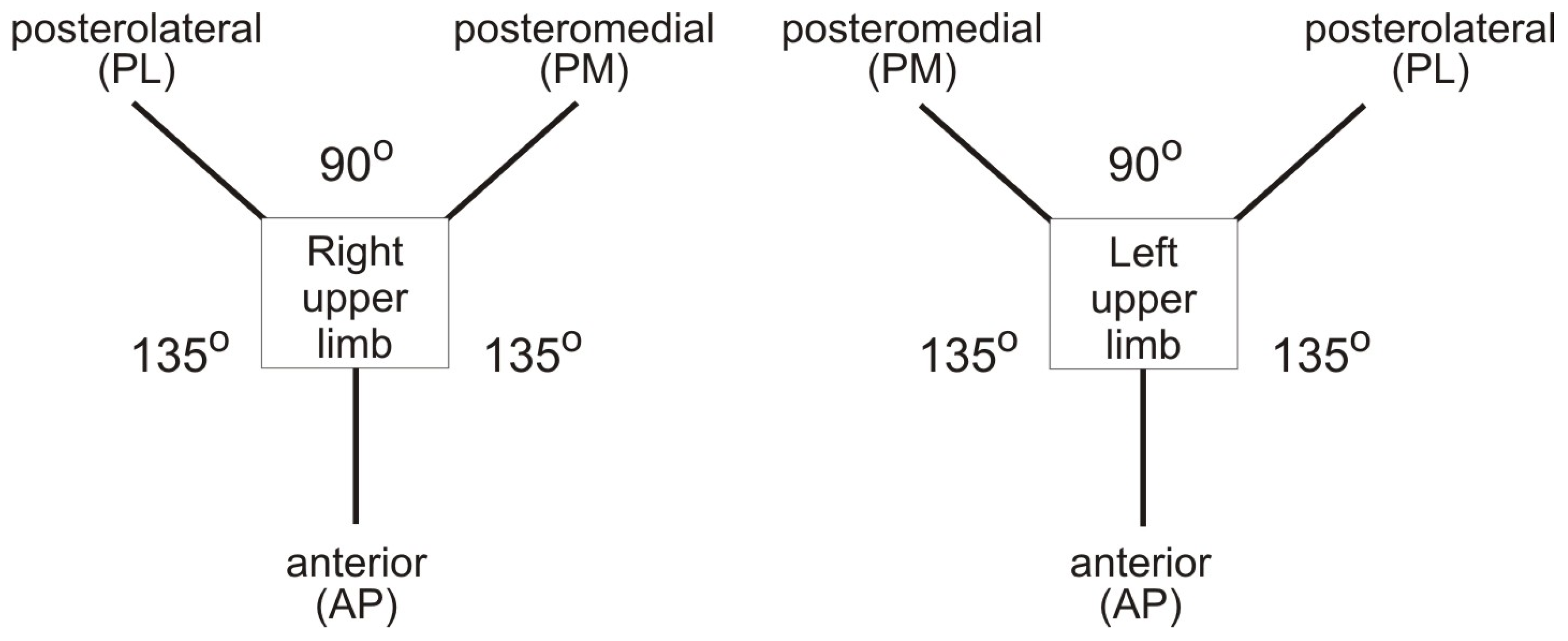
The Upper Quarter Y-Balance Test (UQYBT) was used to evaluate upper-extremity stability, mobility, and inter-limb functional symmetry. During the assessment, participants assumed a push-up position with their feet placed hip-width apart and both hands positioned on the center platform. While supporting body weight on one arm, participants reached with the contralateral arm in three directions—anterior (AP), posteromedial (PM), and posterolateral (PL)—by pushing the reach indicator as far as possible while maintaining balance and keeping the supporting hand in contact with the platform (
Figure 1). Reach distances were attributed to the reaching limb. Therefore, when participants supported their body weight on one upper limb, the reach distance obtained with the contralateral upper limb was recorded for the reaching limb and used for further analyses.
For the UQYBT, participants were tested using a standardized sequence. The right upper limb was assessed first, followed by the left upper limb. Within each limb, reach directions were performed in the order of AP, PM, and PL.
Each participant performed three successful trials in each reach direction for each upper limb. The greatest reach distance achieved in each direction was retained for further analysis. Reach distances were subsequently normalized to upper-limb length and expressed as a percentage of limb length according to the following equation [
14]:
Short rest intervals were provided between consecutive trials and between testing of the two upper limbs to minimize fatigue; however, the exact duration of these intervals was not formally recorded. Trials were considered unsuccessful and repeated if the participant lost balance, removed or repositioned the supporting hand from the platform, lifted either foot from the floor, touched the floor with any body part other than the designated support points, demonstrated excessive body or trunk tilt that compromised the required push-up position, was unable to complete the reach movement in a controlled manner, or failed to return to the starting position following the reaching task.
Prior to testing, upper-limb length was measured with participants standing upright as the linear distance from the spinous process of the seventh cervical vertebra (C7) to the distal tip of the middle finger of the tested limb, with the shoulder abducted to 90°, the elbow fully extended, and the fingers extended [
16]. This measurement was used to normalize reach distances and calculate composite performance indices.
A composite index (
) was calculated separately for each upper limb using the following equations:
where AP represents the anterior reach distance, PM the posteromedial reach distance, and PL the posterolateral reach distance.
The composite inter-limb symmetry index (
was calculated using the following formula:
Similarly, hand grip strength (
) was calculated according to the following equation:
2.3. Statistical Analysis
Statistical analyses were performed using Python (version 3.11) with computational packages including SciPy (version 1.11.4). Data normality was assessed using the Shapiro–Wilk test. As all variables demonstrated a normal distribution (p > 0.05), parametric statistical methods were applied.
Inter-limb differences in hand grip strength, UQYBT reach distances, and Composite Indexes (
) values were evaluated using paired Student’s
t-tests. Effect sizes were calculated using Cohen’s
dz and interpreted as trivial (<0.20), small (0.20–0.49), medium (0.50–0.79), and large (≥0.80) [
27].
Associations between hand grip strength of both upper limbs, dynamic stability variables, and asymmetry indices were examined using Pearson’s correlation coefficients (
r). Correlation strength was interpreted as weak (|
r| < 0.30), moderate (0.30–0.49), strong (0.50–0.69), and very strong (≥0.70) [
28].
4. Discussion
The present study investigated upper-limb functional asymmetry and dynamic stability in experienced taekwon-do athletes using the Upper Quarter Y-Balance Test (UQYBT) and hand grip strength assessment. The main findings demonstrated selective inter-limb asymmetry in upper-limb dynamic stability, whereas overall hand grip strength and composite dynamic stability remained relatively symmetrical between limbs. Additionally, maximal grip strength was not significantly associated with dynamic stability performance or asymmetry indices.
4.1. Interpretation of Inter-Limb Asymmetry
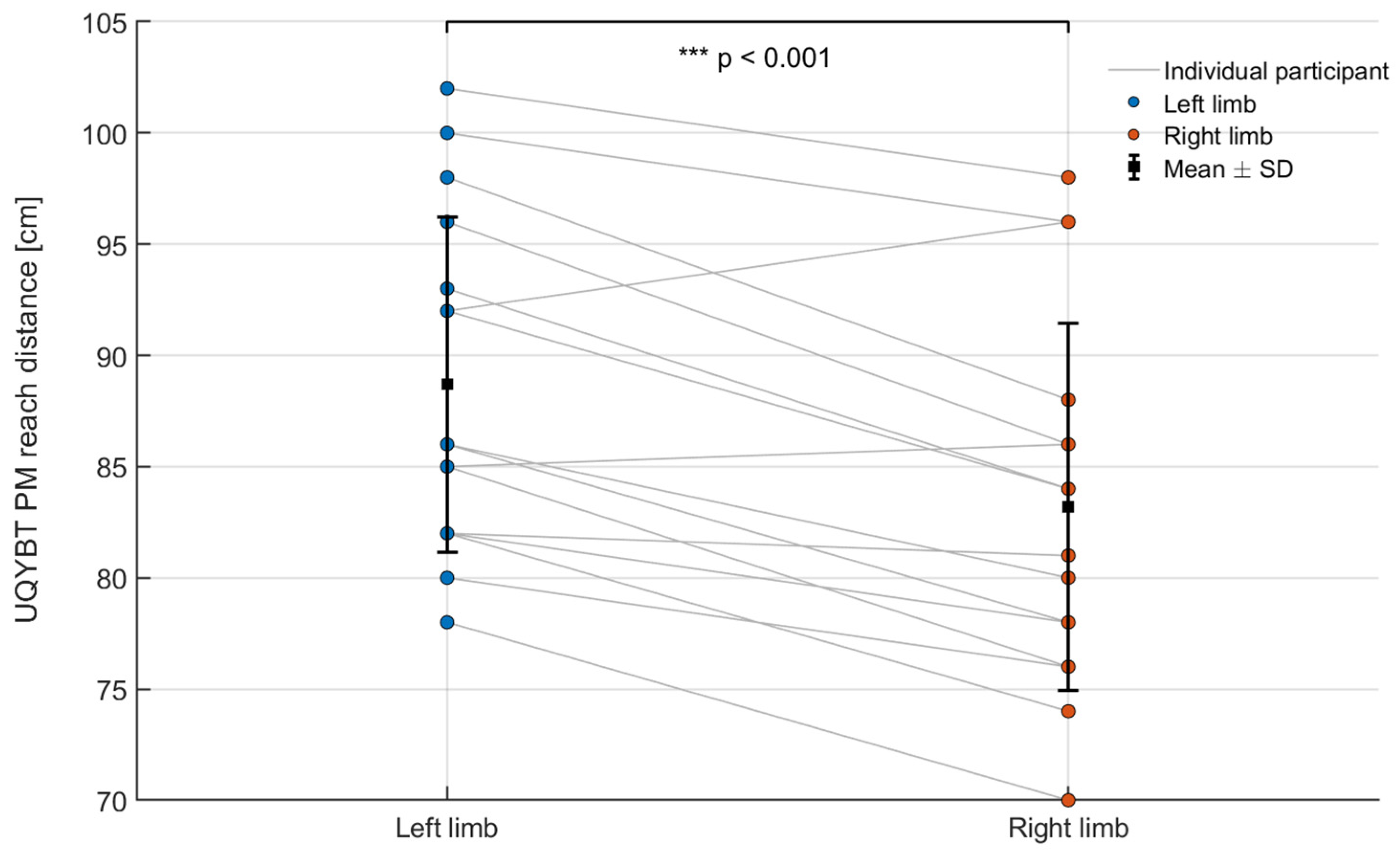
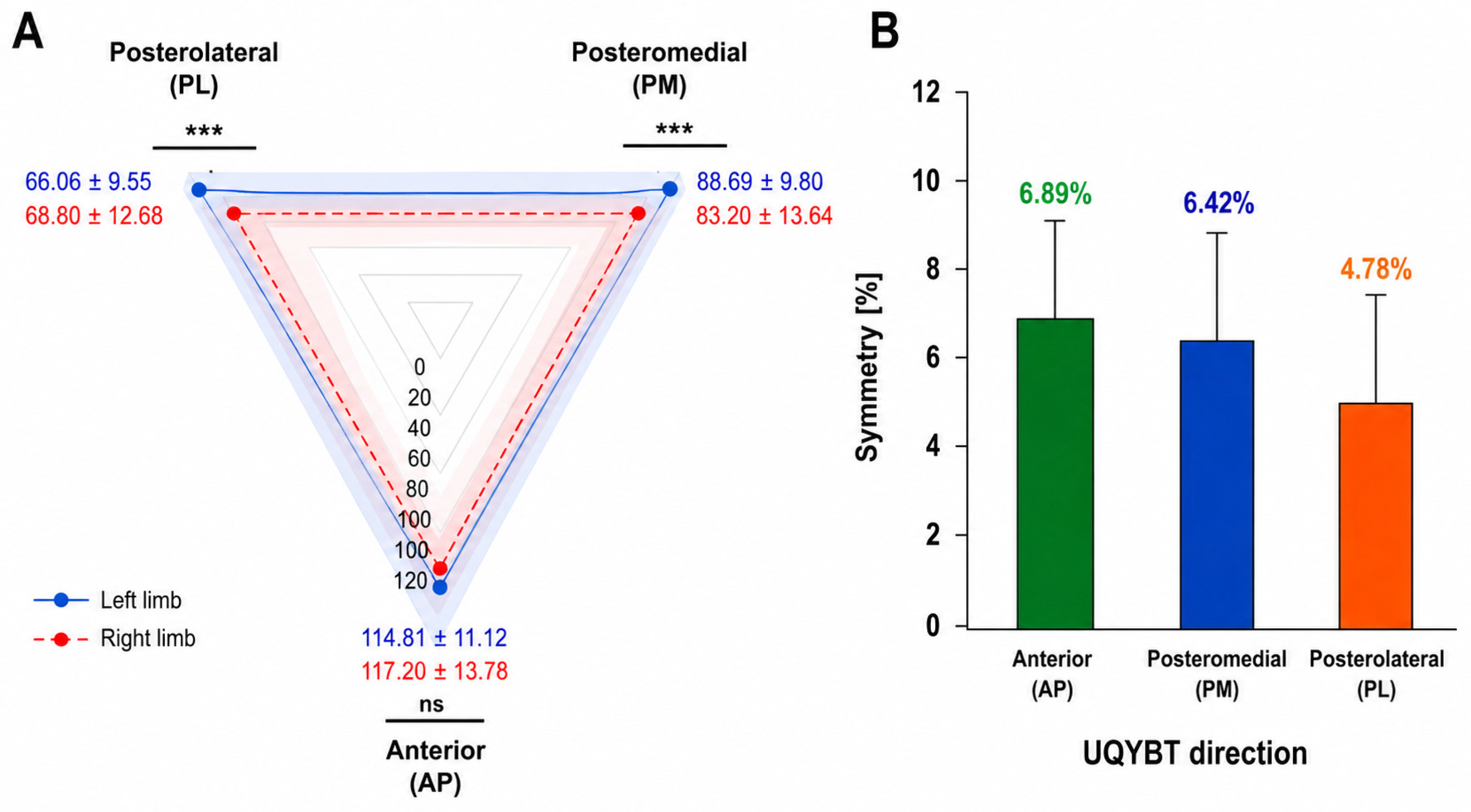
One of the most important findings of the present study was the presence of movement-specific asymmetry in the posteromedial (PM) direction of the UQYBT. In contrast, no significant inter-limb differences were identified for the anterior (AP), posterolateral (PL), or Composite Index () values. These findings suggest that experienced taekwon-do athletes develop selective sport-specific neuromuscular adaptations rather than generalized asymmetry across all movement tasks.
Taekwon-do is characterized by repetitive unilateral actions, asymmetrical fighting stances, and rapid changes in body position, which may contribute to the development of directional asymmetry. Repeated execution of offensive and defensive techniques may promote side-specific adaptations in neuromuscular coordination, postural stabilization, and closed kinetic chain control. Previous biomechanical analyses in taekwon-do athletes demonstrated differences in effective mass generation and movement execution between kicking techniques and athlete characteristics, supporting the presence of sport-specific functional adaptations [
29]. Furthermore, studies conducted in combat sports have shown that dynamic technical actions are accompanied by specific muscle activation patterns and neuromuscular control strategies that may influence stability performance and inter-limb coordination [
30]. Similar sport-specific asymmetrical adaptations have been reported in athletes practicing handball, baseball, and other unilateral sports, where repetitive movement patterns contribute to inter-limb differences in upper-quarter mobility and stability [
17,
31].
Interestingly, despite the asymmetry identified in the PM direction, the Composite Index values remained symmetrical between limbs. This finding may indicate that athletes are capable of maintaining overall upper-limb functional balance despite directional differences in selected movement patterns. Such compensation mechanisms may potentially reflect long-term neuromuscular adaptation resulting from systematic training exposure.
Current evidence suggests that asymmetry should not always be interpreted as pathological dysfunction, particularly in highly trained athletes exposed to repetitive unilateral movement patterns. In highly trained athletes, asymmetrical movement strategies may represent functional sport-specific adaptations associated with technical specialization and repeated unilateral loading [
16]. However, excessive asymmetry may still influence movement efficiency and potentially increase injury susceptibility [
17].
4.2. Relationship Between Strength and Dynamic Stability
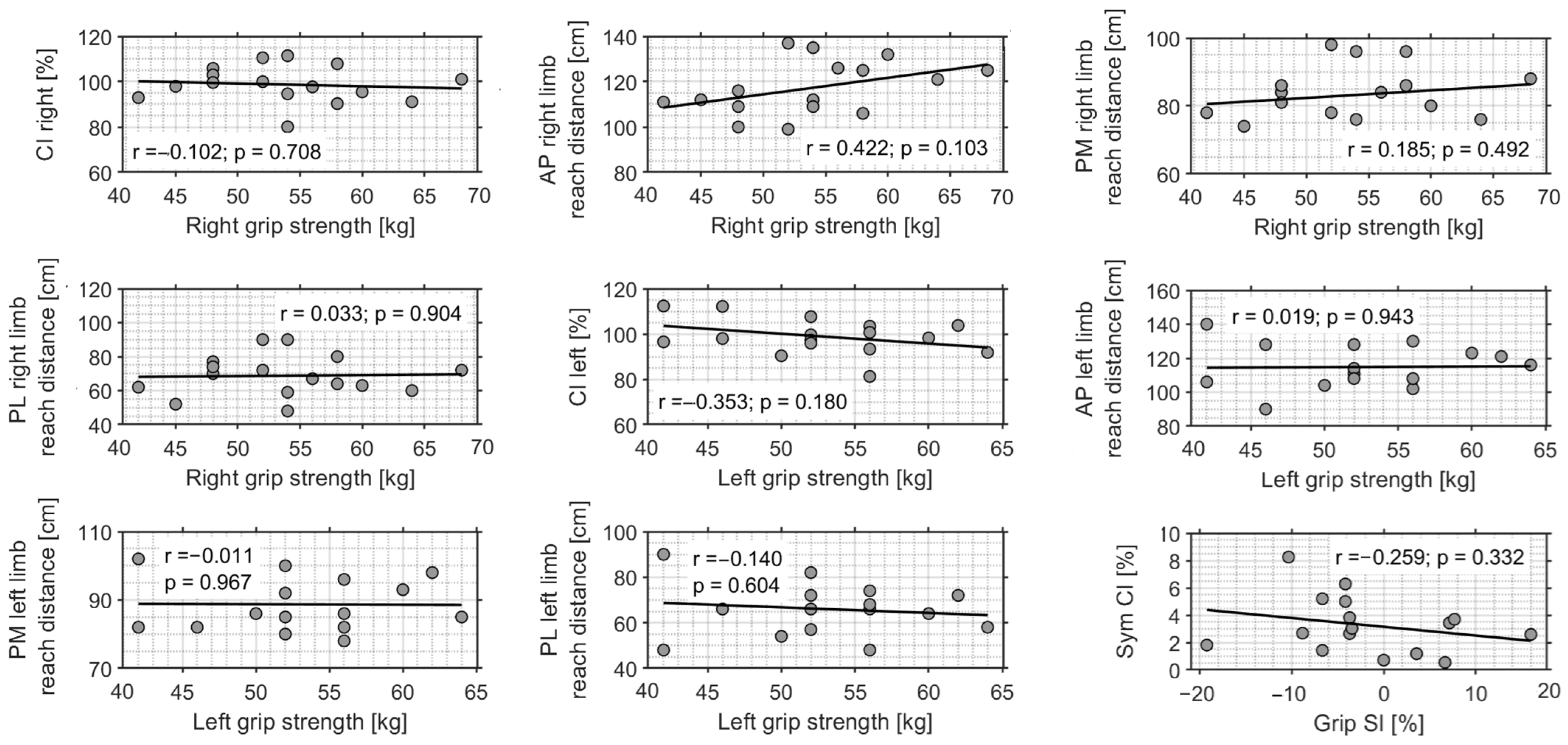
Another important observation of the present study was the absence of significant correlations between hand grip strength and dynamic stability performance. Neither maximal grip strength nor grip symmetry indices were significantly associated with Composite Index values or asymmetry measures.
These findings suggest that dynamic upper-limb stability in taekwon-do athletes depends primarily on neuromuscular coordination, proprioception, trunk stabilization, and shoulder control rather than isolated maximal force production. Previous studies in physically active and athletic populations have emphasized the importance of neuromuscular efficiency, reaction capacity, and sensorimotor control for functional movement performance and stability regulation [
32,
33]. Recent evidence further suggests that sport-specific performance and movement quality are strongly influenced by neuromuscular coordination patterns, which may be altered by fatigue and training load, highlighting the importance of coordination-related adaptations beyond isolated strength measures [
34].
Although grip strength is commonly considered a general indicator of upper-extremity function, the UQYBT requires complex sensorimotor integration and closed kinetic chain stabilization abilities that may not directly depend on maximal strength capacity alone [
35]. Interestingly, the relationships observed for the left upper limb were consistently negligible-to-weak, whereas the right upper limb demonstrated slightly stronger, although still statistically non-significant, associations with selected UQYBT variables. This may indicate a greater functional involvement of the dominant limb in sport-specific stabilization and movement control strategies developed through long-term taekwon-do practice.
The UQYBT has previously been identified as a reliable and reproducible tool for evaluating upper-extremity mobility, stability, and neuromuscular control in athletic populations [
15]. Furthermore, the UQYBT may help identify movement asymmetries and potential injury risk in athletic populations [
36].
The strongest relationship observed in the present study was the moderate association between grip strength and posterolateral (PL) reach performance; however, this relationship did not reach statistical significance. Importantly, this association was identified only for the right upper limb, while no comparable tendency was observed for the left limb. The relatively small sample size may have reduced statistical power and limited the detection of weaker associations. Therefore, future studies involving larger cohorts and additional biomechanical or electromyographic assessments are warranted.
4.3. Practical Applications
The present findings have several practical implications for coaches, physiotherapists, and strength and conditioning specialists working with taekwon-do athletes. First, the observed movement-specific asymmetry indicates that upper-limb functional screening may provide valuable information regarding sport-specific neuromuscular adaptations and movement strategies.
The Upper Quarter Y-Balance Test appears to be a useful tool for identifying directional asymmetry and monitoring upper-limb dynamic stability in combat sports athletes. Previous studies demonstrated high reliability of the UQYBT, with excellent test–retest reproducibility and strong practical applicability in athletic populations [
15,
37].
Monitoring inter-limb asymmetry may support individualized training planning, neuromuscular conditioning, and injury prevention strategies. Importantly, asymmetry should be interpreted cautiously because asymmetrical movement patterns are not always associated with dysfunction or elevated injury risk [
17]. Since asymmetry in the present study was limited to a specific movement direction and was not accompanied by reduced overall stability or grip strength deficits, it may represent a functional adaptation rather than clinically relevant dysfunction.
Additionally, practitioners should avoid relying exclusively on hand grip strength when evaluating upper-limb function in taekwon-do athletes. Multidimensional assessment protocols combining strength, dynamic stability, neuromuscular control, and asymmetry analysis may provide a more comprehensive evaluation of athlete preparedness and functional performance.
4.4. Study Limitations
Several limitations of the present study should be acknowledged. First, the relatively small sample size limits the generalizability of the findings and may reduce statistical sensitivity for detecting weaker correlations. Second, hand dominance was self-reported rather than determined using a standardized laterality questionnaire. Another limitation is that sport-specific stance preference and dominant kicking side were not analyzed, although these variables may substantially influence upper-limb asymmetry patterns in taekwon-do athletes. Third, the cross-sectional design does not allow conclusions regarding causal relationships between strength and dynamic stability variables.
Furthermore, only selected measures of upper-limb function were included in the study. In particular, handgrip strength was used as a practical indicator of upper-extremity strength; however, it does not fully capture the contributions of other muscle groups involved in dynamic stabilization tasks and may have limited predictive value for complex athletic performance. Therefore, the observed lack of association between grip strength and UQYBT performance should be interpreted with caution. Future studies should incorporate additional assessments of upper-body strength, such as isometric shoulder strength measurements, pushing performance tests, or bench press evaluations, to provide a more comprehensive understanding of the relationship between strength and upper-limb dynamic stability. Additional biomechanical, electromyographic, and kinematic analyses could provide deeper insight into the neuromuscular mechanisms underlying asymmetry in taekwon-do athletes. Future studies should also include female athletes and compare athletes representing different training levels and combat sport disciplines.