1. Introduction
A regular examination of excited HVR is essential because it includes a wide array of self-stimulated and externally forced nonlinear systems observed in engineering, physics, and biological domains. Examining its bifurcation structures and chaotic dynamics enhances the understanding of complex oscillatory behaviour, improves stability predictions under external disturbances, and aids in design, regulation, and optimization of systems where hybrid nonlinear damping and resonance-induced chaos are essential. A one degree of freedom (1DOF) self-sustained oscillator was introduced to simulate the lateral fluctuations of a person traversing a periodically moving floor, namely on a shaky table [
1]. The reaction of the HVR to periodic stimulation was analyzed [
2]. This self-sustained oscillator was initially designed to mimic the cross ground force exerted by a human moving on a hard surface, based on extensive experimental records. The interaction between pedestrians and vibrating structures is a familiar and complex phenomenon to simulate. Nevertheless, its significant impact on the structural response, no adequately stated and experimentally validated model currently exists to describe this interaction in the vertical direction. A 1DOF of mass–spring–damper model of a walking human was employed to mimic its interaction with a vibrating structure [
3]. The ODEs of the vertical dynamic collaboration related to a simpler human–structure model were derived from a mass–spring–damper model and a mass–spring–damper–rigid mass model, utilizing the regularization structure modal function [
4]. The effect of vertical human–structure interaction on the dynamic response of footbridges to pedestrian inputs was examined using a comprehensive crowd model [
5]. A theoretical model was created to analyze a bridge’s vibrational response to pedestrian movement, aimed at improving human–structure interaction in the vertical axis [
6]. Bridges and pedestrians are characterized as mechanical systems with a multi DOF. Given the extensive use of large-span and flexible structures, it is crucial to evaluate the impact of high population density on structural stability and safety; therefore, examining the interaction between the human body and the structure was essential [
7]. The steady-state response of a generalized linked modulated pedestrian–beam system was analytically analyzed [
8]. Pedestrians were considered modulated spring–mass–damper systems, both with/without a partially attached mass to the structure. Currently, there is an increasing interest in the evaluation of vibration serviceability of composite footbridges. The analysis indicated that composite footbridges, being slender civil buildings, may experience significant deflections or uncomfortable vibrations due to the stress exerted by pedestrian traffic [
9]. A pedestrian lateral force hybrid van der Pol–Rayleigh model was used to analyze the interaction dynamic model of a pedestrian–flexible footbridge lateral coupling system [
10]. The current methodology markedly diverges from all prior works, since it employs a fundamentally different conceptual framework and operational strategy. In contrast to previous methods that emphasized traditional methodologies and restricted optimization strategies, the suggested methodology incorporates a more thorough and systematic approach that improves both efficiency and dependability. Moreover, it rectifies various shortcomings identified in previous research by implementing enhanced analytical methods, increased flexibility to diverse settings, and a more resilient framework for attaining precise and consistent outcomes.
The HVR is noteworthy as it integrates two fundamental nonlinear damping mechanisms: van der Pol’s self-excited, amplitude-regulating dissipation and Rayleigh’s velocity-dependent energy balance into a consistent dynamical model. This hybrid model exhibits a broader spectrum of self-sustained oscillatory activity, including complex limit-cycle dynamics, bifurcations, and stability characteristics, rendering it a more accurate representation of actual physical and engineering systems. A study was performed on the dynamics of a hybrid van der Pol–Rayleigh oscillator, commonly employed in the literature to model human and bipedal robotic locomotion [
11]. Qualitative and bifurcation analysis revealed novel dynamics distinct from those of van der Pol and Rayleigh oscillators. The sensitivity of the Casimir force was investigated using a micro-cantilever subjected to dynamic forces in heptagonal processes [
12]. A unique forced van der Pol–Rayleigh-Helmholtz nonlinear oscillator was created to characterize the nonlinear dynamics of the micro-cantilever subjected to simultaneous stimulation and Casimir forces. An inquiry was conducted into the formation and development of self-oscillatory regimes inside a nonlinear dynamic system regulated by a general van der Pol oscillator [
13]. Conditions of the presence of limit cycles are established by asymptotic and bifurcation analysis, and their stability is evaluated. The complex Rayleigh–van-der-Pol–DOs, distinguished by hyper chaotic behaviour, were examined and may be classified as either autonomous or non-autonomous [
14]. A 1DOF oscillator was developed to accurately model the lateral force exerted on a rigid floor by human walking [
15]. A hybrid Rayleigh–van der Pol–Duffing oscillator’s vibrations were reduced by using time delay feedback [
16]. This system exhibited a 1DOF, incorporating cubic and quintic nonlinear terms together with an external force. An analysis was conducted on the periodic complex bursting dynamics of a hybrid Rayleigh-der Pol-DO, influenced by external and parametric slowly varying excitations [
17]. El-Dib [
18] proposed a straightforward and efficient novel approach to investigate the damping quadratic–cubic nonlinear oscillation in physical phenomena, including fluid dynamics, solid-state physics, optics, and plasma physics, as well as dispersion and convection systems without perturbation. The nonlinear damping oscillation was transformed into its corresponding linear oscillation. Coupled non-oscillatory Rayleigh–DOs bifurcate into periodic oscillations, as examined in [
19]. Various dynamical states were analyzed via numerical and analytical methods. The internal dynamics of the Rayleigh oscillator were examined instead of van der Pol’s equation, as the principal damping force depended solely on velocity [
20].
To investigate nonlinear oscillations, Professor Ji-Huan He adapted HFF. He shortened amplitude–frequency representations of nonlinear oscillators and suggested improvements to the original paradigm. The selection of an assessment point is a prerequisite for both the original and enhanced versions; however, no standardized structure for this decision was established [
21]. To quickly estimate the amplitude–frequency curve of oscillators displaying discontinuities, researchers used the weighted-residual approach [
22]. This method produces perfect outcomes with negligible processing, and a specific criterion in identifying assessment points was proposed [
23]. A plethora of researchers have successfully adopted HFF. A research examined a potential solution of a nonlinear oscillator at a certain frequency, created a novel trial function, and verified its efficacy on Duffing oscillator (DO) [
24]. HFF, which was developed from an old Chinese mathematical method, is still a powerful framework for solving nonlinear vibration problems. A further theoretical analysis suggested a new formulation and validated the method’s efficacy in real-world situations [
25]. Additionally, by distinguishing a nonlinear oscillator from its linear counterpart in relevant domain, researchers established an exact correlation between amplitude and period of governing ODE [
26]. An integer parameter in the amplitude-period expression can be appropriately changed in each scenario; this approximation was contrasted with the traditional HFF in a number of illustrative instances [
27]. By choosing an appropriate weighting function inside the goal function, a method for evaluating the ideal period of a conservative nonlinear oscillator was developed, estimated period roughly approximates precise value in several typical scenarios [
28]. The highly nonlinear DO is utilized as a standard to assess the accuracy of the improved method [
29]. To mitigate the challenges inherent in conventional perturbation techniques, researchers employ NPA in the domains of dynamical systems [
30,
31,
32].
The experimental analysis and clarification of bifurcation structures and chaotic dynamics in a periodically excited modified HVR through a novel approach hold considerable practical importance across various engineering and applied science fields, as these oscillators serve as canonical models of self-excited, nonlinear dissipative systems featuring both van der Pol-type nonlinear damping and Rayleigh-type velocity-dependent effects prevalent in real-world devices. From an experimental standpoint, systematically outlining bifurcation scenarios—such as period-doubling cascades, quasi-periodicity, intermittency, interior crises, and the coexistence of multiple attractors—provides critical insights into the emergence of chaos and the sensitivity of systems to parametric variations, excitation amplitude, and forcing frequency, thereby enhancing the reliability of predictions and control of nonlinear dynamics in practical applications. In contrast, the regulated utilization of chaos, guided by experimentally confirmed bifurcation structures, presents prospects in secure communications, random signal generation, and broadband energy harvesting, where chaotic dynamics can improve robustness, signal concealment, or power extraction efficiency. In electrical and electronic circuits, particularly in nonlinear oscillators used in signal processing and radio-frequency (RF) systems, understanding the dynamics of the HVR oscillator under periodic excitation is crucial. Such understanding helps mitigate unwanted oscillations and enables the tailoring of nonlinear responses to achieve desired spectral characteristics and enhanced system performance. The behaviour of the nonlinear model is analyzed using bifurcation diagrams (BDs), phase portraits, and the Poincaré map (PM), which are crucial analytical tools influencing system dynamics. The Largest Lyapunov exponent (LLE) sheds light on periodic oscillations, offering insights into long-term stability and indicating the absence of chaos.
A novel analytical framework is proposed [
33] to characterize the vibrational behaviour of hemispherical resonators with mass defects, yielding multi-order coupled vibration equations. The findings provide essential insights for enhancing the performance of next-generation navigation systems and other applications necessitating accurate vibration control. They offer novel insights into the combined vibrational dynamics of hemispherical resonators and build a proven theoretical foundation for efficient and high-precision mass trimming procedures. Fluid–structure interaction phenomena in a forced-vibration square prism subjected to cross-wind excitation have been investigated utilizing Large Eddy Simulation with dynamic mesh techniques [
34]. A prediction framework for motion-induced aerodynamic forces in tower structures has been established by employing quantified energy-transfer channels to address significant nonlinearities in vortex-induced vibration. The dynamic and damping characteristics of composite cylindrical shells with multiple viscoelastic damping layers have been extensively examined [
35]. A refined mathematical model is developed, yielding critical insights into optimal design strategies for composite sandwich open cylindrical shells with integrated viscoelastic damping treatments, providing valuable guidance for practical engineering applications in the automotive and aerospace sectors requiring enhanced vibration control.
For further clarification, the article is structured as follows. In
Section 2, we provide a mathematical formulation of the addressed topic. The process for characterizing NPA is presented
Section 3. The stability analysis is addressed in
Section 4. This section also includes the stability tongues as well as Floquet multipliers. The examination of time history is presented in
Section 5. The analysis of the dynamic behaviour is described in
Section 6. The fundamental main outcomes are encapsulated in
Section 7.
3. Methodology of NPA
Several aspects of NPA differ from the classical perturbation techniques. Numerous benefits are taken into account in this context. A weakly nonlinear oscillator of ODE with periodic factors is used to construct another equivalent linear ODE. Remember that the linear ODE really contains all of the parameters in the nonlinear ODE. It is well known that all traditional perturbation methods use Taylor expansion to simplify comparable situations when restoring forces are present. The existing NPA fixes this flaw. Unlike other conventional techniques, the NPA makes it possible to analyze the stability of the situation. The NPA seems to be an interesting, useful, and user-friendly tool. It may be used to analyze many classes of nonlinear oscillators.
The primary goal of NPA has three main restrictions. The following is a summary of these limitations:
- i.
It concerns only weakly nonlinear oscillators of second-order ODEs.
- ii.
In every application, the ICs are unchanged.
- iii.
The initial amplitude must be smaller than unity in order to achieve greater precision.
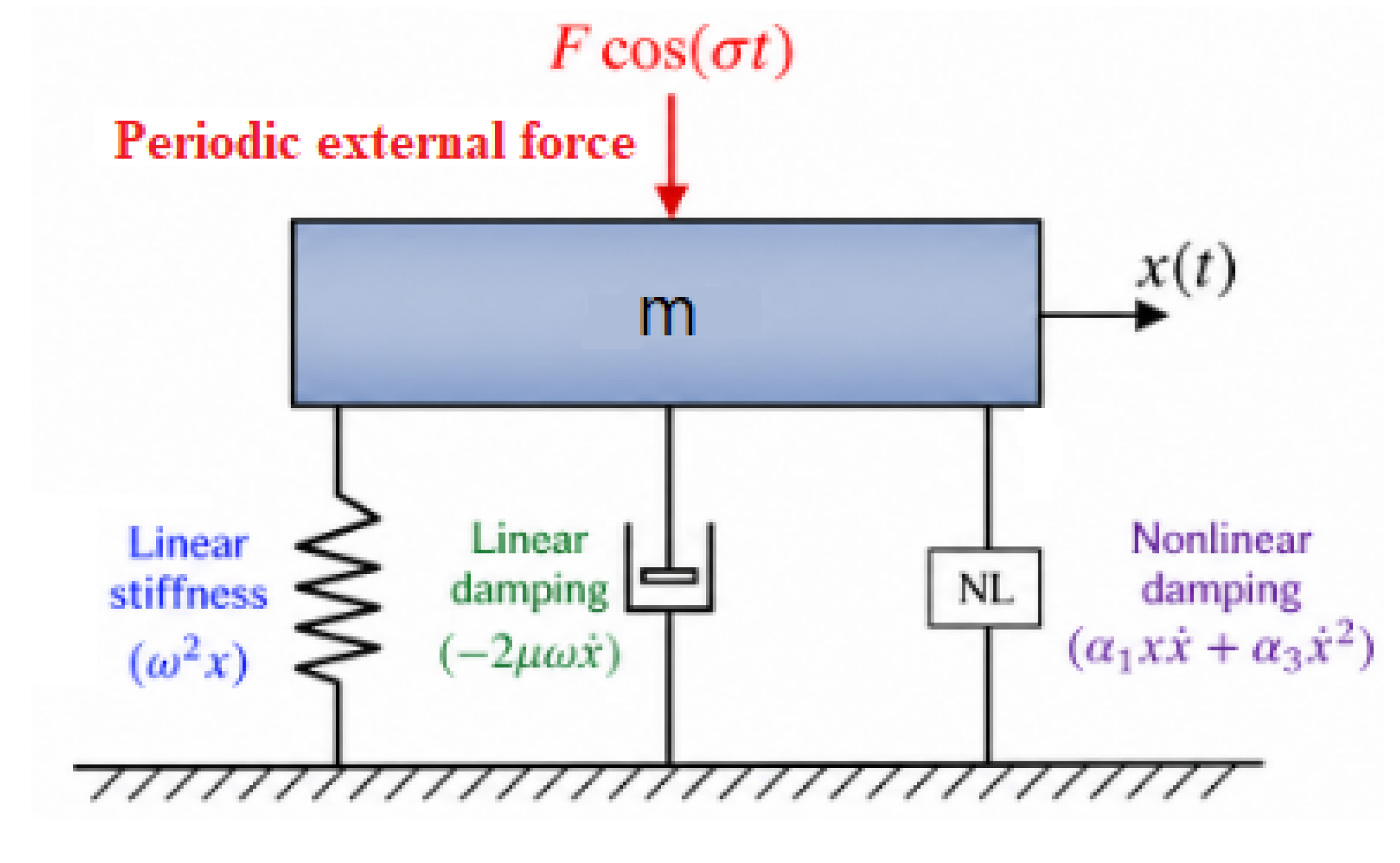
A periodically driven HVR oscillator may be understood as a result of Equation (1). The HPM framework relies heavily on the HFF, which was first presented by Prof. Ji-Huan He. As previously shown [
36,
37], this formulation assesses the frequency of nonlinear oscillators by combining HPM with an averaging process. It provides a systematic analytical expression of substantially nonlinear systems that shows a direct correlation between the appropriate nonlinear frequency and the oscillation amplitude. By integrating throughout a whole oscillation cycle, the NPA captures the system’s periodic nature. In nonlinear oscillatory systems, the frequency deviates from the linear prediction because it often relies on the amplitude. The current approach is especially useful for systems with strong nonlinearities, as it allows a precise frequency estimate without depending on series expansions.
Verification of Method
Examining the dynamical responsiveness and stability properties of a non-autonomous system may be accomplished by converting it into an analogous autonomous representation. By eliminating the direct time dependency of the excitation terms, this reformulation simplifies mathematics and makes it possible to examine the system’s intrinsic resonance and stability characteristics more clearly. In order to transform the original ODE into a nonlinear Mathieu-oscillator, the first step is to integrate the nonhomogeneous term that appears on the right-hand side of Equation (1) with respect to
:
The NPA largely concerns secular concepts, which relate solely to odd functions. The function
can be represented as a constant function with a time-dependent parameter
. This procedure may be termed the “masking technique”. According to El-Dib [
38], the application of the masking technique in nonlinear dynamics, especially in contexts involving periodic forces, represents a strategic and unique scientific approach. This strategy primarily aims to modify the governing ODE of the system to obscure the explicit effect of the periodic force. This reformulation enhances the analytical process while effectively preserving the system’s essential response characteristics to periodic input. The “masking technique” bypasses the direct intricacies of periodic forces while still offering a thorough comprehension of their influence on the system’s behaviour. This method is particularly advantageous in elucidating the intricate dynamics of nonlinear systems affected by periodic forces, hence providing a more effective analytical framework. The implementation of the “masking technique” begins with the initial formulation, as demonstrated by Equation (1) in our study, and advances to effectively remove the explicit depiction of the periodic force. This essential transformation entails formulating an alternate ODE that conceals the impact of the periodic force on the system. The aim is to create a comparable system that replicates the behaviour of the original system under periodic forcing, while excluding the force from the ODE. Equation (1) is obtained using a series of mathematical adjustments or approximations to achieve this result. These stages seek to discreetly incorporate the influence of the periodic force into the system’s dynamics. The incorporation of
as a nonhomogeneous element in Equation (2) obstructs the excitation force from meeting the stability criterion. Moreover, El-Dib [
39] conducted an extensive analysis of the frequency–amplitude formulas for nonlinear oscillators and their advancements. In perturbation methodologies, quadratic or constant nonlinear terms are frequently recast into comparable odd-function forms appropriate for analysis using algebraic and calculus operations, including multiplication, division, differentiation, and integration. The core of the NPA approach is the extraction of odd functions that are related to damping processes and other nonlinear odd terms related to restoring-force features. Nonlinear damping and stiffness effects frequently come from quadratic formulas. The process is based on two primary integrals: the equivalent natural frequency is obtained from the second principal integral, and the equivalent damping coefficient is obtained from the first. Terms involving even-order variables may potentially contribute to either integral, according to the underlying mathematical paradigm. El-Dib [
38,
40,
41,
42,
43,
44] made significant contributions to this discipline by developing and effectively verifying the NPA approach in a number of significant studies. The following connection is used to transform Equation (2) into an equivalent equation with constant coefficients [
38,
40,
41,
42,
43,
44]:
The ODE as shown in Equation (1) offers a clearer framework for examining the dynamics of the system, eliminating the challenges related to time-varying coefficients. Important properties, including stability limits, instability tongues, Floquet multipliers, time–response characteristics, and resonant nonlinear interactions, may be properly studied. Transforming the model into a more understandable form also makes it easier to use sophisticated analytical methods, which results in precise descriptions of the dynamic response and a better comprehension of the equilibrium and total performance of the system. The ODE as given in Equation (1) is transformed into an autonomous form without variable coefficients by using the transformation shown in Equation (3), and it may be stated as follows:
For greater clarity, a comparison of the two nonlinear ODEs as presented in Equations (5) and (9) is carried out in order to verify the earlier method. The values of a chosen system parameter are as follows:
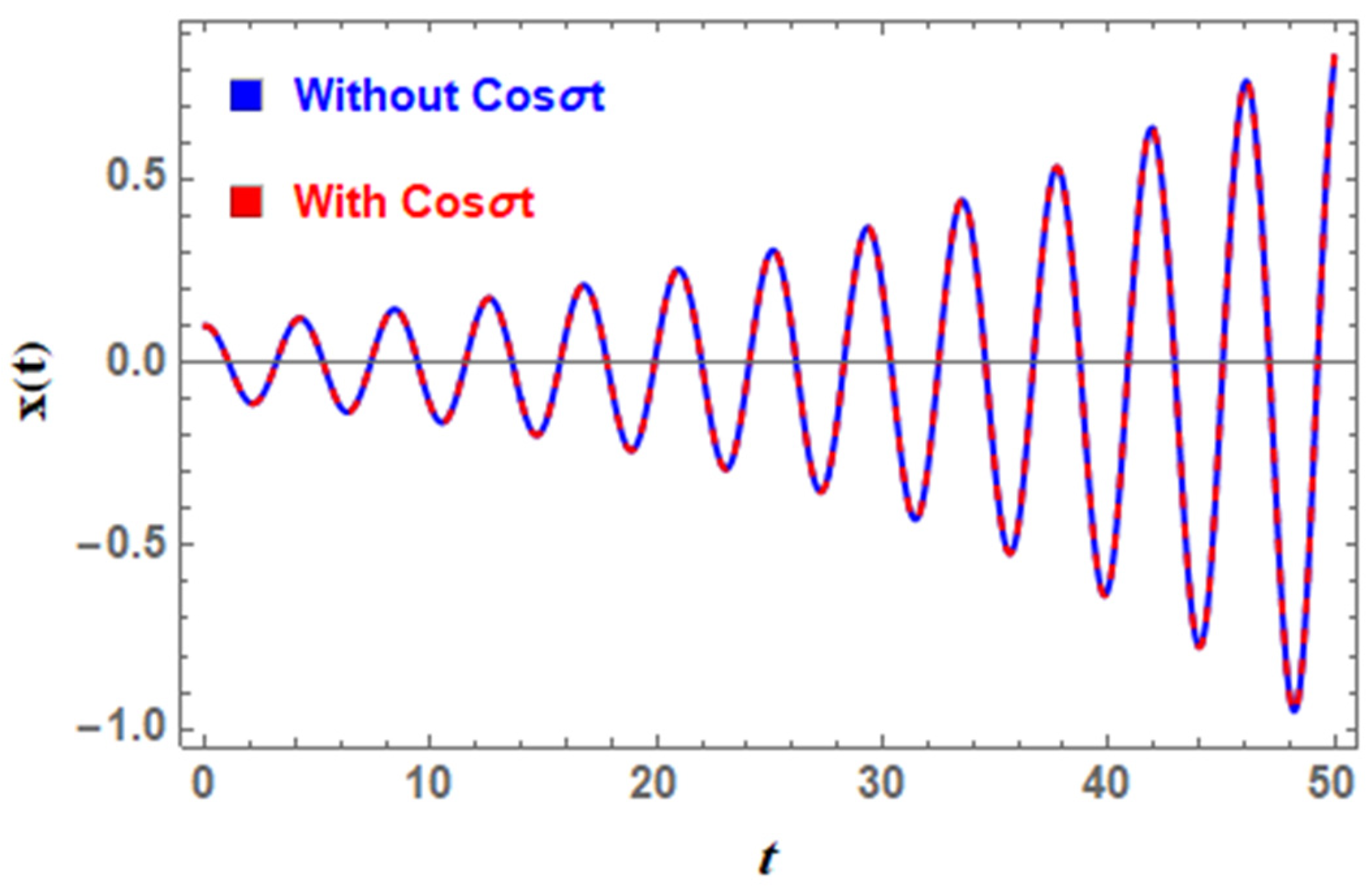
The initial non-autonomous differential equation in Equation (1) and its converted autonomous version in Equation (4) are compared in
Figure 2. The periodic forcing term
is not ignored in the new model; rather, it is represented by a comparable contribution contained in the restoring component as
. The comparison shows that during the course of the simulation, both formulations preserve almost identical dynamic responses, including the oscillatory pattern, phase development, and progressive amplitude attenuation. This demonstrates that the suggested transformation successfully eliminates the direct time-dependent excitation.
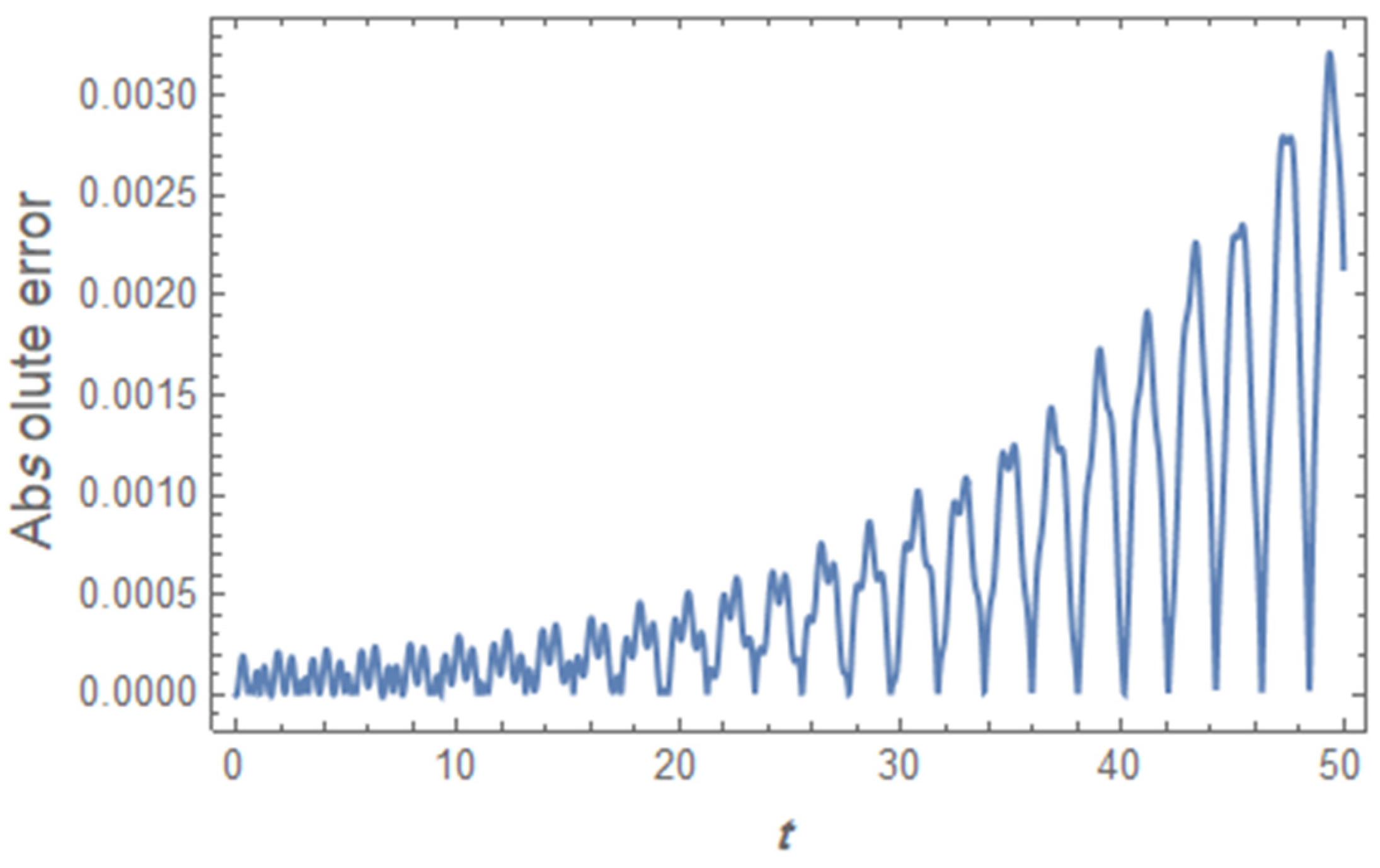
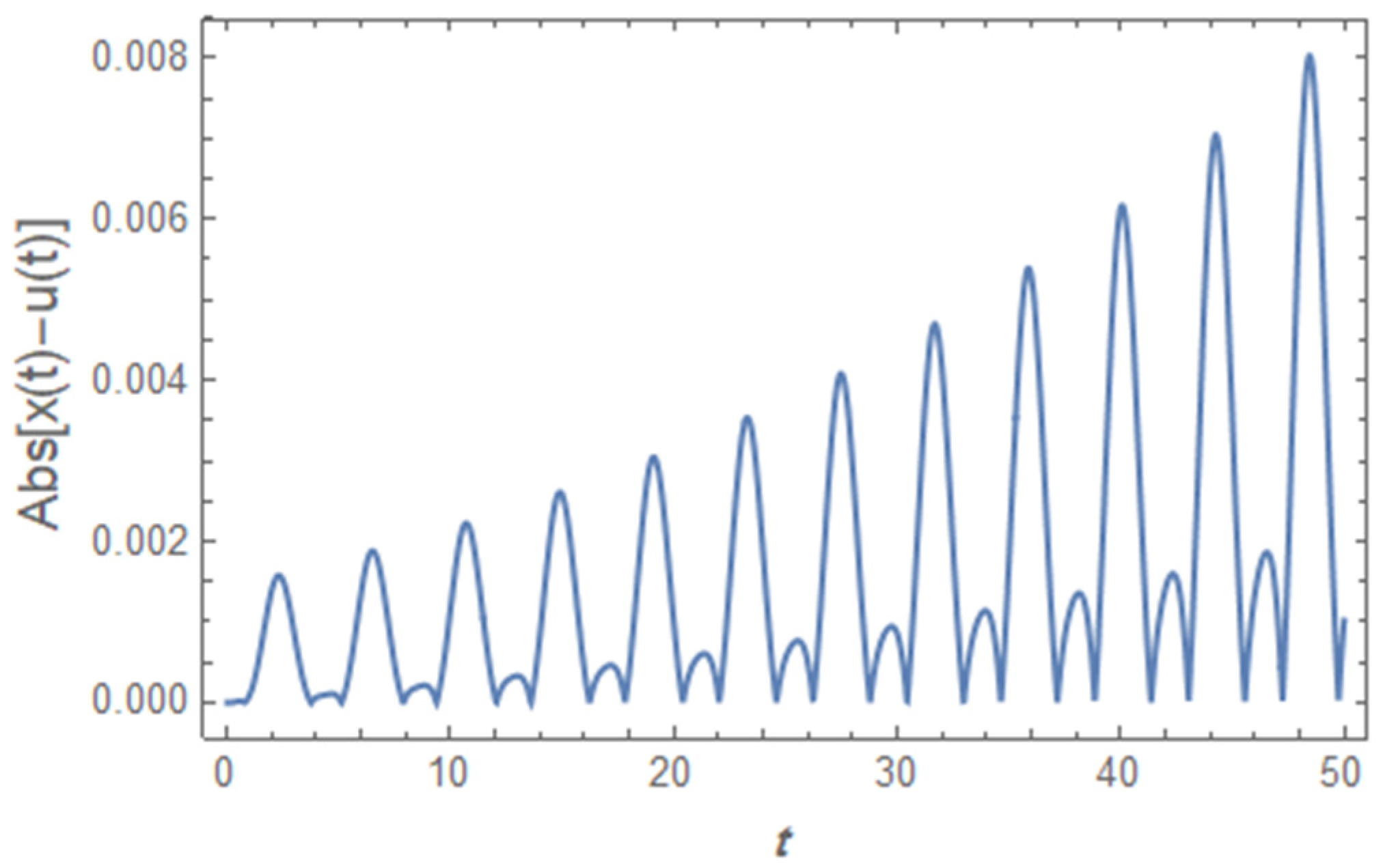
Figure 3 shows the Absolute error between the autonomous and non-autonomous solutions, which offers more confirmation. The error shows a high level of agreement between the two models, staying consistently confined and peaking at about 0.00235. Its oscillatory character, with magnitude on the order of
, further demonstrates the suggested method’s stability and dependability. Thus, an effective and precise framework for studying nonlinear ship roll dynamics is provided by substituting the equivalent contribution
for the explicit excitation term.
Without depending on perturbation expansions or small-parameter assumptions, the NPA analyses the HVR by recasting the original nonlinear ODE into an equivalent linear one. In this context, NPA provides a number of noteworthy benefits: It allows for a more accurate depiction of intricate behaviours such as parametric motion, BDs, and subharmonic resonance, by maintaining the whole nonlinear properties of the restoring and damping factors. For certain initial conditions (ICs), the governing ODE may be numerically solved, which enables the approach to capture large-amplitude rolling movements that are generally outside the scope of traditional perturbation techniques. The formulation exhibits resilience under both regular (periodic) and irregular wave excitations, and it is still applicable for large roll angles, asymmetric hull geometries, and different system complexity levels.
Regarding Equation (1), the suggested ICs are regularly articulated as
Now, Equation (1) could be re-formulated, after integrating the even terms, as
where
defines the odd damping terms and indicates the secular odd terms.
Suggesting a trial solution of the HVR, as assumed by Equation (4), as
where
is specified as the total frequency to be assessed later.
Utilizing the NPA method, the linear ODE that corresponds to Equation (3) may be rewritten by a new function
as Moatimid et al. [
30,
31,
32] and El-Dib et al. [
38,
39,
40,
41,
42,
43,
44]:
where
and
are the consistent damping and consistent frequency coefficients, respectively.
The unidentified new coefficients in Equation (6) are estimated by applying the NPA integrals as Moatimid et al. [
30,
31,
32] and El-Dib et al. [
38,
39,
40,
41,
42,
43,
44]:
and
In
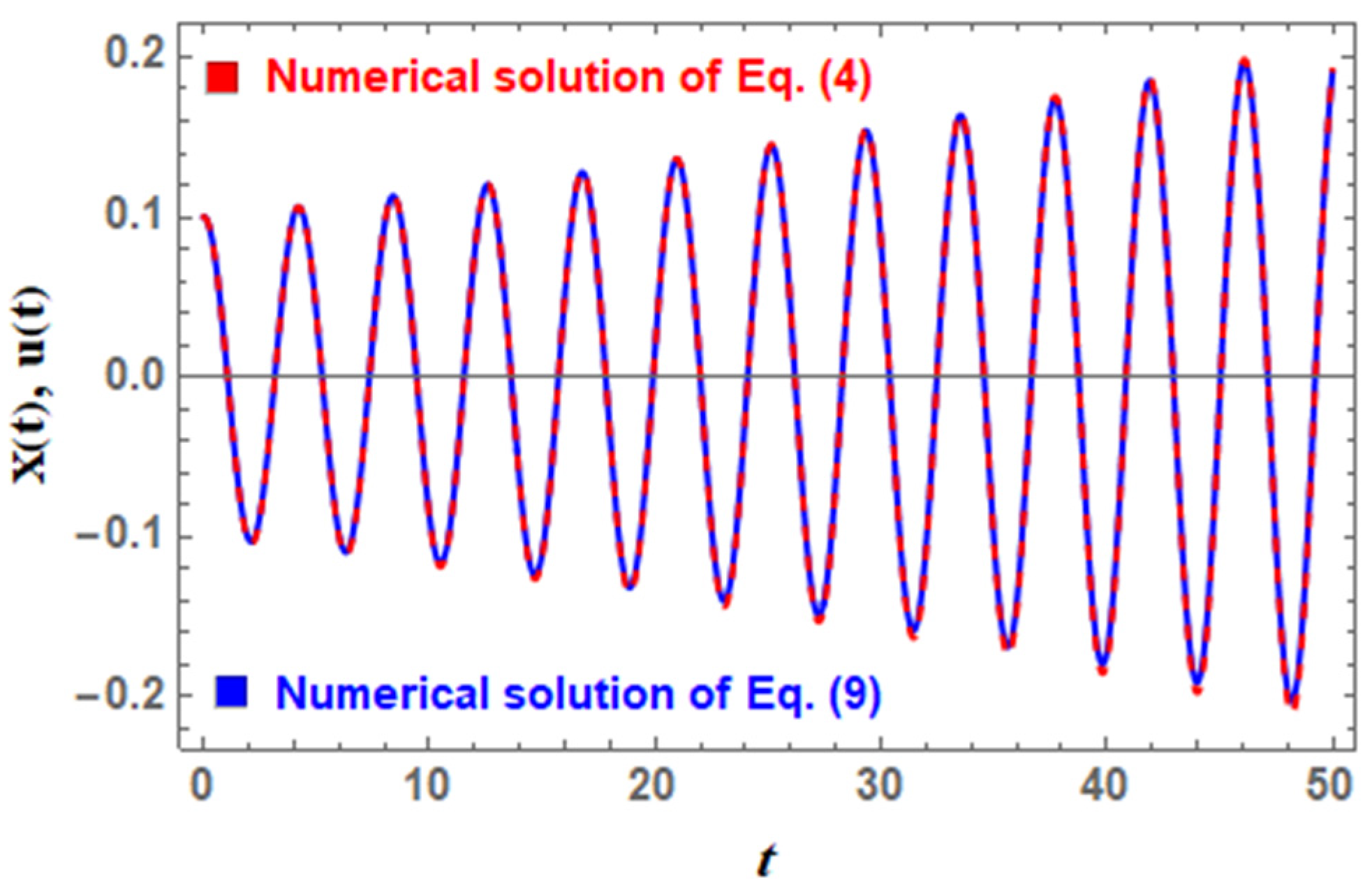
Figure 4, the numerical solution (NS) of the nonlinear HVR as given in Equation (4) and the NPA solution as given in Equation (9) are readily compared. The figure and Absolute error below demonstrate that the two solutions match well, with the maximum error produced being 0.00289 when taking into account the following data:
Therefore,
Figure 5 represents the Absolute error curve between the two solutions of Equations (4) and (9). Excellent convergence between the nonlinear and approximation solutions is shown by the limited oscillatory behaviour of
with a maximum error of less than 8 × 10
−3. The absence of secular growth validates the approximation method’s resilience, but the periodic peaks show transient nonlinear dominance.
The association between the two curves is stronger when their general shapes are notably similar, as illustrated in the accompanying graphic. This indicates that shifting, rotating, and resizing are geometric operations that can effectively align the two curves. A robust correlation is established when both curves exhibit analogous arc-length distribution, orientation, and curvature patterns along their courses. The evident resemblance indicates that they possess analogous curvature radii and tangent orientations, together with other local geometric characteristics. The spatial coherence between corresponding points on the curves can be utilized to objectively assess the quality of alignment. The curves are considered optimally aligned when the cumulative distances between the paired sites are minimized. An optimal geometric transformation, typically involving translation, rotation, and occasionally scaling, is essential in achieving a satisfactory alignment of the two curves. One curve may accurately correspond to its counterpart by this transformation, signifying a substantial degree of similarity. Moreover, for the two curves to align effectively, they must possess significant structural characteristics in common, such as symmetry, recurrent patterns, or analogous inflexion points. The curves demonstrate notable alignment and correspondence when these attributes are consistently linked.
Equation (9) may be represented in its standard form using the usual formula technique. Accordingly, it makes sense to recommend the following change:
The function is now necessary to be assessed.
Substituting Equation (12) into Equation (9), the ODE that governs the unknown function
can be obtained as
which is the traditional Mathieu equation with frequency
, which is realized using the MS version 12.0.0.0 as
4. Stability Analysis
In order to determine the stability profile directly, an analogous linear model is built using the NPA, as shown in Equation (14). This process involves reformulating the original nonlinear governing ODE into a linearized expression with amplitude-dependent effective coefficients that reflect the effects of nonlinear stiffness and damping. This conversion makes the system more agreeable to analytical analysis, while preserving the crucial contribution of quadratic and higher-order nonlinear factors. Consequently, it is possible to directly assess the oscillator’s time-dependent stability behaviour from the form of the associated linear solution. The converted equation adopts the traditional linear oscillator structure with an effective natural frequency and effective damping in its reduced normal form. The sign of the squared resultant frequency parameter is the primary determinant of the motion’s temporal stability. The solution is described in terms of limited trigonometric circle functions (sin and cos) when this amount stays positive, signifying steady oscillatory motion. On the other hand, hyperbolic functions, which indicate the beginning of instability and reflect exponentially rising or declining reactions, are produced when the stability criterion is violated. In addition to clearly defining stable and unstable regions, the accompanying transition curves in the parameter plane shed light on potential bifurcation situations and dynamic transitions. Two essential conditions determine the stability bounds quantitatively: the square of the total oscillation frequency must be positive to ensure oscillatory rather than divergent conduct. The analogous damping factor must be positive to ensure continuous energy dissipation and avoid unbounded amplitude expansion.
By directly connecting the analytical stability conditions to bifurcation thresholds and resonance-induced transitions, these criteria create a physically significant mapping between system characteristics and dynamic performance. The NPA replicates the dynamic behaviour over broad amplitude ranges and parameter changes, as confirmed by NS of all analytical predictions using MS. While remaining completely consistent with the physical mechanisms governing the original ODE, this integrated analytical–numerical approach offers a reliable and effective framework in examining steady-state responses, transient evolution, stability boundaries, and complex nonlinear phenomena.
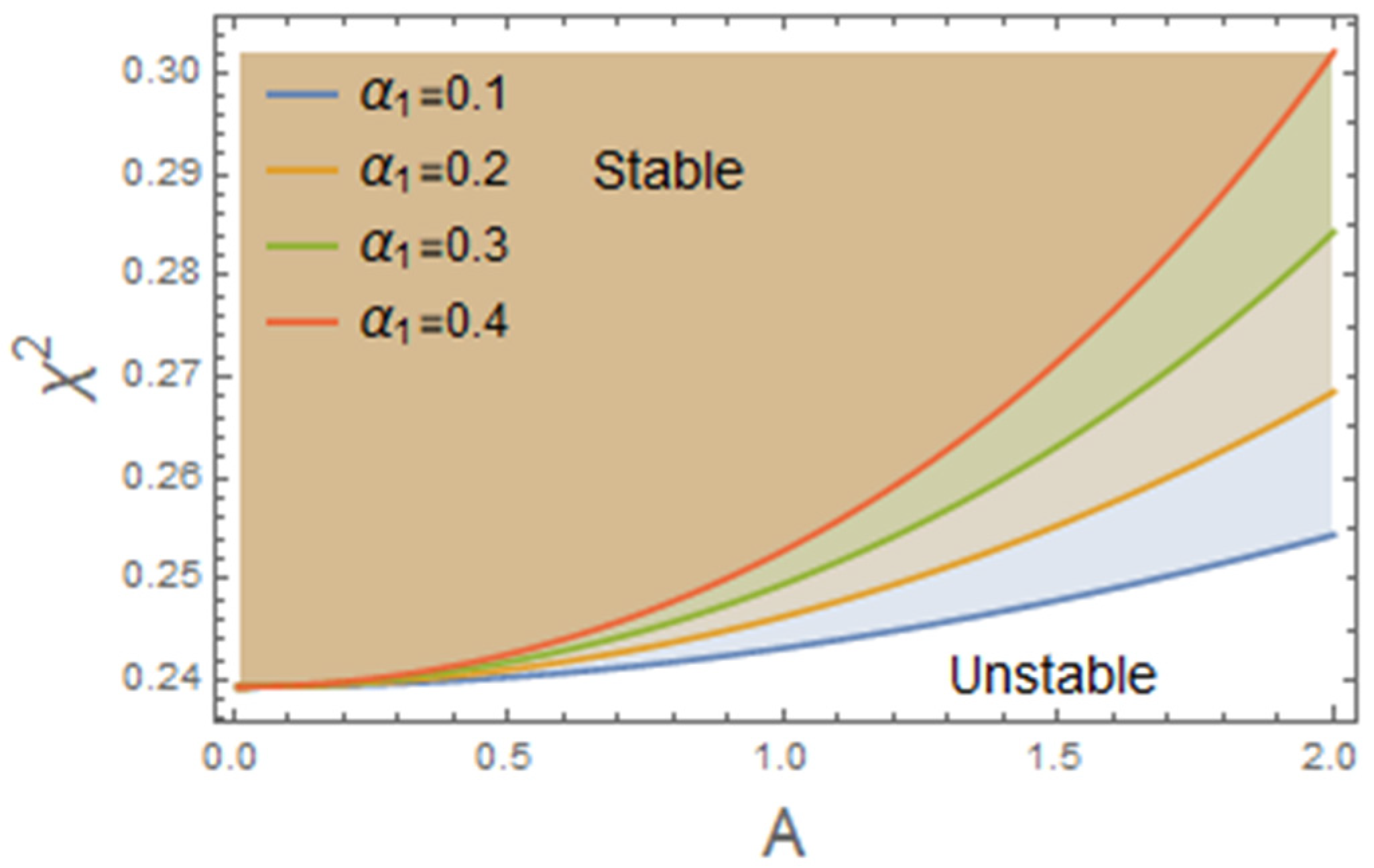
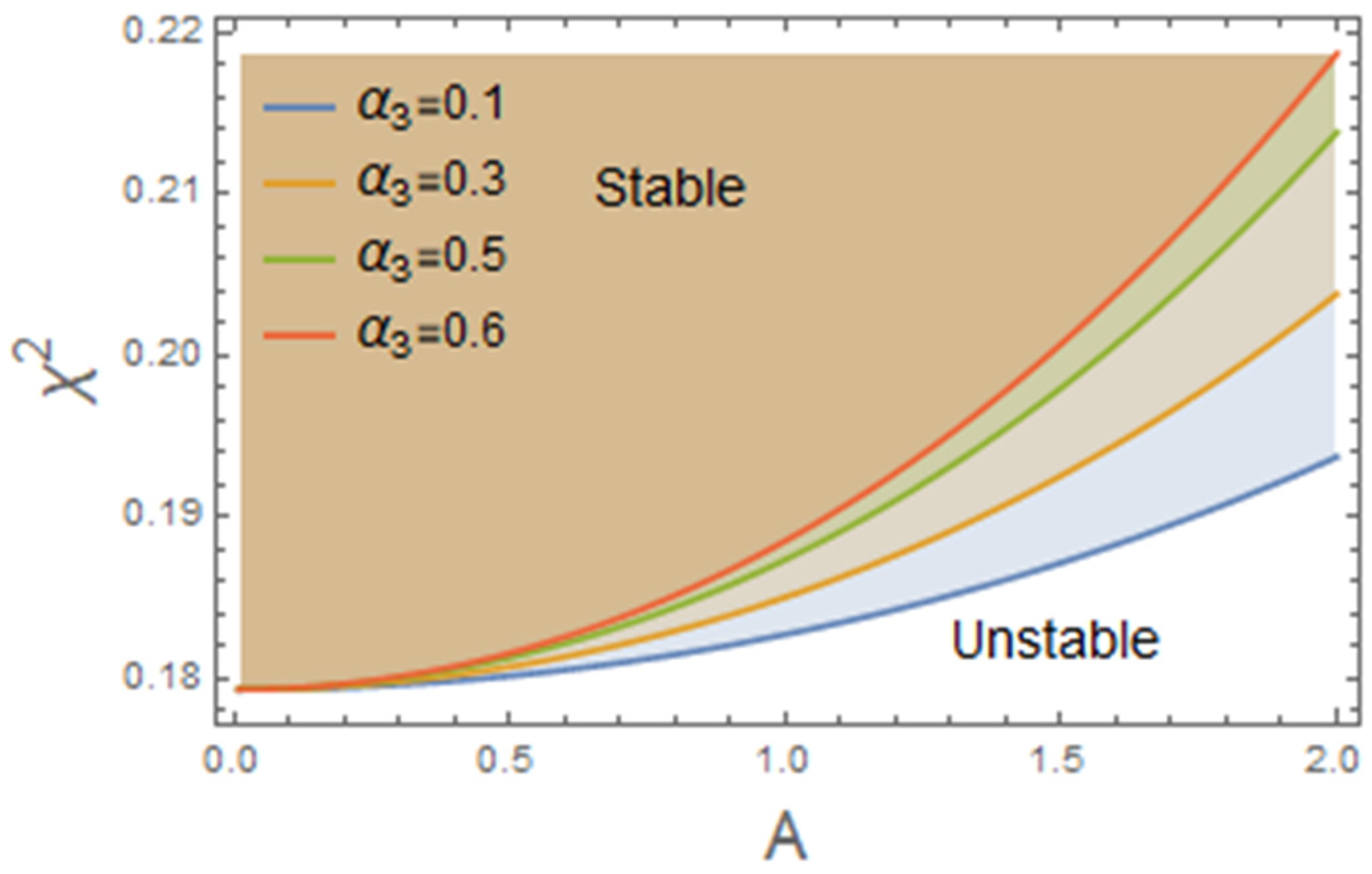
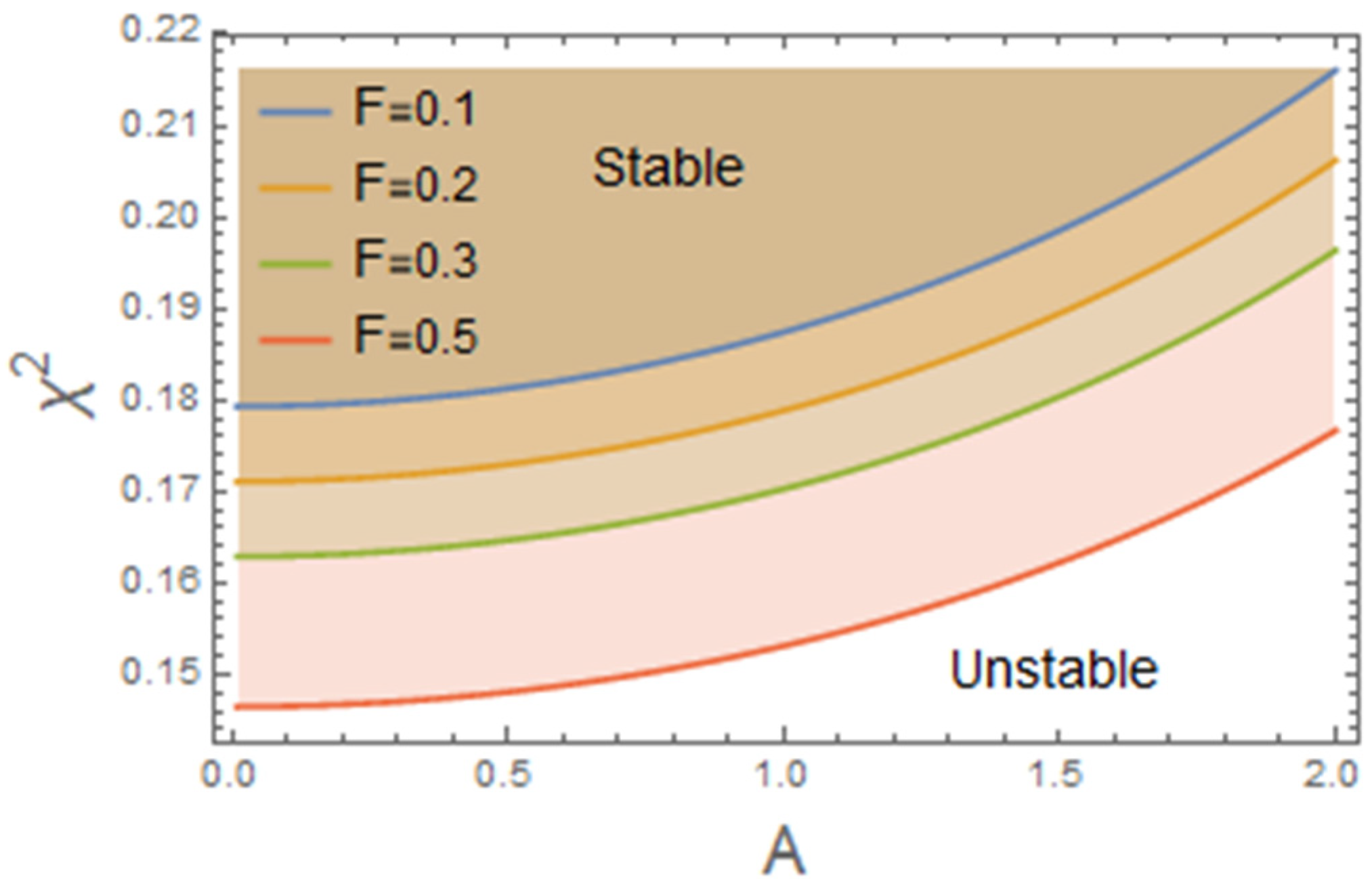
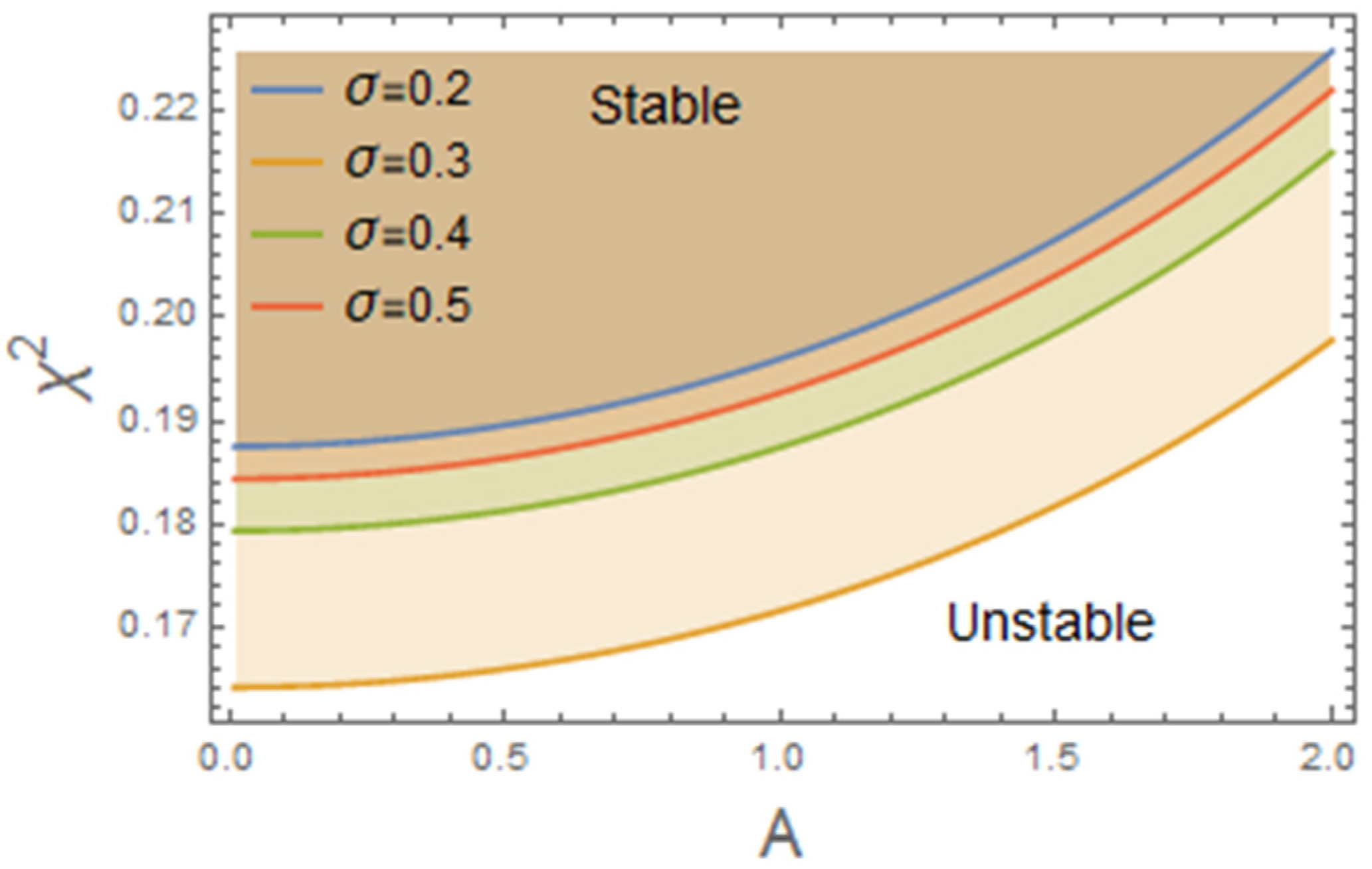
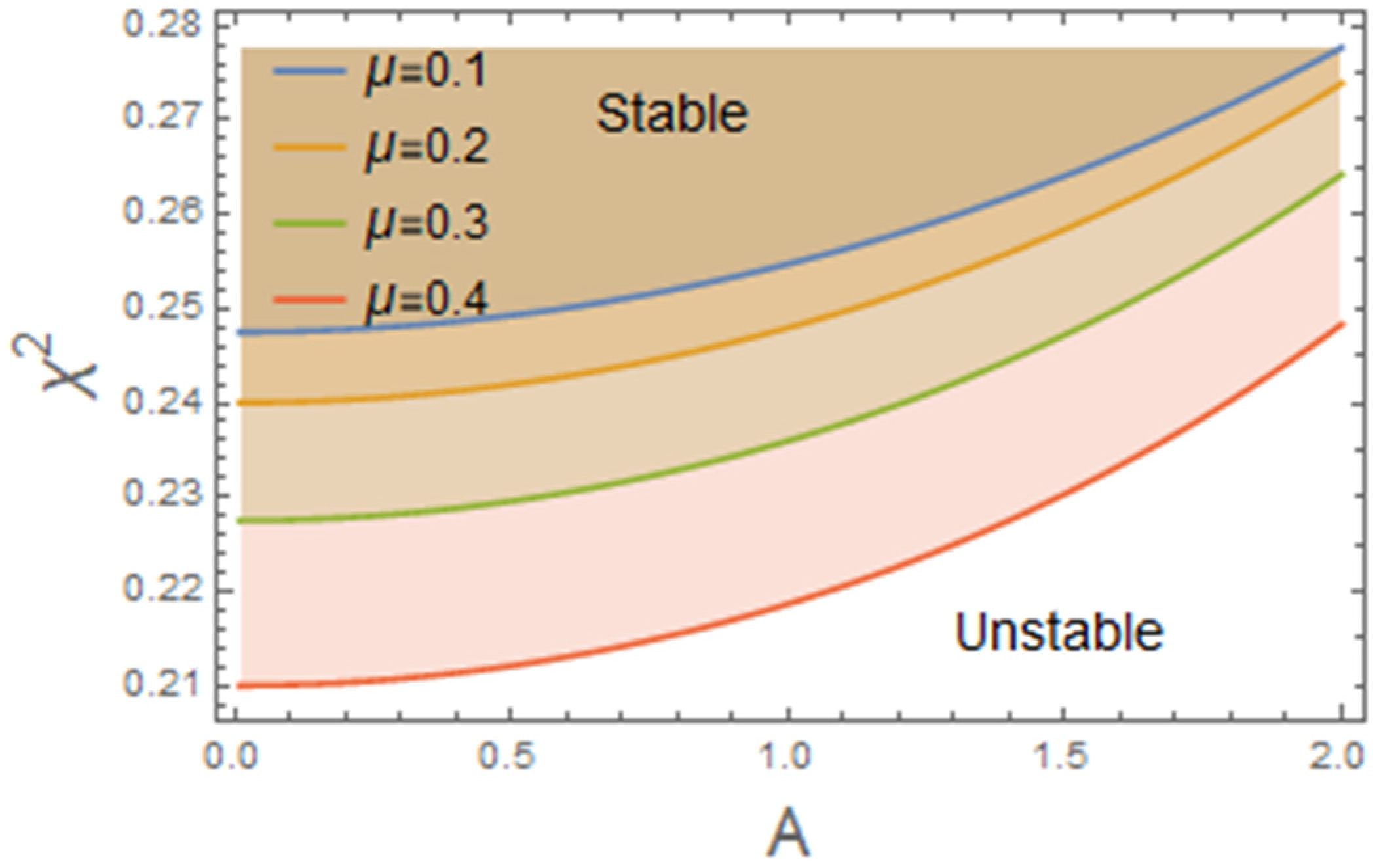
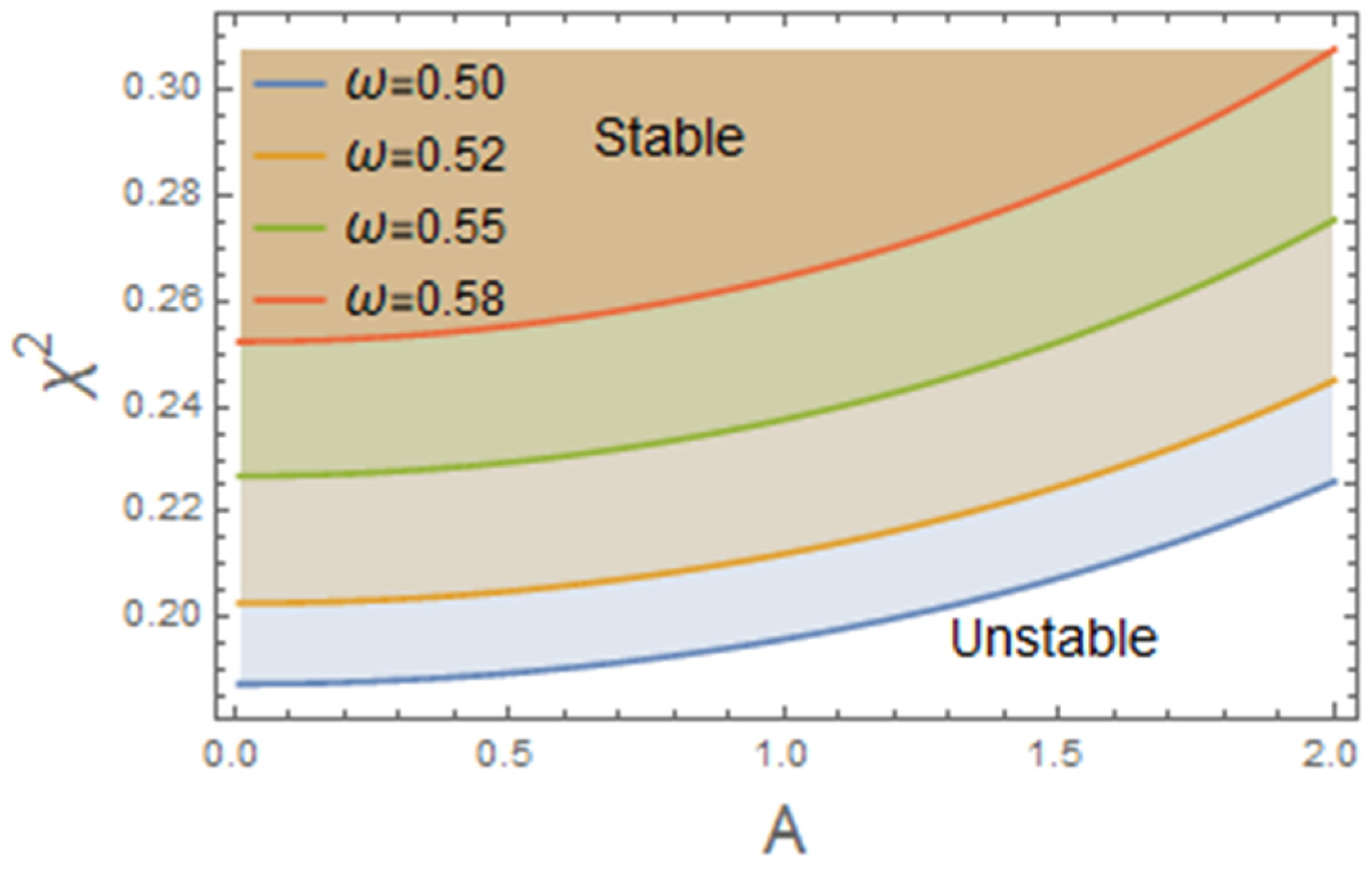
This study’s main goal is to use NPA to assess the stability features of the suggested system. For the sake of clarity, the right-hand side of Equation (14) is used to generate the stability diagrams that correspond to the comparative formulation. The efficacy of this process is evident in
Figure 2,
Figure 3,
Figure 4 and
Figure 5. Instead of analyzing the nonlinear HVR specified in Equation (4) directly, it is more practical to analyze the analogous linear ODE given in Equation (9) in light of the scenario under consideration. The suggested method turns out to be a convincing, simple, and effective substitute for traditional analytical methods as the generated model offers a direct way to investigate nonlinear stability. Moreover, a wide class of nonlinear ODEs may be studied using this paradigm. Consequently, the stability condition that results should ideally look like this:
In the following,
Figure 6,
Figure 7,
Figure 8,
Figure 9,
Figure 10 and
Figure 11 are conspired to inspect the stability areas distributions considering the restriction (15), where
is plotted together with the initial amplitude
. The limitation
, as obtained in inequality (15), appears as a transcendental form of the factors
. As demonstrated by these figures using the data:
which vary due to the discussed parameter in each figure. The effectiveness of MS is used to authorize this situation by determining the form of stability by drawing of
against the starting amplitude
. These graphs provide a better representation of a field’s stable zones with respect to the IC. Darker areas above curves represent stability zones, whereas white areas beneath curves indicate unstable segments.
Figure 6 exposes the influence of the nonlinear coupling term between displacement and velocity
on stability diagram, according to the circumstance (15). This figure validates that
has a destabilizing outcome, where the stable zones are diminishing as
rises. The parameter
represents the coefficient of the mixed nonlinear term
, which functions as an amplitude-dependent damping (or anti-damping) mechanism. This factor alters the effective damping in a state-dependent manner as opposed to uniformly, as the linear term does, because it varies on both displacement and velocity. Depending on the sign combination of
and
, this term might provide energy into the system during specific motion phases, hence decreasing net damping and encouraging oscillation propagation. This can cause earlier bifurcations under external forcing, increase limit-cycle amplitudes, change stability limits, and increase the likelihood that tiny perturbations will amplify. By introducing a nonlinear feedback mechanism,
essentially disrupts the equilibrium between energy input and dissipation, increasing instability and the probability of complex or large-amplitude oscillatory behaviour, giving the destabilizing result as obtained by this figure.
Figure 7 illustrates the influence of the quadratic velocity nonlinearity coefficient
on the system’s stability. The system is found to be less stable with the increasing of
, as noticed; this factor is considered as the coefficient of the quadratic velocity factor
. It incorporates an amplitude-dependent, exclusively nonlinear energy component that is sign independent of velocity. By enhancing the system’s kinetic contribution at higher speeds and lessening the net stabilizing impact of linear damping, this term can function as an efficient velocity-amplifying mechanism. The
term becomes more important as oscillation amplitude increases, resulting in increased waveform distortion, motion asymmetry, and a change in equilibrium characteristics. Under external stimulation, this nonlinear energy injection can increase limit-cycle amplitudes, accelerate oscillation propagation, and reduce the threshold for instability or bifurcation. To put it briefly,
reinforces amplitude-dependent dynamic amplification, amplifies nonlinear response, and exacerbates high-velocity effects.
The HVR stability zones are considerably affected by the excitation factors
and
. Therefore,
Figure 8 and
Figure 9 are illustrated to obtain the impacts of these two coefficients. It is noted that the stable zones increase with the rise of the excitation amplitude
, as seen from
Figure 8, while they diminish with the rise of the excitation frequency
, as shown by
Figure 9. By entraining the motion to a dominating external frequency, the forcing amplitude
can have a stabilizing effect by normalizing the system’s long-term response. The oscillations can synchronize with the forcing instead of growing spontaneously due to internal self-excitation when the excitation intensity is mild, because the periodic input provides energy in a regulated and predictable manner. In addition to decreasing susceptibility to beginning circumstances and suppressing irregular amplitude increase, this synchronization can move the system in the direction of a stable periodic steady state. Such forced entrainment frequently reduces the spectrum of viable responses in nonlinear systems, limiting the dynamics and encouraging constrained motion around a stable limit cycle. On the other hand, when the excitation frequency
approaches or interacts substantially with the natural frequency
of the system, it may cause destabilization. Even mild forcing can result in substantial amplitude amplification around resonance, which increases the effect of nonlinear components and pushes the system in the direction of instability or bifurcation. Moreover, in substantially nonlinear regimes, detuning and frequency interactions may produce internal resonances, subharmonic or superharmonic resonances. Therefore, unfavourable frequency matching increases dynamic amplification and can seriously destabilize the response, whereas
regulates the amount of energy that enters the system and
governs the efficiency of that energy transfer.
Furthermore,
Figure 10 shows that linear damping factor
increases the stability area, which means that this factor has a stabilizing effect on the deliberated current oscillator. When the linear damping term
contributes to positive effective damping, meaning that the combined coefficient of
is dissipative, it eliminates energy from the system proportionate to velocity. This is determined by the parameter
. Increasing
in this stabilizing range decreases oscillation amplitudes, limits the evolution of tiny perturbations, increases energy dissipation, and moves the stability border toward safer parameter areas. Stronger damping reduces the possibility of bifurcation response under external forcing, restricts the creation or magnitude of limit cycles, and counteracts the destabilizing effect of nonlinear factors like
and
. So,
serves as the main control factor that inspires limited, stable motion and controls energy balance, which interprets the result of this figure.
Finally,
Figure 11 is plotted to obtain the effect of the natural frequency
on the stability configuration. It is noted that the increasing of
in a very small range (0.50–0.58) reduces the stable area quickly, which indicates that this parameter has a destabilizing effect on the system. Physically, through the restoring term
, the parameter
largely establishes the linear natural frequency of the system, although its impact goes beyond straightforward stiffness scaling. The system becomes dynamically faster as
rises, allowing it to react more quickly to both external forcing and self-excitation. Resonance sensitivity is increased by this increased responsiveness: even mild forcing can result in large-amplitude oscillations when the excitation frequency
gets close to the natural frequency
. Furthermore, variations in
affect the effective damping strength and the equilibrium between energy input and dissipation since
additionally doubles the linear damping term (by
). A higher
can increase oscillatory energy exchange per cycle in regimes with self-excitation, speeding up amplitude development and causing bifurcation thresholds to move. Nonlinear interactions with the
and
terms can also be improved by greater restorative action, which speeds up the conversion of energy between kinetic and potential forms. Therefore, by increasing resonance susceptibility, enhancing nonlinear coupling effects, and decreasing the margin between stable oscillation and large-amplitude or complicated dynamic behaviour, rising
may destabilize the system.
4.1. Stability Tongues
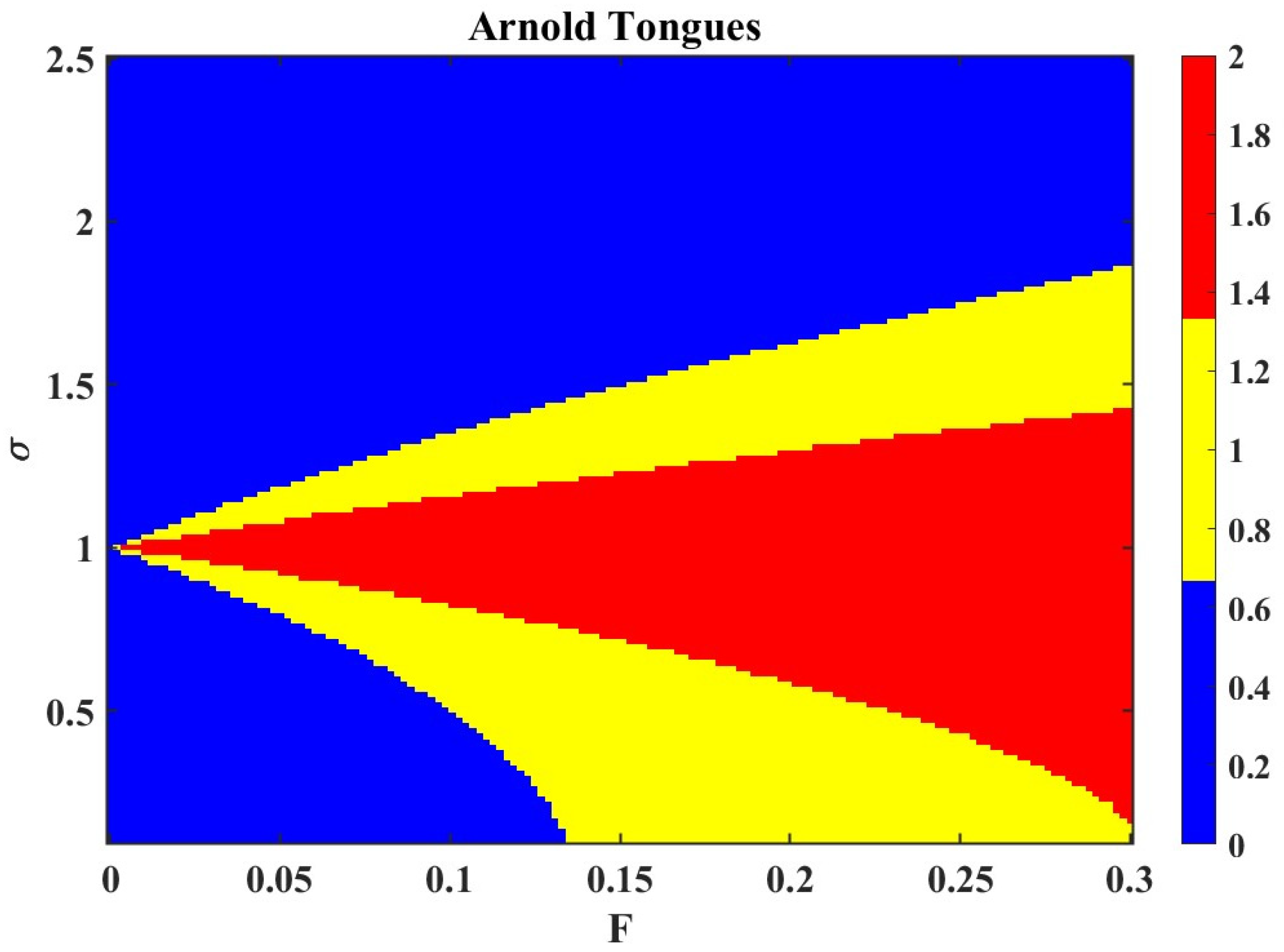
The stability tongues arise from the parametric resonance induced by the periodic excitation term in the current Mathieu-type system. Instability arises when the excitation frequency nears particular resonance conditions at integer fractions of double the natural frequency, facilitating continuous energy transfer into the oscillatory response. The distinctive tongue-shaped regions arise from the interaction of the detuning parameter and the excitation amplitude; consequently, greater deviations from the precise resonance condition require increased excitation to provoke instability. Moreover, the nonlinear terms affect the classical Mathieu instability framework by displacing the instability boundaries and modifying the breadth of the tongues. The Arnold tongue structure, as shown in
Figure 12, represents the nonlinear synchronization landscape of the forced oscillator, arising from a delicate interplay between energy injection, dissipation, and amplitude-dependent frequency modulation. Near the primary resonance (
), even weak forcing is sufficient to establish phase locking, as the external excitation efficiently transfers energy into the system when the phase mismatch is minimal. As the forcing amplitude increases, the nonlinear velocity-dependent term
modifies the effective energy exchange within the system rather than inducing a direct stiffness-based frequency shift, enabling sustained phase locking over a broader range of excitation frequencies; this mechanism explains the progressive widening of the tongues. The boundaries of these regions correspond to critical conditions where the energy supplied by the external forcing balances the energy dissipated through the effective damping terms
, thereby defining the limits of sustained oscillatory motion.
The blue regions correspond to low-amplitude stable responses where the system remains near equilibrium under weak excitation. Within the high-amplitude (red) regions, the system is fully phase-locked and maintains a stable nonlinear resonance attractor, whereas the intermediate (yellow) zones reflect partial synchronization characterized by amplitude modulation and reduced robustness to perturbations. The observed asymmetry and curvature of the tongue boundaries further indicate the influence of nonlinear frequency bending and dissipation, which break the symmetry of the classical linear resonance response. Generally, the diagram encapsulates the fundamental mechanism by which nonlinear systems extend resonance through self-adjustment and energy balance, resulting in structured regions of stable frequency locking in parameter space.
4.2. Floquet Multipliers
The novelty of this study does not simply arise from the separate use of standard nonlinear diagnostic tools, but from their unified implementation within a single analytical–numerical framework of the full modified HVD. In contrast to many conventional approaches based on perturbation techniques, weak nonlinearity assumptions, or small parameters, the present analysis treats the complete nonlinear system directly without introducing any perturbation parameter, asymptotic expansion, or neglect of higher-order terms. All governing parameters and nonlinear contributions are retained in the analytical formulation, allowing the original dynamics of the model to be preserved without simplification. Moreover, the study combines analytical stability investigation together with Floquet multipliers, LEEs, BDs, phase portraits, and PMs within a unified framework to provide a comprehensive description of the global nonlinear dynamics, stability transitions, and chaotic behaviour of the system. Therefore, the originality of the manuscript lies in the direct full-system analytical treatment and the integrated investigation of stability, bifurcation, and chaos under a single comprehensive methodology. In the context of perturbation methods, quadratic terms can be transformed into other odd terms via multiplication, division, integration, or differentiation. The primary foundation for the use of NPA is the classification of odd functions arising from damping and other odd terms related to stiffness effects. Damping or stiffness forces are addressed by including quadratic elements. The equivalent damping is obtained from the first of the two main integrals, whereas the equivalent frequency is obtained from the second. Both of the main integral or the replacement integral can include the integral of the even terms. The thorough efforts of El-Dib [
39,
40], who authored multiple articles on the subject, clarified and analyzed the specific approach of the NPA. Then, the ODE reads as
where
.
Accordingly, the comparable linear ODE is given by
where
which is defined by Equation (10).
To eliminate the damping term
from the linear ODE as given in Equation (2), one assumes that
Formerly, the corresponding standard normal form reads as
The governing ODEs are rewritten in first-order form by presenting the state variables:
The system may be stated in a compact formula as
where
and
is a time-periodic matrix with period
where
that reads as
Presenting the monodromy matrix for the system as follows:
with the ICs
The monodromy matrix over the midpoint of the stable area
can be calculated by integrating the state transition matrix over one period as follows:
where
. The eigenvalues are calculated from the following algebraic equation:
which has the following solution
that has the following roots:
thus, the Floquet multipliers are given by
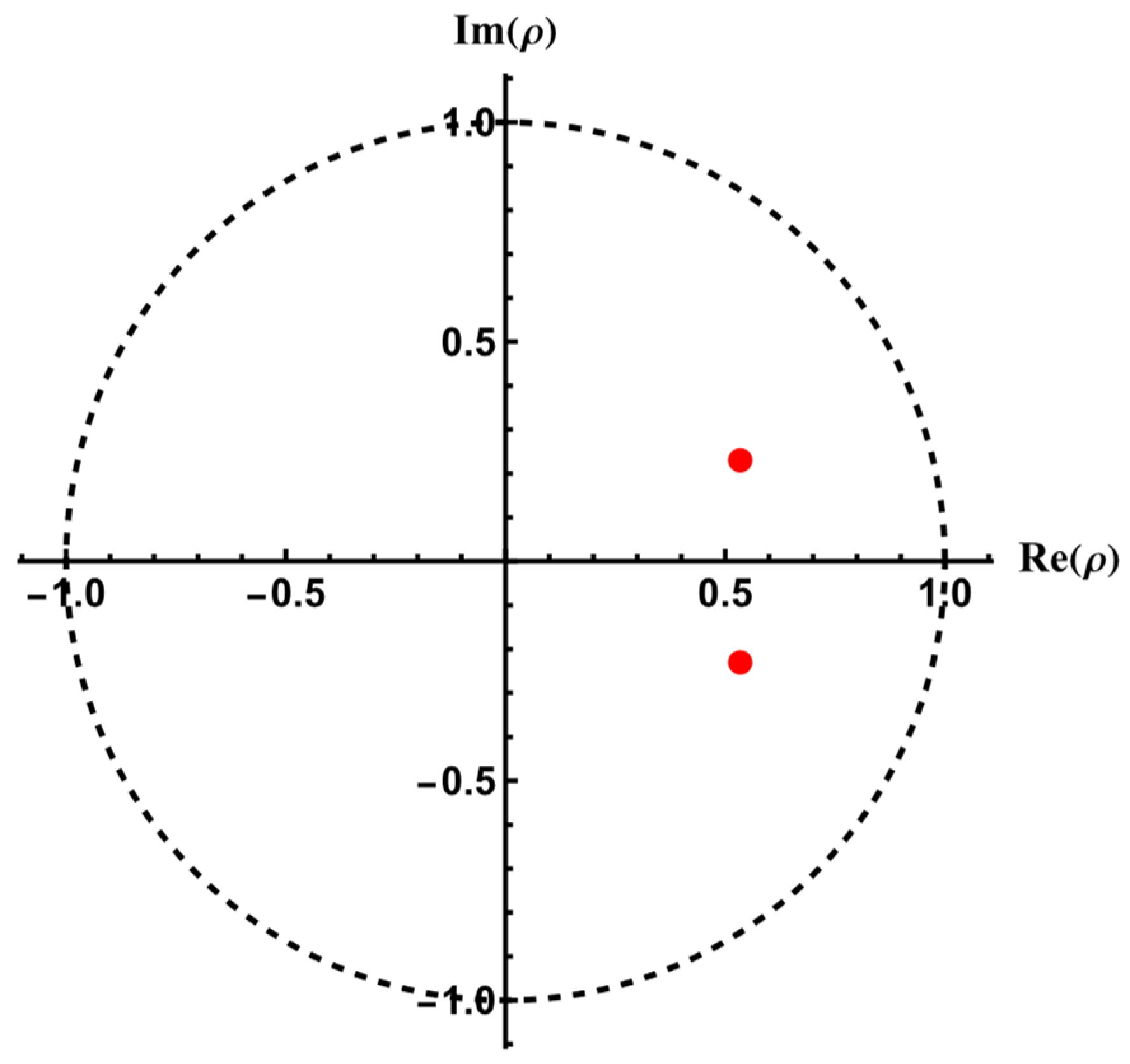
As seen in
Figure 13, the calculated Floquet multipliers are complex and conjugate integers with real and imaginary parts less than units. They also strictly reside inside the unit circle on the complex plane, and their absolute values are less than. This demonstrates the exponential decline of all disturbances over time, confirming the stability of the system. Consequently, the system response gradually becomes less affected by even minor perturbations while continuing to exhibit periodic oscillatory behaviour. While the real component controls the rate of decay, the imaginary component describes the oscillations. Therefore, the system can be considered stable. In a Floquet multiplier diagram, the red points specify the eigenvalues of the monodromy matrix linked to the periodic solution. The two red dots show that all disturbances diminish with time since they are inside the unit circle (their distance from the origin is less than 1).
5. Inspection of Time History
The time history of the current nonlinear oscillator is very important to illustrate because it gives a clear and comprehensible picture of how the system changes dynamically under the combined influence of external forcing, stiffness, nonlinear damping, and self-excitation. The time–response curve , in contrast to solely analytical stability requirements, indicates whether perturbations expand (instability), decay (stability), or converge to a finite-amplitude limit cycle. It enables us to see transient behaviour, amplitude modulation, waveform distortion caused by the nonlinear factors and , and the impact of parameters like , , and on long-term motion. Time-history graphs, particularly when subjected to near-resonant stimulation, clearly differentiate between periodic and quasi-periodic responses. Additionally, they assist in detecting resonance capture, amplitude beating, and synchronization issues. The time history of self-excited systems shows how energy balance is reached over time, indicating whether external force organizes the motion into periodic steady-state behaviour or if oscillations increase until they are limited by nonlinear processes. In order to validate analytical approximations, validate stability predictions, and visually grasp the nonlinear energy exchange processes regulating the oscillator, a time-domain depiction is therefore crucial.
For the above aspects, the impacts of all parameters on the time-history configuration are illustrated throughout
Figure 14,
Figure 15,
Figure 16,
Figure 17,
Figure 18 and
Figure 19 for
solutions as specified in Equation (9) using NPA by means of the data:
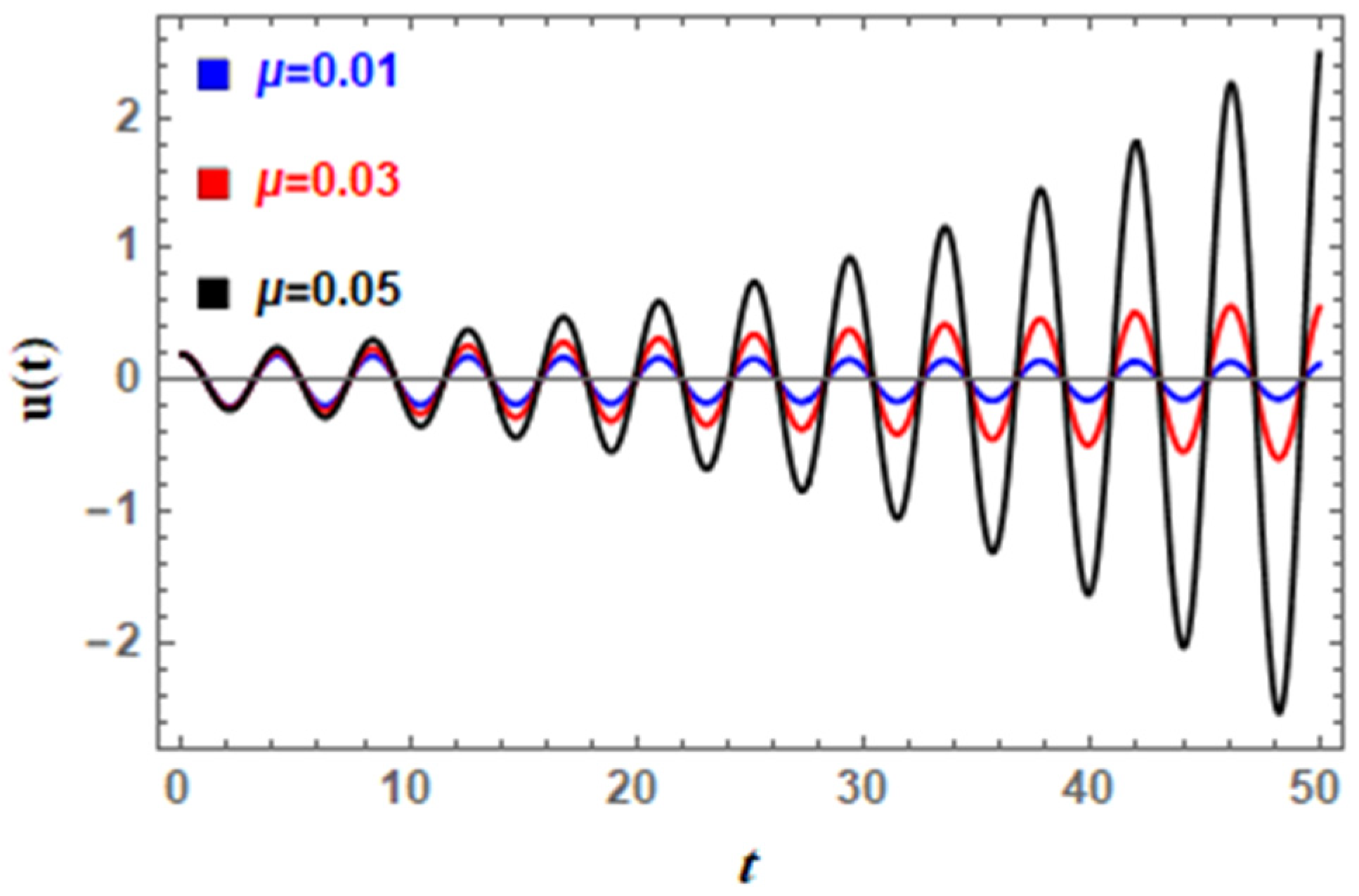
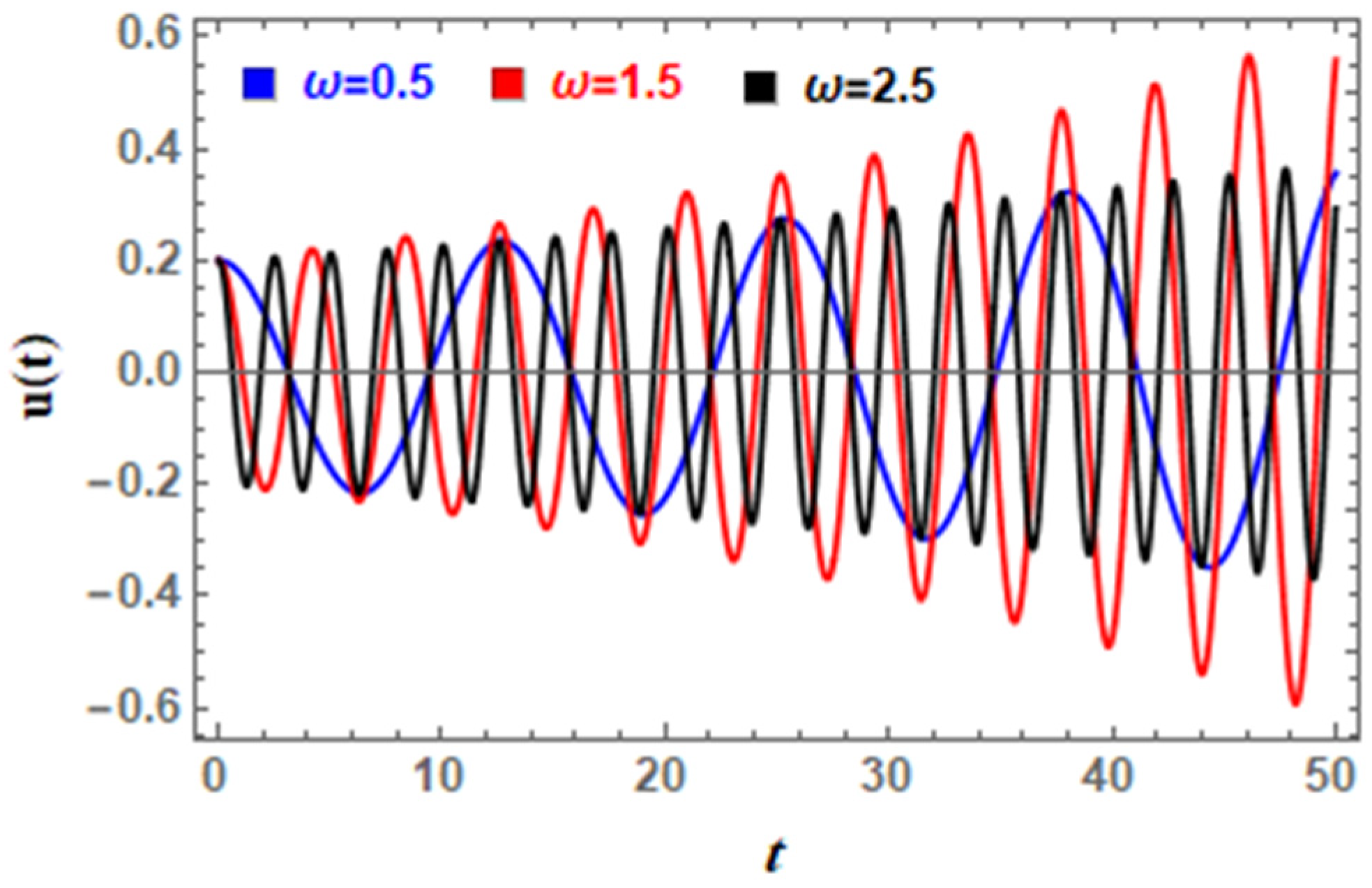
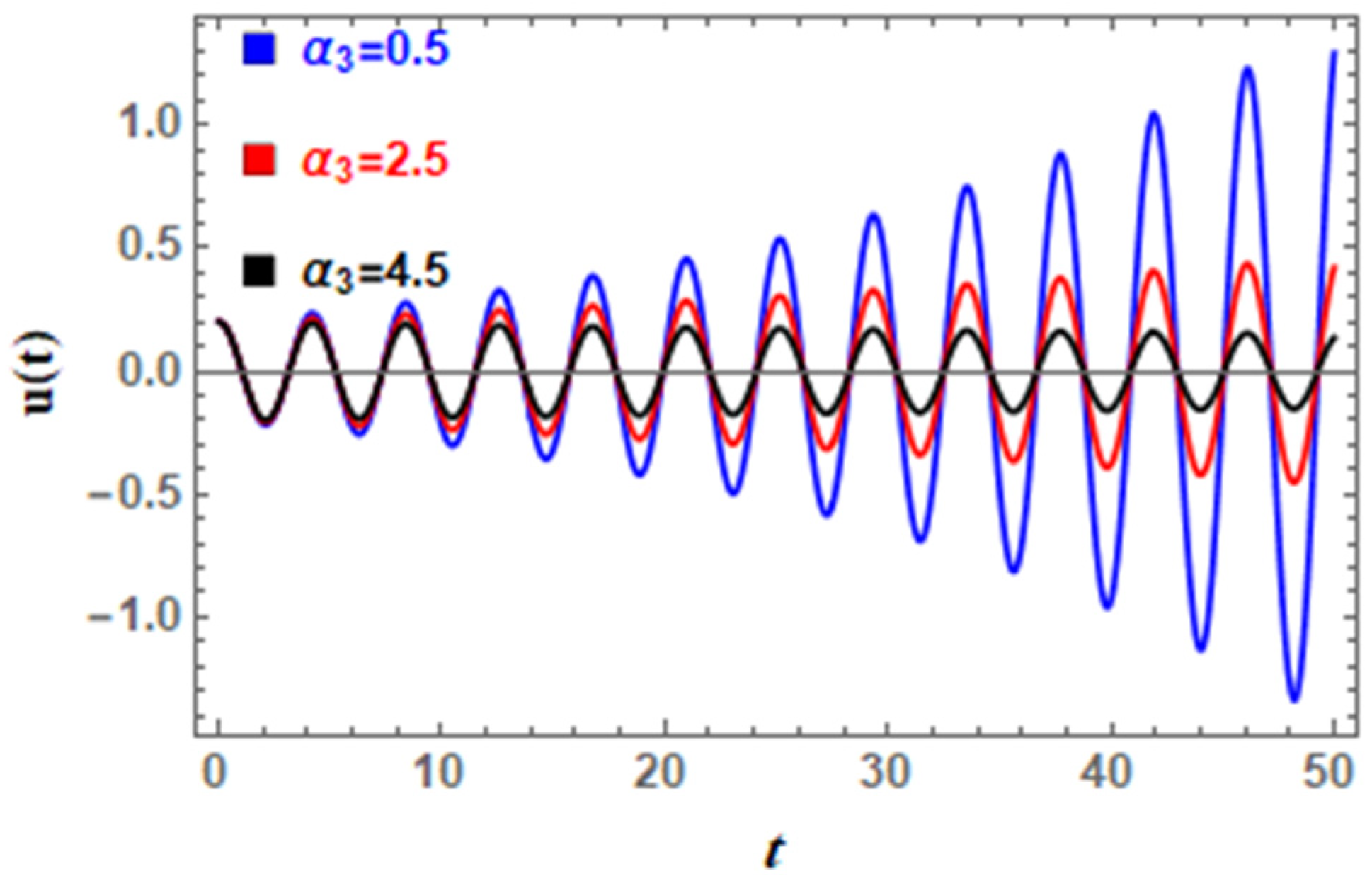
which varies due to the displayed factor. The temporal history of all these photographs shows that the wave amplitudes are steadily declining with time, and oscillations are becoming less pronounced. This is understandable due to damping force.
Figure 14 shows the influence of the linear damping component
on the time-based diffusion of
. The nonlinear oscillator’s time-history response is depicted in this figure for three distinct parameter
values (0.01, 0.03, and 0.04). The data unequivocally demonstrate that the oscillation amplitude increases gradually over time as
rises. This behaviour suggests that
is functioning as a self-excitation control parameter from a physical standpoint. The oscillations stay tiny and only slightly increase at the smallest value,
indicating little energy input into the system. The amplitude rise becomes more noticeable at
, suggesting a stronger energy input each cycle. The oscillations show the biggest amplitude and quickest growth rate for the maximum value
, indicating that the system is shifting away from equilibrium and into a stronger limit-cycle regime. Physically, raising
increases effective negative damping, or decreases dissipation, such that each oscillation causes the system to absorb more energy than it loses. The increase is limited by nonlinear effects when amplitude amplification is caused by this energy imbalance. As the amplitude grows, the waveform also somewhat distorts, indicating a larger nonlinear interaction between the velocity-dependent terms and stiffness. Generally, the picture shows how
governs the oscillator’s energy balance and stability properties: whereas bigger
pushes the system toward higher-amplitude oscillations and more dynamic instability, small
correlates to weak self-excitation and almost steady motion.
The nonlinear oscillator’s time-history performance is shown in
Figure 15 for three distinct natural frequency
values (0.5, 1.5, and 2.5). The charts make it abundantly evident that changing
has a substantial impact on the oscillation rate and amplitude growth properties. As
, the amplitude remains generally moderate, while the oscillations decelerate over extended durations. Because the restoring force is small, the structure has low stiffness and oscillates at a lower inherent frequency, which causes the system to respond slowly. The oscillations speed up, and the amplitude gradually rises at
. The rate of energy exchange between kinetic and potential forms is accelerated by this higher rigidity. Resonance-like amplification is enhanced if the excitation frequency or internal nonlinear interactions are in good agreement with this natural frequency. The oscillations are much faster when
, indicating a stiffer system with a higher inherent frequency. The response exhibits strong amplitude modulation and high-frequency oscillations, suggesting a more intense dynamic interplay between restorative forces and self-excitation. From a physical viewpoint, rising
makes the system more rigid and speeds up oscillatory motion since it is the natural frequency. A larger
increases the system’s sensitivity to resonance circumstances and dynamic interactions. Resonance amplification leads to increased amplitude expansion when the natural frequency gets closer to prominent excitation components.
Figure 15 clarifies how the natural frequency greatly affects the stability and energy distribution of the nonlinear oscillator by regulating oscillation speed, stiffness effects, and resonance susceptibility.
The nonlinear oscillator’s time-history response is depicted in
Figure 16 for three distinct values of
, or the coefficient of the quadratic velocity term (0.5, 2.5, and 4.5). The data show that despite maintaining the general oscillatory structure, rising
marginally alters the amplitude and waveform shape. The oscillations show somewhat bigger peak amplitudes and grow more pronounced with time for the weakest value
. The waveform becomes smoother and less forcefully amplified at subsequent periods when
grows to 2.5 and finally 4.5. This suggests that the system’s high-speed motion is more influenced by the quadratic velocity factor. Physically, when the velocity is high (close to zero-crossings of displacement), its influence becomes substantial because
is the coefficient of the quadratic velocity component. Nonlinear velocity-dependent feedback is strengthened by a greater
. In this instance, the picture implies that rising
limits excessive amplitude expansion by altering the effective energy exchange at high velocities, acting as a nonlinear stabilizing mechanism. Because of the larger nonlinear damping-like action, it lessens peak amplification and somewhat modifies the oscillation profile. Consequently, the picture illustrates how
regulates the degree of quadratic velocity nonlinearity, impacting long-term dynamic balance, waveform distortion, and amplitude regulation. Higher values of
improve the motion’s nonlinear moderation, preserving periodic oscillatory behaviour while avoiding excessive amplitude escalation.
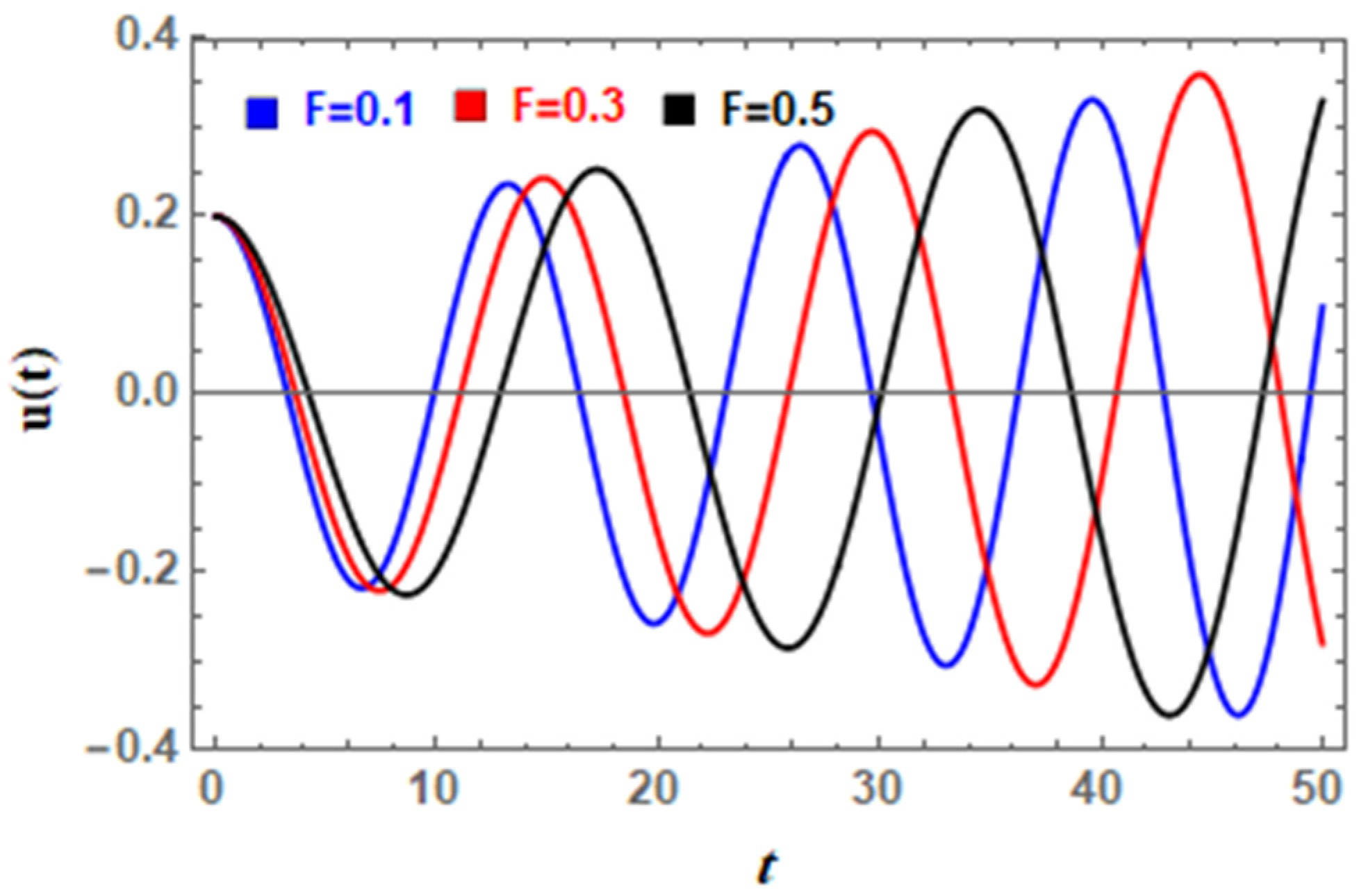
Figure 17 shows the nonlinear oscillator’s time-history response for three distinct values of the external forcing amplitude
(0.1, 0.3, and 0.5). The data obviously show that the excitation amplitude has a major impact on the combined dynamic behaviour as well as the oscillation magnitude. The reaction is still comparatively mild at the lowest forcing level,
, with confined oscillations and constrained amplitude increase. The dynamics of the system are mostly controlled by its inherent characteristics (natural frequency, damping, and nonlinear effects) because the external energy input is minimal. The oscillation amplitude notably rises at
. More energy is injected every cycle by the increased excitation, which improves the system’s reaction and encourages larger displacement excursions. The waveform intensifies, suggesting a more robust interplay between forcing and the inherent dynamics of the system. The oscillations show the biggest amplitude changes and the strongest modulation effects at the highest forcing level
. The system is driven more aggressively by the increased external energy input, which intensifies its response and makes it more susceptible to resonance circumstances. As forcing rises, the system is more likely to approach bifurcation thresholds or nonlinear resonance. Physically, this figure illustrates how
regulates the oscillator’s external energy source. Stronger nonlinear interactions and bigger oscillation amplitudes are the results of more energy being fed into the system as
rises. Whether the motion stays limited or develops into enhanced nonlinear behaviour depends on how excitation and damping are balanced. Consequently, the forcing amplitude serves as a crucial control parameter that determines stability boundaries, resonance amplification, and oscillatory response strength.
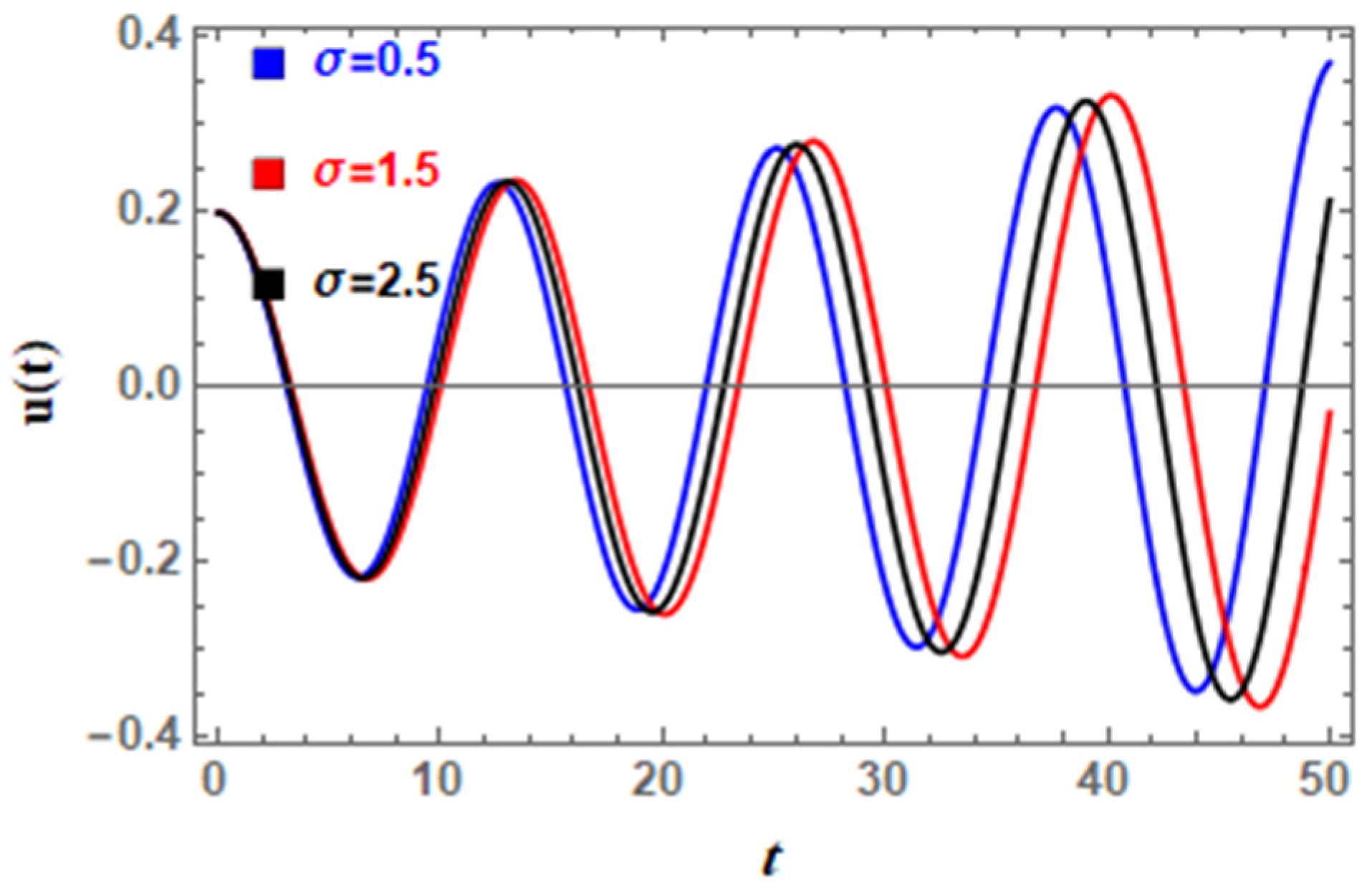
The nonlinear oscillator’s time-history response is shown in
Figure 18 for three distinct excitation frequency
values (0.5, 1.5, and 2.5). The graph shows how changing the forcing frequency impacts the system’s dynamic response since
is the frequency of the external periodic forcing term
. The oscillations are slower and show longer time periods for
. Because the forcing frequency is comparatively low in relation to the system’s inherent oscillatory tendencies, the system response seems smoother and less dynamically strained. Moderate amplitude changes are produced by the slow injection of energy. The oscillation frequency rises, and the reaction intensifies when
increases to 1.5. Strong amplitude increase and more pronounced phase alignment with the excitation are seen in the waveform. This implies that the forcing frequency is nearer the effective natural frequency of the system, which improves resonance-like interaction and boosts dynamic amplification. The oscillations are quicker, and the waveform exhibits more pronounced phase shifts and amplitude modulation as
grows to 2.5. The system may undergo dynamic stiffening effects or resonance amplification (if near natural frequency) at higher excitation frequencies, contingent on the interaction of parameters. Nonlinear effects are exacerbated by the higher frequency, which results in a faster energy exchange per unit of time.
Figure 18 physically illustrates how the excitation frequency
σ controls the rate at which external energy is injected and has a significant impact on resonance behaviour. Resonance causes oscillation amplitudes to rise as
σ gets closer to the system’s intrinsic frequency. The response is more regulated when it is distant from resonance. Accordingly,
serves as a crucial tuning parameter that affects the nonlinear oscillator’s phase synchronization, amplitude growth, resonance susceptibility, and general stability properties.
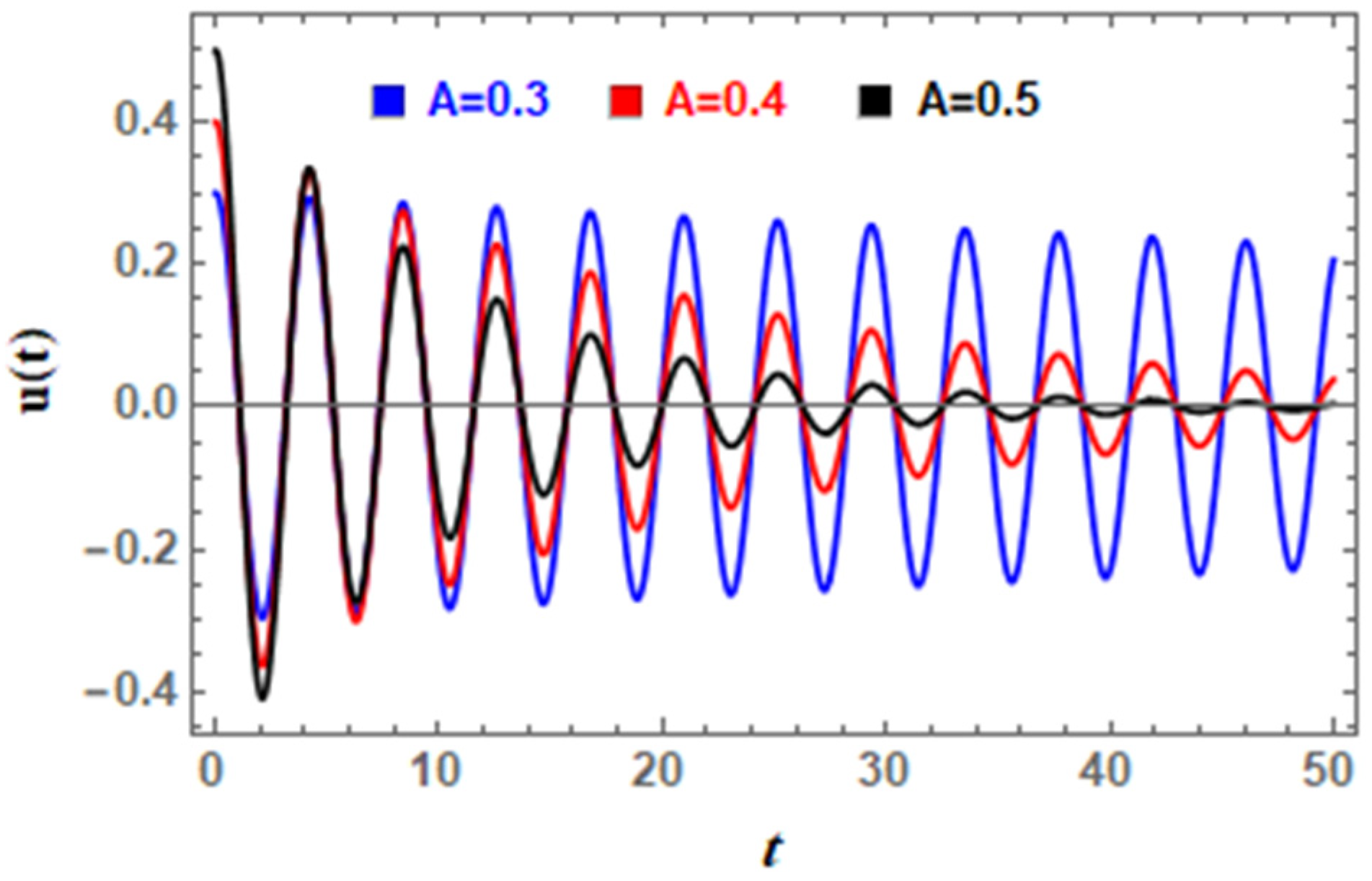
Figure 19 shows the nonlinear oscillator’s time-history response for distinct values of the initial amplitude
. The charts unequivocally demonstrate that despite maintaining the motion’s periodic pattern, rising
greatly increases the oscillation amplitude. The response shows a slight amplitude increase and relatively tiny, confined oscillations for the smallest value
. There are a few nonlinear effects when the system operates in a nearly linear range. The oscillation amplitude substantially increases, and the waveform exhibits a sharper departure from pure sinusoidal behaviour when
rises to 0.4, suggesting higher nonlinear interaction. Increased nonlinear energy exchange is reflected in the oscillations’ greatest amplitudes, a more noticeable increase, and mild waveform distortion at the biggest value
. Depending on its function in the governing equation, the initial amplitude
physically reflects a scaling factor that amplifies the system’s excitation or nonlinear contribution. Greater displacement excursions result from increasing
because it either increases the nonlinear stiffness/damping interaction or injects more effective energy into the oscillator. Higher
values bring the system closer to instability or large-amplitude limit-cycle behaviour, as seen by the increasing spacing between curves over time. This figure indicates that
controls the magnitude of oscillations. While lesser numbers preserve more moderate and steady oscillatory motion, larger values enhance the responsiveness, magnify nonlinear effects, and make the system more sensitive to resonance and dynamic amplification.
6. Examination of Dynamical Behaviour
In this section, we examine the dynamical behaviour of the studied system governed by Equation (1) across examination of BDs, phase portraits, PMs, LLE [
45,
46]. Creating these diagrams is more than just a step in visualization; it is crucial in comprehending, verifying, and managing a nonlinear hybrid oscillator. Here is a straightforward, physically based explanation of their significance and the insights they offer:
- (1)
The significance of creating a BD lies in its function as a guide to the system’s dynamics as a parameter (in this case ) varies. It illustrates the points where the system shifts from stable behaviour to chaotic multi-periodic motion. The physical feedback for this graph can be summarized as follows: It illustrates the extent to which the system can endure a disturbance before becoming unstable. It pinpoints critical thresholds, such as the onset of instability or chaos. This information can aid in the design and control of systems to avoid hazardous conditions, such as in mechanical systems, or to achieve complex behaviour, such as in signal generation. In the case under consideration, the system exhibited excessive dissipation at low .
- (2)
The importance of the phase portrait lies in its depiction of energy equilibrium and the dynamics of motion. It illustrates the geometry of motion in the phase space , identifying the nature of the attractor, whether it is a fixed point, a limit cycle, or a strange attractor (chaos). The importance of this plot lies in its ability to directly illustrate energy exchange: a closed loop signifies balanced energy, indicating stable oscillation, whereas spiral curves suggest either a loss or a gain of energy. The noted distortion is attributed to stronger nonlinear effects, whereas the smooth closed loops in the analyzed figure represent stable energy equilibrium.
- (3)
The significance of the PM (hidden structure detection) can be outlined as follows: It transforms continuous motion into a discrete map, simplifying the detection of complex dynamics, particularly chaos. Consequently, it distinguishes between synchronization and resynchronization, wherein a single point indicates perfect locking, multiple points suggest subharmonics, and a cloud implies chaos. In our scenario, a single point signifies a perfect training force.
- (4)
The LLE, also known as the chaos indicator, offers a quantitative assessment of a system’s stability and is considered the most dependable test for detecting chaos. A negative LLE indicates that disturbances diminish, signifying system stability. When LLE equals zero, the system exhibits neutral behaviour. Conversely, a positive LLE results in exponential divergence, leading to chaos. In the system under study, a negative LLE was observed, indicating that the system is both robust and predictable.
To make sure that the described dynamical behaviour only reflects the actual long-term steady-state dynamics of the modified hybrid van der Pol–Rayleigh oscillator, the transient-state elimination process and the computation of the LLE are crucial procedures. Before building the BDs, phase portraits, Poincaré sections, and LLE curves in the current study, the transient reaction produced just after applying the beginning conditions was eliminated. This elimination procedure ensures that the results are representative of the system’s asymptotic attractor rather of being tainted by short-term numerical artefacts or nonphysical startup oscillations. Physically speaking, the transient domain is the time when, under the combined influence of nonlinear damping, restoring forces, and external excitation, the oscillator redistributes the initially stored energy and progressively approaches its final dynamic state. The system does not show true periodic, quasi-periodic, or chaotic behaviour until this temporary energy redistribution disappears.
The conventional neighbouring-trajectory divergence method was used to calculate the LLE. Two initially neighbouring paths in phase space with a very modest starting separation distance were taken into consideration in this technique. Under the same governing equations, both trajectories progressed concurrently. The Euclidean distance between the two trajectories was continually tracked as a function of time throughout the numerical integration. The Lyapunov definition was then used to calculate the exponential growth or decay rate of this separation. The LLE is calculated mathematically using
where
is the corresponding separation after time
and
is the initial minuscule separation between trajectories. Throughout the simulation, the separation vector was regularly renormalized while maintaining its orientation in phase space to prevent numerical overflow or underflow. The final LLE value was then calculated using the average logarithmic divergence rate accumulated throughout extended integration durations.
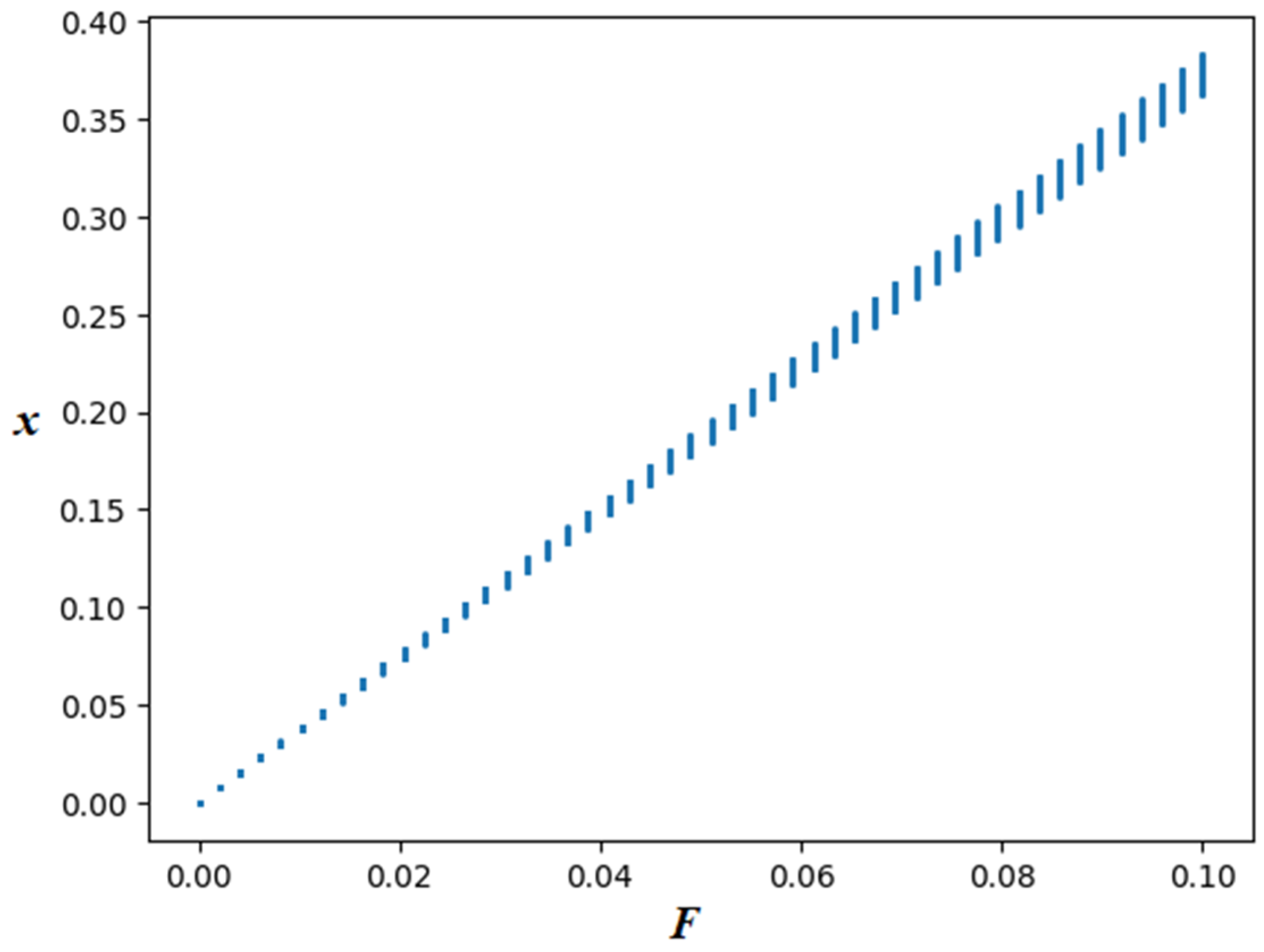
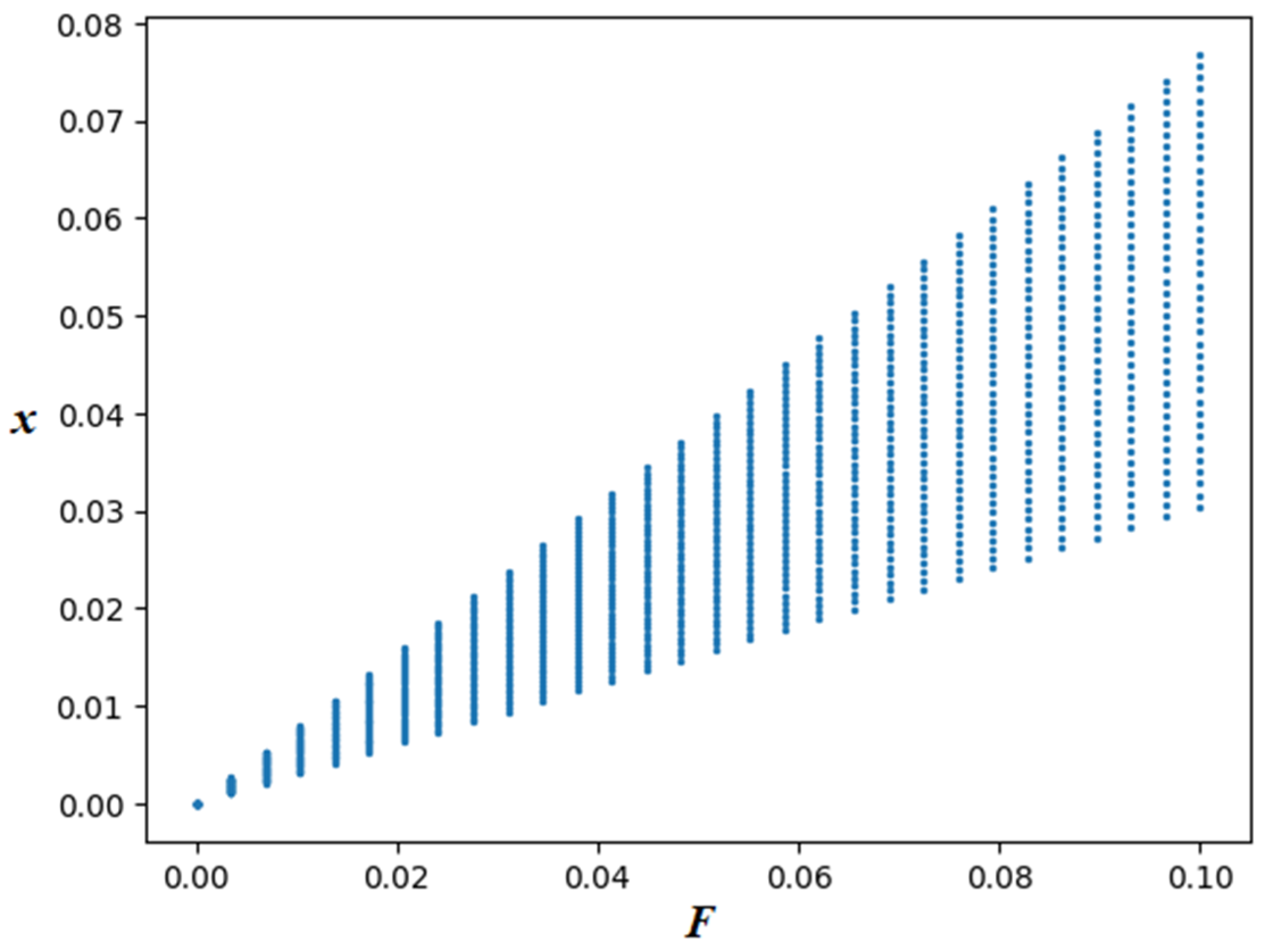
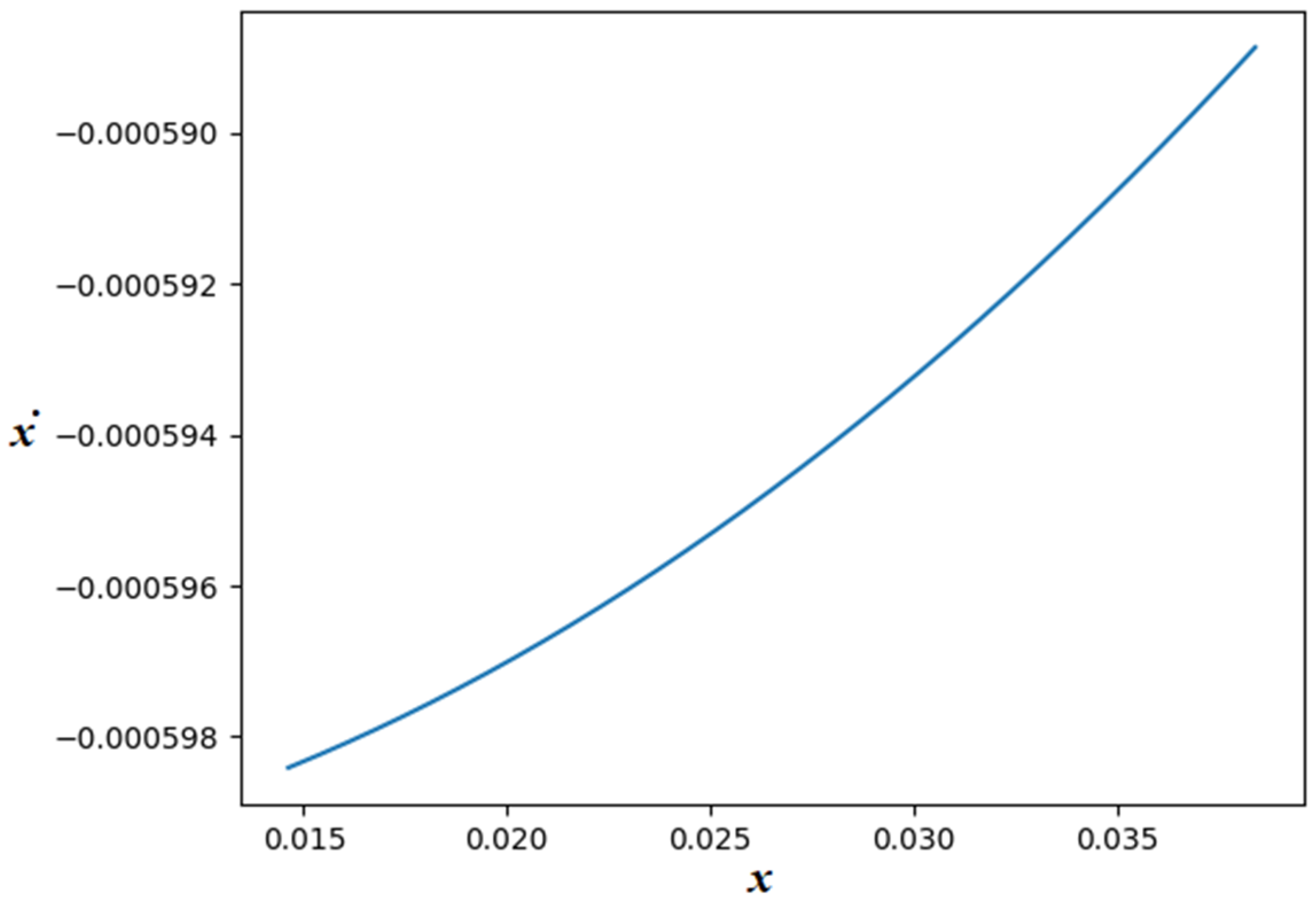
A negative value of LLE means that close trajectories converge over time, which means that the oscillator moves toward a stable periodic attractor as perturbations are damped out. Neutral stability or quasi-periodic motion is associated with a zero LLE, while chaotic dynamics and exponential sensitivity to initial circumstances are associated with a positive LLE. Under the chosen operating settings, the oscillator maintains stable and predictable periodic behaviour without transitioning to chaos, as confirmed by the computed LLE in the current study remaining negative across the examined parameter range. The dynamic behaviour of the modified hybrid oscillator was thoroughly examined using BDs, phase portraits, Poincaré sections, and the LLE across the forcing range. The BD displays a single continuous branch, signifying that the system consistently remains in a stable period-1 state throughout the observed interval, with no signs of period-doubling or multi-stability, as displayed in
Figure 20 and
Figure 21. This result is corroborated by the corresponding phase portrait at
, which shows a smooth trajectory typical of a stable limit cycle with minimal distortion, indicating a weak nonlinear effect, see
Figure 22.
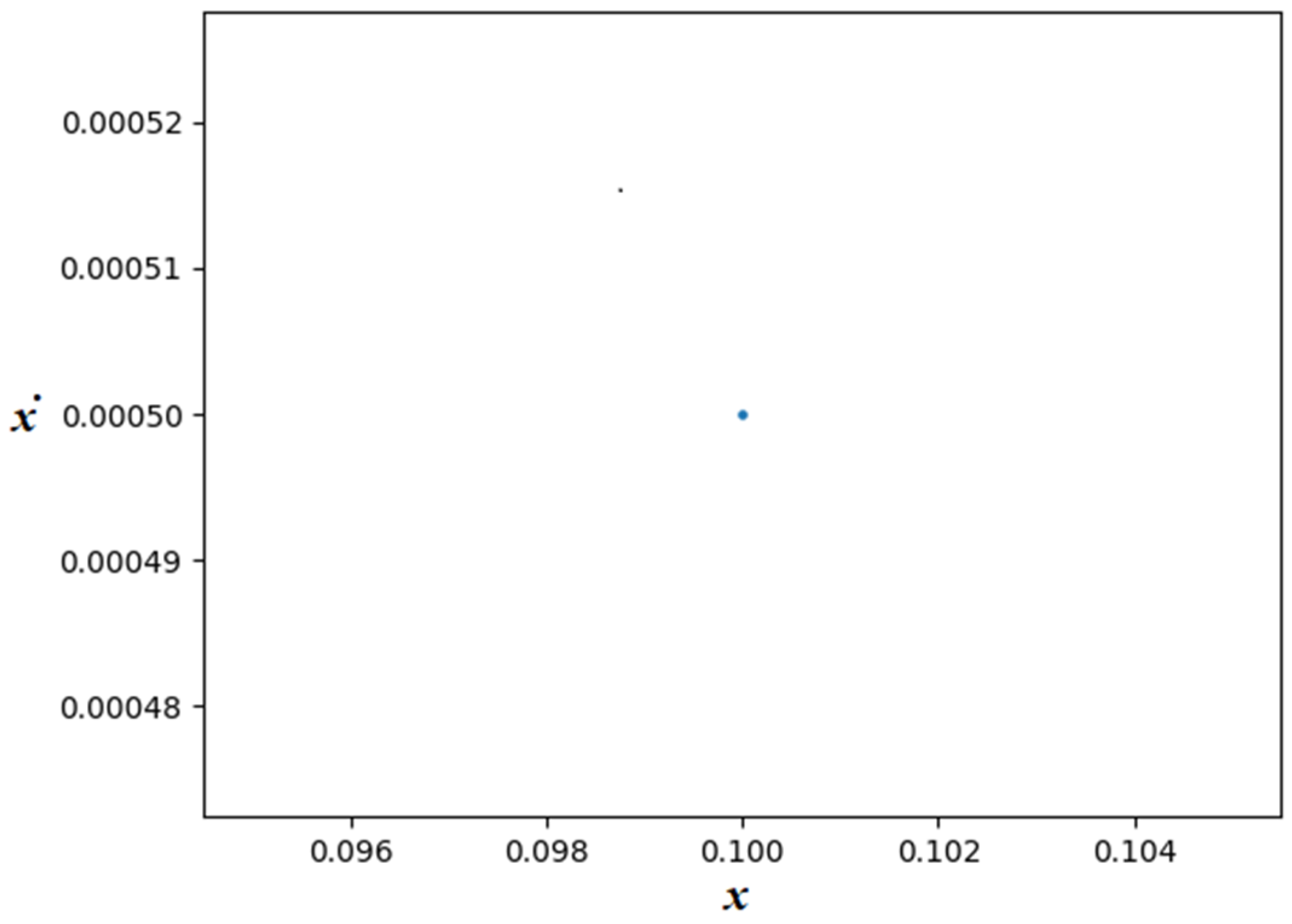
Figure 23 presents the PM, which supports this conclusion by reducing it to a single distinct point, indicating that the system’s response is entirely periodic and in sync with external excitation. Furthermore, the calculated LLE remains negative
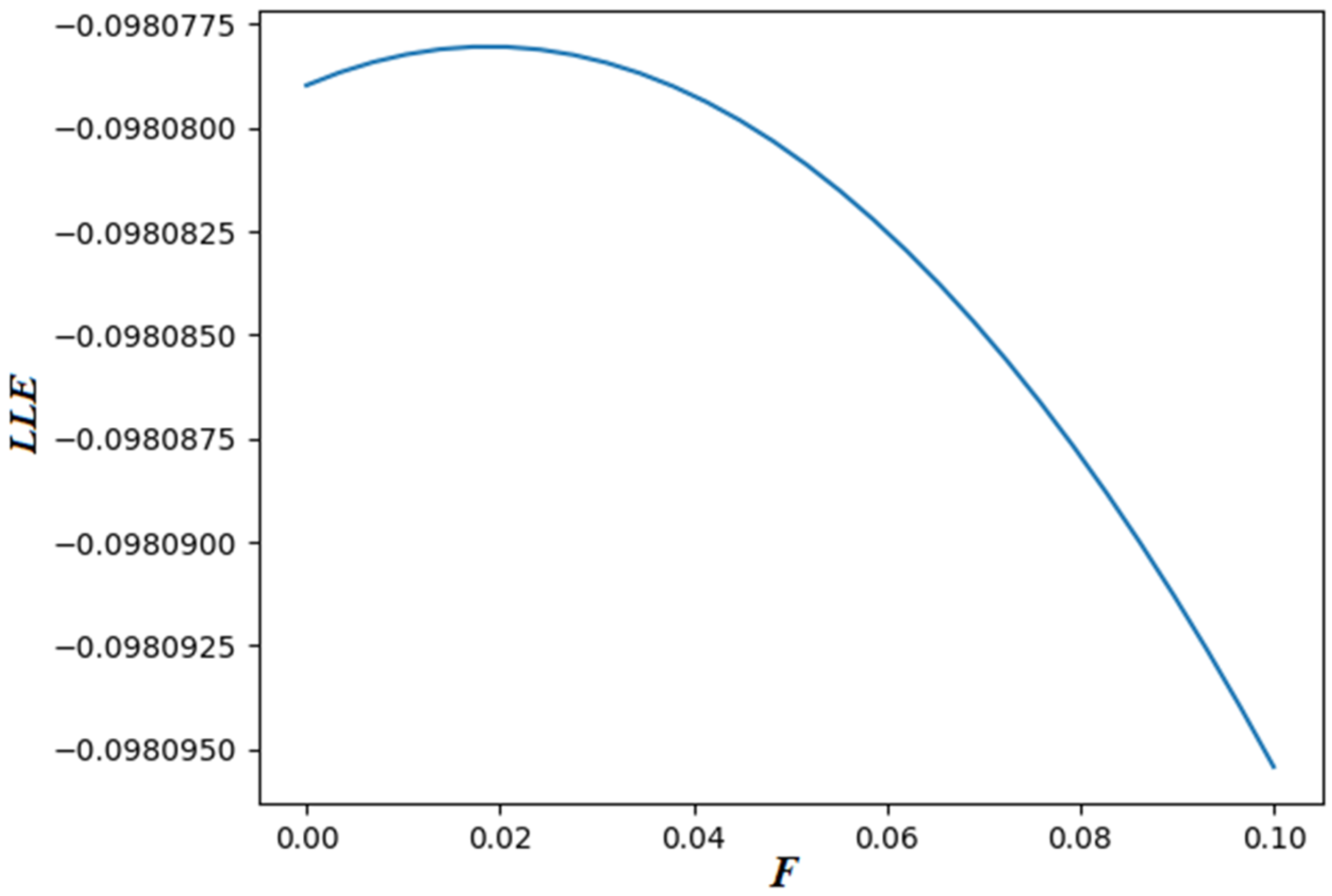
throughout the entire parameter range, offering quantitative proof of the absence of chaos and confirming the system’s asymptotic stability, as noted in
Figure 24. Together, these results illustrate that, under conditions of low forcing amplitudes and weak nonlinear coefficients, the oscillator displays regular and predictable behaviour without shifting into complex or chaotic dynamics. Nearby trajectories in the phase space converge exponentially toward one another over time when the LLE is negative. Physically, this means that the oscillator’s dissipative mechanisms continuously dampen out any slight perturbation that is put into the system. Long-term motion thus becomes extremely predictable, regular, and synced with external stimulation. Since the modified hybrid van der Pol–Rayleigh oscillator in this study does not show sensitive dependency on beginning circumstances, chaotic motion cannot emerge within the examined parameter range, according to the computed negative LLE. The presence of a stable period-1 periodic attractor is directly linked to the PM’s reduction to a single point when the LLE is negative. The system is sampled once every forcing interval since the oscillator is regularly forced. After every forcing cycle, the trajectory returns to precisely the same phase-space location if the response is perfectly periodic and synced with the excitation. As a result, there is only one isolated point in the Poincaré section instead of a closed curve or dispersed cloud because each sampled point coincides with the preceding one. This physically represents total phase locking between the external forcing and the oscillator. In mathematical terms, a negative LLE implies exponential contraction of neighbouring trajectories since it satisfies the criterion
, where
Consequently, any trajectory in the vicinity of the attractor collapses toward the same stable periodic orbit. There is only one repeated intersection point seen when the Poincaré section samples this orbit once every excitation period. Conversely, the Poincaré section would create a closed invariant curve if the response were quasi-periodic since the trajectory would never repeat precisely. Nearby trajectories would diverge exponentially if the reaction were chaotic and the LLE was positive, creating a dispersed cloud of points in the PM that resembled a fractal. Consequently, the observed single point in the Poincaré section is entirely consistent with the negative LLE and verifies that the system does not change into quasi-periodic or chaotic motion but rather stays in a stable, synchronized periodic state.
Now, a more physical explanation of the initial four figures is provided here, in a manner appropriate for a research paper, with a focus on the mechanisms and energy flow. The dynamical behaviour of the modified hybrid oscillator within the forcing range at is characterized by a regime in which dissipation prevails, and the energy input is minimal, resulting in highly orderly motion. The BD, which features a single continuous branch, reveals that the system retains a singular stable attractor for all the considered forcing amplitudes. This suggests that the external excitation is not sufficiently strong to counteract the effects of both linear and nonlinear damping, resulting in an oscillator that exhibits a predictable, single-mode response without shifting to multi-periodic or chaotic states. The phase portrait offers additional understanding of the energy equilibrium at play. The observed closed and nearly smooth path indicates a stable limit cycle, where the energy introduced by external forces is perfectly counterbalanced by dissipation in each cycle. The lack of geometric distortion or folding in the path implies that nonlinear effects, though present, do not significantly disrupt the phase-space structure. As a result, the oscillator functions almost like a weakly nonlinear system with one predominant frequency.
The Poincaré section that reduces to a single point can be understood in physical terms: the system completes each cycle in perfect harmony with the driving force. This demonstrates strong phase locking, indicating that the oscillator does not experience phase drift over time. Practically, the system shows entrainment, in which the external stimulus completely dictates the timing of the motion, eliminating any inherent inclination towards complex dynamics.
The consistently negative value of the LLE throughout the entire range indicates that trajectories that start close together in phase space tend to converge exponentially, underscoring the system’s ability to withstand disturbances. This indicates a dynamic state with a strong attractive force, in which any minor perturbation is rapidly mitigated by damping effects. The absence of positive LEs implies that there is no sensitive dependence on initial conditions, thereby preventing the system from exhibiting chaotic behaviour under these conditions. Generally, these outcomes indicate that the oscillator functions within a low-energy, heavily damped environment, in which the balance between external forces and energy loss results in consistent and predictable behaviour. The nonlinear components have not yet caused sufficient energy redistribution or instability to initiate bifurcations, thereby keeping the system limited to a straightforward periodic attractor.
A solid link between the physical energy-transfer mechanisms regulating the modified hybrid van der Pol–Rayleigh oscillator and the observed nonlinear dynamics has been provided. The paper specifically describes how the transition between stable periodic motion and potential instability regimes is determined by the rivalry between external excitation, nonlinear damping, restoring forces, and self-excitation. The system response is extremely sensitive to changes in the excitation amplitude , excitation , nonlinear coupling coefficient , quadratic velocity coefficient , damping coefficient , and natural frequency , as the bifurcation analysis shows. Because it explains the mechanisms underlying stability loss and dynamic amplification, the paper’s physical interpretation is especially significant. Increasing the nonlinear coupling value , for instance, causes amplitude-dependent feedback between displacement and velocity, which essentially adds energy to the system during specific oscillation phases. In addition to encouraging instability, greater oscillation amplitudes, and faster bifurcation transitions, this reduces the net dissipation. In a similar vein, raising the quadratic velocity nonlinearity intensifies waveform distortion and makes the system more susceptible to dynamic amplification by enhancing nonlinear velocity-dependent energy exchange. The study further emphasizes how important excitation frequency is for initiating instability processes. Resonance-like interactions greatly increase the oscillation energy when the forcing frequency gets closer to the natural frequency , increasing the system’s vulnerability to bifurcation and complicated nonlinear behaviour. The oscillator may move from regular periodic motion to unstable or possibly chaotic regimes due to relatively modest parameter differences, which can be explained by this resonance sensitivity. On the other hand, by dissipating energy, limiting the growth of perturbations, and expanding the stable working zones, the damping parameter serves as a stabilizing mechanism.