Article

A Robotic Disassembly Planning Method for Retired Batteries Based on a Long Short-Term Memory Collaborative Framework

School of Mechanical Engineering, Donghua University, Shanghai 201620, China
*
Author to whom correspondence should be addressed.
Symmetry 2026, 18(6), 981; https://doi.org/10.3390/sym18060981
Submission received: 24 April 2026 / Revised: 21 May 2026 / Accepted: 3 June 2026 / Published: 5 June 2026
(This article belongs to the Special Issue Symmetry-Aware Embodied Intelligence: Foundations and Applications)

Abstract

This paper addresses non-steady-state scenarios in the human–robot collaborative disassembly process of retired power batteries, including component aging, ambiguous instructions, and sensor drift. In such scenarios, the robot exhibits execution robustness problems. This paper proposes a Planning Domain Definition Language (PDDL) generation framework that integrates long-term and short-term memory. The framework combines large language models with knowledge graphs as a long-term memory module for symbolic task decomposition and domain semantic rule generalization, while using meta-heuristic optimization algorithms as a short-term memory module to adapt and optimize action parameters based on real-time sensor feedback. Through this closed-loop mechanism that combines long-term memory guidance with short-term memory adaptation, the system addresses the limitation of traditional PDDL, which, when facing open, time-varying, and heterogeneous industrial disassembly scenarios, has symbolic action models that have difficulty capturing the uncertainty and unpredictable disturbances in real physical systems, limiting its practicality in complex non-steady-state scenarios. Furthermore, the system establishes a feedback mechanism from short-term memory to long-term memory, enhancing disassembly capabilities in non-steady-state environments by transforming scenario information into supplementary understanding. The research validates this method on a real disassembly platform. Compared with baselines of traditional PDDL, a planning method using only large language models (LLMs), and heuristic algorithms, this method achieved an 88.0% task success rate (significantly superior to the 38.0% of traditional PDDL).

1. Introduction

The rapid growth in electric vehicle ownership has brought about a massive wave of power battery decommissioning. As the primary production method for remanufacturing, the disassembly of retired batteries holds significant importance in resource recovery, energy conservation, and emission reduction. Existing automation solutions for recycling often require highly structured environments or large-scale training for specific products, making it difficult to adapt to the high heterogeneity and uncertainty of non-steady-state scenarios. Therefore, human–robot collaborative disassembly is recognized as the optimal method in the current industrial sector; human operators are responsible for fine, flexible tasks, while robots handle heavy-duty, high-repetition tasks. From the dimension of technical evolution, the disassembly of retired batteries is undergoing a leap from semi-automation to full automation. As shown in Table 1, the initial 1.0 automation stage relied on preset trajectories and fixed coordinates, capable of dealing only with highly standardized battery packs. The 2.0 semi-automated perceptual collaboration stage introduced computer vision and basic knowledge bases, providing robots with preliminary feature recognition and adaptive capabilities.
However, existing human–robot collaboration schemes face severe robustness bottlenecks as they move toward the 3.0 fully automated intelligent evolution stage. That is, when facing non-steady-state scenarios such as component aging, part aging, and sensor drift, the system’s perception and decision-making logic often suffer a precipitous drop in execution success rates due to a lack of resilience. Against the backdrop of this core bottleneck in the 2.0 stage, how to endow robots with cognitive abilities that transcend fixed rules—enabling them to ensure the continuity and certainty of disassembly tasks even in non-steady-state environments—has become the core challenge of current research.
In the field of robot task planning, this is usually modeled as a standard PDDL task, aiming to solve the optimal path from the initial state to the target state through symbolic forms. However, traditional PDDL planning methods face severe challenges in the practical application of human–robot collaborative disassembly of retired batteries. PDDL is essentially a standardized language based on predicate logic that describes planning tasks through domains and problems; it is difficult to adapt to randomly changing physical states in non-steady-state scenarios [1], and, secondly, human behavior introduces significant non-steady-state variables. Although LLMs have demonstrated excellent capabilities in semantic reasoning, providing new avenues for complex task planning [2], directly applying the semantic reasoning capabilities of LLMs to disassembly environments requires crossing the three-layered gap of language, perception, and action—that is, task instructions must be mapped to physical entities and executable actions [3]. Existing research suffers from a significant mismatch between static logic and dynamic environments when dealing with non-steady-state industrial scenarios, the root cause of which lies in the fault in the LLM memory mechanism. The retired battery disassembly site is a non-steady-state scenario, yet existing LLMs lack a middle layer to transform the static semantic symbols of PDDL into dynamic scene understanding. Once unexpected changes occur in the environment, static planning based on LLMs cannot perform local adjustments and must re-invoke the large model for time-consuming, high-level re-planning, which violates the requirements for real-time response in industrial scenarios.
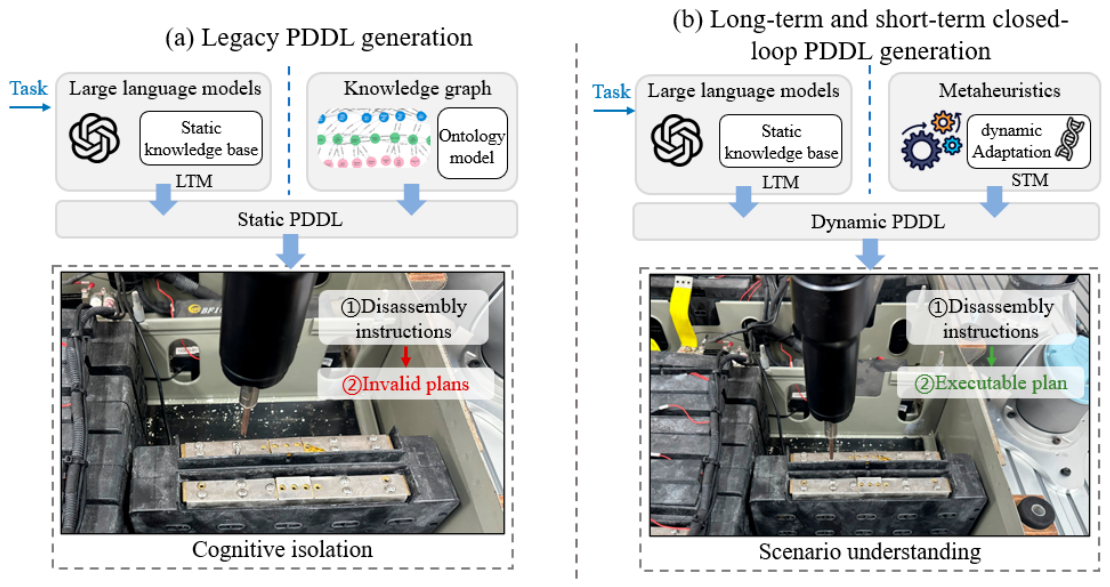
To address the aforementioned problem of mismatch between static logic and dynamic environments, this paper proposes a PDDL generation framework in collaboration with long short-term memory. As shown in Figure 1, the framework defines LLM-driven generalized logical cognition as long-term memory (LTM), which is responsible for processing non-steady-state disassembly scenarios, generating PDDL skeletons containing logical priors, and performing human–robot division of labor. The physical adaptability driven by meta-heuristic algorithms is defined as short-term memory (STM), which is responsible for generating concrete PDDL parameter instances based on disassembly scenarios. This framework solves the problem of symbolic planning lacking scene information, achieves dynamic PDDL instantiation based on disassembly scene perception, and utilizes meta-heuristic algorithms to construct understanding based on scene information within the short-term memory, thereby ensuring the execution stability of planning in non-ideal environments. At the same time, this framework solves the execution robustness problem of robots facing non-steady-state disturbances in human–robot collaborative environments.
The primary contributions of this research are summarized as follows: A Collaborative PDDL Framework: We propose a PDDL generation framework that synergizes the generalized logical reasoning of LLMs with the localized parameter optimization of meta-heuristics, bridging the gap between static logic and non-steady-state battery disassembly environments. LTM Module with knowledge graphs: We developed a long-term memory module that integrates LLMs with knowledge graphs (KGs). This allows for generalized semantic understanding and symbolic task decomposition across diverse scenarios while effectively mitigating “logical hallucinations” during planning. STM Feedback Mechanism: We designed a short-term memory mechanism for scene perception and feedback based on meta-heuristic algorithms. This enables the system to dynamically recalibrate disassembly plans in response to real-time sensor data, significantly improving task success and fault recovery rates under physical disturbances.

2. Literature Review

With the rapid development of the electric vehicle industry and the sharp increase in the number of retired batteries, traditional manual disassembly methods are not only labor-intensive and inefficient but also face serious safety risks, such as high voltage, toxic substance leakage, and thermal runaway [4]. Therefore, robotic disassembly has gradually become a research hotspot, and some scholars have developed automatic identification and operation systems for core components such as screws and busbars, which can effectively replace humans in completing high-risk tasks [5]. Despite this, most previous studies have mainly focused on predefined human–robot task allocation for disassembly, where humans handle unstructured wire harnesses and robots perform highly repetitive movements, yet they have not fully considered non-steady-state factors such as corrosion, deformation, and accumulated assembly errors resulting from long-term service of retired batteries, leading to limited planning robustness of robots when facing environmental rheology [6]. How to achieve autonomous planning with rigorous logic and physical adaptability remains an important direction for improving the intelligence level of battery disassembly. Furthermore, it is important to acknowledge the advancements in low-level control strategies for handling dynamic environments. Existing methods, such as state-filtered disturbance rejection control and multilayer neuroadaptive reinforcement learning of disturbed nonlinear systems via actor-critic mechanisms [7], have demonstrated exceptional capability in suppressing continuous dynamic disturbances at the joint and actuator levels.
As Embodied Intelligence evolves from foundation models toward more complex physical interactions [8], leveraging geometric symmetry to enhance system generalization has become critical. As indicated by recent studies, symmetry-aware architectures can effectively handle rotational invariance in visual perception [9] and optimize action-reward structures in reinforcement learning [10]. With their excellent semantic understanding and common-sense reasoning capabilities, large language models (LLMs) have reshaped the paradigm of robot task planning, causing robots to gradually evolve into agents capable of knowledge reasoning and experience accumulation [11]. Humans have natural advantages in handling complex topological relationships and responding to sudden physical failures, while robots excel in operational precision and long-term logical consistency. To compensate for the lack of grounding in symbolic planning within non-steady-state environments, researchers have turned to seeking linkage mechanisms combining perception, language, and logic to handle dynamic task expressions [12]. Compared to traditional rule-based or finite-state machine methods, LLMs have significant advantages in common-sense reasoning and cross-modal semantic mapping, enabling zero-shot generalization of complex disassembly instructions. Especially in long-sequence task planning, LLMs can extract high-level semantic skeletons from unstructured text, providing a new path for logic-driven task decomposition and strategy generation. For example, Wang et al. proposed a human–robot collaboration framework based on LLM Chain-of-Thought, which endows robots with human-like perception, interaction, self-reasoning, task planning, and task execution thinking modes and execution capabilities [13]. Similarly, scholars have performed task planning by combining LLMs with Retrieval-Augmented Generation (RAG) mechanisms and vision–language models with in-context reasoning to improve the robustness of robots in solving problems when environmental fluctuations occur [14,15].
Meanwhile, to enhance the experience accumulation capability of LLMs, some scholars have proposed a long-term memory mechanism based on a code skill library, enabling agents to handle open environments by accumulating successful operational experience [16]. To solve problems such as equipment failure, other scholars have proposed combining multimodal causal knowledge hypergraphs with LLMs [17,18]. Concurrently, many scholars have attempted to combine LLMs with meta-heuristic algorithms for task allocation, initially demonstrating the potential of semantic reasoning and meta-heuristic search [11]. Traditional PDDL can theoretically achieve rigorous logical reasoning through symbolic modeling, but in disassembly environments involving non-steady states, it often exhibits insufficient robustness due to its high reliance on the static closed-world assumption. This limitation has prompted researchers to explore planning methods that inject PDDL as high-level logic into LLMs. Some studies have proposed methods based on LLMs generating PDDL models and multi-level goal decomposition; although this improves the logic and accuracy of planning, it mostly focuses on discrete logic or high-level task allocation and still falls short in handling real-time adaptive adjustment involving continuous physical parameters [19]. In the field of battery disassembly, research has utilized LLMs to guide the search process of PDDL planners, but it is currently limited to relatively simple single-object scenarios and cannot solve the execution robustness problem when non-steady-state interference occurs during human–robot collaboration [20].
Recently, end-to-end Vision–Language–Action (VLA) models and vision–language models (VLMs) have demonstrated impressive capabilities in bridging the language–perception–action gap. However, in high-risk industrial scenarios like retired battery disassembly, pure VLA models present critical limitations. First, end-to-end VLA networks act as ‘black boxes,’ lacking the strict logical interpretability and safety guarantees required to prevent catastrophic failures (e.g., thermal runaway caused by short circuits). Second, training robust VLA models requires massive amounts of paired trajectory data, which is exceedingly scarce for highly heterogeneous retired batteries. Although responsive planning through LLMs creates a closed loop for human–robot collaboration, its essence is semantic re-planning. Under non-steady-state disassembly conditions, existing LLM responsive architectures lack understanding of dynamic information in different scenarios and cannot achieve a deep leap from logic to scene. Therefore, to endow robots with the cognitive ability to handle complex non-steady-state environments, Zhang et al. proposed combining knowledge graphs (KGs) and LLMs, where the knowledge graph consists of a dynamic information base and a relatively static knowledge base, aiming to solve challenges related to planning robots in non-steady-state environments [21]. Aiming at the non-steady-state scenario of retired battery disassembly, this paper aims to propose a PDDL generation framework collaborative with long-term memory and short-term memory framework, using a combination of LLM and KG to store generalized battery disassembly knowledge as long-term memory, and introducing meta-heuristic algorithms as short-term memory to understand non-steady-state scenes during task execution, thereby effectively filling the gap between high-level logic skeletons and low-level non-steady-state execution, achieving physical adaptability and execution robustness of planning generation in retired battery disassembly scenarios.

3. Methods

In the human–robot collaborative disassembly of retired power batteries, the core of this research is the issue of robot execution robustness in non-steady-state scenarios. The non-steady-state environment not only includes spatial non-steady-state characteristics brought about by diverse battery models and unfixed placement poses in the initial environment, but also emphasizes dynamic evolution and sudden physical anomalies occurring over the disassembly time sequence.
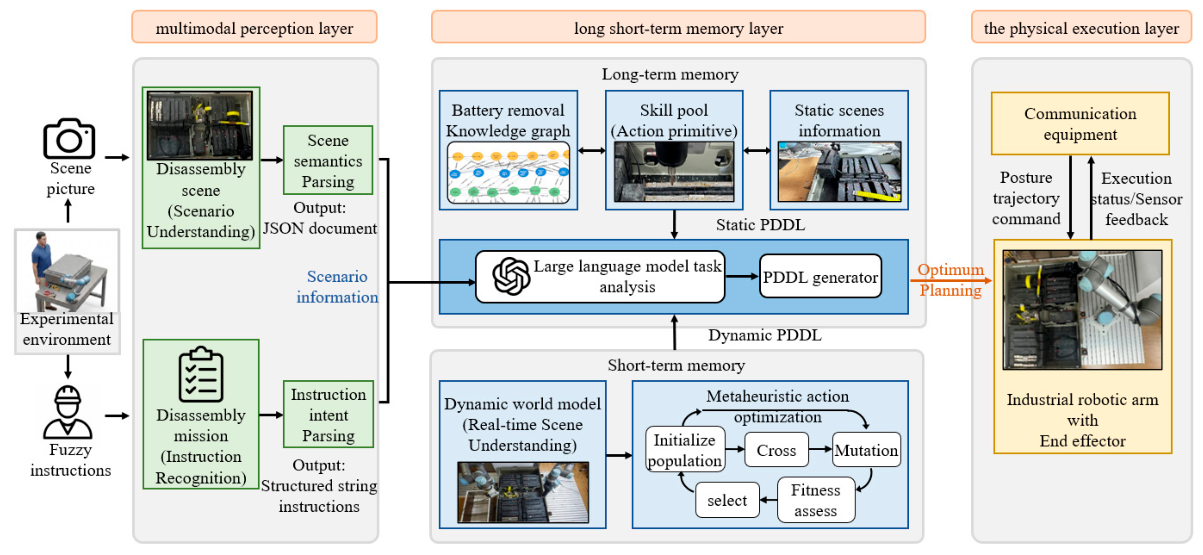
Aiming at this non-steady-state environment of retired battery disassembly, this paper proposes a task planning framework based on a long-term memory and short-term memory framework (LTM-STM). This framework integrates large language models (LLMs) and knowledge graphs (KGs) as long-term memory, using disassembly domain knowledge to guide the generation of the planning skeleton, while introducing meta-heuristic optimization algorithms as short-term memory to achieve scene understanding and local planning refinement in non-steady-state scenarios. The retired battery disassembly task planning framework proposed in this paper adopts a three-layer hierarchical collaborative architecture design consisting of a multimodal perception layer, a long-term memory and short-term memory framework layer, and a physical execution layer, achieving closed-loop integration through an explicit scene information flow, as shown in Figure 2. Compared with traditional PDDL generation and planning methods, this framework has significant advantages in solving non-steady-state disassembly problems. First, the fundamental reason for the poor performance of PDDL in non-steady-state scenarios lies in its closed-world assumption, which cannot cover the disturbances of non-steady-state scenarios. This framework processes symbolic logic through LTM and non-steady-state scene information through STM, effectively solving the robustness generation problem of symbolic planning in non-steady-state scenarios. Second, strong constraint rules between actions, tools, and components are defined through the KG in long-term memory. When the LLM generates PDDL, it is no longer making unordered predictions, which greatly narrows the search space for meta-heuristic algorithms and improves the convergence speed of short-term memory.
Finally, short-term memory utilizes the swarm intelligence characteristics of meta-heuristic algorithms to perform adaptive PDDL generation for non-steady-state features such as battery pack deformation and corrosion. This mechanism for understanding specific scene information compensates for the defect of excessive search overhead when LLMs handle uncertainty, realizing a closed loop from semantic understanding to high-dynamic action execution. It ensures the consistency of task logic while providing a unified interface and expansion foundation for subsequent multi-robot collaboration and cross-scenario migration.

3.1. Multimodal Perception Layer for Battery Disassembly

As the front end of system–environment interaction, the multimodal perception layer constructs the initial state of the environment through scene recognition, natural language instructions, and disassembly task lists. The instruction parsing module is responsible for transcribing the operator’s natural language audio into structured text, while the visual perception module captures the appearance and damage level of the battery pack in real-time through a camera, transforming the physical state of the environment into semantic description fragments recognizable by the knowledge graph. Simultaneously, the scene information generated by the visual perception module is used as input for short-term memory to provide an obstacle avoidance basis for subsequent disassembly planning; this layer provides the initial state of the environment for subsequent planning. Specifically, the visual perception module employs a hybrid pipeline. First, a pre-trained object detection model is utilized to extract bounding boxes of key components. Then, aligned with the geometric depth data from the Intel Corporation (Santa Clara, CA, USA) RealSense D435i camera, the cropped regions of interest are fed into a vision–language model (VLM, implemented via Baidu Inc. (Beijing, China) Qwen-VL API). The VLM acts purely as a semantic attribute extractor, identifying non-steady-state conditions rather than making direct control decisions. These discrete semantic labels are then transmitted to the LTM for knowledge graph querying.

3.2. Long-Term Memory and Short-Term Memory Framework Layer Integrating Logical Reasoning and Non-Steady-State Environments

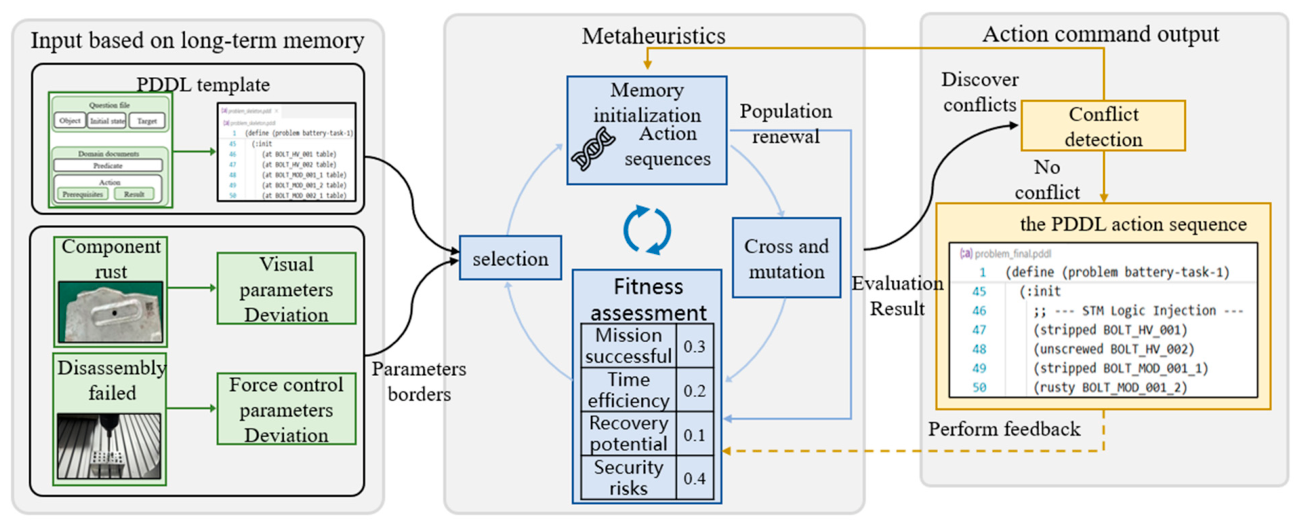
The memory layer is the hub for achieving the fusion of steady-state logic and non-steady-state scenes, divided into two collaborative sub-layers. The long-term memory layer consists of LLM task parsing and the battery disassembly knowledge graph. LTM utilizes the zero-shot reasoning capability of LLMs and the ontological constraints of the knowledge graph to parse human collaborative intentions into a PDDL skeleton. This stage mainly determines action sequences and their logical topological relationships. The short-term memory layer is used for uncertainties in non-steady-state environments; STM adopts meta-heuristic algorithms as the evolutionary unit. STM receives the PDDL skeleton generated by LTM and, through an evolutionary loop of initializing populations, fitness calculation, crossover, mutation, and generating new populations, STM performs a local search for planning parameters to balance execution efficiency and success rate, generating the optimal PDDL parameterized instance adapted to current scene constraints. If a human is detected entering the operation interference zone, STM will use meta-heuristic algorithms to dynamically optimize task planning within the parameter boundaries defined by PDDL, ensuring collaborative safety and the normal progression of the task.
A critical feature of this LTM-STM framework is the experience accumulation and feedback mechanism from the STM back to the LTM. When the STM successfully modifies the LTM-generated PDDL skeleton to adapt to a specific non-steady-state scenario (e.g., severe rust or structural deformation identified via scene recognition), this successfully instantiated and executed PDDL is saved back into the LTM’s repository, tagged with its specific scene information. Consequently, when the system encounters an identical or highly similar physical scenario in the future, the LTM can bypass the generalized reasoning process and directly retrieve this STM-validated PDDL template. This mechanism effectively transforms short-term physical adaptations into long-term experiential knowledge, enabling the reuse of successful disassembly strategies.

3.2.1. Long-Term Memory

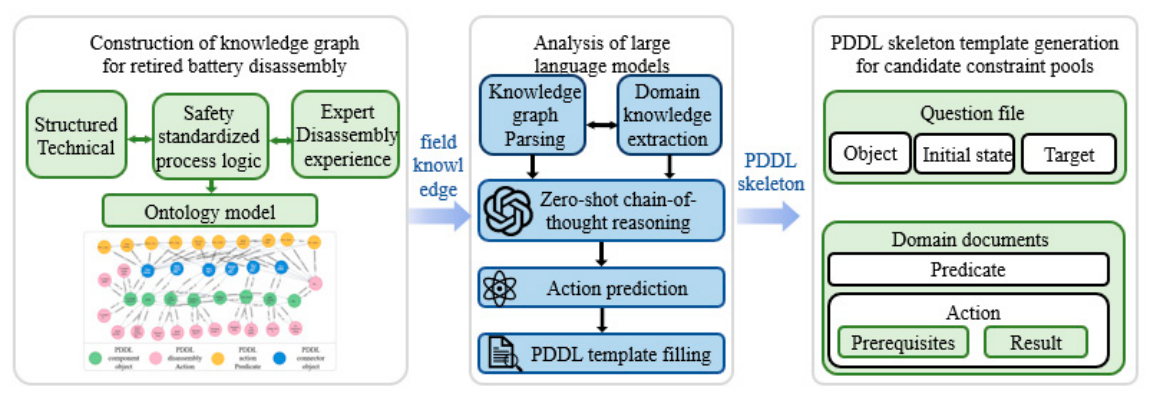
The LTM module aims to utilize the generalized reasoning capability of LLMs and the structured domain support of KGs to achieve semantics; this paper constructs a retired battery disassembly knowledge graph. This graph serves as an ontological model, defining multi-dimensional associations between battery components and fasteners as PDDL object components, disassembly actions as PDDL action components, and disassembly steps as PDDL predicate components, providing factual evidence for PDDL instantiation. Then, the LLM solidifies historical disassembly experience and general common sense into task-level logic templates. For unstructured instructions, long-term memory first performs semantic deconstruction of complex tasks through zero-shot reasoning and prompt-guided LLM to generate a planning skeleton conforming to PDDL specifications, as shown in Figure 3.
This module first acquires RGB images of the target battery pack through visual recognition; the output to the LTM consists of discrete semantic labels, which serve as indices to execute semantic queries in the battery disassembly domain knowledge graph. The system extracts the component hierarchy, fastener constraints, and safety specifications of that battery, transforming them into structured text to be injected into the large language model’s prompt template. Then, the user-input natural language instruction I and the factual background K f a c t retrieved from the knowledge graph are jointly input into the LLM to parse the task intention and its corresponding PDDL instantiation parameters. To formally describe this knowledge-enhanced semantic parsing process, the following mapping function is introduced:
S s k e l e t o n = f L T M ( I , K f a c t , H s t a t e )
where I represents the natural language instruction, K f a c t is the prior facts provided by the knowledge graph, H s t a t e represents the human’s current operation state, and the output S s k e l e t o n represents the generated task planning skeleton.
Subsequently, the system maps the parsed logical operators into a predefined disassembly skill library. Each skill (such as Unscrew, Disconnect, Lift) is strictly defined in PDDL format with its preconditions, action name, parameter variables, and physical effects. To avoid the logical hallucinations of large language models during task generation, this paper does not directly adopt the execution instructions from the LLM. Instead, its output is restricted to a set of symbols verified by the knowledge graph, and formal binding is performed using the strong type constraints of PDDL. Only when the action sequence generated by the LLM passes the path reachability verification of the knowledge graph and the logical integrity check of PDDL will the task skeleton be sent to the execution layer. This process combines the deterministic structural knowledge of the KG with the probabilistic reasoning capability of the LLM through a pipeline structure of prior fact injection, followed by semantic logic synthesis, and finally symbolic constraint validation. The KG is responsible for providing environmental information and constraints on relevant physical prohibited conditions, while the LLM solves the logic of how to combine actions according to instructions. This provides highly robust guidance for robot disassembly tasks in non-steady-state battery disassembly environments and offers high-confidence logical input for subsequent short-term memory instantiation based on meta-heuristic algorithms.
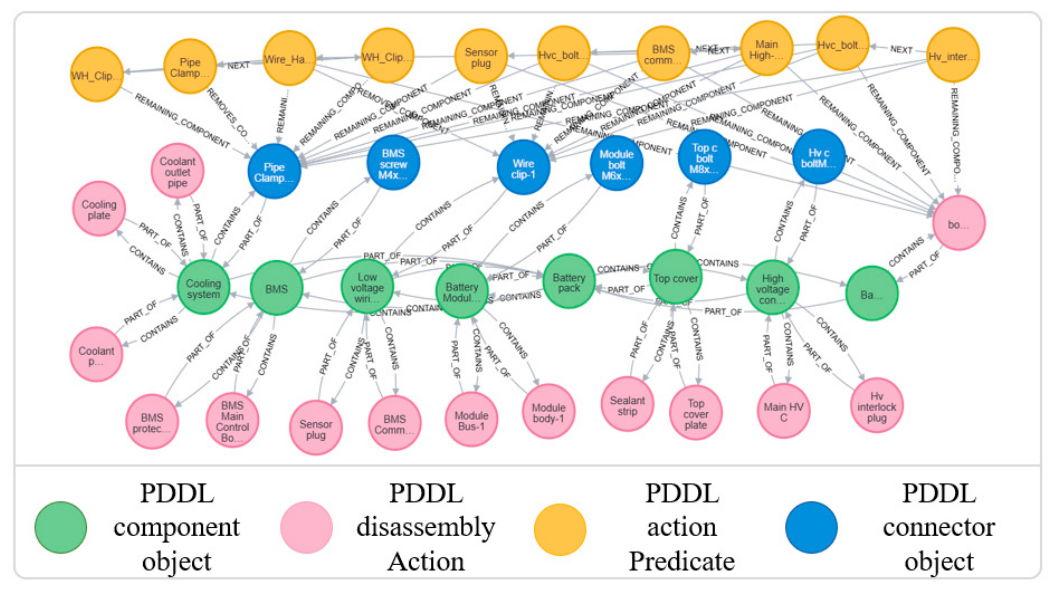
In non-steady-state scenarios of retired battery disassembly, robots need to perceive complex component topological relationships and dynamically changing safety constraints in real-time. Traditional PDDL models struggle to perform effective logical corrections when the environment is heterogeneous due to a lack of deep descriptions of entity attributes. Therefore, this paper constructs a battery disassembly domain knowledge graph as the domain knowledge base in long-term memory. This graph refers to the structured technical documents of mainstream batteries, the process logic of power battery disassembly safety specifications, and expert disassembly experience for non-steady-state environments. Through ontological modeling, this module deeply binds the physical structure and process specifications of the battery pack with the predicate logic of PDDL, providing reasoning boundaries for the large language model (as shown in Figure 4).
This module first defines a multi-layered ontology architecture covering the physical entity domain, operation domain, and constraint domain. The physical entity domain includes core classes such as components, assemblies, and fasteners, used to describe the hierarchical deconstruction relationship of the battery pack from modules to bolts. The operation domain defines actions and steps and associates them with the tool library. To formally describe the semantic logic in the knowledge graph, this paper defines it as a set:
K = { E , R , A }
where E represents the set of entities, R represents the set of relationships, and A represents entity attributes.
To achieve seamless alignment between the knowledge graph and the planning domain, a semantic mapping function, Ψ is introduced:
P = Ψ ( E , R )
where P represents the generated set of PDDL predicates. For example, the relationship is automatically mapped to the PDDL state, and the relationship is transformed into a partial order constraint in the planning sequence.
The core advantage of this module is that it eliminates the semantic gap between PDDL symbolic logic and the non-steady-state battery disassembly environment through structured entity associations. This graph provides domain knowledge support for the LLM, enabling the long-term memory architecture to not only understand the reasons for disassembly actions but also perform correct actions based on the real model of the battery. This ontology-based constraint mechanism ensures that even in non-steady-state environments where sensor data contains noise, the task skeleton still strictly follows the safety criteria and logic of power battery disassembly, effectively preventing catastrophic execution failure caused by logical hallucinations.
Crucially, the construction of the PDDL domain definition directly capitalizes on the principles of logical and functional symmetry. In retired battery packs, although physical degradation is non-steady, the high-level symbolic rules exhibit intrinsic permutation symmetry. For instance, symmetrically distributed fasteners share identical type constraints and predicate structures in PDDL. By leveraging this task-domain symmetry, the LTM module utilizes the knowledge graph to cluster symmetric object instances, which substantially reduces the search space for the short-term memory optimizer.

3.2.2. Short-Term Memory

This paper introduces meta-heuristic algorithms as the core drive of STM, transforming the PDDL skeleton generated by LTM into planning results adapted to non-steady-state environments. In non-steady-state environments for retired battery disassembly, component deformation, fastener corrosion, and random sensor drift make it difficult for preset static action parameters to guarantee execution success rates. To this end, the short-term memory module performs fine-tuning of control parameters in the early stage of action execution through online evolutionary search. This process utilizes the global search capability of genetic algorithms to optimize within the parameter space defined by action operators, achieving dynamic instantiation from the logical skeleton to the physical trajectory. Specifically, a genetic algorithms (GA) is utilized as the core meta-heuristic optimizer for the STM module. The hyperparameters are empirically set as follows: population size = 50, crossover probability = 0.8, and mutation probability = 0.1. The evolutionary process terminates when one of the stopping criteria is met: either reaching a maximum of 100 iterations or the fitness variance across the population falling below a convergence threshold for 10 consecutive generations, ensuring a balance between exploration and computational efficiency. This mechanism supports a feedback loop and significantly improves the robustness of the robot in response to non-steady-state environmental disturbances (as shown in Figure 5).
This module first constructs a parameter encoding scheme, mapping continuous variables in PDDL action operators to solution vectors in the search space. Subsequently, the system combines current sensor feedback and assessment results from a vision–language model to construct a multi-objective fitness function for real-time evaluation of the quality of current action parameters. To formally describe this short-term memory optimization process, the following objective function can be introduced:
F ( x ) = w s r I S R ( x ) + w a p t T r e f T e x e c ( x ) + w r s r R r e c o v e r y ( x ) w r i s k C r i s k ( x )
where x represents the action parameter vector to be optimized, I S R ( x ) represents the task execution success indicator function, T r e f T e x e c ( x ) is the time efficiency ratio, T r e f is the standard reference time, and T e x e c ( x ) is the execution time under the current parameter x . R r e c o v e r y ( x ) represents the potential for fault recovery, and C r i s k ( x ) is the safety risk penalty. Through iterative evolution, the system outputs the optimal parameter set x * as the command input for the execution layer.
Given the highly hazardous nature of retired power battery disassembly, the weighting coefficients in the multi-objective fitness function (Equation (4)) were calibrated strictly following a “safety-first” principle. Based on preliminary grid search optimization and domain expert heuristics, the safety risk penalty was assigned the highest weight ( w r i s k = 0.4), followed by the task success indicator ( w s r = 0.3). Time efficiency ( w a p t = 0.2) and fault recovery potential ( w r s r = 0.1) were assigned lower weights. This configuration prioritizes operational safety and task completion over mere execution speed in non-steady-state environments [22].
To prevent traditional planning algorithms from falling into local optima when facing physical heterogeneity, this paper constructs a short-term memory cache with updating characteristics. The information and visual deviations collected during the execution of each action are transformed into initial population biases for the evolutionary algorithm, rather than adopting a random initialization scheme. Taking the “disassembly of module fastening bolts with corrosion risk” as an example, the system first obtains the Unscrew logic from long-term memory, then the short-term memory module calls the algorithm to search for the optimal path point within the restricted torque range based on the visual perception of the corrosion level.

3.3. Physical Execution Layer for Robot Operations

The execution layer consists of communication equipment and the industrial robotic arm body. The optimal scene PDDL output by the perception layer is converted into specific pose and trajectory instructions for issuance. Under the scheduling of communication equipment, the disassembly action is completed and the execution feedback is sent back in a closed loop. Through the aforementioned layered mechanism, the framework forms a closed-loop process from scene information analysis, long-term memory PDDL framework generation, and short-term memory planning verification to online execution and feedback.

4. Experimental Results

4.1. Experimental Design

Regarding the motivation and non-steady-state scenario definition in the human–robot collaborative disassembly of retired power batteries, the non-steady-state characteristics of the environment are the core bottleneck restricting robot execution robustness. Traditional planning methods are usually based on the closed-world assumption—that is, assuming the environmental state is static and known. However, in actual disassembly conditions, there are three typical non-steady-state failure mechanisms, which directly determine the dimensions of the experimental design in this chapter. First is the random evolution of physical properties; due to long-term use, battery components are often accompanied by unpredictable corrosion, deformation, or electrolyte overflow. These non-steady-state factors cause predefined action parameters to fail during the execution phase, and the model cannot achieve reuse relying solely on static knowledge. Second is the ambiguity of semantic perception; in human–robot collaboration scenarios, human instructions often carry spatial ambiguity, which, combined with visual noise in complex backgrounds, makes it difficult for robots to directly “ground” high-level logic to specific physical entities. Finally, there is the dynamic disturbance of sensor feedback; mechanical vibration, local occlusion, or sensor drift during the disassembly process can cause inconsistency between real-time feedback and initial planning. If the system lacks online parameter fine-tuning capabilities, it will trigger a chain of execution crashes. Therefore, the experiments in this chapter no longer focus solely on operational efficiency under standard conditions but take logical stability and physical adaptability as core evaluation dimensions. The experimental design follows a progressive logic from steady-state to non-steady-state: Experiment A serves as the baseline indicator to verify the task decomposition accuracy of the LTM under ideal conditions. Experiments B, C, and D introduce artificial fuzzy instructions and physical disturbances to specifically examine how the STM achieves closed-loop fault recovery through meta-heuristic evolution when perception fails or the environment changes. Through these comparative experiments, the aim is to verify whether the LTM-STM collaborative framework can effectively bridge the understanding gap between static symbolic logic and the non-steady-state physical environment.

4.2. Experimental Environment Setup

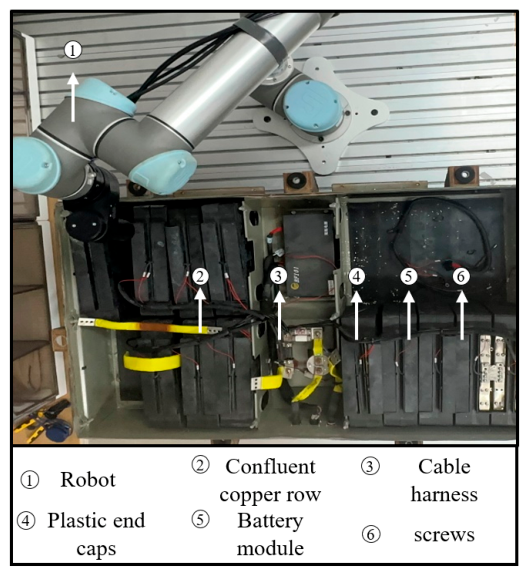
To comprehensively verify the effectiveness of the long-term memory and short-term memory framework collaborative planning framework proposed in this paper for retired battery human–robot collaborative disassembly tasks, this study built a robot experimental platform with visual perception, natural language understanding, and high-precision force-controlled operation capabilities (as shown in Figure 6). The hardware execution system uses a UR5 six-degree-of-freedom collaborative robot produced by Universal Robots(Odense, Denmark). The perception system is equipped with an Intel Corporation (Santa Clara, CA, USA) RealSense D435i depth camera, fixed to the mechanical arm’s end flange using an eye-in-hand installation method. This camera provides high-resolution RGB images. The hardware categories are shown in Table 2.
The large language model employed in the LTM module is the GPT-4 model accessed via OpenAI API. To ensure logical determinism and minimize hallucination, the prompt structure comprises a system role defining the PDDL domain constraints, followed by a dynamic injection of the knowledge graph query results and user instructions. The knowledge graph, constructed in Neo4j, contains approximately 150 entity nodes and 300 relationship edges, manually validated by three domain experts to ensure process safety. The specific meta-heuristic algorithm used in the STM is a GA, with parameters set as follows: population size = 50, crossover probability = 0.8, mutation probability = 0.1, and a maximum of 100 iterations. As discussed in Section 4.5, the total system latency (inference and search) is bounded under 15 s.
To construct a realistic non-steady-state scenario, the experimental object is a retired battery module with a highly representative and complex physical structure. As shown in Figure 6, the main components include fasteners with varying degrees of random corrosion, high-voltage wire harnesses, copper busbars, plastic top covers, and the core battery module. The construction logic of this experimental platform fully considers the closed-loop feedback requirements in non-steady-state environments. The system establishes a channel from high-level semantic understanding to low-level mechanical perception, providing a solid physical foundation for subsequent verification of the LTM-STM framework’s robustness.

4.3. Method Comparison and Verification

To systematically evaluate the comprehensive performance of the proposed LTM-STM framework, the comparative experiments were designed as an ablation study to isolate and verify the specific contributions of the LTM and STM modules. We selected three representative baselines: Fixed-PDDL: Represents the traditional mainstream planning scheme relying on static Domain and Problem files without any memory mechanisms. LLM-PDDL: Serves as a baseline retaining only the LTM (semantic reasoning) while stripping the underlying STM (physical parameter evolution). It employs Chain-of-Thought prompting to generate PDDL skeletons but directly issues commands without real-time physical adaptation. GA-PDDL: Serves as a baseline retaining only the STM (meta-heuristic search) while stripping the LTM. It relies solely on a GA to perform blind global searches for parameters without high-level semantic guidance. To systematically evaluate the comprehensive performance of this method in natural language task parsing, PDDL planning generation, and action execution efficiency, this paper designs four types of performance metrics. First, semantic task accuracy (STA) is defined to evaluate whether the generated PDDL sequence conforms to physical logic and skill constraints. Second, execution success rate (SR) is defined as the proportion of trials where the specified component is completely detached and removed from the workspace without triggering the hardware collision threshold (>50 N). The third item is Average Planning Time (APT), reflecting the system’s response speed from receiving instructions to generating executable parameters. Finally, recovery success rate (RSR) represents the probability that the system, upon encountering a physical anomaly (e.g., fastener offset or rust) causing an initial action failure, successfully recalculates and completes the action via STM parameter evolution. It is critical to clarify that the fault recovery success rate (RSR) is a conditional probability calculated exclusively from the subset of trials where an initial physical anomaly occurred, whereas the execution success rate (SR) applies to the entire set of trials. This explains why RSR can numerically exceed SR without mathematical contradiction.
To verify the effectiveness and superiority of the task planning method of the long-term memory and short-term memory framework proposed in this paper in non-steady-state environments, three representative existing methods were selected for comparison. Fixed-PDDL method, representing the mainstream planning scheme for traditional industrial robots: this method uses the Fast Downward planner to generate action sequences based on manually pre-written fixed Domain and Problem files. Its logic is rigorous but lacks perception of environmental dynamic changes. LLM-PDDL method: to ensure a fair comparison, this method introduces Chain-of-Thought prompt engineering to guide the large language model in logical reasoning to generate PDDL skeletons. However, this baseline directly issues execution commands and lacks low-level physical perception feedback and online parameter adjustment. GA-PDDL method: this method does not use LTM semantic guidance and relies solely on meta-heuristic algorithms to perform blind searches in the global parameter space. All four methods were tested under the same hardware platform and disassembly task conditions. Each task was repeated 50 times to obtain average results, as shown in Table 3.
From the experimental result analysis, the LTM-STM collaborative framework proposed in this paper is significantly superior to the comparison baselines in all key metrics. In terms of semantic task accuracy, although Fixed-PDDL reached 92.0% by relying on manually defined hard rules, it performed extremely poorly under non-steady-state conditions. LLM-PDDL reached 82.0% accuracy through Chain-of-Thought optimization but still exhibited logical hallucinations. The method in this paper (96.0%) utilizes the prior domain knowledge of the knowledge graph (KG), which, while maintaining the LLM’s corresponding thinking ability, greatly suppresses the generation of illegal actions, an increase of 14% over LLM-PDDL. In terms of task execution success rate, this method reached 88.0%, an increase of approximately 50% and 36% compared to Fixed-PDDL (38.5%) and LLM-PDDL (52.0%), respectively. This indicates that when non-steady-state disturbances such as fastener bias or deformation exist, schemes relying only on high-level logic without low-level physical adaptation struggle to maintain task continuity. On the efficiency metric APT, Fixed-PDDL planned faster due to its static nature but could not handle anomalies. GA-PDDL faced the curse of dimensionality when searching for optimal action parameters in the global space due to the lack of semantic guidance, with an average time as high as 56.4 s. The method in this paper controls the average task time at 24.8 s by using the logical skeleton provided by LTM to narrow the STM’s search space, achieving an effective balance between planning accuracy and search efficiency. Meanwhile, in terms of robustness, the fault recovery success rate of this method reached 0.91. In contrast, LLM-PDDL could only perform simple retries with a result of only 32%, while GA-PDDL, although possessing local optimization capability, lacked global logical guidance, with a fault recovery success rate of 55%. This verifies the significant improvement in system stability by the closed-loop mechanism of long-term memory guidance and short-term memory evolution. Comprehensive comparison results show that the proposed method not only achieves deep semantic-level constraints through KG and LLM but also enhances adaptability to non-steady-state scenarios through meta-heuristic algorithms. This method significantly improves the reliability of robots handling highly uncertain tasks like retired battery disassembly through verifiable PDDL skeletons and evolvable execution parameters, providing a new technical path for intelligent task planning in complex industrial disassembly scenarios.

4.4. Experimental Process

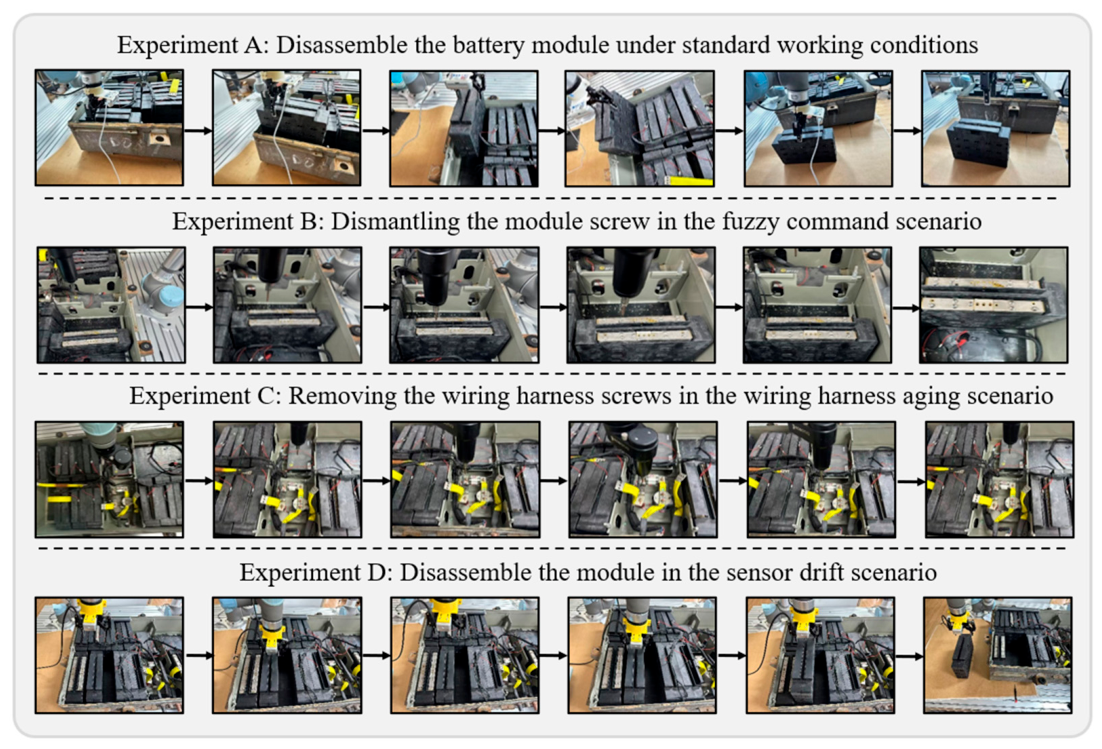
To verify the adaptability of the proposed method in dealing with non-steady-state scenarios of retired batteries, four types of challenging experimental scenarios were designed. These scenarios are all important and difficult tasks for robot battery disassembly in human–robot collaborative disassembly. Category 1: Standard Condition Disassembly Task: in this scenario, the battery pack structure is complete and the pose is accurate, aiming to test the basic accuracy and execution efficiency of the LTM module in generating PDDL planning skeletons under ideal conditions. Category 2: Noise during Human–Robot Collaboration: the experimenter issues instructions containing fuzzy spatial semantics to test the system’s ability to use the KG for knowledge anchoring and LLM semantic alignment. Category 3 and 4: Disassembly Tasks in Non-steady-state Environments: physical disturbances are introduced during the execution process, including artificially set bolt hole offsets, simulated fastener aging, and partial field-of-view occlusion, to verify the online correction capability of the meta-heuristic algorithm in the STM module for action parameters. The above experimental scenarios were all conducted under the same hardware platform and software environment to ensure comparability of results. The experimental process is divided into five stages: First is the Perception and Retrieval Stage, identifying part information in the battery pack through visual recognition and retrieving component topology from the KG. Second is the Logical Planning Stage: LTM combines instructions and KG facts to generate a PDDL skeleton suitable for the current disassembly scenario. Third is the Parameter Evolution Stage: STM calls the meta-heuristic algorithm to initialize the action parameter population based on current real-time feedback. Fourth is the Closed-loop Execution Stage: the robot executes the disassembly task and performs online PDDL adjustment based on visual feedback. The last is the Evaluation and Recording Stage: each task group repeated the experiment 50 times to record metrics such as task success rate, semantic parsing accuracy, and anomaly recovery time.

4.5. Experimental Results and Performance Analysis

Through multiple rounds of experiments on the robot disassembly system driven by the proposed collaborative long-term memory and short-term memory framework in three typical non-steady-state scenarios (see Figure 7), this paper comprehensively evaluated the system performance from four dimensions: semantic parsing accuracy, task execution success rate, task execution efficiency, and anomaly recovery capability. The statistical results are shown in Table 4.
Specifically, in Experiment A with a clear rule structure, the system achieved a 98% semantic accuracy and a 95% execution success rate, verifying the determinism of LTM in generating PDDL skeletons in structured environments. In Experiment B involving fuzzy instructions, even with non-deterministic semantic descriptions, the semantic accuracy remained at 92% relying on the prior constraints of the KG. This shows that LTM can effectively filter logical hallucinations produced by large language models, ensuring alignment between high-level instructions and physical process specifications. In Experiments C and D, which simulate real retired conditions, despite being affected by bolt offset, corrosion, and visual occlusion, although the task execution success rate decreased compared to standard conditions, the fault recovery success rate reached 89.5%. This is significantly superior to traditional static planning methods, proving that the STM module can effectively compensate for prediction biases brought by environmental non-steady-state factors through meta-heuristic algorithm parameter evolution.
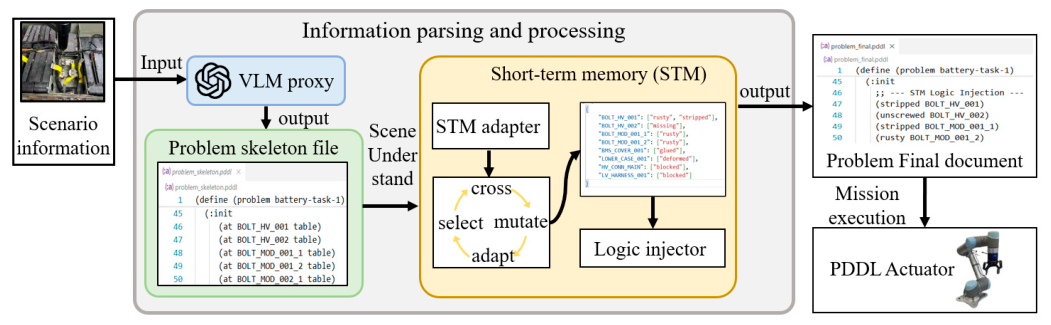
As shown in Figure 8, taking Experiment C as an example, after the visual recognition module obtains current scene information, it passes the scene information to the LTM. The LLM within generates a PDDL skeleton conforming to the current scene, and then the STM module obtains relevant part-aging information after scene understanding, and then transforms the LLM-generated PDDL skeleton into a PDDL document conforming to the current scene through the meta-heuristic algorithm. Experimental data indicates that as task complexity increases, the average task time shows an upward trend. The increased time overhead mainly stems from twoaspects: first is the calculation delay of KG retrieval and LLM reasoning; second is the time required for population evolution in the STM stage by the meta-heuristic algorithm. However, considering the high danger of retired battery disassembly, it is highly reasonable in industrial practice to exchange moderate delays for higher success rates and safety. The experimental results strongly support the advanced nature of the proposed LTM-STM collaborative framework in handling non-steady-state disassembly tasks of power batteries.

5. Conclusions

This paper proposes a robot task planning method based on long-term memory and short-term memory framework collaboration for non-steady-state scenarios in the human–robot collaborative disassembly process of retired power batteries. This method achieves robot understanding of disassembly tasks and non-steady-state scenarios through KG and LLM to build long-term memory, completing the reasoning of task logic skeletons. Simultaneously, it uses meta-heuristic algorithms to build short-term memory, achieving adaptive instantiation evolution for non-steady-state scenarios. Experimental results show that in non-steady-state tasks including component corrosion, pose bias, and fuzzy semantic instructions, the proposed framework achieved a semantic task accuracy of 96.0% and a task execution success rate of 88.0%. After introducing physical disturbances, the fault recovery success rate increased to 91.0%, effectively verifying the stability and robustness of the proposed framework in handling high-uncertainty disassembly tasks. Comparison experiments with mainstream planning methods such as Fixed-PDDL and LLM-PDDL prove that this method demonstrates significant superiority in logical rationality, execution success rate, and parameter evolution efficiency. This shows that the collaborative mechanism of long-term memory and short-term memory framework plays a key role in improving planning quality in non-steady-state scenarios, increasing the overall task completion rate by approximately 35–50% compared to traditional methods. Despite the demonstrated improvements, this study has several limitations. The framework relies heavily on a manually constructed prior knowledge graph, which limits its zero-shot scalability to completely undocumented battery models. Furthermore, the current STM adaptation focuses on end-effector parameters and lacks a dynamic global obstacle avoidance mechanism for the entire robotic arm during severe structural deformations. Current validations are also restricted to single-arm scenarios.
Future research will continue around the deep integration of human–robot collaborative disassembly systems. First, through multimodal perception enhancement, further integrate end-effector torque, and tactile and human posture perception recognition to build a more sensitive real-time collaboration monitoring mechanism, achieving accurate judgment of fastener states and adaptive compensation of process parameters. Second, research on multi-agent task collaboration is needed; facing the disassembly needs of large-sized battery packs, explore task dynamic allocation strategies between multiple robots and human operators, resolving temporal conflicts through a unified framework and improving collective collaboration efficiency. Finally, autonomous skill learning: aiming at the limitations of atomic skill libraries, combined with reinforcement learning and human demonstration, enable robots to autonomously optimize skill parameters by observing the flexible manipulation skills of human experts.

Author Contributions

Conceptualization, J.L., S.Z., J.S. and J.B.; methodology, J.L., S.Z., J.S. and J.B.; software, J.L., S.Z. and J.S.; validation, J.L., S.Z. and J.S.; formal analysis, J.L., S.Z.; investigation, J.L., S.Z. and J.S.; resources, J.L., S.Z. and J.S.; data curation, J.L., S.Z. and J.S.; writing—original draft preparation, J.L., S.Z. and J.S.; writing—review and editing, J.L., S.Z., J.S. and J.B.; visualization, J.L., S.Z., J.S. and J.B.; resources, J.L. and J.B. All authors have read and agreed to the published version of the manuscript.

Funding

This work was supported by the Fundamental Research Funds for the Central Universities (2232025G-09).

Data Availability Statement

The data presented in this study are available on demand from the corresponding author at 2241038@mail.dhu.edu.cn.

Acknowledgments

During the preparation of this work, the authors used Grammarly (v1.2.250) in order to improve language and grammar. After using this tool, the authors reviewed and edited the content as needed and take full responsibility for the content of the publication.

Conflicts of Interest

The authors declare no conflicts of interest.

Abbreviations

The following abbreviations are used in this manuscript:
PDDLPlanning Domain Definition Language
LLMLarge Language Models
LTM-STMLong-Term Memory and Short-Term Memory Framework
LTMLong-Term Memory
STMShort-Term Memory

References

  1. Li, W.; Peng, Y.; Zhu, Y.; Pham, D.T.; Nee, A.Y.C.; Ong, S.K. End-of-Life Electric Vehicle Battery Disassembly Enabled by Intelligent and Human-Robot Collaboration Technologies: A Review. Robot. Comput.-Integr. Manuf. 2024, 89, 102758. [Google Scholar] [CrossRef] [Scilit]
  2. Asif, M.E.; Rastegarpanah, A.; Stolkin, R. Robotic Disassembly for End-of-Life Products Focusing on Task and Motion Planning: A Comprehensive Survey. J. Manuf. Syst. 2024, 77, 483–524. [Google Scholar] [CrossRef] [Scilit]
  3. Yuan, G.; Liu, X.; Qiu, X.; Zheng, P.; Pham, D.T.; Su, M. Human-Robot Collaborative Disassembly in Industry 5.0: A Systematic Literature Review and Future Research Agenda. J. Manuf. Syst. 2025, 79, 199–216. [Google Scholar] [CrossRef] [Scilit]
  4. Zang, Y.; Wang, Y. Robotic Disassembly of Electric Vehicle Batteries: An Overview. In Proceedings of the 2022 27th International Conference on Automation and Computing (ICAC); IEEE: Bristol, UK, 2022; pp. 1–6. [Google Scholar]
  5. Díaz, I.; Borro, D.; Iparraguirre, O.; Eizaguirre, M.; Ricardo, F.A.; Muñoz, N.; Gil, J.J. Robotic System for Automated Disassembly of Electronic Waste: Unscrewing. Robot. Comput.-Integr. Manuf. 2025, 95, 103032. [Google Scholar] [CrossRef] [Scilit]
  6. Villagrossi, E.; Dinon, T. Robotics for Electric Vehicles Battery Packs Disassembly towards Sustainable Remanufacturing. J. Remanufacturing 2023, 13, 355–379. [Google Scholar] [CrossRef] [Scilit]
  7. Yang, G. Multilayer Neuroadaptive Reinforcement Learning of Disturbed Nonlinear Systems via Actor-Critic Mechanism. IEEE Trans. Automat. Sci. Eng. 2026, 23, 1372–1381. [Google Scholar] [CrossRef] [Scilit]
  8. Lisondra, M. Embodied AI with Foundation Models for Mobile Service Robots: A Systematic Review. Robotics 2026, 15, 55. [Google Scholar] [CrossRef] [Scilit]
  9. Liu, S.; Suganuma, M.; Okatani, T. Symmetry-Aware Neural Architecture for Embodied Visual Navigation. Int. J. Comput. Vis. 2024, 132, 1091–1107. [Google Scholar] [CrossRef] [Scilit]
  10. Nguyen, H.; Kozuno, T.; Beltran-Hernandez, C.C.; Hamaya, M. Symmetry-Aware Reinforcement Learning for Robotic Assembly under Partial Observability with a Soft Wrist. In Proceedings of the 2024 IEEE International Conference on Robotics and Automation (ICRA), Yokohama, Japan, 13–17 May 2024; IEEE: New York, NY, USA, 2024. [Google Scholar]
  11. Wang, B.; Zheng, L.; Wang, Y.; Qi, Z. LLM-Based Multi-Agent Task Planning for Human-Robot Collaborative Assembly Balancing Operator Experience and Efficiency. J. Manuf. Syst. 2025, 82, 1020–1045. [Google Scholar] [CrossRef] [Scilit]
  12. Meng, S.; Wang, Y.; Yang, C.-F.; Peng, N.; Chang, K.-W. LLM-A*: Large Language Model Enhanced Incremental Heuristic Search on Path Planning. In Findings of the Association for Computational Linguistics: EMNLP 2024; Association for Computational Linguistics: Miami, FL, USA, 2024. [Google Scholar]
  13. Wang, Y.; Guo, Q.; Zheng, L.; Wang, B.; Zheng, P.; Qi, Z. LLM Based Autonomous Agent of Human-Robot Collaboration for Aerospace Wire Harnessing Assembly. Robot. Comput.-Integr. Manuf. 2026, 97, 103120. [Google Scholar] [CrossRef] [Scilit]
  14. Mon-Williams, R.; Li, G.; Long, R.; Du, W.; Lucas, C.G. Embodied Large Language Models Enable Robots to Complete Complex Tasks in Unpredictable Environments. Nat. Mach. Intell. 2025, 7, 592–601. [Google Scholar] [CrossRef] [Scilit] [PubMed]
  15. Zhang, J.; Wang, Z.; Lai, J.; Wang, H. GPTArm: An Autonomous Task Planning Manipulator Grasping System Based on Vision–Language Models. Machines 2025, 13, 247. [Google Scholar] [CrossRef] [Scilit]
  16. Wang, G.; Xie, Y.; Jiang, Y.; Mandlekar, A.; Xiao, C.; Zhu, Y.; Fan, L.; Anandkumar, A. Voyager: An Open-Ended Embodied Agent with Large Language Models. arXiv 2023, arXiv:2305.16291. [Google Scholar] [CrossRef] [Scilit]
  17. Li, F.; Li, X.; Wen, S.; Huang, H.; Bao, J. SAMAC-R3-MED: Semantic Alignment and Multi-Agent Collaboration of Retriever-Reranker-Responder Models for Multimodal Engineering Documents. Comput. Ind. 2025, 171, 104336. [Google Scholar] [CrossRef] [Scilit]
  18. Li, F.; Li, X.; Wen, S.; Bao, J. Multi-Modal Causal Hypergraph Reasoning for Enhancing Collaborative Diagnosis of Equipment Composite Failures. Adv. Eng. Inform. 2025, 68, 103611. [Google Scholar] [CrossRef] [Scilit]
  19. Kwon, M.; Kim, Y.; Kim, Y.J. Fast and Accurate Task Planning Using Neuro-Symbolic Language Models and Multi-Level Goal Decomposition. In Proceedings of the 2025 IEEE International Conference on Robotics and Automation (ICRA), Atlanta, GA, USA, 19–23 May 2025; IEEE: New York, NY, USA, 2025. [Google Scholar]
  20. Zhang, Y.; Wang, Z.; Zhang, S.; Peng, Y.; Chen, M. Boosting Robot Intelligence in Practice: Enhancing Robot Task Planning with Large Language Models. In Proceedings of the 2023 8th International Conference on Robotics and Automation Engineering (ICRAE); IEEE: Singapore, 2023; pp. 90–94. [Google Scholar]
  21. Zhang, J.; Cai, S.; Jiang, Z.; Xiao, J.; Ming, Z. FireRobBrain: Planning for a Firefighting Robot Using Knowledge Graph and Large Language Model. In Proceedings of the 2024 10th IEEE International Conference on Intelligent Data and Security (IDS); IEEE: New York, NY, USA, 2024; pp. 37–41. [Google Scholar]
  22. Trianni, V.; López-Ibáñez, M. Advantages of Task-Specific Multi-Objective Optimisation in Evolutionary Robotics. PLoS ONE 2015, 10, e0136406. [Google Scholar] [CrossRef] [Scilit]
Figure 1. Comparison of the proposed method with traditional research approaches.
Symmetry 18 00981 g001
Figure 2. Architecture of the robotic battery disassembly system based on the long short-term memory collaborative framework.
Symmetry 18 00981 g002
Figure 3. Flowchart of long-term memory.
Symmetry 18 00981 g003
Figure 4. Partial schematic diagram of the battery disassembly domain knowledge graph.
Symmetry 18 00981 g004
Figure 5. Flowchart of short-term memory.
Symmetry 18 00981 g005
Figure 6. Experimental equipment and disassembly environment.
Symmetry 18 00981 g006
Figure 7. Retired battery disassembly process based on the long-term memory and short-term memory framework in non-steady-state scenarios.
Symmetry 18 00981 g007
Figure 8. Overall process of generating PDDL in a component aging scenario.
Symmetry 18 00981 g008
Table 1. Technological evolution of human–robot collaborative disassembly for traction batteries.
Evolutionary StageCore CharacteristicsEnvironmental AdaptabilityTask Planning MechanismLimitations and Critical Challenges
1.0 Predefined AutomationTrajectory-based execution for standardized battery pack processingRestricted to ideal, highly structured environments without spatial offsetsHard-coded trajectories and deterministic rulesInability to accommodate physical displacements or model heterogeneity
2.0 Perceptual Collaboration (Basic)Integration of computer vision and fundamental labor divisionSemi-structured environments with minor spatial perturbationsTask sequencing governed by static heuristicsDegraded success rates in non-stationary or dynamic environments
2.0+ Proposed Research (Cognitively Enhanced)Synergistic drive of long-term memory and short-term memory framework (LTM-STM) mechanismsPerception and self-adaptation within non-stationary environmentsPDDL generation via coupled LLM reasoning and meta-heuristic algorithmsAugmented execution robustness against complex environmental interference
3.0 Autonomous DisassemblyFully autonomous multi-robot coordination and deep logical inferenceComprehensive adaptation to unstructured physical environmentsSelf-evolving swarm intelligence and end-to-end decision-makingCurrent technical frameworks remain nascent
Table 2. Disassembly system hardware categories.
Hardware CategoryModel/ComponentExperimental Functional Role
Execution UnitUR5 Collaborative RobotGlobal motion planning and task execution
Fastening ToolUR5 Screwdriving KitSTM physical state perception and parameter evolution
Gripping ToolRobotiq Electric GripperComponent stripping and material handling
Visual SensorRealSense D435iLTM semantic extraction and STM metric estimation
Control CoreROS2LTM-STM collaborative architecture running environment
Table 3. Performance comparison of different planning methods in non-steady-state scenarios.
MethodSemantic Task Accuracy STA (%)Task Execution Success Rate SR (%)Average Task Time APT (s)Fault Recovery Success Rate RSR (%)
Fixed-PDDL92.038.530.4
LLM-PDDL82.552.032.532.0
GA-PDDL18.524.556.455.0
LTM-STM-PDDL96.088.024.891.0
Table 4. Performance evaluation results in different task scenarios.
Task Scenario TypeSemantic Task Accuracy STA (%)Task Execution Success Rate SR (%)Average Task Time APT (s)Fault Recovery Success Rate RSR (%)
Experiment A98.095.018.4
Experiment B92.084.021.678.0
Experiment C84.080.524.889.5
Experiment D86.086.032.484.0
Disclaimer/Publisher’s Note: The statements, opinions and data contained in all publications are solely those of the individual author(s) and contributor(s) and not of MDPI and/or the editor(s). MDPI and/or the editor(s) disclaim responsibility for any injury to people or property resulting from any ideas, methods, instructions or products referred to in the content.