1. Introduction
Graph factor theory studies spanning subgraphs whose vertex degrees satisfy prescribed constraints. Classic examples include k-factors, -factors, and parity factors. In this paper, we focus on a colored variant of this problem. The vertices of a graph are colored red or blue, and each color class is assigned a different set of allowable degrees. A spanning subgraph satisfying these color-dependent degree requirements is called a two-tone factor.
This formulation provides a concrete way to study heterogeneous constraints on otherwise uniform graph structures. In an r-regular graph, all vertices have the same ambient degree, but a red-blue coloring imposes different local requirements on different vertices. Thus, the problem can be viewed as a controlled form of symmetry breaking: the underlying graph remains structurally regular, while the target factor must satisfy color-dependent degree constraints.
The study of degree-constrained factors has a long history. Foundational results on
k-factors in regular graphs date back to classical works such as [
1,
2], and were further developed through factorization theory [
3,
4]. More general frameworks, including
-factors and parity factors, were introduced to capture flexible vertex-wise degree constraints [
5,
6,
7]. Comprehensive treatments of factor theory can be found in [
8,
9].
From an algorithmic perspective, factor problems are closely related to matching theory and combinatorial optimization. Classical reductions transform several factor problems into matching problems, which can be solved in polynomial time using algorithms originating from Edmonds’ blossom method [
10,
11]. This connection is important here because it turns existence statements for two-tone factors into constructive procedures.
Recent work of Furuya and Kano studied colored degree factors in regular graphs and claw-free cubic graphs [
12,
13]. Motivated by these results, we investigate two-tone factors under arbitrary red-blue vertex colorings. Our focus is on identifying structural conditions under which color-dependent degree constraints remain feasible, and on formulating an explicit construction pipeline based on factor reductions.
The revised contribution of this paper is organized around a positive result and a boundary result. The regular graph theorem gives a robust existence statement under arbitrary colorings. The claw-free cubic analysis shows that a tempting arbitrary-coloring extension is not valid without further compatibility assumptions, but that meaningful restricted and algorithmic statements remain available.
The main contributions are as follows:
We prove an existence theorem for two-tone -factors in edge-connected regular graphs under arbitrary red-blue vertex colorings.
We describe a constructive factor-theoretic pipeline that reduces the regular two-tone factor problem to matching-type formulations.
For the claw-free cubic setting, we show that the arbitrary-coloring -factor extension is false in general by means of a triangle-inflated counterexample.
We prove a restricted positive result for cubic graphs with a triangle decomposition when the coloring is constant on every triangle.
We give a mask-consistency characterization for triangle-inflated cubic graphs, explaining both feasible instances and counterexamples through local-to-global compatibility of triangle masks.
We support the constructive viewpoint with a certificate-based computational pipeline that records structural filters, solver status, recovered factors, and vertex-degree certificates.
The rest of the paper is organized as follows.
Section 2 reviews related results on graph factors.
Section 3 introduces the notation and definitions used throughout the paper.
Section 4 presents the regular positive theorem, the restricted claw-free cubic theorem, and the mask-consistency/counterexample results.
Section 5 gives the proofs and the counterexample construction.
Section 6 describes the algorithmic framework.
Section 7 reports computational implementation and counterexample-audit experiments.
Section 8 discusses the results from a structural symmetry perspective, and
Section 9 concludes the paper.
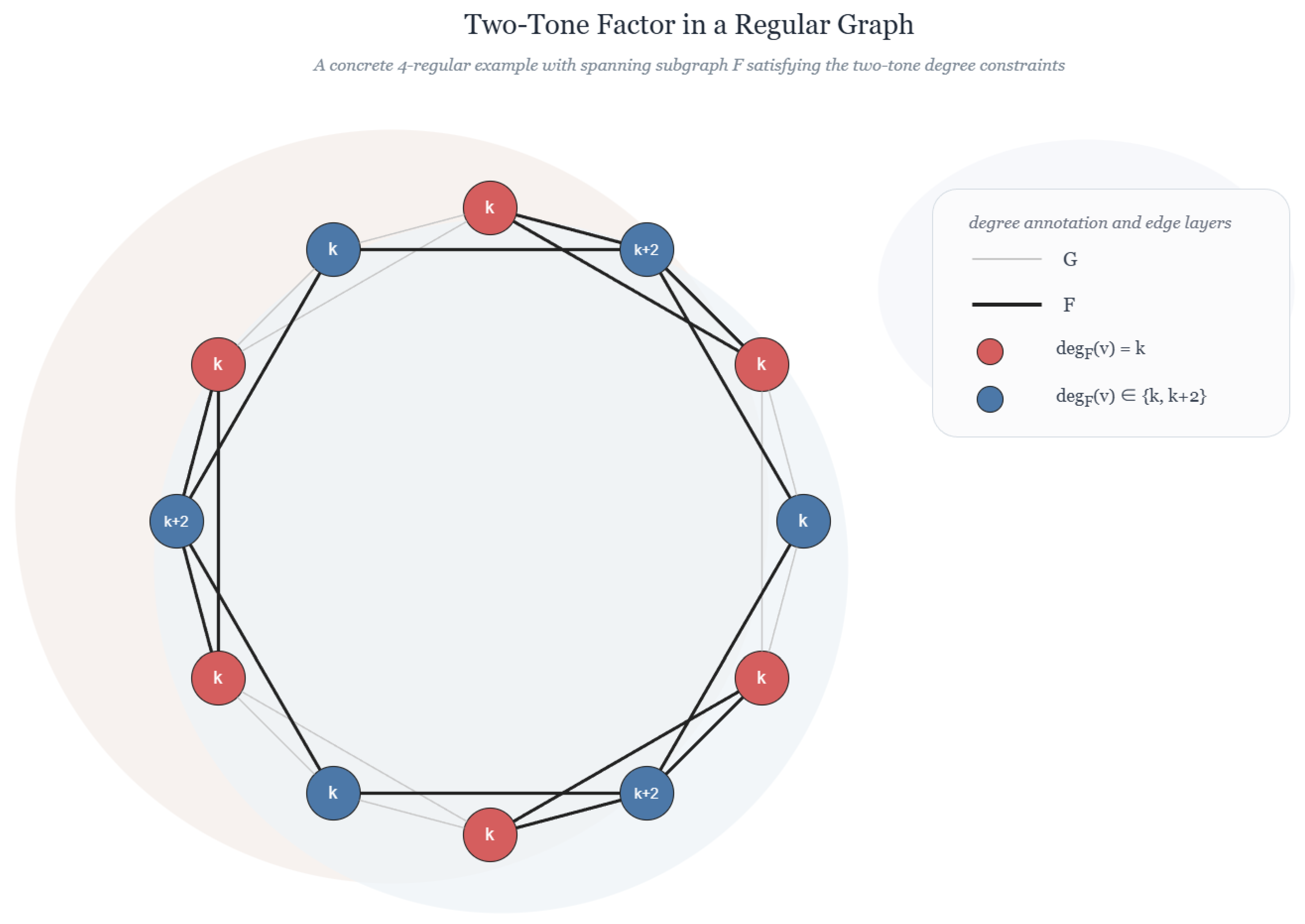
To provide intuition for the concept of two-tone factors, we illustrate a concrete example in
Figure 1. The figure shows how a regular graph can admit a spanning subgraph satisfying heterogeneous degree constraints under a red-blue coloring.
2. Related Work
The theory of graph factors is one of the central topics in graph theory, with a long and well-established history. Related spanning-structure problems, including Hamiltonian and ordered digraphs, have also been studied under prescribed global structural constraints [
14]. Early foundational work on factorization of regular graphs can be traced back to classical results by Petersen and König [
1,
2], which laid the groundwork for the study of degree-constrained subgraphs. These developments were later unified and systematically presented in comprehensive treatments such as [
8,
9]. In addition, algebraic perspectives on graph structure further highlight the role of symmetry in regular graphs [
15].
We first recall several classical results on the existence of
k-factors in regular graphs, which play a fundamental role in factor theory.
Theorem 1. Let λ, r, and k be integers with and . Let G be a λ-edge connected r-regular graph. If one of the following conditions holds, then G has a k-factor:
- (i)
- (ii)
Both r and k are even [1]; - (iii)
r is even, k is odd, is even, and [3]; - (iv)
r is odd, k is even, and [3]; - (v)
Both r and k are odd and [3,4].
The following corollary provides a unified sufficient condition for the existence of k-factors under edge-connectivity constraints.
Corollary 1. Let λ, r, and k be integers with and . Let G be a λ-edge connected r-regular graph such that is even. Then G has a k-factor [8]. Beyond exact
k-factors, relaxation to
-factors has also been extensively studied, allowing bounded deviations in vertex degrees. Such relaxations are closely related to more general degree-constrained subgraph problems [
7,
16].
Theorem 2. Let r and k be integers with . Let G be an r-regular graph. Then:
- (i)
G has a -factor [17]; - (ii)
For a maximal independent set W, there exists a -factor with prescribed structure [18]; - (iii)
If , then G has a regular -factor [19].
More generally, the theory of
-factors provides a unified framework for handling vertex-wise degree constraints. Fundamental results by Lovász [
5,
6] establish necessary and sufficient conditions for the existence of such factors via parity and cut conditions. These results reveal that factor existence can be characterized through structural constraints involving vertex subsets and connectivity. Further extensions and algorithmic formulations of
-factor problems can be found in [
20,
21].
From an algorithmic perspective, factor problems are closely related to matching theory. In particular, the
-factor problem can be reduced to a perfect matching problem through classical transformations, and thus can be solved in polynomial time using matching algorithms such as Edmonds’ blossom algorithm [
10]. More advanced implementations and practical improvements of matching algorithms have been developed in [
22,
23,
24]. Comprehensive treatments of matching and combinatorial optimization can be found in [
11,
25]. These connections establish a deep link between structural graph theory and efficient algorithm design.
More recently, colored factor problems have been introduced to model heterogeneous constraints in regular graphs. In particular, Furuya and Kano [
12] studied degree factors under red-blue vertex colorings of regular graphs, while further results on claw-free cubic graphs and two-tone factors were established in [
13]. These works demonstrate that structural properties such as edge-connectivity and claw-freeness play a critical role in ensuring the existence of feasible factors under coloring constraints. In addition, structural properties of claw-free graphs have been extensively studied in [
26], providing deeper insights into their role in factor-related problems.
In addition, structural properties such as edge-connectivity, diagnosability, and fault tolerance have also been extensively studied in interconnection network models. For example, the edge-connectivity of expanded
k-ary
n-cube networks was analyzed in [
27], demonstrating strong robustness under edge failures. Diagnosability results for Cayley graph networks generated by transposition trees further show how local graph structure affects the ability to identify faulty vertices under comparison-based diagnosis models [
28]. Fault-tolerant path-embedding problems in 4-ary
n-cubes also illustrate how network structures preserve spanning or near-spanning connectivity properties under faulty nodes [
29]. These results further reinforce the importance of connectivity as a fundamental mechanism for maintaining structural feasibility under constraints.
Our work builds upon these developments by extending the theory of two-tone factors to more general settings, while also emphasizing their algorithmic realizability. In particular, we combine structural results on edge-connectivity and claw-free graphs with parity factor techniques and matching-based constructions, thereby bridging classical factor theory and modern algorithmic approaches. Moreover, our perspective is also related to broader studies of network robustness and constrained structures in complex systems [
30,
31].
3. Main Results
We now present the main theoretical statements. The first result is a positive theorem for edge-connected regular graphs under arbitrary red-blue colorings. The claw-free cubic part is stated more carefully: the unrestricted arbitrary-coloring statement is false in general, but a restricted positive result and an exact mask-consistency formulation remain available.
3.1. The Regular Graph Theorem
Theorem 3. Let λ, r, and k be integers with and . Let G be a λ-edge connected r-regular graph such that is even. Then for every red-blue vertex coloring of G, G has a two-tone -factor.
The proof of Theorem 3 is based on the theory of parity
-factors [
6]. The red-blue degree requirement is translated into a parity-constrained factor problem, and edge-connectivity is used to control the relevant Lovász cut inequalities.
3.2. Restricted Claw-Free Cubic Result
The following result gives a safe positive statement in the claw-free cubic direction. It does not assert arbitrary-coloring feasibility. Instead, it identifies a local color-symmetric situation in which the required factor is obtained by an explicit construction.
Theorem 4 (Restricted claw-free cubic case). Let G be a cubic graph whose vertex set admits a partition into vertex-disjoint triangles. Suppose that the red-blue coloring is constant on every triangle . Then G has a two-tone -factor.
This condition is deliberately stronger than claw-freeness. Its role is to provide a provable local symmetry-stable regime: monochromatic triangles can be satisfied independently, without requiring any edge between distinct triangles.
3.3. Mask Consistency for Triangle-Inflated Cubic Graphs
For mixed colorings of triangle-inflated cubic graphs, local feasibility does not automatically imply global feasibility. The following formulation records the exact compatibility condition used in the computational audit.
Proposition 1 (Mask-consistency formulation). Let G be a triangle-inflated cubic graph with triangle partition . For each triangle , let be the set of external-edge masks that can be completed by a choice of internal triangle edges so that all three vertices of T satisfy their prescribed red-blue degree constraints. Then G has a two-tone -factor if and only if there is a choice of one mask for every such that the two endpoint masks agree on every edge between distinct triangles.
3.4. Failure of the Arbitrary-Coloring Extension
The unrestricted version of the claw-free cubic statement is false.
Proposition 2 (Failure of the arbitrary-coloring extension). There exists a simple, connected, cubic, 3-edge-connected, claw-free graph with a red-blue coloring that admits no two-tone -factor.
The construction is given in
Section 4.6. This result explains why the claw-free cubic part of the paper is formulated through a restricted positive theorem and a mask-consistency characterization rather than an unconditional arbitrary-coloring theorem.
Together, Theorem 3, Theorem 4, Proposition 1, and Proposition 2 separate the symmetry-stable and symmetry-fragile regimes of the two-tone factor problem. Global degree regularity plus edge-connectivity supports arbitrary color perturbations in the regular setting, whereas local triangular structure in the claw-free cubic setting requires additional color/mask compatibility.
4. Proof of Main Results
4.1. Parity Factor Criterion
We first recall a fundamental result on parity
-factors, originally established by Lovász [
6]. This theorem provides a complete characterization of the existence of parity-constrained factors via cut conditions, and serves as the main technical tool in our proofs.
Theorem 5. Let G be a graph and let be functions satisfying and for all . Then G has a parity -factor if and only if for all pairs of disjoint sets , where denotes the number of components D of satisfying Such components are called -odd components.
4.2. Proof of Theorem 3
Proof. Define two functions
by
Then
G has a two-tone
-factor if and only if
G has a parity
-factor. By Theorem 5, it suffices to verify that
for all disjoint sets
.
Since
is even, we have
Thus
, and we may assume
.
Let be the -odd components of , where . Let . Since , we have .
Since
G is
r-regular,
and
. Moreover, each edge incident to
S or
T either connects to
T,
S, or some component
. Thus,
Substituting these bounds yields
By the assumption
, we have
We consider the three following cases:
Case 1. and .
Case 2. .
Then
, and hence
Case 3. .
Then
, and hence
Thus for all i, and therefore . Hence G has the desired factor. □
4.3. A Generalized Corollary
The following result extends Theorem 3 by allowing a larger gap between the degree constraints on blue vertices. It shows that the parity-based approach is robust under broader degree intervals, as long as the parity condition is preserved.
Corollary 2. Let λ, r, k, and b be integers with , , , and b even. Let G be a λ-edge connected r-regular graph such that is even. Then for every red-blue vertex coloring of G, G has a two-tone -factor.
Proof. The proof follows the same strategy as in Theorem 3, based on the parity
-factor framework of [
6]. The only modification is that the upper bound function for blue vertices is changed from
to
, where
b is even.
Since
and
still holds, the parity condition remains valid. Moreover, the edge-connectivity condition ensures that each component
contributes sufficiently to the inequality
as in the proof of Theorem 3. Therefore,
holds for all disjoint
, and the desired factor exists. □
4.4. Proof of Theorem 4
Proof. For each triangle , we define the factor F locally. If T is red, select no edge of T. If T is blue, select all three internal edges of T. No edge between distinct triangles is selected.
Every red vertex therefore has degree 0 in
F, and every blue vertex has degree 2 in
F.
Hence
and
Thus
F is a two-tone
-factor. □
4.5. Proof of Proposition 1
Proof. Suppose first that F is a two-tone -factor. For each triangle T, record the three binary values indicating whether the three external edges incident with T are selected in F. This gives a mask . Since the restriction of F to the internal edges of T completes these external choices to valid vertex degrees, we have . Moreover, each edge between two distinct triangles is either selected or not selected in F, so the two endpoint masks agree on that edge.
Conversely, suppose that such a consistent mask assignment exists. For each triangle T, since , choose internal triangle edges completing the external mask to valid degrees for the three vertices of T. The consistency condition ensures that every edge between distinct triangles is selected consistently from both endpoints. Combining these external edges with the chosen internal edges over all triangles gives a spanning subgraph F. By construction, every vertex satisfies its prescribed red-blue degree constraint. Hence F is a two-tone -factor. □
For the eight possible triangle color patterns, the feasible external masks used in Proposition 1 are shown in
Table 1. Here, a mask records which of the three external edges incident with the triangle are selected.
4.6. A Counterexample to the Arbitrary-Coloring Extension
We now give the construction supporting Proposition 2. Let
H be the cubic graph on vertex set
with edge set
Replace each vertex
by a triangle
. The three edges incident with
i in
H are attached bijectively to the three vertices of
. The resulting graph has 60 vertices and 90 edges. It is simple, connected, cubic, 3-edge-connected, and claw-free; claw-freeness follows because every vertex belongs to one of the inflated triangles and its three neighbours do not induce an independent set.
The color patterns of the inflated triangles are
Applying the mask-consistency formulation of Proposition 1 to this instance yields no feasible global mask assignment. The infeasibility was independently checked by a binary edge-variable formulation and by the compressed mask-CSP formulation described above. Thus, the graph satisfies the structural assumptions of the arbitrary-coloring claw-free cubic extension, but no spanning subgraph satisfies the red degree set and blue degree set . This proves Proposition 2.
5. Algorithmic Framework
In this section, we describe the constructive viewpoint behind the regular two-tone result and the mask-based formulation for triangle-inflated cubic graphs. The regular case is handled through parity-factor and matching-type reductions. The claw-free cubic case is not treated as an unconditional existence theorem; instead, mixed triangle colorings are handled by the mask-consistency formulation of Proposition 1.
5.1. Problem Formulation
Given a graph
together with a red-blue vertex coloring
, the regular case asks for a spanning subgraph
F such that
This is formulated as a parity
-factor problem, with the functions
g and
f defined as in the proof of Theorem 3.
For triangle-inflated cubic graphs with degree sets
, the general mixed-color case is represented through the mask-consistency formulation. Each triangle supplies a finite domain of feasible external masks, and the global problem is to choose compatible masks across the inter-triangle edges.
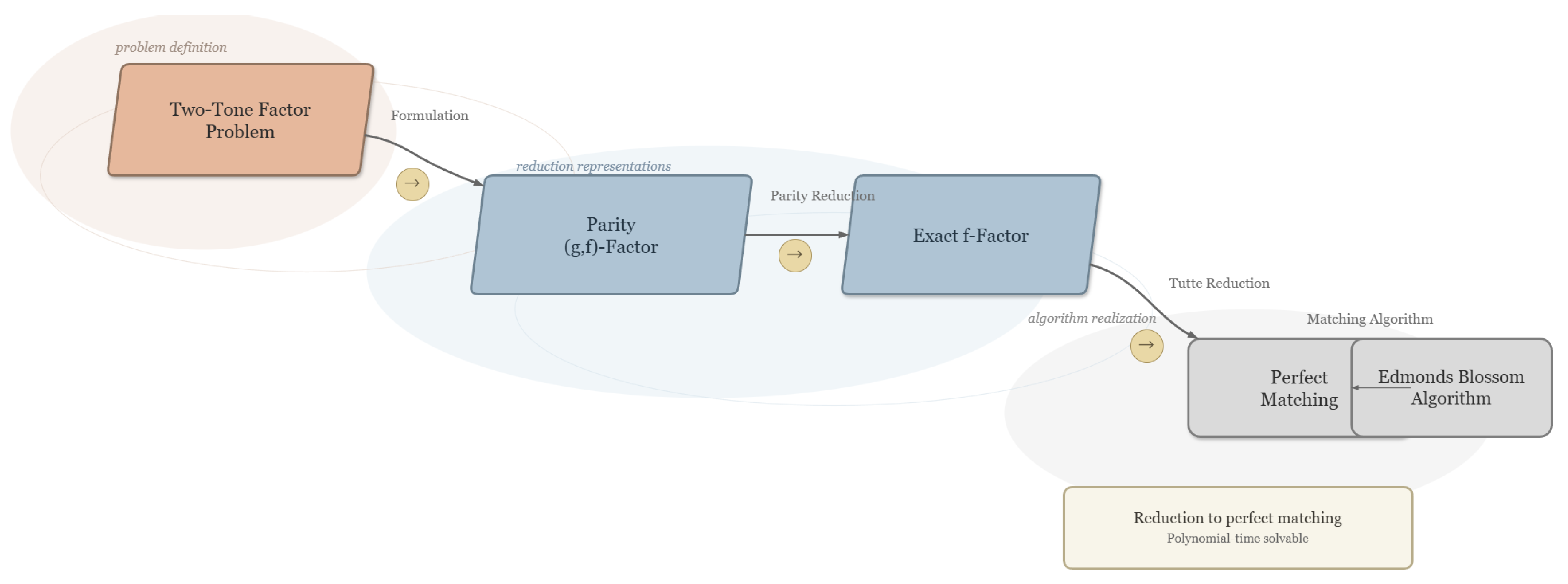
Figure 2 summarizes the reduction pipeline for the regular two-tone factor problem.
5.2. Reduction Pipeline for the Regular Case
For the regular two-tone factor problem, we use the following sequence of transformations:
Any parity
-factor problem can be transformed into an equivalent exact
f-factor problem by standard parity-adjustment constructions [
6].
The exact
f-factor problem can be reduced to a perfect matching problem by Tutte-type reductions [
10,
17]. The resulting matching instance admits a perfect matching if and only if the original factor instance is feasible.
5.3. Algorithm Description
The overall construction and certification procedure is summarized in Algorithm 1. The algorithm separates the regular parity-factor setting, the monochromatic-triangle setting, and the triangle-inflated mask-consistency setting, and then certifies the recovered factor by checking the degree of every vertex.
| Algorithm 1: Construction and certification of two-tone factors. |
Input: A graph and a red-blue coloring of V. Output: A two-tone factor F satisfying the prescribed degree constraints, if one is found, together with a vertex-degree certificate. Steps: - 1.
Identify the applicable setting: the regular parity-factor setting of Theorem 3, the monochromatic-triangle setting of Theorem 4, or the triangle-inflated mask-consistency setting of Proposition 1. - 2.
In the regular case, construct the corresponding parity -factor instance and reduce it to a matching-type instance. - 3.
In the monochromatic-triangle case, construct the factor locally by selecting no internal edge in each red triangle and all three internal edges in each blue triangle. - 4.
In the triangle-inflated mixed-color case, construct the local mask domains and solve the resulting mask-consistency problem on the base graph. - 5.
Recover the selected edge set F in the original graph. - 6.
Certify directly that every vertex degree lies in the prescribed color-dependent degree set.
|
5.4. Correctness and Complexity
For the regular case, correctness follows from Theorem 3 and the standard equivalence between parity factors, exact factors, and matching-type formulations. For the monochromatic-triangle case, correctness follows from the explicit construction in Theorem 4. For the triangle-inflated mixed-color case, correctness follows from Proposition 1: a consistent mask assignment is equivalent to a valid two-tone factor.
All transformations used in the regular matching pipeline are polynomial in the size of the input graph. The mask-consistency formulation has finite local domains of size at most 8 per triangle; it therefore provides an exact certificate formulation for the triangle-inflated cubic family and is especially useful for proof-audit experiments.
6. Computational Illustration and Counterexample Audit
6.1. Experimental Goals
The experiments in this section are not intended to provide empirical proof of the existence theorems. The theoretical statements are proved analytically. Instead, the computational study has three purposes. First, it illustrates the constructive factor-recovery pipeline on theorem-valid regular graph instances. Second, it records certificate-level verification, so that solver termination is not confused with the existence of a valid factor. Third, it audits the natural extension of the regular result to the claw-free cubic setting and identifies where arbitrary red-blue colorings fail.
6.2. Certificate Pipeline
For each generated instance, the pipeline records the graph class, the coloring, the structural filters, the solver status, the recovered edge set, and a vertex-degree certificate. A run is counted as certified only if the recovered spanning subgraph F satisfies for every vertex v, where is the allowed degree set determined by the color of v. Solver completion alone is not counted as success.
The pipeline consists of the following steps:
- 1.
Generate a graph instance from the prescribed graph family.
- 2.
Assign a red-blue vertex coloring.
- 3.
Check structural assumptions, including regularity, connectivity, edge-connectivity, and claw-freeness when required.
- 4.
Construct the corresponding degree-constrained factor instance.
- 5.
Solve the instance using the appropriate backend: a binary edge-variable formulation for direct certification, a matching backend for the regular construction, or a compressed mask-CSP formulation for triangle-inflated cubic graphs.
- 6.
Recover the selected edge set and certify the degree of every vertex.
- 7.
Log infeasible cases together with the graph, coloring, and failure reason.
6.3. Regular Graph Positive Controls
We first tested the regular graph setting corresponding to Theorem 3. The parameter grid used
with 20 independently generated instances for each parameter cell. This gave 360 generated instances in total. All 360 instances passed the theorem-valid structural checks and all 360 were certified successfully by the degree-certificate oracle. The results are summarized in
Table 2.
Thus, for the tested regular positive-control family, the implementation recovered certified two-tone factors in every accepted theorem-valid instance.
6.4. Claw-Free Cubic Stress Tests
We then tested the natural claw-free cubic extension with allowed degree sets
. The instances were generated from triangle-inflated cubic base graphs. The structural filters checked simplicity, connectedness, cubicity, 3-edge-connectivity, and claw-freeness. In total, 180 instances were generated and 162 passed the structural filters. Among these accepted instances, 160 admitted certified two-tone factors, whereas 2 were infeasible under the binary edge-variable oracle. The results of the claw-free cubic stress tests are summarized in
Table 3.
These two infeasible cases are not treated as routine solver failures. Instead, they are proof-audit outliers, because they satisfy the implemented structural hypotheses but fail the arbitrary-coloring conclusion. This is why the revised manuscript does not state an unconditional claw-free cubic theorem.
6.5. Cross-Checking by Mask Consistency
To check whether the infeasible cases were artifacts of the MILP solver, we implemented an independent compressed CSP formulation for triangle-inflated graphs. For each triangle T, the CSP enumerates the set of external-edge masks that can be completed by internal triangle edges to satisfy the local red-blue degree constraints. The global CSP then requires the two endpoint masks to agree on every edge between distinct triangles.
We cross-checked 14 theorem-valid claw-free cubic rows, including the two MILP-infeasible outliers and 12 MILP-certified positive rows. The MILP and CSP formulations agreed on all 14 cases, with no disagreements. Both infeasible outliers remained infeasible under the CSP formulation. The cross-check results between the MILP oracle and the compressed CSP formulation are summarized in
Table 4.
6.6. Probe of Restricted Conditions
The counterexample audit motivated a further search for structural restrictions under which a positive claw-free cubic statement might remain valid. We tested several candidate conditions on triangle-inflated claw-free cubic instances. This probe generated 900 instances, of which 846 passed the structural filters. The results are summarized in
Table 5.
The presence of an triangle or a triangle is not sufficient, because infeasible selected instances were found. The condition that at most half of the triangles are mixed produced no infeasible selected instance in this sample, but we do not state it as a theorem because no proof is currently available. The revised manuscript, therefore, retains only restrictions that are proved analytically. In particular, Theorem 4 uses the monochromatic-triangle condition, which has a direct constructive proof, while Proposition 1 gives the exact compatibility condition for the triangle-inflated family.
6.7. Discussion
The computational results support three conclusions. First, the regular positive-control experiments show that the constructive pipeline reliably recovers certified factors on theorem-valid regular instances. Second, the claw-free cubic stress tests show that 3-edge-connectivity and claw-freeness alone do not guarantee the -factor under arbitrary red-blue colorings. Third, the mask-consistency formulation gives an exact local-to-global explanation for feasible and infeasible triangle-inflated instances.
For this reason, the revised theoretical statement does not assert the arbitrary-coloring claw-free cubic extension. Instead, it keeps a provable restricted positive result for monochromatic triangle decompositions and uses mask consistency to describe the general triangle-inflated case.
7. Structural Interpretation from the Perspective of Symmetry
This section interprets the revised results from the perspective of symmetry and color-induced perturbation. The discussion is not intended as an additional formal theorem. Rather, it explains how the positive regular theorem, the restricted claw-free theorem, and the counterexample together identify a boundary between symmetry-stable and symmetry-fragile colored degree constraints.
7.1. Coloring as Heterogeneous Degree Constraints
An r-regular graph is symmetric at the level of vertex degrees: every vertex has the same ambient degree. A red-blue coloring breaks this uniformity by assigning different allowable degrees to different vertex classes. In the two-tone setting, the question is whether this local heterogeneity can be absorbed by a spanning factor without destroying global feasibility.
This motivates the following terminology. A colored graph is color-degree compatible with respect to degree sets
and
if it has a spanning subgraph
F such that
In this language, Theorem 3 gives a global symmetry-stable regime: regularity, edge-connectivity, and parity feasibility imply color-degree compatibility for arbitrary red-blue colorings in the regular case.
7.2. Global and Local Symmetry-Stable Regimes
For the regular graph result, edge-connectivity is the main stabilizing condition. The proof of Theorem 3 translates the two-tone requirement into a parity
-factor problem. Feasibility is governed by the Lovász cut expression
where
S and
T range over disjoint vertex subsets. The role of edge-connectivity is to control the boundary terms in this inequality and prevent local coloring imbalance from producing a global obstruction.
The restricted claw-free cubic result gives a different, local symmetry-stable regime. When every triangle is monochromatic, the coloring is aligned with the triangle decomposition. The required factor can then be constructed locally: red triangles contribute no internal edges and blue triangles contribute all three internal edges. This is a strong restriction, but it is mathematically clean and directly certifies compatibility.
7.3. Symmetry-Fragile Regime and Mask Compatibility
The counterexample in Proposition 2 shows that local claw-free structure and 3-edge-connectivity do not suffice for arbitrary red-blue colorings. Mixed triangle color patterns introduce local degrees of freedom, represented by external masks. A global factor exists only when these masks can be chosen consistently across the base graph.
Thus, the mask-consistency formulation of Proposition 1 gives the precise local-to-global obstruction. Local triangle feasibility is not enough; the selected external masks must also agree on every edge between distinct triangles. This explains why some mixed-color triangle-inflated instances are feasible while the counterexample is not.
7.4. Summary of the Structural Picture
The revised results identify three regimes. First, the regular graph theorem is globally symmetry-stable: arbitrary color perturbations can be absorbed under the stated edge-connectivity and parity assumptions. Second, the monochromatic-triangle theorem is locally symmetry-stable: color symmetry inside each triangle yields a direct construction. Third, mixed triangle colorings form a symmetry-fragile regime governed by mask compatibility.
This interpretation keeps the symmetry component tied to the actual mathematical arguments. The symmetry being studied is the stability, or failure of stability, of degree-regular and triangle-based structures under color-dependent degree perturbations.
8. Potential Applications and Modeling Motivation
The main focus of this paper is theoretical and algorithmic. Nevertheless, two-tone factors provide a useful abstraction for network models in which different vertex classes have different allowable interaction levels. We briefly describe two representative modeling motivations.
8.1. Scheduling and Resource Allocation on Structured Networks
In scheduling or resource-allocation problems, vertices may represent tasks, processors, agents, or communication units, while edges represent feasible interactions. A red-blue coloring can encode two classes of demand, priority, or capacity. A two-tone factor then represents a feasible selection of interactions satisfying different local degree requirements for the two classes.
Under this interpretation, the existence results give sufficient structural conditions under which such heterogeneous degree requirements can be met. The algorithmic reduction further provides a constructive route for finding the selected interaction subgraph.
8.2. Conflict Graph Models
Two-tone factors can also be interpreted in conflict graph models, where vertices represent entities competing for shared resources and edges represent admissible pairwise interactions. The color-dependent degree sets model different interaction limits for different types of entities. A feasible two-tone factor then selects a compatible set of interactions respecting both the graph structure and the heterogeneous degree requirements.
These examples are intended as modeling motivations rather than fully developed applied case studies. A detailed investigation of domain-specific models, data, and performance criteria is left for future work.
9. Conclusions
In this paper, we studied two-tone factors in regular graphs and claw-free cubic graphs under red-blue vertex colorings. The two-tone framework assigns different allowable degree sets to different color classes and therefore provides a natural setting for studying heterogeneous degree constraints on structured graphs.
The main positive theorem concerns edge-connected regular graphs. Under the stated connectivity and parity assumptions, every red-blue coloring admits a two-tone -factor. This result is proved through the parity -factor framework, where edge-connectivity controls the relevant cut inequalities.
The claw-free cubic part is revised as a boundary analysis rather than an unconditional positive theorem. The arbitrary-coloring extension for -factors is false in general, as shown by a triangle-inflated counterexample. Nevertheless, a clean restricted positive result holds when the graph has a triangle decomposition and the coloring is constant on every triangle. For mixed triangle colorings, the mask-consistency formulation gives an exact local-to-global description of feasibility.
From an algorithmic perspective, we described how the regular factor instances can be reduced to matching-type formulations and how triangle-inflated cubic instances can be audited by mask consistency. The computational section was framed as an implementation and proof-audit study: it certifies recovered factors in the regular positive-control family, identifies infeasible claw-free cubic outliers, and explains why empirical candidate conditions are not stated as theorems without proof.
From the perspective of symmetry, the paper distinguishes symmetry-stable and symmetry-fragile regimes. Global degree regularity and edge-connectivity support arbitrary color perturbations in the regular setting. Monochromatic triangle decompositions provide a local symmetry-stable regime in the cubic setting. Mixed triangle colorings, however, require mask compatibility and can fail globally even when the graph is cubic, 3-edge-connected, and claw-free.
Future work includes identifying stronger and more natural sufficient conditions for the claw-free cubic case, deriving human-checkable obstruction certificates for mask-inconsistent instances, refining the construction algorithms for large-scale instances, and developing more detailed applications in structured scheduling, resource allocation, and network design.
Author Contributions
Conceptualization, L.-H.W. and M.-J.-S.W.; methodology, L.-H.W. and M.-J.-S.W.; software, C.-W.L.; validation, L.-H.W., M.-J.-S.W. and Q.-J.B.; formal analysis, L.-H.W.; investigation, L.-H.W.; resources, M.-J.-S.W.; data curation, C.-W.L.; writing—original draft preparation, L.-H.W.; writing—review and editing, M.-J.-S.W.; visualization, C.-W.L.; supervision, M.-J.-S.W.; project administration, M.-J.-S.W.; funding acquisition, Q.-J.B. All authors have read and agreed to the published version of the manuscript.
Funding
This work was supported by the Natural Science Foundation of Shandong Province, China (Grant No. ZR2022MA077).
Data Availability Statement
The data used in this study are generated from synthetic graph instances. The experimental logs, counterexample audit artifacts, and implementation scripts are available from the corresponding author upon reasonable request. The algorithms and implementation details are described in the paper and can be reproduced following the provided methodology.
Conflicts of Interest
Author Mu-Jiang-Shan Wang was employed by the company Shenzhen Kaihong Digital Industry Development Co., Ltd. The remaining authors declare that the research was conducted in the absence of any commercial or financial relationships that could be construed as a potential conflict of interest.
References
- Petersen, J. Die Theorie der regulären Graphs. Acta Math. 1891, 15, 193–220. [Google Scholar] [CrossRef] [Scilit]
- König, D. Über Graphen und ihre Anwendung auf Determinantentheorie und Mengenlehre. Math. Ann. 1916, 77, 453–465. [Google Scholar] [CrossRef] [Scilit]
- Gallai, T. On Factorisation of Graphs. Acta Math. Acad. Sci. Hung. 1950, 1, 133–153. [Google Scholar] [CrossRef] [Scilit]
- Bäbler, D. Über die Zerlegung regulärer Streckencomplexe ungerader Ordnung. Comment. Math. Helv. 1937, 10, 275–287. [Google Scholar] [CrossRef] [Scilit]
- Lovász, L. Subgraphs with Prescribed Valencies. J. Comb. Theory 1970, 8, 391–416. [Google Scholar] [CrossRef] [Scilit]
- Lovász, L. The Factorization of Graphs II. Acta Math. Acad. Sci. Hung. 1972, 23, 223–246. [Google Scholar] [CrossRef] [Scilit]
- Vergnas, M.L. An Extension of Tutte’s Theorem. J. Comb. Theory Ser. B 1972, 13, 192–202. [Google Scholar]
- Akiyama, J.; Kano, M. Factors and Factorizations of Graphs; Lecture Notes in Mathematics; Springer: Berlin/Heidelberg, Germany, 2011; Volume 2031. [Google Scholar]
- Plummer, M.D. Graph Factors and Factorizations; Elsevier: Amsterdam, The Netherlands, 2010. [Google Scholar]
- Edmonds, J. Paths, Trees, and Flowers. Can. J. Math. 1965, 17, 449–467. [Google Scholar] [CrossRef] [Scilit]
- Schrijver, A. Combinatorial Optimization: Polyhedra and Efficiency; Springer: Berlin/Heidelberg, Germany, 2003. [Google Scholar]
- Furuya, M.; Kano, M. Degree Factors with Red-Blue Coloring of Regular Graphs. Electron. J. Comb. 2024, 31, 1–40. [Google Scholar] [CrossRef] [Scilit] [PubMed]
- Furuya, M.; Kano, M. Factors with Red–Blue Coloring of Claw-Free Graphs and Cubic Graphs. Graphs Comb. 2023, 39, 85. [Google Scholar] [CrossRef] [Scilit]
- Mu-Jiang-shan, W.; Jun, Y.; Shang-wei, L. Ordered and Hamilton Digraphs. Chin. Q. J. Math. 2010, 25, 317–326. [Google Scholar]
- Godsil, C.; Royle, G. Algebraic Graph Theory; Springer: Berlin/Heidelberg, Germany, 2001. [Google Scholar]
- Kano, M.; Saito, A. [a,b]-Factors of Graphs. Discret. Math. 1983, 47, 113–116. [Google Scholar] [CrossRef] [Scilit]
- Tutte, W.T. The Subgraph Problem. In Annals of Discrete Mathematics; Elsevier: Amsterdam, The Netherlands, 1978; Volume 3, pp. 289–295. [Google Scholar]
- Egawa, Y.; Kano, M. Sufficient Conditions for Graphs to Have (g,f)-Factors. Discret. Math. 1996, 151, 87–90. [Google Scholar] [CrossRef] [Scilit]
- Kano, M. Factors of Regular Graphs. J. Comb. Theory Ser. B 1986, 41, 27–36. [Google Scholar] [CrossRef] [Scilit]
- Anstee, R.P. An Algorithmic Proof of Tutte’s f-Factor Theorem. J. Algorithms 1985, 6, 112–131. [Google Scholar] [CrossRef] [Scilit]
- Heinrich, K.; Liu, G. Degree Constrained Subgraphs. Discret. Math. 1990, 81, 129–138. [Google Scholar]
- Gabow, H.N. An Efficient Implementation of Edmonds’ Algorithm. J. ACM 1976, 23, 221–234. [Google Scholar] [CrossRef] [Scilit]
- Kolmogorov, V. Blossom V: A New Implementation of a Minimum Cost Perfect Matching Algorithm. Math. Program. Comput. 2009, 1, 43–67. [Google Scholar] [CrossRef] [Scilit]
- Mical, S.; Vazirani, M. An O(sqrt(V)E) Algorithm for Finding Maximum Matching. Combinatorica 2013, 33, 347–375. [Google Scholar]
- Korte, B.; Vygen, J. Combinatorial Optimization: Theory and Algorithms; Springer: Berlin/Heidelberg, Germany, 2018. [Google Scholar]
- Chudnovsky, M.; Seymour, P. The Structure of Claw-Free Graphs. In Surveys in Combinatorics; Cambridge University Press: Cambridge, UK, 2005; pp. 153–171. [Google Scholar]
- Wang, S.; Wang, M. The Edge Connectivity of Expanded k-Ary n-Cubes. Discret. Dyn. Nat. Soc. 2018, 2018, 7867342. [Google Scholar] [CrossRef] [Scilit]
- Wang, M.; Wang, S. Diagnosability of Cayley graph networks generated by transposition trees under the comparison diagnosis model. Ann. Appl. Math. 2016, 32, 166–173. [Google Scholar]
- Wang, S.; Wangmu, J.; Qi, Z.; Ren, Y. Embedding paths into the 4-ary n-cube with faulty nodes. In Proceedings of the 2011 International Conference on Consumer Electronics, Communications and Networks (CECNet); IEEE: Piscataway, NJ, USA, 2011; pp. 4949–4951. [Google Scholar]
- Newman, M. Networks: An Introduction; Oxford University Press: Oxford, UK, 2010. [Google Scholar]
- Albert, R.; Barabási, A.L. Statistical Mechanics of Complex Networks. Rev. Mod. Phys. 2002, 74, 47–97. [Google Scholar] [CrossRef] [Scilit]
| Disclaimer/Publisher’s Note: The statements, opinions and data contained in all publications are solely those of the individual author(s) and contributor(s) and not of MDPI and/or the editor(s). MDPI and/or the editor(s) disclaim responsibility for any injury to people or property resulting from any ideas, methods, instructions or products referred to in the content. |