


Abstract
This paper addresses the tracking control problem of robotic manipulators under a universal symmetry constraint framework in the presence of lumped uncertainties and external disturbances. Unlike conventional constrained control schemes that treat tracking error bounds and state bounds separately, the proposed method explicitly exploits the symmetric structure of the prescribed constraints and formulates both tracking error constraints and full-state constraints in a unified manner. Based on the Euler–Lagrange dynamics of robotic manipulators, a universal symmetry constraint transformation is introduced to convert the original constrained system into an equivalent unconstrained form while preserving the intrinsic symmetry of the admissible sets. To enhance robustness against uncertainties and disturbances, a sliding-mode extended state observer is designed to estimate the total disturbance online. Meanwhile, a tracking differentiator is incorporated into the recursive design to avoid repeated differentiation of virtual control signals. On this basis, a disturbance-compensated backstepping controller is developed for the transformed manipulator system. It is shown that all closed-loop signals remain bounded, the prescribed symmetric tracking error and state constraints are never violated, and the tracking error converges asymptotically when the observer and differentiator errors vanish asymptotically. Simulation results obtained from a robotic manipulator verify the effectiveness of the proposed control strategy.
1. Introduction
Symmetry is a fundamental concept in mathematics, physics, and engineering, and it frequently appears in the formulation of practical control constraints [1]. In robotic systems, many operational limitations are naturally imposed in a symmetric form with respect to the equilibrium point or the desired trajectory, such as symmetric bounds on tracking errors, symmetric admissible intervals for joint positions, and symmetric velocity limits centered around zero. Such symmetric constraints are not only mathematically meaningful, but also physically reasonable, since they reflect balanced performance requirements and safety margins in both positive and negative directions. Therefore, tracking control under symmetry constraints is of both theoretical and practical significance [2,3].
For robotic manipulators, achieving accurate trajectory tracking while respecting physical limitations remains a challenging problem. On the one hand, joint positions and velocities must stay within admissible ranges to ensure safe operation and avoid mechanical damage. On the other hand, the tracking error is also expected to remain within a prescribed performance envelope in order to guarantee satisfactory transient and steady-state responses. If either requirement is not properly addressed, the system may suffer from degraded control performance or even instability. This makes the simultaneous treatment of tracking error constraints and full-state constraints an important issue in constrained manipulator control [4,5,6].
In recent decades, there has been a significant amount of research conducted on a variety of topics related to constrained nonlinear systems. These include barrier Lyapunov functions, funnel control, and prescribed performance control [7,8,9]. Despite the efficacy of these methodologies in preventing state trajectories from crossing predetermined boundaries, extant results predominantly focus on tracking error constraints or full-state constraints, as opposed to addressing both concurrently within a unified framework. Moreover, a significant number of extant methodologies transform full-state constraints into novel restrictions on tracking error or virtual control laws, which frequently gives rise to so-called feasibility conditions, thereby diminishing design flexibility [10,11]. Moreover, conventional recursive design generally utilizes standard backstepping techniques, rendering it susceptible to the recognized problem of complexity explosion, which arises from the repeated differentiation of the virtual control signal [12,13].
To overcome these limitations, a recent universal constraint approach provides a promising framework for handling both tracking error constraints and full-state constraints simultaneously. By constructing a universal composite barrier function for the tracking error and output, together with universal barrier functions for the remaining states, the constrained system can be transformed into an equivalent unconstrained one without introducing feasibility conditions. More importantly, the constraining functions can be directly specified by the user, which greatly improves design flexibility. Since the controller developed in this paper is built upon this idea, the UCA proposed in [14] serves as a key methodological foundation of the present work.
On the other hand, robotic manipulators are inevitably affected by uncertain dynamics, parameter variations, unmodeled effects, and external disturbances. Active disturbance rejection control (ADRC), originally proposed by Han, has been recognized as an effective framework for handling such effects by lumping uncertainties and disturbances into a total disturbance and estimating it online via an extended state observer (ESO) [15]. Recent studies on ADRC for Euler–Lagrange (EL) systems have shown that exploiting model structure can improve both disturbance estimation and control performance. In particular, sliding-mode extended state observers (SMESOs) have been shown to provide faster convergence, higher estimation precision, and stronger robustness than conventional linear ESOs in the presence of uncertainties and time-varying disturbances [16,17,18]. These advantages are particularly desirable for constrained manipulator systems, because the transient disturbance estimation performance has a direct influence on the preservation of the prescribed symmetric constraints.
Meanwhile, although backstepping is a natural tool for nonlinear tracking control, its direct implementation often suffers from repeated differentiation of virtual control signals. Dynamic surface control was introduced to alleviate this issue by means of low-pass filters [19], while tracking differentiators (TDs) provide an effective alternative for generating virtual control derivatives without explicit analytical differentiation [20]. This makes them particularly suitable for recursive constrained control designs with disturbance compensation.
Motivated by the above observations, this paper develops an ADRC-based tracking control scheme for robotic manipulators under a universal symmetry constraint (UCS) framework. The manipulator dynamics are first described in the EL form, and the unknown nonlinearities together with external disturbances are lumped into a total disturbance. Then, by exploiting the symmetry of the prescribed tracking error and state bounds, a UCS transformation is introduced to convert the original constrained system into an equivalent unconstrained one. A SMESO is designed to estimate the total disturbance online, and a TD is employed to generate the derivative of the virtual control signal and avoid repeated differentiation in the recursive design.
The main contributions of this paper are summarized as follows.
- A UCS framework is established for robotic manipulators, in which symmetric tracking error constraints and symmetric full-state constraints are incorporated into a unified barrier-based transformation, allowing the constrained tracking problem to be reformulated in an unconstrained coordinate system.
- A SMESO is introduced to estimate the lumped disturbance online and improve the robustness of the constrained manipulator control system against uncertainties and external disturbances.
- A disturbance-compensated recursive controller with a TD is developed, which avoids the explosion of complexity and guarantees boundedness of all closed-loop signals, satisfaction of the prescribed symmetric constraints, and asymptotic tracking performance.
The remainder of this paper is organized as follows. Section 2 presents the manipulator dynamics and the required preliminaries, including the UCS framework and ADRC-related background. Section 3 develops the SMESO, the controller, and the corresponding stability analysis. Section 4 provides simulation results on a robotic manipulator. Finally, Section 5 concludes this paper.
2. Preliminaries
2.1. Robot Manipulator Dynamics
Consider an n-degree-of-freedom (DOF) robotic manipulator described by the Euler–Lagrange formulation. The joint-space dynamics can be written as
where denotes the joint position vector, and and represent the joint velocity and acceleration, respectively. The matrices , , and denote the inertia matrix, Coriolis/centrifugal matrix, and gravity vector, respectively. The control input is denoted by , and represents unknown external disturbances and unmodeled dynamics.
Define the augmented state variables as , and the total disturbance state as .
Then the system can be rewritten as
where .
Assumption 1.
The total disturbance and its time derivative are bounded; i.e., there exist positive constants and such that
Remark 1.
By rewriting the EL dynamics into the form , , all model nonlinearities, coupling terms, and external disturbances are lumped into a unified total disturbance term. This reformulation provides a convenient foundation for observer-based disturbance estimation and controller design, while still preserving the physical interpretation of the manipulator dynamics.
2.2. Universal Symmetry Constraint Framework
In this subsection, a USC framework is introduced to transform a constrained nonlinear system into an equivalent unconstrained one via barrier-type coordinate mappings. This transformation enables systematic controller design while guaranteeing constraint satisfaction.
Define the tracking error as
where is the desired trajectory. The tracking error is required to satisfy
and the system states are constrained as
where , are the boundaries of the UCS.
Assumption 2.
The desired trajectory is twice continuously differentiable, and , , and are bounded.
Assumption 3.
The symmetric constraint functions , , , and , , are continuously differentiable and bounded.
Assumption 4.
The initial conditions satisfy the constraints; i.e.,
To enforce the constraints, define the transformed variables. First, construct a universal composite barrier function for the tracking error and the system output:
where are design constants and satisfy , . For the remaining states, universal barrier function is designed as
Thus, from (7) and (8), it follows that as e or approaches the constraint boundary, tends to infinity; i.e., , and .
Remark 2.
The above transformation converts the constrained control problem into an unconstrained one in the z-coordinates. Therefore, standard nonlinear control techniques, such as backstepping, can be directly applied. Moreover, the constraint satisfaction is guaranteed implicitly by ensuring boundedness of , without requiring explicit constraint handling in the control law.
Remark 3.
Different from general asymmetric constrained control formulations, the proposed transformation explicitly exploits the symmetry of the prescribed admissible sets. In particular, the tracking error bounds and state bounds are constructed in symmetric forms with respect to the equilibrium or reference trajectory, which not only simplifies the transformation structure but also makes the resulting constrained formulation more suitable for symmetry-oriented control analysis.
2.3. Active Disturbance Rejection Control
Consider a second-order nonlinear system in the following form:
where represents unknown internal dynamics, denotes external disturbances, and is a known nominal control gain. In ADRC, all unknown terms are lumped into a total disturbance:
Thus, the system can be rewritten as
2.3.1. Extended State Observer (ESO)
To estimate the total disturbance , ADRC introduces an extended state
which yields the augmented system:
A linear extended state observer (LESO) is constructed as
where are the observer states, and are observer gains.
A common bandwidth-based tuning is given by
where is the observer bandwidth.
2.3.2. Disturbance Compensation Control Law
Using the disturbance estimate , the control input is designed as
where is a nominal control term (e.g., PD or backstepping-based control). Substituting into the system yields
Thus, if , the system behaves approximately as a disturbance-free double integrator.
2.3.3. Tracking Differentiator
To avoid the “explosion of complexity” in backstepping design, ADRC introduces a TD to estimate the derivative of virtual control signals without explicit differentiation.
A commonly used second-order TD is given by
where is the input signal, , and . The parameters , , and determine the convergence speed and damping characteristics.
Remark 4.
The ADRC framework provides a systematic way to handle uncertainties without requiring precise system models. In this paper, the ESO is employed to estimate the lumped disturbance in the manipulator dynamics, while the TD is utilized to approximate the derivative of virtual control signals in the backstepping design, thereby avoiding repeated differentiation and improving numerical robustness.
3. Main Results
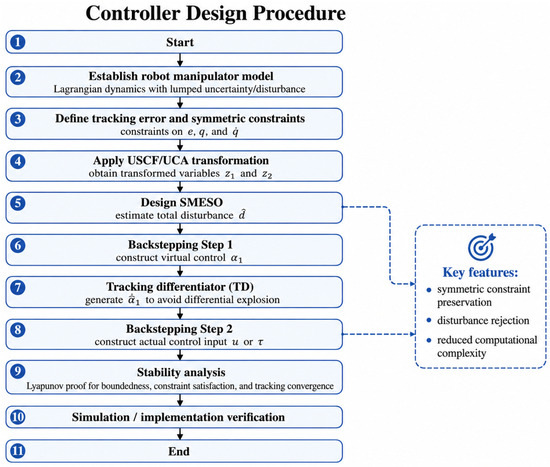
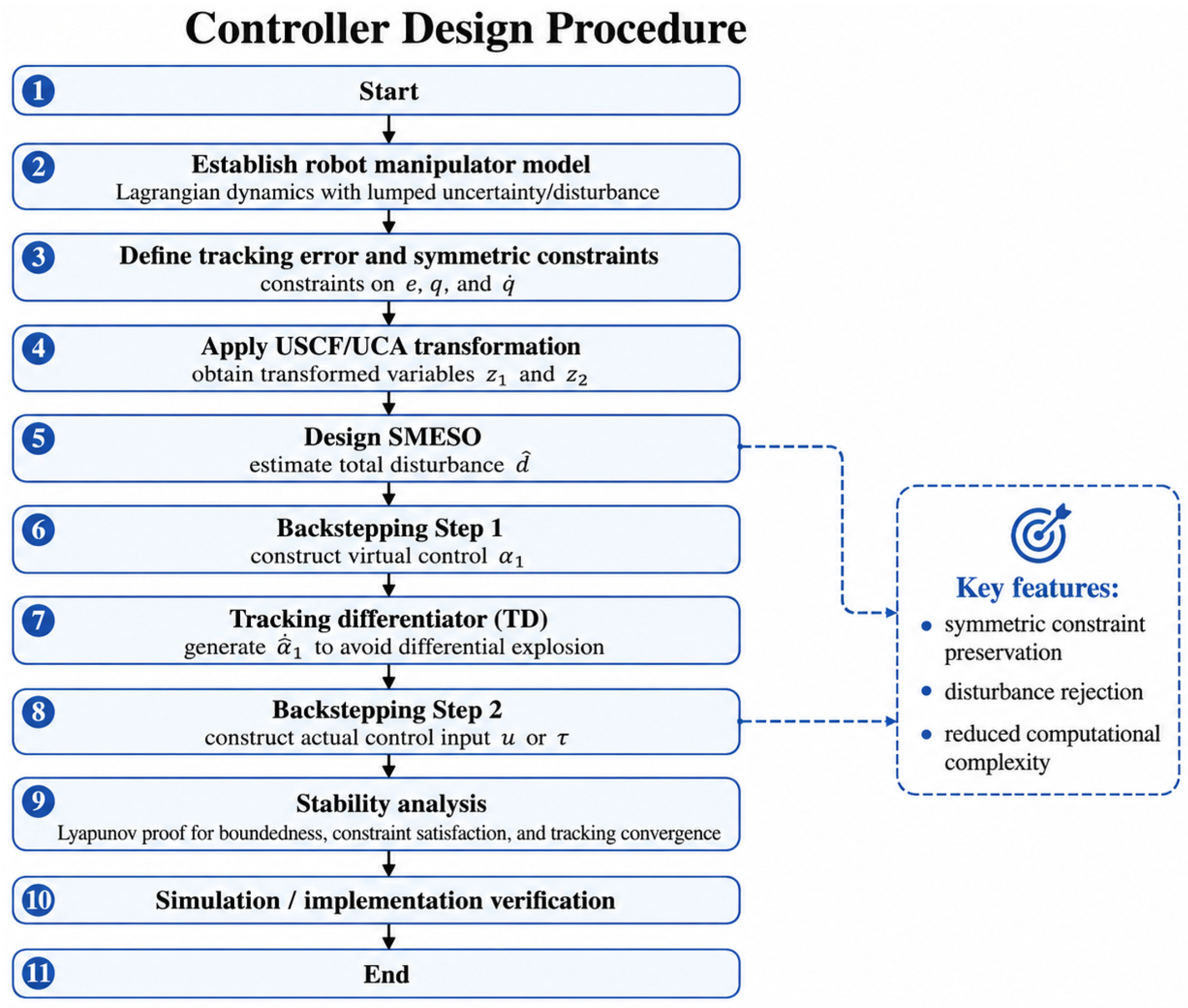
In this section, the main control design is presented for the constrained tracking problem of robotic manipulators under the proposed universal symmetry constraint framework. First, a sliding-mode extended state observer (SMESO) is constructed to estimate the lumped uncertainty and external disturbance. Then, based on the transformed variables generated by the universal symmetry constraint transformation, a recursive backstepping controller is developed with the aid of a TD to avoid repeated differentiation of the virtual control signal. Finally, the stability of the closed-loop system is analyzed to show boundedness of all signals, satisfaction of the prescribed symmetric constraints, and convergence of the tracking error. To further clarify the step-by-step implementation of the proposed method, the controller design procedure is summarized in Figure 1.
Figure 1.
Controller design procedure.
3.1. Sliding Mode-Based Extended State Observer Design
To estimate the lumped uncertainties and external disturbances in the robotic manipulator system, a SMESO is developed.
Let denote the observer states. Define the estimation error
Introduce the auxiliary variable
where is a positive definite diagonal matrix.
To drive to zero, consider the following continuous nonlinear correction law:
where is a design constant, is a positive definite diagonal matrix, and is defined element-wise as
with and .
Based on the above design, the SMESO is constructed as
where and are observer gains.
Define the estimation errors
Then the error dynamics are derived as
Remark 5.
Although sliding-mode observers may suffer from chattering when an ideal discontinuous switching function is used, the SMESO in this paper employs a continuous nonlinear correction function with a boundary-layer parameter δ. Therefore, high-frequency chattering near the switching surface is alleviated in practical implementation. In addition, the prescribed symmetric constraints are enforced through the boundedness of the transformed variables generated by the USCF transformation. Hence, bounded observer estimation errors only enter the transformed closed-loop system as perturbation terms and do not lead to constraint violation, provided that the transformed variables remain bounded.
Theorem 1.
Consider the observer error system derived above. Suppose that the total disturbance derivative is bounded. Then, under the proposed SMESO, the estimation errors satisfy and and remains bounded. Furthermore, if , then
Proof.
Define the Lyapunov function as
where the auxiliary variable is given by
Taking the time derivative of V and substituting the designed correction law yields
which is negative definite for all . Therefore, it follows that
From the definition of , the estimation error satisfies the reduced-order dynamics
which implies that and .
Substituting this result into the observer error dynamics leads to . Furthermore, since is bounded, the disturbance estimation error remains bounded. In the case where , it further follows that . This completes the proof. □
Remark 6.
Compared with a conventional linear extended state observer, the proposed SMESO introduces nonlinear correction terms into the estimation dynamics, which improves the disturbance reconstruction capability in the presence of time-varying uncertainties. This feature is particularly important for constrained manipulator systems, since the transient estimation accuracy directly affects the preservation of the prescribed symmetric constraints.
3.2. Controller Design
Based on the USC transformation, the original constrained manipulator system is converted into an equivalent unconstrained system in the transformed coordinates. In this subsection, a backstepping controller combined with the proposed SMESO and TD is designed.
First, taking the derivative of yields
with
It can be deduced from Equations (4), (5), (32), and (34) that the condition of is applicable in all cases. Furthermore, and can be directly used in subsequent control design.
Substituting (2) into (31) yields
Through the above transformation, the original constrained system (2) is transformed into an unconstrained system (36). Therefore, our control objective shifts from ensuring the boundedness of the tracking error e and system states to ensuring the boundedness of .
Subsequently, we will proceed with the design of the controller. Firstly, the following UCA-based coordinate transformation must be defined:
where , and is the virtual controller.
Step 1: From (36) and (37), it can be deduced that the derivative of is
Subsequently, the following candidate positive definite Lyapunov function is to be chosen:
Taking the derivative of and substituting (39) into it yields
Then, the virtual controller is designed as
Then, substituting (42) into (41) yields
Step 2: From (36) and (38), we obtain the derivative of as
Subsequently, the following candidate positive definite Lyapunov function is to be chosen:
Taking the derivative of and substituting (44) into it yields
To avoid repeated differentiation of the virtual control , a TD is introduced to estimate . Let the TD states be denoted by and , and consider
where , , and are design parameters. Then the derivative of the virtual control is approximated by .
From the proposed SMESO, the total disturbance estimation is given by . Then, to stabilize the second transformed subsystem and compensate the unknown terms, choose the actual control law as
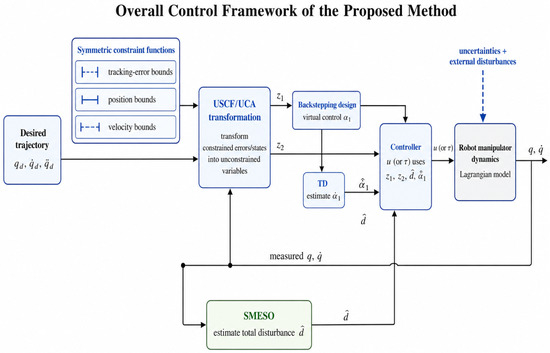
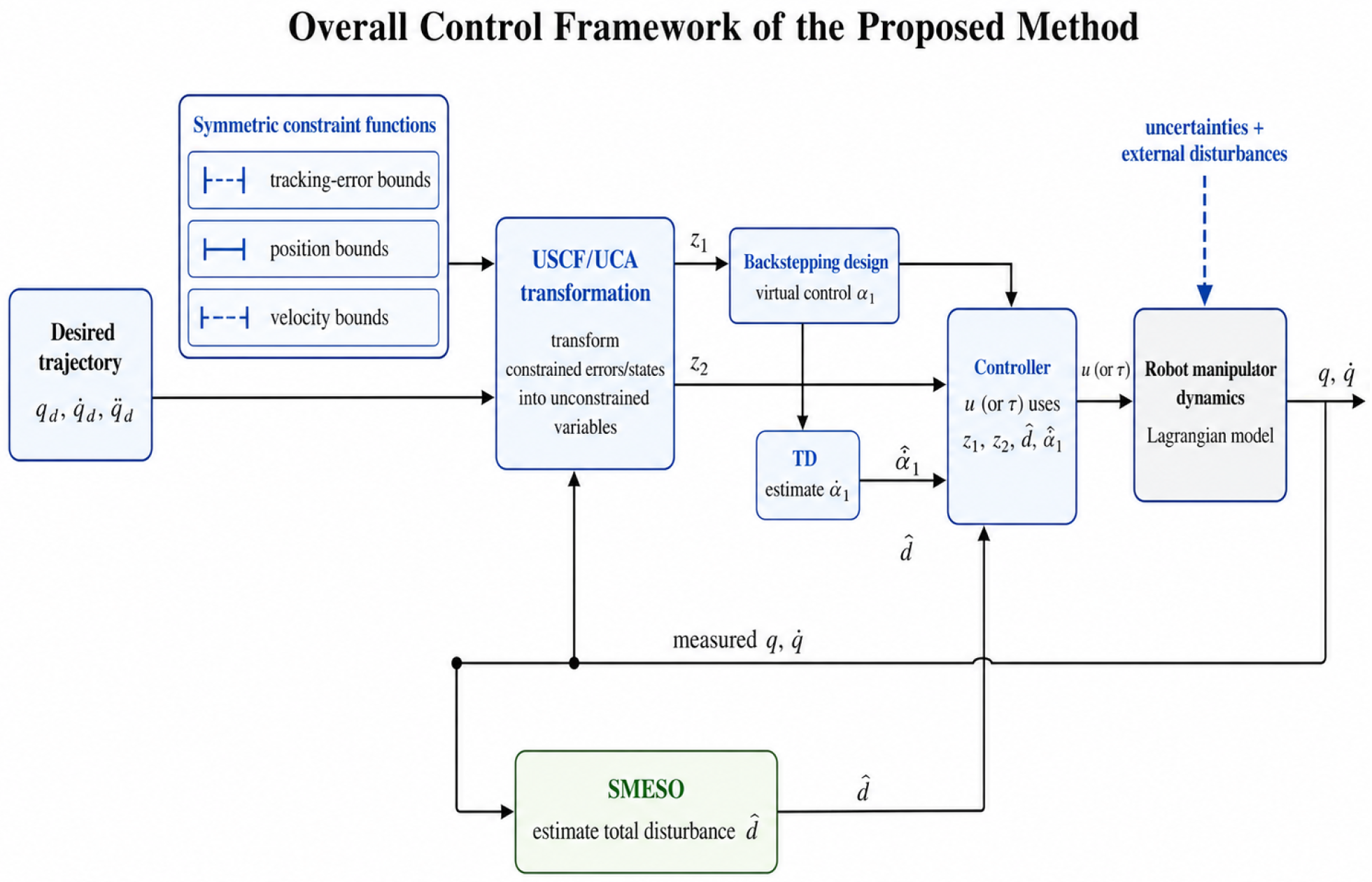
The overall control architecture of the proposed method is illustrated in Figure 2.
Figure 2.
Overall control framework of the proposed method.
Remark 7.
The proposed controller has a clear modular structure. The UCS transformation is responsible for converting the original constrained problem into an unconstrained one, the SMESO provides real-time estimation and compensation of the lumped disturbance, and the TD avoids repeated analytical differentiation of the virtual control signal. Therefore, the overall design simultaneously addresses constraint satisfaction, disturbance rejection, and computational complexity reduction.
3.3. Stability Analysis
Theorem 2.
For the robotic manipulator under the proposed universal constraint transformation, SMESO, TD, and backstepping controller, suppose that all assumptions are satisfied. Then all closed-loop signals are bounded for all , the prescribed tracking error and full-state constraints are never violated during the evolution of the system, and the transformed variables remain bounded and converge to a small neighborhood of the origin. In particular, if the observer estimation error and the TD estimation error vanish asymptotically, then the transformed states converge to zero and the tracking error approaches zero asymptotically.
Proof.
Then, substituting (48) into (46) yields
With the help of Young’s inequality, we can obtain
where .
Integrating both sides yields
in which is a constant.
Therefore , ; i.e., . Since the system is bounded, and , by Barbalat’s lemma, it follows that , . From the UCA transformation , . As , it follows that . Meanwhile, since diverges at the constraint boundaries, boundedness of implies that e, , always remain within the prescribed constraints. Therefore, we come to the conclusion that all the signals of the closed-loop system are bounded. □
Remark 8.
The result of Theorem 2 shows that the stability of the closed-loop system and the satisfaction of the prescribed symmetric constraints are achieved simultaneously through the boundedness of the transformed variables. In other words, the proposed UCS transformation converts the original constrained tracking problem into an equivalent unconstrained stabilization problem in the transformed coordinates. Therefore, once the boundedness and convergence of the transformed states are guaranteed, the original tracking error and state variables are automatically confined within their prescribed symmetric bounds. This property reflects the essential advantage of the proposed framework, namely that constraint preservation is achieved implicitly through coordinate transformation rather than by directly imposing inequality conditions in the control law.
4. Simulation Results
In this section, a numerical example is presented to verify the effectiveness of the proposed constrained tracking control scheme for a one-DOF robotic manipulator.
Consider the following single-link manipulator dynamics:
where q is the joint angle, and are the joint velocity and acceleration, respectively, and denotes the control torque. The external disturbance is represented by . In the simulation, the system parameters are selected as , , , , and .
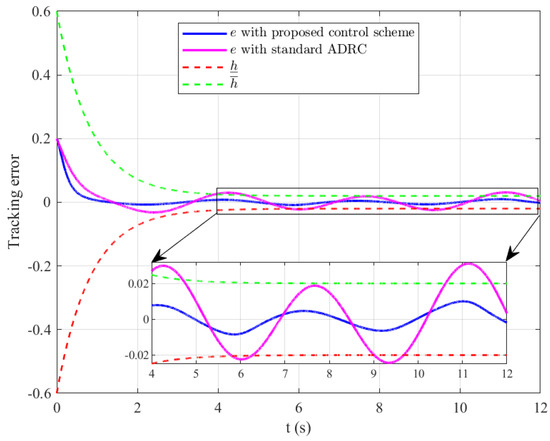
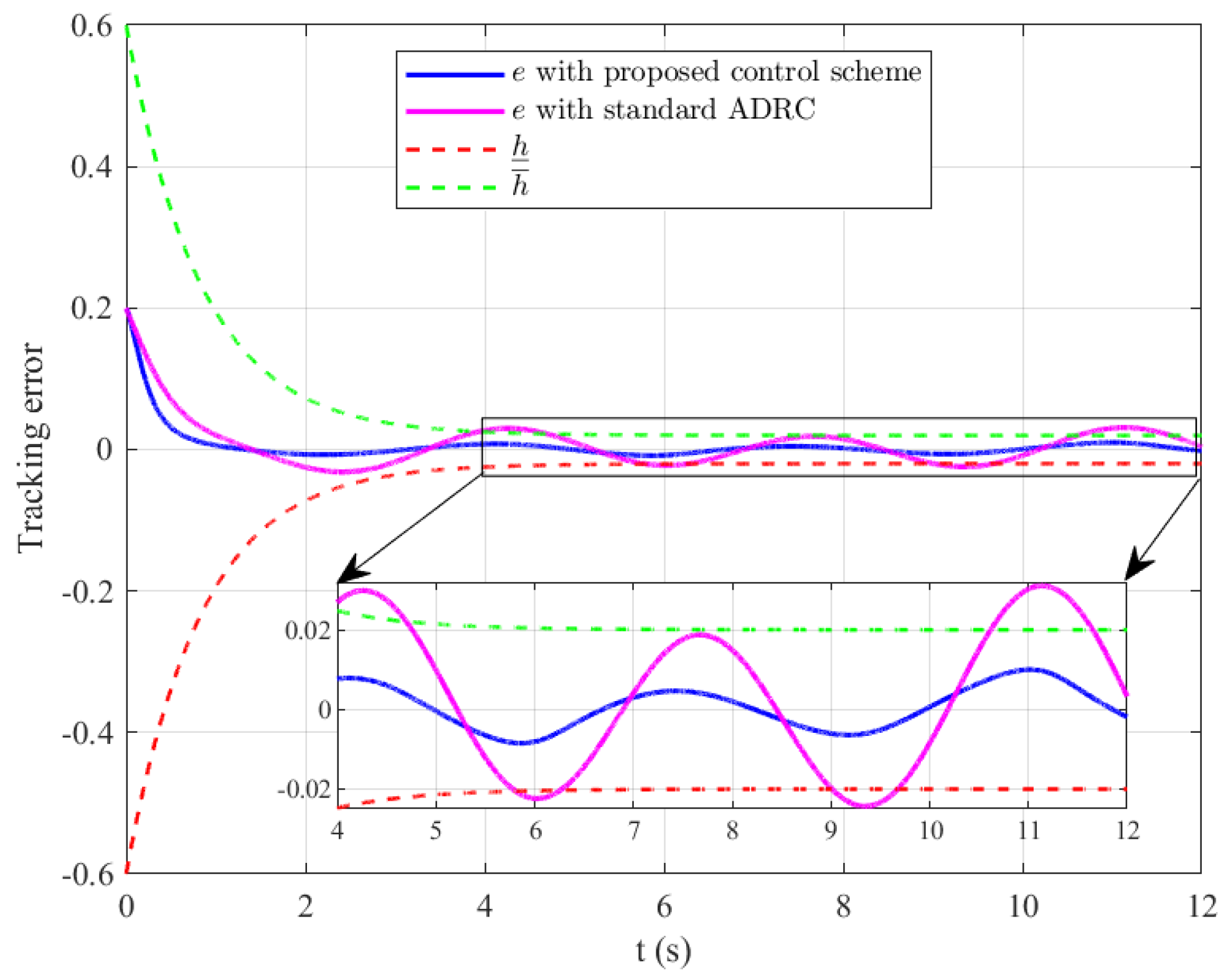
The desired trajectory is chosen as , with and . The external disturbance is selected as . The tracking error is defined as , and the prescribed tracking error bounds are given by the exponentially decaying functions
where , , and .
The joint position constraint is specified by the wave-shaped time-varying boundaries
where , , , , and .
Similarly, the joint velocity constraint is chosen as
where , , , , and .
The initial conditions are selected as , , which satisfy the prescribed error and state constraints. The initial values of the SMESO and the TD are chosen as zero. The control gains are chosen as , , and the parameters of the TD are selected as , , . The SMESO parameters are taken as , , , , , , and .
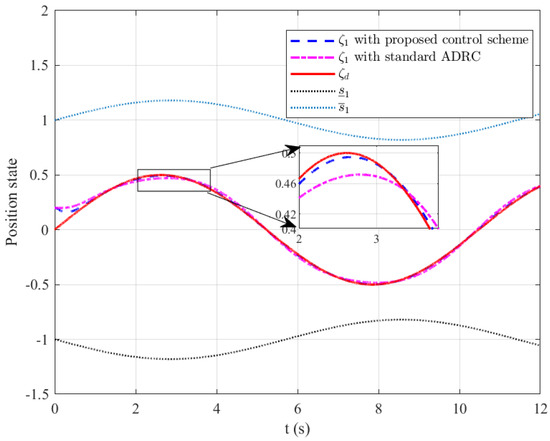
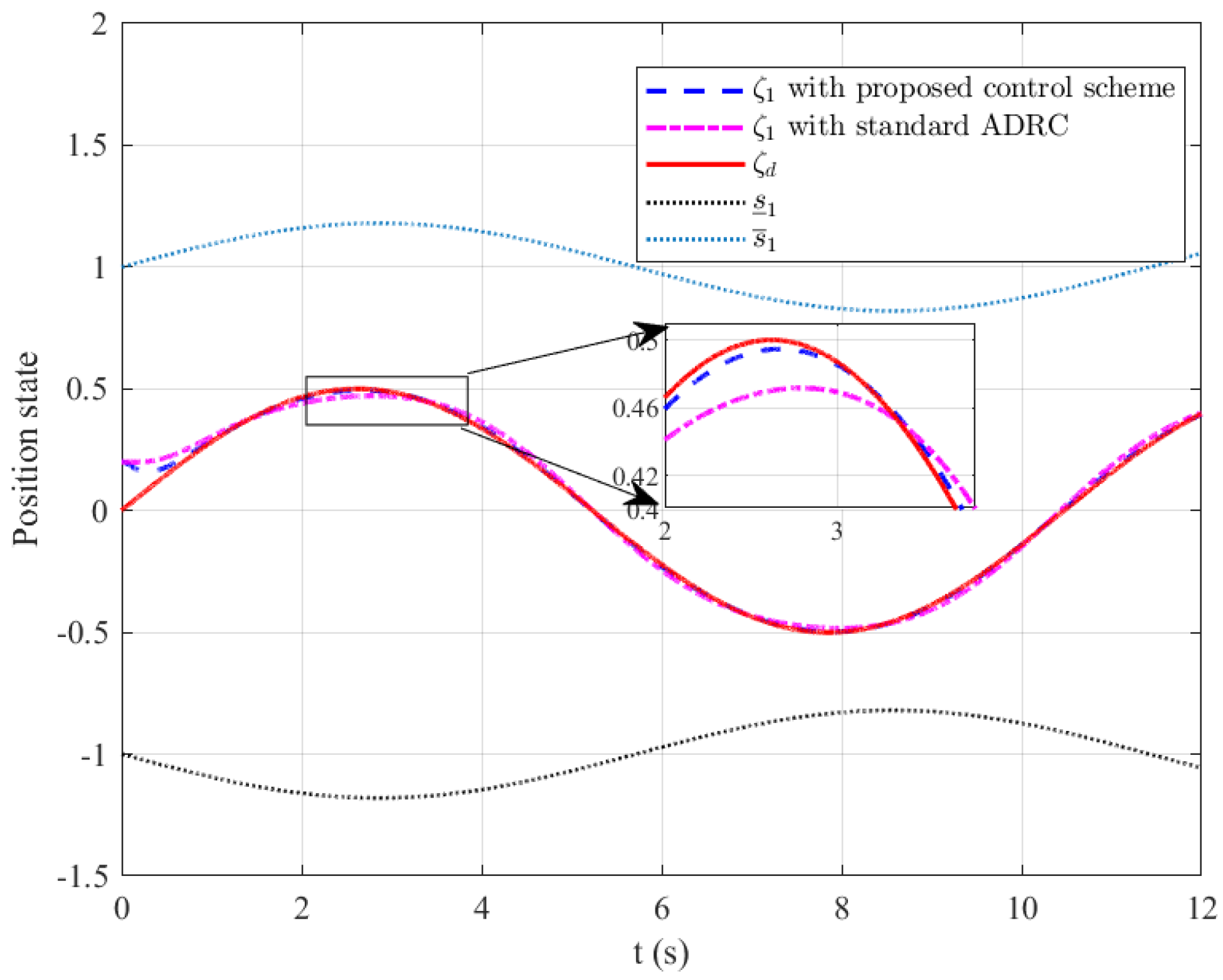
The simulation results are shown in Figure 3, Figure 4, Figure 5, Figure 6, Figure 7, Figure 8 and Figure 9. Figure 3 shows the position responses obtained by the proposed control scheme and the standard ADRC without constraints. It can be observed that both methods can track the desired trajectory, but the proposed method exhibits a faster transient response and remains strictly within the prescribed time-varying position constraints. In contrast, the standard ADRC produces a larger tracking deviation due to the absence of explicit constraint handling.
Figure 3.
Position state comparison between the proposed control scheme and the standard ADRC without constraints.
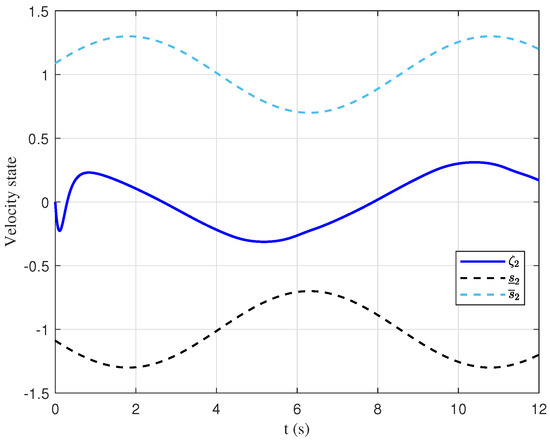
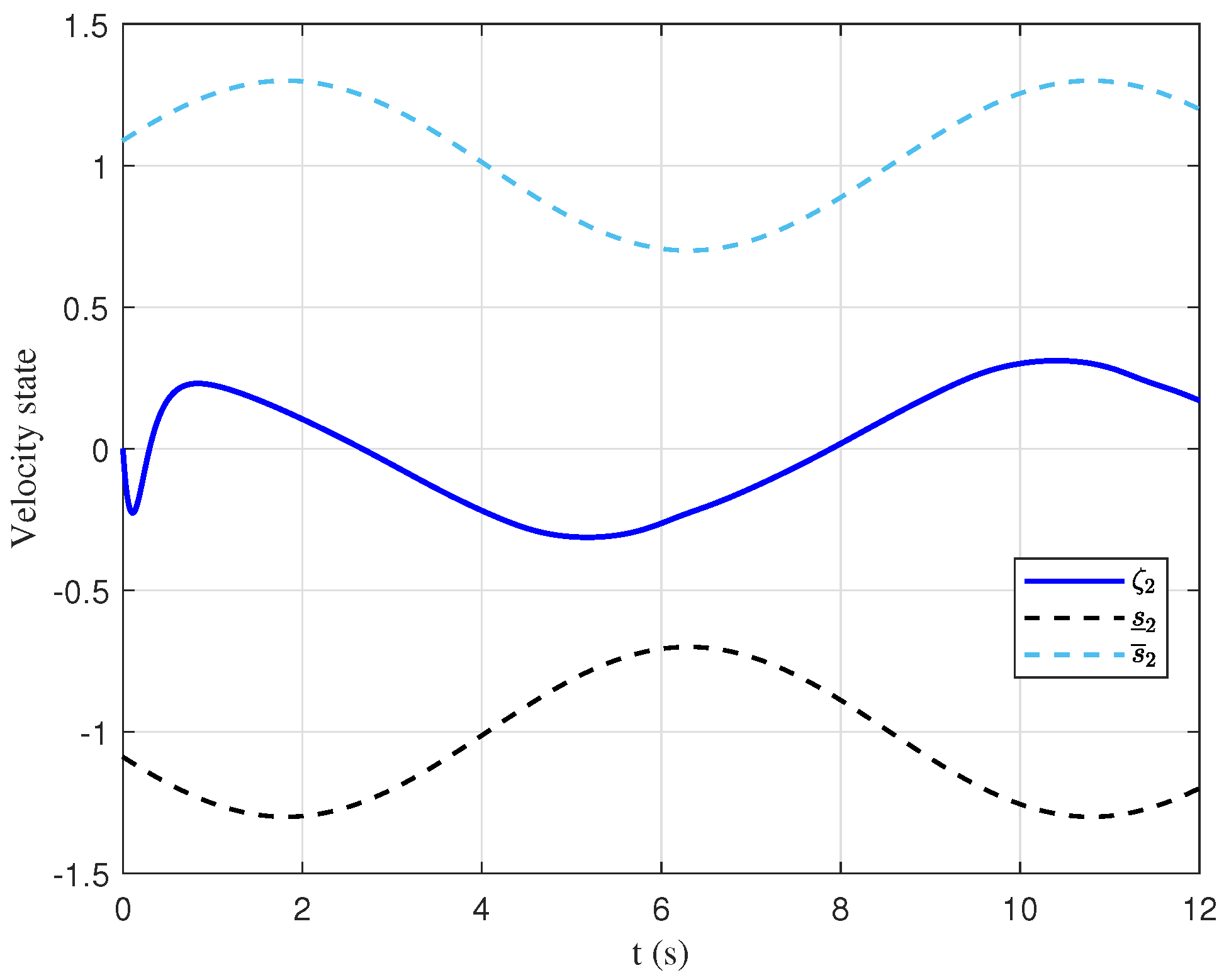
Figure 4.
Velocity state of the manipulator and the prescribed time-varying velocity constraints.
Figure 5.
Tracking error comparison between the proposed control scheme and the standard ADRC without constraints.
Figure 6.
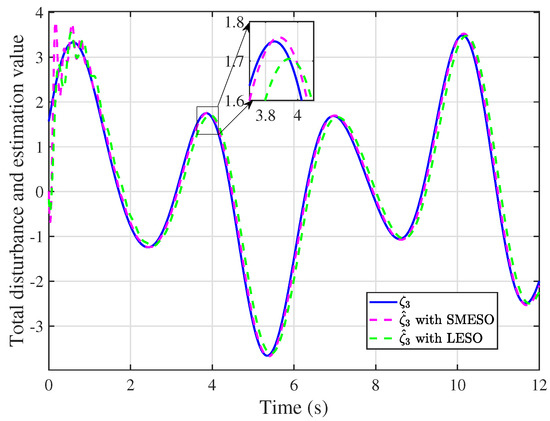
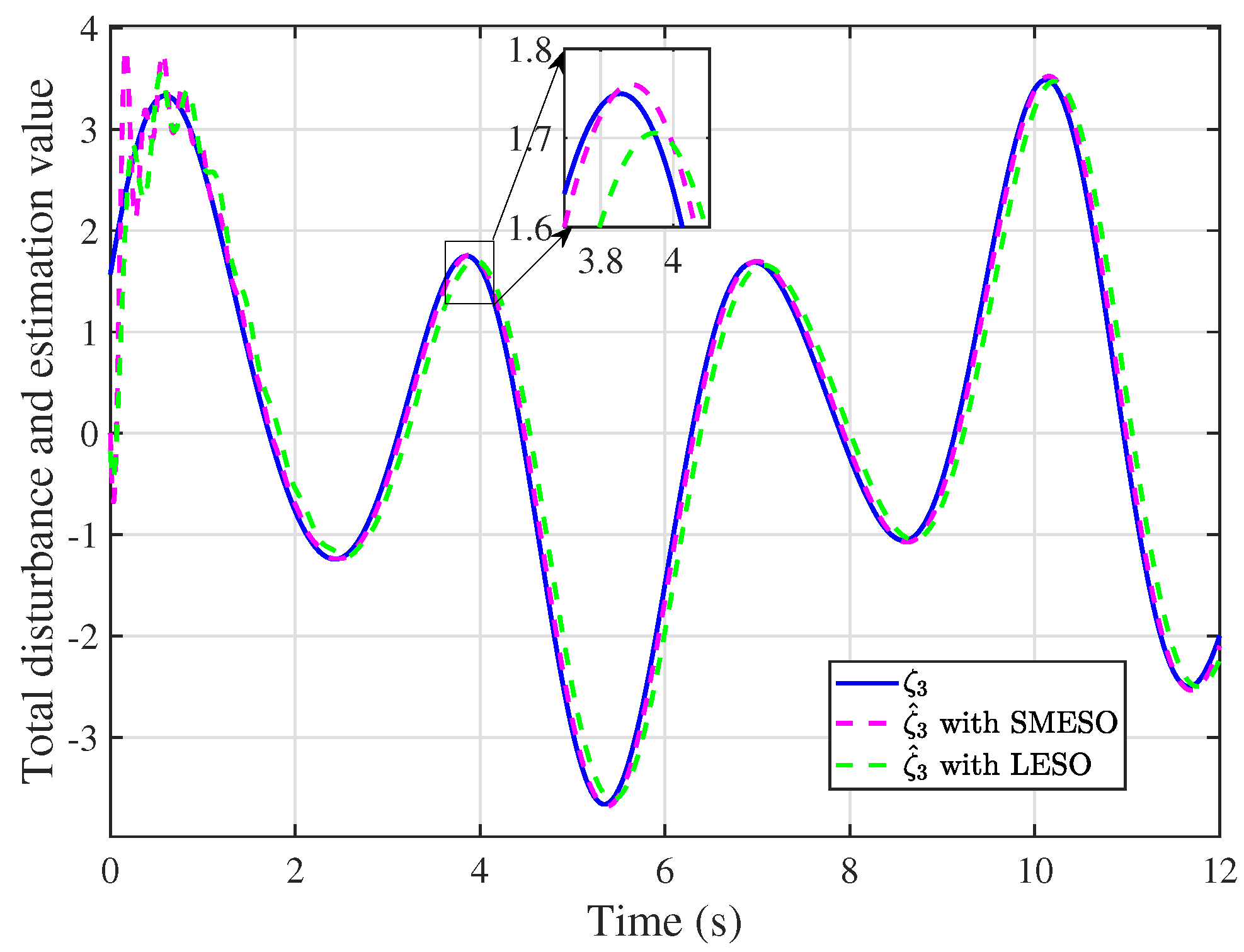
Total disturbance and its estimates generated by the proposed SMESO and the conventional LESO.
Figure 7.
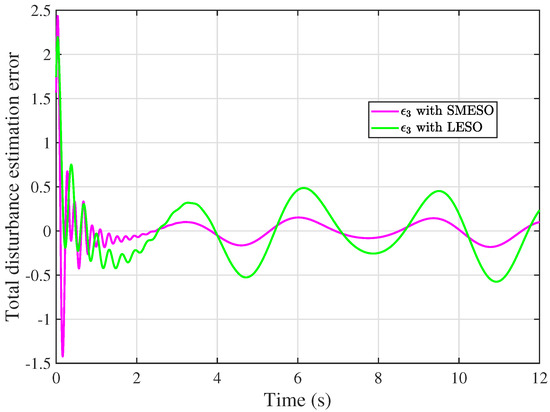
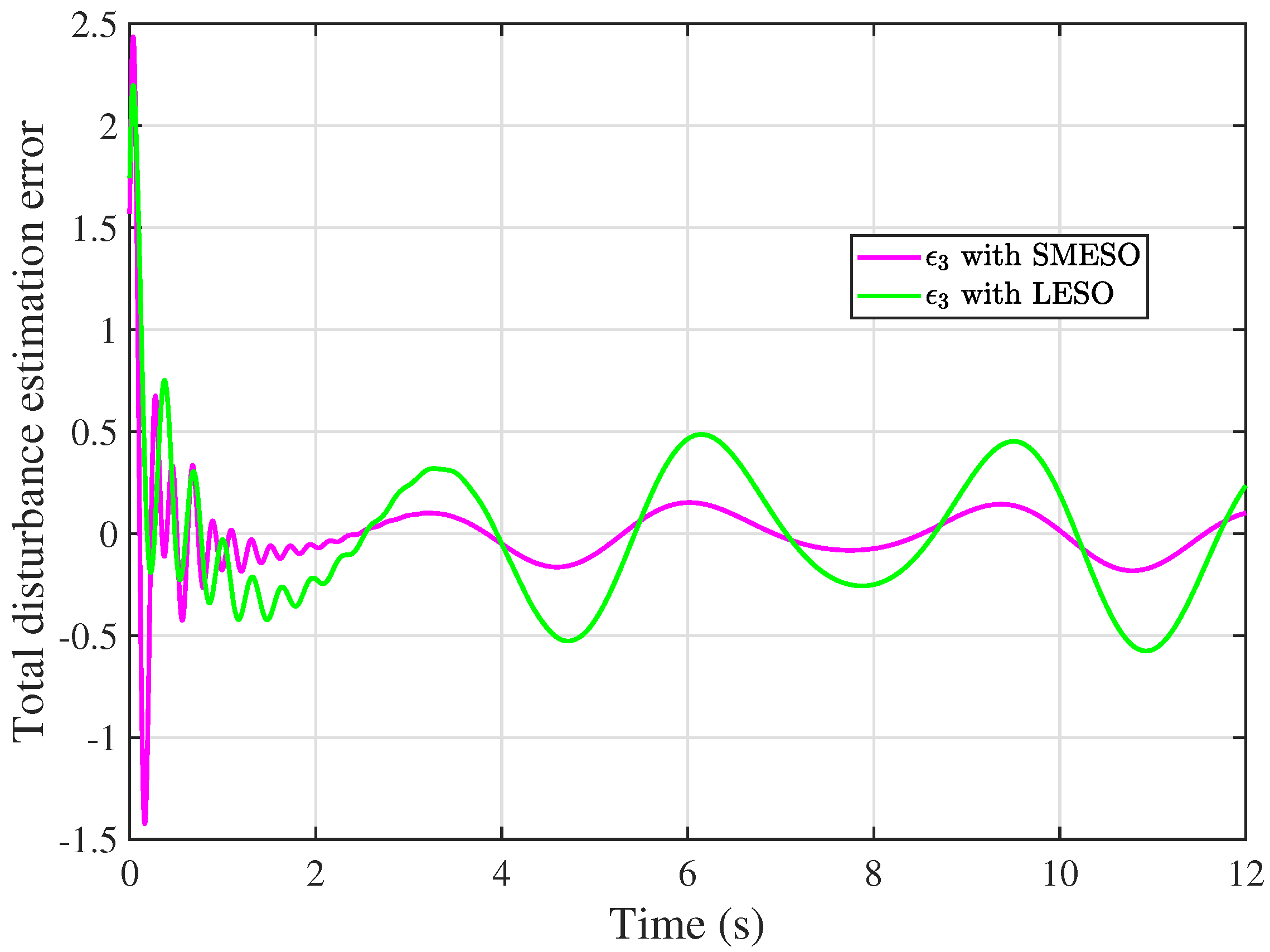
Total disturbance estimation errors of the proposed SMESO and the conventional LESO.
Figure 8.
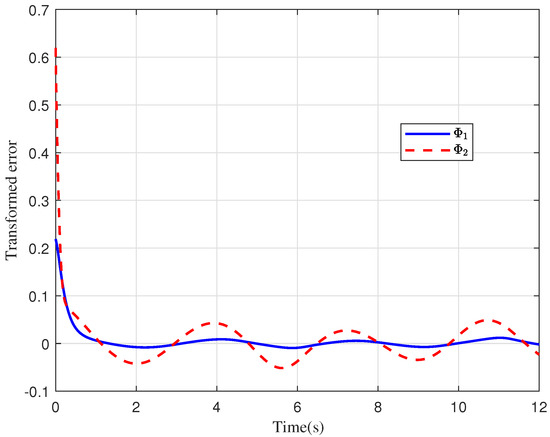
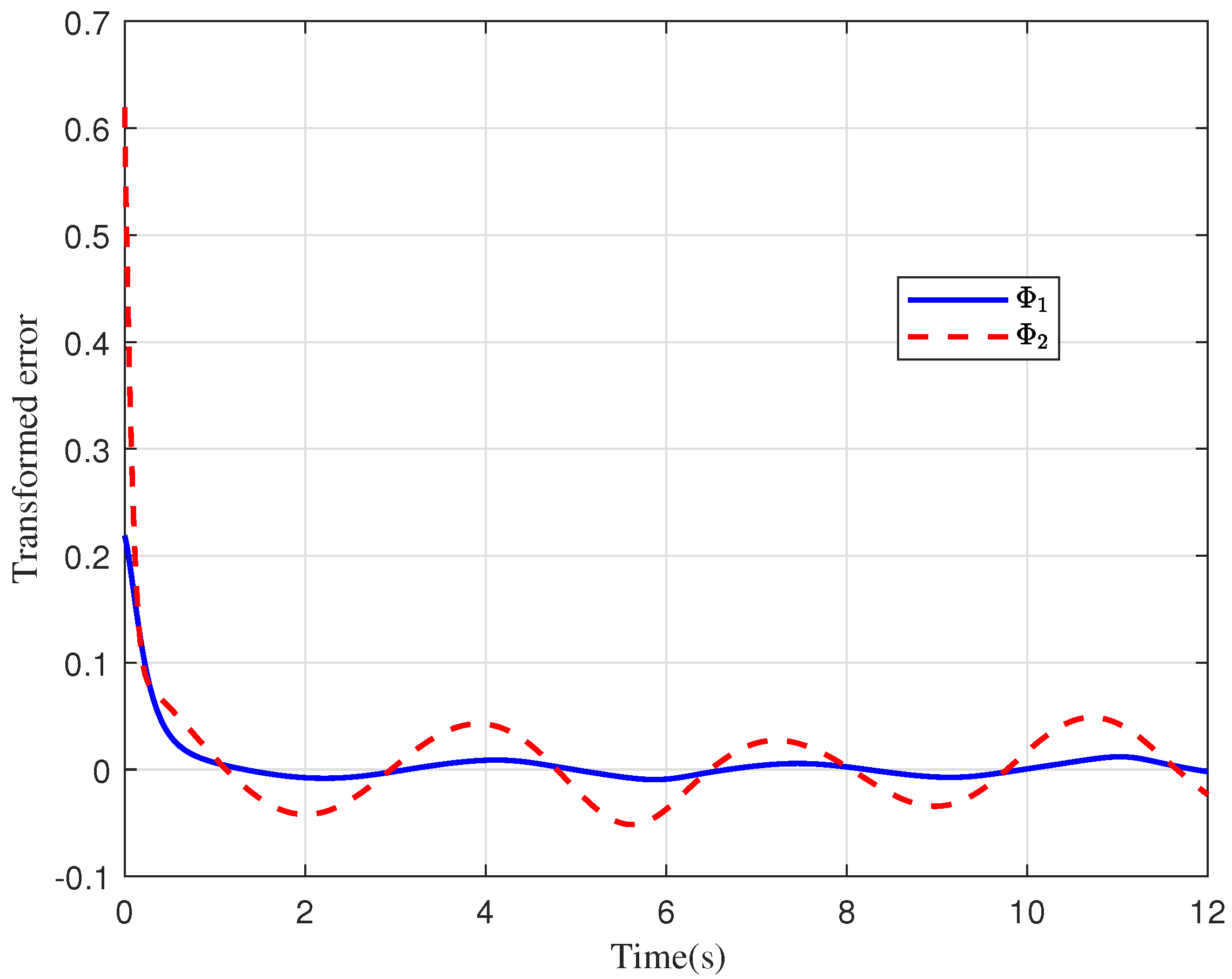
Transformed errors of the constrained control system.
Figure 9.
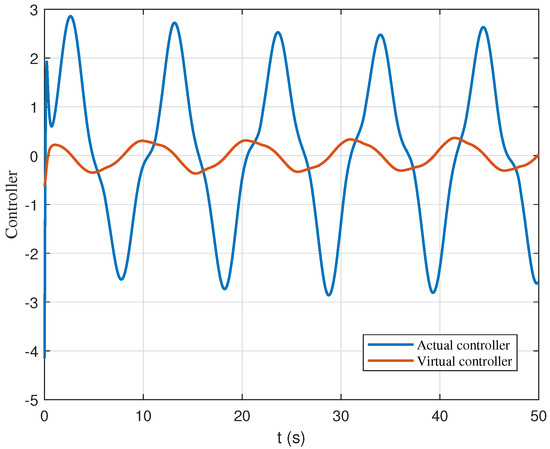
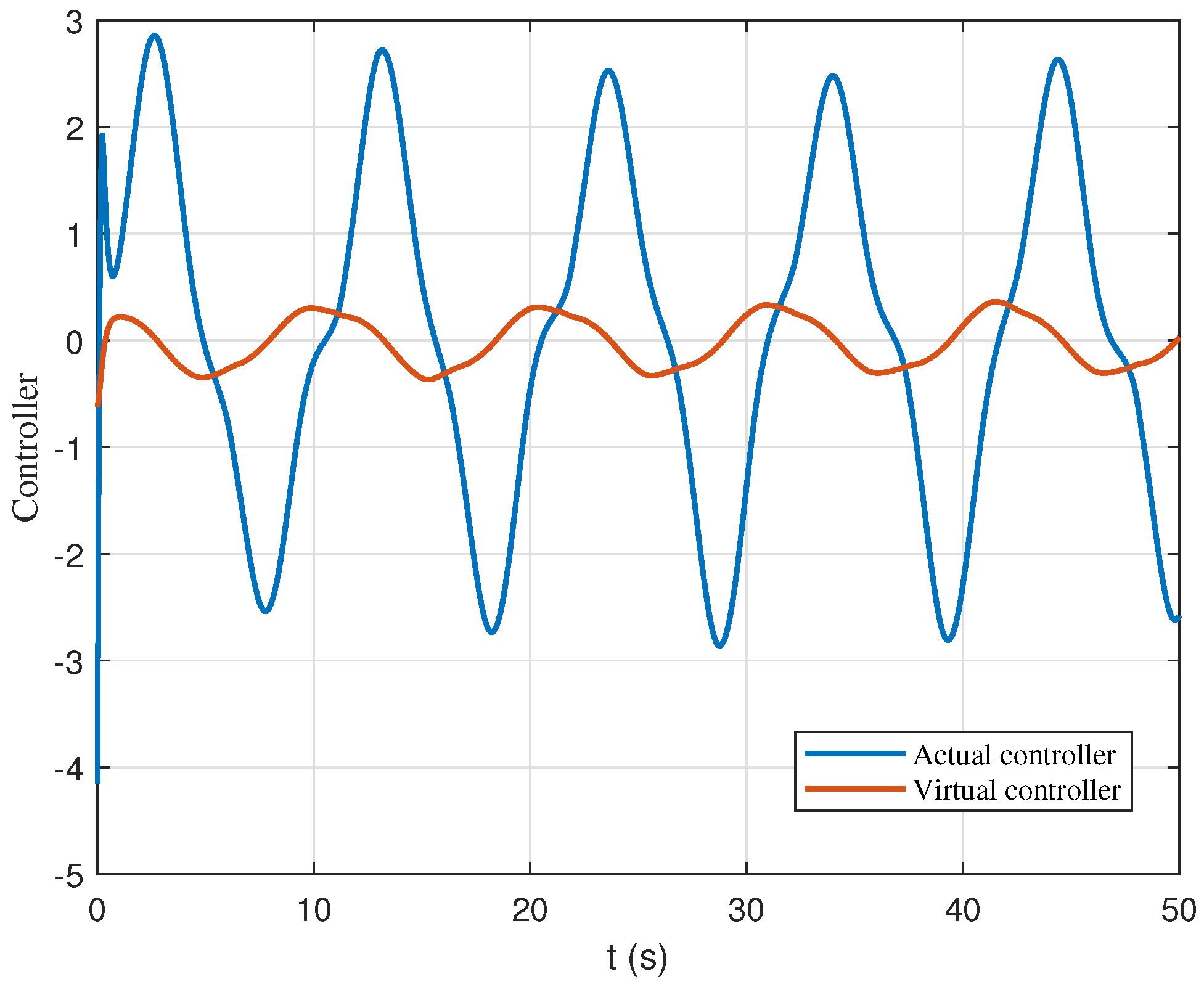
Virtual control signal and actual control input of the proposed controller.
Figure 4 depicts the velocity state and its corresponding time-varying constraint boundaries. It is seen that the velocity response is smooth and remains strictly inside the admissible region for all time. This result further demonstrates that the proposed method is capable of simultaneously handling the position constraint and the velocity constraint, thereby ensuring safe system operation under the prescribed state limitations.
Figure 5 presents the tracking error comparison. The proposed method confines the tracking error within the prescribed performance bounds during the entire process and achieves a smaller steady-state error. The standard ADRC can stabilize the system, but its transient and steady-state errors are larger, which demonstrates the necessity of introducing the proposed universal symmetry constraint framework. It can be observed from Figure 3, Figure 4 and Figure 5 that the tracking error, position state, and velocity state remain strictly within their prescribed bounds throughout the simulation, which indicates that the SMESO-induced estimation fluctuations do not cause any violation of the symmetric constraints.
Figure 6 presents the total disturbance and its estimates generated by the proposed SMESO and the conventional LESO. It can be observed that both observers are capable of reconstructing the general variation trend of the lumped disturbance. However, compared with the LESO, the SMESO provides a faster and more accurate estimation response after the initial transient stage. In particular, the enlarged local view shows that the SMESO estimate is closer to the actual disturbance, while the LESO exhibits a more noticeable phase lag and amplitude deviation. This confirms that the nonlinear correction terms in the SMESO improve the disturbance reconstruction capability for time-varying uncertainties.
Figure 7 shows the disturbance estimation errors of the SMESO and LESO. Although both observers experience a transient estimation error at the beginning of the simulation, the estimation error of the SMESO decreases more rapidly and remains within a smaller neighborhood around zero after convergence. In contrast, the LESO produces a larger oscillatory estimation error during the steady-state stage. This indicates that the proposed SMESO achieves better disturbance estimation accuracy than the conventional LESO, which contributes to improved tracking performance and a larger safety margin for maintaining the prescribed symmetric constraints.
Figure 8 presents the transformed errors. It is shown that both transformed variables converge rapidly and remain bounded during the entire control process. Since the transformed errors are directly associated with the USC-based coordinate transformation, their boundedness implies that the original tracking error and the constrained states remain within the prescribed constraint sets. This result is consistent with the theoretical analysis.
Figure 9 depicts the virtual controller and the actual controller. It can be seen that both signals remain bounded and smooth throughout the simulation interval. The actual control input shows a larger adjustment range than the virtual control signal in the transient stage, which is expected due to the compensation of disturbance estimation and transformed error feedback. Nevertheless, no excessive oscillation or numerical divergence is observed, indicating that the proposed control law is physically implementable and maintains good control performance.
Overall, the above simulation results demonstrate that the proposed control strategy can achieve accurate trajectory tracking for the one-DOF manipulator, while simultaneously guaranteeing prescribed tracking performance, satisfying full-state constraints, and effectively compensating for the lumped disturbance through the SMESO.
5. Conclusions
This paper has investigated the constrained tracking control problem for robotic manipulators under a UCS framework. By introducing a symmetry-preserving barrier-based transformation, the original constrained system was converted into an equivalent unconstrained one, such that symmetric tracking error constraints and full-state constraints could be handled simultaneously. A SMESO was designed to estimate the lumped disturbance online, and a TD was incorporated to avoid repeated differentiation in the recursive design. Based on these components, a disturbance-compensated controller was developed for the Euler–Lagrange manipulator system. Theoretical analysis showed that all closed-loop signals remain bounded, the prescribed symmetric constraints are always satisfied, and the tracking error converges asymptotically under vanishing observer and differentiator errors. Simulation results on a one-DOF robotic manipulator further verified the effectiveness of the proposed method. Future work will focus on extending the proposed framework to multi-DOF manipulators and more general constrained nonlinear systems.
Author Contributions
Writing—original draft preparation, Z.S.; writing—review and editing, C.Z.; conceptualization, methodology, supervision, G.Z. All authors have read and agreed to the published version of the manuscript.
Funding
This research was supported in part by the State Grid Corporation of China Science and Technology Project under Grant J2025059, and in part by the Research and Application of Key Technologies for Intelligent Equipment in Large-Diameter Shield Tunneling under Grant SBG20250000059.
Data Availability Statement
Data are contained within the article.
Conflicts of Interest
The authors declare that this study received funding from the State Grid Corporation of China Science and Technology Project. The funder was not involved in the study design, collection, analysis, interpretation of data, the writing of this article, or the decision to submit it for publication.
References
- Zhao, Y.; Siriwardane, E.M.D.; Wu, Z.; Fu, N.; Al-Fahdi, M.; Hu, M.; Hu, J. Physics guided deep learning for generative design of crystal materials with symmetry constraints. npj Comput. Mater. 2023, 9, 38. [Google Scholar] [CrossRef] [Scilit]
- Lyshevski, S.E. Analytic design of constrained control laws for nonlinear dynamic systems with symmetric and asymmetric limits. Int. J. Syst. Sci. 2024, 55, 453–466. [Google Scholar] [CrossRef] [Scilit]
- Zhao, Z.; He, W.; Ge, S.S. Adaptive neural network control of a fully actuated marine surface vessel with multiple output constraints. IEEE Trans. Control Syst. Technol. 2014, 22, 1536–1543. [Google Scholar] [CrossRef] [Scilit]
- Sun, W.; Wu, Y.; Lv, X. Adaptive neural network control for full-state constrained robotic manipulator with actuator saturation and time-varying delays. IEEE Trans. Neural Netw. Learn. Syst. 2021, 33, 3331–3342. [Google Scholar] [CrossRef] [Scilit] [PubMed]
- Li, D.P.; Li, D.J. Adaptive neural tracking control for an uncertain state constrained robotic manipulator with unknown time-varying delays. IEEE Trans. Syst. Man Cybern. Syst. 2017, 48, 2219–2228. [Google Scholar] [CrossRef] [Scilit]
- Bao, D.; Liang, X.; Ge, S.S.; Hou, B. Adaptive neural trajectory tracking control for n-DOF robotic manipulators with state constraints. IEEE Trans. Ind. Inform. 2022, 19, 8039–8048. [Google Scholar] [CrossRef] [Scilit]
- Zhang, C.; Zhang, G.; Han, W.; Lv, X.; Shi, Z. Distributed fixed-time control for high-order multi-agent systems with FTESO and feasibility constraints. J. Frankl. Inst. 2024, 361, 107219. [Google Scholar] [CrossRef] [Scilit]
- Yang, T.; Dong, J. Funnel-based cooperative output regulation control for uncertain nonlinear multiagent systems under input saturation. IEEE Trans. Syst. Man Cybern. Syst. 2024, 54, 5925–5935. [Google Scholar] [CrossRef] [Scilit]
- Shi, Z.; Han, W.; Zhang, C.; Zhang, G. A modular prescribed performance formation control scheme of a high-order multi-agent system with a finite-time extended state observer. Electronics 2025, 14, 1783. [Google Scholar] [CrossRef] [Scilit]
- Wang, P.; Duan, G.; Li, P.; Wang, L. Adaptive formation control of nonlinear high-order fully actuated multiagent systems with full-state constraints and its application. IEEE Trans. Cybern. 2025, 55, 5002–5013. [Google Scholar] [CrossRef] [Scilit] [PubMed]
- Zhang, W.; Zhao, L. Command filtered backstepping based finite-time adaptive fuzzy event-triggered control for unmanned aerial vehicle with full-state constraints. IEEE Trans. Veh. Technol. 2025, 74, 10162–10174. [Google Scholar] [CrossRef] [Scilit]
- Krstic, M.; Kanellakopoulos, I.; Kokotovic, P.V. Nonlinear and Adaptive Control Design; Wiley: New York, NY, USA, 1995. [Google Scholar]
- Swaroop, D.; Hedrick, J.K.; Yip, P.P.; Gerdes, J.C. Dynamic surface control for a class of nonlinear systems. IEEE Trans. Autom. Control 2002, 45, 1893–1899. [Google Scholar] [CrossRef] [Scilit]
- Zhang, Y.; Pang, K.; Chen, J.; Li, K.; Hua, C. Adaptive control for nonlinear systems with both tracking error constraints and full-state constraints: A universal constraint approach. IEEE Trans. Autom. Control 2026, 71, 1326–1333. [Google Scholar] [CrossRef] [Scilit]
- Han, J. From PID to active disturbance rejection control. IEEE Trans. Ind. Electron. 2009, 56, 900–906. [Google Scholar] [CrossRef] [Scilit]
- Ren, C.; Ding, Y.; Hu, L.; Liu, J.; Ju, Z.; Ma, S. Active disturbance rejection control of Euler–Lagrange systems exploiting internal damping. IEEE Trans. Cybern. 2022, 52, 4334–4345. [Google Scholar] [CrossRef] [Scilit] [PubMed]
- Zhang, J.; Yu, S.; Yan, Y. Fixed-time extended state observer-based trajectory tracking and point stabilization control for marine surface vessels with uncertainties and disturbances. Ocean Eng. 2019, 186, 106109. [Google Scholar] [CrossRef] [Scilit]
- Zhang, L.; Xia, Y.; Shen, G.; Cui, B. Fixed-time attitude tracking control for spacecraft based on a fixed-time extended state observer. Sci. China Inf. Sci. 2021, 64, 212201. [Google Scholar] [CrossRef] [Scilit]
- Li, Y.; Yin, Z.; Yuan, D.; Zhang, Y.; Gao, Y.; Yang, H. A multi-harmonics suppression backstepping extended state observer for the PMSM electrolytic capacitorless drives sensorless control. IEEE Trans. Power Electron. 2025, 40, 10769–10782. [Google Scholar] [CrossRef] [Scilit]
- Han, J.Q.; Wang, W. Nonlinear tracking-differentiator. J. Syst. Sci. Math. Sci. 1994, 14, 177–183. (In Chinese) [Google Scholar]
Disclaimer/Publisher’s Note: The statements, opinions and data contained in all publications are solely those of the individual author(s) and contributor(s) and not of MDPI and/or the editor(s). MDPI and/or the editor(s) disclaim responsibility for any injury to people or property resulting from any ideas, methods, instructions or products referred to in the content. |
© 2026 by the authors. Licensee MDPI, Basel, Switzerland. This article is an open access article distributed under the terms and conditions of the Creative Commons Attribution (CC BY) license.