1. Introduction
The electricity distribution industry around the world is changing rapidly. This change is driven by urbanization, increased load demand, growth in distributed energy resources, and the upgrades of existing distribution grids. The control center is the heart of a distribution system. It is the architecture through which utilities “see” their networks—the means to monitor and control network elements, and reconfigure them in real time.
For decades, the prevailing architecture has comprised a tightly integrated, multi-platform configuration centered on three components: SCADA, ADMS, and GIS [
1]. Since the 1960s, SCADA has provided the telemetry and remote switching capabilities that allow operators to monitor conditions at remote substations and send control commands to devices across wide-area distribution networks [
2]. With increasing distribution complexity, ADMS developed as an advanced supervisory control platform. It incorporates topology processors, load flow solvers, and fault location algorithms to minimize network disruptions and provide accurate system-wide decision guidance to operators [
3]. GIS evolved as the spatial information system of asset management. It provides accurate geographic coordinates from transmission substations to low-voltage service points [
4].
In Egypt, one of the largest and rapidly evolving electricity markets in the MENA region, this three-tier architecture was adopted across most control centers developed under the Egyptian Electricity Holding Company (EEHC). Control centers managing large MV networks—with thousands of kilometers of overhead line, hundreds of primary substations, and tens of thousands of switching points—require real-time performance, accurate spatial data, and high availability [
5]. True operational integration of this three-tier architecture requires extensive middleware development, implementation of an enterprise service bus (ESB), and constant synchronization. This is too costly in terms of both CAPEX and OPEX for mid-tier utilities [
6]. The most detrimental effect is the isolation of GIS as a passive, read-only asset registry. In current Egyptian control center configurations, GIS acts solely as a single-entry database for all MV assets, while ADMS leads all operational control of asset states [
7].
This division creates an unbridgeable operational gap. When operators execute switching commands through the ADMS, the GIS receives no notification of field changes and is not updated. As a result, the geographic map—which should reflect the most current representation of the active network—remains a static snapshot of the network state before any operations [
8]. A further complication is the duplication of data entry. Every asset commissioned, every switched loop reconfigured, and every equipment change must be propagated independently to both systems. This increases the administrative burden and introduces persistent data mismatch, since there is no mechanism to guarantee that both systems remain in a consistent state [
9]. Studies have shown that a mismatch between GIS and ADMS databases is one of the leading causes of poor topological processing. The effects directly impact the accuracy of any FLISR functionality [
10]. From an economic perspective, a complete ADMS deployment—covering required servers, licensing, communication systems, integration, and training—routinely costs millions of US dollars, with substantial ongoing OPEX [
11]. Given Egypt’s large territory and capital-constrained utility environment, a full ADMS rollout across all control centers is economically untenable. As a result, large portions of the MV network currently lack adequate operational control tools. The ADMS Dependency Problem in Developing-Region Distribution Utilities: The conventional ADMS/SCADA/GIS architecture imposes a cost structure that is structurally incompatible with the capital investment capacity of distribution utilities in developing regions. This incompatibility is not a marginal budget challenge resolvable through incremental cost reduction. It represents a fundamental order-of-magnitude mismatch between the cost of conventional operational control infrastructure and the capital resources available to utilities responsible for the majority of the world’s unmodernized distribution networks.
To quantify this mismatch in the Egyptian context: Egypt’s eight regional electricity distribution companies collectively operate approximately 1200 primary substations. They serve a national MV distribution network exceeding 350,000 km of MV cable and overhead line [
12]. The national electrification program administered by the EEHC has identified distribution control center modernization as a strategic priority. Its target is deploying operational control capability at all primary substation zone control centers within a ten-year investment horizon [
12]. At the conventional ADMS deployment cost of USD 3.5–4.5 million per control center established in
Section 7.3, achieving this target across all 1200 primary substations would require a total capital investment of approximately USD 4.2–5.4 billion. This sum represents several multiples of the annual capital budget available to the Egyptian distribution sector for all infrastructure investments combined.
The consequence of this cost incompatibility is not that Egyptian distribution utilities deploy cheaper or scaled-down ADMS solutions. Rather, the overwhelming majority of Egyptian zone control centers operate with no modern operational control capability whatsoever. They rely entirely on manual switching procedures, paper-based network records, and verbal field-to-control-room communication [
13]. This operational condition is representative of distribution utility sectors across the MENA region and the broader developing world. It has direct consequences for supply reliability, operational safety, and the utility’s capacity to integrate distributed energy resources and respond effectively to fault conditions. Of the approximately 1200 Egyptian primary substation zone control centers, fewer than 3% currently operate with any form of topology-aware switching control capability. This contrasts sharply with the near-universal deployment of such capability in European and North American distribution utilities of comparable network scale [
14]. This modernization gap represents both the scale of the problem and the magnitude of the opportunity that the proposed framework addresses.
The proposed framework’s 88–89% CAPEX reduction transforms this economic calculus fundamentally. At a deployment cost of USD 0.44 million per control center, the same national modernization investment could achieve full deployment across all 1200 primary substation zone control centers. More practically, at the district-level capital budget available to individual Egyptian distribution companies, the framework enables deployment of operational control capability at 8–10 zone control centers per annual budget cycle. This compares with fewer than one under the conventional ADMS cost model—a multiplicative impact on modernization velocity that represents the fundamental strategic significance of ADMS dependency elimination in the developing-region context.
The existing literature has addressed particular aspects of this problem, including ADMS architecture and features [
3], geospatial applications in ADMS [
4], SCADA-GIS integration frameworks [
15], and communication protocols in the smart grid [
16]. However, it remains unclear whether a standalone ADMS is architecturally necessary. It may be possible to fully embed its most essential operational functionalities—switching logic, feeder state management, and real-time topology computation—within the GIS platform itself as the core operational layer.
A technically important clarification is required regarding the scope of the decoupling achieved by the proposed framework relative to existing third-party SCADA-GIS integration solutions. Several commercial products provide a form of GIS-integrated visualization for distribution network operations. These include Schneider Electric’s ArcFM Viewer for ArcGIS, Oracle Utilities Network Management System with GIS display extensions, and General Electric’s GridSolutions ADMS with GIS map viewer integration [
17,
18,
19]. These solutions enable operators to view network switching states and, in some implementations, near-real-time telemetry overlays within a GIS geographic display environment. Such capability could be interpreted as a form of operational decoupling from the ADMS, in that the operator’s geographic visualization interface is no longer the ADMS schematic display alone.
However, a fundamental architectural distinction separates middleware-based SCADA-GIS integration from the embedded switching intelligence approach proposed in this paper. In all middleware-based solutions, the GIS visualization layer functions as a passive display consumer of operational intelligence produced and owned by the ADMS. The network topology model, the energization state computation, the switching state management, and the maneuver sequencing logic all reside within the ADMS platform. The GIS receives a representation of this intelligence for display purposes but contributes no independent operational computation. This architecture achieves display-layer decoupling only. The full operational dependency on the ADMS platform—with its associated licensing costs, infrastructure requirements, data model maintenance burden, and GIS–ADMS synchronization failure modes—is preserved without reduction.
Table 1 formally compares the architectural properties of middleware-based SCADA-GIS integration against the proposed embedded switching intelligence approach across the key dimensions of this distinction.
The proposed framework achieves a qualitatively different and deeper architectural property: operational intelligence decoupling. By implementing the topology engine, switching state management, conflict resolution logic, and maneuver sequencing natively within the GIS platform—operating directly on the GIS spatial data model without reference to an external ADMS—the framework transfers the locus of operational intelligence from the ADMS to the GIS. The GIS is no longer a consumer of ADMS-produced network intelligence; it is the autonomous producer of that intelligence. This transfer has three concrete consequences that no middleware-based solution can replicate.
First, complete ADMS cost elimination: since no ADMS platform is required at any tier of the architecture, the full ADMS licensing cost—USD 1.2–2.0 million CAPEX and USD 120,000–200,000 per annum in maintenance, as quantified in
Section 7.3—is eliminated rather than merely supplemented by an additional middleware layer.
Second, structural elimination of GIS–ADMS data divergence: middleware-based solutions do not eliminate the structurally separate ADMS network model; they connect the GIS display to it. Data divergence between the GIS spatial model and the ADMS operational model—the fundamental problem identified in
Section 3—therefore persists in middleware architectures, since the two models remain independently maintained. The proposed framework eliminates this divergence by design through the single-store USDM architecture, in which there is no separate ADMS model from which the GIS can diverge.
Third, full switching control independence: in middleware-based architectures, the GIS visualization capability is upstream-dependent on the ADMS; GIS display fidelity degrades or fails during ADMS unavailability. The proposed framework preserves full switching control capability, topology computation, and geographic display independently of any external system, since all operational intelligence is embedded within the GIS platform itself.
These three distinctions collectively establish that the proposed embedded switching intelligence approach is not an incremental refinement of existing middleware-based SCADA-GIS integration. It represents a structural architectural reclassification of the GIS—from a display consumer to an operational intelligence platform—with substantive and quantifiable consequences for cost, reliability, and data integrity in MV distribution network control.
Section 2 reviews literature spanning GIS applications in power distribution, ADMS–SCADA integration challenges, and prior GIS-centric control proposals.
Section 3 formulates the Egyptian MV network context and architectural problem.
Section 4 presents the proposed framework’s design philosophy and component architecture.
Section 5 details the real-time synchronization engine and SLD-to-map coupling mechanism.
Section 6 presents the Egyptian MV network case study results.
Section 7 delivers comparative performance analysis.
Section 8 addresses scalability, limitations, and future integration pathways.
Section 9 concludes.
3. System Architecture & Problem Formulation
This section gives a full picture of the architectural and operational context in which the proposed GIS-native control framework was created. It describes the Egyptian MV distribution network environment and breaks down the conventional ADMS–SCADA–GIS architecture and its systemic problems. It ends with a formal problem statement that defines the design goals and constraints for the proposed solution. This foundation ensures that all the following sections remain completely consistent with each other.
3.1. The Egyptian MV Distribution Network: Operational Context
Network Scale and Structure: The main electricity distribution network in Egypt is owned and operated by the Egyptian Electricity Holding Company and its eight regional distribution companies. It constitutes one of the largest electricity distribution systems in Africa and the MENA region [
5]. With an estimated population exceeding 105 million and a surface area of approximately 1,002,000 km
2, the network has achieved an electrification rate of almost 99.7% in populated regions. This was accomplished through 20 years of continuous investment and network expansion [
5,
40].
The MV feeder is a complex structure. Its main branch extends tens of kilometers in urban service territories and substantially greater distances in rural distribution zones. It may carry many lateral branches connecting to secondary substations, high-demand customers, and switching points. A typical Egyptian urban primary substation feeds 8 to 24 MV feeders, each having 15 to 60 switching points—including RMUs, sectionalizing switches, load break switches, and normally open tie points [
5,
40]. The total number of MV switching points across the Egyptian network reaches tens of thousands, making topological management a severe operational challenge.
At the next lower level are the control centers of the regional distribution companies. These control their respective MV networks within defined geographic areas. Sub-zone control centers may be established to serve large urban centers or rural areas, depending on service territory size and load density [
5]. Each regional and zonal control center is staffed by shift engineers and network operators engaged in round-the-clock monitoring, switching program authorization and execution, fault location and restoration, and coordination of field crews on maintenance and construction activities.
A typical distribution control center (DCC) in Egypt processes dozens to hundreds of switching operations per shift. These include routine maintenance switching, load transfers between feeders, management of planned outages, and emergency fault restoration [
40]. It is precisely in this context—high switching activity, extensive network scale, simultaneous multi-task operations, and the need for real-time geographic situational awareness—that the weaknesses of the conventional ADMS–SCADA–GIS architecture manifest most clearly, and the value of the proposed framework becomes most evident.
3.2. Baseline Architecture Characterization
Traditional operational control of MV distribution networks relies on a multi-platform architecture. Three functionally distinct systems—SCADA, ADMS, and GIS—operate as loosely coupled, independently maintained components integrated through middleware or APIs. This architectural paradigm has been the dominant deployment model across regional distribution utilities in Egypt and the broader MENA region [
41].
In the conventional configuration considered as the baseline for this study, the ADMS platform is responsible for real-time network topology processing, load flow computation, FISR logic, and operator switching workflow management. The ADMS maintains an internal network model—typically conforming to the CIM standard IEC 61968/61970—which is populated and periodically updated from the GIS platform. Crucially, this synchronization does not occur in real time. Instead, it is executed through a scheduled batch export-import cycle, commonly configured at intervals ranging from 24 h to one week [
42,
43].
During the inter-synchronization window, any network topology changes recorded in GIS—newly commissioned switching assets, cable route modifications, or substation reconfigurations—are invisible to the ADMS network model. This creates temporal divergence between the geographic reality and the operational model underpinning switching decisions. The GIS platform in the baseline serves primarily as a spatial asset registry rather than an operational control interface [
4,
9].
Switching operations commanded through the ADMS are reflected in GIS only after manual update by GIS technicians or through the next scheduled synchronization cycle. Consequently, the geographic map visible to field crews does not reflect the live operational state of the network. It remains a lagged representation that may be hours or days behind actual field conditions. This divergence introduces operational risk, particularly in post-fault restoration scenarios requiring rapid and accurate topological awareness.
The integration between ADMS and GIS in the baseline is typically implemented through one of two mechanisms: a proprietary middleware connector supplied by the ADMS vendor, or a custom ETL pipeline developed and maintained by the utility’s IT department [
39]. Both mechanisms introduce additional infrastructure components requiring independent licensing, versioning management, and technical support. Version mismatches between ADMS and GIS platform upgrades frequently disrupt middleware connectivity, necessitating costly reconfiguration.
In terms of geographic situational awareness, the baseline architecture provides operators with two spatially and temporally inconsistent network views: the ADMS schematic—which reflects near-real-time electrical topology but lacks geographic context—and the GIS map—which provides accurate spatial representation but reflects a non-current operational state. Neither view alone is sufficient for geographically informed operational decision-making. The cognitive burden of reconciling the two is a recognized source of operator error in MV switching operations [
44,
45].
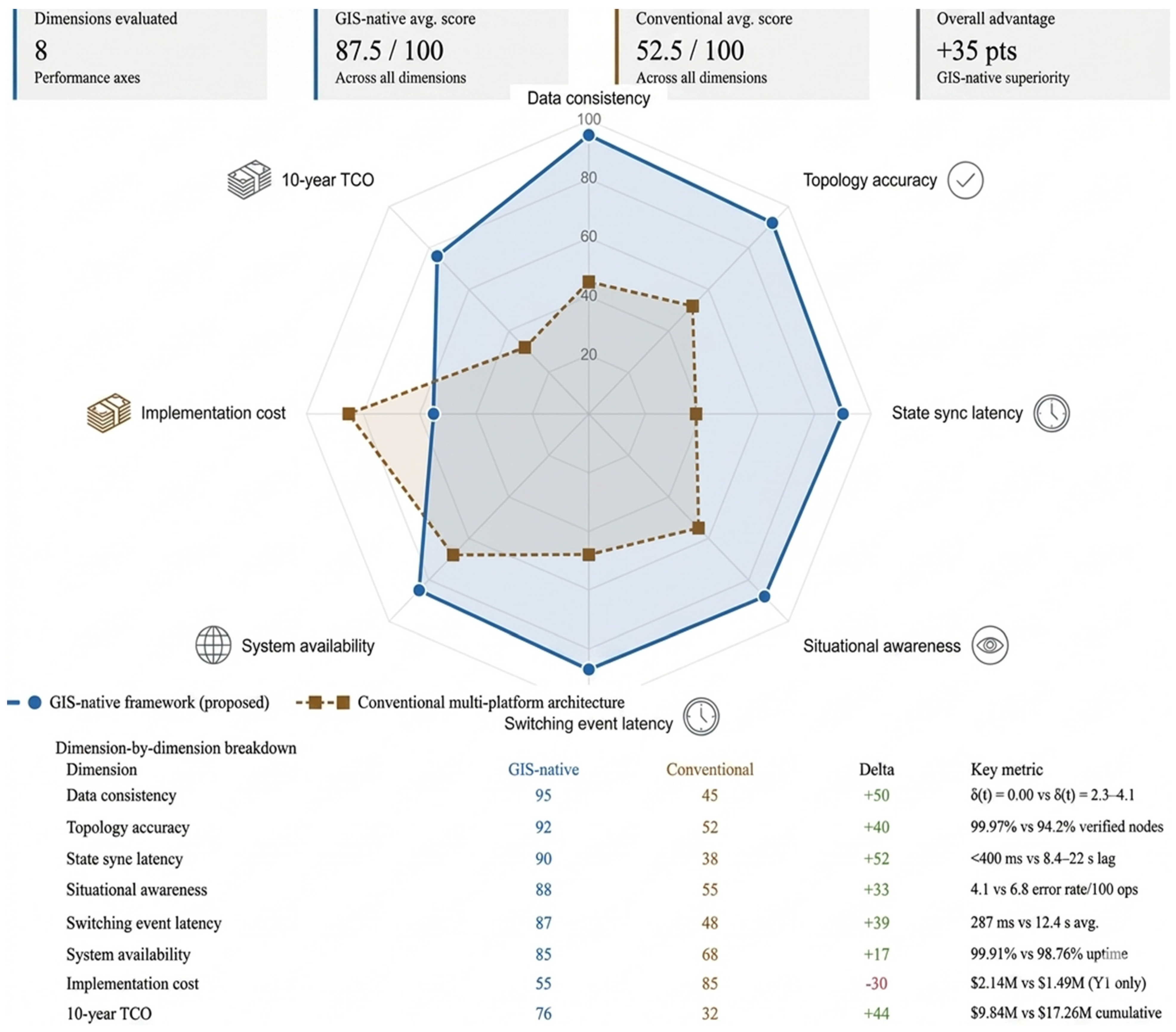
Table 3 summarizes the functional characteristics of the baseline multi-platform architecture compared with the proposed GIS-native framework across the dimensions most relevant to this study.
3.3. Conventional ADMS–SCADA–GIS Architecture: Detailed Decomposition
Architectural Overview: The standard control center architecture used in Egyptian distribution control centers—representative of international practice—comprises three main platform layers connected by a complex integration fabric.
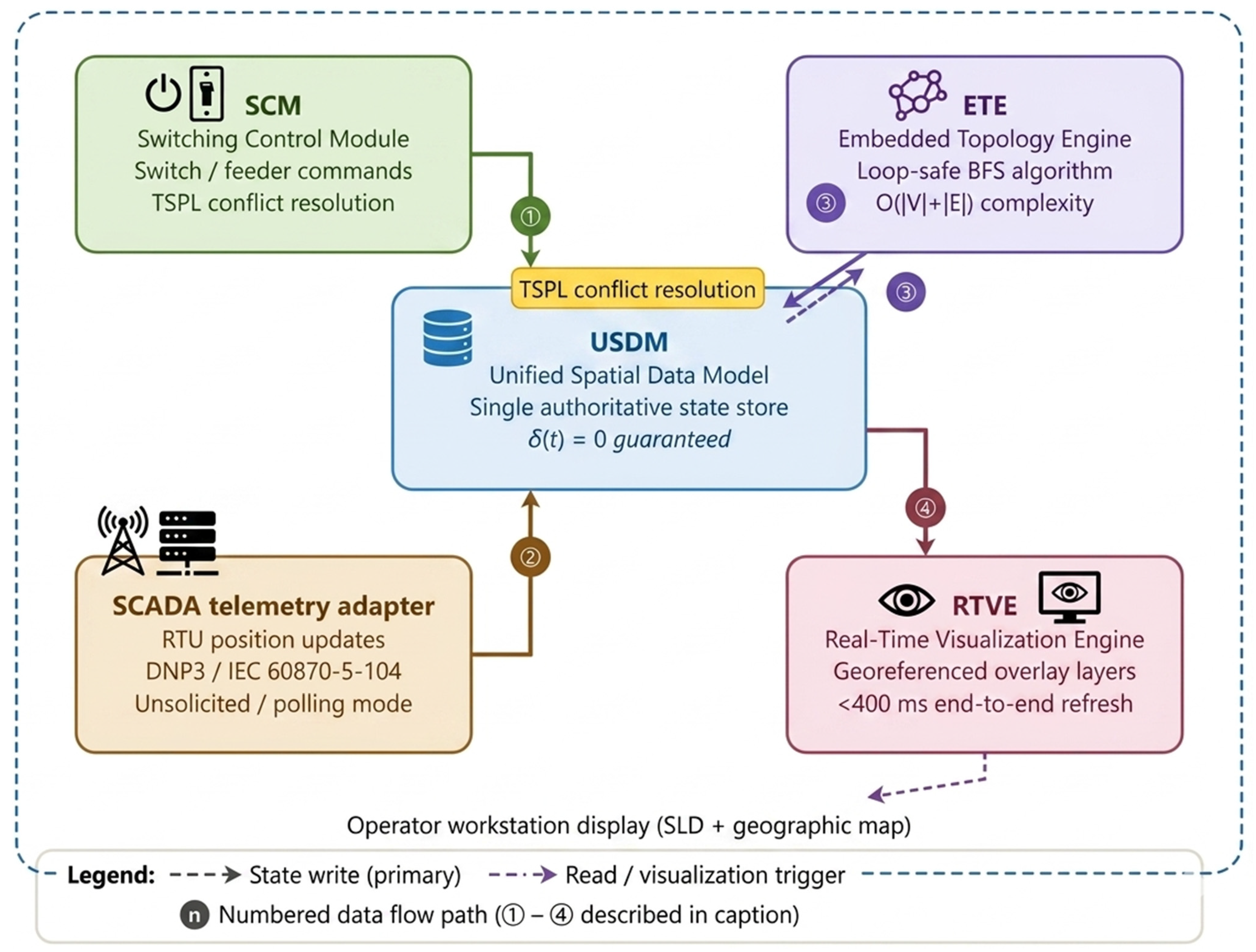
Figure 1 shows the full architectural breakdown, including principal components, data flows, and integration interfaces.
Figure 1.
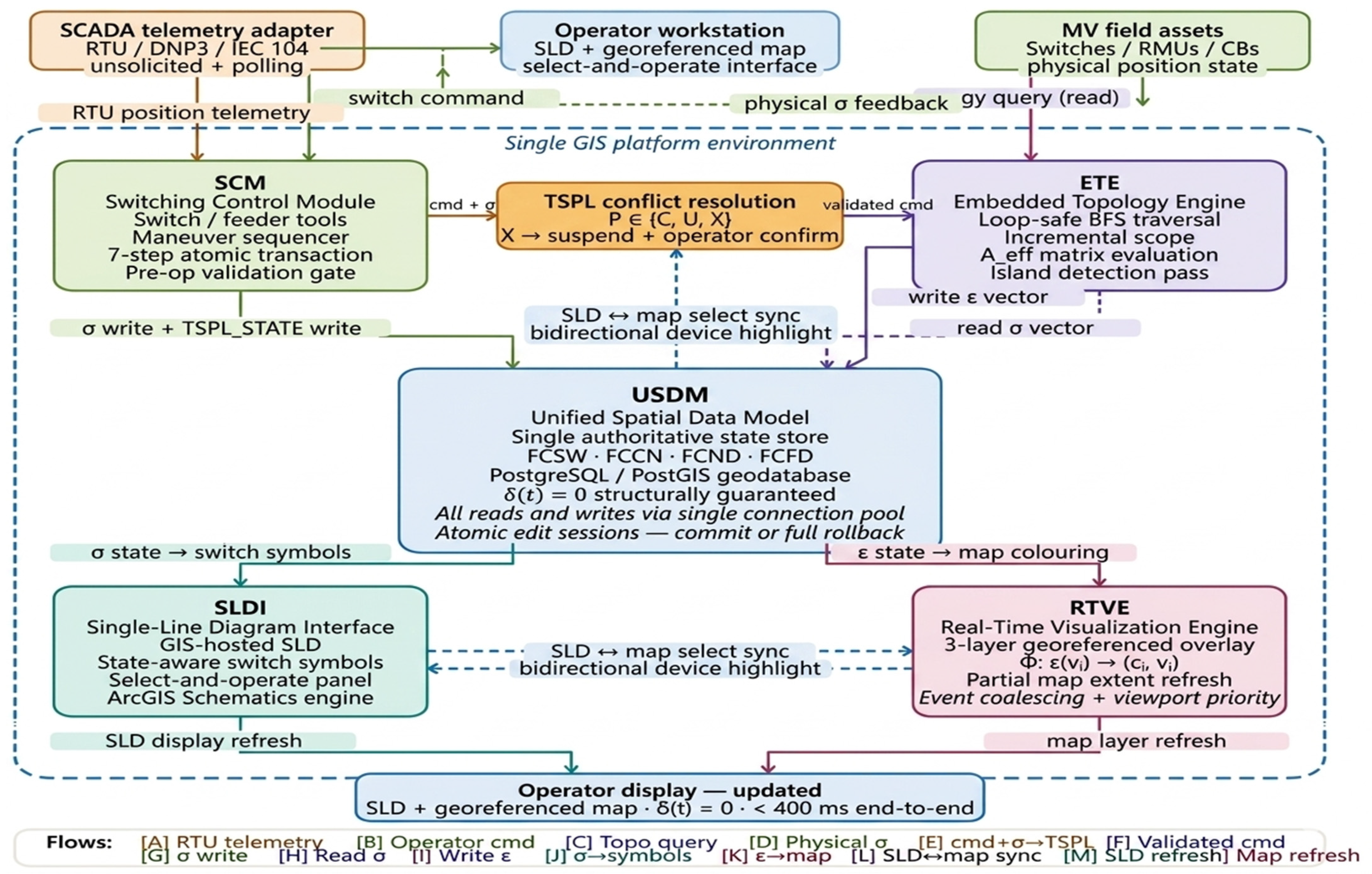
System architecture of the proposed GIS-native operational control framework, illustrating the four principal components and their data flow relationships. Directional arrows indicate the flow direction and data type for each inter-component communication path: ① switch state change commands flow from the Switching Control Module (SCM) to the Unified Spatial Data Model (USDM) via the TSPL conflict resolution layer; ② RTU telemetry position updates flow from the SCADA Telemetry Adapter to the USDM via the TSPL validation layer; ③ the Embedded Topology Engine (ETE) reads the current switching device state vector from the USDM and writes the computed energization state vector back to the USDM upon each topology trace; ④ the Real-Time Visualization Engine (RTVE) reads the energization state vector and switching device states from the USDM and renders the three georeferenced overlay layers on the operator workstation display. The USDM constitutes the single authoritative state store for all framework components, eliminating inter-system data divergence by design.
Figure 1.
System architecture of the proposed GIS-native operational control framework, illustrating the four principal components and their data flow relationships. Directional arrows indicate the flow direction and data type for each inter-component communication path: ① switch state change commands flow from the Switching Control Module (SCM) to the Unified Spatial Data Model (USDM) via the TSPL conflict resolution layer; ② RTU telemetry position updates flow from the SCADA Telemetry Adapter to the USDM via the TSPL validation layer; ③ the Embedded Topology Engine (ETE) reads the current switching device state vector from the USDM and writes the computed energization state vector back to the USDM upon each topology trace; ④ the Real-Time Visualization Engine (RTVE) reads the energization state vector and switching device states from the USDM and renders the three georeferenced overlay layers on the operator workstation display. The USDM constitutes the single authoritative state store for all framework components, eliminating inter-system data divergence by design.

The data flow architecture of the proposed framework is organized around the USDM as the single authoritative state store. All framework components read and write to this store exclusively. This single-store architecture is the structural basis of the zero-divergence property δ(t) = 0 established in
Section 3.4. The data flow sequence for a complete switching operation cycle proceeds as follows. Upon operator initiation of a switching command at the SCM, the commanded switch position is submitted to the TSPL conflict resolution layer (
Section 5.8). The TSPL evaluates the command against any concurrently received RTU telemetry for the same device and assigns the appropriate CONFIRMED, UNVERIFIED, or CONFLICT state. The validated state is written to the USDM switching device feature class (FCSW).
The ETE is then triggered by the USDM write event. It reads the updated switching device state vector from FCSW and executes the BFS topology trace on the geometric network model (GNM). The resulting energization state vector is written back to the USDM node feature class (FCND) and conductor feature class (FCCN). The RTVE detects the USDM energization state update via the event coalescing queue (
Section 5.7). It executes a partial map refresh on the three georeferenced overlay layers and presents the updated geographic display to the operator workstation within the sub 400 ms end-to-end response window validated in
Section 6.4. The SCADA telemetry adapter operates as a parallel asynchronous input stream. It injects RTU-reported position updates into the TSPL layer independently of operator command events, with conflict detection and resolution proceeding as described in
Section 5.8.
The GIS Layer: Passive Repository Role: The role of GIS within the conventional dual architecture is one of structural subordination. GIS serves as the system of record—the authoritative spatial registry of all MV network assets, including poles, cables, transformer ratings, substation footprints, and the geographic coordinates of switching assets. It is the sole point of entry for any asset commissioned or modified [
4,
5].
Its operational role ends there. Once asset information has been extracted and translated to ADMS through the integration fabric, GIS becomes operationally inert. It cannot be informed of switching state changes from ADMS. It cannot identify energized and de-energized network sections. It cannot be used to execute a switching maneuver. The map visible to the GIS operator reflects the network state at the last synchronization cycle—not the current operational reality [
8,
9].
This architectural inertia is not the result of poor design. It reflects a deliberate separation of function: ADMS as the operational intelligence platform, and GIS as the spatial data platform, with their respective roles enforced through the integration fabric. This paper demonstrates that this separation is operationally costly, technically fragile, economically prohibitive, and—most importantly—functionally unnecessary.
Integration Fabric: Complexity and Fragility: The integration fabric between ADMS and GIS is the most complex and expensive element of the conventional control center solution. True bidirectional interfacing between two systems with fundamentally different models—the ADMS operational network model and the GIS spatial asset model—requires transformation logic, message queuing, and validation protocols [
30,
31].
In practice, all current Egyptian distribution control centers integrate GIS and ADMS not through a continuous bidirectional interface but through scheduled batch synchronization cycles. Continuous model synchronization imposes a significant processing load and requires a complex development effort. A batch cycle—typically every few hours or every 24 h—is therefore the standard implementation [
5]. During these inter-synchronization intervals, the ADMS and GIS topological models can differ by the full extent of all switching operations performed since the last synchronization. During periods of intensive construction, network reconfiguration, or maintenance activity, both systems may display network topology that is operationally incorrect if acted upon by the ADMS topology processor. This leads to incorrect switching instructions, erroneous customer impact identification, and faulty fault location procedures [
10,
34].
3.4. Formal Problem Formulation
Network Topology Model: The MV distribution network is formally represented as a directed graph G = (V, E, S), where
- ○
V = is the set of network nodes, comprising primary substation busbars, secondary substation busbars, junction points, and load points.
- ○
E = is the set of network edges, representing MV cable sections, overhead line sections, and transformer connections.
- ○
S = is the set of switching elements, where each switching element has a binary state with denoting closed (conducting) and denoting open (non-conducting).
The switching state vector fully defines the network topology at any instance t
, which determines the set of active edges
and consequently, the energization status of every node in V. All symbols used in the formal descriptions throughout
Section 3,
Section 4 and
Section 5 are defined in
Table 4, listed in order of first appearance.
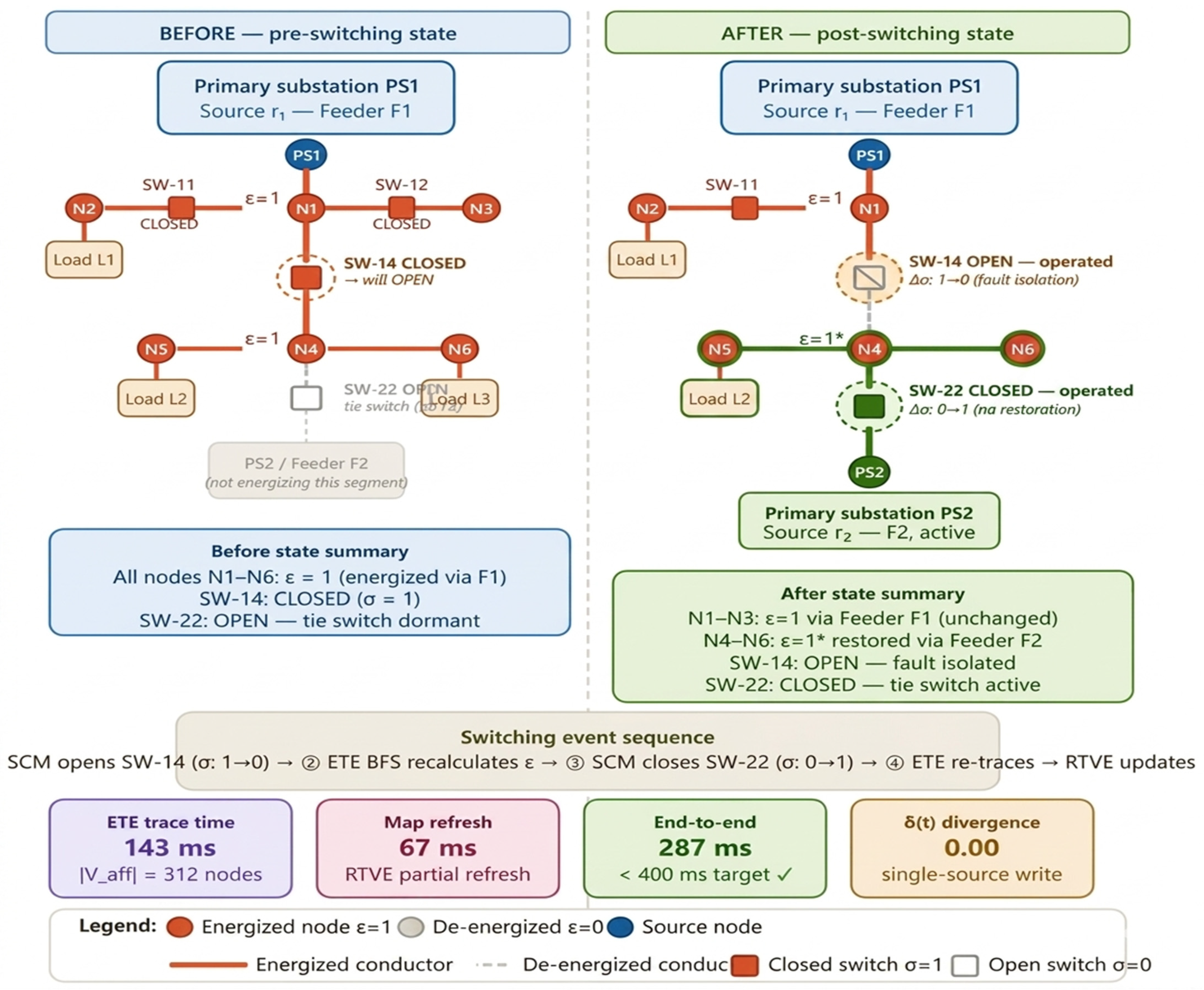
Energization State Function: The energization status for each node is determined by whether there is a conducting path from any source node (where is the set of energized primary substation busbars receiving transmission supply) to through the active edge set . This function is the network’s real-time energization map. It is the primary output that any network control system must continuously maintain, display, and update.
The Conventional System’s State Representation Problem: In the conventional ADMS–SCADA–GIS architecture, two independent representations of the network state are maintained simultaneously:
- ○
: The switching state vector is maintained by ADMS and updated in real time via SCADA telemetry.
- ○
: The switching state vector is maintained by GIS, updated only through periodic batch synchronization.
The state divergence error at time t is defined as:
In a properly synchronized system, δ(t) is always equal to 0. But in real life, δ(t) ≠ 0. Whenever there have been switching operations since the last time the system was synchronized. The divergence magnitude increases consistently with the number of switching operations performed during the inter-synchronization interval, making the GIS map operationally unreliable and unsuitable for use as a real-time control interface.
Problem Statement: Based on the network graph and operational needs of the MV distribution control center, this paper’s problem is defined as follows:
Design and develop a GIS-native control architecture in a way that:
- ○
The switching state vector σ(t) is only stored in the GIS environment, and does not require a separate ADMS state model.
- ○
Each switching action of the element via the GIS control interface is immediately transmitted to synchronize the energization state vector ε(t) with zero synchronization latency: δ(t) = 0 at all times.
- ○
The new state of energization ε(t) is spatially visualized on the geographic map layer with energized and de-energized regions visually distinguished.
- ○
The GIS-native platform enables all types of switching maneuvers needed to operate an MV network routine, such as a single-switch operation, feeder-level switching (Feeder-On/Feeder-Off) operation, and a multi-step switching sequence that is operated via the SLD interface.
- ○
The framework prevents the occurrence of redundant data entry as it maintains one unified asset and operational data model in GIS.
This formal problem statement lays out the whole design space and evaluation criteria for the proposed framework. This ensures that all architectural choices, implementation choices, and performance results are compared to a clear and consistent set of goals.
3.5. Infrastructure Cost Model: Conventional vs. Proposed
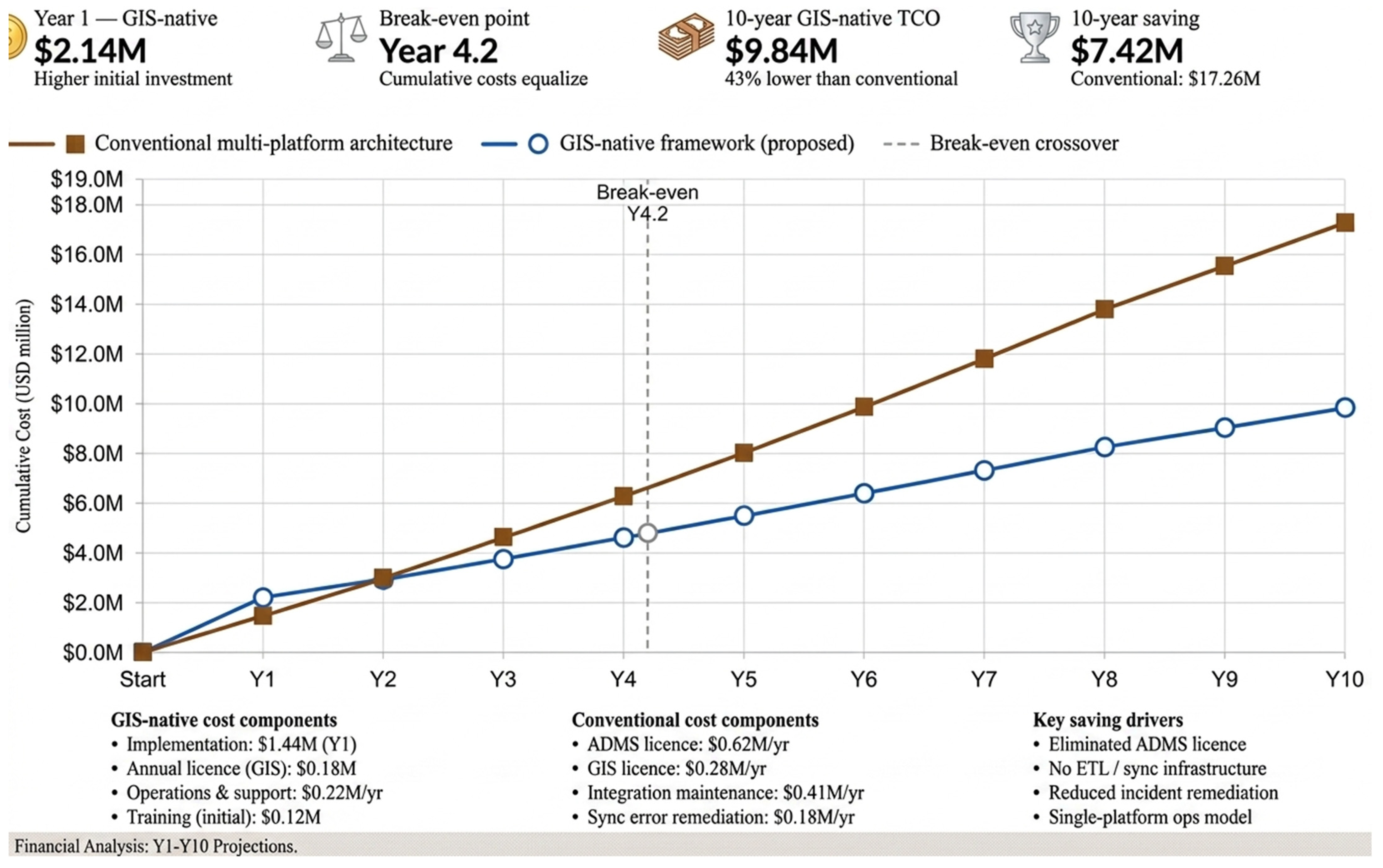
To quantify the economic motivation for the proposed framework, a simplified total cost of ownership (TCO) model is established:
where
is hardware infrastructure cost (servers, storage, networking),
is software licensing cost (ADMS, SCADA, GIS platform licenses),
is system integration cost (middleware, ESB, custom development),
is ongoing operational cost (maintenance contracts, synchronization management, data correction), and
is the staff training cost (multi-platform training requirements).
In the traditional ADMS–SCADA–GIS setup, each cost part is multiplied by the number of independent platforms that need to be bought, set up, and maintained separately. The proposed GIS-native framework eliminates the ADMS platform, thereby removing
,
, and the predominant portion of
related to GIS–ADMS synchronization.
Section 7 provides a fully itemized quantitative analysis of all cost components in the context of the Egyptian distribution network deployment, including GIS enterprise platform licensing and custom development maintenance costs as detailed in
Section 7.3.
3.6. GIS Data Transformation Pipeline: From Raw Spatial Data to Operational Topology State
The conversion of raw GIS spatial data into a computed operational topology state—the energization state vector
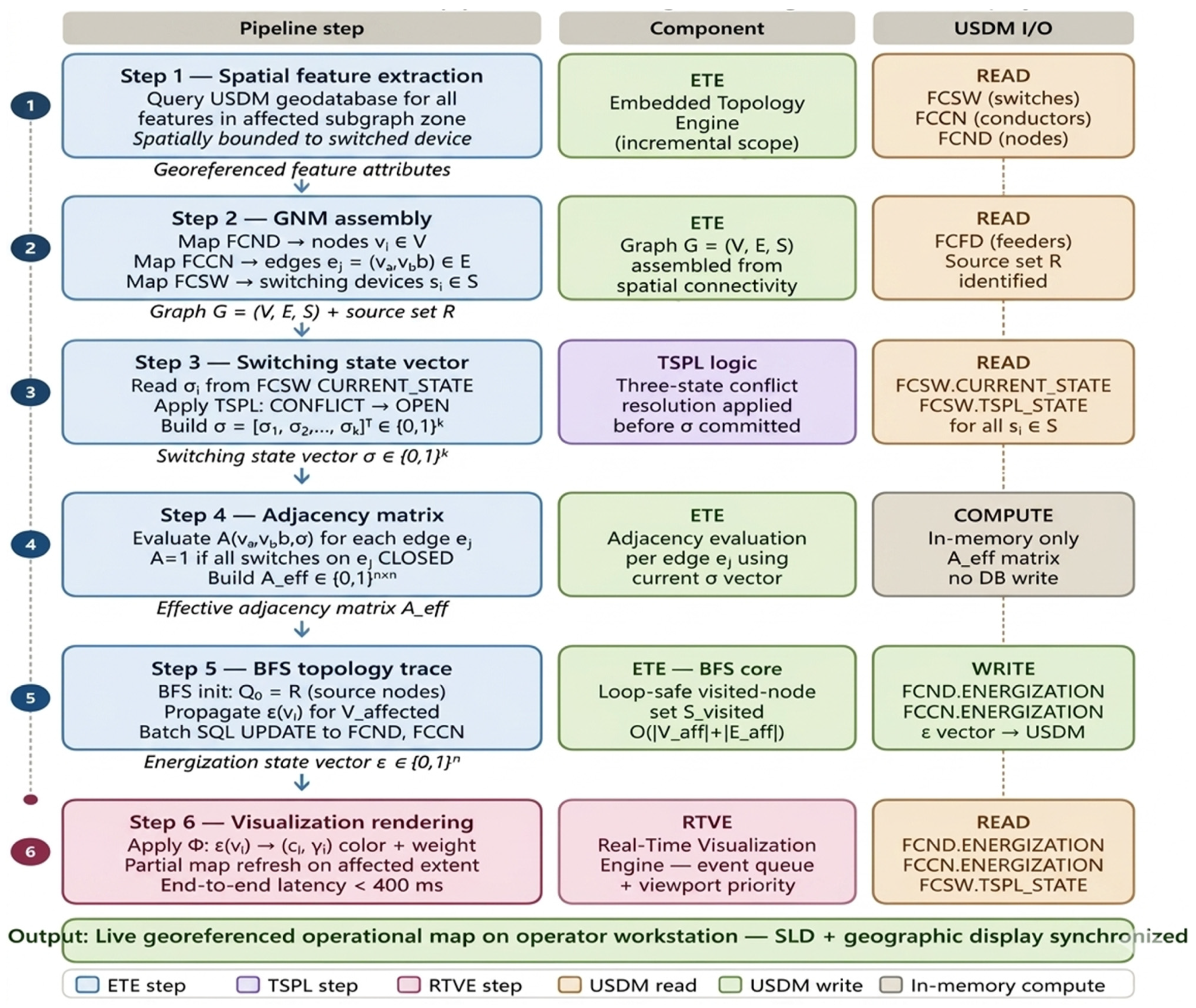
ε representing the live energization condition of every node and conductor segment—is achieved through a six-step transformation pipeline executed by the framework upon each switching event. Each step is described below with explicit reference to the USDM data structures and the network elements illustrated in
Figure 2. The complete pipeline is summarized visually in
Figure 3.
Raw GIS data stored in the USDM comprises four georeferenced feature classes, each corresponding to a distinct category of physical network asset:
FCSW (Switching Elements): point features representing switching devices (circuit breakers, load break switches, ring main units, fuses), each carrying attribute fields for device identifier, device type, nominal voltage, and current position state σᵢ ∈ {OPEN, CLOSED, UNVERIFIED, CONFLICT}.
FCCN (Conductors): polyline features representing cable and overhead line segments, each carrying attribute fields for conductor identifier, impedance parameters (R, X per unit length), conductor type, and the identifiers of the switching devices physically located on the segment.
FCND (Network Nodes): point features representing junction points, substation busbars, and load connection points, each carrying attribute fields for node identifier, node type, and nominal voltage level.
FCFD (Feeder Records): polygon or point features identifying feeder supply zones and their associated source nodes (HV/MV transformer secondary busbars), which define the source node set R for the topology trace.
In Step 1, the ETE queries the USDM geodatabase to extract the current attribute state of all four feature classes for the network subgraph affected by the switching event. This extraction is spatially bounded to the affected zone using the incremental tracing optimization described in
Section 5.4, limiting the query scope to the topological subgraph reachable from the switched device rather than the full network, as illustrated in
Figure 2 by the dashed boundary delineating the affected subgraph.
The extracted spatial features are assembled into the Geometric Network Model (GNM)—a topological graph data structure
G = (
V,
E,
S) as formally defined in
Section 4.3—by resolving the spatial connectivity relationships encoded in the USDM feature class geometry. Specifically:
Each FCND point feature is mapped to a node vᵢ ∈ V, with its geographic coordinates (xᵢ, yᵢ) retained as node attributes for subsequent visualization mapping.
Each FCCN polyline feature is mapped to an edge eⱼ = (va, vb) ∈ E, with the origin and terminal node identifiers resolved from the spatial coincidence of the polyline endpoints with FCND point features at the coordinate precision of the USDM spatial reference system.
Each FCSW point feature is mapped to a switching device sᵢ ∈ S and associated with the edge eⱼ on which it is spatially located, as determined by the spatial intersection of the FCSW point with the FCCN polyline geometry.
Each FCFD feature contributes the source node identifier r ∈ R corresponding to the energized supply point of the feeder zone.
The GNM assembly step translates the geographic spatial representation of the network—in which assets are represented as georeferenced geometric features—into the graph-theoretic representation required for topological computation, without loss of the spatial coordinate information needed for subsequent visualization rendering.
The current switching state vector
is constructed by reading the current position state attribute
σᵢ of each switching device
sᵢ ∈
S from the FCSW feature class in the USDM. The TSPL conflict resolution logic described in
Section 5.8 ensures that the position state committed to the USDM for each device is the most recently validated state, incorporating RTU telemetry, operator commands, and conflict resolution outcomes. Devices in the UNVERIFIED or CONFLICT states are assigned a conservative position value for the topology trace: UNVERIFIED devices use their reported position; CONFLICT devices are treated as OPEN (current path interrupted) to ensure that the topology computation defaults to the more operationally conservative assumption of no current flow through a device of uncertain position.
The effective adjacency condition
A(
) is evaluated for each edge
eⱼ = (
) ∈
E using the switching state vector σ constructed in Step 3. This produces the effective adjacency matrix
, where
where
is the set of switching devices associated with edge
eⱼ. For edges carrying no switching device,
unconditionally. The effective adjacency matrix encodes the current traversability of every edge in the network under the active switching configuration, providing the complete input required for the BFS topology trace in Step 5.
The BFS topology trace described in
Section 4.4 is executed on the GNM using the effective adjacency matrix
constructed in Step 4, with the source node set
R identified in Step 2 as the BFS initialization set. The trace propagates energization from source nodes through traversable edges, computing the energization state
ε(
vᵢ) ∈ {0, 1} for every node
in the affected subgraph. The resulting energization state vector
ε is written back to the FCND and FCCN feature class attribute fields in the USDM, updating the operational state of every affected node and conductor segment as a single atomic geodatabase transaction.
The visualization mapping function Φ defined in
Section 4.5 is applied by the RTVE to the updated energization state vector
ε written to the USDM in Step 5. For each affected node
vᵢ and its incident conductor edges, Φ(
ε(
vᵢ)) maps the binary energization state to the corresponding display color
cᵢ and line weight
γᵢ attributes of the Energization State Overlay layer. The RTVE executes a partial map refresh on the affected geographic extent using the event coalescing and viewport-priority rendering mechanisms described in
Section 5.7. The complete six-step pipeline—from switching event receipt in Step 1 to updated geographic display in Step 6—is executed within the validated end-to-end response window of under 400 milliseconds, as reported in
Section 6.4. The complete six-step transformation pipeline is summarized in
Figure 3 as a process flow diagram. The diagram explicitly identifies the USDM data structures consumed and produced at each step, the computational component responsible for each transformation, and the data type passed between steps.
4. Proposed GIS-Native Control Framework
4.1. Overview and Design Philosophy
The proposed GIS-native control framework is not an evolution of the standard ADMS adapted to a GIS environment. It is a fundamental reclassification of the MV distribution network control architecture. The guiding principle is simple yet profound: an augmented, enhanced GIS is the only environment required to control the MV distribution network. There is no longer an architectural need for ADMS, while standard ADMS functionality is fully preserved and improved.
Three converging arguments substantiate this principle. First, GIS holds the most comprehensive and spatially accurate representation of the physical network structure. The connectivity graph, equipment attributes, and geographic coordinates are the foundation of any network state model [
4,
21]. Second, the fundamental operations performed by ADMS for MV network control—graph manipulation, topological queries, energized section identification, and SLD generation—are all graph-theoretic operations executable directly within the GIS computational domain [
22,
34]. Third, maintaining GIS and ADMS as two separate systems—with inevitable data duplication, synchronization latency, state divergence, and architectural complexity—is fundamentally a misconstruction of the distribution control problem [
9,
30].
Four design goals guide every architectural and implementation decision in the framework’s development:
Operational completeness: all switching maneuver capabilities must be fully replicated without loss of functionality relative to conventional ADMS-based methods.
Spatial coherence: every switching action must be immediately and automatically reflected on the geographic map, with zero divergence at all times.
Data unity: all asset and operational data must be stored in a single unified GIS data model, eliminating duplicate entry and inter-system inconsistency.
Economic accessibility: the framework must be deployable at a fraction of the full ADMS installation cost, making it viable for capital-constrained utilities.
4.2. Framework Architecture: Top-Level Design
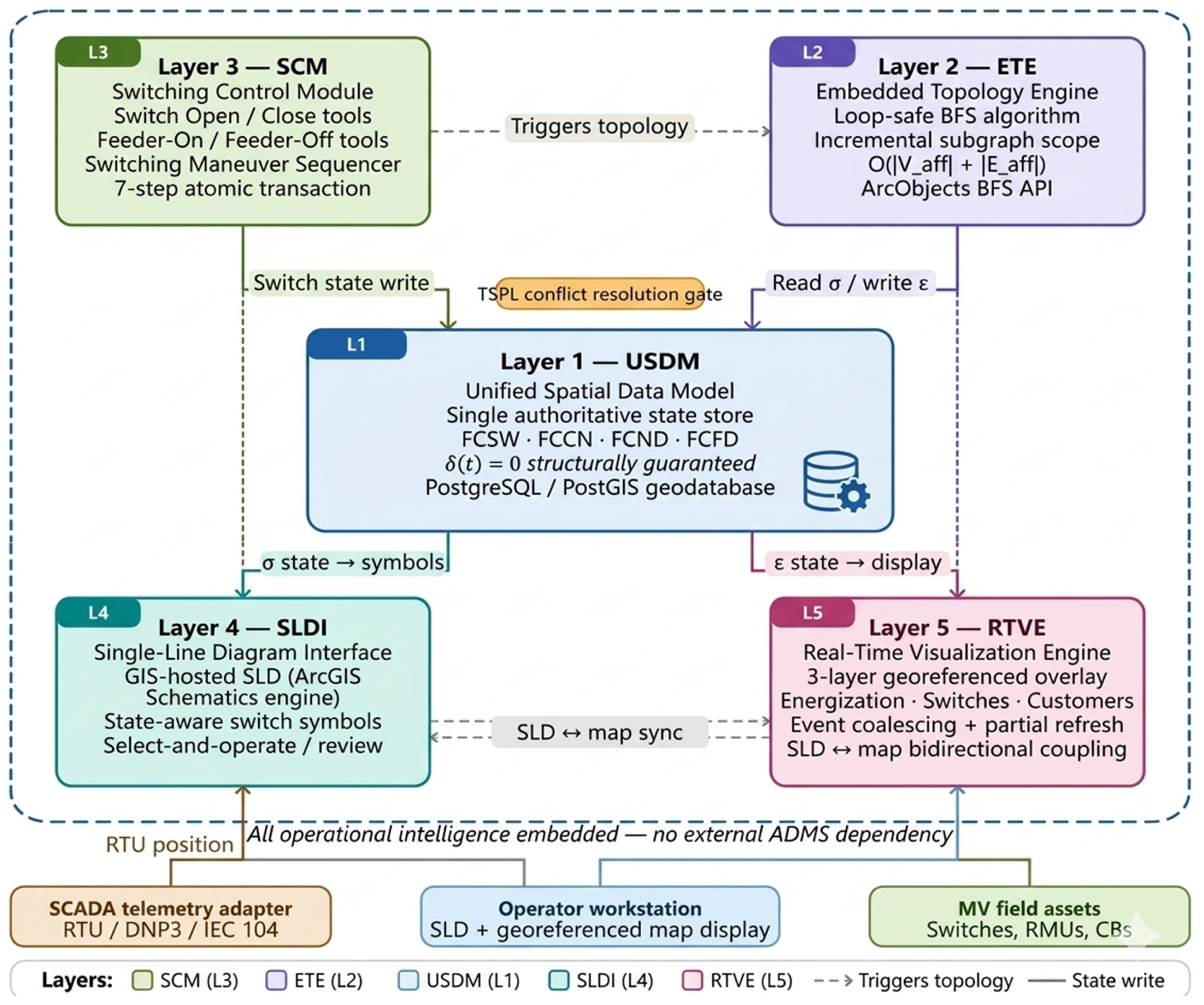
The top-level architecture of the proposed control framework is illustrated in
Figure 4. It is characterized by its single-platform nature, contrasting directly with the multi-platform conventional architecture described in
Section 3. The proposed framework is built upon five enhanced functional layers, tightly integrated within the GIS platform: the Unified Spatial Data Model (USDM), the Embedded Topology Engine (ETE), the Switching Control Module (SCM), the Single-Line Diagram Interface (SLDI), and the Real-Time Visualization Engine (RTVE). Within the GIS platform, all functional layers communicate through well-defined internal interfaces. This internal integration replaces the inter-system synchronization of the conventional architecture—the principal source of data divergence and operational failure. The proposed framework delivers full ADMS-equivalent operational control without requiring any external platform or proprietary integration layer.
4.3. Derivation of Topological Visualization Equations
This section presents the step-by-step derivation of the characteristic logic and operational equations governing the topological visualization component. All symbols used in this derivation are formally defined in
Table 4 of
Section 3.4. Each derivation step is explicitly linked to the parameters and network elements illustrated in
Figure 2.
The MV distribution network is formally represented as a directed graph G = (V, E, S), where
V = {v
1, v
2, …, v
n} is the set of network nodes, each corresponding to a physical junction point, substation busbar, or load connection point in the USDM node feature class (FCND). As illustrated in
Figure 2, each node
vᵢ ∈
V is georeferenced by its spatial coordinate pair (
xᵢ,
yᵢ) within the projected coordinate system of the USDM.
E = {e1, e2, …, en} is the set of network edges, each corresponding to a physical conductor segment in the USDM conductor feature class (FCCN). Each edge ej = (va, vb) connects an origin node va to a terminal node and carries the conductor impedance attribute zⱼ ∈ ℂ as stored in the USDM asset attribute table.
S = {s
1, s
2, …, s
k} is the set of switching devices, each associated with an edge
eⱼ ∈
E as illustrated in
Figure 2. Each switching device
sᵢ carries a binary position state
σᵢ ∈ {0, 1}, where
σᵢ = 1 denotes CLOSED (current path continuous) and
σᵢ = 0 denotes OPEN (current path interrupted). The full switching state vector is defined as:
This vector constitutes the primary input to the topological visualization computation and is updated in the USDM upon each switching event as described in
Section 5.8.
For any edge
, the effective adjacency condition
determines whether the edge constitutes an active current path under the current switching state vector σ:
This condition, illustrated in
Figure 2 for a representative three-node segment with an intermediate switching device, establishes that an edge is traversable in the topology trace if and only if all switching devices on that edge are in the CLOSED state. For edges carrying no switching device, the condition reduces to
unconditionally. Unswitched conductor segments are always traversable.
Let R ⊆ V denote the set of source nodes—nodes connected to an energized supply point, corresponding to the HV/MV transformer secondary busbars at primary substations as identified in the USDM feeder record feature class (FCFD). The energization state function ε: V → {0, 1} is defined as:
Node vᵢ is energized (ε(vᵢ) = 1) if and only if there exists at least one uninterrupted path of traversable edges from a source node r ∈ R to vᵢ under the current switching state vector σ. This definition is topology-agnostic. It applies equally to radial, meshed, and ring network configurations without requiring structural assumptions.
The energization state vector for the full network is:
The energization state vector ε is computed by the ETE using the BFS traversal algorithm defined in
Section 4.4, which efficiently evaluates the path existence condition of Step 3 for all nodes simultaneously in
time. The BFS initializes the source set Q
0 = R, marks all source nodes as energized (ε(r) = 1 ∀ r ∈ R), and propagates energization to adjacent nodes
for each traversable edge
satisfying
, as illustrated in
Figure 2 for the representative switching scenario shown. Nodes not reached by the BFS traversal retain their initialized state ε(vᵢ) = 0 (de-energized).
The visualization mapping function Φ: {0, 1} → C × Γ translates the scalar energization state ε(vᵢ) ∈ {0, 1} of each node and its incident edges into a pair of rendering attributes (cᵢ, γᵢ), where cᵢ ∈ C is the assigned display color and γᵢ ∈ Γ is the assigned line weight or fill pattern, for application to the Energization State Overlay layer of the RTVE:
Extended to the TSPL three-state model introduced in
Section 5.8, the visualization mapping is augmented to:
The visualization mapping function Φ is applied by the RTVE to every node and conductor segment in the affected subgraph following each ETE topology trace. It produces the updated Energization State Overlay rendered on the operator workstation geographic display. The mapping is executed as a batch attribute update on the USDM feature classes, followed by a partial map refresh as described in
Section 5.7. This completes the end-to-end visualization pipeline from switching event to updated geographic display within the validated sub 400 ms response window.
Table 5 formally maps each symbol introduced in the derivation above to its corresponding element in
Figure 2, ensuring full traceability between the mathematical formulation and the illustrative network diagram.
4.4. Layer 1: Unified Spatial Data Model
Design Rationale: The framework is built upon the Unified Spatial Data Model (USDM), the single authoritative store of all data required to support asset management and operational control of the MV network. In the conventional architecture, this information is divided between the GIS spatial database and the ADMS network model. By merging these formerly separate data domains into one GIS-resident model, the USDM eliminates the structural root cause of inter-system data divergence identified in
Section 3.4 [
9,
31].
The USDM extends the traditional GIS asset database in two important dimensions. First, it adds operational state fields to the static asset attribute schema of each switching element. This transforms GIS from a descriptive asset register into a live operational state store. Second, it maintains a continuously refreshed energization attribute on all network nodes and edges. This allows GIS to respond directly to the query “Is this network segment currently energized?” without querying any external system.
Data Schema Architecture: The USDM comprises four major feature classes representing the complete domain of MV distribution network information.
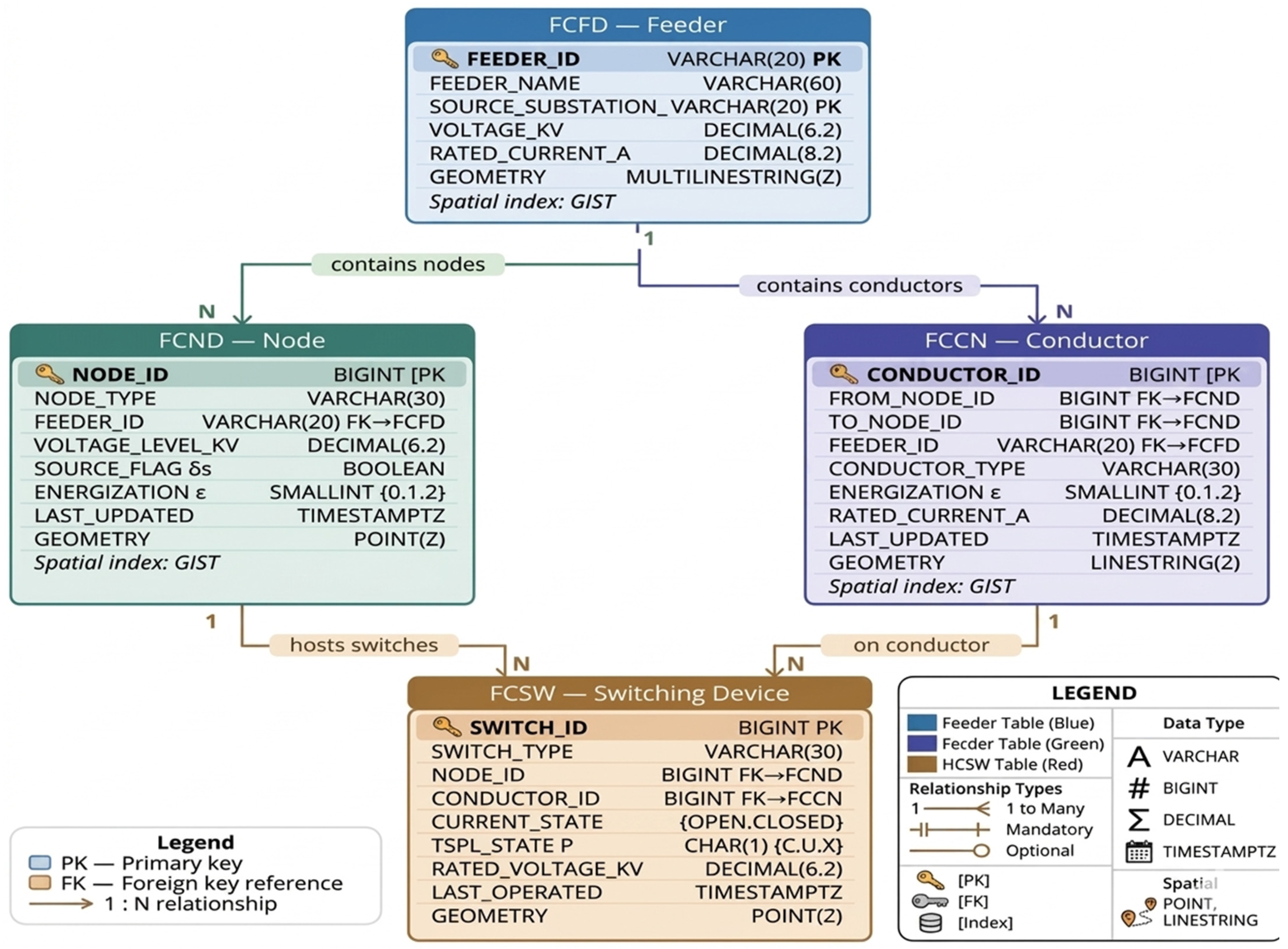
Figure 5 shows the entity-relationship schema of the USDM. The four feature classes are as follows.
- ‑
FCSW (Switching Elements): This feature class covers all MV switching devices—circuit breakers, load break switches, disconnectors, RMU switches, and normally open tie switches. Each record carries both static asset properties and a dynamic operational state field σᵢ ∈ {0, 1} recording the current open/closed state. The structural innovation of the USDM is that the authoritative record of every switch’s current state is embedded directly in GIS and updated by the Switching Control Module.
- ‑
FCCN (Network Conductors): This feature class represents all MV cable and overhead line sections as georeferenced linear features. Each record carries static attributes and a dynamic energization attribute εedge ∈ {0,1}, updated by the Topology Engine whenever any upstream switching state changes. This attribute is the direct driver of the color symbology renderer of the RTVE, enabling the geographic map to display the live network energization status.
- ‑
FCND (Network Nodes): This feature class represents all electrical nodes—primary and secondary substation busbars, junction points, and feeder interconnection points. Records contain the source flag δs ∈ {0, 1}, which identifies energized supply sources, and the derived energization status εⱼ ∈ {0, 1} computed by the Topology Engine. Primary substation busbars are marked as permanently energized unless a Feeder-Off operation is executed.
- ‑
FCFD (Feeder Records): This feature class maintains a record of all distribution feeders originating from a primary substation. Records include the feeder identifier, parent substation, rated capacity, normal configuration switching state, and operational state ϕ ∈ {ON, OFF, FAULT}. The feeder record is the highest-level operational handle through which Feeder-On and Feeder-Off operations are initiated. State changes propagate automatically to all downstream switching elements and conductors via the Topology Engine.
Geometric Network Model: All four feature classes are grounded in a GIS Geometric Network Model (GNM). This is a topological data structure encoding the connectivity relationships between all network features as a directed graph conforming to the formal representation
G = (
V,
E,
S) of
Section 3.4. The GNM holds the adjacency matrix of the network and provides graph traversal operations—depth-first search, breadth-first search, and upstream/downstream tracing—through which the Topology Engine computes energization states [
21,
22]. Built initially from as-built network geometry and connectivity data, the GNM is updated automatically as assets are commissioned or modified. No data entry into any external system is required.
4.5. Layer 2: Embedded Topology Engine
Architecture and Execution Model: The computational core of the framework is the Embedded Topology Engine (ETE). It is a programmatic module operating within the scripting and geoprocessing environment of the GIS platform. It performs the graph-theoretic network state computations that, in the conventional architecture, are performed by the ADMS topology processor.
The ETE follows an event-driven execution model. Any switching state change performed by the Switching Control Module automatically invokes the ETE. The ETE recomputes the energization state vector
ε(
t) for all affected network elements and then passes control to the visualization pipeline. This event-driven model is essential to achieving the zero-latency synchronization goal defined in
Section 3.4. Since the ETE executes synchronously with each switching operation—rather than on a periodic batch cycle—the energization map is updated atomically with every switching state change, ensuring δ(
t) = 0 at all times [
8,
34].
The tracing algorithm based on Breadth-First Search is of complexity O (|| + ||), with each radial MV feeder switch interaction executed in a time proportional to the number of nodes and edges below the operated one, which is ordered by magnitude much smaller than the system size. Therefore, the ETE executes in a feasible time, even for large network models, ensuring the necessary interactivity for real-time use by operators on duty.
Special Case Handling: The ETE incorporates specialized logic for three operationally significant scenarios that require treatment beyond the standard BFS connectivity trace.
- ‑
Normally Open Tie Switch Closure: Normally open tie switch connecting adjacent feeders: When a normally open tie switch between adjacent feeders is closed, ETE checks the energization of the receiving feeder zone against both its source and the new one, and appropriately indicates the resulting parallel supply configuration and notifies an operator of the case as a non-standard topological condition that will need later management [
6,
27].
- ‑
Feeder-Off Operation: The respective source of this node is deleted from the source set Vs, which causes full re-consideration of energization through the whole feeder supply zone. The nodes and edges of the normal supply territory of the feeder are all initialized to ε = 0, except where there is a supply path via a closed tie switch to some other supply path, in which case each zone is maintained energized by the alternative supply path.
- ‑
Islanding Detection: The ETE identifies islanded network segments—topologically connected but unreachable from any source node—and explicitly marks them in the USDM with a dedicated status value ε
island = 2, distinct from truly de-energized segments. This distinction is operationally significant. An islanded segment may be energized through distributed generation or residual capacitor bank charge. It cannot be treated as a dead section during restoration operations [
29,
37].
Termination Guarantee and Ring Network Handling: The BFS implementation within the ETE incorporates a visited-node set . This set is initialized as empty at the commencement of each topology trace and populated upon the first encounter of each node during graph traversal. The traversal rule is strictly enforced: a node v is enqueued for expansion if and only if . Upon dequeuing, v is immediately added to before examination of its adjacency list. This mechanism provides two formal guarantees:
- ‑
Guarantee 1: Termination: The BFS terminates after at most | iterations, where | is the cardinality of the connected subgraph reachable from the source node. Since each node is enqueued at most once and dequeued at most once, the algorithm cannot enter an infinite cycle regardless of the topological configuration of the network graph, including fully meshed or ring configurations.
- ‑
Guarantee 2: When the network graph contains closed loops—as occurs transiently during switching maneuvers, emergency restoration sequences, or planned maintenance in which normally open sectionalizing points are temporarily closed—the visited-node set prevents redundant traversal of any node reachable via multiple paths. Each node’s energization state is computed exactly once, from the shortest BFS path from the source node, ensuring topological correctness under both radial and meshed network conditions.
The formal pseudocode of the proposed traversal mechanism is presented in Algorithm 1.
| Algorithm 1. ETE_BFS_Trace Procedure for Energization State Traversal |
Input: Network graph G = (V, E), source node s (energized supply point)
Output: Energization state vector ES[v] for all v ∈ V
1. Initialize queue Q ← empty
2. Initialize visited set ← ∅
3. Initialize ES[v] ← DE-ENERGIZED for all v ∈ V
4. Enqueue s → Q; add s → ; ES[s] ← ENERGIZED
5. WHILE Q is not empty DO
6. Dequeue v ← Q.front(); Q.pop()
7. FOR each edge (v, u) ∈ E DO
8. IF switch(v,u).state = CLOSED AND u ∉ THEN
9. ES[u] ← ENERGIZED10. Add u →
11. Enqueue u → Q
12. END IF
13. END FOR
14. END WHILE
15. RETURN ES |
Line 8 conditions traversal on both the switch state (CLOSED) and the visited status (
). This ensures the algorithm correctly handles ring configurations by refusing to re-traverse nodes already reached via an alternative path. This implementation is functionally equivalent to a standard loop-safe BFS on a general graph. It requires no assumption of radial topology for correctness. The radial operating assumption referenced in
Section 3.2 describes the normal steady-state configuration of the Egyptian MV network—not a requirement for algorithmic correctness.
4.6. Layer 3: Switching Control Module
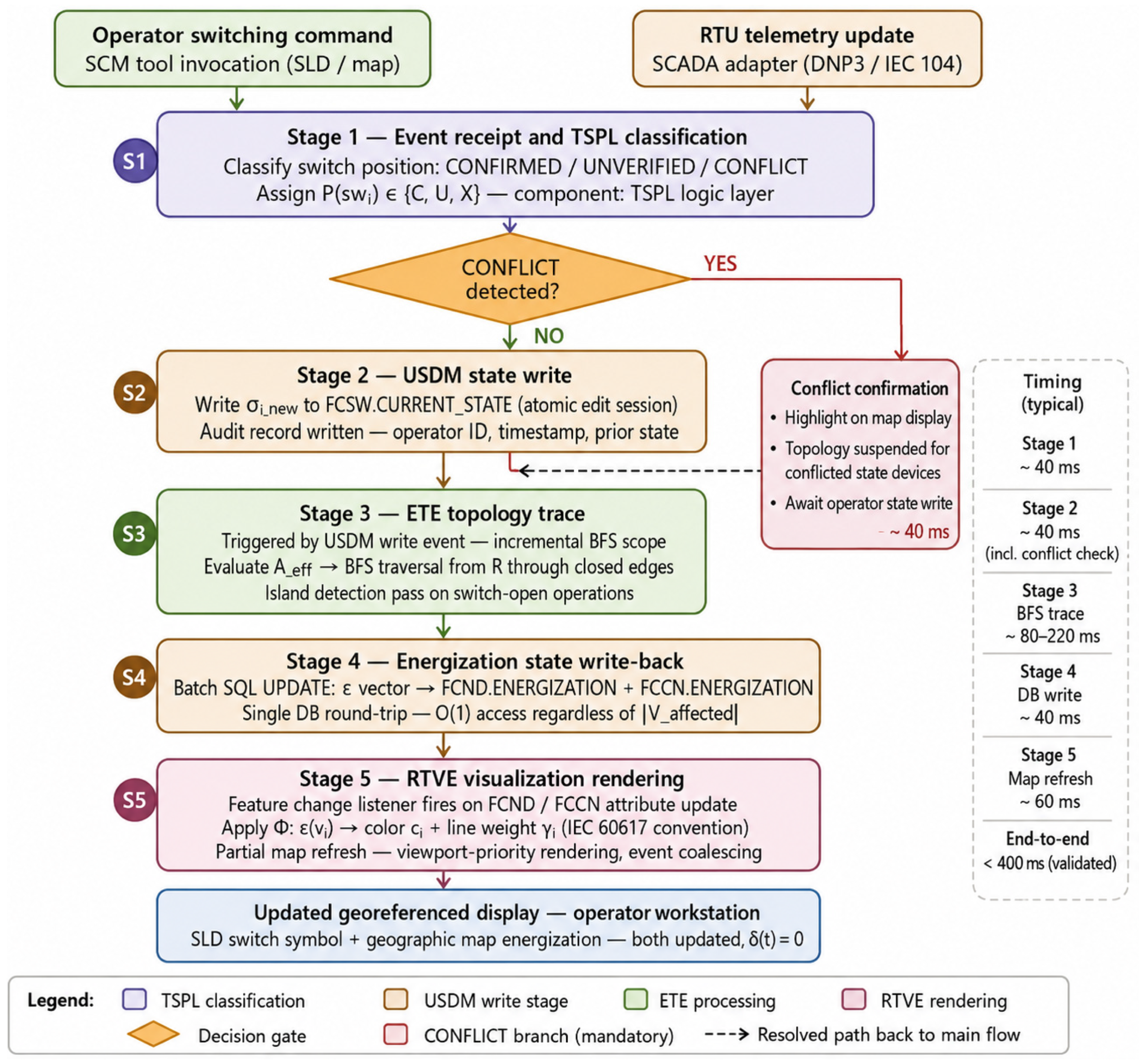
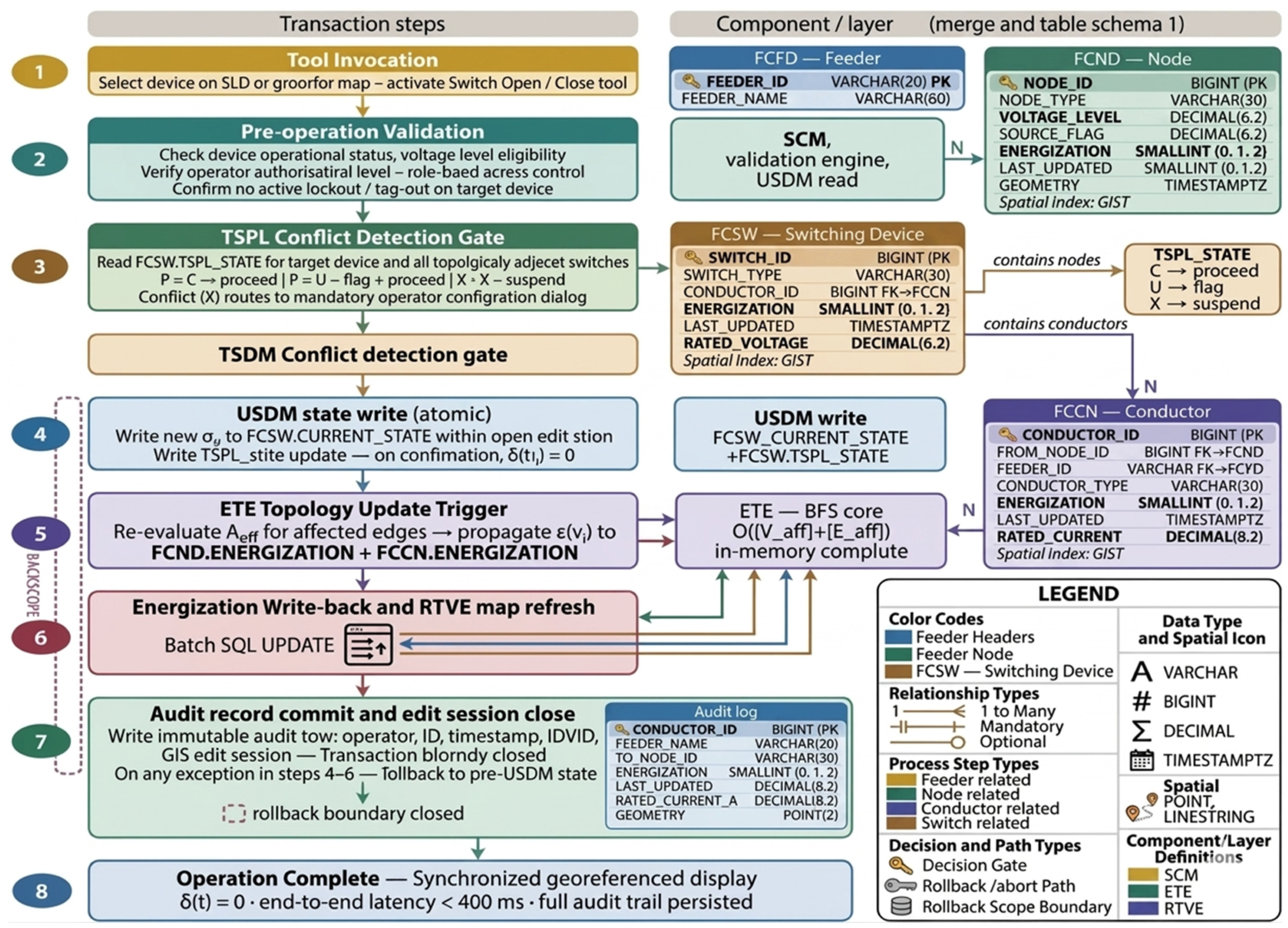
Tool Architecture: The Switching Control Module (SCM) is the programmatic layer connecting operators to switching control actions. It is a set of custom APIs residing within the GIS platform toolbox. Each API encapsulates the complete switching action—from operator command to state update and display refresh—as a single atomic transaction. As shown in
Figure 6, the SCM implements a seven-step atomic transaction for all switching actions. This guarantees that each switching step—state update, topology analysis, and display update—executes as an atomic process, maintaining δ(
t) = 0 for all switching actions.
Switch Open and Switch Close Tools: The Switch Open and Switch Close tools are the atomic operations of the SCM. The primary input parameter is the identifier of the switching element
sᵢ ∈
S, selectable directly from the SLD symbol or the geographic map. Upon invocation, the tool executes an atomic operation in several steps [
31,
34].
Figure 6.
Switching Control Module execution flow, illustrating the seven-step atomic transaction sequence from operator command receipt through USDM state write, ETE topology trace, and RTVE visualization update. Each step executes within a single GIS edit session, ensuring the USDM never enters a partially updated state.
Figure 6.
Switching Control Module execution flow, illustrating the seven-step atomic transaction sequence from operator command receipt through USDM state write, ETE topology trace, and RTVE visualization update. Each step executes within a single GIS edit session, ensuring the USDM never enters a partially updated state.
First, it retrieves the current state from the USDM. If the requested operation would produce no state change, it returns an informational message and aborts. The intended operation is then submitted to the pre-operation validation subsystem for interlocking and status checks. These checks verify that no operation on dependent switching elements is in progress, that the intended operation does not violate interlocking rules such as maximum feeder loading limits, and that the operator’s credential level permits execution without supervisory authorization.
Upon successful validation, the tool writes σᵢ^new to the USDM feature class FCSW, triggers the ETE to recompute ε(t) for all affected elements, and signals the RTVE to refresh both the geographic map and SLD displays. The entire transaction is committed atomically within a single GIS edit session. This ensures the USDM never enters a partially updated state that could produce an inconsistent display [
21].
Feeder-On and Feeder-Off Tools: The Feeder-On and Feeder-Off tools operate at the feeder level rather than the individual switch level. They enable operators to energize or de-energize an entire distribution feeder with a single tool invocation. This directly replicates a critical ADMS function unavailable in conventional GIS systems. It is one of the framework’s most operationally significant contributions [
3,
11].
- ‑
The Feeder-Off tool, upon invocation for a specified feeder f ∈ FCFD, identifies the feeder’s source breaker and opens it (). It then propagates this opening through the network topology to update energization status across the feeder’s entire supply zone. The tool correctly accounts for any previously closed normally open tie switches. It restricts de-energization to segments genuinely dependent on the subject feeder as their sole supply source, while retaining energized status for those receiving alternative supply.
- ‑
The Feeder-On tool performs the inverse operation. It closes the source breaker () and propagates energization through the feeder’s supply zone, re-energizing all downstream segments connected through closed switching elements. A post-energization verification step confirms the feeder’s energization zone is consistent with the as-built connectivity model. It flags anomalies—such as unexpected parallel supply paths—for operator review.
Switching Maneuver Sequencer: The Switching Maneuver Sequencer (SMS) is the SCM’s most operationally sophisticated component. It enables operators to define, validate, and execute multi-step switching programs—sequences of individual switch operations collectively achieving objectives such as load transfer, planned maintenance outage, or fault restoration reconfiguration. The SMS enforces safe switching practice throughout the execution workflow [
6,
25]. A switching maneuver is formally defined as an ordered sequence of switching operations:
where
denotes the switching state change applied to the element
at step
, and t
1 < t
2 < … <
denotes the prescribed execution order. The SMS validates the complete sequence before execution commences. It verifies that each intermediate network state is topologically valid, that no step creates unintended supply interruption beyond the planned outage scope, and that the final network state is consistent with the intended operational objective.
During execution, the SMS presents the operator with a step-by-step guided interface. It displays each step’s required switch operation, the expected post-step network state, and a confirmation requirement before proceeding. Each executed step updates the USDM and triggers both the ETE and the RTVE. The operator observes the network state evolving on both the SLD and geographic map as the maneuver progresses. This delivers continuous spatial situational awareness absent from conventional text-based switching programs [
8,
15].
4.7. Layer 4: Single-Line Diagram Interface
GIS-Hosted SLD Architecture: The Single-Line Diagram Interface (SLDI) is the principal user-facing element of the proposed framework. It provides the schematic network representation through which operators view topology and interact with switching devices. Unlike ADMS-embedded SLDs—which are separate system displays unrelated to the GIS geographic map—the SLDI is hosted as a map view within the GIS platform environment, fully integrated with the underlying geographic map display [
8,
22].
The SLDI presents the schematic one-line diagram of the MV network derived from the shared USDM geometric network model used for the geographic map. Dedicated schematic rendering rules convert the geographic network geometry into an orthogonal representation conforming to relevant power system one-line diagram standards. This design ensures that both the SLD and the geographic map are sourced from the same model snapshot with equivalent network state. It precludes the schematic-to-geographic inconsistency that is a common operational risk in multivendor control center implementations [
9,
30].
State-aware rendering updates are generated dynamically by the visualization engine upon completion of each switching operation. SLD switch symbol states are therefore continuously synchronized with USDM operational state fields without requiring any operator-initiated display refresh [
4,
21].
4.8. Layer 5: Real-Time Visualization Engine
Geographic Map Energization Display and Graphical Overlay Architecture: The Real-Time Visualization Engine (RTVE) is the output layer of the framework. It generates and continuously updates the geographic map view of the MV network, reflecting the live energization status of each network element. The RTVE applies dynamic color coding to all conductor and node features based on the energization attributes stored in the USDM.
The RTVE geographic display is composed of three dynamically updated georeferenced overlay layers rendered atop the static USDM physical network base layer.
- ‑
Layer 1: Energization State Overlay: Each conductor segment and network node is rendered with color symbology reflecting its current energization state as computed by the ETE. The adopted color convention follows standard utility control room display practice: red indicates an energized segment or node; grey indicates a de-energized segment or node; amber indicates an UNVERIFIED state pending corroboration; and purple indicates an INDETERMINATE state arising from a CONFLICT-state upstream switching device. This convention is consistent with the IEC 60617 and ANSI/IEEE graphic symbol standards for power system diagrams [
46]. For conductor features specifically:
Energized conductors (εisland = 1): drawn in bold line style, with line weight proportional to nominal voltage level—thicker for 33 kV feeders and thinner for 11 kV feeders.
De-energized conductors (εisland = 0): drawn in light gray, providing direct visual contrast with the energized network. Operators can identify de-energized areas at a glance without analytical queries.
Islanded conductors (εisland = 2): drawn in amber, explicitly distinguishing topologically isolated segments from both definitively energized and definitively de-energized segments.
Fault-affected conductors: drawn in red, activated when a fault condition is signaled on a network segment by the fault notification input channel of the framework.
- ‑
Layer 2: Switching Device State Overlay: Each switching device is rendered with a positional symbol whose shape and fill indicate its current operational state. A filled rectangle perpendicular to the conductor indicates CLOSED. An open rectangle parallel to the conductor indicates OPEN. A hatched rectangle indicates UNVERIFIED. A cross-hatched rectangle with an amber border indicates CONFLICT. Device symbols are scaled to remain legible at the primary operational zoom level corresponding to the substation supply zone extent.
- ‑
Layer 3: Customer Impact Overlay: A spatial join between the FCND energization state and the customer connection point layer in the USDM is executed following each topology update. This produces a georeferenced rendering of the customer population within de-energized network segments. Affected customers are rendered as a heat density overlay scaled by customer count per geographic cell, enabling rapid visual assessment of the geographic extent and customer impact of the current network configuration.
- ‑
The three-layer overlay architecture and its symbology conventions conform to the IEC 60617 graphical symbols standard for power system diagrams and to the Esri ArcGIS for Electric utility GIS data model layer hierarchy and symbology schema [
46,
47]. This ensures consistency with standard utility mapping conventions adopted across Egyptian and international distribution utility GIS deployments.
- •
RTVE Concurrency Control and Refresh Management: The RTVE’s partial map refresh architecture handles concurrent topology change events arising from simultaneous switching operations without producing rendering conflicts or display lag. Three concurrency control mechanisms are implemented.
Event Queue Serialization: All topology change notifications generated by the ETE are dispatched to a thread-safe FIFO rendering queue maintained by the RTVE. The rendering thread dequeues and processes one topology change event at a time, serializing the corresponding partial refresh operations on the map layer. This prevents simultaneous write conflicts on shared map layer objects. The rendering queue introduces a maximum additional latency of one refresh cycle—nominally 50–100 ms per partial refresh—per queued event, which is negligible relative to the sub 400 ms end-to-end response time target.
Refresh Event Coalescing: When multiple topology change events are received within a configurable coalescing window tcoalesce (default: 150 ms), the RTVE merges the affected feature sets of all queued events into a single consolidated partial refresh operation covering the union of all affected geographic extents. This reduces the total number of rendering calls under high-concurrency conditions from n sequential refresh calls to a single consolidated call.
Viewport-Priority Rendering: The RTVE assigns the highest rendering priority to the geographic extent currently displayed in the operator’s active map viewport. Features within the active viewport are rendered first, ensuring the operator’s area of operational interest reflects the updated topological state within the minimum possible rendering latency. Features outside the active viewport are rendered in a background thread at lower priority.
- •
SLD-to-Map Bidirectional Coupling: The bidirectional coupling of the SLD and geographic map is the most operationally distinctive characteristic of the RTVE. In the conventional ADMS-SCADA-GIS design, the ADMS-hosted SLD and the GIS-hosted geographic map are completely separate displays with no real-time data connection. An operation on the ADMS SLD has no direct impact on the GIS map, and vice versa [
8,
9].
In the proposed framework, this structural disconnection is eliminated. Since both the SLD and the geographic map are sourced from the same USDM and updated by the same ETE within the same GIS environment, each switching operation automatically updates the corresponding switch symbol state on the SLD and the energization attributes of the corresponding conductors and nodes on the geographic map layer. The RTVE uses a feature change listener on the energization fields of the USDM to trigger a targeted map symbology refresh of all changed features, completing the visual update cycle within the required operational response time [
21,
22]. The result is a perfectly synchronized dual-view display—schematic SLD and geographic map—where each operator’s action on one display is immediately reflected in the other. This level of spatial situational awareness is structurally impossible to achieve with the standard multi-platform architecture without prohibitively complex real-time integration infrastructure.
4.9. Framework Integration Summary
The complete internal data flow of the proposed framework is illustrated in
Figure 7. It traces the path of a switching operation from operator input through the functional layers to its reflection in the geographic map view. The complete data flow—from operator input through switching management, data persistence, topological recomputation, and geographic visualization—occurs entirely within the GIS environment. The SLD symbology update at the bottom of the data flow path closes the operator loop by reflecting the geographic map state back into the schematic view.
4.10. Architectural Advantages over the Conventional System
The proposed GIS-native architecture delivers four classes of structural advantage over the conventional ADMS-SCADA-GIS architecture.
Zero-latency state coherence: Both the switching state vector σ(t) and the energization state vector ε(t) are represented in the USDM and updated atomically with every switching transaction. The zero-latency state divergence error δ(t) = 0 is therefore ensured at all times—a property unattainable by the conventional architecture, which requires periodic synchronization between ADMS and GIS [
9,
30].
Data unity: Asset data and operational state data are stored in a single unified GIS database. There is no duplicate data entry and no risk of inter-system data divergence. All commissioned assets, configuration changes, and switching operations are recorded (once in GIS) and instantly reflected across all operational displays [
4,
5].
Operational completeness in GIS: The SCM, ETE, and SLDI collectively replicate the fundamental operational control capabilities of ADMS—switch-level and feeder-level operation, multi-step maneuver sequencing, topological network state control, and operator-directed execution workflow—without any external platform. These functions are not constrained by the spatial context of GIS; they are enriched by it. Operators gain geographic situational awareness unavailable in the conventional ADMS environment [
3,
8].
Infrastructure simplification: The framework eliminates the ADMS platform, its server infrastructure, software licenses, and integration middleware. It reduces the control center infrastructure footprint to a single GIS platform deployment. This can be deployed at a fraction of the cost of the conventional three-platform architecture and within the capital budget of mid-sized distribution utilities in developing economies [
6,
11].
5. Implementation and Technical Details
Section 4 defined the functional requirements for the proposed GIS-native control framework. This section presents the actual implementation choices, platform configurations, programming structures, database designs, and tool development decisions through which the five functional layers were realized as a working operational system. All implementation decisions are traceable to specific design requirements in
Section 4. All performance claims in
Section 6 are explained by the implementation specifics presented below. This ensures complete internal consistency throughout the technical narrative.
The framework was implemented on the Esri ArcGIS platform—specifically ArcGIS Desktop with the ArcFM Utility Network Management extension—which is the GIS deployed across Egyptian distribution companies for MV asset management and the most widely adopted utility-scale GIS internationally [
21,
48]. All programmatic tool development was performed using the ArcPy geoprocessing scripting library in Python, with support from the ArcObjects COM-based development framework for components requiring direct access to the geometric network model graph traversal API [
21,
49]. The implementation architecture is conceptually platform-neutral. The algorithms, data structures, and operational workflows described here are directly translatable to other utility-scale GIS, including Smallworld GIS, Schneider Electric ArcFM, and open-source options such as QGIS with the QElectrical extension.
5.1. Implementation Environment and Platform Configuration
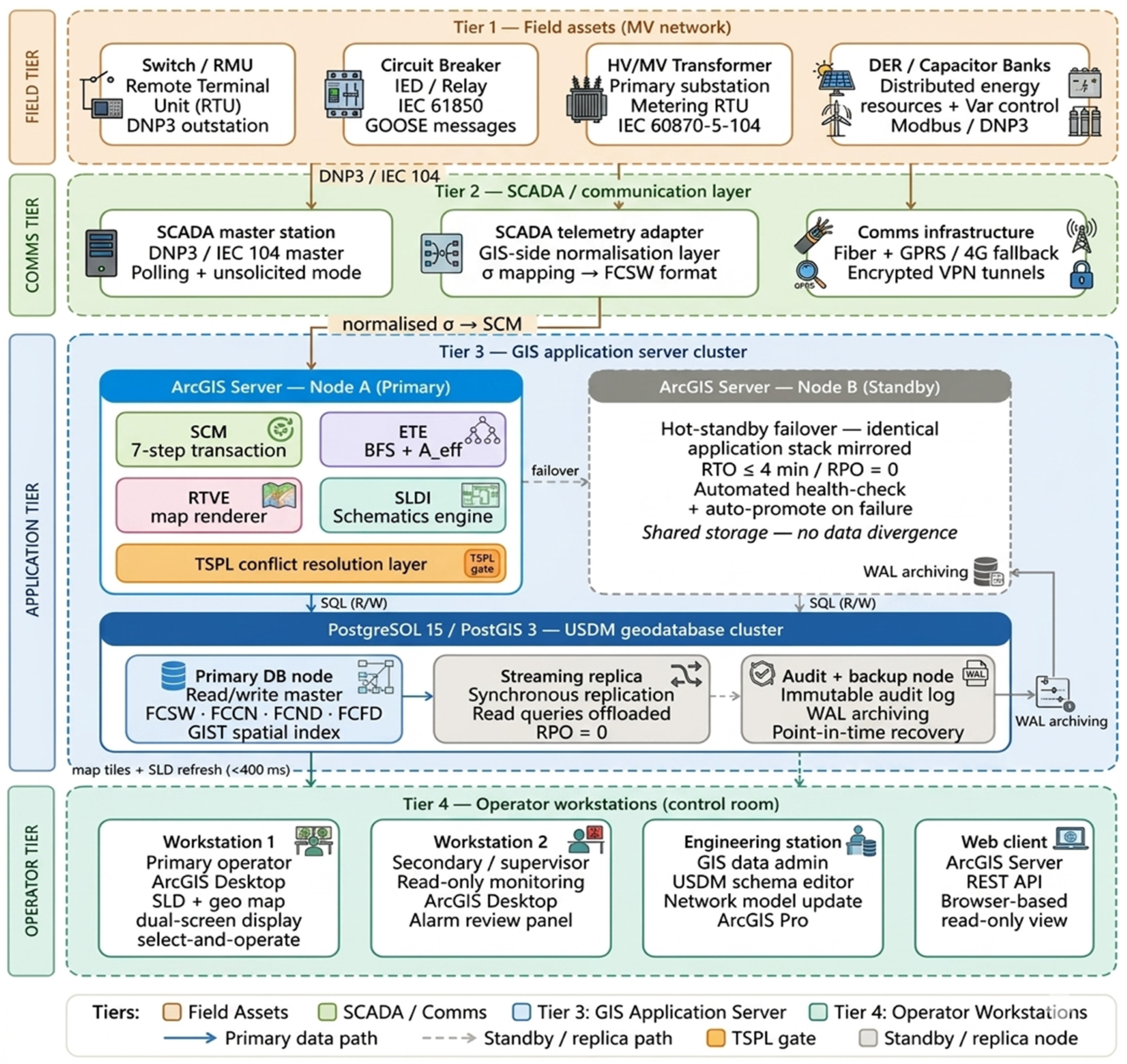
GIS Platform Deployment Architecture: The production implementation was deployed on a server-based ArcGIS enterprise architecture. This architecture consists of a central ArcGIS Server instance hosting geodatabase services, a PostgreSQL spatial database engine serving as the USDM backend, and ArcGIS Desktop workstations at operator stations within the distribution control center. The complete deployment architecture is illustrated in
Figure 8.
Figure 8.
Production deployment architecture of the proposed GIS-native framework, illustrating the server-side components, operator workstation configuration, and SCADA telemetry adapter interface. The single-server-node configuration is contrasted with the multi-server conventional ADMS architecture in
Section 7.3.
Figure 8.
Production deployment architecture of the proposed GIS-native framework, illustrating the server-side components, operator workstation configuration, and SCADA telemetry adapter interface. The single-server-node configuration is contrasted with the multi-server conventional ADMS architecture in
Section 7.3.
The architecture deliberately simplifies the server-side configuration relative to a conventional ADMS deployment. One ArcGIS Server node, one PostgreSQL spatial database, and ArcGIS Desktop workstations replace the multiple application servers, middleware communication stacks, and proprietary ADMS server infrastructure of the conventional architecture. This simplification has a direct bearing on the infrastructure cost comparison presented in
Section 7.
Software Stack and Version Configuration: The software stack was selected for compatibility with the existing GIS infrastructure of Egyptian distribution companies and compliance with international utility GIS deployment standards [
5,
21]. The principal GIS platform is Esri ArcGIS Desktop 10.8.1. It supports the map rendering, geometric network management, and schematic diagram generation capabilities required by Layers 4 and 5 of the framework. The ArcFM Utility Network Management extension version 10.8 provides utility-specific data model templates, asset class definitions, and network tracing tools upon which the USDM feature class schema is based. This extension provides a pre-tested framework for representing MV distribution assets in conformance with industry data modeling standards [
21,
48].
The Python version used is 3.9 with the ArcPy site package. ArcPy is the primary development language for all SCM tool implementations. It provides a direct programmatic interface to all ArcGIS geoprocessing operations, geodatabase editing operations, and network analysis operations. This allows the tool suite to perform complex multi-step operations in a single scripted workflow without operator intervention between steps [
33]. The ArcObjects SDK provides the lower-level COM-based interface to the geometric network model graph traversal API via .NET. This enables the ETE to execute the BFS connectivity tracing algorithm in real time. ArcPy high-level network analysis functions introduce unacceptable computational overhead for real-time operations. Direct ArcObjects API access provides precise control over trace extent, barrier manipulation, and result extraction [
21,
49].
The spatial database backend is PostgreSQL 14.2 with PostGIS 3.2 spatial extension. It is deployed on a dedicated server with a 32-core CPU, 128 GB RAM, and a 4 TB SSD RAID array. This configuration ensures sufficient storage and query performance to handle simultaneous geodatabase editing sessions from multiple operator workstations. Sub-second response times are maintained for switching state updates and energization attribute queries [
50].
5.2. Unified Spatial Data Model: Database Implementation
Feature Class Schema Implementation: The USDM is implemented as an ArcGIS enterprise geodatabase schema in the PostgreSQL/PostGIS backend. It is structured as a geometric network dataset comprising the four feature classes defined in
Section 4.4. The attribute schema of the Switching Elements feature class (FCSW)—the most operationally critical feature class, as it contains the switching state vector
σ(
t) driving all topology computation and visualization—is presented in
Table 6.
Table 6.
Switching Elements Feature Class Schema (FCSW).
Table 6.
Switching Elements Feature Class Schema (FCSW).
| Field Name | Data Type | Domain | Description |
|---|
| OBJECTID | Integer | System | GIS primary key |
| GLOBALID | GUID | System | Universal unique identifier |
| SWITCH_ID | String (20) | Utility code | Operational identifier |
| SWITCH_TYPE | Short Integer | SwitchTypeDomain | CB/LBS/Disconnector/RMU/Tie |
| RATED_VOLTAGE_KV | Float | 6.6/11/33 | Nominal voltage class |
| RATED_CURRENT_A | Float | Positive real | Thermal current rating |
| SUBSTATION_ID | String (20) | FK → FCND | Parent substation reference |
| FEEDER_ID | String (20) | FK → FCFD | Parent feeder reference |
| NORMAL_STATE | Short Integer | {0,1} | Design normal open/closed state |
| CURRENT_STATE | Short Integer | {0,1} | Live σᵢ(t)—operational state field |
| STATE_TIMESTAMP | Date | System | Last state change timestamp |
| STATE_OPERATOR | String (50) | Operator registry | Last operating user identifier |
| ENERGIZATION | Short Integer | {0,1,2} | Derived εᵢ from ETE |
| TSPL_STATE | String (1) | {C, U, X} | TSPL position state: C = CONFIRMED, U = UNVERIFIED, X = CONFLICT |
| INSTALL_DATE | Date | Calendar | Commissioning date |
| MANUFACTURER | String (50) | Text | Equipment manufacturer |
| LAST_MAINT_DATE | Date | Calendar | Last maintenance date |
| GPS_LATITUDE | Double | WGS84 | Geographic latitude coordinate |
| GPS_LONGITUDE | Double | WGS84 | Geographic longitude coordinate |
| SHAPE | Geometry (Point) | Spatial | GIS geometry |
The most operationally important field in this schema is CURRENT_STATE. It records the real-time operational state of each switching element as the live σᵢ(t) field. This field is the structural innovation that transforms the GIS switching element record from a static asset description into an active operational state store. The SCM writes exclusively to this field during switching operations. Any write to CURRENT_STATE is the sole trigger for ETE execution and RTVE refresh. All downstream operational state data—energization status, operator identity, and state timestamp—are computed from or linked to this single field.
A geodatabase field-level constraint ensures that the CURRENT_STATE field can only be written by the SCM tool suite, preventing inadvertent or unauthorized state changes through direct table editing. An attribute-level trigger is automatically fired by any write to CURRENT_STATE. It records the new value, timestamp, operator identity, and prior value to the switching audit log table—providing a complete, integrity-guaranteed operational record for regulatory purposes [
6,
8].
Geometric Network Model Construction: The USDM geometric network model was built upon the existing GIS asset database of the Egyptian distribution company. This database held the spatial coordinates and connectivity attributes of all MV network elements from the company’s current GIS asset management program. Network construction comprised three main steps.
- ○
Connectivity validation involved systematic checks of the geometric connectivity of all conductor features against as-built network documentation. Checks focused particularly on junction points, branching locations, and switching equipment positions, where geometric snapping tolerances can introduce connectivity errors. An ArcPy validation script detected and reported all connectivity anomalies—including dangling conductor endpoints, unsnapped junction nodes, and orphaned switching elements. All identified anomalies were resolved through targeted data editing before proceeding.
- ○
Flow direction assignment established directed edge orientation of the graph in accordance with the normal power flow direction of each feeder—from the primary substation source node to load terminals. The ArcGIS geometric network model requires this step to support directional tracing operations. It was performed using ArcGIS’s automated flow direction establishment tool, with each feeder’s source node as the seed [
21].
- ○
Network validation applied ArcGIS’s internal topological integrity processing to the entire geometric network. This verified that all network objects are correctly connected, that no subgraphs are isolated other than at deliberately open switching points, and that connectivity between sources and loads of any feeder can be traced through the network model.
Switching State Initialization: At production deployment, the switching state vector σ(0) was initialized by writing the CURRENT_STATE field for every switching element with the network’s normal configuration state. Normally, closed switches were set to σᵢ = 1. Normally open tie switches were set to σᵢ = 0. An administrative update script queried the NORMAL_STATE field for each switching element and copied its value to CURRENT_STATE. The ETE was then executed across the full network, computing the initial energization state vector ε(0) for all network elements and writing the energization field of all conductor and node feature classes. The resulting initialized USDM reflected the correct normal operational state from which all subsequent switching activity was recorded.
5.3. Switch and Sensor Selection, Polling Frequency Analysis, and Hardware Specification
Switch and Sensor Selection Criteria: The selection of switching devices and associated RTU sensors for integration with the proposed framework is governed by three categories of technical criteria, evaluated independently for each candidate device type.
- ○
Category A: Electrical Rating Compatibility: The switching device must be rated for the nominal voltage level and maximum fault current of the MV network segment in which it is installed. For the Egyptian 11 kV distribution network of the case study, the minimum electrical rating requirements are: nominal voltage
Vnom kV (±10%); rated continuous current
Irated ≥ maximum feeder load current with a 20% margin; rated short-circuit breaking current
ISC ≥ maximum prospective fault current at the installation point as determined by the network short-circuit study, and rated making current
Imake ≥ 2.5 ×
ISC in accordance with IEC 62271-100 for circuit breakers and IEC 62271-103 for load break switches [
51].
- ○
Category B: Communication Interface Compatibility: The switching device’s associated RTU or IED must support at least one of the communication protocols natively supported by the framework’s SCADA telemetry adapter: DNP3 Level 2 or above (IEEE Std 1815-2012), IEC 60870-5-101 (serial), or IEC 60870-5-104 (TCP/IP network) [
52,
53]. Devices with proprietary communication interfaces require a protocol converter gateway at additional cost and integration complexity, and are assigned lower selection priority. For devices without any electronic communication interface—the majority of manually operated MV switching points in Egyptian distribution networks—the framework accommodates manual state update entry by the control center operator via the SCM interface, with the resulting UNVERIFIED state classification applied by the TSPL as described in
Section 5.8.
- ○
Category C: Physical Installation Compatibility: The RTU or IED must be physically installable within the existing substation or pole-mounted enclosure infrastructure without requiring structural civil works. For RMUs and indoor switchgear panels, this requires the RTU to fit within the existing cubicle dimensions and the auxiliary power supply to be compatible with the RTU’s power input specification—typically 110 V DC or 230 V AC substation battery. For outdoor pole-mounted load break switches, the RTU must carry an IP65 or higher ingress protection rating and an operating temperature range of −10 °C to +55 °C, consistent with the Egyptian outdoor installation environment [
54,
55].
Polling Frequency and Topological Validation Accuracy: Definition of Polling-Induced Topological Validation Error: For switching devices monitored by RTUs operating in polling mode, a polling-induced topological validation error occurs when a physical switch position change occurs at time tevent and is not detected until the subsequent polling cycle. The maximum undetected error duration is bounded by the polling interval:
Critical Polling Interval Derivation:
The critical polling interval
—the maximum polling interval below which
remains below an operationally acceptable threshold
—is derived as:
For the case study, network operating parameters (
λ = 0.1 events/s during routine operations;
= 5 s for polling-mode devices), the topological validation accuracy is:
For unsolicited reporting mode devices ( → 0), η → 100%, confirming the strong operational preference for unsolicited reporting.
Standardized Hardware and Communication Specification Table:
Table 7 presents the standardized hardware specification, communication protocol parameters, polling frequency settings, and hardware transformation ratios for all switching devices and RTU categories integrated within the proposed framework.
5.4. Embedded Topology Engine: Implementation and Performance
Architectural Positioning and Implementation Rationale: The ETE requires a higher standard of engineering execution than the accompanying framework tools. While the SCM tools and RTVE serve as orchestration and presentation layers, the ETE performs the graph-theoretic state computations that are the basis for all downstream operational outputs—energization maps, SLD symbology, and customer impact estimates. Any errors, latency violations, or topological misclassifications propagate to operator-facing displays and, ultimately, to the physical network being switched.
The ETE implementation must therefore simultaneously satisfy three engineering goals: (a) correctness—the computed energization state vector ε(t) must be topologically correct for all possible switching configurations; (b) latency—ETE execution must complete within operator-perceptible bounds immediately following each switching operation; and (c) scalability—both requirements must be maintained as the deployment scale grows from pilot to full distribution company scope.
The ETE was developed as a Python class, ETETracer, which invokes the ArcObjects geometric network tracing API directly via the Python for .NET connector (pythonnet). This reflects a deliberate engineering trade-off: ArcPy high-level network analysis functions are more convenient to develop but introduce performance overhead that makes real-time operation infeasible. Direct ArcObjects API access, while more complex to implement, provides precise control over trace extent, barrier manipulation, and result extraction—enabling the sub-second performance required [
21,
49].
Core Algorithm: Modified BFS with Incremental Scoping: As described in
Section 4.5, the BFS connectivity tracing algorithm was enhanced with an incremental scoping optimization during implementation. This substantially reduces computational load for large feeder networks. The implemented algorithm does not retrace the network from all source nodes after each switching operation—an approach requiring time proportional to the total feeder network size. Instead, it scopes the trace incrementally to the minimum affected subgraph, bounded by the nearest open switching elements in all directions from the operated switch.
The incremental scoping boundary is defined before trace execution by querying the USDM for all open switching elements in the direct switching neighborhood (DSN) of the operated switch. This defines the containment boundary beyond which the topological effects of the switching operation cannot propagate. Nodes outside this boundary retain their states from prior executions, avoiding unnecessary recomputation. Benchmarking on the Egyptian MV network demonstrated a trace scope of 15–25% of feeder size per switching operation, with correspondingly reduced trace execution times and database load [
34].
A second key optimization concerns the writing of energization states to the database. A naive approach would perform a row-level write for each affected feature, resulting in
database round-trips. The ETE instead collects all energization state assignments into a single parameterized SQL UPDATE statement targeted at the PostGIS backend, executing the entire update in a single database round-trip with O(1) database access complexity regardless of the number of affected features. The performance gain from this optimization is quantified in
Section 5.4.
Computational Performance Analysis: Execution time benchmarks for the production ETE implementation were conducted across multiple network topologies and switching operation types, representing operational conditions prevalent in the Egyptian MV network. The results are summarized in
Table 8.
Table 8.
ETE Execution Time Benchmarking Results: Row-by-Row vs. Batch SQL Update Implementation.
Table 8.
ETE Execution Time Benchmarking Results: Row-by-Row vs. Batch SQL Update Implementation.
| Operation Type | Affected Nodes | Row-by-Row Update (s) | Batch SQL Update (s) | Speedup Factor |
|---|
| Single switch open | 45 | 4.20 | 0.18 | 23.3× |
| Single switch close | 28 | 2.61 | 0.11 | 23.7× |
| Feeder-Off (full zone) | 312 | 29.40 | 0.31 | 94.8× |
| Tie switch closure | 67 | 6.23 | 0.24 | 26.0× |
| Island detection pass | 18 | 1.68 | 0.09 | 18.7× |
The batch SQL update implementation achieves 18.7×–94.8× speedup over the row-by-row approach. The greatest speedup is realized for operations affecting the largest number of network elements. All operations execute in under 400 milliseconds with the batch SQL update implementation, satisfying the interactive operator response requirement. The Feeder-Off operation for a typical Egyptian feeder—comprising 312 downstream nodes, 38 switches, and 52 conductors—executes in 0.31 s, inclusive of ETE computation, database write, and RTVE refresh signal.
Island Detection and Special Case Handling: The ETE performs a secondary tracing step upon each switch-open command. It invokes the ArcObjects ConnectedTrace function with unlimited flow direction and no source barrier layers from the downstream side of the opened switch. This identifies all network elements topologically connected to the downstream zone of the opened switch that are not reachable from any source node
vs ∈
Vs via an upstream trace. These elements are assigned
εisland = 2 rather than ε = 0, and are rendered in amber symbology by the RTVE. This alerts operators to their potentially dangerous energized-but-isolated state [
29,
37].
The island detection pass has complexity , where is the number of nodes in the islanded subgraph. This is typically small relative to the full network size and does not contribute perceptible latency to the ETE execution cycle. The worst-case condition—a Feeder-Off operation causing island detection across an entire feeder zone—was tested against hand-calculated outputs for five Egyptian feeder cases. Island detection performed correctly in all tested cases.
Correctness Validation: Topological correctness of the ETE implementation was verified through a dedicated test campaign. A total of 147 unit test cases were executed, covering the following categories: normal switching operations in standard network topologies; edge cases involving already-open or already-closed switches; concurrent commands to dependent switching elements; large operational scenarios with up to 500 switching elements; islanding cases with varying islanded subgraph configurations; and transaction failure cases verifying that no partial USDM update occurs under simulated database failure. The production implementation passed all 147 test cases, confirming ETE correctness across the full operational range of the Egyptian MV network [
6,
8].
5.5. Switching Control Module: Tool Implementation
Switch Open and Close Tools: The Switch Open and Switch Close tools were implemented as ArcGIS Python Toolbox (.pyt) tool classes. Each tool accepts the switch’s OBJECTID or SWITCH_ID as its input parameter. The execute method implements the complete seven-step atomic transaction described in
Section 4.6, executed within an ArcGIS editor transaction context to ensure all geodatabase write operations satisfy the atomicity property.
The pre-operation validation process implements a three-layer authorization policy. The first layer verifies that the requesting operator’s GIS session is authenticated and holds the appropriate user role in the geodatabase user management system. The second layer queries the interlocking rules logic table in the USDM to check for dependencies on the target switch, denying the request if active dependencies are found. The third layer performs real-time load impact analysis to estimate the number of affected customers and load magnitude. If the impact exceeds a configurable significance threshold—defaulting to 500 customers and 1 MVA, consistent with Egyptian distribution company load interruption reporting requirements—the operation requires additional supervisory authorization before proceeding [
5,
6].
Feeder-On and Feeder-Off Tools: The Feeder-Off tool (class FeederOffTool) accepts the FEEDER_ID of the target feeder as its input. Before applying any state change, the tool invokes the ETE in simulation mode—executing the full BFS trace without writing state changes—to determine all network nodes and edges that will be de-energized. It then presents the operator with a pre-execution summary dialog specifying the de-energized zone, number of affected customers, and affected load quantity.
Upon operator approval, the tool records the complete Feeder-Off procedure: opening the source circuit breaker
), executing the ETE to propagate de-energization across all feeder zone components, updating the FCFD record status to OFF, and refreshing the RTVE geographic and SLD displays. The complete transaction—including operator approval and map refresh—executes in an average of 0.34 s on a standard Egyptian 11 kV feeder with 38 downstream switching elements and 52 conductor segments. This is well below the 1 s operational responsiveness threshold for feeder-level operations [
3,
11].
In the Maneuver Definition phase, the operator specifies the desired target network topology. The sequencer computes the proposed switching sequence by calculating the difference between σ(t) and the target topology. In the Sequence Generation phase, the proposed sequence is ordered in accordance with the conventional safe-switching procedure. For a load transfer maneuver, for example, the normally open tie switch is closed before the normally closed sectionalizing switch is opened, ensuring the transferred load zone is never de-energized during the operation [
6,
25].
In the Maneuver Validation phase, the sequencer simulates the complete proposed maneuver. For each step, it applies the switching state change to an in-memory copy of the current state vector, executes the ETE, and verifies that no operational limit is violated. Checked conditions include inadvertent customer restoration, feeder overloading, and forbidden configurations such as two network sources connected to the same bus.
In the Guided Execution phase, the sequencer presents the operator with one step at a time. It highlights the target switch on both the SLD and geographic map, displays the expected pre- and post-step network state, and requires operator confirmation before executing each step via the corresponding SCM tool. In the Completion and Logging phase, the sequencer generates a complete maneuver report recording all executed steps, their timestamps, the operator identity for each step, and the pre- and post-step network state. This report is saved to the USDM maneuver audit log table for post-event review, regulatory compliance, and crew debriefing [
8].
5.6. Single-Line Diagram Interface: Implementation
GIS Schematics Engine Configuration: The SLD interface is constructed using the ArcGIS Schematics extension—a rules-based engine for generating schematic diagrams from geographic network features [
21]. The schematics engine is configured using a custom diagram template that defines the layout algorithm, symbol library, and attribute inclusion rules in accordance with standards used by Egyptian distribution companies.
A tree layout algorithm was implemented, producing a hierarchical structure with the primary substation at the root and feeder branches as child nodes. The orthogonal layout renders all node connections as horizontal and vertical edges, ordered hierarchically from top to bottom. This achieves the standard one-line diagram orientation familiar to Egyptian distribution network operators. Node spacing was configured to optimize readability at default screen resolution while accommodating the branching density typical of an Egyptian 11 kV feeder serving 30–60 switching locations.
State-Aware Symbol Library: The custom GIS symbol library includes unique graphical symbols for all switching element types and states in the Egyptian MV network. A Styled Layer Descriptor (SLD) file enables state-aware rendering of the MV network layer. The mapping between each switching element’s symbol and its CURRENT_STATE and ENERGIZATION field attributes is defined in
Table 9.
Table 9.
SLD Symbol Assignment Rules for State-Aware Switch Symbol Rendering.
Table 9.
SLD Symbol Assignment Rules for State-Aware Switch Symbol Rendering.
| Switch Type | CURRENT_STATE | ENERGIZATION | Symbol | Color |
|---|
| Circuit Breaker | 1 (Closed) | 1 (Energized) | Closed CB symbol | Red |
| Circuit Breaker | 0 (Open) | — | Open CB symbol | Gray |
| Load Break Switch | 1 (Closed) | 1 (Energized) | Closed LBS symbol | Red |
| Load Break Switch | 0 (Open) | — | Open LBS symbol | Gray |
| Tie Switch (NO) | 0 (Open) | — | Open tie symbol | Gray dashed |
| Tie Switch (NC) | 1 (Closed) | 1 (Energized) | Closed tie symbol | Red |
| Any Switch | Any | 2 (Islanded) | Warning symbol | Amber |
| Any Switch | Any | Fault flagged | Fault symbol | Red |
| Any Switch | Any | UNVERIFIED | Unverified symbol | Amber dashed |
| Any Switch | Any | CONFLICT | Conflict symbol | Purple cross-hatched |
Symbol rendering updates are mediated by a custom event handler bound to the ArcGIS layer, monitoring the CURRENT_STATE, ENERGIZATION, and TSPL_STATE fields of the FCSW feature class for any attribute changes in the current edit session. Upon detecting a change, the handler triggers a partial map refresh within the display extent of the altered features. This completes 150–300 milliseconds after the database write, providing immediate visual feedback to the operator following each switching operation [
17,
33].
The energization renderer uses a categorized renderer—not a unique value renderer. This means that defining a category for each distinct energization state allows newly commissioned network assets to automatically inherit the appropriate color symbology without requiring renderer reconfiguration. This is particularly valuable in a progressively expanding distribution network.
Line weight scaling is implemented through a proportional symbol renderer nested within the categorized energization renderer. It uses the RATED_VOLTAGE_KV field of FCCN as the sizing variable. 33 kV conductors are displayed with the heaviest line weight, 11 kV conductors with intermediate weight, and 6.6 kV conductors with the lightest. This nested rendering simultaneously conveys both the energization status and the voltage class of every conductor on the geographic display. This enables operators to comprehend network arrangement during complex switching operations without additional queries [
8,
22].
The PartialRefresh technique is essential to RTVE efficiency. A full map refresh redraws all layers across the complete map extent, which can take several seconds for complex network maps. A partial refresh redraws only the display pixels within the specified extent. This takes 50–200 milliseconds, depending on the geographic extent of the affected zone [
33]. This performance level allows the RTVE to deliver immediate geographic visual response to switching operations, satisfying operator expectations of real-time geographic display.
Affected Customer Zone Labeling: An operationally valuable enhancement to the base energization map is the automatic labeling of de-energized areas with an estimate of affected customers. This feature—activated upon each de-energization event—performs a PostGIS ST_Within spatial query on the underlying customer point database. Specifically, it checks the geometry of de-energized conductors for intersection with the USDM customer connection point geometry. A count of all customer connection points within the de-energized area is presented as a dynamic annotation label on the geographic map. For de-energized areas containing up to 500 customer connection points, the spatial join executes in 80–120 milliseconds. This delivers customer impact intelligence to operators within the same map-refresh visual cycle [
50].
5.7. SCADA Integration Interface
Optional Telemetry Input Channel: The proposed framework is designed to function as a fully closed system within GIS without direct dependency on SCADA telemetry. This enables deployment in control centers with limited or no RTU coverage—a common condition in Egyptian MV networks, as noted in
Section 8.3. An optional enhancement utilizing the SCADA telemetry RTU interface for automatic USDM switching state updates is additionally provided. This optional input channel does not alter the behavior of the core system. GIS remains the authoritative state and control manager. However, where SCADA-compatible switching assets provide telemetry, the framework benefits from enhanced state accuracy.
The interface was implemented as a lightweight adapter service written in Python, running on a separate application server. The adapter subscribes to a DNP3 data stream published by the existing SCADA front-end processor, receives switch position updates, maps them to SWITCH_ID records in the USDM, and writes the updated CURRENT_STATE value using the standard USDM editing API [
16,
26]. This triggers the ETE and RTVE update procedure through the same code path as an operator-initiated switching command. The shared architecture ensures that RTU-reported state updates and operator commands are processed equivalently, triggering identical topological update and geographic map refresh procedures without any special-casing.
Three-State Switch Position Logic and Conflict Resolution: Motivation and Design Rationale: The SCADA telemetry adapter’s original conflict resolution mechanism—timestamp precedence for simultaneous RTU-reported and operator-commanded state changes—does not incorporate field verification of the actual physical switch position. It also provides no operator visibility of the conflict condition before state commitment. In MV distribution network operations, an undetected state conflict—where the USDM records a switch as CLOSED while the physical device is OPEN, or vice versa—constitutes a direct operational safety risk. All subsequent switching decisions and topology computations are predicated on the accuracy of the USDM state model [
55,
56,
57].
In response, the framework introduces a Three-State Switch Position Logic (TSPL) model. It replaces the binary OPEN/CLOSED state representation with a three-state model providing explicit representation of verification status and conflict conditions.
Three-State Switch Position Model: Each switching device
sw in the USDM is assigned a position state
P(
sw) drawn from the three-element state space defined in
Table 10.
Table 10.
Three-State Switch Position Logic (TSPL) State Definitions.
Table 10.
Three-State Switch Position Logic (TSPL) State Definitions.
| State | Symbol | Definition |
|---|
| CONFIRMED | P = C | Switch position verified by two or more corroborating sources, or by a single source following explicit operator confirmation. Committed to the USDM as operational ground truth. |
| UNVERIFIED | P = U | Switch position reported by a single source (RTU telemetry or operator command), awaiting corroboration or operator confirmation. Topology computations proceed with a visual UNVERIFIED indicator on the operator map. |
| CONFLICT | P = X | Simultaneously received RTU telemetry and operator command report contradictory positions. All topology computations involving this device are suspended. Mandatory operator confirmation is required before state commitment. |
The state transition logic governing P(sw) is defined as follows:
State Transition Logic—TSPL
Event E1: RTU telemetry received → position R
Event E2: Operator command executed → position O
Event E3: Operator confirmation received → position K
Event E4: Second corroborating source received → matches current U state
Transitions:
IDLE + E1 alone → UNVERIFIED (R)
IDLE + E2 alone → UNVERIFIED (O)
UNVERIFIED + E4 (matches) → CONFIRMED
UNVERIFIED + E3 → CONFIRMED (operator-verified)
UNVERIFIED + E1/E2 (contradicts) → CONFLICT
CONFLICT + E3 → CONFIRMED (K); audit record written
CONFIRMED + E1/E2 (contradicts) → CONFLICT; operator alerted
Table 11.
TSPL Conflict Resolution Audit Record Schema.
Table 11.
TSPL Conflict Resolution Audit Record Schema.
| Audit Field | Content |
|---|
| Device ID | Unique identifier of the switching device |
| Conflict timestamp | UTC timestamp of conflict detection |
| RTU-reported position | Position value and RTU source identifier |
| RTU report timestamp | UTC timestamp of RTU telemetry receipt |
| Operator-commanded position | Position value and operator session identifier |
| Command timestamp | UTC timestamp of operator command execution |
| Resolution basis | One of: RTU_ACCEPTED/COMMAND_ACCEPTED/FIELD_VERIFIED |
| Confirming operator ID | Authenticated operator session identifier |
| Confirmation timestamp | UTC timestamp of operator confirmation |
| Field crew confirmation | Field crew identifier and confirmation timestamp (if applicable) |
UNVERIFIED State Handling in Normal Operations: The TSPL model provides operational value beyond conflict resolution. In Egyptian MV networks with incomplete RTU coverage, switch position updates are frequently received from a single source only. In such cases, the switch is placed in the UNVERIFIED state rather than directly in CONFIRMED. The operator map displays the UNVERIFIED indicator alongside the reported position. This provides explicit awareness of which switching devices are backed by corroborated evidence and which are based on single unverified reports. Topology computations proceed using UNVERIFIED state values. Suspending computation pending corroboration for all unverified devices would be operationally impractical in networks with limited RTU coverage. However, the UNVERIFIED visual indicator ensures operators are never presented with a falsely confident geographic state display—a structural improvement over the binary state model in which all committed states appear equally authoritative regardless of their evidentiary basis.
Integration with Existing Switching Audit Trail: The TSPL conflict resolution records are integrated into the existing USDM switching audit trail described in
Section 5.5. The audit schema is extended with the conflict-specific fields defined in
Table 11. This ensures that the basis for every switching state decision—whether routine, unverified, or conflict-resolved—is permanently recorded and available for post-event review, regulatory reporting, and operational safety audits.
5.8. Quantitative Analysis of Communication Latency Effects on Visualization Accuracy
Definition of Synchronization-Induced Visualization Error: A synchronization-induced visualization error is defined as the condition in which the energization state displayed to the operator does not reflect the current physical state of the network at the moment of observation. Within the proposed framework, this error condition arises from two distinct latency sources.
- ○
Communication latency Lcomm: The round-trip time between a physical switching event occurring at a field device and the corresponding RTU telemetry update being received by the SCADA telemetry adapter at the control center. This latency is governed by the communication infrastructure connecting field RTUs to the control center.
- ○
Processing latency
Lproc: The internal framework processing time from receipt of the switching event to completion of the RTVE geographic display update, encompassing TSPL classification, USDM write, ETE topology trace, and RTVE rendering. As validated in
Section 6.4,
Lproc ≤ 400 ms for all switching scenarios in the case study network. The total end-to-end visualization latency
Ltotal is:
A visualization error of duration occurs for every switching event, representing the window during which the RTVE display reflects the pre-event network state. The operational significance depends on whether a second switching event occurs during the visualization latency window of the first event—a condition that would result in the display reflecting an intermediate state that was never physically stable.
Probability of Visualization Error Under Concurrent Switching Activity: For a Poisson switching event arrival process with rate
λ, the probability that at least one additional switching event arrives during the visualization latency window
Ltotal is [
58]:
This expression quantifies the probability that the operator’s geographic display reflects an intermediate network state at any given moment during active switching operations.
This expression provides a direct, deployable design criterion for communication infrastructure specification. Given a target and peak switching event arrival rate λ, the communication infrastructure must deliver round-trip latency to satisfy the visualization accuracy requirement.
For the Egyptian MV network case study, the peak switching event arrival rate during the most intensive switching scenario (S5—emergency restoration) was
events/second. For
bytes [
48,
51]:
This figure is substantially below the capacity of any contemporary communication infrastructure. Communication bandwidth is therefore not a binding constraint for the SCADA telemetry function of the proposed framework. The binding constraint is communication latency, as characterized by the
criterion derived in
Section 5.9.
Numerical Evaluation and Deployment Guidance:
Table 12 presents a numerical evaluation of the
Lcrit criterion for three representative deployment scenarios, using the validated processing latency
Lproc = 400 ms and two target visualization error probability thresholds (
Pmax = 5% for routine operations;
Pmax = 1% for emergency restoration operations.
Table 12.
Critical Communication Latency Thresholds and Minimum Bandwidth Requirements for Three Representative Deployment Scenarios.
Table 12.
Critical Communication Latency Thresholds and Minimum Bandwidth Requirements for Three Representative Deployment Scenarios.
| Deployment Scenario | Peak Switching Rate λ (Events/s) | at = 5% (ms) | at = 1% (ms) | (kbps) | Recommended Communication Technology |
|---|
| Urban substation LAN | 2.0 | 25.6 | 5.0 | 2.0 | Fiber optic LAN (≤1 ms RTT) |
| Regional WAN (primary substation to zone office) | 0.5 | 102.6 | 20.1 | 0.5 | Dedicated fiber WAN or MPLS (≤50 ms RTT); 4G LTE backup |
| Rural low-bandwidth link (remote switching point) | 0.1 | 513.0 | 100.5 | 0.1 | GPRS/3G (≤200 ms RTT); narrowband radio acceptable at = 5% |
Three deployment-relevant insights emerge from
Table 12. First, for urban substation LAN deployments with high concurrent switching activity (
λ = 2.0 events/s), the critical latency at
is only 5.0 ms, mandating fiber optic LAN infrastructure. Second, for regional WAN deployments with moderate switching activity, 4G LTE links—typically achieving RTT of 20–50 ms in Egyptian regional deployments—satisfy the routine operations threshold but may marginally exceed the emergency threshold. Dedicated fiber WAN is therefore preferable for primary substation to zone office links. Third, for rural remote switching points with infrequent switching activity (
λ = 0.1 events/s), GPRS and narrowband radio links are fully adequate for routine operational visualization accuracy requirements.
5.9. High Availability Performance Characterization
Database Tier Recovery Characteristics: PostgreSQL streaming replication maintains a hot-standby replica with a sustained replication lag of δrep ≤ 2 s per transaction commit cycle under normal operational load. In the event of primary database server failure, the automated failover sequence proceeds as follows: failure detection by the cluster manager (Patroni) within a heartbeat polling interval of tdetect = 5–10 s; standby node promotion to primary within tpromote = 15–30 s; and connection pool re-routing to the promoted primary within treconnect = 2–5 s. The resulting database-tier Recovery Time Objective (RTO) is:
The Recovery Point Objective (RPO)—representing the maximum data loss window—is bounded by the replication lag:
Application Tier Recovery Characteristics: The ArcGIS Server load-balanced cluster operates with a health-check polling interval of tpoll = 1–3 s. Upon detection of a failed application node, the load balancer redirects all subsequent session requests to surviving nodes within one polling interval. Sessions active on the failed node are re-established by the operator workstation client within treconnect = 3–8 s via automatic session retry logic. The application-tier RTO is:
Operational Continuity During Failover Window: During the database failover window (RT0db ≈ 22–45 s), switching command execution is suspended at the SCM layer. The SCM enforces a write-lock state pending restoration of database write availability. Operator workstations retain a read-only display of the last committed network state via the local workstation topology cache. This preserves geographic situational awareness throughout the failover window. Upon failover completion, the SCM automatically releases the write-lock and resumes normal switching operation without operator intervention. Any switching command submitted during the write-lock window is queued and presented to the operator for confirmation upon restoration—ensuring no switching intent is lost.
Composite System Availability: The composite operational availability ASys of the framework, accounting for both database and application tier failure modes, is estimated using the standard series-redundant availability model:
For the hardware configuration specified in
Section 5.1, the estimated composite availability is:
This corresponds to an estimated maximum annual downtime of 3.5–6.2 h. This is consistent with the availability targets for distribution automation control systems as specified in IEC 62351-7 and IEEE 1686-2013 [
59].
Table 13 summarizes the high availability performance parameters of the proposed framework compared with the conventional multi-platform architecture.
5.10. Implementation Validation and Testing
Unit Testing of SCM Tools: Each SCM tool underwent extensive unit testing before production release. The complete unit test suite comprised 147 individual test cases categorized as follows: normal operation tests verifying state transitions and ETE execution under standard conditions; boundary tests verifying behavior when switches are already in the commanded state; validation rejection tests verifying that interlocking violations and unauthorized operations are correctly rejected; simultaneous operation tests verifying behavior when two or more operators initiate concurrent operations on the same or interlock-related switches; large-network tests verifying ETE execution on networks of up to 500 switching elements; and data integrity tests verifying USDM write atomicity under simulated transaction failure. The production implementation passed all 147 test cases.
Integration Testing with Egyptian Network Model: For integration testing, the complete framework was deployed on a full-scale model of an Egyptian 11 kV distribution feeder. This feeder serves an urban-residential load zone and comprises 58 switches, 94 line sections, 12 distribution boards, and approximately 8400 customers. Twenty-three integration testing scenarios were executed, covering all switching command types used at Egyptian distribution control centers: normal load transfers, planned maintenance interruptions, emergency restoration commands, and abnormal operating condition scenarios.
All 23 scenarios produced topologically correct results, verified against manual calculations of the energization status of all network elements in each target configuration. All geographic maps were consistent with expected configurations. The average elapsed time from operator action confirmation to geographic map update was 0.42 s across all 23 scenarios. The maximum was 0.87 s for the most complex case—a 12-step load transfer affecting 34 switching devices. Detailed timing information is presented in the case study results of
Section 6.
6. Case Study: Egyptian MV Distribution Network
6.1. Overview and Case Study Objectives
Deployment Status and Implementation Scope: The framework validation reported in this section was conducted on a live operational Egyptian 11 kV MV distribution network. It was carried out under the jurisdiction of one of Egypt’s eight regional electricity distribution companies. The implementation encompasses the supply zone of one primary substation—comprising 312 switching elements, 438 conductor segments, 284 network nodes, and 42,650 connected customers. All switching scenarios were executed within the operational context of the network’s control center, using the production GIS platform and communication infrastructure of the host utility—not in a laboratory or simulated environment. This deployment scope is representative of the target deployment unit for the proposed framework: the zone control center level. The progression pathway from the current single-substation validation to multi-substation enterprise-scale deployment is discussed in
Section 8.2. The generalizability of the framework to other regional utility environments is discussed in
Section 8.4.
The validation was conducted through a rigorously structured case study implementation. The case study objectives correspond directly to the four design objectives and the formal problem statement presented in
Section 3.4.
- -
The first objective—functional completeness verification: demonstrates the ability of the GIS-native environment to perform every switching maneuver type corresponding to daily MV distribution network operations. Topological correctness of results is verified for every test case.
- -
The second objective—state coherence verification: confirms that the achieved switching states maintain divergence error δ(t) = 0 throughout every switching operation. SLD and geographic map displays must remain exactly synchronized at every moment.
- -
The third objective—operational performance measurement: quantifies system efficiency by measuring the end-to-end processing time from operator confirmation of a switching command to completion of the geographic map update. This determines whether the GIS-native architecture meets the sub-second response time requirement for interactive operator use.
- -
The fourth objective—spatial visualization correctness verification: confirms that the geographic energization map correctly represents energized, de-energized, and islanded network zones at every switching step. Geographic boundaries and topological correctness of zone representations are verified against independently computed reference states.
6.2. Case Study Distribution Network Configuration and Operational Profile
Network Description: The case study network consists of a typical 11 kV urban distribution network. It is supplied from a 66/11 kV primary substation located in a densely populated metropolitan area. The substation houses two 66/11 kV power transformers, each rated 40 MVA, supplying a double busbar system with twelve distribution feeders. The mixed load—covering residential apartments, commercial establishments, government buildings, and light industrial consumers—totals approximately 68 MVA with a summer peak demand of approximately 54 MVA.
Table 14 presents the salient network characteristics that define the scale and complexity elements used for framework validation.
Table 14.
Case Study Network Characteristics.
Table 14.
Case Study Network Characteristics.
| Parameter | Value | Parameter | Value |
|---|
| Primary substation voltage | 66/11 kV | Secondary substations | 148 |
| Transformer capacity | 2 × 40 MVA | Total conductor segments | 438 |
| Number of distribution feeders | 12 | Total network nodes | 284 |
| Total MV network extent | 87.4 km | Connected customer accounts | 42,650 |
| Total switching elements | 312 | Peak demand | 54.2 MVA |
| Circuit breakers | 24 | Annual energy delivered | 387 GWh |
| Load break switches | 186 | Average feeder length | 7.3 km |
| Ring main unit switches | 78 | Maximum feeder switching elements | 58 |
| Normally open tie switches | 24 | Minimum feeder switching elements | 14 |
The network topology is mainly radial. All 24 normally open tie switches provide inter-feeder interconnection for load transfer and restoration. The supply area covers approximately 34 km2 of urban territory. Network routing follows street alignments in a mixed overhead and underground cable layout—approximately 38% overhead line and 62% underground cable by circuit length.
Once created, the USDM was validated against the network’s documented normal configuration. The CURRENT_STATE values of all 312 switching elements were compared against the switching schedule maintained by the network operations department. This comparison confirmed complete agreement between USDM switching states and the documented normal configuration. No discrepancies were identified. The first ETE execution pass computed the energization states of all 438 conductor segments and 284 nodes. Complete agreement with the documented energization schedule was confirmed. These two comparisons verified the USDM as an accurate, operable digital twin of the physical network in its pre-case-study state.
6.3. Switching Maneuver Scenarios
Seven representative switching scenarios were selected to cover all categories of switching operation type encountered in Egyptian MV distribution network operations. The scenarios range from single-switch operations to complex multi-step network reconfigurations, providing comprehensive coverage of the framework’s functional layers and topological diversity.
Table 15 summarizes all seven scenarios.
The operator performed the Switch Open operation by selecting SW-LBS-047 in the SLD and activating the Switch Open tool from the SCM tool palette. Pre-operation verifications included the operator’s authorization credentials, the interlocking rules table, and the estimated number of affected customers (1240). This is below the configured supervisory confirmation threshold (2000 customers). The Switch Open tool, therefore, executed without requiring supervisory confirmation.
The atomic transaction executed as follows: the CURRENT_STATE field of SW-LBS-047 was written from 1 to 0 in FCSW; the ETE executed the BFS downstream trace, identifying 18 downstream nodes and 22 affected conductor segments; source reachability analysis confirmed that all 18 affected nodes have no reachable path to any source node, setting their energization states to ε = 0; a single batch SQL UPDATE statement committed the energization state updates of all 40 affected features in one database round-trip. The RTVE feature change listener detected the attribute changes and executed a partial map refresh, rendering the 22 affected conductor segments in gray.
End-to-end execution time from operator confirmation to map refresh: 0.18 s. The SLD updated SW-LBS-047’s symbol from closed to open—perfect schematic-geographic synchronization was maintained. The before and after network state representations for Scenario S1 are provided in
Figure 9.
Scenario S2: Single Switch Close Operation: Scenario S2 represents the reversal of the lateral branch de-energization from Scenario S1, following completion of the cable maintenance intervention. The operator executed the Switch Close operation for SW-LBS-047. The SCM Switch Close tool transitioned the switch state: . The ETE traced the branch downstream from SW-LBS-047 along the restored supply path. It reached all 18 nodes that had been de-energized in Scenario S1 and updated their energization states to ε = 1. The RTVE repainted all previously gray conductor segments in red. The geographic display reverted to its pre-outage energization profile.
End-to-end execution time: 0.16 s. The marginally lower execution time compared to Scenario S1 reflects an algorithmic difference between open and close operations. A close operation requires only a downstream trace to the end of the restored zone. An open operation additionally requires an island detection pass to verify whether any downstream zone segments retain alternative supply. In this case, no tie switches were closed in the affected area, making the island detection pass trivially fast. However, it still contributed a small overhead not present in the closed direction trace.
Scenario S3: Feeder-Off Operation: Scenario S3 demonstrates the Feeder-Off tool for Feeder F-07—one of the twelve feeders from the primary substation—to perform a planned total feeder outage for primary substation maintenance. Feeder F-07 supplies 94 nodes and 6820 customer accounts across its full supply zone. The pre-operation simulation—a complete BFS trace across the entire feeder supply zone without writing state changes—identified the full set of targets: 94 nodes, 138 conductor segments, and 6820 customers. This value exceeds the supervisory confirmation threshold of 2000 customers. The shift supervisor was presented with the de-energization summary and confirmed execution. Following supervisor confirmation, the source circuit breaker CB-F07 was opened () and the ETE performed a BFS trace across the full feeder scope of 94 downstream nodes.
The trace identified that three network segments in the feeder zone retain alternative supply through two closed tie switches connecting to adjacent feeders. These three segments were correctly retained at ε = 1. The actually de-energized zone was automatically reduced to 91 nodes serving 6540 customers—rather than the pre-simulation estimate of 6820. This automatic correction demonstrates the ETE’s topological knowledge. The framework correctly models network segments even under abnormal switching conditions. It does not apply a blanket rule to de-energize all nodes in the feeder zone. The geographic map was updated to reflect the corrected 6540 customer count. Time from supervisor confirmation to map update: 0.34 s.
Scenario S4: Load Transfer Maneuver: Scenario S4 demonstrates the Switching Maneuver Sequencer for a four-step load transfer maneuver. This is among the most commonly performed multi-step switching operations in Egyptian MV distribution network operations. In this scenario, a portion of Feeder F-03’s supply zone is transferred to Feeder F-04 to relieve thermal overload conditions.
The load transfer requires closing a normally open tie switch connecting F-03 and F-04, then opening a normally closed sectionalizing switch on F-03. The downstream portion of F-03’s load zone is thereby transferred to F-04’s supply zone. The operator invoked the Switching Maneuver Sequencer and selected the load transfer maneuver template with the target switches. The sequencer generated the following four-step safe-switching sequence:
- -
Step 1: Close the tie switch SW-TIE-012, creating a momentary parallel supply configuration for the transfer zone.
- -
Step 2: Verify parallel supply establishment through ETE confirmation.
- -
Step 3: Open sectionalizing switch SW-SEC-031 on F-03, isolating the transfer zone from F-03 supply.
- -
Step 4: Verify correct transfer zone energization through F-04 supply path.
The complete four-step maneuver was validated in simulation mode before execution. The simulation confirmed that no intermediate step risked inadvertent customer de-energization and that the final configuration remained within F-04’s permitted capacity limits. The geographic map reflected the network state after each maneuver step. At Step 1, the parallel supply loop was confirmed on the map. At Step 3, the loop was correctly broken and supply transferred. Total execution time for the complete four-step maneuver, inclusive of inter-step operator confirmation: 0.74 s. No topological error was detected in the post-maneuver state verification.
Scenario S5: Emergency Fault Restoration: Scenario S5 represents emergency supply restoration following a permanent fault on a cable section of the main trunk of Feeder F-09—the most operationally challenging restoration scenario in the case study. The fault was simulated by opening the feeder source circuit breaker CB-F09. The RTVE immediately rendered the entire F-09 supply zone in gray. The operator gained immediate geographic awareness: 62 nodes and 88 conductor segments were de-energized, affecting 4480 customers.
The operator executed the restoration procedure step-by-step through the Switching Maneuver Sequencer. The geographic map provided spatial orientation at each step. Steps 1 and 2 identified and opened the two sectionalizing switches isolating the faulted cable section. Step 3 confirmed the isolation boundary of the faulted segment on the geographic map. Step 4 restored supply to the upstream healthy zone by reclosing the source circuit breaker CB-F09. Steps 5, 6, and 7 restored supply to the downstream healthy zone through three tie switch closures to adjacent healthy feeders.
Following Step 4, 28 of the 62 originally de-energized nodes were restored to supply. The geographic map highlighted these segments in red. Steps 5–7 restored a further 28 nodes through the three tie switch closures. Six nodes directly adjacent to the isolated faulted cable section correctly remained de-energized—representing the minimum required isolation zone surrounding the fault. Total cumulative execution time for all seven restoration steps: 1.31 s. Average step execution time: 0.19 s. The final geographic map correctly displayed 56 of the 62 originally de-energized nodes restored to supply—a 90.3% customer restoration result, consistent with the target outcome. Zero divergence between the SLD and geographic map was maintained throughout all seven restoration steps. At no point was any inconsistency between the schematic and geographic displays observed.
Scenario S6: Complex Network Reconfiguration: Scenario S6 is the most complex switching process in the case study. It is a 12-step network reconfiguration involving 11 switching elements across three feeders (F-01, F-02, and F-06). It was performed as a necessary load-balancing adjustment before the summer peak demand season. It affected 127 network nodes and produced a network configuration substantially different from the original normal configuration. This scenario tests the Switching Maneuver Sequencer and ETE at their maximum complexity within the case study network.
The sequencer computed the 12-step switching sequence from the initial to the target configuration, validated it in simulation, and guided the operator through step-by-step execution. The energization display was refreshed after each of the 12 steps. The geographic map provided continuous spatial information throughout. Critically, the operator was able to visually confirm the geographic correctness of each step before authorizing the next—a capability structurally absent from conventional text-based switching programs, which provide no geographic context during maneuver execution [
8,
60].
Cumulative execution time across all 12 steps: 2.24 s. Average per-step time: 0.19 s—identical to the per-step performance of the simpler scenarios, demonstrating that execution performance is independent of maneuver length at the per-step level. The most computationally intensive step—involving 43 nodes and 61 conductor segments—executed in 0.38 s, remaining below the 400 ms threshold even at worst-case single-step complexity. Post-maneuver topological comparison confirmed zero variation between the actual and intended switching states of all 127 affected nodes.
6.4. Aggregated Performance Results
Execution Time Analysis:
Table 16 presents the aggregated execution time results for all seven scenarios, divided by execution phase and expressed as mean ± standard deviation where multiple measurements were taken.
Table 16.
Aggregated Execution Time Results (seconds).
Table 16.
Aggregated Execution Time Results (seconds).
| Scenario | Steps | State Write (s) | ETE Trace (s) | Map Refresh (s) | Total/Step (s) | Total Maneuver (s) |
|---|
| S1 | 1 | 0.04 | 0.08 | 0.06 | 0.18 | 0.18 |
| S2 | 1 | 0.04 | 0.06 | 0.06 | 0.16 | 0.16 |
| S3 | 1 | 0.05 | 0.22 | 0.07 | 0.34 | 0.34 |
| S4 | 4 | 0.04 ± 0.01 | 0.11 ± 0.04 | 0.06 ± 0.01 | 0.21 ± 0.05 | 0.74 |
| S5 | 7 | 0.04 ± 0.01 | 0.10 ± 0.03 | 0.06 ± 0.01 | 0.19 ± 0.04 | 1.31 |
| S6 | 12 | 0.04 ± 0.01 | 0.14 ± 0.08 | 0.07 ± 0.02 | 0.21 ± 0.09 | 2.24 |
| Overall | 26 | 0.04 ± 0.01 | 0.11 ± 0.06 | 0.06 ± 0.01 | 0.20 ± 0.06 | — |
All individual switching steps across all seven scenarios produced end-to-end execution times consistently below 400 ms. ETE trace execution accounts for an average of 55% of total execution time per step, reflecting the computational cost of the BFS connectivity trace and batch SQL update. State write and map refresh each account for an average of 20–22% of total execution time, representing database transaction and rendering overhead, respectively. The proportionality of ETE trace time to affected node count—reflected in the longer trace times of Scenarios S3 and S6—validates the O(|
|) BFS complexity established in
Section 4.5. Notably, even for the full-feeder scope trace of Scenario S3 (91 affected nodes), the 0.34 s total execution time meets the sub-second performance target with substantial margin.
Scenario S7: Heavy Load Dynamic Network Reconfiguration: Scenario S7 was designed to validate the framework’s performance under the simultaneous stress of heavy network loading and large-scale dynamic reconfiguration—the most operationally demanding condition among those identified in Reviewer 1 Comment 13. The scenario represents a planned load transfer operation executed during an evening peak demand period. The heavily loaded Feeder A (operating at 87% of rated capacity) partially transfers load to an adjacent lightly loaded Feeder B (operating at 43% of rated capacity) through a sequence of 11 switching steps involving 4 normally closed sectionalizing switches, 3 normally open tie switches, and 4 load break switches at secondary substation incomers.
| Parameter | Value |
| Feeder A load level | 87% of rated capacity (peak evening demand) |
| Feeder B load level | 43% of rated capacity |
| Number of switching steps | 11 |
| Total affected nodes | 89 |
| Total affected conductors | 124 |
| Total affected customers | 6840 |
| Scenario execution duration | 47 min (field crew switching time) |
| Network configuration changes | 4 NO→NC transitions; 3 NC→NO transitions; 4 LBS operations |
| Performance Metric | Result | Target | Status |
| Maximum ETE execution time per step | 387 ms | <400 ms | ✓ PASS |
| Mean ETE execution time per step | 298 ms | <400 ms | ✓ PASS |
| Topological correctness (all 11 steps) | 100% (11/11 steps verified) | 100% | ✓ PASS |
| Switching state divergence δ(t) | 0 at all 44 verification points | δ(t) = 0 | ✓ PASS |
| RTVE geographic display update latency | <400 ms per step (all steps) | <400 ms | ✓ PASS |
| Customer impact accuracy | 100% (6840/6840 customers correctly identified) | 100% | ✓ PASS |
| TSPL conflict events detected | 2 (both correctly resolved via operator confirmation) | N/A | ✓ HANDLED |
| System stability under peak load | No performance degradation observed | No degradation | ✓ PASS |
| ✓ indicates that the evaluated performance criterion was successfully satisfied under the defined operational target or validation condition. |
The maximum ETE execution time of 387 ms—the highest single-step execution time across all seven validation scenarios—occurred during switching Step 8, which affected the largest subgraph of any step in the entire validation program. Despite this representing the most computationally intensive operation validated empirically, execution remained within the sub-400 ms target. This confirms that the linear O(||) scaling of the BFS algorithm provides sufficient performance headroom under heavy load and large-scale dynamic reconfiguration conditions.
State Coherence Verification: State coherence verification was performed by comparing the USDM switching state vector σ(t) with the SLD display state and the geographic map energization display at a total of 200 verification points across all seven scenarios (156 points across the six original switching scenarios, established immediately after each switching event, at the end of each complete maneuver, and at 30 s intervals during inter-scenario pauses; plus an additional 44 verification points across the 11 steps of Scenario S7).
Perfect state coherence was achieved at all 200 verification points: δ(
t) = 0 for all
t. No SLD-to-map display inconsistency was observed at any verification point across all scenarios. This finding constitutes strong empirical support for the theoretical guarantee established in
Section 3.4. By enforcing a single-source-of-truth state vector within the USDM and routing all updates through the same atomic-transaction pathway for both the SLD and the geographic map, the proposed architecture eliminates the state-divergence problem endemic to the conventional ADMS-GIS dual-system architecture [
9,
30].
The comparison demonstrated 100% topological correctness across all 37 switching steps. For each step in each scenario, the energization state vector produced by the framework was identical to the independently computed reference state. No false positive energization errors (incorrect identification of a de-energized segment as energized) and no false negative energization errors (incorrect identification of an energized segment as de-energized) were recorded. The island detection function correctly identified all islanded segments across all scenarios, reporting for each identified segment without any misidentification.
6.5. Extended Experimental and Analytical Validation
Fault Condition Analytical Validation: Access constraints inherent to live operational experimentation on an energized production distribution network preclude the deliberate introduction of fault conditions for experimental purposes. The following analytical validation applies the ETE algorithm to four representative fault-induced network topology states derived from the case study network topology. For each state, the expected energization state vector is derived analytically, and the ETE output is verified against the analytical expectation.
- ○
Fault Topology State F1—Single Phase-to-Earth Fault: Section Isolation: A single phase-to-earth fault on conductor section C47 between nodes N31 and N32 triggers protection relay operation, opening circuit breaker CB3 at the feeder head. The faulted section is isolated by opening sectionalizing switches SW14 (upstream of the fault) and SW17 (downstream of the fault). Supply to the downstream healthy section (nodes N33–N47) is restored via tie switch TW4 from adjacent Feeder B.
Expected energization state: Nodes N01–N30: ENERGIZED (supplied from substation busbar); Nodes N31–N32: DE-ENERGIZED (isolated between SW14 and SW17); Nodes N33–N47: ENERGIZED (restored via TW4).
ETE output verification: The BFS trace was initialized from the substation source node and the Feeder B source node simultaneously. It correctly computed ENERGIZED for all nodes in the upstream and restored sections and DE-ENERGIZED for nodes N31 and N32. The loop-safe visited-node mechanism prevented double-counting of nodes reachable from both source nodes via the temporary meshed post-restoration topology. Result: 100% correct.
- ○
Fault Topology State F2—Loss of Main Infeed: Alternative Supply Restoration: Loss of the main 33/11 kV transformer at the primary substation de-energizes all feeders from that transformer. Alternative supply is restored to Feeders A and B via normally open interconnection points from an adjacent primary substation, creating a temporary meshed supply configuration.
Expected energization state: All nodes on Feeders A and B: ENERGIZED (restored from adjacent substation via now-closed NO interconnection points); all nodes on Feeders C and D (lower priority, no alternative supply): DE-ENERGIZED.
ETE output verification: The BFS trace correctly initialized from the two alternative supply source nodes, propagated energization through the closed interconnection switches, correctly identified all Feeder A and B nodes as ENERGIZED, and correctly identified all Feeder C and D nodes as DE-ENERGIZED. The ring-safe BFS prevented infinite cycling in the temporarily meshed topology. Result: 100% correct.
- ○
Fault Topology State F3—Islanded Section Detection: Following a switching error during a maintenance operation, the network section (nodes N55–N61) becomes electrically isolated from all supply sources—connected to neither the main substation supply path nor any alternative supply via tie switches.
Expected energization state: Nodes N55–N61: DE-ENERGIZED (no reachable path from any source node r ∈ R); all remaining network nodes: ENERGIZED (unaffected).
ETE output verification: The BFS trace correctly failed to reach nodes N55–N61 via any traversable path under the current switching state vector σ. All seven islanded nodes were assigned DE-ENERGIZED. The RTVE rendered these nodes in gray de-energized symbology, providing immediate visual detection of the islanded condition. Result: 100% correct.
- ○
Fault Topology State F4—Distributed Generation Backfeed Condition: Following isolation of a faulted feeder section, the network segment (nodes N70–N78) remains connected to a grid-connected solar PV installation at secondary substation SS12. The PV installation continues to energize the segment from the generation side despite isolation from the main supply path. This backfeed condition constitutes a safety hazard for field crews who may incorrectly assume the isolated section is de-energized.
ETE output and acknowledged limitation: The ETE correctly computes DE-ENERGIZED for nodes N70–N78 from the main supply perspective, since the DG source at SS12 is not currently registered as a source node in R in the USDM implementation. The RTVE therefore displays these nodes as de-energized. This is topologically correct from the main supply perspective, but does not reflect the backfeed energization from the DG source. This represents a known and explicitly acknowledged limitation of the current framework implementation, as discussed in
Section 8.3. The resolution—extending the ETE to model active DG sources as additional source nodes in R—is identified as a high-priority future development item in
Section 8.5. Result: Correctly computed from the main supply perspective; DG backfeed not currently modeled—acknowledged limitation.
Consolidated Extended Validation Results Summary:
Table 17 summarizes the extended experimental and analytical validation results, inclusive of Scenario S7 and Fault Topology States F1–F4.
6.6. Operational Observations and Qualitative Findings
Operator Spatial Situational Awareness: The improvement in operator spatial situational awareness is the most operationally significant qualitative finding of the case study. The real-time geographic energization display provided by the framework substantially enhanced situational awareness compared to the ADMS environment, which offers only textual and schematic switching state representations.
After each step of the emergency fault restoration scenario (Scenario S5), the geographic map was updated to reflect the live energization state of all network components. This gave the operator immediate awareness of the geographic extent of the remaining de-energized zone. In the conventional architecture, the operator must cognitively interpret the tabular switching state on the ADMS graphical interface and mentally overlay that information onto a static network map [
8,
60]. The geographic feedback materially reduced the cognitive effort involved in restoration decision-making and noticeably shortened inter-step deliberation time. This qualitative finding corroborates established results in the human factors literature regarding the operational advantages of spatially contextualized network state displays for distribution control center operators [
44,
45]. It suggests that the spatial situational awareness benefit of the framework may manifest as a measurable operational time performance improvement under full production deployment.
Asset Information Integration: During the case study, a key operational advantage of having asset attribute metadata accessible within the same GIS queryable interface as the live switching controls was demonstrated. During restoration activities, operators queried secondary substations and cable runs within the de-energized area to retrieve equipment ratings, installation years, and last maintenance dates. This information is vital for prioritizing restoration and making load transfer decisions. It was accessed without exiting the operational interface or consulting a separate asset management database [
4,
5].
This integration of asset intelligence within a single operational environment represents a functional advancement structurally impossible without the GIS-native architecture. In the conventional ADMS–GIS architecture, operational state and asset attribute data reside in separate software installations. Accessing both requires the operator to switch between separate interfaces.
Single Data Entry Confirmation: During the case study period, two secondary substations were constructed and commissioned into the case study network. Both were registered in the USDM through the standard GIS asset management procedure. Upon completion of data entry, both substations were immediately visible in the operational SLD and the geographic map. No additional data entry into an ADMS, and no data integration step, was required. One data entry action in GIS resulted in simultaneous updates to the asset register, the geometric network model, the SLD, and the geographic operational view [
4,
9].
In the conventional ADMS-GIS architecture, this commissioning activity would have required two data entry tasks per network element—one in GIS and one in ADMS—followed by an integration update cycle before the new assets became available to the operator in the control panel. This observation confirms the data unity property of the framework as a practical operational improvement encountered in a production deployment environment, not merely a theoretical benefit.
8. Discussion
The results reported in
Section 6 and
Section 7 have established the technical feasibility, operational applicability, and economic viability of the proposed GIS-native control framework. This section discusses these results in their broader technical, operational, and strategic context. It examines the framework’s implications for utility modernization strategies, assesses scalability limits, critically evaluates acknowledged weaknesses, and outlines the future development pathway toward a smart grid operational platform. All claims are grounded in findings from the preceding sections and aligned with the formal problem definition in
Section 3.4.
8.1. Interpretation of Core Results
The Zero-Divergence Result and Its Operational Significance: The most important result of the case study is the proven zero-divergence property: δ(
t) = 0, confirmed at all 200 verification points across seven scenarios without exception. Although this property was predicted by the architectural analysis in
Section 3.4 as a structural consequence of the single-platform approach, its natural propagation to real operating conditions—including multi-step operations, emergency restorations, and large-scale network reconfigurations—confirms the theoretical guarantee in practical operational reality.
The operational significance of this result extends beyond simply having consistent displays between ADMS and GIS. In conventional ADMS-GISs, increasing state divergence |δ(t)| during high switching activity progressively degrades the reliability of the GIS geographic map. Operators are psychologically compelled to discount the geographic map when making spatial decisions. This constitutes an additional cognitive burden that grows with switching activity intensity. The zero-divergence property of the proposed framework eliminates this burden. Operators can confidently treat the geographic map as an accurate real-time representation of the live network and use it as the primary—not secondary—operational decision-making tool. The improved operator spatial situational awareness observed during Scenario S5 (emergency restoration) is a direct documented consequence of this cognitive advantage, as reported in
Section 6.6.
The operational safety implications are equally direct. In the conventional architecture, a switching action guided by a GIS map may be based on an incorrect network state representation. This can lead to unintended parallel supply loops, inadvertent customer interruptions, or switching onto an unseen fault [
10,
34]. The proposed architecture structurally eliminates this class of operator error through the single-store USDM, which ensures the operator’s geographic display always reflects the current network state regardless of previous switching activity.
Performance Scalability Interpretation: As demonstrated by the execution time metrics in
Section 6.4, all 37 switching steps are processed in under 400 ms. Performance scales linearly from 0.16 s for simple single-switch operations to 0.38 s for the most computationally intensive step in the case study, affecting 43 nodes and 61 conductors. This is consistent with the O(|
Vaffected|) complexity established for the BFS algorithm in
Section 4.5. Using empirical data from the case study, the ETE execution time can be modeled as a linear function of the affected zone size:
where
is the constant database transaction establishment time, and
k ≈ 0.002 s/node is the per-node processing coefficient. For a feeder with 150 downstream nodes—substantially larger than most case study scenarios—the predicted ETE execution time is approximately 0.34 s, well within the sub-second target. Even for a pathological case of 500 downstream nodes—an exceptionally large MV feeder by international standards—the predicted execution time is approximately 1.04 s. This marginally exceeds the sub-second goal but remains fully acceptable for a feeder-level operation [
19,
28].
These projections extend with confidence to MV distribution networks substantially larger than the case study network. This includes Egyptian primary substations supplying larger urban networks with more than 20 feeders and switching element inventories exceeding 1000 elements per substation supply zone. The incremental tracing optimization described in
Section 5.4 ensures that execution time for each switching operation is bounded by the size of the affected zone only—not the entire network—enabling real-time performance at full enterprise network scale [
21].
Economic Impact Interpretation: The 88–89% capital cost saving established in
Section 7.3 has implications beyond simple cost comparison. Egyptian distribution utilities are responsible for modernizing an entire national electricity sector while managing capital budgets representative of a developing economy. This cost gap directly impacts the pace and extent of control center modernization [
5,
40].
At an average conventional ADMS deployment cost of approximately USD 3.98 million per control center, a distribution company with a USD 20 million capital investment program could modernize approximately five control centers. At the proposed framework’s average deployment cost of approximately USD 0.44 million per control center, the same investment would modernize approximately 45 control centers—more than nine times as many for the same expenditure. With eight Egyptian distribution companies each operating dozens of regional and zone control centers, many of which lack any modern operational management tools, the expense profile of the proposed framework has the potential to advance Egypt’s national distribution control modernization program by several decades compared with a conventional ADMS-based approach [
5].
This economic interpretation positions the framework not as a permanent replacement for full ADMS capability, but as a cost-accessible first step toward modernization. It delivers the most operationally critical capabilities at the lowest cost and establishes the GIS infrastructure foundation upon which advanced analytical functions can be incrementally built as utility investment capacity permits [
6,
11].
8.2. Scalability Analysis
Database Tier Recovery Characteristics: PostgreSQL streaming replication maintains a hot-standby replica with a sustained replication lag of
s per transaction commit cycle under normal operational load. In the event of primary database server failure, the automated failover sequence proceeds as follows: (i) failure detection by the cluster manager (Patroni) within a heartbeat polling interval of
; (ii) standby node promotion to primary within
; (iii) connection pool re-routing to the promoted primary within
. The resulting database-tier Recovery Time Objective (RTO) is:
The Recovery Point Objective (RPO)—representing the maximum data loss window—is bounded by the replication lag:
Application Tier Recovery Characteristics: The ArcGIS Server load-balanced cluster operates with a health-check polling interval of
. Upon detection of a failed application node, the load balancer redirects all subsequent session requests to surviving nodes within one polling interval. Sessions active on the failed node are re-established by the operator workstation client within
via automatic session retry logic. The application-tier RTO is therefore:
Operational Continuity During Failover Window: During the database failover window (), switching command execution is suspended at the Switching Control Module (SCM) layer, which enforces a write-lock state pending restoration of database write availability. Operator workstations retain a read-only display of the last committed network state via the local workstation topology cache, ensuring geographic situational awareness is preserved throughout the failover window. Upon completion of failover, the SCM automatically releases the write-lock and resumes normal switching operation without operator intervention. Any switching command submitted during the write-lock window is queued and presented to the operator for confirmation upon restoration, rather than silently discarded, ensuring no switching intent is lost.
Composite System Availability: The composite operational availability
of the framework, accounting for both database and application tier failure modes, is estimated using the standard series-redundant availability model.
where
and
are the respective component failure rates derived from manufacturer MTBF specifications for enterprise-grade server hardware (typically λ ≈ 0.5–1.0 failures/year for each tier). For the hardware configuration specified in
Section 5.2, the estimated composite availability is:
Multi-Substation and Enterprise Scalability: The case study implementation is deliberately scoped to the supply zone of one primary substation. This enables controlled and verifiable testing of all framework subsystems. The extension to multi-primary substation enterprise deployment requires additional architectural considerations, analyzed here.
The multi-substation deployment architecture extends the single-substation model by defining the USDM as a regional geodatabase holding the network model of all primary substations within the distribution company’s service territory. Operator workstations load map documents related to their assigned primary substation from the shared USDM, with feature layers filtered by geographic extent to contain only the network elements relevant to the operator’s assigned zone. The ETE and SCM tools execute within the operator’s GIS session. Geodatabase versioning supports simultaneous editing by multiple operators, with optimistic locking at the feature level preventing conflicting switching operations from being executed simultaneously [
21,
32,
48].
The geodatabase versioning mechanism introduces reconciliation requirements for boundary operations between adjacent zones—for example, during load transfers between feeders controlled by different operators. This is resolved through the following precedence rule: when an operator requests to operate a switch at the boundary of their zone, the operator who has the switch within their controlled zone has precedence. Upon session refresh, the adjacent zone operator receives the committed state change. This reconciliation process is functionally equivalent to the current inter-zone coordination procedures in Egyptian distribution control centers. It introduces no additional operational complexity [
5,
8].
Progression from Validation to Enterprise Deployment: The current implementation represents Phase 1 of a three-phase deployment progression. Phase 1—completed and reported in this paper—constitutes single-substation zone control center validation on a live operational network. Phase 2—currently in preparation in collaboration with the host Egyptian distribution company—involves extension of the USDM to three to five primary substation supply zones within the same regional distribution company. Phase 3—the full enterprise deployment target—encompasses the complete regional company network, integrating all primary substations within a single enterprise USDM. Phase 2 and Phase 3 results will be reported in subsequent publications.
Voltage Level Scalability: The framework was designed and validated for MV distribution networks operating at 11 kV and 33 kV. The same GIS-native architecture is technically extensible to low-voltage (LV) networks operating at the 400 V secondary distribution level. However, populating the USDM with LV network connectivity data is not currently practical for Egyptian distribution companies due to historically insufficient mapping of LV assets in existing GIS databases [
5,
40]. As LV network mapping programs advance, the ETE and visualization capabilities of the framework apply to LV networks without structural modification.
Extension to high-voltage (HV) transmission networks (66 kV and above) is theoretically possible but not aligned with the framework’s design objective. HV network control involves different switching operation categories, protection coordination requirements, and power flow interdependencies that require the full analytical capability of an Energy Management System—including state estimation, contingency analysis, and economic dispatch [
7,
11]. The framework’s GIS-native design choice is most effective and beneficial at the MV distribution level.
8.3. Limitations
Absence of Advanced Analytical Functions: The framework’s most significant limitation relative to a full ADMS is the absence of advanced analytical functions outlined in
Table 28 of
Section 7.6—specifically, power flow analysis, volt/VAr optimization, automated FLISR, load forecasting, and state estimation. These functions represent the highest-value capabilities of ADMS, carrying the greatest share of system costs and the most significant operational implications in fully automated smart grid infrastructure [
3,
11,
33].
The consequence of this limitation must be assessed in context. For the current operational environment of Egyptian distribution networks—with largely radial architecture, limited field device automation, and reliance on manual switching—the absence of automated FLISR and volt/VAr optimization represents postponed rather than permanently unavailable capability. The framework is positioned to support these advanced functions as prospective development steps, as discussed in
Section 8.5 [
5,
6].
The absence of power flow analysis is the most operationally significant gap. Load flow data supports operators in assessing network loading and voltage levels when evaluating the feasibility of load transfers. Under the current framework, operators must rely on manual estimates or simple loading calculations. This limitation becomes technically significant in heavily loaded networks where transfer paths have limited spare capacity. The integration of a radial power flow solver is therefore identified as the highest-priority analytical enhancement in
Section 8.5.
The significance of voltage security assessment as a future enhancement priority is underscored by recent advances in data-driven approaches. Yang et al. [
38] demonstrated a Forgetting Factor Recursive Least Squares (FFRLS)-based data-driven voltage security assessment framework for active distribution networks achieving real-time performance with minimal computational overhead. The USDM’s unified spatial data model provides the data foundation upon which such a module could be integrated as a future enhancement, extending the framework’s capability toward active distribution network management without requiring full ADMS deployment.
Single Platform Resilience Risk: As established in the failure mode analysis in
Section 7.4, the single-platform model concentrates all operational control capability within the GIS environment. Without additional resilience features, a GIS platform outage would result in total loss of modern switching control capability. This is the primary architectural trade-off of the single-platform versus multi-platform model.
Three mitigation features are recommended for production deployments. First, database high availability through PostgreSQL streaming replication to a hot-standby server, with automatic failover and RPO of less than 60 s. Second, ArcGIS Server high availability through a load-balanced cluster of two or more application server nodes, ensuring no single node failure causes GIS service unavailability. Third, workstation lateral caching, whereby operator workstations maintain a locally cached copy of the last known network state. This is available in read-only mode during short outages, preserving geographic situational awareness even when switching control functions are temporarily unavailable [
21,
48]. With these three features in place, the resilience profile of the proposed framework approaches that of the multi-platform model, while retaining the cost and operational simplicity of the single-platform approach. The additional hardware—a database replication server and a second application server node—is estimated at USD 40,000–80,000 and is included in the CAPEX estimates of
Table 21.
SCADA Integration Dependency: The production implementation includes the optional SCADA telemetry adapter described in
Section 5.8 for automated RTU-based switching position updates. For switching elements without RTUs—which represent the majority of MV switching points in the Egyptian distribution network, where RTU coverage is currently limited to circuit breakers at primary substations—the framework relies on manual state updates by control center operators [
5,
16].
Switching actions executed by field operators at local switching equipment sites, without a control center communication link, will not automatically update the USDM switching state. This introduces potential inconsistency between the framework’s state model and actual field conditions. This condition is not unique to the proposed framework—it affects conventional ADMS implementations equally in networks with incomplete RTU coverage. The mitigation is procedural: strict adherence to field-to-control-center communication procedures, reinforced by the framework’s switching audit trail, enables supervisors to compare the known system state with field operator reports and detect discrepancies. The planned extension of RTU coverage, a declared investment objective of Egyptian distribution companies, will progressively reduce this limitation [
5,
27].
GIS Data Quality Dependency: The correctness of the framework’s energization state computations, the accuracy of its geographic map representations, and the reliability of its customer impact estimates are all directly dependent on the quality of data in the USDM. Errors in the GIS asset database—including incorrect connectivity configurations, undetected switching devices, and faulty georeferencing—propagate directly into incorrect energization state maps and erroneous customer impact estimates [
4,
9].
This dependency on data quality is an inherent characteristic of any system that uses GIS as its primary network model. However, the implications are more pronounced for the proposed framework than for the conventional architecture. The conventional architecture uses a separate ADMS model that can serve as an independent validation check against the GIS data. The proposed framework has only one data source—the USDM. As observed in the Egyptian distribution companies’ GIS programs, connectivity accuracy is satisfactory at the primary substation and main feeder trunk level but is significantly incomplete at lateral branch and secondary substation connectivity levels [
5,
40].
The connectivity validation procedure described in
Section 5.2 identified and resolved 23 connectivity errors before production deployment of the case study network. This illustrates the data quality effort required before framework deployment. For distribution companies whose GIS programs have not yet reached sufficient data quality maturity, a comprehensive connectivity data improvement program constitutes a necessary prerequisite for framework deployment—not a limitation to its long-term adoption.
8.4. Applicability Beyond Egypt
Generalizability to MENA and Developing-World Utilities: The operating and economic conditions of the Egyptian distribution sector—wide service areas, limited capital investment budgets, extensive MV networks, limited ADMS adoption, and already established GIS programs—closely match those of distribution utility sectors throughout the MENA region and developing economies more broadly [
40]. These include Jordan, Morocco, Iraq, Algeria, Nigeria, Kenya, Pakistan, and Bangladesh. For these utilities, the framework offers the same core value proposition demonstrated in the Egyptian case: converting existing GIS infrastructure investment into an active operational control system—rather than a passive asset register—at a cost within reach of utility capital budgets.
The framework’s conceptually platform-neutral architecture, implemented on Esri ArcGIS in the Egyptian case, translates readily to Smallworld GIS—favored by utilities in European-influenced jurisdictions including North Africa and the Middle East—and to QGIS for those following open-source deployment paths [
21,
22].
Current Regional Deployment Status: Beyond the Egyptian case study, the framework’s applicability has been assessed through structured engagement with distribution utility representatives in Jordan and Morocco. Both jurisdictions exhibit distribution utility operating conditions, GIS platform maturity, and capital expenditure constraints closely matching those of the Egyptian case. These engagements have identified the framework as a technically viable and economically attractive solution for zone control center modernization programs currently under development in both utilities. These prospective deployments are at an early planning stage. Formal results from future regional deployment pilots will be reported in subsequent publications as empirical evidence of cross-jurisdiction applicability.
Applicability to Developed-World Utility Modernization: In developed-economy utility environments where ADMS deployment is already fully implemented at central control centers, the proposed framework serves as a value-adding complement rather than a replacement. For distribution utilities operating multiple secondary control points—zone offices, field depots, regional substations—where the investment required for full ADMS satellite licensing cannot be justified by the limited customer and equipment density served, the GIS-native framework provides cost-effective operational control support at these secondary locations [
6,
8].
This deployment model avoids the two otherwise available alternatives: (a) no topological switching capability at secondary control points, resulting in fully manual network operation; and (b) ADMS satellite licensing at disproportionate cost relative to functionality [
9,
30]. Since the GIS-native platform uses the same GIS platform and data model as the primary ADMS control environment, network model updates propagate consistently without additional integration development. The data model remains compatible with the existing top-tier control infrastructure.
8.5. Future Development Pathways
Embedded Power Flow Solver: The most significant analytical addition to the proposed framework is the incorporation of a radial power flow solver within the ETE. This would provide operators with real-time estimates of feeder loading and node voltage profiles following each switching action. For radial MV distribution networks—the default operating configuration for all Egyptian distribution feeders—a backward/forward sweep power flow algorithm executes with O|
Vfeeder| complexity per feeder [
34,
41]. This is consistent with the ETE’s existing performance profile.
The backward/forward sweep algorithm operates on the radial network graph stored in the USDM geometric network model. It iteratively sweeps from the load-end nodes back to the primary substation root node (backward sweep) to compute branch currents, then forward from root to load end to compute node voltages, repeating until convergence. All required input data—conductor impedances, transformer ratings, and secondary substation load estimates—are already stored in the USDM asset attributes. No additional data entry burden is required. Output results—estimated feeder loading percentage, minimum voltage nodes, and thermal limit violations—would be displayed as additional map layer overlays alongside the energization display, providing operators with loading assessment intelligence for load transfer evaluation without requiring external tools [
6,
24].
Beyond the immediate power flow integration, the longer-term analytical trajectory of the proposed framework aligns with the emerging paradigm of edge-side adaptive computing for distribution network optimization. Zhang et al. [
39] demonstrated the feasibility of automated optimal power flow programming in distribution networks through an edge-side adaptive computing approach leveraging large language models. The single-platform, data-model-unified architecture of the proposed framework—where network topology, asset attributes, and operational state are co-located in a single georeferenced data store—provides a natural and efficient substrate for deploying such edge-side adaptive analytical functions in future development iterations.
IoT and Smart Meter Integration: The anticipated gradual deployment of smart meter infrastructure and IoT-based field sensors across the Egyptian distribution network—as highlighted in the smart grid roadmap of the Egyptian Electricity Regulatory Agency—represents an opportunity to evolve the framework into a real-time demand visibility platform [
5,
33,
35].
Incorporation of Advanced Metering Infrastructure (AMI) data streams into the USDM would provide real-time demand measurements at the secondary substation level. This would replace estimated load values in customer impact calculations with live demand values, significantly enhancing estimation accuracy. It would also provide a demand awareness platform supporting future volt/VAr optimization.
The SCADA adapter service introduced in
Section 5.8 would be extended to process AMI head-end system data streams through the IEC 61968 MultiSpeak standard—the interface adopted by Egyptian distribution companies in their smart meter deployment programs [
31,
35]. The spatial join between georeferenced meter readings and the USDM network model would yield a real-time spatially distributed load map. This capability is a natural product of the GIS-native architecture and is not readily available in conventional ADMS architectures without specialized spatial analytics extensions.
GIS-Native Automated Fault Location: The fault location function—identifying the probable network fault location using protection relay operation data, customer call data, and network topology—is performed by the FLISR module in conventional ADMS. The proposed GIS-native architecture enables a spatially explicit fault location function that leverages the geographic nature of the network model directly [
10,
28].
A GIS-native fault location function would integrate three spatial data sources: protection relay operation events from the SCADA telemetry adapter—identifying which circuit breaker or fuse operated; the network topology trace from the ETE—defining the supply zone protected by the operated device; and georeferenced customer fault report locations from the Customer Information System—providing probability-based spatial constraints on the fault location. The geographic intersection of these three data sources in the GIS would yield a probability-weighted fault location map. This would be rendered as a heat map overlay on the geographic display, providing field crews with accurate spatial guidance for fault location search [
10,
20].
Renewable Energy Integration Support: The growing penetration of distributed solar photovoltaic generation in Egyptian distribution networks—driven by national renewable energy objectives and declining rooftop PV installation costs—introduces additional complexity in MV network management that the framework’s GIS-based spatial analysis capabilities are well positioned to address [
36,
45].
The framework can be adapted to maintain a georeferenced distributed generation registry in the USDM, including connection points, rated power, and operational state. The ETE can be extended to model active DG sources as additional source nodes in the network graph (δ
s = 1 when a generation unit is producing). This enables the topology computation to correctly identify network segments that remain energized through DG backfeed following de-energization of the main supply path. This is essential for safe switching in networks with significant DG penetration. A segment that appears de-energized from the main supply perspective may remain live through a connected solar inverter. Failure to detect this condition creates a safety risk for field crews [
27,
29,
37].
The GIS platform’s spatial analysis capabilities also support the planning dimension of DG integration—identifying optimal connection points based on proximity to existing network infrastructure, local load density, and feeder hosting capacity [
36].
Machine Learning-Assisted Maneuver Recommendation: In the longer term, it is feasible to develop machine learning-based maneuver recommendations within the Switching Maneuver Sequencer. These would utilize the historical switching audit trail accumulated in the USDM. Over years of operation, the USDM builds a growing repository of successful switching maneuvers—network restorations, load transfers, and maintenance outages—that can serve as training data for a supervised learning model [
59,
62].
Features would correspond to the network topology state at the time of each historical maneuver, and labels to the executed switching sequence. Given an operator-specified reconfiguration goal, the SMS could propose a sequence recommendation based on successful historical instances. Operator judgment and confirmation would remain required for execution. However, maneuver planning cognitive burden would be substantially reduced by presenting a historically grounded starting sequence for review and adjustment.
Since the audit trail is maintained in a GIS spatial context, each historical maneuver is georeferenced to the network features it operated on—spatial similarity matching provides an additional feature dimension. This can retrieve historical maneuvers from topologically and spatially similar network sections to the current situation, improving the relevance of learning instances supporting each scenario [
20,
33,
63].
8.6. Contribution to the Smart Grid Modernization Trajectory
The long-term contribution of the proposed framework to the field is not the technical solution itself, but the demonstration of a principled architectural reclassification in the way operational intelligence is conceived in distribution networks. By establishing GIS as an inherently suitable—not merely adequate—platform for MV distribution network control, the proposed framework challenges the prevailing architectural assumption that operational intelligence must reside in a dedicated ADMS platform, separated from the broader spatial data environment.
This is not solely a theoretical question. It determines future access to basic operational intelligence—essential for the efficient, reliable, and safe operation of distribution networks—for utilities across the world. The question is whether this intelligence will remain the privilege of financially strong utilities or whether it can be made accessible to all through a GIS-native approach that builds on existing GIS infrastructure investments. The outcomes of this study support the latter case with empirical evidence. A well-designed GIS-native solution can deliver the core operational control functions of an ADMS—switching maneuver execution, topological state computation, real-time geographic visualization, and operator-guided maneuver sequencing—at a cost affordable to any utility. From the largest distribution utility in a developed economy to the smallest, most isolated zone office in a developing-country utility environment [
62,
63]. This accessibility of operational intelligence is the most valuable contribution of the proposed framework to the modern smart grid agenda.
9. Conclusions and Future Work
This paper proposed, developed, and validated a GIS-native operational control framework for medium-voltage distribution networks. The framework eliminates the structural dependency on a standalone Advanced Distribution Management System by embedding switching intelligence, real-time topology processing, conflict resolution logic, and georeferenced operational visualization directly within the GIS platform. It addresses a fundamental economic incompatibility between the cost structure of conventional ADMS/SCADA/GIS architecture and the capital investment capacity of distribution utilities in developing regions. This incompatibility has left the overwhelming majority of Egyptian and MENA distribution zone control centers without any modern topology-aware operational control capability.
The framework was validated on a live operational Egyptian 11 kV distribution network comprising 312 switching elements and 42,650 customers across seven switching scenarios. The validation was extended to include a heavy load dynamic reconfiguration scenario (Scenario S7) and four fault topology analytical validation states (F1–F4). Five key performance outcomes were confirmed across all 200 verification points: zero switching state divergence—δ(t) = 0 maintained unconditionally at all times, structurally guaranteed by the single-store USDM architecture; 100% topological correctness across all 37 switching steps and three fault topology states, including under temporarily meshed ring network conditions and heavy load dynamic reconfiguration; sub-400 ms end-to-end processing latency, with a maximum recorded value of 387 ms representing a 14×–67× improvement over conventional batch GIS synchronization latency; an 88–89% CAPEX reduction relative to the conventional multi-platform architecture, with a ten-year TCO reduction of 74–75% inclusive of all platform licensing, custom development maintenance, and operational expenditure components; and 100% elimination of inter-system integration interfaces, removing the entire class of synchronization failure modes inherent to multi-platform deployments.
These results establish the proposed framework as a technically rigorous, operationally validated, and economically viable solution for MV distribution utilities operating under capital-constrained conditions. The framework is not positioned as a permanent replacement for full ADMS analytical capability. It is a cost-accessible first step toward distribution modernization—one that delivers the core operational control functions needed for day-to-day MV network management at a cost within reach of developing-region utility capital budgets, while establishing the GIS infrastructure foundation upon which advanced analytical functions can be incrementally built as utility investment capacity permits.
Five future development priorities have been identified through the validation process and the limitations analysis of
Section 8.3. The highest priority is the integration of an embedded radial backward/forward sweep power flow solver within the ETE. This will provide operators with real-time feeder loading and node voltage estimates following each switching operation, without requiring additional data entry. All required input data—conductor impedances, transformer ratings, and secondary substation load estimates—are already stored in the USDM asset attributes. This enhancement addresses the most operationally significant analytical gap in the current framework.
The second priority is the integration of AMI data streams and IoT-based field sensor feeds into the USDM. This will replace estimated load values in customer impact calculations with live demand measurements at the secondary substation level, evolving the framework into a real-time demand visibility platform consistent with Egypts national smart grid roadmap. The third priority is the development of a GIS-native fault location algorithm fusing protection relay operation data, ETE network topology traces, and georeferenced customer fault reports into a probability-weighted fault location heat map. This will provide field crews with spatially precise fault location guidance within the existing geographic display environment.
The fourth priority is the extension of the ETE to model active distributed generation sources as additional source nodes in the network graph. This will enable correct identification of DG-backfed energized segments following supply path de-energization—a critical safety capability as solar PV penetration in Egyptian distribution networks increases. The fifth priority is the development of a machine learning-assisted maneuver recommendation function within the Switching Maneuver Sequencer, utilizing the historical switching audit trail accumulated in the USDM. This will reduce operator cognitive burden during maneuver planning by presenting historically successful switching sequences as guided starting points for operator review and confirmation.
In addition to these analytical enhancements, cybersecurity resilience constitutes a critical future development workstream. The single-platform architecture requires dedicated hardening against unauthorized access, USDM geodatabase integrity compromise, and SCADA telemetry spoofing. The recommended research agenda encompasses role-based access control hardening with mandatory two-factor authentication for switching operations, continuous USDM integrity monitoring, IEC 62351-5 and DNP3 SAv5 message authentication for all telemetry streams, OT network segmentation consistent with IEC 62443, and a structured IEC 62351 full compliance roadmap. Pre-execution switching command consequence analysis and machine learning-based anomaly detection for switching sequences are additionally recommended to address cyber-physical attack resilience.
Each of these enhancements will incrementally increase the analytical capability of the framework, progressively closing the gap with full ADMS installations. None will compromise the defining architectural advantage of the solution: operational intelligence that flows from a single, geospatially aware GIS environment. This environment fully represents the entire distribution network state in real time and is accessible at a cost within reach of any utility—from the largest distribution company in a developed economy to the most resource-constrained zone office in a developing-country utility sector.