Article

Differential Subordination and Superordination Related to Admissible Functions for Multivalent Functions Associated with Borel Distribution

by
Shahad Kareem Atiyah
1,
Abbas Kareem Wanas
2,* and
Alina Alb Lupas
3,*
1
Department of Mathematics, College of Science, University of Al-Qadisiyah, Al Diwaniyah 58001, Iraq
2
Department of Mathematics, College of Education for Women, University of Al-Qadisiyah, Al Diwaniyah 58001, Iraq
3
Department of Mathematics and Computer Science, University of Oradea, 1 University Street, 410087 Oradea, Romania
*
Authors to whom correspondence should be addressed.
Symmetry 2026, 18(6), 1015; https://doi.org/10.3390/sym18061015
Submission received: 23 April 2026 / Revised: 6 June 2026 / Accepted: 9 June 2026 / Published: 12 June 2026
(This article belongs to the Special Issue Symmetry in Complex Analysis Operators Theory)

Abstract

In this paper, we consider some differential subordination and superordination results for analytic and multivalent functions in the open unit disk related to Borel distribution through investigating appropriate families of admissible functions. These results are applied to obtain differential sandwich results.

1. Introduction

Let n be a positive integer and let a be a complex number. Suppose that H a   ,   n represents the collection of analytic functions within the open unit disk D = { z C : z < 1 } that can be written as follows:
f z = a + a n z n + a n + 1 z n + 1 + .
Let A p denote the class of all multivalent analytic functions in the open unit disk D and have the form
f z = z p + n = p + 1 a n z n   ,   z D ,
where A 1 = A . Consider two analytic functions f z and H z defined on D . We describe f as subordinate to H or H is a superordinate to f ; in such a case we write f H if there exists an analytic function M z in D as well as M 0 = 0 and M z < 1   z D , such that f z = H M z (see [1]). For a univalent function H z , the subordination relation f H holds precisely when f 0 = H 0 and the image of D under f is contained in the image of D under H .
The Borel distribution (BD), described by the probability mass function presented below, was studied by Wanas and Khuttar [2] in a recent work.
P x = r = δ r r 1 e δ r r ! , r = 1,2 , 3 ,   .
In [2], Wanas and Khuttar described a series in which the coefficients are given by the probability values of the Borel distribution (BD)
N p δ ; z = z p + n = p + 1 δ n p n p 1 e δ n p n p ! z n   ,
where 0 < δ 1 and
We examine the operator O p , δ f : A p A p defined via inversion or Hadamard product
p , δ f z = N p δ ; z f z = z p + n = p + 1 δ n p n p 1 e δ n p n p !   a n z n ,  
where 0 < δ 1   a n d   z D .
The Borel distribution is characterized by the parameter δ ,   0 < δ 1 , which determines the coefficients of the Borel distribution series used in this study. These coefficients are incorporated into a linear operator through the Hadamard product, allowing probabilistic concepts to be applied in geometric function theory.
The class A p consists of analytic multivalent functions in the open unit disk, represented by
f z = z p + n = p + 1 a n z n , z D .
This class generalizes the well-known class of univalent functions, since the case p = 1 reduces to the univalent case.
The linear operator introduced in the paper is defined by convolution with the Borel distribution series. It transforms multivalent analytic functions while preserving analyticity and serves as the main tool for establishing differential subordination, superordination, and sandwich-type results.
Example 1.
Let  A 1  be defined by
f z = z + z 2 + 1 2 z 3   .
Applying the operator  O 1 , δ  with  δ = 1 , we obtain
O 1,1 f z = z + n = 2 3 n 1 n 2 e n 1 n 1 !   a n z n .
We compute the coefficients explicitly. For  n = 2 , we have
1 0 e 1 1 ! = e 1 ,
and for  n = 3 ,
2 1 e 2 2 ! = e 2 .
Thus,
O 1,1 f z = z + e 1   z 2 + 1 2 e 2   z 3 .
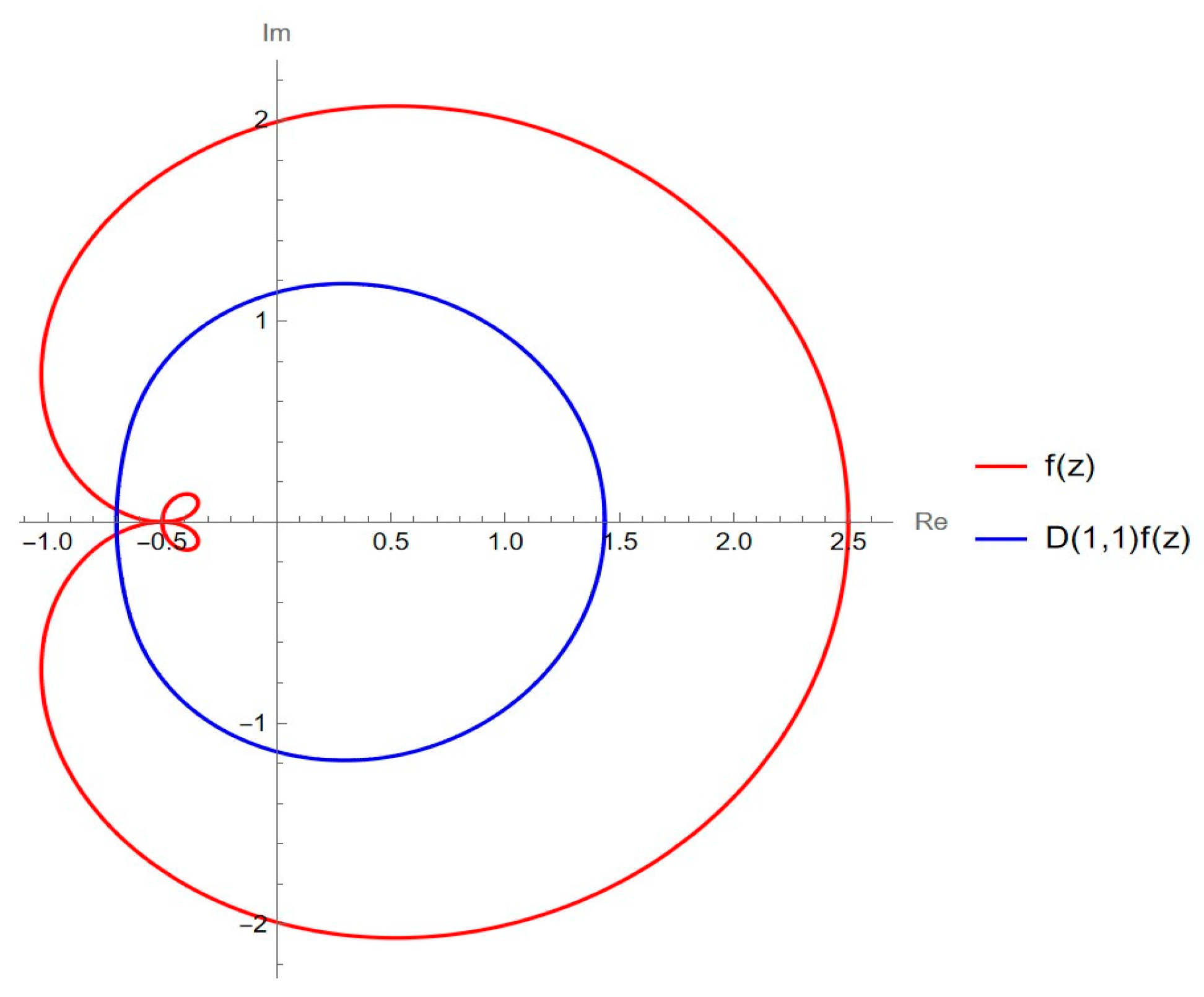
It is evident that the operator  O p , δ  reduces the magnitude of the higher-order coefficients by exponentially decaying factors. In particular, the coefficients of    z 2  and  z 3  decrease from  1  and  1 2  to  e 1  and  1 2 e 2 , espectively. Consequently, the influence of higher-order terms is diminished, resulting in a smoother analytic behavior of the transformed function. This effect is illustrated graphically in Figure 1, where the image of the unit disk under  O 1,1 f z  appears less distorted compared to that of  f z . Moreover, the parameter δ controls the rate of decay and hence determines the strength of this transformation.
Consider Q as the collection consisting of all univalent functions q ( z ) on the boundary of D excluding the set E q , where E q = ξ     D : lim z ξ   q z = , and q ξ 0   f o r   ξ D \ E q .
Therefore, Figure 1 confirms the geometric smoothing effect of the proposed operator.
Overall, this example demonstrates that the proposed operator is not merely an algebraic transformation of coefficients. Rather, it acts as an effective geometric smoothing operator that systematically suppresses the influence of higher-order terms through exponentially decaying weights. This property makes it particularly useful in the investigation of coefficient estimates, geometric function theory, differential subordinations, and related inclusion relationships among subclasses of analytic functions.
Definition 1
([1]). Suppose that     C ,  q  belong to  Q  and  p  belong to  N . The family of admissible functions, denoted by  Ψ n , q , comprises those mappyings  ψ : C 3 × D C  that satisfy the admissibility requirement defined by
ψ r , s , t ; z   ,
whenever the following conditions are simultaneously met:
r = q ξ , s = k ξ q ξ ,   R e t s + 1 k R e 1 + ξ q ξ q ξ ,
where  z D , ξ D \ q  with  k p . We simply write  Ψ 1 , q = Ψ [ , q ] .
In the special case where q z = M M z + a M + a ¯ z , with M > 0 and a < M , it follows that q D = D M = : < M ,   q 0 = a ,   E q = ϕ and q Q . Accordingly, we established Ψ n , M , a = Ψ n , q in this instance, as well as in more unique situations where   q = D M ,; the class is represented by Ψ n M , a .
Definition 2
([3]). Suppose that    C  with  q z  belong to the set  H a , n  as well as  q z 0 .  The admissible mappings family, represented by  Ψ n , q , comprises those mappings.   ψ : C 3 × D ¯ C  that satisfy the admissibility requirement defined by
ψ r , s , t ; ξ ,
if all of the following conditions are simultaneously met:
r = q z , s = z q z m ,   R e t s + 1 1 m R e 1 + z q z q z ,
where  z D , ξ D , and  m n 1 . Specifically, the family  Ψ 1 , q  is written as  Ψ , q .
Lemma 1
([1]). Letting  Ψ n , q  represent the family of functions  ψ , as well as  q 0 = a .  If
J z = a + a n z n + a n + 1 z n + 1 +   ,
be an analytic function satisfies the condition
ψ J z ,   z J z , z 2 J z ; z ,
then  J z q z .
Lemma 2
([3]). Letting  Ψ , q  represent the family of functions  ψ , as well as  q 0 = a .  If  J z   ϵ   Q a  with  ψ J z , z J z , z 2 J z ; z  be an analytic and injective in  D ,  then
ψ J z , z J z , z 2 J z ; z : z D   ,
implies  q z J z .
This study focuses on the differential subordination and superordination of multivalent functions related to the linear operator O p , δ described by Borel distribution. Recently, numerous authors have examined subordination and superordination for analytic functions defined via certain operators. In [4], Aouf at al. used generalized differential operator and investigated some differential subordination and superordination results of higher-order derivatives of multivalent functions. Rahrovi [5] obtained subordination and superordination properties for convolution operator. In 2017, Attiya and Yassen [6] discussed some subordination and superordination results associated with generalized Srivastava-Attiya operator, while in 2021 Morais and Zayed [7] introduced applications of differential subordination and superordination theorems for fluid mechanics. Alhwikem et al. [8] presented and examined a certain families of admissible functions associated with fuzzy differential subordination. Also, some related findings are shown in [9,10,11,12].
Lemma 3.
Assume that  f A p  and the linear operator  O p , δ  is defined by (2). Then
z O p , δ f z = p n 1 n p n p 1 e p n O p , δ + 1 f z + p p n 1 n p n p 1 e p n O p , δ f z ,
where  0 < δ 1   a n d   z D .
Proof. 
Applying (3), we obtain
p n 1 n p n p 1 e p n O p , δ + 1 f z + p p n 1 n p n p 1 e p n O p , δ f z = p n 1 n p n p 1 e p n z p + n = p + 1 δ + 1 n p n p 1 e δ + 1 n p n p ǃ a n z n + p p n 1 n p n p 1 e p n z p + n = p + 1 δ n p n p 1 e δ n p n p ǃ a n z n = p z p + n = p + 1 δ n p n p 1 e δ n p n p ǃ a n z n p n 1 n p n p 1 e p n n p n p 1 e p n 1 + p = p z p + n = p + 1 δ n p n p 1 e δ n p n p ǃ a n z n n p 1 n p n p 1 e p n 1 n p n p 1 e p n + p = p z p + n = p + 1 n   δ n p n p 1 e δ n p n p ǃ a n z n = z O p , δ f z ,
which establishes the identity 3 . □
The connection of the present work with Symmetry arises from the invariance properties of the considered classes of multivalent analytic functions under analytic transformations in the unit disk. The proposed Borel-distribution-based linear operator preserves the analytic structure of functions and generates subclasses characterized through differential subordination and superordination. These subclasses exhibit geometric symmetry through their invariant behavior under conformal mappings and admissibility conditions. Therefore, the obtained results contribute to the study of symmetry-type structures in geometric function theory by establishing invariant relationships between analytic functions and their associated operators.

2. Results of Subordination for the Operator O p , δ

Definition 3.
Consider a   be a subset of  C  and  q z    belongs to  Q ο H ο , p .  The admissibility class, denoted by  Φ O 1 , q , consists of those mappings  ϕ : C 3 × D C  consists of those elements that obey the following admission requirement:
ϕ u , v , w ; z
whenever the following conditions are simultaneously met:
u = q ξ , v = k ξ z q ξ p + p n 1 n p n p 1 e p n q ξ 1 n p n p 1 e p n p n
and
R e p n 1 n p n p 1   e p n 2 w p p n 1 n p n p 1   e p n 2 u p n 1 n p n p 1   e p n v + p p n 1 n p n p 1   e p n u + 2 p p n 1 n p n p 1 e p n k R e ξ q ξ q ξ + 1   ,
where  z D , ξ D \ E q , as well as  k p .
Theorem 1.
Consider  ϕ Φ O 1 , q . If  f z A p  fulfill
ϕ O p , δ f z , O p , δ + 1 f z , O p , δ + 2 f z ; z : z D 0 < δ 1 , p N ,
then
O p , δ f z q z .
Proof. 
Let J z be an analytic function in D expressed in the form
J z = O p , δ f z   ,  
thus, by differentiating (5) with regard to z and applying the connection in (3), we obtain
z J z p p n 1 n p n p 1 e p n J z p n 1 n p n p 1   e p n = O p , δ + 1 f z .
Further computations show that
z 2 J z + 1 2 p p n 1 n p n p 1 e p n z J z p p n 1 n p n p 1 e p n 2 J z p n 1 n p n p 1   e p n 2 = O p , δ + 2 f z .
Specify the transformations from C 3 to C by
u r , s , t = r , v r , s , t = s p p n 1 n p n p 1 e p n r p n 1 n p n p 1   e p n t + 1 2 p p n 1 n p n p 1 e p n s w r , s , t = p p n 1 n p n p 1 e p n 2 r p n 1 n p n p 1   e p n 2   .
ψ r , s , t ; z = ϕ u , v , w ; z = ϕ r , s p p n 1 n p n p 1 e p n r p n 1 n p n p 1   e p n , t + 1 2 p p n 1 n p n p 1 e p n s p p n 1 n p n p 1 e p n 2 r p n 1 n p n p 1   e p n 2 ; z
By Lemma 1 and Equations (5)–(9), we obtain
ψ J z , z J z , z 2 J z ; z = ϕ O p , δ f z , O p , δ + 1 f z , O p , δ + 2 f z ; z .
Therefore, (4) takes the form
ψ J z , z J z , z 2 J z ; z .
Note that
t s + 1 = p n 1 n p n p 1   e p n 2 w + p p n 1 n p n p 1   e p n 2 u p n 1 n p n p 1   e p n v + p p n 1 n p n p 1   e p n u + 2 p p n 1 n p n p 1 e p n .
Thus, the acceptance conditions for both ϕ and ψ where ϕ belongs to the class   Φ O 1 , q coincide with the admissibility condition stated in Definition 1. Consequently, ψ qualifies as an element of Ψ O 1 , q This is consistent with the result presented in Lemma 1.
J z q z   o r   O p , δ f z q z .
When C constitutes a simply connected domain. In this instance, = F D for a specific conformal projection F z of D upon , as well as denote the class Φ O 1 F D , q as Φ O 1 F , q . Consequently, we derive an extra assumption from the aforementioned theorem. □
Theorem 2.
Assume that  ϕ Φ O 1 F , q . If  f z A p  and fulfills
ϕ O p , δ f z , O p , δ + 1 f z , O p , δ + 2 f z ; z F z ,
where  0 < δ 1 , p N , Then, the subordination relation
O p , δ f z q z .
holds. In order to investigate the unspecified behavior of  q z  on the boundary of the unit disk  D , the following corollary offers an explanatory demonstration.
Corollary 1.
Letting  ϕ  belong to  Φ O 1 , q  for a certain  k  inside the interval  ( 0 , 1 ) ,  where  q k z = q k z . Let  q z  be analytic and univalent (injective) on the unit disk  D  satisfying  q 0 = 0  and let  C .  Suppose further that  f z    belongs to the class  A p  and that the following condition holds:
ϕ O p , δ f z , O p , δ + 1 f z , O p , δ + 2 f z ; z ,
where  0 < δ 1 , p N , then
O p , δ f z q z .
Proof. 
From Theorem 1, it follows that O p , δ f z q k z , based on the fact that
q k z q z .
Thus, O p , δ f z q z . □
Theorem 3.
Let  F z  and  q z  be two univalent (injective) functions on the unit disk  D , with  q 0 = 0  as well as  q k z = q k z ,  F k z = F k z . Suppose the function  ϕ : C 3 × D C  satisfies either of the following conditions:
(1)  ϕ  is an element of the class    Φ O 1 F , q k , for some  k 0,1 ,
(2) There exists some  k ο 0,1  such that for every  k k ο , 1  the inclusion  ϕ Φ O 1 F k , q k ,  holds, and additionally  f z  belongs to  A p  satisfy Equation (11).
Then, under either condition, we have the subordination relation
O p , δ f z q z .
Proof. 
 
1 . Applying Theorem 1 yields O p , δ f z q k z , since
q k z q z ,
it follows that O p , δ f z q z .
2 . Let us set J z =   O p , δ f z and define   J k z = J k z , then
ϕ J k z , z J k z , z 2 J k z ; k z = ϕ J k z , k z J k z , k z 2 J k z , k z F k D ,
According to Lemma 1, if ϕ J z , z J z , z 2 J z ; w z , where w D = D is an arbitrary mapping with w z = k z , therefore
J k z q k z .
For k in the interval k ο , 1 , taking k 1 , we deduce that
O p , δ f z q z .
The best dominant for the differential subordination (11) is derived form the following theorem □
Theorem 4.
Suppose    ϕ : C 3 × D C  denotes a function, where  F z  is univalent in  D  and  q ( z )  is a holds of the following
ϕ q z ,   z q z p p n 1 n p n p 1 e p n   q z p n 1 n p n p 1   e p n , z 2 q z + 1 2 p p n 1 n p n p 1 e p n z q z p p n 1 n p n p 1 e p n 2 q z n   p p n 1 n p n p 1 e p n 2 ; z = F z ,
where  q ( 0 ) = 0  and complies with at least one of the criteria that follow
(1)  q z Q ο  with  ϕ Φ O 1 F , q ,
(2)  q z  is injective in  D  with  ϕ Φ O 1 F , q k , and  0 < k < 1 ,
or
(3)  q z  is analytic and injective in  D  as well as there is  k ο 0,1 , where
ϕ Φ O 1 F k , q k   k k ο , 1 . If  f z A p  fulfil the relation in (2.8), then
O p , δ f z q z .
Thus, the best dominant is  q ( z ) .
Proof. 
The conclusions drawn from Theorems 2 and 3 reveal that   q ( z ) plays the role of a dominant for (11). In addition, because q ( z ) meets the requirement (12), it also serves as a solution to (11). Consequently, q ( z ) is subordinate to all other dominants, which establishes it as the best possible dominant. □
In the restricted scenario where q ( z ) = M z with M > 0 and by reference to Definition 1, the collection of admissible functions Φ O 1 , q written as Φ O 1 , M is set forth in the material that follows.
Definition 4.
Letting  M  be greater than 0 and   be a subset of  C . The functions  ϕ : C 3 × D C  that are classified under  Φ O 1 , M  as admissible functions such that
ϕ ( ( M e i θ , ( k p + p n 1 n p n p 1 e p n ) M e i θ p n 1 n p n p 1   e p n , l + ( k p + p n 1 n p n p 1 e p n ( 1 + 2 k p + p n 1 n p n p 1 e p n ) ) ) M e i θ ; z )   ,
whenever  z D ,  θ R ,  R e l e i θ k 1 k M  for all  θ  as well as  k n .
Corollary 2.
Assume  ϕ  belong to  Φ O 1 , M . If  f z  belong to  A p  and fulfills
ϕ O p , δ f z , O p , δ + 1 f z , O p , δ + 2 f z ; z
where  0 < δ 1 , p N , then
O p , δ f z < M .
For the specific instance where    = q D = : < M , the family  Φ O 1 , M  is typically written as  Φ O 1 M .
Corollary 3.
Letting  ϕ  be an element of  Φ O 1 M . If  f z A p  adheres to the inequality
ϕ O p , δ f z , O p , δ + 1 f z , O p , δ + 2 f z ; z < M ,
where  0 < δ 1 , p N , then
O p , δ f z < M .
Corollary 4.
Assume  M > 0  as well as  f z A p  in which case
| p n 1 n p n p 1   e p n 2 O p , δ + 2 f z p n 1 n p n p 1   e p n O p , δ + 1 f z p p n 1 n p n p 1 e p n 2 O p , δ f z | < 2 p p n 1 n p n p 1   e p n + 1 p + p p 1 M ,
then
O p , δ f z < M .
Proof. 
By taking
u , v , w ; z = p n 1 n p n p 1   e p n 2 w p n 1 n p n p 1   e p n v p p n 1 n p n p 1 e p n 2 u ,
and = F D , where
F z = p 2 p p n 1 n p n p 1   e p n + 1 + p 1 M z ,   M > 0
Since
l + 2 p p n 1 n p n p 1   e p n + 1 k M e i θ p 2 p p n 1 n p n p 1   e p n + 1 + p 1 M .
Thus, ϕ is an element of the class Φ O 1 , M . Consequently, the admissibility condition expressed in (13) is satisfied, and applying Corollary 2 yields the required conclusion. □
Definition 5.
Letting q z taken as an element of Φ Q 1 H ο in addition to     C . The admissibility class, denoted by Φ O 2 , q , comprises all mappings ϕ : C 3 × D C that fulfill the admissibility condition
ϕ u , v , w ; z   ,
whenever the following conditions are simultaneously met as follows:
u = q ξ , v = k ξ 1 n p p n 1 e p n   p n q ξ + q ξ
and
R e p n 1 n p n p 1   e p n w + 3 u 2 v v u   M R e 1 + ξ q ξ q ξ   ,
where z D , ξ D \ E q ,   k 1 .
Theorem 5.
Let f z belong to A p and ϕ Φ O 2 , q . If f z fulfills
ϕ O p , δ f z z p , O p , δ + 1 f z z p , O p , δ + 2 f z z p ; z : z D ,
where 0 < δ 1 , p N .
Then
O p , δ f z z p q z .
Proof. 
Consider the function J defined as
J z = O p , δ f z z p ,
which is analytic in D . By differentiating (16) and utilizing (3), we arrive at the conclusion that
O p , δ + 1 f z z p = 1 n p p n 1 e p n   p n z J z + J z .
Subsequent calculations indicate that
O p , δ + 2 f z z p = 1 n p p n 1 e p n   p n 2 z 2 J z + 1 n p p n 1 e p n   p n z J z 2 + 1 n p p n 1 e p n   p n + J z .  
To bridge the classes of admissible functions, we introduce the mapps C 3 C described by:
u r , s , t = r , v r , s , t = 1 n p p n 1 e p n   p n s + r , w r , s , t = 1 n p p n 1 e p n   p n 2 t + 1 n p p n 1 e p n   p n s 2 + 1 n p p n 1 e p n   p n + r .
Let
ψ r , s , t ; z = ϕ u , v , w ; z = ϕ r , 1 n p p n 1 e p n   p n s + r , 1 n p p n 1 e p n   p n 2 t + 1 n p p n 1 e p n   p n s 2 + 1 n p p n 1 e p n   p n + r ; z .  
By using Lemma 1 and Equations (16)–(18) and (20), we obtain
ψ J z , z J z , z 2 J z ; z = ϕ O p , δ f z z p , O p , δ + 1 f z z p , O p , δ + 2 f z z p ; z .
Hence (15), becomes
ψ J z , z J z , z 2 J z ; z   .
To conclude the proof, we now demonstrate that the condition governing the admissibility of   ϕ belongs to Φ O 2 , q matches the condition prescribed for ψ in Definition 1.
t s + 1 = p n 1 n p n p 1   e p n w + u 2 v v u   .
It is confirmed that ψ belongs to Ψ , q . Accordingly, by virtue of Lemma 1, it follows that J z q z , which is equivalent to the following subordination:
O p , δ f z z p q z   .
For a simply connected domain with is not equal to C . In this instance, = F D for a certain conformal mapping F z of D onto , and we denote the class Φ O 2 F D , q as Φ O 2 F , q . Consequently, we derive the following conclusion from the aforementioned theorem. □
Theorem 6.
Consider that  ϕ Φ O 2 F , q . If  f ( z )  belongs to  A p  and fulfills
ϕ O p , δ f z z p , O p , δ + 1 f z z p , O p , δ + 2 f z z p F z ,  
then
O p , δ f z z p q z .
The admissibility class, denoted by  Φ O 2 , q , consists of those mappings  ϕ : C 3 × D C  that fulfill the admissibility condition
ϕ u , v , w ; z   ,
whenever the following conditions are simultaneously met:
In the particular situation where   q z = M z ,   M > 0 , and by making use of Definition 5, the family of admissible functions Φ O 2 , q , written as   Φ O 2 , M , is presented in what follows.
Definition 6.
If  M > 0  as well as      C  be a set. An admissibility class, denoted by  Φ O 2 , M , comprises all mappings    ϕ : C 3 × D C  that fulfill the admissibility condition
ϕ M e i θ , k 2 p p n 1 n p n p 1   e p n 1 M e i θ p n 1 n p n p 1   e p n , l + 2 2 p p n 1 n p n p 1   e p n 1 k 2 p p n 1 n p n p 1   e p n 1 2 M e i ϕ n p p n 1 n p n p 1   e p n 2 ; z   ,
whenever  z D , θ R , R e l e i θ k 1 k M    real  θ  as well as  k 1 .
Corollary 5.
Assume  ϕ  belong to  Φ O 2 , M . If  f z  belongs to  A p  and fulfills
ϕ O p , δ f z z p , O p , δ + 1 f z z p , O p , δ + 2 f z z p ; z   ,   0 < δ 1 , p N ,
then
O p , δ f z z p < M .
In the specific setting where  = q D = : < M , the family  Φ O 2 , M  is typically written as  Φ O 2 M .
Corollary 6.
Assume  ϕ  belong to  Φ O 2 M . If  f z  belongs to  A p  and fulfills
ϕ O p , δ f z z p , O p , δ + 1 f z z p , O p , δ + 2 f z z p ; z < M , 0 < δ 1 , p N ,
then
O p , δ f z z p < M .
Corollary 7.
If  M > 0  as well as  f ( z )  is an element of  A p  that fulfills
O p , δ + 1 f z z p < 1 ,   0 < δ 1 , p N ,
then
O p , δ f z z p < M .
Corollary 8.
Assume that  M > 0  as well as  f z  belongs to  A p  and fulfills
ϕ M e i θ , k 2 p p n 1 n p n p 1   e p n 1 M e i θ q p p n 1 n p n p 1   e p n , l + 2 2 p p n 1 n p n p 1   e p n 1 e + 2 p p n 1 n p n p 1   e p n 1 2 p e i ϕ p n 1 n p n p 1   e p n 2 ; z < 3 2 p p n 1 n p n p 1   e p n 1 M ,
then
O p , δ f z z p < 1 .
Proof. 
Letting.
ϕ u , v , w ; z = n p p n 1 n p n p 1   e p n 2 w + n p p n 1 n p n p 1   e p n v 2 p p n 1 n p n p 1   e p n 1 2 u
As well as = F D ,
F z = 3 2 p p n 1 n p n p 1   e p n 1 M z ,     M > 0 .
Because
ϕ M e i θ , k + 2 p p n 1 n p n p 1   e p n 1 M e i θ p n 1 n p n p 1   e p n , l + 2 2 p p n 1 n p n p 1   e p n 1 k + 2 p p n 1 n p n p 1   e p n 1 2 p e i ϕ n p p n 1 n p n p 1   e p n 2 ; z = l 2 2 p p n 1 n p n p 1   e p n k + 2 p p n 1 n p n p 1   e p n 1 M e i θ l k i θ 2 2 p p n 1 n p n p 1   e p n k + 2 p p n 1 n p n p 1   e p n 1 M R e l e i θ + 2 k + 1 2 p p n 1 n p n p 1   e p n 1 M k k 1 M + 2 k + 1 2 p p n 1 n p n p 1   e p n 1 M 3 2 p p n 1 n p n p 1   e p n 1 M ,
z D , θ R and for every real   θ and every k 1 , we getting R e l e i θ k 1 k M . □
Consequently ϕ belongs to , Φ O 2 , M , meaning that the admissibility condition (23) is fulfilled. Then, by applying Corollary 5, we obtain the desired result.
Definition 7.
Let   be a subset of  C  and let  q z Q 1 H . Consider mapps  ϕ : C 3 × D C  that are members of the admissible class  Φ O 3 , q  These functions are required to satisfy the following admissibility condition:   ϕ u , v , w ; z   ,  under the condition that
u = q ξ , v = q ξ + 1 n p p n 1 e p n   p n k ξ q ξ   q ξ   q ξ 0
and
R e p n 1 n p n p 1   e p n w v 3 v u + 2 u 2 v u k R e 1 + ξ q ξ q ξ ,
s.t  z D , ξ D \ E q ,   k 1   .
Theorem 7.
Letting  ϕ  belong to  Φ O 3 , q  and  O ( p , δ ) f ( z )  be non-zero. If  f ( z )  belongs to  A p  and fulfills
ϕ O p , δ + 1 f z O p , δ f z , O p , δ + 2 f z O p , δ + 1 f z , O p , δ + 3 f z O p , δ + 2 f z : z D ,  
where  0 < δ 1 , p N , then
O p , δ + 1 f z O p , δ f z q z .
Proof. 
Specify the function
J z = O p , δ + 1 f z O p , δ f z ,
which remains analytic in D . By computing the logarithmic derivative of equation (26) in terms of z and by means of (3), we get
O p , δ + 2 f z O p , δ + 1 f z = 1 n p p n 1 e p n   p n z J z J z + J z .  
Through logarithmic differentiation of (27) with respect to   z and making use of (3), we reach the conclusion that
O p , δ + 3 f z O p , δ + 2 f z = J z + 1 n p p n 1 e p n   p n z J z J z + z J z + z J z p n 1 n p n p 1   e p n J z 1 n p p n 1 e p n   p n z J z J z 2 + 1 n p p n 1 e p n   p n   z 2 J z J z p n 1 n p n p 1   e p n J z + 1 n p p n 1 e p n   p n z J z J z   .
Next, suppose that transformations taking C 3 to C is defined as
u r , s , t = r , v r , s , t = r + 1 n p p n 1 e p n   p n s r   , w r , s , t = r + 1 n p p n 1 e p n   p n s r + s + 1 n p p n 1 e p n   p n s r 1 n p p n 1 e p n   p n s r 2 + 1 n p p n 1 e p n   p n t r p n 1 n p n p 1   e p n r + s r
Let
ψ r , s , t ; z = ϕ u , v , w ; z = ϕ r , r + 1 n p p n 1 e p n   p n s r ,   r + 1 n p p n 1 e p n   p n s r   + s + 1 n p p n 1 e p n   p n s r 1 n p p n 1 e p n   p n s r 2 + 1 n p p n 1 e p n   p n t r p n 1 n p n p 1   e p n r + s r ; z
By making use of Lemma 1 along with relations (26), (27), (28), and likewise (30), we deduce
ψ J z , z J z , z 2 J z ; z = ϕ O p , δ + 1 f z O p , δ f z , O p , δ + 2 f z O p , δ + 1 f z , O p , δ + 3 f z O p , δ + 2 f z   ; z .
Hence, relation (25) transforms into
ψ J z , z J z , z 2 J z ; z   .
Observe that
t s + 1 = p n 1 n p n p 1   e p n w v 3 v u + 2 u 2 v u .
The admissibility condition imposed on ϕ Φ O 3 , q and on ψ are precisely those stipulated in Definition 1.1. Accordingly, ψ   is a member of the class   Ψ , q . Applying Lemma 1.1 then yields either the subordination relation, J z q z or the subordination O p , δ + 1 f z O p , δ f z q z .  □
When C constitutes a simply linked domain. In this instance, = F D for a certain conformal mapping F z of D over Ω, and we denote the class Φ O 3 F D , q as Φ O 3 F , q . Consequently, we get the following consequence from the aforementioned theorem:
Theorem 8.
Consider  ϕ  belongs to the admissible class  Φ O 3 F , q .  Furthermore, let  f z A p  be a function that fulfills the subsequent requirements:
ϕ O p , δ + 1 f z O p , δ f z , O p , δ + 2 f z O p , δ + 1 f z , O p , δ + 3 f z O p , δ + 2 f z ; z F z ,  
where  0 < δ 1 , p N , then
O p , δ + 1 f z O p , δ f z q z .
In the specific scenario where  q z = 1 + M z , with  M > 0 , The admissible functions  Φ O 3 , q , , referred to as  Φ O 3 , M , is presented below in accordance with Definition 7.
Definition 8.
Taking  C  to be a set. The collection of admissible mapps denoted by  Φ O 3 , M . includes every mapping  ϕ : C 3 × D C  obeying the following requirement:
ϕ 1 + M e i θ , 1 + k + p n 1 n p n p 1   e p n 1 + M e i θ p n 1 n p n p 1   e p n 1 + M e i θ M e i θ , 1 + k + p n 1 n p n p 1   e p n 1 + M e i θ p n 1 n p n p 1   e p n 1 + M e i θ M e i θ   + l e i θ + k M p n 1 n p n p 1   e p n 1 + M e i θ 1 k 2 M 2 e i θ + M p n 1 n p n p 1   e p n   k M + p n 1 n p n p 1   e p n 2 M 2 + M e i θ + p n 1 n p n p 1   e p n 2 e i θ ; z  
z D , θ R  and for every real    θ  and every  k 1 , we getting  R e l e i θ k 1 k M .
Corollary 9.
Letting  ϕ  belong to  Φ O 1,2 , M . If  f ( z )  belongs to  A p  and fulfills
ϕ O p , δ + 1 f z O p , δ f z , O p , δ + 2 f z O p , δ + 1 f z , O p , δ + 3 f z O p , δ + 2 f z ; z ,
where  0 < δ 1 , p N ,  then
O p , δ + 1 f z O p , δ f z < 1 + M e i θ .
Consider the special instance where  = q D = : 1 < M  Under this circumstance, the class  Φ O 3 , M  is typically represented as  Φ O 3 M .
Corollary 10.
Letting  ϕ  belong to  Φ O 3 M . If  f ( z )  belongs to  A p  and fulfills
ϕ O p , δ + 1 f z O p , δ f z , O p , δ + 2 f z O p , δ + 1 f z , O p , δ + 3 f z O p , δ + 2 f z ; z 1 < M ,
where  0 < δ 1 , p N , then
O p , δ + 1 f z O p , δ f z 1 < M .
Corollary 11.
Assume that  M > 0  as well as  f ( z )  belong to  A p  such that
O p , δ + 2 f z O p , δ + 1 f z O p , δ + 1 f z O p , δ f z < M n p p n 1 n p n p 1   e p n M + 1 ,
where  0 < δ 1 , p N , then
O p , δ + 1 f z O p , δ f z 1 < M .
Proof. 
Assuming that ϕ u , v , w ; z = v u and = F u , where
F z = 1 n p p n 1 e p n   p n M M + 1 z   ,   M > 0 .
Applying Corollary 9, we have □
1 n p p n 1 e p n   p n   k M e + 1 > 1 n p p n 1 e p n   p n M e + 1   .

3. Superordination Results for the Linear Operator O p , δ

Herein, we obtain outcomes pertaining to differential superordination problems of the linear operator when applied to analytic functions.
Definition 9.
Given  q z H ο , p  and a set    C s.t  z q z 0 .  we define the admissible class  Φ O 1 , q  as the collection of functions  ϕ : C 3 × D ¯ C  observing the following admissibility condition:
ϕ u , v , w ; ξ   ,
whenever
u = q z , v = 1 n p p n 1 e p n   p n   p n 1 n p n p 1   e p n q z + z q z m m ,
and
R e p n 1 n p n p 1   e p n w 2 v + u v u 1 m R e z q z q z + 1 ,
where  z D , ξ D , and  m p .
Theorem 9.
Letting  ϕ  belong to  Φ O 1 , q . If  f ( z )  belongs to  A p , then  O p , δ f z  is an element of  Q ο  and
ϕ O p , δ f z , O p , δ + 1 f z , O p , δ + 2 f z ; z
is univalent in  D  and
ϕ O p , δ f z , O p , δ + 1 f z , O p , δ + 2 f z ; z : z D   ,  
where  0 < δ 1 , p N , then
q z O p , δ f z .
Proof. 
Applying (10) together with (34), we obtain the inclusion
ψ J z , z J z , z 2 J z ; z : z D .
In light of the transformation defined in (8), it is clear that the admissibility conditions imposed on ϕ Φ O 1 , q and on ψ are equivalent to those stated in Definition 2. Thus, ψ Ψ n , q , applying Lemma 2, we conclude that either   q z J z   o r q z O p , δ f z .  □
Now assume that   not equal C is a simply connected set. Under these conditions, can be expressed as F D for an appropriate conformal map F z of D onto . The notation Φ O 1 F D , q is then used as an abbreviation for   Φ O 1 F , q . Consequently, from the preceding theorem, we derive the following result:
Theorem 10.
Assume that  q z H 0 , p , ϕ Φ O 1 F , q . If  f z A p ,   O p , δ f z Q ο  and  ϕ O p , δ f z , O p , δ + 1 f z , O p , δ + 2 f z ; z  is univalent in  D  and
F z ϕ O p , δ f z , O p , δ + 1 f z , O p , δ + 2 f z ; z ,
where  0 < δ 1 , p N , then  q z O p , δ f z .
The following conclusion is a corollary derived from the combination of Theorems 2 and 10.
Corollary 12.
Consider a univalent function    F 2 z  defined on  D , together with two analytic functions    F 1 z  and  q 1 z  in  D . Assume that  q 2 z    belongs to  Q ο  with the initial conditions    q 1 0 = q 2 0 = 0  and that  ϕ  is an element of the intersection  Φ O 1 F 2 , q 2 Φ O 1 F 1 , q 1 . Furthermore, suppose that  f z A p ,  O p , δ f z H 0 , p Q ο  such that
ϕ O p , δ f z , O p , δ + 1 f z , O p , δ + 2 f z ; z
is univalent in  D  and
F 1 z ϕ O p , δ f z , O p , δ + 1 f z , O p , δ + 2 f z ; z F 2 z ,
where  0 < δ 1 , p N , then
q 1 z O p , δ f z q 2 z .
Definition 10.
Letting  q z  belong to  H ο  with   be a subset of  C , with  z q z  not equal to zero. The family of admissible mapps  Φ O 2 , q  comprises mapps  ϕ : C 3 × D ¯ C  fulfill the admissibility condition.
ϕ u , v , w ; ξ ,
where
u = q z , v = z q z + m 2 p p n 1 n p n p 1   e p n 1 q z p n 1 n p n p 1   e p n   m   , R e p n 1 n p n p 1   e p n 2 w 2 p p n 1 n p n p 1   e p n 1 2 u p n 1 n p n p 1   e p n v 2 p p n 1 n p n p 1   e p n 1 u 2 2 2 p p n 1 n p n p 1   e p n 1 1 m R e 1 + z q z q z ,
where  z D , ξ  and  m 1 .
We now state the corresponding result that captures the double conclusion of Theorem 3 in the context of differential superordination.
Theorem 11.
Given  ϕ Φ O 2 , q . If  f z   i s  simply in  A p , O p , δ f z z p Q 1  and
ϕ O p , δ f z z p , O p , δ + 1 f z z p , O p , δ + 2 f z z p ; z
is univalent in  D  as well as
ϕ O p , δ f z z p , O p , δ + 1 f z z p , O p , δ + 2 f z z p ; z : z   ,  
where  0 < δ 1 , p N , then
q z O p , δ f z z p .
Proof. 
Starting from the results given in (2.18), (3.4), we deduce the inclusion
ψ J z , z J z , z 2 J z ; z : z D .
By applying the function given in relation (2.16) it becomes evident that the admissibility condition for   ϕ belongs to Φ O 2 , q coincides with the admissibility requirement for   ψ as introduced in Definition 1.2. Hence, ψ belongs to Ψ n , q . Applying Lemma 1.2, we obtain the subordination relations q z J z or q z O p , δ f z z p .  □
Suppose next that C is a simply connected domain. In this situation   can be expressed as F D for some conformal map F z of D onto the class   Φ O 2 F D , q is then written simply as Φ O 2 F , q . Therefore, from the preceding theorem, we conclude the following result:
Theorem 12.
Suppose that the mapps  q z H ο , F z  is analytic on  D  and  ϕ Φ O 2 F , q . If  f z A p , O p , δ f z z p Q 1 ,
ϕ O p , δ f z z p , O p , δ + 1 f z z p , O p , δ + 2 f z z p ; z
is holomorphic and injective on  D  and
F z ϕ O p , δ f z z p , O p , δ + 1 f z z p , O p , δ + 2 f z z p ; z ,  
where  0 < δ 1 , p N , then
q z O p , δ f z z p .
Integrating the conclusions of Theorems 6 and 12 gives rise to the subsequent essential corollary:
Corollary 13.
Consider two analytic functions  F 1 z  and  q 1 z  defined on  D ,  together with a univalent function  F 2 z  on  D , q 2 z    is an element of    Q 1  with  q 1 z = q 2 z = 1  and that  ϕ    lies in the intersection    Φ O 2 F 2 , q 2 Φ O 2 F 1 , q 1 . Furthermore, suppose that  f z A p ,   O p , δ f z z p   H ο Q 1 ,
ϕ O p , δ f z z p , O p , δ + 1 f z z p , O p , δ + 2 f z z p ; z
is holomorphic and injective on  D  and
F 1 z ϕ O p , δ f z z p , O p , δ + 1 f z z p , O p , δ + 2 f z z p ; z F 2 z ,
where  0 < δ 1 , p N , then
q 1 z O p , δ f z z p q 2 z .
Now, regarding differential superordination, we obtain the two-sided counterpart of Theorem 7.
Definition 11.
Letting  q z 0 , z q z 0 , as well as   be a subset of  C , with  q z H . The set of admissible mapps  Φ O 3 , q  comprises functions  ϕ : C 3 × D ¯ C  that fulfill the admissibility condition  ϕ u , v , w ; ξ . Whenever
u = q z , v = z q z m n p p n 1 n p n p 1   e p n q z + q z , R e n p p n 1 n p n p 1   e p n w v 3 v u + 2 u 2 v u 1 m R e z q z q z + 1 ,
where  z ,   ξ D  and  m 1 .
Theorem 13.
Letting  ϕ  belong to  Φ O 3 , q . If  f ( z )  is an element of  A p ,   O p , δ + 1 f z O p , δ f z Q 1 ,
ϕ O p , δ + 1 f z O p , δ f z , O p , δ + 2 f z O p , δ + 1 f z , O p , δ + 3 f z O p , δ + 2 f z ; z
is holomorphic and injective on  D  and
ϕ O p , δ + 1 f z O p , δ f z , O p , δ + 2 f z O p , δ + 1 f z , O p , δ + 3 f z O p , δ + 2 f z ; z : z D ,
where  0 < δ 1 , p N , then
q z O p , δ + 1 f z O p , δ f z .
Proof. 
We conclude from (2.28) and (3.6) that
ψ J z , z J z , z 2 J z ; z : z D .
The admissibility conditions for ϕ Φ O 3 , q and ψ , as stated in (30), are equal to those outlined in Definition 2. Therefore, ψ is an element of Ψ , q . Consequently, by Lemma 2, we get that q z J z , and therefore
q z O p , δ + 1 f z O p , δ f z .
Let us now turn to the case where C is a simply connected domain. In this setting, we may write, = F D for a specific conformal mapps F z of D onto . Consequently, the admissible class Φ O 3 F D , q is denoted more succinctly as Φ O 3 F , q . As a direct consequence of the preceding theorem, we obtain the following result: □
Theorem 14.
Consider a function  ϕ  belonging to    Φ O 3 F , q ,  F z  is an analytic function defined on  D . If  f z A p ,  O p , δ + 1 f z O p , δ f z Q 1 ,
ϕ O p , δ + 1 f z O p , δ f z , O p , δ + 2 f z O p , δ + 1 f z , O p , δ + 3 f z O p , δ + 2 f z ; z
is holomorphic and injective on  D  and
F z ϕ O p , δ + 1 f z O p , δ f z , O p , δ + 2 f z O p , δ + 1 f z , O p , δ + 3 f z O p , δ + 2 f z ; z ,
where  0 < δ 1 , p N , then
q z O p , δ + 1 f z O p , δ f z .
From the combination of Theorems 8 and 14, we derive the following sandwich theorem.
Corollary 14.
Consider a univalent function  F 2 z  on  D , and take  q 2 z Q 1  with  q 1 0 = q 2 0 = 1 ,  F 1 z  and  q 1 z  be analytic in  D ,  and  ϕ Φ O 3 F 2 , q 2 Φ O 3 F 1 , q 1 . If  f z A p ,  O p , δ + 1 f z O p , δ f z H Q 1 , O p , δ f z 0 ,
ϕ O p , δ + 1 f z O p , δ f z , O p , δ + 2 f z O p , δ + 1 f z , O p , δ + 3 f z O p , δ + 2 f z ; z
is univalent in  D  and
F 1 z ϕ O p , δ + 1 f z O p , δ f z , O p , δ + 2 f z O p , δ + 1 f z , O p , δ + 3 f z O p , δ + 2 f z ; z F 2 z ,
where  0 < δ 1 , p N , then
q 1 z O p , δ + 1 f z O p , δ f z q 2 z .

4. Conclusions

The main goal of this work was to apply the Borel distribution in establishing differential subordination and superordination outcomes for analytic and multivalent functions defined on the open unit disk. This was carried out through suitable classes of admissible functions. The obtained findings were subsequently employed to produce differential sandwich-type results. The properties of this newly introduced distribution offer potential avenues for further exploration, and the findings presented here may encourage additional investigations concerning other function classes.

Author Contributions

The initial idea and conceptual framework were developed by S.K.A. and A.K.W. The methodology was designed by A.K.W. and A.A.L. Software implementation was carried out by S.K.A. Validation of the results was performed jointly by S.K.A. and A.K.W. Formal analysis was conducted by S.K.A. and A.A.L. The investigation phase was undertaken by A.K.W. and A.A.L. Resources were provided by A.K.W. and A.A.L. Data curation was handled by A.K.W. The original draft of the manuscript was prepared by S.K.A. and A.K.W. Subsequent reviewing and editing were completed by S.K.A., A.K.W. and A.A.L. All authors have read and agreed to the published version of the manuscript.

Funding

This research was funded by the University of Oradea.

Data Availability Statement

No new data were created or analyzed in this study.

Conflicts of Interest

The authors declare no conflicts of interest.

References

  1. Miller, S.S.; Mocanu, P.T. Differential Subordinations: Theory and Applications; Series on Monographs and Textbooks in Pure and Applied Mathematics Vol. 225; Marcel Dekker Inc.: New York, NY, USA; Basel, Switzerland, 2000. [Google Scholar]
  2. Wanas, A.K.; Khuttar, J.A. Applications of Borel distribution series on analytic functions. Earthline J. Math. Sci. 2020, 4, 71–82. [Google Scholar] [CrossRef]
  3. Miller, S.S.; Mocanu, P.T. Subordinants of differential superordinations. Complex Var. 2003, 48, 815–826. [Google Scholar] [CrossRef]
  4. Aouf, M.K.; El-Ashwah, R.M.; Abd-Eltawab, A.M. Differential subordination and superordination results of higher-order derivatives of p-valent functions involving a generalized differential operator. Southeast Asian Bull. Math. 2012, 36, 475–488. [Google Scholar]
  5. Rahrovi, S. Subordination and superordination properties for convolution operator. Int. J. Nonlinear Anal. Appl. 2015, 6, 137–147. [Google Scholar]
  6. Attiya, A.A.; Yassen, M.F. Some subordination and superordination results associated with generalized Srivastava-Attiya operator. Filomat 2017, 31, 53–60. [Google Scholar] [CrossRef]
  7. Morais, J.; Zayed, H.M. Applications of differential subordination and superordination theorems to fluid mechanics involving a fractional higher-order integral operator. Alex. Eng. J. 2021, 60, 3901–3914. [Google Scholar] [CrossRef]
  8. Alhwikem, D.; Wanas, A.K.; Abd, B.A.; Amourah, A.; El-Deeb, S.M. Certain families of admissible functions defined via fuzzy differential subordination and a generalized Mittag-Leffler function. AIMS Math. 2026, 11, 943–956. [Google Scholar] [CrossRef]
  9. Darweesh, A.M.; Tayyah, A.S.; Hadi, S.H.; Lupaş, A.A. Sandwich results for holomorphic functions related to an integral operator. Fractal Fract. 2026, 10, 171. [Google Scholar] [CrossRef]
  10. Lupas, A.A.; Oros, G.I. Differential subordination and superordination results using fractional integral of confluent hypergeometric function. Symmetry 2021, 13, 327. [Google Scholar] [CrossRef]
  11. Mahmood, Z.H.; Jassim, K.A.; Shihab, Z.H. Differential subordination and superordination for multivalent functions associated with generalized Fox-Wright functions. Iraqi J. Sci. 2022, 63, 675–682. [Google Scholar] [CrossRef]
  12. Seoudy, T.M. Subordination and superordination results of p-valent analytic functions involving a linear operator. Bol. Soc. Paran. Mat. 2017, 35, 223–234. [Google Scholar] [CrossRef]
Figure 1. Image of the unit disk under O 1,1 f z .
Symmetry 18 01015 g001
Disclaimer/Publisher’s Note: The statements, opinions and data contained in all publications are solely those of the individual author(s) and contributor(s) and not of MDPI and/or the editor(s). MDPI and/or the editor(s) disclaim responsibility for any injury to people or property resulting from any ideas, methods, instructions or products referred to in the content.