H∞ Control Designs for Continuous-Time Singular Systems


Abstract
1. Introduction
- Notations: I is the identity matrix of appropriate dimension. denotes the polynomial degree. represents a block-diagonal matrix. The symbol ∗ indicates symmetric terms in a block matrix. is the transpose of , , and .
2. Preliminaries and Problem Statement
System Description
- Regular if is not identically zero.
- Impulse-free if .
- Stable if for all .
- Admissible if it is regular, impulse free, and stable.
- When , the obtained system (3) is admissible;
- For any non-zero , given the performance index γ of the singular system, when the initial condition is zero, can be satisfied.
- 1.
- ,
- 2.
- .
3. Main Results
| Algorithm 1 Determination of the scalar parameters and |
|
4. H∞ Static Output Design
- The next theorem addresses the design of a static output-feedback controller based on the conditions established in Theorem 1.
5. Examples
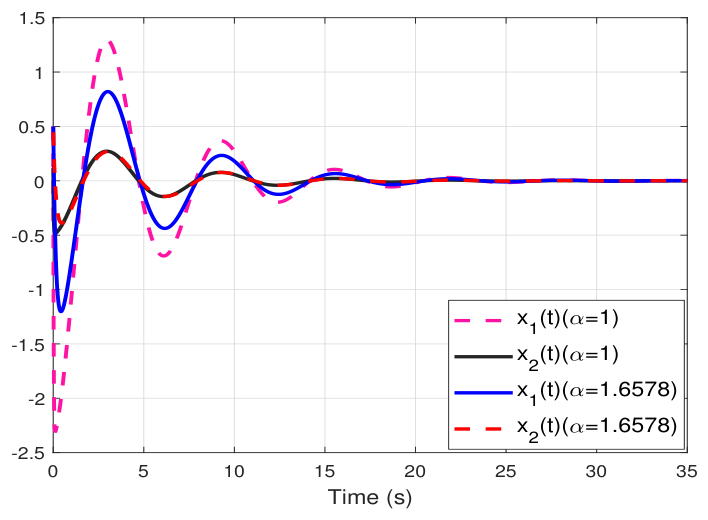
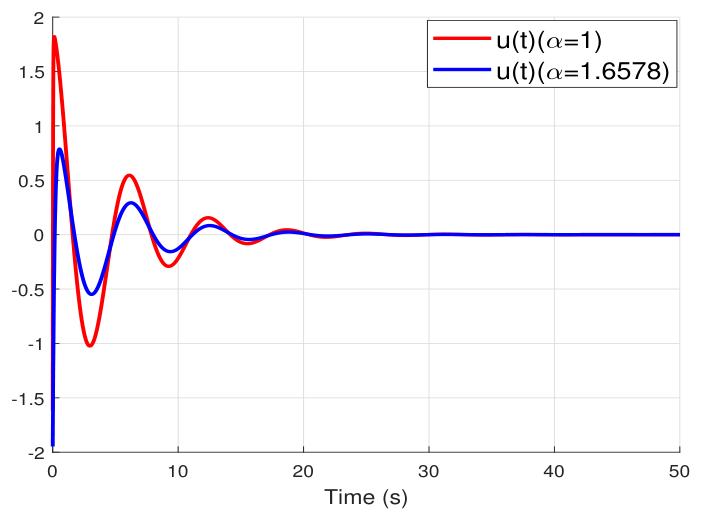
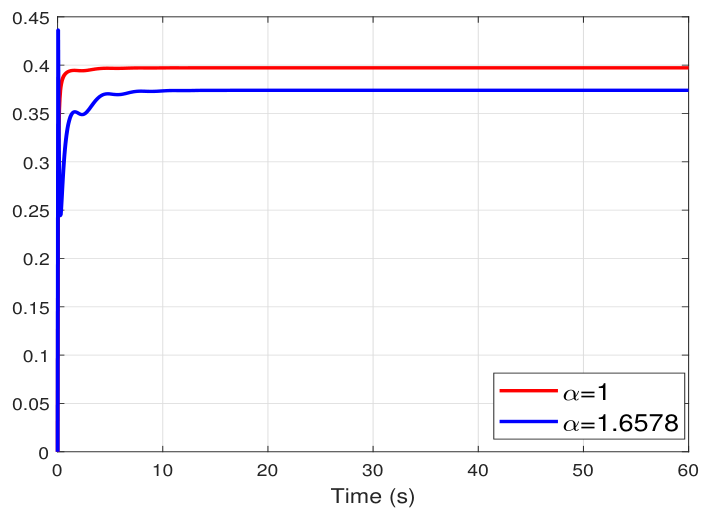
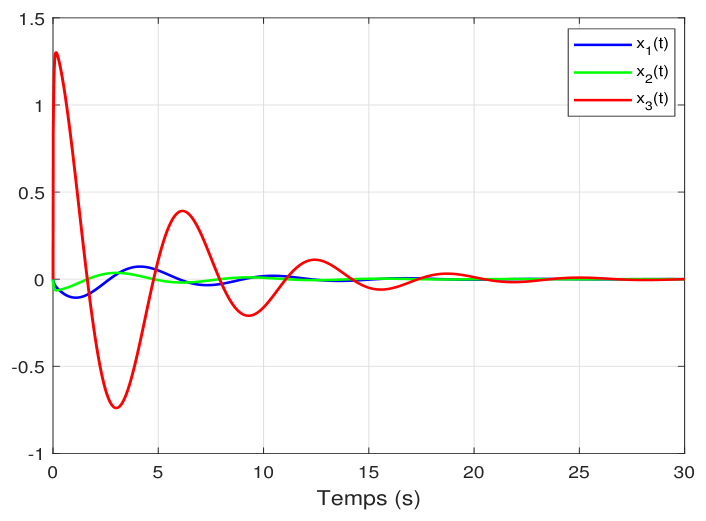
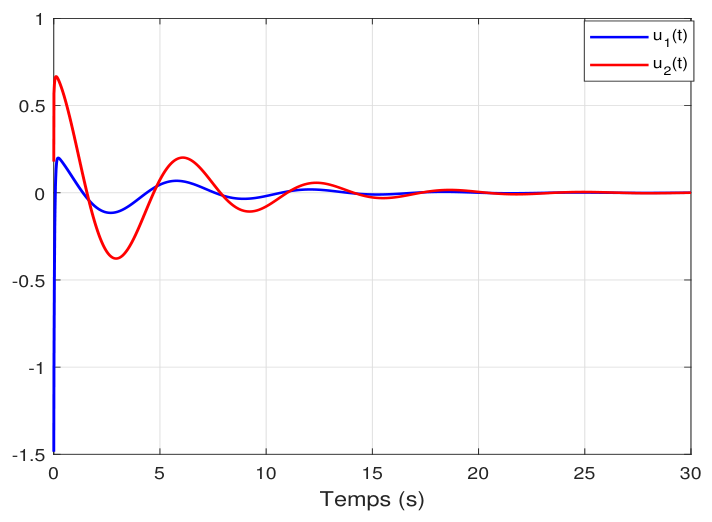
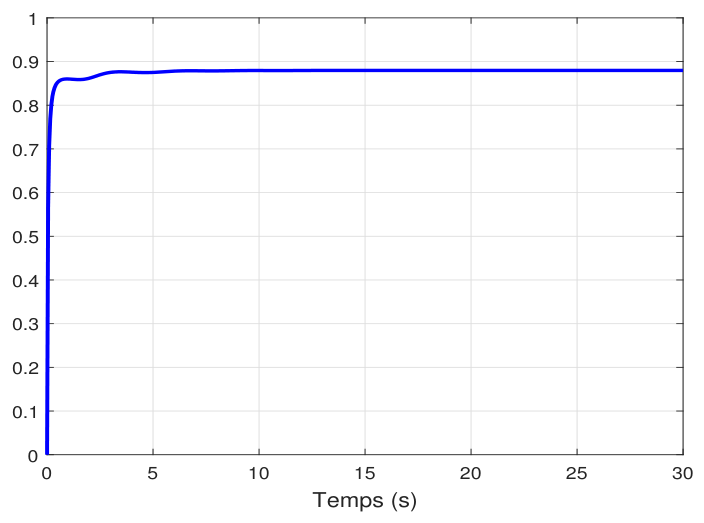
5.1. First Example
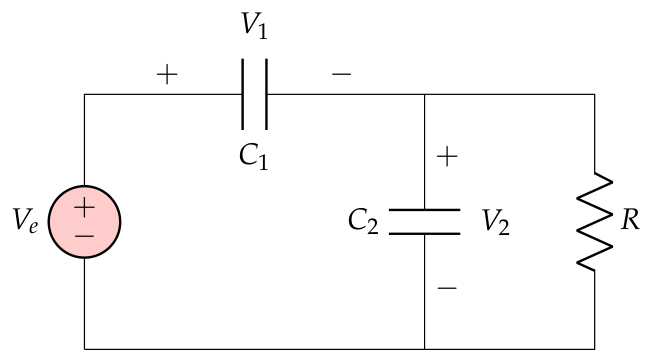
5.2. Second Example
6. Conclusions
Author Contributions
Funding
Data Availability Statement
Conflicts of Interest
References
- Dai, L. Singular Control Systems; Springer: Berlin/Heidelberg, Germany, 1989. [Google Scholar]
- Xu, S.; Lam, J. Robust Control and Filtering of Singular Systems; Springer: Berlin/Heidelberg, Germany, 2006; Volume 332. [Google Scholar]
- Ge, C.; Shi, Y.; Park, J.H.; Hua, C. Robust H∞ stabilization for TS fuzzy systems with time-varying delays and memory sampled-data control. Appl. Math. Comput. 2019, 346, 500–512. [Google Scholar]
- Li, M.; Sun, L.; Yang, R. Finite-time H∞ control for a class of discrete-time nonlinear singular systems. J. Frankl. Inst. 2018, 355, 5384–5393. [Google Scholar] [CrossRef]
- Zhang, Y.; Shi, P.; Nguang, S.K. Observer-based finite-time H∞ control for discrete singular stochastic systems. Appl. Math. Lett. 2014, 38, 115–121. [Google Scholar] [CrossRef]
- Feng, Z.; Shi, P. Two equivalent sets: Application to singular systems. Automatica 2017, 77, 198–205. [Google Scholar] [CrossRef]
- Ji, X.; Su, H.; Chu, J. Robust state feedback H∞ control for uncertain linear discrete singular systems. IET Control Theory Appl. 2007, 1, 195–200. [Google Scholar] [CrossRef]
- Zhang, G.; Xia, Y.; Shi, P. New bounded real lemma for discrete-time singular systems. Automatica 2008, 44, 886–890. [Google Scholar] [CrossRef]
- Zames, G. Feedback and optimal sensitivity: Model reference transformations, multiplicative seminorms, and approximate inverses. IEEE Trans. Autom. Control 1981, 26, 301–320. [Google Scholar] [CrossRef]
- Song, B.; Zhang, Y.; Park, J.H. H∞ control for Poisson-driven stochastic systems. Appl. Math. Comput. 2021, 392, 125716. [Google Scholar] [CrossRef]
- Chadli, M.; Darouach, M. Novel bounded real lemma for discrete-time descriptor systems: Application to H∞ control design. Automatica 2012, 48, 449–453. [Google Scholar] [CrossRef]
- Feng, Y.; Yagoubi, M. On state feedback H∞ control for discrete-time singular systems. IEEE Trans. Autom. Control 2013, 58, 2674–2679. [Google Scholar] [CrossRef]
- Chang, X.H.; Wang, X.Y.; Hou, L.W. New LMI approach to H∞ control of discrete-time singular systems. Appl. Math. Comput. 2024, 474, 128703. [Google Scholar] [CrossRef]
- Delmotte, F.; Guerra, T.M.; Ksantini, M. Continuous Takagi–Sugeno’s models: Reduction of the number of LMI conditions in various fuzzy control design technics. IEEE Trans. Fuzzy Syst. 2007, 15, 426–438. [Google Scholar] [CrossRef]
- Chadli, M.; Shi, P.; Feng, Z.; Lam, J. New bounded real lemma formulation and control for continuous-time descriptor systems. Asian J. Control 2017, 19, 2192–2198. [Google Scholar] [CrossRef]
- Feng, Z.; Lam, J.; Xu, S.; Zhou, S. H∞ control with transients for singular systems. Asian J. Control 2016, 18, 817–827. [Google Scholar] [CrossRef]
- Chang, X.H.; Jin, X. Observer-based fuzzy feedback control for nonlinear systems subject to transmission signal quantization. Appl. Math. Comput. 2022, 414, 126657. [Google Scholar] [CrossRef]
- Kamyar, R.; Peet, M.M.; Peet, Y. Solving large-scale robust stability problems by exploiting the parallel structure of Polya’s theorem. IEEE Trans. Autom. Control 2013, 58, 1931–1947. [Google Scholar] [CrossRef]
- Benner, P.; Schneider, A. Model reduction for linear descriptor systems with many ports. In Progress in Industrial Mathematics at ECMI 2010; Springer: Berlin/Heidelberg, Germany, 2012; pp. 137–143. [Google Scholar]
- Benson, S.J.; Ye, Y. DSDP5: Software For Semidefinite Programming; Technical Report ANL/MCS-P1289-0905; Mathematics and Computer Science Division, Argonne National Laboratory: Argonne, IL, USA, 2005. [Google Scholar]
- Benson, S.J.; Ye, Y.; Zhang, X. Solving Large-Scale Sparse Semidefinite Programs for Combinatorial Optimization. SIAM J. Optim. 2000, 10, 443–461. [Google Scholar] [CrossRef]
- Benson, S.J.; Ye, Y. Algorithm 875: DSDP5—Software for semidefinite programming. ACM Trans. Math. Softw. 2008, 34, 1–20. [Google Scholar] [CrossRef]
- Stürz, Y.R.; Eichler, A.; Smith, R.S. Distributed control design for heterogeneous interconnected systems. IEEE Trans. Autom. Control 2020, 66, 5112–5127. [Google Scholar] [CrossRef]
- Haiek Badreddine, E.; Aiss Hicham, E.; Abdelaziz, H.; Hajjaji Ahmed, E.; Houssaine Tissir, E. New approach to robust observer-based control of one-sided Lipschitz non-linear systems. IET Control Theory Appl. 2019, 13, 333–342. [Google Scholar] [CrossRef]
- Zoulagh, T.; El Haiek, B.; Hmamed, A.; El Hajjaji, A. Homogenous polynomial H∞ filtering for uncertain discrete-time systems: A descriptor approach. Int. J. Adapt. Control Signal Process. 2018, 32, 378–389. [Google Scholar] [CrossRef]
- Zoulagh, T.; El Aiss, H.; Tadeo, F.; El Haiek, B.; Barbosa, K.A.; Hmamed, A. Gain-scheduled energy-to-peak approach for vehicle sideslip angle filtering. Symmetry 2024, 16, 1627. [Google Scholar] [CrossRef]
- Badreddine, E.H.; Sadek, B.A.; Er-Rachid, I.; Barbosa, K.A. H∞ Observer-Based Control for a Class of One-Sided Lipschitz Uncertain Systems in Finite Frequency Domain. Optim. Control Appl. Methods 2025, 46, 1708–1723. [Google Scholar] [CrossRef]
- Gahinet, P.; Nemirovskii, A.; Laub, A.J.; Chilali, M. The LMI control toolbox. In Proceedings of the 1994 33rd IEEE Conference on Decision and Control; IEEE: Piscataway, NJ, USA, 1994; Volume 3, pp. 2038–2041. [Google Scholar]
- Yang, Q.; Chang, X.H. Energy-to-peak controller design for discrete-time singular system. Circuits Syst. Signal Process. 2023, 42, 5944–5957. [Google Scholar] [CrossRef]
- Campbell, S.L.; Meyer, C.D., Jr.; Rose, N.J. Applications of the Drazin inverse to linear systems of differential equations with singular constant coefficients. SIAM J. Appl. Math. 1976, 31, 411–425. [Google Scholar] [CrossRef]
- Campbell, S.L. Singular Systems of Differential Equations II; Research Notes in Mathematics; Pitman Books Ltd.: London, UK; Pitman Publishing Inc.: Marshfield, MA, USA, 1982; Volume 40. [Google Scholar]
- Owens, D.H.; Debeljkovic, D.L. Consistency and Liapunov stability of linear descriptor systems: A geometric analysis. IMA J. Math. Control Inf. 1985, 2, 139–151. [Google Scholar] [CrossRef]
- Ezzine, F.; Hammami, M.A. Convergence and stability analysis of nonlinear singular systems: Application to circuit network. J. Nonlinear Math. Phys. 2024, 31, 69. [Google Scholar] [CrossRef]



| Method | Control K | |
|---|---|---|
| Theorem 2 () | ||
| Theorem 2 () | ||
| Theorem 3 in [16] | — | |
| Theorem 3 – in [16] | — |
| Corollary 1 () | Corollary 1 () | Corollary 1 in [15] |
|---|---|---|
| 2.4215 | 6.6267 | 4.5 |
Disclaimer/Publisher’s Note: The statements, opinions and data contained in all publications are solely those of the individual author(s) and contributor(s) and not of MDPI and/or the editor(s). MDPI and/or the editor(s) disclaim responsibility for any injury to people or property resulting from any ideas, methods, instructions or products referred to in the content. |
© 2026 by the authors. Licensee MDPI, Basel, Switzerland. This article is an open access article distributed under the terms and conditions of the Creative Commons Attribution (CC BY) license.
Share and Cite
El Haiek, B.; Aiss, H.E.; Zoulagh, T.; Tadeo, F. H∞ Control Designs for Continuous-Time Singular Systems. Symmetry 2026, 18, 1014. https://doi.org/10.3390/sym18061014
El Haiek B, Aiss HE, Zoulagh T, Tadeo F. H∞ Control Designs for Continuous-Time Singular Systems. Symmetry. 2026; 18(6):1014. https://doi.org/10.3390/sym18061014
Chicago/Turabian StyleEl Haiek, Badreddine, Hicham El Aiss, Taha Zoulagh, and Fernando Tadeo. 2026. "H∞ Control Designs for Continuous-Time Singular Systems" Symmetry 18, no. 6: 1014. https://doi.org/10.3390/sym18061014
APA StyleEl Haiek, B., Aiss, H. E., Zoulagh, T., & Tadeo, F. (2026). H∞ Control Designs for Continuous-Time Singular Systems. Symmetry, 18(6), 1014. https://doi.org/10.3390/sym18061014