Integrated Borehole GPR and Optical Imaging for Field Investigation of Rock Mass Structures



Abstract
1. Introduction
2. Materials and Methods
2.1. Borehole GPR
2.2. Borehole Optical Imaging
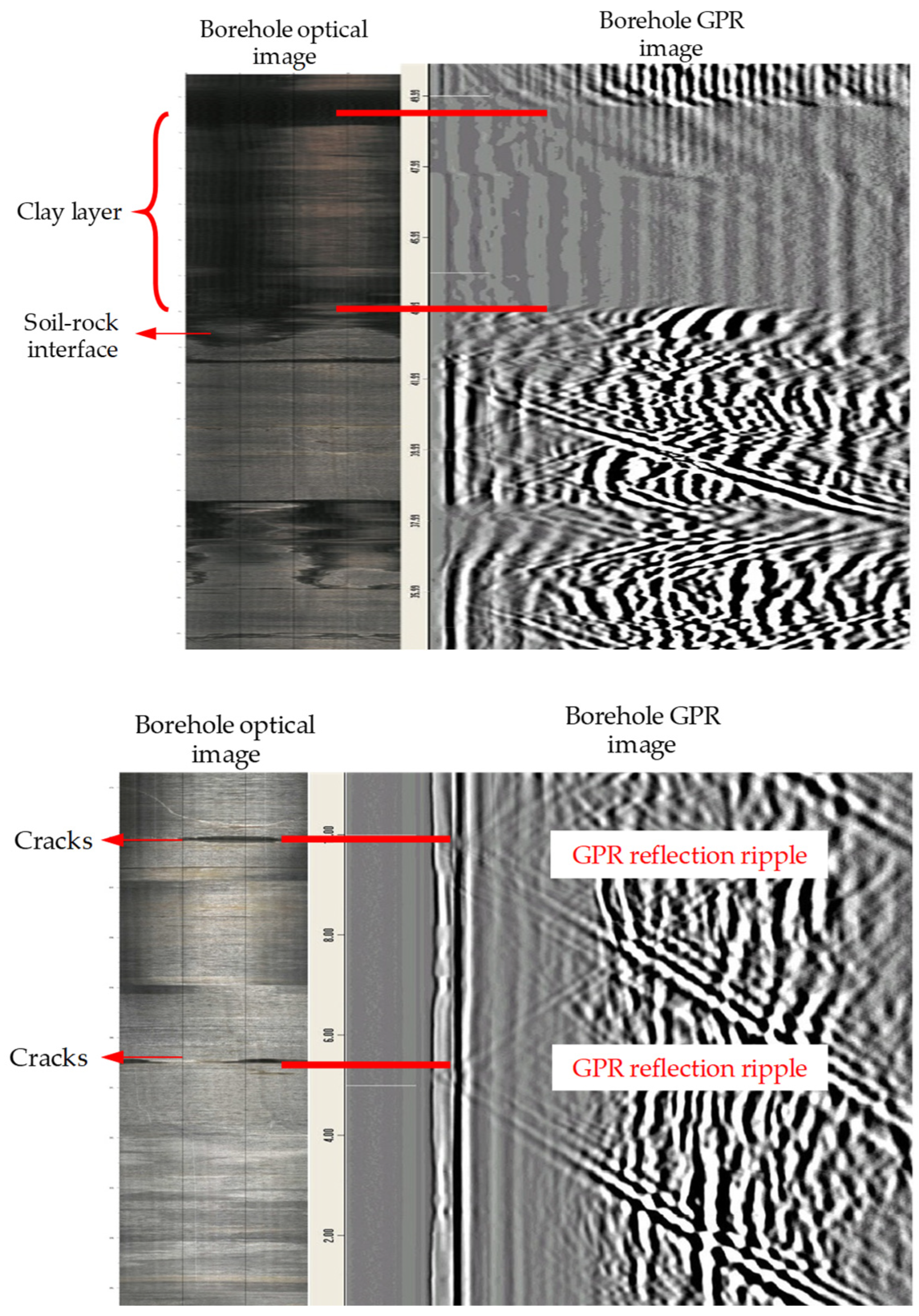
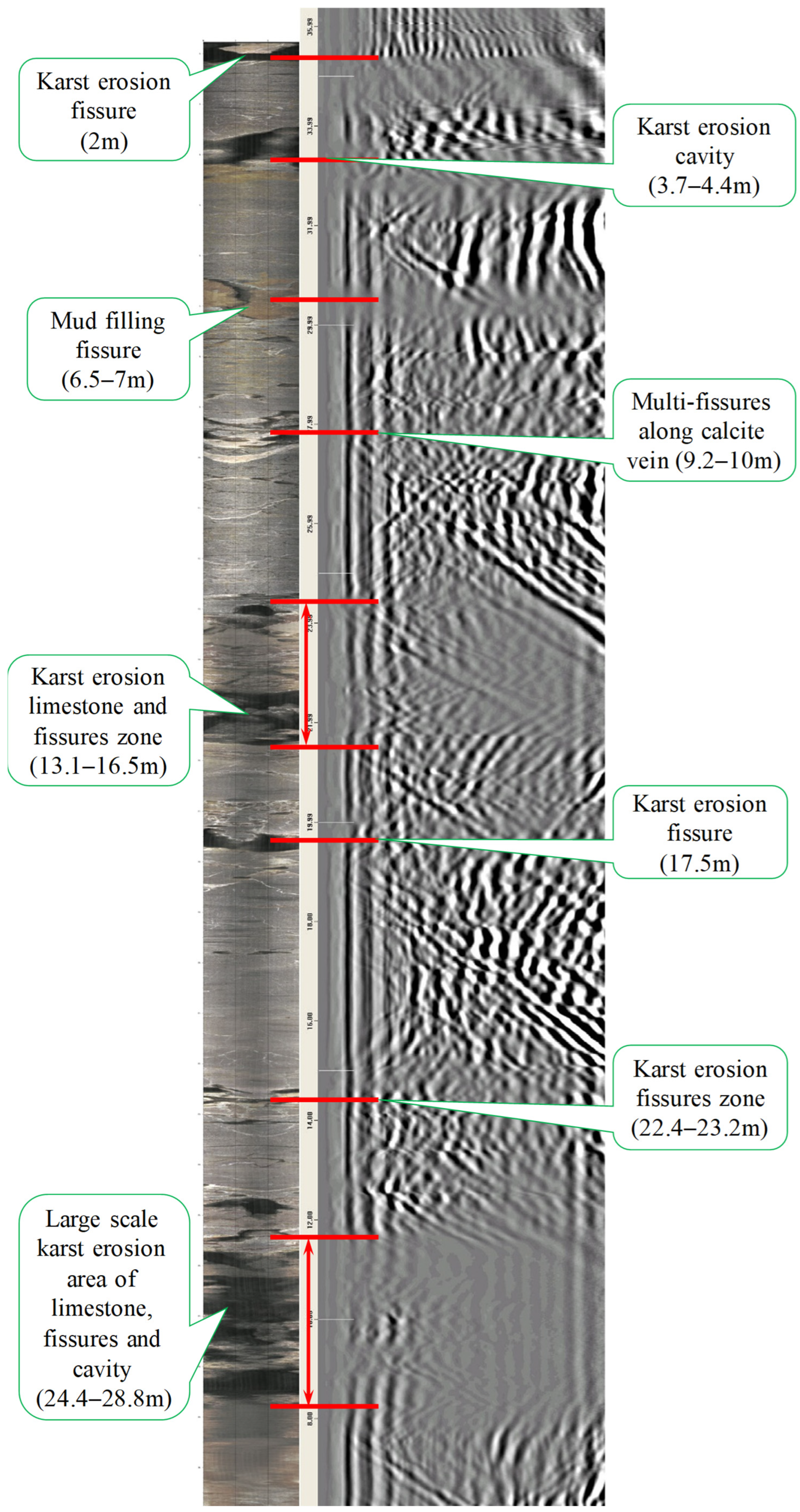
2.3. Comparison of Borehole GPR and Borehole Optical Imaging Data

2.4. Dynamic Exploration Method of Geological Structures
- (1)
- Initial mobilization and single-borehole survey. An intermediate imaging survey is conducted at each control point borehole. The borehole optical imaging results enable measurement of the rock mass integrity index, identification of fracture zones and their dip angles, and detection of potential corrosion areas at the site. Concurrently, existing boreholes are utilized for downhole radar surveys to obtain radar waveform profiles, from which adverse geological phenomena within a radial range of tens of meters can be inferred.
- (2)
- Preliminary on-site data analysis. The integrity of the rock mass and the presence of adverse geological conditions around the borehole are assessed based on the detection results from the control points.
- (3)
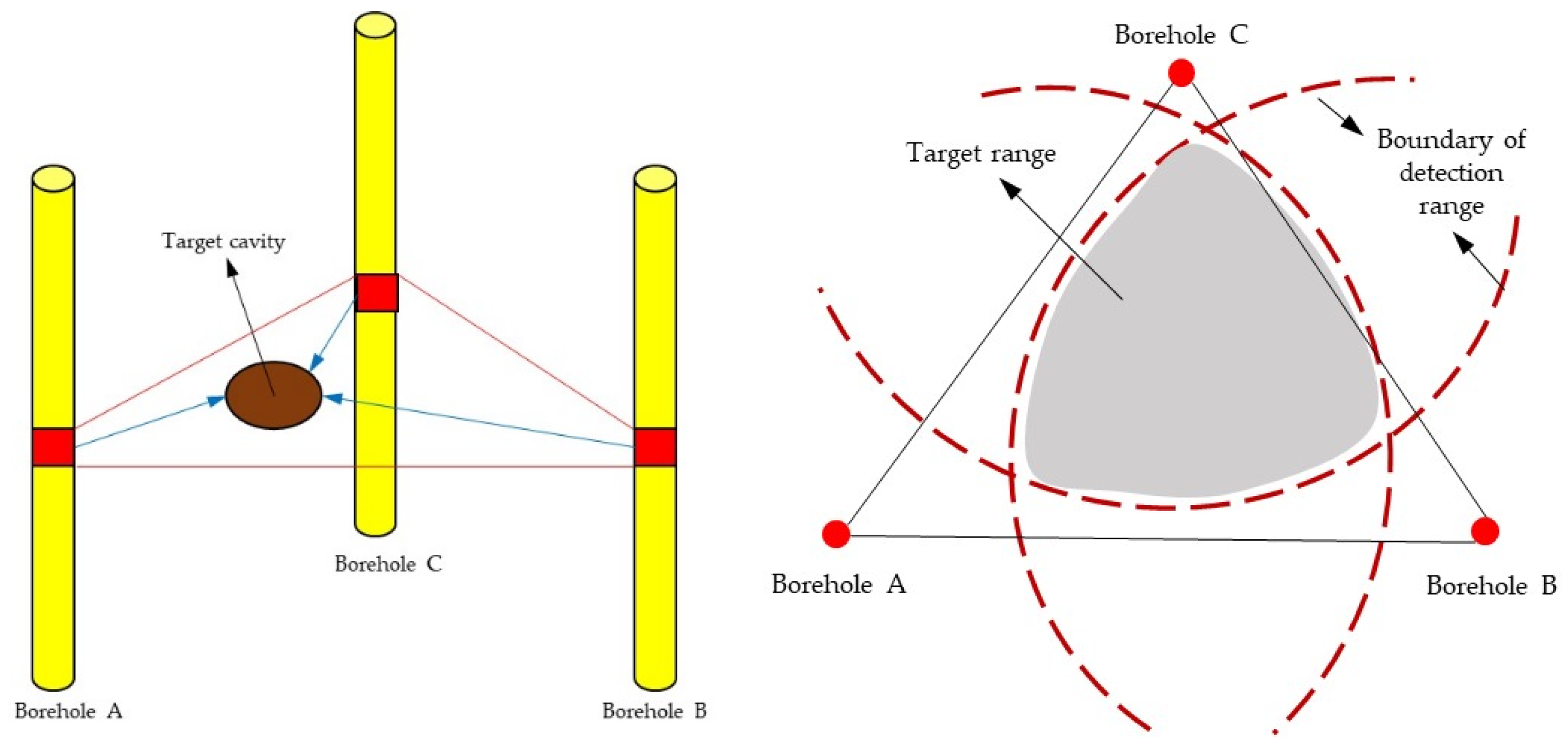
- Adaptive drilling decision and multi-borehole joint analysis. Based on the preliminary analysis results, if no significant geological anomalies are detected in a single borehole, the survey proceeds directly to the next control point. If anomalous geological bodies are identified, additional boreholes may be drilled in the area of concern for multi-borehole testing according to project requirements. Joint testing and analysis are performed on two or more adjacent boreholes. Using digital borehole images and radar profiles, the basic characteristics of structural planes between boreholes are analyzed, including their nature, orientation, depth, and aperture width, to determine the connectivity of structural planes across different boreholes. Simultaneously, the location, geometry, and dimensions of unfavorable geological bodies such as karst features between boreholes can be accurately determined.
- (4)
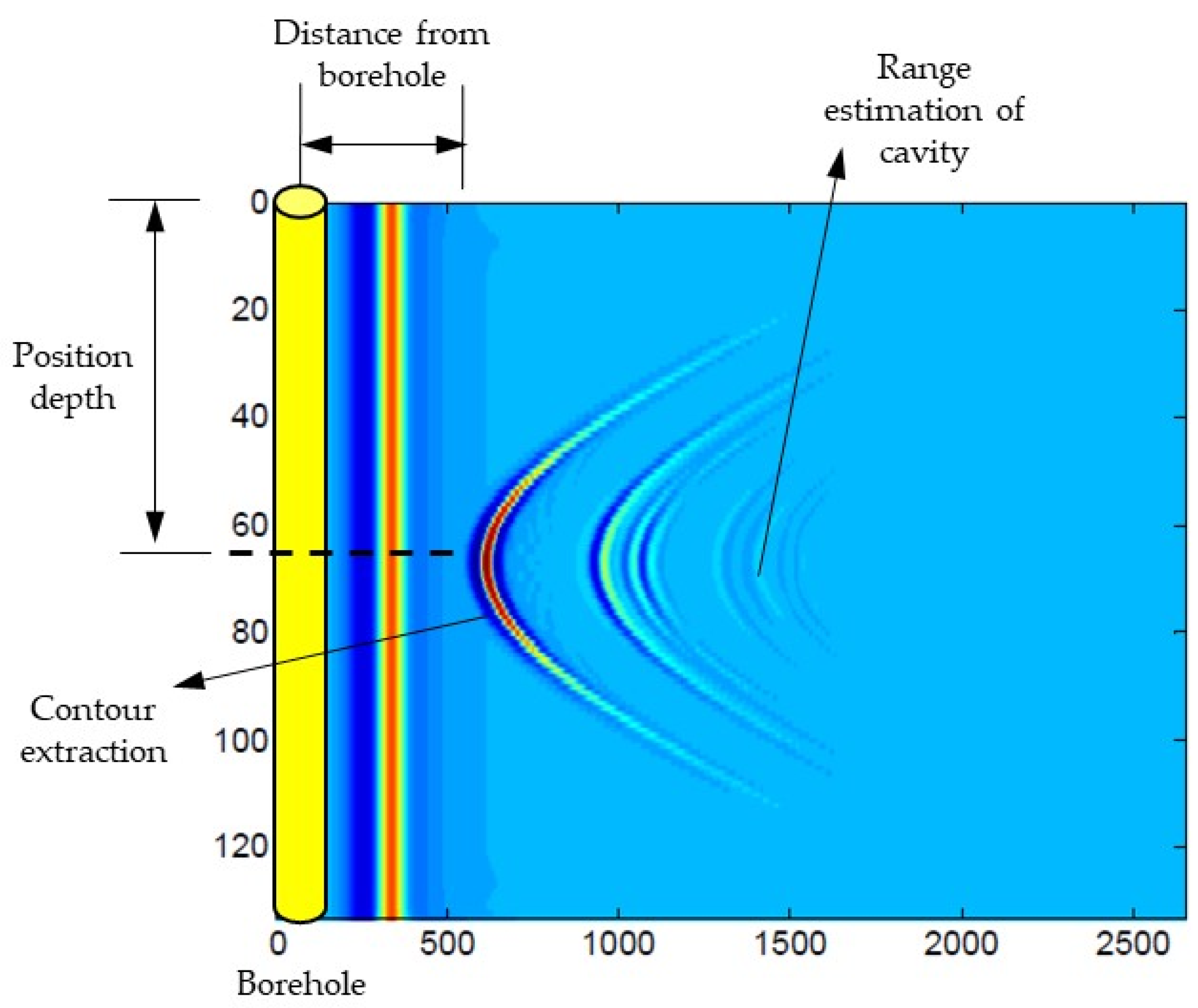
- Indoor data compilation and correlation fusion analysis. Data from all boreholes are subjected to correlation and fusion analysis. Feature bodies are extracted through digital image analysis, and adverse geological structures are evaluated using the established geometric-physical model through regression analysis to estimate target dimensions and spatial coordinates. This enables more accurate characterization of geological conditions along the project alignment, thereby completing the survey task.
3. Results
4. Discussion
- (1)
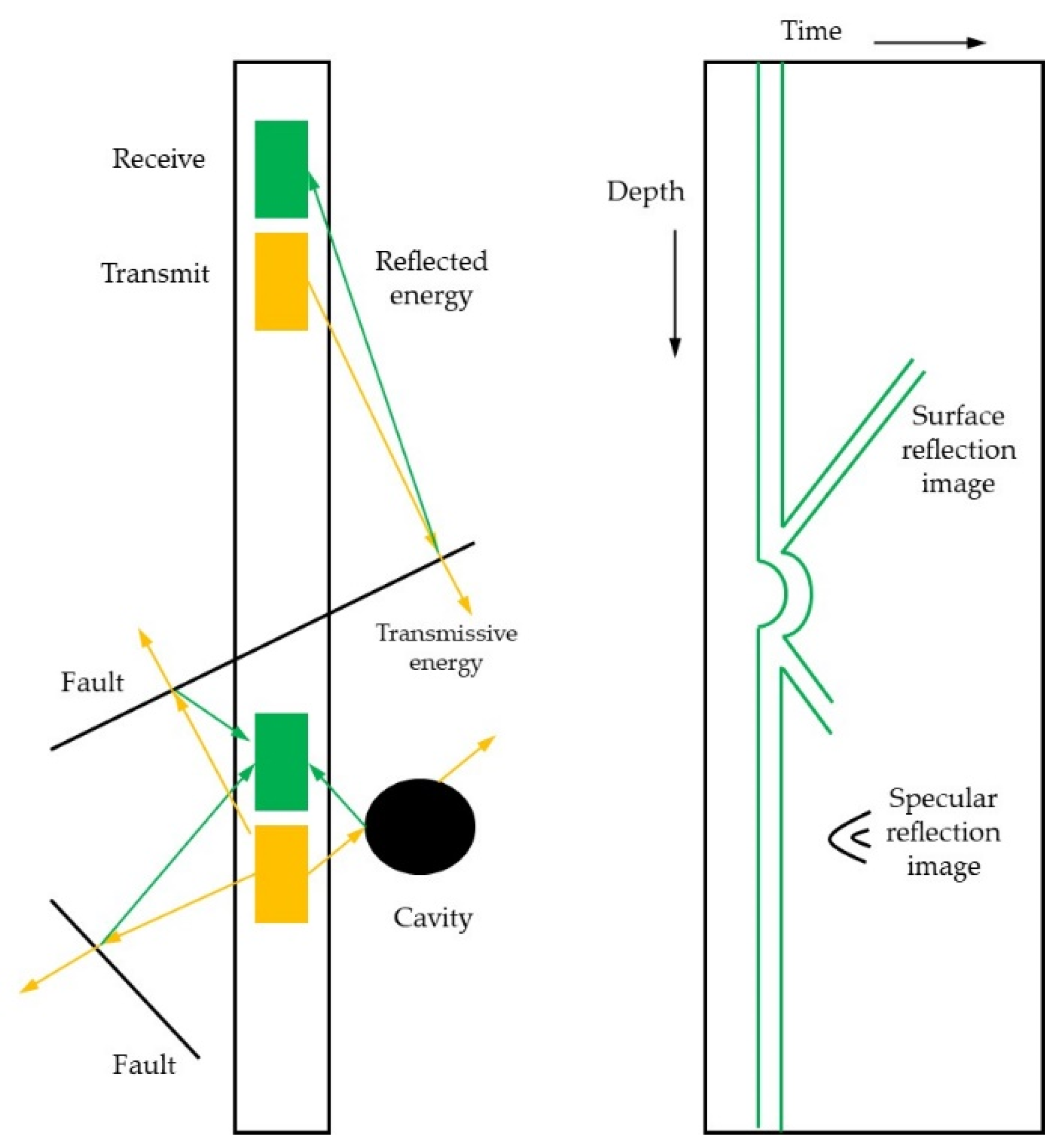
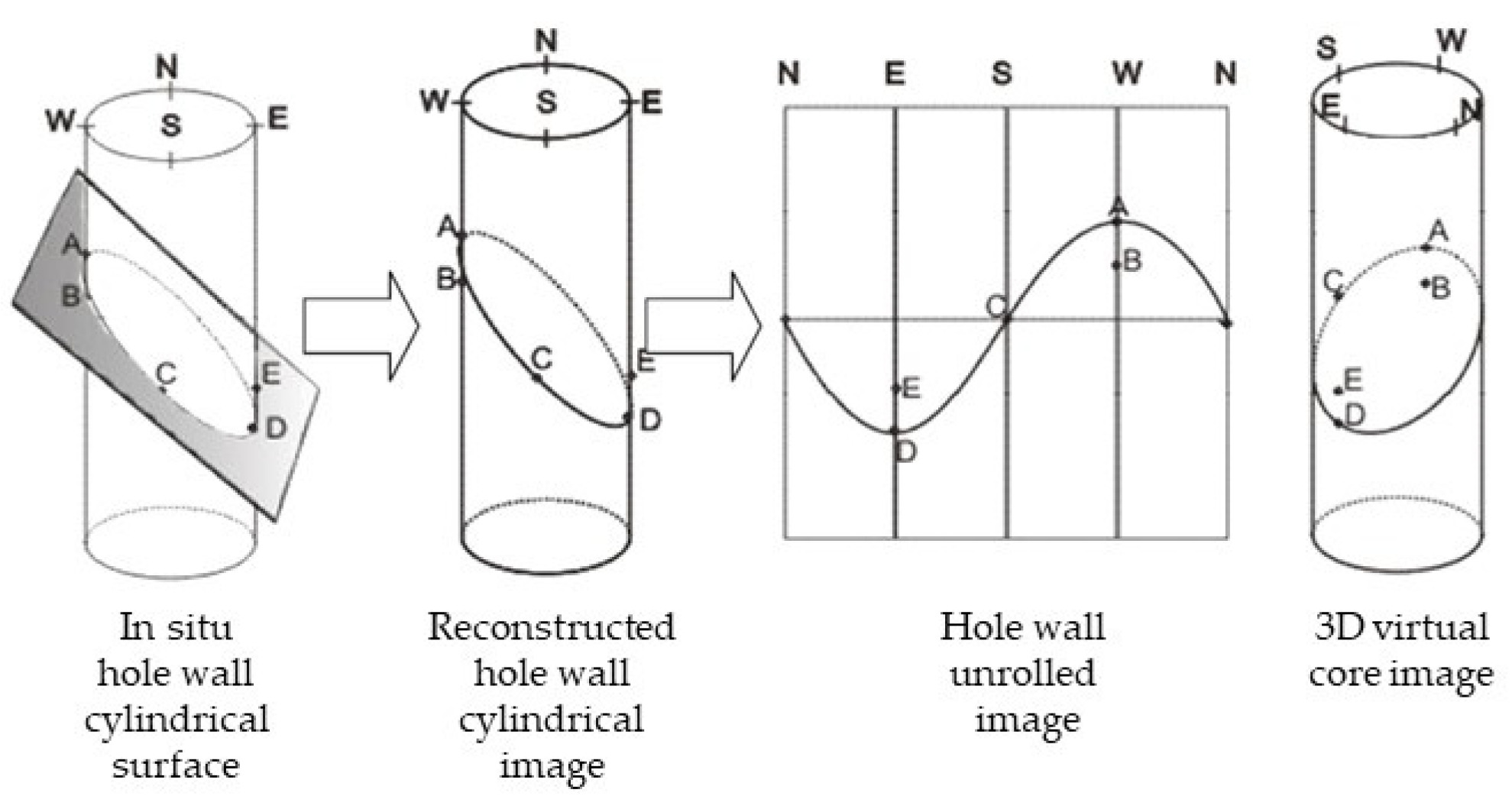
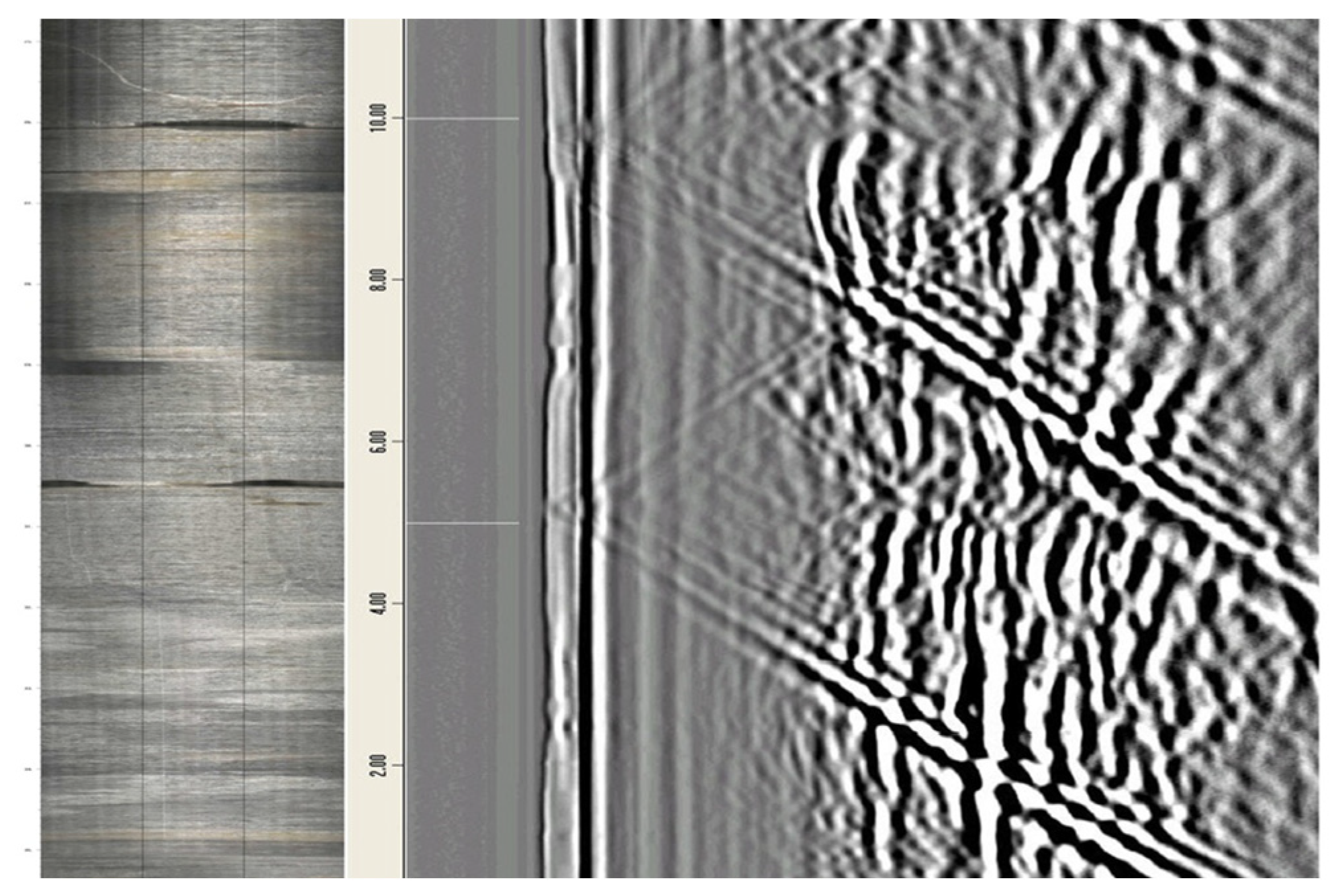
- Complementarity and correlation between optical imaging and borehole GPR. The complementarity of the two methods is rooted in their different physical responses to the same rock mass structures. Optical imaging directly reveals the geometric morphology of borehole wall structures in a “what you see is what you get” manner, whereas GPR indirectly captures the spatial extension of structures through electromagnetic reflections. When an open fracture on the borehole wall extends into the surrounding rock, it simultaneously appears as a visible feature in the optical image and as a reflection interface for the radar wave, thereby forming a close spatial correspondence and high correlation. The joint application of the two methods essentially couples deterministic information from the borehole wall with concealed information from the surrounding rock, enabling three-dimensional characterization from the one-dimensional borehole wall to the surrounding rock mass. It should be noted that the effective range of this correlation is constrained by the physical detection capability of GPR. For the 100 MHz antenna used in this study, the effective detection radius is approximately 10 m under typical hard rock conditions. Within this range, optical imaging can serve as a reliable verification benchmark for radar anomaly interpretation; beyond this distance, the electromagnetic signal attenuates to the noise level, and the spatial correlation between the two datasets disappears. This boundary can be quantitatively evaluated through numerical simulation or calibration with known targets.
- (2)
- Ambiguity reduction in GPR interpretation through optical imaging constraints. The inherent ambiguity of borehole radar detection results is an intrinsic characteristic of the method. Since electromagnetic reflection signals are jointly influenced by electrical property contrasts, geometric configurations, and environmental noise within the rock mass, it is difficult to uniquely determine the nature and spatial location of anomalies based solely on radar profiles. In contrast, borehole optical imaging directly acquires borehole wall images, deterministically revealing structural features such as fractures, bedding planes, and cavities. Within the proposed joint detection framework, the high-certainty information provided by optical images serves as a verification benchmark for radar interpretation: only when a radar anomaly strictly corresponds in spatial position to an open fracture revealed in the optical image is it confirmed as valid; otherwise, it is regarded as a potential false signal or interference. This strategy of constraining radar interpretation with optical imaging effectively reduces the uncertainty associated with the inherent ambiguity of single-hole radar methods and improves the overall reliability of interpretation results.
- (3)
- Operational requirements and technical constraints. Both digital borehole optical imaging and borehole GPR are applicable to vertical and near-vertical boreholes with smooth walls. Since the digital borehole image system employs optical imaging technology, it has certain requirements for water clarity within the borehole. Currently, there are no documented applications of optical systems in extremely turbid water or mud-filled holes. If the borehole water is turbid, improvement measures must be taken, such as water replacement to clarify the return water, alum precipitation, and settling. Furthermore, because mud slurry was used for wall stabilization during this geological investigation, inadequate flushing during hole cleaning had a certain impact on image quality. The following improvements are recommended: (i) coordination and cooperation among drilling, digital imaging, and GPR surveys should be well organized; (ii) for integrated digital imaging and GPR surveys, regardless of subsurface complexity and unfavorable conditions, basically measurable boreholes are required to allow sensor probes to penetrate underground and reach the required depths; (iii) digital borehole images require borehole diameters of Φ46–Φ130 mm, dry or clean-water holes, and removal of mud slurry; (iv) borehole GPR requires borehole diameters greater than Φ50 mm.
- (4)
- Reproducibility and future standardization. Finally, reproducibility is recognized as a fundamental scientific principle. Although the current description of the data fusion framework provides sufficient practical details for engineering applications, further standardization would enhance its quantitative rigor. Therefore, the development of more standardized and quantitatively rigorous fusion protocols—including automated feature-extraction algorithms, objective correlation criteria, and validated inversion strategies—represents an important direction for future research. These advances will help bridge the gap between conceptual methodology and fully reproducible analytical workflows, ultimately providing a solid scientific foundation for the integrated application of borehole imaging technology in engineering geological investigation.
5. Conclusions
- (1)
- The integrated use of borehole optical imaging and GPR proves effective for geological exploration. Optical imaging provides high-resolution, direct visual documentation of borehole walls, capturing fine-scale discontinuities, while borehole GPR radially extends the detection range into surrounding rock masses. The fused analysis of processed images and radar data enables an intuitive and comprehensive representation of rock morphology, including the distribution of fractures, joints, and fracture zones, thereby meeting the objectives of dynamic survey approaches.
- (2)
- The dynamic adjustment of survey layouts, particularly the triangular borehole pattern, allows real-time refinement of exploration targets based on initial findings. This method significantly reduces the number of boreholes required while maintaining effective fracture detection, including fractures with apertures exceeding 1 cm and meter-scale cavities. An integrated analysis of the six boreholes successfully identified common anomalous features, with good consistency between optical imaging and GPR results, validating the practical feasibility of the proposed approach.
- (3)
- The three-dimensional visualization of borehole wall development maps accurately reflects the morphological characteristics of rocks, the distribution of geological structures, and the original state of features such as rock veins. The triangular three-hole survey layout is recommended for promotion in similar engineering applications.
- (4)
- The proposed method demonstrates broad applicability in engineering projects requiring detailed subsurface characterization, including tunnel construction, dam foundation assessment, slope stability analysis, and mineral exploration. Future advancements in sensor technology, data processing algorithms, and real-time interpretation software are expected to enhance automation and usability. Furthermore, integration with machine learning techniques may improve pattern recognition and predictive modeling, contributing to smarter and more risk-aware engineering design and construction.
Author Contributions
Funding
Data Availability Statement
Conflicts of Interest
References
- Wang, C.Y.; Ge, X.R.; Bai, S.W. Study of the digital panoramic borehole image system. Chin. J. Rock Mech. Eng. 2002, 21, 398–403. [Google Scholar]
- Wang, C.Y.; Wang, Y.T.; Zou, X.J.; Han, Z.Q.; Zhong, S. Study of a borehole panoramic stereopair imaging system. Int. J. Rock Mech. Min. Sci. 2018, 104, 174–181. [Google Scholar] [CrossRef]
- Han, Z.Q.; Wang, C.Y.; Wang, C.; Zou, X.J.; Jiao, Y.Y.; Hu, S. A proposed method for determining in-situ stress from borehole breakout based on the borehole stereo-pair imaging technique. J. Rock Mech. Min. Sci. 2018, 127, 104215. [Google Scholar] [CrossRef]
- Kim, J.-H.; Park, S.-G.; Yi, M.-J.; Son, J.-S.; Cho, S.-J. Borehole radar investigations for locating an ice ring formed by cryogenic conditions in an underground cavern. J. Appl. Geophys. 2007, 62, 204–214. [Google Scholar] [CrossRef]
- Yi, Y.; Huisman, J.A.; Klotzsche, A.; Vereecken, H.; Weihermüller, L. Coupled full-waveform inversion of horizontal borehole ground penetrating radar data to estimate soil hydraulic parameters: A synthetic study. J. Hydrol. 2022, 610, 127817. [Google Scholar] [CrossRef]
- Wang, J.C.; Xu, H.H.; Zou, J.P. Fine detection technology of rock mass structure based on borehole acousto-optic combined measurement. Measurement 2022, 187, 110259. [Google Scholar] [CrossRef]
- Li, S.J.; Feng, X.T.; Wang, C.Y.; Hudson, J.A. ISRM Suggested method for rock fractures observations using a borehole digital optical televiewer. Rock Mech. Rock Eng. 2013, 46, 635–644. [Google Scholar] [CrossRef]
- Kevin, J.C. Application of ground-penetrating radar, digital optical borehole images, and cores for characterization of porosity, hydraulic conductivity, and paleokarst in the Biscayne aquifer, southeastern Florida, USA. J. Appl. Geophys. 2004, 55, 61–76. [Google Scholar] [CrossRef]
- Zhong, S.; Wang, C.-Y.; Wu, L.-X.; Tang, X.-J.; Wang, Q.-Y. Integrated application of borehole GPR and borehole imaging to geological surveys. Process Geophys. 2011, 26, 335–341. [Google Scholar]
- Spillmann, T.; Maurer, H.; Willenberg, H.; Evans, K.F.; Heincke, B.; Green, A.G. Characterization of an unstable rock mass based on borehole logs and diverse borehole radar data. J. Appl. Geophys. 2007, 61, 16–38. [Google Scholar] [CrossRef]
- Williams, J.H.; Johnson, C.D. Acoustic and optical borehole-wall imaging for fractured-rock aquifer studies. J. Appl. Geophys. 2004, 55, 151–159. [Google Scholar] [CrossRef]
- Serzu, M.H.; Kozak, E.T.; Lodha, G.S.; Everitt, R.; Woodcock, D. Use of borehole radar techniques to characterize fractured granitic bedrock at AECL’s Underground Research Laboratory. J. Appl. Geophys. 2004, 55, 137–150. [Google Scholar] [CrossRef]
- Li, L.; Wang, R.; Peng, T.; Hao, J.; Zhou, Z.; Han, Z. Identification of geo-bodies in borehole radar image based on Curvelet transform. J. Appl. Geophys. 2021, 189, 104325. [Google Scholar] [CrossRef]
- Tang, X.J.; Sun, T.; Tang, Z.; Tang, J.; Wei, B. Geological disaster survey based on Curvelet transform with borehole Ground Penetrating Radar in Tonglushan old mine site. J. Environ. Sci. 2011, 23, 78–83. [Google Scholar] [CrossRef] [PubMed]
- Mansour, K.; Basheer, A.A.; Rabeh, T.; Khalil, A.; Eldin, A.A.; Sato, M. Geophysical assessment of the hydraulic property of the fracture systems around Lake Nasser, Egypt: In sight of polarimetric borehole radar. NRIAG J. Astron. Geophys. 2014, 3, 7–17. [Google Scholar] [CrossRef]
- Jin, C.Y.; Wang, K.; Han, T.; Lu, Y.; Liu, A.; Liu, D. Segmentation of ore and waste rocks in borehole images using the multi-module densely connected U-net. Comput. Geosci. 2021, 159, 105018. [Google Scholar] [CrossRef]
- Yu, Y.; Weihermüller, L.; Klotzsche, A.; Lärm, L.; Vereecken, H.; Huisman, J.A. Sequential and Coupled Inversion of Horizontal Borehole Ground Penetrating Radar Data to Estimate Soil Hydraulic Properties at the Field Scale. J. Hydrol. 2021, 596, 126010. [Google Scholar] [CrossRef]
- Liu, L.B. Virtual multi-offset reflection profiling with interferometric imaging for borehole radar—ScienceDirect. Signal Process. 2017, 132, 319–326. [Google Scholar] [CrossRef]


Disclaimer/Publisher’s Note: The statements, opinions and data contained in all publications are solely those of the individual author(s) and contributor(s) and not of MDPI and/or the editor(s). MDPI and/or the editor(s) disclaim responsibility for any injury to people or property resulting from any ideas, methods, instructions or products referred to in the content. |
© 2026 by the authors. Licensee MDPI, Basel, Switzerland. This article is an open access article distributed under the terms and conditions of the Creative Commons Attribution (CC BY) license.
Share and Cite
Xiong, Y.; Chen, H.; Han, Z.; Wang, C. Integrated Borehole GPR and Optical Imaging for Field Investigation of Rock Mass Structures. Symmetry 2026, 18, 875. https://doi.org/10.3390/sym18050875
Xiong Y, Chen H, Han Z, Wang C. Integrated Borehole GPR and Optical Imaging for Field Investigation of Rock Mass Structures. Symmetry. 2026; 18(5):875. https://doi.org/10.3390/sym18050875
Chicago/Turabian StyleXiong, Yangyang, Haijun Chen, Zengqiang Han, and Chao Wang. 2026. "Integrated Borehole GPR and Optical Imaging for Field Investigation of Rock Mass Structures" Symmetry 18, no. 5: 875. https://doi.org/10.3390/sym18050875
APA StyleXiong, Y., Chen, H., Han, Z., & Wang, C. (2026). Integrated Borehole GPR and Optical Imaging for Field Investigation of Rock Mass Structures. Symmetry, 18(5), 875. https://doi.org/10.3390/sym18050875