Branch-Priority Exploration for Mobile Robots in Restricted Industrial Corridors

Abstract
1. Introduction
- A symmetry-aware branch detection module that uses multi-directional LiDAR range measurements to identify T-shaped junctions and lateral entrances, applying identical thresholds to both lateral directions so that branch entry is determined by direct geometric evidence rather than frontier score comparisons near intersections.
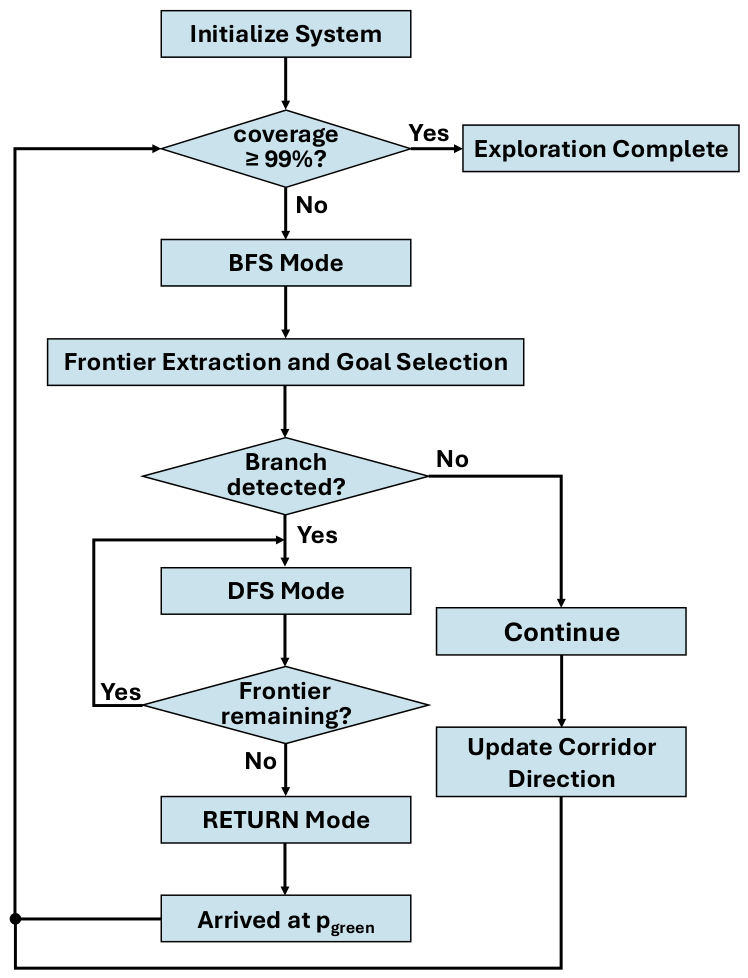
- A hierarchical BFS/DFS mode-switching policy that separates main-corridor progression from branch exploration, with entry and post-return locks to prevent the robot from switching back too early.
- A barrier-based branch memory that places a permanent virtual barrier at each confirmed branch entrance, preventing the planner from routing the robot back into branches that have already been explored.
2. Problem Formulation
2.1. Notation and Symbol Summary
2.2. Robot Motion and Perception Model
2.3. Coverage and Barrier Constraint
3. Methodology
3.1. Decision Policy on Occupancy Grids
3.2. Branch-Priority Policy with Memory
3.3. Convergence Analysis
4. Implementation
4.1. ROS Deployment and Configuration
4.2. Algorithm Description
| Algorithm 1: Online execution pipeline for branch-priority exploration with barrier memory |
 |
5. Test in ROS Environment
5.1. ROS Environment Setup
- : Total mission time (s).
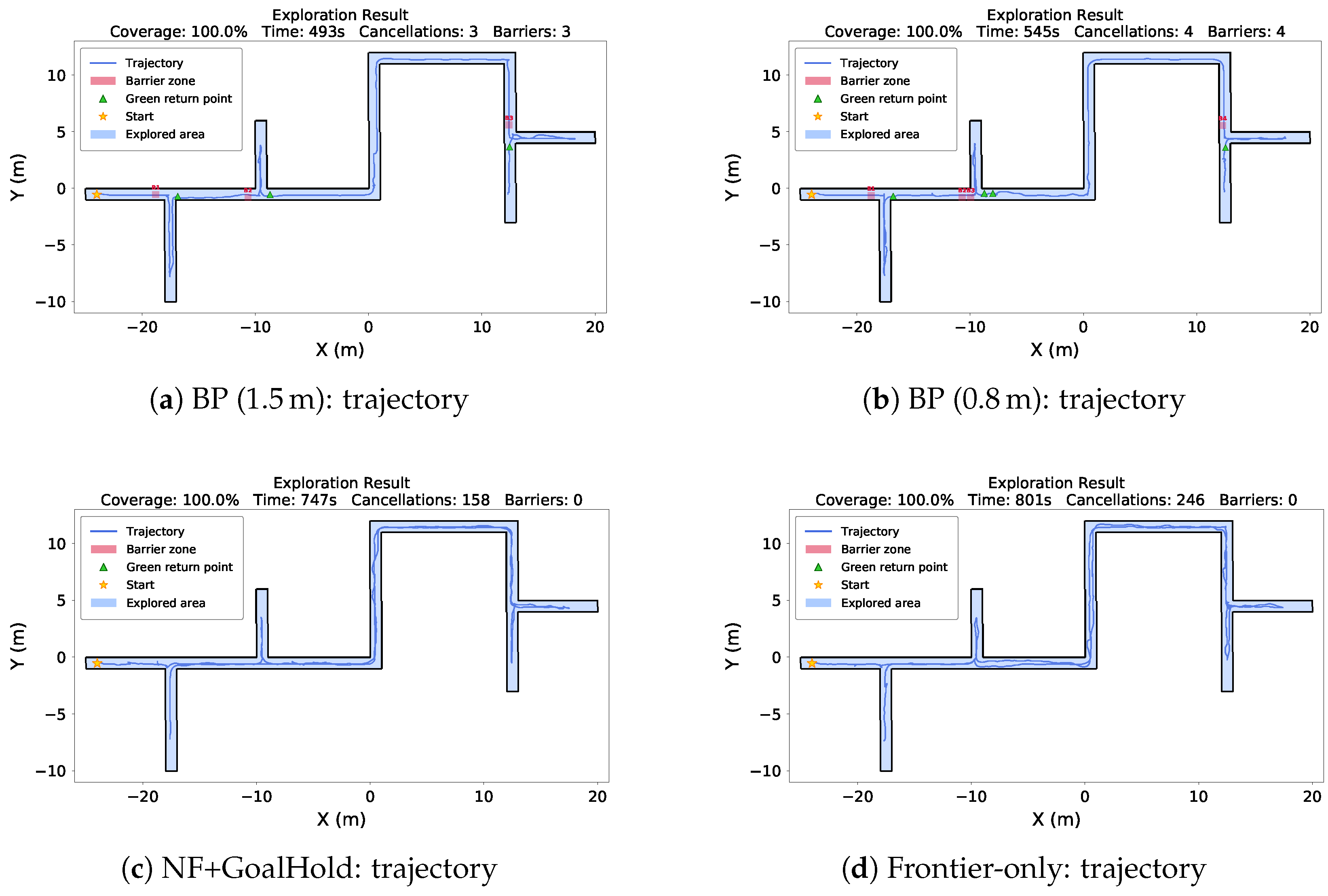
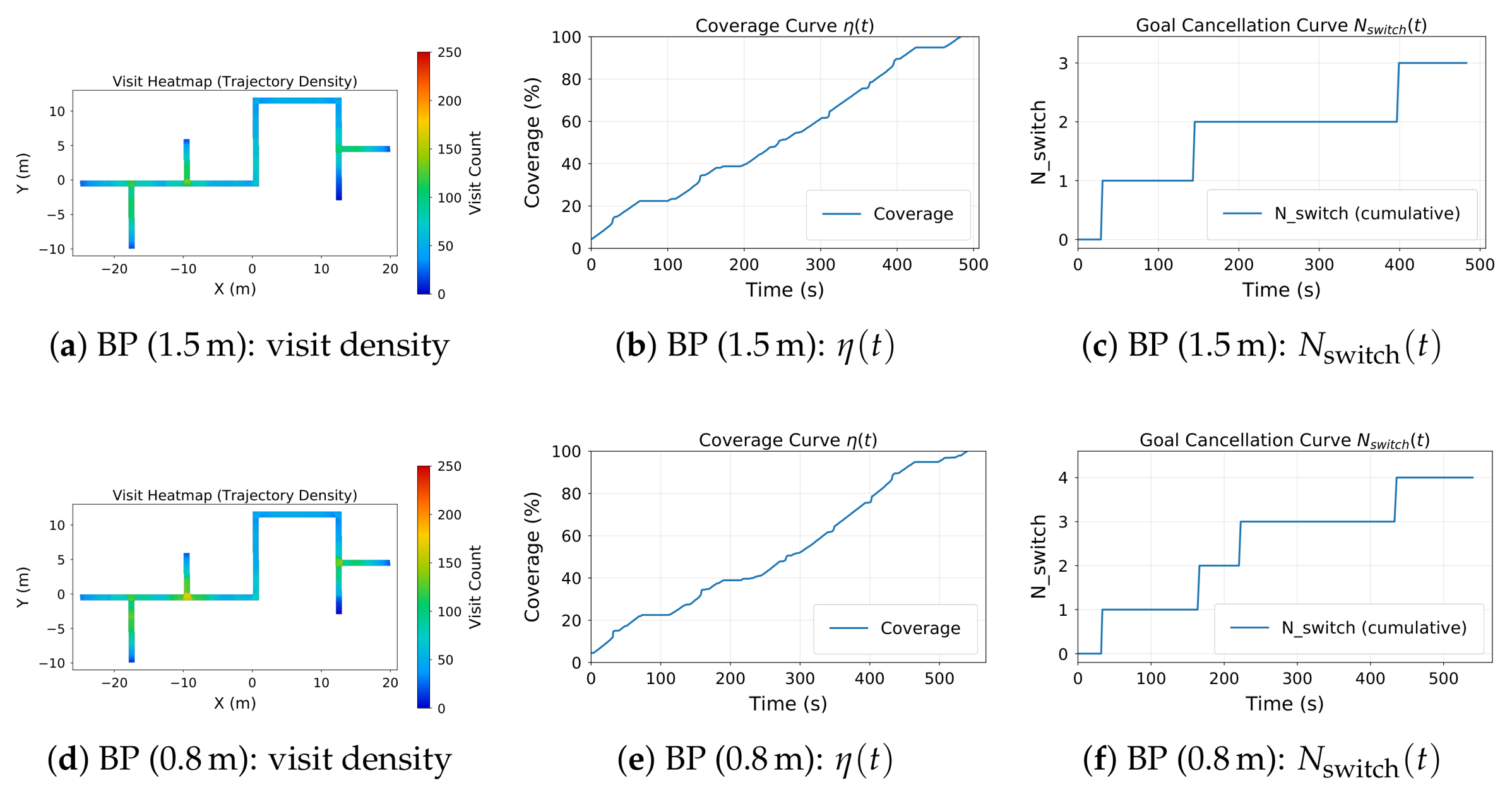
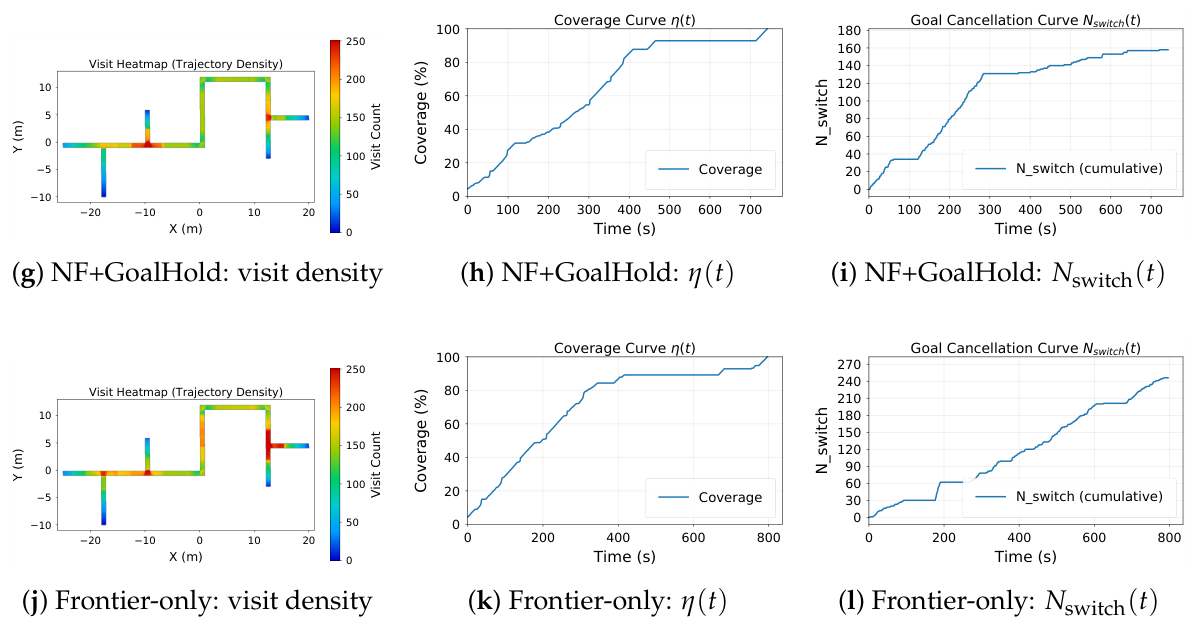
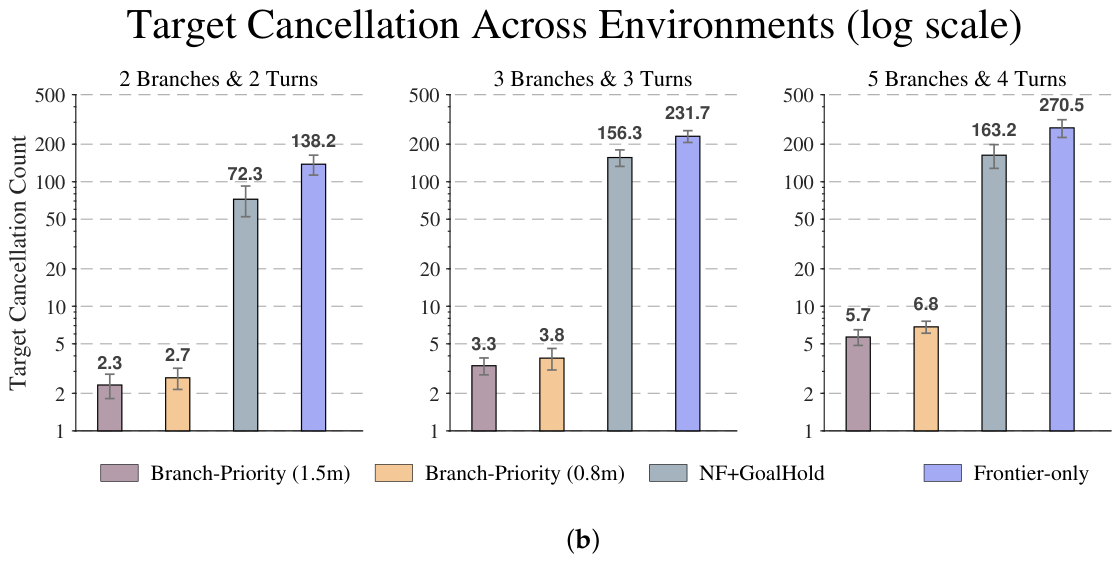
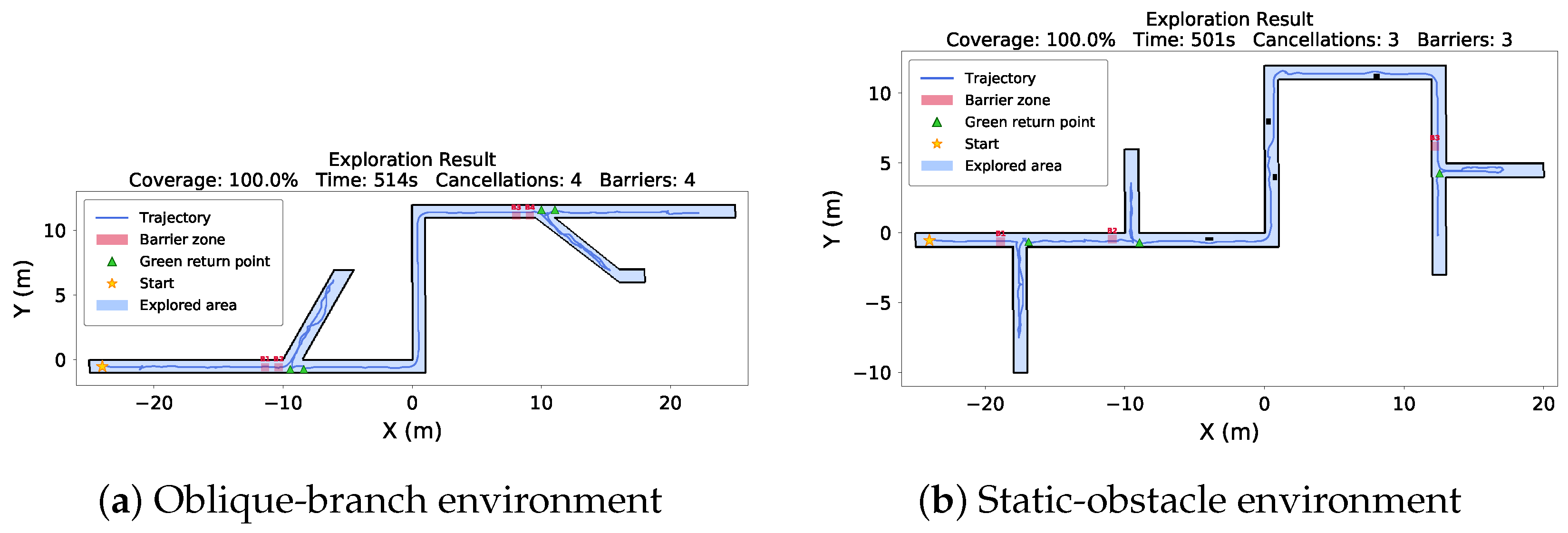
- : Total goal cancellations dispatched to move_base by the exploration node, counting every call to cancel_all_goals() regardless of trigger type. For the proposed method, a cancellation is issued only when a branch is detected; so, equals the number of branch-detection events across the mission.
- : Fraction of trials reaching before timeout (%).
5.2. Baselines and Main Results
5.3. Discussion and Qualitative Analysis
6. Conclusions and Future Work
Author Contributions
Funding
Data Availability Statement
Conflicts of Interest
Appendix A. Proof of Theorem 2
References
- Chen, C.; Wang, Z.; Gong, Z.; Cai, P.; Zhang, C.; Li, Y. Autonomous Navigation and Obstacle Avoidance for Small VTOL UAV in Unknown Environments. Symmetry 2022, 14, 2608. [Google Scholar] [CrossRef]
- Azpúrua, H.; Saboia, M.; Freitas, G.M.; Clark, L.; Agha-mohammadi, A.a.; Pessin, G.; Campos, M.F.; Macharet, D.G. A Survey on the autonomous exploration of confined subterranean spaces: Perspectives from real-word and industrial robotic deployments. Robot. Auton. Syst. 2023, 160, 104304. [Google Scholar] [CrossRef]
- Kozhubaev, Y.; Novak, D.; Ershov, R.; Xu, W.; Cheng, H. Research on Navigation and Dynamic Symmetrical Path Planning Methods for Automated Rescue Robots in Coal Mines. Symmetry 2025, 17, 875. [Google Scholar] [CrossRef]
- Chen, P.; Huang, B.; Yuan, S.; Jin, Y.; Hou, J. Automated mobile robot-based detection of in-process tunnel lining deformation during construction. Autom. Constr. 2025, 180, 106560. [Google Scholar] [CrossRef]
- Shafaei, S.M.; Mousazadeh, H. Development of a mobile robot for safe mechanical evacuation of hazardous bulk materials in industrial confined spaces. J. Field Robot. 2021, 39, 218–231. [Google Scholar] [CrossRef]
- Xiao, X.; Xu, Z.; Wang, Z.; Song, Y.; Warnell, G.; Stone, P.; Zhang, T.; Ravi, S.; Wang, G.; Karnan, H.; et al. Autonomous Ground Navigation in Highly Constrained Spaces: Lessons Learned From the Benchmark Autonomous Robot Navigation Challenge at ICRA 2022. IEEE Robot. Autom. Mag. 2022, 29, 148–156. [Google Scholar] [CrossRef]
- Wang, D.; Liu, Q.; Yang, J.; Huang, D. Research on Path Planning for Intelligent Mobile Robots Based on Improved A* Algorithm. Symmetry 2024, 16, 1311. [Google Scholar] [CrossRef]
- Petracek, P.; Kratky, V.; Petrlik, M.; Baca, T.; Kratochvil, R.; Saska, M. Large-Scale Exploration of Cave Environments by Unmanned Aerial Vehicles. IEEE Robot. Autom. Lett. 2021, 6, 7596–7603. [Google Scholar] [CrossRef]
- Kolvenbach, H.; Wisth, D.; Buchanan, R.; Valsecchi, G.; Grandia, R.; Fallon, M.; Hutter, M. Towards autonomous inspection of concrete deterioration in sewers with legged robots. J. Field Robot. 2020, 37, 1314–1327. [Google Scholar] [CrossRef]
- Miller, I.D.; Cladera, F.; Cowley, A.; Shivakumar, S.S.; Lee, E.S.; Jarin-Lipschitz, L.; Bhat, A.; Rodrigues, N.; Zhou, A.; Cohen, A.; et al. Mine Tunnel Exploration Using Multiple Quadrupedal Robots. IEEE Robot. Autom. Lett. 2020, 5, 2840–2847. [Google Scholar] [CrossRef]
- Azpúrua, H.; Rezende, A.; Potje, G.; Júnior, G.P.d.C.; Fernandes, R.; Miranda, V.; Filho, L.W.d.R.; Domingues, J.; Rocha, F.; de Sousa, F.L.M.; et al. Towards Semi-autonomous Robotic Inspection and Mapping in Confined Spaces with the EspeleoRobô. J. Intell. Robot. Syst. 2021, 101, 69. [Google Scholar] [CrossRef]
- Dang, T.; Tranzatto, M.; Khattak, S.; Mascarich, F.; Alexis, K.; Hutter, M. Graph-based subterranean exploration path planning using aerial and legged robots. J. Field Robot. 2020, 37, 1363–1388. [Google Scholar] [CrossRef]
- Kulkarni, M.; Dharmadhikari, M.; Tranzatto, M.; Zimmermann, S.; Reijgwart, V.; De Petris, P.; Nguyen, H.; Khedekar, N.; Papachristos, C.; Ott, L.; et al. Autonomous Teamed Exploration of Subterranean Environments using Legged and Aerial Robots. In 2022 International Conference on Robotics and Automation (ICRA); IEEE: Piscataway, NJ, USA, 2022; pp. 3306–3313. [Google Scholar] [CrossRef]
- Ebadi, K.; Bernreiter, L.; Biggie, H.; Catt, G.; Chang, Y.; Chatterjee, A.; Denniston, C.E.; Deschênes, S.P.; Harlow, K.; Khattak, S.; et al. Present and Future of SLAM in Extreme Environments: The DARPA SubT Challenge. IEEE Trans. Robot. 2024, 40, 936–959. [Google Scholar] [CrossRef]
- Brugali, D.; Muratore, L.; De Luca, A. Mobile robots exploration strategies and requirements: A systematic mapping study. Int. J. Robot. Res. 2025, 44, 1461–1506. [Google Scholar] [CrossRef]
- Sousa, R.B.; Sobreira, H.M.; Moreira, A.P. A systematic literature review on long-term localization and mapping for mobile robots. J. Field Robot. 2023, 40, 1245–1322. [Google Scholar] [CrossRef]
- Placed, J.A.; Strader, J.; Carrillo, H.; Atanasov, N.; Indelman, V.; Carlone, L.; Castellanos, J.A. A Survey on Active Simultaneous Localization and Mapping: State of the Art and New Frontiers. IEEE Trans. Robot. 2023, 39, 1686–1705. [Google Scholar] [CrossRef]
- Denniston, C.E.; Chang, Y.; Reinke, A.; Ebadi, K.; Sukhatme, G.S.; Carlone, L.; Morrell, B.; Agha-mohammadi, A.a. Loop Closure Prioritization for Efficient and Scalable Multi-Robot SLAM. IEEE Robot. Autom. Lett. 2022, 7, 9651–9658. [Google Scholar] [CrossRef]
- Tran, V.P.; Garratt, M.A.; Kasmarik, K.; Anavatti, S.G. Dynamic Frontier-Led Swarming: Multi-Robot Repeated Coverage in Dynamic Environments. IEEE/CAA J. Autom. Sin. 2023, 10, 646–661. [Google Scholar] [CrossRef]
- Lee, D.; Jung, M.; Yang, W.; Kim, A. LiDAR odometry survey: Recent advancements and remaining challenges. Intell. Serv. Robot. 2024, 17, 95–118. [Google Scholar] [CrossRef]
- Belkin, I.; Abramenko, A.; Yudin, D. Real-Time Lidar-based Localization of Mobile Ground Robot. Procedia Comput. Sci. 2021, 186, 440–448. [Google Scholar] [CrossRef]
- Xu, W.; Cai, Y.; He, D.; Lin, J.; Zhang, F. FAST-LIO2: Fast Direct LiDAR-Inertial Odometry. IEEE Trans. Robot. 2022, 38, 2053–2073. [Google Scholar] [CrossRef]
- Semenas, R.; Bausys, R. Adaptive Autonomous Robot Navigation by Neutrosophic WASPAS Extensions. Symmetry 2022, 14, 179. [Google Scholar] [CrossRef]
- Dai, A.; Papatheodorou, S.; Funk, N.; Tzoumanikas, D.; Leutenegger, S. Fast Frontier-based Information-driven Autonomous Exploration with an MAV. In 2020 IEEE International Conference on Robotics and Automation (ICRA); IEEE: Piscataway, NJ, USA, 2020; pp. 9570–9576. [Google Scholar] [CrossRef]
- Zheng, J.; Mao, S.; Wu, Z.; Kong, P.; Qiang, H. Improved Path Planning for Indoor Patrol Robot Based on Deep Reinforcement Learning. Symmetry 2022, 14, 132. [Google Scholar] [CrossRef]
- Fan, J.; Zhang, X.; Zou, Y. Hierarchical path planner for unknown space exploration using reinforcement learning-based intelligent frontier selection. Expert Syst. Appl. 2023, 230, 120630. [Google Scholar] [CrossRef]
- Teng, Y.; Feng, T.; Li, J.; Chen, S.; Tang, X. A Dual-Layer Symmetric Multi-Robot Path Planning System Based on an Improved Neural Network-DWA Algorithm. Symmetry 2025, 17, 85. [Google Scholar] [CrossRef]
- Cheng, C.; Zhang, H.; Sun, Y.; Tao, H.; Chen, Y. A cross-platform deep reinforcement learning model for autonomous navigation without global information in different scenes. Control Eng. Pract. 2024, 150, 105991. [Google Scholar] [CrossRef]
- Cimurs, R.; Suh, I.H.; Lee, J.H. Goal-Driven Autonomous Exploration Through Deep Reinforcement Learning. IEEE Robot. Autom. Lett. 2022, 7, 730–737. [Google Scholar] [CrossRef]
- Pittol, D.; Mantelli, M.; Maffei, R.; Kolberg, M.; Prestes, E. Loop-Aware Exploration Graph: A concise representation of environments for exploration and active loop-closure. Robot. Auton. Syst. 2022, 155, 104179. [Google Scholar] [CrossRef]
- Yang, F.; Lee, D.H.; Keller, J.; Scherer, S. Graph-based Topological Exploration Planning in Large-scale 3D Environments. In 2021 IEEE International Conference on Robotics and Automation (ICRA); IEEE: Piscataway, NJ, USA, 2021; pp. 12730–12736. [Google Scholar] [CrossRef]
- Cui, X.; Liu, Q.; Liu, Z.; Wang, H. Frontier-Enhanced Topological Memory with Improved Exploration Awareness for Embodied Visual Navigation. In Computer Vision–ECCV 2024; Springer Nature: Cham, Switzerland, 2024; pp. 296–313. [Google Scholar] [CrossRef]



| Method | Scenario | Sensor | Pretrain | Explicit Map | Branch Memory |
|---|---|---|---|---|---|
| BPE (ours) | Corridor | 2D LiDAR | No | No | Yes |
| Topological [31] | 3D tunnel | 3D LiDAR | No | Yes | No |
| Topological [32] | Indoor | Camera | No | Yes | No |
| DRL-based [26] | Indoor | Camera | Yes | No | No |
| Frontier+hysteresis [30] | General | Any | No | No | No |
| NF baseline | General | Any | No | No | No |
| Symbol | Description |
|---|---|
| Robot state (planar pose) | |
| Control input | |
| Linear and angular velocity | |
| Maximum linear and angular velocity | |
| LiDAR measurements | |
| Occupancy grid map | |
| Free (admissible) space | |
| Frontier set | |
| Frontier cluster (i-th) | |
| Cluster priority score | |
| Set of completed branches | |
| Barrier region for branch j | |
| Effective sensing range | |
| Observable cell set from state | |
| 8-neighborhood frontier clustering | |
| Geometric branch detector | |
| Information gain proxy (cluster size) | |
| Navigation path-cost estimate | |
| Observation model | |
| Maximum free range along direction | |
| Passability threshold for direction | |
| Hierarchical target selection policy |
| Category | Parameter | Value |
|---|---|---|
| Map | Resolution | 0.05 m/cell |
| Sensing | Effective range | 3.0 m |
| Control | Decision frequency | 2 Hz |
| Detection | 1.5, 2.0, 3.2, 1.8 m | |
| Detection | Temporal cooldown | 3.0 s |
| Detection | Spatial cooldown | 15 cells |
| Clustering | 0.3 m, 5, 10 | |
| Barrier | Placement offset | 20 cells |
| Barrier | Half-side | 5 cells |
| Lock | Turn-protection | 50 cells |
| Lock | Branch-entry | 30 cells |
| Lock | Post-return | 30 cells |
| DFS completion | 3 | |
| Termination | 0.99, 0.3 m |
| Env | T-Branches | L-Turns | Grid Size (cells) | Free Space (m2) | Traj. Length (m) |
|---|---|---|---|---|---|
| Env-1 | 2 | 2 | 60.2 | 78.19 | |
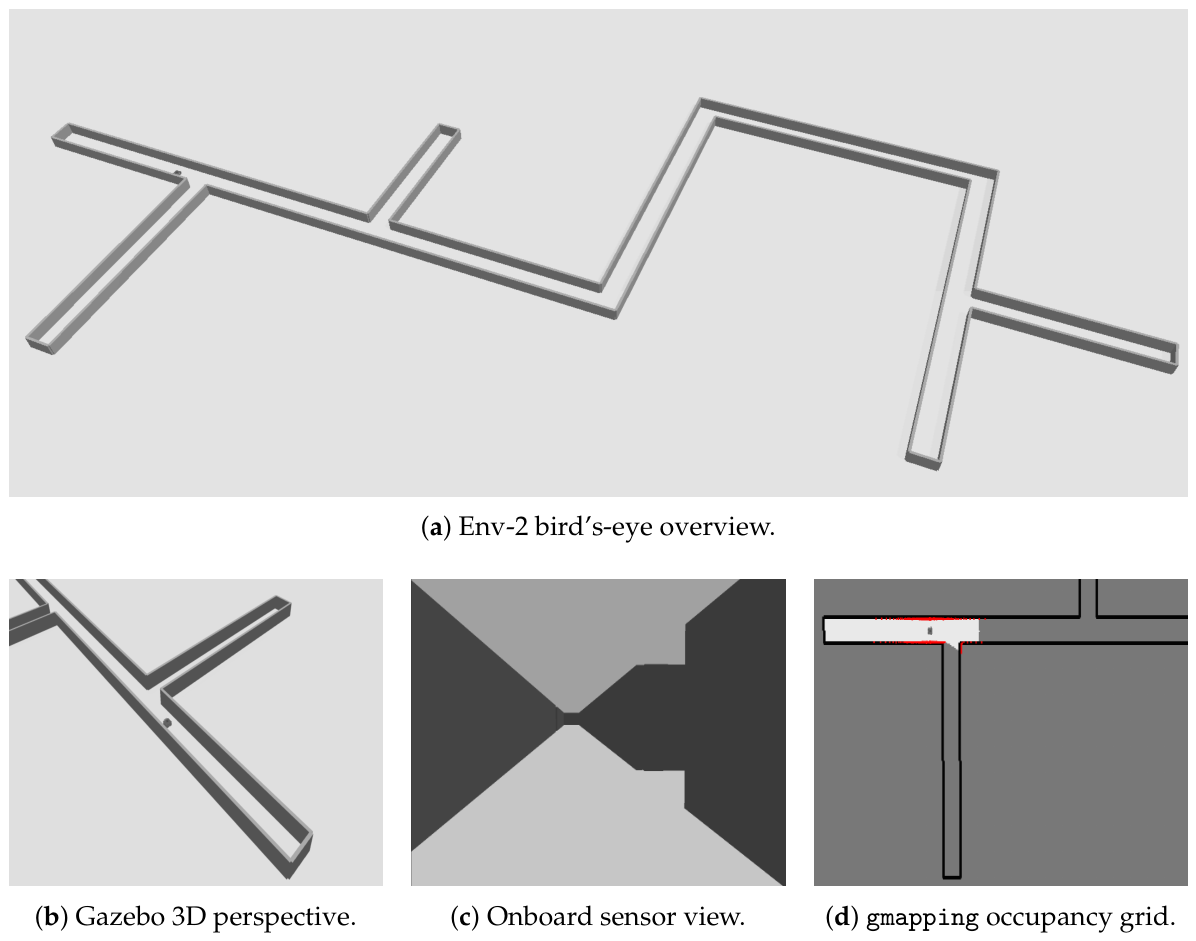
| Env-2 | 3 | 3 | 73.0 | 94.46 | |
| Env-3 | 5 | 4 | 123.2 | 168.40 |
| Env | Method | (s) | (%) | |
|---|---|---|---|---|
| Env-1 | BP (1.5 m) | 100 | ||
| BP (0.8 m) | 100 | |||
| NF+GoalHold | 100 | |||
| NF baseline | 100 | |||
| Env-2 | BP (1.5 m) | 100 | ||
| BP (0.8 m) | 100 | |||
| NF+GoalHold | 100 | |||
| NF baseline | 100 | |||
| Env-3 | BP (1.5 m) | 100 | ||
| BP (0.8 m) | 100 | |||
| NF+GoalHold | 100 | |||
| NF baseline | 100 |
Disclaimer/Publisher’s Note: The statements, opinions and data contained in all publications are solely those of the individual author(s) and contributor(s) and not of MDPI and/or the editor(s). MDPI and/or the editor(s) disclaim responsibility for any injury to people or property resulting from any ideas, methods, instructions or products referred to in the content. |
© 2026 by the authors. Licensee MDPI, Basel, Switzerland. This article is an open access article distributed under the terms and conditions of the Creative Commons Attribution (CC BY) license.
Share and Cite
Yu, W.; Du, W. Branch-Priority Exploration for Mobile Robots in Restricted Industrial Corridors. Symmetry 2026, 18, 806. https://doi.org/10.3390/sym18050806
Yu W, Du W. Branch-Priority Exploration for Mobile Robots in Restricted Industrial Corridors. Symmetry. 2026; 18(5):806. https://doi.org/10.3390/sym18050806
Chicago/Turabian StyleYu, Wenjie, and Wangzhe Du. 2026. "Branch-Priority Exploration for Mobile Robots in Restricted Industrial Corridors" Symmetry 18, no. 5: 806. https://doi.org/10.3390/sym18050806
APA StyleYu, W., & Du, W. (2026). Branch-Priority Exploration for Mobile Robots in Restricted Industrial Corridors. Symmetry, 18(5), 806. https://doi.org/10.3390/sym18050806