Research on a Refined Decision-Making Method for the Multimodal Fuzzy Design Intent of Complex Products Based on Noncooperative–Cooperative Game Serialization


Abstract
1. Introduction
2. Related Studies
2.1. Design Intent Decision-Making
2.2. Game Theory in Product Innovation Design
3. Method
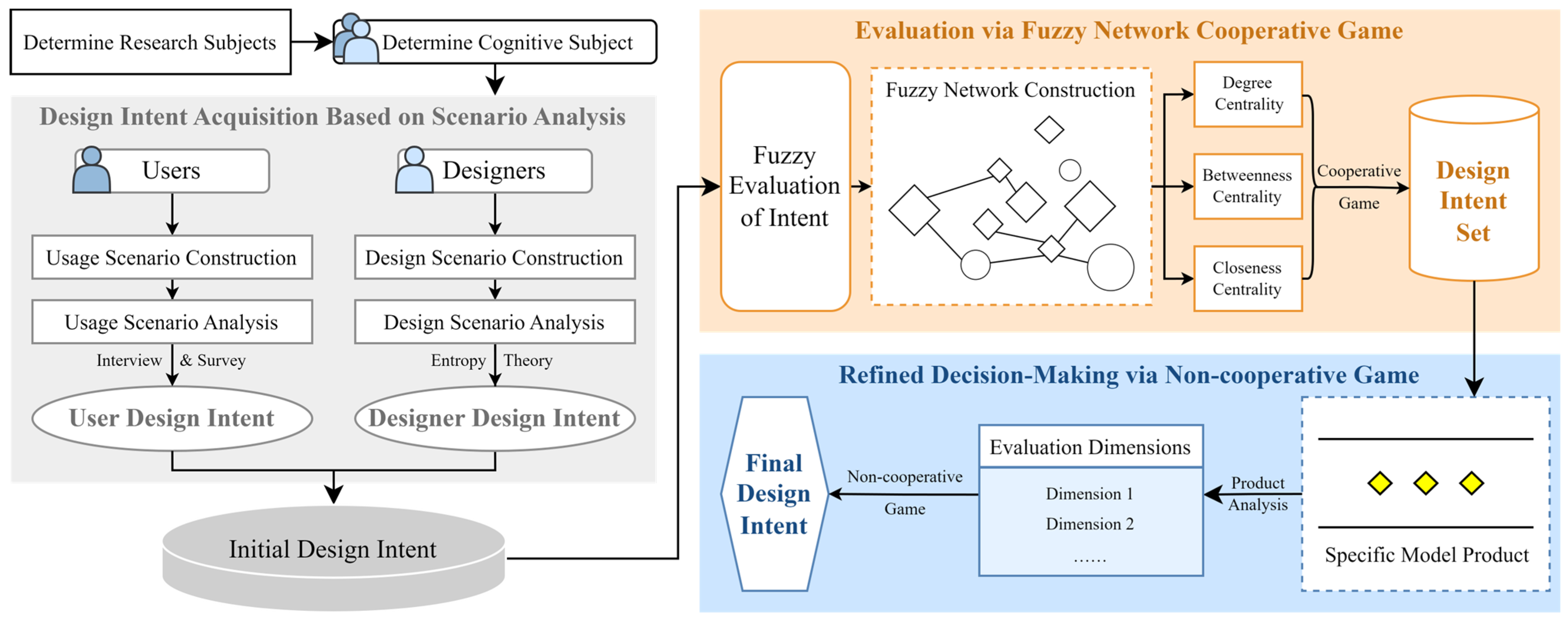
3.1. Multiagent Design Intent Acquisition Based on Scenario Analysis Theory
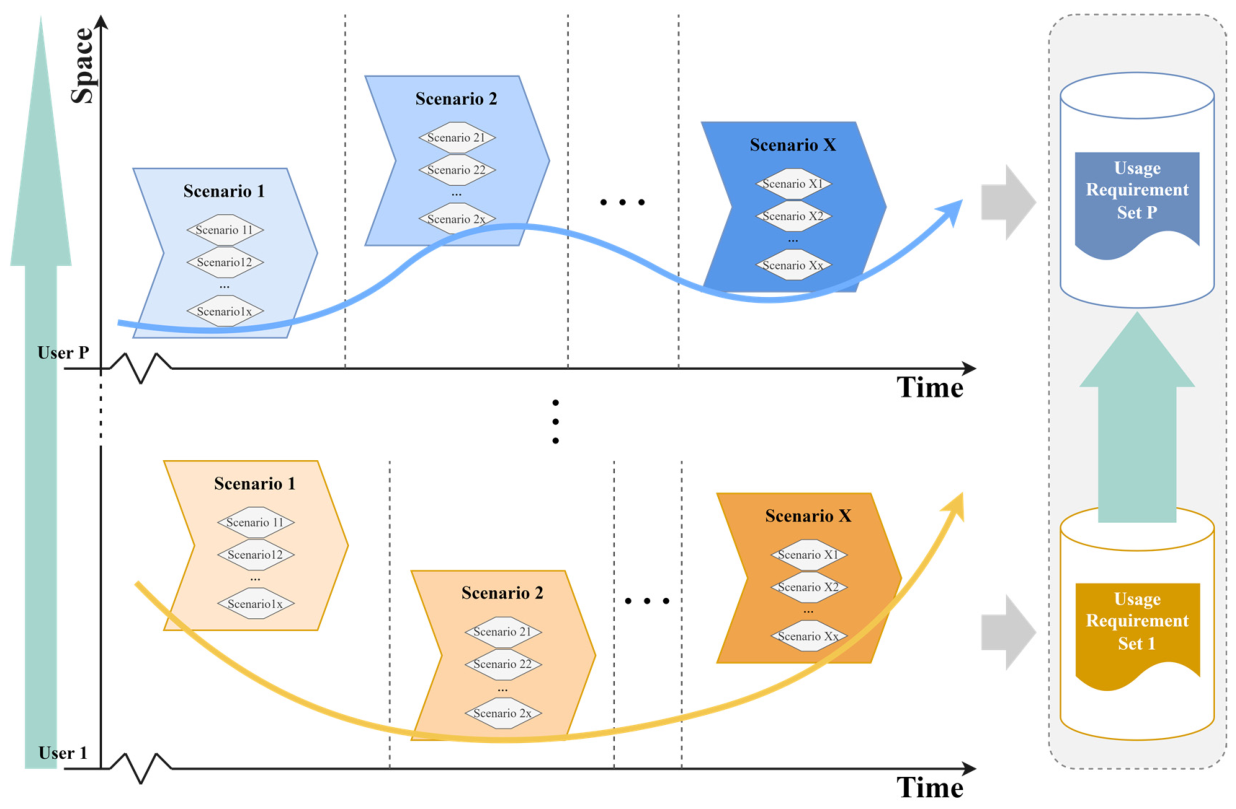
3.1.1. User Design Intent Acquisition Based on Product Usage Scenarios
- Product Usage Scenario Construction
- 2.
- Formal Expression of Design Intent Based on User Usage Scenarios
- 3.
- Systematic Analysis and Comprehensive Evaluation of User Design Intents.
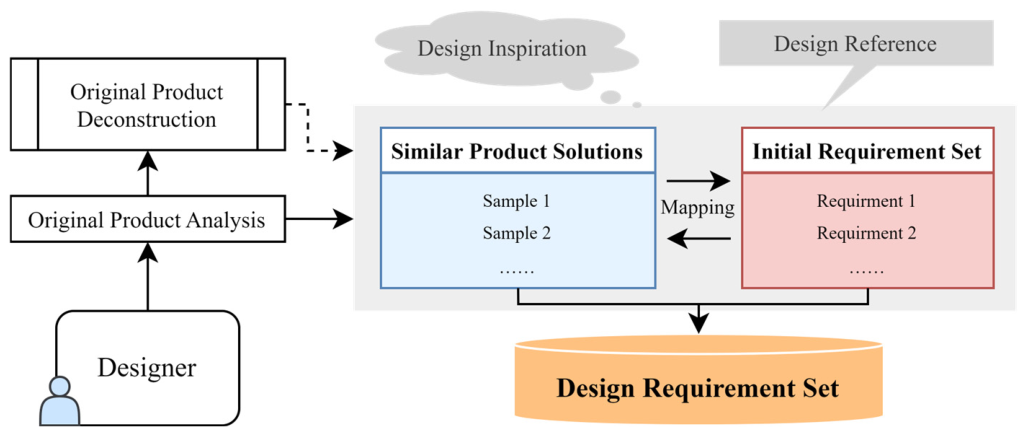
3.1.2. Designer Design Intent Acquisition Based on Product Design Scenarios
- Designer Design Scenario Construction
- 2.
- Designer Design Intent Evaluation Based on Entropy.
- The evaluation value of design intent characterized by entropy is as follows:
- Assume that the matrix X of evaluation by designers for the research samples is as follows:
- To reduce errors in the evaluation process by designers, matrix X is normalized to obtain the intent decision matrix , and then the probability of the design intent is obtained, namely,
- Applying Formula (2) to calculate the probability of each design intent yields the entropy value for the j-th design intent. The weight of this design intent in the entire evaluation process is :
3.2. Design Intent Evaluation Based on a Fuzzy Network Cooperative Game
3.2.1. Fuzzy Network Construction
- The correlation relationships between intent terms reasonably exist;
- The mutual influence relationships between intent terms are symmetric;
- The evaluation relationships provided by the participants are reasonable.
3.2.2. Study of Fuzzy Network Attributes
- Whitening of Fuzzy Numbers
- 2.
- Evaluation of Intent Node Attributes in the Fuzzy Network.
- Node Degree Centrality
- Betweenness Centrality
- Closeness Centrality.
3.2.3. Multiagent Design Intent Importance Evaluation Based on Cooperative Games
- We assign weights to the evaluation results of node degree centrality, betweenness centrality, and closeness centrality, to obtain the basic weight vector . Any combination of W different vectors is represented as follows:where , , is the comprehensive weight vector, and is linear combination coefficient.
- Based on cooperative game theory, the W linear combination coefficients are optimized to minimize the deviation between and each ; then,According to the differential properties of the matrices, Formula (13) can be transformed as follows:Transforming it into a linear formula yields the following:
- By applying Formula (15), can be calculated. After normalization, we obtain the following:Thus, after comprehensive evaluation, the weight vector for the network node’s degree centrality, betweenness centrality, and closeness centrality is obtained as follows:On the basis of , the comprehensive evaluation value for the t-th design intent is obtained as follows:Consequently, the comprehensive degree of importance of each design intent can be obtained.
3.3. Refined Design Intent Decision-Making Based on Noncooperative Game
3.3.1. Construction of Noncooperative Game-Related Matrices
3.3.2. Construction of and Solution to the Noncooperative Game Model
4. Case Verification
4.1. User Design Intent Analysis Based on CNC Machine Tool Usage Scenarios
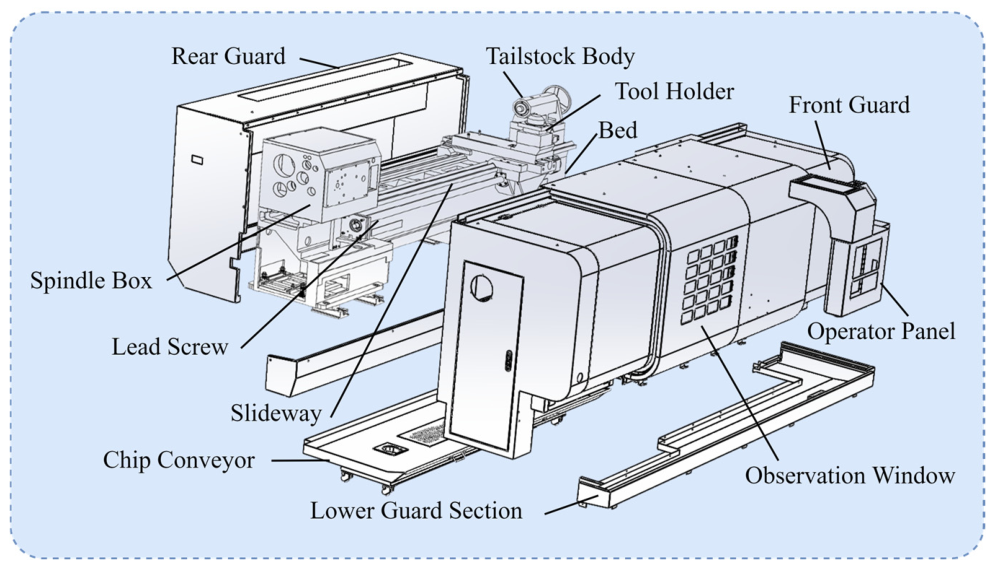
4.2. Designer Design Intent Analysis Based on CNC Machine Tool Design Scenarios
4.3. Integration and Consolidation of CNC Machine Tool Design Intents Merging Users and Designers
4.4. CNC Machine Tool Design Intent Evaluation Based on a Fuzzy Network Cooperative Game
4.5. Refined Design Intent Decision-Making for the CKA6180 CNC Machine Tool Based on a Noncooperative Game
- Satisfaction represents the degree to which the design intent aligns with the development trends of existing similar products and can provide guidance for current product design;
- Novelty is the degree of innovativeness of the design intent relative to trends in similar products on the market and the enterprise’s existing products;
- Feasibility represents the extent to which a design intent can be realized in actual product design;
- Relevance represents the degree of correlation between a design intent and actual product design trends.
4.6. Results Validation
- Construct the normalized matrix. Assume a decision matrix for a multi-attribute decision-making problem involving Y evaluation objects and V evaluation indicators. The normalized matrix is obtained using the vector normalization method.
- Determine the positive and negative ideal solutions, denoted as and , respectively:
- Calculate the Euclidean distance. The Euclidean distance is employed to measure the distances and between the object indicators and the positive/negative ideal solutions:
- Calculate the relative closeness of the evaluation objects. The evaluation objects are ranked in terms of importance based on the magnitude of the relative closeness ; the larger the value of , the more important the evaluation object.
4.7. Results Discussion
5. Conclusions
5.1. Theoretical Contributions
- A multiagent design intent mining method based on scenario theory is proposed. By placing cognitive agents in corresponding scenarios, the accuracy of design intent identification is improved.
- To address the fuzziness and complexity of multiagent cognitive information, a noncooperative–cooperative game serialization decision-making process is constructed. Corresponding game models are established according to the characteristics of different cognitive stages, achieving inferential decision-making for design intent from “divergence” to “convergence” and increasing evaluation accuracy.
- A refined design intent decision-making mode is proposed. Compared with previous design intent reasoning starting from broad categories, this method combines refined design concepts with a noncooperative game and can reduce the “disturbance” of experience dependence on the design process, thereby improving design satisfaction.
5.2. Managerial Implications and Application Value
6. Limitations and Future Research Directions
6.1. Research Limitations
- Cognitive agents were only defined as users and designers. However, in the actual product life cycle, cognitive agents also include engineers, decision-makers, product recyclers, etc. Whether this method can analyze higher-dimensional information from the perspective of more cognitive agents to facilitate design intent decision-making remains to be verified.
- At present, the proposed method is employed solely for the representation and evaluation of the current data. Future work should consider expanding the data dimensions-for instance, by incorporating evaluative data from additional cognitive agents such as engineers and enterprise managers, as well as introducing more fine-grained constraints specific to the research object-in order to further examine the computational complexity and scalability of the method.
- The research data were derived solely from qualitative acquisition and evaluation. Future considerations should include data acquisition and analysis methods that combine qualitative and quantitative approaches from multiple perspectives, such as physiological, psychological, and behavioural measurements.
6.2. Future Research Directions
Author Contributions
Funding
Data Availability Statement
Acknowledgments
Conflicts of Interest
References
- Zhang, L.; Tan, R.; Peng, Q.; Miao, R.; Liu, L. Product innovation based on the host gene and target gene recombination under the technological parasitism framework. Adv. Eng. Inform. 2024, 59, 102341. [Google Scholar] [CrossRef] [Scilit]
- Huo, Y.; Liu, J.; Xiong, J.; Xiao, W.; Zhao, J. Machine learning and CBR integrated mechanical product design approach. Adv. Eng. Inform. 2022, 52, 101611. [Google Scholar] [CrossRef] [Scilit]
- Tan, J.; Gao, M.; Xu, J.; Yang, L.; Jia, C.; Zhang, S.; Wang, K. Digital intelligent forward design method and its application in manufacturing equipment and process. J. Mech. Eng. 2023, 59, 111–125. [Google Scholar]
- Shen, Y. Product Quality Optimization Considering Dynamic Customer Requirement in the Context of the Fast Iterative Pattern. Doctoral Dissertation, Shanghai University, Shanghai, China, 2023. [Google Scholar]
- Jung, S.G.; Salminen, J.; Aldous, K.K.; Jansen, B.J. Persona Craft: Leveraging language models for data-driven persona development. Int. J. Man-Mach. Stud. 2025, 197, 103445. [Google Scholar]
- Liu, Z.; Chen, X.; Zhang, D. Development and analysis of intelligent product evaluation based on multimodal perceptual needs. Comput. Integr. Manuf. Syst. 2025, 31, 3123. [Google Scholar]
- Li, X.; Zheng, P.; Bao, J.; Gao, L.; Xu, X. Achieving cognitive mass personalization via the self-X cognitive manufacturing network: An industrial knowledge graph-and graph embedding-enabled pathway. Engineering 2023, 22, 14–19. [Google Scholar] [CrossRef] [Scilit]
- Hong, Z.; Feng, Y.X.; Lou, S.; Song, X.; Hu, B.; Zang, Z.; Tan, J. Overview and Prospects of Uncertain Intelligent Design for Complex Products. J. Mech. Eng. 2023, 59, 213–236. [Google Scholar]
- Pan, X.; Li, X.; Li, Q.; Hu, Z.; Bao, J. Evolving to multi-modal knowledge graphs for engineering design: State-of-the-art and future challenges. J. Eng. Des. 2025, 36, 1156–1195. [Google Scholar] [CrossRef] [Scilit]
- Murata, H.; Kobayashi, H. A Needs-Based Design Method for Product–Service Systems to Enhance Social Sustainability. Sustainability 2025, 17, 3619. [Google Scholar] [CrossRef] [Scilit]
- Das, S.; Mallick, B.; Das, S. From Concept to Market: Integrating Customer Needs in Product Development. J. Inst. Eng. Ser. C 2024, 105, 1643–1652. [Google Scholar] [CrossRef] [Scilit]
- Luo, S.; Yuan, Y.; Zhang, J.; Zhang, L.; Yi, P. Generation and evaluation method of conceptual schemes driven by the rail transit vehicles design intelligent agent. Comput. Integr. Manuf. Syst. 2026, 32, 425–436. [Google Scholar]
- Liang, Q.; Luo, C.; Zhang, Z.; Cheng, D. Mining maximum ordinal–cardinal consensus for large-scale group decision making with incomplete fuzzy preference relations. IEEE Trans. Fuzzy Syst. 2024, 32, 3542–3555. [Google Scholar] [CrossRef] [Scilit]
- Wang, S.; Wu, J.; Chiclana, F.; Ji, F.; Fujita, H. Global feedback mechanism by explicit and implicit power for group consensus in social network. Inform. Fusion 2024, 104, 102205. [Google Scholar] [CrossRef] [Scilit]
- Cao, M.; Chiclana, F.; Liu, Y.; Wu, J.; Herrera-Viedma, E. A bilateral negotiation mechanism by dynamic harmony threshold for group consensus decision making. Eng. Appl. Artif. Intel. 2024, 133, 108225. [Google Scholar] [CrossRef] [Scilit]
- Amirkhani, A.; Barshooi, A.H. Consensus in multi-agent systems: A review. Artif. Intel. Rev. 2022, 55, 3897–3935. [Google Scholar] [CrossRef] [Scilit]
- Xing, Y.; Wu, J.; Chiclana, F.; Wang, S.; Zhu, Z. Personalized trust incentive mechanisms with personality characteristics for minimum cost consensus in group decision making. Inform. Fusion 2025, 118, 102967. [Google Scholar] [CrossRef] [Scilit]
- Liang, D.; Ou, C.; Xu, Z. A customer-driven quality function deployment approach for intelligent product design: A case of automatic-dishwasher. Appl. Soft Comput. 2024, 167, 112403. [Google Scholar] [CrossRef] [Scilit]
- Qiu, K.; Su, J.; Zhang, X.; Yang, W. Evaluation and balance of cognitive friction: Evaluation of product target image form combining entropy and game theory. Symmetry 2020, 12, 1398. [Google Scholar] [CrossRef] [Scilit]
- Zhao, F.; Wang, X.; Li, M.; Zhang, X. Research on Image-Driven Cloud Model Decision for Product Design. Mach. Des. Manuf. 2026, 371–377+384. [Google Scholar] [CrossRef]
- Ali, A.; Abdel-Basset, M.; Abouhawwash, M.; Gharib, M.; Mohamed, M. N-type-2-aras: An efficient hybrid multi-criteria optimization approach for end-of-life vehicle’s recycling facility location: A sustainable approach. Expert Syst. Appl. 2024, 250, 14. [Google Scholar] [CrossRef] [Scilit]
- Xu, J.; Jiang, Z.; Zhu, S.; Yan, W.; Zhu, H.; Sun, B. Decision-making method for selecting remanufacturing strategies based on multi-attribute remaining life scenarios of used electromechanical products. Comput. Integr. Manuf. Syst. 2026, 32, 287–299. [Google Scholar]
- Hezam, I.M.; Ali, A.M.; Sallam, K.; Hameed, I.A.; Foul, A.; Abdel-Basset, M.; Saha, A.K. An extension of root assessment method (RAM) under spherical fuzzy framework for optimal selection of electricity production technologies toward sustainability: A case study. Int. J. Energy Res. 2024, 2024, 7985867. [Google Scholar] [CrossRef] [Scilit]
- Wang, N.; Shi, D.; Li, Z.; Chen, P.; Ren, X. Investigating emotional design of the intelligent cockpit based on visual sequence data and improved LSTM. Adv. Eng. Inform. 2024, 61, 102557. [Google Scholar] [CrossRef] [Scilit]
- Wang, S.; Su, J.; Zhang, S.; Qiu, K.; Liu, S.; Yang, W. Research Overview and Prospect on Emergence Mechanisms for Product Innovation Design. J. Mech. Eng. 2026, 1–18. Available online: https://link.cnki.net/urlid/11.2187.TH.20250919.1418.020 (accessed on 25 April 2026).
- Song, X.; Li, K.; Hu, Z.; Guo, D. High Performance Manufacturing: Collaborative Mechanisms for Design and Manufacturing. J. Mech. Eng. 2024, 60, 2–12. [Google Scholar] [CrossRef] [Scilit]
- Hong, Z.; Feng, Y.; Ji, R.; Song, X.; Yi, S.; Li, Z.; Tan, J. Research Overview of Product Design Driven by Man-Machine Joint Cognition with Value Chain Collaboration. J. Mech. Eng. 2025, 61, 120–141. [Google Scholar]
- Sun, Y.; Qiao, Y.; Xiao, J.; Chen, D. Industrial design change task allocation method for complex product manufacturing based on implementation intention matching. J. Adv. Mech. Des. Syst. 2024, 18, JAMDSM0074. [Google Scholar]
- Jiang, Z.; Sun, B.; Zhu, S.; Yan, W.; Wang, Y.; Zhang, H. A knowledge graph–based requirement identification model for products remanufacturing design. J. Eng. Des. 2025, 36, 1401–1424. [Google Scholar]
- Luo, S.; Zhang, X.; Wang, N. Integrating Kansei engineering and GA-CNN-Attention for emotionally driven design: A methodological approach to aligning product features with user preferences. J. Eng. Des. 2026, 37, 1663–1709. [Google Scholar] [CrossRef] [Scilit]
- Yu, C.; Zhao, P. Service product family optimization design for demand-driven older adult home care. Front. Public Health 2024, 12, 1479586. [Google Scholar]
- Shie, A.J.; Lin, X.; Xu, E.M.; Zhang, Y.; Ye, Z.; Ruan, J.; Fang, Z.; Lee, C.H. Kansei-driven and TRIZ-informed product service systems design with abductive logic: Case study of children’s digital Reading book. J. Eng. Des. 2025, 37, 372–405. [Google Scholar] [CrossRef] [Scilit]
- Luo, S.; Guo, H.; Zhong, S.; Peng, Y.; Zhang, J.; Yi, P.; Zhong, F.; Yu, H.; Wang, Y. Persona generation method for product design driven by AI agent. Comput. Integr. Manuf. Syst. 2025, 31, 3919–3931. [Google Scholar]
- Walter, I.; Pare, P.; Panchal, J. A Cognitive Approach for Modeling Customer Demand Dynamics for Optimal Product Release Strategies. ASME J. Mech. Des. 2024, 146, 081706. [Google Scholar] [CrossRef] [Scilit]
- Yang, Y.; Li, Q.; Li, C.; Qin, Q. User requirements analysis of new energy vehicles based on improved Kano model. Energy 2024, 309, 133134. [Google Scholar] [CrossRef] [Scilit]
- Wu, Y.; He, L.; Goh, M.; Li, N.; Wu, Z. Customer requirement-oriented personalized product configuration method with knowledge graphs. Adv. Eng. Inform. 2025, 66, 103446. [Google Scholar] [CrossRef] [Scilit]
- Zhang, X.; Zheng, M.; Ming, X. Industrial intelligent connected ecosystem (IICE) oriented towards uncertainty and dynamic demand characteristics. Inter. J. Adv. Manuf. Tech. 2025, 139, 1525–1539. [Google Scholar] [CrossRef] [Scilit]
- Chen, Y.; Jiang, Z.; Zhu, S.; Zhang, H. Research on reassembly strategy of used mechanical equipment components based on non-cooperative game. J. Mech. Eng. 2021, 57, 203–212. [Google Scholar]
- Gibbons, R. An introduction to applicable game theory. J. Econ. Perspect. 1997, 11, 127–149. [Google Scholar] [CrossRef] [Scilit]
- Qiu, K. Research on Complex Product Redesign Method for Multi-Domain Game Collaboration. Ph.D. Thesis, Lanzhou University of Technology, Gansu, China, 2023. [Google Scholar]
- Sun, L.; Li, J.; Wu, J.; Zhang, S. Optimization of product design decisions based on game theory and perceptual image. J. Mach. Des. 2022, 39, 146–153. [Google Scholar]
- Lu, C.; Chai, H. Game decision making for modular design reuse of electromechanical products. J. Zhejiang Univ. Technol. 2019, 47, 406–410. [Google Scholar]
- Song, R.; Cao, G.; Guo, Z.; Liu, Z. Research on Identification Method of Harmful Functions Based on Game Theory. Chin. Mech. Eng. 2018, 29, 41–48+56. [Google Scholar]
- Bao, H.; Wang, Z.; Tao, J.; Li, H.Z.; Yu, S.R.; Song, P.L. A Non-cooperative Game Modular Design Method for Mechanical and Electrical Products for Reuse and Assembly Complexity Balance. J. Mech. Eng. 2025, 61, 285–296. [Google Scholar]
- Chen, Y.; Yu, Q. A Game Thory-based Approach to Determining the Weights of Customer Requirements. J. Syst. Manag. 2017, 26, 196–199. [Google Scholar]
- Li, X.; Wang, Z. Evaluation and optimization of design schemes based on cloud model and improved evidence theory. J. Mach. Des. 2023, 40, 136–142. [Google Scholar]
- Zhu, L.; Ni, X. Study on the commercial transformation path of pujiang paper-cutting based on scenario analysis method. Zhuangshi 2024, 139–141. [Google Scholar] [CrossRef]
- Yu, F.; Li, J.; Liu, Z.; Li, P. User requirements identification method based on scenario analysis and negative reviews. J. Mach. Des. 2025, 42, 205–211. [Google Scholar]
- Liu, L.; Tan, R.; Liu, W.; Zhang, H.; Zhang, J. Innovation opportunities identification in fuzzy front end based on scenario. Comput. Integr. Manuf. Syst. 2023, 29, 1313–1326. [Google Scholar]
- Liu, Y.; Wu, C.; Luan, X. Patent circumvention design method based on functional cognitive expansion. Comput. Integr. Manuf. Syst. 2023, 29, 3191–3207. [Google Scholar]
- Pan, H. The cause of human fatigue and scenario analysis in the process of marine transportation. J. Southeast Univ. (Engl. Ed.) 2020, 36, 107–117. [Google Scholar]
- Ni, J.; Wang, Z.; Lian, X.; Zhou, J. Optimization method of product design schemes based on preference information. Comput. Integr. Manuf. Syst. 2019, 25, 1238–1247. [Google Scholar]
- Su, J.; Zhang, X.; Jing, N.; Chen, X. Research on the entropy evaluation of product styling image under the cognitive difference. J. Mach. Des. 2016, 33, 105–108. [Google Scholar]
- Zhang, H.; Yao, Y.G. An integrative vulnerability evaluation model to urban road complex network. Wirel. Pers. Commun. 2019, 107, 193–204. [Google Scholar] [CrossRef] [Scilit]
- Geng, X.; Bo, Z. Approach to determine customer requirements weight based on network game. Comput. Integr. Manuf. Syst. 2020, 26, 2792–2798. [Google Scholar]
- Gao, Y.; Zhou, D.; Liu, C.; Zhang, L. Triangular fuzzy number intuitionistic fuzzy aggregation operators and their application base on interaction. Syst. Eng. Theory Pract. 2012, 32, 1964–1972. [Google Scholar]
- Wang, N.; Shi, C.; Kang, X. Design of a disinfection and epidemic prevention robot based on fuzzy QFD and the ARIZ algorithm. Sustainability 2022, 14, 16341. [Google Scholar] [CrossRef] [Scilit]
- Friedkin, N. Theoretical foundations for centrality measures. Am. J. Sociol. 1991, 96, 1478–1504. [Google Scholar] [CrossRef] [Scilit]
- Bian, T.; Hu, J.; Deng, Y. Identifying influential nodes in complex networks based on AHP. Phys. A 2017, 479, 422–436. [Google Scholar] [CrossRef] [Scilit]
- Yang, Y.; Xie, G.; Xie, J. Mining important nodes in directed weighted complex networks. Discret. Dyn. Nat. Soc. 2017, 97, 9741824. [Google Scholar] [CrossRef] [Scilit]
- Geng, X.; Wang, J. Evaluation of product service system design based on complex network and PROMETHEE II. Comput. Integr. Manuf. Syst. 2019, 25, 2324–2333. [Google Scholar]
- Muratović, E.; Muminović, A.J.; Dizdarević, E.; Mijović, B.; Delić, M. A surface wear prediction framework and performance evaluation strategy for polymer gears. Appl. Sci. 2026, 16, 2186. [Google Scholar] [CrossRef] [Scilit]
- Zhu, T.; Wu, C.; Zhang, Z.; Li, Y.; Wu, T. Research on evaluation methods of complex product design based on hybrid Kansei engineering modeling. Symmetry 2025, 17, 306. [Google Scholar] [CrossRef] [Scilit]
- Lou, S.; Feng, Y.; Hu, B.; Hong, Z.; Tan, J. Human-computer Cognitive Collaboration-driven Conceptual Design of Complex Equipment: Research Progress and Challenges. J. Mech. Eng. 2024, 60, 2–19. [Google Scholar]
- Su, J.; Yu, B.; Li, X.; Zhang, Z.; Guo, R. Image-driven product modeling intelligent design methodology. J. Mach. Des. 2024, 41, 115–120. [Google Scholar]
- Hwang, C.L.; Yoon, K. Methods for multiple attribute decision making. In Multiple Attribute Decision Making: Methods and Applications a State-of-the-Art Survey; Springer-Verlag: Berlin/Heidelberg, Germany, 1981; pp. 58–191. [Google Scholar]
- Sun, Y.; Yang, B.; Zhu, Z.; Lu, P. Research on Perceptual Design of Tank Turret Shape Based on Shape Grammar. Acta Armament. 2026, 47, 209–223. [Google Scholar]
- Zeng, D. Cognitive Intervention Theory and Methods of Interactive Evolutionary Product form Design. Ph.D. Thesis, China University of Mining and Technology, Jiangsu, China, 2021. [Google Scholar]
- Li, J.; Guo, X.; Zhao, W.; Zhang, K.; Yu, M.; Guo, X. A Human-centric Product Design Model and Implementation Framework for Multi-design Subjects Integration. J. Mech. Eng. 2025, 61, 82–104. [Google Scholar]



| Research Method | Problem Addressed | Author(s) and Reference | Year | Key Advantage |
|---|---|---|---|---|
| Extension Theory | Design task changes during complex product development. | Sun et al. [28] | 2024 | Quantifies the universality of design intent through evaluation. |
| Knowledge Graphs | Existing research only considers customer demands for product performance. | Jiang et al. [29] | 2025 | Constructs a knowledge graph for design intent identification by combining product failure characteristics with customer requirements. |
| Existing research lacks a framework to uniformly represent customer design intent and product information. | Wu et al. [36] | 2025 | Matches customer requirements with product configuration schemes to achieve decision-making for diverse personalized demands. | |
| BERTopic | Difficulty in predicting user design intent and capturing subtle emotional changes. | Luo et al. [30] | 2025 | Compensates for the shortcomings of traditional design techniques in capturing user intent and reducing data dimensionality. |
| Kano Model | Difficulty in directly obtaining accurate user design intent due to limitations in technology and customer group characteristics. | Yu et al. [31] | 2024 | Performs detailed evaluation and standardized processing of customer requirements to predict potential customer intent. |
| Design Agent | Existing methods for demand decision-making based on user personas generally suffer from single dimensions, insufficient generalization, and low user participation. | Luo et al. [30] | 2025 | Proposes an agent-driven method for generating user personas in product design and constructs a generative model, expanding the theoretical and technical system of personas for more accurate demands. |
| 4C Model | Continuous changes in consumer demands for children’s reading products. | Shie et al. [32] | 2025 | Combines Kansei Engineering, TRIZ theory, and fuzzy techniques to form user design intent at both functional and emotional levels. |
| Decision Field Theory (DFT) | Inability to capture dynamic changes in design intent during product development and decision-making processes. | Walter et al. [34] | 2024 | Formulates product strategies through accurate prediction of design intent. |
| BERT-TCBAD-Kano | Imbalance in review content reduces the accuracy of user intent analysis. | Yang et al. [35] | 2024 | Improves data prediction accuracy and helps determine the priority of various user intents. |
| Fuzzy Cognitive Map (FCM) and ARIMA Model | Accurately grasping and predicting customer demands for the Industrial Intelligent Connection Ecosystem (IICE). | Zhang et al. [37] | 2025 | Effectively realizes the mining and dynamic predictive analysis of implicit customer demands. |
| Noncooperative– Cooperative Game Serialization | Existing research has not explored the impact of the cognitive agents’ environment on outcomes during the early-stage decision-making of design intent evaluation, nor the correlation between product personalization features and design intent decisions. | This paper | - | Improves the accuracy of design intent identification through scenario analysis of design subjects and consideration of personalized features of the design object. |
| Design Intent Terms | Correlation Indicator|Average Correlation | |||
|---|---|---|---|---|
| R1 | … | |||
| R2 | … | |||
| … | … | |||
| Rrd | … | |||
| No. | Design Intent Description | Design Intent Extraction |
|---|---|---|
| 1 | Machining accuracy meets requirements | High machining accuracy |
| 2 | Hope machining is faster than similar products | High machining speed |
| 3 | Operating system should be high-end, simple, and easy to operate | Superior operating system |
| 4 | Internal machine lighting should be good, clear visibility | Good lighting effect |
| 5 | While meeting performance, product should be light weight | Light weight |
| 6 | Machining chip fluid separation effect should be good | Easy chip fluid separation |
| 7 | Machine should have high power | High power |
| 8 | Machine waterproof performance should be good | Good waterproof effect |
| 9 | Operation interface layout should be reasonable and easy to operate | Reasonable layout |
| 10 | Machine interior should be easy to clean | Easy to clean |
| 11 | Buttons should vary in size based on function to prevent errors | Superior ergonomic performance |
| … | … | … |
| 57 | Height of machine control area should be reasonable | Good operational ergonomics |
| Interactive | Modern | Precise | Novel | Grand | Convenient | Dull | Warm |
| Functional | Sturdy | Technological | Sharp | Smooth | Proportionate | Safe | Elegant |
| … | … | … | … | … | … | … | … |
| Reliable | Dazzling | Neat | Flat | Esthetic | Rough | Gorgeous | Powerful |
| Cold | Soft | Fresh | Loose | Rigid |
| Complex | Branded | Neat | Technological | Concise | Grand | Precise | |
|---|---|---|---|---|---|---|---|
| Sa1 | 4.06 | 3.53 | 4.38 | 4.28 | 3.97 | 4.22 | 3.63 |
| Sa2 | 3.25 | 3.00 | 2.84 | 3.38 | 3.63 | 3.22 | 3.28 |
| Sa3 | 3.47 | 2.94 | 3.09 | 3.56 | 3.31 | 3.03 | 3.06 |
| … | |||||||
| Sa14 | 3.75 | 3.47 | 3.56 | 3.78 | 3.94 | 3.72 | 3.59 |
| Sa15 | 3.63 | 3.13 | 3.53 | 3.50 | 3.63 | 3.28 | 3.50 |
| Initial Intent Terms | Degree Centrality | Betweenness Centrality | Closeness Centrality |
|---|---|---|---|
| 0.882 | 0.403 | 0.537 | |
| 0.882 | 0.690 | 0.537 | |
| 1.000 | 0.984 | 1.000 | |
| 0.765 | 0.294 | 0.162 | |
| 0.824 | 0.346 | 0.340 | |
| … | |||
| 0.882 | 0.559 | 0.537 | |
| Initial Intent Terms | Comprehensive Eval. | … | Initial Intent Terms | Comprehensive Eval. |
| 0.6173 | 0.3443 | |||
| 0.7090 | 0.9949 | |||
| 0.9949 | 0.5588 | |||
| 0.4194 | 0.7875 | |||
| 0.5147 | 0.8597 | |||
| 0.6384 | 0.6672 |
| Design Intent Terms | Correlation Indicator|Average Correlation | |||
|---|---|---|---|---|
| R1 | |3.2 | |2.4 | |3.0 | |2.8 |
| R2 | |3.6 | |4.0 | |3.2 | |3.4 |
| R3 | |4.0 | |3.4 | |3.8 | |4.0 |
| R4 | |3.4 | |2.4 | |3.2 | |2.6 |
| … | ||||
| R9 | |3.4 | |2.6 | |3.6 | |2.8 |
| Design Intent Terms | Ranking Result | |||
|---|---|---|---|---|
| R1 | 2.408 | 0.200 | 0.077 | 9 |
| R2 | 1.077 | 1.844 | 0.631 | 3 |
| R3 | 0.632 | 2.059 | 0.765 | 2 |
| R4 | 2.417 | 0.283 | 0.105 | 8 |
| R5 | 1.697 | 0.980 | 0.366 | 6 |
| R6 | 0.400 | 2.298 | 0.852 | 1 |
| R7 | 1.166 | 1.897 | 0.619 | 4 |
| R8 | 1.510 | 1.149 | 0.432 | 5 |
| R9 | 2.078 | 0.693 | 0.250 | 7 |
Disclaimer/Publisher’s Note: The statements, opinions and data contained in all publications are solely those of the individual author(s) and contributor(s) and not of MDPI and/or the editor(s). MDPI and/or the editor(s) disclaim responsibility for any injury to people or property resulting from any ideas, methods, instructions or products referred to in the content. |
© 2026 by the authors. Licensee MDPI, Basel, Switzerland. This article is an open access article distributed under the terms and conditions of the Creative Commons Attribution (CC BY) license.
Share and Cite
Qiu, K.; Liu, J.; Shi, Q.; Pu, L.; Liu, M. Research on a Refined Decision-Making Method for the Multimodal Fuzzy Design Intent of Complex Products Based on Noncooperative–Cooperative Game Serialization. Symmetry 2026, 18, 772. https://doi.org/10.3390/sym18050772
Qiu K, Liu J, Shi Q, Pu L, Liu M. Research on a Refined Decision-Making Method for the Multimodal Fuzzy Design Intent of Complex Products Based on Noncooperative–Cooperative Game Serialization. Symmetry. 2026; 18(5):772. https://doi.org/10.3390/sym18050772
Chicago/Turabian StyleQiu, Kai, Junxi Liu, Qinghua Shi, Le Pu, and Mingyuan Liu. 2026. "Research on a Refined Decision-Making Method for the Multimodal Fuzzy Design Intent of Complex Products Based on Noncooperative–Cooperative Game Serialization" Symmetry 18, no. 5: 772. https://doi.org/10.3390/sym18050772
APA StyleQiu, K., Liu, J., Shi, Q., Pu, L., & Liu, M. (2026). Research on a Refined Decision-Making Method for the Multimodal Fuzzy Design Intent of Complex Products Based on Noncooperative–Cooperative Game Serialization. Symmetry, 18(5), 772. https://doi.org/10.3390/sym18050772