A Hybrid Hypergraph–Dynamic Graph Attention Network Based on Temporal Decay Attention and Conditional Aggregation for Stock Trend Prediction

Abstract
1. Introduction
2. Related Work
2.1. Stock Prediction Based on Time Series Models
2.2. Stock Prediction Based on Graph Learning
2.3. Stock Prediction Based on Hypergraph Learning
3. Proposed Model
3.1. Problem Formulation
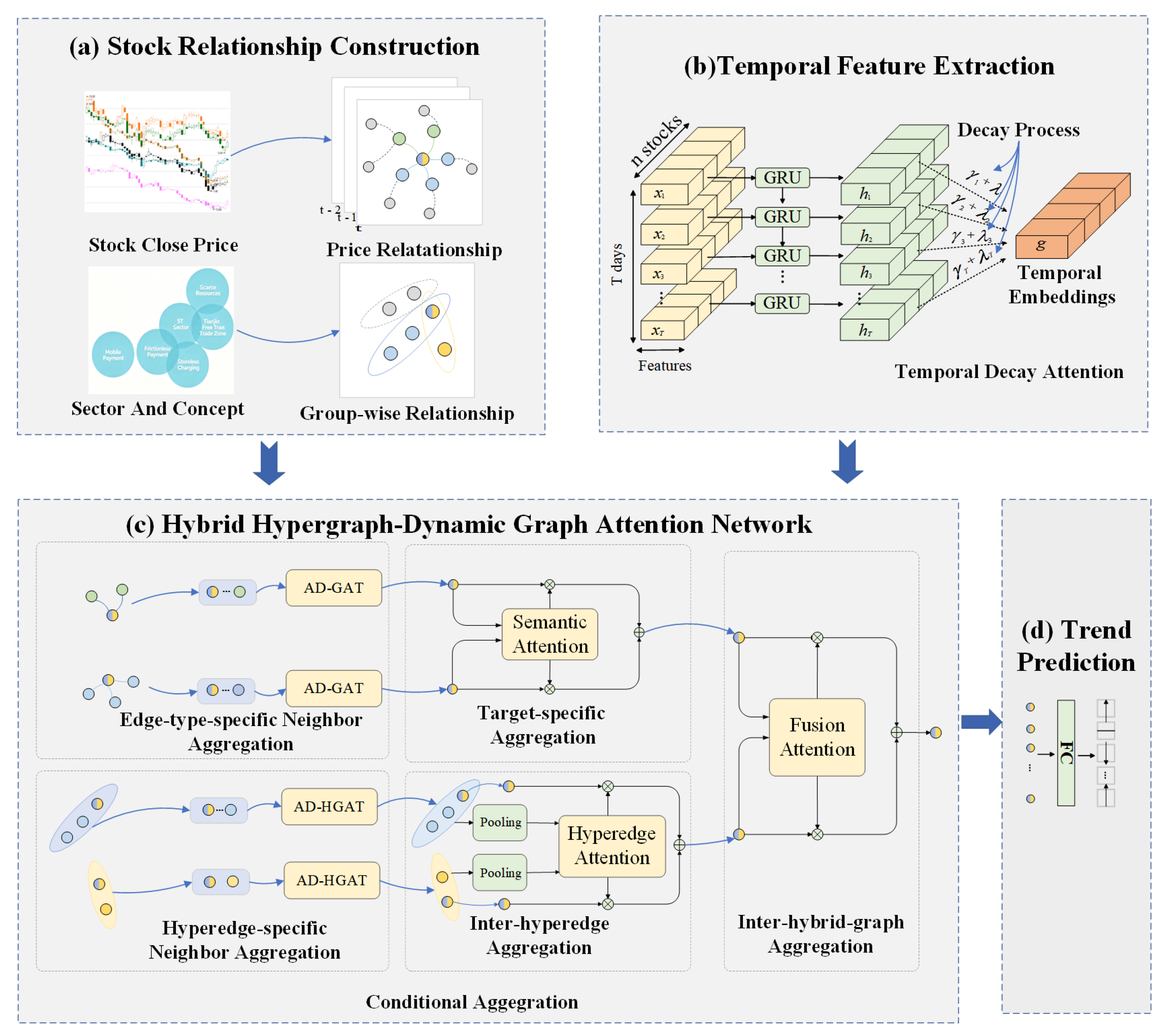
3.2. Architecture Overview
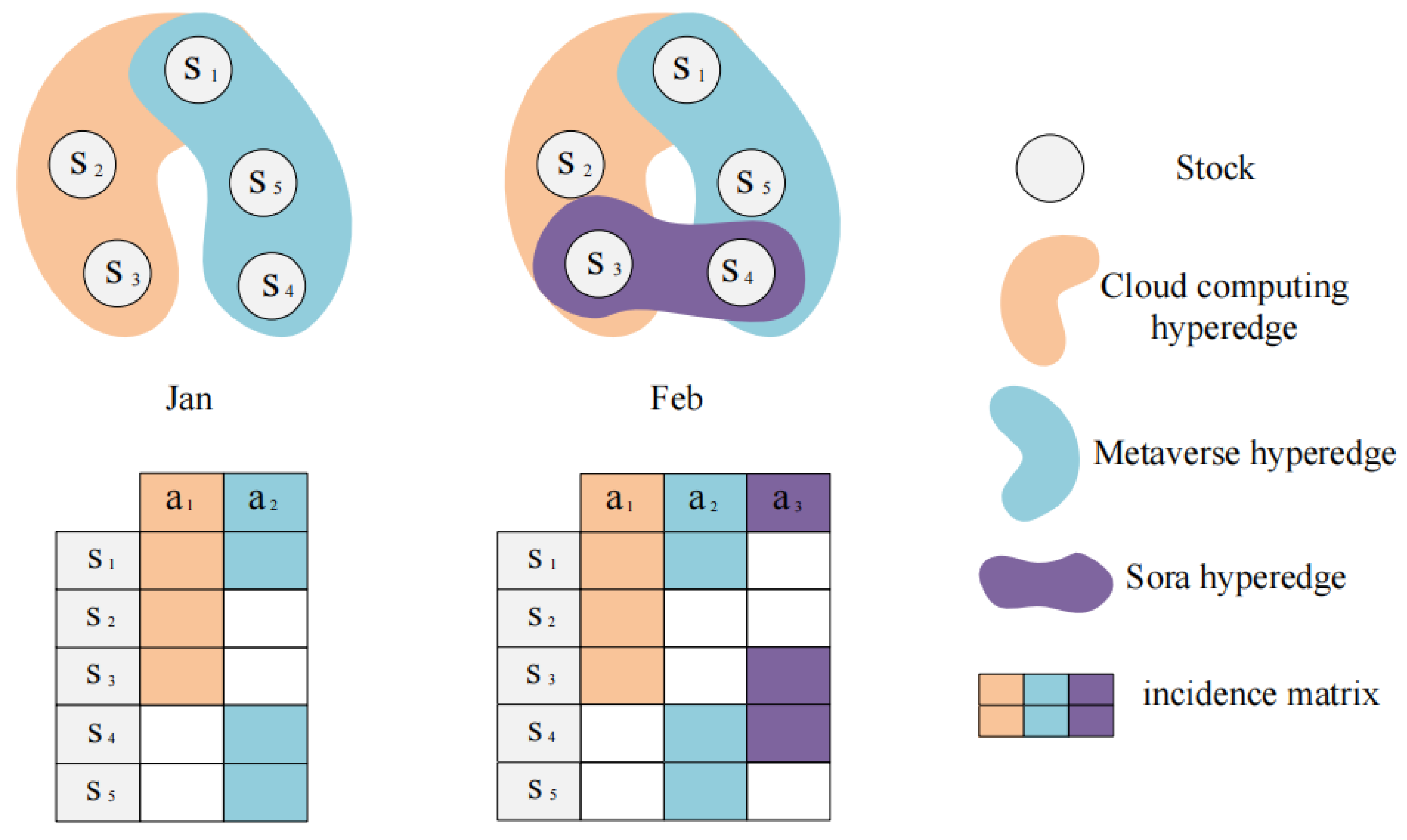
- Stock relationship construction: This module consists of two parts, price heterogeneity graph construction and hypergraph construction. The purpose of price heterogeneity graph construction is to obtain a dynamic stock relationship graph. The purpose of hypergraph construction is to construct stock domain knowledge hyperedges and node indices for the hypergraph through predefined knowledge.
- Temporal feature extraction: The purpose of time series feature extraction is to encode the temporal characteristics of each stock, thereby obtaining the features of each node in the hybrid graph. We achieve this by combining GRU with Temporal Decay Attention.
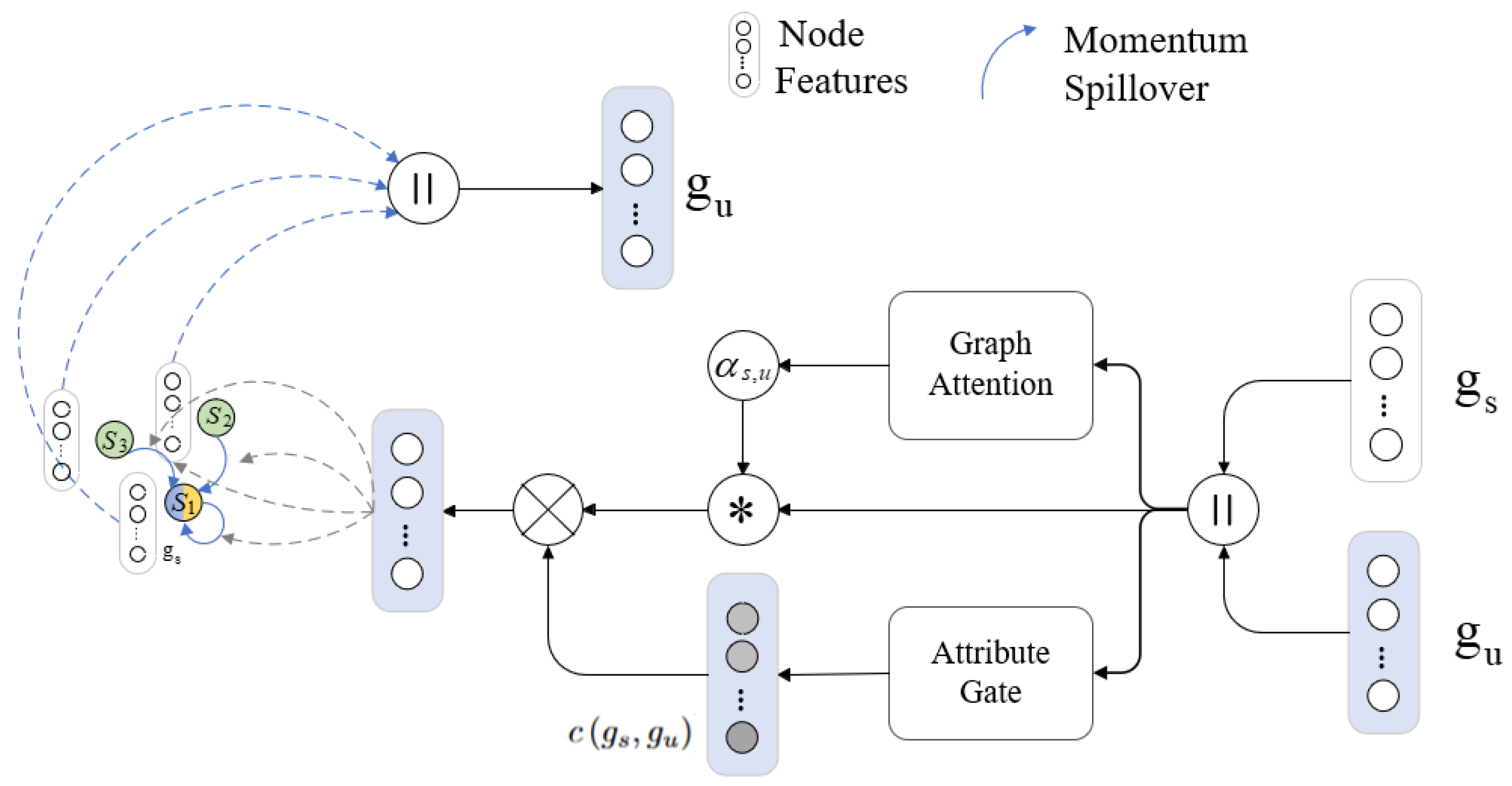
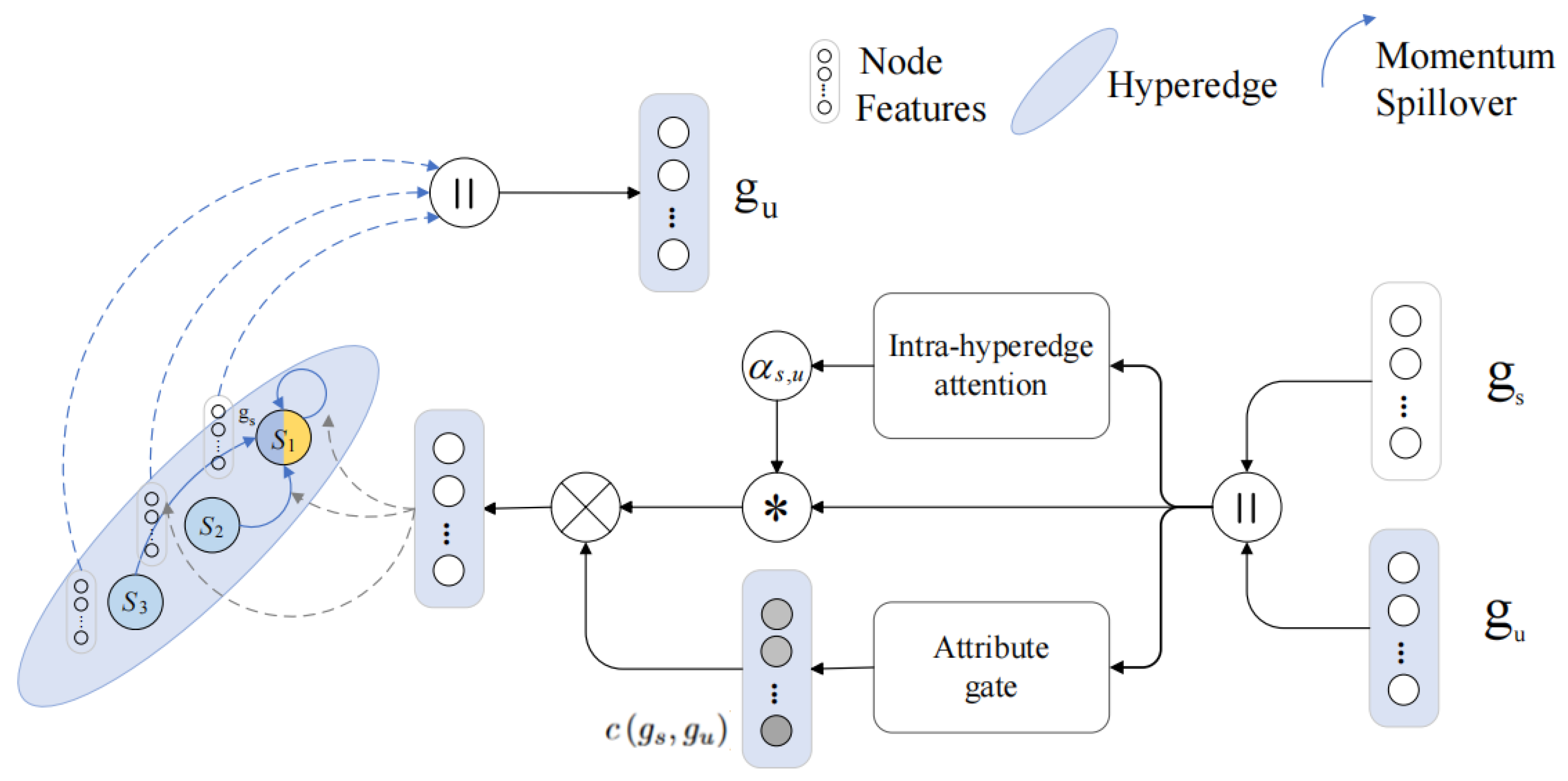
- Hybrid hypergraph–dynamic graph attention network: A hybrid hypergraph–dynamic graph attention network is designed to learn stock interactions in hybrid graphs, achieving this through a conditional aggregation method. The conditional aggregation method is primarily manifested in price heterogeneous graph, hypergraph, and hybrid graphs. It coordinates the importance of different sources during information propagation and selectively aggregates information to obtain the final embedding of stocks.
- Stock trend prediction: The stock trend prediction outputs the probability of future stock prices increasing, remaining flat, or decreasing through a fully connected layer.
3.3. Stock Relationship Construction
3.3.1. Heterogeneous Topology Graph Construction
3.3.2. Hypergraph Construction
3.4. Temporal Feature Extraction Based on Temporal Decay Attention
3.5. Hybrid Hypergraph–Dynamic Graph Attention Network
3.5.1. Conditional Aggregation in Price Heterogeneous Graph
3.5.2. Conditional Aggregation in Hypergraph
3.5.3. Conditional Aggregation Based on Inter-Hybrid-Graph Aggregation
3.6. Stock Trend Prediction
4. Experiment
4.1. Dataset
4.2. Evaluation Metrics
4.3. Baselines
- LSTM [17]: one of the most widely used deep learning models today uses historical price data to predict future stock trends.
- DARNN [3]: DARNN adds a two-stage attention mechanism to recurrent neural networks. It adaptively selects the relevant driving sequences and the relevant hidden states.
- GCN [5]: the node attributes are encoded using the LSTM network and the attributes of the neighbours are aggregated to the central node via GCN.
- TGC [24]: the model uses the dynamics of the time series to adjust pre-defined firm relationships.
- AD-GAT [45]: the method uses an unmarked attention mechanism to update stock relationships, while an attribute-mattered aggregator is designed to capture momentum spillovers.
- THGNN [28]: THGNN infers a dynamic heterogeneous graph from market signals and learns the dynamic relationships of stocks through a two-stage attention mechanism.
- HGTAN [7]: the method introduces fund hypergraphs and industry hypergraphs and uses a hierarchical attention module to learn the importance of different nodes, hyperedges, and hypergraphs.
4.4. Experimental Settings
4.5. Results and Analysis
4.5.1. Predictive Performance
4.5.2. Ablation Study
4.5.3. Time Complexity Analysis
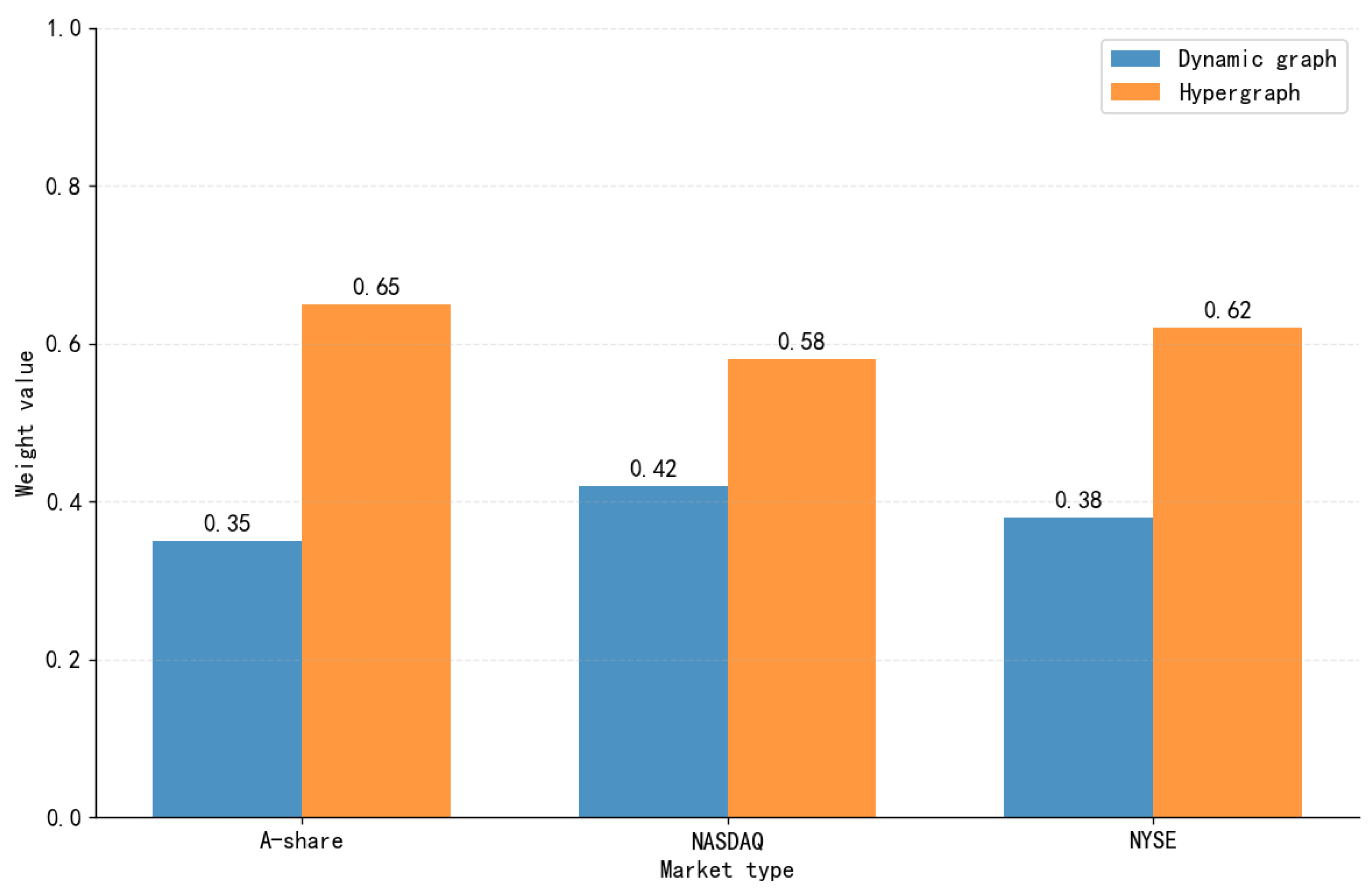
4.5.4. Hypergraph Scale Adaptation
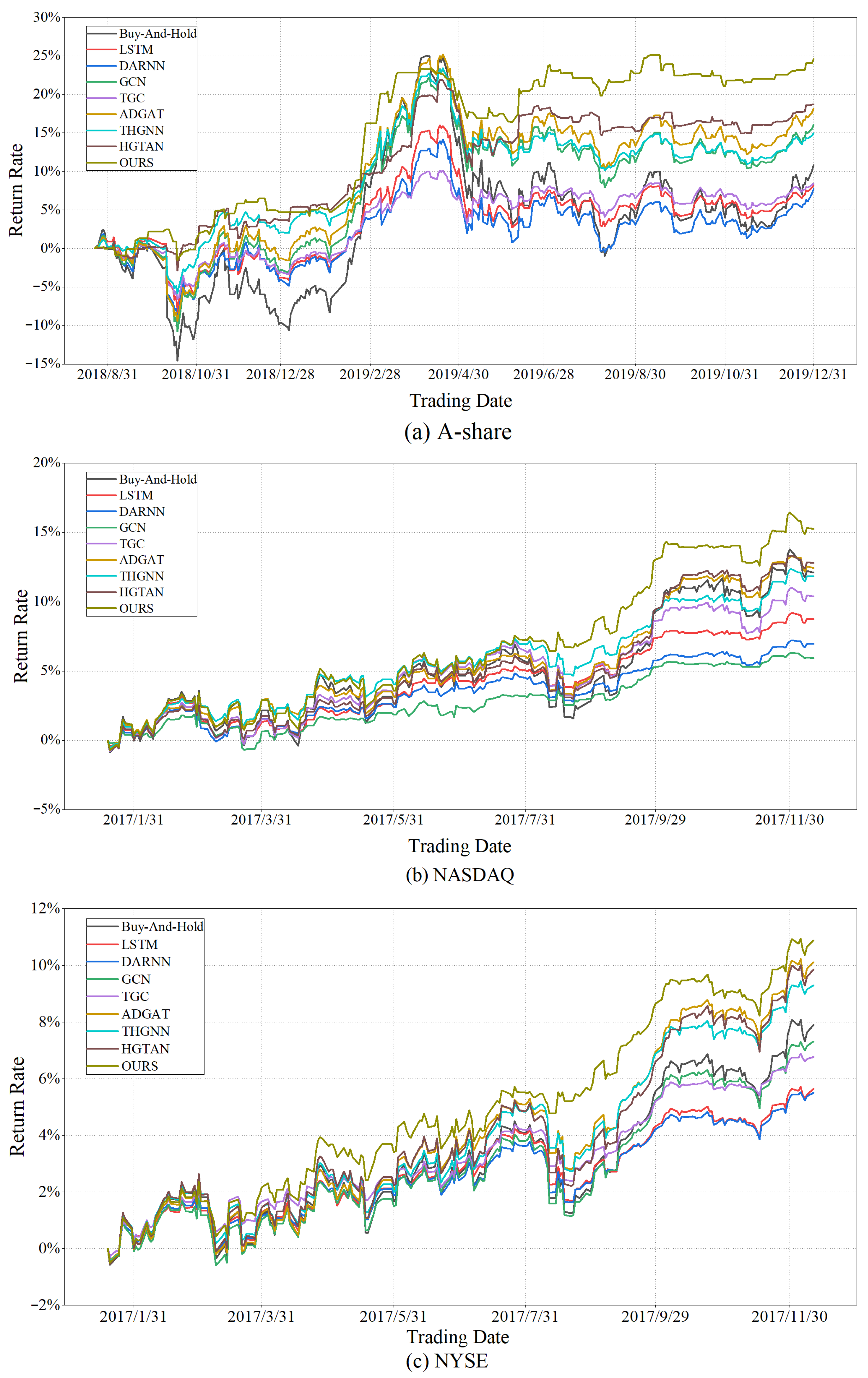
4.6. Investment Simulation
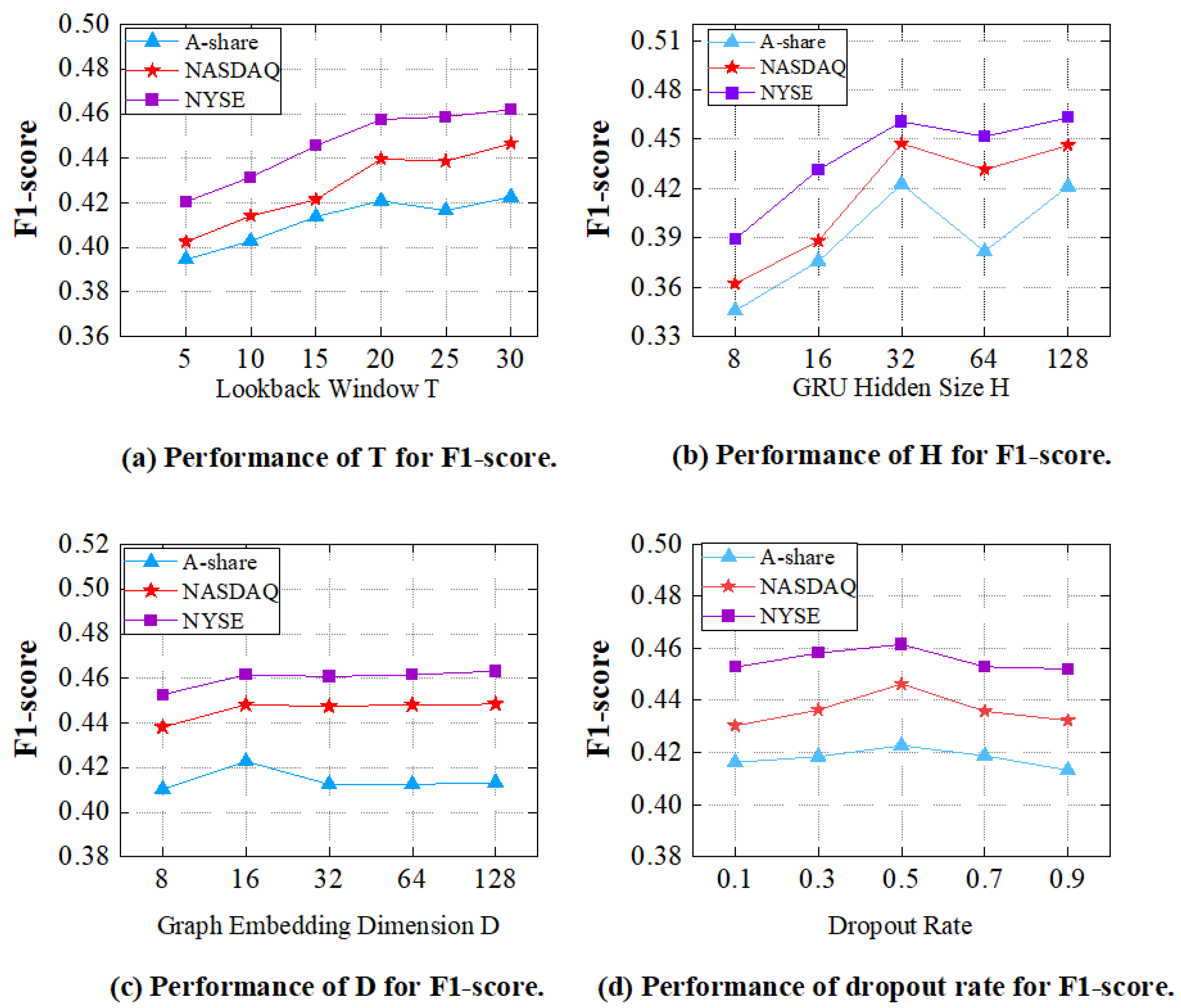
4.7. Hyperparameter Sensitivity
- Window size : To check the performance of HDGAN under different time window sizes, we set T to {5,10,15,20,25,30} and the results are shown in Figure 7. For HDGAN, the model reaches a local optimum when T is set to 20, and the model performance starts to decrease when the window is further increased. Therefore, the input time window size is set to 20.
- Graph embedding dimension : In order to verify the effect of the embedding dimension of the graph features on the performance of HDGAN, we set D to {8, 16, 32, 64, 128} and observe the corresponding F1 performance, and the results are shown in Figure 7, which shows that when the hidden layer size is set to 16, the model has the best F1 performance. As the size of the hidden layer increases, the overfitting problem may occur, leading to performance degradation.
- The number of neurons in the hidden layer : To verify the effect of hidden layer size of GRU on the performance of HDGAN, we set H to and observe the corresponding F1 score performance. The results are shown in Figure 7. It can be seen that the model performance reaches a local optimum when H is set to 32 and 128, respectively, and when H is too small, it limits the expressive ability of the model.
- Ratio of dropout : We give the in Figure 7. We observe salient improvements in all evaluation metrics (Accuracy, Precision, Recall and F1 score) by setting the dropout rate to 0.5, which reveals the usefulness of applying dropout for mitigating overfitting caused by multiple stacked attention layers and the hybrid hypergraph–dynamic graph structure. Moreover, dropout exerts an additional effect of implicit model averaging with numerous sub-networks generated by random feature masking, which has potential significance for simulating the highly non-stationary volatility of stock markets and enhancing the model’s robustness to noisy financial data.
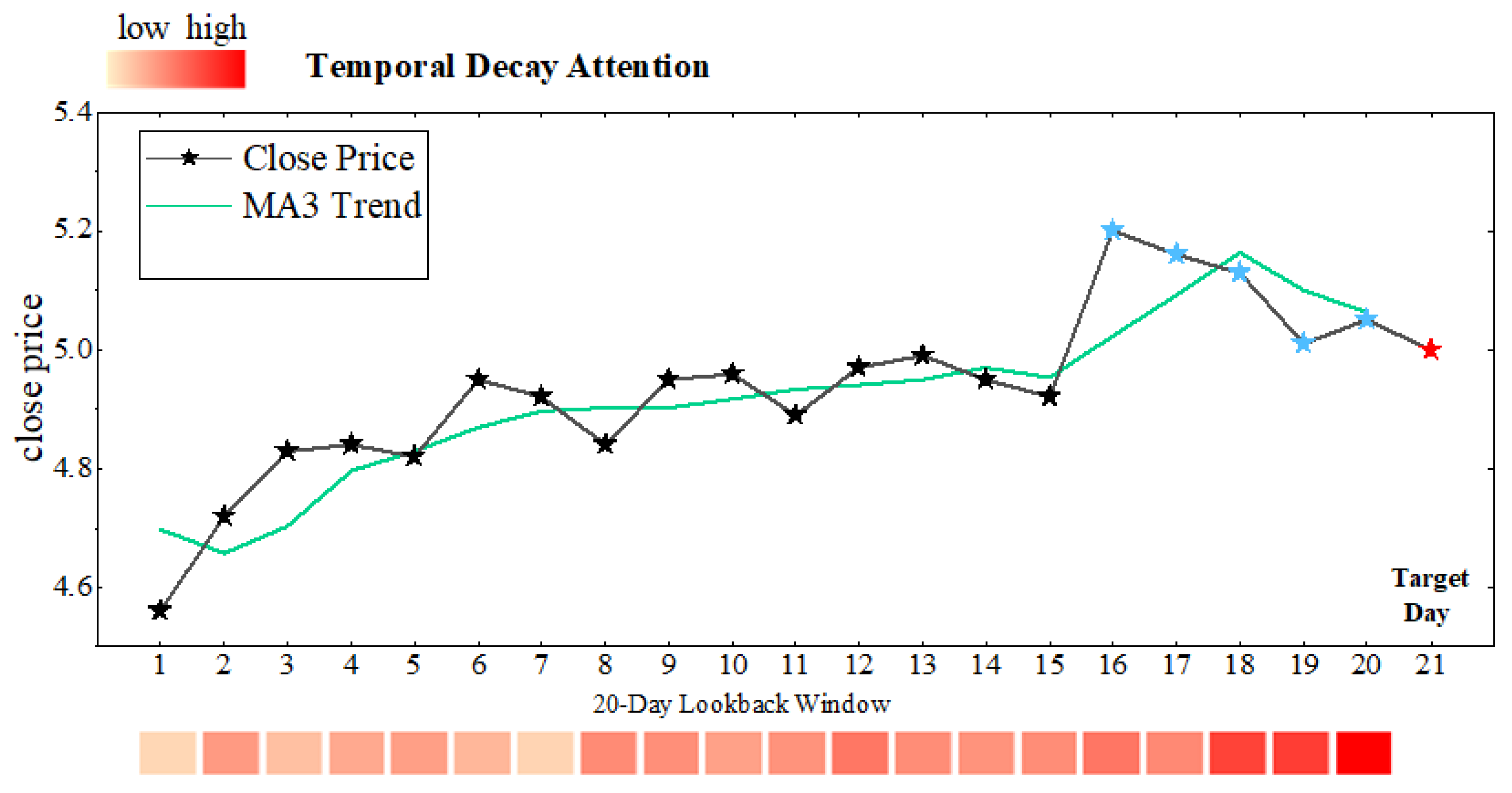
4.8. Visualizing Temporal Decay Attention
5. Conclusions
- Coping with concept drift in stock markets: To address the limitation of the current model in dealing with severe/sudden concept drift, we will carry out two targeted improvement strategies in future research. First, we will integrate real-time market auxiliary signals (e.g., concept hotness, policy news) into the dynamic graph construction module to break the reliance on historical price data alone and perceive early signs of concept drift in real time. Second, we will add a lightweight concept drift detection sub-module based on statistical methods to identify concept drift in real time, and design an adaptive reweighting strategy to suppress misleading historical relations and enhance the learning of newly formed valid market patterns. We will verify the optimized model on extended datasets containing severe concept drift scenarios to further improve its adaptability to dynamic financial markets.
- Heterogeneous hypergraph modeling: The existing methods are limited to homogeneous graphs or hypergraphs, but the relevance of stocks comes from multiple aspects, which restricts the generalization ability of the model. Using heterogeneous hypergraphs can more comprehensively represent the relationships between stocks, but the increase in the types of relationships can exacerbate the instability of hyperedges, and lead to a significant increase in computational load. For instance, adaptive hyperedge generation techniques, or the integration of reinforcement learning and attention mechanisms, to identify meaningful hyperedges may be a potential solution.
- Multi-modal fusion: Existing stock trend prediction models are inadequate when dealing with cross-modal data. There may be information redundancy or conflicts between multi-modal data, which could lead to confusion in the model’s fusion process, affecting the accuracy of predictions. Moreover, computational costs and data quality remain challenging issues. Integrating large language models (LLMs) and reinforcement learning to understand this cross-modal interaction may be a promising solution.
- Interpretability of stock prediction model: Existing stock prediction models are often regarded as black boxes, making it difficult to provide explanations for decision-making and this limitation hinders their application in financial decision-making. The identification of feature importance is challenging, and the generalization capability and trade-off between accuracy and interpretability remain issues that warrant further investigation. Future research should focus on advancing highly interpretable models or integrating existing explanatory methods. For example, different mask generation algorithms can be used to obtain masks corresponding to stock features or the associated matrix. These masks are then applied as interference to cover the original information, allowing for the study of the effects of different perturbations on the original information.
- Large-scale stock universe validation: We plan to validate the scalability of HDGAN on ultra-large-scale stock datasets, including the entire US equity market with more than five thousand stocks and the full A-share market with more than five thousand stocks. We will quantitatively evaluate the model performance in terms of prediction accuracy retention, computational latency and memory usage. We also intend to further optimize the model with adaptive hyperedge pruning and distributed graph training techniques to improve its computational efficiency in large-scale application scenarios.
Author Contributions
Funding
Data Availability Statement
Conflicts of Interest
References
- Rounaghi, M.M.; Zadeh, F.N. Investigation of market efficiency and financial stability between S&P 500 and London stock exchange: Monthly and yearly forecasting of time series stock returns using ARMA model. Phys. A Stat. Mech. Appl. 2016, 456, 10–21. [Google Scholar] [CrossRef]
- Liu, Z.; Dang, Z.; Yu, J. Stock Price Prediction Model Based on RBF-SVM Algorithm. In 2020 International Conference on Computer Engineering and Intelligent Control (ICCEIC); IEEE: New York, NY, USA, 2020; pp. 124–127. [Google Scholar] [CrossRef]
- Qin, Y.; Song, D.; Chen, H.; Cheng, W.; Jiang, G.; Cottrell, G.W. A Dual-Stage Attention-Based Recurrent Neural Network for Time Series Prediction. In Proceedings of the Twenty-Sixth International Joint Conference on Artificial Intelligence, IJCAI-17; International Joint Conferences on Artificial Intelligence: Freiburg, Germany, 2017; pp. 2627–2633. [Google Scholar] [CrossRef]
- Li, X.; Luo, S.; Pan, L.; Wu, Z. Adapt to small-scale and long-term time series forecasting with enhanced multidimensional correlation. Expert Syst. Appl. 2024, 238, 122203. [Google Scholar] [CrossRef]
- Chen, Y.; Wei, Z.; Huang, X. Incorporating Corporation Relationship via Graph Convolutional Neural Networks for Stock Price Prediction. In The 27th ACM International Conference on Information and Knowledge Management; ACM: New York, NY, USA, 2018; pp. 1655–1658. [Google Scholar] [CrossRef]
- Feng, Y.; You, H.; Zhang, Z.; Ji, R.; Gao, Y. Hypergraph neural networks. Proc. AAAI Conf. Artif. Intell. 2019, 33, 3558–3565. [Google Scholar] [CrossRef]
- Cui, C.; Li, X.; Zhang, C.; Guan, W.; Wang, M. Temporal-Relational hypergraph tri-Attention networks for stock trend prediction. Pattern Recognit. 2023, 143, 109759. [Google Scholar] [CrossRef]
- Liao, S.; Xie, L.; Du, Y.; Chen, S.; Wan, H.; Xu, H. Stock trend prediction based on dynamic hypergraph spatio-temporal network. Appl. Soft Comput. 2024, 154, 111329. [Google Scholar] [CrossRef]
- Adebiyi, A.A.; Adewumi, A.O.; Ayo, C.K. Comparison of ARIMA and artificial neural networks models for stock price prediction. J. Appl. Math. 2014, 2014, 614342. [Google Scholar] [CrossRef]
- Chong, C.W.; Ahmad, M.I.; Abdullah, M.Y. Performance of GARCH models in forecasting stock market volatility. J. Forecast. 1999, 18, 333–343. [Google Scholar] [CrossRef]
- Hochreiter, S.; Schmidhuber, J. Long short-term memory. Neural Comput. 1997, 9, 1735–1780. [Google Scholar] [CrossRef]
- Rahman, M.O.; Hossain, M.S.; Junaid, T.S.; Forhad, M.S.A.; Hossen, M.K. Predicting prices of stock market using gated recurrent units (GRUs) neural networks. Int. J. Comput. Sci. Netw. Secur. 2019, 19, 213–222. Available online: https://www.researchgate.net/profile/Md-Sabir-Hossain/publication/331385031_Predicting_Prices_of_Stock_Market_using_Gated_Recurrent_Units_GRUs_Neural_Networks/links/5c93b36492851cf0ae8e96fb/Predicting-Prices-of-Stock-Market-using-Gated-Recurrent-Units-GRUs-Neural-Networks.pdf (accessed on 13 April 2026).
- Ismail Fawaz, H.; Forestier, G.; Weber, J.; Idoumghar, L.; Muller, P.A. Deep learning for time series classification: A review. Data Min. Knowl. Discov. 2019, 33, 917–963. [Google Scholar] [CrossRef]
- Teng, X.; Zhang, X.; Luo, Z. Multi-scale local cues and hierarchical attention-based LSTM for stock price trend prediction. Neurocomputing 2022, 505, 92–100. [Google Scholar] [CrossRef]
- Park, H.J.; Kim, Y.; Kim, H.Y. Stock market forecasting using a multi-task approach integrating long short-term memory and the random forest framework. Appl. Soft Comput. 2022, 114, 108106. [Google Scholar] [CrossRef]
- Liu, W.J.; Ge, Y.B.; Gu, Y.C. News-driven stock market index prediction based on trellis network and sentiment attention mechanism. Expert Syst. Appl. 2024, 250, 123966. [Google Scholar] [CrossRef]
- Zhang, L.; Aggarwal, C.; Qi, G.J. Stock price prediction via discovering multi-frequency trading patterns. In Proceedings of the 23rd ACM SIGKDD International Conference on Knowledge Discovery and Data Mining; ACM: New York, NY, USA, 2017; pp. 2141–2149. [Google Scholar] [CrossRef]
- Kanwal, A.; Lau, M.F.; Ng, S.P.; Sim, K.Y.; Chandrasekaran, S. BiCuDNNLSTM-1dCNN—A hybrid deep learning-based predictive model for stock price prediction. Expert Syst. Appl. 2022, 202, 117123. [Google Scholar] [CrossRef]
- An, Z.; Wu, Y.; Hao, F.; Chen, Y.; He, X. A novel hierarchical feature selection with local shuffling and models reweighting for stock price forecasting. Expert Syst. Appl. 2024, 249, 123482. [Google Scholar] [CrossRef]
- Yang, Z.; Zhao, T.; Wang, S.; Li, X. MDF-DMC: A stock prediction model combining multi-view stock data features with dynamic market correlation information. Expert Syst. Appl. 2024, 238, 122134. [Google Scholar] [CrossRef]
- Zeng, L.; Wang, L.; Niu, H.; Zhang, R.; Wang, L.; Li, J. Trade When Opportunity Comes: Price Movement Forecasting via Locality-Aware Attention and Iterative Refinement Labeling. In Proceedings of the Thirty-ThirdInternational Joint Conference on Artificial Intelligence; ACM: New York, NY, USA, 2024; pp. 6134–6142. [Google Scholar] [CrossRef]
- Fang, Y.; Liu, R.; Huang, H.; Zhao, P.; Wu, Q. A Spatio-Temporal Diffusion Model for Missing and Real-Time Financial Data Inference. In Proceedings of the 33rd ACM International Conference on Information and Knowledge Management; ACM: New York, NY, USA, 2024; pp. 602–611. [Google Scholar] [CrossRef]
- Cheng, M.; Yang, J.; Pan, T.; Liu, Q.; Li, Z.; Wang, S. ConvTimeNet: A Deep Hierarchical Fully Convolutional Model for Multivariate Time Series Analysis. In Proceedings of the ACM on Web Conference 2025; ACM: New York, NY, USA, 2025; pp. 171–180. [Google Scholar] [CrossRef]
- Feng, F.; He, X.; Wang, X.; Luo, C.; Liu, Y.; Chua, T.S. Temporal relational ranking for stock prediction. ACM Trans. Inf. Syst. (TOIS) 2019, 37, 1–30. [Google Scholar] [CrossRef]
- Kim, R.; So, C.H.; Jeong, M.; Lee, S.; Kim, J.; Kang, J. Hats: A hierarchical graph attention network for stock movement prediction. arXiv 2019, arXiv:1908.07999. [Google Scholar] [CrossRef]
- Wang, H.; Li, S.; Wang, T.; Zheng, J. Hierarchical Adaptive Temporal-Relational Modeling for Stock Trend Prediction. In Proceedings of the Thirtieth International Joint Conference on Artificial Intelligence (IJCAI-21); International Joint Conferences on Artificial Intelligence: Freiburg, Germany, 2021; pp. 3691–3698. [Google Scholar] [CrossRef]
- Wang, H.; Wang, T.; Li, S.; Guan, S. HATR-I: Hierarchical adaptive temporal relational interaction for stock trend prediction. IEEE Trans. Knowl. Data Eng. 2022, 35, 6988–7002. [Google Scholar] [CrossRef]
- Xiang, S.; Cheng, D.; Shang, C.; Zhang, Y.; Liang, Y. Temporal and heterogeneous graph neural network for financial time series prediction. In Proceedings of the 31st ACM International Conference on Information & Knowledge Management; ACM: New York, NY, USA, 2022; pp. 3584–3593. [Google Scholar] [CrossRef]
- Wang, T.; Guo, J.; Shan, Y.; Zhang, Y.; Peng, B.; Wu, Z. A knowledge graph–GCN–community detection integrated model for large-scale stock price prediction. Appl. Soft Comput. 2023, 145, 110595. [Google Scholar] [CrossRef]
- Zhu, P.; Li, Y.; Liu, Q.; Cheng, D.; Jiang, C. Financial time series prediction with multi-granularity graph augmented learning. IEEE Trans. Knowl. Data Eng. 2025, 37, 6436–6449. [Google Scholar] [CrossRef]
- Li, S.; Sun, Y.; Lin, Y.; Gao, X.; Shang, S.; Yan, R. CausalStock: Deep end-to-end causal discovery for news-driven multi-stock movement prediction. Adv. Neural Inf. Process. Syst. 2024, 37, 47432–47454. [Google Scholar] [CrossRef]
- Chen, W.; Li, S.; Wang, H.; Wang, T. Enhancer: A distribution-aware framework with temporal-relational meta-learning for stock prediction. In Proceedings of the 31st ACM SIGKDD Conference on Knowledge Discovery and Data Mining V. 2; ACM: New York, NY, USA, 2025; pp. 250–261. [Google Scholar] [CrossRef]
- Sawhney, R.; Agarwal, S.; Wadhwa, A.; Shah, R.R. Spatiotemporal hypergraph convolution network for stock movement forecasting. In 2020 IEEE International Conference on Data Mining (ICDM); IEEE: New York, NY, USA, 2020; pp. 482–491. [Google Scholar] [CrossRef]
- Sawhney, R.; Agarwal, S.; Wadhwa, A.; Derr, T.; Shah, R.R. Stock selection via spatiotemporal hypergraph attention network: A learning to rank approach. Proc. AAAI Conf. Artif. Intell. 2021, 35, 497–504. [Google Scholar] [CrossRef]
- Huynh, T.T.; Nguyen, M.H.; Nguyen, T.T.; Nguyen, P.L.; Weidlich, M.; Nguyen, Q.V.H.; Aberer, K. Efficient integration of multi-order dynamics and internal dynamics in stock movement prediction. In Proceedings of the Sixteenth ACM International Conference on Web Search and Data Mining; ACM: New York, NY, USA, 2023; pp. 850–858. [Google Scholar] [CrossRef]
- Fang, L.; Zhao, T.; Yu, J.; Guo, Q.; Li, X.; Zhang, C. TD-HCN: A trend-driven hypergraph convolutional network for stock return prediction. Neural Netw. 2025, 190, 107729. [Google Scholar] [CrossRef]
- Duan, Y.; Wang, W.; Li, J. FactorGCL: A Hypergraph-Based Factor Model with Temporal Residual Contrastive Learning for Stock Returns Prediction. Proc. AAAI Conf. Artif. Intell. 2025, 39, 173–181. [Google Scholar] [CrossRef]
- Xia, H.; Ao, H.; Li, L.; Liu, Y.; Liu, S.; Ye, G.; Chai, H. CI-STHPAN: Pre-trained Attention Network for Stock Selection with Channel-Independent Spatio-Temporal Hypergraph. Proc. AAAI Conf. Artif. Intell. 2024, 38, 9187–9195. [Google Scholar] [CrossRef]
- Park, K.; Hong, S.; Jeon, J.J. Dynamic Higher-Order Relations and Event-Driven Temporal Modeling for Stock Price Forecasting. In Proceedings of the Thirty-Fourth International Joint Conference on Artificial Intelligence, IJCAI-25; International Joint Conferences on Artificial Intelligence: Darmstadt, Germany, 2025; pp. 6048–6056. [Google Scholar] [CrossRef]
- Song, L.; Li, H.; Chen, S.; Gan, X.; Shi, B.; Ma, J.; Pan, Y.; Wang, X.; Shang, X. Multi-Scale Temporal Neural Network for Stock Trend Prediction Enhanced by Temporal Hyepredge Learning. In Proceedings of the Thirty-Fourth International Joint Conference on Artificial Intelligence, IJCAI-25; International Joint Conferences on Artificial Intelligence: Darmstadt, Germany, 2025; pp. 3272–3280. [Google Scholar] [CrossRef]
- Malkiel, B.G. Efficient market hypothesis. In Finance; Eatwell, J., Milgate, M., Newman, P., Eds.; Palgrave Macmillan: London, UK, 1989; pp. 127–134. [Google Scholar]
- Zhang, C.; Song, D.; Huang, C.; Swami, A.; Chawla, N.V. Heterogeneous graph neural network. In Proceedings of the 25th ACM SIGKDD International Conference on Knowledge Discovery & Data Mining; ACM: New York, NY, USA, 2019; pp. 793–803. [Google Scholar] [CrossRef]
- Hallac, D.; Park, Y.; Boyd, S.; Leskovec, J. Network inference via the time-varying graphical lasso. In Proceedings of the 23rd ACM SIGKDD International Conference on Knowledge Discovery and Data Mining; ACM: New York, NY, USA, 2017; pp. 205–213. [Google Scholar] [CrossRef]
- Kipf, T.N.; Welling, M. Semi-supervised classification with graph convolutional networks. arXiv 2016, arXiv:1609.02907. [Google Scholar] [CrossRef]
- Cheng, R.; Li, Q. Modeling the momentum spillover effect for stock prediction via attribute-driven graph attention networks. Proc. AAAI Conf. Artif. Intell. 2021, 35, 55–62. [Google Scholar] [CrossRef]
- Wang, Y.; Zhu, D. A hypergraph-based hybrid graph convolutional network for intracity human activity intensity prediction and geographic relationship interpretation. Inf. Fusion 2024, 104, 102149. [Google Scholar] [CrossRef]



| Market | Stocks | Training Date | Training Days | Validation Date | Validation Days | Testing Date | Test Days |
|---|---|---|---|---|---|---|---|
| NASDAQ | 1026 | 2 January 2013–31 December 2015 | 756 | 4 January 2016–30 December 2016 | 252 | 3 January 2017–8 December 2017 | 237 |
| NYSE | 1737 | 2 January 2013–31 December 2015 | 756 | 4 January 2016–30 December 2016 | 252 | 3 January 2017–8 December 2017 | 237 |
| A-share | 754 | 4 January 2013–20 March 2017 | 1008 | 21 March 2017–7 August 2018 | 340 | 8 August 2018–31 December 2019 | 331 |
| Method | A-Share | NASDAQ | NYSE | |||||||||
|---|---|---|---|---|---|---|---|---|---|---|---|---|
| Accuracy | Precision | Recall | Accuracy | Precision | Recall | Accuracy | Precision | Recall | ||||
| LSTM | 35.81% | 34.99% | 34.91% | 34.94% | 37.22% | 34.64% | 36.56% | 35.52% | 45.73% | 36.22% | 38.04% | 37.08% |
| DARNN | 38.41% | 37.99% | 39.24% | 38.60% | 40.46% | 37.05% | 37.76% | 37.40% | 47.98% | 41.41% | 39.53% | 40.44% |
| GCN | 37.44% | 39.07% | 34.49% | 36.62% | 39.75% | 40.82% | 38.78% | 39.76% | 45.99% | 35.89% | 37.38% | 36.31% |
| TGC | 38.42% | 39.35% | 35.72% | 37.44% | 39.98% | 38.24% | 38.08% | 38.16% | 47.95% | 41.94% | 38.54% | 40.15% |
| AD-GAT | 38.69% | 40.95% | 41.83% | 37.91% | 42.24% | 40.75% | 40.74% | 40.20% | 49.85% | 43.71% | 39.04% | 40.26% |
| THGNN | 38.84% | 39.57% | 42.08% | 35.81% | 39.98% | 40.37% | 41.01% | 39.64% | 49.57% | 44.30% | 40.93% | 45.49% |
| HGTAN | 40.02% | 41.77% | 39.03% | 40.32% | 40.67% | 38.11% | 38.86% | 38.48% | 48.25% | 41.02% | 39.84% | 40.42% |
| OURS | 41.30 * ± 0.36% | 42.37 * ± 0.26% | 42.71 * ± 0.36% | 42.26 * ± 0.54% | 42.52 * ± 0.41% | 43.90 * ± 0.35% | 43.81 * ± 0.37% | 44.64 * ± 0.28% | 50.21 * ± 0.26% | 43.65 * ± 0.43% | 40.94 * ± 0.37% | 46.16 * ± 0.53% |
| Method | A-Share | NASDAQ | NYSE | |||||||||
|---|---|---|---|---|---|---|---|---|---|---|---|---|
| Accuracy | Precision | Recall | Accuracy | Precision | Recall | Accuracy | Precision | Recall | ||||
| w/o Temporal Decay Attn | 39.58% | 37.31% | 34.61% | 37.94% | 40.048% | 37.62% | 38.92% | 39.70% | 49.68% | 43.17% | 38.89% | 44.84% |
| w/o Attribute Aggregator | 40.27% | 38.45% | 37.24% | 38.60% | 41.55% | 38.81% | 39.48% | 40.08% | 49.71% | 42.75% | 38.94% | 44.79% |
| w/o Heterogeneous graph | 39.99% | 43.73% | 35.20% | 37.62% | 39.84% | 39.01% | 39.26% | 40.24% | 49.88% | 42.53% | 37.53% | 42.67% |
| w/o Hypergraph | 38.87% | 40.75% | 35.72% | 35.16% | 39.75% | 39.00% | 39.04% | 39.38% | 49.34% | 41.16% | 40.16% | 40.53% |
| w/o Conditional Aggregation | 40.46% | 42.70% | 42.17% | 42.06% | 42.24% | 40.75% | 40.74% | 40.20% | 50.14% | 43.41% | 39.95% | 45.98% |
| HDGAN | 41.30% | 42.37% | 42.71% | 42.26% | 42.52% | 43.90% | 43.81% | 44.64% | 50.21% | 43.65% | 40.94% | 46.16% |
| Model | Parameters (K) | Time (s) |
|---|---|---|
| LSTM | 2.10 | 3 |
| DARNN | 15.56 | 20 |
| GCN | 19.48 | 23 |
| TGC | 23.78 | 29 |
| AD-GAT | 1843.03 | 322 |
| THGNN | 110.40 | 88 |
| HGTAN | 586.66 | 245 |
| OURS | 159.37 | 112 |
| Method | A-Share | NASDAQ | NYSE | ||||||
|---|---|---|---|---|---|---|---|---|---|
| IRR | MDD | SR | IRR | MDD | SR | IRR | MDD | SR | |
| Buy-and-Holder | 10.84% | 26.01% | 0.274 | 12.09% | 5.38% | 0.937 | 7.91% | 3.27% | 0.742 |
| LSTM | 8.27% | 13.26% | 0.483 | 8.76% | 3.32% | 0.971 | 5.64% | 2.54% | 0.753 |
| DARNN | 14.79% | 21.24% | 0.608 | 6.97% | 2.66% | 0.939 | 5.51% | 2.15% | 0.727 |
| GCN | 16.10% | 15.43% | 0.905 | 5.95% | 2.83% | 0.640 | 7.32% | 2.89% | 0.640 |
| TGC | 8.46% | 7.85% | 0.587 | 10.38% | 4.00% | 1.046 | 6.78% | 1.98% | 0.966 |
| AD-GAT | 18.17% | 14.86% | 1.035 | 12.43% | 3.01% | 1.060 | 10.13% | 2.61% | 0.851 |
| THGNN | 14.97% | 13.31% | 1.277 | 11.67% | 2.65% | 1.135 | 9.30% | 2.38% | 0.899 |
| HGTAN | 18.71% | 11.29% | 1.407 | 12.81% | 3.13% | 0.903 | 9.86% | 3.02% | 0.878 |
| OURS | 24.62 * ± 0.59% | 6.96 ± 0.43% | 1.495 * ± 0.21% | 15.25 * ± 0.54% | 2.8 ± 0.12% | 1.223 * ± 0.11% | 10.89 * ± 0.13% | 1.92 * ± 0.24% | 1.110 * ± 0.10% |
Disclaimer/Publisher’s Note: The statements, opinions and data contained in all publications are solely those of the individual author(s) and contributor(s) and not of MDPI and/or the editor(s). MDPI and/or the editor(s) disclaim responsibility for any injury to people or property resulting from any ideas, methods, instructions or products referred to in the content. |
© 2026 by the authors. Licensee MDPI, Basel, Switzerland. This article is an open access article distributed under the terms and conditions of the Creative Commons Attribution (CC BY) license.
Share and Cite
Chen, X.; Zhou, X.; Wang, H. A Hybrid Hypergraph–Dynamic Graph Attention Network Based on Temporal Decay Attention and Conditional Aggregation for Stock Trend Prediction. Symmetry 2026, 18, 724. https://doi.org/10.3390/sym18050724
Chen X, Zhou X, Wang H. A Hybrid Hypergraph–Dynamic Graph Attention Network Based on Temporal Decay Attention and Conditional Aggregation for Stock Trend Prediction. Symmetry. 2026; 18(5):724. https://doi.org/10.3390/sym18050724
Chicago/Turabian StyleChen, Xiyuan, Xiaoyan Zhou, and Haibin Wang. 2026. "A Hybrid Hypergraph–Dynamic Graph Attention Network Based on Temporal Decay Attention and Conditional Aggregation for Stock Trend Prediction" Symmetry 18, no. 5: 724. https://doi.org/10.3390/sym18050724
APA StyleChen, X., Zhou, X., & Wang, H. (2026). A Hybrid Hypergraph–Dynamic Graph Attention Network Based on Temporal Decay Attention and Conditional Aggregation for Stock Trend Prediction. Symmetry, 18(5), 724. https://doi.org/10.3390/sym18050724