Article

A Hybrid Hypergraph–Dynamic Graph Attention Network Based on Temporal Decay Attention and Conditional Aggregation for Stock Trend Prediction

1
School of Electronic and Information Engineering, Nanjing University of Information Science and Technology, Nanjing 210044, China
2
School of Software, Nanjing University of Information Science and Technology, Nanjing 210044, China
*
Author to whom correspondence should be addressed.
Symmetry 2026, 18(5), 724; https://doi.org/10.3390/sym18050724
Submission received: 20 December 2025 / Revised: 21 March 2026 / Accepted: 14 April 2026 / Published: 24 April 2026

Abstract

As a novel tool for predicting stock trends, hypergraphs are used to effectively represent high-order relationships among stocks, capturing symmetric dependencies inherent in market interactions. However, the instability of hyperedges limits their ability to capture dynamic stock changes, and existing methods neglect the influence of time decay on feature importance. To address these challenges, a hybrid hypergraph–dynamic graph attention network based on temporal decay attention and conditional aggregation for stock trend prediction, namely HDGAN, is developed. Specifically, we utilize dynamic graphs to capture the dynamic relationships among stocks, which mitigates the instability of the hyperedge structure in dynamic markets. A temporal decay attention mechanism is designed to identify important feature points in the evolution of stock prices, and then a conditional aggregation method is proposed to aggregate information from different pathways. Extensive experiments on A-share, NASDAQ, and NYSE datasets demonstrate HDGAN outperforms other state-of-the-art methods in stock trend prediction and investment return.

1. Introduction

The prediction of stock price movements plays a critical role in investors’ decision-making processes and portfolio management, and constitutes a fundamental component of both financial research and practical implementation. Precise evaluation of stock price dynamics and their relative performance is not merely an aspect of investment activities, but also has far-reaching implications for overall economic functioning.
Some traditional studies on stock trend prediction are primarily grounded in the time-series analysis framework and commonly employ statistical models and machine learning techniques, such as autoregressive moving average (ARMA) [1] and support vector machines (SVMs) [2]. With the rapid advancement of artificial intelligence technologies, an increasing number of deep neural network models have been introduced into this field, such as recurrent neural networks (RNNs) [3] and transformers [4]. These models are capable of extracting complex latent patterns from multi-source data, including technical indicators, fundamental information, relational data, and social media signals, thereby enhancing the performance of price trend forecasting. However, many of these approaches typically treat stock time series as independent and identically distributed sequences, thereby neglecting the correlations among different stocks. In practice, substantial interactions exist between related stocks. With the development of graph neural networks (GNNs) [5], numerous studies have modeled individual stocks and their interrelationships as nodes and edges in a graph. By leveraging various GNN-based architectures to capture inter-stock dependencies, these approaches aim to better characterize relational influences and consequently improve the accuracy of stock prediction. Although graph-neural-network-based models for stock prediction have achieved substantial progress, most traditional graph-based approaches still primarily rely on pairwise relationships between stocks to forecast future trends. Undoubtedly, such modeling strategies may overlook higher-order information among stocks, such as cases where multiple stocks belong to the same industry and share common intrinsic attributes.
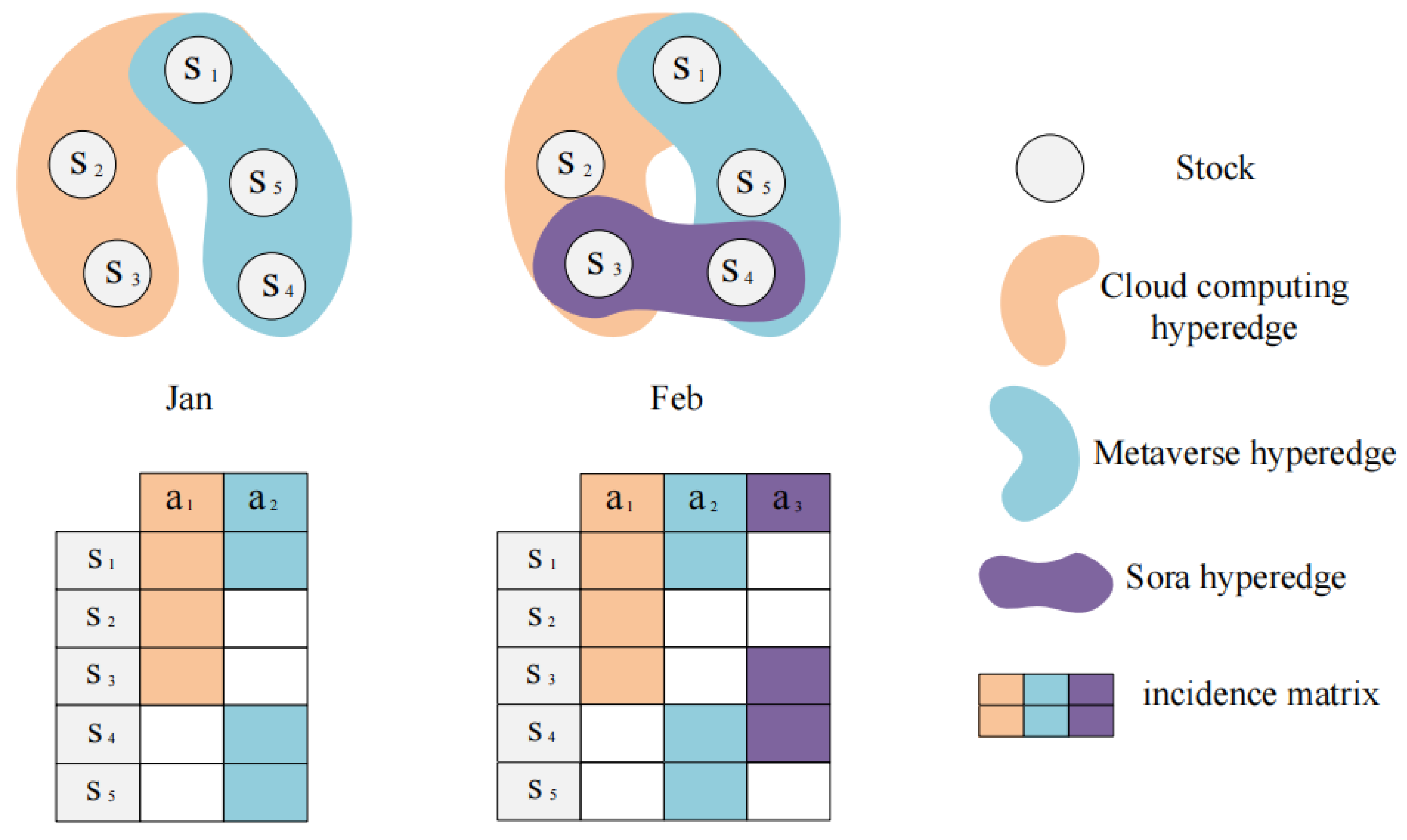
With the development of hypergraph neural networks [6], as shown in Figure 1, using hypergraphs to represent stock relationships can effectively alleviate these problems. Hypergraphs provide a natural way to model complex high-order relationships among stocks, enabling the capture of symmetric dependencies inherent in market interaction. Here, the symmetric dependencies in the stock market refer to the mutual, non-directional group-wise correlation and collective influence among multiple stocks bound by the same intrinsic attribute (e.g., industry affiliation, concept association). This concept has three core connotations consistent with stock market dynamics: (1) undirected group relations—stock interactions in the group are mutual and bidirectional without predefined directional influence; (2) permutation invariance within the group—the collective correlation of the group is irrelevant to the order of stock nodes; and (3) equal fundamental node contribution—stocks in the same group share the same intrinsic attribute forming the dependency, and thus have an equal fundamental contribution to the group’s collective dynamic. Traditional pairwise undirected graphs can only model binary symmetric relations between two stocks, while hypergraphs can naturally extend this binary symmetry to multi-node group symmetry, making it the optimal tool to capture the symmetric dependencies in stock market. However, the stock market is a highly dynamic environment, and the relationships among stocks will constantly change with time and market conditions. When these relationships change, the topological structures of the hypergraph will also change accordingly (Figure 1), including variations in the number of hyperedges. This results in instability in the hypergraph representation (such as the N × E matrix, where N denotes nodes and E denotes hyperedges), making it difficult to accurately reflect the dynamic changes in stock relationships. It should be clarified that this hypergraph instability does not involve industry-based hyperedges, which are structurally stable with almost no changes in their incidence matrix during implementation and serve as stable domain prior knowledge in our modeling. Instead, it refers to the hyperedges with dynamically evolving topological structures in the stock market, which may emerge or disappear rapidly with market dynamics.
Despite the progress of hypergraph-based stock prediction methods, their handling of dynamic relationships remains insufficient. Most existing methods either use predefined hypergraphs or learn hyperedges through fixed-scale clustering, which fixes the number of hyperedges E. For example, Li et al. [7] introduced predefined industry hypergraphs and fund hypergraphs to learn heterogeneous group-wise relationships among stocks, while Chen et al. [8] learned a dynamic hypergraph to represent continuously changing stock relationships. However, these methods still cannot well adapt to market variations, as hyperedges frequently appear, disappear, or recombine over time. A fixed E cannot adapt to such changes, leading to unstable topological representations and inaccurate high-order relation modeling. To alleviate this issue, we introduce dynamic graphs as a complementary structure. Unlike hypergraphs with variable E, dynamic graphs use a fixed N × N adjacency matrix, whose structure remains stable regardless of how relationships evolve. This stable topology effectively compensates for the instability of hyperedges, while hypergraphs continue to capture high-order industry and concept relationships. By combining them, our hybrid framework achieves both stable representation and expressive high-order modeling.
In addition, in financial time series, the influence of historical market information on future stock trends follows an inherent temporal decay pattern: earlier events gradually lose their predictive power, while recent trading states and market signals dominate short-term price movements. However, existing methods fail to capture this critical property. Most approaches rely on standard attention mechanisms to identify important trading days. For instance, Qin et al. [3] incorporated a temporal attention module into long short-term memory networks to emphasize momentum-driven hidden states, and Li et al. [7] developed a dedicated temporal attention layer to model the calendar effects inherent in stock price series. Nevertheless, such mechanisms only measure pairwise token similarity and lack sufficient contextual insight. More importantly, conventional attention is position-agnostic and cannot model the natural attenuation of influence over time, leading to unreasonable weight assignments that overemphasize outdated information and reduce sensitivity to the latest market changes. To address this limitation, we propose a temporal decay attention mechanism, which explicitly introduces time-aware decay coefficients to adapt attention weights, enabling the model to concentrate on recent critical information while suppressing the interference of distant historical data.
To address these issues, we propose a hybrid hypergraph–dynamic graph attention network based on temporal decay attention and conditional aggregation for stock trend prediction (HDGAN). We use hybrid graphs to model stock relationships, where hypergraphs are used to model high-order stock relationships and graphs are used to model dynamic stock relationships. Since the adjacency graph of a graph is always an N × N matrix, where N denotes nodes, we can use it to clearly represent the connection relationships between nodes regardless of how the stock relationships change. This stability enables us to better track and analyze the direct connections between firms in the stock market. Then, we proposed a temporal decay attention mechanism targeting the temporal trends of stock prices. HDGAN simulates the temporal evolution of stock relationship strength and prices by combining stock relationships with the temporal decay attention mechanism. In addition, we propose a conditional aggregation method to selectively aggregate information from different paths, and consider the states of the connected firms after the connection is established.
To validate the proposed method, we conducted extensive experiments on three stock datasets from the Chinese A-share market, National Association of Securities Dealers Automated Quotations (NASDAQ) and New York Stock Exchange (NYSE). The experiments demonstrated that our approach outperforms existing stock trend prediction methods. The main contributions of this paper are summarized as follows:
(1) To overcome the instability of hyperedge structures in dynamic markets, we propose a hybrid hypergraph–dynamic graph framework to simultaneously model stable high-order relations and adaptive dynamic relations.
(2) To address the neglect of temporal decay in historical information, we design a temporal decay attention mechanism to automatically adjust the influence weight of historical states over time.
(3) To alleviate the unreasonable information fusion from heterogeneous relations, we propose a conditional aggregation strategy to selectively fuse information from different graph paths.
(4) We conducted experimental evaluations and investment simulations on three real datasets (A-share, NASDAQ, and NYSE) to validate the effectiveness of HDGAN.
The rest of this paper is organized as follows: Section 2 reviews the related work. Section 3 details the the temporal decay attention mechanism and the hybrid hypergraph–dynamic graph attention network. Experimental setups are described in Section 4. Section 5 concludes our work and outlines the directions of future research.

2. Related Work

2.1. Stock Prediction Based on Time Series Models

In the early stages of stock market forecasting research, traditional time-series models, such as the Autoregressive Integrated Moving Average (ARIMA) [9] and Generalized Autoregressive Conditional Heteroskedasticity (GARCH) [10], were widely employed to predict price trends. In addition, various technical indicators were constructed based on historical prices and trading volumes to provide insights into future market movements. With the advancement of machine learning, classical algorithms including logistic regression and support vector machines (SVMs) [2] were gradually introduced into stock trend prediction and demonstrated certain predictive capabilities. However, these approaches generally rely on the assumption that financial time series are linear and stationary, which limits their ability to capture the inherent nonlinearity and high volatility of stock markets.
In recent years, deep neural networks have been progressively introduced into stock price prediction research and have demonstrated promising application potential. Among them, models based on recurrent neural networks (RNNs) have attracted considerable attention due to their strong capability in modeling temporal dependencies [11,12,13]. Stock market data inherently exhibit time-series characteristics, which align well with the ability of recurrent neural networks to capture temporal dependencies and evolving patterns over time [14,15,16]. For example, Zhang et al. [17] introduces a state frequency mechanism (SFM) that enables the model to better adapt to high-frequency trading scenarios, thereby improving its ability to perceive subtle market dynamics. The dual-stage attention-based recurrent neural network (DA-RNN), proposed by Qin et al. [3], employs both input and temporal attention mechanisms to selectively emphasize relevant features and effectively capture long-term dependencies in time-series data. Furthermore, hybrid approaches that integrate RNNs with convolutional neural networks (CNNs) have gained increasing attention. A representative example is the BiCuDNNLSTM-CNN model proposed by Kanwal et al. [18], which enhances the representation of stock data by leveraging the complementary strengths of different neural architectures. An et al. [19] proposed the HFSLSMR-LSTM, which performs local shuffle perturbations to assess feature importance and propagates only informative features to subsequent layers. In addition, a proximity-based reweighting scheme is employed to adjust model parameters, thereby reducing redundant features in the LSTM and effectively improving overall performance. Yang et al. [20] proposed an MDF-DMC framework that dynamically extracts representative features from multi-view stock sequences while enhancing model stability. Zeng et al. [21] presented the LARA framework, which focuses on sample selection and noise reduction. STDM [22] integrates feature projection with spatial–temporal attention mechanisms to achieve missing value estimation. In addition, Cheng et al. [23] developed ConvTimeNet, a hierarchical time series modeling approach built on convolutional operations.
Nevertheless, a key drawback of these approaches lies in their assumption that stocks are mutually independent, as they focus solely on the influence of individual stock features on future price movements while neglecting the interactions among different stocks within the market.

2.2. Stock Prediction Based on Graph Learning

Financial market behavior cannot be fully explained by the movement of individual stock prices alone, as assets are embedded in a market environment characterized by rich interdependencies and complex relational structures. Recognizing the importance of such interactions, recent studies have increasingly incorporated auxiliary information—including inter-stock correlations, sector affiliations, and network-based relationships—into predictive models. In this regard, graph-based learning frameworks have emerged as a promising direction for improving forecasting accuracy by explicitly modeling the interconnected nature of financial systems.
For instance, Chen et al. [5] constructed a stock graph based on inter-company shareholding information and employed a hybrid framework combining a pipeline architecture with graph convolutional networks to predict stock price movements. Feng et al. [24] developed industry association graphs and wiki-based relationship graphs, and a temporal graph convolution (TGC) model was proposed to perform stock price prediction on the NASDAQ and NYSE markets. A hierarchical graph attention network (HATS) designed by Kim et al. [25] selectively aggregates information from multiple relationship types to learn expressive stock representations for trend prediction. Wang et al. [26,27] reported further progress in enhancing prediction accuracy by integrating multi-perspective relational information to capture fine-grained interaction patterns. To model dynamic inter-stock relationships, Xiang et al. [28] built a stock relation graph from historical market signals and introduced a two-stage attention mechanism to learn time-varying dependencies. Additionally, Wang et al. [29] developed a stock knowledge graph incorporating shareholder-, industry-, and concept-level information, mapped it into a structured topological graph, and proposed a community detection-enhanced GCN framework for large-scale stock trend prediction. Zhu et al. [30] proposed a multi-granularity graph-augmented framework to capture both medium- and short-term stock dynamics, excelling in high-frequency trading; Li et al. [31] built a temporal causal graph via a lag-aware mechanism to model unidirectional stock influences. Chen et al. [32] introduced an Approximation-Intervention mechanism to correct relation drift and enhance model generalization.

2.3. Stock Prediction Based on Hypergraph Learning

Graph-based learning techniques have demonstrated strong effectiveness in financial modeling; however, conventional graph frameworks typically rely on pairwise relationships between stocks. In real-world markets, stock interactions often exhibit higher-order and group-level structures, which cannot be adequately captured by simple pairwise connections and may lead to information loss regarding collective stock behavior [33]. To overcome this limitation, Sawhney et al. [34] introduced a Spatio-Temporal Hypergraph Attention Network (STHAN-SR) that jointly models the temporal dynamics of stock prices and industry-based affiliations to improve trend prediction. To further capture complex stock behaviors, Huynh et al. [35] proposed a temporal generative filtering mechanism that models individual stock dynamics while integrating higher-order relational information via hypergraph attention and convolution operations. In addition, Cui et al. [7] developed a hypergraph tri-attention network (HGTAN), which employs node-level, hyperedge-level, and hypergraph-level attention mechanisms to quantify the relative importance of different structural components. Furthermore, Fang et al. [36] proposed a novel Trend-Driven Hypergraph Convolutional Network (TD-HCN), which incorporates a Prior-constrained Relational Learning (PCRL) framework to leverage explicit domain priors for guiding the discovery of latent high-order inter-stock relationships. Duan et al. [37] proposed a hypergraph-based factor model named FactorGCL, which leverages hypergraph structures to effectively capture high-order nonlinear relationships between stock returns and risk factors. Xia et al. [38] integrated the advantages of Transformer and hypergraph attention networks (HGAT), achieving competitive performance in stock-ranking prediction. Park et al. [39] introduced dynamic hypergraphs to adapt to the high-order group-level correlations inside the stock market, rather than simple pairwise relations. Song et al. [40] further explored time-varying patterns of sector-related stocks via a temporal hypergraph attention mechanism. These studies highlight the growing adoption of hypergraph-based learning paradigms in financial forecasting, enabling more expressive modeling of intricate stock relationships that extend beyond traditional pairwise interactions.

3. Proposed Model

3.1. Problem Formulation

Given the historical price sequence of stocks s, X t = { [ x s , t T + 1 , x s , t T + 2 , , x s , t ] , s S } , x s , t R D is the price sequence features of the stock s at t-th day, D is the dimension of features at each time-step, and T is the time window size. In addition, we have introduced a price heterogeneous graph and a sector hypergraph to represent the complex relationships among stocks. We denote G V , E as the price heterogeneous graph for stocks, and G ^ V ^ , E ^ as the stock sector hypergraph, where V , V ^ are stock node sets, E is the edge set, and E ^ is the hyperedge set.
Since it is much more difficult to accurately predict the future price of a stock, we transform the regression task of predicting the price of a stock into a time node classification task. Specifically, given a sequence of trading day prices over the past T days and a graph topology relationship among stocks, our goal is to predict the trend of the price of a stock, i.e., rising, falling or steady, on the next trading day. The mapping relationship is as follows:
F X , G , G ^ [ y ^ 1 , y ^ 2 , , y ^ n ] .
Here, F · represents the proposed method HDGAN. y ^ is the predicted label for the next trading day. Although HDGAN only performs a three-class classification (rising, falling, steady), stock trend prediction is inherently far more complex than standard classification tasks. It involves high-dimensional, non-stationary, and noisy financial data, dynamic temporal patterns, and dual relational structures including pairwise correlations and high-order group-wise dependencies. The hierarchical structure of HDGAN is therefore task-driven: each component is designed to address a specific challenge in modeling complex market dynamics rather than being unnecessarily complex for a simple prediction target.

3.2. Architecture Overview

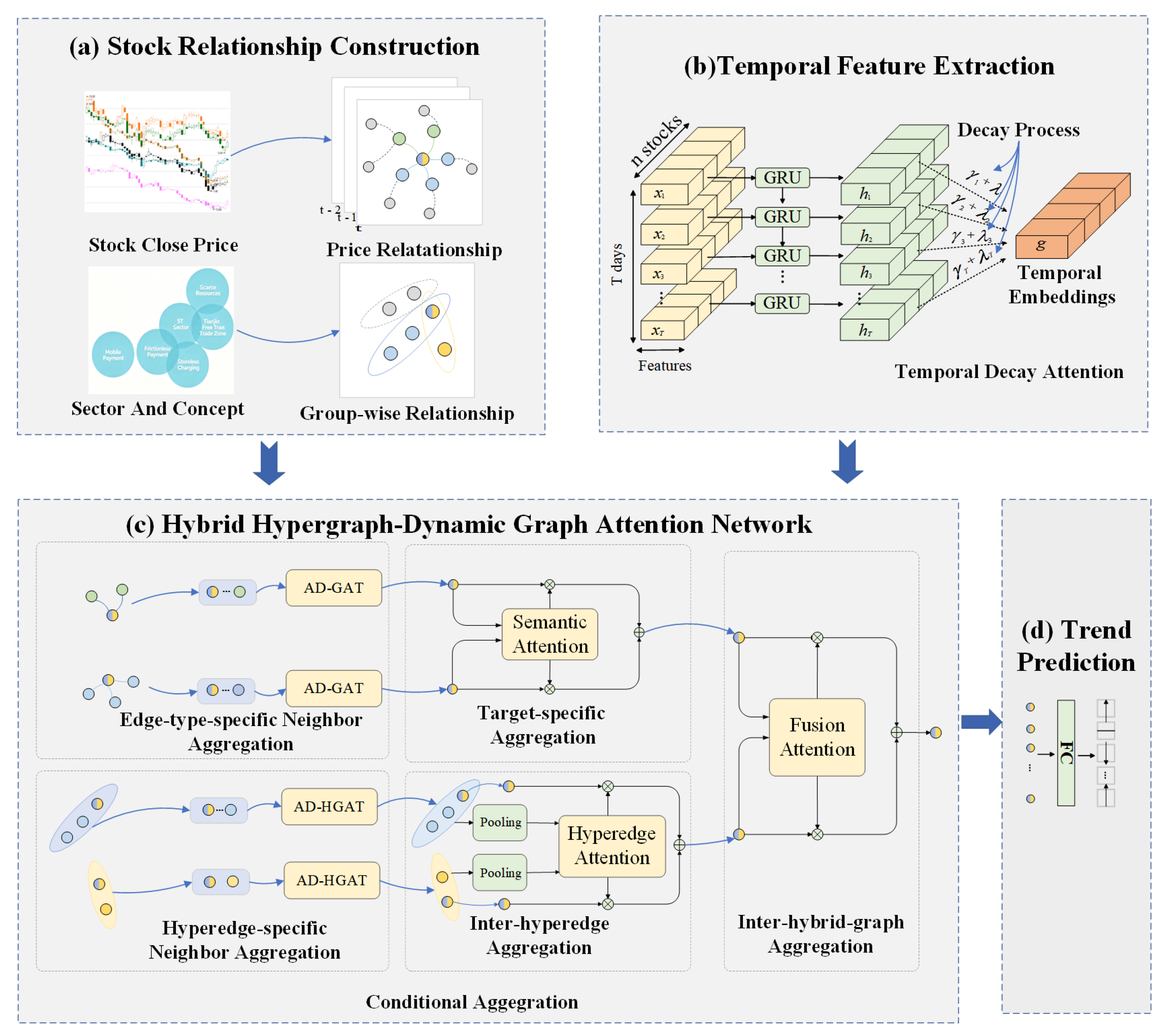
In this section, a hybrid hypergraph–dynamic graph attention network based on temporal decay attention and conditional aggregation for stock trend prediction (HDGAN) is introduced, and the overall framework of HDGAN is given in Figure 2. The model consists of four main parts, i.e., stock relation construction, temporal feature extraction, hybrid hypergraph–dynamic graph attention network and trend prediction.
  • Stock relationship construction: This module consists of two parts, price heterogeneity graph construction and hypergraph construction. The purpose of price heterogeneity graph construction is to obtain a dynamic stock relationship graph. The purpose of hypergraph construction is to construct stock domain knowledge hyperedges and node indices for the hypergraph through predefined knowledge.
  • Temporal feature extraction: The purpose of time series feature extraction is to encode the temporal characteristics of each stock, thereby obtaining the features of each node in the hybrid graph. We achieve this by combining GRU with Temporal Decay Attention.
  • Hybrid hypergraph–dynamic graph attention network: A hybrid hypergraph–dynamic graph attention network is designed to learn stock interactions in hybrid graphs, achieving this through a conditional aggregation method. The conditional aggregation method is primarily manifested in price heterogeneous graph, hypergraph, and hybrid graphs. It coordinates the importance of different sources during information propagation and selectively aggregates information to obtain the final embedding of stocks.
  • Stock trend prediction: The stock trend prediction outputs the probability of future stock prices increasing, remaining flat, or decreasing through a fully connected layer.
Notably, the “hybrid” of the proposed hybrid hypergraph–dynamic graph attention network is a principled stock relationship modeling and adaptive fusion framework, which integrates the dynamic price heterogeneous graph and industry-concept hypergraph in a two-stage hierarchical manner. The dynamic price heterogeneous graph is designed to capture the pairwise dynamic time-varying correlations between stocks with a stable N × N adjacency matrix structure, mitigating the hyperedge structural instability in the dynamic stock market; the industry-concept hypergraph is designed to capture the high-order group-wise dependencies among stocks based on industry and concept prior knowledge, making up for the inability of dynamic graphs to model collective stock interactions. The two graph components complement each other, and their integration is realized through a dedicated inter-hybrid-graph attention mechanism in the conditional aggregation module, which ensures the full retention of unique relational features of each component while adaptively fusing them in a data-driven way.

3.3. Stock Relationship Construction

3.3.1. Heterogeneous Topology Graph Construction

As stated in the Efficient Market Hypothesis Malkiel [41], stock prices in an ideal efficient market would fully reflect all available information. However, real-world financial markets are non-ideal and imperfectly efficient, as stock movements are affected not only by historical prices but also by investor sentiment, liquidity, policy changes, and various exogenous shocks. These factors lead to complex and predictable dependencies among stock prices, which carry critical information for trend forecasting. Therefore, modeling the relational structure among stocks remains one of the most essential components in stock trend prediction.
Stock relationships include dynamic, time-varying pairwise price correlations with positive and negative spillover effects that cannot be adequately represented by static graphs. To capture such real-time evolving pairwise dependencies, we construct a dynamic price graph as a core component of our relational modeling. We mine the historical prices of stocks to find stocks that are simultaneously correlated, i.e., whose prices move up and down in the unison or opposite direction. We construct a heterogeneous graph G ( V , E ) to represent this relationships [42], where V represents the set of nodes, and E = E p o s E n e g denotes the set of links. Specifically, we normalise the closing prices of all stocks. Then, we generate the precision matrix at different timestamps using the time-varying graphical lasso (TVGL) algorithm [43], which is based on the Alternating Direction Method of Multipliers (ADMM) that separates the problem into pieces that are easier to solve. The result is to generate Θ = Θ 1 , Θ 2 , , Θ T corresponding to T consecutive time intervals, where we treat the values of two different correlations as two different types of edges. At time t, we treat values of Θ t greater than 0 as the adjacency matrix for E p o s and values lower than 0 as the adjacency matrix for E n e g .

3.3.2. Hypergraph Construction

We represent the group-wise relationships among stocks through hypergraphs, where hyperedges represent different groups. We construct a hypergraph G ^ V ^ , E ^ , W ^ , where V ^ represents the set of stocks, E ^ represents the set of hyperedges, and W ^ represents the importance of the hyperedges. We set the hyperedge weight matrix W ^ = I for uniform initial weight assignment, and this setting has no significant impact on the model performance because the subsequent inter-hyperedge attention module in the conditional aggregation mechanism can adaptively learn the differentiated relative importance of different hyperedges for each stock in a data-driven manner during training. We inject domain knowledge into the hyperedges among stocks through two types of relationships (industry relationships and concept stock relationships). Stocks in the same industry or concept exhibit strong collective group-wise behaviors that exceed the representation capacity of pairwise edges. To model such high-order group dependencies, we introduce hypergraph-based modeling, which complements the dynamic graph and forms a dual-relational framework. Stocks belonging to the same industry generally experience similar price trends based on industry performance. In order to take advantage of this signal, we construct a hyperedge set of stocks connected to the same industry. Formally, we construct a hyperedge e ^ E ^ i n d that connects stocks that belong to the same industry.
Concept stocks are usually closely related to a hot topic or trend in the market. When a concept receives widespread attention in the market, related stocks may be sought after by funds, driving stock prices to rise. We have constructed a hyperedge set of stocks that connect to the same concept sector. In the US market, we use the first-order and second-order relationships of Wikidata to replace the concept sector hyperedge. Formally, we construct a hyperedge e ^ E ^ c o n that connects stocks that belong to the same concept.
We combine two types of hyperedges as E ^ = E ^ i n d E ^ c o n to construct the hypergraph G ^ , which can be characterized as the incidence matrix H R | V ^ | × | E ^ | , as shown in Figure 1. For v ^ V ^ and e ^ E ^ :
H v ^ , e ^ = 1 , if v ^ e ^ , 0 , otherwise

3.4. Temporal Feature Extraction Based on Temporal Decay Attention

In stock markets with high volatility, historical price data of stocks are a crucial indicator for predicting future trends and are widely used in various stock forecasting tasks. We first use the RNN model to capture the time-series dependencies from the stock historical data. On trading day t, we input the historical data X t from the previous T trading days into the RNN model:
h t = GRU x t , h t 1
where x t and h t denote stock features and hidden layer states on t-th day. Research has shown that specific points in time are often associated with stock price movements, such as when companies release quarterly financial reports or new products. For this reason, we designed a temporal decay attention layer that allows the model to focus on specific key trading days. The importance of the hidden states is ascertained through the computation of similarities between the query vector W q of the most recent hidden state h T and the key vectors W k of the daily hidden states. The attention weight γ t of the hidden state h t is defined as follows:
γ t = e x p s h t , h T Σ j = 1 T e x p s h t , h T
where
s h t , h T = W k h t T W q h T
is a compatibility function that transforms h t and h T into a latent space, and computes their dot product in the space. However, stock prices are readily influenced by external events. For example, the release of a new version of Apple’s products not only impacts the company’s stock price but can also affect the future valuation of related equities. Such influence may attenuate over time, rendering stock prices more susceptible to the effects of recent occurrences. Stock prices are affected by short-term trading signals, medium-term industry trends, and long-term market cycles, with the influence of historical information decaying over time. Simple recurrent models such as LSTM or GRU cannot adequately capture such multi-scale temporal characteristics. The temporal decay attention mechanism is thus introduced to dynamically weight temporal features and adapt to time-varying importance, enabling more robust modeling of evolving market patterns. The self-attention mechanism, limited to detecting similarities among hidden states, is incapable of capturing the characteristics of this temporal evolution. In order to capture this property, we propose a time decay process; we first compute a learnable decay coefficient σ t based on the hidden state h t . Specifically, we obtain the adaptive coefficient σ t as follows:
σ t = | W d h t | + b ,
where W d and b are learnable parameters. We then use σ t to calculate the time decay weight λ t :
λ t = e x p T t σ t 2 .
This exponential decay form is designed based on financial intuition and aligns with the Hawkes process (a classic financial time series framework), which models the time-decaying impact of historical market events; the parameterized σ t dynamically adjusts the decay rate with market states, adapting to the time-varying nature of real financial markets. The absolute value ensures σ t > 0 for valid exponential decay calculations and preserves the magnitude of the hidden state’s linear transformation, enabling magnitude-dependent adaptive decay rates that match market dynamics. Then, we add the temporal decay weights to the hidden state attention weights to obtain the final temporal attention weights. We generate a unified embedding g to describe the global temporal dynamics of a stock, which are computed as the weighted sum of the transformed hidden states, i.e.,:
g = t = 1 T γ t + λ t W v h t
In the temporal attention layer, W q , W k , and W v are three transformation matrices to be learned. Following the same steps, we can yield the temporal dynamics representations of all stocks, which are denoted as { g 1 , g 2 , , g n } .

3.5. Hybrid Hypergraph–Dynamic Graph Attention Network

Traditional graph convolutional networks (GCNs) [44] and hypergraph convolutional networks (HGCNs) [6] have demonstrated excellent performance in modeling stock relationships. However, there are some limitations in directly applying these models to stock relationship analysis: (1) they fail to fully consider the differences between different information pathways; and (2) they ignore the states of the two connected companies after the connection is established. To overcome these problems, we propose a novel hybrid hypergraph–dynamic graph attention network (HDGAN), which uses a conditional aggregation method to address the above challenges. We detail the application details of the conditional aggregation method in heterogeneous graphs, hypergraphs, and hybrid graphs. Financial data are highly noisy and prone to spurious correlations and concept drift. Simple aggregation or fully connected layers cannot effectively filter invalid information. Our conditional aggregation and multi-branch attention mechanisms serve to adaptively select valid signals, suppress noise, and weight the contributions of different relational pathways, ensuring robust and meaningful feature fusion.

3.5.1. Conditional Aggregation in Price Heterogeneous Graph

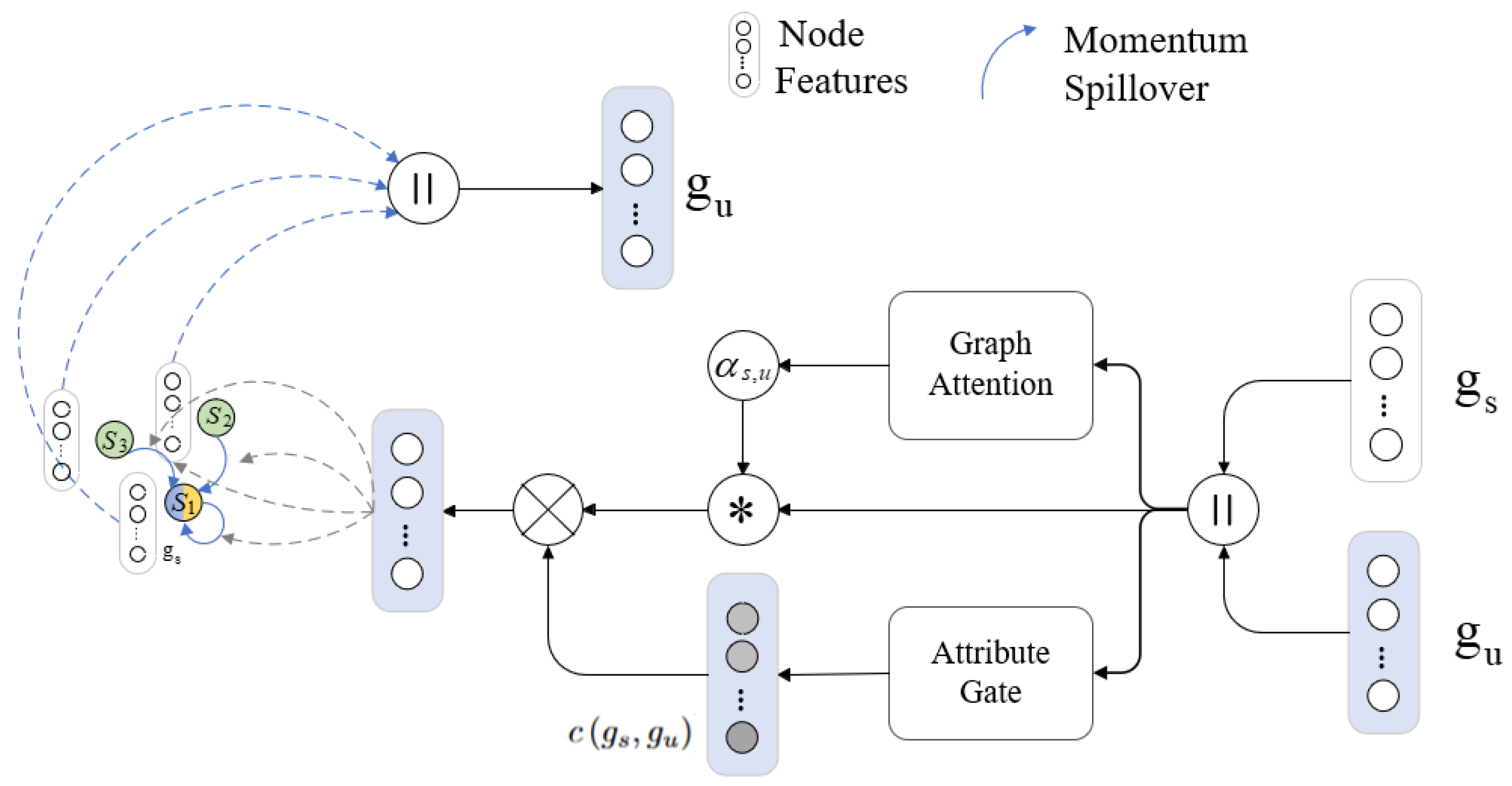
Edge-type-specific neighbor aggregation: After obtaining the temporal dynamic representations of all stock nodes, we employ them as node features for both the price heterogeneous graph and the sector hypergraph. On the price heterogeneous graph, for neighbors associated with each relation r, we adopt an edge-type-specific Attribute-Driven Graph Attention Network (AD-GAT) layer to aggregate spillover effects from nodes linked to the target via identical edge types. The detailed pipeline of AD-GAT is illustrated in Figure 3. Within one AD-GAT layer, we first use graph attention to calculate instance-level attention weights so as to capture relational dependencies between a neighboring node s and the target node u, and to enhance the representation of node u. To further distinguish the relative influence of various neighbors on the target node, we then compute the normalized importance scores as follows:
g s = z s e s , u , r = L e a k y R e l u a r T W r [ z s | | g u ] if s u L e a k y R e l u a r T W r [ z s | | z s ] if s = u
where g s and g u are concatenated and mapped into a F dimensional vector using W r and it is further transformed into a scalar that represents their connection strength via vector a r . To make a s , u , r comparable among other related companies, a s , u is further normalized with a softmax function over all choices of u:
α s , u , r = e x p e s , u , r k N s r e x p e s , k , r
where N s r is the neighbourhood of s under the r relation, and α s , u , r is the normalized connection strength from u to s under the r relation. In a real stock market, if an abnormal price of a stock is accompanied by low trading, then this price change may not spill over. We introduce a non-linear correlation mapping mechanism c · to distinguish spillovers of different attributes under the relationship r. The embedding of the firm under an edge type specific relation g s , r is obtained by aggregating the spillovers from neighbours of the same edge type connected to the target node.
g s , r = σ u N s r α s , u , r W m g u c ( g s , g u ) momentum spillovers from u to s + α s , s , r z s
where
c g s , g u = σ W [ g s | | g u ] + b
where g s , r is the embedding of the firm s in the relation r. Assuming that there are R s edges of different types connected to firm s, we can obtain a set of R s representations of an edge type specific for a target node s V ˜ , which are denoted as { g s , 1 , g s , 2 , , g s , R s } .
Target-specific aggregation: There are significant differences in the manifestations and influence mechanisms of spillover effects among stocks with different types of correlations. In order to learn the importance of different relationships in the relationship graph G , we adaptively generate the importance of different relationships through the semantic attention mechanism, and aggregate the edge-type-specific representations to obtain the all-relation embedding of company s.
ω r = 1 | V ˜ | s V ˜ q T t a n h W g s , r + b , β r = s o f t m a x ω r , g s = r = 1 R s β r · g s , r

3.5.2. Conditional Aggregation in Hypergraph

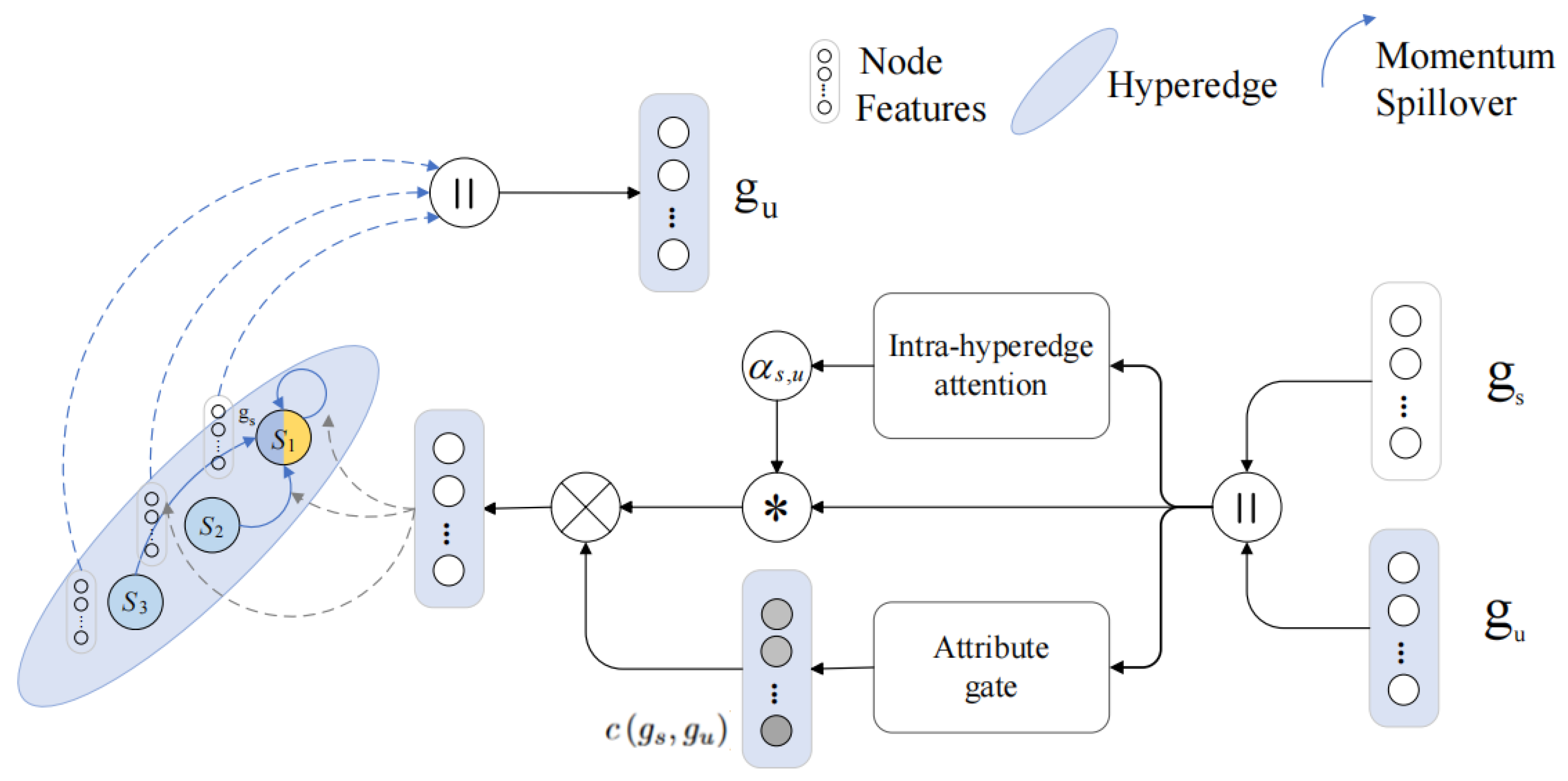
Hyperedge-specific neighbor aggregation: In the sector hypergraph, we focus on aggregating group-level information within each hyperedge e. For nodes associated with the same hyperedge e, a hyperedge-specific Attribute-Driven Intra-hyperedge Attention Network (AD-HGAT) layer is utilized to integrate spillover effects among intra-hyperedge nodes. The detailed architecture of AD-HGAT is displayed in Figure 4. Within the AD-HGAT layer, intra-hyperedge attention is adopted to compute and normalize the attention coefficient a s , u , which measures the contribution of neighbor u to target stock s within hyperedge e. Different from the graph-based scheme in Chen et al. [45], our hyperedge-level attention further distinguishes attribute-wise spillover intensities and yields the refined representation of stock s by weighted aggregation of its intra-hyperedge neighbors:
a s , u = e x p δ a d T P [ g s | | g u ] v N e e x p δ a d T P [ g s | | g v ] , r s e = δ u N e a s , u P r u e c ( g s , g u ) momentum spillovers from node u to hyperedge , e
where P is a mapping matrix to be learned and a d is a matrix of shared attention vectors to convert vectors to scalars then computing the degree between any pair of stocks. N e is the subset that forms the hyperedge e.
Inter-hyperedge aggregation: A stock may be covered by multiple hyperedges just as a stock may belong to multiple concepts; the momentum spillover effects may manifest in different forms and degrees due to the characteristics of different groups. Therefore, it is necessary to measure the importance of all the different hyperedge-specific embeddings. Formally, for the hyperedge subset H s containing stocks s in G ^ , for hyperedges e H s , the hyperedge embedding q e for e is generated by:
q e = p o o l { r s e , s N e }
where p o o l · denotes the element-wise max-pooling operation. After obtaining the embedding of each hyperedge, we use the hyperedge Attention method to compute hyperedge-level attention to explore the importance of q to all other hyperedges, and to characterize the s in G ^ by weighting the aggregation of all specific hyperedges.
c q e = b H s δ a c T Q [ q e | | q b ]
β e = e x p c q e b H s e x p c q b
r s m = e H s β e r s e momentum spillovers from hyperedge e to node s
Similar to 13 , Q and a c are the mapping matrix to be learned and matrix of shared attention vectors. Notably, all hyperedges share a unified set of learnable weights (instead of independent embeddings for each hyperedge ID), which allows the model to adapt to newly emerged hyperedges in the test set without retraining and ensures generalization for dynamic hypergraph topology changes.

3.5.3. Conditional Aggregation Based on Inter-Hybrid-Graph Aggregation

In complex financial markets, modeling stock interactions via hybrid graphs not only alleviates the instability issue of hyperedges but also captures the simultaneous existence of pairwise correlations and intricate high-order relationships. As emphasized in [46], such dependencies are tightly coupled rather than independent; pairwise and high-order connections interweave with and affect each other throughout market dynamics. To effectively fuse embeddings from pairwise and group-level patterns, we introduce an adaptive attention mechanism. This module enables the model to automatically evaluate the significance of different structural embeddings and capture their interactive dependencies. Specifically, we first measure the compatibility between g and r and compute the corresponding attention coefficients as follows:
o g s = δ a o T [ V g s | | V r s ] , o r s = δ a o T [ V r s | | V g s ] , ω g = e x p o g s e x p o g s + e x p o r s , ω r = e x p o r s e s p o r s + e x p o g s ,
where ω g denotes the attention weight for the hypergraph embedding, and ω r denotes the attention weight for the pairwise graph embedding. Finally, we complete the update of the stock embedding by:
y ¯ s = ω g g s + ω r r s

3.6. Stock Trend Prediction

Following the same steps, we can get the final output of all the stocks denoted as { y ¯ 1 , y ¯ 2 , , y ¯ n } . Then, a dense layer with a softmax function is used to generate probabilities of future stock trends:
y ^ s = s o f t m a x D e n s e ( y ¯ s ) .
We employ Cross Entropy loss to update the neural network:
L = c y s , c l n y ^ s , c ,
where y s , c is a ground-truth movement class of stock s.

4. Experiment

4.1. Dataset

To comprehensively evaluate the proposed HDGAN model, we conduct experiments on three representative stock markets, namely the NASDAQ, the New York Stock Exchange (NYSE), and the Chinese A-share market. Historical stock sequences for NASDAQ and NYSE are obtained from [24], covering 1245 trading days from 2 January 2013 to 8 December 2017, with 1026 and 1737 stocks, respectively. For the Chinese A-share market, we follow the data-processing pipeline in [7] and collect historical prices of 754 stocks across 1702 trading days from 4 January 2013 to 31 December 2019, using the open-source financial API Tushare. We filter out newly listed, delisted, and suspended stocks whose valid trading duration is less than 98% of the total period, and retain the daily closing price for each remaining stock. To characterize price movements at multiple time scales, we compute four standard technical indicators: 5-day, 10-day, 20-day, and 30-day moving averages. Notably, the closing price and the same four moving-average features are adopted uniformly across all three datasets to ensure consistency in feature construction. All datasets are chronologically split into training, validation, and test sets with a fixed ratio of 6:2:2. Detailed statistics and temporal partitions are summarized in Table 1. In addition, stock industry affiliations and concept relationships for constructing relational structures are collected via the open-source financial data library AKShare.

4.2. Evaluation Metrics

In our study, we use two thresholds β r i s i n g , β f a l l i n g to define the rate of change of the closing price on the second trading day c h g T + 1 as three directions, up 1 , down 2 , and stable 0 .
c h g T + 1 = p T + 1 p T p T
y = 1 if c h g T + 1 β r i s i n g 2 if c h g T + 1 β f a l l i n g 0 otherwise
where thresholds β r i s i n g and β f a l l i n g are used to balance the number of samples in different categories. We set β r i s i n g = 0.55% and β f a l l i n g = −0.50% in line with the previous works [7].
We evaluate our proposed model in terms of both predictive performance and profitability performance. To evaluate the predictive performance of the model, we use accuracy, precision, recall, and F 1 score as evaluation metrics in agreement with [7,25].
Accuracy = t p + t n t p + f p + t n + f n
Precision = t p t p + f p
Recall = t p t p + f n
F 1 = 2 Precision Recall Precision + Recall
where t p is true positive, f p is false positive, t n is true negative and f n is false negative.
For profitability performance, we first back-test the model according to its predicted results and then use three commonly used metrics: cumulative investment return rate (IRR), maximum drawdown (MDD) and Sharpe ratio (SR), i.e.,:
IRR: It is a direct response to the return on investment and it is calculated by adding up the returns of all stocks. R i represents the daily return rate.
IRR = P 0 i n R i
MDD: Maximum drawdown measures the maximum decline in cumulative portfolio value from the peak. It is used to measure the maximum loss experienced by investors during the investment period.
MDD = m a x p i p j p i , j > i
where p i is the net product value on day i.
SR: Sharpe ratio measures the profitability of the investment method and takes into account risk.
SR = R p R f σ
where R p is the expected rate of return on a portfolio, R f represents the interest rate without any risk, and σ is the standard deviation of returns.

4.3. Baselines

We compare the proposed HDGAN with different stock-trend-type algorithms. For a fair comparison, all algorithms employ identical time-series inputs, including technical indicators and the length of the lookback window. The main hyper-parameters of each baseline method are initialized following the settings reported in their respective original papers, and then carefully optimized via grid search to attain their best possible performance.
  • LSTM [17]: one of the most widely used deep learning models today uses historical price data to predict future stock trends.
  • DARNN [3]: DARNN adds a two-stage attention mechanism to recurrent neural networks. It adaptively selects the relevant driving sequences and the relevant hidden states.
  • GCN [5]: the node attributes are encoded using the LSTM network and the attributes of the neighbours are aggregated to the central node via GCN.
  • TGC [24]: the model uses the dynamics of the time series to adjust pre-defined firm relationships.
  • AD-GAT [45]: the method uses an unmarked attention mechanism to update stock relationships, while an attribute-mattered aggregator is designed to capture momentum spillovers.
  • THGNN [28]: THGNN infers a dynamic heterogeneous graph from market signals and learns the dynamic relationships of stocks through a two-stage attention mechanism.
  • HGTAN [7]: the method introduces fund hypergraphs and industry hypergraphs and uses a hierarchical attention module to learn the importance of different nodes, hyperedges, and hypergraphs.

4.4. Experimental Settings

The basic framework of our model is executed using pytorch with a batch size of 64 and a maximum number of training epochs of 600. We used an initial learning rate of 0.001 and Adam optimizer to train the model parameters and tuned most of the hyperparameters at {8, 16, 32, 64, 128} and verified later. We finally set the hidden state of the GRU and the number of units per layer to 32 and 2, respectively. The time step was set to 30, the hidden layer of the graph was set to 16, and the dropout was set to 0.5. The experimental environment was configured with NVIDIA RTX 4090 with 24 GB video memory for training, validation and testing. Despite the relatively rich structure of HDGAN, its computational overhead is well controlled due to several sparsity-aware designs. The dynamic graph constructed via TVGL maintains high sparsity by retaining only significant correlations, avoiding dense and redundant computations. Industry hyperedges are naturally sparse because each stock belongs to exactly one industry, leading to a clean and fixed hyperedge structure. Concept hyperedges are also sparse by construction, as we only consider core market concepts. Both the dynamic graph and hypergraph modules are implemented efficiently using PyTorch Geometric 2.5.2 (PyG). Although the model introduces more parameters to capture complex market dynamics, the overall computational cost remains moderate and feasible for real-world stock prediction tasks.

4.5. Results and Analysis

4.5.1. Predictive Performance

The overall classification performance of the different models is shown in Table 2. As shown in the table, the comparison over the three datasets indicates that our proposed HDGAN outperforms the other methods in all metrics.
As a classic deep learning model, LSTM lags far behind the stock-relationship-based models, including GCN, TGC, ADGAT, HGTAN and HDGAN, which may indicate that it is unable to effectively capture the temporal dependence of stock time series data. In addition, DARNN performs reasonably well using only historical stock price data. Compared to LSTM, DARNN incorporates an attention mechanism that automatically selects relevant trade sequence information, suggesting that better results can also be achieved by using the attention mechanism wisely. It is worth noting that ADGAT achieves the second best performance among all metrics in both the NASDAQ and NYSE datasets, which is due to the fact that ADGAT takes into account the momentum spillover effect among stocks and uses an attribute-sensitive approach to aggregate stock information, which is more appropriate for the stock market. Compared to HGTAN, which uses a hypergraph structure, this is due to the fact that HGTAN lacks fund holding relationships, resulting in poor model performance. On the A-share dataset, HGTAN generally achieves the second best performance for all metrics, which is due to the fact that HGTAN takes into account higher-order relationships.
HDGAN makes full use of stock relationships, modelling both group and pairwise relationships among stocks and taking into account momentum spillovers among stocks. HDGAN outperforms other models in all metrics. More precisely, it outperforms the second place by an average of almost 0.64% in accuracy and 4.04% in F 1 score, which clearly proves the effectiveness of HDGAN for stock trend prediction.
The architectural complexity of HDGAN (multiple attention layers and hybrid graph structure) is rationally designed and verified by quantitative analysis: (1) The model achieves an average 0.64% accuracy improvement and 4.04% F 1 score improvement over the second-best baseline, with no redundant modules (ablation experiments confirm each module’s positive contribution). (2) The computational complexity is controlled as O ( T · N · D + R · N · d + E · N · d ) with sparse matrices, and the training time on the NYSE dataset (1737 stocks) is about 8 h on an NVIDIA RTX 4090, which is consistent with state-of-the-art models.

4.5.2. Ablation Study

To analyse the effectiveness of the components of our proposed framework, we transformed it into the following five models and conducted experiments on three datasets.
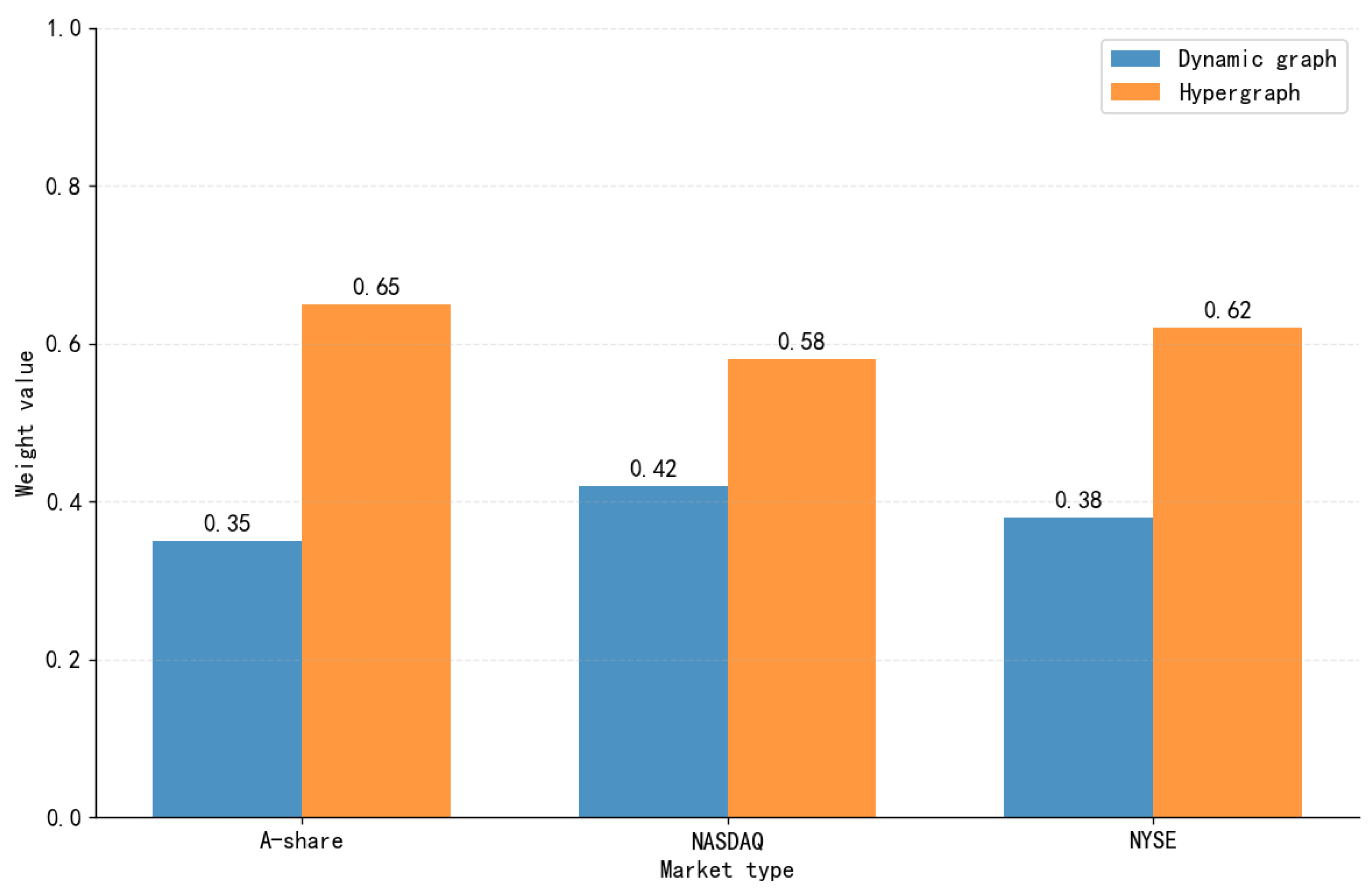
In Table 3, we observe that the model exhibits poor performance in the absence of temporal decay attention, which validates the importance of temporal modelling for the overall model as it also affects subsequent relationship learning modules. With the removal of the attribute aggregator, the model shows a slight loss, which is due to the fact that conventional GCNs and HGCNs do not take into account the state of the company at the time of connection. On the spatial side, the removal of any part leads to a significant performance loss. Specifically, the loss of removing the hypergraph learning part is greater than removing the price graph, confirming the equal importance of pairwise dynamic relations and group-wise relationships for stock forecasting. Unlike pairwise price graphs that only capture simple bilateral correlations between individual stocks, hypergraphs model high-order group relations derived from industry sectors, concept themes, and capital flows. As shown in Figure 5, in the A-share market, where such concept classifications are particularly abundant and dense, the hypergraph module dominates the model’s decision-making with a weight of 0.65, significantly higher than the dynamic graph weight of 0.35. In contrast, the NASDAQ and NYSE markets feature sparser concept-driven group effects and more independent stock movements, leading to a relatively higher dynamic graph weight (0.42 and 0.38, respectively) and slightly lower hypergraph weights (0.58 and 0.62). This adaptive weight distribution confirms that high-order hypergraph relations carry more critical and stable market information in concept-rich markets, thus leading to more substantial performance degradation when hypergraph learning is removed, while pairwise dynamic correlations play a more important role in markets with weaker group linkages. This validates the complementary importance of both pairwise dynamic relations and group-wise relationships for stock forecasting. On the other hand, the performance loss due to the removal of the conditional aggregation is smaller, as both variants of the model remain valid without fusion. The complementarity of aggregated information also proves the effectiveness of the conditional aggregation.

4.5.3. Time Complexity Analysis

We compare the model complexity and computational efficiency on the A-share dataset in terms of the number of trainable parameters and the time cost for training one epoch. As shown in Table 4, our model has a moderate number of parameters at 159.37 K, and its time cost per epoch is only 112 s. It is significantly more efficient than heavy baselines including ADGAT and HGTAN while maintaining a reasonable overhead compared with lightweight models. This indicates that the proposed method achieves improved prediction performance without introducing excessive computational burden.

4.5.4. Hypergraph Scale Adaptation

Since the hypergraph structures in this work are constructed based on real-world stock industry classifications and concept affiliations, the number and scale of hyperedges are naturally determined by the actual market data rather than artificially adjustable variables. Therefore, controlled experiments on varying hypergraph scales are not applicable under the current data setup. Nevertheless, the proposed model has shown stable and reliable performance throughout the whole dynamic prediction period with evolving relational data, which preliminarily validates its rationality in modeling time-varying large-scale stock data. In future work, we will further explore the scalability of the model on datasets with manually designed hypergraph scales for more comprehensive validation.

4.6. Investment Simulation

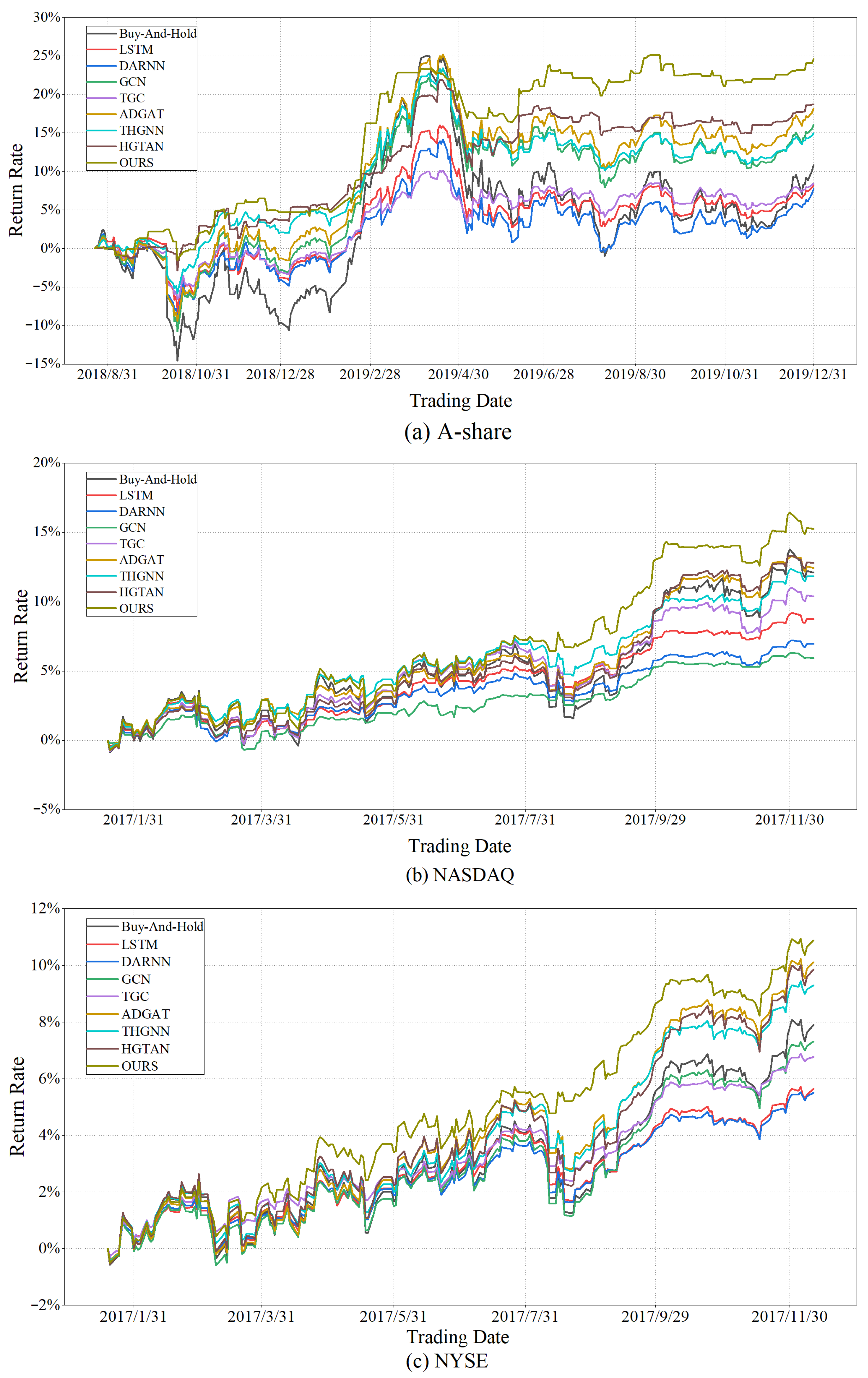
To compare the profitability of the models, we ran investment simulations in the Chinese and US markets. Specifically, we simulated stock trades based on the model’s predictions. At the start of the backtest, we allocated the investment budget equally to each stock, and if the model predicted that a stock was likely to rise the next day, we bought the stock at the current closing price. After the purchase, if the model predicts that the stock price will continue to rise or remain flat, the trader will continue to hold the stock, and if the model predicts that the stock may trend down, the trader will sell at the day’s closing price. The backtesting is conducted on the trading days covered by the test set, i.e., from 22 August 2018 to 31 December 2019 for the Chinese stock market and from 21 March 2017 to 7 August 2018 for the US stock market. Following the standard evaluation protocol in representative stock prediction studies [7,24], our backtesting experiment is based on two common assumptions: all transactions can be fully executed at the quoted closing prices; transaction costs and liquidity frictions are not considered, which is consistent with the settings of existing related works to ensure fair comparison.
The returns of HDGAN and other methods over the backtesting period are shown in Figure 6. A buy-and-hold strategy is used as an additional benchmark. In the buy-and-hold strategy, we buy all stocks at the beginning of the backtest and hold them without any further operations; therefore, the returns of the buy-and-hold strategy reflect the overall market volatility in real time. It can be seen that the proposed HDGAN model largely outperforms other methods in terms of investment returns. Compared with the most advanced hypergraph-based model, HGTAN, the HDGAN has an average improvement of 3.13% in IRR. On the other hand, the Sharpe ratio is superior to that of other models, indicating that the model can generate higher excess returns while assuming the same risk. It generates stable positive returns throughout the backtesting process, especially when the stock market is falling. HDGAN is able to provide more accurate forecasts and investors can make timely decisions to short their positions to avoid losses. The results suggest that the HDGAN stock selection methodology is more profitable than other models. Table 5 shows the comparison with other methods on profitability measures, where HDGAN consistently outperforms other methods and is the best performer on virtually all measures.

4.7. Hyperparameter Sensitivity

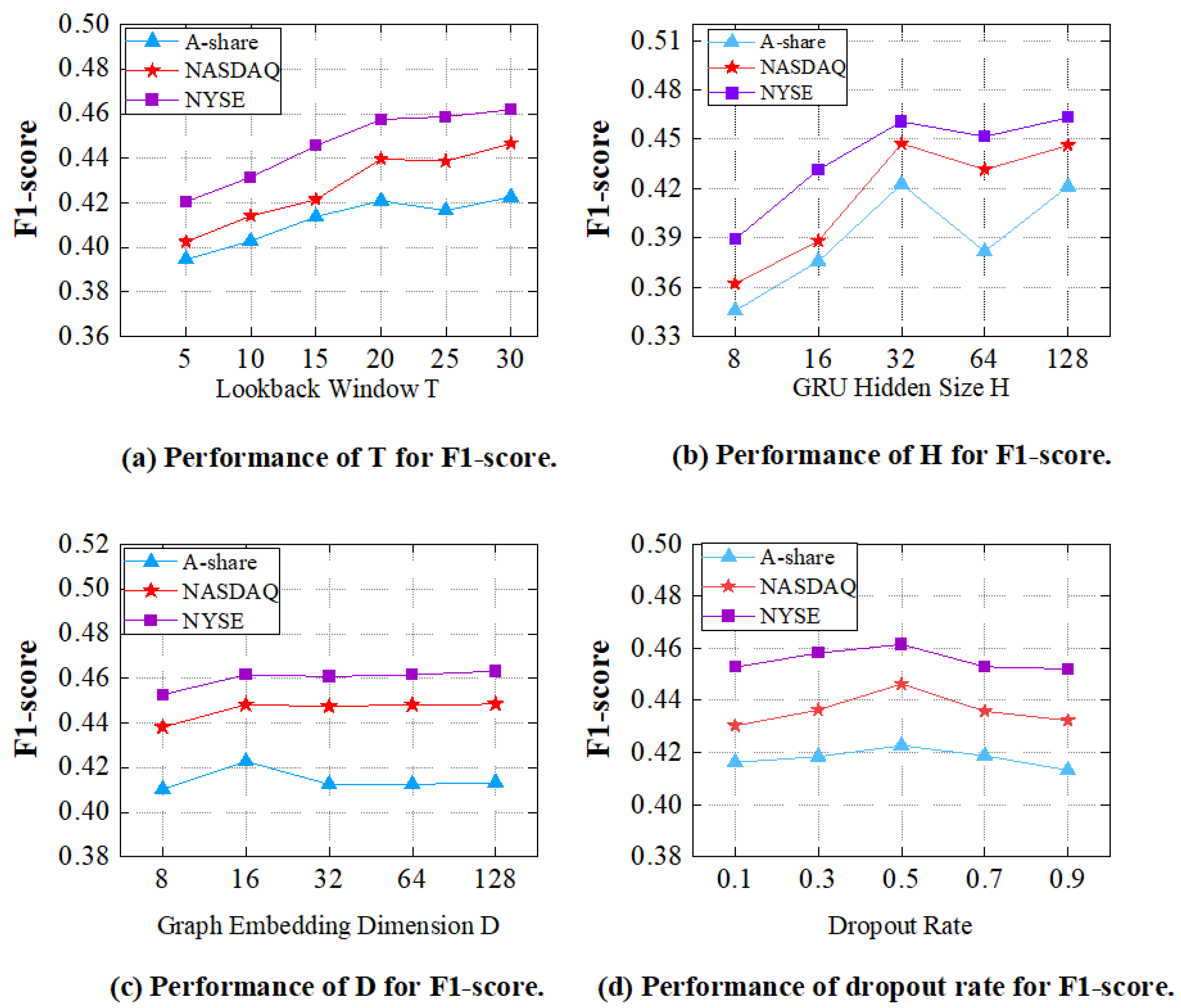
To further investigate the effect of hyperparameters on model performance, we vary the input stock series length T, the graph embedding dimension D, the hidden size of the GRU F, and the ratio of dropout, and conduct experiments on three datasets.
  • Window size T : To check the performance of HDGAN under different time window sizes, we set T to {5,10,15,20,25,30} and the results are shown in Figure 7. For HDGAN, the model reaches a local optimum when T is set to 20, and the model performance starts to decrease when the window is further increased. Therefore, the input time window size is set to 20.
  • Graph embedding dimension D : In order to verify the effect of the embedding dimension of the graph features on the performance of HDGAN, we set D to {8, 16, 32, 64, 128} and observe the corresponding F1 performance, and the results are shown in Figure 7, which shows that when the hidden layer size is set to 16, the model has the best F1 performance. As the size of the hidden layer increases, the overfitting problem may occur, leading to performance degradation.
  • The number of neurons in the hidden layer H : To verify the effect of hidden layer size of GRU on the performance of HDGAN, we set H to { 8 , 16 , 32 , 64 , 128 } and observe the corresponding F1 score performance. The results are shown in Figure 7. It can be seen that the model performance reaches a local optimum when H is set to 32 and 128, respectively, and when H is too small, it limits the expressive ability of the model.
  • Ratio of dropout R d : We give the R d { 0.1 , 0.2 , 0.5 , 0.7 , 0.9 } in Figure 7. We observe salient improvements in all evaluation metrics (Accuracy, Precision, Recall and F1 score) by setting the dropout rate to 0.5, which reveals the usefulness of applying dropout for mitigating overfitting caused by multiple stacked attention layers and the hybrid hypergraph–dynamic graph structure. Moreover, dropout exerts an additional effect of implicit model averaging with numerous sub-networks generated by random feature masking, which has potential significance for simulating the highly non-stationary volatility of stock markets and enhancing the model’s robustness to noisy financial data.

4.8. Visualizing Temporal Decay Attention

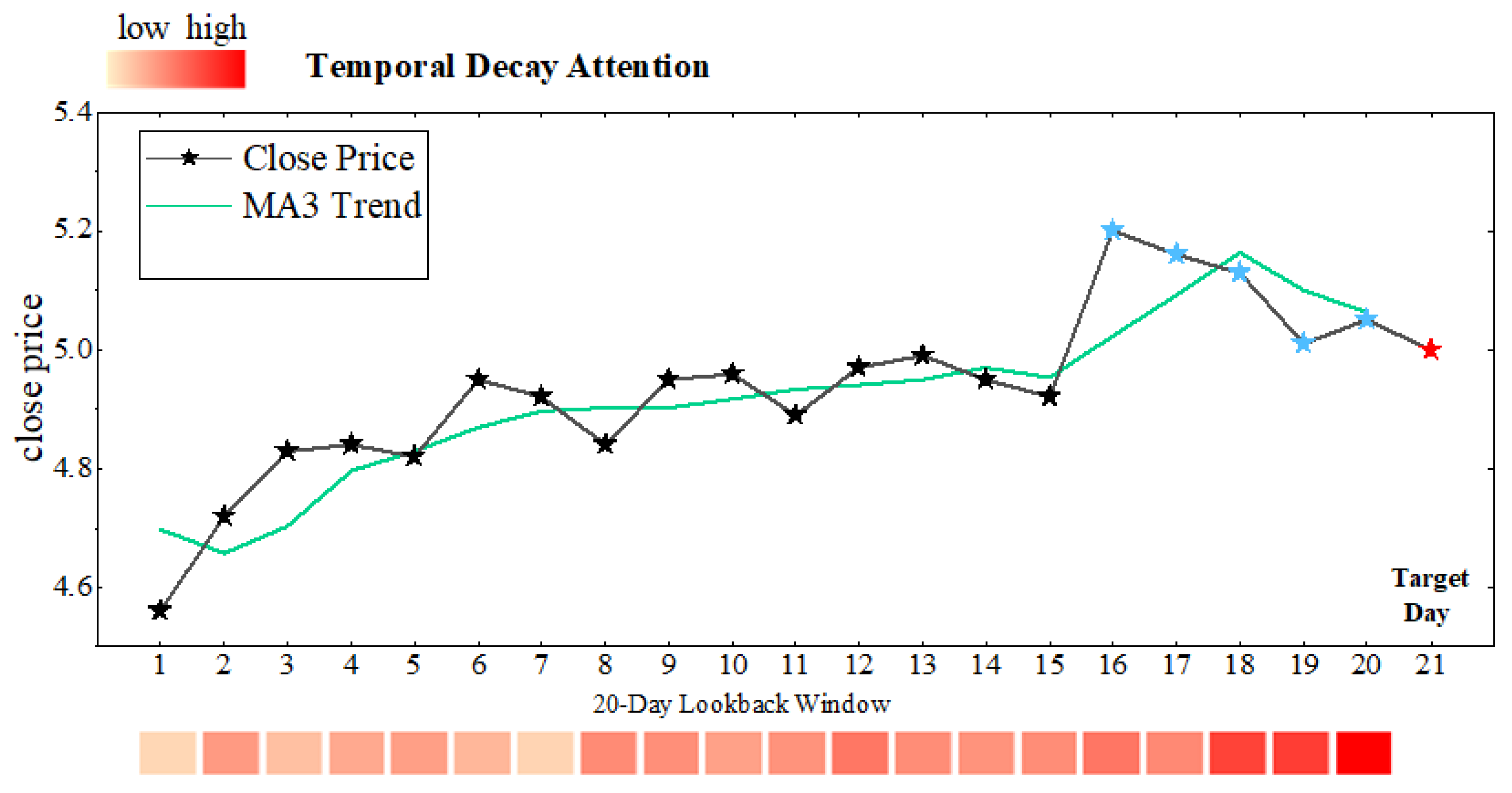
To understand the importance of temporal decay in the learning of the attentional mechanism, we further visualise the weight scores of the stock historical dynamic sequences in Figure 8. Due to the high oscillation frequency of the sequence, which leads to some temporal attention divergence, the most recent time step (blue points) gains more temporal attention through the decay process, which accurately captures the downward trend at the end of the window (blue points). To interpret the temporal attention weights visualized in Figure 7, we observe that certain earlier days (e.g., day 2) receive higher attention weights than more recent days (e.g., day 7). This pattern indicates that the model identifies specific historical trading days as critical “signal days” that contain influential market information, such as major policy announcements, industry events, or trend inflection points. These events have a persistent impact on subsequent stock price movements, making them more predictive than some recent days that may only reflect transient market noise. This demonstrates that our temporal attention mechanism can effectively capture long-range, meaningful dependencies in financial time series rather than simply assigning higher weights to the most recent observations. These results show that temporal decay attention distinguishes features at different times and effectively identifies important feature points.

5. Conclusions

In this paper, a hybrid hypergraph–dynamic graph attention network (HDGAN) is proposed to address the instability of hyperedges and take the impact of time decay into account within stock market dynamics. By integrating hypergraphs for complex stock relationships and dynamic graphs for evolving interactions, HDGAN provides a more stable and responsive framework. The temporal decay attention mechanism within HDGAN effectively captures the temporal dynamics of stock prices, identifying significant features influenced by time decay. Additionally, a conditional aggregation method is implemented to selectively integrate information, enhancing the model’s ability to process and prioritize information from diverse pathways. This innovative approach aims to improve the accuracy and adaptability of stock market analysis tools, and offer valuable insights for the development of spatio-temporal forecasting methods.
Our research demonstrates that integrating graphs and hypergraphs not only improves prediction accuracy but also enhances the interpretability of deep-learning-based spatio-temporal models. Due to the complexity of financial markets, characterized by the nonlinearity and dynamics of stock price changes, predicting stock trends remains an exceedingly challenging task. Below, we outline some potential research directions.
  • Coping with concept drift in stock markets: To address the limitation of the current model in dealing with severe/sudden concept drift, we will carry out two targeted improvement strategies in future research. First, we will integrate real-time market auxiliary signals (e.g., concept hotness, policy news) into the dynamic graph construction module to break the reliance on historical price data alone and perceive early signs of concept drift in real time. Second, we will add a lightweight concept drift detection sub-module based on statistical methods to identify concept drift in real time, and design an adaptive reweighting strategy to suppress misleading historical relations and enhance the learning of newly formed valid market patterns. We will verify the optimized model on extended datasets containing severe concept drift scenarios to further improve its adaptability to dynamic financial markets.
  • Heterogeneous hypergraph modeling: The existing methods are limited to homogeneous graphs or hypergraphs, but the relevance of stocks comes from multiple aspects, which restricts the generalization ability of the model. Using heterogeneous hypergraphs can more comprehensively represent the relationships between stocks, but the increase in the types of relationships can exacerbate the instability of hyperedges, and lead to a significant increase in computational load. For instance, adaptive hyperedge generation techniques, or the integration of reinforcement learning and attention mechanisms, to identify meaningful hyperedges may be a potential solution.
  • Multi-modal fusion: Existing stock trend prediction models are inadequate when dealing with cross-modal data. There may be information redundancy or conflicts between multi-modal data, which could lead to confusion in the model’s fusion process, affecting the accuracy of predictions. Moreover, computational costs and data quality remain challenging issues. Integrating large language models (LLMs) and reinforcement learning to understand this cross-modal interaction may be a promising solution.
  • Interpretability of stock prediction model: Existing stock prediction models are often regarded as black boxes, making it difficult to provide explanations for decision-making and this limitation hinders their application in financial decision-making. The identification of feature importance is challenging, and the generalization capability and trade-off between accuracy and interpretability remain issues that warrant further investigation. Future research should focus on advancing highly interpretable models or integrating existing explanatory methods. For example, different mask generation algorithms can be used to obtain masks corresponding to stock features or the associated matrix. These masks are then applied as interference to cover the original information, allowing for the study of the effects of different perturbations on the original information.
  • Large-scale stock universe validation: We plan to validate the scalability of HDGAN on ultra-large-scale stock datasets, including the entire US equity market with more than five thousand stocks and the full A-share market with more than five thousand stocks. We will quantitatively evaluate the model performance in terms of prediction accuracy retention, computational latency and memory usage. We also intend to further optimize the model with adaptive hyperedge pruning and distributed graph training techniques to improve its computational efficiency in large-scale application scenarios.

Author Contributions

Writing—Original Draft, X.C.; Writing—Review & Editing, H.W. and X.Z.; Conceptualization, X.C., X.Z. and H.W.; Methodology, X.C.; Software, X.Z.; Formal Analysis, X.C. and X.Z.; Investigation, X.C. and X.Z.; Funding Acquisition, H.W. All authors have read and agreed to the published version of the manuscript.

Funding

This work is supported by the Basic Research Program of Jiangsu (BK20231142), the Postgraduate Research and Practice Innovation Program of Jiangsu Province (KYCX25_1663), and the Priority Academic Program Development of Jiangsu Higher Education Institutions (PAPD).

Data Availability Statement

The data that support the findings of this study are available from the author Xiyuan Chen, upon reasonable request.

Conflicts of Interest

The authors declare that they have no known competing financial interests or personal relationships that could have appeared to influence the work reported in this paper.

References

  1. Rounaghi, M.M.; Zadeh, F.N. Investigation of market efficiency and financial stability between S&P 500 and London stock exchange: Monthly and yearly forecasting of time series stock returns using ARMA model. Phys. A Stat. Mech. Appl. 2016, 456, 10–21. [Google Scholar] [CrossRef]
  2. Liu, Z.; Dang, Z.; Yu, J. Stock Price Prediction Model Based on RBF-SVM Algorithm. In 2020 International Conference on Computer Engineering and Intelligent Control (ICCEIC); IEEE: New York, NY, USA, 2020; pp. 124–127. [Google Scholar] [CrossRef]
  3. Qin, Y.; Song, D.; Chen, H.; Cheng, W.; Jiang, G.; Cottrell, G.W. A Dual-Stage Attention-Based Recurrent Neural Network for Time Series Prediction. In Proceedings of the Twenty-Sixth International Joint Conference on Artificial Intelligence, IJCAI-17; International Joint Conferences on Artificial Intelligence: Freiburg, Germany, 2017; pp. 2627–2633. [Google Scholar] [CrossRef]
  4. Li, X.; Luo, S.; Pan, L.; Wu, Z. Adapt to small-scale and long-term time series forecasting with enhanced multidimensional correlation. Expert Syst. Appl. 2024, 238, 122203. [Google Scholar] [CrossRef]
  5. Chen, Y.; Wei, Z.; Huang, X. Incorporating Corporation Relationship via Graph Convolutional Neural Networks for Stock Price Prediction. In The 27th ACM International Conference on Information and Knowledge Management; ACM: New York, NY, USA, 2018; pp. 1655–1658. [Google Scholar] [CrossRef]
  6. Feng, Y.; You, H.; Zhang, Z.; Ji, R.; Gao, Y. Hypergraph neural networks. Proc. AAAI Conf. Artif. Intell. 2019, 33, 3558–3565. [Google Scholar] [CrossRef]
  7. Cui, C.; Li, X.; Zhang, C.; Guan, W.; Wang, M. Temporal-Relational hypergraph tri-Attention networks for stock trend prediction. Pattern Recognit. 2023, 143, 109759. [Google Scholar] [CrossRef]
  8. Liao, S.; Xie, L.; Du, Y.; Chen, S.; Wan, H.; Xu, H. Stock trend prediction based on dynamic hypergraph spatio-temporal network. Appl. Soft Comput. 2024, 154, 111329. [Google Scholar] [CrossRef]
  9. Adebiyi, A.A.; Adewumi, A.O.; Ayo, C.K. Comparison of ARIMA and artificial neural networks models for stock price prediction. J. Appl. Math. 2014, 2014, 614342. [Google Scholar] [CrossRef]
  10. Chong, C.W.; Ahmad, M.I.; Abdullah, M.Y. Performance of GARCH models in forecasting stock market volatility. J. Forecast. 1999, 18, 333–343. [Google Scholar] [CrossRef]
  11. Hochreiter, S.; Schmidhuber, J. Long short-term memory. Neural Comput. 1997, 9, 1735–1780. [Google Scholar] [CrossRef]
  12. Rahman, M.O.; Hossain, M.S.; Junaid, T.S.; Forhad, M.S.A.; Hossen, M.K. Predicting prices of stock market using gated recurrent units (GRUs) neural networks. Int. J. Comput. Sci. Netw. Secur. 2019, 19, 213–222. Available online: https://www.researchgate.net/profile/Md-Sabir-Hossain/publication/331385031_Predicting_Prices_of_Stock_Market_using_Gated_Recurrent_Units_GRUs_Neural_Networks/links/5c93b36492851cf0ae8e96fb/Predicting-Prices-of-Stock-Market-using-Gated-Recurrent-Units-GRUs-Neural-Networks.pdf (accessed on 13 April 2026).
  13. Ismail Fawaz, H.; Forestier, G.; Weber, J.; Idoumghar, L.; Muller, P.A. Deep learning for time series classification: A review. Data Min. Knowl. Discov. 2019, 33, 917–963. [Google Scholar] [CrossRef]
  14. Teng, X.; Zhang, X.; Luo, Z. Multi-scale local cues and hierarchical attention-based LSTM for stock price trend prediction. Neurocomputing 2022, 505, 92–100. [Google Scholar] [CrossRef]
  15. Park, H.J.; Kim, Y.; Kim, H.Y. Stock market forecasting using a multi-task approach integrating long short-term memory and the random forest framework. Appl. Soft Comput. 2022, 114, 108106. [Google Scholar] [CrossRef]
  16. Liu, W.J.; Ge, Y.B.; Gu, Y.C. News-driven stock market index prediction based on trellis network and sentiment attention mechanism. Expert Syst. Appl. 2024, 250, 123966. [Google Scholar] [CrossRef]
  17. Zhang, L.; Aggarwal, C.; Qi, G.J. Stock price prediction via discovering multi-frequency trading patterns. In Proceedings of the 23rd ACM SIGKDD International Conference on Knowledge Discovery and Data Mining; ACM: New York, NY, USA, 2017; pp. 2141–2149. [Google Scholar] [CrossRef]
  18. Kanwal, A.; Lau, M.F.; Ng, S.P.; Sim, K.Y.; Chandrasekaran, S. BiCuDNNLSTM-1dCNN—A hybrid deep learning-based predictive model for stock price prediction. Expert Syst. Appl. 2022, 202, 117123. [Google Scholar] [CrossRef]
  19. An, Z.; Wu, Y.; Hao, F.; Chen, Y.; He, X. A novel hierarchical feature selection with local shuffling and models reweighting for stock price forecasting. Expert Syst. Appl. 2024, 249, 123482. [Google Scholar] [CrossRef]
  20. Yang, Z.; Zhao, T.; Wang, S.; Li, X. MDF-DMC: A stock prediction model combining multi-view stock data features with dynamic market correlation information. Expert Syst. Appl. 2024, 238, 122134. [Google Scholar] [CrossRef]
  21. Zeng, L.; Wang, L.; Niu, H.; Zhang, R.; Wang, L.; Li, J. Trade When Opportunity Comes: Price Movement Forecasting via Locality-Aware Attention and Iterative Refinement Labeling. In Proceedings of the Thirty-ThirdInternational Joint Conference on Artificial Intelligence; ACM: New York, NY, USA, 2024; pp. 6134–6142. [Google Scholar] [CrossRef]
  22. Fang, Y.; Liu, R.; Huang, H.; Zhao, P.; Wu, Q. A Spatio-Temporal Diffusion Model for Missing and Real-Time Financial Data Inference. In Proceedings of the 33rd ACM International Conference on Information and Knowledge Management; ACM: New York, NY, USA, 2024; pp. 602–611. [Google Scholar] [CrossRef]
  23. Cheng, M.; Yang, J.; Pan, T.; Liu, Q.; Li, Z.; Wang, S. ConvTimeNet: A Deep Hierarchical Fully Convolutional Model for Multivariate Time Series Analysis. In Proceedings of the ACM on Web Conference 2025; ACM: New York, NY, USA, 2025; pp. 171–180. [Google Scholar] [CrossRef]
  24. Feng, F.; He, X.; Wang, X.; Luo, C.; Liu, Y.; Chua, T.S. Temporal relational ranking for stock prediction. ACM Trans. Inf. Syst. (TOIS) 2019, 37, 1–30. [Google Scholar] [CrossRef]
  25. Kim, R.; So, C.H.; Jeong, M.; Lee, S.; Kim, J.; Kang, J. Hats: A hierarchical graph attention network for stock movement prediction. arXiv 2019, arXiv:1908.07999. [Google Scholar] [CrossRef]
  26. Wang, H.; Li, S.; Wang, T.; Zheng, J. Hierarchical Adaptive Temporal-Relational Modeling for Stock Trend Prediction. In Proceedings of the Thirtieth International Joint Conference on Artificial Intelligence (IJCAI-21); International Joint Conferences on Artificial Intelligence: Freiburg, Germany, 2021; pp. 3691–3698. [Google Scholar] [CrossRef]
  27. Wang, H.; Wang, T.; Li, S.; Guan, S. HATR-I: Hierarchical adaptive temporal relational interaction for stock trend prediction. IEEE Trans. Knowl. Data Eng. 2022, 35, 6988–7002. [Google Scholar] [CrossRef]
  28. Xiang, S.; Cheng, D.; Shang, C.; Zhang, Y.; Liang, Y. Temporal and heterogeneous graph neural network for financial time series prediction. In Proceedings of the 31st ACM International Conference on Information & Knowledge Management; ACM: New York, NY, USA, 2022; pp. 3584–3593. [Google Scholar] [CrossRef]
  29. Wang, T.; Guo, J.; Shan, Y.; Zhang, Y.; Peng, B.; Wu, Z. A knowledge graph–GCN–community detection integrated model for large-scale stock price prediction. Appl. Soft Comput. 2023, 145, 110595. [Google Scholar] [CrossRef]
  30. Zhu, P.; Li, Y.; Liu, Q.; Cheng, D.; Jiang, C. Financial time series prediction with multi-granularity graph augmented learning. IEEE Trans. Knowl. Data Eng. 2025, 37, 6436–6449. [Google Scholar] [CrossRef]
  31. Li, S.; Sun, Y.; Lin, Y.; Gao, X.; Shang, S.; Yan, R. CausalStock: Deep end-to-end causal discovery for news-driven multi-stock movement prediction. Adv. Neural Inf. Process. Syst. 2024, 37, 47432–47454. [Google Scholar] [CrossRef]
  32. Chen, W.; Li, S.; Wang, H.; Wang, T. Enhancer: A distribution-aware framework with temporal-relational meta-learning for stock prediction. In Proceedings of the 31st ACM SIGKDD Conference on Knowledge Discovery and Data Mining V. 2; ACM: New York, NY, USA, 2025; pp. 250–261. [Google Scholar] [CrossRef]
  33. Sawhney, R.; Agarwal, S.; Wadhwa, A.; Shah, R.R. Spatiotemporal hypergraph convolution network for stock movement forecasting. In 2020 IEEE International Conference on Data Mining (ICDM); IEEE: New York, NY, USA, 2020; pp. 482–491. [Google Scholar] [CrossRef]
  34. Sawhney, R.; Agarwal, S.; Wadhwa, A.; Derr, T.; Shah, R.R. Stock selection via spatiotemporal hypergraph attention network: A learning to rank approach. Proc. AAAI Conf. Artif. Intell. 2021, 35, 497–504. [Google Scholar] [CrossRef]
  35. Huynh, T.T.; Nguyen, M.H.; Nguyen, T.T.; Nguyen, P.L.; Weidlich, M.; Nguyen, Q.V.H.; Aberer, K. Efficient integration of multi-order dynamics and internal dynamics in stock movement prediction. In Proceedings of the Sixteenth ACM International Conference on Web Search and Data Mining; ACM: New York, NY, USA, 2023; pp. 850–858. [Google Scholar] [CrossRef]
  36. Fang, L.; Zhao, T.; Yu, J.; Guo, Q.; Li, X.; Zhang, C. TD-HCN: A trend-driven hypergraph convolutional network for stock return prediction. Neural Netw. 2025, 190, 107729. [Google Scholar] [CrossRef]
  37. Duan, Y.; Wang, W.; Li, J. FactorGCL: A Hypergraph-Based Factor Model with Temporal Residual Contrastive Learning for Stock Returns Prediction. Proc. AAAI Conf. Artif. Intell. 2025, 39, 173–181. [Google Scholar] [CrossRef]
  38. Xia, H.; Ao, H.; Li, L.; Liu, Y.; Liu, S.; Ye, G.; Chai, H. CI-STHPAN: Pre-trained Attention Network for Stock Selection with Channel-Independent Spatio-Temporal Hypergraph. Proc. AAAI Conf. Artif. Intell. 2024, 38, 9187–9195. [Google Scholar] [CrossRef]
  39. Park, K.; Hong, S.; Jeon, J.J. Dynamic Higher-Order Relations and Event-Driven Temporal Modeling for Stock Price Forecasting. In Proceedings of the Thirty-Fourth International Joint Conference on Artificial Intelligence, IJCAI-25; International Joint Conferences on Artificial Intelligence: Darmstadt, Germany, 2025; pp. 6048–6056. [Google Scholar] [CrossRef]
  40. Song, L.; Li, H.; Chen, S.; Gan, X.; Shi, B.; Ma, J.; Pan, Y.; Wang, X.; Shang, X. Multi-Scale Temporal Neural Network for Stock Trend Prediction Enhanced by Temporal Hyepredge Learning. In Proceedings of the Thirty-Fourth International Joint Conference on Artificial Intelligence, IJCAI-25; International Joint Conferences on Artificial Intelligence: Darmstadt, Germany, 2025; pp. 3272–3280. [Google Scholar] [CrossRef]
  41. Malkiel, B.G. Efficient market hypothesis. In Finance; Eatwell, J., Milgate, M., Newman, P., Eds.; Palgrave Macmillan: London, UK, 1989; pp. 127–134. [Google Scholar]
  42. Zhang, C.; Song, D.; Huang, C.; Swami, A.; Chawla, N.V. Heterogeneous graph neural network. In Proceedings of the 25th ACM SIGKDD International Conference on Knowledge Discovery & Data Mining; ACM: New York, NY, USA, 2019; pp. 793–803. [Google Scholar] [CrossRef]
  43. Hallac, D.; Park, Y.; Boyd, S.; Leskovec, J. Network inference via the time-varying graphical lasso. In Proceedings of the 23rd ACM SIGKDD International Conference on Knowledge Discovery and Data Mining; ACM: New York, NY, USA, 2017; pp. 205–213. [Google Scholar] [CrossRef]
  44. Kipf, T.N.; Welling, M. Semi-supervised classification with graph convolutional networks. arXiv 2016, arXiv:1609.02907. [Google Scholar] [CrossRef]
  45. Cheng, R.; Li, Q. Modeling the momentum spillover effect for stock prediction via attribute-driven graph attention networks. Proc. AAAI Conf. Artif. Intell. 2021, 35, 55–62. [Google Scholar] [CrossRef]
  46. Wang, Y.; Zhu, D. A hypergraph-based hybrid graph convolutional network for intracity human activity intensity prediction and geographic relationship interpretation. Inf. Fusion 2024, 104, 102149. [Google Scholar] [CrossRef]
Figure 1. Concept relations (hyperedges) at different moments. In January, we can use cloud computing hyperedge and metaverse hyperedge to represent the group-wise relationships among stocks. In February, with the global popularity of Sora, the emergence of the Sora concept led to the formation of a new hyperedge, but this also caused changes in the incidence matrix of the hypergraph.
Symmetry 18 00724 g001
Figure 2. The We added further explanation overall architecture of our framework.
Symmetry 18 00724 g002
Figure 3. AD-GAT module. The symbol ∗ denotes element-wise multiplication.
Symmetry 18 00724 g003
Figure 4. AD-HGAT module. The symbol ∗ denotes element-wise multiplication.
Symmetry 18 00724 g004
Figure 5. Comparison of dynamic graph and hypergraph weights in different markets.
Symmetry 18 00724 g005
Figure 6. Backtesting performance illustration of all methods.
Symmetry 18 00724 g006
Figure 7. Parameter analysis.
Symmetry 18 00724 g007
Figure 8. Visualizing temporal decay attention. The blue stars indicate historical days with notable periodic patterns in recent price changes, while the red star denotes the target day of the prediction.
Symmetry 18 00724 g008
Table 1. Statistics and temporal partition of the three stock market datasets.
MarketStocksTraining DateTraining DaysValidation DateValidation DaysTesting DateTest Days
NASDAQ10262 January 2013–31 December 20157564 January 2016–30 December 20162523 January 2017–8 December 2017237
NYSE17372 January 2013–31 December 20157564 January 2016–30 December 20162523 January 2017–8 December 2017237
A-share7544 January 2013–20 March 2017100821 March 2017–7 August 20183408 August 2018–31 December 2019331
Table 2. Classification performance of different methods on the NASDAQ, NYSE and A-share datasets. The best results are in bold. And * denotes statistically significant improvement (measured by t-test with p-value < 0.01) over all baselines.
MethodA-Share NASDAQ NYSE
AccuracyPrecisionRecall F 1 AccuracyPrecisionRecall F 1 Accuracy PrecisionRecall F 1
LSTM35.81%34.99%34.91%34.94%37.22%34.64%36.56%35.52%45.73%36.22%38.04%37.08%
DARNN38.41%37.99%39.24%38.60%40.46%37.05%37.76%37.40%47.98%41.41%39.53%40.44%
GCN37.44%39.07%34.49%36.62%39.75%40.82%38.78%39.76%45.99%35.89%37.38%36.31%
TGC38.42%39.35%35.72%37.44%39.98%38.24%38.08%38.16%47.95%41.94%38.54%40.15%
AD-GAT38.69%40.95%41.83%37.91%42.24%40.75%40.74%40.20%49.85%43.71%39.04%40.26%
THGNN38.84%39.57%42.08%35.81%39.98%40.37%41.01%39.64%49.57%44.30%40.93%45.49%
HGTAN40.02%41.77%39.03%40.32%40.67%38.11%38.86%38.48%48.25%41.02%39.84%40.42%
OURS41.30 * ± 0.36%42.37 * ± 0.26%42.71 * ± 0.36%42.26 * ± 0.54%42.52 * ± 0.41%43.90 * ± 0.35%43.81 * ± 0.37%44.64 * ± 0.28%50.21 * ± 0.26%43.65 * ± 0.43%40.94 * ± 0.37%46.16 * ± 0.53%
Table 3. Comparisons of ablation experiment results on the NASDAQ, NYSE and A-share datasets. The best results are in bold.
MethodA-Share NASDAQ NYSE
AccuracyPrecisionRecall F 1 AccuracyPrecisionRecall F 1 AccuracyPrecisionRecall F 1
w/o Temporal Decay Attn39.58%37.31%34.61%37.94%40.048%37.62%38.92%39.70%49.68%43.17%38.89%44.84%
w/o Attribute Aggregator40.27%38.45%37.24%38.60%41.55%38.81%39.48%40.08%49.71%42.75%38.94%44.79%
w/o Heterogeneous graph39.99%43.73%35.20%37.62%39.84%39.01%39.26%40.24%49.88%42.53%37.53%42.67%
w/o Hypergraph38.87%40.75%35.72%35.16%39.75%39.00%39.04%39.38%49.34%41.16%40.16%40.53%
w/o Conditional Aggregation40.46%42.70%42.17%42.06%42.24%40.75%40.74%40.20%50.14%43.41%39.95%45.98%
HDGAN41.30%42.37%42.71%42.26%42.52%43.90%43.81%44.64%50.21%43.65%40.94%46.16%
Table 4. Model complexity and training efficiency comparison on the A-share dataset.
ModelParameters (K)Time (s)
LSTM2.103
DARNN15.5620
GCN19.4823
TGC23.7829
AD-GAT1843.03322
THGNN110.4088
HGTAN586.66245
OURS159.37112
Table 5. Profitability of different methods during the back-testing. The best results are in bold. And * denotes statistically significant improvement (measured by t-test with p-value < 0.01) over all baselines.
MethodA-ShareNASDAQNYSE
IRRMDDSRIRRMDD SRIRR MDDSR
Buy-and-Holder10.84%26.01%0.27412.09%5.38%0.9377.91%3.27%0.742
LSTM8.27%13.26%0.4838.76%3.32%0.9715.64%2.54%0.753
DARNN14.79%21.24%0.6086.97%2.66%0.9395.51%2.15%0.727
GCN16.10%15.43%0.9055.95%2.83%0.6407.32%2.89%0.640
TGC8.46%7.85%0.58710.38%4.00%1.0466.78%1.98%0.966
AD-GAT18.17%14.86%1.03512.43%3.01%1.06010.13%2.61%0.851
THGNN14.97%13.31%1.27711.67%2.65%1.1359.30%2.38%0.899
HGTAN18.71%11.29%1.40712.81%3.13%0.9039.86%3.02%0.878
OURS24.62 * ± 0.59%6.96 ± 0.43%1.495 * ± 0.21%15.25 * ± 0.54%2.8 ± 0.12%1.223 * ± 0.11%10.89 * ± 0.13%1.92 * ± 0.24%1.110 * ± 0.10%
Disclaimer/Publisher’s Note: The statements, opinions and data contained in all publications are solely those of the individual author(s) and contributor(s) and not of MDPI and/or the editor(s). MDPI and/or the editor(s) disclaim responsibility for any injury to people or property resulting from any ideas, methods, instructions or products referred to in the content.