Article

Two Operations of a “Symmetric Difference” Type on Three-Dimensional Index Matrices

by
Krassimir Atanassov
1,
Veselina Bureva
2 and
Tania Pencheva
1,*
1
Institute of Biophysics and Biomedical Engineering, Bulgarian Academy of Sciences, 1113 Sofia, Bulgaria
2
Laboratory of Intelligent Systems, Burgas State University “Prof. Dr. Assen Zlatarov”, 8010 Burgas, Bulgaria
*
Author to whom correspondence should be addressed.
Symmetry 2026, 18(4), 696; https://doi.org/10.3390/sym18040696
Submission received: 27 February 2026 / Revised: 7 April 2026 / Accepted: 17 April 2026 / Published: 21 April 2026
(This article belongs to the Special Issue Symmetry/Asymmetry in Fuzzy Control)

Abstract

In the current research, we introduce two operations of a “symmetric difference” type over three-dimensional extended index matrices, and investigate some of their basic properties. An example of the implementation of symmetric difference-type operations is presented in the field of relational databases, aiming to demonstrate the operations’ efficiency by comparing sets with dissimilar attributes.

1. Introduction

The concept of an Index Matrix (IM) was introduced in [1] and discussed in a series of papers and in books [2,3]. IMs are extensions of the well-known mathematical object “matrix” (see, e.g., [4,5]). Each of operation’s addition, subtraction, and multiplication, defined over standard matrices, requires specific conditions in order for these operations to be correctly performed. The introduction of IMs was inspired by the idea that matrices are redefined in such a way that all operations on them are valide and applicable, regardless of the differences in their dimensions. By giving the matrices and operations on them a more complex form, these conditions ensure greater possibilities for matrix calculus, as well as more applications. Firstly, all operations were developed in the two-dimensional (2D) case [2,3]. Later on, certain results obtained for 2D IMs became the basis for the development of the apparatus for three (3D)- and n-dimensional matrices, namely 3-DIMs and n-DIMS, respectively. The analogues of operations defined on 2-DIMs for the case of 3-DIMs have been elaborated in [2,3]. The theory of IMs has been further explored in [6].
Following [2,3], we will mention that one IM can be populated by the following: elements of the set {0, 1}, real or complex numbers, variables, predicates, functions, or even whole IMs. In the latter case, the IM is called an Extended IM (EIM). When elements of a given IM are intuitionistic fuzzy pairs, the object is called an intuitionistic fuzzy IM (IFIM) (see [2]). Therefore, each IFIM is a particular case of an EIM. The EIMs were extended to three- and n-dimensional EIMs (3-DEIMs and n-DEIMs).
In the present paper, in Section 2, we give short remarks on 3-DEIMs, in Section 3 we introduce two new operations of a “symmetric difference” type over two 3-DEIMs, and investigate some of their basic properties. In Section 4, we present an example of the implementation of “symmetric difference” operations in the field of relational databases. Finally, in the Conclusion, we outline the main achievements of the current investigation, and discuss some additional ideas for future research.
List of abbreviations used in the current investigation:
  • IM—index matrix
  • EIM—extended index matrix
  • 3-DEIM—three- dimensional extended index matrix
  • n-DEIM—n-dimensional extended index matrix
  • IFIM—intuitionistic fuzzy index matrix
  • NGB theory—von Neumann–Bernays–Gödel set theory

2. Preliminary

Let I be a fixed set of indices and X be a fixed set of objects. Following [2,3], we will call “3-DEIM” with index sets K , L , and H ( K , L , H I ) the object:
[ K , L , H , { a k i , l j , h g } ] { h g l 1 l j l n k 1 a k 1 , l 1 , h g a k 1 , l j , h g a k 1 , l n , h g k i a k i , l 1 , h g a k i , l j , h g a k i , l n , h g k m a k m , l 1 , h g a k m , l j , h g a k m , l n , h g | h g H }     { h 1 l 1 l j l n k 1 a k 1 , l 1 , h 1 a k 1 , l j , h 1 a k 1 , l n , h 1 k i a k i , l 1 , h 1 a k i , l j , h 1 a k i , l n , h 1 k m a k m , l 1 , h 1 a k m , l j , h 1 a k m , l n , h 1 ,       h 2 l 1 l j l n k 1 a k 1 , l 1 , h 2 a k 1 , l j , h 2 a k 1 , l n , h 2 k i a k i , l 1 , h 2 a k i , l j , h 2 a k i , l n , h 2 k m a k m , l 1 , h 2 a k m , l j , h 2 a k m , l n , h 2 ,     h f l 1 l j l n k 1 a k 1 , l 1 , h f a k 1 , l j , h f a k 1 , l n , h f k i a k i , l 1 , h f a k i , l j , h f a k i , l n , h f k m a k m , l 1 , h f a k m , l j , h f a k m , l n , h f } .
where K = { k 1 , k 2 , . . . , k m } , L = { l 1 , l 2 , . . . , l n } , H = { h 1 , h 2 , . . . , h f } , and for 1 i m , 1 j n , 1 g f : a k i , l j , h g X .
For the 3-DEIMs
A = [ K A , L A , H A , { a k i A , l j A , h g A } ]
and
B = [ K B , L B , H B , { b k p B , l q B , h r B } ]
operations that are analogous to the usual matrix operations of addition and multiplication are defined [2], as well as more specific operations.
Let , : X × X X . Let e 0 and e * be unit elements of X with respect to operations ∘ and ∗, respectively.
The following definitions are given according to [2,3]:
Addition
A ( ) B = [ K A K B , L A L B , H A H B , { c t u , v w , x y } ] ,
where
c t u , v w , x y
= a k i A , l j A , h g A , if t u = k i A K A , v w = l j A L A and x y = h g A H A H B or t u = k i A K A , v w = l j A L A L B and x y = h g A H A or t u = k i A K A K B , v w = l j A L A and x y = h g A H A b k p B , l q B , h r B , if t u = k p B K B , v w = l q B L B and x y = h r B H B H A or t u = k p B K B , v w = l q B L B L A and x y = h r B H B or t u = k p B K B K A , v w = l q B L B and x y = h r B H B a k i A , l j A , h g A b k p B , l q B , h r B , if t u = k i A = k p B K A K B , v w = l j A = l q B L A L B and x y = h g A = h r B H A H B e 0 , otherwise
Termwise multiplication
A ( ) B = [ K A K B , L A L B , H A H B , { c t u , v w , x y } ] ,
where c t u , v w , x y = a k i A , l j A , h g A b k p B , l q B , h r B , for t u = k i A = k p B K A K B , v w = l j A = l q B L A L B and x y = h g A = h r B H A H B .  
Multiplication
A ( , ) B = [ K A ( K B L A ) , L B ( L A K B ) , H A H B , { c t u , v w , x y } ] ,
where
c t u , v w , x y = a k i A , l j A , h g A , if   ( t u = k i A K A and v w = l j A L A K B L B and x y = h g A H A ) or   ( t u = k i A K A K B L B and v w = l j A L A and x y = h g A H A ) b k p B , l q B , h r B , if   ( t u = k p B K B and v w = l q B L B K A L A and x y = h r B H B ) or   ( t u = k p B K B K A L A and v w = l q B L B and x y = h r B H B ) ( a k i A , l j A , h g A b k p B , l q B , h r B ) ,     l j A = k p B K A L B   if t u = k i A K A and v w = l q B L B and x y = h g A = h r B H A H B e 0 , otherwise
Structural subtraction
A B = [ K A K B , L A L B , H A H B , { c t u , v w , x y } ] ,
where “−” is the set-theoretic difference operation and c t u , v w , x y = a k i , l j , h g ,   for t u = k i K A K B , v w = l j L A L B   and x y = h g H A H B .
In [3], three other operations of “multiplication” are defined, but these will not be discussed here because they are not related to the topic of this research.

3. Definitions of Two New Operations “Symmetric Difference” over Two 3-DIMs and Some of Their Properties

In [7], two operations of “symmetric difference” are defined over 2-DIMs. In this investigation, we extend their definition to 3-DIMs.
Let the 3-DEIMs A and B defined above be given. For those, we define the following operations:
First operation “symmetric difference”:
A 1 B = [ K A ÷ K B , L A ÷ L B , H A ÷ H B , { c t u , v w , x y } ] ,
where for every two arbitrary (standard set-theoretical) sets Y and Z:
Y ÷ Z = ( Y Z ) ( Z Y )
and
c t u , v w , x y = a k i A , l j A , h g A , if t u = k i A K A K B , v w = l j A L A L B , x y = h g A H A H B b k p B , l q B , h r B , if t u = k p B K B K A , v w = l q B L B L A , x y = h r B H B H A e 0 , otherwise
Second operation “symmetric difference”:
A 2 B = [ K A K B , L A L B , H A H B , { c t u , v w , x y } ] ,
where
c t u , v w , x y = a k i A , l j A , h g A , if t u = k i A K A K B , v w = l j A L A , x y = h g A H A or t u = k i A K A , v w = l j A L A L B , x y = h g A H A or t u = k i A K A , v w = l j A L A , x y = h g A H A H B b k p B , l q B , h r B , if t u = k p B K B K A , v w = l q B L B , x y = h r B H B , or t u = k p B K B , v w = l q B L B L A , x y = h r B H B or t u = k p B K B , v w = l q B L B , x y = h r B H B H A e 0 , otherwise
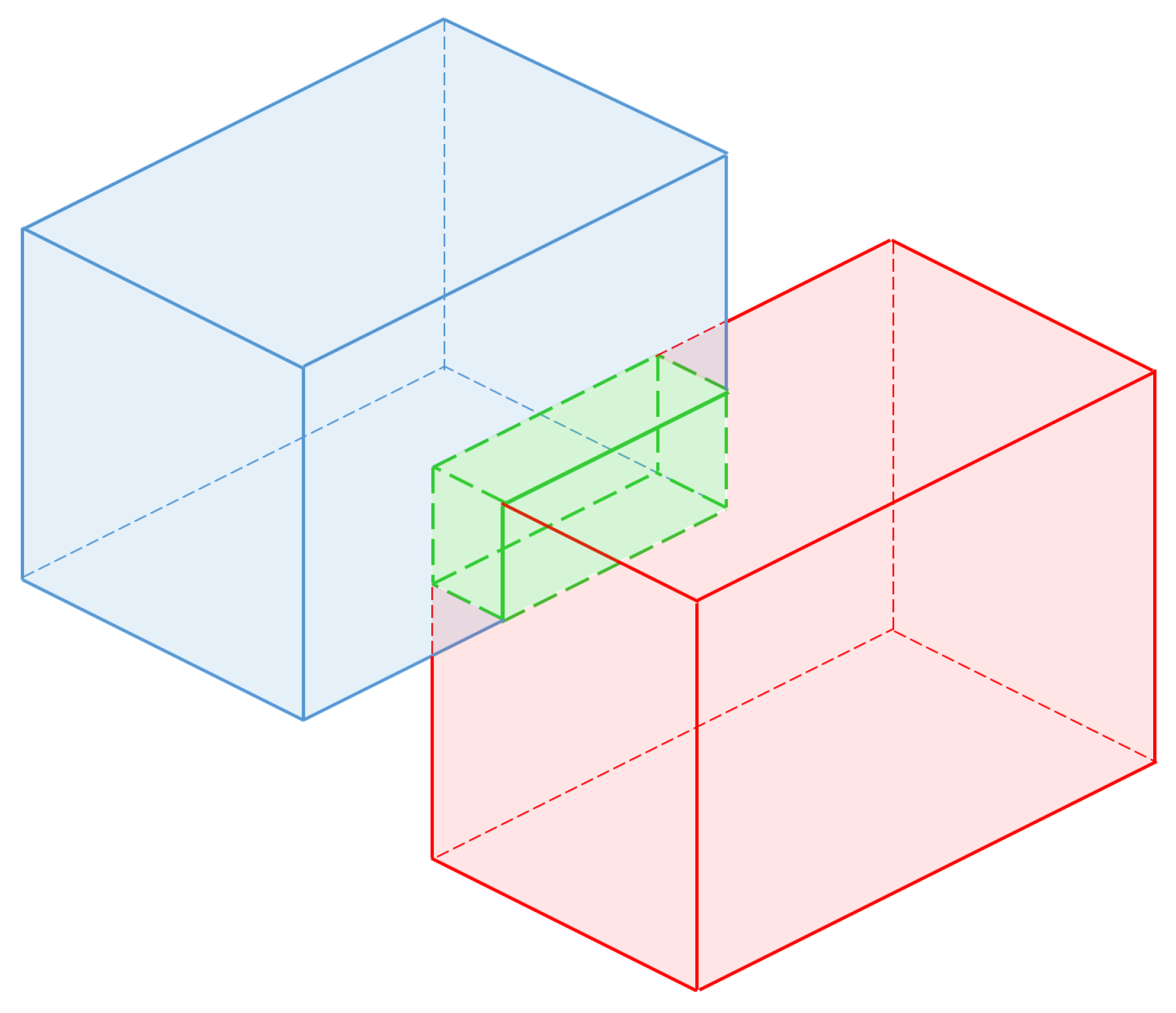
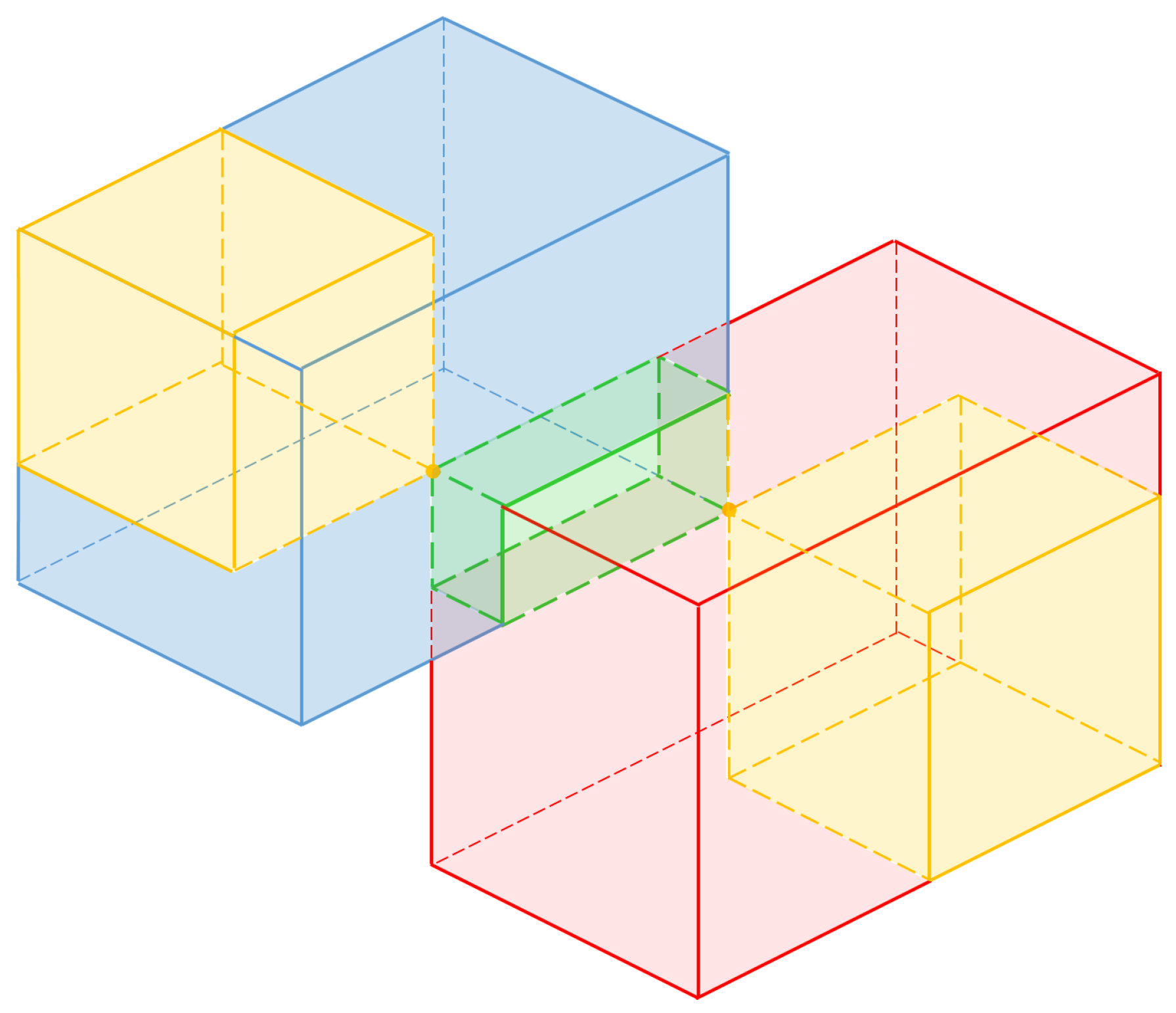
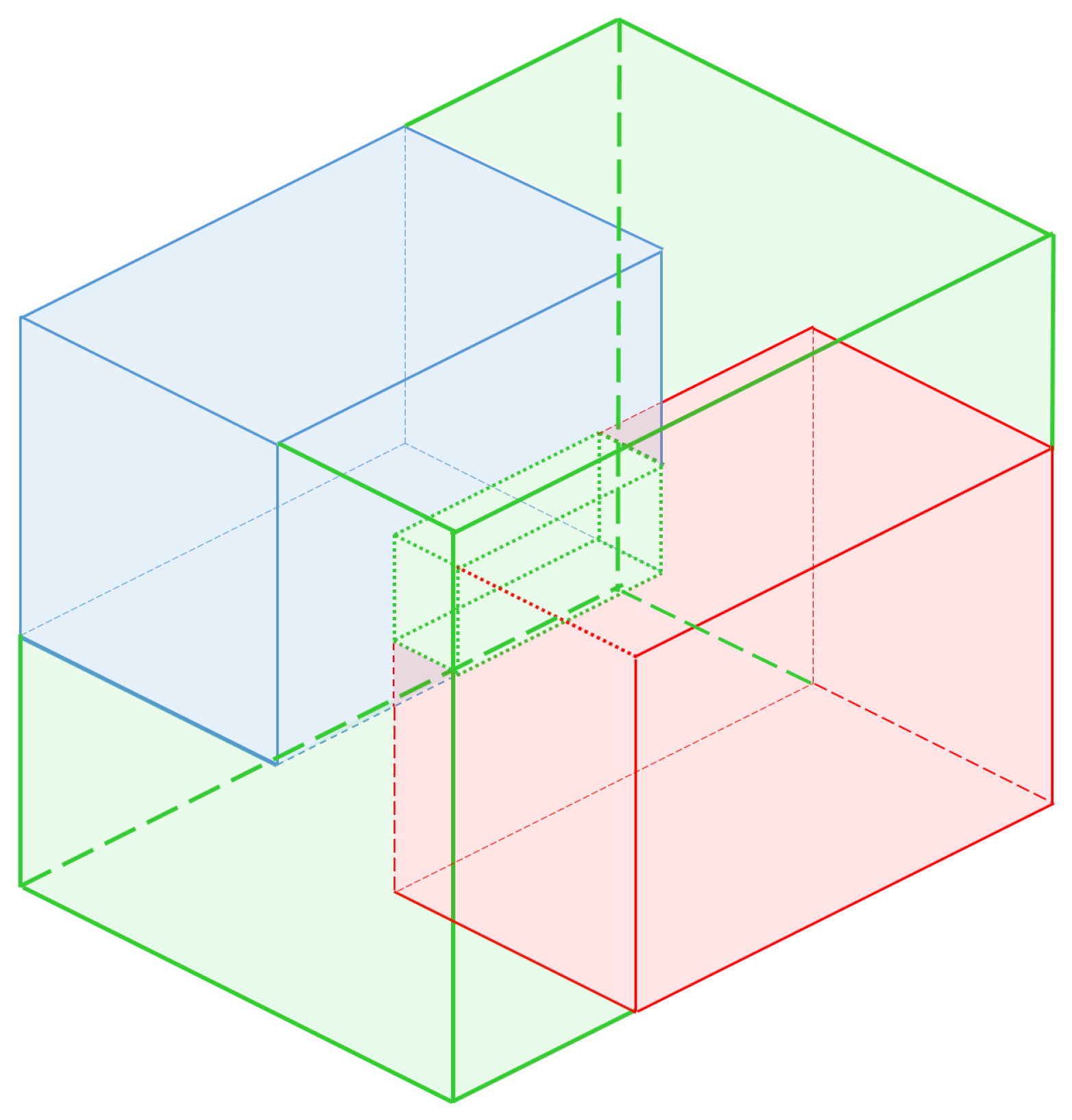
For a better understanding of the two “symmetric difference”-type operations developed here, they were visualized as two IMs that share a subset of identical indices and identical values, as illustrated in Figure 1. In the following Figure 2 and Figure 3, graphical representations of the first operation “symmetric difference” (Figure 2) and of the second operation “symmetric difference” (Figure 3) are given.
Let the operation × denote a Cartesian product between two (ordinary) sets.
Theorem 1.
For every two 3-DEIMs A and B, for each operation : X × X X and for operation # : X × X X defined for two arbitrary x , y X by x # y = e # X , the following equalities:
A 1 B = ( A B ) ( ) ( b A ) , A 2 B = A ( # ) B
hold.
Proof. 
From the definitions of operations ⊖ and , we obtain:
( A B ) ( ) ( B A ) = [ K A K B , L A L B , H A H B , { a k i A , l j A , h g A } ] ( ) [ K B K A , L B L A , H B H A , { b k p B , l q B , h r B } ] = [ ( K A K B ) ( K B K A ) , ( L A L B ) ( L B L A ) , ( H A H B ) ( H B H A ) , { c t u , v w , x y } ] = [ K A ÷ K B , L A ÷ L B , H A ÷ H B , { c t u , v w , x y } ] = A 1 B ,
where
c t u , v w , x y = a k i A , l j A , h g A , for t u = k i A K A K B and v w = l j A L A L B and x y = h g A H A H B b k p B , l q B , h r B , for t u = k p B K B K A and v w = l q B L B L A and x y = h r B H B H A .
From the definitions of operations ( # ) and the condition x # y = e # , we obtain:
A ( # ) B = [ K A K B , L A L B , H A H B , { c t u , v w , x y } ] = A 2 B ,
because, by definition,
c t u , v w , x y = a k i A , l j A , h g A , if t u = k i A K A , v w = l j A L A and x y = h g A H A H B or t u = k i A K A , v w = l j A L A L B and x y = h g A H A or t u = k i A K A K B , v w = l j A L A and x y = h g A H A b k p B , l q B , h r B , if t u = k p B K B , v w = l q B L B and x y = h r B H B H A or t u = k p B K B , v w = l q B L B L A and x y = h r B H B or t u = k p B K B K A , v w = l q B L B and x y = h r B H B a k i A , l j A , h g A # b k p B , l q B , h r B , if t u = k i A = k p B K A K B , v w = l j A = l q B L A L B and x y = h g A = h r B H A H B e 0 , otherwise = a k i A , l j A , h g A ,       if t u = k i A K A , v w = l j A L A and x y = h g A H A H B       or t u = k i A K A , v w = l j A L A L B and x y = h g A H A       or t u = k i A K A K B , v w = l j A L A and x y = h g A H A b k p B , l q B , h r B ,       if t u = k p B K B , v w = l q B L B and x y = h r B H B H A       or t u = k p B K B , v w = l q B L B L A and x y = h r B H B       or t u = k p B K B K A , v w = l q B L B and x y = h r B H B e 0 ,       otherwise
that proves the theorem.    □
Let M be the set of all 3-DEIMs with elements from X . We must mention that when X is a set (class) in the sense of von Neumann–Bernays–Gödel (NGB)-set theory (see, e.g., [8,9,10]), M will be a set if its matrices have numerical elements, or a class when its matrices have arbitrary predicates as elements.
Let
I = [ , , ] ,
where the symbol ⊥ denotes the absence of objects.
Theorem 2.
M , 1 , I is a commutative group.
Proof. 
Following the definition of a commutative group (see, [11]), we will check the respective conditions. First, from the definition of operation “ 1 ”, for every two 3-DEIMs A , B M , it follows that A 1 B M .
Second, using the well-known equality (see, e.g., [10]) for every three sets X , Y , and Z:
( X ÷ Y ) ÷ Z = X ÷ ( Y ÷ Z ) ,
for every three 3-DEIMs A , B , C M , where
C = [ K C , L C , H C , { c α , β , γ } ]
we obtain
( A 1 B ) 1 C = ( [ K A , L A , H A , { a k i A , l j A , h g A } ] 1 [ K B , L B , H B , { b k p B , l q B , h r B } ] ) 1 [ K C , L C , H C , { c α , β , γ } ] = [ K A ÷ K B , L A ÷ L B , H A ÷ H B , { d t u , v w , x y } ] 1 [ K C , L C , H C , { c α , β , γ } ]
(where each element d t u , v w , x y is some element a k i A , l j A , h g A or some element b k p B , l q B , h r B )
= [ ( K A ÷ K B ) ÷ K C , ( L A ÷ L B ) ÷ L C , ( H A ÷ H B ) ÷ H C , { f δ , ϵ , ζ } ]
(where each element f δ , ϵ , ζ is some element a k i A , l j A , h g A or some element b k p B , l q B , h r B , or some element c α , β , γ )
= [ K A ÷ ( K B ÷ K C ) , L A ÷ ( L B ÷ L C ) , H A ÷ ( H B ÷ H C ) , { f δ , ϵ , ζ } ] = [ K A , L A , H A , { a k i A , l j A , h g A } ] 1 [ K B ÷ K C , L B ÷ L C , H B ÷ H C , { s η , θ , κ } ]
(where each element s η , θ , κ is some element b k p B , l q B , h r B or some element c α , β , γ )
= [ K A , L A , H A , { a k i A , l j A , h g A } ] 1 ( [ K B , L B , H B , { b k p B , l q B , h r B } ] 1 [ K C , L C , H C , { c α , β , γ } ] ) = A 1 ( B 1 C ) .
Third, for the 3-DEIM I and for an arbitrary A M , we obtain:
A 1 I = [ K A , L A , H A , { a k i A , l j A , h g A } ] 1 [ , , ] = [ K A ÷ , L A ÷ , H A ÷ , { d t u , v w , x y } ]
(where each element d t u , v w , x y coincides with the element a k i A , l j A , h g A from A for t u = k i A , v w = l j A , x y = h g A )
= [ K A , L A , H A , { a k i A , l j A , h g A } ] = A .
Fourth, from the well-known equality X ÷ Y = Y ÷ X , for two sets, it follows that
A 1 B = [ K A , L A , H A , { a k i A , l j A , h g A } ] 1 [ K B , L B , H B , { b k p B , l q B , h r B } ] = [ K A ÷ K B , L A ÷ L B , H A ÷ H B , { c t u , v w , x y } ] = [ K B ÷ K A , L B ÷ L A , H B ÷ H A , { c t u , v w , x y } ] = B 1 A .
Finally,
A 1 A = [ K A ÷ K A , L A ÷ L A , H A ÷ H A , { c t u , v w , x y } ] = [ , , , { c t u , v w , x y } ] = [ , , , { } ] = I
(due to a lack of indices, element c t u , v w , x y must be ⊥). The theorem is proven.    □
Theorem 3.
M , 2 , I is a commutative monoid.
Proof. 
The proof of this assertion is similar to the proof of Theorem 2, but without the final, fifth step of the proof of Theorem 2. Therefore, as in the previous proof, we can prove that M , 2 , I is a commutative monoid, but this object is not a group due to the fact that there is no 3-DEIM B M , such that for some 3-DEIM A M
A 2 B = I .
This fact follows from the set-theoretical fact that there is no set X, such that for some non-empty set Y to hold, X Y = .    □
As mentioned in the Introduction, each IFIM is a particular case of an EIM. Therefore, the two new operations developed in Section 3 can be applied to IFIMs, and therefore to IMs with elements from fuzzy sets, where there is only the degree of agreement, and each intuitionistic fuzzy pair a , b might be reduced to only the degree of agreement a and the degree of disagreement is 1 a , while the degree of uncertainty from the intuitionistic fuzzy logic is 0.

4. “Symmetric Difference” Operations Implementation over Databases

The current section presents an example of the above elaborated “symmetric difference”-tye operations in the field of databases. It is known that the relational databases are based on relational algebra and relational calculus. Thereafter, there is a close relation between the group of set operations in the relational databases theory and “symmetric difference”-type operations. Relational algebra uses a set of operators to create new relations from existing ones, the main three of which are union, intersection, and difference [12,13,14]. The union operation combines the data from two tables with a similar structure. The intersection operation finds equal records in both tables. The operation difference is used for returning the data from table A that do not exist in table B, and vice versa.
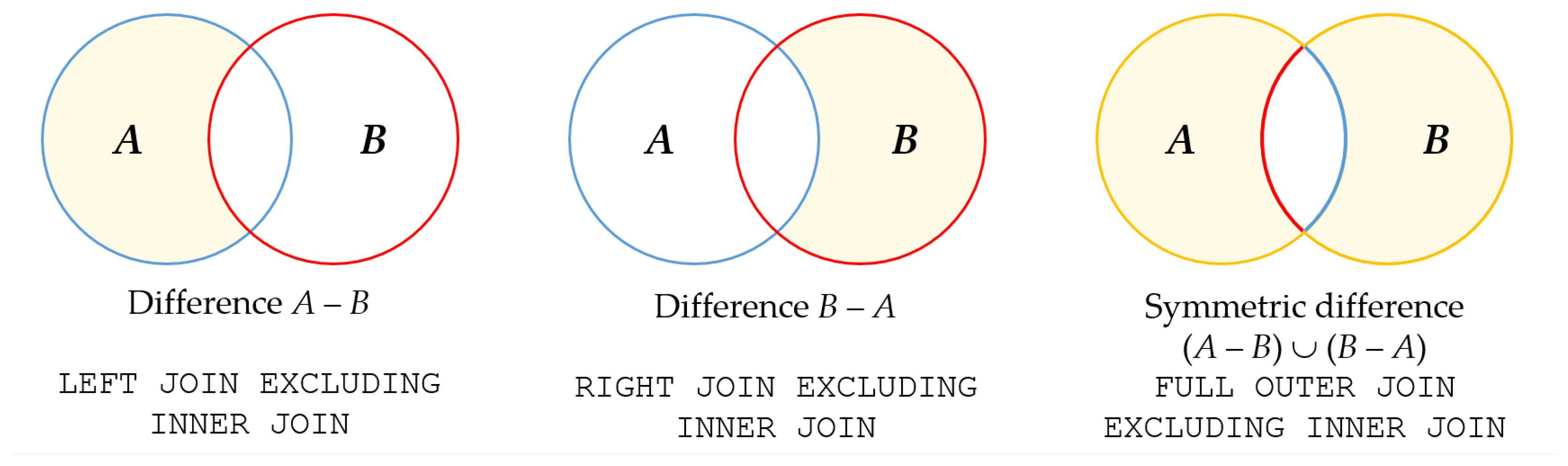
The difference operation will be the focus of the current investigation. Venn diagrams are frequently used to visualize database set operations and types of joins. Venn diagrams of different types of difference operation over sets are presented in Figure 4.
In database management systems (DBMSs), the difference operation is used to identify records that differ between two union-compatible tables. In structured query language (SQL), this operation is implemented through operators EXCEPT or MINUS, depending on the specific DBMS. In addition to set operations, various types of relationships between two tables can be identified using JOIN statements. The present discussion focuses on the more complex case in which the tables being compared belong to two different databases.
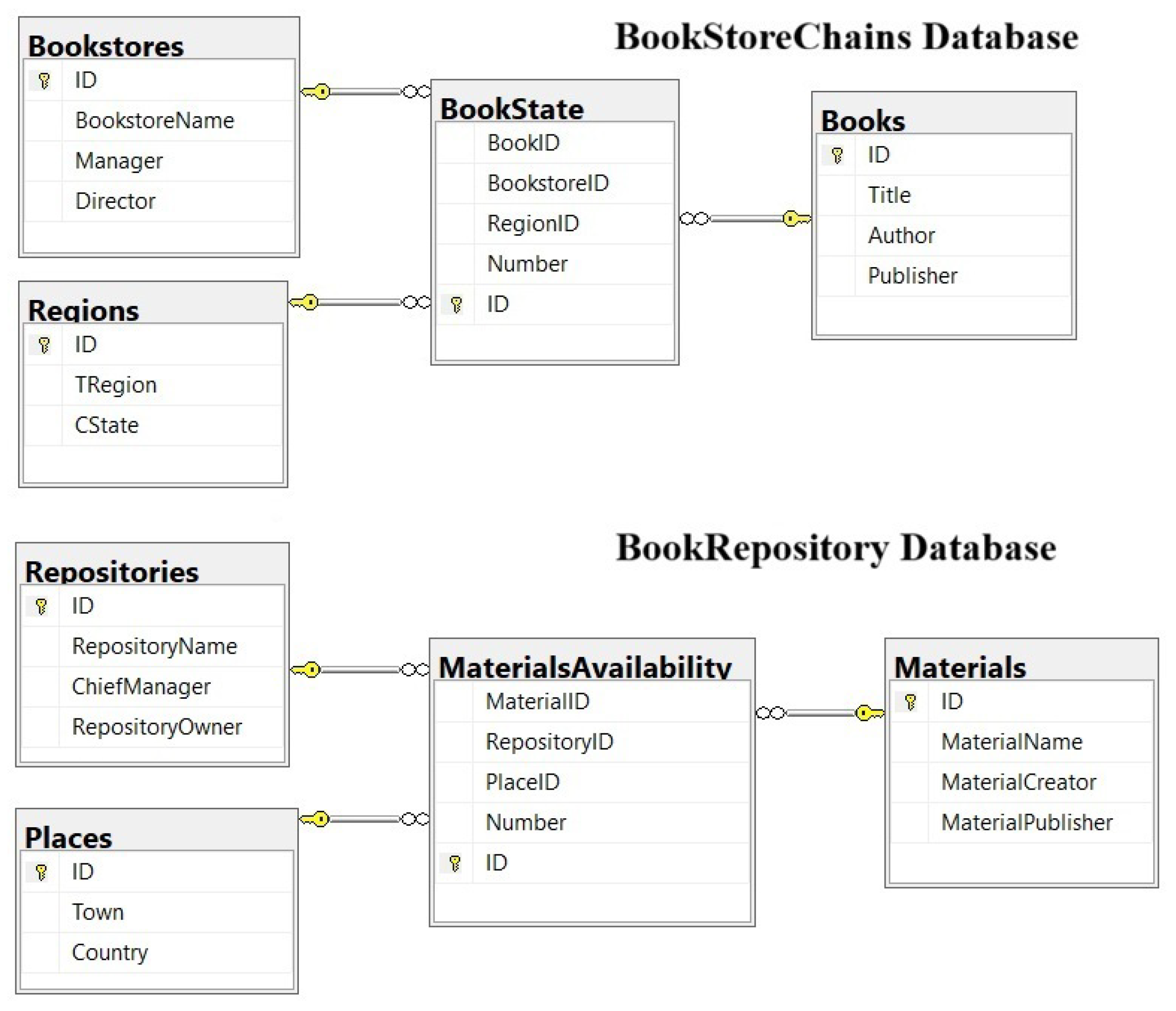
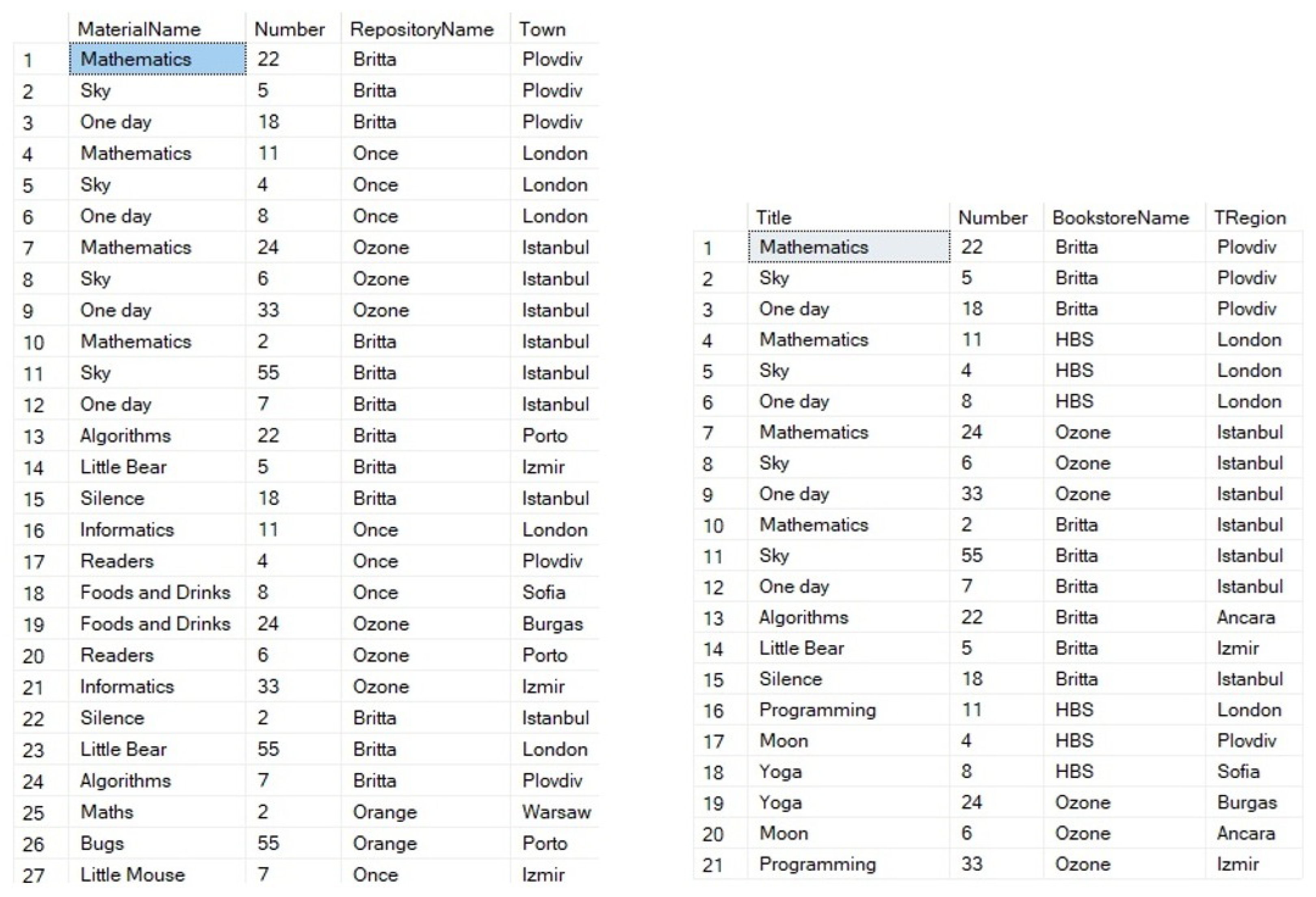
An example of data sources presented in the form of two databases are firstly created. In this case, the BooksRepository and BookStoresChain databases have a similar structure. Databases are created using SQL Server Express 2022 and SQL Server Management Studio 21 [12,15,16]. Database BooksRepository contains Repositories, Places, MaterialsAvailability, and Materials, tables. Database BookStoresChain includes Bookstores, Regions, BookState, Books and tables. The diagrams of both databases are presented in Figure 5. The data from BooksRepository and BookStoresChain is queried by INNER JOIN statements and is presented in Figure 6.
The first query, presented in Figure 6, selects the columns MaterialName from Materials table, RepositoryName from Repositories table, Town from Places table and Number from MaterialsAvailability table from BooksRepository database. The second query, presented in Figure 6, selects the columns Title from Books table, BookStoreName from BookStores table, TRegion from Regions table and Number from BookStates table from BookStoresChain database.
The “symmetric difference” operation can be effectively illustrated in the context of relational databases. By applying it, reports can be generated to present intersections, unions, and differences between datasets. These standard operations are typically performed on two-dimensional tables. Therefore, an example of the symmetric difference operation is first presented for 2D data. Subsequently, the discussion is extended to the case of 3D data.
The implementation of “symmetric difference” operation in a 2D case is demonstrated through the BooksRepository and BookStoresChains databases. The aim is that a list of books that are available only in the first database or only in the second database are extracted. The SQL statement to realize that is presented below:
SQL query:
Symmetry 18 00696 i001
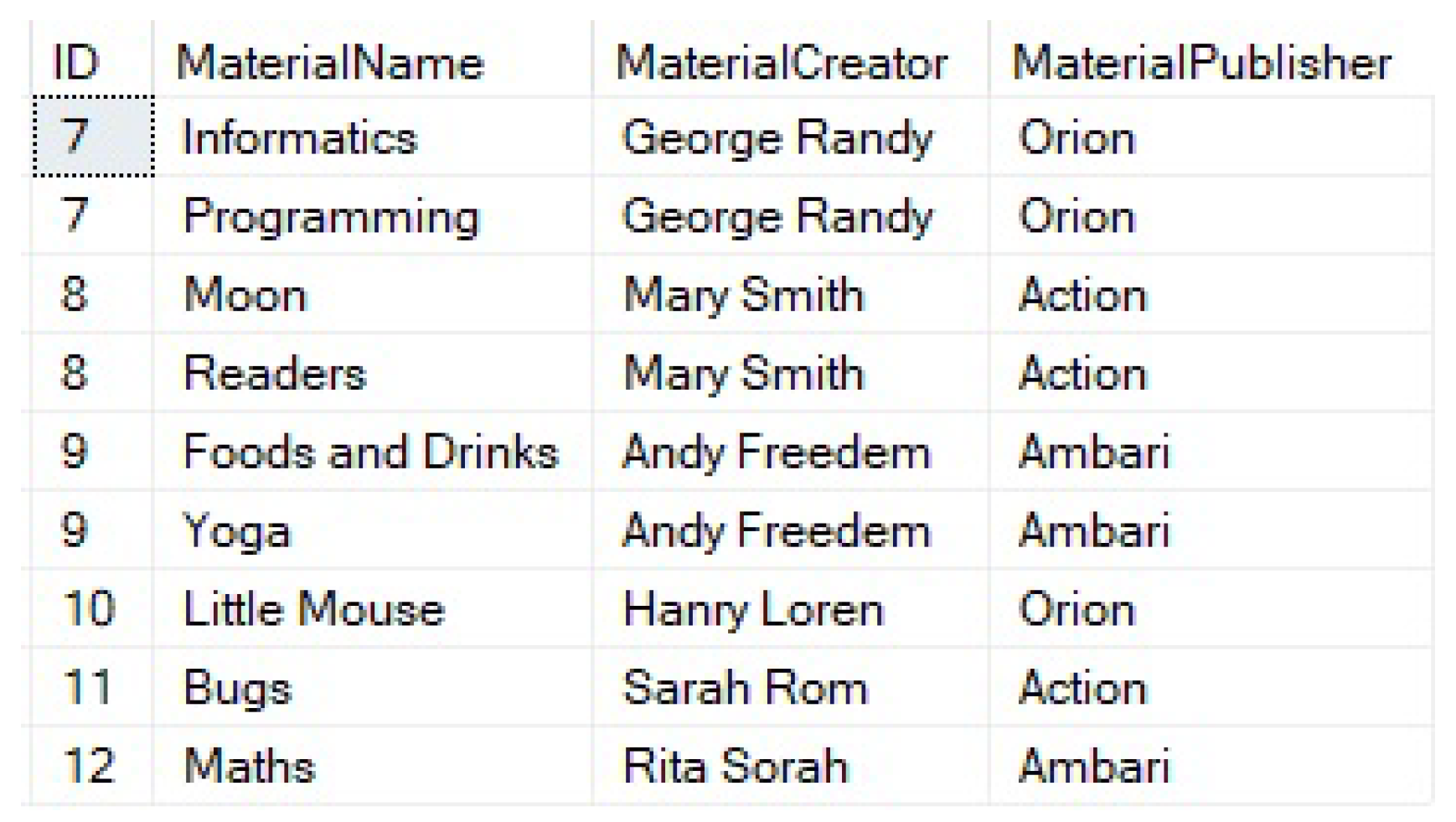
The result of the SQL statement is presented in Figure 7. It contains nine books that are available only in the BookRepository database and three books that are available only in the BookStoreChains database.
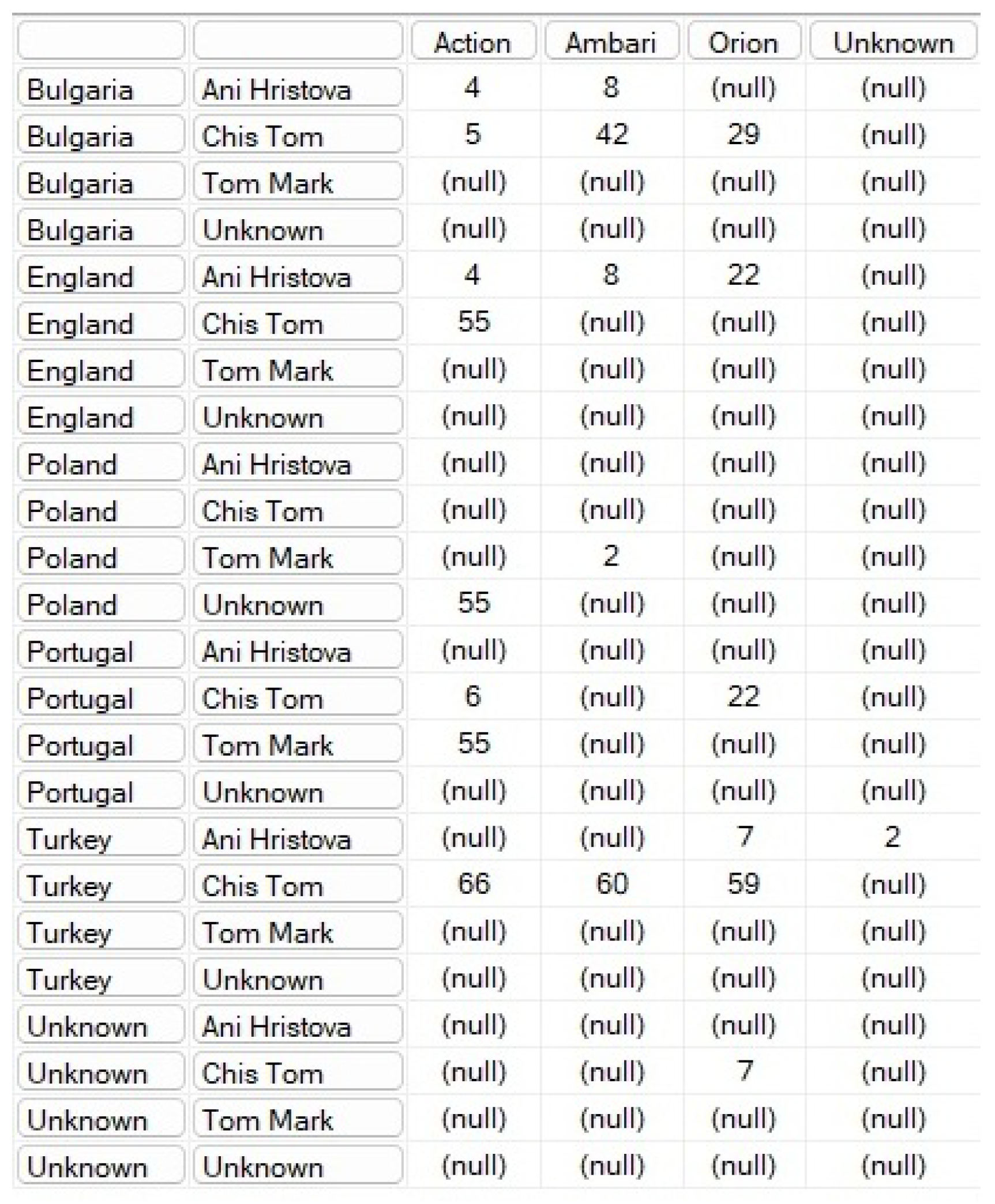
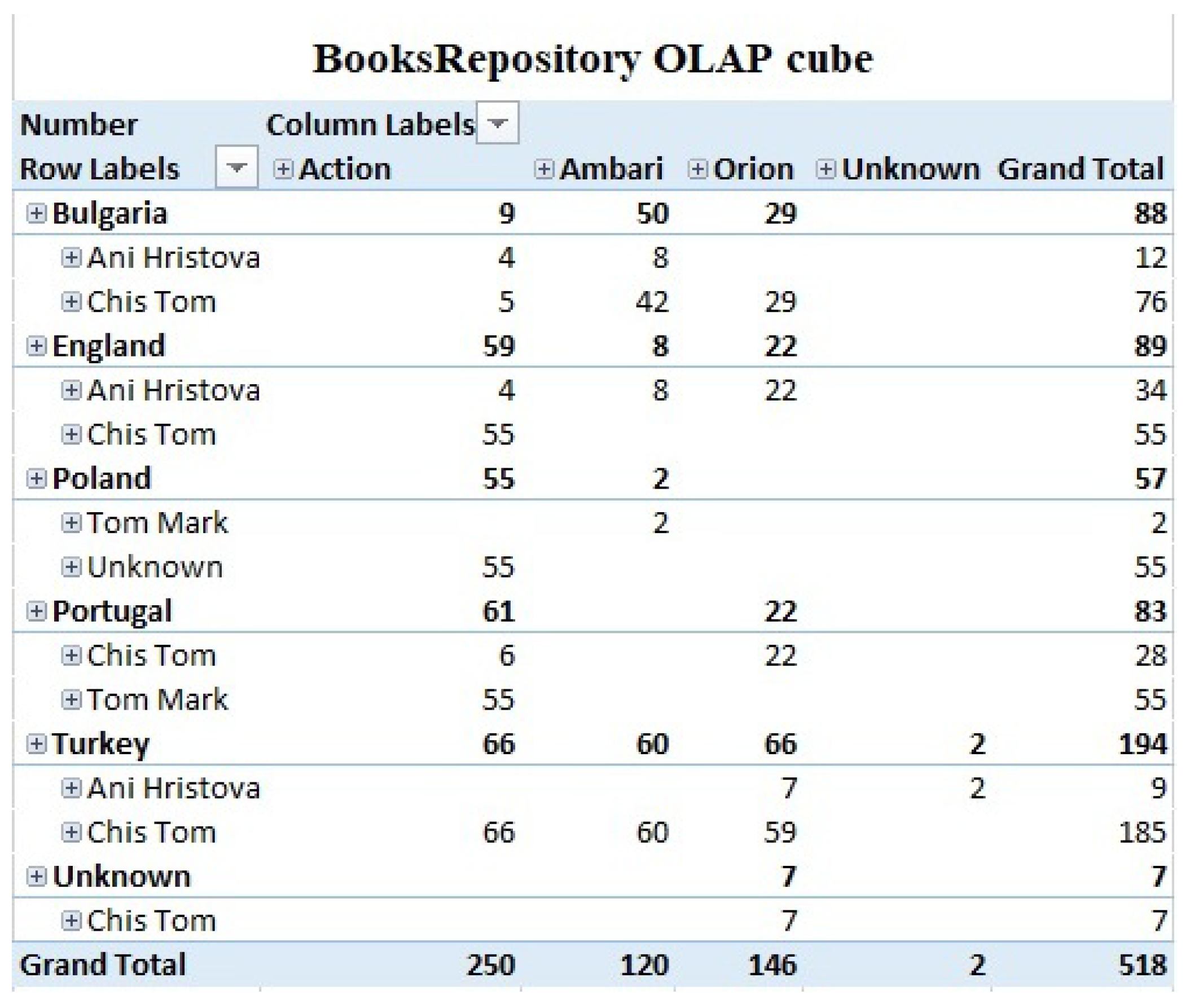
Further, the “symmetric difference” operation is further illustrated in the context of multidimensional databases. The objective is to compare several datasets with differing attributes and to highlight elements present in one dataset but absent in another. The construction of 3D structures is again based on the BookStoresChain and BooksRepository databases. Two OLAP (Online Analytical Processing) cubes are implemented, and the resulting tables are used for subsequent data transformation. The initial two-dimensional tables are preprocessed and transformed into 3D representations (Figure 8 and Figure 9). The BooksRepository database is used for BooksRepository OLAP cube generation. The tables Materials, Places and Repositories are used for constructing dimensions. The table MaterialsAvailability is used for number measure generation. The OLAP cube is made using SQL Server Analysis Services (SSAS) and Microsoft Visual Studio 2022 [17]. The multidimensional language (MDX) query is executed to select the 3D data analogously to the 3D index matrices.
MDX query:
Symmetry 18 00696 i002
Result:
Figure 8. MDX query representing 3D data from the BooksRepository OLAP cube.
Symmetry 18 00696 g008
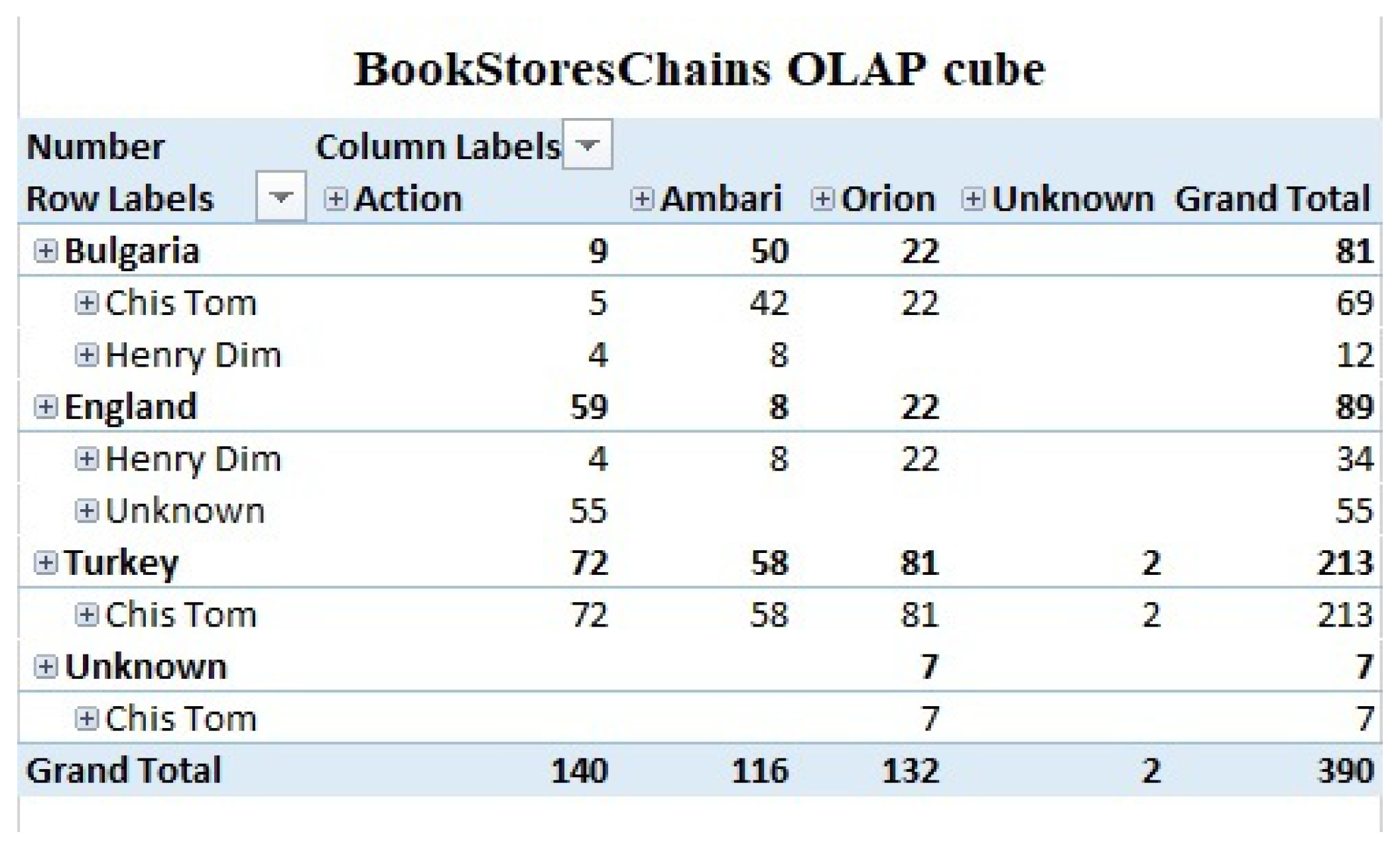
The same algorithm and instruments are used for BookStoresChain OLAP cube generation. It is constructed using BookStoresChains database tables. Books, Regions, and Bookstores tables are extracted for creating the dimensions. The table BookStates is used for Number measure selection. The MDX query is executed to select the 3D data similar to the 3D index matrices. The result is presented in Figure 9.
MDX query:
Symmetry 18 00696 i003
Result:
Figure 9. MDX query representing 3-D data from BookStoresChains OLAP cube.
Symmetry 18 00696 g009
It is well known that set operations are typically performed within a single OLAP data cube, where they are implemented by combining attribute groups across dimensions [18]. In the present case, however, two OLAP cubes are involved. Therefore, the corresponding 3D tables are extracted and used for further processing. The “symmetric difference” operation is implemented in a separate application. To this end, OLAP data are extracted via an SSAS connection using Excel OLAP tools and represented as 3D tables. The table shown in Figure 10 contains data from the BookStoresChains OLAP cube, while the table presented in Figure 11 includes data from the BooksRepository OLAP cube.
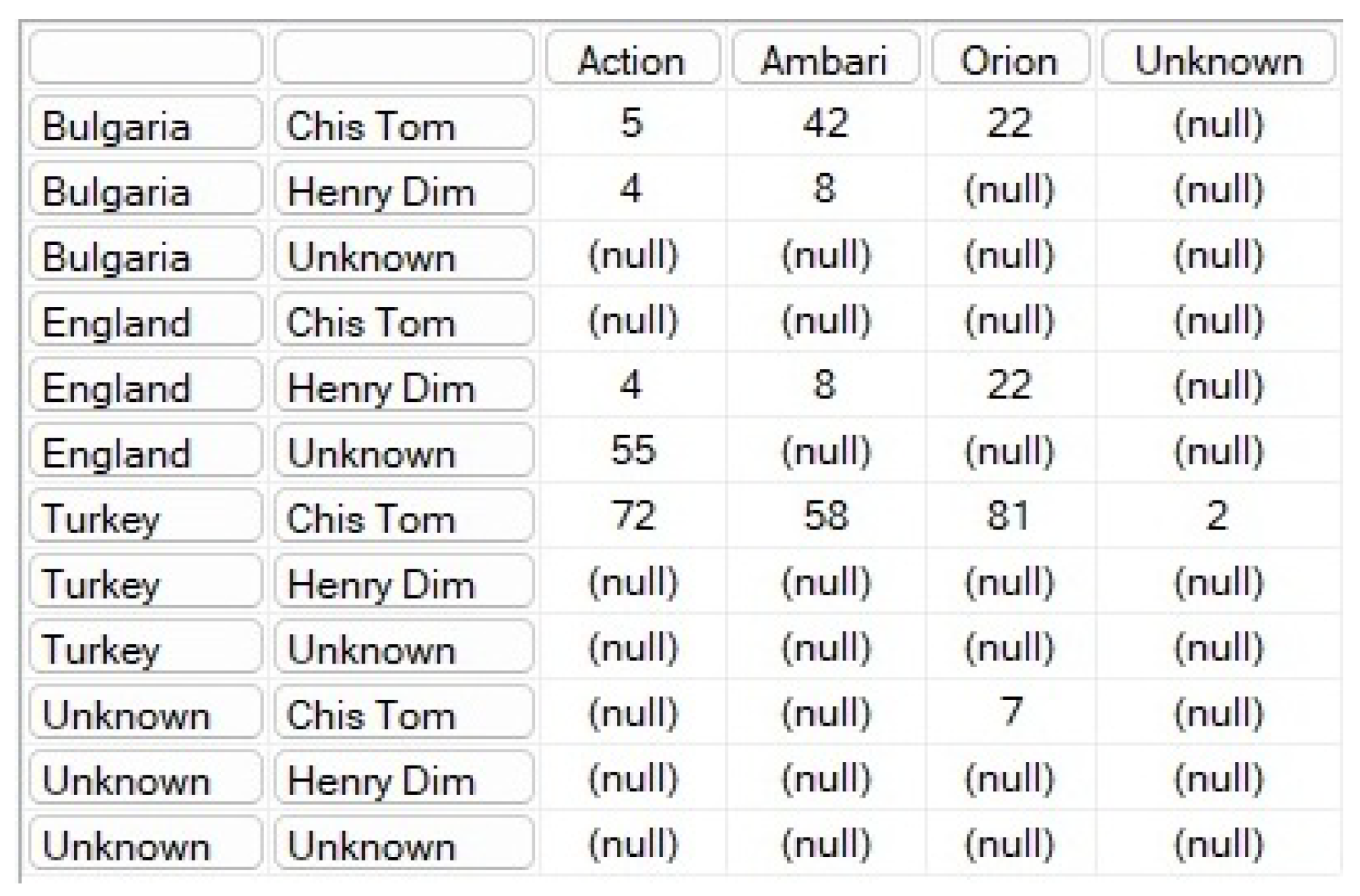
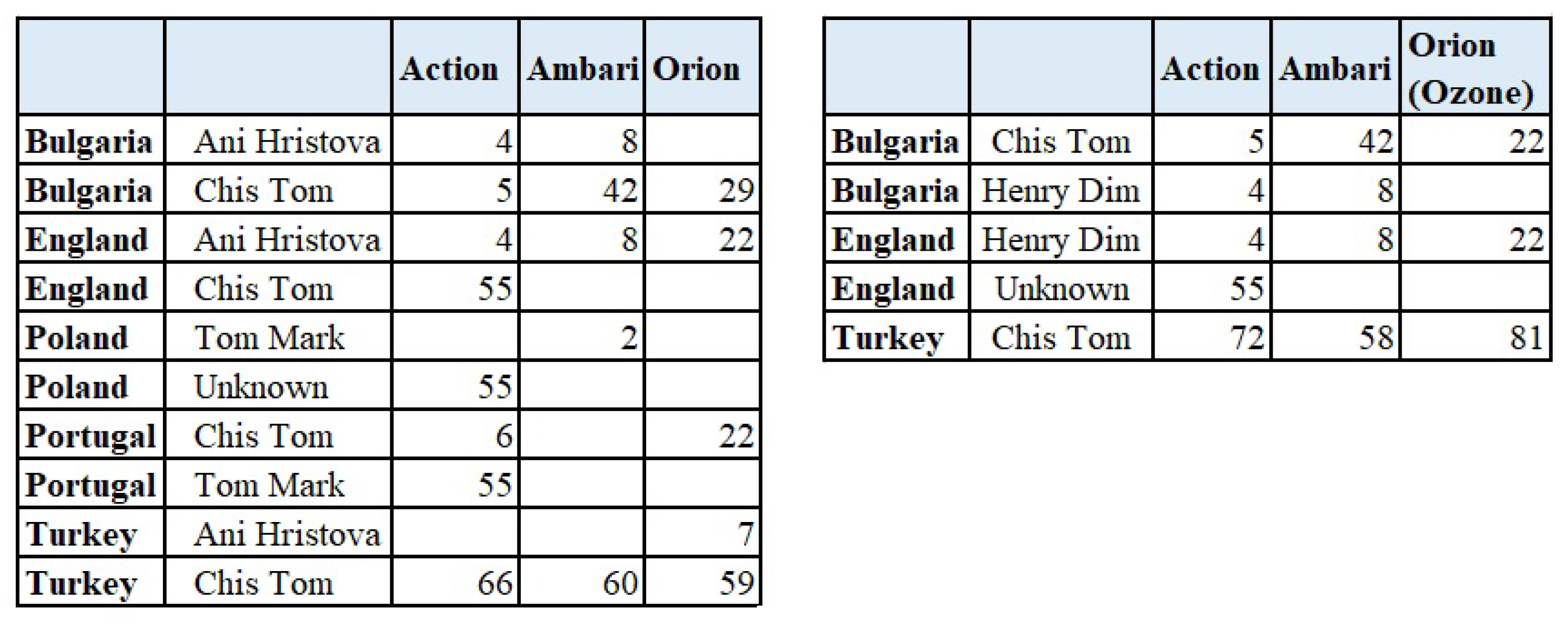
Two tables from the BooksRepository OLAP cube and BookStoresChains OLAP cubes are cleaned and preprocessed to take the form presented in Figure 12. The first two columns contain the values for attributes of two dimensions. The first row presents the attributes of the third dimension. These two tables are used for visualization of the “symmetric difference” operation. Another possible option is for the user to generate artificial files of a similar type.

4.1. An Illustration of the First “Symmetric Difference” Operation over Three-Dimensional Data

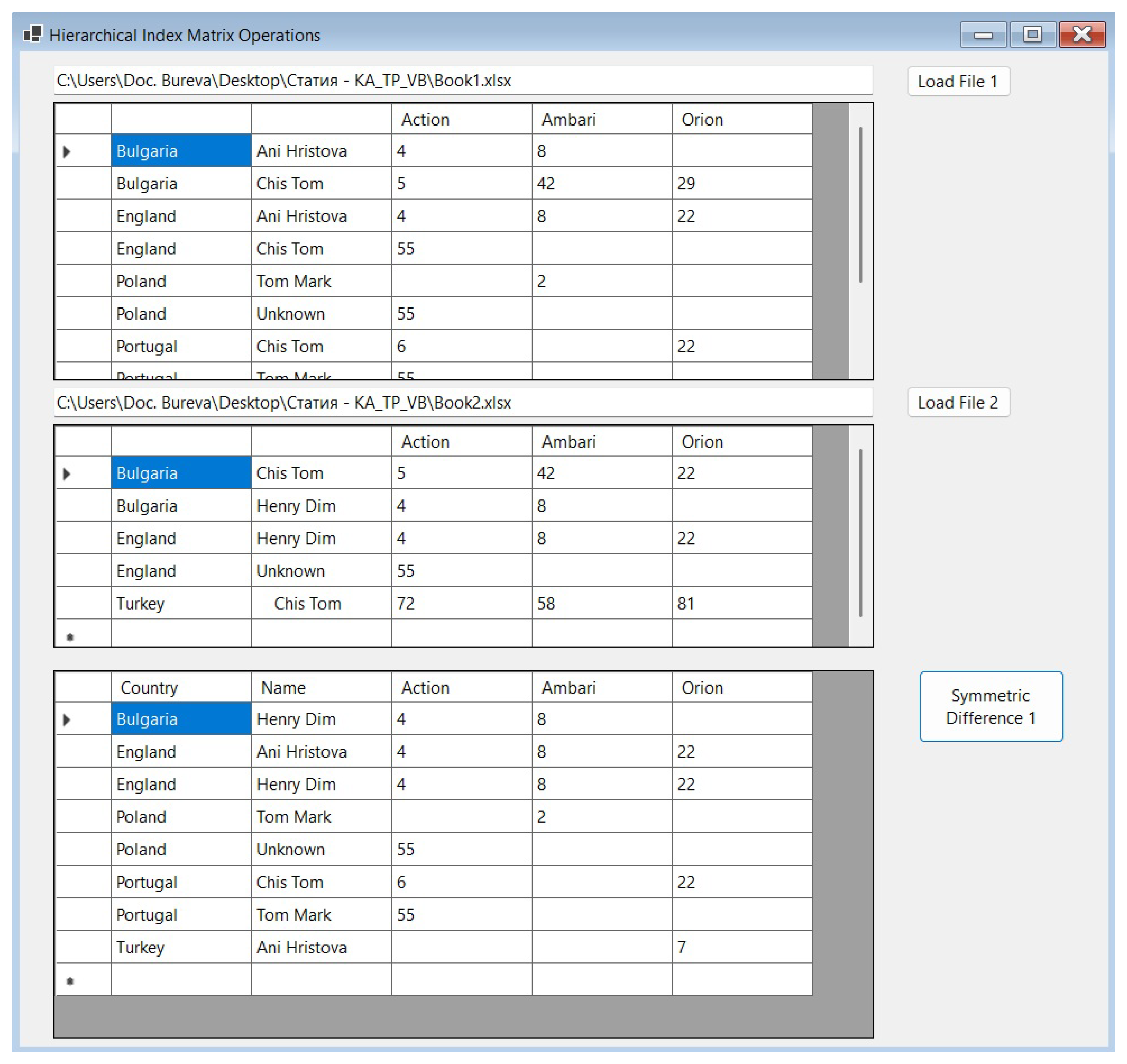
The “symmetric difference” operations are implemented in a Windows Forms (.NET Core 12) application using the programming language C#. The data from the two input tables are loaded into two programmatically generated DataGridView controls. These controls are designed to represent three dimensions. The first and second dimensions are visualized in the first two columns, while the third dimension is presented in the first row of the DataGridView controls.
The first operation “symmetric difference” identifies differing records across the dimensions by performing the suboperations BooksRepository minus BookStoresChains and BookStoresChains minus BooksRepository. The resulting data are then combined into a single dataset. The operation includes the following steps:
Case 1: The combination of:
Titles of books stored in Materials table of BooksRepository database minus Titles of books stored in Books table of BookStoresChain database AND
The names of bookshops stored in Repositories table of BooksRepository database minus the names of bookshops stored in BookStores table of BookStoresChains database AND
The names of towns stored in Places table of BooksRepository database minus the names of towns stored in Regions table of BookStoresChains database.
Case 2: The combination of:
Titles of books stored in Books table of BookStoresChains database minus titles of books stored in Materials table of BooksRepository database AND
The names of bookshops stored in BookStores table of BookStoresChains database minus the names of bookshops in Repositories table of BooksRepository database AND
The names of towns stored in Regions table of BookStoresChains database minus the names of towns stored in Places table of BooksRepository database.
The first “symmetric difference”-type operation is tested using the data tables presented in Figure 12. The result is visualized in Figure 13. The third DataGridView control shown on the bottom of Figure 13 presents the first “symmetric difference”-type operation as a result of the input data loaded in the first two datagridview controls.

4.2. An Illustration of the Second “Symmetric Difference”-Typr Operation over 3D Data

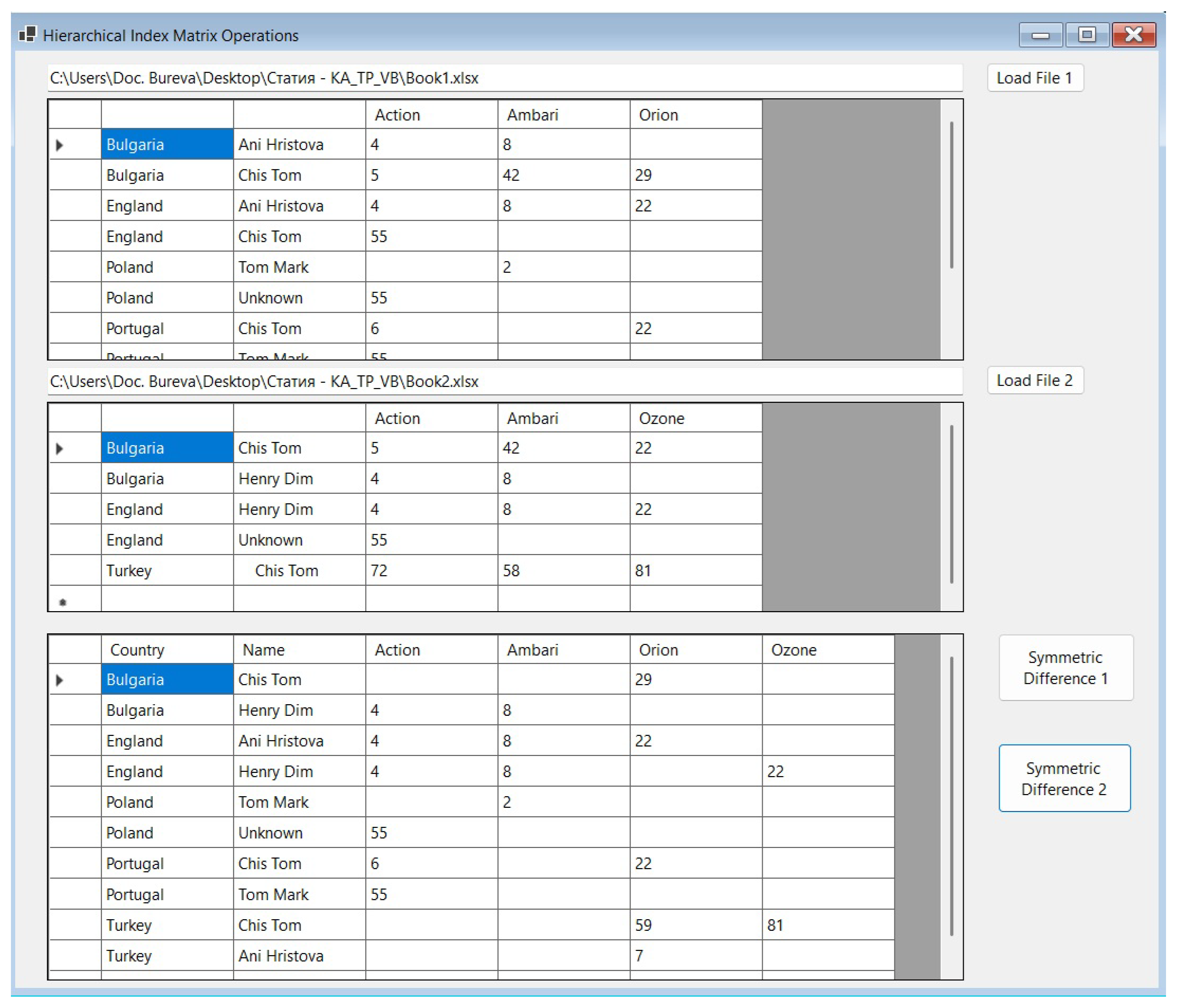
The second “symmetric difference”-type operation performs extraction based on the one different dimension for BooksRepository minus BookStoresChains and for BookStoresChains minus BooksRepository united in one resulting dataset. The operation includes the following steps:
Case 1: The combination of:
Titles of books stored in Materials table of BooksRepository database minus titles of books stored in Books table of BookStoresChain database OR
The names of bookshops stored in Repositories table of BooksRepository database minus the names of bookshops stored in BookStores table of BookStoresChains database OR
The names of towns stored in Places table of BooksRepository database minus the names of towns stored in Regions table of BookStoresChains database.
Case 2: The combination of:
Titles of books stored in Books table of BookStoresChains database minus titles of books stored in Materials table of BooksRepository database OR
The names of bookshops stored in BookStores table of BookStoresChains database minus the names of bookshops in Repositories table of BooksRepository database OR
The names of towns stored in Regions table of BookStoresChains database minus the names of towns stored in Places table of BooksRepository database.
The second “symmetric difference”-type operation is tested using the data tables presented in Figure 12. The result is demonstrated in Figure 14. The third DataGridView control shown on the bottom of Figure 14 presents the second “symmetric difference”-type operation of the data loaded in the first two DataGridView controls.
The examples, presented in Section 4.1 and Section 4.2, demonstrate the implementations of the herewith defined “symmetric difference” operations, which provide capabilities to find different data from two 3D datasets. The operations are helpful when the user wants to extract and work with records that are present in only one of two datasets. Comparing data in different sources can be used to increase the efficiency of querying and supply management.

5. Conclusions

In the present paper, two new “symmetric difference”-type operations were introduced over 3-DEIMs, shown to be applicable also over IFIMs. The presented example of implementation of the elaborated “symmetric difference” operations in the field of relational databases served to demonstrate the entire process: from the creation of the relational databases, through their use for 3-D OLAP cube generation, to the extraction of 3D data tables using OLAP tools for Excel and their use in C# Windows Forms application containing the “symmetric difference” operation implementation. Thus, the two new “symmetric difference”-type operations were demonstrated to be effective for the comparison of data sets with dissimilar attributes. As a direction of further research, at the moment the authors are working on the representativeness of the arbitrary databases by IMs and the operations over IMs, as well as on the program realization of operations over IMs, which do not have analogues in the BigData. The results from this ongoing research (including newly here defined definitions) will be included in a further book, which will be a continuation of [2,3].

Author Contributions

Conceptualization, K.A., V.B. and T.P.; methodology, K.A.; software, V.B.; validation, K.A., V.B. and T.P.; formal analysis, K.A. and T.P.; investigation, K.A., V.B. and T.P.; writing—original draft preparation, K.A. and T.P.; writing—review and editing, K.A., V.B. and T.P.; visualization, V.B. and T.P.; supervision, K.A. and T.P.; project administration, K.A., V.B. and T.P.; funding acquisition, K.A.,V.B. and T.P. All authors have read and agreed to the published version of the manuscript.

Funding

The authors gratefully acknowledge the funding by the Bulgarian National Science Fund under the grant KP-06-N72/8 from 14 December 2023, titled “Intuitionistic Fuzzy Methods for Data Analysis with an Emphasis on the Blood Donation System in Bulgaria”.

Data Availability Statement

The original contributions presented in the study are included in the article. Further inquiries can be directed to the corresponding author.

Acknowledgments

The authors are grateful to Vassia Atanassova and Peter Vassilev for their fruitful discussions and support in the visualization materials.

Conflicts of Interest

The authors declare no conflicts of interest.

References

  1. Atanassov, K. Generalized index matrices. Comptes Rendus L’Academie Bulg. Sci. 1987, 40, 15–18. [Google Scholar]
  2. Atanassov, K. Index Matrices: Towards an Augmented Matrix Calculus; Springer: Cham, Switzerland, 2014. [Google Scholar]
  3. Atanassov, K. On Index Matrices; Academic Publishing House “Acad. Marin Drinov”: Sofia, Bulgaria, 2025. [Google Scholar]
  4. Bernstein, D.S. Matrix Mathematics: Theory, Facts, and Formulas, 2nd ed.; Princeton University Press: Princeton, NJ, USA, 2009. [Google Scholar]
  5. Lang, S. Algebra; Springer: New York, NY, USA, 2002. [Google Scholar]
  6. Bureva, V.; Atanassov, K.; Atanassova, V.; Umlenski, I. Inverse Operator over Index Matrices. Mathematics 2026, 14, 615. [Google Scholar] [CrossRef]
  7. Atanassov, K.; Bureva, V. Two new operations over extended index matrices and their applications in Big Data. In Proceedings of the 17th Conference on Computer Science and Intelligence Systems, Sofia, Bulgaria, 4–7 September 2022; pp. 1–6. [Google Scholar]
  8. Fraenkel, A.; Bar-Hillel, Y. Foundations of Set Theory; North-Holland Publ. Co.: Amsterdam, The Netherlands, 1958. [Google Scholar]
  9. Kuratowski, K.; Mostowski, A. Set Theory; North-Holland Publ. Co.: Amsterdam, The Netherlands, 1967. [Google Scholar]
  10. Rasiowa, H.; Sikorski, R. The Mathematics of Metamathematics; Polish Academy of Sciences: Warszawa, Poland, 1963. [Google Scholar]
  11. MacLane, S.; Birkhoff, G. Algebra, 3rd ed.; AMS Chelsea Publishing: Providence, RI, USA, 1999. [Google Scholar]
  12. Date, C.J. Database Design and Relational Theory; Apress: New York, NY, USA, 2019. [Google Scholar]
  13. Sumathi, S.; Esakkirajan, S. Fundamentals of Relational Database Management Systems; Studies in Computational Intelligence; Springer: Berlin/Heidelberg, Germany, 2007. [Google Scholar]
  14. Garcia-Molina, H.; Ullman, J.; Widom, J. Database Systems: The Complete Book, 2nd ed.; Pearson: London, UK, 2009. [Google Scholar]
  15. Beaulieu, A. Learning SQL, 3rd ed.; O’Reilly Media: Sebastopol, CA, USA, 2020. [Google Scholar]
  16. Kaufmann, M.; Meier, A. SQL and NoSQL Databases, Modeling, Languages, Security and Architectures for Big Data Management; Springer: Berlin/Heidelberg, Germany, 2023. [Google Scholar]
  17. Steven, H. Hands-On SQL Server 2019 Analysis Services: Design and Query Tabular and Multi-Dimensional Models Using Microsoft’s SQL Server Analysis Services; Packt: Birmingham, UK, 2020. [Google Scholar]
  18. Traneva, V.; Bureva, V.; Sotirova, E.; Atanassov, K. Index matrices and OLAP-cube. Part 3: A presentation of the OLAP “InterCube Set” and “Data cube” operations by index matrices. Adv. Stud. Contemp. Math. 2018, 28, 423–448. [Google Scholar]
Figure 1. Intersection between two IMs sharing a subset of identical indices and identical values).
Symmetry 18 00696 g001
Figure 2. A graphical representation of the first operation “symmetric difference”.
Symmetry 18 00696 g002
Figure 3. A graphical representation of the second operation “symmetric difference”.
Symmetry 18 00696 g003
Figure 4. Venn diagrams of the set operation difference between sets A and B from relational algebra.
Symmetry 18 00696 g004
Figure 5. The diagrams of BookStoresChain databases (upper diagram) and BooksRepository (bottom diagram).
Symmetry 18 00696 g005
Figure 6. Examples of data from the BooksRepository and BookStoresChains databases, selected by INNER JOIN queries.
Symmetry 18 00696 g006
Figure 7. “Symmetric difference” operation in the 2D case.
Symmetry 18 00696 g007
Figure 10. Data from BookStoresChains OLAP cube.
Symmetry 18 00696 g010
Figure 11. Data from BooksRepository OLAP cube.
Symmetry 18 00696 g011
Figure 12. Transformed tables from BooksRepository OLAP cube (on the left) and from BookStoresChains OLAP cube (on the right).
Symmetry 18 00696 g012
Figure 13. The first “symmetric difference”-type operation implementation.
Symmetry 18 00696 g013
Figure 14. The second “symmetric difference” operation implementation.
Symmetry 18 00696 g014
Disclaimer/Publisher’s Note: The statements, opinions and data contained in all publications are solely those of the individual author(s) and contributor(s) and not of MDPI and/or the editor(s). MDPI and/or the editor(s) disclaim responsibility for any injury to people or property resulting from any ideas, methods, instructions or products referred to in the content.