Review

Recent Progress in Antimatter Research with Heavy-Ion Collisions

1
State Key Laboratory of Heavy Ion Science and Technology, Institute of Modern Physics, Chinese Academy of Sciences, Lanzhou 730000, China
2
School of Nuclear Science and Technology, University of Chinese Academy of Sciences, Beijing 101408, China
*
Author to whom correspondence should be addressed.
Symmetry 2026, 18(4), 693; https://doi.org/10.3390/sym18040693
Submission received: 22 March 2026 / Revised: 11 April 2026 / Accepted: 13 April 2026 / Published: 21 April 2026

Abstract

Matter–antimatter asymmetry is a fundamental question in both astronomy and particle physics. Investigating antimatter is of great interest for testing the potential explanations of matter–antimatter asymmetry in our Universe. In relativistic heavy-ion collisions, the extremely high energy density and temperature are similar to the early Universe shortly after the Big Bang. In this paper, we review the recent progress in antimatter search and study heavy-ion collisions, with a focus on the RHIC-STAR and LHC-ALICE experiments, particularly the newly observed antimatter hypernuclei H ¯ Λ ¯ 4 and He ¯ Λ ¯ 4 . The statistical thermal model and the coalescence production model can quantitatively describe the production yields and yield ratios, and the yield measurements of H ¯ Λ ¯ 4 , He ¯ Λ ¯ 4 and their matter counterparts indicate the existence of spin-excited states of these (anti)hypernuclei. Furthermore, new measurements of the lifetimes of H ¯ Λ ¯ 3 , H ¯ Λ ¯ 4 and their matter counterparts reveal no difference between a particle and its corresponding antiparticle, which validates the CPT theorem.

1. Introduction

The modern concept of antimatter originated from the negative energy solution of the Dirac equation for the electron [1]. Later, the anti-electron (positron) was discovered in 1932 by Anderson C. D. in a cosmic ray experiment [2]. Strong evidence shows that the current observable universe is dominated by matter [3]. However, the Big Bang theory predicts that equal amounts of matter and antimatter should have been produced in the early Universe. Astronomy observations, such as cosmic expansion [4] and cosmic microwave background [5,6], support a hot and dense early universe where matter and antimatter particle pairs are continuously created and annihilated. Thus, the net baryon number should be zero, implying matter–antimatter symmetry at the beginning of the Universe. As the Universe expands and cools, the annihilation process dominates. Since both creation and annihilation conserve the net baryon number, any observed matter–antimatter imbalance should originate from an asymmetry generated dynamically during cosmic evolution. Today, matter clearly dominates in the current observed Universe [3]. This well-known matter–antimatter asymmetry, also referred to as baryon asymmetry of the Universe (BAU), remains one of the fundamental open questions in both astronomy and particle physics. In 1967, physicist Sakharov A.D. proposed that matter–antimatter asymmetry could arise dynamically through the evolution of Universe rather than being imposed in initial conditions. He identified three necessary criteria, known as Sakharov’s conditions, for a possible baryon asymmetry mechanism: (i) baryon number violation, (ii) C and CP symmetry breaking, (iii) out of thermal equilibrium [7]. In principle, the Sakharov conditions can be satisfied within the framework of the Standard Model, but the resulting asymmetry is too small to account for the observed matter dominance [3]. This discrepancy underscores the need for physics beyond the Standard Model and motivates continued experimental and theoretical investigations into antimatter.
Symmetry plays an important role in physics. In a local quantum field with Lorentz invariance, physical laws under the combined operator of charge conjugation (C), parity inversion (P), and time reversal (T) are invariant, known as CPT symmetry. The CPT theorem guarantees that matter and antimatter particles possess some identical intrinsic properties, such as mass and lifetime. Any measurable difference in these properties between matter and antimatter would signal CPT violation. To date, no CPT violation has been observed despite numerous high-precision experimental tests [8,9,10,11,12,13]. In heavy-ion collisions, the first measurement of the strong interaction between antiprotons, obtained by using correlation functions, reveals the interaction is attractive. The scattering length and the effective range of the interaction are consistent with the corresponding proton–proton interaction within uncertainties [14]; the results validate the CPT symmetry.
In the current Universe, antiparticles are difficult to produce and detect due to rapid annihilation upon contact with matter. Two approaches are employed to study antiparticles: cosmic ray and accelerator-based collisions. High-energy cosmic rays interacting with the interstellar medium can produce antiparticles, such as antiprotons, which are detected by space-based experiments [15]. However, antimatter nuclei with a mass number A 2 have so far only been observed in heavy-ion collision experiments. Heavy-ion collisions recreate the extremely high temperature and energy density similar to those of the early Universe shortly after the Big Bang, enabling the copious production of antimatter. As the fireball expands and cools, a fraction of the produced antiparticles can decouple from the medium before annihilation, and then be observed by the detectors [16].
In heavy-ion collisions, (anti)hypernuclei can be produced. Containing at least one hyperon, hypernuclei serve as a unique probe to the hyperon–nucleon (Y-N) interaction, which is crucial for understanding the equation of state of dense matter in neutron stars [17]. The lightest hypernucleus is H Λ 3 , which was first observed in nuclear emulsion exposed to a cosmic ray [18]. Its corresponding antiparticle H ¯ Λ ¯ 3 was observed in heavy-ion collisions by the STAR Collaboration [19]. Precise measurements of the mass and binding energy of H Λ 3 and H ¯ Λ ¯ 3 show excellent agreement between particle and antiparticle [20], providing a validation of the CPT theorem.
In this paper, we review the recent experimental progress in antimatter research from the STAR experiment at the RHIC and the ALICE experiment at the LHC, with particular emphasis on the newly discovered antimatter hypernuclei H ¯ Λ ¯ 4 and He ¯ Λ ¯ 4 . We discuss their measured properties, including lifetimes and production yields, as well as the underlying production mechanisms inferred from data.

2. Experiment

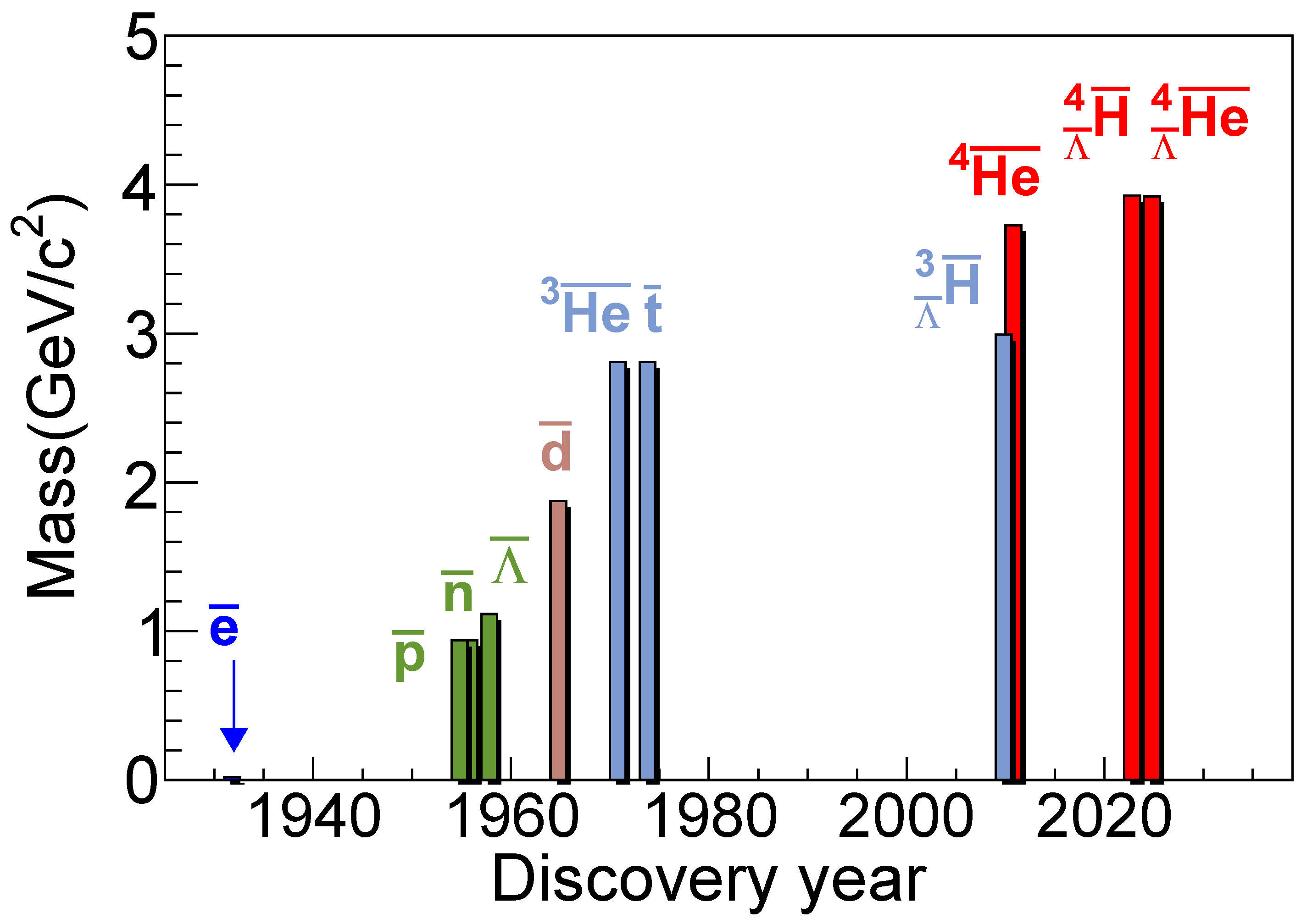
Historical milestones in antimatter discovery are summarized in Figure 1. The first antiparticle, the positron, was discovered in a cosmic ray experiment using a cloud chamber. Observed tracks had the same mass-to-charge ratio as the electron but curved in the opposite direction [2]. Later, as synchrotron technology was employed in experiments, heavier antiparticles were subsequently discovered: antiproton ( p ¯ ) [21], antineutron ( n ¯ ) [22], and antilambda ( Λ ¯ ) [23]. Then composite antimatter nuclei with baryon numbers of 2 and 3, including antideuteron ( d ¯ ) [24,25], antitriton ( t ¯ ) [26] and antihelium-3 ( He ¯ 3 ) [27], were discovered. Decades later, the RHIC-STAR collaboration reported the first observation of antimatter hypernucleus H ¯ Λ ¯ 3 in 2010 [19], followed by the discovery of He ¯ 4 in 2011 [28]. A comprehensive overview of the antimatter in heavy-ion collisions can be found in [29]. In recent years, STAR [30] and ALICE [31] experiments have led the frontier of antimatter research with heavy-ion collisions. The STAR collaboration reports the heaviest antimatter hypernucleus observed so far, H ¯ Λ ¯ 4 [16]. And the ALICE collaboration confirms the existence of H ¯ Λ ¯ 4 and presents evidence for its isobaric partner, He ¯ Λ ¯ 4 [32].

2.1. STAR Detector at RHIC

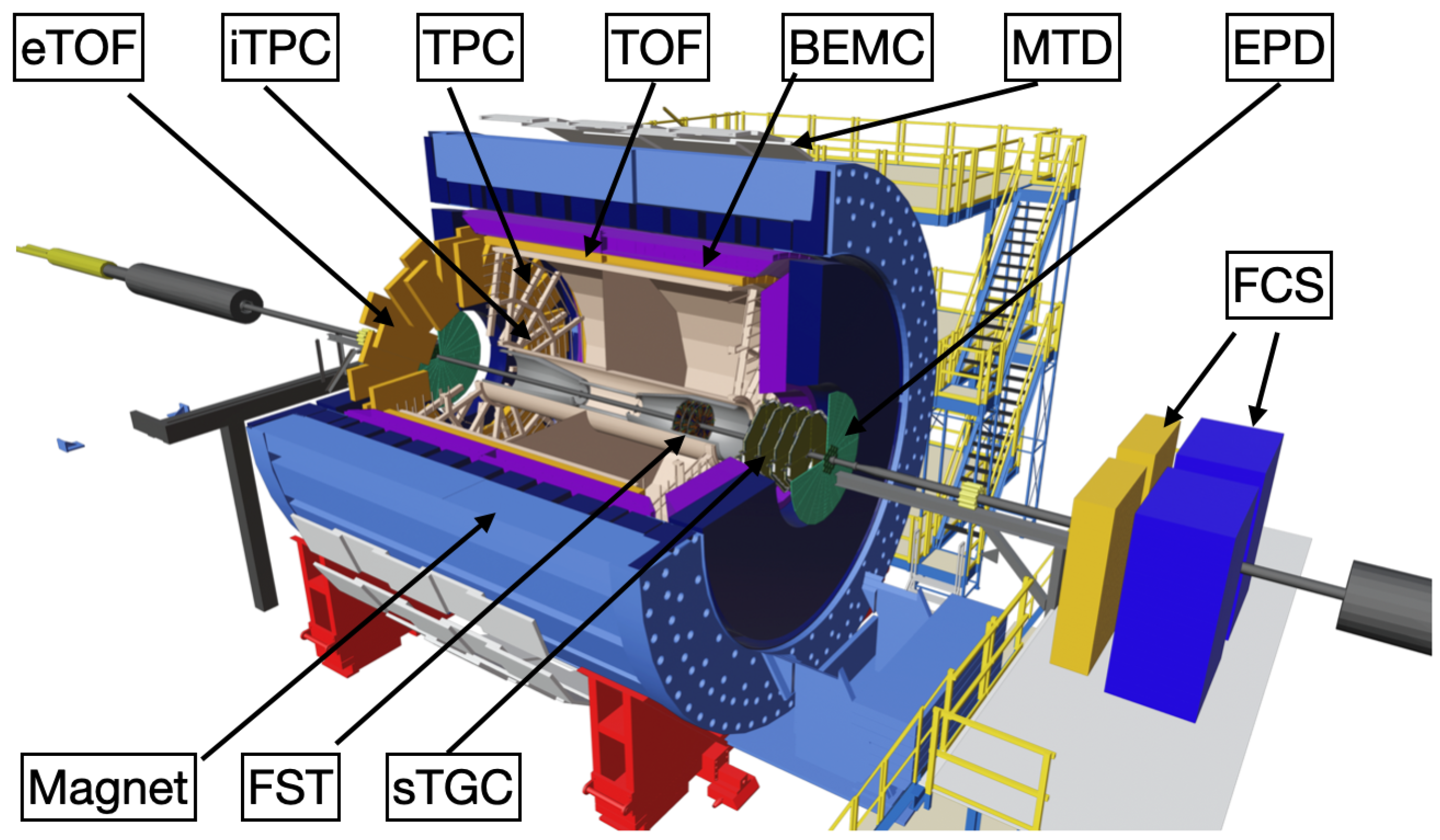
STAR [30] is one of the four major detectors at the RHIC facility. A schematic of the detector system is shown in Figure 2. The main tracking system is the gas-filled cylindrical Time Projection Chamber (TPC). With a magnetic field of 0.5 T parallel to the beam direction, particle momentum information can be obtained. TPC can also acquire energy loss ( d E / d x ) information. Different charged particles exhibit different energy loss. Based on the Bethe–Bloch formula, as implemented in Bichsel theory [33], charged particle species can be identified by TPC. Since 2018, the inner region of the TPC has been upgraded (iTPC), extending the charged particle pseudorapidity η coverage from | η | < 1.0 to | η | < 1.5 with 2 π azimuthal coverage.
The Time of Flight (TOF) detector provides additional particle identification ability. The whole TOF system consists of the barrel TOF and the vertex position detector (VPD). The barrel TOF, with | η | < 0.96 and 2 π azimuthal coverage, uses the start time provided by the VPD detector. The TOF measurements significantly enhance STAR’s separation ability for pions, kaons and protons. Along the beam line, a Forward Silicon Tracker (FST), small-strip Thin Gap Chamber (sTGC), Event Plane Detector (EPD) and Forward Calorimeter System (FCS) are installed. Around the beam, a Barrel Electromagnetic Calorimeter (BEMC) and Muon Telescope Detector (MTD) are installed. Details of sub-detector systems of STAR can be found in [30].
STAR is designed primarily to explore the properties of quark–gluon plasma (QGP), a deconfined state of matter that existed shortly after the Big Bang. Beam Energy Scan phases I and II (BES-I, BES-II), including the Fixed-Target program (FXT), have yielded fruitful results on the QCD phase diagram and hadron properties [34,35,36,37,38,39].

2.2. ALICE Detector at LHC

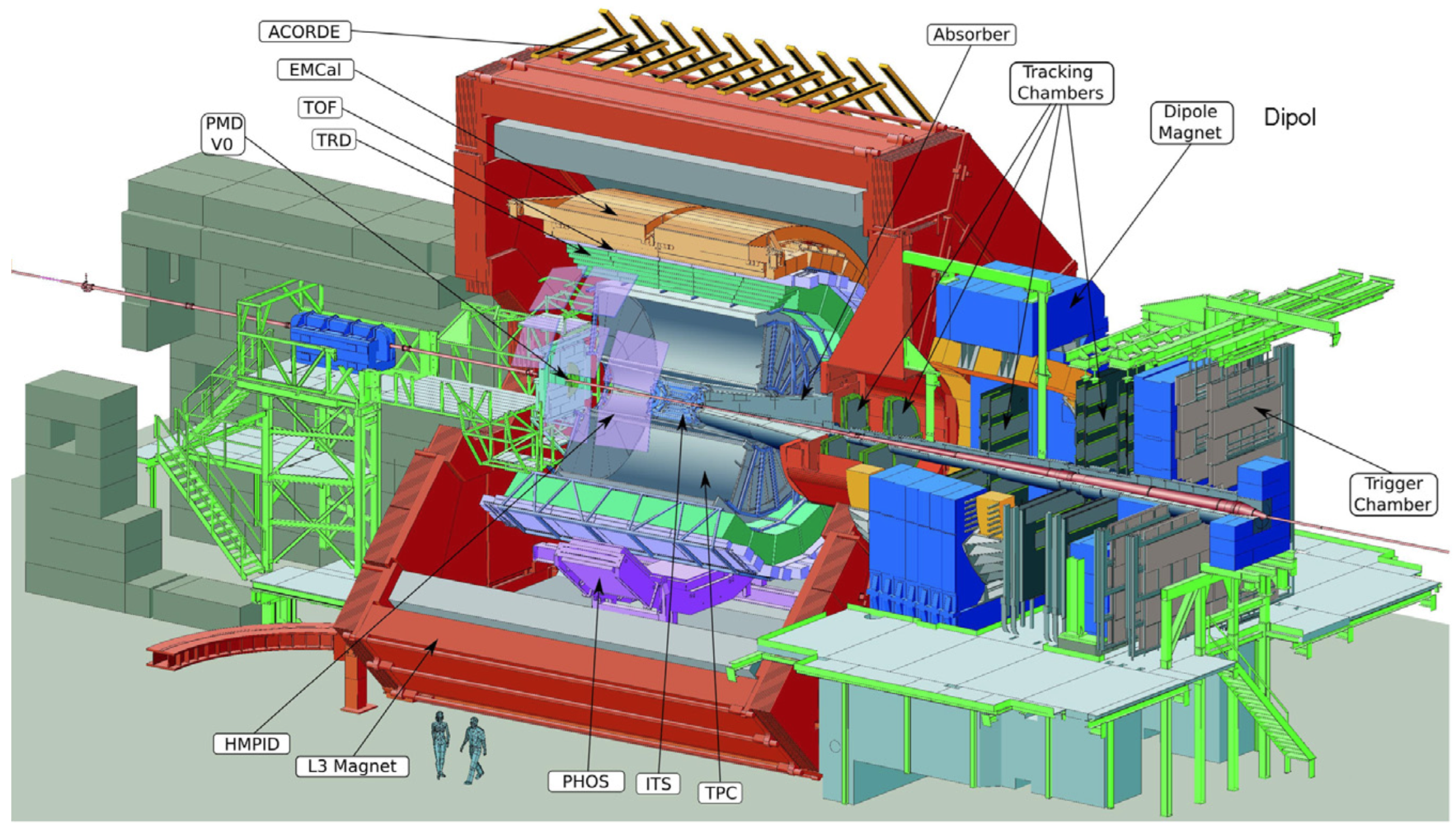
ALICE [31] is a dedicated heavy-ion detector at the LHC at CERN, designed to study the properties of quark–gluon plasma under extreme high-temperature conditions. A schematic of the ALICE detector is shown in Figure 3. The ALICE experiment delivers excellent performance despite the thousands of particles produced in ultra-relativistic Pb+Pb collisions, as well as in smaller collision systems such as p+p collisions. The inner tracking system (ITS) [40] is at the center of the entire detector system, which provides precise reconstruction of the positions of primary and secondary vertices.
ALICE’s main tracking system is the TPC [41], which reconstructs charged particle trajectories and measures their momenta in a 0.5 T solenoidal magnetic field aligned with the beam line. The TPC provides up to 159 three-dimensional space points per track, enabling high-precision tracking over full azimuthal coverage and a wide pseudorapidity range ( | η | < 0.9 ). Additionally, the specific energy loss ( d E / d x ) measured along the track follows the Bethe–Bloch formula, allowing the discrimination of different charged particle species.
π , K and p identification is significantly enhanced by the TOF detector, which precisely measures the time for particles to reach the TOF detector from the collision vertex, combined with the momenta information from the TPC. The TOF detector achieves excellent separation power across a broad momentum range. From the beam line outward, the High-Momentum Particle IDentification (HMPID) PHOton Spectrometer (PHOS), Electro-Magnetic Calorimeter (EMCal) and ALICE COsmic Ray DEtector (ACORDE) are arranged. Details of other sub-detector systems can be found in [31].
Operating at TeV-scale center-of-mass energies in Pb+Pb collisions, ALICE offers a unique platform to probe the thermodynamic and transport properties of the QGP under extreme conditions. The ALICE collaboration has produced significant results in heavy flavor physics and hadron properties [42,43,44,45,46,47].

3. Results

3.1. Antimatter Hypernucleus Signals

In heavy-ion collisions, hypernucleus candidates can be reconstructed using the decayed charged daughter particles with their 3D momenta and masses. Specifically, the decay channels of H ¯ Λ ¯ 4 and He ¯ Λ ¯ 4 used in the analyses are H ¯ Λ ¯ 4 4 He ¯ + π + and He ¯ Λ ¯ 4 3 He ¯ + p ¯ + π + , respectively.
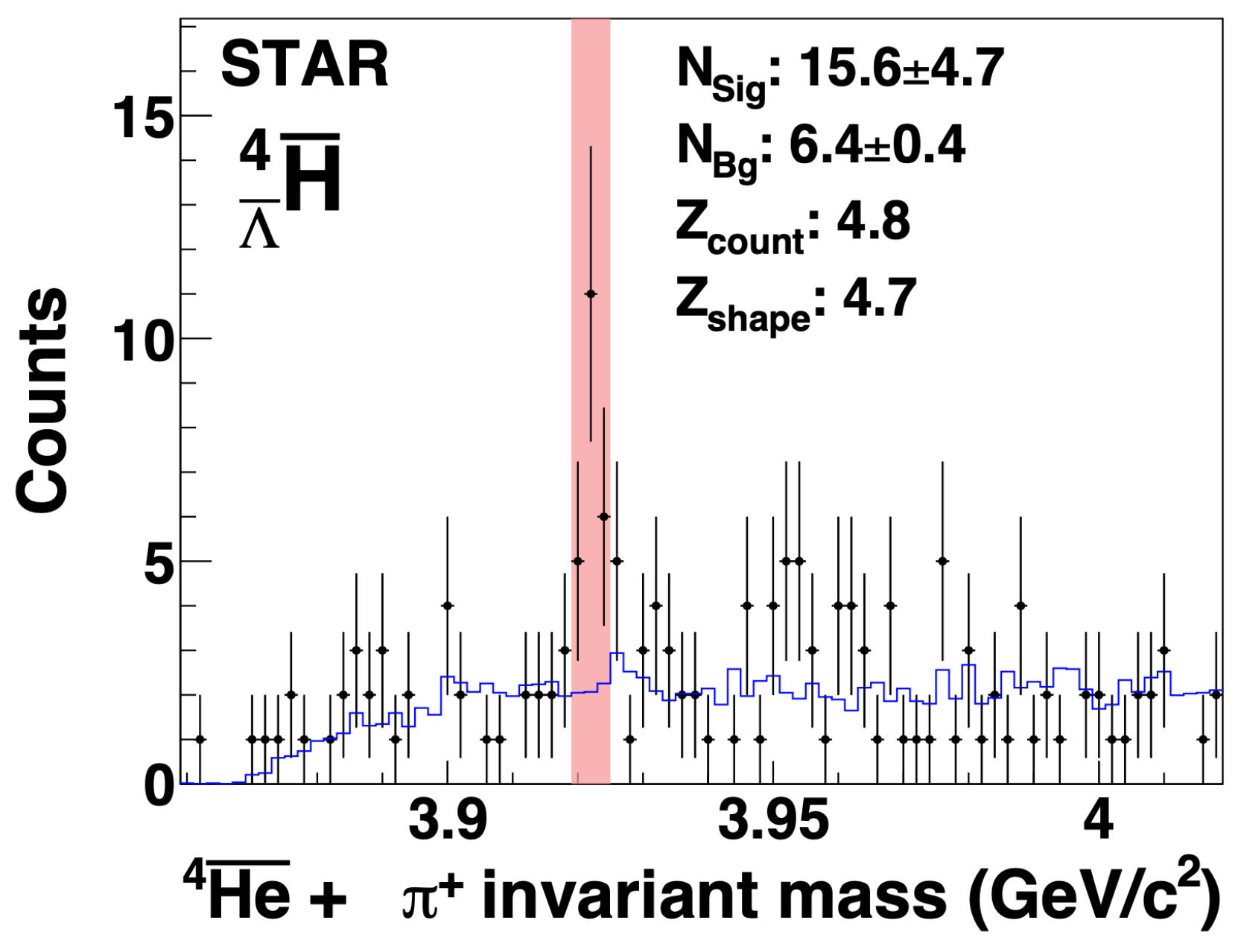
The STAR collaboration reports the heaviest observed antimatter hypernuclues H ¯ Λ ¯ 4 [16]. The invariant mass distribution of H ¯ Λ ¯ 4 is shown in Figure 4. U+U, Au+Au, Ru+Ru and Zr+Zr collisions with energies of s N N = 193 GeV (U+U) and s N N = 200 GeV (other systems) are used in the measurement. After background subtraction, 15.6 ± 4.7   H ¯ Λ ¯ 4 signal candidates were observed. The significance calculation is based on an asymptotic formula Z = 2 [ N S i g + N B g l n ( 1 + N S i g N B g ) N S i g ] [48]. Here Z c o u n t is obtained with a direct counting of the signal N S i g and background N B g within a certain invariant mass range, while for Z s h a p e a fitting function is applied to obtain the N S i g and N B g . The derived significances are Z c o u n t = 4.8 σ and Z s h a p e = 4.7 σ .
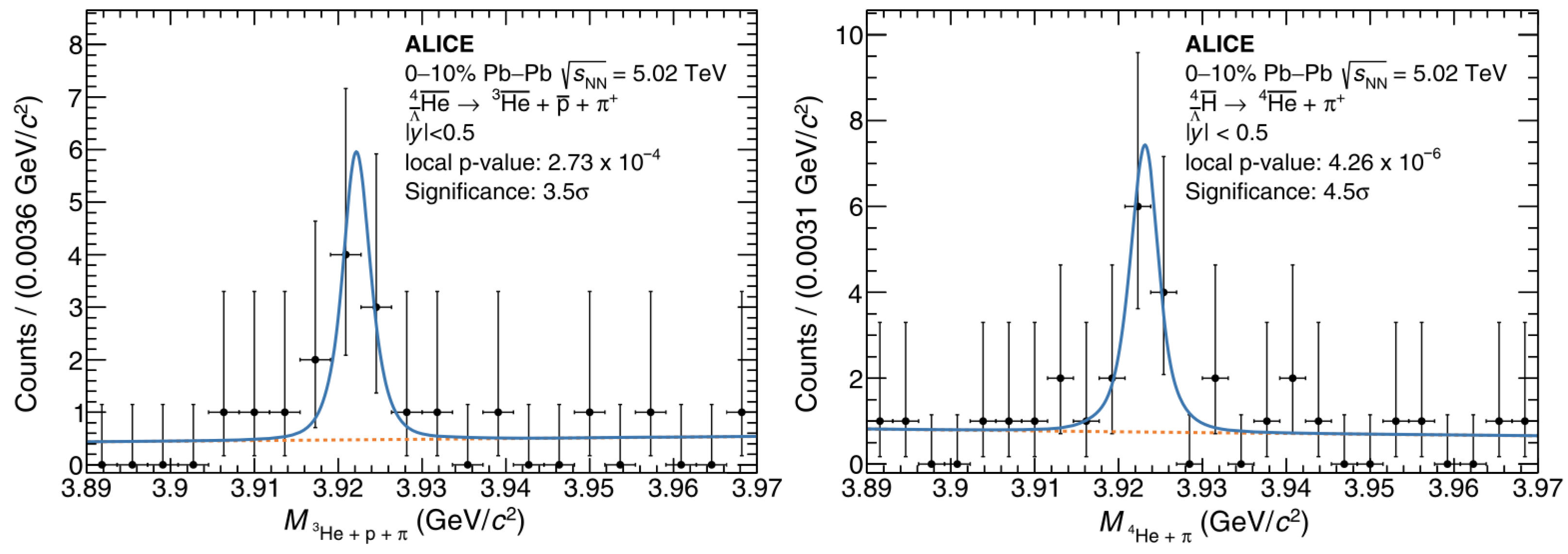
The ALICE collaboration also reports antimatter hypernuclei with a baryon number of 4 in Pb+Pb collisions at s N N = 5.02 TeV . The evidence for He ¯ Λ ¯ 4 and the observation of H ¯ Λ ¯ 4 are presented. The significances for He ¯ Λ ¯ 4 and H ¯ Λ ¯ 4 are 3.5 σ and 4.5 σ respectively, as shown in Figure 5. These findings from two independent experiments provide cross-validation for the existence of H ¯ Λ ¯ 4 . The newly discovered antimatter particles H ¯ Λ ¯ 4 and He ¯ Λ ¯ 4 bring a new opportunity for studying antimatter properties, such as production yields and lifetimes, and for testing matter–antimatter symmetry in the hypernucleus sector.

3.2. Yield

Hypernucleus yields are related to the underlying particle production mechanisms. In heavy-ion collisions, hypernucleus production can be described by the coalescence model [28,49]. This model assumes that hypernuclei are produced near the kinetic freeze-out stage of the fireball evolution when p, n, and Λ are close in both coordinate and momentum space [50]. Alternatively, particle yields can also be well described by the statistical thermal model [51,52,53], which assumes that particles are produced from a system in chemical and thermal equilibrium. Global parameters such as temperature and baryon chemical potential can be extracted by simultaneously fitting all measured particle yields. The differences between the thermal model and the coalescence model have been systematically discussed and compared in [54].
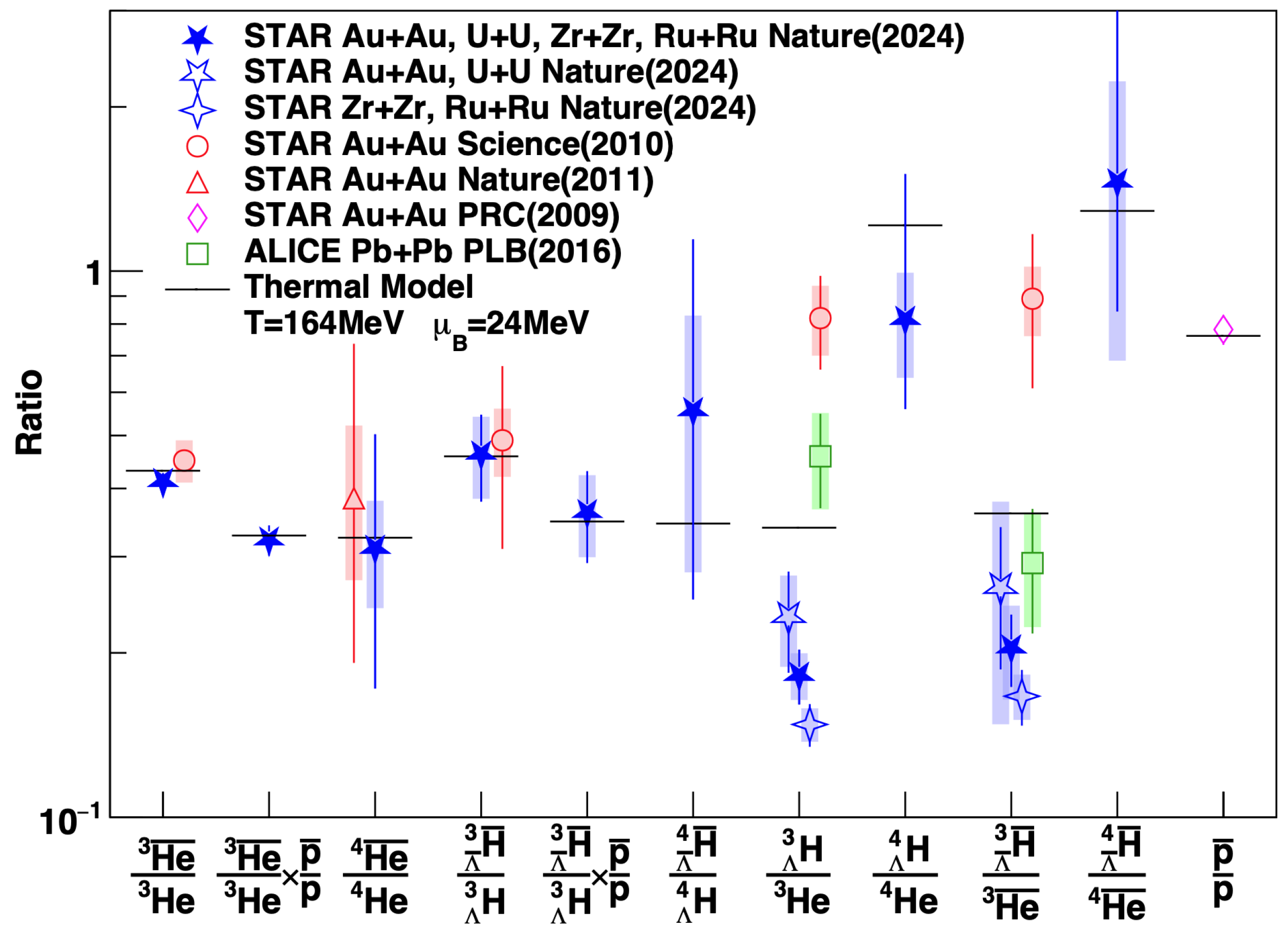
Various particle yield ratios are presented in Figure 6 by the STAR experiment [16]. The yield ratios can largely eliminate the biases caused by different collision systems. Generally, all yield ratios between antiparticles and their corresponding particles are less than unity, reflecting the net-positive baryon number of the initial colliding nuclei. The statistic thermal model [51] can quantitatively describe the measured yield ratios. Notably, the yield ratios from experimental data exhibit the following scaling relationships: He ¯ 3 He 3 × p ¯ p He ¯ 4 He 4 , H ¯ Λ 3 H Λ 3 × p ¯ p H ¯ Λ 4 H Λ 4 , H Λ 4 He 4 4 × H Λ 3 He 3 and H ¯ Λ ¯ 4 He ¯ 4 4 × H ¯ Λ ¯ 3 He ¯ 3 . These ratios are chosen so that the numbers of net constituent (anti-)nucleons and (anti-) Λ hyperons are consistent between the left- and right-hand sides of the equations. Thus, these scaling relationships are naturally expected within the coalescence framework when neglecting details such as the different sizes of the (anti)(hyper)nuclei. The factor 4 arises from the spin-degeneracy. H 4 and He ¯ 4 possess only a spin-0 ground state, while H Λ 4 and H ¯ Λ ¯ 4 have spin-0 (ground) and spin-1 (excited) states. The excited state with a spin degeneracy factor of 3 can electromagnetically decay into the spin ground state, which increases the total measured yields by approximately a factor of 4. In general, the yield ratios can be well reproduced by the thermal model and are consistent with the expectations of the coalescence model.
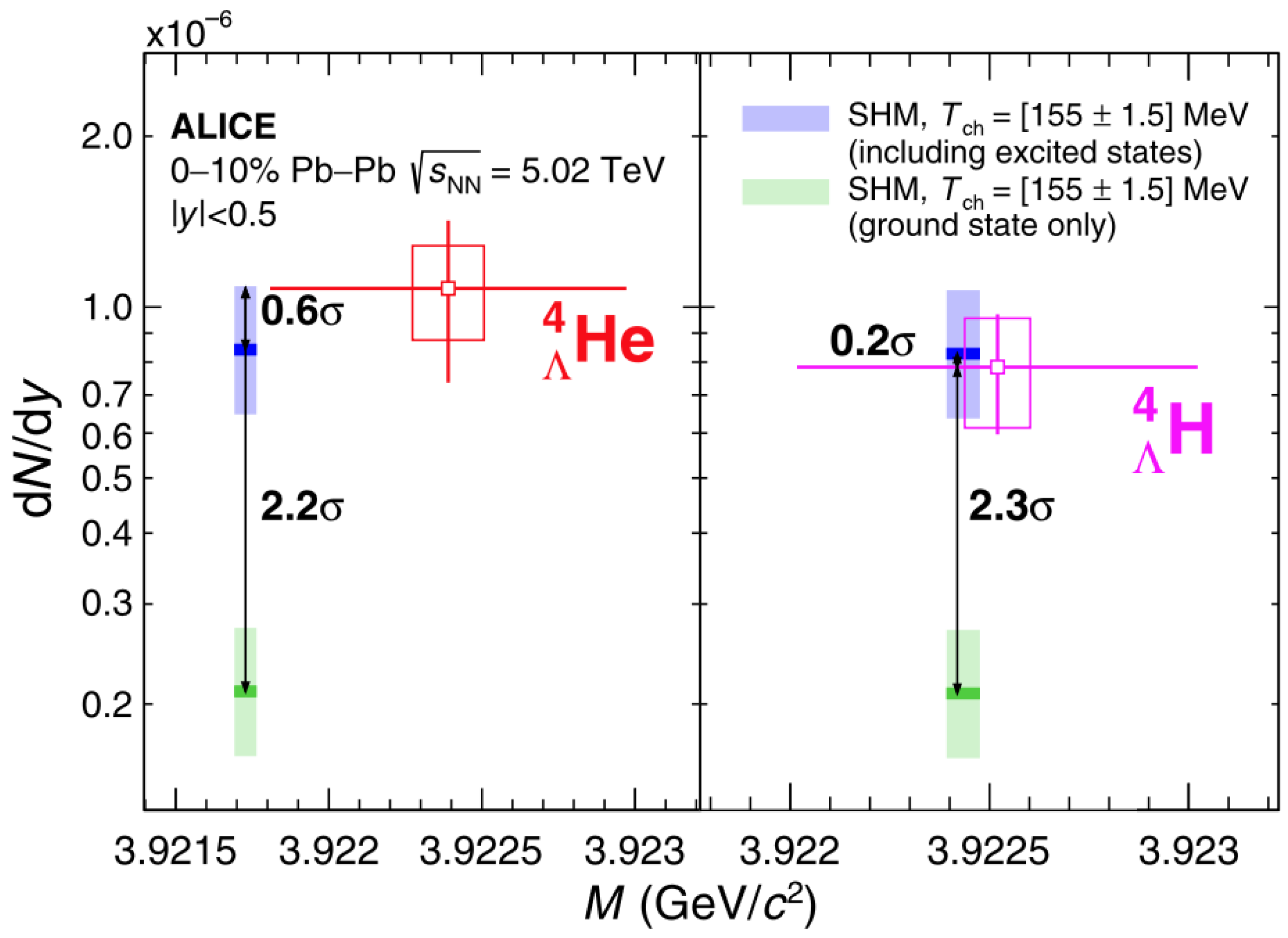
In the ALICE experiment, the Statistical Hadron Model (SHM) [53] is employed to constrain the spin states of hypernuclei by comparing predicted and measured yields. The SHM model is a thermal model which explicitly accounts for spin degeneracy in its yield calculations. As shown in Figure 7, the ALICE collaboration measured yields and masses of the H ¯ Λ ¯ 4 and He ¯ Λ ¯ 4 . The production yield d N / d y can be quantitatively reproduced by the SHM model only when spin-excited states are included. However, the coalescence calculation tends to underestimate the production yield of (anti)hypernuclei and (anti)nuclei measured by the ALICE collaboration [32,57]. If only the spin-0 ground state is assumed, the SHM model underpredicts the data by 2.2 σ and 2.3 σ for He ¯ Λ ¯ 4 and H ¯ Λ ¯ 4 , respectively. Both STAR and ALICE data indicate H ¯ Λ ¯ 4 has a spin-1 excited state.

3.3. Lifetime Measurements

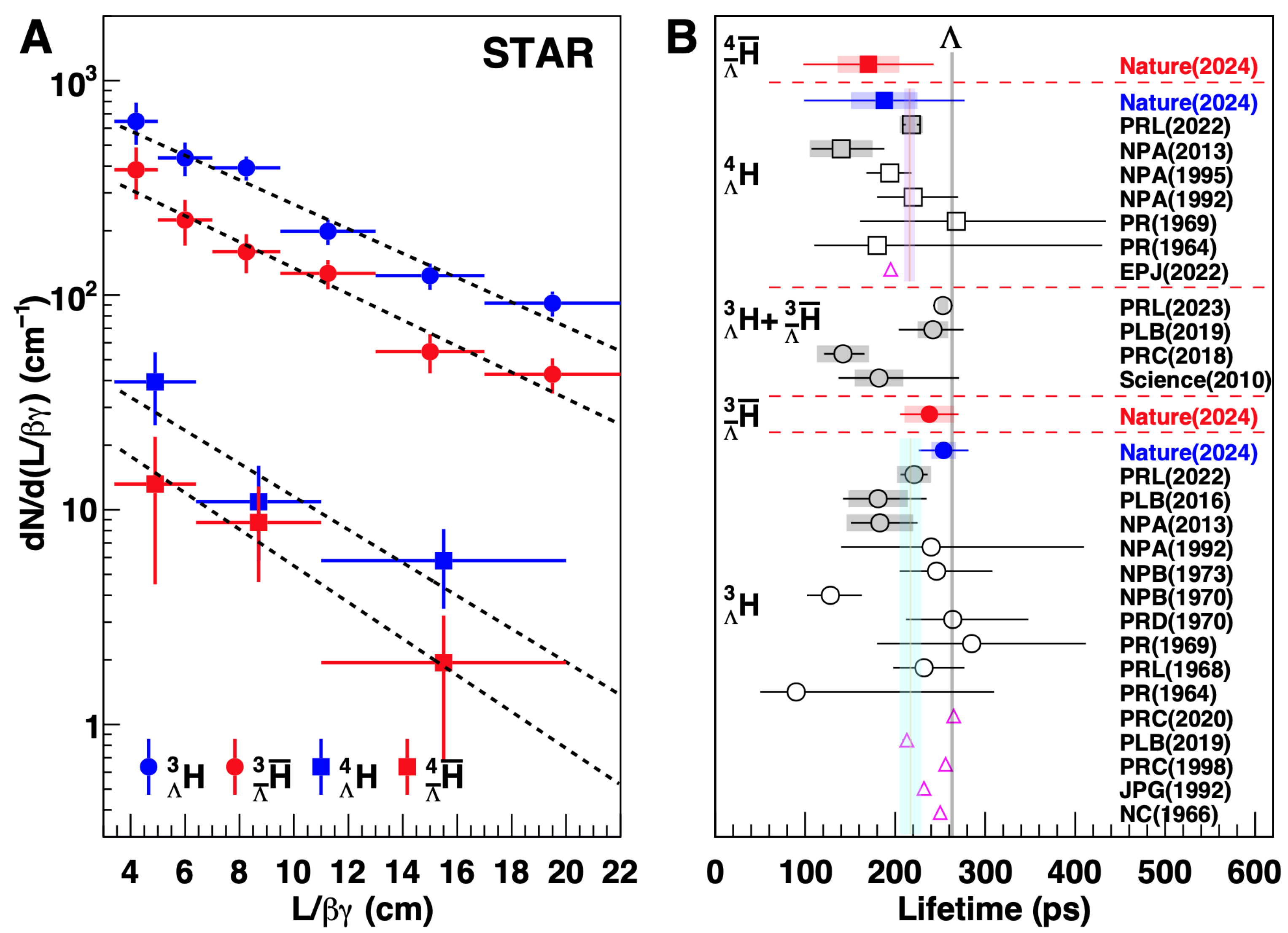
According to the CPT theorem, the lifetime of a particle and its corresponding antiparticle should be identical. Therefore, precision comparisons of the lifetimes of hypernuclei and their antimatter analogs provide a stringent test of CPT symmetry and may offer insights into the origin of the matter–antimatter asymmetry in the Universe. In heavy-ion collision experiments, hypernuclear lifetime is one of the key properties for investigating hyperon–nucleon interactions [58]. Due to the weak decay, the typical lifetime of a hypernucleus is on the order of ∼ 10 2 p s , which is long enough to be experimentally accessible. The STAR Collaboration has measured the lifetimes of both matter and antimatter hypernuclei H Λ 3 , H ¯ Λ ¯ 3 , H Λ 4 and H ¯ Λ ¯ 4 . As shown in the left panel of Figure 8, the lifetime τ is extracted by N ( t ) = N 0 e x p ( t / τ ) = N 0 e x p ( ( L / β γ ) / τ ) , where L is the hypernuclei decay length and β γ is determined by the hypernucleus momentum. The extracted lifetime results for these (anti)hypernuclei are summarized in the right panel of Figure 8: τ ( Λ 3 H ) = 254 ± 28 ( stat . ) ± 14 ( sys . ) ps , τ ( Λ ¯ 3 H ¯ ) = 238 ± 33 ( stat . ) ± 28 ( sys . ) ps , τ ( Λ 4 H ) = 188 ± 89 ( stat . ) ± 37 ( sys . ) ps , τ ( Λ ¯ 4 H ¯ ) = 170 ± 72 ( stat . ) ± 34 ( sys . ) ps . This is the first measurement for the lifetime of H ¯ Λ ¯ 3 and H ¯ Λ ¯ 4 . The measured lifetimes of H Λ 3 and H Λ 4 are consistent with world averaged data, and measured hypernuclei lifetimes are shorter than free Λ lifetime. The lifetime differences measured in the STAR between the hypernuclei and antimatter hypernuclei are τ ( Λ 3 H ) τ ( Λ ¯ 3 H ¯ ) = 16 ± 43 ( stat . ) ± 20 ( sys . ) ps and τ ( Λ 4 H ) τ ( Λ ¯ 4 H ¯ ) = 18 ± 115 ( stat . ) ± 46 ( sys . ) . Both results are consistent with zero within uncertainties, indicating no significant lifetime difference between the hypernuclei and their corresponding antihypernuclei.
The ALICE collaboration has measured the relative lifetime difference between H Λ 3 and H ¯ Λ ¯ 3 [13]. The result is τ ( Λ 3 H ) τ ( Λ 3 H ¯ ) τ ( Λ 3 H ) = 0.03 ± 0.07 ( stat . ) ± 0.04 ( sys . ) . No lifetime difference is observed, which is consistent with the STAR measurement. These results constitute a new test of the CPT symmetry at the hypernucleus level.

4. Summary and Outlook

In summary, the STAR and ALICE collaborations are actively investigating antimatter with heavy-ion collisions, and the antimatter hypernucleus H ¯ Λ ¯ 4 has been observed by both STAR and ALICE experiments. The ALICE collaboration has also presented evidence for He ¯ Λ ¯ 4 . Yield measurements strongly suggest the existence of spin-excited states in H ¯ Λ ¯ 4 and He ¯ Λ ¯ 4 . Additionally, yield ratio measurements from the STAR collaboration support a coalescence-based production mechanism for light (anti)hypernuclei. Precision lifetime measurements of H Λ 3 , H ¯ Λ ¯ 3 , H Λ 4 and H ¯ Λ ¯ 4 show no statistically significant difference between matter and antimatter hypernuclei lifetimes, validating the CPT symmetry.
Recently, the STAR collaboration has finished collecting approximately 20.1 billion minimum-bias Au+Au collision events at s N N = 200 GeV over Run 23–25. Meanwhile, ALICE is in the final phase of Run 3 data taking, which employs continuous readout and a new silicon pixel tracker for the ITS2 detector. These upgrades have significantly enhanced ALICE’s data-taking rate and tracking precision. These high-statistics datasets will enable more precise measurements of rare antimatter nuclei, open the door to the discovery of even heavier antimatter particles, and potentially deepen our understanding of fundamental symmetries and the origin of the matter–antimatter asymmetry in the Universe.

Author Contributions

Conceptualization, writing and review, T.L., J.W. and H.Q. All authors have read and agreed to the published version of the manuscript.

Funding

This review is supported by the Chinese Academy of Sciences Project for Young Scientists in Basic Research No. YSBR-088.

Data Availability Statement

The original data have been made publicly available by the referred collaborations.

Conflicts of Interest

The authors declare no conflicts of interest.

References

  1. Dirac, P.A.M. The quantum theory of the electron. Proc. Roy. Soc. A 1928, 117, 610. [Google Scholar] [CrossRef]
  2. Anderson, C.D. The Positive Electron. Phys. Rev. 1933, 43, 491–494. [Google Scholar] [CrossRef]
  3. Canetti, L.; Drewes, M.; Shaposhnikov, M. Matter and antimatter in the universe. New J. Phys. 2012, 14, 095012. [Google Scholar] [CrossRef]
  4. Hubble, E.A. relation between distance and radial velocity among extra-galactic nebulae. Proc. Natl. Acad. Sci. USA 1929, 15, 168–173. [Google Scholar] [CrossRef]
  5. Penzias, A.A.; Wilson, R.W. A Measurement of Excess Antenna Temperature at 4080 Mc/s. Astrophys. J. 1965, 142, 419–421. Available online: https://api.semanticscholar.org/CorpusID:120759902 (accessed on 21 March 2026). [CrossRef]
  6. Wilkinson, D.T. Measurement of the Cosmic Microwave Background at 8.56-mm Wavelength. Phys. Rev. Lett. 1967, 19, 1195–1198. [Google Scholar] [CrossRef]
  7. Sakharov, A.D. Violation of CP invariance, C asymmetry, and baryon asymmetry of the universe. Sov. Phys. Usp. 1991, 34, 392. [Google Scholar] [CrossRef]
  8. Abouzaid, E.; Arenton, M.; Barker, A.R.; Barrio, M.; Bellantoni, L.; Blucher, E.; Bock, G.J.; Bown, C.; Cheu, E.; Coleman, R.; et al. Precise measurements of direct CP violation, CPT symmetry, and other parameters in the neutral kaon system. Phys. Rev. D 2011, 83, 092001. [Google Scholar] [CrossRef]
  9. Mittleman, R.K.; Ioannou, I.I.; Dehmelt, H.G.; Russell, N. Bound on CPT and Lorentz Symmetry with a Trapped Electron. Phys. Rev. Lett. 1999, 83, 2116. [Google Scholar] [CrossRef]
  10. Bennett, G.W.; Bousquet, B.; Brown, H.N.; Bunce, G.; Carey, R.M.; Cushman, P.; Danby, G.T.; Debevec, P.T.; Deile, M.; Deng, H.; et al. Search for Lorentz and CPT Violation Effects in Muon Spin Precession. Phys. Rev. Lett. 2008, 100, 091602. [Google Scholar] [CrossRef]
  11. Ulmer, S.; Smorra, C.; Mooser, A.; Franke, K.; Nagahama, H.; Schneider, G.; Higuchi, T.; Van Gorp, S.; Blaum, K.; Matsuda, Y.; et al. High-precision comparison of the antiproton-to-proton charge-to-mass ratio. Nature 2015, 524, 196–199. [Google Scholar] [CrossRef]
  12. The ALICE Collaboration. Precision measurement of the mass difference between light nuclei and anti-nuclei. Nat. Phys. 2015, 11, 811–814. [Google Scholar] [CrossRef]
  13. The ALICE Collaboration. Measurement of the Lifetime and Λ Separation Energy of H Λ 3 . Phys. Rev. Lett. 2023, 131, 102302. [Google Scholar] [CrossRef]
  14. The STAR Collaboration. Measurement of interaction between antiprotons. Nature 2015, 527, 345–348. [Google Scholar] [CrossRef]
  15. The PAMELA Collaboration. The discovery of geomagnetically trapped cosmic ray antiprotons. Astrophys. J. Lett. 2011, 737, L29. [Google Scholar] [CrossRef]
  16. The STAR Collaboration. Observation of the antimatter hypernucleus H ¯ Λ ¯ 4 . Nature 2024, 632, 1026–1031. [Google Scholar] [CrossRef]
  17. Lattimer, J.M.; Prakash, M. The Physics of Neutron Stars. Science 2004, 304, 409–412. [Google Scholar] [CrossRef]
  18. Danysz, M.; Pniewski, J. Delayed disintegration of a heavy nuclear fragment: I. Phil. Mag. 1953, 44, 348–350. [Google Scholar] [CrossRef]
  19. The STAR Collaboration. Observation of an Antimatter Hypernucleus. Science 2010, 328, 58–62. [Google Scholar] [CrossRef]
  20. The STAR Collaboration. Measurement of the mass difference and the binding energy of the hypertriton and antihypertriton. Nat. Phys. 2020, 16, 409–412. [Google Scholar] [CrossRef]
  21. Chamberlain, O.; Segrè, E.; Wiegand, C.; Ypsilantis, T. Observation of Antiprotons. Phys. Rev. 1955, 100, 947–950. [Google Scholar] [CrossRef]
  22. Cork, B.; Lambertson, G.R.; Piccioni, O.; Wenzel, W.A. Antineutrons Produced from Antiprotons in Charge-Exchange Collisions. Phys. Rev. 1956, 104, 1193–1197. [Google Scholar] [CrossRef][Green Version]
  23. Prowse, D.J.; Baldo-Ceolin, M. Anti-Lambda hyperon. Phys. Rev. Lett. 1958, 1, 179. [Google Scholar] [CrossRef]
  24. Massam, T.; Muller, T.; Righini, B.; Schneegans, M.; Zichichi, A. Experimental observation of antideuteron production. Nuovo Cim. 1965, 39, 10–14. [Google Scholar] [CrossRef]
  25. Dorfan, D.E.; Eades, J.; Lederman, L.M.; Lee, W.; Ting, C.C. Observation of Antideuterons. Phys. Rev. Lett. 1965, 14, 1003–1006. [Google Scholar] [CrossRef]
  26. Vishnevsky, N.K.; Grachev, M.I.; Rykalin, V.I.; Lapshin, V.G.; Solyanik, V.I. Observation of antitritium. Yad. Fiz 1974, 20, 694–708. [Google Scholar]
  27. Antipov, Y.M.; Denisov, S.P.; Donskov, S.V.; Gorin, Y.P.; Kachanov, V.A. Observation of antihelium-3. Nucl. Phys. B 1971, 31, 235–252. [Google Scholar] [CrossRef]
  28. The STAR Collaboration. Observation of the antimatter helium-4 nucleus. Nature 2011, 473, 353–356. [Google Scholar] [CrossRef]
  29. Chen, J.; Keane, D.; Ma, Y.G.; Tang, A.; Xu, Z. Anti nuclei in heavy ion collisions. Phys. Repo. 2018, 760, 1–39. [Google Scholar] [CrossRef]
  30. Ackermann, K.H.; Adams, N.; Adler, C.; Ahammed, Z.; Ahmad, S.; Allgower, C.; Amonett, J.; Amsbaugh, J.; Anderson, B.D.; Anderson, M.; et al. STAR detector overview. Nucl. Instrum. Methods A 2003, 499, 624–632. [Google Scholar] [CrossRef]
  31. The ALICE Collaboration. The ALICE experiment at the CERN LHC. J. Instrum. 2008, 3, S08002. [Google Scholar] [CrossRef]
  32. The ALICE Collaboration. First Measurement of A = 4 Hypernuclei and Antihypernuclei at the LHC. Phys. Rev. Lett. 2025, 134, 162301. [Google Scholar] [CrossRef]
  33. Hans, B. A method to improve tracking and particle identification in TPCs and silicon detectors. Nucl. Instrum. Methods A 2006, 562, 154–197. [Google Scholar] [CrossRef]
  34. The STAR Collaboration. Measurements of Proton High-Order Cumulants in NN S = 3 GeV Au+Au Collisions and Implications for the QCD Critical Point. Phys. Rev. Lett. 2022, 128, 202303. [Google Scholar] [CrossRef]
  35. The STAR Collaboration. Precision Measurement of (Net-)proton Number Fluctuations in Au+Au Collisions at RHIC. Phys. Rev. Lett. 2025, 135, 142301. [Google Scholar] [CrossRef]
  36. The STAR Collaboration. Beam Energy Dependence of Triton Production and Yield Ratio (Nt × Np/ N d 2 ) in Au+Au Collisions at RHIC. Phys. Rev. Lett. 2023, 130, 202301. [Google Scholar] [CrossRef]
  37. The STAR Collaboration. Onset of Constituent Quark Number Scaling in Heavy-Ion Collisions at RHIC. Phys. Rev. Lett. 2025, 135, 072301. [Google Scholar] [CrossRef]
  38. The STAR Collaboration. Global Λ hyperon polarization in nuclear collisions. Nature 2017, 548, 62–65. [Google Scholar] [CrossRef]
  39. The STAR Collaboration. Pattern of global spin alignment of ϕ and K 0 * mesons in heavy-ion collisions. Nature 2023, 614, 244–248. [Google Scholar] [CrossRef]
  40. The ALICE Collaboration. Alignment of the ALICE Inner Tracking System with cosmic-ray tracks. J. Instrum. 2010, 5, P03003. [Google Scholar] [CrossRef]
  41. The ALICE Collaboration. The ALICE TPC, a large 3-dimensional tracking device with fast readout for ultra-high multiplicity events. Nucl. Instrum. Methods A 2010, 622, 316–367. [Google Scholar] [CrossRef]
  42. The ALICE Collaboration. Observation of deuteron and antideuteron formation from resonance-decay nucleons. Nature 2025, 648, 306–311. [Google Scholar] [CrossRef]
  43. The ALICE Collaboration. Evidence of Spin-Orbital Angular Momentum Interactions in Relativistic Heavy-Ion Collisions. Phys. Rev. Lett. 2020, 125, 012301. [Google Scholar] [CrossRef]
  44. The ALICE Collaboration. First measurement of D*+ vector meson spin alignment in Pb–Pb collisions at NN S = 5.02 TeV. J. High Energ. Phys. 2025, 2025, 94. [Google Scholar] [CrossRef]
  45. The ALICE Collaboration. Investigations of Anisotropic Flow Using Multiparticle Azimuthal Correlations in pp, p-Pb, Xe-Xe, and Pb-Pb Collisions at the LHC. Phys. Rev. Lett. 2019, 14, 142301. [Google Scholar] [CrossRef]
  46. The ALICE Collaboration. Unveiling the strong interaction among hadrons at the LHC. Nature 2020, 588, 232–238. [Google Scholar] [CrossRef]
  47. The ALICE Collaboration. Study of (〈pT〉) and its higher moments, and extraction of the speed of sound in Pb-Pb collisions with ALICE. J. High Energ. Phys. 2025, 2025, 76. [Google Scholar] [CrossRef]
  48. Cowan, G.; Cranmer, K.; Gross, E.; Vitells, O. Asymptotic formulae for likelihood-based tests of new physics. Eur. Phys. J. C 2011, 871, 1544. [Google Scholar] [CrossRef]
  49. Abdallah, M.S.; Aboona, B.E.; Adam, J.; Adamczyk, L.; Adams, J.R.; Adkins, J.K.; Agakishiev, G.; Aggarwal, I.; Aggarwal, M.M.; Ahammed, Z.; et al. Measurements of H Λ 3 and H Λ 4 Lifetimes and Yields in Au+Au Collisions in the High Baryon Density Region. Phys. Rev. Lett. 2023, 128, 202301. [Google Scholar] [CrossRef]
  50. Sato, H.; Yazaki, K. On the coalescence model for high energy nuclear reactions. Phys. Lett. B 1981, 98, 153–157. [Google Scholar] [CrossRef]
  51. Andronic, A.; Munzinger, P.B.; Stachel, J.; Stöcker, H. Production of light nuclei, hypernuclei and their antiparticles in relativistic nuclear collisions. Phys. Lett. B 2011, 697, 203–207. [Google Scholar] [CrossRef]
  52. The ALICE Collaboration. Production of 4He and He ¯ 4 in Pb–Pb collisions at NN S = 2.76 TeV at the LHC. Nucl. Phys. A 2018, 971, 1–20. [Google Scholar] [CrossRef]
  53. Vovchenko, V.; Dönigus, B.; Stoecker, H. Multiplicity dependence of light nuclei production at LHC energies in the canonical statistical model. Phys. Lett. B 2018, 785, 171–174. [Google Scholar] [CrossRef]
  54. Steinheimer, J.; Gudima, K.; Botvina, A. Hypernuclei, dibaryon and antinuclei production in high energy heavy ion collisions: Thermal production vs. Coalescence. Phys. Lett. B 2012, 714, 85–91. [Google Scholar] [CrossRef]
  55. The STAR Collaboration. Identified Baryon and Meson Distributions at Large Transverse Momenta from Au+Au Collisions at NN S = 200 GeV. Phys. Rev. Lett. 2006, 97, 152301. [Google Scholar] [CrossRef]
  56. The ALICE Collaboration. H Λ 3 and H ¯ Λ ¯ 3 production in Pb–Pb collisions at NN S = 2.76 TeV. Phys. Lett. B 2016, 754, 360. [Google Scholar] [CrossRef]
  57. The ALICE Collaboration. Measurement of (anti)alpha production in central Pb–Pb collisions at NN S = 5.02 TeV. Phys. Lett. B 2024, 858, 138943. [Google Scholar] [CrossRef]
  58. Pérez-Obiol, A.; Gazda, D.; Friedman, E.; Gal, A. Revisiting the hypertriton lifetime puzzle. Phys. Lett. B 2020, 811, 135916. [Google Scholar] [CrossRef]
  59. Rayet, M.; Dalitz, R.H. The lifetime of H Λ 3 . Nuovo. Cim. A 1966, 46, 786. [Google Scholar] [CrossRef]
  60. Gongleton, J.G. A simple model of the hypertriton. J. Phys. G: Nucl. Part. Phys. 1992, 18, 339. [Google Scholar] [CrossRef]
  61. Kamada, H.; Golak, J.; Miyagawa, K.; Witała, H.; Glöckle, W. π-mesonic decay of the hypertriton. Phys. Rev. C 1998, 57, 1595. [Google Scholar] [CrossRef]
  62. Gal, A.; Garcilazo, H. Towards resolving the H Λ 3 lifetime puzzle. Phys. Lett. B 2019, 791, 48. [Google Scholar] [CrossRef]
  63. Prem, R.J.; Steinberg, P.H. Lifetimes of Hypernuclei, H Λ 3 , H Λ 4 , H Λ 5 . Phys. Rev. 1964, 136, B1803. [Google Scholar] [CrossRef]
  64. Keyes, G.; Derrick, M.; Fields, T.; Hyman, L.G.; Fetkovich, J.G.; McKenzie, J.; Riley, B.; Wang, I.-T. New Measurement of the H Λ 3 Lifetime. Phys. Rev. Lett. 1968, 20, 819. [Google Scholar] [CrossRef]
  65. Phillips, R.E.; Schneps, J. Lifetimes of Light Hyperfragments. II. Phys. Rev. 1969, 180, 1307. [Google Scholar] [CrossRef]
  66. Keyes, G.; Derrick, M.; Fields, T.; Hyman, L.G.; Fetkovich, J.G.; McKenzie, J.; Riley, B.; Wang, I.-T. Properties of H Λ 3 . Phys. Rev. D 1970, 1, 66. [Google Scholar] [CrossRef]
  67. Keyes, G.; Sacton, J.; Wickens, J.H.; Block, M.M. A measurement of the lifetime of the H Λ 3 hypernucleus. Nucl. Phys. B 1973, 67, 269. [Google Scholar] [CrossRef]
  68. Avramenko, S.; Aksinenko, V.; Anikina, M.; Bannik, B.; Belikov, Y.; Butenko, V.; Drozdov, V.; Gajevski, K.; Galperin, A.; Glagoleva, N. A study of the production and lifetime of the lightest relativistic hypernuclei. Nucl. Phys. A 1992, 547, 95. [Google Scholar] [CrossRef]
  69. Rappold, C.; Kim, E.; Nakajima, D.; Saito, T.R.; Bertini, O.; Bianchin, S.; Bozkurt, V.; Kavatsyuk, M.; Ma, Y.; Maas, F.; et al. Hypernuclear spectroscopy of products from 6Li projectiles on a carbon target at 2 AGeV. Nucl. Phys. A 2013, 913, 170. [Google Scholar] [CrossRef]
  70. Bohm, G.; Klabuhn, J.; Krecker, U.; Wysotzki, F.; Coremans, G.; Sacton, J.; Vilain, P.; Wickens, J.H.; Wilquet, G.; O’Sullivan, D.; et al. On the lifetime of the H Λ 3 hypernucleus. Nucl. Phys. B 1970, 16, 46. [Google Scholar] [CrossRef]
  71. The STAR Collaboration. Measurement of the H Λ 3 lifetime in Au+Au collisions at the BNL Relativistic Heavy Ion Collider. Phys. Rev. C 2018, 97, 054909. [Google Scholar] [CrossRef]
  72. ALICE Collaboration. H Λ 3 and H ¯ Λ ¯ 3 lifetime measurement in Pb-Pb collisions at NN S = 5.02 TeV via two-body decay. Phys. Lett. B 2019, 797, 134905. [Google Scholar] [CrossRef]
  73. Gal, A. Recent progress on few-body hypernuclei. EPJ Web of Conf. 2022, 259, 08002. [Google Scholar] [CrossRef]
  74. Outa, H.; Aoki, M.; Hayano, R.S.; Ishikawa, T.; Iwasaki, M.; Sakaguchi, A.; Takada, E.; Tamura, H.; Yamazaki, T. Mesonic weak decay of H Λ 4 and He Λ 4 . Nucl. Phys. A 1995, 585, 109. [Google Scholar] [CrossRef]
Figure 1. Antiparticles’ mass vs. discovery year. Different color represents different baryon number.
Symmetry 18 00693 g001
Figure 2. A schematic of the STAR detector.
Symmetry 18 00693 g002
Figure 3. A schematic of the ALICE detector.
Symmetry 18 00693 g003
Figure 4. Plot is reproduced from [16]. Invariant mass distribution of He ¯ 4 + π + with the H ¯ Λ ¯ 4 signal in a combination of U+U, Au+Au, Ru+Ru and Zr+Zr collisions at s N N = 193 GeV (U+U) and s N N = 200 GeV (other systems) at STAR. The black points show signal candidates. The blue curve represents the background distribution constructed by randomly rotating one of the daughter tracks. The red band marks the signal-invariant mass region. Reproduced with permission from Springer Nature. License number: 6253050458017.
Symmetry 18 00693 g004
Figure 5. Plots are from [32]. Invariant mass distributions of He ¯ 3 + p + π + with the He ¯ Λ ¯ 4 signal (left) and of He ¯ 4 + π + with the H ¯ Λ ¯ 4 signal (right) in Pb+Pb collisions at s N N = 5.02 TeV at ALICE. Black points show signal candidates. Blue curves are the fitting lines, and the orange dashed lines show the fitting backgrounds.
Symmetry 18 00693 g005
Figure 6. Plot is reproduced from [16]. The other references are [19,28,55,56]. Yield ratios for different particles from the STAR experiment. Reproduced with permission from Springer Nature. License number: 6253050458017.
Symmetry 18 00693 g006
Figure 7. Plots are from [32]. (Anti) He Λ 4 (left) and (anti) H Λ 4 (right) integrated production yields vs. masses from the ALICE experiment. Results are averaged by particles and antiparticles for corresponding hypernucleus.
Symmetry 18 00693 g007
Figure 8. Plots are reproduced from [16]. The other references are [13,19,49,56,59,60,61,62,63,64,65,66,67,68,69,70,71,72,73,74]. (A) Λ yield in different L / ( β γ ) with detector efficiency correction. (B) Measured lifetime of H Λ 3 , H ¯ Λ ¯ 3 , H Λ 4 and H ¯ Λ ¯ 4 . Reproduced with permission from Springer Nature. License number: 6253050458017.
Symmetry 18 00693 g008
Disclaimer/Publisher’s Note: The statements, opinions and data contained in all publications are solely those of the individual author(s) and contributor(s) and not of MDPI and/or the editor(s). MDPI and/or the editor(s) disclaim responsibility for any injury to people or property resulting from any ideas, methods, instructions or products referred to in the content.