Article

A Symmetry-Guided Multi-Strategy Differential Hybrid Slime Mold Algorithm for Sustainable Microgrid Dispatch Under Refined Battery Degradation Models

1
School of Tianyou, East China Jiaotong University, Nanchang 330013, China
2
School of Electrical and Automation Engineering, East China Jiaotong University, Nanchang 330013, China
3
School of Information Science and Engineering, Northeastern University, Shenyang 110819, China
4
School of Mathematics and Computer Science, Nanchang University, Nanchang 330031, China
*
Author to whom correspondence should be addressed.
Symmetry 2026, 18(4), 692; https://doi.org/10.3390/sym18040692
Submission received: 17 March 2026 / Revised: 6 April 2026 / Accepted: 16 April 2026 / Published: 21 April 2026
(This article belongs to the Special Issue Symmetry and Metaheuristic Algorithms)

Abstract

Optimized dispatch of microgrids is crucial for improving the economic performance and long-term sustainability of modern low-carbon power systems. In particular, accurate economic dispatch modeling for battery energy storage systems (BESSs) is essential for properly evaluating the operational benefits and lifetime costs of microgrids. However, when both battery cycle aging and calendar aging are considered, the resulting scheduling model becomes highly nonlinear, high-dimensional, non-convex, and multimodal, which poses substantial challenges to conventional optimization methods. To alleviate the above problem, a symmetry-guided multi-strategy differential hybrid slime mold algorithm (MDHSMA) is introduced for the day-ahead economic dispatch of microgrids under a refined battery degradation framework. First, a chaotic bimodal mirrored Latin hypercube sampling strategy is designed to exploit symmetry during population initialization, thereby enhancing diversity and improving structured coverage of the search space. Second, a history-driven adaptive differential evolution mechanism is integrated to balance global exploration and local exploitation more effectively during the iterative search process. Third, a state-aware stagnation handling framework is incorporated to maintain population vitality and further improve convergence accuracy and robustness. MDHSMA is evaluated against 12 state-of-the-art optimizers on the CEC2017 and CEC2022 benchmark suites and two representative engineering optimization problems to verify its overall performance. In addition, it is applied to a microgrid case study with refined BESS degradation modeling. The results show that MDHSMA achieves the lowest comprehensive operating cost by effectively coordinating electricity arbitrage and battery life consumption. Moreover, it guides the energy storage system toward shallow charge–-discharge patterns, thereby mitigating accelerated degradation caused by excessive cycling. These results confirm the effectiveness and practical value of the proposed method for sustainable microgrid dispatch in complex nonconvex optimization scenarios.

1. Introduction

With the accelerating global energy transition and the steady progress of the “dual carbon” strategy, modern power systems are increasingly expected to enhance renewable energy utilization and reduce carbon emissions [1]. A microgrid refers to a localized energy network at the distribution level, consisting of distributed energy resources, energy storage facilities, and various load types [2,3]. By effectively coordinating these components, the microgrid can realize power balance and autonomous control, which contributes to higher renewable energy penetration and improved supply reliability. In terms of system operation, day-ahead optimal scheduling is carried out based on forecasts of next-day demand, and wind and solar generation, as well as time-of-use electricity prices, so as to optimize the output plans of controllable units within a 24 h scheduling horizon. Therefore, a key function of the energy management system is to achieve the lowest possible operating cost subject to constraints including power balance, unit output limits, and equipment operating requirements [4,5].
Within the framework of microgrids, battery energy storage systems (BESSs) are primarily used to smooth out fluctuations in renewable energy and for price arbitrage; their charging and discharging strategies have a significant impact on system economic efficiency and safety [6]. However, existing studies typically employ simplified metrics such as energy throughput, charge–-discharge cycles, or equivalent cycle counts to estimate degradation costs when establishing energy storage dispatch models, and approximate battery life loss as a fixed-cost term linearly related to the amount of charge–-discharge energy [7]. Although such methods facilitate modeling and solution, they struggle to accurately reflect the actual aging patterns of lithium-ion batteries, which may consequently affect the long-term economic evaluation of scheduling results [8]. In fact, lithium-ion battery degradation typically involves both cyclic aging and calendar aging, and its evolution exhibits a significantly nonlinear relationship with factors such as DOD, SOC, temperature, and time. When a refined degradation model is incorporated into the scheduling objective, due to the combined effects of dynamic temporal constraints and strong variable couplings, microgrid scheduling often evolves into a high-dimensional, non-convex, and highly challenging complex multimodal optimization problem [9]. In particular, the combined effects of different degradation mechanisms and temporal operating conditions cause the objective function to exhibit distinct asymmetric response characteristics in local regions, thereby increasing the difficulty of global optimization. Such problems pose significant challenges to traditional linear programming or integer programming methods, highlighting the necessity of balancing “modeling accuracy and solution complexity” at the scheduling level [10].
Regarding the problem of optimizing microgrid dispatch, existing research can be broadly categorized into mathematical programming methods, uncertainty optimization methods, and computational intelligence methods. Mathematical programming methods, by establishing explicit objective functions and constraint systems, offer strong interpretability and controllability. Among these, mixed-integer linear programming (MILP) is commonly used to address mixed discrete–-continuous decision-making problems such as unit start-stop, energy storage charging and discharging, and time-of-use pricing response. Nemati et al. developed a model for microgrid unit combination and economic scheduling based on MILP [11]. To enhance the dynamic scheduling capability of microgrid energy management, Alarcón et al. further proposed an energy management strategy based on economic model predictive control (EMPC) and validated its effectiveness [12]. Meanwhile, to address uncertainties in renewable energy output and load forecasting, stochastic programming, robust optimization, and risk-constrained methods have also been widely used to enhance the robustness of scheduling solutions. For example, Li et al. combined two-stage stochastic programming with rolling time-domain control for microgrid energy management [13]; Levorato et al. utilized budget uncertainty sets to characterize the impact of source-load fluctuations on microgrid trading and scheduling [14]; and Herding et al. introduced Conditional Value at Risk (CVaR) to balance economic efficiency and risk control [15]. Overall, the aforementioned methods offer certain advantages in terms of model rigor and disturbance resistance; however, their performance often depends on scenario construction, uncertainty set configuration, and parameter selection. When refined energy storage degradation costs and high-dimensional temporal decision variables are further considered, the model scale and coupling complexity increase rapidly, and significant challenges remain regarding solution efficiency and scalability.
In contrast, intelligent optimization methods demonstrate strong applicability in microgrid optimization and scheduling because they do not rely on gradient information, are suitable for handling non-convex constraints, and are easily coupled with complex operational models. Beyond microgrid applications, advanced computational frameworks have also shown strong potential in other complex engineering scenarios, including nonlinear electricity–-water nexus dispatch [16], emergency coordination of coupled electricity–-watershed networks with heterogeneous flexibility resources under severe drought events [17], and intelligent fault diagnosis tasks such as digital-twin-driven mechanical diagnosis under indeterminate states and bearing fault identification under unknown operating conditions [18,19,20]. These studies further suggest that advanced optimization and data-driven methods can provide effective decision support for high-dimensional, nonlinear, and strongly coupled engineering systems. In recent years, researchers have developed various improvements to traditional intelligent algorithms, focusing on convergence speed, population diversity, and local optimization capabilities, and have applied these to microgrid scheduling problems [21]. For example, Guan et al. introduced an inertia factor adjustment and a particle adaptive mutation mechanism into Particle Swarm Optimization (PSO) to propose an improved PSO algorithm for multi-objective optimization scheduling of grid-connected microgrids, achieving good results in reducing operational and environmental costs [22]. For interconnected multi-microgrid systems, Dong and Lee integrated chaotic maps with differential evolution (DE) to develop an enhanced DE variant. This method strengthens global exploration and improves the efficiency of feasible solution identification in complex scheduling scenarios, ultimately contributing to better economic performance and operational reliability in multi-microgrid settings [23]. Furthermore, Wang et al. addressed the economic scheduling problem of microgrid clusters by introducing chaotic mappings and dynamic adversarial learning strategies into Grey Wolf Optimization (GWO), thereby constructing the Improved Grey Wolf Algorithm (CDGWO), which effectively improved the algorithm’s scheduling efficiency and overall economic performance [24]. Although these improved methods have to some extent enhanced the solution performance in microgrid scheduling, existing methods still generally suffer from limited optimization accuracy, insufficient stability, and a tendency to get stuck in local optima when dealing with high-dimensional, non-convex, and strongly coupled optimization models that account for detailed battery degradation costs. Against this backdrop, the slime mold algorithm (SMA) has gradually garnered widespread attention due to its unique weight update mechanism and its ability to balance exploration and exploitation.
Introduced by Li et al. in 2020 [25], the slime mold algorithm (SMA) mimics the adaptive foraging networks of Myxomycetes. By utilizing a unique contraction mode alongside a positive–-negative feedback weight mechanism, standard SMA achieves a commendable equilibrium between global exploration and local exploitation across various benchmark and engineering optimization tasks. However, its structural shortcomings become evident when applied to intricate models, such as complex microgrid scheduling. Specifically, its reliance on random initialization narrows the initial search space. Furthermore, the dimension-independent position update fails to maintain rotation invariance, severely hindering its performance on problems with highly coupled variables. Finally, the rapid decay of oscillatory weights during later iterations often strips the population of diversity, predisposing the algorithm to premature stagnation.
To tackle the above challenges, this paper develops a symmetry-guided multi-strategy differential hybrid slime mold algorithm (MDHSMA) for day-ahead microgrid scheduling under a refined battery degradation framework. Unlike general SMA variants mainly designed for benchmark problems, the proposed method is tailored to high-dimensional, nonlinear, non-convex, and strongly coupled dispatch tasks involving refined battery-life-loss modeling. In particular, it is intended to alleviate three key difficulties: insufficient initialization coverage in high-dimensional spaces, weak search coordination under strong variable coupling, and premature stagnation in the later search stage.
Compared with related methods, the main strength of MDHSMA lies in its integrated enhancement of initialization, search coordination, and stagnation handling, which enables better adaptation to the complex cost landscape arising from grid interaction, multi-source coordination, and refined battery degradation costs. The major contributions of this study are summarized below:
(1)
A novel chaotic bimodal mirrored Latin hypercube sampling method (CBLHSM) is proposed. By incorporating a mirror-symmetric sampling mechanism and leveraging the ergodicity of chaotic mappings, it generates initial populations with enhanced coverage, structural complementarity, and distribution balance, thereby providing high-quality starting points for global search.
(2)
A history-driven adaptive differential evolution strategy (HADE) is embedded into SMA. Through adaptive parameter generation, staged differential mutation, and historical memory feedback, this mechanism enhances search coordination in strongly coupled optimization landscapes.
(3)
A state-aware stagnation handling framework (SAS) is incorporated to monitor population status during the search. The framework combines dynamic restart, reverse learning for poor individuals, and elite perturbation to alleviate stagnation and reduce the likelihood of premature convergence.
(4)
Comprehensive experiments were conducted on the CEC2017 and CEC2022 benchmark suites, as well as representative constrained engineering design problems. Statistical comparisons with advanced peer algorithms show that MDHSMA achieves superior convergence characteristics, high-quality solutions, and strong robustness. In addition, ablation studies were carried out on the CEC benchmarks to quantify the effect of each enhancement module on the overall behavior of the proposed method.
(5)
The proposed MDHSMA was further validated on the day-ahead optimal scheduling problem of microgrids under a refined battery degradation model. Experimental results further confirm its scalability and robustness in addressing high-dimensional, non-convex engineering optimization tasks, demonstrating effective coordination between short-term economic objectives and long-term battery life preservation.
The subsequent sections are arranged as follows. A brief introduction to the mathematical foundation of the standard slime mold algorithm is given in Section 2. Section 3 details the structure of MDHSMA as well as its key enhancement components. Section 4 presents the statistical test results obtained from the CEC benchmark suites, whereas Section 5 evaluates the proposed approach on two practical engineering optimization cases. The application of MDHSMA to the refined microgrid scheduling model is discussed in Section 6, followed by an analysis of the obtained results. Section 7 concludes the paper with a summary of the major findings and several recommendations for future research.

2. The Basic Principle of the Slime Mold Algorithm

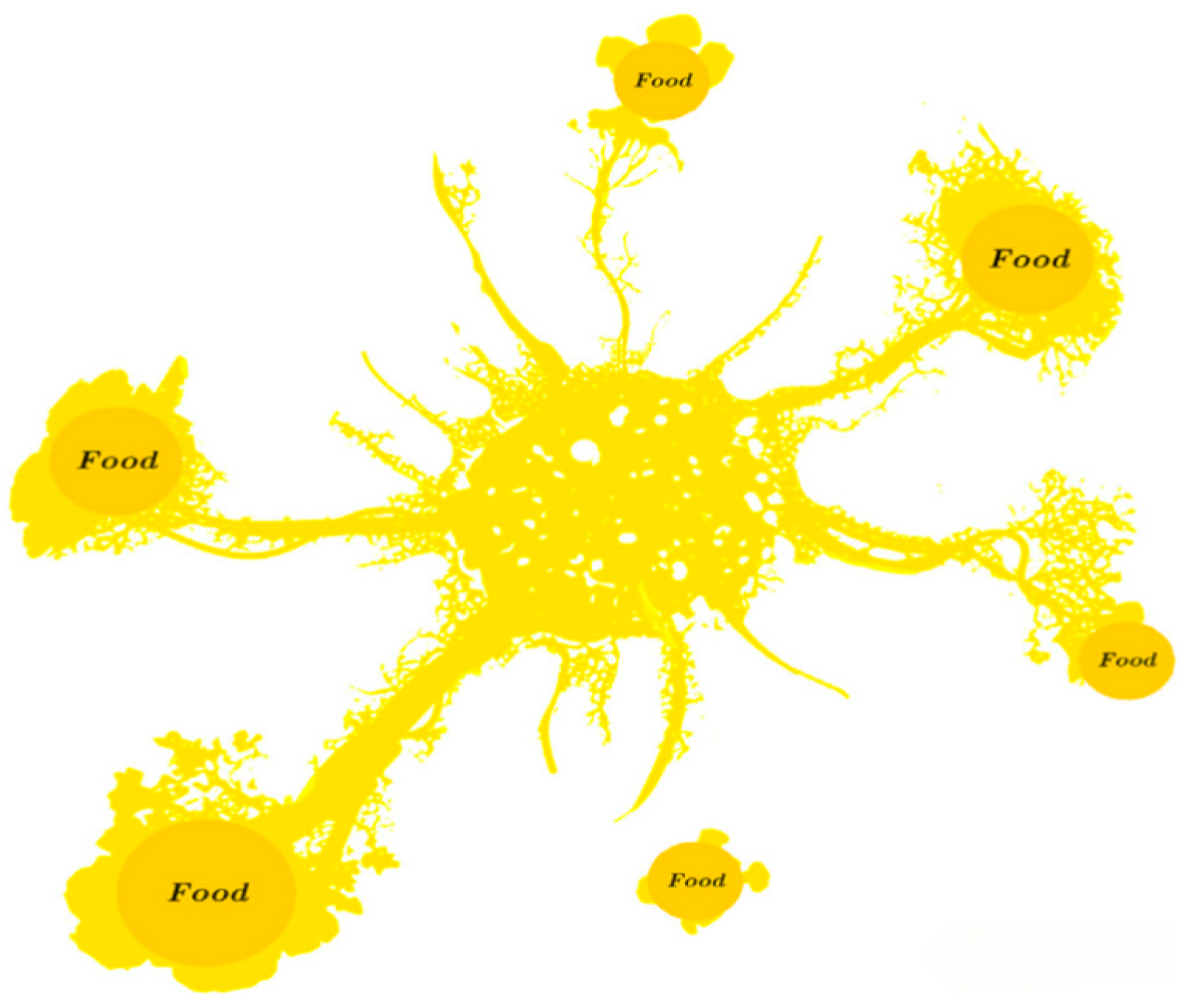
Before introducing the proposed method, the basic mechanism of the standard slime mold algorithm (SMA) is briefly reviewed to provide the background for the subsequent improvements and to clarify the search characteristics motivating the development of MDHSMA. As shown in Figure 1, slime molds regulate cytoplasmic transport through oscillatory contractions and dynamically adjust their vein network according to external stimuli. This adaptive behavior enables them to approach nutrient-rich regions while maintaining flexible path selection. SMA abstracts these characteristics into a mathematical search framework for optimization.
Population Initialization: The initial position matrix X i n i t i a l is defined as:
X i n i t i a l = ( U B L B ) r a n d ( N , D ) + L B
Here, N denotes the population size, D is the dimensionality of the problem, and L B and U B are the lower and upper bounds of the search space, respectively. The term r a n d ( N , D ) represents an N × D random matrix whose entries are uniformly distributed over [0, 1].
Approaching Food: To mimic the movement of slime molds toward food sources, SMA updates the position of each individual according to:
X i ( t + 1 ) = { X b ( t ) + v b ( W X A ( t ) X B ( t ) ) , r 1 < p 1 v c X ( t ) , r 1 p 1
Here, X b ( t ) denotes the best solution obtained at iteration t, whereas X ( t ) corresponds to the current individual. X A ( t ) and X B ( t ) are two different individuals randomly chosen from the population. In addition, r 1 [ 0 ,   1 ] , v b [ a ,   a ] , vc decreases linearly from 1 to 0 as the iteration proceeds, and W denotes the adaptive weight.
When r 1 < p 1 , the individual mainly performs local exploitation around promising regions; otherwise, it tends to preserve broader search behavior. The control probability p 1 is computed as:
p 1 = tanh ( | f i t i f i t b e s t | )
where f i t i is the fitness of individual i, and f i t b e s t is the current global optimum.
The parameter a governs the search range and progressively diminishes as iterations advance. A larger value during the early phase facilitates global exploration, while a smaller value in the later stage enhances local exploitation. Its definition is given as follows:
a = a r c t a n h ( 1 t T m a x )
The iteration budget is capped by T m a x .
Individuals located in more favorable regions are assigned stronger movement tendencies, whereas those in poorer regions move more conservatively. The weight is defined as:
W ( S d e x ( i ) ) = { 1 + r 1 log ( b f i t f i t i b f i t w f i t + 1 ) , c o n d i t i o n 1 r 1 log ( b f i t f i t i b f i t w f i t + 1 ) , o t h e r s
where b f i t and w f i t represent, respectively, the best and worst fitness values achieved in the current iteration, while S d e x denotes the ranking index produced by sorting the population based on fitness.
Wrapping Food: By combining this feedback mechanism with random global perturbation, the general position update rule of SMA can be written as:
X i ( t + 1 ) = { r a n d 1 ( U B L B ) + L B , r a n d 1 < z 1 X b ( t ) + v b ( W X A ( t ) X B ( t ) ) , r a n d 2 z 1 , r 1 < p 1 v c X ( t ) , r a n d 2 z 1 , r 1 p 1
Here, r a n d 1 , r a n d 2 , and z 1 are random variables uniformly distributed in the interval [ 0 ,   1 ] .
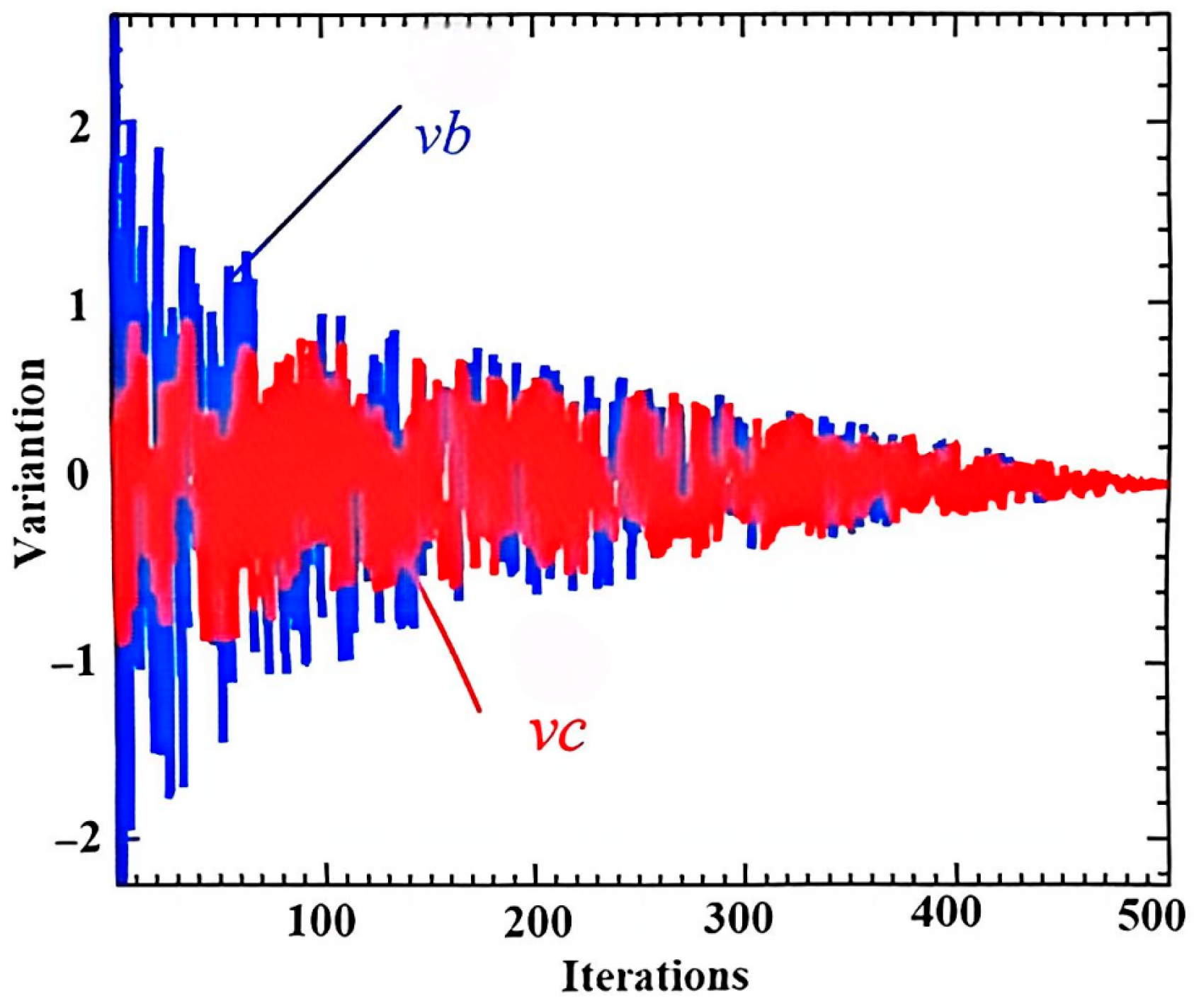
Grabbing Food: In SMA, the final propagation process is jointly governed by the three parameters W , vb , and vc , which together describe the progressive movement of individuals toward promising regions.
As shown in Figure 2, both vb and vc gradually decrease toward zero as the iteration progresses. This trend reflects the search behavior of slime molds: the algorithm exploits promising regions while still retaining some capacity to explore unexplored areas.

3. Our Proposal: Multi-Strategy Differential Hybrid Slime Mold Algorithm (MDHSMA)

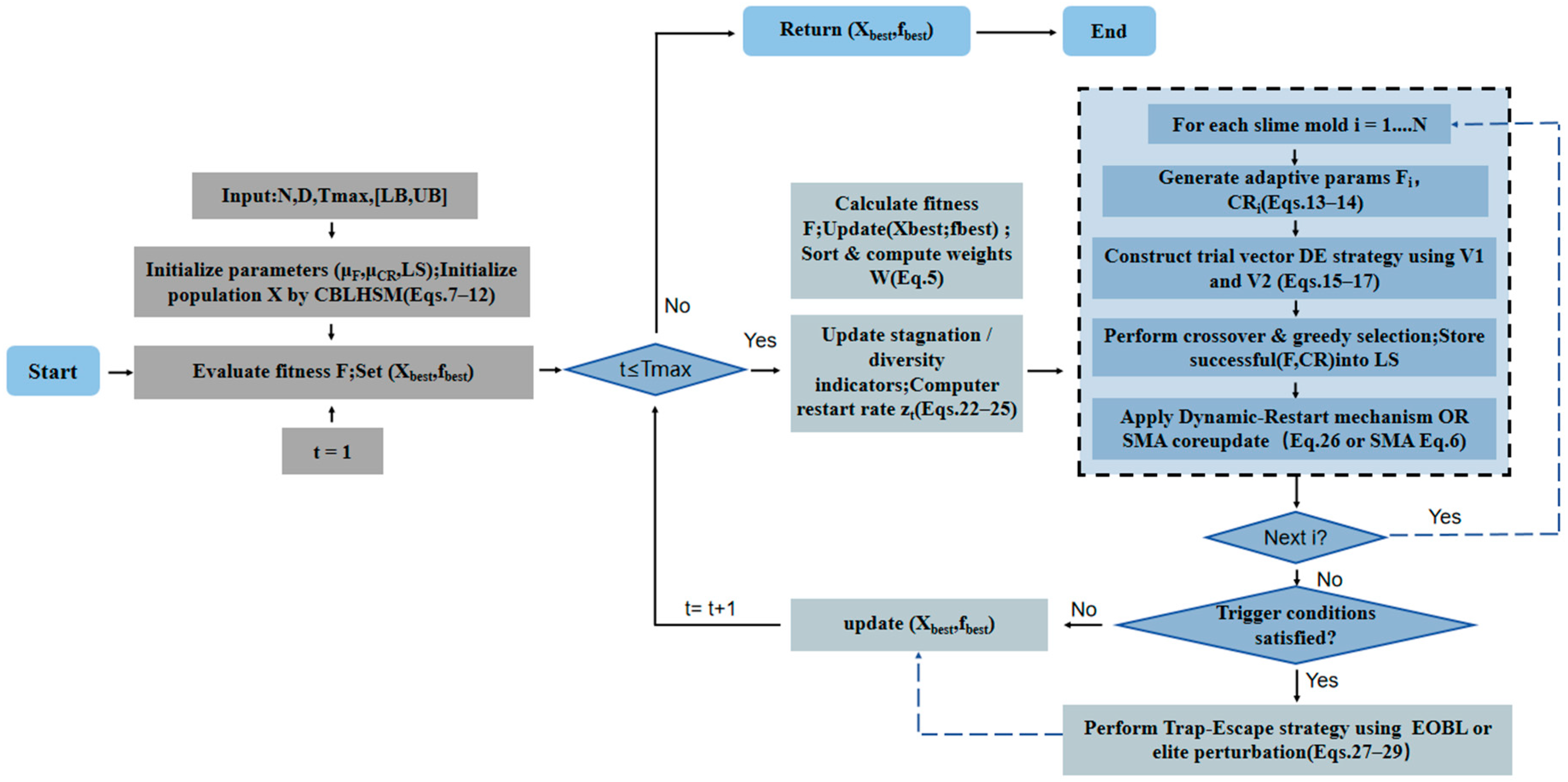
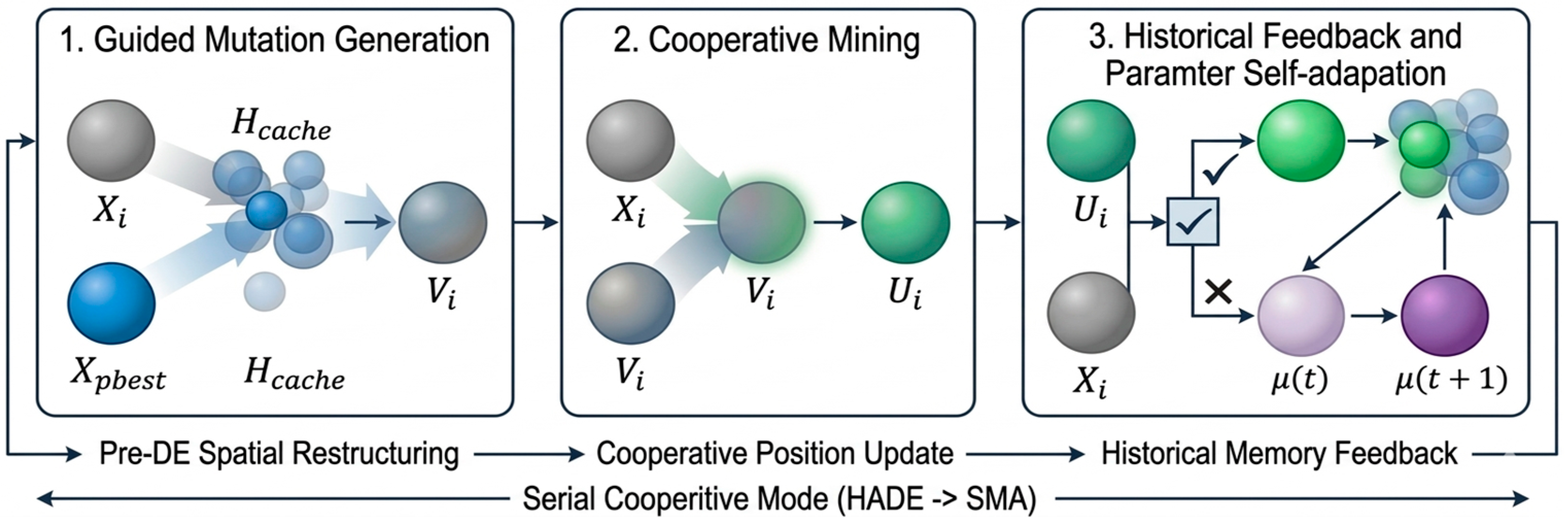
This section presents the proposed MDHSMA, and its overall workflow is illustrated in Figure 3. The algorithm begins with a population initialization scheme that combines chaotic bimodal Latin hypercube sampling with mirrored pairing, aiming to improve ergodicity, geometric complementarity, and boundary coverage in the search space. During the iterative phase, an adaptive parameter control strategy with historical feedback and a hybrid position update mechanism is incorporated to reduce the risk of premature convergence and to strengthen search efficiency. In addition, when the population is trapped in a local optimum or the search enters the final evolutionary stage, a state-aware stagnation handling framework is triggered. Through dynamic restart, lightweight dynamic backtracking, and Gaussian perturbation, this framework performs hierarchical regulation on different groups of individuals, thereby further enhancing solution accuracy and convergence behavior.

3.1. Chaos-Based Bimodal Mirrored Latin Hypercube Sampling Initialization (CBLHSM)

In standard SMA, random initialization may produce local crowding and uncovered regions, especially in high-dimensional spaces. To alleviate this issue, CBLHSM combines the stratification property of Latin hypercube sampling, the ergodicity of chaotic mapping, and the complementarity introduced by mirrored construction.
In a D-dimensional search space, each dimension is first partitioned into N equiprobable intervals based on the population size N, after which normalized samples are produced using Latin hypercube sampling:
U i , j = P j ( i ) r i , j N
Here, P j ( i ) denotes a random permutation of the set { 1,2 , , N } in the j-th dimension, and r i , j U ( 0,1 ) represents the perturbation term within the interval.
To simultaneously account for both the central and peripheral regions of the search space, a logistic chaotic map is introduced to construct individual-level heterogeneous scaling factors. The chaotic sequence c k is generated as follows:
c k + 1 = λ c k ( 1 c k )
Here, following the common practice in chaotic optimization, λ is fixed at 4 so that the mapping operates in a typical chaotic regime [26]. Furthermore, by mapping the i-th chaotic value c i to the interval [ 0.7 ,   2.3 ] , we obtain the individual scaling exponent:
γ i = 0.7 + 1.6 c i
Then, the uniform sample U i , j is transformed into a bimodal sample U i , j :
U i , j = 0.5 + 0.5 s g n ( 2 U i , j 1 ) | 2 U i , j 1 | γ i
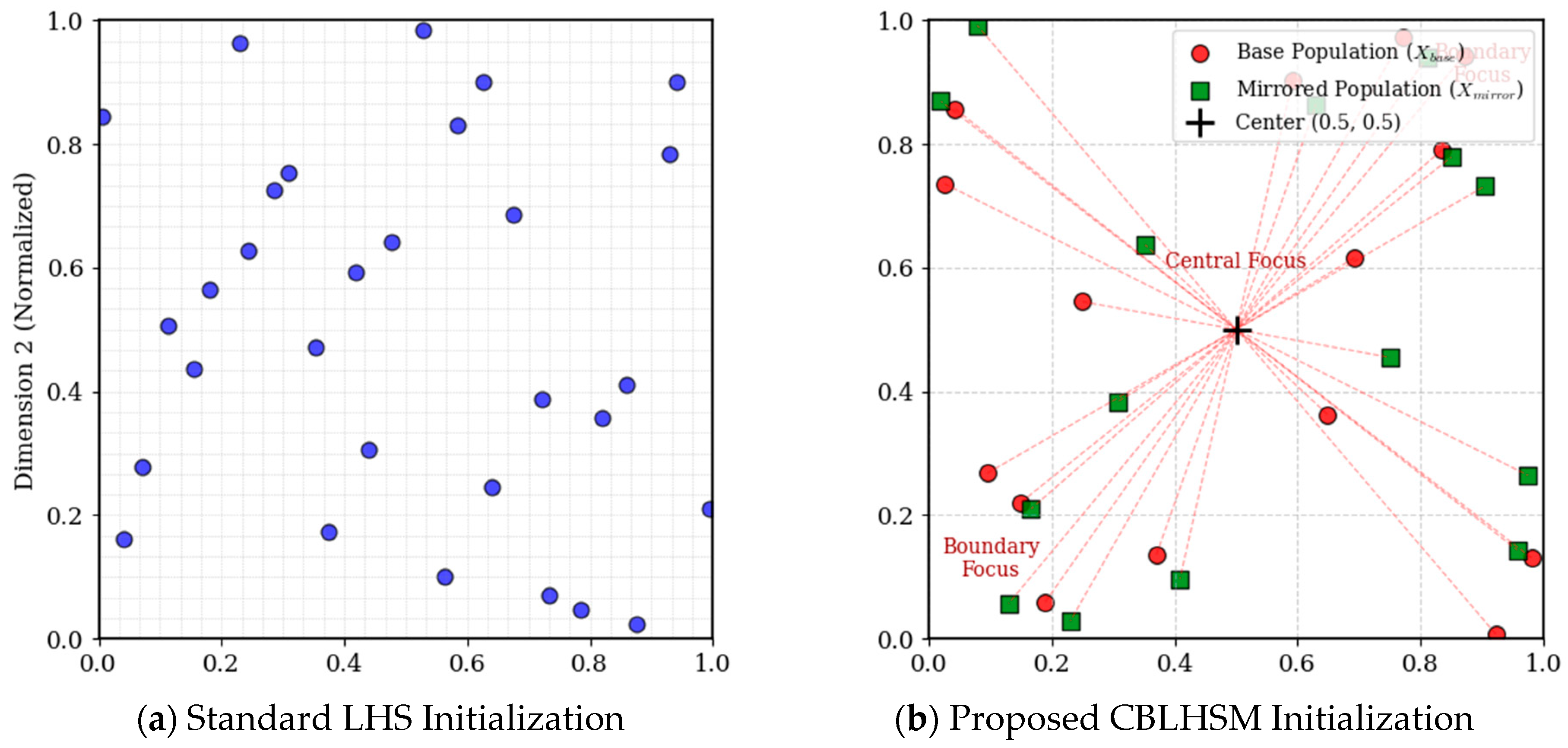
Here, s g n ( ) denotes the sign function. When γ i > 1 , samples tend to contract toward the central region; when γ i < 1 , samples expand toward both sides of the boundary.
Building on this, to further improve the geometric complementarity of the initial population, a mirror pairing mechanism is employed to construct mirror individuals relative to the base population. Let the first N/2 individuals generated by Equation (10) form the base population U b a s e ; then, its mirror population U m i r r o r is defined as:
U m i r r o r = 1 U b a s e
where 1 is an all-ones matrix with the same dimension as U b a s e . The final normalized population U = { U 1 , , U N } is obtained by combining U b a s e and U m i r r o r , and then mapped to the actual search space [ L B , U B ] as:
X i 0 = L B + U i ( U B L B ) , i = 1 , , N
where ⊙ denotes the Hadamard product. This construction assigns each candidate solution a mirrored counterpart in the opposite region of the hypercube, which expands the effective coverage of the initial population. In MDHSMA, the explicit symmetry mechanism is introduced at this stage through mirrored initialization, while its later influence appears indirectly in the subsequent HADE and SAS processes. The difference between conventional LHS and CBLHSM is illustrated in Figure 4.

3.2. History-Driven Adaptive Differential Evolution Strategy (HADE)

To address the search blindness in standard SMA caused by the lack of individual lateral interactions, MDHSMA establishes a serial collaborative model that involves “DE-space reorganization followed by SMA-based fine-tuning.” HADE consists of two serial differential stages and a historical memory feedback loop.
First, for each generation, the differential scaling factor F i t and the crossover probability C R i t are generated adaptively for each individual. The algorithm maintains two global parameters, the centers μ F and μ C R , and sets up a fixed-length history pool to record recent successful samples. Specifically, the local parameters are generated using Cauchy and Gaussian perturbations:
F i t = μ F + 0.08 t a n ( π ( u 0.5 ) ) , u U ( 0,1 )
C R i t = c l i p ( μ C R + 0.1 M ( 0,1 ) , 0,1 )
Here, tan ( π ( u 0.5 ) ) corresponds to the Cauchy perturbation, M ( 0 , 1 ) is a standard normal random variable, and c l i p ( ) is the truncation operator. To ensure parameter stability, F i t is restricted to the interval (0, 0.8], and CRit is restricted to the interval [0, 1].
In the first differential phase, when the convergence iteration count τ = t / T m a x < 0.6 is reached, an elite-guided differential mutation strategy is used to generate exploration vectors:
V i t = X i t + F i t ( X p b e s t t X i t ) + F i t ( X r 1 t X r 2 t )
In this context, X i t R D is the position of the i-th individual at iteration t, and X p b e s t t R D is an elite vector drawn uniformly from the top p% of individuals according to current fitness.
In the second differential phase, to prevent a rapid decline in diversity later on, a weighted hybrid update mechanism consisting of two types of differential vectors is introduced. The weighting factors, which vary nonlinearly with each iteration, are defined as:
ω ( t ) = ( t T m a x ) 1.2
The hybrid mutation vector Vhybrid is then computed by:
V 1 = X r 1 + F i ( X r 2 X r 3 ) V 2 = X i + F i ( X b e s t X i ) + F i ( X r 4 X r 5 ) V h y b r i d = ( 1 ω ) V 1 + ω V 2
In this context, X b e s t represents the current global optimal individual, while X r 1 , , X r 5 R D denote random reference individuals that differ from the current individual in index and are mutually distinct. As the optimization advances, ω gradually grows, promoting a smooth change in search emphasis from V 1 -based global exploration to V 2 -based local exploitation.
After completing guided exploration and a hybrid differential search, a unified binary crossover mechanism is used to construct candidate solutions from the differential search results. Regardless of whether the mutation vectors are derived from Equation (15) or Equation (17), the trial vectors U i t are generated according to the following rule:
U i , j t = { V i , j t , r i , j C R i t   o r   j = j r a n d X i , j t , o t h e r w i s e
Here, V i , j t denotes the mutant vector generated in the current differential stage, r a n d i , j U ( 0 , 1 ) , and j r a n d { 1,2 , , D } is a random dimension index ensuring that the trial vector inherits differential information in at least one dimension. After crossover and selection, μ F and μ C R are updated from the successful samples to adapt to the search process. Let S F = { F s } , and S C R = { C R s } be the corresponding successful parameter sets. Then, for the s-th successful sample generated at iteration t s , its exponential time weight is defined as follows:
w s = exp ( t s max ( 1 , t 1 ) ) q exp ( t q max ( 1 , t 1 ) )
This gives us the weighted average:
m e a n F = s w s F s 2 s w s F s , m e a n C R = s w s C R s
Subsequently, the global center parameter is updated using exponential smoothing:
μ F = ( 1 c ) μ F + c m e a n F , μ C R = ( 1 c ) μ C R + c m e a n C R
Here, c = 0.1 denotes the learning rate, following the standard setting commonly adopted in the JADE family of adaptive differential evolution algorithms [27,28]. If no successful sample appears in the current generation, μ F and μ C R remain unchanged to avoid parameter drift. In this way, the mutation amplitude and crossover strength are adjusted according to recent successful search behavior. After HADE, the population continues to evolve under the original SMA mechanism, forming a complementary DE-SMA update process. The overall structure of HADE is illustrated in Figure 5.

3.3. State-Aware Stagnation Handling (SAS)

SAS acts as an event-triggered regulation module. Instead of intervening throughout the whole search, it is activated only when the population state indicates stagnation, diversity loss, or late-stage refinement demand.

3.3.1. Condition Monitoring

The mechanism continuously tracks both a stagnation counter, k s t a g , and a population-wide diversity metric. Initially, the geometric median vector of the swarm, X m e d , and the median Euclidean dispersion D i v are evaluated:
X m e d = m e d i a n ( X , 1 ) , D i v = m e d i a n i ( X i X m e d 2 )
This dispersion is subsequently normalized into the bounded index D n o r m :
D n o r m = min ( 1 , D i v m e a n ( U B L B ) D + ε )
To reduce false detections caused by small numerical fluctuations, the stagnation counter is updated using a significance threshold ϵ   =   1 0 - 6 :
k s t a g ( t ) = { 0 , h ( t ) < h ( t 1 ) ϵ max ( 1 , | h ( t 1 ) | ) min ( k s t a g ( t 1 ) + 1 , K m a x ) , o t h e r w i s e
Here, K m a x = 25 dictates the absolute upper limit for tolerated stagnation. An escalating k s t a g signals algorithmic entrapment, whereas a condition of D n o r m 0.1 denotes critical diversity depletion. These dual indicators collaboratively determine the dynamic restart rate z t .

3.3.2. Dynamic Restart and Perturbation Mechanism

When a stagnant state is detected, the effective stagnation factor s e f f and the dynamic restart probability z t are further calculated based on the normalized stagnation degree s s t a g = k s t a g / K m a x :
s e f f = { 0 , s s t a g s 0 s s t a g s 0 1 s 0 , s s t a g > s 0 , z t = z m i n + ( z m a x z m i n ) s e f f α z
In particular, s 0 = 0.5 , z m i n = 0.005 , z m a x = 0.02 , and α z = 1.5 . z m i n and z m a x bound the adaptive restart probability to avoid excessively weak or aggressive restart behavior. When D n o r m < 0.1 , z t is further increased, whereas restart is disabled in the late stage to maintain convergence stability. Based on this mechanism, SAS applies different interventions to different performance groups. For individuals in the lower half of the population, dynamic restart is evaluated only at sparsely spaced intervals, and random reinitialization is performed with probability z t :
X i = L B + r ( U B L B ) , r U ( 0,1 ) D
For the bottom 5% of individuals, a lightweight dynamic backtracking mechanism is invoked only at sparsely spaced intervals under evident stagnation in the intermediate stage. Prior to the backtracking step, dynamic boundaries are defined based on the current population state:
l b d y n = min i X i , u b d y n = max i X i
Perform backpropagation based on this dynamic boundary:
X i = δ ( l b d y n + u b d y n ) X i , δ U ( 0,1 ) D
If certain dimensions exceed the bounds after a backward step, they are randomly adjusted within the dynamic boundaries. This strategy helps the worst individual escape the local optimum region.
For the top 5% of elite individuals, small Gaussian perturbations are introduced in the late search stage when the stagnation level remains low. This helps refine the search around promising regions without disrupting the current convergence trend. To maintain computational stability in high-dimensional cases, only a few elite individuals are selected for this operation. The update rule is given as follows:
X e l i t e , n e w = X e l i t e + η N ( 0,1 ) ( U B L B )
where η = 0.03 is the scaling factor. Overall, the SAS framework realizes hierarchical intervention through a monitoring–response loop: dynamic restart is used to recover diversity for underperforming subgroups, reverse-style learning is applied to escape local trapping for extremely poor individuals, and mild perturbation is imposed on a few elite individuals in the late stage to further improve solution accuracy.

3.4. Analysis of Computational Complexity

Algorithm 1 outlines the overall procedure of MDHSMA. In the initialization phase, Latin hypercube sampling, chaotic mapping, and mirrored generation can all be carried out in a vectorized form, yielding a computational cost of O ( N   ×   D ) . Let the fitness evaluation cost of a single candidate be O ( C f ) . Then, the population fitness evaluation in each iteration requires O ( N   ×   C f ) , while population sorting requires O ( N log N ) . In the update phase, both the SMA core search and the DE-based hybrid search are mainly composed of linear vector operations, leading to a cost of O ( N   ×   D ) .
The SAS module additionally involves diversity monitoring, stagnation detection, dynamic restart, and local perturbation. Although its worst-case complexity is also O ( N   ×   D ) , these operations are activated only under certain conditions or applied to limited individuals, so the actual average cost is usually lower. Therefore, the per-iteration complexity of MDHSMA is O ( N   ×   C f   +   N log N +   N   ×   D ) , and the total complexity over T iterations is O ( T ( N × C f + N log N + N × D ) ) . Thus, MDHSMA retains the same asymptotic complexity order while incurring only a moderate additional computational cost in exchange for improved solution quality and robustness.
Algorithm 1: MDHSMA
Input: Population size: N, Dimension: D, Maximum iteration: Tmax, Bounds: [LB,UB]
Output: Best solution Xbest and best fitness fbest
1 Function MDHSMA(N, D, Tmax):
2  Initialize parameters and memory ( μ F ,   μ C R , LS); initialize population X by CBLHSM (Equations (7)–(12));
3  Evaluate fitness F; set (Xbest, fbest);
4  t = 1;
5  while t ≤ Tmax do
6    | Calculate fitness F; update (Xbest, fbest); sort and compute weights W (Equation (5));
7    | Update stagnation and diversity indicators; compute adaptive restart rate zt (Equations (22)–(25));
8    | for each slime mold i = 1…N do
9    | | Generate adaptive parameters F i t   and   C R i t (Equations (13) and (14));
10  | | Construct trial vector by DE strategy using V2 and V1 (Equations (15)–(17));
11  | | Perform crossover and greedy selection; store successful ( F i t ,   C R i t ) into LS;
12  | | Apply Dynamic-Restart mechanism or SMA core update (Equation (26) or SMA Equation(6));
13  | end for
14  | if trigger conditions satisfied then
15  | | Perform Trap-Escape strategy using lightweight EOBL or elite perturbation (Equations (27)–(29));
16  | end if
17  | Update (Xbest, fbest);
18  | t = t + 1;
19  end while
20  return Xbest, fbest

4. Numerical Experiments Based on the CEC Benchmark

To assess the global optimization performance of MDHSMA, extensive experiments were conducted on the CEC benchmark suites to evaluate its accuracy, robustness, and scalability under diverse numerical landscapes, as well as the contribution of its main components.

4.1. Experimental Setup and Implementation Details

To guarantee the integrity, fairness, and strict reproducibility of the comparative analysis, all algorithmic evaluations were executed within a highly standardized computational environment, thereby neutralizing any potential hardware- or software-induced discrepancies. The specifications of the deployed simulation platform are detailed below: operating system Windows 11, processor AMD Ryzen 7 7840H with Radeon 780M Graphics, memory 16 GB RAM, and programming language MATLAB R2024b.

4.2. Benchmark Functions, Algorithms Under Comparison, and Parameter Settings

To provide a more thorough assessment of the search behavior of MDHSMA in complex optimization scenarios, the widely adopted CEC2017 and CEC2022 benchmark suites were selected for experimentation. These benchmark collections contain a broad range of functions with distinct structural characteristics, including multimodal, hybrid, composition, and high-dimensional problems. Such diversity makes them suitable for evaluating the exploration–exploitation balance, convergence efficiency, and robustness of optimization algorithms under different levels of difficulty.
For performance comparison, 12 representative optimizers from different categories were selected. These methods are grouped into four classes:
  • Classical Algorithms: GA [29], DE [30], PSO [31].
  • Highly Cited Algorithms: GWO [32], WOA [33], COA [34].
  • SMA-related Algorithms: SMA, ASMA [35], ISMA [36], EMSMA [37].
  • Latest Algorithms: WUTP [38] and PEOA [39].
To facilitate a clear comparison and ensure experimental reproducibility, the parameter settings of all algorithms considered in this study are reported in Table 1. For consistency, the population size, maximum iteration count, and number of independent trials were fixed at 100, 1000, and 30, respectively, for all methods.

4.3. Comparative Experiments and Analysis of CEC2017

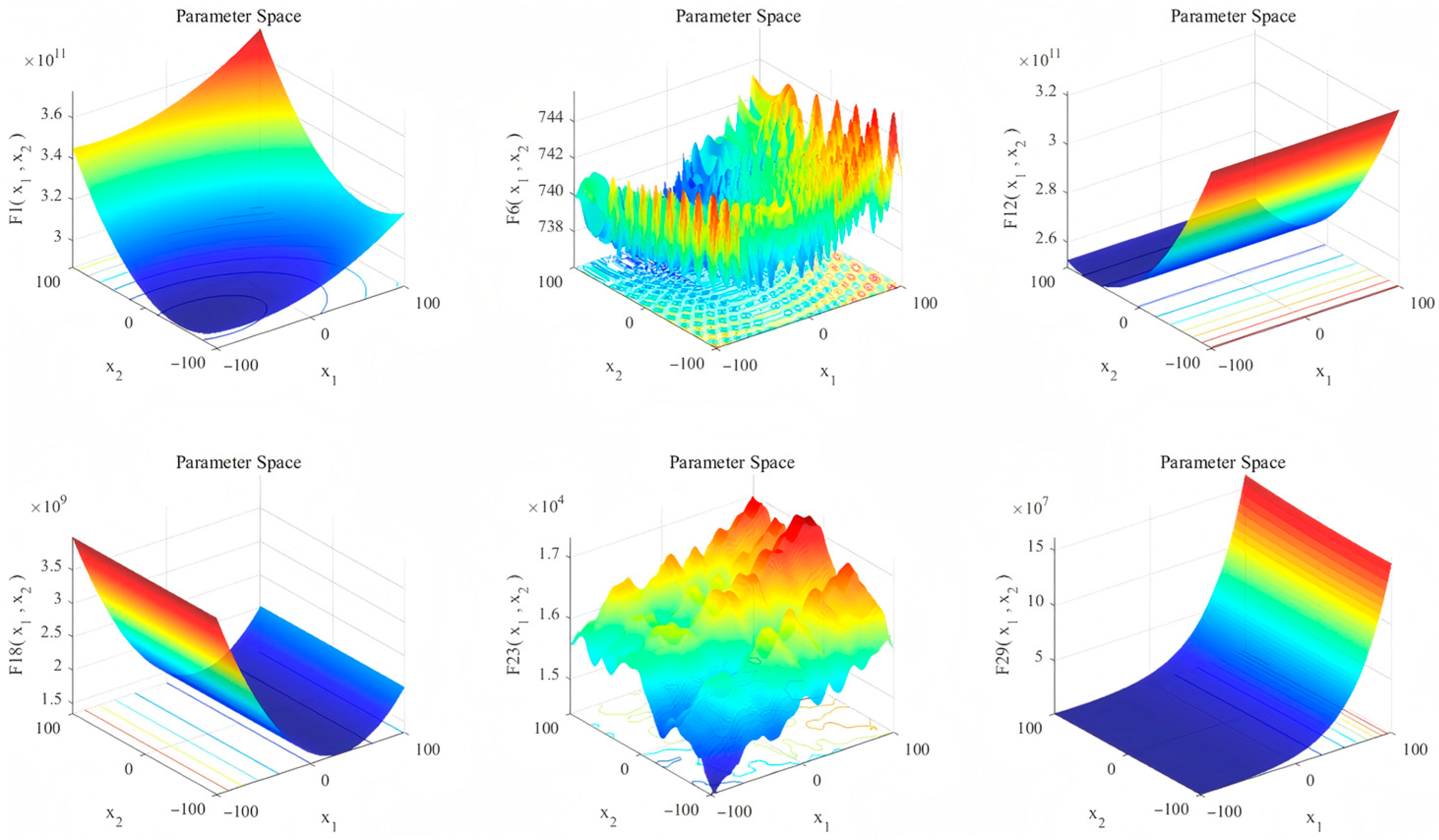
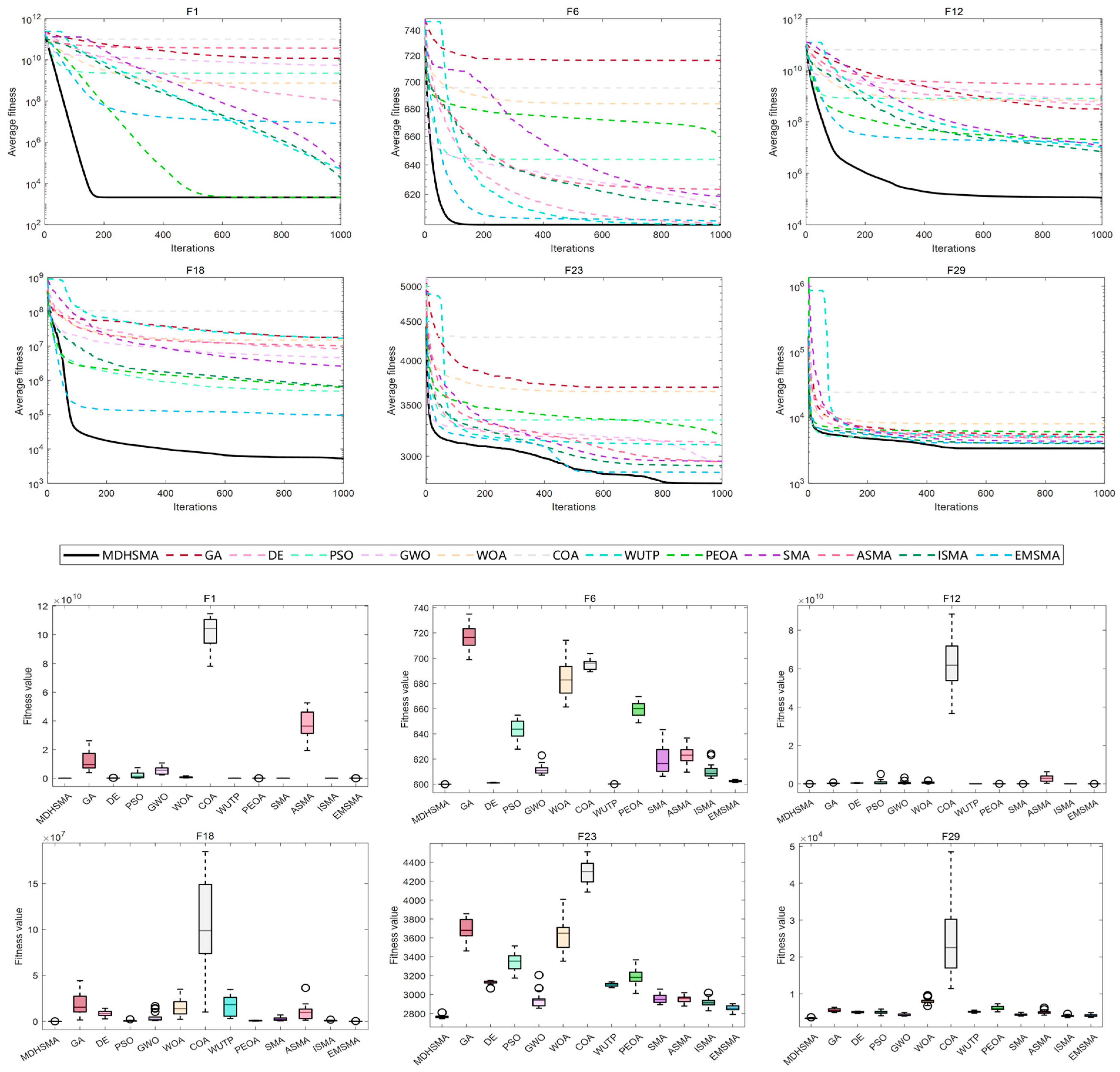
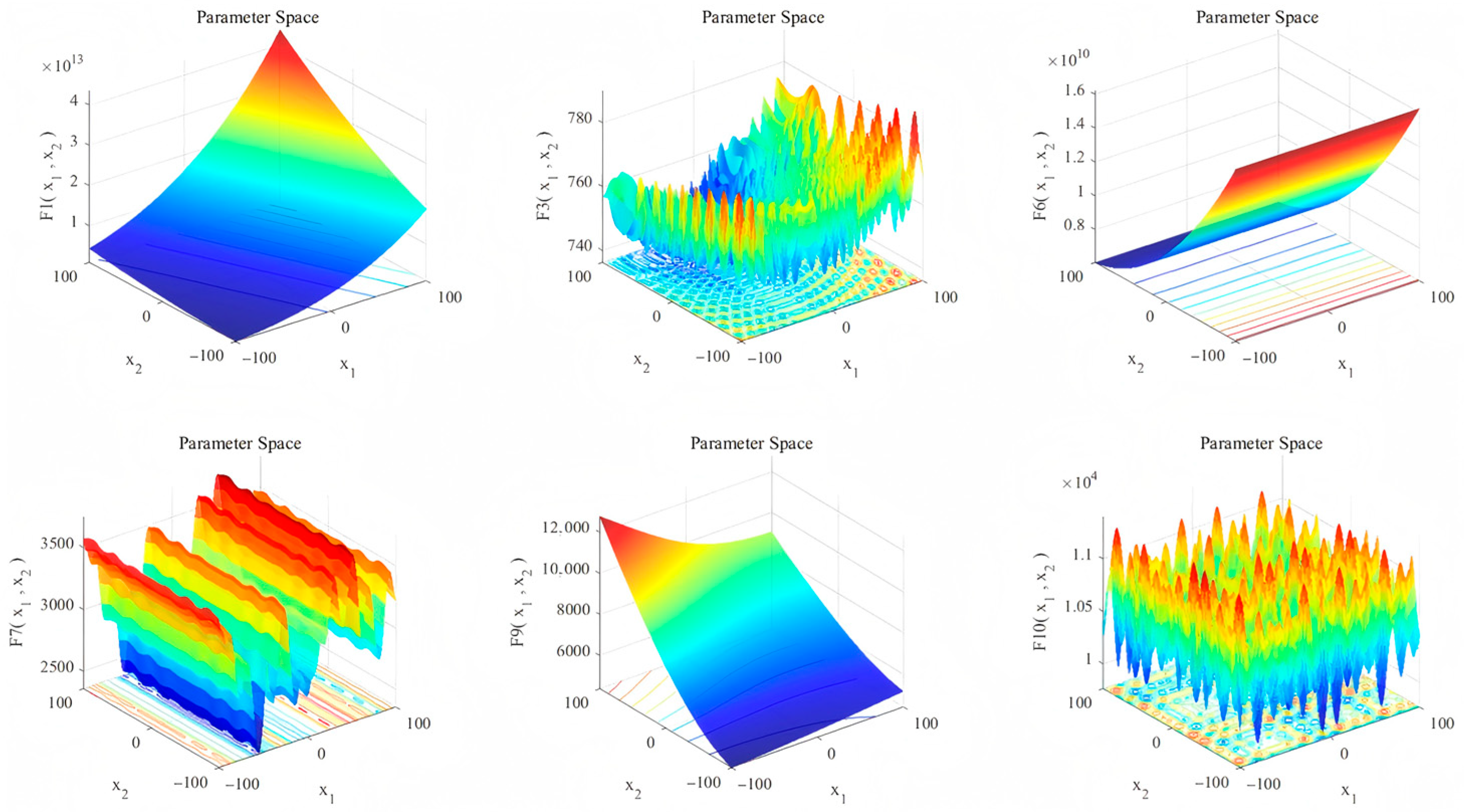
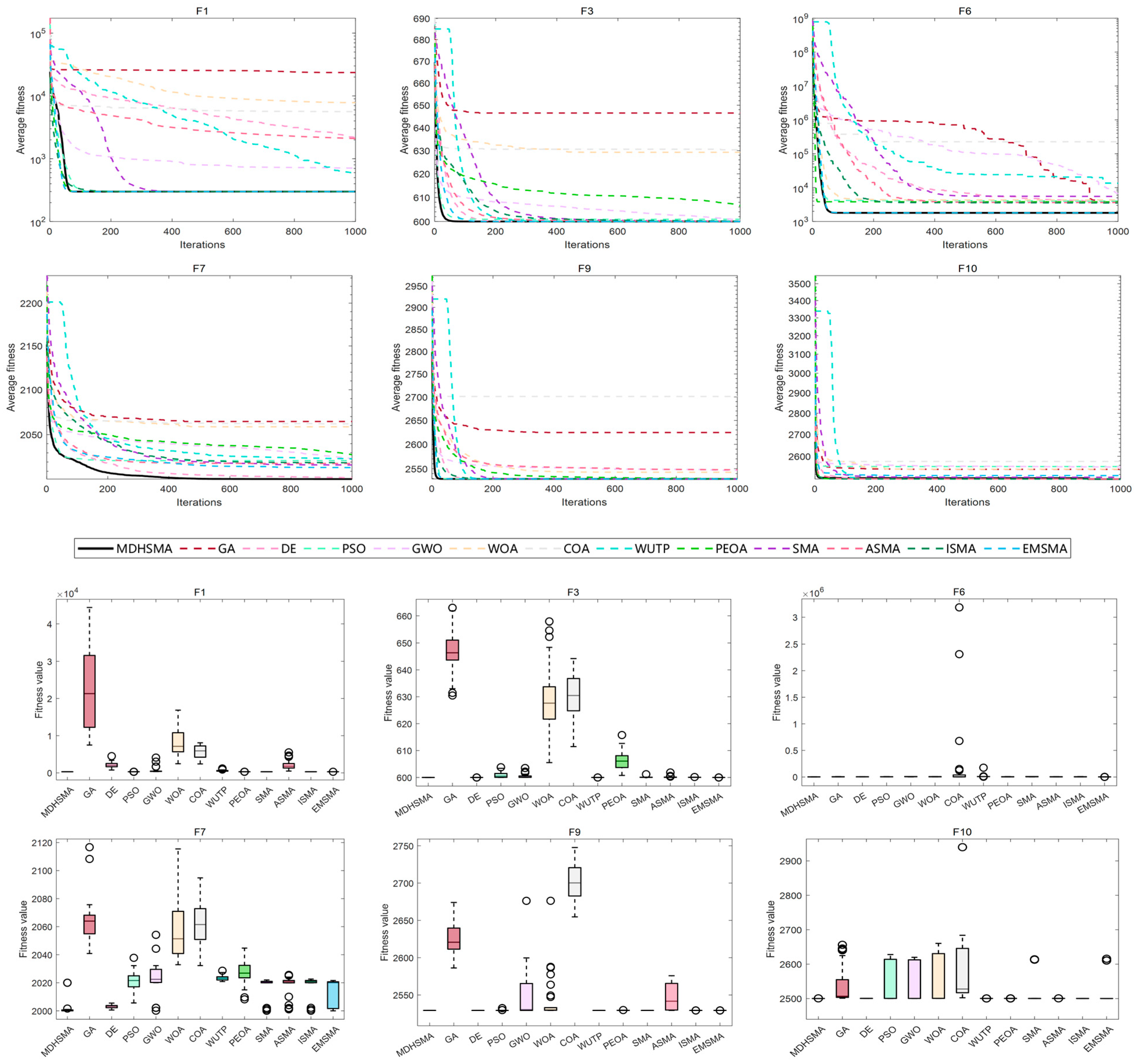
To examine whether the observed performance gaps between MDHSMA and the other algorithms are statistically meaningful, the Mann–Whitney U test was applied. In the reported results, +, ≈, and − represent that MDHSMA is significantly better than, statistically comparable with, or significantly worse than the corresponding optimizer, respectively. Furthermore, the Friedman ranking test was used to obtain a comprehensive evaluation of the relative performance of all algorithms on the benchmark suite by computing their mean ranks across the test functions. For ease of comparison, the best results were highlighted in bold. The corresponding statistical summary for CEC2017 is reported in Table 2, and the detailed numerical outcomes are included in Appendix A. Several representative function landscapes from CEC2017 are shown in Figure 6, and the corresponding convergence behaviors together with the box-plot distributions are presented in Figure 7, Figure 8, Figure 9 and Figure 10.
As shown in Table 2, across all the considered dimensions, MDHSMA achieved the best overall performance in CEC2017. The statistical results suggest that this advantage comes from the combined effect of the CBLHSM initialization strategy, the hybrid position update mechanism, and the state-aware stagnation handling framework. With these components working together, MDHSMA attains high solution accuracy while maintaining stable and scalable search behavior on different benchmark functions. The box plots further show that MDHSMA produces more concentrated results over repeated runs, indicating lower variability and better repeatability. This can be attributed to the more balanced initial population distribution and the adaptive intervention mechanism based on stagnation and diversity information during evolution. The advantage is more evident in high-dimensional cases, where many conventional algorithms tend to lose diversity and converge prematurely. By preserving a broader effective search range through differential interaction and low-frequency escape operations, MDHSMA exhibits better scalability and more reliable optimization performance.
More importantly, MDHSMA shows a relatively stable advantage across different function categories and dimensional settings, suggesting that its improvements are not limited to a small subset of problems. Such cross-scenario consistency is especially important for meta-heuristic algorithms, since practical optimization tasks often involve noise, complex constraints, and high-dimensional decision variables. Without sufficient robustness, it is difficult for an algorithm to deliver repeatable and reliable results in real applications.

4.4. Comparative Experiments and Analysis of CEC2022

To gain deeper insight into the adaptability and robustness of MDHSMA under more demanding test conditions, further experiments were performed using the CEC2022 benchmark suite. This suite contains unimodal, basic, hybrid, and composite functions, and introduces more complicated shift and rotation settings than CEC2017. The experimental protocol was kept consistent with that in the previous subsection, and the problem dimensions were set to D = 10 and D = 20.
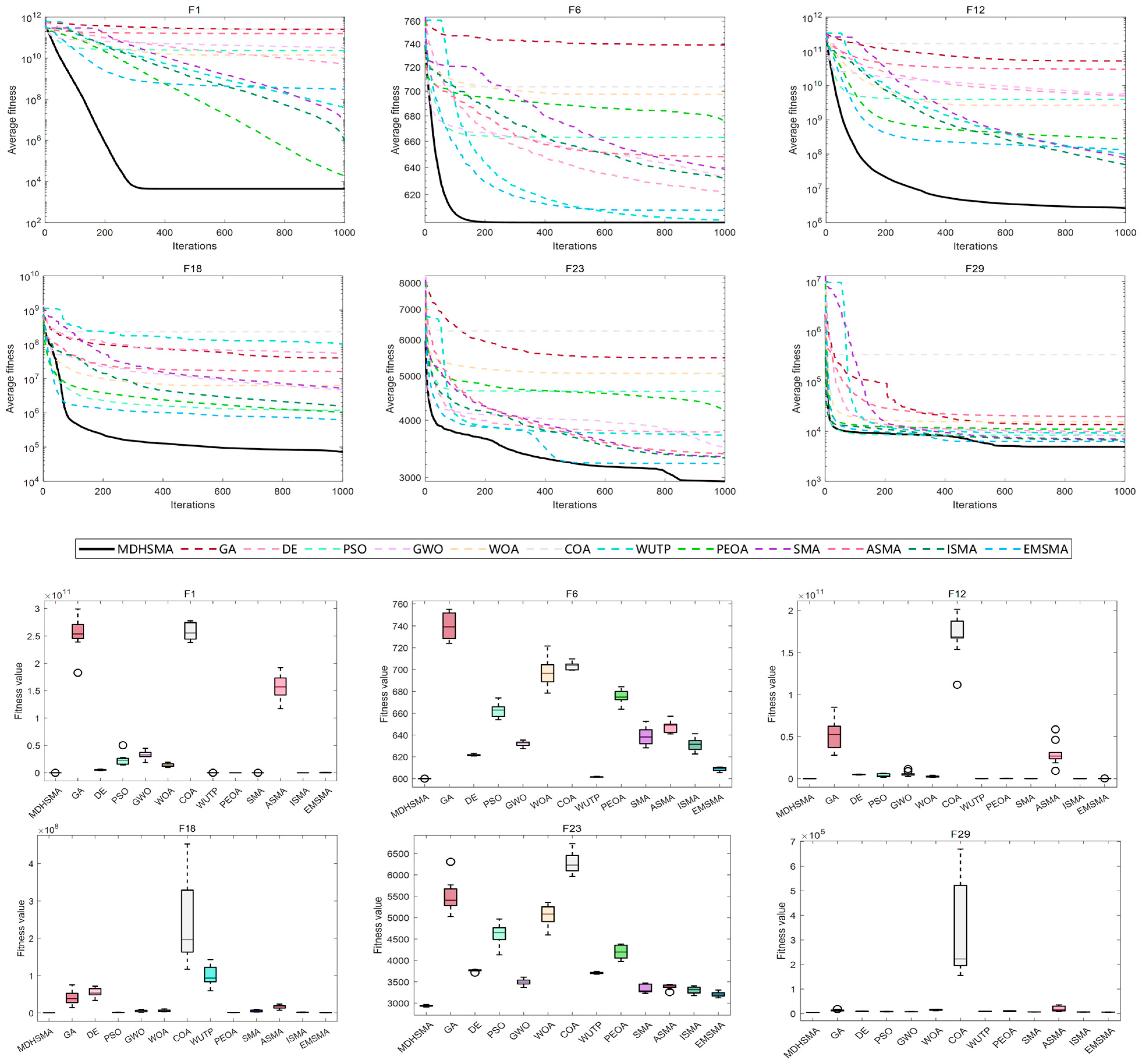
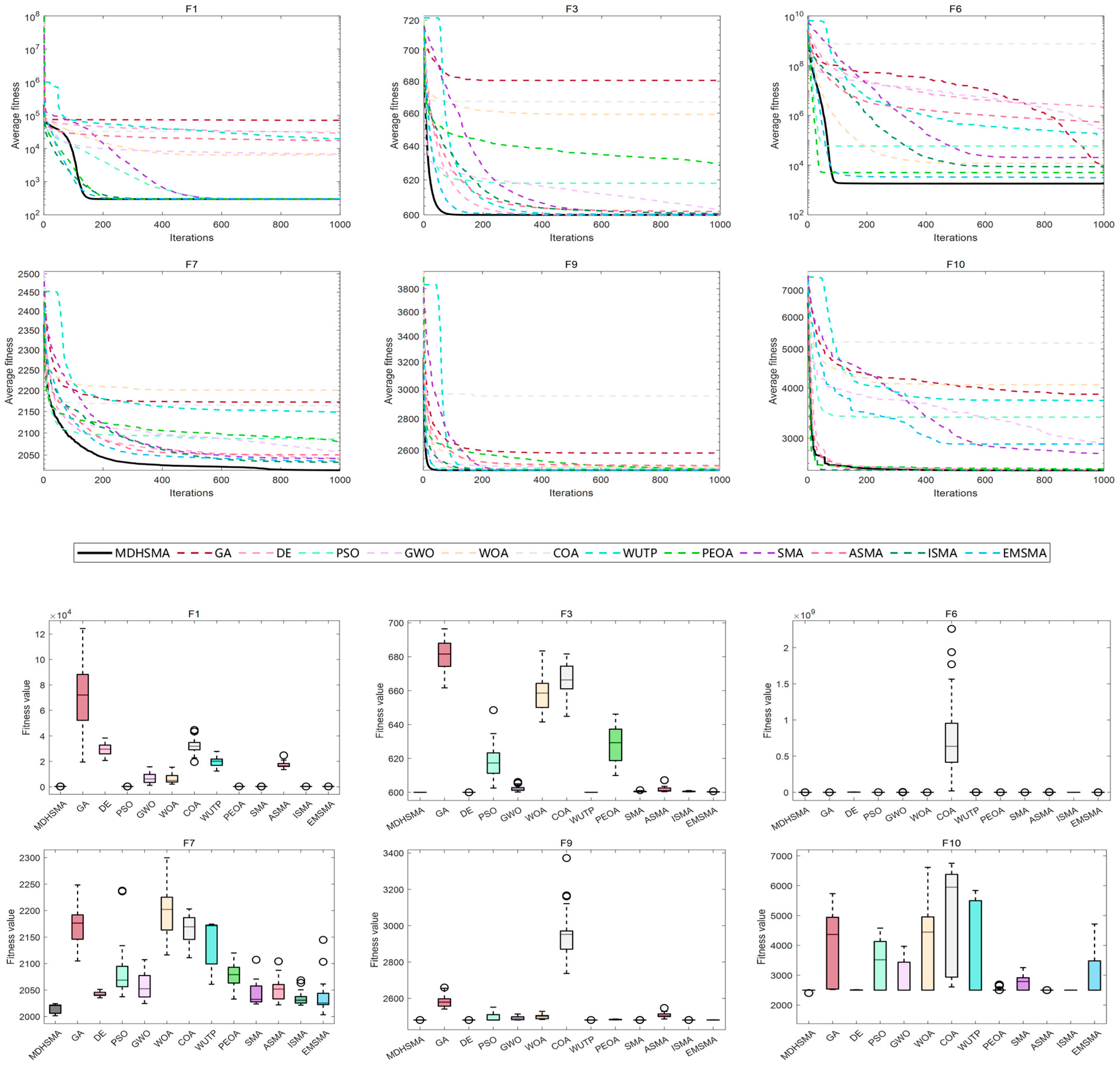
Table 3 presents the overall statistical comparison and average ranking results of 13 algorithms in CEC2022, and the complete numerical results can be found in Appendix B. Figure 11 illustrates the three-dimensional landscapes of several representative CEC2022 functions, and Figure 12 and Figure 13 present the corresponding optimization results. As shown in Table 3, MDHSMA remains highly competitive across different dimensional settings. In the 10-dimensional cases, it secured the top overall ranking with an average rank of 1.50, and the statistical results further confirm its superiority to the comparison methods. In the 20-dimensional cases, MDHSMA held onto its leading position with an average rank of 1.08, demonstrating stable performance across medium-dimensional optimization tasks. Compared with SMA variants such as ISMA and EMSMA, MDHSMA not only preserves high accuracy on relatively simple low-dimensional problems, but also demonstrates stronger search capability and faster convergence on more complex hybrid and composite landscapes. These results indicate that the method we have proposed can provide a more stable and reliable foundation for subsequent engineering applications. Its performance advantage mainly comes from a better balance between global exploration and local exploitation, together with diversity preservation in the early stage and solution refinement in the later stage.

4.5. Ablation Experiments Based on the CEC Benchmark

In the aforementioned comparative experiments, MDHSMA demonstrated superior overall performance compared to all competing algorithms. To deeply explore the effectiveness of each improvement strategy within MDHSMA and verify the specific contributions of its core components—chaotic bimodal mirror LHS initialization (CBLHSM), history-driven adaptive differential evolution strategy (HADE), and state-aware stagnation handling (SAS)—to the overall performance of the algorithm, this section conducted a series of ablation experiments on the CEC2017 benchmark test sets. Table 4 summarizes the average rankings of each algorithm in the ablation experiments on the CEC2017 benchmark dataset. Detailed experimental data are provided in Appendix C.
Ablation experiments demonstrate that each strategy contributes to enhancing specific aspects of SMA performance. However, when only a single strategy or partial strategies are introduced, performance improvements tend to be localized. They either favor early exploration (e.g., using CBLHSM alone) or mid-stage exploitation (e.g., using HADE alone), leading to potential bottlenecks that hinder the stable enhancement of the entire search process. This limitation underscores the importance of adopting a holistic approach to algorithm design.
The superior performance of MDHSMA does not stem from improvements in any single strategy, but rather from the organic integration and synergistic interaction among the three core strategies: CBLHSM, HADE, and SAS. Each component plays a unique and irreplaceable role throughout the algorithm’s lifecycle, collectively forming a robust and efficient optimization system. This integration ensures that MDHSMA maintains diverse exploration and precise exploitation from the initial sampling phase to final convergence, achieving outstanding performance in CEC benchmarks. While experimental results confirm MDHSMA’s optimal performance, the NFL theorem reminds us that no single algorithm can universally excel across all optimization problems. Recent studies on bridge cable performance warning, bridge tower warning under strong wind action, rock core integrity prediction based on deep semantic segmentation, and spatio-temporal power outage risk prediction for interdependent urban electricity and drainage networks under rainstorm disasters [40] further illustrate the broad applicability of intelligent computational frameworks in heterogeneous engineering monitoring, prediction, and decision-support tasks [41,42,43]. Future research may focus on further enhancing adaptability, such as through problem-specific tuning mechanisms or adaptive strategy selection, to strengthen MDHSMA’s generalization and robustness across a broader spectrum of real-world optimization tasks.

4.6. Parameter Sensitivity Analysis of MDHSMA

Table 5 presents the average rankings, and the detailed results are given in Appendix C. In the 30D and 50D CEC2017 tests, the parameters had some effect on MDHSMA, while the default settings generally remained within the optimal or near-optimal range. Specifically, K m a x = 25 achieved the best average rank in both dimensions (1.67 in 30D and 1.67 in 50D), indicating a suitable trade-off between timely stagnation response and stable late-stage convergence. For s 0 , the best value was 0.4 in 30D, whereas 0.5 and 0.6 performed best in 50D; nevertheless, s 0 = 0.5 showed better cross-dimensional robustness and was therefore retained as the default. For η , the value 0.03 was best in 30D and tied for best in 50D, suggesting that a moderate threshold is more effective for identifying genuine stagnation. For α z , the value 1.5 performed best in both dimensions, indicating that moderate modulation is more beneficial for balancing restart intensity and search stability. In summary, the default parameter settings were chosen on a reasonable empirical basis rather than arbitrarily.

5. Engineering Problem Case Studies

Beyond synthetic benchmarks, practical engineering design problems were further considered to assess the applicability of MDHSMA in constrained optimization scenarios. Such experiments help verify whether the proposed method can maintain competitive performance when facing more realistic problem structures. To guarantee the fairness and reliability of the comparative study, all algorithms were independently run 30 times under the same experimental conditions, with each run having a fixed number of iterations of 500 times.

5.1. Piston Lever Design Problem (PLDP)

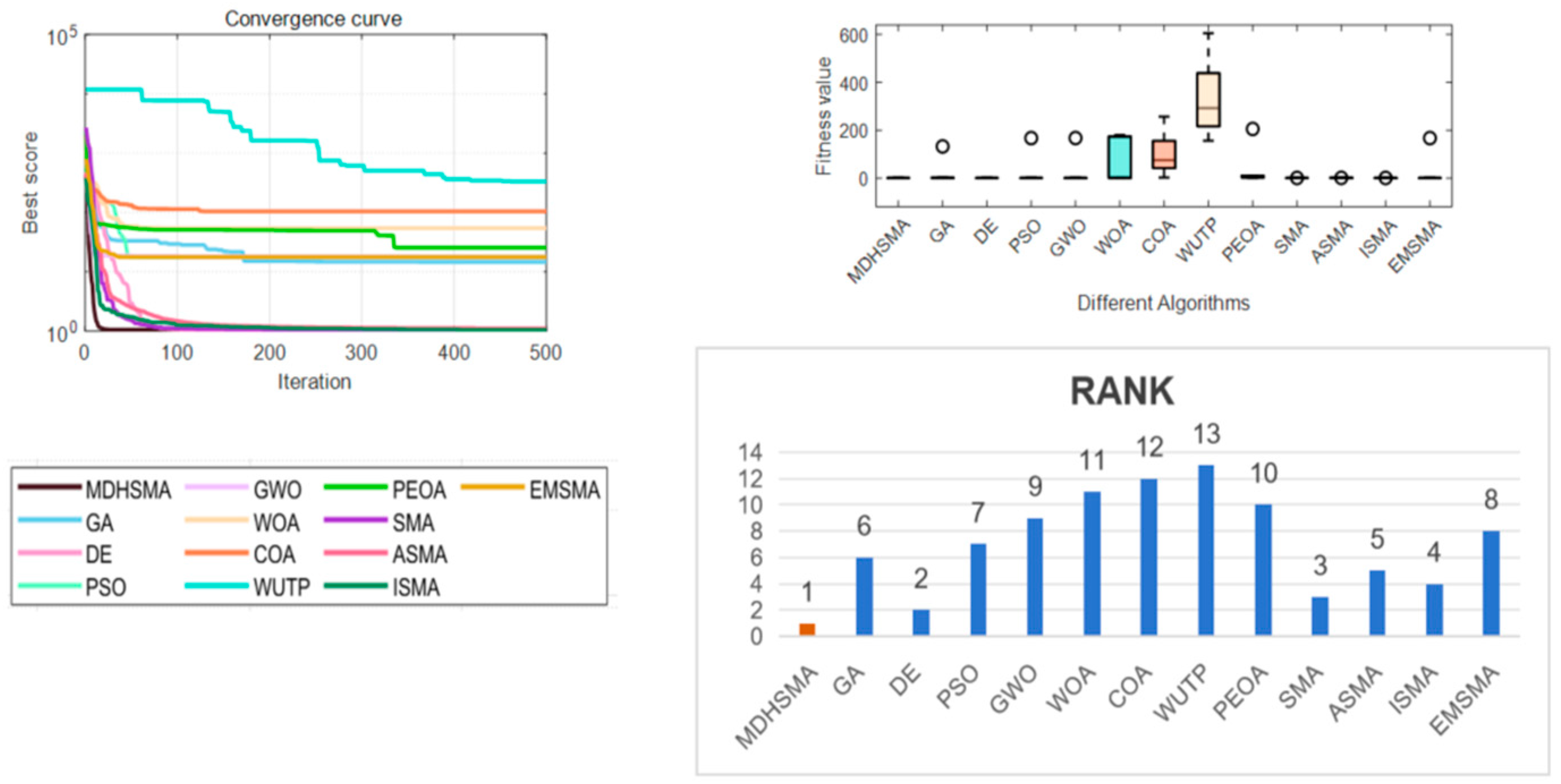
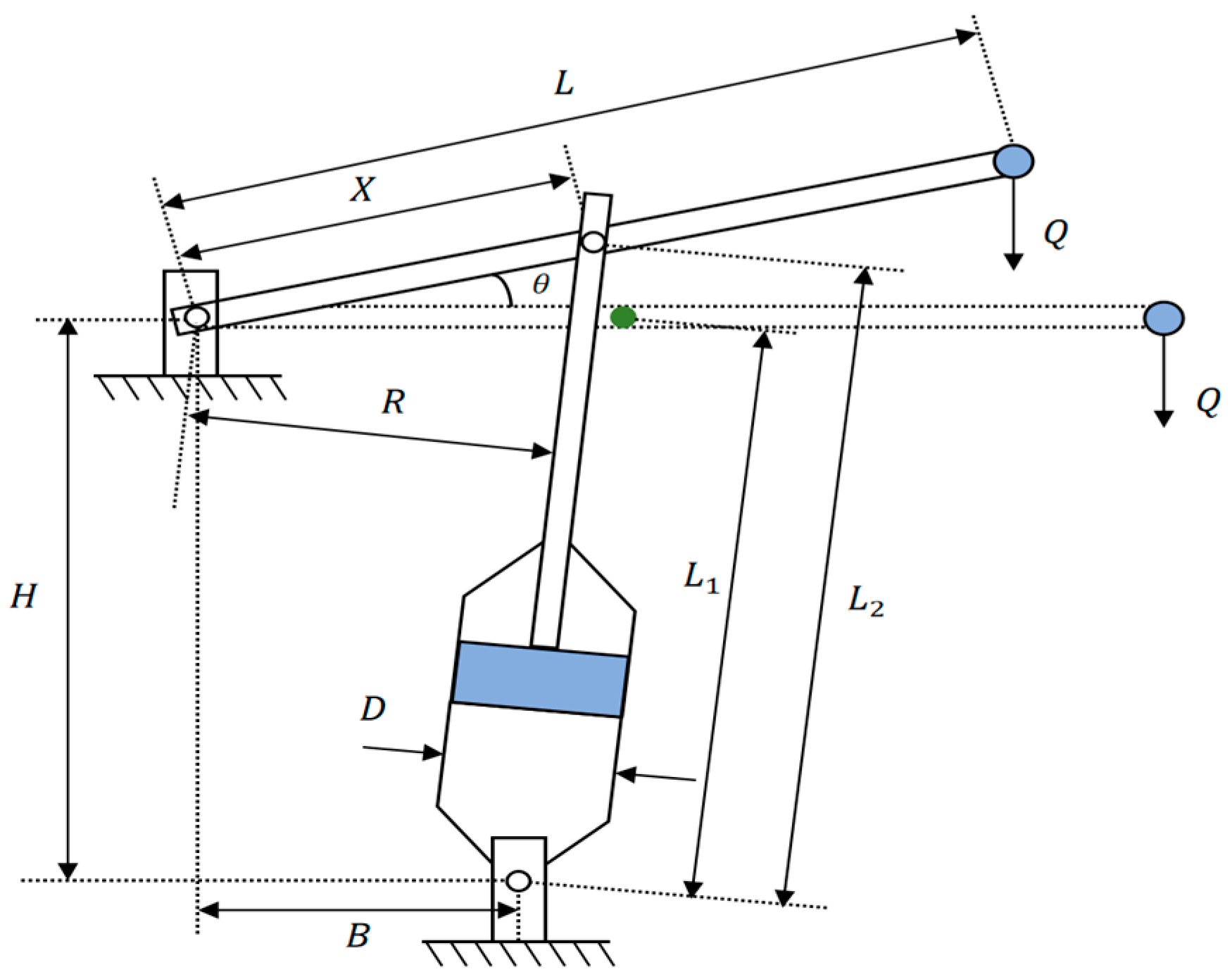
In this subsection, PLDP is adopted as a benchmark example to evaluate the effectiveness of MDHSMA on continuous engineering optimization problems involving nonlinear geometric constraints. The complete mathematical description of the problem can be found in Appendix D.1. The optimization outcomes together with the statistical analysis are listed in Table 6, and the corresponding convergence profiles, box plots, and ranking results are displayed in Figure 14.
The research results show that MDHSMA performs at a leading level on PLDP, together with DE and the standard SMA. Relative to the other SMA variants, MDHSMA shows clear advantages in solution quality and run-to-run stability, while its computational cost remains competitive. Overall, these findings provide further evidence that the proposed algorithm is well suited for solving constrained engineering design problems encountered in practical applications.

5.2. Pressure Vessel Design Problems (PVDP)

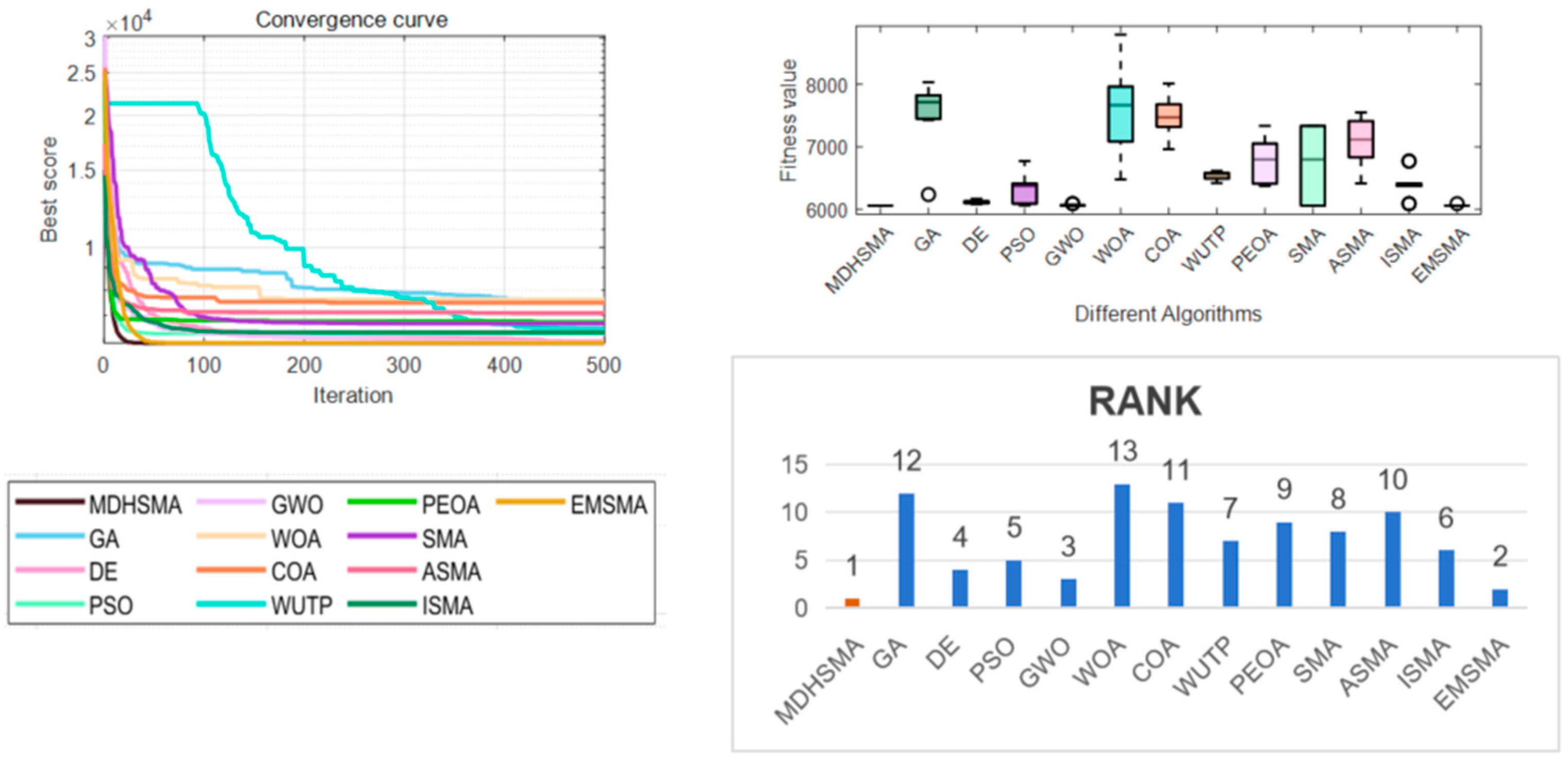
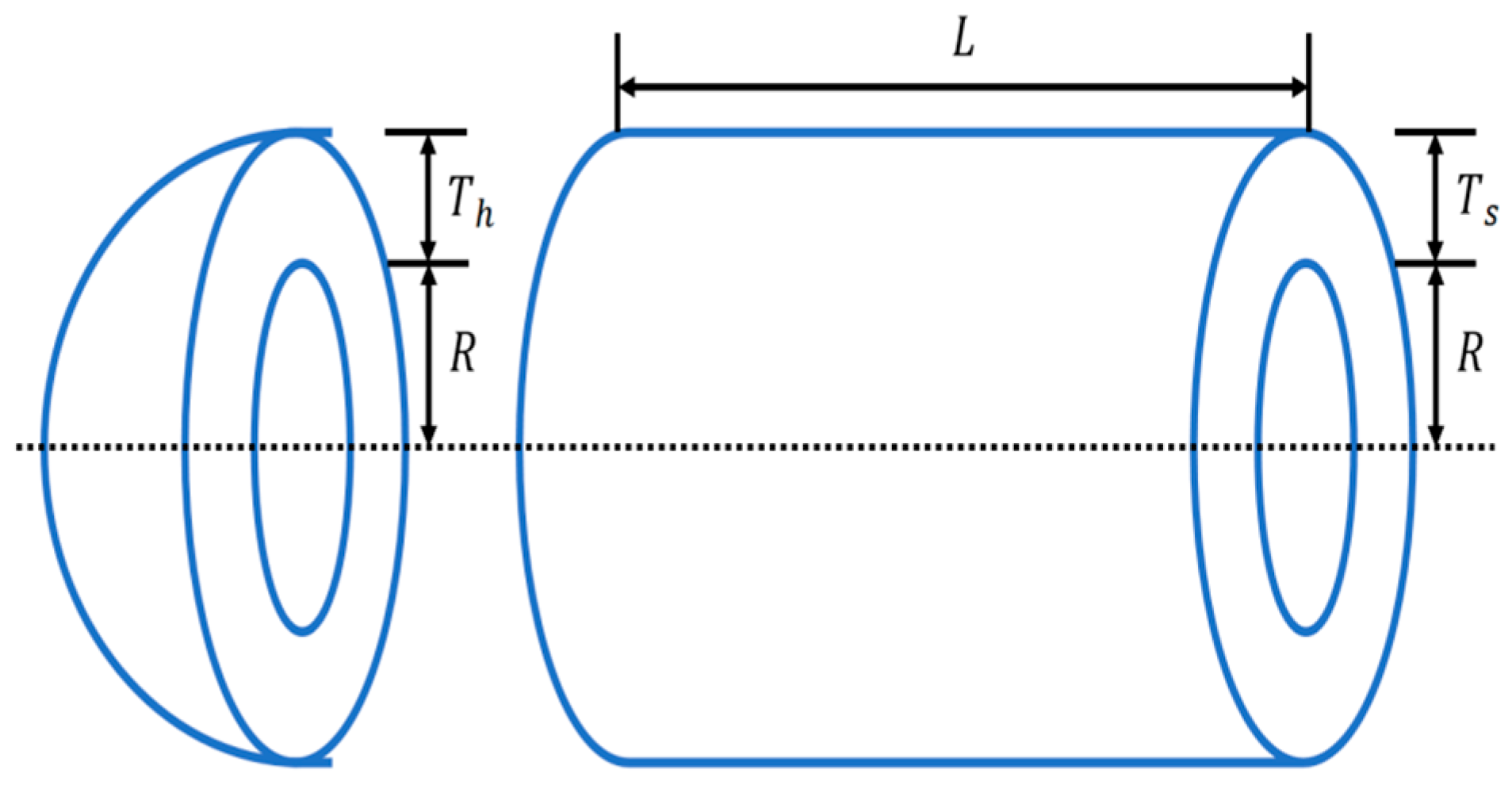
PVDP was selected as a representative mixed-variable engineering optimization case to further investigate the performance of MDHSMA. The objective of this problem is to minimize the overall manufacturing cost while satisfying a series of structural and fabrication-related constraints. A detailed mathematical description of PVDP is provided in Appendix D.2. Table 7 summarizes the optimization results and statistical analysis, whereas Figure 15 presents the corresponding convergence curves, box plots, and ranking results.
According to the overall ranking results, MDHSMA, EMSMA, and GWO are the three best-performing algorithms on this problem. Among them, MDHSMA exhibits the most competitive performance in terms of objective value, solution stability, and convergence characteristics. The box plots show that the solutions obtained by MDHSMA are distributed more compactly and with smaller fluctuations, indicating stronger robustness and better repeatability when handling mixed-variable optimization problems with multiple constraints. In addition, the convergence curves suggest that MDHSMA can locate high-quality feasible solutions within a relatively limited number of iterations and continue improving them during the later search stage, which helps alleviate premature convergence and enhances overall optimization reliability.

6. Application of MDHSMA in Day-Ahead Optimization Scheduling for Microgrids Considering Refined Battery Degradation Models

Owing to the continuous progress in distributed generation and energy storage technologies, microgrids have been widely recognized as an effective means of improving the economic viability and operational flexibility of energy systems [44,45]. Meanwhile, the sustainable grid integration of battery resources, including second-life EV batteries, has also received growing attention due to its benefits for grid flexibility and circular-economy development [46]. Under grid-connected operation, day-ahead scheduling requires the coordinated dispatch of multiple generation units and energy storage devices over a 24 h horizon, while satisfying power balance, unit capacity limits, battery SOC constraints, and grid-interaction constraints [47,48].
However, existing models typically employ simplified descriptions of degradation, making it difficult to accurately reflect the impact of frequent charging and discharging on battery life [49]. To enhance the engineering feasibility and long-term economic viability of the dispatch strategy, this paper introduces a refined battery degradation mechanism into the day-ahead dispatch model. It decomposes lifespan degradation into cycle degradation and calendar degradation, monetizes them as degradation cost terms, and expands the optimization objective from minimizing daily operating costs to minimizing the combined total of operating costs and lifespan degradation [50]. Due to the high-dimensional, non-convex, and strongly coupled nature of this problem, traditional analytical or gradient-based methods struggle to provide effective solutions [51]. Therefore, this paper employs MDHSMA to optimize the model and obtain high-quality day-ahead dispatch plans that satisfy the constraints.

6.1. Development of an Economic Dispatch Model for Microgrids

To overcome the limitations of conventional dispatch models that oversimplify nonlinear battery aging, a refined degradation cost is explicitly embedded into the optimization model. The adopted formulation captures the nonlinear effects of SOC fluctuation depth, charge/discharge rate, average SOC, and time on battery lifetime, thus enabling a more realistic trade-off between operating cost and battery life. Although temperature is also a key aging factor, especially for calendar aging [52], its explicit inclusion would require additional electro-thermal state equations and significantly increase the complexity of the day-ahead scheduling problem [53,54]. Therefore, this work adopts a dispatch-oriented semi-empirical degradation model, in which DOD/SOC/C-rate/time effects are modeled explicitly, while temperature is treated implicitly through the empirical coefficient set [55]. The associated configuration is shown in what follows.
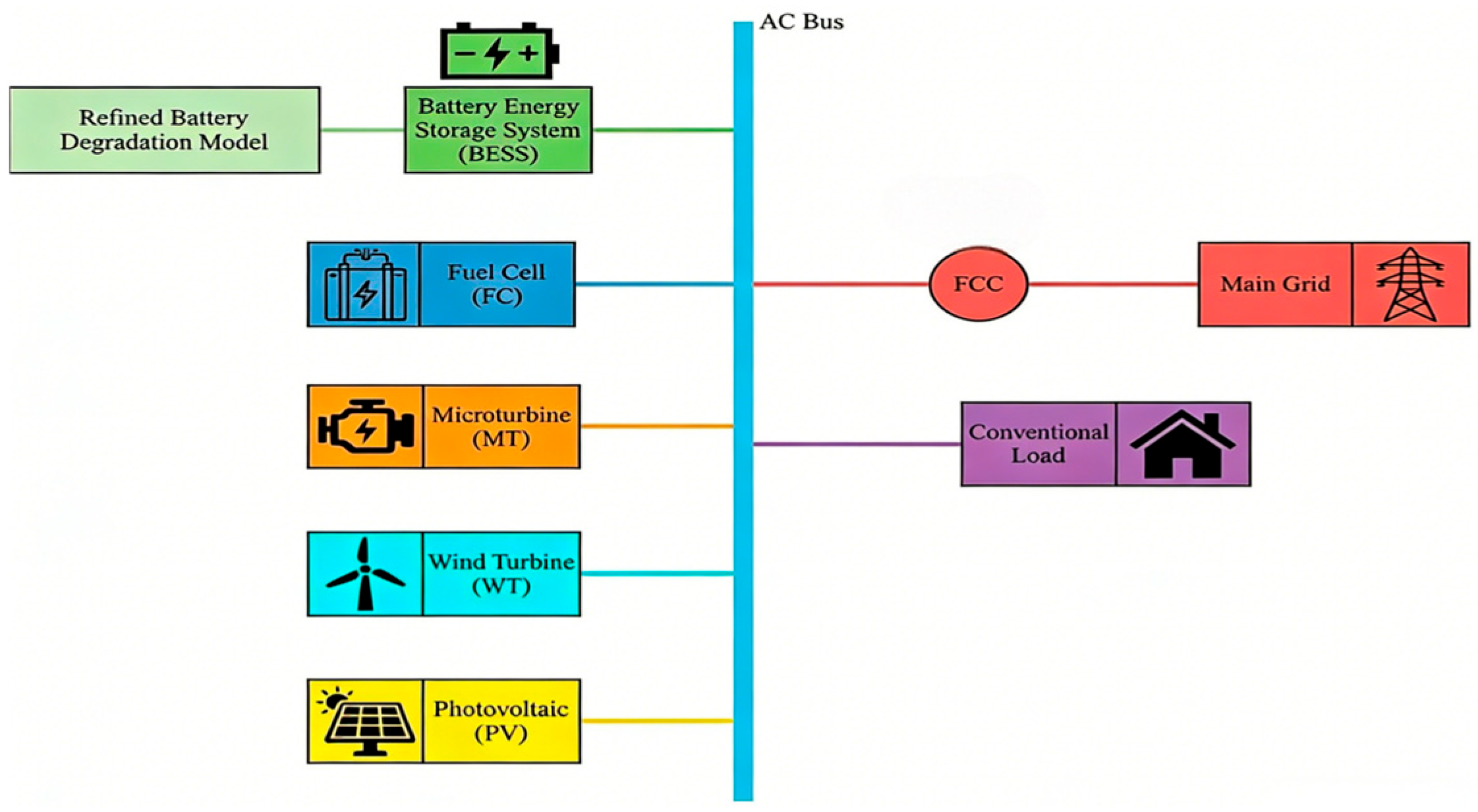
Figure 16 represents the supervisory energy-management architecture of the microgrid, rather than the detailed control topology at the device level. The PV and wind subsystems are assumed to follow conventional local MPPT and converter regulation, and their outputs are thus characterized by forecasted available power profiles in the scheduling model. By contrast, the PEMFC is treated as a dispatchable generation unit, whose active-power reference is issued by the upper-level energy management system and tracked locally within the specified operating limits. Therefore, the main focus of this work is the system-level day-ahead economic dispatch problem.

6.1.1. Objective Function

In this work, day-ahead economic dispatch is investigated by incorporating a refined battery degradation model, and the corresponding optimization objective can be expressed as:
min J = J o p + J d e g + J p e n
(1)
Operating Costs ( J o p )
The total operating cost consists of several components:
J o p = J M T + J F C + J P V + J W T + J e s + J g r i d
The specific calculations are as follows:
① MT/FC power generation and operation & maintenance costs:
J M T = c M T τ = 1 H P M T ( τ ) Δ τ ,           J F C = c F C τ = 1 H P F C ( τ ) Δ τ
where the variables P M T ( τ ) and P F C ( τ ) correspond to the output levels (kW) of the microturbine (MT) and fuel cell (FC) in period τ , respectively, whereas c M T and c F C represent the equivalent unit costs of electricity generation for the two units (CNY/kWh).
② PV/WT operational costs:
J P V = c P V τ = 1 H P ^ P V ( τ ) Δ τ , J W T = c W T τ = 1 H P ^ W T ( τ ) Δ τ
where P ^ P V ( τ ) and P ^ W T ( τ ) are the forecasted available outputs (kW) of photovoltaic generation and wind power, respectively; c P V and c W T denote their unit O&M costs (CNY/kWh).
③ Energy storage throughput operation and maintenance costs:
J e s = c e s τ = 1 H | P e s ( τ ) | Δ τ
Here, P e s ( τ ) represents the energy storage power (kW), where P e s ( τ ) > 0 denotes discharge and P e s ( τ ) < 0 denotes charging; c e s denotes the unit throughput operation and maintenance cost (CNY/kWh).
④ Main grid electricity trading interaction costs:
The purchased power P e x i n ( τ ) and sold power P e x o u t ( τ ) are defined as follows:
P e x i n ( τ ) = max ( P e x ( τ ) , 0 ) P e x o u t ( τ ) = max ( P e x ( τ ) , 0 )
The total daily interaction cost is:
J g r i d = τ = 1 H [ λ b ( τ ) P e x i n ( τ ) λ s ( τ ) P e x o u t ( τ ) ] Δ τ
where λ b ( τ ) and λ s ( τ ) correspond to the electricity buying and selling prices at time interval τ , respectively.
(2)
Refined Battery Degradation Cost ( J d e g )
To better reflect the physical and economic impact of battery aging, the degradation effect is explicitly incorporated into the objective function. Let C r e p denote the battery replacement cost (CNY), and let L d a y represent the normalized daily life loss. Then, the degradation cost is expressed as:
{ J d e g = C r e p L d a y L d a y = L cyc + L cal
Cycle degradation ( L cyc ): Correlated with SOC fluctuation depth and charge/discharge rate.
L c y c = τ = 1 H a c y c | Δ s ( τ ) | α [ 1 + a r r e s ( τ ) β ]
where Δ s ( τ ) = s ( τ ) s ( τ 1 ) , r e s ( τ ) = | P e s ( τ ) | E e s ; E e s is the rated battery capacity; a c y c , α , a r , and β are fitting coefficients; and r e s ( τ ) is the equivalent C-rate used to describe charging/discharging intensity.
Calendar degradation ( L cal ): Correlated with average SOC level and placement time.
L c a l = a c a l exp [ γ ( s ¯ 0.5 ) ] H Δ τ 24 , s ¯ = 1 H + 1 τ = 0 H s ( τ )
where a c a l and γ are the calendar-aging coefficients. This term is used to characterize the cumulative effect of long-term storage and elevated SOC levels on battery lifetime.
(3)
Punishment Cost ( J p e n )
The function is as follows:
J p e n = J s o c p e n + J t e r p e n + J e x p e n + J p k p e n
① Basic operational penalties
{ J s o c p e n = ω s o c τ = 0 H [ max ( 0 , s m i n s ( τ ) ) 2 + max ( 0 , s ( τ ) s m a x ) 2 ] J t e r p e n = ω t e r [ s ( H ) s 0 ] 2 J e x p e n = ω e x τ = 1 H max ( 0 , | P e x ( τ ) | P e x m a x ) 2
② Peak-period soft must-run penalty
To enhance the participation of locally controllable power sources during peak periods while avoiding excessive enforcement that compromises economic efficiency, a “soft lower limit” deviation penalty is introduced for MT/FC during peak hours.
I p k ( τ ) = { 1 , λ b ( τ ) λ t h r 0 , o t h e r w i s e
where λ t h r denotes the peak-period electricity price threshold. Let P M T r e f and P F C r e f denote the expected minimum power output during peak periods. Then the soft must-run penalty term is:
J p k p e n = ω p k Δ τ τ = 1 H I p k ( τ ) [ max ( 0 , P M T r e f P M T ( τ ) ) 2 + max ( 0 , P F C r e f P F C ( τ ) ) 2 ]
where ω p k represents the weighting coefficient; when ω p k assumes a smaller value, this term serves only as a “mild guide,” ensuring that MT/FC contributes a certain baseline output during peak periods without dominating the dispatch solution.

6.1.2. Constraints

(1) Distributed Power Source Output Constraints
{ 0 P M T ( τ ) P M T m a x 0 P F C ( τ ) P F C m a x
(2) Supply–Demand Power Balance Constraint
P ^ P V ( τ ) + P ^ W T ( τ ) + P M T ( τ ) + P F C ( τ ) + P e s ( τ ) + P e x ( τ ) = P L ( τ )
(3) Power Exchange Constraints Between Microgrids and the Main Grid
Due to limitations imposed by PCC transformer capacity or interconnection lines, power exchange must satisfy the following:
P e x m a x P e x ( τ ) P e x m a x
(4) Battery Power and SOC Constraints
The battery energy storage system is constrained by both power limits and SOC state-transition equations:
{ P e s m i n P e s ( τ ) P e s m a x s m i n s ( τ ) s m a x s ( 0 ) = s 0 s ( τ + 1 ) = s ( τ ) + η c P c ( τ ) P d ( τ ) / η d E e s Δ τ
The battery output is decomposed into discharge and charge components, given by P d ( τ ) = max ( P e s ( τ ) , 0 ) and P c ( τ ) = max ( P e s ( τ ) , 0 ) , respectively. In this study, both the charging efficiency and discharging efficiency are taken as 0.95, i.e., η c = η d = 0.95 .

6.2. Microgrid Basic Data

(1)
Table 8 gives the output bounds, generation costs, and maintenance cost parameters of each source.
(2)
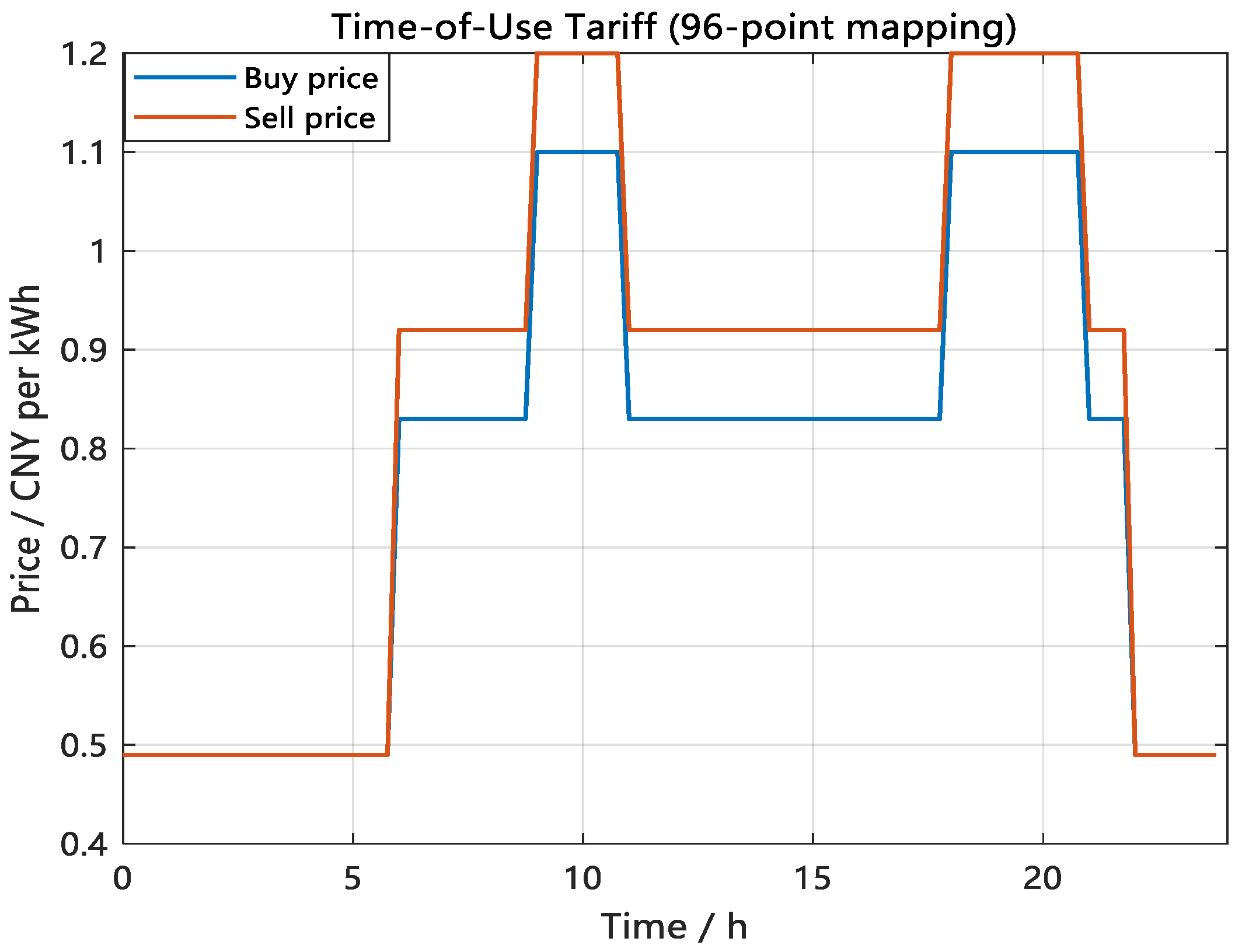
The microgrid exchanges power with the utility grid through the PCC. A positive value of P e x ( τ ) indicates power purchased from the grid, whereas a negative value represents power sold back to the grid. An upper limit for interaction power is set: | P e x ( τ ) | P e x m a x . This example assumes P e x m a x = 200   k W . Table 9 presents the electricity buying price λ b ( τ ) and selling price λ s ( τ ) .
As illustrated in Figure 17.
(3)
Based on the energy storage power boundaries provided in Table 8, to reflect the combined effect of “power-based constraints + energy-based constraints,” the rated energy storage capacity is set to E e s = 80 kWh (corresponding to a 20 kW, 4 h configuration). SOC constraints and efficiency parameters are configured as follows:
Initial SOC: s 0 = 0.50 ;
Upper/Lower Limits: s m i n = 0.20 , s m a x = 0.90 .
(4)
To explicitly incorporate battery lifespan loss into daily scheduling objectives, this paper monetizes battery replacement costs and employs a semi-empirical degradation characterization combining cycle degradation and calendar degradation. The battery replacement unit cost is set to 1200 CNY/kWh, yielding a total replacement cost of C r e p = 1200 × 80 = 96,000 CNY. The cycle-aging term adopts the coefficient set a c y c = 2.5 × 1 0 4 , α = 1.7 , a r = 0.35 , and β = 1.1 , while the calendar-aging term adopts a c a l = 1.2 × 1 0 4 and γ = 3.0 . These coefficients are fixed throughout all simulations and are used consistently in the calculation of L c y c , L c a l , L d a y , and J d e g . The detailed meanings of these parameters are summarized in Table 10 [56,57].

6.3. Simulation Results

To examine the applicability of MDHSMA to day-ahead dispatch problems in microgrids with refined battery degradation models, simulation studies were performed according to the parameter settings given in Table 8. In this study, battery temperature is assumed to remain approximately controlled within a narrow operating range; therefore, its effect is not explicitly modeled as a thermal state, but is implicitly reflected in the adopted empirical degradation coefficients.

6.3.1. Comprehensive Economic Analysis

The total operating cost of the optimal scheduling result is 954.61 CNY. Table 11 details the specific composition of each cost item.
From the cost structure, it is evident that refined degradation costs ( J d e g 190.79 CNY) represent the second-largest expenditure after electricity procurement costs. Traditional linear models often underestimate this component (typically accounting for only 5–10%), leading to dispatch strategies that overuse batteries and result in “hidden losses.” MDHSMA achieves true economic optimization by accurately quantifying this cost and suppressing inefficient deep charge–-discharge cycles.

6.3.2. Optimized Scheduling Strategy and Energy Balance

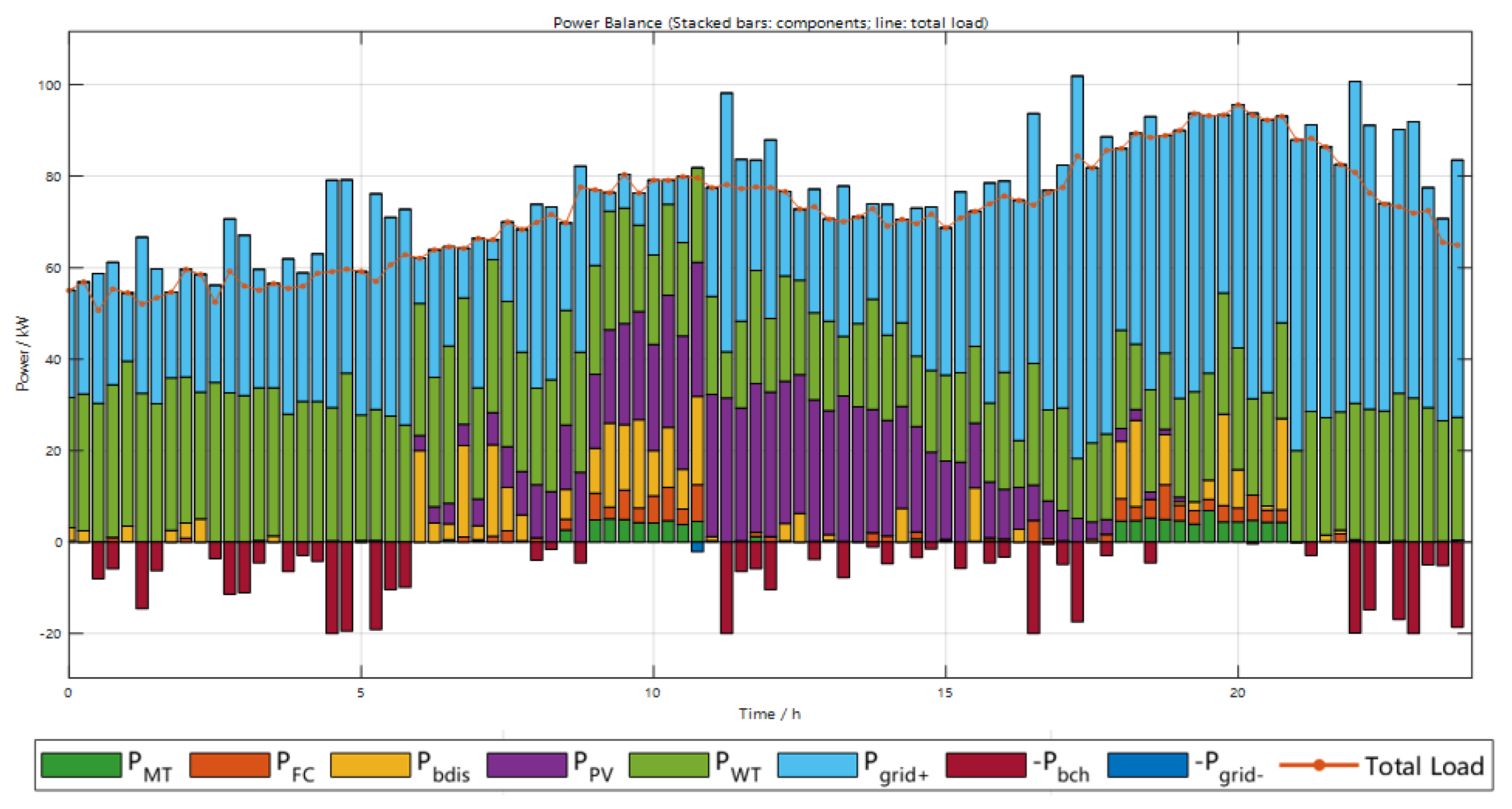
Figure 18 clearly illustrate the “generation-grid-load-storage” coordination mechanism proposed by MDHSMA:
(1)
Regarding renewable energy integration, photovoltaic (yellow area) and wind power (cyan area) are prioritized for full absorption, forming the primary daytime power supply.
(2)
For peak shaving and valley filling: During nighttime off-peak hours (00:00–06:00), low load demand allows grid supply (blue area) to not only meet consumption but also charge storage systems (negative bar column); during the evening peak (18:00–21:00), as PV output declines and load surges, the energy storage system rapidly switches to discharge mode (orange area), significantly reducing costly grid power purchases.
(3)
Regarding precise balancing, across all 96 dispatch points throughout the entire period, the maximum power balance residual was only 7.105 × 10 15 kW, verifying that the algorithm-generated dispatch commands strictly comply with Kirchhoff’s current law.

6.3.3. SOC Evolution and Degradation Characteristics of the BESS

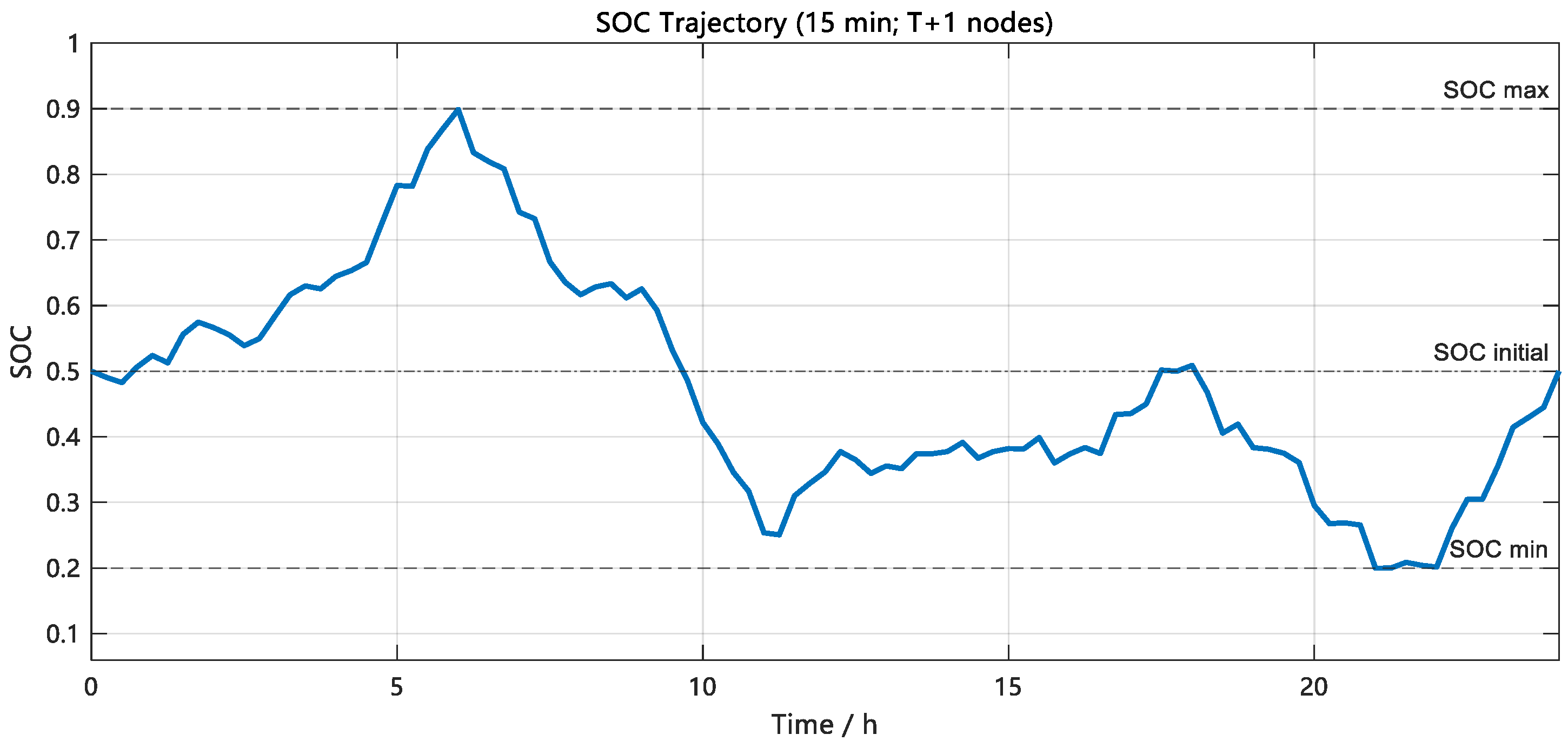
As shown in Figure 19, the BESS SOC consistently satisfies the constraints s m i n = 0.2 and s m a x = 0.90 throughout the entire scheduling cycle and returns to near its initial value by the end of the day, indicating that the generated scheduling strategy demonstrates good constraint satisfaction and cross-day sustainability. The SOC curve reflects obvious temporal operating characteristics. When electricity prices are low or renewable generation is relatively sufficient, the battery energy storage system tends to charge. Conversely, under peak-demand and high-tariff conditions, it enters discharge mode to assist peak regulation and lower grid power purchases. This suggests that the BESS charging/discharging behavior can be well coordinated with load variations, price signals, and renewable power output.
In terms of quantitative metrics, the BESS’s daily throughput was 190.79 kWh, with an intraday DOD of 0.699 and an average SOC of 0.4748; the corresponding cycle degradation, calendar degradation, and total life loss were 6.6938 × 10⁻⁵, 1.1126 × 10⁻⁴, and 1.782 × 10⁻⁴, respectively. Among these, calendar degradation is the dominant factor, indicating that this scheduling strategy does not result in overuse driven by high-frequency deep cycling. Overall, the refined degradation cost term effectively constrains the intensity of energy storage usage, enabling the system to achieve a more reasonable balance between economic efficiency and lifespan loss.

6.3.4. Performance Comparison Analysis

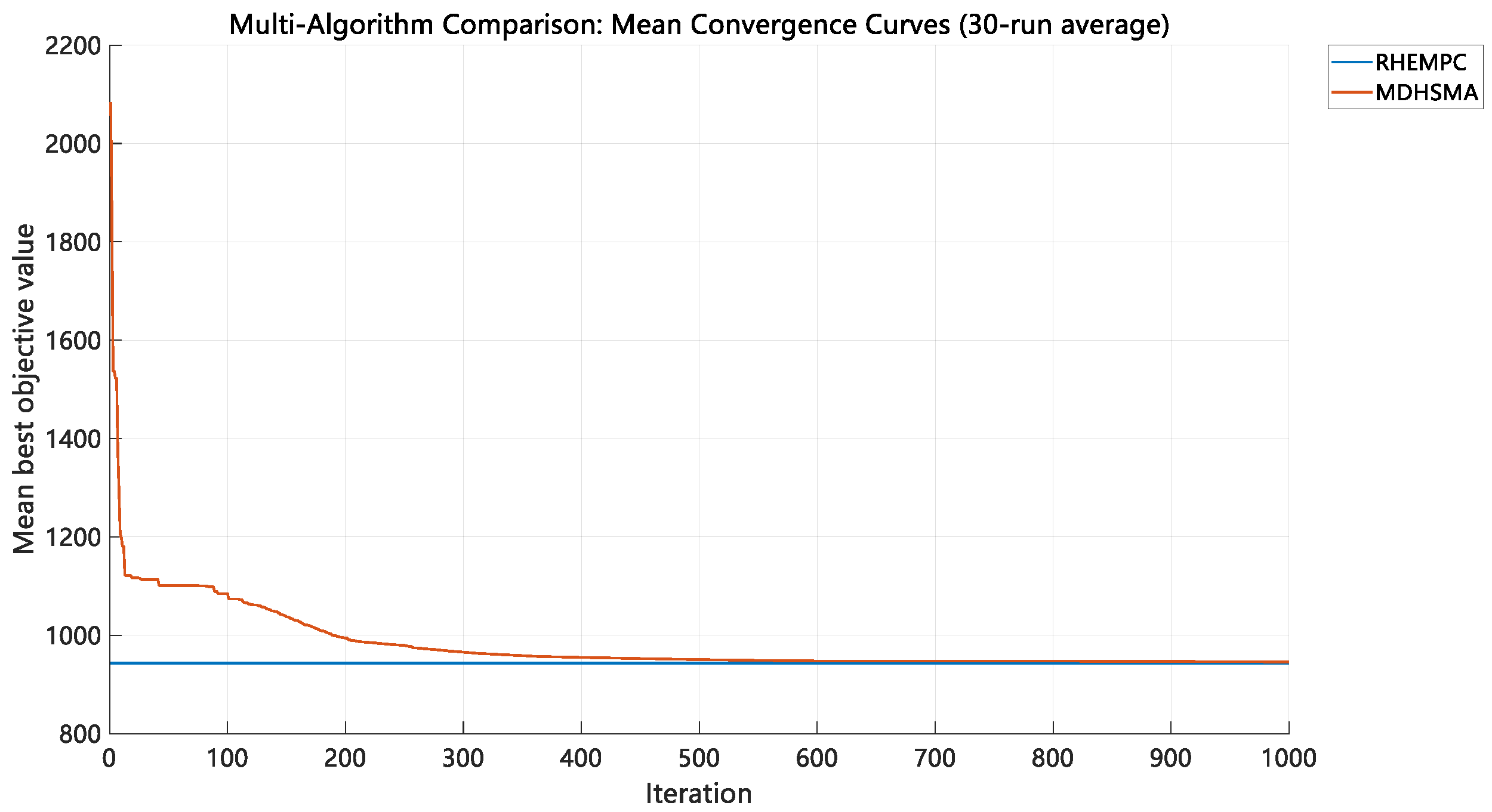
To complement the comparison with meta-heuristic methods, a domain-specific rolling-horizon economic MPC benchmark (RH-EMPC) was further introduced for the microgrid scheduling case. RH-EMPC uses the same scheduling objective, refined battery degradation model, and operational constraints as MDHSMA, while solving the problem in a rolling-horizon framework [58,59]. Based on a sensitivity analysis of the rolling window length, several settings with H { 13 ,   14 ,   15 ,   16 ,   17 } were examined. Among them, H = 16 achieved the best trade-off between total scheduling cost and computational burden, and was therefore selected as the final benchmark configuration. The corresponding reference result is denoted as J r e f = 942.50 . The cost comparison is presented in Figure 20.
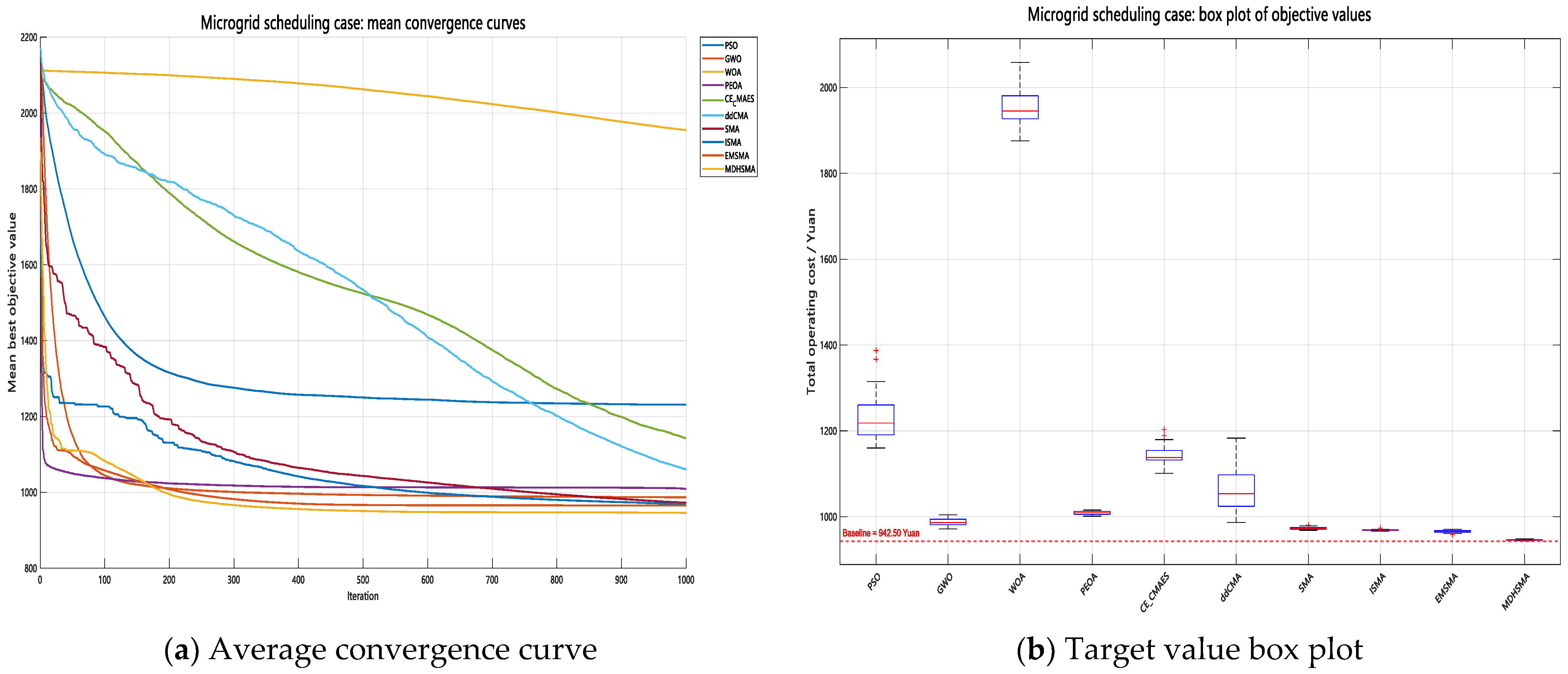
Next, MDHSMA was compared with nine representative meta-heuristic algorithms, including classical methods (GWO, WOA, SMA, and PSO), a recent advanced method (PEOA), improved SMA variants (ISMA and EMSMA), and two improved CMA-ES variants (CE-CMAES [60] and ddCMA [61]). The CMA-ES-based methods were further included because they have been widely used in recent years for microgrid energy dispatch and related non-convex optimization problems.
All algorithms operated under identical experimental conditions: population size N = 100, maximum iteration count T m a x = 1000 , with 30 independent runs to mitigate randomness effects on results.
(1)
Statistical Analysis of Results
Table 12 reports the statistical results of the objective values obtained by each algorithm over 30 independent runs, including the best value, mean, standard deviation, MAE, RMSE, and average runtime. The reference baseline is J r e f = 942.50 CNY, from which both MAE and RMSE are calculated. For the Weighted TOPSIS analysis, the indicator weights were assigned as Mean = 0.65, MAE = 0.20, RMSE = 0.10, Std = 0.04, and Avg. runtime = 0.01, thereby placing greater emphasis on solution quality.
MDHSMA delivered the best overall performance among the 10 comparison algorithms over 30 independent runs. Its best and mean objective values were 944.23 CNY and 945.89 CNY, respectively, all ranking first among the compared methods. MDHSMA also achieved the smallest standard deviation (1.0986), reflecting the highest solution stability. With respect to the reference baseline J r e f , its MAE and RMSE were only 3.394 and 3.5617, respectively, indicating the closest overall agreement with the baseline result. Compared with EMSMA, the second-best method, MDHSMA reduced the average operating cost by 19.77 CNY, from 965.66 CNY to 945.89 CNY. In addition, its best solution was only 1.7286 CNY above the reference baseline, which further supports its effectiveness under the refined nonlinear scheduling model.
According to Table 13, MDHSMA significantly outperformed all other algorithms in pairwise comparisons ( p c o r r e c t e d < 0.05 ). Moreover, the weighted TOPSIS results ranked MDHSMA first, indicating the best overall balance among cost, error, stability, and runtime. These findings consistently support the superiority of MDHSMA in the studied microgrid scheduling problem.
(2)
Analysis of Convergence Behavior and Distribution Characteristics
As shown by the average convergence curves in Figure 21, MDHSMA quickly reaches promising regions in the early stage and continues to improve steadily afterward, finally converging to the lowest cost among all compared algorithms. The box plots also show the lowest and most concentrated distribution for MDHSMA, indicating superior solution quality, reproducibility, and robustness.
These results confirm that the proposed hybrid strategy effectively improves the search performance of the algorithm on complex cost functions. Specifically, CBLHSM enhances the spatial coverage of the initial population, HADE strengthens the balance between exploration and exploitation during the search, and SAS improves stagnation escape and late-stage local refinement. Although these mechanisms do not change the mathematical form of the scheduling objective, they significantly improve search efficiency over the non-convex landscape formed by grid trading cost, distributed generation cost, and battery degradation cost, thereby leading to better scheduling results. Overall, the proposed method shows clear advantages in economic performance, robustness, and engineering applicability.

6.3.5. Robustness Validation Under Forecast Uncertainty

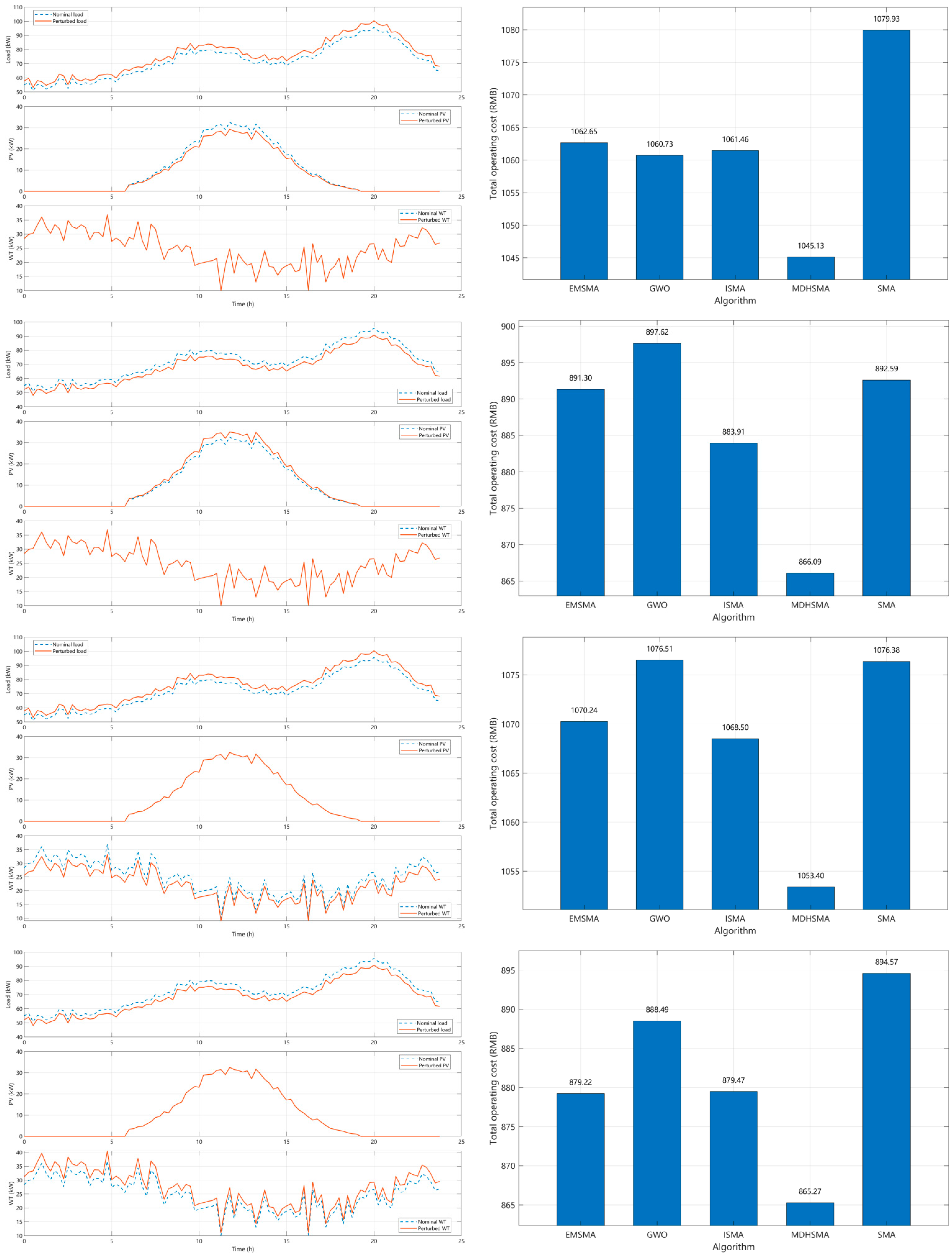
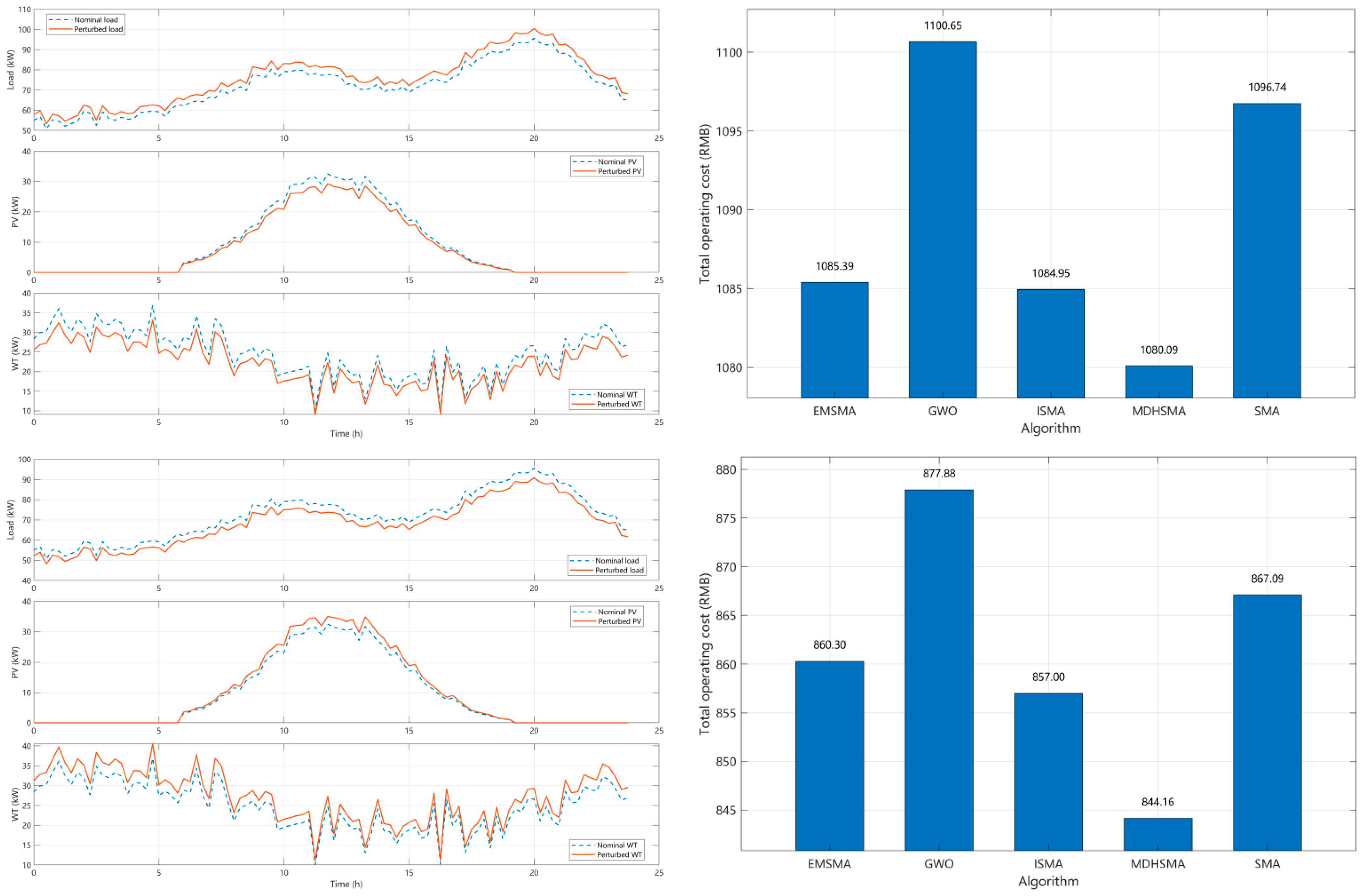
To reflect the mismatch between renewable generation and load forecasts in practical microgrid operation, this paper further evaluates dispatch robustness under forecast uncertainty based on the deterministic day-ahead case. Instead of using a single forecast profile, six fixed- error scenarios with clear physical interpretations are constructed to represent typical adverse and favorable conditions. The forecast deviations of PV and wind power are set to ±10%, and the load deviation is set to ±5%. Accordingly, six scenarios are considered: S1 (Low PV + High Load), S2 (High PV + Low Load), S3 (Low WT + High Load), S4 (High WT + Low Load), S5 (Low PV + Low WT + High Load), and S6 (High PV + High WT + Low Load). Their definitions are given in Table 14, and the corresponding disturbance curves and cost results are shown in Figure 22.
From an economic perspective, MDHSMA showed the strongest robustness under all uncertainty scenarios, achieving the lowest average total cost of 959.02 yuan and ranking first overall (AvgRank = 1). Even in the harshest case, S5, its total cost was limited to 1080.09 yuan, which was lower than that of SMA (1096.74 yuan) and GWO (1100.65 yuan). In the favorable scenario S6, the cost further decreased to 844.16 yuan, demonstrating strong adaptability across different operating conditions.
In summary, MDHSMA remained superior in both average and scenario-specific cost performance, suggesting that it can balance economic efficiency, battery degradation considerations, and dispatch feasibility under forecast uncertainty. This further supports its practical value beyond deterministic day-ahead scheduling.

7. Conclusions

This paper proposes a multi-strategy differential hybrid slime mold algorithm (MDHSMA) to address high-dimensional, multi-modal optimization problems with complex constraints. The proposed method is employed for the day-ahead optimal scheduling of microgrids considering a refined battery degradation model. Addressing the limitations of the standard SMA algorithm—its tendency to get stuck in local optima and insufficient exploration capability in complex search spaces—MDHSMA incorporates chaotic bimodal Latin hypercube sampling (CBLHSM) to enhance population diversity and exploration, integrates adaptive differential evolution strategies to improve fine-tuning capabilities during plateaus, and designs diversity-monitored low-frequency restart mechanisms with reverse learning strategies. This establishes a robust global optimization framework.
The experimental results obtained from the CEC2017 and CEC2022 benchmark functions, as well as two typical constrained engineering optimization problems, verify that MDHSMA possesses strong competitive performance with respect to convergence precision, stability, and robustness. Statistical results from the Friedman test and the Mann–-Whitney U test further confirm that MDHSMA possesses a significant competitive advantage when handling different types of topographic features and is capable of effectively balancing global search and local exploration.
In terms of engineering applications, this paper constructs a day-ahead optimization scheduling model for microgrids that accounts for both cyclic and calendar degradation, and monetizes battery life loss as a degradation cost term, thereby expanding the optimization objective from minimizing single-day operating costs to minimizing the combined total of operating costs and life loss. Simulation results demonstrate that the MDHSMA method can yield high-quality scheduling solutions in this high-dimensional, non-convex, and strongly coupled scenario. It reduces system operating costs while suppressing excessive charging and discharging of energy storage devices, thereby achieving coordinated optimization among economic efficiency, operational reliability, and equipment lifespan.
Although the proposed method has been further validated through multi-scenario robustness analysis, the current framework remains centered on day-ahead dispatch and has not yet been extended to more dynamic operating conditions. Future work may extend MDHSMA to real-time and rolling scheduling by incorporating model predictive control, robust optimization, or receding-horizon strategies, and further assess its performance in more complex source–-grid–-load–-storage coordination scenarios. In addition, because temperature effects are only treated implicitly in the current study, explicit battery temperature dynamics and electro-thermal coupled aging models could be incorporated to improve the physical fidelity of degradation-aware dispatch. The effects of reactive power injection, voltage regulation requirements, and apparent-power limits of interfaced units should also be considered to further enhance the engineering realism and applicability of the proposed method.


Author Contributions

Conceptualization, X.L. and M.D.; methodology, X.L. and X.S.; software, X.L.; validation, X.L. and X.S.; formal analysis, Y.L.; investigation, M.D. and Y.L.; resources, X.L. and Y.L.; data curation, X.S.; writing—original draft preparation, X.L.; writing—review and editing, X.L. and X.S.; visualization, X.L.; supervision, X.S.; project administration, X.L. and X.S. All authors have read and agreed to the published version of the manuscript.

Funding

No external funding was provided for the conduct or publication of this research.

Data Availability Statement

All data supporting the findings of this work are available from the corresponding authors upon reasonable request. Access will be granted following a reasonable period to ensure appropriate use and compliance with institutional policies.

Acknowledgments

The authors would like to express their sincere appreciation to all colleagues and collaborators who provided valuable suggestions, constructive discussions, and technical assistance throughout the course of this study.

Conflicts of Interest

The authors confirm that there are no financial or personal conflicts of interest associated with this research.

Appendix A. CEC2017 Comparative Experiment Results

Table A1, Table A2, Table A3 and Table A4 summarize the experimental results across all dimensions of CEC2017.
Table A1. Detailed results of optimizers in 10-D CEC2017.
GADEPSOGWOWOACOAWUTPPEOASMAASMAISMAEMSMAMDHSMA
F1std1.3606E+042.0154E+032.0918E+037.7081E+074.5778E+052.4216E+093.2174E+032.6331E+034.5189E+035.9808E+073.1428E+031.0971E+030.0000E+00
mean8.0437E+03+2.3156E+03+2.0944E+03+1.7808E+07+2.1777E+05+4.6251E+09+1.0795E+04+2.6306E+03+7.8322E+03+1.3385E+07+2.8010E+03+5.7120E+02+1.0000E+02
F3std1.6457E+049.1967E+023.1943E−141.1385E+032.5733E+022.1872E+032.2345E+029.0307E−084.0801E−041.3834E+034.6913E−047.1117E−130.0000E+00
mean3.7826E+04+2.7659E+03+3.0000E+02+9.5510E+02+5.7015E+02+8.5263E+03+7.6647E+02+3.0000E+02+3.0000E+02+2.7386E+03+3.0000E+02+3.0000E+02+3.0000E+02
F4std3.1245E+003.4465E−011.1813E+018.8085E+001.7745E+011.8317E+021.1612E−012.9422E+002.6323E+012.2322E+019.4753E−011.0886E+000.0000E+00
mean4.1176E+02+4.0612E+02+4.0770E+02+4.0943E+02+4.1255E+02+7.3866E+02+4.0342E+02+4.0428E+02+4.1573E+02+4.2729E+02+4.0324E+02+4.0432E+02+4.0000E+02
F5std1.4272E+011.6607E+005.8925E+006.8117E+001.5969E+011.4154E+013.6456E+008.9448E+003.1557E+008.3489E+002.7125E+002.8922E+008.2142E−01
mean5.6141E+02+5.1078E+02+5.1803E+02+5.1469E+02+5.4922E+02+5.6981E+02+5.2845E+02+5.2495E+02+5.1219E+02+5.1712E+02+5.0975E+02+5.0831E+02+5.0144E+02
F6std6.3327E+001.0433E−131.2820E+004.0494E−011.3722E+019.1969E+005.8380E−072.3579E+002.9574E−023.6196E−012.9605E−024.0830E−050.0000E+00
mean6.4658E+02+6.0000E+02+6.0102E+02+6.0028E+02+6.3222E+02+6.3350E+02+6.0000E+02+6.0505E+02+6.0005E+02+6.0022E+02+6.0007E+02+6.0000E+02+6.0000E+02
F7std9.5323E+002.3119E+004.6664E+007.2916E+002.3011E+012.1308E+012.9652E+009.2958E+007.3096E+001.1490E+015.0895E+002.3185E+007.6580E−01
mean7.6976E+02+7.2203E+02+7.2191E+02+7.2487E+02+7.7698E+02+7.7782E+02+7.3834E+02+7.3328E+02+7.2221E+02+7.3831E+02+7.2116E+02+7.1609E+02+7.1205E+02
F8std7.4824E+002.0698E+008.0851E+003.9368E+001.2781E+018.5996E+003.1937E+006.5039E+004.9745E+004.3345E+003.8209E+003.6105E+007.9728E−01
mean8.5875E+02+8.1065E+02+8.1556E+02+8.1198E+02+8.3700E+02+8.4501E+02+8.2729E+02+8.1663E+02+8.1497E+02+8.1602E+02+8.0925E+02+8.0826E+02+8.0169E+02
F9std3.6976E+000.0000E+002.6248E−019.9321E+003.4230E+021.2549E+020.0000E+007.4605E+006.6739E−042.4164E+014.2274E−042.3886E−050.0000E+00
mean9.1020E+02+9.0000E+02≈9.0013E+02+9.0271E+02+1.4240E+03+1.1860E+03+9.0000E+02≈9.0319E+02+9.0000E+02+9.4695E+02+9.0000E+02+9.0000E+02+9.0000E+02
F10std2.3666E+021.1037E+022.6202E+022.8404E+022.9843E+021.7861E+021.8671E+023.1894E+022.0921E+021.9812E+022.0270E+021.6610E+021.5587E+02
mean1.8026E+03+1.5135E+03+1.8125E+03+1.4781E+03+1.9050E+03+2.2656E+03+1.6275E+03+1.7057E+03+1.5487E+03+1.5046E+03+1.4604E+03+1.4578E+03+1.2652E+03
F11std1.4442E+037.7125E−012.4432E+017.4486E+007.1329E+013.1926E+027.9947E−011.7932E+015.2009E+009.1874E+002.2516E+001.2367E+002.1260E−01
mean2.1435E+03+1.1032E+03+1.1282E+03+1.1175E+03+1.1940E+03+1.4926E+03+1.1069E+03+1.1352E+03+1.1094E+03+1.1171E+03+1.1046E+03+1.1018E+03+1.1001E+03
F12std2.9811E+061.3605E+051.4206E+046.5985E+054.8736E+065.4286E+072.5528E+039.5258E+032.5067E+046.4333E+051.7662E+041.8883E+026.2664E+01
mean3.4982E+06+2.4909E+05+1.6610E+04+4.8181E+05+3.8090E+06+4.7370E+07+5.6738E+04+1.3123E+04+3.7671E+04+3.5465E+05+2.1744E+04+1.5036E+03+1.2527E+03
F13std1.0158E+047.4959E+026.3005E+036.4849E+031.1568E+043.7151E+037.4657E−014.7551E+031.3192E+047.9832E+034.7387E+035.4959E+001.4107E+00
mean1.3318E+04+2.4858E+03+9.0517E+03+1.1766E+04+2.0182E+04+5.5676E+03+2.3110E+03+7.4204E+03+1.7627E+04+1.1065E+04+4.9639E+03+1.3069E+03+1.3046E+03
F14std7.1004E+031.5925E+011.3499E+021.8119E+035.1561E+011.7925E+019.3420E+012.6532E+011.0795E+013.1710E+021.1092E+014.6954E+006.8094E−01
mean7.4285E+03+1.4265E+03+1.5262E+03+2.9182E+03+1.5322E+03+1.4994E+03+1.5427E+03+1.4646E+03+1.4345E+03+1.7574E+03+1.4155E+03+1.4035E+03+1.4003E+03
F15std2.6471E+043.8964E+014.3519E+021.3764E+032.2159E+031.7777E+038.5241E+024.3372E+019.8029E+012.2508E+034.7862E+004.4203E+001.9146E−01
mean1.4892E+04+1.5385E+03+1.7197E+03+2.4879E+03+3.8332E+03+3.6911E+03+2.9306E+03+1.5847E+03+1.5660E+03+2.7712E+03+1.5071E+03+1.5032E+03+1.5002E+03
F16std9.3001E+011.4445E+001.3738E+026.3872E+011.1916E+029.9614E+011.2231E−015.4120E+011.1218E+028.4916E+011.1450E+014.5164E+014.4839E+00
mean1.7117E+03+1.6033E+03+1.7613E+03+1.6686E+03+1.8166E+03+1.9139E+03+1.6117E+03+1.6449E+03+1.7081E+03+1.7040E+03+1.6084E+03+1.6311E+03+1.6025E+03
F17std2.5553E+011.2684E+003.6342E+011.2145E+013.2668E+012.1932E+012.0369E+001.3435E+012.2338E+011.5878E+019.7832E+001.1114E+011.8556E−01
mean1.7582E+03+1.7036E+03+1.7552E+03+1.7433E+03+1.7835E+03+1.7865E+03+1.7464E+03+1.7488E+03+1.7372E+03+1.7402E+03+1.7229E+03+1.7258E+03+1.7002E+03
F18std1.0299E+046.3482E+021.1595E+041.3733E+049.7096E+033.5803E+038.7264E+038.7702E+031.3137E+041.0981E+046.6402E+031.1561E+012.1368E−01
mean1.1803E+04+2.6631E+03+1.1686E+04+3.0274E+04+1.5843E+04+5.6516E+03+3.0248E+04+1.2500E+04+2.2086E+04+1.3126E+04+7.5340E+03+1.8129E+03+1.8003E+03
F19std6.0174E+033.4663E+011.2125E+035.4699E+031.5134E+041.7917E+037.5285E+032.0874E+011.7355E+033.0555E+031.4612E+002.2579E+001.0263E−02
mean6.4686E+03+1.9350E+03+2.7567E+03+5.4198E+03+2.0521E+04+2.9853E+03+2.2744E+04+1.9316E+03+2.7156E+03+4.0842E+03+1.9035E+03+1.9011E+03+1.9000E+03
F20std6.9947E+010.0000E+006.3586E+013.9272E+014.4133E+013.8343E+011.3353E+011.2176E+011.0094E+011.3106E+017.7069E+009.8003E+001.5691E−01
mean2.1722E+03+2.0000E+03−2.0751E+03+2.0539E+03+2.1334E+03+2.1298E+03+2.0320E+03+2.0439E+03+2.0203E+03+2.0290E+03+2.0218E+03+2.0129E+03+2.0001E+03
F21std4.2637E+012.7652E+015.5694E+017.9302E+006.4480E+015.2031E+016.3590E+018.4382E−015.9279E+013.6166E+011.1499E+005.3427E+015.1915E+01
mean2.3313E+03+2.2457E+03≈2.2933E+03+2.3149E+03+2.3087E+03+2.3221E+03+2.2730E+03+2.2003E+03≈2.2733E+03+2.2319E+03≈2.2007E+03≈2.2713E+03+2.2689E+03
F22std1.8663E+015.6080E+002.7249E+012.9400E+002.1851E+012.4104E+021.2539E+003.3840E+019.9882E−011.5621E+018.9738E−012.0932E−016.4036E−02
mean2.3490E+03+2.2994E+03−2.2971E+03−2.3056E+03+2.3112E+03+2.6549E+03+2.3028E+03+2.2890E+03−2.3029E+03+2.3001E+03+2.3027E+03+2.3001E+03+2.3000E+03
F23std8.2354E+001.9958E+001.1749E+018.4561E+001.3829E+011.6566E+015.0153E+007.3080E+016.5941E+005.2845E+005.5640E+003.2877E+002.3581E+00
mean2.6723E+03+2.6133E+03+2.6276E+03+2.6146E+03+2.6412E+03+2.6771E+03+2.6194E+03+2.6086E+03+2.6179E+03+2.6159E+03+2.6135E+03+2.6093E+03+2.6045E+03
F24std3.9580E+014.9735E+011.0210E+025.5110E+011.0824E+026.7568E+014.0004E+002.0779E+018.0201E+001.1848E+027.3757E+011.1289E+021.1004E+02
mean2.8039E+03+2.7027E+03≈2.7064E+03+2.7295E+03+2.7331E+03+2.7943E+03+2.7579E+03+2.4957E+03−2.7552E+03+2.6359E+03≈2.5240E+03≈2.6680E+03+2.6638E+03
F25std1.1045E+015.0376E+002.3231E+011.6487E+012.9863E+011.3184E+022.4037E+012.2639E+012.4950E+012.6247E+012.2893E+012.2762E+012.3266E+01
mean2.9706E+03+2.9065E+03≈2.9227E+03≈2.9335E+03+2.9441E+03+3.2010E+03+2.9173E+03≈2.9263E+03≈2.9251E+03−2.9260E+03≈2.9283E+03≈2.9284E+03≈2.9257E+03
F26std4.3057E+023.2810E+017.2075E+012.2763E+022.5068E+023.6257E+023.8455E+029.5576E+013.2334E+017.0004E+012.2670E+012.0803E+020.0000E+00
mean3.2450E+03+2.9306E+03+2.9057E+03+2.9668E+03+3.1835E+03+3.7081E+03+3.0955E+03+2.8754E+03−2.9514E+03+2.9872E+03+2.9089E+03+2.9538E+03+2.9000E+03
F27std2.2611E+012.5249E−013.1835E+015.9948E+002.1018E+012.0557E+013.8819E−012.9653E+001.4695E+001.0034E+012.1441E+001.1228E+017.6901E−02
mean3.1661E+03+3.0895E+03≈3.1170E+03+3.0948E+03+3.1127E+03+3.1473E+03+3.0897E+03+3.0948E+03+3.0907E+03+3.1030E+03+3.0904E+03+3.0921E+03+3.0895E+03
F28std3.7650E+015.8827E+011.4065E+021.0989E+021.3355E+021.1730E+021.0496E+027.1752E+011.2725E+025.0281E+011.0631E+021.5086E+021.4289E+02
mean3.2510E+03+3.2263E+03+3.2848E+03+3.3234E+03+3.3405E+03+3.6426E+03+3.3693E+03+3.1013E+03≈3.1955E+03−3.1781E+03≈3.1159E+03≈3.2268E+03+3.1970E+03
F29std3.1520E+017.1614E+004.6067E+012.9143E+018.3959E+016.0317E+015.8570E+002.8168E+013.6671E+012.7445E+011.5484E+019.1567E+002.2474E+00
mean3.2503E+03+3.1647E+03+3.2025E+03+3.1687E+03+3.2960E+03+3.3007E+03+3.1574E+03+3.2018E+03+3.1708E+03+3.1876E+03+3.1562E+03+3.1392E+03+3.1311E+03
F30std6.8669E+058.2429E+035.3823E+056.2569E+059.9427E+051.5246E+062.0932E+053.8631E+051.8207E+051.9429E+052.5668E+054.6591E+052.5151E+05
mean5.7533E+05+2.0112E+04−3.3338E+05+4.9703E+05+5.2215E+05+2.0081E+06+3.5791E+05+1.9414E+05+4.7969E+04+1.9567E+05+8.8409E+04+2.9181E+05+8.5146E+04
+/≈/−29/0/021/5/327/1/129/0/029/0/029/0/027/2/024/2/327/0/225/4/025/4/028/1/0
Avg rank11.384.007.248.5511.0011.667.525.836.557.664.033.791.79
Table A2. Detailed results of optimizers in 30-D CEC2017.
GADEPSOGWOWOACOAWUTPPEOASMAASMAISMAEMSMAMDHSMA
F1std1.1741E+072.7091E+047.9757E+086.1131E+088.7402E+077.7960E+095.5904E+034.1713E+036.8588E+032.2030E+096.3464E+032.1208E+051.4123E−07
mean1.8127E+07+7.1782E+04+5.8860E+08+7.1407E+08+1.0262E+08+4.7387E+10+4.3476E+03+2.9952E+03+7.6533E+03+6.3136E+09+5.3064E+03+2.9586E+05+1.0000E+02
F3std4.9611E+041.3929E+043.4975E+038.1129E+036.7163E+048.8830E+032.1539E+046.2691E−042.0981E+017.4244E+036.0546E−021.3488E+023.8457E−04
mean2.3358E+05+1.3567E+05+4.4360E+03+3.3720E+04+2.0178E+05+7.8580E+04+1.2098E+05+3.0000E+02+3.1854E+02+7.2773E+04+3.0017E+02+4.7404E+02+3.0000E+02
F4std5.6581E+012.7361E+002.6690E+013.3301E+015.1453E+012.6993E+038.9743E−012.6169E+011.5468E+017.6764E+021.6875E+011.6763E+015.9551E+00
mean6.6438E+02+4.9679E+02+5.2199E+02+5.4678E+02+6.0158E+02+1.1381E+04+4.8997E+02+5.0958E+02+4.9592E+02+1.3777E+03+4.9403E+02≈5.0590E+02+4.8801E+02
F5std2.5194E+011.0675E+013.0795E+013.5144E+014.9342E+013.5265E+011.1990E+013.1383E+012.4677E+012.3042E+012.0764E+011.3239E+016.7455E+00
mean7.9884E+02+6.6926E+02+6.2374E+02+6.0462E+02+7.9024E+02+8.7544E+02+6.8368E+02+6.6529E+02+5.9206E+02+6.1511E+02+5.7522E+02+5.5102E+02+5.1886E+02
F6std9.2251E+001.5881E−031.0483E+012.0581E+001.1555E+017.2786E+005.6143E−036.9924E+001.0037E+004.0974E+001.0676E+003.1885E−017.5090E−12
mean6.9537E+02+6.0001E+02+6.2691E+02+6.0483E+02+6.6786E+02+6.7613E+02+6.0002E+02+6.4470E+02+6.0203E+02+6.0609E+02+6.0213E+02+6.0088E+02+6.0000E+02
F7std6.2622E+019.0632E+003.8546E+014.7982E+019.4223E+014.4340E+019.0596E+005.1277E+012.5923E+014.3486E+012.1169E+011.4559E+013.8174E+00
mean1.1091E+03+9.0477E+02+8.5298E+02+8.5610E+02+1.2664E+03+1.3704E+03+9.1764E+02+1.0040E+03+8.2536E+02+9.8809E+02+8.2981E+02+7.8751E+02+7.5091E+02
F8std3.1864E+018.8013E+002.2101E+012.1156E+015.1294E+013.1194E+019.4767E+002.0511E+011.8145E+011.4725E+012.0547E+011.3658E+015.9843E+00
mean1.1023E+03+9.7529E+02+8.9762E+02+8.8068E+02+1.0174E+03+1.1039E+03+9.8627E+02+9.3502E+02+8.9440E+02+9.1453E+02+8.8204E+02+8.5664E+02+8.2277E+02
F9std1.2084E+031.6327E+028.9885E+022.3007E+023.0932E+031.6097E+031.2251E−038.6581E+021.6336E+035.6347E+022.0508E+022.1732E+000.0000E+00
mean2.4675E+03+1.5731E+03+2.5487E+03+1.3919E+03+8.6655E+03+8.7239E+03+9.0000E+02+3.8367E+03+2.7388E+03+2.6232E+03+1.1250E+03+9.0479E+02+9.0000E+02
F10std7.2679E+022.1638E+026.8308E+021.0573E+037.3450E+023.5545E+022.9431E+027.3151E+025.8402E+021.1152E+033.8008E+025.3289E+024.4879E+02
mean5.4129E+03+7.0427E+03+4.5906E+03+4.0739E+03+6.2821E+03+8.2371E+03+7.9373E+03+5.0404E+03+4.4518E+03+5.6437E+03+3.8869E+03+4.5739E+03+3.1230E+03
F11std5.5442E+034.8591E+015.3999E+013.4010E+021.0571E+031.6724E+031.8901E+015.8076E+015.0792E+011.0058E+033.8823E+013.6536E+012.5941E+01
mean8.6133E+03+1.4113E+03+1.2683E+03+1.5396E+03+2.7897E+03+6.2456E+03+1.2742E+03+1.2466E+03+1.2386E+03+2.9546E+03+1.2381E+03+1.2128E+03+1.1220E+03
F12std2.1178E+073.8726E+064.3315E+068.1356E+078.1630E+072.0526E+097.0879E+052.6159E+061.3325E+061.5587E+076.1630E+053.7328E+051.0060E+04
mean2.0215E+07+2.5567E+07+1.7293E+06+4.5571E+07+1.0315E+08+1.0096E+10+1.2376E+06+3.5645E+06+1.9530E+06+2.1526E+07+9.6007E+05+5.3428E+05+1.3631E+04
F13std4.1031E+056.3665E+059.8989E+054.3465E+041.4269E+051.8929E+092.3113E+046.0516E+042.2321E+042.6011E+061.8497E+043.1796E+044.3586E+01
mean4.0919E+05+1.1714E+06+2.4710E+05+8.4123E+04+2.2872E+05+3.2679E+09+2.2274E+04+8.7838E+04+2.3984E+04+6.2285E+05+1.8531E+04+3.3114E+04+1.3678E+03
F14std2.3512E+067.4107E+042.3125E+043.4014E+051.2750E+067.0398E+051.7205E+053.1833E+033.8383E+043.9716E+054.6934E+036.4243E+013.0904E+00
mean2.9388E+06+1.3002E+05+2.0952E+04+2.1391E+05+1.3707E+06+8.9932E+05+2.0600E+05+5.9296E+03+6.1160E+04+4.1440E+05+9.0484E+03+1.5192E+03+1.4280E+03
F15std2.3225E+047.0405E+041.2206E+044.4258E+044.7675E+042.1095E+086.6646E+032.4035E+041.1076E+044.2330E+057.4509E+034.2794E+038.1005E+00
mean5.3898E+04+2.1386E+05+1.3644E+04+6.8942E+04+7.8510E+04+1.5383E+08+3.5638E+04+4.0569E+04+2.8547E+04+1.7652E+05+8.7183E+03+6.2375E+03+1.5186E+03
F16std2.3394E+021.3233E+022.5680E+022.2228E+024.0631E+026.0779E+021.7863E+023.6134E+023.1707E+023.0423E+022.4803E+021.8537E+021.5870E+02
mean3.0450E+03+2.5996E+03+2.5720E+03+2.2741E+03+3.7200E+03+4.7988E+03+2.8594E+03+2.9885E+03+2.5253E+03+2.5430E+03+2.2202E+03+2.1124E+03+1.7938E+03
F17std1.8515E+025.2080E+011.8250E+021.7626E+023.4657E+024.6782E+021.0227E+021.9953E+022.1869E+022.1364E+021.5915E+021.1533E+023.9684E+01
mean2.4338E+03+1.9954E+03+2.2002E+03+2.0454E+03+2.6484E+03+3.4336E+03+2.3566E+03+2.1584E+03+2.2385E+03+2.1382E+03+1.9179E+03+1.8771E+03+1.7639E+03
F18std3.1184E+064.6591E+051.1719E+065.8949E+053.2194E+069.8051E+061.6696E+067.0950E+045.2563E+051.9099E+061.3237E+059.6109E+031.3618E+01
mean3.0439E+06+1.4284E+06+3.7687E+05+6.1009E+05+2.9187E+06+1.2326E+07+1.4287E+06+1.0179E+05+6.3622E+05+2.0961E+06+1.7372E+05+1.2123E+04+1.8434E+03
F19std4.4079E+057.9019E+041.5188E+043.6362E+056.0543E+061.1666E+081.9032E+044.2250E+042.3011E+042.5241E+051.0596E+042.8186E+032.0935E+00
mean3.9727E+05+1.7306E+05+1.2153E+04+2.7427E+05+5.2337E+06+1.7014E+08+3.1128E+04+3.8850E+04+2.7078E+04+1.7829E+05+1.1788E+04+3.5161E+03+1.9091E+03
F20std1.9027E+024.7141E+011.7664E+021.3128E+021.5304E+021.7199E+028.2064E+018.7015E+011.4519E+021.5190E+021.4944E+021.9776E+026.6121E+01
mean2.8413E+03+2.2859E+03+2.5458E+03+2.3936E+03+2.7238E+03+2.8445E+03+2.6861E+03+2.3829E+03+2.5056E+03+2.4364E+03+2.2900E+03+2.3051E+03+2.0692E+03
F21std3.7417E+011.0416E+012.7245E+011.7643E+014.3241E+013.9443E+011.6827E+013.2476E+013.1687E+011.7598E+012.1674E+011.3747E+014.0027E+00
mean2.6814E+03+2.4719E+03+2.4161E+03+2.3765E+03+2.5642E+03+2.7040E+03+2.4733E+03+2.4607E+03+2.4057E+03+2.3794E+03+2.3824E+03+2.3464E+03+2.3216E+03
F22std2.2924E+035.2169E+021.8667E+031.2725E+031.4369E+038.3159E+025.4933E+023.3581E+011.5934E+031.7722E+024.4891E+001.6512E+030.0000E+00
mean5.6642E+03+4.5461E+03+3.6208E+03+4.4605E+03+7.2569E+03+8.8246E+03+9.4065E+03+2.3216E+03+5.2118E+03+2.6711E+03+2.2998E+03−3.3588E+03+2.3000E+03
F23std5.8720E+011.4130E+016.2278E+012.1711E+011.1019E+021.1443E+021.2552E+014.4283E+012.6537E+012.0243E+012.6063E+011.4188E+015.1456E+00
mean3.0875E+03+2.8160E+03+2.9127E+03+2.7328E+03+3.0882E+03+3.4409E+03+2.8402E+03+2.8405E+03+2.7473E+03+2.7344E+03+2.7230E+03+2.7033E+03+2.6689E+03
F24std4.9583E+011.1144E+015.1453E+015.5336E+015.6964E+011.2628E+029.7114E+004.2568E+012.2565E+016.1335E+012.8878E+011.6677E+011.1178E+01
mean3.2740E+03+3.0169E+03+3.0594E+03+2.9300E+03+3.1743E+03+3.6581E+03+3.0108E+03+3.0011E+03+2.9337E+03+2.9896E+03+2.8982E+03+2.8668E+03+2.8489E+03
F25std9.5952E+017.5583E−013.0115E+013.0724E+012.7180E+014.0067E+022.1880E−012.0990E+011.5585E+001.6956E+021.6896E+016.6381E+002.2587E−01
mean3.2869E+03+2.8891E+03+2.9241E+03+2.9590E+03+2.9836E+03+4.4212E+03+2.8877E+03+2.9390E+03+2.8873E+03+3.2556E+03+2.8931E+03+2.8916E+03+2.8871E+03
F26std7.1433E+029.8744E+011.0509E+032.0850E+021.1527E+037.7112E+029.4333E+011.7181E+032.3769E+027.4169E+025.8315E+021.8136E+026.0021E+01
mean6.2248E+03+5.3252E+03+4.6591E+03+4.5008E+03+7.6319E+03+1.0380E+04+5.4778E+03+4.3778E+03≈4.7095E+03+6.2474E+03+4.2876E+03+4.0931E+03+3.7229E+03
F27std9.3224E+013.0852E+003.6996E+011.1590E+011.2971E+022.1201E+027.0878E+004.7078E+011.3528E+011.2985E+018.5791E+001.3325E+016.9011E+00
mean3.6336E+03+3.2205E+03+3.2825E+03+3.2308E+03+3.3906E+03+4.0218E+03+3.2111E+03+3.2962E+03+3.2214E+03+3.2567E+03+3.2122E+03+3.2146E+03+3.2023E+03
F28std1.8305E+021.3844E+014.9621E+017.1361E+014.2969E+015.4500E+024.9547E+021.8156E+013.4527E+011.7277E+021.9092E+012.0583E+013.2292E+01
mean3.7191E+03+3.2865E+03+3.2781E+03+3.3753E+03+3.3695E+03+6.6607E+03+3.4248E+03+3.2791E+03+3.2527E+03+3.7925E+03+3.2188E+03+3.2432E+03+3.1968E+03
F29std2.5294E+028.0938E+012.1940E+021.6283E+022.8774E+028.8998E+022.0708E+022.3877E+022.1277E+021.7062E+021.2929E+021.3270E+024.3337E+01
mean4.4462E+03+3.9072E+03+4.0054E+03+3.7122E+03+4.9887E+03+6.3004E+03+3.9549E+03+4.4873E+03+3.8964E+03+3.9137E+03+3.5492E+03+3.5507E+03+3.3577E+03
F30std2.3953E+063.2302E+043.1511E+044.8684E+061.3488E+074.0873E+083.9549E+035.0919E+057.2062E+031.5180E+063.8781E+033.8869E+041.1114E+02
mean2.4598E+06+1.0555E+05+2.5074E+04+6.7387E+06+1.7990E+07+6.9111E+08+1.5826E+04+6.8096E+05+1.8253E+04+1.7918E+06+1.0730E+04+6.2382E+04+5.1585E+03
+/≈/−29/0/029/0/029/0/029/0/029/0/029/0/029/0/028/1/029/0/029/0/027/1/129/0/0
Avg rank10.797.416.936.6910.9712.697.106.905.418.523.243.281.03
Table A3. Detailed results of optimizers in 50-D CEC2017.
GADEPSOGWOWOACOAWUTPPEOASMAASMAISMAEMSMAMDHSMA
F1std6.7436E+096.5195E+072.2915E+092.4271E+094.1767E+089.9577E+092.0343E+042.3497E+032.0862E+049.6868E+091.0639E+045.5194E+062.1820E+03
mean1.2103E+10+1.0118E+08+2.2496E+09+5.4911E+09+7.4235E+08+1.0162E+11+4.7683E+04+2.1422E+03≈5.5491E+04+3.7457E+10+1.6746E+04+8.0755E+06+2.1107E+03
F3std8.5518E+042.7667E+042.1904E+041.5954E+049.1099E+041.0505E+044.4842E+044.8677E+012.3445E+039.9311E+031.2571E+002.2384E+034.8707E+01
mean4.4174E+05+3.0341E+05+6.6952E+04+9.3388E+04+1.8899E+05+1.7783E+05+3.0552E+05+3.7349E+02+5.7337E+03+1.5306E+05+3.0352E+02−5.8379E+03+3.4557E+02
F4std3.3789E+021.5460E+011.1685E+021.5067E+021.3374E+023.5547E+031.7339E+015.8994E+013.2300E+011.7645E+035.1698E+016.1708E+015.4309E+01
mean1.6780E+03+6.9543E+02+8.0950E+02+8.9076E+02+1.0086E+03+3.1819E+04+6.1102E+02+5.8570E+02+5.6392E+02+6.5238E+03+5.6335E+02+6.0157E+02+5.1338E+02
F5std6.8147E+011.6232E+014.8432E+013.1809E+017.1712E+014.1132E+011.2979E+012.4268E+014.3372E+013.4637E+013.8047E+014.0882E+011.1537E+01
mean1.1018E+03+9.0317E+02+7.4874E+02+6.9315E+02+9.8791E+02+1.1540E+03+8.6905E+02+8.2212E+02+7.1865E+02+8.1305E+02+6.9230E+02+6.4094E+02+5.4751E+02
F6std9.8535E+001.2138E−017.1253E+003.9209E+001.4199E+014.2124E+003.0732E−026.3563E+001.0680E+016.8548E+005.5171E+006.1101E−013.1738E−06
mean7.1630E+02+6.0110E+02+6.4385E+02+6.1164E+02+6.8365E+02+6.9529E+02+6.0018E+02+6.5953E+02+6.1856E+02+6.2339E+02+6.1028E+02+6.0240E+02+6.0000E+02
F7std2.1469E+021.6548E+011.1071E+023.0432E+011.3337E+025.4188E+011.3352E+011.1510E+026.0131E+011.0312E+024.5850E+012.4204E+011.0430E+01
mean1.8689E+03+1.1781E+03+1.1196E+03+1.0260E+03+1.7212E+03+1.9837E+03+1.1305E+03+1.3930E+03+9.9436E+02+1.4969E+03+9.7982E+02+8.8720E+02+7.9762E+02
F8std6.3312E+019.8064E+004.0578E+013.3946E+017.6548E+014.2018E+011.2944E+012.7425E+014.5545E+013.7264E+013.8807E+012.9749E+011.0890E+01
mean1.3795E+03+1.2145E+03+1.0759E+03+1.0014E+03+1.2667E+03+1.4535E+03+1.1688E+03+1.1310E+03+1.0225E+03+1.0953E+03+9.6645E+02+9.2018E+02+8.4767E+02
F9std3.3360E+037.4846E+022.1576E+032.6544E+036.1376E+033.6137E+037.8780E−011.9731E+034.5137E+033.9480E+031.8569E+037.3705E+011.5622E+00
mean1.3344E+04+7.0800E+03+9.5225E+03+5.5742E+03+2.4823E+04+3.2443E+04+9.0117E+02+1.0468E+04+1.1434E+04+1.1229E+04+5.0917E+03+9.8207E+02+9.0080E+02
F10std1.2366E+033.1888E+029.0586E+021.0097E+031.0266E+035.0330E+024.2296E+028.8930E+028.3676E+022.6941E+031.1506E+038.5201E+027.5378E+02
mean1.2136E+04+1.3298E+04+7.7410E+03+6.9318E+03+1.0675E+04+1.4497E+04+1.4820E+04+8.8843E+03+6.8636E+03+1.0154E+04+6.7653E+03+8.3641E+03+6.0924E+03
F11std1.3059E+044.1851E+028.9175E+011.6641E+032.7493E+022.4751E+035.7164E+024.0045E+016.2669E+011.9876E+034.2051E+017.4411E+012.2462E+01
mean2.8225E+04+2.9913E+03+1.3955E+03+3.5479E+03+2.2303E+03+2.4078E+04+3.0744E+03+1.3275E+03+1.3596E+03+1.3050E+04+1.2603E+03+1.4147E+03+1.1900E+03
F12std1.6262E+089.4812E+071.2528E+097.4922E+084.5850E+081.3309E+104.0008E+061.5341E+076.1467E+061.6866E+092.9753E+069.8046E+069.8017E+04
mean3.1344E+08+4.5761E+08+8.1083E+08+5.8094E+08+6.8426E+08+6.2444E+10+1.0527E+07+2.0174E+07+1.1887E+07+2.8102E+09+6.9599E+06+1.5096E+07+1.1304E+05
F13std1.6040E+073.1259E+063.2548E+081.0522E+086.1166E+061.1967E+101.1849E+047.8421E+041.1339E+045.6023E+071.0273E+047.6460E+045.7329E+03
mean1.3204E+07+6.5342E+06+1.3011E+08+9.7612E+07+5.8901E+06+3.0537E+10+1.3898E+04+9.2876E+04+4.0578E+04+5.4854E+07+1.8489E+04+1.2345E+05+5.1756E+03
F14std8.0893E+066.7299E+053.6421E+057.0651E+051.4365E+063.5463E+073.9062E+052.6003E+041.4241E+051.9000E+065.2613E+041.0817E+038.1940E+01
mean9.4958E+06+1.5433E+06+2.4109E+05+7.1582E+05+1.8389E+06+4.0432E+07+7.8190E+05+4.3129E+04+3.3909E+05+2.6567E+06+7.4834E+04+2.1712E+03+1.5365E+03
F15std2.0615E+063.1289E+051.5934E+072.7691E+078.8311E+052.6983E+094.2918E+032.2889E+041.1235E+043.0570E+085.4693E+038.8288E+031.4390E+02
mean1.5371E+06+5.4698E+05+3.5765E+06+2.0628E+07+7.1078E+05+5.9756E+09+3.1377E+04+3.1775E+04+2.6738E+04+2.1316E+08+7.3513E+03+1.8867E+04+1.7380E+03
F16std6.1546E+021.8031E+024.2996E+022.6360E+028.1210E+021.2668E+033.3999E+023.5779E+025.3206E+022.6765E+023.7438E+023.4791E+024.0258E+02
mean4.1875E+03+4.4512E+03+3.3451E+03+3.0288E+03+5.3184E+03+8.1284E+03+4.7073E+03+3.8076E+03+3.3502E+03+3.2048E+03+2.9211E+03+2.9025E+03+2.6100E+03
F17std2.8855E+021.8345E+022.6981E+023.0766E+023.8904E+021.1716E+031.9964E+024.4256E+024.0050E+023.9654E+023.0256E+022.8127E+022.5639E+02
mean3.8768E+03+3.2196E+03+3.2059E+03+2.7837E+03+4.1884E+03+5.7300E+03+3.6616E+03+3.4522E+03+3.1429E+03+3.3592E+03+2.8582E+03+2.6987E+03+2.1751E+03
F18std1.1466E+072.9760E+065.0505E+054.9360E+068.7385E+064.9805E+071.0696E+072.9392E+051.9342E+068.4067E+063.7772E+055.5459E+043.2293E+03
mean1.7974E+07+8.3901E+06+4.8299E+05+4.5389E+06+1.5026E+07+1.0434E+08+1.7033E+07+6.1846E+05+2.5765E+06+1.0254E+07+6.6264E+05+9.5286E+04+5.2936E+03
F19std5.5124E+061.0667E+051.6535E+052.1433E+065.9000E+068.0971E+086.0196E+032.2419E+051.8048E+041.3726E+067.3523E+032.2710E+044.5016E+01
mean6.6100E+06+2.6170E+05+8.2973E+04+1.7359E+06+6.1647E+06+1.9492E+09+6.2454E+03+4.4028E+05+2.1398E+04+5.9612E+05+1.1564E+04+2.5668E+04+2.0055E+03
F20std3.5171E+021.6019E+022.7705E+022.7236E+023.1592E+022.2962E+021.3235E+022.5404E+022.2298E+022.7503E+023.0496E+023.2357E+022.0145E+02
mean3.4378E+03+3.3311E+03+3.2258E+03+2.8533E+03+3.6411E+03+3.8946E+03+3.8527E+03+3.1292E+03+2.9940E+03+3.0242E+03+2.7753E+03+2.8320E+03+2.4597E+03
F21std7.5122E+011.3419E+015.7160E+017.7162E+011.2319E+027.6994E+011.6805E+016.3895E+014.8677E+012.7768E+013.9510E+013.1847E+011.1870E+01
mean3.0929E+03+2.7128E+03+2.5836E+03+2.5079E+03+2.9119E+03+3.0821E+03+2.6755E+03+2.6461E+03+2.5114E+03+2.5051E+03+2.4849E+03+2.4265E+03+2.3469E+03
F22std2.1812E+032.5118E+028.4137E+029.2634E+021.0400E+035.7018E+023.9728E+023.1271E+039.2156E+024.5064E+032.2903E+039.8449E+029.1510E+02
mean1.3649E+04+1.5092E+04+1.0062E+04+8.1381E+03+1.3351E+04+1.6068E+04+1.6017E+04+9.2682E+03+8.4490E+03+1.3711E+04+7.3527E+03≈8.9518E+03+7.4887E+03
F23std1.0121E+021.8957E+018.9161E+018.5846E+011.8150E+021.2761E+021.7856E+018.1967E+014.7639E+013.7062E+014.3165E+012.8096E+011.4478E+01
mean3.6923E+03+3.1284E+03+3.3460E+03+2.9449E+03+3.6444E+03+4.2912E+03+3.1050E+03+3.1803E+03+2.9554E+03+2.9515E+03+2.9166E+03+2.8568E+03+2.7644E+03
F24std1.2607E+022.3170E+011.0732E+021.1434E+021.3548E+021.4787E+021.3714E+018.9950E+014.1346E+015.9841E+015.2215E+012.4278E+011.9213E+01
mean4.0348E+03+3.3105E+03+3.4058E+03+3.1525E+03+3.7534E+03+4.5669E+03+3.2733E+03+3.3434E+03+3.1335E+03+3.3129E+03+3.0889E+03+3.0049E+03+2.9564E+03
F25std8.5879E+021.2966E+015.6939E+012.0396E+021.0344E+029.2900E+021.8840E+013.5917E+013.0177E+011.1126E+032.8863E+013.7945E+012.9483E+01
mean5.1298E+03+3.1171E+03+3.2170E+03+3.4280E+03+3.4088E+03+1.4747E+04+3.0463E+03≈3.1463E+03−3.0632E+03≈6.7296E+03+3.0290E+03−3.0886E+03+3.0470E+03
F26std1.0067E+031.4509E+021.7979E+033.9558E+021.4312E+037.4210E+021.5868E+023.8279E+031.3175E+031.1805E+033.1516E+022.5595E+027.8649E+01
mean1.0221E+04+7.7723E+03+8.0647E+03+5.9653E+03+1.3156E+04+1.6446E+04+7.5948E+03+5.5214E+03+5.6544E+03+1.1450E+04+5.7568E+03+4.8902E+03+4.0543E+03
F27std2.1735E+022.6462E+011.6944E+027.9268E+016.0685E+025.8753E+025.5247E+012.9890E+026.5756E+019.3265E+013.7475E+018.0929E+013.1857E+01
mean4.5267E+03+3.4629E+03+3.6894E+03+3.4993E+03+4.4427E+03+6.1007E+03+3.3702E+03+3.8659E+03+3.3871E+03+3.7151E+03+3.3271E+03+3.4086E+03+3.2783E+03
F28std7.5541E+021.1242E+023.9330E+022.3643E+021.5793E+028.3114E+027.9818E+026.2282E+012.6257E+014.5634E+023.2791E+014.2480E+011.8401E+01
mean6.6125E+03+3.5054E+03+3.7868E+03+3.9802E+03+4.0426E+03+1.1873E+04+4.6549E+03+3.4068E+03+3.3242E+03+6.1083E+03+3.3006E+03≈3.3523E+03+3.3010E+03
F29std4.1557E+022.0032E+024.0732E+022.9319E+028.4385E+021.0520E+041.9886E+025.9488E+022.3263E+025.0070E+022.6974E+023.1578E+021.1037E+02
mean5.5571E+03+5.0442E+03+5.0187E+03+4.3799E+03+8.0595E+03+2.4224E+04+5.1564E+03+6.1193E+03+4.3594E+03+4.9890E+03+4.0137E+03+4.1364E+03+3.4044E+03
F30std1.2867E+083.7611E+064.5106E+063.6806E+076.5161E+072.0005E+092.9686E+051.2138E+074.9059E+055.2109E+071.9921E+051.9558E+063.9209E+04
mean2.3260E+08+1.4026E+07+8.9780E+06+9.9001E+07+1.8065E+08+4.6417E+09+1.3160E+06+3.9756E+07+2.1542E+06+1.3205E+08+1.0434E+06+7.7965E+06+6.1983E+05
+/≈/−29/0/029/0/029/0/029/0/029/0/029/0/028/1/027/1/128/1/029/0/025/2/229/0/0
Avg rank11.107.977.346.6210.2112.727.076.694.768.972.723.661.17
Table A4. Detailed results of optimizers in 100-D CEC2017.
GADEPSOGWOWOACOAWUTPPEOASMAASMAISMAEMSMAMDHSMA
F1std3.0374E+108.0394E+081.0506E+107.2674E+093.2553E+091.5102E+101.3234E+071.1058E+041.2016E+062.1562E+101.1580E+052.1906E+084.0327E+03
mean2.5281E+11+5.2524E+09+2.3597E+10+3.2602E+10+1.4056E+10+2.5790E+11+4.0068E+07+1.8811E+04+8.1250E+06+1.5741E+11+9.9644E+05+3.0763E+08+4.3924E+03
F3std8.5587E+045.2246E+047.1060E+041.5041E+041.5259E+051.2550E+047.4898E+045.4591E+035.6797E+041.0046E+042.9246E+031.9403E+041.0242E+04
mean8.9145E+05+7.7194E+05+4.7240E+05+2.6050E+05+8.9545E+05+3.4635E+05+8.6107E+05+3.8187E+04+1.9813E+05+3.3572E+05+5.2810E+03−1.0400E+05+2.1735E+04
F4std1.0742E+041.1720E+027.4441E+024.6846E+025.1672E+021.5629E+044.9082E+018.1691E+014.4364E+013.7591E+033.3090E+017.8179E+015.7726E+01
mean3.4263E+04+1.8788E+03+2.8653E+03+3.0580E+03+3.3739E+03+9.1966E+04+7.4766E+02+9.0304E+02+7.1536E+02+1.9995E+04+6.9243E+02≈9.6456E+02+6.5784E+02
F5std1.2178E+022.2313E+016.7035E+017.9786E+011.5772E+024.5944E+011.7669E+014.7365E+011.0999E+028.1477E+017.7402E+015.7687E+013.3629E+01
mean2.2763E+03+1.6359E+03+1.2741E+03+1.0919E+03+1.7544E+03+2.0873E+03+1.3622E+03+1.3781E+03+1.1044E+03+1.5068E+03+1.0233E+03+9.4247E+02+6.3236E+02
F6std1.1413E+018.0397E−017.2019E+002.2604E+001.4067E+013.6405E+002.9606E−015.8628E+008.2777E+005.2132E+005.5356E+001.8237E+006.9596E−03
mean7.3912E+02+6.2179E+02+6.6297E+02+6.3223E+02+6.9733E+02+7.0367E+02+6.0160E+02+6.7468E+02+6.3858E+02+6.4814E+02+6.3126E+02+6.0872E+02+6.0000E+02
F7std8.5208E+024.2186E+012.2300E+021.1045E+021.5962E+021.0895E+022.8265E+011.5994E+021.2891E+021.4242E+021.5507E+029.3055E+011.6689E+01
mean7.0483E+03+2.1156E+03+2.3230E+03+1.8191E+03+3.3693E+03+3.9509E+03+1.6919E+03+2.9114E+03+1.6679E+03+3.1021E+03+1.5201E+03+1.2597E+03+9.6282E+02
F8std9.6938E+013.2587E+011.2819E+025.8648E+011.3150E+027.6581E+012.6872E+018.6837E+019.6974E+017.7144E+015.4007E+012.3972E+012.7134E+01
mean2.5934E+03+1.9152E+03+1.6016E+03+1.4026E+03+2.1414E+03+2.5072E+03+1.6767E+03+1.8300E+03+1.4487E+03+1.7381E+03+1.3260E+03+1.2441E+03+9.3757E+02
F9std1.0725E+045.7840E+033.6516E+031.1787E+042.2144E+044.2615E+039.4387E+015.0860E+033.4449E+031.4870E+042.1718E+033.5334E+032.9915E+01
mean8.5216E+04+5.2976E+04+2.2989E+04+2.9952E+04+6.4921E+04+7.2490E+04+1.0758E+03+2.5092E+04+3.0074E+04+5.6107E+04+1.9751E+04+7.2796E+03+9.5212E+02
F10std1.2834E+035.6440E+021.9277E+035.6443E+031.5870E+031.0278E+035.1262E+021.7470E+039.1990E+023.4371E+031.1147E+031.6885E+031.5426E+03
mean2.9198E+04+3.0960E+04+1.5638E+04≈1.6760E+04≈2.5692E+04+3.1345E+04+3.2184E+04+2.0511E+04+1.6212E+04≈2.9487E+04+1.3948E+04−1.7980E+04+1.5393E+04
F11std6.0579E+042.1845E+041.0860E+031.2409E+045.6708E+042.9395E+042.2598E+042.3764E+022.0670E+021.6476E+041.4427E+024.0204E+022.4093E+02
mean2.6637E+05+1.8853E+05+4.4858E+03+4.8763E+04+1.2555E+05+2.0304E+05+1.5638E+05+2.5438E+03+2.5176E+03+1.1937E+05+2.1982E+03≈3.4260E+03+2.0625E+03
F12std1.8136E+103.4740E+081.7361E+092.6268E+097.7107E+082.4162E+103.7265E+071.1574E+082.8380E+071.3828E+101.4835E+075.2073E+077.6253E+05
mean5.1963E+10+4.9496E+09+3.9317E+09+5.7033E+09+2.6269E+09+1.6879E+11+9.9837E+07+2.8206E+08+7.7584E+07+2.9697E+10+4.9701E+07+1.3603E+08+2.6455E+06
F13std1.9313E+096.2005E+065.6958E+086.2455E+081.5232E+074.3759E+096.0469E+031.6185E+043.7278E+052.3989E+091.8736E+041.7381E+053.2652E+03
mean2.5825E+09+7.6513E+06+5.0634E+08+7.7871E+08+2.5063E+07+3.8836E+10+1.3246E+04+4.6534E+04+4.4066E+05+3.5446E+09+6.3685E+04+2.1074E+05+4.6106E+03
F14std4.8979E+074.7319E+061.1390E+063.0758E+063.5670E+062.2472E+072.3109E+072.1225E+056.9635E+055.0721E+063.7671E+051.7327E+052.9541E+04
mean7.4519E+07+3.0241E+07+1.2901E+06+5.8993E+06+5.8639E+06+4.8073E+07+3.5091E+07+5.5688E+05+2.2492E+06+1.3420E+07+9.2867E+05+2.2929E+05+3.9529E+04
F15std1.8987E+081.4175E+062.6250E+087.1949E+077.5750E+061.7965E+092.3831E+042.1179E+044.9871E+041.9793E+081.2246E+042.7882E+042.0529E+03
mean1.2802E+08+2.9588E+06+8.4046E+07+7.3730E+07+6.0196E+06+1.6518E+10+1.9235E+04+4.3412E+04+6.0060E+04+1.7558E+08+2.6082E+04+5.5652E+04+3.4991E+03
F16std1.3237E+033.7081E+028.8685E+021.7198E+031.6012E+032.9957E+032.5363E+021.1268E+037.6623E+026.4836E+025.7567E+029.7294E+027.6974E+02
mean1.1323E+04+1.0921E+04+6.2213E+03+6.4204E+03+1.2802E+04+2.0713E+04+9.8937E+03+8.2497E+03+5.8589E+03+7.9048E+03+5.0727E+03+5.1008E+03+4.1454E+03
F17std1.2398E+032.5764E+023.9191E+025.9181E+021.5142E+033.8325E+063.2931E+026.2447E+023.9885E+021.3397E+043.9668E+024.6863E+024.4790E+02
mean7.6223E+03+7.5846E+03+5.3904E+03+4.7605E+03+8.1843E+03+5.2577E+06+7.1482E+03+6.0053E+03+5.4253E+03+1.1996E+04+4.4233E+03+4.7674E+03+3.7151E+03
F18std1.8997E+071.2233E+076.5634E+052.3908E+062.6444E+061.0753E+082.8520E+073.5956E+052.5659E+065.4243E+066.9999E+053.6616E+052.4762E+04
mean4.0023E+07+5.5590E+07+1.1843E+06+4.7077E+06+6.2598E+06+2.3364E+08+1.0071E+08+1.0391E+06+5.2204E+06+1.6119E+07+1.5556E+06+6.3384E+05+7.2327E+04
F19std2.5950E+082.4360E+062.7795E+086.5289E+073.3631E+073.5335E+097.1538E+031.6048E+062.3943E+043.2187E+085.0292E+037.6254E+051.1842E+03
mean2.5046E+08+6.3939E+06+1.8380E+08+7.2840E+07+4.4896E+07+2.0580E+10+1.0787E+04+2.9453E+06+3.2236E+04+3.9347E+08+8.5406E+03+1.1103E+06+2.8044E+03
F20std5.8204E+022.9828E+028.1410E+021.3469E+035.0893E+022.2941E+023.9340E+023.3316E+024.1763E+029.6056E+024.7268E+026.9954E+026.6760E+02
mean6.8908E+03+7.0606E+03+4.7782E+03≈5.2462E+03≈6.5678E+03+7.4572E+03+7.0536E+03+5.4110E+03+5.3961E+03+5.9576E+03+4.6059E+03≈4.8884E+03≈4.2967E+03
F21std1.9648E+022.7692E+011.2359E+021.5453E+021.5569E+021.2412E+024.0292E+019.7854E+016.8599E+015.9161E+018.0545E+017.0378E+012.2298E+01
mean4.6116E+03+3.4638E+03+3.3707E+03+2.9657E+03+4.1277E+03+4.5798E+03+3.2179E+03+3.4992E+03+2.8909E+03+3.0016E+03+2.8857E+03+2.6868E+03+2.4553E+03
F22std1.0979E+035.0405E+021.7766E+035.8367E+032.0275E+034.8704E+024.9779E+021.1153E+031.2944E+033.7225E+031.6634E+031.5440E+031.5872E+03
mean3.2266E+04+3.3478E+04+1.8270E+04+1.9731E+04+2.8449E+04+3.4174E+04+3.3933E+04+2.2757E+04+1.7334E+04+3.1245E+04+1.6676E+04≈1.9634E+04+1.5894E+04
F23std3.6817E+022.0391E+012.4132E+027.7434E+012.4107E+022.3930E+021.9875E+011.4111E+029.1088E+015.4033E+017.6267E+015.6540E+011.6936E+01
mean5.4802E+03+3.7664E+03+4.6267E+03+3.4952E+03+5.0644E+03+6.2748E+03+3.7089E+03+4.1978E+03+3.3296E+03+3.3803E+03+3.3097E+03+3.2134E+03+2.9401E+03
F24std5.1650E+021.5217E+014.0880E+028.3102E+013.6573E+026.5535E+021.9020E+012.3373E+027.6738E+019.0987E+017.2049E+014.4551E+013.0680E+01
mean7.4902E+03+4.3083E+03+5.3911E+03+3.9812E+03+6.2695E+03+9.3168E+03+4.1728E+03+5.1304E+03+3.9122E+03+4.2771E+03+3.7954E+03+3.6645E+03+3.3947E+03
F25std3.2907E+031.8358E+023.3560E+025.5317E+022.5752E+022.5561E+035.9067E+011.0414E+027.0307E+011.4903E+035.8462E+017.8404E+016.4994E+01
mean2.3635E+04+6.0390E+03+4.9716E+03+5.5814E+03+5.1248E+03+2.7499E+04+3.5245E+03+3.6805E+03+3.4130E+03+1.5246E+04+3.3409E+03≈3.6109E+03+3.3416E+03
F26std3.5628E+031.9785E+022.2160E+035.1796E+023.1576E+031.9548E+032.7000E+029.4362E+038.2766E+022.4577E+035.9540E+027.2094E+021.6737E+02
mean3.3467E+04+1.6932E+04+2.3333E+04+1.3430E+04+3.4626E+04+5.1114E+04+1.5393E+04+1.5606E+04≈1.1906E+04+3.1033E+04+1.1299E+04+9.3466E+03+6.6880E+03
F27std2.3782E+028.0446E+013.3216E+021.5043E+026.5206E+021.0898E+033.3159E+013.3622E+025.0722E+011.3069E+025.1215E+016.8114E+013.1951E+01
mean6.4975E+03+4.1847E+03+4.1387E+03+3.9723E+03+5.3500E+03+1.3115E+04+3.4338E+03≈4.3543E+03+3.5286E+03+4.1993E+03+3.4913E+03+3.6919E+03+3.4345E+03
F28std4.6909E+031.7535E+031.6584E+038.1265E+027.7944E+021.3114E+033.4535E+035.1332E+012.3932E+012.0749E+032.7501E+016.3780E+014.1936E+01
mean2.3733E+04+1.2173E+04+6.6810E+03+6.7464E+03+6.5849E+03+2.9472E+04+1.1558E+04+3.7129E+03+3.4808E+03≈1.8566E+04+3.4548E+03≈3.7228E+03+3.4510E+03
F29std2.5884E+033.0333E+025.9482E+023.3110E+022.0259E+031.9886E+052.6736E+028.7089E+023.5857E+029.8324E+037.0063E+024.6904E+024.4743E+02
mean1.3654E+04+9.8142E+03+8.3633E+03+7.9792E+03+1.5579E+04+3.4433E+05+9.2862E+03+1.1020E+04+7.0266E+03+1.9669E+04+6.7149E+03+6.2816E+03+4.8863E+03
F30std1.3258E+091.3748E+064.4371E+081.6563E+083.2875E+085.2444E+095.6642E+044.6455E+071.8502E+051.6648E+091.7341E+054.2869E+062.6352E+03
mean2.3670E+09+6.1406E+06+2.4324E+08+2.1673E+08+7.6325E+08+3.6429E+10+1.4609E+05+5.8043E+07+3.6881E+05+2.3689E+09+4.0197E+05+1.0131E+07+9.9188E+03
+/≈/−29/0/029/0/027/2/027/2/029/0/029/0/028/1/028/1/027/2/029/0/021/6/228/1/0
Avg rank11.628.727.076.669.6612.526.526.484.559.522.763.791.14

Appendix B. CEC2022 Comparative Experiment Results

Table A5 and Table A6 summarize the experimental results across all dimensions of CEC2022.
Table A5. Results of comparison experiments in 10-D CEC2022.
Func.GADEPSOGWOWOACOAWUTPPEOASMAASMAISMAEMSMAMDHSMA
f1std1.1826E+047.8032E+022.5856E−148.5338E+023.2857E+031.6465E+031.7317E+021.9192E−082.8493E−041.3176E+033.2234E−044.2090E−130.0000E+00
mean2.3565E+04+2.1826E+03+3.0000E+02−7.0961E+02+7.8207E+03+5.6287E+03+5.8547E+02+3.0000E+02+3.0000E+02+2.1011E+03+3.0000E+02+3.0000E+02+3.0000E+02
f2std2.8389E+013.2488E−011.6046E+011.7175E+012.6377E+012.7125E+021.9200E+002.0631E+011.7250E+002.3206E+013.7161E+002.0008E+002.4845E+00
mean4.3629E+02+4.0757E+02≈4.0927E+02≈4.1657E+02+4.2009E+02+9.1282E+02+4.0661E+02+4.0985E+02≈4.0679E+02+4.2243E+02+4.0430E+02≈4.0699E+02+4.0612E+02
f3std8.1983E+001.0765E−131.0044E+007.8604E−011.3720E+018.8293E+003.4384E−073.4643E+002.1177E−013.4947E−013.2113E−024.8986E−050.0000E+00
mean6.4651E+02+6.0000E+02−6.0090E+02+6.0046E+02+6.2927E+02+6.3033E+02+6.0000E+02+6.0645E+02+6.0010E+02+6.0016E+02+6.0007E+02+6.0000E+02+6.0000E+02
f4std7.2501E+003.6131E+006.1092E+005.4882E+001.4783E+019.5757E+003.7937E+004.5839E+001.0060E+016.1223E+007.1143E+002.7104E+002.6819E+00
mean8.5623E+02+8.1810E+02+8.1648E+02+8.1214E+02+8.4058E+02+8.3917E+02+8.2737E+02+8.1543E+02+8.1991E+02+8.1798E+02+8.1495E+02+8.0836E+02+8.0587E+02
f5std3.9632E+008.7445E−042.0388E+003.1493E+002.6799E+021.3639E+020.0000E+001.1187E+004.9140E−013.2388E+011.1840E−017.0354E−040.0000E+00
mean9.0849E+02+9.0000E+02+9.0083E+02+9.0211E+02+1.2338E+03+1.2123E+03+9.0000E+02≈9.0077E+02+9.0032E+02+9.3726E+02+9.0004E+02+9.0000E+02+9.0000E+02
f6std1.6166E+031.0703E+031.7961E+032.0781E+032.1586E+037.0647E+053.0532E+041.7366E+032.0463E+031.5699E+031.8974E+035.9473E+001.7605E−01
mean3.7790E+03+3.4992E+03+4.0095E+03+6.5625E+03+4.3286E+03+2.2558E+05+1.3504E+04+3.8017E+03+5.4957E+03+3.6246E+03+3.5353E+03+1.8038E+03+1.8003E+03
f7std1.5739E+011.0508E+006.4960E+001.0588E+012.1626E+011.4720E+011.9103E+008.6413E+007.9670E+006.9331E+006.1548E+009.4312E+005.0266E+00
mean2.0645E+03+2.0031E+03+2.0215E+03+2.0236E+03+2.0586E+03+2.0619E+03+2.0235E+03+2.0279E+03+2.0168E+03+2.0184E+03+2.0191E+03+2.0140E+03+2.0016E+03
f8std5.7128E+003.8568E+006.1682E+005.0324E+005.6613E+003.1093E+001.1742E+006.1771E+003.6702E+003.6197E+009.1686E+009.8807E+005.0784E+00
mean2.2371E+03+2.2155E+03+2.2187E+03+2.2224E+03+2.2316E+03+2.2292E+03+2.2270E+03+2.2233E+03+2.2201E+03+2.2199E+03+2.2147E+03+2.2091E+03+2.2018E+03
f9std2.1325E+010.0000E+008.0150E−013.1863E+013.0642E+012.4238E+010.0000E+001.2751E−018.3827E−051.7723E+013.2141E−043.5159E−030.0000E+00
mean2.6246E+03+2.5293E+03≈2.5295E+03+2.5466E+03+2.5427E+03+2.7011E+03+2.5293E+03≈2.5294E+03+2.5293E+03+2.5478E+03+2.5293E+03+2.5293E+03+2.5293E+03
f10std5.8101E+015.8516E−025.9064E+015.7055E+016.5930E+019.3676E+014.0620E−021.0430E−012.8712E+011.1362E−014.8414E−023.8652E+019.0996E−02
mean2.5424E+03+2.5004E+03+2.5545E+03+2.5527E+03+2.5429E+03+2.5772E+03+2.5004E+03+2.5004E+03+2.5079E+03+2.5004E+03+2.5003E+03+2.5151E+03≈2.5002E+03
f11std3.6210E+024.4725E+012.7728E+021.2142E+024.4592E+024.3784E+021.1371E+021.2929E+022.0849E+023.2127E+021.2459E+021.3629E+021.3493E+02
mean3.1506E+03+2.8805E+03+2.8910E+03+2.9023E+03+2.9693E+03+3.4721E+03+2.8500E+03+2.6705E+03−2.7048E+03+2.9522E+03+2.6501E+03−2.6733E+03−2.6800E+03
f12std2.0272E+019.8014E−011.6966E+014.5335E+002.4621E+012.4332E+012.9493E−011.2128E+001.1807E+005.5091E+001.9539E+001.0925E+001.4102E+00
mean2.9350E+03+2.8599E+03−2.8748E+03+2.8646E+03+2.8825E+03+2.9020E+03+2.8615E+03≈2.8642E+03+2.8619E+03+2.8696E+03+2.8616E+03≈2.8628E+03+2.8612E+03
+/≈/−:12/0/08/2/210/1/112/0/012/0/012/0/09/3/010/1/112/0/012/0/09/2/110/1/1
Avg. ranks:11.584.427.508.5810.9212.175.836.676.008.103.833.921.50
Table A6. Results of comparison experiments in 20-D CEC2022.
Func.GADEPSOGWOWOACOAWUTPPEOASMAASMAISMAEMSMAMDHSMA
f1std2.4636E+044.8228E+031.9228E−073.8584E+033.3283E+035.8011E+033.9746E+034.4579E−072.7321E−022.2653E+038.5478E−034.5596E+003.8059E−14
mean7.1069E+04+2.9069E+04+3.0000E+02+6.7686E+03+6.4357E+03+3.2308E+04+1.9639E+04+3.0000E+02+3.0004E+02+1.7340E+04+3.0002E+02+3.0612E+02+3.0000E+02
f2std4.4503E+019.1954E−022.3016E+011.6554E+014.5367E+015.5118E+025.9853E−052.3327E+011.2769E+014.1001E+011.2876E+011.1817E+017.6481E−01
mean5.1579E+02+4.4906E+02+4.6119E+02+4.7371E+02+4.9863E+02+2.0566E+03+4.4908E+02+4.5208E+02+4.4686E+02−6.0409E+02+4.5518E+02+4.5025E+02+4.4894E+02
f3std9.5087E+001.4312E−059.5198E+001.5818E+001.1111E+019.6247E+004.1029E−049.7032E+002.5227E−011.7339E+002.0415E−011.0689E−010.0000E+00
mean6.8051E+02+6.0000E+02+6.1805E+02+6.0226E+02+6.5923E+02+6.6681E+02+6.0000E+02+6.2828E+02+6.0047E+02+6.0188E+02+6.0050E+02+6.0027E+02+6.0000E+02
f4std1.6910E+017.9555E+001.8121E+012.3098E+013.2555E+011.7026E+018.5182E+001.3765E+012.2465E+011.7986E+011.4227E+016.4835E+007.3881E+00
mean9.6635E+02+9.0412E+02+8.5518E+02+8.4849E+02+9.1548E+02+9.4857E+02+9.0171E+02+8.6203E+02+8.6669E+02+8.6519E+02+8.4277E+02+8.2484E+02+8.1819E+02
f5std4.0234E+022.7814E+013.8482E+027.5362E+019.7478E+024.4909E+021.4678E−063.0203E+026.3983E+022.4501E+026.2714E+013.5724E−019.4412E−14
mean1.0742E+03+9.7719E+02+1.2398E+03+9.9875E+02+3.4647E+03+2.7269E+03+9.0000E+02+1.8152E+03+1.4055E+03+1.4028E+03+9.2962E+02+9.0035E+02+9.0000E+02
f6std7.5761E+031.1133E+062.7051E+059.6612E+057.7923E+035.6177E+083.4171E+053.0531E+037.4874E+031.1826E+067.4502E+032.7996E+035.9147E+00
mean1.0878E+04+2.2125E+06+5.8198E+04+2.5299E+05+1.1886E+04+7.5770E+08+1.6185E+05+5.0206E+03+2.0203E+04+5.3420E+05+8.6359E+03+3.0916E+03+1.8082E+03
f7std3.5531E+014.2797E+004.9569E+012.1221E+014.5616E+012.8671E+014.3139E+012.1530E+011.9291E+011.8993E+011.1785E+012.7986E+018.4873E+00
mean2.1725E+03+2.0426E+03+2.0855E+03+2.0564E+03+2.2010E+03+2.1640E+03+2.1468E+03+2.0774E+03+2.0423E+03+2.0505E+03+2.0339E+03+2.0368E+03+2.0162E+03
f8std4.7760E+019.2943E−016.7827E+013.5230E+015.8436E+013.6733E+013.3631E+004.8265E+003.0217E+014.1165E+001.0141E+002.1474E+014.0200E+00
mean2.2671E+03+2.2279E+03+2.2847E+03+2.2426E+03+2.2653E+03+2.2752E+03+2.2442E+03+2.2310E+03+2.2319E+03+2.2265E+03+2.2229E+03+2.2278E+03+2.2206E+03
f9std2.9975E+015.3653E−051.9031E+011.0597E+011.4331E+011.3160E+029.0856E−051.2969E+004.0303E−021.3917E+015.2994E−021.4495E−018.4444E−14
mean2.5828E+03+2.4808E+03+2.4916E+03+2.4922E+03+2.5015E+03+2.9539E+03+2.4808E+03+2.4832E+03+2.4808E+03+2.5079E+03+2.4808E+03+2.4811E+03+2.4808E+03
f10std1.2238E+035.1770E+007.8838E+025.4896E+021.2510E+031.6159E+031.5262E+035.3433E+012.4398E+027.9760E−017.9784E−026.5957E+021.7330E+01
mean3.8596E+03+2.5051E+03+3.3855E+03+2.9220E+03+4.0746E+03+5.1733E+03+3.7229E+03+2.5184E+03+2.7501E+03+2.5010E+03+2.5004E+03+2.9026E+03+2.4971E+03
f11std2.7281E+023.7001E−068.3168E−122.3666E+021.0290E+027.9139E+023.8014E−033.3697E+011.8189E+025.1658E+022.5277E+019.3520E+003.6808E−13
mean4.1591E+03+2.9000E+03+2.9000E+03−3.3889E+03+3.0021E+03+8.2301E+03+2.9000E+03+2.9156E+03+2.9575E+03+6.5442E+03+2.9073E+03+2.9098E+03+2.9000E+03
f12std6.4652E+011.5776E+005.6311E+011.0039E+019.7053E+011.3903E+021.9982E+004.0402E+011.5557E+011.0088E+016.1850E+006.0077E+003.7166E+00
mean3.2872E+03+2.9411E+03+3.0113E+03+2.9551E+03+3.0342E+03+3.3606E+03+2.9417E+03+2.9967E+03+2.9473E+03+2.9664E+03+2.9435E+03+2.9419E+03≈2.9394E+03
+/≈/−:12/0/012/0/011/0/112/0/012/0/012/0/012/0/012/0/011/0/112/0/012/0/011/1/0
Avg. ranks:10.925.337.587.8310.2512.426.336.755.924.278.174.331.08

Appendix C. Results of Ablation Studies and Sensitivity Analyses for the CEC Test Set

Table A7 and Table A8 summarize the ablation study results on the CEC2017 benchmark suite under the 30D and 50D settings, whereas Table A9 reports the results of the sensitivity analysis.
Table A7. Results of ablation experiments on 30-D CEC2017.
Func.SMASMA_CBLHSMSMA_HADESMA_SASMDHSMA
MeanStdMeanStdMeanStdMeanStdMeanStd
F17.6533E+036.8588E+038.4410E+037.5733E+031.0000E+023.71719E−145.4496E+035.6782E+031.0000E+021.4123E−07
F33.1854E+022.0981E+013.1248E+021.5318E+013.0029E+026.6064E−013.1943E+021.5709E+013.0000E+023.8457E−04
F44.9592E+021.5468E+014.9356E+029.8090E+004.3583E+022.1437E+014.9760E+029.6671E+004.8801E+025.9551E+00
F55.9206E+022.4677E+015.9591E+022.4056E+015.2822E+025.6665E+005.9082E+022.4109E+015.1886E+026.7455E+00
F66.0203E+021.0037E+006.0212E+022.0000E+006.0000E+029.69559E−056.0432E+021.0660E+006.0000E+027.5090E−12
F78.2536E+022.5923E+018.2158E+021.9124E+017.5818E+027.2029E+008.2285E+021.9791E+017.5091E+023.8174E+00
F88.9440E+021.8145E+018.9373E+023.0219E+018.2987E+027.2533E+008.8318E+022.8244E+018.2277E+025.9843E+00
F92.7388E+031.6336E+032.7275E+031.2503E+039.0000E+022.0019E−022.0365E+039.9147E+029.0000E+020.0000E+00
F104.4518E+035.8402E+024.3083E+035.0068E+023.5406E+034.5538E+023.9484E+035.6561E+023.1230E+034.4879E+02
F111.2386E+035.0792E+011.2316E+035.1769E+011.1290E+032.7077E+011.2062E+035.4533E+011.1220E+032.5941E+01
F121.9530E+061.3325E+062.0750E+061.3102E+068.8086E+035.3099E+036.4809E+043.6114E+041.3631E+041.0060E+04
F132.3984E+042.2321E+042.7871E+042.7007E+041.3648E+035.1855E+013.0545E+042.5828E+041.3678E+034.3586E+01
F146.1160E+043.8383E+046.3848E+044.6541E+045.1425E+036.5423E+031.8640E+041.2213E+041.4280E+033.0904E+00
F152.8547E+041.1076E+042.3668E+041.6638E+042.4948E+034.0765E+032.2752E+041.4095E+041.5186E+038.1005E+00
F162.5253E+033.1707E+022.5321E+033.5915E+021.8546E+031.4182E+022.2924E+033.1994E+021.7938E+031.5870E+02
F172.2385E+032.1869E+022.2942E+031.8068E+021.8088E+035.2222E+012.0580E+031.9930E+021.7639E+033.9684E+01
F186.3622E+055.2563E+053.9560E+052.8733E+059.8250E+032.6131E+042.2768E+051.7621E+051.8434E+031.3618E+01
F192.7078E+042.3011E+043.2295E+042.2920E+042.0695E+036.8194E+022.2286E+042.0161E+041.9091E+032.0935E+00
F202.5056E+031.4519E+022.4829E+031.9186E+022.1208E+036.6648E+012.3872E+031.8526E+022.0692E+036.6121E+01
F212.4057E+033.1687E+012.4020E+032.4060E+012.3279E+035.7549E+002.3787E+031.5643E+012.3216E+034.0027E+00
F225.6820E+035.8207E+025.6789E+031.6501E+032.5224E+036.8541E+024.4735E+031.7487E+032.3000E+030.0000E+00
F232.7473E+032.6537E+012.7416E+032.5880E+012.6771E+035.5923E+002.7284E+032.2421E+012.6689E+035.1456E+00
F242.9337E+032.2565E+012.9432E+033.8982E+012.8464E+037.5544E+002.9092E+031.8062E+012.8489E+031.1178E+01
F252.8873E+031.5585E+002.8902E+031.0004E+012.8871E+032.0604E−012.8946E+031.1683E+012.8871E+032.2587E−01
F264.7095E+032.3769E+024.8322E+033.5376E+023.8183E+031.0433E+024.4940E+031.4220E+023.7229E+036.0021E+01
F273.2214E+031.3528E+013.2164E+031.2164E+013.2000E+035.6402E+003.2166E+038.4644E+003.2023E+036.9011E+00
F283.2527E+033.4527E+013.2434E+033.6170E+013.1322E+035.0547E+013.2504E+033.6018E+013.1968E+033.2292E+01
F293.8964E+032.1277E+023.7967E+032.1940E+023.3672E+035.5983E+013.7030E+031.8403E+023.3577E+034.3337E+01
F301.8253E+047.2062E+031.6886E+045.8268E+035.1660E+032.2940E+021.3237E+044.4245E+035.1585E+031.1114E+02
Avg.ranks:4.414.141.763.451.24
Table A8. Results of ablation experiments on 50-D CEC2017.
Func.SMASMA_CBLHSMSMA_HADESMA_SASMDHSMA
MeanStdMeanStdMeanStdMeanStdMeanStd
F15.5491E+042.0862E+046.9004E+042.4596E+041.4177E+029.1332E+014.9408E+038.0899E+032.1107E+032.1820E+03
F35.7337E+032.3445E+035.0996E+032.1926E+033.0673E+033.8670E+031.1341E+045.2326E+033.4557E+024.8707E+01
F45.6392E+023.2300E+015.6060E+024.3314E+015.2061E+025.0415E+015.8512E+025.2210E+015.1338E+025.4309E+01
F57.1865E+024.3372E+017.5962E+025.2893E+015.6204E+021.2532E+016.9958E+024.1249E+015.4751E+021.1537E+01
F66.1856E+021.0680E+016.1185E+026.6863E+006.0000E+021.9580E−036.1244E+023.2862E+006.0000E+023.1738E−06
F79.9436E+026.0131E+019.8388E+023.5685E+018.0833E+021.8111E+019.9613E+024.8489E+017.9762E+021.0430E+01
F81.0225E+034.5545E+011.0121E+034.1805E+018.6789E+021.2248E+011.0013E+034.2194E+018.4767E+021.0890E+01
F91.1434E+044.5137E+031.1250E+044.5659E+039.0062E+026.7522E−016.7040E+033.4433E+039.0080E+021.5622E+00
F106.8636E+038.3676E+027.2864E+037.7616E+026.0553E+036.5203E+027.3511E+031.0616E+036.0924E+037.5378E+02
F111.3596E+036.2669E+011.3537E+037.6200E+011.1857E+031.7261E+011.4218E+037.4362E+011.1900E+032.2462E+01
F121.1887E+076.1467E+061.3630E+076.1840E+066.9903E+043.8696E+049.2269E+055.6990E+051.1304E+059.8017E+04
F134.0578E+041.1339E+043.9621E+041.6043E+043.0378E+031.8244E+032.3060E+041.1938E+045.1756E+035.7329E+03
F143.3909E+051.4241E+053.4971E+051.5095E+054.2541E+031.2107E+048.8212E+047.0928E+041.5365E+038.1940E+01
F152.6738E+041.1235E+042.4788E+041.2214E+041.6786E+038.5460E+012.2805E+041.0163E+041.7380E+031.4390E+02
F163.3502E+035.3206E+023.1709E+034.2009E+022.4552E+032.9959E+023.1864E+035.1995E+022.6100E+034.0258E+02
F173.1429E+034.0050E+023.1545E+032.7057E+022.3402E+031.6079E+022.8702E+032.3988E+022.1751E+032.5639E+02
F182.5765E+061.9342E+062.1302E+061.1821E+066.8865E+034.4021E+035.7918E+054.1263E+055.2936E+033.2293E+03
F192.1398E+041.8048E+041.7633E+041.7603E+042.0124E+034.3246E+011.1279E+041.3205E+042.0055E+034.5016E+01
F202.9940E+032.2298E+023.0529E+032.7489E+022.6054E+031.6226E+022.8862E+032.3888E+022.4597E+032.0145E+02
F212.5114E+034.8677E+012.5342E+035.0430E+012.3546E+031.4174E+012.4900E+033.4937E+012.3469E+031.1870E+01
F228.4490E+039.2156E+028.7568E+038.9397E+027.9740E+037.6510E+028.7138E+031.0708E+037.4887E+039.1510E+02
F232.9554E+034.7639E+012.9459E+034.7793E+012.7796E+031.9263E+012.9245E+034.1540E+012.7644E+031.4478E+01
F243.1335E+034.1346E+013.1298E+036.5172E+012.9470E+031.4534E+013.0763E+033.9641E+012.9564E+031.9213E+01
F253.0632E+033.0177E+013.0391E+032.6907E+013.0523E+032.6029E+013.0748E+033.5036E+013.0470E+032.9483E+01
F265.6544E+031.3175E+035.8263E+031.0437E+034.2522E+031.4029E+025.6068E+036.9338E+024.0543E+037.8649E+01
F273.3871E+036.5756E+013.4035E+038.9128E+013.2860E+034.4897E+013.3640E+038.5527E+013.2783E+033.1857E+01
F283.3242E+032.6257E+013.3173E+033.0808E+013.2956E+032.1908E+013.3357E+034.3441E+013.3010E+031.8401E+01
F294.3594E+032.3263E+024.2909E+033.7507E+023.4389E+031.2056E+024.2656E+033.8196E+023.4044E+031.1037E+02
F302.1542E+064.9059E+052.1446E+066.1853E+056.3479E+055.8448E+041.4790E+064.7068E+056.1983E+053.9209E+04
Avg.ranks:4.344.001.673.591.38
Table A9. Results of sensitivity analysis.
DimFunc. K m a x = 10 K m a x = 15 K m a x = 25 K m a x = 35 K m a x = 45
MeanStdMeanStdMeanStdMeanStdMeanStd
30F44.9530E+021.3178E+014.8957E+021.0304E+014.8741E+029.2835E+004.9117E+029.3495E+004.8967E+021.2954E+01
F141.4275E+034.0605E+001.4290E+033.8276E+001.4287E+034.1969E+001.4284E+034.0891E+001.4289E+032.4810E+00
F232.9853E+036.1070E+012.9674E+038.0869E+012.9559E+035.3565E+012.9661E+035.5488E+012.9603E+036.3945E+01
50F45.3766E+025.5488E+015.5070E+024.8894E+015.3572E+025.3906E+015.3464E+025.5085E+015.0938E+025.4987E+01
F141.5112E+034.2853E+011.5246E+033.3685E+011.5039E+033.4714E+011.5201E+034.2721E+011.5120E+033.9087E+01
F233.4069E+039.0832E+013.4322E+031.2324E+023.4064E+031.1196E+023.4529E+031.0187E+023.4217E+031.0509E+02
s 0 = 0.30 s 0 = 0.4 s 0 = 0.5 s 0 = 0.6 s 0 = 0.7
MeanStdMeanStdMeanStdMeanStdMeanStd
30F44.8843E+026.2491E+004.8614E+023.7309E+004.9105E+029.9119E+004.9187E+021.0542E+014.8803E+029.5887E+00
F141.4277E+032.7864E+001.4280E+034.1830E+001.4270E+032.0458E+001.4282E+034.6666E+001.4288E+033.5181E+00
F232.9815E+036.7787E+012.9623E+037.6247E+012.9627E+036.3449E+012.9836E+035.7696E+012.9700E+034.9565E+01
50F45.4704E+025.1211E+015.3402E+024.4757E+015.2056E+023.5738E+015.4319E+024.3921E+015.2144E+024.4147E+01
F141.5188E+033.3348E+011.5233E+034.6484E+011.5075E+033.5714E+011.4995E+032.7145E+011.5080E+033.5640E+01
F233.4423E+039.3910E+013.4340E+031.3213E+023.4110E+031.0545E+023.3992E+031.3438E+023.4058E+031.0774E+02
η = 0.01 η = 0.02 η = 0.03 η = 0.04 η = 0.05
MeanStdMeanStdMeanStdMeanStdMeanStd
30F44.9054E+029.2257E+004.9211E+021.3500E+014.8924E+028.8337E+004.9165E+021.0224E+014.8884E+029.2422E+00
F141.4291E+033.2773E+001.4285E+033.5824E+001.4260E+033.5387E+001.4275E+032.3612E+001.4285E+034.0950E+00
F232.9624E+036.7955E+012.9797E+039.5059E+012.9785E+035.4545E+012.9726E+037.4005E+012.9731E+037.4970E+01
50F45.2443E+025.6475E+015.4397E+024.8786E+015.2945E+025.2397E+015.2785E+025.4262E+014.9690E+024.7275E+01
F141.5232E+037.0956E+011.5277E+034.5640E+011.5036E+033.3891E+011.5175E+034.8812E+011.5172E+035.4888E+01
F233.4515E+031.5586E+023.4080E+039.5809E+013.3564E+039.9925E+013.3713E+031.1246E+023.3769E+031.0550E+02
α z = 1 α z = 1.25 α z = 1.5 α z = 1.75 α z = 12
MeanStdMeanStdMeanStdMeanStdMeanStd
30F44.8818E+027.3537E+004.8567E+024.6331E+004.8743E+027.3422E+004.8998E+029.5617E+004.8808E+026.0797E+00
F141.4272E+032.1372E+001.4288E+034.4687E+001.4275E+033.1425E+001.4286E+034.7155E+001.4279E+032.9987E+00
F232.9540E+037.5382E+012.9630E+037.2646E+012.9433E+036.9792E+012.9839E+034.8315E+012.9867E+035.6249E+01
50F45.3232E+025.2191E+015.3622E+026.3956E+015.1415E+024.7023E+015.1867E+025.7575E+015.2495E+024.2321E+01
F141.4979E+033.4199E+011.5347E+034.6018E+011.5035E+033.9604E+011.5190E+032.6155E+011.5143E+034.0039E+01
F233.4505E+031.3912E+023.4765E+031.4470E+023.4494E+031.4133E+023.4234E+031.4260E+023.4475E+031.5014E+02

Appendix D. Description of the Selected Engineering Design Problems

For a more detailed presentation, please refer to Appendix D.1 and Appendix D.2.

Appendix D.1. PLDP

The mathematical formulation of the PLDP is given below and illustrated in Figure A1:
min G ( X ) = 1 4 π m 3 2 ( R 2 R 1 )
s . t . h 1 ( X ) = S U cos ( ) U × F 0 h 2 ( X ) = S ( U m 4 ) N m a x 0 h 3 ( X ) = 1.2 ( R 2 R 1 ) R 1 0 h 4 ( X ) = m 3 2 m 2 0
w h e r e   R = | m 4 ( m 4 sin + m 1 ) + m 1 ( m 2 m 4 cos ) | ( m 4 m 2 ) 2 + m 1 2
F = π M m 3 2 4
R 1 = ( m 4 m 2 ) 2 + m 1 2
R 2 = ( m 4 sin θ + x 1 ) 2 + ( m 2 m 4 cos θ ) 2
= 45 S = 10,000   l b s U = 240   i n N m a x = 1.8 × 10 6   l b s   i n M = 1500   p s i
0.05 m 1 , m 2 , m 4 500
0.05 m 3 120
Figure A1. Illustration of the Piston Rod Design (PLDP) Model.
Symmetry 18 00692 g0a1

Appendix D.2. PVDP

The mathematical model of PVDP is presented as follows, as shown in Figure A2:
min G ( X ) = 0.6224 m 1 m 3 m 4 + 1.7781 m 2 m 3 2 + 3.1661 m 1 2 m 4 + 19.84 m 1 2 m 3
s . t . h 1 ( X ) = m 1 + 0.0193 m 3 0 h 2 ( X ) = m 2 + 0.00954 m 3 0 h 3 ( X ) = π m 3 2 m 4 4 3 π m 3 3 + 1,296,000 0 h 4 ( X ) = m 4 240 0
w h e r e   0 m 1 , m 2 99
10 m 3 , m 4 200
Figure A2. Illustration of the Pressure Vessel Design (PVDP) Model.
Symmetry 18 00692 g0a2

References

  1. Zhao, F.; Bai, F.; Liu, X.; Liu, Z. A review on renewable energy transition under China’s carbon neutrality target. Sustainability 2022, 14, 15006. [Google Scholar] [CrossRef]
  2. Uddin, M.; Mo, H.; Dong, D.; Elsawah, S.; Zhu, J.; Guerrero, J.M. Microgrids: A review, outstanding issues and future trends. Energy Strategy Rev. 2023, 49, 101127. [Google Scholar] [CrossRef]
  3. Lidula, N.W.A.; Rajapakse, A.D. Microgrids research: A review of experimental microgrids and test systems. Renew. Sustain. Energy Rev. 2011, 15, 186–202. [Google Scholar] [CrossRef]
  4. Eyimaya, S.E.; Altin, N. Review of energy management systems in microgrids. Appl. Sci. 2024, 14, 1249. [Google Scholar] [CrossRef]
  5. Silva, V.A.; Aoki, A.R.; Lambert-Torres, G. Optimal day-ahead scheduling of microgrids with battery energy storage system. Energies 2020, 13, 5188. [Google Scholar] [CrossRef]
  6. Luo, L.; Abdulkareem, S.S.; Rezvani, A.; Miveh, M.R.; Samad, S.; Aljojo, N.; Pazhoohesh, M. Optimal scheduling of a renewable based microgrid considering photovoltaic system and battery energy storage under uncertainty. J. Energy Storage 2020, 28, 101306. [Google Scholar] [CrossRef]
  7. Han, S.; Han, S.; Aki, H. A practical battery wear model for electric vehicle charging applications. Appl. Energy 2014, 113, 1100–1108. [Google Scholar] [CrossRef]
  8. Wang, S.; Guo, D.; Han, X.; Lu, L.; Sun, K.; Li, W.; Sauer, D.U.; Ouyang, M. Impact of battery degradation models on energy management of a grid-connected DC microgrid. Energy 2020, 207, 118228. [Google Scholar] [CrossRef]
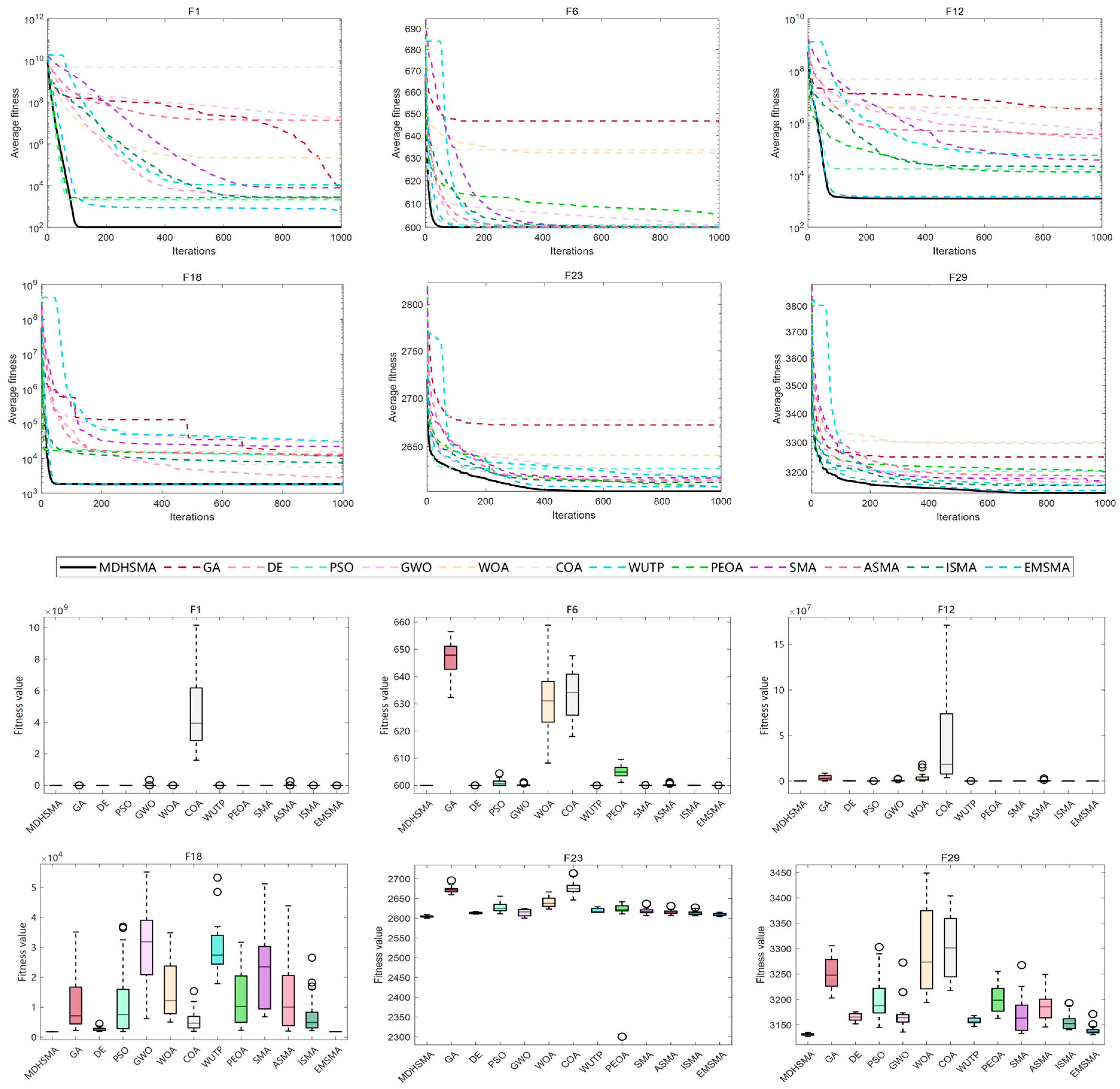
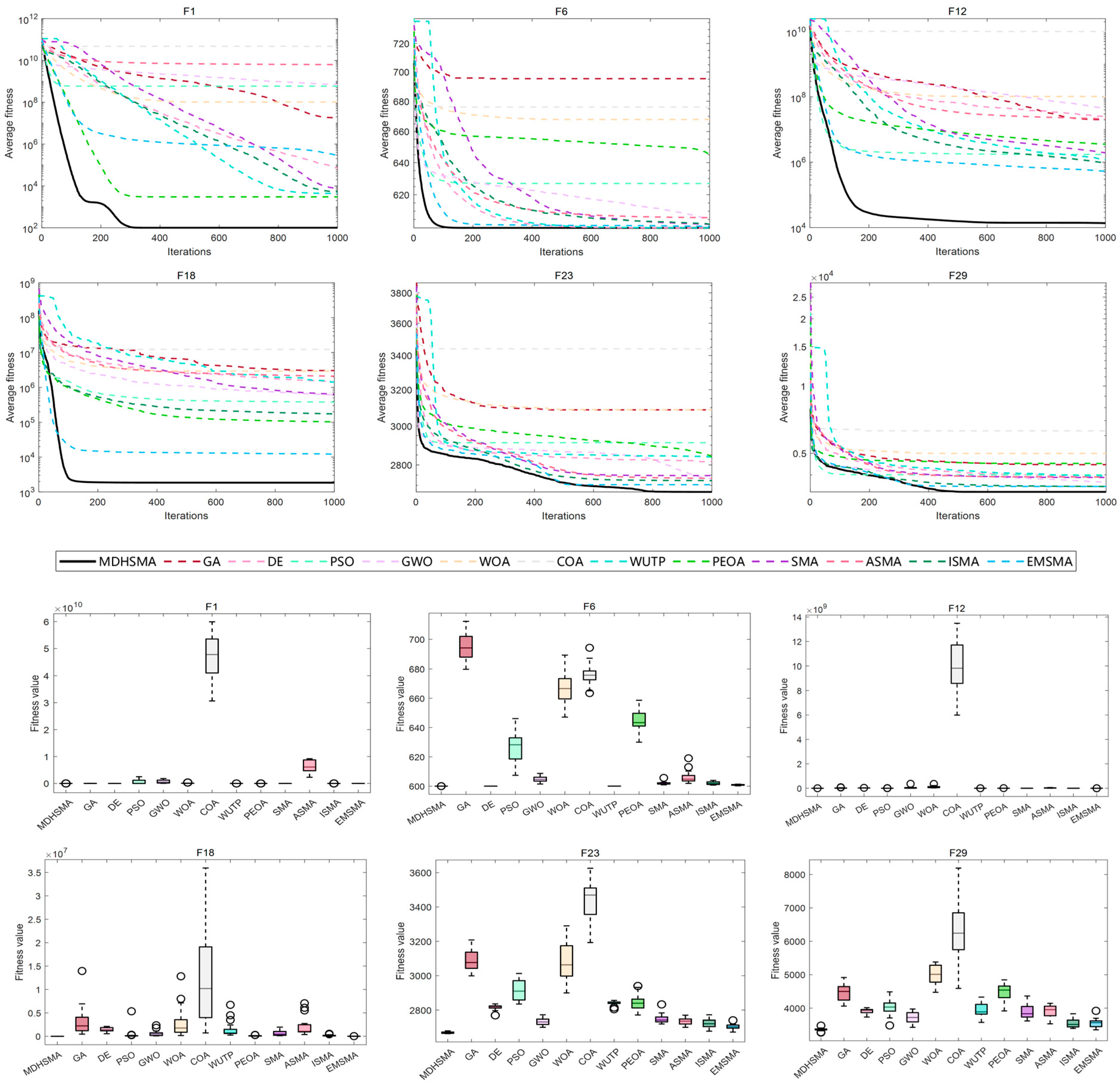
  9. Xu, B.; Zhao, J.; Zheng, T.; Litvinov, E.; Kirschen, D.S. Factoring the cycle aging cost of batteries participating in electricity markets. IEEE Trans. Power Syst. 2017, 33, 2248–2259. [Google Scholar] [CrossRef]
  10. Shi, Y.; Xu, B.; Tan, Y.; Kirschen, D.; Zhang, B. Optimal battery control under cycle aging mechanisms in pay for performance settings. IEEE Trans. Autom. Control 2018, 64, 2324–2339. [Google Scholar] [CrossRef]
  11. Nemati, M.; Braun, M.; Tenbohlen, S. Optimization of unit commitment and economic dispatch in microgrids based on genetic algorithm and mixed integer linear programming. Appl. Energy 2018, 210, 944–963. [Google Scholar] [CrossRef]
  12. Alarcón, M.A.; Alarcón, R.G.; González, A.H.; Ferramosca, A. Economic model predictive control for energy management of a microgrid connected to the main electrical grid. J. Process Control 2022, 117, 40–51. [Google Scholar] [CrossRef]
  13. Li, Z.; Zang, C.; Zeng, P.; Yu, H. Combined two-stage stochastic programming and receding horizon control strategy for microgrid energy management considering uncertainty. Energies 2016, 9, 499. [Google Scholar] [CrossRef]
  14. Levorato, M.; Figueiredo, R.; Frota, Y. Robust microgrid energy trading and scheduling under budgeted uncertainty. Expert Syst. Appl. 2022, 203, 117471. [Google Scholar] [CrossRef]
  15. Herding, R.; Ross, E.; Jones, W.R.; Endler, E.; Charitopoulos, V.M.; Papageorgiou, L.G. Risk-aware microgrid operation and participation in the day-ahead electricity market. Adv. Appl. Energy 2024, 15, 100180. [Google Scholar] [CrossRef]
  16. Hua, Z.; Zhou, B.; Chan, K.W.; Zhang, C.; Cao, Y.; Wang, P.; Xia, M. A progressive polyhedral approximation method for nonlinear PDE-constrained electricity-water nexus dispatch. IEEE Trans. Smart Grid 2025, 16, 2703–2706. [Google Scholar] [CrossRef]
  17. Guo, S.; Zhou, B.; Chung, C.Y.; Bu, S.; Hua, Z.; Liu, J.; Hu, W. Hierarchical Aggregation-Embedded Emergency Scheduling of Coupled Electricity-Watershed Networks with Heterogeneous Flexibility Resources Under Extreme Drought Events. IEEE Trans. Sustain. Energy 2025, 17, 1894–1908. [Google Scholar] [CrossRef]
  18. Guo, Z.; Li, J.; Wang, T.; Xie, J.; Yang, J.; Niu, B. Dynamic-Constrained Digital Twin-Based Mechanical Diagnosis Framework under Undetermined States without Fault Data. IEEE Trans. Instrum. Meas. 2025, 74, 3547715. [Google Scholar]
  19. Azari, M.S.; Santini, S.; Edrisi, F.; Flammini, F. Self-adaptive fault diagnosis for unseen working conditions based on digital twins and domain generalization. Reliab. Eng. Syst. Saf. 2025, 254, 110560. [Google Scholar] [CrossRef]
  20. Guo, Z.; Xu, L.; Zheng, Y.; Xie, J.; Wang, T. Bearing fault diagnostic framework under unknown working conditions based on condition-guided diffusion model. Measurement 2025, 242, 115951. [Google Scholar] [CrossRef]
  21. Zheng, Z.; Yang, S.; Guo, Y.; Jin, X.; Wang, R. Meta-heuristic techniques in microgrid management: A survey. Swarm Evol. Comput. 2023, 78, 101256. [Google Scholar] [CrossRef]
  22. Guan, Z.; Wang, H.; Li, Z.; Luo, X.; Yang, X.; Fang, J.; Zhao, Q. Multi-objective optimal scheduling of microgrids based on improved particle swarm algorithm. Energies 2024, 17, 1760. [Google Scholar] [CrossRef]
  23. Dong, A.; Lee, S.K. The Study of Scheduling Optimization for Multi-Microgrid Systems Based on an Improved Differential Algorithm. Electronics 2024, 13, 4517. [Google Scholar] [CrossRef]
  24. Wang, X.; Wang, S.; Ren, J.; Song, Z.; Zhang, S.; Feng, H. Optimizing economic dispatch for microgrid clusters using improved grey wolf optimization. Electronics 2024, 13, 3139. [Google Scholar] [CrossRef]
  25. Li, S.; Chen, H.; Wang, M.; Heidari, A.A.; Mirjalili, S. Slime mould algorithm: A new method for stochastic optimization. Future Gener. Comput. Syst. 2020, 111, 300–323. [Google Scholar] [CrossRef]
  26. Xu, X.; Rong, H.; Trovati, M.; Liptrott, M.; Bessis, N. CS-PSO: Chaotic particle swarm optimization algorithm for solving combinatorial optimization problems. Soft Comput. 2018, 22, 783–795. [Google Scholar] [CrossRef]
  27. Tanabe, R.; Fukunaga, A.S. Improving the search performance of SHADE using linear population size reduction. In Proceedings of the 2014 IEEE Congress on Evolutionary Computation (CEC), Beijing, China, 6–11 July 2014; IEEE: New York, NY, USA, 2014; pp. 1658–1665. [Google Scholar]
  28. Viktorin, A.; Senkerik, R.; Pluhacek, M.; Kadavy, T.; Zamuda, A. Distance based parameter adaptation for success-history based differential evolution. Swarm Evol. Comput. 2019, 50, 100462. [Google Scholar] [CrossRef]
  29. Holland, J.H. Adaptation in Natural and Artificial Systems: An Introductory Analysis with Applications to Biology, Control, and Artificial Intelligence; MIT Press: Cambridge, MA, USA, 1992. [Google Scholar]
  30. Storn, R.; Price, K. Differential evolution–a simple and efficient heuristic for global optimization over continuous spaces. J. Glob. Optim. 1997, 11, 341–359. [Google Scholar] [CrossRef]
  31. Kennedy, J.; Eberhart, R. Particle swarm optimization. In Proceedings of the ICNN’95-International Conference on Neural Networks, Perth, Australia, 27 November–1 December 1995; IEEE: New York, NY, USA, 1995; Volume 4, pp. 1942–1948. [Google Scholar]
  32. Mirjalili, S.; Mirjalili, S.M.; Lewis, A. Grey wolf optimizer. Adv. Eng. Softw. 2014, 69, 46–61. [Google Scholar] [CrossRef]
  33. Mirjalili, S.; Lewis, A. The whale optimization algorithm. Adv. Eng. Softw. 2016, 95, 51–67. [Google Scholar] [CrossRef]
  34. Jia, H.; Rao, H.; Wen, C.; Mirjalili, S. Crayfish optimization algorithm. Artif. Intell. Rev. 2023, 56, 1919–1979. [Google Scholar] [CrossRef]
  35. Sutha, A.; Tangaramvong, S.; Pyone, E.C.; Gao, W. Artemisinin slime mold algorithm for large-scale truss optimization under frequency constraints. Structures 2025, 80, 110045. [Google Scholar] [CrossRef]
  36. Kaveh, A.; Hamedani, K.B.; Kamalinejad, M. Improved slime mould algorithm with elitist strategy and its application to structural optimization with natural frequency constraints. Comput. Struct. 2022, 264, 106760. [Google Scholar] [CrossRef]
  37. Dong, Y.; Tang, R.; Cai, X. Enhanced Multi-Strategy Slime Mould Algorithm for Global Optimization Problems. Biomimetics 2024, 9, 500. [Google Scholar] [CrossRef]
  38. Braik, M.; Al-Hiary, H. A novel meta-heuristic optimization algorithm inspired by water uptake and transport in plants. Neural Comput. Appl. 2025, 37, 13643–13724. [Google Scholar] [CrossRef]
  39. Trojovský, P. A new human-based metaheuristic algorithm for solving optimization problems based on preschool education. Sci. Rep. 2023, 13, 21472. [Google Scholar] [CrossRef]
  40. Wang, Y.; Zhou, B.; Xu, Y.; Chung, C.Y.; Yang, Y.; Yuan, Z.; Hu, C. Spatio-Temporal Power Outage Risk Prediction for Interdependent Urban Electricity and Drainage Networks Under Rainstorm Disasters. IEEE Trans. Smart Grid 2026. [Google Scholar] [CrossRef]
  41. Shi, Y.; Wang, Y.; Wang, L.N.; Wang, W.N.; Yang, T.Y. Bridge cable performance warning method based on temperature and displacement monitoring data. Buildings 2025, 15, 2342. [Google Scholar] [CrossRef]
  42. Hu, Z.; Zhou, X.; Yu, L. An Intelligent Prediction Method for Rock Core Integrity Based on Deep Semantic Segmentation. Rock Mech. Rock Eng. 2026, 1–15. [Google Scholar] [CrossRef]
  43. Shi, Y.; Wang, Y.; Wang, L.N.; Wang, W.N.; Yang, T.Y. Bridge Tower Warning Method Based on Improved Multi-Rate Fusion Under Strong Wind Action. Buildings 2025, 15, 2733. [Google Scholar] [CrossRef]
  44. Liu, G.; Ollis, T.B.; Ferrari, M.F.; Sundararajan, A.; Tomsovic, K. Robust scheduling of networked microgrids for economics and resilience improvement. Energies 2022, 15, 2249. [Google Scholar] [CrossRef]
  45. Zia, M.F.; Elbouchikhi, E.; Benbouzid, M. Microgrids energy management systems: A critical review on methods, solutions, and prospects. Appl. Energy 2018, 222, 1033–1055. [Google Scholar] [CrossRef]
  46. Kostenko, G.; Zaporozhets, A. Trigger-Based PDCA Framework for Sustainable Grid Integration of Second-Life EV Batteries. World Electr. Veh. J. 2025, 16, 584. [Google Scholar] [CrossRef]
  47. Iqbal, S.; Mehran, K. A day-ahead energy management for multi microgrid system to optimize the energy storage charge and grid dependency—A comparative analysis. Energies 2022, 15, 4062. [Google Scholar] [CrossRef]
  48. Seyednouri, S.R.; Safari, A.; Farrokhifar, M.; Ravadanegh, S.N.; Quteishat, A.; Younis, M. Day-ahead scheduling of multi-energy microgrids based on a stochastic multi-objective optimization model. Energies 2023, 16, 1802. [Google Scholar] [CrossRef]
  49. García-Miguel, P.L.C.; Alonso-Martínez, J.; Arnaltes Gómez, S.; Garcia Plaza, M.; Asensio, A.P. A review on the degradation implementation for the operation of battery energy storage systems. Batteries 2022, 8, 110. [Google Scholar] [CrossRef]
  50. Cardoso, G.; Brouhard, T.; DeForest, N.; Wang, D.; Heleno, M.; Kotzur, L. Battery aging in multi-energy microgrid design using mixed integer linear programming. Appl. Energy 2018, 231, 1059–1069. [Google Scholar] [CrossRef]
  51. Minh, N.Q.; Linh, N.D.; Khiem, N.T. A mixed-integer linear programming model for microgrid optimal scheduling considering BESS degradation and RES uncertainty. J. Energy Storage 2024, 104, 114663. [Google Scholar] [CrossRef]
  52. Werner, D.; Paarmann, S.; Wetzel, T. Calendar aging of li-ion cells—Experimental investigation and empirical correlation. Batteries 2021, 7, 28. [Google Scholar] [CrossRef]
  53. Krupp, A.; Beckmann, R.; Diekmann, T.; Ferg, E.; Schuldt, F.; Agert, C. Calendar aging model for lithium-ion batteries considering the influence of cell characterization. J. Energy Storage 2022, 45, 103506. [Google Scholar] [CrossRef]
  54. Nezhad, A.E.; Mobtahej, M.; Javadi, M.S.; Nardelli, P.H.; Sahoo, S. Optimal operation of lithium-ion batteries in microgrids using a semidefinite thermal model. Int. J. Electr. Power Energy Syst. 2024, 155, 109630. [Google Scholar] [CrossRef]
  55. Nájera, J.; Arribas, J.; De Castro, R.; Núñez, C. Semi-empirical ageing model for LFP and NMC Li-ion battery chemistries. J. Energy Storage 2023, 72, 108016. [Google Scholar] [CrossRef]
  56. Naumann, M.; Spingler, F.B.; Jossen, A. Analysis and modeling of cycle aging of a commercial LiFePO4/graphite cell. J. Power Sources 2020, 451, 227666. [Google Scholar] [CrossRef]
  57. Karger, A.; Schmitt, J.; Kirst, C.; Singer, J.P.; Wildfeuer, L.; Jossen, A. Mechanistic calendar aging model for lithium-ion batteries. J. Power Sources 2023, 578, 233208. [Google Scholar] [CrossRef]
  58. Manzano, J.M.; Salvador, J.R.; Romaine, J.B.; Alvarado-Barrios, L. Economic predictive control for isolated microgrids based on real world demand/renewable energy data and forecast errors. Renew. Energy 2022, 194, 647–658. [Google Scholar] [CrossRef]
  59. Saleem, M.I.; Saha, S.; Izhar, U.; Ang, L. Bi-layer model predictive control strategy for techno-economic operation of grid-connected microgrids. Renew. Energy 2024, 236, 121441. [Google Scholar] [CrossRef]
  60. Dabhi, D.; Pandya, K.; Soares, J.; Lezama, F.; Vale, Z. Cross Entropy Covariance Matrix Adaptation Evolution Strategy for Solving the Bi-Level Bidding Optimization Problem in Local Energy Markets. Energies 2022, 15, 4838. [Google Scholar] [CrossRef]
  61. Akimoto, Y.; Hansen, N. Diagonal acceleration for covariance matrix adaptation evolution strategies. Evol. Comput. 2020, 28, 405–435. [Google Scholar] [CrossRef]
Figure 1. The feeding form of slime molds.
Symmetry 18 00692 g001
Figure 2. Evolutionary trend chart of parameters vb and vc.
Symmetry 18 00692 g002
Figure 3. MDHSMA flowchart.
Symmetry 18 00692 g003
Figure 4. Comparison of the initialization effects in Latin hypercube sampling.
Symmetry 18 00692 g004
Figure 5. Schematic representation of the HADE strategy.
Symmetry 18 00692 g005
Figure 6. Three-dimensional surface visualization in CEC2017 representative functions.
Symmetry 18 00692 g006
Figure 7. Convergence curves and box plots in the 10-D CEC2017 representative function.
Symmetry 18 00692 g007
Figure 8. Convergence curves and box plots in the 30-D CEC2017 representative function.
Symmetry 18 00692 g008
Figure 9. Convergence curves and box plots in the 50-D CEC2017 representative function.
Symmetry 18 00692 g009
Figure 10. Convergence curves and box plots in the 100-D CEC2017 representative function.
Symmetry 18 00692 g010
Figure 11. Three-dimensional surface visualization in CEC2022 representative functions.
Symmetry 18 00692 g011
Figure 12. Convergence curves and box plots in the 10-D CEC2022 representative function.
Symmetry 18 00692 g012
Figure 13. Convergence curves and box plots in the 20-D CEC2022 representative function.
Symmetry 18 00692 g013
Figure 14. Convergence plots, box plots, and rankings in PLDP.
Symmetry 18 00692 g014
Figure 15. Convergence plots, box plots, and rankings in PVDP.
Symmetry 18 00692 g015
Figure 16. Microgrid framework diagram.
Symmetry 18 00692 g016
Figure 17. Time-of-use electricity pricing chart.
Symmetry 18 00692 g017
Figure 18. Stacked diagram of real-time optimal scheduling of power balance for microgrid.
Symmetry 18 00692 g018
Figure 19. Energy storage SOC trajectory.
Symmetry 18 00692 g019
Figure 20. Comparison of total operating costs under different methods.
Symmetry 18 00692 g020
Figure 21. Average convergence curves and box plots of multi-algorithm solutions for the microgrid scheduling problem.
Symmetry 18 00692 g021
Figure 22. The disturbance curves and cost results for six specific scenarios.
Symmetry 18 00692 g022aSymmetry 18 00692 g022b
Table 1. Parameter settings for comparison algorithms.
MAsParametersValue
GA P c 0.6
P m 0.3
DE F [0.3, 0.9]
C R 0.2
PSO w 0.7
( c 1 , c 2 )1.2
GWO a [2, 0]
WOA a [2, 0]
b 1
COA I Stochastic [1, 2]
ASMA P m [0.1, 0.5]
Parameter (K, E)Adaptive
ISMA z 0.03
EMSMA z 0.3
L 50
P U 0.2
PEOARestart index ( R E _ i n d e x )0.5
Strategy parameter ( I )Stochastic [1, 2]
WUTPProbabilities ( p , χ , r r )0.5, 0.5, 0.1
Physical ( K , D , L p )1.0 × 10⁻⁹
Constants ( ρ , g )10,009.81
MDHSMALearning rate ( c )0.1
K m a x 25
η 0.03
s 0 0.5
α z 1.5
Table 2. The experimental results obtained from the comparative experiment held at CEC 2017.
MAs103050100
Avg. Ranks+/≈/−Avg. Ranks+/≈/−Avg. Ranks+/≈/−Avg. Ranks+/≈/−
GA11.3829/0/010.8329/0/011.1029/0/011.6229/0/0
DE4.0021/5/37.4129/0/07.9729/0/08.7229/0/0
PSO7.2427/1/16.9329/0/07.3429/0/07.0727/2/0
GWO8.5529/0/06.6929/0/06.6229/0/06.6627/2/0
WOA11.0029/0/010.9729/0/010.2129/0/09.6629/0/0
COA11.6629/0/012.6929/0/012.7229/0/012.5229/0/0
WUTP7.5227/2/07.1029/0/07.0728/1/06.5228/1/0
PEOA7.8624/2/36.9028/1/06.6927/1/16.4828/1/0
SMA6.5527/0/25.4129/0/04.7628/1/04.5527/2/0
ASMA7.6625/4/08.5229/0/08.9729/0/09.5229/0/0
ISMA7.6625/4/03.2427/1/12.7225/2/22.7621/6/2
EMSMA3.7925/4/03.2729/0/03.6629/0/03.7928/1/0
MDHSMA1.79 1.03 1.17 1.14
Table 3. Experimental results from the comparative experiments conducted at CEC2022.
MAs10 Dim20 Dim
Avg. Ranks+/≈/−Avg. Ranks+/≈/−
GA11.5812/0/010.9212/0/0
DE4.428/2/25.3312/0/0
PSO7.5010/1/17.5811/0/1
GWO8.5810/2/07.8312/0/0
WOA10.9212/0/010.2512/0/0
COA12.1712/0/012.4212/0/0
WUTP5.839/3/06.3312/0/0
PEOA6.6710/1/16.7512/0/0
SMA6.0012/0/05.9211/0/1
ASMA8.1012/0/04.2712/0/0
ISMA3.839/2/18.1712/0/0
EMSMA3.9210/1/14.3311/1/0
MDHSMA1.50 1.08
Table 4. The results of the ablation experiment.
MAsAvg. Ranks
30 Dim50 Dim
SMA4.414.34
SMA_CBLHSM4.144.00
SMA_HADE1.761.67
SMA_SAS3.453.59
MDHSMA1.241.38
Table 5. The sensitivity analysis results of the MDHSMA parameters.
DimAvg. Ranks (CEC 2017)
K m a x = 10 K m a x = 15 K m a x = 25 K m a x = 35 K m a x = 45
303.673.671.673.003.00
502.674.671.673.672.33
s 0 = 0.30 s 0 = 0.4 s 0 = 0.5 s 0 = 0.6 s 0 = 0.7
303.001.672.334.673.33
504.674.002.002.002.33
η = 0.01 η = 0.02 η = 0.03 η = 0.04 η = 0.05
303.004.332.332.673.67
503.674.672.002.672.00
α z = 1 α z = 1.25 α z = 1.5 α z = 1.75 α z = 12
302.333.001.674.333.67
503.005.002.002.332.67
Table 6. Experimental results of the optimizer in PLDP.
MAsMeanBestWorstStdAvg. Runtime
GA1.4644E+01+1.1308E+001.3261E+024.1451E+012.4176E−01
DE1.0574E+00+1.0574E+001.0574E+000.0000E+005.7169E−01
PSO1.7699E+01+1.0574E+001.6747E+025.2625E+011.2379E−01
GWO1.7722E+01+1.0582E+001.6769E+025.2692E+011.4159E−01
WOA5.4297E+01+1.0669E+001.8070E+028.5382E+011.8643E−01
COA1.0389E+02+3.0102E+002.5715E+028.6770E+013.3218E−01
WUTP3.3094E+02+1.5606E+026.0548E+021.4181E+022.0683E−01
PEOA2.5486E+01+1.0574E+002.0566E+026.3398E+013.9197E−01
SMA1.0574E+00+1.0574E+001.0574E+004.3317E−072.9007E−01
ASMA1.1121E+00+1.0577E+001.3837E+009.9991E−023.5895E−01
ISMA1.0576E+00+1.0574E+001.0579E+001.5532E−046.7116E−01
EMSMA1.7699E+01+1.0574E+001.6747E+025.2625E+012.7295E−01
MDHSMA1.0574E+001.0574E+001.0574E+007.6147E−145.8735E−01
Table 7. Experimental results of the optimizer in PVDP.
MAsMeanBestWorstStdAvg. Runtime
GA7.5685E+03+6.2362E+038.0354E+035.0841E+026.0075E−01
DE6.1151E+03+6.0829E+036.1665E+032.9395E+011.1511E+00
PSO6.3646E+03+6.0597E+036.7716E+032.5702E+024.1864E−01
GWO6.0674E+03+6.0601E+036.0916E+031.2654E+014.4356E−01
WOA7.6085E+03+6.4787E+038.7959E+036.8812E+025.2983E−01
COA7.4870E+03+6.9624E+038.0110E+033.1921E+021.0026E+00
WUTP6.5302E+03+6.4215E+036.6120E+036.7197E+015.7003E−01
PEOA6.7765E+03+6.3708E+037.3328E+033.5635E+021.2614E+00
SMA6.7193E+03+6.0597E+037.3328E+035.9807E+026.8798E−01
ASMA7.0900E+03+6.4133E+037.5505E+033.8887E+028.9206E−01
ISMA6.4106E+03+6.0905E+036.7716E+032.2821E+022.2508E+00
EMSMA6.0628E+03+6.0597E+036.0905E+039.7436E+008.1144E−01
MDHSMA6.0597E+036.0597E+036.0597E+030.0000E+001.7176E+00
Table 8. Output limits and operation-cost parameters of microgrid units.
TypesMaximum Output/kWMinimum Output/kWPower Generation Costs (CNY/kWh)Maintenance Costs (CNY/kWh)
PV35000.010
WT45000.298
MT6501.940.031
FC5001.200.087
BESS20−2000.0012
Table 9. Time-of-use electricity pricing table (Unit: CNY).
Time Period TypeTime RangeElectricity Sales PriceElectricity Purchase Price
Peak period9:00–11:00; 18:00–21:001.21.10
On a regular basis6:00–9:00; 11:00–18:00; 21:00–22:000.920.83
Low peak22:00–6:000.490.49
Table 10. Parameters used in the refined battery degradation model.
SymbolValueRole in the Model
a c y c 2.5 × 10⁻⁴Cycle-aging scale coefficient
α1.7DOD exponent
ar0.35Rate correction coefficient
β1.1Rate exponent
acal1.2 × 10−4Calendar-aging scale coefficient
γ3.0SOC sensitivity coefficient
Table 11. Cost breakdown of optimal scheduling plan (Unit: CNY).
Cost ItemNumerical Value
Net Cost of Electricity Purchases and Sales ( J g r i d )669.49
Refined Degradation Costs ( J d e g )190.79
Micro-combustion Engine Cost ( J M T )50.80
Fuel Cell Cost ( J F C )38.09
Total Cost of Ownership ( J O M )4.88
Total Cost (J)954.61
Table 12. Statistical results of different algorithms for the microgrid scheduling problem.
MAsBestMeanStdMAERMSEAvg. Runtime(TOPSIS) Rank
PSO11601231.254.607288.7293.658.29029
GWO971.85986.978.323144.46545.21211.2695
WOA1875.91955.542.3810131013.87.515310
PEOA1001.310094.073166.50166.62227.5596
CE-CMAES1101.11143.121.853200.59201.7418.5268
ddCMA986.931060.546.586117.97126.5515.8037
SMA968.42973.092.87530.59130.7219.42353
ISMA966.55968.971.411826.47326.5142.2644
EMSMA958.39965.662.636123.16123.30524.4852
MDHSMA944.23945.891.09863.3943.561721.4761
Table 13. Results of the Wilcoxon signed-rank test.
MAsSignificant (1 Is/0 Is Not)Result (Compared to MDHSMA)
PSO1+
GWO1+
WOA1+
PEOA1+
CE_CMAES1+
ddCMA1+
SMA1+
ISMA1+
EMSMA1+
Table 14. The robustness verification results under the condition of uncertainty in prediction.
NameCombinationMAsTotal_CostRuntime_s
S1Low PV + High LoadMDHSMA1045.1313.43
SMA1079.935.59
EMSMA1062.658.67
ISMA1061.4617.57
GWO1060.734.37
S2High PV + Low LoadMDHSMA866.0913.31
SMA892.595.58
EMSMA891.308.71
ISMA883.9117.53
GWO897.624.36
S3Low WT + High LoadMDHSMA1053.4013.19
SMA1076.385.58
EMSMA1070.248.69
ISMA1068.5017.48
GWO1076.514.34
S4High WT + Low LoadMDHSMA865.2713.22
SMA894.575.53
EMSMA879.228.59
ISMA879.4717.47
GWO888.494.35
S5Low PV + Low WT + High LoadMDHSMA1080.0913.34
SMA1096.745.55
EMSMA1085.398.64
ISMA1084.9517.57
GWO1100.654.34
S6High PV + High WT + Low LoadMDHSMA844.1613.27
SMA867.095.54
EMSMA860.308.71
ISMA857.0017.60
GWO877.884.33
Disclaimer/Publisher’s Note: The statements, opinions and data contained in all publications are solely those of the individual author(s) and contributor(s) and not of MDPI and/or the editor(s). MDPI and/or the editor(s) disclaim responsibility for any injury to people or property resulting from any ideas, methods, instructions or products referred to in the content.