Article

New Soliton-Type Solutions of the (2 + 1)-Dimensional Variable-Coefficient Boussinesq Equation

School of Mathematical Sciences, Zhejiang University of Technology, Hangzhou 310023, China
*
Author to whom correspondence should be addressed.
Symmetry 2026, 18(4), 680; https://doi.org/10.3390/sym18040680
Submission received: 22 February 2026 / Revised: 10 April 2026 / Accepted: 14 April 2026 / Published: 20 April 2026
(This article belongs to the Special Issue Symmetry in Integrable Systems: Topics and Advances (Second Edition))

Abstract

The ( 2 + 1 ) -dimensional Boussinesq equation plays an important role in mathematical physics. In this paper, we investigate some exact solutions of the ( 2 + 1 ) -dimensional variable-coefficient Boussinesq equation. Firstly, the Painlevé analysis is carried out, and an auto-Bäcklund transformation is constructed by means of a truncated Painlevé expansion combined with symbolic computation. Then, a class of new soliton-type solutions is derived. By selecting appropriate parameter values, detailed simulations are presented to illustrate the dynamical behavior of water wave propagation. Finally, the Lie point symmetries of the equation are studied, and several similarity reductions are derived by solving the corresponding characteristic equations.

1. Introduction

Nonlinear water wave (NLWW) equations, owing to their intrinsic nonlinear structure, can effectively characterize fundamental wave mechanisms such as dispersion and dissipation. Consequently, they exhibit rich and complex dynamical behaviors and play an important role in fields such as fluid mechanics, plasma physics, nonlinear optics, and solid-state physics. Among various types of solutions, soliton, rational, and multivalued solutions are particularly important for understanding the propagation and interaction of nonlinear waves. Therefore, constructing exact solutions of nonlinear water wave equations is of great significance. A number of classical models, such as the Korteweg–de Vries (KdV) equation, the nonlinear Schrödinger (NLS) equation, the Boussinesq equation, and the Kadomtsev–Petviashvili (KP) equation, along with their various extensions, have been extensively studied. Accordingly, many well-established analytical methods have been developed, including Lie symmetry analysis, the inverse scattering transform, Painlevé analysis, the Hirota bilinear method, as well as Bäcklund and Darboux transformations.
The Boussinesq equation serves as a typical model for describing the propagation of weakly nonlinear dispersive long waves. It originates from shallow water wave theory and can be regarded as a nonlinear extension of the classical linear wave equation. By balancing nonlinear effects with higher-order dispersion, it captures the complex dynamical behavior of long-wave propagation. In addition, this equation typically has a good integrable structure, with rich conservation laws and symmetries. A typical ( 1 + 1 ) -dimensional Boussinesq equation can be written as follows:
u t t + α u x x + β ( u 2 ) x x + γ u x x x x = 0 ,
where α , β , γ are constants and u represents the wave field. Depending on the value of the dispersion coefficient, the equation is called the “bad” Boussinesq equation when γ = 1 , while it is referred to as the “good” Boussinesq equation when γ = 1 . In comparison, the “good” Boussinesq equation has better properties and finds important applications in fields such as nonlinear elasticity and electromagnetic wave propagation [1,2,3,4]. A large number of studies have been devoted to Equation (1) and its extended models, and various nonlinear wave structures have been obtained, including periodic solutions, soliton solutions, polynomial solutions, and kink-type solutions [5,6,7,8].
The ( 2 + 1 ) -dimensional Boussinesq equation can be written as
u t t + α u x x + β ( u 2 ) x x + γ u x x x x + δ u y y = 0 ,
where α , β , γ , and δ are constant parameters. Due to the introduction of an additional spatial degree of freedom, this model exhibits more complex propagation behaviors and structural features, and it is of significant importance in modeling small amplitude long waves in shallow water. In recent years, significant progress has been made in the study of such models, particularly in the analysis of integrability, the construction of exact solutions, and the characterization of nonlinear wave structures [9,10,11,12,13,14,15,16,17].
However, most of the existing studies are based on constant-coefficient models, which are insufficient to describe the effects caused by parameters varying in space and time in practical situations. In contrast, variable-coefficient models can more realistically reflect the influence of inhomogeneity on wave propagation, such as variation of propagation speed and structural evolution, and thus possess stronger physical relevance. In recent years, variable-coefficient nonlinear evolution equations have attracted increasing attention and have been widely applied in areas such as wave propagation in inhomogeneous media, plasma physics, and nonlinear optics [18,19,20,21,22,23].
For the variable-coefficient Boussinesq equation, the space–time dependence of the coefficients modifies the local dispersion relation and the balance between nonlinearity and dispersion, thereby affecting wave propagation and structural evolution. For example, it can alter the phase and group velocities, which in turn influence wave packet dynamics and soliton structures. Meanwhile, spatial inhomogeneity may break standard symmetries, leading to generalized conservation laws and imposing constraints on the integrability of the system. Although some studies have investigated variable-coefficient Boussinesq-type equations [16,24,25,26,27], there are still many forms that have yet to be explored. Motivated by this, we consider the following ( 2 + 1 ) -dimensional variable-coefficient Boussinesq equation:
u t t + ( h x u ) x 3 ( u 2 ) x x u x x x x + ( β + h ) u x x u y y = 0 ,
where β is a constant, and h h ( x ) describes the spatial variation of the shear flow along the propagation direction, which is used to characterize the modulation effect of an inhomogeneous flow on wave propagation. When h = constant , the equation reduces to the classical constant-coefficient Boussinesq equation. In contrast, a nontrivial h breaks translational invariance and leads to a fundamentally different mathematical structure. In particular, such variable coefficients generally cannot be removed by point or scaling transformations, indicating the intrinsic nontriviality of the model.
In this context, this paper focuses on the construction of exact solutions of the variable-coefficient Boussinesq equation. In Section 2, the Painlevé analysis of Equation (3) is performed. An auto-Bäcklund transformation is constructed via the truncated Painlevé expansion combined with symbolic computation, leading to a class of explicit soliton solutions. Several representative examples with appropriate parameter choices are presented to illustrate their dynamical behaviors. In Section 3, we mainly discuss the Lie symmetries of Equation (3), the Lie algebra structure of the symmetry vector fields and the corresponding similarity reductions. In Section 4, we conclude the paper with a summary and discussion, and briefly analyze the effects of variable coefficients on the structure of the solutions.

2. New Soliton-Type Solutions of Equation (3)

The Painlevé test provides an effective criterion for assessing the integrability of nonlinear equations. In general, a nonlinear partial differential equation (NLPDE) is said to possess the Painlevé property if its solutions remain single-valued in the neighborhood of all movable singularity manifolds. To examine whether Equation (3) satisfies this property, the Weiss–Tabor–Carnevale (WTC) method is employed [28]. Based on this theory, the singularity manifold is defined by the following expression:
f ( x , y , t ) | S f = 0 , S f R 3 ,
and suppose that u admits a Laurent expansion in terms of f ( x , y , t ) :
u ( x , y , t ) = j = 0 u j ( x , y , t ) f j + α ( x , y , t ) ,
where α is a negative integer. Substituting u u 0 f α ( x , y , t ) into Equation (3) and balancing the dominant terms yield α = 2 , u 0 = 2 f x 2 ( x , y , t ) . Accordingly, Equation (5) takes the form
u = 2 f x 2 ( x , y , t ) f 2 ( x , y , t ) + j = 1 u j ( x , y , t ) f j 2 ( x , y , t ) .
Substituting the above expansion into Equation (3) and equating coefficients of like powers of f yields
( j + 1 ) ( j 4 ) ( j 5 ) ( j 6 ) f x 4 u j = Γ ( u 0 , u 1 , , u j 1 , f x , f y , f t , ) ,
where we denote u i u i ( x , y , t ) and f f ( x , y , t ) for simplicity. Hence, the resonances occur at −1, 4, 5 and 6. In particular, j = 1 reflects the arbitrariness of f. From Equation (7), one arrives at the following equations:
j = 0 : 60 f x 2 u 0 ( 2 f x 2 + u 0 ) = 0 u 0 = 2 f x 2 ,
j = 1 : 120 f x 4 ( 2 f x x + u 1 ) = 0 u 1 = 2 f x x ,
j = 2 : 12 f x 2 6 f x 2 u 2 f x 2 h f x 2 β + 4 f x f x x x f t 2 + f y 2 3 f x x 2 = 0 u 2 = f x 2 h + f x 2 β 4 f x f x x x + f t 2 f y 2 + 3 f x x 2 6 f x 2 ,
j = 3 : 4 f x 6 f x 3 u 3 f x f x x x x f x f y y + f x f t t + 4 f x x f x x x + 4 f x x f y 2 f t 2 3 f x x 2 = 0 u 3 = f x 2 f x x x x + f x 2 f y y f x 2 f t t 4 f x f x x f x x x f x x f y 2 + f x x f t 2 + 3 f x x 3 6 f x 4 ,
j = 4 , 5 : the compatibility conditions are identically satisfied , implying that no obstruction arises , while u 4 and u 5 remain arbitrary . j = 6 : 2 f y y f t t 3 f x 2 4 f y f x x f t f t y 3 f x 4 4 f t f t x f y y 3 f x 3 4 f y f x y f t t 3 f x 3 + 2 f y y f x x f t 2 3 f x 4 + 2 f t t f x x f y 2 3 f x 4 2 f t y 2 3 f x 2 2 f x y 2 f t 2 3 f x 4 2 f t x 2 f y 2 3 f x 4 + h x 2 6 + h h x x 6 + β h x x 6 h x x x x 6 + 4 f x y f t f t y 3 f x 3 + 4 f t x f y f t y 3 f x 3 + 4 f t f t x f y f x y 3 f x 4 = 0 .
Using symbolic computation together with Kruskal’s ansatz [29], the coefficients are determined recursively from Equations (8)–(11). Substituting f = x + ψ ( y , t ) into Equation (12) yields the compatibility condition
4 ψ y y ψ t t 4 ψ t y 2 + h x 2 + h h x x + β h x x h x x x x = 0 .
This condition indicates that ψ cannot be chosen as arbitrary functions. Consequently, the ( 2 + 1 ) -dimensional Boussinesq Equation (3) possesses only the weak Painlevé property.
Although the equation fails the Painlevé test, physically meaningful solutions can still be constructed via the corresponding Bäcklund transformation [30]:
u = 2 ( ln f ) x x + f x 2 h + f x 2 β 4 f x f x x x + f t 2 f y 2 + 3 f x x 2 6 f x 2 .
The above expression is the truncated Painlevé expansion of Equation (6) at the constant term. Substituting Equation (14) into Equation (3) and following computational steps similar to those of Equations (8)–(12), we obtain the following constraint condition:
f x x f y 2 f x x f t 2 + 4 f x f x x f x x x f x 2 f y y f x 2 f x x x x + f x 2 f t t 3 f x x 3 = 0 ,
4 f x 2 f x y 2 f t 2 2 f y f y y f x f t ( f y f t x + f t y f x ) f x y + f x 2 f y y 2 2 f x f t x f t f y y ( f t y f x f y f t x ) 2 + 4 f x x x x ( f y 2 f x x f x 2 2 f y f x y f x 3 + f y y f x 4 ) 16 f x f x x f x x x ( f y 2 f x x 2 f x f x y f y + f x 2 f y y ) + 8 f x f x x ( f y 3 f y f t 2 ) f x y f t f x ( f y f t y f t f y y ) h x x x x ( β + h ) h x x + h x 2 f x 6 + 12 f y 2 f x x 4 + 12 f x x 3 ( 2 f x f x y f y + f x 2 f y y ) + 4 f x x 2 ( f t 2 f y 2 f y 4 ) = 0 .
By setting the coefficient of f x 6 in Equation (16) to zero, the explicit dependence on h is eliminated, yielding
h x x x x = ( β + h ) h x x + h x 2 .
Substituting the above equation into Equation (16), it can be simplified as follows:
f x 2 f t 2 f x y 2 2 f x f y f y y f t ( f y f t x + f t y f x ) f x y + f x 2 f y y 2 2 f x f t x f t f y y ( f t y f x f y f t x ) 2 + f x x x x ( f x 2 f y 2 f x x 2 f y f x y f x 3 + f y y f x 4 ) 4 f x f x x f x x x ( f x x f y 2 2 f x f x y f y + f x 2 f y y ) + 3 f x x 4 f y 2 + 3 f x x 3 ( 2 f x f x y f y + f x 2 f y y ) + f x x 2 ( f t 2 f y 2 f y 4 ) + 2 f x f x x ( f t 2 f y f y 3 ) f x y + ( f t f y y f y f t y ) f t f x = 0 .
It should be noted that, although h satisfies Equation (17), the term 4 ψ y y ψ t t 4 ψ t y 2 still remains in Equation (13).
To construct explicit soliton-type solutions, we introduce the exponential transformation
f ( x , y , t ) = 1 + e w ( x , y , t ) ,
which reduces the constraint equations to a closed nonlinear system for the phase function w ( x , y , t ) . Substituting Equation (19) into the first constraint condition (15) yields the following nonlinear equation:
w x x x x w x 2 w x x w x 4 + w y y w x 2 w t t w x 2 4 w x x x w x x w x + 3 w x x 3 + w x x w t 2 w x x w y 2 = 0 .
Similarly, substituting Equation (19) into Equation (18) yields
w x x x x w x 2 ( w x x w y 2 2 w x y w y w x + w y y w x 2 ) 4 w x x x w x x w x ( w x x w y 2 2 w x y w y w x + w y y w x 2 ) + 3 w x x 4 w y 2 + w x x 3 ( 6 w x y w y w x + 3 w y y w x 2 ) + w y 2 w x x 2 ( w x 4 + w t 2 w y 2 ) + 2 w x w x x w y ( w x 4 + w t 2 w y 2 ) w x y + ( w x 4 2 + w t 2 ) w y y w t y w t w y w x + w x 2 { w x y 2 w t 2 2 w x w y w y y 2 w t ( w t x w y + w t y w x ) w x y + w y y 2 w x 2 2 w t x w y y w t w x ( w t y w x w t x w y ) 2 } = 0 .
To derive explicit solutions with clear physical meaning, we assume that
w ( x , y , t ) = w 1 x + w 2 ,
where w 1 w 1 ( y , t ) and w 2 w 2 ( y , t ) . Substituting Equation (22) into Equation (21) yields the coefficients corresponding to x 2 , x 1 , and x 0 :
x 2 : w 1 3 w 1 w 1 , y y 2 2 ( w 1 , y 2 + w 1 , t 2 ) w 1 , y y w 1 w 1 , t y 2 + 4 w 1 , y w 1 , t w 1 , t y = 0 ,
x 1 : 2 w 1 3 [ ( w 2 , y y w 1 w 1 , y w 2 , y w 1 , t w 2 , t ) w 1 , y y ( w 1 , y 2 + w 1 , t 2 ) w 2 , y y + ( w 1 w 2 , t y + w 1 , y w 2 , t + w 1 , t w 2 , y ) w 1 , t y + 2 w 1 , y w 1 , t w 2 , t y ] = 0 ,
x 0 : w 1 2 [ w 1 2 w 2 , y y 2 2 w 1 ( w 1 , y w 2 , y + w 1 , t w 2 , t ) w 2 , y y w 1 2 w 2 , t y 2 + 2 w 1 ( w 1 , t w 2 , y + w 1 , y w 2 , t ) w 2 , t y ( w 1 , t w 2 , y w 1 , y w 2 , t ) 2 ] = 0 .
Using symbolic computation, we obtain
w 1 = C 6 tanh Ξ 3 + C 5 tanh Ξ 2 + C 4 tanh Ξ + C 3 ,
w 2 = F ( t ) + G ( t y ) ,
where C 1 , , C 6 are arbitrary constants, Ξ = C 1 C 2 ( t y ) , while F and G denote arbitrary functions of t and t y , respectively. The presence of the characteristic variable t y reflects the intrinsic ( 2 + 1 ) -dimensional structure of the system and is absent in the corresponding ( 1 + 1 ) -dimensional Boussinesq equation. By substituting Equations (26) and (27) into Equation (25), we obtain
x 0 : C 2 2 F t 2 cosh ( C 2 y ) + sinh ( C 2 y ) 2 P Q , Q = [ cosh ( C 2 t ) cosh ( C 2 y ) cosh ( C 1 ) + cosh ( C 2 t ) sinh ( C 2 y ) sinh ( C 1 ) sinh ( C 2 t ) sinh ( C 2 y ) cosh ( C 1 ) sinh ( C 2 t ) cosh ( C 2 y ) sinh ( C 1 ) ] 8 .
Here, P depends only on hyperbolic functions and is independent of F and G. By setting F ( t ) = C 7 , the expression vanishes identically, and the consistency condition is automatically satisfied. Consequently, the solution of Equation (21) takes the form
w = C 6 tanh Ξ 3 + C 5 tanh Ξ 2 + C 4 tanh Ξ + C 3 x + G ( t y ) + C 7 .
Substituting Equation (29) into Equation (20) confirms consistency at all orders, indicating that the two constraint conditions coincide and reduce to the same equation.
Finally, applying the transformation (19) to Equation (29) and substituting into Equation (14) yields an explicit soliton-type solution of Equation (3):
u = 1 6 ( 1 + e F ) 2 { [ C 6 2 S 6 2 C 5 C 6 S 5 ( C 5 2 + 2 C 4 C 6 ) S 4 2 ( C 3 C 6 + C 4 C 5 ) S 3 ( 2 C 3 C 5 + C 4 2 ) S 2 2 C 3 C 4 S C 3 2 + β + h ] e 2 F + 2 [ 5 C 6 2 S 6 + 10 C 5 C 6 S 5 + 5 ( 2 C 4 C 6 + C 5 2 ) S 4 + 10 ( C 3 C 6 + C 4 C 5 ) S 3 + 5 ( 2 C 3 C 5 + C 4 2 ) S 2 + 10 C 3 C 4 S + 5 C 3 2 + β + h ] e F [ C 6 2 S 6 + 2 C 5 C 6 S 5 + ( 2 C 4 C 6 + C 5 2 ) S 4 + 2 ( C 3 C 6 + C 4 C 5 ) S 3 + ( 2 C 3 C 5 + C 4 2 ) S 2 + 2 C 3 C 4 S + C 3 2 β h ] } ,
where
S = tanh Ξ , F = C 6 S 3 + C 5 S 2 + C 4 S + C 3 x + C 7 + G ( t y ) .
The variable coefficient h satisfies Equation (17), which can be integrated to give
h = 3 β sec h 2 ( x + C 8 ) β 2 ,
where C 8 is an arbitrary constant.
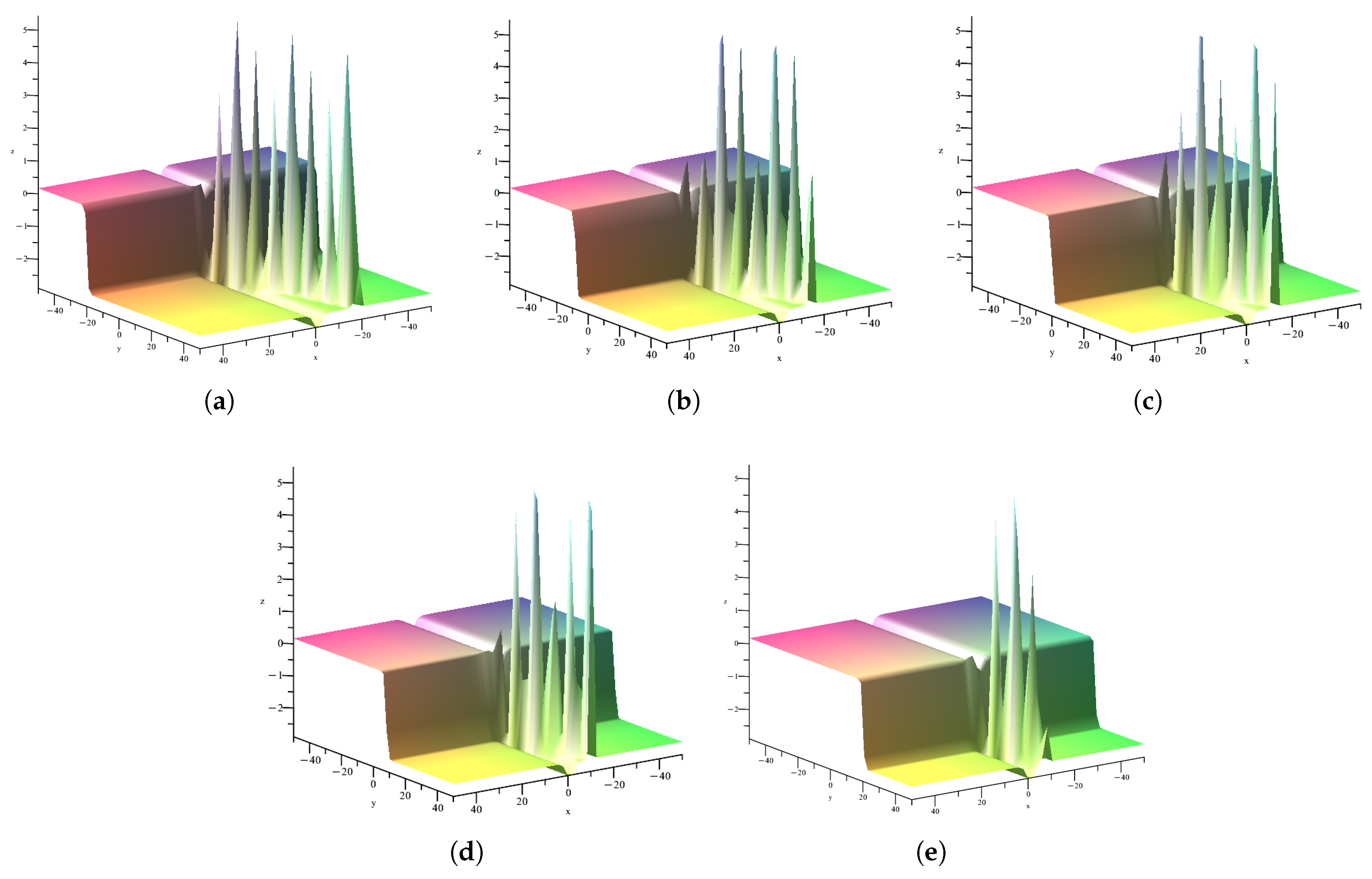
Exact solutions play a crucial role in revealing the dynamical behavior of nonlinear wave systems, particularly when their structural features are visualized graphically. To illustrate these properties, we present the three-dimensional (3D) evolution of the above soliton-type solutions for different choices of the parameters C i and functional forms, and visualize their profiles at various time instances. Since not all possible cases are considered, we focus on several representative examples.
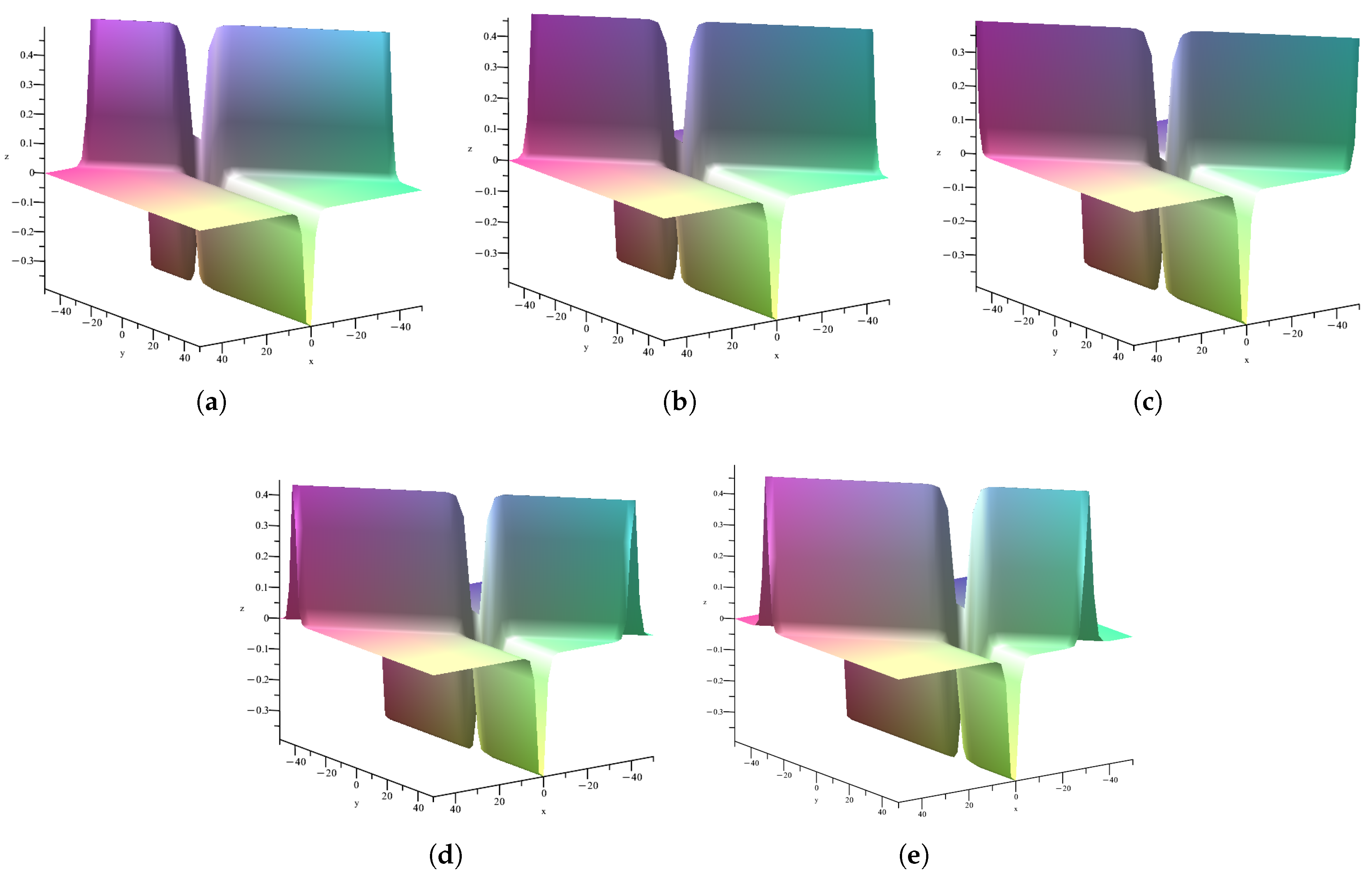
Example 1.
To illustrate the solution structure of Equation (30), we choose G ( t y ) = y t and set the parameters as C i = 1 ( i = 1 , 2 , 3 , 7 , 8 ) , C i = 0 ( i = 4 , 5 , 6 ) and β = 1 . The corresponding solution profiles are shown in Figure 1.
In particular, this figure corresponds to the case w = x + y t , for which the solution reads
u = 1 6 ( 1 + e C 3 x + y t + C 7 ) 2 { C 3 2 + β 3 β sec h 2 ( x + C 8 ) β 2 e 2 ( C 3 x + y t + C 7 ) C 3 2 + β + 2 5 C 3 2 + β 3 β sec h 2 ( x + C 8 ) β 2 e C 3 x + y t + C 7 3 β sec h 2 ( x + C 8 ) β 2 } .
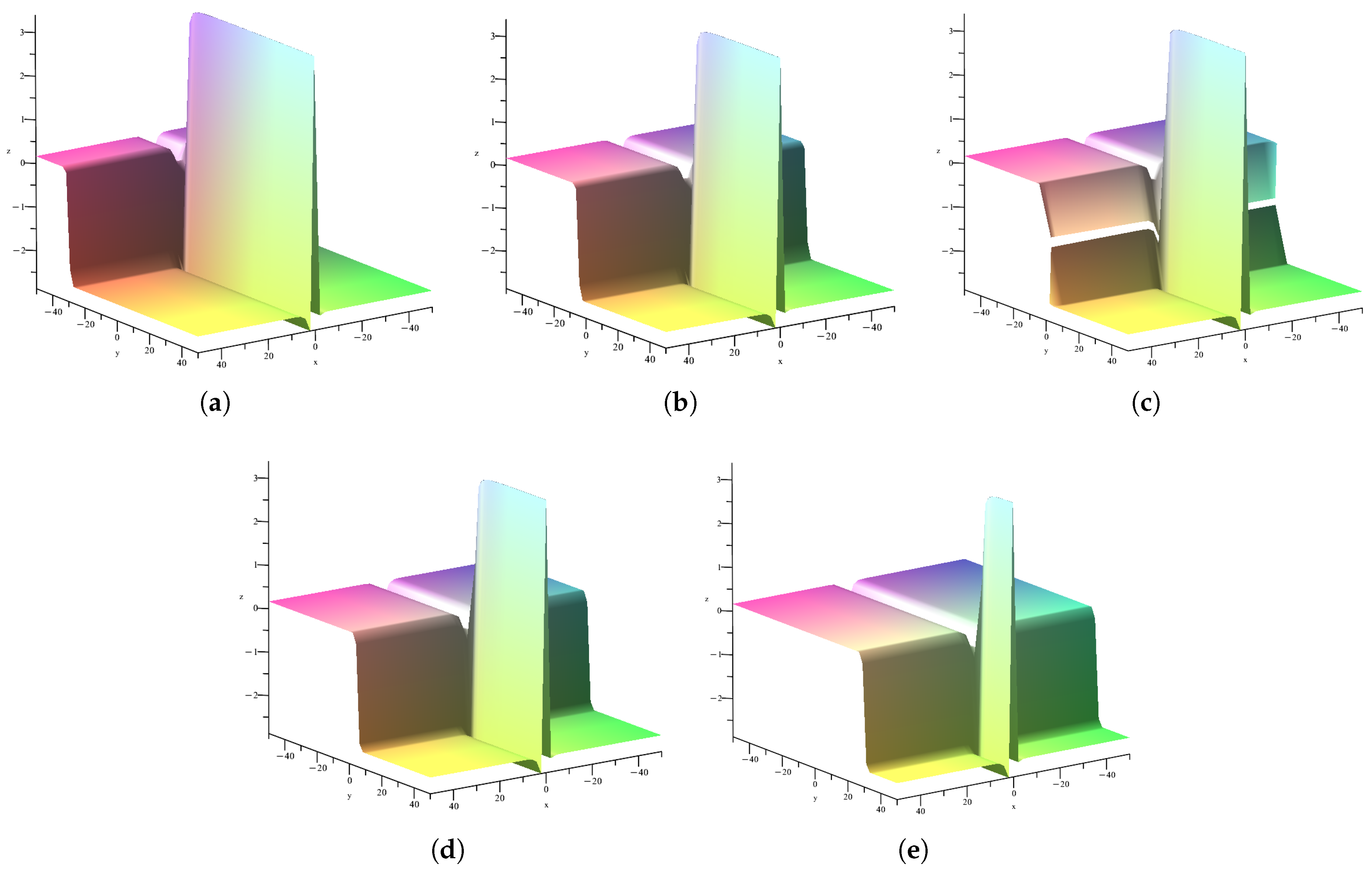
Example 2.
For C i = 1 ( i = 1 , , 8 ) , β = 1 and G ( t y ) = 1 ( t y ) 2 , the solution structures of Equation (30) are presented in Figure 2.
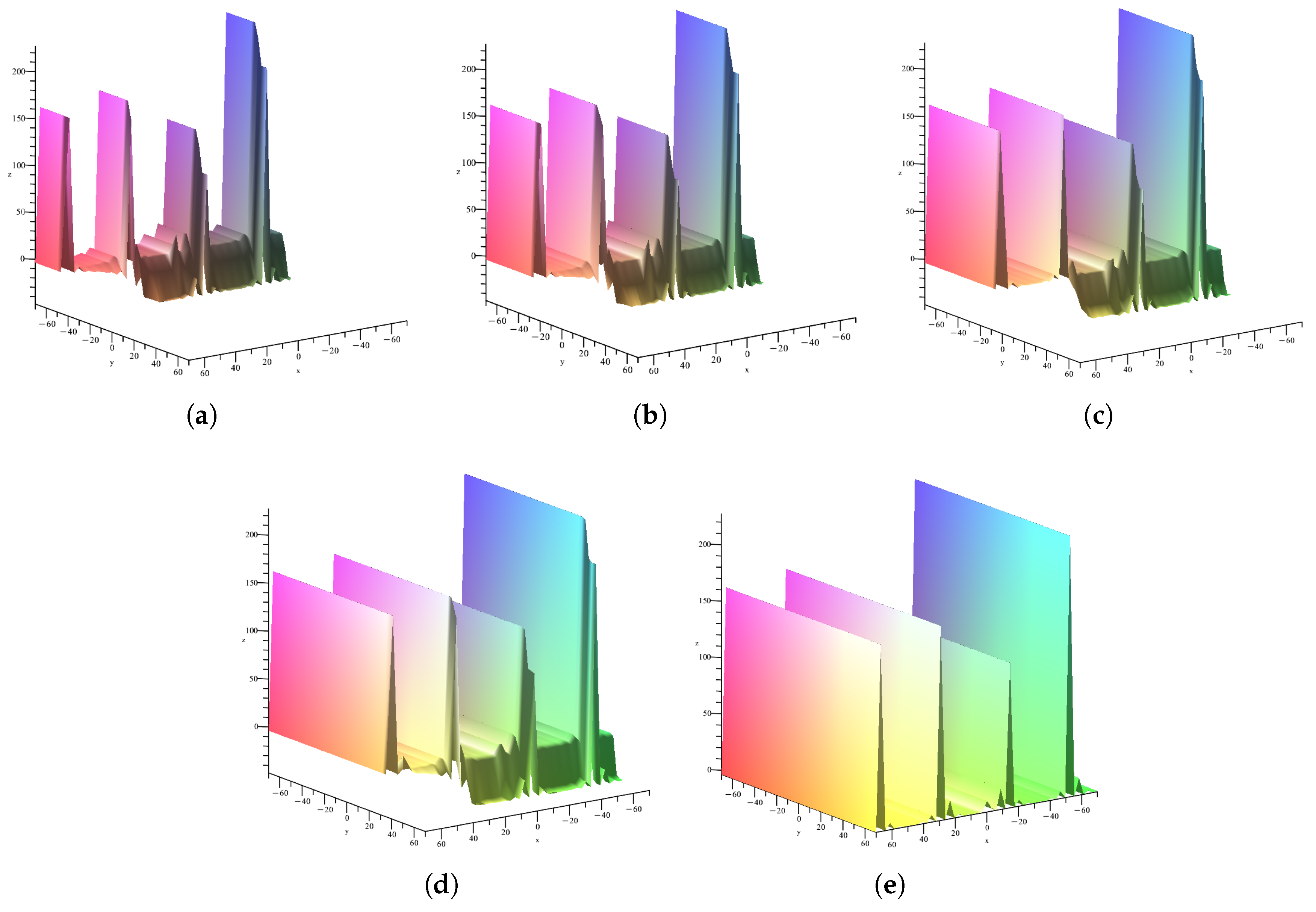
Example 3.
Taking G ( t y ) = e y t and choosing the parameters as C i = 1 ( i = 1 , 2 , 5 , 6 , 7 , 8 ) , C 3 = 10 , C 4 = 5 and β = 1 , the corresponding solution structures of Equation (30) are shown in Figure 3.
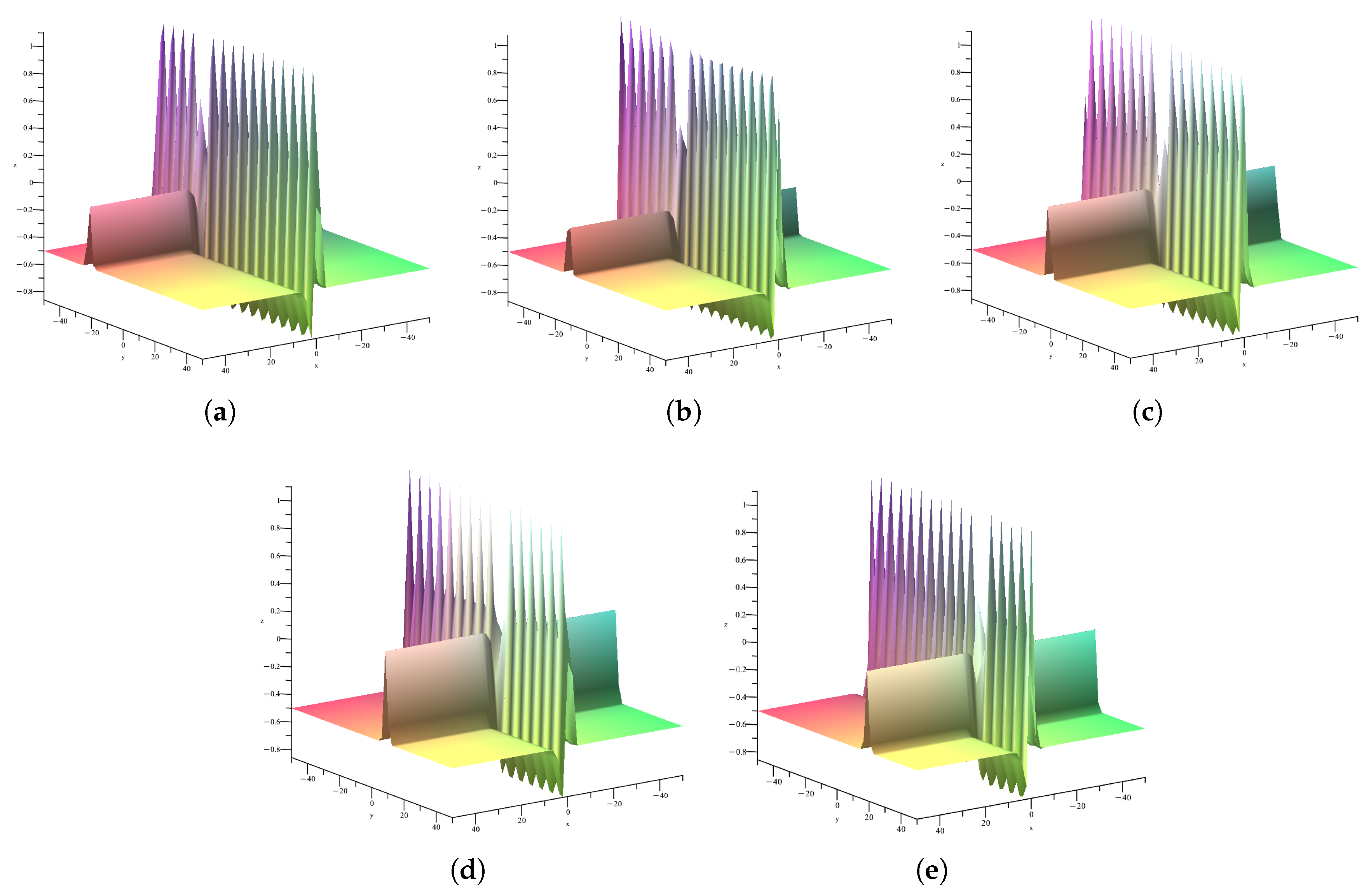
Example 4.
By selecting G ( t y ) = sin ( y t ) and fixing the parameters as C i = 1 ( i = 1 , 2 , 3 , 4 , 6 , 7 , 8 ) , C 5 = 1 , and β = 1 , the resulting wave patterns of Equation (30) are illustrated in Figure 4.
Example 5.
Let G ( t y ) = ( y t ) + sin ( y t ) , and choose the parameters to be C i = 1 ( i = 1 , , 7 ) , C 8 = 1 and β = 1 . The corresponding solution structures of Equation (30) are shown in Figure 5.
It can be observed that, even when the ( 2 + 1 ) -dimensional constant-coefficient Boussinesq equation is generalized to variable-coefficient form, the resulting solution structures remain similar to those of the original constant-coefficient equation and its known variants. In particular, these solutions retain soliton-like profiles and allow the inclusion of arbitrary low-dimensional functions, which provides flexibility in modeling different physical and mathematical situations. This indicates that the solution structures exhibit certain robustness with respect to coefficient variations. Under moderate variable-coefficient perturbations, both the existence and the main features of soliton solutions are largely preserved. Therefore, the results presented in this paper can be extended to more general variable-coefficient models.

3. Lie Symmetries and Similarity Reductions of Equation (3)

In this section, we perform a Lie symmetry analysis of Equation (3). Consider the following one-parameter Lie group of infinitesimal transformations [31]:
x X = x + ε X ( x , y , t , u ) + O ( ε 2 ) , y Y = y + ε Y ( x , y , t , u ) + O ( ε 2 ) , t T = t + ε T ( x , y , t , u ) + O ( ε 2 ) , u U = u + ε U ( x , y , t , u ) + O ( ε 2 ) ,
where ε is a small group parameter. The corresponding vector field is given by
V = X x + Y y + T t + U u .
According to the standard Lie symmetry approach, the fourth-order prolongation of the vector field V is used to impose the invariance condition
pr ( 4 ) V ( Δ ) Δ = 0 = 0 ,
where Δ = u t t u y y u x x x x + ( β + h 6 u ) u x x 6 u x 2 + 2 h x u x + h x x u . From Lie group theory, pr ( 4 ) takes the form
pr ( 4 ) V = V + 1 i + j + l 4 U x i y j t l u x i y j t l ,
where the prolonged coefficients U x i y j t l are determined recursively by
U x i y j t l = D x U x i 1 y j t l ( D x X ) u x i y j t l ( D x Y ) u x i 1 y j + 1 t l ( D x T ) u x i 1 y j t l + 1 ,
= D y U x i y j 1 t l ( D y X ) u x i + 1 y j 1 t l ( D y Y ) u x i y j t l ( D y T ) u x i y j 1 t l + 1 ,
= D t U x i y j t l 1 ( D t X ) u x i + 1 y j t l 1 ( D t Y ) u x i y j + 1 t l 1 ( D t T ) u x i y j t l ,
with D x , D y , and D t denoting the total derivative operators. Substituting Equations (38)–(40) into Equation (36), we obtain the following determining equations:
X u = 0 , Y u = 0 , T u = 0 , U u u = 0 , Y x = 0 , T x = 0 , X y = 0 , X t = 0 , 2 X x T t = 0 , Y y T t = 0 , Y t T y = 0 , U u + T t = 0 , 3 X x x + 2 U u x = 0 , Y t t Y y y + 2 U u y = 0 , T t t + T y y + 2 U u t = 0 .
Through symbolic computation, the infinitesimals X, Y, T, and U are obtained as follows:
X = c 1 2 x + c 2 ,
Y = c 1 y + c 3 t + c 4 ,
T = c 1 t + c 3 y + c 5 ,
U = c 1 ( β + h ) + c 1 2 x + c 2 h x 6 c 1 u ,
where c 1 and c 2 must further satisfy the compatibility condition
( c 1 x + 2 c 2 ) H ( x ) + 6 c 1 H ( x ) = 0 , H ( x ) = h x x x x ( β + h ) h x x h x 2 .
Therefore, when h satisfies the above equation, we obtain a 5-dimensional Lie symmetry algebra that can be represented by the following generators:
V 1 = t , V 2 = y , V 3 = y t + t y , V 4 = x + h x 6 u , V 5 = x 2 x + y y + t t + β + h + 1 2 x h x 6 u u .
Generally, the similarity variables associated with the infinitesimals (42)–(45) of the Lie symmetries are determined by the following characteristic equation:
d x X ( x , y , t , u ) = d y Y ( x , y , t , u ) = d t T ( x , y , t , u ) = d u U ( x , y , t , u ) .
For illustration, several representative examples of similarity reductions are presented below.
  • Case 1: For V 3 , the corresponding characteristic equations yield two independent invariants:
x , ξ = t 2 y 2 .
The group-invariant solution can be written in the form u = u ˜ ( x , ξ ) . Substituting this expression into Equation (3), one obtains the following reduced equation:
4 ( ξ u ˜ ξ ) ξ + ( h x u ˜ ) x 3 ( u ˜ 2 ) x x u ˜ x x x x + [ ( β + h ) u ˜ x ] x = 0 .
  • Case 2: For V 4 , the similarity variables are
y , t , u h 6 .
The group-invariant solution is of the form u = h 6 + W 1 ( y , t ) , where W 1 is an arbitrary function. Substituting this expression into Equation (3), we obtain the following reduced equation:
W 1 , t t W 1 , y y + h x x x x + ( β + h ) h x x + h x 2 6 = 0 .
In particular, if h satisfies (17), the above equation reduces to W 1 , t t W 1 , y y = 0 .
  • Case 3: For the combined vector field V 6 = V 1 + V 2 , the similarity variables are
x , η = t y .
Accordingly, the group-invariant solution can be written in the form u = u ˜ ( x , η ) . Substituting this form into Equation (3) yields the reduced equation:
( h x u ˜ ) x 3 ( u ˜ 2 ) x x u ˜ x x x x + ( β + h ) u ˜ x x = 0 .
If h satisfies Equation (46), the reduced equation admits a class of explicit solutions of the form
u = h ( x ) 6 + W 2 ( η ) ,
where W 2 is an arbitrary function.
It should be emphasized that the solution (30) obtained by the truncated Painlevé expansion belongs to the same Lie reduction class u = u ˜ ( x , η ) associated with the generator V 6 . In particular, when C 3 = C 4 = C 5 = C 6 = 0 , Equation (30) reduces to the steady-state solution u = β + h ( x ) 6 .

4. Conclusions and Discussions

In this paper, we investigate a new ( 2 + 1 ) -dimensional variable-coefficient Boussinesq Equation (3). We begin by applying the Painlevé test to analyze its Painlevé integrability. It is shown that the equation possesses only the weak Painlevé property, since Equation (13) still remains. Nevertheless, a truncated Painlevé expansion at the constant term can still be applied to construct an auto-Bäcklund transformation (14). A class of explicit soliton-type solutions is then obtained. To illustrate their structural properties, we consider several representative functions:
G ( t y ) 1 ( t y ) 2 , e y t , μ ( y t ) + ν sin ( y t ) ,
where μ and ν are arbitrary constants. The corresponding results are shown in Figure 1, Figure 2, Figure 3, Figure 4 and Figure 5, indicating that the soliton profiles remain stable under moderate spatial inhomogeneity and can be flexibly controlled by variable coefficients. In addition, Equation (3) admits the infinitesimals given by (42)–(45), which generate a five-dimensional Lie symmetry algebra.
Compared with the classical Boussinesq equation, the variable-coefficient Boussinesq equation can describe the influence of spatial variations of medium parameters on wave propagation more accurately and flexibly. Specifically, the coefficient h in Equation (3) breaks translational invariance and cannot be eliminated by point or scaling transformations, thus making it more suitable for describing wave propagation in inhomogeneous media. Moreover, the introduction of G ( t y ) in solution (30) enhances the ability to characterize complex wave interactions, and different parameter values can correspond to multiple types of physically meaningful soliton solutions. These solutions may play an important role in explaining certain physical phenomena and may help to deepen the understanding of complex nonlinear evolution systems, while also providing useful references for the study of wave behavior in inhomogeneous media and the application of variable-coefficient equations.


Author Contributions

Conceptualization, J.L.; methodology, J.L.; software, Z.C.; validation, J.L. and Z.C.; visualization, Z.C.; writing—original draft preparation, J.L.; writing—review and editing, Z.C.; supervision, Z.C. All authors have read and agreed to the published version of the manuscript.

Funding

This research received no external funding.

Data Availability Statement

No new data were created or analyzed in this study. Data sharing is not applicable to this article.

Acknowledgments

The authors sincerely appreciate the editor and the anonymous reviewers for their thorough evaluation and helpful feedback, which significantly enhanced the quality of the manuscript.

Conflicts of Interest

The authors declare no conflicts of interest.

References

  1. Boussinesq, J. Théorie de l’intumescence liquide appelée onde solitaire ou de translation se propageant dans un canal rectangulaire. CR Acad. Sci. Paris 1871, 72, 755–759. [Google Scholar]
  2. Boussinesq, J. Théorie des ondes et des remous qui se propagent le long d’un canal rectangulaire horizontal, en communiquant au liquide contenu dans ce canal des vitesses sensiblement pareilles de la surface au fond. J. Math. Pures Appl. 1872, 17, 55–108. [Google Scholar]
  3. Hodyss, D.; Nathan, T.R. Long waves in streamwise varying shear flows: New mechanisms for a weakly nonlinear instability. Phys. Rev. Lett. 2004, 93, 074502. [Google Scholar] [CrossRef]
  4. Hodyss, D.; Nathan, T.R. Instability of variable media to long waves with odd dispersion relations. Commun. Math. Sci. 2006, 4, 669–676. [Google Scholar] [CrossRef]
  5. Yang, D.; Lou, S.Y.; Yu, W.F. Interactions between solitons and cnoidal periodic waves of the Boussinesq equation. Commun. Theor. Phys. 2013, 60, 387–390. [Google Scholar] [CrossRef]
  6. Shi, C.G.; Zhao, B.Z.; Ma, W.X. Exact rational solutions to a Boussinesq-like equation in (1+1)-dimensions. Appl. Math. Lett. 2015, 48, 170–176. [Google Scholar] [CrossRef]
  7. Shakeel, M.; Liu, X.G.; Al-Yaari, A. Interaction of lump, periodic, bright and kink soliton solutions of the (1+1)-dimensional Boussinesq equation using Hirota bilinear approach. J. Nonlinear Math. Phys. 2024, 31, 77. [Google Scholar] [CrossRef]
  8. Gou, Y.C.; Xu, S.J. Painlevé analysis and similarity solutions for the variable-coefficient Boussinesq equation. Acta Math. Appl. Sin. 2006, 29, 1054–1062. [Google Scholar] [CrossRef]
  9. Zhu, J.Y. Line-soliton and rational solutions to (2+1)-dimensional Boussinesq equation by Dbar-problem. arXiv 2017, arXiv:1704.02779. [Google Scholar] [CrossRef]
  10. Cao, Y.L.; He, J.S.; Mihalache, D. Families of exact solutions of a new extended (2+1)-dimensional Boussinesq equation. Nonlinear Dyn. 2018, 91, 2593–2605. [Google Scholar] [CrossRef]
  11. Liu, Y.K.; Li, B.; An, H.L. General high-order breathers and lumps in the (2+1)-dimensional Boussinesq equation. Nonlinear Dyn. 2018, 92, 2061–2076. [Google Scholar] [CrossRef]
  12. Nuruzzaman, M.; Kumar, D. Lumps with their interactions and breathers to an integrable (2+1)-dimensional Boussinesq equation in shallow water. Res. Phys. 2022, 38, 105642. [Google Scholar] [CrossRef]
  13. Jia, M.; Lou, S.Y. Searching for (2+1)-dimensional nonlinear Boussinesq equation from (1+1)-dimensional nonlinear Boussinesq equation. Commun. Theor. Phys. 2023, 75, 075006. [Google Scholar] [CrossRef]
  14. Liu, H.Y.; Wang, L.; Zhang, Y.B.; Lu, G.; Liu, L. Prediction of phase transition and time-varying dynamics of the (2+1)-dimensional Boussinesq equation by parameter-integrated physics-informed neural networks with phase domain decomposition. Phys. Rev. E 2023, 108, 045303. [Google Scholar] [CrossRef]
  15. Kawser, M.A.; Akbar, M.A.; Khan, M.A.; Ghazwani, H.A. Exact soliton solutions and the significance of time-dependent coefficients in the Boussinesq equation: Theory and application in mathematical physics. Sci. Rep. 2024, 14, 762. [Google Scholar] [CrossRef]
  16. Banikhalid, M.; Azmi, A.; Alquran, M.; Ali, M. Novel insights into the propagation of the generalized Boussinesq equation: Dynamics of bidirectional symmetric solitary waves. Partial Differ. Equ. Appl. Math. 2024, 11, 100828. [Google Scholar] [CrossRef]
  17. Wang, K.J.; Shi, F.; Li, S.; Xu, P. Dynamics of resonant soliton, novel hybrid interaction, complex N-soliton and abundant wave solutions to the (2+1)-dimensional Boussinesq equation. Alex. Eng. J. 2024, 105, 485–495. [Google Scholar] [CrossRef]
  18. Xin, X.P.; Zhang, L.L.; Xia, Y.R.; Liu, H.Z. Nonlocal symmetries and exact solutions of the (2+1)-dimensional generalized variable coefficient shallow water wave equation. Appl. Math. Lett. 2019, 94, 112–119. [Google Scholar] [CrossRef]
  19. Kumar, S.; Nisar, K.S.; Kumar, A. A (2+1)-dimensional generalized Hirota–Satsuma–Ito equations: Lie symmetry analysis, invariant solutions and dynamics of soliton solutions. Res. Phys. 2021, 28, 104621. [Google Scholar] [CrossRef]
  20. Ge, F.F.; Tian, S.F. Mechanisms of nonlinear wave transitions in the (2+1)-dimensional generalized breaking soliton equation. Nonlinear Dyn. 2021, 105, 1753–1764. [Google Scholar] [CrossRef]
  21. Gao, X.Y.; Guo, Y.J.; Shan, W.R. Similarity reductions for a generalized (3+1)-dimensional variable-coefficient B-type Kadomtsev–Petviashvili equation in fluid dynamics. Chin. J. Phys. 2022, 77, 2707–2712. [Google Scholar] [CrossRef]
  22. Chen, Y.; Lü, X.; Wang, X.L. Bäcklund transformation, Wronskian solutions and interaction solutions to the (3+1)-dimensional generalized breaking soliton equation. Eur. Phys. J. Plus 2023, 138, 492. [Google Scholar] [CrossRef]
  23. Xu, L.Y.; Yin, X.J.; Cao, N.; Bai, S.T. Multi-soliton solutions of a variable coefficient Schrödinger equation derived from vorticity equation. Nonlinear Dyn. 2024, 112, 2197–2208. [Google Scholar] [CrossRef]
  24. Cui, P. Bilinear form and exact solutions for a new extended (2+1)-dimensional Boussinesq equation. Results Phys. 2021, 22, 103919. [Google Scholar] [CrossRef]
  25. Madadi, M.; Asadi, E.; Inc, M. Novel (3+1)-dimensional variable-coefficients Boussinesq-type equation: Exploring integrability, Wronskian, and Grammian solutions. Phys. Scr. 2024, 99, 125250. [Google Scholar] [CrossRef]
  26. Zhang, L.L.; Lü, X.; Zhu, S.Z. Painlevé analysis, Bäcklund transformation and soliton solutions of the (2+1)-dimensional variable-coefficient Boussinesq equation. Int. J. Theor. Phys. 2024, 63, 160. [Google Scholar] [CrossRef]
  27. Shi, Y.P.; Feng, Y.Q.; Yu, J.C. Lie symmetry analysis, optimal system, conservation laws, and exact solutions for the variable-coefficient higher-order Boussinesq–Burgers system. Mod. Phys. Lett. A 2025, 40, 2550018. [Google Scholar] [CrossRef]
  28. Weiss, J.; Tabor, M.; Carnevale, G. The Painlevé property for partial differential equations. J. Math. Phys. 1983, 24, 522–526. [Google Scholar] [CrossRef]
  29. Jimbo, M.; Kruskal, M.D.; Miwa, T. Painlevé test for the self-dual Yang-Mills equation. Phys. Lett. A 1982, 92, 59–60. [Google Scholar] [CrossRef]
  30. Shen, S.F. Lie symmetry analysis and Painlevé analysis of the new (2+1)-dimensional KdV equation. Appl. Math. J. Chin. Univ. Ser. B 2007, 22, 207–212. [Google Scholar] [CrossRef]
  31. Kumar, M.; Tanwar, D.V.; Kumar, R. On Lie symmetries and soliton solutions of (2+1)-dimensional Bogoyavlenskii equations. Nonlinear Dyn. 2018, 94, 2547–2561. [Google Scholar] [CrossRef]
Figure 1. 3D plots of the soliton solution of Equation (30) with G ( t y ) = y t , where (a) t = 20 , (b) t = 10 , (c) t = 0 , (d) t = 10 , and (e) t = 20 .
Symmetry 18 00680 g001
Figure 2. 3D plots of the soliton solution of Equation (30) with G ( t y ) = 1 ( t y ) 2 , where (a) t = 30 , (b) t = 5 , (c) t = 0 , (d) t = 5 , and (e) t = 30 .
Symmetry 18 00680 g002
Figure 3. 3D plots of the soliton solution of Equation (30) with G ( t y ) = e y t , where (a) t = 40 , (b) t = 20 , (c) t = 0 , (d) t = 40 , and (e) t = 80 .
Symmetry 18 00680 g003
Figure 4. 3D plots of the soliton solution of Equation (30) with G ( t y ) = sin ( y t ) , where (a) t = 20 , (b) t = 10 , (c) t = 0 , (d) t = 10 , and (e) t = 20 .
Symmetry 18 00680 g004
Figure 5. 3D plots of the soliton solution of Equation (30) with G ( t y ) = ( y t ) + sin ( y t ) , where (a) t = 20 , (b) t = 8 , (c) t = 0 , (d) t = 8 , and (e) t = 20 .
Symmetry 18 00680 g005
Disclaimer/Publisher’s Note: The statements, opinions and data contained in all publications are solely those of the individual author(s) and contributor(s) and not of MDPI and/or the editor(s). MDPI and/or the editor(s) disclaim responsibility for any injury to people or property resulting from any ideas, methods, instructions or products referred to in the content.