1. Introduction
This paper addresses two-dimensional linear elastic static problems by developing a symmetric positive definite coupling between the boundary element method (BEM) and the finite element method (FEM) [
1] in the framework of the numerical manifold method (NMM). The work is motivated by the complementary strengths of the two methods: BEM, through its boundary integral formulation and fundamental solutions, naturally captures nonlocal effects, far-field behavior, and stress singularities; NMM [
2,
3], with its dual-cover concept, provides a flexible and unified approximation framework that can accommodate discontinuities, complex geometry, and local variations without frequent remeshing. Combining the FEM and BEM within a single variational framework offers the potential to retain the advantages of both while overcoming their individual limitations.
Existing coupling strategies [
4,
5,
6,
7] can be broadly classified into non-symmetric and symmetric formulations. Non-symmetric couplings, although relatively straightforward to implement, lead to algebraic systems that are non-symmetric, complicating the use of efficient solvers and preconditioners. Symmetric couplings—exemplified by symmetric Galerkin BEM formulations [
1,
8]—achieve symmetry but often require a delicate operator configuration (single- and double-layer potentials [
9], adjoint operators, hypersingular integrals) and are sensitive to the choice of discrete spaces and the treatment of singular integrals [
10,
11]. Multi-region and iterative domain-decomposition approaches [
12,
13] offer alternatives, but they typically operate within the same methodological framework rather than unifying two fundamentally different discretization paradigms.
Recent years have seen continued progress in FEM-BEM coupling techniques. Partitioned solution strategies [
14] using Lagrange multipliers have been proposed for acoustic fluid–structure interaction, allowing the connection of non-matching interfaces. Substructuring domain decomposition methods [
15] have been applied to symmetric Costabel coupling formulations, establishing convergence guarantees for iterative solvers. Within the NMM community, recent work has focused on three-dimensional extensions with contact algorithms [
16], crack surface tracking for fracture simulation, and enriched formulations [
17] for continuum-discontinuum problems. For symmetric boundary element formulations, fast multipole methods have been developed for multi-zone elasticity problems with cracks [
18]. The present work differs from these existing developments in that it embeds the BEM and FEM within a unified NMM framework to achieve symmetric positive definiteness by construction, a feature that has not been addressed in prior NMM-BEM couplings.
A key observation underlying the present formulation is that the displacements and tractions on the BEM patch are not independent; they must satisfy the displacement boundary integral equation, which encapsulates the full set of elasticity equations. If both fields were treated as independent variables, the total number of unknowns would increase. To obtain a symmetric positive definite system within the minimum potential energy framework, the tractions must therefore be eliminated in favor of displacements using the displacement BIE. The prescribed tractions on the boundary then appear as additional constraints on the independent displacement variables, which are enforced via a penalty method. This construction ensures that the final algebraic system inherits the symmetry and positive definiteness of the underlying variational principle.
The symmetric positive definite (SPD) property offers several advantages beyond solver efficiency. In the present system, tractions are eliminated via the displacement BIE, which reduces the number of unknowns. Moreover, the SPD property simplifies modal analysis—a capability that is more involved for non-SPD systems, which may require handling of complex eigenvalues or special solvers.
Unlike macro-element approaches [
8,
19,
20] that enforce interface matching, the NMM framework achieves coupling through a smooth transition of weight functions, eliminating the need for explicit interface conditions. In the present formulation, by eliminating tractions in favor of displacements, the shape-function matrix
is obtained directly from the displacement BIE. This matrix is shown to satisfy the interpolation property and the partition of unity and can naturally preserve continuity of both the field and its derivatives across multi-region boundaries.
In this work, we construct a variational framework that yields a symmetric positive definite system by embedding both the BEM and the FEM within the numerical manifold method. In this framework:
The BEM subdomain is treated as a single mathematical patch whose local approximation is derived from the displacement boundary integral equation, thereby preserving the nonlocal nature of the BEM.
The remaining domain is covered by a standard finite element mesh, with each node defining a patch and the associated shape functions serving as weight functions.
Weight functions are defined over the entire mathematical cover, with explicit zero values outside the support of each patch. This global definition ensures that the partition of unity holds everywhere and enables the global approximation to be expressed as a superposition of contributions from all patches—a structure that fundamentally distinguishes the present method from conventional interface-based couplings.
The present work focuses on linear elastic problems, serving as a foundational step toward a longer-term goal: the simulation of elastoplastic problems [
6,
21] in which the plastic zone is modeled by FEM and the surrounding elastic region by BEM. In such a setting, the symmetry and positive definiteness of the coupled system become particularly attractive, as they enable robust and efficient incremental analysis.
Within this unified NMM framework, the interface between the BEM and FEM subdomains is no longer a special treatment but emerges naturally as the region where weights transition between patches. Displacement continuity is automatically satisfied through the partition of unity, and traction equilibrium is approximately enforced through the variational formulation. The resulting algebraic system is symmetric by construction and remains positive definite when either constant or isoparametric boundary elements are used. These properties are highly attractive for large-scale computation, error analysis, and stability assessment. Although the present work focuses on 2D problems, the SPD property is expected to extend naturally to 3D, as the underlying variational formulation is dimension-independent.
The paper addresses two specific issues: (i) the construction of a variationally consistent coupling that retains the nonlocal effects of BEM within the NMM cover-based approximation space and (ii) the numerical performance of the method, including convergence, accuracy, and sensitivity to near-singular integrals.
In the present implementation, constant boundary elements are used to discretize the BEM super-patch. This choice keeps square and invertible and avoids complications associated with corner singularities. While convenient for a proof-of-concept study, higher-order boundary elements would be required to achieve high accuracy in bending-dominated problems.
The remainder of the paper is organized as follows.
Section 2 presents the governing equations, the boundary integral representation, the NMM cover-based discretization, and the derivation of the symmetric coupling formulation.
Section 3 validates the method on three benchmark examples and compares its performance with existing symmetric and non-symmetric couplings.
Section 4 concludes the paper and discusses directions for future work.
2. Methodology
2.1. Overview of the Coupling Strategy
This section presents the mathematical formulation of the proposed symmetric positive definite coupling. The derivation proceeds in four main steps.
Step 1: Construction of the NMM mathematical cover (
Section 2.2)
The computational domain is partitioned into a BEM subdomain, treated as a single mathematical super-patch, and a complementary region covered by a standard finite element mesh. The mathematical cover consists of patches associated with FEM nodes and the BEM super-patch. Weight functions are defined over the entire cover, with explicit zero values outside each patch, ensuring a global partition of unity.
On FEM patches, the local approximation is the nodal displacement. On the BEM super-patch, the local approximation is constructed from the displacement boundary integral equation, yielding shape functions that satisfy interpolation and partition-of-unity properties. The corresponding strain matrix is then obtained from the strain BIE.
Step 3: Global approximation via partition of unity (
Section 2.5)
The global displacement is expressed as a superposition of patch contributions weighted by the weight functions. This construction automatically enforces displacement continuity across the interface, which emerges naturally as a transition zone where weight functions overlap.
Step 4: Enforcement of traction boundary conditions and assembly (
Section 2.6)
Traction conditions on the BEM super-patch are imposed via a penalty method, preserving symmetry. The resulting global system is symmetric and positive definite when either constant or isoparametric boundary elements are used.
The implementation details and choices (constant elements, interface mapping, comparison with existing methods) are discussed in
Section 2.7,
Section 2.8 and
Section 2.9.
2.2. Mathematical Cover in NMM
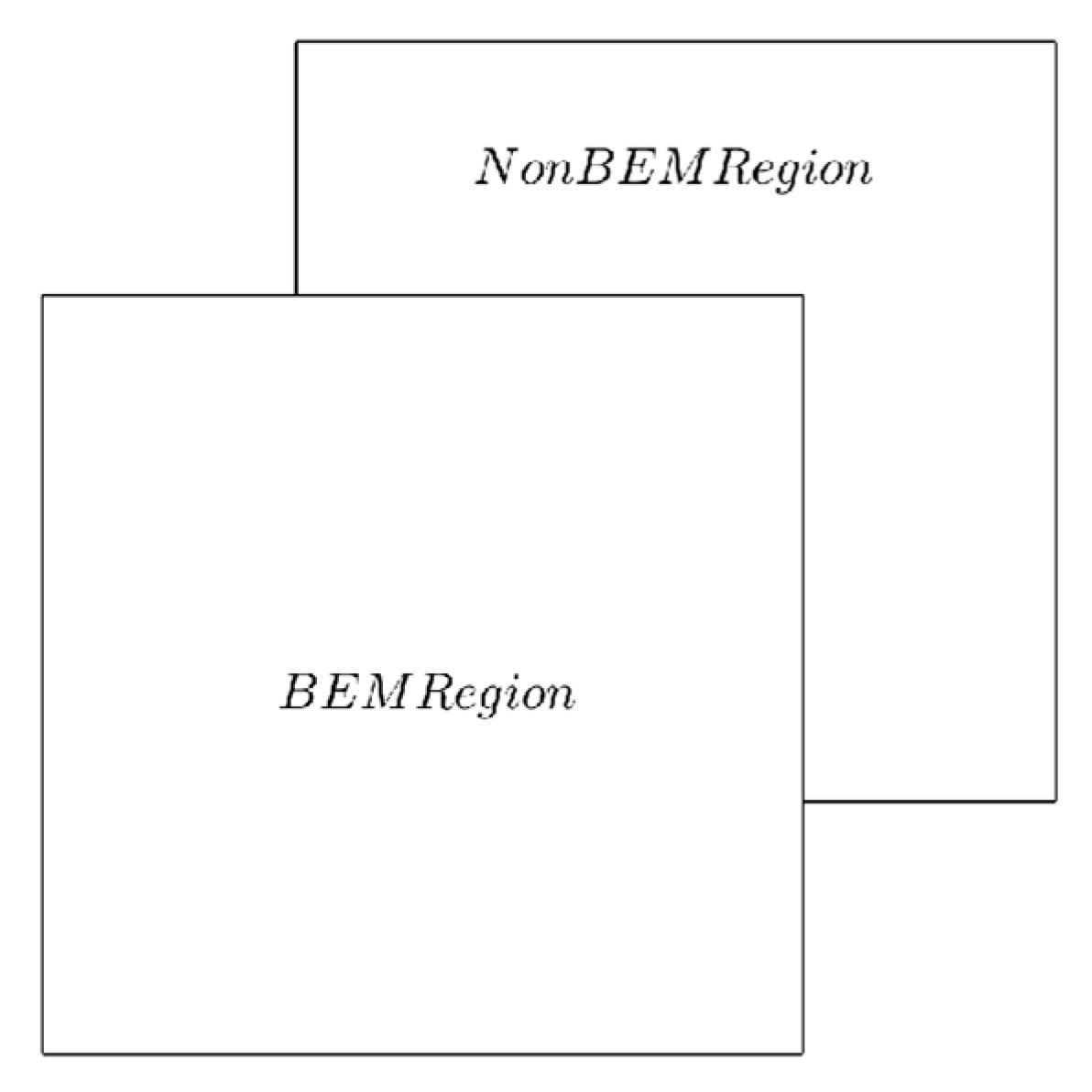
Consider the computational domain shown in
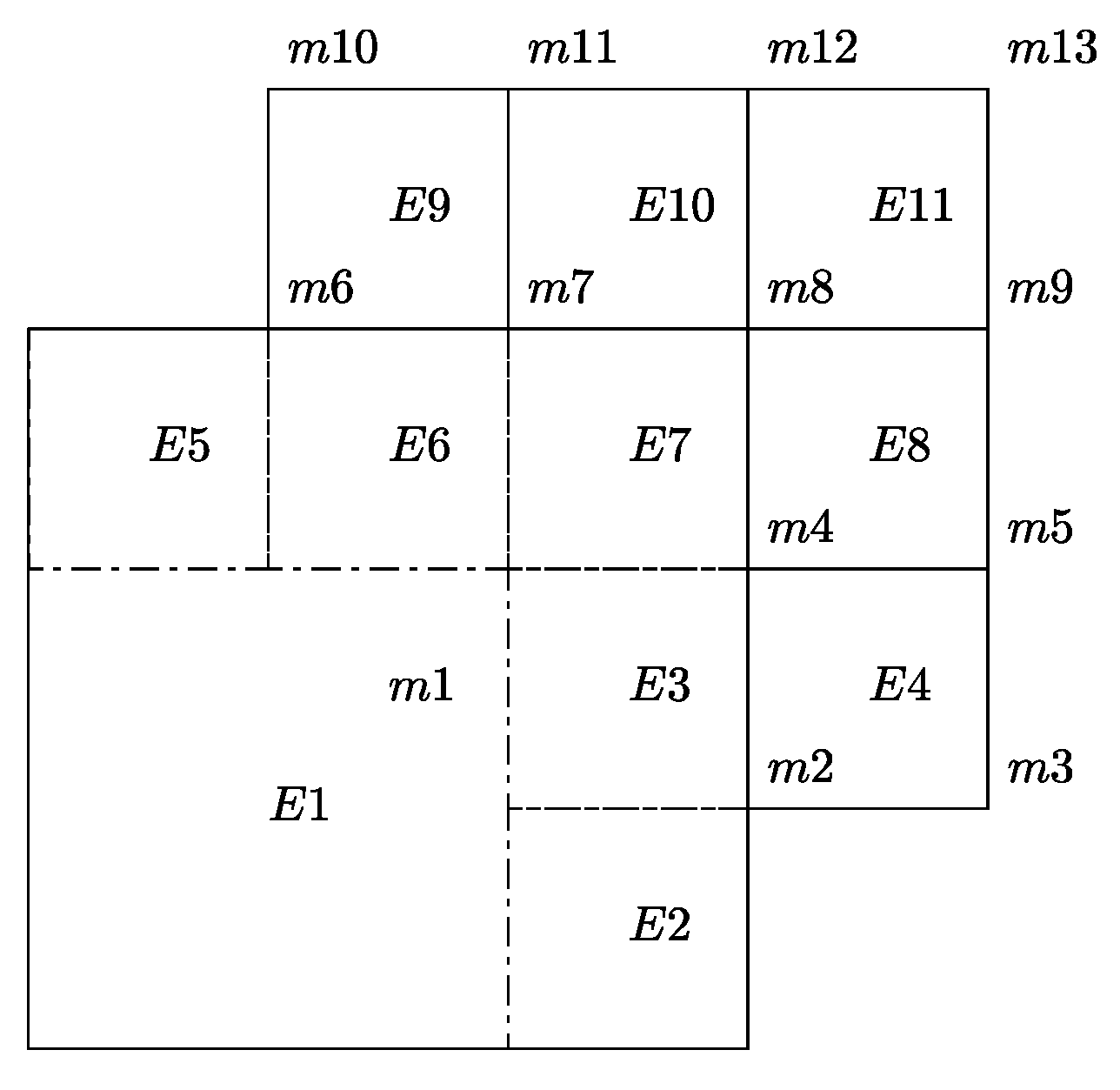
Figure 1. It is partitioned into a BEM subdomain and a complementary non-BEM region. The BEM subdomain is treated as a single, unified mathematical patch to form its part of the mathematical cover. For the non-BEM region, a standard finite element mesh is employed to generate the cover. To ensure the construction of a continuous weight function across the entire mathematical cover, the finite element mesh is extended by one layer of elements into the BEM subdomain, as illustrated in
Figure 2.
In the numerical manifold method (NMM) [
22], when the mathematical cover is generated by a finite element mesh (see
Figure 2), the cover can be viewed as a finite collection of patches. Each patch is associated with a node and forms a star-shaped region composed of all elements connected to that node. Correspondingly, the node is referred to as a star point.
In this configuration, all manifold elements can be characterized by the number and type of covering patches. This number varies continuously from four to one, depending on the element’s location relative to the BEM region and the coupling interface. The following examples, based on
Figure 2, illustrate this variation.
In the FEM region away from the interface, a typical manifold element, such as , is covered by four finite-element patches (). Moving toward the coupling interface, the number of covering patches decreases. For corner elements at the interface, such as , the element is covered by three FEM patches and one BEM patch (, , , ), resulting in a total of four covering patches—but here one of them is the BEM super-patch.
For elements directly on the interface, such as and , the number of covering patches reduces to three: is covered by , , and ; is covered by , , and . For interface elements with only one adjacent FEM node, such as and , the covering patches reduce to two: is covered by and ; is covered by and .
Finally, for elements located entirely within the BEM region, such as , there is only one covering patch—the BEM super-patch . This continuous variation from four to one covering patches naturally gives rise to the three types of manifold elements: pure FEM elements (covered only by FEM patches), pure BEM elements (covered only by the BEM patch), and mixed elements (covered by both).
2.3. Local and Global Approximations in NMM
In the NMM framework, the displacement approximation is constructed from two independent components: the local approximations defined on each mathematical patch, and the weight functions that blend them into a globally continuous field.
For a patch associated with a finite element node, the local approximation is taken as the nodal displacement value, which is constant over the patch. The corresponding weight function is chosen as the finite element shape function associated with that node. This choice ensures that, over a manifold element entirely covered by FEM patches, the global displacement reduces to the standard finite element interpolation [
22]:
where
are the shape functions (weight functions), and
are the nodal displacement vectors.
This formulation naturally distinguishes between the local approximation (the nodal values ) and the weight functions (the shape functions ), which is essential for understanding the coupling with the BEM region. In the BEM region, the local approximation is constructed from the Somigliana identity, and the weight functions are designed to form a partition of unity with the FEM shape functions across the coupling interface.
In the BEM subregion, the local displacement approximation is expressed in a form analogous to that of the FEM:
where
collects the nodal displacement degrees of freedom (DOFs) on the boundary of the BEM subregion, and
is the corresponding matrix, to be constructed from the boundary integral equation.
To construct
, we start from the boundary integral equation of elasticity. Assume the boundary of the BEM subregion is discretized into
elements, each with
nodes. For any source point
inside the BEM region, neglecting body forces, the displacement is given by the standard displacement BIE [
23]:
in which the fundamental solutions [
23] of the elastic plane strain problem are
where
and
are the shear modulus and Poisson’s ratio, respectively;
is the component of the unit outward normal on the boundary
; and
, with
for
inside the domain, and
for
on the boundary, where
is the interior angle at
.
After discretization, Equation (3) can be rewritten as [
23]
where
and
denote the nodal displacement and traction vectors on the boundary of the BEM super-patch, respectively, and
is the scalar free term coefficient defined above.
For any FEM to be coupled with BEM, the choice of interface variables [
1] is a key factor that distinguishes different coupling algorithms [
4]. In this study, the only independent variables for the BEM super-patch are chosen as
. This choice is essential for incorporating the super-patch into the minimum potential energy framework. If both
and
were treated as independent variables, additional variations with respect to
would be required. This would increase the total number of unknowns in the system. Therefore, in the present work we treat only
as independent variables, leading to a symmetric positive definite system with fewer unknowns.
By letting
traverse all boundary nodes of the BEM super-patch, Equation (6) yields the characteristic BEM linear system [
23,
24],
If
is square—which holds in the present work for constant elements without corner degeneracy—one may treat
as the independent variable and recover the boundary traction as
We note that explicit inversion of can be avoided by treating and as independent variables. This alternative has been implemented and yields numerical results close to those of the present formulation for the benchmark problems considered.
Substituting Equation (8) into Equation (6) yields a displacement interpolation matrix that plays the role of shape functions for the BEM super-patch:
with
where the division by
is understood in the scalar sense, as
is a scalar.
The matrix
shares the key features of FEM shape functions and can be written in a block form:
where
is the total number of boundary nodes on the BEM super-patch, and
is the
identity matrix.
Finally, the global displacement approximation in the NMM framework is constructed by combining the contributions from both the FEM and BEM patches via the partition of unity:
where the weight functions satisfy
Substituting the expressions for
and
gives the compact form
where
collects all displacement DOFs in the coupled system, and
represents the enriched approximation space that naturally integrates polynomial basis functions (from FEM) and fundamental-solution-induced components (from BEM) within a unified NMM framework.
Conventional coupling methods enforce displacement continuity and traction equilibrium only at the interface—a “patchwork” of two independent subdomains. In contrast, the NMM-based coupling constructs the global approximation as a superposition of overlapping patch contributions. The interface is no longer a special treatment but emerges naturally as the region where weights transition between patches. This “superposition” perspective fundamentally distinguishes the present method from conventional interface-based couplings.
2.4. Properties of and Strain Discretization
To justify treating the BEM super-patch as a superelement within the NMM framework, we first examine two fundamental properties of the shape-function matrix given in Equation (10): the interpolation property and the partition-of-unity-type property.
When the source point
coincides with the i-th boundary node of the BEM super-patch, Equation (9) reduces to
For this equality to hold for arbitrary nodal displacements, the shape functions must satisfy
i.e.,
for
, and
for
. This is the standard interpolation property.
Next, consider a rigid-body displacement
applied to the entire BEM super-patch in the absence of body forces and tractions. In this case, Equation (9) becomes
Since this holds for an arbitrary
, it follows that
which is a partition-of-unity-type property.
It is worth noting that, when the elastic body is decomposed into multiple regions [
1,
25], each region boundary can be discretized into a superelement. Unlike standard finite elements, which typically guarantee only
continuity across element boundaries, such superelements—constructed from BIEs—can naturally preserve continuity of both the field and its derivatives across multi-region boundaries. This property is particularly advantageous in problems involving stress gradients or material interfaces.
To embed the BEM super-patch into the minimum potential energy framework in a manner analogous to the FEM, a discrete representation of strains within the BEM region is required. Let the strain vector be defined as
where the third component represents the engineering shear strain.
The strains at an interior point
can be obtained from the strain boundary integral equation (strain BIE):
where
and
are the fundamental solutions for strains, obtained by differentiating the displacement fundamental solutions.
The strain BIE is expressed here in a vector form that is convenient for coupling with FEM. The corresponding fundamental solutions can be derived from the standard tensor form of the strain BIE [
23]; this derivation is part of the present work and is presented in full to facilitate implementation.
For the normal strains (
), the corresponding fundamental solutions are
In these expressions, the index is not a summation index; it merely indicates the strain component under consideration.
For the engineering shear strains (
,
), the fundamental solutions are
Following the same discretization procedure used for the displacement BIE, the strain BIE (18) can be expressed in discrete form as
where
and
are the assembled coefficient matrices obtained from the fundamental solutions
and
, respectively.
Substituting the recovered tractions from Equation (8) into Equation (23) yields a direct relation between the strains and the nodal displacements of the BEM super-patch:
with
In summary, the BEM super-patch introduces nonlocal effects into the coupled formulation: the displacement and strain at any interior point depend on the entire boundary data through the boundary integral equations. These nonlocal effects are encapsulated in the matrices and and are naturally accommodated by the NMM framework through the globally defined weight functions. This enables a seamless integration of the BEM’s global nature with the local approximation spaces of the FEM patches.
2.5. Symmetric FEM–BEM Coupling Formulation
In the numerical manifold method, each mathematical patch (and its corresponding physical patch) is characterized by three essential components [
26,
27]: the patch itself, the local basis defined on it, and the weight function associated with it. The previous subsections focused on the construction of the mathematical patches and their local bases. This subsection addresses the construction of the weight functions, the assembly of the stiffness matrix for a manifold element, and the computation of equivalent nodal forces.
A fundamental feature of the NMM is that weight functions are defined over the entire mathematical cover—not only within the region where the patch contributes. Outside the support of a patch, its weight function is explicitly set to zero. This global definition is essential for maintaining the partition of unity and for constructing the global approximation as a superposition of contributions from all patches, even though only a subset contributes numerically at any given point.
Consider an arbitrary manifold element
(see
Figure 2). The global displacement approximation at a quadrature point
in the natural coordinate system is expressed as
where
Here is the total number of nodes in the finite element mesh. The term is the number of FEM patches covering . The quantity denotes the local approximation on the -th FEM patch, and is the corresponding weight function. The term indicates whether the BEM super-patch covers . The quantity is the local approximation on the BEM super-patch (see Equation (9)), and is its associated weight.
Within each manifold element, the weight functions for the FEM patches are taken as the standard finite element shape functions:
The weight function for the BEM super-patch is then constructed to satisfy the partition of unity:
This construction ensures that, within , the sum of all active weight functions equals unity. Outside , the weight functions are defined—either as non-zero (in regions covered by the corresponding patches) or explicitly as zero—such that the partition of unity holds globally. This global perspective distinguishes the present method from conventional coupling approaches, where continuity is enforced only at interfaces.
Rewriting Equation (26) in matrix form gives
with
and
where
collects the displacement degrees of freedom associated with manifold element
, and
is the element shape-function matrix. This matrix can be used in the standard manner to compute element stiffness matrices and equivalent nodal forces within the minimum potential energy framework.
From Equation (26), the strain under the coupled formulation can be written as
where the strain–displacement matrix of the manifold element
is given by
with
Here, is the standard FEM-type strain operator associated with the weight function ; is defined analogously from the weight function . The matrices and remain as defined in Equations (10) and (25), representing the shape function and strain matrix of the BEM super-patch, respectively. The matrix can be used directly to assemble the element stiffness matrix, which is symmetric by construction.
Because the partition of unity has already been enforced in the construction of Equation (29), it can be shown that inherits both the interpolation property and the element-partition property. This renders the treatment of boundary conditions particularly natural in the present method. Similarly, retains the essential characteristics of a finite-element strain–displacement matrix; in particular, it is capable of reproducing both constant-strain and non-constant-strain fields.
Consequently, each manifold element in the coupled formulation possesses properties analogous to those of a standard finite element. The symmetry of the present coupled formulation is established theoretically. The system remains symmetric positive definite when either constant or isoparametric boundary elements are used. As is well known, an SPD finite element formulation guarantees the convergence of the numerical solution. Therefore, the proposed coupling scheme ensures convergence.
Finally, because the manifold elements cover the computational domain continuously and without overlap, there is no need to enforce displacement continuity or traction equilibrium separately across the coupling interface. These interface conditions are satisfied automatically—in the same way that standard finite element methods do not require explicit enforcement of continuity or equilibrium between adjacent elements.
2.6. Additional Constraints on the Independent Displacement of BEM Super-Patch
In the BEM, boundary conditions may involve prescribed tractions. Here, these tractions are imposed as constraints on the independent displacement variables
of the BEM super-patch. From Equation (8), such a constraint can be written as
where
consists of the rows of
corresponding to the prescribed traction degrees of freedom, and
denotes the prescribed traction vector on the manifold element
.
To incorporate this constraint into the total potential energy, we express
in terms of the element displacement vector
via a selective matrix
whose items are 0 or 1. In this way, we have
The constraint then becomes
Using a penalty method [
22], the modified total potential energy for
is
where
is the elastic constitutive matrix and
is a penalty parameter (
). Taking the variation of
with respect to
yields the element stiffness matrix
and the equivalent external force vector
For elements not covered by the BEM super-patch, the penalty term is omitted by taking and . After assembling all element contributions, the global system is obtained and solved in the usual finite element manner. Once the nodal displacements are known, the boundary tractions are recovered from Equation (8).
The global stiffness matrix is assembled from manifold elements that satisfy the interpolation property and the partition of unity. As in standard finite element methods, the stiffness matrix is positive definite because the only zero-energy mode is the rigid body motion, which is suppressed by the prescribed displacement boundary conditions. A more formal justification of positive definiteness based on the theory of Gram matrices is provided in
Appendix A.
In the present study, the penalty parameter is taken as , where E is Young’s modulus. This choice follows common practice in the FEM literature and is supported by preliminary numerical tests: increasing by one order of magnitude increases the condition number of the system matrix by approximately the same factor. The selected value offers a compromise between accurate enforcement of traction equilibrium and acceptable conditioning of the algebraic system.
We note that the penalty method introduces an additional parameter that may affect conditioning. An alternative approach to avoid the penalty method altogether is to incorporate the prescribed boundary conditions on the BEM super-patch directly before the inversion of in Equation (8). This would eliminate the need for a penalty term and further streamline the formulation. A detailed implementation of this alternative is left for future work.
2.7. Comparison with Existing Symmetric Coupling Methods
In this section, we compare the proposed SPD method with some existing classes of symmetric coupling strategies: symmetric Galerkin coupling methods (SGCM), domain-decomposition-based coupling methods and Nitsche-based coupling methods.
The proposed formulation differs from existing symmetric coupling approaches in several structural aspects.
Compared with symmetric Galerkin BEM (SGBEM), which relies on both the displacement and traction boundary integral equations, the present method uses only the displacement BIE. Consequently, it does not involve hypersingular integrals, which require special integration techniques. The resulting algebraic system is symmetric and, under the conditions discussed in
Section 2.6, positive definite, whereas SGBEM typically yields symmetric but indefinite systems.
Compared with domain-decomposition-based coupling methods, the present approach does not require iterative exchange between subdomains. The interface conditions are embedded in the global approximation space through the overlapping weight functions.
Compared with Nitsche-based coupling methods, the present approach does not introduce additional stabilization parameters beyond the penalty parameter used for traction boundary conditions. The interface continuity is handled naturally by the partition of unity of the weight functions, rather than through penalty or Lagrange multiplier terms on a discrete interface. This eliminates the need for interface-specific stabilization tuning.
These features follow from the structure of the NMM-based coupling. A fair quantitative comparison with existing methods would require matched discretization orders across methods, which is beyond the scope of this proof-of-concept study. The focus here is on establishing the SPD coupling framework; a systematic performance assessment is left for future work.
2.8. Numerical Considerations
When the element size becomes sufficiently small, manifold elements near the boundary of the BEM super-patch may suffer from near-singular integrals in the strain BIE (
Section 2.4). These integrals, if not treated properly, can affect the convergence rate, as observed in Example 2 (see the convergence study in
Section 3.2). Several strategies can be considered to address this issue.
Standard BEM techniques such as element subdivision [
28,
29], adaptive Gaussian integration [
30], and coordinate transformations [
31,
32,
33] are applicable. Within the NMM framework, expanding the mathematical cover of the BEM super-patch could in principle avoid near-singularity by separating the integration boundary from the Gauss points, though this has not been implemented here. Converting the strain energy domain integral to a boundary integral offers another potential route.
The theoretical foundations of the latter two strategies have been established in the authors’ previous work; their numerical implementation in the present coupling framework is left for future work.
2.9. Consideration of Constant Elements in the BEM Formulation
A key step in the proposed SPD coupling scheme is the inversion of the matrix
in Equation (8); therefore,
must be square. If higher-order isoparametric elements were used to discretize the boundary of the BEM patch, corner singularities would arise in problems with non-smooth boundaries, causing
to become non-square and hence non-invertible. To avoid this difficulty while maintaining a simple implementation, the boundary of the BEM patch is discretized using constant elements in the present work. The integrals in the displacement and strain BIEs are evaluated analytically following the approach of Deng [
34]. The FEM region is discretized using standard four-node quadrilateral (Q4) elements.
The use of constant elements introduces an additional consideration at the coupling interface. In conventional coupling schemes, coupling constant boundary elements with Q4 finite elements is almost impossible. Within the NMM framework, however, this difficulty is circumvented, as the local approximations on different patches can be completely independent. To further reduce the total number of degrees of freedom, the nodal displacements of the constant boundary elements located within the FEM cover are taken as the average of the corresponding finite element nodal displacements. This introduces an interpolation constraint that links the BEM centroid degrees of freedom to the FEM node degrees of freedom.
After the displacement at a BEM centroid is interpolated from the nodal displacements of the opposing FEM elements, the vector
contains degrees of freedom that are not independent. Let
denote the independent degrees of freedom on the BEM super-patch and
the nodal displacements on the FEM side of the interface. The full BEM displacement vector is then related to these independent variables by
where
is a matrix constructed from the interpolation relations at the interface, with items being 0, 0.5 or 1.0.
For manifold elements covered by the BEM patch, the element stiffness matrix and force vector must undergo a corresponding linear transformation:
It should be noted that although constraint (43) is introduced, the transformed element stiffness matrix remains rank-deficient. However, numerical experiments show that the global stiffness matrix is positive definite. For example, on the coarsest mesh of Example 2, the smallest eigenvalue of the global stiffness matrix was found to be approximately (in physical units), i.e., strictly greater than zero.
This situation is analogous to the assembly process in standard finite element methods: individual element stiffness matrices are rank-deficient, but the global stiffness matrix becomes positive definite after the displacement boundary conditions are imposed.
Furthermore,
Appendix A provides a theoretical proof that the global stiffness matrix obtained from the proposed FE-BE coupling within the NMM framework is symmetric positive definite. That proof does not rely on constraint (43). Since positive definiteness in a larger space implies positive definiteness in a subspace, it follows that the global stiffness matrix remains positive definite even after constraint (43) is introduced.
Finally, to assess the accuracy and convergence of the proposed method in the benchmark examples, the following error measures are adopted. For a quantity of interest
, the absolute error and relative error are defined as
where
and
denote the exact and numerical values, respectively.
Several limitations of the current implementation with constant elements—the approximate satisfaction of traction equilibrium at the interface, the reduced convergence rate, and the poor performance in bending-dominated problems—originate from the use of constant boundary elements. These limitations can be overcome by adopting isoparametric boundary elements (e.g., linear or quadratic) on the BEM super-patch. With isoparametric elements, the interface degrees of freedom match those of the adjacent FEM elements, allowing traction equilibrium to be enforced more directly. Higher-order elements can also represent rigid body rotations and achieve higher convergence rates. The present work therefore serves as a proof-of-concept for the SPD coupling framework, which is independent of the specific boundary element type and naturally extends to higher-order discretizations. We thank the reviewers for their constructive comments that helped us clarify these points.
3. Results and Discussion
3.1. Example 1: Square Plate Under Biaxial Compression
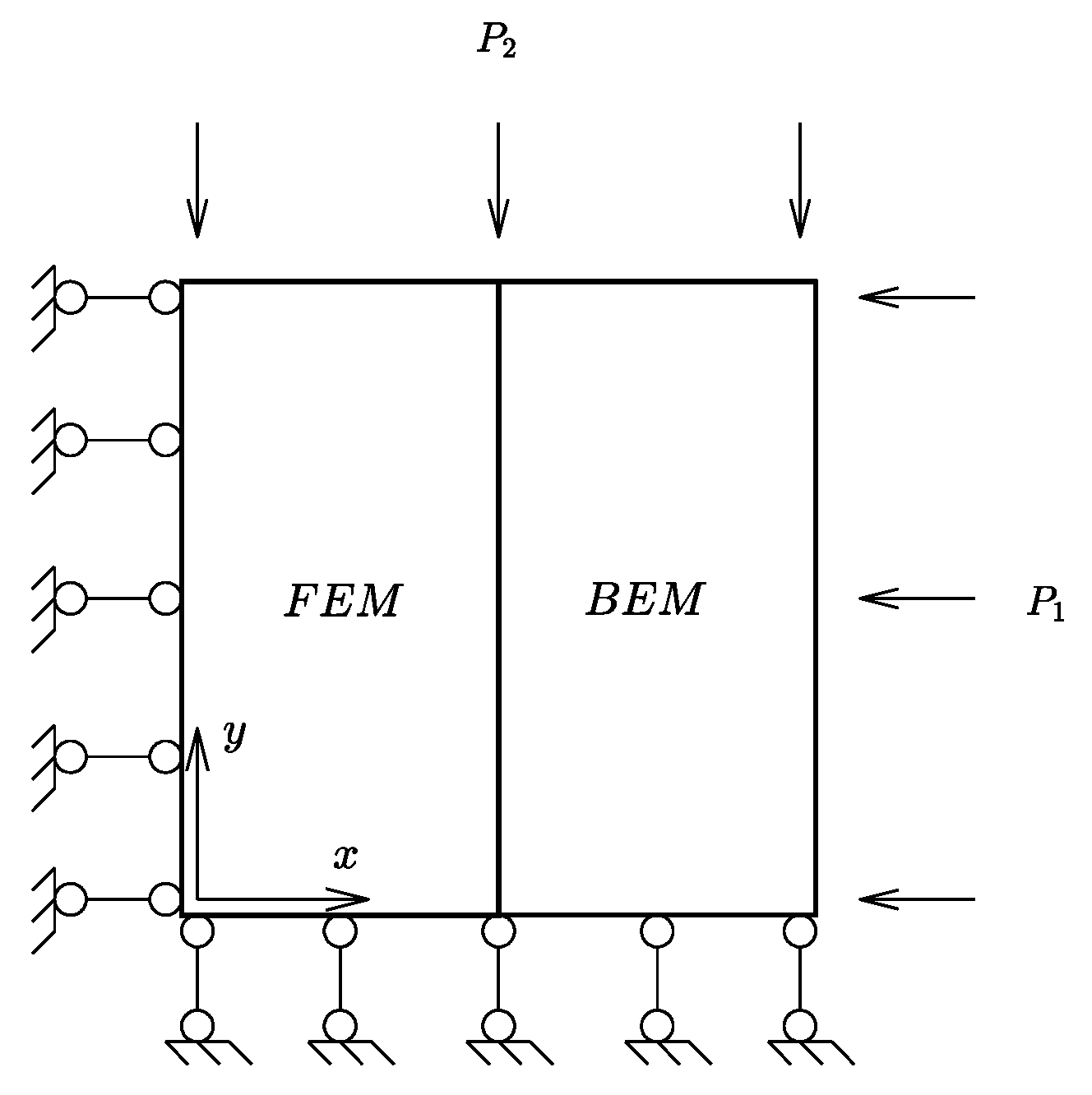
The first benchmark problem considers a uniformly compressed square plate [
33], which can be viewed as an idealized model for a strip foundation beneath a building wall. The geometry and loading conditions are illustrated in
Figure 3.
The plate has dimensions of . Plane-strain conditions are assumed, with Young’s modulus and Poisson’s ratio . The applied pressures are . To avoid the well-known difficulties associated with pure Dirichlet conditions in the BEM (discussed below), mixed boundary conditions are adopted: the normal displacement is constrained to vanish on the edges and , while the remaining boundaries are traction-free.
For this problem, the analytical solutions [
35] of displacement components are as follows:
And the stress components are
In the following figures, results from the FEM subdomain are plotted using nodal values for contour plots, obtained by interpolation of Gauss-point data (for stresses) or the displacement field itself (for displacements). For line plots (e.g., displacements or stresses along a line), FEM results are obtained by interpolation from nodal values, while BEM results are obtained by direct evaluation of the boundary integral equations at the specified interior points, as described in
Section 2.3 and
Section 2.4.
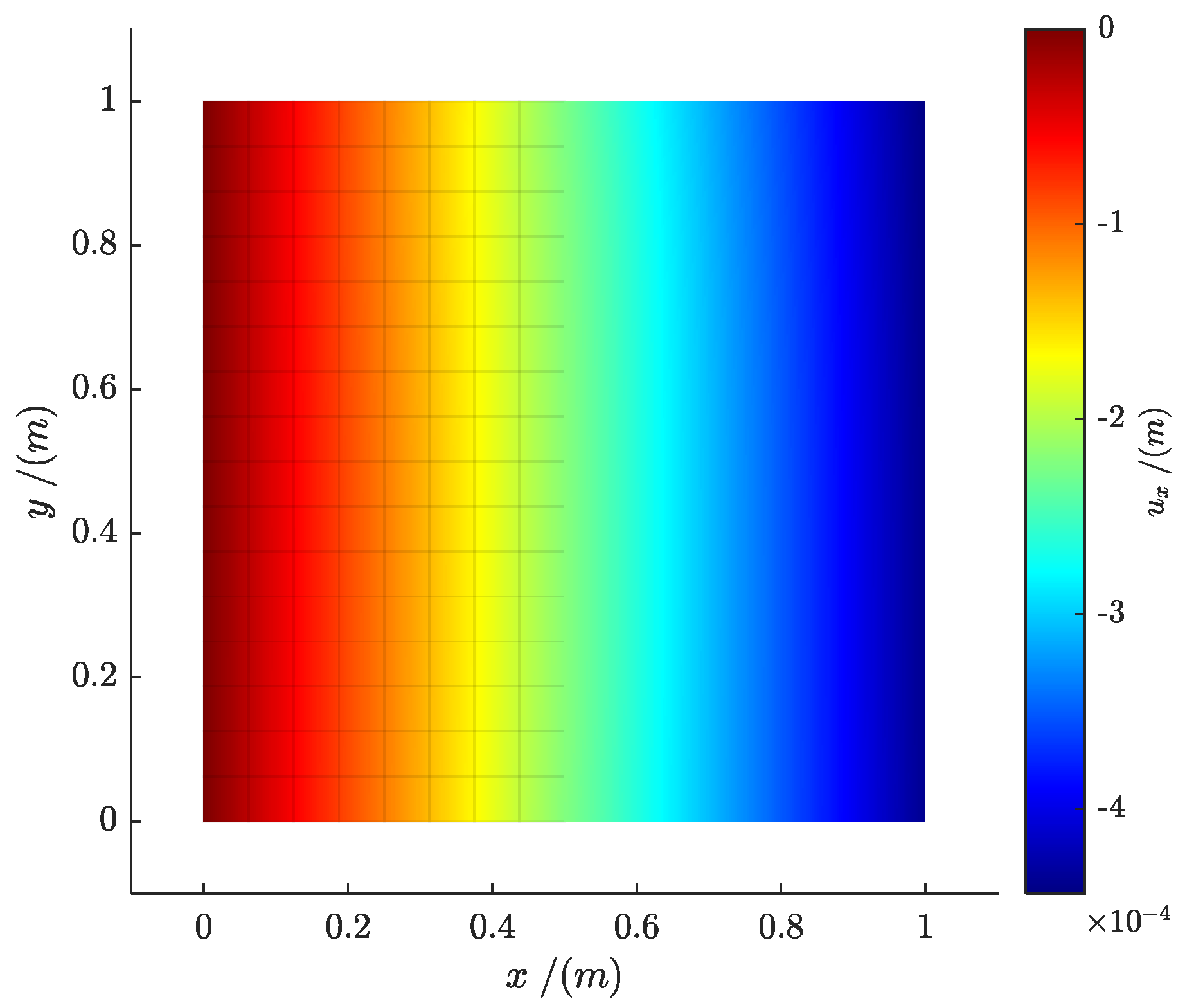
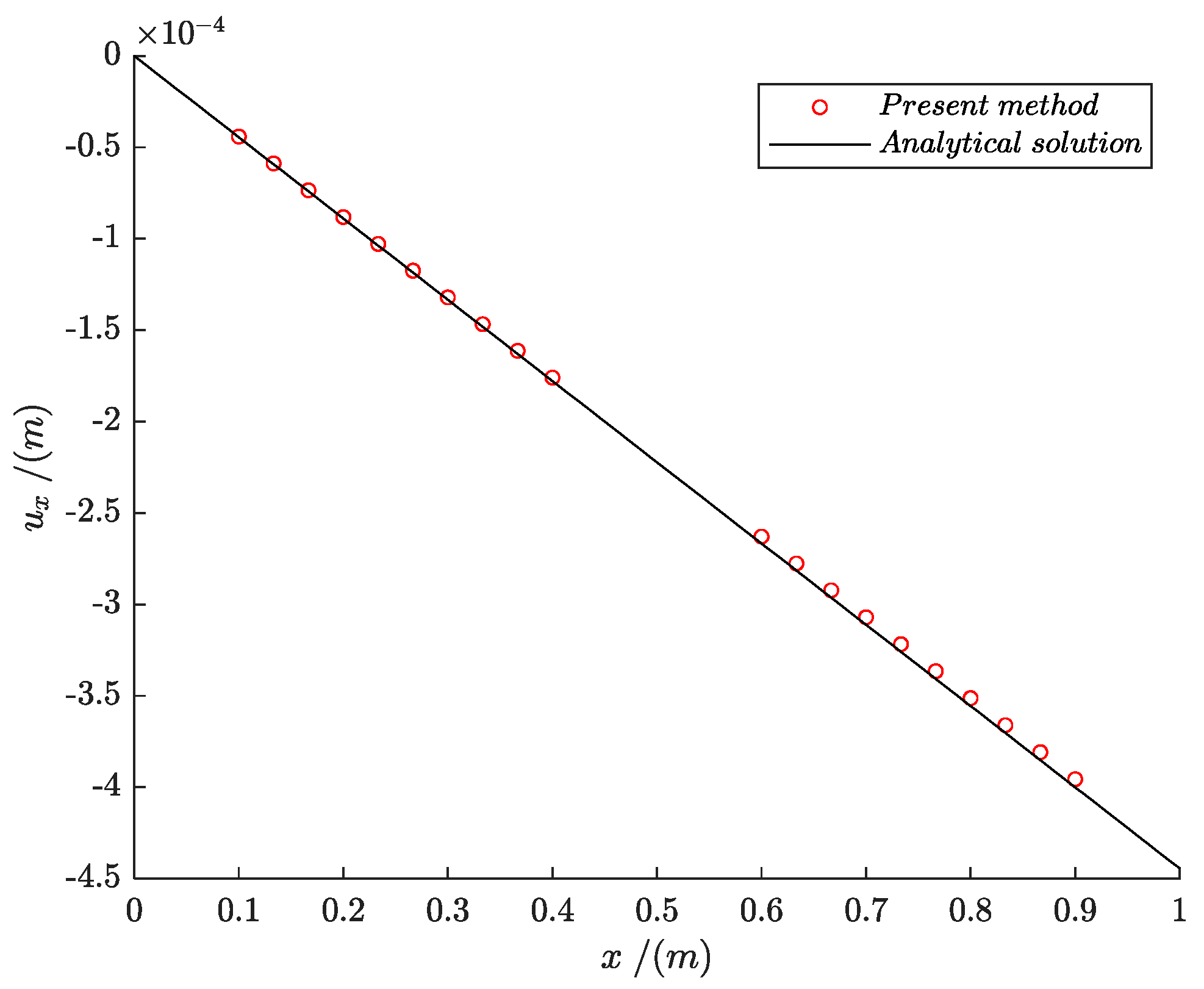
Figure 4 shows the
field obtained using 16 elements on each side. The maximum displacement at the right edge is
, in excellent agreement with the analytical value
.
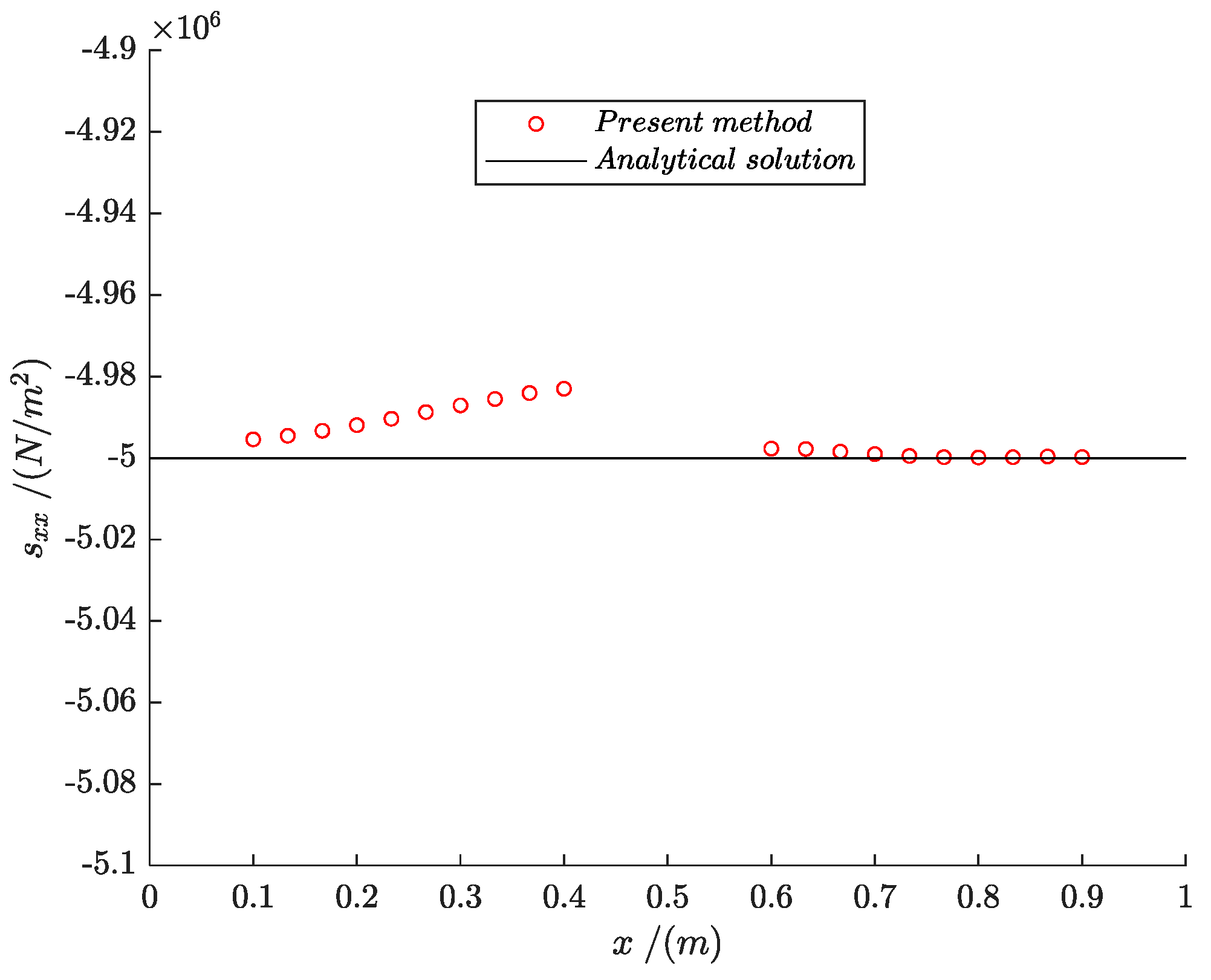
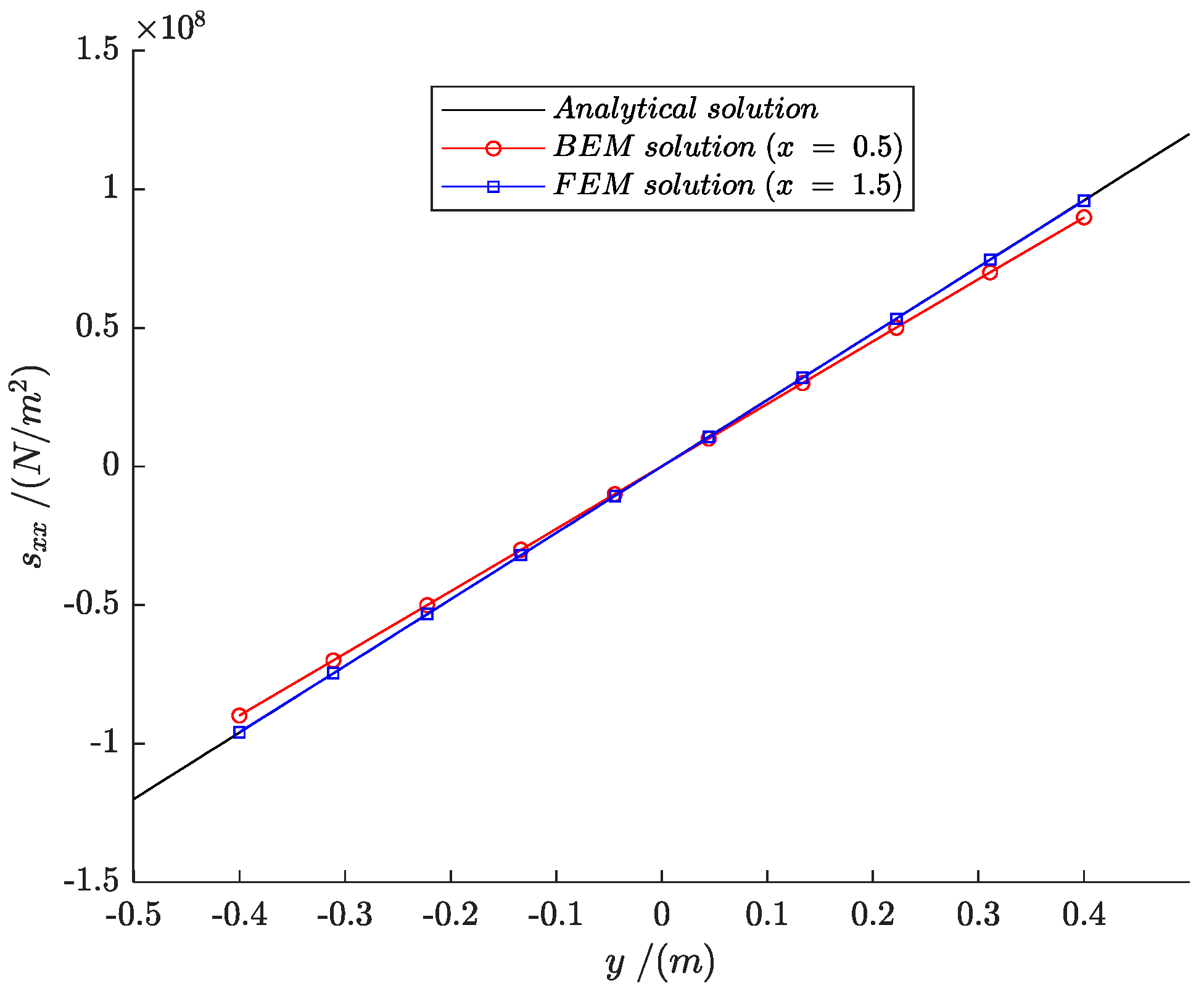
The numerical and analytical solutions for
and
are compared in
Figure 5 and
Figure 6. Overall, the numerical results agree well with the exact solution. A small discrepancy is observed in the FEM subdomain, with a maximum
near the interface.
The square plate problem, even with mixed boundary conditions, is not a trivial benchmark for constant-element BEM.
It is well documented that pure Dirichlet problems in polygonal domains pose severe difficulties for the boundary element method. As shown by Lubuma & Nicaise [
36], the convergence of classical BEM deteriorates due to edge and vertex singularities of the solution. Moreover, Dijkstra [
37] demonstrated that for the Laplace equation with Dirichlet boundary conditions, the boundary integral equation becomes singular for certain critical domain sizes—a phenomenon intimately related to the logarithmic capacity of the domain.
Importantly, these difficulties are not confined to pure Dirichlet problems. For mixed boundary conditions, the system matrix inherits a block originating from the Dirichlet operator, and thus the critical size phenomenon persists [
37]. Consequently, even when traction boundaries are present, the discrete system can become ill-conditioned if the domain size approaches a critical value.
For a square domain, this critical size may be accidentally encountered, which explains why constant-element BEM—even with analytical integration—often exhibits poor accuracy in this seemingly simple geometry. In contrast, a trapezoidal domain shifts the logarithmic capacity away from the critical value, restoring the well-posedness of the system.
In the present coupled formulation, despite these underlying difficulties, accurate displacements and normal stresses are obtained. This demonstrates that the NMM-based framework provides a robust and reliable platform for coupling FEM and BEM.
As discussed in
Section 2.9, the present formulation enforces displacement continuity across the FEM–BEM interface via interpolation but does not explicitly impose traction equilibrium. Nevertheless, the numerical results indicate that equilibrium is approximately satisfied. This is evidenced by the small
and the fact that the discrepancy is confined to the FEM side of the interface.
We note that the slight discrepancy in near the interface (maximum relative error 3.4%) is not attributable to the transition of weight functions, as the partition-of-unity construction ensures smooth displacement continuity across the interface. Several factors contribute to this discrepancy.
First, the penalty method used to enforce traction equilibrium can affect the accuracy of the solution: an excessively small penalty parameter leads to violation of traction equilibrium, while an overly large penalty parameter degrades conditioning. In the present study, the penalty parameter is chosen as to balance these two effects.
Second, the use of constant boundary elements on the BEM super-patch means that traction equilibrium is enforced between the FEM nodal forces and the BEM element-centroid forces, rather than between matching nodal forces as in isoparametric formulations. This mismatch contributes to the local error on the interface.
Third, near-singular integrals in the displacement BIE and strain BIE can affect the accuracy of both the displacement and stress fields when evaluation points approach the boundary. This in turn affects the computation of equivalent nodal forces derived from the BEM super-patch. Furthermore, the shape functions derived from the displacement BIE require accurate integration to maintain their interpolation property (unity at the collocation point, zero elsewhere). In the present implementation, only one Gaussian integration point is used per constant element for computing the equivalent nodal forces; any quadrature error directly influences the nodal forces transmitted to the interface, leading to an imbalance in traction equilibrium.
Fourth, the absence of a comparable error on the BEM side can be attributed to the different ways in which stresses are recovered. On the BEM side, stresses are obtained by direct evaluation of the strain boundary integral equation (strain BIE) at interior points, which provides a relatively accurate representation even in the presence of small displacement perturbations. In contrast, on the FEM side, stresses are derived from derivatives of the displacement field, which amplify any local irregularities introduced at the interface, leading to the slightly larger discrepancy observed in
Figure 6. This interpretation suggests that the interface error primarily reflects the intrinsic characteristics of each subdomain rather than a defect of the coupling framework.
It should be noted that the results presented in
Figure 6 are taken from interior points away from the interface (
in the FEM region and
in the BEM region). Points closer to the interface are omitted because the strain BIE in the BEM region suffers from near-singular integrals when the evaluation point approaches the boundary—a numerical issue that has not been addressed in the current implementation.
The fact that the error remains below 0.5% despite the lack of explicit traction equilibrium and the presence of near-singular effects demonstrates the robustness of the NMM framework: the globally defined weight functions provide a degree of continuity that helps to smooth out local irregularities in the displacement field, thereby keeping stress errors small. Nevertheless, a fully consistent treatment—for instance, by introducing the traction BIE as an additional constraint, by using matching interpolation orders across the interface, or by implementing special quadrature for near-singular integrals—could further improve accuracy and is left for future investigation.
3.2. Example 2: Thick-Walled Cylinder Under Internal and External Pressure
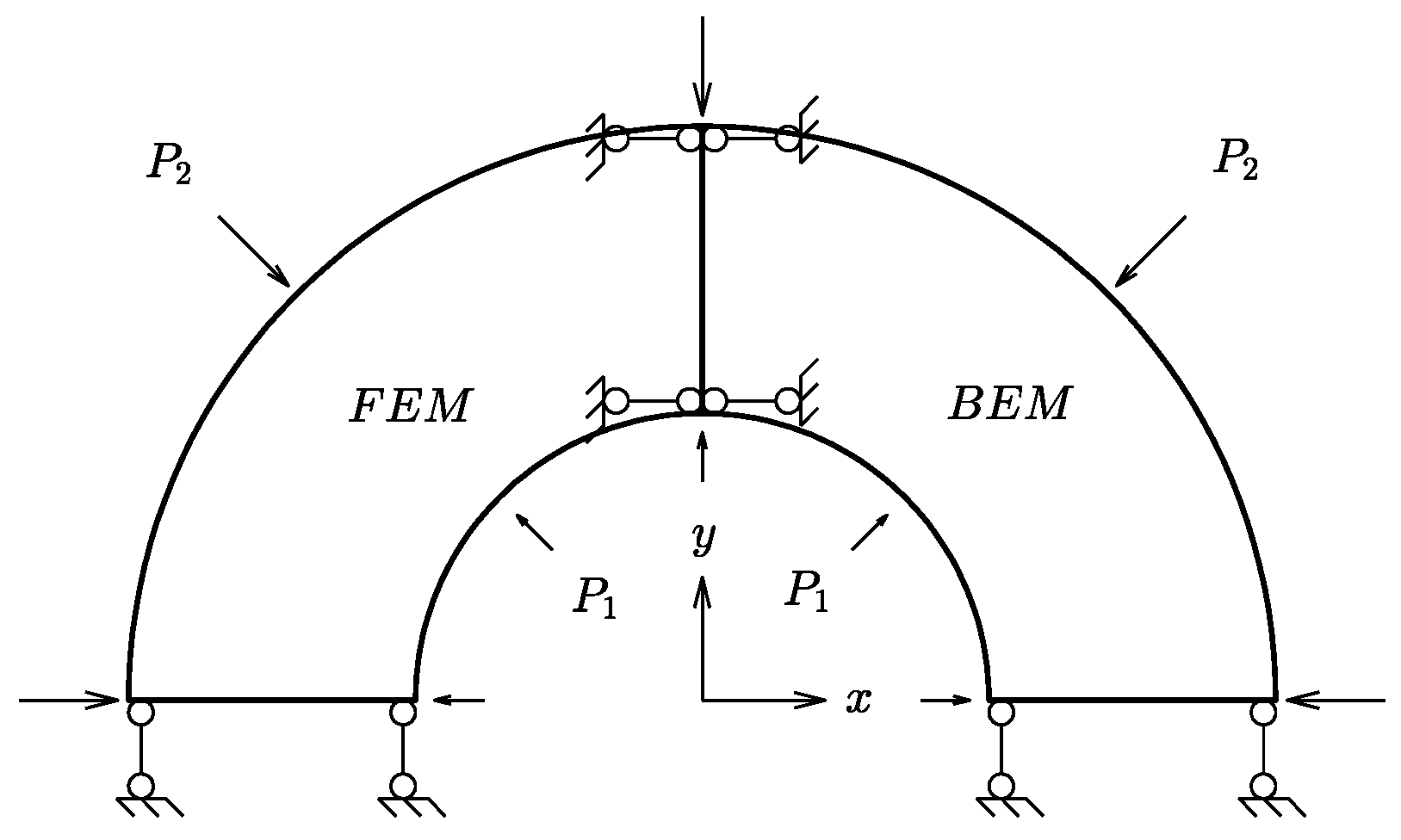
The second example considers a thick-walled cylinder under plane-strain conditions, adopted from Karlis [
38]. Owing to symmetry, only half of the domain is modeled (
Figure 7). The material parameters are
and
. The inner/outer radii are
and
, with internal/external pressures
and
, respectively.
The analytical displacement [
39,
40]
in polar coordinates is
And the stress components
are
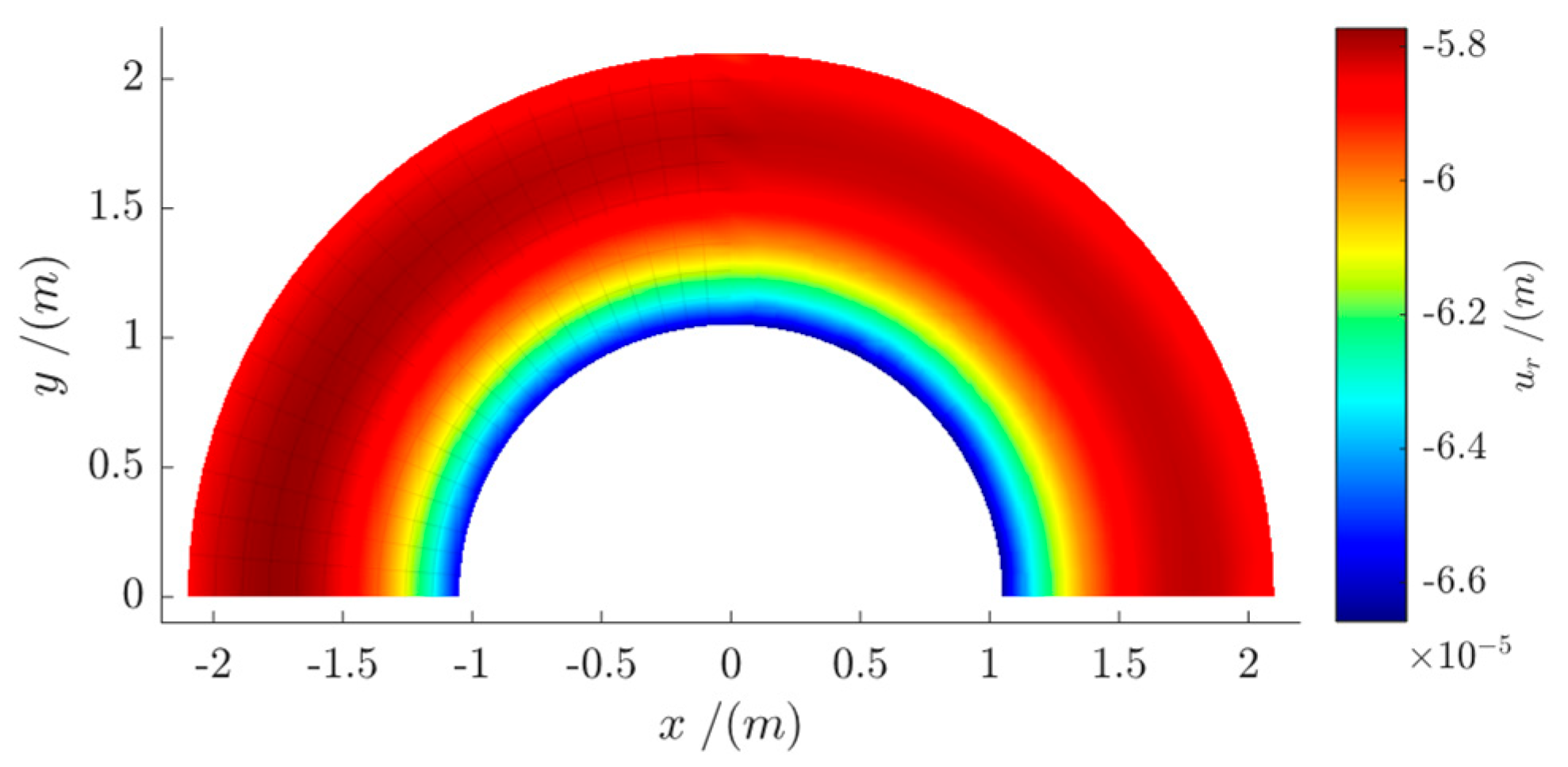
Figure 8 presents the radial displacement field
computed using 10 elements in the radial direction and 20 in the circumferential direction. The analytical range is [
], which agrees well with the proposed symmetric coupling results. When the BEM patch uses only 5 radial elements, as in Karlis [
38], the accuracy remains essentially unchanged.
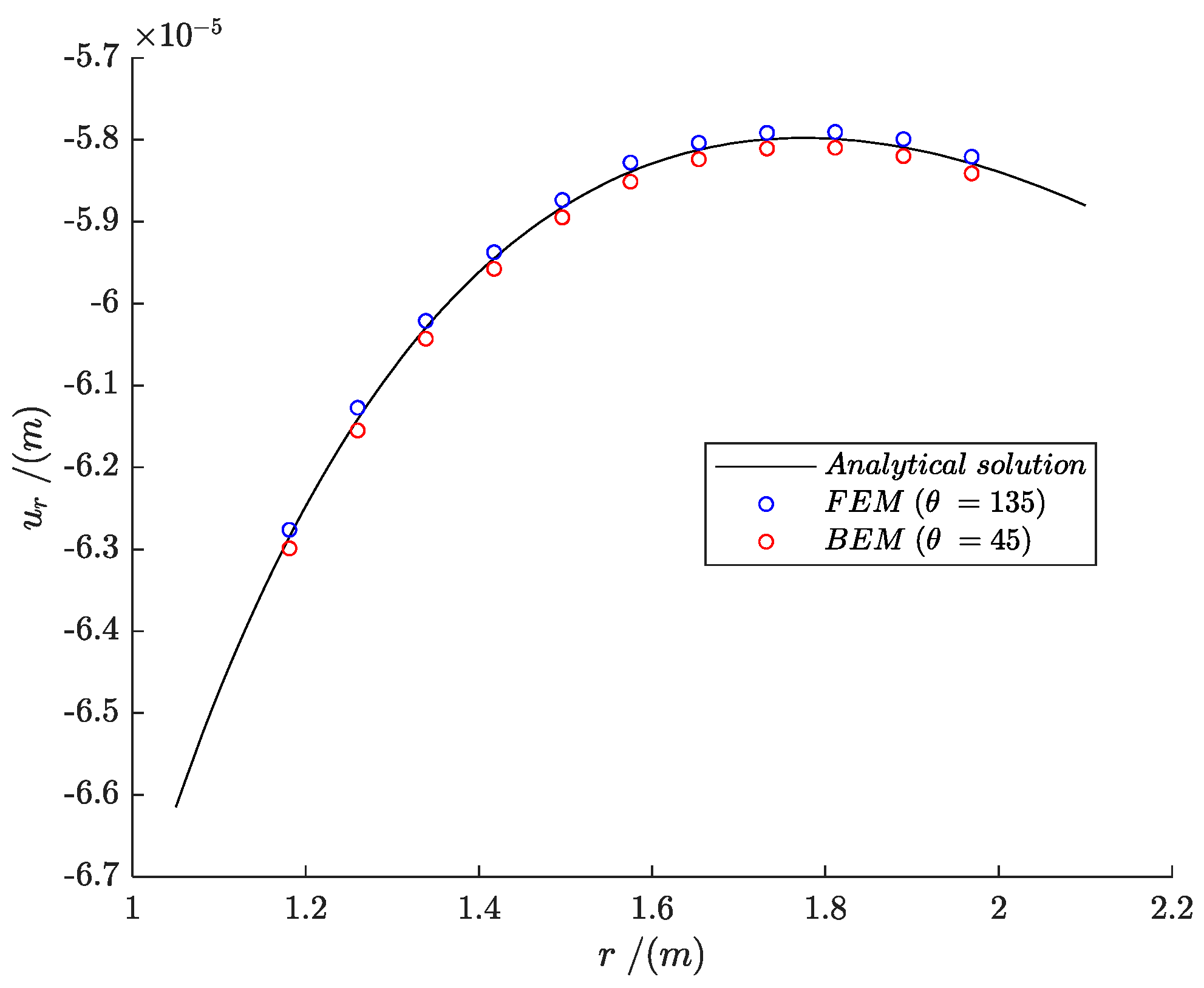
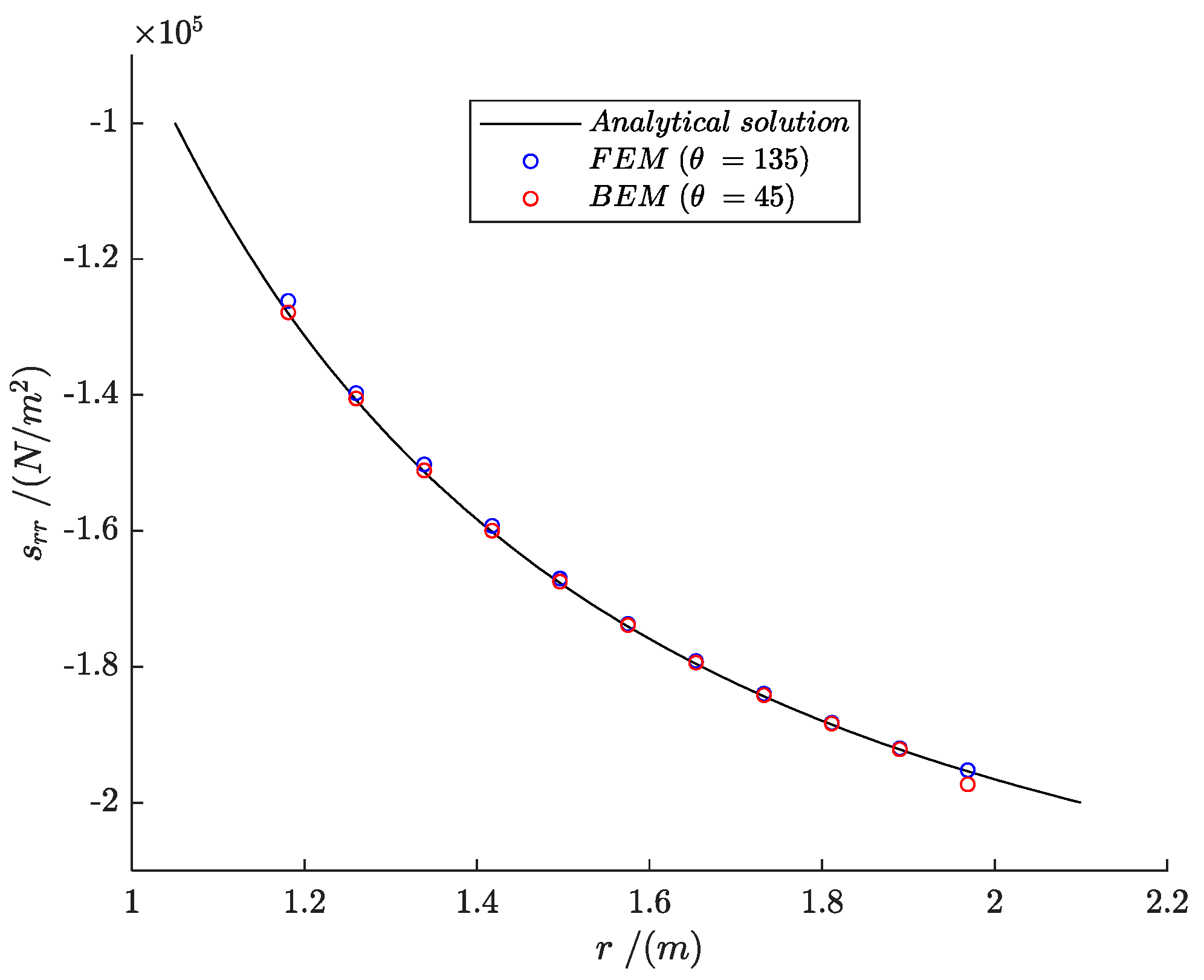
The radial displacement
and radial stress
along the circumferential directions
and
are plotted in
Figure 9 and
Figure 10, respectively. As shown, the numerical solutions match the analytical results closely with 10 radial and 20 circumferential elements.
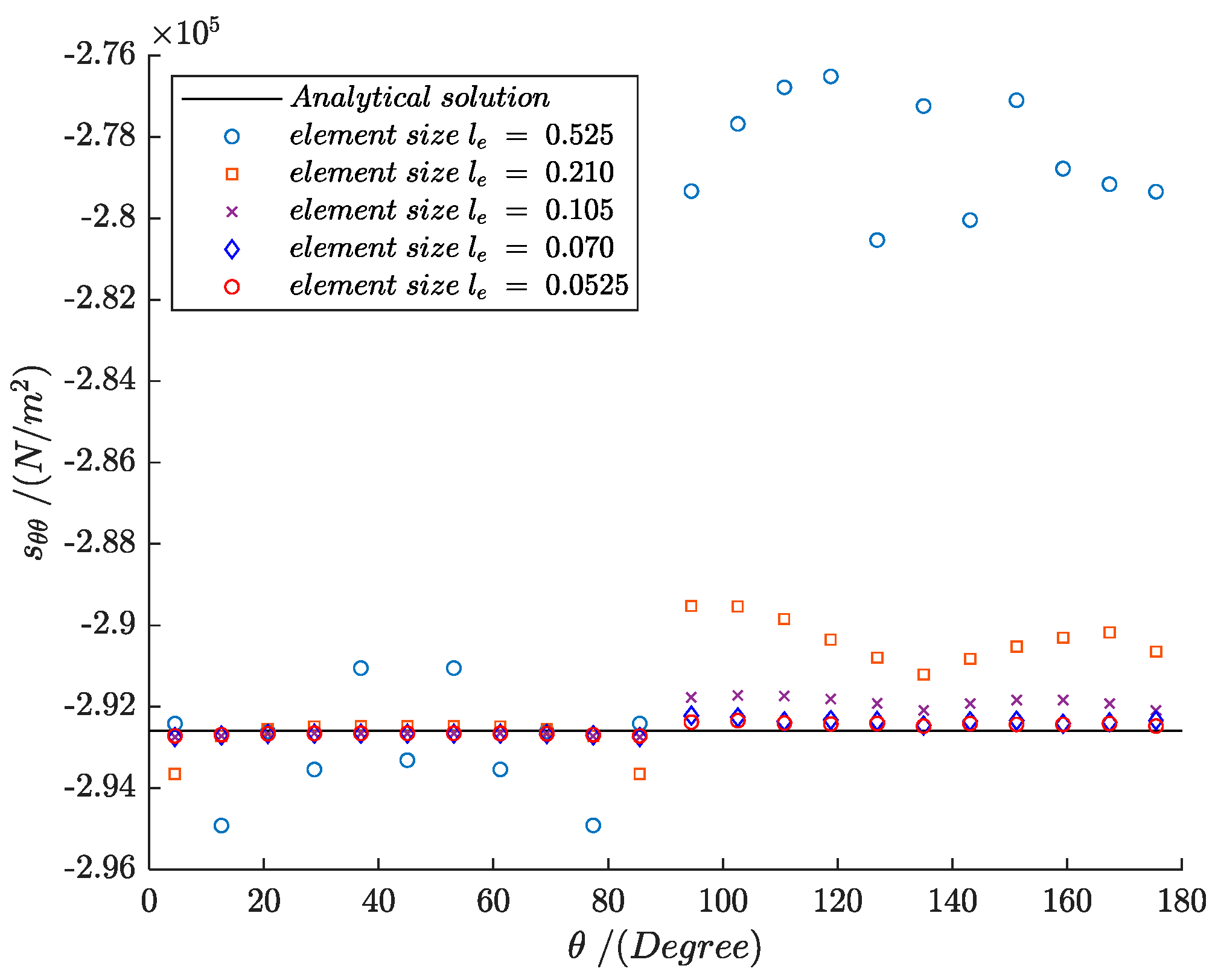
Figure 11 further examines the small accuracy difference in the circumferential stress
between the BEM region (
) and the FEM region (
). A series of mesh seeds is considered:
along the
direction and
along the radial direction. For
, BEM is consistently more accurate than FEM, particularly on coarse meshes.
In the mesh refinement study, the BEM super-patch discretization and the FEM mesh were refined proportionally: the number of boundary elements on the inner and outer radii was kept consistent, and the number of elements along the radial direction was also kept consistent. The FEM mesh on the left half and the BEM boundary discretization on the right half were refined symmetrically.
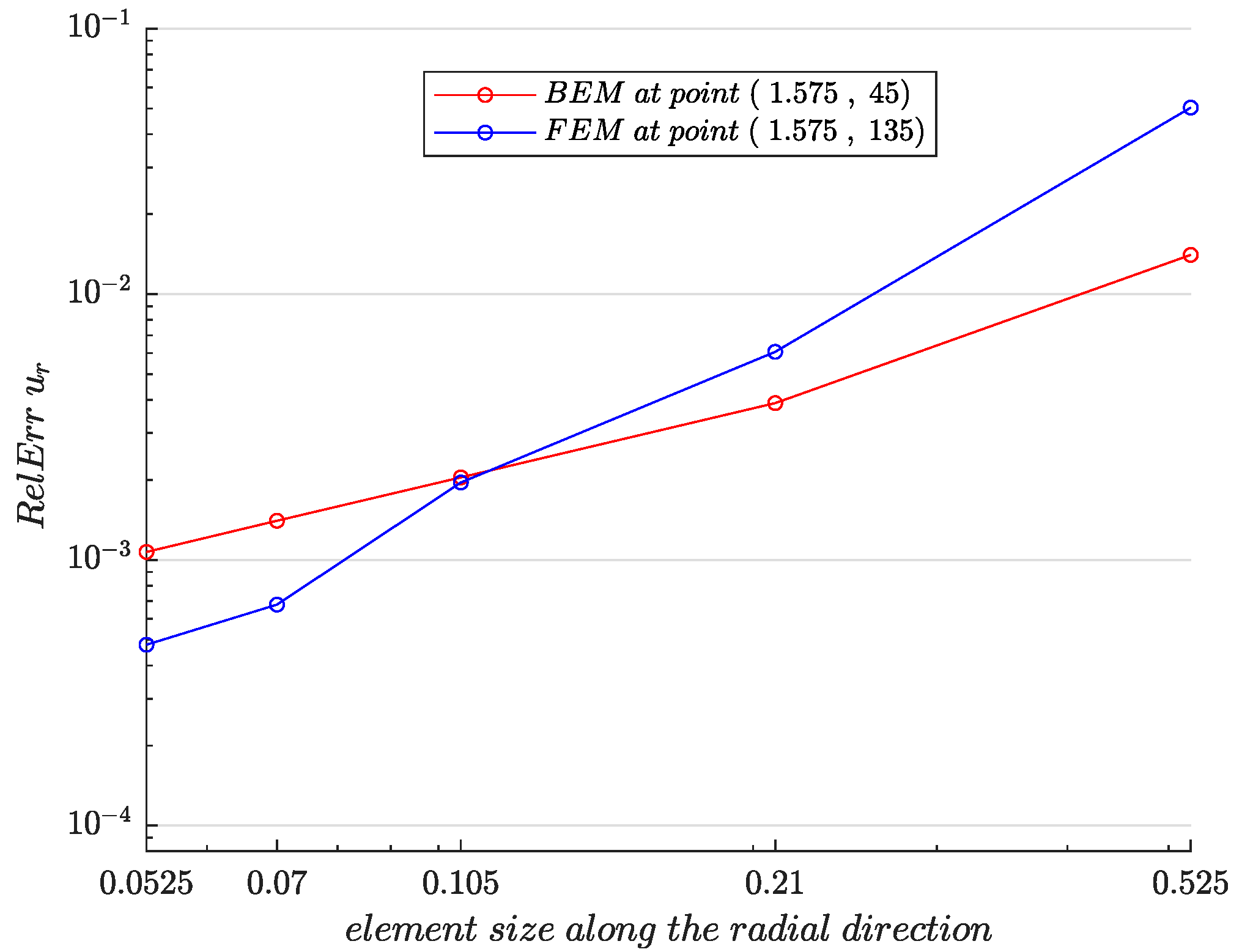
For the convergence study, we report the relative errors of the radial displacement and stress at the centers of the BEM and FEM subdomains, respectively.
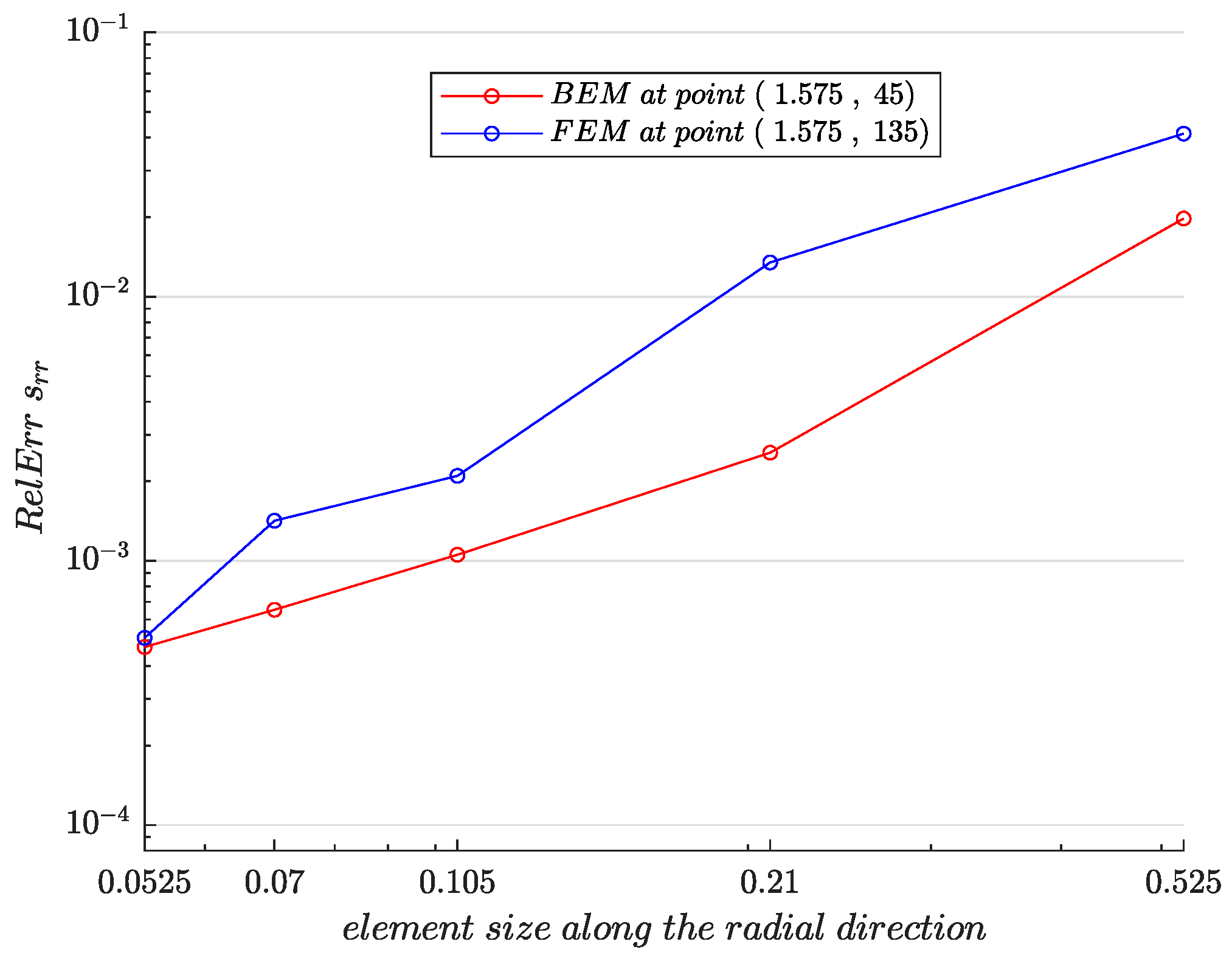
Figure 12 shows the convergence of the radial displacement obtained from the BEM and FEM parts of the coupled formulation. On coarse meshes, the BEM displacement is more accurate than the FEM displacement—a behavior characteristic of constant-element BEM, which often yields reasonable accuracy even with few elements. As the mesh is refined, the FEM displacement converges faster (rate ≈ 2.0) and eventually surpasses the BEM accuracy. The convergence rate of the BEM displacement is observed to be close to unity, which is consistent with the theoretical expectation for constant elements. These results confirm that the coupling procedure does not alter the intrinsic convergence properties of each subdomain.
Figure 13 shows the convergence of the radial stress obtained from the BEM and FEM parts of the coupled formulation. The BEM stress accuracy remains superior to that of the FEM across the entire range of mesh sizes considered. This behavior is consistent with the fact that stresses in BEM are obtained by direct evaluation of the strain boundary integral equation, which provides a more accurate representation than the stress recovery procedure used in FEM. For the coarsest mesh, the BEM stress error is
, compared to
for the FEM; for the finest mesh, the errors are
and
, respectively. The convergence rates of both methods are close to 2.0.
The condition number of the global stiffness matrix increases with penalty parameter and mesh refinement, reflecting the combined influence of the number of degrees of freedom, mesh nonuniformity, and the coupling of BEM and FEM stiffness matrices. The system retains positive definiteness at all refinement levels, and the condition numbers remain within the range treatable by double-precision arithmetic.
It is worth noting that the BEM stress results presented here were obtained using Gaussian quadrature for regular integrals, with six integration points per element. In preliminary studies, analytical integration of the same integrals yielded significantly less accurate stresses on coarse meshes. This is attributed to the fact that analytical integration assumes an exact geometric representation; for a curved boundary such as that of the cylinder, constant-element discretizations introduce geometric approximations that, when combined with exact integration, can lead to unexpected errors. Replacing analytical integration with sufficiently accurate Gaussian quadrature effectively eliminates this source of inaccuracy, as confirmed by the present results.
A slight degradation in the BEM convergence rate is observed on the finest meshes, which may be attributed to near-singular integrals in the strain BIE (Equation (24)) when evaluation points approach the boundary. A more detailed treatment of such integrals is left for future work.
For comparison, we note that a symmetric BEM formulation [
41] applied to an infinite plate with a circular hole achieved a convergence rate of approximately 2.0 for the radial displacement, using linear elements and a problem-specific error measure. A direct quantitative comparison with the present results is difficult due to differences in the problem geometry, element type, and error definition. Nevertheless, the observed convergence rates of the coupled formulation—approximately 2.0 for the FEM displacement and 2.0 for the BEM stress—are consistent with the high accuracy achievable by symmetric formulations in general.
3.3. Example 3: Cantilever Beam Under Pure Bending
To examine the performance of the proposed coupling method in bending-dominated problems [
42,
43,
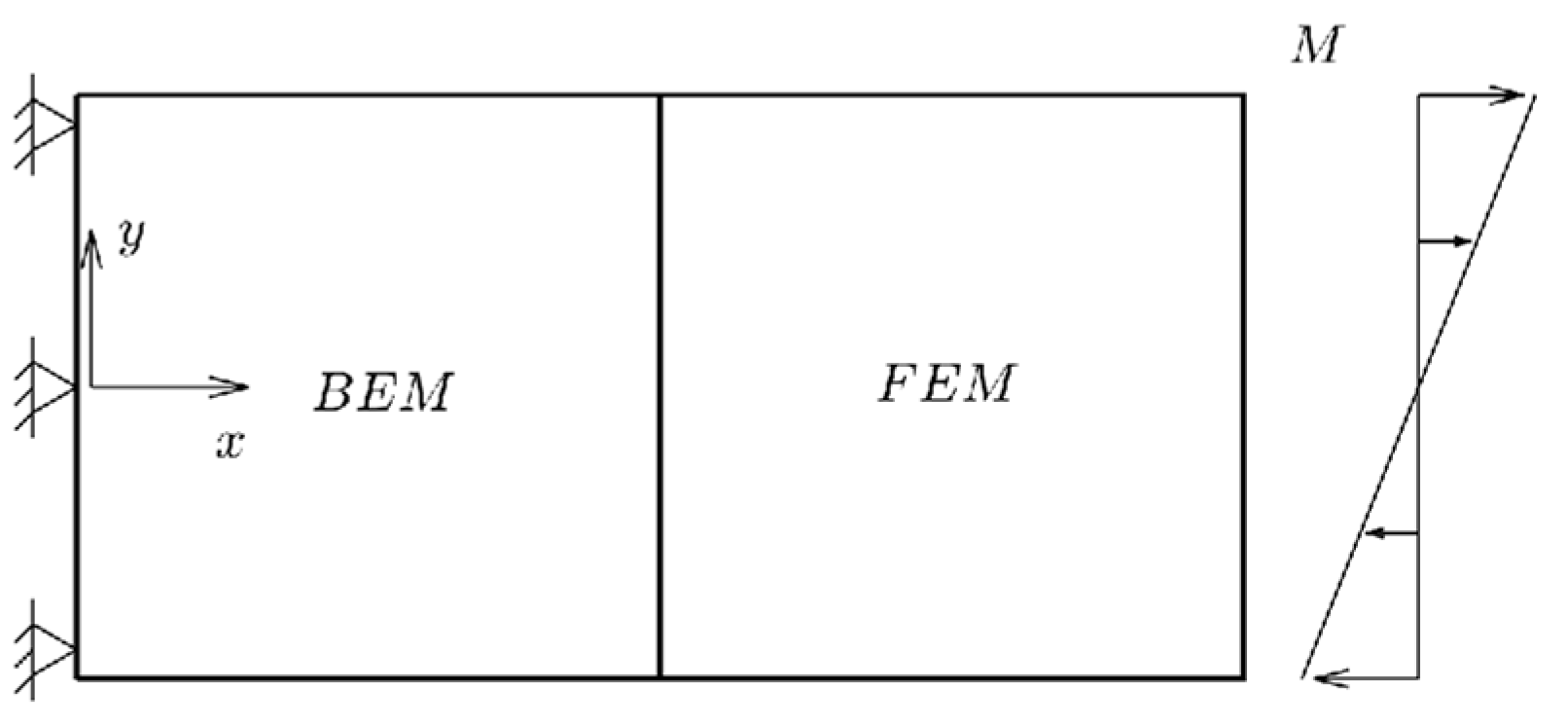
44], a cantilever beam is considered (
Figure 14). The beam has length
, height
, and thickness
. Plane-stress conditions are assumed, with Young’s modulus
and
. A bending moment
is applied at the free end.
The analytical solution [
45,
46] is given by
where
is the moment of inertia. All boundary conditions are prescribed from these analytical expressions.
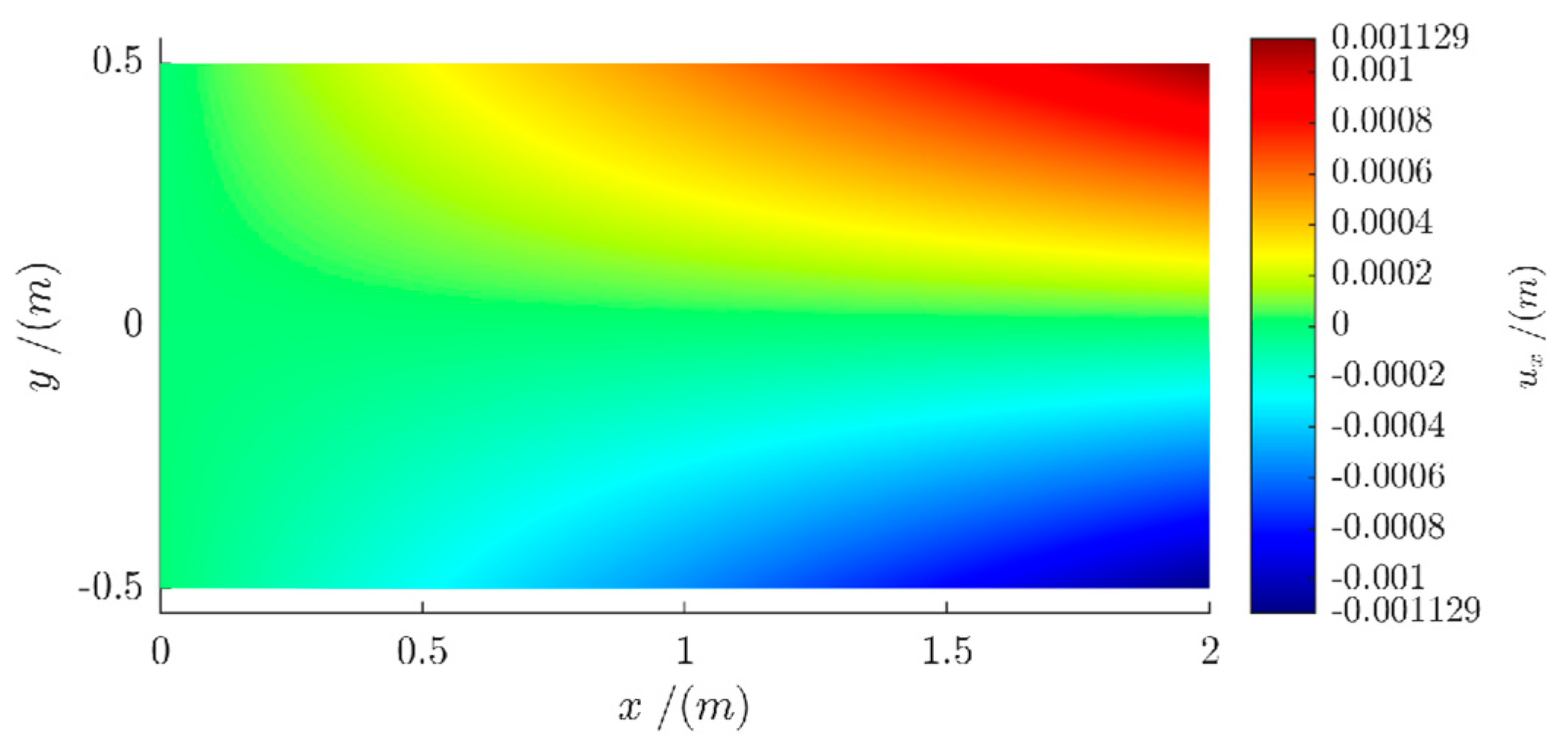
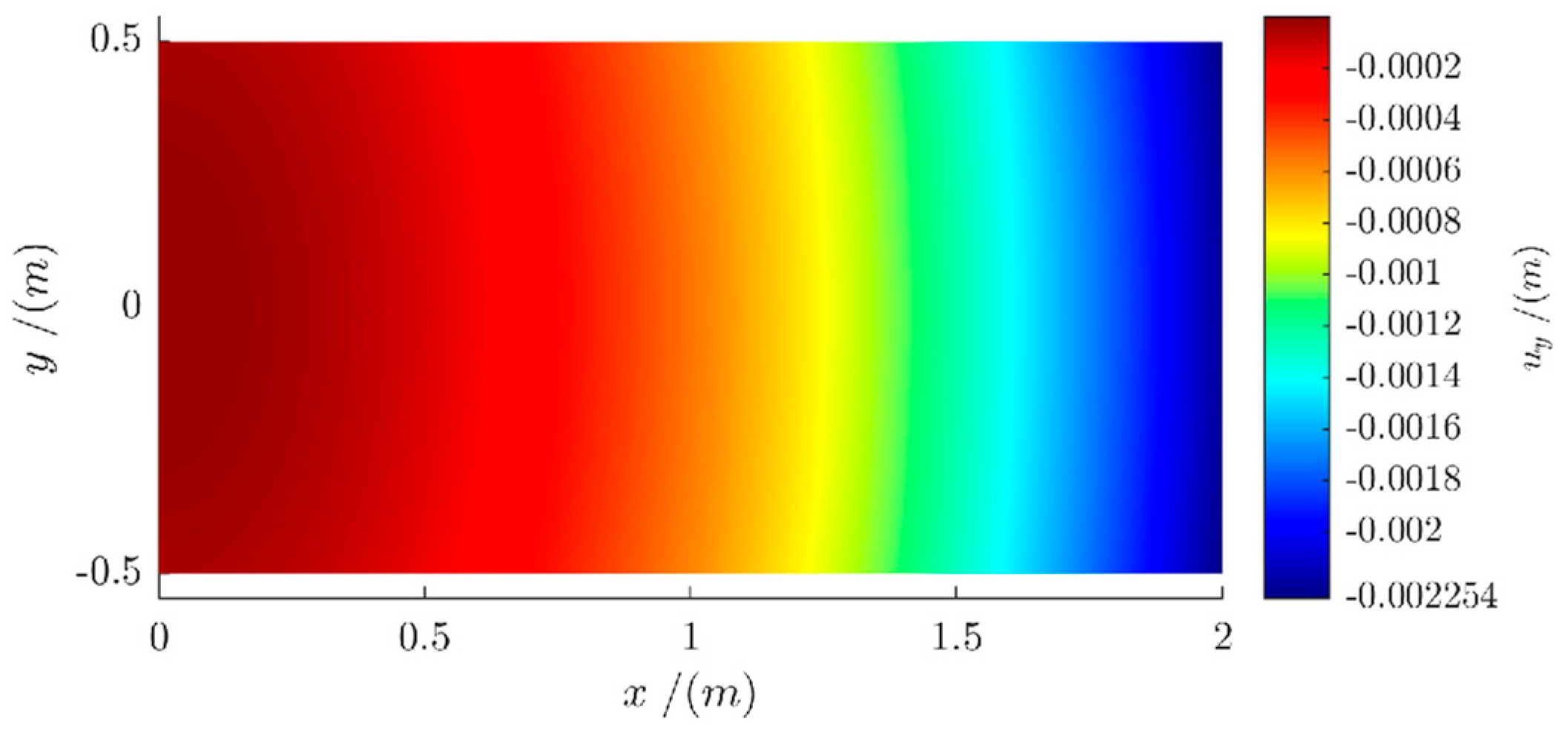
Figure 15 and
Figure 16 show the computed displacement fields. The numerical solution reproduces the classical plane-cross-section assumption, and the maximum displacements are in good agreement with the analytical values (
vs.
;
vs.
analytical value).
Figure 17 compares the stress
predicted by the BEM and FEM regions. In contrast to the previous examples, the FEM stress is more accurate than the BEM stress in this bending-dominated problem. This behavior can be attributed to two factors. First, constant elements in BEM cannot accurately represent rigid-body rotation modes, which are essential for capturing bending deformations [
47]. Second, the elastic fundamental solutions used in the current BEM formulation are derived for infinite domains and are not tailored to plate- or shell-like behavior. Replacing them with appropriate plate or shell fundamental solutions would therefore be a natural direction for improving the method’s performance in such problems.
The poor performance of constant-element BEM in bending-dominated problems is therefore inherent to the discretization. Higher-order boundary elements, which are noted in the conclusion as a future direction, would be a natural way to overcome this limitation. Moreover, for this type of cantilever beam (e.g., aspect ratio
), a pure constant-element BEM model does not outperform a pure linear-element FEM with the same mesh density. This is consistent with the fact that constant elements converge slowly in bending-dominated problems [
47] and is not altered by the coupling procedure.
4. Conclusions
In this work, a symmetric positive definite coupling between the boundary element method (BEM) and the finite element method (FEM) is developed in the framework of the numerical manifold method (NMM). The BEM subdomain is treated as a super mathematical patch whose local approximation is constructed from the displacement integral equation, while the remaining domain is covered by a finite element mesh. Weight functions defined over the entire mathematical cover satisfy a continuous partition of unity, which guarantees variational consistency and ensures the convergence of the coupled formulation.
Numerical examples demonstrate that the proposed method achieves symmetric positive definiteness while preserving the intrinsic convergence properties of each subdomain. The study also reveals that near-singular integrals in the strain BIE can affect the convergence rate when the element size becomes sufficiently small; neglecting them leads to a noticeable deterioration in accuracy.
In the present study, the penalty parameter was consistently taken as across all numerical examples, following standard practice in the FEM literature. An alternative approach to avoid the penalty parameter altogether is to incorporate the prescribed boundary conditions on the BEM super-patch directly before the inversion of .
The current implementation employs constant boundary elements to avoid corner degeneracy and simplify the inversion of . This choice, however, leads to several limitations: traction equilibrium is only approximately satisfied at the interface, the convergence rate of the BEM subdomain is limited to first order, and the method performs poorly in bending-dominated problems. The present work is therefore best viewed as a proof-of-concept study for the SPD coupling framework.
These limitations are inherent to the discretization rather than to the coupling framework. The global stiffness matrix remains symmetric positive definite, as confirmed by both the theoretical proof in
Appendix A and numerical experiments.
A systematic quantitative comparison with existing FEM-BEM coupling methods—including computational efficiency, conditioning, and performance on benchmark problems—is left for future work. Such a comparison will be most meaningful once the framework is extended to higher-order boundary elements, allowing matched discretization orders across methods.
Future work should also address the treatment of near-singular integrals, either by conventional near-singular or specialized nonsingular quadratures, or by converting the domain integral of strain energy into an equivalent boundary integral.
Additionally, neglecting long-range off-diagonal contributions in the BEM stiffness matrix—a concept conceptually related to the compression strategies employed in the fast multipole method—offers a promising path toward a sparse, large-scale formulation. Such an approach could significantly reduce the computational complexity of the BEM subdomain and is a distinct direction for future research.
Although the current implementation is limited to linear elasticity, it lays the groundwork for extending the method to elastoplastic problems, where the FEM would be employed in the plastic zone and BEM in the surrounding elastic region. The symmetric positive definite structure established here is expected to carry over to such incremental formulations, offering the same advantages in stability and solver efficiency.