1. Introduction
With rapid urbanization and the continued intensification of underground space development worldwide, metro systems, utility tunnels, and deep basement structures are increasingly being constructed in densely built urban environments. As a result, new excavations are more frequently carried out in close proximity to existing underground infrastructure, making excavation-induced deformation control a common international challenge in urban geotechnical engineering. In this context, deep foundation pit excavations in the vicinity of existing tunnels have become increasingly unavoidable. Such excavations inevitably induce ground deformations, which in turn generate additional loads and displacement responses along the tunnel alignment, often exhibiting pronounced spatial characteristics [
1,
2]. In engineering practice, isolation structures—such as isolation pile walls and barrier piles—are commonly installed between the excavation and the tunnel to mitigate these adverse effects [
3,
4]. Therefore, a systematic investigation into the mechanical influence of foundation pit excavation on adjacent shield tunnels is of great importance, not only for achieving precise deformation control and correction of metro tunnels, but also for providing a scientific basis for optimizing excavation schemes and support strategies.
Existing studies on the responses of shield tunnels to adjacent excavations can be broadly categorized into: (1) field monitoring [
5,
6]; (2) theoretical analysis [
7,
8,
9,
10]; (3) physical model testing [
11,
12,
13,
14]; and (4) finite-element simulations [
15,
16,
17,
18]. Among these, numerical modelling has become dominant, while field data mainly serve as validation, and rigorous analytical solutions remain relatively limited. According to relevant design specifications [
19], when soft soil dominates the geological conditions near an adjacent tunnel, the plan dimensions of a single foundation pit must satisfy prescribed constraints. Consequently, in practical engineering, within the 50 m protection zone of an existing tunnel, segmented excavation methods—such as partition pits, staged excavation, and skip-excavation sequences—are often adopted. Despite their practical importance, systematic studies on the mechanical responses induced by block-by-block excavation or skip-excavation strategies remain scarce.
From the perspective of theoretical modelling, Wei Gang et al. [
12] considered the variation in lateral earth pressure under different displacement states and proposed a method for computing the stress-release coefficient β. However, this approach is relatively simplified, as the effects of segmented excavation are treated by linear superposition, and β is largely calibrated empirically based on displacement modes. Treating the retaining structure of a yet-to-be-excavated adjacent pit as an isolation pile system can effectively reduce deformation transmitted to the existing tunnel. Feng Guohui et al. [
20] idealized isolation piles as uniformly distributed piles and modelled them using a Kerr beam-on-foundation framework, which is inherently one-dimensional and incapable of representing the true two-dimensional behavior of an isolation-pile wall. Similarly, Wei Gang et al. [
17] simulated isolation piles using a dense-pile model with a simplified shear layer, which tends to produce an overly stiff “equivalent isolation wall,” leading to conservative estimates of displacement reduction.
In summary, current theoretical frameworks for evaluating tunnel responses to adjacent excavation still rely heavily on simplified coupling schemes. Key parameters are commonly selected empirically and lack comprehensive mechanistic interpretation. Moreover, research on isolation piles remains largely equivalent in nature, typically idealizing the system as a uniform pile array while neglecting the inherent two-dimensional spatial effects produced by actual barrier piles. Therefore, it is necessary to further clarify the components of retaining-structure deformation, reveal the memory effects associated with sequential loading, and develop an isolation model that more realistically captures plate–soil interaction. These advancements would provide a more robust and practical theoretical foundation for tunnel protection design and optimization of excavation sequencing in engineering practice.
To address the above limitations, this study develops an analytical framework for adjacent excavation–tunnel interaction under the coupled influence of pit segmentation and isolation piles. The main advances over previous analytical methods are summarized as follows. First, the effect of segmented excavation is not treated as a simple direct superposition; instead, a stage-by-stage transfer procedure is established to propagate the deformation induced by earlier sub-pits to the retaining/isolation system of subsequent sub-pits, thereby capturing the sequencing-dependent spatial interaction among segmented pits. Second, the proposed framework explicitly decomposes retaining-wall deformation into bending-induced and excavation-induced components, which makes it possible to interpret the right-skewed “S-shaped” profile and to reveal the peak-shift behavior caused by prior unloading, i.e., the memory effect of excavation sequence. Third, the isolation piles are no longer idealized as a one-dimensional beam or an overly stiff equivalent pile group, but are modeled as a Kerr-foundation plate–soil interaction system, so that the two-dimensional flexural response of the isolation wall can be incorporated into the analytical transfer chain from pit excavation to tunnel deformation. These developments enable a more mechanistic interpretation of segmented excavation effects and improve the applicability of the analytical method for design and optimization of excavation sequencing adjacent to existing shield tunnels.
Beyond its analytical contribution, the present study also has clear engineering significance. By improving the prediction of excavation-induced deformation in existing shield tunnels and by supporting the optimization of pit segmentation and excavation sequencing, the proposed method can contribute to safer and more resilient underground infrastructure construction in densely urbanized areas. In this sense, the work is relevant to the broader goals of sustainable urban development, particularly SDG 9 (Industry, Innovation and Infrastructure) and SDG 11 (Sustainable Cities and Communities), as it supports the protection of existing transport infrastructure and the safer integration of new underground development within complex urban environments.
First, to develop a three-dimensional analytical framework for evaluating the interaction between segmented foundation pit excavation and adjacent existing tunnels under the coupled influence of excavation sequencing and isolation piles. Second, to clarify the mechanical components of retaining-wall deformation and reveal the peak-shift behavior and memory effect induced by sequential excavation. Third, to establish a practical analytical procedure that can be used to predict retaining-wall and tunnel deformation in engineering cases and to support the optimization of pit segmentation and excavation sequencing in practice.
2. Methodology
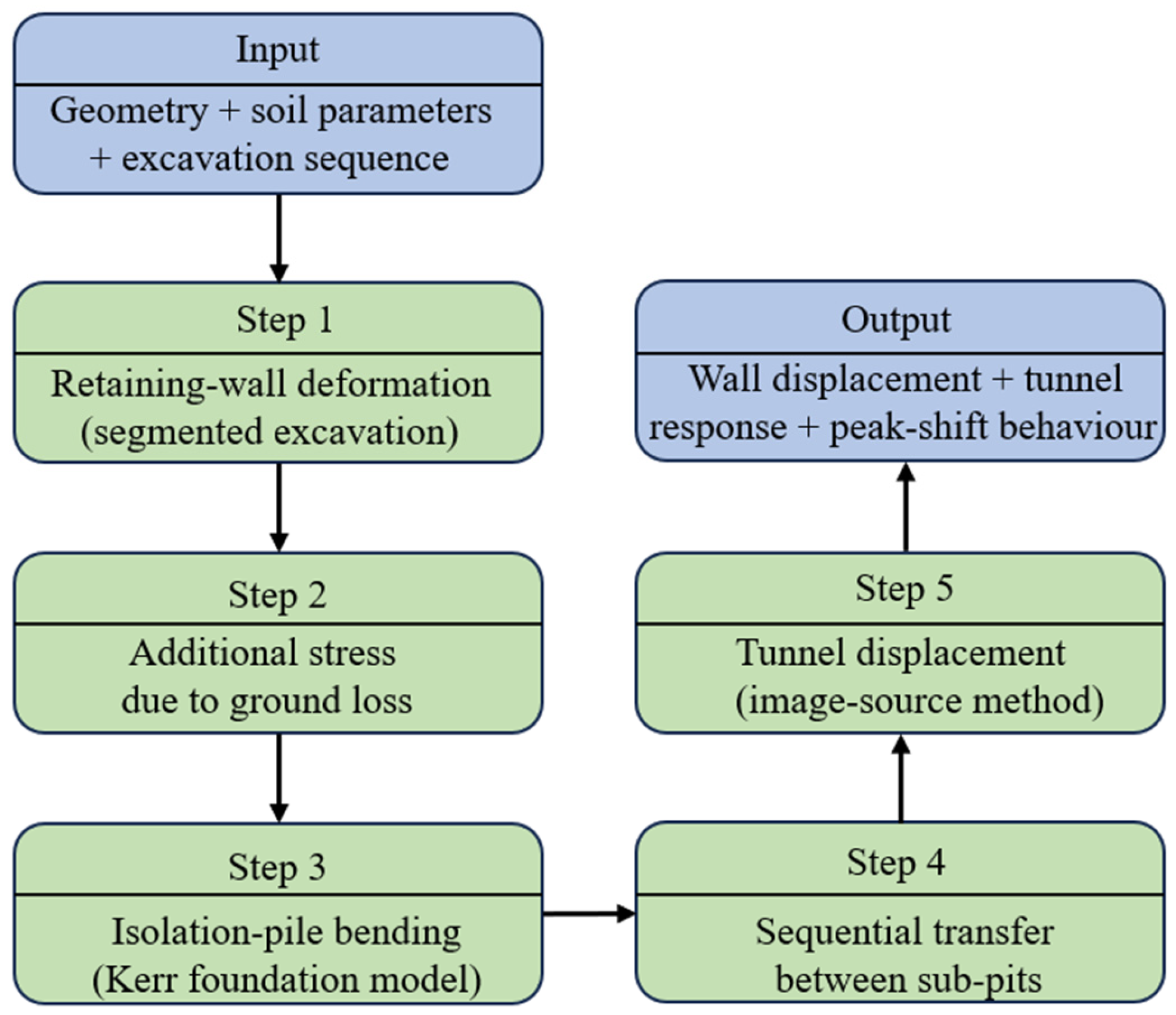
For clarity, the overall analytical procedure is summarized in
Figure 1.
2.1. Establishment of the Mechanical Model
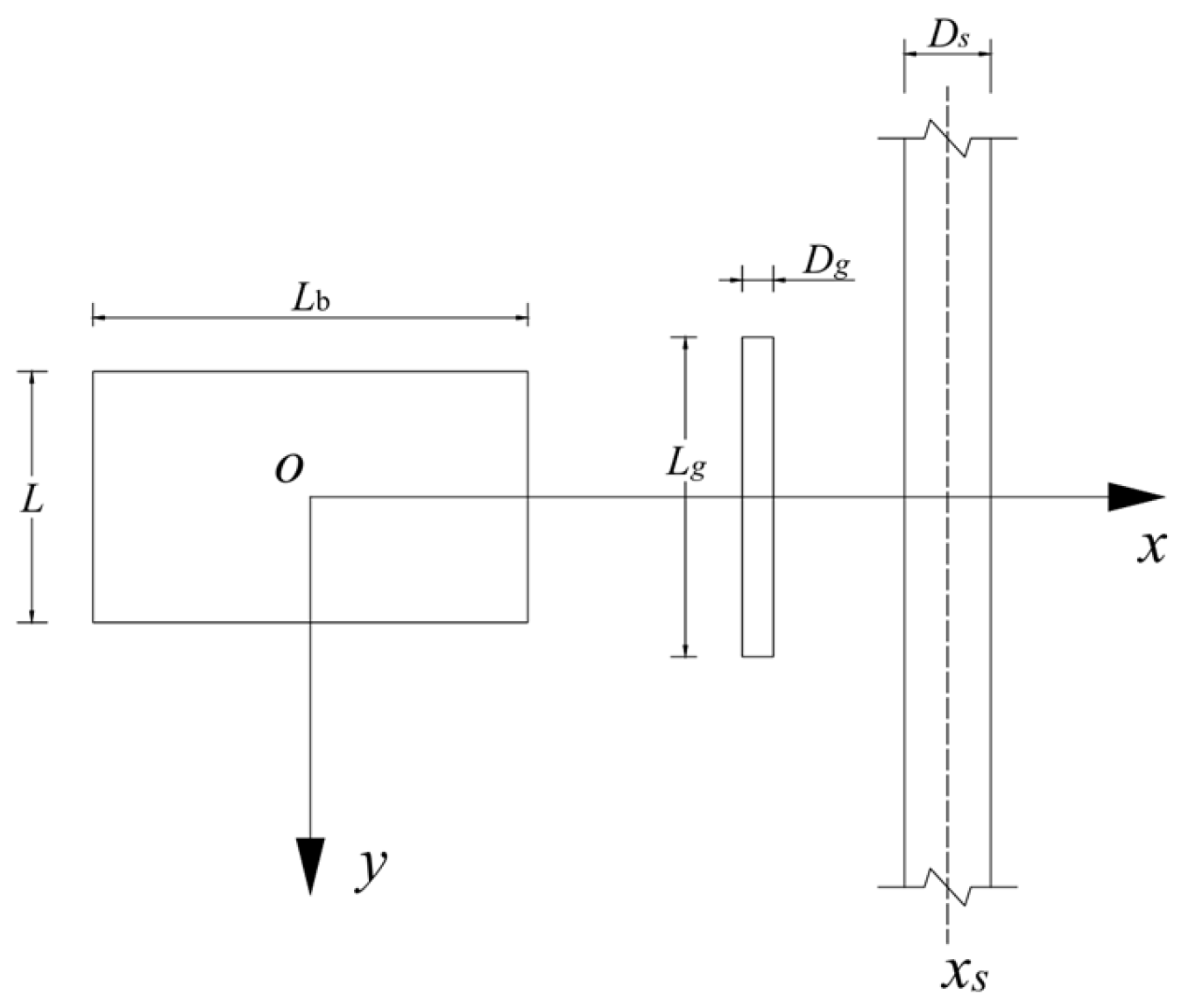
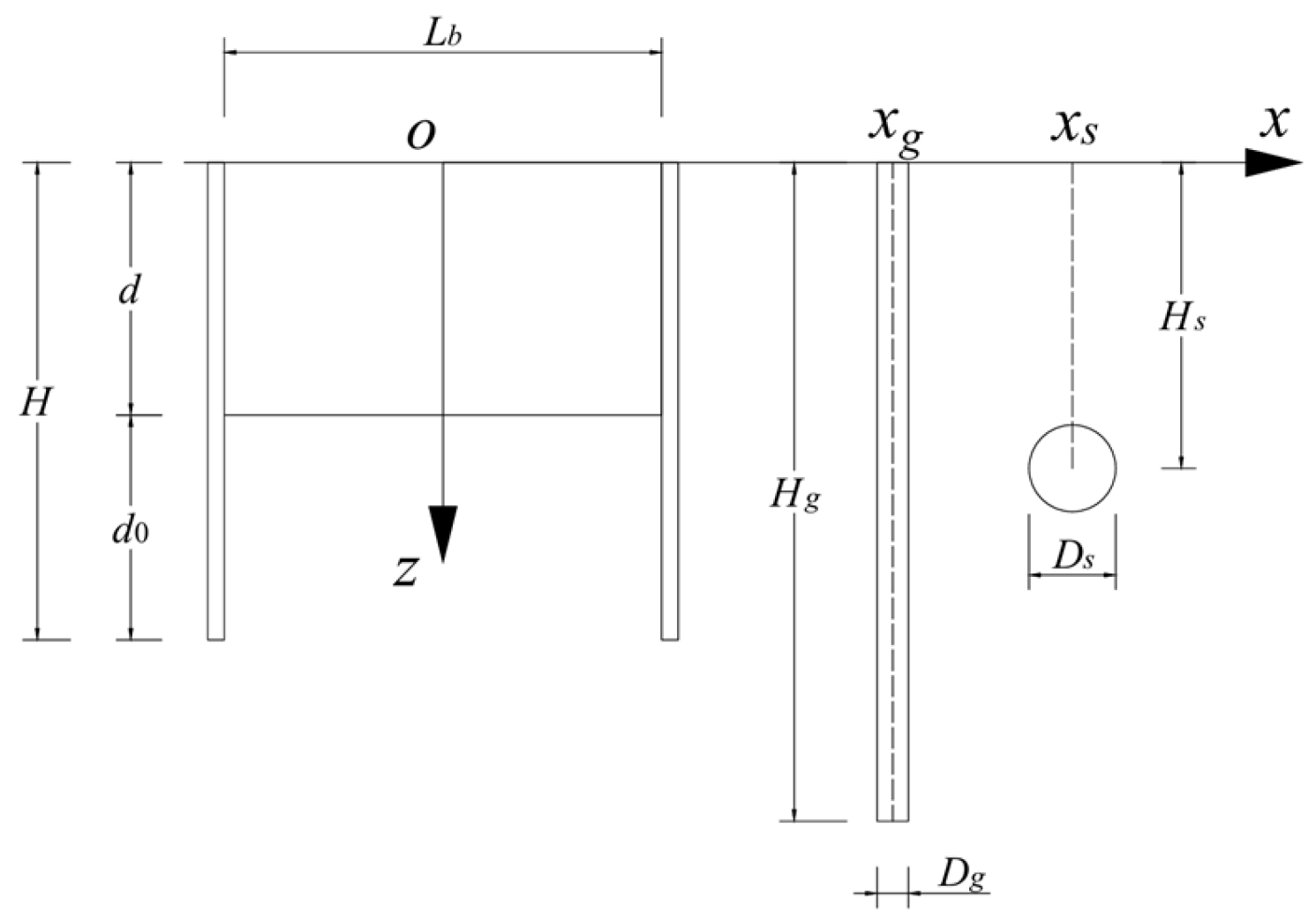
Figure 2 and
Figure 3 illustrate the computational model adopted in this study. The foundation pit is located on one side of the existing tunnel, with the isolation pile wall situated between the two. Under the working conditions considered herein, the retaining wall of the pit adjacent to the tunnel is treated as an isolation pile system. A three-dimensional coordinate system is established with the pit center as the origin. The length of the pit wall parallel to the tunnel axis is denoted as
L, while that of the opposite side is
Lb. The excavation depth is
d, and the embedment depth of the retaining structure below the pit base is
d0, giving a total wall length of
H. The isolation pile wall is positioned at
x =
xg, with width
Lg, thickness
Dg, and length
Hg. The axis of the existing tunnel is located at
x =
xs, with an axis depth of
Hs and tunnel diameter
Ds.
The analytical procedure of this study consists of the following components: (1) After excavation, the lateral wall of the foundation pit induces ground loss. The isolation piles are initially neglected, and the three-dimensional additional stress at the location of the isolation pile is computed based on this ground-loss mechanism. (2) Using the Kerr foundation model, the flexural deformation of the isolation pile is then evaluated. (3) When the subsequent pit is excavated, additional deformation occurs on top of the previously induced bending of the isolation pile, and the newly generated ground loss further affects the retaining structure of the next segmented pit. (4) After propagating this process to the final excavation stage, the ultimate retaining-wall deformation is obtained. Using the image-source method, the displacement of the existing tunnel caused by the accumulated ground loss is finally computed.
For clarity, the overall analytical procedure of the proposed method is summarized as follows.
Step 1: The staged excavation-induced lateral deformation of the retaining wall is first determined by considering both the vertical deformation profile and the spatial effect along the pit wall.
Step 2: Based on the resulting wall deformation, the excavation-induced ground loss is converted into a three-dimensional additional stress field acting on the isolation-pile wall.
Step 3: The flexural response of the isolation-pile wall is then calculated using the Kerr-foundation plate model together with the corresponding variational and finite-difference formulations.
Step 4: For segmented excavation, the deformation induced by the previously excavated sub-pits is sequentially transferred to the retaining structure of the subsequent sub-pits, so that the cumulative retaining-wall displacement field can be obtained stage by stage.
Step 5: Finally, the image-source method and the tunnel–soil deformation–coordination model are employed to calculate the tunnel displacement induced by the accumulated excavation-related ground loss.
2.2. Calculation Formula for Lateral Displacement of the Foundation Pit Wall
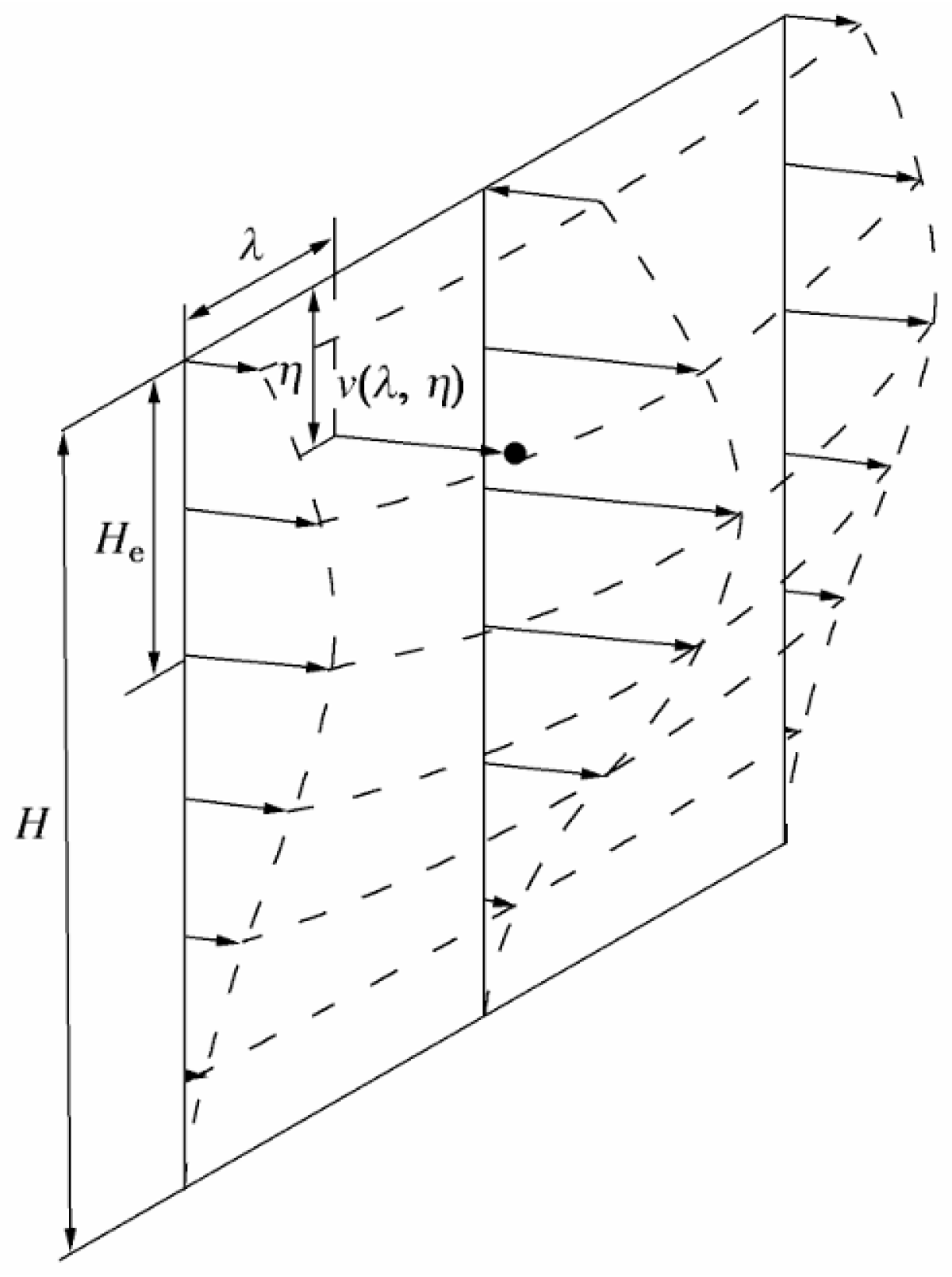
As shown in
Figure 4, Zhang et al. [
21] fitted the incremental deformation of the retaining structure using a segmented cosine function and proposed an “inward-convex” lateral deflection profile for retaining walls.
where
δmax i is the maximum lateral deformation of the retaining structure induced by the
i-th excavation layer, with
δmax/
He = 0.2%;
δi(
η,
Hei) denotes the incremental lateral deformation of the retaining wall at depth
η caused by the
i-th excavation layer; and
Hei is the excavation depth after completion of the
i-th layer.
The maximum incremental deformation induced by the
i-th excavation layer is given by
where
vmax is the accumulated maximum deformation of the retaining structure. In practical engineering, the cumulative maximum lateral deformation is commonly adopted as the control criterion for wall displacement, and the accumulated deformation at each excavation stage must satisfy this prescribed limit.
Considering the spatial effects of foundation pit deformation, the lateral displacement varies along the wall owing to differences in system stiffness and soil stress state. Smaller deformations generally occur near the pit corners, while larger deformations develop in the central region of long retaining walls. Liu Nianwu et al. reported that the PSR (Profile Shape Ratio) of the retaining structure is approximately 0.72 near the pit corners; when the PSR approaches 1.00, the corresponding value of
λ/
Hei is about 4.00.
where λ represents the horizontal distance between the point of displacement calculation and the edge of the foundation pit.
By integrating the above expressions, the deformation of the retaining structure at any location along the pit wall—accounting for spatial effects during excavation—can be obtained as
It should be noted that the segmented analytical function used in this section is not intended to explicitly solve the structural response of the retaining system under individual struts/anchors and detailed boundary conditions. Instead, it provides an equivalent deformation representation, in which the influence of support stiffness, wall rigidity, and boundary restraint is implicitly reflected through the prescribed wall-deformation control value and the adopted displacement-shape parameters. For cases where explicit support-wall interaction is required, more detailed approaches such as beam-on-elastic-foundation analysis or FEM may be adopted.
2.3. Formulation of Additional Stress
To evaluate the additional stresses acting on the isolation piles induced by the deformation of the foundation pit, this study adopts the ground-displacement analytical model proposed in [
22]. Considering a spherical cavity of radius
a generated at point
F(
x0,
y0,
z0), the stress components in the horizontal
x-direction at an arbitrary point
P(
x1,
y1,
z1)—denoted as σ
x−s1 and σ
x−s2—can be expressed as follows:
The
x-direction additional stress
generated by a unit volume of cavity is given by
The horizontal additional stress
σ1 generated by the lateral deformation of the retaining wall is given by
where
E is the elastic modulus of the soil;
V1 denotes the cavity volume generated by the deformation of the retaining structure. The value of
V1 can be obtained either from field monitoring data or by computing the coordinates of points within the cavity region using Equation (4);
;
;
.
It should be noted that the equivalent spherical cavity is introduced here as a volume-equivalent analytical idealization rather than a literal geometric description of excavation-induced soil deformation. Its purpose is to transform the complex ground-loss effect associated with retaining-wall deformation into a tractable source term for calculating the additional stress field in an elastic medium. The nonuniform features of the actual problem, including staged excavation, spatial variation along the wall, and stratigraphic differences, are incorporated separately through the wall-deformation formulation, sequential transfer procedure, and engineering input parameters. Therefore, the spherical-cavity model should be understood as an intermediate analytical approximation whose applicability is mainly limited to small- to moderate-deformation conditions dominated by ground loss and stress redistribution.
2.4. Calculation of Isolation-Pile Bending Deformation
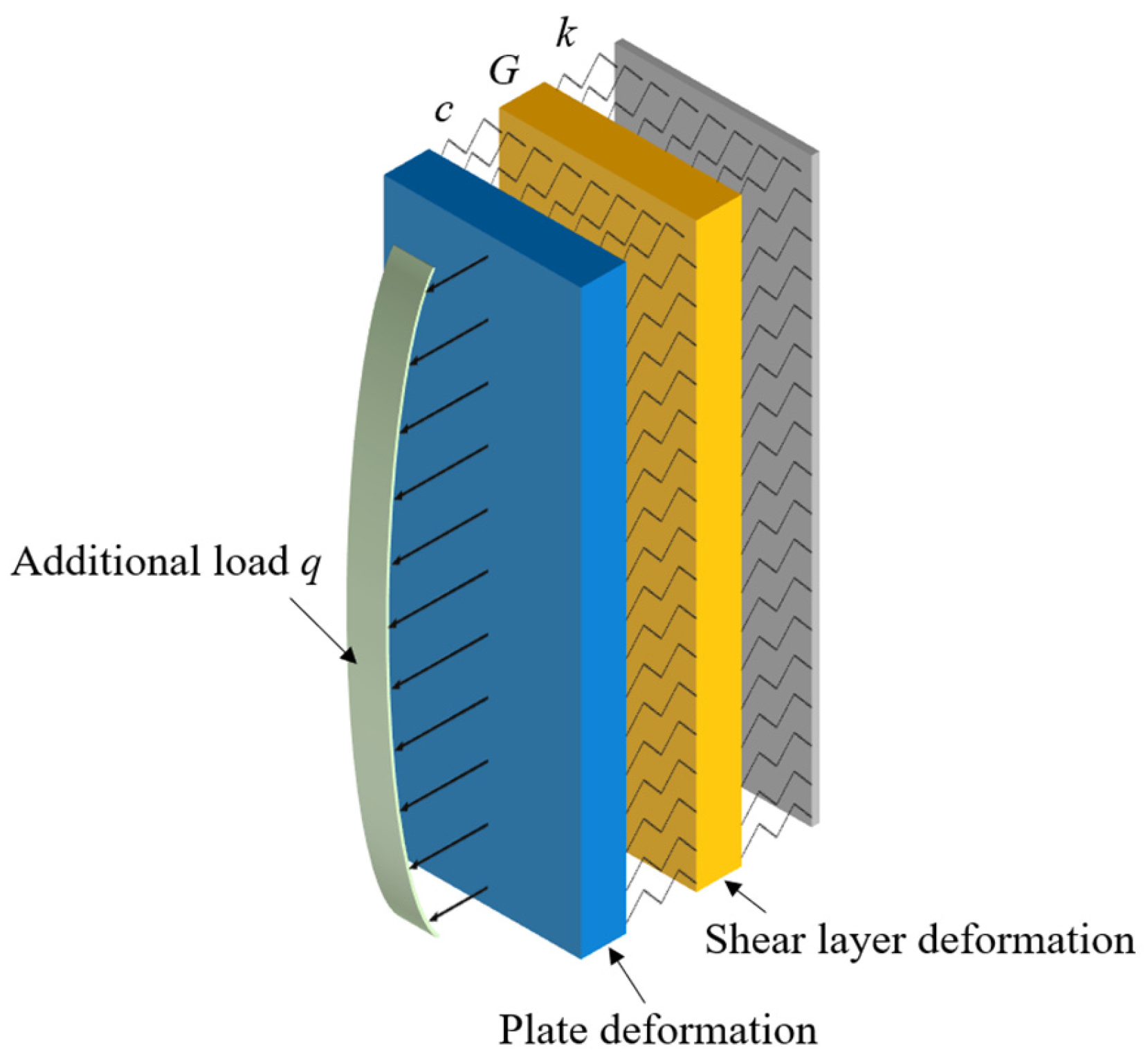
Based on the assumed free-field displacement pattern of the excavated soil, the isolation pile is modeled using the Kerr foundation model. The pile is idealized as a plate element, and the corresponding plate–soil interaction model under the Kerr foundation framework is shown in
Figure 5.
Although the present formulation remains within an equivalent elastic framework, the Kerr foundation is adopted instead of a simpler Winkler foundation because the isolation-pile system is idealized here as a continuous wall-like plate rather than as an isolated member. Compared with the Winkler model, the Kerr model introduces shear interaction between adjacent foundation points and is therefore better able to represent the continuity of soil support, the spatial redistribution of deformation, and the two-dimensional flexural response of the equivalent isolation wall.
By idealizing the equivalent diaphragm wall as a thin plate (Kirchhoff plate) lying in the (
y,
z) plane, with its transverse deflection denoted as
ω(
y,
z), the bending energy of the plate
Ub can be expressed as
where
D is the flexural rigidity of the plate.
.
,
,
.
For the foundation soil modeled using the three-parameter Kerr foundation—consisting of two elastic spring layers with stiffnesses
k and
c, and an intermediate shear layer with modulus
G—the reactive pressure acting on the plate can be written as
where
us is the soil displacement induced by foundation pit excavation, as derived in
Section 2.2;
.
The total potential energy of the system is given by
where the first term represents the bending energy of the plate; the second term corresponds to the energy stored in the upper vertical spring
ck, the Winkler spring
kw, and the shear layer
Gk; and the last term denotes the work done by external loads.
Taking the first variation and integrating by parts the terms associated with ∇(
ω −
us), the equilibrium condition can be obtained as
where
.
If
ω =
ω(
z) and
us =
us are uniform with respect to
y(∂/∂
y = 0), the above equation can be rewritten as
Using the finite difference method, it can be obtained that
Within the plate (along the normal direction
n and tangential direction
s), the following relations hold:
Design a computational grid of size
Ny ×
Nx with step size
h. Let the one-dimensional second-order finite-difference matrix be
, and define
(the two-dimensional five-point Laplacian matrix scaled by
h2). Then, Equation (12) can be written at the interior nodes as
where
vec(·) denotes the vectorization operator that stacks matrix entries column-wise;
W,
Q, and
Us are the sampling matrices of displacement, external load, and free-field displacement on the computational grid, respectively;
ξ and
ξ2 are block Toeplitz banded matrices; the discrete Laplacian operator ∇
2 is represented by
ξ/
h2; and the biharmonic operator ∇
4 is represented by
ξ2/
h4.
After discretizing Equation (12) at the interior nodes, the coefficients on the left-hand side corresponding to the four types of stencil positions can be written as follows:
Similarly, the right-hand side can be expressed as:
It should be noted that the isolation piles are modeled here as an equivalent thin plate not because the piles are physically continuous, but because the present study focuses on the global barrier effect and wall-like flexural response of a relatively dense isolation-pile system. This homogenized representation is intended for predicting the overall deformation transfer to the tunnel, whereas local discrete effects related to pile spacing and individual pile response are beyond the scope of the present analytical model.
2.5. Image-Source Method for Calculating Tunnel Deformation
Due to differences in coordinate definitions, the lateral displacement of the pit wall is formulated with the wall surface as the origin, whereas the subsequent calculations use the pit center as the origin. Therefore, the coordinate systems must be unified as follows: x0 = Lb/2, , z0 = η.
C. Sagaseta [
23], based on elastic assumptions, derived the vertical and horizontal displacements at any point within a half-space caused by a local loss of soil mass (image-source method). In this study, the ground displacement induced by foundation pit excavation is calculated using this approach, with the following assumptions: (1) soil compressibility, softening, and rheological effects are neglected; and (2) ground displacement is primarily attributed to excavation-induced soil loss.
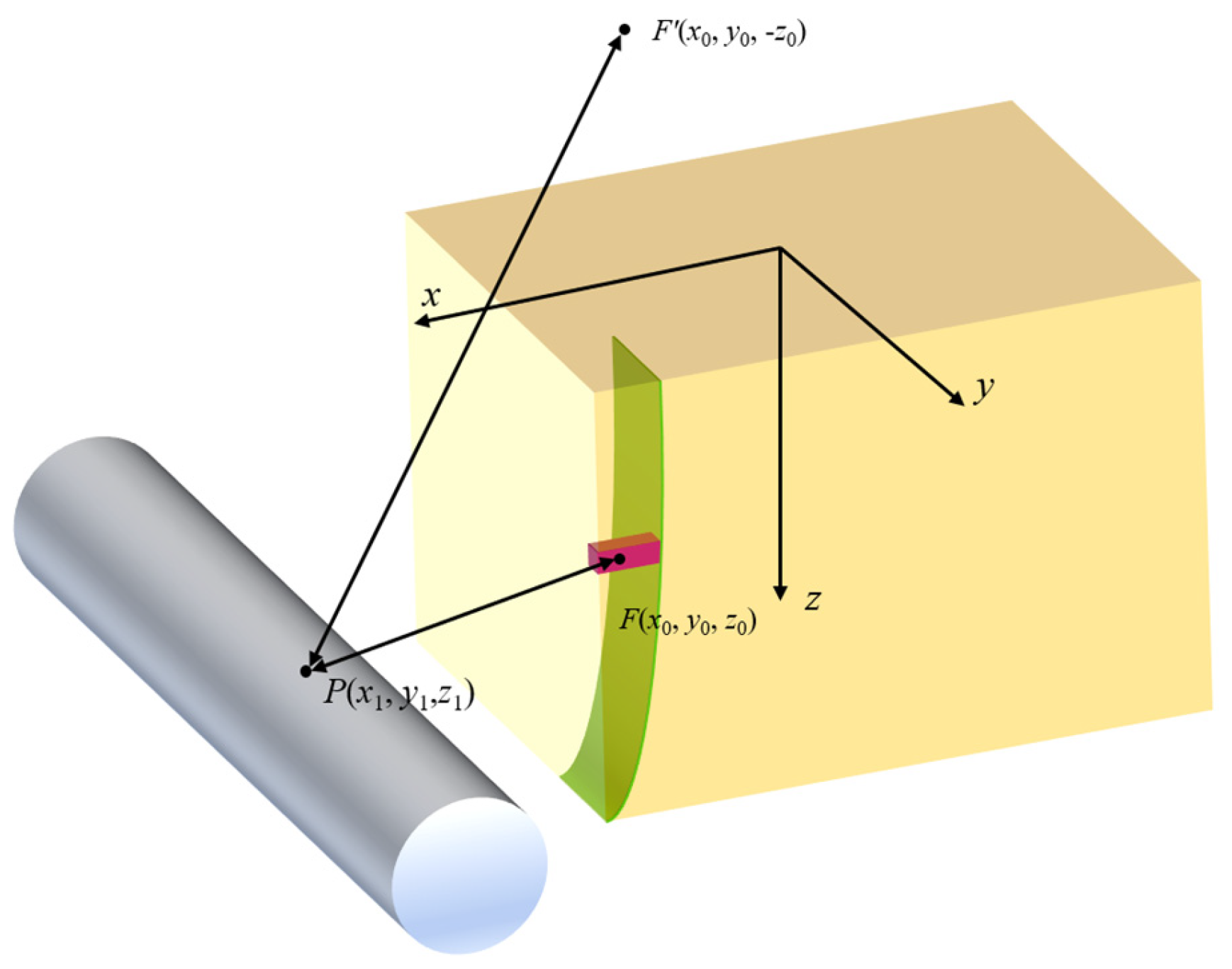
As shown in
Figure 6, a spherical cavity of radius
generated at point
F(
x0,
y0,
z0) produces
a displacement at point
P(
x1,
y1,
z1) located along the tunnel axis. The displacement component in the
z-direction can be expressed as
where
is the distance between point
F and point
P.
.
Equation (25) is derived under the assumption of a full-space condition, whereas the actual problem corresponds to a half-space. Therefore, point
F is mirrored to
F′, as illustrated in
Figure 6. The displacement component in the
z-direction at point
P induced by the image point
F′ can be expressed as
where
is the distance between point
F′ and point
P.
During the transformation from the full-space to the half-space problem, shear strain
γ is generated at the ground surface:
The additional shear stress generated at the ground surface is
where
Gs is the shear modulus of the soil,
, and
ts is the thickness of the shear layer.
Considering the effect of the additional shear stress at the ground surface, the displacement component in the
x-direction at point
P induced by this shear stress can be expressed as
In summary, the total soil displacement in the
x-direction can be written as
Based on the principle of volume equivalence, the deformation of the pit wall is divided into
n small rectangular elements. Each rectangular element is then converted into an equivalent spherical cavity, whose effective radius is given by
where
ωt is the final displacement of the pit wall.
After obtaining the soil displacement at any point along the tunnel axis induced by the ground loss corresponding to each point on the pit wall, integration is performed along the wall direction. The vertical displacement at any point along the tunnel axis can thus be expressed as
To avoid unnecessary repetition and because the mechanical formulation is well established in previous studies, the rotational-shear coordinated deformation model and its associated energy-based solution procedure are not rederived in this paper. Instead, the complete theoretical framework proposed by Qi et al. [
24] is adopted directly.
Following these references, the relative displacements of adjacent lining rings, the flexural-shear interaction mechanism, and the total strain energy of the shield segment system—including soil deformation energy, bedding reaction energy, shear force contribution, and bolt axial force contribution—are expressed through the standard formulation in [
24]. The deformation function is expanded using Fourier series, and the unknown coefficients are solved via the minimum potential energy principle.
For clarity and continuity, only the resulting displacement expressions required for the tunnel–soil coupling analysis are used herein, while the full derivations can be found in [
24].
2.6. Applicability and Limitations of the Analytical Model
The proposed analytical framework is intended primarily for preliminary prediction and mechanism interpretation of excavation-induced deformation in segmented foundation pits adjacent to existing tunnels. Owing to the use of an equivalent elastic description for the soil in the additional-stress analysis and the idealization of the isolation pile wall as a thin Kirchhoff plate on a Kerr foundation, the model is expected to perform best under engineering conditions characterized by small to moderate deformation, limited soil yielding, and relatively continuous isolation structures that can be reasonably homogenized as an equivalent wall. Under such conditions, the method is particularly suitable for evaluating the influence of pit segmentation, excavation sequence, and isolation-wall stiffness on retaining-wall and tunnel responses.
On the other hand, the applicability of the model may be reduced in cases involving pronounced soil nonlinearity or plastic failure, large deformation, severe hydraulic disturbance, or highly discrete pile arrangements that cannot be represented adequately by an equivalent plate system. In such situations, the present method should be used with caution, and numerical simulation or field-based calibration may be required for a more accurate assessment.
In practical engineering, the present model should be understood as a serviceability-oriented analytical tool rather than a full nonlinear constitutive simulator. Its main role is to provide rapid prediction of deformation trends, peak locations, and relative differences between alternative excavation sequences when the excavation-induced response remains within a controlled deformation range. For projects in which marked plasticity, stiffness degradation, consolidation, or seepage-coupled effects are expected to dominate, the present framework should be used with caution and supplemented by field monitoring and refined nonlinear numerical analysis.
It should be noted that the present case-study validation is conducted under two representative engineering configurations and is intended primarily to verify the practical applicability of the proposed method, rather than to provide a systematic sensitivity analysis with respect to excavation-tunnel spacing, boundary proximity, or constraint conditions.
3. Results
Two foundation pit projects are selected in this study to investigate the influence of segmented excavation of adjacent pits on nearby tunnels. The deformation of the retaining structures and the horizontal displacement of the tunnels under segmented excavation conditions are calculated and compared with field measurements, in order to validate the reliability of the proposed method.
The two engineering cases were selected because they are representative of dense urban excavation–tunnel interaction problems in Hangzhou, where new underground development is frequently carried out in close proximity to existing metro infrastructure. Both sites involve segmented foundation-pit excavation adjacent to operational shield tunnels, but they differ in excavation layout, pit depth, and tunnel–pit spatial relationship. Therefore, they provide a suitable basis for validating the proposed analytical method under two typical yet distinct engineering conditions. Case Study 1 represents a top-down segmented excavation adjacent to Metro Line 1 with clear sequencing effects, whereas Case Study 2 represents a more complex multi-zone excavation with varying basement depths and different offsets to the up-track and down-track tunnels. Together, these two cases were chosen to demonstrate both the applicability and the engineering representativeness of the proposed framework.
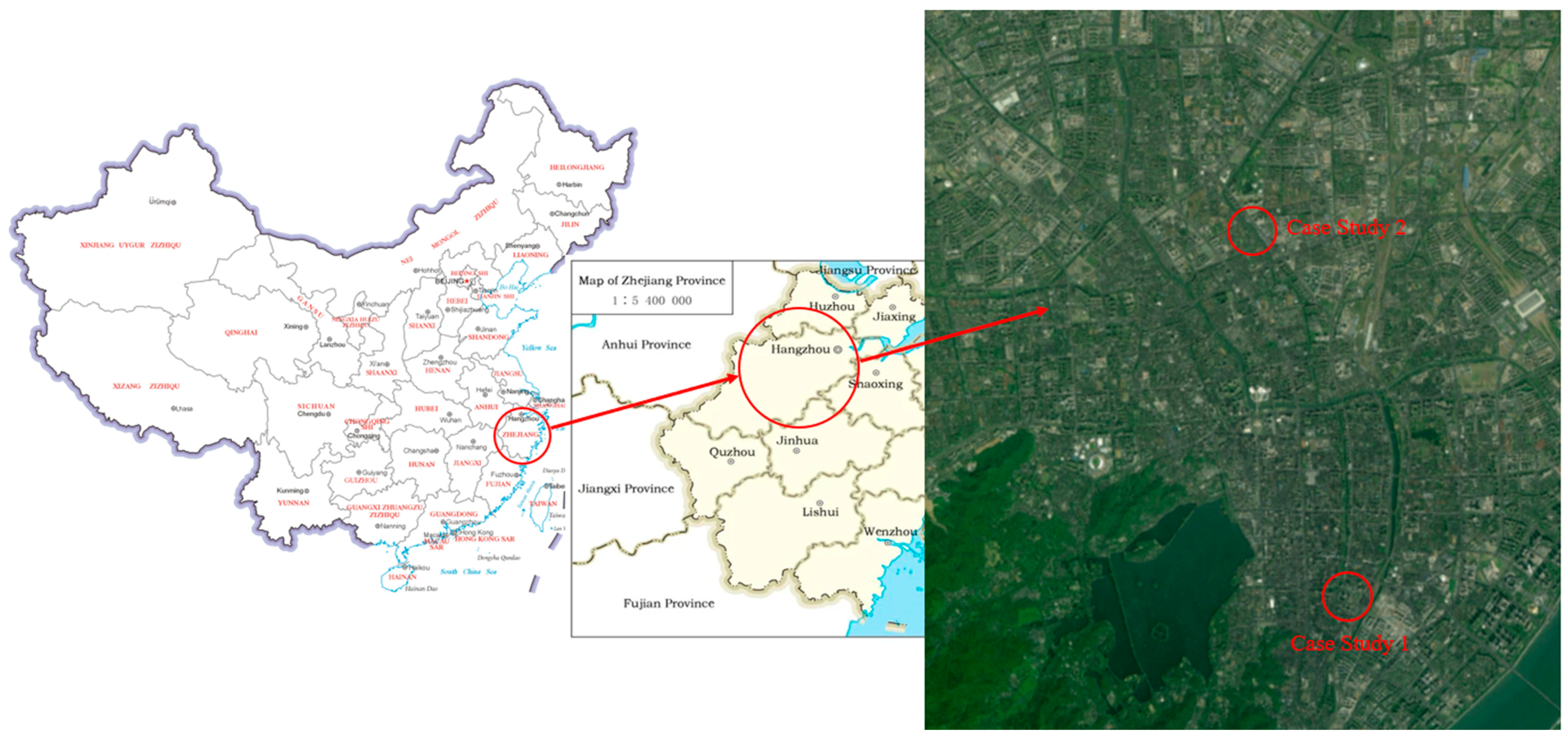
The geographic locations of the two case-study sites are shown in
Figure 7 at the district level. The sites are located in Shangcheng District (Case Study 1) and Xiaoshan District (Case Study 2) of Hangzhou, representing typical urban excavation conditions adjacent to operational metro lines.
3.1. Parameter Selection for Engineering Cases
For the sake of reproducibility, the input values used in the engineering cases are now explicitly classified according to their source. The pit geometry, tunnel geometry, excavation depth, excavation sequence, and monitoring-point locations were obtained directly from project documents and field records. The stratigraphic properties, including unit weight, cohesion, friction angle, and deformation modulus, were taken from the geotechnical investigation reports. As shown in
Table 1, the parameter selection and their corresponding sources for the engineering case analysis are outlined.
For parameters that are not directly measurable in routine practice, equivalent engineering idealizations were adopted. The plate stiffness was calculated from the equivalent structural stiffness of the retaining/isolation system, while the cavity-related and displacement-transfer parameters were determined from the computed wall-deformation field. The Kerr-foundation parameters were not measured directly in the field; instead, they were estimated from the available soil deformation indices and assigned within a physically reasonable range following the corresponding elastic-foundation idealization and previous analytical studies.
3.2. Case Study 1
Case Study 1 was chosen because it provides a typical example of segmented excavation within a metro protection zone, where the influence of excavation sequence on the adjacent Line 1 tunnel can be clearly identified.
This foundation pit project is located in Shangcheng District, Hangzhou. As shown in
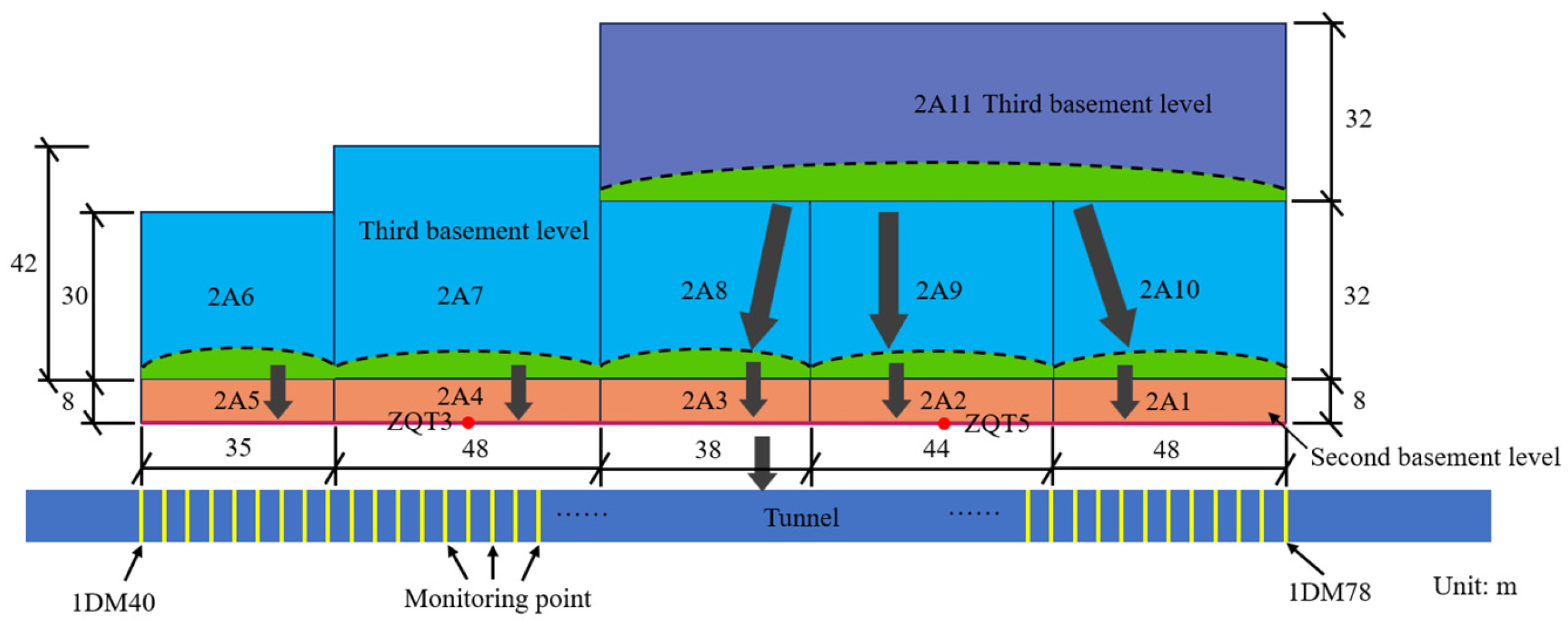
Figure 8, the overall excavation area is divided into Plots 1, 2, 3, and 4. In this study, the excavation of Plot 4 is selected as the analysis target to investigate the effect of segmented excavation on Metro Line 1. The excavation depth of the single-basement area in Plot 4 is 14.05 m, while the excavation depths of the three-basement zones are 16.5 m and 17.55 m, respectively. The small pits are supported by a retaining system consisting of 800 mm-diameter bored piles combined with a 700 mm TRD water-cutoff curtain. The shield tunnel parameters used in the analysis are as follows:
D = 6.2 m,
Dt = 1.2 m,
ks = 7.45 × 10
5 kN/m,
kt = 1.94 × 10
6 kN/m,
EtIt = 1.1 × 10
8 kN·m
2. The crown of Line 1 is located approximately 15.5 m below the ground surface, and the horizontal distance between the tunnel axis and the pit wall is about 19.2 m. The soil parameters are listed in
Table 2 below.
The construction schedule is shown in
Table 3. According to the schedule, the pit is excavated in a top-down sequential manner. Prior to excavation, bored piles were already installed in the soil, forming partition structures between the small pits.
As shown in
Table 2, the soil profile in Case Study 1 consists mainly of interbedded silty sand, silt, and silty clay layers, with noticeable variation in stiffness and thickness among strata. In particular, the deformation modulus
Es ranges from relatively soft clayey layers to stiffer sandy layers, which implies that the excavation-induced deformation transfer and wall–soil interaction are stratigraphically nonuniform. These layered properties provide the basic geotechnical input for the subsequent analytical calculation.
Table 3 indicates that the project was constructed in a clearly staged and sequential manner. This construction sequence is important because the deformation induced by earlier sub-pits can be transferred to the retaining system of subsequently excavated zones, which is exactly the mechanism considered in the proposed analytical framework.
As shown in the figure, horizontal displacement gauges were installed at the midpoints of the retaining walls in sub-pits 2A2 and 2A4 to monitor their lateral deformation. Additional displacement meters were arranged along the shield tunnel to measure its horizontal movement. In this study, data from monitoring point 1DM40-78 are adopted, as they provide a representative measure of the tunnel’s response to adjacent excavation activities.
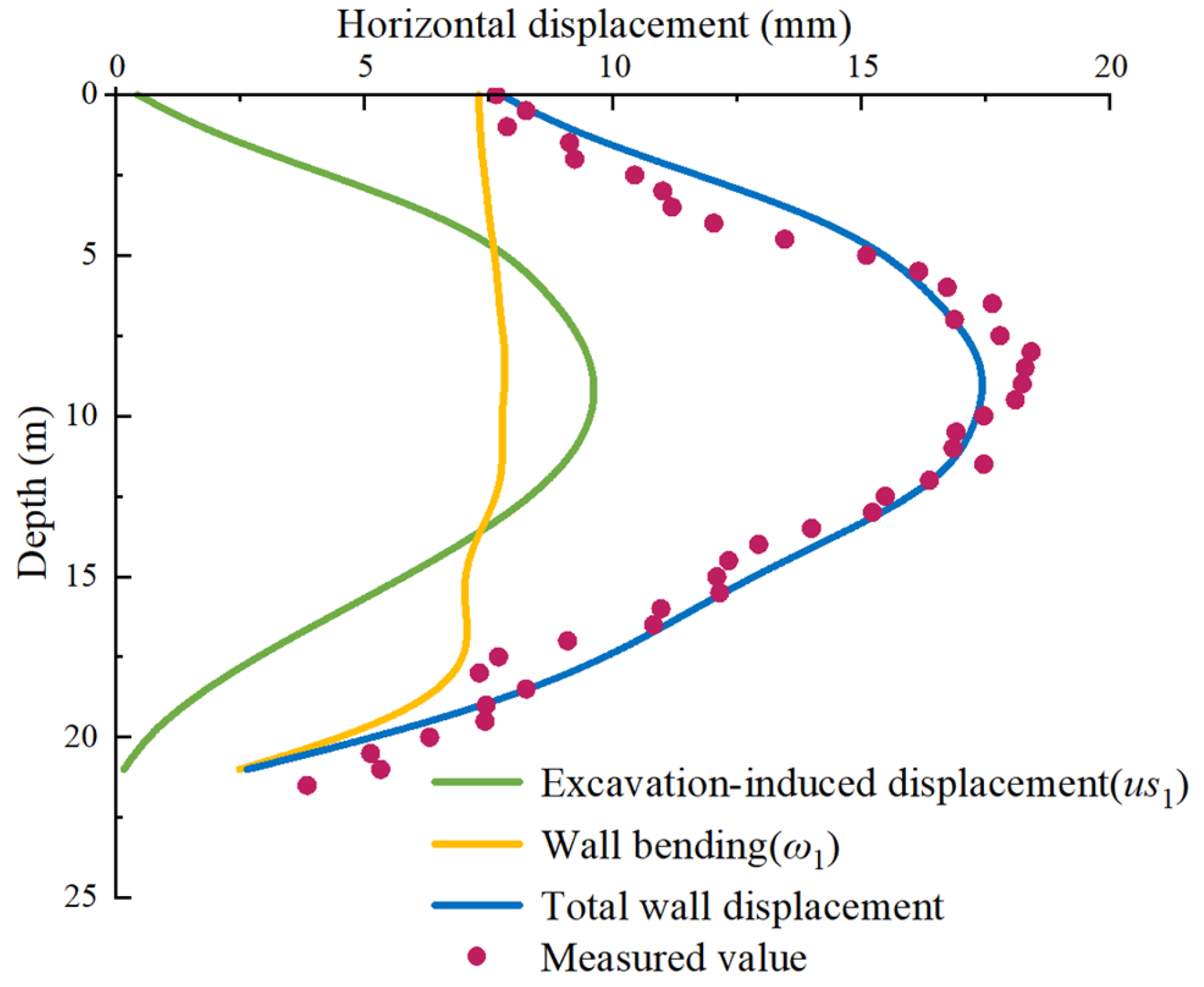
The computation of lateral displacement at monitoring point ZQT5 follows a stepwise procedure. First, the soil loss induced by the excavation of sub-pit 2A11 is used to evaluate its influence on the temporary retaining wall of sub-pit 2A9. The wall deformation generated during the excavation of sub-pit 2A9 is then calculated. These two deformation components are superimposed and subsequently used to determine their combined effect on the retaining wall at sub-pit 2A2. Finally, the wall deformation induced by the excavation of sub-pit 2A2 is obtained, and its superposition with the previously computed components yields the total lateral displacement of the retaining structure within the 2A2 excavation zone.
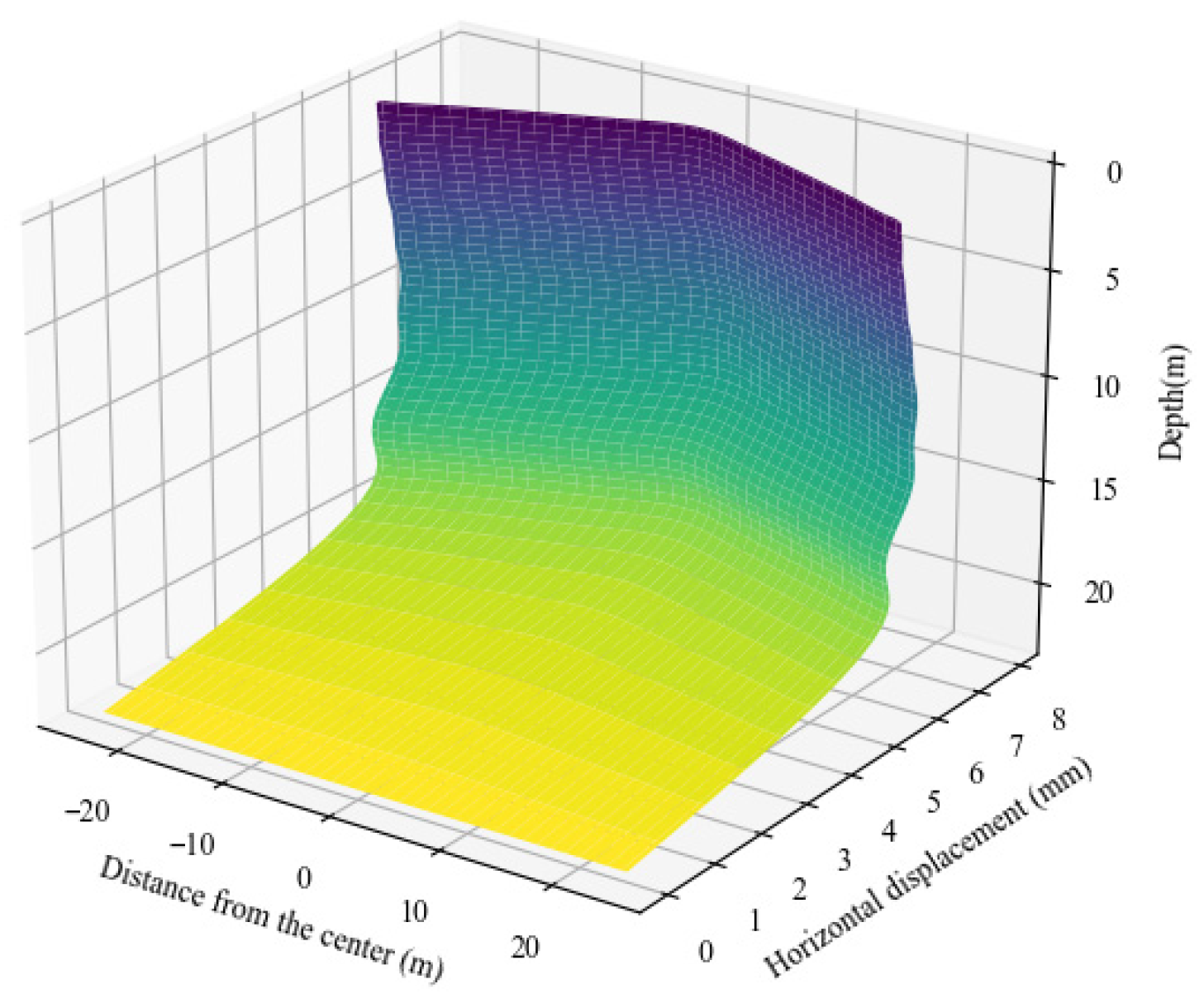
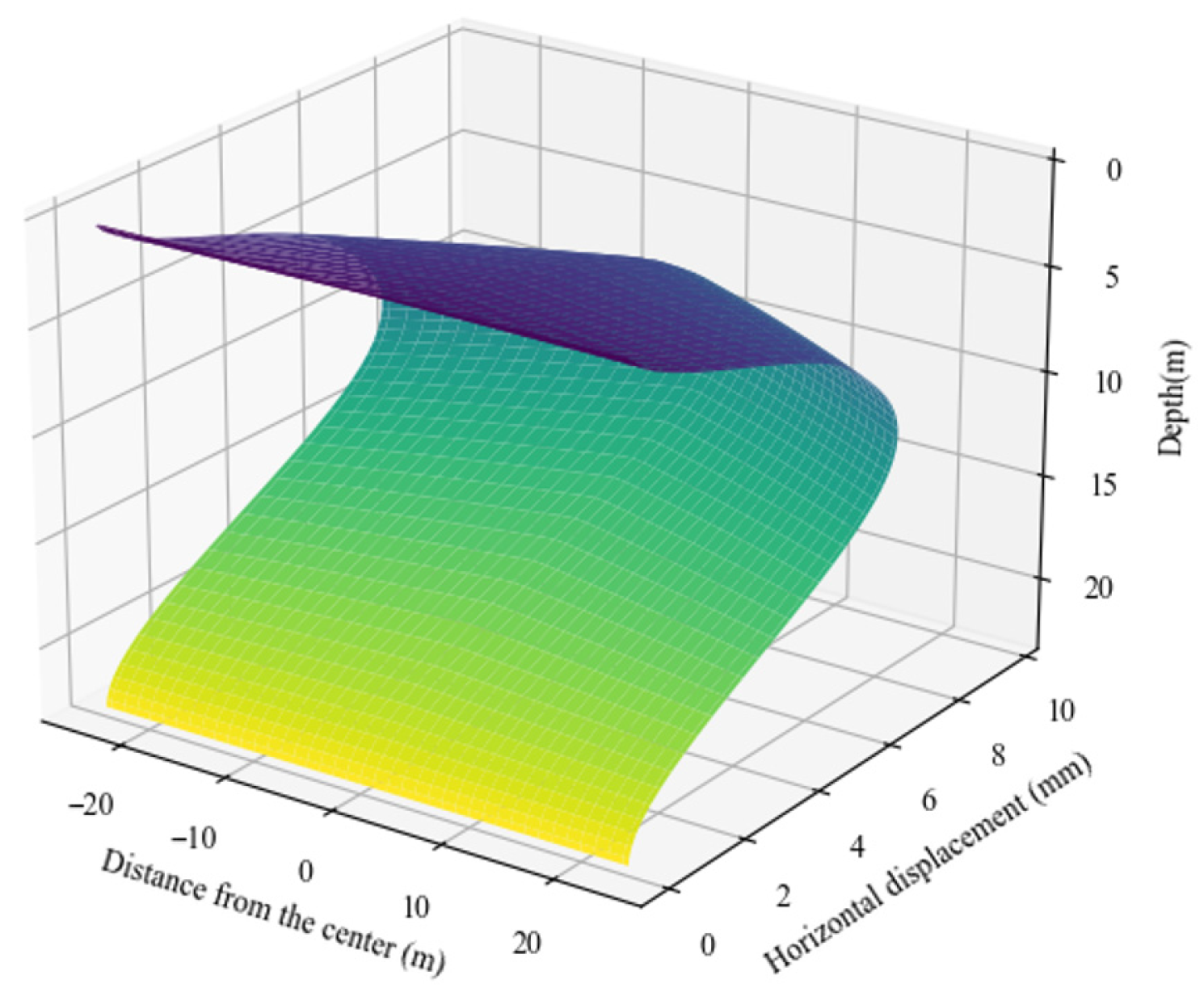
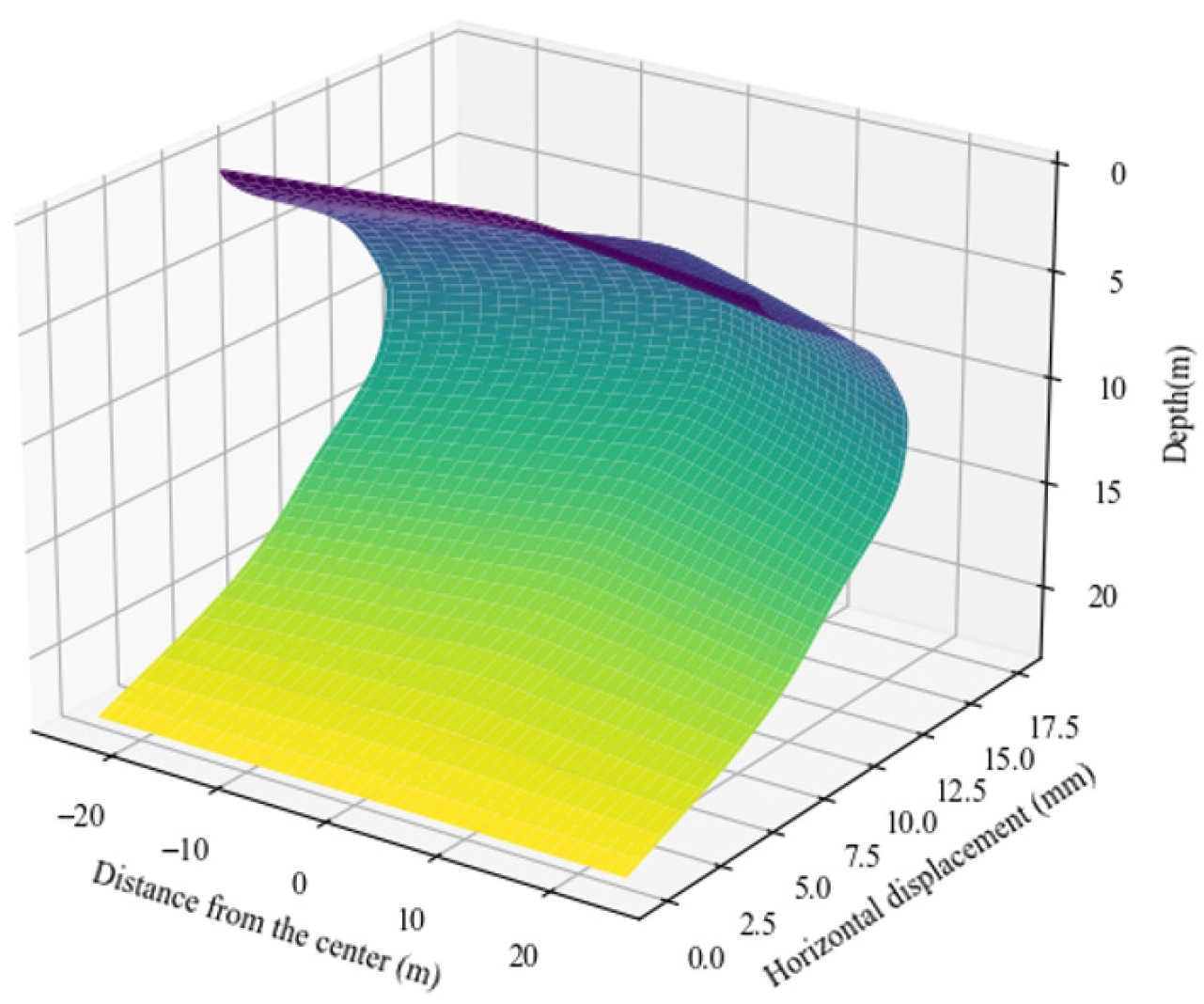
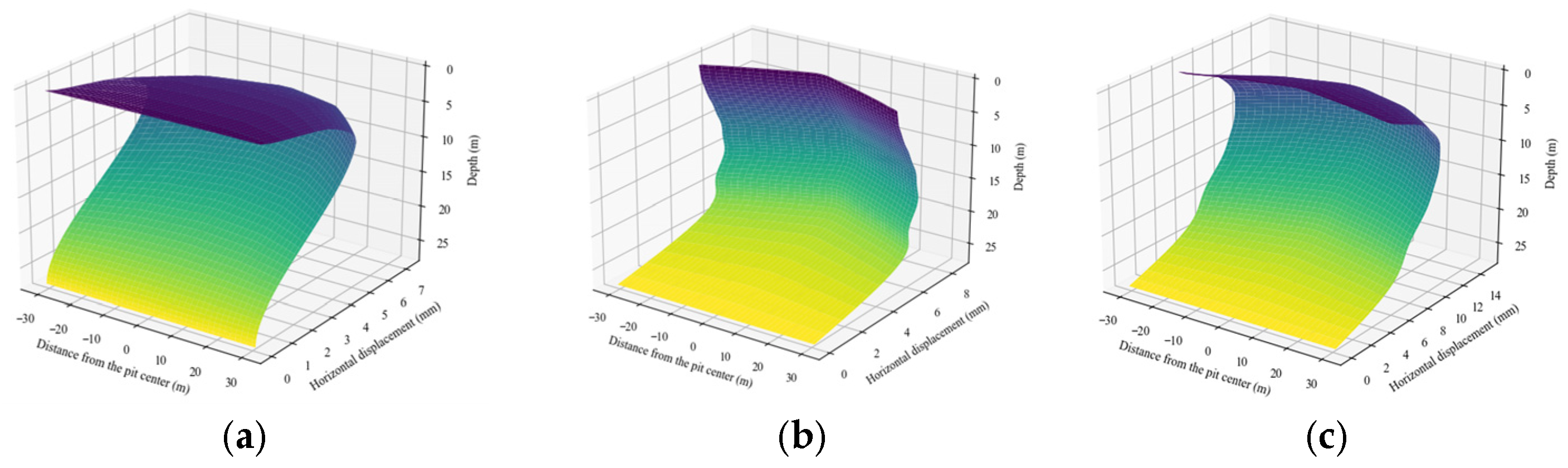
The three-dimensional distributions of (i) bending-induced displacement, (ii) excavation-induced free-field displacement, and (iii) the resulting total displacement are shown in
Figure 9,
Figure 10 and
Figure 11. The bending deformation of the retaining wall remains nearly constant along the upper and middle regions but decays rapidly toward the wall base. The excavation-induced free-field displacement exhibits a broad crest near the centerline and attenuates toward both sides. It increases initially and then decreases with depth, reflecting the shear-mediated transfer of deformation through the surrounding soil. The total displacement profile becomes steeper in the upper portion—dominated by bending—and exhibits a gentle uplift in the lower portion due to the contribution of
us1. The combined effects produce a characteristic right-convex “S-shaped” displacement surface along the centerline.
3.3. Case Study 2
Case Study 2 was selected to complement Case Study 1 by representing a more complex excavation geometry with multiple basement levels and asymmetric tunnel–pit spacing, thereby allowing further verification of the method under a different urban excavation configuration.
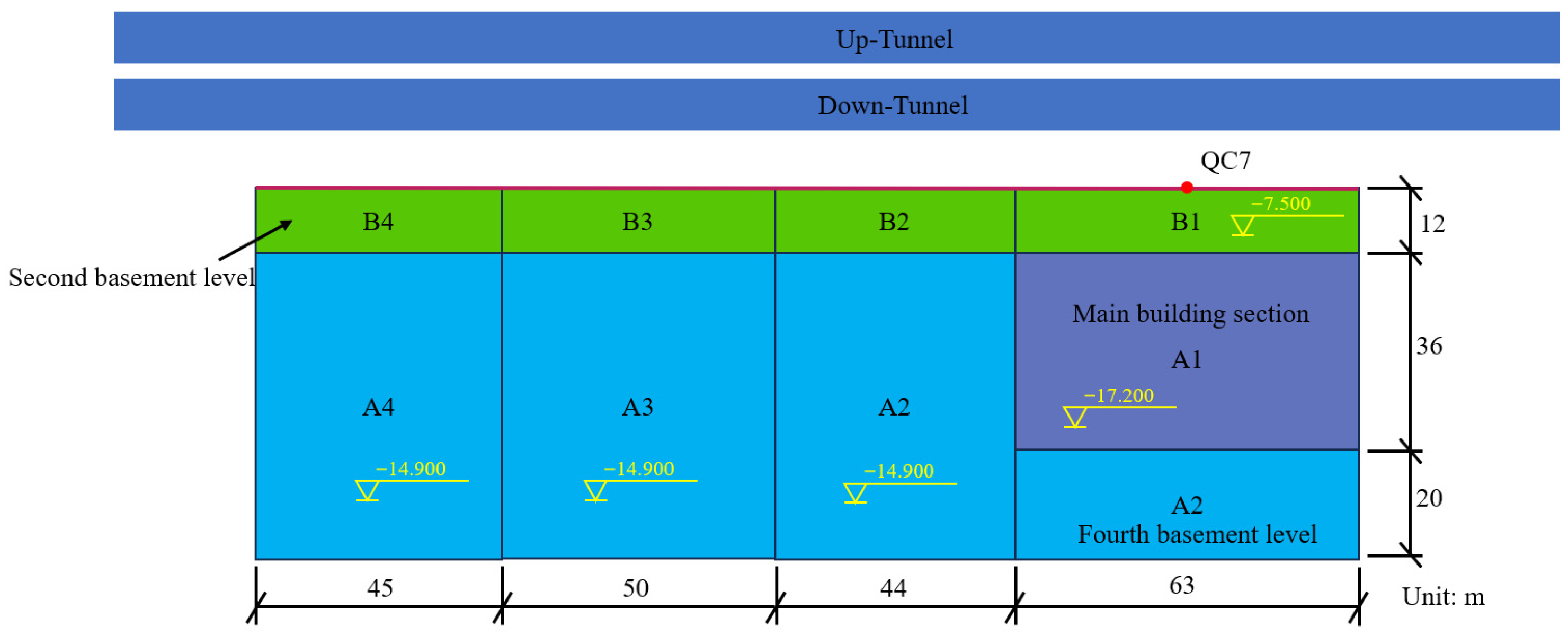
Case Study 2 is located in Xiaoshan District, Hangzhou. The layout of the subdivided excavation zones is shown in
Figure 12. The project consists of 2–4 basement levels: the B1–B4 pits on the northern side, which are adjacent to the metro tunnel, contain two basement levels with an excavation depth of 7.5 m; the A2–A4 pits comprise four basement levels with an excavation depth of 14.9 m; and A1 corresponds to the main building zone with an excavation depth of 17.2 m.
The shield tunnel parameters adopted in the analysis are as follows:
D = 6.2 m,
Dt = 1.2 m,
ks = 7.45 × 10
5 kN/m,
kt = 1.94 × 10
6 kN/m,
EtIt = 1.1 × 10
8 kN·m
2. The tunnel crown is located approximately 20 m below the ground surface. The horizontal distance from the excavation boundary to the centerline of the down-track tunnel is about 16.7 m, and that to the up-track tunnel is approximately 28.7 m. The soil parameters are listed in
Table 4.
The excavation sequence is A3 → A2 → A1 → A4 → B4 → B2 → B3 → B1.
As summarized in
Table 4, Case Study 2 also exhibits layered geotechnical conditions, but with a different stratigraphic composition and stiffness distribution from Case Study 1. Together with the more complex excavation geometry and varying tunnel offsets, these parameters make Case Study 2 a useful complementary case for evaluating the applicability of the proposed method under a different urban excavation setting.
A monitoring point, QC7, was installed at the center of sub-pit B1 to record the horizontal displacement of the retaining structure. The three-dimensional distribution of the calculated wall deformation within sub-pit B1 is shown in
Figure 13. The overall pattern of horizontal displacement is broadly consistent with that observed in Case Study 1.
To provide a more quantitative evaluation of the agreement between calculated and measured results, two simple error indicators are introduced, namely the peak error and the root-mean-square error (RMSE). The peak error is used to assess the accuracy of the predicted maximum displacement, while the RMSE reflects the overall deviation between the calculated and measured curves. The corresponding results for the retaining-wall and tunnel displacement profiles in the two engineering cases are summarized in
Table 5. As can be seen, the proposed method not only captures the deformation shape and peak position well, but also maintains relatively small quantitative errors.
4. Discussion
4.1. Case Study 1
As shown in
Figure 14, the horizontal displacement along the centerline (
y = 0) is extracted for analysis. The displacement in the upper portion of the retaining structure (approximately 0–5 m) and in the lower portion (approximately 15–20 m) is dominated by wall bending, where the contribution from pit-wall uplift is relatively limited. In contrast, the middle zone (approximately 5–15 m) is primarily governed by pit-wall uplift; however, wall bending still accounts for roughly 40% of the total lateral displacement in this region. The superposition of these two deformation components results in a right-convex “S-shaped” profile, with a distinct peak occurring at the mid-depth.
Compared with the conventional method that relies solely on empirical pit-wall displacement formulas, the proposed approach exhibits significantly better agreement with field measurements. This demonstrates its enhanced capability in capturing both the deformation pattern and the overall magnitude of retaining-wall displacement.
For monitoring point ZQT3, the same analytical procedure is applied. The soil loss induced by the excavation of sub-pit 2A7 is first used to evaluate its influence on the lateral displacement of the retaining wall in sub-pit 2A4. This deformation is then superimposed with the free-field displacement generated during the excavation of sub-pit 2A4, resulting in the final horizontal displacement of the retaining structure at this location.
A comparison between the calculated and measured horizontal displacements is presented in
Figure 15. The overall displacement pattern is generally consistent with that observed at monitoring point ZQT5. Because the retaining wall in the 2A4 zone is mainly affected by the excavations of sub-pits 2A4 and 2A7, the resulting lateral displacement is relatively small.
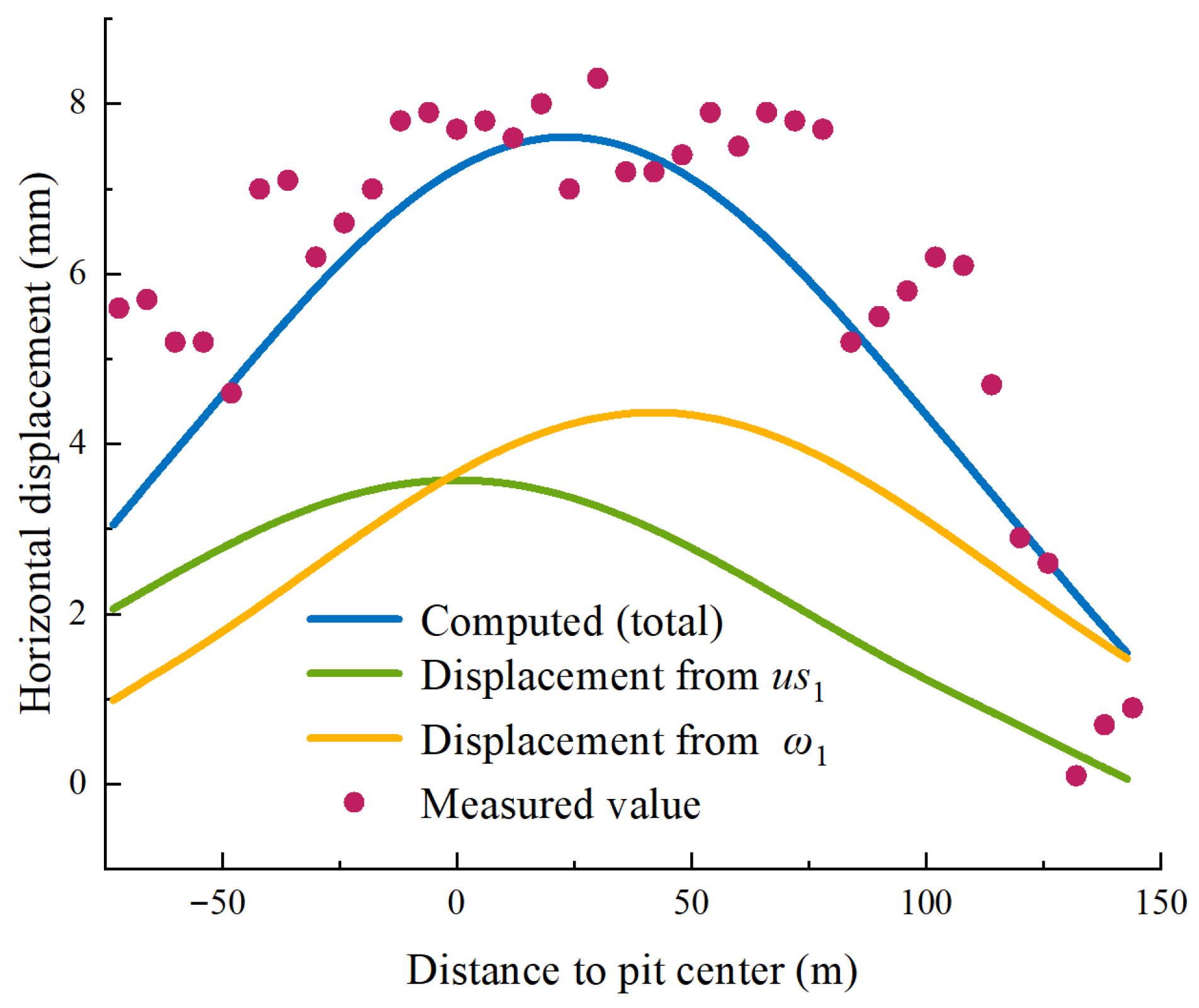
After obtaining the final horizontal displacement surface of the retaining structures in sub-pits 2A1–2A5, the corresponding tunnel displacement induced by the associated soil loss is calculated. The results are presented in
Figure 16. Due to the pronounced unloading effect generated by the excavation of sub-pit 2A11, the bending deformation of the retaining walls in sub-pits 2A1–2A3 is larger than that in sub-pits 2A4–2A5. Consequently, the peak tunnel displacement attributable to wall bending shifts toward the center of sub-pit 2A11.
Furthermore, because the geometries of sub-pits 2A1–2A5 are nearly identical, the excavation-induced free-field displacements are also highly similar. As a result, the peak tunnel displacement associated purely with excavation-induced soil loss appears near the geometric center of the sub-pit group.
In addition, the computed total horizontal displacement of the tunnel exhibits good agreement with the field measurements. In the central region of the grouped pits and on the positive side of the alignment, the predicted values closely match the monitored data, whereas a slight underestimation is observed on the negative side. This deviation may stem from the influence of the adjacent excavations in Plots 1, 2, and 3. Overall, the proposed method demonstrates strong capability in predicting the effects of segmented excavation on both the retaining structures and the nearby shield tunnel.
4.2. Case Study 2
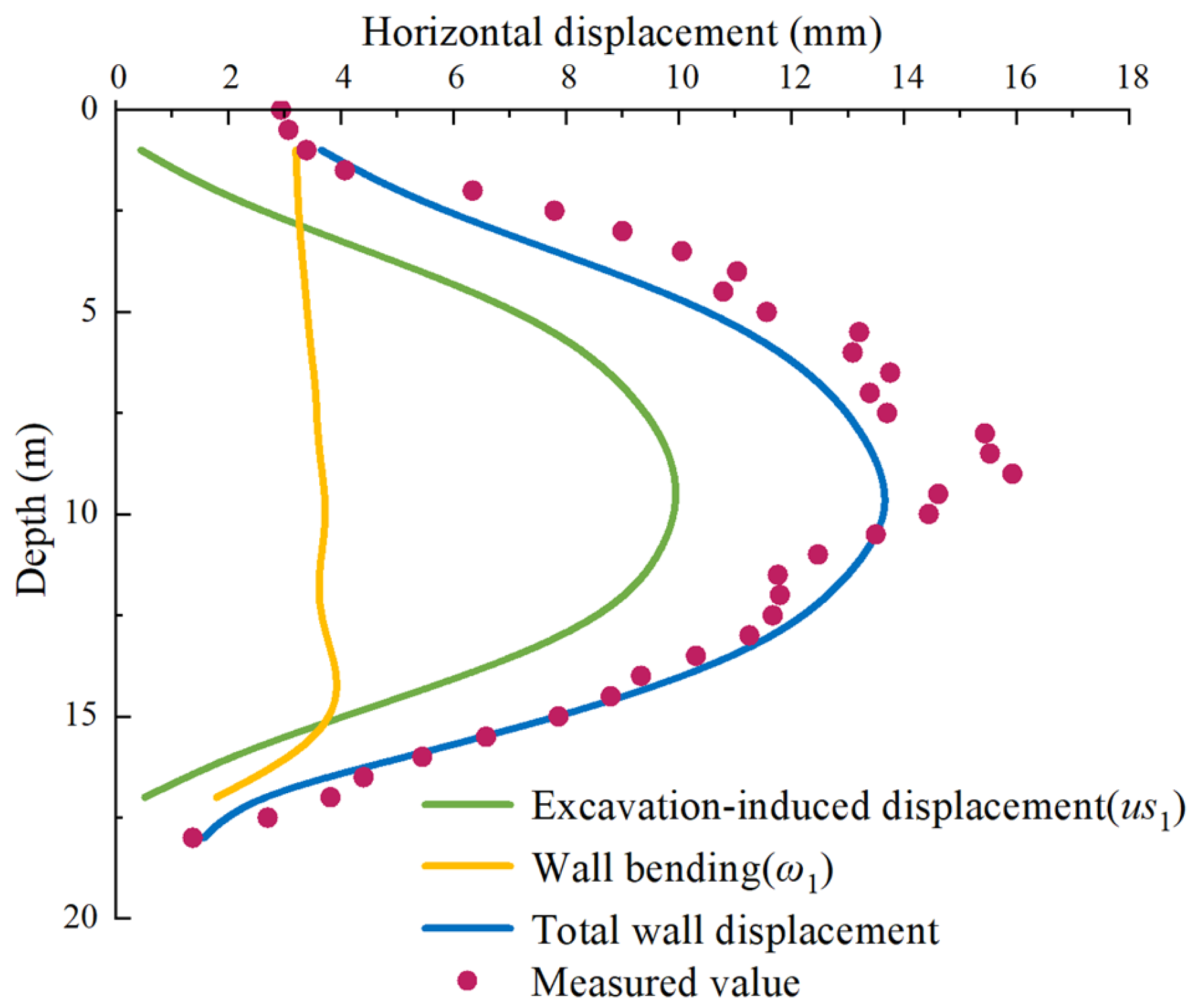
By extracting the displacement profile along the centerline (
y = 0), the comparison between the computed and measured values is presented in
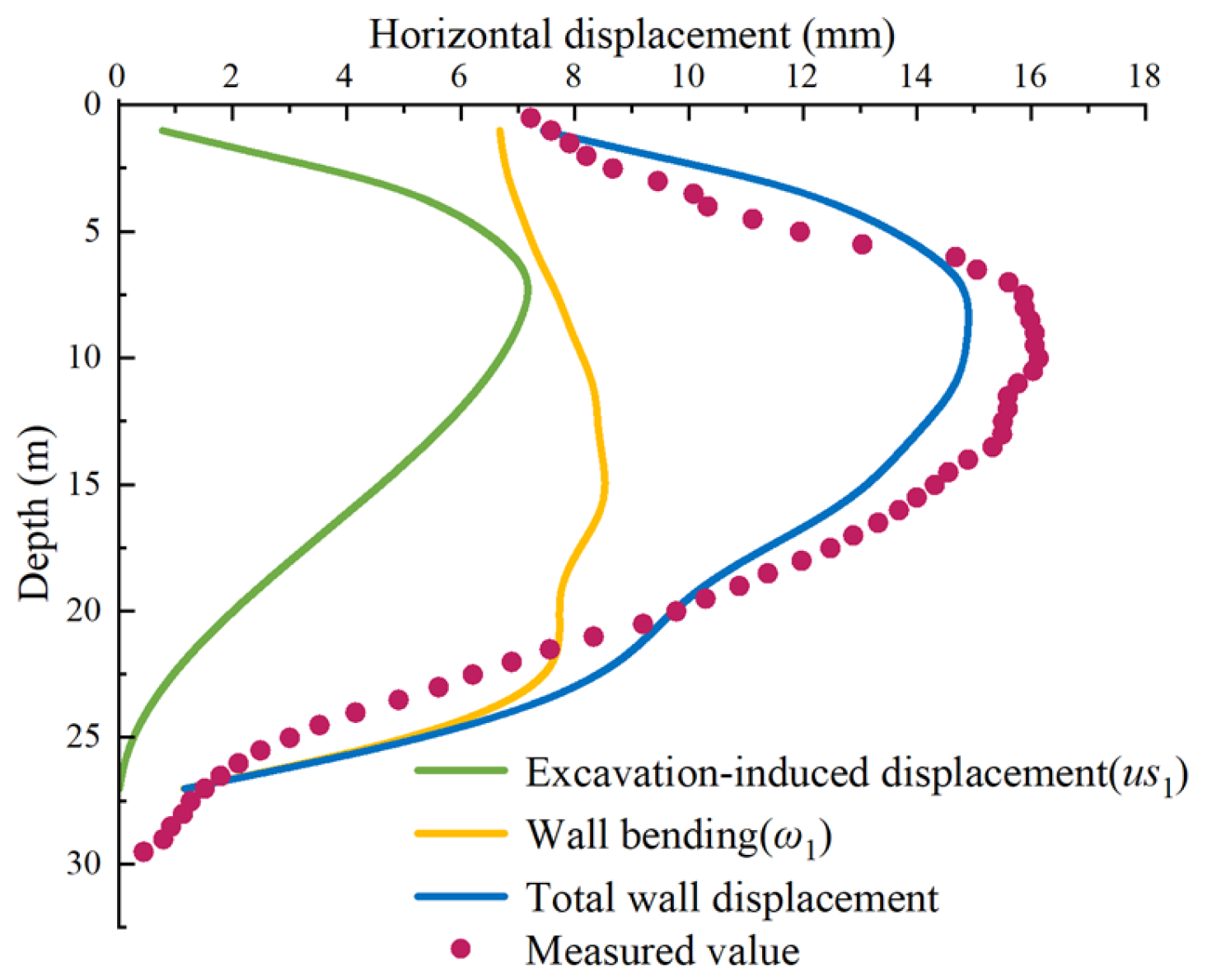
Figure 17. The peak of the excavation-induced displacement curve occurs at a depth of approximately 7.5 m, which may be associated with the excavation depth of the outermost pit. The bending-induced component of the wall displacement increases with depth and then rapidly diminishes beyond a certain depth.
The total displacement shows good agreement with the field measurements. The computed values are slightly overestimated in the upper zone (approximately 0–5 m) and lower zone (approximately 20–27 m) of the wall, while being slightly underestimated in the middle range (approximately 5–20 m). Overall, the calculated results effectively capture the deformation trend and magnitude of the retaining structure.
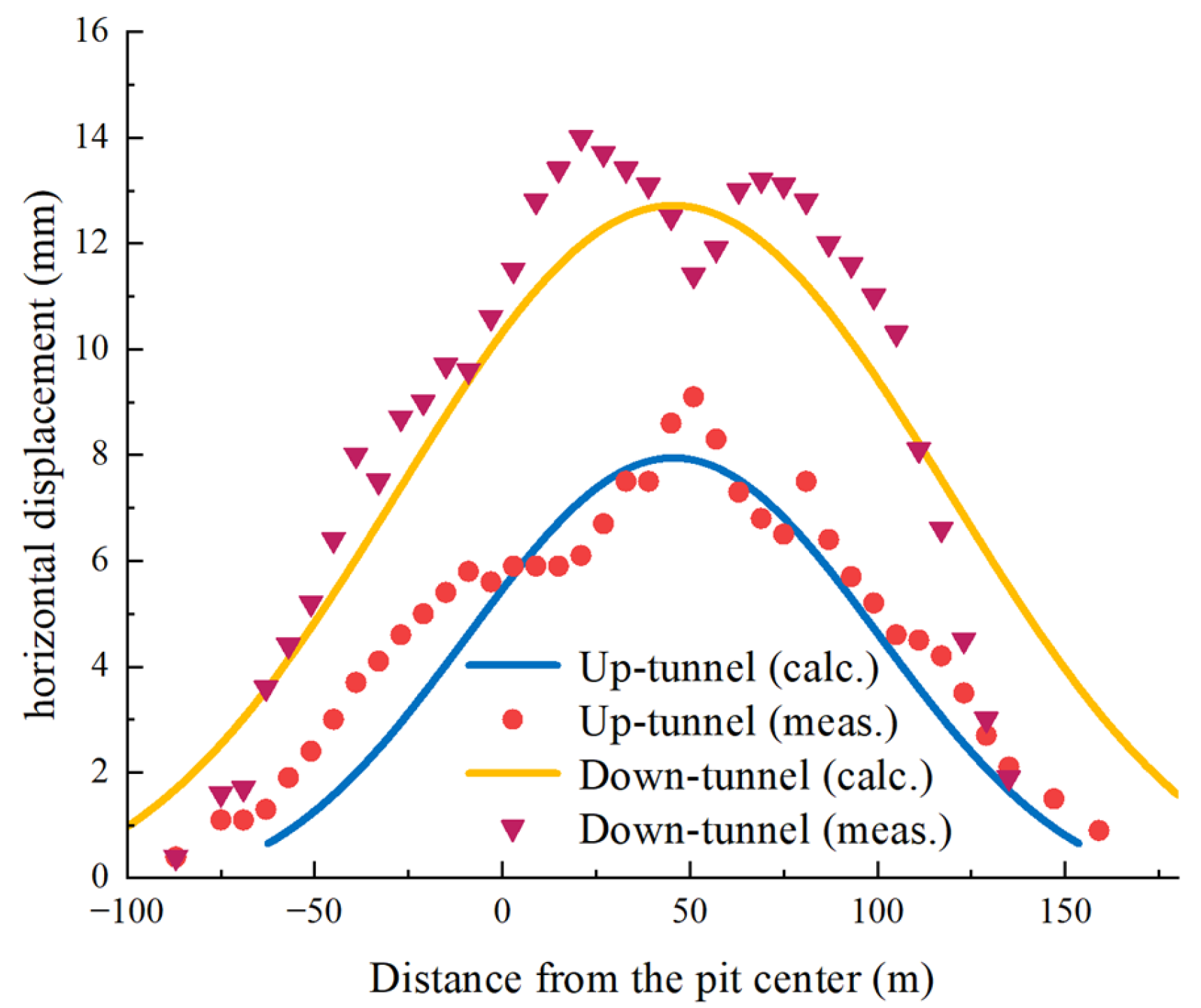
Based on the calculated soil loss behind the retaining structure, the corresponding displacement of the adjacent tunnel is obtained. As shown in
Figure 18, the computed and measured displacements of both the up-track and down-track tunnels are compared. The tunnel displacement profiles exhibit a near-Gaussian distribution. Due to the greater excavation depth in the main-building area, the bending deformation of the retaining structure is more pronounced in this region, causing the peak tunnel displacement to shift toward approximately
y = 45 m.
The measured tunnel displacements show good agreement with the computed curves in terms of both the peak position and overall deformation shape. Errors remain small near the peak, with only minor deviations observed in the tail regions. These results further demonstrate the reliability and robustness of the proposed calculation method.
4.3. Comparison with Previous Studies
The main deformation characteristics obtained in this study are generally consistent with observations reported in previous studies on excavation-induced tunnel response. For example, earlier numerical and centrifuge investigations have shown that adjacent excavation typically produces spatially nonuniform tunnel displacement and that the response is strongly affected by the relative position between the excavation and the tunnel, excavation depth, and unloading sequence [
2,
13,
16,
18]. The present results are in agreement with these general trends. In both engineering cases analyzed herein, the tunnel displacement exhibits a localized distribution with a clear peak, and the retaining-wall deformation shows a pronounced depth-dependent pattern. These findings are also consistent with earlier analytical studies indicating that excavation-induced unloading and wall deformation are the dominant sources of additional tunnel response [
7,
8,
10].
However, compared with previous analytical approaches, the present study provides several additional insights. Existing simplified analytical methods commonly idealize segmented excavation effects through direct superposition or treat the isolation system using one-dimensional beam-type representations [
8,
10,
20]. In contrast, the proposed framework introduces a stage-by-stage transfer procedure for segmented excavation and models the isolation-pile system as a Kerr-foundation plate–soil interaction problem, which makes it possible to capture both the sequencing-dependent memory effect and the two-dimensional flexural contribution of the isolation wall. As a result, the present method not only reproduces the overall deformation magnitude, but also explains characteristic features such as the right-convex “S-shaped” retaining-wall profile, the contribution of wall bending in the middle zone, and the peak-shift behavior of tunnel displacement toward earlier-excavated or deeper-excavated regions. These aspects are less explicitly resolved in most existing analytical solutions and are therefore considered a key difference between the present work and previous studies.
Differences between the present predictions and some previously reported simplified analytical patterns are mainly attributable to the explicit consideration of segmented excavation sequence, the decomposition of wall deformation into bending- and excavation-induced components, and the homogenized plate representation of the isolation-pile system.




 ,
,