1. Introduction
General Relativity (GR) has been remarkably successful in describing gravitational phenomena from laboratory scales to cosmology. Nevertheless, both observational and theoretical motivations have stimulated the investigation of alternative theories of gravity, especially in regimes where dark energy or strong-field effects might reveal novel physics. Modified theories of gravity often arise by relaxing some of the foundational assumptions of GR, such as the form of the gravitational action, the coupling between geometry and matter, or the local conservation of the energy–momentum tensor.
Rastall gravity is an example of such an alternative framework. Originally proposed by Rastall, the theory is based on the hypothesis that the usual covariant conservation law of the energy–momentum tensor may be violated in curved spacetime, allowing for a non-minimal coupling between matter and geometry [
1]. In this formulation, the divergence of the energy–momentum tensor is assumed to be proportional to the gradient of the Ricci scalar, leading to a modification of Einstein’s field equations. Although the field equations can be rewritten in an Einstein-like form with an effective stress–energy tensor, the underlying non-conservation law introduces new features in the dynamics of matter fields and has motivated ongoing discussion about the physical interpretation of the theory and its possible equivalence (or lack thereof) to GR (see, for example, Ref. [
2]). Alternatively, other authors have explicitly argued that Rastall gravity is not generally equivalent to Einstein gravity, highlighting its potential as an extended theory of gravity ready to confront observational data and cosmological challenges [
3].
Over the last decade, Rastall gravity has been applied to a variety of astrophysical and cosmological problems. In cosmology, it has been used to model the accelerated expansion of the Universe and explore effective dark energy scenarios without invoking exotic fluids [
4,
5,
6]. In the context of compact objects, many studies have derived and numerically solved modified Tolman–Oppenheimer–Volkoff (TOV) equations in Rastall gravity for stellar equilibrium and stability, including models of neutron stars, quark stars, and anisotropic compact configurations [
7,
8,
9,
10]. Such studies show how the coupling parameter in Rastall theory affects mass–radius relations, compactness, and the structure of relativistic stars compared to standard GR. For example, quark star models with MIT bag model equations of state and compact star solutions using specified metric potentials have been investigated within this framework [
11,
12] while black hole solutions have been considered by different authors [
13,
14,
15,
16].
Boson stars are hypothetical compact objects composed of scalar particles bound by gravity. Unlike neutron stars, which are supported by fermionic degeneracy pressure and nuclear forces, boson stars are stabilized either by quantum pressure arising from the Heisenberg uncertainty principle (in the case of non-interacting bosons) or by repulsive self-interactions of the scalar field (see, for instance, Refs. [
17,
18]). Since their original construction as solutions to the Einstein–Klein–Gordon system for a complex scalar field, these objects have been extensively studied in GR as potential black-hole mimickers and dark matter candidates. The physical properties of boson stars depend strongly on the scalar self-interaction potential, notably including a quartic self-interaction term such as a
potential, which significantly alters the mass–radius behavior and allows configurations with larger maximum mass than the non-interacting case. The existence of a maximum stable mass for boson stars, analogous to the turning point in neutron star sequences, is a relativistic effect arising from the balance between self-gravity and scalar field pressure [
19,
20,
21].
Despite the growing literature on boson stars in a range of gravitational theories, their structure and stability within Rastall gravity remain largely unexplored, motivating the present work. The main goal of this article is to investigate boson stars in Rastall gravity, focusing on configurations supported by a complex scalar field with a quartic self-interaction potential. We derive the equilibrium configurations using the modified (Rastall) TOV equations appropriate to the theory and employ an effective equation of state associated with the self-interacting potential to facilitate comparison with the standard GR case. Our results indicate that, similar to GR, the mass–radius diagram for Rastall boson stars exhibits a critical mass above which configurations are dynamically unstable. On the one hand, we find that the critical mass slightly decreases with the departure from GR as measured by the Rastall parameter. On the other hand, for a given mass in the stable branch of the mass–radius relationship, the radius of the configuration decreases with departure from GR, reflecting how the modified coupling between matter and geometry influences the equilibrium structure.
The paper is organized as follows. In
Section 2, we present the basic equations of the model, including Rastall gravity’s field equations, the scalar field dynamics, and the modified TOV system.
Section 3 is devoted to numerical results, where we analyze mass–radius relations and the influence of the Rastall parameter on boson star properties. Finally, in
Section 4, we summarize our main conclusions and discuss possible extensions of this work.
2. Equations of the Model
The structure of boson stars is usually investigated by solving the coupled Einstein–Klein–Gordon system, which provides a complete description of the scalar field configuration. However, in the presence of a self-interaction potential of the form , the scalar field can be effectively described as a perfect fluid with a well-defined equation of state in the mean-field approximation. In this regime, the equilibrium configurations can be obtained by solving the Tolman–Oppenheimer–Volkoff equations, an approach that has been widely used in the literature. In the present work, we adopt this effective fluid description, which is particularly suitable in the context of Rastall gravity, where the field equations can be written in terms of an effective stress–energy tensor including both matter and geometric contributions.
As already mentioned, in 1972 Rastall proposed an alternative theory of gravity in which the usual local conservation law for the stress–energy tensor is relaxed in curved spacetime, introducing a non-minimal coupling between geometry and matter fundamentally different from the standard Einstein coupling in GR. Instead of assuming a vanishing covariant divergence of the matter stress–energy tensor, Rastall postulated the relation
where
R is the Ricci scalar and
is the Rastall parameter (a subscript is introduced here in order to distinguish it from the coupling constant
appearing in the boson self-interaction potential). Equation (
1) expresses the possibility that matter and geometry may exchange energy–momentum in a way that is absent in Einstein’s theory.
According to Rastall [
1], this hypothesis is consistent with the modified field equations
whose covariant divergence vanishes identically due to the Bianchi identities. Here we have redefined the Rastall relation appearing in the field equations above by introducing the Einstein gravitational constant
in order to maintain
as a dimensionless parameter.
Contracting tensors on both sides of Equation (
2) yields
where
T denotes the trace of the stress–energy tensor. Substituting Equation (
3) back into Equation (
2) and defining the parameter
as
the field equations can be recast in the form
The field equations above are formally identical to GR if an effective stress–energy tensor
is introduced as
Notice that the effective stress–energy tensor includes both matter and geometric contributions through the trace of the matter tensor, which is related to the scalar curvature of spacetime.
Assuming that both the matter stress–energy tensor and the effective energy–momentum tensor correspond to a perfect fluid, the effective pressure and energy density are given by
and
The Tolman–Oppenheimer–Volkoff (TOV) equations ([
22,
23]) can be derived from the spherically symmetric metric (in geometric units,
)
where
denotes the mass enclosed within a sphere of radius
r. Outside the stellar configuration the spacetime reduces to the Schwarzschild solution.
From the
component of Equation (
5), one obtains
while the
component gives
Finally, an equation for the pressure follows from the condition
, whose radial component leads to
Using Equations (
7) and (
8), and combining Equations (
11) and (
12), one obtains the modified TOV system in Rastall gravity, namely
and
Two important modifications arise in comparison with the Einstein equations. First, the mass conservation equation now contains a pressure contribution and second, the pressure gradient is also sourced by a mass density gradient. These additional contributions modify the stellar structure with respect to models derived within the General Relativity Theory (GRT).
The system of equations above must be solved with the following boundary conditions: at the center, and and at the stellar surface, , the boundary conditions are and , where R and M respectively denote the radius and the mass of the star.
In addition to Equations (
13) and (
14), an equation of state
is required. In the present investigation, the bosonic matter is described by a scalar field endowed with a self-interaction potential of the form
. In the regime of strong self-interaction, it is well known that the system can be described within the mean-field approximation as an effective perfect fluid. In this limit, the pressure–energy density relation is given by [
20,
24]
where
is a reference energy density and
m is the boson mass. A detailed derivation of this equation can be found in Ref. [
25]. This equation of state is adopted in the present calculations.
In order to numerically solve the modified TOV equations derived in the framework of Rastall gravity, it is convenient to introduce dimensionless variables. We follow here the procedure adopted in Ref. [
21]. First, we define a characteristic length scale
as the geometric mean between the gravitational Bohr radius of the boson and the scattering length associated with the self-interaction potential. The latter can be expressed in terms of the boson Compton wavelength and the self-interaction coupling constant
. Hence,
where
is the Planck mass. We then introduce the dimensionless radial coordinate
together with the dimensionless pressure and energy density defined respectively as
and
. The dimensionless mass enclosed within a sphere of radius
is written as
where the reference mass is defined as
This reference mass definition allows for a direct comparison with previous results obtained in the framework of GRT, since in this case the critical (or maximum) mass is
according to Ref. [
20].
Using these transformations, Equations (
13) and (
14) can be recast as
and
For convenience, we have defined the auxiliary functions
and
The system must be supplemented by the dimensionless equation of state corresponding to the self-interaction potential, namely
3. Results
The above set of equations was solved numerically using the boundary conditions described in the previous section. Each stellar configuration is characterized by a chosen central pressure and by the value of the reduced Rastall parameter .
It should be emphasized that different definitions of the Rastall parameter are found in the literature. In some approaches, GR is recovered when
, while in others the relevant dimensionless parameter is given by
[
7,
10]. According to our definition (see Equation (
4)), the Rastall parameter is restricted to the interval
, while the reduced parameter
is defined for all real values, but the particular value
corresponds to the GR limit. Values of
imply negative values of the reduced Rastall parameter
that were not considered in the present work.
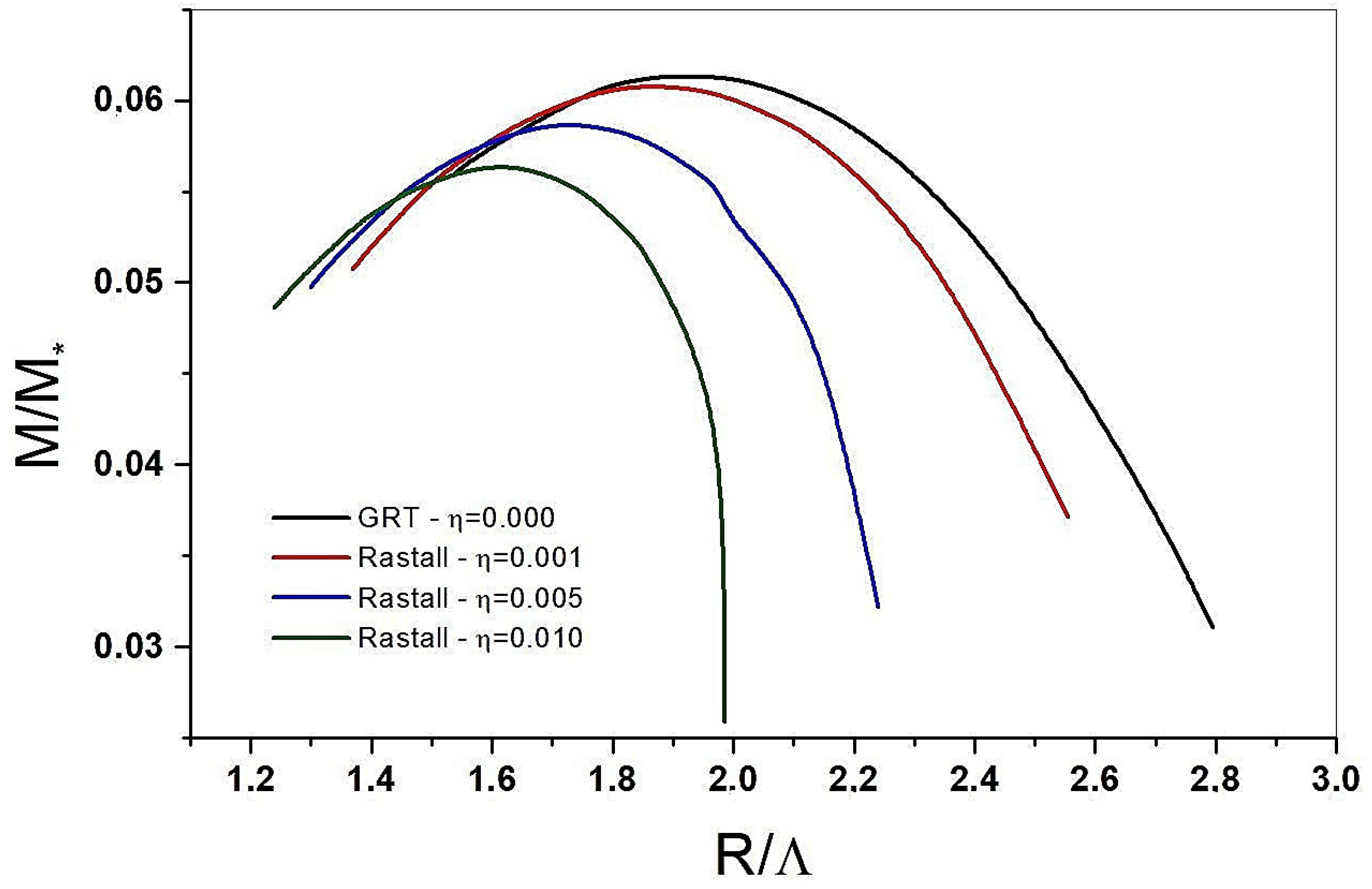
Figure 1 shows the mass–radius relation obtained for configurations characterized by the reduced Rastall parameters
and
. The GR solution (
) is also displayed for comparison and was used to verify the accuracy of the numerical implementation. In fact, when
we recover the
critical mass value, namely,
, within an accuracy of about 0.2% with respect to the computations performed by Ref. [
20].
Inspection of
Figure 1 indicates that the maximum mass, beyond which stellar configurations become dynamically unstable, decreases as the Rastall parameter increases. In other words, the critical mass decreases as deviations from GR become more significant. This is a consequence of the negative pressure contribution to the mass equation (Equation (
13)) not present in the GR formulation of the TOV equations. A second characteristic feature of the models is that, along the stable branch, the slope of the mass–radius relation increases with the departure from GR, which corresponds to an increase in the stellar compactness, as measured by the ratio
. In contrast, in the unstable branch the different curves are nearly superposed. In the case of boson–fermion stars in the context of
, the critical equilibrium configuration is characterized by the extreme values of the number of particles [
26,
27]. Hence, in the context of
the branch characterized by
is typically associated with unstable configurations. In the present work, this condition is used only as a qualitative indicator, since a rigorous stability analysis in Rastall gravity would require a study of radial perturbations, which is beyond the scope of this paper.
An opposite behavior was reported in neutron star models constructed within Rastall gravity, where configurations tend to shift toward larger radii for increasing deviations from GR. For instance, a neutron star with a mass of about
typically has a radius of about 11 km in GR, whereas values in the range 14–17 km were obtained in Rastall gravity [
7]. However, quark star models in the context of Rastall gravity were computed in Ref. [
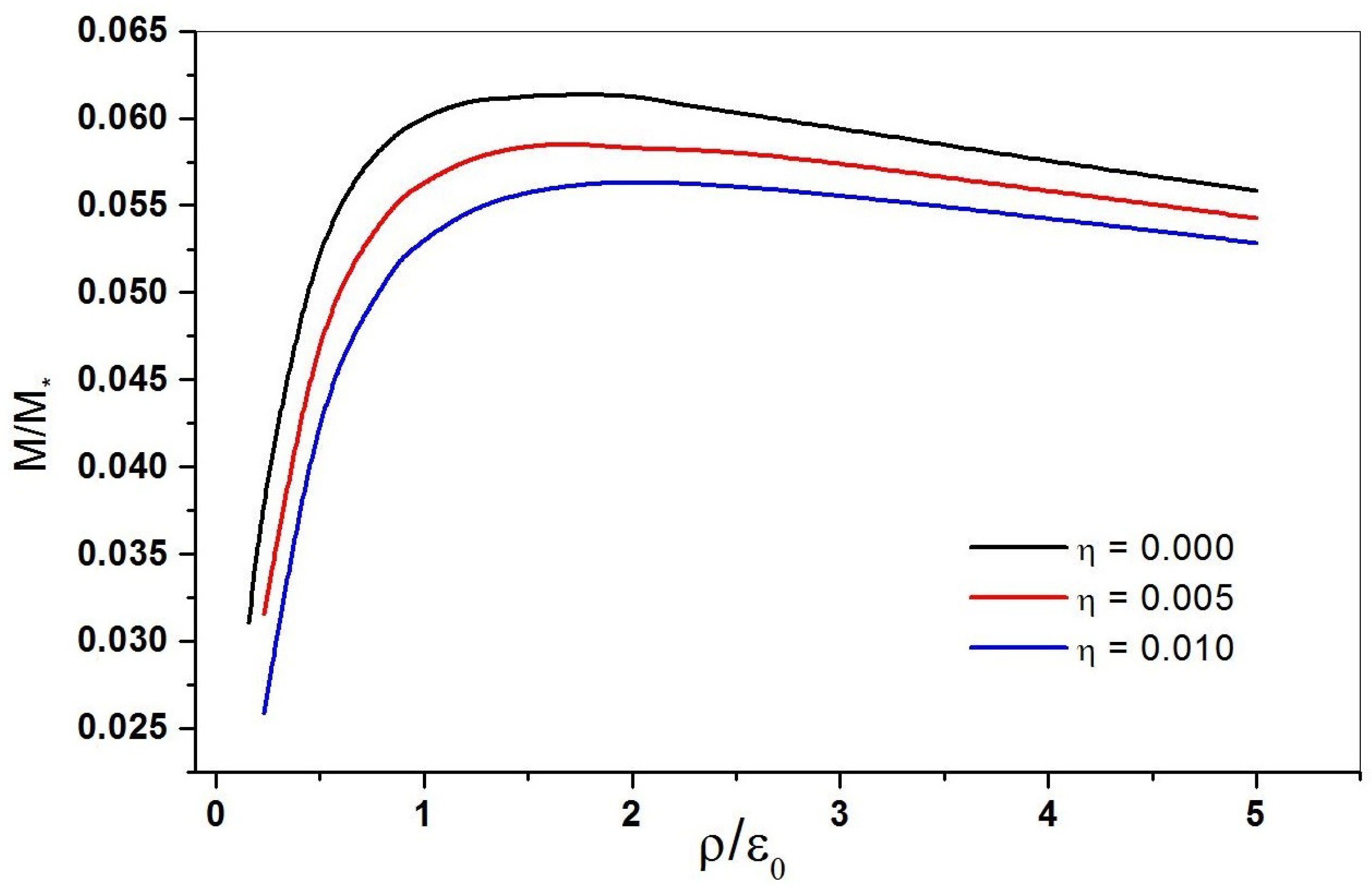
28], displaying the same behavior as our boson star models, namely, the critical mass decreases as deviations from GR increases. Such a trend can be also seen in a plot showing the variation of the stellar mass as a function of the central density (
Figure 2). Similar results for quark stars were obtained by [
28] (see their Figure 4).
This behavior is illustrated quantitatively in
Table 1, where the dimensionless critical masses and the corresponding radii are listed. For completeness, physical values assuming an axion-like particle (ALP) with mass
eV and
are also given [
21].
Notice that the estimated central densities are several orders of magnitude larger than those found in the cores of neutron stars. This is a direct consequence of the fact that bosons are not subject to the Pauli exclusion principle and therefore are not supported by degeneracy pressure, allowing them to reach extremely high central densities. It is worth mentioning that both mass and radius scale inversely with the boson mass, and hence less massive ALPs lead to configurations having larger masses and radii but with the same compactness.
In
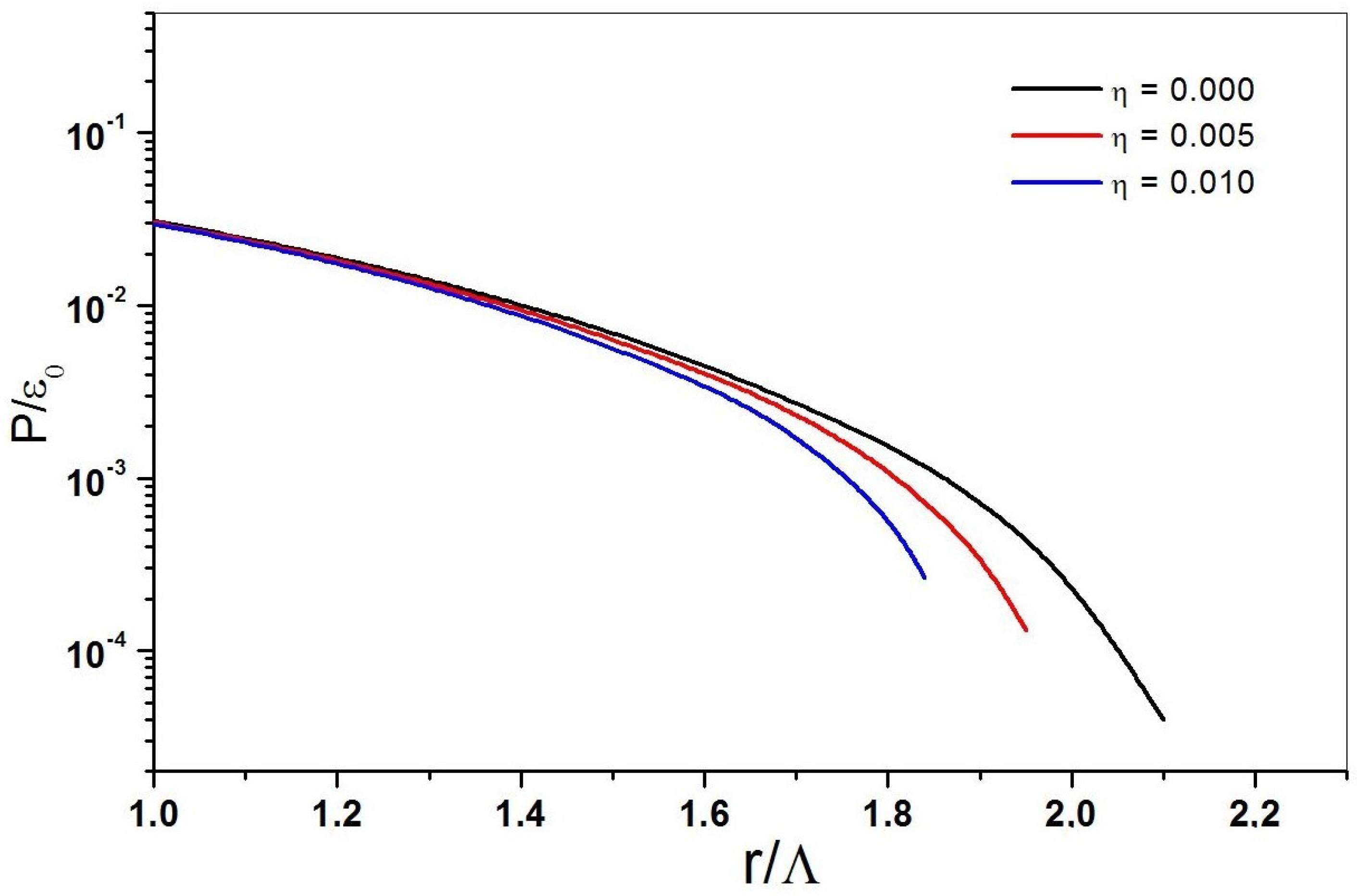
Figure 3 we show pressure profiles for models having the same central value (
) but having different values of the Rastall parameter. The main differences appear in the outer layers of the configurations, where the pressure decreases more abruptly as deviations from GR increase, resulting in more compact stellar configurations. These differences are essentially a consequence of the energy gradient term that contributes to source the pressure gradient in the Rastall approach, as can be seen in Equation (
14).
4. Conclusions
In this work we have investigated equilibrium configurations of boson stars within the framework of Rastall gravity, a phenomenological modification of General Relativity characterized by a non-minimal coupling between geometry and matter through the trace of the stress–energy tensor. In this theory, the usual conservation law is relaxed and the gravitational field equations can be recast in Einstein-like form with an effective stress–energy tensor depending explicitly on the trace of matter.
Starting from the modified field equations, we derived the corresponding Tolman–Oppenheimer–Volkoff system for static, spherically symmetric configurations. The resulting structure equations differ from their GR counterparts in two essential aspects: (i) the mass function receives explicit pressure contributions, and (ii) the pressure gradient depends on both density and pressure through the effective quantities induced by the Rastall parameter.
The stellar configurations were constructed using an effective fluid description associated with a self-interacting scalar field governed by a potential. The corresponding equation of state was implemented in dimensionless form, and the modified system was solved numerically for different values of the reduced Rastall parameter .
Our results show that boson stars in Rastall gravity preserve the qualitative features known from General Relativity, namely the existence of a maximum (critical) mass separating stable and unstable branches in the mass–radius diagram. However, quantitative differences arise as the deviation from GR increases. In particular, the maximum mass decreases as the Rastall parameter grows, indicating that stronger departures from GR reduce the maximum amount of matter that can be supported in hydrostatic equilibrium. Furthermore, the mass–radius relation is modified in such a way that, for a given mass, the stellar radius varies systematically with the Rastall parameter, reflecting the geometric contribution induced by the trace coupling.
The behavior obtained here differs in part from that reported for neutron star configurations in Rastall gravity, highlighting that the impact of the theory depends sensitively on the nature of the matter source and on the equation of state. In the case of boson stars, where pressure originates from scalar self-interaction rather than fermionic degeneracy or nuclear interactions, the interplay between the modified geometric coupling and the nonlinear equation of state leads to distinct structural effects.
It should be emphasized that the results obtained in the present work depend quantitatively on the adopted equation of state, which in turn is determined by the properties of the underlying bosonic field, such as its mass and self-interaction strength. The potential considered here provides a well-established effective description of self-interacting boson stars and has been widely used in previous studies. Although different choices of the equation of state may lead to variations in the predicted masses and radii, the qualitative effects associated with Rastall gravity, namely the modification of the equilibrium structure through the effective coupling between matter and geometry, are expected to be robust. A systematic investigation of alternative bosonic models would be an interesting extension of the present work.
From a broader perspective, our analysis indicates that compact scalar configurations may provide an interesting laboratory to test phenomenological deviations from General Relativity. Since boson stars are frequently considered as dark matter candidates or black hole mimickers, understanding how modified gravity theories affect their structure is of potential astrophysical relevance. Extensions to other scalar potentials or to alternative parameter ranges of the Rastall theory may also help clarify whether observable signatures could distinguish these models from their GR counterparts.