On the

Faculty of Electrical Engineering and Informatics, Technical University of Košice, 042 00 Košice, Slovakia
Symmetry 2026, 18(4), 617; https://doi.org/10.3390/sym18040617
Submission received: 17 February 2026
/
Revised: 27 March 2026
/
Accepted: 3 April 2026
/
Published: 5 April 2026
(This article belongs to the Special Issue Symmetry in Combinatorics and Discrete Mathematics, 2nd Edition)
Abstract
The study of graph connectivity is a central topic in graph theory, with -connectedness being a specialized property of interest. A connected graph is -connected if, in every optimal drawing, there exists a path between every pair of vertices such that no edges cross. This paper explores the -connectedness of the k-power of , denoted , where is a path on n vertices, is a graph on the same vertex set as , and an edge exists in if the distance between u and v on is at most k. The paper concludes with a controversial drawing of the graph with only 16 crossings, which refutes the truth of Zheng et al.’s conjecture that the upper bound holds with equality for all .
1. Introduction
Graph theory, an important branch of mathematical modeling, finds extensive applications across diverse fields by modeling relationships and optimizing complex systems [1]. In computer networks, it optimizes routing protocols to ensure efficient data transmission [2,3]. Social media platforms use it to analyze user interactions, identify communities, and recommend connections [4]. The transportation and logistics industries rely on graph algorithms, such as shortest path and minimum spanning trees, to optimize routes for roads, airlines, and deliveries, minimizing time and costs [5]. In biology, graph theory models disease spread, with nodes representing individuals and edges representing interactions, aiding epidemic control strategies [6]. Urban planning leverages graphs to design efficient public transit systems, minimizing congestion [7]. In telecommunications, graph coloring assigns frequencies to avoid interference [8]. In operations research, flow algorithms optimize supply chains [9], while in cybersecurity, graph-based anomaly detection identifies unusual network traffic patterns [10]. These diverse applications underscore graph theory’s indispensable role in optimizing systems and solving complex problems across multiple disciplines.
This is one of the reasons to study graph connectivity, particularly -connectedness, a specialized property of interest. A simple graph is connected if there exists a path between every pair of vertices. A connected graph is -connected if, in every optimal drawing that minimizes edge crossings, there exists a path between any pair of vertices with no edge crossings. Different forms of graph connectivity have been explored, concerning vertices, edges, and subgraphs. A key problem is identifying a subclass of graphs where removing crossed edges from any optimal drawing yields a connected subgraph. This property of crossing free connectivity of graphs is studied only for the drawings of graphs with the smallest number of crossings, that is, on their optimal drawings. The -connectedness introduced by Staš and Valiska [11] allows us to analyze a graph more finely than classical connectedness, because it takes into account structures such as cycles or factors. In practice, it helps to identify robust and flexible parts of networks where alternative connections or solutions exist. It is used, for example, in the design of reliable networks, flow optimization or matching problems [12]. Thanks to it, we can better detect critical points of the system and possibilities for its improvement. Its main use is in the design of reliable networks (e.g., transportation or computer networks), where alternative connections need to be provided [13]. It is also important in matching and optimization problems, where it helps to find flexible and stable parts of a graph. The issue dealing with this connectedness for the complete graphs , the complete bipartite graphs and the complete tripartite graphs has already been estimated by Staš and Valiska [11,14], and Staš and Timková [15], respectively. The k-th power of paths and cycles has also been extensively studied in various contexts, including structural properties, graph labelings, and distance-based graph model [16,17,18].
2. Definitions and Preliminary Results
Let G be a simple graph (no loops or multiple edges). We denote its vertex set by and edge set by . The graph terminology follows the conventions in [19,20]. The crossing number of G, denoted , is the smallest number of edge intersections possible in any drawing of G (see [21,22] for the definition of a drawing). Clearly, a drawing with the fewest crossings (an optimal drawing) is always a good drawing, meaning no edge crosses itself, no two edges intersect more than once, no edges sharing a vertex cross each other, and no more than two edges meet at any crossing point. For any optimal drawing D of G, we define as the subgraph of G with vertex set and edge set . A connected graph G is -connected if the subgraph is connected for each optimal drawing D of G. Alternatively, G is -connected if there exists a path between any pair of vertices using only edges with no crossings for each optimal drawing D of G. In certain proofs within the paper, we frequently use the crossing number of a vertex , denoted , which is the count of crossings on edges incident with v in a given drawing D of G.
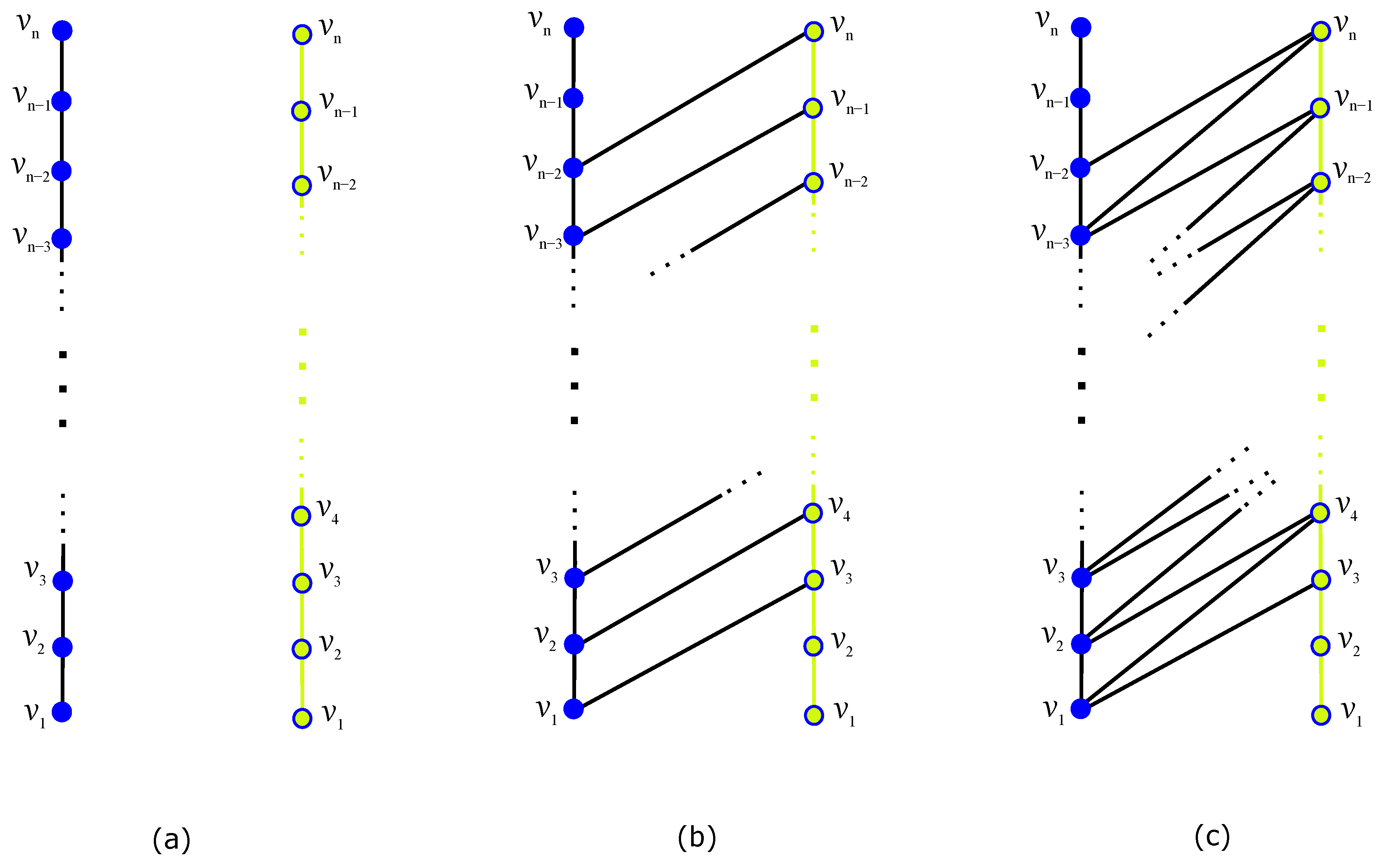
Let be a path on n vertices. For , the k-power of is a graph on the same vertex set as , and an edge exists in if the distance between u and v on is at most k. Since there are planar drawings of the graphs , as shown in Figure 1, the graphs , , and are -connected. Such a representation of drawings on a cylinder with edges identified by straight line segments is taken from Zheng et al. [23].
Due to Staš and Valiska [11], we already know that the complete graph is -connected. As the k-th power of is isomorphic to in the case of , the next result is obvious.
Theorem 1.
The graph is -connected.
The crossing number of was determined for any by Harary and Kainen [24], and later also by Zheng et al. [23].
Theorem 2
In the proof of Theorem 3, we require the two following statements concerning certain restricted drawings of the graph .
Lemma 1.
For , if D is any optimal drawing of then the subdrawing of the subgraph obtained by removing from induced by D is also some optimal drawing of .
Proof.
Let D be any optimal drawing of with crossings according to Theorem 2. Since and also by [24], the crossing number of must be at most one in D. If , then the subdrawing of the subgraph obtained by removing from induced by D includes exactly crossings, that is, it must be an optimal drawing of .
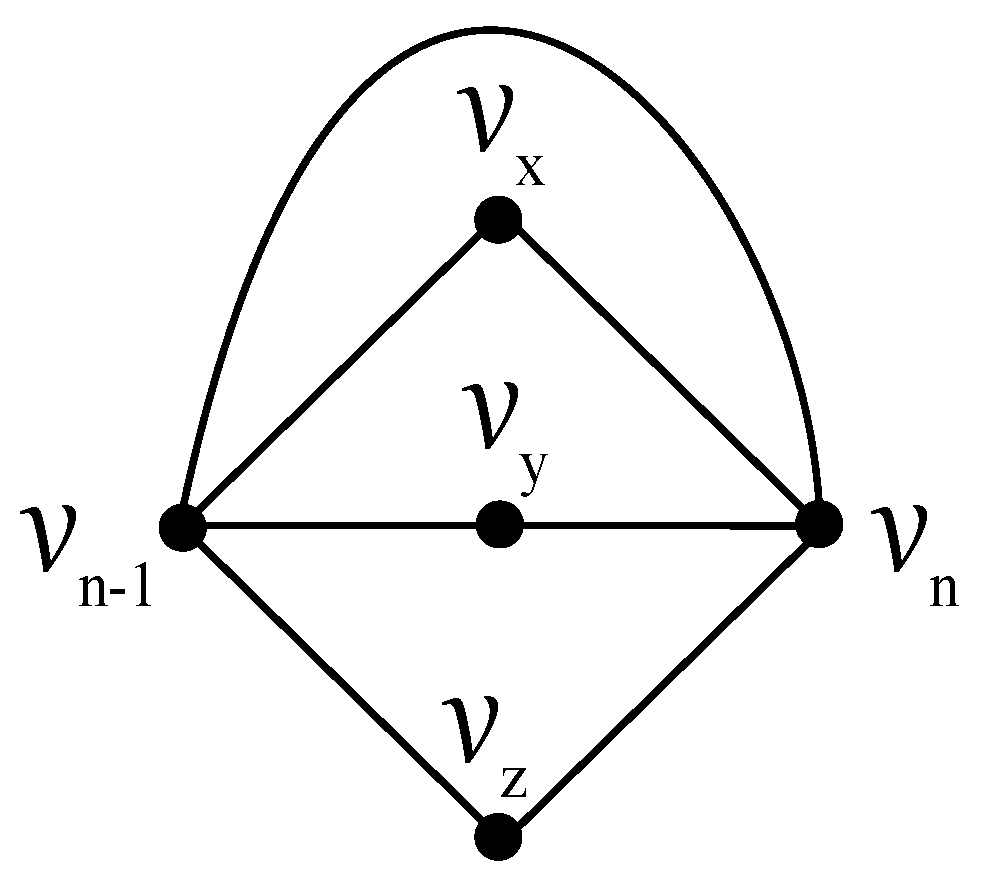
In the following, let the crossing number of be zero in D. Let be the subgraph of with the vertex set and the edge set . As , the subdrawing must be planar, see also Figure 2.
The edge and also the triple of edges , , must produce at least one crossing on some of the edges , , . Finally, by removing the three edges , , and subsequently by smoothing the vertex (refers to the topological operation of removing of degree two and replacing its two incident edges , with a single edge connecting its neighbors and ), we obtain a drawing of the graph isomorphic to with at most crossings. The obtained contradiction to Theorem 2 completes the proof of Lemma 1. □
Corollary 1.
The graph is -connected.
Proof.
Let D be any optimal drawing of with according to Theorem 2 and Lemma 1. Since and there is only one optimal drawing of by [11] (up to isomorphism) with no bridge on uncrossed edges, the subgraph must also be connected. □
Now we are prepared to prove the main result of the paper.
Theorem 3.
The graphs are -connected for .
Proof.
Theorem 3 holds for and thanks to Theorem 1 and Corollary 1, respectively. Let D be an optimal drawing of for which the subgraph is disconnected, and also let the graphs be -connected for all . The crossing number of is equal to one in D thanks to Lemma 1, and let be the subgraph defined in the same way as in the proof of Lemma 1. Next, we will distinguish between nonplanar and planar subdrawing induced by D.
There are a lot of nonplanar good drawings of the graph but in all of them the only possible crossing is determined by the pair of edges and for different provided by no two edges incident with the same vertex cross. The subdrawing of the subgraph obtained by removing from induced by D enforces a connectedness on uncrossed edges of . If the edge is a bridge of the connected subgraph , then the connection of can be preserved through a pair of uncrossed edges and .
We can refer to the drawing in Figure 2 in the case of a planar drawing of . The edge must cross some edge of , and every triple of edges and , , must also produce at least one crossing on some edge of . Assuming , there is only one crossing on four edges , , , in D. Finally, again by removing three edges , , and subsequently by smoothing the vertex (similarly as in the proof of Lemma 1), we obtain a drawing of the graph isomorphic to with at most crossings. The proof is done due to the obtained contradiction to Theorem 2. □
3. The k-th Power of for k at Least Five
Reference [25] offers a comprehensive overview of exact crossing numbers for selected classes of graphs. Its aim is to gather known results, supply appropriate references, and credit the original authors who established these findings. Harary et al. [26] extended the previous result of Theorem 2 by providing lower and upper bounds for the 5-th power of .
Theorem 4
Zheng et al. [23] gave several upper bounds for higher powers and conjectured that they coincide with the exact number of crossings.
Conjecture 1
([23]). for .
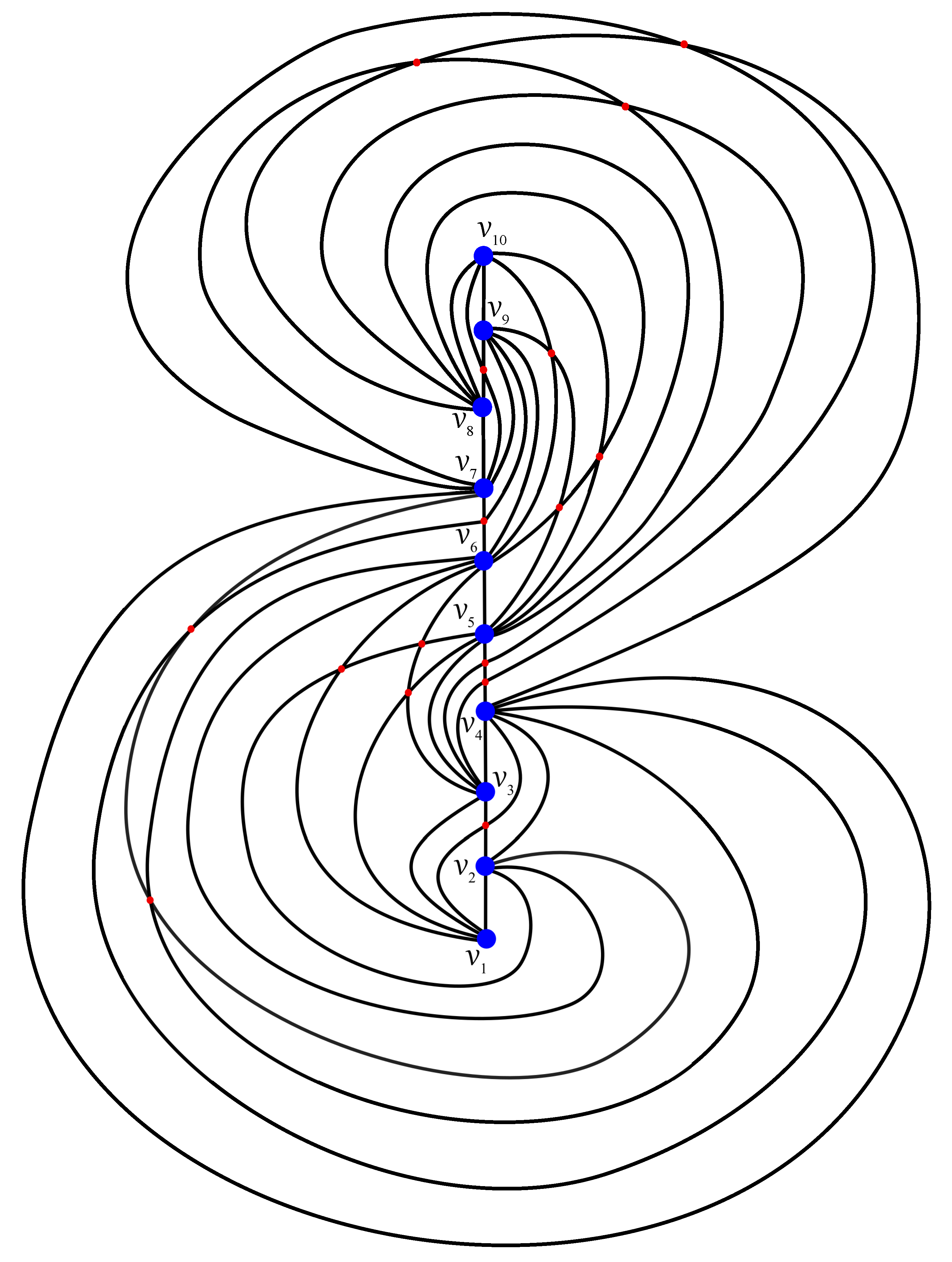
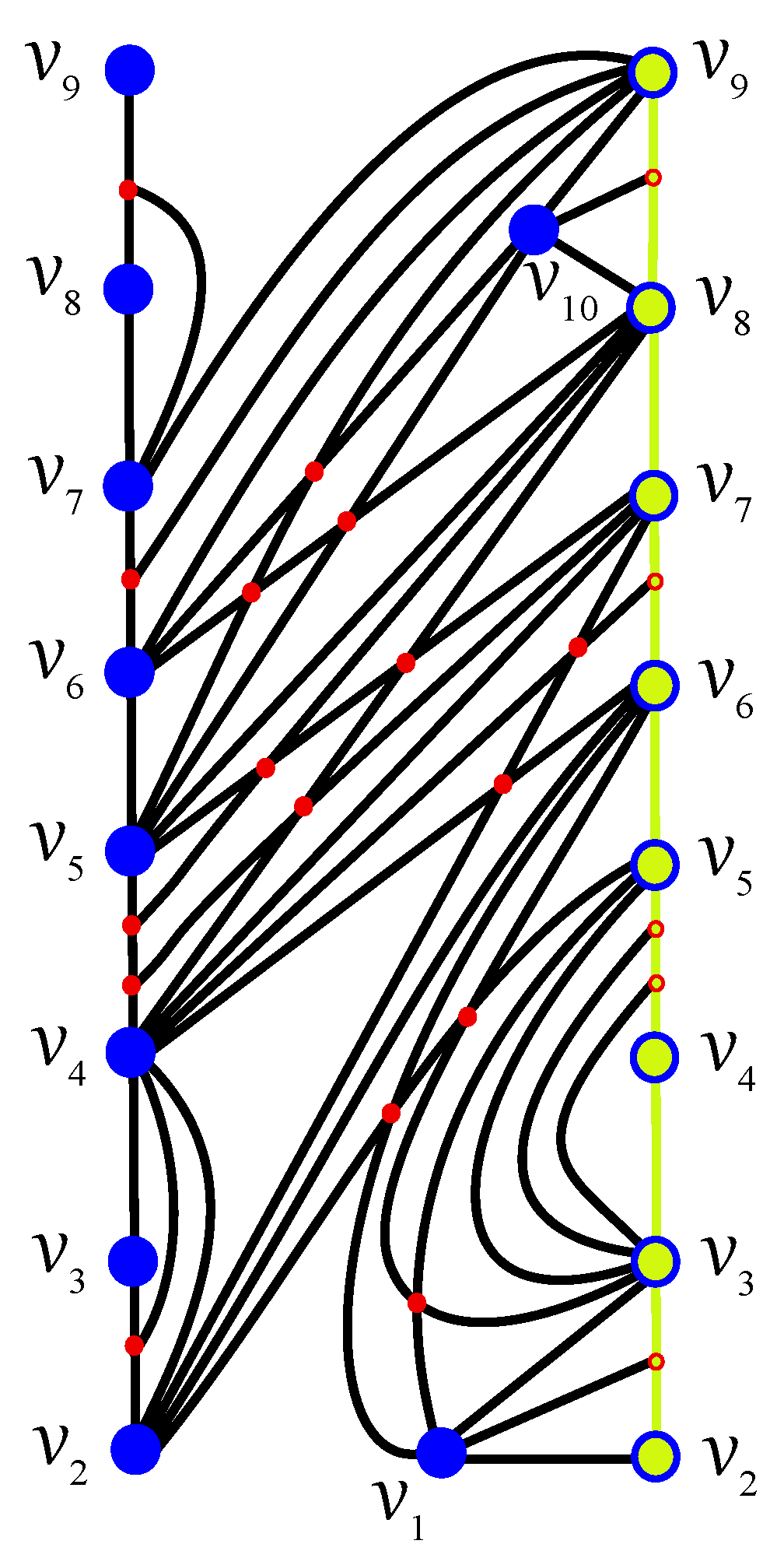
Unfortunately, Conjecture 1 certainly does not hold for which is confirmed by finding a drawing of the graph with only 16 crossings, see Figure 3. Such a drawing of meets all the requirements for a good drawing mentioned in Section 2, and thus we obtain a new and more accurate upper bound for the true value of . Since this drawing is very complex and difficult to follow due to multiple curves, it can be redrawn on a cylinder (homeomorphic to a sphere). Using an idea presented by [23], eight vertices and seven edges of are shown by blue circles and black lines on the left wall, respectively. Their copies are given by blue-green circles and green lines on the right wall. Five crossings located on the left wall (shown by red circles) are projected onto the right one by red-green circles. The remaining vertices, edges, and edge-crossings of are drawn from the left wall to the right one, see Figure 4.
Zheng et al. [23] limited themselves to only straight line segments when drawing edges, which resulted in a higher number of crossings. Note that all edges are required to be drawn as straight line segments in the case of a rectilinear crossing number, and thus some graphs need at least as many crossings as in the classical definition of the crossing number considered in our paper. Our slightly modified cylinder drawing technique (with a possibility of curved edges, and placing the first and last vertices between the left and right walls) seems to be the most suitable form for finding an exact upper estimate of the crossing number of the 5-th power of . It can be expected that the same will be true for higher powers of k greater than five. Based on all previous findings, we are able to postulate the next conjecture which strengthens the estimates of Theorem 4 and Conjecture 1 for n at least 12.
Conjecture 2.
The following bounds hold with equality:
4. Conclusions
In this paper, we proved that the graphs are -connected for all and provided a counterexample to a previously conjectured upper bound for by Zheng et al. [23]. Furthermore, we proposed a refined conjecture (Conjecture 2) that better reflects the observed behavior of crossing numbers. There is a strong dependence between -connectivity and the exact value of the edge crossing number [1,25], and therefore it is all the more difficult to determine an answer for a -connectedness without knowing the exact value of the crossing number of such an investigated graph. So, the first step in the future should be to confirm the new Conjecture 2, and then examine the property of -connectedness for the class of graphs using techniques similar to those presented in this paper. We currently know that the graph is -connected thanks to [11] because the complete graph is isomorphic to .
The techniques used in our paper, in particular the improvement of the cylindrical drawing approach, may be useful in studying higher powers of paths and related classes of graphs. This method may be applicable to other families of graphs where the structure of optimal drawings plays a key role in determining the number of crossings and connectivity properties. It also suggests a possible direction for the development of more general tools for analyzing the relationship between edge crossings and structural properties of graphs. These results contribute to a deeper understanding of the interaction between the number of crossings and structural properties of such graphs.
Funding
This research received no external funding.
Data Availability Statement
Data is contained within the article.
Conflicts of Interest
The author declares no conflicts of interest.
References
- Schaefer, M. The Graph Crossing Number and its Variants: A Survey. Electron. J. Comb. 2024, 1–166. [Google Scholar] [CrossRef] [PubMed]
- Tosuni, B. Graph Theory In Computer Science—An Overview. Int. J. Acad. Res. Reflect. 2015, 3, 55–62. [Google Scholar]
- Yildirim, G. Routing Algorithms as an Application of Graph Theory. Master’s Thesis, Middle East Technical University, Ankara, Turkey, 2023. [Google Scholar]
- Zweig, K.A. Graph Theory. In Social Network Analysis, and Network Science; Springer: Vienna, Austria, 2016; pp. 23–55. [Google Scholar]
- Guze, S. Review of Methods and Algorithms for Modelling Transportation Networks Based on Graph Theory. Sci. J. Gdyn. Marit. Univ. 2018, 107, 25–39. [Google Scholar] [CrossRef]
- Keeling, M.; Eames, K. Networks and Epidemic Models. J. R. Soc. Interface/R. Soc. 2005, 2, 295–307. [Google Scholar] [CrossRef] [PubMed]
- Grujic, Z.; Grujić, B. Optimal Routing in Urban Road Networks: A Graph-Based Approach Using Dijkstra’s Algorithm. Appl. Sci. 2025, 15, 4162. [Google Scholar] [CrossRef]
- Tamura, H.; Nakano, K.; Sengoku, M.; Shinoda, S. On Applications of Graph/Network Theory to Problems in Communication Systems. ECTI-CIT Trans. 2016, 5, 15–21. [Google Scholar] [CrossRef]
- Klibi, W.; Martel, A.; Guitouni, A. The design of robust value-creating supply chain networks: A critical review. Eur. J. Oper. Res. 2010, 203, 283–293. [Google Scholar] [CrossRef]
- Akoglu, L.; Tong, H.; Koutra, D. Graph-based Anomaly Detection and Description: A Survey. Data Min. Knowl. Discov. 2014, 29, 626–688. [Google Scholar] [CrossRef]
- Staš, M.; Valiska, J. On the problems of -connected graphs. Electron. J. Graph Theory Appl. 2023, 11, 491–500. [Google Scholar] [CrossRef]
- Ahuja, R.K.; Magnanti, T.L.; Orlin, J.B. Network Flows; Prentice-Hall: Upper Saddle River, NJ, USA, 1993. [Google Scholar]
- Diestel, R. Graph Theory, 5th ed.; Graduate Texts in Mathematics; Springer: Berlin/Heidelberg, Germany, 2017; Volume 173, p. 448. [Google Scholar]
- Staš, M.; Valiska, J. On problems of -connected graphs for Km,n. Bull. Aust. Math. Soc. 2021, 104, 203–210. [Google Scholar] [CrossRef]
- Staš, M.; Timková, M. On the Problems of -Connected Graphs for Kl,m,n. Mathematics 2024, 12, 2068. [Google Scholar] [CrossRef]
- Chang, G.; Kuo, D. The l(2,1)-labeling problem on graphs. SIAM J. Discret. Math. 1996, 9, 309–316. [Google Scholar] [CrossRef]
- Fiala, J.; Kratochvíl, J.; Kloks, T. Fixed-parameter complexity of λ-labelings. Discret. Appl. Math. 2001, 113, 59–72. [Google Scholar] [CrossRef]
- Lin, M.C.; Rautenbach, D.; Soulignac, F.J.; Szwarcfiter, J.L. Powers of cycles, powers of paths, and distance graphs. Discret. Appl. Math. 2011, 159, 621–627. [Google Scholar] [CrossRef]
- Schaefer, M. Crossing Numbers of Graphs, 1st ed.; CRC Press: Boca Raton, FL, USA, 2018. [Google Scholar]
- West, D.B. Introduction to Graph Theory; Prentice Hall: Upper Saddle River, NJ, USA, 2011. [Google Scholar]
- Pach, J.; Tóth, G. Graph Drawing and the Crossing Number. In Handbook of Graph Drawing and Visualization; CRC Press: Boca Raton, FL, USA, 2013. [Google Scholar]
- Klešč, M. The crossing number of join of the special graph on six vertices with path and cycle. Discret. Math. 2010, 310, 1475–1481. [Google Scholar] [CrossRef]
- Zheng, W.; Lin, X.; Yang, Y.; Gui, Y. On the Crossing Numbers of the k-th Power of Pn. Front. Math. China 2009, 92, 397–409. [Google Scholar]
- Harary, F.; Kainen, P.C. The Cube of a Path is Maximal Planar. Bull. ICA 1993, 7, 55–56. [Google Scholar]
- Clancy, K.; Haythorpe, M.; Newcombe, A. A survey of graphs with known or bounded crossing numbers. Australas. J. Comb. 2020, 78, 209–296. [Google Scholar]
- Harary, F.; Kainen, P.C.; Riskin, A. Every Graph of Cyclic Bandwidth 3 is Toroidal. Bull. ICA 1993, 27, 81–84. [Google Scholar]
Figure 1.
Three planar drawings of on a cylinder for : (a) the planar drawing of , (b) the planar drawing of , (c) the planar drawing of .
Figure 1.
Three planar drawings of on a cylinder for : (a) the planar drawing of , (b) the planar drawing of , (c) the planar drawing of .

Figure 2.
Planar drawing of where .

Figure 3.
A good drawing of with 16 crossings on a sphere.

Figure 4.
A good drawing of with 16 crossings on a cylinder.

Disclaimer/Publisher’s Note: The statements, opinions and data contained in all publications are solely those of the individual author(s) and contributor(s) and not of MDPI and/or the editor(s). MDPI and/or the editor(s) disclaim responsibility for any injury to people or property resulting from any ideas, methods, instructions or products referred to in the content. |
© 2026 by the author. Licensee MDPI, Basel, Switzerland. This article is an open access article distributed under the terms and conditions of the Creative Commons Attribution (CC BY) license.
Share and Cite
MDPI and ACS Style
Staš, M.
On the
AMA Style
Staš M.
On the
Staš, Michal.
2026. "On the
Staš, M.
(2026). On the
Note that from the first issue of 2016, this journal uses article numbers instead of page numbers. See further details here.