1. Introduction
The development of alloys has progressed continuously from ancient metallurgical practices to modern engineering materials, with each stage marked by significant technological advancements. Today, alloys constitute the backbone of numerous structural and functional applications because their properties can be tailored through careful control of composition and processing [
1,
2,
3]. Among the conventional routes for alloy production, casting and powder metallurgy are the most widely used. Although casting is convenient and rapid, it often suffers from segregation, porosity, and non-uniform microstructures. Powder metallurgy, in contrast, has emerged as a highly effective approach for producing high-strength, compositionally uniform materials, particularly for complex, multi-component systems [
4,
5].
Alloy development has long been driven by the need to achieve a balanced combination of mechanical strength, thermal stability, corrosion resistance, and phase stability under service conditions [
6,
7]. Heat treatment is widely used to modify the microstructure and improve the properties of alloys [
8,
9]. Controlled thermal exposure can promote phase transformation, relieve internal stresses, and enhance elemental homogeneity. As a result, key properties such as hardness, strength, and thermal stability are significantly affected. Understanding the relationship between heat treatment and resulting material properties is essential for optimizing alloy performance in advanced engineering applications. Conventional alloy systems such as aluminum alloys, nickel-based superalloys, titanium alloys, and Fe-based steels rely on controlled alloying additions and heat-treatment routes to tailor phase constitution and microstructural symmetry, thereby optimizing performance for targeted applications [
1,
10,
11,
12]. Traditional metallurgical understanding suggested that combining several principal elements would inevitably lead to the formation of multiple intermetallic compounds and intricate microstructures. In recent years, high-entropy alloys (HEAs), characterized by their multi-principal element compositions, have attracted significant attention due to their high configurational entropy, sluggish diffusion, and enhanced thermal stability compared to traditional alloys [
13,
14,
15,
16]. Numerous studies have reported that minor elemental additions can strongly influence phase symmetry (FCC, BCC, or dual-phase), lattice distortion, precipitation behavior, and grain stability during thermal exposure. In particular, metalloid and light-element additions, such as Al, Si, and B, have been shown to modify bonding characteristics, stabilize specific crystal structures, and improve high-temperature strength and oxidation resistance in both conventional alloys and HEAs [
17,
18]. Silicon, widely used in steels, Al-based alloys, and Ni-based superalloys for its role in solid-solution strengthening, oxidation resistance, and phase stabilization, has recently emerged as an effective tuning element in HEAs, where it can alter phase symmetry and suppress microstructural degradation during heat treatment [
19,
20]. These findings highlight the importance of systematic investigations into the role of silicon in governing the phase evolution and microstructural stability of HEAs under thermal processing conditions. In addition, machine learning has emerged as a powerful tool in alloy development by enabling data-driven exploration of complex composition-processing-microstructure-property relationships, thereby accelerating materials discovery and reducing experimental trial-and-error [
21,
22,
23,
24].
However, advances in mechanical alloying (MA) and the concept of high-entropy alloys (HEAs) have transformed this perception. MA, a solid-state powder-processing technique, enables atomic-scale mixing and facilitates the formation of metastable, nanocrystalline, or even single-phase solid solutions [
25,
26]. Sequencing strategies during mechanical alloying have demonstrated a crucial impact on phase stabilization. For example, Vaidhya et al. showed that controlled sequential addition of elements in AlCoCrFeNi HEAs can significantly influence the final phase constitution: a pure BCC phase emerged for the sequence AlNi + Co + Fe + Cr, whereas FeNi + Co + Cr + Al produced a dual BCC–FCC structure [
27,
28]. Despite its many advantages, MA is not free of challenges; contamination from milling media and process control agents remains a concern, though it can be minimized through careful material selection, inert-gas atmospheres, and shorter milling durations.
Within this framework, Al-Fe-Co-Ni-based HEAs have gained considerable interest due to their promising combination of strength, thermal stability, and relatively low density [
29,
30,
31]. The incorporation of silicon into this alloy system further enhances configurational entropy, influences lattice distortion, and improves mechanical performance. High-energy ball milling efficiently synthesizes AlFeCoNiSi
x (x = 0, 0.4, 0.8) alloys via solid-state diffusion and homogeneous mixing, while conventional sintering subsequently densifies the material without compromising the refined microstructure. Post-sintering heat treatments play an essential role in modulating phase evolution, chemical ordering, and lattice relaxation.
X-ray diffraction (XRD) serves as a powerful tool for monitoring these structural transformations. Symmetry analysis of XRD patterns, including peak positions, intensities, broadening, and reflections unique to specific crystal structures, provides deep insights into how Si addition and processing conditions influence the alloy system. In AlFeCoNiSix alloys, changes in symmetry can reveal the transition between BCC, FCC, ordered B2 phases, or multiphase configurations, as well as lattice distortion effects arising from element substitution and thermal treatment. Therefore, the present study integrates mechanical alloying, conventional sintering, and subsequent heat treatment to investigate the structural evolution and symmetry changes in AlFeCoNiSi high-entropy alloys. Through a comprehensive analysis of XRD patterns, this work aims to elucidate the impact of Si addition on phase formation pathways and the thermodynamic and kinetic mechanisms governing symmetry transitions in these multi-component alloy systems.
2. Materials and Methods
High-purity metal powders (>99.5%, Alfa Aesar, Ward Hill, MA, USA) were employed to synthesize the AlFeCoNiSix (x = 0, 0.4, 0.8) high-entropy alloy system. The elemental powders were initially subjected to mechanical alloying in a high-energy planetary ball mill (Retsch PM-400 MA, Haan, Germany), with a milling speed of 300 rpm under ambient laboratory conditions for 10 h. Stearic acid was introduced as a process control agent, and 20 mm steel balls were used as the milling media. The ball-to-powder ratio (BPR) was maintained at 10:1 throughout the milling operation.
Phase evolution in the mechanically alloyed powders was examined by X-ray diffraction (XRD) using a Rigaku diffractometer equipped with a Cu Kα radiation source. The measurements were conducted at an operating voltage of 40 kV and a current of 40 mA. Diffraction patterns were collected over a 2θ range of 30–80°, with a step size of 0.02° and a scanning rate of 0.5°/min. Microstructural features of the milled powders were further characterized using a field-emission scanning electron microscope (FE-SEM, JSM-7500F, JEOL, Tokyo, Japan).
Pellet compaction was carried out using a hydraulic press at 20 MPa with a holding time of 1 min. The green compacts were subsequently sintered in a vacuum furnace under an argon atmosphere at 700 °C for 1 h. For a better conversation, the sintered sample is nominated as 0 Si, 0.4 Si, and 0.8 Si to AlFeCoNiSix (x = 0, 0.4, 0.8), respectively. Additional heat-treatment cycles were performed at 800 °C to study the thermal stability and phase evolution of the alloy system. Post-treatment characterization included repeat XRD analysis and SEM imaging, along with elemental composition verification via energy-dispersive spectroscopy (EDS).
3. Thermodynamic Parameters for Solid Solution Formation
Phase formation in high-entropy alloys (HEAs) is primarily controlled by the interplay between enthalpy (ΔHmix) and entropy (ΔSmix) in the Gibbs free energy (ΔGmix). A negative ΔGmix favours thermodynamic stability and dictates whether a solid solution, intermetallic, or multiphase structure forms. The Ω parameter quantifies the balance between ΔHmix and ΔSmix. High Ω values indicate entropy dominance, promoting stable solid solutions, while low Ω values Favor ordered or intermetallic phases. Increased configurational entropy (ΔSmix), following Boltzmann’s hypothesis, enhances single-phase formation, especially at elevated temperatures. The alloy’s weighted average melting temperature (Tm) influences Ω and thermal stability, while atomic size difference (δ) measures lattice distortion; larger δ values can induce strain, destabilize solid solutions, or favour amorphous/multiphase structures. Finally, the valence electron concentration (VEC) empirically predicts phase type: high VEC stabilizes FCC structures, low VEC favours BCC, and intermediate VEC values often yield mixed FCC + BCC microstructures.
The thermodynamic parameters listed in the table (
Table 1) offer a quantitative basis for understanding phase stability and structural changes in high-entropy alloys (HEAs). The interaction between the enthalpy of mixing (ΔHmix) and the entropy of mixing (ΔSmix) shapes the Gibbs free energy landscape and, as a result, determines whether the alloy forms a solid solution or intermetallic compounds. A moderately negative ΔHmix encourages atomic bonding without strongly favouring the formation of ordered compounds, while a sufficiently high ΔSmix resulting from the randomness of multi-element configurations stabilizes disordered solid-solution phases. The calculated Ω parameter further illustrates this balance; higher Ω values signify stronger entropy-driven stabilization, suggesting a higher chance of forming a single-phase solution, especially at elevated temperatures. Likewise, the weighted melting temperature (Tm) affects the entropy contribution via the Ω ratio and aids in predicting the alloy’s thermal stability during sintering and heat treatment [
32].
Complementing these thermodynamic indicators, the atomic size difference (δ) and the valence electron concentration (VEC) provide additional insights into structural tendencies. The δ parameter captures lattice distortion arising from atomic radius mismatch; when δ is moderate, solid-solution formation is favoured, whereas large δ values lead to significant lattice strain, promoting multiphase or amorphous structures. Meanwhile, VEC serves as an empirical guide for predicting the crystal structure: higher VEC values favour FCC stability, lower values support BCC formation, and intermediate values yield mixed-phase configurations. Together, these thermodynamic and electronic parameters establish a coherent framework for interpreting the observed phase evolution in AlFeCoNi upon adding Si to the system. The calculated properties have been given in
Table 2.
4. Result and Discussion
4.1. Morphology and Phase Evolution of Ball-Milled HEA Powder
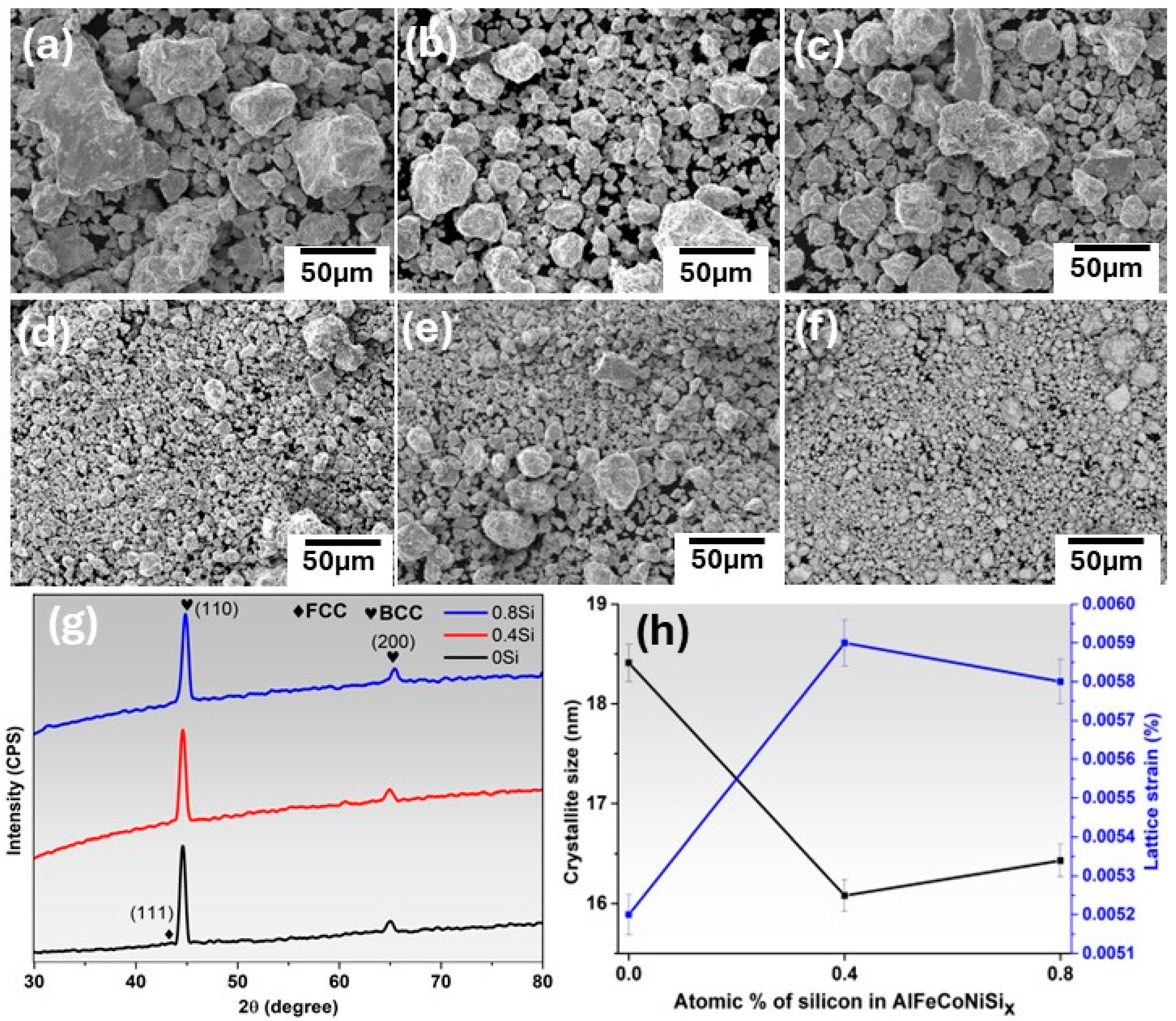
The SEM images in
Figure 1a–c show the morphology of the AlFeCoNiSi
x (x = 0, 0.4, 0.8) powders before mechanical milling. The particles appear coarse, angular, and structurally heterogeneous, reflecting the intrinsic morphology of the as-received elemental powders. Large, irregular fragments co-exist with smaller particles, indicating poor size uniformity and limited intermixing among the constituents. The presence of sharp edges and relatively smooth surfaces suggests that the powders retain their original metallic characteristics, with minimal plastic deformation or fragmentation at this stage.
In contrast, the micrographs in
Figure 1d–f reveal the morphological evolution after 10 h of high-energy ball milling. The powders exhibit a significantly refined and homogenized microstructure, characterized by irregular but much smaller particle sizes. The repeated fracturing and cold-welding events during milling lead to substantial plastic deformation, resulting in a dense population of ultrafine particles and the disappearance of the large primary fragments observed earlier. The increased surface roughness and more uniform particle-size distribution indicate effective alloying among the constituent elements, reflecting the mechanical alloying process’s solid-state diffusion and structural refinement.
The XRD patterns in
Figure 1g present the phase evolution of the milled AlFeCoNiSi
x powders with varying Si content (0 Si, 0.4 Si, and 0.8 Si). All compositions exhibit dominant diffraction peaks corresponding to a BCC solid-solution phase, particularly the (110) and (220) reflections. The presence of only BCC peaks confirms that mechanical alloying successfully promotes extensive elemental mixing, enabling the formation of a single-phase structure even without subsequent sintering or heat treatment.
A noticeable trend is the peak shift and broadening with increasing Si content. The gradual shift of the (110) and (220) peaks toward higher angles for higher Si fractions indicates a reduction in lattice parameter, consistent with the incorporation of smaller Si atoms into the BCC lattice. Peak broadening further suggests reduced crystallite size and increased lattice strain, both characteristic effects of mechanical alloying and enhanced by the addition of Si. Moreover, the relative intensity variation of the peaks across compositions may reflect changes in preferred orientation or micro-strain distribution induced by Si substitution [
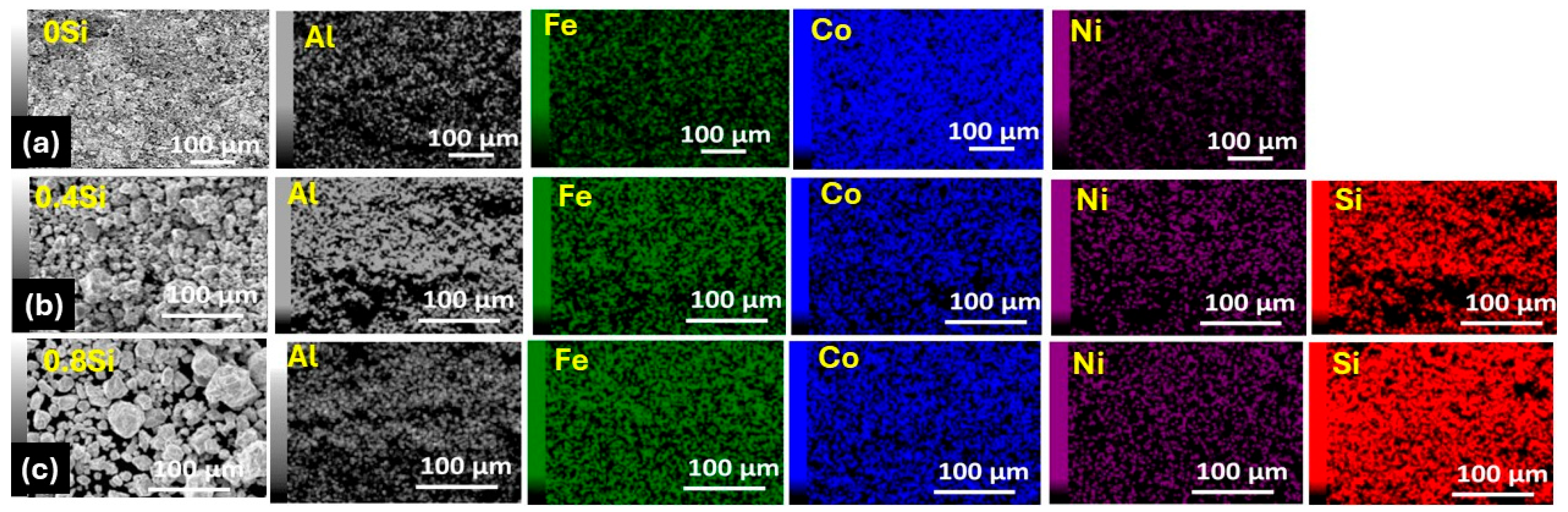
34]. In addition, the elemental distribution analysis was carried out to evaluate the homogeneity of the alloy system, as shown in
Figure 2a–c. The results indicate that all constituent elements are uniformly distributed throughout the HEAs, confirming effective mixing during the mechanical alloying process. Furthermore, the added Si is also found to be evenly dispersed within the alloy matrix, suggesting successful incorporation without noticeable segregation.
4.2. Phase Evaluation and Morphology of Sintered HEA Powder After Compaction
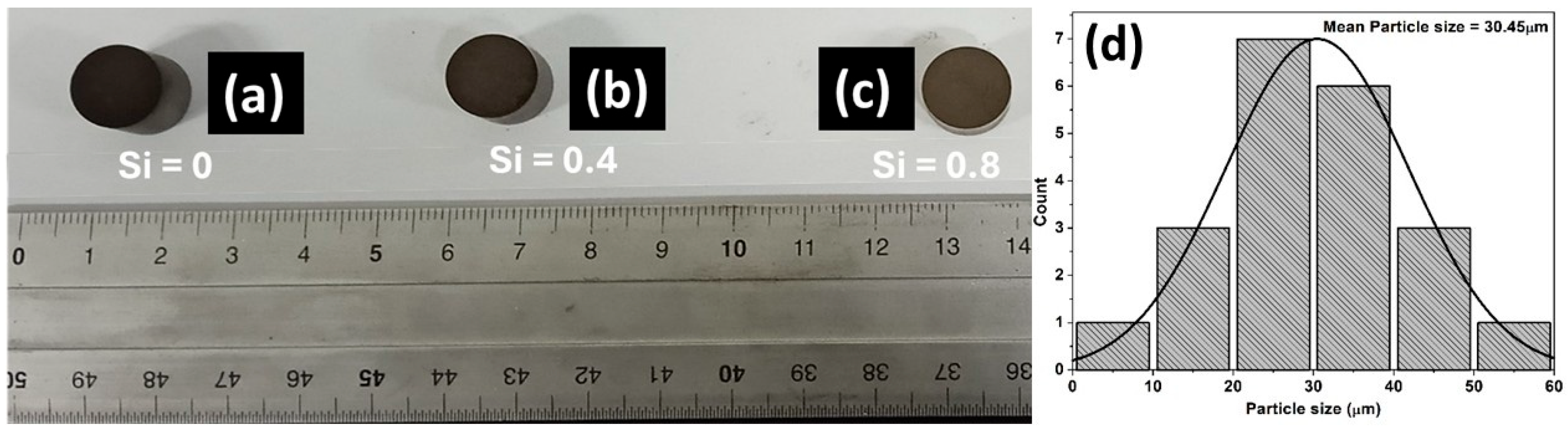
The conventionally sintered pellets of AlFeCoNiSi
x (x = 0, 0.4, 0.8), shown in
Figure 3a–c, exhibit uniform cylindrical geometry with visibly smooth surfaces, indicating successful compaction and densification during the sintering process. Additionally, to understand the characteristics of the alloy powder, particle size was calculated and presented in
Figure 3d. The pellets maintain consistent dimensions across all compositions, suggesting that the powder flowability and compressibility were not adversely affected by Si addition. A slight variation in surface tone can be observed, particularly for the higher Si content, which may be attributed to differences in oxide formation, surface diffusion behavior, or sintering kinetics influenced by Si. The complete structural integrity of all pellets reflects effective consolidation at the selected sintering temperature, enabling the formation of mechanically stable bulk specimens suitable for subsequent microstructural and phase analysis [
35].
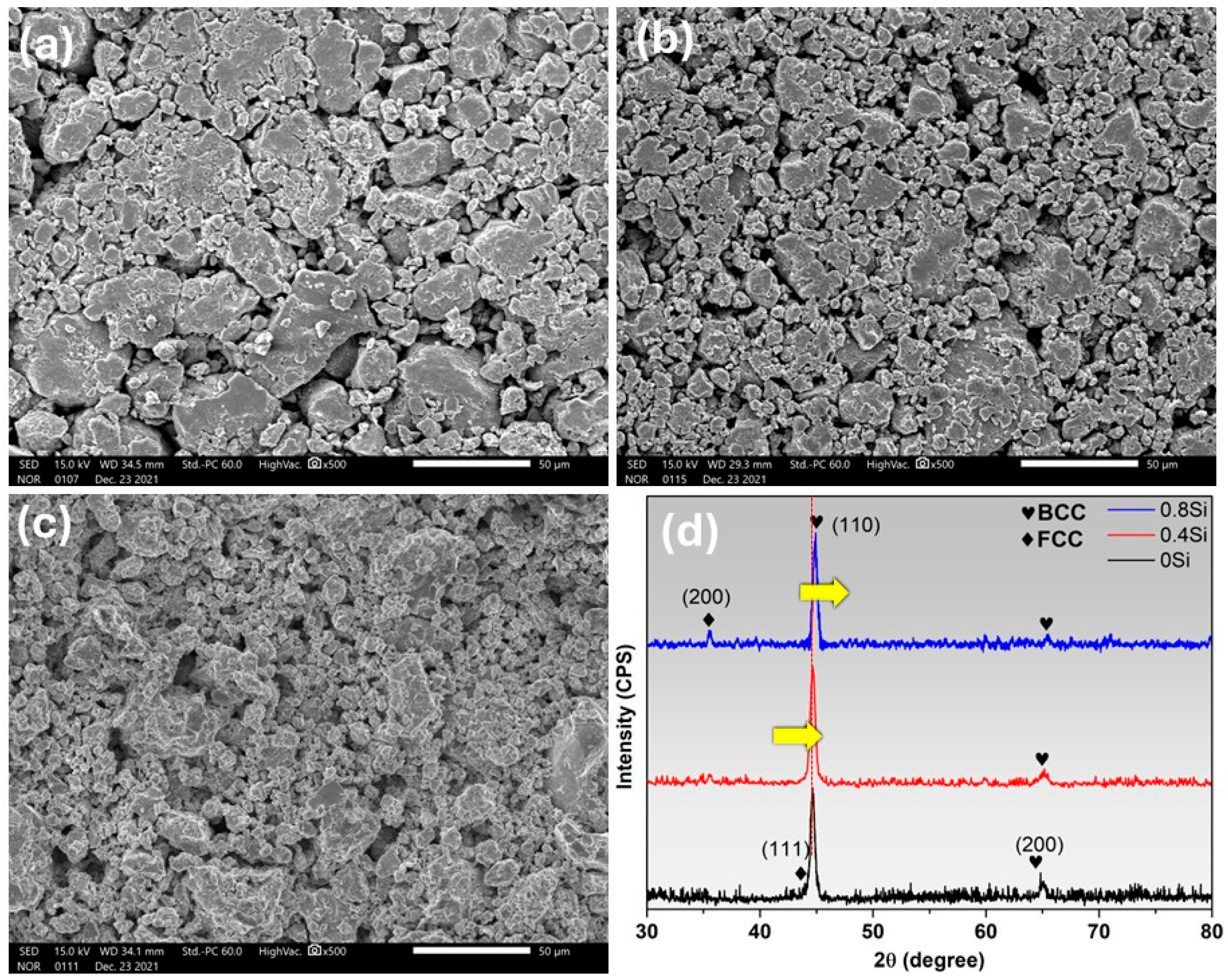
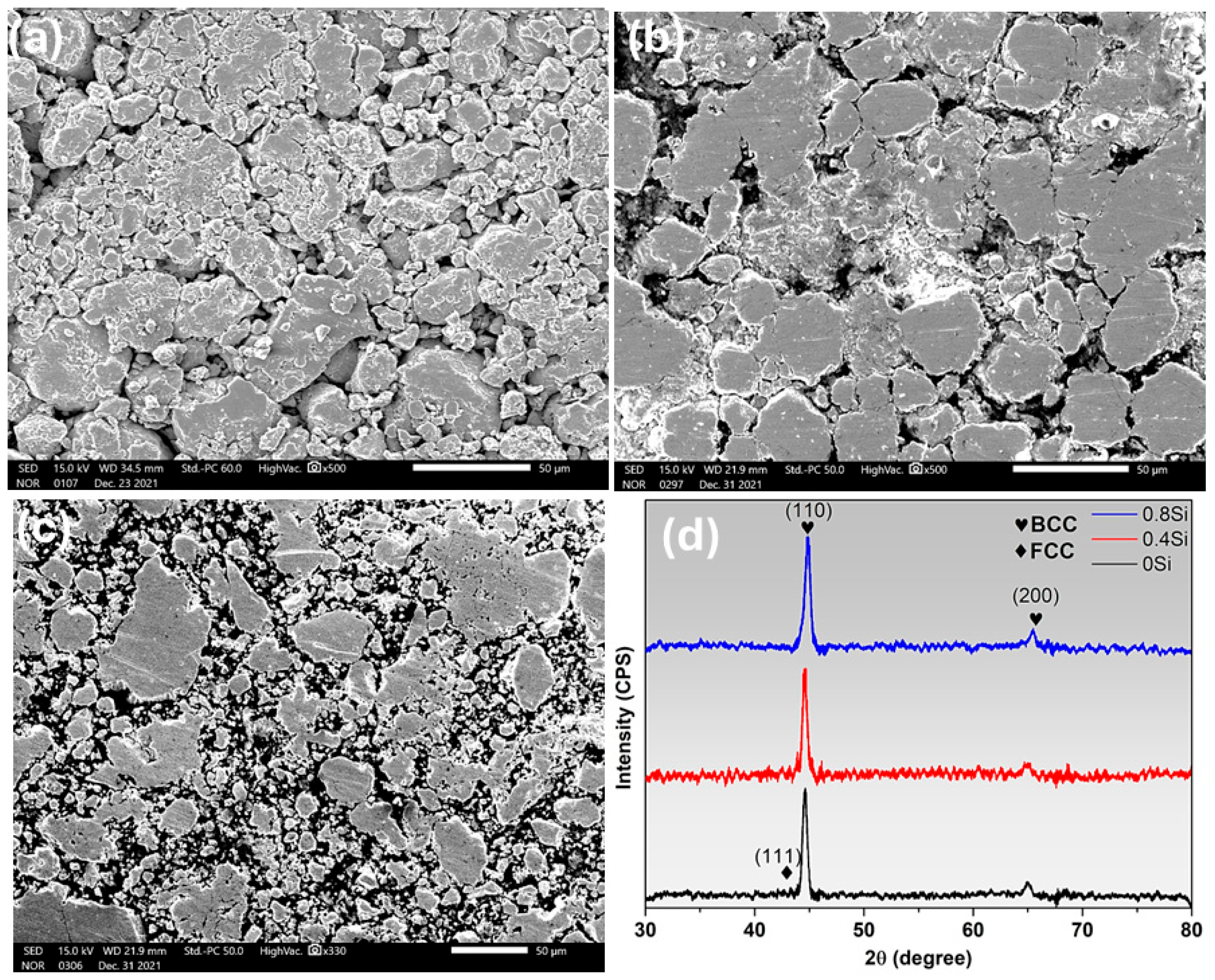
The SEM micrographs of the sintered AlFeCoNiSi
x alloys (
Figure 4a–c) reveal significant microstructural evolution compared with the mechanically alloyed powders. After sintering at 700 °C, the particle boundaries appear smoother, and partial neck formation is evident, indicating the onset of solid-state diffusion and consolidation. In the 0 Si sample (
Figure 1a), relatively larger and loosely bonded agglomerates can be observed, suggesting limited densification at this temperature. With the addition of Si (
Figure 1b,c), the microstructure becomes progressively refined and more compact. The powders display enhanced particle bonding and reduced interparticle porosity, which suggests that Si promotes improved diffusion and assists in the formation of more homogeneous microstructural features. The finer features in the higher-Si alloy indicate that Si addition contributes to lattice distortion and diffusion-driven microstructural refinement during sintering.
The XRD patterns in
Figure 4d provide insights into the phase evolution of the sintered HEAs. All compositions retain the dominant BCC solid-solution phase (Im-3m), as evidenced by the (110) and (200) reflections. However, the Si-free alloy exhibits additional weak peaks corresponding to an FCC phase, suggesting incomplete homogenization or the persistence of metastable elemental clusters. As Si content increases to 0.4 and 0.8, only BCC peaks are observed, indicating that Si addition favours the stabilization of a single BCC phase at the sintering temperature. This stabilization may be attributed to enhanced configurational entropy and atomic size mismatch introduced by Si, which suppresses the formation of ordered intermetallics or secondary phases. Peak broadening in the higher Si alloys further suggests increased macrostrain and lattice distortion, consistent with the SEM observations of finer microstructural features and improved elemental mixing.
In addition to configurational entropy and lattice distortion effects, the role of Si can be better understood from a metallurgical perspective. Si is known to act as a ferrite (BCC) stabilizer, particularly in Fe-based alloy systems, by reducing the valence electron concentration (VEC, which is reduced from 7.5 to 6.92), which favours the formation of BCC over FCC structures. Furthermore, Si influences the electronic structure and bonding characteristics, promoting directional bonding that stabilizes the BCC lattice. During heat treatment, enhanced atomic diffusion facilitates the redistribution of elements, and the presence of Si energetically favours the transformation of any metastable FCC phase into a more stable BCC phase. Thus, the observed FCC-to-BCC transition is driven by a combination of thermodynamic stability (VEC effect) and diffusion-assisted phase evolution, rather than configurational entropy alone.
The SEM images reveal significant microstructural evolution in the samples subjected to 800 °C heat treatment. In
Figure 5a, the microstructure appears relatively dense, with particles showing partial sintering and neck formation. The grains are closely packed, and the reduction in surface asperities suggests the onset of solid-state diffusion at this temperature. Minimal porosity is visible, indicating improved particle cohesion. In contrast,
Figure 5b displays a more pronounced sintering effect, with larger, well-defined grains separated by interconnected pore channels. The increased pore visibility suggests that the sample composition or silicon content influences the sintering behaviour. Larger grains indicate enhanced diffusion and localized grain growth, which often occurs when elemental additions modify the diffusion kinetics or inhibit densification.
Figure 5c presents an even more heterogeneous microstructure, characterized by a combination of large, irregular grains and surrounding finer particles. The higher number of fine dispersed phases between larger grains suggests incomplete densification and inhibited grain coalescence, possibly due to silicon alloying. Silicon is known to affect wetting behavior and diffusion pathways; hence, increasing Si content may disrupt uniform grain growth and retain finer phases within the matrix. Overall, the SEM analysis suggests that heat treatment at 800 °C promotes sintering and grain formation, but silicon influences the degree of densification and microstructural uniformity.
The XRD profiles in
Figure 5d show distinct phase transformations driven by the 800 °C heat treatment and varying silicon content. For the base composition (0 Si), the diffraction peaks correspond primarily to the FCC structure, indicating that the matrix retains its original phase after heat exposure. However, with the introduction of Si (0.4 Si and 0.8 Si), there is a noticeable emergence and strengthening of BCC-phase peaks, marked by the corresponding symbols in the diffractogram.
The progressive intensification of BCC peaks with increasing Si content indicates that silicon promotes the stabilization or formation of a BCC solid-solution phase at elevated temperature. This phase transformation is typical in refractory or Fe-based systems where silicon acts as a ferrite stabilizer. At higher Si concentrations (0.8 Si), the BCC peaks become dominant, confirming that silicon significantly alters the thermodynamic stability of the phases. The shift from FCC to BCC structure implies enhanced thermal stability, reduced lattice distortion, and modified mechanical behavior, particularly at high temperatures. Additionally, the relatively sharper peaks in Si-containing samples suggest improved crystallinity after the 800 °C treatment. The suppression of FCC peaks with increasing Si further demonstrates competitive phase formation, where the BCC phase becomes energetically more favorable under these thermal conditions.
4.3. Discussion on Symmetry, Peak Shifting, and Heat-Treatment Effects
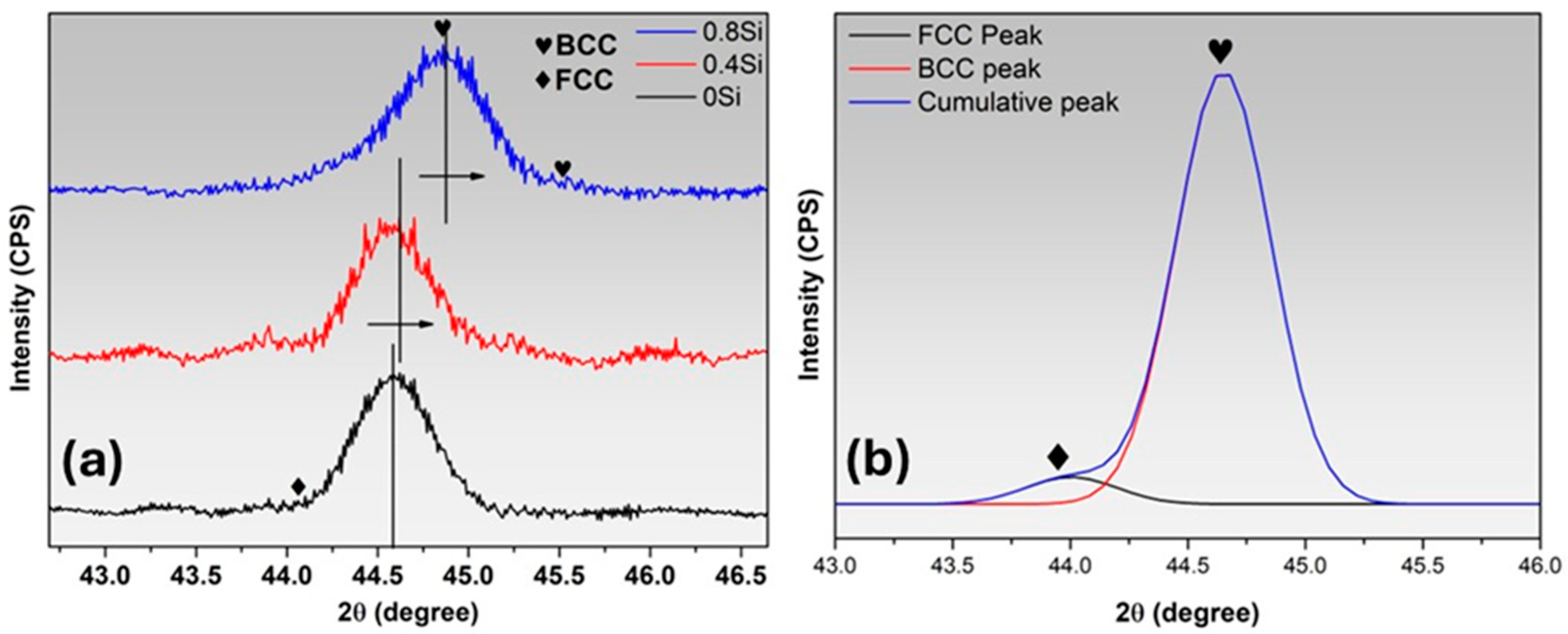
The XRD patterns in
Figure 6a show a noticeable shift in the main diffraction peaks after sintering and subsequent heat treatment, reflecting significant changes in lattice symmetry and phase stability. In the as-milled powders, the peaks correspond predominantly to the BCC structure for the 0 Si alloy (
Figure 1g). The dominant diffraction peak at 2θ ≈ 44.4° (d ≈ 2.037 Å) corresponds to the BCC (110) reflection; indexing gives a lattice parameter
a ≈ 2.88, consistent with a BCC Im-3m matrix. In contrast, Si-containing alloys exhibit a broadened and slightly shifted profile due to the coexistence of FCC and emerging BCC symmetry. After sintering, however, the main peak moves toward higher 2θ values for all compositions, indicating lattice contraction caused by stress relaxation and partial homogenization [
31]. This behavior aligns with the crystallite size and lattice strain values in the table: the sintered state shows reduced lattice strain (e.g., AlFeCoNiSi
0 from 0.0052 to 0.0023), which causes sharpening and more pronounced symmetry of the dominant FCC or BCC peaks. The thermal treatment at 700–800 °C further alters the peak positions, with the appearance of more prominent BCC peaks in Si-containing alloys. This shift confirms that silicon promotes the stabilization of BCC symmetry at elevated temperatures, consistent with the increased crystallite size (22–26 nm) and reduced lattice strain observed after 800 °C heat treatment, as shown in
Table 3.
The peak overlap illustrated in
Figure 6b further supports the coexistence of dual phases and highlights the complexity of symmetry evolution during heat treatment. The FCC peak, positioned at a slightly lower 2θ value, merges with the emerging BCC peak at higher 2θ as Si content increases [
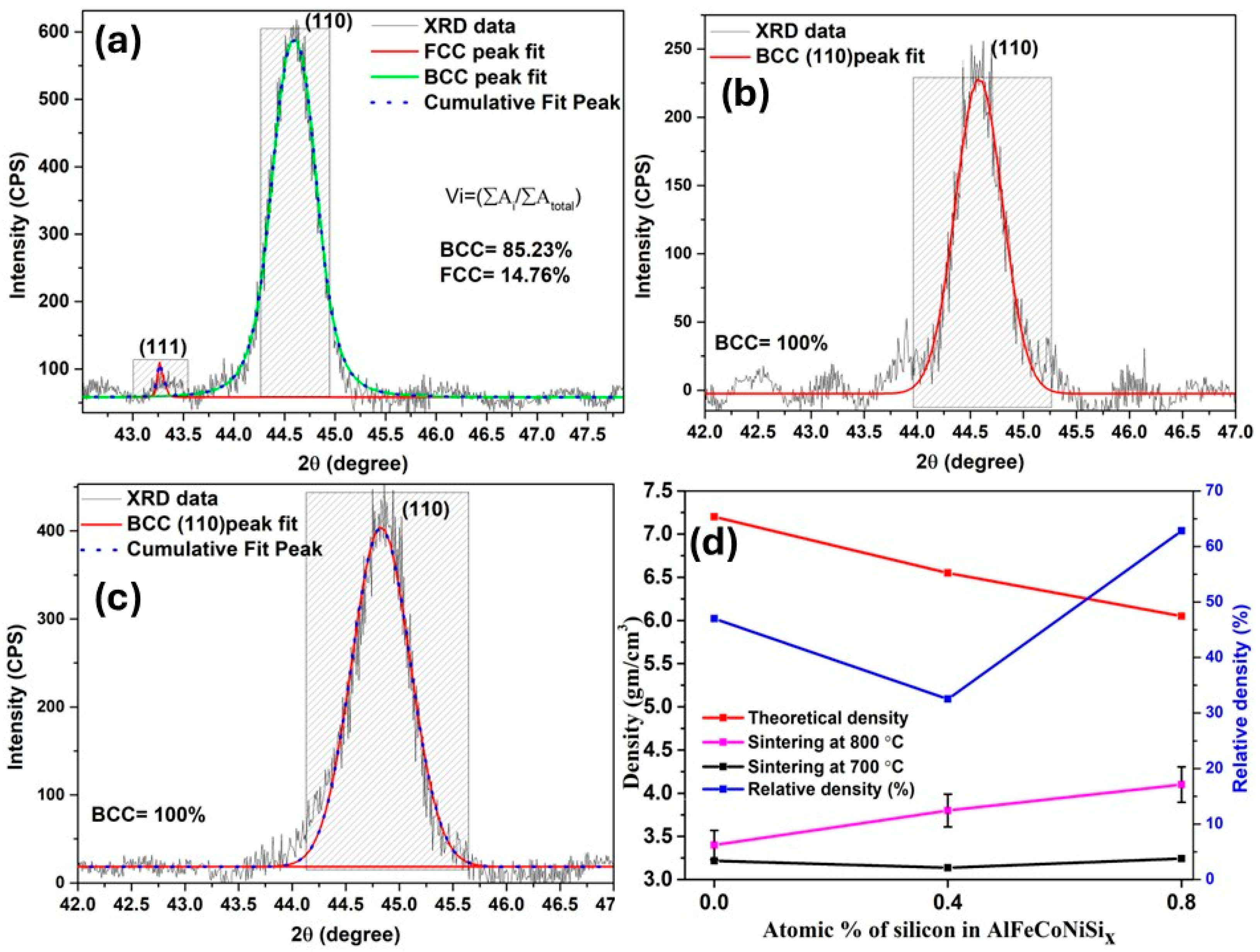
32]. This overlap indicates that both phases contribute to the cumulative peak profile, resulting in a broader, asymmetric peak. For further understanding of the phase evaluation, Rietveld refinement has been performed on the XRD patterns to quantitatively evaluate the phase fractions, and result has been presented in
Figure 7a–c. The analysis reveals that the Si-free alloy contains both BCC (~85%) and a minor FCC (~15%) phase. With the addition of Si, the FCC phase is completely suppressed, and the alloy exhibits a fully BCC structure (100%), as confirmed for higher Si contents.
In addition to this, the effect of the heat treatment has been investigated on bulk samples to understand the density. The results show (
Figure 7d) that, although the theoretical density decreases with increasing Si content, the relative density exhibits a clear increasing trend, particularly for the 0.8 Si alloy. This indicates improved densification and reduced porosity with Si addition. The enhancement in relative density is consistent with the observed microstructural features, such as improved particle bonding and reduced pore fraction, confirming that Si promotes more effective sintering.
Such behavior is typical of multi-phase high-entropy alloys, where elements with different atomic sizes and diffusion rates produce simultaneous strain relaxation and structural reorganization during annealing. The table supports this interpretation: after heating to 800 °C, the 0 Si alloy shows reduced crystallite size and increased lattice strain, evidence of partial recrystallization, whereas Si-alloyed compositions show increased crystallite size and reduced strain, indicating enhanced structural ordering. Thus, the heat treatment not only sharpens and shifts the primary peaks but also strengthens the BCC phase fraction, leading to clearer symmetry separation in high-Si compositions and pronounced peak overlap in low-Si ones.
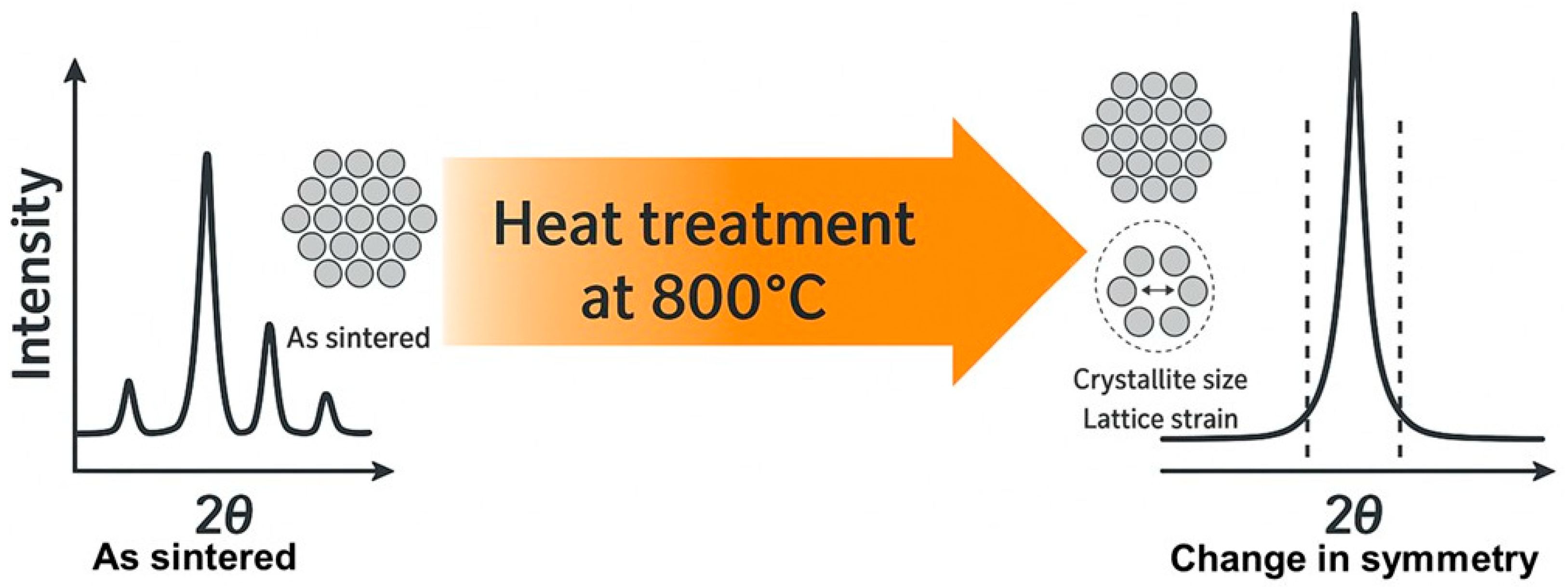
A representation of symmetry evolution which is reflected in XRD peak profiles before and after heat treatment as shown in
Figure 8. The as-sintered alloy exhibits broadened and asymmetric diffraction peaks due to lattice strain and small crystallite size, while heat treatment at 800 °C results in sharper, more symmetric peaks, indicating reduced lattice strain, improved crystallite ordering, and enhanced structural symmetry promoted by silicon addition.
5. Conclusions
In this study, AlFeCoNiSix (x = 0, 0.4, 0.8) high-entropy alloys were synthesized via mechanical alloying followed by sintering at 700 °C to investigate the effect of Si on microstructure and phase stability. The sintered alloys showed improved densification and particle bonding with increasing Si content, evidenced by smoother interfaces, reduced porosity, and finer morphology. XRD results confirmed a predominantly BCC structure for all compositions, while the Si-free alloy exhibited minor FCC phases. The disappearance of FCC peaks and sharpening of BCC reflections with increasing Si indicate that Si effectively stabilizes the single BCC phase.
Additionally, crystallite size and lattice strain analysis reveal that Si suppresses excessive grain growth and maintains lattice distortion during sintering, while heat treatment at 800 °C promotes strain relaxation and improved structural ordering in Si-containing alloys. In contrast, the Si-free alloy shows increased strain and reduced stability after heat treatment. In summary, Si addition stabilizes the BCC symmetry by maintaining controlled lattice distortion during sintering and enabling effective strain relaxation upon heat treatment, thereby suppressing secondary phases and improving microstructural uniformity in AlFeCoNiSix high-entropy alloys.