1. Introduction
In recent decades, fractional calculus has attracted increasing attention because it can be used to describe complex phenomena depending on memory and hereditary properties. Unlike classical integer-order calculus, fractional derivatives incorporate nonlocal operators that allow the present state of a system to depend on its past behavior. Because of this property, fractional calculus has been effectively applied in many fields of science and engineering. These applications demonstrate the effectiveness of fractional models in capturing the dynamics of processes that cannot be adequately represented by traditional integer-order models [
1,
2,
3,
4,
5].
Among the various fractional models, fractional integro-differential equations (FIDEs) play a significant role because they combine fractional derivatives with integral operators that represent spatial interactions and long-range effects. Such equations naturally arise in many areas of applied mathematics and physics. In particular, fractional integro-differential equations have been used to model systems exhibiting anomalous diffusion and fractal dynamics, where long-memory effects and nonlocal interactions play an essential role. These models provide a powerful framework for studying complex dynamical systems in both theoretical and applied contexts.
One of the central research directions is the stability analysis of fractional integro-differential systems. Stability analysis is essential for understanding the qualitative behavior of fractional dynamical systems and for ensuring that numerical approximations remain reliable over time. Beyond stability, the investigation of the existence and uniqueness of solutions is a fundamental step in validating fractional mathematical models and ensuring their well-posedness. Several authors have investigated stability properties, existence, and uniqueness of solutions for different classes of fractional integro-differential equations and related models [
6,
7,
8,
9,
10,
11].
Since analytical solutions of fractional integro-differential equations are rarely available, the development of efficient numerical methods has become an important area of research. Various numerical techniques have been proposed to approximate the solutions of such equations, including discretization schemes, spectral methods, numerical approaches based on integral equation formulations, and others [
12,
13,
14,
15,
16,
17,
18,
19,
20,
21,
22,
23]. These methods have been successfully applied to a wide range of fractional problems and have demonstrated promising accuracy and convergence properties. However, many of the existing approaches may face computational difficulties or require specialized treatment when dealing with symmetric singular kernels. The presence of such kernels introduces additional mathematical and computational challenges, particularly when nonlinear terms and fractional operators are involved. Classical numerical methods may require special treatments for different kernel structures, which limits their applicability to more general classes of fractional integro-differential equations. Therefore, the development of numerical methods capable of efficiently handling fractional integro-differential equations with singular kernels remains an important research problem.
Motivated by these challenges, the present study focuses on the numerical analysis of mixed fractional partial integro-differential equations with symmetric singular kernels. The main objective of this work is to develop a robust numerical framework based on a modified Toeplitz matrix method (TMM) that can efficiently handle the singular kernel structure and convert the problem into a system of nonlinear algebraic equations. This approach provides a stable and accurate numerical scheme while maintaining a unified treatment for different types of singular kernels. In addition, the existence and uniqueness of the solution are established using the Banach fixed-point theorem, and the convergence and stability of the numerical scheme are analyzed. Toeplitz matrix methods have previously been applied to various classes of integral equations due to their computational efficiency and simplicity in transforming integral systems into algebraic systems [
24].
In this work, we will consider the following fractional partial integro-differential equation (FrPI-DE) with a kind of symmetric singular kernel:
under the initial conditions
where
and
are constant parameters, with Caputo fractional derivatives
order
, and
, where
is a Banach space.
is a known continuous function in
. In addition,
and
are known continuous functions. The kernel
, in general, has a symmetric singular term.
Furthermore, we assume the following assumptions:
- (i)
The kernel of position satisfies , C is a constant.
- (ii)
The functions and satisfy and are constants.
- (iii)
The function satisfies , D is a constant.
- (iv)
The norm of the continous function
is defined as:
- (v)
The function
adheres to the following conditions:
where
and
are constants.
The basic structure of this article is organized as follows:
Section 2 establishes the formulation of the nonlinear Volterra–Fredholm integral. In
Section 3, we introduce the convergence of a general solution for the nonlinear Volterra–Fredholm integral equation and the stability of the error. In
Section 4, using the Quadrature method, a nonlinear Volterra–Fredholm integral equation leads to a system of nonlinear Fredholm integral equations. In
Section 5, the modified Toeplitz matrix method (TMM) on an integral equation yields a nonlinear algebraic system. The convergence of the nonlinear algebraic system is discussed in
Section 6, while
Section 7 solves various illustrative examples by using the program Wolfram Mathematica 11 to confirm the efficiency of the approach. Finally,
Section 8 offers concluding remarks and outlines directions for future work.
5. The Modified Toeplitz Matrix Method
The classical Toeplitz matrix method has been widely used for the numerical solution of integral equations, particularly those with smooth convolution-type kernels. In its traditional formulation, the integral operator is discretized on a uniform grid, and the resulting coefficient matrix exhibits a Toeplitz structure due to the translation-invariant properties of the kernel. However, when the kernel contains singularities the direct application of the classical Toeplitz method may lead to reduced numerical accuracy and instability near the singular region.
To address this limitation, the present work introduces a modified Toeplitz matrix for fractional integro-differential equations with symmetric singular kernels. Unlike the traditional approach, the proposed method incorporates a local kernel decomposition and endpoint correction strategy, in which the integral over each subinterval is approximated using auxiliary functions determined through consistency conditions with constant and linear test functions. This procedure produces modified coefficients that explicitly capture the singular behavior of the kernel while preserving the computational advantages of the Toeplitz structure. As a result, the resulting discretized system maintains a Toeplitz-type matrix form but includes additional correction terms that significantly improve stability and accuracy. Moreover, the proposed framework allows different classes of weakly singular kernels to be treated within a unified numerical scheme, which distinguishes it from the conventional Toeplitz method that typically requires separate formulations for different singular kernels.
Now, we shall discuss the numerical solution of the finite system of Fredholm integral Equations (
29) using the Toeplitz matrix method [
24], assuming
. The system can be written as
To approximate the spatial integral, we partition the interval
into
subintervals with step
. Then
Next, estimate the integral term on the right side by
where
and
are arbitrary functions to be determined.
By replacing
and
, respectively, in Equation (
32), we obtain the following two equations that can be solved to determine
and
.
and
Consequently, the two functions
and
are obtained as follows:
where
and
In view of Equations (
33)–(
35), the Formula (
31) becomes
where
Thus, the integral Equation (
30) takes the form
Setting
, we obtain:
with
Using the notations defined below,
Consequently, the system of nonlinear algebraic equations is given by:
with
The matrix
can be expressed in Toeplitz form as:
Here, the matrix
is a Toeplitz matrix of order
, and
The resulting nonlinear algebraic system (
36) is solved using an iterative numerical scheme. In the present work, we employ standard iterative solvers available in Wolfram Mathematica, such as fixed-point iteration or Newton-type methods. The iteration is initialized using the solution of the corresponding linearized system, and convergence is achieved when the norm of the residual vector is less than a prescribed tolerance
.
The computational complexity of the proposed numerical scheme depends primarily on the temporal and spatial discretization parameters. Let M denote the number of time discretization points and the number of spatial nodes in the interval . The discretization of the Volterra integral term requires summations over previous time levels, resulting in operations per time step and operations overall. For each time level, the spatial integral with the singular kernel is approximated using operations for each spatial node, leading to an overall cost of approximately for assembling the algebraic system. The resulting nonlinear system is solved iteratively using standard nonlinear solvers. Each iteration involves matrix–vector operations with the Toeplitz-type matrix, which require operations. Therefore, if K iterations are required for convergence, the total computational complexity of the algorithm can be estimated as . The Toeplitz structure of the coefficient matrix also reduces memory requirements and enables efficient numerical implementation compared with general dense-matrix formulations.
7. Numerical Results
In this section, we are dealing with the problems that are of interest to researchers yet cannot be solved in an analytical way. The problems are characterized by logarithmic, Cauchy kernels, and other singular kernels [
27]. The absolute errors were computed for different values of
x,
t, and
, and it was demonstrated that the method in this paper is accurate.
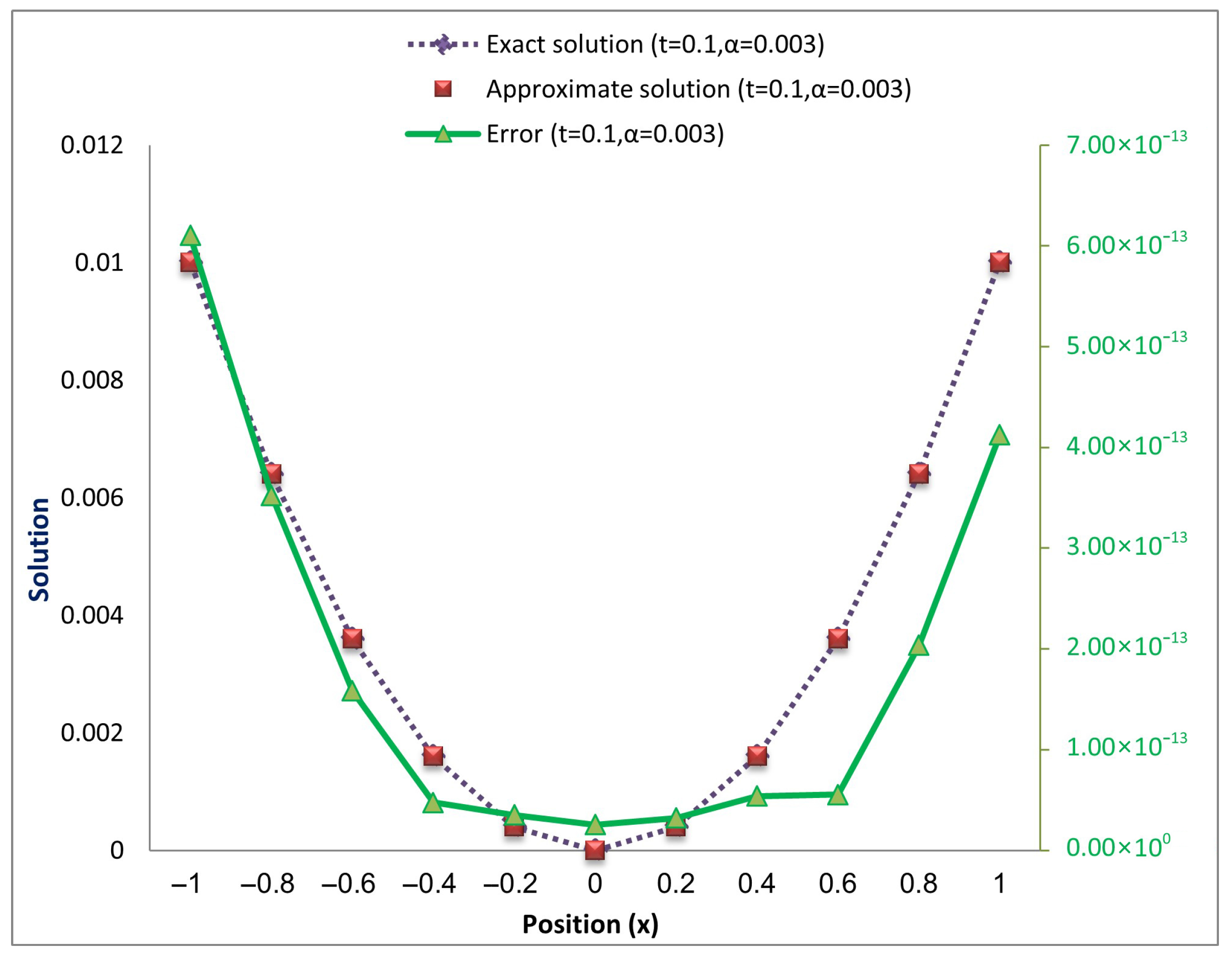
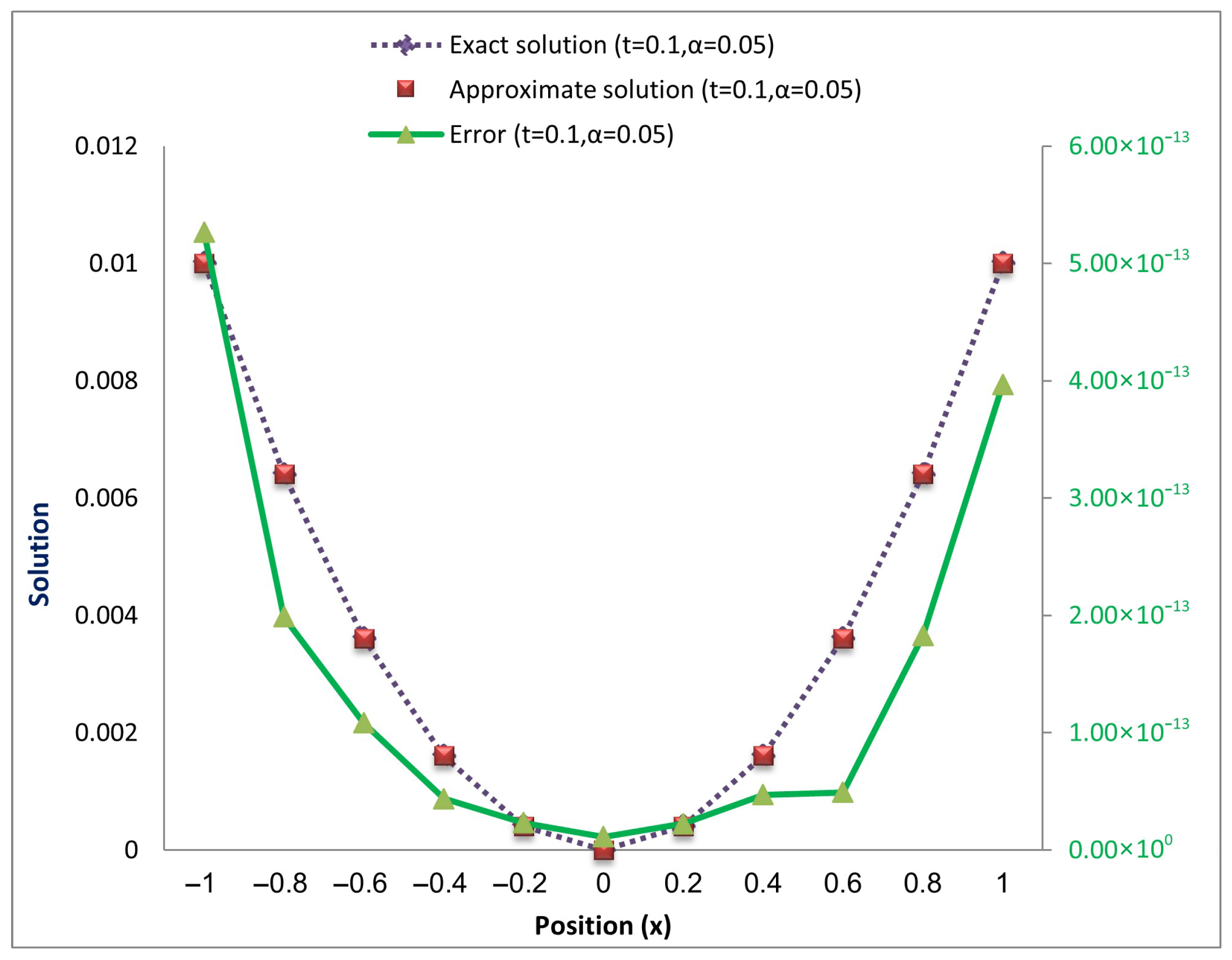
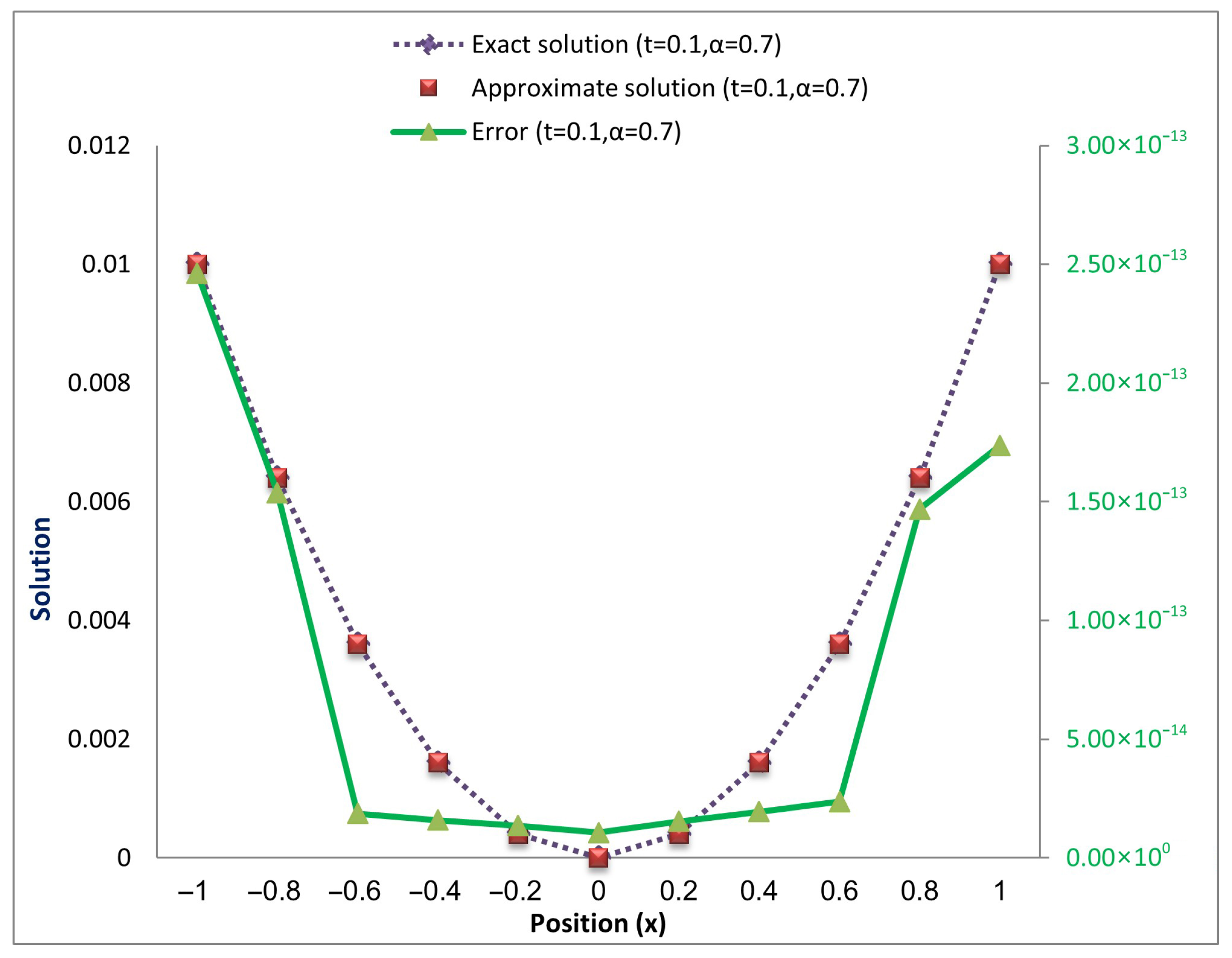
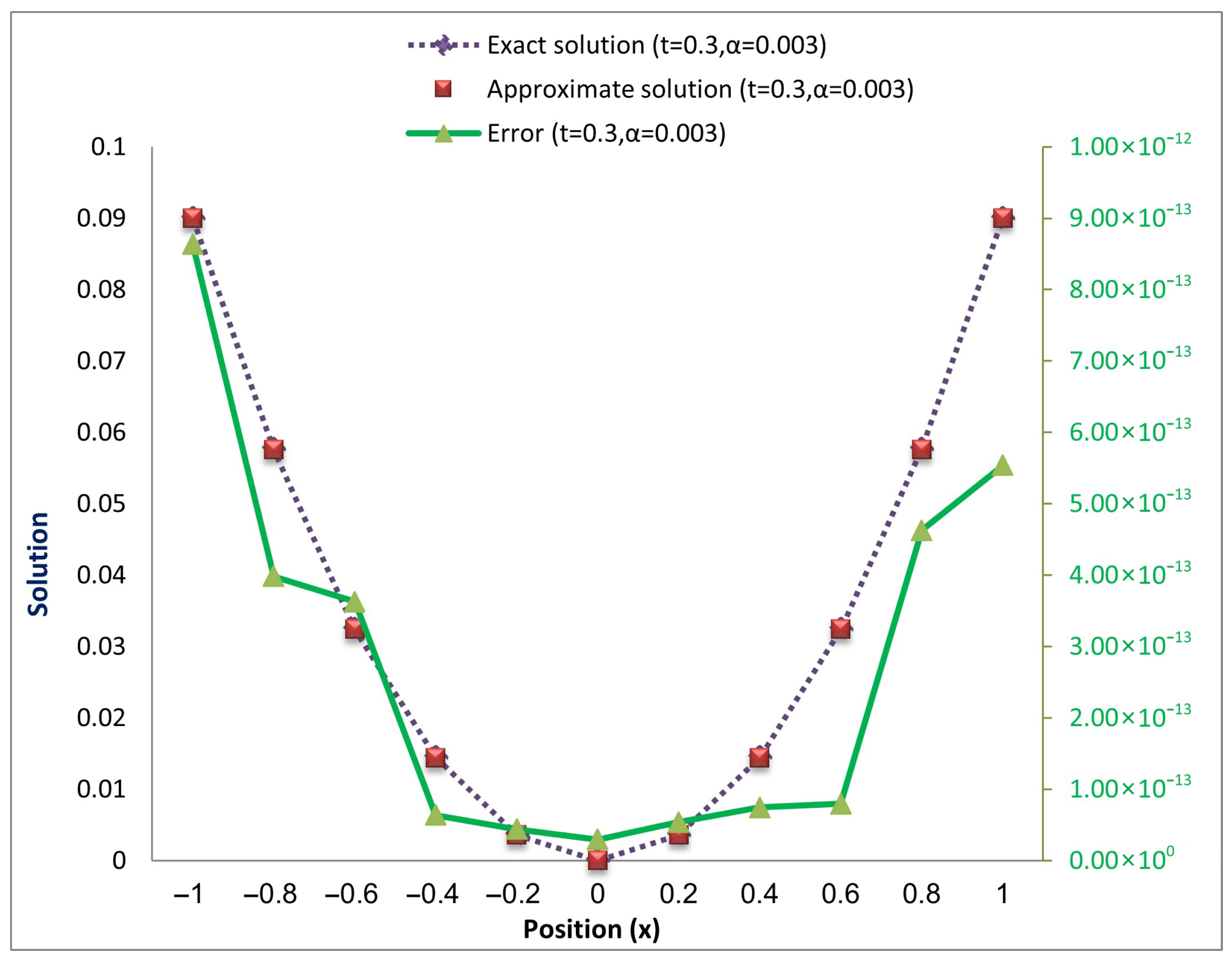
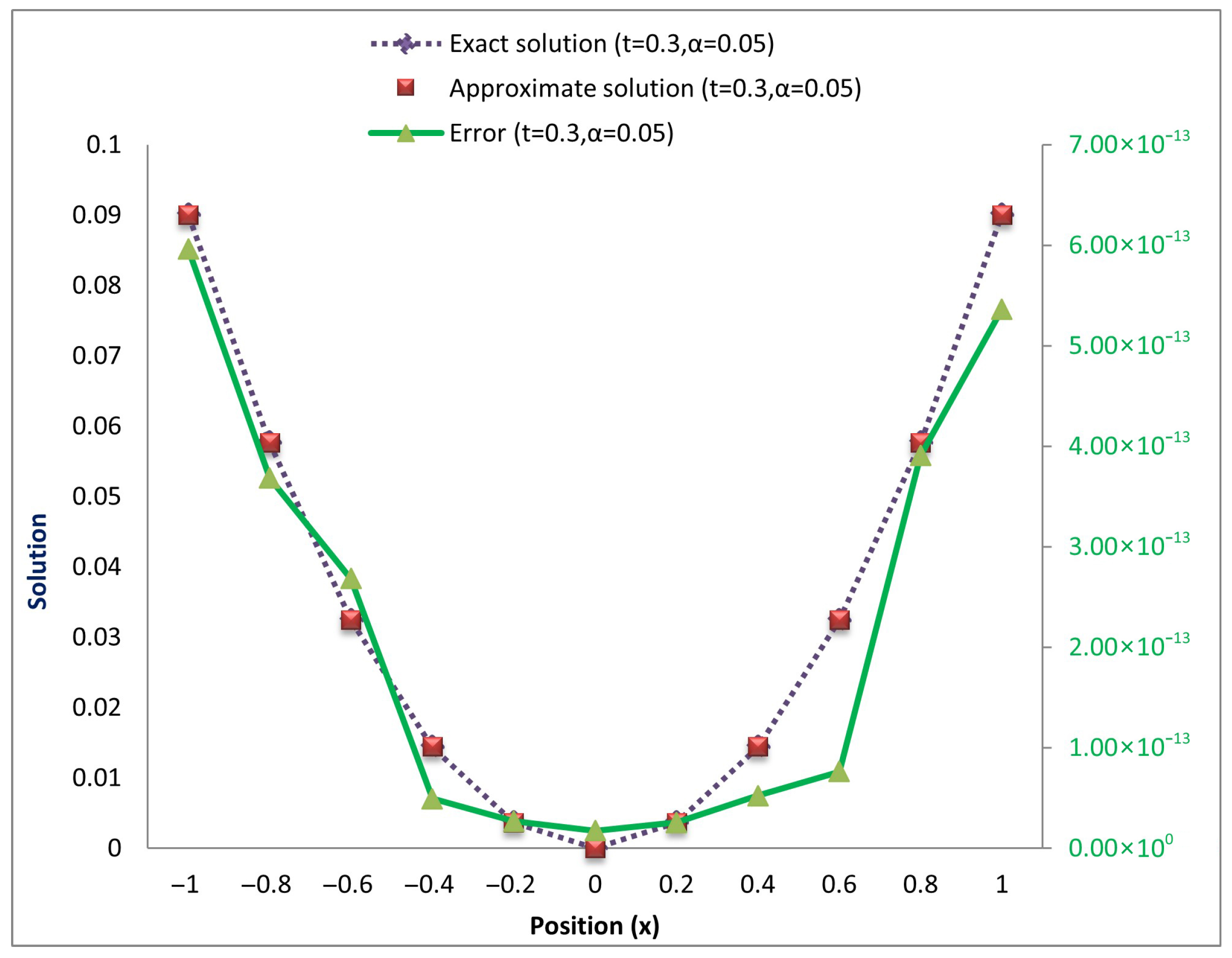
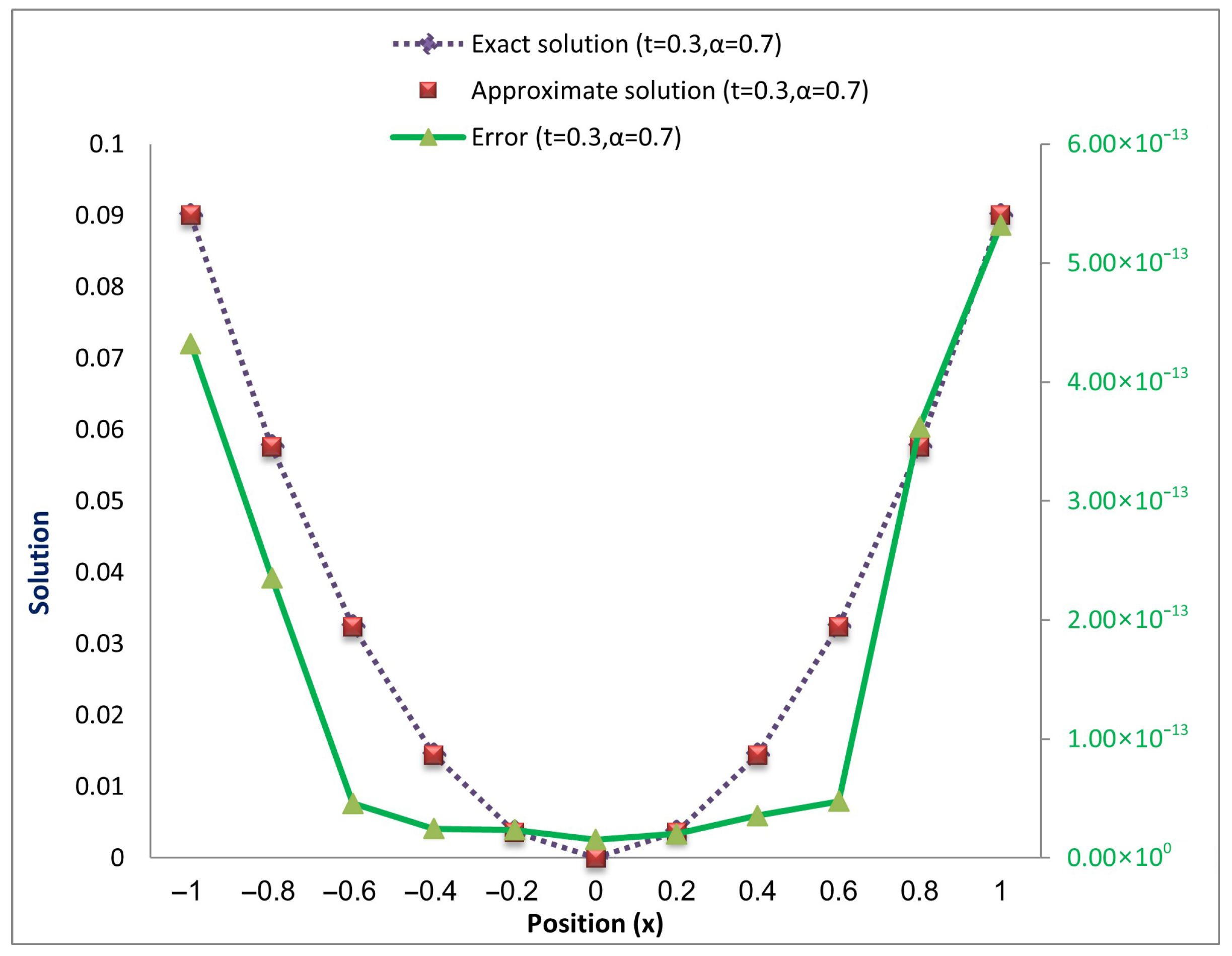
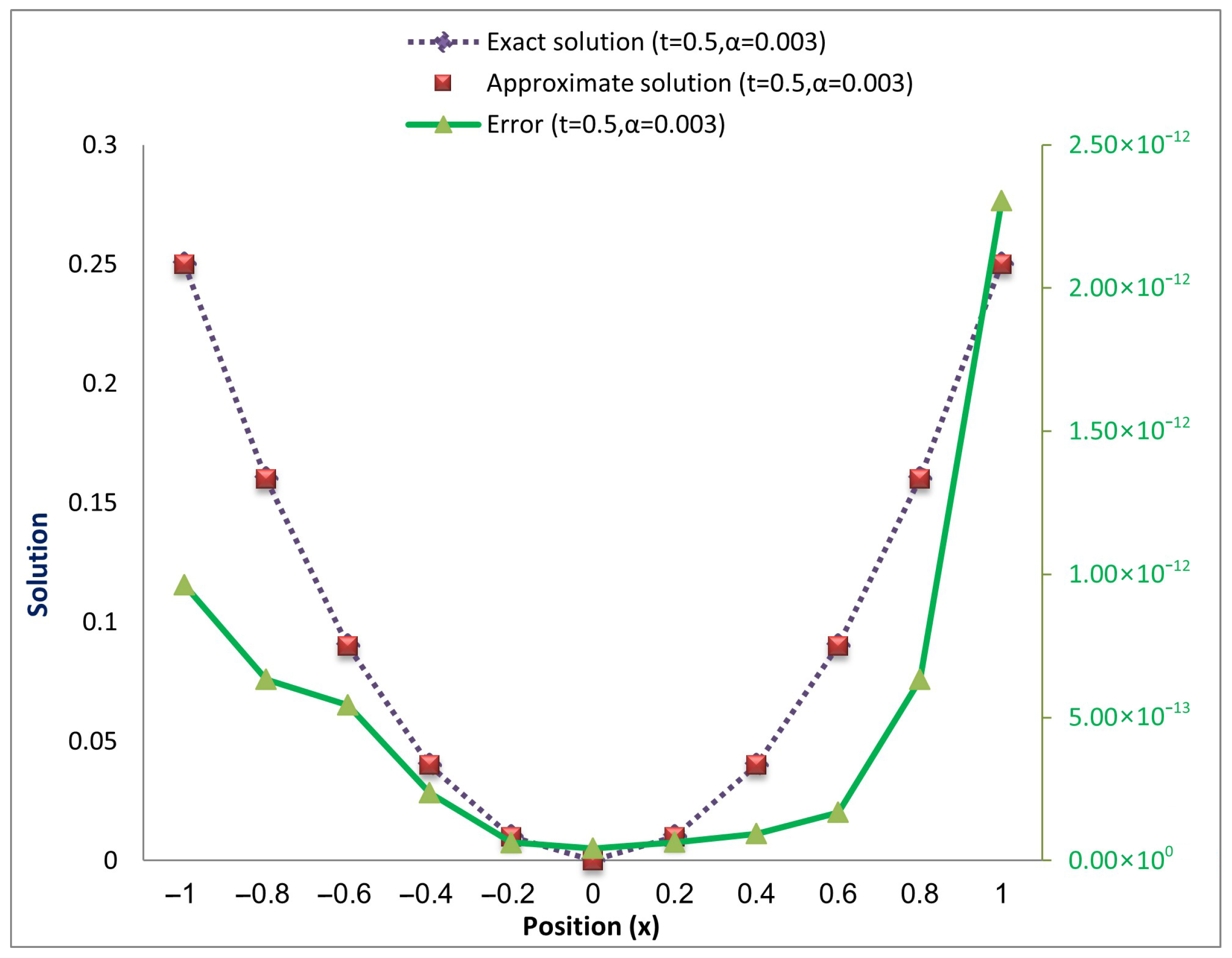
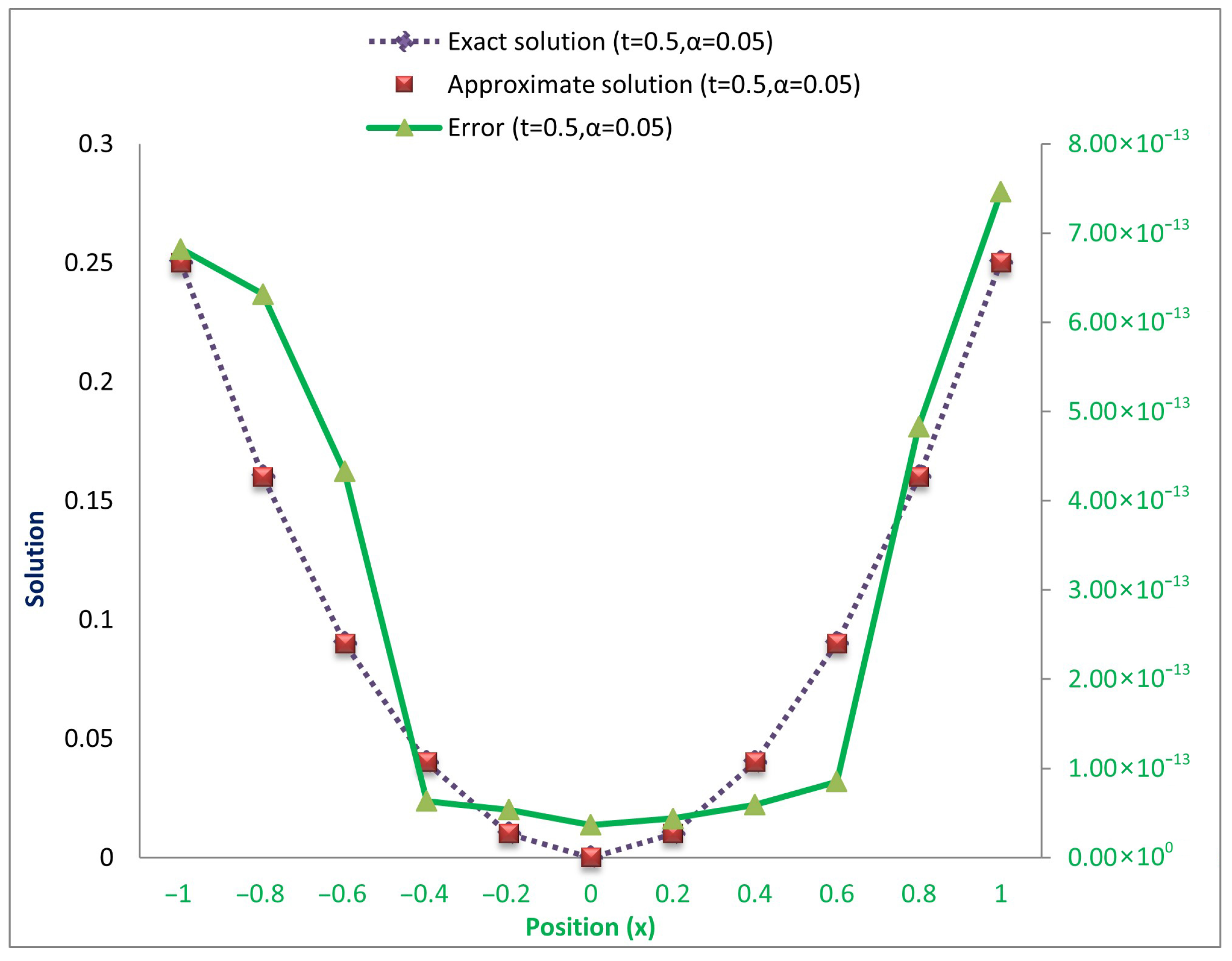
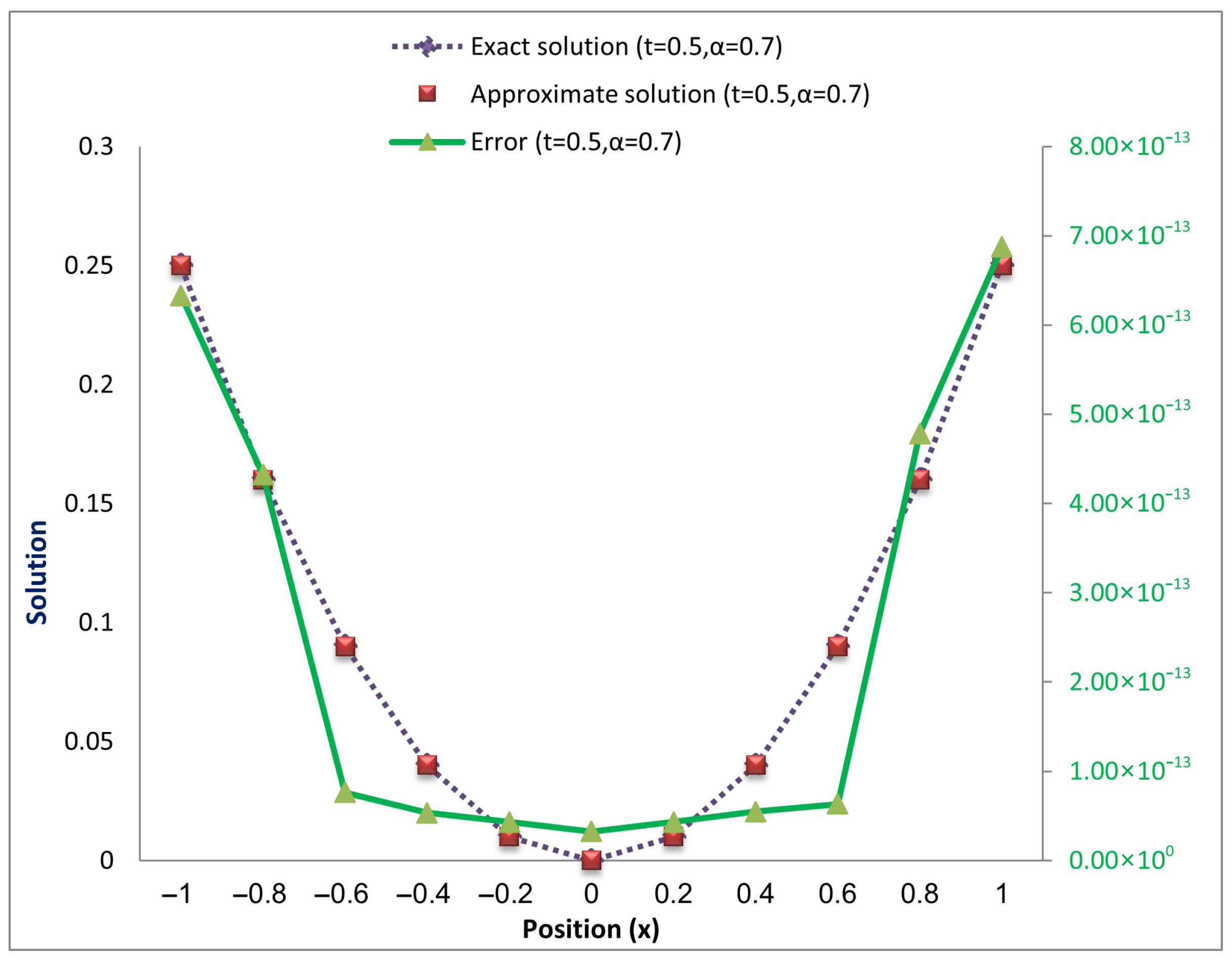
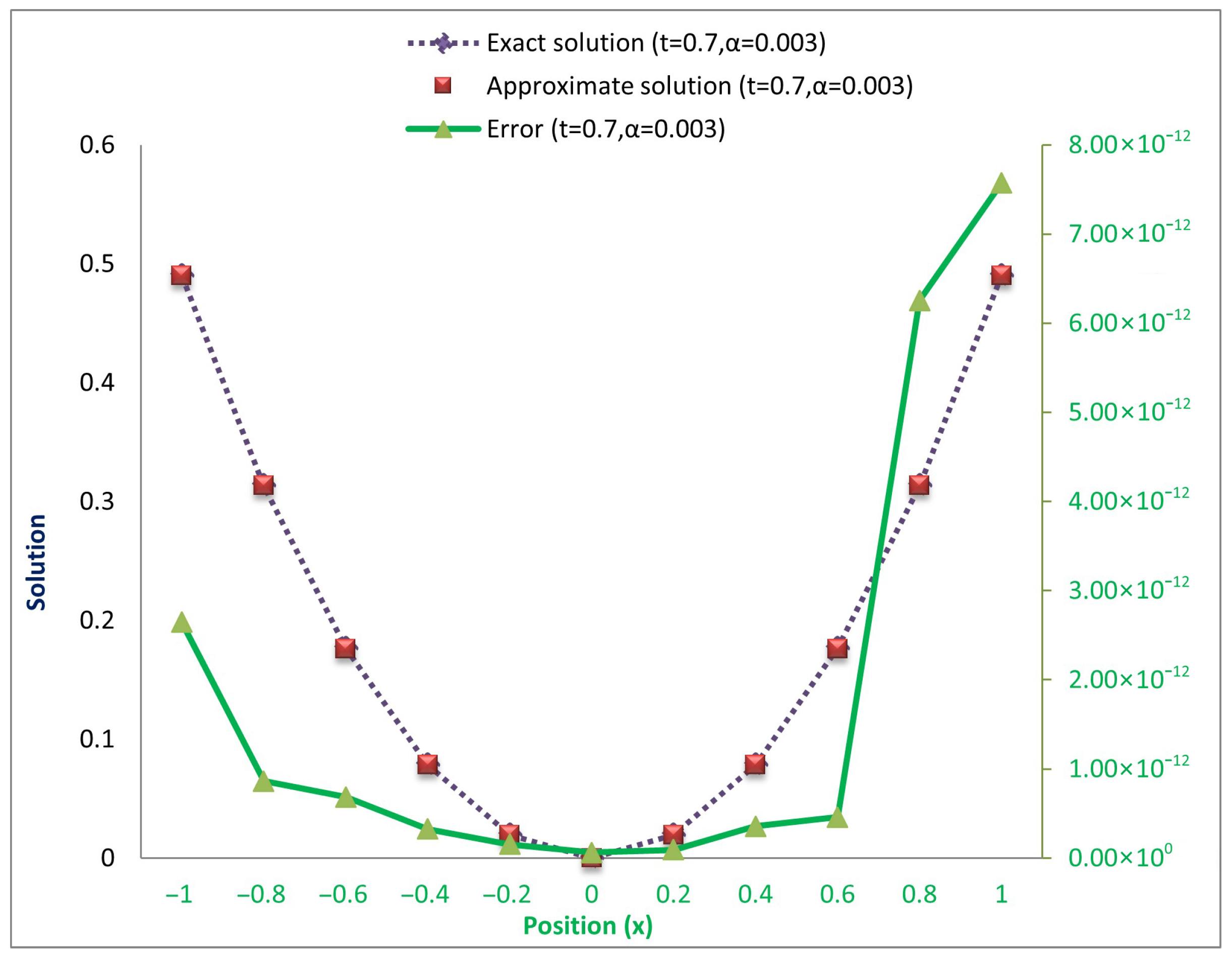
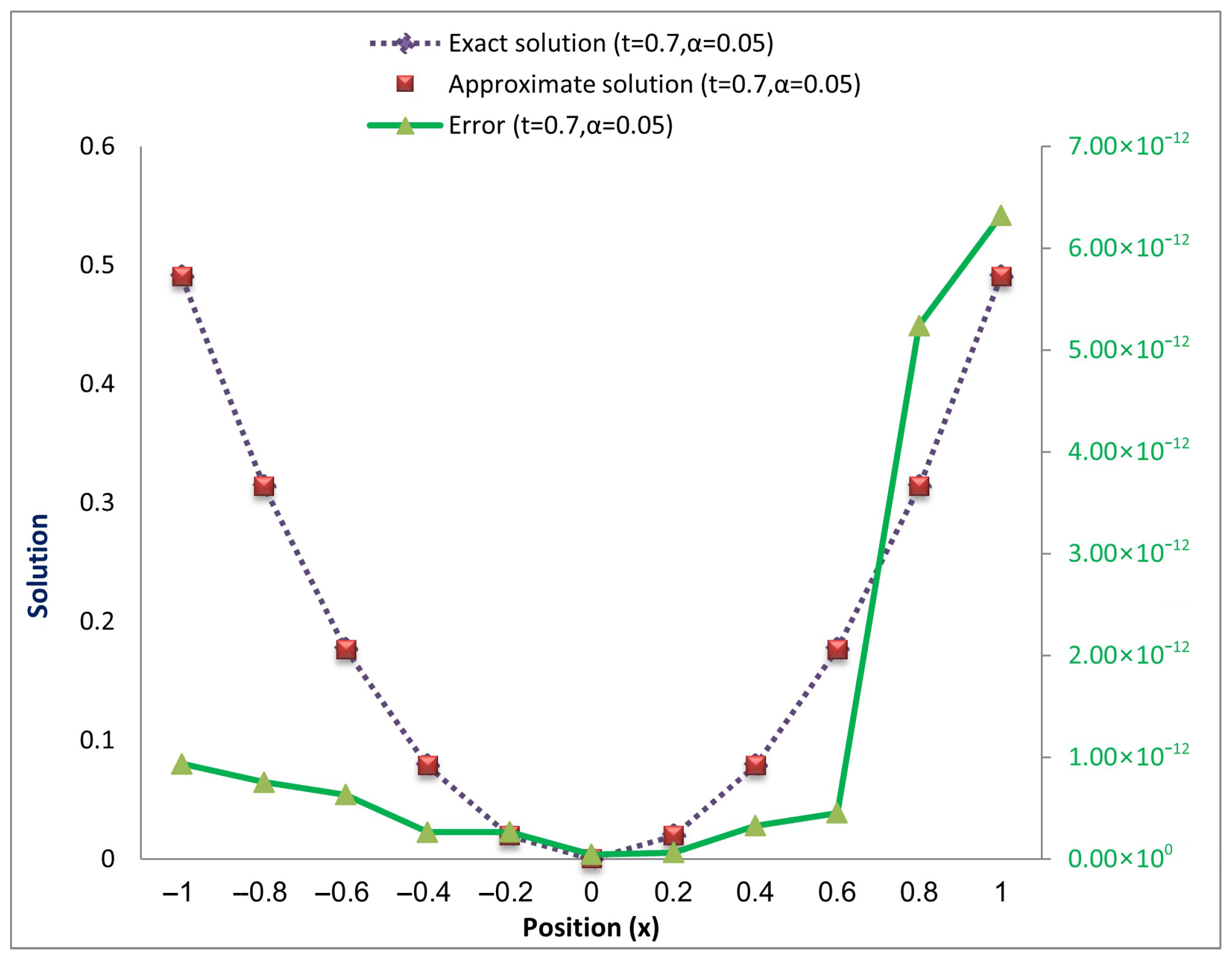
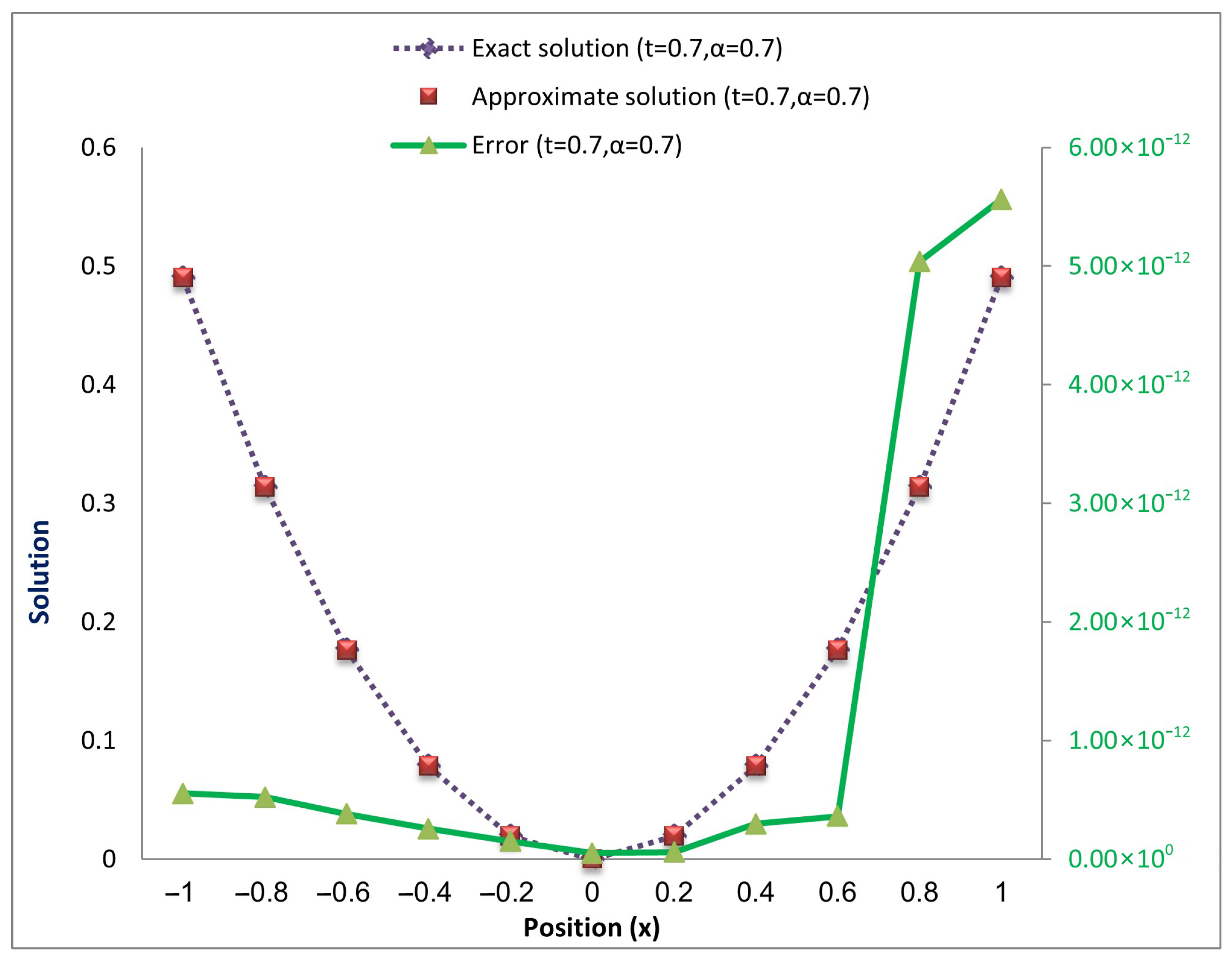
Example 1. Consider the following frPI-DE with a symmetric singular kernel :where the function is chosen such that the exact solution is given by . Under the initial conditions, Integrating Equation (44), we obtain Using condition (45), we get By applying Cauchy’s formula for repeated integration with the fundamental Caputo-fractional integral formula, we get Using condition (45), we obtain the NV-FIE: The modified Toeplitz matrix method (TMM) is applied with to approximate the solution of Equation (46). The exact and approximate solutions are computed at various positions and time values . To check the effectiveness of the proposed method, the absolute error between the exact and approximate solutions is calculated at the same points. To further demonstrate the performance of the numerical scheme, several values of the fractional order α were considered, specifically and 0.7. These values were selected to represent different regimes of fractional dynamics within the interval . The small values and correspond to cases where the fractional derivative is close to the classical integer-order derivative, allowing us to observe the behavior of the numerical method when the memory effect is relatively weak. In contrast, the value represents a stronger fractional behavior, which reflects more pronounced nonlocal memory effects in the model.
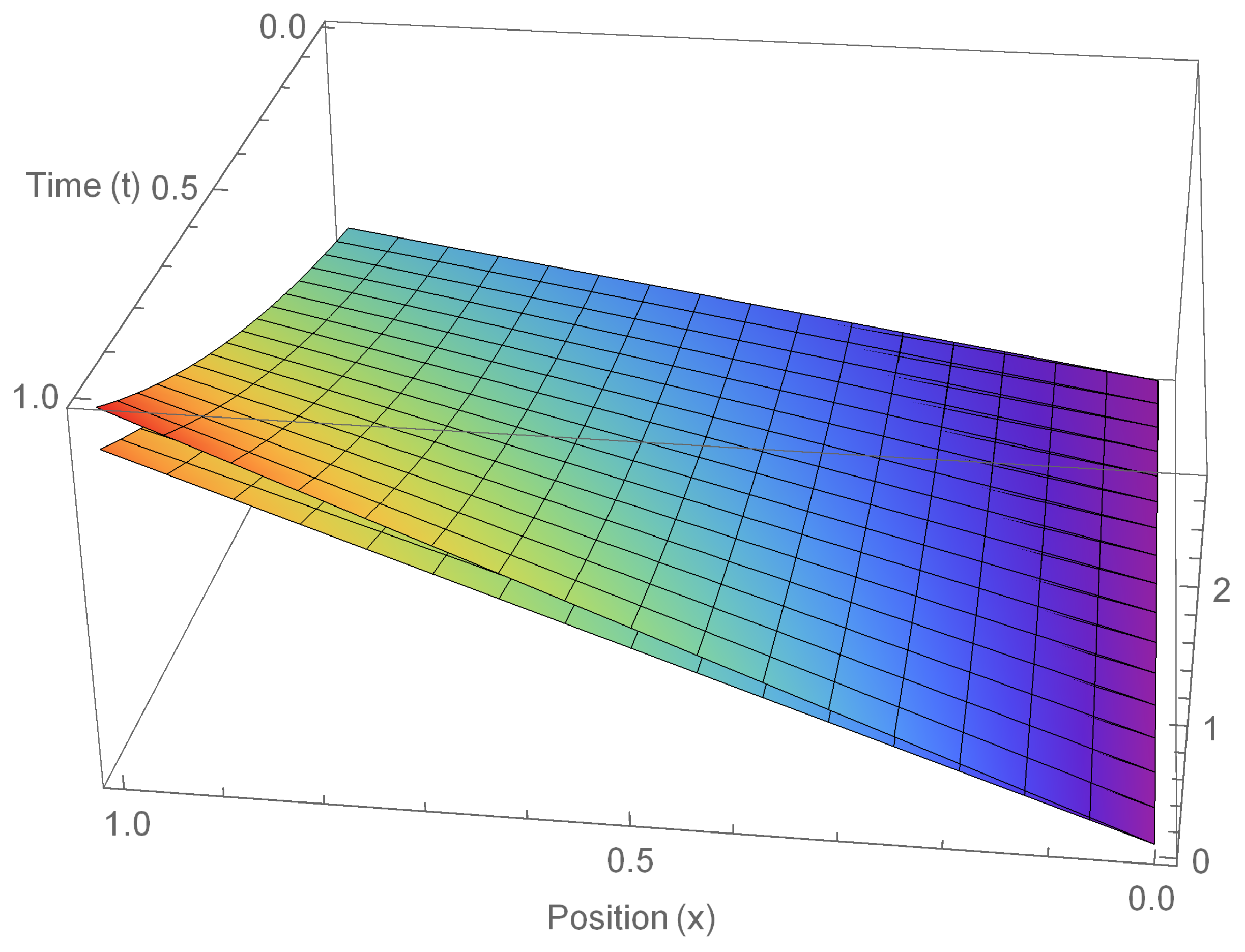
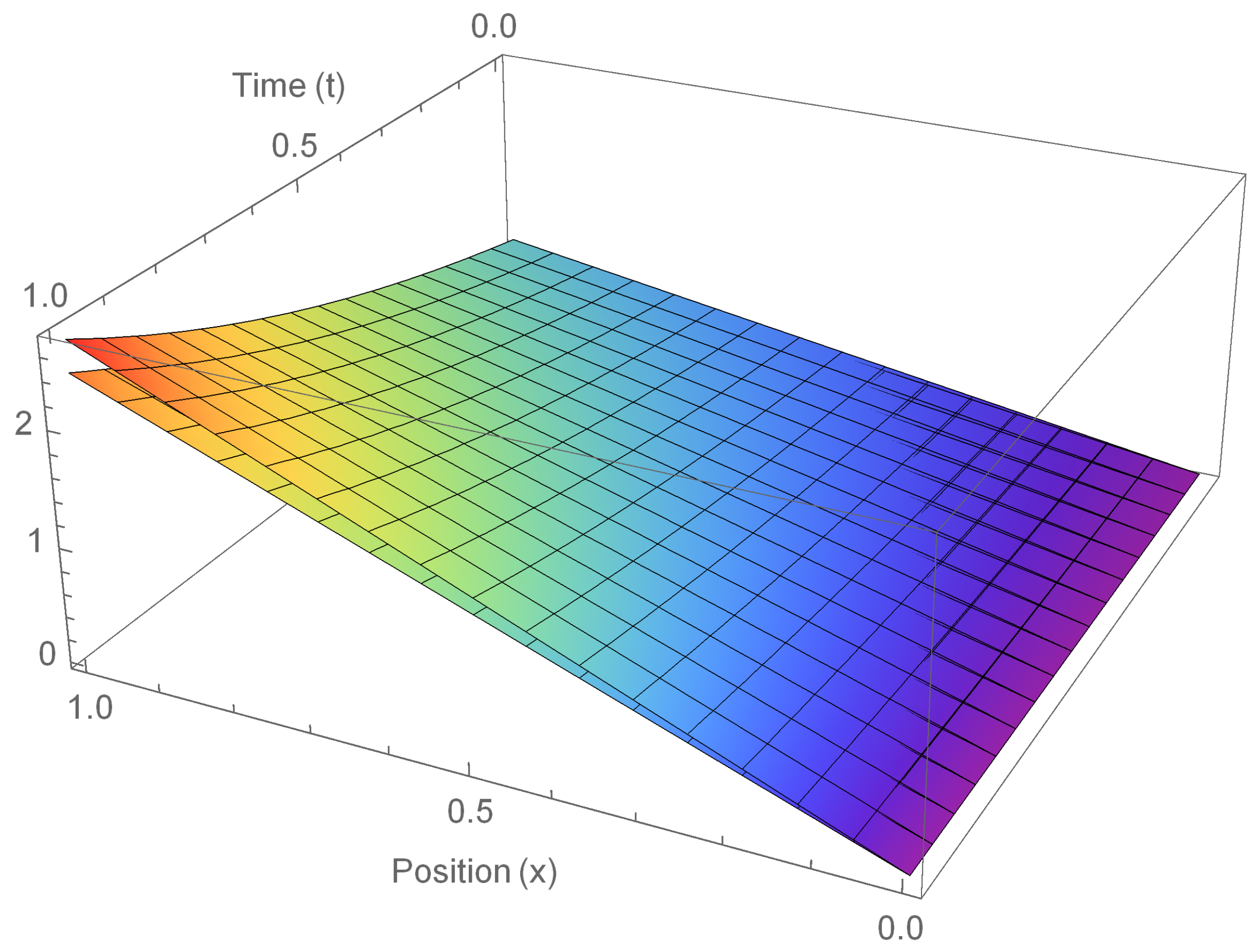
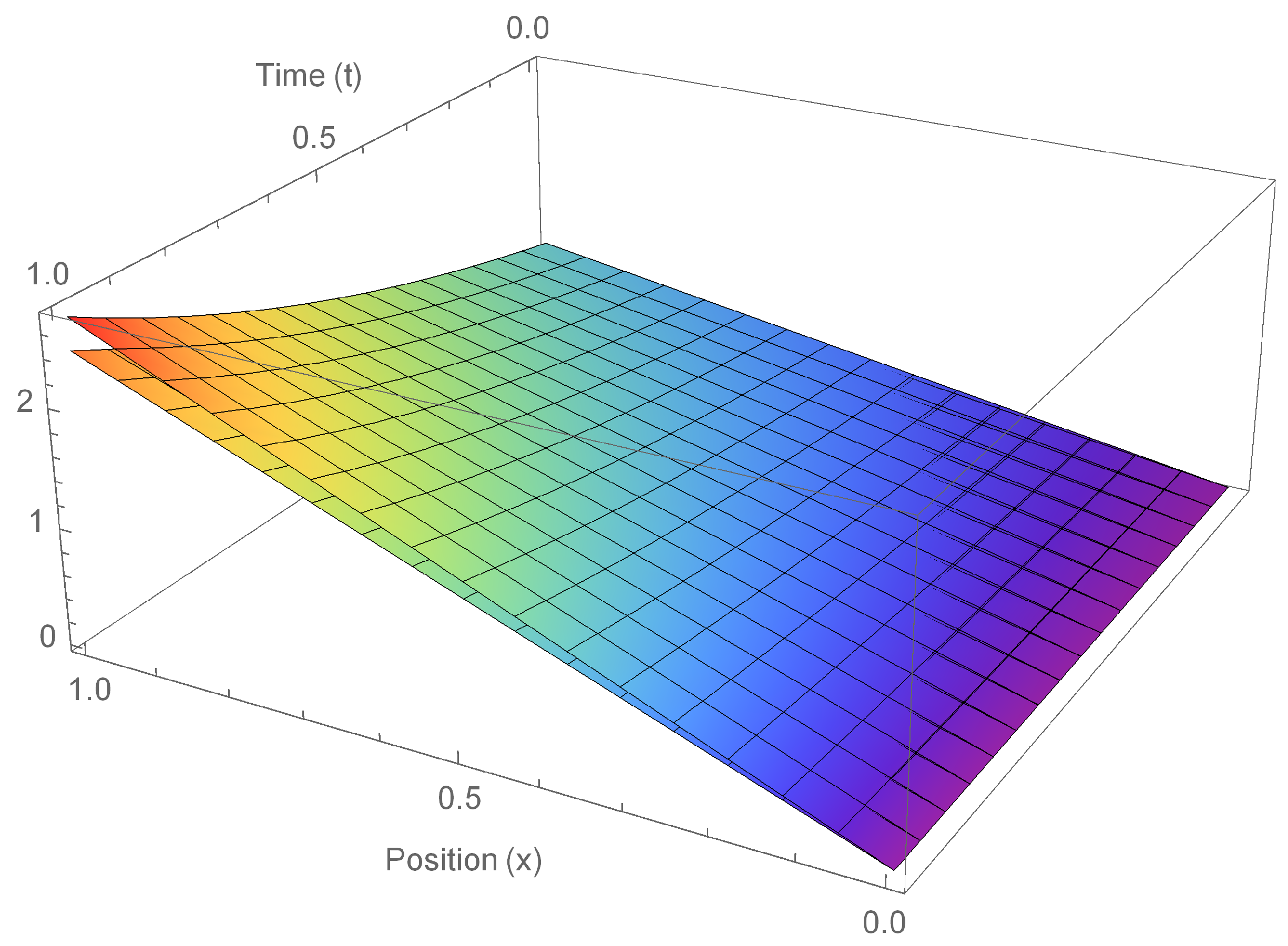
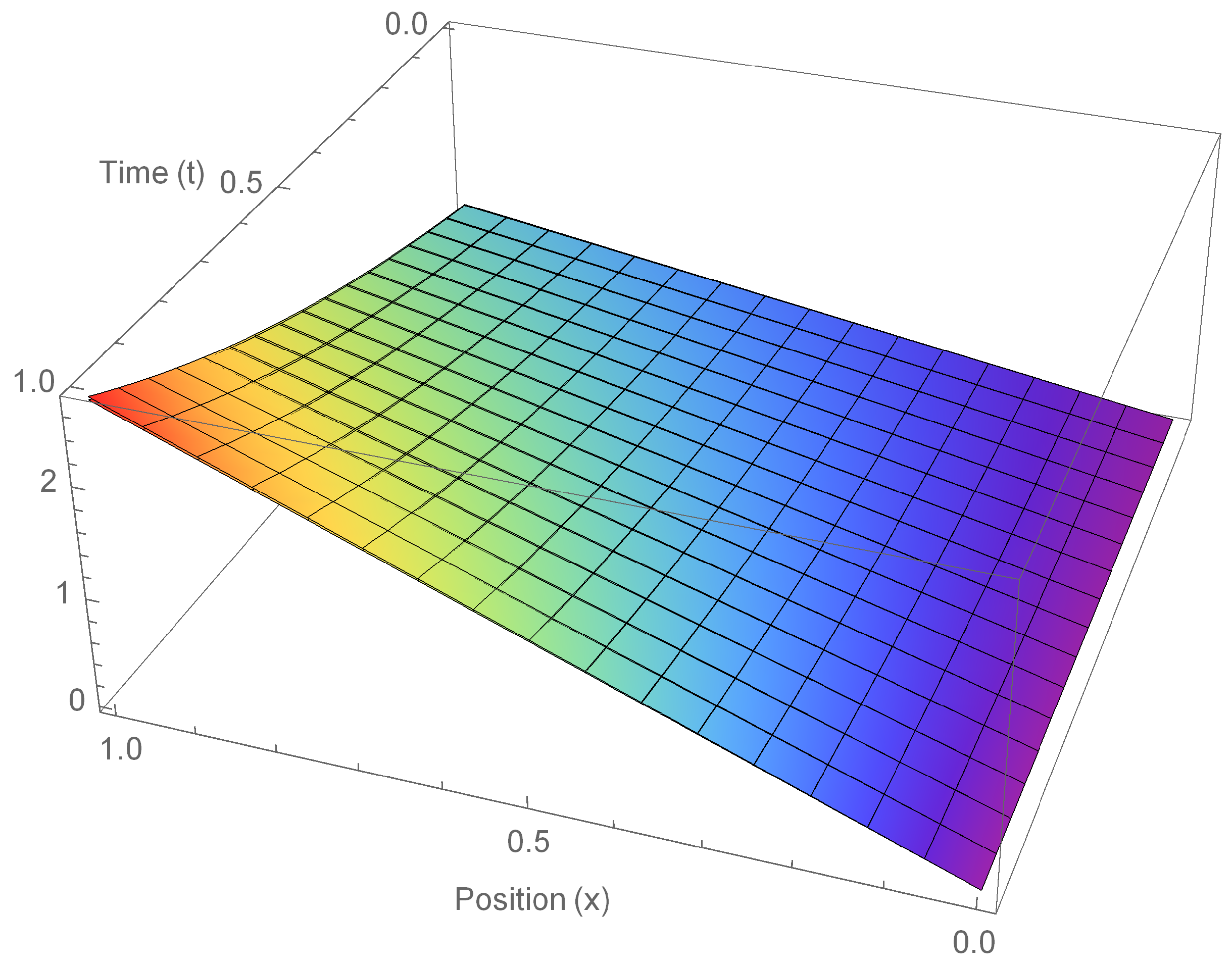
Table 1, Table 2, Table 3 and Table 4 present the absolute errors for different values of t, while Figure 1, Figure 2, Figure 3, Figure 4, Figure 5, Figure 6, Figure 7, Figure 8, Figure 9, Figure 10, Figure 11 and Figure 12 illustrate the exact solution, the numerical solution obtained using the modified Toeplitz matrix method (TMM), and the corresponding absolute error for different values of α.
Figure 1.
Comparison of the exact solution, the numerical solution obtained using TMM, and the corresponding absolute error for Example 1 at and with .
Figure 1.
Comparison of the exact solution, the numerical solution obtained using TMM, and the corresponding absolute error for Example 1 at and with .
Figure 2.
Comparison of the exact solution, the numerical solution obtained using TMM, and the corresponding absolute error for Example 1 at and with .
Figure 2.
Comparison of the exact solution, the numerical solution obtained using TMM, and the corresponding absolute error for Example 1 at and with .
Figure 3.
Comparison of the exact solution, the numerical solution obtained using TMM, and the corresponding absolute error for Example 1 at and with .
Figure 3.
Comparison of the exact solution, the numerical solution obtained using TMM, and the corresponding absolute error for Example 1 at and with .
Table 2.
Absolute errors for Example 1 using TMM with and for different values of .
Table 2.
Absolute errors for Example 1 using TMM with and for different values of .
| x | Errors ( = 0.003) | Errors ( = 0.05) | Errors ( = 0.7) |
|---|
| | | |
| | | |
| | | |
| | | |
| | | |
| | | |
| | | |
| | | |
| | | |
| | | |
| | | |
Figure 4.
Comparison of the exact solution, the numerical solution obtained using TMM, and the corresponding absolute error for Example 1 at and with .
Figure 4.
Comparison of the exact solution, the numerical solution obtained using TMM, and the corresponding absolute error for Example 1 at and with .
Figure 5.
Comparison of the exact solution, the numerical solution obtained using TMM, and the corresponding absolute error for Example 1 at and with .
Figure 5.
Comparison of the exact solution, the numerical solution obtained using TMM, and the corresponding absolute error for Example 1 at and with .
Figure 6.
Comparison of the exact solution, the numerical solution obtained using TMM, and the corresponding absolute error for Example 1 at and with .
Figure 6.
Comparison of the exact solution, the numerical solution obtained using TMM, and the corresponding absolute error for Example 1 at and with .
Table 3.
Absolute errors for Example 1 using TMM with and for different values of .
Table 3.
Absolute errors for Example 1 using TMM with and for different values of .
| x | Errors ( = 0.003) | Errors ( = 0.05) | Errors ( = 0.7) |
|---|
| | | |
| | | |
| | | |
| | | |
| | | |
| | | |
| | | |
| | | |
| | | |
| | | |
| | | |
Figure 7.
Comparison of the exact solution, the numerical solution obtained using TMM, and the corresponding absolute error for Example 1 at and with .
Figure 7.
Comparison of the exact solution, the numerical solution obtained using TMM, and the corresponding absolute error for Example 1 at and with .
Figure 8.
Comparison of the exact solution, the numerical solution obtained using TMM, and the corresponding absolute error for Example 1 at and with .
Figure 8.
Comparison of the exact solution, the numerical solution obtained using TMM, and the corresponding absolute error for Example 1 at and with .
Figure 9.
Comparison of the exact solution, the numerical solution obtained using TMM, and the corresponding absolute error for Example 1 at and with .
Figure 9.
Comparison of the exact solution, the numerical solution obtained using TMM, and the corresponding absolute error for Example 1 at and with .
Table 4.
Absolute errors for Example 1 using TMM with and for different values of .
Table 4.
Absolute errors for Example 1 using TMM with and for different values of .
| x | Errors ( = 0.003) | Errors ( = 0.05) | Errors ( = 0.7) |
|---|
| | | |
| | | |
| | | |
| | | |
| | | |
| | | |
| | | |
| | | |
| | | |
| | | |
| | | |
Figure 10.
Comparison of the exact solution, the numerical solution obtained using TMM, and the corresponding absolute error for Example 1 at and with .
Figure 10.
Comparison of the exact solution, the numerical solution obtained using TMM, and the corresponding absolute error for Example 1 at and with .
Figure 11.
Comparison of the exact solution, the numerical solution obtained using TMM, and the corresponding absolute error for Example 1 at and with .
Figure 11.
Comparison of the exact solution, the numerical solution obtained using TMM, and the corresponding absolute error for Example 1 at and with .
Figure 12.
Comparison of the exact solution, the numerical solution obtained using TMM, and the corresponding absolute error for Example 1 at and with .
Figure 12.
Comparison of the exact solution, the numerical solution obtained using TMM, and the corresponding absolute error for Example 1 at and with .
In this example, the numerical results reported in
Table 1,
Table 2,
Table 3 and
Table 4 demonstrate that the proposed method yields highly accurate approximations for all tested values of the spatial variable
x, time variable
t, and fractional
. In particular, the absolute errors are consistently of the order
–
, even though the spatial discretization parameter is fixed at the relatively small value
. These small error values indicate that the method is converging rapidly and that it is working well with the logarithmic singularity.
From the tables, we find that the smallest errors occur near the center of the spatial domain, while slightly larger errors appear near . This behavior is expected and can be explained by the fact that the logarithmic kernel is more influential near the boundaries, where numerical quadrature and interpolation errors tend to be more pronounced. Nevertheless, even at the boundaries, the errors remain extremely small, confirming the robustness of the scheme.
Figure 1,
Figure 2,
Figure 3,
Figure 4,
Figure 5,
Figure 6,
Figure 7,
Figure 8,
Figure 9,
Figure 10,
Figure 11 and
Figure 12 confirm the data provided in the tables. In all cases, the approximate solutions obtained by the TMM are almost indistinguishable from the exact solutions, with error curves that are smooth, symmetric, and several orders of magnitude smaller than the solution itself. These visual comparisons provide qualitative confirmation of the high accuracy of the proposed approach.
Example 2. Consider the following frPI-DE with a nonsymmetric kernel:where the function is chosen such that the exact solution is given by . Under the initial conditions, Analogously to Example 1, we obtain the following NV-FIE: where Table 5, Table 6, Table 7 and Table 8 illustrate the behavior of the exact solution of Equation (48) over the domain and the time , evaluated at selected points of position and time for different values of α. To check the effectiveness of the proposed method, the approximate solution of Equation (48) is computed at the same points using TMM with and the corresponding absolute errors are reported.
Table 5.
Exact solution, approximate solution, and absolute error for Example 2 computed using TMM with and at different values of x and t.
Table 5.
Exact solution, approximate solution, and absolute error for Example 2 computed using TMM with and at different values of x and t.
| (x, t) | Exact Solution | Approximate Solution | Errors |
|---|
| 0 | 0 | 0 |
| | | |
| | | |
| | | |
| | | |
| | | |
| | | |
| | | |
| | | |
| | | |
Figure 13.
Comparison of the exact solution and the numerical solution obtained using TMM for Example 2 with and fractional order at different values of x and t.
Figure 13.
Comparison of the exact solution and the numerical solution obtained using TMM for Example 2 with and fractional order at different values of x and t.
Table 6.
Exact solution, approximate solution, and absolute error for Example 2 computed using TMM with and at different values of x and t.
Table 6.
Exact solution, approximate solution, and absolute error for Example 2 computed using TMM with and at different values of x and t.
| (x, t) | Exact Solution | Approximate Solution | Errors |
|---|
| 0 | 0 | 0 |
| | | |
| | | |
| | | |
| | | |
| | | |
| | | |
| | | |
| | | |
| | | |
Figure 14.
Comparison of the exact solution and the numerical solution obtained using TMM for Example 2 with and fractional order at different values of x and t.
Figure 14.
Comparison of the exact solution and the numerical solution obtained using TMM for Example 2 with and fractional order at different values of x and t.
Table 7.
Exact solution, approximate solution, and absolute error for Example 2 computed using TMM with and at different values of x and t.
Table 7.
Exact solution, approximate solution, and absolute error for Example 2 computed using TMM with and at different values of x and t.
| (x, t) | Exact Solution | Approximate Solution | Errors |
|---|
| 0 | 0 | 0 |
| | | |
| | | |
| | | |
| | | |
| | | |
| | | |
| | | |
| | | |
| | | |
Figure 15.
Comparison of the exact solution and the numerical solution obtained using TMM for Example 2 with and fractional order at different values of x and t.
Figure 15.
Comparison of the exact solution and the numerical solution obtained using TMM for Example 2 with and fractional order at different values of x and t.
Table 8.
Exact solution, approximate solution, and absolute error for Example 2 computed using TMM with and at different values of x and t.
Table 8.
Exact solution, approximate solution, and absolute error for Example 2 computed using TMM with and at different values of x and t.
| (x, t) | Exact Solution | Approximate Solution | Errors |
|---|
| 0 | 0 | 0 |
| | | |
| | | |
| | | |
| | | |
| | | |
| | | |
| | | |
| | | |
| | | |
Figure 16.
Comparison of the exact solution and the numerical solution obtained using TMM for Example 2 with and fractional order at different values of x and t.
Figure 16.
Comparison of the exact solution and the numerical solution obtained using TMM for Example 2 with and fractional order at different values of x and t.
This example is devoted to assessing the performance of the proposed modified Toeplitz Matrix Method (TMM) when applied to a fractional partial integro-differential equation involving a Cauchy-type singular kernel. This example is of particular importance, as Cauchy kernels are well known for inducing numerical instability and loss of accuracy in classical discretization schemes. The corresponding tables and figures show that the proposed method is robust, accurate, and stable.
The absolute errors at the chosen spatial points and time levels show that the modified TMM produces a numerical solution that closely agrees with the exact solution over the whole spatial domain. For all tested values of the fractional order , the magnitude of the error remains remarkably small, typically ranging between and . The degree of accuracy is obtained with a relatively coarse Toeplitz grid, which indicates the efficiency of the computation method and substantiates its adequacy for practical use in the case of fractional operators and singular kernels.
In
Figure 13,
Figure 14,
Figure 15 and
Figure 16, it is seen that the numerical solution is identical to the exact solution. The error plots are all smooth and well-behaved, with no oscillations. Such behavior is indicative of convergence and confirms that the proposed method preserves the qualitative features of the exact solution.
Example 3. Consider the following frPI-DE with a weakly singular kernel, :where the function is chosen such that the exact solution is given by . Under the initial conditions, Analogously to Example 1, we obtain the following NV-FIE: In this example, we compare the approximate solutions of Equation (50) obtained via the proposed method TMM and the Shifted Chebyshev Polynomials (SCP) method. This comparison is conducted to evaluate the accuracy and efficiency of the proposed method. To achieve this objective, the absolute error for both methods is computed at various values of and over different time , while also varying the number of nodes . The results are presented in Table 9, which provides a quantitative comparison of the performance of the two methods, highlighting the accuracy and effectiveness of the proposed approach in comparison with the conventional method. Table 9 presents a comparative analysis of the numerical errors obtained using TMM and SCP under different parameter settings, specifically for
and
, across various spatial points
x and time levels
t.
The results clearly indicate that both methods yield highly accurate approximations, with error magnitudes predominantly ranging between and . This demonstrates the excellent numerical performance of both TMM and SCP in solving the considered problem. A detailed comparison reveals that the TMM method generally produces slightly smaller errors than the SCP method, particularly for smaller values of . This suggests that TMM exhibits superior numerical accuracy and better convergence behavior under finer parameter settings.
Overall, the results presented in
Table 9 confirm that both TMM and SCP are highly efficient and reliable numerical techniques. Nevertheless, TMM demonstrates a slight advantage in terms of accuracy, making it a preferable choice for solving similar problems requiring high-precision numerical solutions.
Remark on the limiting values of the fractional order :
The fractional order considered in this work satisfies . When approaches the limiting values of this interval, the governing equation gradually transitions toward classical operators. In particular, as the Caputo fractional derivative approaches the first-order classical derivative, while as the operator behaves similarly to an integral-type memory term. In the proposed numerical scheme, the discretization weights involve the Gamma function coefficients and , which remain well defined for values of close to these limits. Consequently, the modified Toeplitz matrix method remains numerically stable for fractional orders approaching both endpoints of the interval. The numerical experiments presented in this section demonstrate that the algorithm maintains accuracy and stability for different values of , confirming the robustness of the proposed approach across the admissible fractional range.