Next Article in Journal
An Analysis of Numerical Techniques for Mixed Fractional Integro-Differential Equations with a Symmetric Singular Kernel
Previous Article in Journal
Symmetry-Based Selection of Gravitational Lagrangians via Noether Approach
 
 
Due to scheduled maintenance work on our servers, there may be short service disruptions on this website between 11:00 and 12:00 CEST on March 28th.
Article

Symmetric Element Stiffness and Symplectic Integration for Eringen’s Integral Nonlocal Rods: Static Response and Higher-Order Vibrations


1
College of Transportation Engineering, Dalian Maritime University, Dalian 116026, China
2
Linglong Beijing R&D Center, Shandong Linglong Tyre Co., Ltd., Beijing 101100, China
*
Author to whom correspondence should be addressed.
Symmetry 2026, 18(4), 571; https://doi.org/10.3390/sym18040571
Submission received: 13 February 2026 / Revised: 9 March 2026 / Accepted: 24 March 2026 / Published: 27 March 2026
(This article belongs to the Section Engineering and Materials)

Abstract

Integral-form nonlocal elasticity provides a mechanically meaningful approach to describing size effects, yet it leads to Volterra-type integro-differential equations that are difficult to solve analytically and numerically challenging for boundary layers and high-order modes. In this work, we developed a symplectic numerical integration framework for Eringen’s two-phase (local/nonlocal mixture) integral model by embedding the constitutive operator into a Hamiltonian formulation and discretizing the influence domain in a belt-wise manner. A step-increase strategy was incorporated to allow flexible spatial marching while preserving the geometric (symplectic) structure of the transfer operation. In addition, a symmetry-explicit, element-level stiffness representation was derived for the discretized integral operator; it exposes a mirrored long-range coupling pattern and enables symmetric, energy-consistent assembly. The resulting kernel-agnostic algorithm accommodates both smooth and finite-range kernels. Static benchmarks and longitudinal vibrations are investigated for exponential, Gaussian, and triangular kernels over representative length ratios and mixture parameters. Comparisons with available analytical and asymptotic solutions show good agreement within their validity ranges, and the method yields stable higher-order eigenfrequencies when asymptotic expansions may be unreliable. The current study is limited to a linear one-dimensional rod setting, and validation is restricted to published analytical/asymptotic solutions rather than experimental calibration.

1. Introduction

Integral nonlocal elasticity offers a physically transparent approach to incorporating long-range interactions through an attenuation kernel; however, it typically yields Volterra-type integro-differential equations that are analytically intractable and often require specialized numerical treatment of the constitutive integral operator.
Differential-form nonlocal models are often introduced to bypass these analytical challenges; however, differential and integral formulations are not generally equivalent and may exhibit inconsistencies (including paradoxical vanishing of nonlocal effects under certain loadings) unless constitutive boundary conditions and admissibility issues are carefully addressed [1,2]. These subtleties motivate a continued emphasis on integral formulations.
More specifically, differential-form reductions typically replace the integral operator with higher-order spatial derivatives, which can simplify the governing equations but may require additional constitutive (nonclassical) boundary conditions and careful admissibility constraints to avoid paradoxes and ill-posedness. By contrast, integral formulations keep the nonlocal averaging explicit and can be posed with classical essential (displacement) and natural (traction) boundary conditions, while nonlocality enters the boundary traction through an integral definition. Recent reviews and discussions provide broader comparisons of nonlocal modeling choices and emphasize the role of boundary conditions and formulation consistency for nanoscale beams and rods [3,4]. From an applicational viewpoint, experimental/atomistic calibration is also an important direction for validation and parameter identification beyond analytical/asymptotic benchmarks (see [5], for example). For completeness, we note that Eringen’s two-phase (local/nonlocal mixture) integral model was originally proposed in [6] and has been actively applied to micro-/nano-rods and beams in recent years [7,8].
Closed-form solutions exist only for a limited set of integral nonlocal statics problems (e.g., tension bars [9] and twisting statics of nanotube-type members [10]). Notably, Tuna and Kirca [11] derived closed-form solutions to Eringen’s integral nonlocal model for the static bending of Euler–Bernoulli and Timoshenko beams. However, iterative/approximate evaluations can deteriorate when the nonlocal contribution dominates [12]. For more general geometries and loadings, robust numerical methods remain essential, including modified-kernel integral models [13,14], finite-element discretization for integral nonlocal elasticity [15], and hybrid collocation/BEM strategies for three-dimensional integral formulations [16].
From an engineering standpoint, micro-/nano-scale components (e.g., MEMS/NEMS) motivate researchers to use size-dependent constitutive descriptions where nonlocal interactions can induce boundary layers and influence both static responses and higher-order dynamics. Physically, the integral form is attractive because it encodes long-range interactions explicitly via an attenuation kernel and influence distance, but it can make the resulting integro-differential system numerically sensitive when boundary layers are steep or high-order modes are targeted. Therefore, stable and reliable computation of high-order modes is both necessary and practically meaningful, prompting the development of numerically robust algorithms for integral nonlocal models.
Beyond the specific context of nonlocal nanomechanics, the accurate prediction of high-order spectral properties is essential in a wide range of advanced vibration problems. High-frequency modes and their couplings play a critical role in systems involving defects, mistuning, or nonlinear energy transfer. Examples include nonlinear force tailoring for harvesting and isolation [17], negative-stiffness absorbers for vibration transmission [18], mistuned blisks [19], resonators with mass defects or size-dependent couplings [20,21,22], and vortex-induced vibration control in flexible structures [23].
From a theoretical standpoint, transferring the problem into a Hamiltonian framework provides a universal conservative-system description in which symplectic integration offers a natural structure-preserving route. Recent developments also show that Hamiltonian-system formulations and structure-preserving (symplectic) algorithms can be advantageous for differential and integro-differential equations [24,25,26,27], with increasing applications in nonlocal elasticity settings [28,29]. These methods are particularly attractive when a kernel-agnostic formulation is desired. More broadly, Hamiltonian formulations provide a cross-disciplinary language for conservative evolution systems; this prompts the use of symmetry and structure preservation as guiding principles when developing numerical methods for nonlocal continua.
A key modeling challenge is that the discretization intuition from local finite elements does not transfer directly to integral nonlocal problems. In conventional local FEM, the primary unknown (displacement) is typically C0-continuous, and the domain is naturally decomposed into elements separated by interfaces; stiffness coupling is essentially “interface-local” (nearest-neighbor) in one dimension. In contrast, integral nonlocality explicitly accounts for next-nearest and far-field interactions within an influence distance, so an interface-based partition alone no longer captures how points interact. This calls for a cross-region viewpoint: one must discretize and increment over an influence domain rather than only across element interfaces. In this work, this idea is implemented through a belt-wise discretization of the influence domain, which provides a convenient and systematic way to track long-range couplings while remaining compatible with a Hamiltonian/symplectic formulation. We refer to this belt-wise influence-domain discretization as the “inter-belt” concept, emphasizing that the influence domain (rather than a single element interface) is the primary organizing unit for integral nonlocal couplings.
The above viewpoint also connects naturally to the symplectic methodology in applied mechanics. In the Hamiltonian description of conservative systems, symplectic (structure-preserving) algorithms are designed to retain the key geometric structure and thereby provide improved long-time stability; in this sense, symplecticity is often interpreted as preserving the intrinsic structure of conservative systems in computation [26,30]. In practical numerical computation, this perspective is consistent with the common observation that structure-preserving schemes can help reduce numerical drift and error accumulation in long-time-step or higher-order modal computations [26,30]. This prompts the development of a discrete formulation in which conservative structure and stiffness symmetry are preserved at the element level (see, e.g., Zhong’s symplectic methodology regarding applied mechanics [31]) and numerical error accumulation is mitigated in long-duration or higher-order computations [32].
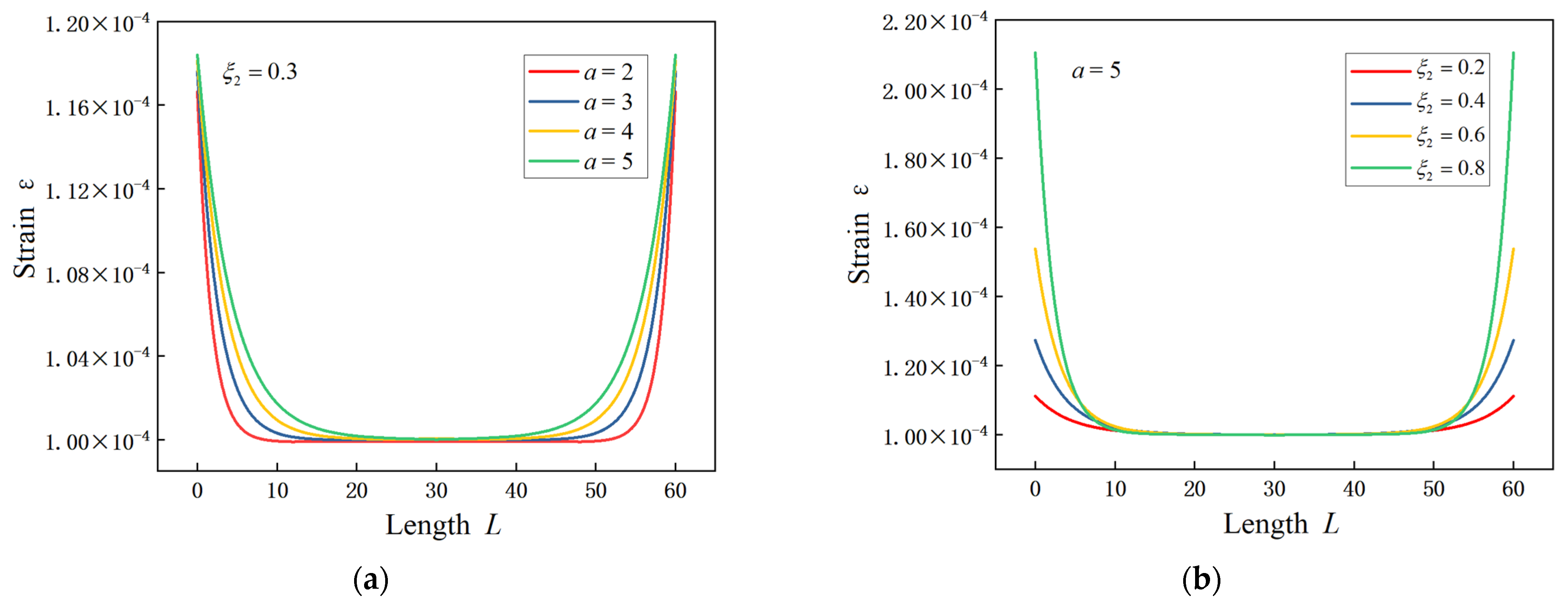
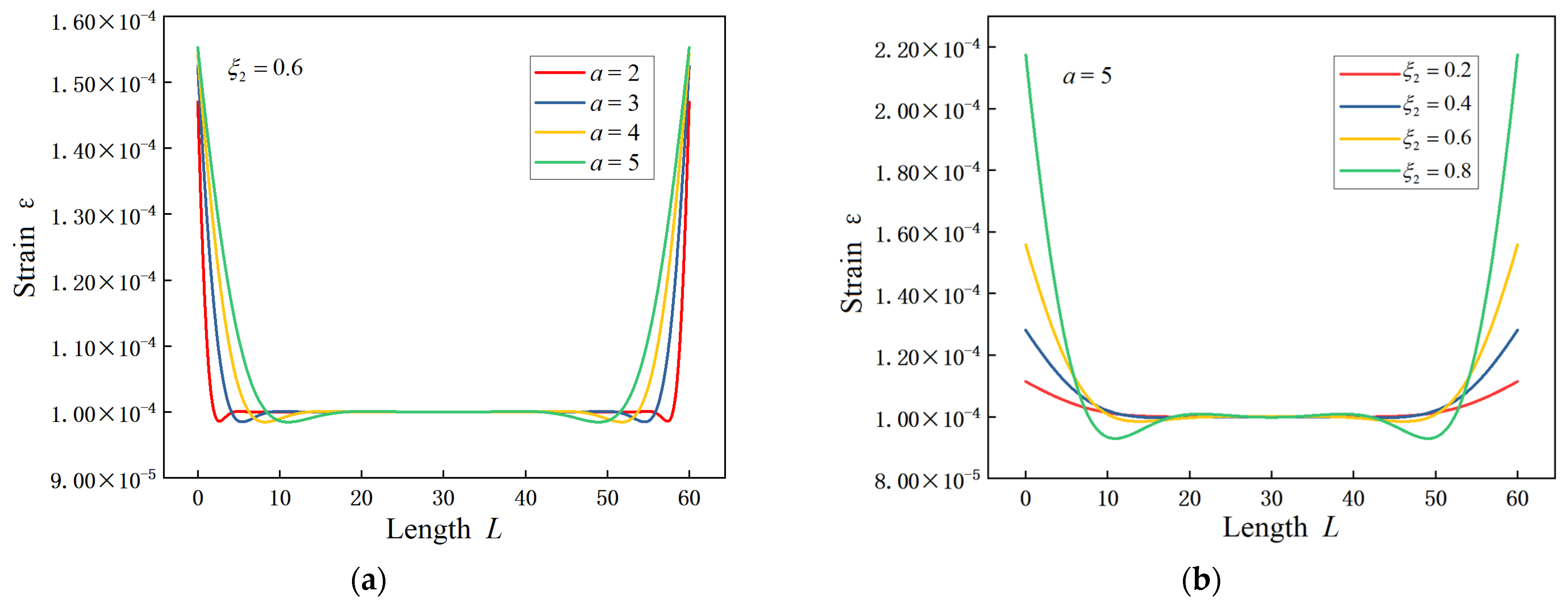
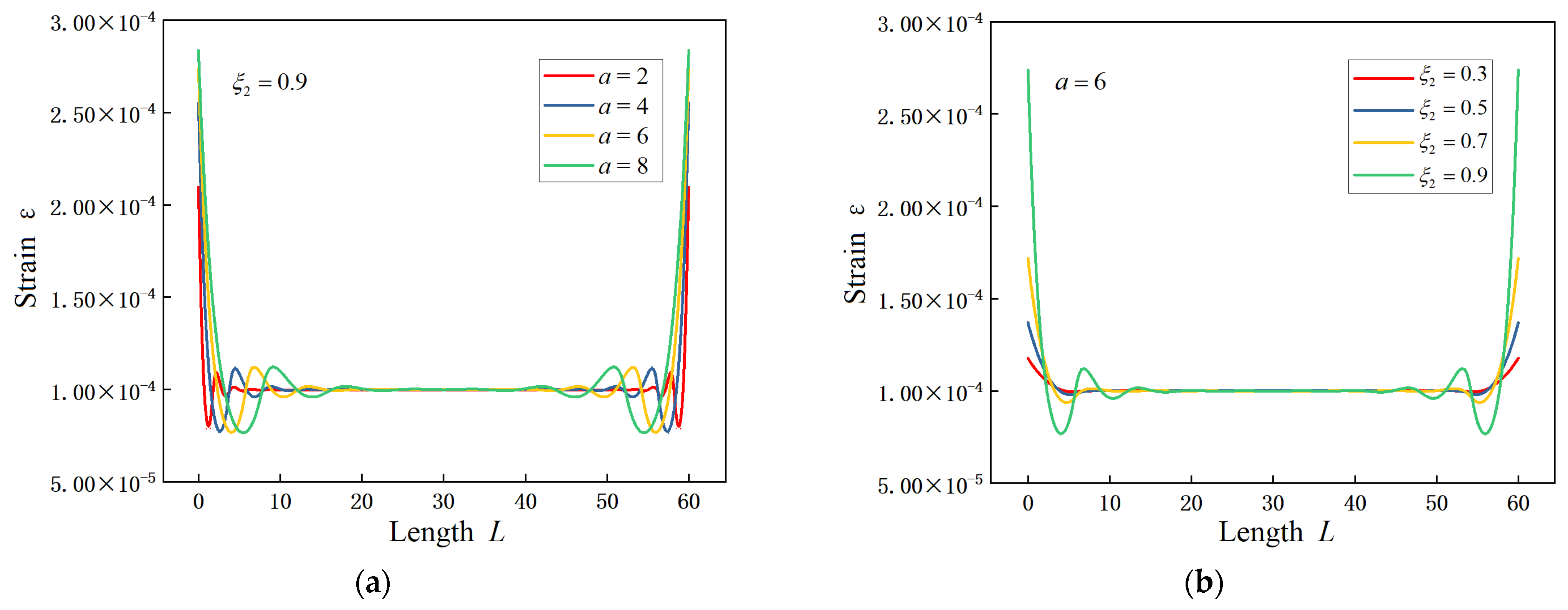
Two symmetry-related aspects are emphasized in this work. First, for symmetric boundary conditions and loadings, the static nonlocal response exhibits symmetric strain distributions (Figure 1, Figure 2 and Figure 3). Second, and more importantly, the belt-wise influence-domain discretization makes the nonlocal coupling structure explicit at the discrete level: the local stiffness (nearest-neighbor interaction) is represented using the classical tridiagonal matrix K 00 , while nonlocal interactions are represented by a family of symmetric submatrices K i i that split into two mirrored half-blocks as the interaction distance increases (Equation (19)). Building on this structure, we develop a symmetry-explicit stiffness construction for the discretized integral operator and combine it with symplectic transfer operations, making reciprocity and energy symmetry transparent at the discrete level.
The main contributions are summarized as follows:
-
We developed a kernel-agnostic symplectic (structure-preserving) integration algorithm for Eringen’s two-phase integral nonlocal rod model, based on belt-wise influence-domain discretization.
-
We established a symmetry-explicit stiffness construction for the discretized integral operator, together with a symmetry-oriented interpretation of the resulting nonlocal coupling pattern and its relation to symmetric near-boundary responses.
-
We performed benchmark validation against analytical and asymptotic results, with an emphasis on robustness for higher-order eigenfrequencies.
The remainder of this paper is organized as follows. Section 2 summarizes the main notation and physical quantities for readability. Section 3 summarizes Eringen’s integral nonlocal constitutive relations. Section 4 presents the symplectic methodology and the belt-wise influence-domain discretization, including the symmetry-explicit stiffness construction. Section 5 reports static and vibration results for representative kernels and parameter settings. Section 6 provides a discussion, and Section 7 concludes the paper.

2. Nomenclature and Physical Quantities

To improve accessibility, we summarize the main symbols used throughout the formulation and the results (Table 1).
For the one-dimensional rod setting considered here, it is convenient to introduce the nonlocal axial force (traction)
N ( x , t ) = E A ξ 1 ε ( x , t ) + ξ 2 0 L α ( | x x | ;   a ) ε ( x , t )   d x ,
so that the axial equilibrium can be written in the compact form: ρ A q ¨ N / x = 0 . In the integral formulation, boundary conditions are stated in the classical essential/natural sense using q and N (no extra constitutive boundary conditions are imposed).

3. Eringen’s Nonlocal Integral Elasticity

For homogeneous and isotropic elastic solids, the integral-type constitutive equation of nonlocal theory can be formulated as [33] follows:
t k l ( x ) = V α ( | x x | ;   κ )   σ k l ( x ) dv ( x ) ,
t k l , k + ρ ( f l u ¨ l ) = 0 ,
σ k l ( x ) = λ e r r ( x ) δ k l + 2 μ e k l ( x ) ,
e k l ( x ) = 1 2 q k ( x ) x l + q l ( x ) x k .
where x denotes the position vector of a material point in the elastic body and x denotes the position vector of an interacting point. The Euclidean distance between the two points is | x x | . For brevity, the explicit time argument is omitted in Equations (1)–(4); in dynamic problems, the fields can depend on t , and the constitutive relation applies at each fixed timepoint.
α ( x x ;   κ ) is the attenuation kernel, which assumes various forms depending on the nonlocal parameter. We use τ ¯ = a / L (the characteristic length ratio) for non-dimensionalization. Here, σ k l ( x ) and e k l ( x ) are the components of the classical (local) stress and strain tensors at x , and t k l ( x ) denotes the corresponding components of the nonlocal stress tensor at x . The quantities ρ , f l , q l , and u ¨ l   represent mass density, body force density, the displacement vector, and the acceleration of the material at the reference point in the body, respectively. V is the region occupied by the body; λ and μ are the Lamé constants; and δ k l is the Kronecker delta. The purely nonlocal model corresponding to Constitutive Relation (1) generates an integral equation of the first kind, which has been reported to lack solutions for the majority of beam problems [34]. Alternatively, a two-phase (local/nonlocal mixture) integral model, widely used in the literature and often referred to as Eringen’s two-phase model, can be written as follows [6,35]:
t k l ( x ) = ξ 1 σ k l ( x ) + ξ 2 V α ( | x x | ;   κ )   σ k l ( x ) d v ( x ) ,
where ξ 1   and ξ 2 represent the mixture parameters of local elasticity and nonlocal elasticity, respectively, with ξ 1   +   ξ 2   = 1 .
Equation (5) is the three-dimensional two-phase constitutive relation written in terms of stress/strain components at material points; as above, the explicit time argument is omitted. The one-dimensional rod model in Section 2 follows from specializing Equation (5) to axial stress and strain, restricting the spatial integral to the rod domain, and combining the resulting constitutive law with the axial force equilibrium.

4. The Symplectic Method for Solving Integro-Differential Equations

This section presents the numerical procedure for solving one-dimensional nonlocal rod problems, including the belt-wise influence-domain discretization and the resulting symplectic transfer formulation. In standard local C0 finite elements, element interfaces provide a natural partition because couplings are essentially nearest neighbors. Under integral nonlocality, however, each point interacts with a finite influence domain, so an interface-only partition is no longer sufficient. We therefore discretize directly over the influence domain and organize the interactions in a belt-wise manner. Here, “belts” enable systematic indexing of influence-domain couplings rather than literal subdomain boundaries.
For a one-dimensional rod, the potential energy (strain energy) can be formulated as follows:
U 2 ( x ) = 0 L 1 2 t k l ( x ) e k l ( x ) d x .
Substituting Equation (5) into Equation (6) yields the potential energy:
U 2 ( x ) = E A 2 ξ 1 0 L ε ( x ) ε ( x ) d x + ξ 2 0 L 0 L ε ( x ) α ( | x x | ;   a ) ε ( x ) d x d x .
The potential energy comprises two components: the local part,
U 2 L ( x )   = E A ξ 1 2 0 L ε 2 ( x ) d x = E A ξ 1 2 0 L q ( x ) x 2 d x ,
and the nonlocal part,
U 2 α ( x ) = E A ξ 2 2 0 L 0 L q ( x ) x α ( | x x | ;   a ) q ( x ) x d x d x .
The kinetic energy is given by
U 1 ( x ) = ρ A 2 0 L q ˙ 2 ( x , t ) d x .
The corresponding variational principle (Hamilton’s principle) is
S = t 0 t 1 U 1 ( x , t ) U 2 ( x , t )   d t .
Assuming the influence distance is l a with α x x ;   a = 0 when x x > l a , carrying out the variation yields a Volterra-type integro-differential equation that can be written as
ρ A q ¨ ( x , t ) E A x ξ 1 q ( x , t ) x + ξ 2 0 L α ( | x x | ;   a ) q ( x , t ) x d x = 0 .
The outer x -derivative expresses the axial force equilibrium; the compact support assumption α x x ;   a = 0 for x x > l a means the integral contributes only over the influence domain.
For time-harmonic (or wave-like) motion, we introduce the phase variable ζ = k x ω t and write
q ( x , t ) = q ( ζ ) = q ( k x ω t ) .
With the belt-wise influence-domain discretization [27], the kinetic energy and potential energy for the rod can be discretized as
U 1 ( x ) = ρ A ω 2 2 η 2 q k 2 + 2 q k + 1 2 + + 2 q k + n 1 2 + q k + n 2 = q T M q / 2 ,
where
M = 2 1 1 2 1 1 2 1 1 2 ρ A η ω 2 2 , q = q k q k + 1 q k + n .
Let the influence domain be divided into n regular parts with l a = n η , enabling discretization of the integral process. The potential energy U2L (x) corresponding to traditional local theory can be written as
U 2 L ( q k , q k + n ) = U 2 , k ( q k , q k + 1 ) + U 2 , k + 1 ( q k + 1 , q k + 2 ) + + U 2 , k + n 1 ( q k + n 1 , q k + n ) = ξ 1 E A 2 η ( q k + 1 q k ) 2 + ( q k + 2 q k + 1 ) 2 + + ( q k + n 1 q k + n ) 2 = q k q k + 1 q k + n T ξ 1 E A 2 η 1 1 0 1 2 1 0 1 0 2 1 0 1 1 q k q k + 1 q k + n = q k q k + 1 q k + n T K L q k q k + 1 q k + n / 2   .
To implement stepwise integration calculation, consider the potential energy of an integral step x k ~ x k 1 ( x k x k 1 = η ):
U 2 α ( q k 1 , q k ) = E A 2 ξ 2 k η η k η q ( x ) x 0 a α ( | s | ;   a ) q ( x s ) s d s d x .
The one-dimensional linear strain tensor within an integral step η is
e x = q ( x ) x = Δ l η = q k q k 1 η .
Therefore, U2α (x) can be further rewritten as
U 2 α ( q k , q k + n ) = U 2 , k ( q k , q k + 1 ) + U 2 , k + 1 ( q k + 1 , q k + 2 ) + + U 2 , k + n 1 ( q k + n 1 , q k + n )   = q k n q k q k + n T E A 4 α 0 K 0 + E A 2 α 1 K 1 + + E A 4 α n K n q k n q k q k + n = q k n q k q k + n T K α q k n q k q k + n / 2   ,
where K i = 0 0 0 K i i is a block matrix whose nonzero block K i i ( n + i + 1 ) × ( n + i + 1 )     ( i = 1 , , n ) is a symmetric “split” stiffness submatrix inside the influence domain. The key feature (useful for both implementation and interpretation) is progressive symmetric splitting: K 00 is the standard tridiagonal stiffness, and K i i ( i 1 ) is formed by two identical half- K 00 blocks that move away from each other while remaining symmetric about the main diagonal.
Define the base matrix K 00 ( n + 1 ) × ( n + 1 ) ,
( K 00 ) j j = 1 , j = 1   or   j = n + 1 , 2 , j = 2 , , n , ( K 00 ) j , j + 1 = ( K 00 ) j + 1 , j = 1     ( j = 1 , , n ) ,
and its half-splitting H = 1 2 K 00 (diagonal entries 0.5 , 1 , , 1 , 0.5 and first off-diagonals 0.5 ). For each i { 0 , 1 , , n } , let N i = n + i + 1 , and introduce two embedding matrices
E 0 = I n + 1 0 ( n + 1 ) × i ( n + 1 ) × N i , E i = 0 ( n + 1 ) × i I n + 1 ( n + 1 ) × N i .
Then, the whole group can be written compactly:
K i i = E 0 T H E i + E i T H E 0 , i = 0 , 1 , , n .
Equation (19) provides an explicit symmetric construction of K i i using selection/embedding matrices. Here, E 0 and E i pick two shifted sets of (n + 1) degrees of freedom (DOFs) from the (n + i + 1)-DOF influence-domain vector, and the two terms in Equation (19) embed H into K i i as a symmetric pair of contributions.
When i = 0, E 0 = E i , and the two contributions coincide, yielding K 00 = 2 H , i.e., the standard local (nearest-neighbor) stiffness matrix. When 0 i n , the two embedded contributions partly overlap on shared DOFs (recovering the same local tridiagonal core there) and simultaneously produce two mirrored off-overlap parts. These off-overlap parts correspond to long-range coupling over an interaction distance of approximately i η . As i increases, the overlap decreases, and the two mirrored long-range parts progressively separate, while the symmetry of K i i is preserved. This progressive, symmetry-preserving splitting is the key structural feature exploited by the symmetric stiffness assembly.
This structure is well aligned with the scope of Symmetry and is broadly applicable. (i) Kernel-agnosticity: the matrix pattern of K i i is fixed by the discretization, whereas different attenuation kernels affect only the scalar weights (the α i factors) used to multiply each interaction distance. (ii) Influence-range generality: Changing the influence domain changes n (via l a = n η ) and therefore the size and separation of the mirrored blocks, but not the symmetric construction itself.
Because the kernel weights typically decay rapidly with i, far-field couplings often become small at macroscopic scales. Conversely, when the size of an element is comparable to or less than the characteristic length, the weighted K i i terms remain significant, and size effects should be retained.
Equations (15), (18), and (19) give the discrete kinetic and potential energies for an interior (non-boundary) elementary sub-structure spanning one influence distance. Boundary sub-structures can be addressed in the same belt-wise manner by adapting the vectors and stiffness assembly; for brevity, their explicit energy expressions are omitted here. The energy of an elementary sub-structure can then be written in quadratic form:
U ( q a , q b ) = U 1 ( x ) + U 2 ( x ) = 1 2 q a q b T R q a q b , R T = R .
The corresponding transfer relation is written as
v a = q a ,   p a T , v b = q b ,   p b T , v b = S v a ,
with the dual force variables defined by
p a = U / q a ,   p b = U / q b .
Here, v a ,   v b   are the state vectors, and p a ,   p b are the dual force variables. The transfer matrix S is symplectic and computed from the assembled belt-wise stiffness matrix R (including both local and nonlocal contributions, with the local stiffness embedded/zero-padded to match the influence-domain size); see [24]. The nonlocal rod problem is thus transferred into a Hamiltonian/symplectic framework.
Initial- and boundary-value problems are then solved in transfer-matrix form. The transfer occurs between adjacent belts that do not share any common points, although each elementary sub-structure may include internal points that are eliminated in the assembly. Consequently, the transfer operation resembles a forward jump, with a minimum step size associated with belt width a. Continuous integral models, however, require arbitrary step sizes; this is handled using the step-increase algorithm in [24].

5. Results

5.1. Static Calculations

Boundary conditions: The static benchmark corresponds to a tension rod subjected to an axial force F applied at the ends. Under the present integral setting, the natural boundary condition is prescribed nonlocal axial force N ( 0 ) = N ( L ) = F (equivalently, constant axial traction), while displacement is defined up to a rigid translation; without loss of generality, we set a reference, such as q ( 0 ) = 0 .
Pisano [9] derived exact solutions for two Volterra integral equations:
e ( x ) = F 2 E A 1 λ a e ( λ a x x ) / a ,
e + ( x ) = F 2 E A 1 λ a e ( λ a L λ a x L + x ) / a ,
where a is the characteristic length. The complete solution is
e ( x ) = F E A λ a 2 F E A e ( λ a L λ a x L + x ) / a + e ( λ a x x ) / a , x [ 0 ,   L ] , λ = ξ 2 2 a ξ 1 .
For the exponential kernel function,
α ( | x x | ;   a ) = 1 2 a e   | x x | a
Numerical solutions for different ξ 2 values were obtained using this symplectic approach. Under the settings used here, interior errors can reach O ( 10 2 ) , while global errors may increase with ξ 2 / ξ 1 due to dominant near-boundary effects; see Table 2 and Table 3.
The order of the transfer symplectic matrix of the elementary sub-structure is 24 × 24 , suggesting relatively high computational efficiency. However, linear interpolation with large spatial steps can still introduce noticeable errors. The relative errors of maximum strain increase with the mixture parameter ξ 2 (Table 2). This trend is consistent with observations reported in [9,12]. When ξ 2 / ξ 1 is large, Volterra-equation-based derivations or iterative schemes may become inaccurate or unstable. The sharp increase in errors for ξ 2 > 0.6 in Table 2 is in line with this limitation. Accuracy can be improved by reducing the spatial step size (Table 4).
In practice, we assess numerical accuracy through step refinement: the step size η (equivalently, the transfer-matrix order within an influence distance) is reduced until the target quantities (e.g., maximum strain or eigenfrequencies) change negligibly between successive refinements; Table 4 provides evidence of this convergence trend for the static benchmark.
The boundary-affected region and boundary stress depend strongly on the characteristic length. The results (Figure 1a) show that the maximum strain slightly overestimates the analytical solution, and the influence range of the boundary effect expands as the characteristic length a increases. The accuracy improves as the step length is reduced. Similarly, the boundary-affected region and boundary strain values converge as the spatial step number decreases. In addition, the boundary-affected region expands with an increase in the mixture parameter ξ 2 (Figure 1b).
For comparison, we also present results for Gaussian and triangular kernels. Their respective forms are given below.
Gaussian   kernel :   α ( | x x | ) = 1 2 a π e | x x | 2 4 a 2 ,
Triangular   kernel :   α ( | x x | ) = 1 a ( 1 | x x | a ) , | x x | a 1 0 ,   | x x | a > 1 .
Numerical solutions with different kernel functions exhibit common characteristics (Figure 2 and Figure 3). Boundary effects intensify with an increase in the mixture parameter ξ 2 , and the influence range of boundary effects expands as characteristic length a increases.

5.2. Dynamic Calculations

Boundary conditions. For longitudinal free vibration, the essential boundary condition for a clamped end is q = 0 , while the natural condition for a free end is vanishing nonlocal axial force N = 0 . Accordingly, the clamped–clamped case involves q ( 0 ) = q ( L ) = 0 , and the clamped–free case involves q ( 0 ) = 0 and N ( L ) = 0 .
To further validate the method, we computed numerical eigenfrequencies for nonlocal rod vibrations. Asymptotic solutions are available for longitudinal rod vibrations [12]. The asymptotic solutions for the vibration frequency of clamped–clamped rods can be written in the following way:
ω ¯ = n π ( 1 α 1 τ ¯ α 2 τ ¯ 2 α 3 τ ¯ 3 ) + ϑ ( τ ¯ 4 ) ,
where
τ ¯ = a L , ω ¯ = ω L ρ E ,
α 1 = 2 ( 1 ξ 1 ) ,
α 2 = 1 2 1 ξ 1 π 2 n 2 ξ 1 + 1 8 ( 1 ξ 1 ) ,
α 3 = ( 1 ξ 1 ) 24 ( 1 + ξ 1 2 ξ 1 ) + n 2 π 2 ( 4 ξ 1 5 ξ 1 11 ) .
Equation (29) was adopted from the published asymptotic analysis in [12] and is used here only as a benchmark for validating the proposed numerical scheme.
In [12], the governing equation and boundary conditions of the two-phase integral rod model were first deduced from Hamilton’s principle for an exponential kernel. Through a sequence of manipulations of the convolution term, the integro-differential equation is reduced to a fourth-order ordinary differential equation with mixed boundary conditions (equivalent to the original clamped–clamped or clamped–free conditions). In particular, the manipulation introduces endpoint strain/derivative terms (e.g., u / x at x = 0 and x = L ). These terms are then fixed consistently by the boundary conditions, resulting in a mixed boundary-value problem for the reduced fourth-order ODE.
The natural frequencies are then obtained via a small- τ ¯ asymptotic expansion, leading to perturbation-series formulas with powers of τ ¯ = a / L . Therefore, Equation (29) is expected to be accurate primarily when τ ¯ is sufficiently small and may deteriorate for larger nonlocal parameters and higher-order modes, which is consistent with the comparisons reported later in this section.
As seen from Equation (29), dimensionless frequencies of nonlocal rods are influenced by both the mixture parameter ξ 1 and the dimensionless nonlocal parameter τ ¯ .
The asymptotic solutions to the vibration frequency of clamped–free rods using nonlocal theory can be written as
ω ¯ = ( n π π 2 ) ( 1 β 1 τ ¯ β 2 τ ¯ 2 β 3 τ ¯ 3 ) + ϑ ( τ ¯ 4 ) ,
where
τ ¯ = a L , ω ¯ = ω L ρ E ,
β 1 = 1 ξ 1 ,
β 2 = 1 8 π 2 ( 1 2 n ) 2 ( 1 ξ ) ξ 1 1 2 ,
β 3 = ( 1 ξ ) 1 + ξ 1 2 ξ 1 + 1 24 2 n 1 2 π 2 ( 4 ξ 1 11 ξ 1 11 ) .
Comparisons (Table 5 and Table 6) show reasonable agreement between asymptotic and numerical solutions, with an average relative error of less than 2%.
Table 7, Table 8, Table 9 and Table 10 compare our method and asymptotic solutions for clamped–free and clamped–clamped rods under different kernel functions. The results show close agreement, with all relative errors being below 2%.
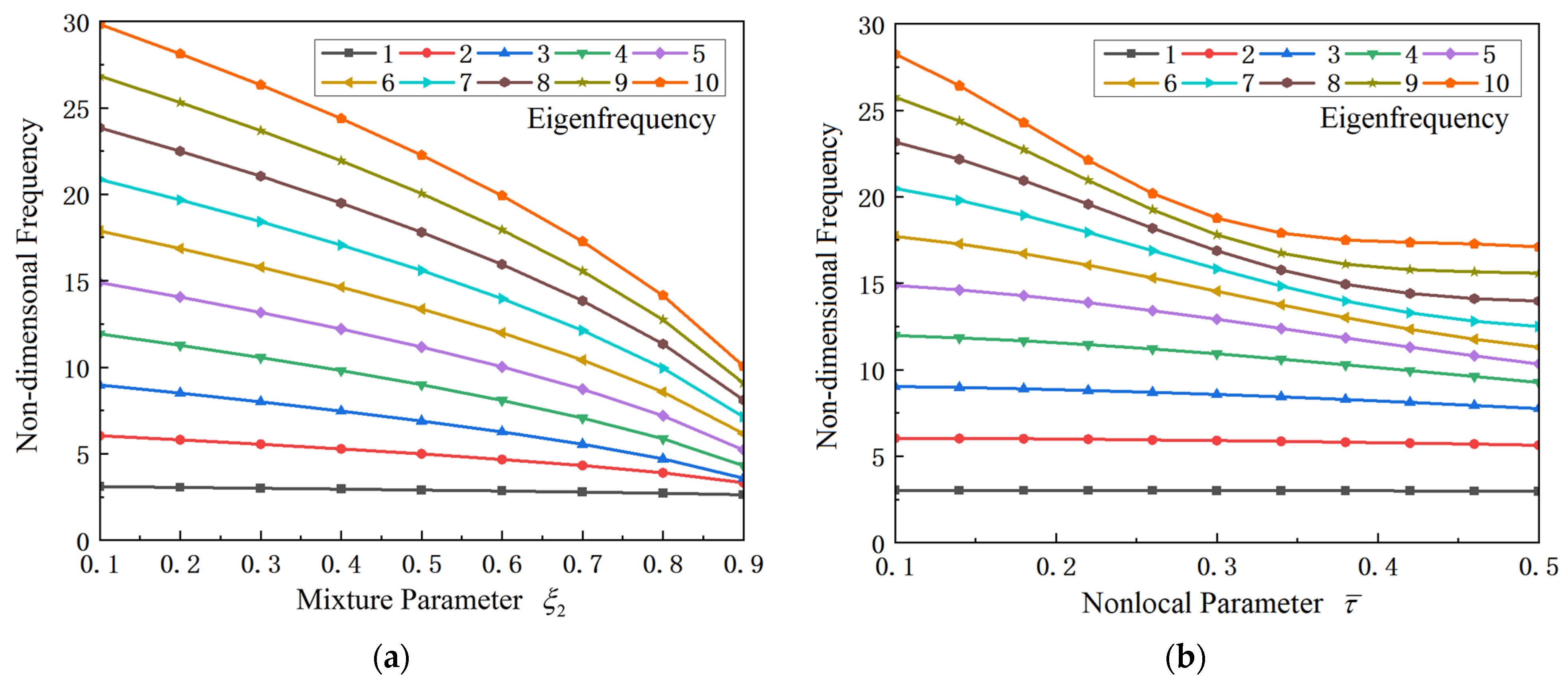
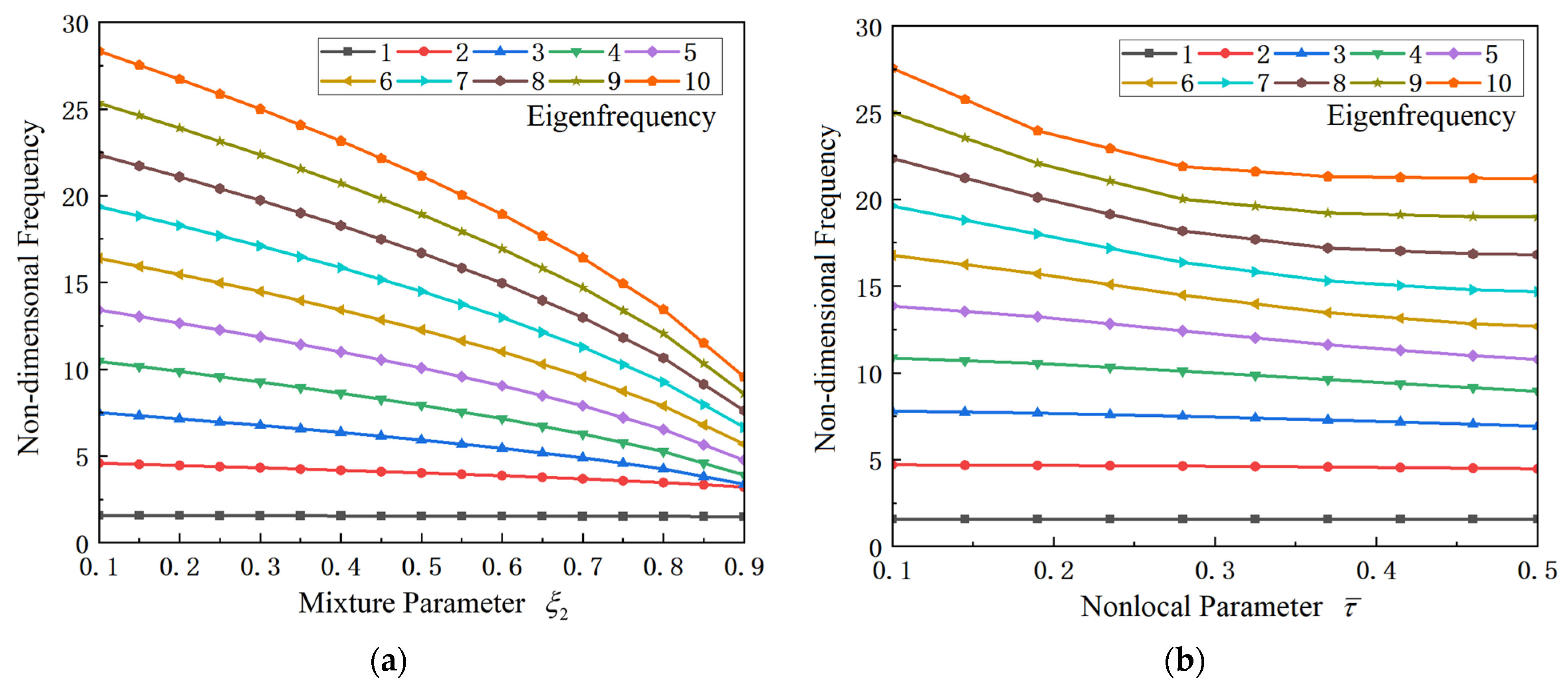
As shown in Figure 4 and Figure 5, the natural frequency decreases with the increase in the mixture parameter ξ 2 and dimensionless nonlocal parameter τ ¯ . The same trend can be observed as the characteristic length increases. Further results show that both the mixture parameter and the characteristic length have a greater impact on higher-order frequencies than on lower-order frequencies. These observations indicate that both the mixture parameter and the characteristic length have a softening effect on the effective stiffness of the nonlocal rod, which is consistent with the trends reported in prior studies [1,12,34].
It is also worth noting that the asymptotic solutions cited in this paper are accurate only within a certain range. Table 11 and Table 12 present the vibration frequencies of clamped–clamped and clamped–free nonlocal rods under the influence of different characteristic lengths. A comparison between the symplectic numerical solutions (our method) and the theoretical asymptotic solutions shows that when the nonlocal parameter τ ¯ is relatively large, the higher-order frequencies from the asymptotic formulas can deviate substantially and may even become negative in some cases. By comparison, the frequencies computed using our method remain non-negative in these cases and follow the expected monotonic trends with respect to ξ 2 and τ ¯ . These results suggest that our method can be applied over a wider parameter range than the asymptotic formulas.

6. Discussion

The symplectic integration framework developed here provides an efficient method for solving linear second-order Volterra integro-differential equations arising from Eringen’s two-phase integral nonlocal constitutive model, without requiring a specific kernel form. In the examples considered, the belt-wise discretization captures the expected near-boundary behavior of integral nonlocality and yields appropriate numerical results for both static response and eigenfrequency calculations.
From the standpoint of symmetry, an additional outcome is that the discretized nonlocal stiffness exhibits an explicit symmetric splitting-and-separation structure (Equation (19)): long-range couplings appear as mirrored block pairs whose separation scales with the interaction distance, while kernel selection only rescales their weights. This symmetry-explicit construction makes reciprocity transparent and facilitates extension to arbitrary kernels and influence ranges by changing only the scalar coefficients and n (with l a = n η ).
More broadly, the Hamiltonian/symplectic formulation provides a principled way to maintain a conservative structure in computations. When combined with the symplectic transfer operation, the symmetry/structure preservation suppresses spurious numerical dissipation or amplification during iteration and improves robustness in eigenfrequency computations, especially for higher-order modes and larger nonlocal parameters, where non-structure-preserving approximations may deteriorate.
In terms of statics, the numerical solutions are in good agreement with the available analytical results. The nonlocal contribution is primarily concentrated near the boundaries: interior strains remain close to the classical local prediction, whereas the boundary-affected region expands as the characteristic length a increases, and the near-boundary effect intensifies as the nonlocal mixture parameter ξ 2 increases. Accordingly, when a and ξ 2 are fixed, changing the kernel mainly affects the spatial extent of the boundary-affected region rather than the interior strain levels.
In dynamics, the computed natural frequencies decrease with an increase in a (equivalently, τ ¯ = a / L ) and ξ 2 , and the softening effect becomes more pronounced for higher-order modes. Comparisons with published asymptotic expressions show good agreement within their intended ranges, whereas at larger values of τ ¯ , the asymptotic expansions can deviate substantially and may even produce nonphysical (negative) values for higher modes. Numerically, accuracy improves as the spatial step is refined, reflecting the role of interpolation/discretization error in resolving steep near-boundary variations.
These results were obtained for linear one-dimensional rod models and the kernels examined. Within this scope, the Hamiltonian/symplectic framework offers an efficient tool for parametric studies of size effects and high-order vibrations in nonlocal rod-type structures.

7. Conclusions

In this work, we developed a Hamiltonian/symplectic formulation for Eringen’s two-phase integral nonlocal rod model and demonstrated a kernel-agnostic belt-wise discretization for both static and eigenfrequency analyses.
The main conclusions are given below:
(1)
The transfer-matrix implementation reproduces the expected near-boundary behavior of integral nonlocality and converges under step refinement.
(2)
The discretized nonlocal stiffness exhibits an explicit symmetric splitting-and-separation structure (Equation (19)) that is independent of the specific kernel shape (kernel choice only enters the picture through scalar weights).
(3)
The present method remains stable for higher-order eigenfrequencies in regimes where asymptotic formulas can deviate substantially and may even yield nonphysical artifacts (e.g., negative values) at larger nonlocal parameters.
(4)
Overall, the formulation can be viewed as a symmetry-explicit discretization within a Hamiltonian setting: symmetry of the assembled discrete stiffness is made explicit for both local and nonlocal couplings and combined with a structure-preserving (symplectic) transfer operation, helping to prevent artificial decay or divergence in higher-order computations and supporting stable eigenfrequency predictions, in line with general structure-preserving viewpoints for conservative dynamics [26,30].
Extensions to more complex members (such as beams/plates), additional physics, and parameter identification from experiments or dispersion data are natural next steps.

Author Contributions

Conceptualization, Z.Y.; methodology, Z.Y. and C.Z.; data curation, Z.Y. and L.W.; writing—original draft preparation, Z.Y.; writing—review and editing, Z.Y. and L.W.; supervision, Z.Y. All authors have read and agreed to the published version of the manuscript.

Funding

This research received no external funding.

Data Availability Statement

The data supporting the findings of this study are available at Zenodo: https://doi.org/10.5281/zenodo.18072524 accessed on 23 March 2026.

Acknowledgments

During the preparation of this manuscript, the authors used GitHub Copilot (GPT-5.2) for language editing and polishing only. The authors reviewed and edited the content as needed and take full responsibility for the content of the publication.

Conflicts of Interest

Author Lulu Wen is currently employed by Shandong Linglong Tyre Co., Ltd. This employment began after graduation. The company had no role in the design of the study; in the collection, analyses, or interpretation of data; in the writing of the manuscript; or in the decision to publish the results. The remaining authors declare that the research was conducted in the absence of any commercial or financial relationships that could be construed as a potential conflict of interest.

References

  1. Reddy, J. Nonlocal theories for bending, buckling and vibration of beams. Int. J. Eng. Sci. 2007, 45, 288–307. [Google Scholar] [CrossRef]
  2. Romano, G.; Barretta, R.; Diaco, M.; de Sciarra, F.M. Constitutive boundary conditions and paradoxes in nonlocal elastic nanobeams. Int. J. Mech. Sci. 2017, 121, 151–156. [Google Scholar] [CrossRef]
  3. Eltaher, M.A.; Khater, M.E.; Emam, S.A. A review on nonlocal elastic models for bending, buckling, vibrations, and wave propagation of nanoscale beams. Appl. Math. Model. 2016, 40, 4109–4128. [Google Scholar] [CrossRef]
  4. Barretta, R.; Faghidian, S.A.; Luciano, R. Longitudinal vibrations of nano-rods by stress-driven integral elasticity. Mech. Adv. Mater. Struct. 2019, 26, 1307–1315. [Google Scholar] [CrossRef]
  5. Barretta, R.; Čanadija, M.; Marotti de Sciarra, F. Modified Nonlocal Strain Gradient Elasticity for Nano-Rods and Application to Carbon Nanotubes. Appl. Sci. 2019, 9, 514. [Google Scholar] [CrossRef]
  6. Eringen, A.C. Theory of nonlocal elasticity and some applications. Res Mech. 1987, 21, 313–342. [Google Scholar]
  7. Qing, H. Size-dependent nonlinear forced vibration of microbeam using two-phase local/nonlocal viscoelastic integral model with thermal effects. J. Vib. Control. 2024, 30, 4421–4437. [Google Scholar] [CrossRef]
  8. Zhang, P.; Qing, H. Thermoelastic analysis of nanobar based on nonlocal integral elasticity and nonlocal integral heat conduction. J. Therm. Stress. 2021, 44, 1244–1261. [Google Scholar] [CrossRef]
  9. Pisano, A.A.; Fuschi, P. Closed form solution for a nonlocal elastic bar in tension. Int. J. Solids Struct. 2003, 40, 13–23. [Google Scholar] [CrossRef]
  10. Zhu, X.; Li, L. Twisting statics of functionally graded nanotubes using Eringen’s nonlocal integral model. Compos. Struct. 2017, 178, 87–96. [Google Scholar] [CrossRef]
  11. Tuna, M.; Kirca, M. Exact solution of Eringen’s nonlocal integral model for bending of Euler-Bernoulli and Timoshenko beams. Int. J. Eng. Sci. 2016, 105, 80–92. [Google Scholar] [CrossRef]
  12. Zhu, X.; Li, L. Longitudinal and torsional vibrations of size-dependent rods via nonlocal integral elasticity. Int. J. Mech. Sci. 2017, 133, 639–650. [Google Scholar] [CrossRef]
  13. Koutsoumaris, C.C.; Eptaimeros, K.; Tsamasphyros, G. A different approach to Eringen’s nonlocal integral stress model with applications for beams. Int. J. Solids Struct. 2017, 112, 222–238. [Google Scholar] [CrossRef]
  14. Koutsoumaris, C.C.; Eptaimeros, K. Nonlocal integral static problems of nanobeams resting on an elastic foundation. Eur. J. Mech. A/Solids 2021, 89, 104295. [Google Scholar] [CrossRef]
  15. Pisano, A.; Sofi, A.; Fuschi, P. Nonlocal integral elasticity: 2D finite element based solutions. Int. J. Solids Struct. 2009, 46, 3836–3849. [Google Scholar] [CrossRef]
  16. Schwartz, M.; Niane, N.; Njiwa, R.K. A simple solution method to 3D integral nonlocal elasticity: Isotropic-BEM coupled with strong form local radial point interpolation. Eng. Anal. Bound. Elem. 2012, 36, 606–612. [Google Scholar] [CrossRef]
  17. Zou, D.; Liu, G.; Rao, Z.; Tan, T.; Zhang, W.; Liao, W.-H. A device capable of customizing nonlinear forces for vibration energy harvesting, vibration isolation, and nonlinear energy sink. Mech. Syst. Signal Process. 2021, 147, 107101. [Google Scholar] [CrossRef]
  18. He, D.; Yang, N.; Liu, Y.; Xu, H.; Li, G.; Duan, Z.; Wang, T. Nonlinear vibration and vibration transmission of roll controlled by negative stiffness vibration absorbers. Mech. Syst. Signal Process. 2026, 245, 113872. [Google Scholar] [CrossRef]
  19. Ma, W.; Bai, B.; Li, X.; Li, J.; Wang, S.; Chen, G. Vibration characteristics of integrally mistuned turbine blisks with hard-coating and bladed multi-packet shrouds. J. Sound Vib. 2026, 625, 119607. [Google Scholar] [CrossRef]
  20. Liu, Q.H.; Liu, Q.; Zhou, Y.; Liu, J.; Dai, Y.; Chen, S.; Dai, T. Identifying vibration characteristics of hemispherical resonators with mass defects. Int. J. Mech. Sci. 2025, 306, 110856. [Google Scholar] [CrossRef]
  21. Mondal, S.; Sur, A. Modeling of nonlocal Caputo-Fabrizio integral models in a nanoscale resonator. Int. J. Comput. Methods Eng. Sci. Mech. 2024, 25, 381–395. [Google Scholar] [CrossRef]
  22. Nikpourian, A.; Ghazavi, M.R.; Azizi, S. Size-dependent modal interactions of a piezoelectrically laminated microarch resonator with 3:1 internal resonance. Appl. Math. Mech.-Engl. Ed. 2020, 41, 1517–1538. [Google Scholar] [CrossRef]
  23. Dai, J.; Yang, C.; Gai, P.-P.; Xu, Z.-D.; Yan, X.; Xu, W.-P. Robust damping improvement against the vortex-induced vibration in flexible bridges using multiple tuned mass damper inerters. Eng. Struct. 2024, 313, 118221. [Google Scholar] [CrossRef]
  24. Yao, Z.; Zhang, H.; Zhong, W. Time delay and inter-belt. Chin. J. Dyn. Control. 2012, 10, 97–106. [Google Scholar] [CrossRef]
  25. Zhong, W.; Zhong, X. Method of separation of variables and Hamiltonian system. Numer. Methods Partial Differ. Equ. 1993, 9, 63–75. [Google Scholar] [CrossRef]
  26. Yao, W.; Zhong, W.; Lim, C. Symplectic Elasticity; World Scientific: Singapore, 2009. [Google Scholar] [CrossRef]
  27. Yao, Z.; Zheng, C.; Zhong, W. Inter-belt analysis of continuous system. Chin. J. Comput. Mech. 2013, 30, 749–756. [Google Scholar] [CrossRef]
  28. Lim, C.W.; Zhang, G.; Reddy, J.N. A higher-order nonlocal elasticity and strain gradient theory and its applications in wave propagation. J. Mech. Phys. Solids 2015, 78, 298–313. [Google Scholar] [CrossRef]
  29. Huang, M.; Zheng, X.; Zhou, C.; An, D.; Li, R. On the symplectic superposition method for new analytic bending, buckling, and free vibration solutions of rectangular nanoplates with all edges free. Acta Mech. 2021, 232, 495–513. [Google Scholar] [CrossRef]
  30. Zhong, W.X.; Sun, Y. Small-parameter perturbation method and symplecticity. Chin. J. Dyn. Control. 2005, 3, 1–6. [Google Scholar] [CrossRef]
  31. Zhong, W.X. Symplectic Solution Methodology in Applied Mechanics; Higher Education Press: Beijing, China, 2006. [Google Scholar]
  32. Wu, F.; Gao, Q.; Zhong, W.X. Multiscale symplectic perturbation integration for the FPU equation. Chin. J. Comput. Mech. 2015, 32, 587–594. [Google Scholar] [CrossRef]
  33. Eringen, A.C. On differential equations of nonlocal elasticity and solutions of screw dislocation and surface waves. J. Appl. Phys. 1983, 54, 4703–4710. [Google Scholar] [CrossRef]
  34. Benvenuti, E.; Simone, A. One-dimensional nonlocal and gradient elasticity: Closed-form solution and size effect. Mech. Res. Commun. 2013, 48, 46–51. [Google Scholar] [CrossRef]
  35. Eringen, A.C. Nonlocal Continuum Field Theories; Springer: New York, NY, USA, 2002. [Google Scholar]
Figure 1. Strain distribution along the rod in the inter-belt model with the exponential kernel: (a) effect of characteristic length a with ξ 2 = 0.3 , and (b) effect of mixture parameter ξ 2 with a = 5 .
Symmetry 18 00571 g001
Figure 2. Strain distribution along the rod in the inter-belt model with the Gaussian kernel: (a) effect of characteristic length a with ξ 2 = 0.6 , and (b) effect of mixture parameter ξ 2 with a = 5 .
Symmetry 18 00571 g002
Figure 3. Strain distribution along the rod in the inter-belt model with the triangular kernel: (a) effect of characteristic length a with ξ 2 = 0.9 , and (b) effect of mixture parameter ξ 2 with a = 6 .
Symmetry 18 00571 g003
Figure 4. Variation in eigenfrequency with respect to key parameters for the exponential-kernel rod model (clamped–clamped): (a) eigenfrequency versus mixture parameter ξ 2 , and (b) eigenfrequency versus nonlocal parameter τ ¯ .
Symmetry 18 00571 g004
Figure 5. Variation in eigenfrequency with respect to key parameters for the Gaussian-kernel rod model (clamped–free): (a) eigenfrequency versus mixture parameter ξ 2 , and (b) eigenfrequency versus nonlocal parameter τ ¯ .
Symmetry 18 00571 g005
Table 1. Summary of the main symbols used in this work.
SymbolMeaning
x [ 0 ,   L ] Axial coordinate and rod domain
LRod length
A Cross-sectional area
EYoung’s modulus
ρ Mass   density   ( so   ρ A is mass per unit length)
q ( x , t ) Axial displacement
ε x , t = q / x Axial strain
ξ 1 ,   ξ 2 Two-phase mixture   parameters   with   ξ 1 + ξ 2   = 1
α ( x x ;   a ) Attenuation kernel with characteristic length a
τ ¯ = a / L Dimensionless nonlocal parameter
l a Influence distance (support for the kernel, which may be finite)
η Spatial step used in belt-wise discretization
n Number   of   steps   within   the   influence   distance ,   l a = n η
ω ,   ϕ ( x ) Natural frequency and mode shape
ω ¯ = ω L ρ / E Dimensionless frequency
Table 2. Comparison of maximum strain between the numerical and analytical solutions for a tension rod with the exponential kernel under different mixture parameters ξ 2   ( τ ¯ = 1 / 60 ) .
ξ 2 Our MethodAnalytical SolutionsRelative Error
0.11.0391.0281.08%
0.21.0841.0631.97%
0.31.1361.1072.62%
0.41.1981.1672.63%
0.51.2731.2501.80%
0.61.3361.3750.65%
0.71.4891.5835.94%
0.81.6602.00017.0%
Table 3. Comparison of minimum strain between the numerical and analytical solutions for a tension rod with the exponential kernel under different mixture parameters ξ 2   ( τ ¯ = 1 / 60 ) .
ξ 2 Our MethodAnalytical SolutionsRelative Error
0.10.99811.0000.19%
0.20.99751.0000.25%
0.30.99751.0000.25%
0.40.99671.0000.33%
0.50.99541.0000.46%
0.60.99501.0000.50%
0.70.99381.0000.62%
0.80.99471.0000.73%
Table 4. Relative error in maximum strain for a tension rod with the exponential kernel versus the spatial step ( ξ 2 = 0.8 , τ ¯ = 1 / 60 ).
Order of Transfer MatrixOur MethodAnalytical SolutionsRelative Error
24 × 241.6602.00017.0%
48 × 481.8262.0008.29%
72 × 721.9192.0004.04%
96 × 962.0722.0003.58%
Table 5. Eigenfrequencies of a clamped–clamped rod using the exponential kernel ( ξ 2 = 0.2 , τ ¯ = 0.01 ).
EigenfrequencyOur MethodAsymptotic SolutionsRelative Error
1st3.11373.13470.67%
2nd6.21326.26760.88%
3rd9.32229.39690.08%
4th12.412112.52090.87%
5th15.492415.63780.93%
6th18.563118.74580.97%
7th21.624621.84311.00%
8th24.657524.93791.12%
9th27.680427.99851.14%
10th30.684531.05311.19%
Table 6. Eigenfrequencies of a clamped–free rod using the exponential kernel ( ξ 2 = 0.2 , τ ¯ = 0.01 ).
EigenfrequencyOur MethodAsymptotic SolutionsRelative Error
1st1.55931.56910.62%
2nd4.66824.70640.81%
3rd7.76777.84100.93%
4th10.867110.97110.95%
5th13.957014.09490.98%
6th17.027917.21061.06%
7th20.098720.31631.07%
8th23.140923.41031.15%
9th26.173626.49091.20%
10th29.177729.55611.28%
Table 7. Eigenfrequencies of a clamped–clamped rod using the Gaussian kernel ( ξ 2 = 0.5 , τ ¯ = 0.001 ).
EigenfrequencyOur MethodAsymptotic SolutionsRelative Error
1st3.13283.13970.22%
2nd6.27046.27940.14%
3rd9.40809.41910.12%
4th12.545612.55850.10%
5th15.673615.69780.15%
6th18.820718.83690.09%
7th21.958421.97560.08%
8th25.095925.11410.07%
9th28.243128.25220.03%
10th31.380131.38980.03%
Table 8. Eigenfrequencies of a clamped–free rod using the Gaussian kernel ( ξ 2 = 0.5 , τ ¯ = 0.001 ).
EigenfrequencyOur MethodAsymptotic SolutionsRelative Error
1st1.56881.57030.01%
2nd4.70644.71100.01%
3rd7.83447.85160.22%
4th10.972010.99200.18%
5th14.109614.13230.29%
6th17.247217.27240.16%
7th20.384820.41230.13%
8th23.522423.55180.12%
9th26.669526.69100.08%
10th29.807129.82980.08%
Table 9. Eigenfrequencies of a clamped–clamped rod using the triangular kernel ( ξ 2 = 0.8 , τ ¯ = 0.005 ).
EigenfrequencyOur MethodAsymptotic SolutionsRelative Error
1st3.14243.12430.58%
2nd6.27996.24620.54%
3rd9.41759.36480.56%
4th12.555112.47800.62%
5th15.683215.58400.63%
6th18.830318.68090.79%
7th21.967921.76690.91%
8th25.105524.84041.05%
9th28.243127.89931.22%
10th31.380130.94201.40%
Table 10. Eigenfrequencies of a clamped–free rod using the triangular kernel ( ξ 2 = 0.8 , τ ¯ = 0.005 ).
EigenfrequencyOur MethodAsymptotic SolutionsRelative Error
1st1.56881.56640.02%
2nd4.70644.69840.12%
3rd7.84407.82760.21%
4th10.991110.95220.35%
5th14.129714.07040.42%
6th17.266317.18040.50%
7th20.403920.28040.61%
8th23.541523.36850.73%
9th26.679026.44280.89%
10th29.807129.50171.02%
Table 11. Eigenfrequencies of a clamped–clamped rod with different nonlocal parameters τ ¯ ( ξ 2 = 0.5 ).
EigenfrequencyOur Method
( τ ¯ = 0.08 )
Asymptotic Solutions
( τ ¯ = 0.08 )
Our Method
( τ ¯ = 0.1 )
Asymptotic Solutions
( τ ¯ = 0.1 )
1st2.97072.97082.89442.9281
2nd5.25955.76044.99255.6189
3rd7.12878.18796.89037.8348
4th9.083710.07228.98849.3385
5th11.210411.232111.17239.8925
6th13.403911.486613.37539.2595
7th15.606910.654515.59737.2020
8th17.82898.554917.80993.4827
9th20.05105.006520.0415−2.1360
10th22.2731−0.171622.2635−9.8913
Table 12. Eigenfrequencies of a clamped–free rod with different nonlocal parameters τ ¯ ( ξ 2 = 0.5 ).
EigenfrequencyOur Method
( τ ¯ = 0.08 )
Asymptotic Solutions
( τ ¯ = 0.08 )
Our Method
( τ ¯ = 0.1 )
Asymptotic Solutions
( τ ¯ = 0.1 )
1st1.54971.53031.53061.5196
2nd4.21054.48094.01974.4024
3rd6.20377.10225.91756.8161
4th8.08249.17437.92038.4480
5th10.132810.477710.07568.8954
6th12.297610.792612.26908.1155
7th14.50069.899414.49115.5257
8th16.71317.578616.70360.9031
9th18.93523.610518.9257−6.0648
10th21.1573−2.224721.1478−15.6909
Disclaimer/Publisher’s Note: The statements, opinions and data contained in all publications are solely those of the individual author(s) and contributor(s) and not of MDPI and/or the editor(s). MDPI and/or the editor(s) disclaim responsibility for any injury to people or property resulting from any ideas, methods, instructions or products referred to in the content.