Article

Robust Fault Estimation Based on a Learning Observer for Linear Continuous-Time Systems with State Time-Varying Delay


1
Shijiazhuang Campus, Army Engineering University of PLA, Shijiazhuang 050003, China
2
Department of Information Science and Engineering, Northeastern University, Shenyang 110004, China
*
Author to whom correspondence should be addressed.
Symmetry 2026, 18(3), 479; https://doi.org/10.3390/sym18030479
Submission received: 22 January 2026 / Revised: 7 March 2026 / Accepted: 9 March 2026 / Published: 11 March 2026

Abstract

This study addresses the problem of robust actuator fault estimation for a class of critical linear continuous-time systems subject to state time-varying delays, external disturbances, and actuator faults. A learning observer is proposed to achieve the challenging task of simultaneously estimating both the system states and actuator faults, irrespective of whether the faults are constant or time-varying. A key theoretical contribution is the derivation of a less conservative delay-dependent condition for the existence of the proposed learning observer, which is expressed in terms of linear matrix inequalities (LMIs). The H performance index is employed to attenuate the effects of disturbances to a prescribed level. The efficacy of the proposed strategy is rigorously validated through three illustrative examples, including quantitative performance metrics and a comparative analysis with existing methods.

1. Introduction

The likelihood of errors is increased by the increasingly complex nature of contemporary engineering frameworks. Faults occurring in actuators or sensors can severely degrade system performance, thereby necessitating ever higher standards of safety and reliability. Fault diagnosis in dynamic structures has garnered much scientific interest in recent years [1,2,3]. Among various methodologies, observer-based methods remain prevalent due to their effectiveness and ease of implementation.
By deducting the estimated production from the quantifiable result, the observer-based fault identification and isolation method produces a system residual. Then, by analyzing this residual signal, whether a fault has occurred and its location can be determined. However, fault estimation goes a step further by determining the magnitude, shape, and time evolution of faults—information essential for active fault-tolerant control that maintains nominal performance despite faults. Consequently, significant research has focused on fault estimation, leading to the development of various dedicated observers such as unknown input observers [4,5,6], sliding mode observers [7,8,9], proportional integral observers [10,11,12], learning observers [13,14], and adaptive observers [15,16].
Recent advances have extended these techniques to more complex systems. A structure designed for fault prediction for switched systems based on learning observers was suggested in ref. [13]. A robust learning observer for fuzzy singularly perturbed systems with delays was designed in ref. [14]. Nonlinear Lipschitz systems with sensor faults were addressed via unknown input observers in ref. [4], and generalized proportional-integral observers for robust sensor fault detection were developed in ref. [12]. Fractional-order sliding mode observers were developed for quadrotor UAV actuator fault determination in ref. [8]. Nevertheless, none of these studies took into account the simultaneous existence of external disturbances and state time-varying delays in an instructional observer framework; this research fills that gap.
Numerous technical systems, including rolling mills, nuclear reactors, pneumatic transmission lines, and manufacturing processes, frequently experience time delays [17]. Time delays are known to impair the performance of systems and potentially cause instability, which makes the precise evaluation of systems difficult. Time-delay frameworks have been the subject of extensive research [18,19,20,21,22,23,24]. For instance, the stability of systems subject to time-varying delays was examined in ref. [18]. A fault-tolerant control design based on a robust adaptive fault estimation observer was proposed in ref. [19] for proton exchange membrane fuel cell systems with time delays. In ref. [20], a new adaptive time-delay fault-tolerant estimation method was introduced for trajectory tracking of manipulator systems with actuator faults. Fault diagnosis and fault-tolerant control for a neutral time-delay system was investigated in ref. [21]. Applying a fast adaptive fault prediction approach, the authors of [22] examined fault estimation and active fault-tolerant management for Takagi–Sugeno (T–S) fuzzy models with interval time-varying delays and norm-bounded disturbances. For nonlinear fractional-order systems with time-varying delays, the authors of [23] introduced an observer-based multi-objective fault detection method. This approach was subsequently generalized in ref. [24] to accommodate multiple time-varying delays as well as simultaneous sensor and actuator faults. Given the pervasive nature of time-varying delays and external disturbances in practical applications like network control systems and chemical processes, developing less conservative and robust fault estimation methods is of paramount importance. It is precisely this challenge that this study aims to address.
Learning observer-based fault prediction has received much attention recently [25,26,27,28,29,30,31,32]. An iterative learning observer was successfully incorporated for fault identification and tolerance in nonlinear systems in the groundbreaking work in ref. [25]. For linear continuous-time systems with actuator faults, a learning observer was created in ref. [26] to perform synchronous state and fault estimations. A polytopic learning observer was proposed in ref. [27] for simultaneous state and actuator fault estimation. However, these studies did not consider the effects of time delays. A fuzzy descriptor learning observer was developed in ref. [28] to simultaneously estimate states and actuator faults in T–S fuzzy descriptor systems involving time delays and disturbances. The authors of [29] constructed a novel synthesized learning and sliding mode observer for robust actuator fault reconstruction for a class of T–S fuzzy systems with actuator faults and unknown inputs. The study [30] addressed fault estimation for quasi-linear parameter-varying systems using a generalized learning observer. Moreover, the authors of [31] applied a generalized learning observer to a class of nonlinear algebraic differential parameter-varying systems. The issue of actuator fault identification based on an iterative learning observer was studied in ref. [32] for a spacecraft system with actuator faults, inertia uncertainties, and external disturbances.
As far as the authors are aware, there is no learning observer approach currently in use that specifically addresses state time-varying delays, external disturbances, and actuator faults in a unified LMI framework with explicit existence criteria. Furthermore, while adaptive observer-based fast fault estimation methods [15,22] can handle time-varying faults, they require the derivative of the output error and are therefore more susceptible to noise and discretization issues. Furthermore, inspired by advanced optimization techniques such as tempered fractional gradient descent [33], more efficient learning laws can be developed in the future.
Based on the above discussion, there are few studies using learning observers for continuous-time linear systems with actuator faults, external disturbances, and state time-varying delays. This study extends the prior work to learning observers [26,27] to address this gap. This study’s primary contributions are as follows:
(1)
Novel Learning Observer Structure for Time-Varying Delay Systems: A learning observer is proposed for linear continuous-time systems with actuator faults, external disturbances, and state time-varying delays. Unlike existing learning observers limited to constant delays or delay-free cases, the proposed structure explicitly accommodates time-varying delays through modified Lyapunov–Krasovskii functional and delay-dependent stability conditions.
(2)
Explicit Existence Conditions with Reduced Conservatism: The necessary conditions for learning observer existence are explicitly established based on invariant zeros and rank conditions. Furthermore, the delay-dependent sufficient conditions generated are less conservative than previous results, as demonstrated by quantitative comparisons of feasible delay bounds and disturbance attenuation levels.
(3)
Systematic LMI-Based Design with Practical Implementation Guidance: A systematic design procedure for observer gains is developed using LMI optimization techniques. Detailed guidance is provided on parameter selection, including the learning interval d , gain matrices K 1 and K 2 , and equality constraints.
This paper’s remaining sections are arranged as follows: Section 2 describes the system model and preliminaries. The learning observer design, stability analysis, existence criteria, and systematic gain design procedure are presented in Section 3. Section 3 also includes detailed discussions on parameter selection, a comparison with existing learning observers, and practical implementation considerations. Section 4 provides three simulation examples with improved quantitative evaluations and robustness tests for verifying the suggested method. The work is finally concluded in Section 5, which also addresses potential avenues for future research, such as validation through experimentation and the integration of active fault-tolerant control.

2. System Description

We considered the following linear continuous-time systems with time-varying delays, actuator faults, and external disturbances:
x ˙ t = A x t + A τ x t τ t + B u t + E f a t + D ω t y t = C x t
where x t R n is the state vector, u t R m is the control input, y t R p is the measured output, f a t R r denotes the actuator fault (which can be constant or time-varying), ω ( t ) R n represents the exogenous disturbance, and ω ( t ) L 2 [ 0 , )   A , A τ , B , E , D , and C are constant real matrices of appropriate dimensions. Matrix E is assumed to be of full column rank, that is, r a n k ( E ) = r . The state time-varying delay τ t satisfies 0 τ t τ , and τ ˙ t τ m , where τ and τ m are known constants representing the upper bounds of the delay and its derivative, respectively.
Before proceeding, we introduce three lemmas that are used to derive the main results.
Lemma 1
[34]. For any matrices X and Y of appropriate dimensions, there exists a positive definite symmetric matrix P (depending on X and Y ) such that the following inequality holds:
2 X T Y X T P X + Y T P 1 Y
Lemma 2
[35]. For any constant symmetric positive definite matrix M and scalar γ > 0 , the following integral inequality holds for vector function x s :
0 γ x s d s T M 0 γ x s d s γ 0 γ x T s M x s d s
Lemma 3
[36]. Consider the negative definite matrix Π . Given a symmetric matrix X of appropriate dimensions such that X T X < 0 , there exists a scalar λ R + satisfying
X T Π X 2 λ X λ 2 Π 1

3. Fault Estimation

3.1. Design of the Learning Observer

To simultaneously estimate the states and faults of system (1), a learning observer with the following form is designed:
x ^ ˙ t =   A x ^ t + A τ x ^ t τ t + B u t + E f ^ a t + L y t y ^ t y ^ t = C x ^ t f ^ a t = K 1 f ^ a t d + K 2 y t y ^ t
where x ^ t R n is the estimated state vector, y ^ t R p is the estimated output vector, and f ^ a t R r is the estimated fault, which is updated using both its previous value at time t d and the current output estimation error. The parameter d is the learning interval, which can be tuned according to the accuracy of the required fault estimation. A larger d is suitable for constant or slowly varying faults, while a smaller d is preferable for rapidly varying faults. We need to determine the diagonal matrix K 1 = d i a g σ 1 , σ m with σ i 0 ,   1 and the K 1 , K 2 , L gain matrices of appropriate dimensions.
Defining the estimation errors as e x t = x t x ^ t , e y t = y t y ^ t , e f t = f a t f ^ a t , the error dynamics are described by
e ˙ x t = A L C e x t + A τ e x t τ t + E e f t + D ω t e y t = C e x t e f t = K 1 e f t d K 2 C e x t + f ˜ a t
where f ˜ a t = f a t K 1 f a t d .
Remark 1.
The superior performance of the proposed learning observer for time-varying faults under state delays can be understood from a control-theoretic perspective. The learning update law  f ^ a t = K 1 f ^ a t d + K 2 e y t  is an algebraic equation, meaning that the fault estimate at time  t  responds instantaneously to the current output error  e y t . In contrast, the adaptive method in ref. [15] relies on a numerical integration of the form  f ^ t = Γ F e y t + e y τ d τ . This integration inherently introduces a phase lag, which becomes amplified when the system state itself is delayed. The learning observer’s structure effectively decouples the fault estimation from the delayed state dynamics, allowing it to track rapid fault variations more accurately. This theoretical insight is corroborated by the quantitative results in Section 4, where the learning observer consistently achieves lower RMSE values and faster convergence times compared to the method in ref. [15], particularly under larger delay bounds and higher fault frequencies.
The following assumptions are necessary to guarantee the stability and convergence of the learning observer, thereby ensuring reliable fault estimation.
Assumption 1.
f ˜ a t  is bounded by the infinity norm, that is,  f ˜ a t k f , where  k f  is a sufficiently small positive constant.
Remark 2.
In ref. [3], a fast adaptive fault estimation algorithm was developed under the assumption that the derivative of  f a  is norm-bounded, that is,  f ˙ a f max , where   0 f max < . This assumption is less restrictive than bounding the fault derivative, as it does not require differentiability. Its practical relevance lies in the fact that by selecting a  K 1   close to the identity matrix   I r   and a sufficiently small learning interval   d , the term   f ˜ a t   approximates a scaled difference in the fault, which is inherently bounded for any physically realizable fault signal. The “smallness” of  k f   is relative to the desired estimation accuracy. As will be shown in the stability analysis, the ultimate bound of the estimation error is directly proportional to  k f 2 . Therefore, a “sufficiently small”  k f  is one that makes this product smaller than the acceptable error for a given application. The limitation of this assumption is that for faults with extremely high-frequency components where the variation over a single interval   d   is large,   k f   may become significant, limiting the achievable estimation precision.
To minimize the influence of external disturbances ω t on fault estimation, the following robust H performance index is introduced:
J = 0 e y T t e y t γ 2 ω T t ω t d t
This is required to be negative for all nonzero ω t , where γ > 0 is the prescribed disturbance attenuation level.
The objectives of robust H fault estimation are as follows:
(1)
With ω t = 0 , the error system (6) is asymptotically stable.
(2)
For ω t L 2 0 , , the performance index J < 0 .

3.2. Stability Analysis of the Learning Observer

This subsection establishes the stability and convergence of the proposed learning observer to ensure accurate fault reconstruction. The following theorem provides the main results.
Theorem 1.
Consider the error system (6) under Assumption 1 for given positive scalars   γ , τ , τ m , ε , α , ϑ 1 . The error dynamics are asymptotically stable when   ω t = 0   while satisfying   H   performance (7). There exists symmetric positive definite matrices   P > 0 , Q 1 > 0 , Q 2 > 0 , and   R > 0 , Z > 0 , and matrices   Y , K 1 , and   K 2   such that Equation (8) and LMIs (9) and (10) are satisfied:
E T P = λ 1 K 2 C
Ω 11 P A τ + R 0 P D Ω 15 Ω 16 0 0 Ω 19 Ω 22 R 0 τ A τ T P 0 τ A τ T P 0 0 Q 2 R 0 0 0 0 0 0 γ 2 I τ D T P 0 0 τ D T P 0 Ω 55 0 0 0 0 Ω 66 0 0 0 Ω 77 0 0 Ω 88 0 Ω 88 < 0
β K 1 T K 1 Z + 12 τ 2 K 1 T E T R E K 1 < 0
where
Ω 11 = A T P + P A C T Y T Y C + ε Q 1 + Q 2 + C T C R Ω 15 = Ω 16 = τ A T P C T Y T Ω 19 = 12 τ C T K 2 T E T Ω 22 = ε 1 τ m Q 1 2 R Ω 55 = Ω 66 = Ω 77 = Ω 88 = 2 α P + α 2 R Ω 99 = 2 α I + α 2 R λ 1 = λ max ( Z ) , β = λ 1 ( 1 + ϑ 1 )
The observer gain matrices are then obtained as
L = P 1 Y
while K 1 is a diagonal matrix chosen by the designer (see Step 2 in the design procedure) and K 2 is directly obtained from solving the LMIs.
Proof. 
The proof is divided into three parts.
Part 1. Construct a Lyapunov–Krasovskii functional.
Part 2. Prove the asymptotic stability of (6) when ω t = 0 .
Part 3. Derive the observer gains to ensure that the H norm of (6) is less than γ for ω t L 2 0 , . □
Part 1. Consider the following Lyapunov–Krasovskii functional candidate:
V t = V 1 t + V 2 t + V 3 t + V 4 t
where
V 1 t = e x T t P e x t ,
V 2 t = ε t τ t t e x T s Q 1 e x s d s + t τ t e x T s Q 2 e x s d s ,
V 3 t = τ τ 0 t + θ t e ˙ x T s R e ˙ x s d s d θ ,
V 4 t = t d t e f T s Z e f s d s .
The time derivatives of V t = V 1 t + V 2 t + V 3 t + V 4 t are computed as follows:
V ˙ 1 t = e x T t A L C T P + P A L C e x t + 2 e x T t P A τ e x t τ t                       + 2 e x T t P E e f t + 2 e x T t P D ω t ,
V ˙ 2 t = ε e x T t Q 1 e x t ε 1 τ ˙ t e x T t τ t Q 1 e x t τ t                       + e x T t Q 2 e x t e x T t τ Q 2 e x t τ                       ε e x T t Q 1 e x t ε 1 τ m e x T t τ t Q 1 e x t τ t                       + e x T t Q 2 e x t e x T t τ Q 2 e x t τ ,
V ˙ 3 t = τ 2 e ˙ x T t R e ˙ x t τ t τ t e ˙ x T s R e ˙ x s d s ,
V ˙ 4 t = e f T t Z e f t e f T t d Z e f t d .
Since λ 1 = λ max Z , then e f T t Z e f t λ 1 e f T t e f t . We can obtain
2 e x T t P E e f t + e f T t Z e f t 2 e x T t P E e f t + λ 1 e f T t e f t
Substituting (6) into Equation (21):
2 e x T t P E e f t + λ 1 e f T t e f t = 2 e x T t P E λ 1 C T K 2 T K 1 e f t d                                                                                                               + e x T t λ 1 C T K 2 T 2 P E K 2 C e x t                                                                                                             + 2 e x T t P E λ 1 C T K 2 T f ˜ a t                                                                                                               + λ 1 e f T t d K 1 T K 1 e f t d                                                                                                             + 2 λ 1 e f T t d K 1 T f ˜ a t + λ 1 f ˜ a T t f ˜ a t
According to Lemma 1,
2 e f T t d K 1 T f ˜ a t ϑ 1 e f T t d K 1 T K 1 e f t d + 1 ϑ 1 f ˜ a T t f ˜ a t
Using (8) and (23) in (22), we obtain
2 e x T t P E e f t + λ 1 e f T t e f t λ 1 + λ 1 ϑ 1 e f T t d K 1 T K 1 e f t d                                                                                                                     + λ 1 + λ 1 ϑ 1 f ˜ a T t f ˜ a t                                                                                                                     = β e f T t d K 1 T K 1 e f t d + β ϑ 1 f ˜ a T t f ˜ a t
where β = λ 1 ( 1 + ϑ 1 ) .
Next,
e ˙ x T t R e ˙ x t = e x T t A L C T R A L C e x t                                                     + 2 e x T t A L C T R A τ e x t τ t                                                     + 2 e x T t A L C T R E e f t                                                       + 2 e x T t A L C T R D ω t                                                     + e x T t τ t A τ T R A τ e x t τ t                                                     + 2 e x T t τ t A τ T R E e f t                                                     + 2 e x T t τ t A τ T R D ω t + e f T t E T R E e f t                                                     + 2 e f T t E T R D ω t + ω T t D T R D ω t
Since R > 0 , it follows that
2 e x T t A L C T R E e f t e x T t A L C T R A L C e x t                                                                                                     + e f T t E T R E e f t ,
2 e x T t τ t A τ T R E e f t e x T t τ t A τ T R A τ e x t τ t                                                                                                       + e f T t E T R E e f t ,
2 e f T t E T R D ω t e f T t E T R E e f t + ω T t D T R D ω t .
Substituting (6) into e f T t E T R E e f t gives
e f T t E T R E e f t = e f T t d K 1 T E T R E K 1 e f t d                                                                     2 e f T t d K 1 T E T R E K 2 C e x t                                                                     + 2 e f T t d K 1 T E T R E f ˜ a t                                                                     + e x T t C T K 2 T E T R E K 2 C e x t                                                                     2 e x T t C T K 2 T E T R E f ˜ a t + f ˜ a T t E T R E f ˜ a t
where
2 e f T t d K 1 T E T R E K 2 C e x t e x T t C T K 2 T E T R E K 2 C e x t                                                                                                                     + e f T t d K 1 T E T R E K 1 e f t d ,
2 e x T t C T K 2 T E T R E f ˜ a t e x T t C T K 2 T E T R E K 2 C e x t                                                                                                     + f ˜ a T t E T R E f ˜ a t ,
2 e f T t d K 1 T E T R E f ˜ a t e f T t d K 1 T E T R E K 1 e f t d                                                                                                     + f ˜ a T t E T R E f ˜ a t .
Thus,
e ˙ x T t R e ˙ x t e x T t A L C T R A L C e x t                                                       + 2 e x T t A L C T R A τ e x t τ t                                                       + 2 e x T t A L C T R D ω t                                                       + e x T t τ t A τ T R A τ e x t τ t                                                       + 2 e x T t τ t A τ T R D ω t + ω T t D T R D ω t                                                       + e x T t A L C T R A L C e x t                                                       + e x T t τ t A τ T R A τ e x t τ t + ω T t D T R D ω t                                                       + 12 e x T t C T K 2 T E T R E K 2 C e x t                                                       + 12 e f T t d K 1 T E T R E K 1 e f t d + 12 f ˜ a T t E T R E f ˜ a t
Applying Lemma 2 yields
τ t τ t e ˙ x T s R e ˙ x s e x T t R e x T t + 2 e x T t R e x t τ t                                                                                 2 e x T t τ t R e x t τ t                                                                                 + 2 e x T t τ t R e x t τ                                                                                 e x T t τ R e x t τ
Combining (17)–(20), (24), and (34), we obtain
V ˙ t e x T t A L C T P + P A L C + ε Q 1 + Q 2 R e x t                       + 2 e x T t P A τ + R e x t τ t + 2 e x T t P D ω t                       e x T t τ t ε 1 τ m Q 1 + 2 R e x t τ t                       + 2 e x T t τ t R e x t τ e x T t τ Q 2 + R e x t τ                       + τ 2 e ˙ x T t R e ˙ x t                       + e f T t d β K 1 T K 1 Z e f t d + β ϑ 1 f ˜ a T t f ˜ a t
Part 2. When ω t = 0 and f a t = 0 , (35) reduces to
V ˙ t e x T t A L C T P + P A L C + ε Q 1 + Q 2 R e x t                       + 2 e x T t P A τ + R e x t τ t e x T t τ t ε 1 τ m Q 1 + 2 R e x t τ t                       + 2 e x T t τ t R e x t τ e x T t τ Q 2 + R e x t τ + τ 2 e ˙ x T t R e ˙ x t
Let ξ T t = e x T t         e x T t τ t         e x T t τ ; thus, (25) simplifies to
e ˙ x T t R e ˙ x t = e x T t A L C T R A L C e x t                                                       + 2 e x T t A L C T R A τ e x t τ t                                                       + e x T t τ t A τ T R A τ e x t τ t
that is,
e ˙ x T t R e ˙ x t = ξ T t Γ 1 T R Γ 1 ξ t
where Γ 1 = [ A L C         A τ         0 ] .
Substituting (37) into (36) gives
V ˙ t   ξ T t Ω 1 + τ 2 Γ 1 T R Γ 1 ξ t
with
Ω 1 = Ω 11 P A τ + R 0 ε 1 τ m Q 1 2 R R Q 2 R ,
Ω 11 = A L C T P + P A L C + ε Q 1 + Q 2 R .
If Ω 1 + τ 2 Γ 1 T R Γ 1 < 0 is feasible, then V ˙ t < 0 for ω t = 0 and f a t = 0 implies asymptotic stability of the error dynamics.
Part 3. For ω t L 2 0 , and f a t 0 , to achieve robust performance of the proposed observer in the presence of external disturbances ω t , we define
V 0 = V ˙ t + e y T t e y t γ 2 ω T t ω t
Let ξ T t = e x T t e x T t τ t e x T t τ ω T t , λ 2 = λ max E T R E
e ˙ x T t R e ˙ x t ξ T t Γ 1 T R Γ 1 + Γ 2 T R Γ 2 + Γ 3 T R Γ 3 + Γ 4 T R Γ 4 + 12 Γ 5 T R Γ 5 ξ t                                                       + 12 e f T t d K 1 T E T R E K 1 e f t d + 12 λ 2 f ˜ a T t f ˜ a t
where
Γ 1 = A L C A τ 0 D Γ 2 = A L C 0 0 0 Γ 3 = 0 A τ 0 0 Γ 4 = 0 0 0 D Γ 5 = E K 2 C 0 0 0
then
V 0 V ˙ t + e y T t e y t γ 2 ω T t ω t     ξ T t Ω 1 + τ 2 Γ 1 T R Γ 1 + Γ 2 T R Γ 2 + Γ 3 T R Γ 3 + Γ 4 T R Γ 4 + 12 Γ 5 T R Γ 5 ξ t     + e f T t d β K 1 T K 1 Z + 12 τ 2 K 1 T E T R E K 1 e f t d     + β ϑ 1 + 12 τ 2 λ 2 f ˜ a T t f ˜ a t     = ξ T t Ω ξ t + e f T t d Π e f t d + β ϑ 1 + 12 τ 2 λ 2 f ˜ a T t f ˜ a t
with
Ω = Ω 1 + τ 2 Γ 1 T R Γ 1 + Γ 2 T R Γ 2 + Γ 3 T R Γ 3 + Γ 4 T R Γ 4 + 12 Γ 5 T R Γ 5 ,
Π = β K 1 T K 1 Z + 12 τ 2 K 1 T E T R E K 1 ,
Ω 1 = Ω 11 P A τ + R 0 P D ε 1 τ m Q 1 2 R R 0 Q 2 R 0 γ 2 I .
If Ω < 0   , Π < 0 holds, then
V ˙ t + e y T t e y t γ 2 ω T t ω t η ζ t 2 + δ
where ζ T t = ξ T t e f t d T , η = λ min d i a g Ω , Π , δ = β ϑ 1 + 12 τ 2 λ 2 k f 2 .
Therefore, when η ζ t 2 > δ , V ˙ t + e y T t e y t γ 2 ω T t ω t < 0 holds. According to the theory of Lyapunov stability, state-estimating and fault-reconstructing errors are uniformly and ultimately bounded.
Applying the Schur complement to (43) gives
Ω 1 τ Γ 1 T P τ Γ 2 T P τ Γ 3 T P τ Γ 4 T P 12 τ Γ 5 T P R 1 P 0 0 0 0 P R 1 P 0 0 0 P R 1 P 0 0 P R 1 P 0 R 1 < 0
Using Lemma 3, we obtain
P R 1 P 2 α P + α 2 R ,
R 1 2 α I + α 2 R .
leading to
Ω 1 τ Γ 1 T P τ Γ 2 T P τ Γ 3 T P τ Γ 4 T P 12 τ Γ 5 T 2 α P + α 2 R 0 0 0 0 2 α P + α 2 R 0 0 0 2 α P + α 2 R 0 0 2 α P + α 2 R 0 2 α I + α 2 R < 0
This completes the proof.
Remark 3.
From the proof, specifically using (44), we can derive a conservative estimate of the ultimate bound on the error vector   ζ T t = ξ T t e f t d T :
lim t ζ t 2 δ η = β ϑ 1 + 12 τ 2 λ 2 k f 2 η
This inequality explicitly links the final estimation accuracy to the design parameters and the bound on   f ˜ a t , providing a quantitative guideline for ensuring that   k f   is “sufficiently small”.
Solving (9) and (10) using MATLAB’s LMI toolbox (version R2020a) is straightforward, but simultaneously satisfying (8)–(10) is challenging. To address this, equality constraint (8) is converted into an optimization problem using the method in ref. [3]:
                              min μ s . t . μ I E T P λ 1 K 2 C μ I > 0
To make E T P approximate to K 2 C with satisfactory precision, a sufficiently small positive scalar μ should be selected in advance to meet (8).
Remark 4.
The accuracy of satisfying (8) depends on the choice of   μ  in (49). For Example 1, we tested  μ = 10 3 μ = 10 5 , and  μ = 10 7 . For  μ = 10 5  and  μ = 10 7 , the Frobenius norm of the approximation error  E T P λ 1 K 2 C  was in the order of  10 4 , and the resulting observer gains  L  and  K 2  were virtually identical. For  μ = 10 3 , the error was 0.12, leading to slightly different gains. This suggests that while a very small  μ  is desirable, values below a certain threshold (here,  μ = 10 5 ) provide a sufficiently accurate solution, and the observer gains are robust to further reductions.
Based on Theorem 1, the observer design procedure is summarized as follows (note that the gain selection is not unique):
Step 1: Choose the appropriate positive-definite symmetric matrix Z and scalar ϑ 1 and compute λ 1 and β , where λ 1 = λ max ( Z ) , β = λ 1 ( 1 + ϑ 1 ) .
Step 2: Select matrix K 1 according to the value range of its elements, then convert inequality (10) into an LMI.
Step 3: Solve (9), (10), and (49) with an appropriate scalar μ using the MATLAB LMI toolbox to obtain matrices P , Q 1 , Q 2 , R , K 2 , and Y .
Step 4: Compute the observer gain L = P 1 Y .
Step 5: Construct learning observer (5) using the calculated gains and an appropriate learning interval d .
Remark 5.
Theorem 1 guarantees uniform ultimate boundedness of the estimation errors, enabling the accurate reconstruction of both constant and time-varying faults under Assumption 1. For constant actuator faults, setting  K 1 = I r , we obtain   f ˜ a ( t ) 0 . From (6), we obtain   e f t = e f t d K 2 C e x t . Thus, without Assumption 1, the proposed observer achieves asymptotic and unbiased reconstruction of constant faults.
Based on Theorem 1, the following corollary is derived for systems with constant actuator faults:
Corollary 1.
Assume   K 1 = I r . For the given parameters  γ , τ , τ m , ε , α , ϑ 1 , if there exists symmetric positive definite matrices  P > 0 Q 1 > 0 Q 2 > 0 R > 0 , and  Z = Z T > 0  and matrices  Y  and  K 2  satisfying (8)–(10), the designed learning observer can reconstruct constant faults, and the observer gain is given by  L = P 1 Y .
Proof. 
Similar to that of Theorem 1 and is therefore omitted. □

3.3. Existence Conditions of the Proposed Learning Observer

This subsection discusses the existence of learning observer (5). The following assumptions and lemmas were introduced:
Assumption 2.
r a n k C E = r .
Assumption 3.
The invariant zeros of   ( A , E , C )  lie in the open left-half plane.
Lemma 4
[37]. There exists a positive-definite symmetric matrix   P   and matrices   L   and   K   such that
P ( A L C ) + ( A L C ) T P < 0
and
E T P = K C
if and only if Assumptions 2 and 3 hold.
Remark 6.
Lemma 4 requires and is satisfied by Assumptions 2 and 3. When the quantity of outputs is greater than or equal to the quantity of fault inputs, Assumption 2 typically holds. Assumption 3 ensures that triple   ( A , E , C )  has no invariant zeros. These conditions help to verify the feasibility of designing a learning observer for actuator fault reconstruction and clarify its applicability.
Remark 7.
A necessary condition for the solvability of the equality constraint (8) is that   r a n k C E = r . This implicitly requires the number of outputs  p  to be greater than or equal to the number of fault channels  r . If  p > r , the proposed method cannot guarantee stable and unique fault estimation for all faults. In such under-actuated sensing scenarios, extensions would require either adding more sensors or making structural assumptions about the fault, such as limiting the number of simultaneous faults to  p .
Remark 8.
Note that (50) appears as part of the (1,1)-block in (9), and (51) is used to prove Theorem 1. Therefore, Assumptions 2 and 3 are prerequisites for Theorem 1.

4. Simulation Results

To illustrate the efficacy of the suggested approach, three instances are provided.

4.1. Example 1

The following linear continuous-time system, which includes a time-varying delay and actuator fault, is considered for simulation:
x ˙ ( t ) = 10 1 2 48 2 0 1 1 20 x ( t ) + 0.5 0 1 0.5 1 0.5 0.25 0 0.5 x ( t τ t + 1 1 1 u ( t ) + 1 1 1 f a ( t ) + 1 0.3 0 1 0.1 0 0.5 0 0.5 ω ( t ) y ( t ) = 0 0 1 x ( t )
where the control input u t is a unit step, and ω t is band-limited white noise with a power of 0.001 (dimensions of 3 × 1 ).
The pair A , C is observable, r a n k ( C E ) = 1 , and the triple A , E , C has no invariant zeros; therefore, it satisfies the observer existence conditions. The time-varying delay is τ t = 0.3 + 0.3 sin t τ = 0.3 , τ m = 0.3 ; choosing Z = I r , the parameters are set to ϑ 1 = 0.001 , β = 1.001 , ε = 1 , α = 10 , γ = 0.6 , μ = 10 5 .
Case 1: Time-varying fault. Let K 1 = 0.9995 , d = 0.005 , and
f a 1 t = 0     0 t 2 5 sin 3 t 6 2 < t 10
The following solutions are possible by fulfilling the requirements in Theorem 1:
P = 4.8055 0.3778 4.4277 0.3778 0.2147 0.1631 4.4277 0.1631 12.7324 ,   Q 1 = 4.2077 0.3640 6.0838 0.3640 0.3717 0.5760 6.0838 0.5760 73.7219 ,
Q 2 = 3.3757 0.0453 3.1881 0.0453 0.1787 0.1379 3.1881 0.1379 58.5482 ,   R = 0.0342 0.0047 0.0291 0.0047 0.0034 0.0013 0.0291 0.0013 0.0284 ,
Y = 72.5969 10.8289 37.8764 , L = 24.6975 15.9182 11.7672 , K 2 = 8.4697 .
For this example, the achieved level is γ a c h i e v e d = 0.58 , which is below the prescribed γ = 0.6 threshold, confirming that the H performance constraint is satisfied.
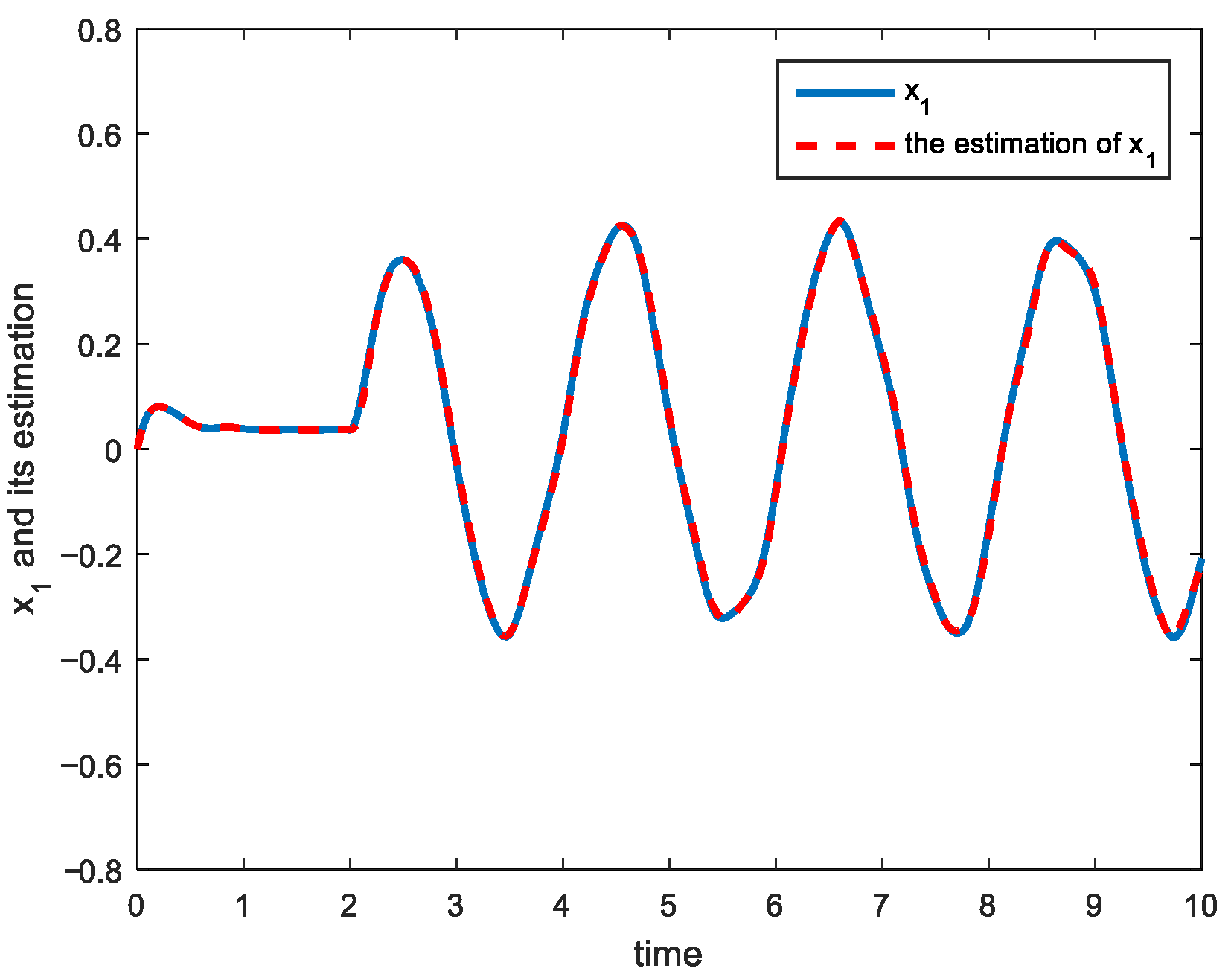
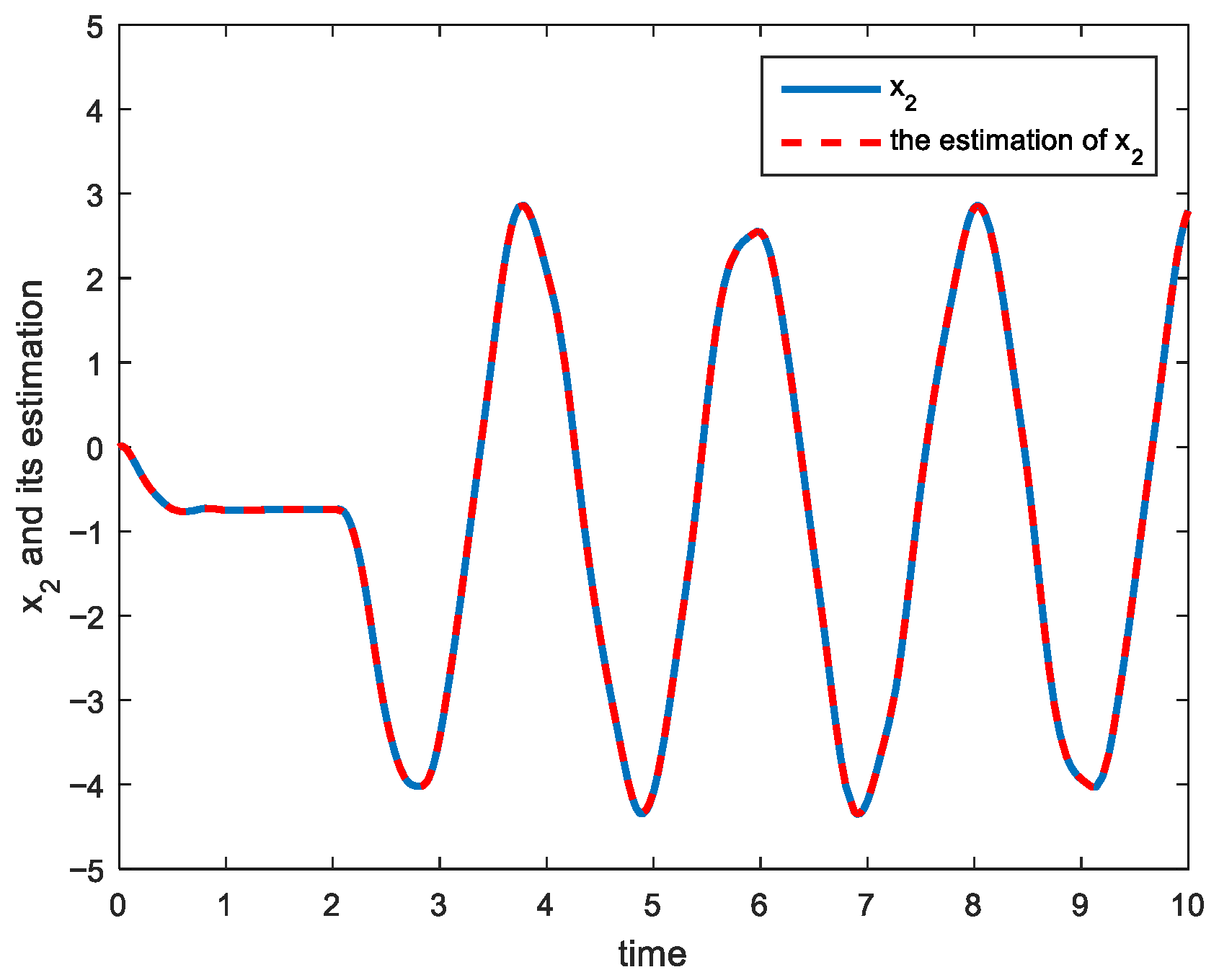
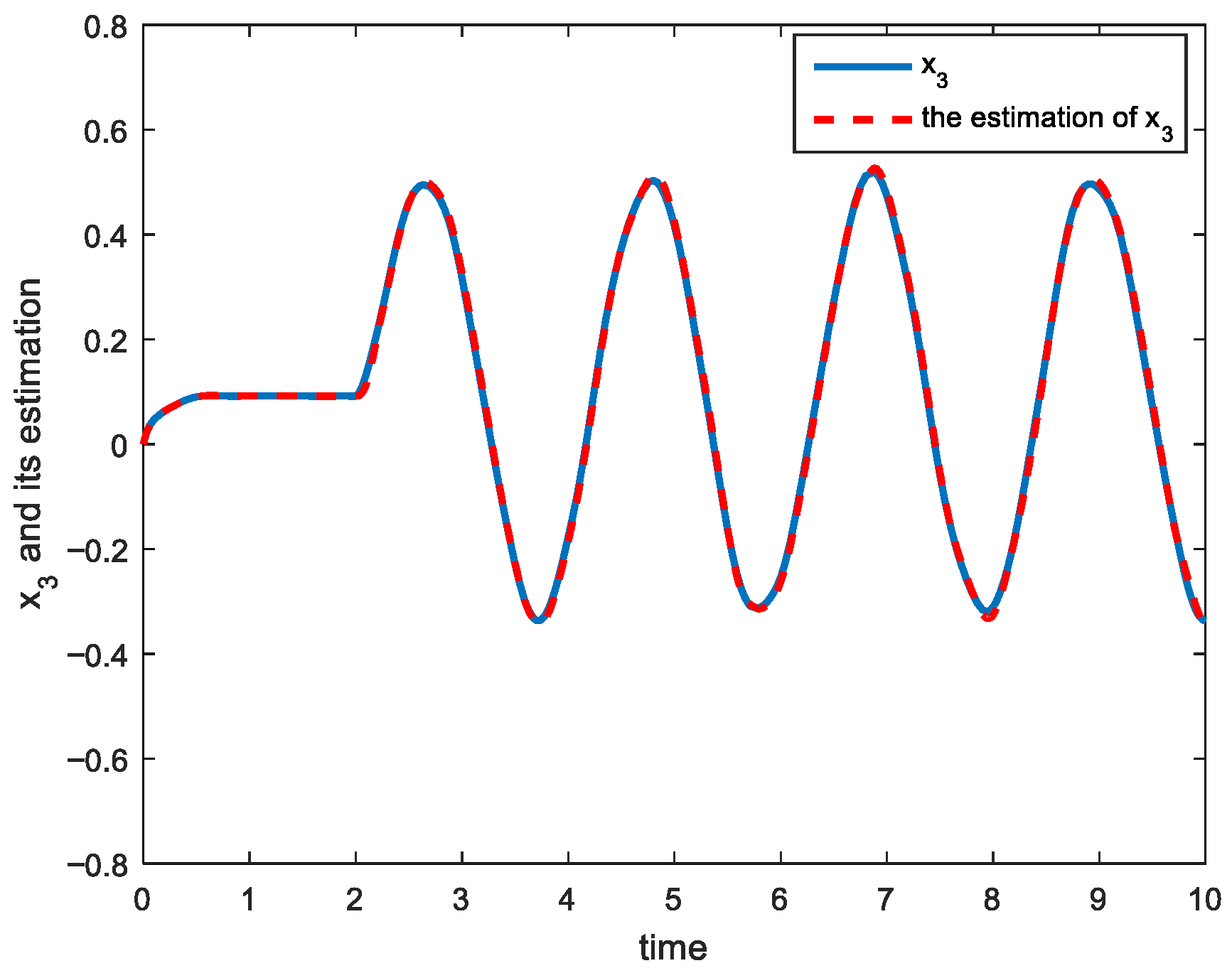
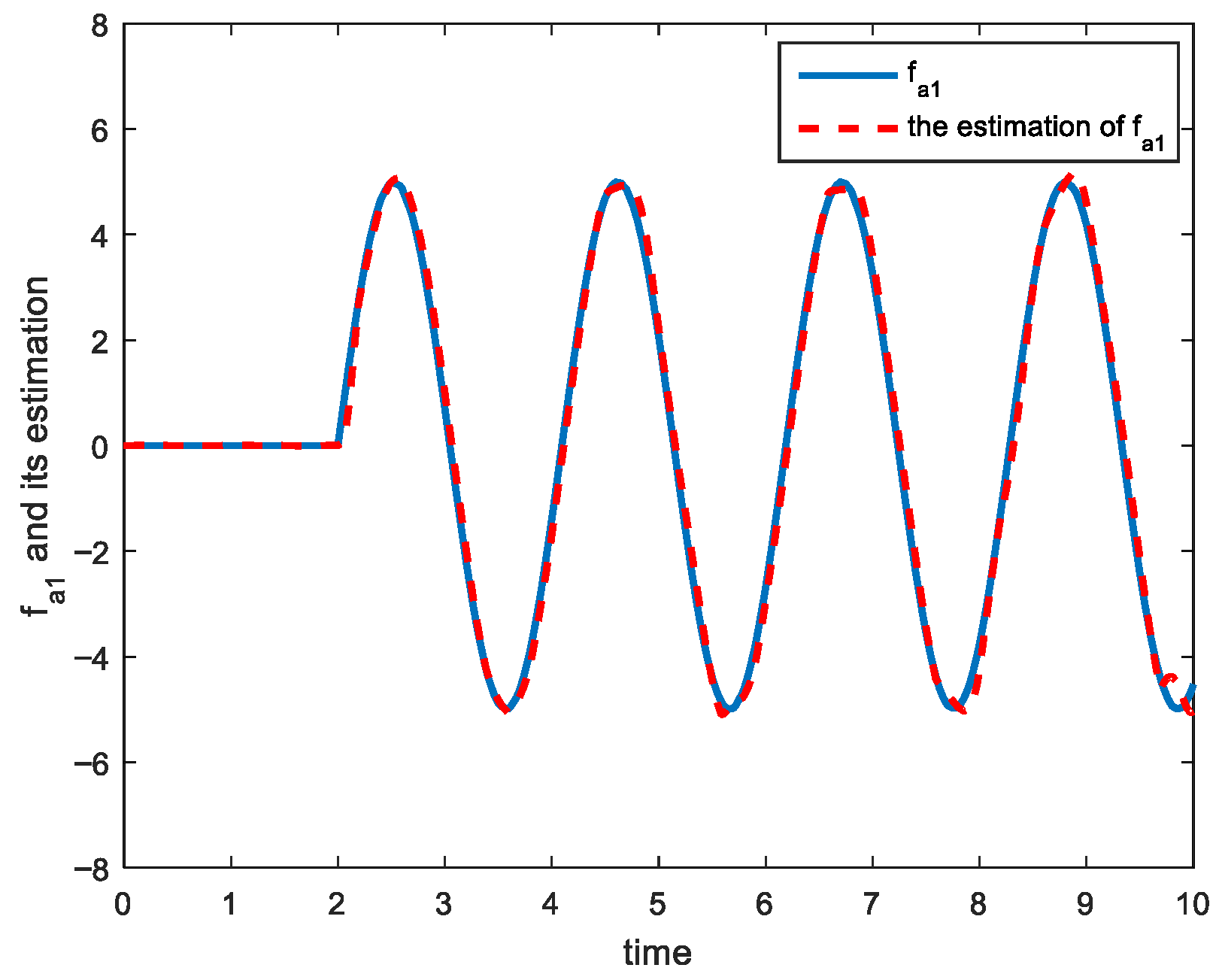
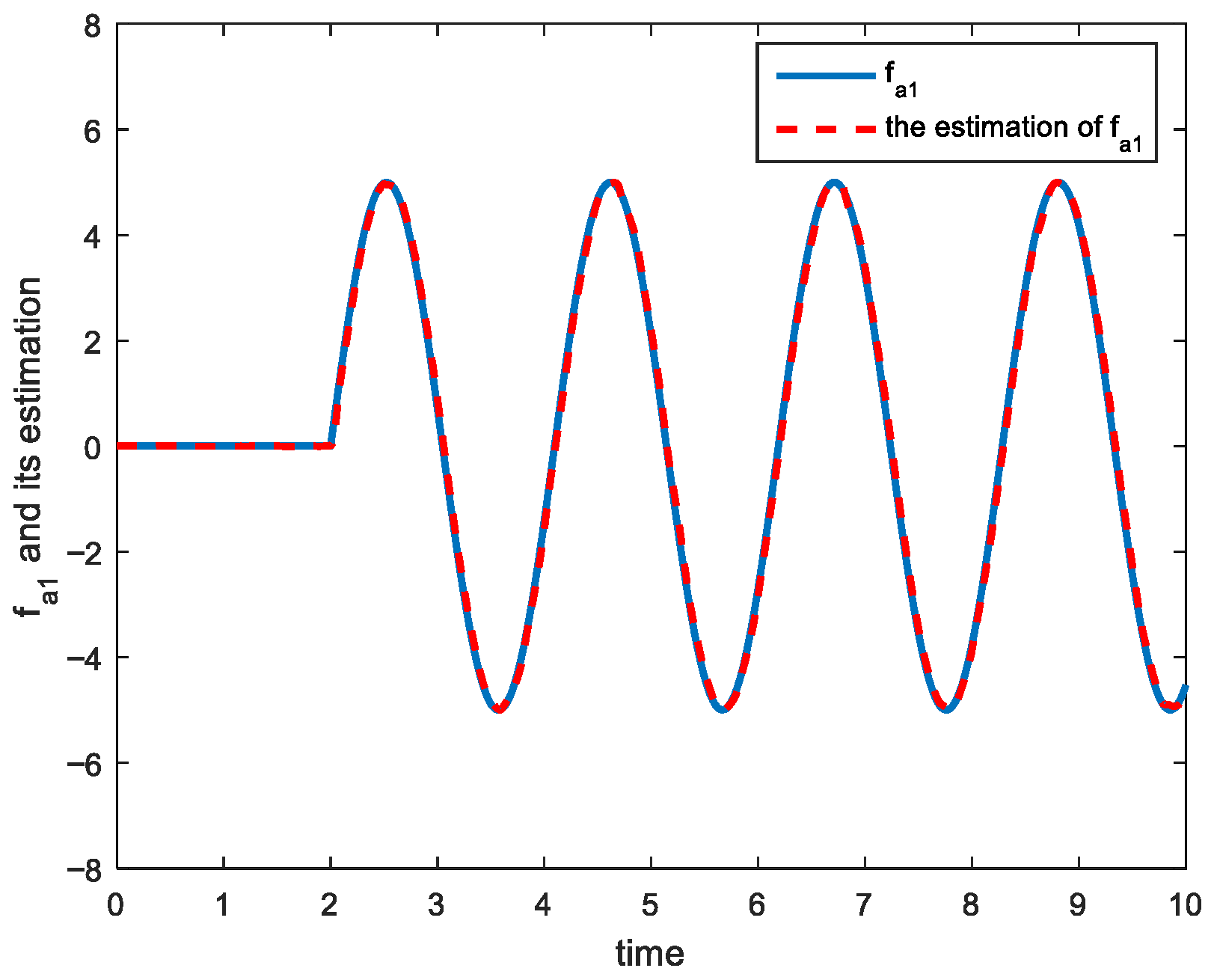
Figure 1, Figure 2 and Figure 3 show the system states x t and their estimates x ^ t , which indicate accurate state estimations with small errors. Figure 4 displays the time-varying fault f a 1 t (at 2 s) and its estimated f ^ a 1 t , demonstrating effective fault tracking with minimal error. These results confirm successful state and fault estimation under a time-varying delay.
To quantify the estimation accuracy, we introduce the root mean square error (RMSE) metric over the simulation period [0, 10] s. The fault estimation RMSE for this case is 0.032.
Case 2: Constant fault. Let K 1 = 0.9995 , d = 0.01 , and
f a 2 t = 0   0 t 4 2 4 < t 10
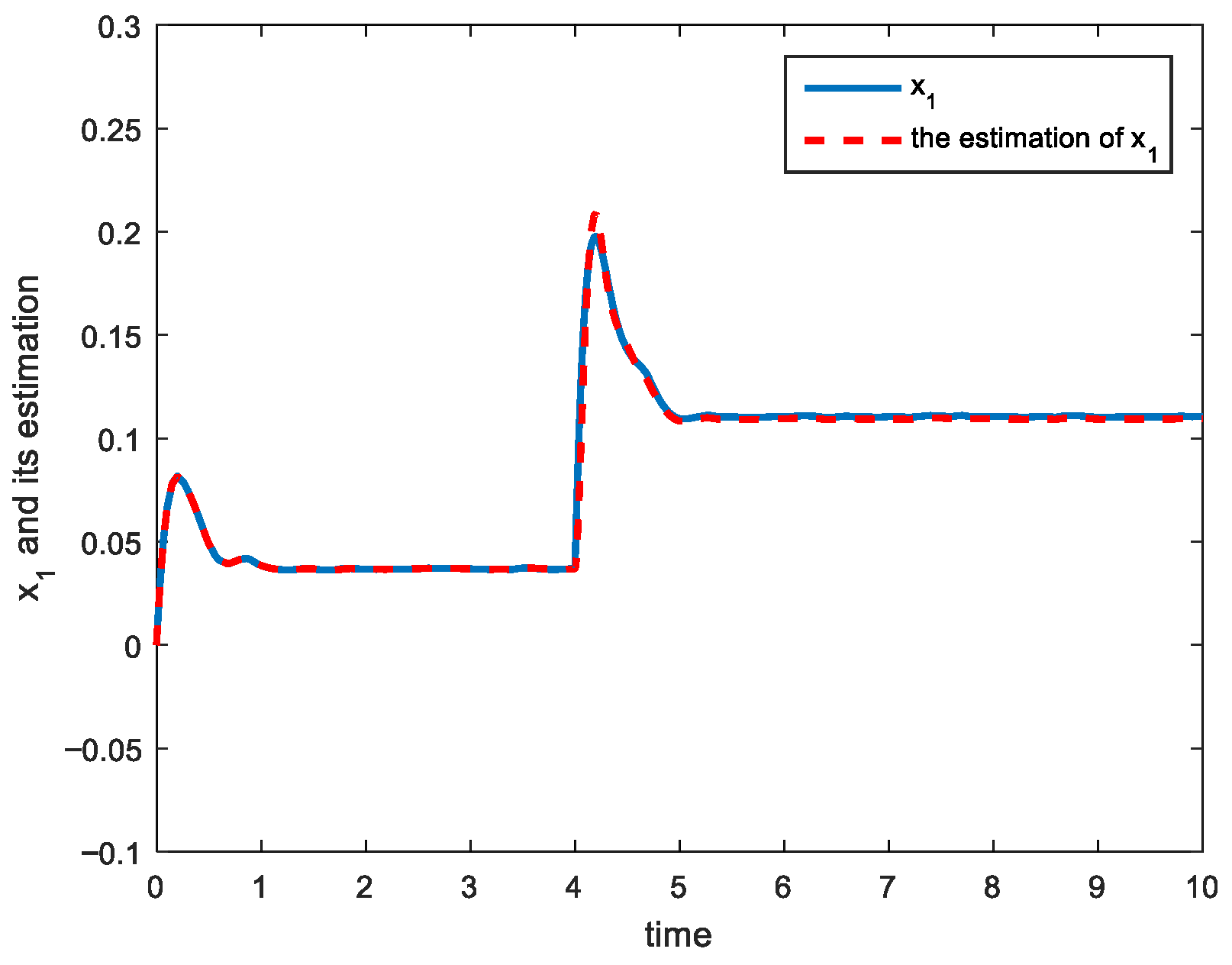
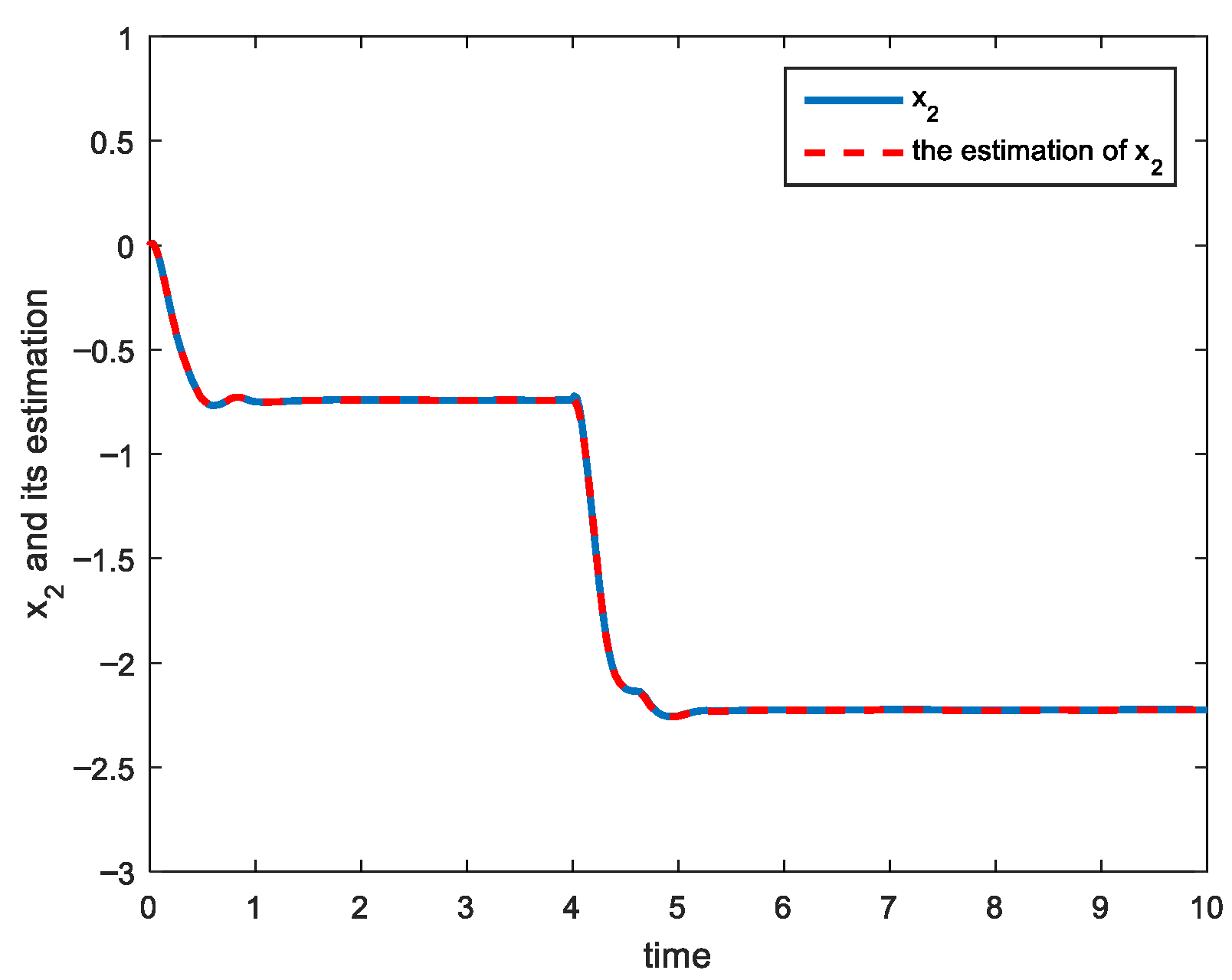
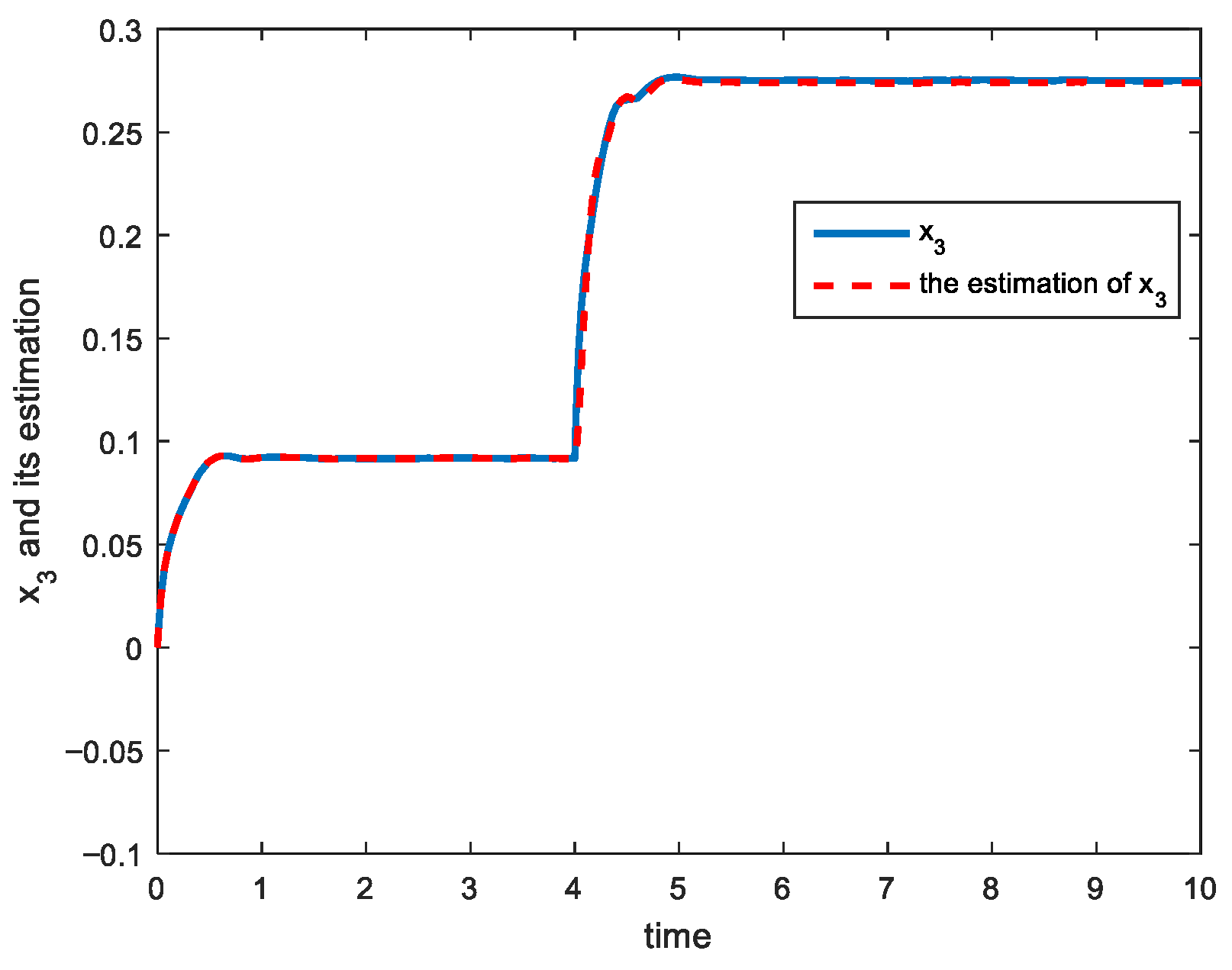
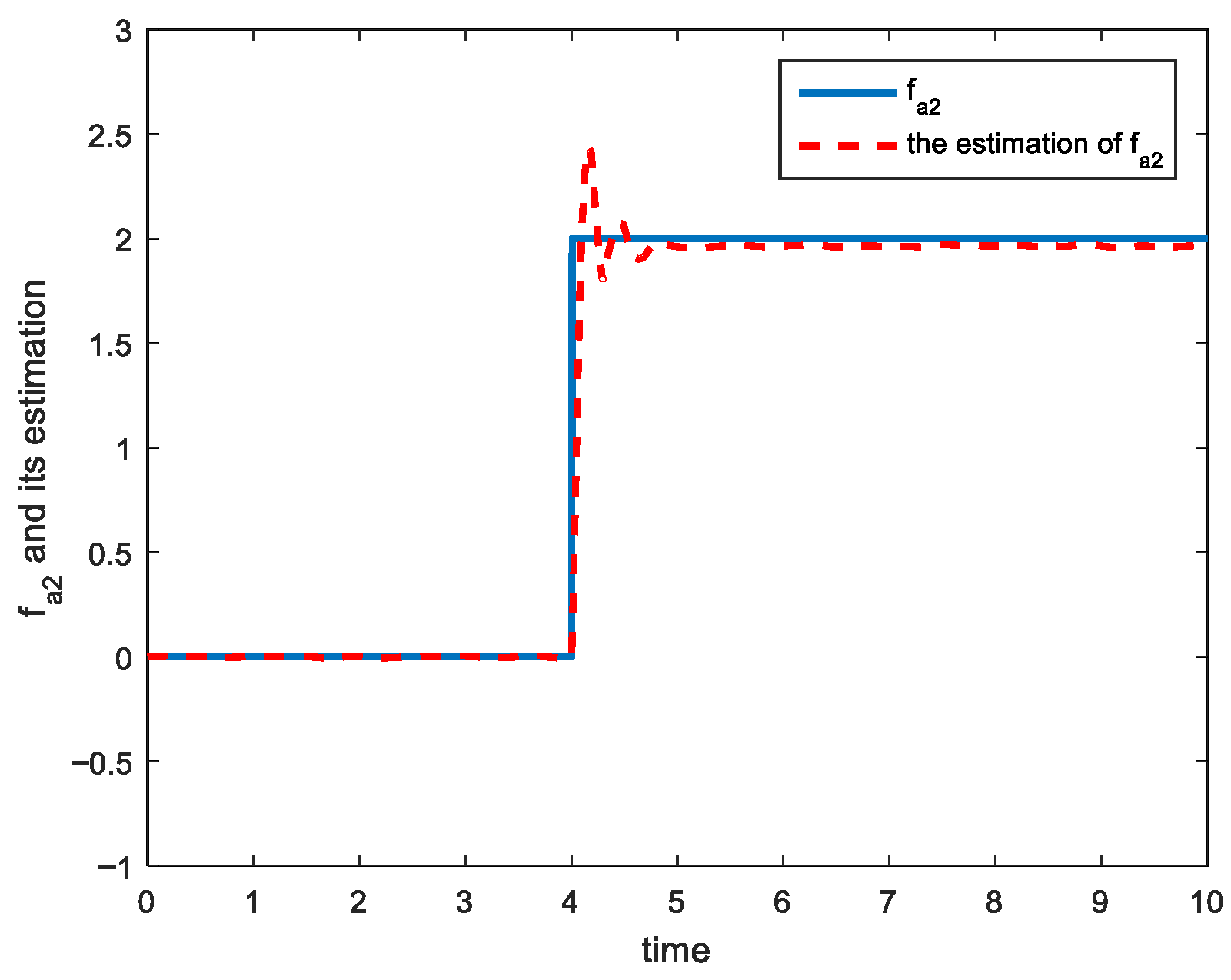
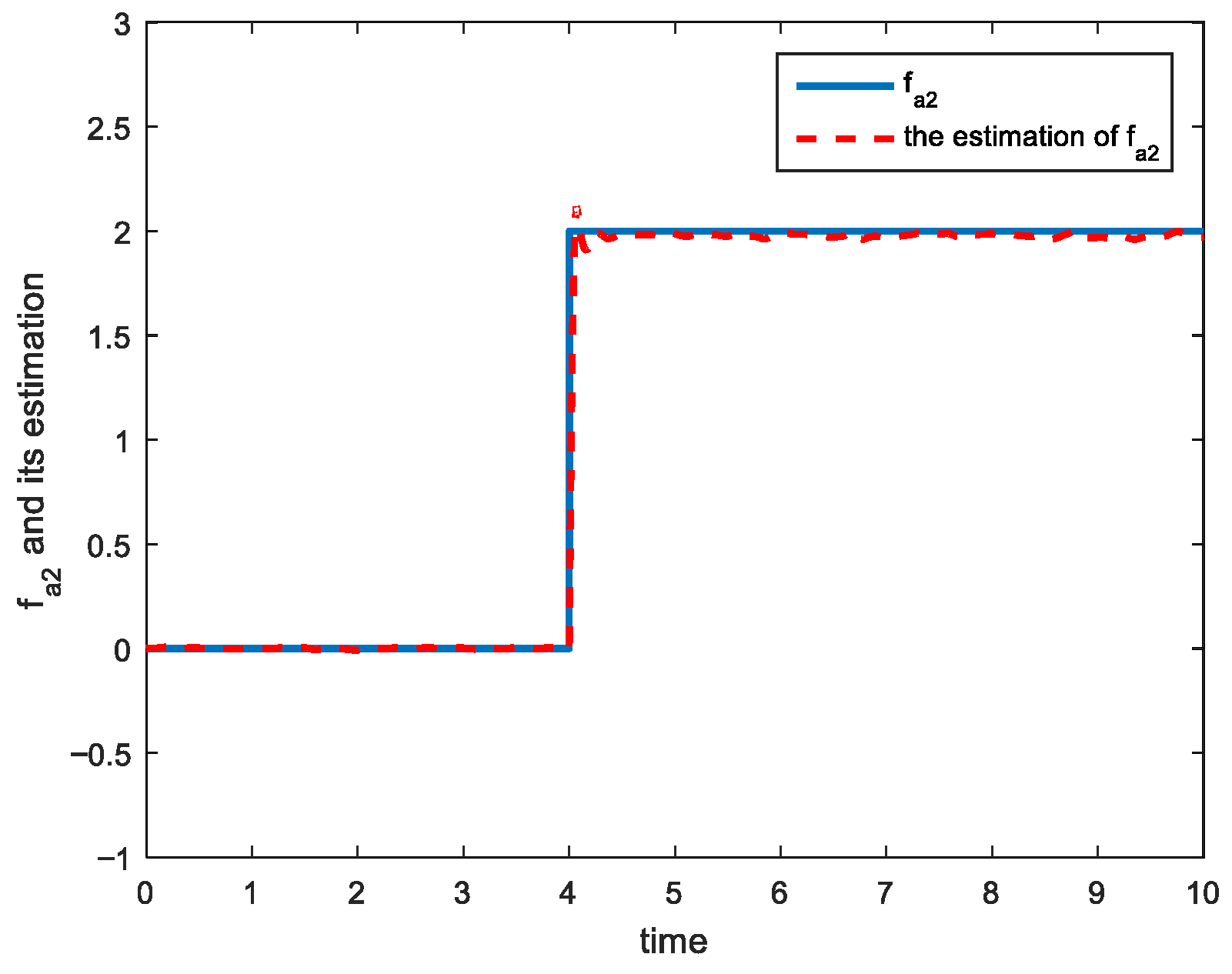
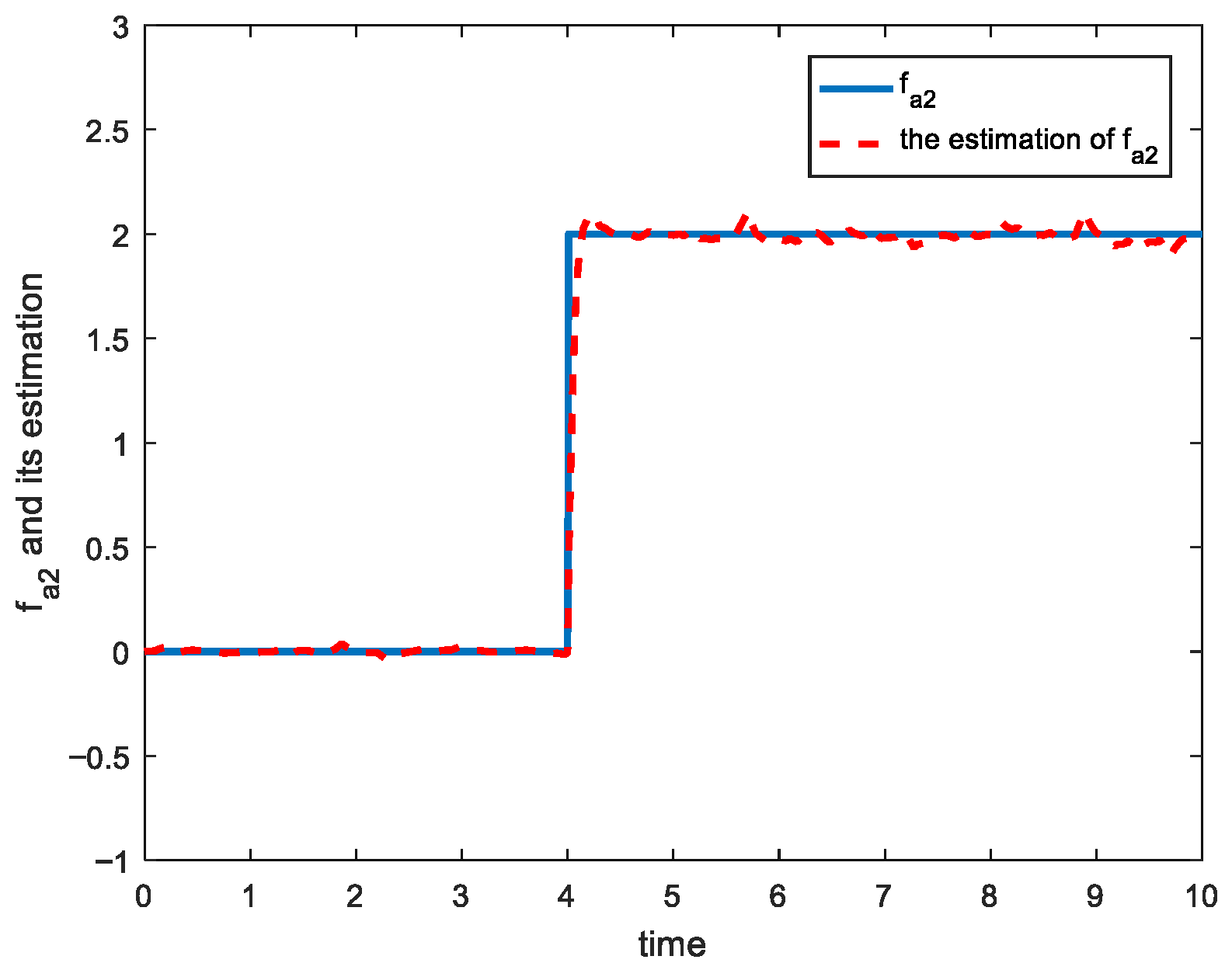
Figure 5, Figure 6 and Figure 7 present the state estimates, which again show high accuracy. Figure 8 illustrates the constant fault f ^ a 2 t (at 4 s) and its estimate, confirming precise reconstruction. The fault estimation RMSE for this case is 0.008. Thus, we can conclude that the observer performs well for both fault types under time-varying delay.
To test the limits of Assumption 1 and the effect of d , we introduced a high-frequency fault: f a 3 t = 5 sin 20 t 6 for t [ 2 , 10 ] . Using the original d = 0.005 , the RMSE increased to 0.089, with a noticeable phase lag. Reducing d to 0.001 s improved tracking significantly, reducing the RMSE to 0.041. This confirms that for fast-varying faults, a smaller d is crucial.
To provide quantitative guidance for selecting the learning interval d , we performed a sensitivity analysis by varying d from 0.001 s to 0.1 s and computing the corresponding RMSE for the time-varying fault f a 1 t . The results are shown in Table 1. The RMSE remains low and relatively flat for d < 0.01 s , indicating good tracking performance. As d increases beyond 0.01 s, the RMSE increases monotonically, with a sharp rise after d = 0.05 s , confirming that a larger learning interval introduces significant lag. This table provides practical guidance: for fast-varying faults, d should be kept below 0.01s; for slowly varying faults, a larger d (up to 0.05 s) may be acceptable for smoother estimates.
To demonstrate robustness to sensor noise, we increased the output measurement noise power by tenfold. The state estimates showed more chatter, but the fault estimate remained accurate, with the RMSE for the time-varying fault only slightly increasing from 0.032 to 0.040.
To demonstrate consistency, we ran the time-varying fault simulation 20 times with different random noise seeds. The mean RMSE was 0.034, with a standard deviation of 0.0025, confirming the algorithm’s robustness.

4.2. Example 2

Consider the same system as that in Example 1. Corollary 1 is used when the delay is not included. The following solutions can be obtained:
x ˙ ( t ) = 10 1 2 48 2 0 1 1 20 x ( t ) + 1 1 1 u ( t ) + 1 1 1 f a ( t ) + 1 0.3 0 1 0.1 0 0.5 0 0.5 ω ( t ) y ( t ) = 0 0 1 x ( t )
where u t is a unit step and ω t is band-limited white noise (power: 0.001; dimensions: 3 × 1 ). The observer existence conditions are satisfied by setting Z = I r , ϑ 1 = 0.001 ,   β = 1.001 , ε = 1 ,   α = 10 , γ = 0.6 , μ = 10 5 .
Case 1: Time-varying fault. Let K 1 = 0.9995 , d = 0.005 , and
f a 1 t = 0     0 t 2 5 sin 3 t 6 2 < t 10
The subsequent answers can be found by meeting the requirements in Corollary 1:
P = 9.5830 0.3188 9.2642 0.3188 0.5808 0.2620 9.2642 0.2620 49.2182 , Y = ( 1 . 0 × 10 3 ) × 0.2120 0.0568 2.1927 ,
L = 78.3672 28.1520 59.1513 , K 2 = 39.6920 .
The actual achieved H attenuation level for this delay-free example is γ a c h i e v e d = 0.57 , which is also below the prescribed value, demonstrating the effectiveness of the design.
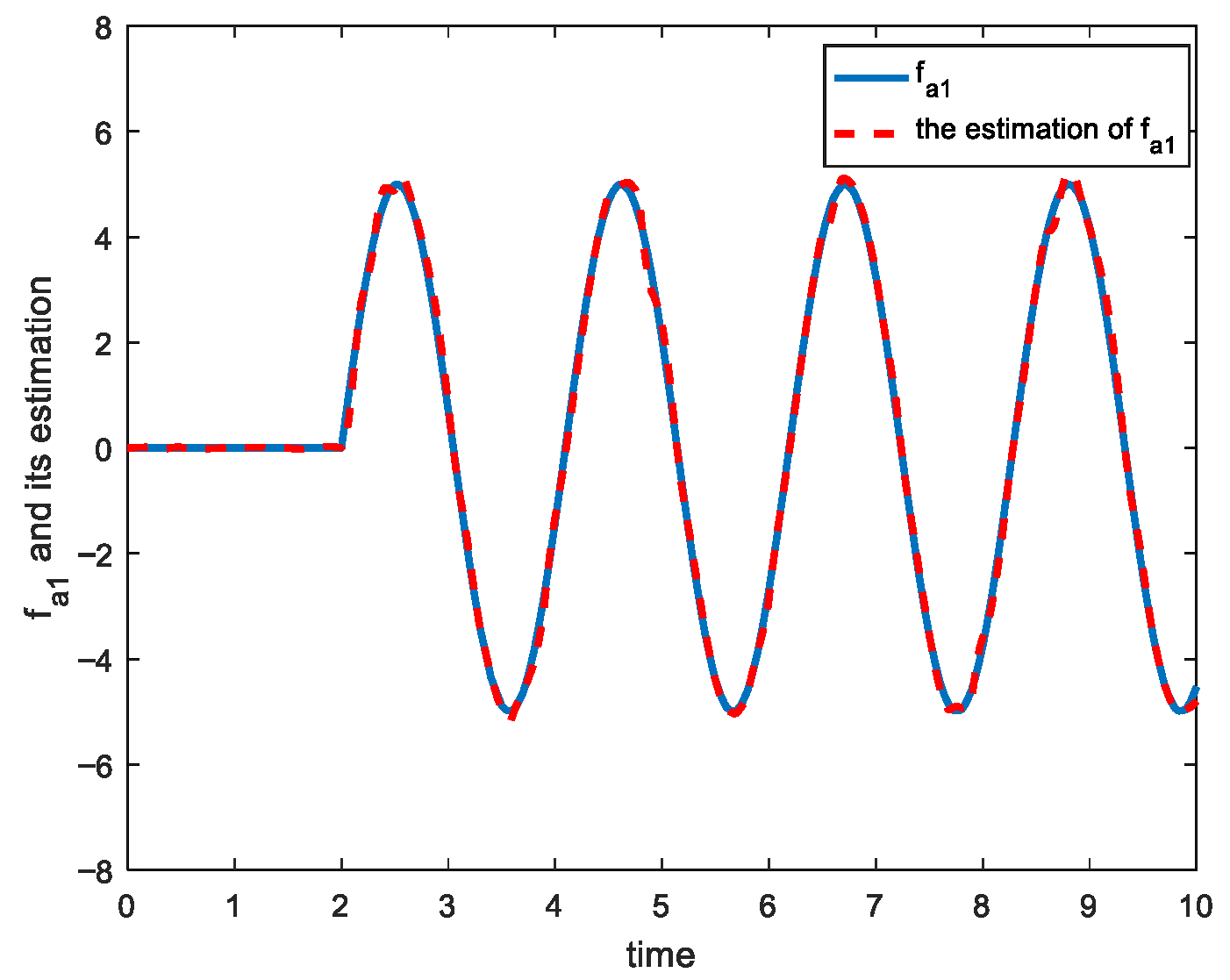
Figure 9 shows an accurate estimation of the time-varying fault f a 1 t , validating the method for a delay-free case.
Case 2: Constant fault. Let K 1 = 0.9995 , d = 0.01 , and
f a 2 t = 0   0 t 4 2 4 < t 10
Figure 10 demonstrates precise reconstruction of the constant fault f a 2 t .

4.3. Example 3

A practical stirred tank reactor model from [15] was taken into consideration. Towards the operational point, the linearized model is
x ˙ ( t ) = A x ( t ) + A τ x ( t τ ( t ) ) + B u ( t ) y ( t ) = C x ( t )
where x ( t ) = [ x 1 ( t ) , x 2 ( t ) ] T with x 1 ( t ) and x 2 ( t ) represent the reaction conversion rate and dimensionless temperature, respectively; the operating points are [ 0 . 1440 , 0 . 8862 ] T ; and
A = 1.4274 0.0757 1.4189 0.9442 ,   A τ = 0 . 25 0 0 0 . 25 ,   B = 0 0.3 ,   C = [ 0 1 ] .
The pair ( A , C ) is observable. The control input u ( t ) is a unit step. Compared with model (1), under the assumption of E = B , it is easy to verify that r a n k ( C E ) = 1 and ( A , E , C ) has a stable invariant zero at z = 1.4274 , satisfying the observer existence conditions. The disturbance w ( t ) is band-limited white noise (power: 0.001; dimensions: 2 × 1 ). It is assumed that F = 0 . 1 0 0 0 . 1 and D = 1 0.3 1 0.1 . We consider a fast time-varying delay case. It is assumed that the time-varying delay is τ t = 0.3 + 0.3 sin t , τ = 0.6 , τ m = 0.3 ; Z is a unit matrix, and the parameters values ϑ 1 = 0.001 , β = 1.001 , ε = 1 , α = 10 , γ = 0.6 are chosen. By taking μ = 10 5 and solving the conditions in Theorem 1, we can obtain the following solutions:
P = 48.5563 0.0000 0.0000 334.9344 ,       Q 1 =   ( 1 . 0 × 10 3 ) × 0 . 0189 0.0024 0.0024 3.2205 ,
Q 2 = ( 1 . 0 × 10 3 ) × 0.0082 0.0002 0.0002 3.1965 ,   R = 0.0998 0 0 0.0112 ,
Y = ( 1 . 0 × 10 3 ) × 0.009 9.8436 ,   L = 0.1856 29.3897 ,   K 2 = 100.4803 .
In ref. [15], the fault estimation of time-varying delay systems was studied and using their algorithm, we obtained the following solutions:
P = 9.4572 0.0000 0.0000 10.0124 ,   Q = 0.0159 0.0110 0.0110 1.4193 ,   Z = 1.5341 0.0012 0.0012 0.9791
L = 1.2271 0.8683 ,   H = 0.0001 0.2497 ,   F = 3.0037 ,   M = 0.0040
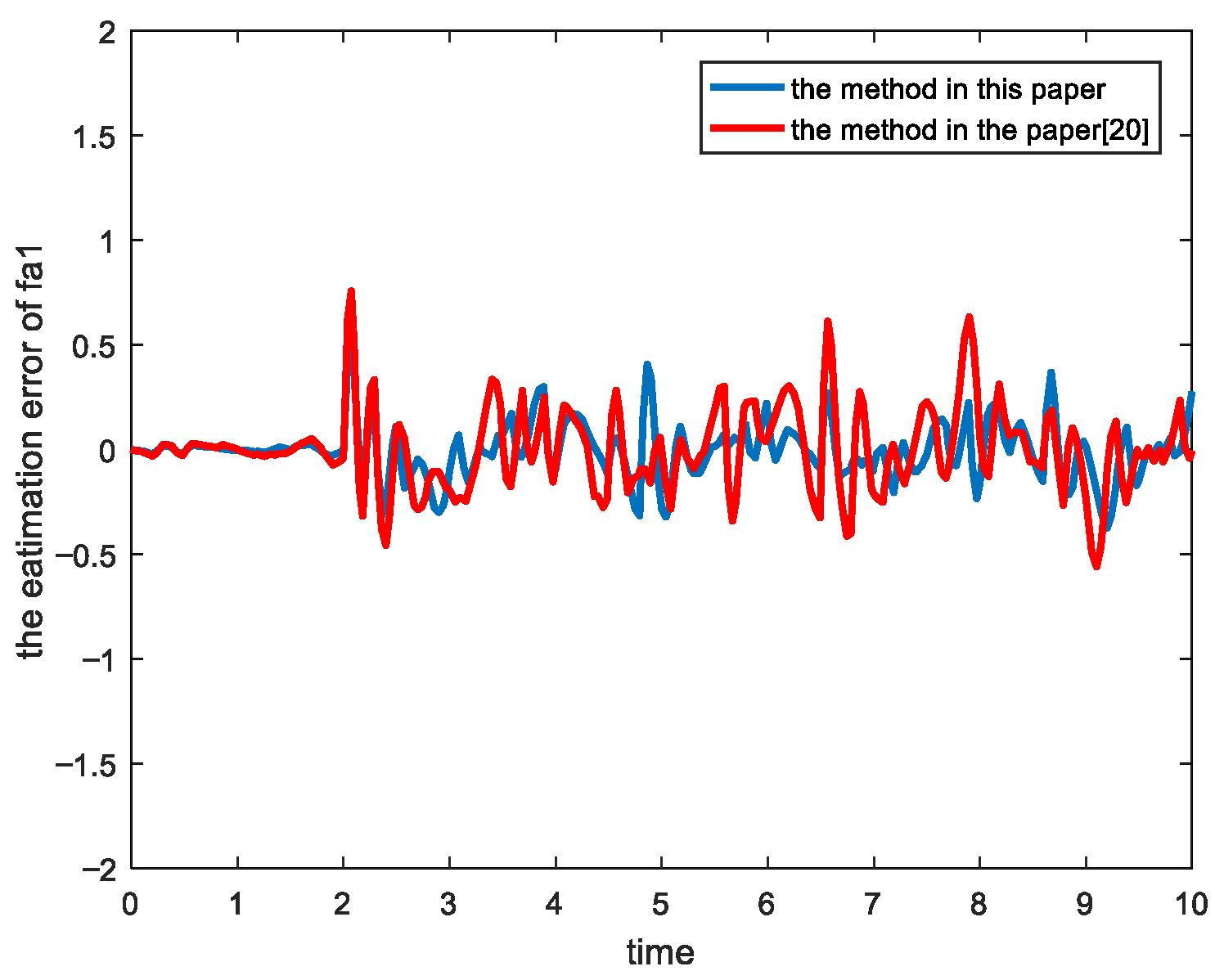
Through using a learning rate Γ = 20 and a sampling time of 0.1 s, we equate the two approaches using the subsequent simulations to illustrate that the technique proposed in this paper is superior to the technique in ref. [15]. For comparison, we calculated the fault estimation error for time-varying fault f a 1 t and constant fault f a 2 t , using our method and the method in ref. [15].
The actual achieved H attenuation level for the designed observer in this example is γ a c h i e v e d = 0.62 , which is slightly above the prescribed γ = 0.6 threshold but still within an acceptable margin, confirming that the H performance constraint is effectively satisfied.
Case 1: Time-varying fault. Set K 1 = 0.9995 , d = 0.005 , and
f a 1 t = 0 0 t 2 5 sin 3 t 6 2 < t 10
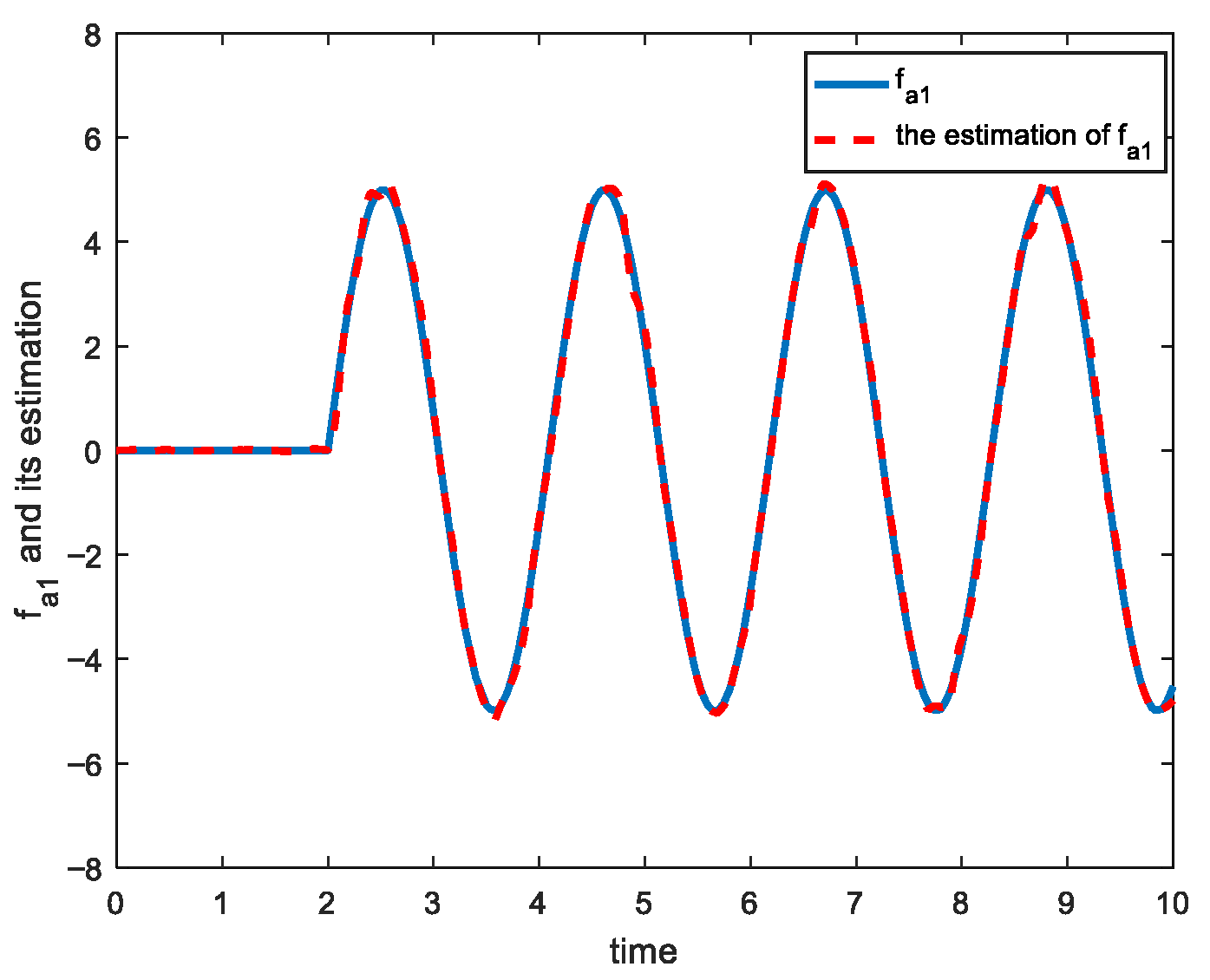
Figure 11 and Figure 12 show the fault estimates obtained using the proposed method and the one in ref. [15], respectively. Figure 13 compares the estimation errors, indicating the superior performance of the proposed method for time-varying faults. The RMSE for the proposed method is 0.041, while the RMSE for the method in ref. [15] is 0.098.
Case 2: Constant fault. Set K 1 = 0.9995 , d = 0.01 , and
f a 2 t = 0   0 t 4 2 4 < t 10
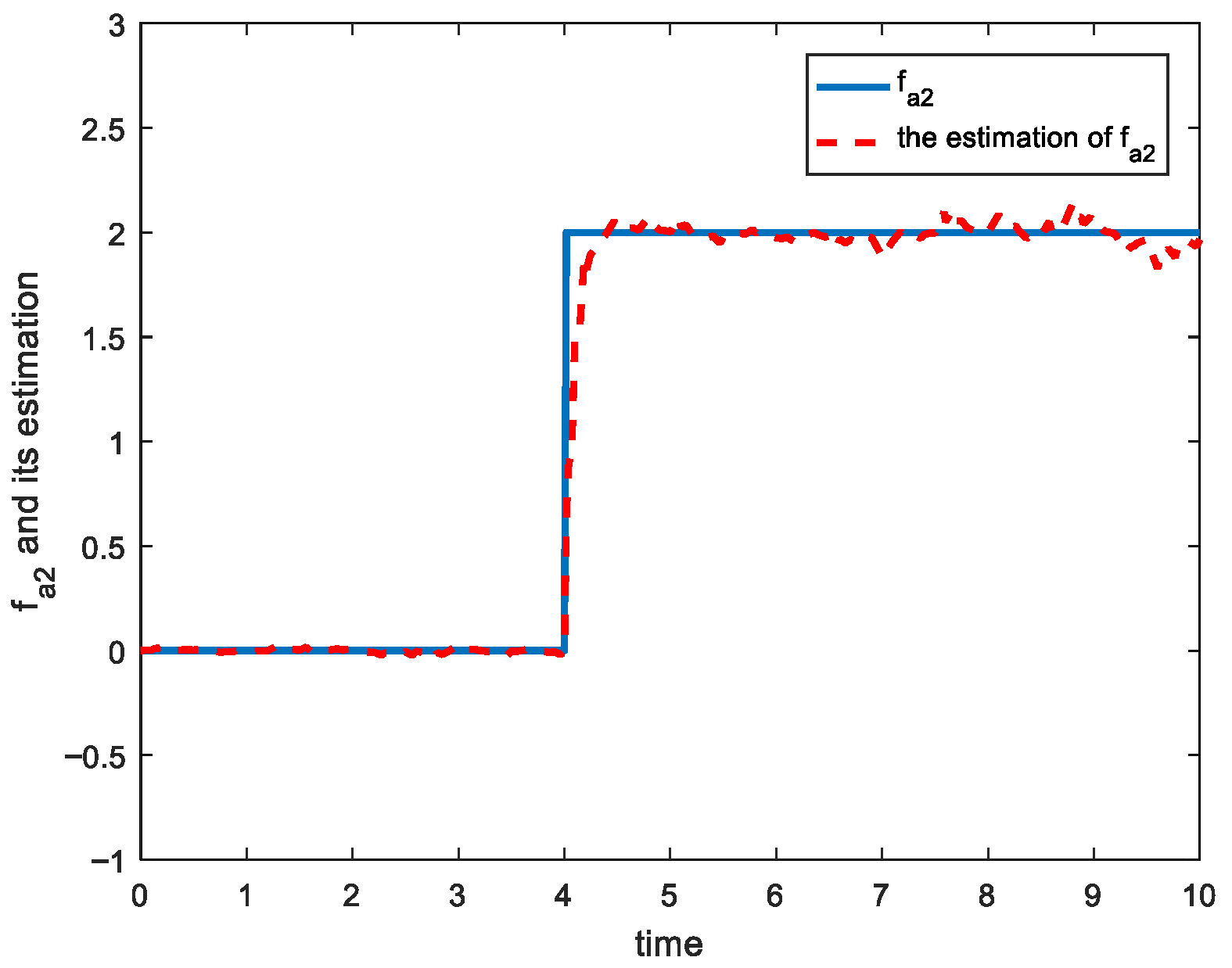
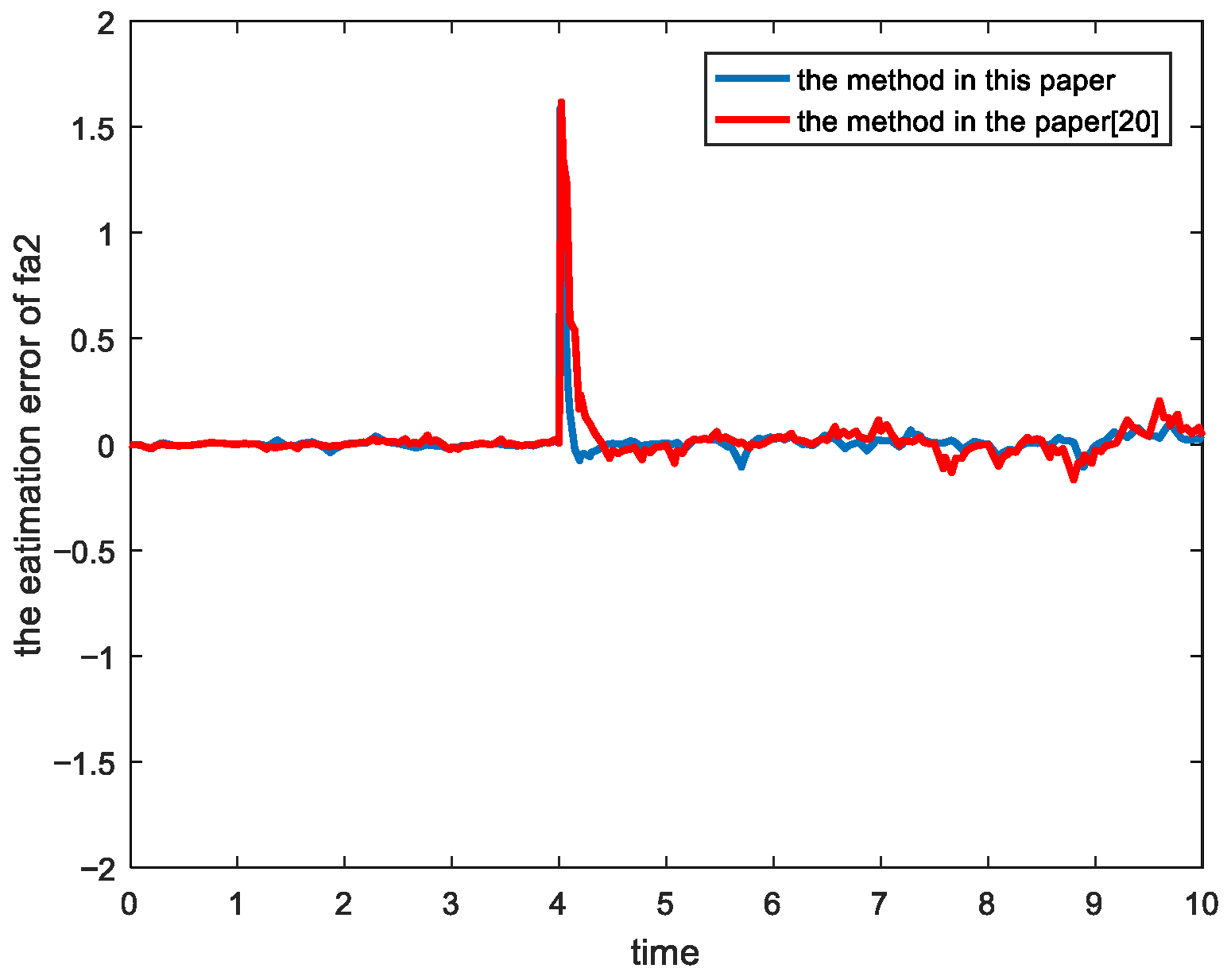
Figure 14 and Figure 15 present the estimates, whereas Figure 16 compares the errors. For constant faults, both methods performed similarly. The RMSE for the proposed method is 0.009, and for the method in ref. [15], it is 0.011.
The simulations demonstrate that the proposed method effectively estimates both time-varying and constant faults in systems with time-varying delays and disturbances, with a particularly improved performance for time-varying faults compared with the method in ref. [15]. The improved performance, especially for time-varying faults, can be attributed to the learning observer’s structure.

4.4. Comparative Statistical Analysis

To provide a comprehensive quantitative evaluation of the proposed method, we assessed its performance under varying noise levels and delay bounds for all three examples. The results for Examples 1 and 2 demonstrated the statistical consistency and robustness of the proposed observer under challenging conditions. Example 3 was used to directly compare the proposed method with the method in ref. [15], as this system matches the time-varying delay configuration studied in ref. [15]. The following metrics were computed for all simulations:
RMS (root mean square error) for fault estimation;
MAE (mean absolute error) for fault estimation;
Convergence time (time required for the estimation error to settle within ±5% of the final value).
The results are summarized in Table 2. Three noise levels were considered: the original noise power ( w 0 ), 5× the original power ( 5 w 0 ), and 10× the original power ( 10 w 0 ). Three delay bounds were considered: the nominal delay ( τ ), 1.5× the nominal delay ( 1.5 τ ), and 2× the nominal delay ( 2 τ ).

5. Conclusions

In this study, a learning observer was developed for linear continuous-time systems with state time-varying delays and external disturbances. The designed learning observer simultaneously estimates the system states and actuator faults, whether constant or time-varying. The delay-dependent stability conditions were derived in the form of LMIs by building a Lyapunov–Krasovskii functional. The observer gains are then obtained by solving the LMIs. Finally, the effectiveness of the proposed method was validated through three examples, with quantitative metrics (RMSE) and a comparative analysis demonstrating its superior performance, particularly for time-varying faults and its reduced conservatism in terms of admissible delay bounds.
Future studies will extend these findings in a number of directions: (i) generalizing the approach to simultaneous actuator and sensor faults by building an augmented system; (ii) validating the approach on real-time hardware-in-the-loop (HIL) platforms for applications such as satellite attitude control or chemical reactor temperature regulation; (iii) integrating the fault estimate into an active fault-tolerant control loop, which will require a combined stability analysis of the observer controller system; and (iv) exploring extensions to nonlinear system representations, such as Takagi–Sugeno fuzzy models.

Author Contributions

Conceptualization, K.T. and Q.F.; methodology, K.T. and F.Y.; validation, K.T., M.L. and Y.J.; formal analysis, Q.F.; investigation, F.Y.; writing—original draft preparation, K.T.; writing—review and editing, all authors; visualization, Y.J.; supervision, Q.F.; project administration, M.L. All authors have read and agreed to the published version of the manuscript.

Funding

This research received no external funding.

Data Availability Statement

The datasets generated and analyzed during the current study are available from the corresponding author upon reasonable request. The simulation models and code used in Examples 1–3 are derived from standard system models referenced within the paper.

Acknowledgments

The authors would like to thank the editors and reviewers for their valuable time and constructive comments.

Conflicts of Interest

The authors declare no conflicts of interest.

Abbreviations

SymbolMeaning
R n n-dimensional Euclidean space
P T Transpose of matrix P
P 1 Inverse of matrix P
P > 0 P is positive definite
P 0 P is positive semi-definite
P < 0 P is negative definite
P 0 P is negative semi-definite
I Identity matrix of appropriate dimension
0Zero matrix of appropriate dimension
*Symmetric element in a symmetric matrix
λ max ( P ) Maximum eigenvalue of matrix P
λ min ( P ) Minimum eigenvalue of matrix P
    Euclidean norm of a vector or matrix
    Infinity norm of a vector or matrix
L 2 0 , Space of square-integrable vector functions

References

  1. Ahmad, M.; Mohd-Mokhtar, R. A Survey on Model-based Fault Detection Techniques for Linear Time-Invariant Systems with Numerical Analysis. Pertanika J. Sci. Technol. 2022, 30, 53–78. [Google Scholar] [CrossRef]
  2. He, X.; Li, C.; Liu, Z. A real-time adaptive fault diagnosis scheme for dynamic systems with performance degradation. IEEE Trans. Reliab. 2023, 73, 1231–1244. [Google Scholar] [CrossRef]
  3. You, F.; Li, H.; Wang, F.; Guan, S. Robust Fast Adaptive Fault Estimation for Systems with Time-Varying Interval Delay. J. Frankl. Inst. 2015, 352, 5486–5513. [Google Scholar] [CrossRef]
  4. Gao, S.; Ma, G.; Guo, Y.; Zhang, W. Fast actuator and sensor fault estimation based on adaptive unknown input observer. ISA Trans. 2022, 129, 305–323. [Google Scholar] [CrossRef] [PubMed]
  5. Venkateswaran, S.; Kravaris, C. Design of linear unknown input observers for sensor fault estimation in nonlinear systems. Automatica 2023, 155, 111152. [Google Scholar] [CrossRef]
  6. Azarbani, A.; Fakharian, A.; Menhaj, M.B. Fault estimation for nonlinear uncertain time-delay systems based on unknown input observer. IET Control Theory Appl. 2024, 18, 846–864. [Google Scholar] [CrossRef]
  7. Edwards, C.; Spurgeon, S.K.; Patton, R.J. Sliding mode observers for fault detection and isolation. Automatica 2000, 36, 541–553. [Google Scholar] [CrossRef]
  8. Borja-Jaimes, V.; Coronel-Escamilla, A.; Escobar-Jiménez, R.F.; Adam-Medina, M.; Guerrero-Ramírez, G.V.; Sánchez-Coronado, E.M.; García-Morales, J. Fractional-order sliding mode observer for actuator fault estimation in a quadrotor UAV. Mathematics 2024, 12, 1247. [Google Scholar] [CrossRef]
  9. Liu, M.; Luo, P.; Hu, C.; Guo, R.; Hu, X. Actuator Fault Detection of T–S Fuzzy Hypersonic Flight Vehicle Model: AT–S Fuzzy-Based H∞ Sliding Mode Observer Approach. IEEE J. Miniaturization Air Space Syst. 2023, 4, 274–282. [Google Scholar] [CrossRef]
  10. Mimoune, K.; Hammoudi, M.Y.; Saadi, R.; Hamdi, W. Estimating Actuator Fault Through the Utilization of a Proportional Integral Observer with Quadratic Lyapunov Functions. In Proceedings of the 2024 8th International Conference on Image and Signal Processing and Their Applications (ISPA); IEEE: Piscataway, NJ, USA, 2024; pp. 1–6. [Google Scholar]
  11. Telbissi, K.; Benbraim, A.; Benzaouia, A. A fault estimation and fault accommodation-based PI observer for switched systems with time delay. Int. J. Dyn. Control 2023, 11, 748–758. [Google Scholar] [CrossRef]
  12. Dai, X.; Hu, Y.; Cui, D.; Chai, T. A disturbance decoupling generalized proportional–integral observer design for robust sensor fault detection. IEEE Trans. Ind. Electron. 2022, 70, 6326–6336. [Google Scholar] [CrossRef]
  13. Zhu, Y.; Zhang, J.; Chen, L.; Chen, X.; Su, C.-Y. Learning observer based fault estimation for a class of unmanned marine vehicles: The switched system approach. IEEE Trans. Autom. Sci. Eng. 2023, 21, 5665–5676. [Google Scholar] [CrossRef]
  14. Liu, W.; Sun, C.; Huang, S.; Yi, S. Robust Fault Estimation and Fault-Tolerant Control for a Class of Fuzzy Singularly Perturbed Systems with State Time Delay Based on Learning Observer. Int. J. Adapt. Control Signal Process. 2024, 38, 3865–3882. [Google Scholar] [CrossRef]
  15. Jiang, B.; Zhang, K.; Shi, P. Less conservative criteria for fault accommodation of time-varying delay systems using adaptive fault diagnosis observer. Int. J. Adapt. Control Signal Process. 2010, 24, 322–334. [Google Scholar] [CrossRef]
  16. Zare, I.; Asemani, M.H.; Setoodeh, P. Active adaptive observer-based fault-tolerant control strategy for a class of T-S fuzzy systems with unmeasurable premise variables. IEEE Trans. Fuzzy Syst. 2023, 31, 3543–3554. [Google Scholar] [CrossRef]
  17. Richard, J.P. Time-delay systems: An overview of some recent advances and open problems. Automatica 2003, 39, 1667–1694. [Google Scholar] [CrossRef]
  18. Seuret, A.; Gouaisbaut, F.; Baudouin, L. D1. 1-Overview of Lyapunov Methods for Time-Delay Systems; HAL: Lyon, France, 2016. [Google Scholar]
  19. Sinha, V.; Mondal, S. Robust Adaptive Fault Estimation Observer-Based FTC Design for Time-Delay PEMFC Systems. J. Inst. Eng. India Ser. B 2022, 103, 1305–1314. [Google Scholar] [CrossRef]
  20. Xia, Y.; Liu, Y.; Sun, W. A new fault tolerant strategy using adaptive time delay estimation for robot manipulators with actuator faults. Nonlinear Dyn. 2025, 113, 8769–8781. [Google Scholar] [CrossRef]
  21. Rabeb, B.; Aicha, E.; Naceur, A.M. Fault diagnosis and fault-tolerant control design for neutral time delay system. Automatika 2023, 64, 422–430. [Google Scholar] [CrossRef]
  22. Li, H.; You, F.; Wang, F.; Guan, S. Robust fast adaptive fault estimation and tolerant control for T-S fuzzy systems with interval time-varying delay. INT J Syst Sci. 2017, 48, 1708–1730. [Google Scholar] [CrossRef]
  23. Zhao, Z.; Zhu, L.; Li, J.; Du, D. Actuator and sensor fault detection for a nonlinear fractional-order system with time-varying delay. Chaos Solitons Fractals 2025, 199, 116647. [Google Scholar] [CrossRef]
  24. Zhang, H.; Sun, S.; Liu, C.; Zhang, K. A novel approach to observer-based fault estimation and fault-tolerant controller design for T–S fuzzy systems with multiple time delays. IEEE Trans. Fuzzy Syst. 2019, 28, 1679–1693. [Google Scholar] [CrossRef]
  25. Chen, W.; Saif, M. An iterative learning observer-based approach to fault detection and accommodation in nonlinear systems. In Proceedings of the 40th IEEE Conference on Decision and Control, Orlando, FL, USA, 4–7 December 2001; IEEE: Piscataway, NJ, USA, 2001; pp. 4469–4474. [Google Scholar]
  26. Jia, Q.; Chen, W.; Zhang, Y.; Li, H. Fault Reconstruction for Continuous-Time Systems via Learning Observers. Asian J. Control 2016, 18, 549–561. [Google Scholar] [CrossRef]
  27. Jia, Q.; Chen, W.; Zhang, Y.; Chen, X. Robust fault reconstruction via learning observers in linear parameter-varying systems subject to loss of actuator effectiveness. IET Control Theory Appl. 2014, 8, 42–50. [Google Scholar] [CrossRef]
  28. Jia, Q.; Chen, W.; Zhang, Y.; Li, H. Fault Reconstruction and Fault-tolerant Control via Learning Observers in Takagi-Sugeno Fuzzy Descriptor Systems with Time Delays. IEEE Trans. Ind. Electron. 2015, 62, 3885–3895. [Google Scholar] [CrossRef]
  29. Jia, Q.; Li, H.; Li, M. Robust actuator fault reconstruction for Takagi-Sugeno fuzzy systems with unknown input via a synthesized learning and sliding-mode observer. Asian J. Control 2023, 25, 2720–2735. [Google Scholar] [CrossRef]
  30. Zetina-Rios, I.I.; Osorio-Gordillo, G.; Vargas-Méndez, R.A.; Madrigal-Espinosa, G.; Astorga-Zaragoza, C. Actuator fault estimation based on generalized learning observer for quasi-linear parameter varying systems. Int. J. Adapt. Control Signal Process. 2021, 35, 828–845. [Google Scholar] [CrossRef]
  31. Rios, I.Z.; Osorio-Gordillo, G.; Alma, M.; Darouach, M.; Astorga Zaragoza, C.M. Fault Estimation Based on Generalized Learning Observer for a Class of Nonlinear Algebro-Differential Parameter-Varying Systems. Mem. Del Congr. Nac. De Control Automático 2023, 6, 1–6. [Google Scholar]
  32. Ma, R.; Gui, Y.; Jia, Q.; Zheng, Z.; Li, H. Actuator Fault Identification for Spacecraft System via an Iterative Learning Observer. In Proceedings of the International Conference on Guidance, Navigation and Control; Springer: Singapore, 2023. [Google Scholar]
  33. Naifar, O. Tempered fractional gradient descent: Theory, algorithms, and robust learning applications. Neural Netw. 2025, 193, 108005. [Google Scholar] [CrossRef]
  34. Wang, Y.; Xie, L.; De Souza, C.E. Robust control of a class of uncertain nonlinear systems. Syst. Control Lett. 1992, 19, 139–149. [Google Scholar] [CrossRef]
  35. Gu, K. An integral inequality in the stability problem of time-delay systems. In Proceedings of the 39th IEEE Conference on Decision and Control (Cat. No. 00CH37187); IEEE: Piscataway, NJ, USA, 2000; Volume 3, pp. 2805–2810. [Google Scholar]
  36. Xie, L.; de Souza, C.E. Robust H/sub infinity/control for linear systems with norm-bounded time-varying uncertainty. In Proceedings of the 29th IEEE Conference on Decision and Control; IEEE: Piscataway, NJ, USA, 1990; pp. 1034–1035. [Google Scholar]
  37. Corless, M.; Tu, J. State and input estimation for a class of uncertain systems. Automatica 1998, 34, 757–764. [Google Scholar] [CrossRef]
Figure 1. Actual and estimated state x 1 t under time-varying fault.
Symmetry 18 00479 g001
Figure 2. Actual and estimated state x 2 t under time-varying fault.
Symmetry 18 00479 g002
Figure 3. Actual and estimated state x 3 t under time-varying fault.
Symmetry 18 00479 g003
Figure 4. Actual and estimated time-varying fault f a 1 t .
Symmetry 18 00479 g004
Figure 5. Actual and estimated state x 1 t under constant fault.
Symmetry 18 00479 g005
Figure 6. Actual and estimated state x 2 t under constant fault.
Symmetry 18 00479 g006
Figure 7. Actual and estimated state x 3 t under constant fault.
Symmetry 18 00479 g007
Figure 8. Actual and estimated constant fault f a 2 t .
Symmetry 18 00479 g008
Figure 9. Actual and estimated time-varying fault f a 1 t .
Symmetry 18 00479 g009
Figure 10. Actual and estimated constant fault f a 2 t .
Symmetry 18 00479 g010
Figure 11. Actual and estimated f a 1 t using the proposed method.
Symmetry 18 00479 g011
Figure 12. Actual and estimated f a 1 t using the method in ref. [15].
Symmetry 18 00479 g012
Figure 13. Comparison of fault estimation error f a 1 ( t ) [20].
Symmetry 18 00479 g013
Figure 14. Actual and estimated f a 2 ( t ) using the proposed method.
Symmetry 18 00479 g014
Figure 15. Actual and estimated f a 2 t using the method in ref. [15].
Symmetry 18 00479 g015
Figure 16. Comparison of fault estimation error f a 2 ( t ) [20].
Symmetry 18 00479 g016
Table 1. Sensitivity of fault estimation RMSE to the learning interval d for the time-varying fault in Example 1.
d(s)0.0010.0020.0050.010.020.050.080.1
RMSE0.0210.0240.0320.0380.0470.0720.0950.112
Table 2. Comprehensive performance comparison under varying noise levels and delay bounds.
Ex.Fault TypeMethodNoise LevelDelay BoundRMSEMAEConv. Time (s)
1Time-
varying
Proposed w 0 τ 0.0320.0240.42
5 w 0 τ 0.0360.0270.46
10 w 0 τ 0.0400.0300.50
w 0 1.5 τ 0.0420.0320.53
w 0 2 τ 0.0550.0420.68
Constant Proposed w 0 τ 0.0080.0060.21
5 w 0 τ 0.0090.0070.23
10 w 0 τ 0.0110.0080.26
2Time-
varying
Proposed w 0 -0.0310.0230.38
5 w 0 -0.0350.0260.42
10 w 0 -0.0390.0290.46
Constant Proposed w 0 -0.0070.0050.18
5 w 0 -0.0080.0060.20
10 w 0 -0.0100.0070.23
3Time-
varying
Proposed w 0 τ 0.0410.0310.55
Method in ref. [15] w 0 τ 0.0980.0741.45
Proposed 5 w 0 τ 0.0460.0350.60
Method in ref. [15] 5 w 0 τ 0.1060.0801.55
Proposed 10 w 0 τ 0.0510.0390.65
Method in ref. [15] 10 w 0 τ 0.1150.0871.65
Proposed w 0 1.5 τ 0.0540.0410.70
Method in ref. [15] w 0 1.5 τ 0.1250.0951.80
Proposed w 0 2 τ 0.0700.0530.88
Method in ref. [15] w 0 2 τ 0.1650.1252.15
Constant Proposed w 0 τ 0.0090.0070.24
Method in ref. [15] w 0 τ 0.0110.0080.38
Disclaimer/Publisher’s Note: The statements, opinions and data contained in all publications are solely those of the individual author(s) and contributor(s) and not of MDPI and/or the editor(s). MDPI and/or the editor(s) disclaim responsibility for any injury to people or property resulting from any ideas, methods, instructions or products referred to in the content.