


Abstract
Single-wheel brake failure in electromechanical brake (EMB) systems breaks the left-right symmetry of wheel forces and yaw moments, creating a critical conflict between emergency braking effectiveness and lateral stability. To address this symmetry-breaking condition, this paper proposes a bimodal, adaptive, coordinated fault-tolerant control strategy that integrates dynamic brake torque redistribution with active front steering (AFS). A novel dynamic interaction model linking deceleration demand with tire adhesion utilization enables real-time assessment and optimization of the balance between longitudinal braking performance and yaw stability. Braking forces are allocated based on adhesion utilization through a layered two-mode strategy—balanced distribution prioritizing lateral stability and compensatory distribution engaging the healthy front wheel when rear axle capacity is exceeded. An integral sliding-mode controller computes the additional yaw moment needed to suppress yaw-rate deviation, with rigorous Lyapunov stability analysis confirming closed-loop stability. AFS is triggered only when yaw-rate deviation exceeds 0.05 rad/s or adhesion utilization reaches 90%, incorporating hysteresis to ensure smooth transitions and minimize unnecessary steering intervention. Comprehensive co-simulations using Carsim and MATLAB/Simulink under diverse failure locations (left-front and right-rear wheels), road adhesion levels ( = 0.85 and 0.5), and braking intensities (0.2 g–0.6 g) demonstrate that the proposed strategy reduces lateral displacement by up to 85.3% compared to full-time AFS control while maintaining over 99% deceleration satisfaction. The results establish an effective dual-objective fault-tolerant framework that enhances both robustness and functional safety of EMB systems under symmetry-breaking faults, offering a physically interpretable, computationally efficient solution well-suited for real-time automotive applications.
1. Introduction
With the evolution of intelligent electric vehicles towards high-level autonomous driving, fault-tolerant control has emerged as a critical challenge for ensuring functional safety in steer-by-wire chassis systems. The electromechanical brake (EMB), an advanced brake-by-wire technology, is progressively replacing conventional hydraulic brakes due to its high responsiveness, precise controllability, mechanical decoupling, and compact structure. However, under single-wheel braking failure, the left–right symmetry of wheel forces and yaw moments is broken, and the EMB system must satisfy two conflicting objectives: meeting the longitudinal deceleration demand for emergency braking while preserving lateral stability amid complex tire–road coupled dynamics. These symmetry-breaking faults further elevate functional-safety risks: the fully electrified architecture improves control flexibility but also increases fault exposure in the absence of mechanical/hydraulic redundancy, while automotive functional-safety standards [1] (e.g., ISO 26262) impose stringent fault-tolerance requirements up to ASIL-D.
Moreover, a recent Symmetry review [2] has noted that many control and evaluation methods are developed under symmetric assumptions in structured driving scenarios, yet their adaptability can degrade markedly when transferred to asymmetric conditions; they therefore advocate dynamic reconstruction and coupled modeling (e.g., multi-physics/digital-twin–enabled analysis) to handle multi-objective coupling under fault-induced asymmetry. Motivated by these insights, recent academic efforts have explored braking force allocation, active steering intervention, fault-tolerant architecture design, and system verification, forming the foundation for EMB functional-safety control. Current research can be broadly grouped into three directions: dynamic braking force allocation, active steering intervention, and fault-tolerant architecture design.
In the area of dynamic braking force distribution research, Jin X et al. [3] integrate cascade active disturbance rejection control with a Karush–Kuhn–Tucker (KKT)-constrained torque allocation layer to optimize four-wheel torque distribution under actuator-faultinduced asymmetry, thereby generating compensatory yaw moment and improving lateral stability, Chen J et al. [4] propose a control strategy for single-wheel EMB failure based on sliding mode control and the Magic Formula tire model. It seeks to achieve braking stability via collaborative optimization of braking force redistribution and front-wheel steering. In the study on dynamic braking force distribution, Chen Y et al. [5] put forward a dynamic tire model based on the improved Hybrid Particle Swarm Optimization (HPSO) and Support Vector Machine (SVM). By taking into account factors such as tire tread, rim, sidewall elasticity, inflation pressure, and soil deformation, this model can obtain more precise tire parameters. Tang X et al. [6] tackle the single-wheel failure issue in distributed-drive electric vehicles. It designs a rule-based torque-reconstruction controller. This controller, combined with a high-gain feedback robust control algorithm, suppresses yaw rate fluctuations. To address single-wheel braking failure, Wu T et al. [7] present an algorithm-based method to dynamically adjust the braking forces of healthy wheel executors, enhancing the robustness of fault-tolerant control under multiple constraints. Liu H et al. [8] propose an autonomous driving system for agricultural four-wheel independent drive (4WID) electric vehicles. It integrates model predictive control (MPC) with direct yaw moment control (DYC). Wang Z et al. [9] optimize braking distance under complex road conditions via a cascaded architecture of ABS and DYC. Li Q et al. [10] propose a rule-based fault-classification strategy that, by combining with sliding mode control for dynamic allocation of additional yaw moment, effectively balances stability requirements in both partial-fault and full-failure scenarios.
In the realm of active steering control research, Yim S [11] integrates sliding mode control with weighted pseudoinverse allocation, employing a variable weighting matrix to capture actuator fault conditions in real time. Ji Yuan et al. [12] introduce barrier Lyapunov functions to constrain yaw-rate tracking errors and combine adaptive finite-time disturbance observers to enhance control robustness. Han, Jinheng et al. [13] reconstruct driving objectives via dynamic risk assessment functions, transforming motion planning into heading-angle tracking optimization. Its novel barrier design, based on an integral heuristic, offers a new paradigm for constrained control. Tang, Xianzhi et al. [14] propose a coordinated steering control strategy combining DDAS and AFS to enhance vehicle stability and driving experience by analyzing their interference mechanisms. Wu, Yang et al. [15] present a novel rear-steering-based decentralized control (RDC) algorithm for four-wheelsteering (4WS) vehicles. The algorithm enhances lateral and directional performance, shows robustness to external disturbances, and adapts to varying road conditions.
In the research on fault-tolerant control systems, Wang Y et al. [16] classify fault-tolerant control into active FTC, which compensates using faultdiagnosis information, and passive FTC, which exploits robust controller properties without relying on real-time fault information, enabling faster compensation when failures occur. Cui, Guanjie et al. [17] propose a gain-scheduling robust approach for linear parameter-varying (LPV) systems. It uses a generalised fault model to achieve dynamic redistribution of braking torque. Luo, Y. et al. [18] design a model-free adaptive control strategy that reduces reliance on precise models through online parameter identification. Guo, Mingjie et al. [19] employ an output-feedback mechanism, which significantly improves vehicle tracking accuracy under actuator faults. Lee, Kibeom et al. [20] design a fault-tolerant algorithm based on motor performance limitations for the ESC fault-tolerant architecture of distributed-drive electric vehicles. Tabbache, Bekheira et al. [21] construct a fault-tolerant observation system with virtual sensor technology, using extended Kalman filters and Luenberger observers to compensate for speed-sensor faults. Hernandez-Alcantara Diana et al. [22] propose a decentralized fault-tolerant control scheme. It uses a nonlinear model to decouple the coupling effects of longitudinal and lateral dynamics. Longitudinal fault detection is achieved solely through lateral behavior monitoring. In a very recent and remarkable work, Wang et al. [23] proposed a fixed-time reinforcement learning fault-tolerant control (FRFC) strategy for uncertain nonlinear systems subject to actuator saturation and time-varying bias faults. By integrating fixed-time stability theory into an actor-critic reinforcement learning framework and incorporating an adaptive fault compensator, their method guarantees that tracking errors converge to a small residual set within a predefined fixed time independent of initial conditions. This work represents a significant advancement in the field of fault-tolerant control, particularly in its comprehensive handling of actuator faults and its rigorous fixed-time convergence guarantee. To address the multi-actuator coordination issue, Zhao, Jinsong et al. [24] propose an adaptive fault-compensation strategy. Employing an online FDI algorithm prevents control-signal saturation. Chen, Ruinan et al. [25] design a hybrid fault-tolerant strategy. It combines dynamic switching between model predictive control and sliding mode control to balance optimal performance and robustness.
In the study of state estimation and robustness enhancement technologies, Mwasilu, Francis et al. [26] use adaptive extended Kalman filtering (AEKF) to real-time adjust the noise covariance matrix, improving the reliability of state estimation under sensor failures. Yu-seok Jeong et al. [27] present a multi-sensor fault-tolerant reconfigurable scheme. It uses state observers to compensate for missing signals, ensuring the system can transition smoothly to a post-fault mode. Lu, En et al. [28] presented a dual-loop control structure combining MPC and SMC. Together with NDO and PPC technologies, it improves the robustness of tractor-trailer systems against model uncertainties and external disturbances. Wang, ChunYan et al. [29] employ structured singular value theory and an online reconfigurable allocation method to enhance system stability under parameter perturbations. Zhao, Shiyue et al. [30] propose a DRL-based drifting-avoidance -crash strategy for extreme-conditions adaptive control. Through aggressive steering operations, it achieves vehicle-speed control after brake failure. Mutoh, Nobuyoshi [31] establishes a model for allocating drive and brake forces on low-friction roads. Its load-transfer optimization approach significantly improves tire force utilization. Chen, Ci et al. [32] propose a multi-agent resilient control protocol. By integrating adaptive compensation with -infinity control for sensor and actuator faults, it offers a theoretical foundation for fault tolerance in distributed systems. In the engineering verification aspect, Cao, Xuanhao et al. [33] build a hardware-in-the-loop (HIL) experimental platform to verify the real-time performance of the control strategy. Zhang, Bohan et al. [34] introduce cooperative game theory into drive-force distribution. Using model predictive control to generate virtual control signals, it achieves high-precision path tracking and fault tolerance in drive-force distribution for four-wheel independently driven electric vehicles. Bao, Hanwei et al. [35] design a highly redundant safety scheme. Through fault-tree analysis and fault-injection experiments, it offers a comprehensive framework for reliability assessment of commercial vehicle braking systems.
When the EMB system experiences a single brake failure, if the vehicle is traveling at high speed and requires emergency braking, an uneven distribution of braking force among the wheels can easily lead to a loss of yaw-moment balance, and a single AFS control may not ensure lateral vehicle stability. Therefore, this paper proposes a bimodal, adaptive fault-tolerant control strategy that combines brake torque redistribution and front-wheel active steering. By constructing a dynamic interaction model between braking deceleration demand and tire adhesion utilization, the balance between braking performance and yaw stability is analyzed in real-time. When tire adhesion utilization or yaw rate deviation exceeds the dynamic critical value, feedforward and feedback control are used to achieve a smooth transition in brake force distribution and AFS intervention, ensuring lateral vehicle stability. On this basis, by optimizing brake force distribution, the braking deceleration demand is maximized, the braking distance is minimized, and longitudinal safety and lateral stability are synergistically optimized.
Overall, the main contributions of this paper are as follows:
- A novel rule-based bimodal coordinated control framework: Unlike conventional integrated AFS-DYC systems that often rely on continuous optimization, we propose a threshold-triggered hierarchical coordination that prioritizes rear-axle braking to preserve front-wheel steering capability and minimize AFS intervention. By leveraging tire adhesion utilization as a key metric for mode switching, we achieve a physically interpretable and computationally efficient solution.
- A layered braking torque allocation strategy with explicit saturation handling: The allocation dynamically switches between two modes based on rear-axle adhesion utilization: A balanced distribution mode (equally splitting torque to the rear wheels for lateral stability) and a compensatory mode (engaging the healthy front wheel when the rear axle is saturated). This design inherently respects actuator saturation limits and ensures braking commands remain physically feasible.
- An innovative mode decision mechanism based on rear-axle adhesion utilization: By comparing the driver’s deceleration demand with the physical limit of the rear axle (quantified by adhesion utilization) in real time, the strategy determines whether AFS intervention is necessary. This provides an objective and quantitative basis for coordinating braking and steering.
The remainder of this paper is organized as follows. Section 2 establishes a high-precision vehicle dynamics model considering single-wheel brake failure, including a seven-degree-of-freedom vehicle model, the Magic Formula tire model with vertical load transfer calculations, and a description of the EMB system and the failure scenario. Section 3 elaborates the proposed bimodal adaptive coordinated fault-tolerant control strategy, covering yaw moment calculation via integral sliding mode control with Lyapunov stability proof, dynamic distribution based on tire adhesion utilization, a layered braking torque allocation strategy that explicitly handles actuator saturation, the design of the AFS controller with stability analysis, and the threshold-triggered switching logic with hysteresis. Section 4 presents co-simulation results using Carsim and MATLAB/Simulink under various scenarios, including left-front wheel failure with different deceleration demands, right-rear wheel failure on both high-adhesion and low-adhesion roads. Section 5 concludes the paper and discusses future research directions.
2. Full-Vehicle Multibody Dynamic System Modeling
To address the functional safety requirements for EMB systems after a single brake failure, a high-precision dynamic model that includes vehicle longitudinal, lateral, and yaw motion, as well as tire force coupling characteristics, is established, providing a theoretical foundation for fault-tolerant control.
2.1. Full-Vehicle Multi-Degree-of-Freedom Model
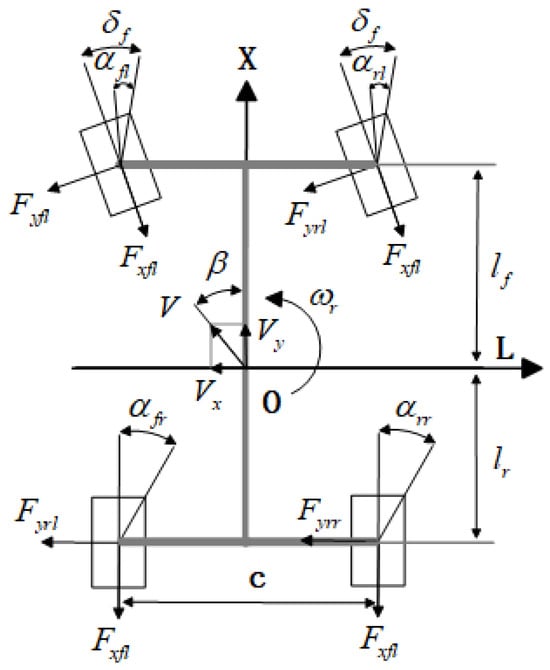
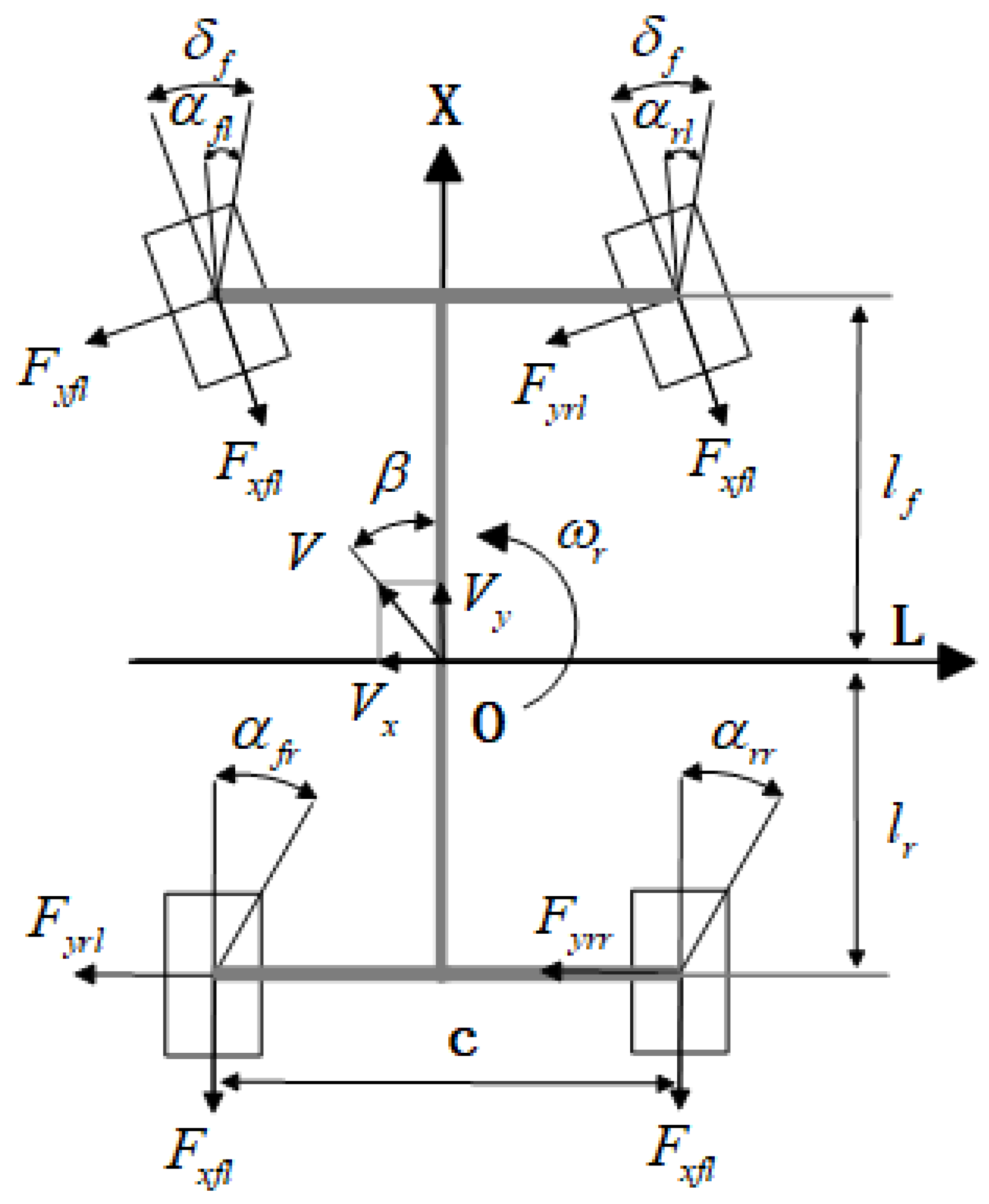
Considering AFS intervention, construct a seven-degree-of-freedom model [36] that includes longitudinal (x-axis), lateral (y-axis), yaw (about the z-axis), and four-wheel rotation (Figure 1). Define the left front wheel (), right front wheel (), left rear wheel (), and right rear wheel (). The differential equations for vehicle motion are as follows:
Figure 1.
Diagram of the whole vehicle dynamics model.
Equations of longitudinal dynamics:
Equations of lateral dynamics:
Equations of yaw dynamics:
In the formula, m represents the total vehicle mass, represents the longitudinal/lateral speed, represents the yaw rate, represents the tire longitudinal/lateral force, represents the steering angle of the front wheels, represents the distance from the center of gravity to the front/rear axle, and c represents the wheelbase.
2.2. Tire Model
Using the Magic Formula tire model to describe nonlinear tire forces [37], combined with the dynamic load distribution characteristics, establishes a coupled model for longitudinal forces and lateral forces:
In the formula, represent longitudinal/lateral acceleration, and h is the height of the center of gravity, reflecting the effect of load transfer on tire force during braking. B, C, D, and E are tire parameters; represents tire slip ratio; and represents tire slip angle. The tire parameters are as follows:
A distinct load-transfer effect occurs during vehicle braking, in which the vehicle’s vertical load is redistributed with the braking deceleration—the vertical load on the front axle tires increases while that on the rear axle tires decreases. Based on this load transfer characteristic, the calculation formula for the tire vertical load is given as follows:
In the formula, represents he vertical load of the tire, and h is the height of the vehicle’s center of gravity from the ground.
2.3. Analysis of the EMB System and Failure Scenarios
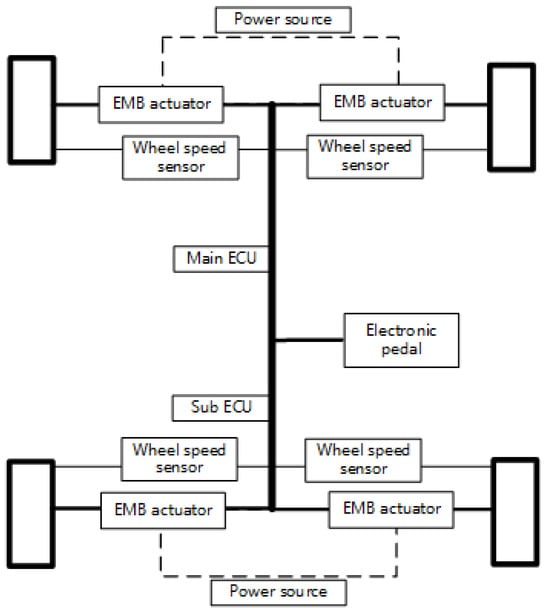
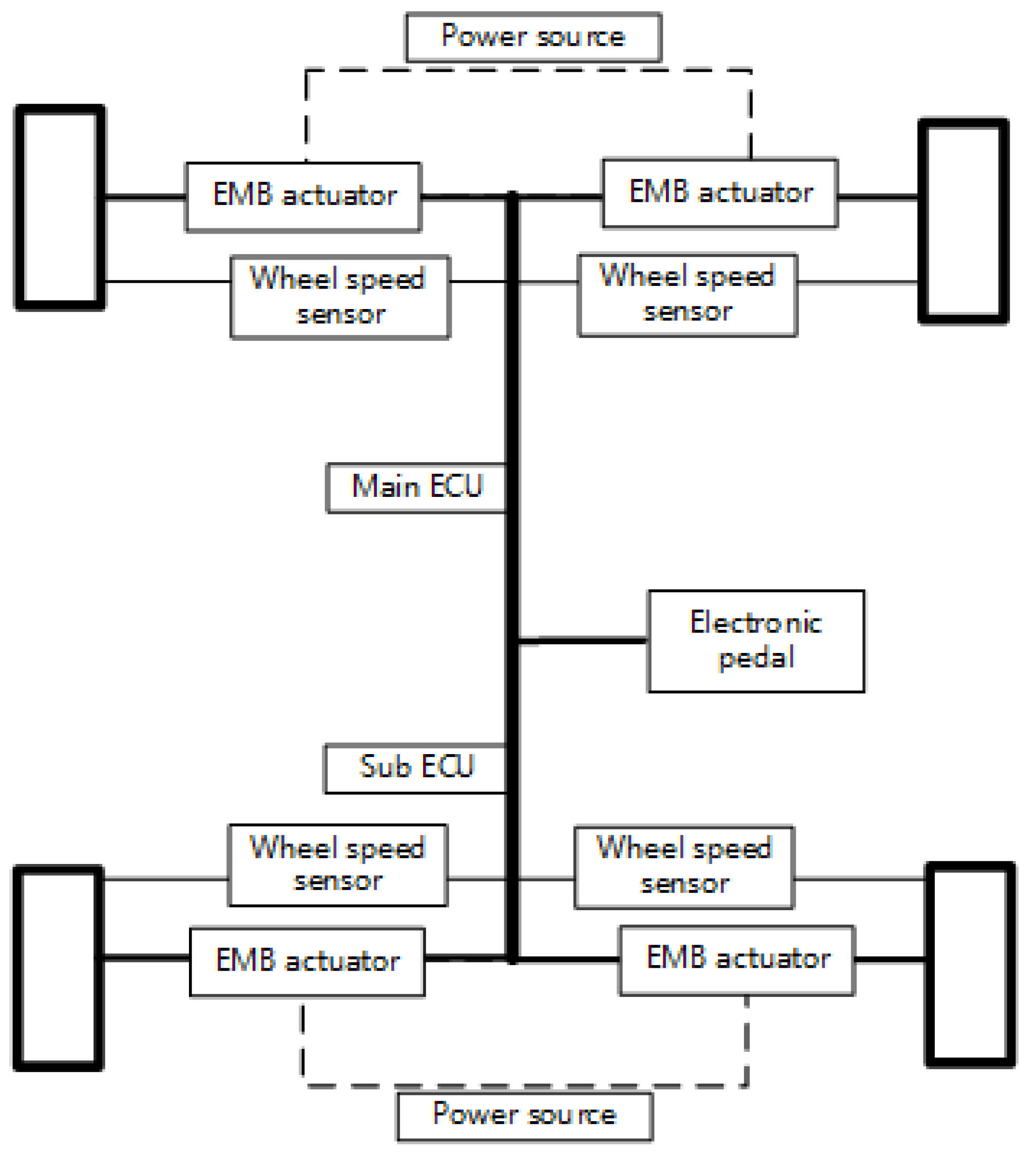
The entire vehicle’s EMB system uses a distributed drive-by-wire structure (Figure 2), with each wheel having an independently controlled EMB module (which mainly includes key components such as the drive motor, transmission mechanism, brake caliper, and brake disc).
Figure 2.
Diagram of the entire EMB system.
The present study employs a pure-electric Electro-Mechanical Brake (EMB) architecture that eliminates hydraulic lines entirely. The system consists of a power supply, a brake-control unit (BCU), a pedal module, four EMB actuators, and dedicated motor-control units (MCUs). After capturing pedal travel and speed, the pedal module transmits the driver’s request to the BCU, which fuses vehicle speed, steering-wheel angle, and other sensor signals to compute the required vehicle-level deceleration and yaw moment. Under single-wheel failure, the BCU decomposes the total demand into individual wheel clamp-force set-points and broadcasts them via a CAN-FD bus to the corresponding MCUs. Each MCU drives a 48-V permanent-magnet synchronous motor coupled to a planetary roller screw and a floating caliper: rotary motion is converted into linear thrust, pressing the pads against the disc and generating a purely frictional braking torque. A built-in pressure sensor closes the force loop; the entire process relies solely on a rigid electro-mechanical path, involving neither hydraulic fluid nor regenerative energy flow. The four-wheel torques are fully decoupled and can be adjusted independently within milliseconds, providing inherent hardware redundancy and vectorial actuation capability for subsequent braking-force redistribution and fault-tolerant control.
Therefore, following the engineering principle established in patent CN121316803A, which advocates immediately cutting off the braking torque command to a failed wheel upon fault detection to ensure system safety, this study models single-wheel EMB failure as an instantaneous and complete loss of braking torque. This modeling choice is grounded in the most severe and frequent fault modes of the electro-mechanical chain: Open-circuit motor windings, burnt power MOSFETs, or fatigue fracture of the planetary roller screw, all cause the transmission path to break within milliseconds, leaving the friction pads without axial thrust and reducing residual clamping force to zero. No repeatable “partial clamping” intermediate state exists, and on-board sensors provide negligible observability of such mechanical breaks, making it impossible to deliver a high-confidence residual torque estimate within the 50 ms fault-tolerant time interval (FFI) mandated by ISO 26262. Injecting an uncertain residual coefficient would continuously bias the torque budget and, under high deceleration, could induce excessive yaw-rate errors, potentially compromising vehicle stability. Consequently, upon fault confirmation, the failed wheel is permanently masked, transferring the entire braking demand to the remaining three wheels and compensating for the missing yaw moment via AFS. This conservative assumption, aligned with the patent’s safety-oriented approach, prioritizes vehicle stability and system reliability at high braking levels while establishing a clear foundation for future incorporation of progressive degradation models.
It is important to note that, while this study focuses on a single-wheel complete failure as the worst-case scenario, the proposed control framework inherently exhibits robustness against matched uncertainties and disturbances due to its sliding-mode structure. Moreover, the conservative threshold setting provides a safety margin that accommodates moderate parameter deviations (e.g., mass variation, CG shift) and sensor noise. Nevertheless, future work will incorporate more comprehensive fault models, such as time-varying bias faults and partial failures, to further enhance the method’s applicability.
In the formula, represents the road adhesion coefficient; is the vertical load on the tire; and is the rolling radius of the wheel.
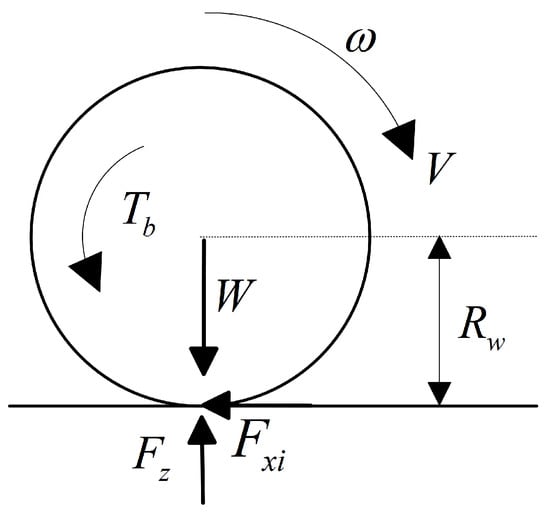
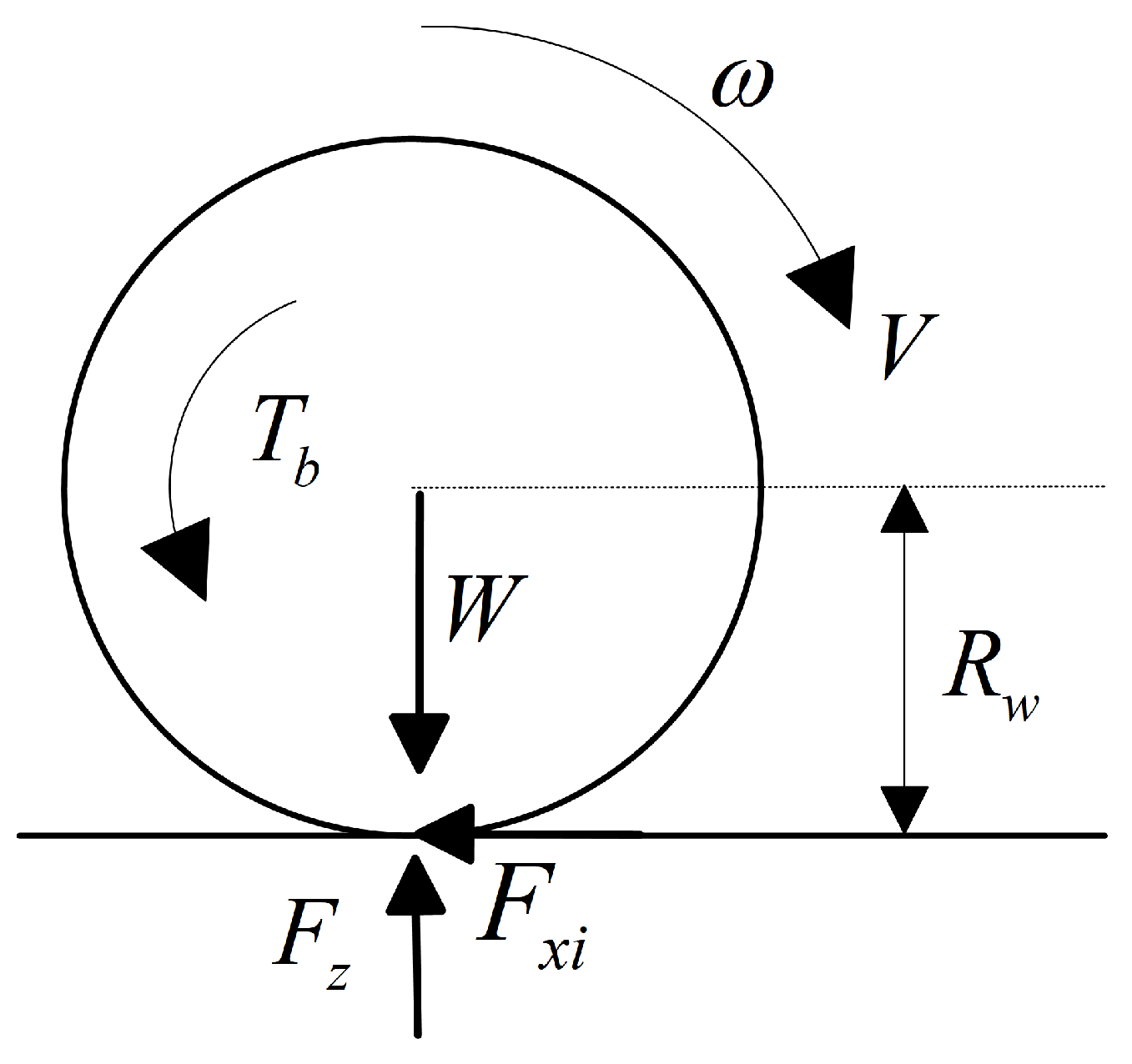
Considering only the planar motion characteristics of the vehicle, the force analysis of the wheels during braking is shown in Figure 3.
Figure 3.
Diagram of wheel forces.
Obtain the tire rotation differential equation [38]:
In the formula, represents the angular velocity of the wheel; represents the braking torque; represents the tire radius; represents the longitudinal tire force; and represents the wheel’s moment of inertia.
3. Bimodal Collaborative Fault-Tolerant Control Strategy Under Single-Wheel EMB Failure
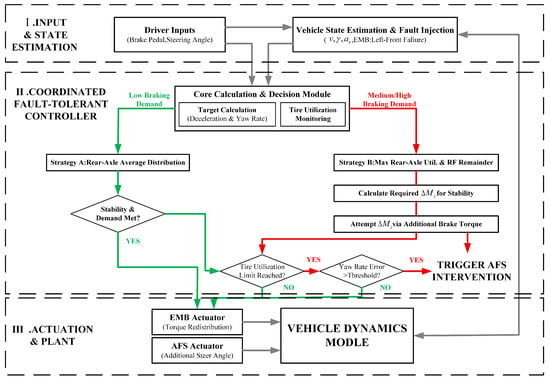
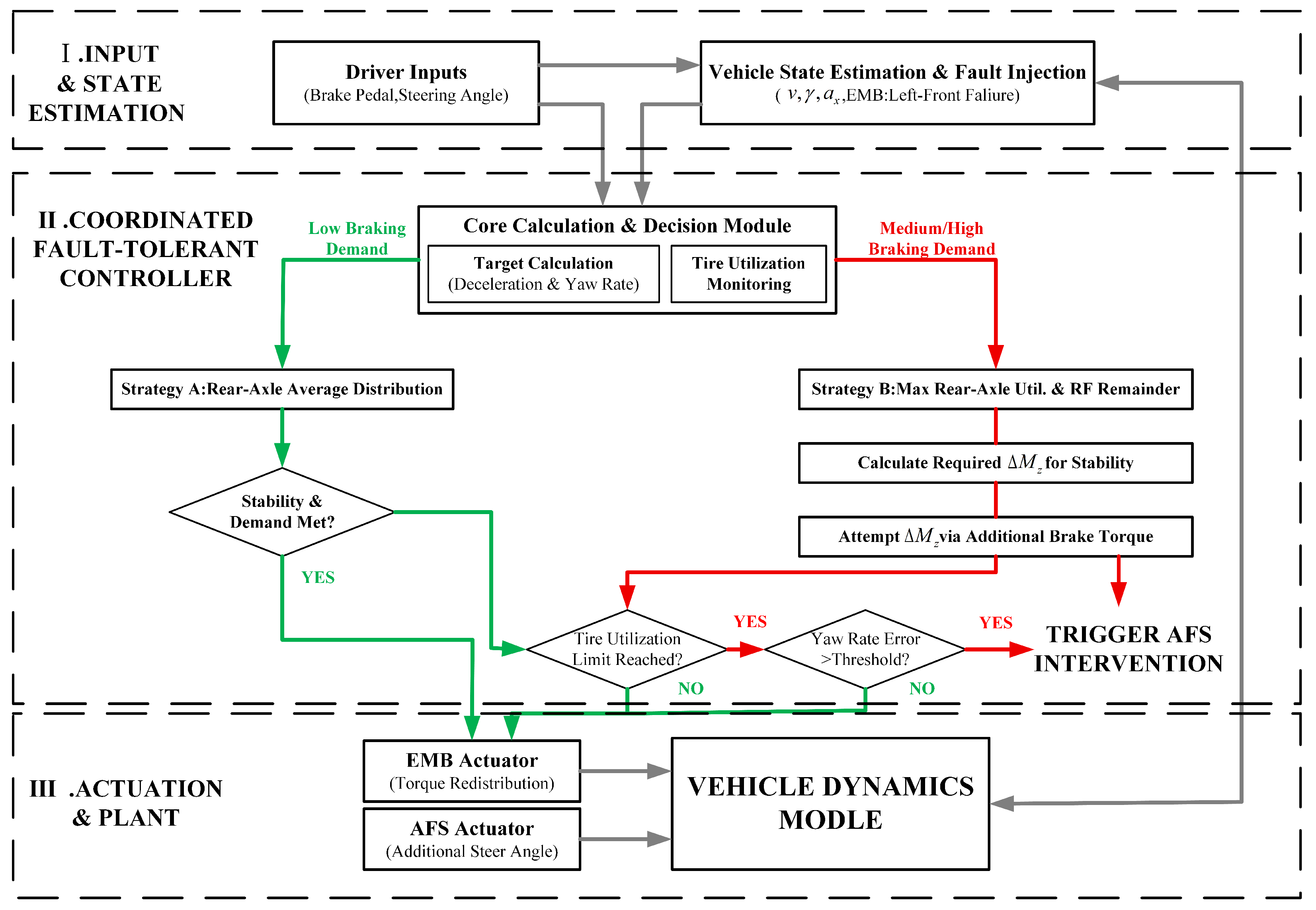
To address the lateral instability caused by single-wheel EMB failures, this paper proposes a fault-tolerant control framework integrating dynamic braking force allocation, yaw moment compensation, and AFS adaptive coordination, as illustrated in Figure 4. Anchored in a vehicle dynamics model, the strategy employs real-time monitoring of tire force states, adhesion utilization rates, and lateral motion parameters to establish a hierarchical control logic. First, it calculates the required yaw moment using an integral sliding mode control method. Then, based on the failure condition and driver braking deceleration demand, it categorizes the failure and optimizes the brake force distribution for the other three wheels. Additionally, it uses AFS to nonlinearly compensate for residual moment deviations. To adapt to varying braking deceleration demands and failure conditions, a threshold-triggered mechanism for rear-wheel adhesion utilization is introduced to enable coordinated control of differential braking and AFS intervention. This ensures that the yaw motion remains within acceptable limits while maximizing the driver’s longitudinal braking performance requirements. The following sections will focus on the calculation and dynamic allocation of yaw moment, the optimized brake force distribution, the design of the AFS control law, and the bimodal switching logic.
Figure 4.
Framework of dual-modal collaborative fault-tolerant control strategy.
3.1. Coordinated Control and Dynamic Allocation of Lateral Moment
3.1.1. Calculation of Lateral Moment
Considering the effects of the center of gravity lateral offset angle and yaw rate n vehicle stability, we simplify the vehicle model to obtain the following two-degree-of-freedom differential equation [39]:
In the formula, represent the lateral stiffness of the front and rear axles, is the yaw rate, is the sideslip angle of the center of gravity, a and b are the distances from the center of gravity to the front and rear axles respectively, is the moment of inertia, u is the longitudinal velocity, v is the lateral velocity, is the steering wheel angle, and m is the mass of the vehicle.
Rewrite the above equation as a state-space equation:
Using sliding mode control theory, the direct yaw moment decision controller is designed by establishing appropriate control laws and sliding mode switching surfaces, enabling the tracking of the desired yaw rate and the center-of-gravity lateral slip angle states, thus effectively controlling the direct yaw moment. Direct yaw moment control adjusts the longitudinal force distribution of each tire to generate an additional yaw moment , causing the vehicle to rotate laterally and thereby controlling its lateral motion and ensuring driving stability. Therefore, considering the additional yaw moment , the state equation is rewritten as follows:
Sliding mode control features simple algorithms and a fast response. To enhance system robustness, this paper employs an integral sliding-mode control method to compute the required additional yaw moment. The control target is the yaw rate, and the sliding surface is defined as follows:
In the formula, represents the error in the roll angular velocity, and c( ) denotes the relative weighting coefficient between the deviations.
Substituting the first line of the state-space equation expansion into the sliding surface and differentiating yields [40]:
Introducing the law of uniform approach:
Combining Equations (13) and (14) and substituting functions for the sign function , we obtain
Proof.
Choose the Lyapunov function candidate as . Taking its derivative with respect to time and substituting the reaching law
, we obtain:
Since , is negative definite. This satisfies the Lyapunov stability condition, guaranteeing that the sliding surface s is reached in finite time and the system trajectory remains on it. Consequently, the tracking error econverges to zero asymptotically. The chattering effect caused by the sign function is mitigated by replacing it with a saturation function in the simulation, as indicated in the manuscript. □
3.1.2. Lateral Moment Dynamic Distribution
The magnitude of the longitudinal force of the tire is constrained by various physical conditions, including the tire adhesion limit constraint and the actuator constraint. This article only considers the tire adhesion limit constraint.
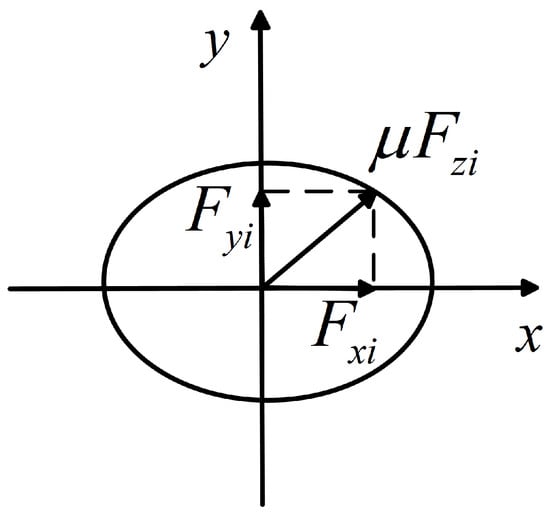
This article only considers the tire adhesion limit constraint. According to the principle of the relationship between the longitudinal and lateral adhesion of the tire (Figure 5), the longitudinal force and lateral force of the tire satisfy [41]:
In the formula, represents the longitudinal force of the tire, represents the lateral force of the tire, represents the vertical load, and represents the road adhesion coefficient.
Figure 5.
Relationship between longitudinal and lateral tire adhesion.
In the vehicle dynamics model established in this paper (Figure 1), the front wheels are steering wheels, while the rear wheels can be approximately considered as having no turning angle. Based on this model, when calculating the tire load rate of the rear axle , the lateral force (in the y direction) can be ignored. This is because the rear wheels have an extremely small turning angle during steering, and the lateral force they generate has a negligible effect on the overall force on the vehicle. Therefore, to simplify the calculation and enhance the applicability of the model, only the longitudinal force (in the x direction) is considered when calculating the tire load rate. This ensures that the adhesion capability of the tires does not exceed their limit under various operating conditions, thereby ensuring the stability of the vehicle. The tire load rate represents the utilization rate of tire adhesion:
In the formula, represents the tire load utilization, represents the longitudinal force on the rear wheels, represents the lateral force on the rear wheels, represents the vertical load on the rear wheels, represents the conservative adhesion utilization factor, set to 0.95, and represents the road adhesion coefficient.
Taking the rear wheels as an example, by analyzing the remaining tire load rates of the two rear wheels, we can determine the available space for the distribution of the yaw moment on the rear axle. Specifically, the remaining tire load rates of the two rear wheels are () and (), their magnitudes reflect the available adhesion margin of the tires under longitudinal force. Based on these load rates, we can calculate the yaw-moment distribution coefficient K, which is used to determine the proportion of the yaw moment distribution between the two rear wheels.
This coefficient allows the required yaw moment of the vehicle to be distributed reasonably according to the remaining moment on the two rear wheels, thereby effectively controlling the vehicle’s yaw moment. The specific distribution is as follows:
The dynamic calculation and reasonable distribution of vehicle yaw moment can be performed using the method shown in Equation (21), thereby optimizing vehicle ride stability and handling performance.
The dynamic allocation method for yaw moment proposed in this section not only takes into account the tire adhesion limit constraints but also fully considers the dynamic characteristics of the vehicle under different braking states, providing an effective solution for vehicle stability control in the event of a single wheel failure in EMB.
3.2. Dynamic Torque Distribution Strategy for Vehicle Braking When Single EMB Brake Fails
This section addresses the actuator saturation constraint, a critical factor in emergency braking. The maximum braking torque each healthy EMB actuator can provide is physically limited by the tire-road friction (). The proposed layered distribution strategy explicitly manages this saturation by operating in two modes based on whether the demanded torque exceeds the capacity of the rear axle.
Taking the failure of the left front wheel brake as an example, this paper proposes a layered braking force distribution method based on actuator saturation constraints. By dynamically optimizing the load on the left and right rear wheels and compensating for the braking force on the right front wheel, it ensures the efficient realization of the total braking torque requirement under the premise of meeting the physical constraints of the actuators.
After a left-front wheel brake failure, determining the rear wheel load distribution capability is a core component of the control strategy design. First, calculate the theoretical even force moment for the rear wheels ; if it meets the criteria , enter the balanced distribution mode. In this mode, the rear wheels symmetrically distribute the braking torque on both sides to minimize yaw disturbance, at which point the torque distribution among the three normally functioning wheels is as follows:
This mode prioritizes rear-wheel redundancy, suitable for high-traction surfaces, effectively preventing vehicle lateral instability caused by asymmetric braking forces on the front wheels.
When the torque distribution between the left and right rear wheels exceeds the saturation limit of one wheel , the system switches to a compensatory distribution mode. In this mode, the rear wheels are first allocated the maximum allowable torque:
The residual torque requirement is dynamically compensated by the right front wheel:
If the right front wheel still fails to meet the requirements , the system will activate a degraded control strategy. This involves reducing the total braking torque request while simultaneously activating AFS compensation yaw torque to ensure vehicle lateral motion stability. At this point, the total braking torque is adjusted to:
In summary, the allocation strategy is designed to operate within the physical saturation limits. By first saturating the rear axle and then compensating with the right-front wheel, and finally reducing the total demand if all actuators are saturated, the controller ensures that braking commands remain feasible and physically realizable.
3.3. Design of the AFS Controller
To address the potential issue of vehicle lateral motion instability caused by single-brake failure in EMB, this paper proposes an AFS control method [42] based on integral sliding mode theory. This method dynamically adjusts the front wheel steering angle to compensate for asymmetric braking torque, thereby enhancing yaw stability.
To reduce the complexity of the control algorithm, the following assumption is made: the lateral force of the tire is linearized, meaning that the lateral force of the tire is approximately linearly related to the slip angle:
In the formula, k represents the equivalent lateral stiffness, which is directly proportional to the vertical load .
Due to the small steering angle of the front wheels , higher-order nonlinear terms are neglected, resulting in the following approximation:
Design the AFS controller using an integral sliding mode control method. The control objective is the yaw rate, and the sliding surface is:
In the formula, represents the error in the roll angular velocity, and c( ) denotes the relative weighting coefficient between the deviations.
Expanding the first row of the state-space Equation (12) and substituting it into the sliding surface, then differentiating, we obtain
Introducing the uniform approach law (13):
Combining Equations (14) and (28), and substituting the function for the sign function, we obtain the front wheel angle as follows:
Proof.
Choose the Lyapunov function candidate as . Taking its derivative with respect to time and substituting the reaching law , we obtain:
Since , is negative definite. This satisfies the Lyapunov stability condition, guaranteeing that the sliding surface sb is reached in finite time and the system trajectory remains on it. Consequently, the tracking error econverges to zero asymptotically. The chattering effect caused by the sign function is mitigated by replacing it with a saturation function in the simulation, as indicated in the manuscript. □
3.4. Threshold Switching Logic for AFS Intervention
To address the nonlinear differences in vehicle dynamic characteristics when an EMB single-brake failure occurs, this paper proposes a method for designing AFS intervention thresholds based on multi-criteria, enabling dynamic switching between bimodal coordinated control strategies to balance braking performance and lateral stability objectives.
There are three triggering conditions for AFS intervention:
(1) Rear wheel adhesion utilization threshold triggered: The primary basis for setting the rear wheel utilization threshold at 90% includes three points: first, based on the relationship between tire longitudinal and lateral adhesion, when the rear wheel utilization approaches 100%, the tire’s adhesion potential is nearly saturated, and further increasing braking force may cause a sharp drop in lateral force, leading to vehicle lateral instability. Setting the threshold at 90% reserves about 10% of margin for lateral force, ensuring that the vehicle can maintain lateral stability during emergency steering or road disturbances; secondly, in actual driving, the road adhesion coefficient may experience dynamic changes (such as local wetness or unevenness), setting the threshold at 90% provides the system with some buffer space, avoiding weakened control effectiveness due to changes in road conditions; additionally, the dynamic response time of the steering system has certain delays (typically 50–100 ms), preemptively engaging AFS when tire adhesion utilization reaches 90% allows sufficient response time for the actuators, ensuring timely execution of control commands.
The longitudinal force utilization is obtained from Equation (16): .
When (the threshold is 0.9), it is determined that the rear wheels are approaching the adhesion limit, triggering AFS intervention. Through the coordinated action of AFS and yaw moment redistribution, the vehicle’s lateral stability requirements are met.
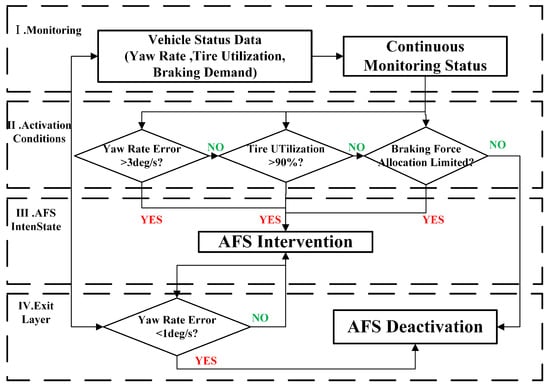
(2) Lateral-yaw rate-deviation trigger (Figure 6): To prevent excessive energy consumption and actuator wear caused by frequent interventions of the Active Front Steering (AFS) system due to overly low thresholds (such as 1 deg/s) while ensuring timely suppression of instability trends through higher thresholds (such as 5 deg/s), this study sets the yaw rate deviation activation threshold at 3 deg/s and establishes a hysteresis threshold of 1 deg/s after activation to ensure smooth switching transitions.
Figure 6.
AFS deactivation logic.
Calculate the deviation between the actual yaw rate and the reference model output .
When 3 deg/s, the coordinated control mode is activated, and a front-wheel steering compensation torque is introduced.
(3) Initial brake strength level triggering:
Compare the total braking force requirement with the maximum available rear wheel braking force .
When , the driver’s braking demand cannot be fully met by the rear wheels and the cooperative control mode is directly activated, introducing a steering compensation torque to the front wheels.
Above all, the total desired yaw moment from the upper-level controller is continuous. In the balanced mode, this moment is entirely generated by differential braking. As the rear wheels approach saturation, the achievable braking yaw moment degrades smoothly, and the AFS controller is designed to generate the residual moment . Since is continuous and decreases smoothly, emerges continuously from zero, ensuring bumpless transfer.
4. Simulation Experiments and Results Analysis
To comprehensively evaluate the performance of the proposed dual-modal adaptive collaborative fault-tolerant control strategy under different braking intensity requirements, this section establishes a closed-loop control system based on a high-precision vehicle dynamics simulation platform. The simulation platform uses co-simulation with Carsim2021.0 and Matlab/SimulinkR2023a. Carsim’s C-class vehicle is used as the reference vehicle. On this basis, the tire model and EMB model built in Simulink are connected, and the braking system is modified to four-wheel independent braking. The main vehicle parameters are set as shown in Table 1.
Table 1.
Full vehicle simulation parameters.
To comprehensively evaluate the performance of the proposed control strategy under diverse operating conditions, three sets of simulation scenarios are established. First, on a high-adhesion road with friction coefficient , the vehicle travels at an initial speed of 60 km/h with a sinusoidal steering input , and emergency deceleration demands of 0.2 g, 0.3 g, and 0.4 g are respectively applied to simulate a left-front wheel EMB failure. Second, under the same high-adhesion condition and initial speed, a deceleration demand of is set to emulate a right-rear wheel EMB failure, with the steering input unchanged. Third, on a low-adhesion road with , the initial speed is reduced to 40 km/h, the steering input remains the same, and a deceleration demand of 0.3 g is applied to simulate a right-rear wheel failure. These three sets of simulations collectively verify the adaptability and robustness of the control strategy across different failure locations, road adhesion levels, and braking intensities.
In the simulation experiment, a single EMB failure scenario was simulated by manually setting the braking force output of one wheel to zero. Due to significant load transfer to the front axle during braking, the vehicle is more prone to yaw-moment imbalance. Therefore, the left front wheel or the right rear wheel was set to enter the failure state after 1 s to evaluate the system’s lateral stability control capability under asymmetric braking forces.
In the simulation experiment, two control strategies were compared: the first is a bimodal coordinated control strategy that combines lateral moment distribution based on tire adhesion utilization with AFS. This strategy dynamically adjusts the braking force distribution by calculating real-time rear-tire adhesion utilization and triggering AFS control when the yaw-rate tracking error or tire utilization exceeds a threshold. The second strategy is a full-time AFS control strategy, which only corrects yaw stability using AFS and does not involve dynamic braking force distribution.
To analyze the differences between the two control strategies in terms of braking stability, trajectory tracking accuracy, and tire force distribution efficiency, we mainly compare indicators such as trajectory offset, yaw rate tracking error, center of gravity slip angle error, rear axle tire utilization, and additional steering angle of the front wheels.
4.1. Simulation Experiment of Bimodal Cooperative Control for Corner Braking Under Left Front Wheel EMB Failure
4.1.1. The Braking Deceleration Requirement Is 0.2 g
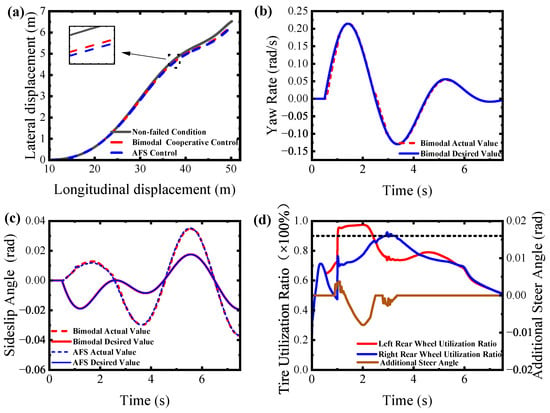
From the simulation results in Figure 7a, it is evident that even when the braking demand increases to 0.2 g, the bimodal strategy still shows advantages but faces more complex tire force-coupling challenges. Its maximum lateral offset is 0.16 m, and the average offset is 0.091 m, which is a reduction of 11.1% and 6.2%, respectively, compared to the full-course AFS control’s 0.18 m and 0.097 m. Under bimodal control, longitudinal displacement increases by 0.32 m, and the braking deceleration reaches 99.4% of the desired value, whereas AFS control only achieves 98.8%. As shown in Figure 7b, the peak yaw rate error further decreases to 0.026 rad/s (1.49 deg/s), and no threshold is triggered throughout the process, indicating that the bimodal coordinated control strategy can maintain high control precision at a braking deceleration of 0.2 g.
Figure 7.
Simulation results when the braking deceleration is 0.2 g. (a) Braking trajectory. (b) Yaw rate. (c) Sideslip angle. (d) Tire utilization ratio and Additional steer angle.
As shown in Figure 7c, the centroid lateral deviation errors for both control methods are similar. However, with bimodal control, the centroid lateral deviation error never exceeds 0.025 rad throughout the process, making its impact on trajectory deviation negligible.
As seen in Figure 7d, due to the increased tire load transfer phenomenon, the vertical load on the left rear wheel decreases to 73% of its initial value during the left turn phase, reaching the threshold (indicated by the dashed line) more quickly, which triggers AFS control with a maximum additional angle of 0.0079 rad. Notably, although the additional angle is larger than in the condition, its amplitude is still significantly lower than that under pure AFS strategy control (0.0085 rad), validating the effectiveness of the bimodal coordinated control strategy in the synergistic distribution of braking force and steering torque. Additionally, during the right turn phase, the utilization rate of the right rear wheel also reaches the threshold, but for a shorter duration, with AFS intervening briefly.
The above simulation results show that the dual-modal cooperative control strategy has good robustness at a braking intensity of . This is achieved by dynamically adjusting the distribution of braking force and the timing of AFS intervention, thereby optimizing the car’s lateral stability and braking performance in tandem.
4.1.2. The Braking Deceleration Requirement Is
When the braking deceleration requirement reaches , due to the significant overall braking torque of the vehicle at this time, similar to the braking-demand condition, the rear wheels receive a greater share of the braking torque. This makes it easier for the left and right rear wheels to reach the set threshold (indicated by the dashed line in Figure 8d), leading to more frequent intervention of AFS. From Figure 8b, we can see that in terms of lateral stability, the error between the actual yaw rate and the ideal yaw rate is relatively small, with the maximum error being only 0.026 rad/s (1.49 deg/s).
Figure 8.
Simulation results when the braking deceleration is 0.3 g. (a) Braking trajectory. (b) Yaw rate. (c) Sideslip angle. (d) Tire utilization ratio and Additional steer angle.
As shown in Figure 8c, the centroid lateral deviation errors under both control methods are similar, with a maximum of no more than 0.03 rad. Drivers have a weak perception of this level of offset and can compensate for it with slight steering adjustments. Therefore, this error does not significantly affect vehicle maneuverability in practical applications.
During the first 1–2 s of the braking process, the yaw moment is mainly achieved through additional braking torque. At this point, AFS control is activated due to the left rear wheel reaching its threshold, but compared to using AFS control throughout, the additional steering angle of the front wheels is relatively small, resulting in a smaller lateral trajectory deviation. However, when the braking process reaches 2–3 s, the left rear wheel has reached its threshold, and the front wheel steering angle increases. At this stage, the trajectories under both control strategies, as shown in the middle section of Figure 8a, are nearly identical. After the braking process enters the 3-s mark, although the control measures based on tire utilization in the first half can temporarily suppress trajectory deviation to some extent, they fail to completely eliminate the yaw rate error, which is then amplified after AFS intervention. From Figure 8b, it can be seen that within the 1–2 s timeframe, the vehicle already has a yaw rate deviation, requiring AFS feedback control to make larger corrections, which results in slightly weaker control performance in the latter half compared to full AFS control. However, as shown in Figure 8a, during the entire control process, the vehicle using bimodal coordinated control has an average offset of 0.074 m, with longitudinal displacement increasing by only 0.31 m compared to the non-failure condition, achieving 99.3% of the desired braking deceleration. In contrast, the simulation results of using AFS control throughout show an average offset of 0.11 m and a braking deceleration of only 97.9% of the desired value.
During the first half of the braking process, trajectory deviation is suppressed by controlling tire utilization, but it fails to completely eliminate yaw rate error, resulting in slightly weaker control performance in the second half compared to full-time AFS control. However, the bimodal cooperative control strategy ensures lateral stability while effectively reducing trajectory deviation, better meeting the driver’s braking expectations, and overall performs better than full-time AFS control, demonstrating certain advantages.
4.1.3. The Braking Deceleration Requirement Is
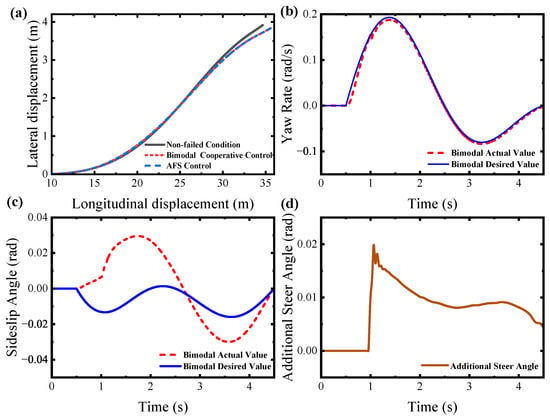
Under high braking-demand conditions with a deceleration of , the rear-wheel braking-force distribution is fully saturated, making it impossible to utilize additional yaw moment for lateral stability control. The system directly triggers AFS intervention, using the lateral adhesion margin of the right front wheel to compensate for the yaw moment. At this point, the bimodal coordinated control strategy degrades into pure steering control. As shown in Figure 9a, the trajectories of both control strategies completely overlap, with a maximum offset of 0.09 m and an average offset of 0.03 m. Longitudinal displacement increases by 1.04 m, and the braking deceleration reaches 97.1% of the required value.
Figure 9.
Simulation results when the braking deceleration is 0.4 g. (a) Braking trajectory. (b) Yaw rate. (c) Sideslip angle. (d) Additional steer angle.
From Figure 9b, it can be seen that the yaw rate error is close to 0.02 rad/s (1.15 deg/s). Additionally, from Figure 9c, it is evident that the lateral deviation angle error of the center of gravity is small and will not significantly affect vehicle maneuverability. Figure 9d shows that the maximum additional steering angle of the front wheel does not exceed 0.02 rad, which is far below the limit value of the front wheel’s steering angle, indicating that the front wheel still has sufficient lateral margin for yaw moment compensation.
4.2. Simulation Experiment of Bimodal Cooperative Control for Corner Braking Under Right Rear-Wheel EMB Failure
4.2.1. Right Rear-Wheel Failure on a High-Traction Road
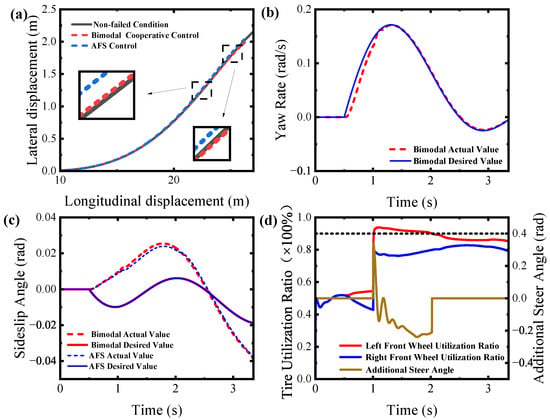
During emergency braking on the high-adhesion pavement with a road adhesion coefficient of , a significant load transfer effect occurs on the vehicle, where the front axle bears the vast majority of the vertical load of the entire vehicle. Even if a complete EMB failure occurs on the right rear wheel, the two healthy wheels on the front axle still possess the capacity to undertake most of the braking intensity requirements. To further highlight the control advantages of the bimodal coordinated fault-tolerant control strategy under high braking intensity, a deceleration demand of was selected as the driver’s braking deceleration requirement for simulation analysis, and a comparative analysis was conducted on the simulation results of three control modes, namely bimodal coordinated fault-tolerant control, full-time AFS control, and normal braking without failure.
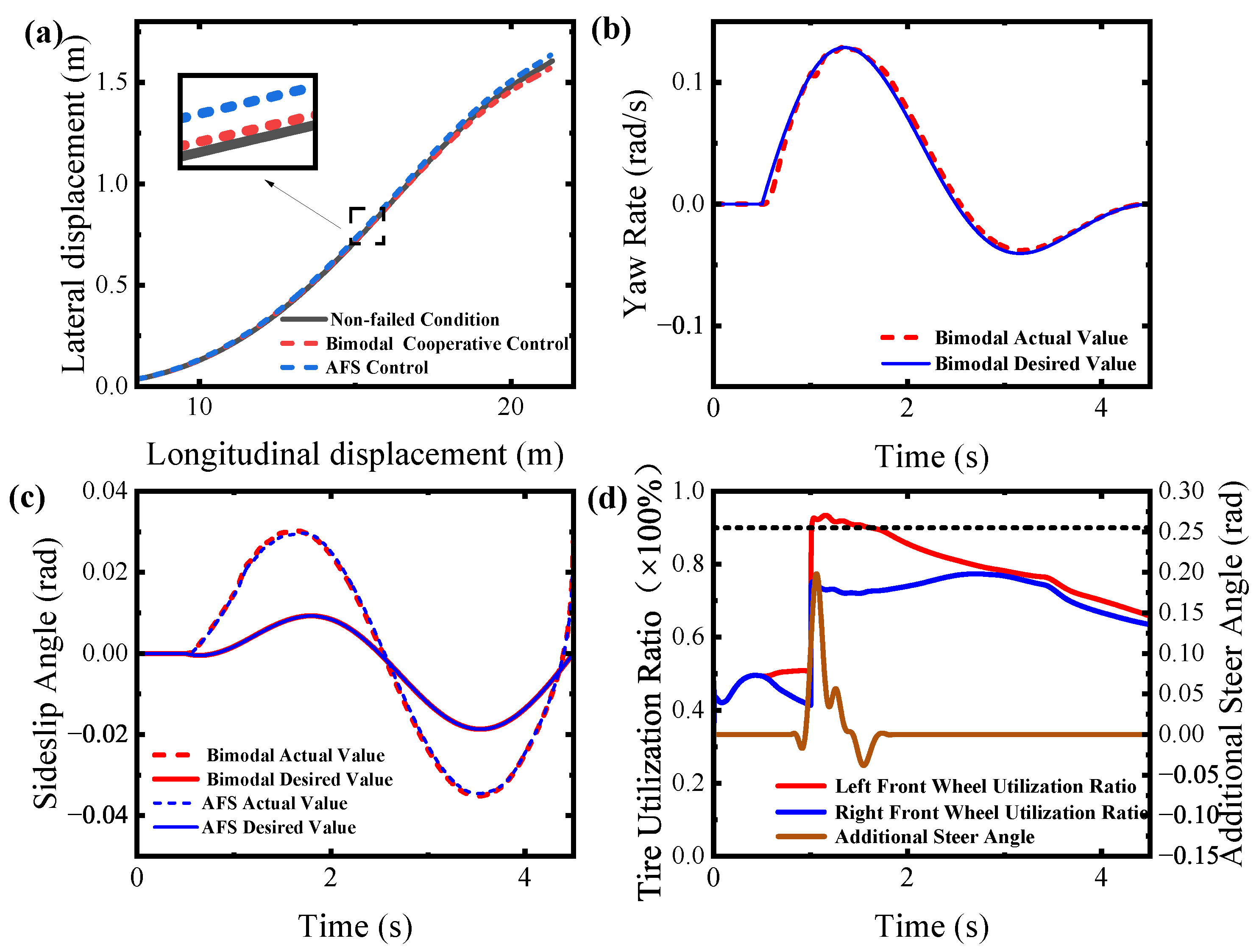
Figure 10a presents the comparison of vehicle braking trajectories under the three control modes. The braking trajectory of the vehicle under bimodal coordinated fault-tolerant control almost completely coincides with the normal trajectory under the non-failure condition, with a maximum lateral offset of only 0.002 m. In contrast, the vehicle under full-time AFS control exhibits an obvious trajectory offset, with the maximum lateral offset reaching 0.012 m. Compared with the full-time AFS control strategy, the bimodal coordinated fault-tolerant control reduces the maximum lateral offset of the vehicle by 83.3%, demonstrating an extremely significant control advantage. This result indicates that under the working condition of right rear wheel EMB failure on high-adhesion pavement, the bimodal control strategy can accurately counteract the yaw moment disturbance caused by single-wheel failure through the dynamic optimal allocation of braking forces among the remaining three healthy wheels, fundamentally suppress the trajectory offset, and achieve an ultra-high level of path tracking accuracy.
Figure 10.
Simulation results when the braking deceleration is 0.6 g. (a) Braking trajectory. (b) Yaw rate. (c) Sideslip angle. (d) Tire utilization ratio and Additional steer angle.
From the perspective of the yaw rate response characteristics shown in Figure 10b, under bimodal coordinated fault-tolerant control, the tracking process of the actual vehicle yaw rate to the ideal reference value remains highly stable throughout the entire braking cycle. The yaw rate tracking error throughout the braking period does not exceed the AFS preset intervention threshold of 3 deg/s, fully verifying that the proposed strategy effectively maintains vehicle lateral motion stability under complex conditions of high braking intensity and single-wheel failure. As a key index reflecting the lateral stability state of the vehicle, the tracking error of the center-of-gravity sideslip angle remains at an extremely low level under both the bimodal coordinated fault-tolerant control and full-time AFS control methods. The error of this magnitude has no obvious impact on the driver’s actual handling perception and will not degrade the vehicle’s maneuverability.
Figure 10d shows the dynamic variation curves of the tire utilization rate of the left front wheel and the additional steering angle of the front wheels. In the left-turn phase from 1 s to 2 s at the initial stage of braking, affected by load transfer, the vertical load of the left front wheel decreases significantly, and its tire adhesion utilization rate rises rapidly and reaches the 90% trigger threshold for AFS intervention. At this time, the AFS system intervenes briefly and generates a maximum additional front-wheel steering angle of approximately 0.3 rad to assist in compensating for the vehicle yaw moment. This additional steering angle is far lower than the mechanical steering angle limit of the front wheels, indicating that the intervention range of AFS is within the physically feasible range without the risk of actuator saturation. With the progress of the braking process, the vehicle speed decreases gradually and the steering direction changes; consequently, the tire utilization rate of the left front wheel drops back and remains below the threshold at all times. Meanwhile, the vehicle yaw rate deviation does not reach the AFS trigger condition again, so the AFS system ceases to intervene in the control. This dynamic control process fully embodies the core idea of on-demand coordinated control in the bimodal coordinated fault-tolerant control strategy, which prioritizes the use of braking force redistribution to counteract yaw disturbances and enables steering assistance only when necessary, thereby effectively reducing the workload and energy consumption of the AFS actuator.
In terms of braking efficiency, the actual braking deceleration of the vehicle under bimodal coordinated fault-tolerant control reaches 99.8% of the target deceleration, with the braking distance increasing by only 0.1 m compared with the non-failure condition, resulting in almost no performance loss. In contrast, the braking deceleration satisfaction rate under full-time AFS control is approximately 99.2%, with a slightly inferior braking efficiency performance. This result indicates that under the high-braking-intensity condition on high-adhesion pavement, the bimodal coordinated fault-tolerant control strategy can maximize the satisfaction of the driver’s longitudinal braking demand while accurately ensuring the lateral stability of the vehicle, thus realizing coordinated optimization of the vehicle’s lateral stability and longitudinal braking efficiency.
4.2.2. Right-Rear Wheel Failure on a Low-Traction Road
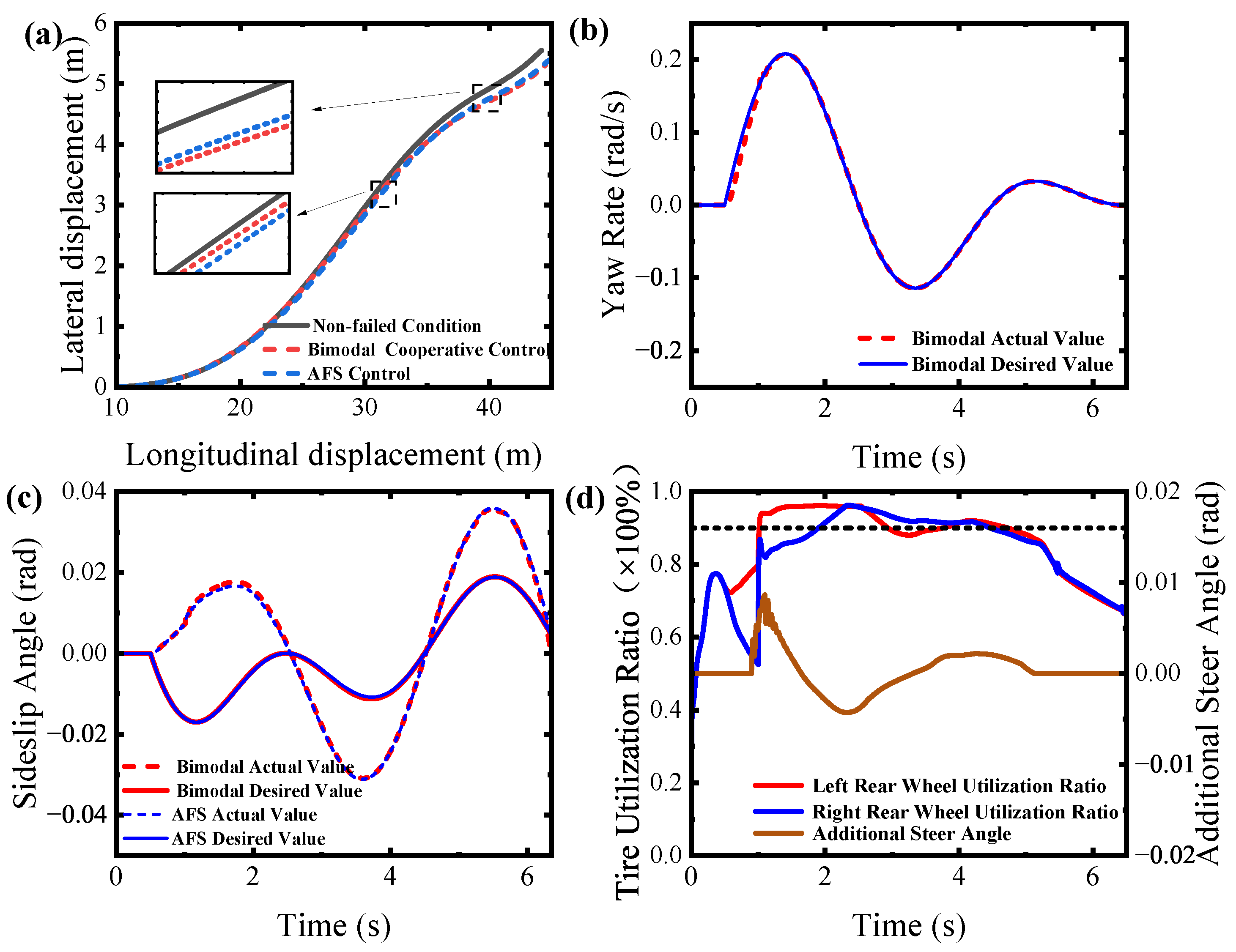
On a low-traction road with a friction coefficient of , the maximum achievable braking deceleration is theoretically limited to no more than due to the traction limit. During braking, the front axle bears the majority of the vertical load, leaving a relatively limited adhesion margin for the rear wheels. Therefore, under the condition of a right-rear wheel EMB failure, a deceleration demand of is selected as a representative simulation scenario, taking into account both the road surface characteristics and the influence of the failed wheel location. This choice enables an effective evaluation of the control strategy’s performance under typical low-adhesion conditions.
Figure 11a presents the vehicle braking trajectories under three control modes. The trajectory obtained with the bimodal cooperative fault-tolerant control closely coincides with the ideal unfailed trajectory, exhibiting a maximum lateral deviation of 0.023 m and an average deviation of 0.008 m. In contrast, the full-time AFS control yields a maximum lateral deviation of 0.156 m and an average deviation of 0.042 m. Compared with full-time AFS, the bimodal strategy reduces the maximum lateral deviation by 85.3% and the average lateral deviation by 81.0%. These results demonstrate that, under right-rear wheel failure on a low-adhesion road, the bimodal control effectively suppresses the yaw disturbance caused by the failure through dynamic redistribution of braking forces among the remaining three wheels, thereby significantly enhancing path-tracking accuracy.
Figure 11.
Simulation results when the braking deceleration is 0.3 g. (a) Braking trajectory. (b) Yaw rate. (c) Sideslip angle. (d) Tire utilization ratio and additional steer angle.
Figure 11b presents the actual yaw rate under bimodal control tracks the reference value steadily, and the tracking error remains consistently below the preset threshold of 3 deg/s throughout the entire process. This confirms that the proposed strategy effectively maintains vehicle yaw stability. Figure 11c shows that the sideslip angle tracking error remains small under both control methods, and its influence on driver perception is negligible.
Figure 11d presents the time histories of the rear-wheel tire utilization ratios and the additional front-wheel steering angle. During the initial left-turn phase from 1 s to 1.8 s, load transfer reduces the vertical load on the left rear wheel, causing its utilization ratio to rapidly increase and reach the 90% trigger threshold. At this moment, the AFS system intervenes briefly, providing a maximum additional steering angle of approximately 0.2 rad to assist in yaw moment compensation. As the vehicle speed decreases and the right-turn phase follows, the load transfer effect on the right rear wheel is less pronounced, and its utilization ratio remains below the threshold; consequently, no further AFS intervention occurs. This process exemplifies the on-demand cooperative control philosophy of the bimodal strategy, which prioritizes brake force redistribution and activates steering assistance only when necessary.
In terms of braking efficiency, the actual deceleration achieved by the bimodal control reaches 99.4% of the target value, with a braking distance increase of only 0.32 m compared to the unfailed condition. In contrast, the full-time AFS control fulfills only 98.8% of the demanded deceleration. These findings indicate that on low-adhesion roads, the bimodal control can better satisfy the driver’s longitudinal braking demand while simultaneously preserving lateral stability.
The bimodal coordinated fault-tolerant control strategy proposed in this study shows limited adaptability under low-traction conditions. Specifically, the reduced tire grip narrows the adjustment range of braking force distribution, making it less effective to optimize lateral stability only by braking force allocation; meanwhile, the narrowed lateral force margin of tires weakens the supplementary regulation effect of active front steering (AFS), which requires more cautious operation under extremely low-traction working conditions. For actual driving, it is recommended that drivers lower the vehicle speed appropriately and avoid aggressive braking to maintain driving stability. For intelligent vehicles equipped with autonomous driving systems, real-time adjustment of vehicle speed and braking intensity based on the perceived road traction coefficient can further ensure the safe and stable operation of the vehicle under low-traction conditions, thereby fully leveraging the control performance of the proposed strategy.
5. Conclusions and Outlook
5.1. Key Conclusions
This paper addresses the functional safety challenges of electromechanical brake (EMB) systems under single-wheel failure by proposing a bimodal adaptive coordinated fault-tolerant control strategy that combines dynamic braking force allocation with active front steering (AFS). Through comprehensive co-simulations using Carsim and MATLAB/Simulink under various failure locations (left-front and right-rear wheels), road adhesion conditions ( and ), and braking intensity demands ( to ), the effectiveness and robustness of the proposed strategy have been systematically validated. The key conclusions are summarized as follows:
(1) Compared with full-time AFS control, the proposed bimodal strategy significantly reduces lateral displacement under all tested scenarios. For left-front wheel failure at 0.2 g–0.3 g deceleration demands, lateral offsets are reduced by 6.2–67.3% while maintaining yaw rate errors consistently below the 0.05 rad/s threshold and achieving over 99% deceleration satisfaction. Under right-rear wheel failure with 0.6g high-intensity braking on high-adhesion roads (), the maximum lateral offset is reduced by 83.3% to only 0.002 m, demonstrating near-ideal trajectory tracking. On low-adhesion roads () with right-rear wheel failure at 0.3 g deceleration, the maximum lateral deviation is reduced by 85.3%, and the yaw rate tracking error remains below the 3 deg/s threshold throughout the braking process. In all cases, the deceleration satisfaction rate exceeds 99%, with braking distance increases of only 0.1–1.04 m compared to non-failure conditions.
(2) The strategy maintains effective performance across different failure locations, road adhesion levels, and braking intensities. The conservative 90% adhesion utilization threshold, combined with hysteresis in AFS triggering (3 deg/s activation, 1 deg/s deactivation), provides inherent robustness against parameter uncertainties, sensor noise, and external disturbances. The sliding mode control structure further guarantees theoretical robustness against matched uncertainties, as established through Lyapunov stability analysis.
(3) Two critical limitations are observed. First, under moderate deceleration demands (0.2 g–0.3 g), the cumulative amplification of residual yaw rate errors after AFS intervention emerges as the primary constraint on control precision, highlighting the necessity for dynamic compensation optimization in braking-steering coupled control. Second, under rear axle braking force saturation (e.g., at deceleration during left-front wheel failure), the system reverts to pure steering control, with performance constrained by inherent tire physical limitations Under such conditions, the lateral trajectory of the proposed strategy coincides with that of full-time AFS control, underscoring that no fault-tolerant control can exceed the inherent adhesion limits of tires.
(4) The innovation of this study lies in establishing a dual-objective fault-tolerant control framework for EMB systems that concurrently addresses braking intensity and vehicle lateral stability through a rule-based, threshold-triggered hierarchical coordination approach. This paradigm not only provides a novel methodology for ensuring safety in the event of single-wheel EMB failures but also offers valuable references for developing coordinated redundancy-based safety technologies across steer-by-wire chassis subsystems.
5.2. Research Prospects
The proposed dual-mode coordination control strategy demonstrates excellent performance under single-wheel brake failure scenarios. Future research should focus on three key directions. First, expand the fault model to include complex real-world failures such as time-varying bias faults, partial performance degradation, and intermittent failures while integrating advanced fault-tolerant frameworks like Wang’s [23] fixed-time reinforcement learning method. Second, address the distinct dynamic responses between front-wheel and rear-wheel failures. Front-wheel failures cause significant load transfer, leading to yaw moment imbalance and lateral deviation, while rear-wheel failures primarily affect braking performance. Develop position-based dynamic parameter adaptation mechanisms supported by bench and vehicle-in-the-loop validation. Third, incorporate steering actuator dynamics into the control algorithm to mitigate response delays using feedforward compensation or predictive control. Explore high-dynamic steer-by-wire systems to enhance precision, especially under high-speed or low-adhesion conditions where execution delays exacerbate yaw rate and sideslip angle tracking errors. Despite significant differences in dynamic responses across failure positions, the core strategy logic remains consistent through coordinated dynamic braking torque allocation and active front steering compensation for optimal stability and braking performance.
Author Contributions
Conceptualization, T.S.; formal analysis, T.S. and H.J.; investigation, H.J.; data curation, T.S. and H.J.; writing—original draft preparation, T.S. and H.J.; writing—review and editing, T.S., K.Y. and Y.C.; supervision, T.S.; consultation, K.Y. and Y.C. All authors have read and agreed to the published version of the manuscript.
Funding
This project is partially funded by the Jiangsu Provincial Key Research and Development Program (Grant No. BE2017129).
Data Availability Statement
Since the parameters of the engine and motor used in this paper were generated under a specific project cooperation agreement, they cannot be made public due to the restrictions of the agreement.
Conflicts of Interest
The authors declare no conflicts of interest.
Abbreviations
The following abbreviations are used in this manuscript:
| EMB | Electro-Mechanical Brake |
| AFS | Active Front Steering |
References
- da Silva, F.A.; Bagbaba, A.C.; Hamdioui, S.; Sauer, C. Combining fault analysis technologies for ISO26262 functional safety verification. In Proceedings of the 2019 IEEE 28th Asian Test Symposium (ATS), Kolkata, India, 10–13 December 2019; pp. 129–1295. [Google Scholar]
- Chen, Y.; Jiang, H.; Sun, T. Review of Scenario Virtual Testing Technology for Autonomous Vehicles: Migration Challenges Between Symmetric Frameworks and Asymmetric Scenarios. Symmetry 2025, 17, 1503. [Google Scholar] [CrossRef] [Scilit]
- Jin, X.; Lv, H.; Tao, Y.; Lu, J.; Lv, J.; Ikiela, N.V.O. Active Fault Tolerant Trajectory-Tracking Control of Autonomous Distributed-Drive Electric Vehicles Considering Steer-by-Wire Failure. Symmetry 2025, 17, 1471. [Google Scholar] [CrossRef] [Scilit]
- Chen, J.; Han, Y.; Huangfu, B.; Shi, J. Research on Vehicle Stability Control Strategy Under Single-Wheel Emb Braking Failure. In Proceedings of the 2024 8th CAA International Conference on Vehicular Control and Intelligence (CVCI); IEEE: Piscataway, NJ, USA, 2024; pp. 1–6. [Google Scholar]
- Chen, Y.; Chen, L.; Huang, C.; Lu, Y.; Wang, C. A dynamic tire model based on HPSO-SVM. Int. J. Agric. Biol. Eng. 2019, 12, 36–41. [Google Scholar] [CrossRef] [Scilit]
- Tang, X.; Shi, L.; Wang, B.; Xie, Y. EMB-based brake failure stability control strategy for distributed drive electric vehicles. In Proceedings of the 2022 6th CAA International Conference on Vehicular Control and Intelligence (CVCI); IEEE: Piscataway, NJ, USA, 2022; pp. 1–6. [Google Scholar]
- Wu, T.; Wang, J.; Rong, J.; Meng, Y.; Yang, X.; Peng, J.; Chu, L. Braking reconstruction control for fault-tolerance in electromechanical brake actuator failures. Proc. Inst. Mech. Eng. Part D-J. Automob. Eng. 2025, 239, 6455–6470. [Google Scholar] [CrossRef] [Scilit]
- Liu, H.; Yan, S.; Shen, Y.; Li, C.; Zhang, Y.; Hussain, F. Model predictive control system based on direct yaw moment control for 4WID self-steering agriculture vehicle. Int. J. Agric. Biol. Eng. 2021, 14, 175–181. [Google Scholar] [CrossRef] [Scilit]
- Wang, Z.; Zhu, J.; Zhang, L.; Wang, Y. Automotive ABS/DYC coordinated control under complex driving conditions. IEEE Access 2018, 6, 32769–32779. [Google Scholar] [CrossRef] [Scilit]
- Li, Q.; Zhang, H.; Gao, C.; Yan, S. Research on failure classification and control strategy of four-wheel independent drive electric vehicle drive system. J. Braz. Soc. Mech. Sci. Eng. 2021, 43, 550. [Google Scholar] [CrossRef] [Scilit]
- Yim, S. Fault-tolerant yaw moment control with steer—and brake-by-wire devices. Int. J. Automot. Technol. 2014, 15, 463–468. [Google Scholar] [CrossRef] [Scilit]
- Ji, Y.; Zhang, J.; Lv, C.; He, C.; Hou, X.; Han, J. Fault-tolerant vehicle stability control based on active steering and direct yaw moment with finite-time constraint performance recovery. IEEE Trans. Veh. Technol. 2023, 72, 15317–15329. [Google Scholar] [CrossRef] [Scilit]
- Han, J.; Zhang, J.; Lv, C.; He, C.; Wei, H.; Zhao, S.; Zhang, Z.; Ji, Y. Safe Replanning and Motion Control for Automated Emergency Braking Under Braking System Failures. IEEE Trans. Veh. Technol. 2024, 74, 2353–2365. [Google Scholar] [CrossRef] [Scilit]
- Wang, J.; Zhang, C.; Guo, D.; Liu, Z.; Zhou, Z.; Wang, Z. Coordinated steering control combining DDAS and AFS for the front-wheel-independent-drive electric vehicles. IEEE Trans. Transp. Electrif. 2023, 10, 6295–6308. [Google Scholar] [CrossRef] [Scilit]
- Wu, Y.; Li, B.; Zhang, N.; Du, H.; Zhang, B. Rear-steering based decentralized control of four-wheel steering vehicle. IEEE Trans. Veh. Technol. 2020, 69, 10899–10913. [Google Scholar] [CrossRef] [Scilit]
- Wang, Y.; Wang, M. Adaptive Fault-Tolerant Sliding Mode Control Design for Robotic Manipulators with Uncertainties and Actuator Failures. Symmetry 2025, 17, 1547. [Google Scholar] [CrossRef] [Scilit]
- Cui, G.; Bao, C.; Guo, M.; Xu, Y.; He, Y.; Wu, J. Research on Path Tracking Fault-Tolerant Control Strategy for Intelligent Commercial Vehicles Based on Brake Actuator Failure. Actuators 2024, 13, 97. [Google Scholar] [CrossRef] [Scilit]
- Luo, Y.; Luo, J.; Qin, Z. Model-independent self-tuning fault-tolerant control method for 4WID EV. Int. J. Automot. Technol. 2016, 17, 1091–1100. [Google Scholar] [CrossRef] [Scilit]
- Guo, M.; Bao, C.; Cao, Q.; Xu, F.; Miao, X.; Wu, J. Fault-Tolerant Control Study of Four-Wheel Independent Drive Electric Vehicles Based on Drive Actuator Faults. Machines 2024, 12, 450. [Google Scholar] [CrossRef] [Scilit]
- Lee, K.; Lee, M. Fault-tolerant stability control for independent four-wheel drive electric vehicle under actuator fault conditions. IEEE Access 2020, 8, 91368–91378. [Google Scholar] [CrossRef] [Scilit]
- Tabbache, B.; Benbouzid, M.E.H.; Kheloui, A.; Bourgeot, J.-M. Virtual-sensor-based maximum-likelihood voting approach for fault-tolerant control of electric vehicle powertrains. IEEE Trans. Veh. Technol. 2012, 62, 1075–1083. [Google Scholar] [CrossRef] [Scilit]
- Hernandez-Alcantara, D.; Amezquita-Brooks, L.; Morales-Menéndez, R.; Sename, O.; Dugard, L. The cross-coupling of lateral-longitudinal vehicle dynamics: Towards decentralized Fault-Tolerant Control Schemes. Mechatronics 2018, 50, 377–393. [Google Scholar] [CrossRef] [Scilit]
- Wang, Q.; Fu, H.; Chen, Z.; An, B.; Ma, Z. Fixed-time reinforcement learning fault-tolerant control for uncertain nonlinear systems with actuator saturation and time-varying bias faults. Eng. Appl. Artif. Intell. 2026, 170, 114250. [Google Scholar] [CrossRef] [Scilit]
- Zhao, J.; Lin, Y. Adaptive actuator failure compensation control: A new scheme based on fault detection and isolation. IEEE/ASME Trans. Mechatron. 2023, 28, 2236–2247. [Google Scholar] [CrossRef] [Scilit]
- Chen, R.; Ou, J. A hybrid fault-tolerant control strategy for four-wheel independent drive vehicles. Adv. Mech. Eng. 2021, 13, 16878140211045486. [Google Scholar] [CrossRef] [Scilit]
- Mwasilu, F.; Jung, J.W. Enhanced fault-tolerant control of interior PMSMs based on an adaptive EKF for EV traction applications. IEEE Trans. Power Electron. 2015, 31, 5746–5758. [Google Scholar] [CrossRef] [Scilit]
- Jeong, Y.; Sul, S.K.; Schulz, S.E.; Patel, N. Fault detection and fault-tolerant control of interior permanent-magnet motor drive system for electric vehicle. IEEE Trans. Ind. Appl. 2005, 41, 46–51. [Google Scholar] [CrossRef] [Scilit]
- Lu, E.; Xue, J.; Chen, T.; Patel, N. Robust trajectory tracking control of an autonomous tractor-trailer considering model parameter uncertainties and disturbances. Agriculture 2023, 13, 869. [Google Scholar] [CrossRef] [Scilit]
- Wang, C.; Heng, B.; Zhao, W. Yaw and lateral stability control for four-wheel-independent steering and four-wheel-independent driving electric vehicle. Proc. Inst. Mech. Eng. Part D-J. Automob. Eng. 2020, 234, 409–422. [Google Scholar] [CrossRef] [Scilit]
- Zhao, S.; Zhang, J.; He, C.; Hou, X.; Huang, H. Adaptive drift control of autonomous electric vehicles after brake system failures. IEEE Trans. Ind. Electron. 2023, 71, 6041–6052. [Google Scholar] [CrossRef] [Scilit]
- Mutoh, N. Driving and braking torque distribution methods for front-and rear-wheel-independent drive-type electric vehicles on roads with low friction coefficient. IEEE Trans. Ind. Electron. 2012, 59, 3919–3933. [Google Scholar] [CrossRef] [Scilit]
- Chen, C.; Lewis, F.L.; Xie, S.; Modares, H.; Liu, Z.; Zuo, S.; Davoudi, A. Resilient adaptive and H∞ controls of multi-agent systems under sensor and actuator faults. Automatica 2019, 102, 19–26. [Google Scholar] [CrossRef] [Scilit]
- Cao, X.; Tian, Y.; Ji, X.; Qiu, B. Fault-tolerant controller design for path following of the autonomous vehicle under the faults in braking actuators. IEEE Trans. Transp. Electrif. 2021, 7, 2530–2540. [Google Scholar] [CrossRef] [Scilit]
- Zhang, B.; Lu, S. Fault-tolerant control for four-wheel independent actuated electric vehicle using feedback linearization and cooperative game theory. Control Eng. Pract. 2020, 101, 104510. [Google Scholar] [CrossRef] [Scilit]
- Bao, H.; Wang, K.; Wei, X.; Cheng, Y.; Zhao, M.; Li, G. Highly Redundant Safety Scheme and Its Experimental Validation for the Electronic-Controlled Pneumatic Braking System of Commercial Vehicle for Autonomous Driving. IEEE Access 2024, 12, 138201–138210. [Google Scholar] [CrossRef] [Scilit]
- Xu, Y.; Zhu, Z.; Zhou, D.; Lv, H.; Wang, X.; Li, L.; Zhao, W. Fault-Tolerant Control of Electro-Mechanical Brake Based on Low-Order Sliding Mode Control and Quadratic Programming Allocation. arXiv 2024, arXiv:5995934. [Google Scholar]
- Bhoraskar, A.; Sakthivel, P. A review and a comparison of Dugoff and modified Dugoff formula with Magic formula. In Proceedings of the 2017 International Conference on Nascent Technologies in Engineering (ICNTE); IEEE: Piscataway, NJ, USA, 2017; pp. 1–4. [Google Scholar]
- Chang, C.; Chu, L.; Zhao, D. Wheel Speed Control for Corner Module ABS with Full Brake-By-Wire System. In Proceedings of the SAE 2025 Intelligent and Connected Vehicles Symposium; SAE Technical Paper; SAE International: Warrendale, PA, USA, 2025. [Google Scholar]
- Ma, L.; Cheng, C.; Guo, J.; Shi, B.; Ding, S.; Mei, K. Direct yaw-moment control of electric vehicles based on adaptive sliding mode. Math. Biosci. Eng. 2023, 20, 13334–13355. [Google Scholar] [CrossRef] [Scilit] [PubMed]
- Asiabar, A.N.; Kazemi, R. A direct yaw moment controller for a four in-wheel motor drive electric vehicle using adaptive sliding mode control. Proc. Inst. Mech. Eng. Part K-J. Multi-Body Dyn. 2019, 233, 549–567. [Google Scholar] [CrossRef] [Scilit]
- Nah, J.; Seo, J.; Yi, K.; Kim, W.; Lee, J. Friction circle estimation-based torque distribution control of six-wheeled independent driving vehicles for terrain-driving performance. Proc. Inst. Mech. Eng. Part D-J. Automob. Eng. 2015, 229, 1469–1482. [Google Scholar] [CrossRef] [Scilit]
- Yim, S.; Kim, S.; Yun, H. Coordinated control with electronic stability control and active front steering using the optimum yaw moment distribution under a lateral force constraint on the active front steering. Proc. Inst. Mech. Eng. Part D-J. Automob. Eng. 2016, 230, 581–592. [Google Scholar] [CrossRef] [Scilit]

Disclaimer/Publisher’s Note: The statements, opinions and data contained in all publications are solely those of the individual author(s) and contributor(s) and not of MDPI and/or the editor(s). MDPI and/or the editor(s) disclaim responsibility for any injury to people or property resulting from any ideas, methods, instructions or products referred to in the content. |
© 2026 by the authors. Licensee MDPI, Basel, Switzerland. This article is an open access article distributed under the terms and conditions of the Creative Commons Attribution (CC BY) license.