Article

Low-Light Image Enhancement via Wavelet Domain Frequency Cross-Attention

1
Department of Electronics Engineering, Pusan National University, Busan 46241, Republic of Korea
2
Electronics and Telecommunications Research Institute, Daejeon 34129, Republic of Korea
*
Author to whom correspondence should be addressed.
Symmetry 2026, 18(3), 470; https://doi.org/10.3390/sym18030470
Submission received: 10 February 2026 / Revised: 3 March 2026 / Accepted: 6 March 2026 / Published: 10 March 2026

Abstract

This study proposes a novel low-light image enhancement network that incorporates a frequency cross-attention mechanism in the wavelet domain. The proposed network enhances brightness through the low-frequency wavelet subband while simultaneously restoring fine details in the high-frequency subbands. Color degradation during the brightening process is prevented by applying a color-preserving block based on the saturation component before the illumination adjustment. Furthermore, U-shaped lightening and multiscale sharpening blocks are designed to enhance the image brightness and detail, respectively. The disruption of intrinsic symmetry in coefficient correlations poses a major challenge in independently processing wavelet subbands. To address this issue, we propose a frequency cross-attention block that enables effective information exchange between subbands, thereby preserving their inherent correlations. The proposed network produces visually consistent and refined outputs by balancing the enhanced wavelet subbands. Experimental evaluations demonstrate that the proposed network achieves competitive performance in both subjective quality and objective metrics, confirming its effectiveness for low-light image enhancement.

1. Introduction

Images captured in low-light environments often exhibit reduced visibility, decreased contrast, and diminished color fidelity. Insufficient illumination during image capture is the primary cause of such image quality deterioration. This limitation hinders computer vision systems from accurately reproducing color and contrast. Consequently, low-light image enhancement (LLIE) has emerged as a critical preprocessing step under low-light conditions. It improves the reliability and robustness of various computer vision tasks, including object detection, face recognition, and nighttime dehazing. Recent research has focused on mitigating the adverse effects of low illumination in computer vision applications, with particular emphasis on machine learning-based approaches [1].
Although histogram equalization-based techniques [2,3] have been used to enhance low-light images, they often perform poorly on severely distorted images and frequently introduce noise into the enhanced results. Additionally, physical image degradation model-based LLIE methods, such as Retinex theory [4,5] and atmospheric scattering model (ASM) [6,7], are typically employed to enhance low-light images. However, these methods frequently encounter challenges in terms of parameter determination and may produce halos and amplified noise. Recently, deep learning-based LLIE networks, including convolutional neural network (CNN) [8,9], generative adversarial network (GAN) [10], and transformer [11,12] architectures, have achieved remarkable success and attracted significant attention. Despite these advances, the primary challenge in low-light image enhancement (LLIE) is the simultaneous restoration of brightness, color fidelity, and contrast. Many approaches attempt to address these factors individually. However, achieving balanced and consistent improvement across all three remains difficult.
Low-light images typically exhibit low absolute values for both the high- and low-frequency coefficients in the wavelet domain. Consequently, the LLIE in this domain essentially corresponds to increasing the magnitude of the wavelet coefficients. Brightness restoration and contrast enhancement are governed by the low-frequency wavelet subband and high-frequency wavelet features, respectively. However, conventional LLIE approaches often fail to restore brightness, color fidelity, and contrast simultaneously. This limitation largely arises from the difficulty of preserving the intrinsic correlation between low- and high-frequency subbands.
To address these challenges, we propose a novel machine learning-based LLIE framework in the wavelet domain. The framework employs global maximum pooling (GMP) as a fundamental operation to amplify both the low- and high-frequency coefficients. This process helps restore brightness and enhance fine details. To prevent color degradation during lightening process, the saturation component of the input image is incorporated to guide illumination adjustment while preserving chromatic fidelity. Because low- and high-frequency subbands are intrinsically correlated, maintaining their interdependence during enhancement is essential. To this end, we introduce a frequency cross-attention mechanism that facilitates effective information exchange across subbands, yielding balanced enhancement and structurally consistent results.
The major contributions of this study are summarized as follows:
  • We present a novel LLIE framework in the wavelet domain that separately enhances brightness (low-frequency) and contrast (high-frequency) while preserving inter-subband correlations.
  • We employ GMP as a core operation to amplify the wavelet coefficients, thereby enabling the effective restoration of low-light images.
  • We design a U-shaped lightening (UL) block to restore brightness and a multiscale sharpening (MS) block to enhance the image contrast.
  • We incorporate a color-preserving (CP) strategy based on the saturation component to improve brightness without compromising color fidelity.
  • We introduce a frequency cross-attention (FCA) mechanism to preserve the intrinsic relationships between low- and high-frequency subbands, leading to visually consistent and refined image enhancement.
  • In the final refinement stage, the initially enhanced image is further processed using the CP and UL blocks, where the low-light image and its saturation component are used. The outputs of the CP and UL blocks are then employed as attention weights to refine the enhanced low-light image produced by the main network.
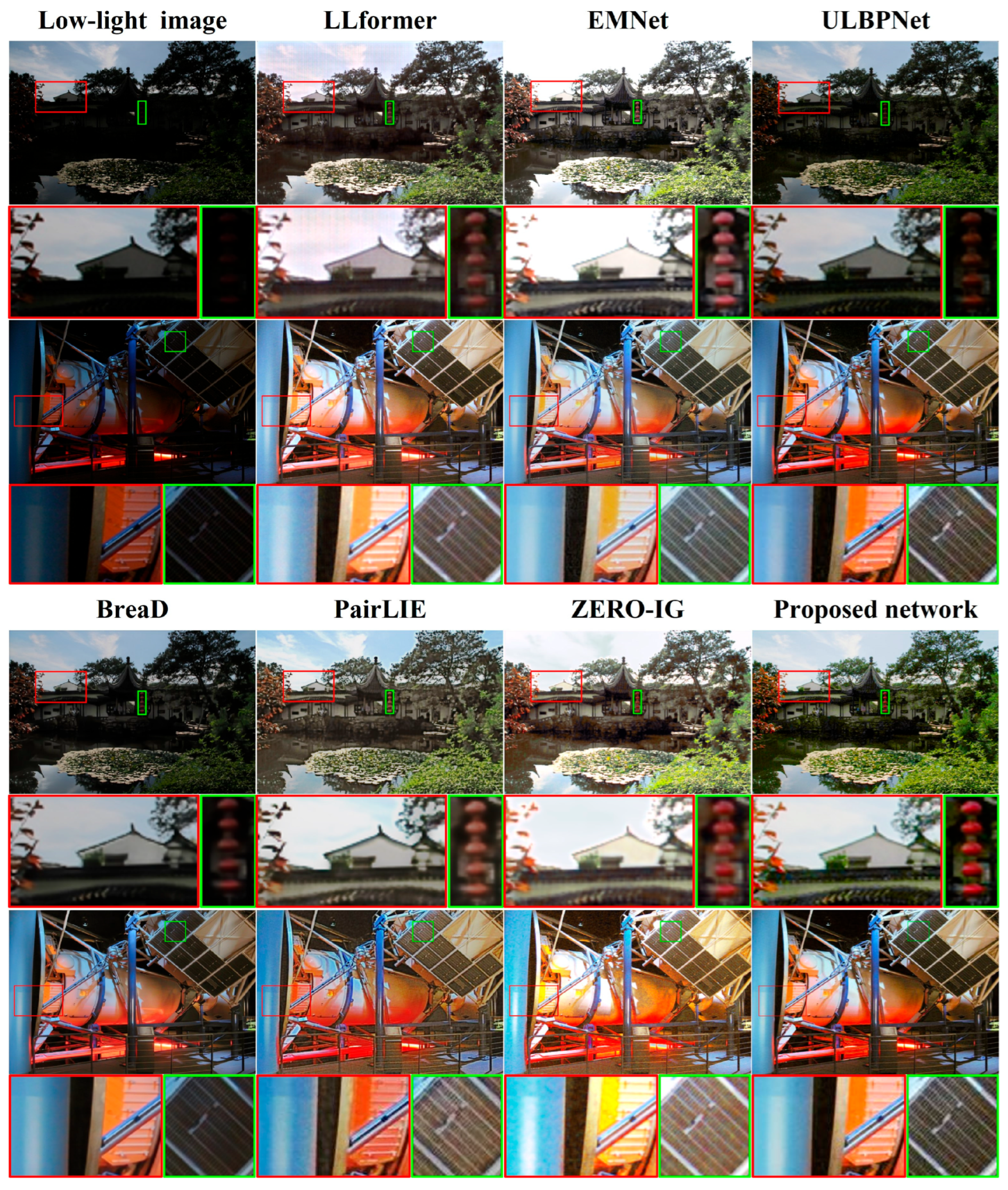
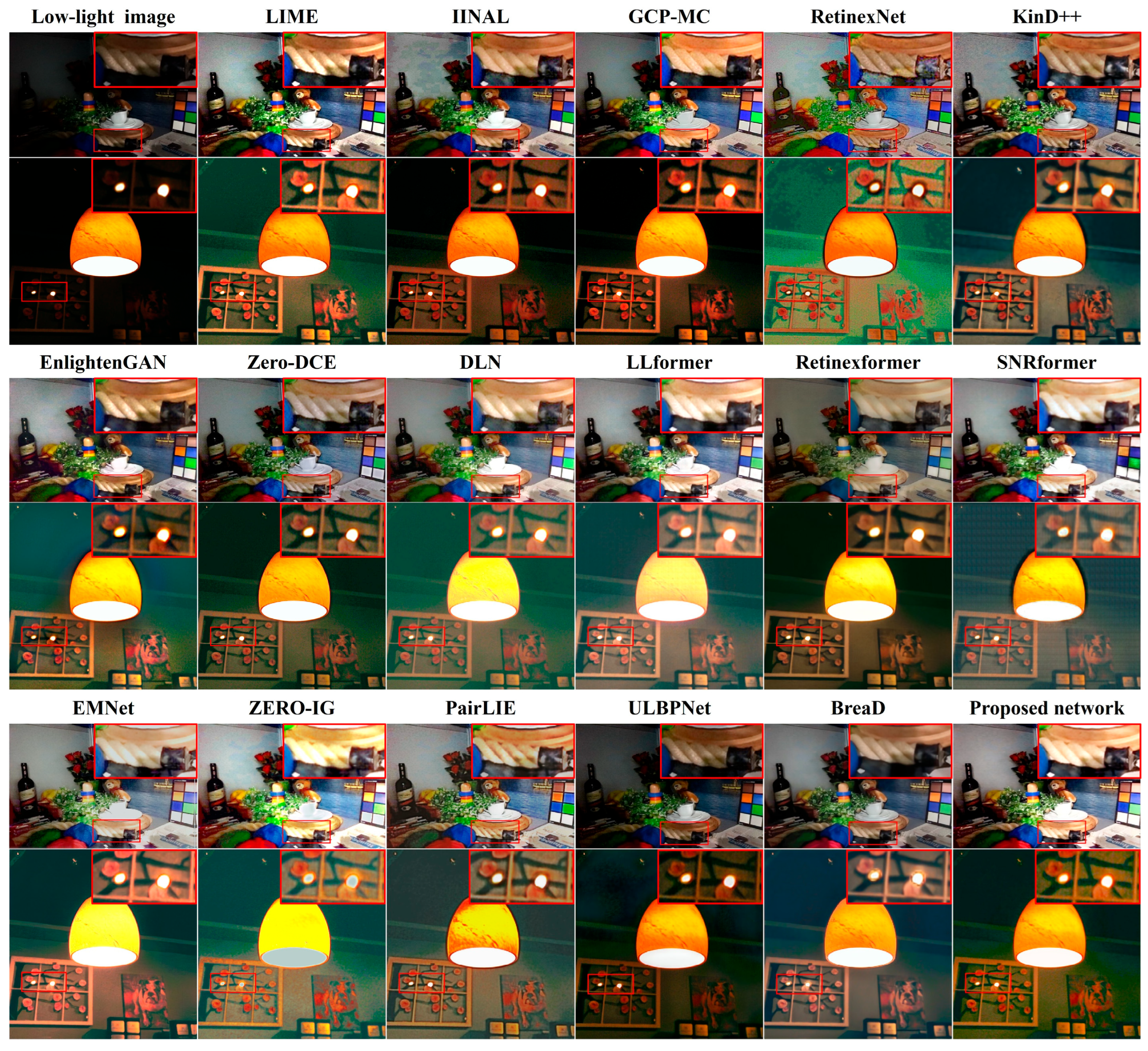
Figure 1 illustrates the low-light images restored by the proposed LLIE network in comparison with recent state-of-the-art methods, including LLformer [11], U-shaped lightening back-projection (ULBPNet) [9], breaking down the darkness (BreaD) [13], external memory-augmented network (EMNet) [14], paired low-light image enhancement (PairLIE) [15], and zero-shot illumination-guided enhancement (ZERO-IG) [16]. As shown in Figure 1, the proposed network effectively restores image brightness and fine details. It also recovers natural color and improves overall contrast. These results demonstrate its acceptable qualitative performance in LLIE.
The remainder of this paper is organized as follows. Section 2 briefly reviews various studies related to LLIE. Section 3 describes the configuration of the proposed LLIE network and the functions of the presented blocks. Section 4 discusses the experimental results and findings. Finally, the conclusions are presented in Section 5.

2. Related Works

2.1. Classical Methods

Classical model-free methods primarily restore the brightness and enhance the contrast in low-light images using traditional image processing techniques. Various pixel-based transformation approaches [17] have been employed to adjust pixel intensities and improve the image contrast. Alternatively, image enhancement can be achieved by modifying the shapes of the global or the local histograms [2,3]. In addition, the contextual variational method [18] and image fusion techniques [19] have been introduced to mitigate issues such as contrast over-enhancement.
The classical LLIE method based on Retinex theory aims to estimate the illumination and reflectance components either simultaneously or sequentially. Guo et al. [4] proposed an illumination estimation technique (LIME) that first derived an illumination map by maximizing the pixel values across all color channels and then refined it through an optimization algorithm. Ren et al. [20] introduced a model-based method that combined a camera response model with the conventional Retinex theory. Hao et al. [5] developed a semi-decoupled decomposition approach using a total variation model. This method first estimates an illumination map. It then jointly estimates the reflectance using the input image and the computed illumination. Furthermore, Retinex theory, which decomposes images into illumination and reflectance components, inspired the construction of LLIE networks using machine learning [12,21]. Model-based LLIE algorithms employing the ASM typically require image inversion because low-light images often resemble inverted versions of normal images. To address this issue, Jeon et al. [6] introduced an inverted image normalization technique (IINAL) based on the estimated atmospheric light to maintain a physically valid degradation model for LLIE. More recently, Jeon et al. [7] proposed an algorithm that incorporated a gamma correction prior in two mixed color spaces (HSI and HSV), referred to as GCP-MC, to facilitate robust parameter estimation. Although ASM-based LLIE methods are computationally efficient, they are hindered by excessive enhancement and difficulties in accurately estimating the model parameters.

2.2. Machine Learning-Based Methods

Recent research has increasingly shifted toward deep learning-based approaches to overcome the limitations of traditional model-based LLIE methods. These methods exploit large-scale datasets and powerful representation learning to jointly restore brightness, contrast, and color fidelity, achieving more robust and visually consistent enhancements than classical algorithms. Recent advances in deep learning have enabled significant progress in the field of LLIE. CNN-based approaches effectively learn spatial features from paired low- and normal-light images. This capability enables reliable brightness restoration and contrast enhancement. In addition to CNNs, GAN-based methods have been used to generate more realistic results by leveraging adversarial learning. More recently, transformer-based architectures have gained attention, owing to their ability to capture long-range dependencies and global contextual information. As a result, they further improve color fidelity, structural consistency, and generalization to diverse low-light scenes. Despite these advances, achieving a balanced enhancement of brightness, detail, and color remains a challenging task, which has motivated the development of more specialized architectures.
Wang et al. [8] proposed a deep lightening network (DLN) that employed lightening back-projection and feature aggregation techniques. Lu et al. [22] designed a two-branch fusion network to generate two enhanced low-light images, which were subsequently combined using a calibration method to further improve the image quality. Zhang et al. [23] developed KinD++, an LLIE network that extended their previously proposed mutually complementary networks. Park et al. [9] introduced ULBPNet, which enhanced brightness and preserved color details using a saturation-guided fusion mechanism. Guo et al. [13] presented a breaking-down-the-darkness framework, which was inspired by the divide-and-rule principle. Yao et al. [24] proposed a gradient-aware and contrastive-adaptive learning algorithm to address the challenges posed by inaccurate gradient information in LLIE. More recently, Luo et al. [25] introduced a deep recurrent collaborative framework designed for multi-view low-light enhancement.
Various GAN-based LLIE frameworks using unsupervised learning have been developed to address the limitations caused by the scarcity of training datasets. Jiang et al. [10] introduced EnlightenGAN, a GAN-based LIE framework that regularized the unpaired training by directly extracting information from the inputs. Fu et al. [15] proposed PairLIE, which leveraged paired low-light images by enforcing a Retinex-based reflectance consistency and incorporating self-supervised illumination adjustment. Cao et al. [26] introduced a self-supervised low-light image enhancement framework that leverages Retinex-based priors to train unpaired data, where multiple self-regularization objectives are jointly employed. Zero-reference learning is an attractive approach for mitigating the limitations of training data, particularly the need for paired references. Guo et al. [27] proposed a zero-reference deep curve estimation (Zero-DCE) network that enhanced low-light images using an adaptive curve estimation algorithm. Yang et al. [28] proposed NeRCo, an unsupervised implicit neural representation method for restoring low-light images. Shi et al. [16] developed ZERO-IG, a network designed to jointly denoise and enhance real-world low-light images.
Transformer-based LLIE methods have attracted significant attention and exhibited promising performance. Wang et al. [29] proposed a conditional normalizing flow model that captured the distribution of normal-light images and derived an image color map based on Retinex theory to enhance low-light inputs. Xu et al. [30] introduced SNRformer, a signal-to-noise ratio (SNR)-aware network that leveraged the SNR as guidance for low-light image enhancement. Wang et al. [11] developed LLformer, a transformer-based LLIE framework that employed a multi-head self-attention mechanism and cross-layer attention fusion. Cai et al. [12] proposed Retinexformer, a one-stage Retinex-based transformer that incorporated illumination representations to guide non-local interaction modeling across regions with varying lighting conditions. Ye et al. [14] presented EMNet, which augments a transformer backbone with external memory. This design retrieves illumination, color, and detail priors during inference and stabilizes restoration under severely low-light conditions. Xu et al. [31] presented a hybrid low-light enhancement framework that combines multi-scale transformer-based feature aggregation with a conditional normalizing flow. Wen et al. [32] introduced a one-stage Retinex-based enhancement network that integrates convolutional neural network features with dual-attention vision transformer modules. Hue et al. [33] proposed a wavelet-based LLIE network that integrates convolutional layers and transformer block, where wavelet decomposition is used to separate frequency components for more robust low-light enhancement. Zhang et al. [34] introduced a Retinex-based framework combined with dual-tree complex wavelet transform and a transformer encoder–decoder.
Although machine learning-based LLIE methods have achieved remarkable progress through diverse deep network architectures, considerable potential for further advancements in both network design and performance optimization remain. In this study, we address these challenges by proposing a novel LLIE framework in the wavelet domain, which introduces a frequency cross-attention mechanism. The proposed network enhances brightness through low-frequency subbands and restores fine details via high-frequency subbands, while simultaneously preserving their intrinsic correlations.

3. Proposed Method

3.1. Overall Architecture of Proposed Network

The proposed LLIE network operates in the wavelet domain to restore brightness and enhance details using specialized blocks tailored to low- and high-frequency wavelet subbands. Because brightness and detail represent different visual aspects, the application of identical enhancement strategies to both can hinder effective image restoration. Therefore, the proposed framework enhances brightness in the low-frequency subband, which captures the approximate information, and sharpens the high-frequency subbands to restore fine details. This approach yields clear and bright outputs. To further improve the restoration quality, the FCA mechanism is introduced to facilitate effective interaction between low- and high-frequency features.
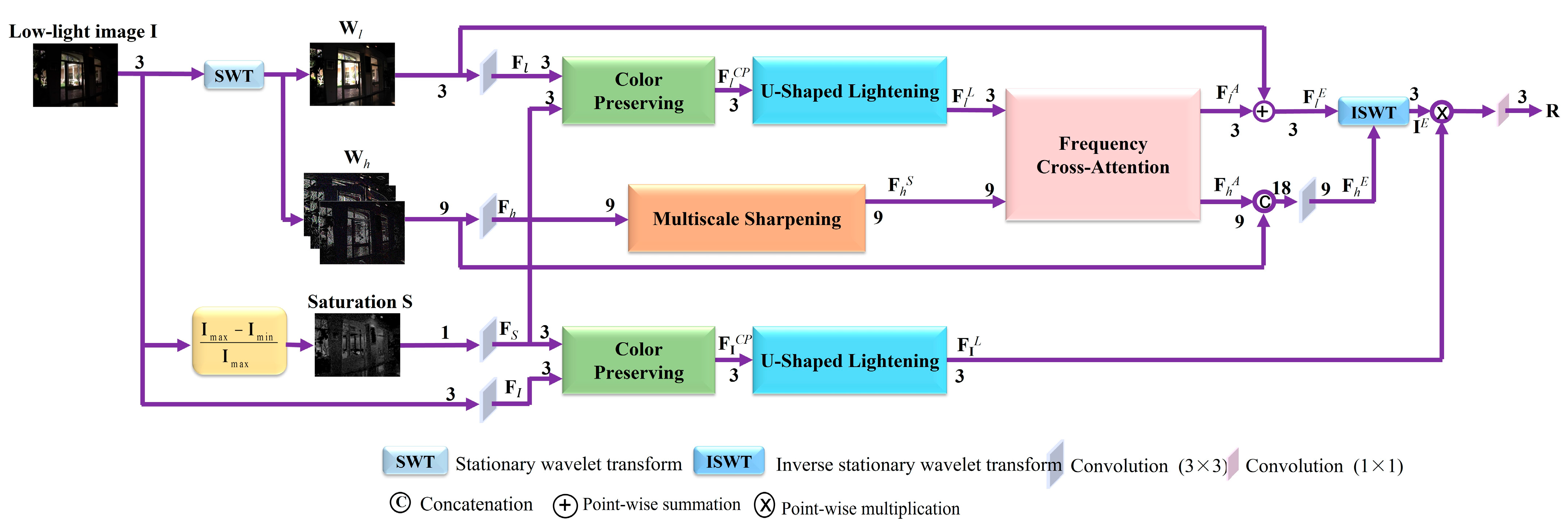
Figure 2 illustrates the overall architecture of the proposed LLIE network, which comprises four main components—CP, UL, MS, and FCA blocks—along with several convolutional layers. The CP block enhances brightness while preserving color fidelity. The UL block restores global brightness. The MS block enhances fine details and local contrast. The FCA block facilitates information exchange between low- and high-frequency subbands to preserve their intrinsic correlations. The numbers on the connections between the blocks and convolutional layers indicate the number of feature channels. The enhanced wavelet features are inversely transformed to generate a preliminary restored image. This image is further refined by incorporating a lightened version of the input image into the RGB domain to produce the final restored output.
Let I denote the input low-light image, which is transformed into the wavelet domain using a stationary wavelet transform (SWT) without downsampling. For computational efficiency and edge enhancement, we use the simplest Haar kernel for the wavelet transform. The SWT produces one low-frequency subband and three high-frequency subbands. For a low-light color image in the RGB domain, this yields three-channel low-frequency and nine-channel high-frequency subbands, represented by Wl and Wh, respectively. The low-frequency component Wl is used to restore the brightness, whereas the high-frequency component Wh is employed to enhance the contrast and recover fine details.
Before enhancing the low-frequency subband, the CP block is used to guide the color information during the lightening process. Specifically, the saturation map S of the input image I, which is computed in the HSV color space, is used to transfer the chromatic information to the low-frequency subband Wl. The CP block generates a low-frequency feature enriched with color information by incorporating S, which is expressed as follows:
F l C P = C P ( F l , F S ) ,
where FlCP denotes the low-frequency subband feature enriched with color information, CP() represents the function of the CP block, and Fl and FS are the convolved features of Wl and S, respectively. The feature FlCP is then input into the UL block to compute the brightened feature FlL defined as follows:
F l L = UL ( F l C P ) ,
where UL() denotes the UL block function.
For the high-frequency subbands, convolutional operations are first applied, and the resulting features are subsequently sharpened using MS blocks to produce the feature FhS as follows:
F h S = MS ( F h ) ,
where MS() represents the function of the MS block, and Fh is the high-frequency subband feature obtained by
F h = Conv 3 ( W h ) ,
where Convm() denotes the convolution operation with kernel size m × m.
The lightened subband feature FlL and sharpened feature FhS can be reconstructed into an enhanced image through inverse wavelet transformation. However, independently enhancing each subband may not yield an optimal restoration because wavelet subbands are inherently correlated. Therefore, we propose a cross-attention mechanism that establishes intrinsic correlations between the low- and high-frequency subbands. The FCA block processes FlL and FhS to produce correlated and balanced outputs denoted as FlA and FhA, respectively:
F l A , F h A = FCA ( F l L , F h S ) ,
where FCA() denotes the FCA block function. To preserve the characteristics of the original low-light image, the lightened low-frequency subband FlA is combined with the original low-frequency coefficient Wl through a residual operation:
F l E = F l A W l ,
where ⨁ denotes point-wise addition. Because the high-frequency coefficients contain signed information, the sharpened feature FhA is concatenated with the original high-frequency subband Wh as follows:
F h E = F h A © W h ,
where © denotes concatenation. Finally, the enhanced low- and high frequency subbands (FlE and FhE) are reconstructed into the improved image IE using the inverse stationary wavelet transform (ISWT):
I E = ISWT ( F l E , F h E ) ,
where ISWT() denotes the inverse stationary wavelet transformation.
To further enhance image quality, a refinement process that incorporates the original low-light image and its saturation map is introduced. Let FICP denotes the outputs of the CP block for the original image I, which is computed using the saturation map Fs as follows:
F Ι C P = CP Conv 3 I , F S ,
Let FIL denotes the output feature of the UL block for FIC, where FIL = UL(FICP). Finally, the restored image R is computed using IE and FIL as follows:
R = Conv 3 I E F I L ,
where and denotes the pointwise multiplication operator. Owing to this refinement stage, the lightened image in the spatial domain serves as a weighting factor for the enhanced image reconstructed in the wavelet domain, thereby improving the restoration results.

3.2. Color Preserving Block

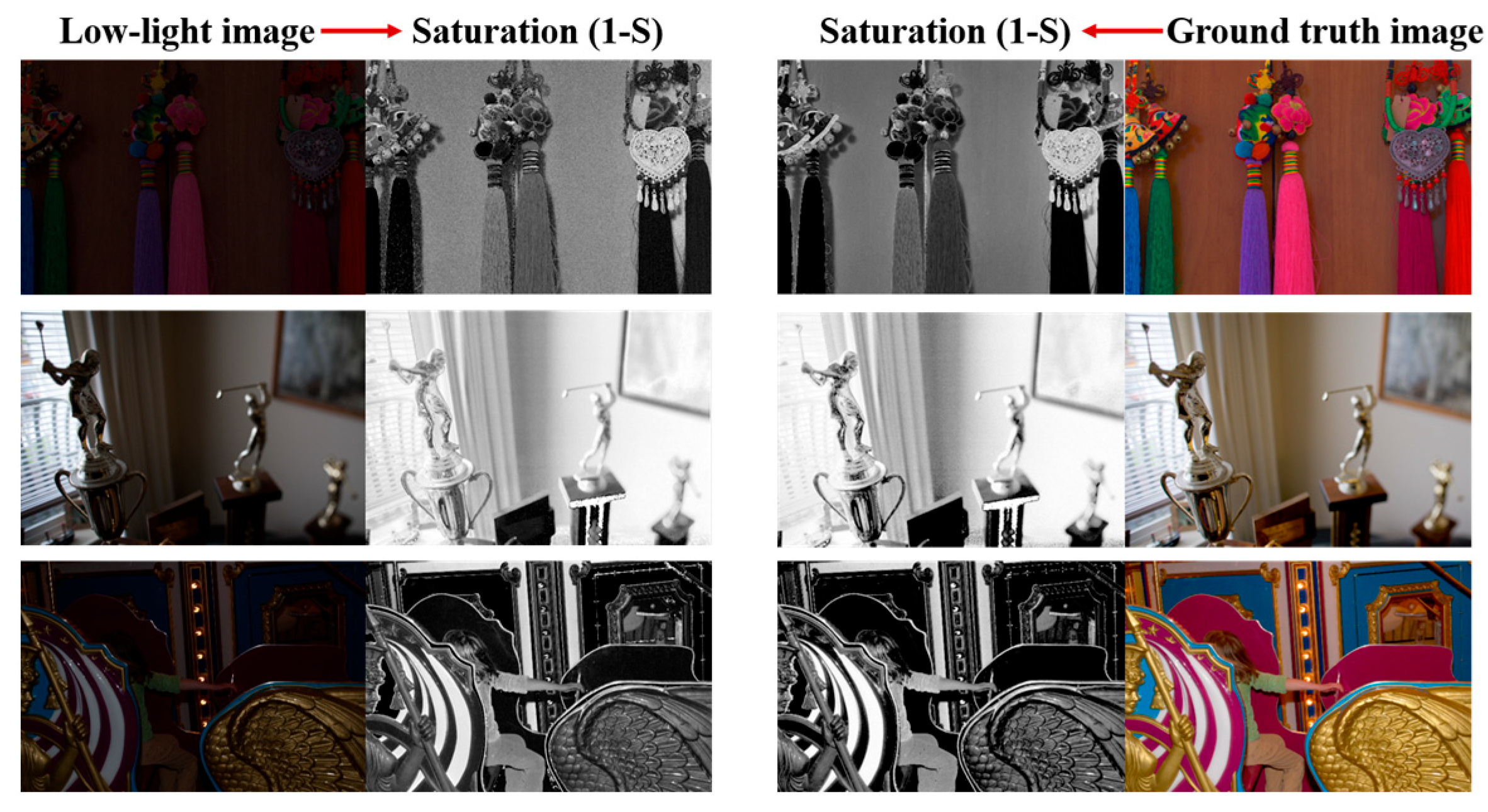
When illumination attenuation occurs almost uniformly in a normal-light image, the saturations of the low-light and normally illuminated images differ slightly [9]. Figure 3 illustrates sample low-light images and their corresponding saturation maps, along with the ground-truth images and their saturation maps. As shown in Figure 3, the saturation map of a low-light image closely resembles that of the corresponding normal-light image. Therefore, saturation is a valuable indicator for maintaining color fidelity and addresses a major limitation of LLIE. Hence, we propose a simple yet effective method for preserving color fidelity by incorporating saturation-guided priors via the GMP technique.
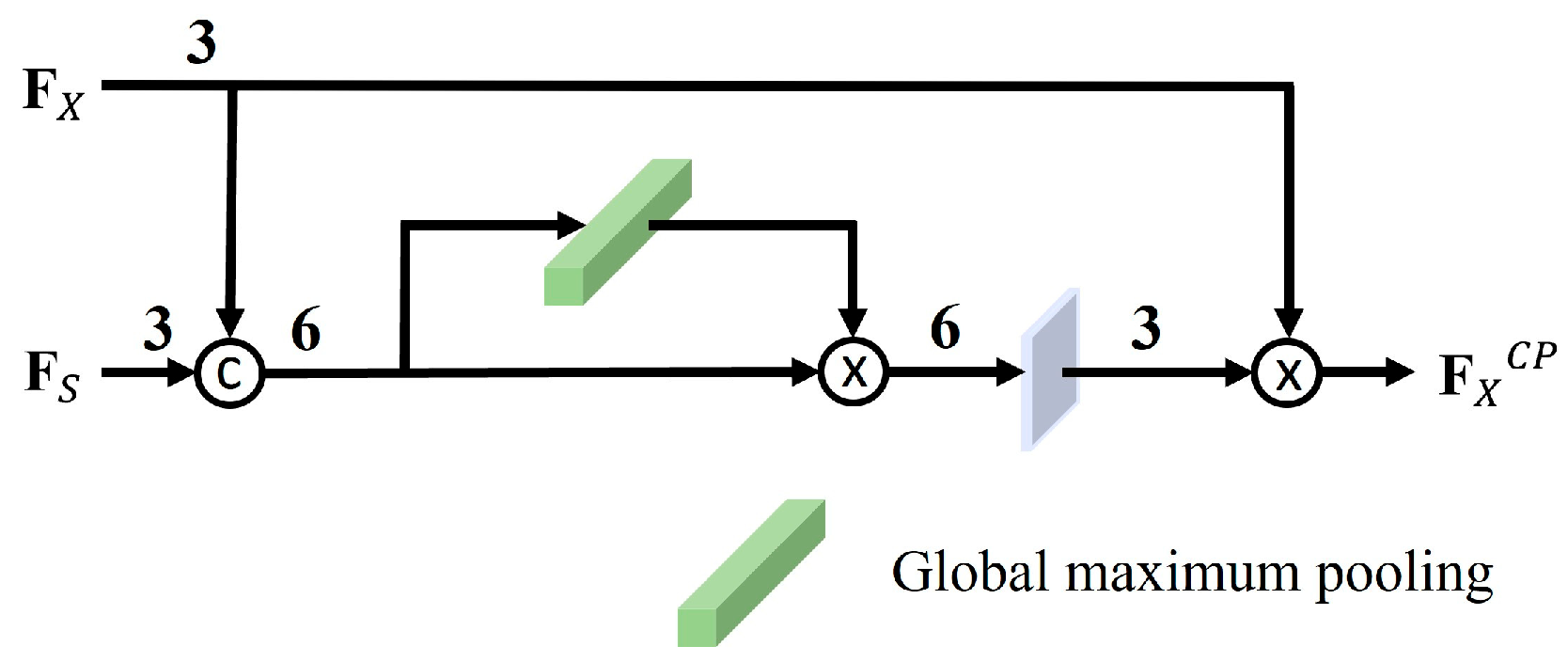
Figure 4 shows the structure of the CP block. The saturation feature FS of the low-light image is combined with the input feature FX to guide the chromatic information of the original image I. The GMP then extracts the maximum feature from each channel and uses it as an attention weight to enrich the chromatic information of FX. The output of the CP block FXCP is computed as follows:
F X C P = F X ( Conv 3 GMP F S © F X F S © F X ) ,
where GMP() denotes the GMP function. The image saturation, which characterizes pure color, is employed as a weighting factor for the input features. This concept is reflected in the multiplication term FS  FX in Equation (11). By extracting the maximum feature via GMP and applying it as an attention factor, the CP block incorporates color information from the original low-light image into the input feature, thereby enhancing brightness while preserving color fidelity.

3.3. U-Shaped Lightening Block

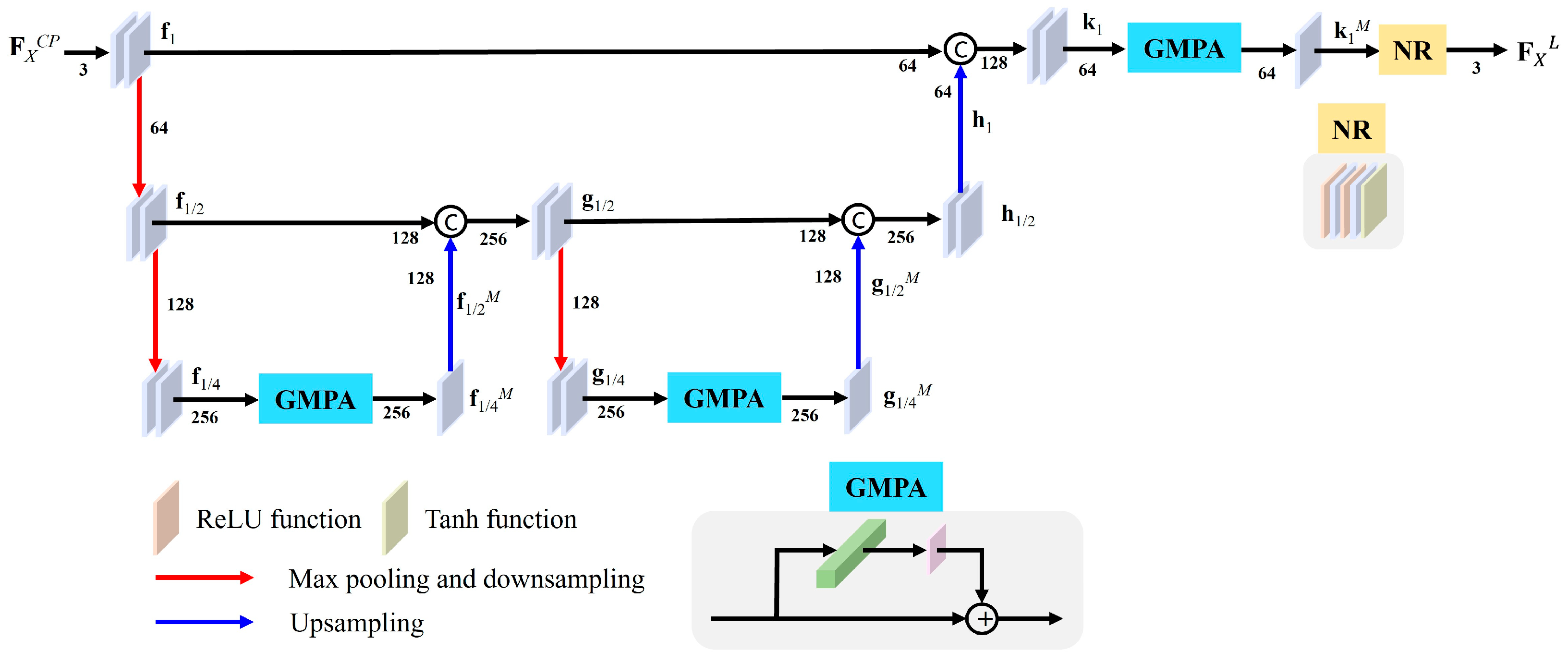
Low-light images inherently exhibit low-magnitude wavelet coefficients in the low-frequency subband. To enhance brightness, it is necessary to enlarge these low-frequency features. Hence, we propose a UL block with a U-shaped architecture that employs maximum pooling for the downsampling. Before upsampling, a GMP-based attention mechanism is applied to selectively amplify the low-frequency features, whereas multiple activation functions are applied at the output to suppress noise. The UL block increases the global luminance of the input feature by increasing the overall intensity of low-light features. Its input is the feature FXCP, generated by the CP block that preserves color information. As illustrated in Figure 5, the UL block follows a U-shaped path with two successive rounds of downsampling and upsampling. Along this path, the GMP-driven channel attention and feature-fusion mechanisms are interleaved, enabling progressive brightness enhancement while maintaining the color fidelity.
First, two convolution layers are applied to generate the reference feature f1 at the original scale as follows:
f 1 = Conv 3 ( Conv 3 F X C P ) .
In the downsampling path, maximum pooling halves the spatial resolution by half, and two convolutions are subsequently applied for refinement. Applying this operation once to f1 produces f1/2, and its repetition yields the lowest-scale feature f1/4. Because maximum pooling selects the maximum value within each local region, the resulting lower-scale features preserve and compress brighter representations. Consequently, f1/4 can be regarded as a feature map in which bright content is more densely concentrated than that in f1. A channel attention mechanism is applied at the lowest scale f1/4. The GMP generates a channel descriptor that is transformed by a convolution layer into learnable channel weights and added back to the feature via element-wise addition. A final convolution operation produces the attended feature as follows:
f 1 / 4 M = Conv 3 ( f 1 / 4 Conv 1 GMP f 1 / 4 ) ,
where f1/4M denotes GMP-based attended feature.
In the upsampling path, the attended feature f1/4M is upsampled by a factor of two to obtain f1/2M. It is then concatenated with the same-scale original feature f1/2 and fused through two convolution layers to generate a brightness-enhanced, information-fused feature g1/2 at that scale as follows:
g 1 / 2 = Conv 3 Conv 3 f 1 / 2 © f 1 / 2 M .
The second leg of the UL block is constructed by repeating the sequence in Equations (13) and (14) using g1/2. Specifically, g1/2 is the downsampled maximum pooling used to produce g1/4, which is then processed using a GMP-based attention mechanism to generate g1/4M. This feature is subsequently upsampled to obtain g1/2M, and a concatenated feature, h1/2, is produced following the same procedure as in Equation (14). Finally, h1/2 is upsampled to the original resolution, producing the feature h1.
To obtain the final lightened feature, h1 is concatenated with f1 and passed through the GMP-based attention block to generate kM1 as follows:
k 1 M = Conv 3 k 1 Conv 1 GMP k 1 ,
where
k 1 = Conv 3 Conv 3 f 1 © h 1 .
In the final stage, the noise reduction (NR) module depicted in Figure 5 is applied using two convolution layers with ReLU activation functions, followed by a hyperbolic tangent activation function to suppress noise. The final enhanced feature FXL is produced as follows:
F X L = tanh ( Conv 3 σ Conv 3 σ k 1 M ) ,
where tanh() and σ() denote hyperbolic tangent and ReLU activation functions, respectively.
In summary, the UL block follows a compress–amplify–restore trajectory: maximum pooling compresses bright responses, GMP-based attention amplifies luminance, and feature fusion restores spatial details. Thus, global brightness is effectively increased while preserving the color consistency provided by the CP block.

3.4. Multiscale Sharpening Block

The MS block is designed to enhance fine image details by using high-frequency wavelet features that contain essential boundary information to produce sharper images by emphasizing structures such as edges and corners. In the proposed network, the high-frequency features are used as inputs and processed at multiple scales to utilize a richer set of information. This multiscale processing increases the coefficients of the high-frequency features, thereby enhancing the detail representation and yielding sharpened outputs.
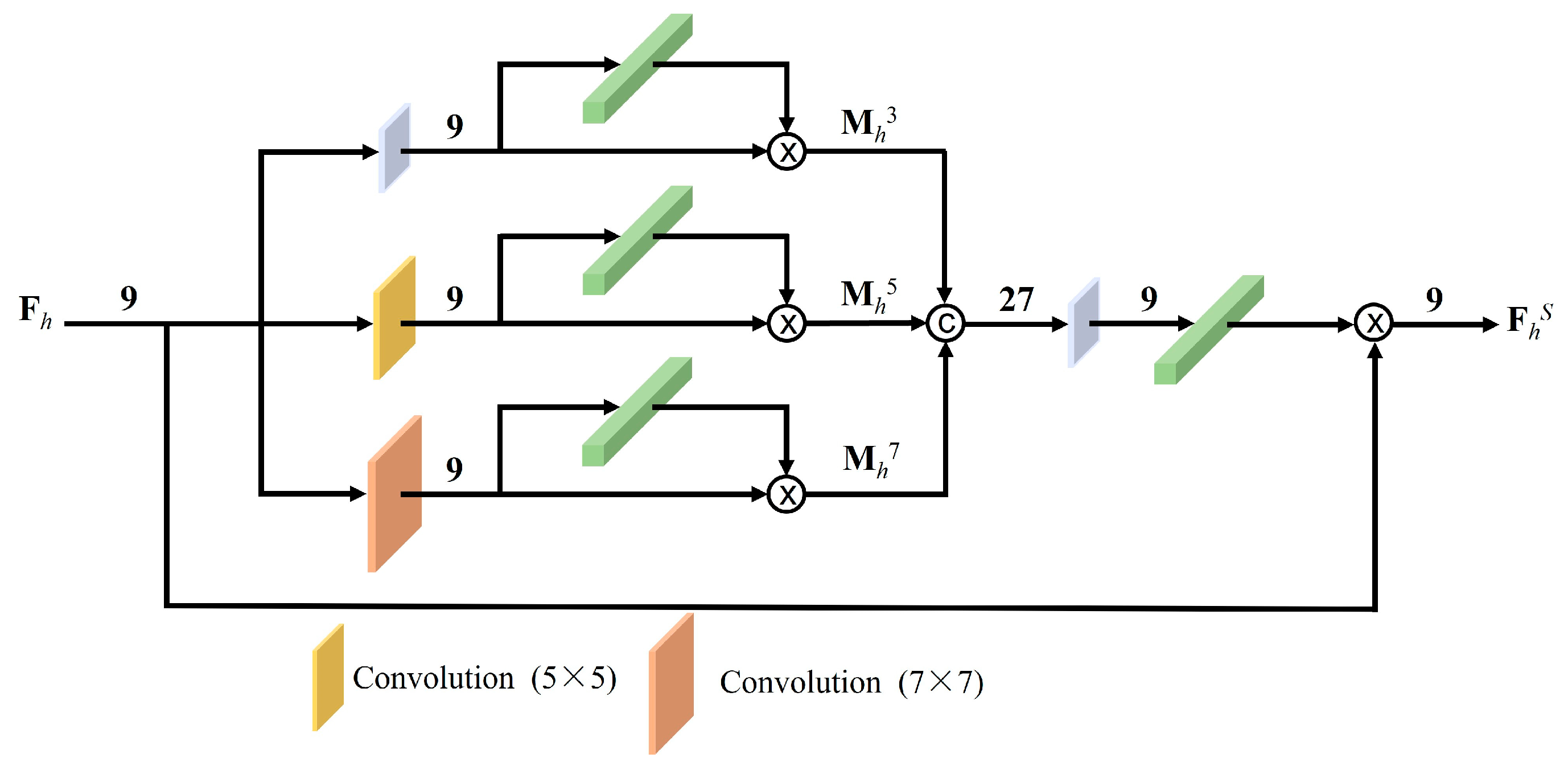
Figure 6 illustrates the structure of the MS block. The high-frequency subband feature Fh is processed through convolutional layers with kernel sizes of 3 × 3, 5 × 5, and 7 × 7 to extract multiscale features. In the wavelet domain, the magnitudes of the high-frequency coefficients are proportional to the edge strength and image contrast. Based on this property, the MS block restores image details at multiple scales using the GMP operation. The GMP-weighted multiscale features are computed as follows:
M h m = Conv m F h GMP Conv m F h , m = 3 , 5 , 7 ,
where Mhm denotes the GMP-attentive feature extracted from a convolutional layer with a kernel size of m × m. Each Mhm is subsequently aggregated and passed through an additional GMP-based attention process to generate the final sharpened high-frequency feature FhS as follows:
F h S = F h GMP Conv 3 M h 3 © M h 5 © M h 7 ,

3.5. Frequency Cross-Attention Block

In the proposed method, brightness is restored from the low-frequency subband using the CP and UL blocks, whereas the image details are enhanced from the high-frequency subband using the MS block. In the wavelet domain, the image contrast is determined by the ratio between the low- and high-frequency components [35]. However, processing these components independently through different blocks distorts this ratio and introduces local inconsistencies in the image contrast. Such disturbances may result in an unnatural appearance either through excessive enhancement or insufficient improvement, ultimately degrading the overall performance of the LLIE. The FCA mechanism is introduced to overcome these limitations. The FCA block explicitly models the correlation between the low- and high-frequency subbands, allowing the mutual exchange of information to preserve their intrinsic relationships. By integrating complementary information across frequency subbands using an attention mechanism, the FCA block maintains contrast consistency throughout the image and simultaneously reinforces structural details and global illumination.
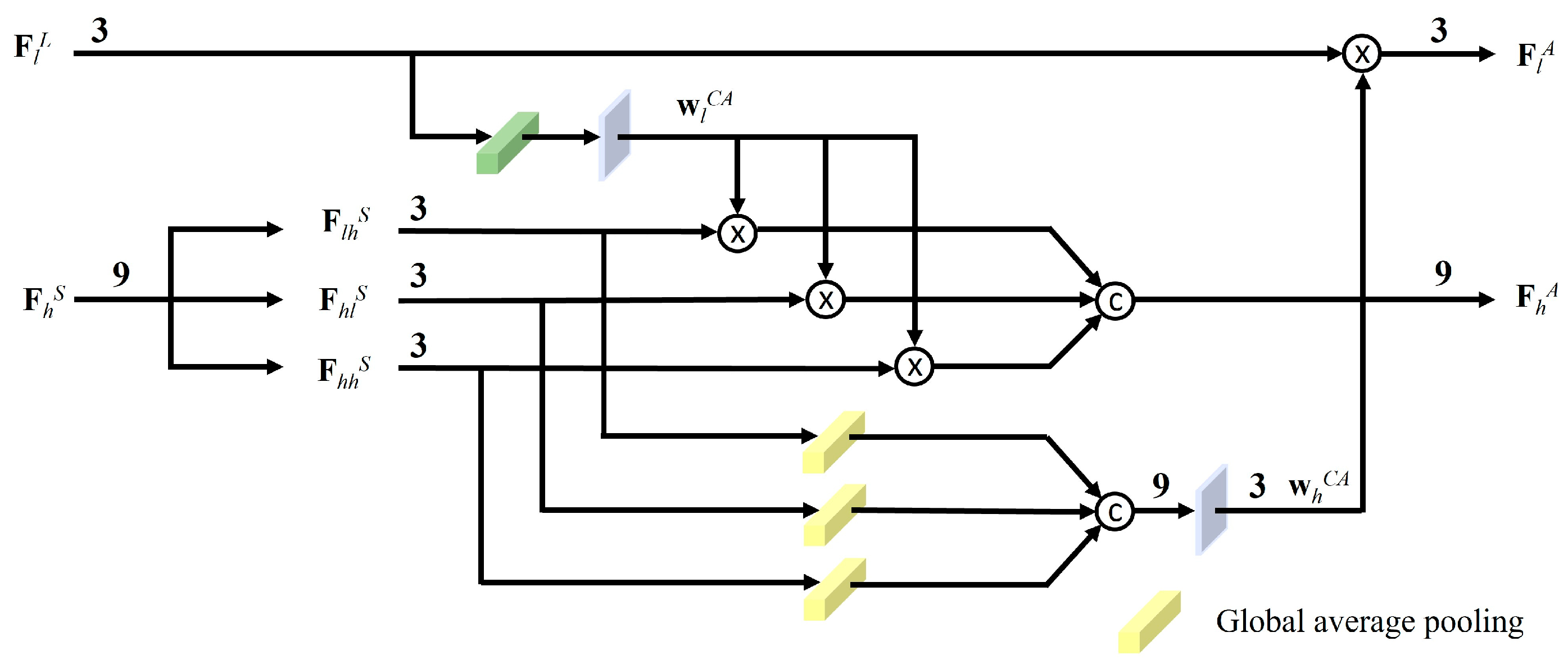
Figure 7 illustrates the structure of the proposed FCA block. First, the enhanced high-frequency wavelet feature vector is decomposed into FlhS (horizontal), FhlS (vertical), and FhhS (diagonal). These three features are refined using the attentive weights derived from the GMP values of the lightened low-frequency component FlL, expressed as follows:
F h A = w l C A F l h S © w l C A F h l S © w l C A F h h S ,
where FhA denotes the refined high-frequency wavelet feature and wlCA represents the attentive weight computed from FlL. The attentive weight wlCA is calculated as follows:
w l C A = Conv 3 GMP F l L .
Thus, the refined high-frequency feature FhA incorporates lightened information from FlL through wlCA and improves edge sharpness and detail clarity in the restored image.
Meanwhile, the initially lightened low-frequency feature FlL receives guidance from the high-frequency features. Specifically, the attentive weight whCA is derived from the high-frequency information using the global average pooling (GAP) as follows:
w h C A = Conv 3 GAP F l h S © GAP F h l S © GAP F h h S ,
where GAP() is the GAP function, which is employed instead of GMP to prevent excessive influence from the enhanced high-frequency subbands and to ensure a more stable and balanced refinement of the low-frequency feature. The refined low-frequency feature FlA using whCA is then computed as follows:
F l A = w h C A F l L .
In summary, the proposed cross-attention mechanism establishes bidirectional interactions between low- and high-frequency subbands, enabling effective cross-referencing of features. This approach preserves the local contrast consistency in the reconstructed images by ensuring that complementary information from a subband guides the enhancement of the other. Consequently, a well-balanced restoration is achieved by simultaneously improving brightness, enhancing detail sharpness, and maintaining natural contrast. These improvements enhance the overall perceptual fidelity, producing visually pleasing results and acceptable performance in LLIE.

3.6. Loss Function

The proposed LLIE network is trained using two loss functions: the structural similarity index measure (SSIM) [36] and total variation (TV) functions. The SSIM loss evaluates the structural similarity between the enhanced image and reference images. This is defined as follows:
L s s i m = 1 ssim G , R ,
where Lssim, G, and ssim(G,R) represent the SSIM loss, reference image, and SSIM value between G and the restored image R, respectively. The SSIM values range between 0 and 1, with larger values indicating higher similarity. Therefore, 1 − ssim (G,R) is used as the loss function to minimize the error as it decreases. The TV loss ensures spatial smoothness and continuity in the restored image, suppresses noise and avoids excessive pixelation. It is defined as the sum of the squared intensity differences between adjacent pixels, that is, the sum of the squared differences in the pixel values for all adjacent pixel pairs:
L t v = ( x , y ) R ( x , y + 1 ) R ( x , y ) 2 + R ( x + 1 , y ) R ( x , y ) 2 ,
where (x,y) denotes the spatial pixel location of the image and Ltv represents the TV loss function. Finally, the total loss function is formulated as a weighted combination of the two components as follows:
L t = L s s i m + λ L t v ,
where Lt represents the total loss, and λ is a balancing hyperparameter, which is set to 0.001 in the proposed network.

4. Experimental Results

4.1. Implementation Details

The proposed network was implemented in PyTorch 2.4 for training and testing. All layer parameters were initialized using the PyTorch default initializers. Experiments were conducted on a workstation equipped with an NVIDIA GeForce RTX 4070 Ti SUPER (16 GB), an Intel Core i7-14700 CPU @ 2.10 GHz, and 32 GB of RAM. The mini-batch size was 16, and the input image patches were 128 × 128 pixels. We used the Adam optimizer with a learning rate of 1 × 10⁻⁴, and trained the network for 4000 epochs. The code is available at https://github.com/daeun00/FCANet (accessed on 9 February 2026).

4.2. Datasets and Comparison

The proposed network was trained using the low-light (LOL) [37] and LOL-v2 dataset [38]. The LOL and LOL-v2 datasets consist of 485 and 1140 image pairs, respectively. Therefore, 1625 image pairs were available for training. For evaluation, 15 image pairs from the LOL dataset were used for testing. In addition, five non-reference datasets without ground-truth pairs were employed to further assess the LLIE performance, which comprehensively evaluated the generalization capability of the model across diverse low-light conditions: DICM [39] (44 images), LIME [4] (10 images), Fusion [40] (18 images), MEF [41] (17 images), and TM-DIED [42] (222 images).
The performance of LLIE was evaluated by comparing the proposed network with 16 state-of-the-art methods, including three model-based methods (LIME [4], IINAL [6], and GCP-MC [7]), 10 learning-based methods (RetinexNet [35], KinD++ [23], EnlightenGAN [10], Zero-DCE [27], DLN [8], ULBPNet [9], BreaD [13], EMNet [14], PairLIE [15], and ZERO-IG [16]) and three transformer-based methods (LLformer [11], Retinexformer [12], and SNRformer [30]). The model parameters for each method were obtained from their respective official sources, and the released pretrained weights were used for experiments. The quality of the restored images obtained using various LLIE was quantitatively evaluated via four full-reference metrics: peak signal-to-noise ratio (PSNR), SSIM [36], learned perceptual image patch similarity (LPIPS) [43], and feature similarity index measure (FSIM) [44]. The naturalness image quality evaluator (NIQE) [45] was applied to enhanced images without ground truths and to the referenced images to assess the naturalness of the restored results.

4.3. Complexity

Table 1 presents the network parameters, flops and corresponding runtimes required to generate the enhanced images. The runtimes were calculated by averaging the processing times for LOL test images across 10 tasks. Extremely lightweight and zero-reference-based methods achieve short runtimes. However, subsequent discussions indicate that their visual fidelity and quantitative scores are limited. Transformer-based approaches and other recent architectures typically employ larger parameter budgets and consequently require longer processing times. Some methods with modest parameter count, such as BreaD, KinD++, and EnlightenGAN, still exhibit long runtimes. The proposed network is favorably balanced between speed and capacity, processing a test image in 0.0206 s with 10,689 × 103 parameters.

4.4. Qualitative Comparison

Typically, the performance of an LLIE method is evaluated based on the visual quality of the enhanced low-light images, specifically in terms of the ability of the method to recover brightness, improve contrast, and maintain color fidelity.
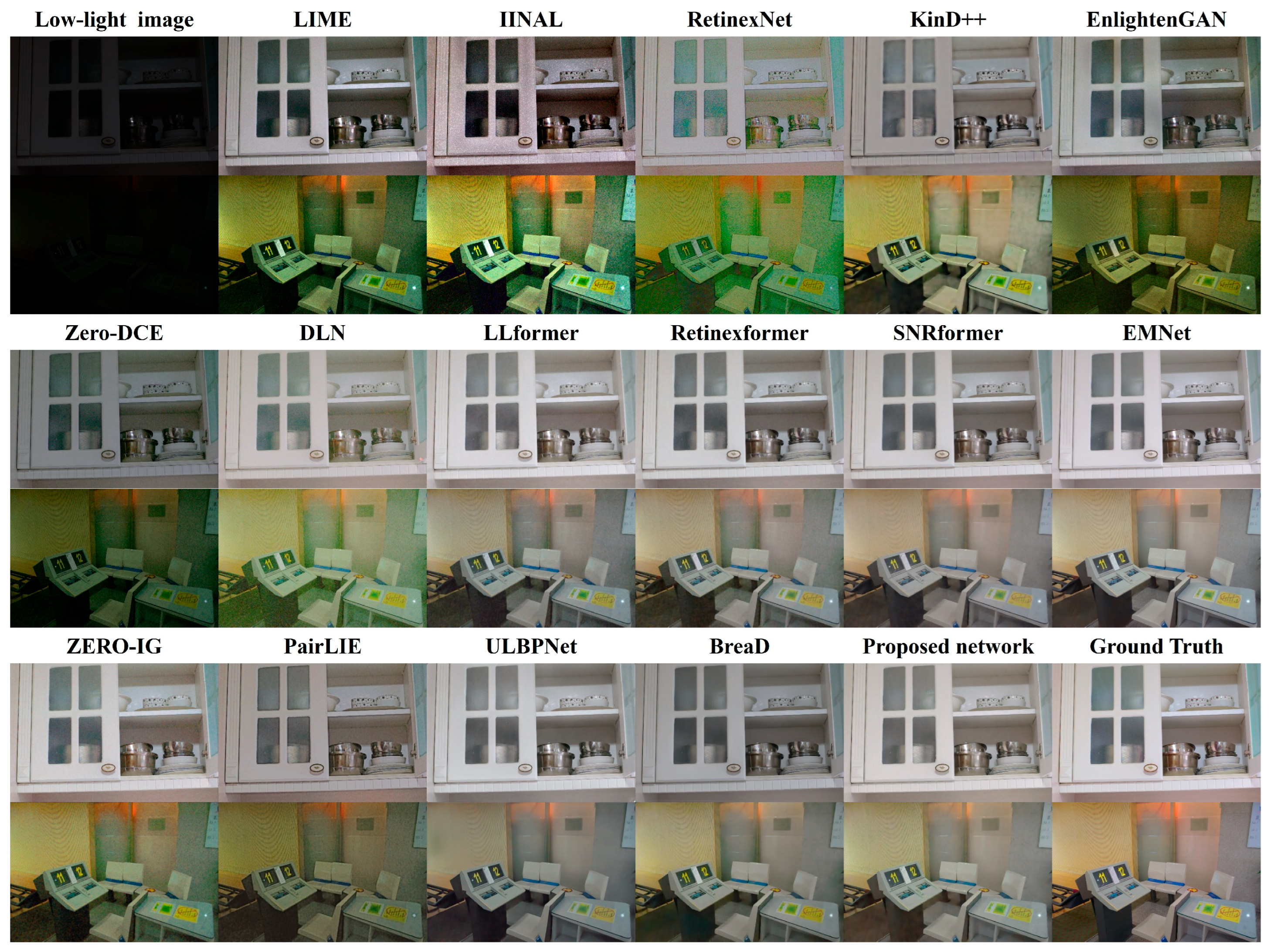
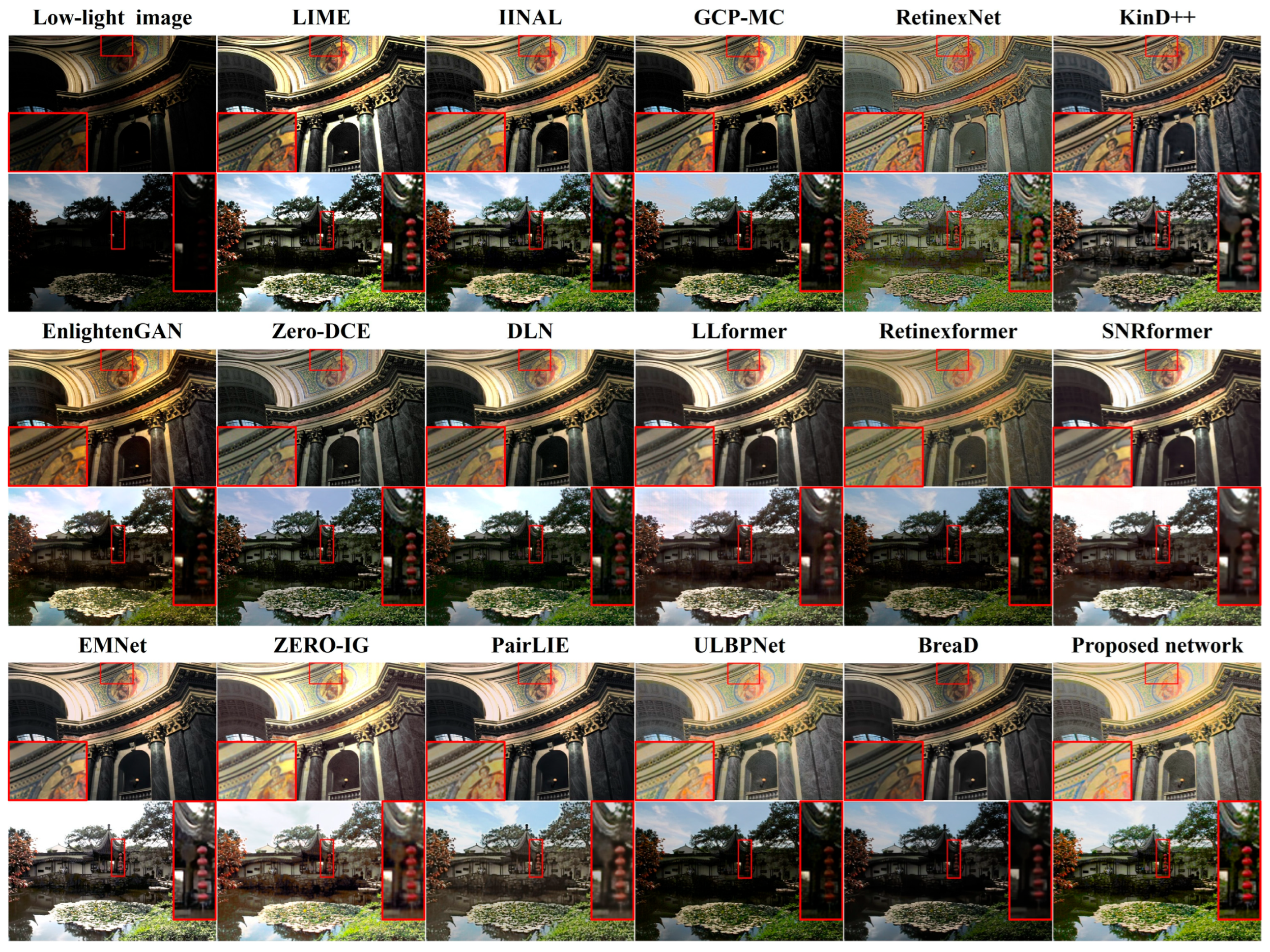
Figure 8 qualitatively compares the enhanced results obtained from the proposed network with those obtained using existing LLIE methods for the 15 LOL test images. The results from LIME exhibit an insufficiently bright background, whereas IINAL and RetinexNet introduce significant noise, with the background colors differing from those of the reference images. Although KinD++ preserves many details, the resulting image exhibits less-defined boundaries owing to color fading. Additionally, the results of the EnlightenGAN and DLN exhibit excessive noise, incomplete color restoration, and an overall faint appearance. Zero-DCE and PairLIE display noise throughout the image and fail to restore sufficient brightness. The results of LLformer, Retinexformer, and ZERO-IG exhibit noise and lack detail, whereas SNRformer fails to produce clear details. Along with the proposed method, EMNet, ULBPNet, and BreaD restore brightness without introducing noise. However, EMNet and ULBPNet exhibit reduced detail and blurriness, whereas BreaD exhibits incomplete color restoration and some blurriness. In contrast, the proposed method effectively restores both color and detail, and the results closely resemble the ground-truth images. Furthermore, it accurately captures the ground-truth color and provides excellent detail without noise or distortion, thereby outperforming the other methods.
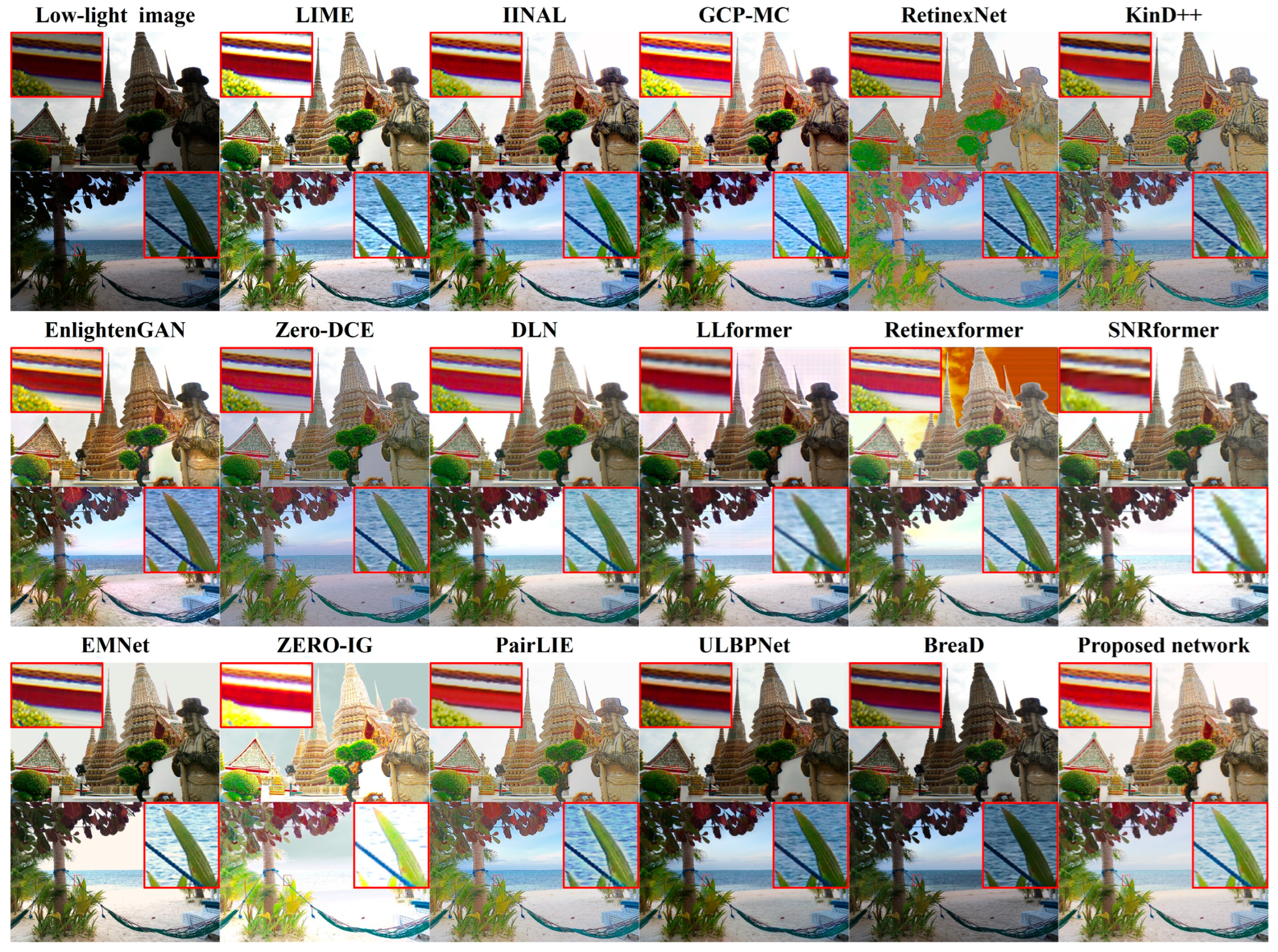
Figure 9 qualitatively compares the enhanced results obtained using the proposed method with those obtained using other LLIE methods on the MEF dataset. RetinexNet exhibits over-enhancement with pronounced noise amplification. KinD++ is likewise over-enhanced, compromising the structural detail, and Zero-DCE degrades the color fidelity. LLformer, SNRformer, EMNet, ZERO-IG, and PairLIE do not preserve the chromaticity during enhancement, producing smeared textures and damaged fine details. GCP-MC, DLN, and BreaD provide little to no global brightness recovery, whereas ULBPNet and Retinexformer leave insufficiently exposed regions. EnlightenGAN introduces noticeable color shifts. LIME yields enhanced results that are underexposed or coarse details, whereas IINAL lacks fine structures. However, the proposed method delivers bright, globally consistent exposure while preserving color fidelity and sharp detail and suppresses noise, even in the darkest areas.
Figure 10 shows the results of the proposed method on the TM-DIED dataset compared with those of the other LLIE methods. ULBPNet and BreaD fail to restore adequate global brightness. RetinexNet, KinD++, and PairLIE markedly amplify the noise across the scene. Retinexformer and ZERO-IG incur substantial losses of color and detail, yielding unnatural reconstructions, while LLformer, SNRformer, and EMNet produce muted chromas with softened fine structures. GCP-MC exhibits over-enhancement with saturated chroma and noticeable color shifts, whereas Zero-DCE introduces edge-localized color shifts and blurry outputs. The outputs of LIME, IINAL, and EnlightenGAN are less blurry; however, they remain low in chroma and exhibit over-contrast, leading to poor color balance. DLN appears relatively natural yet remains underexposed and slightly soft. The proposed network naturally brightens the image and preserves the contrast between light and dark areas. In addition, the colors are accurately restored without distortion, appear vivid yet natural, and the details are clearly maintained.
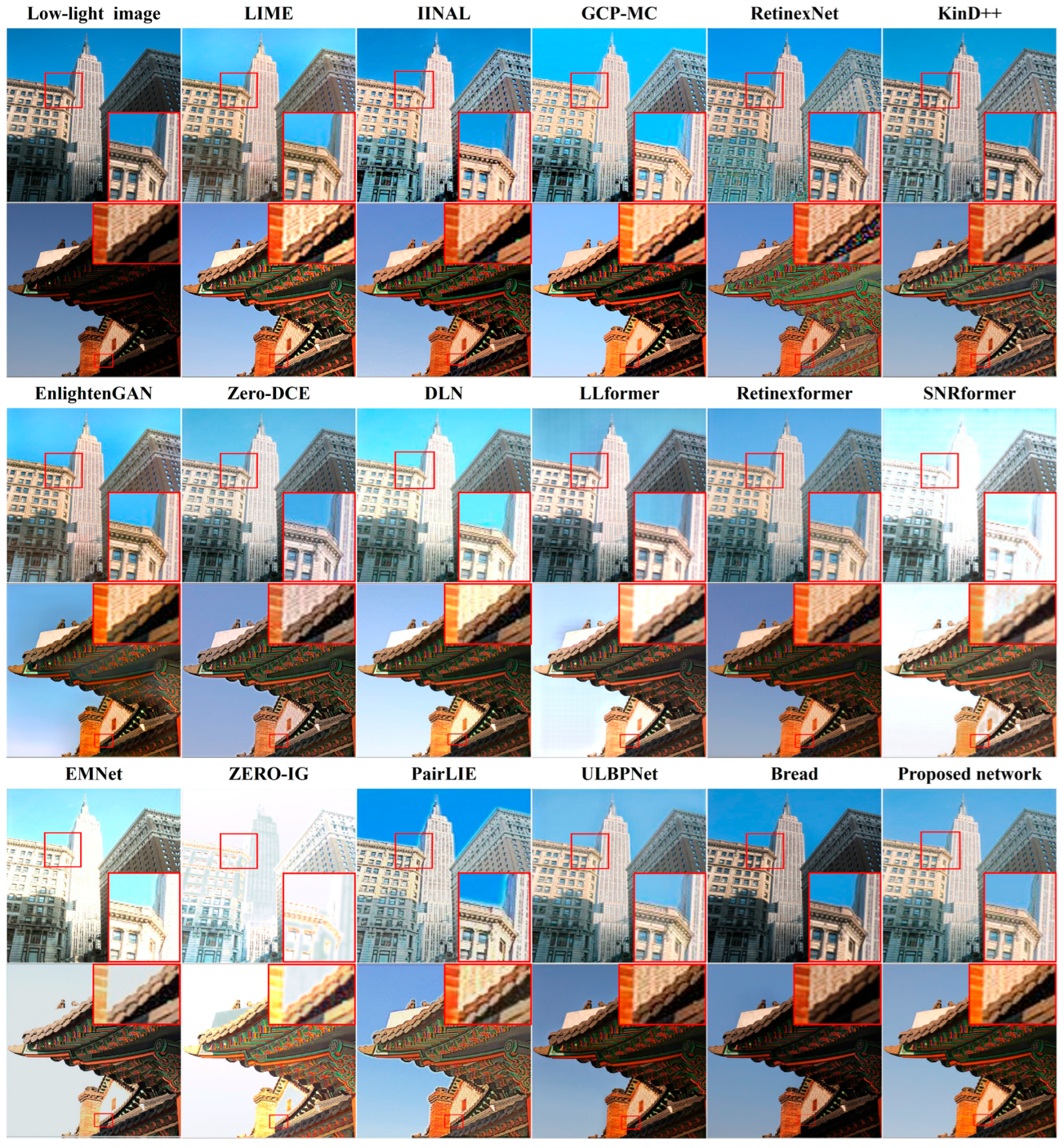
Figure 11 presents the results of the Fusion dataset. Retinexformer, ULBPNet, and BreaD fail to deliver sufficient global exposure, whereas LLformer, SNRformer, EMNet, and ZERO-IG are over-brightened, leading to color loss, highlight clipping, and loss of fine detail. Zero-DCE and DLN yield desaturated and blurred outputs. LIME, KinD++, and PairLIE degrade color and introduce unnatural edge emphasis, whereas GCP-MC over-enhances and shifts colors. Furthermore, RetinexNet exhibits over-enhancement with noticeable noise and visually inconsistent artifacts, whereas IINAL, EnlightenGAN, and the proposed method preserve the structural details while improving the brightness. Overall, the proposed approach preserves and restores color, produces clean boundaries, naturally increases the global brightness, and clearly reveals fine details with minimal artifacts.
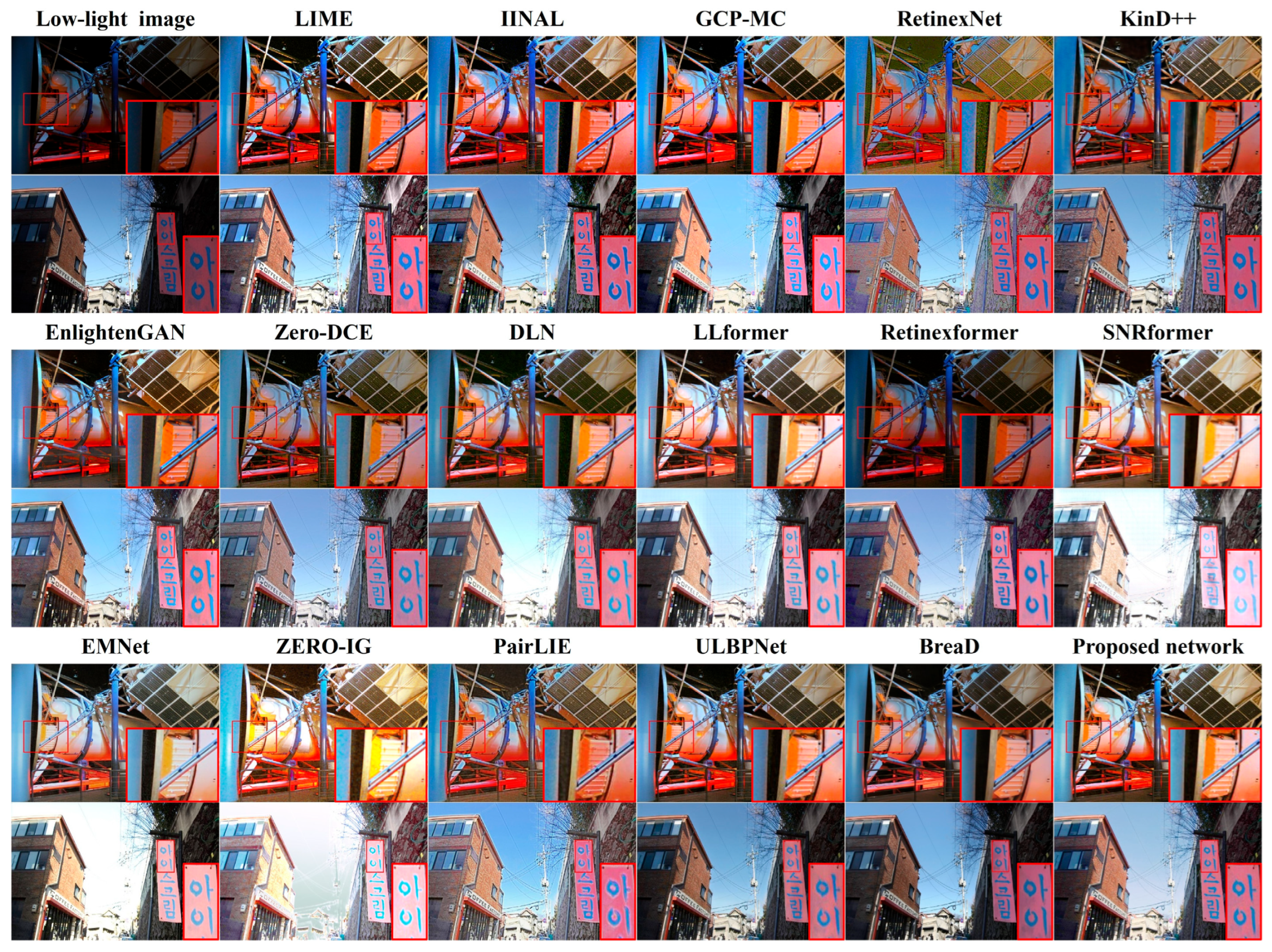
Figure 12 provides a qualitative comparison of the DICM dataset between the proposed method and existing LLIE approaches. RetinexNet and PairLIE considerably amplify noise, erode fine structures, and degrade chromatic fidelity. DLN and LLformer produce desaturated hazy outputs during illumination restoration. SNRformer, EMNet, and ZERO-IG exhibit extensive overexposure and highlight clipping with severe losses of detail and color. LIME, IINAL, and GCP-MC show over-enhancement with noticeable color shifts and inconsistent fine details. EnlightenGAN and Zero-DCE yield coarse textures and unstable structures. Although ULBPNet and BreaD recover certain structures naturally, they fail to provide sufficient, globally uniform exposure, leaving brightness imbalances. In certain cases, Retinexformer offers little or no brightness restoration. In contrast, the proposed method restores exposure without amplifying noise, preserves color consistency, and maintains crisp details across the entire scene.
Figure 13 compares the results for the LIME dataset. IINAL, GCP-MC, and ULBPNet do not provide sufficient exposure. Although RetinexNet and LIME brighten the scenes, they introduce pronounced background noise. DLN, LLformer, SNRformer, EMNet, ZeroIG, and BreaD yield soft, blurry reconstructions that lack sharpness and local contrast. Zero-DCE and Retinexformer yield blurred and desaturated reconstructions. KinD++ and PairLIE exhibit over-enhancement with unnatural edge transitions and degraded fine details. Similarly, EnlightenGAN produces unnatural boundaries and, in some cases, soft outputs globally. In contrast, the proposed method brightens dark regions without increasing noise and preserves the structure and color of highlights such as light sources.

4.5. Quantitative Comparison

Table 2 compares the average quantitative evaluation metrics for the LOL test images, where the top three performances are highlighted in bold, italicized, and underlined text, respectively. In Table 2, the symbol ↓ indicates that a smaller value corresponds to a better evaluation index, while the symbol ↑ indicates that a larger value is preferable. As shown in Table 2, the proposed method ranks second in terms of SSIM, LPIPS, and FSIM. PSNR ranks fourth behind EMNet, Retinexformer, and SNRformer, while maintaining a clear margin over the remaining methods. EMNet surpasses PSNR, SSIM, LPIPS, and FSIM, and ranks second on NIQE. Retinexformer, which ranks second on PSNR and third on NIQE and LPIPS, matches or slightly trails the proposed method on the other metrics. ULBPNet achieves the best NIQE, while SNRformer ranks third on PSNR; however, both perform worse than the proposed method on the remaining metrics. Overall, the proposed method exhibits superior performers across all metrics and exhibits a balanced quantitative profile.
Table 3 compares each LLIE method using the NIQE values. For the five non-reference datasets, we ranked the methods based on their average NIQE. The proposed method ranks third in terms of the average NIQE, which is close to the top two across most datasets. BreaD attains the best NIQE, and ULBPNet ranks second; however, as shown in Table 2, BreaD performs significantly worse than the proposed method on PSNR, SSIM, LPIPS, and FSIM. Similarly, ULBPNet excels only on NIQE while lagging on the other metrics. In contrast, the proposed network achieves a high average NIQE on the non-reference datasets, indicating outputs consistent with the statistics of natural images and delivers balanced, strong results on the reference-based metrics.

4.6. Failure Cases

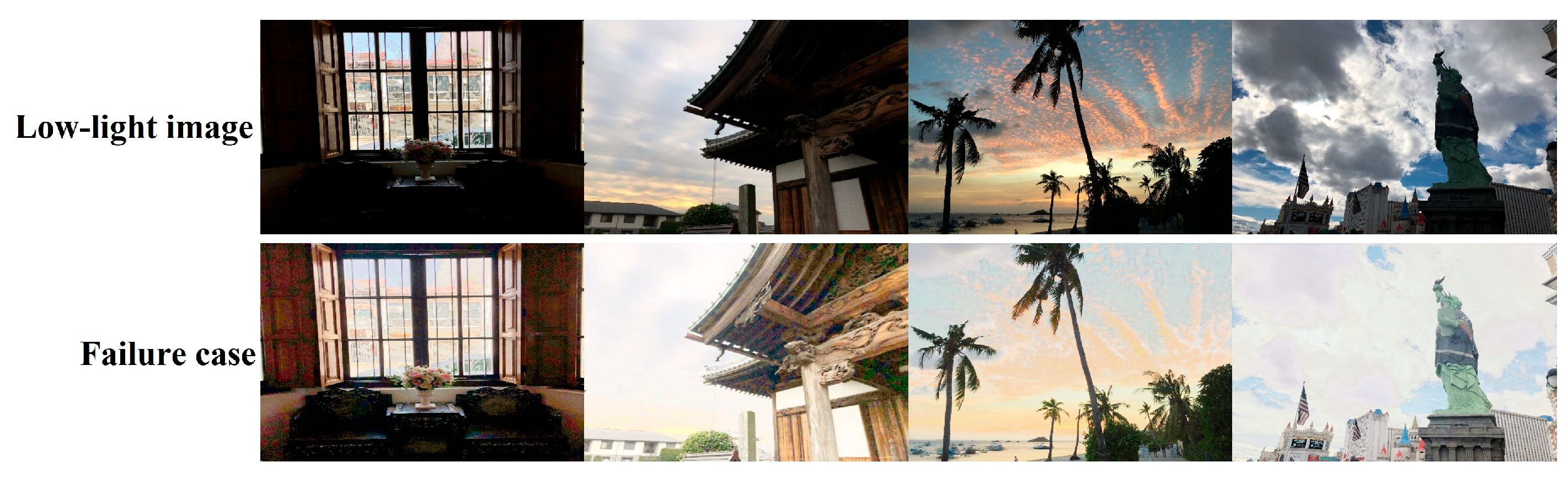
The proposed LLIE network was evaluated on five non-reference datasets comprising a total of 311 images. Although the overall performance remained stable, over-enhancement was observed in a number of challenging samples with fewer than 1.6% of the test images as identified failure cases. Figure 14 presents representative failure examples. As shown in Figure 14, slight color cast artifacts may appear when the global illumination is strongly amplified. In addition, excessive brightening in high-luminance regions, such as the sky, lead to partial highlight saturation and loss of fine details. Nevertheless, foreground objects that were originally underexposed are effectively brightened while preserving color consistency. In conclusion, a limitation of the proposed network is that the strong luminance amplification required to enhance dark regions may simultaneously induce over-enhancement in already bright areas. Despite this limitation, the failure rate remains below 1.6%, and no noticeable structural distortion is introduced. Overall, the proposed method maintains stable performance across diverse low-light conditions, exhibiting only limited degradation in rare cases.

4.7. Summary of Qualitative and Quantitative Results

As shown in Table 2, EMNet performs strongly on several reference-based metrics. However, Table 3 shows its poor rank in the NIQE metric for the non-reference images. Furthermore, the qualitative results for the non-reference LLIE in Figure 9, Figure 10, Figure 11, Figure 12 and Figure 13 do not exhibit convincing restoration quality. Thus, EMNet is overfitted to the LOL-based test images, leading to limited generalization. Retinexformer displays a similar pattern, producing subjectively less satisfactory results. ULBPNet consistently exhibits strong quantitative scores on both the reference-based and non-reference test sets, as shown in Table 2 and Table 3. However, it fails to restore brightness and fine details in subjective visual evaluations. BreaD performs poorly on reference-based metrics despite achieving the highest NIQE scores for non-reference datasets. The subjective evaluations further reveal noticeable color shifts, insufficient brightness enhancement, and inadequate detail restoration.
Conversely, the proposed network achieves strong objective performance on both reference-based and non-reference datasets. The resulting images demonstrate substantial improvements in brightness restoration, color fidelity, image contrast, and detail recovery. Overall, the proposed method demonstrates robust generalization within the LLIE setting, delivering consistently high performance across diverse test environments.

4.8. Ablation Study

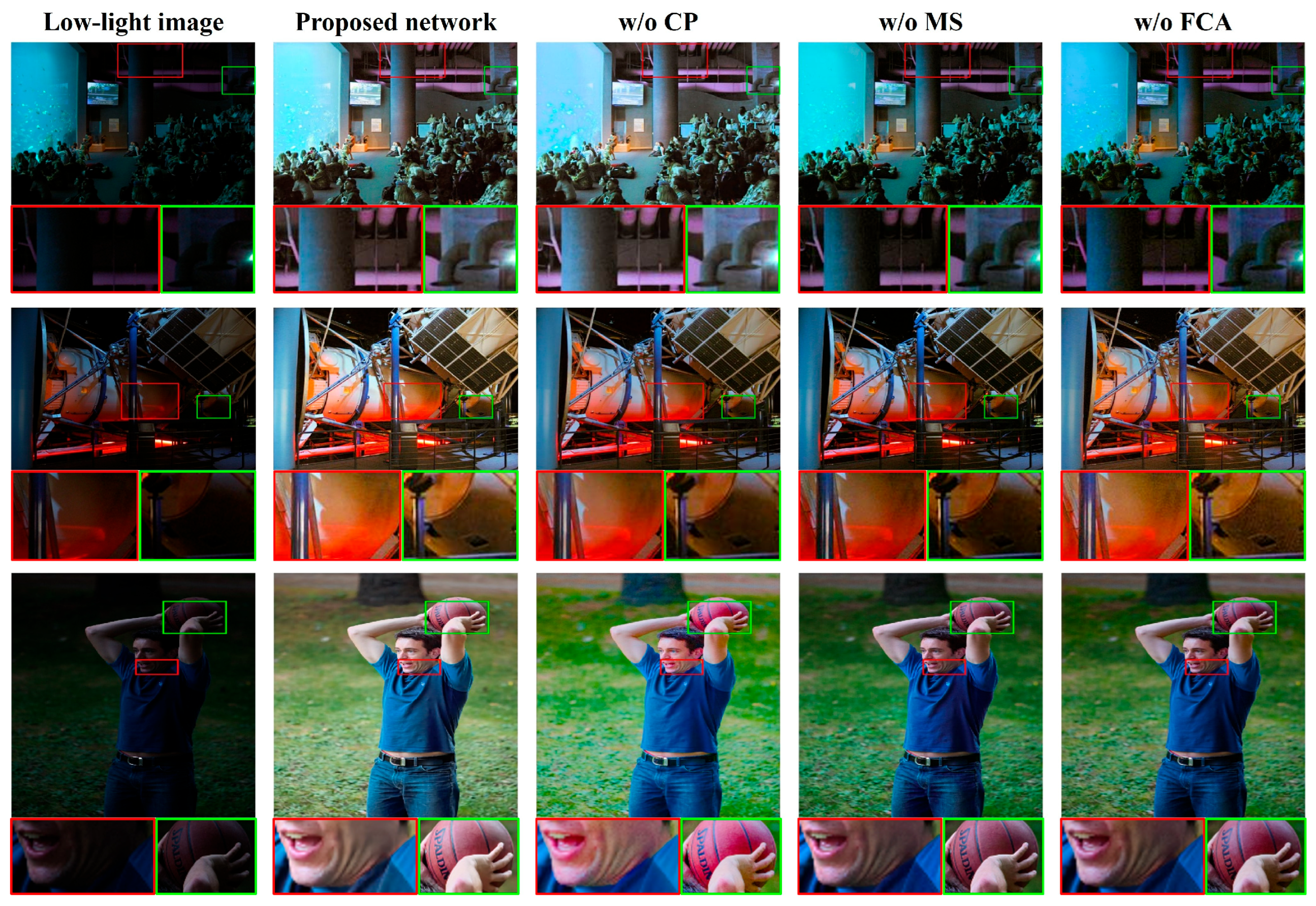
Three ablation studies were conducted to evaluate the contributions of the CP, MS, and FCA blocks by removing each component from the proposed LLIE network. Figure 15 shows the restored images obtained from various ablation experiments. When the CP block is removed, a colored cast appears in the enhancement results. When the MS block is removed from the proposed network, the details of the resulting images are lost. The absence of the FCA block disrupts the correlation between the wavelet coefficients, leading to insufficient improvements in both image brightness and details.
Table 4 presents the averaged PSNR, SSIM, and NIQE values for 15 LOL test images and 100 randomly selected LOL-v2 images from each ablation experiment. The CP block is essential for restoring brightness while maintaining color fidelity by incorporating the saturation component of the low-light image. Removal of this block reduces the PSNR by approximately 1 dB, leading to a noticeable degradation in image quality, whereas the SSIM and NIQE values exhibit only negligible changes within 1%. The MS block enhances the contrast of low-light images, and its removal deteriorates the performance across all three metrics. In particular, the largest decrease occurs in PSNR, from 27.921 dB to 26.494 dB, whereas the NIQE increases from 2.992 to 3.117, reflecting poorer visual quality. The FCA block is responsible for adjusting and enhancing contrast through the interaction between low- and high-frequency components, thereby improving the overall restoration process. Ablation experiments revealed that removing this block reduced the PSNR by more than 1 dB, from 27.921 dB to 26.693 dB, along with lower SSIM and higher NIQE values. In summary, each block contributes to the network performance, and their combined effect enables the proposed method to achieve acceptable brightness restoration, contrast enhancement, and overall visual quality.

5. Conclusions

This study proposed an effective low-light image enhancement network that simultaneously improves the low- and high-frequency coefficients in the wavelet domain. A U-shaped lighting block was employed to enhance the low-frequency subband, whereas a color-preserving block using the saturation component of the low-light image was introduced before the illumination step. For the high-frequency subbands, a multiscale sharpening block was designed to enhance the edges and improve the image contrast. In addition, a frequency cross-attention block was developed to preserve the correlations among the enhanced wavelet subband features by enabling information sharing across frequencies. Ablation studies demonstrated that each of these components contributed significantly to brightness restoration and contrast enhancement. The effectiveness of the proposed method was validated through comparisons with state-of-the-art approaches using multiple benchmark datasets. The experimental results confirmed that the proposed network consistently achieved competitive performance compared to existing methods in terms of both objective metrics and perceptual image quality. Moreover, the results across diverse datasets highlighted the strong generalization ability of the proposed network, facilitating robust performance under various low-light conditions.

Author Contributions

D.E.L.: Methodology, software, data curation, writing—original draft preparation. J.Y.P.: Methodology, software, writing—review and editing. I.K.E.: Conceptualization, validation, supervision, writing—review and editing. All authors have read and agreed to the published version of the manuscript.

Funding

This research was supported by the National Research Foundation of Korea (NRF) funded by the Korea government (MSIT) (Grant No. RS-2023-00243132).

Data Availability Statement

The original data presented in the study are openly available in GitHub at https://github.com/daeun00/FCANet (accessed on 9 February 2026).

Acknowledgments

During the preparation of this manuscript, the authors used ChatGPT-5 in order to assist in revising the English grammar. After using this tool, the authors reviewed and edited the content as needed, and they take full responsibility for the content of the published article.

Conflicts of Interest

The authors declare no conflicts of interest.

References

  1. Li, C.; Guo, C.; Han, L.; Jiang, J.; Cheng, M.-M.; Gu, J.; Loy, C.C. Low-light image and video enhancement using deep learning: A survey. IEEE Trans. Pattern Anal. Mach. Intell. 2022, 44, 9396–9416. [Google Scholar] [CrossRef] [PubMed]
  2. Mun, J.W.; Jang, Y.S.; Nam, Y.J.; Kim, J.S. Edge-enhancing bi-histogram equalisation using guided image filter. J. Vis. Commun. Image Represent. 2019, 58, 688–700. [Google Scholar] [CrossRef]
  3. Rao, B.S. Dynamic histogram equalization for contrast enhancement for digital images. Appl. Soft Comput. 2020, 89, 106114. [Google Scholar] [CrossRef]
  4. Guo, X.; Li, Y.; Ling, H. LIME: Low-light image enhancement via illumination map estimation. IEEE Trans. Image Process. 2017, 26, 982–993. [Google Scholar] [CrossRef]
  5. Hao, S.; Han, X.; Guo, Y.; Xu, X.; Wang, M. Low-light image enhancement with semi-decoupled decomposition. IEEE Trans. Multimed. 2020, 22, 3025–3038. [Google Scholar] [CrossRef]
  6. Jeon, J.J.; Eom, I.K. Low-light image enhancement using inverted image normalized by atmospheric light. Signal Process. 2022, 196, 108523. [Google Scholar] [CrossRef]
  7. Jeon, J.J.; Park, J.Y.; Eom, I.K. Low-light image enhancement using gamma correction prior in mixed color spaces. Pattern Recognit. 2024, 146, 110001. [Google Scholar] [CrossRef]
  8. Wang, L.W.; Liu, Z.S.; Siu, W.C.; Lun, D.P.K. Lightening Network for Low-Light Image Enhancement. IEEE Trans. Image Process. 2020, 29, 7984–7996. [Google Scholar] [CrossRef]
  9. Park, J.Y.; Park, C.W.; Eom, I.K. ULBPNet: Low-light image enhancement using U-shaped lightening back-projection. Knowl.-Based Syst. 2023, 281, 111099. [Google Scholar] [CrossRef]
  10. Jiang, Y.; Gong, X.; Liu, D.; Cheng, Y.; Shen, X.; Yang, J.; Zhou, P.; Wang, Z. EnlightenGAN: Deep light enhancement without paired supervision. IEEE Trans. Image Process. 2021, 30, 2340–2349. [Google Scholar] [CrossRef] [PubMed]
  11. Wang, T.; Zhang, K.; Shen, T.; Luo, W.; Stenger, B.; Lu, T. Ultra-high-definition low-light image enhancement: A benchmark and transformer-based method. In Proceedings of the AAAI Conference on Artificial Intelligence, Washington, DC, USA, 7–14 February 2023; Volume 37, pp. 2654–2662. [Google Scholar] [CrossRef]
  12. Cai, Y.; Bian, H.; Lin, J.; Wang, H.; Timofte, R.; Zhang, Y. Retinexformer: One-stage Retinex-based transformer for low-light image enhancement. In Proceedings of the IEEE/CVF International Conference on Computer Vision (ICCV), Paris, France, 1–6 October 2023; pp. 12470–12479. [Google Scholar] [CrossRef]
  13. Guo, X.; Hu, Q. Low-light image enhancement via breaking down the darkness. Int. J. Comput. Vis. 2023, 131, 48–66. [Google Scholar] [CrossRef]
  14. Ye, D.; Ni, Z.; Yang, W.; Wang, H.; Wang, S.; Kwong, S. Glow in the dark: Low-light image enhancement with external memory. IEEE Trans. Multimed. 2024, 26, 2148–2163. [Google Scholar] [CrossRef]
  15. Fu, Z.; Yang, Y.; Tu, X.; Huang, Y.; Ding, X.; Ma, K.-K. Learning a simple low-light image enhancer from paired low-light instances. In Proceedings of the IEEE/CVF Conference on Computer Vision and Pattern Recognition (CVPR), Vancouver, BC, Canada, 17–24 June 2023; pp. 22252–22261. [Google Scholar] [CrossRef]
  16. Shi, Y.; Liu, D.; Zhang, L.; Tian, Y.; Xia, X.; Fu, X. ZERO-IG: Zero-shot illumination-guided joint denoising and adaptive enhancement for low-light images. In Proceedings of the IEEE/CVF Conference on Computer Vision and Pattern Recognition (CVPR), Seattle, WA, USA, 16–22 June 2024; pp. 3015–3024. [Google Scholar] [CrossRef]
  17. Srinivas, K.; Bhandari, A.K. Low light image enhancement with adaptive sigmoid transfer function. IET Image Process. 2020, 14, 668–678. [Google Scholar] [CrossRef]
  18. Celik, T.; Tjahjadi, T. Contextual and variational contrast enhancement. IEEE Trans. Image Process. 2011, 20, 3431–3441. [Google Scholar] [CrossRef]
  19. Fu, X.; Zeng, D.; Huang, Y.; Liao, Y.; Ding, X.; Paisley, J. A fusion-based enhancing method for weakly illuminated images. Signal Process. 2016, 129, 82–96. [Google Scholar] [CrossRef]
  20. Ren, W.; Liu, S.; Ma, L.; Xu, Q.; Xu, X.; Cao, X.; Du, J.; Yang, M.-H. Low-light image enhancement via a deep hybrid network. IEEE Trans. Image Process. 2019, 28, 4364–4375. [Google Scholar] [CrossRef] [PubMed]
  21. Wu, W.; Weng, J.; Zhang, P.; Wang, X.; Yang, W.; Jiang, J. URetinex-Net: Retinex-based deep unfolding network for low-light image enhancement. In Proceedings of the IEEE/CVF Conference on Computer Vision and Pattern Recognition (CVPR), New Orleans, LA, USA, 18–24 June 2022; pp. 5891–5900. [Google Scholar] [CrossRef]
  22. Lu, K.; Zhang, L. TBEFN: A two-branch exposure-fusion network for low-light image enhancement. IEEE Trans. Multimed. 2021, 23, 4093–4105. [Google Scholar] [CrossRef]
  23. Zhang, Y.; Guo, X.; Ma, J.; Liu, W.; Zhang, J. Beyond brightening low-light images. Int. J. Comput. Vis. 2021, 129, 1013–1037. [Google Scholar] [CrossRef]
  24. Yao, Z.; Su, J.N.; Fan, G.; Gan, M.; Chen, C.L.P. GACA: A gradient-aware and contrastive-adaptive learning framework for low-light image enhancement. IEEE Trans. Instrum. Meas. 2024, 73, 1–14. [Google Scholar] [CrossRef]
  25. Luo, H.; Chen, B.; Zhu, L.; Chen, P.; Wang, S. RCNet: Deep recurrent collaborative network for multi-view low-light image enhancement. IEEE Trans. Multimed. 2025, 27, 2001–2014. [Google Scholar] [CrossRef]
  26. Cao, J.; Zou, Q.; Ning, X.; Wang, Z.; Wang, G. FIPNet: Self-supervised low-light image enhancement combining feature and illumination priors. Neurocomputing 2025, 623, 129426. [Google Scholar] [CrossRef]
  27. Guo, C.; Li, C.; Guo, J.; Loy, C.C.; Hou, J.; Kwong, S.; Cong, R. Zero-reference deep curve estimation for low-light image enhancement. In Proceedings of the IEEE/CVF Conference on Computer Vision and Pattern Recognition (CVPR), Seattle, WA, USA, 13–19 June 2020; pp. 1780–1789. [Google Scholar] [CrossRef]
  28. Yang, S.; Ding, M.; Wu, Y.; Li, Z.; Zhang, J. Implicit neural representation for cooperative low-light image enhancement. In Proceedings of the IEEE/CVF International Conference on Computer Vision (ICCV), Paris, France, 1–6 October 2023; pp. 12872–12881. [Google Scholar] [CrossRef]
  29. Wang, Y.; Wan, R.; Li, H.; Chau, L.-P.; Kot, A. Low-light image enhancement with normalizing flow. In Proceedings of the AAAI Conference on Artificial Intelligence, Online, 22 February–1 March 2022; Volume 36, pp. 2604–2612. [Google Scholar] [CrossRef]
  30. Xu, X.; Wang, R.; Fu, C.-W.; Jia, J. SNR-aware low-light image enhancement. In Proceedings of the IEEE/CVF Conference on Computer Vision and Pattern Recognition (CVPR), New Orleans, LA, USA, 18–24 June 2022; pp. 17693–17703. [Google Scholar] [CrossRef]
  31. Xu, L.; Hu, C.; Hu, Y.; Jing, X.; Cai, Z.; Lu, X. UPT-Flow: Multi-scale transformer-guided normalizing flow for low-light image enhancement. Pattern Recognit. 2025, 158, 111076. [Google Scholar] [CrossRef]
  32. Wen, Y.; Xu, P.; Li, Z.; Xu(Ato), W. An illumination-guided dual attention vision transformer for low-light image enhancement. Pattern Recognit. 2025, 158, 111033. [Google Scholar] [CrossRef]
  33. Hu, X.; Liu, K.; Yin, X.; Gao, X.; Jiang, P.; Qian, X. Wavelet-based enhancement network for low-light Image. Displays 2025, 87, 102954. [Google Scholar] [CrossRef]
  34. Zhang, Y.; Jiang, J.; Wang, Z.; Zhang, Q.; Jiang, Y.; Liu, J.; Hou, Z. Low-light image enhancement method based on Retinex theory and dual-tree complex wavelet transform. J. King Saud Univ. Comput. Inf. Sci. 2025, 37, 83. [Google Scholar] [CrossRef]
  35. Kim, S.E.; Jeon, J.J.; Eom, I.K. Image contrast enhancement using entropy scaling in wavelet domain. Signal Process. 2016, 127, 1–11. [Google Scholar] [CrossRef]
  36. Wang, Z.; Bovik, A.C.; Sheikh, H.R.; Simoncelli, E.P. Image quality assessment: From error visibility to structural similarity. IEEE Trans. Image Process. 2004, 13, 600–612. [Google Scholar] [CrossRef]
  37. Wei, C.; Wang, W.; Yang, W.; Liu, J. Deep Retinex decomposition for low-light enhancement. arXiv 2018, arXiv:1808.04560. [Google Scholar] [CrossRef]
  38. Yang, W.; Wang, H.; Huang, H.; Wang, S.; Liu, J. Sparse gradient regularized deep Retinex network for robust low-light image enhancement. IEEE Trans. Image Process. 2021, 30, 2072–2086. [Google Scholar] [CrossRef] [PubMed]
  39. Lee, C.; Lee, C.; Kim, C.S. Contrast enhancement based on layered difference representation of 2D histograms. IEEE Trans. Image Process. 2013, 22, 5372–5384. [Google Scholar] [CrossRef] [PubMed]
  40. Wang, Q.; Fu, X.; Zhang, X.P.; Ding, X. A fusion-based method for single backlit image enhancement. In Proceedings of the IEEE International Conference on Image Processing (ICIP), Phoenix, Az, USA, 25–28 September 2016; pp. 4077–4081. [Google Scholar] [CrossRef]
  41. Ma, K.; Zeng, K.; Wang, Z. Perceptual quality assessment for multi-exposure image fusion. IEEE Trans. Image Process. 2015, 24, 3345–3356. [Google Scholar] [CrossRef] [PubMed]
  42. Vonikakis Datasets. Available online: https://sites.google.com/site/vonikakis/datasets (accessed on 9 February 2026).
  43. Zhang, R.; Isola, P.; Efros, A.A.; Shechtman, E.; Wang, O. The unreasonable effectiveness of deep features as a perceptual metric. In Proceedings of the IEEE/CVF Conference on Computer Vision and Pattern Recognition (CVPR), Salt Lake City, UT, USA, 18–23 June 2018; pp. 586–595. [Google Scholar] [CrossRef]
  44. Zhang, L.; Zhang, L.; Mou, X.; Zhang, D. FSIM: A feature similarity index for image quality assessment. IEEE Trans. Image Process. 2011, 20, 2378–2386. [Google Scholar] [CrossRef] [PubMed]
  45. Mittal, A.; Soundararajan, R.; Bovik, A.C. Making a ‘completely blind’ image quality analyzer. IEEE Signal Process. Lett. 2013, 20, 209–212. [Google Scholar] [CrossRef]
Figure 1. Comparison of restored low-light images obtained using recent machine learning-based methods and the proposed method.
Symmetry 18 00470 g001
Figure 2. Overall architecture of the proposed LLIE network.
Symmetry 18 00470 g002
Figure 3. Saturation maps for low-light images and their corresponding normal-light images.
Symmetry 18 00470 g003
Figure 4. Structure of the CP block.
Symmetry 18 00470 g004
Figure 5. Structure of the UL block.
Symmetry 18 00470 g005
Figure 6. Structure of the MS block.
Symmetry 18 00470 g006
Figure 7. Structure of the FCA block.
Symmetry 18 00470 g007
Figure 8. Qualitative comparison between the results of the proposed network and other LLIE methods on the LOL test images.
Symmetry 18 00470 g008
Figure 9. Qualitative comparison of the results of the proposed network and other LLIE methods on the MEF test images.
Symmetry 18 00470 g009
Figure 10. Qualitative comparison of the results of the proposed network and other LLIE methods on the TM-DIED test images.
Symmetry 18 00470 g010
Figure 11. Qualitative comparison of the results of the proposed network and other LLIE methods on the Fusion test images.
Symmetry 18 00470 g011
Figure 12. Qualitative comparison of the results of the proposed network and other LLIE methods on the DICM test images.
Symmetry 18 00470 g012
Figure 13. Qualitative comparison of the results of the proposed network and other LLIE methods on the LIME test images.
Symmetry 18 00470 g013
Figure 14. Failure cases of the proposed method.
Symmetry 18 00470 g014
Figure 15. Restored images obtained using ablation experiments.
Symmetry 18 00470 g015
Table 1. Comparison of the runtime, parameter count, and flops between the proposed LLIE method and existing networks.
Network ModelRuntime (Second)Parameters (×103)Flops (G)
RetinexNet0.937044473.656
KinD++3.188082751359.787
EnlightenGAN0.0518863761.010
Zero-DCE0.00787919.008
DLN0.0160701166.502
LLformer0.348724,549165.889
Retinexformer0.3756160562.323
SNRformer0.195839,120174.53
EMNet0.299012,520525.435
ZERO-IG0.0081198118.725
PairLIE0.008834281.84
ULBPNet0.078419,626887.912
Bread0.37302020108.218
Proposed network0.020610,689395.946
Table 2. Comparison of the averaged quantitative evaluation measure values for LOL test images.
MethodPSNR ↑SSIM ↑NIQE ↓LPIPS ↓FSIM ↑
LIME16.920 ± 3.6790.504 ± 0.1137.458 ± 0.8270.360 ± 0.1380.894 ± 0.035
IINAL16.390 ± 2.3640.400 ± 0.1007.656 ± 0.7750.465 ± 0.1400.842 ± 0.043
GCP-MC17.393 ± 2.1270.412 ± 0.0998.305 ± 0.9300.428 ± 0.1580.863 ± 0.041
RetinexNet16.774 ± 2.3680.425 ± 0.0928.091 ± 0.7640.474 ± 0.1340.849 ± 0.025
KinD++17.752 ± 2.7560.758 ± 0.0912.824 ± 0.5470.198 ± 0.0550.866 ± 0.039
EnlightenGAN17.483 ± 4.5240.652 ± 0.1105.056 ± 0.6720.322 ± 0.1440.912 ± 0.032
Zero-DCE14.797 ± 4.2670.561 ± 0.1256.925 ± 0.8300.335 ± 0.1290.918 ± 0.028
DLN19.261 ± 4.0780.698 ± 0.0885.447 ± 0.6490.299 ± 0.1140.931 ± 0.021
LLformer23.649 ± 4.4790.816 ± 0.0762.664 ± 0.4430.168 ± 0.0500.953 ± 0.022
Retinexformer25.153 ± 2.7740.843 ± 0.0552.282 ± 0.4300.131 ± 0.0430.961 ± 0.012
SNRformer24.610 ± 4.1110.840 ± 0.0682.516 ± 0.2850.151 ± 0.0460.958 ± 0.017
EMNet25.365 ± 4.1000.869 ± 0.0702.445 ± 0.4010.084 ± 0.0210.968 ± 0.015
ZERO-IG22.175 ± 5.2120.772 ± 0.0743.035 ± 0.2550.199 ± 0.0890.931 ± 0.031
PairLIE18.468 ± 3.9020.753 ± 0.0783.358 ± 0.4860.243 ± 0.0770.915 ± 0.020
ULBPNet23.349 ± 3.4640.847 ± 0.0662.157 ± 0.2330.145 ± 0.0510.955 ± 0.018
BreaD20.620 ± 2.8660.831 ± 0.0762.554 ± 0.3190.164 ± 0.0550.952 ± 0.016
Proposed network24.080 ± 4.0710.854 ± 0.0682.560 ± 0.2880.128 ± 0.0450.961 ± 0.019
Table 3. Comparison of the averaged NIQE values for non-reference datasets.
MethodDICMLIMEFusionTM-DIEDMEFAVG
LIME3.338 ± 1.2163.581 ± 1.6102.764 ± 0.8152.415 ± 0.5922.997 ± 0.8393.020
IINAL3.297 ± 1.1023.653 ± 1.8132.727 ± 0.8712.448 ± 0.5343.237 ± 0.7003.072
GCP-MC3.154 ± 1.0213.387 ± 1.8532.687 ± 0.8592.552 ± 0.5153.011 ± 0.5052.958
RetinexNet4.076 ± 1.5594.143 ± 2.1633.081 ± 0.9532.997 ± 0.7343.832 ± 1.3133.626
KinD++2.257 ± 0.4513.563 ± 2.9732.414 ± 0.8352.282 ± 0.5242.280 ± 0.2712.559
EnlightenGAN2.731 ± 0.6512.957 ± 1.1832.246 ± 0.5972.227 ± 0.4622.370 ± 0.4472.506
Zero-DCE2.606 ± 1.0043.393 ± 1.6082.596 ± 0.7352.337 ± 0.5562.846 ± 0.7262.756
DLN2.736 ± 1.0923.047 ± 1.4732.772 ± 0.8012.698 ± 1.1322.435 ± 0.5732.738
LLformer2.967 ± 0.8653.417 ± 1.2573.174 ± 0.6662.973 ± 0.5382.562 ± 0.2693.019
Retinexformer2.823 ± 0.9603.062 ± 1.6392.809 ± 0.6912.328 ± 0.5352.691 ± 0.5422.743
SNRformer2.501 ± 0.4703.523 ± 1.3232.935 ± 0.8103.679 ± 0.6692.373 ± 0.3653.002
EMNet3.690 ± 2.3123.278 ± 2.0193.324 ± 1.0333.738 ± 2.2392.644 ± 0.7233.335
ZERO-IG2.513 ± 0.4582.806 ± 1.4482.499 ± 0.7552.279 ± 0.4262.337 ± 0.4492.487
PairLIE2.092 ± 0.4803.099 ± 1.8582.460 ± 0.7562.468 ± 0.5962.532 ± 0.3292.530
ULBPNet1.897 ± 0.4713.113 ± 1.6732.337 ± 0.6432.220 ± 0.4362.527 ± 0.5422.419
BreaD2.184 ± 0.3422.940 ± 1.2472.260 ± 0.4802.303 ± 0.4502.180 ± 0.3182.373
Proposed network1.984 ± 0.5903.251 ± 2.2112.190 ± 0.6392.226 ± 0.4792.495 ± 0.3982.429
Table 4. Quantitative results of ablation experiments conducted on LOL and LOL-v2 test images.
CPMSFCAPSNR ↑SSIM ↑NIQE ↓
27.9210.92.992
26.9780.8952.971
26.4940.8993.117
26.6930.8933.102
Disclaimer/Publisher’s Note: The statements, opinions and data contained in all publications are solely those of the individual author(s) and contributor(s) and not of MDPI and/or the editor(s). MDPI and/or the editor(s) disclaim responsibility for any injury to people or property resulting from any ideas, methods, instructions or products referred to in the content.