1. Introduction
Carbon fiber composites play a crucial role in high-performance manufacturing, particularly in aerospace, defense, and automotive industries [
1]. The quality of the carbon fiber fabric, which serves as the fundamental form of these composites, has a direct influence on the overall performance and reliability of the final product [
2,
3]. As a result, maintaining a constant and precise warp tension during weaving becomes a key technical requirement to ensure fabric quality and uniformity while avoiding problems such as yarn breakage or uneven texture [
4,
5,
6]. However, the tension control system of a carbon fiber loom involves complex and highly coupled dynamics. It is influenced by time-varying factors, including changes in winding radius and system inertia, and the nonlinear friction that appears in the transmission mechanism adds further difficulty [
7,
8]. Many studies commonly simplify friction modeling to a linear viscous term [
9]. This assumption makes analysis straightforward but fails to capture the nonlinear and non-smooth behavior observed in practice. In reality, especially at low speed or during start–stop transitions, friction follows the Stribeck model, which better reflects stick–slip motion and the Stribeck effect [
10]. These phenomena are known to cause creep, vibration, and fluctuations in tension. Neglecting them results in a clear mismatch between the physical system and its mathematical model, ultimately limiting the achievable performance of controllers based on such oversimplified assumptions. To fill this research gap, the present work focuses on a more realistic and challenging tension-control problem that explicitly incorporates Stribeck friction into the system dynamics [
11,
12,
13].
In the field of tension control, Proportional–Integral–Derivative (PID) controllers still remain the industrial workhorse due to their simple structure and ease of use [
14,
15,
16]. Yet, numerous studies have shown that conventional PID controllers often lack adaptability when dealing with strong nonlinearities and time-varying system parameters. They tend to struggle in maintaining a good balance between transient response and steady-state precision. For example, while hybrid approaches like the adaptive fuzzy PID controller developed by Liu et al. [
17] can enhance adaptability to some extent, their linear foundation inherently restricts their ability to manage complex nonlinear dynamics. The inherent limitations of PID-based strategies in handling such nonlinearities have motivated modern control research to focus on methods such as Sliding Mode Control (SMC), a method recognized for its resistance to model uncertainties and external disturbances [
18,
19,
20,
21]. However, classical SMC depends on a discontinuous, high-gain switching law, which inevitably induces the well-known chattering phenomenon. This high-frequency oscillation may excite unmodeled dynamics and, in mechanical systems, can even lead to component wear and reduced system longevity [
22,
23,
24]. To mitigate this issue, recent research has proposed sophisticated composite control strategies. For instance, smooth super-twisting algorithms [
25,
26], fractional-order nonsingular terminal sliding mode control [
27,
28], and neuro-adaptive third-order sliding mode techniques have been developed [
29,
30]. These methods, often combined with advanced disturbance observers, have demonstrated significant potential in suppressing chattering while ensuring finite-time convergence and precise disturbance estimation in complex nonlinear systems.
The development of control theory has continuously aimed to overcome the drawbacks of earlier methods. Terminal Sliding Mode Control (TSMC) introduced nonlinear sliding surfaces to achieve finite-time convergence, although it introduced the potential risk of singularity. Non-Singular Fast Terminal Sliding Mode Control (NFTSMC) was later proposed to avoid this singularity while achieving global fast convergence [
31,
32,
33]. Nevertheless, when large system uncertainties are present, NFTSMC still requires a relatively high switching gain to maintain robustness. As a result, the chattering phenomenon is only reduced rather than completely eliminated. In response, the estimate-and-compensate concept has become a dominant trend in recent research. Active Disturbance Rejection Control (ADRC) and its key element, the Extended State Observer (ESO), are representative examples of this philosophy [
34,
35,
36]. Recent studies have further advanced in this direction. For instance, Fu et al. [
37] integrated fractional-order calculus with sliding mode and backstepping control, employing an ESO to estimate external disturbances. Similarly, Zhang et al. [
38] developed a Fixed-Time ESO (FESO) for a 3D loom and combined it with a logarithmic sliding surface, achieving rapid convergence and excellent tracking performance. Although these techniques represent the current frontier of control research, they share an inherent limitation: all unmodeled dynamics—including structured nonlinearities such as Stribeck friction—are treated as a single lumped disturbance [
39,
40]. While this simplification is convenient and often effective, it sacrifices the opportunity for targeted compensation of known nonlinear characteristics. Consequently, the achievable control accuracy remains constrained, and valuable prior physical knowledge of the system is underutilized.
Meanwhile, data-driven and predictive optimization paradigms are increasingly applied to precision electromechanical control. For example, Gafurov et al. [
41] developed an AI-driven digital twin framework for autonomous tension optimization in roll-to-roll manufacturing. Alam and Carlucho [
42] explored Deep Reinforcement Learning (DRL), using traditional controllers to accelerate policy training and mitigate convergence issues in pure learning methods. However, Model Predictive Control (MPC) relies heavily on high-fidelity models, while DRL requires massive training data. Their deployment costs and generalization risks limit their practical application in weaving processes, which are characterized by strong time-varying friction and random disturbances.
Therefore, this study selects SMC and its variants as the primary baselines. First, SMC provides robust invariance against parameter perturbations and unmodeled dynamics without precise models or extensive training. This perfectly suits the coexisting time-varying friction (e.g., the Stribeck effect) and random disturbances in weaving tension systems. Second, the proposed I-ARBF-NFTSMC is a structural extension of the SMC framework. Comparing it directly with traditional SMC and FESO-NFTSMC accurately quantifies the improvements from the Tanh-FTDO and I-ARBF modules, avoiding confounding factors from different control architectures.
Motivated by the limitations of existing methods, this study proposes a “divide-and-conquer” control philosophy aimed at precise nonlinear compensation and improved robustness. Compared with existing FESO-based sliding mode tension controllers, which typically lump all unmodeled dynamics and disturbances into a single total-disturbance term, the proposed scheme explicitly separates structured internal nonlinearities (dominated by Stribeck friction) from unstructured external disturbances induced by weaving actions and environmental variations. This “divide-and-conquer” treatment enables targeted compensation: The I-ARBF network is introduced to compensate for time-varying deviations from the nominal Stribeck friction model (e.g., caused by wear, temperature, or material variations), while the Tanh-FTDO provides fixed-time estimation of the remaining lumped disturbances with reduced chattering due to its smooth odd-symmetric injection. By integrating these two feedforward compensation channels into an NFTSMC backbone, the proposed composite controller improves tracking accuracy and robustness without relying on excessively large switching gains, leading to faster convergence and smoother control inputs than conventional FESO-based or neural-network-assisted baselines.
- (1)
High-fidelity modeling and friction compensation: The Stribeck friction model is incorporated into the loom tension dynamics to accurately capture real nonlinear behavior. An Adaptive Radial Basis Function (ARBF) neural network is used to approximate and compensate for this friction online, improving model accuracy and control precision.
- (2)
Smooth fixed-time disturbance observation: A Hyperbolic Tangent Fixed-Time Disturbance Observer (Tanh-FTDO) replaces the discontinuous signum function with a smooth hyperbolic tangent. Its strict odd symmetry ensures balanced correction for bi-directional disturbances, suppressing chattering while maintaining fixed-time convergence.
- (3)
Integrated composite control framework: The ARBF compensation and Tanh-FTDO estimation are embedded as feedforward components in a Non-Singular Fast Terminal Sliding Mode Control (NFTSMC) scheme, effectively reducing chattering and slow convergence while enhancing tracking accuracy and robustness.
2. System Modeling and Problem Formulation
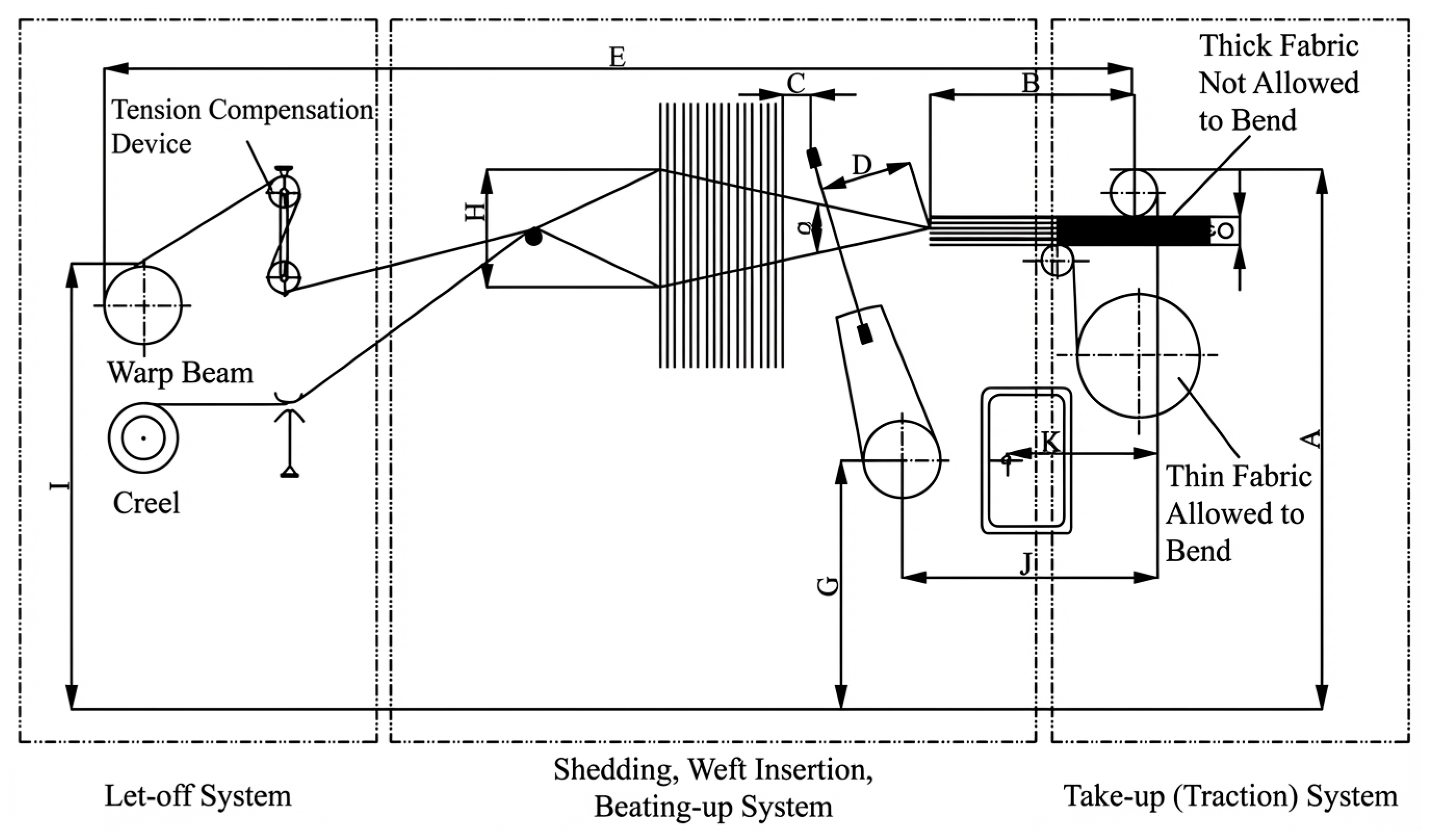
The working principle of the carbon fiber diagonal weaving loom is shown in
Figure 1. The loom integrates several key mechanisms that operate together, including the warp let-off, weft insertion, shedding, beat-up, and take-up systems. During weaving, the warp yarns are released from the warp beam and routed through a tension compensation device to maintain uniform tension [
43]. After that, the yarns are guided through the heddle eyes. The vertical movement of the heddles creates the shed, an opening through which the weft yarn is inserted and interlaces with the warp yarns at the fell of the cloth to form the woven fabric. The woven fabric is then pulled forward by the take-up device and rolled onto the cloth beam.
Among these coordinated mechanisms, the warp let-off system plays the most critical role in establishing the initial yarn tension. The stability of this subsystem has a direct impact on the uniformity and quality of the final fabric.
2.1. Mechanical Model of the Let-Off System
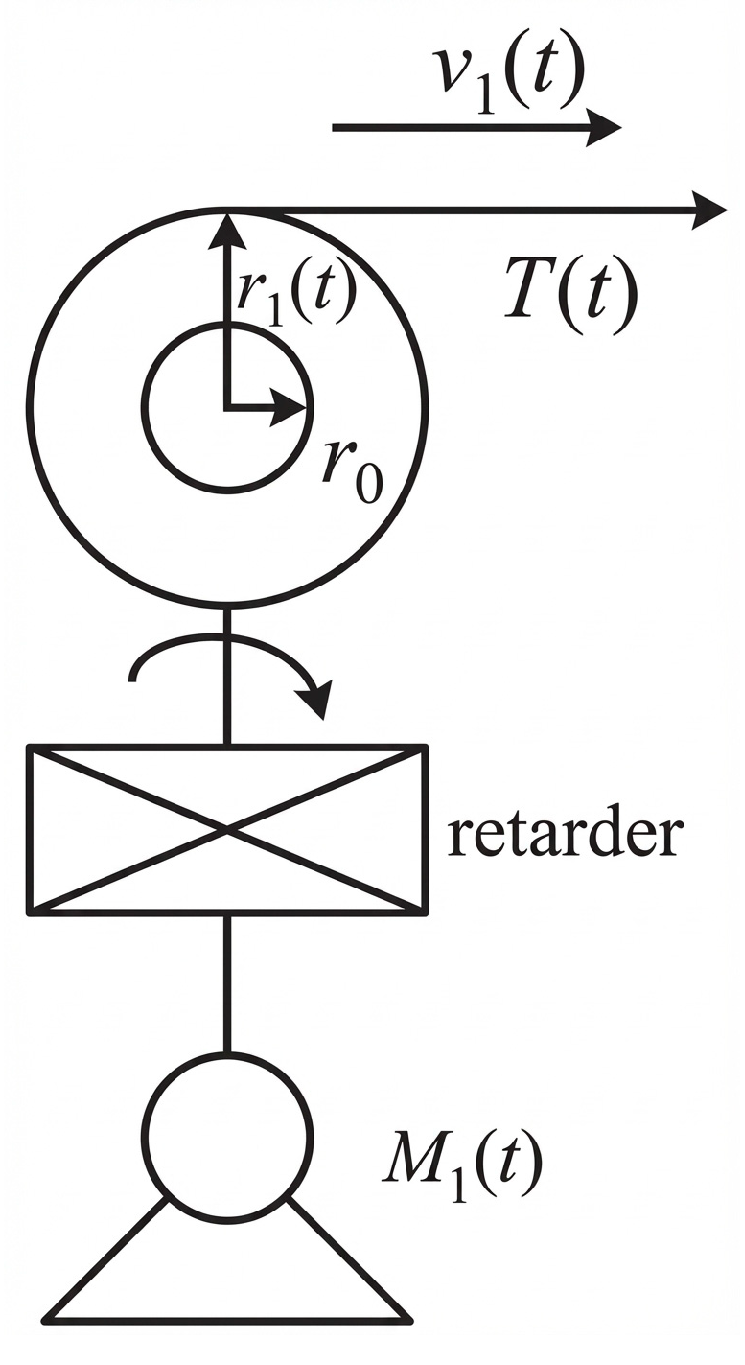
During the let-off stage, several factors—such as motion speed, friction, system inertia, and external disturbances—jointly affect the tension of the warp yarns, as illustrated in
Figure 2. In this study, the warp let-off system is selected as the main subject for analysis. A dynamic model is developed as the basis for the controller design presented in the following sections.
Figure 2 illustrates the mathematical model of the let-off system. In this system, the radius of the warp beam changes with its angular displacement. The relationship between them can be expressed as follows:
where
is the initial radius of the fully loaded warp beam,
is the real-time angular displacement, and
denotes the thickness of a single yarn layer. The angular displacement
is the time integral of the angular velocity:
Due to the change in radius, the moment of inertia of the warp beam
is also dynamically updated:
where
is the yarn mass density,
is the width of the warp, and
is the radius of the empty warp beam.
2.2. Stribeck Friction Modeling
Friction torque plays a crucial role in the stability and response characteristics of a loom’s tension control system. At low operating speeds, changes in the friction coefficient can lead to sudden variations in friction, sometimes causing oscillations or stick–slip motion. To describe this nonlinear behavior more accurately, the present study adopts the Stribeck friction model to characterize the frictional load within the loom system.
The mathematical form of the Stribeck model can be expressed as follows [
12]:
where
is the static friction torque, representing the maximum friction in the low-speed region;
is the Coulomb friction torque, representing the steady-state friction in the medium-speed region;
is the viscous friction coefficient for the high-speed region;
is the motor’s angular velocity;
is the Stribeck velocity constant, which determines the rate of friction decay;
is an exponent that controls the rate of this friction decay; and
is the signum function, which indicates the direction of the friction torque.
The relationship between the motor’s angular velocity (
) and that of the warp beam (
) is given by
where
is the gear ratio of the transmission system.
Low-Speed Region (): At low loom speeds, the friction is mainly governed by static friction. As the rotational speed begins to rise, the friction force quickly drops from the static level to the Coulomb friction level.
Medium-Speed Region: When the rotational speed of the loom motor becomes higher, the friction force gradually settles near the value of Coulomb friction. At this stage, its variation is minimal, and the overall behavior remains relatively stable. As a result, the system responds more smoothly, and the tension can be controlled with higher precision.
High-Speed Region: As the speed increases, the friction gradually shifts from the Coulomb type to the viscous type. In this range, the friction force tends to rise almost the angular velocity.
2.3. Friction Parameter Identification and Practical Considerations
Although incorporating the Stribeck friction model significantly enhances the physical fidelity of the system dynamics, it is important to note that acquiring the exact friction parameters () during actual weaving processes is challenging. These parameters are highly sensitive to operating conditions and susceptible to variations in temperature, mechanical wear, lubrication status, and yarn material properties, thereby exhibiting distinct time-varying characteristics.
In engineering practice, parameter acquisition typically relies on two methodologies. On the one hand, during the equipment commissioning or maintenance phase, nominal parameters can be obtained via offline identification. For instance, step or ramp excitations are applied to the let-off motor under low-speed conditions to measure the steady-state torque-speed relationship. Subsequently, the Stribeck model parameters are fitted using nonlinear least squares or recursive identification algorithms. This approach provides a reasonable initial parameter set for the controller.
On the other hand, considering the inevitable parameter drift during long-term operation, online adaptive or data-driven compensation methods are more commonly employed to handle parametric uncertainties. In the proposed control framework, the I-ARBF neural network does not depend on precise friction parameters; rather, it is utilized to approximate and compensate online for the residual nonlinear friction terms that the nominal Stribeck model cannot accurately capture. Consequently, the system’s sensitivity to friction parameter variations is significantly reduced.
Furthermore, the Hyperbolic Tangent Fixed-Time Disturbance Observer (Tanh-FTDO) provides additional estimation and compensation for the remaining lumped uncertainties caused by parameter shifts, weaving actions, and environmental disturbances. Through the synergistic action of the neural network and the disturbance observer, the proposed method maintains robust control performance even in the presence of parametric uncertainties and time-varying characteristics.
2.4. Nonlinear State-Space Model of the Tension System
Based on the law of energy conservation, the driving torque in the let-off system equals the sum of the load torque and the friction torque, which can be expressed as follows [
43]:
where
is the actual output torque of the motor,
is the load torque generated by the yarn tension, and
is the Stribeck nonlinear friction load.
The total moment of inertia consists of three components:
where
is the inherent moment of inertia of the empty warp beam, and
is the equivalent moment of inertia of the motor shaft.
During the weaving process, operational actions such as shedding, beat-up, and take-up induce periodic disturbances in the system’s tension. Furthermore, the system is subject to a certain degree of modeling uncertainty due to factors including the time-varying nature of model parameters, changes in friction characteristics with operating conditions, and external interferences.
In this paper, the primary characteristics of the friction torque are explicitly incorporated into the system’s dynamic equations via the nonlinear Stribeck friction model. External disturbances, including those from shedding, weft insertion, beat-up, and environmental factors, are treated as a single lumped disturbance
. After incorporating this total disturbance term into the torque balance equation of the warp beam, the complete dynamic equation is given by
with the let-off linear velocity defined as
, the take-up linear velocity as a constant
, and the tension elastic coefficient as
; the tension dynamic equation is
By substituting the above equation, the expression for the second-order derivative of the tension is obtained as follows:
By integrating the dynamic modeling results above and introducing the equivalent lumped disturbance term
to represent the unmodeled external disturbances in the system, the dynamic process of the yarn tension
can be simplified into the following nonlinear second-order system form [
38]:
In order to unify the description of the tension control system and to establish a foundation for the subsequent design of the disturbance observer and sliding mode controller, the following state variables are introduced:
Based on the preceding system dynamics model, the tension control system can be reformulated into the following standard second-order nonlinear state-space form [
43]:
In order to guarantee the feasibility of the subsequent design of the observer and controller, the disturbance term is assumed to be bounded as follows:
Assumption (Boundedness of Disturbance): The disturbance
and its time derivative
are bounded. That is, there exist positive constants
and
such that
3. Sliding Mode Controller Design with Neural Network Compensation and a Hyperbolic Tangent Disturbance Observer
To address the nonlinearities and uncertainties in the model from
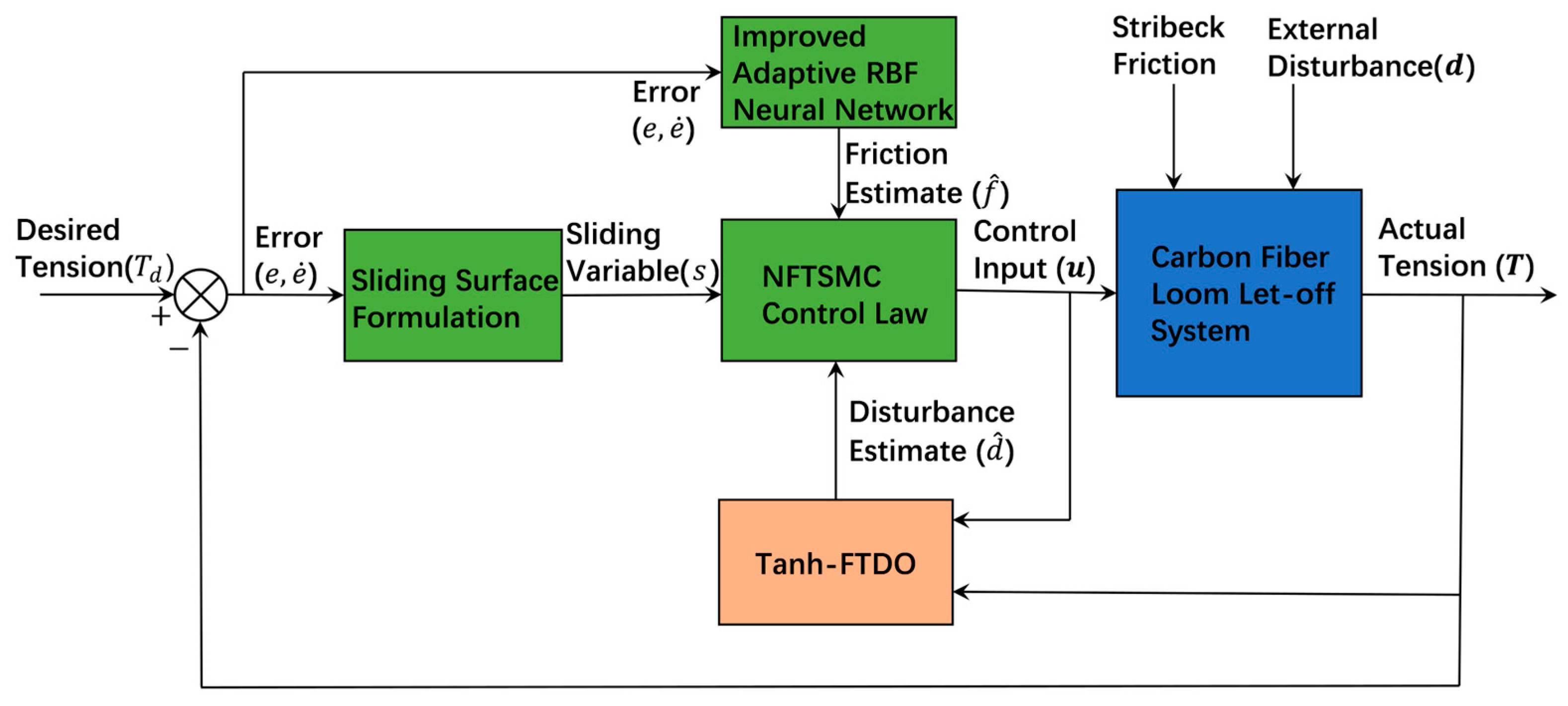
Section 2, this chapter presents an advanced composite control strategy based on the philosophy of “Divide and Conquer, Precise Compensation.” The overall architecture of the proposed I-ARBF-NFTSMC strategy is illustrated in
Figure 3. This architecture synergistically utilizes a novel Hyperbolic Tangent Fixed-Time Disturbance Observer (Tanh-FTDO) to estimate external disturbances and an Improved Adaptive Radial Basis Function (I-ARBF) neural network to compensate for internal Stribeck friction. The outputs of both are integrated as a composite feedforward term into a main Non-Singular Fast Terminal Sliding Mode (NFTSMC) controller to ensure the fast and stable convergence of the closed-loop system. The subsequent sections will provide a rigorous theoretical elaboration on the design and stability of these three modules.
3.1. Design of the Hyperbolic Tangent Fixed-Time Disturbance Observer (Tanh-FTDO)
In practical weaving, the equivalent lumped disturbance typically acts as an additive term independent of system states. Relying solely on feedback control inevitably introduces response lag. Therefore, a Disturbance Observer (DO) is designed to provide proactive feedforward estimation, functioning similarly to a ‘radar’ for system disturbances. Considering the stochastic nature of the disturbance variations, it is required that the observer must converge within a fixed time; that is, its convergence time must be upper-bounded by a constant that is independent of the initial conditions. To achieve this and mitigate the chattering caused by the signum function in conventional fixed-time observers, a hyperbolic tangent function is introduced. This smooth function replaces the discontinuous switching term, ensuring better dynamic performance.
To facilitate observer design, the equivalent lumped disturbance
is defined as an extended state
. Accordingly, the augmented state-space model is formulated as follows:
Based on this, the proposed Hyperbolic Tangent Fixed-Time Disturbance Observer (Tanh-FTDO) is designed as follows:
where
is the estimate of the state
,
. To simplify the parameter tuning process, the gains
,
, and
are parameterized by a unified observer bandwidth
. This formulation allows the observer’s response speed to be systematically regulated via a single parameter. Following the design principles of a third-order linear observer, the gains
,
and
are set as follows:
By subtracting Equation (15) from Equation (13), the error dynamics equation can be obtained as
Fixed-Time Stability Analysis of the Tanh-FTDO
This subsection establishes the fixed-time ultimate boundedness of the estimation error of the proposed Tanh-FTDO via a Lyapunov-based perturbation analysis. To avoid repeating the full fixed-time proof for the sign-based third-order FESO in [
44], the Tanh-FTDO error dynamics are decomposed into a nominal sign-based FESO error system and a bounded smoothing-induced perturbation term. Under the bounded disturbance-derivative assumption, a Lyapunov inequality is derived to show that the estimation error converges to a compact neighborhood of the origin within a settling-time upper bound that is independent of the initial condition.
Lemma 1 (Fixed-Time Bounded Stability)
. Consider the nonlinear system , where is the system state. If there exists a continuous and positive definite Lyapunov function such that its time derivative satisfies the following inequality:where . Then, the system is fixed-time ultimately bounded [44]. The upper bound of the settling time is independent of the initial state and is given by The observer error vector is denoted by
Then, (18) can be expressed as follows:
where
denotes the nominal sign-based third-order FESO error dynamics corresponding to the observer structure in [
44], and
is the bounded smoothing-induced perturbation term caused by replacing the discontinuous signum injection with
.
Here, the mixed-power correction terms parameterized by and (with ) are embedded in . The corresponding Lyapunov decay exponents in Lemma 1 are induced by these mixed-power parameters and therefore satisfy .
Define the smoothing mismatch as
Then, for any
. Hence, under the regularized numerical implementation adopted in this paper, there exists
such that
Let
be the Lyapunov function associated with the nominal sign-based observer in [
44]. Taking its derivative along (21) yields
By the nominal sign-based fixed-time result in [
44], the first term satisfies the decay condition in Lemma 1. Moreover, since
is bounded in the considered bounded region, there exists
, such that
Therefore,
where
is a bounded constant term induced by the smoothing perturbation. It is constant because both
and
admit time-independent upper bounds in the considered bounded operating region.
Consequently,
satisfies the fixed-time ultimate boundedness inequality form in Lemma 1. It follows that
By Lemma 1, the observer error system is fixed-time ultimately bounded, enters a compact neighborhood of the origin within a settling-time upper bound independent of the initial condition and remains therein thereafter.
The key innovation involves substituting the discontinuous function with the smooth hyperbolic tangent function . Mathematically, the odd symmetry of ensures balanced correction for estimation errors, thereby eliminating asymmetric switching and mitigating chattering. Furthermore, this bounded smooth approximation preserves the essential stability condition by maintaining the same sign as the error. Integrated with this smooth core, a scaling parameter is introduced to adjust the steepness of the error correction curve, while mixed-power terms of are employed to shape the convergence behavior across different error ranges. To further simplify implementation, the observer gains , , and are parameterized by a single bandwidth , allowing for systematic tuning of the response speed.
3.2. Improved ARBF Neural Network for Residual Approximation
In
Section 2, the Stribeck friction model was explicitly derived using Equation (4) to characterize the frictional load. However, directly utilizing this fixed model for high-precision control presents practical challenges. The physical parameters in Equation (4) (e.g., the viscous coefficient
and Coulomb torque
) are sensitive to operating conditions, exhibiting time-varying drift due to temperature rise and mechanical wear [
45,
46,
47].
To address this, the system dynamics are decomposed into a nominal part and a residual part:
where
represents the nominal dynamics calculated using the standard parameters of the Stribeck model in Equation (4). The term
denotes the lumped residual dynamics, which encapsulates the structured uncertainties arising from parameter variations and unmodeled internal friction.
It is imperative to distinguish the role of the proposed neural network from that of the disturbance observer. As defined in
Section 3.1, the Tanh-FTDO is designed to estimate exogenous disturbances
(e.g., load shocks from shedding and beating-up motions), which are independent of the system states. In contrast, the residual term
constitutes internal structural uncertainties that are strictly dependent on the system states (i.e., tension and velocity). To avoid overburdening the observer gain and to achieve a hierarchical compensation scheme, the I-ARBF neural network is employed specifically to approximate the state-dependent residual
.
The ARBF neural network is selected in this work due to its strong local approximation capability for state-dependent nonlinear residuals, simple structure, and low computational burden, which are suitable for real-time implementation. In addition, its parameterization is convenient for integration with the Lyapunov-based adaptive update law used in the controller design. Therefore, the I-ARBF network provides an effective and practical choice for online residual compensation in the proposed hierarchical framework.
3.2.1. Input Mapping and Basis Functions
Let the I-ARBF neural network be employed to approximate and compensate for the state-dependent residual dynamics caused by parameter variations and unmodeled friction effects. To this end, the input vector of the network is constructed from measurable system states as
where
, and
is a mapping matrix used to scale the input features, ensuring that the contributions of the different error components are balanced within the neural network [
48,
49].
3.2.2. Gaussian Basis Functions and Normalization
Each neuron in the network is activated by a normalized Gaussian basis function
. The inherent radial symmetry of the Gaussian kernel is a fundamental property utilized here. This symmetry ensures that the activation depends solely on the Euclidean distance from the center vector. For a given input
, each basis function is defined as
where
and
are the center and width
of the basis function, respectively, and
is given by
This normalization is crucial as it ensures the network output remains numerically bounded, avoiding numerical instability in high-dimensional spaces.
3.2.3. Neural Network Output and Approximation Error
Let
denote the basis function vector. The output of the network is given by
According to the Universal Approximation Theorem, there exist ideal weights
, such that the residual dynamics can be approximated as follows:
Therefore, the approximation error is defined as
where the weight error is defined as
.
3.3. Design of a Modified Non-Singular Fast Terminal Sliding Mode Controller
Let
denote the desired tension trajectory. The tension tracking error and its derivative are defined as
and
. To enhance convergence speed during large errors and stability during small errors, a dual power-law composite term is integrated into the conventional NFTSMC framework. The improved sliding surface is defined as follows:
where
, and the exponents satisfy
The second term dominates the rapid convergence in the large-error phase. The first term governs the smooth stability in the small-error phase.
To formulate the equivalent control law, it is necessary to differentiate the sliding surface. Taking the time derivative of Equation (35) along the system dynamics yields
Based on the equivalent control principle, the equivalent control term is obtained by enforcing
on the sliding surface
. The equivalent control term is first designed to compensate for the system dynamics:
Since the system is subject to internal time-varying Stribeck friction and external disturbances arising from beating-up, shedding, etc., a switching control term is introduced to enhance robustness. This term drives the system state toward the sliding manifold and maintains it in the vicinity of the manifold. Following the design philosophy of an improved reaching law, the switching term is constructed by combining a power-law reaching component with a boundary-layer saturation function, so as to suppress chattering while ensuring reachability. Its expression is given by
where
, and
. During the large-error phase, the power-law term
dominates, leading to fast reaching toward the sliding manifold. As the system approaches equilibrium, the boundary-layer saturation term
becomes dominant, which smooths the control action and effectively alleviates chattering, thereby ensuring stable sliding motion.
In summary, the total control law is composed of the equivalent control term and the switching control term, and is given by
After substituting the total control law
into the sliding surface equation,
is derived as
Then, the disturbance error term is defined as follows:
Substituting Equations (34) and (42) into Equation (41) yields
3.4. Stability Analysis of the Improved ARBF Non-Singular Fast Terminal Sliding Mode Controller
The appropriate Lyapunov function is selected:
The time derivative is given by
Substituting (43) into (45) and noting that
yields
The adaptive law for the neural network weights is given by
Substituting the adaptive law from Equation (47) into Equation (46) yields
Furthermore, if the gain of the robust term is chosen to satisfy
Then, Equation (50) can be simplified to
Since
, this term can be conservatively neglected, yielding
When the sliding variable satisfies
, the condition
holds. Therefore, the Lyapunov function decreases monotonically outside the set
, implying that the sliding variable
reaches the following set in finite time and remains therein thereafter:
Hence, the sliding variable is uniformly ultimately bounded. Furthermore, combined with the boundedness of the disturbance estimation error and the neural network approximation error, all closed-loop signals remain bounded.
During the sliding phase (s = 0), the error dynamics can be written as follows:
Consider the auxiliary Lyapunov function candidate:
Taking the time derivative yields
Since
, it is clear that Equation (58) is negative definite. This indicates that the error system is strictly decreasing while on the sliding surface. Furthermore, according to the finite-time convergence theorem, when
, the system error is guaranteed to converge to zero within a finite time. The upper bound of the settling time is given by
In summary, the condition outside the boundary layer confirms monotonic energy decay and the boundedness of all closed-loop signals under the above assumptions. When , the sliding variable converges to the set in finite time, achieving practical stability. Under the ideal sliding condition , the boundary layer shrinks to the origin, and finite-time convergence can be recovered. Consequently, the proposed controller achieves practical finite-time stability in the presence of a boundary layer and recovers finite-time convergence under ideal sliding conditions.
Remark 1 (Numerical Implementation)
. Theoretically, for fractional exponents satisfying , the derivative of the term becomes unbounded as , leading to a singularity problem. In practical digital implementation, this infinite gain may amplify sensor noise and cause high-frequency chattering. To handle this, a regularized formulation is adopted in the controller:where is a small positive constant (). This continuous modification eliminates the singularity at the origin while ensuring that . It guarantees numerical stability on the embedded platform while preserving the practical finite-time convergence properties of the control law. 4. Simulation and Results Analysis
To systematically validate the effectiveness and superiority of the proposed Non-Singular Fast Terminal Sliding Mode Control (I-ARBF-NFTSMC) strategy, which is based on a Hyperbolic Tangent Fixed-Time Disturbance Observer (Tanh-FTDO) and an Improved Adaptive Radial Basis Function (I-ARBF) neural network, this chapter presents a simulation study of the warp feeding system for a carbon fiber loom using the MATLAB R2021b environment. This section will first independently validate the performance of the improved disturbance observer and the improved neural network. This will be followed by a comprehensive performance comparison of the final integrated control strategy.
4.1. Simulation Parameter Setup
The simulation experiments are based on the dynamic model of the warp feeding system established in the preceding section. The main physical parameters of the system and the controller parameters are listed in
Table 1.
Parameter tuning and fairness of comparison. The controller parameters of all compared methods were determined following a unified and reproducible tuning protocol. Specifically, the initial parameter sets of the conventional SMC, the fixed-time NFTSMC/FESO-based baseline, and the neural-network-related module were selected according to the parameter-selection guidelines and numerical settings reported in Refs. [
33,
38,
43,
45]. On this basis, a limited-range fine-tuning was performed under the same simulation conditions adopted in this study (identical plant model, initial conditions, reference trajectory, disturbance scenarios, sampling step, and actuator constraints). The tuning objective was kept consistent across all methods, aiming to obtain stable and representative performance while balancing tracking accuracy, convergence speed, chattering suppression, and control smoothness. For parameters shared by different controllers, identical numerical values were used to ensure consistency. Note that the reported parameter values are engineering-oriented selections rather than globally optimal solutions; however, they are obtained under consistent conditions to support a fair and meaningful comparison.
4.2. Performance Comparison of Disturbance Observers
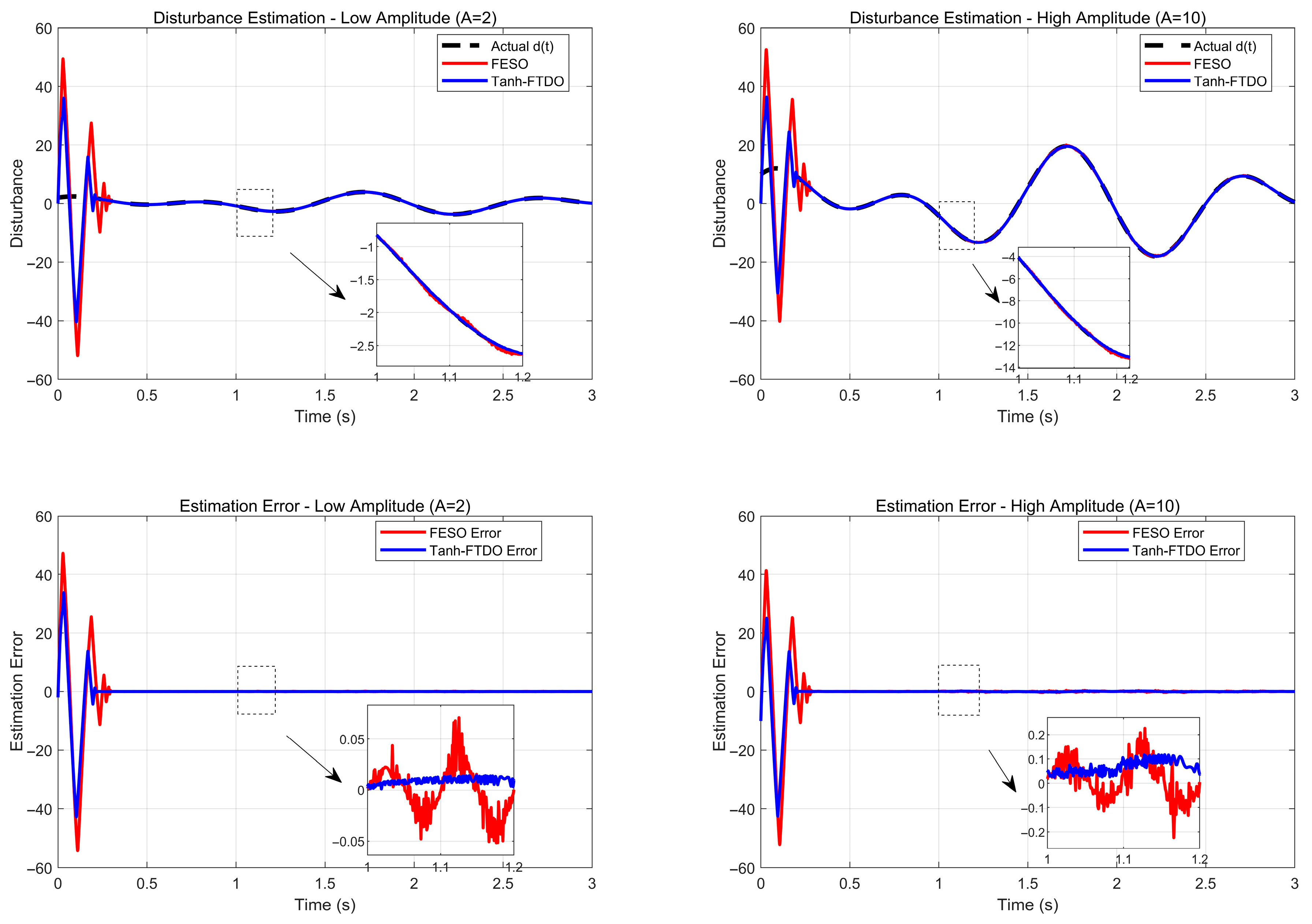
When tested with sine and cosine disturbances, the proposed Tanh-FTDO demonstrates superior performance over the conventional FESO under identical conditions (
, same parameters), as shown in
Figure 4 and
Table 2. In the case of small-amplitude disturbances (A = 2), within the steady-state interval (t > 1 s), the steady-state mean error was reduced by 67.31%. For large-amplitude disturbances (A = 10), within the steady-state interval (t > 1 s), the mean error reduction was 12.833%.
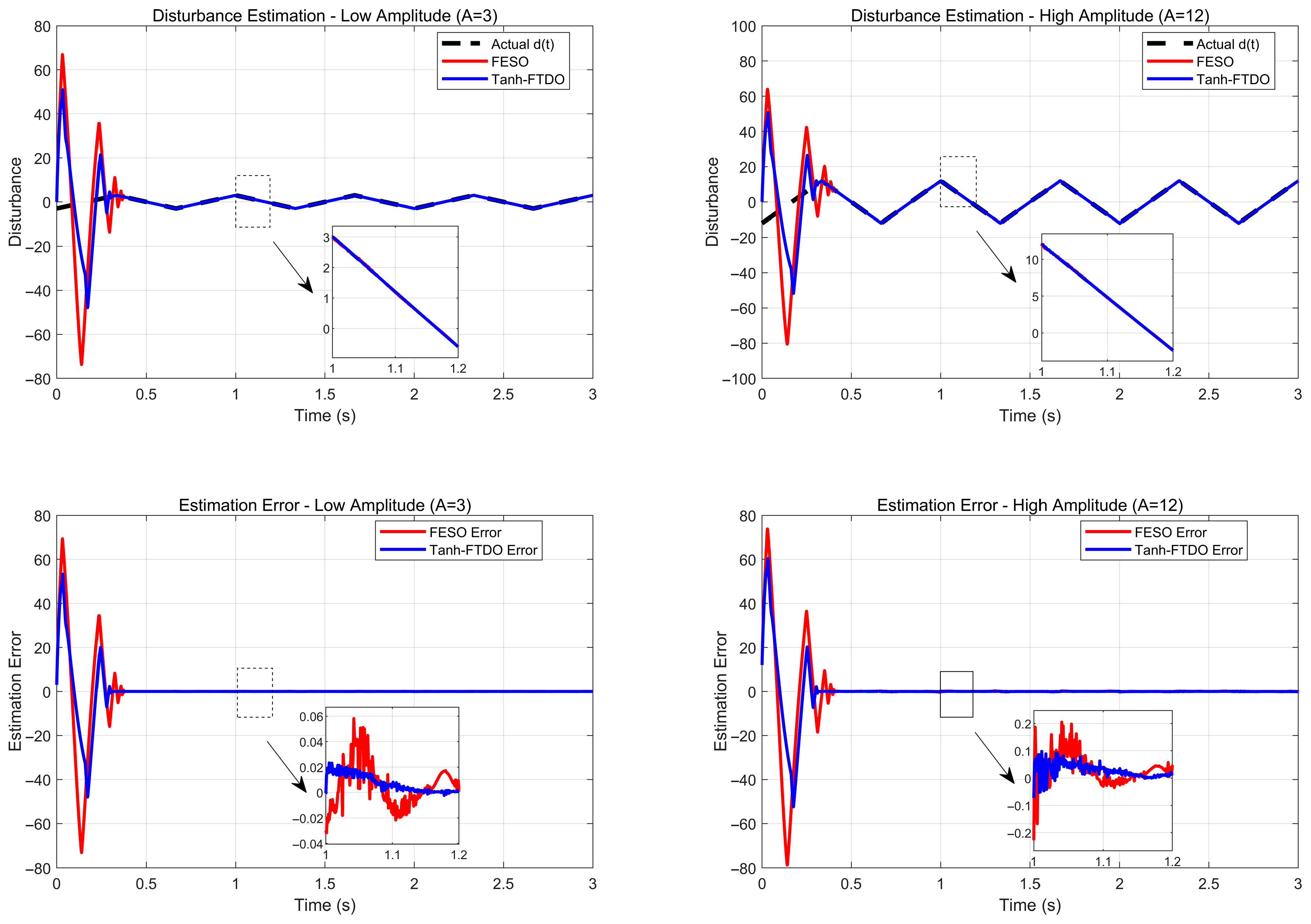
According to the simulation results, a performance comparison between the conventional Fixed-Time Extended State Observer (FESO) and the proposed Hyperbolic Tangent Fixed-Time Disturbance Observer (Tanh-FTDO) was conducted under various amplitudes of a triangular wave disturbance, as shown in
Figure 5 and
Table 3. The initial conditions were set to
. For low-amplitude disturbances (A = 3), the proposed Tanh-FTDO reduced the steady-state mean error by 62.71%. For high-amplitude disturbances (A = 12), it reduced the steady-state mean error by 19.85%.
Under the initial conditions of
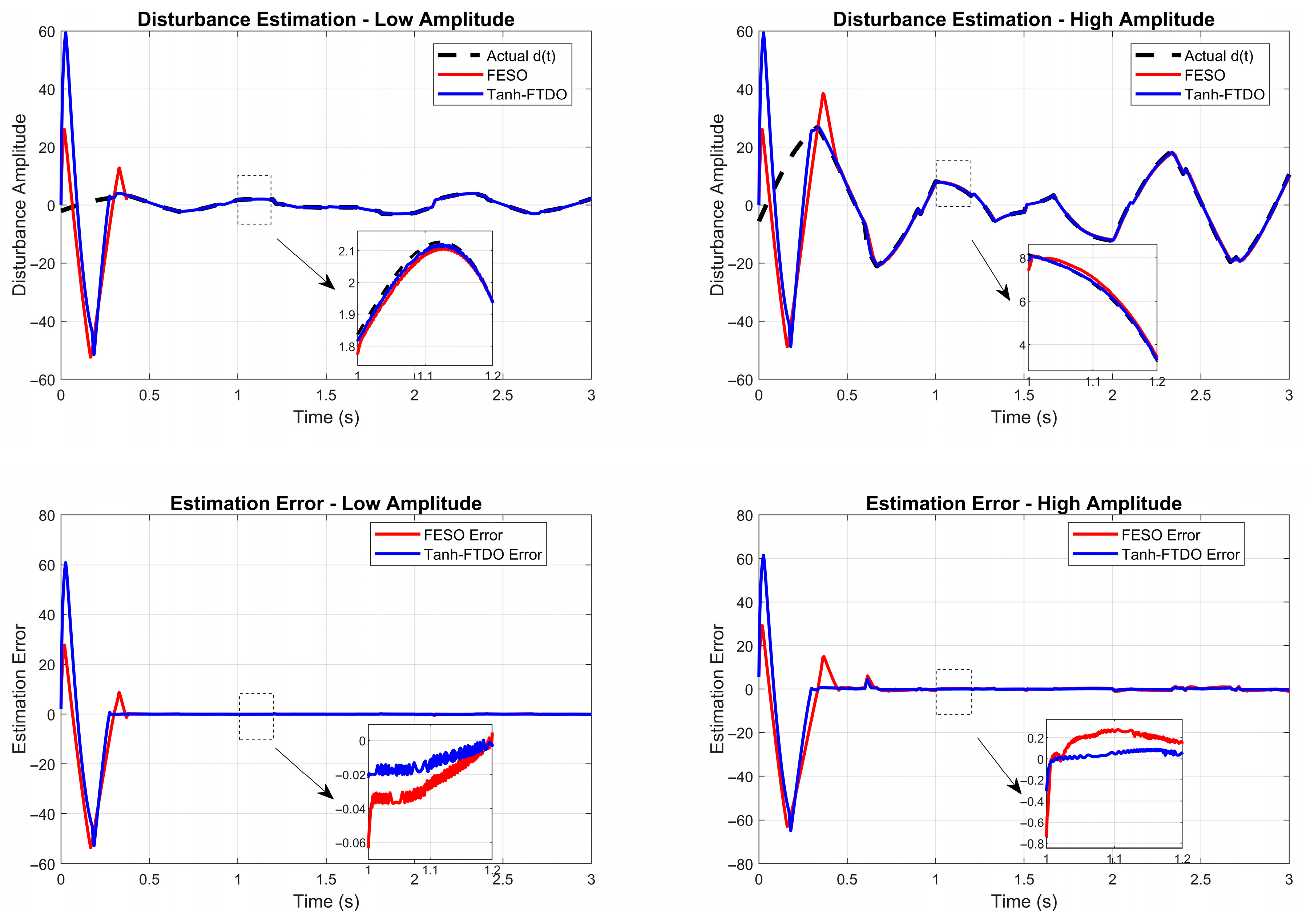
and with a uniform parameter set, a comparative experiment between the conventional FESO and the proposed Tanh-FTDO was conducted using a composite disturbance signal, as shown in
Figure 6 and
Table 4. The true disturbance applied was constructed by superimposing three components: a sinusoidal disturbance component, a triangular-wave disturbance component, and a smooth random disturbance component. Experimental results indicate that, under low-amplitude composite disturbances, the improved observer reduces the steady-state mean error by 59.71%. Under high-amplitude composite disturbance conditions, the Tanh-FTDO reduced the steady-state mean error by 54.31%.
The simulation outcomes verify that the proposed Hyperbolic Tangent Fixed-Time Disturbance Observer (Tanh-FTDO) performs effectively under various disturbance scenarios. In the tests with three representative disturbances, the observer reached convergence in roughly 0.35 s and greatly reduced the chattering effect. This benefit arises from substituting the discontinuous signum function in traditional observers with a smooth hyperbolic tangent function. Consequently, the steady-state mean error was reduced by up to 67.31%, and both the disturbance-estimation accuracy and the overall system robustness were further improved.
4.3. Neural Network Approximation Performance
To evaluate the approximation performance of the proposed I-ARBF neural network, a simulation study is carried out for the state-dependent residual dynamics . In the simulation, represents the model mismatch induced by temperature variation and mechanical wear, which cannot be captured by the nominal Stribeck model.
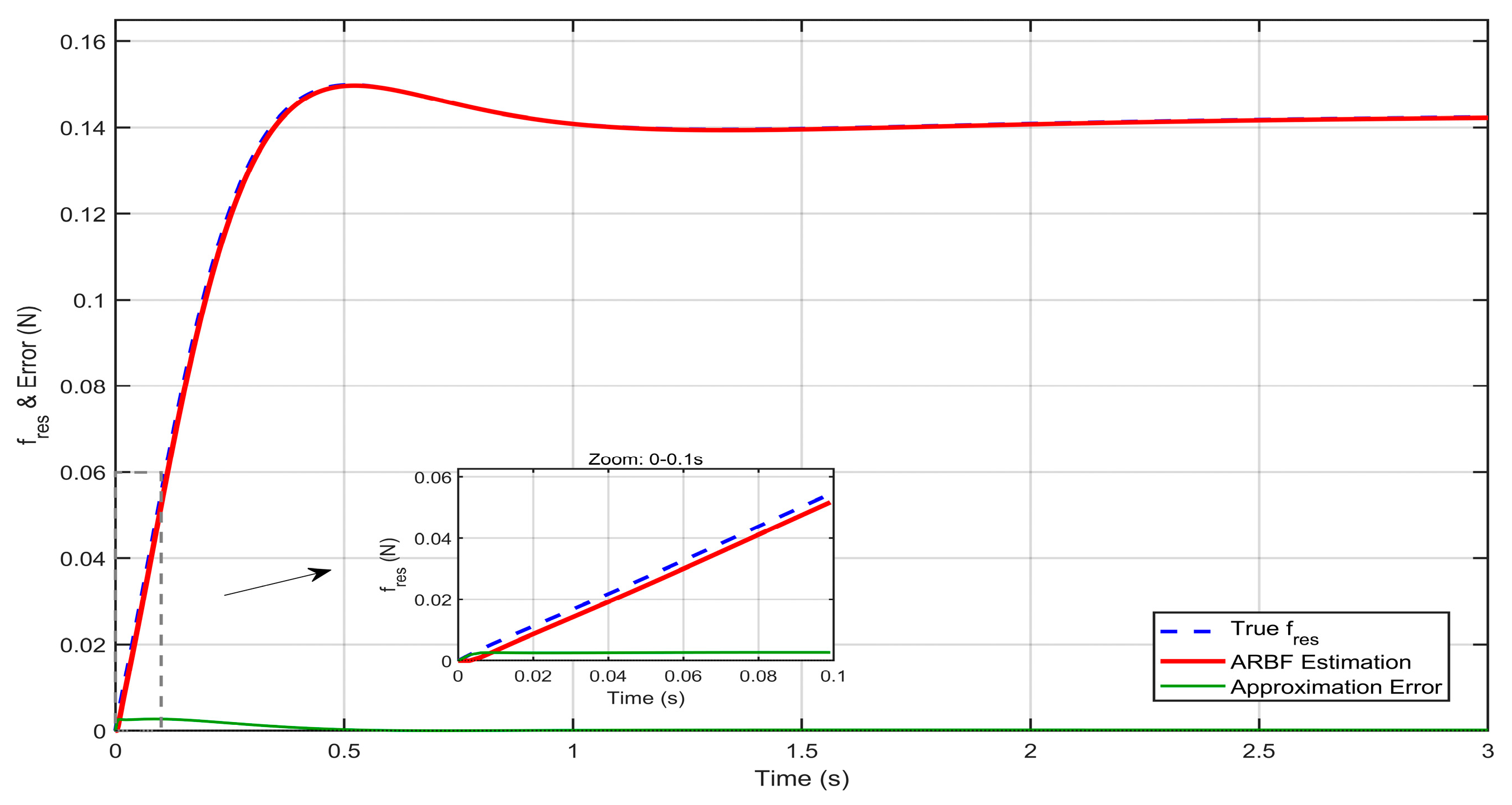
Figure 7 presents the true residual signal, the neural network estimation, and the corresponding approximation error. It can be observed that the proposed neural network rapidly captures the dynamic variation of the residual term during the transient stage (0–0.1 s). The zoomed-in view shows that the estimation error remains bounded and small. This indicates that the adaptive law guarantees fast parameter convergence and stable learning behavior.
After approximately 0.5 s, the estimation converges to the true residual signal. The steady-state approximation error approaches zero and is significantly smaller than the amplitude of . The error remains uniformly bounded throughout the simulation.
These results verify that the proposed I-ARBF network possesses strong approximation capability for state-dependent uncertainties. Hence, it can effectively compensate for internal structured uncertainties and support the hierarchical control framework without increasing the burden of the disturbance observer.
4.4. Comparison of Integrated Control Strategies
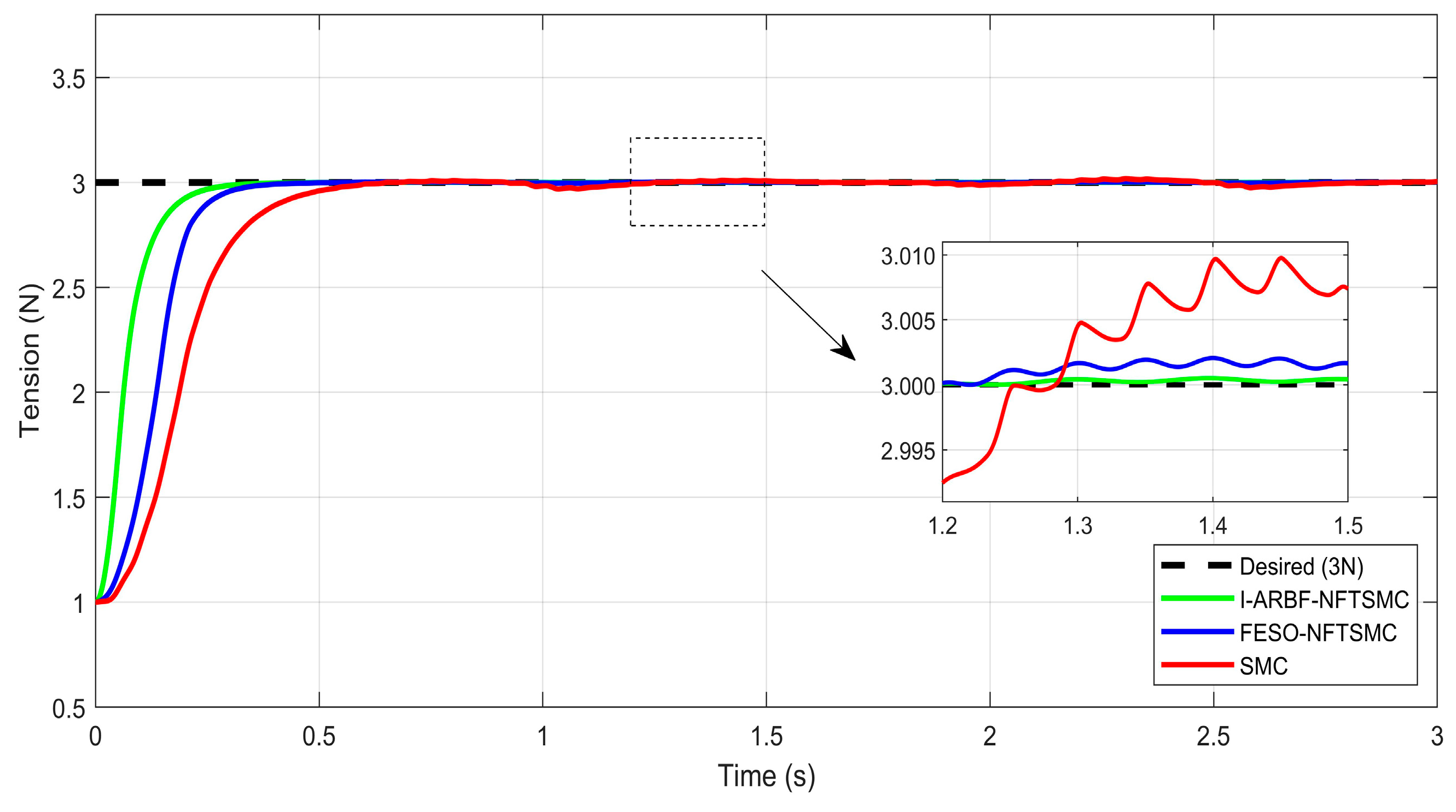
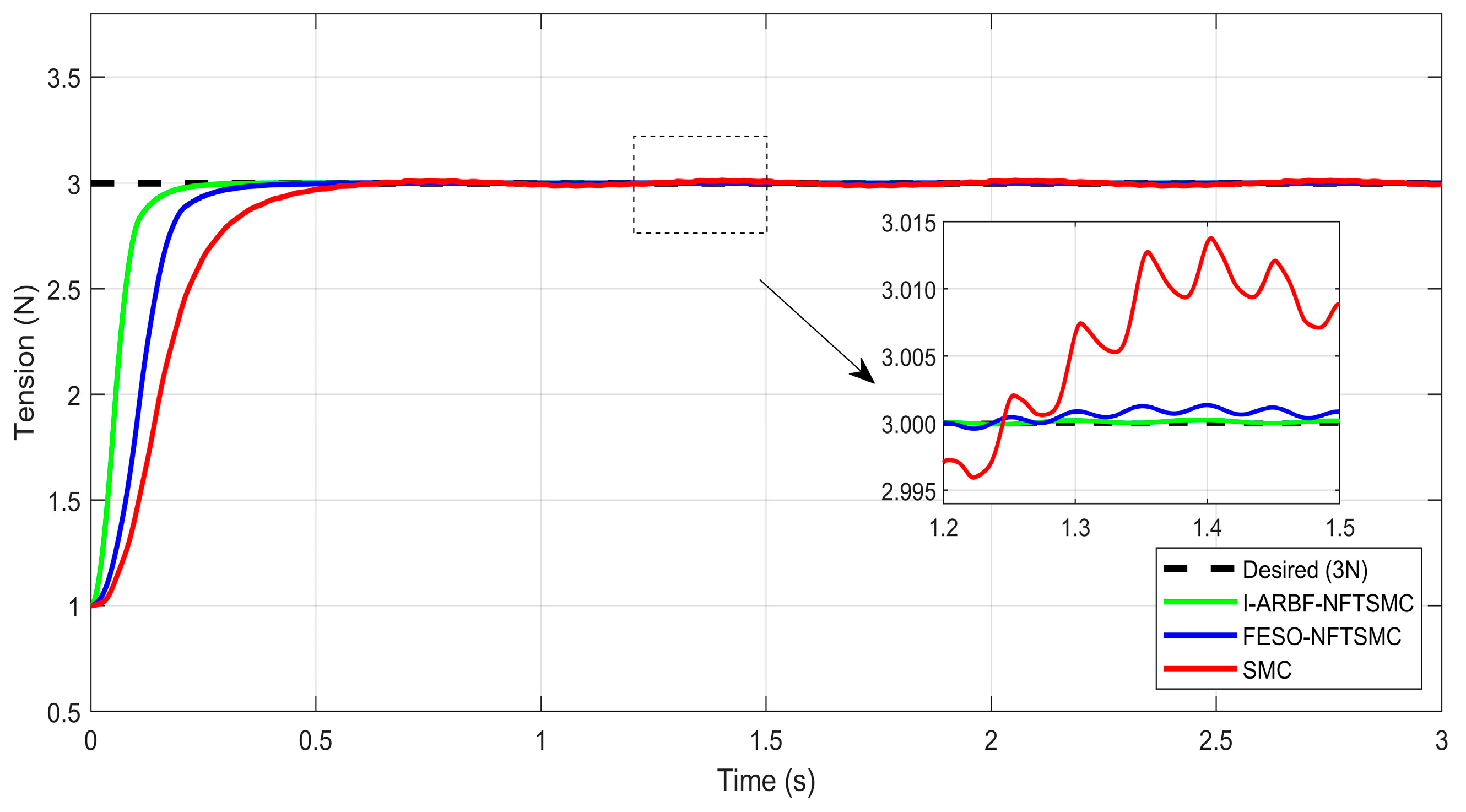
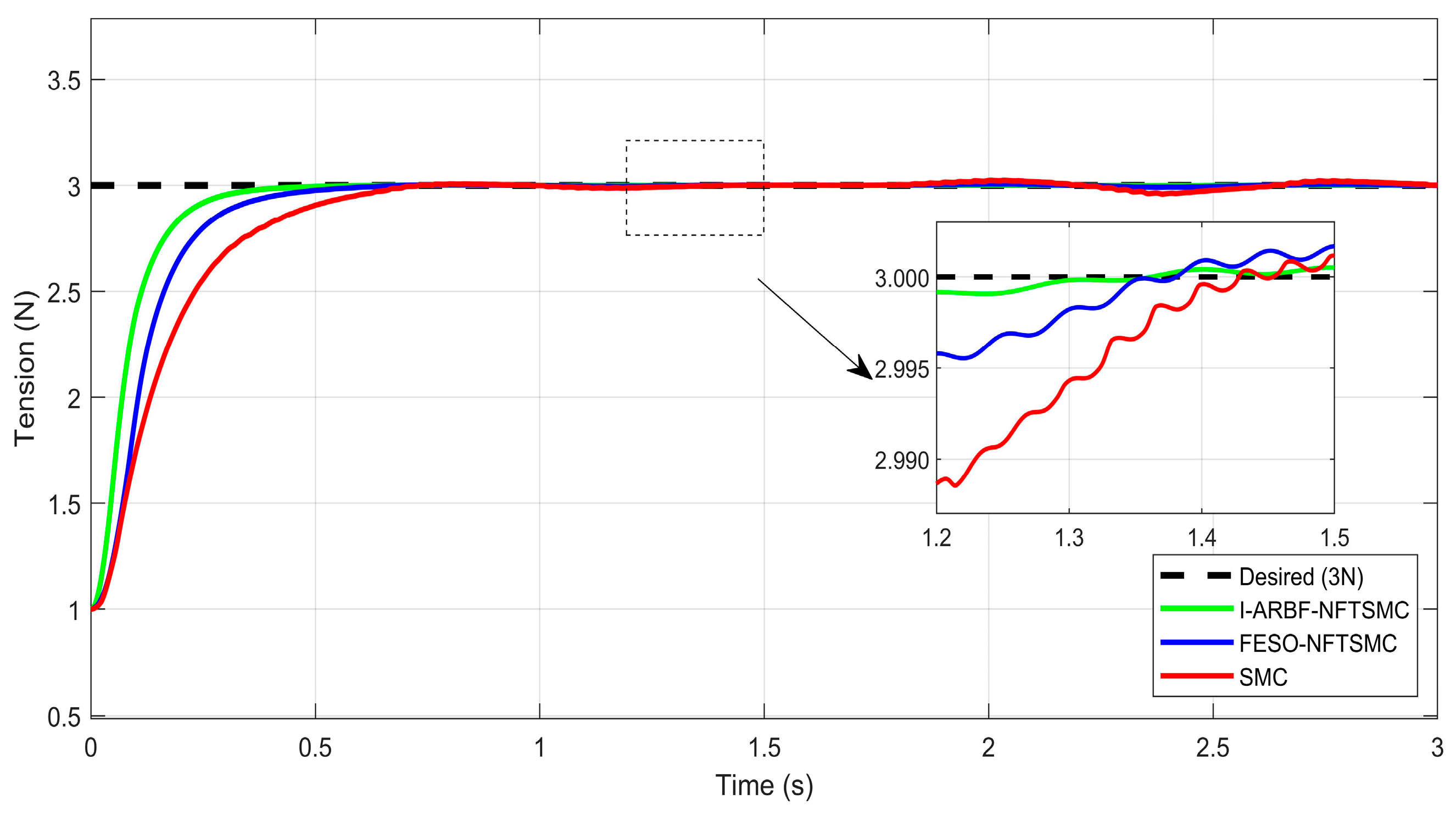
Figure 8,
Figure 9 and
Figure 10 show the tracking performance under sinusoidal, triangular, and composite disturbances. The conventional SMC achieves basic tracking but exhibits pronounced oscillations and steady-state deviations. The FESO-NFTSMC uses disturbance estimation to partially suppress these fluctuations. In contrast, the proposed I-ARBF-NFTSMC demonstrates the best overall performance. It consistently provides faster convergence, smaller steady-state errors, and smoother control inputs across all tested scenarios.
Table 5 quantitatively confirms these improvements, particularly in response speed. Under the challenging composite-disturbance condition, the proposed method reduces the settling time to 0.386 s. This represents a 25.2% improvement over the FESO-NFTSMC (0.516 s) and a 44.0% improvement over the SMC (0.689 s). Moreover, it achieves the lowest mean and maximum tracking errors, demonstrating superior robustness.
These significant improvements in response speed and precision result directly from the proposed “divide-and-conquer” architecture. This framework explicitly handles internal uncertainties and external disturbances simultaneously. First, the I-ARBF neural network rapidly approximates the internal state-dependent residual dynamics , compensating for unmodeled Stribeck friction and parameter drift. With the Lyapunov-based adaptive weight update law using a fixed learning gain, this internal compensation removes physical drag and prevents transient delays. Second, the Tanh-FTDO provides a smooth, fast feedforward estimation of external lumped disturbances . This mechanism proactively mitigates external shocks and reduces the reliance on delayed feedback control. Finally, the improved NFTSMC sliding surface introduces a specific power-law term. This term dominates during the large-error phase to drive rapid initial convergence.
4.5. Ablation Experiments of the Proposed Controller
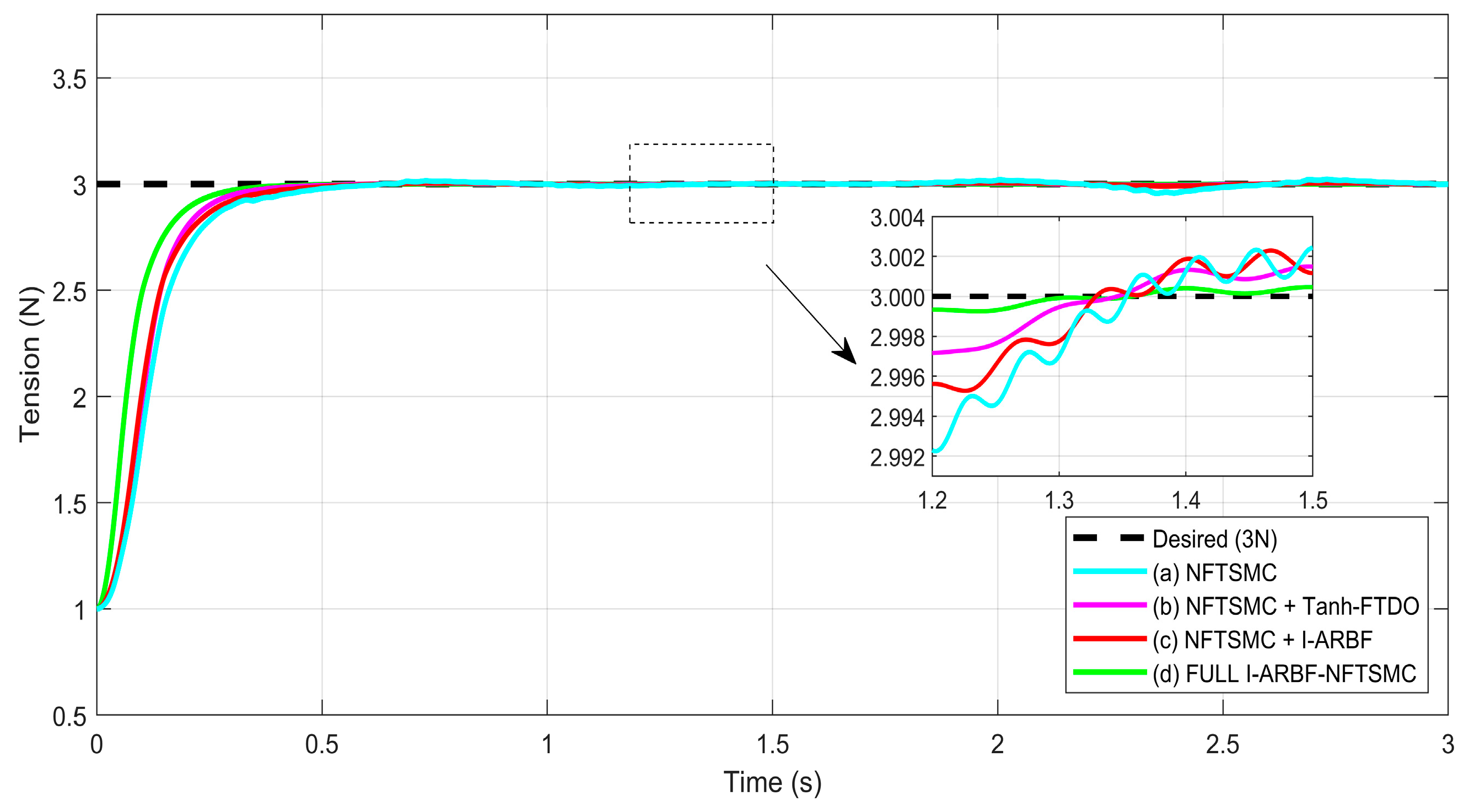
As shown in
Figure 11 and
Table 6, the ablation study clarifies how each module affects the transient response under composite disturbance. The baseline NFTSMC settles in 0.613 s. Adding I-ARBF reduces the settling time to 0.538 s (12.2% reduction), indicating faster convergence when internal nonlinear friction uncertainty is compensated. Adding Tanh-FTDO yields a settling time of 0.485 s (20.9% reduction), showing improved transient behavior with disturbance estimation. The full I-ARBF-NFTSMC achieves the shortest settling time of 0.386 s, corresponding to a 37.0% reduction relative to NFTSMC. Overall, combining I-ARBF and Tanh-FTDO provides the most efficient transient response while maintaining stable tracking.
4.6. Computational Feasibility Analysis
To validate the suitability of the proposed I-ARBF-NFTSMC strategy for real-time industrial applications, a computational complexity analysis was conducted targeting a representative embedded platform, the ARM Cortex-M7 (e.g., STM32F7 series, 216 MHz). This processor is widely used in high-end textile machinery controllers due to its integrated Floating-Point Unit (FPU) and DSP instructions.
The execution time of the proposed algorithm is primarily determined by the number of transcendental functions (e.g., tanh, exp, pow) and matrix operations. Based on standard CMSIS-DSP library benchmarks and conservative estimation, the cycle counts for these operations were estimated. In this study, the I-ARBF neural network is configured with a compact structure of 5 hidden nodes (j = 5) to balance approximation accuracy and computational efficiency. The estimated execution time per control cycle is detailed in
Table 7.
As shown in
Table 7, the total estimated execution time is approximately 18.5 μs. Given the simulation step size and typical industrial control loop period of 1 ms (1000 μs), the proposed algorithm consumes less than 2% of the processor’s available resources. This confirms that the composite controller is computationally efficient and well within the capabilities of modern embedded systems.
5. Conclusions and Future Work
This paper addressed strong nonlinearities, time-varying uncertainties, and external disturbances in the warp let-off tension control of carbon fiber diagonal weaving looms by establishing a nonlinear dynamic model incorporating the Stribeck friction term. An Improved Adaptive Radial Basis Function-based Non-Singular Fast Terminal Sliding Mode Control (I-ARBF-NFTSMC) framework was proposed, which integrates a divide-and-conquer composite compensation architecture: the Tanh-FTDO performs smooth and fast estimation of external disturbances and suppresses chattering, while the I-ARBF neural network approximates and compensates internal friction nonlinearities, thereby alleviating the discontinuous switching and model dependency of conventional methods.
In disturbance observation, compared with FESO, the Tanh-FTDO achieved an approximately 67% reduction in steady-state mean-squared error under low-amplitude sinusoidal disturbances, a 13% reduction for high-amplitude sinusoidal disturbances, 63% and 20% reductions for low- and high-amplitude triangular disturbances, and approximately 60% and 54% reductions for low- and high-amplitude composite disturbances. In tension tracking, relative to FESO-NFTSMC, the proposed I-ARBF-NFTSMC maintained steady-state mean errors below 0.02 N under various disturbance conditions. In composite-disturbance scenarios, the maximum error decreased from 0.08787 N to 0.01965 N, and the settling time shortened from 0.516 s to 0.386 s (25.2% improvement), while significantly mitigating control-input chattering.
Despite these promising simulation results, practical implementation in industrial environments introduces additional challenges that warrant discussion. First, measurement noise from sensors is inevitable in real-world applications. While the smooth structure of the proposed Tanh-FTDO offers inherent noise attenuation advantages over non-smooth observers, its sensitivity to high-frequency noise requires further experimental validation. Second, the computational load of the neural network is a critical factor for real-time control. Although the I-ARBF network is designed for efficiency, its implementation on resource-constrained embedded platforms may require optimization to ensure loop-cycle integrity. Third, physical limitations, such as actuator saturation, must be explicitly managed to prevent performance degradation during large transient errors.
Future work will focus on addressing these practical issues through Hardware-in-the-Loop (HIL) and physical experiments. Specifically, we aim to investigate robust filtering techniques for measurement noise, optimize the algorithm’s computational efficiency for embedded hardware, and incorporate anti-windup mechanisms to handle actuator constraints. Additionally, extending this decoupled compensation strategy to other nonlinear mechatronic systems—such as robotic joints or servo drives—remains an important direction for further exploration.