Article

Dynamic Modeling of Planetary Gear Reducer in High-Torque Hub Drive System

1
School of Mechanical Engineering, Nanjing Institute of Technology, Nanjing 211167, China
2
School of Mechanical Engineering, Southeast University, Nanjing 211189, China
*
Author to whom correspondence should be addressed.
Symmetry 2026, 18(3), 429; https://doi.org/10.3390/sym18030429
Submission received: 28 January 2026 / Revised: 25 February 2026 / Accepted: 27 February 2026 / Published: 28 February 2026

Abstract

The hub drive system has emerged as a promising development orientation for future vehicles, with the planetary gear reducer serving as its key power transmission component. Considering the complexity of the reducer’s dynamic characteristics under high-torque conditions, this study establishes a lumped parameter translational–torsional coupling dynamic model for the two-stage planetary gear reducer based on Lagrange’s dynamic equations, incorporating critical nonlinear factors such as time-varying meshing stiffness and tooth clearance. No-load vibration tests were conducted to collect vibration acceleration of the secondary planet carrier and the primary ring gear under the operating condition of the primary sun gear rotating at 606 r/min. Experimental verification indicates that the errors between the simulation results and experimental acceleration amplitudes are 9.09% and 14.63%, respectively, confirming the validity and reliability of the theory model. This translational–torsional coupling dynamic model provides significant theoretical support for the dynamic optimization design, vibration control, and performance improvement of reducers in high-torque hub drive systems.

1. Introduce

The hub drive system is a type of system that installs the motor inside the wheel hub and uses the motor instead of the engine to drive the vehicle [1]. As an emerging drive method, a hub drive can omit components such as clutches and differentials in traditional vehicles. It drives the reducer through the motor, simplifying the vehicle structure and improving transmission efficiency [2,3]. Meanwhile, it features low environmental and noise pollution, making it an important direction for the development of future vehicles, and it has been gradually promoted and applied to engineering transportation machinery and vehicles [4,5,6,7].
The reducer in the hub drive system is a device capable of reducing speed and increasing torque, and it is a crucial structure for transmitting power in mechanical systems [8]. As a type of reducer, the planetary gear reducer uses planetary gears to achieve power splitting, featuring high load capacity, high efficiency, and high torque. It is commonly applied in fields such as automotive, aerospace, and marine machinery. However, the planetary gear reducer consists of numerous components with a complex structure. Additionally, various errors exist during gear processing and assembly, and the inherent characteristics of the gears themselves have a significant impact on the dynamic performance of the reducer. Therefore, researching the dynamic characteristics of planetary gears is of great significance [9,10,11,12,13].
Some scholars have conducted dynamic modeling research on planetary gears at an early stage. Considering nonlinear factors such as time-varying meshing stiffness, they studied the influence of changes in various excitations of gears on their dynamic performance through the finite element method and numerical analysis method. Tuplin [14] proposed the first spring-mass model for gears in 1950, which equated gears to lumped masses and studied gear meshing using meshing stiffness, laying a foundation for subsequent research. In 1976, Hidaka et al. conducted research on the single-stage 2K-H planetary gear, systematically analyzing the dynamic load sharing characteristics of the planetary gear train through theoretical calculations [15]. Uzguven [16] carried out early research on linear time-invariant gears, ignoring the influence of all nonlinear factors. In 1999, Kahraman et al. conducted a combined theoretical and practical study on the load sharing problem of planetary gear transmission again, proposing a nonlinear time-varying dynamic model including tooth clearance and time-varying meshing stiffness, which mainly studied the sensitivity of dynamic load characteristics to reducer design variables [17]. Parker et al. established a dynamic model using the finite element method, investigating the influence of the relative phase of planetary gears on system excitation [18]. In 2008, Inalpolatl et al. developed a multi-stage planetary gear torsional dynamic model and performed vibration and modal analysis on the transmission system [19]. In 2009, Eritenel et al. took shaft wobble and axial movement as research factors, established a coupled bending-torsion–axial-wobble mechanical model, and studied the natural characteristics of the planetary gear train [20]. In 2012, Kim et al. established a dynamic model of the planetary gear transmission system, researching the influence of time-varying contact ratio and time-varying pressure angle on the dynamic response of planetary gears [21]. In 2014, Jonathan Keller et al. considered factors such as gravity and bearing clearance, conducted a comparative analysis between experiments and the established lumped parameter model, and studied the dynamic characteristics of gears [22]. In 2016, Marques [23] derived a four-degree-of-freedom gear dynamic model considering friction, time-varying meshing stiffness and damping, specifically investigating the influence of friction on the dynamics of spur gears and helical gears. In 2018, Li and Khonsari [24] comprehensively considered the nonlinear factors of automotive clutches and planetary gear sets, integrated the tooth clearance model into the comprehensive mathematical model of the vehicle powertrain equipped with automatic transmissions, and studied the influence of nonlinear factors on torsional vibration. In 2020, Hodaei [25] used an elasto-plastic contact model to study the influence of roughness on gear tooth energy loss, and simultaneously used a nonlinear dynamic model to investigate the vibration characteristics of gears. In 2021, Ryali [26] studied the influence of the magnitude and fluctuation of input torque on system vibration response and load distribution through the derived gear dynamic model.
The high-torque hub-driven planetary gear reducer system is a complex system. To conduct research on this system, a lumped parameter model is established via Lagrange’s dynamic equations, considering nonlinear factors such as time-varying meshing stiffness and tooth clearance.

2. Structure of High-Torque Hub Drive System

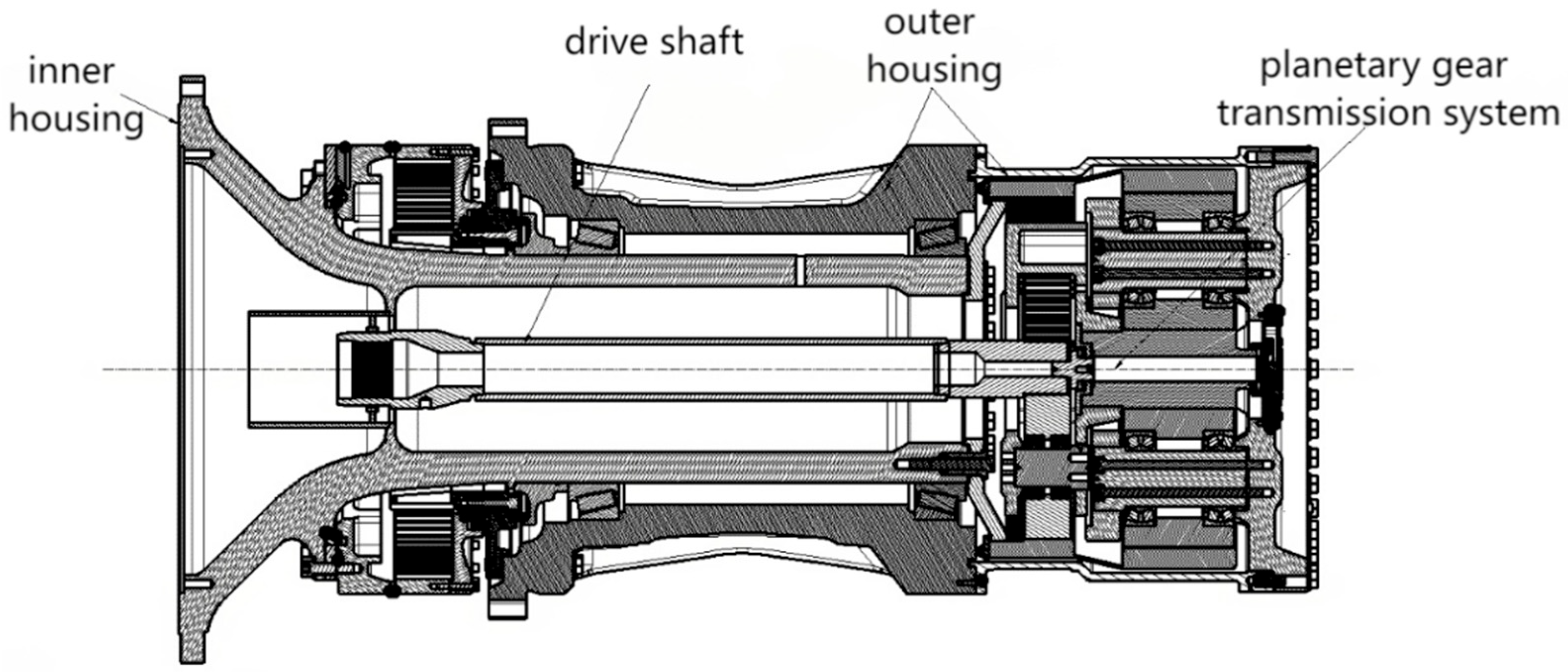
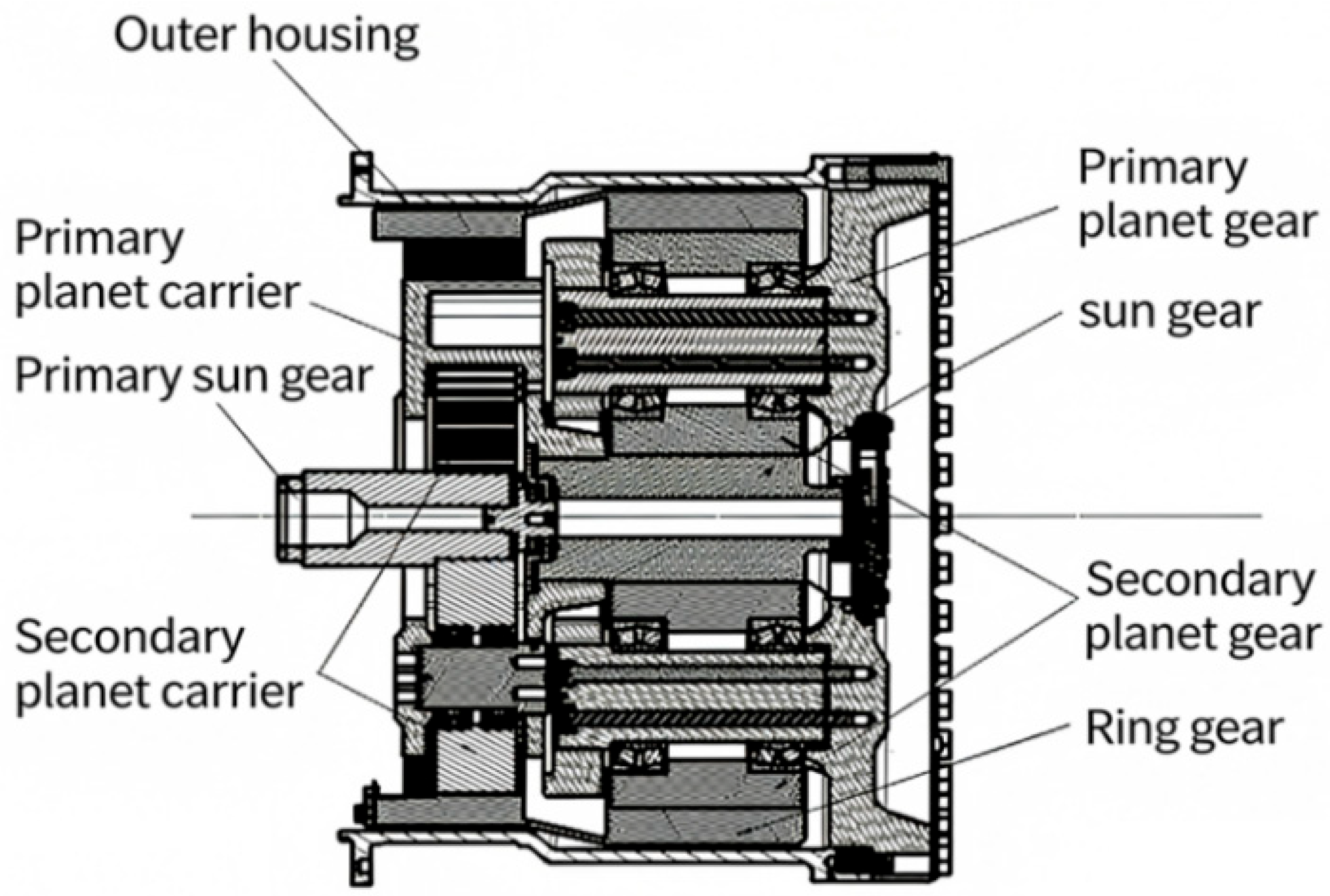
The hub-driven planetary reducer is mainly composed of a drive system, an inner housing, a drive shaft, a planetary gear transmission system, and an outer housing. As shown in Figure 1, the drive shaft is a hollow shaft connecting the drive system and the planetary gear transmission system. The main body of the inner housing is fixed to the vehicle with bolts. The hub drive system is mainly motor-driven, and power is transmitted to the planetary gear system through the drive shaft. The planetary gear system is used for speed reduction and torque multiplication, and power is transmitted to the outer housing, thus driving the wheels firmly connected to the outer housing. The planetary gear transmission system is shown in Figure 2, and its main components include a primary sun gear, three primary planetary gears, a primary planet carrier, a secondary sun gear, a secondary planet carrier, four secondary planetary gears, and a ring gear.
The transmission of planetary gears is mainly achieved with the ring gear fixed. Power is transmitted to the primary sun gear, then to the planet carrier via the planetary gears, and finally output by the planet carrier. It can be seen from the above structure that during the operation of planetary gear transmission, the primary sun gear rotates, the ring gear is fixed, and the primary planetary gears rotate to drive the primary planet carrier to rotate. The primary planet carrier drives the secondary sun gear to rotate through a spline connection. As the secondary sun gear rotates, it drives the secondary planetary gears to rotate, and the secondary planet carrier rotates accordingly, thereby driving the outer housing connected to the secondary planet carrier to rotate, enabling the mining truck to move forward.

3. Dynamic Modeling

Time-varying meshing stiffness is an important factor affecting the dynamics of planetary gear reducers. It arises from the periodic change in stiffness caused by the alternating meshing of single teeth and multiple teeth. Tooth clearance is also a key factor influencing dynamics. This is because the gap between gear meshing surfaces, in reality, must account for factors such as lubrication space, errors, and thermal deformation.
The dynamic model based on the lumped parameter method describes the planetary gear reducer system using mathematical formulas, treating each component in the system as a mass-elastic body to be studied, and investigates the dynamics of the planetary gear reducer through numerical analysis. This model needs to examine the interactions between various components in the system, which are represented by the stiffness, damping, and relative displacement between each component.

3.1. Relative Displacement Analysis

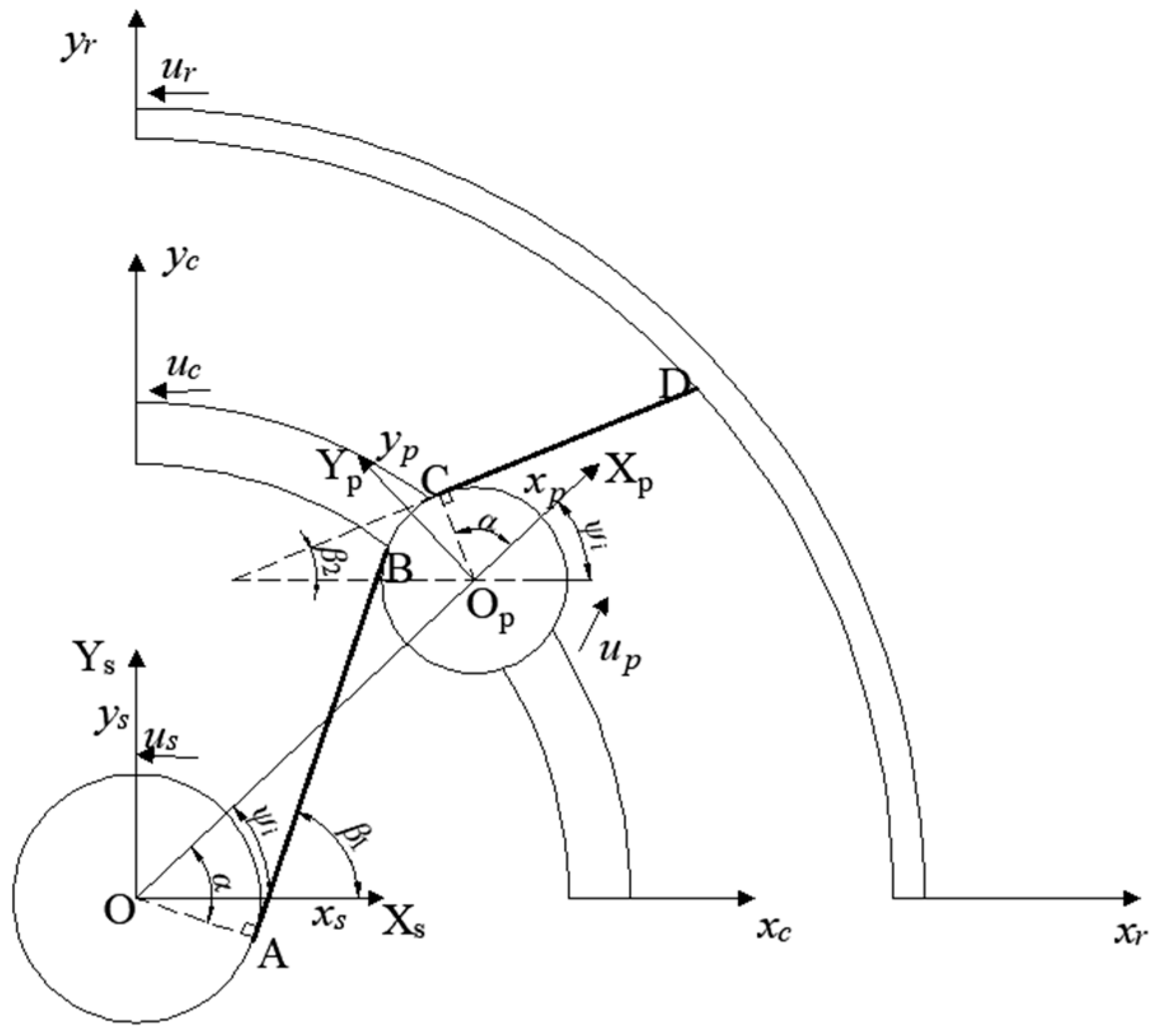
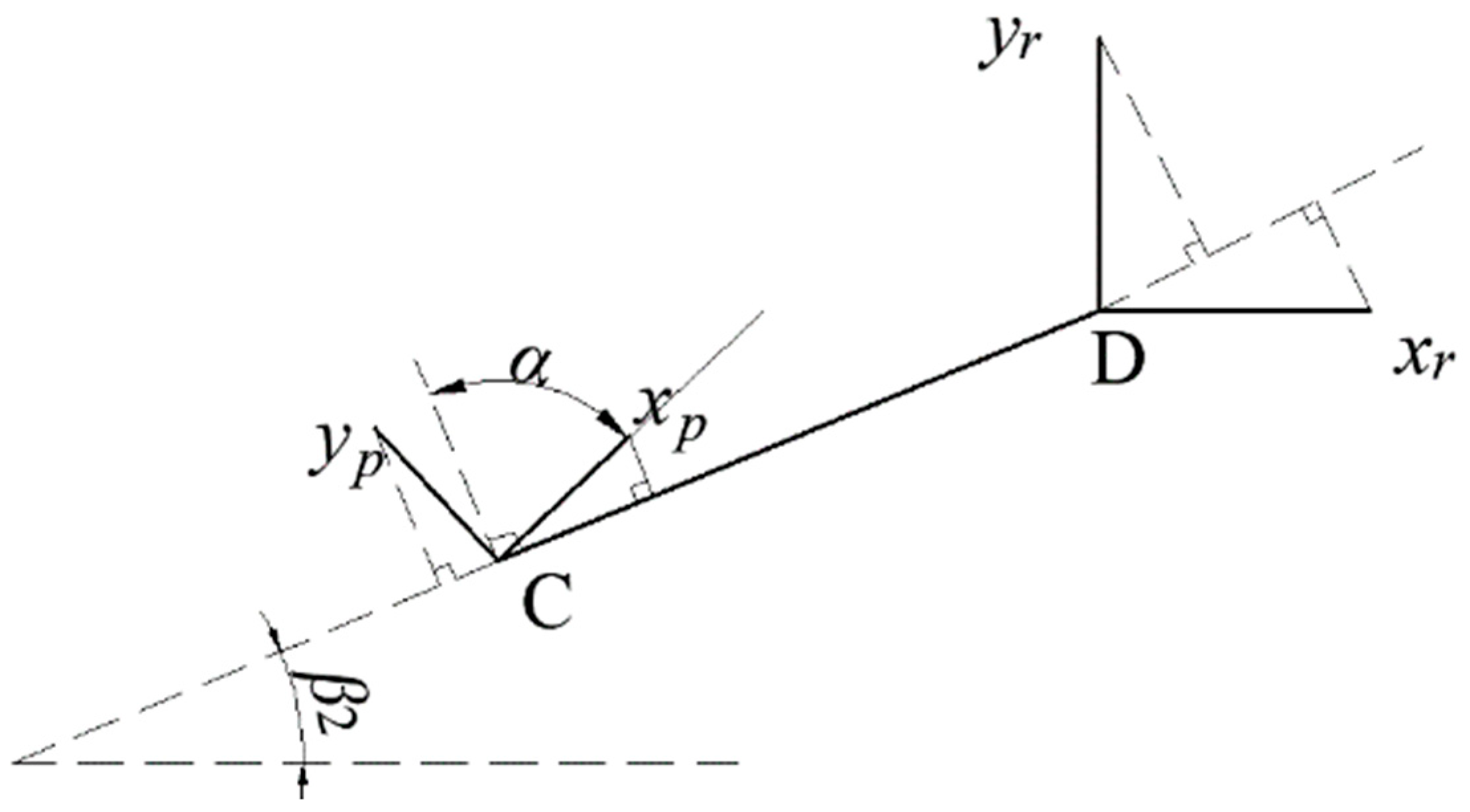
Figure 3 shows the schematic diagram of planetary gear meshing. Among them, the absolute coordinate system OXsYs is established on the sun gear, and the follower coordinate system OpXpYp that rotates with the planetary gear is established with the line connecting the sun gear and the planetary gear as the Xp axis. In the figure, lines AB and CD are the meshing lines between the sun gear and the planetary gear, and between the ring gear and the planetary gear, respectively. The torsional linear displacements of the sun gear, planetary gear, planet carrier, and ring gear are us, up, uc, and ur, respectively, with counterclockwise defined as the positive direction. The horizontal vibration displacements of the sun gear are xs and ys, those of the inner ring gear are xr and yr, those of the planet carrier are xc and yc, and those of the planetary gear are xp and yp. α is the meshing angle, ψi is the angle of the follower coordinate system of planetary gear i rotated relative to the Xs axis, and β1 and β2 are the angles between the horizontal line in the absolute coordinate system and the meshing lines.
Where
ψ i = ω c t + 2 π ( m 1 ) M
β 1 = π 2 α + ψ i
β 2 = α + ψ i π 2
In the above formula, ωc is the rotational angular velocity of the planet carrier, m denotes the m-th planetary gear, and M is the number of planetary gears.
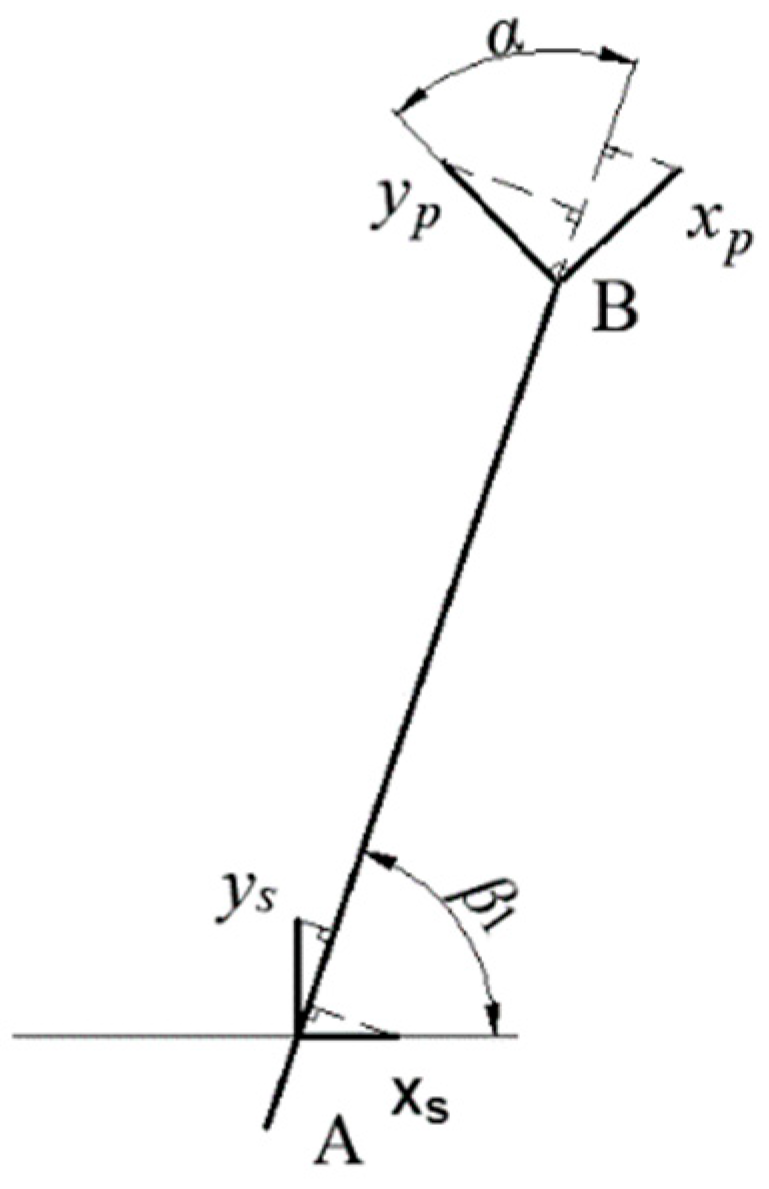
Taking the direction from A to B as the positive direction of the meshing line between the sun gear and the planetary gear, the displacements of the sun gear and the planetary gear are projected onto the meshing line AB, as shown in Figure 4. The relative displacement can be expressed as
δ s p i = x p i sin α + y p i cos α + ( u p i ) x s cos β 1 y s sin β 1 u s = x p i sin α + y p i cos α u p i + x s sin ( α + ψ i ) y s cos ( α + ψ i ) u s
In the formula, x p i and y p i are the horizontal vibration displacements of the i-th planetary gear.
Taking the direction from C to D as the positive direction of the meshing line between the planetary gear and the ring gear, the displacements of the planetary gear and the ring gear are projected onto the meshing line CD, as shown in Figure 5. The relative displacement can be expressed as
δ r p i = x r cos β 2 + y r sin β 2 u r x p i sin α ( y p i cos α ) ( u p i ) = x r sin ( α + ψ i ) y r cos ( α + ψ i ) u r x p i sin α + y p i cos α + u p i
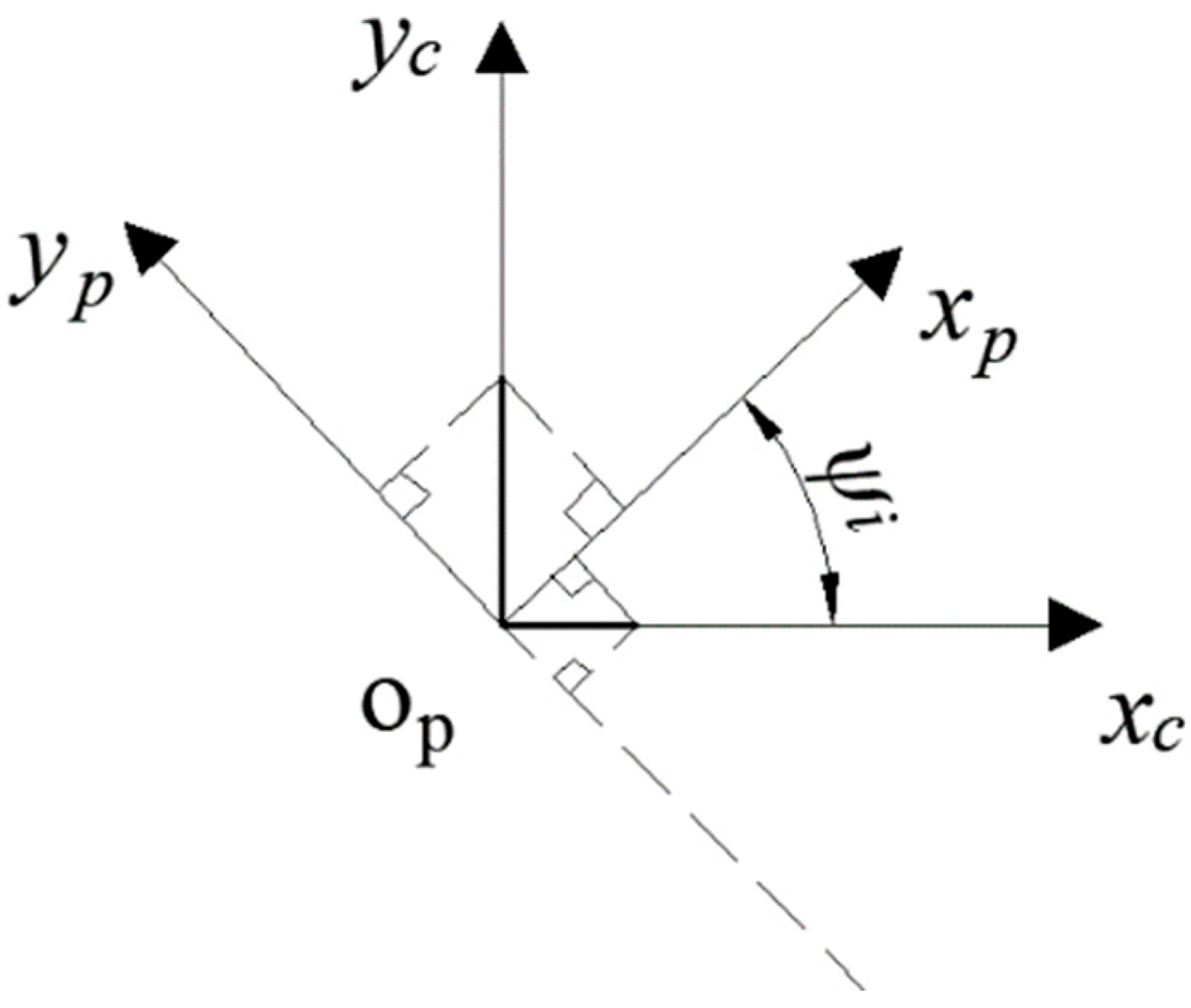
Taking the x-direction of the follower coordinate system on the planetary gear as the positive direction, as shown in Figure 6, the relative displacement relationship between the planet carrier and the planetary gear is expressed as the following formula.
δ c p i x = x p i x c cos ψ i y c sin ψ i
δ c p l y = y p i + x c sin ψ i y c cos ψ i u c

3.2. Meshing Stiffness and Tooth Clearance

During the meshing of planetary gears, single teeth and multiple teeth engage alternately; thus, the meshing stiffness of the gears also changes periodically. The Weber energy method is mainly adopted in this calculation.
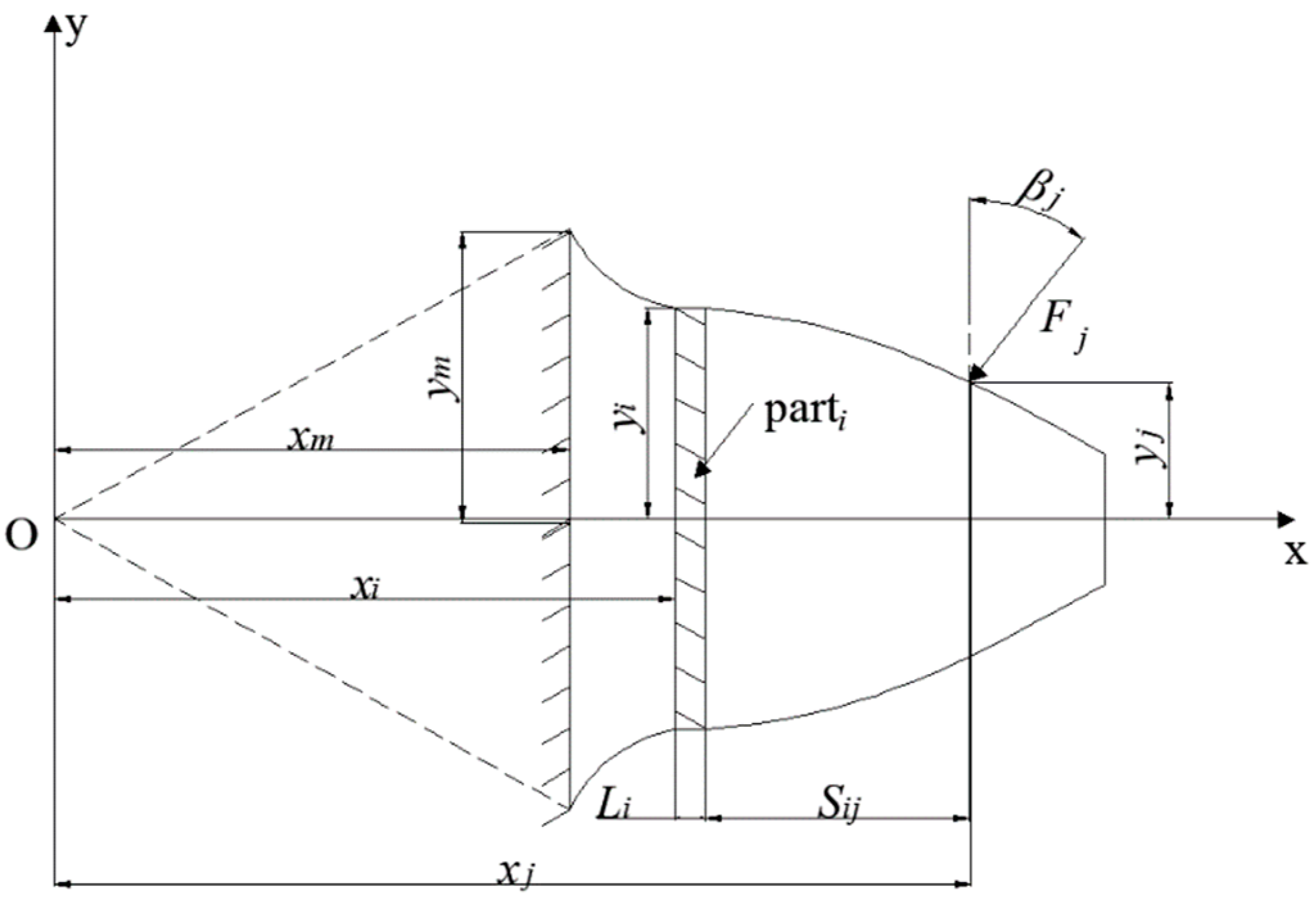
Using the Weber energy method, the gear deformation δj mainly includes the bending, shear, and axial compression deformation of the gear tooth part δBj, the base deformation at the gear transition fillet δMj, and the local contact deformation δCj. As shown in Figure 7, xm is the distance from the gear center to the tooth root, ym is the distance from the tooth root edge to the x-axis, xi is the distance from the gear center to the shaded part i, yi is the distance from the tooth surface of the shaded part i to the x-axis, Fj is the normal force acting on point j of the gear tooth surface, βj is the angle between Fj and the y-axis, xj is the distance from the gear center to point j, yj is the distance from point j to the x-axis, and Sij is the projection of the distance from point j to the shaded part i on the x-axis. To calculate the gear tooth deformation, the Weber method mainly divides the gear tooth into several small segments, and the total bending, shear, and axial compression deformation of the entire gear tooth is the superposition of the deformations of each small segment. Therefore, δB can be expressed as
δ B = i = 1 n δ B i
The shaded part in the figure represents a small segment i, whose cross-sectional area is Ai, tooth width is B, length is Li, and section modulus is Ii. The cross-sectional area Ai and section modulus Ii are derived as
A i = 2 × y i × B
I i = ( 2 × y i ) 3 × B 12
δBij can be derived as
δ B j = F j E e cos 2 β j L i 3 + 3 L i 2 S j + 3 L i S j i 2 3 I i cos β j sin β j L i 2 y j + 2 L i y j S j i 2 I i + cos 2 β j 12 ( 1 + v ) L i 5 A i + sin 2 β j L i A i
In the above formula, Ee is the effective elastic modulus, and ν is Poisson’s ratio of the material. According to R.W. Cornell’s research, the base deformation δMj at the gear transition fillet can be expressed as the following formula.
For wide teeth, the ratio of the tooth width of the tooth surface to the circular tooth thickness at the pitch circle is greater than 5; δMj can be expressed as
δ M j = F j   cos 2 β j B E ( 1 ν 3 ) [ 5.306 ( L f / H f ) 2 + 2 ( 1 ν 2 ν 2 1 ν 2 ) L f H f + 1.534 ( 1 + 0.4167   tan 2 β j 1 + ν ) ]
For narrow teeth, if the ratio of the tooth width of the tooth surface to the circular tooth thickness at the pitch circle is less than 5, then δMj is
δ M j = F j   cos 2 β j B E [ 5.306 L f H f + 2 ( 1 ν ) L f H f + 1.534 1 + 0.4167   tan 2 β j 1 + ν ]
where Lf = xjxmyjtanβj, Hf = 2ym.
According to the Hertz contact theory, the local contact deformation δCj is
δ C j = 1.275 E 0.9 B 0.8 F j 0.1
Therefore, by adding the above three types of deformations, the total deformation δj at the gear meshing point is obtained as
δ j = δ E j + δ M j + δ C j
The meshing stiffness Kj at meshing point j is
K j = F j δ j
In addition, tooth clearance is the gap between gear meshing surfaces reserved due to errors, lubrication space, thermal deformation in practical scenarios, and other factors. It is also an important part in the modeling of gear nonlinear dynamics, which is mainly expressed as follows
f ( x ) = x b ,                 x > b         0 ,                     | x | < b x + b ,               x < b
where x is the δspi or δrpi, and b is half of the tooth backlash.

3.3. Coupled Equations Establish

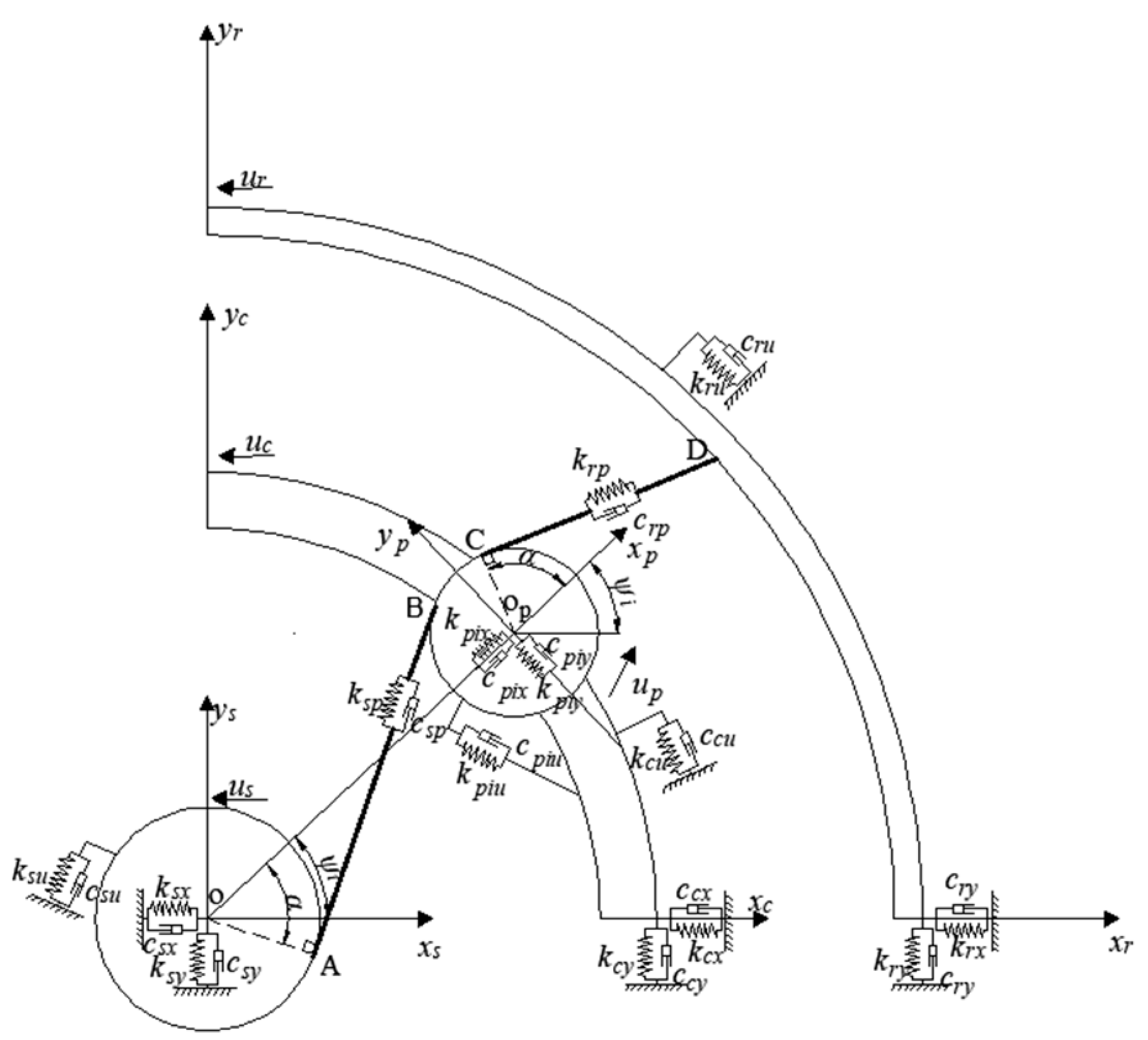
Figure 8 shows the translational–torsional coupling model of the planetary gear, including the sun gear, planet carrier, planetary gears, and ring gear. Due to the complexity of the high-torque hub-driven planetary gear reducer system, the following processes need to be performed when establishing a dynamic model using the lumped parameter method:
(1)
Assume that each component in the system moves in a single plane without axial movement.
(2)
Assume that each component in the system is rigid, and the interactions between the meshing pairs and supports of the components are represented by stiffness and damping.
(3)
Assume that all planetary gears are identical and evenly distributed around the central gear of the same stage.
(4)
In the actual production of the planetary gear reducer studied in this paper, the primary ring gear and the secondary ring gear are an integral part. For the convenience of research, it is assumed that the primary ring gear and the secondary ring gear are two separate mass blocks.
Since the planetary gear reducer studied in this paper is a two-stage reducer system with numerous components and complex parameters, Lagrange’s equations are adopted to establish the dynamic equations, and the equation is as follows:
d d t L q ˙ j L q j + D q ˙ j = Q j
where L = T-U, T is the kinetic energy, U is the potential energy, D is the dissipation function of the system for viscous damping, qj is the generalized coordinates, and Qj is the generalized forces.
In the paper, xIs and yIs are set as the horizontal vibration displacements of the primary sun gear; uIs is its rotational linear displacement, xIc and yIc are the horizontal vibration displacements of the primary planet carrier, uIr is the rotational linear displacement, xIpi and yIpi are the horizontal vibration displacements of the i-th planetary gear of the primary stage, and uIpi(i = 1, 2, 3) is its rotational linear displacement. xIIs, yIIs are defined as the horizontal vibration displacements of the secondary sun gear, and uIIs as its rotational linear displacement, xIIc, yIIc as the horizontal vibration displacements of the secondary planet carrier, and uIIc as its rotational linear displacement. xIIr, yIIr are the horizontal vibration displacements of the secondary ring gear, and uIIr is its rotational linear displacement; xIIpj, yIIpj are the horizontal vibration displacements of the j-th planetary gear of the secondary stage, and uIIpj(j = 1, 2, 3, 4) is its rotational linear displacement.
The calculation formula for meshing damping is as follows
c s p 1 = 2 c s p k s p 1 / m s 2 + 1 / m p 2
c r p 1 = 2 c r p k r p 1 / m r 2 + 1 / m p 2
where csp and crp are the meshing damping ratios with a value range of 0.03–0.17, and a value of 0.07 is adopted for them in this paper [27,28,29].
The tooth surface meshing force between the primary sun gear and the i-th primary planetary gear is
F s p i I = k s p i I ( t )     f δ s p i I + c s p I     δ ˙ s p i I
The tooth surface meshing force between the i-th planetary gear and the ring gear is
F y p i I = k y p i I ( t )     f δ y p i I + c y p     δ ˙ y p i I
The differential equation of the primary sun gear is thus obtained as
ψ s p i = α + ψ t
m s I x ¨ s + i = 1 3 F s p i I sin ψ s p i + k s x I x s + c s x I x ˙ s = 0 m s I y ¨ s i = 1 3 F s p i I cos ψ s p i + k s y I y s + c s y I y ˙ s = 0 I s I ( r s ) 2 u ¨ s i = 1 3 F s p i I + k s u I u s I + c s u I u ˙ s = T s r s
The differential equation of the primary planet carrier is
m c I x ¨ c I = i = 1 3 ( k p i x I δ c p i x I + c p i x I δ ˙ c p i x I ) cos ψ i i = 1 3 ( k p i y I δ c p i y I + c p i y I δ ˙ c p i y I ) sin ψ i + k c x I x c I + c c x I x ˙ c m c I y ¨ c I = i = 1 3 ( k p i x I δ c p i x I + c p i x I δ ˙ c p i x I ) sin ψ i + i = 1 3 ( k p i y I δ c p i y I + c p i y I δ ˙ c p i y I ) cos ψ i + k c x I x c I + c c x I x ˙ c I c I ( r c I ) 2 u ¨ c I = i = 1 3 ( k p i y I δ c p i y I + c p i y I δ ˙ c p i y I ) k c s 12 ( u c I r m r c I u s I I r m r s I I ) k c u I u c I c c u I u ˙ c I
The differential equation of the primary ring gear is
ψ r p i = α + ψ i
m r I x ¨ r I + i = 1 3 F r p i I sin ψ r p i + k r χ x r I + c r χ x ˙ r I = 0 m r I y ¨ r i = 1 3 F r p i I cos ψ r p i + k r y y r I + c r y y ˙ r I = 0 I r I ( r r ) 2 u ¨ r I i = 1 3 F r p i I + k r u I u r I + c r u u ˙ r I = 0
The differential equation of the i-th primary planetary gear is
m p i I x ˙ p i I 2 ω c y ˙ p i I ω c 2 x p i I + F s p i I sin α F r p i I sin α + k p i x I δ ˙ c p i x I + c p i x I δ ˙ c p i x I = 0 m p i I y ¨ p i I + 2 ω c x ˙ p i I ω c 2 y p i I + F s p i I cos α + F r p i I cos α + k p l y I δ ˙ c p l y I + c p l y I δ ˙ c p l y I = 0 I p i I ( r p I ) 2 u ¨ p i I F s p i I + F r p i I = 0
where mIh(h = s,r,c,p) are, respectively, the masses of the primary sun gear, ring gear, planet carrier and planetary gear. IIh(h = s,r,c,p) are the mass moments of inertia of the aforementioned primary components. rIh(h = s, r, c, p) are, respectively, the base circle radii of the primary sun gear, ring gear, planet carrier and planetary gear. kIspi(t), (i = 1, 2, 3) are, respectively, the time-varying meshing stiffness between the primary ring gear and the i-th primary planetary gear. kIpix, kIpiy, and kIpiu are the support and torsional stiffness of the i-th primary planetary gear. kIhx, kIhy, and kIhu(h = s,r,c) are the support and torsional stiffness of the primary sun gear, ring gear and planet carrier, respectively. k c s 1 2 is the interstage coupling stiffness between the primary and secondary stages, and rm is the radius of the spline between the primary and secondary stages.
The calculation formula for the secondary meshing damping is as follows:
c s p Π = 2 c s p k s p Π 1 / m s Π + 1 / m p Π
c r p Π = 2 c r p 1 / m r Π + 1 / m p Π
where csp and crp are meshing damping ratios with a value range of 0.03–0.17, and a value of 0.07 is adopted for them in this paper.
The tooth surface meshing force between the secondary sun gear and the j-th secondary planetary gear is
F s p j Π = k s p j Π ( t )     f δ s p j Π + c s p Π     δ ~ s p j Π
The tooth surface meshing force between the j-th secondary planetary gear and the secondary ring gear is
F r p j Π = k r p j Π ( t )     f δ r p j Π + c r p Π     δ ˙ r p j Π
The differential equation of the secondary sun gear is
ψ s p j = α + ψ j
m s I I x ˙ s I I + j = 1 4 F s p j I I sin ψ s p j + k s x I I x s I I + c s x I I x ˙ s I I = 0 m s I I y ˙ s I I j = 1 4 F s p j I I cos ψ s p j + k s y I I y s I I + c s y I I y ˙ s I I = 0 I s I I ( r s I I ) 2 u ¨ s I I j = 1 4 F s p j I I + k c s 12 u s I I r m r s I I u c I r m r c r m I I r s I I + k s u I I u s I I + c s u I I u ˙
The differential equation of the secondary planet carrier is
m c I I x ¨ c I I = i = 1 4 ( k p i x I I δ c p i x I I + c p i x I I δ ˙ c p i x I I ) cos ψ i i = 1 4 ( k p i y I I δ c p i y I I + c p i y I I δ ˙ c p i y I I ) sin ψ i + k c x I I x c I I + c c x I I x ˙ c m c I I y ¨ c I I = i = 1 4 ( k p i x I I δ c p i x I I + c p i x I I δ ˙ c p i x I I ) sin ψ i + i = 1 4 ( k p i y I I δ c p i y I I + c p i y I I δ ˙ c p i y I I ) cos ψ i + k c x I I x c I I + c c x I I x ˙ c I c I I ( r c I I ) 2 u ¨ c I I = i = 1 4 ( k p i y I I δ c p i y I I + c p i y I I δ ˙ c p i y I I ) k c u I I u c I I c c u I I u ˙ c I I + T c r c I I
The differential equation of the secondary ring gear is
ψ r p j = α + ψ j
m r Π x ¨ r Π + j = 1 4 F r y j Π sin ψ r p j + k r x Π x r Π + c r x Π x ˙ r Π = 0 m r Π y ¨ r Π j = 1 4 F r y j Π cos ψ r p j + k r y Π y r Π + c r y Π y ˙ r Π = 0 I r Π ( r r ) 2 u ¨ r Π j = 1 4 F r u p j Π + k r u Π u r Π + c r u Π u ˙ r Π = 0
The differential equation of the j-th secondary planetary gear is
m p j Π x ¨ p j 2 ω c y ˙ p j ω c 2 x p j + F s p j Π sin α F r p j Π sin α + k p j x Π δ c p j x Π + c p j y Π δ ¨ c p j y Π = 0 m p j Π y ¨ p j + 2 ω c x ˙ p j ω c 2 y p j + F s p j Π cos α + F r p j Π cos α + k p j y Π δ c p j y Π + c p j x Π δ ¨ c p j x Π = 0 I p j Π ( r p Π ) 2 u ¨ p j F s p j Π + F r p j = 0
where mIIh(h = s,r,c,p) are, respectively, the masses of the secondary sun gear, ring gear, planet carrier and planetary gear, IIIh(h = s,r,c,p) the mass moments of inertia of the aforementioned secondary components, rIIh(h = s,r,c,p) the base circle radii of the secondary sun gear, ring gear, planet carrier and planetary gear, kIIspj(t)(j = 1, 2, 3, 4) the time-varying meshing stiffness between the secondary sun gear and the j-th secondary planetary gear, kIIrpj(t)(j = 1, 2, 3, 4) the time-varying meshing stiffness between the secondary ring gear and the j-th secondary planetary gear. kIIpjx, kIIpjy and kIIpju are the support and torsional stiffness of the j-th secondary planetary gear. kIIhx, kIIhy and kIIhu(h = s,r,c) are the support and torsional stiffness of the secondary sun gear, ring gear and planet carrier, respectively. k c s 1 2 is the interstage coupling stiffness between the primary and secondary stages, and rm the radius of the spline between the primary and secondary stages.
Let [M], [C], [K] and [F] denote the mass matrix, damping matrix, stiffness matrix and excitation matrix, respectively. By assembling the aforementioned equations, the vibration equation of the two-stage planetary gear transmission system can be obtained as follows:
[ M ] q ¨ + [ C ] q ˙ + [ K ] q = [ F ]
where q is the matrix composed of all generalized coordinates in the system, given by
q = [ x s 1 , y s 1 , u s , x c 1 , y c 1 , u c , x r 1 , y r 1 , u r , x p 1 , y p 1 , u p 1 , x p 2 , y p 2 , u p 2 , x p 3 , y p 3 , u p 3 , x s 2 , y s 2 , u s 2 ,   x c Π , y c Π , x r Π , y r Π , u p 1 Π , y p 1 Π , u p 2 Π , y p 2 Π , u p 3 Π , y p 3 Π , x p 4 Π , y p 4 Π ] T

4. Experiment

For the planetary gear reducer of the high-torque hub drive system, this paper conducted a no-load vibration test on the reducer, obtained the vibration acceleration data of relevant components, and compared them with the lumped parameter dynamic model.

4.1. Test Scheme

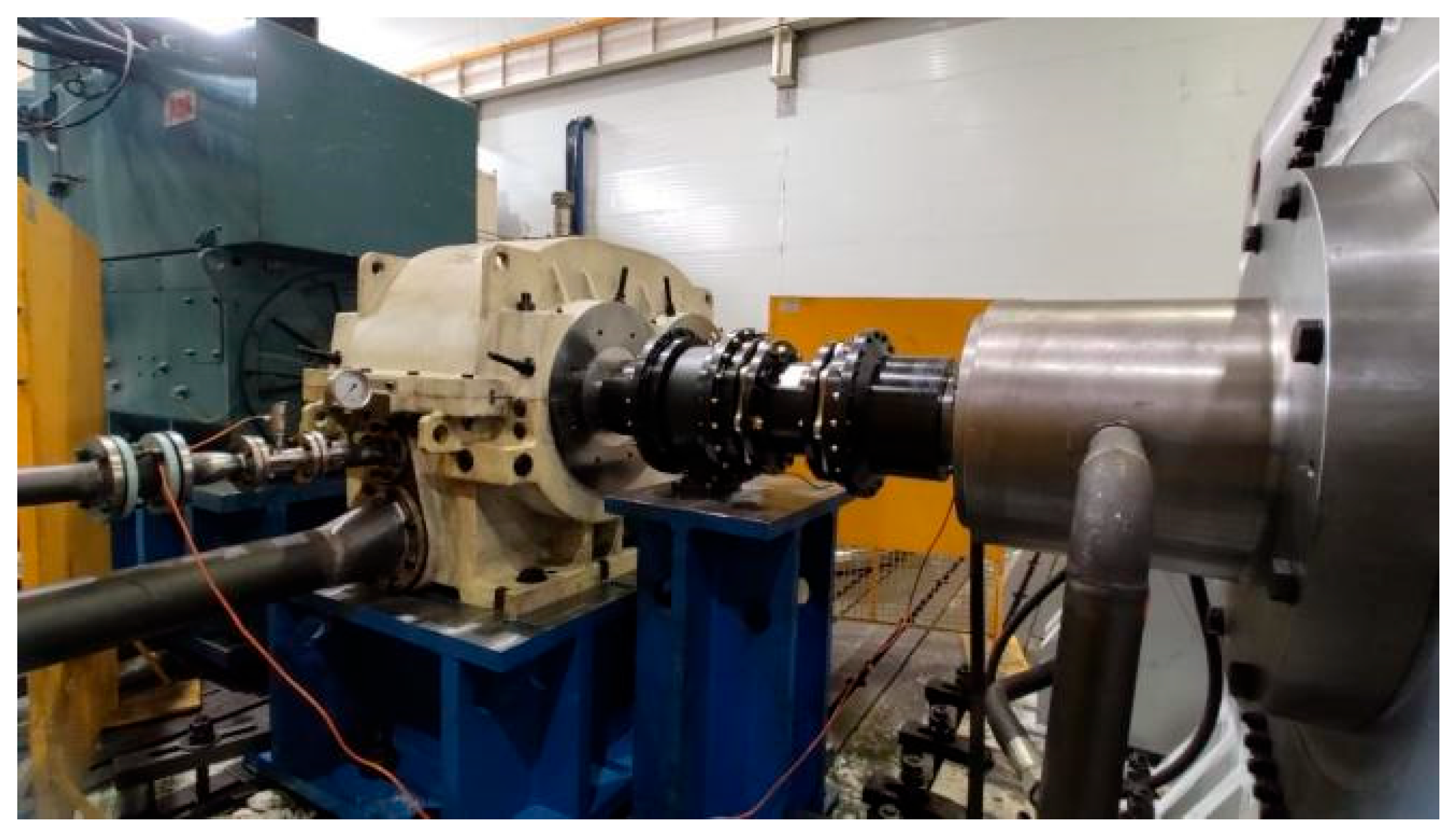
Figure 9 shows the schematic diagram of the test. This no-load test mainly consists of a drive motor, a coupler, a transmission, and a high-torque hub-driven planetary gear reducer. Power is provided by the drive motor, and the transmission increases the rotational speed of the drive motor before transmitting it to the reducer. Among them, the reducer is fixed on the wall through its housing.
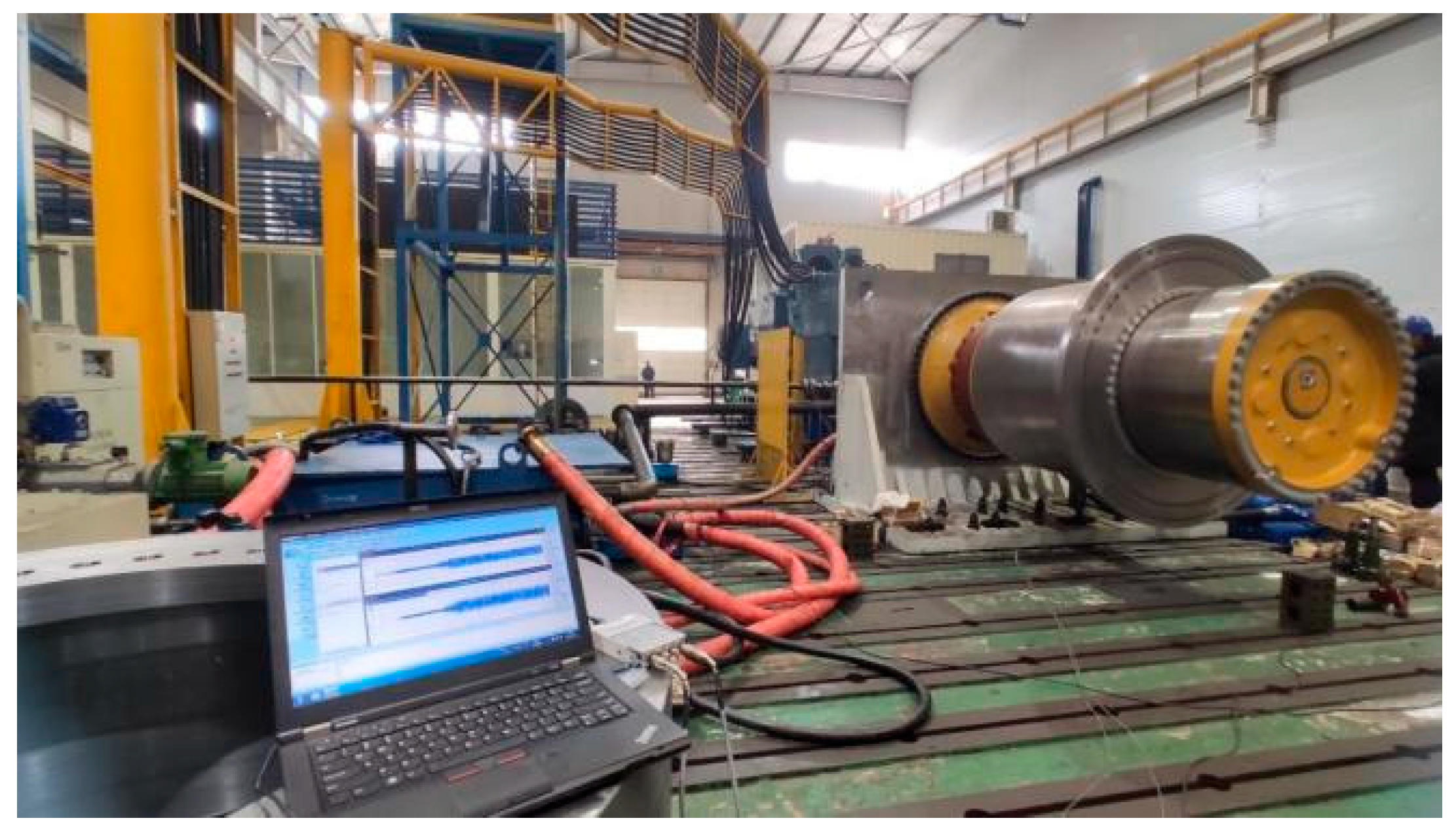
The test site of the high-torque hub-driven planetary gear reducer is shown in Figure 10 and Figure 11. The drive motor, transmission, and coupler are illustrated in Figure 10, while Figure 11 presents the layout of the test site, which includes the planetary gear reducer and data acquisition instruments.
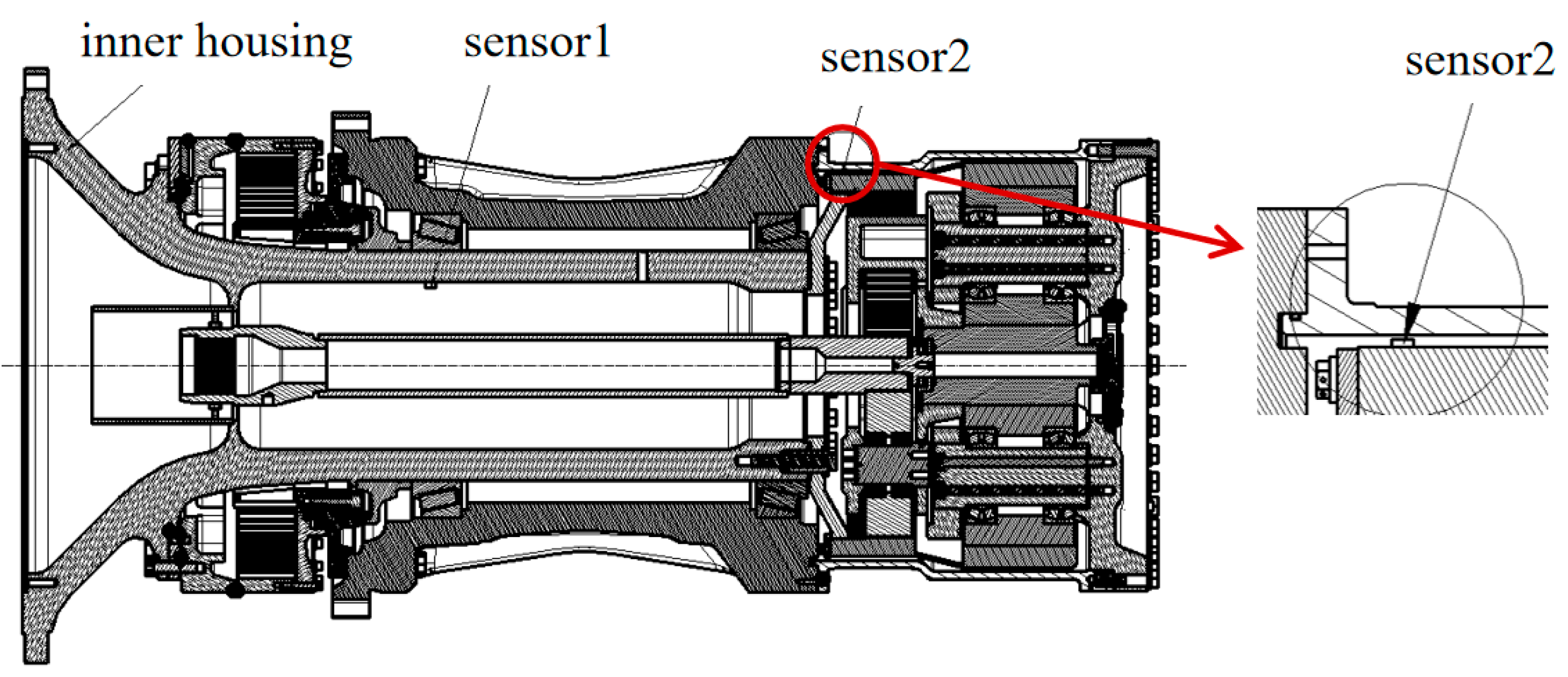
Figure 12 shows the sensor arrangement position of this no-load test. Sensors are mainly arranged on the inner wall of the housing and the outer wall of the primary ring gear, and unidirectional accelerometers are adopted to collect vibration signals in the y-direction.

4.2. Experiment Result

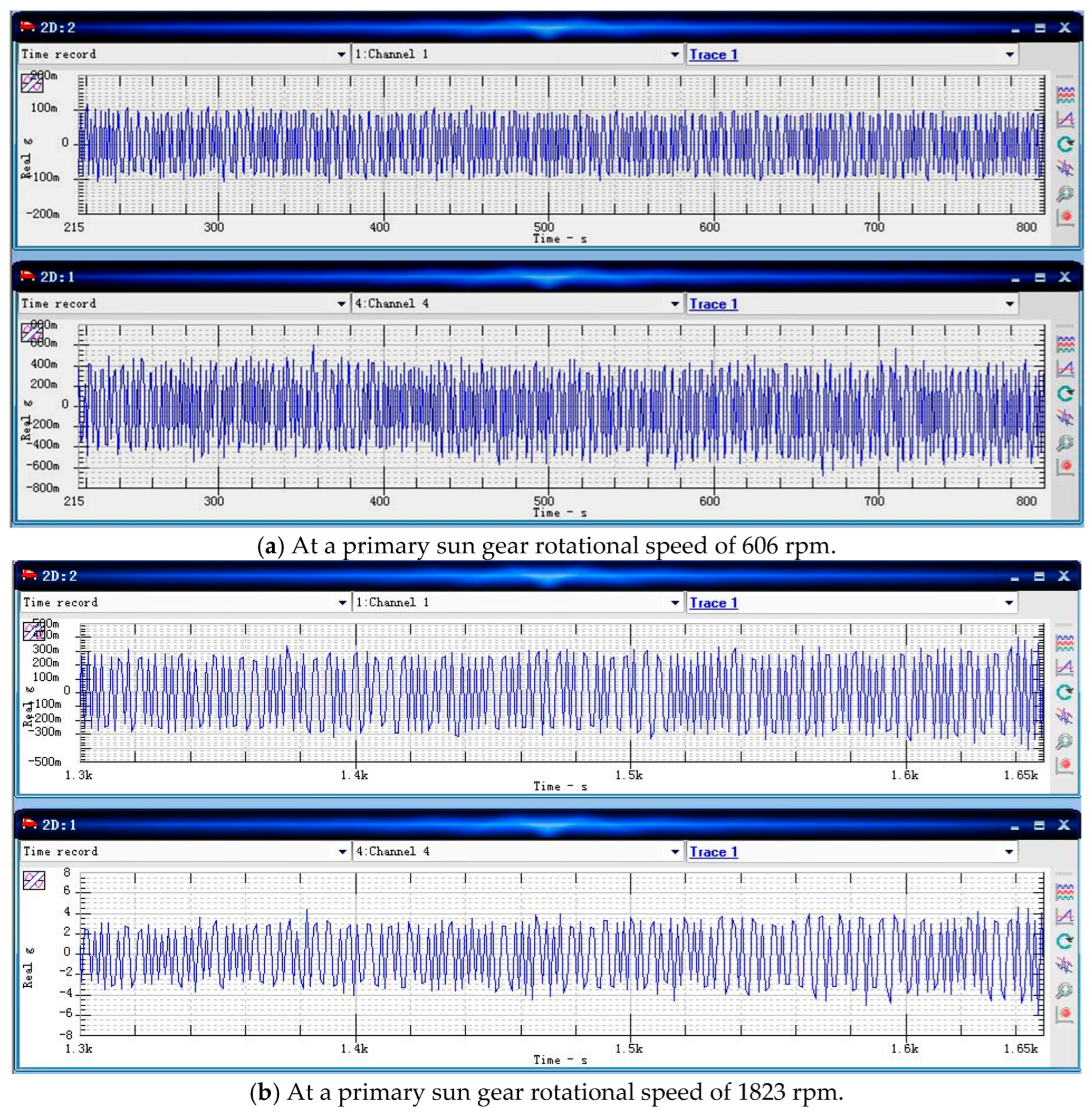
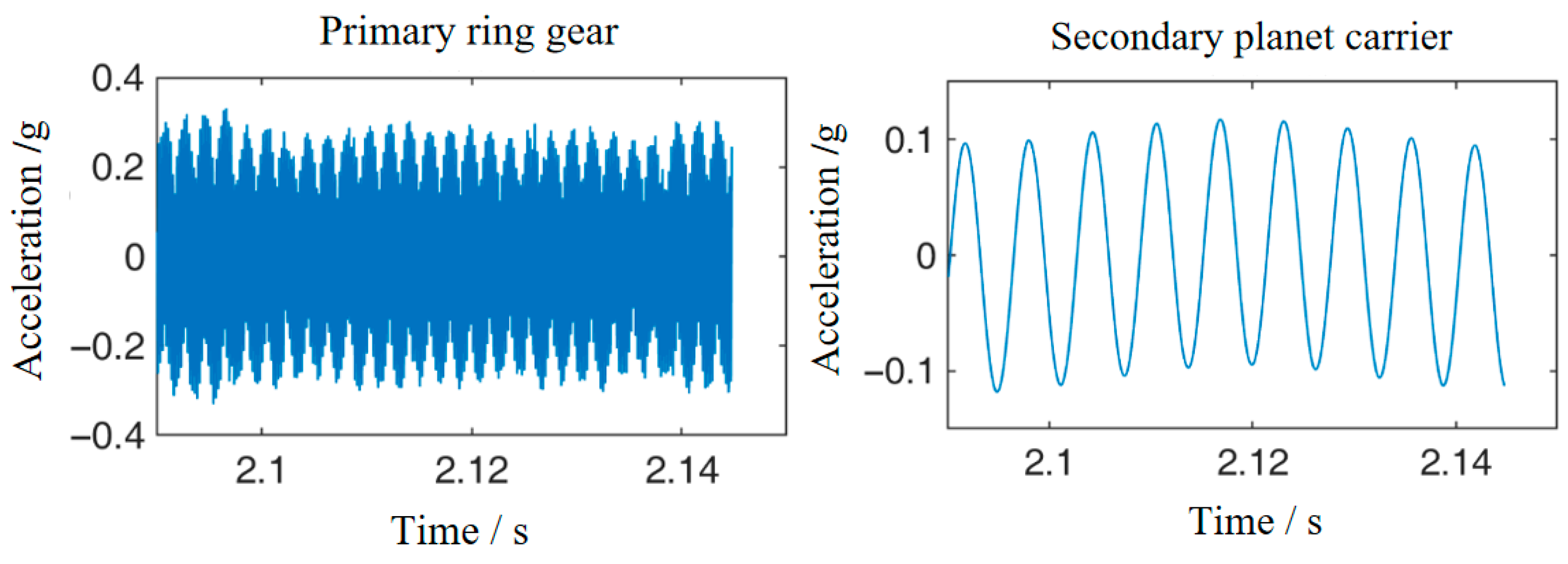
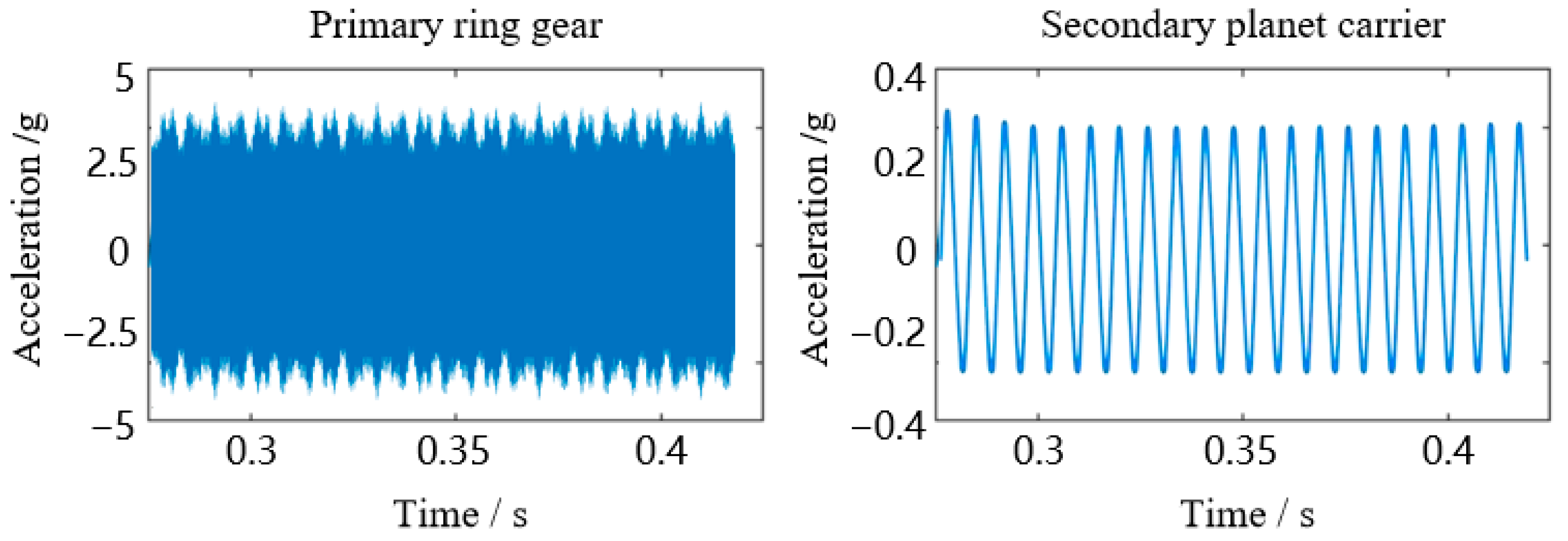
This test mainly conducted a vibration test under the no-load condition with primary sun gear rotational speeds of 606 rpm and 1823 rpm. Figure 13 shows the vibration acceleration results measured by two sensors: the data measured by Sensor 1 is Channel 1, and that measured by Sensor 2 is Channel 4. Sensor 1 mainly collects the vibration data of the housing (which is fixed on the wall), and since the secondary planet carrier is connected to the housing through bearings, the vibration data of Sensor 1 can be regarded as the vibration data of the secondary planet carrier. Sensor 2 measures the vibration acceleration data of the primary ring gear. When the rotational speed is 606 rpm, the vibration acceleration amplitude of the primary ring gear is 0.41 g, and that of the secondary planet carrier is 0.11 g. When the rotational speed is 1823 rpm, the vibration acceleration amplitude of the primary ring gear is increased to 3.83 g, and that of the secondary planet carrier increases to 0.29 g, g = 9.8 m/s2.
To verify the theoretical calculation results, the vibration acceleration values of the primary ring gear and the secondary planet carrier at a primary sun gear rotational speed of 606 rpm and 1823 rpm are compared with the experimental results. Figure 14 and Figure 15 show the vibration acceleration curves of the primary ring gear and the secondary planet carrier calculated by the translational–torsional coupling dynamic model.
As can be seen from the Table 1, the simulation results are relatively close to the experimental results, but there are still certain errors. This is because the planetary gear reducer model of the high-torque hub drive system is complex with numerous influencing factors, including manufacturing errors, installation errors, and the lubrication system. Since factors such as errors and lubrication are not considered in the lumped parameter model of this paper, there should be certain errors between the theoretical analysis and the experimental results, thus verifying the feasibility of the translational–torsional coupling model proposed in this paper.

5. Conclusions

This study mainly derives a mathematical model that can be used in engineering calculations of the core component of high-torque hub drive systems. A lumped parameter translational–torsional coupling model was established based on Lagrange’s dynamic equations, incorporating key nonlinear factors such as time-varying meshing stiffness and tooth clearance. Furthermore, the Weber energy method was employed to calculate gear meshing stiffness, and the system’s vibration equation was assembled using mass, damping, stiffness, and excitation matrices. Dynamic differential equations for each component at all stages were derived by means of the Runge–Kutta numerical integration method via the software of MATLAB R2020a.
In addition, a no-load vibration test platform was constructed, comprising a drive motor, coupling, transmission, and the planetary gear reducer. According to the experimental verification results, it can be found that the proposed translational–torsional coupling model is valid and reliable. When the primary sun gear operated at 606 r/min and 1823 r/min, comparative analysis between simulation and experimental results showed errors of 14.63% and 9.12% for the primary ring gear, 9.09% and 6.89% for the secondary planet carrier.
This investigation provides significant theoretical support for the dynamic optimization design, vibration control, and performance improvement of reducers in high-torque hub drive systems. Obviously, it should not be cumbersome and acceptable for engineering applications.

Author Contributions

F.L.: Conceptualization, methodology, software, investigation, formal analysis, writing original draft. X.D.: Writing—original draft, simulation, investigation. H.J.: Data curation, writing—original draft, visualization, investigation. J.Z.: Funding acquisition, writing, review and editing. Q.F.: Conceptualization, resources, supervision, writing review and editing. All authors have read and agreed to the published version of the manuscript.

Funding

This research was funded by the National Natural Science Foundation of China (grant number 52405275), the Natural Science Foundation of the Higher Education Institutions of Jiangsu Province, China (grant number 24KJB460017) and Scientific Research Foundation for High-level Talents of Nanjing Institute of Technology (grant number YKJ202102). The financial support is gratefully acknowledged.

Institutional Review Board Statement

Not applicable.

Informed Consent Statement

Not applicable.

Data Availability Statement

No new data were created or analyzed in this study. Data sharing is not applicable to this article.

Conflicts of Interest

The authors do not have any conflicts of interest with other entities or researchers.

References

  1. Almuramady, N.; Al-Mayali, M.F.; Esmail, E.L. Configuration design and kinematic analysis of compound power-split mechanisms for in-wheel motor-driven electrical vehicles. Results Eng. 2025, 28, 108368. [Google Scholar] [CrossRef]
  2. Ghazali, M.; Vukotić, M.; Miljavec, D.; Hartavi, A.E. Temperature-adaptive torque allocation for all wheel drive electric trucks. Appl. Therm. Eng. 2025, 276, 126846. [Google Scholar] [CrossRef]
  3. Wen, C.K.; Ren, W.; Zhu, Q.Z.; Zhao, C.J.; Luo, Z.H.; Zhang, S.L.; Xie, B.; Meng, Z.J. Reducing Operation Emissions and Improving Work Efficiency Using a Pure Electric Wheel Drive Tractor. Engineering 2024, 37, 230–245. [Google Scholar] [CrossRef]
  4. Liao, Z.; Cai, L.; Yang, Q.; Zhang, Y. Design of lateral dynamic control objectives for multi-wheeled distributed drive electric vehicles. Eng. Sci. Technol. 2024, 50, 101629. [Google Scholar] [CrossRef]
  5. Tyni, T.; Vepsäläinen, J. Hydraulic hybrid system coupling traction motor and working hydraulics of electric wheel loader. Energy 2025, 332, 137217. [Google Scholar] [CrossRef]
  6. Xiong, W.; Zheng, G.; Zhang, H.; Yu, M.; Wang, X. Load Characteristics and Friction Torque Analysis of Triple-Row Wheel Hub Bearings. Lubricants 2026, 14, 45. [Google Scholar] [CrossRef]
  7. Ding, X.; Chen, X.; Li, Y. Design and Simulation Study of an Intelligent Electric Drive Wheel with Integrated Transmission System and Load-Sensing Unit. Energies 2026, 19, 461. [Google Scholar] [CrossRef]
  8. Li, F.; Jiao, H.; Zhang, J.; Fu, Q. Dynamic Modeling and Output Characteristics Analysis of the Hub-Drive Reduction System. Appl. Sci. 2025, 15, 1680. [Google Scholar] [CrossRef]
  9. Tian, H.; Ma, H.; Peng, Z.; Zhu, J.; Zhao, S.; Zhang, X. Study on rigid-flexible coupling modeling of planetary gear systems: Incorporation of the pass effect and random excitations. Mech. Mach. Theory 2024, 201, 105745. [Google Scholar] [CrossRef]
  10. Liu, N.; Ma, H.; Ding, X.; Liu, J. Dynamic characteristics of rigid-flexible coupled planetary gear-bearing-rotor system considering the tooth surface lubrication friction and roughness. Mech. Mach. Theory 2025, 217, 106259. [Google Scholar] [CrossRef]
  11. Liu, Y.; Li, X.; Liu, H.; Ma, H. Time-varying meshing stiffness model of the idler ring bearing in planetary gear train. Mech. Mach. Theory 2026, 219, 106322. [Google Scholar] [CrossRef]
  12. Bouslema, M.; Frikha, A.; Abdennadhar, M.; Fakhfakh, T.; Nasri, R.; Haddar, M. Effects of modal truncation and condensation methods on the Frequency Response Function of a stage reducer connected by rigid coupling to a planetary gear system. Comptes Rendus Mécanique 2017, 345, 807–823. [Google Scholar] [CrossRef]
  13. Mo, S.; Chen, K.; Yao, B.; Chen, S.; Hu, W.; Zhou, D.; Mo, W.; Zhang, W. Coupled dynamic characteristics of electric drive train system under vehicle-mounted environment. Mech. Syst. Signal Process. 2025, 241, 113518. [Google Scholar] [CrossRef]
  14. Tuplin, W.A. Gear-tooth stresses at high speed. Proc. Inst. Mech. Eng. 1950, 163, 162–175. [Google Scholar] [CrossRef]
  15. Hidaka, T.; Terauchi, Y. Dynamic behavior of planetary gear: 1st report load distribution in planetary gear. Bull. JSME 1976, 19, 690–698. [Google Scholar] [CrossRef]
  16. Ozgiven, H.N.; Houser, D.R. Mathematical models used in gear dynamics-a review. J. Sound Vib. 1988, 12l, 383–411. [Google Scholar] [CrossRef]
  17. Kahraman, A. Static Load Sharing Characteristics of Transmission Planetary Gear Sets: Model and Experiment. SAE Trans. 1999, 108, 1954–1963. [Google Scholar]
  18. Parker, R.G.; Agashe, V.; Vijayakar, S.M. Dynamic Response of a Planetary Gear System Using a Finite Element/Contact Mechanics Model. J. Mech. Des. 2000, 122, 304–310. [Google Scholar] [CrossRef]
  19. Inalpolat, M.; Kahraman, A. Dynamic modelling of planetary gears of automatic transmissions. Proc. Inst. Mech. Eng. Part K Joumal Multi-Body Dyn. 2008, 222, 229–242. [Google Scholar] [CrossRef]
  20. Eritenel, T.; Parker, R.G. Modal properties of three-dimensional helical planetary gears. J. Sound Vib. 2009, 325, 397–420. [Google Scholar] [CrossRef]
  21. Kim, W.; Lee, J.Y.; Chung, J. Dynamic analysis for a planetary gear with time-varying pressure angles and contact ratios. J. Sound Vib. 2012, 331, 883–901. [Google Scholar] [CrossRef]
  22. Guo, Y.; Keller, J.; Parker, R.G. Nonlinear dynamics and stability of wind turbine planetary gear sets under gravity effects. Eur. J. Mech. -A/Solids 2014, 47, 45–57. [Google Scholar] [CrossRef]
  23. Marques, P.M.T.; Martins, R.C.; Seabra, J.H.O. Gear dynamics and power loss. Tribol. Int. 2016, 100, 400–411. [Google Scholar] [CrossRef]
  24. Li, M.; Khonsari, M.; Yang, R. Dynamics analysis of torsional vibration induced by clutch and gear set in automatic transmission. Int. J. Automot. Technol. 2018, 19, 473–488. [Google Scholar] [CrossRef]
  25. Hodaei, M.; Rabbani, V.; Maghoul, P.; Bahari, A.; Farhang, K.; Wu, N. Analytical modeling of contact mechanics of helical gear tooth by considering surface roughness effects. J. Adhes. Sci. Technol. 2020, 34, 2176–2199. [Google Scholar] [CrossRef]
  26. Ryali, L.; Talbot, D. Dynamic load distribution of planetary gear sets subject to both internal and external excitations. Forsch. Im Ingenieurwesen 2022, 86, 283–294. [Google Scholar] [CrossRef]
  27. Kasuba, R.; Evans, J.W. An extended solution for determining dynamic loads in spur gearing. ASME Mech. Des. 1981, 103, 398–409. [Google Scholar]
  28. KWang, L.; Cheng, H.S. A numerical solution to the dynamic load film thickness and suface temperature in spur gears. ASME Mech. Des. 1981, 103, 177–187. [Google Scholar]
  29. Omar, F.K.; Moustafa, K.A.F.; Emam, S. Mathematical modeling of gearbox including defects withexperimental verification. J. Vib. Control 2012, 18, 1310–1321. [Google Scholar] [CrossRef]
Figure 1. Schematic diagram of the hub drive system.
Symmetry 18 00429 g001
Figure 2. Structural diagram of the planetary gear transmission system.
Symmetry 18 00429 g002
Figure 3. Relative displacement relationship of each component of the planetary gear reducer.
Symmetry 18 00429 g003
Figure 4. Relative displacement relationship between the sun gear and planetary gear.
Symmetry 18 00429 g004
Figure 5. Relative displacement relationship between the planetary gear and ring gear.
Symmetry 18 00429 g005
Figure 6. Relative displacement relationship between the planetary gear and planet carrier.
Symmetry 18 00429 g006
Figure 7. Calculation model of time-varying gear tooth stiffness.
Symmetry 18 00429 g007
Figure 8. Translational–torsional coupling model of two-stage planetary gears.
Symmetry 18 00429 g008
Figure 9. Experimental schematic of the high-torque hub-driven two-stage planetary gear reducer.
Symmetry 18 00429 g009
Figure 10. Diagram of drive motor, transmission and coupling.
Symmetry 18 00429 g010
Figure 11. On-site test diagram.
Symmetry 18 00429 g011
Figure 12. Diagram of sensor arrangement position.
Symmetry 18 00429 g012
Figure 13. Vibration test results of the high-torque hub-driven two-stage planetary gear reducer at different rotational speeds under no-load conditions.
Symmetry 18 00429 g013
Figure 14. Plots of vibration acceleration of the first-stage internal ring gear and second-stage planet carrier obtained by model calculation at a primary sun gear rotational speed of 606 rpm.
Symmetry 18 00429 g014
Figure 15. Plots of vibration acceleration of the first-stage internal ring gear and second-stage planet carrier obtained by model calculation at a primary sun gear rotational speed of 1823 rpm.
Symmetry 18 00429 g015
Table 1. Comparison of vibration acceleration amplitudes between test and simulation.
SpeedPositionSimulation Result/gTest Result/gError
606 rpmPrimary ring gear0.350.4114.63%
Secondary planet carrier0.120.119.09%
1823 rpmPrimary ring gear3.493.839.12%
Secondary planet carrier0.310.296.89%
Disclaimer/Publisher’s Note: The statements, opinions and data contained in all publications are solely those of the individual author(s) and contributor(s) and not of MDPI and/or the editor(s). MDPI and/or the editor(s) disclaim responsibility for any injury to people or property resulting from any ideas, methods, instructions or products referred to in the content.