Article

Symmetry-Aware Simulation and Experimental Study of Thin-Wall AA7075 End Milling: From Tooth-Order Force Symmetry to Symmetry-Breaking Dynamic Response and Residual Stress

1
School of Mechanical and Electrical Engineering, Quanzhou University of Information Engineering, Quanzhou 362000, China
2
School of Mechanical Engineering, Chongqing Industry Polytechnic University, Chongqing 401120, China
*
Author to whom correspondence should be addressed.
Symmetry 2026, 18(1), 74; https://doi.org/10.3390/sym18010074 (registering DOI)
Submission received: 31 October 2025 / Revised: 13 December 2025 / Accepted: 15 December 2025 / Published: 1 January 2026

Abstract

Symmetry and asymmetry jointly govern the dynamics and surface integrity of thin-wall AA7075 end milling. In this work, a symmetry-aware simulation and experimental framework is developed to connect process parameters with milling forces, dynamic response, surface quality, and through-thickness residual stress. A mechanistic milling-force model is first established for multi-tooth end milling, where the periodically repeated tooth-order excitation provides a nominally symmetric load pattern along the tool path. The predicted forces are then used as input for finite-element modal and harmonic-response analysis of a thin-walled component, revealing how symmetric and anti-symmetric mode shapes interact with the tooth-order excitation to generate locally amplified, asymmetric vibration of the compliant wall. Orthogonal and single-factor milling experiments on AA7075 thin-wall specimens are performed to calibrate and validate the force model, and to quantify the influence of feed per tooth, axial depth of cut, spindle speed, and radial width of cut on deformation, surface roughness, and geometric accuracy. Finally, a thermo-mechanically coupled finite-element model is employed to evaluate the residual-stress field, showing a characteristic pattern in which an initially symmetric thermal–mechanical loading produces depth-wise symmetry breaking between tensile surface layers and compressive subsurface zones. The proposed symmetry-aware framework, which combines milling-force theory, finite-element simulation, and systematic experiments, provides practical guidance for selecting parameter windows that suppress vibration, control residual stress, and improve the machining quality of thin-wall AA7075 components.

1. Introduction

Thin-walled components made from 7xxx-series aluminum alloys—especially AA7075—are essential in aerospace structures where high specific stiffness, tight dimensional tolerances, and demanding material removal rates must be simultaneously achieved [1,2]. Their lightweight geometry, though beneficial for structural efficiency, significantly reduces stiffness during machining. Consequently, even small variations in axial depth of cut (ap), radial width of cut (ae), spindle speed (n), or feed per tooth (fz) alter local chip formation and contact kinematics, amplify cutting forces on the compliant wall, and excite vibrations that directly influence surface finish and residual stress distribution [3,4]. These coupled effects increase the risk of dimensional errors, rework, and deformation during final assembly of thin rib–web components [5,6].
The influence of the four principal parameters is well understood. Raising fz thickens the undeformed chip and enhances ploughing effects at low effective rake angles; increasing ap lengthens the active axial engagement and the number of simultaneously cutting teeth; enlarging ae broadens the contact width between tool and workpiece; and modifying n alters the contact time per tooth and thermal field within the shear zone [7,8,9,10]. In thin-wall milling, these adjustments do not simply scale cutting forces. Because structural stiffness varies along the wall, identical load increments can induce much larger deflections at mid-span than near the fixed ends. This deflection, in turn, modifies chip thickness and amplifies dynamic forces (Fx, Fy, Fz), potentially driving the system toward regenerative chatter [11,12,13]. Even below the chatter threshold, periodic tooth-passing excitation introduces micro-waviness and deteriorates surface topography, leading to a tight coupling between vibration amplitude and surface roughness [14,15]. Meanwhile, transient heating and severe plastic deformation near the tool–chip interface yield tensile stresses at the surface and compressive ones beneath, which may cause significant distortion in thin sections during later machining stages [16].
Extensive research has addressed fragments of this parameter–response chain. Mechanistic models that discretize helical flutes into axial micro-elements and integrate shear and edge effects along the immersion arc have evolved into accurate, fast predictors once the cutting coefficients are calibrated through steady-state experiments [17,18,19,20]. Their efficiency makes them suitable for real-time process planning, while empirical regressions remain valuable for tool–material calibration [21,22]. Nevertheless, most validations have focused on rigid or moderately stiff workpieces. The full propagation of identified force models into the thin-wall regime, where structural compliance dominates dynamic response and directly affects surface integrity, has received less systematic study [23,24]. On the dynamics front, tri-axial acceleration measurements and advanced digital filtering—such as zero-phase Butterworth band-pass sections centered on the tooth-passing frequency—allow quantitative evaluation of load-induced vibrations and amplitude comparison across process conditions [25,26,27,28]. However, many studies isolate force identification, vibration characterization, surface metrology, and residual-stress evaluation, leading to fragmented insights for thin-wall geometries.
Residual stress represents the final link in this integrity chain. During slot milling, thermal gradients and localized plastic flow generate non-uniform strain fields; upon unloading and cooling, these leave a characteristic depth profile that is tensile near the surface and compressive in the subsurface region, gradually relaxing toward the bulk [29,30]. Thermo-mechanically coupled finite-element (FE) models—typically employing rate- and temperature-dependent constitutive laws such as Johnson–Cook—can reproduce the shape of these profiles and serve for parametric sensitivity analyses when direct residual-stress measurement on slender walls is impractical [31,32]. For AA7075 thin-walled structures, however, a fully integrated experimental–numerical chain that consistently maps process parameters to cutting forces, vibration, surface roughness, and residual stress remains insufficiently explored [33,34].
Recent studies have also proposed end-to-end workflows that combine cutting-force modelling, vibration monitoring, surface-integrity assessment, and FE-based residual-stress prediction for milling processes [12,23]. However, most of these frameworks have been developed for relatively stiff workpieces or generic pocketing operations, rely on force-coefficient identification on rigid reference blocks, and validate residual-stress predictions only against a limited set of global metrics. The present study therefore does not claim novelty in the generic idea of an “integrated workflow”, but in how the individual blocks are implemented and coupled for symmetry-aware thin-wall AA7075 milling.
Accordingly, this paper develops a symmetry-aware experimental–numerical workflow for milling of thin-wall AA7075 components. Rather than introducing the generic concept of an integrated process chain, the novelty lies in how the individual blocks are implemented and coupled for this specific thin-wall configuration: (i) cutting-force coefficients are identified directly on the compliant thin wall, using repeated passes at each cutting condition to quantify identification repeatability; (ii) the identified forces are coupled with multi-point vibration diagnostics and surface-finish mapping along the wall span to obtain a symmetry-aware interpretation of vibration patterns; and (iii) a thermo-mechanically coupled FE model of the same thin-wall geometry is used to predict machining-induced residual stresses and to relate the simulated profiles qualitatively to measured wall deflection and roughness metrics. This implementation provides an end-to-end, symmetry-aware view of parameter–response relationships that is tailored to thin-wall AA7075 milling and complements existing end-to-end frameworks developed for stiffer workpieces.

2. Materials and Methods

2.1. Testbed and Workpiece Geometry

All machining and vibration experiments were carried out on a vertical CNC machining center (J1VMC40MB, Jinan First Machine Tool Group, Jinan, China). The machine is equipped with a 9 kW spindle capable of speeds up to 2000 r·min−1, mounted on a 900 × 400 mm worktable with X, Y, and Z travels of 680, 380, and 490 mm, respectively, under a Siemens 840D numerical control system. The cutting tool employed was a 10 mm-diameter, 4-flute cemented-carbide end mill with a right-hand helix angle of 35°, optimized for dry finishing of high-strength aluminum alloys.
The test workpiece was a rectangular AA7075 aluminum block (170 mm × 95 mm × 10 mm) machined to include two thin-wall beams that mimic the stiffness distribution of simply supported structural members. Each beam measured 150 mm in length, with wall widths of 16 mm and 8 mm, respectively, to represent different compliance levels. The programmed toolpath comprised an entry region, a steady-state slotting zone along the beam span, and an exit section. All dynamic and integrity analyses were conducted using data collected from the steady-cut interval, where transient effects from tool engagement and exit were fully excluded. Geometrically, the thin-wall behaves as a slender, approximately symmetric beam with mirror planes through the mid-span and mid-thickness, which underpins the symmetric and antisymmetric bending modes observed in the finite-element modal analysis and provides a natural reference for identifying symmetry-breaking in the measured vibration responses. All key dimensions shown in Figure 1 were inspected using a digital caliper (0.01 mm resolution) prior to testing, and only specimens meeting the nominal geometry without visible defects were used.

2.2. Instruments and Materials

The principal specifications of the machining center are summarized in Table 1, defining the operational envelope of spindle speed, feed, and depth of cut, and enabling precise replication of the experimental conditions.
To capture reliable process data, a dedicated milling-force measurement system was integrated with the machining platform. The instrumentation consisted of a piezoelectric dynamometer, a charge amplifier, and a multi-channel data-acquisition module. During each milling pass, the instantaneous cutting forces acting on the dynamometer produced electric charges within its piezoelectric crystals. These charges were converted into proportional voltage signals through the charge amplifier and subsequently digitized via A/D conversion in the acquisition unit. The digital force data were then processed using specialized software to isolate the steady-cut interval, filter transient effects, and prepare synchronized datasets for dynamic and integrity analyses.
This integrated electromechanical setup ensured accurate temporal alignment between the mechanical loading events and their electrical representations. It provided a robust experimental foundation for quantitatively correlating cutting parameters with the resulting force characteristics, vibration signatures, and surface integrity responses, forming the basis for the symmetry-aware dynamic interpretation developed in later sections.
The geometrical specifications and substrate composition of the cutting tool are provided in Table 2. These parameters were deliberately chosen to achieve consistent edge engagement and to maintain uniform chip-formation mechanics across all test conditions. By standardizing tool geometry and material properties, the influence of tool-induced variability was minimized, ensuring that any observed differences in force, vibration, or surface response originated solely from the controlled process parameters.
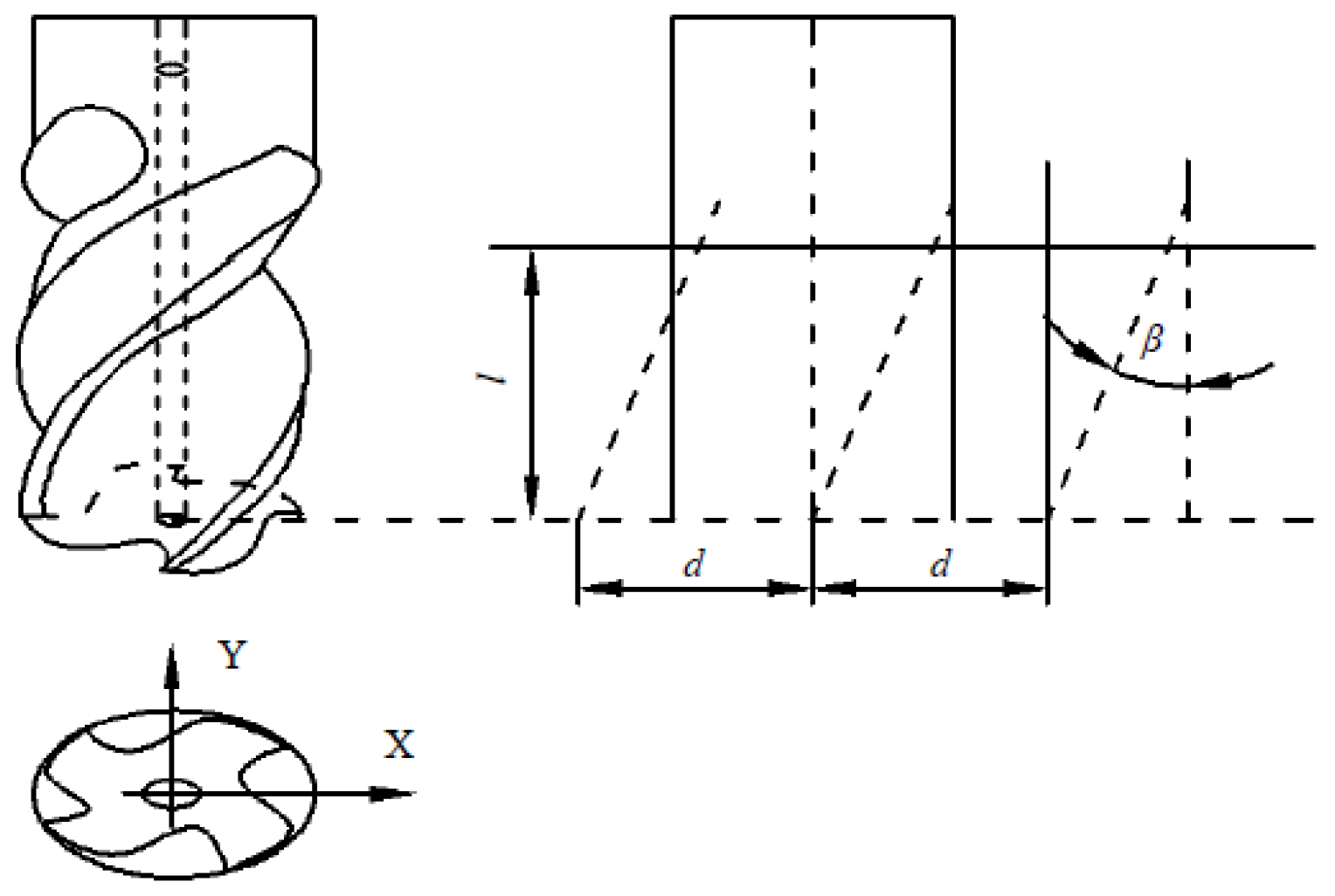
Figure 1 presents the milling-tool/coordinate schematic, used to define the axis directions and sign conventions adopted throughout the manuscript. In Figure 1, the global Cartesian axes are shown, with the X-axis aligned with the feed direction along the wall span, the Y-axis pointing across the wall thickness, and the Z-axis along the wall height. The arrows indicate the feed direction and spindle rotation, and the straight mid-span segment highlighted by the thick arrow corresponds to the steady-state cutting region used for force, vibration, and surface-roughness analysis.
The workpiece material employed in this investigation was AA7075 aluminum alloy, a representative member of the 7xxx series known for its outstanding combination of high specific strength, good plasticity below 150 °C, low density, and excellent corrosion resistance. Its chemical composition and thermo-physical properties, summarized in Table 3 and Table 4, respectively, served as key material inputs for both the mechanistic force modeling and the thermo-mechanically coupled finite-element simulations performed in this study. These property datasets ensured that the experimental observations and numerical analyses were founded on accurate material parameters, enabling consistent correlation between the cutting responses and the underlying constitutive behavior of AA7075.
Because of their high sensitivity, linearity, and stability, piezoelectric sensors are widely adopted for capturing dynamic cutting forces in machining applications. In this study, a Kistler 9257B triaxial piezoelectric dynamometer (Kistler Group, Winterthur, Switzerland) was utilized to record the cutting-force components along the X, Y, and Z directions. The device’s measurement range and natural frequency bandwidth were well matched to the operating conditions of aluminum slot milling, ensuring accurate resolution of transient force fluctuations throughout the selected spindle-speed domain. The principal specifications of the dynamometer are listed in Table 5, confirming its suitability for precise, real-time force acquisition under high-frequency excitation typical of thin-wall milling.
A Kistler 5070A charge amplifier was employed to transform the electrical charge signals generated by the dynamometer into corresponding voltage outputs. Operating within a 0–45 kHz bandwidth and a ±10 V conversion range, the amplifier ensured accurate preservation of the dynamic characteristics of the cutting-force signals. Its frequency response was fully compatible with that of the triaxial dynamometer, enabling faithful reproduction of transient load variations without distortion or phase lag. The amplifier’s essential technical parameters are summarized in Table 6, confirming its suitability for high-fidelity force acquisition under the selected milling conditions.

2.3. Rigid Instantaneous Milling-Force Model and Identification of Average Force Coefficients

2.3.1. Instantaneous Force Model

Let dFₜ, dFᵣ, and dFₐ denote the infinitesimal tangential, radial, and axial cutting-force components acting on an elemental segment of a helical flute located at an angular immersion angle φ and an axial coordinate z. Under steady climb-milling conditions, the instantaneous uncut chip thickness can be described by h(φ) = fz sinφ. where fn is the feed per tooth. In the mechanistic micro-element model, the local cutting load is correlated with the instantaneous chip thickness through the specific shear coefficient (Kc) and edge coefficient (Ke), which represent the material’s intrinsic resistance to plastic shear deformation and the additional load contribution from edge ploughing, respectively. This formulation provides a quantitative link between the tool–workpiece interaction and the distributed cutting forces along the helical edge, forming the foundation for subsequent integration over the axial engagement domain.
d F t = ( K t c h ( ϕ ) + K t e ) b d z , d F r = ( K r c h ( ϕ ) + K r e ) b d z , d F a = ( K a c h ( ϕ ) + K a e ) b d z ,
In this formulation, b represents the infinitesimal axial thickness of cut, corresponding to a unit-depth element of material removal along the flute. Through an appropriate coordinate transformation, the elemental tangential, radial, and axial force components are resolved into the global coordinate frame (O–x y z). This transformation enables direct computation of the total cutting-force components in each spatial direction, thereby linking the local tool–chip interaction to the measurable forces acting on the workpiece.
d F x d F y d F z = cos φ sin φ 0 sin φ cos φ 0 0 0 1 d F t d F r d F a
By integrating the elemental forces over both the immersion angle (φ) and the axial coordinate (z), the resultant cutting-force components corresponding to the j-th tooth can be obtained along the x, y, and z directions. This double integration yields a complete spatial description of the instantaneous load distribution acting on the tool and workpiece during milling, effectively capturing the combined influence of flute geometry, chip thickness variation, and engagement kinematics on the overall cutting behavior.
F x , j φ j ( z ) = f z 4 k β K t c cos 2 φ j ( z ) + K r c 2 φ j ( z ) sin 2 φ j ( z ) + 1 k β K t e sin φ j ( z ) K r e cos φ j ( z ) z j , 1 ( φ j ( z ) ) z j , 2 ( φ j ( z ) ) F y , j φ j ( z ) = f z 4 k β K t c 2 φ j ( z ) sin 2 φ j ( z ) + K r c cos 2 φ j ( z ) + 1 k β K t e cos φ j ( z ) + K r e sin φ j ( z ) z j , 1 ( φ j ( z ) ) z j , 2 ( φ j ( z ) ) F z , j φ j ( z ) = 1 k β K a c f z cos φ j ( z ) K a e φ j ( z ) z j , 1 ( φ j ( z ) ) z j , 2 ( φ j ( z ) )
In this formulation, ϕᵢ,1 and ϕᵢ,2 denote the entry and exit immersion angles of the i-th tooth, while the term kβ = 2tanβ/D defines the geometric correction factor associated with the tool’s helix angle. The total cutting force is then obtained by integrating the elemental contributions of all simultaneously engaged teeth along the helical edge.
When the cutting parameters—namely axial depth (ap), radial width (ae), and spindle speed (n)—are held constant, the mean cutting force exhibits a linear dependence on the feed per tooth (fz). This proportionality can be expressed analytically, forming the basis for parameter identification and experimental validation of the mechanistic model.
Beyond classical mechanistic milling-force models that rely on specific shear and edge coefficients, several alternative approaches have been proposed to predict cutting forces without explicit calibration of such coefficients. For example, Pan et al. developed an analytical force model for laser-assisted end milling of Inconel 718 in which oblique cutting is transformed into equivalent orthogonal cutting and the forces are obtained from Oxley-type contact mechanics, coupled with a Johnson–Cook flow law and a Johnson–Mehl–Avrami–Kolmogorov (JMAK) recrystallization model, so that the cutting and axial forces are predicted directly as functions of strain, strain rate, temperature, and microstructural evolution rather than from identified Ktc and Kte values [36]. These microstructure-sensitive formulations reduce reliance on empirical cutting-force coefficients but require detailed temperature fields and calibrated material parameters for both the constitutive and recrystallization models. In the present work, where the focus is on process planning for AA7075 thin-wall finishing with limited material data, a mechanistic force-coefficient model is therefore adopted as a pragmatic choice, while microstructure-aware modeling strategies such as that of Pan et al. are considered promising candidates for future extension of the framework.
F x , y , z = α 0 + α 1 f z
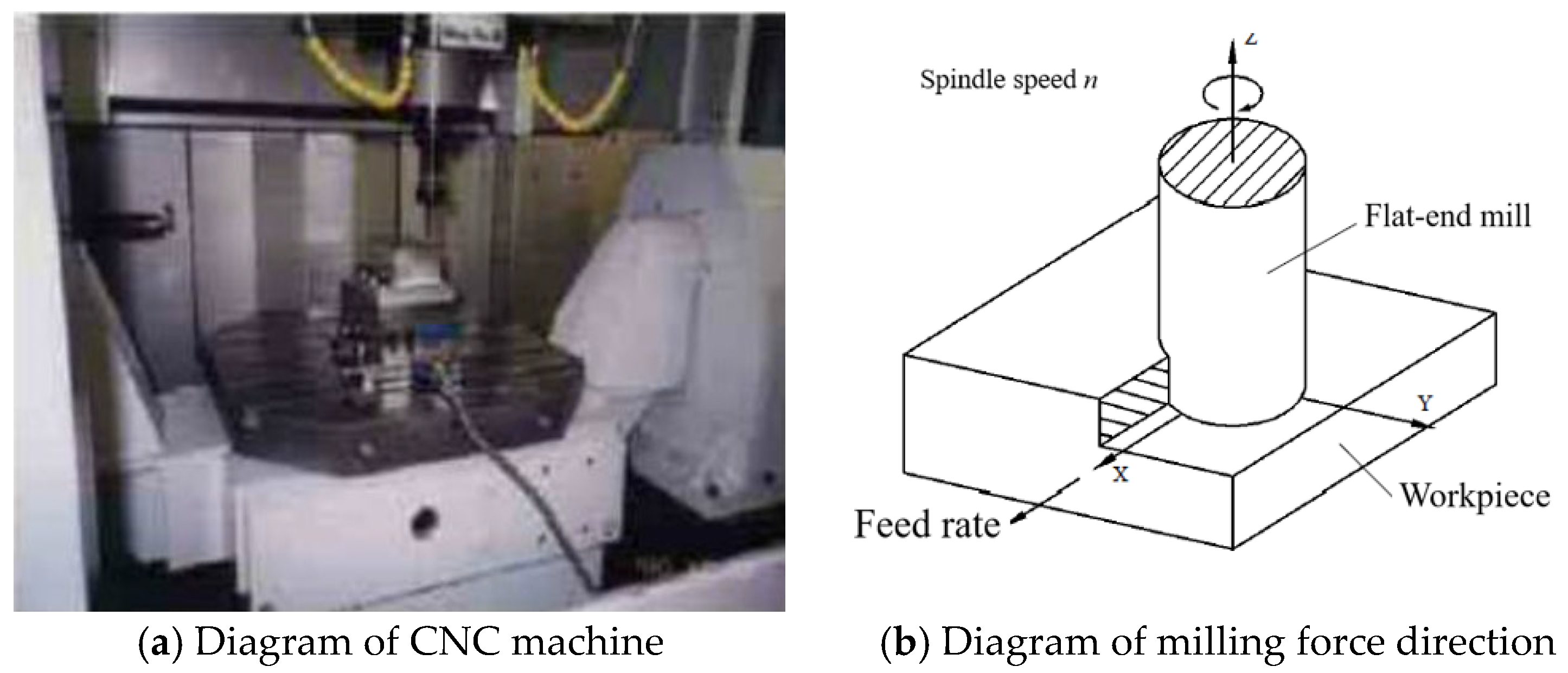
The cutting-force coefficients were determined through a dedicated set of milling experiments conducted on AA7075 aluminum alloy specimens using a cemented-carbide end mill. In the experimental arrangement, the piezoelectric dynamometer was rigidly mounted on the machine’s T-slot table, and the workpiece was bolted directly onto the dynamometer to ensure mechanical stability and prevent signal distortion during force transmission. All tests were performed under dry, climb-milling conditions with a plane-slot cutting configuration, providing a steady and repeatable engagement state essential for accurate force measurement. The overall experimental layout is schematically presented in Figure 2.
Following the principle of the average milling-force coefficient model, a series of eight controlled experiments was conducted in which only the feed per tooth (fz) was systematically varied. The remaining parameters—radial width of cut (ae), axial depth of cut (ap), and spindle speed (n)—were held constant to isolate the individual effect of feed on the cutting-force response. This design strategy ensured that variations in measured forces could be directly attributed to changes in fz, allowing precise determination of the corresponding specific cutting and edge coefficients through linear regression analysis. The detailed parameter settings employed for coefficient identification are summarized in Table 7.
Each milling experiment was executed sequentially following the predefined parameter matrix, with the cutting-force components along the X, Y, and Z axes continuously recorded in real time. To guarantee the reliability and comparability of the measurements, only the steady-state cutting interval of each test was extracted for analysis. Within this region, the raw force signals exhibited nearly periodic oscillations around a constant level dominated by the tooth-passing frequency, without any low-frequency drift or instability. For each test, the time-averaged values of the recorded forces over the steady-state interval were computed and adopted as the representative milling loads corresponding to each feed-per-tooth condition. The complete set of these averaged forces for coefficient identification is summarized in Table 8. In this table, the force components are reported with their signs according to the machine-tool coordinate system, so that forces acting opposite to the positive axis directions appear as negative values.

2.3.2. Linear Regression and Force-Coefficient Identification

A linear regression algorithm was implemented in MATLAB R2022b to analyze the experimental results summarized in Table 8. The measured mean cutting forces were fitted as a function of the feed per tooth (fz), and the regression outputs were subsequently correlated with the mechanistic force model to extract the specific shear (Kc) and edge (Ke) coefficients for AA7075 milling with a cemented-carbide end mill. The identified parameters, obtained from the best-fit linear relations, are listed in Table 9, providing quantitative inputs for subsequent predictive simulations and validation of the developed mechanistic framework. In the adopted force coordinate system, the global force components are defined along the machine-tool axes, so that tangential forces acting in the chip-flow direction appear with a negative sign in the global cutting-direction component; consequently, the negative Ktc and Kte values reported in Table 9 do not indicate non-physical behaviour, but simply mean that the shear and edge-force contributions act opposite to the positive global force direction, while their magnitudes quantify the specific shearing and ploughing resistance per unit uncut chip thickness and per unit edge contact length.
The obtained regression equations are as follows, in line with linear force-coefficient identification procedures widely adopted in mechanistic milling-force models [13]:
F x ¯ = 134.58 f z 11.79 F y ¯ = 377.49 f z 12.83 F z ¯ = 122.45 f z + 3.87
The linear regression exhibited excellent predictive accuracy, with coefficients of determination R2 > 0.90 for all three force components within the investigated feed-per-tooth range. This indicates that a linear dependence of cutting force on feed per tooth fz is an adequate approximation in the present calibration window, and the identified coefficients are therefore used for prediction and interpretation only within this range of chip thicknesses and fz levels.
To assess the validity of the identified coefficients, they were incorporated into the rigid mechanistic force model and evaluated against an independent experimental dataset obtained under varying feed-per-tooth (fz) conditions. As presented in Table 10, the predicted and measured cutting forces show excellent agreement, with the maximum deviation below 5 N. The corresponding average relative errors in the X, Y, and Z directions were 7.9%, 6.6%, and 9.0%, respectively, demonstrating the strong predictive fidelity and reliability of the developed milling-force model.
It should be noted, however, that this regression-based identification implicitly assumes a quasi-rigid workpiece; when the wall compliance becomes significant, part of the deflection-induced modulation of chip thickness may be absorbed into the identified force coefficients, so that the coefficients become specific to the present thin-wall geometry, fixture, and stability range.

2.4. Vibration Measurement and Signal Conditioning

2.4.1. Accelerometer Placement and Signal Acquisition

The programmed toolpath consisted of three sequential stages—tool entry, steady-state cutting, and tool exit. Only the data collected during the steady-cutting phase were analyzed to ensure stability and repeatability of the measurements. In each cutting condition, this toolpath was repeated several times, and for every measured quantity the mean value and sample standard deviation over the repeated passes were computed and used as uncertainty measures in the subsequent analysis. As clarified in Figure 1, the X-axis is aligned with the feed direction along the wall span, the Y-axis is oriented across the wall thickness, and the Z-axis corresponds to the wall height; the straight mid-span segment of the path, marked by a thick arrow in Figure 1, is the steady-state cutting region from which forces, vibration, and surface-roughness data are extracted, whereas the entry and exit segments are excluded from the analysis.
During testing, the piezoelectric dynamometer was rigidly clamped to the machine table using pressure plates, while the AA7075 workpiece was securely fastened atop the dynamometer to maintain firm coupling and precise force transmission. Owing to the pronounced vibration amplitudes of the thin-wall beam during machining—which made direct sensor mounting impractical—three DYTRAN 3097A2 accelerometers were instead installed on the thicker base sections of the specimen.
Each accelerometer was oriented along one of the three orthogonal axes: x (feed direction), y (width of cut), and z (axial depth). Prior to machining, the sensors were carefully aligned and bonded to the workpiece surface with adhesive to ensure accurate response, since magnetic attachment was ineffective on the lightweight aluminum structure. The sensors captured vibration-induced acceleration voltages in all three directions at a sampling rate of 12.8 kHz. The analog signals were transmitted to the data-acquisition system, converted into digital form, and subsequently processed for spectral analysis.
The adopted coordinate convention defines x, y, and z as the feed, radial, and axial directions, respectively. Because the cutting forces under climb milling act opposite to the positive feed and width directions, the recorded Fx and Fy signals may appear negative in the dynamometer output. For clarity, time-domain plots display absolute magnitudes, whereas tabulated data preserve the signed values. The principal performance specifications of the three accelerometers are summarized in Table 11.

2.4.2. Digital Filtering

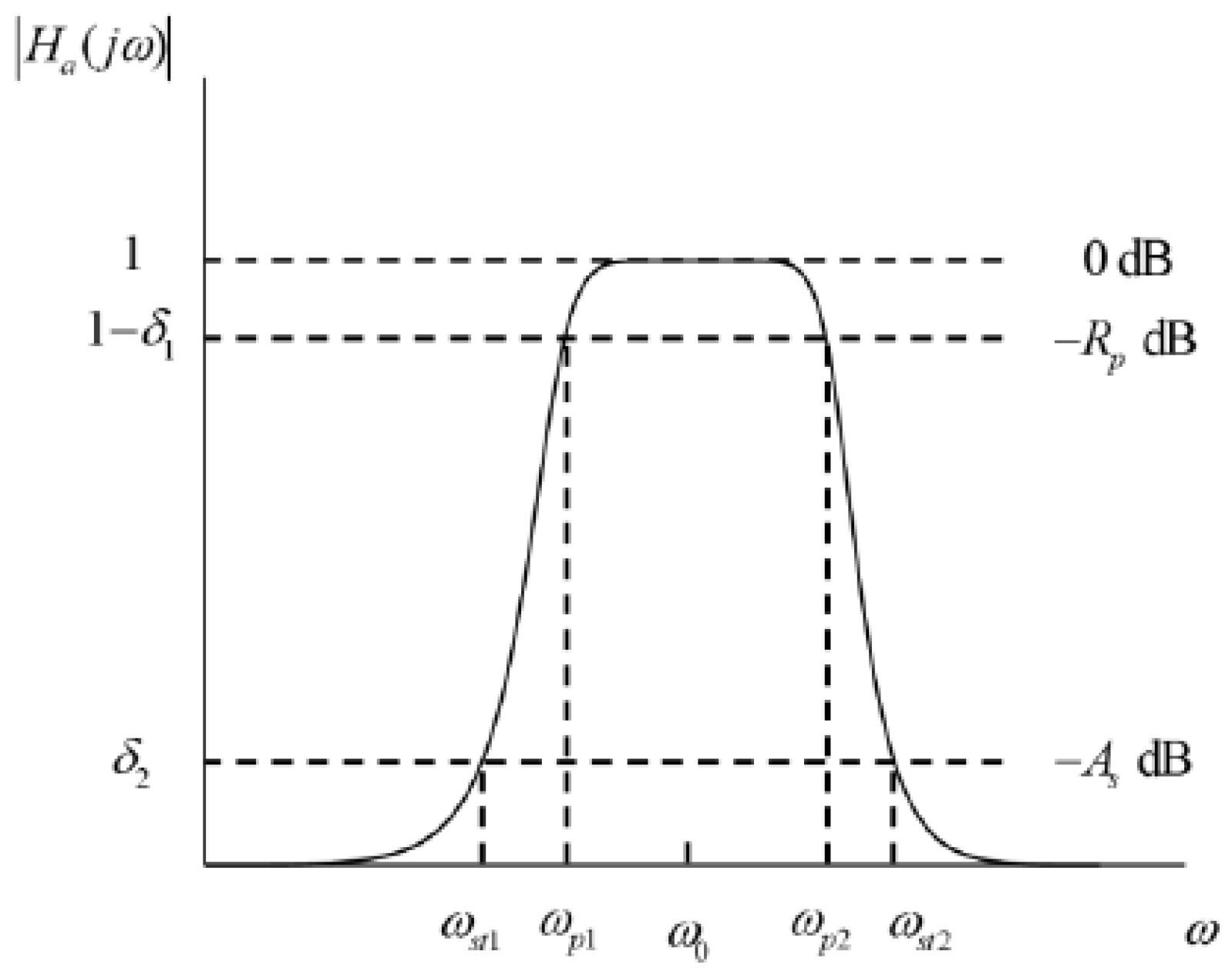
Both the cutting-force and acceleration signals were processed using a fourth-order zero-phase Butterworth band-pass filter to remove extraneous noise. The filter passband was centered at the tooth-passing frequency (ftpf) and constrained within [0.8ftpf, 1.2ftpf], effectively suppressing low-frequency drift and high-frequency interference while preserving the dominant modulation produced by tooth engagement. The characteristic frequency was defined as ftpf = zn/60, where z = 4 denotes the number of flutes and n the spindle speed in revolutions per minute. Signal conditioning and post-processing were performed in MATLAB R2022b using the Signal Processing Toolbox, with a sampling rate of 12.8 kHz providing adequate temporal resolution for detailed dynamic analysis.
H ( j ω ) = 1 1 + ω ω c 2 n ,
To clean the vibration signals before further analysis, a digital Butterworth band-pass filter was implemented in MATLAB R2022b (Signal Processing Toolbox). The design followed a simple two-step procedure. First, representative acceleration time histories and their FFT spectra were inspected, which showed a clear vibration band around the tooth-passing frequency and indicated that very low frequencies were dominated by drift, whereas very high frequencies were dominated by broadband electrical noise. Second, the lower and upper cut-off frequencies of the filter were placed around the edges of this vibration band so that the dominant milling-related content was preserved while low-frequency drift and high-frequency noise were strongly attenuated. With these settings, the filtered signals retain the periodic response required for force and vibration interpretation, and the corresponding amplitude-response characteristics are summarized in Figure 3.
This filtering scheme effectively removed high-frequency disturbances while preserving the dominant tooth-passing-frequency components, thereby ensuring that the processed acceleration signals faithfully represented the dynamic response of the milling system.

2.5. Finite-Element Modeling and Simulation Settings

To maintain full consistency with the experimental conditions, the cutting tool in the finite-element (FE) simulation was modeled as a helical end mill identical in geometry to that used in the milling tests. Only the active cutting portion—the helical flutes located near the lower section of the tool—was included to enhance computational efficiency, since the shank region remained disengaged from the workpiece during cutting. In all FE simulations, the radial width of cut was fixed at ae = 2 mm, representing a light finishing engagement for the thin-wall configuration and allowing us to focus on the influence of axial depth of cut and thermo-mechanical coupling on the local stress and deformation fields rather than on a full parametric variation in ae.
The workpiece, representing a thin-walled, simply supported beam, was modeled with the same geometric configuration as in the experiments. The analysis domain was restricted to the machined thin-beam region to reduce computational cost while preserving the dominant deformation characteristics. Both tool and workpiece geometries were constructed in 3D CAD software and subsequently imported into Abaqus/Explicit 2021, where uniform scaling was applied to improve numerical convergence. The end mill had a diameter of 4 mm, four flutes, and a helix angle of 35°, while the workpiece dimensions were 14 mm × 5 mm × 2 mm.
A thermo-mechanically coupled FE model was then established in Abaqus/Explicit 2021 to simulate the slot milling of AA7075. The workpiece was discretized using eight-node coupled thermomechanical brick elements (C3D8RT), whereas the cutter was meshed with four-node coupled tetrahedral elements (C3D4T). Mesh refinement was concentrated in the cutting and chip-formation zones to accurately capture steep temperature and stress gradients. The Johnson–Cook constitutive law was employed to describe the strain-rate- and temperature-dependent plasticity of the material, and ductile fracture was represented using the corresponding Johnson–Cook shear damage criterion [31].
To verify that the predicted residual-stress field is not unduly influenced by mesh discretization, a mesh-sensitivity check was performed by progressively refining the workpiece mesh in the cutting and near-surface regions. Comparisons between the adopted mesh and a refined mesh with increased element density in these regions revealed only minor differences in the through-thickness residual-stress profiles and in the magnitude of the peak surface tensile stress, whereas a coarser mesh produced visibly larger deviations. On this basis, the chosen mesh was regarded as a suitable compromise between numerical accuracy and computational cost, and the reported finite-element results can be considered effectively mesh independent within the accuracy required for the present study.
With the adopted mesh density and explicit time integration, the computational cost of the thermo-mechanically coupled simulations remains moderate. For each simulated cutting condition, a full milling pass of the thin-wall workpiece could be completed in a reasonable CPU time on a standard multi-core workstation, which makes the model suitable for parametric studies involving a limited number of spindle-speed and feed-per-tooth combinations such as those considered in Section 3.5.
Boundary conditions were assigned to reproduce the experimental clamping configuration on the dynamometer, and the tool path replicated the slotting trajectory along the thin-beam span. A tool–chip heat partition ratio of 0.8 was adopted to match the thermal boundary characteristics observed in the experiments. The overall model configuration, including the tool–workpiece assembly and mesh distribution.
The mechanical behavior of AA7075 was modeled using the classical Johnson–Cook constitutive law, in which the flow stress is expressed as a function of plastic strain, strain rate, and temperature with constant parameters A, B, n, C, and m calibrated for AA7075 (Table 12). In this conventional form, the Johnson–Cook parameters do not explicitly evolve with microstructure and thus represent effective values over the range of strains, strain rates, and temperatures encountered in the present thin-wall milling simulations.
Recent work by Pan et al. on laser-assisted milling of Inconel 718 has demonstrated a microstructure-sensitive extension of the Johnson–Cook model, in which the initial yield-stress parameter is formulated as a function of dynamically evolving grain size and the grain size is predicted from a Johnson–Mehl–Avrami–Kolmogorov (JMAK) recrystallization model [36]. In that framework, the flow stress becomes explicitly sensitive to dynamic recrystallization and microstructural evolution under severe thermal loading. By comparison, the Johnson–Cook parameters listed in Table 12 for AA7075 are microstructure independent and do not include an explicit grain-size dependence; they should therefore be interpreted as effective, averaged properties for the temperature and strain-rate range of the present non-laser-assisted milling conditions. Incorporating a similar microstructure-sensitive formulation for AA7075 would require detailed recrystallization data and calibration of additional material parameters, which is beyond the scope of this study but represents a promising direction for future work.
The tool–workpiece interface was defined through temperature-dependent friction and thermal contact parameters, as summarized in Table 13. These coefficients governed heat generation and interfacial shear transfer during chip separation, ensuring realistic coupling between the thermal and mechanical fields within the simulation. Specifically, a constant Coulomb friction coefficient, a thermal contact conductance, and a tool–chip heat partition ratio were chosen within typical ranges reported for dry machining of aluminium alloys and are summarized in Table 13.
In addition to the thermo-mechanically coupled cutting simulation, a linear elastic version of the same finite-element model was used to perform eigenvalue (modal) and frequency-domain harmonic-response analyses, which were employed to extract the dominant out-of-plane bending modes of the thin wall and their forced response at the tooth-passing frequency for the symmetry-breaking interpretation discussed in Section 4.

3. Results

3.1. Trends of Milling Forces Under Single-Factor Variation

To highlight the evolution of load magnitude with each cutting parameter, Figure 4, Figure 5, Figure 6 and Figure 7 plot the absolute values of the measured force components, |Fx|, |Fy|, and |Fz|, derived from the signed force data reported in Table 8. The sign convention for the raw measurements follows the machine-tool axes, as described in the experimental setup, whereas the trend plots focus on the force magnitudes.
Unless otherwise stated, all experimental results reported in this section correspond to mean values obtained from repeated passes under each cutting condition. The associated sample standard deviations were used as uncertainty measures; they remained consistently much smaller than the differences between parameter levels, so that the qualitative trends and rankings discussed in the following subsections are robust.
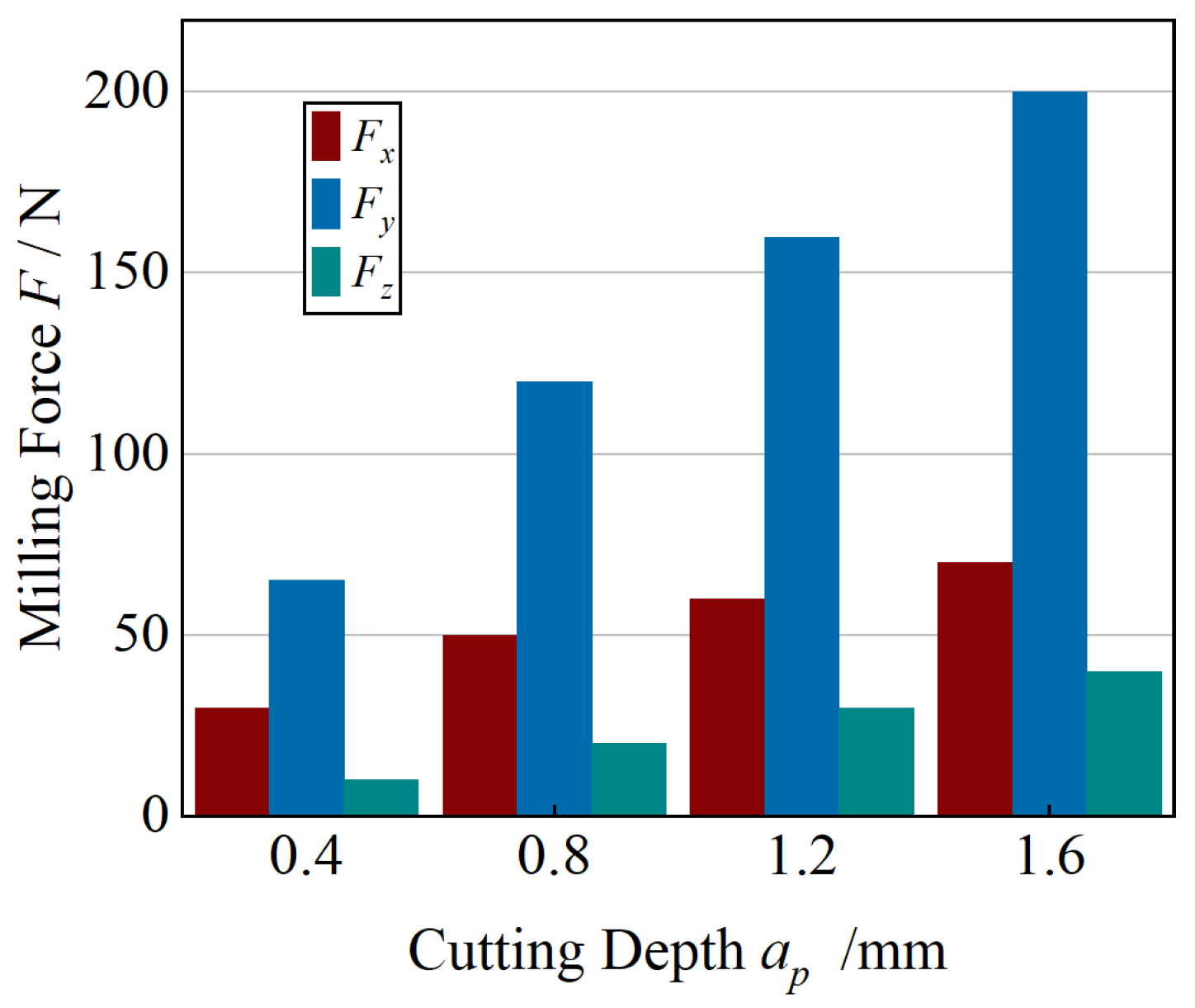
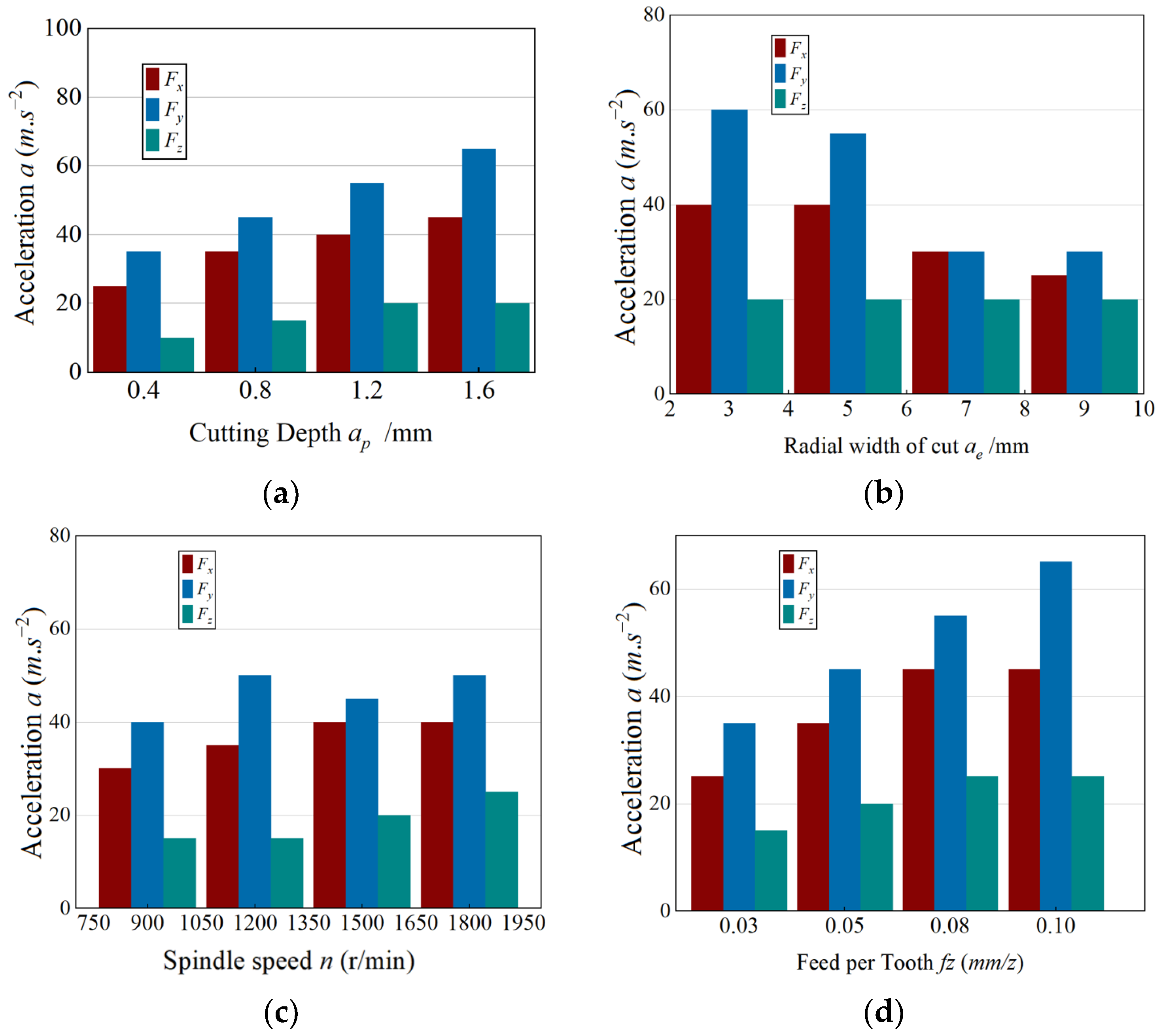
As shown in Figure 4, the influence of axial cutting depth (ap) on the milling forces was evaluated under constant conditions of ae = 5 mm, n = 1500 r·min−1, and fz = 0.05 mm·z−1. The results reveal a consistent increase in all three force components (Fx, Fy, and Fz) as ap rises from 0.4 mm to 1.6 mm. This trend arises because a deeper axial engagement enlarges both the chip cross-sectional area and the tool–workpiece contact region, thereby intensifying material deformation and frictional resistance at the interface. Consequently, the overall cutting load grows proportionally with ap, reflecting the higher mechanical resistance encountered during deeper penetration. Across all axial depth levels in Figure 4, the standard deviations of the repeated force measurements were small compared with the corresponding mean forces, and they did not alter the monotonic increase trend described above.
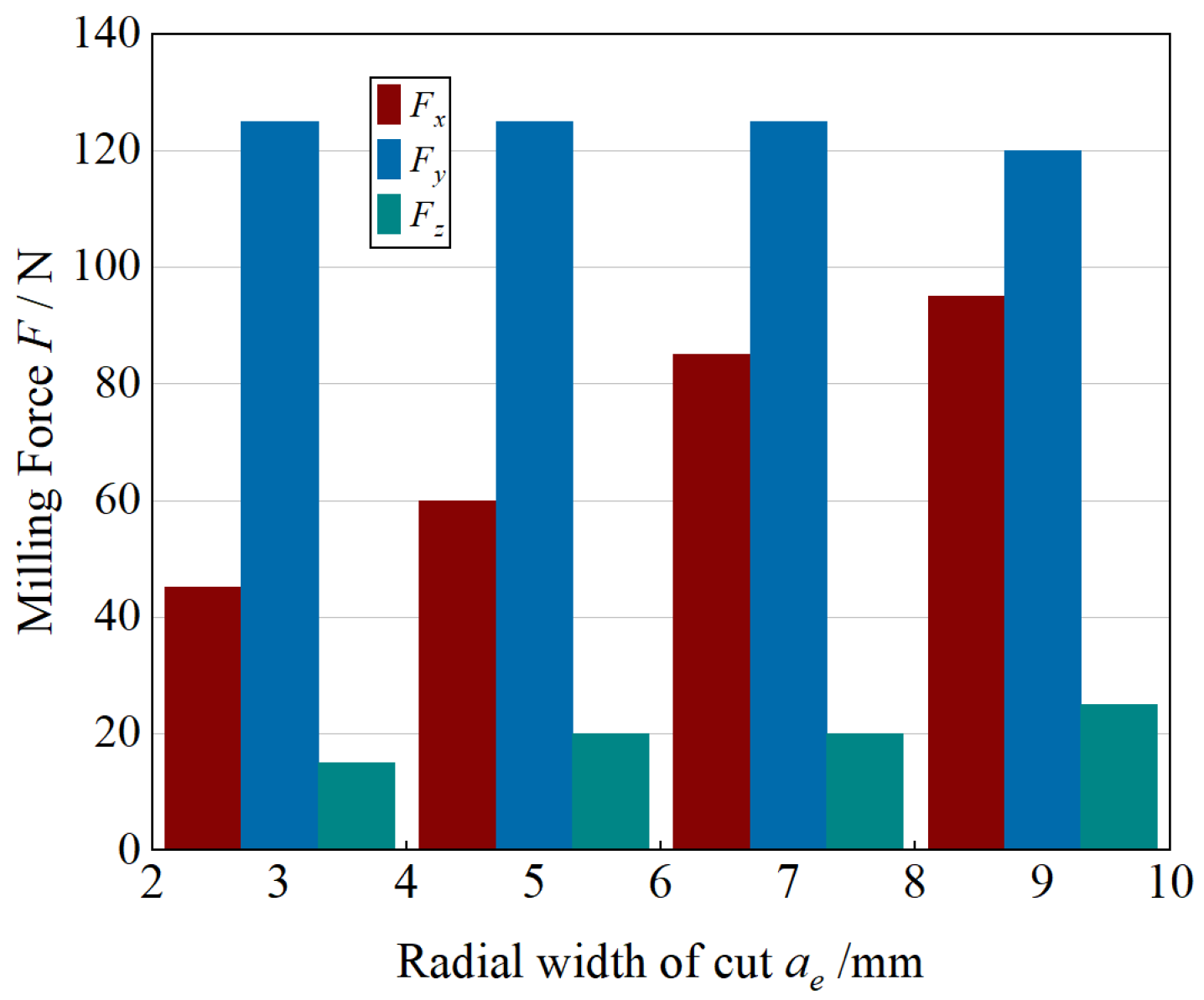
As illustrated in Figure 5, the influence of radial cutting width (ae) on milling forces was investigated under constant conditions of ap = 0.8 mm, n = 1500 r·min−1, and fz = 0.05 mm·z−1. When ae increased from 3 mm to 9 mm, the feed-direction force (Fx) exhibited a pronounced increase, whereas Fy and Fz remained nearly constant. This behavior results from the larger radial engagement, which increases the number of teeth simultaneously participating in the cut, thereby amplifying the total tangential load projected onto the feed direction. Meanwhile, as the effective deformation coefficient decreases slightly with greater engagement width, the frictional resistance on the tool flank is reduced. The combined influence of these two opposing mechanisms produces a significant rise in Fx, while leaving Fy and Fz essentially unchanged.
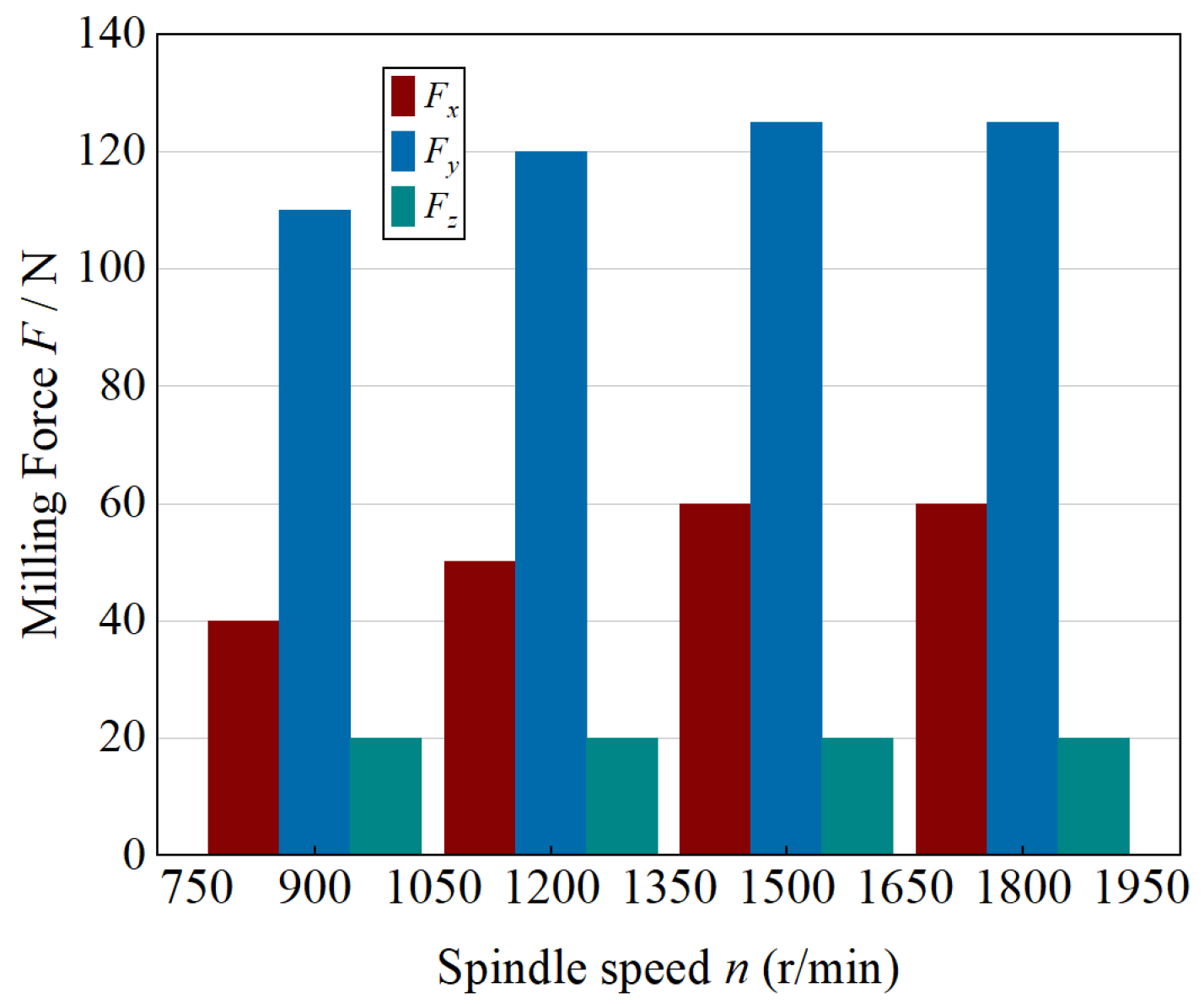
As depicted in Figure 6, the influence of spindle speed (n) on the milling forces was examined under constant parameters of ap = 0.8 mm, ae = 5 mm, and fz = 0.05 mm·z−1. With increasing spindle speed from 900 to 1800 r·min−1, all three force components (Fx, Fy, and Fz) initially increased and subsequently decreased, exhibiting a distinct non-monotonic trend.
At moderate speeds, the absence of coolant leads to a temperature rise at the tool–chip interface, which enhances material softening yet simultaneously increases deformation resistance due to elevated friction, resulting in larger cutting forces. When the spindle speed exceeds approximately 50 m·min−1, the material removal per tooth diminishes and the tool–workpiece contact time per engagement shortens, thereby reducing the overall load. The interplay between these competing thermal and kinematic mechanisms accounts for the observed pattern of an initial rise followed by a decline in cutting forces at higher spindle speeds.
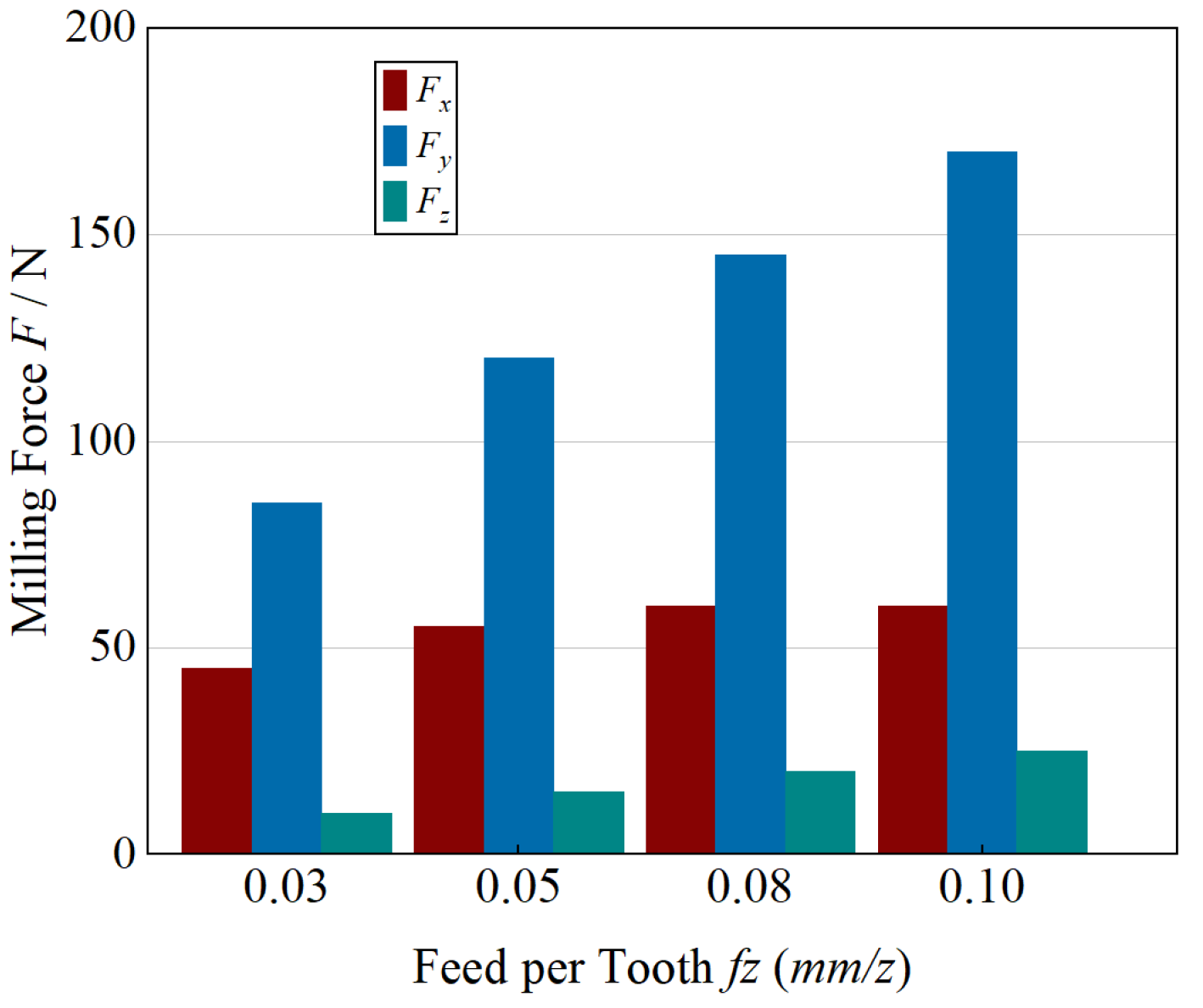
As shown in Figure 7, the influence of feed per tooth (fz) on the cutting forces was examined under constant parameters of ap = 0.8 mm, ae = 5 mm, and n = 1500 r·min−1. When fz increased from 0.025 mm·z−1 to 0.10 mm·z−1, all three force components (Fx, Fy, and Fz) rose sharply, displaying an almost linear correlation with fz.
This behavior is attributed to the proportional increase in undeformed chip thickness, which enlarges both the tool–chip contact area and the frictional load along the interface. Among the three directions, Fy exhibited the most pronounced growth, highlighting the dominance of the tangential cutting component, while Fz remained the smallest due to the limited axial immersion typical of end milling. Overall, the results confirm that higher feed per tooth intensifies chip load and interfacial friction, thereby amplifying the resultant cutting forces in all directions.

3.2. Orthogonal and Variance Analyses of Milling Forces

In the orthogonal design, let Kij represent the cumulative response corresponding to the j-th factor at the i-th level, and kij its mean value. The range is defined as Ri = kimax − kimin, where a larger R indicates a stronger influence of that factor on the evaluated response. This analytical approach enables a quantitative ranking of the relative contributions of individual cutting parameters.
The results of the range analysis for the milling forces are summarized in Table 14. Table 14 lists the factor-level averages k1jk4j and the corresponding ranges Rj for each factor, which are used to rank the influence of the milling parameters on the response. For each factor j, the level average kij is computed as the arithmetic mean of the response over the four orthogonal runs in which factor j is set to level i in the L16(44) design. The calculated level means and corresponding R-values reveal that the axial depth of cut (ap) exerts the most significant effect across all three force components, confirming its dominant role in determining the overall cutting load. Conversely, spindle speed (n) exhibits the weakest influence on Fx and Fz, whereas the radial width of cut (ae) contributes least to variations in Fy. Collectively, these findings establish the following order of sensitivity for the milling forces: ap > fz > ae > n.
Based on the computed range values for each factor, the relative influence of the cutting parameters on the three directional force components (Fx, Fy, and Fz) was evaluated, as summarized in Table 15.
The resulting factor hierarchies confirm that the axial depth of cut (ap) exerts the most significant influence on the overall cutting-force response. Secondary contributions arise from the feed per tooth (fz) and radial width (ae), whereas the spindle speed (n) consistently exhibits the weakest effect. Specifically, the sensitivity orders are identified as ap > ae > fz > n for Fx, ap > fz > n > ae for Fy, and ap > fz > ae > n for Fz. These results collectively reinforce that cutting depth is the dominant parameter governing force magnitude across all directions.
A pooled-error analysis of variance (ANOVA) was conducted to assess the statistical significance of each cutting parameter. For each response variable, the factors were assigned three degrees of freedom (df1 = 3), while the remaining non-significant effects were successively combined into the residual term to yield a stable estimate of the error variance. This resulted in a final pooled error degree of freedom of dfe = 9.
Significance was evaluated at nominal confidence levels α = 0.05 and α = 0.01, with corresponding critical F-values of F0.05(3,9) = 3.94 and F0.01(3,9) = 7.02, respectively. Because the L16(44) orthogonal design provides only one observation per condition and the error term is obtained by pooling the smallest sums of squares, these F-tests should be regarded as approximate: effects with F ≥ F0.01(3,9) are described as statistically significant at the 1% level within the pooled-error ANOVA model, effects with F0.05(3,9) ≤ F < F0.01(3,9) as significant at the 5% level, and effects with F < F0.05(3,9) as not statistically significant. The same evaluation protocol was applied consistently to Fx, Fy, and Fz to ensure uniformity across the directional responses.
As summarized in Table 16, within the pooled-error ANOVA model the axial depth of cut ap exerts the strongest influence on both Fx and Fy, while the radial width of cut ae affects Fx and the feed per tooth fz affects Fy. For Fz, ap again dominates and fz has a moderate effect, whereas n and ae have comparatively small effects that are not statistically distinguishable from the pooled experimental error at the 5% level. These outcomes indicate that, for the tested thin-wall configuration, axial depth of cut is the primary factor governing cutting-force magnitude, but the exact significance levels should be interpreted with caution because they rely on the single-replicate L16(44) design and the pooled-error assumption.
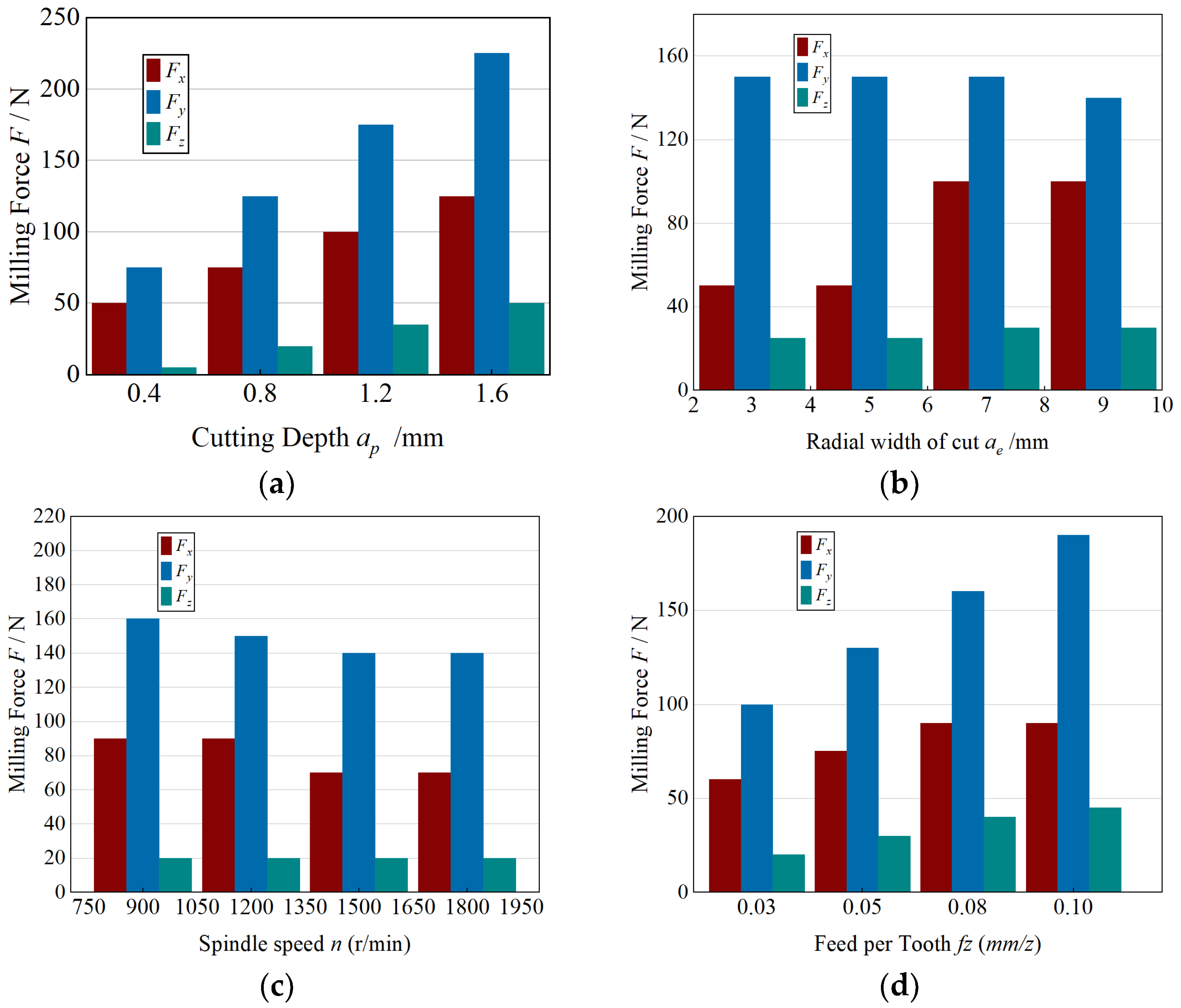
As depicted in Figure 8, the milling forces exhibit distinct and physically consistent main-effect patterns. Increasing the axial depth of cut (ap) leads to a pronounced growth in the overall cutting load due to the enlargement of the material removal cross-section. When the radial width of cut (ae) increases, the feed-direction force (Fx) rises noticeably, while Fy and Fz remain nearly unchanged, indicating that the additional engagement primarily intensifies the tangential loading.
With rising spindle speed (n), all three force components show a slight decrease, attributed to thermal softening of the material and the corresponding reduction in chip thickness per tooth. In contrast, a larger feed per tooth (fz) causes a marked increase in all force components due to the formation of thicker undeformed chips and enhanced ploughing interaction at the tool–workpiece interface. These collective trends align closely with both the single-factor tests and the orthogonal experimental analysis, demonstrating the robustness and internal consistency of the experimental findings.

3.3. Milling Vibration: Single-Factor Trends and Orthogonal Confirmation

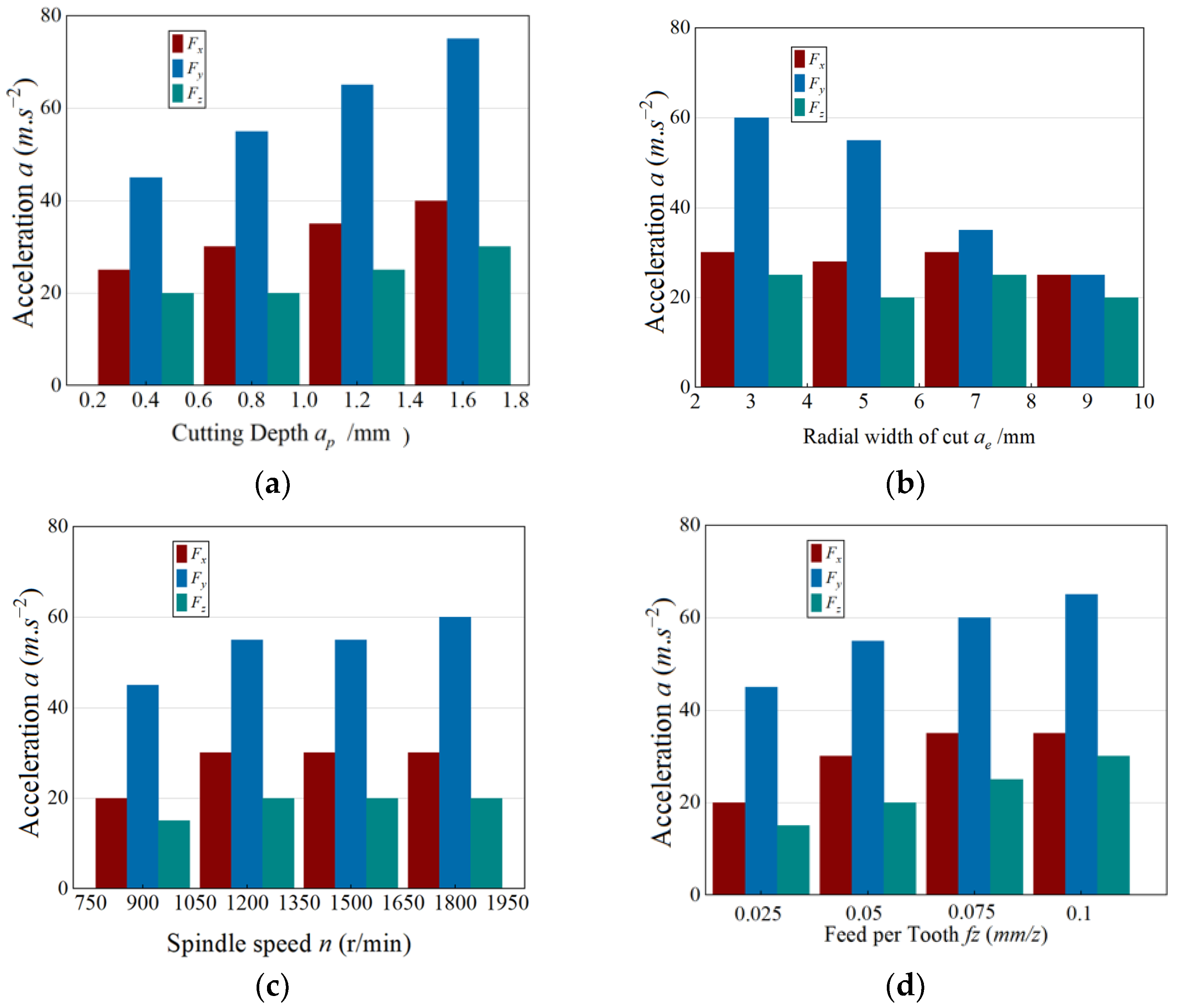
As shown in Figure 9a, the influence of axial depth of cut (ap) on vibration behavior was examined under constant parameters of ae = 5 mm, n = 1500 r·min−1, and fz = 0.05 mm·z−1. The acceleration amplitudes in all three directions (ax, aγ, and az) increased consistently as ap rose from 0.4 mm to 1.6 mm. This response stems from the larger cutting engagement, which enhances plastic deformation, frictional contact, and the dynamic excitation of the thin-walled structure.
Across the other single-factor experiments, similar parameter-dependent patterns were observed. Increasing the radial width of cut (ae) slightly amplified ax while exerting negligible influence on aγ and az. Higher spindle speeds (n) led to reduced vibration amplitudes because of shorter tool–workpiece contact durations and intensified thermal softening. Conversely, increasing the feed per tooth (fz) produced a substantial rise in vibration across all directions, caused by thicker undeformed chips and stronger intermittent impact loading.
Overall, the vibration responses follow trends that closely mirror those of the cutting forces, underscoring the strong dynamic coupling between process parameters and structural behavior in thin-wall milling.
According to the proportional contributions obtained from the range analysis, the relative influence of each milling parameter on the vibration accelerations (ax, aγ, and az) was quantified, as summarized in Table 17. The ranking results reveal that both the feed per tooth (fz) and the axial depth of cut (ap) exert the most pronounced effects on vibration amplitude across all measurement directions, with fz consistently emerging as the dominant factor.
This observation underscores the high dynamic sensitivity of the thin-wall structure to variations in chip thickness and engagement depth, demonstrating that these parameters strongly govern the magnitude and stability of the vibration response. The outcome further confirms the direct linkage between cutting parameters and dynamic behavior in thin-wall milling, providing a quantitative basis for optimizing process conditions to suppress vibration and enhance surface integrity.
An analysis of variance (ANOVA) was conducted to evaluate the statistical significance of the machining parameters on the vibration accelerations (ax, aγ, and az). The analytical procedure followed the same methodology as the cutting-force analysis, ensuring consistency in variance decomposition and confidence-level testing. The results are summarized in Table 18.
For ax, only the feed per tooth (fz) exhibited a statistically significant effect, while axial depth (ap), radial width (ae), and spindle speed (n) showed negligible influence. This indicates that variations in fz primarily control vibration along the feed direction. In the case of aγ, the axial depth, radial width, and feed per tooth were all significant, confirming that both engagement geometry and chip load contribute to vibration in the width direction, whereas spindle speed again proved insignificant. For az, only feed per tooth exerted a strong effect, with other parameters showing minimal impact.
Overall, the results for the thin-walled beam configuration reveal that feed per tooth (fz) and radial width (ae) are the dominant factors influencing vibration across all directions, whereas spindle speed (n) has the weakest contribution. To effectively suppress vibration while maintaining machining efficiency, a smaller feed per tooth and reduced axial depth are recommended, while higher spindle speeds can be employed to compensate for productivity losses.
Considering both vibration suppression and machining efficiency, the optimal parameter combination was determined as A1B3C4D1, corresponding to ap = 0.4 mm, ae = 7 mm, n = 1800 r·min−1, and fz = 0.025 mm·z−1. This configuration minimizes the overall vibration amplitude while ensuring adequate cutting performance for thin-wall AA7075 milling operations.
As shown in Figure 10, the main-effects plots obtained from the orthogonal experiments clearly demonstrate that the feed per tooth (fz) and axial depth of cut (ap) exert a substantially greater influence on vibration behavior than either the spindle speed (n) or the radial width of cut (ae). This pronounced disparity confirms the dominant role of chip load and engagement depth in governing the dynamic response of thin-walled structures, emphasizing that effective vibration control in thin-wall milling primarily depends on the proper selection of these two parameters.

3.4. Surface Topography and Roughness (Thin-Walled vs. Non-Thin-Walled)

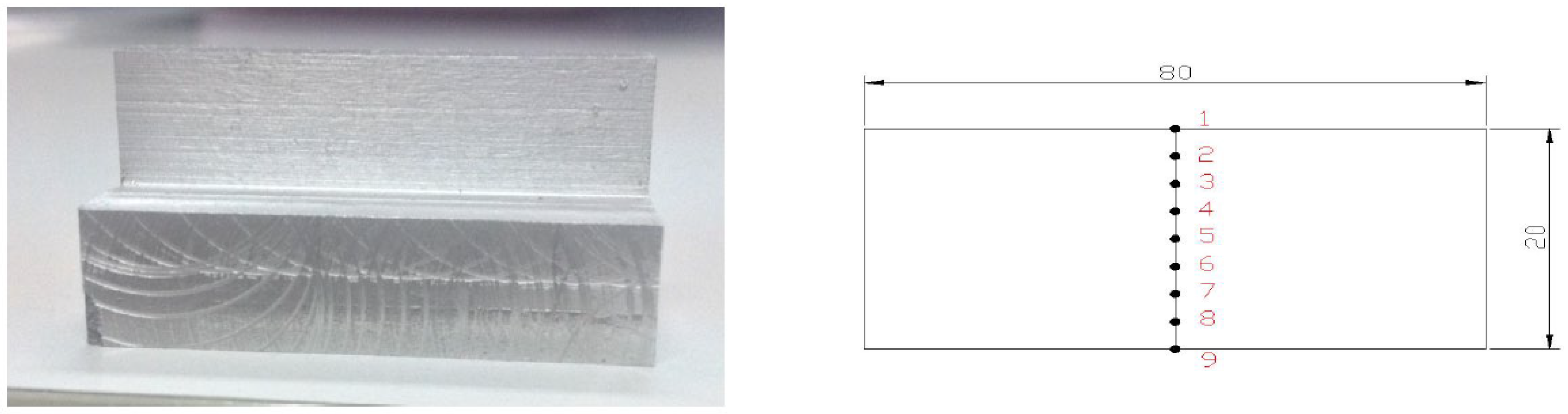
The surface roughness (Ra) was measured at predefined locations on both the thin-walled and reference (non-thin-walled) specimens to ensure consistency in sampling. The selected measurement zones are shown in Figure 11, where identical surface regions were used for all tests to maintain uniform evaluation conditions and enable reliable comparison between the two structural configurations.
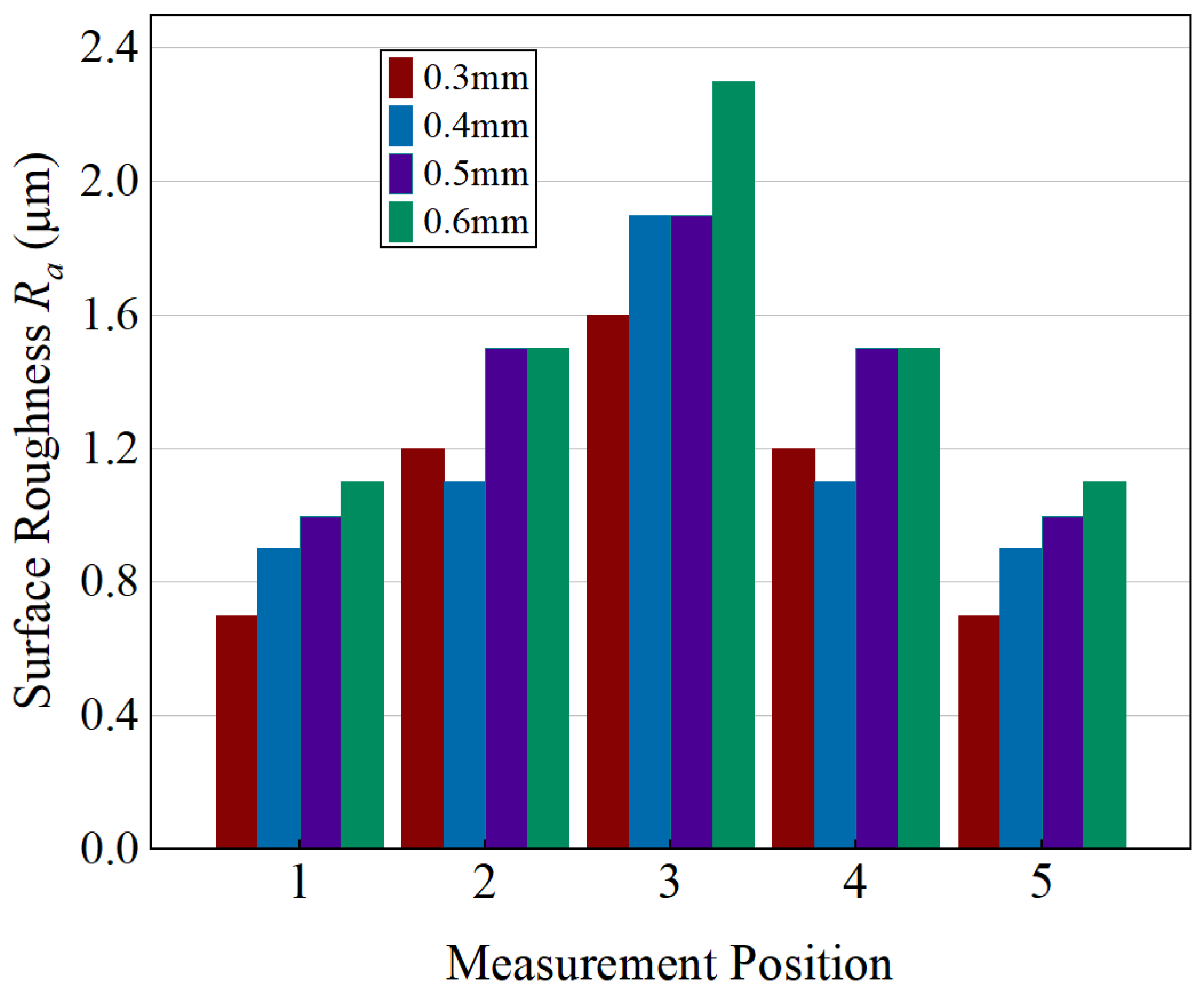
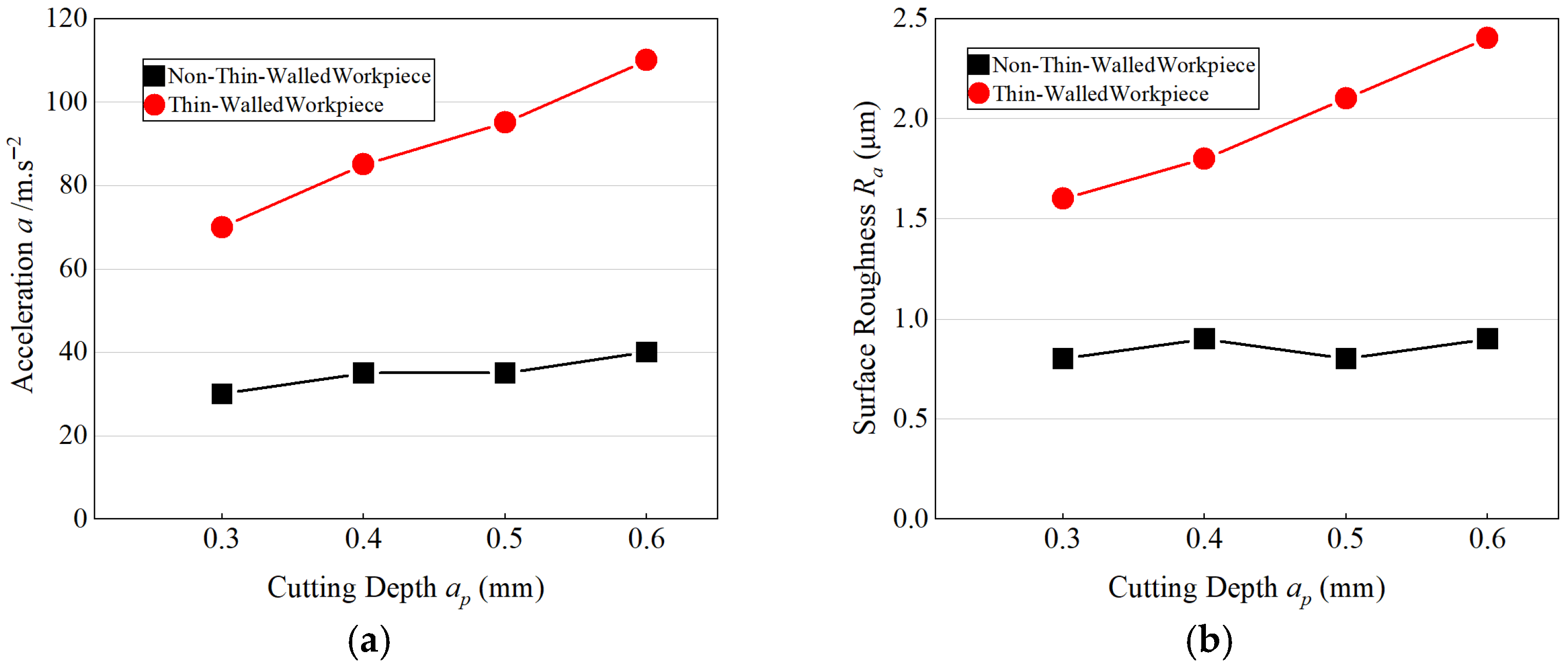
Under constant cutting conditions of ae = 5 mm, n = 1500 r·min−1, and fz = 0.05 mm·z−1, an increase in the axial depth of cut (ap) resulted in a clear rise in the surface roughness (Ra) for both the thin-walled and reference specimens. As shown in Figure 12, the thin-walled workpiece consistently exhibited higher roughness values than the non-thin-walled counterpart, primarily due to its lower structural stiffness and greater susceptibility to vibration-induced deflection during milling. The amplified dynamic compliance of the thin wall magnifies surface waviness and tool-mark irregularity, leading to a more pronounced deterioration in surface finish as ap increases. For all cutting depths examined in Figure 12, the standard deviations of the measured surface roughness were much smaller than the differences between the parameter levels, so that the relative ranking of the roughness values remained unchanged when considering the experimental uncertainty.
Figure 13 illustrates the influence of axial depth of cut on the milling vibration amplitude and the corresponding surface roughness (Ra) of the thin-wall specimen. For the tested configuration, conditions that generate larger vibration amplitudes consistently exhibit higher Ra values, whereas conditions with lower vibration amplitudes lead to smoother surfaces. This trend suggests a monotonic relationship between the dynamic excitation of the wall and the resulting finish. In the present work, Figure 13 is therefore used as a qualitative consistency check linking vibration and surface roughness, rather than as a stand-alone predictive correlation model, because the number of discrete test points is limited and other cutting parameters co-vary across the conditions.

3.5. Residual-Stress Simulation Results

The thermo-mechanically coupled finite-element simulation indicates that the residual stress within the machined layer follows a characteristic depth-dependent pattern. A tensile peak is formed at the immediate surface, which gradually transforms into a compressive stress state with increasing depth and finally attenuates toward a near-zero level in the substrate, in line with residual-stress profiles reported for milled aluminum and nickel-base alloys in the literature [29,30,36]. A tensile peak is formed at the immediate surface, which gradually transforms into a compressive stress state with increasing depth and finally attenuates toward a near-zero level in the substrate. From a through-thickness symmetry standpoint, this profile corresponds to a self-equilibrated tensile–compressive distribution that is nearly symmetric about the depth where the stress crosses zero, while slight deviations from perfect symmetry arise from the one-sided mechanical and thermal loading of the milling process and the asymmetric clamping of the thin wall.
This stress gradient originates from the incompatibility between the intense thermal–plastic deformation induced in the near-surface material during cutting and the elastic constraint imposed by the relatively cooler underlying bulk.
The evolution of this residual-stress field is mainly governed by the competition between thermal loading and mechanical restraining effects. During cutting, severe localized heating and plastic flow generate high tensile stresses at the surface. Upon cooling, the constrained shrinkage of the surface layer leads to the formation of a subsurface compressive zone, resulting in a self-equilibrated stress distribution across the depth.
Parametric analysis further shows that the axial depth of cut (ap) exerts only a limited influence on the residual-stress profile along the depth direction. In contrast, both the spindle speed (n) and the feed per tooth (fn) exhibit pronounced effects. An increase in spindle speed generally suppresses the magnitude of the surface tensile stress, whereas a larger feed per tooth significantly intensifies both the surface tensile peak and the underlying compressive stress.
The weak sensitivity to axial depth of cut can be explained by the enhanced heat dissipation associated with deeper engagement conditions. The enlarged tool–workpiece contact area and more efficient chip removal promote thermal diffusion and reduce local thermal gradients. As a result, the residual-stress field becomes relatively stable with respect to ap, while being predominantly controlled by the coupled thermal–mechanical effects induced by spindle speed and feed per tooth.
These FE-based residual-stress profiles are also consistent with published analytical and experimental studies. Feng et al. [37] developed a dynamic-recrystallization-enhanced analytical and numerical framework for milling of Inconel 718 and reported a tensile surface peak followed by a subsurface compressive valley, with only moderate sensitivity of the depth profile to radial immersion and axial engagement, which closely resembles the depthwise evolution obtained here for thin-wall AA7075. Furthermore, X-ray diffraction measurements and thermo-mechanically coupled FE predictions for milled aluminum and nickel-base alloys [29,30] show comparable surface–subsurface transition depths and compressive peak magnitudes. This agreement in profile shape and qualitative parameter sensitivities indicates that the present FE model captures the dominant thermo-mechanical mechanisms governing residual-stress formation in thin-wall AA7075 slot milling, even though microstructure evolution is represented here by a conventional Johnson–Cook law rather than an explicit recrystallization model.
Although direct residual-stress measurements were not carried out in the present study due to equipment constraints, the depthwise residual-stress profiles predicted by the FE model are consistent with machining-induced residual-stress distributions reported in the literature for aluminium alloys and AA7075 thin sections, which also exhibit a tensile surface peak followed by a subsurface compressive zone that gradually decays toward zero. Moreover, the simulated trends with spindle speed and feed per tooth—namely that higher spindle speed mitigates the surface tensile stress, whereas higher feed per tooth amplifies both the tensile peak and the underlying compressive valley—are in line with the experimentally observed variations in thin-wall deflection and surface roughness under the same cutting conditions. These qualitative agreements provide partial experimental support for the residual-stress predictions and their use in interpreting symmetry-breaking effects.
Because the FE simulations were performed for a single, relatively small radial width of cut ae = 2 mm, the residual-stress distributions reported in this section should be interpreted as representative of a light finishing engagement rather than of the entire experimental range of ae. Larger radial immersions are expected mainly to scale the magnitude of the thermo-mechanical loading, while preserving the tensile–compressive pattern identified here, but a quantitative assessment over the full ae range would require additional simulations.


4. Discussion

4.1. Mechanistic Interpretation

Within the investigated parameter range, the dominant mechanism linking process parameters to surface integrity arises from the interaction between chip-thickness evolution and thin-wall structural compliance. An increase in feed per tooth (fx) enlarges the instantaneous uncut chip thickness, intensifying the ploughing effect at small effective rake angles and leading to higher cutting forces. The compliant wall transforms these periodic loads into amplified vibrations, which deteriorate surface finish and increase roughness. From a modal point of view, the thin wall behaves primarily as a simply supported bending plate: the first global out-of-plane bending mode is nearly symmetric with respect to the mid-span, whereas the neighboring higher modes exhibit weakly anti-symmetric deflection patterns because of the non-uniform fixture and clamping. As the axial depth of cut and feed per tooth increase, the tooth-passing frequency moves into the vicinity of this cluster of low-order modes, and the harmonic response becomes a mixed contribution of the symmetric and anti-symmetric modes. The resulting vibration field is therefore no longer mirror-symmetric along the wall span but biased toward one side, which provides a modal interpretation of the symmetry-breaking mechanism observed in the experiments. In terms of symmetry, the tooth-passing excitation exhibits a clear discrete rotational symmetry in time, the thin-wall behaves as an almost symmetric beam–plate structure, and the observed deterioration of surface finish and residual stress at aggressive cutting conditions can be interpreted as the system being driven from a near-symmetric dynamic regime into a symmetry-breaking regime in which one vibration direction and one side of the wall dominate the response.
Similarly, increasing the axial depth of cut (ap) extends the engagement length and raises both mean and fluctuating forces by engaging multiple teeth simultaneously. The intensified load amplifies wall deflection and regenerative chatter. In contrast, the effects of spindle speed (n) and radial width (ae) are moderate within the tested domain, although the latter exerts stronger influence in the transverse (y) direction due to varying tool–workpiece overlap. These patterns are consistent with the range and ANOVA analyses, confirming fx as the dominant driver of vibration across all directions, while n and ae contribute least.

4.2. Parameter Windows and Trade-Offs

Achieving stable cutting and high-quality surfaces demands a careful balance between productivity and dynamic stability. Suppressing vibration requires minimizing fx and maintaining moderate ap, while spindle speed can be increased within the stable region to preserve efficiency. Based on orthogonal experiments, the optimal compromise between stability and throughput is achieved at ap = 0.4 mm, ae = 7 mm, n = 1800 r·min−1, and fx = 0.025 mm·z−1.
Beyond this window, excessive ap or fx leads to nonlinear growth of vibration and roughness. A practical optimization sequence is therefore: (1) select minimal fx consistent with productivity; (2) keep ap within finishing limits; (3) choose n near the upper stability bound; and (4) adjust ae conservatively to control transverse vibration. This approach aligns with symmetry-based optimization strategies, where stable, repeatable process states emerge from balanced mechanical–thermal interactions.

4.3. Thin-Wall Versus Non–Thin-Wall Behavior

When machined under identical parameters, the thin-wall specimen displays a distinct mid-span maximum in both vibration and surface roughness, corresponding to the region of lowest stiffness and highest dynamic compliance. Surface roughness (Ra) peaks at this location and declines toward the supports, while increasing ap raises the entire roughness profile.
Comparative analysis shows that thin-wall structures are significantly more sensitive to parameter changes than rigid samples. The stiffer reference exhibits lower vibration and smoother surfaces, confirming that structural compliance magnifies both mechanical and dynamic influences on surface generation. This asymmetry between flexible and rigid geometries illustrates the necessity of geometry-aware parameter selection in precision manufacturing.

4.4. Limitations and External Validity

The conclusions are bounded by the tested parameter space and simplified geometry. The examined spindle-speed range (900–1800 r·min−1) excludes high-speed stability lobes, and the experimental configuration—combining a table-mounted dynamometer with workpiece-mounted accelerometers—introduces setup-dependent coupling effects. Furthermore, the cutting-force coefficients were identified using a first-order (linear) model in feed per tooth; while the linear regression showed R2 > 0.90 in the investigated finishing range, potential nonlinearities at substantially higher feed-per-tooth values (e.g., fz ≈ 0.20–0.25 mm/z) cannot be ruled out and would require additional experiments or re-identification if such conditions are of interest. Similarly, the apparent correlation between vibration amplitude and surface roughness (Ra) shown in Figure 13 is interpreted qualitatively in this study; establishing a quantitative regression or cross-correlation model between acceleration amplitude and (Ra) would require a dedicated experimental design with more test points and independently varied cutting parameters, which is left for future work.
In simulations, the Johnson–Cook constitutive and shear-failure models were adopted with fixed friction and heat-partition coefficients. Although these assumptions affect absolute stress levels, the depthwise tensile–compressive transition pattern remains robust. Finite-element analysis focused on x–y stress components, as the z-direction contribution was negligible. Direct, pointwise validation of the simulated residual-stress field by X-ray diffraction or hole-drilling measurements was not available in the present work; instead, the plausibility of the predictions was assessed qualitatively through comparison with published machining-induced residual-stress profiles for AA7075 and through the experimentally observed trends in wall distortion and surface roughness discussed in Section 3.5. A dedicated experimental campaign with spatially resolved residual-stress measurements on thin-wall geometries would further strengthen the quantitative validation of the model. Moreover, the thermo-mechanically coupled FE simulations were carried out for a single radial width of cut ae = 2 mm, which reduces the computational cost but also limits the quantitative applicability of the simulated residual-stress field and symmetry-breaking mechanism to cutting conditions with similar engagement; extending the analysis to the full experimental range of ae (3–9 mm) would require a dedicated parametric FE study and is left for future work.
Because each L16(44) orthogonal condition was tested once, the ANOVA relied on a pooled-error approach in which the smallest factor sums of squares were combined to estimate the experimental variance; as a result, the reported significance levels and factor rankings depend on this modelling assumption and should be viewed as approximate. Surface roughness and residual stress may vary spatially; thus, the current evaluation emphasizes representative regions. Future efforts should incorporate replication, full-field mapping, and high-speed validation to strengthen model fidelity and statistical confidence.
Compared with recent end-to-end frameworks that combine cutting-force modelling, vibration monitoring, surface-integrity assessment, and residual-stress prediction for milling [13,23], the present workflow is distinguished by three aspects. First, the force-coefficient identification is carried out directly on the compliant thin wall rather than on a rigid reference block, and the repeatability of the identified coefficients is quantified by computing mean values and sample standard deviations over repeated passes at each cutting condition. Second, the coupling strategy is explicitly symmetry-aware: the identified forces are related to multi-point vibration and surface-finish measurements along the wall span and interpreted in connection with the dominant bending modes of the wall. Third, the validation metrics span several levels, including the relative deviations between predicted and measured milling forces (Table 10), the qualitative agreement between the simulated and published residual-stress profiles for AA7075, and the consistency between the simulated residual-stress trends and the measured wall deflection and roughness variations. These elements position the present workflow as a thin-wall-specific complement to existing end-to-end approaches.
Despite the generally good agreement between the mechanistic milling-force predictions and the measurements, the force-coefficient identification performed on the thin-wall specimen is subject to several limitations. First, the identification procedure assumes that the local uncut chip thickness is prescribed by the programmed toolpath and does not account for the feedback of wall deflection on chip thickness during the cut. Under pronounced compliance, part of this coupled tool–workpiece motion is effectively folded into the identified coefficients, which reduces their physical transparency. Second, because the thin wall exhibits non-uniform stiffness along its span due to the clamping and boundary conditions, the identified coefficients represent an average response of a specific geometry–fixture combination rather than purely material-dependent cutting constants. Third, to avoid chatter and loss of contact, the identification tests are restricted to a relatively stable parameter window, so that the resulting coefficients should not be extrapolated to substantially different wall thicknesses, boundary conditions, or parameter ranges close to instability. These limitations imply that, while the present coefficients are suitable for symmetry-aware analysis and process optimization for the studied thin-wall configuration, more general applications would require either identification on stiffer reference specimens or joint identification of cutting coefficients and structural dynamics.

5. Conclusions

This study proposes a symmetry-aware simulation and experimental framework for thin-wall AA7075 end milling by combining a mechanistic milling-force model, finite-element modal and harmonic-response analysis, systematic cutting tests, and thermo-mechanical residual-stress simulation. The approach links nominally symmetric tooth-order excitation to asymmetric vibration, deformation, surface roughness, and depth-wise residual stress in a unified way. The main conclusions are as follows:
(1)
The mechanistic milling-force model, which explicitly considers the symmetry of tooth engagement and the effects of chip thickness and effective rake angle, predicts the three-component forces with good agreement to experiments across the tested parameter range. The dominant influence of feed per tooth and axial depth of cut on force amplitude reflects the fact that these parameters directly break the ideal symmetry of chip load distribution among teeth, whereas spindle speed and radial width mainly rescale the overall excitation level.
(2)
Finite-element modal and harmonic-response analyses of the thin-wall specimen show that tooth-order excitation primarily couples with a few low-order out-of-plane bending modes of the wall. The lowest bending mode exhibits an almost symmetric deflection pattern with respect to the mid-span, whereas the next higher modes show slight anti-symmetric components and local curvature changes near the clamped regions. When the tooth-passing frequency lies between these neighboring modes, the forced response at that frequency can be interpreted as a linear combination of a symmetric and an anti-symmetric mode shape. This modal superposition gives rise to asymmetric vibration envelopes and mid-span amplification, so that one side of the wall vibrates more strongly than the other. In this sense, symmetry breaking is not caused by a change in the nominal loading pattern, which remains tooth-order symmetric, but by a parameter-dependent change in the relative participation of the underlying modes as the excitation frequency is shifted by variations in axial depth of cut and feed per tooth. This symmetry-breaking dynamic response explains why thin walls are significantly more sensitive to small parameter changes than non-thin-wall references, and why local peaks in vibration correlate with deteriorated surface roughness and geometric error.
(3)
Orthogonal and single-factor milling experiments on AA7075 thin-wall components confirm that both feed per tooth and axial depth of cut are the key drivers of vibration, surface roughness, and dimensional deviation. Within the investigated domain, low feed per tooth and moderate axial depth maintain a quasi-symmetric, repeatable process state with smaller vibration and better surface finish, while larger values induce strong asymmetry between different wall regions. The optimized parameter combinations obtained from the experiments and range/ANOVA analyses thus correspond to process windows in which the dynamic response remains near-symmetric and stable.
(4)
The thermo-mechanically coupled finite-element simulation reveals a characteristic residual-stress profile in which tensile stresses appear at the machined surface and gradually transition to compressive stresses beneath, eventually decaying toward the neutral bulk. Although the thermal–mechanical loading is approximately symmetric along the tool path, the interaction between localized plastic deformation and the constraining substrate causes a depth-wise symmetry breaking of the stress state. Spindle speed tends to reduce surface tension by shortening the thermal exposure, whereas feed per tooth amplifies both the tensile peak and the compressive valley, indicating that process parameters can be used to tune the degree of mechanical–thermal asymmetry.
In practical terms, the results suggest that thin-wall AA7075 end milling should employ relatively small feed per tooth and carefully selected axial depths of cut, combined with moderately high spindle speeds and conservative radial engagement, to preserve symmetric, stable cutting conditions while controlling residual stress and deformation. Future work will extend the present symmetry-aware framework to more complex thin-wall geometries and higher-speed regimes, and will incorporate multi-objective optimization to jointly manage symmetric excitation, symmetry-breaking responses, and long-term dimensional stability.

Author Contributions

Conceptualization, D.S. and S.S.A.S.; Methodology, D.S.; Experimental investigation and data acquisition, D.S.; Simulation modeling and formal analysis, D.S.; Supervision, S.S.A.S.; Validation and review, S.S.A.S.; Writing—original draft preparation, D.S.; Writing—review and editing, S.S.A.S. All authors have read and agreed to the published version of the manuscript.

Funding

This work was supported by the Scientific and Technological Research Program of Chongqing Municipal Education Commission (Grant No. KJQN202303241) and the research funding by the National Natural Science Foundation of China (Grant number W2533130).

Data Availability Statement

The original contributions presented in this study are included in the article. Further inquiries can be directed to the corresponding author.

Acknowledgments

The authors gratefully acknowledge the institutional support provided by the School of Mechanical and Electrical Engineering, Quanzhou University of Information Engineering, and the School of Mechanical Engineering, Chongqing Industry Polytechnic University.

Conflicts of Interest

The authors declare no conflicts of interest.

References

  1. Pimenov, D.Y.; Kiran, M.; Khanna, N.; Pintaude, G.; Vasco, M.C.; da Silva, L.R.R.; Giasin, K. Review of improvement of machinability and surface integrity in machining on aluminum alloys. Int. J. Adv. Manuf. Technol. 2023, 129, 4743–4779. [Google Scholar] [CrossRef]
  2. Jeleńkowski, J.; Karpowicz, M.; Mońka, G.; Tacikowski, J. Influence of shot peening on the properties of aluminium alloy 7075 AW T6511 and magnesium alloy AZ31B-F. Inżynieria Powierzchni 2015, 3, 22–27. [Google Scholar]
  3. Bochnia, J.; Kozior, T.; Hajnys, J. 3D Printing of Thin-Walled Models-State-of-Art. Mechanics 2024, 66, 34–39. [Google Scholar] [CrossRef]
  4. Weber, D.; Kirsch, B.; Chighizola, C.R.; D’Elia, C.R.; Linke, B.S.; Hill, M.R.; Aurich, J.C. Analysis of machining-induced residual stresses of milled aluminum workpieces, their repeatability, and their resulting distortion. Int. J. Adv. Manuf. Technol. 2021, 115, 1089–1110. [Google Scholar] [CrossRef]
  5. Tehranizadeh, F.; Berenji, K.R.; Yıldız, S.; Budak, E. Chatter stability of thin-walled part machining using special end mills. CIRP Ann. 2022, 71, 365–368. [Google Scholar] [CrossRef]
  6. Bolar, G.; Joshi, S.N.; Das, S. Sustainable thin-wall machining: Holistic analysis considering the energy efficiency, productivity, and product quality. Int. J. Interact. Des. Manuf. 2023, 17, 145–166, Correction in Int. J. Interact. Des. Manuf. 2023, 17, 167–168. [Google Scholar]
  7. Radu, P.; Schnakovszky, C. A review of proposed models for cutting force prediction in milling parts with low rigidity. Machines 2024, 12, 140. [Google Scholar] [CrossRef]
  8. Rubeo, M.A.; Schmitz, T.L. Milling force modeling: A comparison of two approaches. Procedia Manuf. 2016, 5, 90–105. [Google Scholar] [CrossRef]
  9. Altintas, Y.; Ber, A. Manufacturing automation: Metal cutting mechanics, machine tool vibrations, and CNC design. Appl. Mech. Rev. 2001, 54, B84. [Google Scholar] [CrossRef]
  10. Hrițuc, A.; Mihalache, A.M.; Dodun, O.; Slătineanu, L.; Nagîț, G. Evaluation of Thin Wall Milling Ability Using Disc Cutters. Micromachines 2023, 14, 341. [Google Scholar] [CrossRef]
  11. Ozsoy, M.; Sims, N.D.; Ozturk, E. Actuator saturation during active vibration control of milling. Mech. Syst. Signal Process. 2025, 224, 111942. [Google Scholar] [CrossRef]
  12. Masoudi, S.; Amini, S.; Saeidi, E.; Eslami-Chalander, H. Effect of machining-induced residual stress on the distortion of thin-walled parts. Int. J. Adv. Manuf. Technol. 2015, 76, 597–608. [Google Scholar] [CrossRef]
  13. Gonzalo, O.; Beristain, J.; Jauregi, H.; Sanz, C. A method for the identification of the specific force coefficients for mechanistic milling simulation. Int. J. Mach. Tools Manuf. 2010, 50, 765–774. [Google Scholar] [CrossRef]
  14. Sahoo, P.; Patra, K. Mechanistic modeling of cutting forces in micro-end-milling considering tool run out, minimum chip thickness and tooth overlapping effects. Mach. Sci. Technol. 2019, 23, 407–430. [Google Scholar] [CrossRef]
  15. Oliaei, S.N.B.; Karpat, Y. Influence of tool wear on machining forces and tool deflections during micro milling. Int. J. Adv. Manuf. Technol. 2016, 84, 1963–1980. [Google Scholar] [CrossRef]
  16. Gopal, M. Prediction of surface roughness in turning of duplex stainless steel (DSS) using response surface methodology (RSM) and artificial neural network (ANN). Mater. Today Proc. 2021, 47, 6704–6711. [Google Scholar] [CrossRef]
  17. Soo, S.; Aspinwall, D. Developments in modelling of metal cutting processes. Proc. Inst. Mech. Eng. Part L J. Mater. Des. Appl. 2007, 221, 197–211. [Google Scholar] [CrossRef]
  18. Altintaş, Y.; Budak, E. Analytical prediction of stability lobes in milling. CIRP Ann. 1995, 44, 357–362. [Google Scholar] [CrossRef]
  19. Altintaş, Y.; Lee, P. A general mechanics and dynamics model for helical end mills. CIRP Ann. 1996, 45, 59–64. [Google Scholar] [CrossRef]
  20. Shi, H. A summary of the theory on machine tool chatter. In Metal Cutting Theory: New Perspectives and New Approaches; Springer: Berlin/Heidelberg, Germany, 2018; pp. 231–267. [Google Scholar]
  21. Phadke, M.S. Quality Engineering Using Robust Design; Prentice Hall PTR: Englewood Cliffs, NJ, USA, 1995. [Google Scholar]
  22. Jeyakumar, S.; Marimuthu, K.; Ramachandran, T. Prediction of cutting force, tool wear and surface roughness of Al6061/SiC composite for end milling operations using RSM. J. Mech. Sci. Technol. 2013, 27, 2813–2822. [Google Scholar] [CrossRef]
  23. Madariaga, A.; Cuesta, M.; Ortiz-De-Zarate, G.; Saenz-De-Argandona, E.; Soriano, D.; Prime, M.B.; Arrazola, P.J. Correcting distortions of thin-walled machined parts by machine hammer peening. Chin. J. Aeronaut. 2024, 37, 439–453. [Google Scholar] [CrossRef]
  24. Perez, I.; Madariaga, A.; Cuesta, M.; Garay, A.; Arrazola, P.; Ruiz, J.; Rubio, F.; Sanchez, R. Effect of cutting speed on the surface integrity of face milled 7050-T7451 aluminium workpieces. Procedia CIRP 2018, 71, 460–465. [Google Scholar] [CrossRef]
  25. Rahimi, M.H.; Huynh, H.N.; Altintas, Y. On-line chatter detection in milling with hybrid machine learning and physics-based model. CIRP J. Manuf. Sci. Technol. 2021, 35, 25–40. [Google Scholar] [CrossRef]
  26. Chung, K.; Geddam, A. A multi-sensor approach to the monitoring of end milling operations. J. Mater. Process. Technol. 2003, 139, 15–20. [Google Scholar] [CrossRef]
  27. Lauro, C.; Brandao, L.C.; Baldo, D.; Reis, R.; Davim, J. Monitoring and processing signal applied in machining processes—A review. Measurement 2014, 58, 73–86. [Google Scholar] [CrossRef]
  28. Rajain, K.; Sliusarenko, O.; Bizzarri, M.; Bartoň, M. Curve-guided 5-axis CNC flank milling of free-form surfaces using custom-shaped tools. Comput. Aided Geom. Des. 2022, 94, 102082. [Google Scholar] [CrossRef]
  29. Durmuş, H. Optimization of multi-process parameters according to the surface quality criteria in the end milling of the AA6013 aluminum alloy. Mater. Technol. 2012, 46, 383–388. [Google Scholar]
  30. Soori, M.; Arezoo, B. A review in machining-induced residual stress. J. New Technol. Mater. 2022, 12, 64–83. [Google Scholar]
  31. Johnson, G.R. A constitutive model and data for metals subjected to large strains, high strain rates and high temperatures. In Proceedings of the 7th International Symposium on Ballistics, The Hague, The Netherlands, 19–21 April 1983. [Google Scholar]
  32. Mareau, C. A thermodynamically consistent formulation of the Johnson–Cook model. Mech. Mater. 2020, 143, 103340. [Google Scholar] [CrossRef]
  33. Fergani, O.; Lazoglu, I.; Mkaddem, A.; El Mansori, M.; Liang, S.Y. Analytical modeling of residual stress and the induced deflection of a milled thin plate. Int. J. Adv. Manuf. Technol. 2014, 75, 455–463. [Google Scholar] [CrossRef]
  34. Thomas, K.K.; Kannan, S.; Pervaiz, S.; Nazzal, M.; Karthikeyan, R. Computational analysis of machining induced stress distribution during dry and cryogenic orthogonal cutting of 7075 aluminium closed cell syntactic foams. Micromachines 2023, 14, 174. [Google Scholar] [CrossRef] [PubMed]
  35. Davis, J.R. Aluminum and Aluminum Alloys; ASM International: Materials Park, OH, USA, 1993. [Google Scholar]
  36. Pan, Z.; Feng, Y.; Lu, Y.-T.; Lin, Y.-F.; Hung, T.-P.; Hsu, F.-C.; Liang, S.Y. Force modeling of Inconel 718 laser-assisted end milling under recrystallization effects. Int. J. Adv. Manuf. Technol. 2017, 92, 2965–2974. [Google Scholar] [CrossRef]
  37. Feng, Y.; Pan, Z.; Lu, X.; Liang, S.Y. Analytical and numerical predictions of machining-induced residual stress in milling of Inconel 718 considering dynamic recrystallization. In Proceedings of the International Manufacturing Science and Engineering Conference, College Station, TX, USA, 18–22 June 2018; p. V004T003A023. [Google Scholar]
Figure 1. Milling-tool schematic.
Symmetry 18 00074 g001
Figure 2. Milling Test Site.
Symmetry 18 00074 g002
Figure 3. Amplitude Response Characteristics of Butterworth Band-pass Filter.
Symmetry 18 00074 g003
Figure 4. Influence of Cutting Depth on Milling Force.
Symmetry 18 00074 g004
Figure 5. Influence of Cutting Width on Milling Force.
Symmetry 18 00074 g005
Figure 6. Influence of Spindle Speed on Milling Force.
Symmetry 18 00074 g006
Figure 7. Influence of Feed Per Tooth on Milling Force.
Symmetry 18 00074 g007
Figure 8. Intuitive Analysis of the Influence of Various Factors on Milling Force. (a) Influence of axial depth of cut, (b) Influence of radial width of cut, (c) Influence of spindle speed, (d) Influence of feed per tooth.
Symmetry 18 00074 g008
Figure 9. Influence of Single Factor Milling Parameters on Milling Vibration. (a) Axial depth of cut, (b) Radial width of cut, (c) Spindle speed, (d) Feed per tooth.
Symmetry 18 00074 g009
Figure 10. Intuitive main-effect plots of factors on vibration. (a) Influence of axial depth of cut, (b) Influence of radial width of cut, (c) Influence of spindle speed, (d) Influence of feed per tooth.
Symmetry 18 00074 g010
Figure 11. Division of Different Measurement Areas on Thin-wall Part Surface.
Symmetry 18 00074 g011
Figure 12. Surface Roughness at Different Cutting Depth.
Symmetry 18 00074 g012
Figure 13. Influence of Cutting Depth on Milling Vibration and Surface Roughness. (a) Milling Vibration, (b) Surface Roughness.
Symmetry 18 00074 g013
Table 1. Main Parameters of Milling Machine.
ItemValue
ModelJ1VMC40MB
Spindle power/kW9
Max spindle speed/r·min−12000
Table size/mm900 × 400
Travel (x × y × z)/mm680 × 380 × 490
CNC systemSiemens 840D
Table 2. Milling Cutter Parameters.
MaterialFlutesDiameterHelix SenseHelix Angle
Cemented carbide410 mmRight-hand35°
Table 3. Chemical composition of AA7075 (wt.%) [35].
SiFeCuMnMgCrZnTiAl
0.40.51.2–2.00.32.1–2.90.18–0.285.1–6.10.2balance
Table 4. Thermophysical/mechanical properties of AA7075 [35].
Tensile Strength (MPa)Yield Strength (MPa)Specific Heat (J·kg−1·°C−1)CTE (°C−1)Thermal
Conductivity (W·m−1·°C−1)
Young’s
Modulus (GPa)
Hardness (HB)Density (kg·m−3)
52446296023.6 × 10−617371.71502810
Table 5. Main Parameters of Kistler 9257B Dynamometer.
AxisRange/kNSensitivity (Calibrated)/pC·N−1Natural Frequency/kHz
x−5~5−7.9402.3
y−5~5−7.9422.3
z−5~5−3.7143.5
Table 6. Main Parameters of Kistler 5070A Charge Amplifier.
Technical ParameterValue
Number of channels4
Measurement range/pC±200~20,000
Frequency range/kHz0~45
Output voltage range/V±10
Noise/mV<10
Table 7. Identification test parameters for milling-force coefficients.
Milling ModeSpindle Speed n (r/min)Axial Depth ap (mm)Radial Width ae (mm)Feed per Tooth fz (mm/z)
Climb milling7000.3100.025, 0.05, 0.075, 0.10, 0.125, 0.15, 0.20, 0.25
Table 8. Average milling-force measurement results in the steady-state cutting interval.
fz/mm·z F x ¯ /N F y ¯ /N F z ¯ /N
0.025−13.12−16.956.07
0.050−19.99−28.108.46
0.075−25.76−35.6013.29
0.100−29.08−50.0515.19
0.125−34.62−56.1316.97
0.150−36.52−67.0920.78
0.200−41.32−83.8528.07
0.250−45.14−103.2335.09
Table 9. Identified cutting/edge-force coefficients.
Shear Coefficients/N·mm−2ValueEdge Coefficients/N·mm−1Value
Krc434.67Kre39.21
Ktc−1258.94Kte−27.63
Kac308.26Kae4.87
Table 10. Calculation Data and Measured Data of Milling Force Model.
Predicted Fx/NPredicted Fy/NPredicted Fz/NMeasured Fx/NMeasured Fy/NMeasured Fz/N
0.025−22.45−26.086.20−24.35−28.597.02
0.050−25.60−35.459.38−27.79−38.6710.16
0.075−28.66−43.1815.01−31.40−46.9716.21
0.100−35.16−53.1116.71−38.43−56.8818.25
0.125−36.58−64.4819.10−39.30−68.5320.71
0.150−39.11−71.6923.38−41.71−75.9825.21
0.200−48.02−91.5229.39−50.79−94.0531.78
0.250−50.98−106.4636.84−53.23−106.1739.68
Table 11. Parameters of Acceleration Sensor.
ChannelModelSensitivity/(mV·g)RangeMeasurement Bandwidth (Hz)
xDYTRAN 3097A2100.45±500.3–5000
yDYTRAN 3097A2100.58±500.3–5000
zDYTRAN 3097A2100.99±500.3–5000
Table 12. Johnson–Cook material parameters for AA7075 used in the present finite-element model.
ParameterValue
A/MPa583
B/MPa349
n0.72
C0.015
m1.68
Table 13. Friction and thermal contact parameters adopted at the tool–workpiece interface in the finite-element simulation.
ParameterValue
Coulomb coefficient ( μ )0.30
Thermal contact conductance/W·m−2·K−115,000
Tool–chip heat partition ratio0.80
Table 14. Range analysis of milling force.
Fx/N (ap)Fx/N (ae)Fx/N (n)Fx/N (fz)Fy/N (ap)Fy/N (ae)Fy/N (n)Fy/N (fz)Fz/N (ap)Fz/N (ae)Fz/N (n)Fz/N (fz)
k1j40.3254.7787.7965.3865.10137.94160.39102.447.1420.6525.8814.73
k2j66.6656.9987.6474.81117.69151.93150.45122.7113.2820.8626.2719.00
k3j92.3196.2973.4286.74170.85154.48140.81167.8827.1928.4020.6628.41
k4j125.66110.7972.1092.12229.45133.07133.05178.5445.9924.6420.3731.63
Ri85.3356.0215.6926.74164.3521.4027.3476.1138.857.755.9016.90
Table 15. Sequence of Factors Affecting Milling Force.
Milling Force DirectionSequence of Influencing Factors
Fxap > ae > fz > n
Fyap > fz > n > ae
Fzap > fz > ae > n
Table 16. ANOVA of Milling Forces.
Analysis Target Source of Variance Sum of Squares Degrees of Freedom Mean Square F Value Fα Significance Level
Fx115,242.7835080.9310.79F0.05(3,9) = 3.94
F0.01(3,9) = 7.02
Highly significant
29217.9533072.646.52Significant
3990.033330.010.70Not significant
41760.283586.761.25Not significant
Error e*4238.199470.91
Total28,698.9315
Fy155,594.39318,531.4633.69F0.05(3,9) = 3.94
F0.01(3,9) = 7.02
Highly significant
2971.933323.980.59Not significant
31119.743373.250.68Not significant
414,168.6134722.878.59Highly significant
Error e*4951.179550.13
Total74,714.1615
Fz3952.0031317.3422.843.94F0.05(3,9) = 3.94
F0.01(3,9) = 7.02
Highly significant
137.37345.790.793.94Not significant
132.50344.170.753.94Not significant
793.363264.454.583.94Significant
519.22957.69
5264.5815
Note: e* denotes the pooled error term in the pooled-error ANOVA. It was obtained by merging the sums of squares and degrees of freedom of non-significant factors into the residual error to provide a more stable estimate of the error variance and improve the reliability of the F-test under the single-replicate L16 orthogonal design.
Table 17. Factor order affecting vibration.
DirectionOrder of Factor Influence
axfz> ap > ae > n
ayfz> ae > ap > n
azfz> ap > n > ae
Table 18. Variance Analysis of Milling Vibration.
TargetSourceSum of SquaresdfMean SquareF ValueFaSignificance Level
axFactor 1670.533223.518.91F0.05(3,3) = 9.28
F0.01(3,3) = 29.46
Not significant
Factor 2388.023129.345.16Not significant
Factor 3153.86351.282.04Not significant
Factor 41281.573427.1917.03Significant
Error e75.263
Error e*75.26325.08
Total2569.2615
ayFactor 11775.153591.7215.72F0.05(3,3) = 9.28
F0.01(3,3) = 29.46
Significant
Factor 22791.033930.3424.72Significant
Factor 3370.743123.593.28Not significant
Factor 43275.6531091.8829.01Significant
Error e112.903
Error e*112.90337.63
Total8325.4715
azFactor 1236.76378.923.01F0.05(3,6) = 4.76
F0.01(3,6) = 9.78
Not significant
Factor 231.44310.480.40Not significant
Factor 3136.84345.611.74Not significant
Factor 4378.423126.145.90Significant
Error e68.003
Error e*236.28926.26
Total851.4515
Note: e* denotes the pooled error term obtained in the pooled-error ANOVA. Specifically, the sums of squares and degrees of freedom of non-significant factors were combined with the original error term to form e*, providing a more reliable estimate of the experimental error variance and improving the robustness of the F-test under the single-replicate orthogonal experimental design.
Disclaimer/Publisher’s Note: The statements, opinions and data contained in all publications are solely those of the individual author(s) and contributor(s) and not of MDPI and/or the editor(s). MDPI and/or the editor(s) disclaim responsibility for any injury to people or property resulting from any ideas, methods, instructions or products referred to in the content.