1. Introduction
In the last few decades, the world’s population has been increasing exponentially. This demographic growth brings specific problems. One is providing food and water for all residents; the other is that, as the number of inhabitants increases, municipal waste rises proportionally. It is projected that by 2050, two-thirds of the population will live in urban areas and that waste problems will become increasingly severe [
1]. To address this growing problem, it is necessary to develop a municipal waste management system to reduce environmental impact and protect resources for future generations [
2]. Przydatek et al. [
3] further highlight this problem, noting that 2 billion tons of municipal waste are generated annually, of which at least 33% is disposed of in an environmentally unsafe manner. This fact further emphasizes the importance of municipal waste management [
4]. This problem can be addressed through reuse and recycling by applying the principles of the circular economy (CE) [
5]. However, to apply these CE principles in practice, it is necessary to influence the population by implementing strategic management to reduce municipal waste generation [
6]. Improving waste management efficiency can be achieved in various ways, including waste sorting [
7].
The key challenge in implementing CE principles in households is raising awareness of the importance of proper waste disposal and selection. To achieve this, it is necessary to promote lifelong learning for the population and to support media coverage of CE principles [
8]. However, applying CE principles in general requires providing the necessary equipment and implementing appropriate strategies. Research by Wang et al. [
9] showed that the implementation of CE practices depends on three factors: subjective norms within the household, perceived behavioral control, and behavioral intentions. Among these three factors, household-level subjective norms have the greatest influence on the implementation of these practices, and systematic action is required to change them. To achieve this, various strategies are needed to effect behavioral change, including promotional policies, campaigns, socialization, and community-based educational activities [
10].
In addition to education, the application of technological solutions also contributes to solving the problem of municipal waste in strategic management. As technological solutions develop, the problem of municipal waste is being addressed more quickly [
11]. Therefore, it is necessary to use modern technological solutions alongside education and media promotion. In this way, various sensors can support waste sorting, and advanced artificial intelligence (AI)-based systems can also be used [
12]. These advanced systems motivate the population to participate more effectively in waste sorting, thereby enabling the implementation of CE practices.
In addition to technological solutions, waste reduction is influenced by legal regulations [
13] that set household obligations and impose sanctions for noncompliance. For this reason, strategic municipal waste management must be applied in different ways to ensure synergistic effects from the various measures implemented to reduce waste. Reducing household waste also reduces environmental impacts, protects natural resources, and strengthens environmental behavior among the population.
Efficient and effective municipal waste management is a challenge for countries in transition, such as Bosnia and Herzegovina (BiH) [
14]. This country has a particularly inefficient waste management system, with landfills failing to meet environmental standards and many illegal landfills endangering the country’s natural resources. To partially address this problem, strategic management is needed to reduce the municipal waste generated by citizens. To evaluate these strategies, the Brčko District of BiH will be used as an example. The specificity of this local government is its special administrative status within BiH. Given its status, this local community is a good sample.
However, these studies will not determine which strategy should be applied; instead, they will identify which of the observed strategies gives the best results, as judged by the population’s opinion. This is because solving a problem requires a systematic approach and multiple measures. Only in this way will a synergistic effect be achieved, where applying two or more strategies produces better results than applying any single strategy alone. These strategies should complement one another and help address municipal household waste.
1.1. Research Motivation
There are several motivations for conducting this research. First, municipal waste is increasing, posing a major environmental problem. Reducing household waste or increasing its recycling would reduce the negative environmental impact. Second, implementing strategic management aligned with CE principles affects household waste generation. By implementing these strategies, waste is reduced, and the percentage of waste sorted for further use or recycling increases. Third, the Brčko District, as a local administrative unit, lacks a municipal waste landfill. This local community planned to build a waste management center. However, construction of the waste management center has not yet begun and will take several years. The temporary solution used by the Brčko District is to transport municipal waste to other regional landfills in other parts of BiH. This increases logistical costs because the collected waste must be transported to a designated location. This increases transportation costs, primarily due to fuel consumption, municipal machinery use, and personnel. Therefore, reducing household waste is necessary to reduce logistics costs. Reducing waste in this local community would also lower the logistical costs of waste management. All of the above motivations, along with many others not listed, demonstrate the importance of conducting this research.
1.2. Research Goals
When implementing this research, it is necessary to define the goals it will achieve. When setting goals, start with the primary goal, which is further broken down into the specific goals of this research. The main goal of this research is to evaluate municipal waste management strategies to determine which would have the greatest practical impact, using the Brčko District of BiH as a case study. To achieve this, it is necessary to determine how strategies will be evaluated. During the evaluation, the opinions of the population will be used to determine which strategy would give the best results in practice. On this occasion, the population will provide ratings on a linguistic scale, which will be used to determine the importance of the criteria and identify which strategies would give the best results. To achieve this, a fuzzy approach based on linguistic ratings will be used. Based on all this, specific research goals are set, which will be addressed through questions to which this research should provide an answer:
How can the membership function be defined symmetrically so that there is no difference in specific ratings?
Which of the criteria used is the most important for ranking strategies?
Which of the strategies gives the best results according to the population of the Brčko District of BiH??
Do the rankings of the strategies differ based on the demographic characteristics of the population?
1.3. Research Contributions
Given the specificity of the research subject, this research makes several contributions. First, this research focuses on a strategic approach to reducing waste that ends up in landfills and thus endangers the environment. It is necessary to reduce waste and reuse or recycle it. In this way, the environment would be protected in accordance with the 3R principles (reduce, reuse, and recycle). Second, these strategies are not yet in practice in the Brčko District of BiH, and this research examines their potential effects on municipal waste reduction in this area. Determining the effects would not result in only one of the strategies being used; it is necessary to use more of them for the effects to be as good as possible in practice. This research provides only an assessment of the importance of these strategies, based on which a particular strategy can be given greater focus. Third, by using symmetric membership functions to determine rating importance, a symmetric fuzzy number will be defined for each rating, and the relationships among them will also be symmetric. In this way, no particular rating will be given greater weight, and all ratings will be equal when calculating the final result. Fourth, given the research design and sample size, a comparative analysis of the results will be conducted to determine whether respondents’ demographic characteristics affect the ranking of strategies. In this way, it will be determined whether certain demographic groups have different attitudes and opinions from others. By comparing these groups, it will be possible to determine which municipal waste management strategy a particular demographic group prefers and whether there are differences in their opinions. Fifth, the contribution of this research is the integration of the SiWeC method with various MCDM methods using symmetric fuzzy numbers. Its application enables the systematic management of household municipal waste, as demonstrated by local community examples.
3. Methodology and Research Implementation
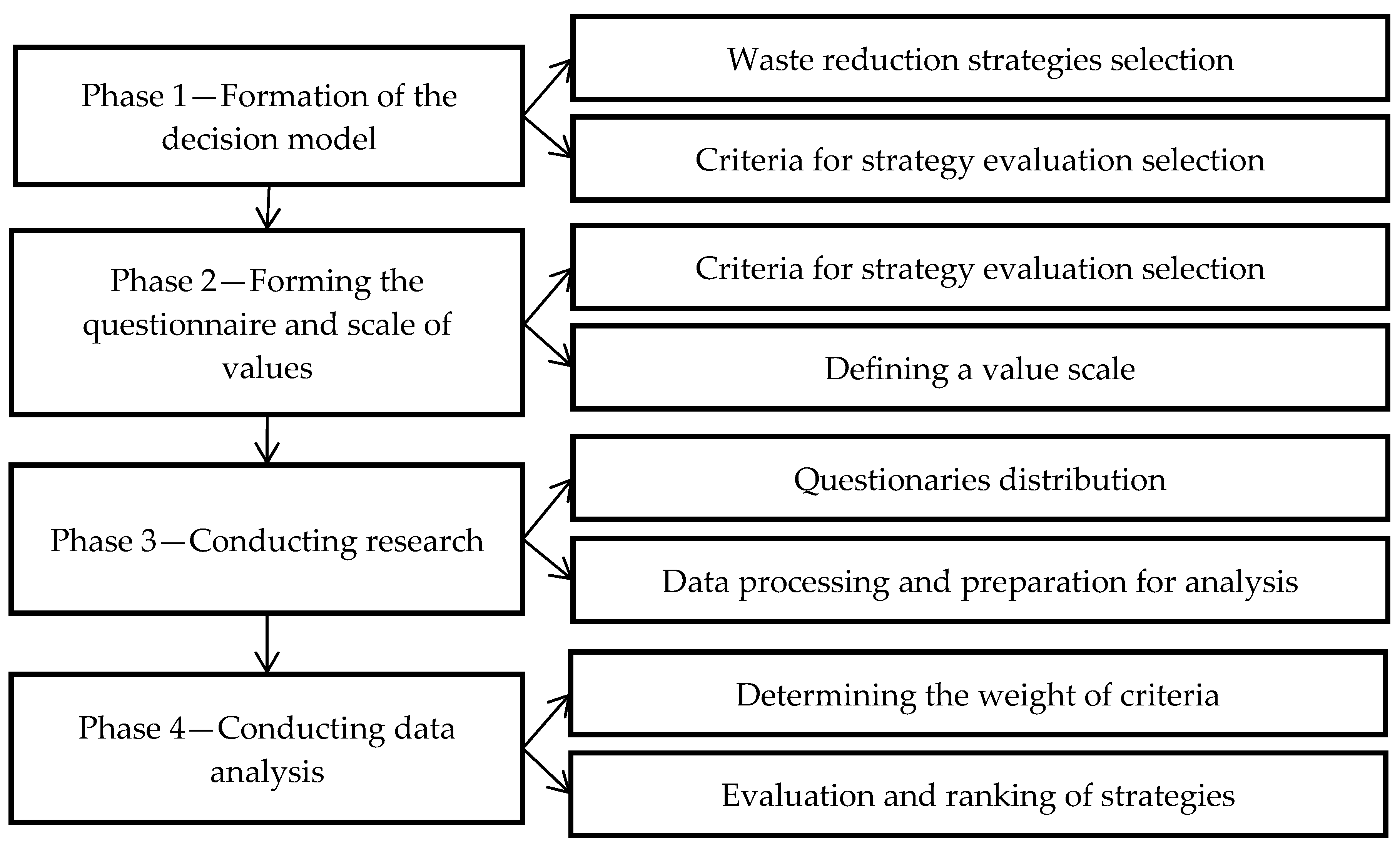
The research will be conducted through four interconnected phases. Each phase is described in detail to support this research. All phases are shown in
Figure 1. The following text will explain these research phases.
3.1. Formation of the Research Model
The research model evaluates strategies to reduce household municipal waste and provides criteria for assessing these strategies. To determine the research model, the strategies to be used will be defined first. When selecting strategies, it was assumed that they could be implemented by utility companies in BiH, with particular emphasis on their application in the Brčko District. In addition, the practical application of these strategies was considered, using examples from developed countries. Further selection of these strategies is based on local planning strategies and their practical implementation in the Brčko District of BiH. Special emphasis was placed on the fact that these strategies do not require substantial initial investment and can be implemented with existing institutional and infrastructural capacities. Defining strategies in this way makes them feasible in practice within this local community. In this research, six strategies were adopted to reduce municipal waste generated by the population:
Strategy 1 (Separate collection and recycling) provides separate containers for waste separation (plastic, glass, etc.) so waste can be disposed of free of charge, and recycling is simplified.
Strategy 2 (Pay as you throw). Under this strategy, garbage collection is charged based on the amount of waste generated by the household and sent to landfills.
Strategy 3 (Packaging return machines) involves installing machines for the return of plastic bottles, cans, and PET packaging for a fee.
Strategy 4 (Waste separation for composting) supports the composting of bio-waste by installing composting containers that will be available to citizens.
Strategy 5 (Reuse and exchange) establishes a center for the exchange of things, where clothes, toys, household appliances, furniture, and other waste that can be reused could be delivered and could be taken for free or for a small fee.
Strategy 6 (Reducing single-use packaging) enables the distribution of multiple packaging and provides incentives for the use of multiple packaging to reduce packaging waste.
These strategies are common in developed countries and are used in practice. However, developing countries have not yet reached a level of ecological development that allows for their implementation. It should be noted that these strategies are also used in some areas within these countries, but such cases are isolated. In practice, the goal should be to increase the number of such cases to effectively manage household-generated municipal waste in developing nations. To evaluate and rank these strategies, ten criteria were used (
Table 2). Questions were also developed to assess the impacts of each strategy and to enable household evaluation. Using these criteria, the effectiveness of the selected strategies will be determined.
3.2. Questionnaires and Scale of Values Formation
In accordance with the research model, a questionnaire is also developed for this study. The questionnaire is organized into three categories. The first group of questions collects demographic data on respondents’ gender, educational level, household size, and age. The second group of questions assesses the importance of the research criteria. In this set of questions, respondents are asked to rate the importance of each criterion in evaluating strategies. The third group of questions assesses the efficiency of municipal waste management strategies. In this set of questions, respondents rate the extent to which each strategy meets the research criteria. If a strategy meets the criteria to a higher extent, the score will be higher; if it meets the criteria to a lesser extent, the score will be lower. Before the survey was conducted, the questionnaire was pretested with a small sample to assess whether the criteria and proposed strategies were clear to respondents. Based on feedback, minor linguistic corrections were made to simplify the questionnaire, increasing the number of respondents. In this way, the risk of misinterpretation of the questions was reduced, and the reliability of the responses was increased. In addition, collecting data using a questionnaire structured in this way allows the respondents to use linguistic value scales when assessing the criteria and strategies. These value scales allow for more flexible assessment compared to classic numerical ratings and are more suitable when qualitative criteria are used.
After the questionnaire is developed, it is necessary to determine which rating scales will be used to assess the importance of the criteria and to evaluate the strategies. To determine the importance of the criteria, a scale from very unimportant to very important will be used (
Table 3). A total of seven linguistic values will be used to assess these criteria. When determining if strategies meet the set goals, the value scale ranges from very bad to very good (
Table 3). This value harmony is defined through seven linguistic values.
To use these linguistic scales to determine the weight of the criteria and the rank order of the strategies, it is necessary to define the membership function. Since a fuzzy approach will be used in this research, the membership function is defined so that all values increase symmetrically by one. In addition, the first fuzzy number is smaller than the second by one, while the third fuzzy number is larger than the second by one. The fuzzy numbers themselves are symmetrically larger or smaller than the previous relation to the following number. In this way, the membership function of a fuzzy number is symmetrically formed.
3.3. Conducting the Research
The research for this paper was conducted in the Brčko District of BiH. When selecting respondents, it was assumed that only one household member would complete the questionnaire to maximize the number of households reached. A total of 202 residents of the Brčko District of BiH completed the survey questionnaire. Because this research aimed to obtain preliminary household opinions, the number of households covered was sufficient. The demographic characteristics of the respondents are presented in
Table 4.
Based on the respondents’ demographic characteristics, it can be concluded that women were overrepresented and that the largest group was those with higher or university degrees. The most included respondents have 3 or 4 household members, and the most represented age group is 31–50 years. Although the demographic characteristics of the respondents showed a higher representation of female respondents, it should be noted that the role of the female population is greater in household and waste management tasks. Accordingly, the aggregate results from these surveys will reflect actual decision-making regarding municipal waste management.
3.4. Conducting Multi-Criteria Analysis
After respondents provide their data, it is processed and prepared for analysis. In this study, the SiWeC method will be used to determine the importance of the criteria. At the same time, the ranking of the selected strategies will be performed using a combination of three methods: TOPSIS, ARAS, and SAW. These methods were selected based on the following:
- -
These three methods are among the basic MCMD methods and serve as the foundation for developing new MCDM methods and approaches.
- -
They are commonly used in practice, and their results are generally consistent with those of other MCDM approaches.
- -
They use different normalization techniques, so applying these three methods eliminates the influence of normalization in decision-making.
- -
Implementing these methods allows for a comparative analysis of the results, leading to more reliable decisions.
The SiWeC method was used in this study for several reasons. First, because the criteria’s importance is calculated by weighting, this method, unlike others, applies normalization as the first step, reducing all collected data to uniform values [
42]. This method also emphasizes the importance of expert ratings, as it is preferable for ratings to be more diverse than uniform, since specific criteria were given priority [
43]. Finally, this method can easily include a large number of experts, which is important for this study.
Three ranking strategies were selected to eliminate the influence of normalization on the final ranking. When using MCDM methods for ranking alternatives, normalization can significantly affect results by narrowing or expanding the data, thereby giving greater weight to the highest values. In addition, the TOPSIS method is the most widely used in MCDM analysis and therefore plays a significant role in these analyses [
44]. The SAW method is the simplest MCDM method for ranking alternatives, relying solely on data weighting and normalization. In addition, this method provides rankings similar to those of more complex methods, which gives it some importance, especially when conducting comparative analyses of results across different MCDM methods. The ARAS method, unlike the SAW method, requires an additional step [
45], but it remains straightforward to use. All three methods use different normalizations, so the impact of normalization on strategy ranking will be examined.
The fuzzy SiWeC method was initially implemented by the author [
46]. Compared to traditional methods for determining criterion weights, such as AHP or BMW, the fuzzy SiWeC method allows for the direct incorporation of respondents’ uncertainty and subjectivity through symmetric fuzzy sets. This reduces pressure on respondents when rating the importance of criteria, as they do not have to compare criteria or determine rankings; instead, they directly assess the importance of each criterion, resulting in a more realistic representation of human decision-making in complex situations. The steps of this method are as follows:
Step 1. Evaluation of the importance of the criteria using the values from
Table 3Step 2. Formation of fuzzy matrices, where individual linguistic values are transformed into fuzzy numbers. In this research, triangular fuzzy numbers () will be applied.
Step 3. Normalization of the fuzzy matrix
where
is the maximum value of the fuzzy number for all values of the fuzzy decision matrix.
Step 4. Determining the importance of expert ratings. This determination is made using the standard deviation. The standard deviation in this method emphasizes the importance of the assessment and the criteria. A larger standard deviation indicates greater variation in the evaluations, while a smaller value indicates greater consensus in the ratings. In this way, it allows for a more objective determination of the weights. Its application also gives preference to examiners with greater dispersion in their answers, thereby serving as a measure of dispersion.
Step 5. Weighting. In this step, the normalized values are multiplied by the standard deviation.
Step 6. Forming the aggregate value of the weights.
Step 7. Determination of criteria weights.
The steps for implementing the TOPSIS method were originally defined by Hwang & Yoon [
47], and later, a fuzzy set approach was developed. The TOPSIS method is based on the concept of distance from ideal and anti-ideal solutions. The optimal alternative is the one closest to the optimal solution and farthest from the anti-ideal solution. Applying the fuzzy TOPSIS method in this research enables the processing of imprecise information represented by linguistic values. This is especially important when subjective judgment is incorporated into the final decision. Due to these specificities and the TOPSIS method’s logic, it is often used as a reference method in MCDM research. The steps of this approach are as follows:
Step 1. Evaluation of alternatives and formation of a decision matrix using linguistic values.
Step 2. Transformation of the decision matrix into fuzzy numbers.
Step 4. Weighting process.
Step 5. Ideal and anti-ideal alternatives calculation.
Step 6. Calculation of deviations from ideal and anti-ideal alternatives.
Step 7. Relative closeness and ranking.
The ARAS method was developed by Zavadskas and Turskis [
48], and later, a fuzzy set-based approach was developed. This method compares each alternative with a reference alternative, which is also the optimal alternative. Each alternative is compared with this, and the closeness of each to it is determined. The closer the alternative is to the optimal one, the better it meets the ranking objectives. The advantage of this method is its simplicity, transparency, and use of percentage normalization. This allows for a direct comparison of each alternative with the optimal one. The steps of this method are as follows:
Step 1. Evaluation of alternatives and formation of a decision matrix using linguistic values.
Step 2. Transformation of the decision matrix into fuzzy numbers.
Step 4. Formation of the optimal alternative.
Step 5. Weighting. In this step, the normalized values are multiplied by the corresponding criteria weight.
Step 6. Calculating overall performance.
Step 8. Calculation of the degree of utility.
The SAW method was developed and defined by Harsanyi [
49] and has since been used in numerous papers. This method is the oldest and simplest MCDM method. It is based on a simple summation of normalized weighted data for alternatives. Thus, the classic SAW method has three steps: normalization, weighting, and ranking. Despite this, the method provides reliable, stable results. Its contribution is when alternatives can be directly aggregated. This research provides additional verification of the consistency of strategy rankings and enables comparison with results from more complex, sophisticated methods. The steps of this method for a fuzzy set are:
Step 1. Evaluation of alternatives and formation of a decision matrix using linguistic values.
Step 2. Transformation of the decision matrix into fuzzy numbers.
Step 3. Normalization.
where
is the maximum value of the fuzzy number for each criterion.
Step 5. Calculation of overall performance.
Based on the steps of these methods, it is evident that the first two steps are the same for all three methods, after which each method applies a different normalization. In this way, these methods incorporate the impact of normalization on strategy ranking.
4. Results
To determine which municipal waste management strategy would give the best results for the population of the Brčko District of Bosnia and Herzegovina, it is necessary to first assess the relative importance of the criteria. The importance of the criteria is determined using the fuzzy SiWeC method. Since this method has already been used in many studies, the importance of the criteria will be explained descriptively. The respondents first evaluate the importance of the criteria. The respondents assess the importance of the criteria by assigning appropriate linguistic values (
Table 5).
When forming a linguistic decision matrix for the criteria, the transformation into fuzzy numbers is first performed by applying the membership function defined in
Table 3. Then, the normalization of this fuzzy decision matrix is performed (Equation (1)). In this step of the fuzzy SiWeC method, all fuzzy numbers are divided by the value 9 because this is the largest value of fuzzy numbers. Afterward, the importance of the respondents’ ratings is assessed by calculating the standard deviation of their normalized ratings. Then, weighting is performed (Equation (2)) where the normalized values of fuzzy numbers are multiplied by the corresponding standard deviation value. Then, the weights of the aggregate values of the criteria are added (Equation (3)), and finally, the importance of the criteria is calculated by summing their weights (Equation (4)). The results of applying the steps of the fuzzy SiWeC method based on the respondents’ ratings (
Table 6) show that the greatest importance was given to criterion Cr.1.—Efficiency of waste reduction, followed by criterion Cr.7.—Sustainable long-term effect, while the least importance was given to criterion Cr.10.—Flexibility in terms of strategy implementation.
Since the criteria weights have been determined, it is now possible to calculate which municipal waste management strategy produced the best results, according to respondents. The first step in ranking these strategies is to evaluate them according to respondents’ ratings. They were tasked with evaluating each strategy using linguistic values for the selected criteria (
Table 7).
After the respondents have evaluated all strategies, fuzzy numbers are generated using the defined membership functions (
Table 3). Then, a summary decision matrix is formed by averaging the fuzzy numbers, with equal weight assigned to each respondent in determining strategies. The next step is normalization. For criteria Cr.1. and ST1, normalization is calculated as:
Normalization for fuzzy TOPSIS:
Normalization for fuzzy ARAS:
Normalization for fuzzy SAW:
After the normalization values are calculated in the fuzzy ARAS method, the optimal alternative is selected as the one with the highest value. Weighting is then applied across all methods used. After the weighted data values are obtained in the fuzzy TOPSIS method, the deviations from the ideal and anti-ideal values are calculated (Equations (9) and (10)). In contrast, in the fuzzy ARAS and fuzzy SAW methods, the overall performance is calculated (Equations (15) and (20)). After that, the relative closeness value is calculated in the method, and the alternatives are ranked (Equation (11)). In the fuzzy ARAS and SAW methods, defuzzification is performed (Equations (16) and (21)); in the fuzzy ARAS method, the degree of utility is calculated (Equation (17)), and the strategies are ranked; in the fuzzy SAW method, after defuzzification, the strategies are ranked. The results of the three fuzzy methods implemented (
Table 8) indicate that Strategy 3 (Packaging return machines) receives the highest ratings from respondents, followed by Strategy 5 (Reuse and exchange). At the same time, Strategy 2 (Pay as you throw) is the worst-ranked strategy. With these fuzzy methods, the rankings differ across TOPSIS, ARAS, and SAW. This is because when ranking strategies ST1 and ST5, the results differ very little; therefore, the difference is due to the complexity of implementing the fuzzy TOPSIS method.
Having determined which strategy is best for reducing household waste, we will now assess whether ratings differ across respondent groups. When comparing responses across genders, apparent differences emerged (
Table 9). This was also evident in Spearman’s correlation coefficient, which indicated a significant difference between the fuzzy TOPIS and ARAS methods (r = 0.257;
p = 0.658), whereas the rank-order correlation with the fuzzy SAW method showed a somewhat smaller difference (r = 0.387;
p = 0.497). The largest difference is with Strategy 2—Pay as you throw. Male respondents ranked this strategy second, while female respondents ranked it sixth. Differences also exist among other strategies. Only Strategy 3—Packaging return machines had the same rank order and was the best among these two categories of respondents. Based on this, it was shown that the choice of the best strategy does not depend on respondents’ gender; however, opinions differ regarding the application of other strategies for municipal waste management.
Examining respondents’ educational levels, the results also show a significant difference between the groups (
Table 10). The most significant difference in the rankings is between respondents with a high school education and those with a master’s or doctorate (r = 0.257;
p = 0.658). The difference between respondents with a secondary education and those with a bachelor’s degree is smaller (r = 0.371;
p = 0.497). The smallest difference is between respondents with a bachelor’s degree and those with a master’s or doctorate (r = 0.771;
p = 0.103), but it remains statistically significant. The most considerable difference between these respondents is with Strategy 1—Separate collection and recycling. Among respondents with a high school education, this strategy was ranked lowest, whereas among those with a bachelor’s, master’s, or doctoral degree, it ranked second.
The results for the number of household members first showed a difference between the rank order of the observed fuzzy methods and the number of household members with 1 or 2 members, but this difference was slight and not statistically significant (r = 0.943;
p = 0.017). However, there is a significant difference between the observed number of household members. The most significant difference in rank orders occurs when respondents are grouped by household size. Thus, the most significant difference when observing the results of the fuzzy TOPSIS method is between respondents with 1–2 members in the household and respondents with five or more members in the household (r = 0.486;
p = 0.356), while the same difference is observed between respondents with 3–4 members in the household and respondents with five or more members in the household. The same difference is observed in the fuzzy ARAS and SAW methods for respondents with 3–4 and 5 or more household members. There is a smaller difference between respondents with 1–2 members in the household and those with 3–4 members in the household (r = 0.771;
p = 0.103), and this is also the case for the results obtained using the fuzzy ARAS and SAW methods. All other relationships also showed a statistically significant difference between the observed groups of respondents. When looking at the ranking of strategies, the most significant difference is with Strategy 1—Separate collection and recycling: it ranked fourth among respondents with 1–2 members, and fifth among respondents with 3–4 members. For respondents with five or more household members, it was second. For Strategy 5—Reuse and exchange, it was ranked second among respondents with 1–2 and 3–4 household members, while respondents with five or more household members ranked it fifth (
Table 11).
The results for respondents’ age showed a difference in the rank orders of the fuzzy methods used, specifically between fuzzy TOPSIS and the fuzzy ARAS and SAW methods. A difference in rank order was observed among respondents aged 30 or younger, but it was not statistically significant (r = 0.943;
p = 0.017). When looking at the mutual rank orders across the observed groups of respondents, it was found that the largest group is between 31 and 50 years old, and the second-largest is among respondents aged 50 or older (r = 0.143;
p = 0.803). Additionally, there is a statistically significant difference among all observed groups. These results showed that the most significant change was in the rank order of Strategy 4—Waste separation for composting, and that a significant difference in rank order is also present for Strategy 6—Reducing single-use packaging (
Table 12).
When summarizing the results across the observed groups of respondents, it can be concluded that all groups of respondents decided that Strategy 3—Packaging return machines would achieve the best results in reducing household municipal waste.
5. Discussion
The world’s growing population generates large amounts of waste, a major environmental problem. Various activities are underway to address this problem. Albizzati et al. [
5] view the application of the CE principles as a solution to this problem. However, implementing these principles requires encouraging households to generate less municipal waste or to separate waste for recycling or reuse. This research examined which strategy would best reduce household waste. To examine this, households from the Brčko District of BiH were included. This local community is a separate administrative unit in BiH with special status, distinct from the other communities. Therefore, this local community is a good sample for examining how households in developing countries think, as BiH is a developing country. What characterizes these countries is that the CE principles are less well implemented [
50].
To increase household awareness in developing countries, it is necessary to implement strategic management with targeted strategies [
51]. In practice, many strategies affect households and help reduce the amount of waste they generate, which ends up in landfills. This research includes six strategies that could help households generate less municipal waste. The purpose of this research was to obtain households’ opinions on which strategy would give the best results in practice. To do this, a survey was conducted among 202 households in the Brčko District. This was done because the aim was to include only one household member in the research. That member then rated these strategies for their household. Thus, with fewer respondents, a larger proportion of the population in the Brčko District of BiH was included. Because the respondents are from different demographic groups, this research also examined how each group rated the strategies.
Given the complexity of this research, the MCDM methodology was used. These methods are used to assess the importance of criteria and to rank alternatives [
52]. Usually, assessments of criterion importance and alternative rankings are collected from fewer respondents because expert opinion is often used in these methods [
53]. In contrast, this research included a larger number of respondents and used a more complex analysis owing to the additional ratings. Since respondents’ ratings were expressed as linguistic values, a fuzzy set was used to represent them. In this study, 10 criteria were used to evaluate the six strategies. The fuzzy SiWeC method was chosen to determine the weights of these criteria. This method has shown good results in practice to date, is easy to use, and allows easy assessment of criteria [
54]. Due to these characteristics, this method was chosen because it made it easier for respondents to assess the importance of the criteria. The results of this approach, based on respondents’ ratings and the steps of the fuzzy SiWeC method, showed that the most important criteria for respondents are the efficiency of waste reduction and a sustainable, long-term effect. It is logical to expect that the observed strategies would be effective in reducing waste. For this reason, the criterion of waste-reduction efficiency was prioritized over other criteria. The criterion of sustainable long-term effects was ranked second in importance. This is because each strategy should have long-term effects, especially in terms of sustainability. Sustainability is of great importance in theory and practice because sustainable practices preserve resources for future generations [
55] and protect the environment.
Three methods were used to determine which strategy would give the best results in practice. The fuzzy TOPSIS method was chosen because it is widely used in practice and has shown promising results [
56]. The fuzzy ARAS method is a simple MCDM method that uses percentage normalization, which is why it was chosen for this study. The fuzzy SAW method is one of the oldest MCDM methods [
57], is the most straightforward, and produces results that do not deviate from those of more complex MCDM methods. These three methods were also selected to eliminate the effects of normalization on alternative ranking. When implementing the study’s methodology, a ranking was first generated for all respondents, followed by rankings for individual demographic groups. In the overall ranking, Strategy 3—Packaging return machines achieved the best results, and it was ranked first across all demographic groups observed. One reason this strategy was ranked best is that it allows households to earn a fee for separating and recycling waste. When packaging is inserted into these machines, individuals are compensated monetarily. For example, under Strategy 1—Separate collection and recycling, households do not receive money; instead, they sort waste out of goodwill. Therefore, a fee is necessary for other strategies to achieve better results in practice.
Furthermore, when examining results across specific demographic groups, the rankings of the other five strategies differ significantly. The Spearman correlation coefficient values showed this. When observing the relationship by gender, it was shown that, regarding Strategy 2—Pay as you throw, male respondents believed that it would give the second-best results, and female respondents believed that it would give the worst results. Based on this, it can be concluded that male respondents believe that if they are forced to pay more if they have more municipal waste, it will influence them to reduce that waste, and on the other hand, female respondents believe that it will not have much of an impact on the amount of waste, but only on the increase in municipal waste collection costs. Furthermore, this difference is attributable to gender roles within the household, in which women are more likely to make decisions regarding waste management. In contrast, men are more likely to evaluate these strategies in terms of technical and organizational efficiency. These results indicate that implementing these strategies must also be adjusted by gender. Looking further into these results, they were somewhat in agreement with those for Strategies 4—Waste separation for composting and 5—Reuse and exchange, but there was still a small difference in their rankings.
Looking at the results by respondents’ educational level, the most significant differences are for Strategy 1—Separate collection and recycling. Respondents with higher education believe this Strategy would give good results, while respondents with secondary education think it would be the worst. Based on this, it can be concluded that respondents with higher levels of education are more likely to separate their municipal waste, thereby reducing total waste. In contrast, respondents with secondary education believe that it would only take up their time and that, in essence, the amount of waste would remain the same, only they would have to do more work with it. The results for other strategies differ, but not to the same extent as those for Strategy 1.
When looking at the number of household members of the respondents, it can be seen that two strategies have significantly different ranking orders, namely Strategy 1—Separate collection and recycling, and Strategy 5—Reuse and exchange. Looking at Strategy 1, respondents who have 5 or more members in the household believe that this Strategy would have good effects in reducing waste, while respondents who have 1–2 members believe that it would have fewer effects, and respondents who have 3–4 members in the household believe that this Strategy would have the second-worst effects. This is because it would be easier to divide the work when there are more household members, each collecting waste separately for recycling. However, looking at the answers of respondents with 3–4 household members, the question arises: can one member have such a decisive influence on whether the household separates this waste? When looking at Strategy 5, respondents with 1–2 and 3–4 household members agreed that it would have positive effects and ranked it second. In comparison, respondents with 5 or more members assessed that this Strategy would give the second-worst results. This may be because, as the household grows, members share goods more frequently and no longer see the need to reuse them.
All respondents agreed that, based on household size, Strategy 2—Pay as you throw would produce the worst results in reducing waste. Respondents with a high school education also confirmed this. The only difference is that those with a high school education said this strategy would have the second-worst results. In this way, these two demographic groups agree that differentiating waste-collection prices by municipal waste volume would not achieve the desired outcome, because those who generate more waste would be willing to pay more to dispose of it. Respondents did not agree on this by age. Those aged 31–50 agree that this Strategy would produce the worst results, but the other two groups of respondents believe the other strategies would produce worse results. Among these groups of respondents, this group is the most inconsistent, with the greatest variation in rankings. For example, for Strategy 4—Waste separation for composting, respondents over 50 years old believe it would give the worst results, while respondents under 30 years old believe it is Strategy 6—Reduction of single-use packaging that would give the worst results. Based on these results, it can be concluded that demographic groups can influence strategy choice.
5.1. Research Implications
The way this research was conducted and the results obtained indicate that it has significant implications for practice and theory. This research first showed that to reduce municipal waste, we should encourage households by charging a fee for separating garbage for recycling. The main incentive for reducing waste is the additional income households can earn from municipal waste, or, better yet, the money they can save. Therefore, to achieve better results, we should introduce a fee. For example, with Strategy 6—reducing disposable packaging, the incentive could be that you get a more affordable product if you use reusable packaging. For example, installing vending machines for certain products that households would use their own packaging for, so they could get those products at a lower price. The next implication of this research is that strategies must be tailored to specific respondent groups. It is not possible to apply the same strategies to the entire population; instead, they should be adapted to a specific demographic group. In addition, the promotion of a particular strategy should be tailored to the target demographic to improve its acceptance. This research also had implications for the development of MCDM methodology, as it demonstrated that these methods can be applied to larger samples and integrated with other statistical analyses, as shown in this study by using Spearman’s rank correlation coefficient. In this way, MCDM methods can be applied to research involving much larger numbers of respondents, but software solutions should be developed to support their use. With a larger number of respondents, more data processing is required, which also increases the complexity of obtaining research results.
5.2. Managerial Implications
The results of this research imply significant managerial insights for decision-makers, especially for utility companies and local authorities. First, this research showed that respondents believe strategy 3 would produce the best results, indicating the need to provide financial incentives to encourage the population to reduce municipal waste actively and to apply the principles of the circular economy as widely as possible. Managers of utility companies should therefore integrate environmental goals with direct benefits for the local population. To achieve the desired outcomes, it is necessary to address the motivation of all participants and stakeholders. Only in this way can the goals be realized. In addition, the results of this research showed that there is no universal strategy that suits everyone and gives optimal results. Therefore, it is necessary to adapt strategies to target groups, and the most effective approach is to combine them. Managers of utility companies or local authorities must therefore adapt their strategies to specific target groups. Some strategies have greater effects on certain demographic categories, whereas others have smaller effects. Therefore, it is necessary to use diverse strategies and implement incentive measures to ensure they are as widely accepted in practice as possible. For efficient municipal waste management, it is necessary to integrate technical, economic, social, and other dimensions, and to communicate with the population and influence their perceptions through education to increase the acceptance and long-term sustainability of a particular strategy.
5.3. Research Limitations
This research has identified limitations that should be addressed in future research. First, the number of respondents can be increased to include individuals without prior knowledge of the field, making ratings more uniform and less likely to favor any particular alternative. When using MCDM methods, it is necessary to ensure that individuals with prior knowledge of the relevant field are included. In addition, the selection of criteria and alternatives itself shows certain limitations in this research. In this study, qualitative criteria were somewhat more complex; as a result, some respondents did not fully understand the criteria and strategies. Although each criterion and strategy was explained, it was necessary to simplify them to make them more transparent to all respondents. This is problematic when a larger number of respondents is involved, so it is necessary to account for their prior knowledge of the field. Therefore, such research should be conducted alongside simpler research to reduce its limitations. To obtain even more reliable results, it is necessary to increase the number of respondents, as more respondents provide the information needed to choose suitable municipal waste management strategies. Therefore, the number of respondents is a limitation of this research; however, it is sometimes not possible to include more participants because respondents are not interested in the research. In such cases, they may need to be compensated to increase their motivation to participate.
5.4. Future Research Guidelines
This research provided a conceptual application of MCDM methods for larger numbers of respondents. Based on this, guidelines were provided for future research on how this type of research could be applied to other areas and to other problems encountered in practice. The application of the fuzzy SiWeC method demonstrated strong performance and showed that the criteria weights can be readily determined when there are more respondents. Therefore, this method should be used in future research when it is necessary to quickly and easily determine criterion weights. The application of the fuzzy TOPSIS, ARAS, and SAW methods has shown that different MCDM methods can be used when ranking alternatives. Before applying these methods, it is sufficient to methodologically reduce a larger number of individual decision matrices into a summary decision matrix. The methodology for this has been successfully presented in this study and can be further developed in future research. Based on this, it is possible to use other MCDM methods in future research, provided that this or a similar methodology is used to obtain a summary decision table.
6. Conclusions
This research aimed to address municipal waste management and help households reduce the waste they generate. In this regard, six municipal waste management strategies were considered, each evaluated against ten criteria. To determine which of the selected strategies would give the best results, households in the Brčko District of BiH were included. A total of 202 respondents were included. Respondents’ ratings were incorporated using a fuzzy set with symmetric fuzzy number membership functions. In addition, fuzzy SiWeC methods were used to assess the importance of the criteria, and fuzzy TOPSIS, ARAS, and SAW methods were used to identify which of the observed strategies would give the best results in practice.
The results of this research showed that the most important factor is the strategy’s efficiency in achieving the desired results. In addition, it was shown that Strategy 3—Packaging return machines—produced the best results. Therefore, in the Brčko District, in cooperation with the Komunalno Company, it is necessary to install as many of these packaging return machines as possible. These machines collect various types of packaging for recycling or reuse, thereby reducing the total amount of household waste. This strategy was rated the best by respondents because these machines can generate additional household income and reduce household waste. It should be noted that, in this study, the evaluation of strategies was limited to waste reduction, and a cost–benefit analysis was not conducted. However, all strategies were selected because their implementation requires low execution costs. To incorporate this analysis, a new study should be conducted based exclusively on it to obtain additional information and to help reduce household waste. This research shows that reducing household waste also requires motivation to adopt specific strategies. However, to achieve optimal results, applying a single strategy is insufficient; multiple strategies are required to achieve synergistic effects. The results of this research can be applied to other local communities in BiH, as the selected sample from the Brčko District effectively reflects the policy on municipal waste management in BiH.
The results show that the methods used can give different outcomes, especially with the fuzzy TOPSIS method. This method showed a possible deviation in the ranking order of strategies. This is due to the specific steps the fuzzy TOPSIS method uses, which distinguish it from other methods. In addition, this research showed that normalization did not affect the ranking of strategies, as the rankings were similar and, in some cases, identical across the fuzzy ARAS and SAW methods. It should be noted that belonging to demographic groups plays an important role in determining which strategy to apply. Therefore, it is necessary to implement targeted strategies to achieve optimal outcomes in municipal waste management. This is because there are significant statistical differences in the rankings of waste management strategies across certain respondent demographic groups.




 ,
,