


Abstract
The present work provides a detailed discussion of the dynamical behavior of the delay-induced model of cumulative concentration of hot pollutants, including the contribution of the time-delay parameter to the system’s stability. Analytical results indicate that time delay is a bifurcation mechanism that leads to a critical threshold, at which a steady state loses asymptotic stability and a Hopf bifurcation occurs. The directional analysis is carried out to further explain the behavior of the system in the neighborhood of this transition, and this offers some understanding of the nature and stability of the resulting periodic solutions, as well as the qualitative evolution. Numerical simulations are done on representative parameter values to support the theoretical results. Comprehensively, the findings reveal the strong dependence of the accumulation processes of pollutants on the effects of time delays and the significance of considering the temporal lags in environmental modeling. The study provides a viable analytical and numerical system of interpreting transitions caused by delays in pollutant concentration systems.
1. Introduction
Mathematical modeling is essential for atmospheric processes involving water vapor, cloud droplets, and precipitation. Initial theoretical investigations indicated that evaporation, condensation, drop formation, and rainfall are time-dependent processes resulting from nonlinear interactions among atmospheric constituents [1,2,3]. Such processes are commonly modeled by systems of differential equations that describe how the vapor density, cloud droplets, and raindrops vary over time.
Cloud microphysics shows that both natural processes of growth and depletion, as well as interactions among system variables, control how water vapor is converted into cloud droplets and then into rainfall [4,5]. Nonlinear models are primarily used to understand feedbacks, threshold dynamics, and steady-state dynamics in real atmospheric systems [6,7].
Atmospheric pollutants significantly affect cloud and precipitation processes. Experimental and modeling research has found that pollutants may reduce the efficacy of condensation, decrease droplet size, and delay the onset of rainfall [8,9]. The high levels of pollutants prevent the formation of cloud droplets, thereby increasing cloud duration and decreasing precipitation efficiency [10]. Mathematical and numerical models have extensively investigated the role of pollutant concentration as a dynamical quantity in cloud microphysics [11,12]. As it has been shown by numerous theoretical and empirical works, the faster the pollutant is removed, the greater the level of water droplet densities [13]. According to these results, coupled models of precipitation and pollution with washout processes are routinely considered [14].
Some of the proposed practical interventions aimed at minimizing atmospheric pollutant levels include fogging systems, mist sprays, and artificial rain technologies [15,16]. The studies also show that the introduced water droplets undergo natural depletion through evaporation and contact with atmospheric pollutants [17].
One of the fundamental properties of atmospheric systems is time delay, because most physical and chemical processes are not instantaneous. Transport times, chemical reaction latencies, or slow interactions between pollutants and water droplets may lead to delays [18,19]. Delays in responses of environmental and ecological systems are usually modeled by delay differential equations [20]. Recent studies use fractional-order models and refined numerical techniques to study alcohol dependence, nonlinear delay differential equations, and singly perturbed integro-differential equations, and the accuracy is verified [21,22].
The dynamics in the atmosphere are complicated with nonlinear interactions between water vapor, cloud droplets, raindrops, and pollutants, which need mathematical modeling to be an important tool in the study of the dynamics. But time delay is one basic characteristic of actual environmental processes that have frequently been simplified or ignored. Pollutant transport, mixing, thermal conditioning, and washout by water droplets do not happen in reality instantaneously. It will always be finite until pollutants are effectively able to interact with mitigation measures. Such delays can be overlooked and result in incomplete forecasts of accumulation and removal processes of pollutants. Based on this observation, the current paper is an attempt to study the effects of adding a time-delay parameter in the pollutant washout term on the overall stability and qualitative behavior of a coupled vapor-cloud-pollution system.
The primary value of the research is the development and thorough investigation of a delay differential equation of cumulative concentration of hot pollutants with a realistic delay of washout. It defines time delay as a key bifurcation parameter that destabilize the steady state and cause Hopf bifurcation -based oscillations. The work offers clear analytical and computational understanding on delay-induced transitions in the pollutant dynamics through directional analysis and numerical simulations of supporting numerical simulations.
2. Mathematical Model
According to this model, the densities of water vapor, cloud droplets, raindrops, and water droplets, as well as the concentrations of pollutants, are treated as time-varying variables. The interaction between these elements occurs through natural development and decay, as pollutants affect various aspects of the system. The time delay in the pollutant term is used to model the slow response of the pollutant washout due to delays in reacting with the water droplets. The time delay is introduced only in the pollutant washout term to represent the finite time required for hot pollutants to undergo transport, mixing, and thermal conditioning before being effectively removed by water droplets. The water droplet density is treated as an immediately controllable variable with no intrinsic memory, so no delay is imposed on it.
where the parameters and variables are as follows: represents the density of vapors, shows the cloud droplets, shows raindrops, represent the cumulative concentration of hot pollutants in the surrounding, shows the density of water drops introduced to reduce the cumulative concentration of hot pollutants in the surrounding. shows the constant rate of vapor formation, is the natural rate of depletion of water vapors, is the rate of decrease in water vapors due to interaction with hot pollutants, is the rate of formation of cloud droplets, is the natural rate of depletion of droplets, is the rate of decrease in water cloud droplets due to interaction with hot pollutants, is the rate of formation of raindrops, is the natural rate of depletion of raindrop, is the natural rate of depletion of hot pollutants, and is the rate of depletion of hot pollutants due to washout by water drops. is the rate of inflow of water drops in the atmosphere, is the natural rate of depletion of water drops and is the rate of depletion of water drops due to hot pollutants. All state variables are in terms of concentrations , time is taken in hours (h), the first-order rate parameters are in the units of , parameters of interaction are measured in , and the rate of formation of the vapor is measured in units of .
Positivity of the dynamical model: We define the state vector
Parameters are all non-negative and the right-hand side is locally Lipschitz, which implies local existence and uniqueness.
Theorem 1
(Positivity Invariance). Under initial conditions:
then the solution is non-negative to all .
Proof.
We verify that all the variables do not enter the negative orthant. This is based on the classical Nagumo Invariance Condition [23]:
Assuming that the formula of a variable takes the form
then the set is positively invariant. □
We examine equation-by-equation.
- Vapor density :At the boundary ,Thus, cannot be negative.
- Cloud droplets :At ,Hence, is invariant.
- Raindrops :At ,Thus, will not therefore be negative.
- Hot pollutant concentration :At , the equation becomesAccordingly, the boundary is implicit and cannot pass over the negative values.
- Water drops :At ,Thus, is invariant. For each component , we haveAnd the non-negative orthant is, therefore, positively invariant.Boundedness of dynamical system:
Theorem 2.
Assume that is any of the solutions of (1) whose initial data are nonnegative. Then, there is a constant , which only depends on the parameters and initial data and such that
and in fact
where is an explicit computable constant.
Proof.
Using standard techniques of dissipative population models and delay differential equations of Hale and Lunel [24], Smith [25], and Brauer and Chavez [26]. □
We construct a Lyapunov-like linear functional
with constants to be chosen. Differentiate (2) w.r.t (1):
Choose
This ensures
by Young’s inequality
and since for all once is chosen large.
In this way, the negative linear dissipation will always predominate on the positive linear production terms. Every bilinear term, such as
is enclosed in the Young’s inequality. For any ,
According to Lakshmikantam and Leela [27]. This being a positive system, we may continue to use
and assuming that there is a (distinctly) small change in y, the sum of all the bilinear positive terms is dominated by
for explicit constants .
Replacing (15) by (8) and provided that is small enough, all contributions of bilinear positive terms are dominated by
in which may be arbitrarily small.
The linear part of (13) contains
On subtraction of the little contributions coming from Step 3, we have
where
Finally, as both the variables are positive coefficients of , we can have
Thus
where
the differential inequality
The standard comparison lemma of ODEs is as follows.
Thus,
As each of the variables is restricted by , then the variables are all ultimately bound in a uniform manner. Therefore, the solution is always contained in a small sub-set of , and the blow-up cannot be suffered.
Equilibrium point:
Using linear equation and we find (the denominators below assume )
Replacement of into the equation at equilibrium to eliminate . Define the auxiliary scalar
If then
Equivalently (), with ,
Then, and become
Thus, all balances are fixed at a value which is a solution to the pollutant–water algebraic subsystem that follows the past two equations.
Pollutant–water subsystem (two branches):
The equation gives us the equilibrium, and, as a result, the following equation:
Hence, either , or, if , then
Pollutant-free equilibrium ()
Set . At equilibrium , so (assuming ) . Applying (8) and (9) with we find that there is a unique pollutant-free equilibrium:
(If degeneracy occurs: is undetermined by the last eqn when ; treat separately.)
Endemic (pollutant-present) equilibrium ():
Assume . Then (require ). Replace in -equation (steady state):
Solve for (provided ):
Existence/positivity condition for this branch:
then (32) gives a positive and and then the rest of the coordinates are obtained uniquely by (31) and (32):
Ensure the denominator to be positive, i.e.,
Assuming (33) and (34) are true, the pollutant-present equilibrium is unique (the pollutant subsystem takes on only one algebraic value of z and the other ones are algebraic).
If (33) and (34) hold, the pollutant-present equilibrium exists and is unique (the pollutant subsystem yields a single algebraic value of and the rest follow algebraically).
Degenerate cases:
- : then Equation (4) gives . When then (only clean, pollutant-free branch). When , there is further degeneracy and Equation (4) gives no constraint; solve Equation (5) jointly possible continua of equilibria.
- : Formula (6) is singular. Then, Equations (4) and (5) is dependent, and either there is no endemic solution of the interior or a continuum might be seen, solving Equation (4), Equation (5) at the same time (they become linearly dependent).
- or : denominators disappear in (41) and (42); treat separately (non-generic for standard positive parameters ).
Pollutant-free equilibrium (always present under standard dissipation):
Endemic (pollutant-present) equilibrium (exists) iff (12) and (13) hold:
Let (with and denominator ).
If and , then
Stability of dynamical model: linearization around , and define perturbations:
Then, the linearized system will be
where .
The Jacobian matrix without delay:
The delay contribution matrix:
Characteristic Equation: the characteristic equation is
This is extended into a fifth-degree quasi-polynomial of the form
Parameters and equilibrium values explicitly affect .
Stability Analysis for .
When , the system reduces to an ODE:
The characteristic equation becomes a fifth-degree polynomial:
4.1 Routh–Hurwitz Stability .
An asymptotically stable equilibrium of the model exists provided that the following are true:
Routh–Hurwitz Conditions:
Because all natural depletion rates are positive:
we have
All major minors positive when self-decay is most significant compared to self-feedback:
This gives the following condition in the asymptotic stability case when τ = 0:
Stability for and Hopf bifurcation:
Delay has no effect except in the equation of pollution:
5.1 Characteristic equation relevant to delay:
A reduced 2D delayed subsystem:
This yields
Hopf Bifurcation: a Hopf bifurcation is a bifurcation that happens when two eigenvalues cross the imaginary axis:
Substitute
where
Distinguish real and imaginary parts:
Real part:
Imaginary part:
Treat and . These two equations are linear in . They can be rearranged as follows:
Divide by and put in matrix form where
The determinant for . The inversion expressed in closed-form is as follows:
And gives only the equation in . Change (A) and non-denominators:
Let . Multiply through by . Upon simplification we get the scalar equation
This is the master equation for . Take it to a polynomic form: it is algebraic of degree 6 in omega (), so it should have several positive roots a priori.
Expand it to a polynomial form: it is a sixth-degree algebraic Equation (6) in (), so you will have finitely many positive solutions .
Given an individual root calculate .
The family of critical delays where is a root is then
The correct quadrant will be obtained by use of the two-argument arctangent The first critical delay of that is the minimum value of (k chosen suitably).
From the real/imaginary separation, we eliminate trigonometric terms to obtain the frequency equation This reduces to a sixth-degree algebraic equation in ω.
Using Equation (48): , we compute .
The corresponding Hopf frequency is .
We substitute back into the original characteristic equation and show numerically that
Equation (47) is necessary and sufficient for the existence of a pair of purely imaginary roots . In practice you can check simpler necessary conditions before solving the full degree-6 equation:
- is positive value on the right; therefore, a solution is expected with the left-hand side not surpassing this value at a given ; check the continuity of functionand look for sign changes for .
- One of the simplest necessary conditions that at least one of the real satisfies is the opposite signs of the value at and :So, if the limit at infinity is negative, add a sign at zero to find the roots. (This is only heuristic—solve numerically for reliability.)
6.1 Critical Delay .
Solve imaginary part for :
Therefore, the critical delay which induces a Hopf bifurcation is
Put the value of in Equation (53):
The that corresponds will have to meet the real-part equation.
7. The condition of the Hopf bifurcation theorem:
A Hopf bifurcation occurs iff:
(H1) Pure imaginary roots exist
(H2) Crossing condition (transversality)
Compute by implicit differentiation of . This means that in the present case, where the scalar characteristic function of interest is, the scalar characteristic equations are 2 × 2 delayed block equations:
Differentiate w.r.t. :
Evaluate at and . The transversality condition is lowered to
Since and , the numerator is generically nonzero; we just have to make sure that practically we calculate numerically the complex quotient and verify that its real part ≠ 0. On increasing τ the pair shifts to the right (loss of stability) and vice versa. the denominator is nonzero (i.e., the root is simple), and then we evaluate the real part.
We prove the transversality condition for the characteristic Equation (42):
For simplicity, .
Then (42) becomes
Assume at that the characteristic equation admits .
Substitute into (57). First, expand the polynomial part:
Thus,
Substitute :
Real part:
Imaginary part:
These determine and . We differentiate (57) implicitly. Since
We compute both derivatives. In terms of the derivative w.r.t. , only the exponential depends on :
For the derivative w.r.t. , differentiate (58):
Numerator:
Compute product
Thus,
Denominator:
The denominator never vanishes because the eigenvalue is simple. To obtain the real part, multiply the numerator and denominator by the complex conjugate of .
After standard algebra (using (R) and (I) to eliminate trigonometric terms), one obtains
Since
the sign is determined by the numerator. Recall
Thus,
All factors: , (washout rate), , .
Therefore,
Hence the eigenvalues cross the imaginary axis with non-zero speed. Therefore, the transversality condition holds, and a Hopf bifurcation occurs at .
Practically, one calculates numerically the complex quotient and verifies that its real . On increasing the pair shifts to the right (loss of stability) and vice versa.
Directional Analysis of Dynamical Model: State vector . Equilibrium . Linearization yields
or in matrices as earlier
with given explicitly in Jacobian.
Assume that at the characteristic equation is the sum of a simple pair of purely complex roots and no others on the imaginary axis.
Compute (Hassard method):
Eigenvectors and adjoint : In the case of DDEs, eigenvectors are functions on .
- Solve the adjoint eigenproblem for the vector :Take (for ).
- Solve the adjoint eigenproblem for (row vector):Assume the adjoint eigenfunction for in Hassard’s inner product conventions).
- Normalization. Enforce the bilinear inner-product normalization:in which case the bilinear form is (Hassard convention) in the case of DDEs.
(or) the corresponding finite form which results from the exponential form of Hassard et al. [28]) In practice, with and , the normalization reduces to an explicit algebraic formula in . Solve a scalar normalization constant such that .
Taylor expansion of the right-hand side functional (the vector field of the RFDE, with delayed arguments) around the equilibrium defines bilinear map and trilinear map
Since the dynamical model is a polynomial (only bilinear terms), the trilinear map will be zero except due to the composition of lower-order nonlinearities (but in the model, most cubic partial derivatives are zero). Precisely, calculate the second derivatives of the original right-hand side , about up-to-date and deferred arguments and equations that have nonzero second derivatives (at equilibrium) of the following:
From :
Nonzero second partials:
From :
From :
and are symmetrical in differentiation (in your representation). Note: The delayed factor causes incorporated delayed dependence; the formulas of Hassard deal with this by considering the contribution of the delayed argument as a contribution to the multilinear maps by evaluating it at . From :
All other second derivatives are zero. Construct : for two vectors (treated as values of perturbations at time 0); the values of are
In this case is the value of the history at time ; in a reduction in Hassard with an you will evaluate such terms by the exponential factor .
Trilinear map : in a pure quadratic model of polynomials, the pure third partial derivatives are all zero; but in the Hassard normal-form formula there is an additional term which contains such compositions as , which is not zero.
Calculate the scalar coefficients .
Using and you form
in which is the inner product of the Hassard (in the case of DDEs this is reduced to an algebraic pairing since B is computed at times and ).
The auxiliary function solves the inhomogeneous equation on the range orthogonal to the center subspace:
Then, solve for (resolvent/inverse evaluation). This can be represented in terms of matrices by a linear algebraic system of equations to get the Fourier coefficient of , since it is all exponential in .
for . The same exponential evaluations are used on the right-hand side to take into consideration delay. Then, define
in which is the already calculated solution and is zero for purely quadratic fields of vectors: the term need not be present, although the resolvent term is essential.
From the sum of coefficients into and then :
The complex constant (often simply referred to as cor in other texts) is obtained by the formula of Hassard; and the first Lyapunov coefficient is then
One convenient expression (Hassard et al. [28], Thm. 3.4.2) is
The choice of combination varies depending upon the normalization conventions of ; use the version in Hassard et al. (1981) [28] consistently. After computing we evaluate . If supercritical, if subcritical.
Numerical Example: To confirm the analytical results, a numerical example is given where the system is simulated by values of representative parameters. The calculated trajectories demonstrate the qualitative characteristics of all state variables and validate the expected change in stable and oscillatory states. These findings also underline the importance of the delay parameter in determining the dynamics of a long-term system. The parametric values are: .
3. Result and Discussion
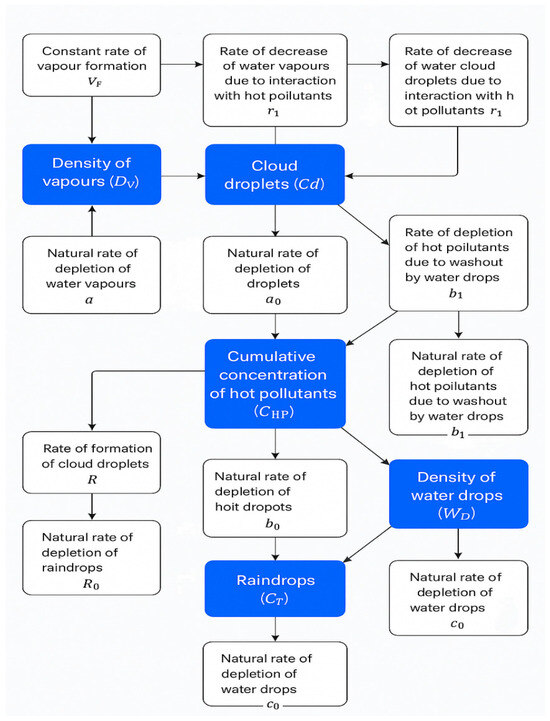
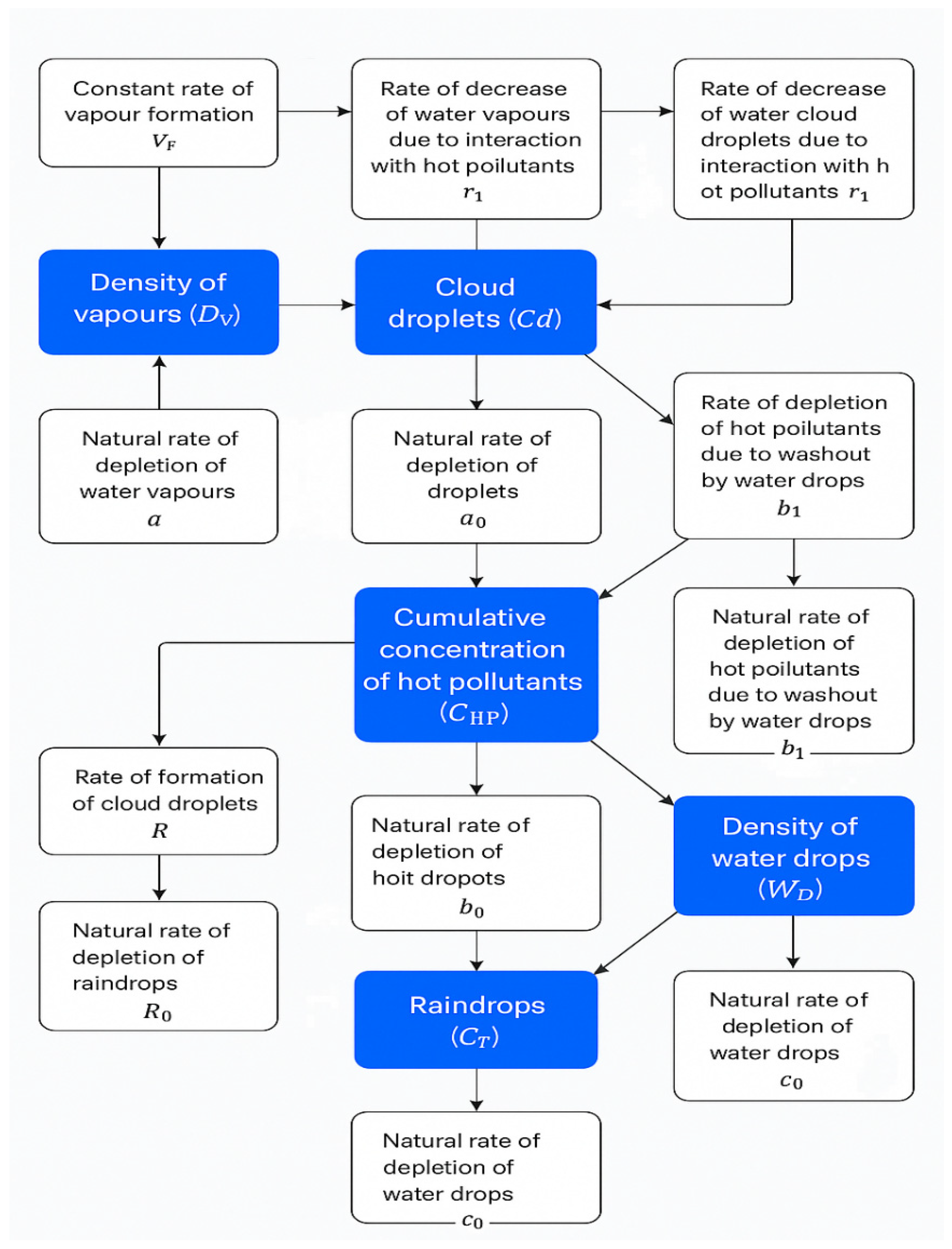
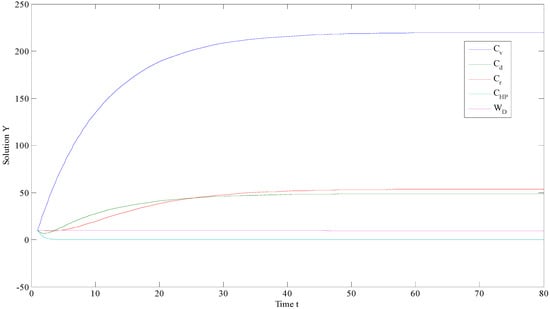
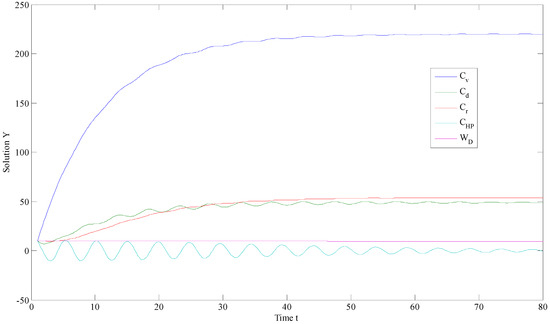
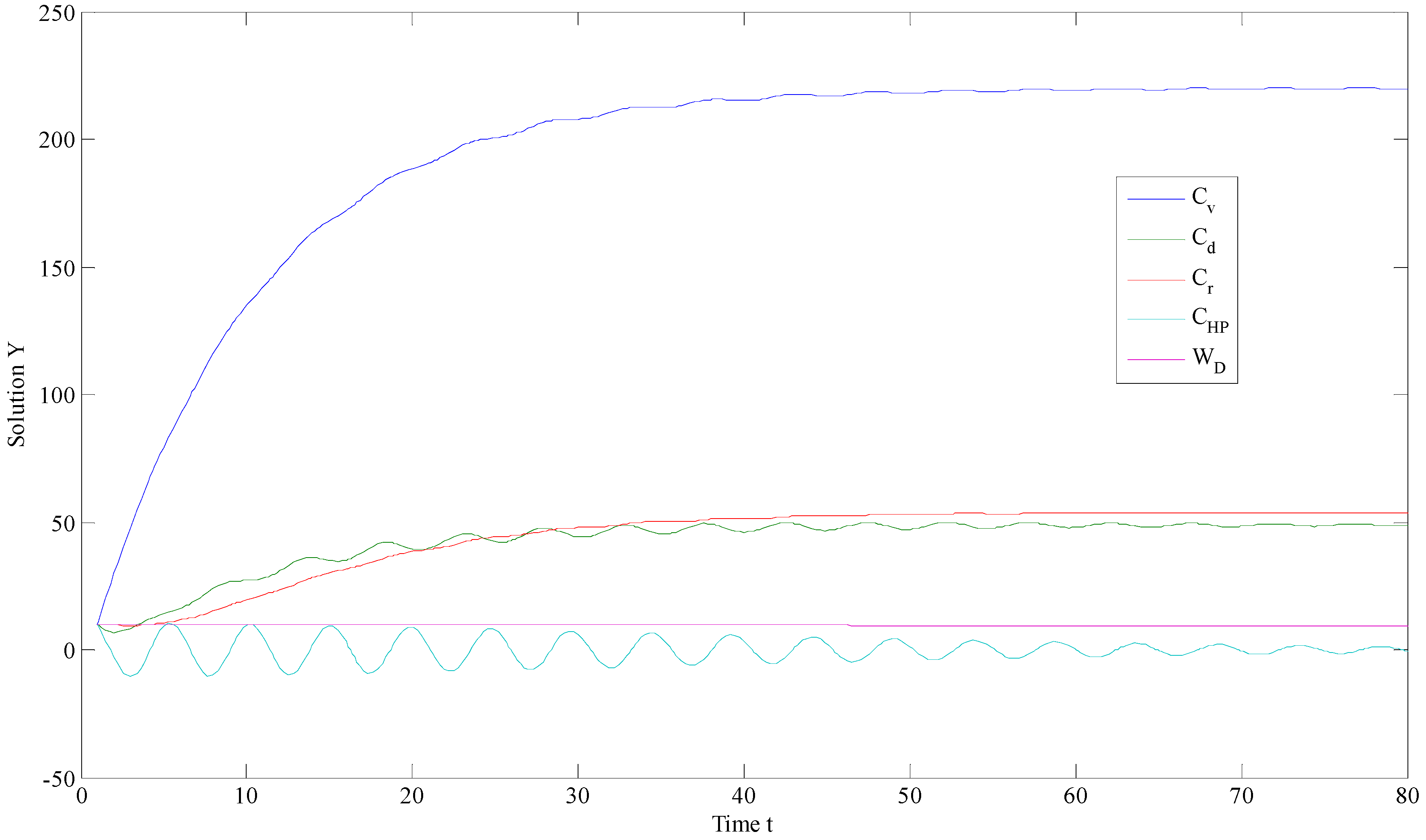
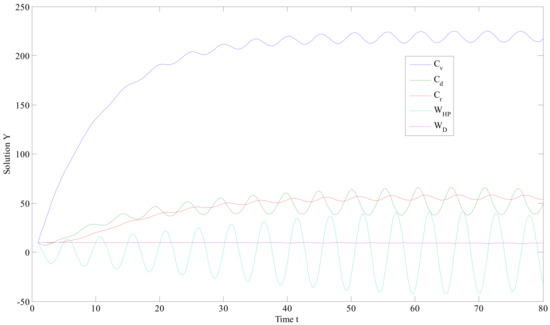
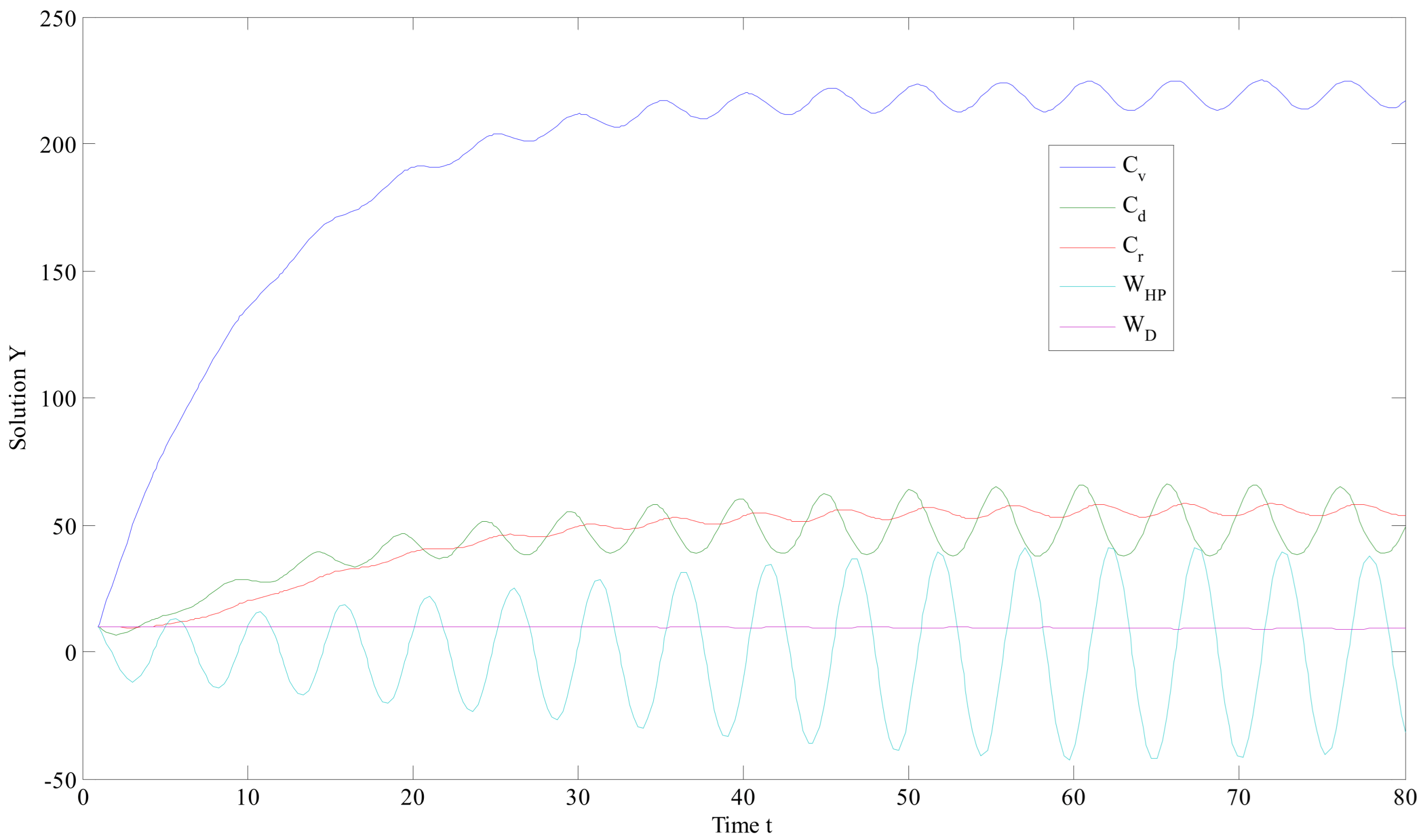
The simulated curves represent the qualitative dynamics of all the state variables and confirm the predicted changes in the dynamical regimes (stable, asymptotically stable, and oscillatory). Figure 1 depicts the dynamical system and how its different parameters interact. These numerical data also underscore the critical role of the delay parameter in the long-term behavior of the system and in regulating the onset of oscillatory behavior. Figure 2 shows that, in the absence of delay , the cumulative concentration of hot pollutants is constant. The curves approach the equilibrium in a monotonous manner, which is the entire proof that the system itself maintains the desired kind of stability in the absence of a time lag. Figure 3 shows the delay values below the critical value ; the cumulative concentration exhibits a simple instability loss.
Figure 1.
Flow chart of dynamical system.
Figure 2.
The cumulative concentration of hot pollutants is stable, when .
Figure 3.
The cumulative concentration loses the stability and move towards asymptotic stability when .
Nevertheless, the cumulative concentration moves toward an asymptotically stable equilibrium. Though there may be small transient oscillations that fade away over time, this indicates that the system is globally asymptotically stable at this range of delay. Figure 4 shows that the delay is as significant as, or larger than, the critical value ; there is a qualitative change in the dynamical structure of the system. The equilibrium loses its asymptotic stability, and the curves develop into continuous oscillations, indicating the presence of a Hopf bifurcation. Such a transition marks the onset of sustained periodic behavior, consistent with the theoretical definition of a delay-induced bifurcation. The quantitative results indicate how time delay is an important factor in defining the behavior of the system in the long run. Although the system remains stable under small delays, a more pronounced delay may ruin the balance to create sustained oscillations. This kind of behavior is realistic in the long-term systems where cyclical behavior can be caused by delayed responsiveness.
Figure 4.
The cumulative concentration loses the asymptotic stability and moves towards Hopf bifurcation when .
4. Conclusions
This paper investigates a dynamical model of the cumulative concentration of hot pollutants to explore its dynamic behavior with a delay. The time delay () is determined analytically as an important bifurcation parameter that can change the qualitative nature of the system. The critical delay value is calculated at the point at which the equilibrium state becomes asymptotically unstable, and a Hopf bifurcation takes place, which indicates the beginning of sustained oscillatory behavior. Moreover, the character and permanence of the bifurcating periodic solutions are also found by an elaborate directional analysis of the model. The analysis defines the direction of the Hopf bifurcation. It explains the qualitative development of oscillatory behavior near the critical threshold, thereby providing a more in-depth understanding of the system’s structural changes. The results of the analysis are confirmed by numerical simulations performed with representative parameter sets. The findings indicate that the system is stable even without delay, switches to an asymptotically stable state when delay is present , and finally exhibits sustained oscillations. The results highlight the significant role of the delay parameter on the long-term dynamics of pollutants .
All the analytical, directional, and numerical investigations provide a standard for assessing the model’s behavior. The findings of the work underpin the critical role of time delays in regulating stability and oscillatory behavior, with practical implications for developing future models, predictions, and management strategies in systems that incorporate time lags.
Author Contributions
D.: Writing—original manuscript, formal analysis, methodology, investigation, conceptualization, software, review, editing. P.K.: review and editing, formal analysis. H.O.A.: Writing—original manuscript, conceptualization. I.N.C.: Writing—original manuscript, formal analysis, methodology. All authors have read and agreed to the published version of the manuscript.
Funding
This research did not receive any specific grant from funding agencies in the public, commercial, or non-for-profit sectors.
Data Availability Statement
No new data were created or analyzed in this study. Data sharing is not applicable to this article.
Conflicts of Interest
The authors have no conflict of interest.
References
- Pruppacher, H.R.; Klett, J.D. Microphysics of Clouds and Precipitation; Kluwer Academic Publishers: Amsterdam, The Netherlands, 1997. [Google Scholar]
- Cotton, W.R.; Anthes, R.A. Storm and Cloud Dynamics; Academic Press: Cambridge, MA, USA, 1992; Volume 44. [Google Scholar]
- Houze, R.A., Jr. Cloud Dynamics; Academic Press: Cambridge, MA, USA, 2014; Volume 104. [Google Scholar]
- Kessler, E. On the distribution and continuity of water substance in atmospheric circulations. In On the Distribution and Continuity of Water Substance in Atmospheric Circulations; American Meteorological Society: Boston, MA, USA, 1969; pp. 1–84. [Google Scholar]
- Rogers, R.R.; Yau, M.K. A short course in cloud physics. Bull. Amer. Meteor. Soc. 1989, 45, 619. [Google Scholar]
- Fowler, A.C. Mathematical Models in the Applied Sciences; Cambridge University Press: Cambridge, UK, 1997; Volume 17. [Google Scholar]
- Grabowski, W.W.; Wang, L.P. Growth of cloud droplets in a turbulent environment. Annu. Rev. Fluid Mech. 2013, 45, 293–324. [Google Scholar] [CrossRef] [Scilit]
- Twomey, S. The influence of pollution on the shortwave albedo of clouds. J. Atmos. Sci. 1977, 34, 1149–1152. [Google Scholar] [CrossRef] [Scilit]
- Rosenfeld, D. Suppression of rain and snow by urban and industrial air pollution. Science 2000, 287, 1793–1796. [Google Scholar] [CrossRef] [Scilit] [PubMed]
- Albrecht, B.A. Aerosols, cloud microphysics, and fractional cloudiness. Science 1989, 245, 1227–1230. [Google Scholar] [CrossRef] [Scilit] [PubMed]
- Seinfeld, J.H.; Pandis, S.N. Atmospheric Chemistry and Physics: From Air Pollution to Climate Change; John Wiley & Sons: Hoboken, NJ, USA, 2016. [Google Scholar]
- Jacobson, M.Z. Fundamentals of Atmospheric Modeling; Cambridge University Press: Cambridge, UK, 1999. [Google Scholar]
- Baklanov, A.; Mestayer, P.G.; Clappier, A.; Zilitinkevich, S.; Joffre, S.; Mahura, A.; Nielsen, N.W. Towards improving the simulation of meteorological fields in urban areas through updated/advanced surface fluxes description. Atmos. Chem. Phys. 2008, 8, 523–543. [Google Scholar] [CrossRef] [Scilit]
- Chate, D.M.; Rao, P.S.P.; Naik, M.S.; Momin, G.A.; Safai, P.D.; Ali, K. Scavenging of aerosols and their chemical species by rain. Atmos. Environ. 2003, 37, 2477–2484. [Google Scholar] [CrossRef] [Scilit]
- Wacker, S.; Gröbner, J.; Nowak, D.; Vuilleumier, L.; Kämpfer, N. Cloud effect of persistent stratus nebulosus at the Payerne BSRN site. Atmos. Res. 2011, 102, 1–9. [Google Scholar] [CrossRef] [Scilit]
- Zhang, L.; Gong, S.; Padro, J.; Barrie, L. A size-segregated particle dry deposition scheme for an atmospheric aerosol module. Atmos. Environ. 2001, 35, 549–560. [Google Scholar] [CrossRef] [Scilit]
- Jacob, D.J.; Winner, D.A. Effect of climate change on air quality. Atmos. Environ. 2009, 43, 51–63. [Google Scholar] [CrossRef] [Scilit]
- Ruan, S.; Wei, J. On the zeros of transcendental functions with applications to stability of delay differential equations with two delays. Dyn. Contin. Discret. Impuls. Syst. Ser. A 2003, 10, 863–874. [Google Scholar]
- Beretta, E.; Kuang, Y. Geometric stability switch criteria in delay differential systems with delay dependent parameters. SIAM J. Math. Anal. 2002, 33, 1144–1165. [Google Scholar] [CrossRef] [Scilit]
- Gourley, S.A.; Kuang, Y. A stage structured predator-prey model and its dependence on maturation delay and death rate. J. Math. Biol. 2004, 49, 188–200. [Google Scholar] [CrossRef] [Scilit] [PubMed]
- Öztürk, Z.; Bilgil, H.; Sorgun, S. Fractional SAQ alcohol model: Stability analysis and Türkiye application. Int. J. Math. Comput. Eng. 2025, 3, 125–136. [Google Scholar] [CrossRef] [Scilit]
- Srinivasa, K.; Mundewadi, R.A. Wavelets approach for the solution of nonlinear variable delay differential equations. Int. J. Math. Comput. Eng. 2023, 1, 139–148. [Google Scholar] [CrossRef] [Scilit]
- Nagumo, M. Über die lage der integralkurven gewöhnlicher differential gleichungen. Proc. Phys.-Math. Soc. Jpn. 3rd Ser. 1942, 24, 551–559. [Google Scholar]
- Hale, J.K.; Lunel, S.M.V. Introduction to Functional Differential Equations; Springer Science & Business Media: Berlin/Heidelberg, Germany, 2013; Volume 99. [Google Scholar]
- Smith, H.L. Monotone Dynamical Systems: An Introduction to the Theory of Competitive and Cooperative Systems: An Introduction to the Theory of Competitive and Cooperative Systems; American Mathematical Society: Providence, RI, USA, 1995; No. 41. [Google Scholar]
- Brauer, F.; Castillo-Chavez, C.; Castillo-Chavez, C. Mathematical Models in Population Biology and Epidemiology; Springer: New York, NY, USA, 2012; Volume 2, No. 10. [Google Scholar]
- Lakshmikantham, V.; Leela, S. (Eds.) Differential and Integral Inequalities: Theory and Applications: Volume I: Ordinary Differential Equations; Academic Press: Cambridge, MA, USA, 1969. [Google Scholar]
- Hassard, B.D.; Kazarinoff, N.D.; Wan, Y.H. Theory and Applications of Hopf Bifurcation; CUP Archive: Cambridge, UK, 1981; Volume 41. [Google Scholar]
Disclaimer/Publisher’s Note: The statements, opinions and data contained in all publications are solely those of the individual author(s) and contributor(s) and not of MDPI and/or the editor(s). MDPI and/or the editor(s) disclaim responsibility for any injury to people or property resulting from any ideas, methods, instructions or products referred to in the content. |
© 2026 by the authors. Licensee MDPI, Basel, Switzerland. This article is an open access article distributed under the terms and conditions of the Creative Commons Attribution (CC BY) license.