State-Extended MPC for Trajectory Tracking and Optimal Obstacle Avoidance in Multi-Point Suspension Systems

 , ,
, , 
Abstract
1. Introduction
1.1. The Challenge of Gravity Compensation for Space Manipulators
1.2. MPC Development and Applications
1.3. Contributions of This Work
- We propose a novel state-extension framework that explicitly models collision-avoidance constraints as internal system states, thereby integrating trajectory tracking and optimal collision avoidance into a unified underactuated MPC model for co-optimization within a single predictive horizon.
- We design and experimentally validate a tailored Model Predictive Controller for the proposed state-extended system, which simultaneously addresses kinematic redundancy, external disturbances, and dynamic collision constraints, achieving real-time and synchronized optimization of high-precision tracking and proactive safety.
- We evaluate the proposed method on a multi-point active suspension platform with redundant degrees of freedom, and the results demonstrate its capability to actively avoid inter-unit collisions while maintaining tracking accuracy.
2. Trajectory Tracking Modeling for a Multi-Point Suspension System with Collision Avoidance
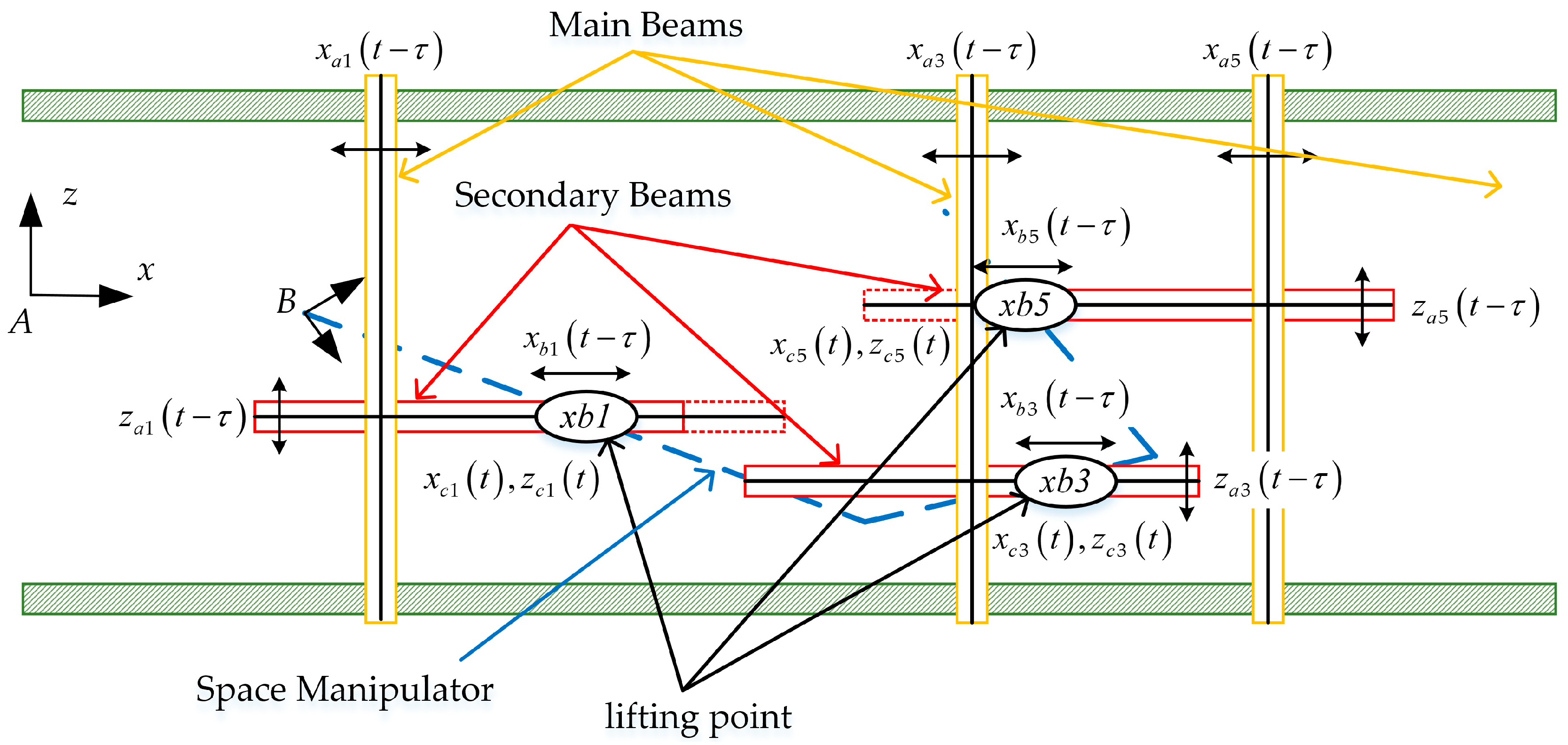
2.1. Multi-Suspension Winch Unit Design with Redundant Degrees of Freedom
2.1.1. Trajectory-Tracking Status
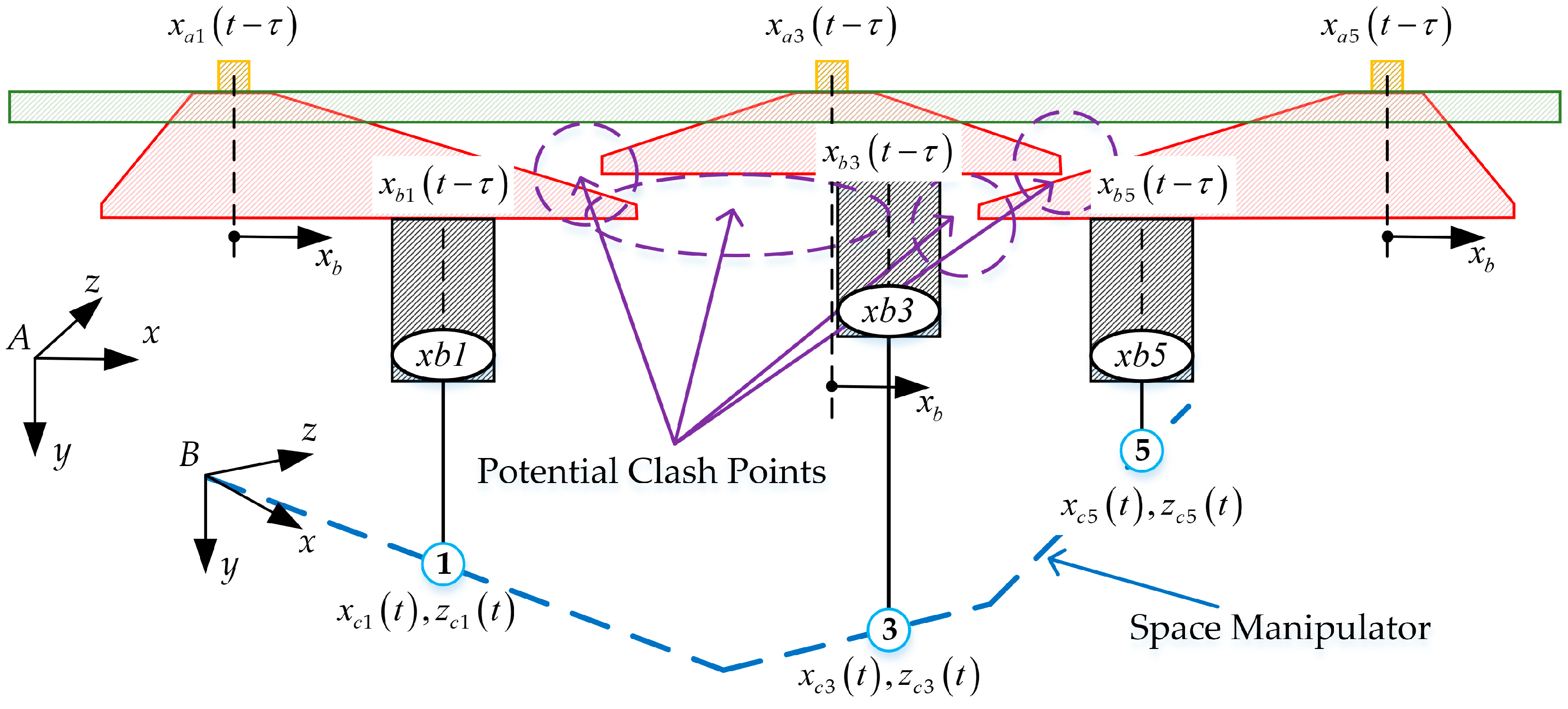
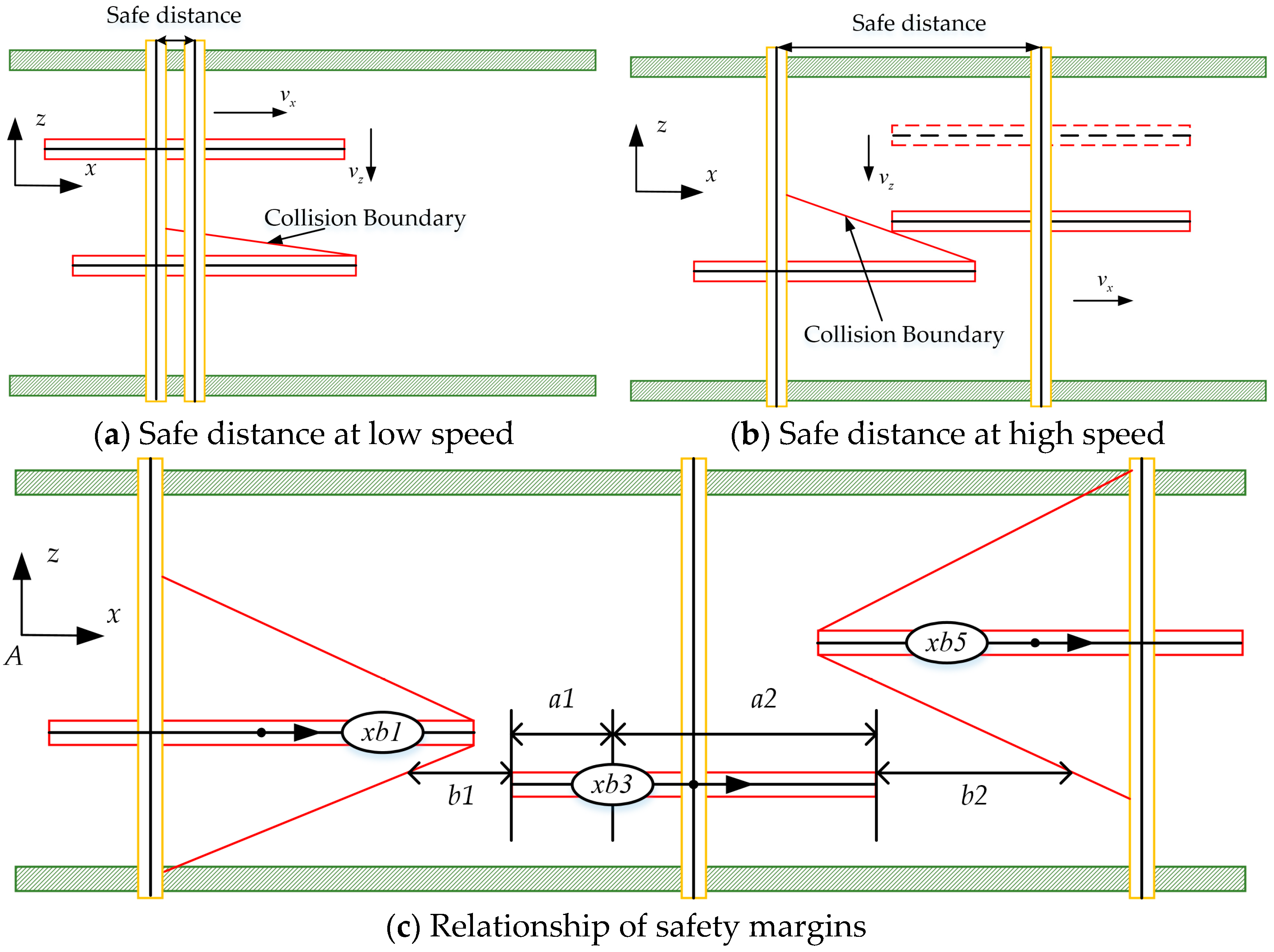
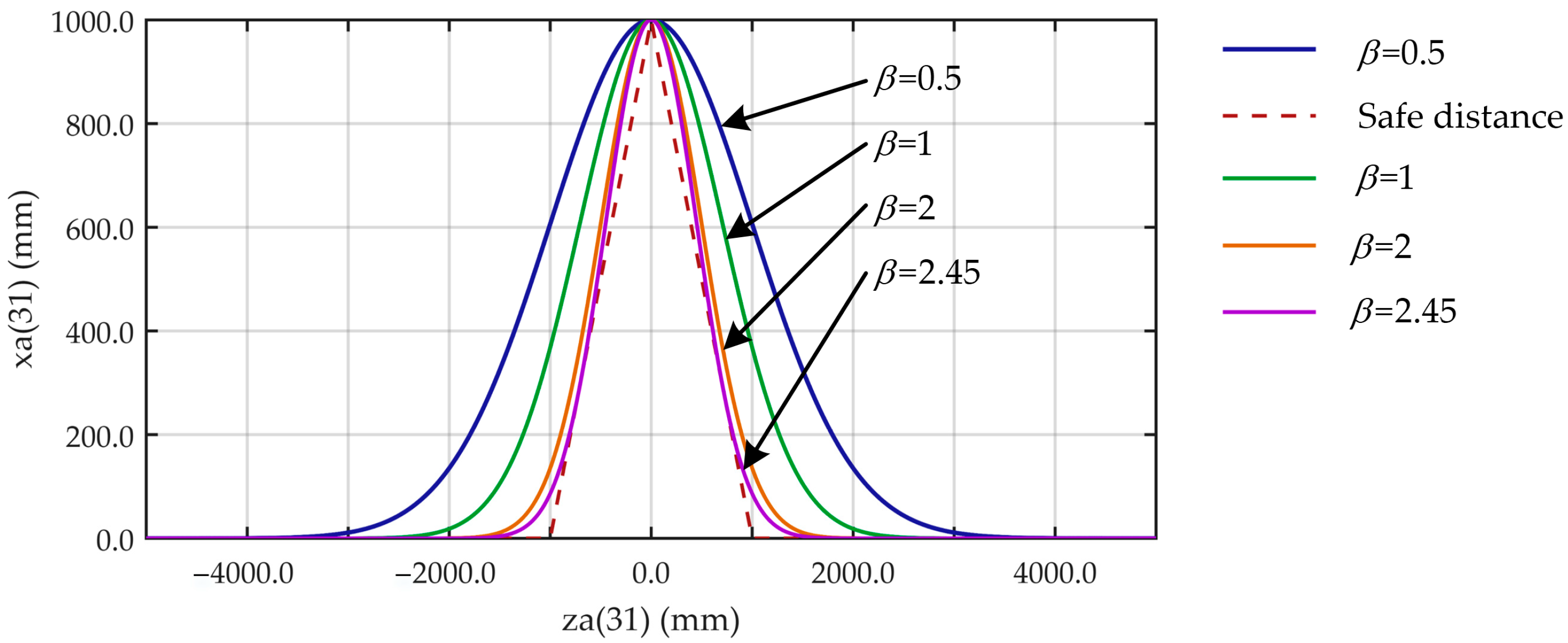
2.1.2. Optimal Collision Avoidance State
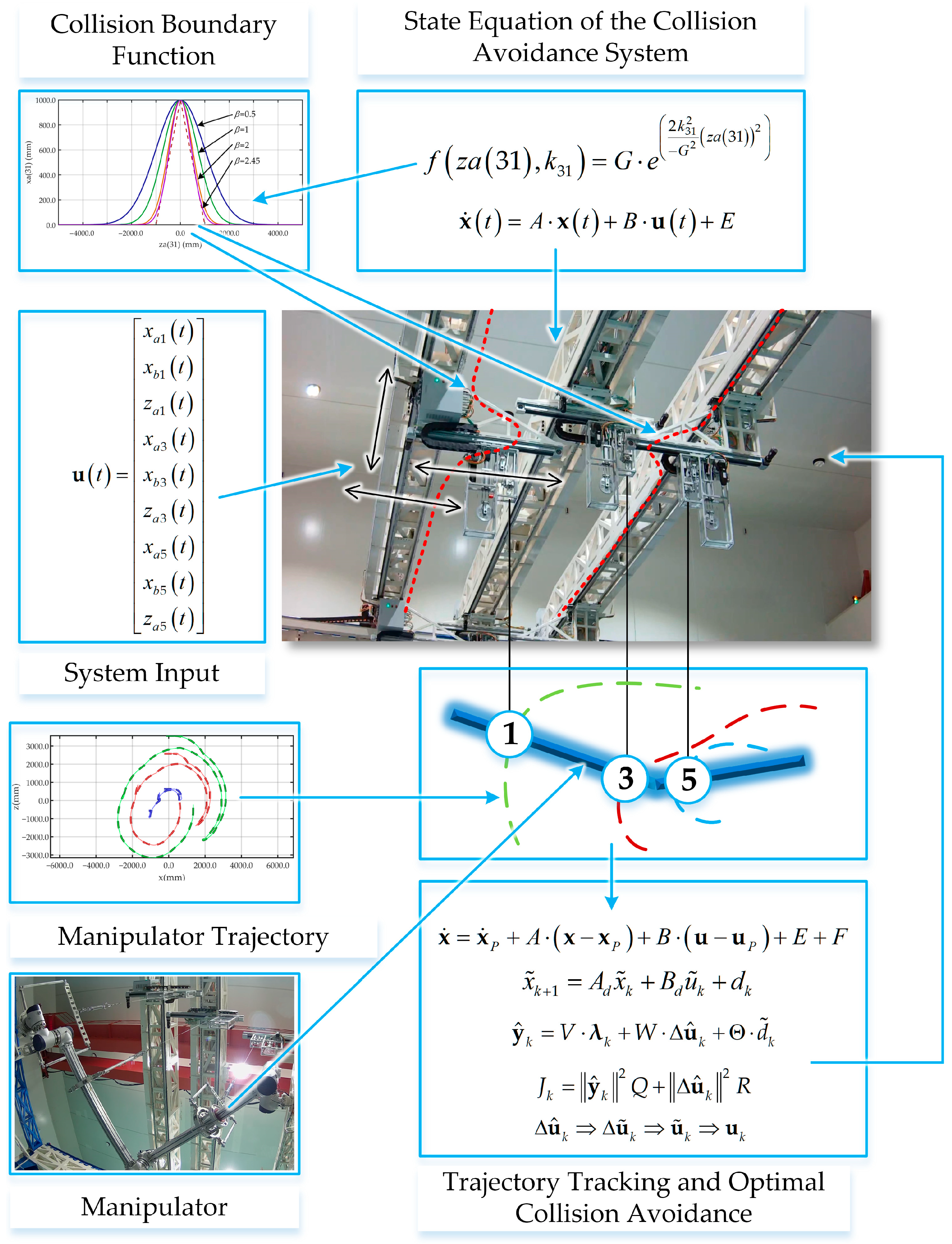
2.1.3. Integrated System State Equations
2.2. Establishment of Continuous State Transition Equations for Under-Driven Systems
2.3. Establishment of the Continuous Error Model
3. Controller Design for Optimal Collision Avoidance in a Multi-Suspension Winch Unit System
3.1. Establishment of Discrete Error Models
3.2. Future Time-Domain Prediction Models with Disturbance Terms
3.3. Solving the MPC Optimal Objective
4. Test Results
4.1. Test System
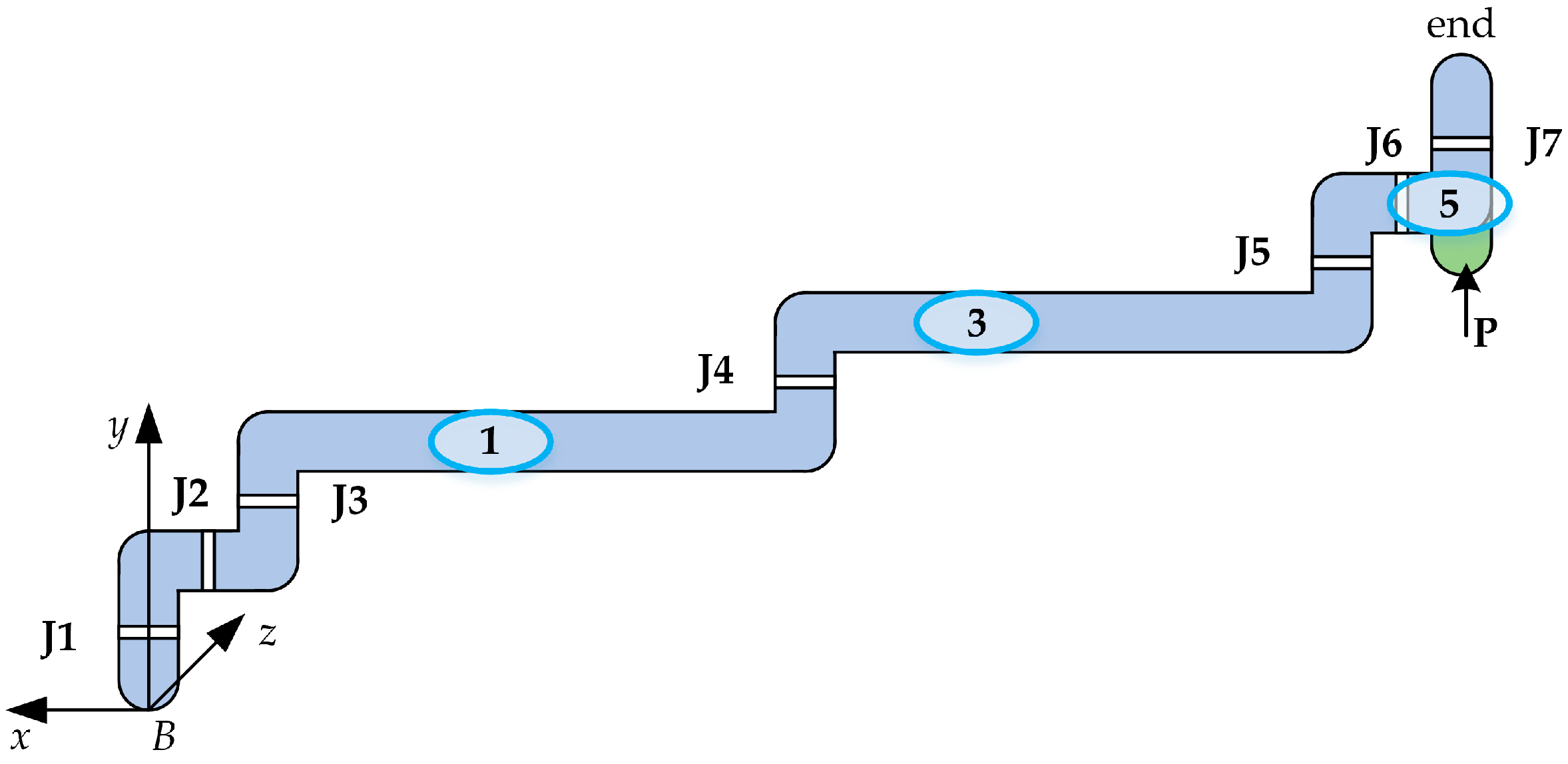
4.2. Robotic Arm Motion Trajectory
4.3. System Performance
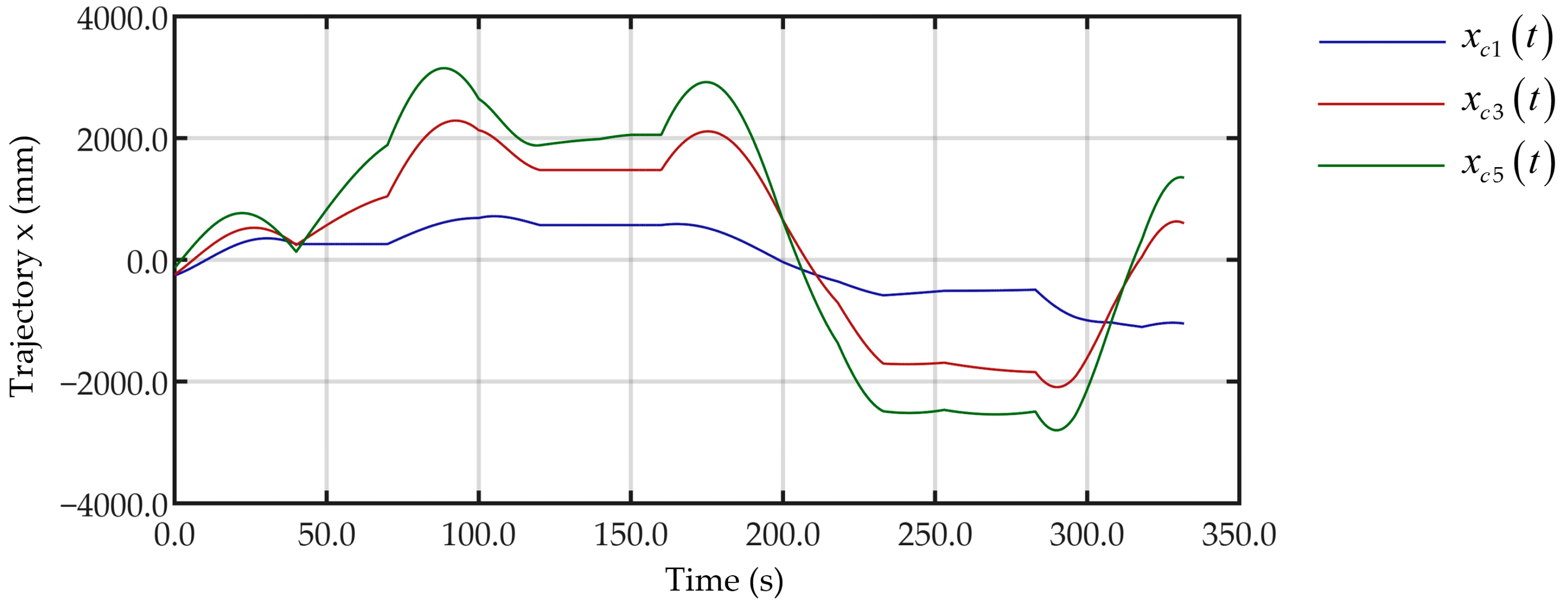
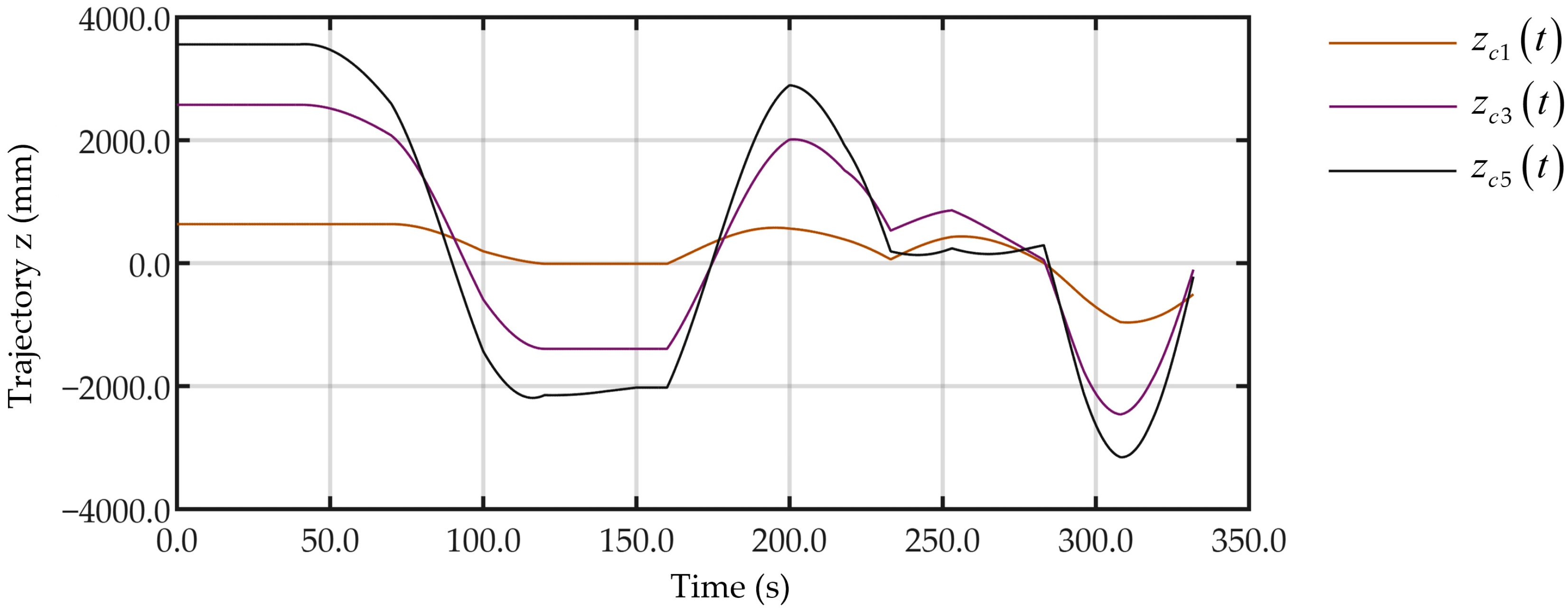
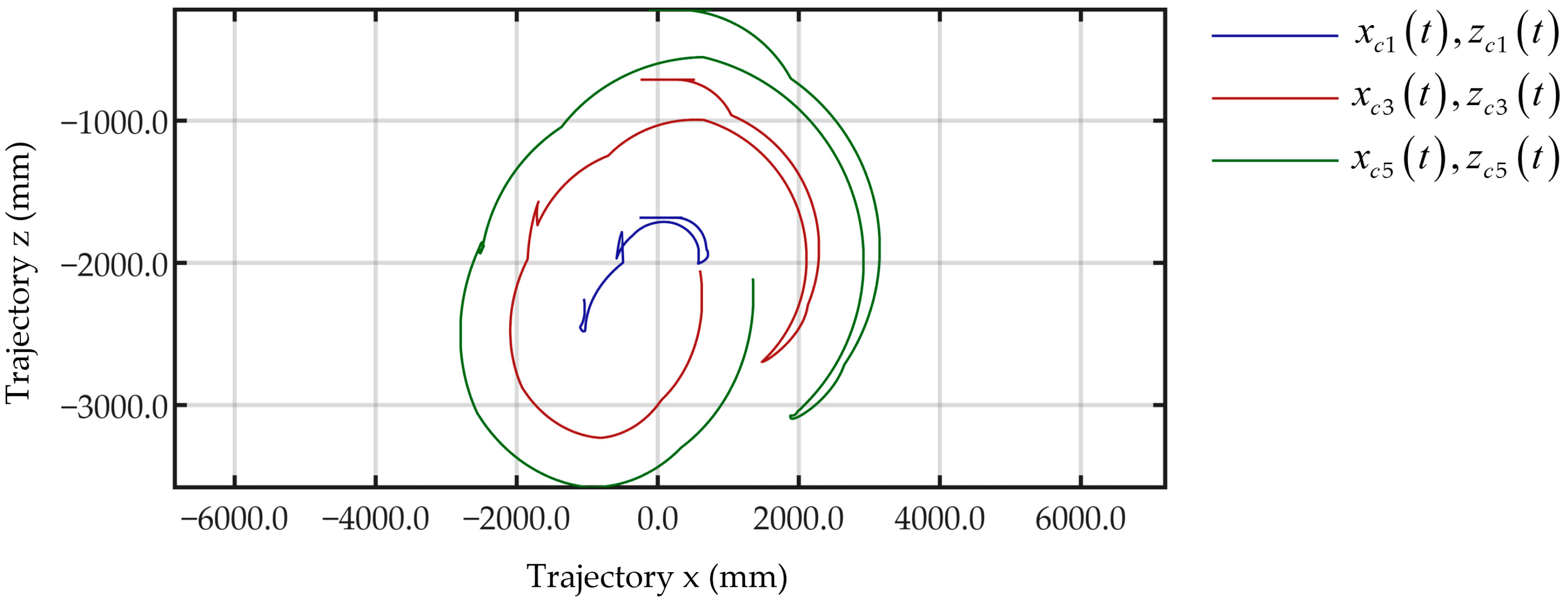
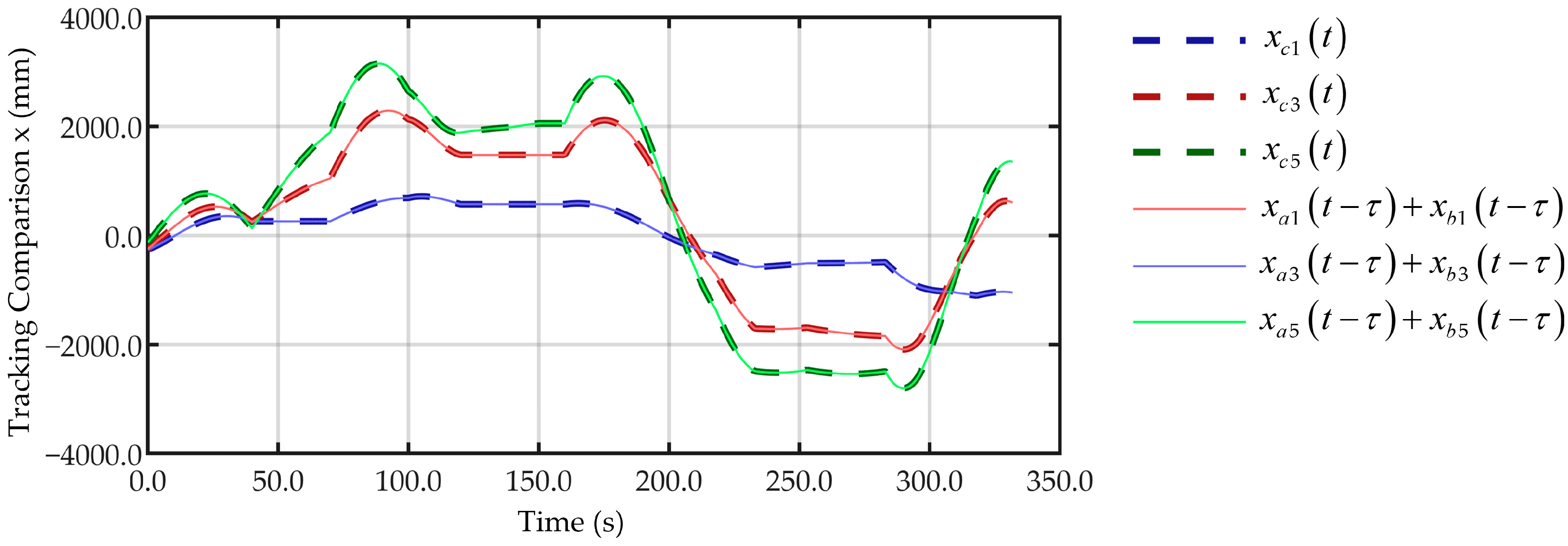
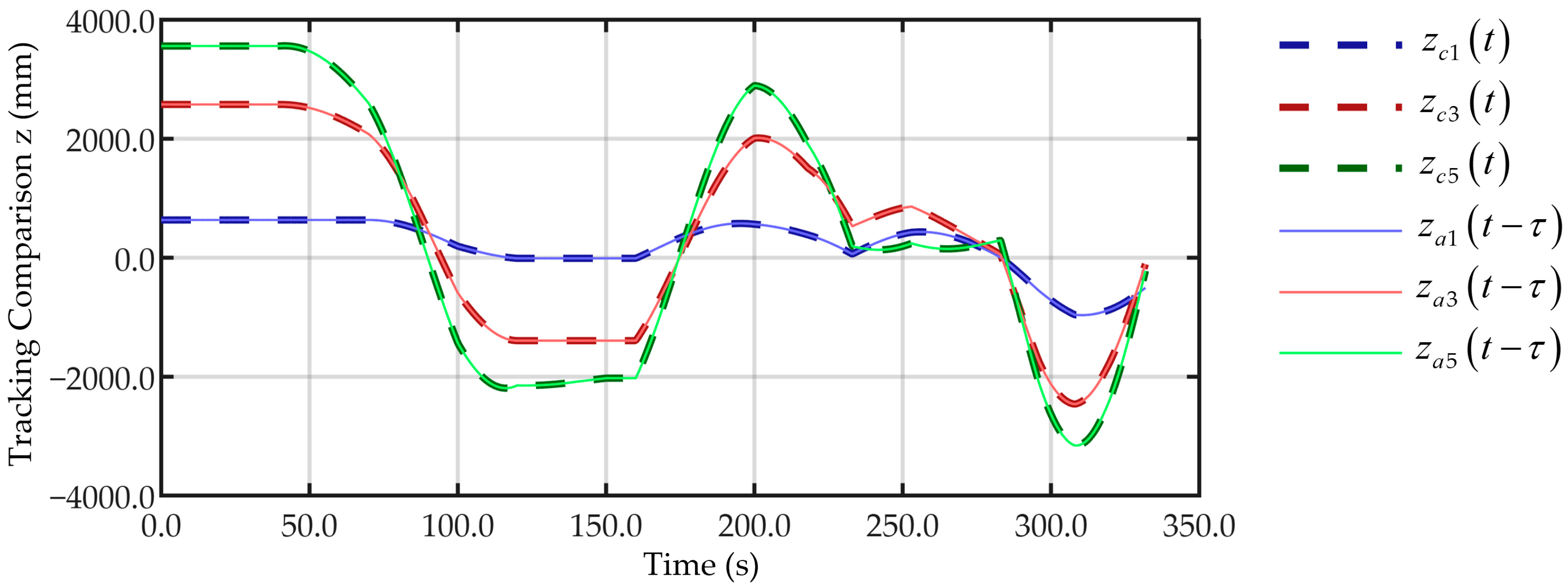
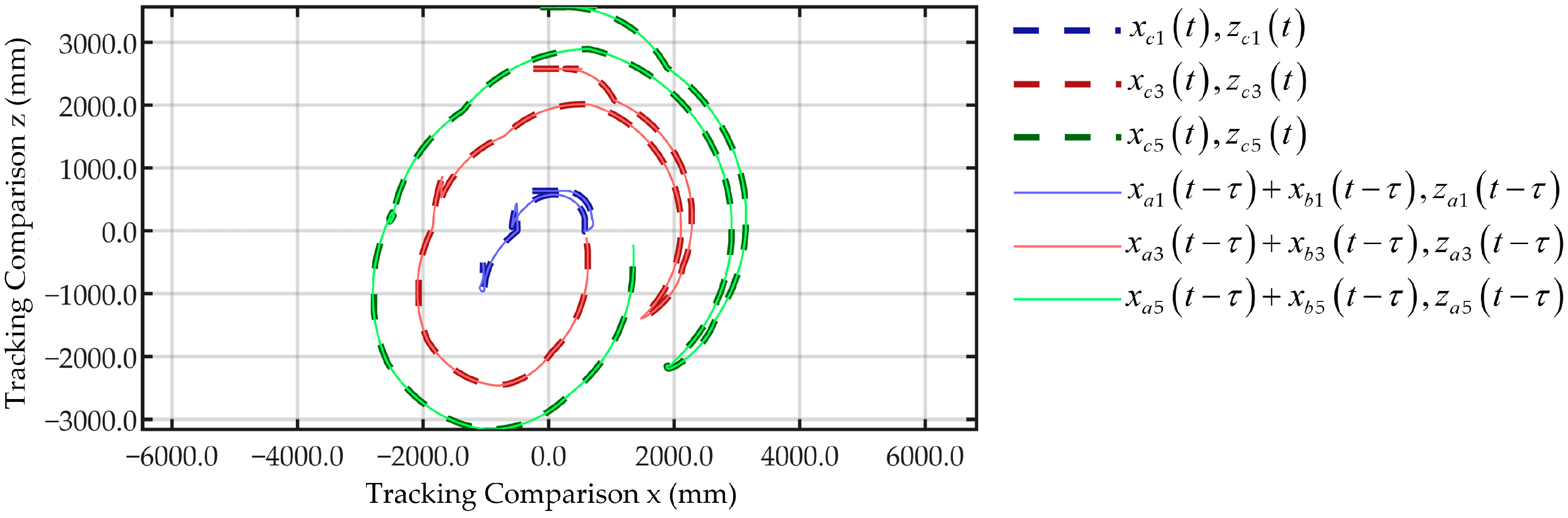
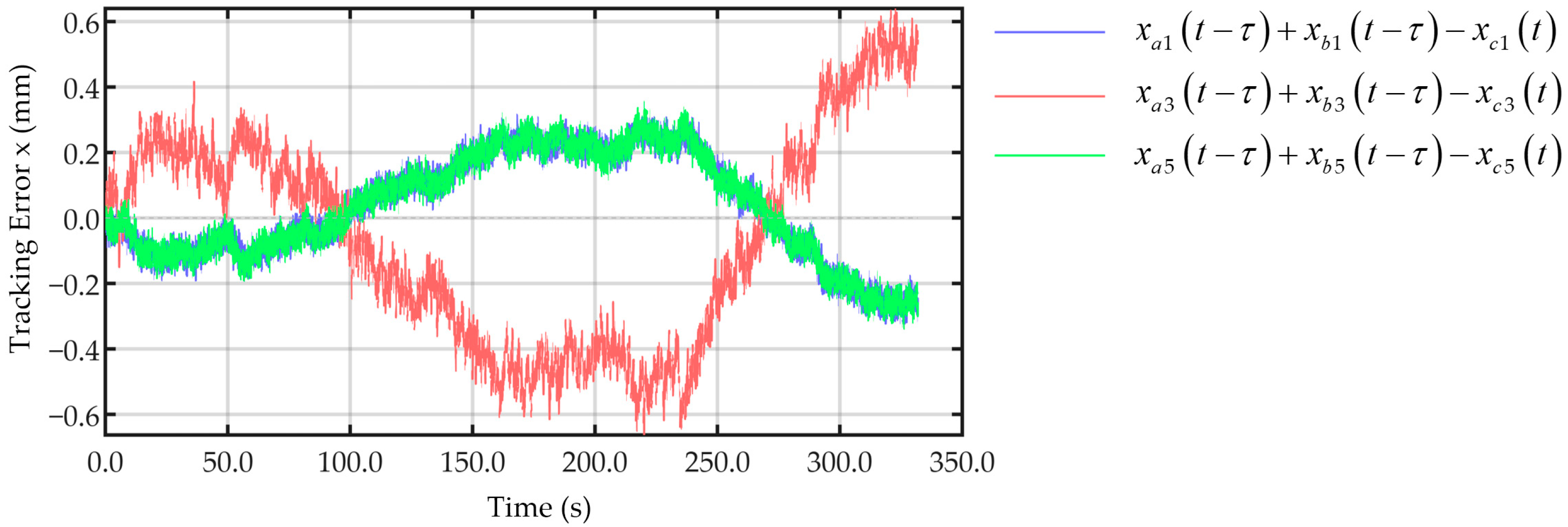
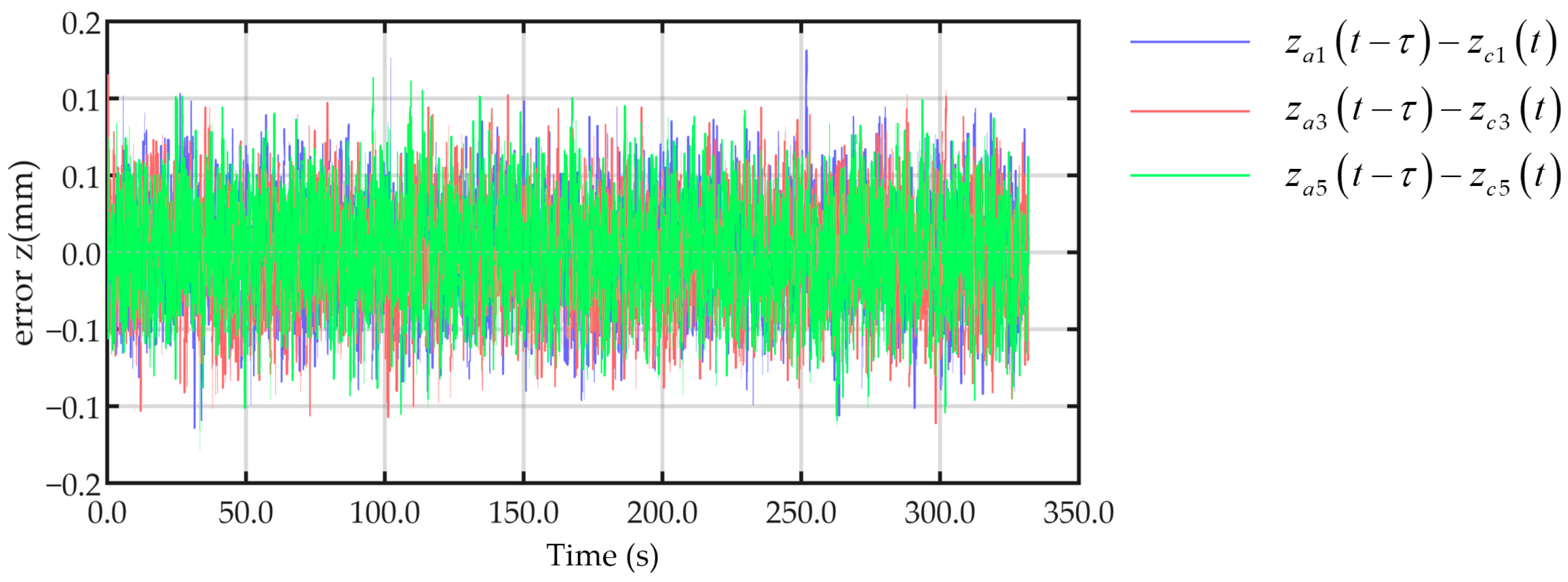
4.3.1. Trajectory Tracking Performance Analysis
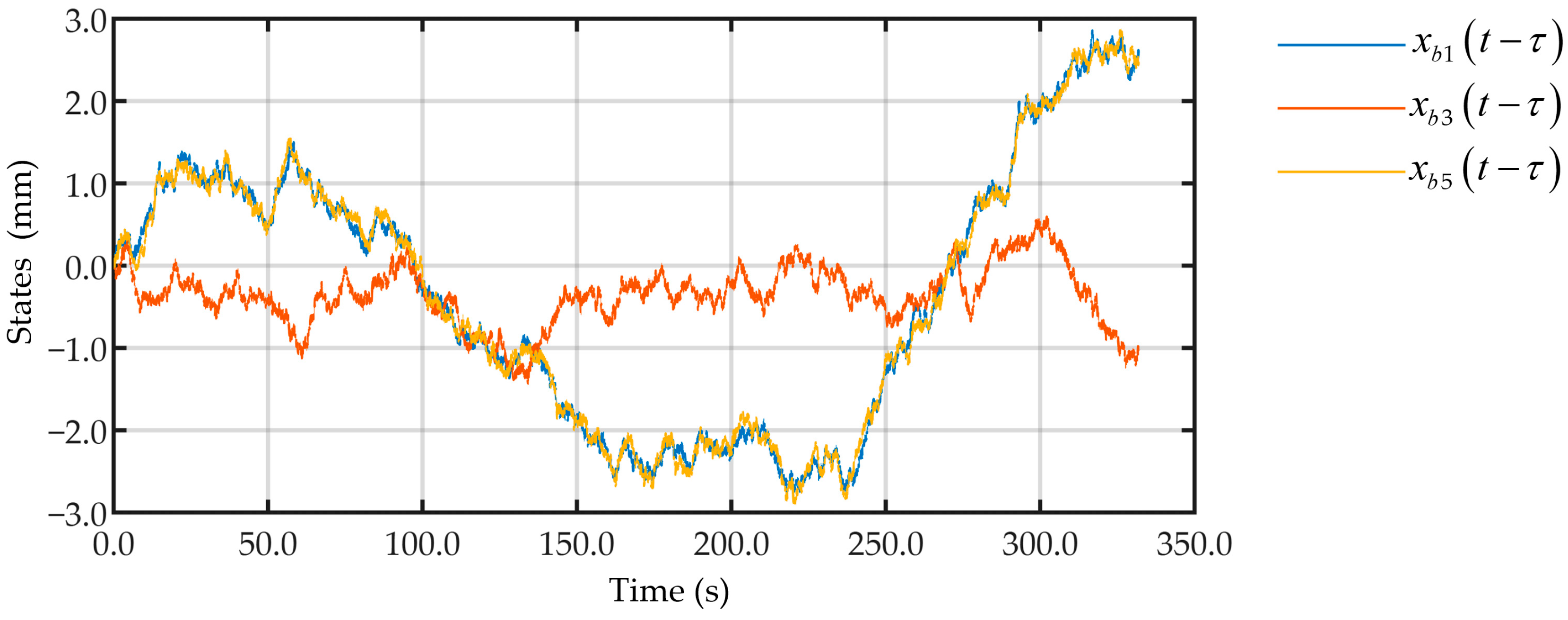
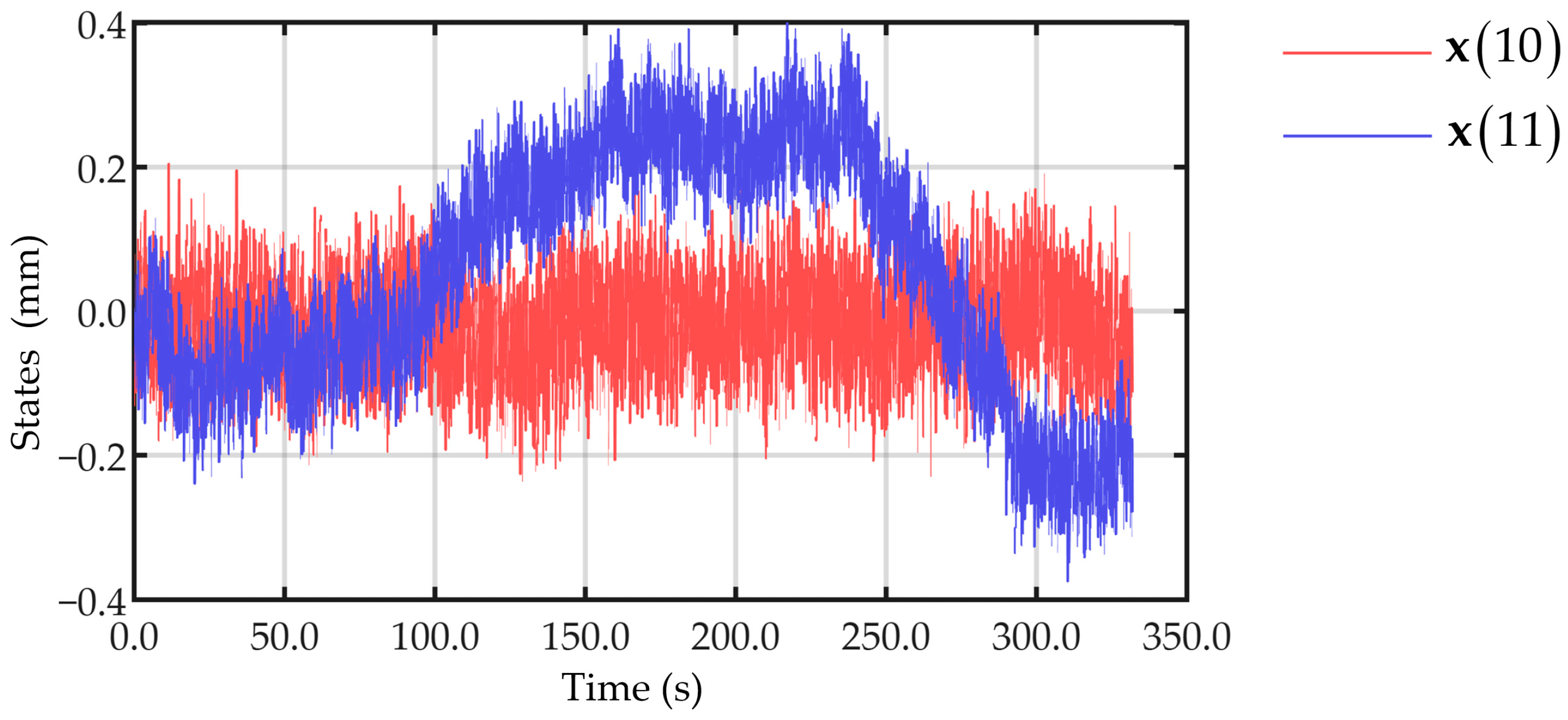
4.3.2. Collision Avoidance State Analysis
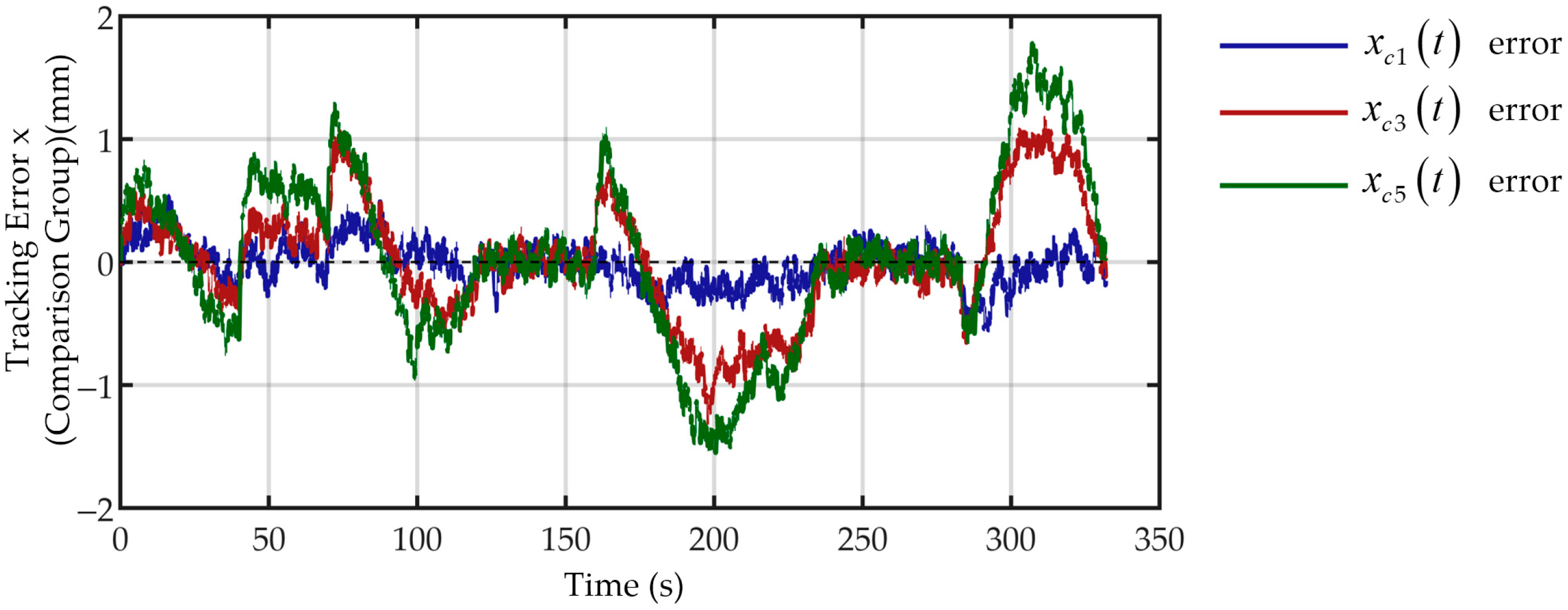
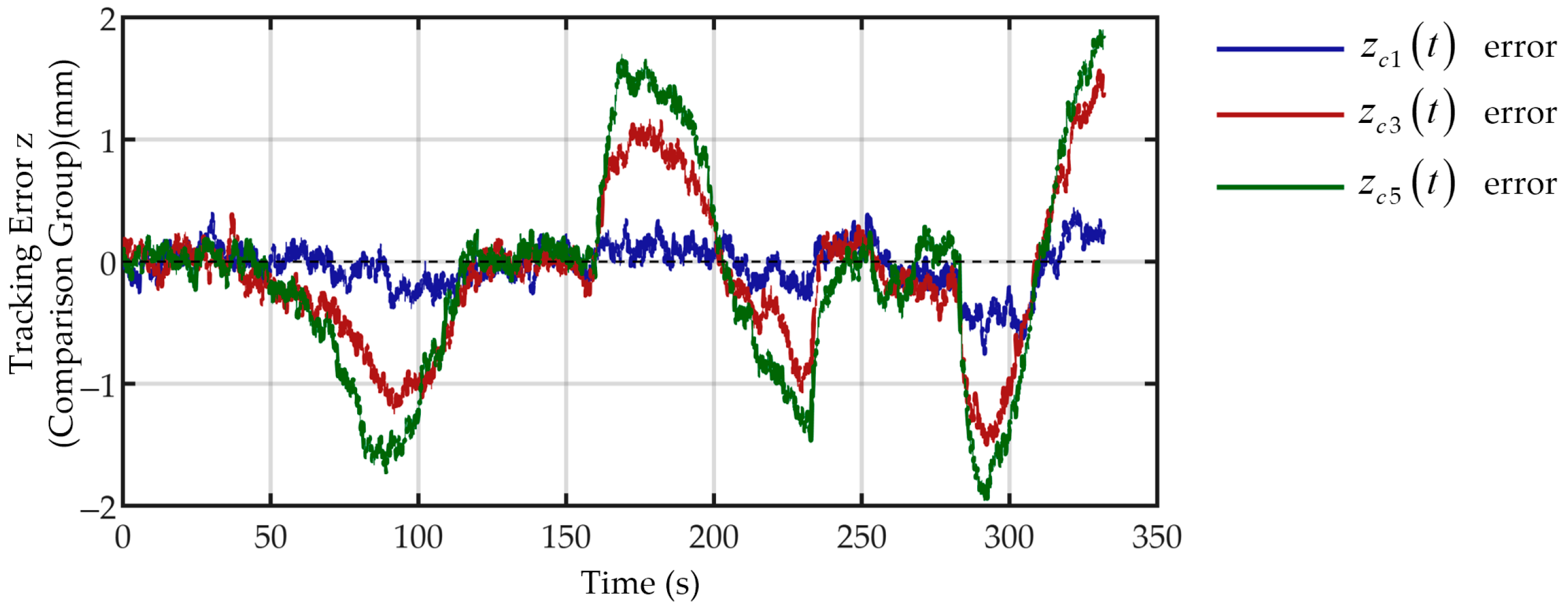
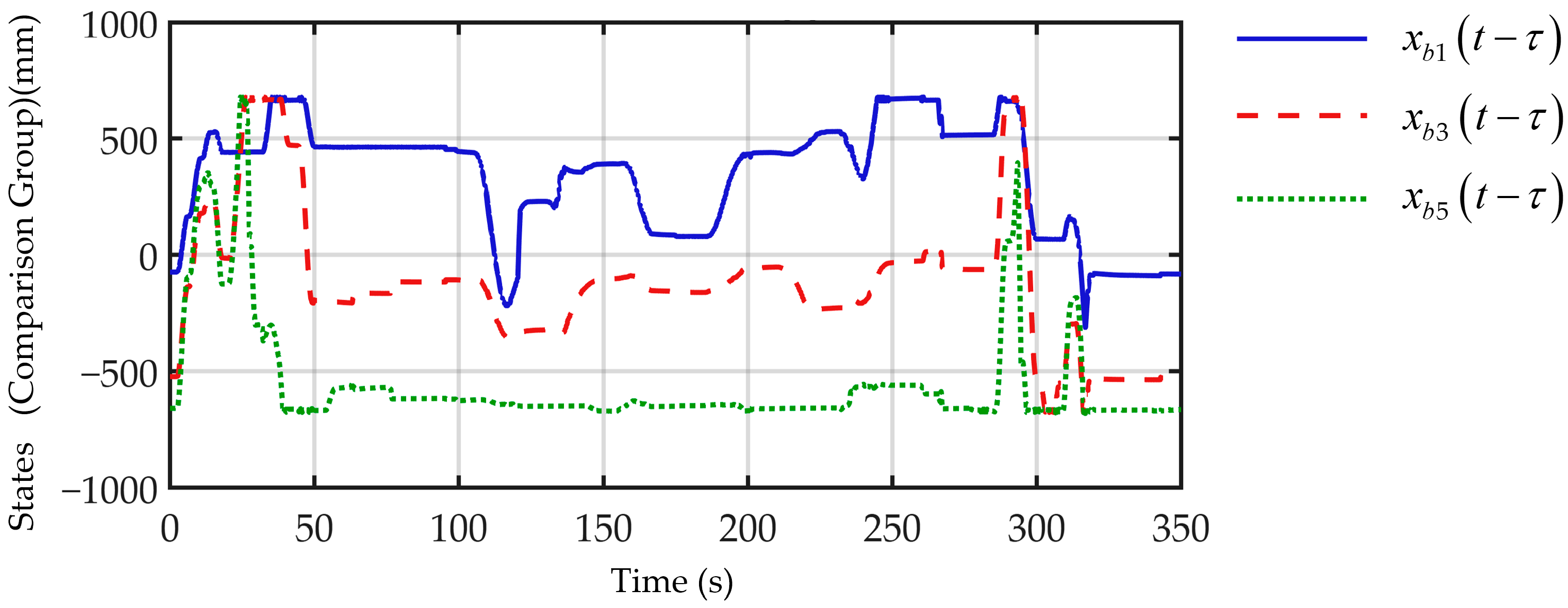
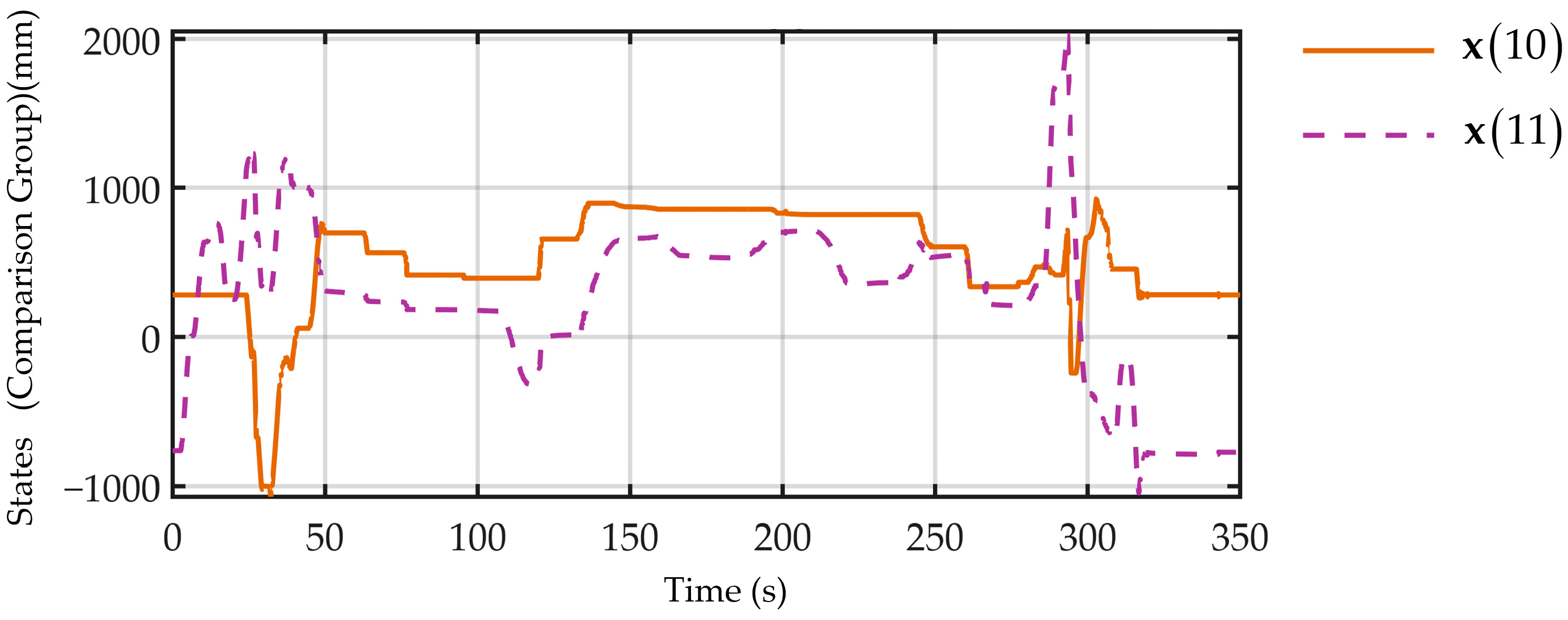
4.3.3. Comparative Analysis of Collision Avoidance States
4.3.4. Control Input and System Stability
5. Conclusions
Author Contributions
Funding
Data Availability Statement
Conflicts of Interest
Abbreviations
| MPC | Model Predictive Controller. |
| NARX | Nonlinear autoregressive exogenous. |
| DOF | Degree-of-freedom. |
| QP | Quadratic Programming. |
References
- Li, H.Y.; Cheng, Z.; Zhao, D.N.; Wang, H.W.; Li, D.Y.; Zhang, J.B.; Song, X.D.; Zhao, L.N. Research on multi-degree-of-freedom microgravity simulation deployment test system based on suspension method and air flotation method. Chin. J. Eng. Des. 2020, 27, 508–515. [Google Scholar]
- Xu, J.L.; Guo, Y.S.; Liu, F.C.; Huang, H.Y. Development and Experiment of Semi-Physical Simulation Platform for Space Manipulator. Sensors 2024, 24, 4354. [Google Scholar] [CrossRef]
- Qi, N.M.; Zhang, W.H.; Gao, J.Z.; Huo, M.Y. The Primary Discussion for the Ground Simulation System of Spatial Microgravity. Aerosp. Control 2011, 29, 95–100. [Google Scholar] [CrossRef]
- Li, C.Z. Design of Gravity Compensation Control System of Suspended Manipulator Based on Fuzzy PID. Comput. Meas. Control 2023, 31, 100–105+112. [Google Scholar] [CrossRef]
- Elmorshedy, M.F.; Xu, W.; El-Sousy, F.F.M.; Islam, M.R.; Ahmed, A.A. Recent Achievements in Model Predictive Control Techniques for Industrial Motor: A Comprehensive State-of-the-Art. IEEE Access 2021, 9, 58170–58191. [Google Scholar] [CrossRef]
- You, Y.L.; Yang, Z.; Zhuo, H.Z.; Xu, N.; Liao, L.W.; Jiang, W.B. Design of an adaptive MPC control system for unmanned ground vehicle based on FP-ADMM and RBFNN. Control Engineering Practice 2025, 164, 106399. [Google Scholar] [CrossRef]
- Najafqolian, M.A.; Alipour, K.; Mousavifard, R.; Tarvirdizadeh, B. Control of Aerial Robots Using Convex QP LMPC and Learning-Based Explicit-MPC. IEEE Trans. Ind. Inform. 2024, 20, 10883–10891. [Google Scholar] [CrossRef]
- Dong, F.; Li, X.C.; You, K.Y.; Song, S.J. Standoff Tracking Using DNN-Based MPC With Implementation on FPGA. IEEE Trans. Control Syst. Technol. 2023, 31, 1998–2010. [Google Scholar] [CrossRef]
- Eltrabyly, A.; Ichalal, D.; Mammar, S. Quadcopter Trajectory Tracking in the Presence of 4 Faulty Actuators: A Nonlinear MHE and MPC Approach. IEEE Control Syst. Lett. 2022, 6, 2024–2029. [Google Scholar] [CrossRef]
- Wang, H.Y.; Liu, B.; Ping, X.Y.; An, Q. Path Tracking Control for Autonomous Vehicles Based on an Improved MPC. IEEE Access 2019, 7, 161064–161073. [Google Scholar] [CrossRef]
- Dixit, S.; Montanaro, U.; Dianati, M.; Oxtoby, D.; Mizutani, T.; Mouzakitis, A.; Fallah, S. Trajectory Planning for Autonomous High-Speed Overtaking in Structured Environments Using Robust MPC. IEEE Trans. Intell. Transp. Syst. 2020, 21, 2310–2323. [Google Scholar] [CrossRef]
- Bellegarda, G.; Nguyen, Q. Dynamic Vehicle Drifting With Nonlinear MPC and a Fused Kinematic-Dynamic Bicycle Model. IEEE Control Syst. Lett. 2022, 6, 1958–1963. [Google Scholar] [CrossRef]
- Zhang, B.; Zhao, W.; Luan, Z.; Wang, C.; Zhou, X.; Wu, H. An Antirollover Control Strategy Based on Time-Varying Nonlinear MPC for Three-Axle Steering/Braking-by-Wire Vehicle. IEEE Trans. Ind. Electron. 2024, 71, 11048–11060. [Google Scholar] [CrossRef]
- Huang, X.; Zha, Y.; Lv, X.; Quan, X. Torque Fault-Tolerant Hierarchical Control of 4WID Electric Vehicles Based on Improved MPC and SMC. IEEE Access 2023, 11, 132718–132734. [Google Scholar] [CrossRef]
- Gomaa, M.A.K.; Silva, O.D.; Mann, G.K.I.; Gosine, R.G. Nonlinear MPC Without Terminal Costs or Constraints for Multi-Rotor Aerial Vehicles. IEEE Control Syst. Lett. 2022, 6, 440–445. [Google Scholar] [CrossRef]
- Hassan, A.; Ruiz-Moreno, S.; Frejo, J.R.D.; Maestre, J.M.; Camacho, E.F. Neural-Network Based MPC for Enhanced Lateral Stability in Electric Vehicles. IEEE Access 2024, 12, 23265–23278. [Google Scholar] [CrossRef]
- Tagliabue, A.; How, J.P. Efficient Deep Learning of Robust Policies From MPC Using Imitation and Tube-Guided Data Augmentation. IEEE Trans. Robot. 2024, 40, 4301–4321. [Google Scholar] [CrossRef]
- Hanover, D.; Foehn, P.; Sun, S.; Kaufmann, E.; Scaramuzza, D. Performance, Precision, and Payloads: Adaptive Nonlinear MPC for Quadrotors. IEEE Robot. Autom. Lett. 2022, 7, 690–697. [Google Scholar] [CrossRef]
- Ahmed, I.; Suid, M.H.; Ahmad, M.A.; Salmiah, A.; Mat Jusof, M.F.; Mohd Tumari, M.Z. Optimization of a robust sigmoid PID controller for automatic voltage regulation using the nonlinear sine-cosine algorithm with amplifier feedback dynamic weighted (AFDW) system. Int. J. Robot. Control Syst. 2025, 5, 1975–1997. [Google Scholar] [CrossRef]
- Izci, D.; Ekinci, S.; Mohd Tumari, M.Z.; Ahmad, M.A. A novel Gudermannian function-driven controller architecture optimized by starfish optimizer for superior transient performance of automatic voltage regulation. Biomimetics 2025, 11, 7. [Google Scholar] [CrossRef]
- Saat, S.; Ahmad, M.A.; Ghazali, M.R. Data-driven brain emotional learning-based intelligent controller-PID control of MIMO systems based on a modified safe experimentation dynamics algorithm. Int. J. Cogn. Comput. Eng. 2025, 6, 74–99. [Google Scholar] [CrossRef]
- Izci, D.; Ekinci, S.; Mohd Tumari, M.Z.; Ahmad, M.A. A novel softsign fractional-order controller optimized by an intelligent nature-inspired algorithm for magnetic levitation control. Fractal Fract. 2025, 9, 801. [Google Scholar] [CrossRef]
- Rawlings, J.B.; Mayne, D.Q.; Diehl, M.M. Model Predictive Control: Theory, Computation, and Design, 2nd ed.; Nob Hill Publishing: Madison, WI, USA, 2017; pp. 150–155. [Google Scholar]
- Quartullo, R.; Bianchini, G.; Garulli, A.; Giannitrapani, A. Robust variable-horizon MPC with adaptive terminal constraints. Automatica 2025, 179, 112465. [Google Scholar] [CrossRef]
- He, N.; Li, Y.; Li, H.; He, D.; Cheng, F. PID-Based Event-Triggered MPC for Constrained Nonlinear Cyber-Physical Systems: Theory and Application. IEEE Trans. Ind. Electron. 2024, 71, 13103–13112. [Google Scholar] [CrossRef]
- Wan, X.B.; Wei, F.; Zhang, C.K.; Wu, M. Networked Output-Feedback MPC: A Bounded Dynamic Variable and Time-Varying Threshold-Dependent Event-Based Approach. IEEE Trans. Cybern. 2024, 54, 2308–2319. [Google Scholar] [CrossRef] [PubMed]
- Pang, S.Z.; Zhang, Y.H.; Huangfu, Y.G.; Li, X.; Tan, B.; Li, P.; Tian, C.Y.; Quan, S. A Virtual MPC-Based Artificial Neural Network Controller for PMSM Drives in Aircraft Electric Propulsion System. IEEE Trans. Ind. Appl. 2024, 60, 3603–3612. [Google Scholar] [CrossRef]
- Liu, N.; Chai, T.Y.; Zhang, Y.J.; Gao, W.A. Data-driven optimal tuning of PID controller parameters. Sci. China-Inf. Sci. 2025, 68, 172201. [Google Scholar] [CrossRef]



| Model Stage | Symbol | Description |
|---|---|---|
| Original Continuous-time System Equation | State Matrix | |
| Control Matrix | ||
| State-Extended Continuous-time Equation | State Matrix | |
| Control Matrix | ||
| Internal Disturbance Matrix | ||
| State Vector | ||
| Control Input Vector | ||
| Continuous-time Tracking Error Equation | State Matrix | |
| Control Matrix | ||
| Internal Disturbance Matrix | ||
| Trajectory Disturbance Matrix | ||
| State Vector | ||
| Control Input Vector | ||
| Discrete-time Error Equation | State Matrix | |
| Control Matrix | ||
| Disturbance | ||
| State Vector | ||
| Control Input Vector | ||
| State-Extended Discrete-time Error Equation | State Matrix | |
| Control Matrix | ||
| Disturbance | ||
| State Vector | ||
| Control Input Vector | ||
| Time-expanded Prediction System Equation | State Matrix | |
| Control Matrix | ||
| Disturbance Matrix | ||
| State Vector | ||
| Control Input Vector | ||
| Disturbance Vector |
| Time | Joint 1 | Joint 2 | Joint 3 | Joint 4 | Joint 5 | Joint 6 | Joint 7 | Bx | Bz | By |
|---|---|---|---|---|---|---|---|---|---|---|
| 0 | 0 | 0 | 90 | 180 | −30 | −90 | 0 | 0 | 0 | 0 |
| 40 | −180 | 0 | 90 | 180 | −30 | −90 | 0 | 0 | 0 | 0 |
| 30 | −180 | 0 | 90 | 114.98 | −30 | −90 | 0 | 0 | 0 | 0 |
| 30 | −180 | 0 | 0 | 114.98 | −30 | −90 | 0 | 0 | 0 | 0 |
| 20 | −120 | −23.18 | −48.81 | 114.98 | −30 | −90 | 0 | 0 | 0 | 0 |
| 20 | −120 | −23.18 | −48.81 | 114.98 | 11.02 | −90 | 0 | 0 | 0 | 0 |
| 10 | −120 | −23.18 | −48.81 | 114.98 | 11.02 | −62.64 | 0 | 0 | 0 | 0 |
| 10 | −120 | −23.18 | −48.81 | 114.98 | 11.02 | −62.64 | −153.69 | 0 | 0 | 0 |
| 40 | −120 | −97.81 | −35.33 | 109.85 | −6.99 | −48.07 | −114.39 | 0 | −120 | −49.31 |
| 18 | −120 | −115.77 | −26.55 | 72.67 | 12.8 | −41.44 | −105.95 | 0 | −140 | −71.5 |
| 15 | −120 | −145.15 | −42.77 | 76.46 | 3.64 | −45.57 | −84.4 | 0 | −200 | −90 |
| 20 | −180 | −150.03 | −29.24 | 83.89 | −54.66 | −30.03 | 0 | 0 | −200 | −90 |
| 30 | −270 | −172.45 | −36.12 | 90.16 | −84.26 | −83.47 | 93.79 | 0 | −200 | −90 |
| 13 | −270 | −144.96 | −45.67 | 107.02 | −92.47 | −75.3 | 98.71 | −390 | −330 | −113.88 |
| 12 | −270 | −119 | −44.27 | 104.34 | −92.57 | −68.53 | 103.12 | −750 | −450 | −135.92 |
| 10 | −270 | −97.49 | −45.68 | 106.81 | −94.44 | −65.58 | 105.2 | −1150 | −350 | −154.28 |
| 14 | −270 | −68.03 | −54.39 | 123.03 | −100.55 | −71.1 | 101.4 | −1470 | −210 | −180 |
| Parameter Category | Parameter Name | Symbol | Data |
|---|---|---|---|
| System Dimension | State Dimension | 11 | |
| Control input dimensions | 9 | ||
| Collision Boundary Parameters | Fundamental Collision Distance | 1000 mm | |
| Shape Factor | 2 | ||
| Maximum horizontal avoidance speed | 500 mm/s | ||
| MPC Weight Matrix | State Weight Matrix | Suspension Winch Unit offset state: 0.01 | |
| Tracking and Safety Distance Status: 0.1 | |||
| Control Input Weight Matrix | 10 (for Input Component: 1, 3, 4, 6, 7, 9) | ||
| 1 (for Input Component: 2, 5, 8) | |||
| Time parameter | Time domain prediction | 10 | |
| Control Cycle | 0.01 s | ||
| System Delay | 0.01 s |
| Trajectory | Maximum Deviation (mm) | Standard Deviation (mm) | ||
|---|---|---|---|---|
| Proposed MPC | Comparative PID | Proposed MPC | Comparative PID | |
| 0.319 | 0.552 | 0.161 | 0.172 | |
| 0.640 | 0.752 | 0.322 | 0.185 | |
| 0.354 | 1.306 | 0.161 | 0.469 | |
| 0.131 | 1.561 | 0.028 | 0.607 | |
| 0.115 | 1.778 | 0.028 | 0.682 | |
| 0.113 | 1.941 | 0.029 | 0.838 | |
Disclaimer/Publisher’s Note: The statements, opinions and data contained in all publications are solely those of the individual author(s) and contributor(s) and not of MDPI and/or the editor(s). MDPI and/or the editor(s) disclaim responsibility for any injury to people or property resulting from any ideas, methods, instructions or products referred to in the content. |
© 2026 by the authors. Licensee MDPI, Basel, Switzerland. This article is an open access article distributed under the terms and conditions of the Creative Commons Attribution (CC BY) license.
Share and Cite
Zhang, X.; Tian, Y.; Jiang, Z.; Xu, Z.; Sun, Y.; Bai, X. State-Extended MPC for Trajectory Tracking and Optimal Obstacle Avoidance in Multi-Point Suspension Systems. Symmetry 2026, 18, 385. https://doi.org/10.3390/sym18020385
Zhang X, Tian Y, Jiang Z, Xu Z, Sun Y, Bai X. State-Extended MPC for Trajectory Tracking and Optimal Obstacle Avoidance in Multi-Point Suspension Systems. Symmetry. 2026; 18(2):385. https://doi.org/10.3390/sym18020385
Chicago/Turabian StyleZhang, Xiao, Yonglin Tian, Zainan Jiang, Zhigang Xu, Yinjin Sun, and Xinlin Bai. 2026. "State-Extended MPC for Trajectory Tracking and Optimal Obstacle Avoidance in Multi-Point Suspension Systems" Symmetry 18, no. 2: 385. https://doi.org/10.3390/sym18020385
APA StyleZhang, X., Tian, Y., Jiang, Z., Xu, Z., Sun, Y., & Bai, X. (2026). State-Extended MPC for Trajectory Tracking and Optimal Obstacle Avoidance in Multi-Point Suspension Systems. Symmetry, 18(2), 385. https://doi.org/10.3390/sym18020385