Article

Thermoelastic Oscillations of a Solid Medium with Voids via the Influence of Atangana-Baleanu-Caputo Fractional Derivative


1
Department of Mathematics, College of Science, Jouf University, Sakaka 72388, Saudi Arabia
2
Department of Mathematics, College of Science, Qassim University, Buraydah 52571, Saudi Arabia
*
Authors to whom correspondence should be addressed.
Symmetry 2026, 18(2), 359; https://doi.org/10.3390/sym18020359
Submission received: 8 January 2026 / Revised: 9 February 2026 / Accepted: 12 February 2026 / Published: 14 February 2026
(This article belongs to the Section B: Mathematics)

Abstract

This study employs the Atangana–Baleanu–Caputo fractional derivative within the Moore–Gibson–Thompson heat conduction model to analytically investigate the thermoelastic vibrations in solid medium-containing voids. The ABC–MGT formulation incorporates a non-singular Mittag–Leffler memory kernel, facilitating the modeling of tempered hereditary relaxation in voided thermoelastic media, thereby producing more realistic attenuation and phase lag characteristics in transient responses than conventional integer-order models. Specifically, our novelty lies in developing a coupled thermoelastic–void formulation within an ABC–MGT heat conduction framework, deriving the full governing system and boundary-value solution in the Laplace domain, and providing a systematic parametric analysis showing how the ABC order changes attenuation, phase lag, and stress/void interactions. This approach enables a precise analytical resolution of the problem. The analysis indicates that the presence and size of voids substantially impact the system response variables, with smaller apertures yielding reduced magnitudes. Thus, this analytical investigation introduces a novel methodology for addressing the complex challenges associated with advanced functional materials and high-performance engineering structures.

1. Introduction

Fractional calculus has been widely used in many fields and mathematical applications. Fractional derivatives have been defined in various forms, each using a distinct or unique kernel. Examples include Caputo, Riemann–Liouville, and Caputo-Fabrizio derivatives, which use the non-singular exponential decay kernel [1,2,3,4], and most importantly, the Atangana–Balino–Cabuto derivatives, which use the non-singular Mittag–Leffler kernel [5]. While the Atangana–Baleanu–Caputo (ABC) operator is known for its non-single Mittag–Leffler kernel (NMLK) and its ability to modulate high-frequency amplification, recent research has introduced alternative frameworks that extend memory and non-locality in thermoelastic systems. Recent studies, such as those by Karde et al. [6], have used the two-parameter fractional Goufo-Caputo operator to model the heat transfer in infinitely hollow cylinders. This operator generalizes the (ABC) derivative and provides a more elastic normalization function, which is particularly effective in predicting the displacement behavior and nonlocal thermoelastic stress under the influence of various cross-sectional heat sources. In the field of hygroscopic thermoelasticity, Chandel et al. [7] introduced a unified framework that integrates a three-phase lag (TPL) model with non-local-Klein-Gordon (NKG) elasticity. This approach accounts for spatial non-locality along with memory lag, providing more realistic stress predictions in hollow cylinders by incorporating internal length and timescales. This is a remarkable advance compared to standard fractional models, as it simultaneously addresses finite wave speeds and spatial interactions.
Many fields of materials science and engineering are aware of the significance of thermoelasticity. To design and analyze structures that can withstand mechanical stress and heat, thermoelasticity is necessary. The infinite speed of heat transport in thermoelasticity has been the subject of much research, particularly in the last fifty years, thanks to modified generalized theories [8,9,10,11]. Energy dissipation is either included in or excluded from thermoelasticity models that researchers have created [12,13,14]. The Moore–Gibson–Thompson (MGT) equation has recently been the subject of numerous articles [15,16]. By incorporating a relaxation parameter into the GN-III model and utilizing updated heat and energy equations, a Moore–Gibson–Thompson heat conduction model was created in [17,18]. The theory of thermoelasticity has been examined and interpreted in many scientific publications [19,20,21].
Voids are small holes in porous rocks, biological tissues, foams, and lightweight composites from natural or deliberate sources. The void structure in these materials dampens and dissipates energy under mechanical and thermal stresses, making them suitable for vibration control and thermal management. Theories from [22,23,24] on linear and nonlinear elastic materials with voids have significantly impacted the understanding of mechanical behavior. To understand thermoelasticity operations on insulating materials with vacancies, Ref. [25] investigated them. Marin studied uniqueness and effect in void-filled thermoelastic structures [26,27]. Energy dispersion effects are included in their model. In [28], linear elastic materials with voids were found and studied, and it was found that void volume affects material behavior. Ref. [29] shows that the DPL model can be used to study the response of generalized thermoelasticity for the free vibration of a solid cylinder with voids and it examined wave propagation in a generalized solid cylinder with arbitrary sampling; whereas [30,31,32,33,34,35,36] studied free and three-dimensional vibrations of supported, homogeneous, transversely isotropic, thermoelastic cylindrical panels in linear coupled thermoelastic. Voided solids exhibit multi-scale relaxation and hereditary responses owing to microstructural rearrangement and void–matrix interactions, which affect both wave attenuation and phase lag. The (ABC) operator is particularly relevant here because its non-singular Mittag–Leffler kernel provides a smooth, physically realistic memory while still allowing a long-tail hereditary effect, which is appropriate for porous materials, where dissipation is not purely local in time.
This study introduces a novel mathematical model for analyzing the influence of void volume on generalized thermoelasticity parameters in an isotropic solid cylinder subjected to free vibrations. Employing the Atangana–Baleanu–Caputo (ABC) fractional derivative within the Moore–Gibson–Thompson (MGT) thermoelasticity model with voids, the effects of voids on thermoelastic wave propagation are investigated. This approach fills a gap in the existing research by enhancing the (MGT) model with the Atangana–Baleanu–Caputo fractional derivative, which uses a non-singular Mittag–Leffler kernel to avoid short-time singularities, provide smooth long-tail memory, and retain a clear classical limit, making it suitable for coupled thermoelastic–void responses. Numerical findings reveal that numerous tiny voids lower variable values and minimize wave anisotropy in cylinders with voids.

2. Problem Formulation and Basic Definitions of the Fractional Calculus Operator

In this section, a rigid cylindrical medium with voids and the foundational equations are derived from [36,37,38,39]. The rate of change in displacements and stress across the medium under study provides insights into its behavior under different conditions. In addition to that, the fractional Riemann–Liouville or Caputo derivative has been used in most previous studies on thermoelasticity, but in this paper, we apply the fractional Atangana–Baleanu–Caputo (ABC) derivative for the thermal conductivity model (MGT). To the authors’ knowledge, no one has used this tool to solve such problems.
This study investigates a rigid cylindrical medium with voids, establishing a model whose basic structure is like in existing studies (e.g., [38,39]). We analyze the dynamics of the medium by examining the evolution of its displacements and stresses under different conditions. While most previous studies in thermoelasticity, including those using the (MGT) model, have employed standard fractional coefficients such as the Riemann–Liouville or Caputo derivatives, this paper presents an important methodological advance. Here, we apply the fractional (ABC) derivative to the thermoelectric MGT model. To the best of our knowledge, this specific formulation—the ABC derivative applied to solve this class of thermoelasticity problem—represents a novel contribution to the field.
System equations:
o i j = 2 u l i j + δ i j l k k β θ b S
where
2 l i j = A j , i + A i , j , θ = T T 0
Dynamic equilibrium equation:
u A i , j j + + u A j , i j β θ , i + b S , i = ρ 2 A i t 2
Governing equation for voids:
p 2 S b A k k ξ S + β θ = ρ H 2 S t 2
The mechanical state is described by the Cauchy stress tensor components ( o i j ) , the strain tensor components ( l i j ) , and the displacement components ( A i , j ) , where δ i j is the Kronecker delta. Material properties include Lame’s constants ( , u ) and the density of the medium ( ρ ) . The thermal state is quantified by the change in temperature ( θ = T T 0 ) , where T is the absolute temperature and T 0 is the reference temperature, alongside the related parameter β = 3 + 2 u α t , which incorporates the thermal expansion coefficient ( α t ) . The porous nature of the medium is characterized by the voids volume fraction field ( S ) , the equilibrated inertia ( H ) , and the specific void parameters ( p , b , ξ ) .
Definition 1
[40]. The examination employs the left and right Atangana–Baleanu fractional derivatives in the Caputo sense, which introduces a non-singular, exponential-decay kernel suitable for modeling the complex memory effects inherent in the thermal system. For a function  f t of order  α , these factors are mathematically described as:
D t α a A B C f t = B ( α ) 1 α a t d f ξ d ξ E α α 1 α t ξ α d ξ ( l e f t ) D t α b A B C f t = B ( α ) 1 α t b d f ξ d ξ E α α 1 α t ξ α d ξ ( r i g h t )
In this, B α = 1 α + α Γ α is the standardization function and E α ( · ) represents the Mittag–Leffler function.
Definition 2
[40]. The Atangana–Baleanu fractional integral (ABFI) of order  α for a function  f t is articulated as:
I t α A B f t = 1 α B ( α ) f t + α B ( α ) Γ α a t f ξ t ξ α 1 d ξ
The fundamental property of this integral is that it reaches zero when f t is a constant function.
The specific choice of the standardization function B α = 1 α + α Γ α is critical for ensuring the operator’s consistency with classical mechanics. This form is selected to preserve the property B 0 = B 1 = 1 , allowing for a seamless transition between fractional and integer-order derivatives.
To prove the recovery of the first-order classical derivative as α 1 , let the Laplace transform into the left-handed (ABC) derivative:
L D t A B C , α f t s = B α 1 α · s α F s s α 1 f 0 s α + α 1 α , 0 < α < 1 ,
where F s = L f t s .   A s   α 1 , we have B α = 1 α + α Γ α 0 + 1 / Γ ( 1 ) = 1 and α / ( 1 α ) + .
Hence,
B α 1 α · 1 s α + α 1 α = B α 1 α s α + α 1 .
Therefore, by continuity of the limit in the Laplace domain,
lim α 1 L D t A B C , α f t s = s F ( s ) f ( 0 ) = L { f ( t ) } ( s ) .
By uniqueness of the Laplace transform, we obtain the required classical limit
lim α 1 L D t A B C , α f t = f ( t ) .
To construct a modified fractional model for generalized thermoelasticity, we fundamentally alter classical Fourier’s law. This modification is achieved by replacing the standard time rate of change t with the Atangana–Baleanu fractional (ABF) operator D t α A B C , where the order α is restricted to 0 < α 1 .
This methodological step incorporates complex memory effects into the thermal process, yielding the fractional form of the constitutive equation for the heat flux:
1 + τ θ D t α A B C F = k θ
According to the well-established Green–Naghdi theorem (specifically the GN-III models [12,13,14]), we introduce the thermal displacement ϑ , such that its time derivative is equal to the temperature, ϑ ˙ = ϑ t = θ . This framework defines the heat conduction flux q as follows:
q = k θ + k ϑ ,
Incorporating the thermal relaxation time ( τ 0 ) and the ( A B C ) fractional operator D t α A B C , the constitutive relationship is modified. This update to Fourier’s law for the thermoelastic cylinder with voids introduces extra delays for the heat flux vector, leading to the modified fractional Moore–Gibson–Thompson ( M G T ) heat conduction equation [35]:
1 + τ 0 D t α A B C q r , t = K θ r , t + K ϑ r , t
Referring to Equation (8) and in conjunction with the energy balance, we derive the Atangana–Baleanu fractional Moore–Gibson–Thompson (ABFMGT) model for a thermoelastic cylinder with voids:
1 + τ 0 D t α A B C ρ C e 2 θ t 2 + β T 0 2 t 2 div A + M T 0 S Q t = K 2 θ ˙ + K 2 θ
Here, C e is the specific heat, Q is the heat source, and M is the thermo-void coupling parameter. The Atangana–Baleanu fractional Moore–Gibson–Thompson thermo-voids model ( A B C F M G T . V ) is thus governed by the combination of the constitutive Equations (1) and (5), the thermal conduction Equation (9), and the resulting equation of motion:
u A i , j j + + u A j , i j β θ , i + b S , i + F i = ρ A ¨ i
The structure of this equation of motion is consistent with generalized thermoelasticity theory [41,42,43,44,45,46,47,48] under the assumption of constant density. However, the overall set of governing equations diverges from standard thermoelastic theory due to the explicit inclusion of the voids volume. The ABCFMGT model itself serves as a fractional expansion of both the Lord–Shulman (LS) theory [1] and the Green–Naghdi type III (GN-III) thermoelasticity model [17,18]. While the Moore–Gibson–Thompson (MGT) framework is classically introduced through the heat flux/temperature evolution, the present material setting (thermoelastic solid with voids) is also known to exhibit hereditary mechanical response due to microstructural relaxation, internal friction, and delayed inertia associated with the void phase. Thus, we use the ABC operator for non-singular memory of time-dependent mechanical relaxation, which is a generalized inertial/damping effect in the displacement field. We agree that adding memory to both the thermal and mechanical subsystems risks over-parameterization without clear justification. Here, the thermal ABC operator governs heat transport relaxation, whereas the mechanical ABC operator handles hereditary inertia/damping in momentum balance. They act on distinct state variables through separate constitutive channels. The mechanical ABC operator models Visco-inertial effects (inertia delay plus damping), matching microstructural relaxation in voided media. It does not introduce extra thermoelastic coupling beyond standard stress–strain–temperature relations but modifies the mechanical field’s temporal response for hereditary behavior.
Due to the cylindrical symmetry of the problem, the displacement components in the cylindrical coordinate system simplify to A r = A r , t , A θ = 0 , A z = 0 .
The strain components resulting from this analysis are articulated as:
l r r = A r ,   l θ θ = A r ,   l r θ = l θ z = l r z = l z z = 0
The cubic-dilatation l is defined in terms of the displacement component A for the cylindrical geometry:
l = A r + A r = ( r A ) r
The stress–strain relations are established as follows, incorporating the void-scalar S and temperature θ :
o r r = + 2 u A r + A r + b S β θ o θ θ = A r + + 2 u A r + b S β θ
The equation of motion (3) in the radial direction, after applying the ( A B C ) fractional operator of order α to the acceleration term, becomes:
o r r , r + 1 r σ r r σ θ θ = ρ D t 2 α A B C A
Substituting the stress–strain Relation (13) into the fractional equation of motion (14) yields the displacement equation:
+ 2 u 2 A r 2 + 1 r A r A r 2 + b S r β θ r = ρ D t 2 α A B C A
Taking the divergence of the resulting equation of motion (15) or, equivalently, applying the Laplacian operator 2 = 2 r 2 + 1 r r to the dilatation l results in the governing equation for dilatation:
+ 2 u 2 l + b 2 S β 2 θ = ρ D t 2 α A B C l
The equation of voids (4) is similarly transformed using the fractional operator, resulting in:
p 2 S b l ξ S + M θ = ρ H D t 2 α A B C S
The generalized equation of heat conduction (9) incorporating the ( A B C ) fractional derivative with the M G T model reduces to:
K D t α A B C + K 2 θ = 1 + τ 0 D t α A B C ρ C E θ t + β T 0 l t + M T 0 S
To simplify the systems of equations, we introduce the following dimensionless variables:
r , A = ω c 1 r , A , θ = β ρ C 1 2 θ , o r r , o θ θ = 1 ρ C 1 2 o r r , o θ θ , t , τ 0 = ω t , τ 0 , S = b ρ C 1 2 S , ω = ρ C E c 1 2 K , c 1 2 = + 2 u ρ .
According to these dimensionless variables, the governing Equations (16)–(18) are reformulated as follows:
2 l + 2 S 2 θ = D t 2 α A B C l
p 1 2 S b l p 2 S + p 3 θ = p 4 D t 2 α A B C S
K D t α A B C + K 2 θ = 1 + τ 0 D t α A B C θ t + ε l t + ε p 5 S
where p 1 = p ω 2 ρ b ,   p 2 = ξ ρ C 1 2 b ,   p 3 = M ρ C 1 2 β ,   p 4 = ρ 2 C 1 2 H ω 2 b ,   p 5 = K M b β C E ,   ε = T 0 β 2 ρ 2 C E c 1 2 .
The constitutive equations from (13) are reduced to the following dimensionless forms:
o r r = A r + δ 2 A r + S θ , o θ θ = δ 2 A r + A r + S θ ,
anywhere δ 2 = + 2 u .
We analyze a rigid cylinder ( r = a ) subjected to thermal shock. We assume that the cylinder’s surface remains free from any attractive forces and that there is no change in the volume-to-space ratio field at the boundary. Under these conditions, the required surface equations are
θ a , t = θ 0 H t , S a , t = 0 , o r r a , t = 0
We further assume that the isotropic thermoelastic cylinder with voids is initially un-disturbed, both thermally and mechanically. This leads to the following starting conditions:
A r , 0 = A r , 0 t = 0 , θ r , 0 = r , 0 t = 0 , ϕ r , 0 = S r , 0 t = 0 , o i j r , 0 = 0 ,

3. Solution of the Problem in the Laplace Transform Domain

To facilitate solving the governing equations, we apply the Laplace transform, which is defined for a function f r , t as:
f ¯ r , s = £ f r , t = 0 f r , t e s t d t ,   R e ( s ) > 0 ,   0 < r a
Applying this transform to the system of governing Equations (20)–(23) yields the transformed version of the displacement field equation:
1 B α 1 α + α s 2 α 2 l ¯ = 2 S ¯ 2 θ ¯
b l ¯ = p 1 2 1 B α 1 α + α s 2 α 2 p 4 p 2 S ¯ + p 3 θ ¯
2 θ ¯ = L B α 1 α + α s α θ ¯ + ε 1 α + α s α l ¯ + ε p 5 S ¯
o ¯ r r = A ¯ r + δ 2 A ¯ r + S ¯ θ ¯ o ¯ θ θ = δ 2 A ¯ r + A ¯ + S ¯ θ ¯
By eliminating any one of the variables ( l ¯ , θ ¯ ,   o r   S ¯ ) from Equations (20)–(22), we arrive at the following higher order differential equation governing the system’s behavior:
6 L 1 4 + L 2 2 L 3 ( l ¯ , θ ¯ , S ¯ ) = 0
The coefficients L 1 ,   L 2 ,   L 3 are defined as:
L 1 = b f 2 α 1 f 8 + f 4 f 6 p 1 b L 2 = b f 3 f 2 f 8 + f 5 f 6 f 4 f 7 p 1 b L 3 = f 3 f 8 + f 5 f 7 p 1 b
where the constituent parameters f 1 , f 2 , , f 9 are given by:
f 1 = ε L B α 1 α + α s α , f 2 = 1 B α B α b 1 α + α s 2 α p 1 p 4 B α p 2 , f 3 = 1 B α 1 α + α s 2 α f 9 + p 2 ,
f 5 = p 3 B α 1 α + α s 2 α , f 4 = b p 3 , f 6 = p 1 f 1 , f 7 = f 1 f 9 p 2 + p 5 ε b L ,
f 8 = p 3 f 1 + b f 1 ε , f 9 = p 4 B α 1 α + α s 2 α , L = 1 B α 1 α + α s α B α + τ 0 1 α + α s α K 1 α + α s α + B α K s
The governing differential Equation (30), derived from eliminating-variables, is factorized into the following:
2 h 1 2 2 h 2 2 2 h 3 2 l ¯ , θ ¯ , S ¯ = 0
The parameters h 1 ,   h 2 ,   h 3 are the roots with positive real parts of the characteristic algebraic equation:
h 6 L 1 h 4 + L 2 h 2 L 3 = 0
Let z   =   h 2 . Then the characteristic equation becomes z 3     L 1   z 2   +   L 2   z     L 3   =   0 . A sufficient condition ensuring bounded radial solutions is L 1 > 0 ,   L 2 > 0 ,   L 3 > 0   a n d   L 1 L 2 > L 3 , which implies R e z i > 0 . The parameters h i are then selected as h i = z i on the principal branch, so that R e h i > 0 , guaranteeing decay of the modified Bessel modes. For the material constants and fractional orders used in Section 4, this condition is satisfied and was verified computing h i (s) along the Bromwich contour.
The solution to the system, which is bounded as r 0 , is expressed in terms of the modified Bessel function of the first kind of order zero. The general solution for the temperature ( θ ¯ ) and the field variables ( l ¯ , θ ¯ ) is:
θ ¯ = i = 1 3 D i s I 0 h i r
l ¯ = i = 1 3 D i I 0 h i r S ¯ = i = 1 3 D i I 0 h i r
Substituting Equations (34) and (35) back into the governing Equations (20) and (21) establishes auxiliary relationships between the unknown functions. We introduce the coefficients S ¯ , l = to express D i , D i in terms of D i :
D i = 1 p 4 p 4 h i 2 ( f 1 p 5 ε L ) + p 5 f 9 ε L h i 2 ε ε h i 2 f 1 p 5 ε 2 L D i = Φ i D i D i = h i 2 f 9 p 4 + f 1 ε L ε + 1 h i 2 f 1 f 9 ε p 4 h i 2 ε ε h i 2 f 1 p 5 ε 2 L D i = Ψ i D i
We consequently have:
l ¯ = i = 1 3 Φ i D i I 0 h i r S ¯ = i = 1 3 Ψ i D i I 0 h i r
u ¯ = i = 1 3 Φ i D i I 1 h i r h i
Using the derived Relations (36)–(38), the nonzero stress components derived from Equation (29) become:
o ¯ r r = i = 1 3 Φ i + Ψ i 1 I 0 h i r + δ 2 Φ i h i r I 1 h i r D i ( s ) o ¯ θ θ = i = 1 3 δ 2 Φ i + Ψ i 1 I 0 h i r + Φ i h i r I 1 h i r D i ( s )
To evaluate the unknown parameters D i , ( i = 1 , 2 , 3 ) , at r = a , we apply the Laplace transform of the boundary Condition (24):
θ ¯ a , s = θ ¯ 0 s = H ¯ s , S ¯ a , s = 0 , o ¯ r r ( a , s ) = 0
Applying these three conditions to the transformed Solutions (34), (37) and (39) yields the following system of linear equations for D i :
θ ¯ = i = 1 3 D i = θ ¯ 0 s l ¯ = i = 1 3 1 p 4 p 4 h i 2 ( f 1 p 5 ε L ) + p 5 f 9 ε L h i 2 ε ε h i 2 f 1 p 5 ε 2 L D i = 0 S ¯ = i = 1 3 h i 2 f 9 p 4 + f 1 ε L ε + 1 h i 2 f 1 f 9 ε p 4 h i 2 ε ε h i 2 f 1 p 5 ε 2 L D i = 0
o ¯ r r = i = 1 3 Φ i + Ψ i 1 I 0 h i r + δ 2 Φ i h i r I 1 h i D i = 0 o ¯ θ θ = i = 1 3 δ 2 Φ i + Ψ i 1 I 0 h i r + Φ i h i r I 1 h i r D i = 0

4. Inversion Transformation and Numerical Results

We solved the generalized thermoelastic cylinder problem, which incorporates voids and the Atangana–Baleanu–Caputo (ABC) fractional derivative with the (MGT) model, using the numerical inversion method in the physical domain. The numerical results are obtained via the Riemann sum approximation. According to the procedure established by Honig and Hirdes [49], the Laplace transformed function f r , t can be inverted as:
f r , t = £ 1 f ¯ r , s = 1 2 π i v i v + i e s t f ¯ r , s d s
By setting s   =   v   + i w   ( h e r e   v ,   w R ) , this formulation is rewritten for numerical evaluation as:
f r , t = e v t 2 π e i w t f ¯ r , v = i w d w
The approximation formula, derived from expanding the function h ( r ,   t )   =   e v t   f   ( r ,   t ) in a Fourier series over the interval [0, 2 t 1 ] (as detailed in [49,50]), is then applied:
f r , t = e v t L 1 2 R e f ¯ r , v + j = 0 R e f ¯ r , v + i j π t 1 cos j π t 1 t j = 0 I m f ¯ r , v + i j π t 1 sin j π t 1 t F 1 r , v , t , t 1
The term F 1 r , v , t , t 1 is the discretization error which can be made arbitrarily small by selecting a sufficiently large value for the free parameter v t 1 . The parameter t 1 controls the frequency discretization of the Fourier series expansion; increasing t 1 reduces this error and improves approximation accuracy. The optimal selection of the parameters v and t 1 is performed based on the procedures outlined in [51,52,53].

4.1. Numerical Results

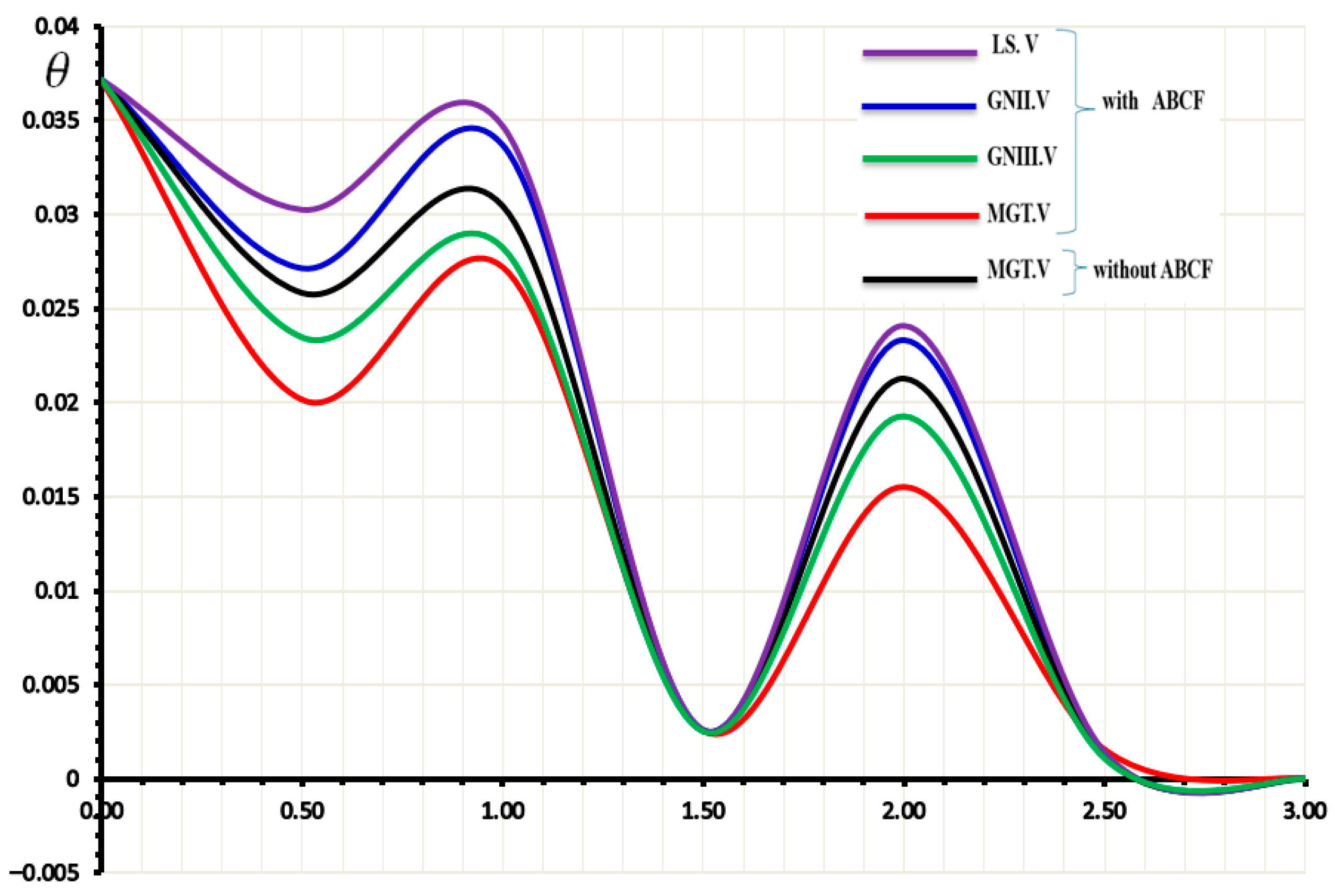
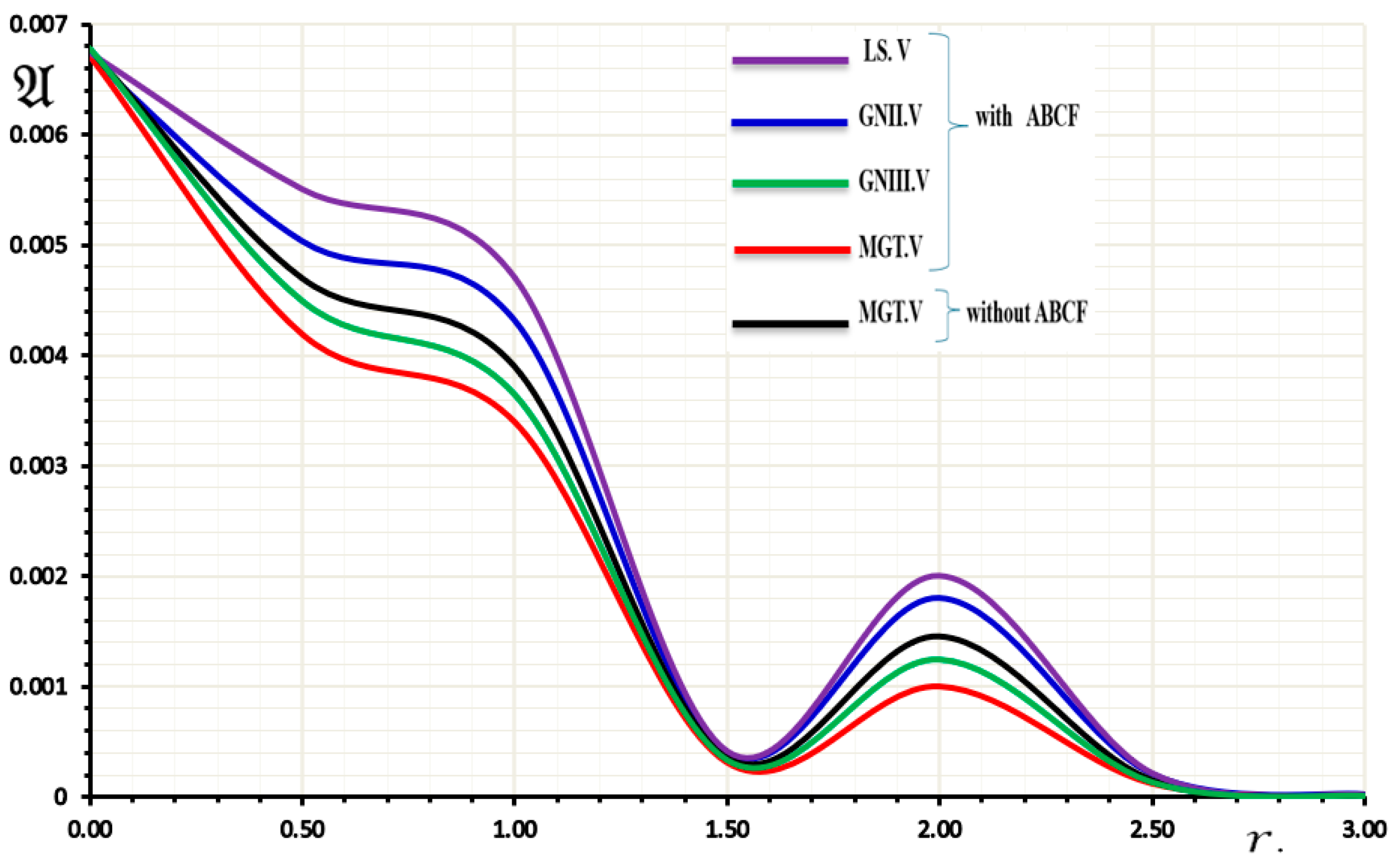
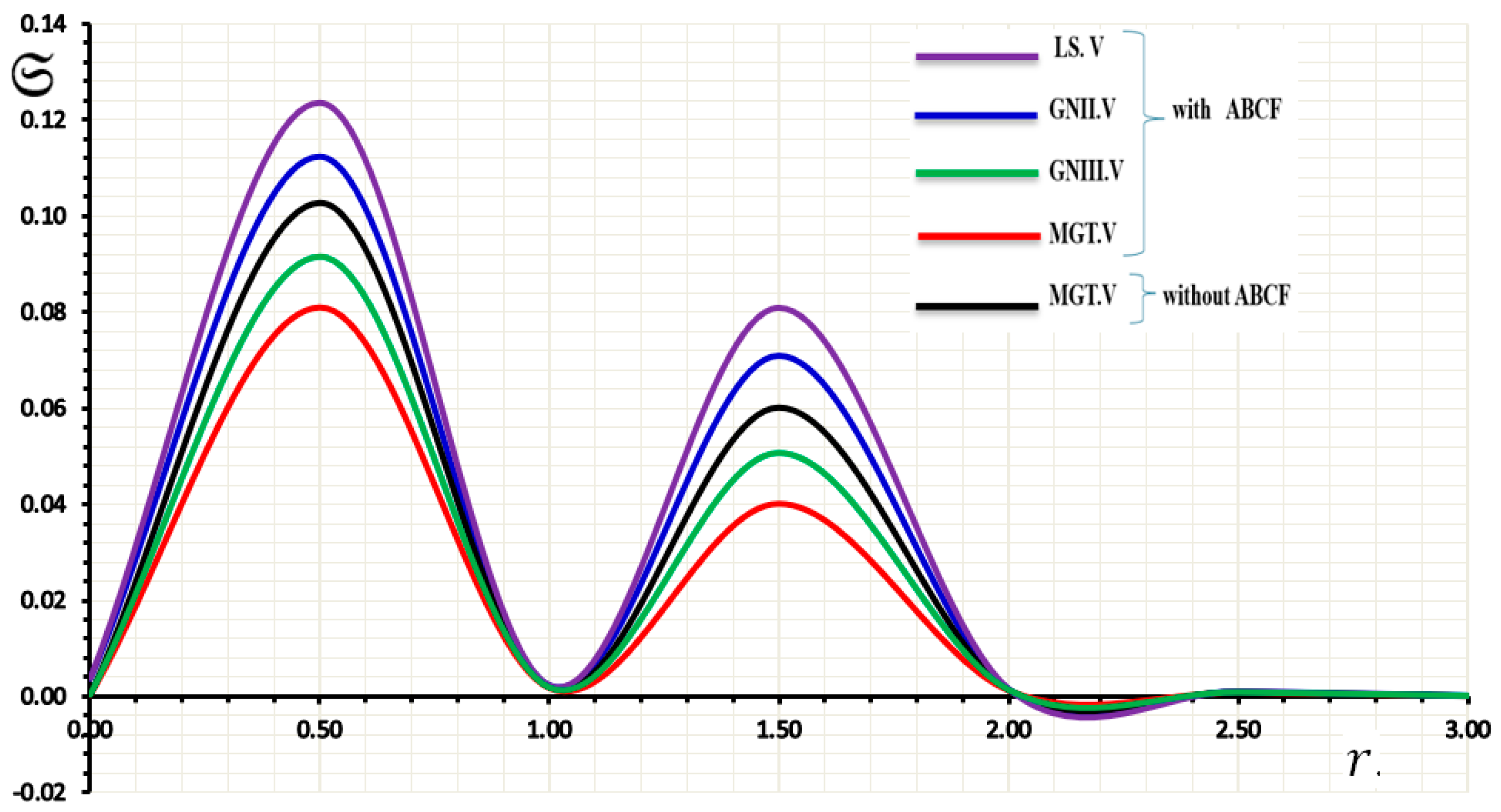
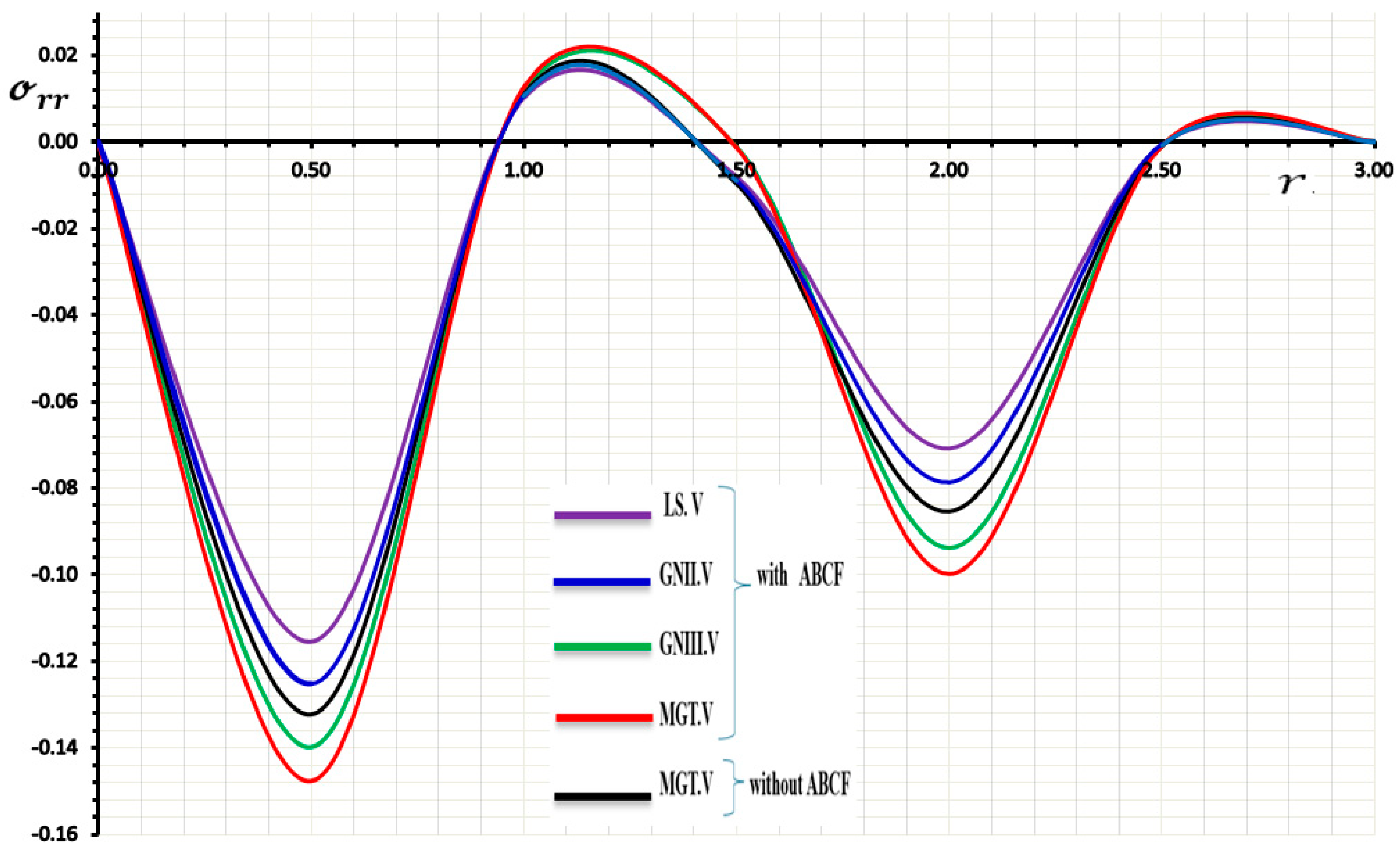
This section provides a comparative analysis of the proposed Atangana–Baleanu fractional Moore–Gibson–Thompson model with voids (ABCFMGT.V) against several established and modified thermoelastic models under the same conditions. The models compared are: (MGT.V), (ABCFLS.V), (ABCFGN-II.V), and (ABCFGN-III.V). This comparative assessment is conducted on thermoelastic cylinders with voids using the following fixed parameters: r = a = 3 ,   t = 0.1 ,   τ 0 = 0.03 ,   K s = 0.001 . . The fractional effects are prominently visible in the targeted regimes, whereas at later times or with parameter selections the responses naturally converge across models, yielding comparable trends without indicating redundancy. In addition to that, this similarity does not imply redundancy; rather, it indicates that for the selected material constant and loading, the coupling/relaxation parameters dominate over α , and the fractional operator mainly fine-tunes attenuation and phase lag. The specific material parameters utilized for this study are adopted directly from previous research [38,39]:
T 0 = 298   K   , ρ   =   2 × 10 3   k g   m 3 , p   =   8 × 10 8   N , H = 1.753 × 10 15   m 2 , k   =   386   W m 1 K 1 , α t =   8 × 10 9   N , C e   =   1.04 × 10 3   J   k g 1   d e g 1   , u   =   7.5 × 10 9   N m 2 ,   =   1.5 × 10 10   N m 2 , b   =   1.13849 × 10 10   N m 2   , K 0   =   1.7 × 10 2   W m 1   d e g 1 , ξ 1 =   1.2 × 10 10   N m 2 , M   =   2 × 10 6   N m 2   d e g 1 , β   =   2.68 × 10 6   N m 2   d e g 1 , α = 0.5 .

4.2. Assessment of Several Thermoelasticity Models with Voids and ABC Fractional Derivative

In this section, we provide a visual explanation of the distributions of the temperature ( θ ), displacement ( A ), value of voids ( S ), and thermoelastic stress for the different thermoelastic models.
Figure 1: The temperature profile demonstrates smooth decay as a function of radial distance, characteristic of thermal diffusion incorporating relaxation effects and fractional memory. The absence of sharp fronts underscores attenuated heatwave propagation, while amplitude disparities stem from the distinct relaxation and memory mechanisms in each model: the Moore–Gibson–Thompson thermal voids model without the Atangana–Baleanu–Caputo fractional derivative (MGT.V), the Lord–Shulman thermal voids model (ABCFLS.V), the Green–Naghdi models (ABCFGN-II.V and ABCFGN-III.V), and the Moore–Gibson–Thompson thermoelasticity model with voids (ABCFMGT.V) that includes the Atangana–Baleanu–Caputo fractional derivative. These models chiefly differ in magnitude, with elevated initial temperatures progressively declining over time across all cases. This pattern manifests as reduced temperatures near the cylinder’s surface under the specified boundary conditions. Furthermore, the models (ABCFLS.V), (ABCFGN-II.V), and MGT.V display comparable distributions before converging to zero within the cylindrical domain. These findings highlight the substantial impact of temperature-dependent properties on physical quantity distributions, with variations aligning well with prior results [21,29], and thereby validating the model.
Figure 2 depicts the variation of the displacement amplitude A with radial distance r , facilitating a comparison among various models: (ABCFLS.V), (ABCFGN-II.V), (ABCFGN-III.V), (MGT.V), and (ABCFMGT.V). The displacement profile exhibits a decaying oscillatory pattern, emblematic of elastic wave propagation in a compliant medium. The amplitude reduction toward the boundary highlights the combined effects of void-induced softening and thermoelastic damping. The displacement curves for the range (0 < r < 1.5) show that the values for the cases of (ABCFLS.V) and (ABCFGN-II.V) are higher than those of the other models. Furthermore, it is observed that during the period (2.5 < r < 3), the five models (ABCFLS.V, ABCFGN-II.V, ABCFGN-III.V, MGT.V, and ABCFMGT.V) exhibit convergence as they approach zero. This aligns with the findings of [21,48], confirming the oscillatory behavior of displacement in thermoelasticity with voids.
Figure 3: The void field distribution presents a localized peak followed by gradual attenuation, representing the dynamic interaction between void inertia and matrix stiffness. This shape indicates that voids actively store and dissipate energy rather than behave as passive defects. The distribution of thermoelastic with voids for (ABCFLS.V), (ABCFGN-II.V), (MGT.V), and (ABCFGN-III.V) is larger than that of (ABCFMGT.V), based on our findings. Point 0.5 is the point at which all the models achieve their highest values, while the interval between 2 and 2.5 is where they achieve their lowest values. According to Sharma [31] and Kumar [38], it is worth noting that the five models (ABCFLS.V), (ABCFGN-II.V), (ABCFGN-III.V), (MGT.V), and (ABCFMGT.V) exhibit similar curves and values that are closely aligned, but they gradually decrease within the solid cylinder until they stabilize within the range of 2.5 to 3.0.
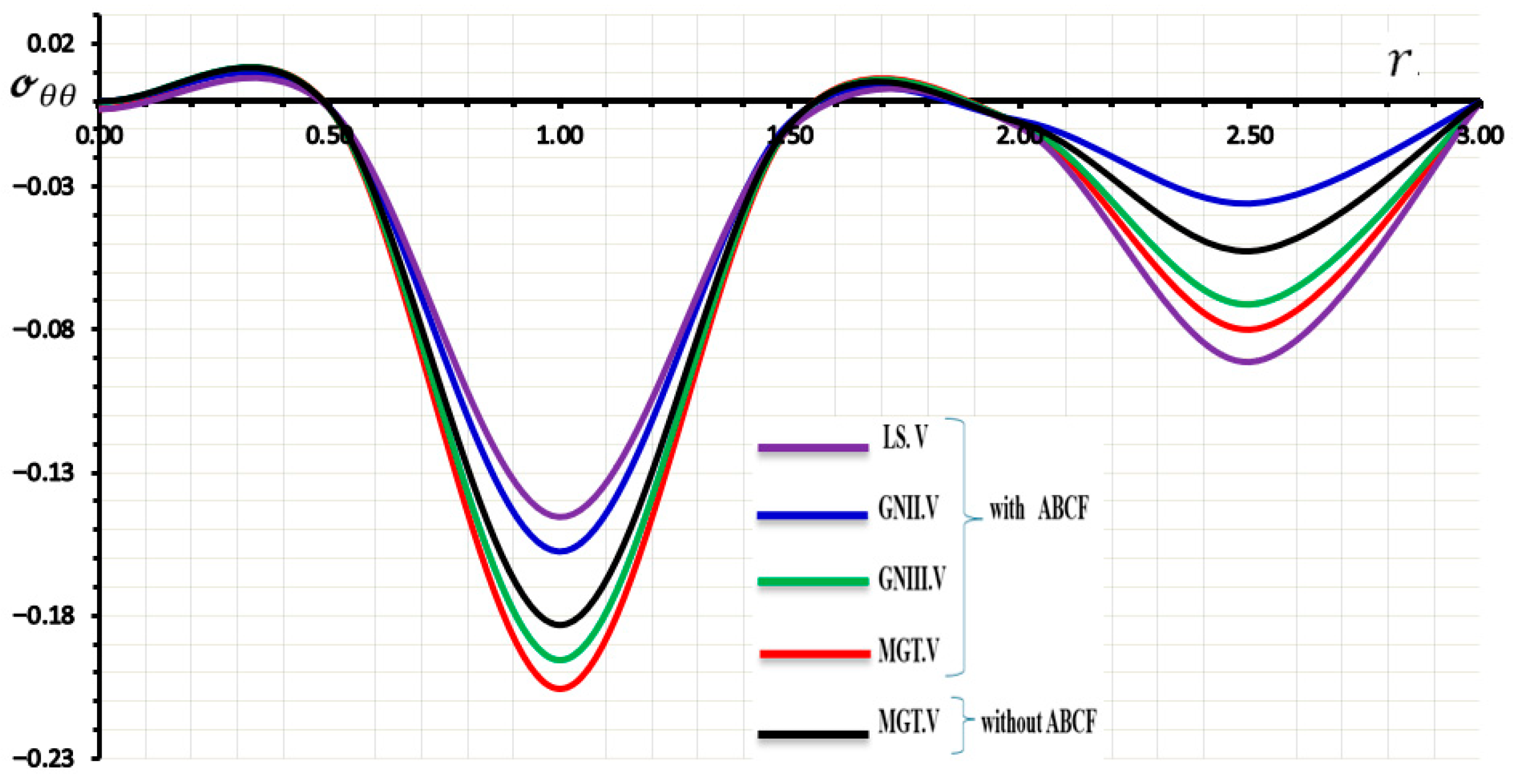
Figure 4 and Figure 5 depict the radial distribution of thermoelastic stresses incorporating voids across various frameworks, including Lord–Shulman thermoelasticity with voids, Green–Naghdi models, and the Moore–Gibson–Thompson model of thermoelasticity, both with and without the Atangana–Baleanu–Caputo fractional derivative.
  • The radial stress profile exhibits sign reversals and boundary-layer localization, indicative of transient compressive tensile oscillations induced by thermoelastic coupling. The abrupt variations adjacent to the surface highlight the pronounced effects of thermal loading and void interactions.
  • Hoop stress exhibits smoother oscillations relative to radial stress, reflecting circumferential redistribution of thermal strains. This configuration underscores the voids’ influence in mitigating stress concentrations and facilitating stress relaxation within the cylinder.
  • The profiles exhibit substantial discrepancies near the surface, with convergence observed in the cylinder’s interior.
  • Pressures commence at minimal levels, progressively escalate with oscillations over time, and ultimately decay to zero.
  • Negative values signify compressive stresses under the employed sign convention; boundary-proximate sign changes arise from transient thermoelastic oscillations intensified by boundary conditions and void interactions, proving resilient to Laplace inversion sensitivity analyses.
  • Void/porosity coupling manifests via void-dependent constitutive and interaction terms, chiefly altering the medium’s effective compressibility and compliance, thereby impacting displacements, stresses, and the void fraction predominantly.

4.3. The Effect of the Atangana–Baleanu Fractional Derivative for Order α in Caputo Sense (ABCF)

Using the Atangana–Baleanu–Caputo fractional derivative in theoretical analysis provides a clearer understanding of the behavior of elastic materials, particularly those with holes. By incorporating fractional order parameters, this approach effectively captures size-dependent effects overlooked by traditional local elasticity theories. These advancements are especially crucial for thermoelastic materials with voids, where spatial and temporal interactions profoundly influence mechanical and thermal properties. The importance of ABC fractional derivative parameters in modeling such materials stems from their employment of a non-singular Mittag–Leffler kernel, which reveals non-local influences: stress or strain at one point depends on conditions in nearby regions. The spatial fractional parameter captures the influences of nearby strains and stresses, yielding reduced magnitudes in the stress and strain fields. This smoothing effect dampens sharp variations while introducing size-dependent behavior. Moreover, the fractional order governs the strength and temporal distribution of memory effects via the non-singular Mittag–Leffler kernel; lower values extend the hereditary tail, increasing the phase delay and altering the decay envelope. The ABC fractional operator acts on thermal evolution, introducing hereditary thermal relaxation (memory) that primarily alters the temperature attenuation and phase lag, with mechanical changes arising secondarily via thermoelastic coupling. Through field coupling, these dynamics produce observable peak delays, smooth wavefronts, and modified stress–void interactions. Additionally, the void field alters the volumetric response via the coupling terms in the stress and momentum balance equations. Depending on the local sign and gradient of the void variable, this can amplify or counteract the thermoelastic volumetric strain, explaining the boundary-layer sign changes and peak shifts in stress or displacement. Finally, the relaxation parameter governs the rate at which the heat flux responds to temperature or thermal displacement gradients, thereby dictating the thermal wave speed, phase lag, and timing of thermoelastic loading in the mechanical field. The ABC fractional operator acts on the thermal evolution, introducing hereditary thermal relaxation (memory) that primarily alters temperature attenuation and phase lag, with mechanical changes arising secondarily via thermoelastic coupling.
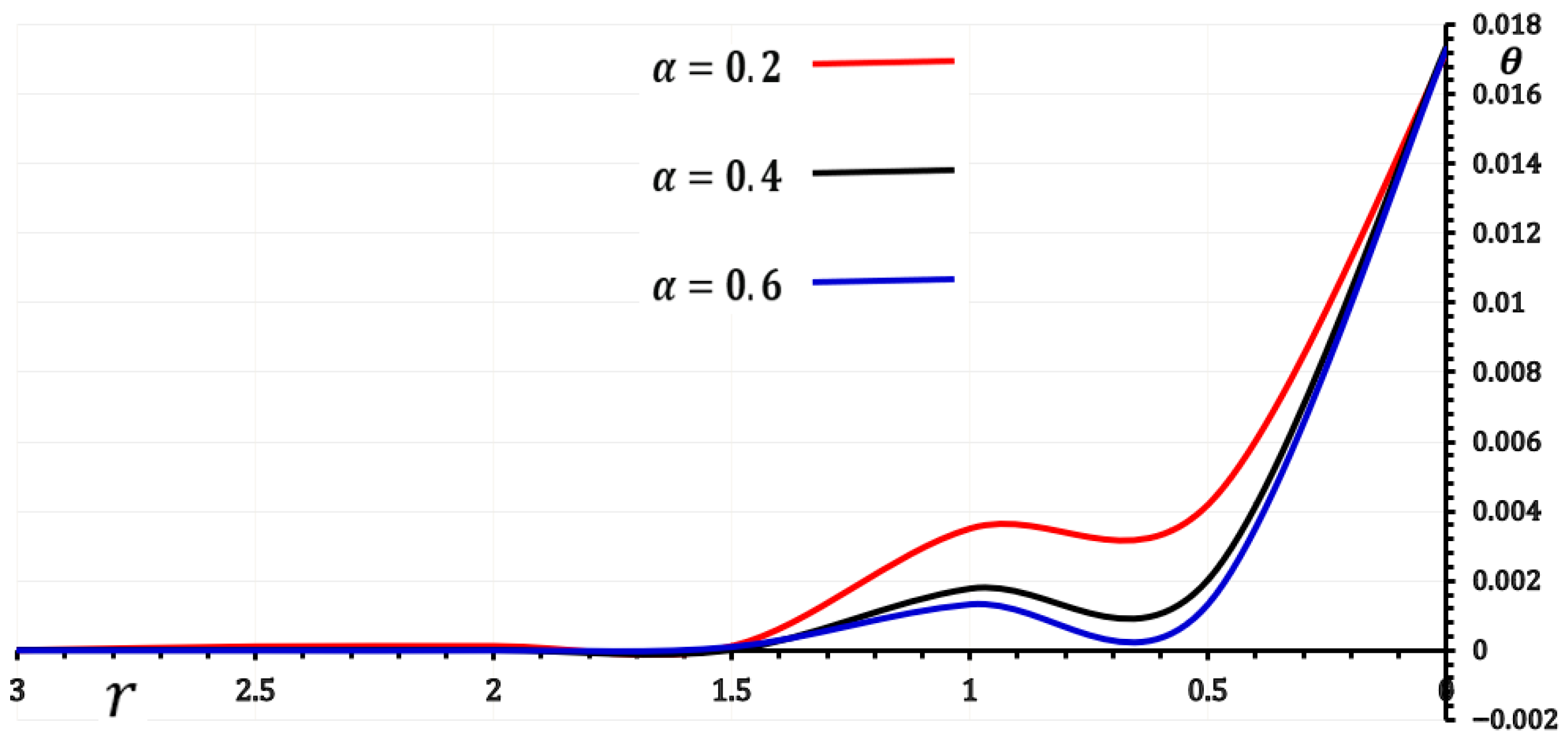
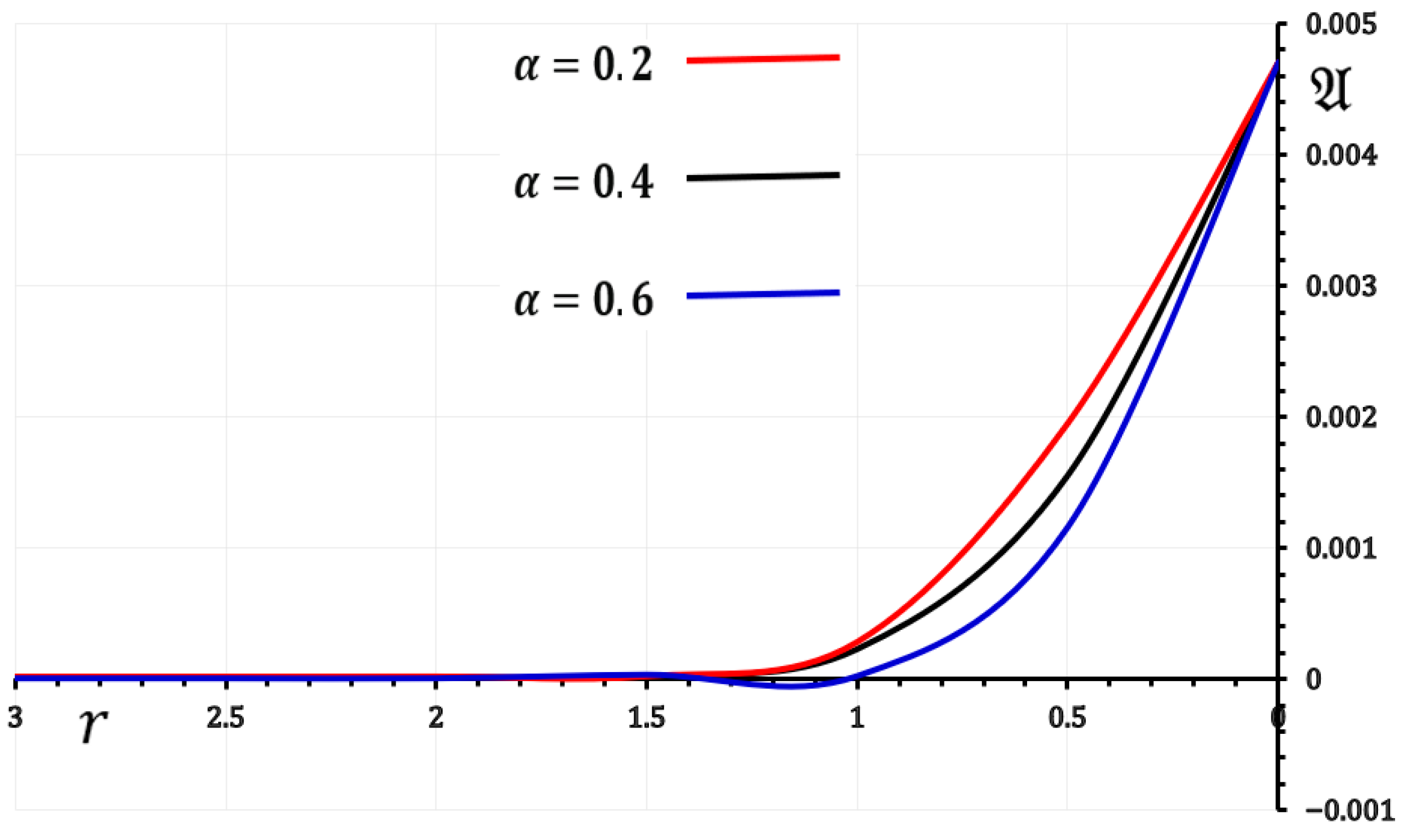
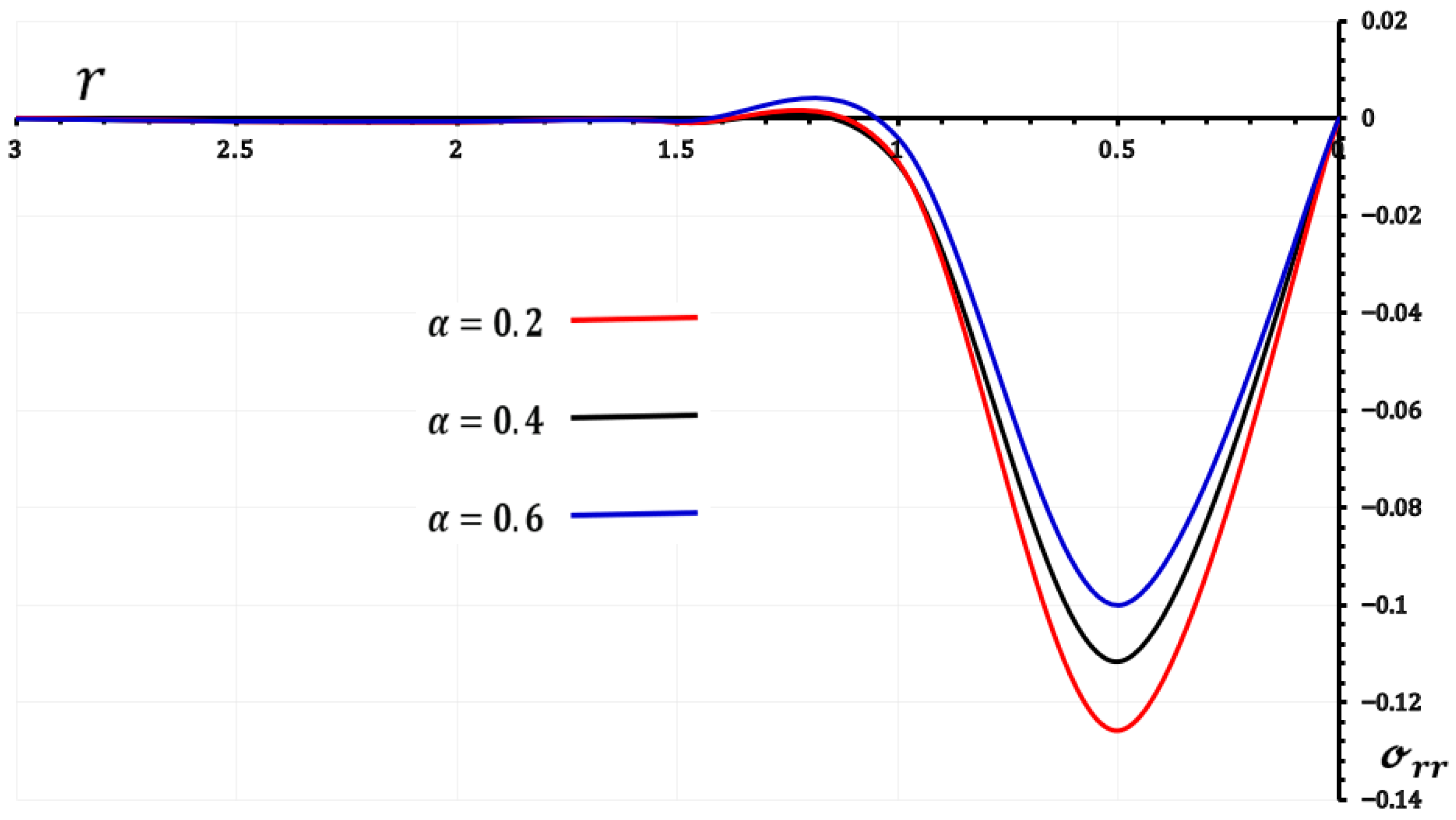
Figure 6 and Figure 7 show the variations in temperature θ and displacement A against r for different values of ( α = 0.2 ,   α = 0.4 ,   a n d   α = 0.6 ) . Notably, the value of α significantly affects the temperature over a wide range of r , i.e., ( 1.0 < r < 3.0 ) , and increasing the value of α causes a decrease in the values of temperature θ and displacement A . This indicates that physical fields at any fixed point weaken with increasing values of α , suggesting a potential relationship between time and decreases in physical fields. The progressively flattened temperature profiles indicate enhanced attenuation as the fractional order increases, showing that stronger memory weakens thermal intensity and smooths spatial gradients. The reduction in peak amplitude and faster decay of the displacement curves reflect increased visco-inertial damping, where higher fractional order suppresses elastic oscillations.
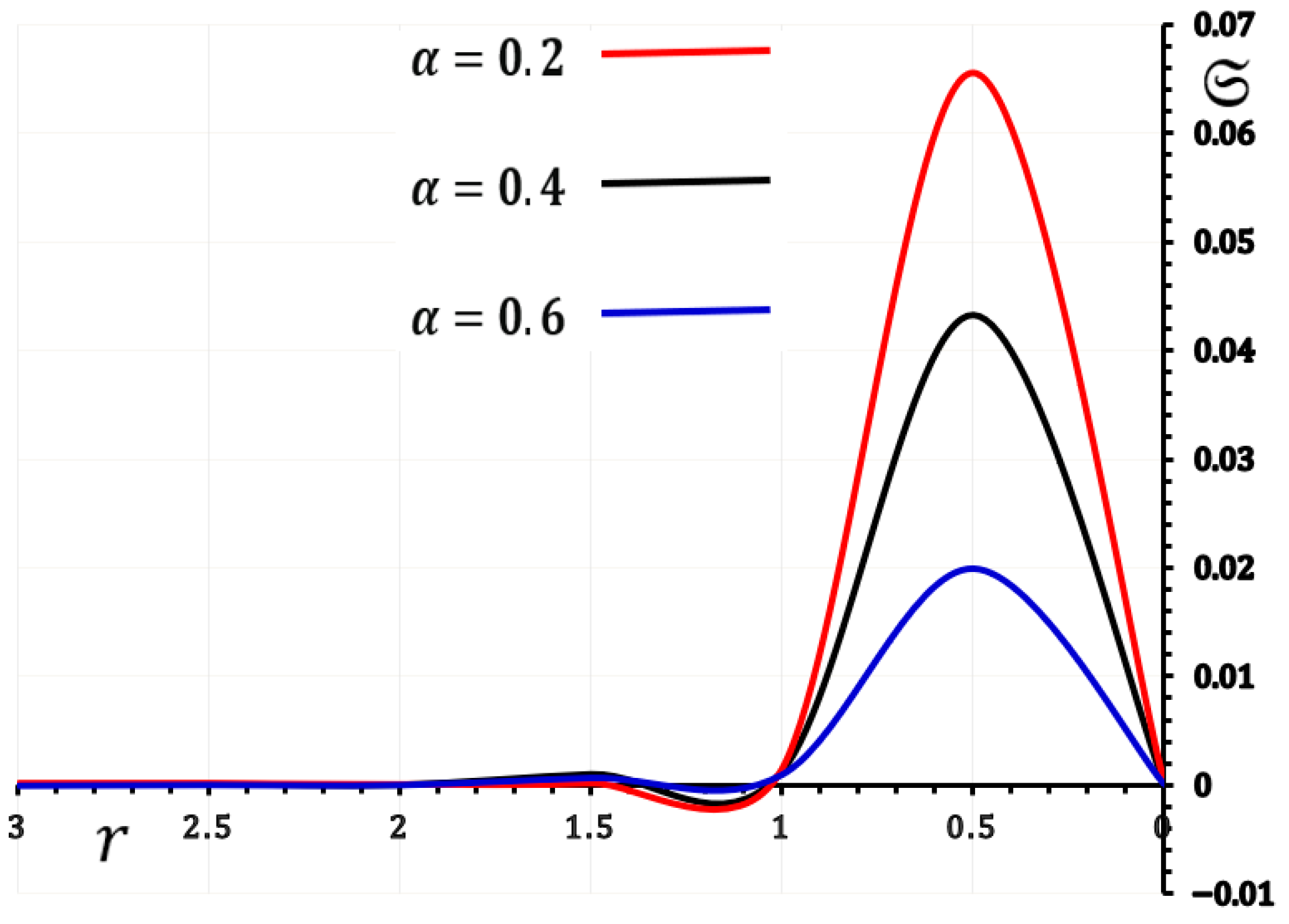
Figure 8 shows the variation in void field S with respect to r for different values of ( α = 0.2 ,   α = 0.4 ,   a n d   α = 0.6 ) .
  • The diminishing peak of the void distribution signifies reduced void activation as memory effects strengthen, indicating delayed and weakened void–matrix interaction.
  • In the range ( 0.0 < r < 1.5 ) , increasing α leads to a decrease in the magnitude of the void field S .
  • In contrast, the curves of the void volume vanish simultaneously in the range ( 1.5 < r < 3.0 ) .
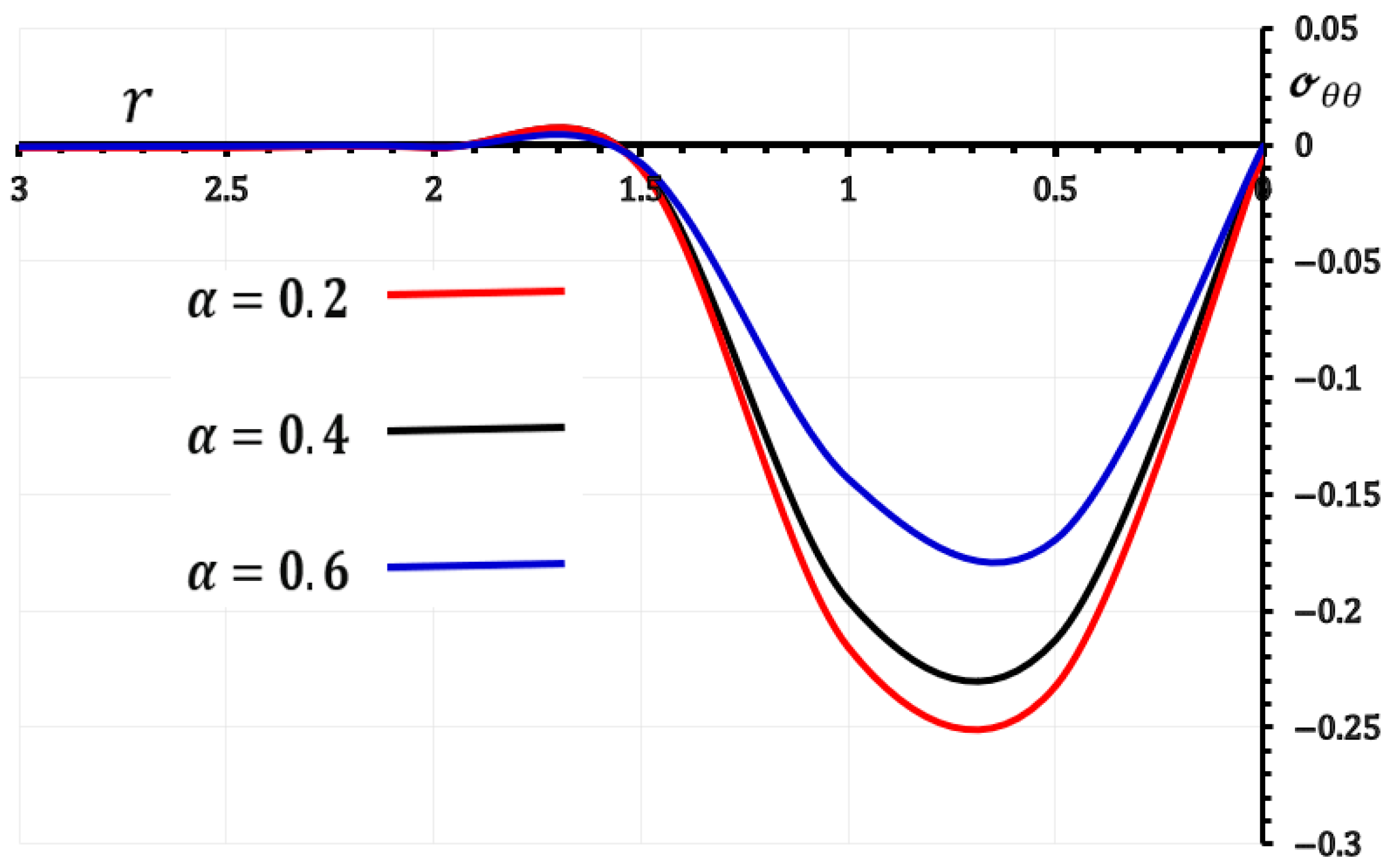
Figure 9 and Figure 10 illustrate the stresses o r r and o θ θ   variation with respect to the radius r for different values of ( α = 0.2 ,   α = 0.4 ,   a n d   α = 0.6 )
  • The Atangana–Baleanu–Caputo fractional derivative significantly influences stress variation.
  • Indeed, within the interval ( 0   <   r   <   2.0 ) , increasing   α decreases the magnitude of stress.
  • In Figure 9, the shrinking stress extrema and smoother profiles demonstrate that a higher fractional order mitigates stress concentration by spreading the thermoelastic response over time.
  • Figure 10. The gradual smoothing and attenuation of circumferential stress curves reveal enhanced stress relaxation, with fractional memory moderating rapid circumferential strain buildup.
Figure 9. The variation in thermal stresses ( o r r ) against radial distance r for different values of the fractional parameter α .
Symmetry 18 00359 g009
Figure 10. The variation in thermal stresses ( o θ θ ) against radial distance r for different values of the fractional parameter α .
Symmetry 18 00359 g010

5. Conclusions

This academic study integrated the Atangana–Baleanu–Caputo fractional derivative with the (MGT) model to examine the vibrational characteristics of a thermoelastic cylinder. This innovative method was designed to characterize the behavior of void-structural elements subjected to thermal and mechanical stresses, a crucial area in advanced materials engineering. Our graphical results indicate that the void modulus significantly influences various models, such as the Lord–Schulman (LS. V), Green–Naghdi (GN-II. V and GN-III.V), and Moore–Gibson–Thompson (MGT.V), both with and without the Atangana–Baleanu–Caputo fractional derivative, in the thermoelastic domain. The results can be summarized as follows:
  • The pivotal role of voids in coupled dynamics: intimate coupling of the void volume fraction with stress and temperature via constitutive equations and functioning as an intrinsic compliance that reshapes wave propagation speeds and damping characteristics. This yields a cogent rationale for the pronounced mechanical field responses relative to the thermal responses in select parameter domains.
  • The significance of the ABC–MGT paradigm is underscored by our demonstration of how integrating third-order MGT heat conduction with the ABC kernel captures finite-speed thermal waves imbued with memory effects, which are critically pertinent for transient scenarios in porous media where conventional Fourier or lower-order models invariably underestimate propagation delays and energy dissipation.
  • The ABC fractional order modulates the effective thermal memory of the medium, engendering distinct alterations in the attenuation and phase lag of intertwined thermoelastic and void fields. Consequently, the fractional order emerges not as a mere fitting parameter but as a quantifiable index of the hereditary relaxation intensity.
  • In this paper, we conclude that the magnitudes of all the physical quantities of the (MGT) model under the Atangana–Baleanu–Caputo fractional derivatives are smaller than those in the other models. This is due to the incorporation of fractional derivative parameters.

Author Contributions

A.A.H.: Funding, Formal Analysis, Visualization; A.Y.: Conceptualization, Methodology, Writing—Original Draft, Supervision, Writing—Review and Editing; A.Z.: Conceptualization, Methodology, Supervision; S.A.A.: Formal analysis; I.-E.A.: Formal Analysis; I.O.A.: Validation; E.S.: Visualization; M.S.: Investigation; Writing—Review and Editing. All authors have read and agreed to the published version of the manuscript.

Funding

This work was funded by the Deanship of Graduate Studies and Scientific Research at Jouf University under grant No. (DGSSR-2025-02-01242).

Data Availability Statement

The original contributions presented in this study are included in the article. Further inquiries can be directed to the corresponding authors.

Conflicts of Interest

The authors declare no competing interests.

References

  1. Podlubny, I. Fractional Differential Equations; Academic Press: San Diego, CA, USA, 1999. [Google Scholar]
  2. Samko, S.G.; Kilbas, A.A.; Marichev, O.I. Fractional Integrals and Derivatives: Theory and Applications; Gordon & Breach: Yverdon, Switzerland, 1993. [Google Scholar]
  3. Kilbas, A.A.; Srivastava, H.M.; Trujillo, J.J. Theory and Applications of Fractional Differential Equations. In North-Holland Mathematics Studies; Elsevier: Amsterdam, The Netherlands, 2006. [Google Scholar]
  4. Caputo, M.; Fabrizio, M. A new definition of fractional derivative without singular kernel. Prog. Fract. Differ. Appl. 2015, 1, 73–85. [Google Scholar]
  5. Atangana, A.; Baleanu, D. New fractional derivative with non-local and non-singular kernel. Therm. Sci. 2016, 20, 757–763. [Google Scholar] [CrossRef] [Scilit]
  6. Karde, N.; Kamdi, D.; Varghese, V. Effect of nonlocality and Goufo-Caputo kernel in heat transfer nonsimple model within an infinite-length hollow cylinder subjected to diverse sectional heat supply. J. Therm. Stress. 2025, 48, 45–63. [Google Scholar] [CrossRef] [Scilit]
  7. Chandel, N.; Khalsa, L.; Varghese, V.; Dhore, N. Dynamic analysis of the Klein–Gordon nonlocality and memory phenomena in a TPL hygrothermoelastic cylinder generating the heat and moisture. Acta Mech. 2025. [Google Scholar] [CrossRef] [Scilit]
  8. Lord, H.W.; Shulman, Y. A generalized dynamical theory of thermoelasticity. J. Mech. Phys. Solids 1967, 15, 299–309. [Google Scholar] [CrossRef] [Scilit]
  9. Green, A.E.; Lindsay, K.A. Thermoelasticity. J. Elast. 1972, 2, 1–7. [Google Scholar] [CrossRef] [Scilit]
  10. Tzou, D.Y. Experimental support for the lagging behaviour in heat propagation. J. Thermophys. Heat Transf. 1995, 9, 686–693. [Google Scholar] [CrossRef] [Scilit]
  11. Tzou, D.Y. A unified approach for heat conduction from macro to microscale. J. Heat Transf. 1995, 117, 8–16. [Google Scholar] [CrossRef] [Scilit]
  12. Green, A.E.; Naghdi, P.M. A Re-Examination of the Basic Postulates of Thermomechanics. Proc. R. Soc. A Math. Phys. Eng. Sci. 1991, 432, 171–194. [Google Scholar] [CrossRef] [Scilit]
  13. Green, A.E.; Naghdi, P.M. On undamped heat waves in an elastic solid. J. Ther. Stress. 1992, 15, 253–264. [Google Scholar] [CrossRef] [Scilit]
  14. Green, A.E.; Naghdi, P.M. Thermoelasticity without energy dissipation. J. Elast. 1993, 31, 189–208. [Google Scholar] [CrossRef] [Scilit]
  15. Lasiecka, I.; Wang, X. Moore–Gibson–Thompson equation with memory, part II: General decay of energy. J. Differ. Equ. 2015, 259, 7610–7635. [Google Scholar] [CrossRef] [Scilit]
  16. Conejero, J.A.; Lizama, C.; Ródenas Escribá, F.D.A. Chaotic behaviour of the solutions of the Moore–Gibson–Thompson equation. Appl. Math. Inf. Sci. 2005, 9, 2233–2238. [Google Scholar]
  17. Quintanilla, R. Moore-Gibson-Thompson thermoelasticity. Math. Mech. Solids 2019, 24, 4020–4031. [Google Scholar] [CrossRef] [Scilit]
  18. Quintanilla, R. Moore-Gibson-Thompson thermoelasticity with two temperatures. Appl. Eng. Sci. 2020, 1, 100006. [Google Scholar] [CrossRef] [Scilit]
  19. Jangid, K.; Gupta, M.; Mukhopadhyay, S. On propagation of harmonic plane waves under the Moore–Gibson–Thompson thermoelasticity theory. Waves Random Complex Media 2021, 34, 1976–1999. [Google Scholar] [CrossRef] [Scilit]
  20. Yahya, A.; Saidi, A.; Abouelregal, A.E.; Zakria, A. Moore–Gibson–Thompson heat conduction model under the Klein–Gordon (KG) nonlocality for a thermoelastic solid cylinder with voids. Mech. Based Des. Struct. Mach. 2025, 1–19. [Google Scholar] [CrossRef] [Scilit]
  21. Yahya, A.M.H.; Saidi, A.; Abouelregal, A.E.; Zakria, A.; Ibrahim-Elkhalil, A.; Mohammed, F.A. Thermoelastic Vibrations for Solid Cylinder with Voids, Using Moore–Gibson–Thompson Heat Conduction Model. AIMS Math. 2024, 9, 34588–34605. [Google Scholar]
  22. Iesan, D. A theory of thermoelastic materials with voids. Acta Mech. 1986, 60, 67–89. [Google Scholar] [CrossRef] [Scilit]
  23. Cowin, S.C.; Nunziato, J.W. Linear elastic materials with voids. J. Elast. 1983, 13, 125–147. [Google Scholar] [CrossRef] [Scilit]
  24. Nunziato, J.W.; Cowin, S.C. A Nonlinear Theory of Elastic Materials with Voids. Arch. Ration. Mech. Anal. 1979, 72, 175–201. [Google Scholar] [CrossRef] [Scilit]
  25. Ciarletta, M.; Scarpetta, E. Some Results on Thermoelasticity for Dielectric Materials with Voids. J. Appl. Math. Mech. 1995, 75, 707–714. [Google Scholar] [CrossRef] [Scilit]
  26. Marin, M. A Uniqueness Result for Body with Voids in Linear Thermoelasticity. Rend. Mat. Appl. 1997, 17, 103–113. [Google Scholar]
  27. Marin, M. On the Domain of Influence in Thermoelas-elasticity of Bodies with Voids. Arch. Math. 1997, 33, 301–308. [Google Scholar]
  28. Cicco, S.D.; Diaco, M. A Theory of Thermoelastic Materials with Voids without Energy Dissipation. J. Therm. Stress. 2002, 25, 493–503. [Google Scholar] [CrossRef] [Scilit]
  29. Yahya, A.; Saidi, A. Response of Generalized Thermoelastic for Free Vibration of a Solid Cylinder with Voids Under a Dual-Phase Lag Model. Iran. J. Sci. Technol. Trans. Mech. Eng. 2025, 49, 1333–1343. [Google Scholar] [CrossRef] [Scilit]
  30. Ponnusamy, P. Wave propagation in a generalized thermoelastic solid cylinder of arbitrary cross-section. Int. J. Solids Struct. 2007, 44, 5336–5348. [Google Scholar] [CrossRef] [Scilit]
  31. Sharma, J.N. Three-dimensional vibration analysis of a homogeneous transversely isotropic thermoelastic cylindrical panel. J. Acoust. Soc. Am. 2001, 110, 648–653. [Google Scholar] [CrossRef] [Scilit]
  32. Sharma, J.N.; Sharma, P.K. Free vibration analysis of homogeneous transversely isotropic thermoelastic cylindrical panel. J. Therm. Stress. 2002, 25, 169–182. [Google Scholar] [CrossRef] [Scilit]
  33. Sharma, D.K.; Thakur, D.; Walia, V.; Sarkar, N. Free vibration analysis of a nonlocal thermoelastic hollow cylinder with diffusion. J. Therm. Stress. 2020, 43, 981–997. [Google Scholar] [CrossRef] [Scilit]
  34. Chandrasekharaiah, D.S. Effects of Surface Stresses and Voids on Rayleigh Waves in an Elastic Solid. Int. J. Eng. Sci. 1987, 25, 205–211. [Google Scholar] [CrossRef] [Scilit]
  35. Sharma, P.K.; Kaur, D.; Sharma, J.N. Three-dimensional vibration analysis of a thermoelastic cylindrical panel with voids. Int. J. Solids Struct. 2008, 45, 5049–5058. [Google Scholar] [CrossRef] [Scilit]
  36. Sharma, D.K.; Thakur, D. Vibrations of nonlocal thermoelastic voids sphere with three–phase–lag model. Mater. Today Proc. 2021, 42, 356–361. [Google Scholar] [CrossRef] [Scilit]
  37. Sharma, S.R.; Mehalwal, J.C.; Sarkar, N.; Sharma, D.K. Vibration analysis of electro-magneto transversely isotropic non-local thermoelastic cylinder with voids material. Eur. J. Mech.-A/Solids 2022, 92, 104455. [Google Scholar] [CrossRef] [Scilit]
  38. Kumar, D.; Prakash, S.; Thakur, C.; Sarkar, N.; Bachher, M. Vibrations of a nonlocal thermoelastic cylinder with the void. Acta Mech. 2020, 231, 2931–2945. [Google Scholar] [CrossRef] [Scilit]
  39. Singh, B.; Pal, R. Surface Wave Propagation in a Generalized Thermoelastic Material with Voids. Appl. Math. 2011, 2, 521–526. [Google Scholar] [CrossRef]
  40. Watuagala, G.K. Sumudu transform: A new integral transform to solve differential equations and control engineering problems. Int. J. Math. Educ. Sci. Technol. 1993, 24, 35–43. [Google Scholar] [CrossRef] [Scilit]
  41. Abo-Dahab, S.M.; Abd-Alla, A.M.; Kilany, A.A. Effects of rotation and gravity on an electro-magneto thermoelastic medium with diffusion and voids by using the Lord Shulman and dual-phase-lag models. Appl. Math. Mech. 2019, 40, 11–35. [Google Scholar] [CrossRef] [Scilit]
  42. Abouelregal, A.E.; Abo-Dahab, S.M. Dual-phase- lag diffusion model for Thomson’s phenomenon on electromagnetic-thermoelastic an infinitely solid cylinder. J. Comput. Theor. Nanosci. 2014, 11, 1031–1039. [Google Scholar] [CrossRef] [Scilit]
  43. Abo-Dahab, S.M. S-waves propagation in a non-homogeneous anisotropic incompressible medium under influences of a gravity field, initial stress, electromagnetic field and rotation. Appl. Math. Inf. Sci. 2016, 1, 363–376. [Google Scholar] [CrossRef] [Scilit]
  44. Kumar, R.; Singh Reen, R.L.; Garg, S.K. Axisymmetric propagation in a thermoelastic diffusion with phase lags. Am. J. Sci. Technol. 2016, 3, 82–96. [Google Scholar]
  45. Abouelregal, A.E. A problem of a semi-infinite medium subjected to exponential heating using a dual-phase-lag Thermoelastic Model. Appl. Math. 2011, 2, 619–624. [Google Scholar] [CrossRef]
  46. Kumar, R.; Kansal, T. Propagation of plane waves and fundamental solution in the theories of thermoelastic diffusive materials with voids. Int. J. Appl. Math. Mech. 2012, 8, 84–103. [Google Scholar]
  47. Xue, Z.; Liu, J.; Tian, X.; Yu, Y. Thermal shock fracture associated with unified fractional heat conduction. Eur. J. Mech.-A/Solids 2021, 85, 104–129. [Google Scholar] [CrossRef] [Scilit]
  48. Abouelregal, A.E.; Sedighi, H.M. A new insight into the interaction of thermoelasticity with mass diffusion for a half-space in the context of Moore–Gibson–Thompson thermodiffusion theory. Appl. Phys. A 2021, 127, 582. [Google Scholar] [CrossRef] [Scilit]
  49. Honig, G.; Hirdes, U. A method for the numerical inversion of the Laplace transform. J. Comp. Appl. Math. 1984, 10, 113. [Google Scholar] [CrossRef] [Scilit]
  50. Yu, Y.J.; Deng, Z.C. Fractional order theory of Cattaneo-type thermoelasticity using new fractional derivatives. Appl. Math. Model. 2020, 87, 731. [Google Scholar] [CrossRef] [Scilit]
  51. Yu, Y.J.; Deng, Z.C. Fractional order thermoelasticity for piezoelectric materials. Fractals 2021, 29, 2150082. [Google Scholar] [CrossRef] [Scilit]
  52. Abouelregal, A.E.; Elhagary, M.A.; Soleiman, A.; Khalil, K.M. Generalized thermoelastic diffusion model with higher-order fractional time-derivatives and four-phase-lags. Mech. Based Des. Struct. Mach. 2020, 50, 897–914. [Google Scholar] [CrossRef] [Scilit]
  53. Yu, Y.J.; Zhao, L.J. Fractional thermoelasticity revisited with new definitions of fractional derivative. Eur. J. Mech.-A/Solids 2020, 84, 104043. [Google Scholar] [CrossRef] [Scilit]
Figure 1. The variation in temperature θ against radial distance   r .
Symmetry 18 00359 g001
Figure 2. The fluctuation of displacement relative to the radial distance r .
Symmetry 18 00359 g002
Figure 3. The variation in the voids S against radial distance r .
Symmetry 18 00359 g003
Figure 4. The variation in thermal stresses o r r against radial distance r .
Symmetry 18 00359 g004
Figure 5. The variation the thermal stresses o θ θ against radial distance r .
Symmetry 18 00359 g005
Figure 6. The variation in temperature θ against radial distance r for different values of fractional parameter α .
Symmetry 18 00359 g006
Figure 7. The variation in displacement A against radial distance r for different values of fractional parameter α .
Symmetry 18 00359 g007
Figure 8. The variation in void S against radial distance r for different values of fractional parameter α .
Symmetry 18 00359 g008
Disclaimer/Publisher’s Note: The statements, opinions and data contained in all publications are solely those of the individual author(s) and contributor(s) and not of MDPI and/or the editor(s). MDPI and/or the editor(s) disclaim responsibility for any injury to people or property resulting from any ideas, methods, instructions or products referred to in the content.