Thermoelastic Oscillations of a Solid Medium with Voids via the Influence of Atangana-Baleanu-Caputo Fractional Derivative

 , , ,
, , ,  , , and
Abstract
1. Introduction
2. Problem Formulation and Basic Definitions of the Fractional Calculus Operator
3. Solution of the Problem in the Laplace Transform Domain
4. Inversion Transformation and Numerical Results
4.1. Numerical Results
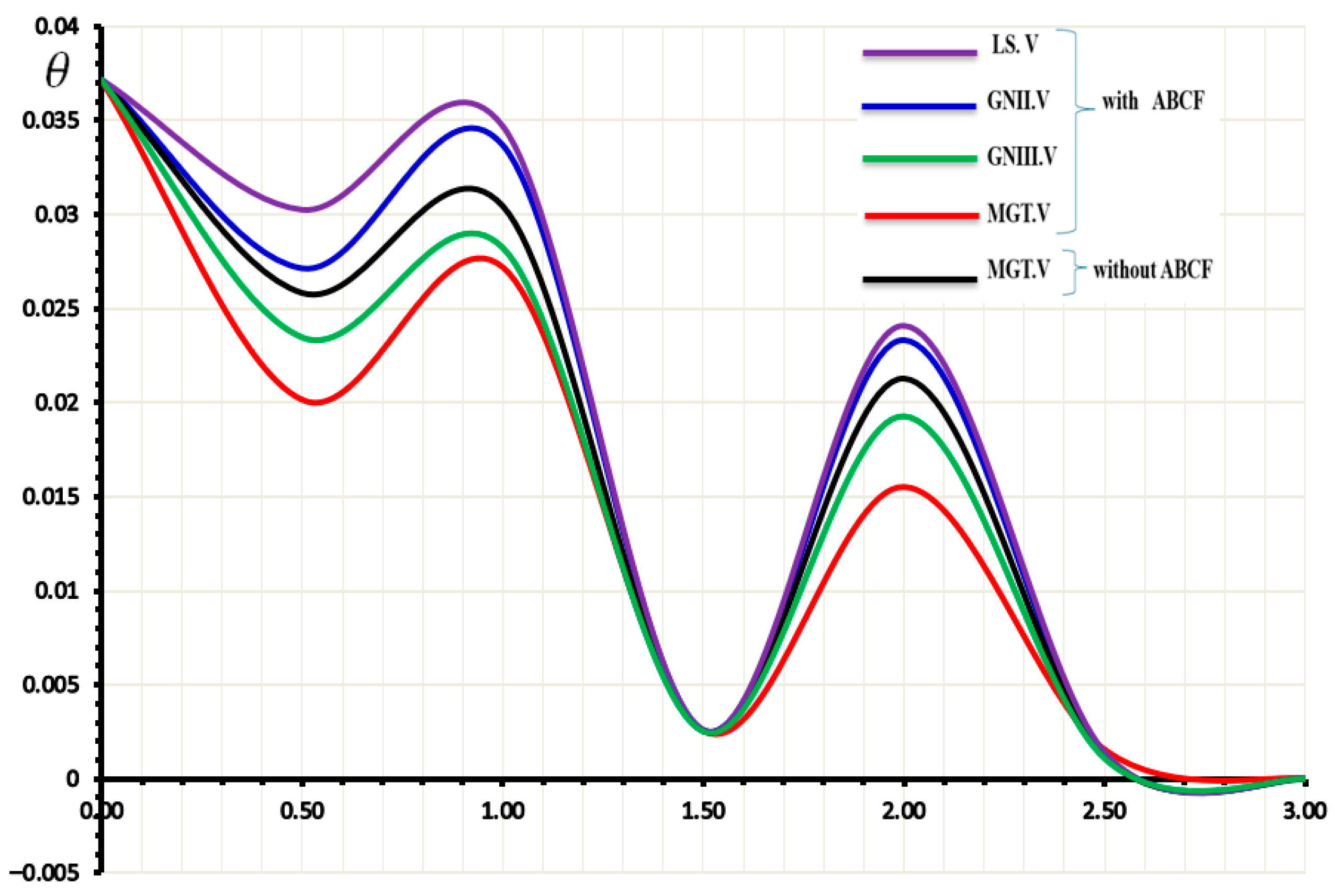
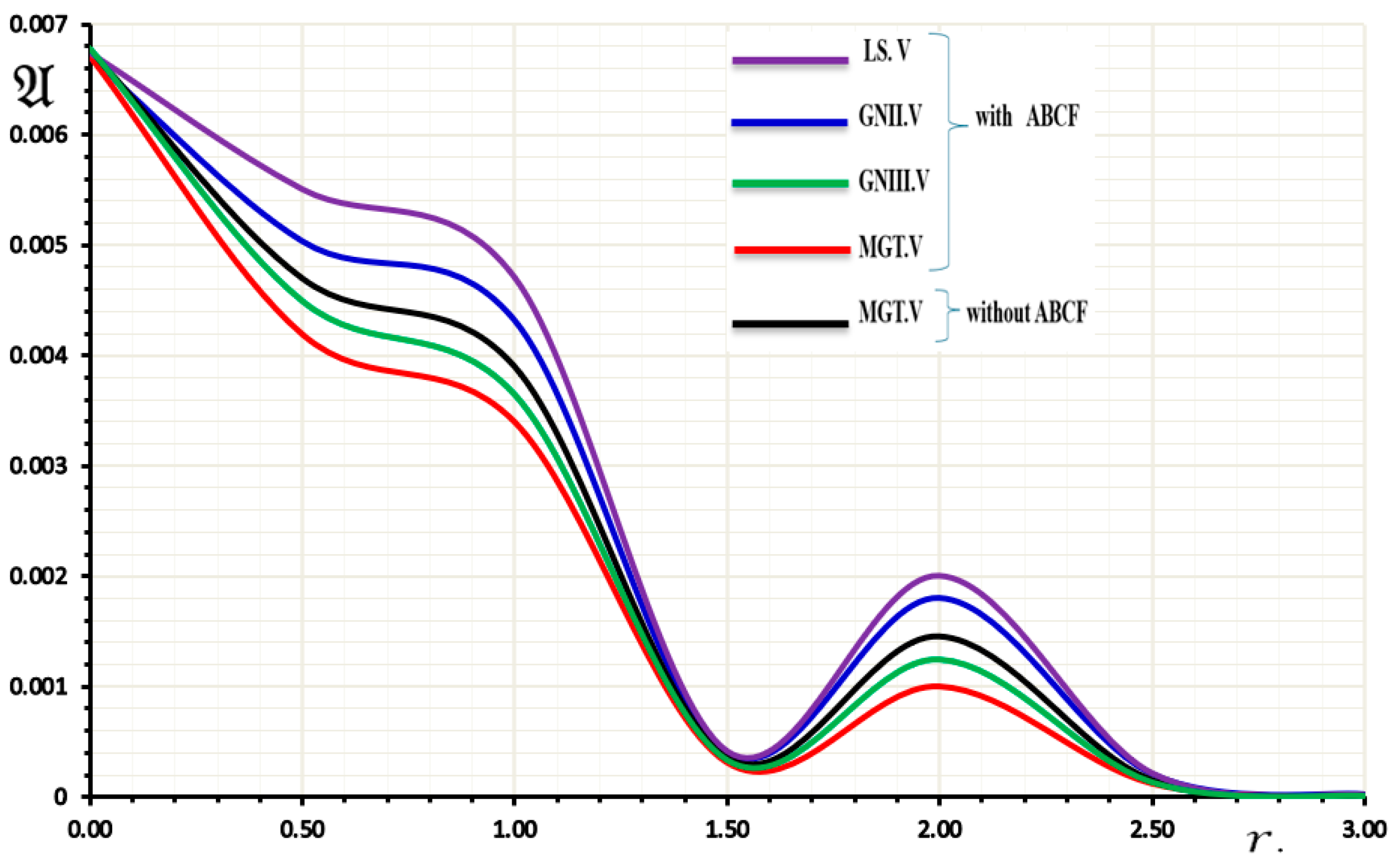
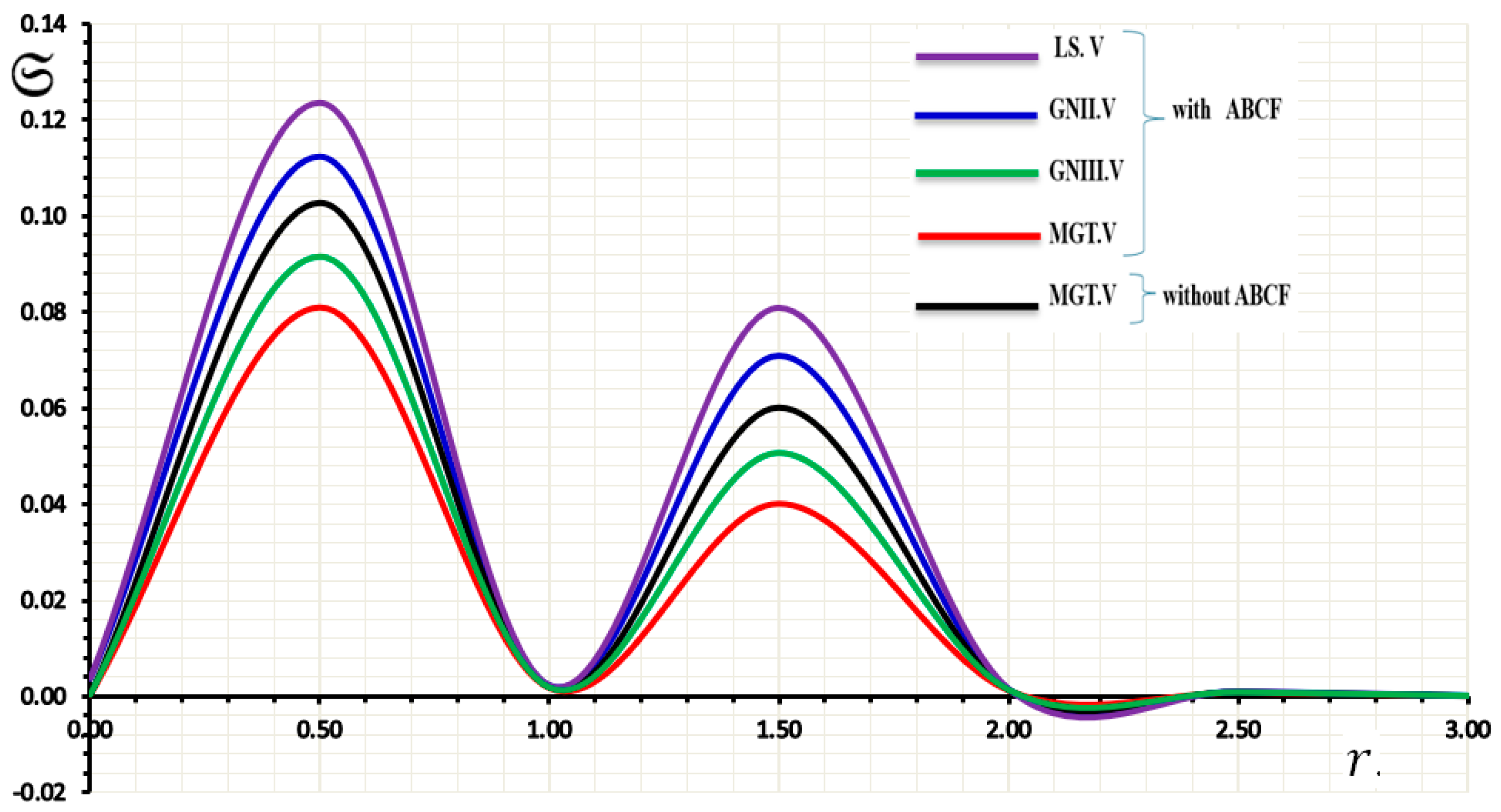
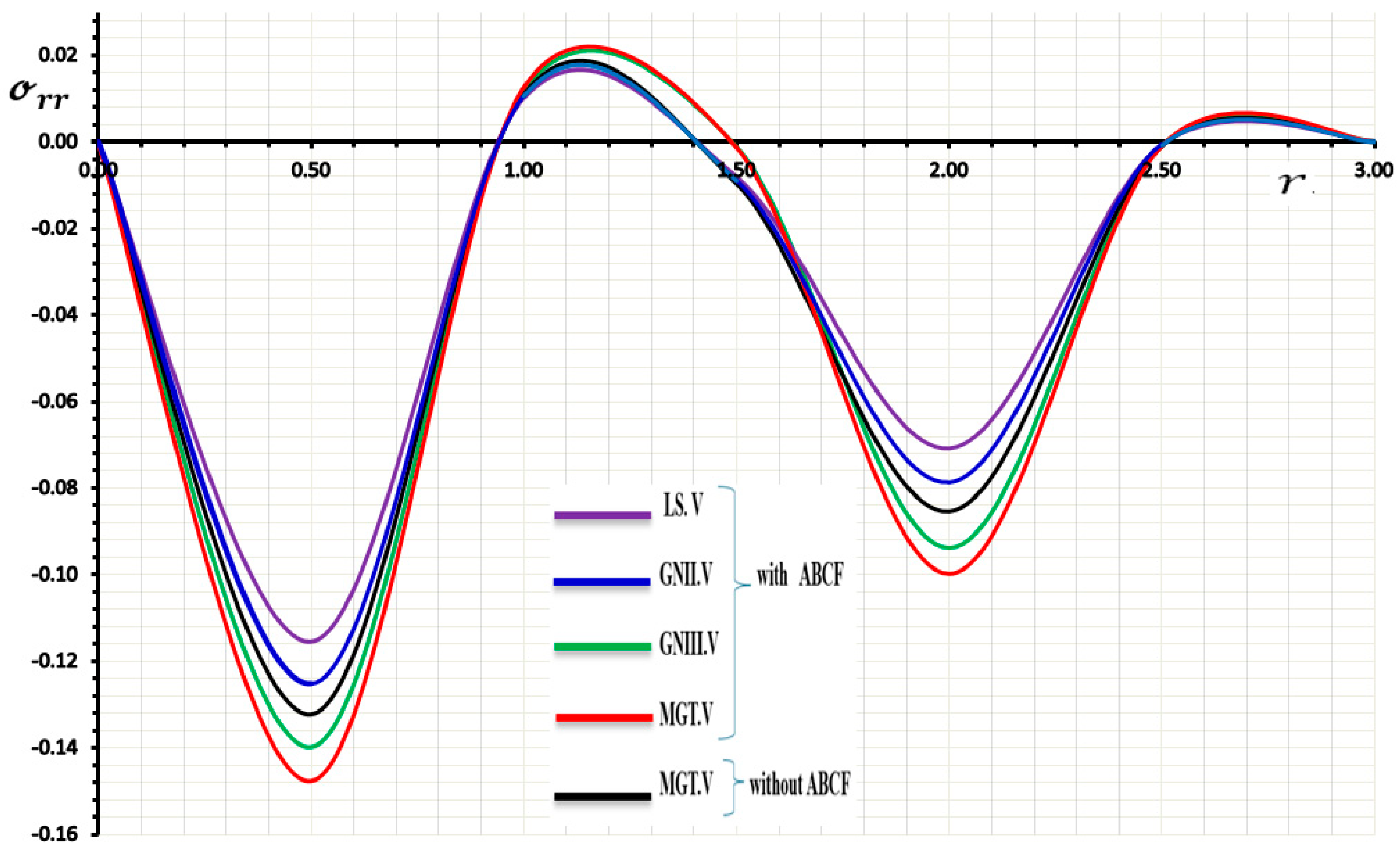
4.2. Assessment of Several Thermoelasticity Models with Voids and ABC Fractional Derivative
- The radial stress profile exhibits sign reversals and boundary-layer localization, indicative of transient compressive tensile oscillations induced by thermoelastic coupling. The abrupt variations adjacent to the surface highlight the pronounced effects of thermal loading and void interactions.
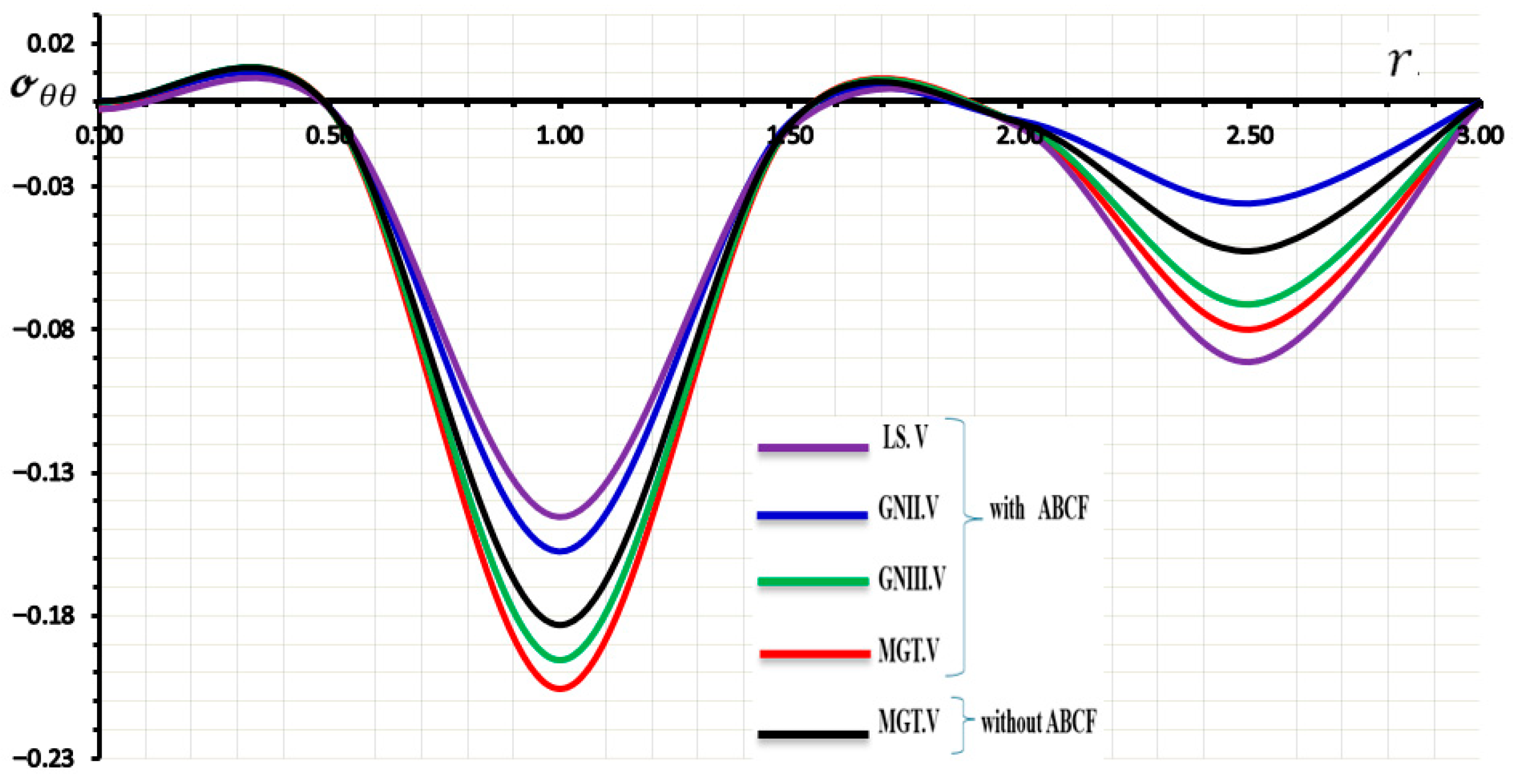
- Hoop stress exhibits smoother oscillations relative to radial stress, reflecting circumferential redistribution of thermal strains. This configuration underscores the voids’ influence in mitigating stress concentrations and facilitating stress relaxation within the cylinder.
- The profiles exhibit substantial discrepancies near the surface, with convergence observed in the cylinder’s interior.
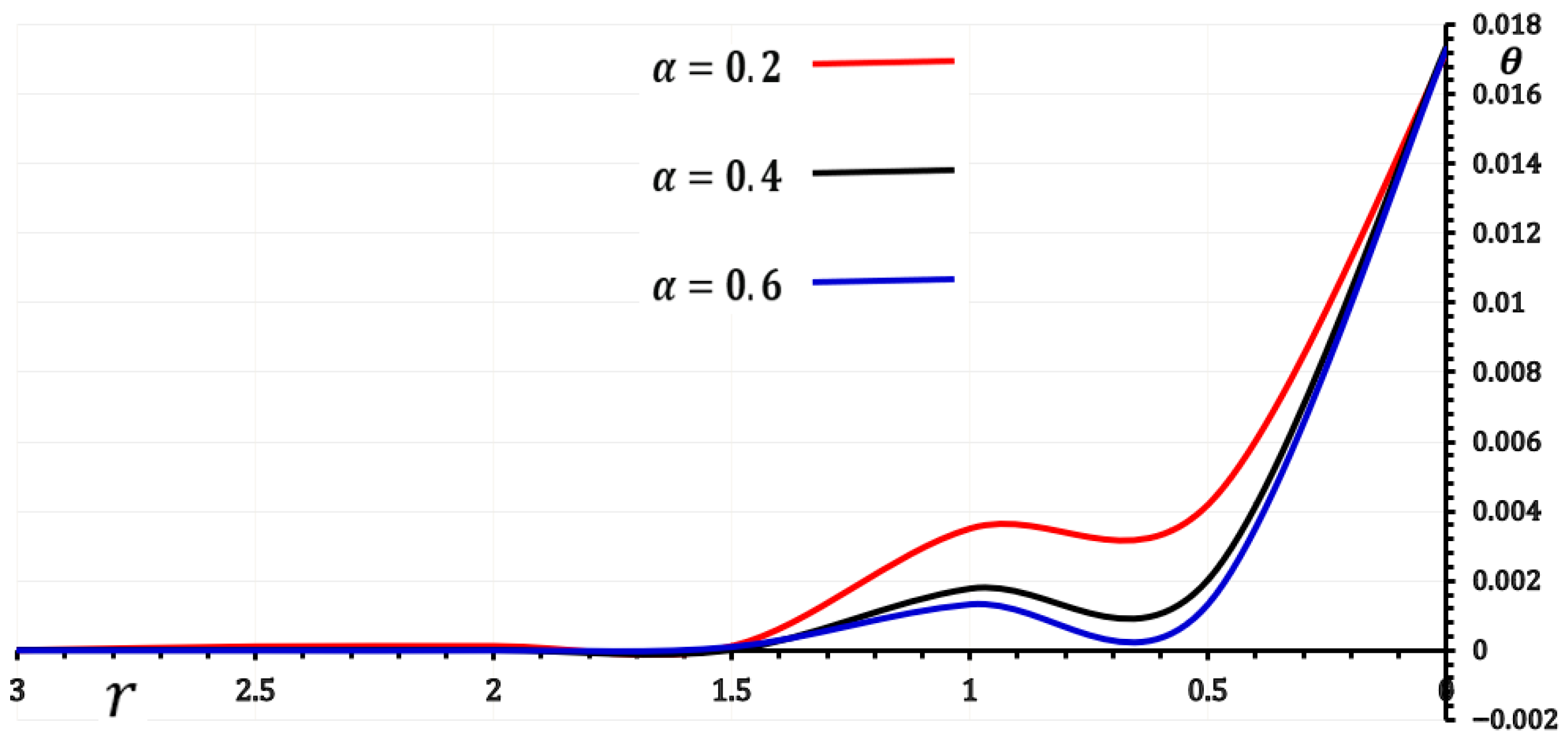
- Pressures commence at minimal levels, progressively escalate with oscillations over time, and ultimately decay to zero.
- Negative values signify compressive stresses under the employed sign convention; boundary-proximate sign changes arise from transient thermoelastic oscillations intensified by boundary conditions and void interactions, proving resilient to Laplace inversion sensitivity analyses.
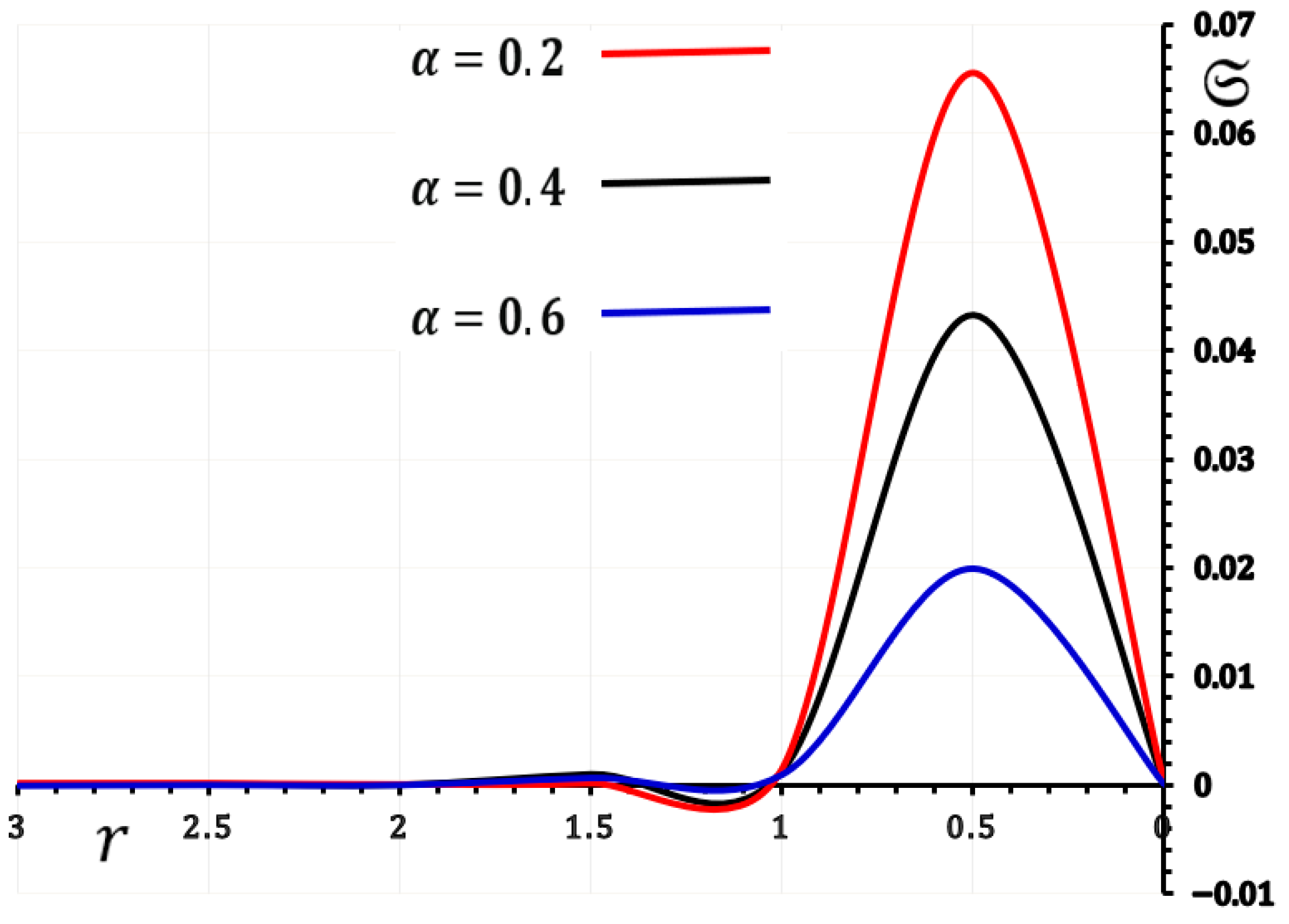
- Void/porosity coupling manifests via void-dependent constitutive and interaction terms, chiefly altering the medium’s effective compressibility and compliance, thereby impacting displacements, stresses, and the void fraction predominantly.
4.3. The Effect of the Atangana–Baleanu Fractional Derivative for Order in Caputo Sense (ABCF)
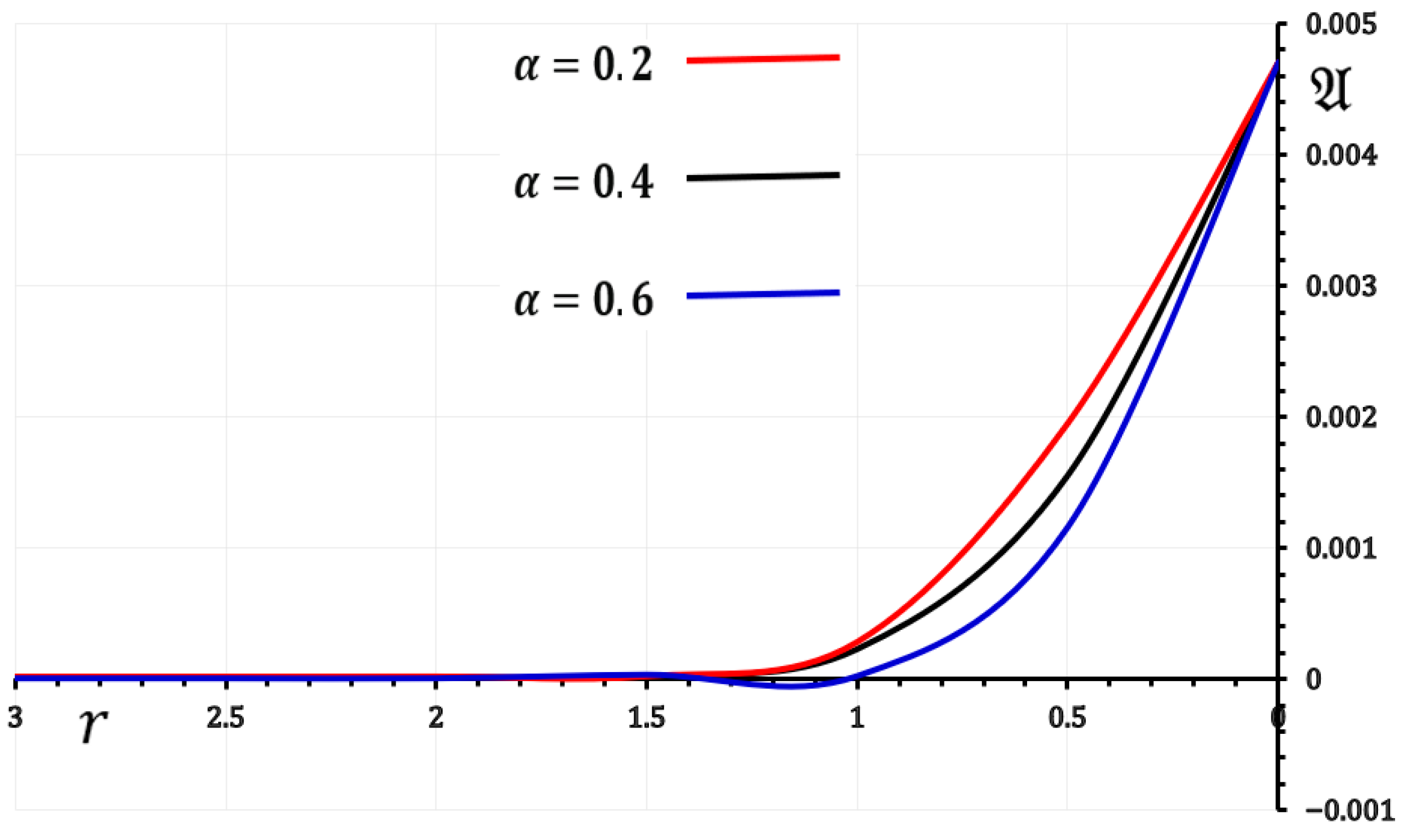
- The diminishing peak of the void distribution signifies reduced void activation as memory effects strengthen, indicating delayed and weakened void–matrix interaction.
- In the range increasing leads to a decrease in the magnitude of the void field .
- In contrast, the curves of the void volume vanish simultaneously in the range .
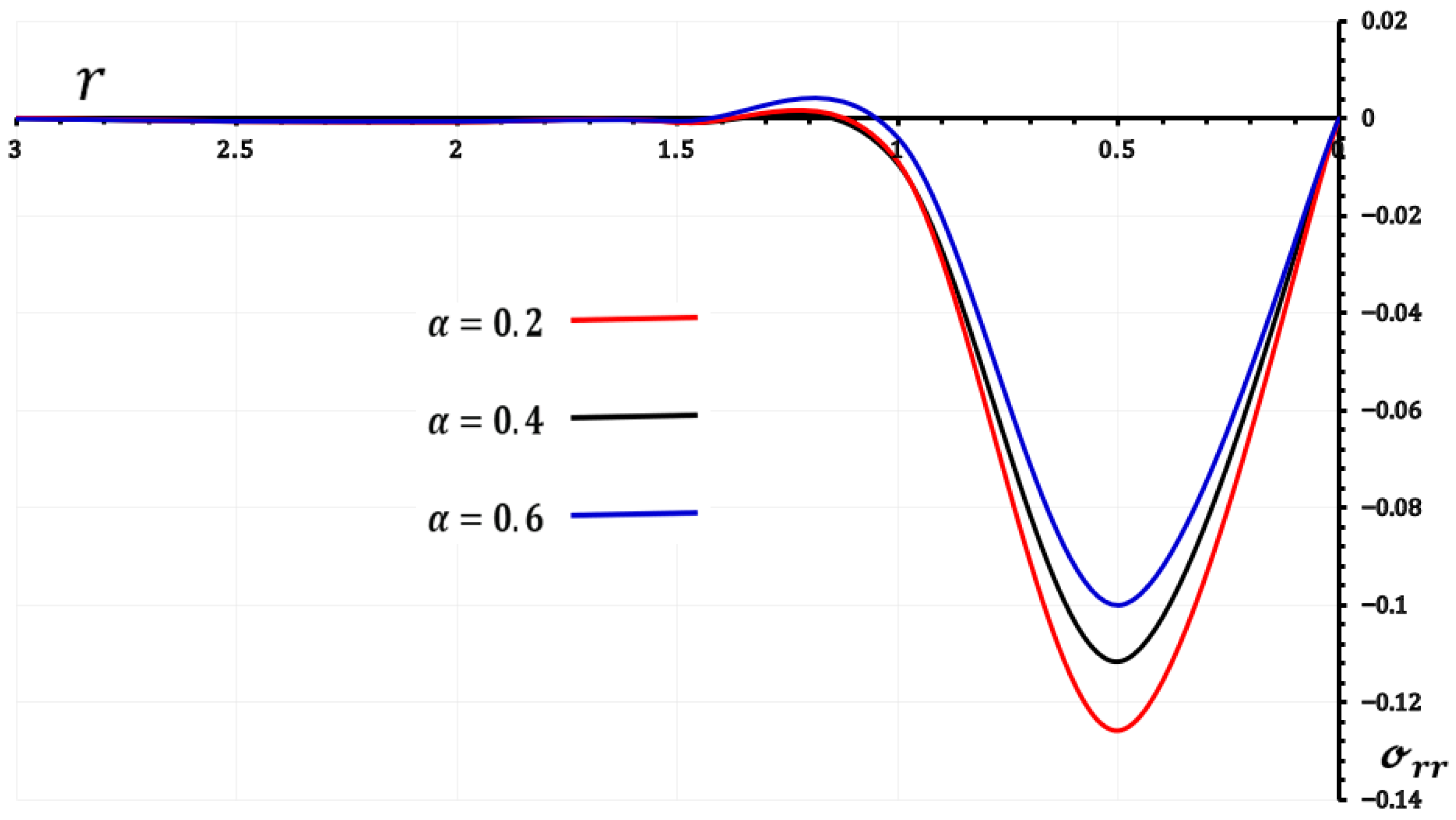
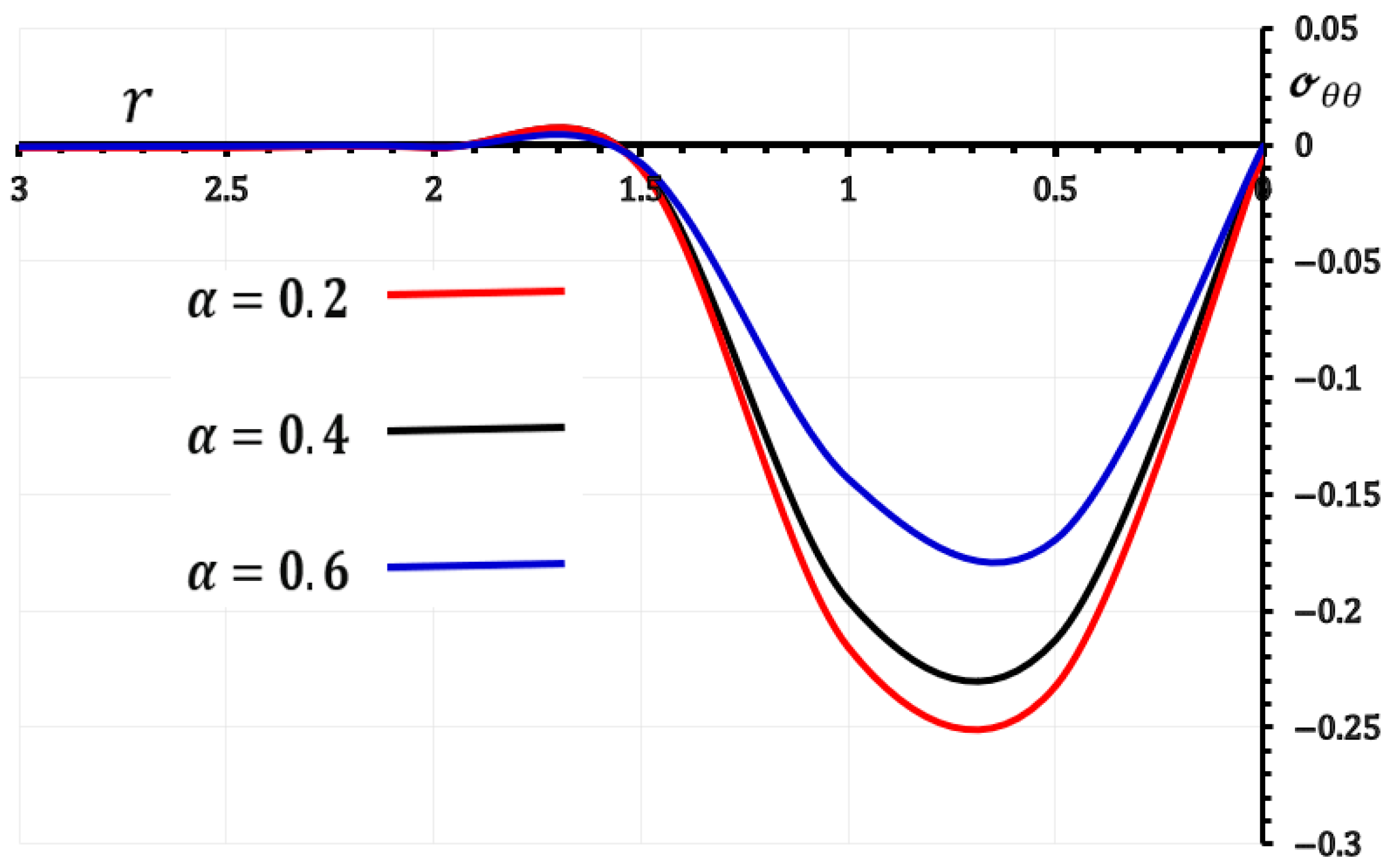
- The Atangana–Baleanu–Caputo fractional derivative significantly influences stress variation.
- Indeed, within the interval , increasing decreases the magnitude of stress.
- In Figure 9, the shrinking stress extrema and smoother profiles demonstrate that a higher fractional order mitigates stress concentration by spreading the thermoelastic response over time.
- Figure 10. The gradual smoothing and attenuation of circumferential stress curves reveal enhanced stress relaxation, with fractional memory moderating rapid circumferential strain buildup.


5. Conclusions
- The pivotal role of voids in coupled dynamics: intimate coupling of the void volume fraction with stress and temperature via constitutive equations and functioning as an intrinsic compliance that reshapes wave propagation speeds and damping characteristics. This yields a cogent rationale for the pronounced mechanical field responses relative to the thermal responses in select parameter domains.
- The significance of the ABC–MGT paradigm is underscored by our demonstration of how integrating third-order MGT heat conduction with the ABC kernel captures finite-speed thermal waves imbued with memory effects, which are critically pertinent for transient scenarios in porous media where conventional Fourier or lower-order models invariably underestimate propagation delays and energy dissipation.
- The ABC fractional order modulates the effective thermal memory of the medium, engendering distinct alterations in the attenuation and phase lag of intertwined thermoelastic and void fields. Consequently, the fractional order emerges not as a mere fitting parameter but as a quantifiable index of the hereditary relaxation intensity.
- In this paper, we conclude that the magnitudes of all the physical quantities of the (MGT) model under the Atangana–Baleanu–Caputo fractional derivatives are smaller than those in the other models. This is due to the incorporation of fractional derivative parameters.
Author Contributions
Funding
Data Availability Statement
Conflicts of Interest
References
- Podlubny, I. Fractional Differential Equations; Academic Press: San Diego, CA, USA, 1999. [Google Scholar]
- Samko, S.G.; Kilbas, A.A.; Marichev, O.I. Fractional Integrals and Derivatives: Theory and Applications; Gordon & Breach: Yverdon, Switzerland, 1993. [Google Scholar]
- Kilbas, A.A.; Srivastava, H.M.; Trujillo, J.J. Theory and Applications of Fractional Differential Equations. In North-Holland Mathematics Studies; Elsevier: Amsterdam, The Netherlands, 2006. [Google Scholar]
- Caputo, M.; Fabrizio, M. A new definition of fractional derivative without singular kernel. Prog. Fract. Differ. Appl. 2015, 1, 73–85. [Google Scholar]
- Atangana, A.; Baleanu, D. New fractional derivative with non-local and non-singular kernel. Therm. Sci. 2016, 20, 757–763. [Google Scholar] [CrossRef] [Scilit]
- Karde, N.; Kamdi, D.; Varghese, V. Effect of nonlocality and Goufo-Caputo kernel in heat transfer nonsimple model within an infinite-length hollow cylinder subjected to diverse sectional heat supply. J. Therm. Stress. 2025, 48, 45–63. [Google Scholar] [CrossRef] [Scilit]
- Chandel, N.; Khalsa, L.; Varghese, V.; Dhore, N. Dynamic analysis of the Klein–Gordon nonlocality and memory phenomena in a TPL hygrothermoelastic cylinder generating the heat and moisture. Acta Mech. 2025. [Google Scholar] [CrossRef] [Scilit]
- Lord, H.W.; Shulman, Y. A generalized dynamical theory of thermoelasticity. J. Mech. Phys. Solids 1967, 15, 299–309. [Google Scholar] [CrossRef] [Scilit]
- Green, A.E.; Lindsay, K.A. Thermoelasticity. J. Elast. 1972, 2, 1–7. [Google Scholar] [CrossRef] [Scilit]
- Tzou, D.Y. Experimental support for the lagging behaviour in heat propagation. J. Thermophys. Heat Transf. 1995, 9, 686–693. [Google Scholar] [CrossRef] [Scilit]
- Tzou, D.Y. A unified approach for heat conduction from macro to microscale. J. Heat Transf. 1995, 117, 8–16. [Google Scholar] [CrossRef] [Scilit]
- Green, A.E.; Naghdi, P.M. A Re-Examination of the Basic Postulates of Thermomechanics. Proc. R. Soc. A Math. Phys. Eng. Sci. 1991, 432, 171–194. [Google Scholar] [CrossRef] [Scilit]
- Green, A.E.; Naghdi, P.M. On undamped heat waves in an elastic solid. J. Ther. Stress. 1992, 15, 253–264. [Google Scholar] [CrossRef] [Scilit]
- Green, A.E.; Naghdi, P.M. Thermoelasticity without energy dissipation. J. Elast. 1993, 31, 189–208. [Google Scholar] [CrossRef] [Scilit]
- Lasiecka, I.; Wang, X. Moore–Gibson–Thompson equation with memory, part II: General decay of energy. J. Differ. Equ. 2015, 259, 7610–7635. [Google Scholar] [CrossRef] [Scilit]
- Conejero, J.A.; Lizama, C.; Ródenas Escribá, F.D.A. Chaotic behaviour of the solutions of the Moore–Gibson–Thompson equation. Appl. Math. Inf. Sci. 2005, 9, 2233–2238. [Google Scholar]
- Quintanilla, R. Moore-Gibson-Thompson thermoelasticity. Math. Mech. Solids 2019, 24, 4020–4031. [Google Scholar] [CrossRef] [Scilit]
- Quintanilla, R. Moore-Gibson-Thompson thermoelasticity with two temperatures. Appl. Eng. Sci. 2020, 1, 100006. [Google Scholar] [CrossRef] [Scilit]
- Jangid, K.; Gupta, M.; Mukhopadhyay, S. On propagation of harmonic plane waves under the Moore–Gibson–Thompson thermoelasticity theory. Waves Random Complex Media 2021, 34, 1976–1999. [Google Scholar] [CrossRef] [Scilit]
- Yahya, A.; Saidi, A.; Abouelregal, A.E.; Zakria, A. Moore–Gibson–Thompson heat conduction model under the Klein–Gordon (KG) nonlocality for a thermoelastic solid cylinder with voids. Mech. Based Des. Struct. Mach. 2025, 1–19. [Google Scholar] [CrossRef] [Scilit]
- Yahya, A.M.H.; Saidi, A.; Abouelregal, A.E.; Zakria, A.; Ibrahim-Elkhalil, A.; Mohammed, F.A. Thermoelastic Vibrations for Solid Cylinder with Voids, Using Moore–Gibson–Thompson Heat Conduction Model. AIMS Math. 2024, 9, 34588–34605. [Google Scholar]
- Iesan, D. A theory of thermoelastic materials with voids. Acta Mech. 1986, 60, 67–89. [Google Scholar] [CrossRef] [Scilit]
- Cowin, S.C.; Nunziato, J.W. Linear elastic materials with voids. J. Elast. 1983, 13, 125–147. [Google Scholar] [CrossRef] [Scilit]
- Nunziato, J.W.; Cowin, S.C. A Nonlinear Theory of Elastic Materials with Voids. Arch. Ration. Mech. Anal. 1979, 72, 175–201. [Google Scholar] [CrossRef] [Scilit]
- Ciarletta, M.; Scarpetta, E. Some Results on Thermoelasticity for Dielectric Materials with Voids. J. Appl. Math. Mech. 1995, 75, 707–714. [Google Scholar] [CrossRef] [Scilit]
- Marin, M. A Uniqueness Result for Body with Voids in Linear Thermoelasticity. Rend. Mat. Appl. 1997, 17, 103–113. [Google Scholar]
- Marin, M. On the Domain of Influence in Thermoelas-elasticity of Bodies with Voids. Arch. Math. 1997, 33, 301–308. [Google Scholar]
- Cicco, S.D.; Diaco, M. A Theory of Thermoelastic Materials with Voids without Energy Dissipation. J. Therm. Stress. 2002, 25, 493–503. [Google Scholar] [CrossRef] [Scilit]
- Yahya, A.; Saidi, A. Response of Generalized Thermoelastic for Free Vibration of a Solid Cylinder with Voids Under a Dual-Phase Lag Model. Iran. J. Sci. Technol. Trans. Mech. Eng. 2025, 49, 1333–1343. [Google Scholar] [CrossRef] [Scilit]
- Ponnusamy, P. Wave propagation in a generalized thermoelastic solid cylinder of arbitrary cross-section. Int. J. Solids Struct. 2007, 44, 5336–5348. [Google Scholar] [CrossRef] [Scilit]
- Sharma, J.N. Three-dimensional vibration analysis of a homogeneous transversely isotropic thermoelastic cylindrical panel. J. Acoust. Soc. Am. 2001, 110, 648–653. [Google Scholar] [CrossRef] [Scilit]
- Sharma, J.N.; Sharma, P.K. Free vibration analysis of homogeneous transversely isotropic thermoelastic cylindrical panel. J. Therm. Stress. 2002, 25, 169–182. [Google Scholar] [CrossRef] [Scilit]
- Sharma, D.K.; Thakur, D.; Walia, V.; Sarkar, N. Free vibration analysis of a nonlocal thermoelastic hollow cylinder with diffusion. J. Therm. Stress. 2020, 43, 981–997. [Google Scholar] [CrossRef] [Scilit]
- Chandrasekharaiah, D.S. Effects of Surface Stresses and Voids on Rayleigh Waves in an Elastic Solid. Int. J. Eng. Sci. 1987, 25, 205–211. [Google Scholar] [CrossRef] [Scilit]
- Sharma, P.K.; Kaur, D.; Sharma, J.N. Three-dimensional vibration analysis of a thermoelastic cylindrical panel with voids. Int. J. Solids Struct. 2008, 45, 5049–5058. [Google Scholar] [CrossRef] [Scilit]
- Sharma, D.K.; Thakur, D. Vibrations of nonlocal thermoelastic voids sphere with three–phase–lag model. Mater. Today Proc. 2021, 42, 356–361. [Google Scholar] [CrossRef] [Scilit]
- Sharma, S.R.; Mehalwal, J.C.; Sarkar, N.; Sharma, D.K. Vibration analysis of electro-magneto transversely isotropic non-local thermoelastic cylinder with voids material. Eur. J. Mech.-A/Solids 2022, 92, 104455. [Google Scholar] [CrossRef] [Scilit]
- Kumar, D.; Prakash, S.; Thakur, C.; Sarkar, N.; Bachher, M. Vibrations of a nonlocal thermoelastic cylinder with the void. Acta Mech. 2020, 231, 2931–2945. [Google Scholar] [CrossRef] [Scilit]
- Singh, B.; Pal, R. Surface Wave Propagation in a Generalized Thermoelastic Material with Voids. Appl. Math. 2011, 2, 521–526. [Google Scholar] [CrossRef]
- Watuagala, G.K. Sumudu transform: A new integral transform to solve differential equations and control engineering problems. Int. J. Math. Educ. Sci. Technol. 1993, 24, 35–43. [Google Scholar] [CrossRef] [Scilit]
- Abo-Dahab, S.M.; Abd-Alla, A.M.; Kilany, A.A. Effects of rotation and gravity on an electro-magneto thermoelastic medium with diffusion and voids by using the Lord Shulman and dual-phase-lag models. Appl. Math. Mech. 2019, 40, 11–35. [Google Scholar] [CrossRef] [Scilit]
- Abouelregal, A.E.; Abo-Dahab, S.M. Dual-phase- lag diffusion model for Thomson’s phenomenon on electromagnetic-thermoelastic an infinitely solid cylinder. J. Comput. Theor. Nanosci. 2014, 11, 1031–1039. [Google Scholar] [CrossRef] [Scilit]
- Abo-Dahab, S.M. S-waves propagation in a non-homogeneous anisotropic incompressible medium under influences of a gravity field, initial stress, electromagnetic field and rotation. Appl. Math. Inf. Sci. 2016, 1, 363–376. [Google Scholar] [CrossRef] [Scilit]
- Kumar, R.; Singh Reen, R.L.; Garg, S.K. Axisymmetric propagation in a thermoelastic diffusion with phase lags. Am. J. Sci. Technol. 2016, 3, 82–96. [Google Scholar]
- Abouelregal, A.E. A problem of a semi-infinite medium subjected to exponential heating using a dual-phase-lag Thermoelastic Model. Appl. Math. 2011, 2, 619–624. [Google Scholar] [CrossRef]
- Kumar, R.; Kansal, T. Propagation of plane waves and fundamental solution in the theories of thermoelastic diffusive materials with voids. Int. J. Appl. Math. Mech. 2012, 8, 84–103. [Google Scholar]
- Xue, Z.; Liu, J.; Tian, X.; Yu, Y. Thermal shock fracture associated with unified fractional heat conduction. Eur. J. Mech.-A/Solids 2021, 85, 104–129. [Google Scholar] [CrossRef] [Scilit]
- Abouelregal, A.E.; Sedighi, H.M. A new insight into the interaction of thermoelasticity with mass diffusion for a half-space in the context of Moore–Gibson–Thompson thermodiffusion theory. Appl. Phys. A 2021, 127, 582. [Google Scholar] [CrossRef] [Scilit]
- Honig, G.; Hirdes, U. A method for the numerical inversion of the Laplace transform. J. Comp. Appl. Math. 1984, 10, 113. [Google Scholar] [CrossRef] [Scilit]
- Yu, Y.J.; Deng, Z.C. Fractional order theory of Cattaneo-type thermoelasticity using new fractional derivatives. Appl. Math. Model. 2020, 87, 731. [Google Scholar] [CrossRef] [Scilit]
- Yu, Y.J.; Deng, Z.C. Fractional order thermoelasticity for piezoelectric materials. Fractals 2021, 29, 2150082. [Google Scholar] [CrossRef] [Scilit]
- Abouelregal, A.E.; Elhagary, M.A.; Soleiman, A.; Khalil, K.M. Generalized thermoelastic diffusion model with higher-order fractional time-derivatives and four-phase-lags. Mech. Based Des. Struct. Mach. 2020, 50, 897–914. [Google Scholar] [CrossRef] [Scilit]
- Yu, Y.J.; Zhao, L.J. Fractional thermoelasticity revisited with new definitions of fractional derivative. Eur. J. Mech.-A/Solids 2020, 84, 104043. [Google Scholar] [CrossRef] [Scilit]


Disclaimer/Publisher’s Note: The statements, opinions and data contained in all publications are solely those of the individual author(s) and contributor(s) and not of MDPI and/or the editor(s). MDPI and/or the editor(s) disclaim responsibility for any injury to people or property resulting from any ideas, methods, instructions or products referred to in the content. |
© 2026 by the authors. Licensee MDPI, Basel, Switzerland. This article is an open access article distributed under the terms and conditions of the Creative Commons Attribution (CC BY) license.
Share and Cite
Hassan, A.A.; Yahya, A.; Zakria, A.; Ahmed, S.A.; Ahmed, I.-E.; Ahmed, I.O.; Salih, E.; Suhail, M. Thermoelastic Oscillations of a Solid Medium with Voids via the Influence of Atangana-Baleanu-Caputo Fractional Derivative. Symmetry 2026, 18, 359. https://doi.org/10.3390/sym18020359
Hassan AA, Yahya A, Zakria A, Ahmed SA, Ahmed I-E, Ahmed IO, Salih E, Suhail M. Thermoelastic Oscillations of a Solid Medium with Voids via the Influence of Atangana-Baleanu-Caputo Fractional Derivative. Symmetry. 2026; 18(2):359. https://doi.org/10.3390/sym18020359
Chicago/Turabian StyleHassan, Abdelgabar Adam, Ahmed Yahya, Adam Zakria, Shams A. Ahmed, Ibrahim-Elkhalil Ahmed, Ibrahim Omer Ahmed, Eshraga Salih, and Muntasir Suhail. 2026. "Thermoelastic Oscillations of a Solid Medium with Voids via the Influence of Atangana-Baleanu-Caputo Fractional Derivative" Symmetry 18, no. 2: 359. https://doi.org/10.3390/sym18020359
APA StyleHassan, A. A., Yahya, A., Zakria, A., Ahmed, S. A., Ahmed, I.-E., Ahmed, I. O., Salih, E., & Suhail, M. (2026). Thermoelastic Oscillations of a Solid Medium with Voids via the Influence of Atangana-Baleanu-Caputo Fractional Derivative. Symmetry, 18(2), 359. https://doi.org/10.3390/sym18020359