Article

A Synergistic Physics–Data-Driven and Memory-Resident Computing Approach for Security Assessment in Modern Power Systems

1
State Grid Zhejiang Electric Power Co., Ltd., Research Institute, Hangzhou 310014, China
2
School of Electrical Engineering, Shandong University, Jinan 250061, China
*
Author to whom correspondence should be addressed.
Symmetry 2026, 18(2), 318; https://doi.org/10.3390/sym18020318
Submission received: 15 January 2026 / Revised: 4 February 2026 / Accepted: 6 February 2026 / Published: 9 February 2026
(This article belongs to the Section Engineering and Materials)

Abstract

Rapid N-1 security assessment in modern power systems faces a critical conflict between computational timeliness and the heavy reliance on labeled data for high-fidelity models. To mitigate this issue, a unified framework co-optimizing a physics-informed neural network (PINN) and memory-resident computing is proposed. At the algorithm level, power flow equation residuals are incorporated into the PINN formulation as physical regularization terms. This integration facilitates better alignment with electrical constraints and improves generalization capabilities under small-sample conditions. At the system level, a heterogeneity-aware asynchronous parallel computing architecture is developed. In this architecture, pull-based scheduling and lock-free memory mapping are utilized to mitigate straggler effects, thereby reducing synchronization latency and I/O overhead. Numerical case studies on the IEEE 39-bus system demonstrate that the physics mismatch is reduced by nearly two orders of magnitude compared to a baseline deep neural network (DNN), and the total execution time for scanning 20,000 contingencies is decreased by 34.0%.

1. Introduction

The high penetration of renewable energy and the increasing complexity of grid interconnections have significantly enhanced system stochasticity, posing severe challenges to accurately assessing N-1 security and revealing system vulnerabilities [1]. Faced with the strong nonlinear dynamic characteristics of complex transformer loads and renewable energy power under extreme conditions [2,3], the adaptability of traditional physical modeling is increasingly limited. This has driven a research paradigm shift toward data-driven approaches. Algorithms such as deep feature extraction [4], local neural network modeling [5], and end-to-end probabilistic assessment have been proposed successively [6]. Furthermore, topology-aware networks and sequence models have effectively addressed the challenges of topology dependence and missing data in state estimation [7,8,9]. However, the efficacy of purely data-driven methods is constrained by the scarcity of high-fidelity labeled data. Although data augmentation and semi-supervised frameworks offer partial remedies [10,11], the paradigm shift toward physics-informed learning has emerged as a new trend to fundamentally ensure model robustness.
By explicitly embedding power flow equations and physical constraints into the loss function of deep neural networks, researchers have constructed assessment frameworks with physical consistency. It is important to note that the PINN-based method proposed in this paper does not introduce new physical security criteria. Instead, it serves as a high-speed surrogate model for traditional iterative solvers. By approximating the mapping established by power flow equations, it aims to resolve the computational bottleneck of solving massive contingency scenarios. This not only achieves highly robust state perception under disturbances but also opens new paths for unsupervised fast power flow inference [12,13,14]. The advantages of this physics–data synergy were subsequently expanded to more complex static and transient security analysis scenarios. This effectively overcame the convergence bottlenecks in calculating system operating boundaries under varying topological conditions [15,16] and significantly improved the credibility of transmission transfer capability assessment [17] and transient stability discrimination [18,19]. Furthermore, to address the uncertainty of system dynamic behaviors, methods integrating domain knowledge priors have been used to finely characterize frequency response features [20], effectively define the safe operating region under intelligent decision-making [21], and optimize the prediction accuracy of key dynamic parameters [22]. Meanwhile, to enhance the transparency of deep models in engineering applications, advanced sensitivity analysis indices have been introduced to quantify the physical interaction mechanisms of key state variables [23]. Based on this, novel architectures emphasizing continuous internal monitoring have further provided theoretical support for blocking system-level cascading failures and enhancing overall defense capabilities [24].
Although high-fidelity surrogate models have matured in theoretical modeling, their large-scale deployment for real-time N-1 scanning still faces computational efficiency bottlenecks. Concurrency analysis of the underlying execution mechanisms further reveals that the synchronous waiting latency prevalent in traditional parallel modes constrains overall performance [25,26]. Moreover, the inherent device heterogeneity in distributed environments induces the straggler effect, leading to substantial idleness of computing resources [27]. To overcome this latency dilemma, at the software scheduling level, the introduction of hierarchical pipeline parallelism and various asynchronous communication protocols has effectively achieved temporal decoupling of computation and communication tasks [28,29,30]. In particular, scheduling frameworks based on semi-asynchronous mechanisms have proven capable of maximizing system throughput in heterogeneous computing environments [31]. At the underlying hardware level, in-memory computing techniques based on algorithm–architecture co-optimization and sparse-aware single-pass architectures have physically broken the memory wall limit, offering a fundamental solution to drastically reduce data movement overhead [32,33].
Despite significant progress in improving model accuracy and computational efficiency, existing N-1 security assessment systems still face multiple limitations. Purely data-driven models lack physical consistency [6,9], while standard parallel architectures suffer from synchronization barriers [26,31]. To clearly position the novelty of this paper, Table 1 compares the proposed framework with existing representative methodologies across dimensions including physical adherence, data dependency, and computing architecture.
To address the gaps identified above, the main innovative contributions are summarized as follows:
  • A system-level integration scheme characterized by deep software–hardware synergy is proposed. By synergizing the physical dimensionality reduction in the proxy model with the memory-resident asynchronous acceleration, a low-cost real-time assessment paradigm is established. As empirically verified in Section 5.3, this paradigm enables millisecond-level N-1 scanning capabilities on general-purpose personal computers without relying on high-end high-performance computing clusters.
  • A physics-informed proxy model specifically for topology-variant N-1 analysis is constructed. Power flow equations are integrated as regularization terms to guide the solution space to adhere to steady-state physical laws. This integration effectively constrains the neural network hypothesis space, thereby enhancing generalization robustness under topology changes and small-sample conditions.
  • A fully asynchronous parallel computing architecture for heterogeneous multi-core environments is designed. In contrast to synchronous parallel strategies that retain rigid synchronization barriers, a non-blocking pull-based dynamic scheduling strategy combined with lock-free memory mapping technology is employed. Consequently, the logical decoupling of computation and communication is achieved, effectively mitigating the straggler effect caused by hardware variability and improving the resource utilization of multi-core processors.
The remainder of this paper is organized as follows: Section 2 formulates the mathematical model for the power system N-1 security assessment problem, defining the steady-state power flow equations and security constraints. Section 3 proposes the lightweight proxy model based on PINN, detailing the network architecture, physical mechanism embedding, and the hybrid loss function design. Section 4 presents the fully asynchronous parallel computing architecture tailored for multi-core environments, introducing the memory-resident data interaction mechanism and non-blocking scheduling strategy. Section 5 demonstrates the effectiveness of the proposed framework through comprehensive case studies on IEEE standard test systems. Section 6 discusses the validity of the idealized framework and the robustness challenges in real-world engineering environments. Finally, Section 7 concludes the paper.

2. Modeling of Power System N-1 Security Assessment Problem

Fundamentally, static security assessment of power systems involves identifying the boundary of the feasible region within a high-dimensional nonlinear state space, subject to physical constraints and operational limits. The N-1 security criterion requires that the system state trajectory must converge within this secure feasible region following a topological perturbation caused by the loss of any arbitrary single component. This process involves complex topology-state coupling relationships. On one hand, the physical laws of the power grid constitute rigid equality constraints for system operation; on the other hand, equipment thermal stability limits and voltage levels constitute multiple inequality constraints.

2.1. Steady-State Power Flow Model of Power Systems

The steady-state operating characteristics of power systems follow Kirchhoff’s laws. For a power network containing N buses, its steady-state physical characteristics are typically described by a system of nonlinear power flow equations. Let N = { 1 , 2 , , N } be the set of system buses. For any bus i     N , its injected active power P i and reactive power Q i must satisfy the following power balance constraints:
P i V i j N V j ( G i j cos θ i j + B i j sin θ i j ) = 0 Q i + V i j N V j ( G i j sin θ i j B i j cos θ i j ) = 0
where V i and θ i represent the voltage magnitude and phase angle of bus i, respectively; θ i j =   θ i θ j denotes the voltage phase angle difference; G i j and B i j are the real and imaginary parts of the element in the i-th row and j-th column of the bus admittance matrix Y bus .
From a topological perspective, the summation terms in Equation (1) represent the physical mechanism of communication or energy exchange among different buses. The power grid constitutes a connected graph where transmission lines act as edges facilitating this interaction. The mutual admittance elements G i j and B i j in the bus admittance matrix Y bus quantify the coupling strength between bus i and bus j. Consequently, Equation (1) essentially describes how the local state of bus i is constrained by the states of its physically connected neighbors j (where | Y i j |   0 ). It is precisely through this topological coupling path that a perturbation caused by an N-1 contingency, such as a change in topology or node injection, propagates from the fault location to the entire network, necessitating a global coordination of state variables to reach a new equilibrium.
To facilitate subsequent model construction, the aforementioned equations are expressed in the following compact form:
f ( x , u ) = 0
where u represents the control variables of the system, and x represents the state variables. In the physics-guided neural network proposed in subsequent sections, this function f ( ) serves as the core basis for the physical consistency regularization term.

2.2. Definition of N-1 Contingency Set

N-1 security assessment aims to analyze the steady-state behavior of the system following a single component outage. It should be noted that a complete N-1 assessment typically includes outages of transmission lines, generators, and transformers. However, this study specifically focuses on transmission line outages to validate the model’s capability in handling complex topological variations. While the proposed framework can be theoretically extended to generator and transformer outages by expanding the input vector, they are not included in the current experimental scope. Let the contingency set be defined as K =   { 0 , 1 , ,   K } , where k   =   0 denotes the base case, and k   >   0 represents the k-th contingency.
For any contingency k     K , the network topology changes, causing the bus admittance matrix to shift from Y bus ( 0 ) to Y bus ( k ) . Therefore, for contingency k, the system must satisfy the corresponding power flow equations:
f ( k ) ( x ( k ) , u ) = 0
where x ( k ) represents the system state following contingency k, i.e., the post-fault power flow solution. Conventional N-1 scanning methods require repeatedly solving the aforementioned nonlinear system of equations for every element in the set K , resulting in a computational burden that grows exponentially with the network scale.

2.3. Security Constraints and Assessment Metrics

Upon obtaining the post-contingency system state x ( k ) , it is necessary to verify whether it satisfies the operational security constraints. Two primary categories of hard constraints are considered.
  • Bus Voltage Constraints:
The voltage magnitude at each bus must remain within the allowable deviation range:
V i min V i ( k ) V i max , i N
where V i min and V i max represent the minimum and maximum voltage limits, respectively.
2.
Branch Thermal Stability Constraints:
The apparent power flow through transmission lines or transformers must not exceed their rated thermal capacity:
| S i j ( k ) |     S i j max , ( i , j ) L
where L denotes the set of system branches; S i j ( k ) is the transmission power of branch ij under contingency k; and S i j max represents the maximum transmission power limit of branch ij.
If any contingency k results in the violation of any of the aforementioned inequality constraints, the system is deemed to be in an insecure state under that specific N-1 scenario.

3. Lightweight Proxy Model Based on Physics-Informed Neural Networks

This section presents a specialized PINN framework tailored for power system N-1 security assessment. Distinct from the generic PINN paradigm applied in fluid dynamics or mechanics, the proposed architecture incorporates two targeted improvements to address the unique challenges of power grid analysis, including topology variability and physical unit inconsistency:
  • Topology-Aware Input Construction: A composite input vector integrating control variables and discrete topology states is designed to capture the mapping rules under N-1 structural perturbations.
  • Dynamic Weight Adaptation Strategy: A time-varying weighting scheme is introduced to balance the trade-off between statistical data fitting and physical consistency during different training phases.
The specific architecture and optimization mechanisms are detailed as follows.

3.1. Overall Architecture Design

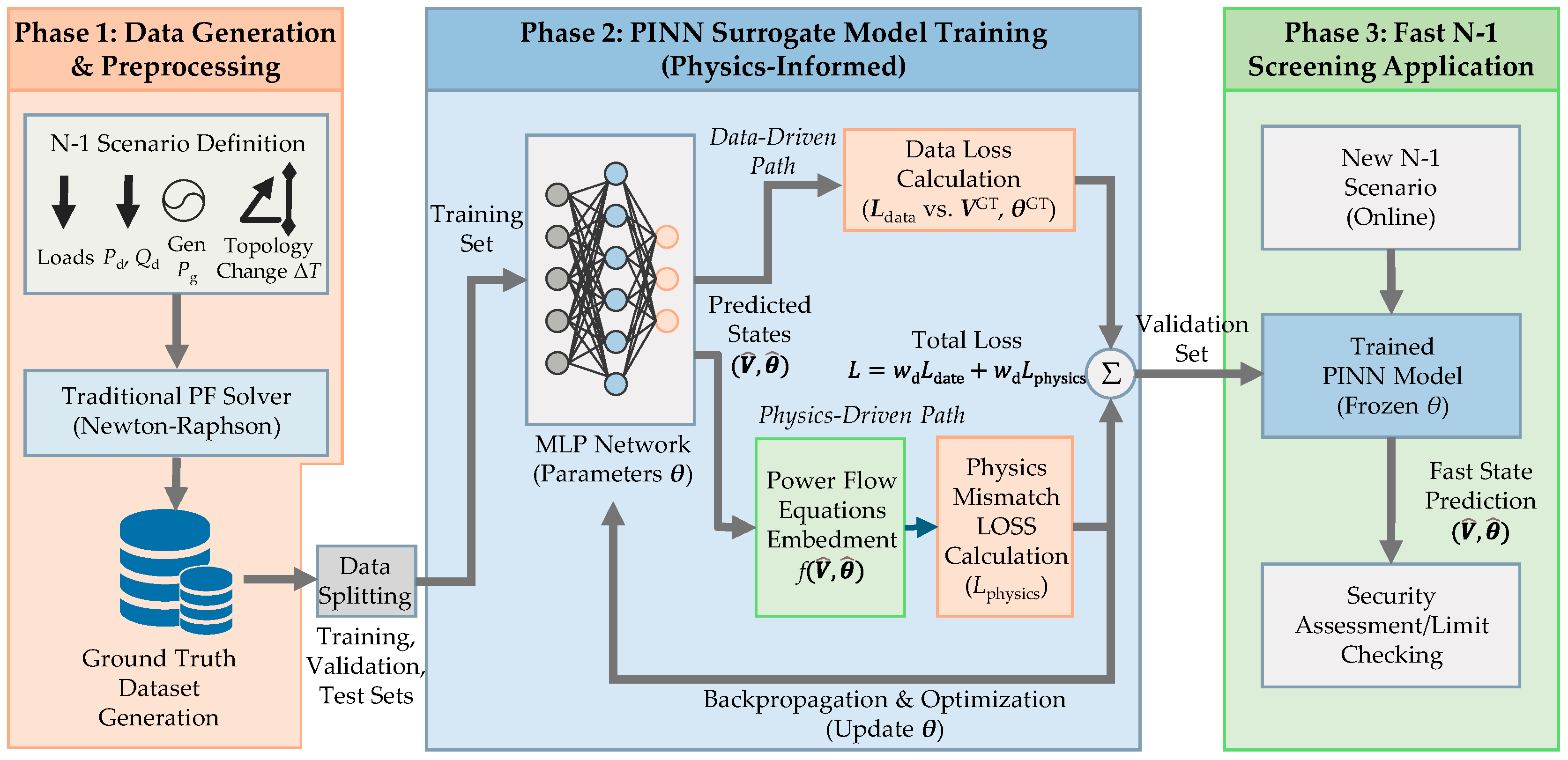
The proposed PINN proxy model is illustrated in Figure 1. The model aims to establish a direct mapping from N-1 contingency scenarios to system steady-state variables. This architecture explicitly embeds the power system physical equations f ( x , u ) = 0 described in Section 2 into the network training structure, forming a dual-driven mechanism based on both data fitting and physical constraints.

3.1.1. Input Feature Construction

To address the N-1 security assessment problem, the input vector z ( k ) of the model must be capable of completely describing the operating boundary conditions under the k-th contingency scenario. According to the definition in Section 2.1, the input consists of the control variables u and the topology state s ( k ) :
z ( k ) = [ u , s ( k ) ]
where u 2 N is the active and reactive power injection vector for all system buses described in Section 2.1, representing the current load level and generation schedule. s ( k ) { 0 , 1 } L is the branch switching status vector, and L denotes the total number of system branches. Corresponding to the changes in the admittance matrix Y b u s ( k ) described in Section 2.2, the element in s ( k ) corresponding to the faulted branch is set to 0, while the remaining elements are set to 1. This enables the neural network to capture the physical changes in the network topology structure.

3.1.2. Topology-Aware Backbone Network

To efficiently capture the nonlinear mapping of power flow manifolds while meeting real-time requirements, a specific fully connected network with four hidden layers is constructed as the fitting core. The forward propagation process from the contingency input vector z ( k ) to the predicted state vector x ^ ( k ) is explicitly formulated as:
x ^ ( k ) = W out σ σ W l z ( k ) + b l + b out
where { W l , b l } denote the weight matrices and bias vectors of the l-th layer, and W out , b out correspond to the output layer parameters. The hyperbolic tangent function σ ( ) = tanh ( ) is adopted as the activation function throughout the hidden layers to ensure the high-order differentiability required for computing physical gradients.

3.1.3. Output State Layer

The output of the model corresponds directly to the system state variables x defined in Section 2.1, rather than indirect variables:
x ^ ( k ) =   [ V ^ ( k ) , θ ^ ( k ) ]
where V ^ ( k ) and θ ^ ( k ) represent the predicted bus voltage magnitude and phase angle vectors, respectively. The advantage of directly outputting the state variables x lies in the fact that they constitute the minimum complete set for describing the system steady state; any other physical quantity can be uniquely derived from x .

3.1.4. Physical Mechanism Verification Module

This is the key feature distinguishing the PINN from traditional deep learning. This module contains no trainable parameters and is essentially a computational graph implementation of the power flow equations f ( x , u ) defined in Section 2.1.
This module accepts the predicted output x ^ ( k ) from the neural network and the control variables u from the input, combined with the current bus admittance matrix Y bus ( k ) , to calculate the physical equation residual:
r ( k ) = f ( k ) ( x ^ ( k ) , u )
If the predicted results strictly comply with physical laws, the residual r ( k ) should be strictly equal to the zero vector. During the training process, this residual is transformed into a physical loss function, forcing the neural network to search within the weight space for a solution that satisfies Kirchhoff’s laws.

3.2. Embedding of Physical Constraints and Construction of Hybrid Loss Function

Based on the PINN architecture proposed in Section 3.1, the core task of model training is to find a set of optimal network parameters Θ , such that the predicted state x ^ can both fit the existing sample data and satisfy the physical operation laws of the power system. To this end, this section constructs a hybrid loss function comprising a data-driven term and a physical constraint term.

3.2.1. Data-Driven Loss Term

To enable the model to learn from historical data, the data-driven loss function L d a t a is defined first. This term adopts a supervised learning paradigm to quantify the discrepancy between the state vector x ^ ( k ) predicted by the neural network and the ground truth label x label ( k ) obtained from offline simulation. The mean squared error is adopted as the metric, calculated as follows:
L data ( Θ ) = 1 M k = 1 M | | x ^ ( k ) x label ( k ) | | 2 2
where M is the number of samples in a training batch; x label ( k ) represents the true voltage magnitude and phase angle under the k-th contingency scenario; and 2 denotes the Euclidean norm. L data encourages the neural network to converge rapidly within the distribution space covered by the samples, thereby learning the statistical laws of the power flow manifold.

3.2.2. Physical Mechanism Regularization Term

Relying solely on L data presents two limitations: first, it requires a massive amount of labeled data; second, the model exhibits poor generalization capability on out-of-sample data and may output results that violate fundamental physical principles. To address this, this study utilizes the power flow equations f ( ) constructed in Section 2.1 to formulate a physical mechanism regularization term, denoted as L phy . By directly substituting the predicted output x ^ ( k ) from the neural network and the corresponding control variables u ( k ) into the power flow equations, the physical residual is calculated as:
r ( k ) = f ( k ) ( x ^ ( k ) , u ( k ) )
According to physical laws, a perfect prediction solution should yield r ( k ) = 0 . Therefore, the physical loss function is defined as the norm of this residual vector:
L phy ( Θ ) = 1 M k = 1 M | | f ( k ) ( x ^ ( k ) , u ( k ) ) | | 2 2
Expanded, L phy essentially penalizes the violations of active and reactive power at all buses in the network:
L phy = 1 M k = 1 M i N ( Δ P i ( k ) ) 2 + ( Δ Q i ( k ) ) 2
This term can be calculated without any labeled data. During the backpropagation process, gradient information flows through the physical equations f ( ) to the neural network, forcing the network parameters Θ to update towards the manifold space that satisfies Kirchhoff’s laws.

3.2.3. Hybrid Objective Function Optimization

The ultimate training objective is to minimize the weighted sum of the aforementioned two terms:
L total ( Θ ) = L data ( Θ ) + λ L phy ( Θ )
where λ is the physical constraint weighting coefficient. When λ = 0 , the model degenerates into a standard DNN, relying entirely on data-driven learning with poor physical interpretability. When λ , the model tends to solve pure mathematical equations but is prone to getting trapped in local minima within the non-convex power flow solution space. Therefore, by reasonably setting λ , the PINN model achieves a balance between data fitting and physical consistency. This mechanism enables the model to significantly compress the solution space by leveraging the strong constraint characteristics of physical equations, thereby achieving high-precision generalization under small-sample conditions.

3.3. Training Strategy and Optimization

Section 3.2 constructed a hybrid objective function incorporating physical mechanisms. However, during the actual optimization process, due to the significant disparity in numerical magnitudes between the state variables x and the control variables u , combined with the complex loss function landscape caused by the non-convex power flow manifold, directly applying standard gradient descent methods makes it difficult to achieve satisfactory convergence. To address this, this section designs a targeted training strategy.

3.3.1. Variable Standardization and Physical Inverse Transformation

The input data u and output data x possess different physical units and magnitudes. To eliminate the impact of dimensional differences on gradient propagation, the Z-Score standardization method is employed to preprocess all training data:
z ˜ = z μ z σ z
where z represents the original variable; μ z and σ z denote the mean and standard deviation of that variable across the training set, respectively; and z ˜ is the standardized input/output variable.
It is worth noting that the physical loss term L phy defined in Section 3.2 is calculated based on the actual physical equations f ( ) . The parameters in the physical equations correspond to actual physical magnitudes. Therefore, before calculating L phy , a non-trainable inverse normalization layer must be embedded within the network:
x ^ ( k ) = x ˜ ^ ( k ) σ x + μ x
This layer restores the normalized predicted values x ˜ ^ ( k ) output by the neural network to the true values x ^ ( k ) with physical significance, which are then substituted into f ( ) to calculate the physical residual. This design ensures that the neural network updates its weights within a numerically friendly normalized space while simultaneously accepting mechanism constraints within the real physical space.

3.3.2. Adaptive Dynamic Adjustment of Physical Weights

In the early stage of training, the neural network has not yet learned the basic distribution of the data, and the predicted value x ^ often severely deviates from physical laws. This results in the value of the physical loss term L phy being much larger than that of the data loss term L data . If the weighting coefficient λ in Section 3.2 remains fixed, the massive physical gradients might dominate the update direction, causing the model to oscillate within the wrong state space and making it difficult to converge.
In the initial phase, the physical residual is significantly larger than the data loss. A fixed large λ would cause the optimization landscape to be dominated by stiff physical constraints, potentially trapping the model in local minima. By initiating training with a smaller λ , the model prioritizes learning the statistical distribution from labeled data to locate a coarse feasible region. As the training epoch t increases, λ is gradually amplified to enforce strict physical compliance, thereby refining the solution within the manifold satisfying Kirchhoff’s laws.
To address this, a dynamic adjustment strategy for λ based on the training process is proposed. In the initial phase, a smaller value is assigned to λ , enabling the model to prioritize fitting the data distribution. As the training epochs increase, λ is gradually increased to strengthen the effect of physical constraints, thereby finely refining the solution space. The update formula for λ is designed as follows:
λ t = λ base α ( t )
where t denotes the current training epoch; λ base is the base weight; and α ( t ) represents a nonlinear growth function. This ensures that physical constraints take strict effect in the later stages of training, enabling the final output to meet the accuracy requirements of N-1 verification.

3.3.3. Parameter Updating Algorithm

Given that the solution space of the power system N-1 problem contains a large number of saddle points, and the objective function becomes more complex after introducing the physical regularization term, this study selects the adaptive moment estimation (ADAM) optimizer to replace the traditional stochastic gradient descent.
The ADAM algorithm utilizes the first moment estimation and second moment estimation of gradients to dynamically adjust the learning rate for each parameter, effectively adapting to the update requirements of features with different magnitudes. The update rule for the parameters Θ is as follows:
Θ t + 1 = Θ t η m ^ t v ^ t + ϵ
where η is the initial learning rate and m ^ t and v ^ t are the bias-corrected first and second moment estimates of the gradients, respectively. Through this algorithm, the model can ensure training stability while rapidly traversing the flat regions of the loss function, efficiently searching for the optimal parameter solution that minimizes L total .

3.4. Theoretical Framework Comparison

To elucidate the theoretical advantages of the proposed approach, a comparative analysis was conducted against traditional iterative solvers and pure data-driven deep learning models. The comparison metrics include underlying inference mechanisms, time complexity regarding network size N , physical consistency, and dependency on labeled data. The detailed theoretical comparison is presented in Table 2.
As indicated in Table 2, traditional methods ensure strict adherence to physical laws but suffer from cubic computational complexity and potential non-convergence issues, rendering them unsuitable for real-time large-scale N-1 scanning. Conversely, pure data-driven models offer rapid inference but lack physical interpretability and robustness, particularly when training data is scarce. The proposed PINN architecture effectively bridges this gap. By embedding power flow equations f ( x , u ) = 0 into the loss landscape, the solution space is theoretically constrained to a valid physical manifold. Consequently, the proposed method retains the O ( 1 ) inference efficiency of neural networks while inheriting the physical consistency characteristics of traditional solvers, providing a theoretical guarantee for its performance in safety-critical assessment tasks.

4. Fully Asynchronous Parallel Computing Architecture for Multi-Core Environments

While the PINN proxy model achieves rapid inference for single power flow snapshots, the overall time consumption of N-1 security assessment still depends on the throughput of the computing system when facing the contingency set K containing massive fault scenarios. Addressing the issues of disk I/O blocking and CPU resource idleness present in traditional serial computing, this section proposes a fully asynchronous parallel computing architecture tailored for single-machine multi-core environments. This architecture adopts an In-memory mechanism at the physical layer to eliminate data read/write latency, and designs a task distribution strategy based on non-blocking scheduling at the logical layer. It aims to maximize the utilization of the parallel computing power of multi-core processors through software–hardware synergetic optimization, thereby realizing the real-time implementation of large-scale N-1 scanning.

4.1. Overall Design of Multi-Core Parallel Computing Architecture

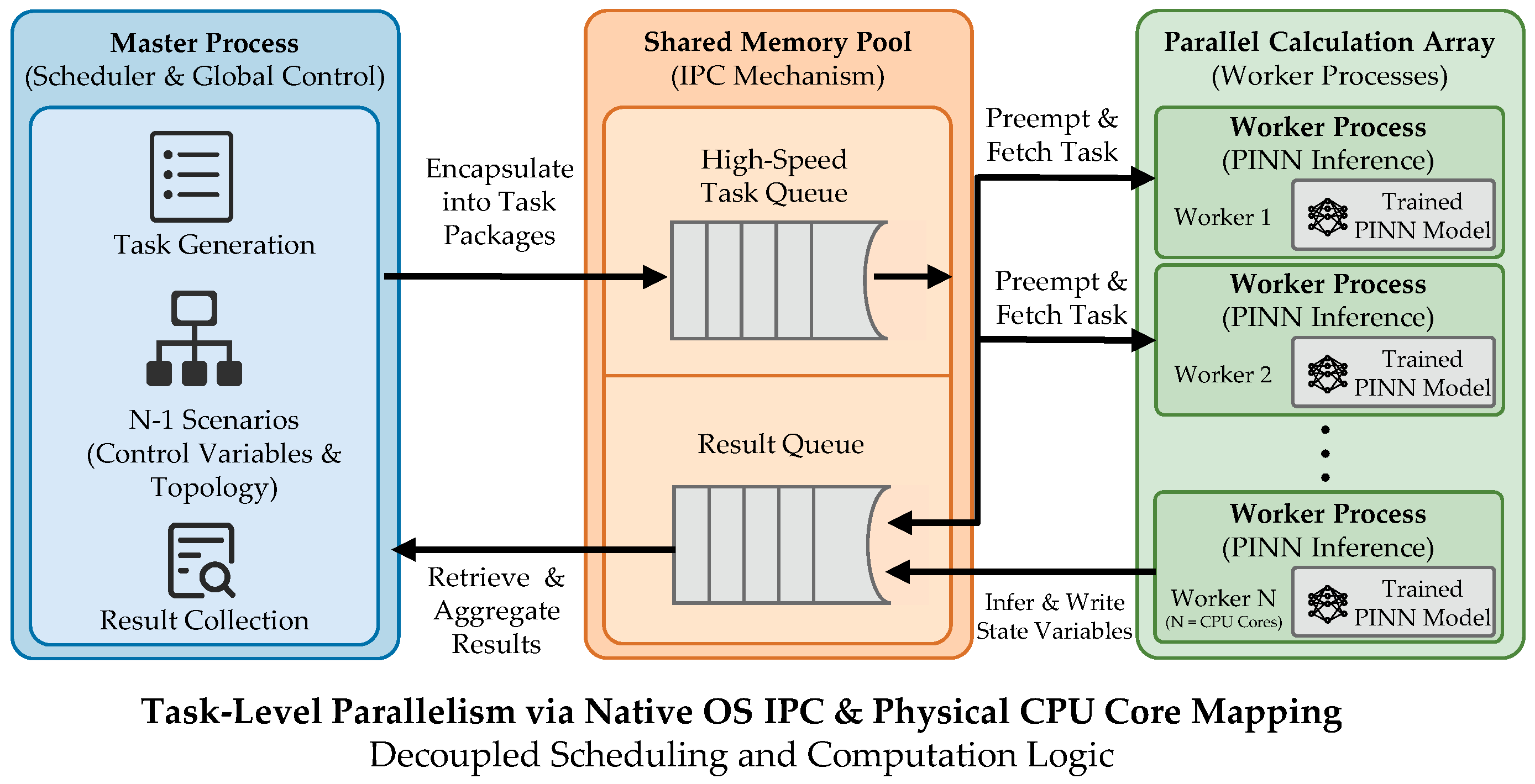
Leveraging the inherent task-level parallelism of various contingency scenarios within the contingency set K , this section constructs a lightweight parallel computing architecture based on the Master–Worker pattern. This architecture aims to map high-dimensional N-1 scanning tasks directly onto physical CPU cores. The system logically decouples the computational flow into two orthogonal entities: the Master process, responsible for task scheduling and global control, and the Worker processes, responsible for bearing the PINN model inference.
The overall framework is illustrated in Figure 2. During the initialization phase, the system automatically spawns N cpu 1 peer Worker processes based on the physical core count N cpu of the host machine, forming a parallel computing array. Serving as the architectural hub, the Master process is responsible for encapsulating each element in the contingency set K —specifically the control variables u and topology state s ( k ) under the fault scenario—into an independent computing task package, which is then distributed via a high-speed task queue constructed based on shared memory. Each Worker process operates in a loop state of “listening-acquiring-inferring-returning”. They utilize the PINN model trained in Section 3 to process fault samples in parallel, eventually writing the predicted state variables x ^ ( k ) into the result queue. This architecture discards complex network communication protocols and utilizes the operating system’s native inter-process communication (IPC) mechanisms, achieving physical isolation and efficient synergy between computational resources and scheduling logic.

4.2. Data Interaction Mechanism Based on Memory-Resident Computing

In general-purpose computing environments, the computational speed of CPUs far exceeds that of disk I/O. Frequent reading of power grid model files or neural network weights from the hard drive leads to severe I/O blocking, significantly reducing the parallel speedup ratio. To overcome this bottleneck under limited hardware resources, this architecture establishes a data interaction mechanism entirely based on memory-resident computing. According to read/write frequency and lifecycle, system data is categorized into static global data and dynamic interaction data, with targeted memory management strategies adopted for each.
Targeting static global data that is voluminous and remains invariant during the assessment process—primarily including the PINN parameter set Θ trained in Section 3 and the power grid base topology parameters—standard multi-process replication modes would require each Worker process to independently load a model copy. This causes memory usage to grow linearly with the number of cores, easily triggering out-of-memory errors. To address this, the architecture utilizes the underlying copy-on-write (COW) technology of the operating system to achieve data sharing. During the system initialization phase, the Master process loads the aforementioned static data into physical memory at once and locks it in a read-only state. The subsequently spawned N cpu 1 Worker processes do not request new physical memory spaces but directly map to the data copy of the parent process via virtual memory addresses. The operating system allocates independent physical space for a memory page only when a process attempts to modify the data. This mechanism ensures that throughout the entire N-1 scanning process, regardless of how many computing cores are launched, the massive PINN parameters exist as a single copy in physical memory, drastically reducing memory overhead and making it feasible to process large-scale nodal systems on ordinary workstations.
For dynamic interaction data generated at high frequency during the N-1 scanning process, namely the dispatched task packages [ u , s ( k ) ] and the returned prediction results [ x ^ ( k ) ] , the system constructs a high-speed communication pipeline based on a shared memory queue. To further reduce the context switching overhead of IPC, this section introduces a task chunking strategy. The Master process no longer distributes tasks based on individual contingency scenarios but packages the contingency set in K into task clusters according to a preset chunk size. A Worker process extracts a task cluster from the shared queue at once, executes multiple inferences continuously locally, and then writes back the results in batches. This strategy significantly reduces the frequency of contention for shared memory locks and the number of serialization/deserialization operations.
Furthermore, to ensure data consistency and integrity during memory transmission, the interaction protocol undergoes strict binary encoding optimization. The task vector z ( k ) is compressed into a compact byte stream and written directly into the memory mapped region, avoiding the extra CPU consumption caused by high-level language object conversion. Through the above design, I/O-intensive operations originally limited by disk read/write speeds are transformed into nanosecond-level memory addressing operations, ensuring that the computing power of the cores can be focused on the matrix operations of the PINN model at all times, rather than being consumed by data movement.

4.3. Fully Asynchronous Non-Blocking Scheduling Strategy

In multi-core parallel computing, traditional synchronous scheduling modes typically adopt the bulk synchronous parallel mechanism, where the Master process sets a global synchronization barrier after distributing a batch of tasks and must wait for all Worker processes to complete the current batch calculation before entering the next round. In a personal computer environment, due to interference from operating system background processes or dynamic adjustment of CPU core frequencies, the calculation time of different Worker processes often varies. Under the synchronous mode, the slowest straggler core forces other high-speed cores that have completed their tasks to remain in an idle waiting state, significantly impeding the overall assessment progress. Therefore, this section designs a fully asynchronous non-blocking scheduling strategy based on a dynamic pull-based mode.

4.3.1. Dynamic Load Balancing Based on Preemption

To eliminate the resource waste caused by synchronous barriers, the architecture discards the static mapping scheme of pre-allocating tasks, instead adopting a Worker -initiated dynamic scheduling mechanism. Under this mechanism, the task queue acts as the sole task buffer pool. The Master process does not assign a specific task to be executed by a specific core but continuously fills the pool with encapsulated contingency scenario data. Each Worker process runs in a completely independent asynchronous loop: when a Worker completes the inference of the current task chunk and returns the results, it immediately accesses the task queue to request new tasks, without concerning itself with the progress of other Workers.
This mechanism naturally implements fine-grained dynamic load balancing. Physical cores with stronger computing power or currently lower load can pull tasks from the queue at a higher frequency, thereby undertaking a larger workload; conversely, slower cores affected by system background noise process fewer tasks. Through this adaptive adjustment of capability-based work distribution, all CPU cores remain fully loaded throughout the entire N-1 scanning cycle, thoroughly eliminating the bottleneck caused by uneven processing speeds.

4.3.2. Pipeline Overlapping of Computation and Communication

To further improve system throughput, this strategy performs a pipelining design for model inference and result processing in the time dimension. On the Master process side, non-blocking polling or asynchronous callback mechanisms are adopted to handle the predicted data returned by Workers. The Master process does not suspend while waiting for the result of a specific task but continuously checks the result queue. Once a new state prediction vector x ^ ( k ) is detected arriving, the Master immediately retrieves it and performs the limit violation check and log recording. Meanwhile, all Worker processes continue to execute the inference for the next batch of contingency scenarios in the background.
This fully asynchronous design allows the compute-intensive operations of Workers running PINN forward propagation and the logic-intensive operations of the Master processing result data to achieve perfect parallelism on the time axis. Assuming the system has a total of N c p u cores and the total task volume is sufficiently large, the theoretical speedup ratio S can approach the ideal value:
S N cpu 1 1 + α
where α is a minimal coefficient representing the overhead of inter-process communication and lock contention. This strategy ensures that the N-1 assessment process operates as efficiently as a pipeline factory until the last task in the contingency set K is processed.

4.3.3. Theoretical Performance Analysis: Amdahl’s Law and Computation-Memory Balance

To quantitatively evaluate the efficiency of the proposed framework, a theoretical performance analysis is conducted based on Amdahl’s Law and the computation–memory balance principle [34,35,36].
The theoretical speedup S of a parallel task is governed by Amdahl’s Law:
S = 1 f + 1 f N cpu
where f denotes the serial fraction of the workload and N cpu is the number of processing cores. In conventional synchronous security assessment, f is not only determined by the intrinsic serial code but is also significantly inflated by the synchronization latency Δ t sync and I/O wait times Δ t io . Thus, the effective serial fraction f eff can be expressed as:
f eff = f intrinsic + ( Δ t sync + Δ t io ) T total
The proposed asynchronous memory-resident architecture minimizes Δ t sync by decoupling task execution and suppresses Δ t io through in-memory data structures. Consequently, f eff is reduced to approach f intrinsic , allowing S to scale linearly with n .
Furthermore, the computation–memory balance is optimized. The intensity of the computational task I is defined as the ratio of floating-point operations to memory access data volume. By utilizing memory-resident computing, the data movement overhead is internalized, ensuring that the system operates in a computation-bound regime rather than being limited by the memory bandwidth, thereby maximizing the throughput of the multi-core processor.

5. Case Studies

5.1. Case Study Setup

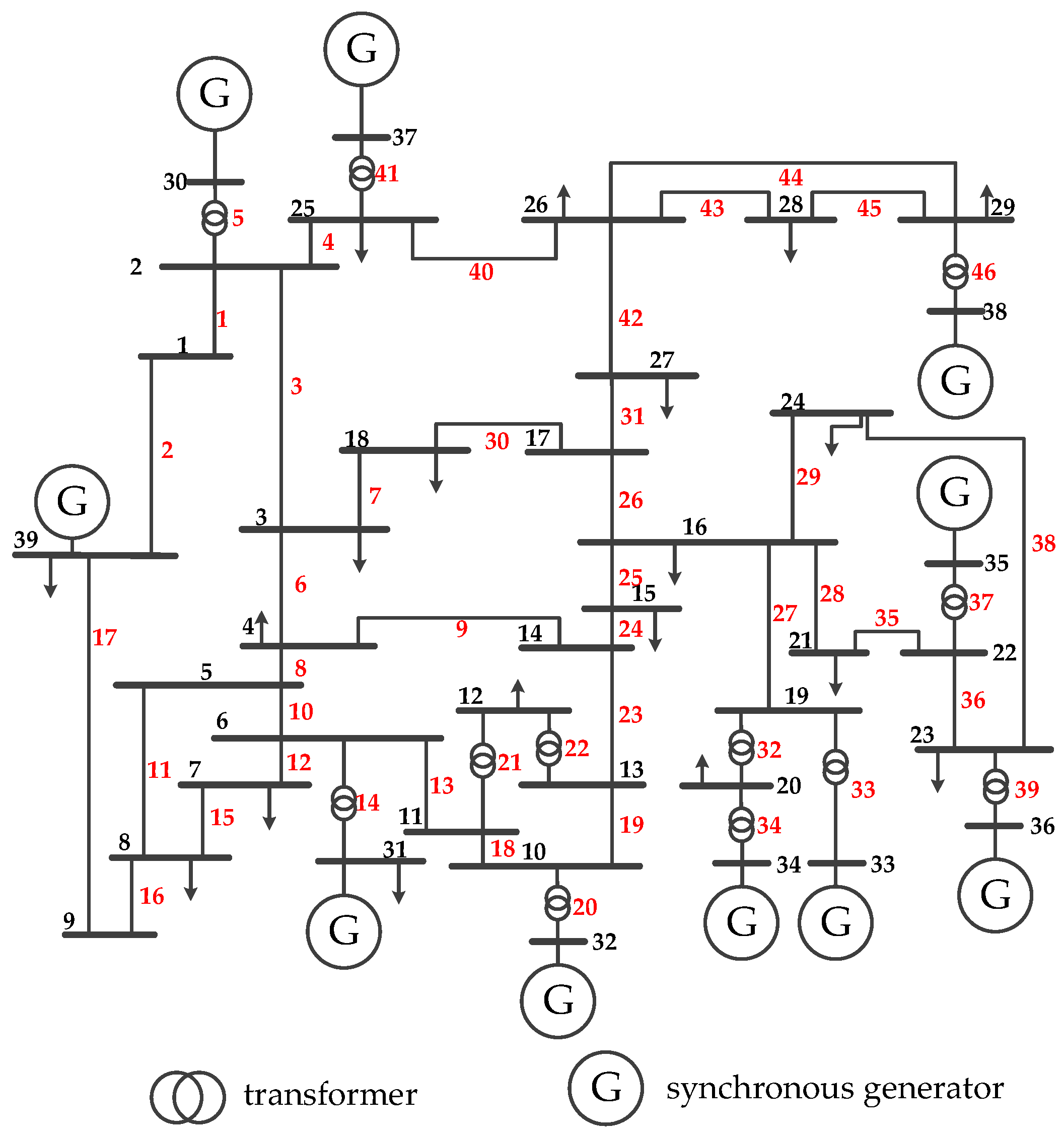
To verify the prediction accuracy of the proposed PINN proxy model and its generalization ability under small samples, and to assess the operating efficiency of the fully asynchronous parallel computing architecture on a personal computer, the IEEE 39-bus standard test system shown in Figure 3 is selected as the core verification platform. The system consists of 10 synchronous generators, 39 buses, 46 AC transmission lines, and 12 transformers, with a system base power set to 100 MVA.
The construction of the experimental sample set adopts the Monte Carlo simulation method, aiming to cover various operating boundaries of the power system. We assume that the active load P d , i and reactive load Q d , i at each bus are mutually independent and follow a uniform distribution. Centered on the base load P d , i 0 of the standard case data, the fluctuation range is set to 20%. The specific random perturbation model is expressed as:
P d , i ~ U ( 0.8 P d , i 0 ,   1.2 P d , i 0 )
Q d , i ~ U ( 0.8 Q d , i 0 ,   1.2 Q d , i 0 )
Except for the slack bus 31, the active power output of the remaining generators is redistributed proportionally according to the system total load level and strictly restricted within the unit physical constraints [ P g , i min ,   P g , i max ] . On this basis, for each generated base operating sample, all 46 transmission lines in the system are traversed to simulate line disconnection faults one by one. Consistent with the definition in Section 2.2, generator and transformer outages are excluded from this simulation to strictly isolate the impact of topological changes on model performance. Thereby constructing a contingency set K containing both base states and N-1 fault states. The Newton-Raphson method in the MATPOWER 7.1 toolbox is utilized to perform calculations for all the aforementioned scenarios. After eliminating non-convergent samples, 100,000 sets of valid data are finally retained as ground truth labels. The dataset is randomly divided into a training set, a validation set, and a test set in a ratio of 70%:10%:20%, and Z-Score standardization is performed on all input features z , namely the injection power and topology vectors, as well as on the output labels x , specifically the voltage magnitudes and phase angles.
Regarding the proposed lightweight PINN model, this experiment constructs a compact fully connected neural network architecture. The specific network structure and hyperparameter settings are detailed in Table 3. To meet the requirements of physical equations for the continuity of high-order derivatives, the hyperbolic tangent function (Tanh) is selected as the activation function for all hidden layers. Regarding the training strategy, to balance data fitting and physical constraints, the physics-guided weight λ adopts a dynamic adjustment strategy, increasing linearly from 0.0 to 1.5 during the training process. This prompts the model to quickly learn the data distribution in the initial stage and strictly approximate the physical manifold in the later stage.
All experiments are conducted on a single personal computer. The hardware platform is equipped with an Intel Core i7-12700K processor and 32 GB DDR4 3200 MHz memory. The software environment is based on the Windows 10 operating system and Python 3.9, while the deep learning model is built using Pytorch 1.13.1. The model offline training phase utilizes an NVIDIA RTX 3070 GPU for acceleration; however, during the N-1 online scanning and performance evaluation phases, only CPU resources are used to assess the actual throughput capability of the proposed asynchronous parallel architecture.

5.2. Verification of Model Prediction Accuracy and Security Assessment Applications

To comprehensively evaluate the performance of the proposed PINN proxy model, comparative experiments are conducted against two baseline models: a standard data-driven DNN and a graph neural network (GNN). The baseline DNN employs the same four-layer fully connected architecture as the proposed PINN but is trained solely on data discrepancies without physical regularization. It is formally noted that the performance metrics for the PINN model presented in Table 4 are derived directly from the model configuration and training hyperparameters specified in Table 3. The GNN model is selected for comparison due to its advantageous capability in capturing non-Euclidean topological correlations in power grids [14]. By contrasting the performance of these three models on the IEEE 39-bus test set, the specific contributions of topological awareness and physical mechanism constraints to model generalization and interpretability are analyzed.
Three primary metrics are adopted to quantify the prediction performance from different perspectives. The root mean square error (RMSE) measures the global deviation between the predicted values and the ground truth labels, serving as an indicator of overall fitting accuracy. The mean absolute percentage error (MAPE) evaluates the relative prediction accuracy, which is particularly significant for variables with small magnitudes such as voltage phase angles. The physics mismatch metric η p h y quantifies the degree of violation of Kirchhoff’s laws by substituting the predicted state variables back into the power flow equations, thereby assessing the physical consistency of the model. The calculation formulas for these metrics are as follows:
R M S E = 1 N t e s t k = 1 N t e s t | | x ^ ( k ) x t r u e ( k ) | | 2 2
M A P E = 1 N t e s t k = 1 N t e s t x t r u e ( k ) x ^ ( k ) x t r u e ( k ) × 100 %
η p h y = 1 N t e s t k = 1 N t e s t | | f ( k ) ( x ^ ( k ) , u ) | | 2
Table 4 presents the statistical error results of the PINN, the GNN, and the baseline DNN on the test set. Experimental data indicates that under the condition of sufficient labeled data, the GNN achieves the highest prediction accuracy, with a voltage magnitude RMSE of 1.65 × 10 4 p.u. This is attributed to the GNN’s superior ability to extract topological features from the graph-structured power grid data. Although the proposed PINN yields a slightly higher RMSE ( 1.85 × 10 4 p.u.) compared to the GNN, it still significantly outperforms the baseline DNN, achieving an improvement of approximately 15.1%. More importantly, while the GNN excels in statistical fitting, the PINN demonstrates an overwhelming advantage in physical consistency. The Physics Mismatch of the PINN is nearly negligible compared to the data-driven models, indicating that the PINN successfully finds a solution that balances high accuracy with strict adherence to physical laws. This characteristic makes the PINN more reliable in engineering scenarios where physical validity is paramount.
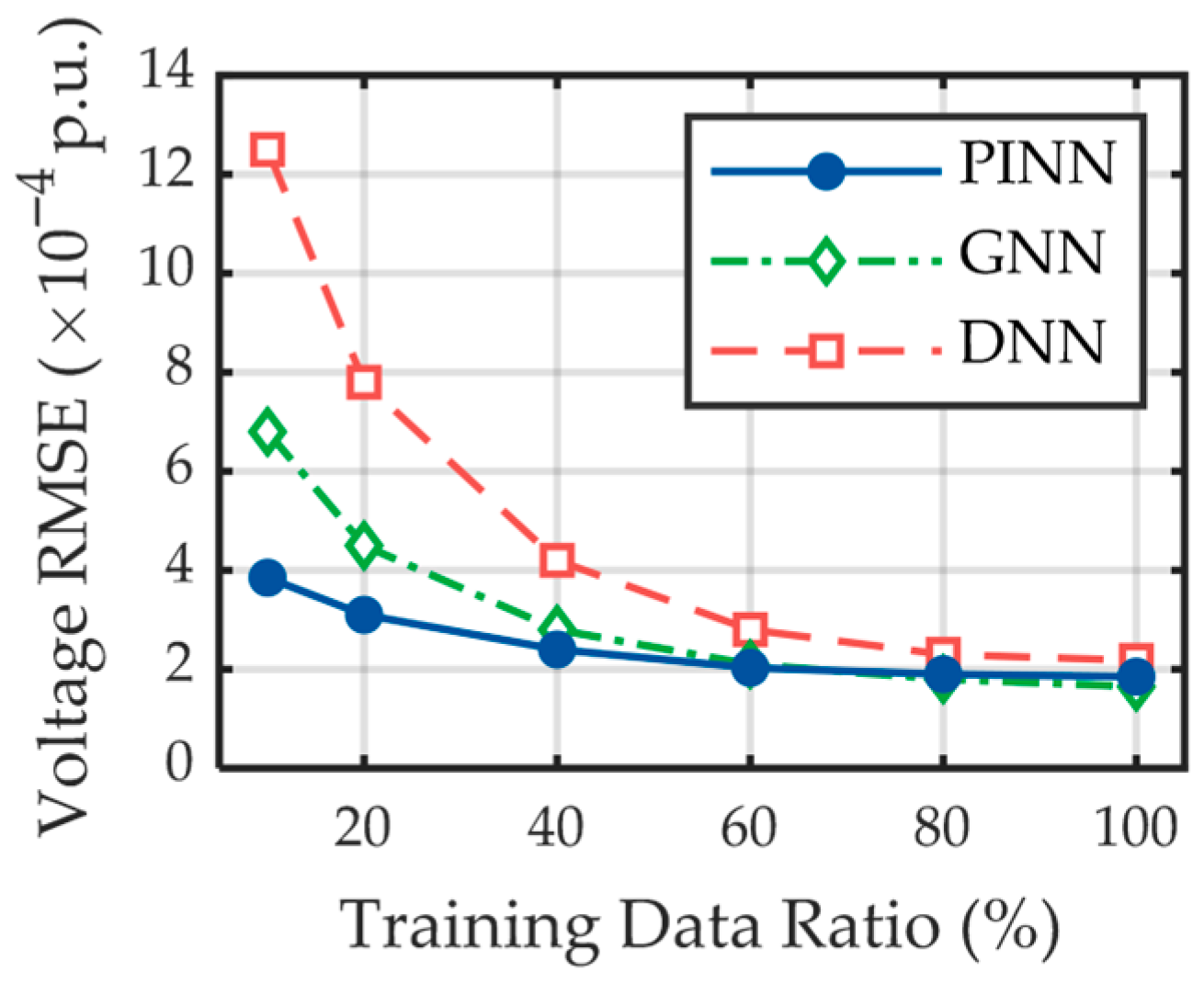
Beyond the performance comparison under full data conditions, the core innovative value of the PINN model lies in its superior small-sample learning capability. Addressing the high cost of acquiring high-quality labeled samples in actual power system operations, this experiment maintains a constant test set while progressively reducing the training set size. The PINN, GNN, and DNN are retrained using 10%, 20%, 40%, 60%, and 80% of the full data, respectively, and the variation trends of their average RMSE on the test set are recorded.
As illustrated in Figure 4, distinct behaviors are observed among the three models as the training sample size decreases. In the data-rich regime spanning from 80% to 100%, the performance gap between the PINN and the GNN is relatively narrow, which is expected as data-driven models converge when fed with sufficient information. However, a significant divergence is identified in the sparse-data regime between 10% and 40%. It is observed that the prediction error of the pure data-driven DNN rises exponentially due to severe overfitting when labeled data is scarce. The GNN also exhibits a marked performance degradation, with its RMSE surpassing that of the PINN when the training ratio drops below 40%. In contrast, extreme resilience is demonstrated by the PINN model; even under the condition of 10% data availability, its RMSE remains at a low level of 3.87 × 10 4 p.u., which is approximately 74% lower than that of the DNN. This comparison quantitatively proves that the embedded physical equations effectively function as high-quality regularization, compensating for the lack of explicit labels and ensuring robust generalization in small-sample engineering scenarios.
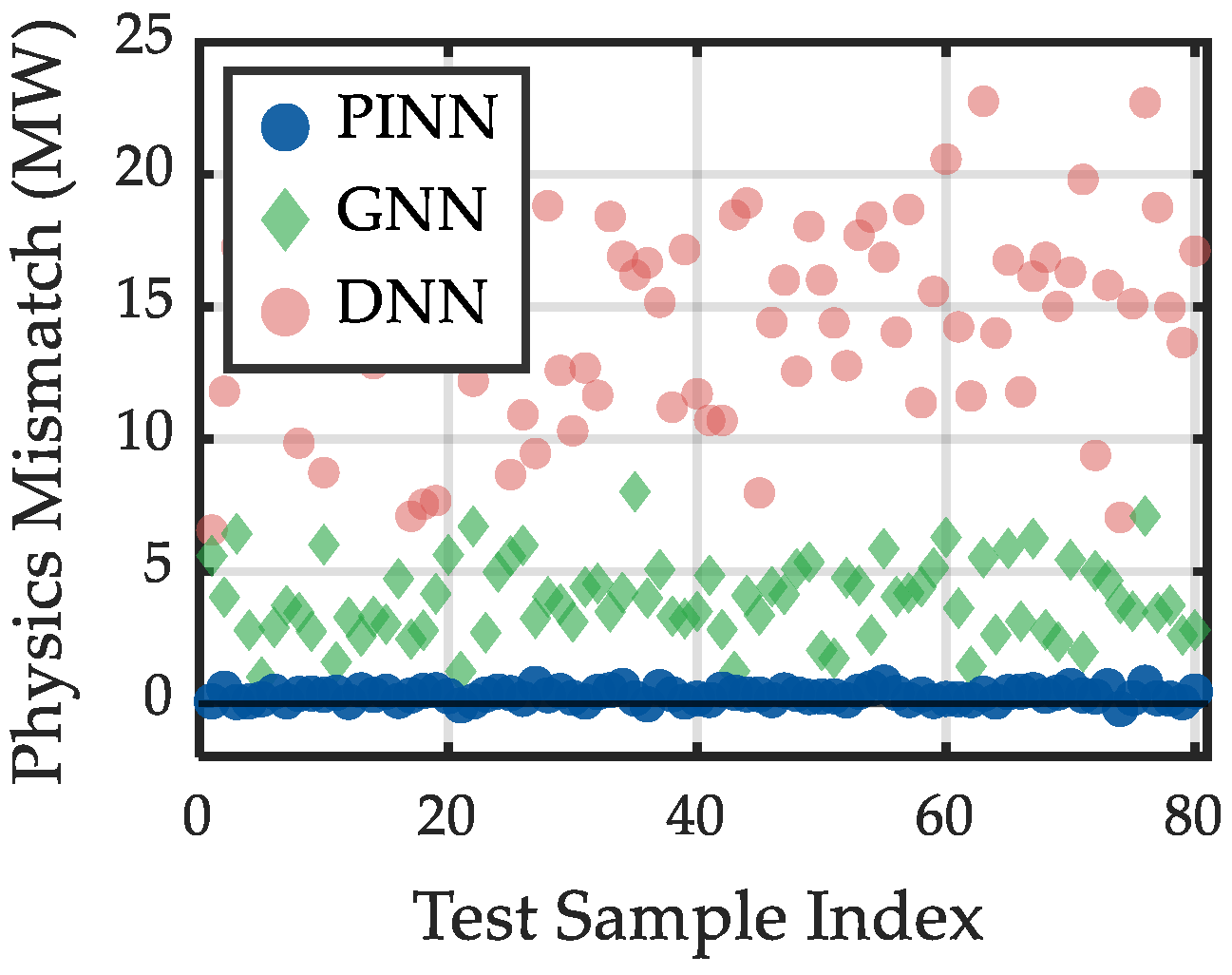
To further quantify the physical interpretability of the model outputs, the Physics Mismatch metric is analyzed in detail. Statistical results in Table 4 have already shown the average superiority of PINN. Although the GNN reduces the mismatch to 3.85 MW compared to the DNN’s 15.42 MW by implicitly learning topology, it still lacks explicit physical constraints. The PINN model reduces this value to 0.32 MW, a reduction of over 90% compared to the GNN. Figure 5 displays the power mismatch distribution of 100 randomly selected test samples. The residuals of the baseline DNN are widely distributed with a high mean value, indicating that the unconstrained data-driven model fails to guarantee power balance even if the statistical fitting error is low. This is attributed to the fact that the DNN optimizes solely for label proximity, ignoring the underlying topological constraints. Conversely, the residual distribution of the PINN converges tightly around zero. This demonstrates that the PINN not only fits the input-output mapping but also internalizes Kirchhoff’s laws within the network weights via the physical regularization term L p h y . This high degree of physical consistency ensures the credibility of N-1 assessment results in engineering applications.
Further examining the model performance on the binary classification task involving safe operation and limit violation detection, the allowable range for bus voltage is set to [0.95, 1.05] p.u., and the line thermal stability limit is set to 100%. The 20,000 contingency scenarios in the test set are divided into safe and violation categories based on ground truth labels, focusing on the false negative rate and false positive rate.
As shown in Table 5, statistical results reveal that the baseline DNN model exhibits high uncertainty when processing samples near operational boundaries, with an FPR of 4.2% and an FNR as high as 2.8%. In an engineering context, a false negative implies that the dispatcher ignores actual existing overload or voltage collapse risks, posing a fatal threat to grid security. Benefiting from its powerful topological perception capabilities, the GNN significantly improves classification accuracy to 99.4% and reduces the FNR to 0.5%, demonstrating excellent fault identification performance. However, the PINN model prioritizes physical safety constraints, further controlling the critical FNR within 0.3% at the cost of a slightly higher false alarm rate. This characteristic, which prioritizes the minimization of false negatives over false positives, demonstrates the high reliability of the proposed PINN method in security early warning applications.
To further explore the adaptability of the model in complex contingency scenarios, a representative critical line disconnection case from the test set is selected for specific analysis.
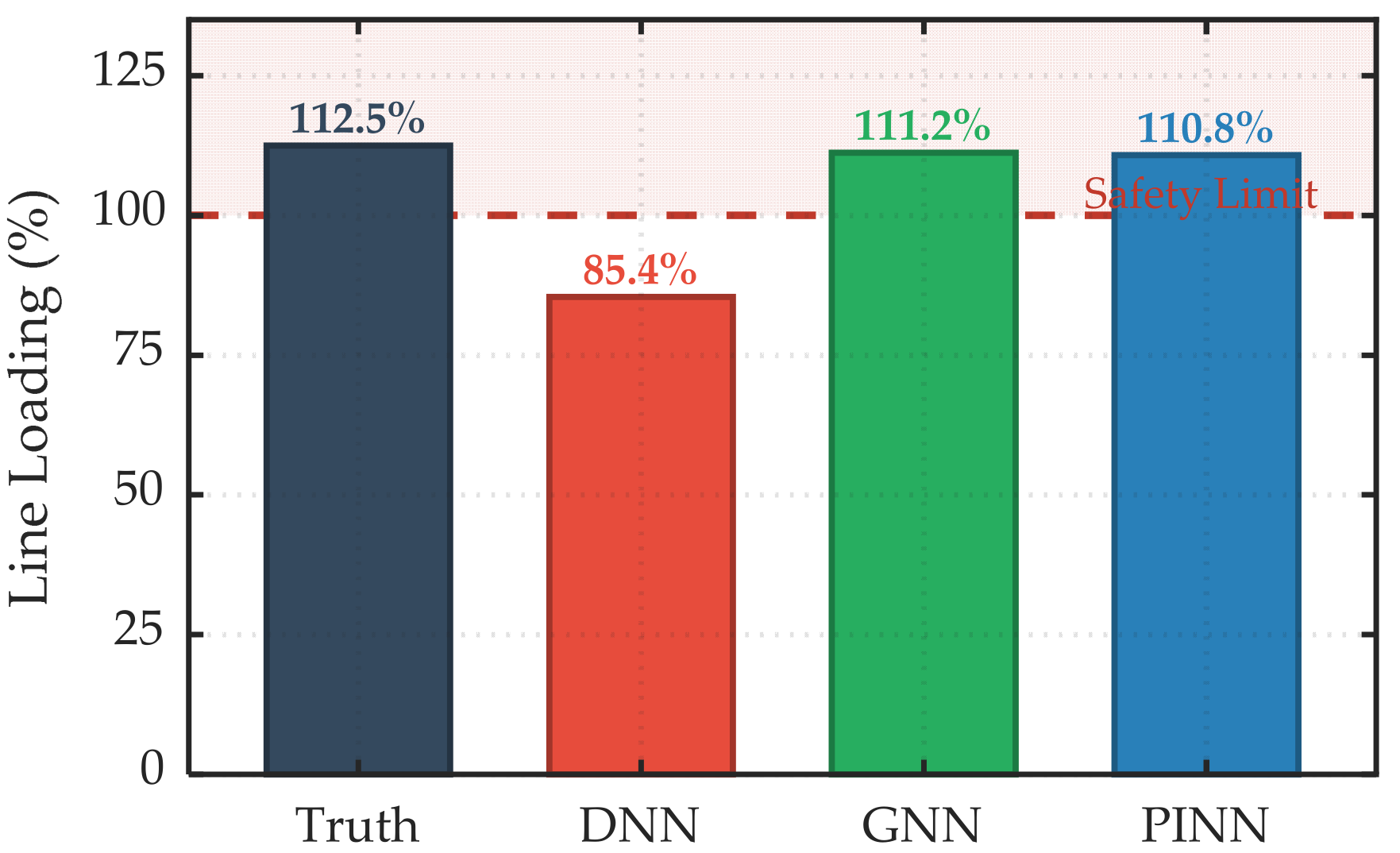
As shown in Figure 6, when the critical tie line 16–17 disconnects, the power flow distribution undergoes drastic reconstruction, and the loading rate of the adjacent line 16–19 surges to 112.5%, indicating a severe overload. At this moment, the baseline DNN model infers solely based on the statistical laws of historical data and incorrectly predicts the loading rate of this line as 85.4%, erroneously classifying it as a safe state. In contrast, both the GNN and the PINN successfully capture the impact of the topological change. The GNN, leveraging its message-passing mechanism to aggregate neighbor information, accurately predicts a loading rate of 111.2%. Similarly, because the PINN model explicitly encodes the topology state s ( k ) and is forced to satisfy Kirchhoff’s laws during training, it successfully captures the physical path of power flow transfer and predicts the loading rate as 110.8%. This comparison confirms that while the GNN achieves high precision through structural induction, the PINN achieves comparable robustness through physical regularization, and both methods significantly outperform the naive DNN in handling complex combinatorial faults.
To further verify the robustness of the proposed dynamic weighting strategy, a sensitivity analysis was conducted regarding the maximum physical weight threshold λ max . The selection of λ max is critical: a value that is too small may fail to effectively impose physical constraints, while a value that is too large could lead to stiff gradients, dominating the data loss and hindering convergence. We retrained the PINN model with λ max varying from 0.5 to 5.0, while keeping the network architecture and other training hyperparameters unchanged.
The statistical results of the model performance under different λ max settings are presented in Table 6. It can be observed that when λ max is set to a low value, the constraint strength is insufficient, resulting in a relatively high physics mismatch of 2.15 MW. Conversely, when λ max is excessively large, although the physics mismatch is minimized to 0.12 MW, the Voltage RMSE deteriorates slightly to 2.05 × 10 4 p.u., indicating that the optimization landscape became too complex for the optimizer to find the global optimum for the data fitting term. However, within the range of λ max [ 1.0 , 2.0 ] , both the prediction accuracy and physical consistency remain highly stable and optimal. This demonstrates that the proposed method is not sensitive to the precise selection of this hyperparameter, provided it falls within a reasonable magnitude.

5.3. Verification of Efficiency for Fully Asynchronous Parallel Computing

Having verified the prediction accuracy of the PINN proxy model on the IEEE 39-bus system, this section utilizes the same test system to focus on examining the operating efficiency and resource scheduling characteristics of the proposed fully asynchronous parallel computing architecture in a personal computer environment. The experimental platform remains based on the aforementioned Intel Core i7-12700K processor. This chip adopts a heterogeneous hybrid architecture of 8 performance cores (P-Cores) + 4 efficiency cores (E-Cores). The experiment selects 20,000 N-1 contingency scenarios included in the test set as the standard workload, recording the total computation time and CPU core load status under three modes: serial calculation, barrier-based synchronous parallel (Sync-Parallel), and the proposed fully asynchronous parallel (Async-Parallel).
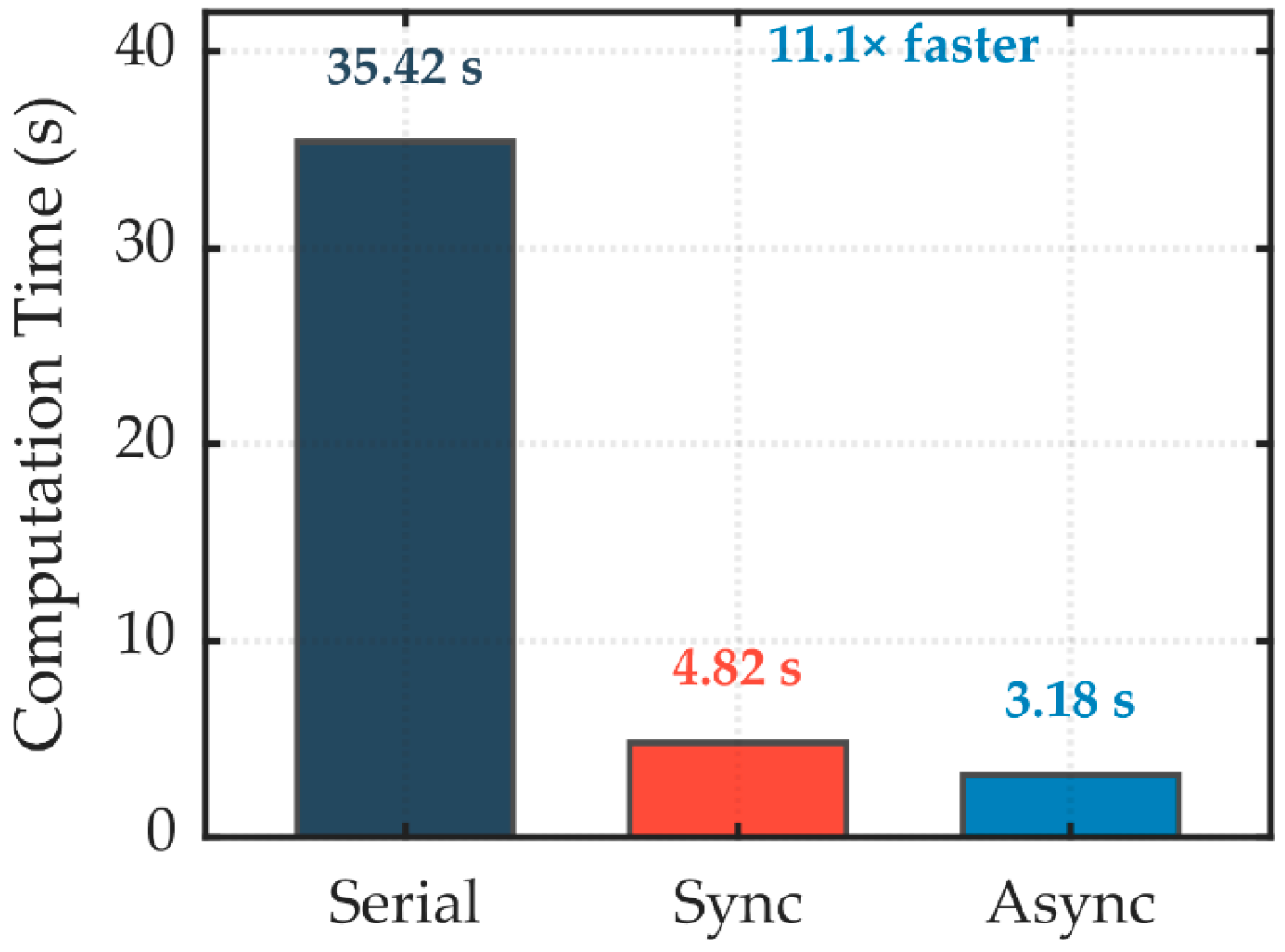
As shown in Table 7, in single-core Serial mode, completing the scanning of 20,000 scenarios takes a total of 35.42 s, with an average inference time of approximately 1.77 milliseconds per single pass. When 12 Worker processes are enabled for parallel acceleration, the traditional Sync-Parallel mode shortens the time to 4.82 s, corresponding to a speedup ratio of 7.35. Although the speed is improved, this value is far below the theoretical maximum speedup and fails to fully utilize the computing power of the 12 physical cores. In comparison, the proposed Async-Parallel architecture further compresses the total time to 3.18 s, increasing the speedup ratio to 11.14, an efficiency improvement of 34.0% compared to the synchronous mode. The fundamental reason for this significant performance difference lies in the heterogeneous nature of the processor: in Sync-Parallel mode, the system must set a synchronization barrier at the end of each task batch, causing the faster P-Cores to wait for the slower E-Cores to complete their tasks before entering the next round. This bottleneck severely drags down the overall throughput. The fully asynchronous architecture, however, adopts a pull-based scheduling, allowing P-Cores to preemptively fetch new tasks from the shared memory queue immediately after completing the current task without waiting for E-Cores, consequently achieving dynamic load balancing by allocating computational tasks commensurate with the processing capacity of each core.
To intuitively quantify the performance differences in different computing modes in a heterogeneous multi-core environment, Figure 7, Figure 8 and Figure 9 display the experimental results from three dimensions: total time consumption, multi-core speedup characteristics, and microscopic core load.
Figure 7 compares the wall-clock time of Serial, Sync-Parallel, and Async-Parallel modes when processing 20,000 N-1 scenarios. Under the single-core serial baseline, the full scan takes 35.42 s; employing the traditional synchronous parallel strategy shortens the time to 4.82 s. The proposed asynchronous architecture further slashes the computational overhead, depressing the total time to 3.18 s. This significant time advantage, a roughly 34.0% improvement over the synchronous mode, indicates that by eliminating the global synchronization barrier, the system successfully avoids the extra latency caused by inter-process communication, achieving microsecond-level task throughput.
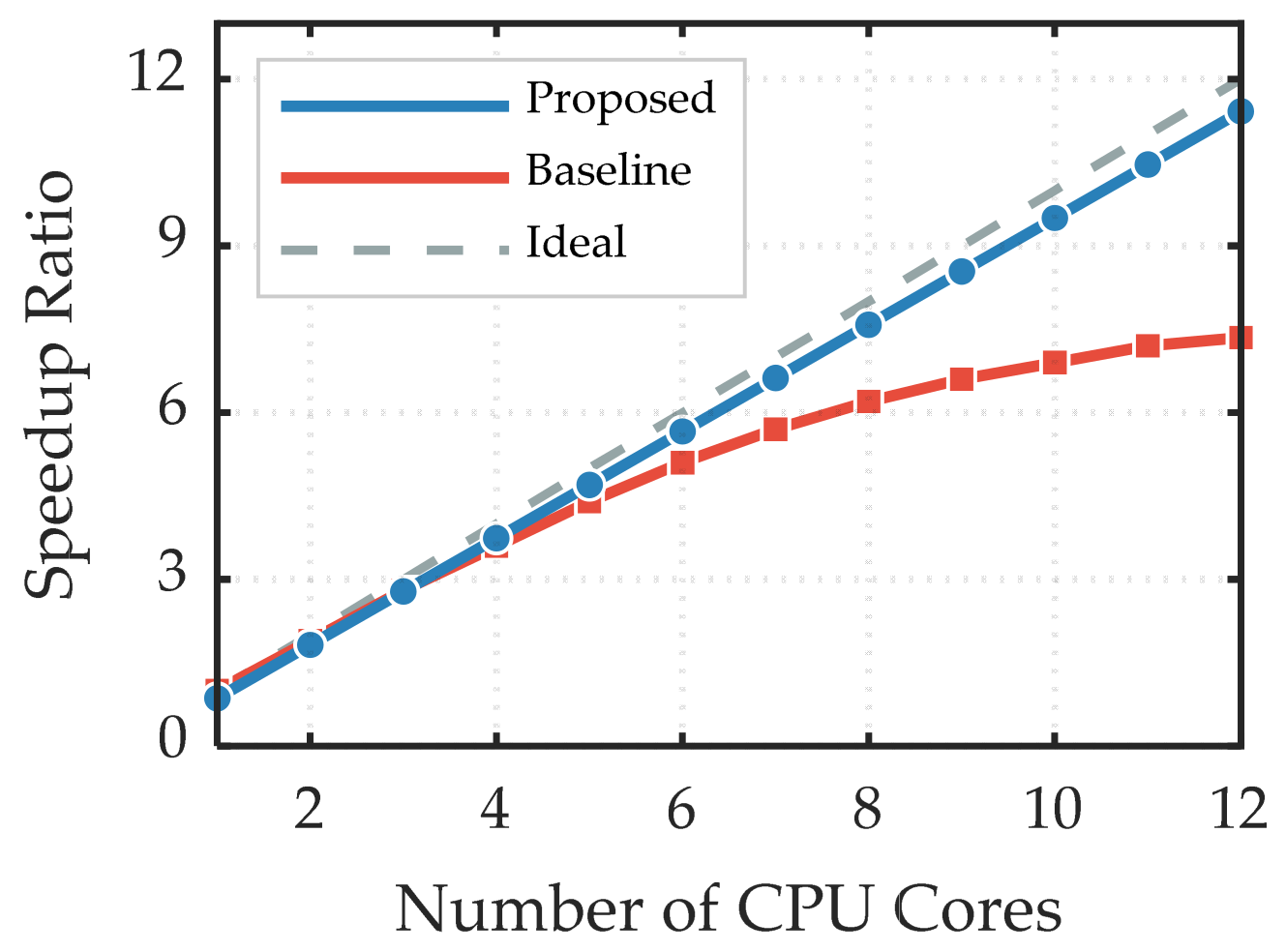
Figure 8 plots the trend of the speedup ratio as the number of Worker processes changes. The black dashed line in the figure represents the ideal linear speedup. It can be seen that as the core count increases from 1 to 12, the Sync-Parallel mode gradually deviates from the ideal line, showing a trend of diminishing marginal returns, finally reaching only a 7.35× speedup at 12 cores. This is because the slower operation speed of the E-Cores of the i7-12700K processor drags down the completion time of the entire batch. In contrast, the proposed Asynchronous mode consistently hugs the ideal linear acceleration line, achieving an 11.1× speedup at full core capacity. This proves that the dynamic scheduling strategy based on the Pull mode can effectively overcome hardware heterogeneity and possesses excellent parallel efficiency on shared-memory architectures.
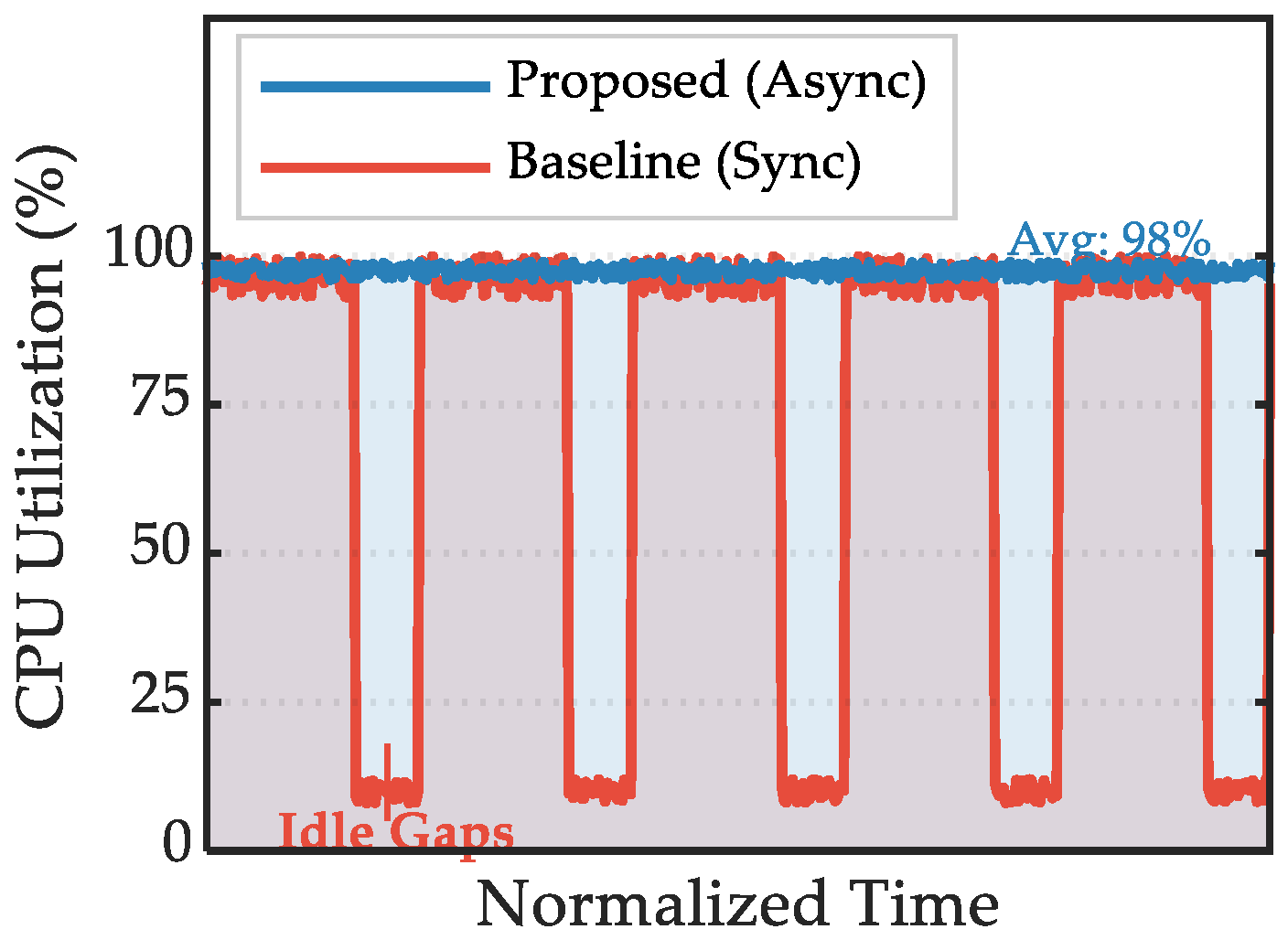
The deep mechanism of this performance difference is fully explained in the CPU microscopic load sequence in Figure 9. This figure captures a segment of the real-time occupancy rate of a P-Core during the calculation process. In Sync mode, the CPU load exhibits pronounced sawtooth fluctuations, with significant intervals interspersed between peak loads that should have been fully loaded. These gaps correspond to the invalid waiting time of high-performance cores waiting for low-performance cores to complete the current batch of tasks, known as the Straggler Effect. Conversely, in Async mode, benefiting from the non-blocking task preemption mechanism, the P-Core does not need to wait after completing the current inference and immediately acquires a new task from the shared memory queue. This mechanism fills all the idle gaps, maintaining the core load at a nearly 100% saturation state throughout the entire lifecycle. It is formally clarified that this high utilization signifies that the idle wait times inherent in traditional methods have been successfully eliminated, thereby transforming the physical computing power of the hardware into maximum computational productivity without causing instability. Furthermore, the achievement of such high throughput on a standard CPU validates the cost-effectiveness of the proposed method for widespread utility deployment.

5.4. Computational Efficiency and High-Dimensional Adaptability Analysis

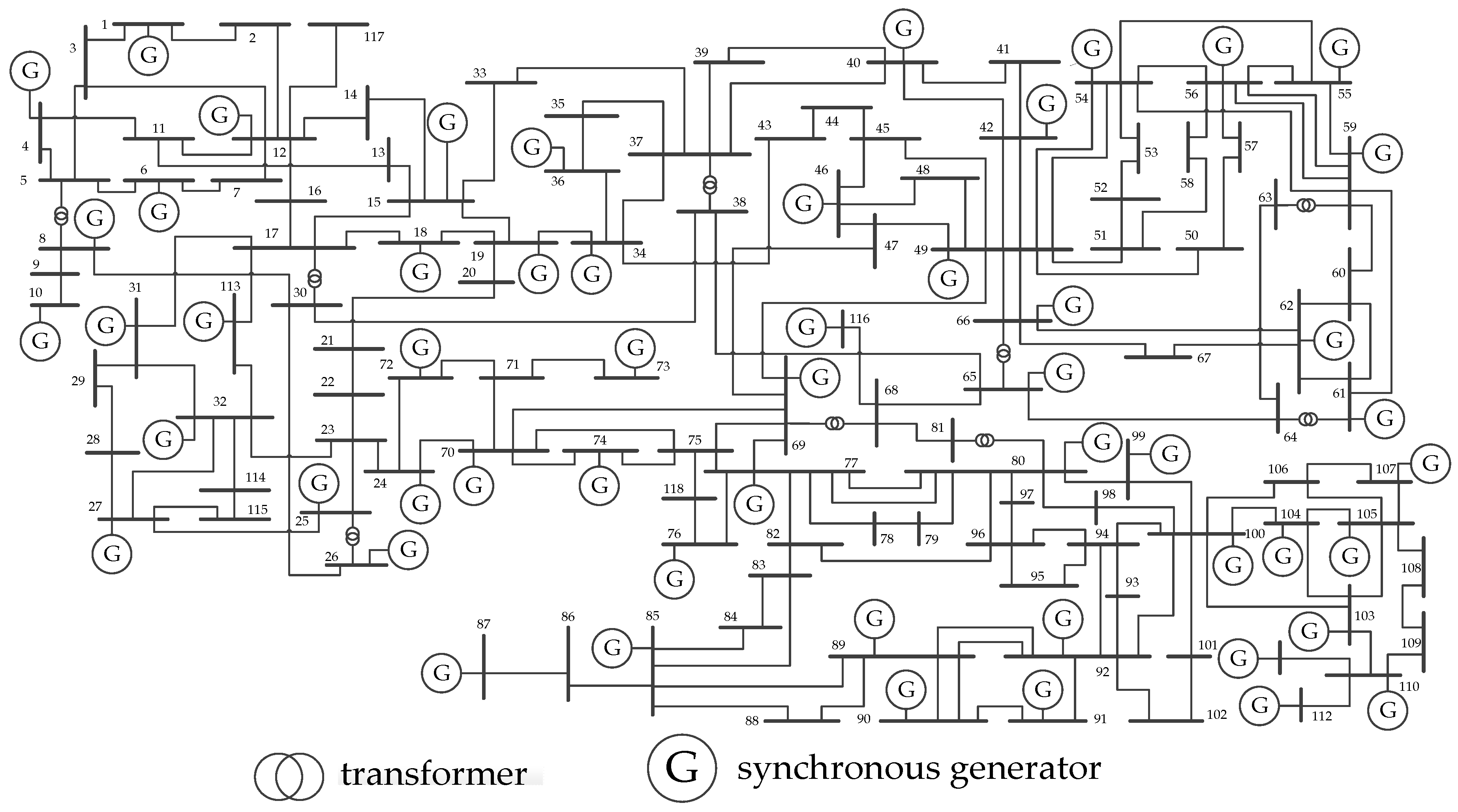
To further verify the applicability of the proposed method in large-scale power grids, this section extends the test object from the IEEE 39-bus system to the topologically more complex IEEE 118-bus system. As shown in Figure 10, this system contains 118 buses, 54 generators, and 186 transmission lines, with its state space dimension and the scale of the N-1 contingency set increasing by approximately 3 times compared to the 39-bus system. In this high-dimensional scenario, neural networks face the challenge of the Curse of Dimensionality, where the sparsity of the input feature space increases drastically, typically requiring an exponentially growing number of training samples to maintain the same prediction accuracy. For the IEEE 118 system, the hidden layer scale of the PINN model is moderately deepened to [512, 512, 256, 128], and the input layer dimension is correspondingly extended to 304, including 118 active power injections, 118 reactive power injections, and a 186-dimensional topology vector.
Experimental results indicate that despite the significant increase in system scale, the PINN proxy model maintains excellent generalization performance. Table 8 presents the changes in various metrics when scaling from 39 buses to 118 buses. It can be observed that the input feature dimension increased by 145%, and the complexity of the physical system grew nonlinearly. Under the same training sample density, the voltage prediction RMSE of the baseline DNN model deteriorated from 2.18 × 10 4 p.u. in the IEEE 39 system to 5.62 × 10 4 p.u., with an error growth rate as high as 157.8%. This exposes the inadequacy of pure data-driven methods in handling high-dimensional nonlinear mappings, making them prone to falling into local minima. In contrast, relying on strong regularization constraints from physical equations, the PINN model recorded an RMSE of only 2.45 × 10 4 p.u. on the IEEE 118 system, controlling the error growth rate at 32.4%. This implies that with the system scale expanding nearly 3 times, the accuracy loss of the PINN is only around 30%, and its error growth rate is far lower than the growth rate of feature dimensions. This proves that the introduction of physical mechanisms effectively compresses the search range of the high-dimensional solution space, allowing the model to converge rapidly along the manifold satisfying Kirchhoff’s laws, thereby demonstrating significant data efficiency advantages when dealing with large-scale power grid problems.
Regarding computational efficiency, a larger system implies increased time consumption for a single power flow calculation and memory pressure brought by the growth of the admittance matrix dimensions. Test data shows that, supported by the fully asynchronous parallel architecture, the total time for scanning approximately 20,000 N-1 scenarios for the IEEE 118 system is only 8.4 s. The single inference time increased from 0.16 ms to 0.42 ms, an increase of 162.5%. This magnitude of increase is basically consistent with the growth of input dimensions, indicating that the time complexity of the algorithm presents a linear relationship relative to the system scale, without exhibiting an exponential explosion. At this point, the In-Memory and COW mechanisms described in Section 4.2 played a key role. Due to the large size of the parameter files for the 118-bus system, employing a traditional multi-process mode would lead to severe throughput bottlenecks caused by frequent disk I/O and memory copying. However, the memory usage monitored by this architecture increased by only 200 MB compared to the 39-bus system, and the CPU cores remained fully loaded throughout. This confirms that the fully asynchronous architecture not only solves the core utilization problem but also effectively mitigates the data transmission overhead caused by the expansion of system scale, ensuring that the assessment efficiency achieves a near-linear speedup with the number of physical cores. It implies that the proposed architecture effectively maximizes the throughput of shared-memory symmetric multiprocessing systems, rather than being limited by the data movement overhead associated with increased system complexity.


6. Discussion

6.1. Validity and Limitations of the Idealized Self-Consistent Framework

Regarding the issue that the training data source and the physical constraint equations share the same origin in this study, it is necessary to clarify the rationale behind this experimental design and its potential limitations. In the experimental setup, the mathematical model used to generate the ground truth is maintained in complete consistency with the physical equations embedded in the PINN loss function. This self-consistent setup was deliberately adopted to serve the core positioning of this study regarding system integration. To isolate interferences caused by parameter errors and construct a controlled environment, the research focus is concentrated on evaluating the synergistic performance of the physics–data dual-driven mechanism deeply integrated with the asynchronous parallel architecture. Within this environment, the capability of the algorithm to handle non-convex topological manifold mappings and the efficiency of the hardware architecture in overcoming computational bottlenecks caused by heterogeneity can be accurately quantified. Consequently, the current experimental results establish the theoretical upper bound of the proposed integrated scheme.
However, the limitations of this idealized setup are also fully acknowledged. In practical power system operations, a deviation between the mathematical model and the physical reality is inevitable, known as the model–reality mismatch. For instance, the resistance and reactance parameters of transmission lines may drift due to environmental temperature changes and conductor aging. If the physical parameters embedded within the PINN are inconsistent with the actual physical characteristics of the grid, strict physical equation constraints might be counterproductive, leading to negative transfer. Therefore, the conclusions of this study should be viewed as the optimal performance under the premise that system parameters are accurately known.

6.2. Limitations on Distributed Scalability

It is acknowledged that the claims of computational efficiency in this study are strictly verified within a single-node, multi-core environment. While the proposed asynchronous architecture demonstrates superior parallel performance on shared-memory systems by minimizing synchronization latency, its scalability on distributed memory systems has not been tested. In distributed environments, inter-node communication latency and network bandwidth constraints may introduce new bottlenecks that differ from the intra-node straggler effects addressed in this paper. Therefore, the applicability of the proposed method is currently positioned at the edge computing level or local workstation level for control centers, and its extension to distributed frameworks remains a subject for future investigation.

6.3. Robustness Challenges in Complex Real-World Engineering Environments

In the dispatch and operation of actual power grids, data provided by supervisory control and data acquisition (SCADA) systems or phasor measurement units (PMUs) are rarely perfect. Addressing this issue, the practical application of the proposed method faces three main categories of challenges:
The first challenge is the impact of measurement noise and bad data. Actual measurement data are typically superimposed with Gaussian white noise or even contain outlier bad data caused by sensor malfunctions. The current PINN model employs a hard constraints mechanism, which requires the network output to strictly satisfy Kirchhoff’s laws. When the input data itself contains significant noise, overly strong physical constraints may force the neural network to fit this noise, thereby degrading the model’s ability to generalize the true system state.
The second challenge is the sensitivity to topology identification errors. This study assumes that the topology state in the input vector is accurately known. However, in engineering practice, false reporting of circuit breaker statuses can lead to topology identification errors. Once the input topology vector does not match the actual network structure, the physical loss function will be calculated based on an incorrect admittance matrix. This conflict between the physics-guided direction and the data distribution may lead to divergence in model training or severe distortion of prediction results.
In light of this, future work will be dedicated to enhancing the robustness of the model. Potential solutions include introducing uncertainty-based soft constraint mechanisms to dynamically adjust the confidence of physical weights based on the signal-to-noise ratio of the data, and developing joint data-driven approaches for state estimation and parameter identification. This would enable the model to adaptively correct physical model parameters while learning state mappings.

7. Conclusions

Addressing the challenge of balancing real-time performance and model accuracy in large-scale power system security assessment, this paper constructs a lightweight assessment framework based on system-level integration. This framework effectively resolves the conflict between model accuracy, computational efficiency, and data dependence in power system security assessment. By integrating a physical loss function that satisfies Kirchhoff’s laws with a fully asynchronous parallel architecture, the system achieves high-precision state prediction under small-sample conditions and significantly reduces the physical mismatch.
Regarding algorithms, this paper designs a fully asynchronous parallel computing architecture. This architecture leverages a dynamic scheduling strategy to eliminate synchronization latency among multi-core processors and combines In-Memory technology to break the data interaction bottleneck. Experiments demonstrate that this method achieves a near-ideal linear speedup ratio on a general-purpose personal computer. It is capable of completing the real-time scanning of massive fault scenarios with sub-millisecond single inference speed, verifying the feasibility of implementing online security assessment on low-cost hardware.
Future research work will introduce Graph Neural Network technology to further enhance the generalization capability of the model regarding drastic changes in grid topology structure. By improving the robustness of the model against drastic topology variations and measurement noise, the realization of comprehensive intelligent management from precise security early warning to automatic defense strategy coordination is envisaged.

Author Contributions

Conceptualization, W.H., G.W.; methodology, W.H., G.W.; software, W.D., L.Z.; validation, W.H., Y.Y., G.W.; formal analysis, W.H., W.D.; investigation, W.H., W.D., L.Z., Y.Y.; resources, Y.Y.; data curation, L.Z., Y.Y.; writing—original draft preparation, W.H.; writing—review and editing, W.H., W.D., L.Z., Y.Y., G.W.; visualization, W.D., L.Z.; supervision, G.W.; project administration, Y.Y.; funding acquisition, Y.Y. All authors have read and agreed to the published version of the manuscript.

Funding

This research was funded by the Science and Technology Project of State Grid Zhejiang Electric Power Co., Ltd. [Project Title: “Research on Development Trends and Support Requirements of. Stability Characteristics. for. New-Type Power Systems.in Receiving-End Provincial Regions (B311DS24000X)”].

Data Availability Statement

Dataset available on request from the authors.

Conflicts of Interest

Author Wen Hua, Wei Dong, Lebing Zhao and Ying Yang were employed by the company State Grid Zhejiang Electric Power Co., Ltd. Research Institute. The authors declare that this study received funding from the Science and Technology Project of State Grid Zhejiang Electric Power Co., Ltd. The funder was not involved in the study design, collection, analysis, interpretation of data, the writing of this article or the decision to submit it for publication.

Abbreviations

The following abbreviations are used in this manuscript:
PINNphysics-informed neural network
DNNdeep neural network
ADAMadaptive moment estimation
IPCinter-process communication
COWcopy-on-write
Tanhhyperbolic tangent activation function
RMSEroot mean squared error
MAPEmean absolute percentage error
P-Coreperformance core
E-Coreefficiency core
Sync-Parallelsynchronous parallel computing
Async-Parallelasynchronous parallel computing
SCADAsupervisory control and data acquisition
PMUsphasor measurement units
GNNgraph neural network

References

  1. Zhou, M.; Liu, C.; Jahromi, A.A.; Kundur, D.; Wu, J.; Long, C. Revealing Vulnerability of N-1 Secure Power Systems to Coordinated Cyber-Physical Attacks. IEEE Trans. Power Syst. 2023, 38, 1044–1057. [Google Scholar] [CrossRef]
  2. Alzubi, I.; Albatran, S.; Smadi, I.A.; Harasis, S.; Alsmadi, Y. Asymmetric Dynamic Modeling and Parameter Evaluation of Complex Load Model for Power System Stability Analysis. Symmetry 2025, 17, 481. [Google Scholar] [CrossRef]
  3. Lin, L.; Xu, J.; Liu, J.; Zhang, H.; Gao, P. Short-term wind power forecasting method for extreme cold wave conditions based on small sample segmentation. Int. J. Electr. Power Energy Syst. 2025, 170, 110876. [Google Scholar] [CrossRef]
  4. Peng, Z.; Han, H.; Ma, J. IAVOA–EATCN: An Adaptive Deep Framework for Accurate Power Load Forecasting. Symmetry 2026, 18, 102. [Google Scholar] [CrossRef]
  5. Qi, H.; Su, R.; Sun, R.; Yan, J. Data-Driven Dynamic Security Partition Assessment of Power Systems Based on Symmetric Electrical Distance Matrix and Chebyshev Distance. Symmetry 2024, 16, 1355. [Google Scholar] [CrossRef]
  6. Yu, Q.; Li, Z.; Han, X.; Ju, P.; Shahidehpour, M. End-to-end learning for stochastic preventive dispatch of renewables-rich power systems in abnormal weather conditions. Renew. Energy 2024, 234, 121107. [Google Scholar] [CrossRef]
  7. Moshtagh, S.; Azimian, B.; Golgol, M.; Pal, A. Topology-Aware Graph Neural Network-Based State Estimation for PMU-Unobservable Power Systems. IEEE Trans. Power Syst. 2025, 40, 4547–4560. [Google Scholar] [CrossRef]
  8. van Nooten, C.C.; van de Poll, T.; Füllhase, S.; Heres, J.; Heskes, T.; Shapovalova, Y. Graph neural networks for assessing the reliability of the medium-voltage grid. Appl. Energy 2025, 384, 125401. [Google Scholar] [CrossRef]
  9. Mostafanezhad, M.; Mohammadi, M.; Afrasiabi, S.; Afrasiabi, M.; Aghaei, J.; Chung, C.Y. Data-Driven Small-Signal and N-1 Security Assessment Considering Missing Data. IEEE Trans. Power Syst. 2024, 39, 2587–2597. [Google Scholar] [CrossRef]
  10. Li, Y.; Zhang, M.; Chen, C. A Deep-Learning intelligent system incorporating data augmentation for Short-Term voltage stability assessment of power systems. Appl. Energy 2022, 308, 118347. [Google Scholar] [CrossRef]
  11. Ter, M.E.Z.; Sajadi, A.; Hodge, B. Semi-supervised multi-task learning based framework for power system security assessment. Int. J. Electr. Power Energy Syst. 2025, 170, 110910. [Google Scholar] [CrossRef]
  12. Falas, S.; Asprou, M.; Konstantinou, C.; Michael, M.K. Robust Power System State Estimation Using Physics-Informed Neural Networks. IEEE Trans. Ind. Inform. 2025, 21, 8057–8067. [Google Scholar] [CrossRef]
  13. Ngo, Q.; Nguyen, B.L.H.; Vu, T.V.; Zhang, J.; Ngo, T. Physics-informed graphical neural network for power system state estimation. Appl. Energy 2024, 358, 122602. [Google Scholar] [CrossRef]
  14. Jiang, B.; Qin, C.; Wang, Q. An Unsupervised Physics-Informed Neural Network Method for AC Power Flow Calculations. IEEE Trans. Power Syst. 2025, 40, 4407–4410. [Google Scholar] [CrossRef]
  15. Xu, K.; Qiu, L.; Dai, X.; Ding, Y.; Ye, C.; Fang, Y. Optimal power flow under varying topologies via physics-guided neural network with stack-learning. Int. J. Electr. Power Energy Syst. 2025, 173, 111391. [Google Scholar] [CrossRef]
  16. Chen, K.; Bose, S.; Zhang, Y. Physics-Informed Gradient Estimation for Accelerating Deep Learning-Based AC-OPF. IEEE Trans. Ind. Inform. 2025, 21, 4649–4660. [Google Scholar] [CrossRef]
  17. Zhu, Y.; Dan, Y.; Wang, L.; Zhou, Y.; Wei, W. Integrating Knowledge-based and Data-driven Approaches for TTC Assessment in Power Systems with High Renewable Penetration. IEEE Trans. Power Syst. 2024, 39, 5869–5879. [Google Scholar] [CrossRef]
  18. Shen, C.; Zuo, K.; Sun, M. Physics-Augmented Auxiliary Learning for Power System Transient Stability Assessment. IEEE Trans. Ind. Inform. 2025, 21, 6811–6822. [Google Scholar] [CrossRef]
  19. Li, J.; Zhang, H.; Wang, C.; Ma, P.; Meng, Y.; Yang, H. A characteristic oriented probabilistic stability assessment method based on physics-informed neural network for stochastic power system. Int. J. Electr. Power Energy Syst. 2026, 174, 111504. [Google Scholar] [CrossRef]
  20. Li, J.; Cui, H. Knowledge prior deep meta-reinforcement learning-based load frequency control of isolated sustainable energy system considering electricity prosumers. J. Clean. Prod. 2025, 504, 145410. [Google Scholar] [CrossRef]
  21. Su, T.; Wu, T.; Zhao, J.; Scaglione, A.; Xie, L. A Review of Safe Reinforcement Learning Methods for Modern Power Systems. Proc. IEEE 2025, 113, 213–255. [Google Scholar] [CrossRef]
  22. Wang, W.; Guo, H.; Liu, S.; Xin, Y.; Li, G.; Wang, Y. Dynamic-parameter physics-informed neural networks for short-term photovoltaic power prediction: Integrating physics-informed and data driven. Appl. Energy 2025, 401, 126764. [Google Scholar] [CrossRef]
  23. Peng, S.; Lin, X.; Tang, J.; Xie, K.; Ponci, F.; Monti, A. A Set of Novel Global Sensitivity Analysis Indices for Probabilistic Static Voltage Stability Assessment with Correlated Uncertainty Sources. IEEE Trans. Power Syst. 2024, 39, 2543–2557. [Google Scholar] [CrossRef]
  24. Liao, X.; Yang, S.; Xu, J.; Liu, L.; Liang, W.; Yu, S.; Ji, Y.; Liu, S. Improved Trust Evaluation Model Based on PBFT and Zero Trust Integrated Power Network Security Defense Method. Symmetry 2025, 17, 1982. [Google Scholar] [CrossRef]
  25. Besta, M.; Hoefler, T. Parallel and Distributed Graph Neural Networks: An In-Depth Concurrency Analysis. IEEE Trans. Pattern Anal. Mach. Intell. 2024, 46, 2584–2606. [Google Scholar] [CrossRef]
  26. Li, H.; Ma, S.; Wang, T.; Zhang, W.; Wang, G.; Song, C.; Qu, H.; Lin, J.; Ma, C.; Pei, J.; et al. HASP: Hierarchical Asynchronous Parallelism for Multi-NN Tasks. IEEE Trans. Comput. 2024, 73, 366–379. [Google Scholar] [CrossRef]
  27. Lang, N.; Cohen, A.; Shlezinger, N. Stragglers-Aware Low-Latency Synchronous Federated Learning via Layer-Wise Model Updates. IEEE Trans. Commun. 2024, 73, 3333–3346. [Google Scholar] [CrossRef]
  28. Xia, Y.; Zhang, Z.; Yang, D.; Hu, C.; Zhou, X.; Chen, H.; Sang, Q.; Cheng, D. Redundancy-Free and Load-Balanced TGNN Training with Hierarchical Pipeline Parallelism. IEEE Trans. Parallel Distrib. Syst. 2024, 35, 1904–1919. [Google Scholar] [CrossRef]
  29. Yang, H.; Chen, J.; Pan, K.; He, K.; Jia, M.; Du, R. Volia: An Efficient and Light Asynchronous BFT Protocol. IEEE Trans. Inf. Forensics Secur. 2025, 20, 6706–6718. [Google Scholar] [CrossRef]
  30. Ye, J.; Peng, Y.; Li, Y.; Li, Z.; Huang, J. Asynchronous Control based Aggregation Transport Protocol for Distributed Deep Learning. IEEE Trans. Comput. 2025, 74, 1362–1376. [Google Scholar] [CrossRef]
  31. Geng, J.; Cao, J.; Jia, H.; Zhu, Z.; Fang, H.; Gao, C.; Ji, C.; Jia, G.; Han, G.; Zhou, X. Heter-Train: A Distributed Training Framework Based on Semi-Asynchronous Parallel Mechanism for Heterogeneous Intelligent Transportation Systems. IIEEE Trans. Intell. Transp. Syst. 2024, 25, 959–972. [Google Scholar] [CrossRef]
  32. Cao, Q.; Wang, S.; Fu, H.; Gao, Q.; Chen, Z.; Gao, L.; Liang, F. SC-IMC: Algorithm-Architecture Co-Optimized SRAM-Based In-Memory Computing for Sine/Cosine and Convolutional Acceleration. IEEE Trans. Very Large Scale Integr. (VLSI) Syst. 2025, 33, 2200–2213. [Google Scholar] [CrossRef]
  33. Wang, S.; Cao, Q.; Wang, Y.; Chen, H.; Chen, Z.; Liang, F. Single-Pass: An Operation Unit-Based In-Memory Computing Architecture for Sparse Neural Networks. IEEE Trans. Comput.-Aided Des. Integr. Circuits Syst. 2025, 44, 2952–2965. [Google Scholar] [CrossRef]
  34. Pei, S.; Kim, M.-S.; Gaudiot, J.-L. Extending Amdahl’s Law for Heterogeneous Multicore Processor with Consideration of the Overhead of Data Preparation. IEEE Embed. Syst. Lett. 2016, 8, 26–29. [Google Scholar] [CrossRef]
  35. Issa, J.; Figueira, S. Graphics performance analysis using Amdahl’s law. In Proceedings of the 2010 International Symposium on Performance Evaluation of Computer and Telecommunication Systems (SPECTS’10), Ottawa, ON, Canada, 11–14 July 2010; pp. 127–132. [Google Scholar]
  36. Hill, M.D.; Marty, M.R. Amdahl’s Law in the Multicore Era. Computer 2008, 41, 33–38. [Google Scholar] [CrossRef]
Figure 1. Schematic diagram of the overall architecture of the PINN model.
Symmetry 18 00318 g001
Figure 2. Conceptual framework of Master–Worker parallel computing architecture for N-1 contingency scanning.
Symmetry 18 00318 g002
Figure 3. Single-line diagram of the IEEE 39-bus standard test system.
Symmetry 18 00318 g003
Figure 4. Trends of average RMSE on the test set under different training sample sizes.
Symmetry 18 00318 g004
Figure 5. Distribution of power mismatches for 100 randomly selected test samples.
Symmetry 18 00318 g005
Figure 6. Comparison of power flow redistribution prediction under the outage of line 16–17.
Symmetry 18 00318 g006
Figure 7. Comparison of wall-clock time for processing 20,000 N-1 scenarios.
Symmetry 18 00318 g007
Figure 8. Trends of speedup ratio with the number of worker processes.
Symmetry 18 00318 g008
Figure 9. Real-time CPU load sequence of P-CORES under different scheduling strategies.
Symmetry 18 00318 g009
Figure 10. Topology diagram of the IEEE 118-bus standard test system.
Symmetry 18 00318 g010
Table 1. Comparison of key features between the proposed framework and existing paradigms.
Method CategoryPure Data-DrivenStandard PINNAdv. Parallel ComputingProposed Method
Representative Works[6,9,10][12,13,14][26,28,31]This Work
Physics AdherenceLowHighN/AHigh
Data DependenceHighLowN/ALow
Computing ArchitectureTypically Serial or Sync-ParallelStandard ParallelHierarchical/Semi-AsyncFully Async
Straggler MitigationNoNoPartialFull
Core NoveltyFeature extractionLoss function designTask scheduling & communication optimizationSystem Integration
Table 2. Theoretical comparison of different security assessment paradigms.
FeatureTraditional Iterative SolverPure Data-Driven ModelProposed PINN Proxy Model
Inference MechanismIterative solution of nonlinear algebraic equations based on Jacobian matrix inversion.Nonlinear mapping based on statistical feature extraction and activation functions.Dual-driven mechanism combining statistical mapping with explicit physical equation constraints.
Computational ComplexityHigh. Approx. O ( k N 3 ) . per state, where k is the number of iterations. Computation time is topology-dependent and theoretically unbounded if divergence occurs.Low. O ( L N 2 ) , where L is the number of layers. Deterministic forward propagation time.Low. O ( L N 2 ) . Maintains the lightweight inference speed of neural networks.
Physical ConsistencyStrict. Results satisfy Kirchhoff’s laws.Weak. Results are probabilistic estimates without physical constraints, often violating power balance.High. Solutions are constrained to the physical manifold via regularization, ensuring low physical mismatch.
Data DependencyNone. Relies solely on physical parameters.High. Requires massive labeled datasets to cover the state space; prone to overfitting with small samples.Low. Physical equations act as prior knowledge, enabling robust generalization even with sparse labeled data.
Table 3. Architecture and training hyperparameters of the PINN model.
CategoryParameterValue/Description
Network ArchitectureInput Dim124
Output Dim78
Hidden Layers4 FC Layers: [256, 256, 128, 64]
Activation FunctionTanh
Training StrategyOptimizerADAM ( η = 1 × 10 3 )
Learning Rate DecayCosine Annealing ( T m a x =   2000 )
Batch Size128
Physics Weight λDynamic Linear Growth: 0.0 1.5
Table 4. Statistical error results of PINN, GNN, and DNN on the test set.
ModelVoltage RMSE (p.u.)Angle RMSE (deg)Voltage MAPEAngle MAPEPhysics Mismatch (MW)
DNN 2.18 × 10 4 4.52 × 10 2 0.023%0.15%15.42
GNN 1.65 × 10 4 2.85 × 10 2 0.015%0.09%3.85
PINN 1.85 × 10 4 3.10 × 10 2 0.018%0.11%0.32
Table 5. Performance comparison of safety/limit violation classification tasks.
ModelAccuracyFalse Negative Rate (Missed)False Positive Rate (False Alarm)
DNN94.5%2.8% (High Risk)4.2%
GNN99.4%0.5%0.4%
PINN98.9%0.3% (Safe)0.8%
Table 6. Impact of λ max on physics-informed loss and solution convergence.
λmaxVoltage RMSE (p.u.)Angle RMSE (deg)Physics Mismatch (MW)Convergence Stability
0.5 1.98 × 10 4 3.45 × 10 2 2.15High
1.0 1.89 × 10 4 3.18 × 10 2 0.56High
1.5 (Proposed) 1.85 × 10 4 3.10 × 10 2 0.32High
2.0 1.87 × 10 4 3.12 × 10 2 0.28High
5.0 2.05 × 10 4 3.68 × 10 2 0.12Moderate
Table 7. Comparison of total computation time and speedup ratio under different computing modes.
Computing ModeTotal Time (s) Speedup   Ratio   ( S p )Throughput (Scenarios/s)
Serial Computing35.421.00 (Baseline)564.6
Sync-Parallel4.827.354149.4
Async-Parallel3.1811.146289.3
Table 8. Comparative analysis of model scalability and performance between IEEE 39-bus and IEEE 118-bus systems.
MetricsIEEE 39-Bus (Medium)IEEE 118-Bus (Large)Growth Rate (Δ)
Input Dimension124304+145.2%
PINN Voltage RMSE 1.85 × 10 4   p . u . 2.45 × 10 4   p . u . +32.4%
Baseline DNN RMSE 2.18 × 10 4   p . u . 5.62 × 10 4   p . u . +157.8%
Inference Time (ms)0.160.42+162.5%
Disclaimer/Publisher’s Note: The statements, opinions and data contained in all publications are solely those of the individual author(s) and contributor(s) and not of MDPI and/or the editor(s). MDPI and/or the editor(s) disclaim responsibility for any injury to people or property resulting from any ideas, methods, instructions or products referred to in the content.