Article

Bertrand Surface Family Pairs Preserving Common Characteristic Curves

School of Mathematics and Big Data, Chaohu University, Hefei 238024, China
*
Author to whom correspondence should be addressed.
Symmetry 2026, 18(2), 309; https://doi.org/10.3390/sym18020309
Submission received: 4 January 2026 / Revised: 3 February 2026 / Accepted: 4 February 2026 / Published: 8 February 2026
(This article belongs to the Section Mathematics)

Abstract

Bertrand curve pairs share the same principal normals, creating a geometric symmetry useful in design and modeling. The geometry of a surface can be characterized and studied through three types of characteristic curves: geodesics, curvature lines, and asymptotic curves. We introduce a method to construct corresponding surface family pairs from a Bertrand curve pair, ensuring that both curves serve as the same type of characteristic curve on each surface family, thereby extending curve symmetry to surface symmetry. We build surface pairs by linearly combining the Frenet frame of a Bertrand curve, with coefficients acting as shape functions. We establish necessary and sufficient conditions that these functions must satisfy to guarantee that the Bertrand curves become the same characteristic type on both surface families. This provides flexible control over surface geometry and curve type. We further derive conditions for developable surface pairs, proving that no developable pair can contain a twisted Bertrand curve as a curvature line or asymptotic curve. To illustrate this, we construct surface pairs from a circular helix, and the resulting surfaces exhibit an aesthetically pleasing symmetry, demonstrating the flexibility and interactivity of our framework.

1. Introduction

If the principal normals of a curve coincide with those of another curve, they are known as Bertrand curves and are considered to be each other’s Bertrand mates [1]. This fundamental property establishes a reciprocal pairing relationship, forming a classical example of symmetry in differential geometry. This intrinsic reciprocal symmetry makes Bertrand curve pairs particularly valuable in applications such as precision gear design, computational geometry, and geometric modeling. Numerous scholars have dedicated their efforts to studying the Bertrand curve [2,3,4].
On the surface, three prominent categories of characteristic curves play vital roles in determining the form and characteristics of a surface. These encompass geodesics that serve as the shortest paths connecting two points in a neighborhood on the surface [5] and have extensive applications in computer graphics, industrial processes, and deep learning due to their short-range properties [6,7,8]. Another category is curvature lines that effectively depict variations in principal directions during surface analysis and have diverse applications in fields such as geometric shape recognition, surface reconstruction, and 3D point cloud data processing [9,10]. Lastly, asymptotic curves on a surface show non-positive Gaussian curvature and hold significance in domains such as astronomy, astrophysics, and architectural CAD drawing [11,12].
Early research on characteristic curves mainly focused on calculating these curves on a designated surface. However, in practical applications, the inverse problem arises: the need to generate a surface family that collectively interpolates a given curve as their shared characteristic curve. Wang et al. [13] proposed a method for constructing surface families by expressing them as linear combinations of the Frenet frame of the provided curve, using coefficients called scale functions. They established necessary and sufficient conditions for these scale functions in cases where the provided curve represents a common isoparametric geodesic (i.e., a geodesic that is also a parametric line) within the surface family. Kasap et al. [14] extended this concept to more general cases by considering factorable scale functions. Based on this construction approach, Li et al. [15] and Bayram et al. [16] independently derived essential and adequate criteria for scale functions in cases where the provided curve represents a shared isoparametric curvature line (i.e., a curvature line that is also a parametric line) or a shared isoparametric asymptotic curve (i.e., an asymptotic that is also a parametric line) within the surface family. Kaya and Önder [17] defined another type of characteristic curve called a D-type curve and explored its use in constructing surface families that interpolate it as their characteristic curves, since D-type curves encompass both geodesics and asymptotic curves, making this construction method more versatile.
Developable surfaces can be isometrically mapped to a plane, which optimizes material efficiency and simplifies manufacturing, crucial in sheet metal forming, composite layups, and aerospace components. Zhao and Wang [18], Liu and Wang [19], and Li et al. [20] proposed a novel approach to construct developable surfaces based on the method of surface family construction. They introduced methods for constructing developable surface families by interpolating given curves as common geodesics, asymptotic curves, and curvature lines.
Recent work has extended the construction of surface families that contain special curves or curve pairs as characteristic curves. Bayram et al. [21], Bayram and Bilici [22], and Bayram [23], respectively, constructed surfaces interpolating natural lift, involute, and adjoint curves as common characteristic curves, while Atalay and Kasap [24,25] and Atalay [26] built surfaces interpolating Smarandache curves and Mannheim curve pairs, respectively. Furthermore, Wang et al. [27] created the developable surface family pairs that connect the natural curve pair and the conjugate curve pair as shared asymptotic curves. Şenyurt et al. [28] constructed surface families on which the Bertrand D-partner of any curve lies as an isogeodesic, isoasymptotic, or curvature line, while in [29], they established surface families containing both the involute and evolute of a given curve as characteristic curves of these types. Their work provides a generalized theoretical framework for generating surfaces from specific curve pairs. However, to the best of the authors’ knowledge, a unified method for constructing surface families that contain Bertrand curves as all three types of common characteristic curves remains absent. To address this gap, we propose a novel construction of Bertrand surface family pairs that preserve common characteristic curves. This construction extends the classical symmetry between Bertrand curves to ensure a consistent correspondence between the surfaces they generate. Specifically, if a Bertrand curve is a geodesic, asymptotic curve, or curvature line on one surface, its Bertrand mate will be the same type on the paired surface. This approach not only provides shape control through scale functions but also allows the characteristic type to be freely chosen, offering significant flexibility for interactive surface modeling.
In Section 2, we present the relevant conclusions regarding three types of characteristic curves, developable surfaces and Bertrand curves. In Section 3, we propose a unified approach for constructing Bertrand surface family pairs that preserve common characteristic curves. Moving on to Section 4, we establish the sufficient and necessary conditions that can be used to ascertain whether a Bertrand surface family preserving common characteristic curves is developable. Finally, in Section 5, we demonstrate our unified construction method using a cylindrical helix as a base, producing generated surfaces with distinct symmetrical properties to highlight its practicality and interactivity.

2. Preliminaries

Firstly, we offer the conditions for identifying a surface curve as a characteristic curve.
Lemma 1.
1. 
A geodesic curve on a surface exhibits parallelism between its principal normal vector and the surface normal vector [13].
2. 
An asymptotic curve on a surface exhibits perpendicularity between its principal normal vector and the surface normal vector [15].
3. 
A curvature line on a surface satisfies the property that the surface normals along it form a developable surface [16].
Let α ( s ) represent a three-dimensional Euclidean space curve parameterized by arc length s, where α ( s ) 0 ; otherwise, the curve would be a straight line, or its principal normal vector would be undefined at that point. ζ ( s ) , η ( s ) , and ξ ( s ) are the unit tangent vector, principal normal vector, and binormal vector of α ( s ) , respectively. They constitute a unit right-handed orthonormal frame, known as the Frenet frame, which is denoted as { ζ ( s ) , η ( s ) , ξ ( s ) } , and they satisfy [5]
ζ ( s ) = α ( s ) , η ( s ) = α ( s ) | α ( s ) | , ξ ( s ) = ζ ( s ) × η ( s ) ,
Additionally, we have [5]
ζ ( s ) = κ ( s ) η ( s ) , η ( s ) = κ ( s ) ζ ( s ) + τ ( s ) ξ ( s ) , ξ ( s ) = τ ( s ) η ( s ) ,
where the symbol “×” denotes the cross product between two vectors, and κ (s) and τ (s) represent the curvature and torsion of α ( s ) , respectively.
The surface family U ( s , t ) that interpolates α ( s ) takes the following form [11]:
U ( s , t ) = α ( s ) + i ( s , t ) ζ ( s ) + j ( s , t ) η ( s ) + k ( s , t ) ξ ( s ) ,
where the C 1 continuous functions i ( s , t ) , j ( s , t ) , and k ( s , t ) are the scale functions of U ( s , t ) . Furthermore, there is a certain value of t, denoted as t 0 , for which U ( s , t 0 ) = α ( s ) , implying that
i ( s , t 0 ) = j ( s , t 0 ) = k ( s , t 0 ) = 0 .
Obviously, different functions such as i ( s , t ) , j ( s , t ) , and k ( s , t ) yield surfaces of various shapes, but these surfaces always contain the curve α ( s ) .
Consider the normal vector of U ( s , t ) as n ( s , t ) and the normal vector of U ( s , t ) along α ( s ) as n ( s , t 0 ) , and let θ ( s ) represent the angle between n ( s , t 0 ) and the principal normal vector η ( s ) . References [13], [15], and [16], respectively, provide the necessary and sufficient conditions for α ( s ) to be a geodesic, a curvature line, and an asymptotic curve on the surface U ( s , t ) . A lemma involving θ ( s ) uniformly expresses these conditions.
Lemma 2.
The sufficient and necessary conditions for α ( s ) to be a common characteristic curve on U ( s , t ) are that the scale functions satisfy
j ( s , t 0 ) t = f ( s ) sin θ ( s ) k ( s , t 0 ) t = f ( s ) cos θ ( s ) .
Moreover, exactly one of the following three conditions holds:
1. 
In the case of a geodesic, θ ( s ) = 0 or π;
2. 
In the case of an asymptotic curve, θ ( s ) = π 2 ;
3. 
In the case of a curvature line, θ ( s ) = τ ( s ) .
Here, f ( s ) serves as the control function of U ( s , t ) because it governs the shape of the surface.
Secondly, we outline the approach to identify the Bertrand curve.
Lemma 3 
([1]).
1. 
A twisted (non-planar) curve is a Bertrand curve if the relationship between curvature κ and torsion τ satisfies the condition λ ( κ + c τ ) = 1 , where λ 0 and c are constants.
2. 
A plane curve must be a Bertrand curve.
Finally, we summarize the conclusions about ruled surfaces and developable surfaces as follows. The equation of the ruled surface is [5]
r ( x , y ) = ω ( x ) + ( y y 0 ) υ ( x ) ,
where x and y are the parameters of r ( x , y ) , the vector ω ( x ) is the directrix, and the vector υ ( x ) is located on the generator line.
Lemma 4
([5]). The ruled surface r ( x , y ) is developable when
( ω ( x ) , υ ( x ) , υ ( x ) ) = 0 ,
where ( · , · , · ) represents the mixed product of three vectors.

3. Bertrand Surface Family Pairs Preserving Common Characteristic Curves

Given that the curve α ( s ) from Section 2 is a Bertrand curve, we define the curve
α ¯ ( s ) = α ( s ) + λ η ( s )
as its Bertrand mate curve, and we call the pair { α ( s ) , α ¯ ( s ) } a Bertrand curve pair, where the constant λ satisfies the condition λ ( κ + c τ ) = 1 in Lemma 3.
U ¯ ( s , t ) = α ¯ ( s ) + i ( s , t ) ζ ( s ) + j ( s , t ) η ( s ) + k ( s , t ) ξ ( s )
defines a surface family that interpolates α ¯ ( s ) . This surface family and U ( s , t ) in Section 2 together constitute the Bertrand surface family pair { U ( s , t ) , U ¯ ( s , t ) } .
Substituting Equation (8) into Equation (9), we can rewrite U ¯ ( s , t ) as
U ¯ ( s , t ) = α ( s ) + i ( s , t ) ζ ( s ) + ( j ( s , t ) + λ ) η ( s ) + k ( s , t ) ξ ( s ) .
We now derive the conditions for a Bertrand surface family pair { U ( s , t ) , U ¯ ( s , t ) } that preserves common characteristic curves. This construction embodies a type-preserving geometric symmetry: it ensures that if α ( s ) is a specific type of characteristic curve (geodesic, asymptotic, or curvature line) on U ( s , t ) , then its Bertrand mate α ¯ ( s ) is guaranteed to be the same type of characteristic curve on the paired surface U ¯ ( s , t ) .
We analyze two cases separately: when the given curve α ( s ) is a twisted (non-planar) Bertrand curve and when it is a planar curve. In the following part of this section, we denote the Frenet frame of α ¯ ( s ) by { ζ ¯ ( s ) , η ¯ ( s ) , ξ ¯ ( s ) } . For brevity, we abbreviate ζ ( s ) , η ( s ) , ξ ( s ) , ζ ¯ ( s ) , η ¯ ( s ) , and ξ ¯ ( s ) as ζ , η , ξ , ζ ¯ , η ¯ , and ξ ¯ , respectively. Let n ¯ ( s , t ) denote the unit normal vector of U ¯ ( s , t ) , n ¯ ( s , t 0 ) represent the unit normal vector of U ¯ ( s , t ) along α ¯ ( s ) , and φ ( s ) be the angle between n ¯ ( s , t 0 ) and η ¯ ( s ) .
Case 1.  α ( s ) is a twisted (non-planar) Bertrand curve (i.e., τ ( s ) 0 ).
Lemma 5.
The relationship between the Frenet frames of α ( s ) and α ¯ ( s ) is
ζ ¯ = δ 1 + c 2 ( c ζ + ξ ) , η ¯ = ε η , ξ ¯ = δ ε 1 + c 2 ( ζ + c ξ ) ,
where ε , δ { 1 , + 1 } , and the constant c satisfies the condition λ ( κ + c τ ) = 1 given in Lemma 3.
Proof. 
By Equations (1), (2) and (8), and Lemma 3,
α ¯ ( s ) = α ( s ) + λ η = ζ + λ ( κ ( s ) ζ + τ ( s ) ξ ) = ( 1 λ κ ( s ) ) ζ + λ τ ( s ) ξ = λ τ ( s ) ( c ζ + ξ ) ,
Then
| α ¯ ( s ) | = | λ τ ( s ) | 1 + c 2 ,
Thus, we have
ζ ¯ = α ¯ ( s ) | α ¯ ( s ) | = δ 1 + c 2 ( c ζ + ξ ) .
From the definition of Bertrand curves, the principal normals of the curves α ( s ) and α ¯ ( s ) coincide, which implies that η ¯ η ; that is, η ¯ = ε η .
Finally, from Equation (1), we get
ξ ¯ = ζ ¯ × η ¯ = δ ε 1 + c 2 ( ζ + c ξ ) .
Theorem 1.
The necessary and sufficient conditions for the Bertrand surface family pair { U ( s , t ) , U ¯ ( s , t ) } to preserve common characteristic curves are that the scale functions must satisfy
i ( s , t 0 ) t = g ( s ) cos φ ( s ) + c k ( s , t 0 ) t , j ( s , t 0 ) t = δ g ( s ) sin φ ( s ) 1 + c 2 = f ( s ) sin θ ( s ) , k ( s , t 0 ) t = f ( s ) cos θ ( s ) ,
and exactly one of the following three conditions holds:
1. 
When the characteristic curves are geodesics, θ ( s ) , φ ( s ) = 0 or π;
2. 
When the characteristic curves are asymptotic curves, θ ( s ) = φ ( s ) = π 2 ;
3. 
When the characteristic curves are curvature lines, θ ( s ) = τ ( s ) , φ ( s ) = δ λ 1 + c 2 .
Here, the functions f ( s ) and g ( s ) are called the control functions of the Bertrand surface family pair { U ( s , t ) , U ¯ ( s , t ) } .
Proof. 
Preserving common characteristic curves requires that the Bertrand curve pair α ( s ) and α ¯ ( s ) serve as the same type of common characteristic curve on their respective surface families. Lemma 2 has already established the necessary and sufficient conditions for α ( s ) to be a common characteristic curve on the surface family U ( s , t ) . Therefore, we now derive the corresponding necessary and sufficient conditions for α ¯ ( s ) to be a common characteristic curve on the surface family U ¯ ( s , t ) .
Firstly, according to Lemma 2, the type of characteristic curve that the curve α ¯ ( s ) is on the surface family U ¯ ( s , t ) depends on the angle φ ( s ) between the unit normal vector n ¯ ( s , t 0 ) and the principal normal vector ξ ¯ . Therefore, we will derive the relationship between the scale functions i ( s , t ) , j ( s , t ) , and k ( s , t ) of the surface family and the angle φ ( s ) .
On the one hand, in curve theory, the fact that ζ ¯ is simultaneously perpendicular to η ¯ , ξ ¯ , and n ¯ ( s , t 0 ) implies that η ¯ , ξ ¯ and n ¯ ( s , t 0 ) lie in the same plane. Consequently,
n ¯ ( s , t 0 ) = cos φ ( s ) η ¯ + sin φ ( s ) ξ ¯ ,
Substituting Equation (11) into Equation (14), we get
n ¯ ( s , t 0 ) = ε δ sin φ ( s ) 1 + c 2 ζ + cos φ ( s ) η + c δ sin φ ( s ) 1 + c 2 ξ ;
On the other hand, according to Equations (2) and (10), we obtain
U ¯ ( s , t 0 ) t = i ( s , t 0 ) t ζ + j ( s , t 0 ) t η + k ( s , t 0 ) t ξ , U ¯ ( s , t 0 ) s = 1 + i ( s , t 0 ) s κ ( s ) ( j ( s , t 0 ) + λ ) ζ + κ ( s ) i ( s , t 0 ) + j ( s , t 0 ) s τ ( s ) k ( s , t 0 ) η + τ ( s ) ( j ( s , t 0 ) + λ ) + k ( s , t 0 ) s ξ ,
and applying Equation (4) and the definition of partial derivatives yields
i ( s , t 0 ) s = j ( s , t 0 ) s = k ( s , t 0 ) s = 0 ,
Furthermore, since Lemma 3, it follows that
U ¯ ( s , t 0 ) s = ( 1 λ κ ( s ) ) ζ + λ τ ( s ) η = λ τ ( s ) ( c ζ + ξ ) ,
Then, the normal vector N ¯ ( s , t 0 ) of U ¯ ( s , t ) along α ¯ ( s ) is given by
N ¯ ( s , t 0 ) = U ¯ ( s , t 0 ) s × U ¯ ( s , t 0 ) t = λ τ ( s ) j ( s , t 0 ) t ζ + i ( s , t 0 ) t c k ( s , t 0 ) t η + c j ( s , t 0 ) t ξ .
Since n ¯ ( s , t 0 ) is parallel to N ¯ ( s , t 0 ) , Equations (15) and (17) yield
j ( s , t 0 ) t δ sin φ ( s ) 1 + c 2 = i ( s , t 0 ) t c k ( s , t 0 ) t cos φ ( s ) ,
That is, there exists a function g ( s ) such that
i ( s , t 0 ) t = g ( s ) cos φ ( s ) + c k ( s , t 0 ) t , j ( s , t 0 ) t = δ g ( s ) sin φ ( s ) 1 + c 2 ,
Then, we obtain Equation (13) by combining Equations (5) and (18).
Secondly, we will separately discuss the conditions that the angle φ ( s ) must satisfy when the curve α ¯ ( s ) is a geodesic, an asymptotic curve, and a curvature line.
It is easy to see from the Lemma 1 that α ¯ ( s ) is a geodesic only when φ ( s ) = 0 or φ ( s ) = π , and α ¯ ( s ) is an asymptotic curve only when φ ( s ) = π 2 .
We now focus on deriving the case where α ¯ ( s ) is a curvature line. From Lemmas 1 and 4, α ¯ ( s ) is a curvature line only when
( α ¯ ( s ) , n ¯ ( s , t 0 ) , n ¯ ( s , t 0 ) ) = 0 .
Using Equation (2), we take the derivative of Equation (15) to obtain
n ¯ ( s , t 0 ) = ε δ cos φ ( s ) φ ( s ) 1 + c 2 ζ δ κ ( s ) sin φ ( s ) 1 + c 2 η sin φ ( s ) φ ( s ) η + cos φ ( s ) ( κ ( s ) ζ + τ ( s ) ξ ) + c δ 1 + c 2 cos φ ( s ) φ ( s ) ξ c δ 1 + c 2 sin φ ( s ) τ ( s ) η = ε cos φ ( s ) δ φ ( s ) 1 + c 2 + κ ( s ) ζ + sin φ ( s ) δ κ ( s ) 1 + c 2 + φ ( s ) + c δ τ ( s ) 1 + c 2 η cos φ ( s ) τ ( s ) + c δ φ ( s ) 1 + c 2 ξ .
According to Equations (12) and (15), we have
α ¯ ( s ) × n ¯ ( s , t 0 ) = ε λ τ ( s ) cos φ ( s ) ζ + δ 1 + c 2 sin φ ( s ) η + c cos φ ( s ) ξ ,
Then, substituting Equations (20) and (21) into Equation (19), we get
( α ¯ ( s ) , n ¯ ( s , t 0 ) , n ¯ ( s , t 0 ) ) = ( α ¯ ( s ) × n ¯ ( s , t 0 ) ) · n ¯ ( s , t 0 ) = λ τ ( s ) [ κ ( s ) + c τ ( s ) + δ 1 + c 2 φ ( s ) ] = 0 ,
Since λ 0 and τ ( s ) 0 , we have
κ ( s ) + c τ ( s ) + δ 1 + c 2 φ ( s ) = 0 ,
That is,
φ ( s ) = δ κ ( s ) + c τ ( s ) 1 + c 2 ,
From Lemma 3, we know that
κ ( s ) + c τ ( s ) = 1 λ ,
Then,
φ ( s ) = δ λ 1 + c 2 .
Finally, by combining the above conclusions with Lemma 2, the theorem is proved. □
Case 2.  α ( s ) is a plane curve and is not a circle of radius λ (i.e., κ ( s ) 1 λ , τ ( s ) = 0 ).
Note that if α ( s ) is a circle of radius λ , Equation (8) clearly shows that its Bertrand mate α ¯ ( s ) degenerates to the center of α ( s ) .
Lemma 6.
The relationship between the Frenet frames of α ( s ) and α ¯ ( s ) is
ζ ¯ = ε ζ , η ¯ = δ η , ξ ¯ = ε δ ξ ,
where ε , δ { 1 , + 1 } .
Proof. 
Since α ( s ) is a plane curve, the definition of Bertrand curves implies that its Bertrand mate α ¯ ( s ) is also a plane curve. Moreover, because η ¯ η , it follows that ζ ¯ ζ , giving
ζ ¯ = ε ζ , η ¯ = δ η ,
Then,
ξ ¯ = ζ ¯ × η ¯ = ε δ ζ .
Theorem 2.
The necessary and sufficient conditions for the Bertrand surface family pair { U ( s , t ) , U ¯ ( s , t ) } to preserve common characteristic curves are that the scale functions must satisfy
j ( s , t 0 ) t = ε g ( s ) sin φ ( s ) = f ( s ) sin θ ( s ) , k ( s , t 0 ) t = g ( s ) cos φ ( s ) = f ( s ) cos θ ( s ) ,
and exactly one of the following three conditions holds:
1. 
When the characteristic curves are geodesics, θ ( s ) , φ ( s ) = 0 or π;
2. 
When the characteristic curves are asymptotic curves, θ ( s ) = φ ( s ) = π 2 ;
3. 
When the characteristic curves are curvature lines, both θ ( s ) and φ ( s ) are constants.
Here, the functions f ( s ) and g ( s ) are called the control functions of the Bertrand surface family pair { U ( s , t ) , U ¯ ( s , t ) } .
Proof. 
Firstly, we derive the relationship between the scale functions i ( s , t ) , j ( s , t ) , and k ( s , t ) and the angle φ ( s ) between the unit normal vector n ¯ ( s , t 0 ) and the principal normal vector ξ ¯ .
From Equations (14) and (23), we obtain the unit surface normal vector along α ¯ ( s ) as
n ¯ ( s , t 0 ) = δ ( cos φ ( s ) η + ε sin φ ( s ) ξ ) ;
Since τ ( s ) = 0 , then according to Equation (16), we obtain
U ¯ ( s , t 0 ) s = ( 1 λ κ ( s ) ) ζ + λ τ ( s ) η = ( 1 λ κ ( s ) ) ζ , U ¯ ( s , t 0 ) t = i ( s , t 0 ) t ζ + j ( s , t 0 ) t η + k ( s , t 0 ) t ξ ,
and the surface normal vector along α ¯ ( s ) is
N ¯ ( s , t 0 ) = U ¯ ( s , t 0 ) s × U ¯ ( s , t 0 ) t = ( 1 κ ( s ) λ ) j ( s , t 0 ) t ξ k ( s , t 0 ) t η .
Since n ¯ ( s , t 0 ) N ¯ ( s , t 0 ) , we have
j ( s , t 0 ) t = ε g ( s ) sin φ ( s ) , k ( s , t 0 ) t = g ( s ) cos φ ( s ) ,
Combining Equations (5) and (26) yields Equation (24).
Secondly, Lemma 1 shows that α ¯ ( s ) is a geodesic when φ ( s ) = 0 or π and identifies it as as an asymptotic curve when φ ( s ) = π 2 .
We now examine the case in which α ¯ ( s ) is a curvature line. Substituting τ ( s ) = 0 into Equation (12) yields
α ¯ ( s ) = ( 1 λ κ ( s ) ) ζ + λ τ ( s ) ξ = ( 1 λ κ ( s ) ) ζ ,
and from Equation (25), we obtain
n ¯ ( s , t 0 ) = δ κ ( s ) cos φ ( s ) ζ + φ ( s ) sin φ ( s ) η ε φ ( s ) cos φ ( s ) ξ .
Lemmas 1 and 4 establish that when α ( s ) is a curvature line, the mixed product satisfies
( α ¯ ( s ) , n ¯ ( s , t 0 ) , n ¯ ( s , t 0 ) ) = ε ( 1 κ ( s ) λ ) φ ( s ) = 0 .
Because ε 0 and κ ( s ) 1 λ , this forces φ ( s ) = 0 : that is, φ ( s ) is a constant.
Finally, by combining the above conclusions with Lemma 2, the theorem is proved. □

4. Bertrand Developable Surface Family Pairs Preserving Common Characteristic Curves

We now further present the conditions for the Bertrand surface family pair { U ( s , t ) , U ¯ ( s , t ) } to be developable, while still ensuring that the curves α ( s ) and α ¯ ( s ) from the Bertrand curve pair remain as the same type of common characteristic curve on their respective surface families.
Lemma 7
([30]). The surface family U ( s , t ) is developable, with α ( s ) being a common characteristic curve if and only if the scale functions satisfy
( i ( s , t ) , j ( s , t ) , k ( s , t ) ) = ( t t 0 ) ( o ( s ) , p ( s ) , q ( s ) ) , f ( s ) f ( s ) ( θ ( s ) + τ ( s ) ) + κ ( s ) o ( s ) cos θ ( s ) = 0 , p ( s ) = f ( s ) sin θ ( s ) , q ( s ) = f ( s ) cos θ ( s ) ,
and exactly one of the following three conditions holds:
1. 
In the case of a geodesic, θ ( s ) = 0 or π;
2. 
In the case of an asymptotic curve, θ ( s ) = π 2 ;
3. 
In the case of a curvature line, θ ( s ) = τ ( s ) .
Here, the C 1 continuous function f ( s ) is called the control function of U ( s , t ) .
Note that in Equation (27), if f ( s ) = 0 , then p ( s ) = q ( s ) = 0 ; therefore,
U ( s , t ) = α ( s ) + ( t t 0 ) o ( s ) ζ , U ¯ ( s , t ) = α ¯ ( s ) + ( t t 0 ) o ( s ) ζ .
Now, since U ( s , t ) is a tangent surface of α ( s ) , it must be developable. When α ( s ) is a plane curve, U ¯ ( s , t ) is also a tangent surface of α ¯ ( s ) and must be developable. However, when α ( s ) is a twisted curve, U ¯ ( s , t ) is not developable. In fact, let D ( s ) = o ( s ) ζ ; then,
D ( s ) = o ( s ) ζ + o ( s ) κ ( s ) η ,
and from Equation (12), we have
( α ¯ ( s ) , D ( s ) , D ( s ) ) = λ κ ( s ) τ ( s ) o 2 ( s ) 0 ,
so U ¯ ( s , t ) is not a developable surface according to Lemma 4.
Now, let us consider the case where f ( s ) 0 .
Case 1.  α ( s ) is a twisted Bertrand curve.
Theorem 3.
The necessary and sufficient conditions for the Bertrand surface family pair { U ( s , t ) , U ¯ ( s , t ) } to be developable and to preserve common geodesics are that the scale functions must satisfy
( i ( s , t ) , j ( s , t ) , k ( s , t ) ) = ( t t 0 ) ( o ( s ) , p ( s ) , q ( s ) ) , o ( s ) = g 1 ( s ) + c q ( s ) , p ( s ) = 0 , q ( s ) = f 1 ( s ) , g 1 ( s ) = f 1 ( s ) τ ( s ) κ ( s ) c .
where the functions f 1 ( s ) and g 1 ( s ) are called the control functions of the Bertrand developable surface family pair { U ( s , t ) , U ¯ ( s , t ) } .
Proof. 
Firstly, according to Lemma 7, when U ( s , t ) is a developable surface family and α ( s ) is their common geodesic, the scale functions i ( s , t ) , j ( s , t ) , and k ( s , t ) satisfy the following conditions:
( i ( s , t ) , j ( s , t ) , k ( s , t ) ) = ( t t 0 ) ( o ( s ) , p ( s ) , q ( s ) ) , o ( s ) = τ ( s ) f 1 ( s ) κ ( s ) , p ( s ) = 0 , q ( s ) = f 1 ( s ) ,
where f 1 ( s ) = ± f ( s ) .
Secondly, according to Theorem 1, the necessary and sufficient conditions for α ¯ ( s ) to be a common geodesic on the surface family U ¯ ( s , t ) are
i ( s , t 0 ) t = g 1 ( s ) + c k ( s , t 0 ) t , j ( s , t 0 ) t = 0 ,
where g 1 ( s ) = ± g ( s ) . By combining Equations (29) and (30), Equation (28) is established.
Finally, we show that by choosing the scale functions according to Equation (28), the surface family U ¯ ( s , t ) is also developable. Here,
U ¯ ( s , t ) = α ¯ ( s ) + ( t t 0 ) f 1 ( s ) τ ( s ) κ ( s ) ζ + ξ ,
Setting D 1 ( s ) = f 1 ( s ) τ ( s ) κ ( s ) ζ + ξ and differentiating with Equation (2) gives
D 1 ( s ) = τ ( s ) f 1 ( s ) κ ( s ) ζ + f ( s ) ξ ,
From Equation (12), we have
α ¯ ( s ) = λ τ ( s ) ( c ζ + ξ ) ,
Hence,
( α ¯ ( s ) , D 1 ( s ) , D 1 ( s ) ) = 0 ,
Then, according to Lemma 4, U ¯ ( s , t ) is a developable surface family, and the theorem is proved. □
Theorem 4.
There is no Bertrand developable surface family pair preserving common curvature lines.
Proof. 
According to Lemma 7, if U ( s , t ) is a developable surface family interpolating α ( s ) as a common curvature line, then
( i ( s , t ) , j ( s , t ) , k ( s , t ) ) = ( t t 0 ) ( o ( s ) , p ( s ) , q ( s ) ) , o ( s ) = 0 , p ( s ) = f ( s ) sin θ ( s ) , q ( s ) = f ( s ) cos θ ( s ) , θ ( s ) = τ ( s ) .
From Equation (31), we get
U ¯ ( s , t ) = α ¯ ( s ) + ( t t 0 ) f ( s ) sin θ ( s ) η cos θ ( s ) ξ ,
Setting D 2 ( s ) = f ( s ) sin θ ( s ) η cos θ ( s ) ξ and differentiating with Equation (2) gives
D 2 ( s ) = f ( s ) κ ( s ) sin θ ( s ) ζ + f ( s ) sin θ ( s ) η cos θ ( s ) ξ ,
so
( α ¯ ( s ) , D 2 ( s ) , D 2 ( s ) ) = λ κ ( s ) τ ( s ) f 2 ( s ) sin 2 θ ( s ) ,
Because λ 0 , κ ( s ) 0 , τ ( s ) 0 , f ( s ) 0 , and sin θ ( s ) 0 , we have
( α ¯ ( s ) , D 2 ( s ) , D 2 ( s ) ) 0 ,
According to Lemma 4, U ¯ ( s , t ) is not a developable surface family. The theorem is proved. □
Theorem 5.
There is no Bertrand developable surface family pair preserving common asymptotic curves.
Proof. 
Suppose that U ( s , t ) is a developable surface family that interpolates α ( s ) as a common asymptotic curve; from Lemma 7, f ( s ) τ ( s ) = 0 . However, since the curve α ( s ) is a twisted Bertrand curve, we have τ ( s ) 0 . Moreover, we previously assumed that the control function satisfies f ( s ) 0 . Consequently, f ( s ) τ ( s ) 0 , which leads to a contradiction. Therefore, U ( s , t ) cannot be a developable surface that contains α ( s ) as a common asymptotic curve. The theorem is proved. □
Case 2.  α ( s ) is a plane curve.
Theorem 6.
The necessary and sufficient conditions for the Bertrand surface family pair { U ( s , t ) , U ¯ ( s , t ) } to be developable and to preserve common geodesics are that the scale functions satisfy
( i ( s , t ) , j ( s , t ) , k ( s , t ) ) = ( t t 0 ) ( o ( s ) , p ( s ) , q ( s ) ) , o ( s ) = p ( s ) = 0 , q ( s ) = g 1 ( s ) = f 1 ( s ) ,
where the functions f 1 ( s ) and g 1 ( s ) are called the control functions of { U ( s , t ) , U ¯ ( s , t ) } .
Proof. 
Firstly, according Lemma 7, when U ( s , t ) is developable, with α ( s ) being a common geodesic and τ ( s ) = 0 , the scale functions satisfy
( i ( s , t ) , j ( s , t ) , k ( s , t ) ) = ( t t 0 ) ( o ( s ) , p ( s ) , q ( s ) ) , o ( s ) = p ( s ) = 0 , q ( s ) = f 1 ( s ) ,
where f 1 ( s ) = ± f ( s ) .
Secondly, according to Theorem 2, the necessary and sufficient conditions for α ¯ ( s ) to be a common geodesic on the U ¯ ( s , t ) are
j ( s , t 0 ) t = 0 , k ( s , t 0 ) t = g 1 ( s ) ,
where g 1 ( s ) = ± g ( s ) . From Equations (33) and (34), Equation (32) is proved.
Finally, from Equation (32), we obtain
U ¯ ( s , t ) = α ¯ ( s ) + ( t t 0 ) f 1 ( s ) ξ ,
assuming D 3 ( s ) = f 1 ( s ) ξ . Since τ ( s ) = 0 , it follows from Equation (2) that
D 3 ( s ) = f 1 ( s ) ξ ,
and
α ¯ ( s ) = ( 1 λ κ ( s ) ) ζ ,
Consequently, we have
( α ¯ ( s ) , D 3 ( s ) , D 3 ( s ) ) = 0 ,
indicating that U ¯ ( s , t ) is a developable surface family. Thus, the theorem is proved. □
Theorem 7.
The necessary and sufficient conditions for the Bertrand surface family pair { U ( s , t ) , U ¯ ( s , t ) } to be developable and to preserve common curvature lines are that the scale functions must satisfy
( i ( s , t ) , j ( s , t ) , k ( s , t ) ) = ( t t 0 ) ( o ( s ) , p ( s ) , q ( s ) ) , o ( s ) = 0 , p ( s ) = ε 1 C 1 2 g ( s ) = 1 C 2 2 f ( s ) , q ( s ) = C 1 g ( s ) = C 2 f ( s ) ,
where C 1 and C 2 are constants, and the functions f ( s ) and g ( s ) are called the control functions of { U . ( s , t ) , U ¯ ( s , t ) }
Proof. 
Firstly, according Lemma 7, when U ( s , t ) represents a developable surface family that interpolates α ( s ) as a common curvature line with τ ( s ) = 0 , the scale functions satisfy
( i ( s , t ) , j ( s , t ) , k ( s , t ) ) = ( t t 0 ) ( o ( s ) , p ( s ) , q ( s ) ) , o ( s ) = 0 , p ( s ) = f ( s ) sin θ , q ( s ) = f ( s ) cos θ ,
where θ is a constant.
Secondly, according to Theorem 2, the necessary and sufficient conditions for α ¯ ( s ) to be a common curvature line on the U ¯ ( s , t ) are
j ( s , t 0 ) t = ε g ( s ) sin φ , k ( s , t 0 ) t = g ( s ) cos φ ,
where φ is a constant.
Let cos φ = C 1 , cos θ = C 2 , and from Equations (36) and (37), Equation (35) is proved.
Finally, from Equation (35), we obtain
U ¯ ( s , t ) = α ¯ ( s ) + ( t t 0 ) f ( s ) ( 1 C 2 2 η C 2 ξ ) ,
assuming D 4 ( s ) = f ( s ) ( 1 C 2 2 η C 2 ξ ) ; since τ ( s ) = 0 , we know from Equation (2) that
D 4 ( s ) = 1 C 2 2 ( κ ( s ) f ( s ) ζ + f ( s ) η ) C 2 f ( s ) ξ ,
and
α ¯ ( s ) = ( 1 λ κ ( s ) ) ζ ,
Therefore,
( α ¯ ( s ) , D 4 ( s ) , D 4 ( s ) ) = 0 ,
which implies that U ¯ ( s , t ) is a developable surface family; the theorem is proved. □
Theorem 8.
The Bertrand developable surface family pair that preserves common asymptotic curves is necessarily composed of planes.
Proof. 
Firstly, according Lemma 7, when U ( s , t ) is developable, with α ( s ) being a common asymptotic curve and τ ( s ) = 0 , the scale functions satisfy
( i ( s , t ) , j ( s , t ) , k ( s , t ) ) = ( t t 0 ) ( o ( s ) , p ( s ) , q ( s ) ) , p ( s ) = f ( s ) .
Secondly, according to Theorem 2, the necessary and sufficient conditions for α ¯ ( s ) to be a common asymptotic curve on the U ¯ ( s , t ) are
j ( s , t 0 ) t = ε g ( s ) , k ( s , t 0 ) t = 0 .
From Equations (38) and (39), we have
( i ( s , t ) , j ( s , t ) , k ( s , t ) ) = ( t t 0 ) ( o ( s ) , p ( s ) , q ( s ) ) , p ( s ) = ε g ( s ) = f ( s ) , q ( s ) = 0 .
Then,
U ( s , t ) = α ( s ) + o ( s ) ζ + f ( s ) η , U ¯ ( s , t ) = α ¯ ( s ) + o ( s ) ζ + f ( s ) η ,
since both α ( s ) and α ¯ ( s ) are plane curves, and U ( s , t ) and U ¯ ( s , t ) are both planes. Therefore, the theorem is proved. □

5. Example

Given a cylindrical helix
α ( s ) = cos s 2 , sin s 2 , s 2 , ( 0 s 40 π ) ,
its Frenet frame, curvature, and torsion are as follows, respectively:
ζ = 1 2 sin s 2 , cos s 2 , 1 , η = cos s 2 , sin s 2 , 0 , ξ = 1 2 sin s 2 , cos s 2 , 1 , κ ( s ) = τ ( s ) = 1 2 .
According to Lemma 3, the curve α ( s ) is a Bertrand curve. If λ = 3 and c = 1 λ κ ( s ) λ τ ( s ) = 1 3 , then its Bertrand mate curve is
α ¯ ( s ) = α ( s ) + λ η = 2 cos s 2 , 2 sin s 2 , s 2 , ( 0 s 40 π ) .
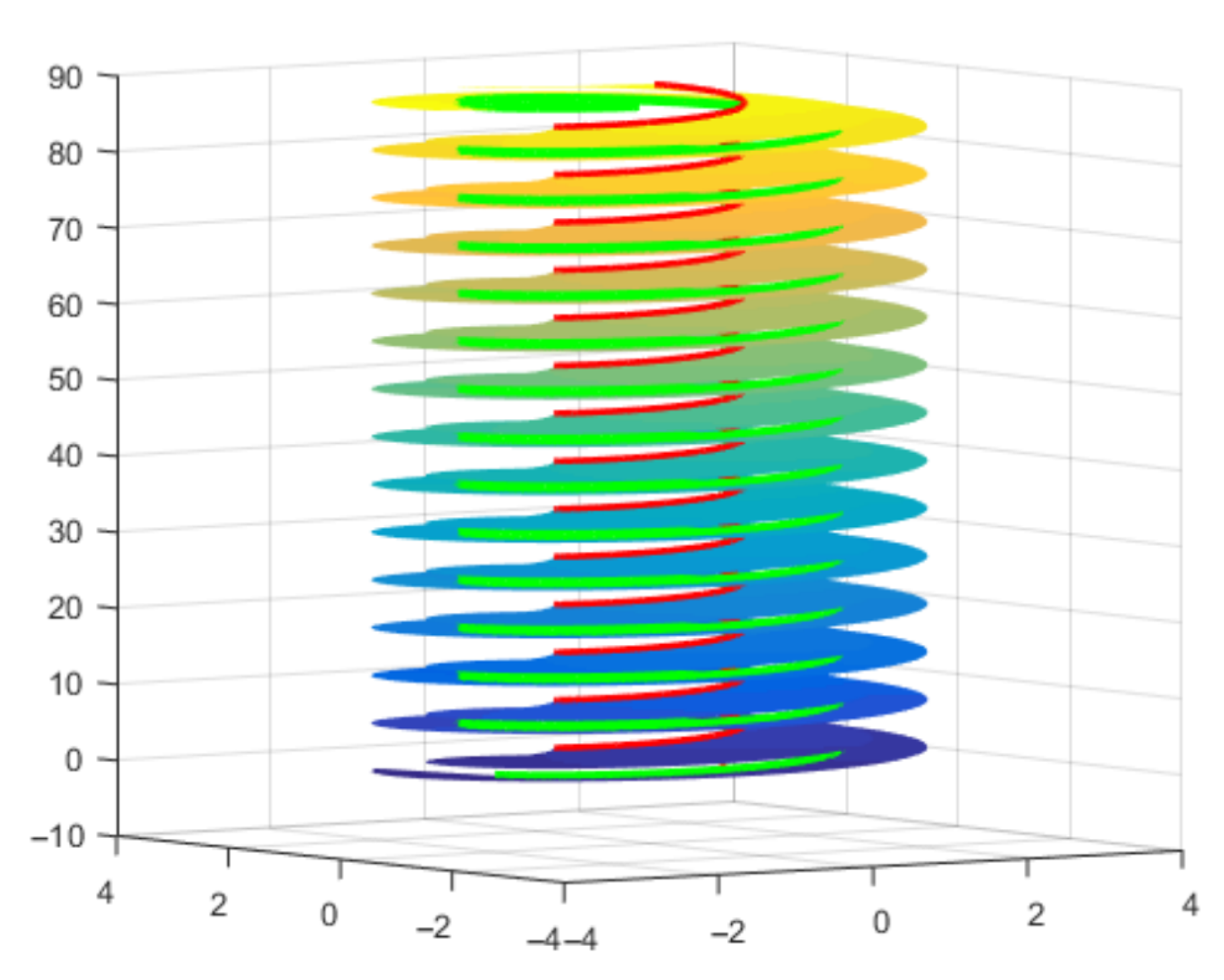
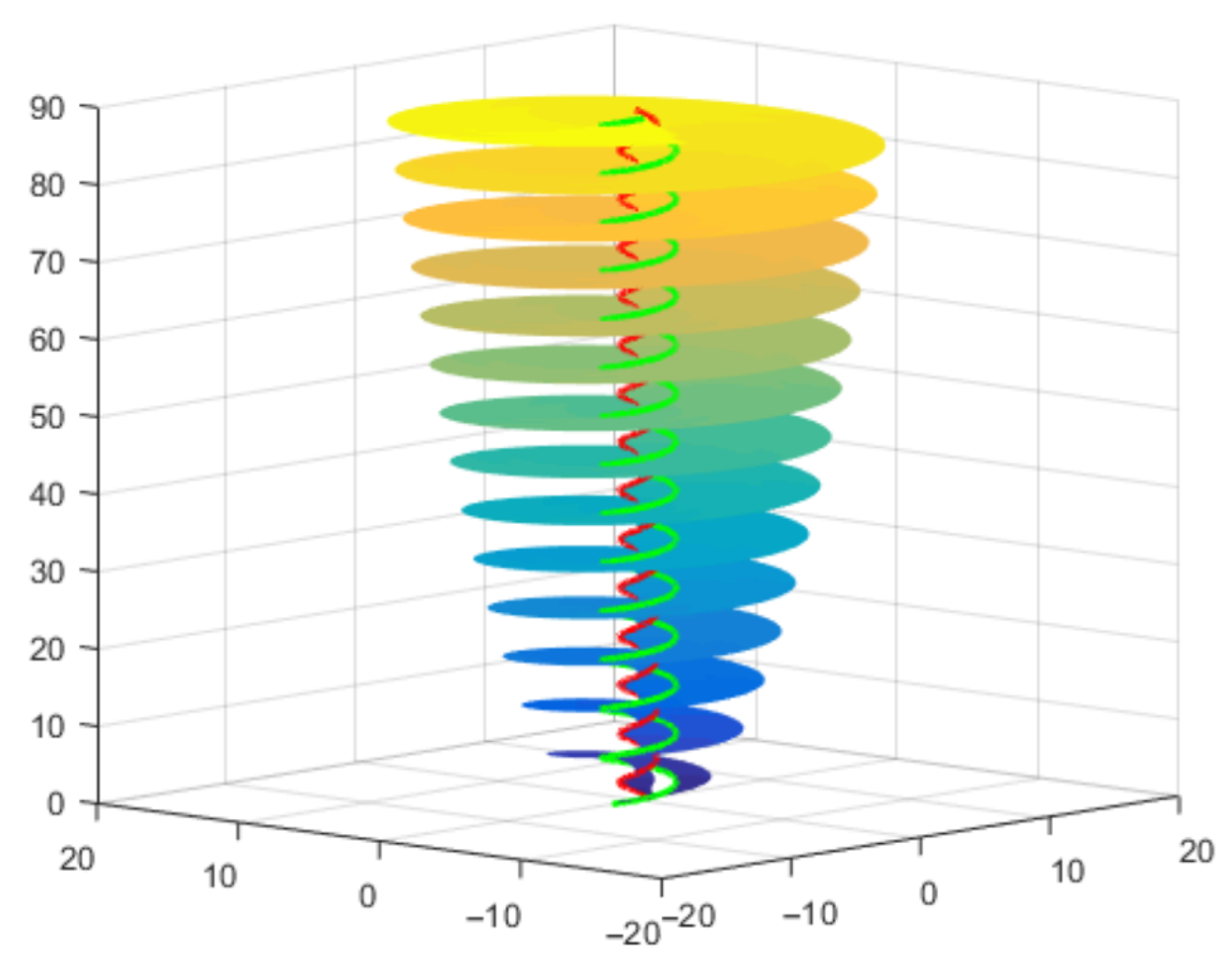
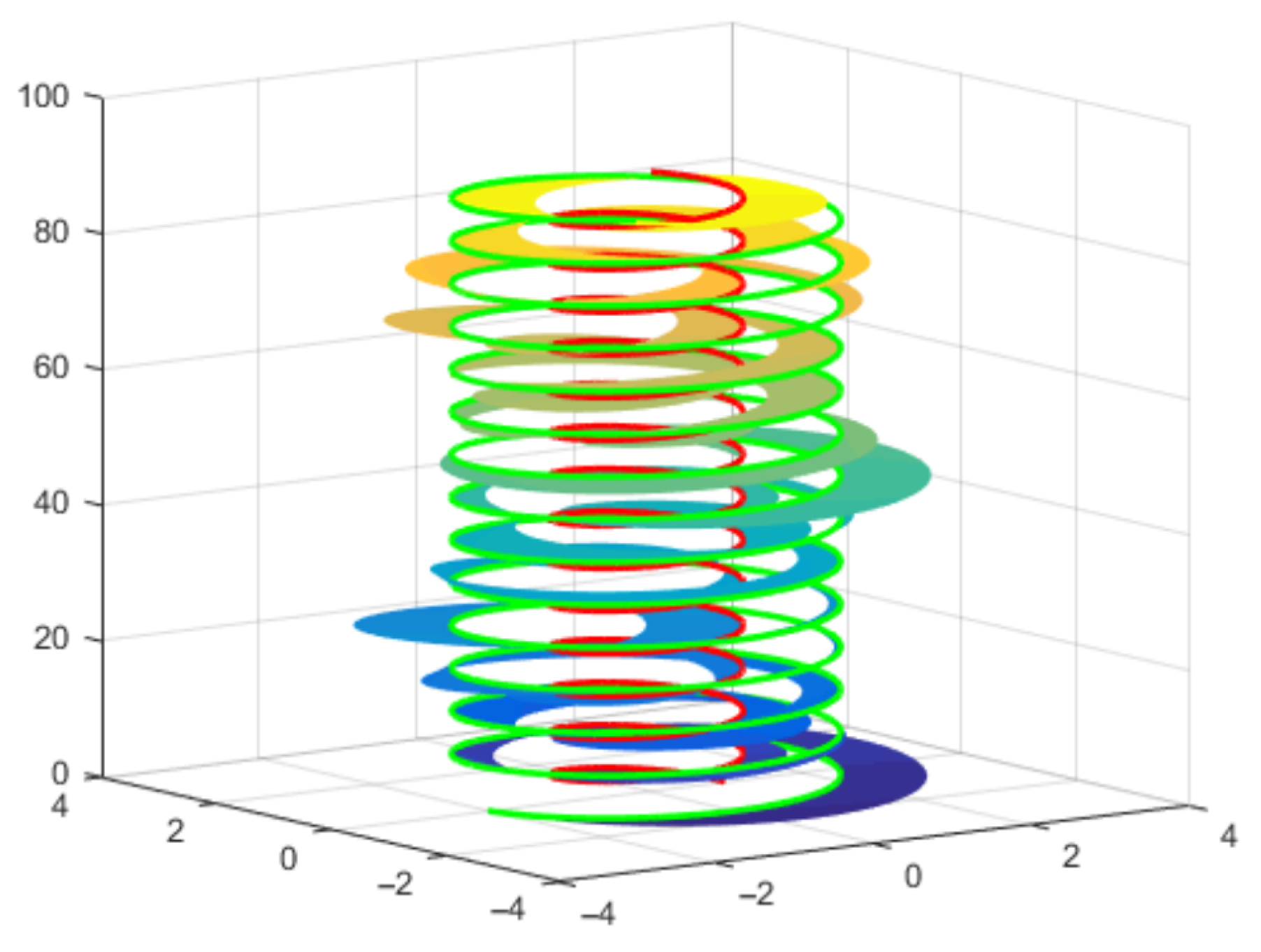
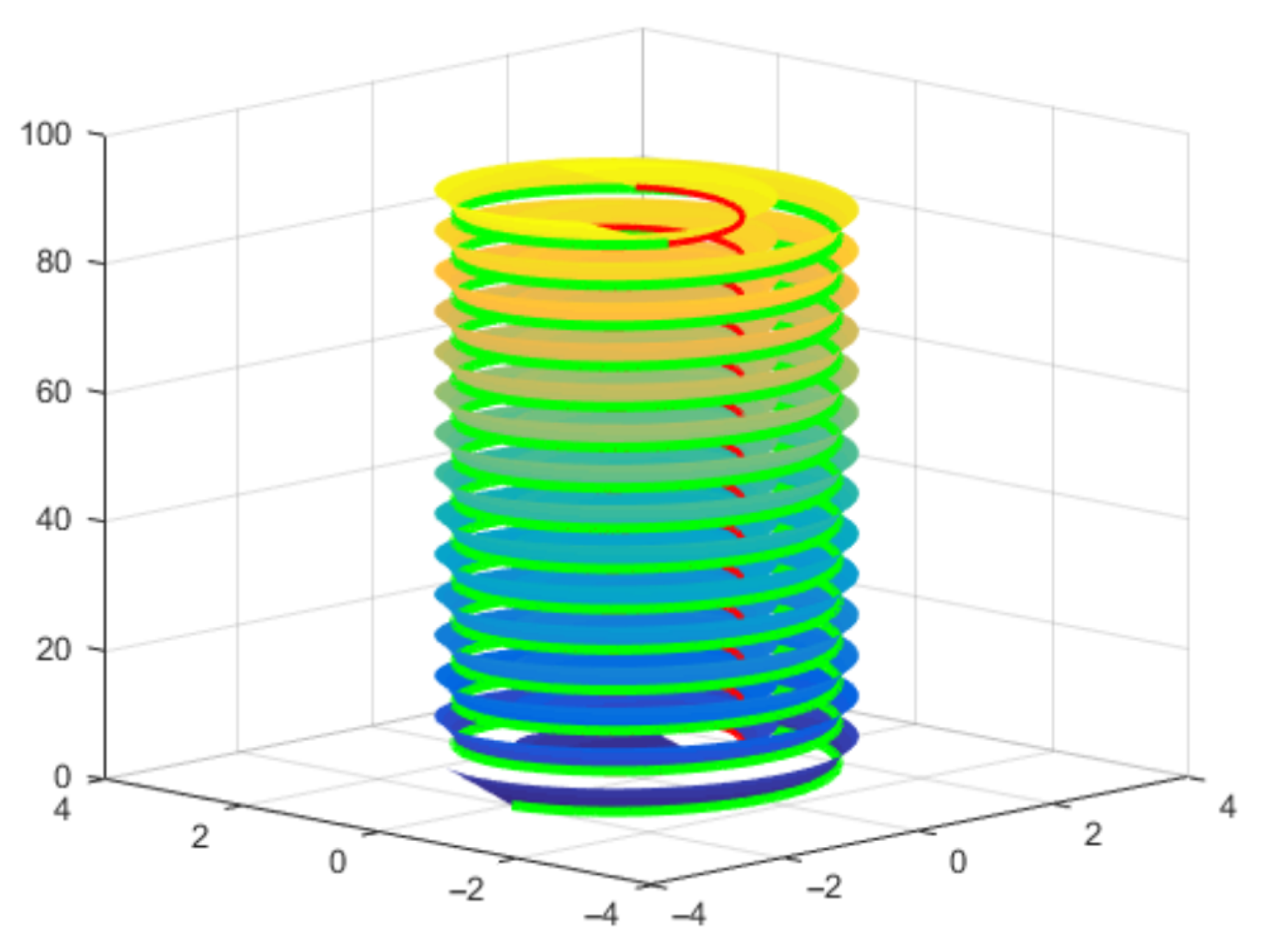
Using the construction method proposed in this paper, we generate Bertrand surface pairs of various shapes from the above Bertrand curve pair { α ( s ) , α ¯ ( s ) } , with the curves serving as common geodesics, asymptotic curves, and curvature lines. In the figures below, the α ( s ) curve appears in red, and the α ¯ ( s ) curve appears in green.
1.
According to Theorem 1, by setting t 0 = 0 , θ ( s ) = 0 , φ ( s ) = π , g ( s ) = 5 3 , and f ( s ) = 2 ,
i ( s , t ) = t , j ( s , t ) = 0 , k ( s , t ) = 2 t , ( 0 t 1 ) ,
and
U ( s , t ) = cos s 2 3 t 2 sin s 2 , sin s 2 + 3 t 2 cos s 2 , s 2 t 2 ,
U ¯ ( s , t ) = 2 cos s 2 3 t 2 sin s 2 , 2 sin s 2 + 3 t 2 cos s 2 , s 2 t 2 .
Therefore, { U ( s , t ) , U ¯ ( s , t ) } forms a Bertrand surface pair preserving common geodesics; see Figure 1.
2.
According to Theorem 1, by setting t 0 = 0 , θ ( s ) = φ ( s ) = π 2 , and f ( s ) = s 1 2 ,
i ( s , t ) = 0 , j ( s , t ) = s 1 2 t , k ( s , t ) = t 2 , ( 0 t 1 ) ,
and
U ( s , t ) = cos s 2 t s 1 2 cos s 2 + t 2 2 sin s 2 , sin s 2 t s 1 2 sin s 2 t 2 2 cos s 2 , s 2 + t 2 2 ,
U ¯ ( s , t ) = 2 cos s 2 t s 1 2 cos s 2 + t 2 2 sin s 2 , 2 sin s 2 t s 1 2 sin s 2 t 2 2 cos s 2 , s 2 + t 2 2 .
Therefore, { U ( s , t ) , U ¯ ( s , t ) } forms a Bertrand surface pair preserving common asymptotic curves; see Figure 2.
3.
According to Theorem 1, by setting t 0 = 0 , δ = 1 , θ ( s ) = s 2 , φ ( s ) = s 10 , f ( s ) = sin s 10 , and g ( s ) = 10 3 sin s 2 ,
i ( s , t ) = t 10 3 sin s 2 cos s 10 1 3 sin s 10 cos s 2 ,
j ( s , t ) = t sin s 10 sin s 2 ,
k ( s , t ) = t sin s 10 cos s 2 , ( 0 t 1 ) ,
and
U ( s , t ) = cos s 2 + t l ( s ) , sin s 2 + t m ( s ) , s 2 + t n ( s ) ,
U ¯ ( s , t ) = 2 cos s 2 + t l ( s ) , 2 sin s 2 + t m ( s ) , s 2 + t n ( s ) ,
where
l ( s ) = 5 3 sin s 2 sin s 2 cos s 10 + 4 3 2 sin s 2 sin s 10 cos s 2 sin s 10 sin s 2 cos s 2 ,
m ( s ) = 5 3 cos s 2 sin s 2 cos s 10 4 3 2 cos s 2 sin s 10 cos s 2 sin s 10 sin s 2 sin s 2 ,
n ( s ) = 5 3 sin s 2 cos s 10 2 3 sin s 10 cos s 2 .
Therefore, { U ( s , t ) , U ¯ ( s , t ) } forms a Bertrand surface pair preserving common curvature lines; see Figure 3.
4.
Finally, the Bertrand curve { α ( s ) , α ¯ ( s ) } is utilized to construct a developable surface preserving common geodesics. According to Theorem 3, by setting t 0 = 0 , f ( s ) = 1 and g ( s ) = 4 3 ,
o ( s ) = 5 3 , p ( s ) = 0 , q ( s ) = 1 , 0 t 1 ,
and
U ( s , t ) = cos s 2 2 3 t sin s 2 , sin s 2 + 2 3 cos s 2 , s 2 + 4 2 3 t ,
U ¯ ( s , t ) = 2 cos s 2 2 3 t sin s 2 , 2 sin s 2 + 2 3 cos s 2 , s 2 + 4 2 3 t .
Therefore, { U ( s , t ) , U ¯ ( s , t ) } forms a Bertrand developable surface family pair preserving common geodesics; see Figure 4.

6. Conclusions and Future Work

In the examples above, using the same cylindrical helix and its Bertrand mate, we constructed differently shaped Bertrand surface pairs that preserve common characteristic curves. The clear visual symmetry of the resulting surfaces directly inherits the intrinsic symmetry of the Bertrand curve pair. The proposed method offers significant advantages: The angles θ ( s ) and φ ( s ) can be adjusted to control the type of characteristic curve, while the control functions f ( s ) and g ( s ) enable flexible shape modifications of the surfaces. This combination of parametric control and inherent symmetry makes the design of surface modeling more flexible and interactive, which provides an effective method and framework. Building upon the framework established in this study, subsequent research will systematically investigate the dependence of Gaussian curvature K and mean curvature H on the control functions f ( s ) and g ( s ) , with a focus on deriving the necessary and sufficient conditions for Bertrand surface families to become developable surfaces ( K = 0 ) or minimal surfaces ( H = 0 ). This direction constitutes an independent and complete theoretical research system, promising to deepen the geometric understanding of Bertrand surfaces and expand their potential in engineering geometry design.

Author Contributions

Conceptualization, J.W. and Z.D.; methodology, J.W.; software, D.W.; validation, J.W., Z.D., and D.W.; formal analysis, J.W.; resources, J.W.; writing—original draft preparation, J.W. and D.W.; writing—review and editing, J.W. and Z.D.; supervision, D.W.; project administration, Z.D.; funding acquisition, J.W. All authors have read and agreed to the published version of the manuscript.

Funding

This research was funded by the Anhui Province University Natural Sciences Research Project under Grant No. 2022AH051727 and the Mathematics Key Construction Discipline of Chaohu University under Grant No. kj22zdjsxk01.

Data Availability Statement

The original contributions presented in this study are included in the article. Further inquiries can be directed to the corresponding author.

Conflicts of Interest

The authors declare no conflicts of interest.

References

  1. Wu, D. Lecture on Differential Geometry, 2nd ed.; Higher Education Press: Beijing, China, 2014. [Google Scholar]
  2. Elzawy, M.; Mosa, S. Quaternionic Bertrand curves in the Galilean space. Filomat 2020, 34, 59–66. [Google Scholar] [CrossRef]
  3. Jiang, X.; Jiang, P.; Meng, J.; Wang, K. Surface pencil pair interpolating Bertrand pair as common asymptotic curves in Galilean space G3. Int. J. Geom. Methods Mod. Phys. 2021, 18, 2150114. [Google Scholar] [CrossRef]
  4. Mofarreh, F.; Abdel-Baky, R.A. Surface pencil pair interpolating Bertrand pair as common asymptotic curves in Euclidean 3-space. Mathematics 2023, 11, 3495. [Google Scholar] [CrossRef]
  5. Mei, X.; Huang, J. Differential Geometry, 5th ed.; Higher Education Press: Beijing, China, 2019. [Google Scholar]
  6. Laux, M.; Zell, A. Robot arm motion planning based on geodesics. In Proceedings of the 2021 IEEE International Conference on Robotics and Automation, Xi’an, China, 30 May 2021; pp. 7585–7591. [Google Scholar]
  7. Meng, W.; Xin, S.; Zhao, J.; Chen, S.; Tu, C.; He, Y. A variational framework for computing geodesic paths on sweep surfaces. Comput.-Aided Des. 2021, 140, 103077. [Google Scholar] [CrossRef]
  8. Torosdagli, N.; Liberton, D.K.; Verma, P.; Sincan, M.; Lee, J.S.; Bagci, U. Deep geodesic learning for segmentation and anatomical landmarking. IEEE Trans. Med Imaging 2018, 38, 919–931. [Google Scholar] [CrossRef]
  9. Kalogerakis, E.; Nowrouzezahrai, D.; Simari, P.; Singh, K. Extracting lines of curvature from noisy point clouds. Comput.-Aided Des. 2009, 41, 282–292. [Google Scholar] [CrossRef]
  10. Pang, X.; Song, Z.; Pang, M. Extraction of the lines of curvature from raw point cloud. In Proceedings of the 9th ACM SIGGRAPH Conference on Virtual-Reality Continuum and its Applications in Industry, Seoul, Republic of Korea, 12 December 2010; pp. 225–228. [Google Scholar]
  11. Wang, H.; Ni, Q. A new method of moving asymptotes for large-scale unconstrained optimization. Appl. Math. Comput. 2008, 203, 62–71. [Google Scholar] [CrossRef]
  12. Flöry, S.; Pottmann, H. Ruled surfaces for rationalization and design in architecture. Life Form. Responsive Inf. Var. Archit. 2010, 103–109. [Google Scholar]
  13. Wang, G.J.; Tang, K.; Tai, C.L. Parametric representation of a surface pencil with a common spatial geodesic. Comput.-Aided Des. 2004, 36, 447–459. [Google Scholar] [CrossRef]
  14. Kasap, E.; Akyildiz, F.T.; Orbay, K. A generalization of surfaces family with common spatial geodesic. Appl. Math. Comput. 2008, 201, 781–789. [Google Scholar] [CrossRef]
  15. Li, C.Y.; Wang, R.H.; Zhu, C.G. Parametric representation of a surface pencil with a common line of curvature. Comput.-Aided Des. 2011, 43, 1110–1117. [Google Scholar] [CrossRef]
  16. Bayram, E.; Güler, F.; Kasap, E. Parametric representation of a surface pencil with a common asymptotic curve. Comput.-Aided Des. 2012, 44, 637–643. [Google Scholar] [CrossRef]
  17. Kaya, O.; Önder, M. Construction of a surface pencil with a common special surface curve. J. Mahani Math. Res. Cent. 2017, 6, 57–72. [Google Scholar]
  18. Zhao, H.; Wang, G. A new method for designing a developable surface utilizing the surface pencil through a given curve. Prog. Nat. Sci. 2008, 18, 105–110. [Google Scholar] [CrossRef]
  19. Liu, Y.; Wang, G.J. Designing developable surface pencil through given curve as its common asymptotic curve. J. Zhejiang Univ. Eng. Sci. 2013, 47, 1246–1252. [Google Scholar]
  20. Li, C.; Xiang, X.; Zhu, C. Design of ruled developable surface through the line of curvature. J. Image Graph. 2016, 21, 527–531. [Google Scholar] [CrossRef]
  21. Bayram, E.; Ergün, E.; Kasap, E. Surface family with a common natural asymptotic lift. J. Sci. Arts 2015, 2, 117–124. [Google Scholar]
  22. Bayram, E.; Bilici, M. Surface family with a common involute asymptotic curve. Int. J. Geom. Methods Mod. Phys. 2016, 13, 1650062. [Google Scholar] [CrossRef]
  23. Bayram, E. Surface pencil with a common adjoint curve. Turk. J. Math. 2020, 44, 1649–1659. [Google Scholar] [CrossRef]
  24. Atalay, G.Ş.; Kasap, E. Surfaces family with common Smarandache asymptotic curve. Bol. Soc. Parana. Matemática 2016, 34, 9–20. [Google Scholar] [CrossRef]
  25. Atalay, G.S.; Kasap, E. Surfaces family with common Smarandache geodesic curve. J. Sci. Arts 2017, 17, 651–664. [Google Scholar]
  26. Atalay, G.S. Surfaces family with a common Mannheim asymptotic curve. J. Comput. Appl. Math. 2018, 2, 143–154. [Google Scholar]
  27. Wang, J.; Jiang, P.; Guo, Y.; Meng, J. Developable surface pencil pairs with special pairs as common asymptotes. Appl. Math. Comput. 2019, 362, 124583. [Google Scholar] [CrossRef]
  28. Şenyurt, S.; Ayvacı, K.H.; Canlı, D. Family of Surfaces with a Common Bertrand-D Curve: Isogeodesic, Isoasymptotic, and Line of Curvature. Appl. Appl. Math. 2021, 16, 1186–1201. [Google Scholar]
  29. Şenyurt, S.; Ayvacı, K.H.; Canlı, D. Family of Surfaces with a Common Spatial Involute and Evolute Curves. Int. Electron. J. Geom. 2022, 15, 160–174. [Google Scholar] [CrossRef]
  30. Wang, J.; Chen, M.; Wang, D. A unified method for constructing developable surface pencils interpolating characteristic curves. Front. Phys. 2022, 10, 979094. [Google Scholar] [CrossRef]
Figure 1. { U ( s , t ) , U ¯ ( s , t ) } preserving common geodesics.
Symmetry 18 00309 g001
Figure 2. { U ( s , t ) , U ¯ ( s , t ) } preserving common asymptotic curves.
Symmetry 18 00309 g002
Figure 3. { U ( s , t ) , U ¯ ( s , t ) } preserving common curvature lines.
Symmetry 18 00309 g003
Figure 4. Developable surface pair { U ( s , t ) , U ¯ ( s , t ) } preserving common geodesics.
Symmetry 18 00309 g004
Disclaimer/Publisher’s Note: The statements, opinions and data contained in all publications are solely those of the individual author(s) and contributor(s) and not of MDPI and/or the editor(s). MDPI and/or the editor(s) disclaim responsibility for any injury to people or property resulting from any ideas, methods, instructions or products referred to in the content.