A Multi-Task Service Composition Method Considering Inter-Task Fairness in Cloud Manufacturing
Abstract
1. Introduction
2. Related Work
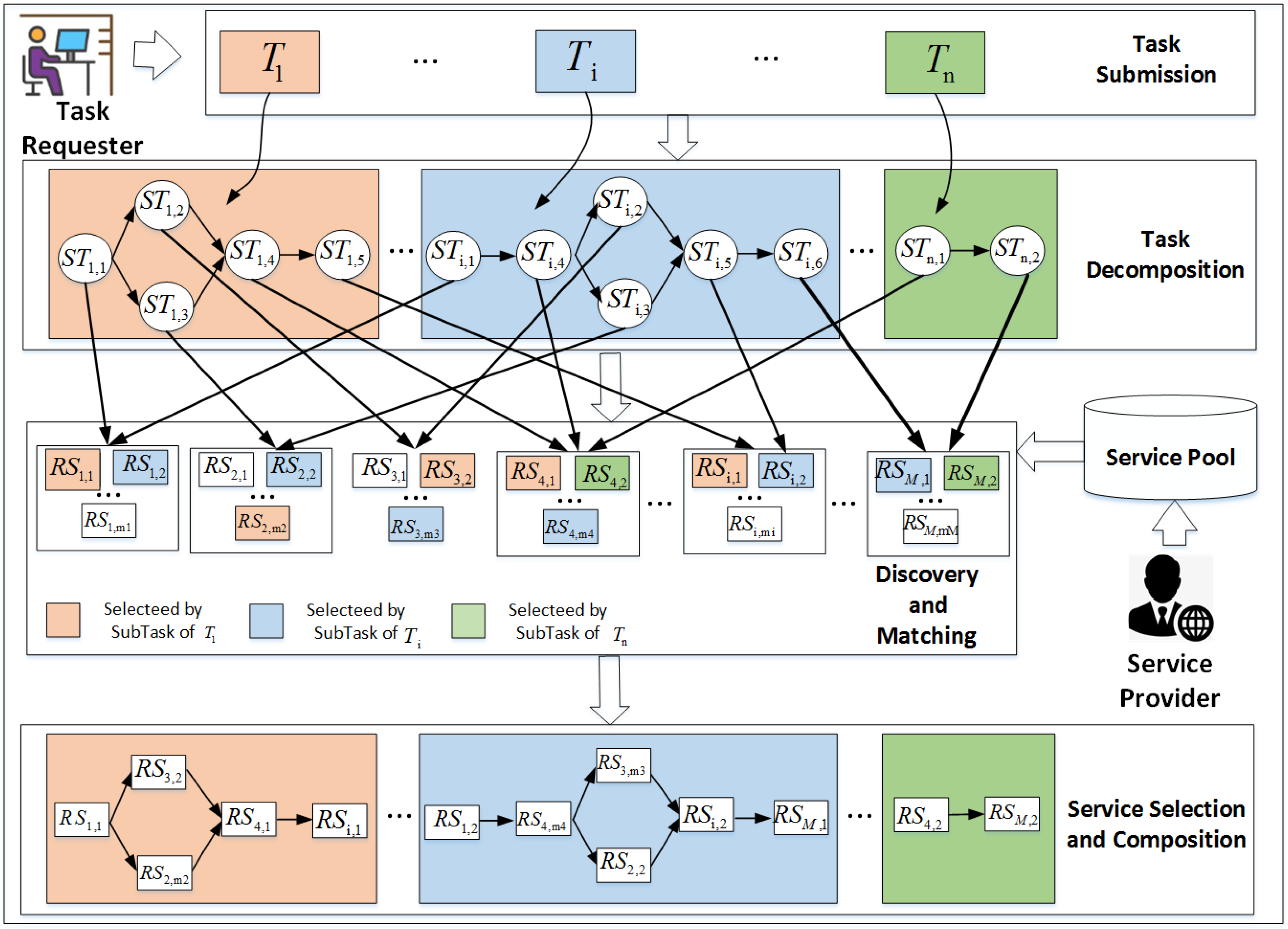
3. Problem Description and Formal Modeling
- (1)
- n: The number of parallel complex MTs.
- (2)
- m: the number of subtasks decomposed from each MT.
- (3)
- : the candidate MS set that can execute the j-th subtask.
- (4)
- : the number of MS in .
- (5)
- : the QoS values of MS i for the j-th subtask, covering multiple indicators: cost indicator , time indicator , quality indicator , reliability indicator , and availability indicator .
- (6)
- : the maximum number of subtask instances that MS i can process simultaneously.
- (1)
- indicates that the j-th subtask of MT r is assigned to MS i.
- (2)
- indicates that the j-th subtask of MT r is not assigned to MS i.
- (1)
- Each subtask must be assigned exactly one MS:
- (2)
- The number of MTs assigned to each MS cannot exceed its load capacity:
4. Marl-Based Solution Methodology
- denotes the number of task-specific agents (one agent is assigned to each MT, where n is the total number of MTs in the CMSC scenario);
- is a single global coordinator agent (responsible for global fairness regulation and inter-agent coordination across all task-specific agents);
- represents the observation space of the multi-agent system, encompassing the local observation spaces of all task-specific agents and the global observation space of the coordinator agent;
- denotes the local observation of the r-th task-specific agent at time t, which covers the subtask assignment progress of the corresponding MT, the QoS performance of selected MSs, and the resource occupancy ratio of the task;
- denotes the global observation of the coordinator agent at time t, which integrates the QoS and load states of all candidate MSs, the reward and resource occupancy of all MTs, and the overall resource utilization rate of the CMP;
- represents the action space of the multi-agent system, where the global coordinator agent does not directly output discrete actions but generates coordination signals to modulate the policy of each task-specific agent;
- denotes the discrete action space of the r-th task-specific agent, where each action corresponds to the selection of a candidate MS for an unassigned subtask j of the r-th MT, and is the number of candidate MSs for subtask j;
- denotes the global state of the system at time t, which contains the complete information of all candidate MSs and all MTs;
- denotes the joint action of all task-specific agents at time t, where each element corresponds to the MS selection decision for the unassigned subtasks of the r-th MT;
- R represents the immediate reward function of the multi-agent system, which outputs a local reward for each task-specific agent and a global reward for the coordinator agent;
- denotes the policy set of the multi-agent system;
- denotes the policy of the r-th task-specific agent, which takes the local observation and the coordination signal from the global coordinator as inputs to predict the probability distribution of MS selection actions;
- denotes the policy of the global coordinator agent, which generates the coordination signal based on the global observation to regulate the action distribution of task-specific agents;
- is the discount factor of the immediate reward, which balances the importance of immediate rewards and future cumulative rewards;
- is the observation distribution function, which generates the local observation of each task-specific agent and the global observation of the coordinator agent based on the global state.
4.1. Task Actor Network
4.2. Centralized Control Network
4.3. Critic Network
- Task Actor Loss
4.4. Global State
4.5. Observation Space
- For the r-th task agent,where (QoS value of MS i in the k-th objective dimension for available MS, 0 for unavailable MS), and the feature matrix of is processed by task-level self-attention to capture intra-task subtask correlations.
- For the centralized control agent,where the feature matrix of is processed by global state self-attention to focus on critical resource features and generate coordination signals.
4.6. Action Space
4.7. Reward Function
- For the r-th task agent: (normalized QoS average value of all currently assigned subtasks for MT r, arithmetic averaging for cost/time/quality, geometric averaging for reliability/availability), reflecting local task utility without subjective weighting;
- For the centralized control agent: (global fairness reward), where is the fairness metric (Euclidean distance of normalized QoS across MTs), and guides the centralized control agent to generate optimal coordination signals;
- The total reward for the multi-agent system iswhere is a coefficient balancing local utility and global fairness.
4.8. State Transition
- Increment the of the selected MS by 1;
- Update the task-service allocation matrix ;
- Recompute the set of unassigned subtasks for each MT r;
- Update the global observation and generate new coordination signals via the centralized control agent.
4.9. Termination Conditions
- All subtasks have been assigned: ;
- The maximum number of steps T is reached.
5. Experimental Analysis
5.1. Experimental Setup and Baseline Comparison
5.1.1. Experimental Environment Configuration
- The task-specific policy network is structured with a two-layer fully connected feature extraction module and independent service selection sub-networks for each subtask. It integrates a two-head multi-head attention mechanism (equipped with residual connections and layer normalization) to model subtask correlations.
- The global coordination network consists of a two-layer fully connected feature extraction layer, a four-head self-attention module (paired with layer normalization and residual connections), and a feed-forward network for further feature processing.
- The centralized value estimation network is a three-layer fully connected network, with hidden layer dimensions scaled to twice the base hidden dimension and the base hidden dimension in sequence, outputting scalar global value estimates.
5.1.2. Dataset Design
- Cost: Monetary cost of service execution (unit: CNY), optimization direction: minimization (smaller is better);
- Time: Execution duration of service (unit: hours), optimization direction: minimization (smaller is better);
- Quality: Qualification rate of service output (dimensionless), optimization direction: maximization (larger is better);
- Reliability: Probability of fault-free service operation (dimensionless), optimization direction: maximization (larger is better);
- Availability: Probability of service being online and accessible (dimensionless), optimization direction: maximization (larger is better).
5.1.3. Baseline Algorithms
- PSO: A classic swarm intelligence algorithm proposed in 1995, inspired by the collective foraging behavior of bird flocks and fish schools. Each solution is modeled as a “particle” that updates its position and velocity by tracking its own historical best and the global best of the swarm, thus effectively balancing exploration and exploitation. Due to its simple structure, PSO can be easily integrated with weight parameters, making it well-suited for multi-objective weighted optimization tasks. Parameter settings: population size = 100, inertia weight = 0.7298, cognitive coefficient = 1.49618, social coefficient = 1.49618, maximum iterations = 2000, velocity limit = [−1, 1].
- FATA: A state-of-the-art physics-inspired swarm intelligence algorithm proposed in 2024, mimicking the mirage formation process. It integrates the mirage light filtering (MLF) principle (with definite integration) and light propagation strategy (LPS) (with trigonometric principles) to balance global exploration and local exploitation, exhibiting excellent performance in continuous multi-objective optimization and engineering tasks. Parameter settings: population size = 100, maximum iterations = 2000, MLF integration step = 0.01, LPS angle range = [0, 2], exploration factor = 0.8.
- Snake Optimizer (SO): A novel nature-inspired metaheuristic algorithm proposed in 2022, inspired by the unique mating and foraging behaviors of snakes. It divides the search process into exploration and exploitation phases, simulating fight and mating modes to update solutions, and thus demonstrates strong competitiveness in multi-objective optimization scenarios. Parameter settings: population size = 100, maximum iterations = 2000, fight probability = 0.5, mating probability = 0.3, exploration-exploitation balance factor = 0.6.
- Differential Evolution (DE): A classic yet continuously improved evolutionary algorithm. It optimizes solutions through mutation, crossover, and selection operations, and its recent variants have been widely applied in multi-objective weighted optimization. Owing to its simplicity and effectiveness, DE is regarded as a representative baseline for evolutionary algorithms. Parameter settings: population size = 100, maximum iterations = 2000, mutation factor = 0.5, crossover probability = 0.8, selection strategy = greedy selection.
- Single-Agent RL (represented by PPO): A cutting-edge RL algorithm for optimization tasks. It optimizes the policy via proximal policy optimization to adapt to complex multi-objective search spaces, showing remarkable effectiveness in single-agent and cooperative optimization problems. Parameter settings: Learning rate = , batch size = 64, discount factor = 0.99, clip range = 0.2, total training steps = 5000, hidden layer dimension = 128.
- MOEA/D: A landmark decomposition-based multi-objective evolutionary algorithm. It decomposes multi-objective optimization problems into scalar subproblems and optimizes them simultaneously. This algorithm has advantages in handling high-dimensional objectives and generating evenly distributed solutions, thus serving as a core baseline for decomposition-based methods. Parameter settings: population size = 100, maximum iterations = 2000, neighborhood size = 20, crossover probability = 0.9, mutation probability = 0.01, penalty factor = 5.
5.2. Convergence Analysis
5.2.1. Synergistic Analysis of Convergence Efficiency and Optimization Accuracy
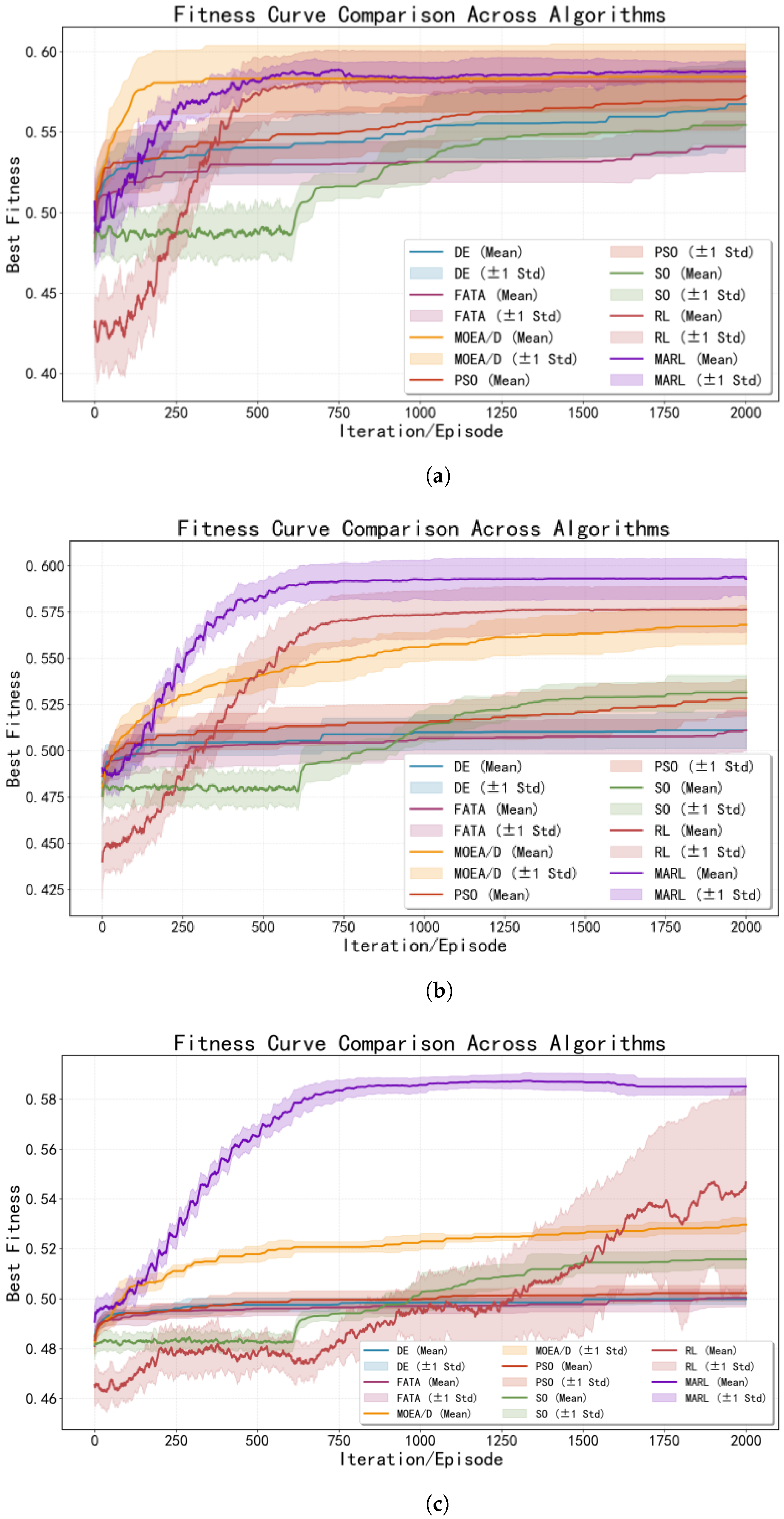
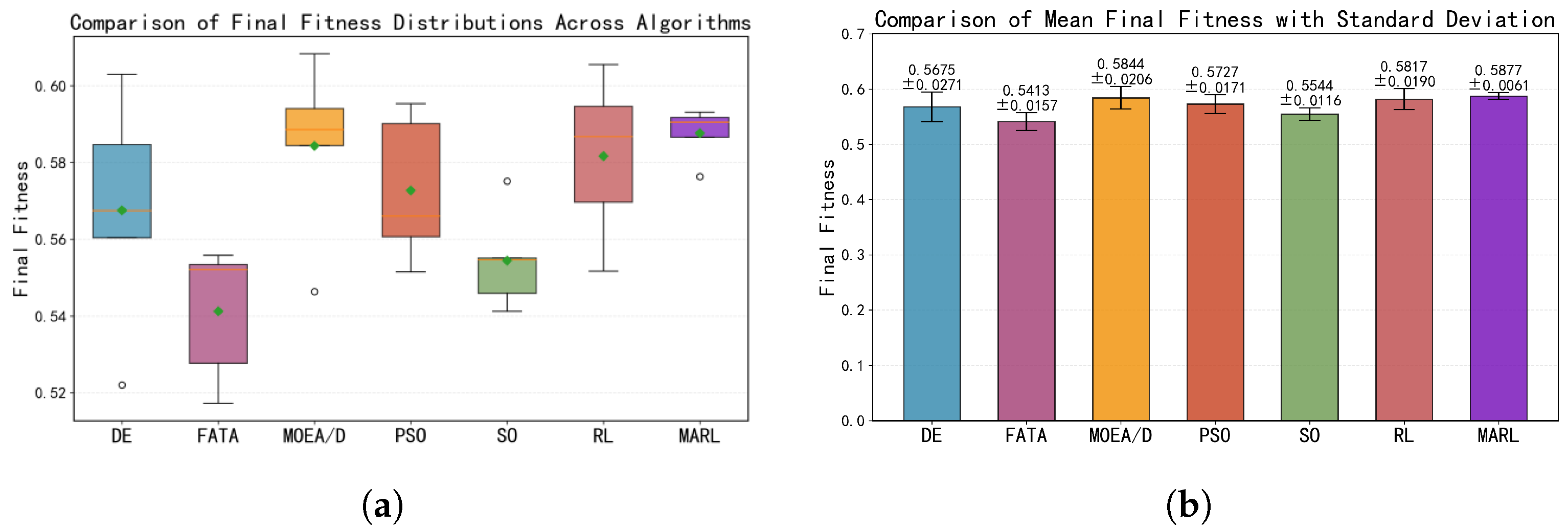
- Small-scale (S1) scenario: MARL has an average convergence iteration count of 741 (the highest among all comparison algorithms), while traditional algorithms like PSO (36), DE (45.6), and FATA (63.2) have much lower counts. However, the fast convergence of traditional algorithms is essentially premature convergence to local optima: their fitness values increase slowly in the early iteration stage, and the stable average fitness is generally below 0.57 (FATA: 0.541261). By contrast, MARL, relying on multi-agent collaborative decision-making, shows a steep fitness increase in the early stage (first 250 iterations), with a final average fitness of 0.58766 (significantly higher than all competitors). For the single-agent RL (PPO), its average convergence iteration count is 569.4 (lower than MARL), but its final average fitness (0.58166) is 0.60% lower than MARL; MOEA/D achieves 0.584352 with 153.4 iterations, still slightly lower than MARL. This indicates that MARL avoids local optima through sufficient offline iteration exploration, achieving higher-precision optimization and laying a high-quality decision-making foundation for online application.
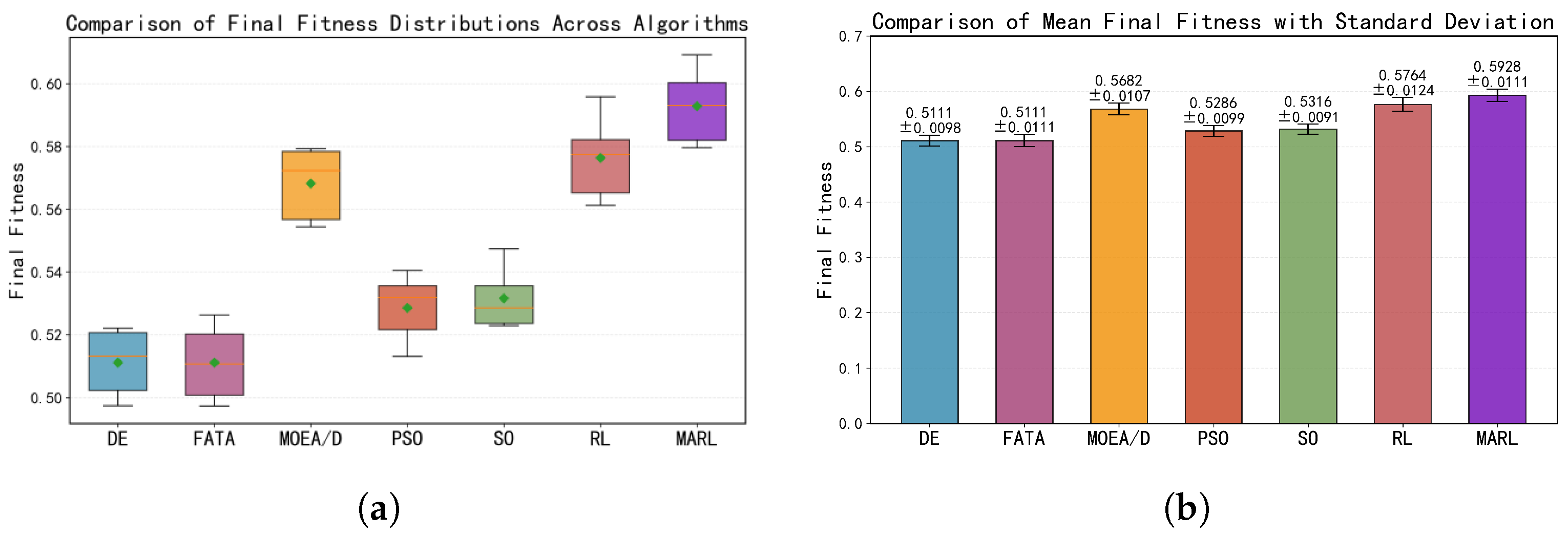
- Medium-scale (S2) scenario: As the solution space dimension increases, MARL’s average convergence iteration count rises to 772 (only 31 more than S1, a <5% increase), showing good scalability; its final average fitness further improves to 0.59282 (the only algorithm with increased accuracy in the medium-scale scenario). In contrast, other algorithms either see a sharp increase in iterations (e.g., RL (PPO) rises from 569.4 to 912.4, a 60.2% increase) or a significant drop in accuracy (e.g., DE drops from 0.567525 to 0.511148, a 9.93% decrease), failing to balance efficiency and accuracy. MOEA/D achieves 0.568239 with 106.8 iterations (4.15% lower than MARL); SO maintains 626.8 iterations but only achieves 0.531644 (a large gap from MARL). MARL’s ability to improve accuracy against the trend stems from multi-agent division of labor, which reduces the search complexity of high-dimensional solution spaces and continuously explores high-quality solutions via offline collaborative exploration—avoiding the “efficiency-accuracy trade-off” of traditional algorithms in expanded solution spaces.
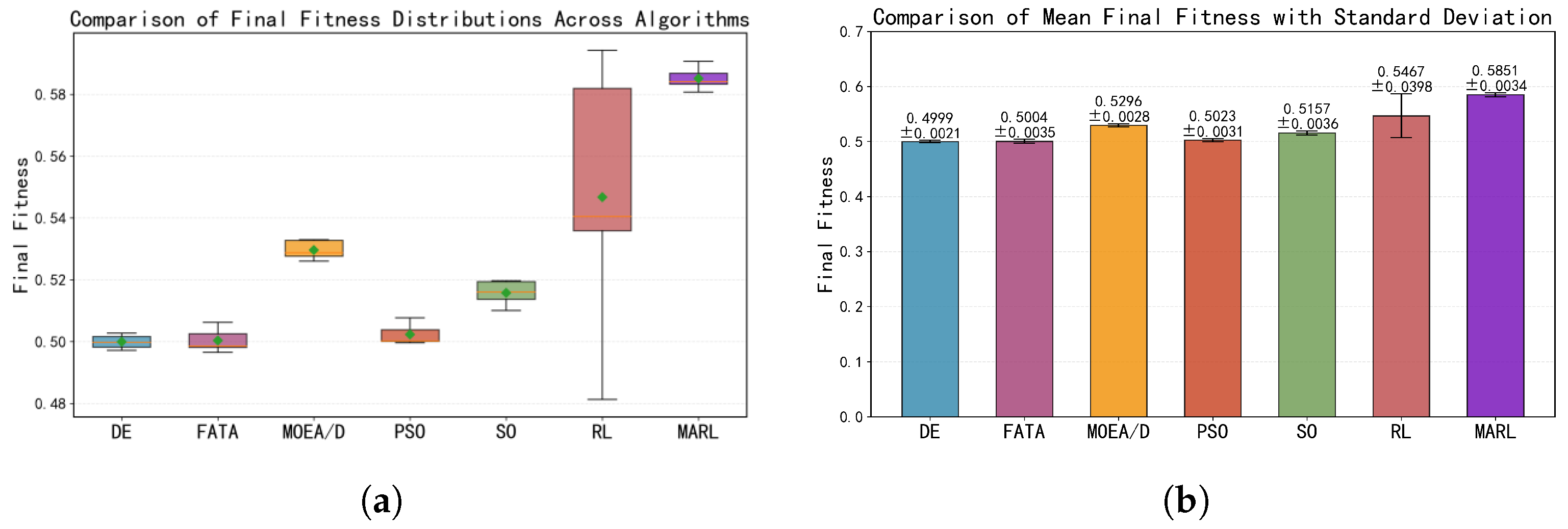
- Large-scale (S3) scenario: The exponentially expanding solution space challenges global exploration capabilities. MARL’s average convergence iteration count is 1025 (a 32.8% increase from S2, still reasonable), and its final average fitness is 0.58508 (only a 1.32% decrease from S2, the smallest attenuation). Traditional algorithms generally suffer from “sharp accuracy drop + inefficient iteration”: DE, PSO, and FATA maintain low iterations (32–44.2) but have average fitness below 0.51 (DE: 0.499896); RL (PPO) reaches 1999 iterations (close to the maximum limit) with fitness dropping to 0.54674 (a 6.00% attenuation), and its convergence process fluctuates frequently (Figure 2c), failing to stabilize. From boxplots and state plots: MARL’s fitness is highly concentrated in 0.58–0.59 (max: 0.5906, min: 0.5807), with a narrow boxplot and short whiskers; RL (PPO) has a wide boxplot, long whiskers, and fitness scattered in 0.4813–0.5942 (standard deviation: 0.039822), with severely degraded stability and accuracy. This confirms MARL’s advantage in complex solution spaces: its multi-agent distributed search and collaborative optimization integrate local search information via reasonable offline iterations, forming a force to approach the global optimal, maintaining high accuracy even in large-scale scenarios and ensuring reliable online response.
5.2.2. Convergence Stability Analysis
- S1 scenario: MARL has a fitness standard deviation of 0.006082 (the smallest among all algorithms), with a compact boxplot (no outliers) and a max–min gap of 0.0168—indicating strong consistency in offline training. Competitors like SO (0.011633), FATA (0.015717), and RL (PPO) (0.018997) have higher standard deviations; DE has a standard deviation of 0.027078, a wide whisker range, and a max–min gap of 0.080882—showing large volatility. This demonstrates that MARL stably outputs high-quality solutions in offline training, with little sensitivity to initial condition fluctuations.
- S2 scenario: As complexity increases, most competitors’ stability decreases, but MARL remains consistent: its standard deviation is 0.011101 (slightly higher than S1), with a narrow boxplot and a max–min gap of 0.0296. Most competitors cannot balance stability and accuracy: DE has a low standard deviation (0.009807) but a boxplot concentrated in the low-fitness range (average: 0.511148); RL (PPO) has a standard deviation of 0.012367, longer whiskers, and 2.77% lower accuracy than MARL. MARL’s high stability comes from the robustness of multi-agent collaboration: information interaction and complementarity offset the uncertainty of single search paths, reducing offline training volatility.
- S3 scenario: Stability differences are more significant: MARL has a standard deviation of 0.003375, a very narrow boxplot (no outliers), and a max–min gap of 0.0099—showing excellent consistency. Competitors’ stability degrades sharply: RL (PPO) has a standard deviation of 0.039822, a wide boxplot, and a range of 0.1129 (highly uncertain); DE, FATA, and PSO have low standard deviations (0.002058–0.003622) but boxplots concentrated in the low-fitness range (“invalid stability” with low accuracy). This indicates that MARL maintains stable optimization in complex solution spaces: dynamic agent collaboration and adaptive strategy adjustment resist the uncertainty of large-scale solution spaces, ensuring reliable offline training results.
5.2.3. Time Complexity Analysis
- (1)
- S1 scenario: The average runtime is 51.33 s (with a standard deviation of 7.77 s and a CV of ≈15.1%), ranging from a minimum of 42.43 s to a maximum of 63.37 s. In this scenario, the algorithm’s runtime exhibits high relative volatility due to factors such as QoS cache hit rate and instantaneous system resource occupancy, yet it generally aligns with the complexity characteristics dominated by the scale of subtasks and services.
- (2)
- S2 scenario: The average runtime reaches 127.34 s (with a standard deviation of 9.03 s and a CV of ≈7.1%), with a minimum of 116.00 s and a maximum of 135.58 s. As the scale of subtasks and services and the number of training iterations increase, the absolute runtime of the algorithm shows a linear growth trend, and the CV of runtime decreases by approximately 53% compared with the S1 scenario, indicating a significant improvement in relative stability.
- (3)
- S3 scenario: The average runtime rises to 442.38 s (with a standard deviation of 21.09 s and a CV of ≈4.8%), varying from 409.17 s (minimum) to 470.81 s (maximum). With further increases in complexity, although the absolute standard deviation of runtime increases due to the larger base value, the CV continues to drop below 5%, demonstrating that the algorithm achieves significantly better relative runtime stability in large-scale scenarios.
5.3. Robustness Analysis
- (1)
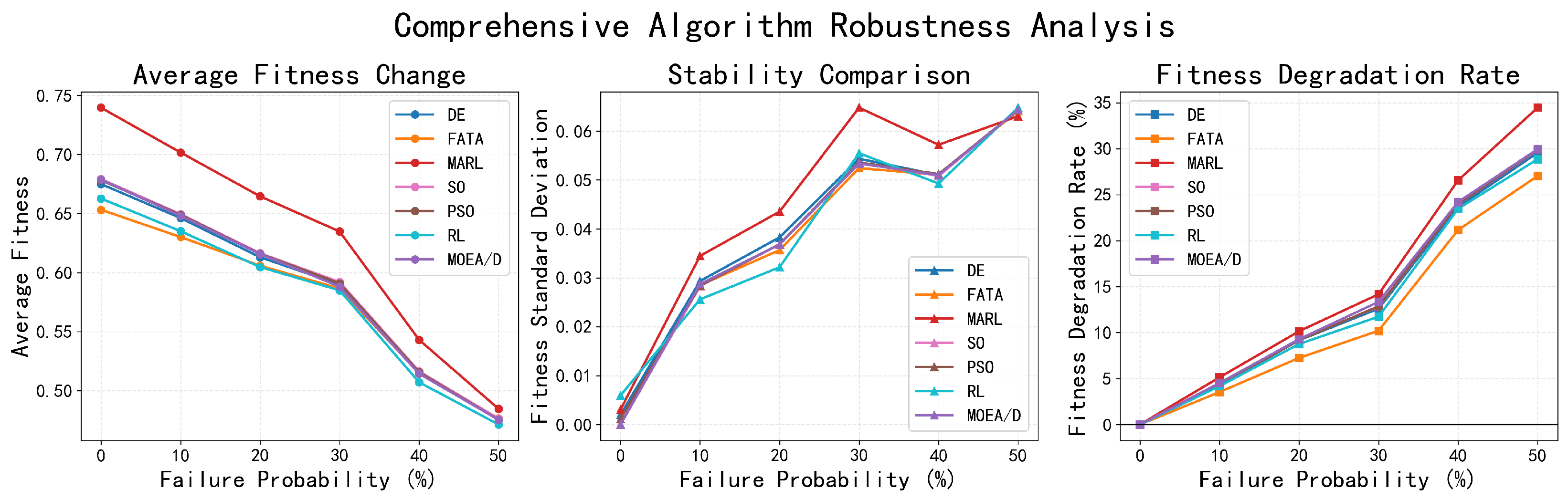
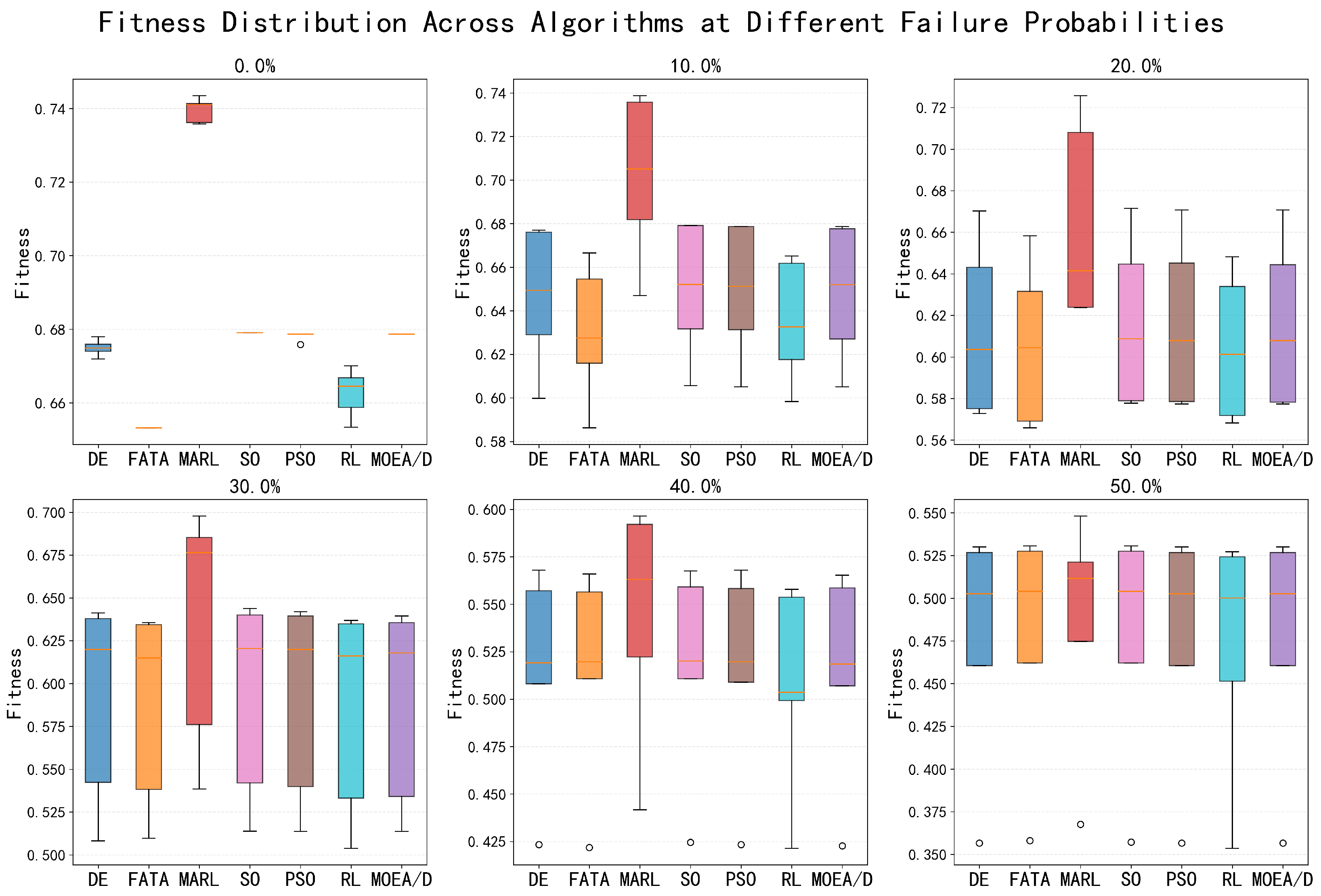
- Service Failure Scenario: A small-scale dataset (S1) is used, with the number of candidate services set to 10. The probability of service failure increases stepwise from 10% to 50%, simulating service node failures under high-concurrency tasks.
- (2)
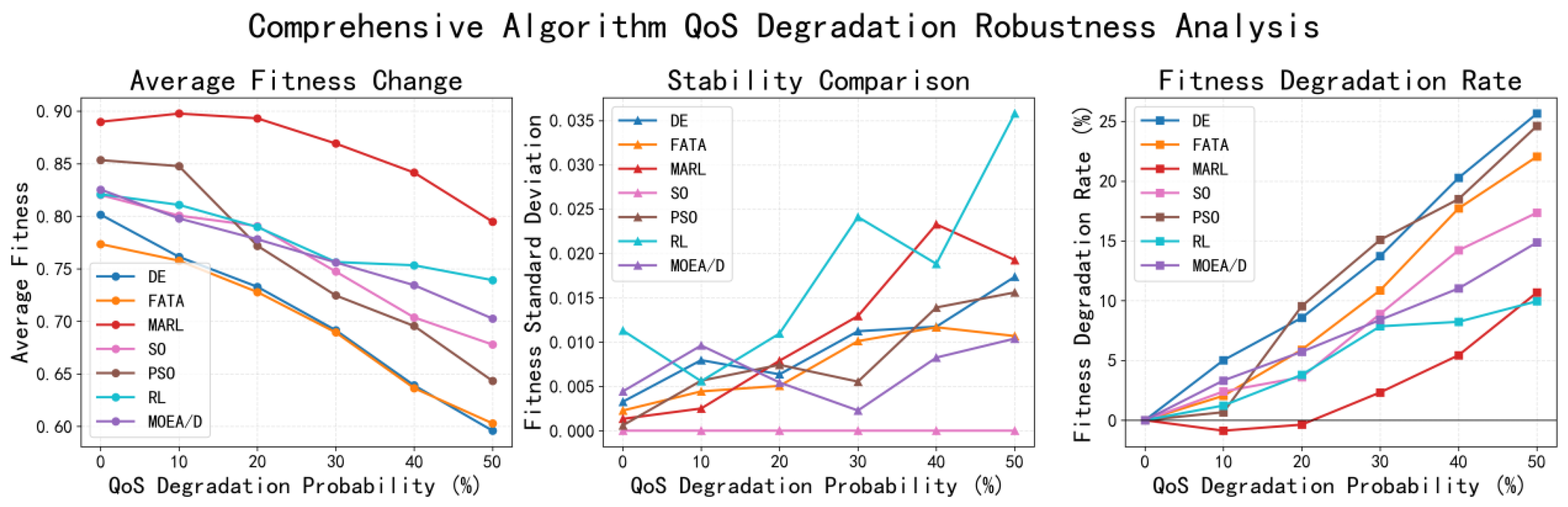
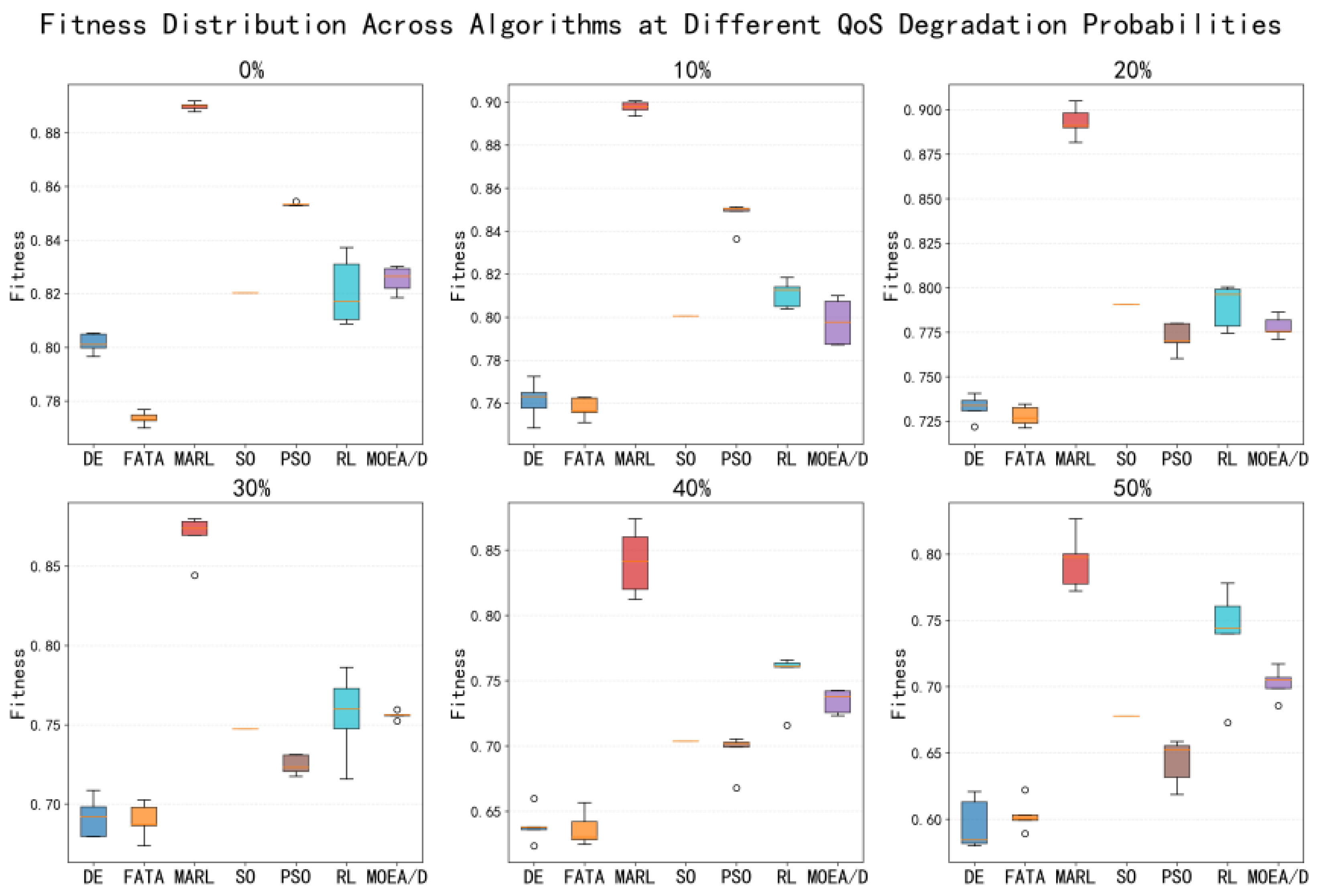
- QoS Degradation Scenario: A medium-scale dataset (S2) is used, with the probability of QoS decline similarly increasing from 10% to 50%, simulating the impact of service performance fluctuations on the overall platform performance.
5.3.1. Robustness Analysis Under Service Failure
5.3.2. Robustness Analysis Under Service Degradation
5.4. Fairness Analysis
5.4.1. Mathematical Modeling of Fairness Metrics
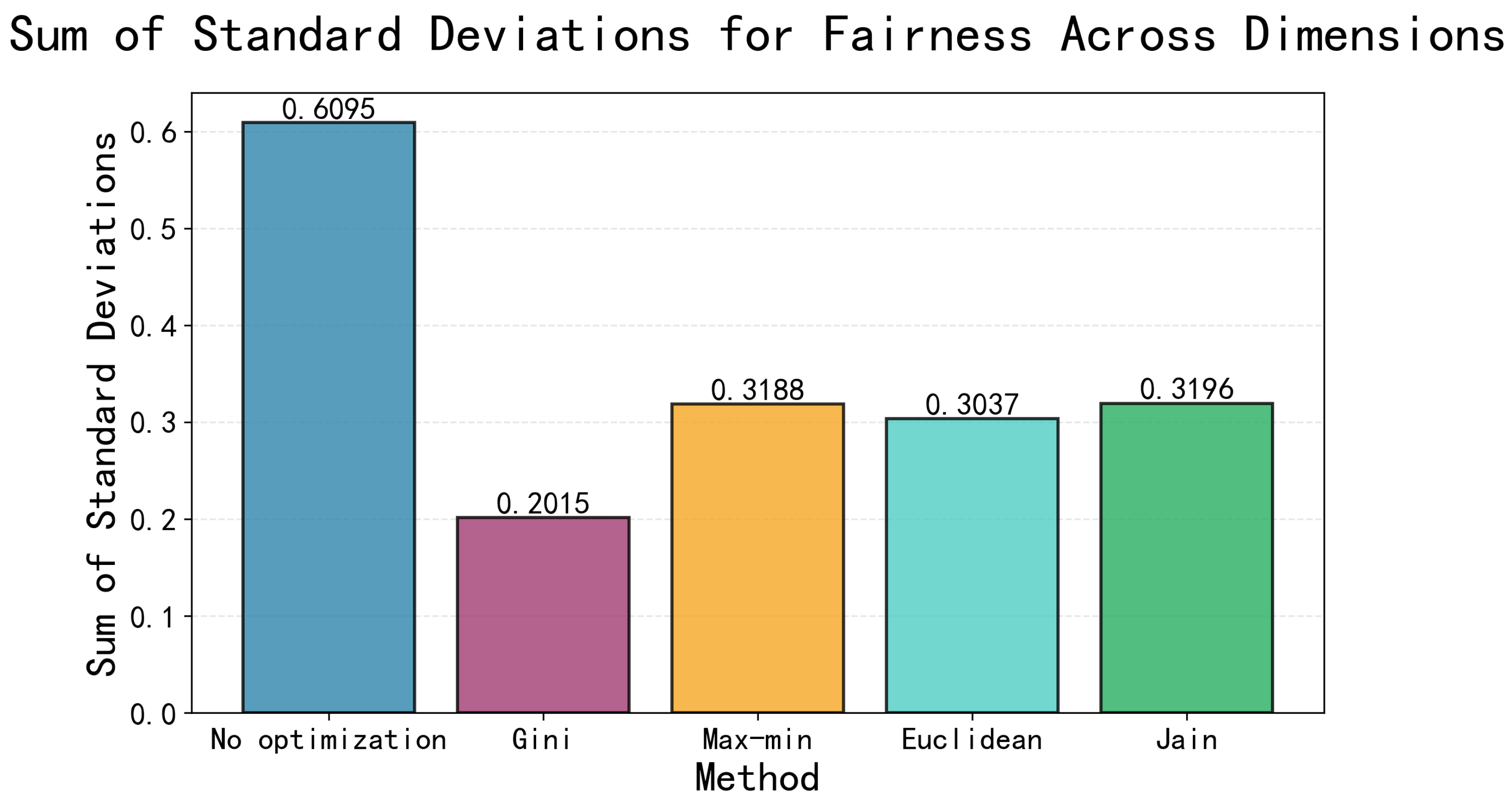
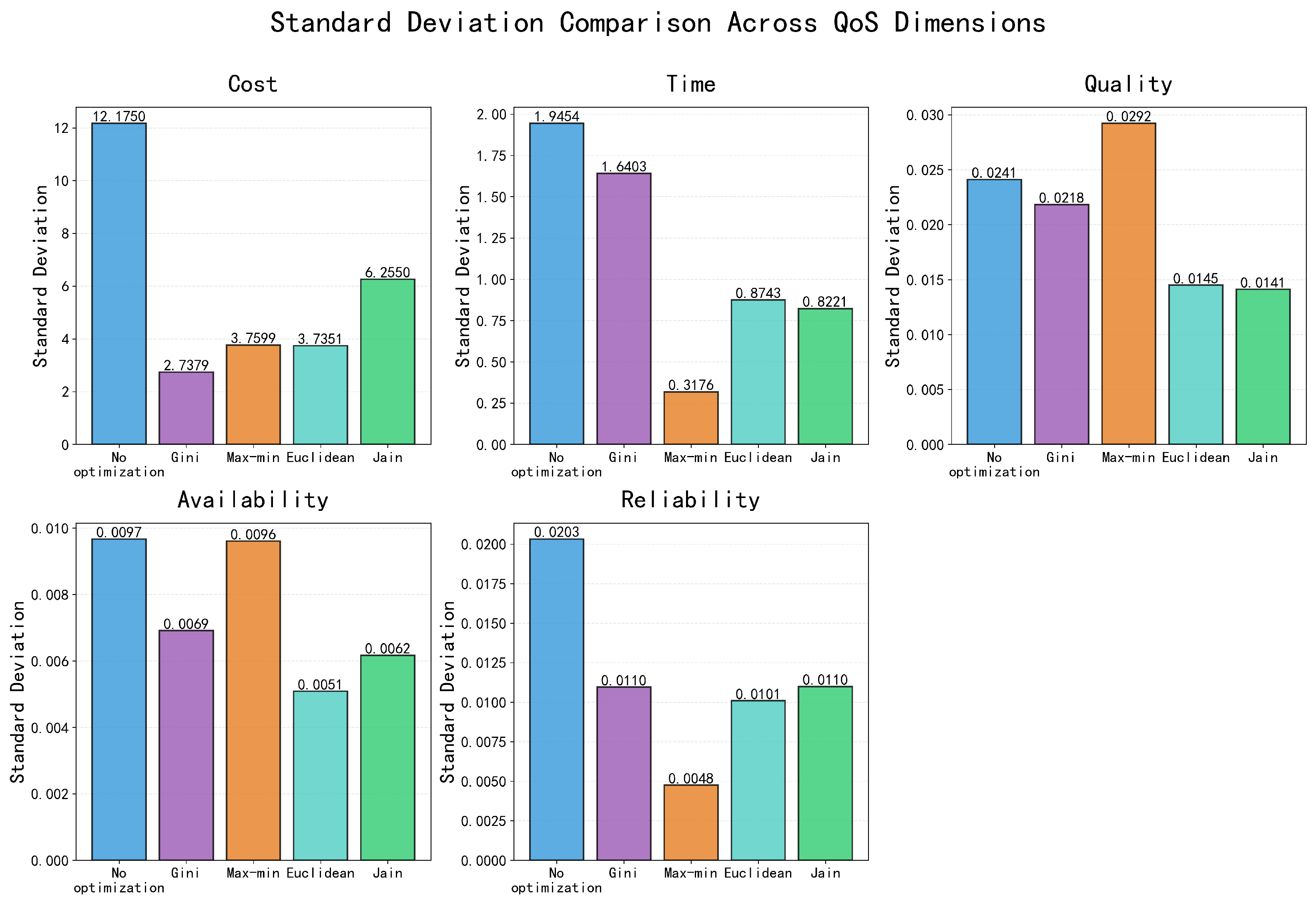
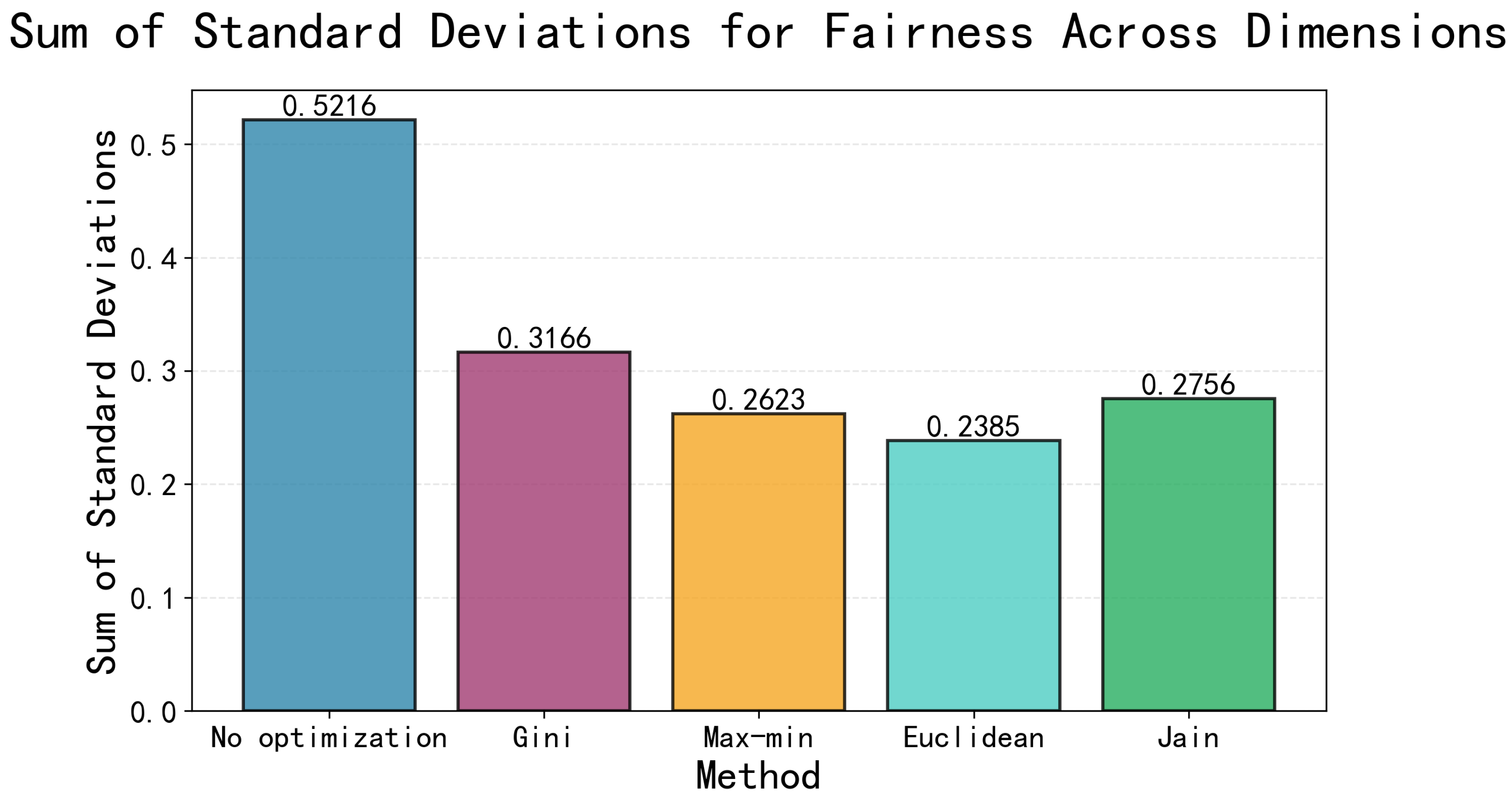
- Euclidean distance measures the global average difference by calculating the mean Euclidean distance of five-dimensional normalized QoS vectors between all MT pairs, with its modeling formula shown in Equation (8) and a smaller value indicating better fairness.
- The Gini coefficient characterizes the degree of inequality based on the cumulative distribution difference of comprehensive normalized QoS scores, with the formulawhere is the mean of comprehensive scores, and a smaller value implies more balanced allocation.
- Max–min fairness focuses on the performance gap between extreme tasks by computing the mean difference between the maximum and minimum values of each QoS dimension, with the formulawhere is the number of QoS evaluation dimensions, and a smaller value indicates a narrower gap between extreme tasks.
- Jain’s index is calculated based on the equilibrium of task scores across each QoS dimension, with a smaller value representing better fairness under the revised logic and its formulawhich reflects the overall fairness by depicting the distribution equilibrium of scores across dimensions.
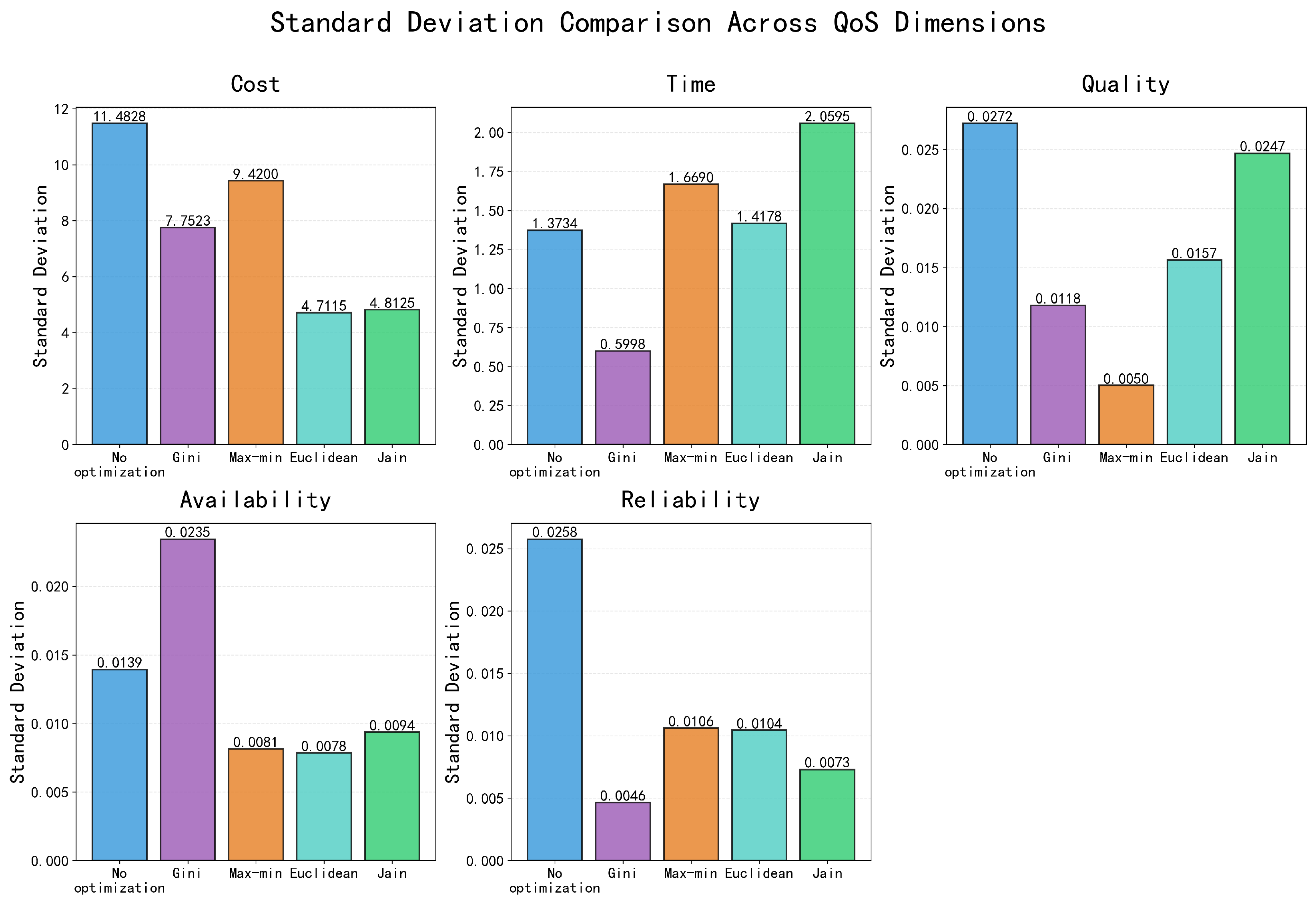
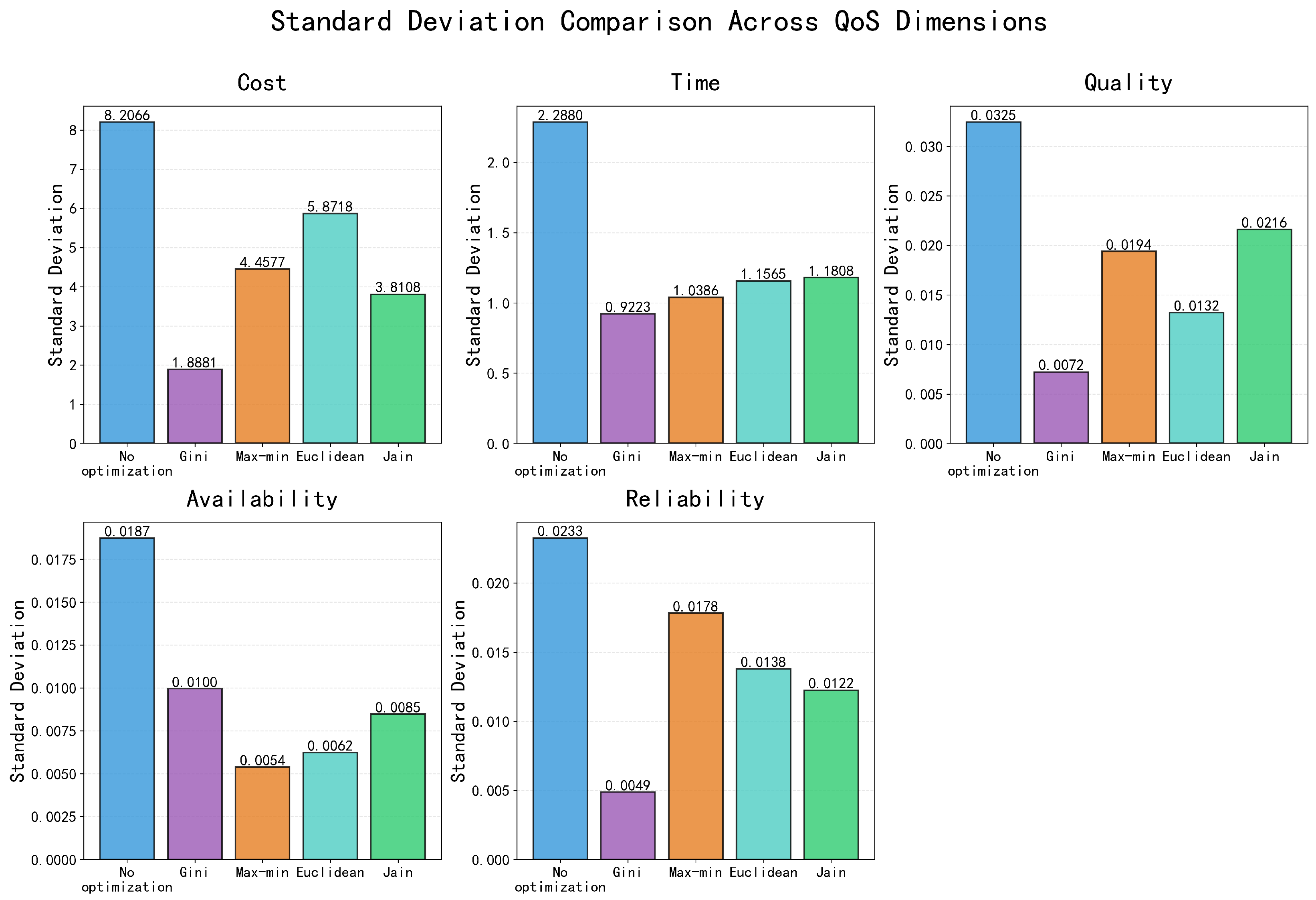
5.4.2. Analysis of Fairness Metrics Across Different Resource Scenarios
- Euclidean distance: demonstrates optimal global fairness in both resource-constrained and resource-sufficient scenarios. Its core advantage lies in comprehensively capturing QoS disparities between tasks, making it suitable for these two scenarios with imbalanced resource supply and demand.
- Gini coefficient: achieves the best performance in the resource-moderate scenario, with a notable effect in suppressing allocation inequality. Applicable to scenarios where resource supply and demand are relatively balanced.
- Max–min fairness: excels at controlling QoS gaps between extreme tasks, effectively managing fluctuations in extreme dimensions but lacking balance across global dimensions.
- Jain’s index: exhibits good inter-task equilibrium in single dimensions, yet its ability to control global QoS disparities is inferior to that of the Euclidean cistance metric.
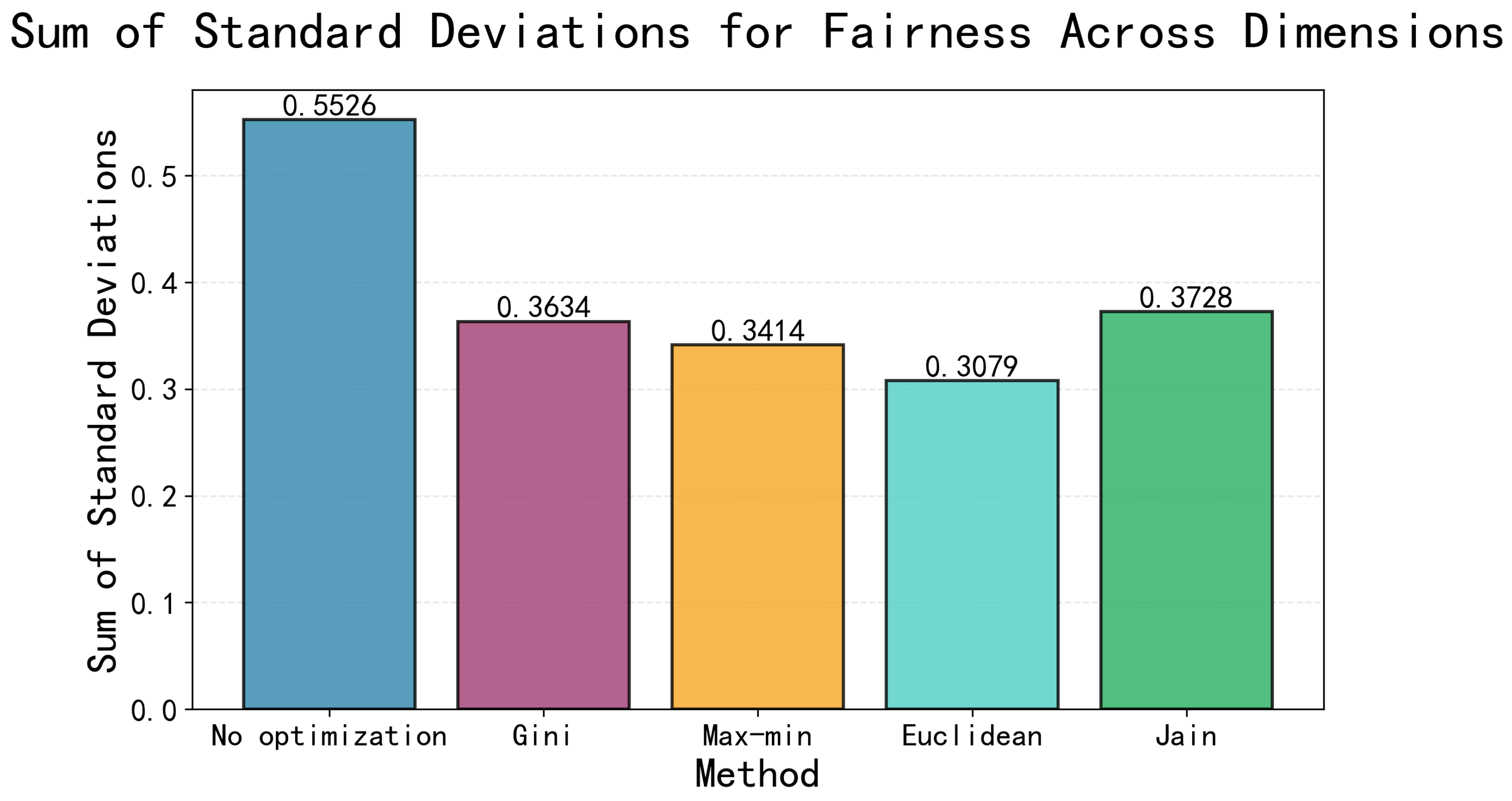
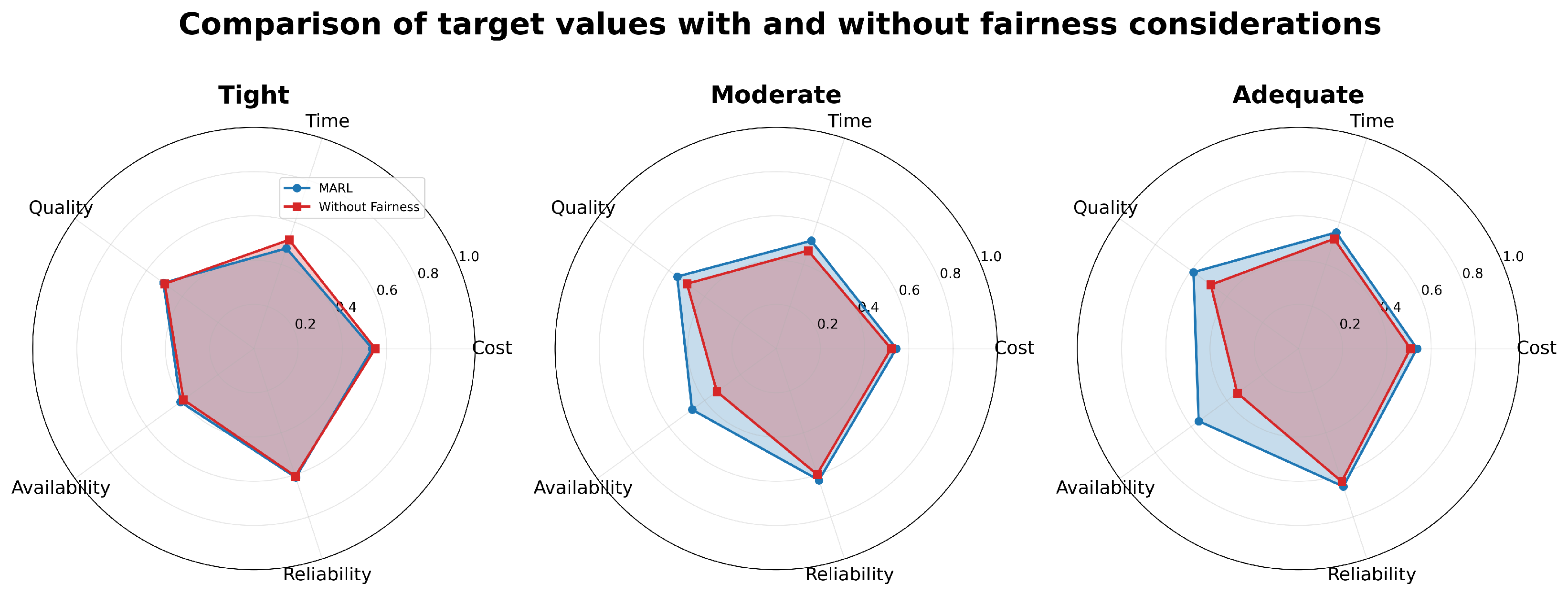
5.4.3. Quantitative Analysis of Fairness-QoS Trade-Off
5.4.4. Ablation Experiment
6. Conclusions
Author Contributions
Funding
Data Availability Statement
Conflicts of Interest
Abbreviations
| CMP | Cloud Manufacturing Platform |
| CMSC | Cloud Manufacturing Service Composition |
| QoS | Quality of Service |
| MT | Manufacturing Task |
| MS | Manufacturing Service |
| SCS | service composition solutions |
| MARL | Multi-Agent Reinforcement Learning |
| CTDE | Centralized Training with Decentralized Execution |
| MOPSO | Pareto-based Particle Swarm Optimization |
| NSGA-II | Non-dominated Sorting Genetic Algorithm II |
| W-PSO | Weighted-based Particle Swarm Optimization |
| W-GA | Weighted-based Genetic Algorithm |
References
- Tao, F.; Cheng, Y.; Xu, L.D.; Zhang, L.; Li, B.H. CCIoT-CMfg: Cloud Computing and Internet of Things-Based Cloud Manufacturing Service System. IEEE Trans. Ind. Inform. 2014, 10, 1435–1442. [Google Scholar]
- Wang, F.; Laili, Y.; Zhang, L. Trust Evaluation for Service Composition in Cloud Manufacturing Using GRU and Association Analysis. IEEE Trans. Ind. Inform. 2023, 19, 1912–1922. [Google Scholar] [CrossRef] [Scilit]
- Li, Y.; Yao, X.; Liu, M. Multiobjective Optimization of Cloud Manufacturing Service Composition with Improved Particle Swarm Optimization Algorithm. Math. Probl. Eng. 2020, 9186023, 1–17. [Google Scholar] [CrossRef] [Scilit]
- Amato, A.; Venticinque, S. Multiobjective Optimization for Brokering of Multicloud Service Composition. ACM Trans. Internet Technol. 2016, 16, 1–20. [Google Scholar] [CrossRef] [Scilit]
- Hayyolalam, V.; Pourghebleh, B.; Chehrehzad, M.R.; Pourhaji Kazem, A.A. Single-objective service composition methods in cloud manufacturing systems: Recent techniques, classification, and future trends. Concurr. Comput. Pract. Exp. 2022, 34, e6698. [Google Scholar] [CrossRef] [Scilit]
- Akbaripour, H.; Pourhaji Kazem, M.H. Service composition and optimal selection in cloud manufacturing: Landscape analysis and optimization by a hybrid imperialist competitive and local search algorithm. Neural Comput. Appl. 2020, 32, 10873–10894. [Google Scholar] [CrossRef] [Scilit]
- Que, Y.; Zhong, W.; Chen, H.; Chen, X.; Ji, X. Improved adaptive immune genetic algorithm for optimal QoS-aware service composition selection in cloud manufacturing. Int. J. Adv. Manuf. Technol. 2018, 96, 4455–4465. [Google Scholar] [CrossRef] [Scilit]
- Yang, B.; Wang, S.; Li, S.; Jin, T. A robust service composition and optimal selection method for cloud manufacturing. Int. J. Prod. Res. 2022, 60, 1134–1152. [Google Scholar] [CrossRef] [Scilit]
- Atmani, N.; Khanouche, M.E.; Belaid, A.; Amirat, Y.; Chibani, A. Machine learning-based reduction and unbiased reinforcement learning method for QoS-aware services composition in IoT environments. Computing 2025, 107, 127. [Google Scholar] [CrossRef] [Scilit]
- Wang, X.; Laili, Y.; Zhang, L.; Liu, Y. Hybrid Task Scheduling in Cloud Manufacturing with Sparse-Reward Deep Reinforcement Learning. IEEE Trans. Autom. Sci. Eng. 2025, 22, 1878–1892. [Google Scholar] [CrossRef] [Scilit]
- Xiao, J.; Cai, Y.; Chen, Y. Study on deep reinforcement learning for multi-task scheduling in cloud manufacturing. Int. J. Comput. Integr. Manuf. 2025, 38, 1663–1680. [Google Scholar] [CrossRef] [Scilit]
- Li, C.; Liu, L.; Shi, L. Review of Cloud Service Composition for Intelligent Manufacturing. J. Ind. Inf. Integr. 2021, 23, 100211. [Google Scholar]
- Yang, Y.; Yang, B.; Wang, S.; Jin, T.; Li, S. An enhanced multi-objective grey wolf optimizer for service composition in cloud manufacturing. Appl. Soft Comput. 2019, 85, 106003. [Google Scholar] [CrossRef] [Scilit]
- Yin, C.; Li, S.; Li, X. An optimization method of cloud manufacturing service composition based on matching-collaboration degree. Int. J. Adv. Manuf. Technol. 2024, 131, 343–353. [Google Scholar] [CrossRef] [Scilit]
- Jin, H.; Jiang, C.; Lv, S.; He, H.; Liao, X. A hybrid teaching-learning-based optimization algorithm for QoS-aware manufacturing cloud service composition. Computing 2022, 104, 2489–2509. [Google Scholar] [CrossRef] [Scilit]
- Hu, Q.; Qi, H.; Jia, Y.; Qu, L. A two-phase method to optimize service composition in cloud manufacturing. Computing 2024, 106, 2261–2291. [Google Scholar] [CrossRef] [Scilit]
- Gao, Y.; Yang, B.; Wang, S.; Fu, G.; Zhou, P. A multi-objective service composition method considering the interests of tri-stakeholders in cloud manufacturing based on an enhanced jellyfish search optimizer. J. Comput. Sci. 2023, 67, 101934. [Google Scholar] [CrossRef] [Scilit]
- Hyder, M.T.; Lobo, C.; Madupuru, T.S.; Sudarshan, S.; Sodahi, M.; Valilai, O.F. Enabling robust service composition in cloud manufacturing with sustainability considerations. In Proceedings of the 2021 IEEE International Conference on Industrial Engineering and Engineering Management (IEEM), Singapore, 13–16 December 2021; pp. 792–796. [Google Scholar]
- Li, H.; Jiang, R.; Ge, S. Researches on Manufacturing Cloud Service Composition and Optimization Approach Supporting for Service Statistic Correlation. In Proceedings of the 2014 26th Chinese Control and Decision Conference (CCDC), Changsha, China, 31 May–2 June 2014; pp. 4149–4154. [Google Scholar]
- Chen, Y.; Liu, J.; Ling, L.; Wang, L. Parallel manufacturing cloud service composition algorithm based on collaborative effect. Comput. Integr. Manuf. Syst. 2019, 25, 137–146. [Google Scholar]
- Wang, Y.; Gao, S.; Wang, S.; Zimmermann, R. An Adaptive Multiobjective Multitask Service Composition Approach Considering Practical Constraints in Fog Manufacturing. IEEE Trans. Ind. Inform. 2022, 18, 6756–6766. [Google Scholar] [CrossRef] [Scilit]
- Zhu, J.; Yu, Z.; Wang, T.; Zhang, Y.; Jiang, B. A Double Layer Coding-based Multi-task Service Composition Method in Cloud Manufacturing. In Proceedings of the International Conference on Cloud Computing, Melbourne, Australia, 9–10 December 2021; pp. 1–6. [Google Scholar]
- Liu, Y.; Ping, Y.; Zhang, L.; Wang, L.; Xu, X. Scheduling of decentralized robot services in cloud manufacturing with deep reinforcement learning. Robot.-Comput.-Integr. Manuf. 2023, 80, 102454. [Google Scholar] [CrossRef] [Scilit]
- Ping, Y.; Liu, Y.; Zhang, L.; Wang, L.; Xu, X. Sequence generation for multi-task scheduling in cloud manufacturing with deep reinforcement learning. J. Manuf. Syst. 2023, 67, 315–337. [Google Scholar] [CrossRef] [Scilit]
- Hu, Y.; Yang, Y.; Wu, F. Dynamic cloud manufacturing service composition with re-entrant services: An online policy perspective. Int. J. Prod. Res. 2024, 62, 3263–3287. [Google Scholar] [CrossRef] [Scilit]
- Xiong, W.; Wang, Y.; Gao, S.; Huang, X.; Wang, S. A multi-objective service composition optimization method considering multi-user benefit and adaptive resource partitioning in hybrid cloud manufacturing. J. Ind. Inf. Integr. 2024, 38, 100564. [Google Scholar] [CrossRef] [Scilit]
- Xie, N.; Tan, W.; Zheng, X.; Zhao, L.; Huang, L.; Sun, Y. An efficient two-phase approach for reliable collaboration-aware service composition in cloud manufacturing. J. Ind. Inf. Integr. 2021, 23, 100211. [Google Scholar] [CrossRef] [Scilit]
- Wang, Y.; Wang, S.; Yang, B.; Gao, B.; Wang, S. An effective adaptive adjustment method for service composition exception handling in cloud manufacturing. J. Intell. Manuf. 2022, 33, 735–751. [Google Scholar] [CrossRef] [Scilit]
- Zhang, Q.; Li, S.; Pu, R.; Zhou, P.; Chen, G.; Li, K.; Lv, D. An adaptive robust service composition and optimal selection method for cloud manufacturing based on the enhanced multi-objective artificial hummingbird algorithm. Expert Syst. Appl. 2024, 244, 122823. [Google Scholar] [CrossRef] [Scilit]
- Deng, L.; Shu, T.; Xia, J. Multi-Strategy Improved Artificial Rabbit Algorithm for QoS-Aware Service Composition in Cloud Manufacturing. Algorithms 2025, 18, 107. [Google Scholar] [CrossRef] [Scilit]
- Jing, W.; Zhang, Y.; Chen, Y.; Zhang, H.; Huang, W. Cloud-edge collaboration composition and scheduling for flexible manufacturing service with a multi-population co-evolutionary algorithm. Robot.-Comput.-Integr. Manuf. 2024, 90, 102814. [Google Scholar] [CrossRef] [Scilit]
- Chen, K.; Wang, T.; Zhuo, H.; Cheng, L. WGO: A similarly encoded whale-goshawk optimization algorithm for uncertain cloud manufacturing service composition. Auton. Intell. Syst. 2025, 5, 1–13. [Google Scholar] [CrossRef] [Scilit]
- Zou, Y.; Qi, N.; Deng, Y.; Xue, Z.; Gong, M.; Zhang, W. Autonomous Resource Management in Microservice Systems via Reinforcement Learning. In Proceedings of the 2025 8th International Conference on Computer Information Science and Application Technology (CISAT), Kunming, China, 11–13 July 2025; pp. 991–995. [Google Scholar]
- Boudour, R.; Aklouf, Y.; Fekir, N.C.; Benmessai, S. Multi-Objective Reinforcement Learning for QoS-Aware Optimization of Multi-Cloud IoT Service Selection. In Proceedings of the 2024 Global Congress on Emerging Technologies (GCET), Gran Canaria, Spain, 9–11 December 2024; pp. 43–50. [Google Scholar]
- Chen, Z.; Zhang, L.; Laili, Y.; Wang, X.; Wang, F. Online simulation task scheduling in cloud manufacturing with cross attention and deep reinforcement learning. J. Intell. Manuf. 2025, 36, 5779–5800. [Google Scholar] [CrossRef] [Scilit]
- Yu, C.; Velu, A.; Vinitsky, E.; Gao, J.; Wang, Y.; Bayen, A.; Wu, Y. The Surprising Effectiveness of PPO in Cooperative Multi-Agent Games. Adv. Neural Inf. Process. Syst. 2022, 35, 24611–24624. [Google Scholar]
- Shi, Y.; Eberhart, R.C. A modified particle swarm optimizer. In Proceedings of the 1998 IEEE International Conference on Evolutionary Computation, Anchorage, AK, USA, 4–9 May 1998; pp. 69–73. [Google Scholar]
- Qi, A.; Zhao, D.; Heidari, A.A.; Liu, L.; Chen, Y.; Chen, H. FATA: An efficient optimization method based on geophysics. Neurocomputing 2024, 607, 128289. [Google Scholar] [CrossRef] [Scilit]
- Hashim, F.A.; Hussien, A.G. Snake Optimizer: A novel meta-heuristic optimization algorithm. Knowl.-Based Syst. 2022, 242, 108320. [Google Scholar] [CrossRef] [Scilit]
- Storn, R.; Price, K. Differential Evolution—A simple and efficient heuristic for global optimization over continuous spaces. J. Glob. Optim. 1997, 11, 341–359. [Google Scholar] [CrossRef] [Scilit]
- Zhang, Q.; Li, H. MOEA/D: A Multiobjective Evolutionary Algorithm Based on Decomposition. IEEE Trans. Evol. Comput. 2007, 11, 712–731. [Google Scholar] [CrossRef] [Scilit]



| Dataset | n | m | Resource Tightness | |
|---|---|---|---|---|
| S1 (Small-scale) | 5 | 3 | 20 | Medium |
| S2 (Medium-scale) | 10 | 6 | 40 | Medium |
| S3 (Large-scale) | 20 | 12 | 80 | Medium |
| D1 (Tight resources) | 10 | 6 | 15 | High |
| D2 (Moderate resources) | 10 | 6 | 40 | Medium |
| D3 (Sufficient resources) | 10 | 6 | 65 | Low |
| Service Tier | Cost | Time | Quality | Reliability | Availability |
|---|---|---|---|---|---|
| High-quality | [10.00, 40.00] | [1.00, 8.00] | [0.9000, 0.9900] | [0.9200, 0.9900] | [0.9200, 0.9900] |
| Medium-quality | [40.00, 70.00] | [8.00, 14.00] | [0.8000, 0.9000] | [0.8500, 0.9200] | [0.8800, 0.9200] |
| General-quality | [70.00, 100.00] | [14.00, 20.00] | [0.7000, 0.8000] | [0.8000, 0.8500] | [0.8500, 0.8800] |
| Algorithm | Average Convergence Iterations | Average Fitness Value | ||||
|---|---|---|---|---|---|---|
| S1 | S2 | S3 | S1 | S2 | S3 | |
| DE | 45.6 | 19.6 | 44.2 | 0.567525 | 0.511148 | 0.499896 |
| FATA | 63.2 | 40.6 | 24.6 | 0.541261 | 0.5111 | 0.500367 |
| MOEA/D | 153.4 | 106.8 | 59.4 | 0.584352 | 0.568239 | 0.529619 |
| PSO | 36 | 51.4 | 32 | 0.572738 | 0.528579 | 0.50227 |
| SO | 646.2 | 626.8 | 642.8 | 0.554428 | 0.531644 | 0.515741 |
| RL | 569.4 | 912.4 | 1999 | 0.58166 | 0.5764 | 0.54674 |
| MARL | 741 | 772 | 1025 | 0.58766 | 0.59282 | 0.58508 |
| Algorithm | Max | Min | Mean | Std |
|---|---|---|---|---|
| DE | 0.602953 | 0.522071 | 0.567525 | 0.027078 |
| FATA | 0.555804 | 0.517271 | 0.541261 | 0.015717 |
| MOEA/D | 0.608323 | 0.546388 | 0.584352 | 0.020631 |
| PSO | 0.595354 | 0.551467 | 0.572738 | 0.017077 |
| SO | 0.575156 | 0.541215 | 0.554428 | 0.011633 |
| RL | 0.6055 | 0.5517 | 0.58166 | 0.018997 |
| MARL | 0.5931 | 0.5763 | 0.58766 | 0.006082 |
| Algorithm | Max | Min | Mean | Std |
|---|---|---|---|---|
| DE | 0.522089 | 0.497438 | 0.511148 | 0.009807 |
| FATA | 0.526326 | 0.497355 | 0.5111 | 0.011054 |
| MOEA/D | 0.579287 | 0.554372 | 0.568239 | 0.010653 |
| PSO | 0.540498 | 0.513161 | 0.528579 | 0.009883 |
| SO | 0.547409 | 0.522917 | 0.531644 | 0.009098 |
| RL | 0.5958 | 0.5613 | 0.5764 | 0.012367 |
| MARL | 0.6092 | 0.5796 | 0.59282 | 0.011101 |
| Algorithm | Max | Min | Mean | Std |
|---|---|---|---|---|
| DE | 0.502695 | 0.497195 | 0.499896 | 0.002058 |
| FATA | 0.506168 | 0.496466 | 0.500367 | 0.003523 |
| MOEA/D | 0.532927 | 0.526012 | 0.529619 | 0.002771 |
| PSO | 0.507643 | 0.499585 | 0.50227 | 0.003089 |
| SO | 0.519652 | 0.510019 | 0.515741 | 0.003622 |
| RL | 0.5942 | 0.4813 | 0.54674 | 0.039822 |
| MARL | 0.5906 | 0.5807 | 0.58508 | 0.003375 |
| Algorithm | Failure Probability (%) | Average Fitness | Standard Deviation | Degradation Rate (%) |
|---|---|---|---|---|
| DE | 0 | 0.674929 | 0.002005 | 0 |
| 10 | 0.646183 | 0.029337 | 4.26 | |
| 20 | 0.613015 | 0.038275 | 9.17 | |
| 30 | 0.589876 | 0.054352 | 12.6 | |
| 40 | 0.515124 | 0.051032 | 23.68 | |
| 50 | 0.475376 | 0.064342 | 29.57 | |
| FATA | 0 | 0.653184 | 0 | 0 |
| 10 | 0.63011 | 0.028489 | 3.53 | |
| 20 | 0.605858 | 0.035673 | 7.25 | |
| 30 | 0.586531 | 0.052444 | 10.2 | |
| 40 | 0.514931 | 0.051046 | 21.17 | |
| 50 | 0.476535 | 0.064119 | 27.04 | |
| MARL | 0 | 0.7396 | 0.003056 | 0 |
| 10 | 0.70166 | 0.034474 | 5.13 | |
| 20 | 0.66456 | 0.043542 | 10.15 | |
| 30 | 0.63478 | 0.064808 | 14.17 | |
| 40 | 0.5431 | 0.057204 | 26.57 | |
| 50 | 0.484629 | 0.063072 | 34.47 | |
| SO | 0 | 0.679119 | 0 | 0 |
| 10 | 0.649485 | 0.02833 | 4.36 | |
| 20 | 0.61634 | 0.036841 | 9.24 | |
| 30 | 0.592028 | 0.053664 | 12.82 | |
| 40 | 0.516444 | 0.050826 | 23.95 | |
| 50 | 0.476366 | 0.064411 | 29.86 | |
| PSO | 0 | 0.678141 | 0.001151 | 0 |
| 10 | 0.648975 | 0.02838 | 4.3 | |
| 20 | 0.615956 | 0.036877 | 9.17 | |
| 30 | 0.590922 | 0.053603 | 12.86 | |
| 40 | 0.515628 | 0.05121 | 23.96 | |
| 50 | 0.475376 | 0.064342 | 29.9 | |
| RL | 0 | 0.662702 | 0.005941 | 0 |
| 10 | 0.635052 | 0.025602 | 4.17 | |
| 20 | 0.604681 | 0.032164 | 8.76 | |
| 30 | 0.584966 | 0.055489 | 11.73 | |
| 40 | 0.507174 | 0.049287 | 23.47 | |
| 50 | 0.471388 | 0.064807 | 28.87 | |
| MOEA/D | 0 | 0.678716 | 0 | 0 |
| 10 | 0.648061 | 0.028726 | 4.52 | |
| 20 | 0.615718 | 0.036816 | 9.28 | |
| 30 | 0.588132 | 0.053373 | 13.35 | |
| 40 | 0.514427 | 0.051021 | 24.21 | |
| 50 | 0.475376 | 0.064342 | 29.96 |
| Algorithm | QoS Degradation Probability (%) | Average Fitness | Standard Deviation | Degradation Rate (%) |
|---|---|---|---|---|
| DE | 0 | 0.801523 | 0.003266 | 0 |
| 10 | 0.761319 | 0.007963 | 5.02 | |
| 20 | 0.732816 | 0.006361 | 8.57 | |
| 30 | 0.691475 | 0.011226 | 13.73 | |
| 40 | 0.639034 | 0.011738 | 20.27 | |
| 50 | 0.595909 | 0.017367 | 25.65 | |
| FATA | 0 | 0.773475 | 0.002275 | 0 |
| 10 | 0.75767 | 0.004437 | 2.04 | |
| 20 | 0.727833 | 0.005058 | 5.9 | |
| 30 | 0.689408 | 0.010112 | 10.87 | |
| 40 | 0.636416 | 0.011675 | 17.72 | |
| 50 | 0.60289 | 0.010686 | 22.05 | |
| MARL | 0 | 0.889861 | 0.001336 | 0 |
| 10 | 0.897658 | 0.002507 | −0.88 | |
| 20 | 0.893154 | 0.007904 | −0.37 | |
| 30 | 0.869151 | 0.012937 | 2.33 | |
| 40 | 0.841483 | 0.023292 | 5.44 | |
| 50 | 0.794802 | 0.019268 | 10.68 | |
| SO | 0 | 0.82026 | 0 | 0 |
| 10 | 0.800545 | 0 | 2.4 | |
| 20 | 0.790664 | 0 | 3.61 | |
| 30 | 0.747332 | 0 | 8.89 | |
| 40 | 0.703659 | 0 | 14.22 | |
| 50 | 0.67788 | 0 | 17.36 | |
| PSO | 0 | 0.853343 | 0.000602 | 0 |
| 10 | 0.847633 | 0.005646 | 0.67 | |
| 20 | 0.771914 | 0.007433 | 9.54 | |
| 30 | 0.72458 | 0.005537 | 15.09 | |
| 40 | 0.695511 | 0.013906 | 18.5 | |
| 50 | 0.643296 | 0.015605 | 24.61 | |
| RL | 0 | 0.820898 | 0.011314 | 0 |
| 10 | 0.810784 | 0.005584 | 1.23 | |
| 20 | 0.789717 | 0.010973 | 3.8 | |
| 30 | 0.756402 | 0.024118 | 7.86 | |
| 40 | 0.753309 | 0.018832 | 8.23 | |
| 50 | 0.73919 | 0.035791 | 9.95 | |
| MOEA/D | 0 | 0.825332 | 0.004436 | 0 |
| 10 | 0.797909 | 0.009616 | 3.32 | |
| 20 | 0.778049 | 0.00544 | 5.73 | |
| 30 | 0.756034 | 0.002279 | 8.4 | |
| 40 | 0.734368 | 0.008253 | 11.02 | |
| 50 | 0.702599 | 0.010395 | 14.87 |
| Algorithm | Euclidean Distance | Gini Coefficient | Max–Min Fairness | Jain’s Index | Sum of Standard Deviations |
|---|---|---|---|---|---|
| Non-optimized | 0.358283 | 0.962103 | 0.368144 | 0.042485 | 0.545988 |
| Gini | 0.270488 | 0.57001 | 0.267623 | 0.02915 | 0.360559 |
| Max–Min | 0.231458 | 0.684946 | 0.209265 | 0.018438 | 0.333134 |
| Euclidean | 0.186091 | 0.612362 | 0.197342 | 0.012722 | 0.301243 |
| Jain’s Index | 0.231183 | 0.693917 | 0.258627 | 0.019652 | 0.363327 |
| Algorithm | Euclidean Distance | Gini Coefficient | Max–Min Fairness | Jain’s Index | Sum of Standard Deviations |
|---|---|---|---|---|---|
| non-optimized | 0.387697 | 0.999067 | 0.402376 | 0.057269 | 0.5987 |
| Gini | 0.139351 | 0.378402 | 0.132504 | 0.005644 | 0.197099 |
| Max–Min | 0.21152 | 0.601607 | 0.18964 | 0.012164 | 0.313852 |
| Euclidean | 0.192357 | 0.559323 | 0.200443 | 0.010431 | 0.298049 |
| Jain | 0.202608 | 0.554714 | 0.204325 | 0.010251 | 0.314178 |
| Algorithm | Euclidean Distance | Gini Coefficient | Max–Min Fairness | Jain’s Index | Sum of Standard Deviations |
|---|---|---|---|---|---|
| non-optimized | 0.337799 | 0.954476 | 0.331097 | 0.039624 | 0.512319 |
| Gini | 0.206221 | 0.553687 | 0.205272 | 0.011417 | 0.30907 |
| Max–Min | 0.186136 | 0.476774 | 0.175697 | 0.009858 | 0.261468 |
| Euclidean | 0.149901 | 0.41709 | 0.157468 | 0.005961 | 0.234444 |
| Jain | 0.179077 | 0.477396 | 0.165643 | 0.007257 | 0.271693 |
| DataSet | QoS Dimension | Non-Optimized | Optimized | Improvement (%) |
|---|---|---|---|---|
| D1 | Time | 10.1803 | 10.9408 | −7.47 |
| Cost | 50.6423 | 51.8315 | −2.35 | |
| Quality | 0.8445 | 0.8466 | 0.25 | |
| Availability | 0.9051 | 0.9074 | 0.25 | |
| Reliability | 0.9152 | 0.9164 | 0.13 | |
| Fairness | 0.3583 | 0.304 | 15.14 | |
| D2 | Time | 11.1442 | 10.2618 | 7.92 |
| Cost | 53.249 | 51.1273 | 3.98 | |
| Quality | 0.8446 | 0.8605 | 1.88 | |
| Availability | 0.8964 | 0.9158 | 2.16 | |
| Reliability | 0.9136 | 0.9189 | 0.58 | |
| Fairness | 0.3801 | 0.2989 | 21.37 | |
| D3 | Time | 10.0868 | 9.5062 | 5.76 |
| Cost | 54.4543 | 51.811 | 4.85 | |
| Quality | 0.8422 | 0.8703 | 3.34 | |
| Availability | 0.8979 | 0.9281 | 3.36 | |
| Reliability | 0.9201 | 0.9246 | 0.49 | |
| Fairness | 0.331 | 0.3149 | 4.86 |
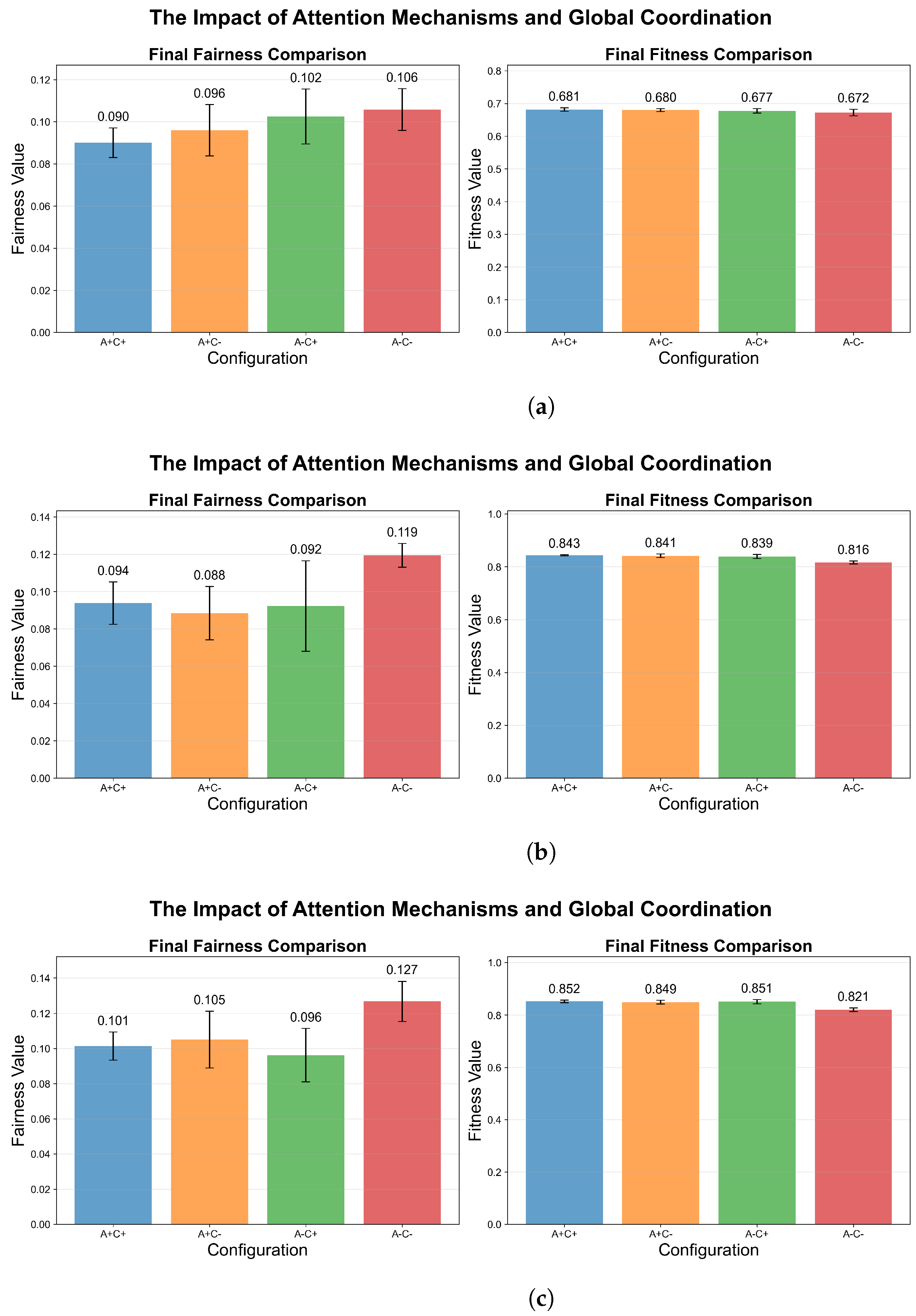
| Constraint | FairnessMean | FairnessStd | FitnessMean | FitnessStd | |
|---|---|---|---|---|---|
| Tight | A+C+ | 0.0900 | 0.0070 | 0.6814 | 0.0056 |
| A+C− | 0.0959 | 0.0122 | 0.6800 | 0.0044 | |
| A−C+ | 0.1025 | 0.0130 | 0.6774 | 0.0067 | |
| A−C− | 0.1058 | 0.0099 | 0.6722 | 0.0101 | |
| Moderate | A+C+ | 0.0938 | 0.0113 | 0.8431 | 0.0022 |
| A+C− | 0.0884 | 0.0143 | 0.8414 | 0.0066 | |
| A−C+ | 0.0923 | 0.0243 | 0.8389 | 0.0076 | |
| A−C− | 0.1194 | 0.0064 | 0.8159 | 0.0059 | |
| Adequate | A+C+ | 0.1014 | 0.0080 | 0.8523 | 0.0051 |
| A+C− | 0.1051 | 0.0162 | 0.8495 | 0.0072 | |
| A−C+ | 0.0962 | 0.0152 | 0.8515 | 0.0080 | |
| A−C− | 0.1268 | 0.0114 | 0.8208 | 0.0069 |
Disclaimer/Publisher’s Note: The statements, opinions and data contained in all publications are solely those of the individual author(s) and contributor(s) and not of MDPI and/or the editor(s). MDPI and/or the editor(s) disclaim responsibility for any injury to people or property resulting from any ideas, methods, instructions or products referred to in the content. |
© 2026 by the authors. Licensee MDPI, Basel, Switzerland. This article is an open access article distributed under the terms and conditions of the Creative Commons Attribution (CC BY) license.
Share and Cite
Fang, Z.; Ying, Y.; Cao, Q.; Fang, D.; Lu, D. A Multi-Task Service Composition Method Considering Inter-Task Fairness in Cloud Manufacturing. Symmetry 2026, 18, 238. https://doi.org/10.3390/sym18020238
Fang Z, Ying Y, Cao Q, Fang D, Lu D. A Multi-Task Service Composition Method Considering Inter-Task Fairness in Cloud Manufacturing. Symmetry. 2026; 18(2):238. https://doi.org/10.3390/sym18020238
Chicago/Turabian StyleFang, Zhou, Yanmeng Ying, Qian Cao, Dongsheng Fang, and Daijun Lu. 2026. "A Multi-Task Service Composition Method Considering Inter-Task Fairness in Cloud Manufacturing" Symmetry 18, no. 2: 238. https://doi.org/10.3390/sym18020238
APA StyleFang, Z., Ying, Y., Cao, Q., Fang, D., & Lu, D. (2026). A Multi-Task Service Composition Method Considering Inter-Task Fairness in Cloud Manufacturing. Symmetry, 18(2), 238. https://doi.org/10.3390/sym18020238