Article

Numerical Modeling of Wind-Induced Deformation in Eastern Red Cedar Tree Forms Using Fluid–Structure Interaction Analysis
by
Ahmet Ayaz
and
Mahdi Tabatabaei Malazi
*
Department of Mechanical Engineering, Faculty of Engineering, Istanbul Aydin University, Istanbul 34295, Turkey
*
Author to whom correspondence should be addressed.
Symmetry 2026, 18(1), 203; https://doi.org/10.3390/sym18010203
Submission received: 25 December 2025 / Revised: 12 January 2026 / Accepted: 14 January 2026 / Published: 21 January 2026
(This article belongs to the Special Issue Symmetry in Computational Fluid Dynamics)

Abstract

This research aims to investigate wind-induced effects numerically in full-scale Eastern Red Cedar tree (ERCT) forms under various wind speeds. A total of 72 model cases were carefully analyzed for variations in crown lengths (CLs), canopy diameters (CDs), bole lengths (BLs), and trunk diameters (TDs) at wind speeds ranging from 15 m/s to 30 m/s. The realizable k–ε turbulence model is employed to resolve the flow region and obtain drag force (FD), velocity, and pressure distributions within the computational fluid domain. The resulting aerodynamic loads are then transferred to ERCT models using a one-way fluid–structure interaction (one-way FSI) approach to predict deformation, stress, and strain in the solid zone. The accuracy of these findings was validated by comparing drag coefficient (CD) results with those from previously conducted studies. Research results reveal that wind speed and the geometric dimensions of the tree notably influence the FD, deformation, strain, and stress experienced by the tree. When wind speed rises from 15 to 30 m/s, the amount of FD, deformation, strain, and stress increases on the ERCT. The present research helps improve the understanding of tree patterns impacted by wind, which is essential for urban design and planning. It provides guidance on how to choose and arrange necessary real trees for efficient windbreaks and comfortable surroundings in life.

1. Introduction

Investigating tree reactions to wind is important in engineering because it helps structural design, safety, energy efficiency, and urban planning. Calculating the drag force and deformation of trees under various wind speeds is the most important point in tree–wind interaction in recent years. The following is a list of some studies conducted on the use of numerical methods for simulating a solitary tree. Amani-Beni et al. [1] conducted a study on the impact of wind on an ERCT model and found that wind speed and geometric characteristics significantly influence deformation, FD, and stress, with FD, bending, and stress increasing as wind speeds rose from 15 to 25 m/s. Hong et al. [2] developed a computational fluid dynamics technique (CFD) model to predict air speed distributions in tree canopies affected by an air-assisted pesticide sprayer, utilizing the sliding mesh method and virtual porous media for performance analysis. Yuan et al. [3] utilized FLUENT software to analyze aerodynamic parameters (A3D) for two rows of Metasequoia glyptostroboides and Populus euramevicana shelterbelts, enhancing the sheltering effect by modeling wind fields for plants and providing new approaches for tree shelterbelt design and maintenance. Hao et al. [4] developed and tested an aeroelastic model involving eight crown variants. The results proved that crown shielding limitations affect the mean crown deflection and the base overturning moment coefficient. Li et al. [5] used SISO to calculate prototype frequencies and mass distribution but found difficulties in the aeroelastic model, particularly in leaf cluster rigidity, and suggested using the Vogel exponent to improve the connection between the modeled object and the prototype. Dellwik et al. [6] found a significant seasonal dependence in a tree’s wake velocity deficit, with winter trees reducing turbulence intensity and summer trees displaying heightened intensity, using experimental methods to measure FD on a single tree. Angelou et al. [7] carried out an experimental investigation of FD on a single European oak tree. They developed a novel post-processing technique to measure the average load on a tree, utilizing extensive strain gauge data collected over a broad range of wind speeds. Bekkers et al. [8] developed a new formulation of the classical drag equation for mature, wind-adapted trees based on a full-scale experiment on an oak tree. They introduced a photographic technique for accurately calculating frontal areas under different lighting conditions. Angelou et al. [9] conducted a study on quantifying wind force on a rural deciduous tree using strain gauges. The research measured average and peak wind force across a wide range of wind speeds. The highest wind load exceeded the mean by 49–66% in summer and 52–79% in winter. Miri et al. [10] studied airflow and turbulence patterns around a Tamarix tree and found that its sheltering influence is seven times its height, with the highest turbulence intensity at lower heights. Manickathan et al. [11] looked at the drag coefficient and turbulent flow downstream of model trees compared with natural trees of the same size to see if they had the same aerodynamic properties. The findings point out that drag coefficients are the same only when both types exhibit similar aerodynamic porosity. Lai et al. [12] conducted a wind tunnel experiment on seven tree types for greening cities, using laser scanning to measure crown characteristics. The study suggests that examining the tree crown can be used to determine wind load. Kazemian and Lavassani [13] used one-way FSI techniques, supported by experiments, to analyze the impact of wind on umbrella-type tensile membrane structures. They demonstrated that grouping decreases uplift responses and that considerable deformations may markedly change pressure coefficients, especially in suction regions. Chimakurthi et al. [14] utilized the Ansys Workbench platform and a two-way FSI technique to numerically model FSI problems, including oscillating fluid interactions with solids and underwater pipeline vibrations, to assess their effectiveness. Investigations of wind impacts on urban trees and the computation of FD using numerical techniques under different boundary situations were carried out [15,16]. Tabatabaei Malazi et al. [17] conducted a study on the deformation of a three-dimensional T-shaped flexible beam model, which revealed that increasing the speed from 0.25 to 0.35 m/s resulted in a 90% increase in deformation, while decreasing it led to a 63% reduction. Tabatabaei Malazi et al. [18] used a one-way FSI method to study forces, shape changes, and stresses on two parallel rectangular cylinders in a 3D flow, discovering that lower pressure leads to less deformation. Vivaldi [19] examined numerical fluid–structure interaction simulations on two in-line cantilever cylinders using URANS and scale-adaptive approaches. The bidirectional FSI results consistently matched the shedding frequency and velocity spectra behind the cylindrical structures. Ghelardi et al. [20] conducted a study on the FSI of a square sail using experimental and numerical techniques. They tested the sail in a wind tunnel at different speeds, and ADINA commercial program was used for numerical modeling. Liu et al. [21] examined the fluid–structure interaction of a solitary bendable cylinder in axial flow at varying inlet velocities, using Ansys Fluent commercial software for flow field analysis. A UDF code type was utilized for the cylinder’s bending. The results proved that changes in vibration depend on flow velocity. Wang et al. [22] used the FSI method to study the vortex-induced vibration (VIV) properties of three risers made of steel and composite materials, showing that fiber-reinforced polymer composite risers moved more than other models. Hassani et al. [23] carried out numerical and experimental studies on the deformation of a flexible rod in fluid flow, measuring a bendable rod in a wind tunnel and using CFD techniques for tree simulations. Kormas et al. [24] simulated wind over forested areas; Kubilay et al. [25] looked into how mature trees can be used around a high-rise building to make it more wind-friendly; and Mun et al. [26] studied how trees can cool down a street canyon. Wijesooriya et al. [27] examined wind-induced deformation in a super-tall, slender structure across multiple wind speed conditions. Deformation responses were evaluated experimentally in a wind tunnel and numerically using both uncoupled one-way and fully coupled two-way FSI approaches. Their results indicated that the one-way FSI framework can predict structural deformations in close agreement with experimental measurements while offering notable computational advantages over two-way FSI, including reduced runtime and lower computational cost. The impact of wind on different structures has been investigated with both computational and experimental techniques [28,29,30]. These findings indicate that a comprehensive understanding of wind–structure interactions is crucial for efficient engineering analysis and design.
This highlights a major gap in the available research regarding models developed by computers for wind effects on trees of various sizes at different speeds, using CFD and computational structural dynamics (CSDs) methods to obtain numerical results. ERCTs can serve as windbreaks due to their wind resistance and ability to grow in difficult environments. According to these facts, a comprehensive study was carried out on realistic 3D models of ERCTs under wind speeds between 15 m/s and 30 m/s. Both CFD and CSD techniques were used for analyzing aerodynamic and structural effects on ERCT models of varying dimensions. This study’s findings provide data on how tree shape affects their effectiveness under real wind conditions. The results provide useful data for choosing and positioning trees to maximize the efficiency of urban windbreaks and enhance the microclimate in established environments. It should be noted that numerical investigations into the aerodynamic characteristics of a similar tree model were also carried out by Amani-Beni et al. [1]. Following validation against available experimental and numerical studies, 72 original modeling cases were run to systematically determine the effects of wind on ERCT models. The research commences with an introduction to numerical techniques, continues to determine ideal design parameters in general, and concludes with a discussion of numerical analysis results. The study also concludes with an overview of its originality and limitations. The results indicate that an increase in wind speed leads to an increase in FD, deformation, stress, and strain in ERCTs. Additionally, the body parameters of trees significantly influence the levels of these factors. The study offers significant insights into tree model behavior under the impact of wind and identifies most important factors affecting their efficacy as windbreaks. With this knowledge, urban environments can be made more acceptable for urban residents.

2. Materials and Methods

2.1. Numerical Techniques

Computational techniques can be utilized to model the wind’s impact on a tree and the tree’s reaction to wind. The one-way FSI approach can efficiently solve the interaction problem between wind and trees with low computational cost and high accuracy. This method’s advantage is based on its ability to provide results regarding aerodynamic forces, including FDs on the ERCT, as well as velocity, pressure distribution around the ERCT, together with the ERCT’s deformation, stress, and strain results within a short solution process.
The Ansys Workbench system coupling was selected to demonstrate the one-way FSI between air and trees. This method uses Ansys Fluent to compute the fluid zone and Ansys Mechanical to calculate the solid zone, with a coupling system then links the two modules. First, the fluid side computes air forces that impact the tree, and the obtained results are transferred to the solid side. This allows calculation of tree displacement, stress, and strain. For the fluid region, the realizable k–ε turbulence model was utilized, while the solid region was solved using the static structure technique. ANSYS Fluent together with the realizable k–ε turbulence model has been widely used to simulate a broad range of engineering flow applications [1,31,32,33,34]. Below is a clarification of the realizable k–ε turbulence scheme and the static structure approach.

2.1.1. CFD Technique

The ANSYS Fluent (2023 R2) program was utilized for solving the airflow behavior around the ERCT by the method of CFD. The realizable k–ε turbulence model, based on the RANS model, was selected to manage the governing formulas in the three-dimensional fluid zone. The realizable k–ε RANS model was selected because it proposes a strong and fast way to close turbulence in external wind flows around complex shapes with possible flow separation and provides reliable predictions of mean aerodynamic forces. The governing equations were solved iteratively until normalized residuals dropped below 10−6, indicating convergence for continuity and momentum equations. The SIMPLE method was utilized for pressure–velocity coupling in the pressure-based segregated analyzer of ANSYS Fluent. Near-wall regions were modeled using standard wall functions. The formulas of continuity and momentum under steady-state conditions can be written as follows [35]
u i x i = 0  
( u i u j ) x j = 1 ρ P x i + x j v u i x j + u j x i 2 3 δ i j u j x j + x j u i u j
The transport equation for k and ε for the realizable k−ε model can be defined as follows [35]
x i ρ k u i = x i μ + μ t σ k k x j + G k ρ ε
x i ρ ε u i = x j μ + μ t σ ε ε x j + ρ C 1 S ε ρ C 2 ε 2 k + v ε
The model parameters for the realizable k−ε turbulence model can be represented b y   C 2 = 1.9 , σ k = 1.0 , and σ ε = 1.2 .

2.1.2. Data Reduction

When wind interacts with a tree, it produces an FD [36,37]. The FD can be computed using the following formula:
F D = F D p r e s s u r e + F D v i s c o u s = P n ^ . e ^ d d S + τ w t ^ . e ^ d d S
where F D p r e s s u r e denotes pressure drag, F D v i s c o u s signifies viscous drag, p represents pressure, and τ indicates wall shear stress.
After calculating the drag force, the drag coefficient can be obtained via Equation (6).
C D = F D 1 2 ρ U 2 A
where A refers to the characteristic area of the body, notably the frontal area of the tree.
In a computerized wind tunnel with a rectangular cross-section of width W and height H, the hydraulic diameter can be calculated as follows:
D h = 2 W H W + H

2.1.3. CSD Technique

The formula of motion defining the deformation of a three-dimensional bendable solid body is defined as follows [17,18]:
[ M ] u ¨ + [ C ] u ˙ + [ K ] u = F

2.2. Computational Methodology and Physical Parameters

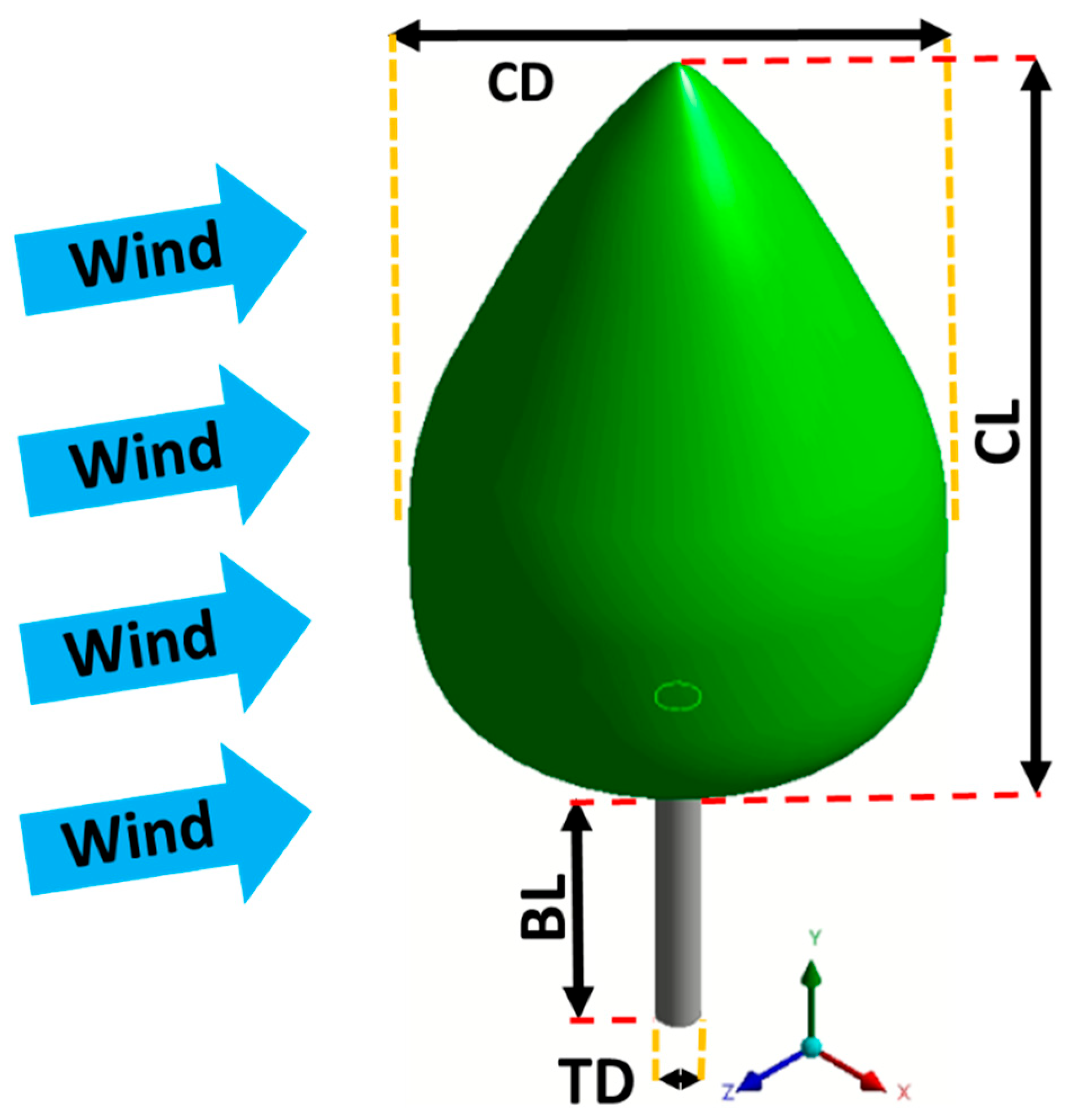
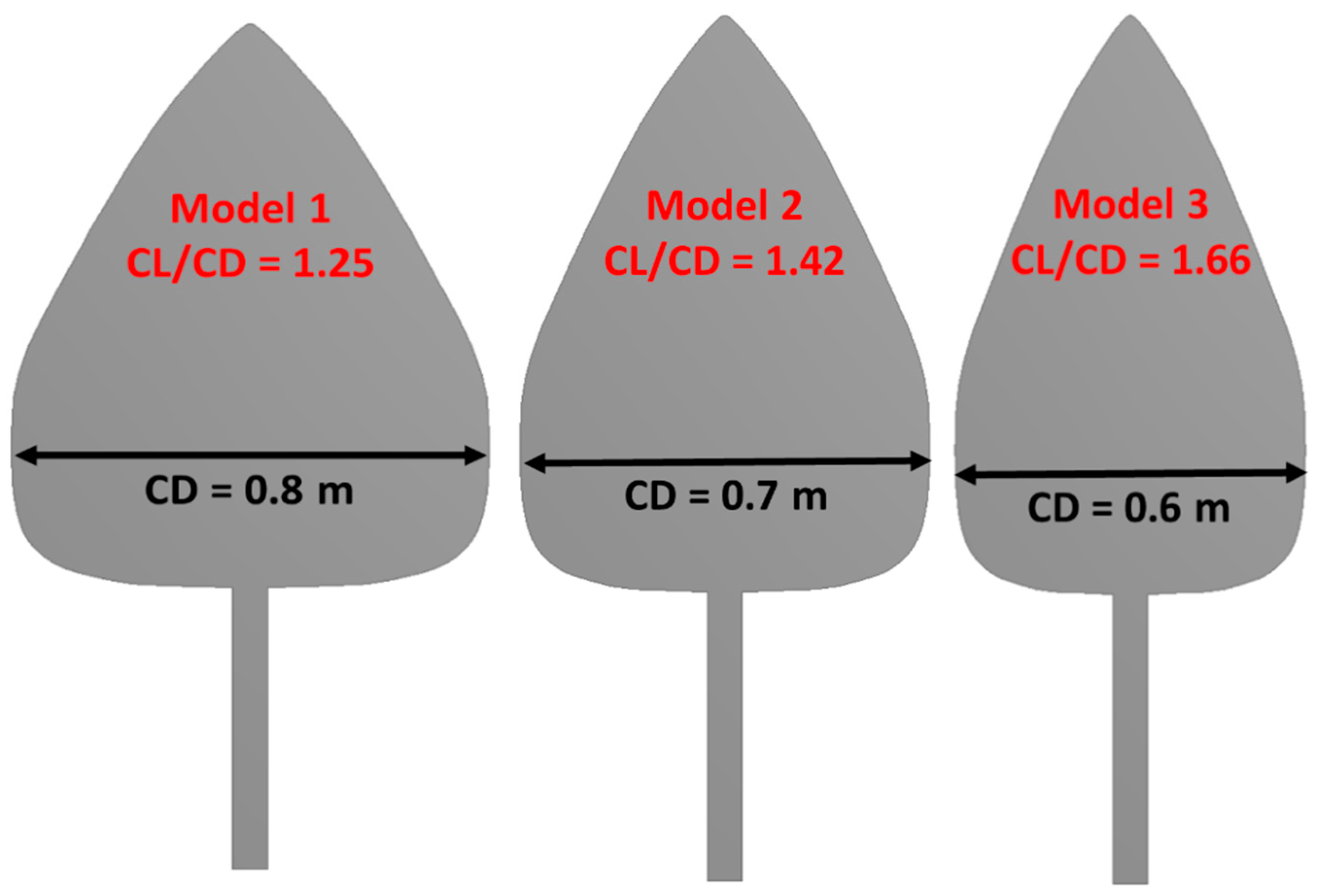
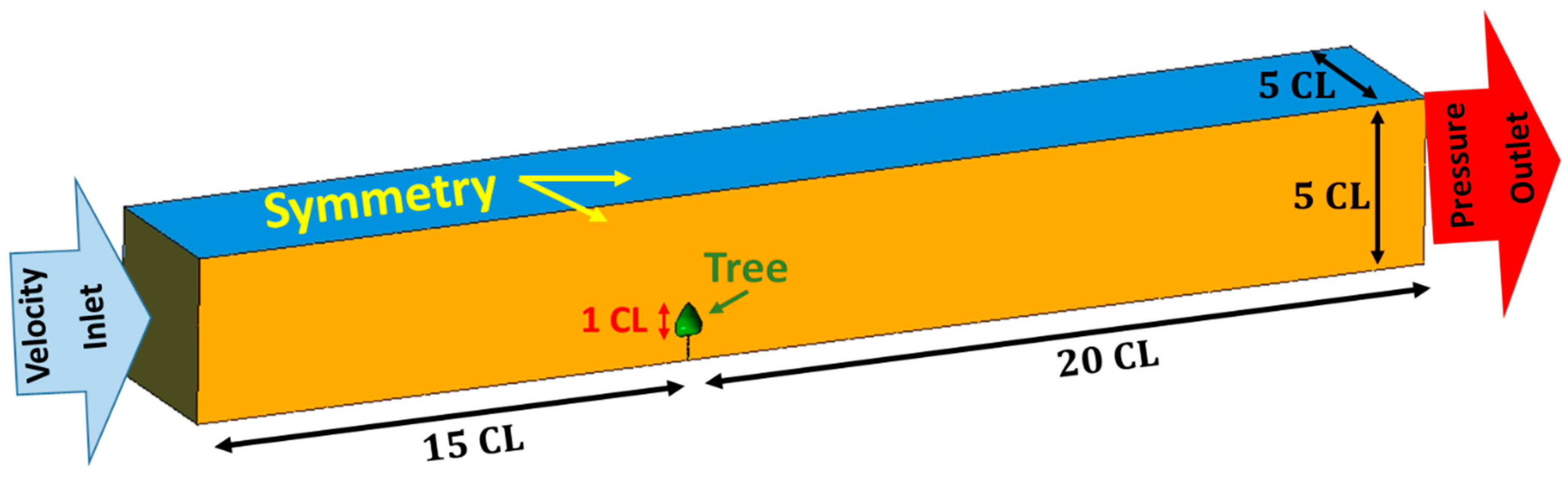
The ERCT models were developed based on measurements of natural, full-scale Eastern Red Cedar trees. Subsequently, the characteristic dimensions were selected for the numerical simulations as follows: CL = 1 m, CD = 0.7–0.8 m, BL = 0.5–1 m, and TD = 0.04–0.06 m. It should be noted that Amani-Beni et al. [1] proposed an ERECT model under a range of conditions. In the present study, a similar model was developed by varying geometric dimensions and boundary conditions. The dimensions of the model trees were determined to be similar to those of real ERCTs. Figure 1 illustrates a 3D model of an ERCT with its geometric details. The fineness ratio of CL to CD was defined at three different values (CL/CD = 1.25, 1.42, and 1.66). The ERCT ‘s CL was 1 m. Figure 2 specifies three different models: Model 1 (CL/CD = 1.25), Model 2 (CL/CD = 1.43), and Model 3 (CL/CD = 1.66). Models 1, 2, and 3 were considered to have a constant CL of 1 m, three different CDs of 0.8 m, 0.7 m, and 0.6 m, two different BLs of 0.5 m and 1.0 m, and two different TDs of 0.04 m and 0.06 m at different wind speeds ( U = 15, 18, 21, 24, 27, and 30 m/s). Table 1 highlights the dimensions of the ERCT models and the related symbols. The present research simulates 72 various case models. Table 2 describes the specifics of the computational experiments carried out in this case study. The ERCT models were analyzed as homogeneous, linear-elastic solids using effective material properties. Table 3 illustrates the properties of air and ERCTs. Figure 3 shows the conventional model of the three-dimensional computing region used to simulate a single three-dimensional solid tree model. The dimensions of the computation area were established as 5 CL in height, 35 CL in length, and 10 CL in width. The velocity input boundary situation was positioned 15 CL upstream of the ERCT model, while the pressure outflow boundary situation was situated 20 CL downstream of the ERCT model. Symmetry boundary situations were applied to the top and side zones of the 3D computational area, while a no-slip boundary situation was applied to the bottom zone. The details of the boundary conditions are listed in Table 4.

2.3. Grid Independency

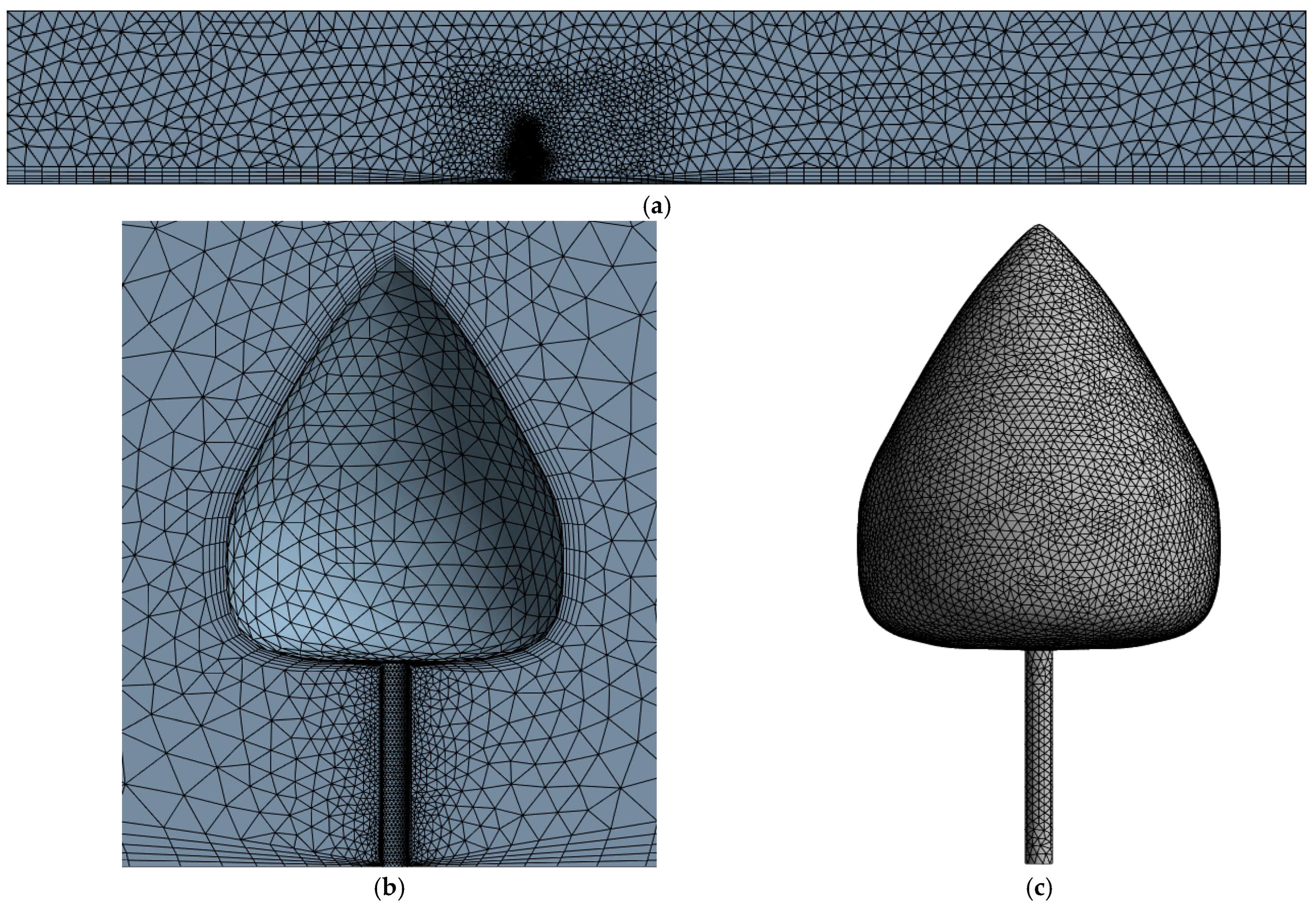
Tetrahedral and prismatic elements were utilized for meshing in the computational field, with a high amount of mesh along the walls to achieve higher accuracy. The computing solid area utilized a tetrahedral mesh. Based on the FD value for Model 1 (BL = 1 m; TD = 0.06 m) at a wind speed of 30 m/s, Table 5 shows that mesh independence tests support the accuracy of the simulations. The first-layer thickness was selected to maintain the wall coordinate y+ within the recommended range of 30–300 for the realizable k–ε turbulence model with standard wall functions. The resulting y+ values ranged from 90 to 185, confirming that the near-wall mesh resolution was appropriate for this modeling approach. Figure 4 shows that the computing fluid region used about 190,000 elements, while the solid computing area used about 740,000 components. The utilization of this number of mesh elements among all models caused an error rate of less than one percent in each simulation.

2.4. Model Verification

It is important to compare numerical results with experimental and numerical data to assess the accuracy of the numerical methods employed. In this study, the predicted drag coefficients ( C D ) for the ERCT models were validated against previously published data. First, the turbulence model used in the simulations was benchmarked against a reference experimental study. Next, the ERCT results were compared with empirically derived C D values reported in the literature. Finally, the ERCT models were built and analyzed using the same scale and boundary conditions described by Amani-Beni et al. [1] to enable a direct comparison.
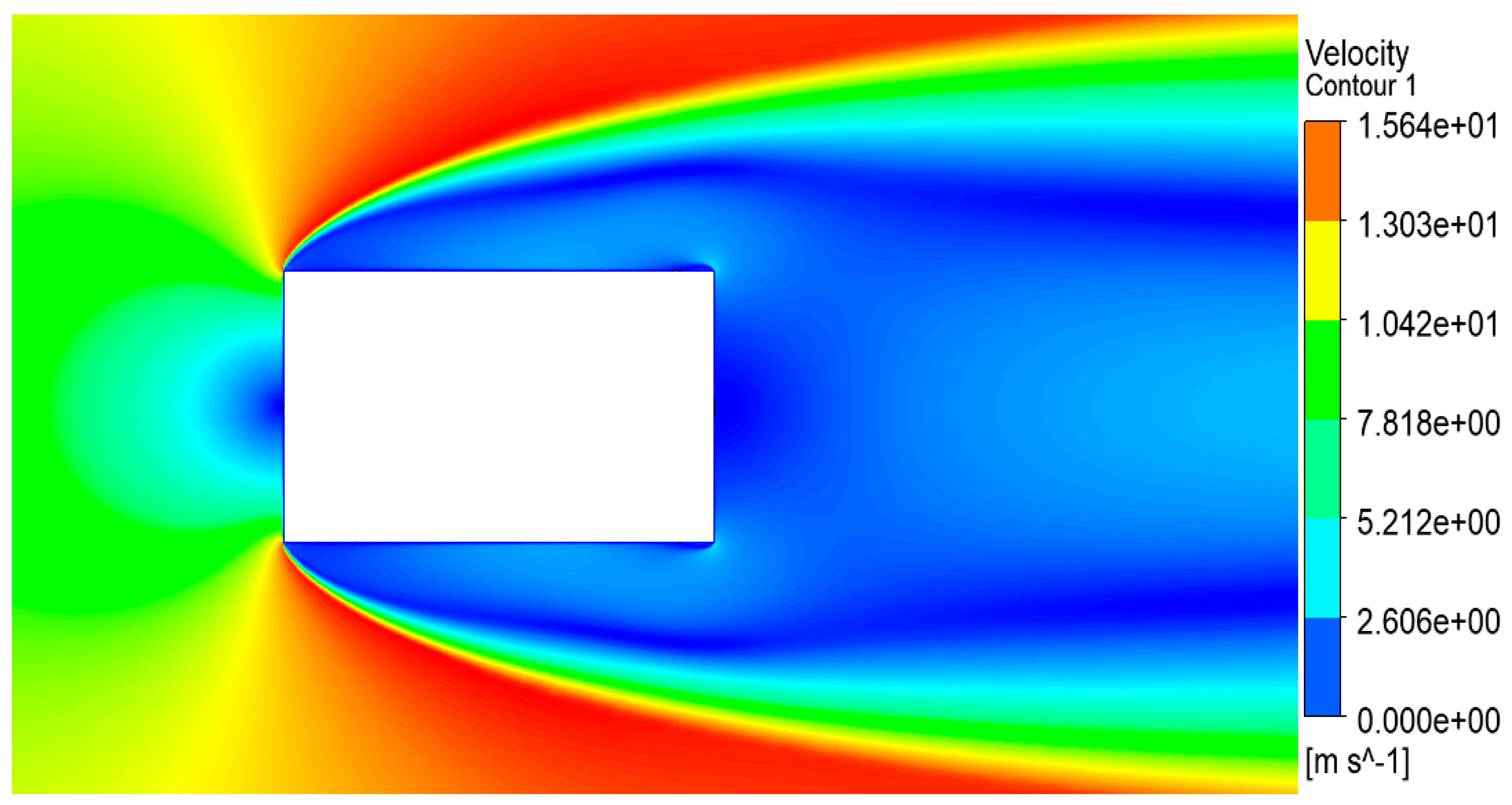
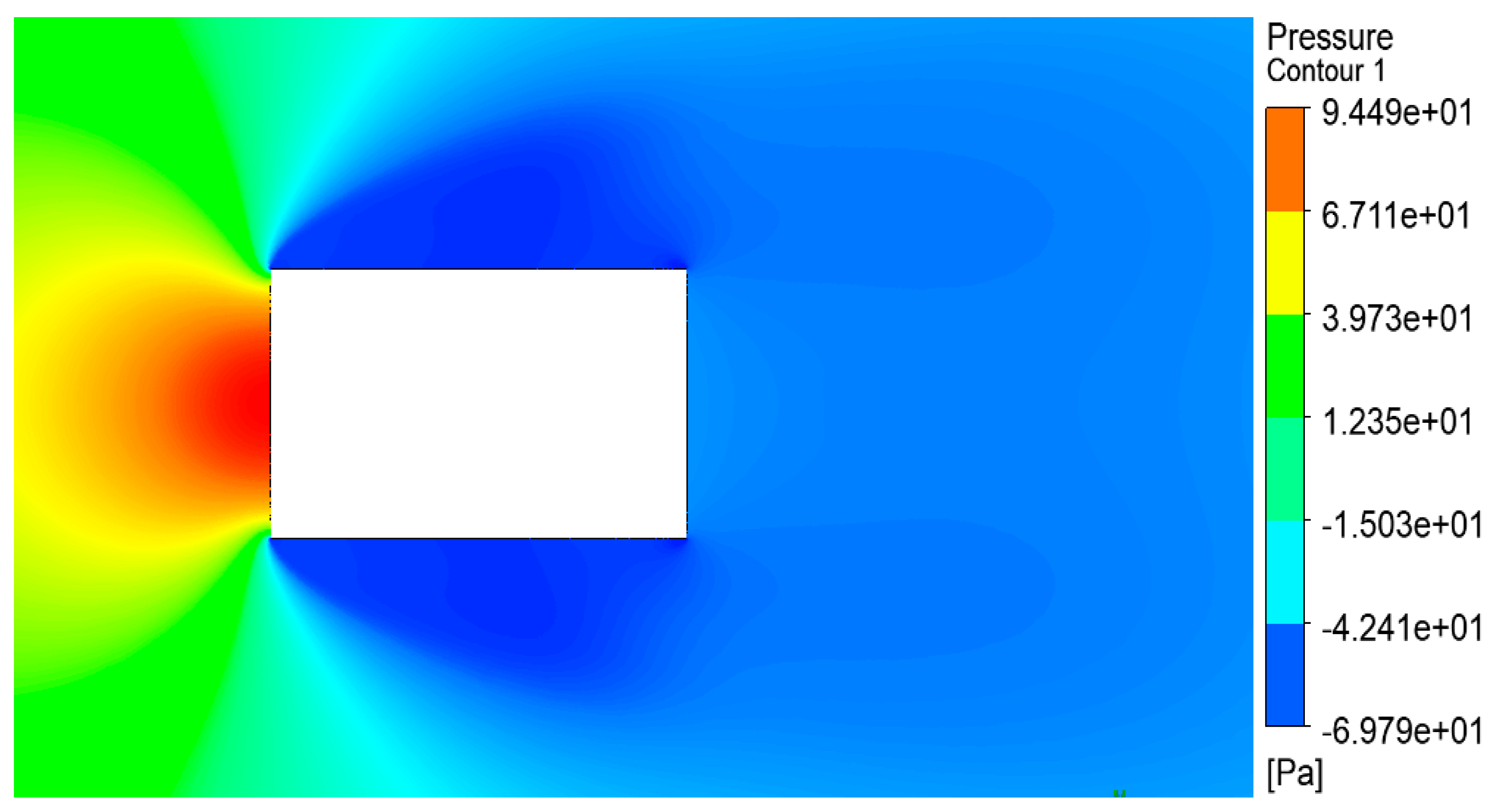
Hou and Sarkar [38] carried out an experimental aerodynamic analysis on a beam with a rectangular cross-section. The beam, measuring 1.14 m in length, 0.114 m in width, and 0.07 m in depth, was tested in a wind tunnel at a constant wind velocity of 12 m/s. Table 6 shows the comparison results of the C D , which ensures the method’s accuracy and reliability. Figure 5 and Figure 6 show the contour visualizations of velocity and pressure distributions around the beam with the rectangular cross-section.
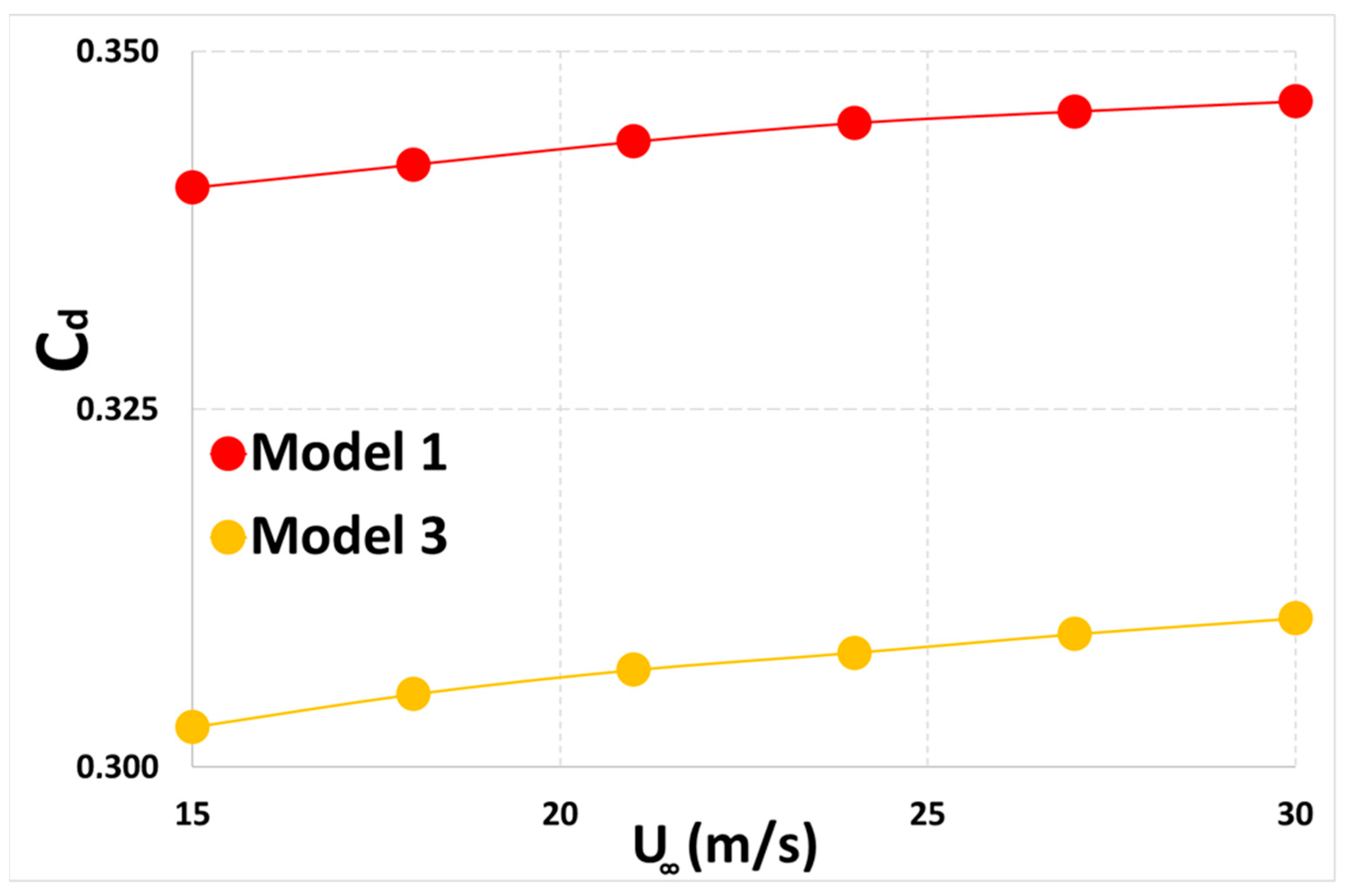
The results for drag coefficient values for trees range from 0.3 to 1.0 at a wind speed of 20 m/s and from 0.2 to 0.7 at a wind speed of 30 m/s, as cited by Cengel and Cimbala [39] by using empirically derived data. Model 1 (BL = 1 m; TD = 0.06 m) exhibited the highest C D among the models, with C D values of 0.3437 and 0.3465 at wind speeds of 20 and 30 m/s, respectively. Model 3 (BL = 0.5 m; TD = 0.04 m) demonstrated the lowest drag coefficient ( C D ) among the models, with C D values of 0.3063 and 0.3104 at wind speeds of 20 m/s and 30 m/s, respectively. Table 7 represents an examination of the C D findings from the present research and empirically derived data at wind speeds of 20 and 30 m/s. The results reveal that the CFD method can accurately predict the main aerodynamic responses, which are very close to the experimental measurements. Therefore, it can be useful for simulating flow fields and analyzing the impact of wind on its behavior.
In addition, Amani-Beni et al. [1] carried out numerical investigations at various scales for ERCT models. To evaluate the performance of the current numerical model, the tree models were sized to be comparable to those used in the study by Amani-Beni et al. [1]. Table 8 illustrates a comparison of C D results between the present study and numerical investigations at a wind speed of 20 m/s. The numerical model used to simulate tree models in this research showed C D results similar to those of the trees in reference [1].
Table 9 presents a comparison of deformation results between the present investigation and numerical calculations in [1] at a wind speed of 20 m/s. The numerical model employed to simulate trees in this research exhibited deformation findings that match those of the numerical study results [1]. The numerical methods utilized for computational simulations of tree models demonstrate strong correlations and accuracy between the present study and other research.

3. Results and Discussion

3.1. FD Study

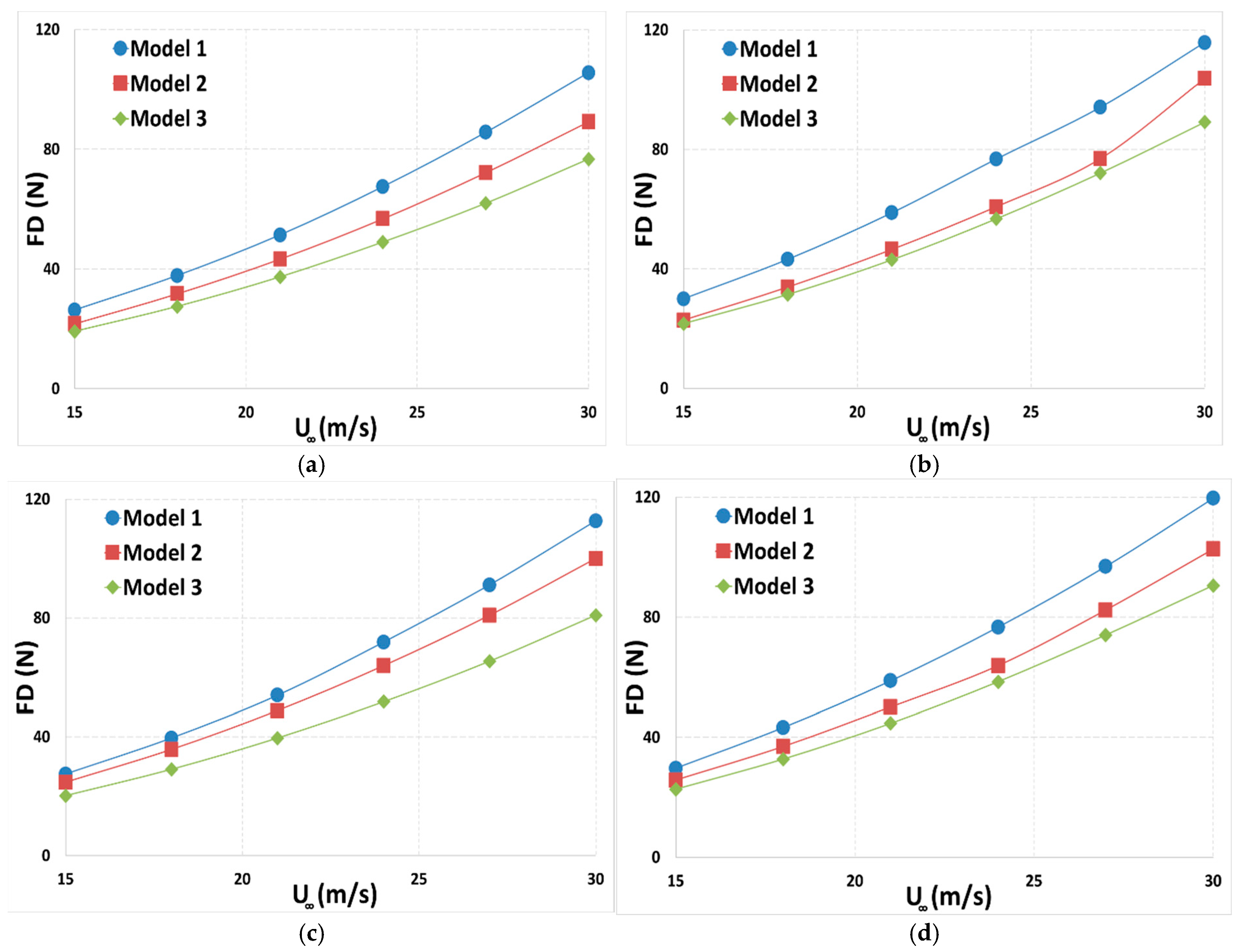
A major determinant of wind-induced tree failure is FD, the aerodynamic resistance faced by wind across the structure of a tree. To figure out how wind affects trees, researchers use computational models like CSD, CFD, and one-way FSI. By including different wind speeds, tree geometries, and material properties, these models give detailed representations of complicated canopy structures and tree sway. They provide understanding in drag-reduction techniques, failure thresholds, and structural adaptation influences. Accurate drag modeling becomes critical for risk management and sustainable vegetation planning as climate change increases the frequency of extreme wind situations. FD significantly depends on the fineness ratio of the CL to CD. Therefore, three different finesse ratios (Model 1 (CL/CD = 1.25), Model 2 (CL/CD = 1.43), and Model 3 (CL/CD = 1.66)) were investigated under various conditions. Figure 7 shows FD for three different ERCT models (Models 1, 2, and 3) at different wind speeds ( U = 15, 18, 21, 24, 27, and 30 m/s), with two different BLs of 0.5 m and 1 m and two various TDs of 0.04 m and 0.06 m. Model 1, with BL of 1 m, TD of 0.06 m, and a wind speed of 30 m/s, achieved the highest FD value of 119.6 N among the 72 numerical simulations. Conversely, Model 3, with BL of 0.5 m, TD of 0.04 m, and a wind speed of 15 m/s, achieved the smallest FD value of 19.12 N. Figure 7d illustrates that when wind speed varies from 15 m/s to 30 m/s, Models 1, 2, and 3 with BL of 1 m and TD of 0.06 m exhibit the highest FDs among other BL and TD values. On the other hand, Figure 7a shows that Models 1, 2, and 3 with BL of 0.5 m and TD of 0.04 m have the lowest FDs. In all models, FD rises with an increase in wind speed. When FDs created by the three tree models with the same bole length and trunk diameter are considered, it is determined that the FDs generated by Model 1 are greater than the FDs created by Models 2 and 3. The surface area of Model 1 facing the wind is greater than that of Models 2 and 3, which causes an increase in FD. At a wind speed of 30 m/s, the FDs of Models 1, 2, and 3 are approximately four times larger than those at 15 m/s. This is according to a comparison of FDs that occur at these two different wind speeds. At a wind speed of 30 m/s, the FD of Model 1 increases by around 32% compared with Model 3 when BL and TD are at their maximum values (BL = 1 m, TD = 0.06 m). Furthermore, at a wind speed of 30 m/s, the FD of Model 1 rises by around 38% compared with Model 3 when BL and TD are at their minimum values (BL = 0.5 m, TD = 0.04 m). It is understood that the FD is heavily influenced by TD, BL, and CD, with FD rising with the growth of TD, BL, and CD. Previous experimental and computational research, as well as the current investigation, demonstrate that trees experience higher FD when wind speed rises. The results also indicated that tree size influence the values of FD, which rises with increasing tree volume.

3.2. C D Study

Among the configurations considered, Model 1 (BL = 1 m; TD = 0.06 m) exhibited the maximum FD at each tested wind speed ( U = 15–30 m/s). Furthermore, Model 1 (BL = 1 m; TD = 0.06 m) had the highest C D at each investigated wind speed ( U = 15–30 m/s). Model 3 (BL = 0.5 m; TD = 0.04 m) experienced the lowest FD values across all examined wind speeds ( U = 15–30 m/s). Furthermore, Model 3 (BL = 0.5 m; TD = 0.04 m) exhibited the lowest C D over all studied wind speeds ( U = 15–30 m/s). Figure 8 illustrates the variation of C D with wind speed for Models 1 and 2. Among the 72 computational simulations, Model 1 (BL = 1 m; TD = 0.06 m) at U = 30 m/s had the largest C D of 0.3465. Conversely, Model 3, with BL of 0.5 m, TD of 0.04 m, and a wind speed of 15 m/s, reached the lowest C D value of 0.3028. The surface area of the ERCT models and wind speed significantly influence these results. In general, increases in both parameters are associated with higher C D s . As TD, BL, and C D increase, the surface area exposed to the wind also increases. Consequently, FD and C D are expected to increase. This increase occurs because both skin friction and pressure drag rise.

3.3. Deformation Study

Deformation helps identify the most flexible, and thus most critical, configurations as wind speed increases, offering clear explanations of how geometric parameters influence overall stability.
One can numerically calculate the total deformation of a 3D, bendable, rigid structure. By applying Equation (9), one can calculate the total deformation.
U = U x 2 + U y 2 + U z 2
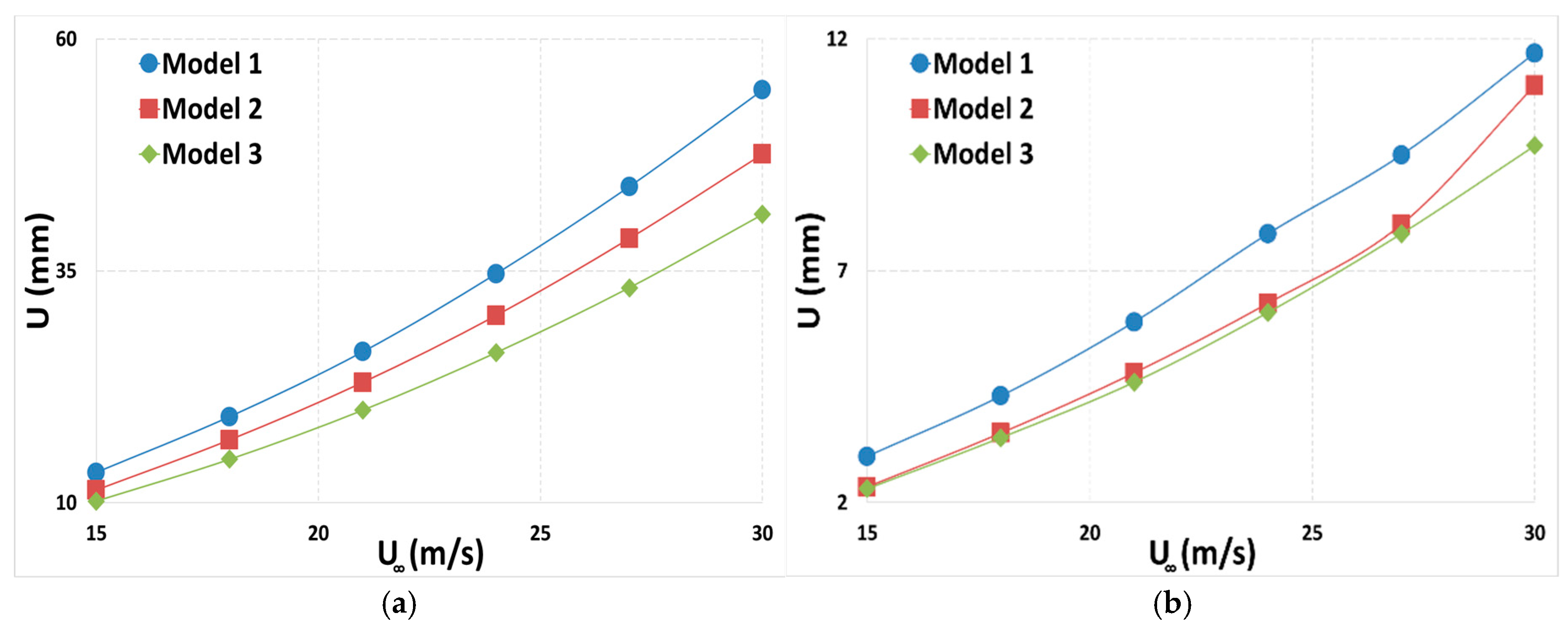
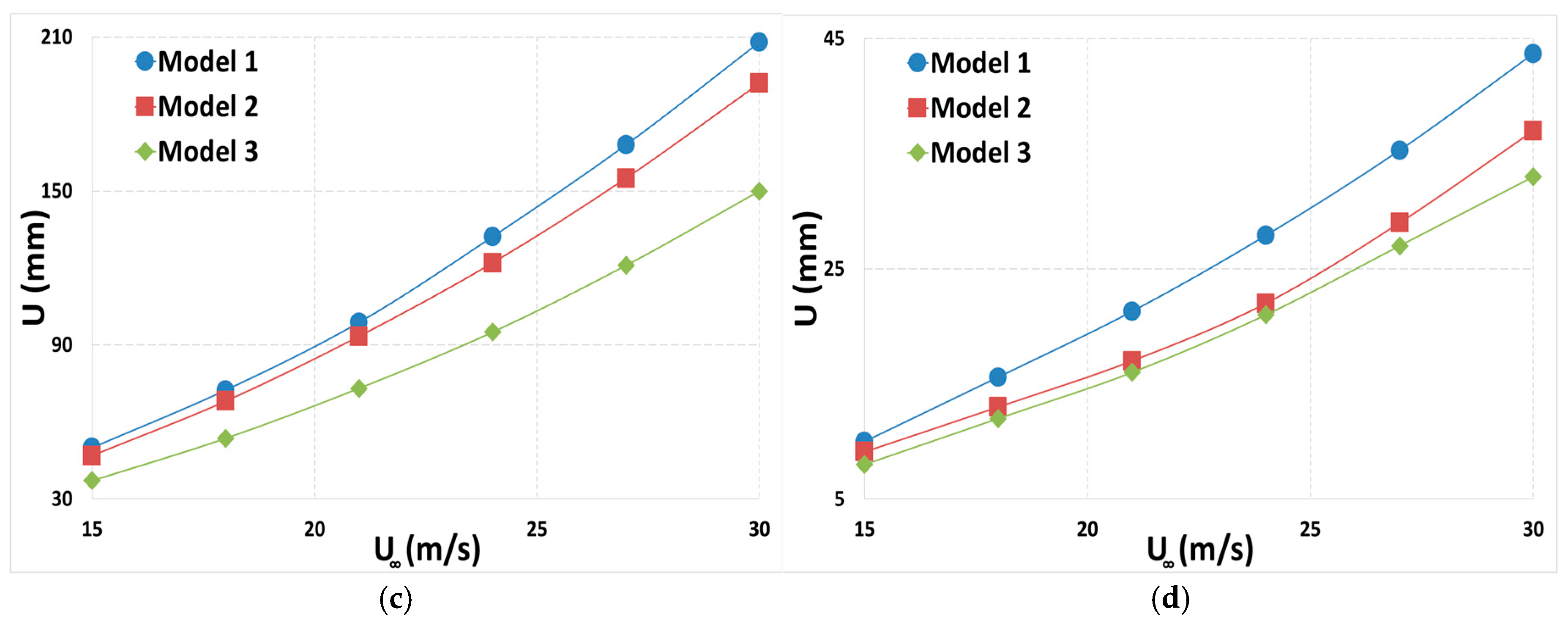
In trees, increasing wind speed increases aerodynamic forces, which causes increased deformation. At lower speeds, trees bend their trunks and branches elastically. Numerical modeling methods, including CSD, CFD, and one-way FSI, allow researchers to explore how variations in tree flexibility, wind speed, and canopy structure affect stress distribution and failure points, thereby clarifying these complex responses. Figure 9 displays the maximum deformation in shape of three different ERCT models, named 1, 2, and 3, when exposed to different wind speeds ( U = 15, 18, 21, 24, 27, and 30 m/s). The ERCT models have two different BLs of 0.5 m and 1 m and two various TDs of 0.04 m and 0.06 m. Among the 72 numerical simulations, Model 1, with BL of 1 m, TD of 0.04 m, and a wind speed of 30 m/s, achieved the greatest deformation value of 208 mm. On the other hand, Model 3 obtained the lowest deformation value of 2.3 mm with BL of 0.5 m, TD of 0.06 m, and a wind speed of 15 m/s. Models 1, 2, and 3 with BL of 1 m and TD of 0.04 m show the greatest deformations among all BL and TD values when wind speed changes between 15 m/s and 30 m/s, as shown in Figure 9c. However, Models 1, 2, and 3 with BL of 0.5 m and TD of 0.06 m have the smallest amount of deformation, as seen in Figure 9b. Wind speed, tree fineness ratio, bole length, and trunk diameter all have significant impacts on the maximum deformation value. In all tree models, maximum deformation value increases as wind speed increases due to increased FD acting on the tree. Maximum deformation value also rises with increasing bole length. Furthermore, maximum deformation value increases as the fineness ratio and trunk diameter reduce. Model 1 demonstrates the greatest deformation value when BL is 1 m and TD is 0.04 m at a wind speed of 30 m/s among all case studies. Conversely, Model 3 exhibits the smallest deformation value, with BL at 0.5 m and TD at 0.06 m at a wind speed of 15 m/s across all case studies. The maximum deformation amount of Model 1 increases by about 38% compared with Model 3 when BL is 1 m and TD is 0.04 m at a wind speed of 30 m/s. When BL is 0.5 m and TD is 0.06 m at a wind speed of 30 m/s, the maximum amount of deformation for Model 1 is approximately 20% higher than that of Model 3. The maximum deformation values of Model 1 at BL of 1 m and TD of 0.04 m is approximately four times larger than that at BL of 0.5 m and TD of 0.04 m when wind speed changes from 15 m/s to 30 m/s. The research results reveal how changing wind speed, tree fineness ratio, BL, and TD dramatically affect maximum deformation. Prior research, including both experimental and numerical studies, along with the current study, have shown that tree deformation increases with increasing wind speed. The experiments revealed that TD significantly influences tree displacement, with deformation increasing as TD decreases. It is important to note that maximum FD and maximum deformation occur under different conditions because they are governed by distinct mechanisms. FD is primarily driven by aerodynamic blockage and the resulting pressure loading, which generally increase with larger TD. In contrast, deformation is mainly controlled by structural stiffness; reducing TD markedly decreases stiffness and increases flexibility. Therefore, configurations with smaller TD values can exhibit greater deformation even when the corresponding drag force is not maximal.

3.4. Stress and Strain Studies

Stress was evaluated to quantify the internal load demand induced by aerodynamic forces and to identify critical regions where failure is most likely to initiate. Reporting stress is essential for structural safety assessment because it reveals how strong winds may adversely affect potentially vulnerable configurations, even when global aerodynamic loads appear comparable.
The von Mises stress can be mathematically calculated in a 3D bendable solid body. Equation (10) is employed to determine the von Mises stress.
σ e = σ 1 σ 2 2 + σ 2 σ 3 2 + σ 3 σ 1 2 2 1 / 2
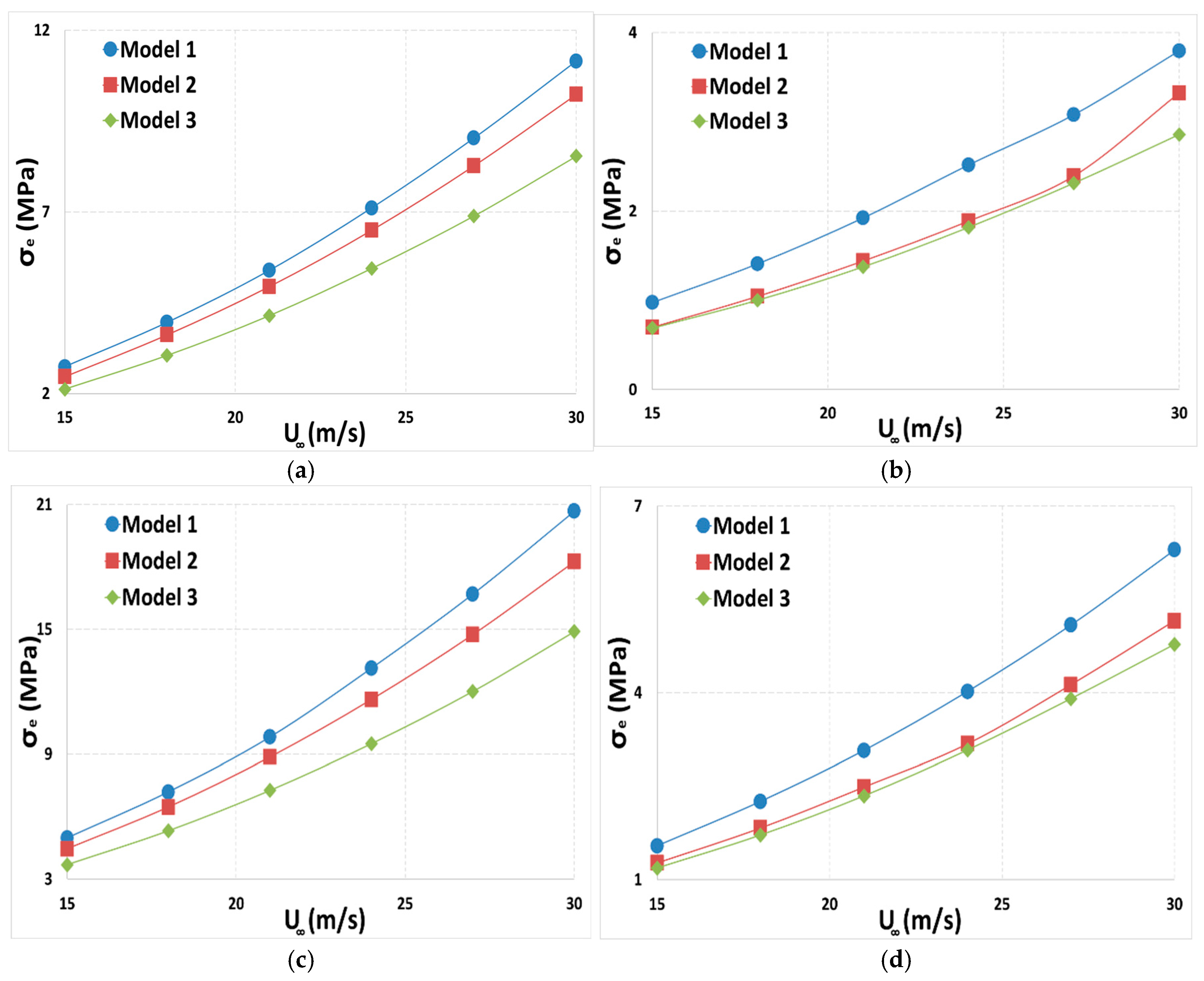
Figure 10 illustrates the maximum von Mises stress for three distinct ERCT models (Models 1, 2, and 3) at varying wind velocities ( U = 15, 18, 21, 24, 27, and 30 m/s), with BLs (BL = 0.5 m and 1 m) and TDs (TD = 0.04 m and 0.06 m). Based on 72 numerical runs, Model 1, with BL of 1 m, TD of 0.04 m, and a wind speed of 30 m/s, achieved the highest von Mises stress value of 20.68 MPa. On the other hand, with BL of 0.5 m, TD of 0.06 m, and a wind speed of 15 m/s, Model 3 achieved the lowest von Mises stress value of 0.69 MPa. Figure 10c illustrates that Models 1, 2, and 3 with BL of 1 m and TD of 0.04 m have the highest von Mises stress values when wind speed changes from 15 m/s to 30 m/s. However, Figure 10b shows that Models 1, 2, and 3 with BL of 0.5 m and TD of 0.06 m have the lowest von Mises stress values when compared with other values of BL and TD. In Models 1, 2, and 3, the maximum von Mises stress increases as wind speed increases due to increased FD acting on the tree. The maximum value of von Mises stress reduces as trunk diameter increases. Model 1 displays the highest von Mises stress value when BL is 1 m and TD is 0.04 m at a wind speed of 30 m/s across all case studies. On the other hand, Model 3 demonstrates the lowest von Mises stress value, with BL of 0.5 m and TD of 0.06 m at a wind speed of 15 m/s across all case studies. The maximum von Mises stress value for Model 1 increases by nearly 38 percent in comparison to Model 3 when BL is 1 m and TD is 0.04 m with a wind speed ranging from 15 m/s to 30 m/s. When the wind speed increases from 15 m/s to 30 m/s, the maximum von Mises stress of Model 1 at BL of 1 m and TD of 0.04 m is nearly two times bigger than that of Model 1 at BL of 0.5 m and TD of 0.04 m. The maximum von Mises stress of Model 1 at BL of 1 m and TD of 0.04 m are about five times larger than those of Model 1 at BL of 0.5 m and TD of 0.06 m when wind speeds vary from 15 m/s to 30 m/s. These results show that variations in wind speed, tree fineness ratio, BL, and TD can significantly affect the maximum value of von Mises stress.
One can mathematically compute the equivalent strain in a three-dimensional deformable solid body. Equation (11) is used to determine the equivalent strain.
ε e = 1 1 + υ 1 2 ε 1 ε 2 2 + ε 2 ε 3 2 + ε 3 ε 1 2 1 2
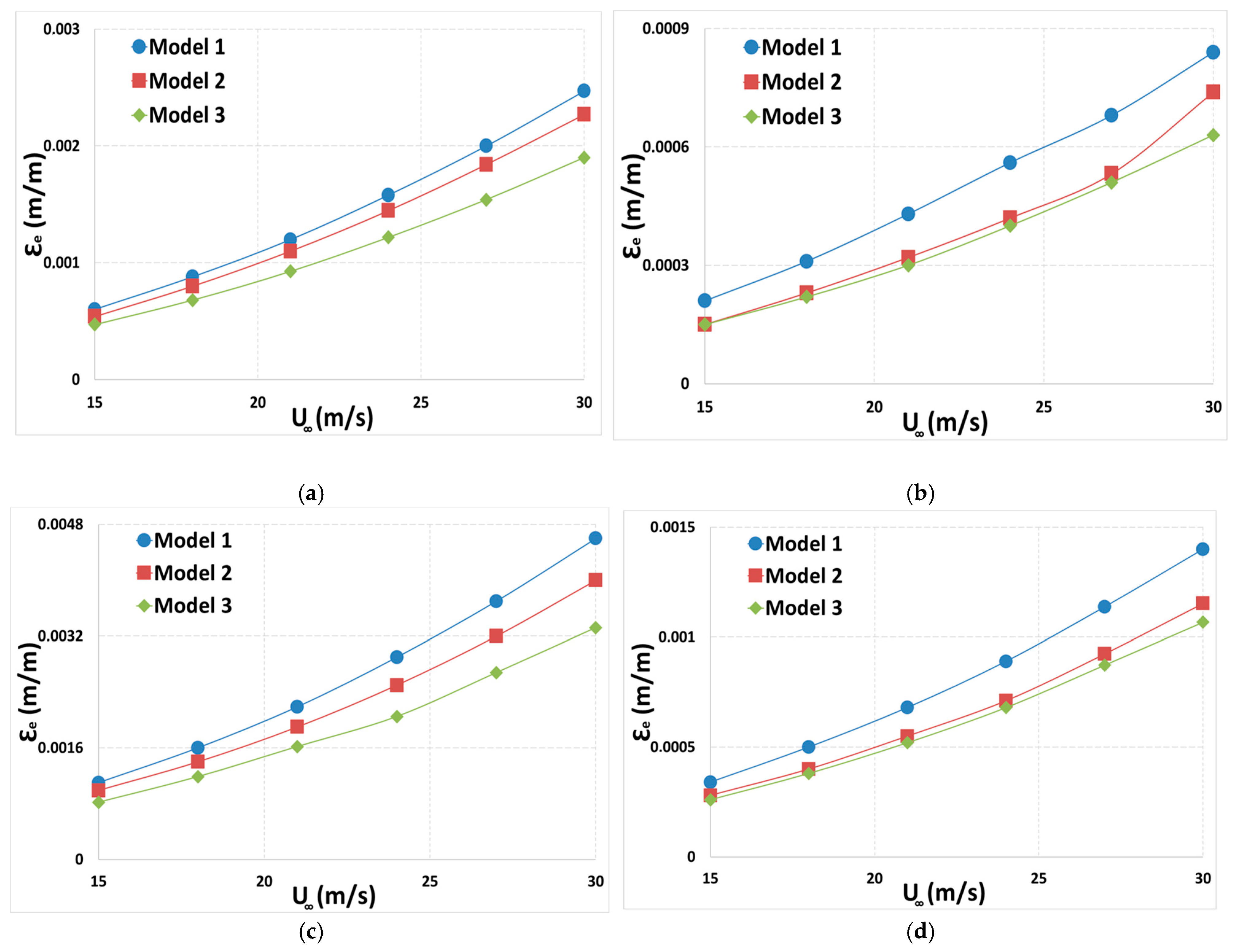
Figure 11 presents the highest equivalent strain value for three different ERCT models (Models 1, 2, and 3) with BLs, (BL = 0.5 m and 1 m), TDs (TD = 0.04 m and 0.06 m), and wind speeds ( U = 15, 18, 21, 24, 27, and 30 m/s). Among the 72 numerical simulations, Model 1, with BL of 1 m, TD of 0.04 m, and a wind speed of 30 m/s, achieved the highest equivalent strain value of 0.0046 m/m. On the other hand, Model 3, with BL of 0.5 m, TD of 0.06 m, and a wind speed of 15 m/s, achieved the lowest equivalent strain value of 0.00015 m/m. When the wind speed increases from 15 m/s to 30 m/s, Models 1, 2, and 3 with BL of 1 m and TD of 0.04 m have the biggest equivalent strain values, as illustrated in Figure 11c. Figure 11b, on the other hand, shows that when BL and TD are changed, Models 1, 2, and 3 with BL of 0.5 m and TD of 0.06 m have the lowest equivalent strain values. In Models 1, 2, and 3, the biggest equivalent strain increases with rising wind speed, caused by the increased deformation of the ERCT models. FD represents the external aerodynamic load imposed by the wind, whereas deformation, stress, and strain quantify the resulting structural response. In general, higher drag increases bending demand, leading to larger displacements and elevated stress–strain levels. However, the magnitude of the response also depends strongly on structural stiffness and geometry; therefore, these structural measures offer vital information beyond global FD alone.

3.5. Deformation, Velocity, and Pressure Contour Visualizations of the Computational Study

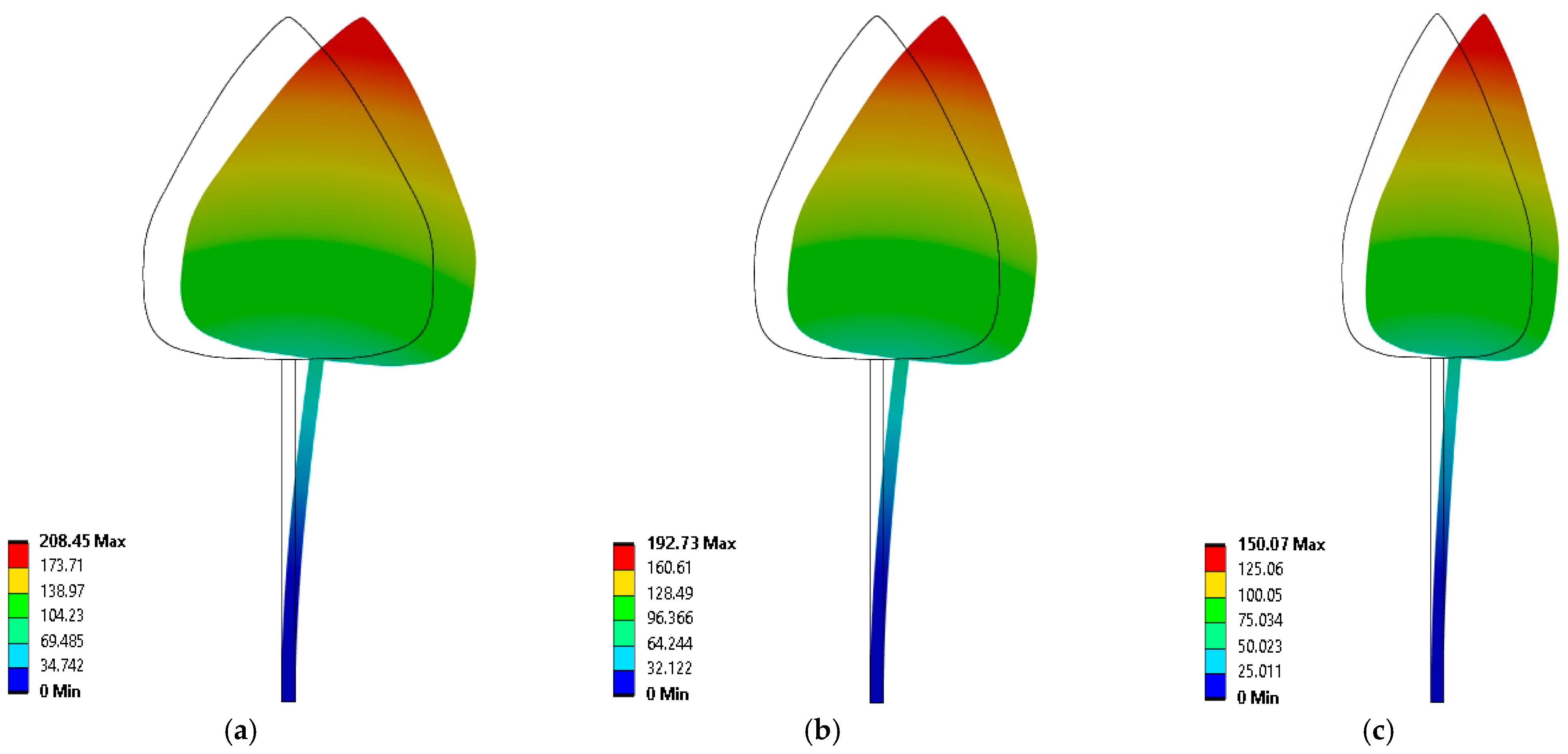
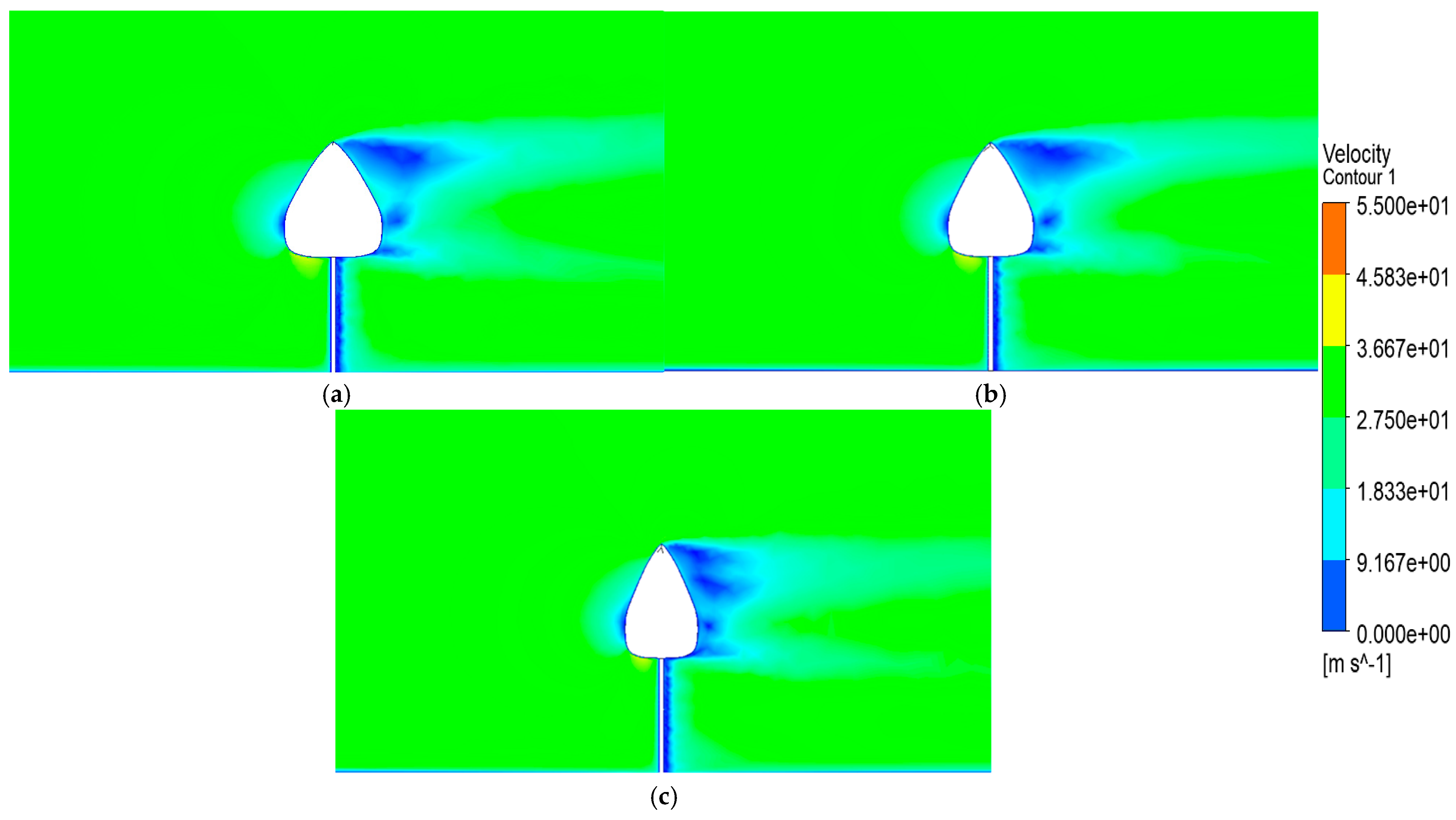
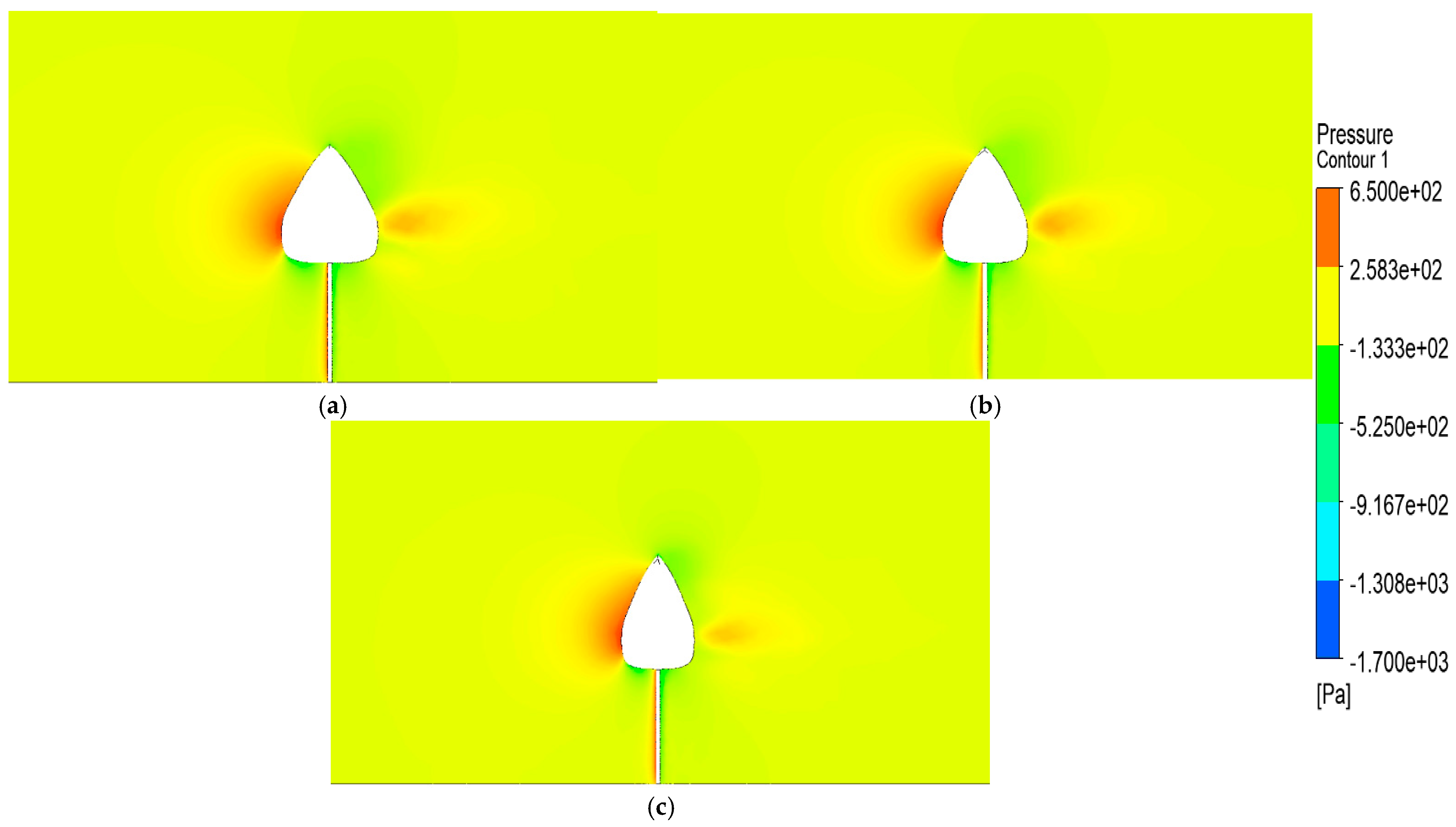
Computational simulations clearly show that total deformation increases greatly with both rising wind speed and BL. This agrees with aerodynamic principles, which posit that FD—proportional to the square of wind speed—imposes more physical pressure on taller or more exposed objects. At a wind speed of 30 m/s, Models 1, 2, and 3 with BL of 1 m and TD of 0.04 m experience the highest deformation. Figure 12 displays contour visualizations of deformed shapes in tree models with BL of 1 m and TD of 0.04 m at a wind speed of 30 m/s. The maximum deformation occurs in Model 1, with a fineness ratio of CL/CD = 1.25. Model 1 experiences a greater pressure magnitude than Models 2 and 3 because Model 1 has a larger surface area facing the wind than Models 2 and 3. Figure 13 shows velocity distribution contour visualizations around tree models with BL of 1 m and TD of 0.04 m at a wind speed of 30 m/s. The front surfaces of all tree models experience the lowest velocities because the front of trees have the highest pressure. These areas often display the lowest velocity values, creating a stagnation zone resulting from the buildup of high air pressure as the arriving wind is forced to slow down and move around the obstacle. The generation of FD and the starting point of structural reactions in the tree depend on the development of this high-pressure region. The contour visualizations of the pressure distribution surrounding tree models with BL of 1 m and TD of 0.04 m at a wind speed of 30 m/s are represented in Figure 14. The frontal surfaces of the trees bear the maximum pressure because the front surfaces experience a large value of wind. This region quickly opposes the entering wind, producing a high-pressure zone that results in wind slowing and stagnation. This higher pressure is a main cause of structural stress and deformation in the tree and significantly impacts the total FD experienced by the tree. The regions behind the tree models have the minimum pressure. It was also realized from the contour visualizations that Model 1, with a larger surface area, has the maximum deformation among the models due to Model 1 experiencing a large amount of pressure on the surface.

4. Conclusions

A solitary 3D ERCT model was numerically solved under wind loading for distinct body dimensions. Models 1, 2, and 3 were introduced with different fineness ratios of CL to CD at wind speeds ranging from 15 m/s to 30 m/s while varying BLs (BL = 0.5 m and 1 m) and TDs (TD = 0.04 m and 0.06 m). The computational fluid region and the computational solid area were integrated utilizing a one-way FSI technique. FD, velocity distribution, and pressure distribution from the computational fluid region and deformation, as well as the maximum stress and strain from the computational solid area, were measured for ERCT Models 1, 2, and 3 using different wind speeds and geometrical parameters. A summary of the results is presented below.
(a)
As wind speed increased, ERCT models experienced increased FD, C D , deformation, stress, and strain.
(b)
The geometric characteristics of ERCT models greatly influenced FD, C D , deformation, stress, and strain.
(c)
A drop in the fineness ratio, combined with an increase in BL and TD, caused an increase in FD.
(d)
Increasing FD causes an increase in the ERCT models.
(e)
Increasing the fineness ratio while reducing BL and TD caused a decrease in FD.
(f)
A decrease in fineness ratio and TD resulted in increased deformation, whereas an increase in fineness ratio and TD resulted in decreased deformation.
(g)
Across the 72 computational cases, the maximum FD and C D were obtained for Model 1 (BL = 1 m; TD = 0.06 m) at U = 30   m /s, reaching 119.6 N and 0.3465, respectively.
(h)
The maximum deformation (208 mm) occurred at U = 30   m /s for Model 1 with BL = 1 m and TD = 0.04 m.
(i)
The results confirm a clear link between aerodynamic loading and ERCT model response: increases in FD generally intensified bending effects, resulting in greater deformation and elevated stress and strain. However, the structural response did not scale solely with FD, as geometric dimensions—particularly TD and BL—played a governing role in determining peak deformation and stress.
The obtained data can determine the optimal selection and positioning of live trees in urban environments to reduce wind speed, thereby creating a more comfortable atmosphere for residents. Future studies can investigate aerodynamic forces in multi-tree windbreak arrangements by changing tree spacing and the number of rows.

Author Contributions

Conceptualization, A.A. and M.T.M.; methodology, A.A. and M.T.M.; software, A.A. and M.T.M.; validation, A.A. and M.T.M.; investigation, A.A. and M.T.M.; data curation, A.A. and M.T.M.; writing—original draft preparation, A.A. and M.T.M. All authors have read and agreed to the published version of the manuscript.

Funding

This research received no external funding.

Data Availability Statement

The original contributions presented in the study are included in the article, further inquiries can be directed to the corresponding author.

Conflicts of Interest

The authors declare no conflicts of interest.

Nomenclature

Areference area (m2)
BLbole length (m)
CDcanopy diameter (m)
CLcrown length (m)
CFDcomputational fluid dynamics
CSDcomputational structural dynamics
C D drag coefficient
ERCTEastern Red Cedar tree
FDdrag force (N)
F D p r e s s u r e pressure drag (N)
F D v i s c o u s viscous drag (N)
FSIfluid structure interaction
G k turbulent kinetic energy generation (m2/s3)
Kturbulent kinetic energy (m2/s2)
Ppressure (Pa)
Sisource term for the momentum equation ( k g / ( m 2   s 2 ) )
TDtrunk diameter (m)
U wind speed (m/s)
ρ density (kg/m3)
u i , u j velocity component (m/s)
Ux, Uy, Uzdeformation components in the x, y, and z directions (m)
y+dimensionless distance from the cell center to the nearest ERCT surface
[M]structural mass matrix
[C]structural damping matrix
[K]structural stiffness matrix
F load vector
u ¨ nodal acceleration vector
u ˙ nodal velocity vector
u nodal displacement vector
Greek letters
μ dynamic viscosity (kg/m.s)
υ effective Poisson’s ratio.
ɛrate of dissipation (m2 /s3)
τwall shear stress (kg/(m·s2))
σ 1 , σ 2 , σ 3 stress states components in the x, y, and z axes (MPa)
ε 1 ,   ε 2 ,   ε 3 strain components in the x, y, and z directions (mm/mm)

References

  1. Amani-Beni, M.; Tabatabaei Malazi, M.; Dehghanian, K.; Dehghanifarsani, L. Investigating the effects of wind loading on three-dimensional tree models using numerical simulation with implications for urban design. Sci. Rep. 2023, 13, 7277. [Google Scholar] [CrossRef] [PubMed]
  2. Hong, S.W.; Zhao, L.; Zhu, H. CFD simulation of airflow inside tree canopies discharged from air-assisted sprayers. Comput. Electron. Agric. 2018, 149, 121–132. [Google Scholar] [CrossRef]
  3. Yuan, W.; Zhu, N.; Zhang, L.; Tong, R.; Miao, Y.; Zhou, F.; Wang, G.G.; Wu, T. Three-dimensional aerodynamic structure estimation and wind field simulation for wide tree shelterbelts. For. Ecol. Manag. 2024, 559, 121813. [Google Scholar] [CrossRef]
  4. Hao, Y.; Kopp, G.A.; Wu, C.H.; Gillmeier, S. A wind tunnel study of the aerodynamic characteristics of a scaled, aeroelastic, model tree. J. Wind Eng. Ind. Aerodyn. 2020, 197, 104088. [Google Scholar] [CrossRef]
  5. Li, Z.; Hao, Y.; Kopp, G.A.; Wu, C.H. Identification of multimodal dynamic characteristics of a decurrent tree with application to a model-scale wind tunnel study. Appl. Sci. 2022, 12, 7432. [Google Scholar] [CrossRef]
  6. Dellwik, E.; van der Laan, M.P.; Angelou, N.; Mann, J.; Sogachev, A. Observed and modeled near-wake flow behind a solitary tree. Agric. For. Meteorol. 2019, 265, 78–87. [Google Scholar] [CrossRef]
  7. Angelou, N.; Dellwik, E.; Mann, J. Wind load estimation on an open-grown European oak tree. Forestry 2019, 92, 381–392. [Google Scholar] [CrossRef]
  8. Bekkers, C.C.A.; Angelou, N.; Dellwik, E. Drag coefficient and frontal area of a solitary mature tree. J. Wind Eng. Ind. Aerodyn. 2022, 220, 104854. [Google Scholar] [CrossRef]
  9. Angelou, N.; Gardiner, B.; Dellwik, E. Mean and maximum two dimensional wind force on an open-grown tree. J. Wind Eng. Ind. Aerodyn. 2025, 257, 105966. [Google Scholar] [CrossRef]
  10. Miri, A.; Webb, N.P. Characterizing the spatial variations of wind velocity and turbulence intensity around a single Tamarix tree. Geomorphology 2022, 414, 108382. [Google Scholar] [CrossRef]
  11. Manickathana, L.; Defraeyea, T.; Allegrinia, J.; Deromeb, D.; Carmelieta, J. Comparative study of flow field and drag coefficient of model and small natural trees in a wind tunnel. Urban For. Urban Green. 2018, 35, 230–239. [Google Scholar] [CrossRef]
  12. Lai, C.; Xiao, B.; Feng, J.; Wang, L.; Zhang, Y.; Sun, Y.; Chen, X.; Guo, W. Crown feature effect evaluation on wind load for evergreen species based on laser scanning and wind tunnel experiments. Sci. Rep. 2022, 12, 21475. [Google Scholar] [CrossRef]
  13. Kazemian, M.; Lavassani, S.H.H. One-way FSI coupling with steady-state and transient CFD analysis for the umbrella form of tensile membrane structure. Arab. J. Sci. Eng. 2025, 50, 1457–1475. [Google Scholar] [CrossRef]
  14. Chimakurthi, S.K.; Reuss, S.; Tooley, M.; Scampoli, S. ANSYS workbench system coupling: A state-of-the-art computational framework for analyzing multiphysics problems. Eng. Comput. 2017, 34, 385–411. [Google Scholar] [CrossRef]
  15. Zeng, F.; Lei, C.; Liu, J.; Niu, J.; Gao, N. CFD Simulation of the Drag Effect of Urban Trees: Source Term Modification Method Revisited at the Tree Scale. Sustain. Cities Soc. 2020, 56, 102079. [Google Scholar] [CrossRef]
  16. Ren, X.; Zhang, G.; Chen, Z.; Zhu, J. The Influence of Wind-Induced Response in Urban Trees on the Surrounding Flow Field. Atmosphere 2023, 14, 1010. [Google Scholar] [CrossRef]
  17. Tabatabaei Malazi, M.; Eren, E.T.; Luo, J.; Mi, S.; Temir, G. Three-dimensional fluid–structure interaction case study on elastic beam. J. Mar. Sci. Eng. 2020, 8, 714. [Google Scholar] [CrossRef]
  18. Tabatabaei Malazi, M.; Aksoy, M.H.; Okbaz, A.A. An investigation on fluid-structure interaction of two tandem rectangular cylinders. Appl. Eng. Lett. 2023, 8, 158–166. [Google Scholar] [CrossRef]
  19. Vivaldi, D. An assessment of CFD-scale fluid–structure interaction simulations through comprehensive experimental data in cross-flow. Comput. Fluids 2024, 278, 106303. [Google Scholar] [CrossRef]
  20. Ghelardi, S.; Freda, A.; Rizzo, C.M.; Villa, D. A fluid structure interaction case study on a square sail in a wind tunnel. Ocean. Eng. 2018, 163, 136–147. [Google Scholar] [CrossRef]
  21. Liu, Z.G.; Liu, Y.; Lu, J. Fluid-structure interaction of single cylinder in axial flow. Comput. Fluids 2012, 56, 143–151. [Google Scholar] [CrossRef]
  22. Wang, C.; Sun, M.; Shankar, S.; Xing, S.; Zhang, L. CFD Simulation of vortex induced vibration for FRP composite riser with different modeling methods. Appl. Sci. 2018, 8, 684. [Google Scholar] [CrossRef]
  23. Hassani, M.; Mureithi, N.W.; Gosselin, F.P. Large coupled bending and torsional deformation of an elastic rod subjected to fluid flow. J. Fluids Struct. 2016, 62, 367–383. [Google Scholar] [CrossRef]
  24. Kormas, A.; Prospathopoulos, J.M.; Chaviaropoulos, P.K.; Yakinthos, K. Wind flow simulation over forested areas using a 3D RANS solver with a tree-scale approach. J. Wind Eng. Ind. Aerodyn. 2016, 155, 149–158. [Google Scholar] [CrossRef]
  25. Kubilay, A.; Rubin, A.; Derome, D.; Carmeliet, J. Wind-comfort assessment in cities undergoing densification with high-rise buildings remediated by urban trees. J. Wind Eng. Ind. Aerodyn. 2024, 249, 105721. [Google Scholar] [CrossRef]
  26. Mun, D.S.; Kang, G.; Yang, M.; Kim, J.J. How trees’ drag and cooling effects influence airflow and temperature distributions around a street canyon. Build. Environ. 2024, 264, 111913. [Google Scholar] [CrossRef]
  27. Wijesooriya, K.; Mohotti, D.; Amin, A.; Chauhan, K. Comparison between an uncoupled one-way and two-way fluid structure interaction simulation on a super-tall slender structure. Eng. Struct. 2021, 229, 111636. [Google Scholar] [CrossRef]
  28. Zhang, Q.; Li, J.; Lu, H.; Zou, H.; Li, K.; Liang, Y.; Yang, B.; Liu, J. TH-MuSiC: A high-performance multi-scale NWP-LBM coupling framework with CPU–GPU architecture for high-fidelity real-time urban wind field simulation. Build. Environ. 2025, 283, 113313. [Google Scholar] [CrossRef]
  29. Chen, Q.; Yang, R.; Liu, X.; Deng, B.; Wang, H.; He, Y. A review on flow visualisation of wind turbine blades in operation. Nondestruct. Test. Eval. 2025, 40, 1–22. [Google Scholar] [CrossRef]
  30. Yang, Q.; Wang, Z.; Liu, M.; Liang, Q.; Nie, S.; Liu, R.; Chen, W. Experimental study on wind-induced fatigue performance of standing seam metal cladding systems with anti-wind clips. Thin-Walled Struct. 2025, 211, 113099. [Google Scholar] [CrossRef]
  31. Abdelmagied, M. Numerical analysis on heat transfer enhancement of Al2O3 and CuO-water nanofluids in annular curved tubes. Int. J. Air-Cond. Refrig. 2025, 33, 1. [Google Scholar] [CrossRef]
  32. Abdelmagied, M. Investigation of fluid flow and heat transfer in annulus conical tubes. Int. J. Air-Cond. Refrig. 2025. [Google Scholar] [CrossRef]
  33. Hubová, O.; Macák, M.; Franek, M.; Lobotka, P.; Bujdáková Konečná, L.; Ivánková, O. Numerical Analysis of Wind Effects on a Residential Building with a Focus on the Linings, Window Sills, and Lintel. Buildings 2023, 13, 183. [Google Scholar] [CrossRef]
  34. Rajasekarababu, K.B.; Vinayagamurthy, G.; Selvi Rajan, S. Evaluation of CFD URANS Turbulence Models for the Building under Environmental Wind Flow with Experimental Validation. J. Appl. Fluid Mech. 2022, 15, 1387–1401. [Google Scholar] [CrossRef]
  35. ANSYS Inc. ANSYS Fluent Theory Guide, 15th ed.; ANSYS Inc: Canonsburg, PA, USA, 2013. [Google Scholar]
  36. Batchelor, G.K. An Introduction to Fluid Dynamics; Cambridge University Press: Cambridge, UK, 2000. [Google Scholar]
  37. Young, D.F.; Munson, B.R.; Okiishi, T.H.; Huebsch, W.W. A Brief Introduction to Fluid Mechanics, 5th ed.; Wiley: Hoboken, NJ, USA, 2010. [Google Scholar]
  38. Hou, F.; Sarkar, P.P. A time-domain method for predicting wind-induced buffeting response of tall buildings. J. Wind Eng. Ind. Aerodyn. 2018, 182, 61–71. [Google Scholar] [CrossRef]
  39. Cengel, Y.A.; Cimbala, J.M. Fluid Mechanics: Fundamentals and Applications, 2nd ed.; McGraw-Hill: Columbus, OH, USA, 2009. [Google Scholar]
Figure 1. Schematic illustration of the solitary ERCT model.
Symmetry 18 00203 g001
Figure 2. Definitions of ERCT Models 1, 2, and 3.
Symmetry 18 00203 g002
Figure 3. Characteristics of the solution’s region and its boundary situations.
Symmetry 18 00203 g003
Figure 4. (a) Mesh of the computational airflow area, (b) enlarged image around the ERCT surface and, (c) mesh of the ERCT computational area.
Symmetry 18 00203 g004
Figure 5. Velocity distribution (m·s−1) contour visualization of the beam model at wind speed of 12 m/s.
Symmetry 18 00203 g005
Figure 6. Pressure distribution (Pa) contour visualization of the beam model at a wind speed of 12 m/s.
Symmetry 18 00203 g006
Figure 7. FD changes with different wind velocities for three ERCT models: (a) BL = 0.5 m, TD = 0.04 m; (b) BL = 0.5 m, TD = 0.06 m; (c) BL = 1 m, TD = 0.04 m; and (d) BL = 1 m, TD = 0.06 m.
Symmetry 18 00203 g007
Figure 8. CD changes with different wind velocities for Model 1 (BL = 1 m, TD = 0.06 m) and Model 3 (BL = 0.5 m, TD = 0.04 m).
Symmetry 18 00203 g008
Figure 9. Maximum deformation change with different wind velocity for three ERCT models: (a) BL = 0.5 m, TD = 0.04 m; (b) BL = 0.5 m, TD = 0.06 m; (c) BL = 1 m, TD = 0.04 m; and (d) BL = 1 m, TD = 0.06 m.
Symmetry 18 00203 g009aSymmetry 18 00203 g009b
Figure 10. Maximum stress changes with different wind velocity for three ERCT models: (a) BL = 0.5 m, TD = 0.04 m; (b) BL = 0.5 m, TD = 0.06 m; (c) BL = 1 m, TD = 0.04 m; and (d) BL = 1 m, TD = 0.06 m.
Symmetry 18 00203 g010
Figure 11. Maximum strain change with different wind velocity for three ERCT models: (a) BL = 0.5 m, TD = 0.04 m; (b) BL = 0.5 m, TD = 0.06 m; (c) BL = 1 m, TD = 0.04 m; and (d) BL = 1 m, TD = 0.06 m.
Symmetry 18 00203 g011
Figure 12. Deformation (mm) contour visualizations of ERCT models at a wind speed of 30 m/s with BL = 1 m and TD = 0.04 m: (a) Model 1, (b) Model 2, and (c) Model 3.
Symmetry 18 00203 g012
Figure 13. Velocity distribution (m·s−1) contour visualizations of ERCT models at a wind speed of 30 m/s with BL = 1 m and TD = 0.04 m: (a) Model 1, (b) Model 2, and (c) Model 3.
Symmetry 18 00203 g013
Figure 14. Pressure distribution (Pa) contour visualizations of ERCT models at a wind speed of 30 m/s with BL = 1 m and TD = 0.04 m: (a) Model 1, (b) Model 2, and (c) Model 3.
Symmetry 18 00203 g014
Table 1. Definitions of the ERCT model scales examined in the current research.
SymbolValueDetail
BL0.5, 1 (m)Bole Length (m)
CD0.8, 0.7, 0.6 (m)Canopy Diameter (m)
CL1 (m)Crown Length (m)
TD0.04, 0.06 (m)Trunk Diameter (m)
Table 2. The present study included a summary of 72 distinct scenarios.
ModelBL (m)CD (m)CL (m)TD (m)U (m/s)
Model 1 (CL/CD = 1.25)0.5, 10.8, 0.7, 0.610.04, 0.0615, 18, 21, 24, 27, 30
Model 2 (CL/CD = 1.43)0.5, 10.8, 0.7, 0.610.04, 0.0615, 18, 21, 24, 27, 30
Model 3 (CL/CD = 1.66)0.5, 10.8, 0.7, 0.610.04, 0.0615, 18, 21, 24, 27, 30
Table 3. Properties of airflow and ERCTs in model simulations.
Air (Wind)
Density ( ρ ) 1.225 (kg/m3)
Dynamic viscosity (µ)1.81 × 10⁻⁵ (kg/m−s)
ERCT (Tree)
Density ( ρ s ) 336 (kg/m3)
Young’s modulus (E)4500 (MPa)
Poisson’s ratio ( ν ) 0.403
Table 4. Details of the boundary conditions.
BoundaryBoundary Condition TypeSpecification Used in the Study
Domain size (reference length CL = crown length)-Height = 5 CL, length = 35 CL,
width = 10 CL, and
Dh = 6.67 CL
InletVelocity inletLocated 15 CL upstream of the tree
OutletPressure outletLocated 20 CL downstream of the tree
Tree surfaceWallNo-slip wall boundary/FSI interface
TopSymmetry Free-slip condition
SideSymmetryFree-slip condition
Bottom (ground)WallNo-slip wall boundary
Table 5. Statistics on the mesh independence examination.
Mesh ResolutionFD (N)% Difference
157,000 elements141.6-
171,000 elements127.39.81
187,000 elements120.75.18
190,000 elements119.60.91
Table 6. Comparison of drag coefficients of numerical and experimental results when wind speed is 12 m/s.
Experimental Study (Hou and
Sarkar [38])
Present StudyError (%)
1.2111.1673.77
Table 7. Comparison of drag coefficients of numerical and empirical results when wind speeds are 20 and 30 m/s.
Wind Speed (m/s)Empirical Data
(Cengel and Cimbala [39])
Present Study
200.3–1.00.3063–0.3437
300.2–0.70.3104–0.3465
Table 8. Comparison of drag coefficient from previous studies and the present study at a wind speed of 20 m/s.
Numerical Study of Tree
(Amani-Beni et al. [1])
CD Error (%)
Model 1 (BL = 0.5 m)0.28800.28540.91
Model 1 (BL = 1.0 m)0.28910.28700.73
Model 2 (BL = 0.5 m)0.31120.30840.90
Model 2 (BL = 1.0 m)0.31630.31360.86
Table 9. Comparison of deformation in previous studies and the present study at a wind speed of 20 m/s.
Numerical Study of Tree
(Amani-Beni et al. [1])
Deformation (mm)Present StudyError (%)
Model 1 (BL = 0.5 m)33.1632.940.66
Model 1 (BL = 1.0 m)80.9580.190.94
Model 2 (BL = 0.5 m)23.3123.120.82
Model 2 (BL = 1.0 m)54.9254.410.93
Disclaimer/Publisher’s Note: The statements, opinions and data contained in all publications are solely those of the individual author(s) and contributor(s) and not of MDPI and/or the editor(s). MDPI and/or the editor(s) disclaim responsibility for any injury to people or property resulting from any ideas, methods, instructions or products referred to in the content.