


Abstract
With the rapid development of Massive Open Online Courses (MOOCs), high dropout rates have become a major challenge, limiting the quality of online education and the effectiveness of targeted interventions. Although existing MOOC dropout prediction methods have incorporated deep learning and attention mechanisms to improve predictive performance to some extent, they still face limitations in modeling differences in course difficulty and learning engagement, capturing multi-scale temporal learning behaviors, and controlling model complexity. To address these issues, this paper proposes a MOOC dropout prediction model that integrates multi-scale convolution with a symmetric dual-attention mechanism, termed SDA-Net. In the feature modeling stage, the model constructs a time allocation ratio matrix (MRatio), a resource utilization ratio matrix (SRatio), and a relative group-level ranking matrix (Rank) to characterize learners’ behavioral differences in terms of time investment, resource usage structure, and relative performance, thereby mitigating the impact of course difficulty and individual effort disparities on prediction outcomes. Structurally, SDA-Net extracts learning behavior features at different temporal scales through multi-scale convolution and incorporates a symmetric dual-attention mechanism composed of spatial and channel attention to adaptively focus on information highly correlated with dropout risk, enhancing feature representation while maintaining a relatively lightweight architecture. Experimental results on the KDD Cup 2015 and XuetangX public datasets demonstrate that SDA-Net achieves more competitive performance than traditional machine learning methods, mainstream deep learning models, and attention-based approaches on major evaluation metrics; in particular, it attains an accuracy of 93.7% on the KDD Cup 2015 dataset and achieves an absolute improvement of 0.2 percentage points in Accuracy and 0.4 percentage points in F1-Score on the XuetangX dataset, confirming that the proposed model effectively balances predictive performance and model complexity.
1. Introduction
With the development of mobile internet and digital technology, Massive Open Online Courses (MOOCs) have emerged as a primary form of self-directed learning, characterized by open course resources, low participation barriers, and flexible learning schedules. Since the emergence of MOOC platforms like Udacity, Coursera, and edX in 2012, global MOOCs have experienced rapid growth. As of May 2024, China has launched over 76,800 MOOCs, with registered users reaching 454 million. The country leads globally in both the scale of credit recognition and learning services [1]. However, this rapid expansion has been accompanied by a pervasive and significant challenge: high dropout rates [2]. Statistics indicate that approximately 85% of learners fail to complete MOOCs, significantly lower than completion rates in traditional classroom settings [3]. This high dropout rate hinders instructors’ ability to effectively grasp learner groups, making personalized guidance and intervention challenging. Accurately predicting learners’ dropout risk and implementing effective early-stage interventions have thus become critical research topics in intelligent education and educational data mining.
In the early stages, scholars typically employed traditional machine learning methods to predict MOOC dropout rates. These approaches primarily relied on learners’ login frequency, assignment submission status, video viewing duration, and discussion forum activity, combined with classification algorithms for prediction. For instance, Kloft et al. [4] employed Support Vector Machines (SVM) to process clickstream data, effectively predicting short-term learning behaviors but facing limitations in long-term behavior forecasting. Ujkani et al. [5] applied Logistic Regression (LR) models to predict college student dropout behavior. Results demonstrated LR’s high reliability and effectiveness in predicting student dropout. Lakkaraju et al. [6] introduced methods such as Adaboost and Random Forest (RF), integrating them with LR to construct a machine learning framework that enhances the robustness of prediction outcomes. Overall, although these methods provide satisfactory interpretability, they encounter limitations when processing learning behavior data that are both large in scale and high in dimensionality.
To address the limitations of traditional machine learning approaches, researchers have incorporated deep learning into MOOC dropout prediction models. Deep learning can automatically extract features through multi-layer neural network structures, making it well-suited for handling the nonlinear and highly dynamic learning behavior data found in MOOCs. For instance, Qiu et al. [7] proposed an end-to-end dropout prediction model based on convolutional neural networks (CNNs), which enhances representation quality through automatic feature extraction and achieves comparable performance to existing state-of-the-art methods on public datasets. Fei and Yeung [8] employed Long Short-Term Memory (LSTM) networks to capture learners’ long-term dependencies, thereby addressing traditional models’ inadequacies in handling temporal data. Mubarak et al. [9] proposed the CONV-LSTM model for automatically extracting features from MOOC learning data and predicting student dropout. El Aouifi et al. [10] proposed a hybrid model combining LSTM and deep neural networks (DNN) for MOOC dropout prediction, demonstrating superior accuracy and efficiency compared to other models. Niu et al. [11] proposed the CNNAE-LSTM model, which enhances dropout prediction accuracy through feature dimensionality reduction and time series modeling. From the above studies, we observe that deep learning methods demonstrate stronger feature learning and modeling capabilities than traditional approaches in MOOC dropout prediction, making it a key research focus in recent years. However, while deep learning-based methods improve prediction accuracy, they still struggle to capture long-range dependencies in learning behavior. Specifically, they fail to effectively characterize behavioral correlations and trend changes across different learning stages, such as across weeks or tasks.
Therefore, scholars have introduced attention mechanisms into MOOC dropout prediction, modeling global features through self-attention mechanisms to enhance prediction accuracy and robustness. For instance, Zhuang et al. [12] proposed an attention-based MOOC dropout prediction model that combines CNNs and LSTMs for feature extraction and temporal modeling. By enhancing key feature representations through multi-head self-attention, their model outperformed existing methods in both F1-Score and accuracy. Fan et al. [13] introduced an online learning prediction model (ONLPSformer) based on Transformers, which extracts features by modeling learner behavior sequences to predict learning performance. Experiments on the MOOCCubeX dataset demonstrated that this model outperforms traditional methods in prediction accuracy. Boufaida et al. [14] introduced the TSA-GRU deep learning framework, which combines temporal sparse attention and GRU to reconstruct student learning trajectories with high fidelity. It generates context-aware representations that balance short-term and long-term patterns through dynamic denoising.
Although the aforementioned models have achieved certain results in predicting MOOC dropout rates, the following issues remain:
- (1)
- Existing methods often focus solely on single behavioral features, failing to account for the impact of course difficulty variations and student effort levels on dropout prediction. They overlook the relationships and differences between features. For instance, most current approaches primarily rely on isolated behavioral indicators such as click counts and assignment submissions, neglecting multiple dimensions like course difficulty, effort levels, and engagement. This results in insufficient feature extraction, making it difficult to comprehensively characterize learners’ behavioral patterns.
- (2)
- Attention mechanism models typically have complex architectures. Although many existing attention-based approaches, such as Transformers, can enhance key behavioral features during feature modeling, their structures are often complicated and their computational pipelines lengthy, which may lead to reduced inference efficiency when processing multi-dimensional temporal behavioral data. In particular, when feature dimensionality is high, such complex attention structures are difficult to deploy in real-world MOOC scenarios with constrained computational resources, thereby limiting their practical applicability.
- (3)
- There exists an imbalance between prediction accuracy and model structural complexity. Existing deep models typically rely on complex architectures to enhance prediction accuracy. However, such structures often involve deep network stacking or multi-level attention modules for temporal modeling, feature fusion, and attention allocation, thereby increasing overall model complexity. Conversely, some lightweight models, while featuring simpler architectures, exhibit deficiencies in temporal modeling and feature focus capabilities, making it challenging to achieve a stable balance between prediction performance and model complexity.
To address the above issues, this paper proposes a symmetric dual-attention network integrating multi-scale convolution for MOOC dropout prediction (SDA-Net). The main contributions of this study are summarized as follows:
- (1)
- We propose a novel MOOC dropout prediction model that integrates multi-dimensional ratio features. During feature design, the model constructs three types of ratio features: the Time Allocation Ratio Matrix (MRatio), the Resource Usage Ratio Matrix (SRatio), and the Group Relative Level Matrix (Rank). These collectively reflect learners’ differences in time distribution, resource utilization, and relative group standing, thereby fully accounting for variations in course difficulty and learning effort during modeling. By integrating these three ratio features across time, behavioral type, and participation ratio dimensions, we form a three-dimensional learning behavior matrix. This achieves a structured representation of learners’ multidimensional dynamic behaviors, enhancing the completeness and discriminative power of the model’s input features.
- (2)
- A symmetric dual-attention architecture was designed to balance predictive performance with structural simplicity. The model employs depthwise separable convolutions (DWConv) to maintain lightweight convolution operations and constructs a symmetric dual-attention mechanism integrating spatial and channel attention, enabling adaptive reinforcement of key behavioral features. This mechanism enhances the model’s feature focus capability while preserving structural simplicity, allowing it to maintain high predictive performance even when modeling complex temporal behaviors.
- (3)
- Achieved an effective balance between prediction accuracy and model structural complexity. The model extracts behavioral features across different temporal scales through a multi-scale convolutional architecture, integrates complementary multi-dimensional features via a symmetric dual-attention mechanism, and enhances deep semantic consistency by incorporating residual connections in the feature augmentation module. While maintaining lightweight and stable performance, the overall structure improves feature representation capabilities, achieving a favorable equilibrium between prediction accuracy and model structural simplicity.
2. Related Work
2.1. MOOC Dropout Prediction Methods Based on Traditional Machine Learning
Traditional machine learning prediction methods for MOOC dropouts primarily include K-Nearest Neighbors (KNNs), Decision Trees (DTs), Random Forests (RFs), Logistic Regression (LR), and Hidden Markov Models (HMM) [15,16,17]. For instance, Chi et al. [16] developed MOOC dropout rate prediction models based on LR, KNN, and RF, comparing their performance through multiple evaluation metrics. Experimental results demonstrated that the RF model outperformed both logistic regression and KNN in overall prediction effectiveness, exhibiting superior stability and accuracy. Jebbari et al. [18] utilized machine learning models to automatically identify learner styles based on XuetangX platform data. Results indicated Decision Trees (DTs) achieved the highest prediction accuracy, exceeding 99%. Benoit et al. [19] analyzed the learning behaviors of 24,000 students on an asynchronous subscription-based MOOC platform using HMM. The findings revealed that student dropout is not solely driven by low motivation; some highly motivated students may also choose to withdraw. Xing et al. [20] developed a prediction model based on Decision Trees (DTs) and General Bayesian Networks (GBNs), incorporating learning behavior features such as module views, forum visit frequency, discussion postings, and active days as input variables to identify students’ dropout risk one week in advance. Zhang et al. [21] proposed a predictive model integrating behavioral data with Support Vector Machines (SVMs) to address high MOOC dropout rates. This model assigns differentiated weights to various behavioral features based on Pearson’s principle, outperforming previous models that applied uniform weights to behavioral characteristics.
Traditional machine learning methods exhibit advantages such as simple model structures and relatively strong interpretability in MOOC dropout prediction, enabling them to capture basic learner behavioral characteristics to a certain extent. However, these methods typically rely on manually designed static features and struggle to effectively model the temporal evolution and nonlinear relationships of learning behaviors. When confronted with high-dimensional, heterogeneous, and highly time-varying MOOC behavioral data, their feature representation capability and predictive performance are significantly constrained, thereby motivating the introduction of deep learning–based approaches.
2.2. MOOC Dropout Prediction Methods Based on Deep Learning
Before the widespread adoption of deep learning methods, research on MOOC dropout prediction mainly relied on feature engineering and dimensionality reduction techniques to alleviate the modeling difficulties caused by high-dimensional and sparse data, the effectiveness of which was validated in the systematic comparative study conducted by Yildiz et al. [22]. Subsequently, deep learning approaches gradually became mainstream in this field due to their advantages in modeling temporal dynamics and nonlinear learning behaviors. Deep learning methods can effectively model the temporal and nonlinear characteristics of MOOC learning behavior, uncovering latent correlations among student actions, and demonstrate significant advantages in dropout prediction. Niu et al. [23] further combined CNNs with Long Short-Term Memory Autoencoders (LSTMAE) to propose a hybrid neural network model, significantly reducing the misclassification rate of “pseudo-diligent” student groups on the KDDCUP 2015 dataset. Talebi et al. [24] combined CNNs with LSTMs and employed the Bagging ensemble method to propose multiple integrated deep models, demonstrating greater stability than single networks. For temporal modeling, Zhang et al. [25] introduced the Convolutional-Bidirectional Temporal Convolutional Network (IC-BTCN). This approach transforms learning behavior into a three-dimensional learning behavior matrix (3D Learning Matrix), extracts local features via convolution, and feeds them into a bidirectional TCN for sequence modeling. Ultimately, it achieved an 89.3% prediction accuracy on the KDDCUP dataset. Niu et al. [26] introduced the Parallel Multi-scale Convolutional-Temporal Convolutional model (PMCT), which fuses Multi-scale Convolutional Networks (MSC) with residual TCNs to achieve cross-scale feature modeling, effectively adapting to diverse learner behavior patterns. Concurrently, representation learning and self-supervised methods have been progressively integrated into MOOC dropout prediction. Amoudi et al. [27] drew inspiration from natural language processing (NLP) to propose a self-supervised representation learning framework based on clickstream data. By utilizing Skip-gram and PCA to generate latent feature representations, they achieved an F1-Score of 87.42% on the KDDCUP dataset, demonstrating the feasibility of NLP methods for student behavior modeling. Talebi [28] combined Recurrent Neural Networks (RNNs) with Gated Recurrent Units (GRUs) to construct a temporal feature model. By employing multiple ensemble methods to enhance prediction performance, the Bagging-GRU approach demonstrated the best results, validating the effectiveness of deep learning ensemble strategies in MOOC dropout prediction. Wu et al. [29] combined CNN-BiGRU (for temporal feature modeling) with GCN (for relationship modeling) to improve the accuracy of MOOC dropout prediction.
Overall, deep learning methods have improved the performance of MOOC dropout prediction through automatic feature learning and temporal modeling, becoming an important research direction in this field. Convolutional neural networks, recurrent neural networks, and their hybrid architectures have demonstrated strong capabilities in capturing local patterns and temporal dependencies. However, most existing approaches still directly rely on raw behavioral frequency or duration features, which provide insufficient characterization of variations in course difficulty and learner engagement heterogeneity. This reliance may further amplify distribution shifts caused by differences in course difficulty and learner effort, thereby limiting the effectiveness of multi-scale behavior modeling and feature focusing.
2.3. MOOC Dropout Prediction Methods Based on Attention Mechanisms
Attention mechanisms enhance the capture of critical behavioral features influencing student dropout by assigning weights to different learning behaviors, thereby highlighting key information and suppressing redundant features. For instance, Chen et al. [30] proposed the CNN-LSTM-ATT time series model, which focuses on local features and temporal information in data, enabling effective prediction of student dropout behavior. Shu et al. [31] proposed the MFF-MOOCREC model, which combines Text-CNN, Bi-LSTM, and multi-level attention mechanisms to extract multi-source features. Clustering and matrix factorization were employed to enhance recommendation effectiveness. Experiments on Coursera and iCourse datasets demonstrated that this model effectively mitigates data sparsity issues and improves recommendation performance. Zheng et al. [32] considered the correlations among learning behaviors, introducing an attention mechanism to measure interactions between different features, thereby enhancing the model’s discriminative capability for complex behavioral data. Liu et al. [33] proposed the Learning Behavior Feature Fusion Deep Learning Network (LBDL), employing Bi-LSTM and attention mechanisms for temporal modeling of video learning behaviors. Combined with a LightGBM classifier, this approach improved representation capabilities for complex learning behaviors. It demonstrates strong performance on dropout rate prediction using the MOOCCube video dataset. He et al. [34] proposed the LBTT model, which integrates temporal patterns and behavioral correlations through a dual-attention mechanism, achieving significant improvements over traditional models on the OULAD dataset.
Related studies introducing attention mechanisms have further enhanced models’ ability to focus on key learning behaviors and have achieved certain progress in complex behavior modeling and prediction stability. However, most existing attention-based models emphasize feature weighting along a single dimension, such as time or channel, and often adopt relatively complex structures with high computational costs, making it difficult to achieve efficient collaborative modeling across multidimensional behavioral features. Consequently, how to realize multi-scale feature extraction and coordinated multidimensional attention while maintaining a lightweight model remains a critical challenge in MOOC dropout prediction.
3. Method
3.1. Overview
As shown in Figure 1, the proposed SDA-Net model aims to improve the accuracy and stability of MOOC dropout prediction. First, on the dataset (e.g., KDD Cup 2015), learners’ clickstream data and behavioral logs are cleaned and standardized to remove missing or abnormal records, and time slices are defined according to course progress to capture the dynamic evolution of learning behaviors. Additionally, we construct three ratio feature matrices: MRatio, SRatio, and Rank from raw learning behavior data. These describe learner differences in time investment, resource utilization, and relative performance while simultaneously accounting for variations in course difficulty and student effort. Subsequently, we extract core learning behavior features such as video viewing, assignment submission, and discussion participation. By quantifying their occurrence frequency and duration, we build a three-dimensional learning behavior matrix reflecting both time-series characteristics and multidimensional behavioral information. During feature extraction, the model employs a multi-scale convolutional architecture. Through four stages of deep separable convolutions, it progressively extracts learning behavior features to capture both local and global information simultaneously. To enhance expressive power, the model introduces a symmetric dual-attention mechanism that models learning behavior features in parallel across spatial and channel dimensions, highlighting key features while suppressing redundant information. Subsequently, the Feature Enhancement Module (FEM) integrates multi-scale convolutional outputs to establish global correlations across stages. Finally, the model outputs the learner’s dropout probability through a fully connected layer (FC) and Softmax classifier, forming an end-to-end workflow from feature extraction to predictive modeling. This architecture balances feature extraction depth with computational efficiency while effectively enhancing model stability and predictive performance through the symmetric attention mechanism.
Figure 1.
MOOC Student Dropout Prediction Model. SDA-Net consists of data preprocessing, multi-scale convolution, symmetric dual-attention, feature fusion, and classification.
3.2. Data Preprocessing
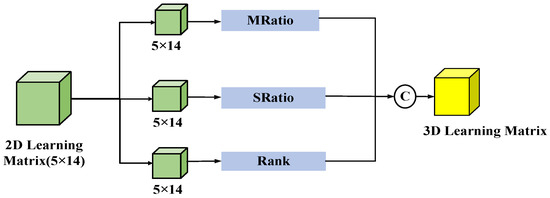
As shown in Figure 2, this study utilizes the KDD Cup 2015 dataset. First, learner clickstream and learning log data are extracted, and the learning process is divided into five consecutive weeks based on course progression to characterize the temporal sequence features of learning behavior. Subsequently, weekly data is subdivided into seven core learning behaviors, as detailed in Table 1: video viewing, assignment and quiz submissions, course page visits, wiki browsing, discussion posting, course navigation, and page closures. For each behavior category, we counted the number of occurrences and the duration of learning, constructing a 5 × 14 two-dimensional behavioral feature matrix. Building on this, we further accumulated the total duration and click counts for each learning activity to calculate learning focus features across different dimensions, thereby characterizing learners’ engagement levels and attention distribution.
Figure 2.
Data Preprocessing.
Table 1.
Student Click Behavior on MOOC Platforms.
Additionally, to mitigate the impact of course difficulty variations and student effort differences on dropout prediction outcomes while enhancing feature comparability and stability, this study constructed three types of ratio feature matrices based on raw learning behavior data: (1) MRatio characterizes learners’ time distribution across different learning activities through the ratio of duration to click counts. (2) SRatio reflects learners’ utilization preferences for different types of learning resources (e.g., videos, assignments, discussions). (3) Rank measures an individual’s relative performance level within the overall learning population. The calculation formulas for these three are as follows:
where denotes the complete learning behavior record set of learner within a course, denotes the th time step (week), represents the th type of learning behavior, denotes the normalized ranking position of learner among all learners in the same course at week . The Rank feature is computed on a weekly basis within each course and is derived solely from learners’ behavioral data during the corresponding week, without performing cross-course or cross-temporal ranking. For tied cases, an average ranking strategy is adopted. Each time step is treated independently without incorporating future information, thereby avoiding noise and information leakage and enabling a stable characterization of learners’ relative learning states.
After obtaining the three-category proportion feature matrix, to further enhance the comparability of different behavioral features, each feature dimension requires standardization and structural representation, as follows:
where denotes the original feature value of learner for the th type of behavior at time step . and denote the mean and standard deviation of the th behavioral feature computed on the training set, respectively. This matrix is used as the model input and provides a unified representation of learners’ temporal and behavioral feature structures.
Subsequently, the three types of ratio matrices are fused along the feature dimension through concatenation operations, forming a 3D Learning Matrix to comprehensively express the differential structures of learners across time series and multidimensional behavioral features. The relevant formula is as follows:
where denotes the number of time steps (weeks),denotes the number of behavior types, and the third dimension corresponds to the three ratio feature categories: MRatio, SRatio, and Rank.
3.3. Feature Extraction Module
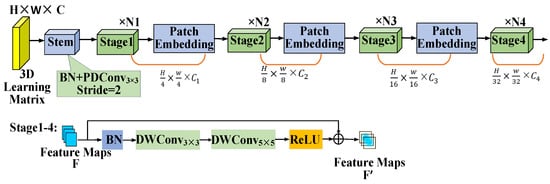
As shown in Figure 3, the feature extraction module takes the three-dimensional learning behavior matrix generated during the data preprocessing stage as its input. First, the input features undergo preliminary processing via stem operations. Batch normalization (BN) is applied before convolutional operations to enhance model training stability and convergence speed, mitigating gradient vanishing and exploding gradient issues, thereby improving model generalization performance [35]. Parallel 3 × 3 Depthwise Separable Convolution is employed to capture learning behavior features across different temporal and spatial scales. Dilatation convolutions introduce hollow structures within convolutional kernels to expand receptive fields, enabling efficient multi-scale feature modeling without increasing parameter counts [36], reflecting the model’s lightweight feature extraction design. Following Stem operations, the model employs a hierarchical convolutional structure comprising four Stages to progressively abstract spatio-temporal behavioral features of learners.
Figure 3.
Feature Extraction.
As shown in Figure 3, the feature extraction section within each Stage consists of repeatedly stacked feature extraction units, each comprising Batch Normalization (BN), DWConv, ReLU activation, and residual connections. By iteratively replicating this computational module across different depths, the network progressively enhances semantic expressiveness while reducing spatial resolution, enabling multi-scale and hierarchical modeling of learning behavior features. The computational process can be represented as:
where denotes the input feature tensor. and represent depthwise separable convolutions with kernel sizes of and , respectively, which capture both local details and large-scale structural patterns under different receptive fields. Rectified Linear Unit (ReLU) serves as the activation function, enhancing the nonlinear expressive capability of the model. The residual connection ensures stable information propagation through stacked layers, effectively mitigating gradient degradation while preserving key features across the four stages. Based on the feature extraction process described above, the multi-scale representations generated at each stage are utilized as structurally stable and semantically rich inputs for the subsequent attention module.
3.4. Symmetric Dual-Attention Mechanism Module (SDA)
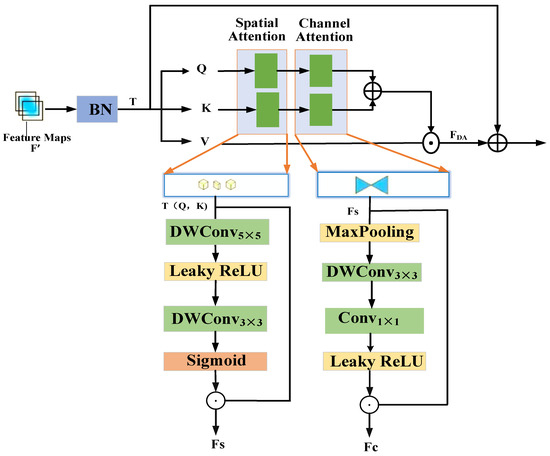
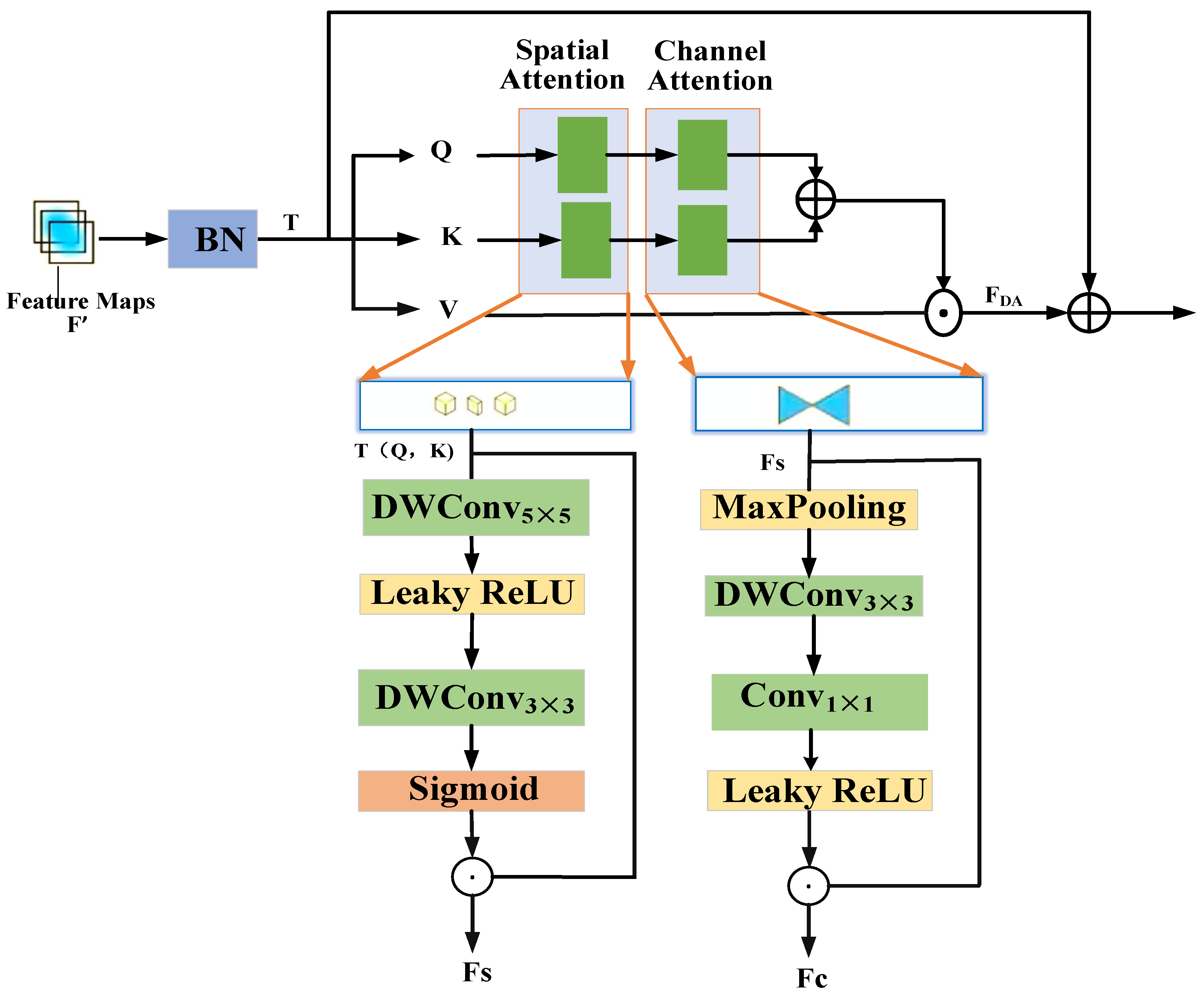
As shown in Figure 4, the attention mechanism section first performs a BN operation, dividing the input features into Q (query), K (key), and V (value). Both Q and K undergo spatial attention followed by channel attention. It should be noted that, unlike Transformer-style self-attention mechanisms, the Q, K, and V features in SDA-Net are generated through lightweight convolutional projections rather than linear embedding layers, and no sequence-wise self-attention across time steps is involved. The spatial and channel attention modules are designed with a symmetric architecture, where each module adaptively models key behavioral features from the spatial (temporal-behavioral) and channel dimensions, respectively. This symmetric design enables a balanced representation of local salient features and global semantic variations, thereby enhancing the model’s comprehensive perception of multidimensional learning behaviors while maintaining efficient attention learning without quadratic computational complexity.
Figure 4.
Spatial Attention Mechanism and Channel Attention Mechanism.
In the spatial attention mechanism, DWConv5×5 extracts local spatial features with a larger receptive field, while Leaky ReLU activation enhances nonlinear expressive capabilities. Subsequently, features undergo further refinement through DWConv3×3 to refine and fuse spatial structural information across different scales. Finally, the feature map is normalized through a Sigmoid function to generate the spatial attention weights, which are then multiplied element-wise with the original features. This operation enables the model to concentrate more effectively on the most discriminative learning behavior regions in the spatial dimension. The spatial attention mechanism is formulated as follows:
where DWConv5×5(⋅) and DWConv3×3(⋅) denote depthwise separable convolutions, used to extract spatial contextual information at different scales, Leaky ReLU(⋅) denotes an activation function with a leakage coefficient. σ(⋅) represents the Sigmoid function, used to generate spatial attention weights Ms. ⊙ indicates element-wise multiplication. The final output Fs constitutes the spatially weighted feature representation. Spatial attention is employed to characterize the importance of different time periods and behavioral distributions for dropout prediction, enabling the model to highlight behavior changes that are highly correlated with dropout during critical learning stages, such as declines in video viewing duration or interruptions in assignment submission in the middle and later phases of the course.
Channel attention is used to distinguish the relative importance of different types of learning behaviors and ratio-based features (MRatio, SRatio, and Rank), thereby strengthening feature channels that are more discriminative for dropout prediction, such as assignment-related behaviors, resource utilization ratios, and relative group-level performance. In the channel attention mechanism, input features first undergo max pooling to aggregate global contextual information. Subsequently, channel-specific features are extracted sequentially through 3 × 3 separable convolutions and 1 × 1 convolutions, with channel attention weights generated using the Leaky ReLU activation function. Finally, these weights are multiplied channel-by-channel with the original features, reinforcing key behavioral features in the channel dimension to achieve adaptive modeling of learners’ multidimensional information.
The channel attention mechanism is formulated as follows:
MaxPool(Fs) performs spatial max pooling on the input feature Fs to aggregate global contextual information at the channel level. DWConv3×3(⋅) models local structural features within each channel, while Conv1×1(⋅) enables inter-channel information fusion and mapping. LeakyReLU(⋅) serves as the activation function, whose output functions as the channel attention weight to measure the importance of different channels. ⊙ denotes element-wise multiplication across channels. The resulting Fc represents feature representations explicitly enhanced in the channel dimension.
The dual-attention fusion SDA formula is as follows:
where and denote the weighted features obtained from the spatial attention and channel attention mechanisms, respectively. Their summation performs attention information fusion, which is then followed by element-wise multiplication with the feature to complete feature reweighting. Finally, the residual term is added to preserve the original features and enhance model stability.
3.5. Feature Enhancement Module (FEM)
As shown in Figure 5, FEM is employed to integrate multi-scale features extracted through convolutional and attention mechanisms across different stages, thereby obtaining a unified feature representation that incorporates both global semantic and temporal dependencies. Specifically, input features first undergo normalization to eliminate distribution differences among features at various scales. Subsequently, 3 × 3 separable convolutions are applied to fuse local and global feature information. Next, the ReLU activation function enhances the model’s nonlinear expressive capability, followed by another 3 × 3 separable convolution to deepen feature interaction and reconstruction. Finally, residual connections preserve the integrity and stability of feature propagation, effectively mitigating gradient vanishing in deep structures and improving training robustness. The overall computational process of multi-scale feature fusion and residual enhancement can be represented as:
Figure 5.
Feature Enhancement Fusion Module.
This equation describes the computation of the Feature Enhancement Module (FEM). The module takes features from different network stages as input, where denotes the feature representation output from the -th stage, with . First, the input feature is normalized by to reduce distribution discrepancies among features from different stages. The normalized feature is then processed by two successive depthwise separable convolutions, with a ReLU activation function applied in between to enhance nonlinear representation and local structural feature extraction. Finally, a residual connection adds the convolutional branch output to the normalized input feature, which helps preserve original information and improve training stability. The resulting represents the enhanced and fused feature output.
3.6. Classification Layers and Model Optimization
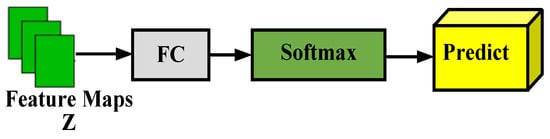
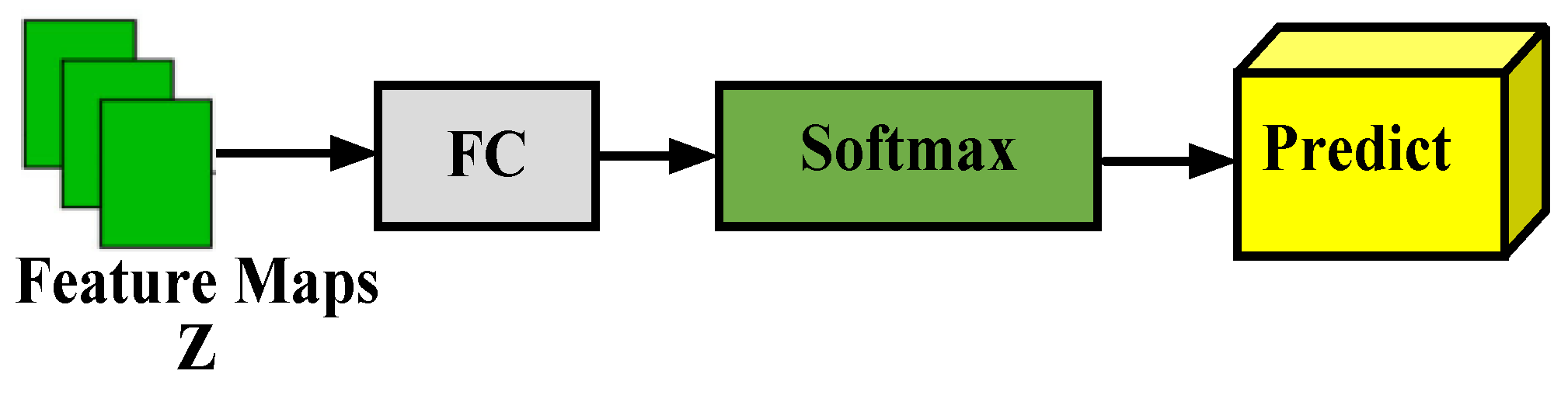
As shown in Figure 6, after extracting and reconstructing high-level semantic features through MSC, DA, and FEM, the model must map the final feature representation to the dropout probability of learners. To achieve this, the model introduces a classification layer at the output end, consisting of a fully connected (FC) network and a Softmax classifier, to perform nonlinear mapping and probability normalization on the fused features.
Figure 6.
Classification Layers and Model Optimization.
To optimize model performance, the Binary Cross-Entropy (BCE) loss function is employed as the objective function. Model parameters undergo backpropagation training, with the calculation formula as follows:
where denotes the ground-truth label of the th sample (1 for dropout and 0 for completion), denotes the predicted dropout probability produced by the model, and denotes the total number of samples. The model parameters are optimized by minimizing the binary cross-entropy between and . MOOC dropout prediction involves inherent class imbalance. In this study, we adopt the Binary Cross-Entropy (BCE) loss function due to its numerical stability and effectiveness in moderately imbalanced binary classification tasks, as well as its wide use in existing MOOC dropout prediction research.
4. Experiment
4.1. Datasets
This study evaluates the proposed model using the KDD Cup 2015 public dataset and the XuetangX dataset. The KDD Cup 2015 dataset records real learner interaction behaviors during course participation in the academic years 2013–2014, with each course lasting five weeks; relevant statistics are summarized in Table 2 [25]. The platform logs seven types of core learning behaviors. To capture learners’ temporal characteristics and learning dynamics, this study adopts course weeks as time steps and computes the frequency and duration of the seven behavior types on a weekly basis, constructing a 5 × 14 two-dimensional behavioral feature matrix. Furthermore, three types of features—MRatio, SRatio, and Rank—are calculated and integrated to form a 3D Learning Matrix, which serves as the model input. XuetangX is a major MOOC platform in China, and its public dataset contains multimodal information such as learning behaviors, course content, and interaction records; relevant details are presented in Table 3 [37]. The dataset comprises 106,455 samples, including 81,762 dropout samples and 24,693 non-dropout samples, and is widely used for learning behavior modeling and dropout prediction studies. In this work, 15 features are selected for modeling, including 14 behavioral features and learners’ active learning duration. Both datasets are split into training and testing sets using an 8:2 ratio to ensure sufficient model training and reliable performance evaluation.
Table 2.
Details of KDD Cup 2015 Dataset.
Table 3.
Details of XuetangX.
4.2. Experimental Setup and Evaluation Metrics
4.2.1. Experimental Setup
The experiments are conducted on the KDD Cup 2015 and XuetangX public datasets, and the proposed SDA-Net model is implemented using the PyTorch framework. For the KDD Cup 2015 dataset, course weeks are used as time steps, and the frequency and duration of seven categories of core learning behaviors are aggregated to construct a 5 × 14 behavioral feature matrix. For the XuetangX dataset, 14 behavioral features along with learners’ active learning duration are selected for modeling. Both datasets are divided into training and testing sets using an 8:2 split. The model employs 3 × 3 and 5 × 5 multi-scale convolutional kernels to extract temporal behavioral features and integrates a symmetric dual-attention mechanism with residual fusion to obtain high-level semantic representations. During training, the Adam optimizer and the binary cross-entropy (BCE) loss function are used. As shown in Table 4, the initial learning rate is set to 1 × 10⁻³, the batch size is 16, and a step-wise learning rate decay strategy is adopted, where the learning rate is reduced to one-tenth of its original value every 10 epochs, with a total of 20 training epochs. To alleviate overfitting, weight decay (5 × 10⁻⁴) and a momentum parameter of 0.73 are introduced to enhance training stability. To reduce the influence of randomness, all experiments are independently repeated 10 times under the same parameter settings. Overall, the parameter configuration ensures stable model convergence while balancing training efficiency and predictive performance.
Table 4.
Setting of experimental environment and other parameters.
4.2.2. Evaluation Metrics
In the task of predicting MOOC dropouts, accurately identifying learners with a tendency to withdraw is crucial for enabling early warning and targeted interventions. However, due to the significant class imbalance between dropout and non-dropout learners, relying solely on Accuracy as an evaluation metric may lead to biased or misleading performance assessment. Therefore, this study comprehensively evaluates the predictive performance of the model using four widely adopted metrics: Accuracy, Precision, Recall, and F1-Score. Precision measures the proportion of actual dropout learners among those predicted as dropouts, reflecting the model’s reliability in identifying high-risk learners. Recall represents the proportion of actual dropouts that are correctly identified, indicating the model’s ability to detect potential dropout risks. Accuracy evaluates the overall correctness of classification across all learner samples. The F1-Score, defined as the harmonic mean of Precision and Recall, provides a balanced and comprehensive assessment of model performance, particularly under imbalanced data distributions. In this study, dropout learners are treated as the positive class (label = 1) when computing Precision, Recall, and F1-Score. All reported F1-Scores correspond to the binary F1-score, computed under a fixed decision threshold of 0.5, ensuring consistency and comparability across different models and experimental settings.
4.3. Experimental Results
4.3.1. Experimental Results on the KDD Cup 2015 Dataset
- Comparison with Traditional Machine Learning-Based MOOC Dropout Prediction Methods
As shown in Table 5, traditional machine learning methods demonstrate overall limited performance in the MOOC dropout prediction task. SVM, LR, and DT rely mainly on manually engineered features for feature representation and therefore struggle to effectively model complex temporal learning behavior patterns. Their Accuracy values are 85.00%, 87.20%, and 83.50%, and the corresponding F1-scores are approximately 0.906, 0.920, and 0.896. However, neither Precision nor Recall reaches an ideal level, which makes it difficult for these methods to achieve stable prediction performance on imbalanced MOOC datasets.
Table 5.
Comparative experimental results of various models on the KDD Cup 2015 dataset.
In contrast, the proposed model outperforms traditional machine learning approaches across all four major evaluation metrics. Specifically, its Accuracy of 93.70% is higher than that of SVM and LR by 8.70 percentage points and 6.50 percentage points, respectively, and exceeds DT by 10.20 percentage points. The proposed method also achieves higher Precision and Recall, reaching 93.90% and 94.00%, respectively, which leads to more stable and reliable overall prediction performance. These results indicate that although traditional methods provide a certain degree of interpretability, their feature learning capability remains insufficient when dealing with high dimensional, nonlinear, and multimodal MOOC learning data. By introducing a multi-scale convolutional structure, the proposed model enables hierarchical extraction of temporal behavioral features. Furthermore, the symmetric dual-attention mechanism simultaneously focuses on important information in spatial and channel dimensions, effectively compensating for the limitations of traditional methods in modeling global dependencies and resulting in improved predictive performance and generalization ability.
- 2.
- Comparison with Deep Learning-Based MOOC Dropout Prediction Methods
As shown in Table 5, the proposed model demonstrates a clear overall performance advantage compared with existing deep learning–based approaches. Single-architecture models such as CNN [23], LSTM [23], and GRU [28] achieve Accuracy values of 84.60%, 85.50%, and 87.80%, respectively, while hybrid models CNN-LSTM [26] and CNN-GRU [23] further improve Accuracy to 84.20% and 88.50%. Although these models are able to capture temporal dependencies in learner behavior to some extent, they remain limited in comprehensively modeling multidimensional and interactive behavioral features. The ensemble model Bagging LSTM-LSTM [28] achieves a higher Accuracy of 89.80%, indicating that model aggregation can enhance predictive performance. Moreover, improved models such as PMCT [26] and IC-BTCN [25] introduce multi-scale or temporal convolutional structures and obtain Accuracies of 88.00% and 89.30%, with corresponding F1-Scores of approximately 92.80% and 93.40%, respectively, suggesting that architectural enhancements contribute positively to temporal feature modeling.
However, most of the above deep learning models primarily rely on raw behavioral frequency and duration features for prediction and do not explicitly account for differences in course difficulty or variations in learning investment. In contrast, the proposed model achieves superior performance across multiple evaluation metrics, with an Accuracy of 93.70%, outperforming Bagging LSTM-LSTM by 3.90 percentage points and exceeding PMCT and IC-BTCN by 5.70 and 4.40 percentage points, respectively. In addition, the proposed approach attains a higher and more balanced F1-Score of 93.90%, reflecting improved robustness and stability. These results indicate that, although existing deep learning methods possess strong feature representation and temporal modeling capabilities, they remain limited in feature focusing and multi-scale behavioral modeling. By incorporating multi-scale convolutional structures, depthwise separable convolutions, and a symmetric dual-attention mechanism for adaptive feature aggregation across spatial and channel dimensions, the proposed model achieves higher prediction accuracy and stability in multidimensional MOOC dropout prediction tasks.
- 3.
- Comparison with Attention-Based MOOC Dropout Prediction Methods
As shown in Table 5, among existing attention-based methods, ATT-CNN-BiLSTM [32] and CLSA [38] achieve Accuracy values of 86.80% and 87.60%, with corresponding F1-Scores of 87.40% and 88.10%, respectively. LBDT [33] attains an Accuracy of 87.30% and an F1-Score of 87.70% on the same dataset. These results indicate that, although the introduction of attention mechanisms leads to certain performance improvements over basic deep learning models, both Accuracy and F1-Score remain within the 86–88% range, suggesting limited overall gains. Compared with these methods, the proposed approach achieves higher results on key metrics such as Accuracy and F1-Score, demonstrating a clear performance advantage. This indicates that the proposed model is more effective in capturing behavioral changes at critical learning stages, distinguishing the importance of different behavioral features, and improving prediction stability, thereby providing stronger predictive capability in complex MOOC learning behavior modeling tasks.
The performance improvement mainly stems from the joint design of the symmetric dual-attention mechanism and the multi-scale convolutional structure. This mechanism simultaneously captures global and local salient features across spatial and channel dimensions, enabling more effective modeling of complex and diverse learning behavior patterns. Specifically, spatial attention emphasizes feature weighting along the temporal dimension, highlighting behavioral changes at critical learning stages that are closely related to dropout risk, while channel attention distinguishes the importance of different behavior types and ratio-based features, including MRatio, SRatio, and Rank. In addition, these ratio features characterize learners’ behavioral differences from complementary perspectives of time allocation, resource utilization, and group performance, while preserving consistent mappings between time steps and behavior types in the feature space. The resulting three-dimensional structured representation after channel fusion provides strong semantic consistency and structural support for weight learning and multi-source feature aggregation in the symmetric dual-attention mechanism, further validating the effectiveness of the proposed model in modeling key dropout-related learning behaviors.
4.3.2. Experimental Results on the XuetangX Dataset
- Comparison with Traditional Machine Learning Methods for MOOC Dropout Prediction
On the XuetangX dataset, the overall predictive performance of traditional machine learning methods remains limited. As shown in Table 6, the Accuracy of models such as LR, SVM, RF, and KNN mainly ranges from 0.71 to 0.82, among which AdaBoost achieves the best performance with an Accuracy of 0.839 and an F1-Score of 0.846.; however, its overall predictive capability is still noticeably inferior to that of deep learning–based models. Compared with LR, whose Accuracy is approximately 0.71, AdaBoost improves prediction accuracy by about 18%, yet it still fails to adequately capture the temporal evolution of learning behaviors and cross-course differences. These methods primarily rely on manually engineered frequency- and duration-based behavioral features, resulting in limited generalization ability in the high-noise and highly heterogeneous XuetangX scenario.
In contrast, our proposed method introduces ratio-based features such as MRatio, SRatio, and Rank, which effectively mitigate the interference caused by differences in course difficulty and learning engagement. Combined with a multi-scale feature learning mechanism, the proposed approach is theoretically more suitable for complex real-world platform data. As a result, it achieves Accuracy, Precision, Recall, and F1-Score values of 0.899, 0.915, 0.903, and 0.909, respectively, demonstrating significant performance improvements and stronger generalization potential compared with traditional methods.
- 2.
- Comparison with Deep Learning-Based MOOC Dropout Prediction Methods
Compared with traditional machine learning approaches, deep learning models achieve improved predictive performance on the XuetangX dataset. As shown in Table 6, the Accuracy values of CNN, CNN-GRU, and CNN-LSTM reach 0.780, 0.806, and 0.815, respectively, demonstrating clear performance advantages over weaker traditional methods and highlighting the effectiveness of deep models in automatic feature learning and temporal modeling. However, single models or simple hybrid architectures still exhibit limitations in capturing complex interactions among learning behaviors.
By incorporating multi-scale or deeper feature fusion mechanisms, the Accuracy of MFCN-VIB and LG-DCA Net is further improved to 0.874 and 0.897, respectively. In particular, LG-DCA Net achieves an absolute Accuracy improvement of 11.7 percentage points over the baseline CNN, at the cost of increased model complexity. In contrast, the proposed SDA-Net attains further performance gains with a smaller parameter size of 21.37 M, achieving absolute improvements of 11.9 percentage points in Accuracy and 11.0 percentage points in F1-Score compared with CNN, and still providing additional gains of 0.2–0.4 percentage points in both Accuracy and F1-Score relative to LG-DCA Net. Overall, these results demonstrate that SDA-Net achieves a more favorable balance between predictive performance and model complexity, making it well suited for real-world MOOC scenarios characterized by high noise and strong heterogeneity, such as XuetangX.
- 3.
- Comparison with Attention-Based MOOC Dropout Prediction Methods
Further comparison with attention-based models indicates that performance gains achieved by single attention structures on the XuetangX dataset remain relatively limited. As shown in Table 6, the Accuracy of CLSA, CNN-LSTM-AT1/AT2, and Cross-TabNet on the XuetangX dataset mainly falls within the range of 0.83–0.84, indicating that single attention-based models provide limited performance gains over baseline deep learning approaches. This is primarily because most existing approaches perform feature weighting independently along either the temporal or channel dimension, making it difficult to collaboratively model the complex relationships among multidimensional learning behaviors.
In contrast, the proposed SDA-Net integrates multi-scale convolution with a symmetric dual-attention mechanism to jointly model key features across both spatial and channel dimensions, thereby enhancing the identification of critical learning stages and high-risk behavioral patterns. On the XuetangX dataset, as shown in Table 6, SDA-Net achieves additional improvements of approximately 0.2% in Accuracy and 0.4% in F1-Score compared with the mainstream attention-based model LG-DCA Net, while maintaining stable Precision and Recall. These results indicate that the proposed method exhibits superior generalization ability and practical value in real-world MOOC scenarios characterized by high noise and strong heterogeneity. Notably, although the absolute performance gains appear modest, such improvements are non-trivial in large-scale MOOC settings, where even small accuracy gains can substantially enhance the effectiveness of early intervention.
Table 6.
Comparative Experimental Results of Different Models on the XuetangX Dataset.
4.4. Ablation Experiments
To validate the impact and contribution of each module in our model to overall performance, this paper designed a progressive ablation study [39] on the KDD Cup 2015 dataset. Starting from a basic convolutional architecture, the experiment progressively introduced MSC, SDA, FEM, and the proportional feature matrix module to analyze the role of each component in feature extraction, attention focusing, semantic fusion, and computational efficiency. Model performance was comprehensively evaluated using four metrics: Accuracy, Precision, Recall, and F1 score [40]. The experimental results are shown in the table.
- Impact of Multi-Scale Convolution Modules on Experimental Results
The baseline model employs a single convolutional architecture, resulting in a relatively uniform temporal scale for feature extraction, which makes it difficult to simultaneously capture short-term fluctuations and long-term dynamic changes in learning behavior [41]. To address this limitation, we introduce a Multi-Scale Convolution (MSC) module that employs parallel 3 × 3 and 5 × 5 depthwise separable convolutions to extract features from different receptive fields, enabling hierarchical modeling of temporal characteristics.
As shown in Table 7, incorporating MSC leads to consistent and stable improvements across all evaluation metrics: Accuracy increases by approximately 1.3 percentage points, Precision by about 1.3 percentage points, Recall by roughly 1.4 percentage points, and F1-Score by around 1.3 percentage points compared with the baseline model. These results indicate that multi-scale convolutions provide richer and more diverse feature representations across different temporal scales, allowing the model to more effectively capture periodic and phased variations in learning behavior. Moreover, although MSC introduces kernels with larger receptive fields, the use of depthwise separable convolutions effectively controls parameter growth, resulting in improved feature extraction capability while maintaining a lightweight model structure.
Table 7.
Impact of Multi-Scale Convolution Modules on Experimental Results.
- 2.
- Impact of Symmetric Dual-Attention Modules on Experimental Results
Based on multi-scale feature extraction, the Symmetric Dual-Attention (SDA) module is introduced to enhance the model’s feature focusing capability. The SDA module comprises two complementary sub-structures: Channel Attention (CA) and Spatial Attention (SA). CA reinforces key behavioral features (e.g., assignment completion rate and learning frequency) through adaptive adjustment of feature weights, while SA emphasizes critical time phases with significant fluctuations in learning activity. Through a symmetric mapping structure, the SDA module balances global semantic information and local temporal variations, thereby improving the model’s ability to identify potential dropout patterns. As shown in Table 8, incorporating the complete SDA module leads to stable and significant performance improvements across all evaluation metrics. Compared with the variant in which both spatial and channel attention branches are removed, the full model improves Accuracy and Precision by approximately 2.5 percentage points, and Recall and F1-Score by about 2.4 percentage points. Even when compared with models that remove only a single attention branch, the complete SDA module still achieves gains of approximately 1.2–1.6 percentage points across all metrics. These results demonstrate that spatial and channel attention provide complementary benefits, and their joint integration effectively suppresses noisy or less informative features, enabling the model to focus more accurately on learning behavior dimensions that are highly correlated with dropout risk.
Table 8.
Impact of Symmetric Dual-Attention Module on Experimental Results.
- 3.
- Impact of Feature Enhancement Fusion Module on Experimental Results
To further enhance semantic consistency and information flow across multi-level features, a Feature Enhancement Fusion Module (FEM) is introduced. This module integrates low-level local features with high-level semantic representations through residual connections and channel re-calibration mechanisms, thereby strengthening the stability and coherence of feature expressions across different hierarchical levels. By facilitating effective information propagation, the FEM alleviates gradient vanishing issues in deep structures while preserving critical semantic information during feature reconstruction.
As shown in Table 9, incorporating the FEM leads to consistent improvements across all evaluation metrics. Specifically, the model’s Accuracy, Precision, Recall, and F1-Score each increase by approximately 0.8 percentage points compared with the variant without FEM. These results validate the effectiveness of the FEM in enhancing feature synergy and semantic fusion, thereby improving the model’s prediction stability across different learning stages.
Table 9.
Impact of Feature Enhancement Fusion Module on Experimental Results.
- 4.
- The Influence of the Three-Category Ratio Feature Matrix on Experimental Results
To verify the effectiveness of the three ratio-based feature matrices in the feature modeling stage, we conducted an ablation study by taking the model using only raw behavioral features as the baseline and progressively introducing MRatio, SRatio, and Rank. As shown in Table 10, the gradual incorporation of ratio features leads to consistent improvements in Accuracy, Precision, Recall, and F1-score. When MRatio is introduced alone, the Accuracy increases from 0.901 to 0.925, corresponding to a relative improvement of approximately 2.7%, which represents the most significant individual performance gain and indicates that the time allocation structure has strong discriminative power for dropout prediction. When SRatio or Rank is introduced individually, the Accuracy increases to 0.921 and 0.919, corresponding to relative improvements of approximately 2.2% and 2.0%, respectively, suggesting that resource utilization preferences and relative group performance provide complementary behavioral information. When all three ratio features are incorporated simultaneously, the model achieves the best performance, with Accuracy and F1-score reaching 0.937 and 0.939, representing relative improvements of approximately 3.6% and 4.1% over the baseline, respectively. These results indicate that a brief analysis of the individual contributions of MRatio, SRatio, and Rank helps clarify the role of ratio features from the perspectives of time investment, resource utilization, and relative performance, and that their joint modeling effectively mitigates feature distribution shifts caused by differences in course difficulty and learning effort, thereby improving the predictive stability and generalization capability of the model.
Table 10.
Impact of the Proportionality Characteristic Matrix of the Three Categories on Experimental Results.
5. Conclusions
This paper proposes a Symmetric Dual-Attention Network integrated with multi-scale convolution, referred to as SDA-Net, for MOOC dropout prediction. The proposed model aims to address the challenges posed by complex learner behavior characteristics, difficulties in modeling temporal dependencies, and relatively high computational costs on MOOC platforms. To improve the comparability and stability of input features, three types of ratio features, namely MRatio, SRatio, and Rank, are constructed during the feature design stage to characterize differences in learners’ time investment, resource utilization, and relative group performance. By introducing a multi-scale convolution module to enhance temporal feature extraction and incorporating a symmetric dual-attention mechanism that adaptively focuses on key behavioral features along both spatial and channel dimensions, SDA-Net achieves an effective balance between predictive accuracy and model complexity. Experimental results on the KDD Cup 2015 dataset demonstrate that SDA-Net consistently outperforms baseline methods across Accuracy, Precision, Recall, and F1-Score. Compared with representative deep learning models such as CNN-LSTMAE and IC-BTCN, SDA-Net achieves improvements of approximately 1.3 percentage points in both Accuracy and F1-Score, while also exhibiting consistent performance advantages in Precision and Recall, indicating stronger discriminative capability and prediction stability. Further experiments on the XuetangX dataset show that, compared with the state-of-the-art LG-DCA Net, SDA-Net attains improvements of approximately 0.2 percentage points in Accuracy and 0.4 percentage points in F1-Score, while maintaining stable Precision and Recall. These results suggest that the proposed model demonstrates superior predictive performance and generalization ability in real-world MOOC scenarios characterized by high noise and strong heterogeneity.
Although SDA-Net demonstrates stable and competitive predictive performance on multiple public datasets, its performance in real MOOC teaching scenarios may still be affected by factors such as data noise, class imbalance, and heterogeneous learning behaviors, leaving room for further improvement. Future work will incorporate evaluation metrics that are more suitable for imbalanced data scenarios, including ROC-AUC and PR-AUC, and will report statistical significance tests or confidence intervals based on multiple independent experimental runs to more comprehensively verify the reliability and robustness of the observed performance gains. In addition, from the perspective of model efficiency and practical deployment, future studies will further evaluate computational cost metrics such as FLOPs and inference time under unified hardware settings, in order to systematically analyze the trade-off between predictive performance and computational efficiency. Furthermore, future work will explore multimodal feature fusion and dynamic temporal modeling methods to continuously enhance the stability and generalization capability of the model in real-world applications.
Author Contributions
Conceptualization, Y.Y., C.X. and G.T.; methodology, Y.Y. and C.X.; software, C.X.; validation, Y.Y., C.X. and G.T.; formal analysis, Y.Y. and C.X.; investigation, G.T.; resources, C.X.; data curation, Y.Y.; writing—original draft preparation, Y.Y.; writing—review and editing, Y.Y. and C.X.; visualization, Y.Y., C.X. and G.T.; supervision, C.X.; project administration, Y.Y., C.X. and G.T.; funding acquisition, Y.Y. and G.T. All authors have read and agreed to the published version of the manuscript.
Funding
This study was supported by the National Natural Science Foundation of China (42261068), the National Natural Science Foundation of China (62363015), the Natural Science Foundation of Jiangxi Province (20242BAB25112), Demonstration Course on Curriculum Civics and Politics in Undergraduate Colleges and Universities in Henan Province in 2024 “International Trade Practice” (185), the Soft Science Research Project in Henan Province in 2025 (252400410103), Henan Province Online First-Class Undergraduate Course “International Trade Theory and Practice” (67), New Round of Key Discipline “Applied Economics” in Henan Province (340), and Funding Program for Specialty Construction of Privately Run General Colleges and Universities (Economics) in Henan Province in 2023.
Data Availability Statement
The XuetangX dataset analyzed during the current study is publicly available in the MoocData repository at http://moocdata.cn/data/user-activity (accessed on 20 October 2025).
Conflicts of Interest
The authors declare no conflicts of interest.
Abbreviations
The following abbreviations are used in this manuscript:
| ATT | Attention |
| BN | Batch Normalization |
| BCE | Binary Cross-Entropy |
| Bi-LSTM | Bidirectional Long Short-Term Memory |
| CA | Channel Attention |
| CNN | Convolutional Neural Network |
| Conv | Convolution |
| DWConv | Depthwise Separable Convolution |
| FC | Fully Connected Layer |
| FEM | Feature Enhancement Module |
| GRU | Gated Recurrent Unit |
| KNN | K-Nearest Neighbors |
| LR | Logistic Regression |
| LSTM | Long Short-Term Memory |
| LSTMAE | LSTM Autoencoder |
| MRatio | Time Allocation Ratio Matrix |
| MSC | Multi-Scale Convolution |
| PMCT | Parallel Multiscale Convolutional Temporal Model |
| PR-AUC | Area Under the Precision–Recall Curve |
| Rank | Relative Level Ranking Matrix |
| ReLU | Rectified Linear Unit |
| RF | Random Forest |
| RNN | Recurrent Neural Network |
| ROC-AUC | Area Under the ROC Curve |
| SA | Spatial Attention |
| SDA | Symmetric Dual-Attention |
| SDA-Net | Symmetric Dual-Attention Network |
| SRatio | Resource Utilization Ratio Matrix |
| SVM | Support Vector Machine |
| TCN | Temporal Convolutional Network |
References
- Yang, X.; Li, Z.; Zhang, S.; Wang, J. The Study of Learner Topics in Reviews of Computer Science MOOC Courses. In Proceedings of the 2025 7th International Conference on Computer Science and Technologies in Education (CSTE), Wuhan, China, 18–20 April 2025. [Google Scholar] [CrossRef] [Scilit]
- Yang, S.; Xiao, Y.; Meng, F. Deep Learning-Based Method for Predicting Student Dropouts in MOOCs. In Proceedings of the 2024 7th International Conference on Machine Learning and Natural Language Processing (MLNLP), Chengdu, China, 18–20 October 2024; pp. 1–6. [Google Scholar] [CrossRef] [Scilit]
- Nesterowicz, K.; Bayramova, U.; Fereshtehnejad, S.M.; Scarlat, A.; Ash, A.; Augustyn, A.M.; Szádeczky, T. Gamification increases completion rates in massive open online courses. Int. J. Inf. Commun. Technol. Educ. 2022, 18, 1–12. [Google Scholar] [CrossRef] [Scilit]
- Kloft, M.; Stiehler, F.; Zheng, Z.; Pinkwart, N. Predicting MOOC dropout over weeks using machine learning methods. In Proceedings of the 2014 Conference on Empirical Methods in Natural Language Processing (EMNLP): Workshop on Analysis of Large Scale Social Interaction in MOOCs, Doha, Qatar, 25–29 October 2014; pp. 60–65. Available online: https://aclanthology.org/W14-4111.pdf (accessed on 29 October 2014).
- Ujkani, B.; Minkovska, D.; Stoyanova, L. Application of logistic regression technique for predicting student dropout. In Proceedings of the 2022 XXXI International Scientific Conference Electronics (ET), Sozopol, Bulgaria, 13–15 September 2022; pp. 1–4. [Google Scholar] [CrossRef] [Scilit]
- Lakkaraju, H.; Aguiar, E.; Shan, C.; Miller, D.; Bhanpuri, N.; Ghani, R.; Addison, K. A machine learning framework to identify students at risk of adverse academic outcomes. In Proceedings of the 21th ACM SIGKDD International Conference on Knowledge Discovery and Data Mining, Sydney, Australia, 10–13 August 2015; pp. 1909–1918. [Google Scholar] [CrossRef] [Scilit]
- Qiu, L.; Liu, Y.; Hu, Q.; Liu, Y. Student dropout prediction in massive open online courses by convolutional neural networks. Soft Comput. 2019, 23, 10287–10301. [Google Scholar] [CrossRef] [Scilit]
- Fei, M.; Yeung, D.Y. Temporal models for predicting student dropout in massive open online courses. In Proceedings of the 2015 IEEE International Conference on Data Mining Workshop (ICDMW), Atlantic City, NJ, USA, 14–17 November 2015; pp. 256–263. [Google Scholar] [CrossRef] [Scilit]
- Mubarak, A.A.; Cao, H.; Hezam, I.M. Deep analytic model for student dropout prediction in massive open online courses. Comput. Electr. Eng. 2021, 93, 107271. [Google Scholar] [CrossRef] [Scilit]
- El Aouifi, H.; El Hajji, M.; Es-Saady, Y. A hybrid approach for early-identification of at-risk dropout students using LSTM-DNN networks. Educ. Inf. Technol. 2024, 29, 18839–18857. [Google Scholar] [CrossRef] [Scilit]
- Niu, K.; Lu, G.; Peng, X.; Zhou, Y.; Zeng, J.; Zhang, K. CNN autoencoders and LSTM-based reduced order model for student dropout prediction. Neural Comput. Appl. 2023, 35, 22341–22357. [Google Scholar] [CrossRef] [Scilit]
- Zhuang, J.; Lai, Y.; Song, R. A predictive model of MOOC dropout based on attention mechanism. In Proceedings of the 2025 IEEE 16th International Symposium on Autonomous Decentralized Systems (ISADS), Tucson, AZ, USA, 21–24 July 2025; pp. 110–118. [Google Scholar] [CrossRef] [Scilit]
- Fan, G.; Guo, J.; Cheng, S.; Yang, D. An online learning prediction system for MOOCs using deep learning approaches. In Proceedings of the 2024 IEEE Smart World Congress (SWC), Nadi, Fiji, 2–7 December 2024; pp. 1322–1328. [Google Scholar] [CrossRef] [Scilit]
- Boufaida, S.O.; Benmachiche, A.; Derdour, M.; Maatallah, M.; Kahil, M.S.; Ghanem, M.C. TSA-GRU: A novel hybrid deep learning module for learner behavior analytics in MOOCs. Future Internet 2025, 17, 355. [Google Scholar] [CrossRef] [Scilit]
- Guo, Y. Logistic Regression Analysis of College Students’ Learning Behavior Considering MOOC Data in Online Learning Environment. J. Combin. Math. Combin. Comput. 2025, 127, 1177–1190. [Google Scholar] [CrossRef] [Scilit]
- Chi, Z.; Zhang, S.; Shi, L. Analysis and prediction of MOOC learners’ dropout behavior. Appl. Sci. 2023, 13, 1068. [Google Scholar] [CrossRef] [Scilit]
- Elbaghazaoui, B.E.; Amnai, M.; Fakhri, Y. Predicting user behavior using data profiling and hidden Markov model. Int. J. Electr. Comput. 2023, 13, 5444–5453. [Google Scholar] [CrossRef] [Scilit]
- Jebbari, M.; Cherradi, B.; Hamida, S.; Raihani, A. Identifying learning styles in MOOCs environment through machine learning predictive modeling. Educ. Inf. Technol. 2024, 29, 20977–21014. [Google Scholar] [CrossRef] [Scilit]
- Benoit, D.F.; Tsang, W.K.; Coussement, K.; Raes, A. High-stake student drop-out prediction using hidden Markov models in fully asynchronous subscription-based MOOCs. Technol. Forecast. Soc. Change 2024, 198, 123009. [Google Scholar] [CrossRef] [Scilit]
- Xing, W.; Chen, X.; Stein, J.; Marcinkowski, M. Temporal predication of dropouts in MOOCs: Reaching the low-hanging fruit through stacking generalization. Comput. Hum. Behav. 2016, 58, 119–129. [Google Scholar] [CrossRef] [Scilit]
- Yujiao, Z.; Ang, L.W.; Shaomin, S.; Palaniappan, S. Dropout prediction model for college students in MOOCs based on weighted multi-feature and SVM. J. Web Eng. 2023, 2, 29–42. [Google Scholar] [CrossRef] [Scilit]
- Yildiz, K.; Camurcu, Y.; Doğan, B. Comparison of Dimension Reduction Techniques on High Dimensional Datasets. Int. Arab J. Inf. Technol. 2018, 15, 256–262. [Google Scholar]
- Niu, K.; Cai, J.; Zhou, Y.; Tai, W.; Feng, X. Hybrid neural network model for MOOC dropout prediction. Complex Syst. Model. Simul. 2025, 2025, 1–10. [Google Scholar] [CrossRef] [Scilit]
- Talebi, K.; Torabi, Z.; Daneshpour, N. Ensemble models based on CNN and LSTM for dropout prediction in MOOC. Expert Syst. Appl. 2024, 235, 121187. [Google Scholar] [CrossRef] [Scilit]
- Zhang, X.; Wang, X.; Zhao, J.; Zhang, B.; Zhang, F. IC-BTCN: A deep learning model for dropout prediction of MOOCs students. IEEE Trans. Educ. 2024, 67, 974–982. [Google Scholar] [CrossRef] [Scilit]
- Niu, K.; Zhou, Y.; Lu, G.; Tai, W.; Zhang, K. PMCT: Parallel multiscale convolutional temporal model for MOOC dropout prediction. Comput. Electr. Eng. 2023, 112, 108989. [Google Scholar] [CrossRef] [Scilit]
- Amoudi, S.A.; Alhothali, A.; Mirza, R.; Assalahi, H.; Aldosemani, T. Click-based representation learning framework of student navigational behavior in MOOCs. IEEE Access 2024, 12, 121480–121495. [Google Scholar] [CrossRef] [Scilit]
- Talebi, K.; Torabi, Z.; Daneshpour, N. Predicting MOOC dropout using ensemble models based on RNN and GRU. Res. Sq. 2024; preprint. [CrossRef] [Scilit]
- Wu, X.; Yu, Z.; Zhang, C.; Yang, Z. Research on MOOC dropout prediction by combining CNN-BiGRU and GCN. In Proceedings of the Fourth International Conference on Computer Vision, Application, and Algorithm (CVAA 2024), Chengdu, China, 11–13 October 2024; Volume 13486, pp. 683–690. [Google Scholar] [CrossRef] [Scilit]
- Chen, M.; Wu, L. A Dropout Prediction Method Based on Time Series Model in MOOCs. J. Phys. Conf. Ser. 2021, 1774, 012065. [Google Scholar] [CrossRef] [Scilit]
- Shu, X.; Cao, W.; Wang, S. A MOOC recommendation model based on multi-feature fusion. Comput. Eng. Appl. 2023, 59, 123–133. [Google Scholar] [CrossRef]
- Zheng, Y.; Shao, Z.; Deng, M.; Gao, Z.; Fu, Q. MOOC dropout prediction using a fusion deep model based on behaviour features. Comput. Electr. Eng. 2022, 104, 108409. [Google Scholar] [CrossRef] [Scilit]
- Liu, H.; Chen, X.; Zhao, F. Learning Behavior Feature Fused Deep Learning Network Model for MOOC Dropout Prediction. Educ. Inf. Technol. 2024, 29, 3257–3278. [Google Scholar] [CrossRef] [Scilit]
- He, X.; Zhang, L.; Li, Y.; Xiao, X.; Wang, H.; Wu, D. LBTT: Fusing Learning Behavior Time Window and Type Information for Early Prediction of Student Learning Performance. Educ. Inf. Technol. 2025, 30, 21609–21634. [Google Scholar] [CrossRef] [Scilit]
- Xu, C.; Zhu, G.; Ye, J.; Shu, J. Educational data mining: Dropout prediction in XuetangX MOOCs. Neural Process. Lett. 2022, 54, 2885–2900. [Google Scholar] [CrossRef] [Scilit]
- Yang, Y.; Xu, C.; Tian, G. Lightweight Financial Fraud Detection Using a Symmetrical GAN-CNN Fusion Architecture. Symmetry 2025, 17, 1366. [Google Scholar] [CrossRef] [Scilit]
- Liu, Y.; Xu, C.; Yang, D.; Shen, Y. MOOC dropout prediction via a dilated convolutional attention network with Lie group features. Informatics 2025, 12, 127. [Google Scholar] [CrossRef] [Scilit]
- Fu, Q.; Gao, Z.; Zhou, J.; Zheng, Y. CLSA: A novel deep learning model for MOOC dropout prediction. Comput. Electr. Eng. 2021, 94, 107315. [Google Scholar] [CrossRef] [Scilit]
- Zhao, Y.; Chen, W.; Xu, Z.; Patwardhan, M.; Wang, C.; Liu, Y.; Vig, L.; Cohan, A. ABGEN: Evaluating Large Language Models in Ablation Study Design and Evaluation for Scientific Research. In Proceedings of the 63rd Annual Meeting of the Association for Computational Linguistics (Volume 1: Long Papers), Vienna, Austria, 28–30 July 2025; pp. 12479–12491. [Google Scholar] [CrossRef] [Scilit]
- Zhu, Y.; Mao, J. Personalised recommendation of English MOOC teaching resources based on multi-dimensional user portrait. Int. J. Bus. Intell. Data Min. 2025, 27, 89–106. [Google Scholar] [CrossRef] [Scilit]
- Wang, D.; Zhang, H.; Yu, Z. MST-MFGAT: An adaptive temporal convolution with feature graph attention network for time series anomaly detection. Neurocomputing 2025, 664, 132134. [Google Scholar] [CrossRef] [Scilit]





Disclaimer/Publisher’s Note: The statements, opinions and data contained in all publications are solely those of the individual author(s) and contributor(s) and not of MDPI and/or the editor(s). MDPI and/or the editor(s) disclaim responsibility for any injury to people or property resulting from any ideas, methods, instructions or products referred to in the content. |
© 2026 by the authors. Licensee MDPI, Basel, Switzerland. This article is an open access article distributed under the terms and conditions of the Creative Commons Attribution (CC BY) license.