Article

Optimal Intensity Measures for the Repair Rate Estimation of Buried Cast Iron Pipelines with Lead-Caulked Joints Subjected to Pulse-like Ground Motions

1
State Key Laboratory of Water Resources Engineering and Management, Changjiang Institute of Survey, Planning, Design and Research Corporation, Wuhan 430010, China
2
School of Water Conservancy and Transportation, Zhengzhou University, Zhengzhou 450001, China
3
State Key Laboratory of Water Resources Engineering and Management, Institute of Engineering Risk and Disaster Prevention, Wuhan University, Wuhan 430072, China
4
School of Infrastructure Engineering, Nanchang University, Nanchang 330031, China
*
Author to whom correspondence should be addressed.
Symmetry 2026, 18(1), 190; https://doi.org/10.3390/sym18010190
Submission received: 27 November 2025 / Revised: 5 January 2026 / Accepted: 15 January 2026 / Published: 20 January 2026
(This article belongs to the Special Issue Feature Papers in Section "Engineering and Materials" 2025)

Abstract

Pulse-like ground motions can cause severe damage to buried cast iron (CI) pipelines, which necessitates the selection of optimal seismic intensity measures (IMs) to estimate pipeline repair rates. Such a selection is essential for mitigating uncertainty in the seismic risk assessment of buried CI pipelines. For the first time, this study systematically screens the optimal scalar and vector IMs for buried cast iron pipelines with lead-caulked joints under pulse-like ground motions by a symmetrical evaluation based on the criteria of efficiency, sufficiency, and proficiency, providing a new method for reducing uncertainty in pipeline seismic risk assessment. We initiate the study by selecting 124 pulse-like ground motions from the NGA-West2 database and identifying 19 scalar and 171 vector IMs as potential candidates. A two-dimensional soil–pipe model is introduced, incorporating variability in the sealing capacity of lead-caulked joints along the axial direction. CI pipeline repair rates are calculated across various scaling factors and apparent wave velocities, yielding 1116 datasets pertinent to CI pipeline damage. The repair rate is adopted as the engineering demand parameter (EDP) to evaluate the efficiency, sufficiency, and proficiency of candidate IMs. Through comprehensive analysis, peak ground velocity (PGV) and the combination of PGV and the time interval between 5% and 75% of normalized Arias intensity ([PGV, Ds5–75]) are determined as the optimal scalar- and vector-IMs, respectively, for assessing the repair rate of buried CI pipelines under pulse-like ground motions.

1. Introduction

Buried cast iron (CI) pipelines have witnessed prevalent applications for the transmission of natural gas and water [1,2], constituting a crucial component of lifeline engineering. Due to the relatively low stiffness of lead-caulked joints, buried CI pipelines are susceptible to pullout at joints under seismic loading, potentially triggering severe secondary disasters that endanger the lives and property of citizens [3,4,5]. Instances of joint failure in buried CI pipelines came to prominence during the 1971 San Fernando [6], the 1994 Northridge [7,8], and the 2011 Christchurch earthquakes [9]. For instance, during the 2017 Mexico earthquake [10], the water networks were amongst the most significantly affected infrastructure systems. Following the earthquake event, over six million users in approximately 64 municipalities lost water supply services. In Mexico City, five regions experienced severe water shortages due to more than 2300 leaks and pipe breakages in the distribution network. In contrast to non-pulse-like ground motions, pulse-like ground motions exhibit a prominent velocity pulse in the velocity time history of the ground motion, characterized by a large amount of energy arriving in a short time window [11], triggering more extensive damage to long-period structures such as buried pipelines [12]. Consequently, seismic risk assessment of buried CI pipelines subjected to pulse-like ground motions holds substantial engineering significance.
The quantitative assessment of the seismic risk of buried pipelines proceeds with the following key steps [13]: (i) identifying the characteristics (including pipe material, joint type, pipe diameter, burial depth, and backfill soil properties) and limit states of pipelines within the risk area; (ii) determining the seismic hazard of the risk area through probabilistic seismic hazard analysis (PSHA); (iii) evaluating the likelihood of buried pipelines reaching a specific damage state under anticipated seismic hazards using fragility relations or curves; and (iv) integrating associated uncertainties to estimate the occurrence probability of a particular damage state. In step (iii), fragility relations estimate engineering demand parameters (EDPs) as a function of seismic intensity measures (IMs). Appropriate IMs can delineate the primary characteristics of seismic ground motions (e.g., amplitude, frequency content, and duration) and mitigate uncertainties in predicting EDPs. Researchers typically employ efficiency, sufficiency, proficiency, practicality, predictability, and robustness as criteria to select optimal IMs, aiming to reduce uncertainties in assessing the seismic response of engineering structures [14,15].
A magnitude of the present research has elucidated optimal scalar- or vector-IMs for the seismic risk assessment of various structures, including pile foundations [16], buildings [17], bridges [18], concrete dams [19], buried steel pipes [20], liquefiable sites [21], slopes [22,23], and tunnels [24]. To the authors’ knowledge, existing empirical and analytical fragility relations for buried CI pipelines capitalize on various types of IMs to estimate pipeline repair rate (RR), such as peak ground acceleration (PGA; [6]), peak ground velocity (PGV; [25]), and peak ground strain (PGS; [5,26]). While PGV has been commonly used, its selection is often based on empirical observation or convention rather than a systematic comparison against a comprehensive set of candidate IMs under rigorous evaluation criteria such as efficiency, sufficiency, and proficiency [13,27]. Moreover, despite the potential advantages of vector-IMs, few studies have definitively identified not only the optimal scalar-IMs but also the superior predictive capability of vector-IMs for the repair rate estimation of buried cast iron pipelines with lead-caulked joints under pulse-like ground motions.
This study thus aims at identifying optimal IMs for estimating RR of buried CI pipelines with lead-caulked joints subjected to pulse-like ground motions through a symmetrical multi-criteria framework. A two-dimensional soil–pipe model factoring in uncertainty in the sealing capacity of lead-caulked joints along the pipe axis is established in OpenSees 3.1.0. A total of 124 pulse-like ground motions selected from the NGA-West2 database are imposed on the soil–pipe model, and the RR of buried CI pipelines under different scaling factors and apparent wave velocities (Ca) are calculated by nonlinear dynamic analyses. Subsequently, 19 scalar-IMs and their corresponding 171 sets of vector-IMs are selected, and the optimal scalar- and vector-IMs for estimating RR of buried CI pipelines with lead-caulked joints subjected to pulse-like ground motions are identified through the criteria of efficiency, sufficiency, and proficiency. The selected optimal IMs aid in mitigating uncertainties in the seismic risk assessment of buried CI pipelines.

2. Identification of Optimal Seismic Intensity Measures

2.1. Candidate Seismic Intensity Measures

In this study, we selected 19 scalar-IMs to assess RR pertaining to buried CI pipelines. These IMs encompass various aspects of ground motions, including those reflecting peak-amplitude characteristics of ground motions such as PGA and PGV; duration-related IMs like Ds5–75 and Ds5–95 [28]; evolutionary IMs that reflect both amplitude and duration characteristics of ground motions, such as cumulative absolute velocity (CAV; [29]), Arias intensity (Ia; [30]), and root-mean-square of velocity (VRMS; [31]); frequency-related measures like the mean period (Tm; [32]) and the predominant period (Tp; [31]); and IMs related to the response spectra of ground motions, such as acceleration spectrum intensity (ASI) and velocity spectrum intensity (VSI; [31]). Detailed information about these selected IMs is presented in Table 1. The IMs considered represent various characteristics (e.g., amplitude, frequency content, and duration) of ground motions. Notably, PGS was excluded for the following reasons: (i) the evaluation of PGS becomes even more complex in cases of irregular topography (e.g., variable bedrock depth, hills, canyons, slopes), as well as in the presence of significant lateral soil heterogeneities [33]; (ii) PGS can be deemed equivalent to PGA when Ca is known, since the theoretical value of PGS can be derived from PGV and Ca [5,33,34].
In comparison to scalar-IMs, vector-IMs can generally improve the predictive efficiency in regressing EDPs. Based on the 19 selected scalar-IMs, a total of 171 pairwise combinations of vector-IMs were configured in this study, examples of which include [PGA, Ia], [PGV, Ds5–75], and [PGV, Sa (0.3 s)]. Note that the values of the candidate IMs were calculated using the (unscaled and scaled) ground motions.

2.2. Criteria for Identifying Optimal IMs

Existing literature predominantly utilizes criteria such as efficiency, sufficiency, proficiency, practicality, predictability, and robustness to identify optimal IMs for predicting the EDPs of interest [14,15,35]. Specifically, the first three metrics, namely efficiency, sufficiency, and proficiency, are the most prevalent criteria [18,36,37]. In this study, we conducted a symmetrical comparison of efficiency, sufficiency, and proficiency across 19 scalar-IMs and 171 vector-IMs, as presented in Section 2.1, to identify the optimal scalar- and vector-IMs for the RR estimation of buried CI pipelines.
Efficiency quantifies the prediction precision of an EDP given an IM and is measured by the standard deviation of residuals during regression analysis. An IM with higher efficiency can reduce the dispersion of the predicted EDP, commonly associated with a lower standard deviation of residuals. To model the relationship between RR and IMs, this study employed a linear regression model in log–log scale [21]:
ln ( R R ) = a + b ln ( IM ) + ε ln ( R R ) ,
ln ( R R ) = a + b ln ( IM i ) + c ln ( IM j ) + ε ln ( R R ) ,
where a, b, and c represent regression coefficients; IMi and IMj denote the two IMs comprising the vector-IM; εln(RR) signifies the regression residual. The standard deviation of residuals (termed as σ) is used to measure the efficiency of different IMs.
Sufficiency assesses whether the selected IM is independent of earthquake source characteristics, such as moment magnitude (Mw) and rupture distance (Rrup). It can be determined by examining the slopes of linear regressions between εln(RR) and Mw, as well as between εln(RR) and Rrup. An IM with better sufficiency results in higher independence of residuals of EDP on Mw and Rrup, leading to smaller slopes in the linear regressions. The relationship between εln(RR) and Mw, as well as εln(RR) and Rrup, can be formulated as follows [21]:
ε ln ( R R ) = c 1 + c 2 M w + ε M w ,
ε ln ( R R ) = c 3 + c 4 ln ( R r u p ) + ε R r u p ,
where εMw and εRrup stand for the regression residuals relative to Mw and Rrup, respectively; c1 to c4 represent regression coefficients. Smaller absolute values of c2 and c4 suggest stronger sufficiency of the corresponding IM. With equal weight assigned to Mw and Rrup, the average absolute value of c2 and c4 (termed as cavg) is employed to evaluate the sufficiency of different IMs [21]:
c a v g = c 2 + c 4 2 ,
Proficiency serves as a composite evaluation index that reflects both the efficiency and practicality of an IM. An IM with higher proficiency implies a more favorable ratio of efficiency to practicality. The proficiency of scalar- and vector-IMs can be computed using the following equations, respectively [18]:
ζ = σ ln ( R R ) ln ( IM ) b ,
ζ = σ ln ( R R ) | ln ( IM i ) ,   ln ( IM j ) ( | b | + | c | ) ,
where σln(RR)|ln(IM) and σln(RR)|ln(IMi),ln(IMj) are the standard deviation of regression residuals for scalar- and vector-IMs, respectively; |b| and |c| are the absolute values of the regression coefficients from Equation (2). Proficiency serves as a composite metric that encapsulates the trade-off between predictive efficiency and practicality. The optimal IM is identified by the minimization of ζ, which provides a direct criterion for selection.

3. Ground Motion Dataset

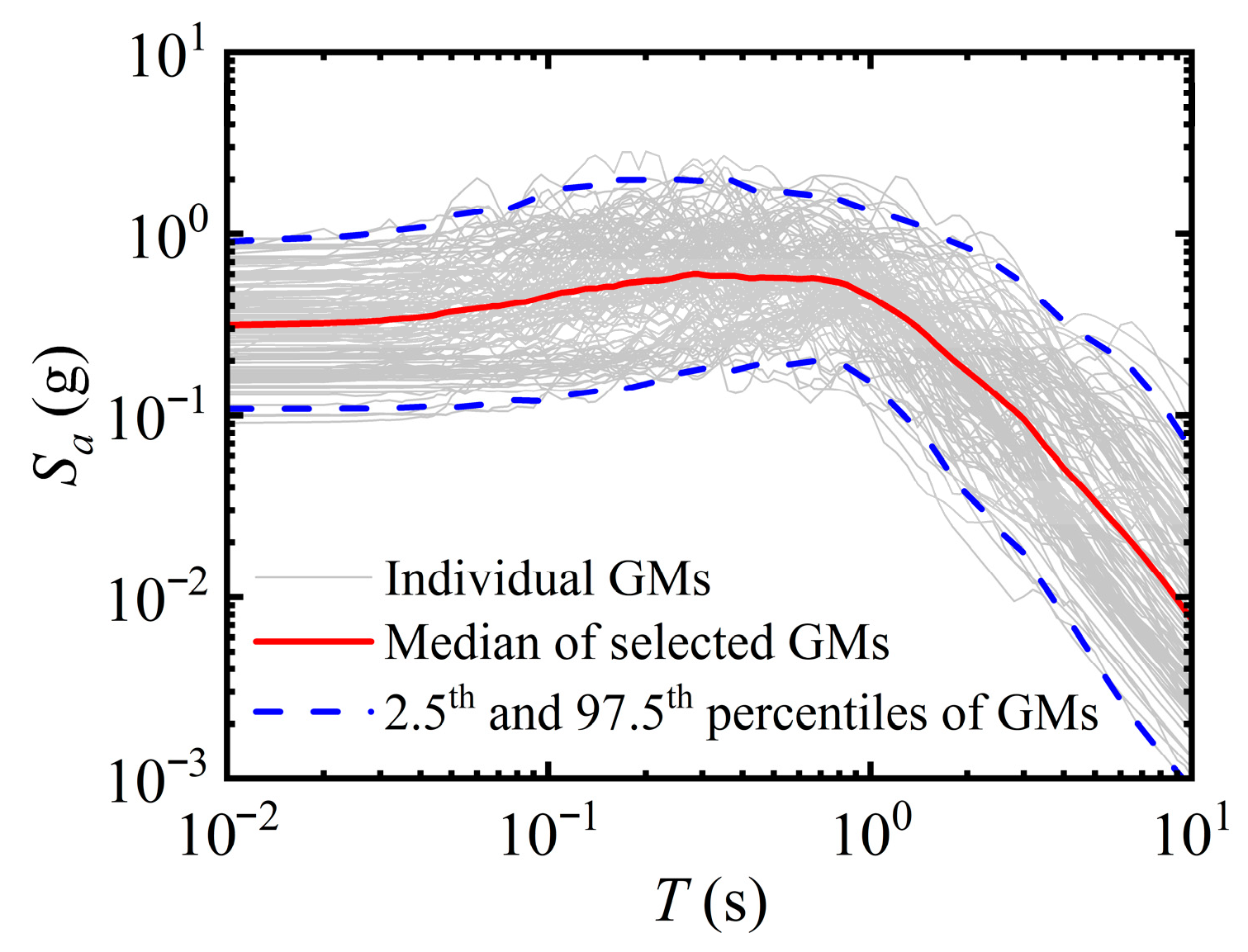
Extensive research activities have proposed widely applicable methods for identifying pulse-like ground motions [38,39]. Shahi [40] introduced a Continuous Wavelet Transform-based method for this purpose and employed it to identify a series of pulse-like ground motions from the Pacific Earthquake Engineering Research Center’s NGA-West2 database [41]. In this study, 124 ground motions were selected from the pulse-like ground motions identified by Shahi [40]. The spectral acceleration of the selected ground motions is presented in Figure 1, while detailed information about these ground motions is provided in Appendix A, Table A1. The opted ground motions have Mw ranging from 5.5 to 8, with a mean value of 6.54; Rrup not exceeding 80 km, with a mean value of 20.56 km; and PGV between 15 cm/s and 170 cm/s, with a mean value of 51.76 cm/s.
To ensure sufficient data on the RR of buried CI pipelines for subsequent optimal IM analysis, the PGA of the selected ground motions was scaled by factors of 1.5 and 2.0. Although scaling the PGA increases the absolute values of the IMs, their distribution patterns remain largely unchanged. Consequently, a total of 124 × 3 = 372 ground motions were used for the dynamic response analysis of buried CI pipelines.

4. Numerical Modeling

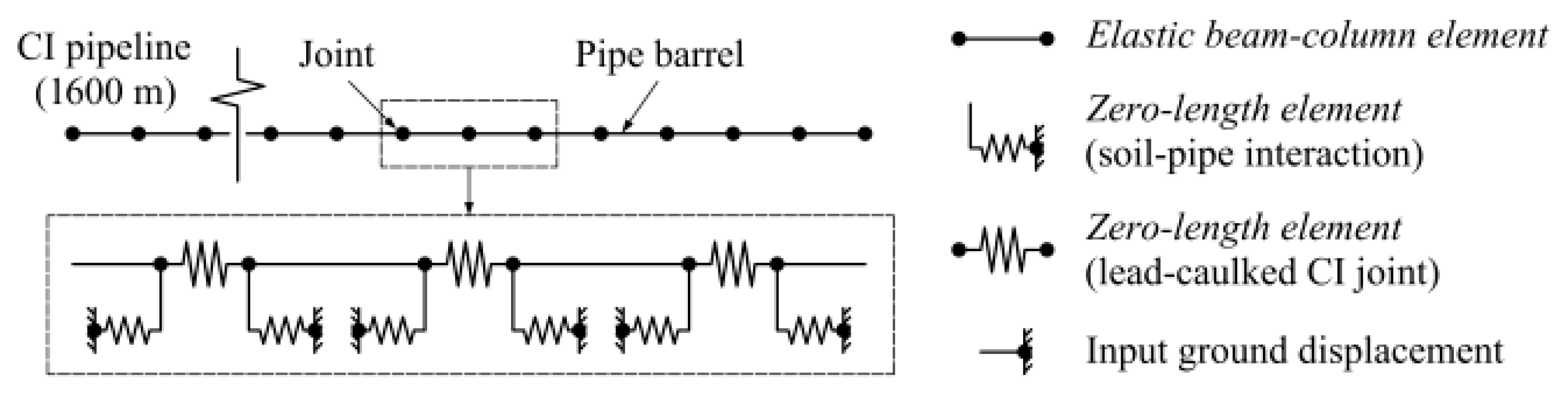
This study established a two-dimensional soil–pipe model based on the finite element method [42,43,44,45] to calculate the RR of buried CI pipelines with a nominal diameter (DN) of 150 mm, as witnessed in Figure 2, and its validity and accuracy have been verified in a previous study [5]. To comprehensively consider the influence of the Ca, each seismic wave was assigned three different values of Ca (1000 m/s, 2000 m/s, and 3000 m/s), racking up a total of 372 × 3 = 1116 calculation scenarios. The selected values of Ca encompass a representative range of apparent wave propagation velocities observed in real seismic events [33] and are consistent with values commonly adopted in seismic response analysis for buried pipelines [46]. The parameter values involved in the model are listed in Table 2.

4.1. Sealing Capacity of the Lead-Caulked Joints

The lead-caulked joints generally consist of packing (hemp or jute yarn) and caulking (lead or cement) materials. Packing serves to evenly fill the cavity between the bell and spigot, preventing the caulking material from entering the pipeline, while the caulking material ensures the sealing of the joint.
According to post-earthquake investigations [3,4] and numerical studies [47], buried pipelines under seismic wave propagation predominantly exhibit axial failure modes, while bending stresses, torsion, and rotational effects are negligible. Therefore, this study focused solely on analyzing the axial response of the pipeline. The axial sealing capacity of lead-caulked joints primarily involves the relationship between axial force and joint opening, as well as the corresponding joint opening (denoted as λl) at which leakage occurs.
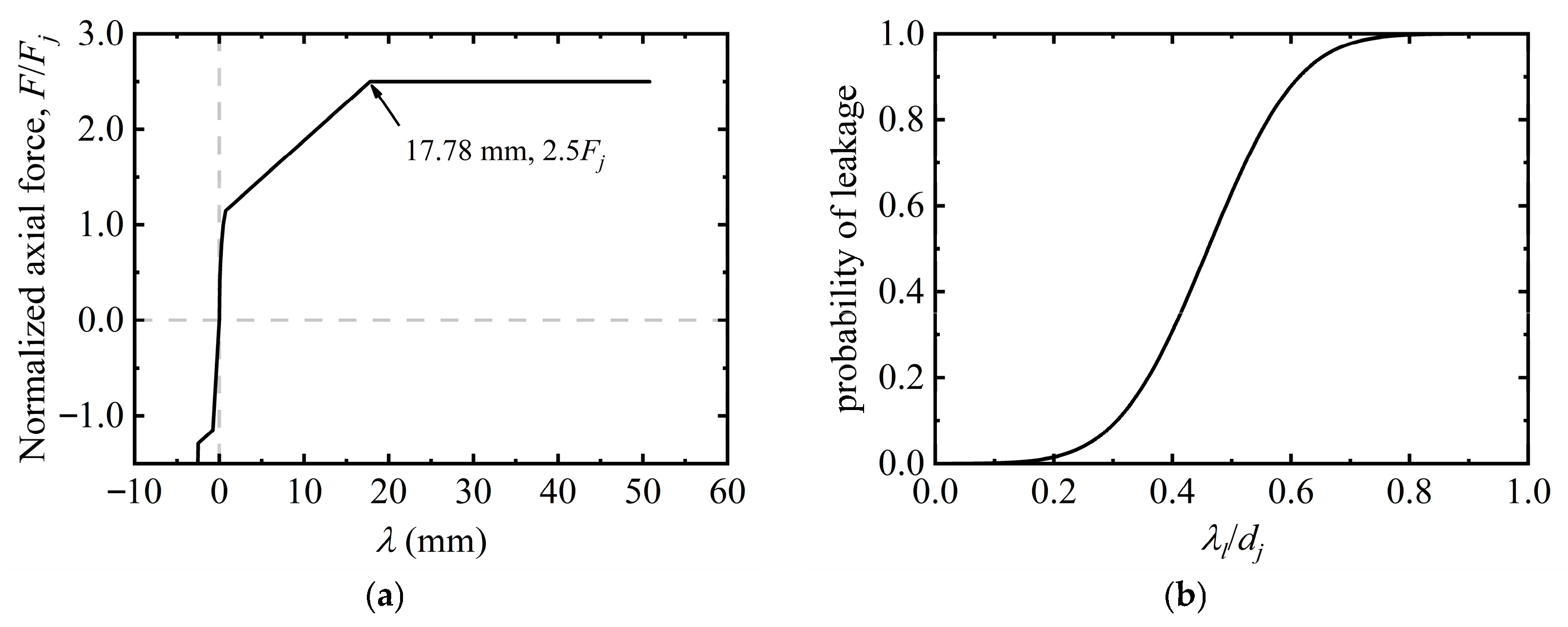
Wham et al. [48] compiled axial tensile test results for 17 sets of lead-caulked joints with nominal diameters ranging from 150 mm to 1500 mm, proposing an empirical relationship between axial force (F) and joint opening (λ) for lead-caulked joints, as depicted in Figure 3a. The joint exhibits high initial tensile stiffness, which declines in the wake of the first slip. The axial tensile force reaches its peak, approximately 2.5 Fj, when the joint opening attains 17.78 mm. The axial force at first slip, Fj, can be calculated as follows [48]:
F j = π D o s d L a C ,
where Dos stands for the outer diameter of the pipe; dL represents the lead caulking depth (which can be assigned as 57 mm for all pipe diameters); aC signifies the CI–lead adhesion. Wham et al. [48] suggested that aC abides by a normal distribution with a mean value of 1.63 MPa and a standard deviation of 0.49 MPa.
The joint opening associated with the leakage of lead-caulked joints demonstrates remarkable uncertainty. El Hmadi and O’Rourke [49] established a cumulative probability distribution for axial leakage versus the normalized joint opening (λl/dj), as evidenced by Figure 3b. Herein, λl represents the joint opening corresponding to leakage, and dj denotes the joint embedment depth (90 mm for DN 150 mm CI pipeline). El Hmadi and O’Rourke [49] suggest that λl/dj follows a normal distribution with a mean value of 0.45 and a standard deviation of 0.13.

4.2. Pipeline Simulation

The pipe barrel was modeled by elastic beam-column elements assigned with corresponding elastic modulus, mass per unit length, and cross-sectional area. The model comprised 267 pipe segments (the length of each pipe segment was assigned as 6 m) and 266 joints, totaling approximately 1600 m in length. To mitigate the influence of boundary effects, only the middle 1000 m of the pipeline (encompassing 167 joints) was used to calculate the repair rate. The remaining pipe segments at both ends served as buffer zones to absorb reflected waves, thereby ensuring that the dynamic response in the central region of interest was unaffected by boundary interference. Additionally, the water within the pipeline was assumed to oscillate concurrently with the pipeline, and only the mass of the water was considered in the finite element model [3,50].

4.3. Joint Simulation

The sealing capacity of lead-caulked joints is predominantly contingent upon the CI–lead adhesion (aC) and the joint opening corresponding to leakage (λl). A physical correlation between aC and λl/dj is anticipated, as both parameters stem from the quality of the lead–cast iron bond. However, the precise correlation coefficient between aC and λl/dj remains unquantified. In accordance with the established simplification prevalent in seismic fragility analyses of cast iron pipelines, a perfect correlation is therefore assumed herein. Additionally, both parameters are represented by truncated normal distributions to preclude non-physical values [26,34]. The mean values and standard deviations of these parameters are provided in Section 4.1. For each finite element model, a set of 266 samples for aC and λl/dj was generated using Latin Hypercube Sampling, corresponding to the 266 joints, thereby enabling the determination of the axial force–joint opening relationship for each joint and the joint opening (λl) corresponding to leakage. The joints were modeled using zero-length elements that incorporate the axial force–joint opening relationship of lead-caulked joints shown in Figure 3a.

4.4. Soil–Pipe Interaction Simulation

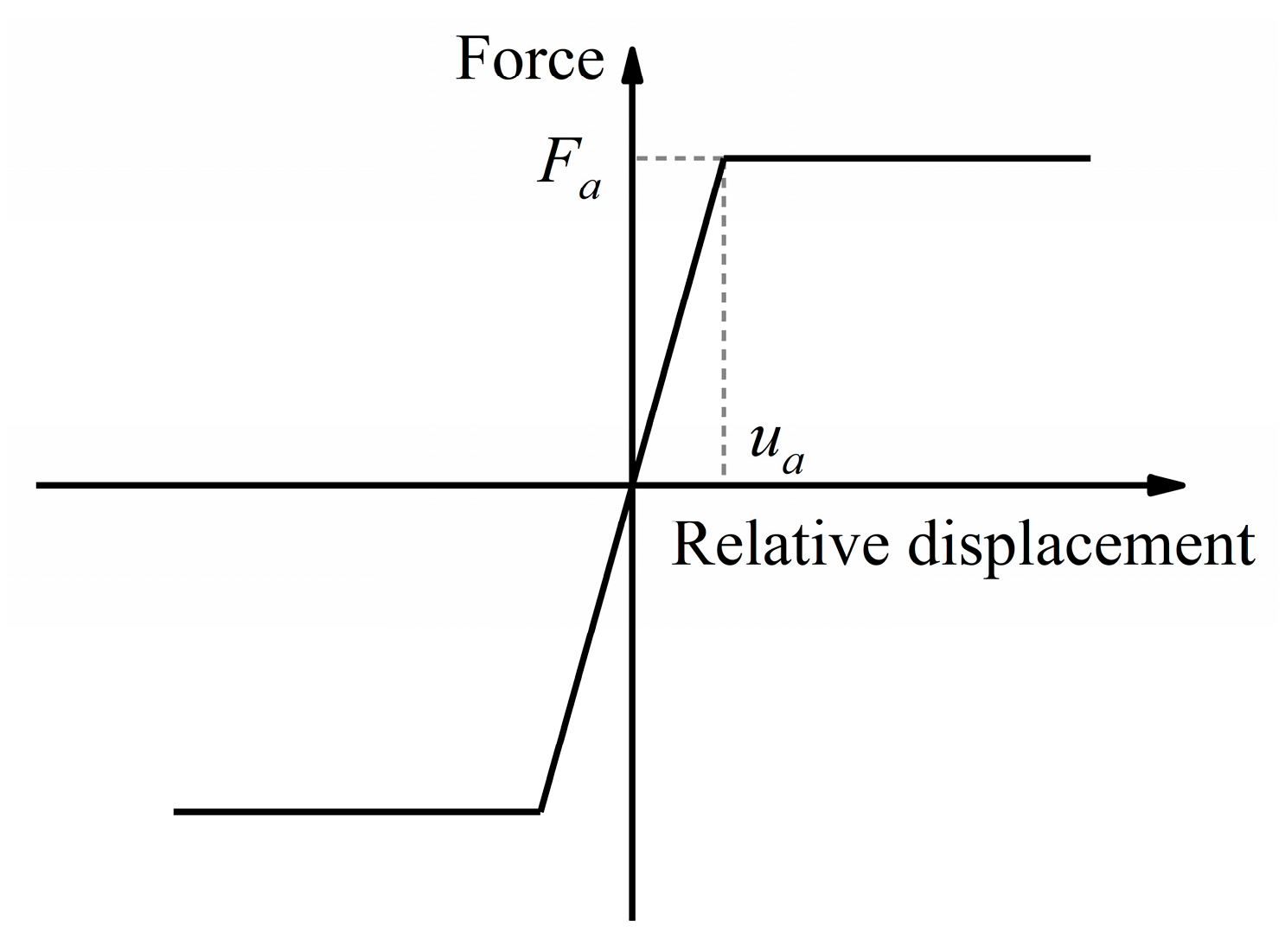
The CI pipeline is assumed to be backfilled with sandy soil. The soil–pipe interaction was simulated using zero-length elements, which were assigned the axial force-relative displacement relationship depicted in Figure 4 [25]. Following the recommendations of ALA [25], the soil–pipe yield displacement (ua) was set as 3 mm. The peak pipe–soil interaction force per unit length (Fa) is given by the following equation:
F a = π D o s d + D o s 2 ρ s g 1 + K 0 2 tan ( f m ϕ ) ,
where ρs and ϕ represent the density and internal friction angle of the backfill soil, respectively; d denotes the burial depth (distance from the ground surface to the top of the pipeline); g is the gravitational acceleration; K0 refers to the at-rest earth pressure coefficient, assigned as 1.0 in this study; and fm is friction factor, set as 0.9 in this study.

4.5. Dynamic Analysis

Buried pipelines are primarily affected by seismic-wave propagation in the axial direction, so the ground motion was applied in the axial direction while the degrees of freedom in other directions were fixed. Existing research indicated that the traveling wave effect should be considered during the dynamic analysis of buried pipelines [46,51,52]. For seismic waves propagating along the axial direction of the pipeline, the shape and amplitude of ground motion at various points can be considered consistent, with only a time lag between the two points. This time lag can be calculated using the following equation [50]:
Δ t = τ C a ,
where τ represents the distance between two points; Ca denotes the apparent wave propagation velocity along the axial direction of the pipeline. For each scenario, the ground displacements incorporating the traveling wave effect were input into each ground node for dynamic analysis.
The dynamic time-history analysis was performed using the unconditionally stable Newmark-β method (γ = 0.5, β = 0.25). A Rayleigh damping model with a damping ratio of 5% was assigned to the system, with the mass- and stiffness-proportionality coefficients calculated by matching this ratio at frequencies of 0.2 Hz and 20 Hz. The nonlinear equations were solved using the Newton–Raphson algorithm, with convergence determined by an energy increment tolerance of 1.0 × 10⁻⁴ and a maximum of 200 iterations per step.

4.6. Acquisition of Repair Rate

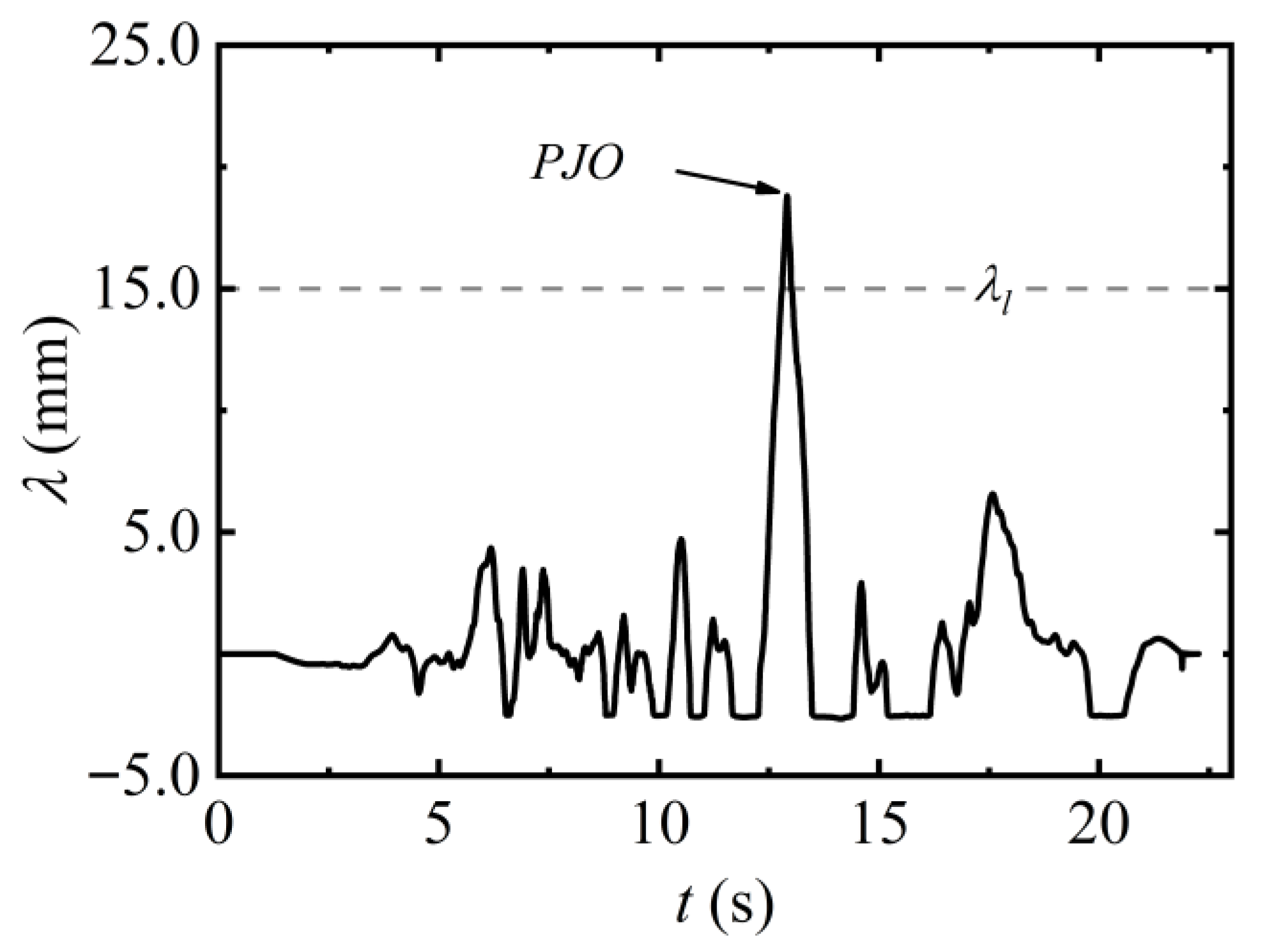
During the dynamic response analysis, the opening time histories of 167 joints within the middle 1000 m of the pipeline were recorded. For instance, Figure 5 depicts the opening time history of a specific joint subjected to the seismic wave RSN723. When the peak joint opening (PJO) exceeds λl, the joint is considered as failed. The PJOs for each joint were extracted. Consequently, the number of failed joints, Numf, in each model can be calculated using the following equation:
N u m f = 167 I P J O λ l ,
where I (PJOλl) is a discriminant function that takes a value of 1 when PJO is greater than or equal to λl and 0 otherwise.
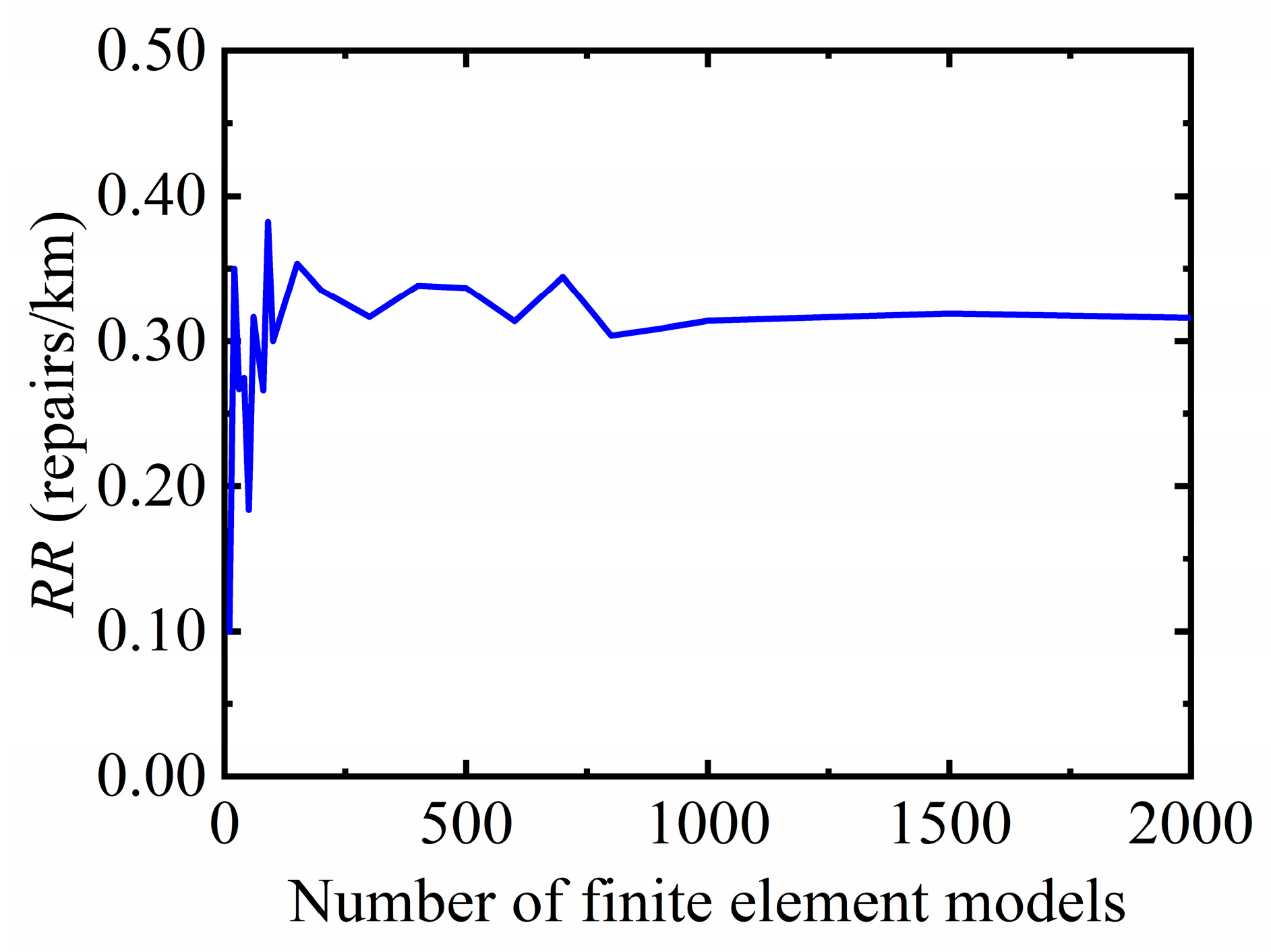
For each seismic scenario, the average value of Numf from finite element models was taken as RR for that specific scenario, expressed in repairs per kilometer. A single finite element model is insufficient to fully represent the uncertainties inherent in the parameters aC and λl/dj. Figure 6 illustrates the variation in the calculated RR with respect to the number of finite element models. The results indicate that the RR stabilizes within an acceptable tolerance once the ensemble size reaches 1000 finite element models, satisfying the precision requirements of the analysis. Consequently, an ensemble of 1000 finite element models was constructed for each seismic scenario to ensure a robust and reliable probabilistic assessment. It should be noted that, to ensure the statistical reliability of the simulation results, an automated procedure was implemented to identify and discard any samples that failed due to numerical non-convergence, followed by supplementing new samples to complete the analysis.
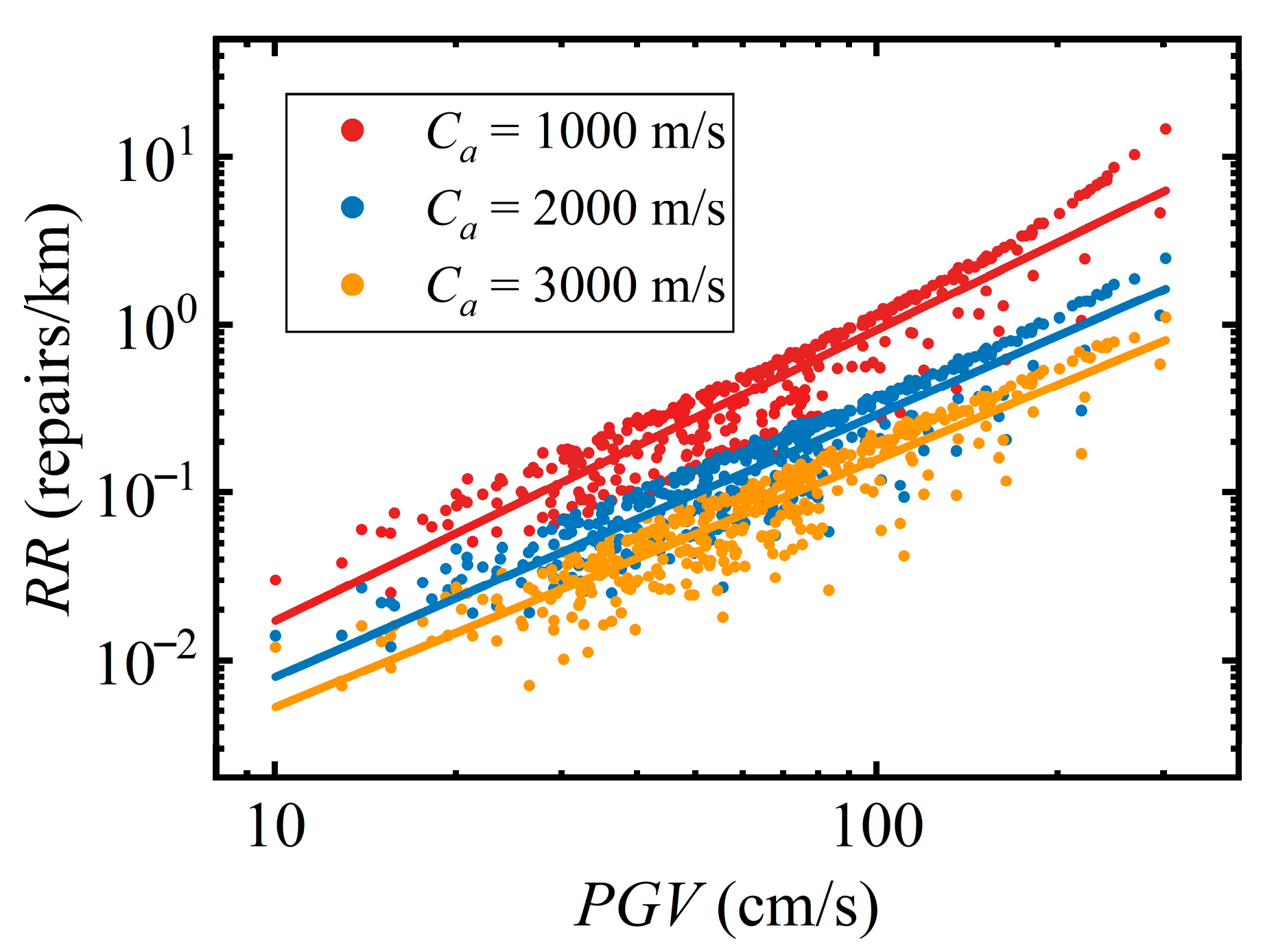
Figure 7 presents the distribution of RR, obtained through numerical modeling, as a function of PGV for three different values of Ca. It can be observed that RR elevates with the increase in PGV and the decrease in Ca. The relationship between RR and PGV is approximately linear in logarithmic scale. The optimal IM for RR assessment under different Ca can be identified based on the data presented in Figure 7.

4.7. Validation of the Numerical Model

The validity of the two-dimensional finite element model developed in this study was assessed through a systematic comparison with a widely recognized empirical fragility relation. This relation synthesizes actual seismic damage observations of buried cast iron pipelines from multiple historical earthquakes [8]. It should be noted that the intensity measure, PGS, in the empirical fragility relation is equal to the ratio of PGV to Ca [46]. The goodness-of-fit between the numerical results and predictive results was quantified using three statistical metrics, with the results summarized in Table 3.
The finite element model demonstrates strong performance in predicting pipeline repair rates, as evidenced by an overall coefficient of determination (R2) of 0.76 and acceptably low Mean Squared Error (MSE) and Mean Absolute Error (MAE) values against the empirical fragility relation. It is noteworthy that the agreement diminishes under lower Ca. This is primarily because a lower Ca amplifies PGS, driving the pipeline system into a high-damage, strongly nonlinear response regime. Empirical data within this high-PGS range are inherently sparse, which complicates precise validation. Nonetheless, the model’s robust performance across the primary parameter range validates its effectiveness for assessing pipeline repair rates under seismic wave propagation.

5. Results

5.1. Optimal Scalar-IMs

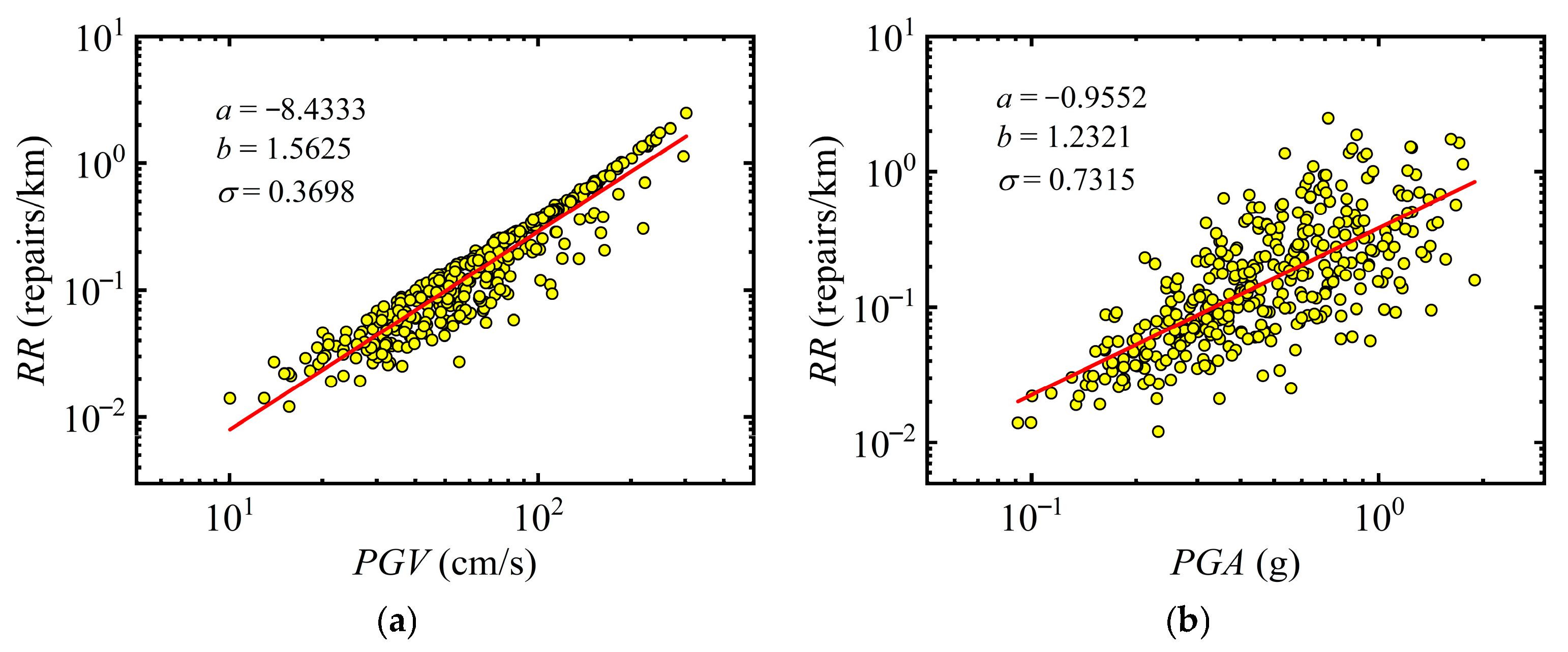
This study elaborated on the efficiency of various scalar-IMs in predicting RR using Equation (1). Utilizing the analysis results with a Ca of 2000 m/s as an illustrative case, Figure 8a,b display the predictive efficiency of PGA and PGV, respectively. The standard deviations of the regression residuals (σ) derived when employing PGA and PGV as IMs are 0.7315 and 0.3698, respectively. When compared to using PGA as the IM, the standard deviation of the residuals is reduced when using PGV, suggesting that PGV outperforms PGA in terms of predictive efficiency.
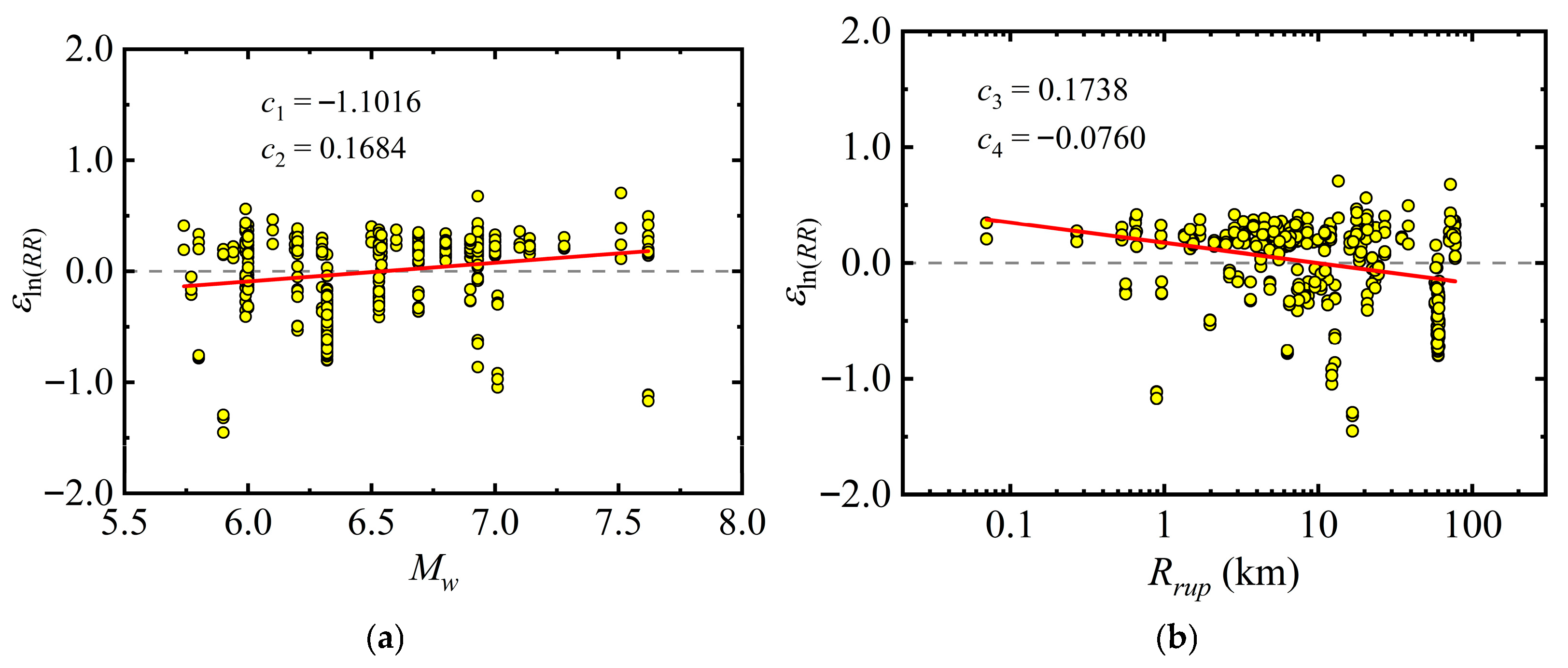
The sufficiency of various scalar-IMs in predicting RR was investigated based on Equations (3)–(5). Figure 9a,b illustrate the dependence of the regression residuals εln(RR) on Mw and Rrup, respectively. When PGV is utilized as the IM, the slope of the regression line between εln(RR) and Mw is 0.1684, indicating a relatively stronger dependence of the regression residuals of ln(RR) on Mw. Conversely, the slope of the regression line between εln(RR) and ln(Rrup) is −0.0760, suggesting a relatively weaker dependence of the regression residuals of ln(RR) on Rrup.
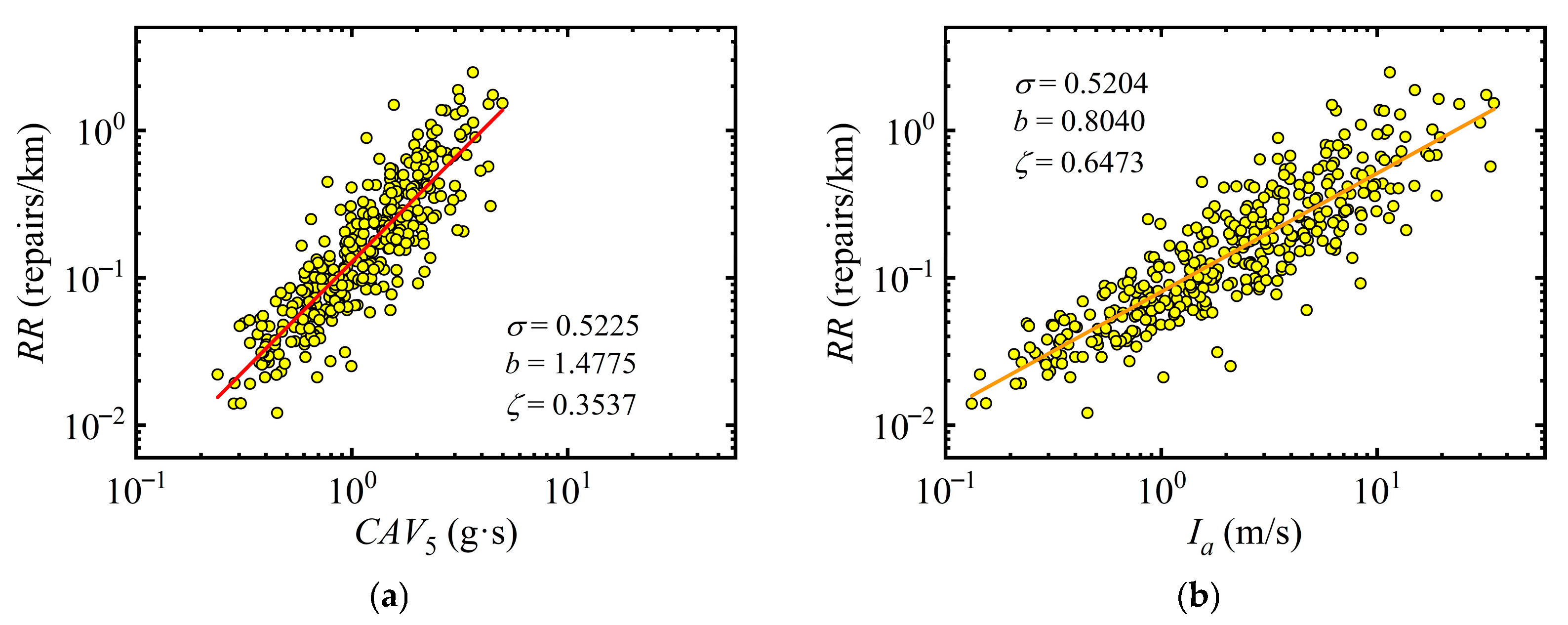
This study also explored the proficiency of various scalar-IMs in predicting RR using Equation (6). Figure 10a,b present the predictive proficiency of CAV5 and Ia, respectively. The standard deviations of the regression residuals (σ) obtained when using CAV5 and Ia as IMs are comparable, at 0.5225 and 0.5204, respectively. However, CAV5 demonstrates superior predictive practicality compared to Ia, as evidenced by a smaller b value when CAV5 is used as the IM. Thus, CAV5 exhibits better predictive proficiency.
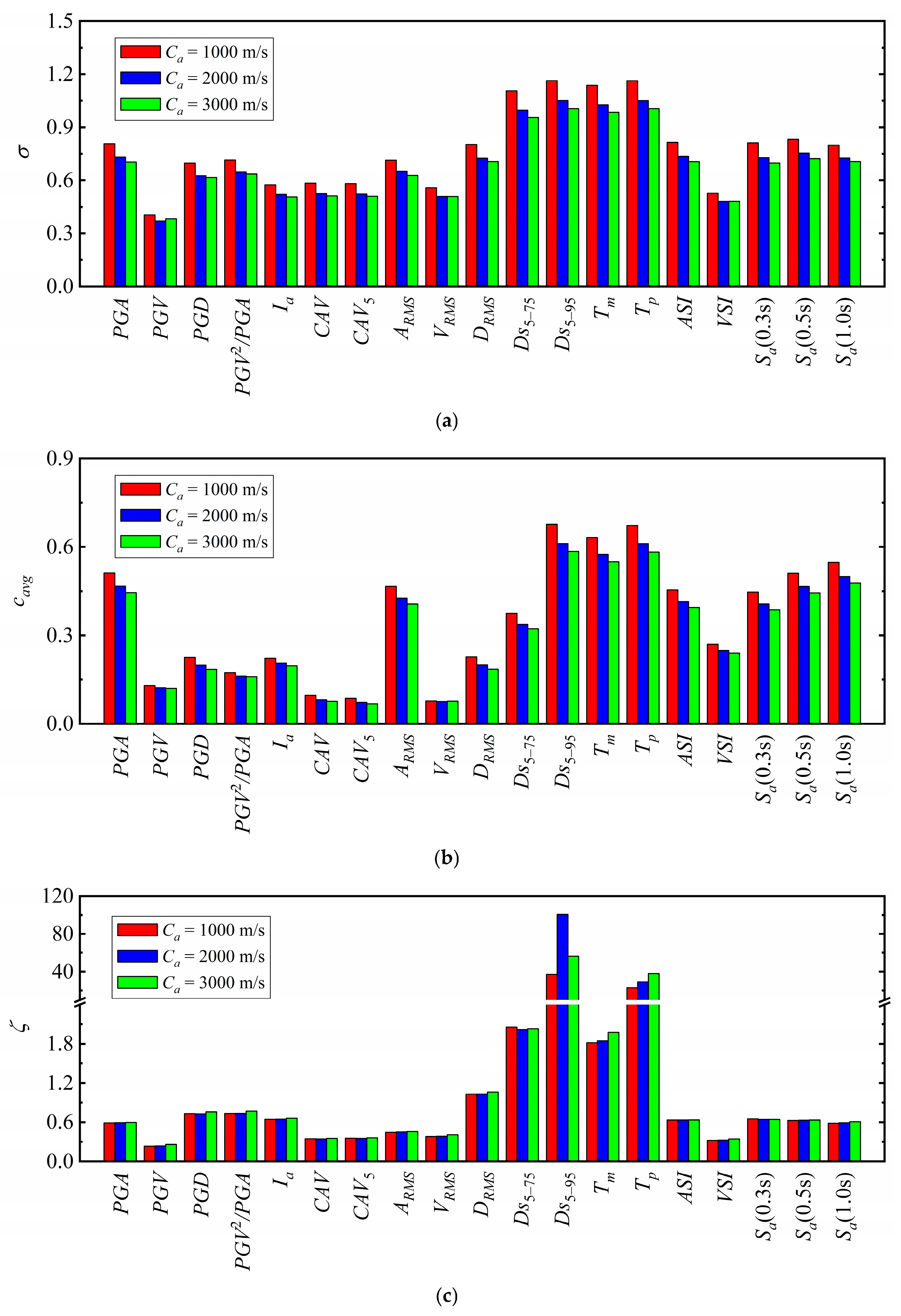
Figure 11 depicts the efficiency, sufficiency, and proficiency of various scalar-IMs in predicting RR of buried CI pipelines subjected to pulse-like ground motions. The distribution patterns of predictive efficiency, sufficiency, and proficiency for each IM remain consistent across different values of Ca. PGV exhibits the highest predictive efficiency (σ = 0.39) and proficiency (ζ = 0.24), followed by VSI (σ = 0.50, ζ = 0.33). In terms of sufficiency, CAV, CAV5, and VRMS perform best with cavg values approximately 0.08; PGV ranks closely behind with cavg values about 0.12. In contrast, VSI shows relatively poorer sufficiency relative to the other IMs (cavg = 0.25). Considering the predictive efficiency, sufficiency, and proficiency of various scalar-IMs comprehensively, PGV is deemed the optimal scalar-IM for predicting RR of buried CI pipelines subjected to pulse-like ground motions.

5.2. Optimal Vector-IMs

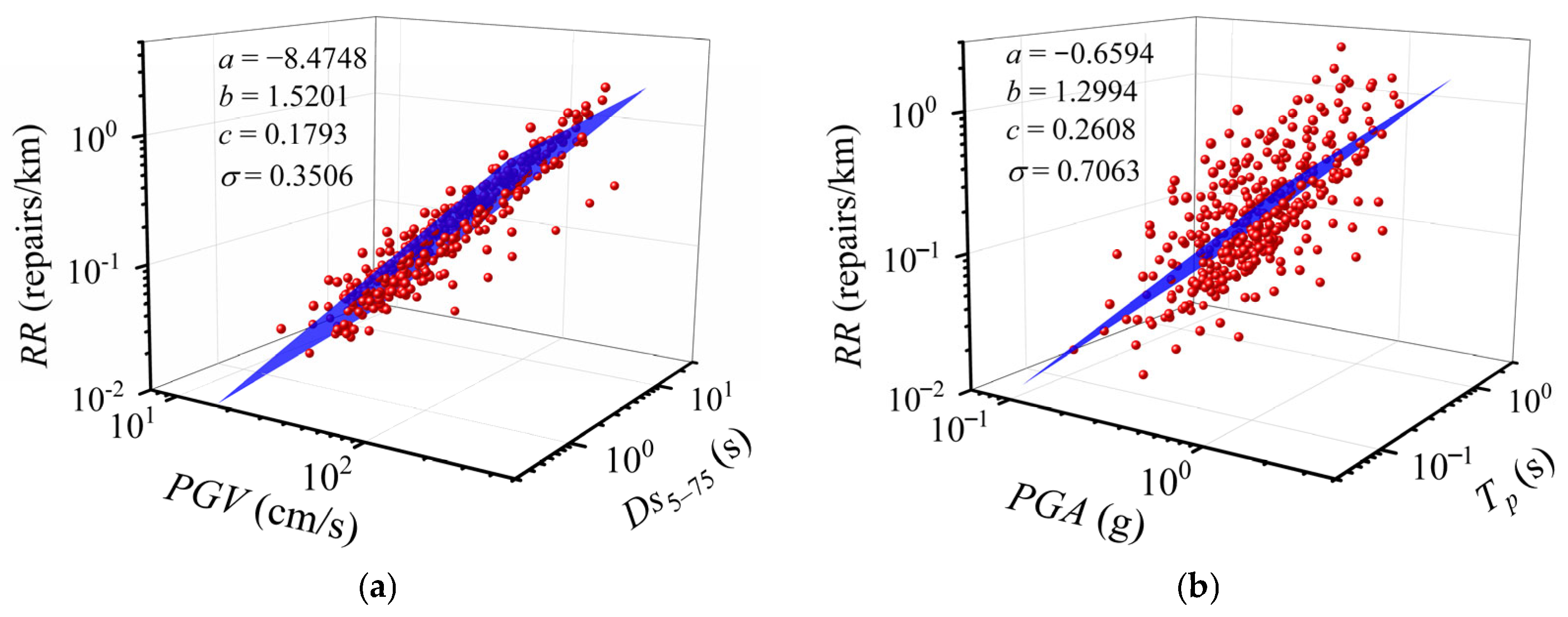
The elucidation of the efficiency of various vector-IMs in predicting RR proceeded with Equation (2). Taking the analysis results with a Ca of 2000 m/s as an illustrative case, Figure 12a,b depict the efficiency analysis outcomes for [PGV, Ds5–75] and [PGA, Tp], respectively. The standard deviations of regression residuals (σ) obtained when utilizing [PGV, Ds5–75] and [PGA, Tp] as IMs are 0.3506 and 0.7063, respectively, revealing superior predictive efficiency for [PGV, Ds5–75].
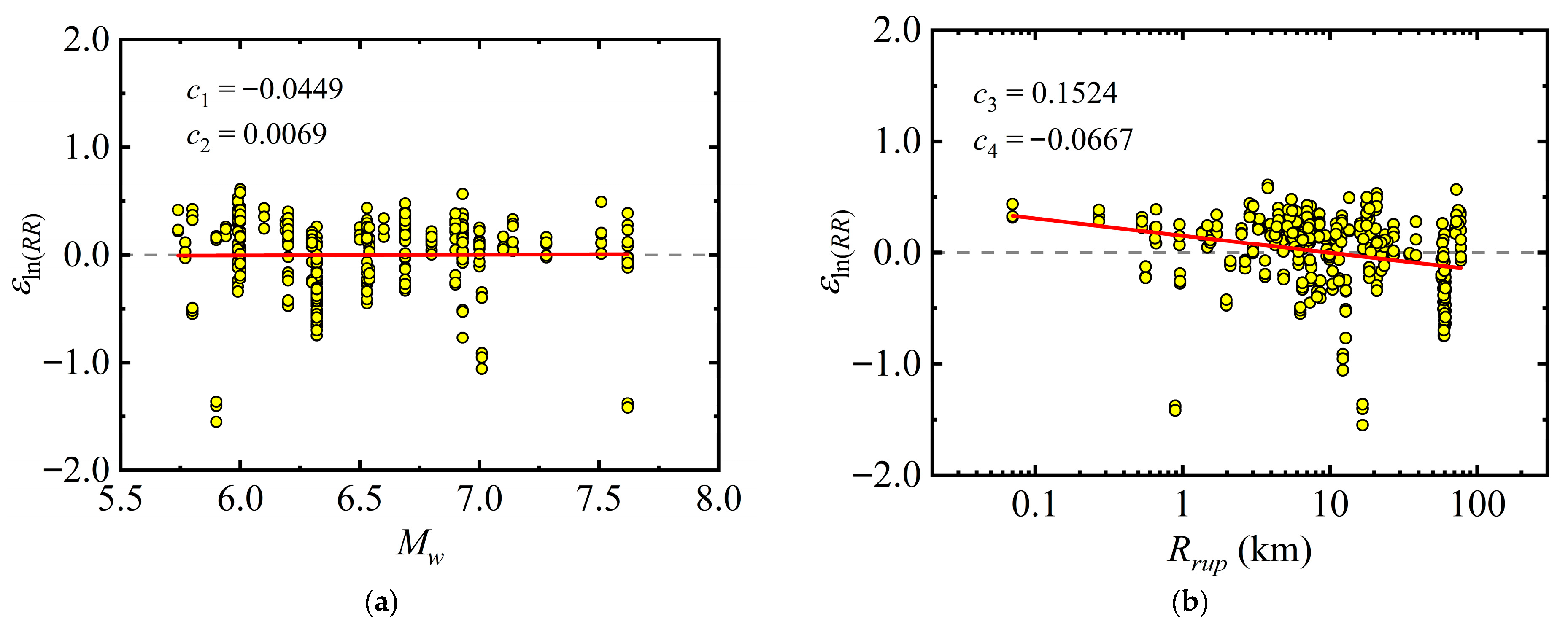
We then investigated the sufficiency of various vector-IMs in predicting RR using Equations (3)–(5). Figure 13a,b demonstrate the dependence of the regression residuals εln(RR) on Mw and Rrup when [PGV, Ds5–75] is employed as the IM. The slope of the regression line between εln(RR) and Mw is 0.0069, markedly smaller than that obtained when using PGV as the IM, effectively mitigating the dependence on Mw. Additionally, the slope of the regression line between εln(RR) and ln(Rrup) is −0.0667, suggesting a relatively lower dependence of εln(RR) on Rrup when [PGV, Ds5–75] is used as the IM.
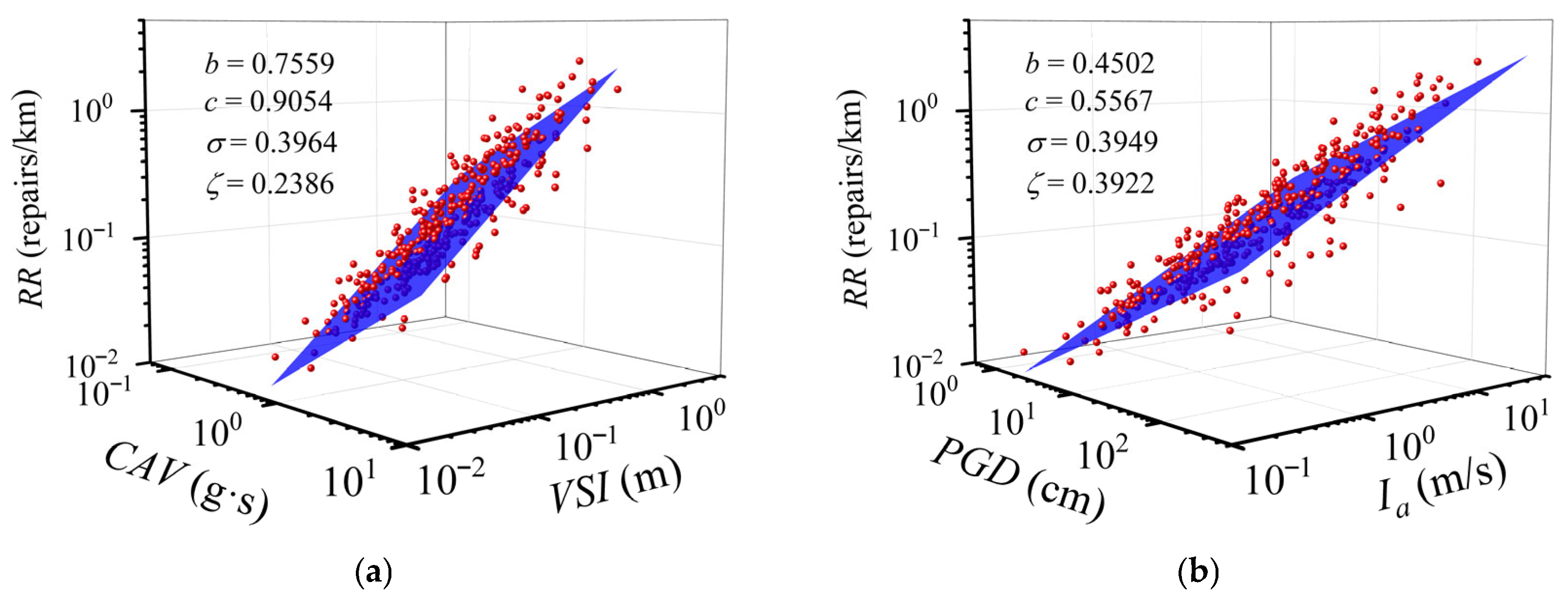
The proficiency of various vector-IMs in predicting RR was explored using Equation (7). Figure 14a,b present the proficiency of [CAV, VSI] and [PGD, Ia], respectively. The standard deviations of the regression residuals (σ) are comparable, at 0.3964 and 0.3922, respectively. However, [CAV, VSI] exhibits superior predictive practicality (b = 0.7559) compared to [PGD, Ia] (b = 0.4502), indicating a greater predictive proficiency for [CAV, VSI].
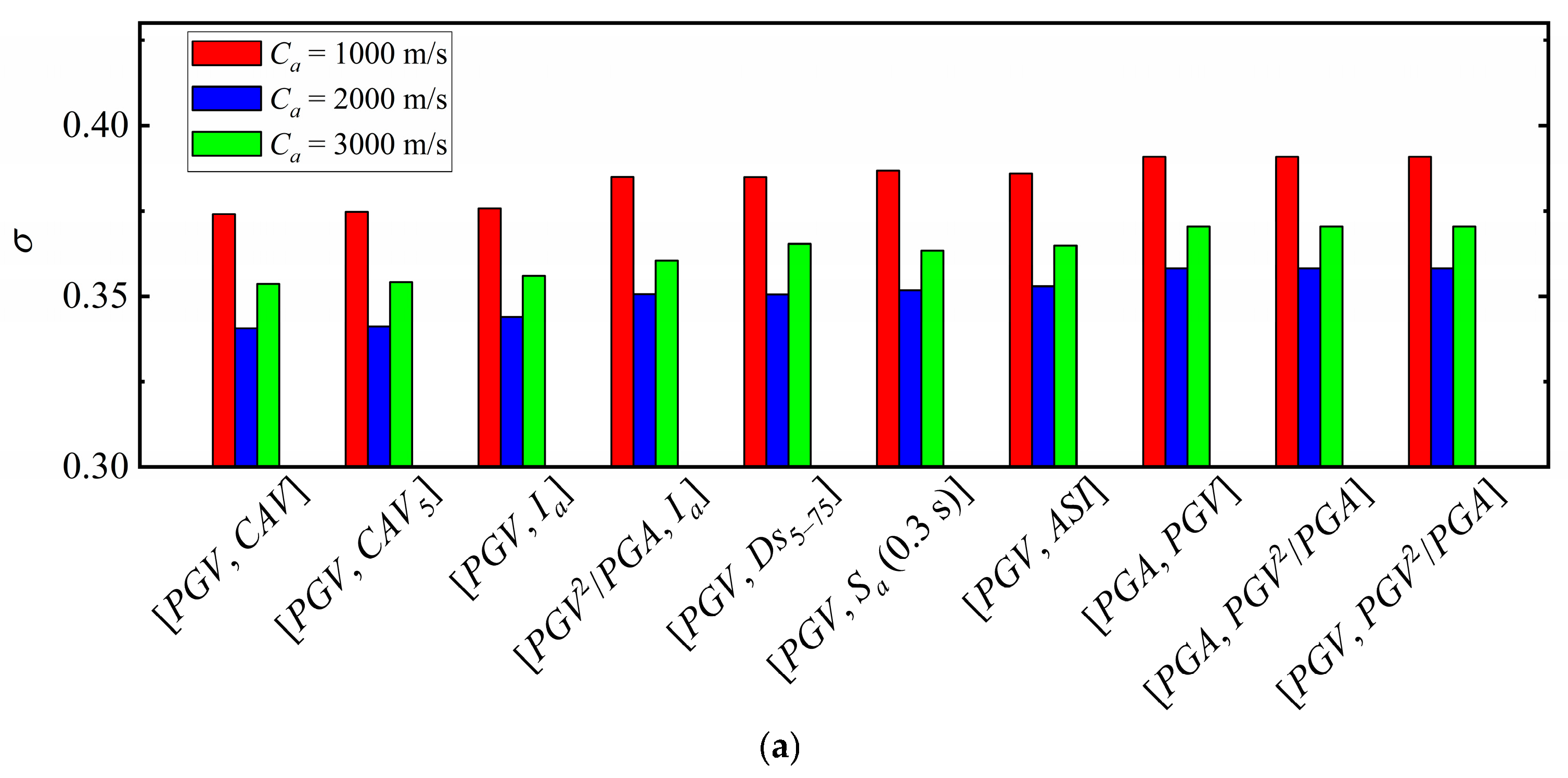
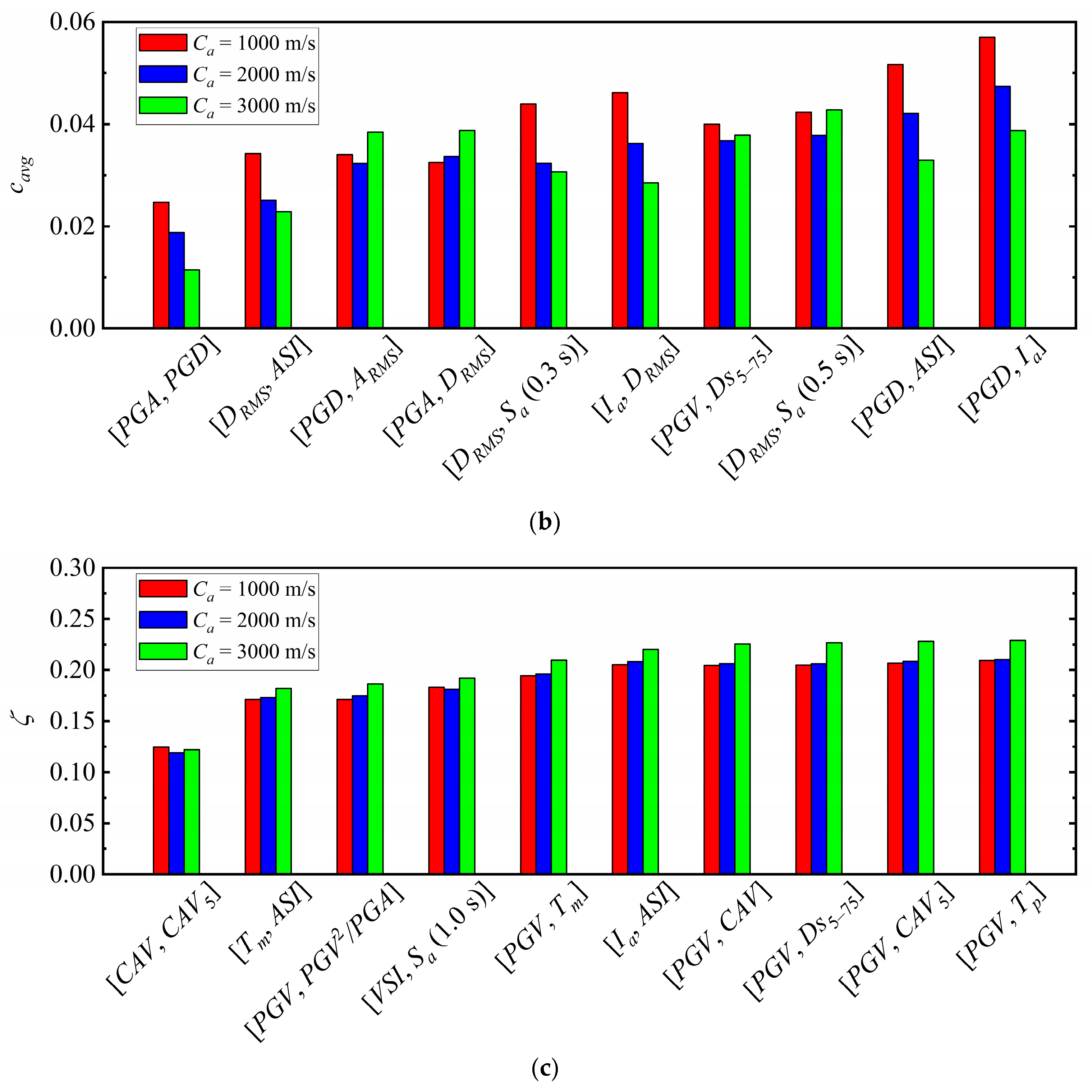
Given the extensive number of vector-IMs, presenting the predictive efficiency, sufficiency, and proficiency analysis results for all vector-IMs is impractical. Therefore, Figure 15 displays the analysis results for the top 10 vector-IMs. Akin to scalar-IMs, the distribution patterns of predictive efficiency, sufficiency, and proficiency for various vector-IMs at different Ca values are consistent. As demonstrated by Figure 15a, the efficiency results for the top 10 vector-IMs are closely grouped, with [PGV, CAV] demonstrating the highest predictive efficiency (σ = 0.36). Figure 15b indicates that [PGA, PGD] (cavg = 0.02) shows the best sufficiency, followed by [DRMS, ASI] (cavg = 0.03), while other vector-IMs also revealed good predictive sufficiency (cavg = 0.05 for [PGD, Ia]). Figure 15c suggests that the predictive proficiency of [CAV, CAV5] (ζ = 0.12) is significantly superior to that of other vector-IMs, with comparable predictive proficiency observed for the remaining IMs.
As evident from Figure 15, [PGV, Ds5–75] exhibits good predictive efficiency (σ = 0.37), sufficiency (cavg = 0.04), and proficiency simultaneously (ζ = 0.21). Therefore, [PGV, Ds5–75] is identified as the optimal vector-IM for estimating RR of buried CI pipelines subjected to pulse-like ground motions. When comparing the predictive efficiency, sufficiency, and proficiency analysis results using [PGV, Ds5–75] and PGV as IMs, it is evident that across three values of Ca, the average reductions in σ, cavg, and ζ are 0.02, 0.09, and 0.03, respectively, underscoring the advantages of using vector-IMs for evaluating RR.

6. Discussion

The regression coefficients for fragility relations of buried CI pipelines using the scalar-IM (PGV) and the vector-IM ([PGV, Ds5–75]) under varying Ca are summarized in Table 4. The common error index, namely the root mean square error (RMSE), is employed to evaluate the overall performance of the fragility relations (presented in Table 4). As a result, the fragility relations using [PGV, Ds5–75] as IM have relatively low RMSE scores under different Ca, indicating the advantage of vector-IM in reducing the error in RR prediction.
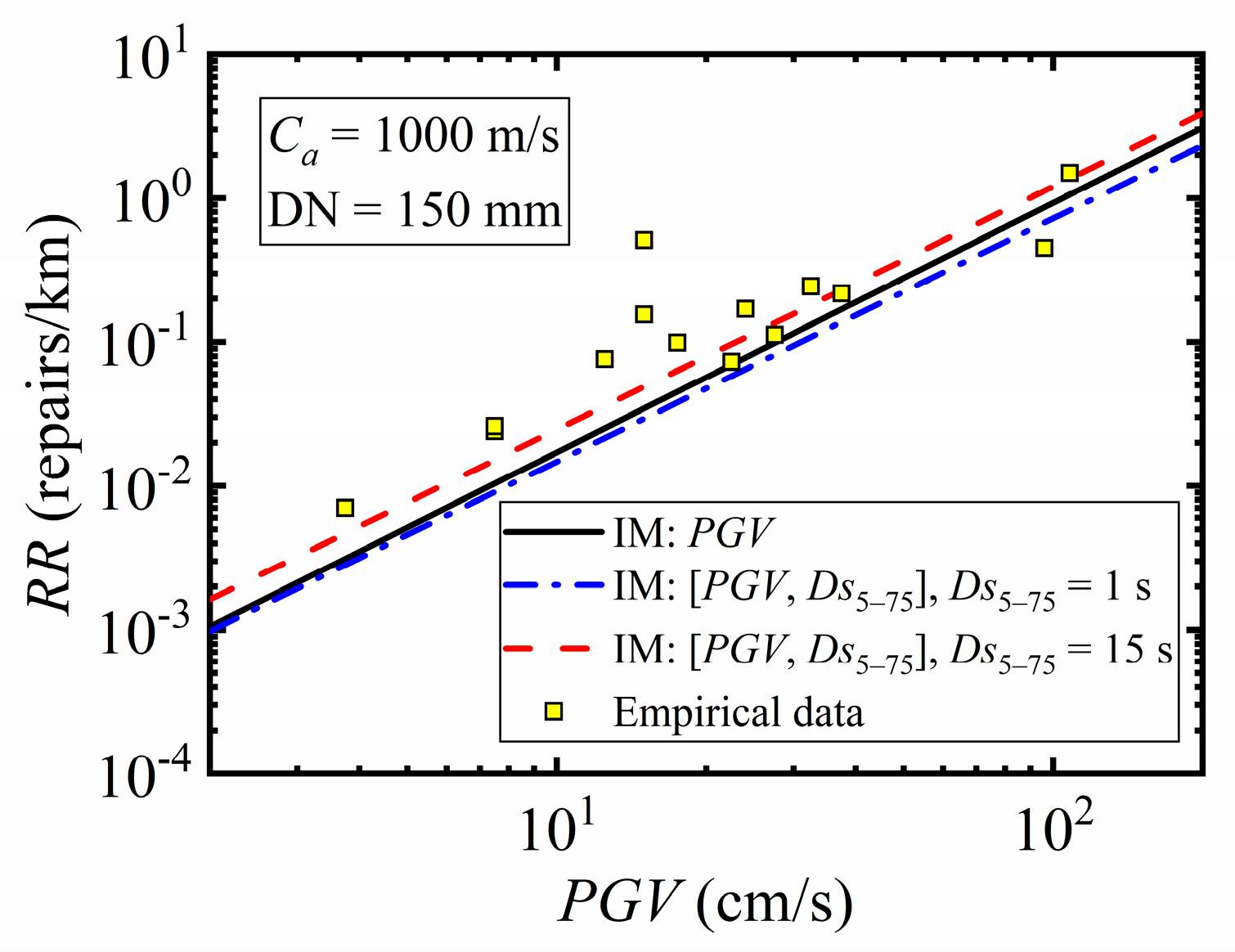
Figure 16 illustrates the predicted RR data versus PGV based on the fragility relations developed, as compared to the empirical data reported by O’Rourke et al. [8]. It clearly shows that the predicted results match reasonably well with the empirical data. The statistical metric, namely the mean absolute error (MAE), is employed to evaluate the agreement between the predicted and empirical RR. The MAE is approximately 0.13 repairs/km when PGV is used as the IM. This value is smaller than the inherent scatter within the empirical dataset (e.g., ranging from 0.16 to 0.51 repairs/km at PGV = 15 cm/s), indicating that the fragility relation appropriately captures the tendency of RR to vary with PGV under pulse-like ground motions. It is noteworthy that when Ds5–75 varies, there is a discrepancy between the RR predicted by the scalar-IM (PGV) and the vector-IM ([PGV, Ds5–75]). Specifically, the RR predicted by PGV is 0.28 repairs/km when PGV equals 50 cm/s. Under the same PGV condition, the RR predicted by [PGV, Ds5–75] are 0.22 and 0.37 repairs/km for Ds5–75 values of 1 s and 15 s, respectively, corresponding to deviations of 21% and 32%. These findings further highlight the advantage of employing vector-IM in reducing the uncertainty of RR predictions. It should be noted that the empirical data is limited in sample size, which necessitates future collection of well-documented damage cases for further validation and refinement of the proposed models.
This study confirms the advantage of vector-IMs in reducing prediction uncertainty of RR for buried CI pipelines subjected to pulse-like ground motions, yet their practicality should be weighed in seismic risk assessment for actual pipeline networks. Compared to scalar-IMs, vector-IMs are less accessible and involve higher computational complexity, making them difficult to integrate into the PSHA framework. Therefore, in practical applications, the more predictive vector-IMs (e.g., [PGV, Ds5–75]) are recommended for the seismic risk assessment of critical pipelines with high safety requirements. For preliminary risk analysis of large-scale pipeline networks, easily accessible scalar-IMs (e.g., PGV) remain the pragmatic choice.
The numerical analysis in this study accounts for the variability in both ground motions and joint properties. However, there are still several limitations in this study: (i) the assumption of perfect correlation between aC and λl/dj does not align with actual conditions; (ii) the findings are primarily applicable to cast iron pipelines with lead-caulked joints subjected to transient ground deformation; and (iii) the inability of the two-dimensional model to accurately account for spatially non-uniform seismic excitation and complex slippage and separation at the soil–pipe interface. Thus, further research is warranted to address these aspects.

7. Conclusions

In this study, a two-dimensional soil–pipe model incorporating the uncertainty in the sealing capacity of lead-caulked joints along the pipeline axis was introduced. A suite of 124 pulse-like ground motions was selected from the NGA-West2 database to conduct nearly 1.116 million nonlinear dynamic analyses for the soil–pipe model, and 19 scalar-IMs and 171 vector-IMs were regarded as potential candidates for identifying the optimal IMs for RR prediction. The RR of CI pipelines was calculated for various scaling factors and apparent wave velocities, resulting in a total of 1116 datasets pertinent to CI pipeline damage. Utilizing RR as the EDP, the predictive efficiency, sufficiency, and proficiency of different IMs were evaluated through regression analysis, ultimately leading to the identification of the optimal scalar- and vector-IMs for estimating RR of buried CI pipelines subjected to pulse-like ground motions. The following conclusions are drawn:
(1)
The distribution patterns of efficiency, sufficiency, and proficiency in predicting RR using various candidate IMs are alike under varying values of Ca. Among the scalar-IMs, PGV exhibits the best predictive efficiency (σ = 0.39) and proficiency (ζ = 0.24), followed by VSI (σ = 0.50, ζ = 0.33). The IMs CAV, CAV5, and VRMS demonstrate superior predictive sufficiency, each with a cavg value of approximately 0.08, and PGV also shows good predictive sufficiency (cavg = 0.12). However, VSI presents inferior sufficiency compared to the other IMs (cavg = 0.25). After comprehensively comparing the predictive efficiency, sufficiency, and proficiency of candidate scalar-IMs, PGV is chosen as the optimal scalar-IM for estimating RR of buried CI pipelines subjected to pulse-like ground motions.
(2)
Among the vector-IMs, [PGV, CAV] demonstrates the best efficiency (σ = 0.36). [PGV, PGD] shows the best sufficiency (cavg = 0.02), followed by [DRMS, ASI] (cavg = 0.03). The proficiency of [CAV, CAV5] is remarkably better than that of other vector-IMs (ζ = 0.12). Considering all three criteria together, [PGV, Ds5–75] exhibits good predictive efficiency (σ = 0.37), sufficiency (cavg = 0.04), and proficiency (ζ = 0.21), and is ultimately identified as the optimal vector-IM for estimating RR of buried CI pipelines subjected to pulse-like ground motions. Compared to PGV, the vector-IM [PGV, Ds5–75] yields improvements across efficiency, sufficiency, and proficiency, with average reductions of approximately 5% in σ, 69% in cavg, and 12% in ζ. This confirms that adopting vector-IMs offers advantages in estimating the RR of buried CI pipelines with lead-caulked joints.
(3)
The symmetrical multi-criteria framework developed in this study successfully identified optimal IMs through a balanced consideration of efficiency, sufficiency, and proficiency. These findings hold practical implications for pipeline seismic risk prevention and management. The scalar-IM (PGV) can serve as a practical parameter for prioritizing maintenance and retrofit planning in large-scale pipeline networks owing to its data availability and computational simplicity. The vector-IM ([PGV, Ds5–75]) can be adopted to reduce uncertainty in site-specific probabilistic risk assessments for high-risk critical pipelines. These findings provide a quantitative basis for seismic design guidelines of buried cast iron pipelines.
The obtained results are considered applicable to DN150 cast iron pipelines with lead-caulked joints subjected to pulse-like ground motions. The applicability of these findings to other pipe diameters, pipe materials, or joint types requires further validation. Moreover, the inclusion of other seismic scenarios, including non-pulse-like, long-duration, and short-duration ground motions, as well as permanent ground deformation induced by liquefaction or fault displacement, represents a critical direction for future work. Extending the analysis to three-dimensional modeling would enable a more realistic simulation of seismic input and soil–pipe interaction. Future research should also validate the proposed intensity measures through field case studies and extend the present methodology to complex terrains such as slopes and canyons.

Author Contributions

Conceptualization: N.Z. and H.L.; methodology: N.Z., Q.W. and G.W.; software: N.Z., H.L. and Q.W.; validation: N.Z., Q.W. and G.W.; investigation: N.Z. and B.T.; writing—original draft preparation: N.Z.; writing—review and editing: H.L., B.T., H.F. and Q.W.; supervision: H.L. and H.F.; funding acquisition: H.F. and Q.W. All authors have read and agreed to the published version of the manuscript.

Funding

This research was funded by the National Key Research and Development Program of China under Grant Number 2022YFC3801000 and the Postdoctor Project of Hubei Province under Grant Number 2024HBBHCXB059.

Data Availability Statement

Data are contained within the article. The data presented in this study can be requested from the authors.

Conflicts of Interest

Ning Zhao, Heng Li and Bing Tang were employed by the company Changjiang Institute of Survey, Planning, Design and Research Corporation. The remaining authors declare that the research was conducted in the absence of any commercial or financial relationships that could be construed as a potential conflict of interest.

Appendix A

Table A1. The detailed information on the selected ground motions.
RSNEarthquakeStationYearMwRrup (km)Vs30 (m/s)
20Northern Calif-03Ferndale City Hall19546.5027.02219.31
148Coyote LakeGilroy Array #319795.747.42349.85
159Imperial Valley-06Agrarias19796.530.65242.05
161Imperial Valley-06Brawley Airport19796.5310.42208.71
170Imperial Valley-06EC County Center FF19796.537.31192.05
171Imperial Valley-06El Centro-Meloland Geot Array19796.530.07264.57
173Imperial Valley-06El Centro Array #1019796.538.60202.85
178Imperial Valley-06El Centro Array #319796.5312.85162.94
179Imperial Valley-06El Centro Array #419796.537.05208.91
180Imperial Valley-06El Centro Array #519796.533.95205.63
181Imperial Valley-06El Centro Array #619796.531.35203.22
182Imperial Valley-06El Centro Array #719796.530.56210.51
184Imperial Valley-06El Centro Differential Array19796.535.09202.26
185Imperial Valley-06Holtville Post Office19796.537.50202.89
250Mammoth Lakes-06Long Valley Dam (Upr L Abut)19805.9416.03537.16
316WestmorlandParachute Test Site19815.9016.66348.69
319WestmorlandWestmorland Fire Sta19815.906.50193.67
415Coalinga-05Transmitter Hill19835.779.51477.25
451Morgan HillCoyote Lake Dam-Southwest Abutment19846.190.53561.43
503Taiwan SMART1(40)SMART1 C0019866.3259.92309.41
504Taiwan SMART1(40)SMART1 E0119866.3257.25308.39
505Taiwan SMART1(40)SMART1 I0119866.3260.11275.82
506Taiwan SMART1(40)SMART1 I0719866.3259.72309.41
507Taiwan SMART1(40)SMART1 M0119866.3260.86268.37
508Taiwan SMART1(40)SMART1 M0719866.3258.92327.61
510Taiwan SMART1(40)SMART1 O0719866.3257.99314.33
568San SalvadorGeotech Investig Center19865.806.30489.34
569San SalvadorNational Geografic Inst19865.806.99455.93
595Whittier Narrows-01Bell Gardens-Jaboneria19875.9917.79267.13
611Whittier Narrows-01Compton-Castlegate St19875.9923.37266.90
614Whittier Narrows-01Downey-Birchdale19875.9920.79245.06
615Whittier Narrows-01Downey-Co Maint Bldg19875.9920.82271.90
645Whittier Narrows-01LB-Orange Ave19875.9924.54344.72
668Whittier Narrows-01Norwalk-Imp Hwy, S Grnd19875.9920.42279.46
692Whittier Narrows-01Santa Fe Springs-E. Joslin19875.9918.49339.06
722Superstition Hills-02Kornbloom Road (temp)19876.5418.48266.01
723Superstition Hills-02Parachute Test Site19876.540.95348.69
725Superstition Hills-02Poe Road (temp)19876.5411.16316.64
738Loma PrietaAlameda Naval Air Stn Hanger19896.9371.00190.00
758Loma PrietaEmeryville, Pacific Park #2, Free Field19896.9376.97198.74
764Loma PrietaGilroy-Historic Bldg19896.9310.97308.55
766Loma PrietaGilroy Array #219896.9311.07270.84
767Loma PrietaGilroy Array #319896.9312.82349.85
783Loma PrietaOakland-Outer Harbor Wharf19896.9374.26248.62
784Loma PrietaOakland-Title and Trust19896.9372.20306.30
796Loma PrietaSF-Presidio19896.9377.43594.47
802Loma PrietaSaratoga-Aloha Ave19896.938.50380.89
803Loma PrietaSaratoga-W Valley Coll19896.939.31347.90
808Loma PrietaTreasure Island19896.9377.42155.11
828Cape MendocinoPetrolia19927.018.18422.17
838LandersBarstow19927.2834.86370.08
900LandersYermo Fire Station19927.2823.62353.63
982Northridge-01Jensen Filter Plant 19946.695.43373.07
983Northridge-01Jensen Filter Plant Generator 19946.695.43525.79
1003Northridge-01LA-Saturn St19946.6927.01308.71
1004Northridge-01LA-Sepulveda VA Hospital19946.698.44380.06
1044Northridge-01Newhall-Fire Sta19946.695.92269.14
1045Northridge-01Newhall-W Pico Canyon Rd19946.695.48285.93
1052Northridge-01Pacoima Kagel Canyon19946.697.26508.08
1054Northridge-01Pardee-SCE19946.697.46325.67
1063Northridge-01Rinaldi Receiving Sta19946.696.50282.25
1084Northridge-01Sylmar-Converter Sta19946.695.35251.24
1085Northridge-01Sylmar-Converter Sta East19946.695.19370.52
1086Northridge-01Sylmar-Olive View Med FF19946.695.30440.54
1106Kobe, JapanKJMA19956.900.96312.00
1114Kobe, JapanPort Island (0 m)19956.903.31198.00
1119Kobe, JapanTakarazuka19956.900.27312.00
1120Kobe, JapanTakatori19956.901.47256.00
1148Kocaeli, TurkeyArcelik19997.5113.49523.00
1176Kocaeli, TurkeyYarimca19997.514.83297.00
1244Chi-Chi, TaiwanCHY10119997.629.94258.89
1402Chi-Chi, TaiwanNST19997.6238.42491.08
1492Chi-Chi, TaiwanTCU05219997.620.66579.10
1510Chi-Chi, TaiwanTCU07519997.620.89573.02
1528Chi-Chi, TaiwanTCU10119997.622.11389.41
1602Duzce, TurkeyBolu19997.1412.04293.57
1605Duzce, TurkeyDuzce19997.146.58281.86
1752Northwest China-03Jiashi19976.1017.73240.09
2495Chi-Chi, Taiwan-03CHY08019996.2022.37496.21
3473Chi-Chi, Taiwan-06TCU07819996.3011.52443.04
3636Taiwan SMART1(40)SMART1 I0419866.3259.93314.88
3641Taiwan SMART1(40)SMART1 I1119866.3260.00309.41
3642Taiwan SMART1(40)SMART1 I1219866.3260.09275.82
3643Taiwan SMART1(40)SMART1 M0219866.3260.89306.78
3644Taiwan SMART1(40)SMART1 M0319866.3260.45306.78
3645Taiwan SMART1(40)SMART1 M0419866.3259.93306.38
3646Taiwan SMART1(40)SMART1 M0519866.3259.50306.38
3647Taiwan SMART1(40)SMART1 M0619866.3259.07308.39
3649Taiwan SMART1(40)SMART1 M0919866.3259.35321.63
3650Taiwan SMART1(40)SMART1 M1019866.3259.86321.63
3652Taiwan SMART1(40)SMART1 M1219866.3260.78275.82
3656Taiwan SMART1(40)SMART1 O0519866.3259.02286.03
3660Taiwan SMART1(40)SMART1 O1119866.3260.90295.17
3744Cape MendocinoBunker Hill FAA19927.0112.24566.42
4040Bam, IranBam20036.601.70487.40
4098Parkfield-02, CAParkfield-Cholame 1E20046.003.00326.64
4100Parkfield-02, CAParkfield-Cholame 2WA20046.003.01173.02
4101Parkfield-02, CAParkfield-Cholame 3E20046.005.55397.36
4102Parkfield-02, CAParkfield-Cholame 3W20046.003.63230.57
4103Parkfield-02, CAParkfield-Cholame 4W20046.004.23410.40
4107Parkfield-02, CAParkfield-Fault Zone 120046.002.51178.27
4113Parkfield-02, CAParkfield-Fault Zone 920046.002.85372.26
4115Parkfield-02, CAParkfield-Fault Zone 1220046.002.65265.21
4126Parkfield-02, CAParkfield-Stone Corral 1E20046.003.79260.63
4458Montenegro, Yugo.Ulcinj-Hotel Olimpic19797.105.76318.74
4480L’Aquila, ItalyL’Aquila-V. Aterno-Centro Valle20096.306.27475.00
4482L’Aquila, ItalyL’Aquila-V. Aterno -F. Aterno20096.306.55552.00
4847Chuetsu-okiJoetsu Kakizakiku Kakizaki20076.8011.94383.43
4850Chuetsu-okiYoshikawaku Joetsu City20076.8016.86561.59
4856Chuetsu-okiKashiwazaki City Center20076.8011.09294.38
4879Chuetsu-okiYan Sakuramachi City watershed20076.8018.97265.82
4896Chuetsu-okiKashiwazaki NPP, Service Hall Array 2.4 m depth20076.8010.97201.00
6911Darfield, New ZealandHORC20107.007.29326.01
6927Darfield, New ZealandLINC20107.007.11263.20
6962Darfield, New ZealandROLC20107.001.54295.74
6969Darfield, New ZealandStyx Mill Transfer Station20107.0020.86247.50
6975Darfield, New ZealandTPLC20107.006.11249.28
8064Christchurch, New ZealandChristchurch Cathedral College20116.203.26198.00
8066Christchurch, New ZealandChristchurch Hospital20116.204.85194.00
8067Christchurch, New ZealandChristchurch Cashmere High School20116.204.46204.00
8090Christchurch, New ZealandHulverstone Drive Pumping Station20116.204.35206.00
8119Christchurch, New ZealandPages Road Pumping Station20116.201.98206.00
8123Christchurch, New ZealandChristchurch Resthaven20116.205.13141.00
8130Christchurch, New ZealandShirley Library20116.205.60207.00

References

  1. Barfuss, S.L. Water Main Break Rates in the USA and Canada: A Comprehensive Study; Utah State University: Logan, UT, USA, 2023. [Google Scholar] [CrossRef]
  2. Tien, C.M.T.; Manalo, A.; Dixon, P.; Tafsirojjaman, T.; Karunasena, W.; Flood, W.W.; Ahmadi, H.; Kiriella, S.; Salah, A.; Wham, B.P. Effects of the legacy pipe ends on the behaviour of pipe-in-pipe repair systems under internal pressure. Eng. Fail. Anal. 2023, 144, 106957. [Google Scholar] [CrossRef]
  3. O’Rourke, M.J.; Liu, X. Seismic Design of Buried and Offshore Pipelines; Multidisciplinary Center for Earthquake Engineering Research: Buffalo, NY, USA, 2012. [Google Scholar]
  4. Nair, G.; Dash, S.; Mondal, G. Review of pipeline performance during earthquakes since 1906. J. Perform. Constr. Fac. 2018, 32, 1–18. [Google Scholar] [CrossRef]
  5. Zhao, N.; Li, D.; Gu, S.-X.; Du, W. Analytical fragility relation for buried cast iron pipelines with lead-caulked joints based on machine learning algorithms. Earthq. Spectra 2023, 40, 566–583. [Google Scholar] [CrossRef]
  6. Isoyama, R.; Katayama, T. Reliability Evaluation of Water Supply System During Earthquakes; Institute of Industrial Science, University of Tokyo: Tokyo, Japan, 1982; Available online: https://katalog.slub-dresden.de/en/id/0-1349465925 (accessed on 15 March 2025).
  7. Jeon, S.-S. Northridge earthquake effects on pipelines and residential buildings. Bull. Seismol. Soc. Am. 2005, 95, 294–318. [Google Scholar] [CrossRef]
  8. O’rourke, M.J.; Filipov, E.T.; Uçkan, E. Towards robust fragility relations for buried segmented pipe in ground strain areas. Earthq. Spectra 2015, 31, 1839–1858. [Google Scholar] [CrossRef]
  9. O’Rourke, T.; Jeon, S.-S.; Toprak, S.; Cubrinovski, M.; Hughes, M.; van Ballegooy, S.; Bouziou, D. Earthquake response of underground pipeline networks in christchurch, NZ. Earthq. Spectra 2014, 30, 183–204. [Google Scholar] [CrossRef]
  10. Lemnitzer, A.; Arduino, P.; Dafni, J.; Franke, K.W.; Martinez, A.; Mayoral, J.; El Mohtar, C.; Pehlivan, M.; Yashinsky, M. The September 19, 2017 MW 7.1 CENTRAL-Mexico earthquake: Immediate observations on selected infrastructure systems. Soil Dyn. Earthq. Eng. 2021, 141, 106430. [Google Scholar] [CrossRef]
  11. Shahi, S.; Baker, J. An efficient algorithm to identify strong-velocity pulses in multicomponent ground motions. Bull. Seismol. Soc. Am. 2014, 104, 2456–2466. [Google Scholar] [CrossRef]
  12. Kiani, A.; Torabi, M.; Mirhosseini, S.M. Intensity measures for the seismic response evaluation of buried steel pipelines under near-field pulse-like ground motions. Earthq. Eng. Eng. Vib. 2019, 18, 917–931. [Google Scholar] [CrossRef]
  13. Tsinidis, G.; Di Sarno, L.; Sextos, A.; Furtner, P. A critical review on the vulnerability assessment of natural gas pipelines subjected to seismic wave propagation. Part 1: Fragility relations and implemented seismic intensity measures. Tunn. Undergr. Space Technol. 2019, 86, 279–296. [Google Scholar] [CrossRef]
  14. Luco, N.; Cornell, C.A. Structure-specific scalar intensity measures for near-source and ordinary earthquake ground motions. Earthq. Spectra 2007, 23, 357–392. [Google Scholar] [CrossRef]
  15. Padgett, J.; Nielson, B. Selection of optimal intensity measures in probabilistic seismic demand models of highway bridge portfolios. Earthq. Eng. Struct. Dyn. 2008, 37, 711–725. [Google Scholar] [CrossRef]
  16. Bradley, B.A.; Cubrinovski, M.; Dhakal, R.P.; MacRae, G.A. Intensity measures for the seismic response of pile foundations. Soil Dyn. Earthq. Eng. 2009, 29, 1046–1058. [Google Scholar] [CrossRef]
  17. Pinzón, L.A.; Hidalgo-Leiva, D.A.; Alva, R.E.; Mánica, M.A.; Pujades, L.G. Correlation between seismic intensity measures and engineering demand parameters of reinforced concrete frame buildings through nonlinear time history analysis. Structures 2023, 57, 105276. [Google Scholar] [CrossRef]
  18. Dehghanpoor, A.; Thambiratnam, D.; Zhang, W.; Chan, T.; Taciroglu, E. An extended probabilistic demand model with optimal intensity measures for seismic performance characterization of isolated bridges under coupled horizontal and vertical motions. Bull. Earthq. Eng. 2021, 19, 2291–2323. [Google Scholar] [CrossRef]
  19. Regina, G.; Zimmaro, P.; Ziotopoulou, K.; Cairo, R. Evaluation of the optimal ground motion intensity measure in the prediction of the seismic vulnerability of earth dams. Earthq. Spectra 2023, 39, 2352–2378. [Google Scholar] [CrossRef]
  20. Tsinidis, G.; Di Sarno, L.; Sextos, A.; Furtner, P. Optimal intensity measures for the structural assessment of buried steel natural gas pipelines due to seismically-induced axial compression at geotechnical discontinuities. Soil Dyn. Earthq. Eng. 2020, 131, 106030. [Google Scholar] [CrossRef]
  21. Wu, Q.; Li, D.-Q.; Du, W. Identification of optimal ground-motion intensity measures for assessing liquefaction triggering and lateral displacement of liquefiable sloping grounds. Earthq. Spectra 2022, 38, 2707–2730. [Google Scholar] [CrossRef]
  22. Du, W.; Wang, G. Ground motion selection for seismic slope displacement analysis using a generalized intensity measure distribution method. Earthq. Eng. Struct. Dyn. 2018, 47, 1352–1359. [Google Scholar] [CrossRef]
  23. Wang, M.-X.; Wu, Q.; Li, D.-Q.; Du, W. Numerical-based seismic displacement hazard analysis for earth slopes considering spatially variable soils. Soil Dyn. Earthq. Eng. 2023, 171, 107967. [Google Scholar] [CrossRef]
  24. Li, J.; Zhong, Z.; Bi, K.; Hao, H. Selection of optimal intensity measures for seismic performance evaluation of underground utility tunnel and internal pipeline system. Tunn. Undergr. Space Technol. 2024, 148, 105780. [Google Scholar] [CrossRef]
  25. American Lifelines Alliance. Seismic Fragility Formulations for Water Systems. Part 1: Guideline; ASCE-FEMA: Reston, VA, USA, 2001. [Google Scholar]
  26. Wijaya, H.; Rajeev, P.; Gad, E. Effect of seismic and soil parameter uncertainties on seismic damage of buried segmented pipeline. Transp. Geotech. 2019, 21, 100274. [Google Scholar] [CrossRef]
  27. Xu, R.; Jiang, R.; Qu, T.J. Review of dynamic response of buried pipelines. J. Pipeline Syst. Eng. 2021, 12, 03120003. [Google Scholar] [CrossRef]
  28. Bommer, J.J.; MartÍNez-Pereira, A. The effective duration of earthquake strong motion. J. Earthq. Eng. 1999, 3, 127–172. [Google Scholar] [CrossRef]
  29. Reed, J.W.; Kassawara, R.P. A criterion for determining exceedance of the operating basis earthquake. Nucl. Eng. Des. 1990, 123, 387–396. [Google Scholar] [CrossRef]
  30. Arias, A. A measure of earthquake intensity. In Seismic Design for Nuclear Power Plants, 1st ed.; Hansen, R.J., Ed.; MIT Press: Cambridge, MA, USA, 1970; pp. 438–483. [Google Scholar]
  31. Kramer, S.L. Geotechnical Earthquake Engineering, 1st ed.; Prentice Hall: Upper Saddle River, NJ, USA, 1996. [Google Scholar]
  32. Rathje, E.M.; Abrahamson, N.A.; Bray, J.D. Simplified frequency content estimates of earthquake ground motions. J. Geotech. Geoenviron. 1998, 124, 150–159. [Google Scholar] [CrossRef]
  33. Paolucci, R.; Smerzini, C. Earthquake-induced transient ground strains from dense seismic networks. Earthq. Spectra 2008, 24, 453–470. [Google Scholar] [CrossRef]
  34. O’Rourke, M.; Vargas-Londono, T. Analytical model for segmented pipe response to tensile ground strain. Earthq. Spectra 2016, 32, 2533–2548. [Google Scholar] [CrossRef]
  35. Dashti, S.; Karimi, Z. Ground motion intensity measures to evaluate I: The liquefaction hazard in the vicinity of shallow-founded structures. Earthq. Spectra 2017, 33, 241–276. [Google Scholar] [CrossRef]
  36. Bayat, M.; Daneshjoo, F.; Nisticò, N. A novel proficient and sufficient intensity measure for probabilistic analysis of skewed highway bridges. Struct. Eng. Mech. 2015, 55, 1177–1202. [Google Scholar] [CrossRef]
  37. Qian, J.; Dong, Y. Multi-criteria decision making for seismic intensity measure selection considering uncertainty. Earthq. Eng. Struct. D 2020, 49, 1095–1114. [Google Scholar] [CrossRef]
  38. Mavroeidis, G. A mathematical representation of near-fault ground motions. Bull. Seismol. Soc. Am. 2003, 93, 1099–1131. [Google Scholar] [CrossRef]
  39. Baker, J. Quantitative classification of near-fault ground motions using wavelet analysis. Bull. Seismol. Soc. Am. 2007, 97, 1486–1501. [Google Scholar] [CrossRef]
  40. Shahi, S.K. A Probabilistic Framework to Include the Effects of Near-Fault Directivity in Seismic Hazard Assessment; Stanford University: Stanford, CA, USA, 2013; Available online: https://purl.stanford.edu/hb804nv7861 (accessed on 15 March 2025).
  41. Ancheta, T.; Darragh, R.; Stewart, J.; Seyhan, E.; Silva, W.; Chiou, B.; Wooddell, K.; Graves, R.; Kottke, A.; Boore, D.; et al. NGA-West2 database. Earthq. Spectra 2014, 30, 989–1005. [Google Scholar] [CrossRef]
  42. Selmy, Y.M.; El-Salakawy, E.F. Nonlinear finite-element analysis of circular GFRP-RC columns subjected to reversed cyclic loading including torsion. Structures 2025, 71, 107819. [Google Scholar] [CrossRef]
  43. Shargh, G.B.; Barati, R. Probabilistic assessment of ground motion rotation impact on seismic performance of structures. Eng. Struct. 2023, 292, 116383. [Google Scholar] [CrossRef]
  44. Dolati, S.S.K.; Matamoros, A.; Ghannoum, W. Recommendations for nonlinear finite element analyses of reinforced concrete columns under seismic loading up to collapse. In ACI Symposium Paper 358; American Concrete Institute: Farmington Hills, MI, USA, 2023; pp. 230–250. [Google Scholar] [CrossRef]
  45. Buyukozturk, O. Nonlinear analysis of reinforced concrete structures. Comput. Struct. 1977, 7, 149–156. [Google Scholar] [CrossRef]
  46. Wang, Y.; O’Rourke, T.D. Seismic Performance Evaluation of Water Supply Systems; Multidisciplinary Center for Earthquake Engineering Research: Buffalo, NY, USA, 2008. [Google Scholar]
  47. Bouziou, D. Earthquake-Induced Ground Deformation Effects on Buried Pipelines; Cornell University: Ithaca, NY, USA, 2015. Available online: https://hdl.handle.net/1813/39318 (accessed on 15 March 2025).
  48. Wham, B.; Argyrou, C.; O’Rourke, T. Jointed pipeline response to tunneling-induced ground deformation. Can. Geotech. J. 2016, 53, 1794–1806. [Google Scholar] [CrossRef]
  49. El Hmadi, K.; O’Rourke, M.J. Seismic Wave Effects on Straight Jointed Buried Pipeline; Multidisciplinary Center for Earthquake Engineering Research: Buffalo, NY, USA, 1989. [Google Scholar]
  50. Zhong, Z.; Filiatrault, A.; Aref, A. Numerical simulation and seismic performance evaluation of buried pipelines rehabilitated with cured-in-place-pipe liner under seismic wave propagation. Earthq. Eng. Struct. Dyn. 2017, 46, 811–829. [Google Scholar] [CrossRef]
  51. Shi, P.; O’Rourke, T.D. Seismic Response Modeling of Water Supply Systems; Multidisciplinary Center for Earthquake Engineering Research: Buffalo, NY, USA, 2008. [Google Scholar]
  52. Shi, P. Seismic wave propagation effects on buried segmented pipelines. Soil Dyn. Earthq. Eng. 2015, 72, 89–98. [Google Scholar] [CrossRef]
Figure 1. Distribution of response spectra of the selected unscaled ground motions.
Symmetry 18 00190 g001
Figure 2. Schematic of the two-dimensional soil–pipe model established in OpenSees.
Symmetry 18 00190 g002
Figure 3. Mechanical and leakage characteristics of lead-caulked joints: (a) the relationship between normalized axial force and joint opening; (b) the relationship between normalized joint opening and leakage probability.
Symmetry 18 00190 g003
Figure 4. Idealized elastic–perfectly plastic relationship used to model the axial soil–pipe interaction.
Symmetry 18 00190 g004
Figure 5. Joint opening time history of a specific joint subjected to the seismic wave RSN723.
Symmetry 18 00190 g005
Figure 6. The variation in the calculated RR with respect to the number of finite element model realizations.
Symmetry 18 00190 g006
Figure 7. The repair rate of buried CI pipelines obtained from numerical analysis for three apparent wave velocities.
Symmetry 18 00190 g007
Figure 8. Comparison of the predictive efficiency for two scalar-IMs: (a) PGA and (b) PGV.
Symmetry 18 00190 g008
Figure 9. Evaluation of the sufficiency of PGV: (a) the dependence of the regression residuals εln(RR) on Mw; (b) the dependence of the regression residuals εln(RR) on Rrup.
Symmetry 18 00190 g009
Figure 10. Comparison of the proficiency for two scalar-IMs: (a) CAV5 and (b) Ia.
Symmetry 18 00190 g010
Figure 11. Comprehensive evaluation of candidate scalar-IMs under different values of Ca: (a) efficiency; (b) sufficiency; and (c) proficiency.
Symmetry 18 00190 g011
Figure 12. Comparison of the predictive efficiency for two vector-IMs: (a) [PGV, Ds5–75] and (b) [PGA, Tp].
Symmetry 18 00190 g012
Figure 13. Evaluation of the sufficiency of [PGV, Ds5–75]: (a) the dependence of the regression residuals εln(RR) on Mw; (b) the dependence of the regression residuals εln(RR) on Rrup.
Symmetry 18 00190 g013
Figure 14. Comparison of the proficiency for two vector-IMs: (a) [CAV, VSI] and (b) [PGD, Ia].
Symmetry 18 00190 g014
Figure 15. Ranking of the top 10 candidate vector-IMs under different values of Ca based on (a) efficiency, (b) sufficiency, and (c) proficiency.
Symmetry 18 00190 g015aSymmetry 18 00190 g015b
Figure 16. Comparison of the predicted and empirical RR versus PGV for buried CI pipelines.
Symmetry 18 00190 g016
Table 1. Intensity measures considered in this study.
IMsDefinitionEquation
PGAPeak ground acceleration P G A = max a t
PGVPeak ground velocity P G V = max v ( t )
PGDPeak ground displacement P G D = max u ( t )
PGV2/PGA//
IaArias intensity I a = π 2 g 0 t t o t a ( t ) 2 d t
CAVCumulative absolute velocity C A V = 0 t t o t a ( t ) d t
CAV5CAV excluded the portion of |a(t)| < 0.05 m/s2 C A V 5 = 0 t t o t χ a ( t ) d t ,   χ = 1 , a ( t ) 0.05   m / s 2 0 , a ( t ) < 0.05   m / s 2
ARMSRoot-mean-square of acceleration A R M S = 1 t t o t 0 t t o t a ( t ) 2 d t
VRMSRoot-mean-square of velocity V R M S = 1 t t o t 0 t t o t v ( t ) 2 d t
DRMSRoot-mean-square of displacement D R M S = 1 t t o t 0 t t o t u ( t ) 2 d t
Ds5–75Time interval between 5% and 75% of the normalized Arias intensity D s 5 75 = t ( 0.75 I a ) t ( 0.05 I a )
Ds5–95Time interval between 5% and 95% of the normalized Arias intensity D s 5 95 = t ( 0.95 I a ) t ( 0.05 I a )
TmMean period of a ground motion T m = ( C i 2 / f i ) C i 2
TpPredominant period T p = T ( max ( S a ) )
ASIAcceleration spectrum intensity A S I = 0.1 0.5 S a ( ξ = 5 % , T ) d T
VSIVelocity spectrum intensity V S I = 0.1 2.5 S v ( ξ = 5 % , T ) d T
Sa (0.3 s)Spectral acceleration at 0.3 s/
Sa (0.5 s)Spectral acceleration at 0.5 s/
Sa (1.0 s)Spectral acceleration at 1.0 s/
Table 2. Parameters assigned in the two-dimensional soil–pipe model.
ComponentsPropertiesUnitsValues
Seismic wavesWave propagation velocity along axial direction, Cam/s1000; 2000; 3000
Pipe–soil interactionSoil density, ρskg/m31900
Cohesion, ckPa0
Friction angle, φ°35
Burial depth, dm1
Relative soil–pipe yielding displacement, uamm3
Pipe barrelElastic modulus, EGPa96
Density, ρpkg/m37000
Segment length, Lm6
Outer diameter, Dosmm169
Wall thickness, emm11
Joint embedment distance, djmm90
Table 3. Comparison of model validation metrics for different Ca and the overall dataset.
Ca (m/s)R2MSEMAE
10000.750.520.45
20000.730.070.18
30000.900.020.10
All0.760.200.24
Table 4. The regression coefficients for the fragility relations of buried CI pipelines under different Ca.
Ca (m/s)ln(RR) = a + b × ln(PGV)ln(RR) = a + b × ln(PGV) + c × ln(Ds5–75)
abRMSEabcRMSE
1000−8.05901.73370.755−8.10271.68910.18840.130
2000−8.43331.56250.120−8.47481.52010.17930.036
3000−8.65501.47790.055−8.69511.43700.17300.018
Disclaimer/Publisher’s Note: The statements, opinions and data contained in all publications are solely those of the individual author(s) and contributor(s) and not of MDPI and/or the editor(s). MDPI and/or the editor(s) disclaim responsibility for any injury to people or property resulting from any ideas, methods, instructions or products referred to in the content.