Article

Investigation of the Sintering Behavior of Nanoparticulate UN via Molecular Dynamics Simulation

1
State Key Laboratory of Powder Metallurgy, Central South University, Changsha 410083, China
2
CNNC Key Laboratory of Fabrication Technology of Reactor Irradiation Special Target, Baotou 014035, China
3
China North Nuclear Fuel Co., Ltd., Baotou 014035, China
4
State Key Laboratory of Advanced Design and Manufacturing for Vehicle Body, College of Mechanical and Vehicle Engineering, Hunan University, Changsha 410082, China
5
Department of Nuclear Science and Technology, Nanjing University of Aeronautics and Astronautics (NUAA), Nanjing 211106, China
*
Author to whom correspondence should be addressed.
Symmetry 2026, 18(1), 191; https://doi.org/10.3390/sym18010191
Submission received: 19 November 2025 / Revised: 19 December 2025 / Accepted: 14 January 2026 / Published: 20 January 2026
(This article belongs to the Section Engineering and Materials)

Abstract

Sintering is a key processing route to consolidate nuclear fuel powders into dense compacts, yet the atomic-level mechanisms governing the sintering of actinide compounds remain poorly understood. Herein, the sintering kinetics and structural evolution of uranium mononitride (UN) nanoparticles are investigated using molecular dynamics (MD) simulations. A three-stage sintering mechanism is revealed based on the symmetrical dual nanoparticle models: initial surface diffusion and neck formation, followed by interface amorphization driven by shear stress, and finally, lattice reconstruction and recrystallization, which peak during the cooling process. By studying the effect of sintering temperature, we find that near-complete densification with good structural integrity is achieved at 1900 K, whereas further increasing the temperature (to 2000 K) led to microstructural instability and near-overburning. In addition, holding time exhibits a clear saturation effect, with variations in holding time showing no significant impact on sintering morphology or density. Therefore, sintering temperature is the dominant factor determining sintering quality. The atomic level insights provided by this work reveal the nonlinear temperature dependence and time saturation effect of UN nanoparticle sintering, and provide a theoretical basis for the prediction, design, and optimization of nuclear fuel sintering process.

1. Introduction

With the continuous improvement of fuel burn-up rate and accident resistance performance requirements, the research and development of new generation nuclear fuel is accelerating [1,2]. With excellent thermal conductivity, high metal density, and ideal neutron properties, these materials are ideal choices for light water reactors and advanced reactor concepts [3,4]. However, in order to achieve the successful application of these fuels, the key is whether the fuel particles with high density and stable microstructure can be prepared under the conditions of commercially feasible temperature and time.
In recent years, many nuclear fuel sintering experiments have been conducted under different sintering processes, mainly focusing on the influence of process parameters on densification. For example, the flash evaporation sintering technology is used to prepare bulk UO2 pellets, and it is found that adjusting the sintering temperature and sintering cycle time are key parameters for improving density [5]. By controlling the cooling rate during the sintering process, the sintering quality is significantly improved, resulting in the formation of UN-U3Si2 composite materials without microcracks, exhibiting enhanced strength and fracture toughness [6]. The experimental characterization results of UN prepared by the spark plasma sintering process show that the early and middle stages of densification are more likely to be dominated by particle rotation and restacking [7]. Subsequent research reveals a new densification mechanism that combines plastic deformation controlled by dislocation motion with grain boundary diffusion and sliding [8]. In addition, dense UN particles with controllable microstructure and heterogeneous phase distribution can be prepared by controlling the initial powder size. Research results have shown that longer ball milling duration and higher sintering temperature promote densification and grain growth [9].
However, it is worth noting that the traditional “trial and error” optimization method of sintering parameters is expensive and can only provide macro-indicators such as final density or grain size [9,10]. Due to the limitations of existing experimental conditions, it is difficult to observe the densification process of the sintering microstructure. This also indirectly leads to the failure to explain the mechanism of the sintering densification process. In contrast, atomic simulation technology can reveal the micro mechanism of necking formation, phase boundary migration, and defect elimination so as to realize the real predictive process design. In atomic simulation technology, molecular dynamics (MD) with femtosecond time resolution and sub-angstrom spatial resolution is particularly suitable for capturing the initial dynamic process of sintering that determines the final microstructure [11,12,13].
The dynamic microstructure evolution and sintering mechanism of Al nanoparticles at different temperatures, times, and particle radii are studied through the atomic simulation method [14,15]. Atomic simulations are conducted to compare the sintering mechanisms of bare Al nanoparticles and nanoparticles with organic coatings, demonstrating the hindrance of organic coatings on sintering [15]. By simulating the sintering between Ag nanoparticles and nanosheets, a sintering behavior distinct from dual particle sintering is revealed, namely the bending of nanosheets towards nanoparticles [16]. In addition to studying the dynamic sintering mechanism of pure metals [17,18], sintering simulations of complex alloys and compounds have also been conducted [19,20]. For example, the sintering simulation of an Al0.3CoCrFeNi high-entropy alloy revealed the significant influence of sintering parameters and the morphology, as well as the size of powder particles, on the mechanical properties of the final sintered sample [19]. The dynamic atomic diffusion behavior of SiC nanoparticles during sintering is studied, revealing the transition of high-temperature-induced diffusion mechanism from surface diffusion to interface diffusion [20].
In the present study, the atomic thermal diffusion behavior in the sintering process in a symmetrical dual nanoparticle model is investigated by MD simulation, and the dynamic evolution law of microstructures under different sintering temperatures and times is analyzed. The aim is to reveal the sintering mechanism of UN at scales beyond experimental reach and provide theoretical guidance for the design of core materials and the optimization of the sintering process.

2. MD Simulation of Sintering Process

Figure 1 displays the initial model composed of two UN nanoparticles with diameters of 4 nm [20], which are axisymmetric along the X, Y, and Z directions. The model exhibits a rock-salt crystal structure of the NaCl type with the alternating spatial distribution of U and N atoms. The periodic boundary conditions are applied in all three direction of x, y, and z. The computational parameters of the atomic simulation details are shown in Table 1. After model construction, the sintering process simulation is carried out, which consists of the following five steps [20]: (I) Two nanoparticles are set up with an initial system temperature of 300 K and relaxed to obtain a stable nanoparticle structure. (II) In the heating stage, all atoms in the system are heated to the sintering temperature. This step allows for adjustment of the sintering temperature to investigate its influence on the resulting structure. (III) The system is maintained at the set temperature to simulate the sustained high-temperature sintering process. By varying the sintering duration at this stage, the effect of sintering time on the structure can be studied. (IV) During the quenching stage, cooling after sintering is simulated by reducing the environmental temperature to 300 K. (V) The sample is relaxed at 300 K to reach its final stable configuration. Stages (II)–(IV) correspond to the actual sintering process. Throughout the entire sintering simulation, the time step is set to 1 fs. The canonical ensemble (NVT) is employed to maintain the specified temperature [12,21]. Temperature control is achieved using the Nose–Hoover thermostat. Initial atomic velocities are randomly assigned according to the Maxwell–Boltzmann distribution corresponding to the target temperature. In addition, the velocity-Verlet algorithm is applied to integrate the equations of motion [21]. The entire simulation is performed using the Large-scale Atomic/Molecular Massively Parallel Simulator (LAMMPS) (version LAMMPS-64bit-latest-MPI.exe) [22,23]. The Open Visualization Tool (OVITO) (version Ovito 2.9.0.exe) is used to realize the visualization of the data and microstructure during the sintering process [24]. The polyhedral template matching is utilized to identify the atom features during the sintering process. The interatomic Angular-Dependent Potential (ADP) for UN is used in the present work [24], which is parameterized using the force-matching method [25,26]. The total potential energy of atom i is expressed by
E i = F α j i ρ β ( r i j ) + 1 2 j i ϕ α β ( r i j ) + 1 2 i , k ( μ i k ) 2 + 1 2 i , k , l ( λ i k l ) 2 1 6 ν i 2
μ i k = j i u α β ( r i j ) r i j k λ i k l = j i w α β ( r i j ) r i j k r i j l ν i = k λ i k k
where F is the embedding energy, which is determined by the atomic electron density ρ . ϕ is the pair potential, α and β is the element types of atoms i and j. k represents three directions of the Cartesian coordinates. μ and λ denote the dipole and quadruple distortions of the local atomic environment. This potential function has been used in previous work to calculate the thermal properties and high-temperature induced point defect motion behavior [27,28].
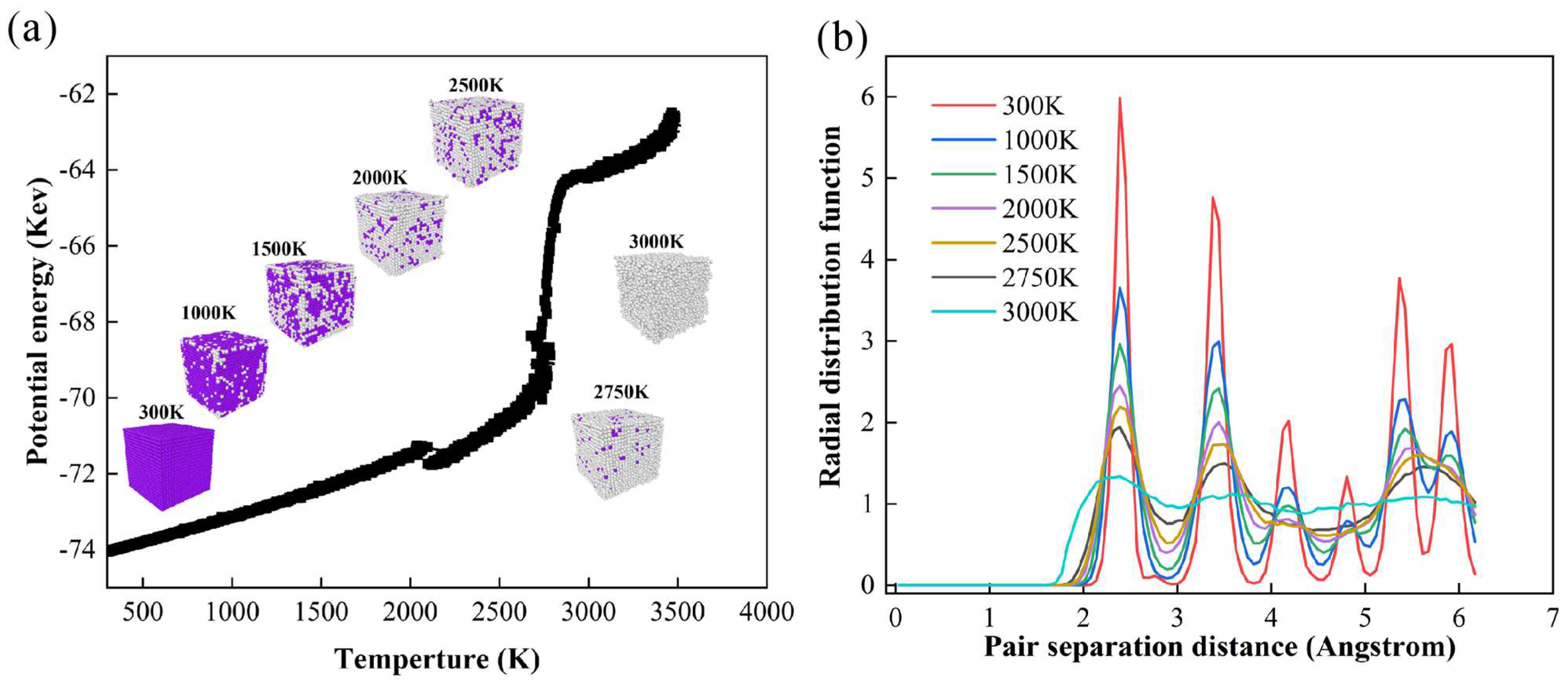
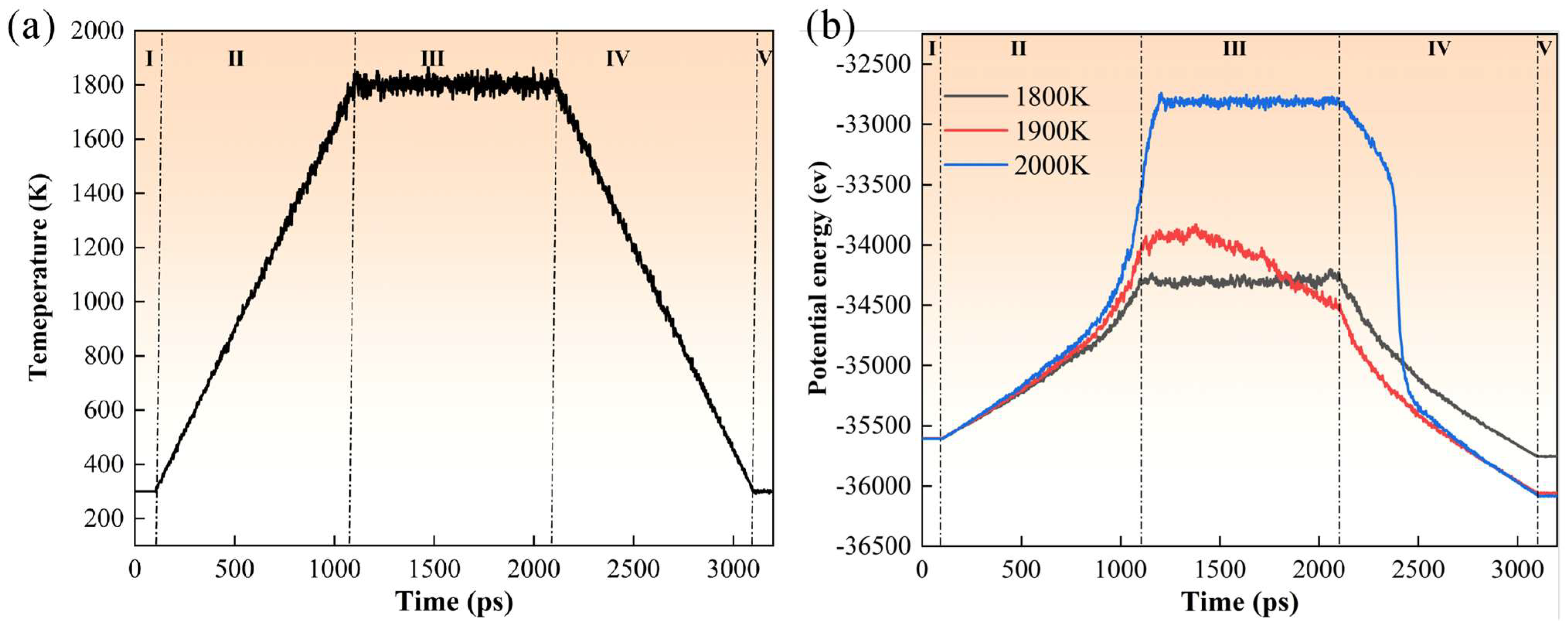
Here, the sintering temperature range is determined based on experiments and simulations. Figure 2a presents the calculated evolution curve of the potential energy of the UN nanoparticle as a function of increasing temperature, where the inflection point observed corresponds to the melting point of the nanoparticle. It can be observed that as the temperature increases gradually from 300 K, the potential energy exhibits a linear rising trend, consistent with thermodynamic expectations. When the temperature approaches and reaches approximately 2800 K, an abrupt change occurs in the potential energy curve, indicating that the material has reached its melting point. This is close to the UN melting point of 2630 °C shown in previous studies [29]. At around 1800 K to 2000 K, the slope of the potential energy curve increases slightly, suggesting the possible onset of structural rearrangement and atomic diffusion within the system. This temperature range corresponds to the “activation stage” in the sintering process, providing the energy foundation for subsequent neck formation between particles and densification. The clear amorphization can be observed from the atomic structure snapshot and RDF curve (Figure 2). Thus, the temperatures are set as 1800 K, 1900 K, and 2000 K in the current work, according to the potential energy curve. The sintering temperature range is also set within this range in the UN sintered experiments [7,9]. The temperature and potential energy history of the system are shown in Figure 3.
Actually, sintering involves a dynamic process of high-temperature-induced atomic diffusion. Therefore, the mean squared displacement (MSD) and diffusion coefficient are employed to evaluate the atomic diffusion behavior during sintering in the present work. The MSD is calculated as the average of the squared displacements of atoms over the simulation trajectory and is defined as [30]:
MSD ( t ) = 1 N i = 1 N r i ( t ) r i ( 0 ) 2
where N is the total number of atoms in the system; i is the atomic number. ri(t) and ri(0) are the position of i at t and 0, respectively.
In addition, the Einstein relation is used to calculate the diffusion coefficient of UN nanoparticles during sintering [31]:
D ( t ) = MSD ( t ) 2 d t
where D(t) denotes the diffusion coefficient, and d is the dimension of the simulation system.

3. Results and Discussion

The atomic characteristics of nanoparticle structure under different sintering temperatures and times are studied. The evolution of structural characteristics during the sintering process is observed, and the sintering mechanism of the UN core under different sintering conditions is further analyzed.
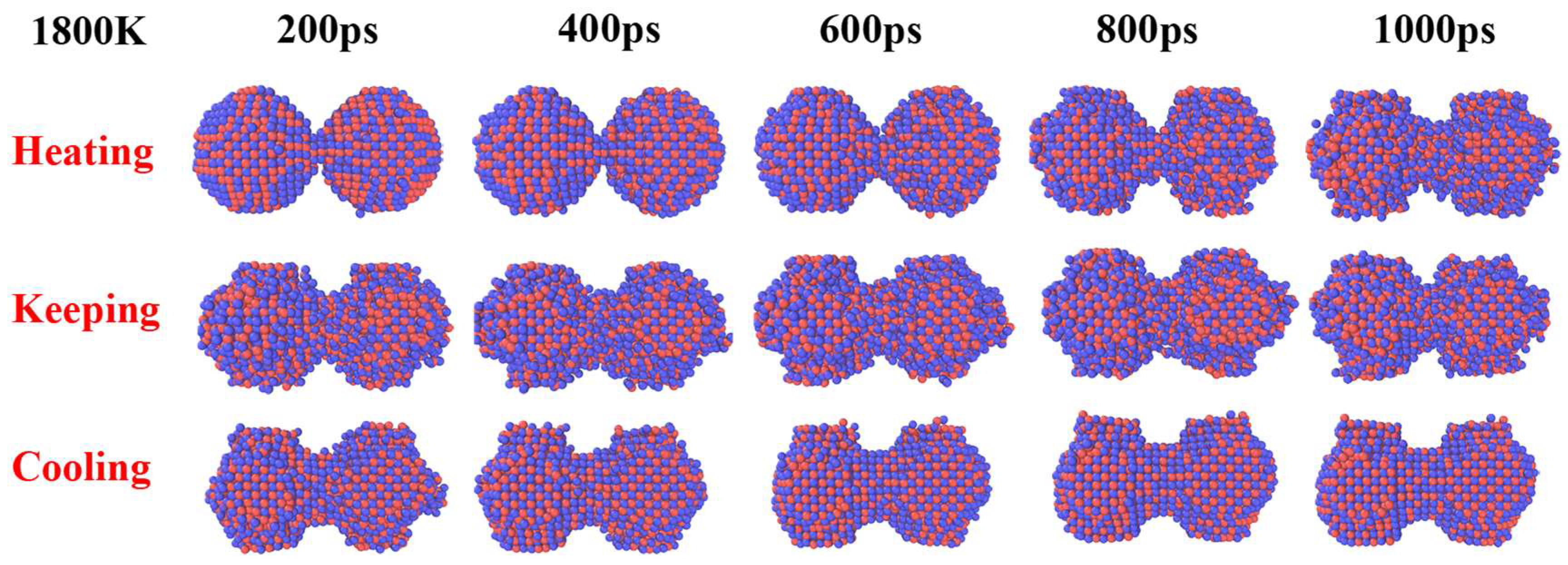
Figure 4 illustrates the morphological evolution of UN nanoparticles during sintering at 1800 K. In the initial heating stage, the interface between the two particles remains distinct. As sintering time increases, a noticeable sintering neck gradually forms between the particles [20,32]. The U and N atoms between the two particles diffuse in the opposite direction, leading to significant intermixing in the interfacial region, which indicates active atomic diffusion [33]. According to previous studies, the activation energies for U and N diffusion are different for different mechanisms. The interstitial mechanisms exhibit relatively low migration barriers. The migration barrier for a U interstitial is approximately 0.6 eV, while that for an N interstitial is about 1.1–1.2 eV. In contrast, the vacancy-mediated mechanisms are associated with higher energy barriers. The migration barrier for a U vacancy is reported to be on the order of 3.1–3.5 eV, and that for an N vacancy is around 2.5 eV under thermal equilibrium conditions [27,34]. The high temperature during the sintering process can promote diffusion. The high mobility of U interstitials and N interstitials is expected to play a dominant role in atomic transport and densification processes.
At the later stage of sintering, the interface between particles basically disappeared, resulting in a stable sintering neck that merges the two nanoparticles into a single entity, which is a typical characteristic of solid-state sintering [35]. The potential energy curve is shown in Figure 3b, which indicates that the cooled configuration has entered a thermodynamic equilibrium state. Throughout the entire process, no obvious pores or voids are found in the whole process, demonstrating the excellent sintering densification capability of UN at this temperature. Meanwhile, previous experiments also showed that UN pellets sintered at 1550 °C obtained high density and uniform structure [36].
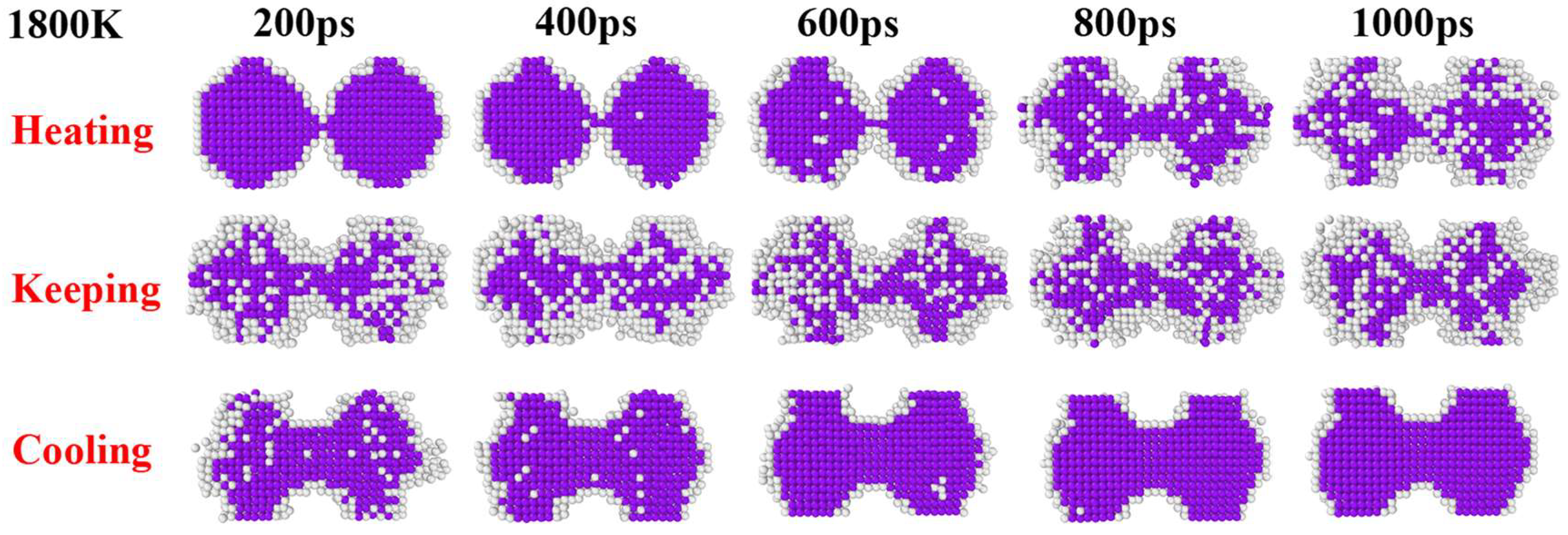
In order to more clearly characterize the internal structural evolution of the sintering neck, the microstructure change in UN nanoparticles at different stages of the sintering process at 1800 K is further analyzed, as shown in Figure 5. The results show that in the heating stage, the atoms on the particle surface begin to migrate, leading to an increase in the surface roughness. Local rearrangement of atoms occurs at the sintering neck, and the local lattice structure in the region of the sintering neck is transformed from a simple cubic structure to an amorphous structure. This transformation is attributed to the lattice dislocation at the junction of the initial nanoparticles [37]. As the system temperature increases, local atomic rearrangement occurs between the particles, which leads to the rigid torsion and shear stress concentration of nanoparticles, thus forming an amorphous structure on the free surface [37,38]. During the isothermal stage, the atomic diffusion becomes more pronounced. The sintering neck between particles is obviously growing, and the lattice structure tends to be complete. The simple cubic lattice region shown in purple in the sintering neck region is gradually expanding, indicating that the lattice rearrangement and recrystallization process are active. In the cooling stage, the sintered structure tends to be stable, the density of lattice defects decreases significantly, and finally, a compact sintered body is formed. Throughout the whole process, the initial symmetry of the model is maintained, and no abnormal particle growth is observed, indicating that the sintering process is well controllable at this temperature.
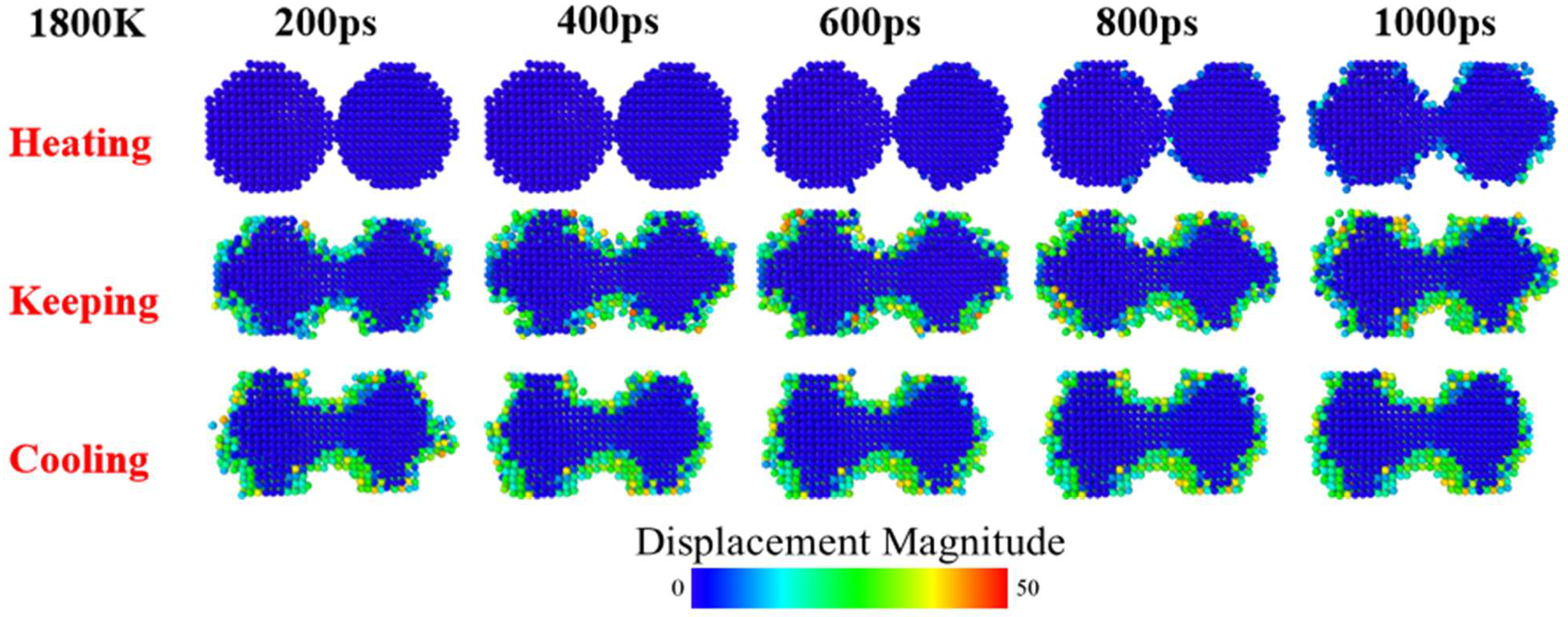
Figure 6 depicts a snapshot of atomic displacement during the sintering process, providing a more intuitive perspective on atomic motion. As the temperature increases, the atomic diffusion mechanism shifts from surface diffusion of a small number of atoms to interfacial diffusion, which has also been reported in previous studies [39,40]. It is obvious that under the current sintering conditions, the internal atoms of the particles are basically stable, and the formation of the sintering neck is due to the collective migration of atoms at the particle contact surface.
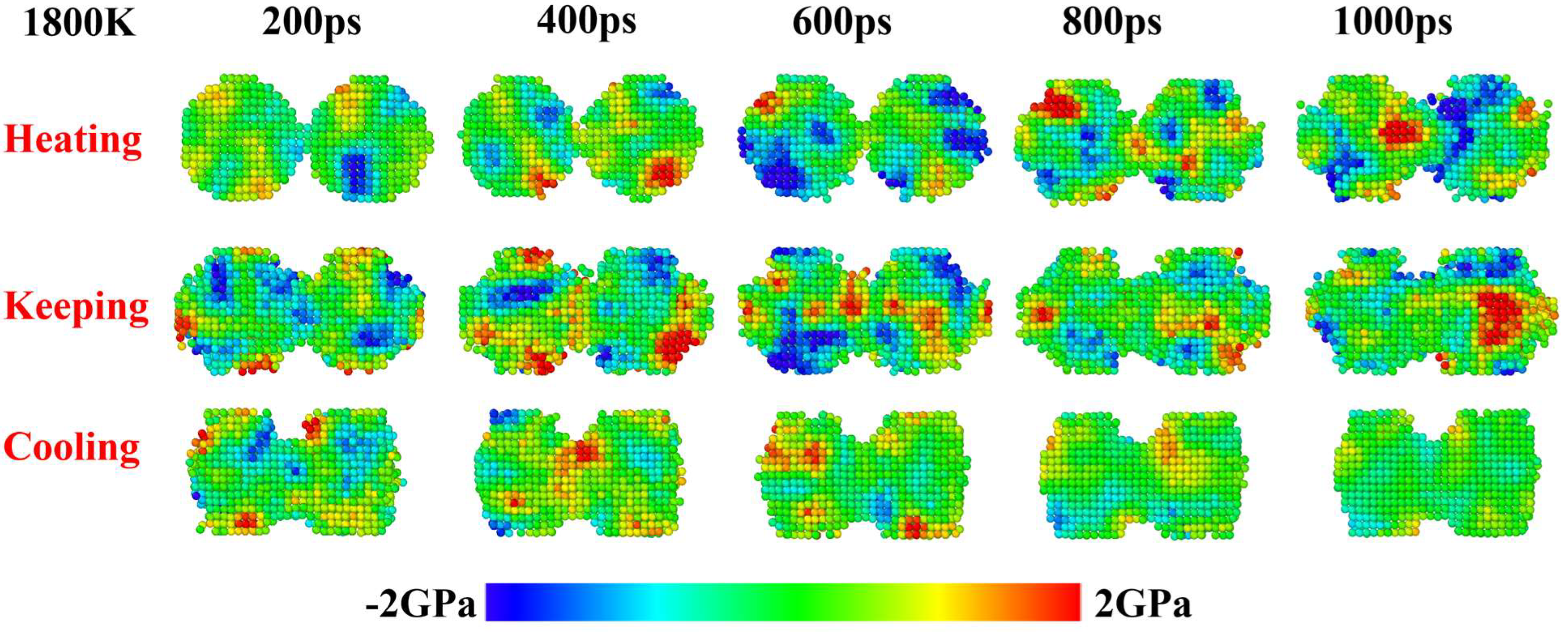
Figure 7 shows the distribution of shear stress σ x y . The results show that during the heating stage, as the temperature rises, the area of high shear stress expands, and the distribution of the high stress area extends from the surface to the center. When the temperature is raised to 1800 ps, the obvious stress concentration phenomena can be observed at the sintering neck. The distinct stress zones in opposite directions at the sintering neck promoted the efficient bonding of atoms in the neck region. During the cooling stage, as the stable structure is formed gradually, the stress of the sintered block gradually tends to be uniform.
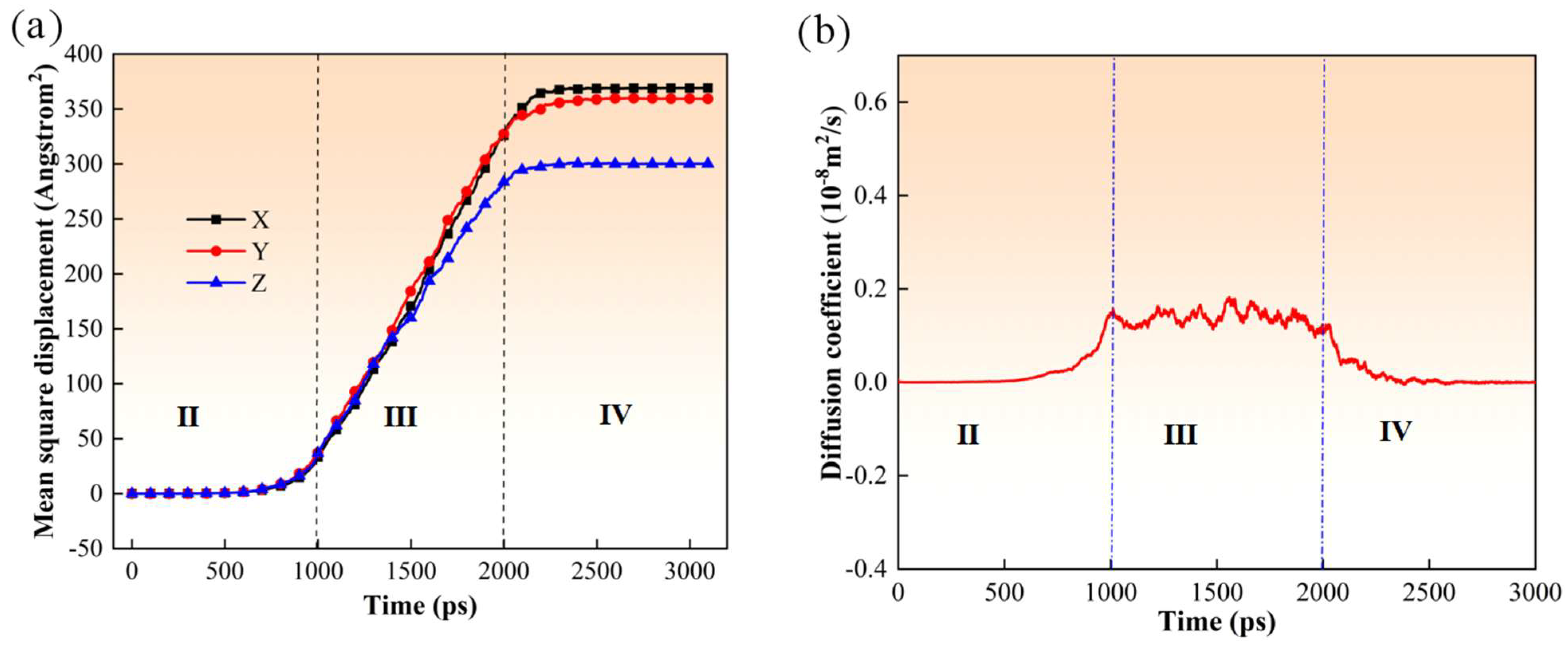
In order to better understand the sintering behavior, the MSD and diffusion coefficient of UN nanoparticles during the sintering process are calculated according to Equations (1) and (2), respectively. Figure 8 shows the evolution of the MSD and diffusion coefficient over time during the sintering process, corresponding to the three stages of heating, keeping, and cooling. When the temperature is low at the initial heating stage, the MSD is relatively stable because atomic motion is restricted. After reaching the set sintering temperature of 1800 K, the MSD rapidly increases. At this stage, the high temperature endows atoms with greater mobility and surface atomic pre-melting, thereby promoting the stable growth of the sintered neck [38,41]. The diffusion coefficient curve (Figure 8b) shows that the atomic diffusion is intense at this stage. During the cooling stage, the MSD returns to stability, and the diffusion coefficient gradually decreases from its peak to 0. The geometric shape no longer showed significant changes.
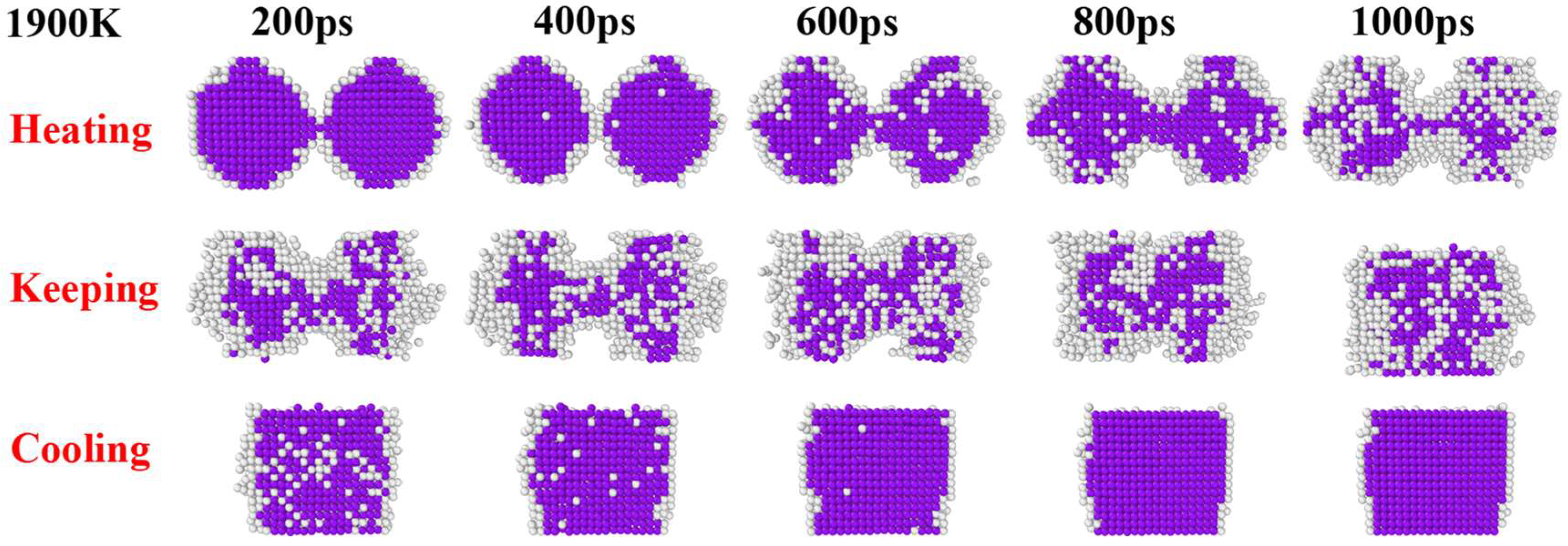
In order to reveal the effect of temperature on UN sintering process, the sintering simulations are conducted under temperatures of 1900 K and 2000 K. Figure 9 exhibits the microstructure evolution of UN particle during sintering process at 1900 K. Compared to the process at 1800 K (Figure 5), the atomic migration is significantly enhanced at 1900 K, leading to the rapid formation and growth of a sintering neck within a shorter time and an overall accelerated sintering rate. By the end of the isothermal stage, the particles have completely merged, transforming from initially spherical morphologies into a monolithic block structure. A notable expansion of the purple region indicates that the high temperature promotes lattice integrity and eliminates free surfaces between nanoparticles. During the cooling stage, a well-defined lattice structure gradually develops. The resulting microstructure demonstrates excellent sintered density and structural integrity at 1900 K, which is consistent with previous experimental results of high UN sintered density obtained at 1872 K [7,9].
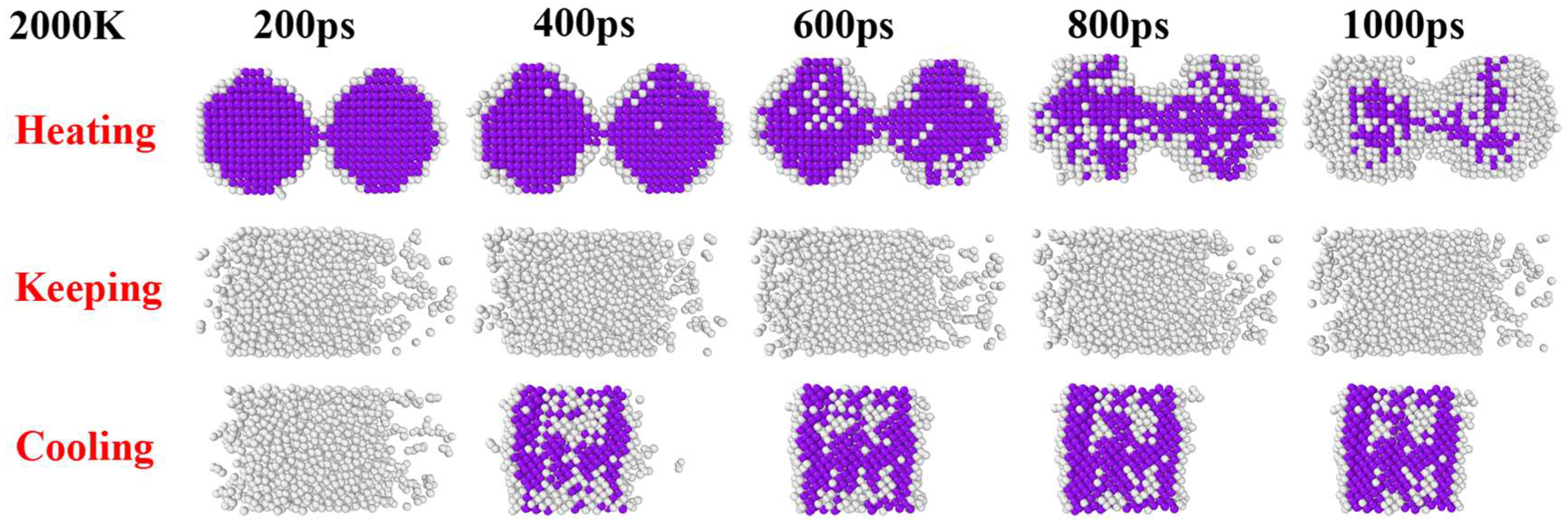
Figure 10 shows the sintering behavior of UN nanoparticles at 2000 K. It can be observed that the atomic migration ability is further enhanced. The nanoparticles show a strong amorphous state from the outside to the inside during the heating process. The sintered neck is formed and grown in a very short time. In the heat preservation stage, the structure of nanoparticles is completely amorphous, and the violent diffusion of atoms combines the two particles into a complete block. In the cooling stage, the particles quickly merge into a single structure. However, the high temperature also led to the obvious disturbance of the lattice structure [42,43]. The disordered arrangement of atoms and the aggregation of lattice defects appear in some regions, indicating that the system is close to thermodynamic instability. The slightly disordered arrangement of atoms in the local region suggests that excessive temperature may lead to slight overburning. Although the density is still high, there is a risk of structural instability. The impact of changes in sintering temperature on diffusion mechanisms, including vacancy diffusion and interstitial atom diffusion, requires deeper physical analysis in future work.
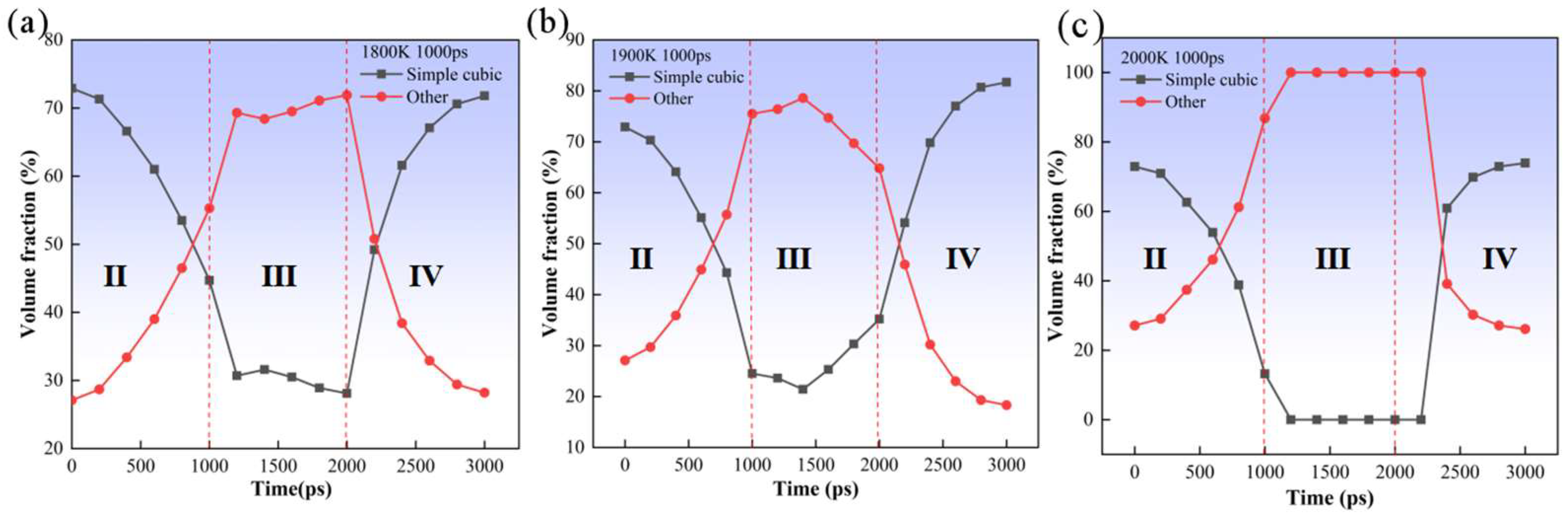
Figure 11 shows the statistical results of lattice structure in the sintering process at different temperatures. In the heating stage, the volume fraction of simple cubic structure decreases linearly. With the increase of the set sintering temperature, the proportion of amorphous structure is higher. At 2000 K sintering temperature, the conversion efficiency reaches 100%, corresponding to complete amorphization. It is worth noting that when the sintering temperature is 1800 K and 2000 K, the holding stage still shows the transformation from simple cubic structure to amorphous structure, but when the sintering temperature is 1900 k, the crystallization has begun in the holding stage, the volume fraction of amorphous structure has decreased, and the intense atomic diffusion at high temperature to the stable lattice position promotes the formation of dense sintered structure.
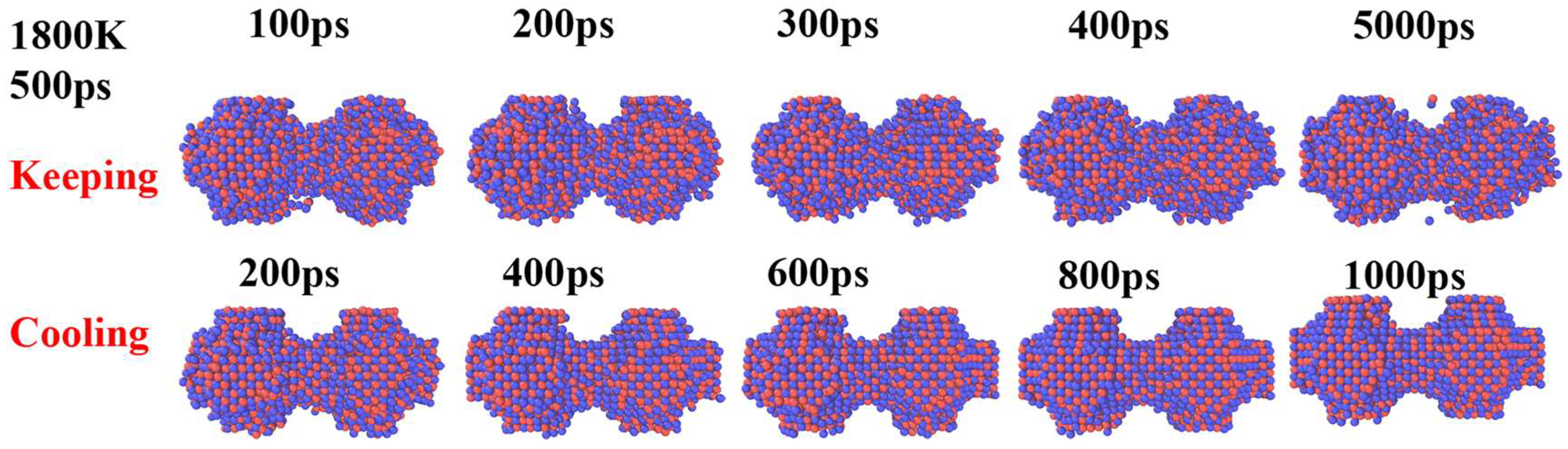
Furthermore, considering that the sintering time is another important factor affecting the sintering quality [30,44,45], the sintering simulation of different durations at a sintering temperature of 1000 K is carried out. Figure 12 presents the sintering results of UN nanoparticles subjected to a holding time of 500 ps at 1800 K. Compared with the standard 1000 ps insulation condition, the sintering neck size at 500 ps is significantly smaller, and the interface between particles has not completely disappeared, indicating that the sintering process has not been fully completed. Although U and N atoms are mixed in the interface region, the diffusion range is limited and the degree of densification is low. The results indicate that too short a holding time will limit atomic diffusion and lattice rearrangement and affect the final sintering quality.
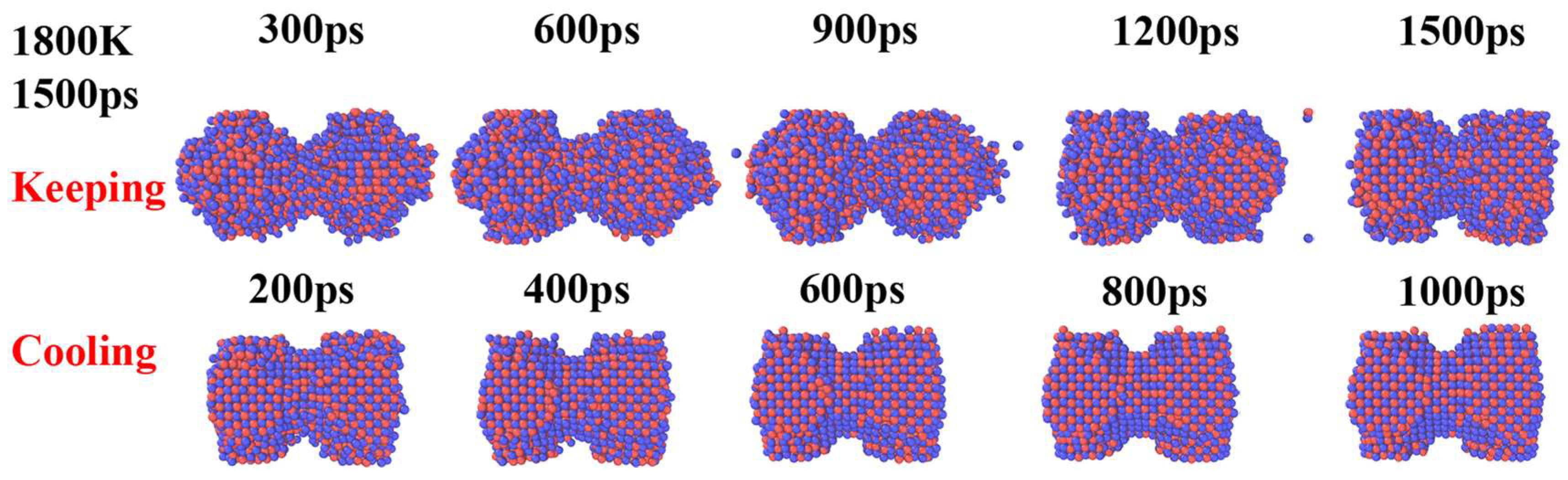
Figure 13 shows the sintering results of extending the holding time to 1500 ps at 1800 K. Compared with the standard 1000 ps, the sintered neck size is further increased, the interface between particles is basically disappeared, and a more rounded combined structure is formed, indicating that prolonging the holding time is helpful to promote the full diffusion of atoms and lattice integrity. However, compared with 1000 ps, the improvement of the densification degree is limited, suggesting that at 1800 K, 1000 ps is close to the sintering saturation time, and the further extension of time has a limited contribution to densification.
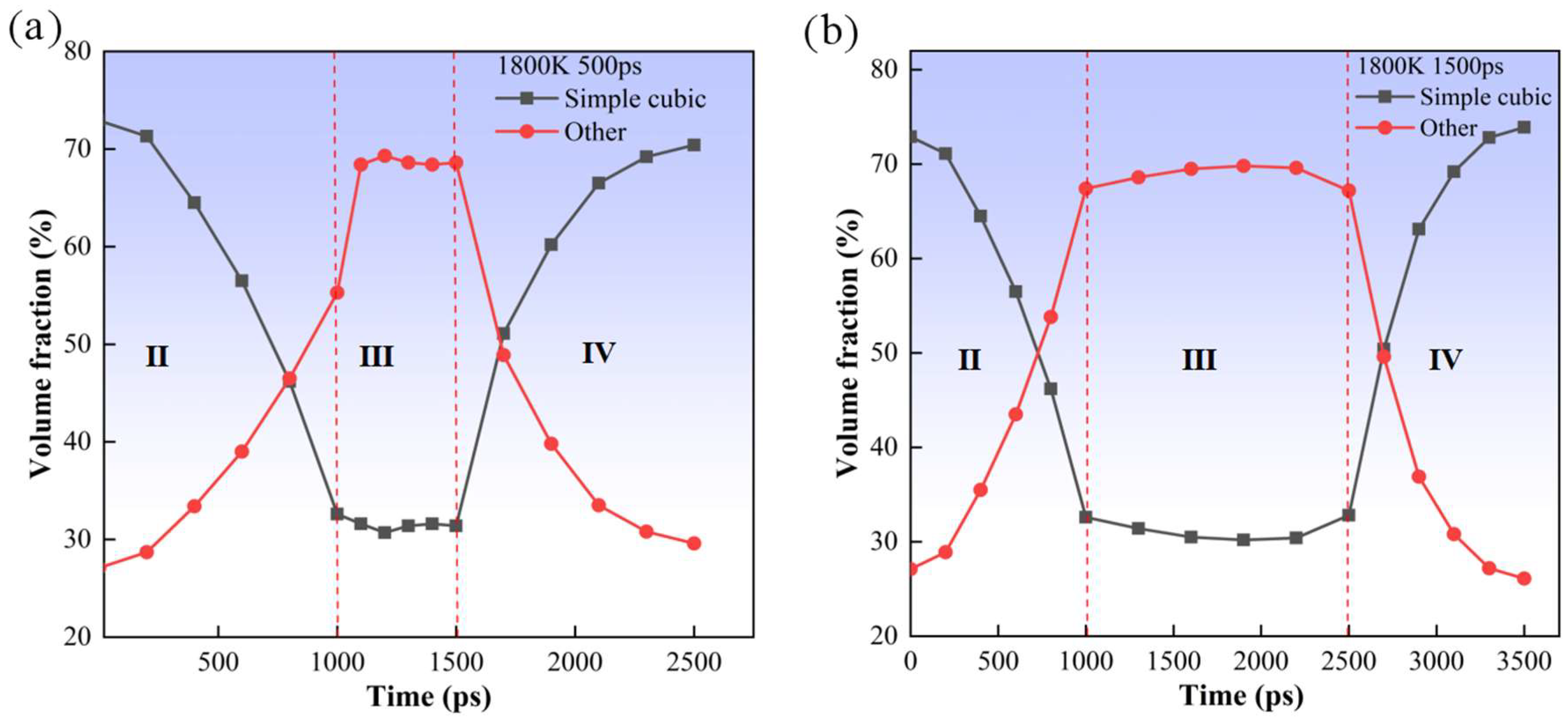
It can be seen from the atomic structure evolution data in Figure 14 that the structure evolution trend is basically the same under different sintering durations. The influence of prolonging the sintering time on the increase in UN percentage of rock salt structure formed after cooling is weak. Thus, it is further proved that compared with the sintering temperature, the influence of changing the sintering time on the sintering structure is small. These findings contribute to a more refined control over the material’s microstructure [46,47], which in turn promotes the improvement of its irradiation performance by enhancing structural stability and defect resistance under radiation conditions.
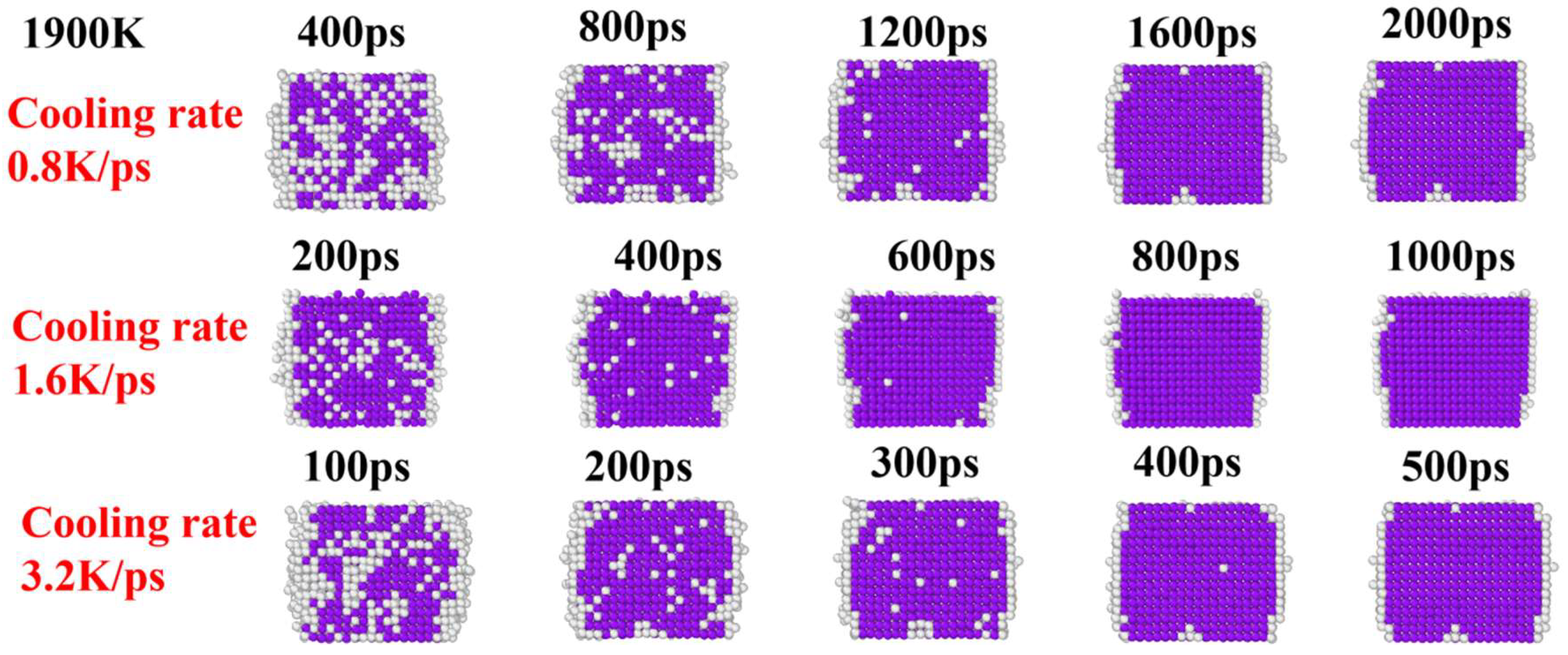
In addition, the duration of the cooling stage is adjusted to analyze the impact of the cooling rate. At a sintering temperature of 1900 K, the cooling times are set to 500 ps, 1000 ps, and 2000 ps, corresponding to cooling rates of 0. 8 K/ps, 1.6 K/ps, and 3.2 K/ps, respectively. Figure 15 shows the evolution of the atomic configuration during the cooling stage at different cooling rates. The results indicate that the final sintered block is almost identical. Therefore, compared to changing the sintering temperature and holding time, adjusting the cooling rate has a smaller impact.
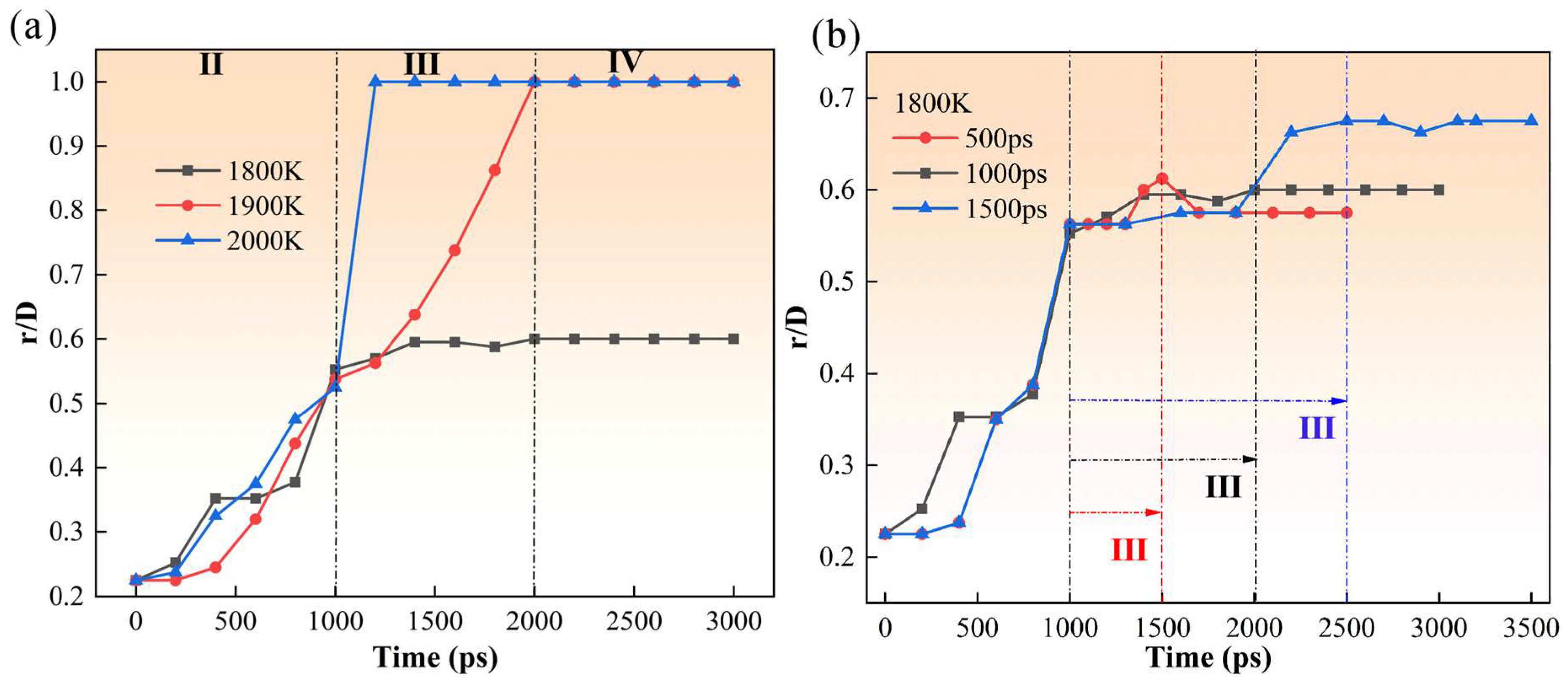
The growth of sintering necks during the sintering process has a significant impact on the densification of UN. The Kuczynski model describes the growth kinetics of sintering necks by establishing the relationship between sintering neck radius and time [48]. Thus, in order to better understand the influence of process parameters on sintering densification, the ratio of sintering neck r t to particle radius R is used to quantify sintering density under different parameters. A large sintering neck radius indicates high density. When the ratio reaches 1, it is defined as near-complete densification. The relationship between the ratio of neck to particle diameter and sintering time is shown in Figure 16. It can be seen that as the temperature increases, r / R reaches 1 at 1900 K and 2000 K. Combined with atomic structure snapshots in Figure 9 and Figure 10, this indicates that the near-complete densification has been obtained at the temperature of 1900 K. In the second stage of the curve, it can be seen that as the temperature increases, the sintering rate rapidly increases. In addition, an increase in temperature raised the r/d by 0.4, while extending the duration from 500 ps to 1500 ps resulted in a mere 0.1 improvement (Figure 16b). This further illustrates the saturation of holding time.

4. Conclusions

In the present work, a large-scale MD simulation method is used to systematically study the sintering dynamic behavior of UN nanoparticles. The surface morphology, microstructure, atomic displacement, and lattice structure transformation during sintering are analyzed, and the effects of different sintering temperatures and times on the sintering mechanism of UN are revealed. The following key conclusions can be drawn:
The sintering process of UN nanoparticles is governed by high-temperature-induced atomic diffusion, leading to the rapid growth of the sintering neck between particles. Under high-temperature shear stress, the local lattice transitions from the original rock-salt structure to an amorphous state. As sintering temperature and time increase, atomic diffusion progresses from the particle surface toward the interior, resulting in disordering and subsequent reconstruction of the atomic arrangement. Upon cooling, a structurally stable configuration with lower surface energy is formed. The increase in sintering temperature reveals a competition between densification and microstructural instability. When the temperature rises from 1800 K to 1900 K, both sintering efficiency and densification are significantly enhanced. However, further increasing the temperature to 2000 K introduces structural defects due to microstructural instability. Sintering time exhibits a saturation effect; prolonging the duration beyond a certain point has minimal influence on structural evolution. Therefore, sintering temperature is identified as the dominant factor compared to sintering time in process optimization. These findings provide a theoretical understanding of the sintering mechanisms and guide the process selection of UN nuclear fuel materials.
Considering that the grading and orientation of sintered powders are also noteworthy factors affecting sintering quality, in future work, we will focus on discussing the influence of powder characteristics on the structural evolution and sintering quality of the sintering process.

Author Contributions

Methodology, W.L. and H.F.; Validation, J.P.; Investigation, B.L. and J.P.; Resources, W.L.; Writing—original draft, W.L., B.L., J.L., J.P. and Q.F.; Writing—review and editing, W.L., H.F. and K.Y.; Supervision, Q.F.; Project administration, J.L. and Q.F. All authors have read and agreed to the published version of the manuscript.

Funding

This work was financially supported by the National Natural Science Foundation of China under grant number 12372069 and 12502072, the Natural Science Foundation of Hunan Province under grant number 2025JJ60048, the Science and Technology Innovation Program of Hunan Province under grant number 2024RC1009, the Changsha Municipal Natural Science Foundation under grant number kq2502186 and the Postdoctoral Fellowship Program of CPSF under grant number GZB20250464.

Data Availability Statement

The original contributions presented in this study are included in the article. Further inquiries can be directed to the corresponding author.

Conflicts of Interest

Author Wentao Liu was employed by the company China North Nuclear Fuel Co., Ltd. The remaining authors declare that the research was conducted in the absence of any commercial or financial relationships that could be construed as a potential conflict of interest.

References

  1. Taylor, R.; Mathers, G.; Banford, A. The development of future options for aqueous recycling of spent nuclear fuels. Prog. Nucl. Energy 2023, 164, 104837. [Google Scholar] [CrossRef]
  2. Andersson, D.A.; Stanek, C.R.; Matthews, C.; Uberuaga, B.P. The past, present, and future of nuclear fuel. MRS Bull. 2023, 48, 1154–1162. [Google Scholar] [CrossRef]
  3. Zanini, A.; Celdran, P.A.; Walter, O.; Carturan, S.M.; Boshoven, J.; Bulgheroni, A.; Biasetto, L.; Manzolaro, M.; Eloirdi, R.; Corradetti, S.; et al. First Structured Uranium-Based Monoliths Produced via Vat Photopolymerization for Nuclear Applications. Adv. Funct. Mater. 2024, 34, 2406916. [Google Scholar] [CrossRef]
  4. Murphy, G.L.; Gericke, R.; Gilson, S.; Bazarkina, E.F.; Rossberg, A.; Kaden, P.; Thümmler, R.; Klinkenberg, M.; Henkes, M.; Kegler, P.; et al. Deconvoluting Cr states in Cr-doped UO2 nuclear fuels via bulk and single crystal spectroscopic studies. Nat. Commun. 2023, 14, 2455. [Google Scholar] [CrossRef]
  5. Harrison, R.W.; Morgan, J.; Buckley, J.; Bostanchi, S.; Pearmain, D.; Abram, T.; Goddard, D.; Barron, N. Flash sintering of UO2 pellets for nuclear fuel and wasteform applications. J. Eur. Ceram. Soc. 2025, 45, 116993. [Google Scholar] [CrossRef]
  6. Gong, B.; Kardoulaki, E.; Yang, K.; Broussard, A.; Zhao, D.; Metzger, K.; White, J.T.; Sivack, M.R.; Mcclellan, K.J.; Lahoda, E.J.; et al. UN and U3Si2 composites densified by spark plasma sintering for accident-tolerant fuels. Ceram. Int. 2022, 48, 10762–10769. [Google Scholar] [CrossRef]
  7. Yang, J.; Li, J.; Yan, C.; Wang, P.; Yang, H.; Qian, X.; Yang, K.; Xu, S.; Lin, J. Microstructure, thermal properties and irradiation behaviors of uranium nitride (UN) nuclear fuel densified by Spark Plasma Sintering (SPS). J. Nucl. Mater. 2025, 608, 155709. [Google Scholar] [CrossRef]
  8. Xu, J.; Yang, Z.; Zhong, Y.; Wen, Z.; Duan, L.; He, S.; Xie, L.; Wang, Z.; Wang, Y.; He, H.; et al. Spark plasma sintering of UN: Sintering behaviors, thermal-mechanical properties, and densification mechanism. Ceram. Int. 2025, 51, 60368–60380. [Google Scholar] [CrossRef]
  9. Yang, K.; Kardoulaki, E.; Zhao, D.; Broussard, A.; Metzger, K.; White, J.T.; Sivack, M.R.; Mcclellan, K.J.; Lahoda, E.J.; Lian, J. Uranium nitride (UN) pellets with controllable microstructure and phase-fabrication by spark plasma sintering and their thermal-mechanical and oxidation properties. J. Nucl. Mater. 2021, 557, 153272. [Google Scholar] [CrossRef]
  10. Ren, S.; Li, J.; Feng, H.; Liaw, P.K.; Fang, Q. A physically-based constitutive model for the prediction of yield strength in the precipitate-hardened high-entropy alloys. Acta Mech. Sin. 2023, 39, 122393. [Google Scholar] [CrossRef]
  11. Long, Q.B.; Zhao, H.B.; Qiu, T.S.; Wu, H.; Yan, H.S.; Qiu, S. The effect of leaching agent anions on the desorption behaviours of Al3+ from kaolinite (001) surface: A molecular dynamics simulation. Colloids Surf. A Physicochem. Eng. Asp. 2025, 727, 138247. [Google Scholar] [CrossRef]
  12. Chen, Y.; Liu, X.; Fu, A.; Peng, J. Unraveling the Subsurface Damage and Material Removal Mechanism of Multi-Principal-Element Alloy FeCrNi Coatings During the Scratching Process. Symmetry 2024, 16, 1391. [Google Scholar] [CrossRef]
  13. Li, J.; Ren, S.; Liu, B.; Liaw, P.K.; Fang, Q. Influence of chemistry and temperature on mechanical behavior and deformation mechanisms of refractory high-entropy alloys: An integrated simulation-modeling analysis. Acta Mech. Sin. 2024, 40, 423122. [Google Scholar] [CrossRef]
  14. Jiang, J.; Chen, P.; Sun, W. Monitoring micro-structural evolution during aluminum sintering and understanding the sintering mechanism of aluminum nanoparticles: A molecular dynamics study. J. Mater. Sci. Technol. 2020, 57, 92–100. [Google Scholar] [CrossRef]
  15. Liu, J.; Wang, M.; Liu, P.; Sun, R.; Yang, Y.; Zou, G. Molecular dynamics study of sintering of Al nanoparticles with/without organic coatings. Comput. Mater. Sci. 2021, 190, 110265. [Google Scholar] [CrossRef]
  16. Li, S.; Liu, Y.; Ye, H.; Liu, X.; Sun, F.; Fan, X.; Zhang, G. Sintering mechanism of Ag nanoparticle-nanoflake: A molecular dynamics simulation. J. Mater. Res. Technol. 2022, 16, 640–655. [Google Scholar] [CrossRef]
  17. Wang, Z.; Song, Z.; Luo, W.; Shang, T.; Liu, Z.; Yuan, J.; Fan, X.; Zhu, Y. The effect of temperature on the mechanisms of Cu nanoparticle sintering: A molecular dynamic study. Powder Technol. 2024, 440, 119802. [Google Scholar] [CrossRef]
  18. Liu, Z.; Cheng, Q.; Wang, Y.; Li, Y.; Zhang, J. Sintering neck growth mechanism of Fe nanoparticles: A molecular dynamics simulation. Chem. Eng. Sci. 2020, 218, 115583. [Google Scholar] [CrossRef]
  19. Guo, Q.; Hou, H.; Wang, K.; Li, M.; Liaw, P.K.; Zhao, Y. Coalescence of Al0.3CoCrFeNi polycrystalline high-entropy alloy in hot-pressed sintering: A molecular dynamics and phase-field study. Npj Comput. Mater. 2023, 9, 185. [Google Scholar] [CrossRef]
  20. Liu, W.; Peng, J.; Liu, J.; Li, J.; Liu, B.; Fang, Q. Investigation of the sintering behavior of nanoparticulate SiC by molecular dynamics simulation. Mater. Today Commun. 2024, 41, 110654. [Google Scholar] [CrossRef]
  21. Sestito, J.M.; Abdeljawad, F.; Harris, T.A.; Wang, Y.; Roach, A. An atomistic simulation study of nanoscale sintering: The role of grain boundary misorientation. Comput. Mater. Sci. 2019, 165, 180–189. [Google Scholar] [CrossRef]
  22. Thompson, A.P.; Aktulga, H.M.; Berger, R.; Bolintineanu, D.S.; Brown, W.M.; Crozier, P.S.; In’t Veld, P.J.; Kohlmeyer, A.; Moore, S.G.; Nguyen, T.D.; et al. LAMMPS-a flexible simulation tool for particle-based materials modeling at the atomic, meso, and continuum scales. Comput. Phys. Commun. 2022, 271, 108171. [Google Scholar] [CrossRef]
  23. Plimpton, S. Fast parallel algorithms for short-range molecular dynamics. J. Comput. Phys. 1995, 117, 1–19. [Google Scholar] [CrossRef]
  24. Stukowski, A. Visualization and analysis of atomistic simulation data with OVITO-the Open Visualization Tool. Model. Simul. Mater. Sci. Eng. 2009, 18, 015012. [Google Scholar] [CrossRef]
  25. Tseplyaev, V.I.; Starikov, S.V. The atomistic simulation of pressure-induced phase transition in uranium mononitride. J. Nucl. Mater. 2016, 480, 7–14. [Google Scholar] [CrossRef]
  26. Brommer, P.; Kiselev, A.; Schopf, D.; Beck, P.; Roth, J.; Trebin, H.R. Classical interaction potentials for diverse materials from ab initio data: A review of potfit. Model. Simul. Mater. Sci. Eng. 2015, 23, 074002. [Google Scholar] [CrossRef]
  27. Kocevski, V.; Cooper, M.W.; Claisse, A.J.; Andersson, D.A. Development and application of a uranium mononitride (UN) potential: Thermomechanical properties and Xe diffusion. J. Nucl. Mater. 2022, 562, 153553. [Google Scholar] [CrossRef]
  28. Starikov, S.; Korneva, M. Description of phase transitions through accumulation of point defects: UN, UO2 and UC. J. Nucl. Mater. 2018, 510, 373–381. [Google Scholar] [CrossRef]
  29. Chen, S.L.; He, X.J.; Yuan, C.X. Recent studies on potential accident-tolerant fuel-cladding systems in light water reactors. Nucl. Sci. Tech. 2020, 31, 32. [Google Scholar] [CrossRef]
  30. Sahni, S.K.; Bhowmick, S.; Upadhyaya, A. Molecular dynamics simulations of solid-state sintering in Fe35Ni alloy: Understanding the process at the atomic scale. J. Mater. Sci. 2024, 59, 2954–2973. [Google Scholar] [CrossRef]
  31. Mehrer, H. Diffusion in Solids: Fundamentals, Methods, Materials, Diffusion-Controlled Processes; Springer: Berlin, Heidelberg, 2007. [Google Scholar]
  32. Nandy, J.; Yedla, N.; Gupta, P.; Sarangi, H.; Sahoo, S. Sintering of AlSi10Mg particles in direct metal laser sintering process: A molecular dynamics simulation study. Mater. Chem. Phys. 2019, 236, 121803. [Google Scholar] [CrossRef]
  33. Li, X.X.; Yang, C.; Chen, T.; Fu, Z.Q.; Li, Y.Y.; Ivasishin, O.M.; Lavernia, E.J. Effective atomic diffusion coefficient dependence on applied pressure during spark plasma sintering. Materialia 2019, 6, 100334. [Google Scholar] [CrossRef]
  34. Kuksin, A.Y.; Starikov, S.V.; Smirnova, D.E.; Tseplyaev, V.I. The diffusion of point defects in uranium mononitride: Combination of DFT and atomistic simulation with novel potential. J. Alloys Compd. 2016, 658, 385–394. [Google Scholar] [CrossRef]
  35. Braginsky, M.; Tikare, V.; Olevsky, E. Numerical simulation of solid state sintering. Int. J. Solids Struct. 2005, 42, 621–636. [Google Scholar] [CrossRef]
  36. Qi, X.; Liu, W.; He, Z.; Wang, Y.; Yun, D. Phase-Field Simulation of the Densification Process During Sintering of UN Nuclear Fuel. Acta Metall. Sin. 2022, 59, 1513–1522. [Google Scholar]
  37. Shi, R.; Wood, M.; Heo, T.W.; Wood, B.C.; Ye, J. Towards understanding particle rigid-body motion during solid-state sintering. J. Eur. Ceram. Soc. 2021, 41, 211–231. [Google Scholar] [CrossRef]
  38. Liu, J.; Lv, W.; Mou, Y.; Chen, C.; Kang, Y. Coalescence behavior of Cu nanoparticles during sintering: Based on atomic scale to macro scale. J. Mater. Res. Technol. 2023, 27, 2490–2507. [Google Scholar] [CrossRef]
  39. Yi, M.; Wang, W.; Xue, M.; Gong, Q.; Xu, B.X. Modeling and simulation of sintering process across scales. Arch. Comput. Methods Eng. 2023, 30, 3325–3358. [Google Scholar] [CrossRef]
  40. Wakai, F.; Brakke, K.A. Mechanics of sintering for coupled grain boundary and surface diffusion. Acta Mater. 2011, 59, 5379–5387. [Google Scholar] [CrossRef]
  41. Singh, R.; Sharma, V. Nano tungsten carbide interactions and mechanical behaviour during sintering: A molecular dynamics study. Comput. Mater. Sci. 2021, 197, 110653. [Google Scholar] [CrossRef]
  42. Gubicza, J.; Nauyoks, S.; Balogh, L.; Lábár, J.; Zerda, T.W.; Ungár, T. Influence of sintering temperature and pressure on crystallite size and lattice defect structure in nanocrystalline SiC. J. Mater. Res. 2005, 22, 1314–1321. [Google Scholar] [CrossRef]
  43. Peng, J.; Li, J.; Liu, B.; Fang, Q.; Liaw, P.K. Origin of thermal deformation induced crystallization and microstructure formation in additive manufactured FCC, BCC, HCP metals and its alloys. Int. J. Plast. 2024, 172, 103831. [Google Scholar] [CrossRef]
  44. Rahimian, M.; Ehsani, N.; Parvin, N.; Baharvandi, H.R. The effect of particle size, sintering temperature and sintering time on the properties of Al-Al2O3 composites, made by powder metallurgy. J. Mater. Process. Technol. 2009, 209, 5387–5393. [Google Scholar] [CrossRef]
  45. Gürbüz, M.; Şenel, M.C.; Koç, E. The effect of sintering time, temperature, and graphene addition on the hardness and microstructure of aluminum composites. J. Compos. Mater. 2018, 52, 553–563. [Google Scholar] [CrossRef]
  46. Lu, W.; Chen, Y.; Li, J.; Liaw, P.K.; Fang, Q. Chemical short-range-order induced multiscale strengthening in refractory medium entropy alloys. Acta Mech. Sin. 2024, 40, 223569. [Google Scholar] [CrossRef]
  47. Tan, F.; Li, L.; Li, J.; Liu, B.; Liaw, P.K.; Fang, Q. Multiscale modelling of irradiation damage behavior in high entropy alloys. Adv. Powder Mater. 2023, 2, 100114. [Google Scholar] [CrossRef]
  48. Chen, T.; Guo, H.; Zhao, W.; Wei, M.; Wu, M.; Chen, Y.; Liu, B. Fabrication of porous tungsten with tunable pore structures via low-temperature pressureless sintering: Processing and mechanisms. Int. J. Refract. Met. Hard Mater. 2025, 132, 107300. [Google Scholar] [CrossRef]
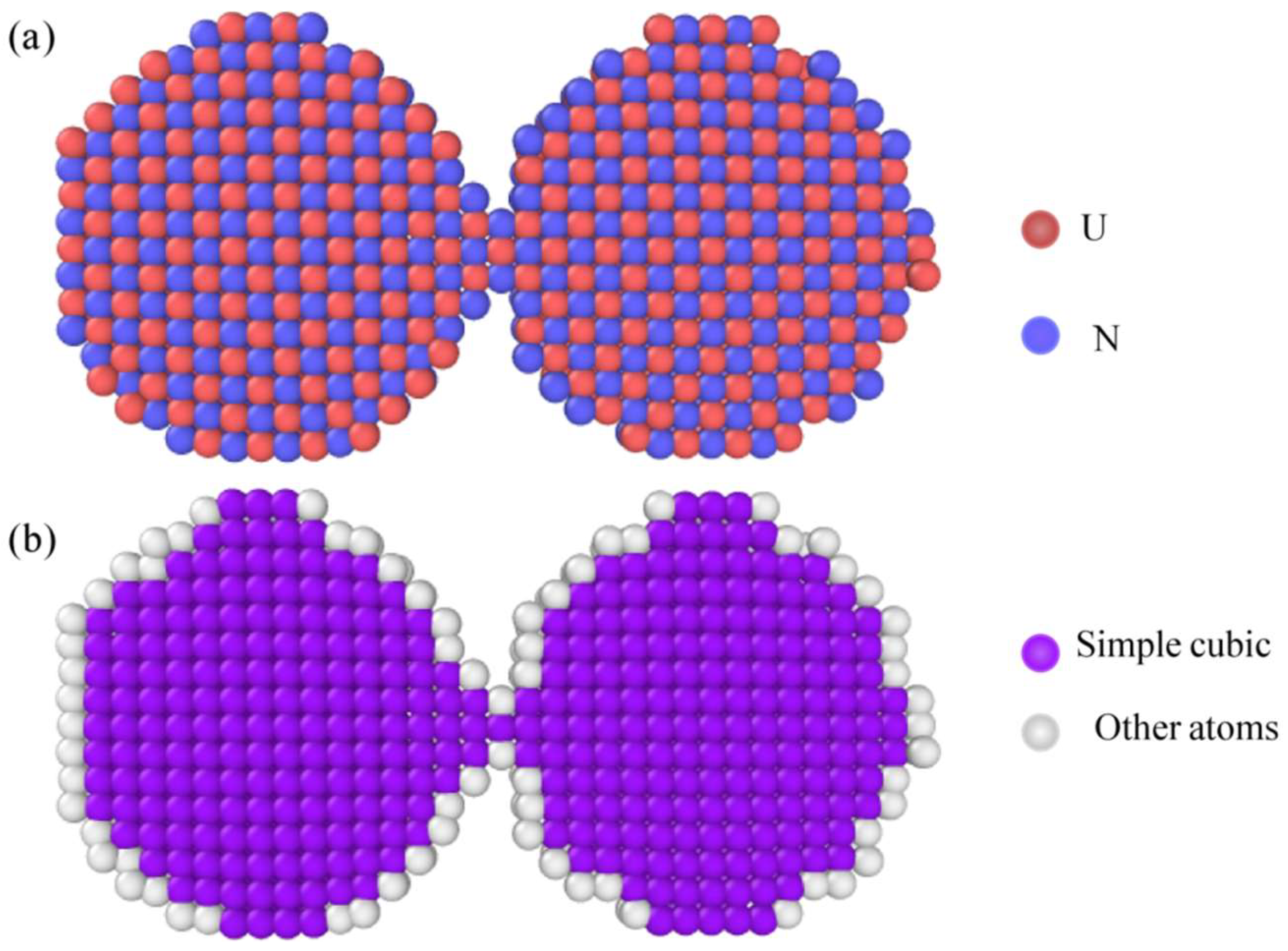
Figure 1. The atomic model of UN nanoparticle colored by atomic type (a) and lattice structure (b).
Symmetry 18 00191 g001
Figure 2. (a) The evolution of potential energy with increasing temperature in the UN nanoparticle. (b) Evolution of radial distribution function for different temperatures.
Symmetry 18 00191 g002
Figure 3. (a) The temperature history of the system with sintering temperature set to 1800 K. In stage “I”, the system temperature is 300 K for a duration of 100 ps. In stage “II”, the system temperature rises from 300 K to 0.6 Tm for a duration of 1000 ps. In stage “III”, the system temperature remains at 0.6 Tm for a duration of 1000 ps. In stage “IV”, the system temperature drops from 0.6 Tm to 300 K for a duration of 1000 ps. In stage “V”, the system temperature remains at 300 K for a duration of 100 ps. (b) The potential energy curve during the sintering process.
Symmetry 18 00191 g003
Figure 4. The evolution process of UN nanoparticles at 1800 K during the three different stages of sintering: heating, holding, and cooling. Atoms are colored by atomic type, with red representing U atoms and blue representing N atoms.
Symmetry 18 00191 g004
Figure 5. The atomic structure evolution process of UN nanoparticles at 1800 K during the three different stages of sintering: heating, holding, and cooling. Atoms are colored by atomic structure.
Symmetry 18 00191 g005
Figure 6. The atomic displacement of UN nanoparticles at 1800 K during the three different stages of sintering: heating, holding, and cooling. Atoms are colored by displacement magnitude.
Symmetry 18 00191 g006
Figure 7. The shear stress σ x y of UN nanoparticles at 1800 K during the three different stages of sintering: heating, holding, and cooling. Atoms are colored by stress magnitude.
Symmetry 18 00191 g007
Figure 8. (a) MSD of UN nanoparticle, and (b) the diffusion coefficient at sintering temperature of 1800 K.
Symmetry 18 00191 g008
Figure 9. The atomic structure evolution process of UN nanoparticles at 1900 K during the three different stages of sintering: heating, holding, and cooling.
Symmetry 18 00191 g009
Figure 10. The atomic structure evolution process of UN nanoparticles at 2000 K during the three different stages of sintering: heating, holding, and cooling.
Symmetry 18 00191 g010
Figure 11. The atomic volume fraction calculated according to the microstructure characteristics evolution with the sintering time at different stages of sintering, at sintering temperature (a) 1800 K, (b) 1900 K, (c) 2000 K.
Symmetry 18 00191 g011
Figure 12. The evolution process of UN nanoparticles during the three different stages of sintering: heating, keeping, and cooling. The temperature of 1800 K and a keeping time of 500 ps.
Symmetry 18 00191 g012
Figure 13. The evolution process of UN nanoparticles during the three different stages of sintering: heating, keeping, and cooling. The temperature of 1800 K and a keeping time of 1500 ps.
Symmetry 18 00191 g013
Figure 14. The atomic volume fraction calculated according to the microstructure characteristics evolution with the sintering time at different stages of sintering for sintering durations (a) 500 ps and (b) 1500 ps.
Symmetry 18 00191 g014
Figure 15. The atomic structure evolution process of UN nanoparticles at 1900 K under different cooling rates of 0.8 K/ps, 1.6 K/ps, and 3.2 K/ps.
Symmetry 18 00191 g015
Figure 16. The relationship of the ratio of neck to particle diameter with sintering time under (a) different sintering temperature and (b) different sintering time.
Symmetry 18 00191 g016
Table 1. Computational parameters of atomic simulation.
MaterialUN Nanoparticles
Box dimensions8 nm × 4 nm × 4 nm
Particles diameters4 nm
Number of nanoparticles2
Time step1 fs
Initial temperature300 K
Boundary conditionp p p
Sintering temperature1800 K, 1900 K, 2000 K
Heating rate1.5 K/ps, 1.6 K/ps, 1.7 K/ps
Cooling rate1.5 K/ps, 1.6 K/ps, 1.7 K/ps
Sintering temperature duration50 ps, 100 ps, 1500 ps
Disclaimer/Publisher’s Note: The statements, opinions and data contained in all publications are solely those of the individual author(s) and contributor(s) and not of MDPI and/or the editor(s). MDPI and/or the editor(s) disclaim responsibility for any injury to people or property resulting from any ideas, methods, instructions or products referred to in the content.