Double-Framed Bipolar Fuzzy Soft Sets and Algorithmic Approaches with Symmetry for Multi-Criteria Decision-Making Under Uncertainty

Abstract
1. Introduction
1.1. Objectives
- To model complex uncertainty by using double-framing to represent both positive and negative aspects of information separately.
- To create a richer data encoding that allows information to be viewed from two competing perspectives, improving the handling of incomplete or uncertain data.
- To enable balanced multi-criteria decisions (e.g., benefit vs. cost) by providing a framework to reconcile and jointly evaluate competing objectives.
- To establish a robust decision mechanism that systematically evaluates both the positive and negative parameters of a situation.
- To apply DFBFSSs to real-world scenarios characterized by contradictory facts or dual objectives, such as risk assessment.
- To enhance decision-making in dual-objective systems, like environmental assessments (economy vs. ecology) and financial planning (profit vs. sustainability).
1.2. Research Gap and Motivation
1.3. Symmetry in the Positive–Negative Dual Framework
1.4. Main Contributions
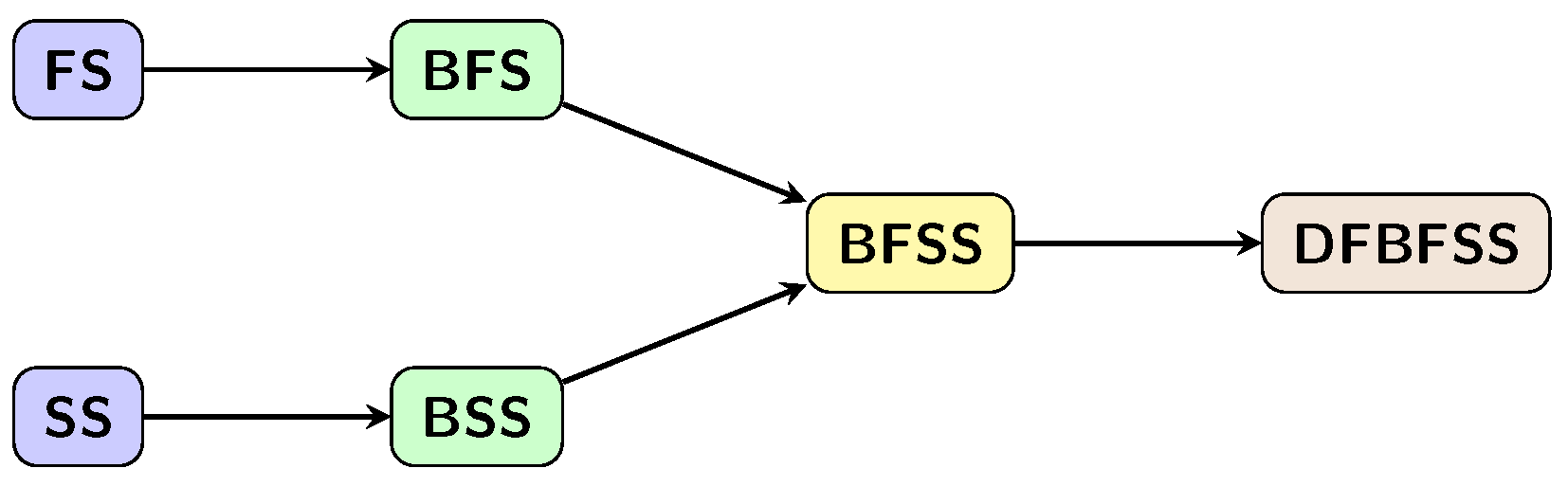
- Generalization of Models: DFBFSSs unify and extend traditional soft set models by integrating bipolarity, fuzziness, and double-framing to capture graded positive and negative assessments.
- Theoretical Foundation: We formally define DFBFSSs, establish their set-theoretic operations and algebraic properties, and build a theoretical basis for future work.
- Practical Application: We develop an MCDM algorithm based on DFBFSSs and demonstrate its effectiveness through a case study, proving its utility in real-world decision scenarios.
- Comparative Analysis: We compare the DFBFS model with existing approaches, highlighting its advantages and demonstrating its viability as a superior decision-making tool. Together, these contributions establish the DFBFS framework as a significant advancement for robust and nuanced MCDM in complex, ambiguous environments.
1.5. Structure of the Paper
2. Preliminaries
3. Double-Framed Bipolar Fuzzy Soft Sets (DFBFSS)
- 1.
- .
- 2.
- andand .
4. Operations on DFBFSSs
- 1.
- .
- 2.
- .
- Now, where and for all and . Thus, .
- 2.
- Its proof is similar to part 1.
- 1.
- and .
- 2.
- and .
- 3.
- and .
- 4.
- .
- 5.
- .
- 6.
- .
- 7.
- If , then .
- 8.
- If , then .
- 9.
- If , then .
- 10.
- If and , then .
- and is similar to above.
- (6)
- Let, for simplicity, . Then and
- (7)
- Since , it follows that and and . Then, . Hence, .
- (8)
- Since , it follows that and and . Put . Then and ,andThen . Thus .
- (9)
- Since , it follows that , and . Put . Then and ,Then Thus .
- (10)
- Since and , it follows that , and , and , Therefore, , and . Hence, . □
- 1.
- .
- 2.
- .
- 3.
- .
- 4.
- .
- andThen . Thus .
- 2.
- By Definitions 11 and 17, we obtainandThen . Thus .
- 3.
- By Definitions 11 and 16, we obtainThen . Thus .The proof of part 4 is in a similar fashion of number 3.
- 1.
- .
- 2.
- .
- 3.
- .
- 4.
- .
- Hence, .
- 2.
- Let , where and . ThenHence, .
- 3.
- Let , where and , thenHence, .
- 4.
- Let , where and , thenTherefore, .
- 1.
- .
- 2.
- .
- 3.
- .
- 4.
- .
- 1.
- .
- 2.
- .
- 3.
- .
- 4.
- .
- 1.
- .
- 2.
- .
- 3.
- .
- 4.
- .
- 1.
- where , and .
- 2.
- .
- 3.
- .
- 4.
- .
- 5.
- .
- 6.
- .
- 7.
- .
- the positive membership value of is less than or equal to the positive membership value of ,
- the negative membership value of is greater than or equal to the negative membership value of ,
- the negation of positive membership value of is greater than or equal to the positive membership value of , and
- the negation of negative membership value of is less than or equal to the negative membership value of .
5. Application
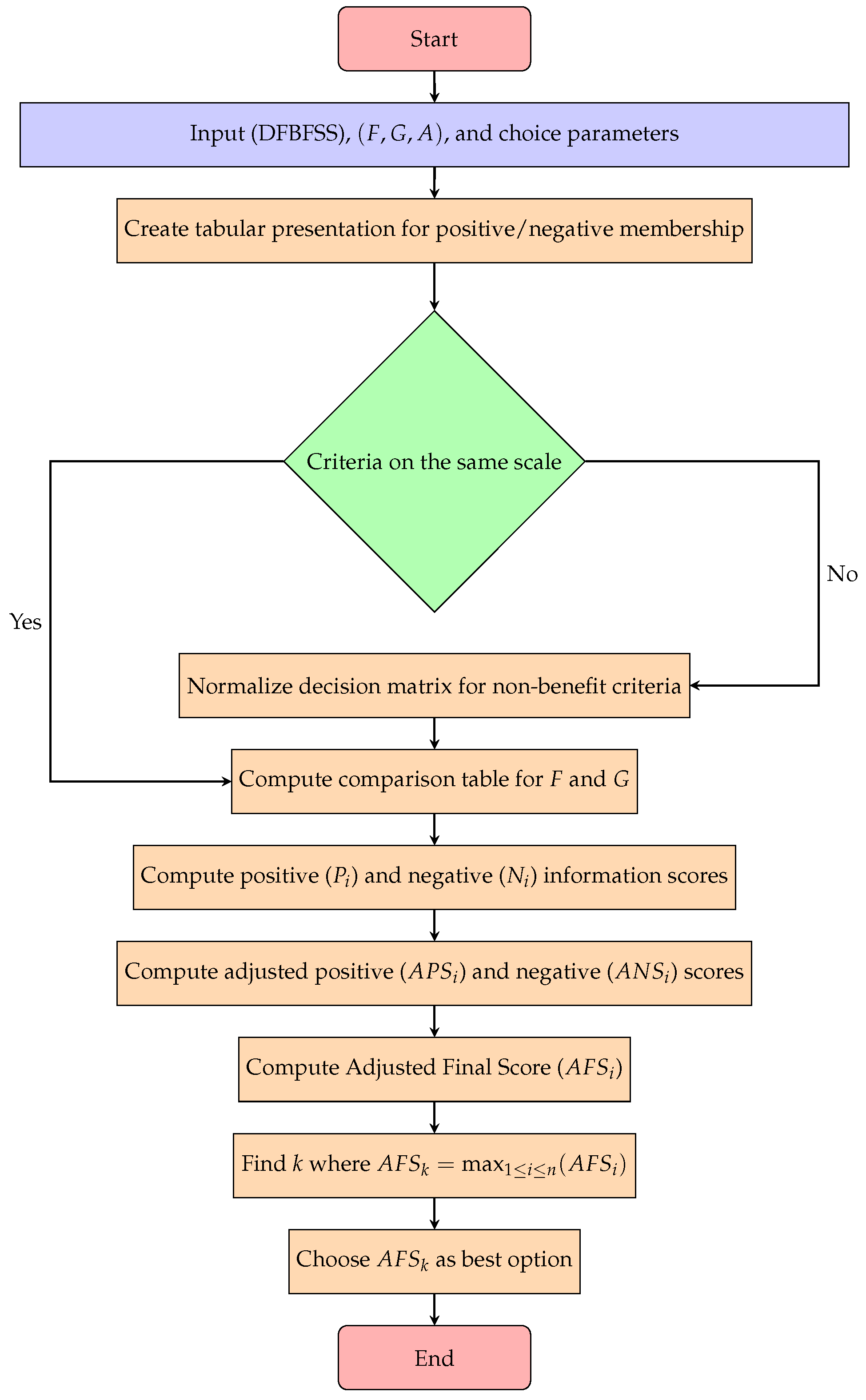
- Step 1:
- The algorithm begins by accepting a Double-Frame Bipolar Fuzzy Soft Set (DFBFSS) , where is the set of alternatives, the set of criteria, and the mapping that assigns to each alternative-criterion pair a tuple of four membership values: positive membership , its negation , negative membership , and its negation . These values, derived from expert judgment or data, are then systematically organized into a decision matrix (tabular form), with rows representing alternatives, columns representing criteria, and each cell containing the corresponding four-dimensional membership tuple. This matrix serves as the structured input, clearly presenting both supporting and opposing evaluations alongside their respective negations for all considered factors.
- Step 2:
- Normalizing is required if the criteria are not on the same scale. This involves normalizing the decision matrix based on the characteristics of each criterion by using the Definition 11, i.e., for each non-benefit criterion, the normalization operation applies the complement definition to each membership component—for example, transforming the original positive membership into or a structurally equivalent complement, ensuring all criteria contribute uniformly within the bipolar fuzzy framework while preserving the relational logic between a membership and its negation. Benefit criteria remain unchanged, as their original values are already aligned with the desired direction of preference.
- Step 3:
- In this step, comparison tabular for functions F and G is computed using Definition 20. The following three steps are found using Definition 21.
- Step 4:
- Positive and negative information scores with their negations and are computed.
- Step 5:
- Adjusted positive and negative information scores with their negations are computed.
- Step 6:
- Adjusted Final score is computed.
- Step 7:
- Find k where .
- Step 8:
- For , is the best choice to be chosen.
6. Numerical Example
7. Comparative Analysis
8. Conclusions
Author Contributions
Funding
Data Availability Statement
Conflicts of Interest
References
- Ali, G.; Akram, M.; Koam, A.N.; Alcantud, J.C.R. Parameter reductions of bipolar fuzzy soft sets with their decision-making algorithms. Symmetry 2019, 11, 949. [Google Scholar] [CrossRef]
- Zadeh, L.A. Fuzzy sets. Inf. Control 1965, 8, 338–353. [Google Scholar] [CrossRef]
- Bellman, R.E.; Zadeh, L.A. Decision-making in a fuzzy environment. Manag. Sci. 1970, 17, B-141–B-164. [Google Scholar] [CrossRef]
- Dubois, D. The role of fuzzy sets in decision sciences: Old techniques and new directions. Fuzzy Sets Syst. 2011, 184, 3–28. [Google Scholar] [CrossRef]
- Tong, R.M. Fuzzy control systems: A retrospective. In Proceedings of the 1983 American Control Conference, San Francisco, CA, USA, 22–24 June 1983; pp. 1224–1229. [Google Scholar]
- Bezdek, J.C. Pattern Recognition with Fuzzy Objective Function Algorithms; Springer Science & Business Media: Berlin/Heidelberg, Germany, 2013. [Google Scholar]
- Pedrycz, W. Fuzzy sets in pattern recognition: Methodology and methods. Pattern Recognit. 1990, 23, 121–146. [Google Scholar] [CrossRef]
- Kandel, A.; Schneider, M. Fuzzy sets and their applications to artificial intelligence. Adv. Comput. 1989, 28, 69–105. [Google Scholar]
- Kahraman, C.; Onar, S.C.; Oztaysi, B.; Cebi, S. Role of Fuzzy Sets on Artificial Intelligence Methods: A literature. Trans. Fuzzy Sets Syst. 2023, 2, 158–178. [Google Scholar]
- Chen, C.-T.; Lin, C.-T.; Huang, S.-F. A fuzzy approach for supplier evaluation and selection in supply chain management. Int. J. Prod. Econ. 2006, 102, 289–301. [Google Scholar] [CrossRef]
- Taherdoost, H.; Madanchian, M. Decision making: Models, processes, techniques. Cloud Comput. Data Sci. 2024, 5, 1–14. [Google Scholar] [CrossRef]
- Litvaj, I.; Ponisciakova, O.; Stancekova, D.; Svobodova, J.; Mrazik, J. Decision-making procedures and their relation to knowledge management and quality management. Sustainability 2022, 14, 572. [Google Scholar] [CrossRef]
- Mu, E. Multicriteria decision making as interdisciplinary research. Int. J. Anal. Hierarchy Process. 2022, 14. [Google Scholar] [CrossRef]
- Newell, W.H. Decision Making in Interdisciplinary Studies. In Handbook of Decision Making; Morçöl, G., Ed.; CRC Press/Taylor & Francis Group: New York, NY, USA, 2007; pp. 245–264. [Google Scholar]
- Schmude, T.; Koesten, L.; Möller, T.; Tschiatschek, S. Applying Interdisciplinary Frameworks to Understand Algorithmic Decision-Making. arXiv 2023, arXiv:2305.16700. [Google Scholar]
- Abubakar, A.M.; Elrehail, H.; Alatailat, M.A.; Elçi, A. Knowledge management, decision-making style and organizational performance. J. Innov. Knowl. 2019, 4, 104–114. [Google Scholar] [CrossRef]
- AlDhaena, E. The role of knowledge management in strategic decision-making in higher education institutions (HEIs): A proposed model. Int. J. Innov. Creat. Change 2020, 10, 50–57. [Google Scholar]
- Bruch, E.; Feinberg, F. Decision-making processes in social contexts. Annu. Rev. Sociol. 2017, 43, 207–227. [Google Scholar] [CrossRef]
- Sayama, H.; Dionne, S.D. Studying collective human decision making and creativity with evolutionary computation. Artif. Life 2015, 21, 379–393. [Google Scholar] [CrossRef][Green Version]
- Zafar, F.; Akram, M. A novel decision-making method based on rough fuzzy information. Int. J. Fuzzy Syst. 2018, 20, 1000–1014. [Google Scholar] [CrossRef]
- Naz, S.; Ashraf, S.; Akram, M. A novel approach to decision-making with Pythagorean fuzzy information. Mathematics 2018, 6, 95. [Google Scholar] [CrossRef]
- Zhang, W.R. bipolar fuzzy sets. In Proceedings of the 1998 IEEE International Conference on Fuzzy Systems Proceedings, IEEE World Congress on Computational Intelligence (Cat. No. 98CH36228), Anchorage, AK, USA, 4–9 May 1998; Volume 1, pp. 835–840. [Google Scholar]
- Molodtsov, D. Soft set theory—First results. Comput. Math. Appl. 1999, 37, 19–31. [Google Scholar] [CrossRef]
- Ali, M.I.; Shabir, M. Comments on De Morgan’s law in fuzzy soft sets. J. Fuzzy Math. 2010, 18, 679–686. [Google Scholar]
- Ali, M.I. Another view on reduction of parameters in soft sets. Appl. Soft Comput. 2012, 12, 1814–1821. [Google Scholar] [CrossRef]
- Feng, F.; Li, C.; Davvaz, B.; Ali, M.I. Soft sets combined with fuzzy sets and rough sets: A tentative approach. Soft Comput. 2010, 14, 899–911. [Google Scholar] [CrossRef]
- Maji, P.K.R. Biswas ans AR Roy, “Fuzzy soft sets”. J. Fuzzy Math. 2001, 9, 589–602. [Google Scholar]
- Roy, A.R.; Maji, P. A fuzzy soft set theoretic approach to decision making problems. J. Comput. Appl. Math. 2007, 203, 412–418. [Google Scholar] [CrossRef]
- Pei, D.; Miao, D. A From soft sets to information systems. In Proceedings of the 2005 IEEE International Conference on Granular Computing, Beijing, China, 25–27 July 2005; Volume 2, pp. 617–621. [Google Scholar]
- Yang, X.; Lin, T.Y.; Yang, J.; Li, Y.; Yu, D. Combination of interval-valued fuzzy set and soft set. Comput. Math. Appl. 2009, 58, 521–527. [Google Scholar] [CrossRef]
- Shabir, M.; Naz, M. On bipolar soft sets. arXiv 2013, arXiv:1303.1344. [Google Scholar] [PubMed]
- Mahmood, T. A novel approach towards bipolar soft sets and their applications. J. Math. 2020, 2020, 4690808. [Google Scholar] [CrossRef]
- Lee, K.M. Bipolar-valued fuzzy sets and their operations. In Proceedings of the International Conference on Intelligent Technologies, Bangkok, Thailand, 12–14 December 2000; pp. 307–312. [Google Scholar]
- Abdullah, S.; Aslam, M.; Ullah, K. Bipolar fuzzy soft sets and its applications in decision making problem. J. Intell. Fuzzy Syst. 2014, 27, 729–742. [Google Scholar] [CrossRef]
- Musa, S.Y.; Asaad, B.A.; Alohali, H.; Ameen, Z.A.; Alqahtani, M.H. Fuzzy N-Bipolar Soft Sets for Multi-Criteria Decision-Making: Theory and Application. CMES-Comput. Model. Eng. Sci. 2025, 143, 911–943. [Google Scholar] [CrossRef]
- Alqablan, K.A.; Alsager, K.M. Multi-Q Cubic bipolar fuzzy soft sets and cosine similarity methods for multi-criteria decision making. Symmetry 2025, 16, 1032. [Google Scholar] [CrossRef]
- El-Atik, A.A.; Abu-Gdairi, R.; Nasef, A.A.; Jafari, S.; Badr, M. Fuzzy Soft Sets and Decision Making in Ideal Nutrition. Symmetry 2023, 15, 1523. [Google Scholar] [CrossRef]
- Shi, D.; Khiamy, H.M.; Abbas, S.E.; Ibedou, I. Roughness of bipolar soft sets via ideals and its applications. Eur. J. Pure Appl. Math. 2025, 18, 6225. [Google Scholar] [CrossRef]
- Maji, P.K.; Biswas, R.; Roy, A.R. Soft set theory. Comput. Math. Appl. 2003, 45, 555–562. [Google Scholar] [CrossRef]
- Naz, M.; Shabir, M. On fuzzy bipolar soft sets, their algebraic structures and applications. J. Intell. Fuzzy Syst. 2014, 26, 1645–1656. [Google Scholar] [CrossRef]



| 3 | 1 | 1 | 2 | 1 | 1 | |
| 2 | 3 | 2 | 2 | 1 | 1 | |
| 2 | 2 | 3 | 1 | 1 | 1 | |
| 1 | 1 | 2 | 3 | 0 | 1 | |
| 2 | 2 | 2 | 3 | 3 | 2 | |
| 2 | 1 | 2 | 2 | 1 | 3 |
| 3 | 1 | 0 | 0 | 0 | 2 | |
| 2 | 3 | 1 | 1 | 2 | 1 | |
| 3 | 2 | 3 | 1 | 3 | 2 | |
| 3 | 2 | 2 | 3 | 3 | 3 | |
| 3 | 1 | 2 | 0 | 3 | 2 | |
| 2 | 2 | 1 | 1 | 1 | 3 |
| 3 | 3 | 1 | 1 | 2 | 3 | |
| 0 | 3 | 1 | 1 | 2 | 3 | |
| 2 | 2 | 3 | 0 | 2 | 2 | |
| 2 | 2 | 3 | 3 | 2 | 3 | |
| 1 | 2 | 2 | 1 | 3 | 2 | |
| 0 | 1 | 1 | 1 | 2 | 3 |
| 3 | 2 | 2 | 2 | 1 | 1 | |
| 2 | 3 | 2 | 2 | 2 | 2 | |
| 1 | 1 | 3 | 2 | 1 | 1 | |
| 1 | 1 | 1 | 3 | 0 | 0 | |
| 3 | 3 | 2 | 3 | 3 | 3 | |
| 2 | 2 | 2 | 3 | 1 | 3 |
| Row Sum: | Column Sum: | ||
|---|---|---|---|
| 9 | 12 | ||
| 11 | 10 | ||
| 10 | 12 | ||
| 8 | 13 | ||
| 14 | 7 | ||
| 11 | 9 |
| Row Sum: | Column Sum: | ||
|---|---|---|---|
| 6 | 16 | ||
| 10 | 11 | ||
| 14 | 9 | ||
| 16 | 6 | ||
| 11 | 12 | ||
| 10 | 13 |
| Row Sum: | Column Sum: | ||
|---|---|---|---|
| 13 | 8 | ||
| 10 | 13 | ||
| 11 | 11 | ||
| 15 | 7 | ||
| 11 | 13 | ||
| 8 | 16 |
| Row Sum: | Column Sum: | ||
|---|---|---|---|
| 11 | 12 | ||
| 13 | 12 | ||
| 9 | 12 | ||
| 6 | 15 | ||
| 17 | 8 | ||
| 13 | 10 |
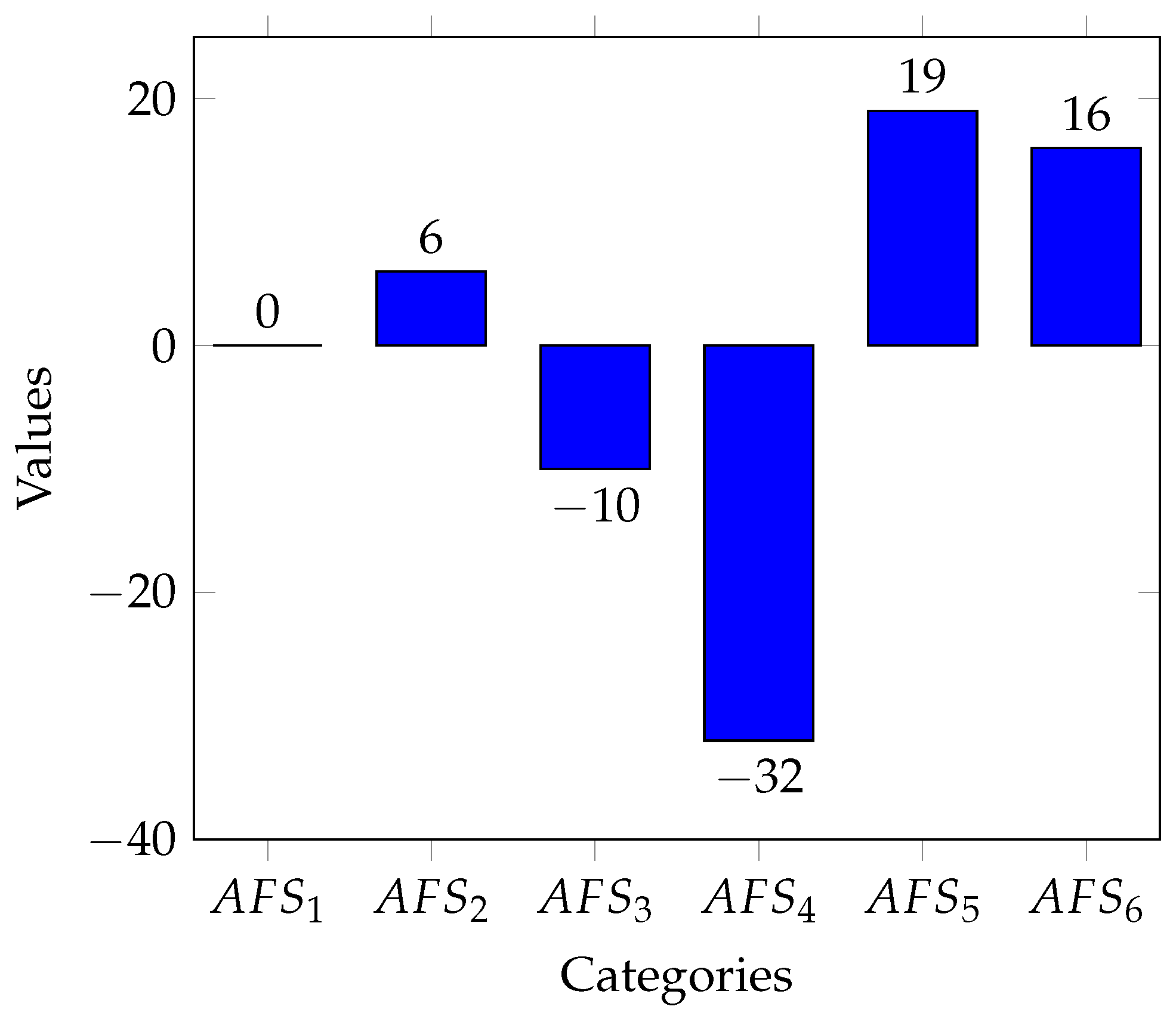
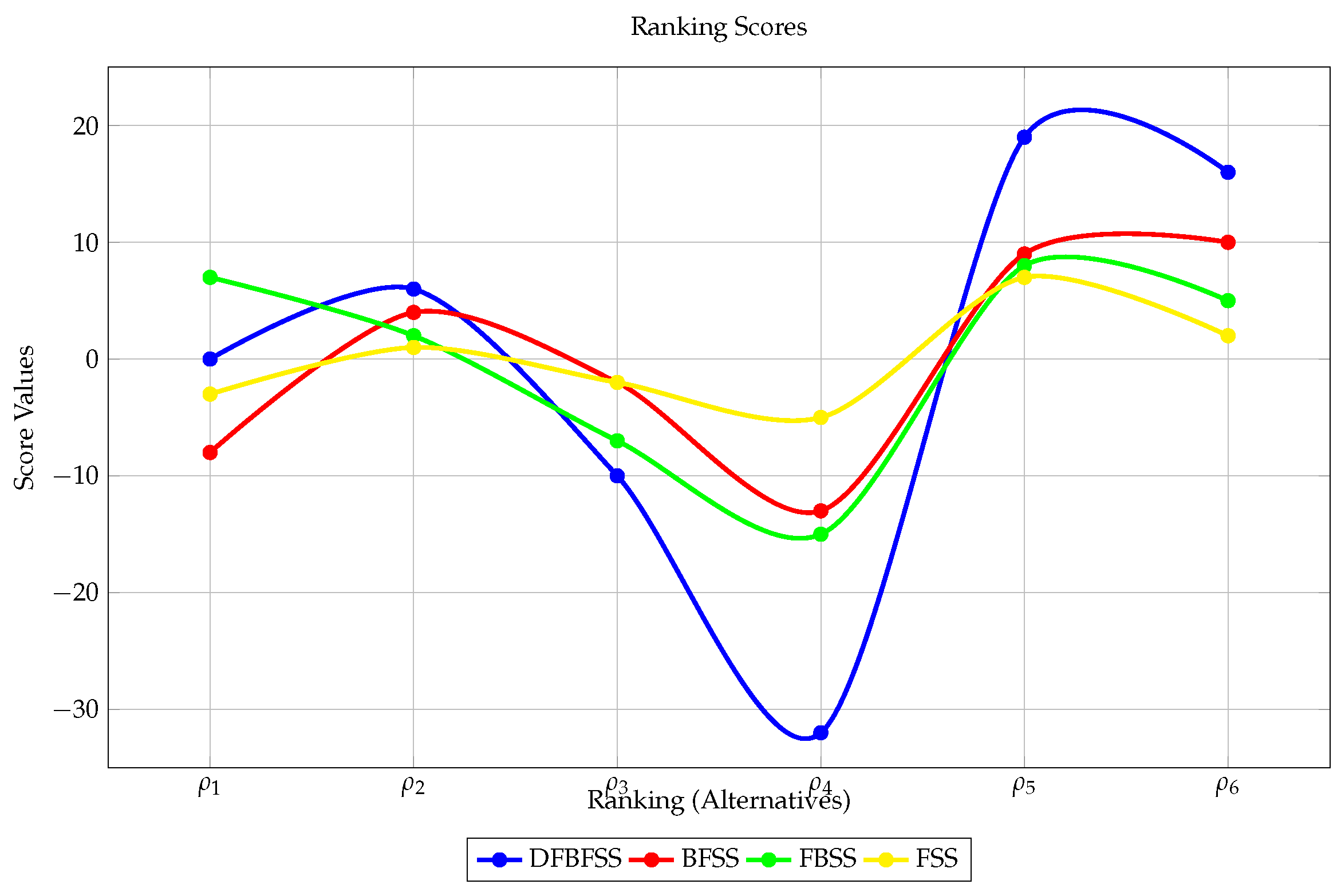
| Models | Ranking Results | Optimal Alternative |
|---|---|---|
| DFBFSS | ||
| FSS | ||
| FBSS | ||
| BFSS |
| Aspect/Model | Soft Set (SS) | Fuzzy Soft Set (FSS) | Bipolar FSS (BFSS) | Proposed DFBFSS |
|---|---|---|---|---|
| Handles Vague Data | No (Crisp) | Yes | Yes | Yes |
| Models Bipolarity | No | No | Yes | Yes |
| Captures Negation | No | No | No | Yes |
| Complexity of Representation | Low | Medium | Medium | High (Four-dimensional) |
| Key Justification | Oversimplifies due to crisp logic | Misses conflicting criteria | Misses negation semantics | Captures complete expert judgment with dual-frame uncertainty |
| Model | Positive Membership | Negative Membership | Negation | Bipolarity | Multi-Criteria Decision Support | Notes |
|---|---|---|---|---|---|---|
| SS [23] | ✓ | × | × | × | Limited | Binary or crisp values only |
| FSS [27] | ✓ | × | × | × | Moderate | Captures positive fuzziness only |
| BFSS [34] | ✓ | ✓ | × | ✓ | Moderate | No negation information |
| DFBFSS (Proposed) | ✓ | ✓ | ✓ | ✓ | High | Four-dimensional, dual-frame, handles negation |
Disclaimer/Publisher’s Note: The statements, opinions and data contained in all publications are solely those of the individual author(s) and contributor(s) and not of MDPI and/or the editor(s). MDPI and/or the editor(s) disclaim responsibility for any injury to people or property resulting from any ideas, methods, instructions or products referred to in the content. |
© 2026 by the authors. Licensee MDPI, Basel, Switzerland. This article is an open access article distributed under the terms and conditions of the Creative Commons Attribution (CC BY) license.
Share and Cite
Mershkhan, S.M.; Asaad, B.A. Double-Framed Bipolar Fuzzy Soft Sets and Algorithmic Approaches with Symmetry for Multi-Criteria Decision-Making Under Uncertainty. Symmetry 2026, 18, 119. https://doi.org/10.3390/sym18010119
Mershkhan SM, Asaad BA. Double-Framed Bipolar Fuzzy Soft Sets and Algorithmic Approaches with Symmetry for Multi-Criteria Decision-Making Under Uncertainty. Symmetry. 2026; 18(1):119. https://doi.org/10.3390/sym18010119
Chicago/Turabian StyleMershkhan, Shadya M., and Baravan A. Asaad. 2026. "Double-Framed Bipolar Fuzzy Soft Sets and Algorithmic Approaches with Symmetry for Multi-Criteria Decision-Making Under Uncertainty" Symmetry 18, no. 1: 119. https://doi.org/10.3390/sym18010119
APA StyleMershkhan, S. M., & Asaad, B. A. (2026). Double-Framed Bipolar Fuzzy Soft Sets and Algorithmic Approaches with Symmetry for Multi-Criteria Decision-Making Under Uncertainty. Symmetry, 18(1), 119. https://doi.org/10.3390/sym18010119