The African Vultures Optimization Algorithm (AVOA) is a novel meta-heuristic algorithm inspired by the hunger-driven foraging behavior of African vultures. It was proposed by Abdollahzadeh et al. for solving global optimization problems.
2.2.1. Original AVOA Algorithm
The original AVOA algorithm can be summarized into the following four components:
- 1.
Random initialization of the vulture population:
- 2.
Determine the optimal vulture individuals:
Select the vultures with the best fitness values as Leaders
and
:
Here,
and
are parameters to be measured before the search operation, both ranging from 0 to 1, and satisfying the condition
. Subsequently, Equation (7) is used to select the best solution for each group, thereby determining the probability of selecting the optimal solution.
- 3.
Exploration Phase:
The hunger rate governs the dynamic transition between the exploration and exploitation phases and serves as the core scheduling parameter of AVOA. Its variation is jointly determined by a time adjustment function
and a random variable
, as follows:
In Equations (8) and (9), iter denotes the current iteration number, and represents the maximum number of iterations. The parameter is a perturbation control variable, defined within the range , and it changes with each iteration. Parameters and are constants used to control the shape of the hunger curve. The variable t is introduced to enhance the algorithm’s ability to escape from local optima. is used to determine the phase transition; when , the algorithm enters the exploration phase, whereas when , it switches to the exploitation phase.
During the exploration phase, vultures search broadly for potential food sources. The algorithm selects between two distinct random search patterns based on a probability parameter
, which is a random value generated within the range [0, 1] prior to executing the search operation. As shown in Equation (10), if the value of
is greater than or equal to the parameter
, Equation (11) is adopted; otherwise, Equation (13) is applied.
Mechanism 1: Distance-Driven Search
In this mechanism, represents the position vector of the vulture in the next iteration, and is the hunger rate parameter obtained from Equation (9) in the current iteration. In Equation (12), denotes one of the best vultures selected using Equation (6) during the current iteration. is a coefficient vector used to introduce randomness, calculated as , where is a random number between 0 and 1, simulating the vulture’s behavior of approaching or moving away from the reference target in a random direction. is the current position vector of the vulture.
Mechanism 2: Random Offset Search
is a random value between 0 and 1. In Mechanism 2, new positions are generated randomly over the global search space to enhance the diversity of the search.
- 4.
Exploitation Phase:
When , the algorithm enters the exploitation phase, indicating that the vulture has discovered a potential food source and begins to encircle or hunt. This phase is divided into two states: moderate satiety and intense hunger. Each state involves two key parameters: and . Specifically, is used in the moderate satiety state, while is used in the intense hunger state. Before entering the exploitation phase, both parameters are initialized with values of 0 and 1, respectively.
State 1: Moderate Satiety State ()
At the beginning of the exploitation phase, a random number
is generated between 0 and 1. If this number is greater than or equal to parameter
, the vulture performs an encircling competition strategy. Otherwise, a spiral flight strategy is applied:
Mechanism 1: Encircling Competition
In Equation (15), is calculated using Equation (12), and is obtained from Equation (9). The variable generates a random value between 0 and 1, which is used to introduce stochastic variability in the scaling factor.
Mechanism 2: Spiral Flight
denotes the position vector of one of the two best vultures in the current iteration, as determined by Equation (6). The functions and represent the standard sine and cosine functions, respectively. The variables and are random numbers ranging from 0 to 1. By computing and , the position of the vulture is ultimately updated using Equation (19).
State 2: Severe Hunger State ()
When vultures are in a state of extreme hunger, they exhibit more aggressive attacking or convergence behaviors. In this case, the algorithm selects different mechanisms based on the value of
. The variable
is a random number between 0 and 1.
In Equations (21) and (22), represents the first group of best-performing vultures in the current iteration, and denotes the second group of best-performing vultures. Finally, all vultures are aggregated using Equation (23) to obtain the updated position for the next iteration.
In Equation (24), denotes the problem dimension. In Equation (25), and are random numbers uniformly distributed in the range [0, 1], a is a constant fixed at 1.5, and the value of is calculated according to Equation (26).
The computational complexity of the original AVOA algorithm depends on three fundamental components: initialization, fitness evaluation, and vulture position update. Therefore, its overall time complexity can be expressed as:
where
is the population size,
is the maximum number of iterations, and
is the problem dimension.
2.2.2. Improved African Vulture Optimization Algorithm
To address the limitations of the traditional African Vulture Optimization Algorithm—including strong randomness in population initialization, insufficient balance between exploration and exploitation due to fixed parameters, and the decline of population diversity in later stages—this paper proposes an Improved African Vulture Optimization Algorithm. While retaining the overall framework and bio-inspired characteristics of the original algorithm, IAVOA introduces targeted enhancements from the following three aspects:
- 1.
A population initialization strategy based on Perturbation-Enhanced Dynamic Tent Mapping is designed to improve the uniformity of the initial distribution and enhance global exploration capabilities;
- 2.
An Adaptive Parameter Control mechanism is incorporated into the AVOA to dynamically balance the exploration and exploitation phases;
- 3.
An Elite Retention and Migration mechanism is introduced to prevent the loss of high-quality individuals and maintain population diversity.
- 1.
Perturbation-Enhanced Dynamic Tent Mapping
The original population initialization method may lead to individual clustering or uneven coverage in high-dimensional spaces, leading to insufficient diversity in the early search phase. To enhance the spatial uniformity and global exploration potential of the initial population in optimization algorithms, this paper proposes a Perturbation-Enhanced Dynamic Tent Mapping based on the traditional Tent chaotic map.
By incorporating time-dependent parameter control and slight random perturbation mechanisms, this method preserves the chaotic characteristics while significantly improving the uniform distribution of initial individuals in the search space, thereby avoiding the banded clustering problem typically caused by standard Tent sequences.
- 1.
Dynamic Parameter Design:
As one of the classical models in nonlinear dynamics, the Tent map is a piecewise linear transformation widely used in the study of chaotic systems. Its basic form transforms the input value
through a control parameter
, and the mapping is defined as follows:
Here, is the control parameter that determines the behavioral characteristics of the mapping. As the value of gradually increases, the system transitions from ordered periodic behavior to a chaotic state, and this transition becomes particularly pronounced.
Due to its simple mathematical structure, the Tent map provides an intuitive representation of chaotic behavior in nonlinear systems and effectively reveals the transition between periodicity and chaos. As a result, it has been widely used in cryptography and pseudo-random number generation. However, owing to its limited parameter range and relatively simple structure, the Tent map exhibits certain limitations in modeling complex systems. To maintain the chaotic properties of the Tent map while improving the uniformity of the initial population distribution, this paper introduces an enhanced version of the Tent mapping. The improved formulation is defined as follows:
Here, is the time-dependent control parameter, defined as ; is the amplitude of the dynamic perturbation; represents the current iteration number; and denotes the maximum number of iterations.
This dynamic structure allows the Tent map to continuously shift its axis of symmetry during the iterative process, thereby generating a periodic distribution drift on a global scale. Such behavior enhances the diversity of the search in the early stages of the optimization process.
- 2.
Perturbation-Enhanced Mechanism:
To further disrupt the aggregation characteristics of deterministic chaotic trajectories, a small perturbation term is introduced after each iteration:
Here, denotes a random variable that follows a uniform distribution over the interval [−1, 1]; is the perturbation intensity, where . By applying a slight random perturbation to the mapped value, the perturbation term effectively eliminates autocorrelation among trajectories, resulting in a more dispersed distribution of individual positions.
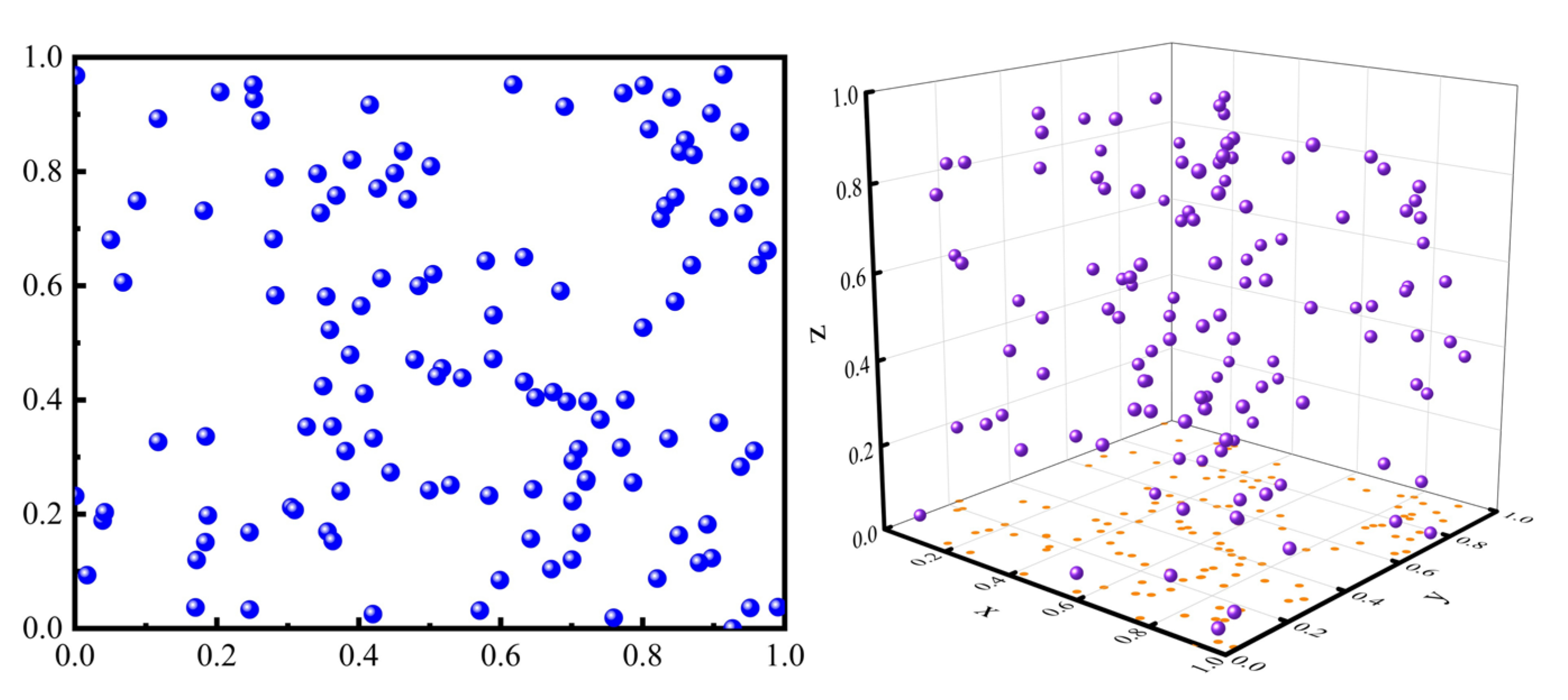
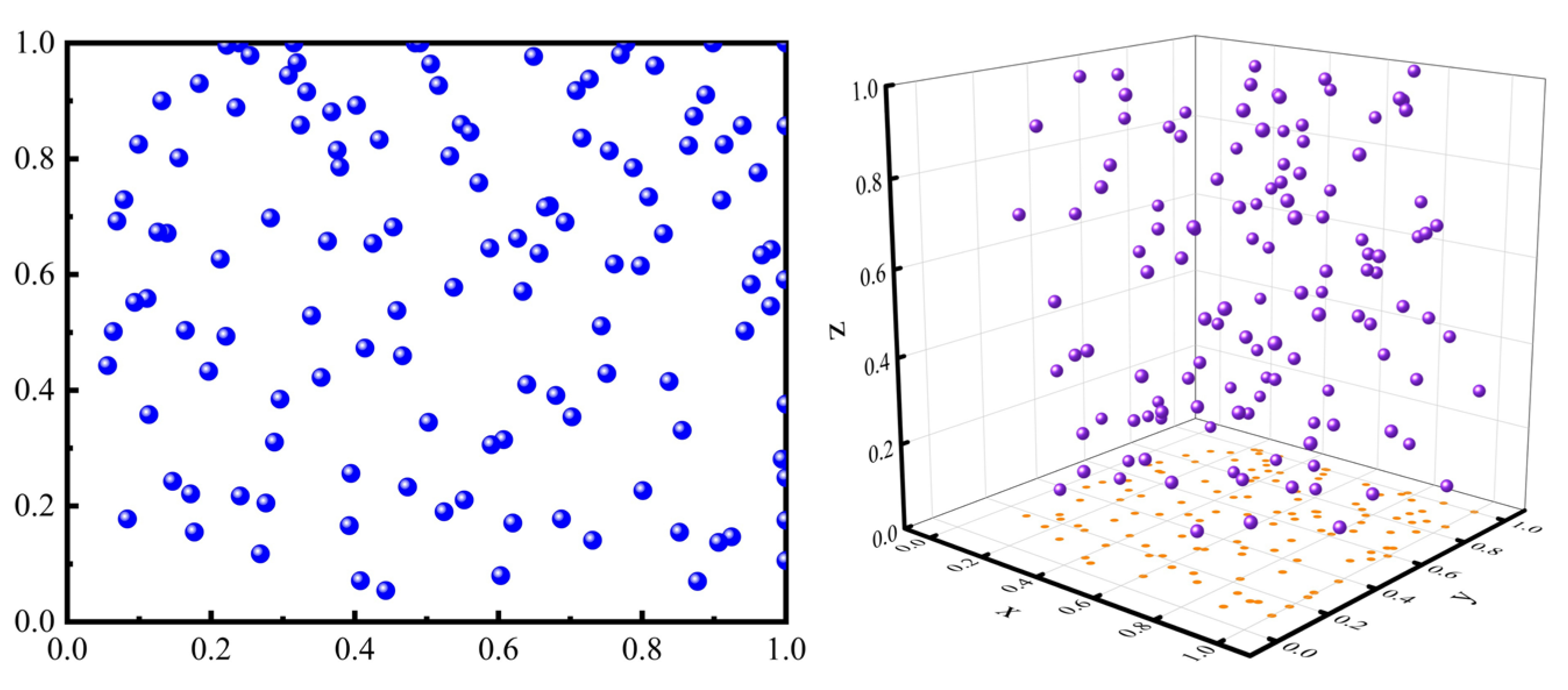
Figure 4 and
Figure 5 illustrate the population sample distributions generated by random initialization and PDTM-based initialization in two-dimensional and three-dimensional spaces, respectively. The colors in the figures are used solely for visualization enhancement and do not convey any specific meaning. As shown in the figures, the population generated by random initialization exhibits clear non-uniformity, characterized by multiple dense and sparse regions interspersed throughout the space, which hinders effective coverage of the entire search space. In contrast, the proposed PDTM-based initialization method significantly improves the spatial uniformity of the population distribution, enhancing not only the diversity of the initial population but also providing a better starting point for the optimization process.
The aforementioned improvements enable PDTM to retain the inherent nonlinear dynamic characteristics of chaotic sequences while enhancing its ability to regulate distribution structure. This facilitates the generation of a more exploratory initial population layout, introducing higher initial perturbation and better spatial coverage for the subsequent search process. It is important to note that in this study, PDTM is applied solely during the population initialization phase of the optimization algorithm. Its primary objective is to generate a more randomized and uniformly distributed set of initial individuals, thereby enhancing the diversity of search starting points and reducing initialization bias. Under this one-time usage setting, the stochasticity of PDTM serves as a desirable property for improving initialization quality rather than a flaw.
- 3.
Adaptive Control Parameter Mechanism
In the original AVOA, fixed parameters (such as ) are used throughout the optimization process. Specifically, and determine the flight search range of vultures; , , and adjust the balance between exploration and exploitation; the parameter controls the variation of the hunger rate and affects the update speed. However, fixing these parameters throughout the optimization process limits the algorithm’s ability to adapt to problem-specific requirements at different stages. As a result, the algorithm may exhibit excessive exploration or insufficient local exploitation in the later iterations, thereby compromising the convergence performance.
To address this limitation, a dynamic adaptive parameter adjustment mechanism is introduced in this study. This mechanism enables the algorithm to maintain a proper balance between exploration and exploitation phases, thereby enhancing both global search capability and local optimization efficiency. The updated parameter adjustment equations are formulated as follows:
In Equation (8), the original algorithm employs a fixed constant , causing the oscillation range of the hunger rate to remain constant throughout the entire iteration process. In contrast, IAVOA replaces it with a linearly decreasing function , as defined in Equation (31), allowing the oscillation amplitude of the hunger rate function to gradually converge. This adaptive adjustment enables the algorithm to exhibit strong global exploration in the early stages and stable local exploitation in the later stages.
In Equation (6), the parameters and in the original algorithm are fixed and randomly generated before the algorithm is executed, which maintains a balanced population distribution during the search process. As shown in Equation (32), the improved version adopts a time-dependent that decreases over iterations, promoting more intensive exploration at the beginning and progressively enhancing local exploitation in the later stages.
During the exploration and exploitation processes, the original algorithm uses fixed constants for , , and , resulting in constant behavior selection probabilities throughout the search. In the improved version, a time-varying oscillatory function is introduced, as defined in Equation (33), which enables a cyclic and dynamic transition between exploration and exploitation phases. This mechanism periodically “reactivates” the exploration stage during iterations, effectively helping the algorithm escape from local optima.
These dynamic adjustment mechanisms enable the algorithm to enhance its global search ability during the initial iterations and gradually shift toward local refinement in the later phases. This smooth transition optimizes the balance between exploration and exploitation, improves the algorithm’s adaptability, and ultimately enhances the convergence stability.
- 4.
Elite Retention and Migration Mechanism
In the original AVOA, the update of individuals relies entirely on the current population, lacking memory of historically superior solutions. This often leads to the loss of valuable information and population homogenization. To address this issue, this study introduces an elite retention and migration mechanism. In each generation, the top
of the best-performing individuals are retained to form an elite set
, and a migration-based update is executed every
iterations as follows:
where
denotes the individual with the best fitness in the elite set, and
represents the optimal solution among elite individuals. The migration coefficient
is gradually decaying over iterations. The parameter settings are:
,
, and
.
The elite retention and migration mechanism simulates the natural selection process by preserving a certain number of high-quality solutions and replacing the worst-performing individuals. This strategy not only increases the probability of convergence toward the global optimum but also effectively maintains population diversity, thereby avoiding premature convergence. By replacing the worst-performing of individuals, the algorithm mimics the migration and aggregation behavior of vultures, ensuring the preservation of historically optimal solutions while maintaining population diversity and global search capability.
- 5.
Overall Workflow of IAVOA
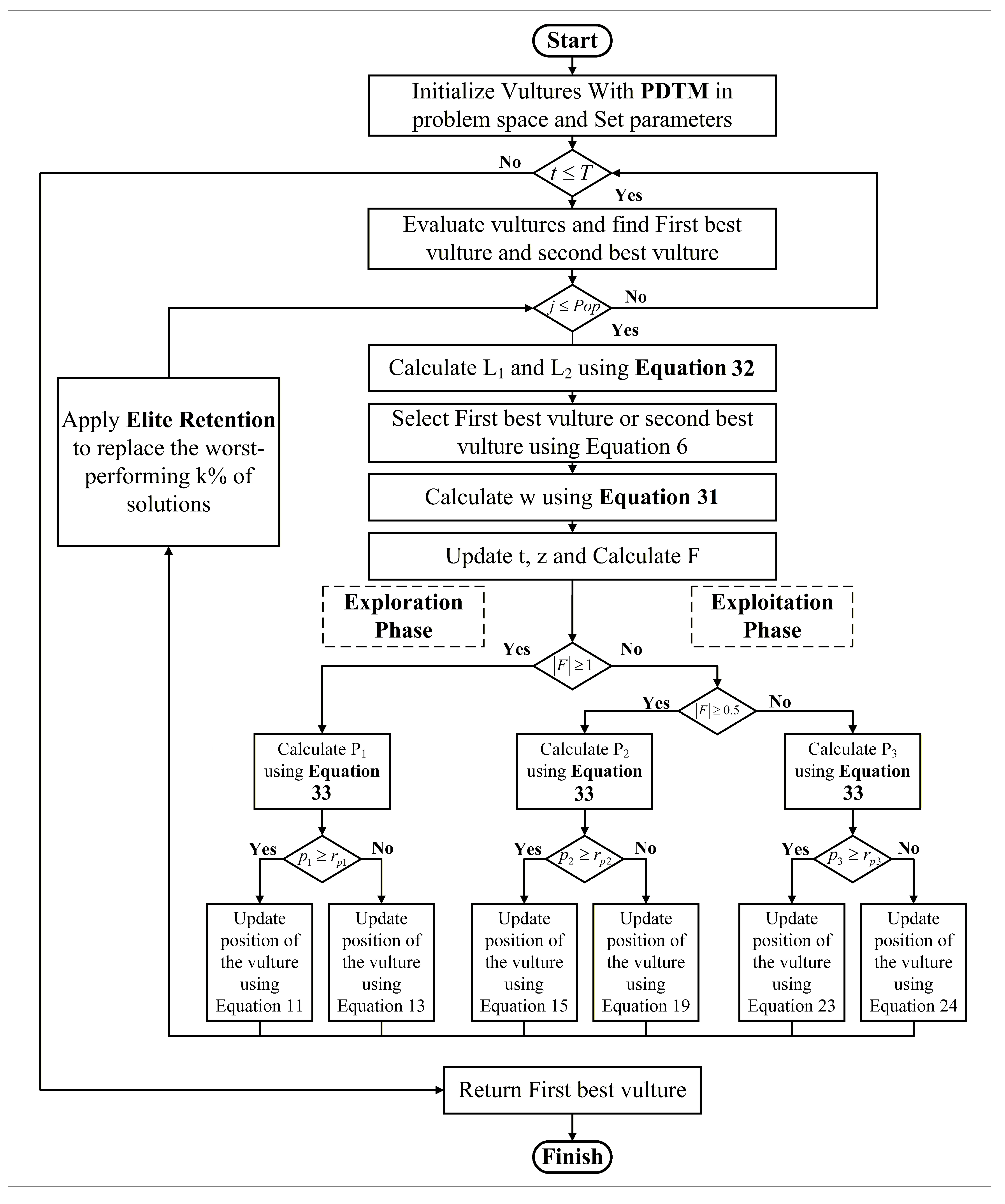
Figure 6 illustrates the overall workflow of IAVOA. To establish an effective balance between search space distribution and population strategy, IAVOA emphasizes different optimization priorities across three stages: initialization, search iteration, and convergence control. In the initialization stage, Perturbation-Enhanced Dynamic Tent Mapping (PDTM) is introduced to improve the coverage and uniformity of the initial population. During the search and iteration phase, an adaptive control parameter mechanism is employed to dynamically adjust individual behavior, achieving a balanced transition between exploration and exploitation. In the convergence control stage, an elite retention and migration mechanism is incorporated, using a guiding strategy to enhance convergence accuracy and prevent premature convergence to local optima. Overall, IAVOA achieves comprehensive optimization of search efficiency, solution space coverage, and convergence stability through the coordinated design of initialization perturbation, adaptive regulation, and elite-guided strategies.
2.2.3. Testing the IAVOA
To verify the effectiveness and stability of the IAVOA algorithm, two commonly used benchmark test functions are selected in this study: the Schwefel Problem 2.21 and the Generalized Penalized Function. These two functions represent unimodal and multimodal optimization problems, respectively, and are capable of comprehensively evaluating the algorithm’s performance across different types of optimization tasks.
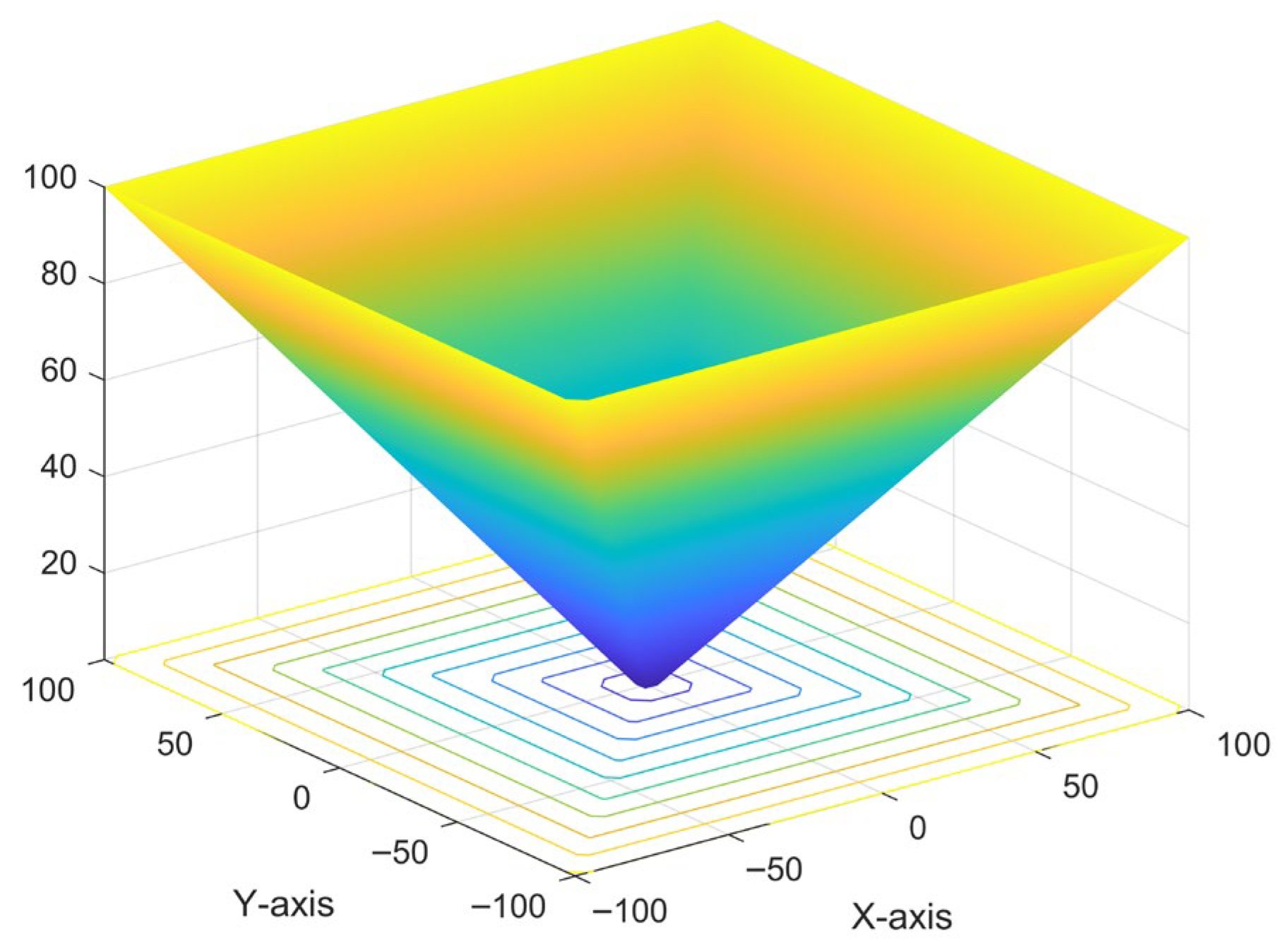
The Schwefel Problem 2.21 is a typical unimodal function characterized by its symmetric shape and gentle gradient. Its global minimum is zero and located at the origin. However, due to the weak gradient information near the optimal solution, the algorithm may converge slowly when solving this function. Therefore, Schwefel Problem 2.21 is well-suited for testing the local search ability and convergence precision of optimization algorithms. The surface of this function is illustrated in
Figure 7, and the corresponding formula is defined as follows:
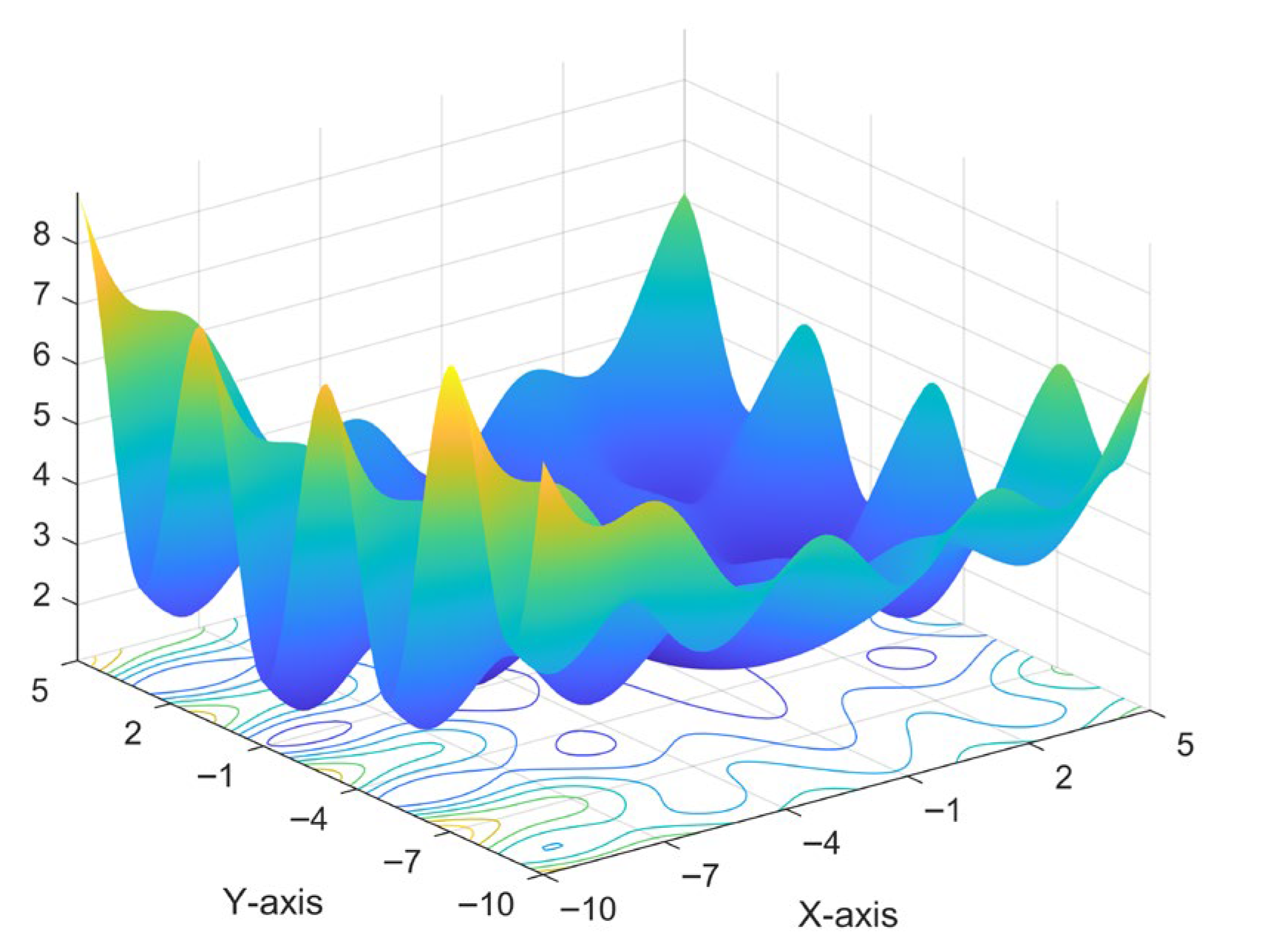
The Generalized Penalized Function is a multimodal and nonlinear function characterized by a complex boundary structure and a large number of local optima. These features make the optimization process highly challenging. This function is commonly used to evaluate an algorithm’s global search capability, its ability to escape from local optima, and its adaptability to constrained conditions. An example of the function’s surface is shown in
Figure 8. It is worth noting that the colors and projections in
Figure 7 and
Figure 8 are used solely for visual enhancement and do not carry any specific meaning.
Let
, and the function is defined as follows:
where
, and the variable transformation
is computed as follows:
The penalty function
is defined as
In this study, several representative optimization algorithms were selected for comparative experiments, including the Enhanced Whale Optimization Algorithm (EWOA) [
20], Multi-Verse Optimizer (MVO) [
21], Chameleon Swarm Algorithm (CSA) [
22], Improved Grey Wolf Optimizer (IGWO) [
23], and Beluga Whale Optimization (BWO) [
24]. These algorithms were compared against the baseline African Vultures Optimization Algorithm to verify the superiority of the proposed algorithm.
EWOA and MVO demonstrate strong capabilities in escaping local optima: the former enhances global search ability through an adaptive mechanism, while the latter improves solution diversity via a multi-version strategy. CSA and IGWO exhibit advantages in global exploration: CSA improves adaptability by dynamically adjusting its search strategy, whereas IGWO enhances convergence accuracy through a modified leader selection mechanism. BWO performs well in high-dimensional and complex problems by optimizing the search process through information sharing, thereby improving the robustness of the algorithm.
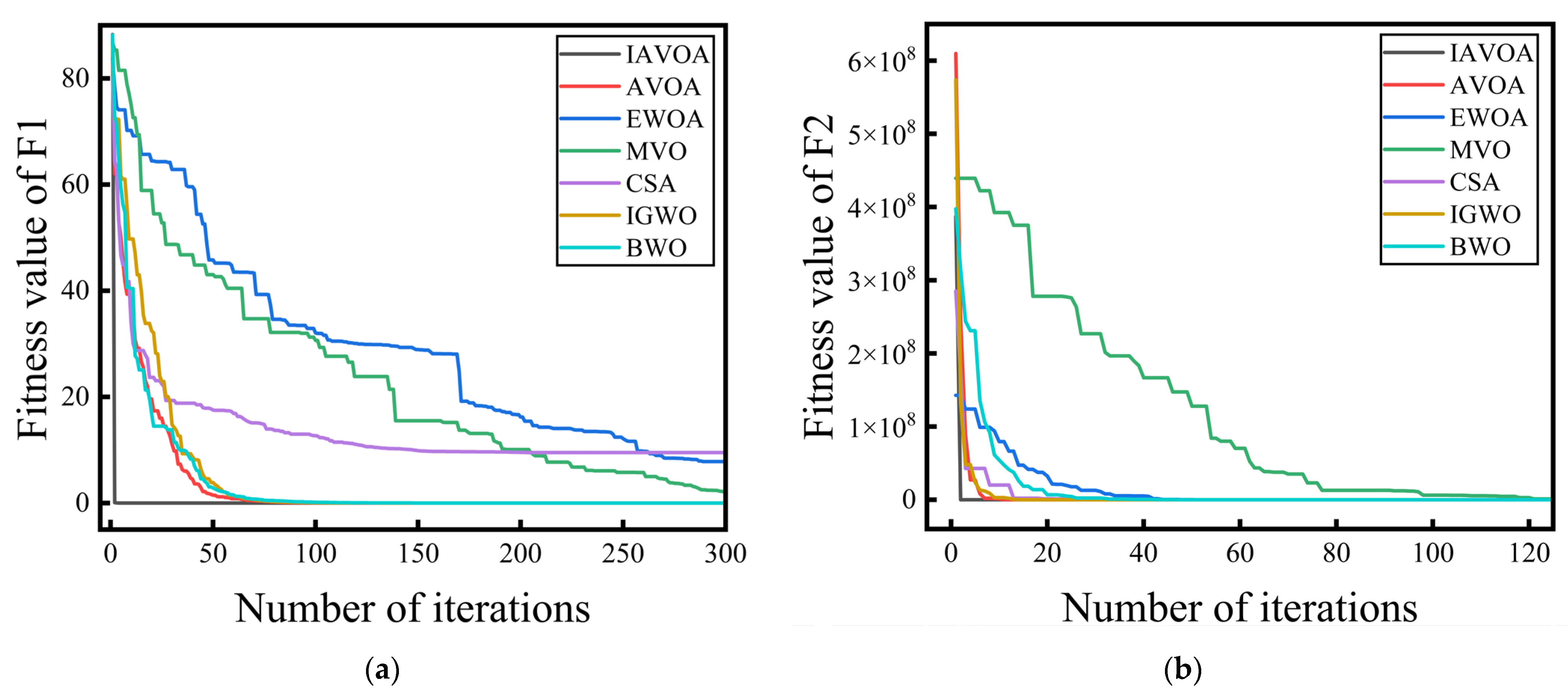
For all algorithms, the initial population size was set to 50, and the number of iterations was fixed at 300. The experimental results are presented in
Table 4 and
Table 5, and the optimization processes on the two benchmark functions are illustrated in
Figure 9a and
Figure 9b, respectively. The colors of the curves represent different optimization algorithms, as indicated in the figure legends.
As illustrated in
Figure 9a, for the unimodal function F1 (Schwefel’s Problem 2.21), the IAVOA algorithm rapidly descends to the minimum value, demonstrating an exceptionally high convergence speed. This characteristic indicates that IAVOA can effectively avoid excessive exploration in regions with weak gradient information and can swiftly locate the global optimum.
Benefiting from its multi-stage cooperative control mechanism, IAVOA achieves a significant reduction within the first five iterations, showcasing both fast and stable convergence. Compared with other benchmark algorithms, IAVOA reaches near-optimal solutions the earliest, highlighting its superior global search capability and convergence efficiency. This optimization task confirms IAVOA’s superiority in unimodal function optimization, particularly in handling flat-gradient regions.
In contrast, the original AVOA and BWO exhibit relatively fast early-stage convergence but slow down in the later stages, lacking sufficient local search capability. While EWOA and MVO possess certain global search abilities, they converge slowly overall and fail to reach the optimal solution within 300 iterations. CSA shows a slow convergence rate during the early stages and struggles to escape from local optima once trapped. IGWO performs well in the later stages but suffers from large fluctuations in the early iterations, indicating limited convergence stability.
In summary, IAVOA demonstrates clear advantages in convergence accuracy, stability, and the ability to escape local optima, validating the effectiveness of the proposed improvements in enhancing the algorithm’s overall performance.
As shown in
Figure 9b, in the optimization task of the Generalized Penalized Function, the IAVOA algorithm exhibits a significant convergence advantage. The global minimum of this function differs greatly from the initial solution, which increases the difficulty of the optimization process. Under such circumstances, IAVOA is able to rapidly approach the optimal solution within a short period. This superior performance is attributed to IAVOA’s efficient exploration and exploitation mechanism, enabling fast convergence to the global optimum.
In comparison, the original AVOA, IGWO, and SCA algorithms do not match IAVOA in terms of convergence speed, but they also deliver competitive performance. In particular, IGWO and SCA show advantages in solving multimodal problems. Based on the convergence performance in both the unimodal function F1 and this multimodal function, it can be concluded that AVOA maintains good adaptability in different types of optimization problems. This observation is one of the key reasons for selecting AVOA as the basis for further improvement.
EWOA and BWO also show their respective advantages in multimodal function optimization. Although EWOA converges more slowly, its process is stable and steadily approaches the optimal solution. BWO tends to get trapped in local optima during the early stages, but after several iterations, it accelerates and quickly reaches the global optimum. In contrast, MVO performs relatively poorly. While it is capable of moving gradually toward the optimal solution, it requires significantly more iterations, exceeding 120, whereas other algorithms typically find the optimal solution within 50 iterations.
Table 4 presents the performance of six optimization algorithms on the benchmark test function F1(x). According to the results, IAVOA outperforms the other algorithms in both optimization capability and stability. Specifically, for the F1 function, IAVOA successfully achieved the optimal value of 0, indicating its superior performance in accurately approaching the target solution. In comparison, the best results obtained by AVOA, EWOA, MVO, CSA, IGWO, and BWO were 0.0003, 7.7648, 2.1443, 9.5137, 0.0005, and 0.0008, respectively. Although most of the algorithms approached the optimal value, there were still certain deviations. In particular, EWOA, MVO, and CSA exhibited larger gaps from the theoretical optimum, suggesting relatively weaker global search capabilities and lower efficiency in the solution space of unimodal problems.
In terms of average value, IAVOA achieved the lowest mean of 0.2946, significantly better than the other algorithms. This demonstrates that IAVOA maintained stable and efficient search performance throughout its runs. AVOA obtained an average value of 3.4794, which, although acceptable, was clearly higher than that of IAVOA. The average values of EWOA and MVO were 29.5471 and 23.4527, respectively, indicating that these algorithms are more prone to larger deviations in complex search spaces, which negatively affects the quality of the results. CSA and IGWO also showed relatively high average values, 13.6426 and 4.9123, respectively, reflecting their instability in result quality. BWO achieved an average of 3.9035, which was better than some other algorithms but still exhibited a noticeable level of fluctuation.
The standard deviation is a key indicator for evaluating the stability and robustness of an algorithm. A smaller standard deviation implies more consistent performance. IAVOA had the smallest standard deviation of 5.0963 among all algorithms, indicating its superior stability across multiple runs. AVOA followed with a standard deviation of 10.7954, which was considerably higher than that of IAVOA. The standard deviations of EWOA and MVO were 18.7278 and 19.6106, respectively, suggesting a lack of accuracy. CSA and IGWO showed values of 8.6281 and 13.9570, both relatively high, indicating weaker performance on complex problems. BWO had a standard deviation of 11.9122, which, although slightly better than some algorithms, still did not match the performance of IAVOA.
According to
Table 5, in the benchmark test of the multimodal function F2(x), IAVOA successfully achieved the optimal value of 5.7485 × 10
−19, which is the smallest among all the compared algorithms. This result indicates that IAVOA possesses a very strong global search capability and highly accurate target approximation ability. In contrast, the best results of AVOA and IGWO were 2.6700 × 10
−3 and 1.6787 × 10
−5, respectively. Although these values are better than those of other comparative algorithms, they still fall short in precision. EWOA and MVO obtained best results of 0.13999 and 0.80292, respectively, demonstrating poor accuracy and indicating their limited effectiveness in handling complex multimodal optimization tasks.
In terms of average value, IAVOA achieved a mean of 1.2909 × 10⁶, significantly outperforming the other algorithms. This result shows that the algorithm is not only capable of finding the global optimum but also maintains the stability of high-quality solutions across multiple runs. The average values of AVOA and CSA were 3.3718 × 10⁶ and 2.6674 × 10⁶, respectively, which are considerably higher than that of IAVOA. The average values of EWOA and MVO were 6.2435 × 10⁶ and 5.2174 × 10⁷, respectively, indicating that their optimization processes lack stability and are more likely to be affected by local minima, resulting in poorer solution quality.
Finally, with respect to the standard deviation, IAVOA achieved the smallest value of 2.2360 × 10⁷, suggesting that its optimization process is the most balanced. The standard deviations of the other algorithms were all greater than that of IAVOA, reflecting higher variability and a lack of consistency in their performance across multiple runs. In summary, IAVOA demonstrates outstanding performance not only on unimodal problems but also on multimodal problems. Its excellent convergence ability in complex optimization tasks confirms its robustness and adaptability.
The primary computational overhead of IAVOA arises from three components: population initialization, fitness evaluation, and position updating. Since the PDTM mapping and parameter adjustment processes involve only simple arithmetic operations, the time complexity remains the same as that of the original AVOA, which is:
Therefore, IAVOA significantly improves the global search ability and convergence performance of the algorithm without introducing any substantial increase in computational burden.