1. Introduction
Singularly perturbed differential equations are equations that contain a small parameter multiplying the highest derivative. The presence of this small parameter in the highest derivative often causes abrupt changes in the solution, leading to the formation of boundary layers or other singular structures. Such equations arise in many areas of physics, engineering, fluid mechanics, control theory, electrical circuits, chemical kinetics, population dynamics, and biological systems, where processes occur at vastly different scales—for example, very fast and very slow dynamics occurring simultaneously.
Various aspects of singular perturbations have been extensively developed in the works of M.I. Vishik and L.A. Lyusternik [
1,
2], A.B. Vasilyeva and V.F. Butuzov [
3,
4], S.A. Lomov [
5], E.F. Mishchenko and N.Kh. Rozov [
6], V.A. Trenogin [
7], W. Wazov [
8], O’Malley R. E. Jr. [
9], and others. Foundational contributions to this field were made by A. N. Tikhonov, who proved his famous fundamental theorems on the limiting transition in singularly perturbed nonlinear ordinary differential equations with bounded initial conditions [
10].
The initial value problem with singular initial conditions for a nonlinear second-order ordinary differential equation with a small parameter was studied by M.I. Vishik and L.A. Lyusternik [
2], as well as by K.A. Kassymov [
11]. They showed that, as the small parameter approaches zero, the solution to the original initial value problem tends to the solution of the degenerate equation with modified initial conditions. Such problems are known as Cauchy problems with initial jumps. K.A. Kassymov [
12] studied the most general cases of the Cauchy problem for singularly perturbed nonlinear systems of ordinary and integro-differential equations, as well as partial differential equations of hyperbolic type.
In [
13], the authors study a class of symmetric vector fields in the context of singularly perturbed fast–slow dynamical systems. Their primary aim is to understand how the symmetry properties of a dynamical system are affected by singular perturbations. They analyze the persistence of these symmetry properties when the singular perturbation parameter
is positive and sufficiently small, and they examine the relationships between the symmetries of the singularly perturbed system and those of the limiting systems obtained in the fast and slow time scales where
Impulsive effects refer to sudden, discrete changes or disturbances that occur within a system at specific points in time. These effects are typically represented by discontinuities in the state of the system, which occur instantaneously or over a very short period. Such impulses are often modeled using impulsive differential equations. Impulsive differential equations are particularly useful for describing real-world phenomena in which abrupt transitions or jumps occur, such as shocks, switching, or instantaneous control actions.
We note that the development of the theory of impulsive differential equations with a small parameter is associated with researchers such as M. Akhmet [
14], D.D. Bainov, V. Covachev, P.S. Simeonov [
15,
16], V. Lakshmikantham [
17], A.M. Samoilenko and N.A. Perestyuk [
18], among others. However, in the singularly perturbed differential equations they studied, the impulse functions exhibited a regular character.
Singularly perturbed differential equations with singular impulse functions were first investigated by Akhmet and Çağ. In [
19,
20,
21], they extended the impulsive analogue of Tikhonov’s theorem to a system of the form
with initial condition
where
, and
I are
m-dimensional vector valued functions,
, and
J are
n-dimensional vector valued functions,
...
and
are distinct discontinuity moments in
They considered differential equations where impulses are also singularly perturbed, and these are different from those in [
15] and extended from the Tikhonov theorem such that system (
1) has the small parameter in impulse function. The discontinuity moments are different for each dependent variables. Two cases of singularity with single-layer and multi-layers, which depend on impulse functions, are considered [
21]. The singularity in the impulsive part of the system can be treated through perturbation theory methods. Lyapunov’s second method is used to show the stability in the rescaled time.
In [
22,
23], authors consider impulsive systems with singularities. A uniform asymptotic approximation of the solution was built, which is valid in the entire interval
. Higher-order approximations and complete asymptotic expansions for solutions of systems with singularly perturbed impulses were constructed. The method of boundary functions was applied to obtain the main result.
The present work is a generalization of [
21] to the case of singular initial data; i.e., the system under consideration has a small parameter not only in the impulse function, but also in the initial condition. The limit transition from the solution to a singularly perturbed problem with an initial jump to the solution to a modified degenerate problem will be shown.
2. Problem Description
Singularly perturbed impulsive equations are a class of differential equations containing a small parameter, in which the solution exhibits rapid variations such as jumps or oscillations over short time intervals. These equations simultaneously capture continuous dynamics and discrete impulsive effects, making them suitable for modeling processes that undergo abrupt state transitions. Their practical relevance spans diverse domains: in biology, for population dynamics and the spread of infectious diseases; in neuroscience, for describing neural network activity; in chemistry, for catalytic reactions where the catalyst acts as an impulsive perturbation; in engineering, for control systems with discrete interventions, such as robotics and industrial process monitoring; in finance, for market behavior influenced by sudden news or policy shifts; and in physics, for the motion of particles subject to external impulsive forces. The main advantage of this work lies in its ability to represent complex systems where continuous evolution is intertwined with discrete events, to adapt models to varying conditions and parameters, and to provide reliable tools for analyzing system behavior and forecasting future dynamics.
In this paper, we consider the singularly perturbed linear impulsive differential system
with initial conditions
where
is a small positive real number,
and
are assumed to be independent of
and
...
are distinct discontinuity moments in
In the problem (
3) and (
4), the system, the impulses, and the initial condition for
are singularly perturbed.
From System (
3) for
, we obtain a system of equations:
If, instead of condition (
4), we take bounded initial values
then, according to the results of [
21], the solution to the problems (
3) and (
6) where
will remain in a neighborhood of the solution of the usual degenerate system (
5), obtained from (
3) for
with the previous initial condition:
That is, the limiting relations between the solution
to the singularly perturbed problems (
3) and (
4) and the solution
to the degenerate problems (
5) and (
7) hold, as expressed in
In this case, the limiting transition as
with respect to the component
y is uniform in
t on
Consider now the original singularly perturbed system (
3) with the growing condition (
4) for
z as
In our work, it will be shown that, in this case, the solution
to the singularly perturbed problems (
3) and (
4) as
does not converge to the solution to the usual degenerate problems (
5) and (
7), but to the solution of the same degenerate system (
5) with a different initial condition:
which is distinct from (
7). In this case, the solution
of the singularly perturbed systems (
3) and (
4) and the solution
to the modified degenerate problems (
5) and (
8) satisfy the limiting relations
Then, as
the limiting transition is not uniform in
t on
with respect to both the
z and
y components, because
Consequently, when the initial data (
4) are unbounded, the solution to the singularly perturbed problems (
3) and (
4), as
“jumps” to another solution from the family of solutions of the system (
5). Since, for the problems (
3) and (
4), the limit transition
as
is not uniform with respect to
there is a sufficiently small domain
which is a neighborhood of the initial point
in which the solution
of the singularly perturbed problems (
3) and (
4) differs significantly from the solution
of the modified degenerate problems (
5) and (
8). This phenomenon is referred to as the
initial jump phenomenon. The interval
on which the solutions to the singularly perturbed problems (
3) and (
4) differs substantially from the solutions to the modified degenerate problems (
5) and (
8) is called the
initial jump zone, while the remainder of
is called the
smooth zone. The quantity
defined as the difference between the initial conditions (
8) and (
7), is referred to as the
initial jump of the solution at
Since the first equation of the system (
5) is not differential, so it does not need any initial condition for
From the first equation (
5), we find
Then, by substituting
into system (
5), we obtain the system
Thus, it will be proved that, as
the solutions to the problems (
3) and (
4) does not lead to the solution to the usual degenerate problem, but to the solution to the degenerate system (
9) with the modified initial condition (
8).
3. Main Results
3.1. Singularity with a Single Layer
The following conditions are required:
The functions and are assumed to be continuously differentiable on the interval
where denotes the value of the function at each impulse moment
Theorem 1. Let conditions be satisfied. Then for sufficiently small ε, the solutions and to problems (3) and (4) where exist, are unique and satisfy the following limiting equalitieswhere are the solutions to the modified degenerate problems (9) and (8). Proof of Theorem 1. Let
Then the problems (
3) and (
4) take the form
with initial conditions
Let us prove that, as
the solutions to the singularly perturbed problems (
10) and (
11) converge to the solution of the degenerate equation
with the modified initial condition
where
is the yet unknown initial jump of the solution
The solutions to the problems (
12) and (
13) has the form
where
Let us consider the homogeneous system corresponding to the system (
10)
For the fundamental matrix
of the homogeneous system (
15) under the conditions
and
the following asymptotic representations hold as
where
Let the matrix
with respect to
t be a solution of the homogeneous system (
15) with the initial condition
The matrix
is called the Cauchy matrix. The elements
of the matrix
are determined by the formula
where
is the determinant obtained from the Wronskian
by replacing the elements of its
j-th row with the
i-th row of the fundamental matrix
From formula (
18), taking into account (
16) and (
17), we have the following asymptotic representations for the elements of the Cauchy matrix where
Using the Cauchy matrix, the solutions to the problems (
10) and (
11) are represented in the form
where
From the Formula (
20) for the solution
to the problems (
10) and (
11) taking into account (
19), we have the following asymptotic representation where
Then from (
21) as
, we obtain the following limiting equalities:
where
is the solution to the modified degenerate problems (
12) and (
13) expressed by the Formula (
14), and the initial jump
of the solution
takes the form
Note that if, instead of the initial condition (
8), we take condition (
7), then the solution to problems (
9) and (
7) has the form
Then, as follows from (
21) and (
24), the solution to the original singularly perturbed problems (
3) and (
4) does not lead, as
, to the solution to the usual degenerate problems (
9) and (
7).
The initial jump
can also be calculated as follows. In the initial jump zone, where
z is sufficiently large,
y varies over a finite range, and
t is small, the system (
3) can be approximated by the first-order system
From (
25), we obtain
Integrating (
26) with the initial conditions (
4), we have
Assume that a jump for
y occurs, i.e.,
and the quantity
z remains bounded as
Consequently, substituting
into the last equality and passing to the limit as
we obtain the value of the initial jump
which coincides with the Formula (
23).
From the representation (
21), taking into account (
17) and the condition
, the following estimates hold:
Now let us take the point
on the segment
From the estimate (
27), it follows that the component
is bounded at the point
Indeed,
i.e.,
Now, let us consider the interval
Using the condition
we obtain
Therefore, it follows that
Thus, the theorem 1 is proven. □
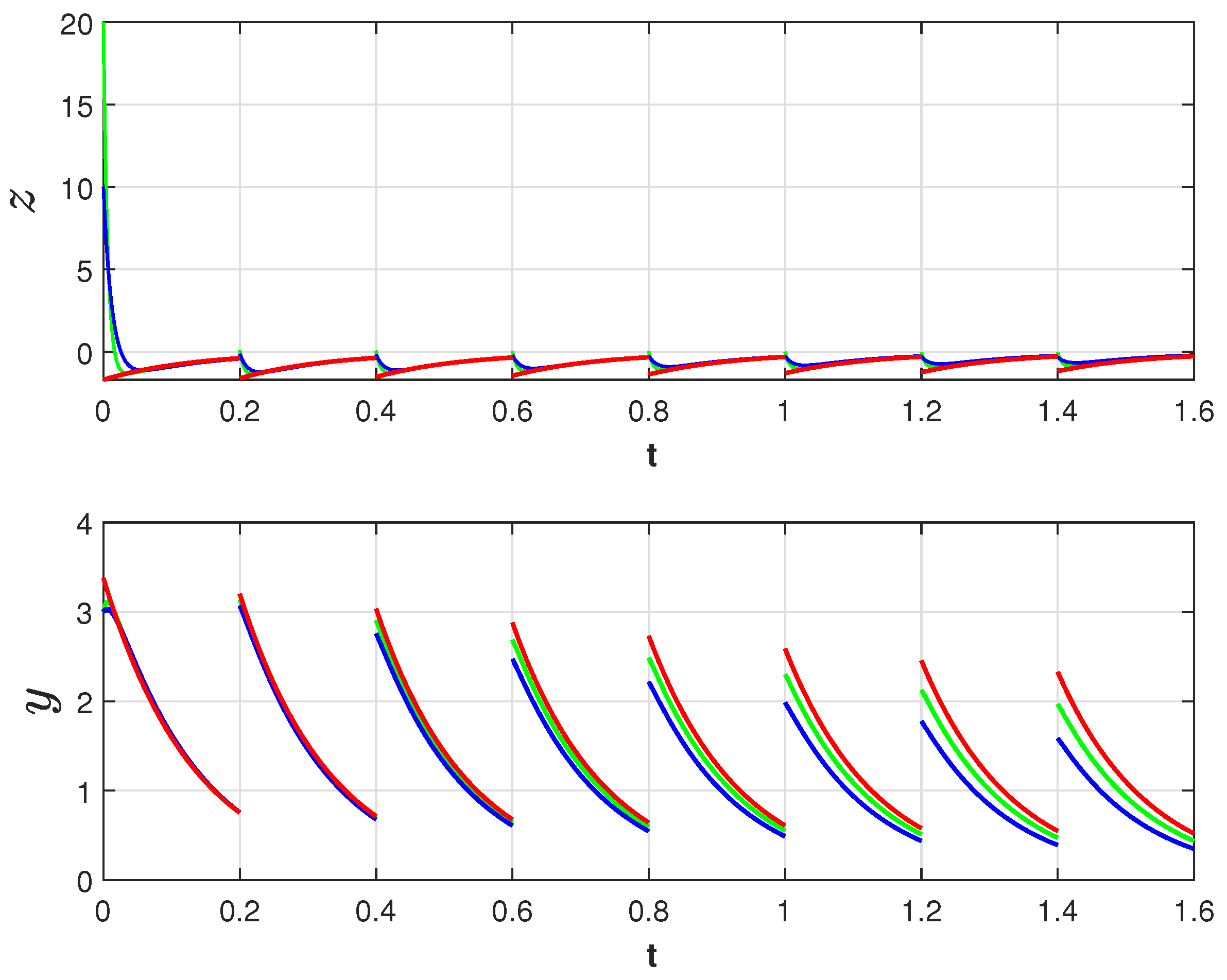
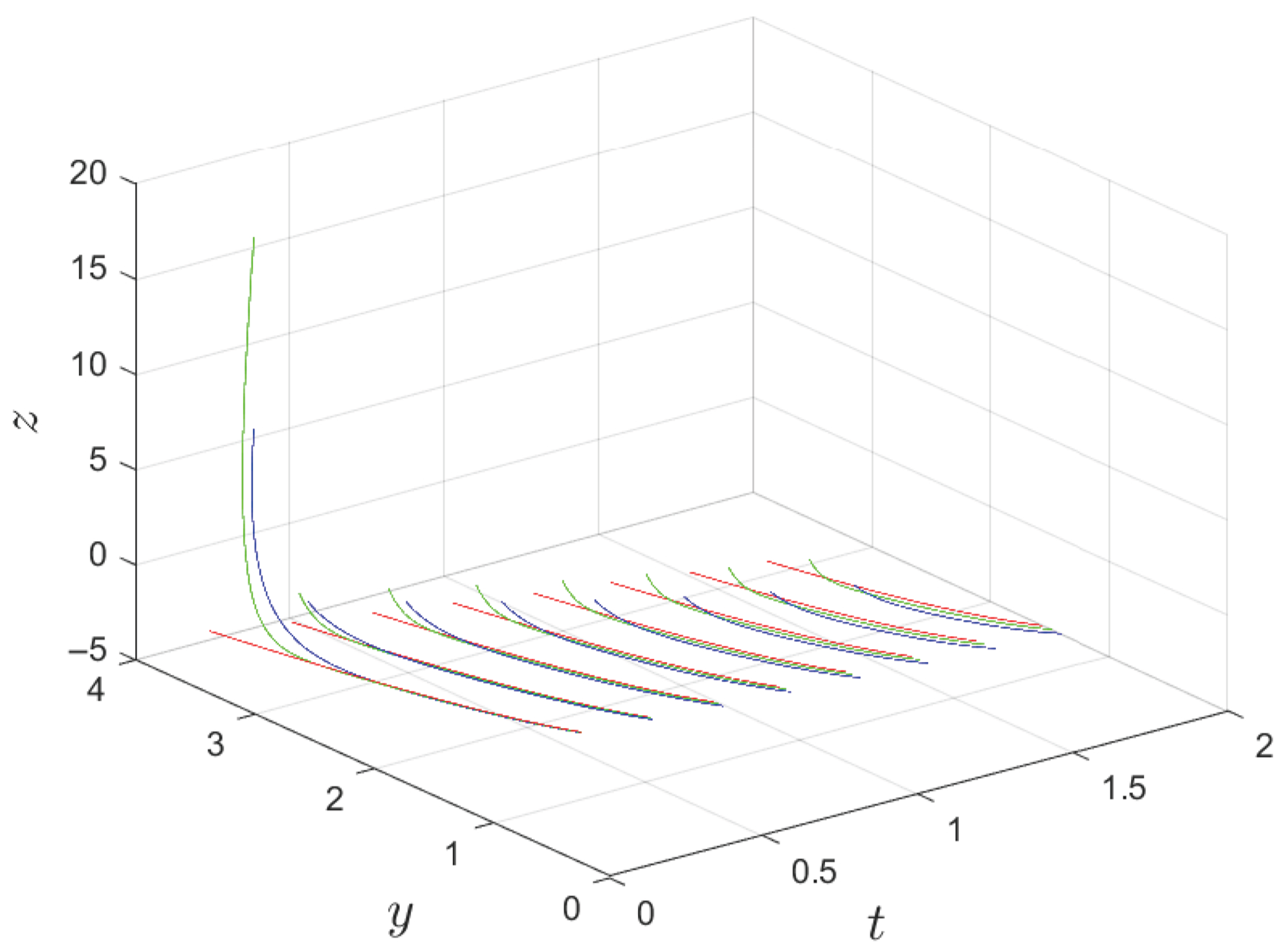
At the point , the convergence is nonuniform, since and at the moments of discontinuity the layers do not arise. This is because is a continuous function and Therefore, there is only one initial layer on the neighborhood .
3.2. Singularity with Multi-Layers
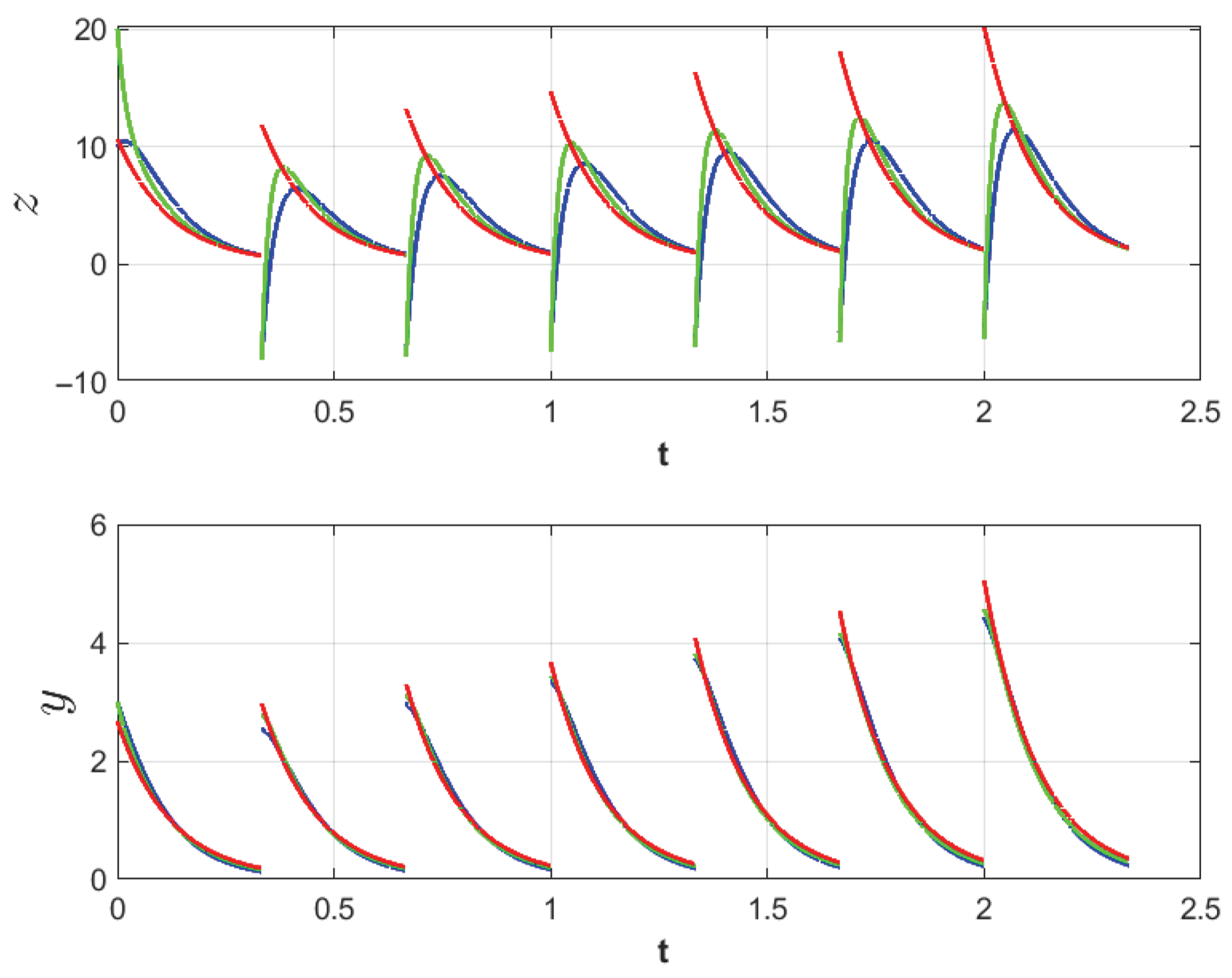
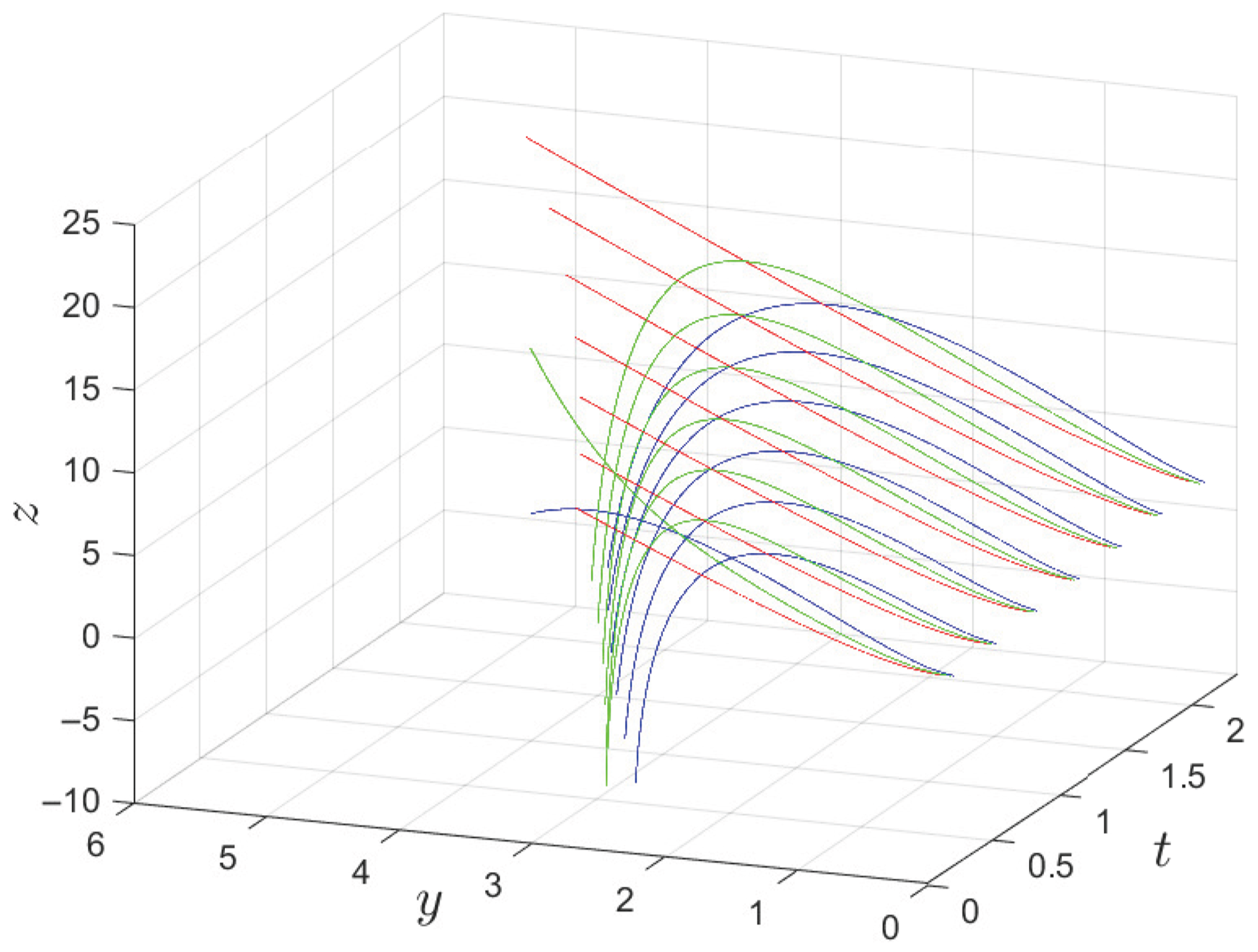
As shown in the previous subsection, the solution exhibits a single initial layer. The presence of an impulse function may lead to non-uniform convergence near several points, resulting in the emergence of multiple boundary layers. These layers are situated in neighborhoods of and
Let us again consider the system (
3) with initial conditions (
4) and instead of the condition
, we introduce the following condition:
where denotes the value of the function at each impulse moment, corresponding to the points ,
Theorem 2. Assume that the conditions – and are satisfied. Then for a sufficiently small ε, the solutions and of problems (3) and (4) where exist, are unique and satisfy the following limiting equalities: Proof of Theorem 2. The proof proceeds similarly to that of Theorem 1, except that the solution exhibits a singularity with a multi-layer structure in the neighborhoods of
and
According to the condition
after each discontinuity moment
for
the solution
does not remain close to the root
that is
Therefore, the difference
does not tend to be zero as
, and in this case, multi-layer phenomena will be observed. □