1. Introduction
The algebraic structure relies significantly on symmetry, which is applied across various domains. Tung [
1] used an algebraic approach to structuring patterns as extended symmetries. Rupe [
2] generalized the accurate predictive regularity of symmetry groups and provided an algebraic theory of patterns based on a fundamental premise of future equivalence. In addition, the latter and its semigroup algebra extended the translation symmetry to partial and hidden symmetries. The algebra with arbitrary internal symmetry and local translations was set up by Corral [
3] for a general gauge theory of gravity. Decision-making (DM) typically faces challenges associated with uncertain circumstances, which are particularly demanding due to the complex modeling and management of such uncertainties. Fenz and Guo [
4] introduced FS set-based group DM and gave the frame related to group DM. Multiple criteria decision-making (MCDM) challenges exist in a variety of practical domains [
5,
6,
7], and techniques are employed to collect decision data and build the framework to get at an acceptable solution to the challenges at hand. For specific purposes, these models make a significant contribution to precise DM, time savings, and cost reduction. We have used a number of theories and mechanisms to overcome these problems. Uncertainty, like probability, differs from probability in several aspects. Nevertheless, to hold such an assumption, when two or more roots of imprecision occur together, it results in vagueness and imprecision in the modeling process. To address the ambiguity of evaluative data, fuzzy sets introduced by Zadeh [
8] marked a pivotal development in addressing the intricacies of uncertainty and vagueness within datasets and DM processes defined as
where U is the universal set and
The intuitionist FS, presented by Atanassov [
9] as an extension of the FS, provides two-dimensional information of data by increasing the non-membership value known as IFS, defined as
.
Shabir et al. [
10] explained the algebraic structure of q-rung ortho-pair fuzzy relations and showed how they could be used in real life in DM. Also presented a comparative analysis with current theories. Aguiló [
11] showed several binary tools that can be used on well-known families of fuzzy implications. These tools also create lattice substructures in certain sets when the implication generators are limited. Zheng [
12] presented a novel category of membership functions that integrates subjective perception with objective information via the Gaussian belonging function grounded on probability density. GPDMF established five operators and offered various examples to elucidate theoretical findings. In 1994, Zhang [
13] introduced the bipolar FS, which is an extension of the FS with a degree of belonging range of [−1, 1]. For a bipolar FS, an element with a degree of belonging 0 is considered not relevant to the corresponding property. An entity with a degree of belonging (0, 1] is considered partially satisfied with the property, while an entity with a degree of belonging [−1, 0] is considered partially satisfied with the implicit counter-property. Multipolar information is critical in many real-world challenges, including those in technology and neurobiology. Chen et al. introduced a new concept called
-PFS theory [
14], where the grade of the membership function is extended from the interval
to
-polar intervals of
or
. Additionally, it illustrates the diverse ideas established by bipolar fuzzy sets and their implementation in
-PFSs. It also gave examples of how
-PFSs can be used in the real world. The basic idea behind this strategy is that multipolar knowledge emerges from the possibility of encountering information and data related to real-world issues from multiple n agents (
). This new approach inspired scholars to propose many innovative notions for
-PFSs and hybrid models, such as mathematics and artificial intelligence.
Molodtsov introduced an innovative extension of FS theory, which he called the soft set theory [
15]. The soft set theory has been useful in many areas because it is naturally flexible and adaptable. It also provided a strong framework for quantifying and analyzing vague data, which led to more accurate and trustworthy assessments. This further enhances the characteristics of FS sets as delineated and examined in the research of prior scholars [
16]. Application DM Furthermore, the HFS set is examined in [
17]. ÂIseki and co-authors introduced the concept of
algebra.
algebra is founded on two distinct theories: set theory and propositional calculus [
18,
19,
20]. Xi [
21] initially introduced fuzzy
algebra by combining the fundamental concepts of FS and
algebra. Ahmad [
22] developed a strong connection between the concept of FSs and
algebra. As a result, other scholars [
23,
24,
25] conducted extensive studies on
algebra and ideals in the context of FSs. Masarwah et al. [
26] talked about generalized
-polar fuzzy positive implicative ideals in the context of
algebras and provided important contributions to the field of algebra by doing this.
Hesitant FSs are an empirical extension of FSs introduced by Torra [
27]. These sets were created to address the challenge of determining an element’s membership in a set, which can be complicated due to uncertainty among several valid values. For example, when two experts debate integrating
x in
A, one intends to allocate a value of 0.3 while the other recommends 0.4. Therefore, the degree of uncertainty about possible values is slightly reduced. IFS are not suitable for modeling this particular scenario. However, HFSs can be represented using multisets, which provide more accurate estimation in the DM process. Alsager and Alshehri introduced the concept of a single-valued neutrosophic
rough set by coupling a single-valued neutrosophic HFS with a rough set. In information systems, the use of single-valued neutrosophic HFSs and rough sets is a highly effective approach for addressing uncertainty, granularity, and knowledge incompleteness. Moreover Song et al. [
28] established HF set in
/
and investigated a multi-
Q-dual
soft rough model for DM, offering valuable approaches [
29,
30,
31]. The investigation related to the
Q-
ideal in
algerbra expanded the theoretical framework [
32]. Moreover, the concept of anti-fuzzy ideal in
algebras and soft
/
algebras has been introduced, and fundamental properties are discussed [
33]. The practical application of fuzzy soft set theory in
algebras has also been explored, highlighting its versatility in various domains [
34]. Furthermore, in the context of
algebras, research on fuzzy commutative ideals and the application of HFSs to filters in MTL algerbra have a wide range of the scope of algebraic concepts [
35].
The following are the motivations of the novel approach and objectives:
The methods presented in previous literature fail to generate any meaningful information when the provided data consists of distinct numerical fuzzy values within their crisp domain. Decision-makers have developed various hybrid approaches to address different forms of uncertainties, data variability, and multiple-criteria DM challenges arising from data with numerous numerical fuzzy values:
- 1.
Torra proposed the concept of HFSs, which is an empirical extension of FSs [
27]. Chen et al. [
14] introduced an extension of bipolar FS known as
-PFS, where the grade of the membership function is extended from the interval
to
-polar intervals of
or
. Xi [
21] initially introduced fuzzy
algebra by combining the fundamental concepts of FS and
algebra, and Ahmad [
22] developed a strong connection between the concept of FSs and
algebra.
- 2.
The proposed hybrid method addresses limitations in existing theories:
The ability to handle multi-dimensional uncertainty and hesitancy is limited.
Complex real-world problems, such as career determination, lack adequate algebraic frameworks for combining m-polarity and Q-hesitancy in decision-making.
Currently, there are insufficient tools available for modeling and analyzing uncertainty in structured algebraic systems such as -algebras. This hybrid approach aims to bridge these gaps by providing a more comprehensive and flexible mathematical framework.
- 3.
To generate a more advanced hybrid approach known as -Polar Q-HFSs, we coupled -PFS and Q-HFS, then applied it to the algebra and demonstrated the application of career selection to check its effectiveness and accuracy.
- 4.
Using this hybrid approach, -Polar Q-HFSs, we discuss several fundamental results under the influence of the proposed model, -Polar Q-HFSs, in / algebras.
- 5.
The proposed approach demonstrates its novelty by yielding more authentic and comparable results when evaluating alternatives with multi-polar membership set information in the application of career selection. In other words, this technique can effectively tackle problems and systems with multiple membership values. The suggested methodology demonstrates more compatibility compared with numerous modifications of the FS and several other DM theories.
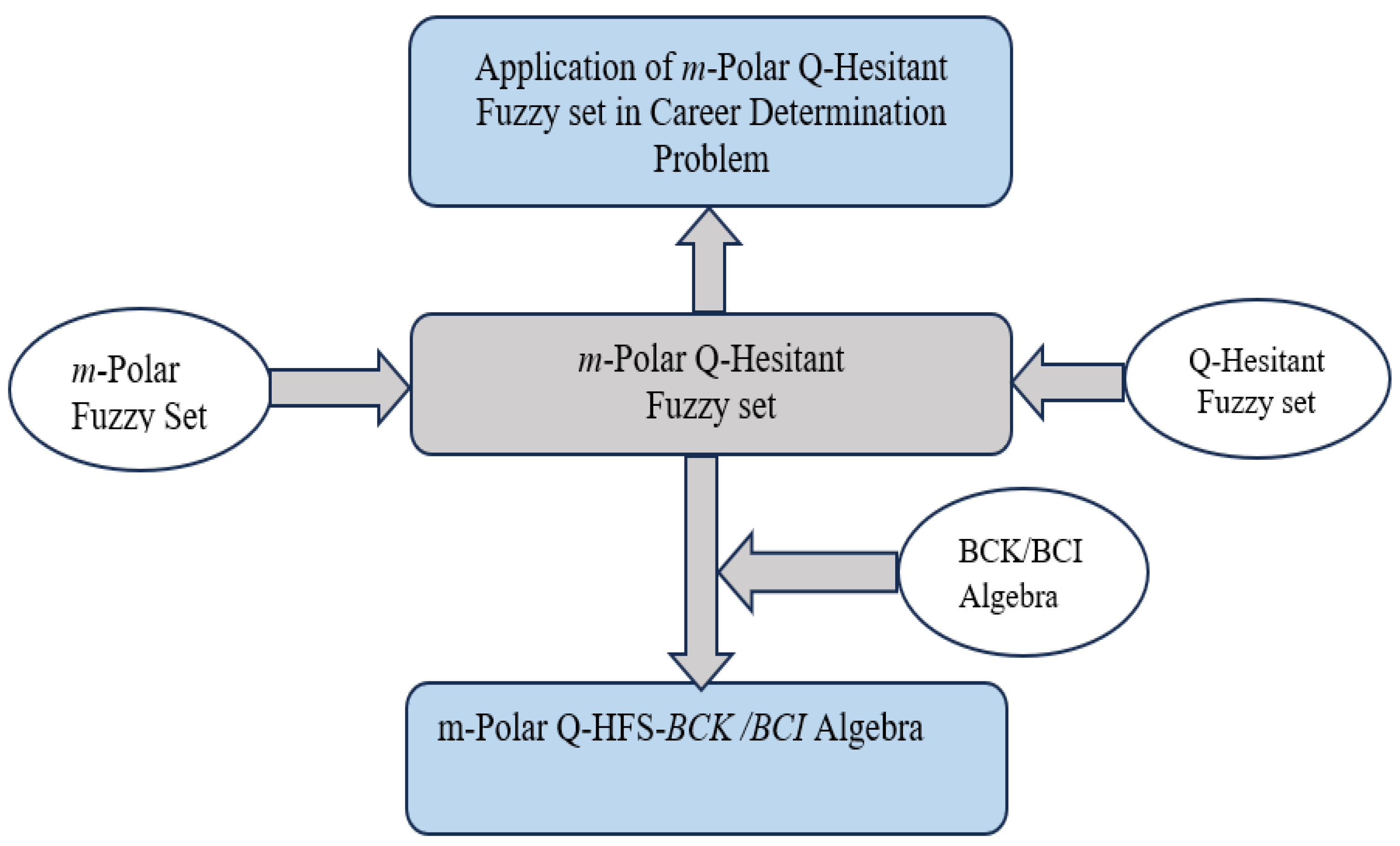
Figure 1 shows the proposed model of the hybrid approach, and
Table 1 shows the comparison with the existing approaches.
The organization of this research paper is as follows. In
Section 2, we review some fundamental concepts and preliminary information about the proposed method. In
Section 3, we discuss the
sets and examine their several fundamental properties. Moreover, we investigate specific variations, including
subalgebras, ideals, and numerical examples. In
Section 4, practical applications are based on
sets in DM problems, and we demonstrate how these concepts find relevance in solving real-world decision-support challenges. As we conclude, our Conclusion section not only summarizes our findings but also underscores the broader significance of the
sets in the realm of mathematics and beyond.
3. -Polar -Hesitant Fuzzy Sets
In this part, we develop the sets and expand on traditional fuzzy and HFSs, offering a multidimensional way to deal with uncertainty and unwillingness. We study the core principles, properties, and modifications of subalgebras and ideals. Also, it aims to provide an overview of sets and their applications in DM and mathematics. Furthermore, it examines subalgebras, which are important in set theory, to understand their fundamental properties and significance within this mathematical context.
Definition 7. Assuming is a algerbra, the set can be described as follows:on is said to be an -subalgebra if it fulfills the condition: Example 1. Suppose that is a algerbra with a binary action "*", as shown in Table 2 below: Define the set and a 2-polar FS on as follows (Table 3): Thus, is an -polar Q- subalgebra.
Proposition 1. Every subalgebra of meets the following: Proof. , we obtain the following:
This completes the proof. □
Proposition 2. If every subalgebra of fulfills this inequality: Proof. By using the definition of the
algerbra, we obtain
. Then,
, we obtain the following:
□
Proposition 1 implies that Now, investigate the ideals, which have significant importance in sets. We will study their properties and practical uses to see how they fit into the mathematical framework we are discussing.
Definition 8. Let be a Q-HFS in . Then, is known as ideal of if it meets the following axiom:
- 1.
.
- 2.
For all where .
Example 2. Let be a set with a binary action "*", which is described in the following Table 4: Then, is a algerbra. Define a set and a 3-polar FS on as follows Table 5: It is customary to confirm that is a 3-polar Q- ideal.
Proposition 3. All of ideal over satisfies the following condition:
Proof. Let
such that
, then
:
This ends the proof. □
Theorem 1. In algebra , every ideal is subalgebra.
Proof. Assume that
and
is an
ideal over
,
for
and for all
. Then,
is an
subalgebra over
. This complete the proof. □
Proposition 4. Every ideal over algebra fulfills the below inequality: Proof. Let
be an
ideal; therefore, for
and
□
Proposition 5. Each ideal meets the following axioms: .
- 1.
If .
- 2.
.
- 3.
If . Then,
Proof. Assume that and
(1) If
, then
since
is an
ideal of
(2) Since
from (1) we have
. Hence,
(3) If
, then
Exploring commutative ideals, we will see how they are important in sets and DM. Understanding them helps us grasp their importance in our math framework. □
Definition 9. An setin algebra is said to be an commutative ideal of if it holds these conditions: - 1.
- 2.
For all and .
Example 3. Let us consider the algebra and the set as defined in the previous example. We will now define an -polar Q- commutative ideal based on this algebra.
First, let us consider the algebra with the binary operation "*", which is given in the following Table 6: The set , and 2-polar FS on , is described as follows:
For each pair of elements in , we define membership values. Here’s how we define membership values for the FS Table 7: The membership values for the FS are defined as follows in Table 8: To construct the -polar Q- commutative ideal, take the intersection of and for every pair of elements in . This ideal represents the commutative qualities and unwilling nature of the operations in the supplied algebra. It enables a more nuanced understanding of algebraic behavior by taking into account various amounts of delay in operations.
Theorem 2. An ideal of a algebra is an commutative ideal if it meets the properties given below:. Proof. Let ,
Suppose that
is an
commutative-ideal of
. Taking
, then
conversely, Assume that
satisfies
then,
then, we obtain the following:
. Hence, is an commutative ideal. □
Theorem 3. All commutative ideals are an ideal of .
Proof. Let
. Let
be an
commutative ideal of
.
for all
. Thus,
is an
ideal.
Here, we will look at close ideals, a special concept in our study. We will introduce them, explain what they are, and show how they are used, especially in decision-support systems. Understanding these ideals helps us see their role in our research. □
Definition 10. An idealof algerbra is known to be closed if and .
Example 4. The ideal, which is established in (3.2), is a closed ideal.
Theorem 4. An ideal is known to be closed if it meets Proof. Suppose that
is a closed
ideal over a
algerbra
. Since
, and .
Conversely, let
be an
ideal in
algerbra
, since
we have:
for all
. Therefore,
is a closed
ideal covering a
algerbra
for every
. □
In the following, we will explore implicative ideals, defining and explaining them to understand their role in DM. These ideals are crucial in our research, showing their importance in our overall work.
Definition 11. An setin is named as implicative ideal if it fulfills the condition given below: - 1.
- 2.
for all and .
Example 5. Let be a algerbra under binary action " *", as illustrated in the clayey Table 9 below. Define the set and a 3-polar FS on as follows (Table 10): Thus, is a 3-polar Q- implicative ideal.
Proposition 6. In algebra , every implicative ideal is an ideal.
Proof. Let
be an
implicative ideal over
. Let
, then:
Replace
, and using
, we obtain
for all
is an
ideal. □
Theorem 5. Assuming is an implicative algerbra, all ideals over are also implicative ideals.
Proof. Assuming
is an implicative
algerbra, it implies accordingly
and
. Additionally, let
be an
ideal. Then, we can derive:
for all
. Thus, it is an
implicative ideal of
. Then,
is an
implicative ideal of
. □
Theorem 6. Let be an ideal of a algerbra . Then is an implicative ideal of if it meets the following criteria:. Proof. Assume that
is an
implicative ideal of
. Take
in
Conversely, assume that
fulfill the characteristics. As
is an
ideal of
, we have
Then,
is an
implicative ideal of
and the proof is completed. Starting in the following section, we will explore
PI ideals. These ideals are important in our research, especially for DM, and explain these ideals to understand their characteristics. □
Definition 12. An setis algerbra is named as PI ideal of - 1.
- 2.
and .
Example 6. Suppose that is an algerbra with a binary action " *", describe in the clayey Table 11. Defined the set and a 3-polar FS on as follows Table 12: So, is a 2-polar Q- PI ideal.
Proposition 7. In algerbra each PI ideal is -polar Q ideal.
Proof. Suppose that
be
PI ideal of
algerbra
.
, such that
put
Therefore, is an ideal. That end the proof. □
Theorem 7. Let ideal on . Then, PI ideal if and .
Proof. Assume that the
ideal
of
is an
filter PI ideal of
, So
if we put
, we have
and .
Conversely, assume that
is an
ideal over
and satisfies the inequality
Since
Now we can prove that
for all
. In contrast, there exist
Such that
Which is a contradiction; therefore,
and . Thus is an PI ideal of for all . □
Proposition 8. If is a PI algerbra, then all ideal of is an PI ideal of .
Proof. Suppose that
is an
PI ideal of
, for all
and
, and then
By replacing
v by
and
by
, we get
Therefore,
is a PI
algerbra,
for all
. Hence,
Thus, PI ideal of for all . □
4. Application of -Polar -Hesitant Fuzzy Sets in Career Determination Problems
In this section, we shift our focus from the theoretical aspects of sets to their practical applications in career determination problems. The theoretical foundations laid out in the previous sections serve as the building blocks for understanding how sets can be effectively utilized in real-world scenarios. Career determination is a critical domain where these concepts find their relevance, providing innovative solutions to complex problems.
We are going to address how
is employed for enhancing career decision-support systems and problem-solving methodologies, illustrating its usefulness in resolving practical challenges. The comparison table is  with an equal number of rows and columns; both rows and columns are distinguished with the names of the companies,
, and the elements are
, given by
the number of the belonging degree of
exceeds or equals the belonging degree of
. The row sum of a company
is indicated by
The column sum of a company
is denoted by
:
The score of a company
is
and this may be offered as:
We provide a procedure based on sets of
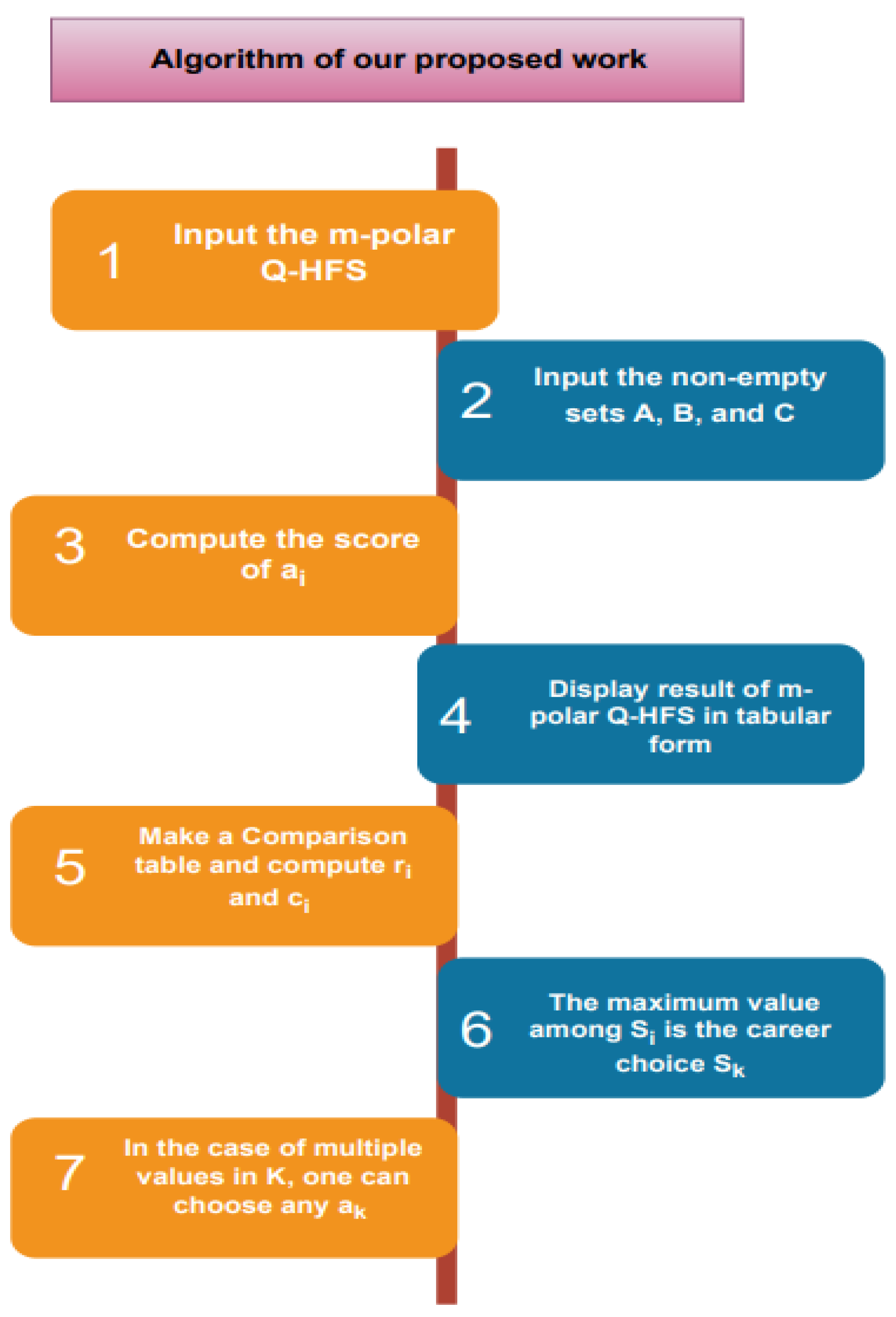
. Algorithm 1 defined a step-by-step strategy to employ MQHFs in career selection circumstances. It provided a basic and methodical approach to tackling uncertainty and apprehension in career decision services. This algorithm provides practical guidelines for implementing MQHFs and is a valuable tool for scholars and professionals working in a range of disciplines where career decisions must be made under uncertain conditions. The following
Figure 2 shows the model for the career determination algorithm.
| Algorithm 1: Career determination algorithm using set |
Input the set. Input the non-empty sets A, B, and C. Compute the score of . Calculate the corresponding resultant set and present it in tabular form. Create a comparison-table for the set and calculate and . The career choice is if it represents the maximum value among . In case there are multiple values in , you can choose any of the career options .
|
An illustrative example: In this example, we will show how the algorithm works and how it may be used in real-world data extraction situations. This actual application will allow us to assess the algorithm’s effectiveness and potential for providing useful insights in a variety of decision-support environments.
Example 7. Enhanced Example: Career Determination Using Sets for University Students.
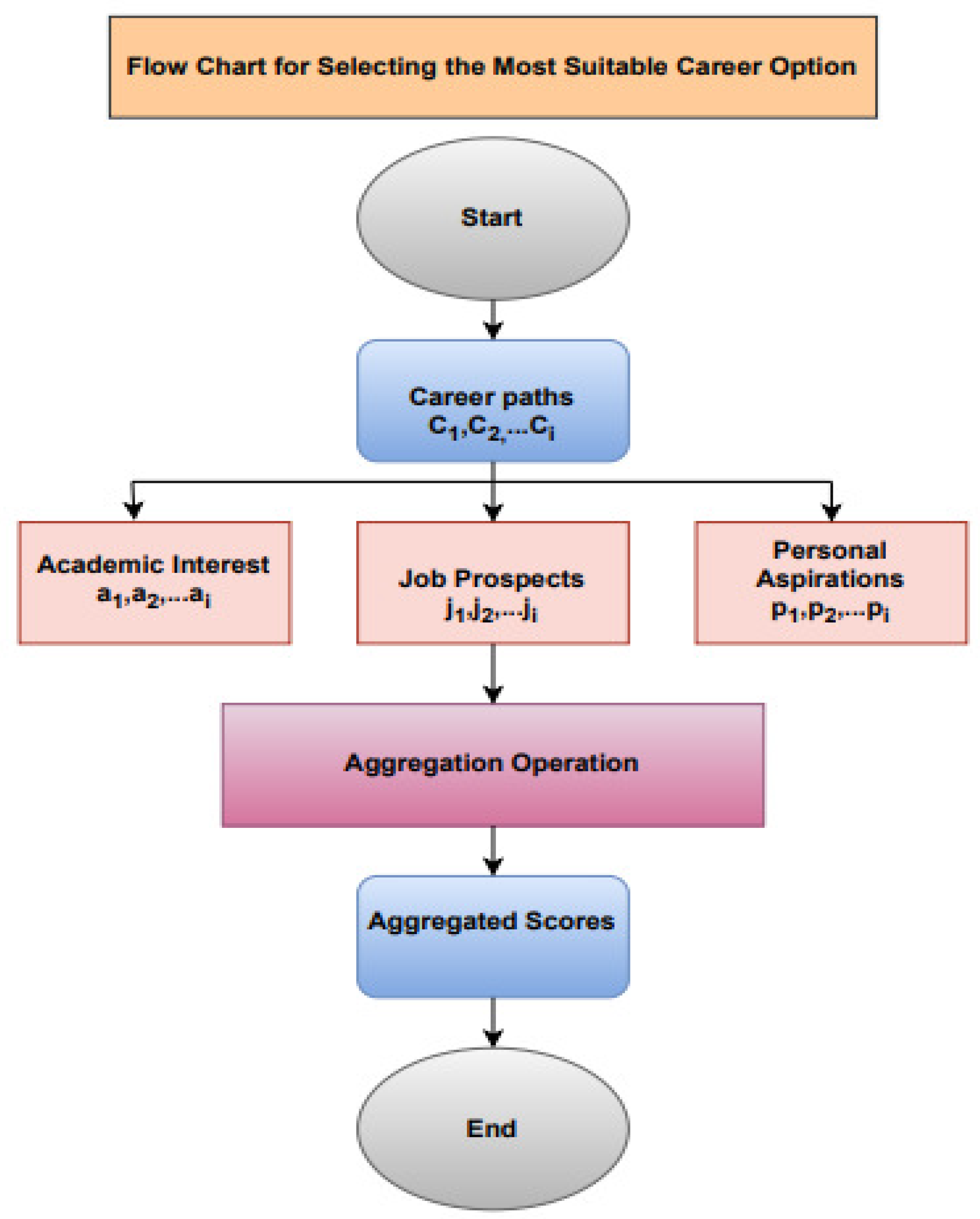
In a university career counseling scenario, a group of students is facing a significant decision: selecting the most suitable career path. They approach this challenging task by considering three crucial factors: academic interest, job prospects, and personal aspirations. To effectively evaluate their career options, the students employ sets to account for their individual preferences and uncertainties.
The universe set U represents the available career paths, denoted as , and the key evaluation criteria are as follows:
Performing Aggregation (AND) Operation:To identify the best job option depending on the combined factors of academic interest (A), job prospects (J), and personal aspirations (P), an aggregation operation is performed. The "AND" operation is employed to aggregate the scores of each career option across all three factors. The "AND" operation is defined as follows: Now, let us calculate the aggregated scores for all career options using the "AND" operation.
Aggregated Scores:
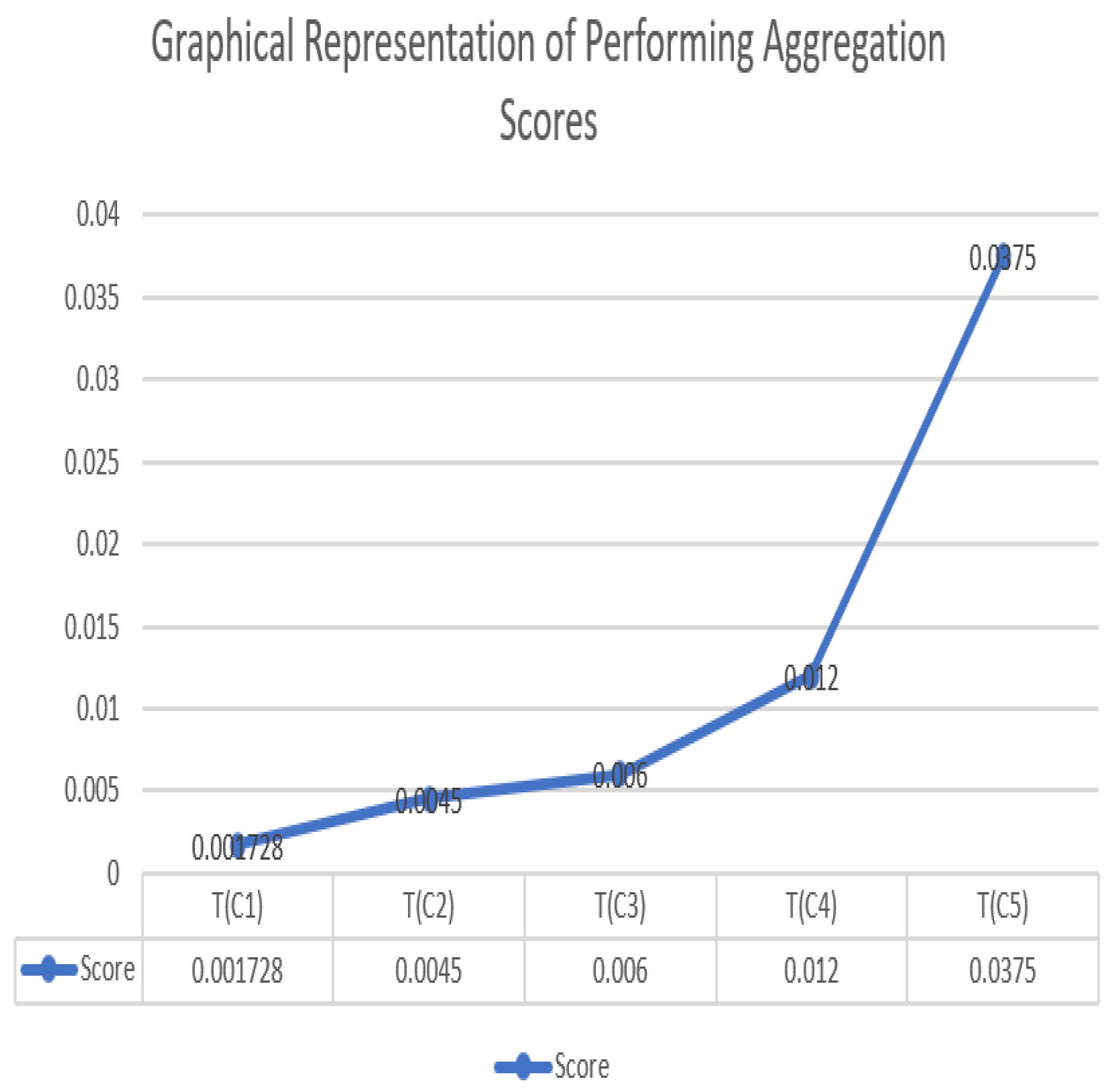
For :Perform similar calculations for , , , and to find their respective aggregated scores and Figure 3 represents the graphical representation of aggregation scores.
Decision: The most suitable career option based on the combined criteria of academic interest, job prospects, and personal aspirations is , as it has the highest aggregated score. This method empowers the students to make well-informed career decisions that align with their individual preferences and uncertainties, ultimately leading to a more satisfying and fulfilling professional path. Figure 4 shows the complete steps of how our algorithm finds the highest aggregated score.