1. Introduction
With the continuous improvement of people’s pursuit of quality of life, leisure traveling has become a fashionable and popular way of life. As a kind of travel carrier with promising development, small recreational vehicles have attracted much attention for their characteristics of being free, convenient, and economical. Statistical data shows that the comfort and convenience of the recreational vehicles’ interior space are the primary factors that drivers and passengers pay attention to [
1,
2]. However, in the whole industry chain of recreational vehicle manufacturing, the design cost of the interior space accounts for about 50~60% of the total price [
3,
4]. Therefore, research on the design method of recreational vehicles’ interior space plays an important guiding role for manufacturing enterprises to reduce costs and improve user satisfaction.
At present, research on the interior space design of recreational vehicles mainly consists of three fields: design methods based on modularization ideas, ergonomic theories, and functional facilities’ relationships.
1.1. Design Methods Based on Modularization Ideas
Modular design is a green design method that combines product design elements into subsystems with specific functions, i.e., modules, and then designs products by reasonable module combinations. Its application in the interior space design of recreational vehicles can be categorized into two approaches: the user requirement-based modular design method and the manufacturing and assembly process optimization-based modular design method.
The user requirement-based modular design method is first performed by categorizing the recreational vehicle usage requirements to establish a standardized module library and then establishing the interior space design scheme by combining the modules.
Liu et al. [
5] employed the fuzzy analytic hierarchy process and quality function deployment theory to analyze the mapping relationship between users’ requirements and technical weightings. By integrating the gray relational analysis with the correlation analysis of automotive interior spaces, distinct functional modules are constructed to establish the vehicle’s interior design scheme. Zhang et al. [
6] utilized the
Kanon model to categorize the fundamental requirements of the target customers into distinct functional modules. By employing the AR technology, a presentation platform for recreational vehicle interior space design is established, thereby achieving a modularized design scheme tailored to users’ needs. Cai et al. [
7] and Stampf et al. [
8] analyzed the relationship between non-driving activities of passengers and the modular design of the interior layout in autonomous driving mode. The research findings indicate that the level of driving automation correlates positively with the diversity of passengers’ non-driving activities. Consequently, the impacts of passengers’ non-driving activities must be considered in the interior space design scheme. Zhan et al. [
9] and Bai et al. [
10] proposed a design method for smart furniture, which integrates modularization techniques with intelligent platforms to enhance the functionality, flexibility, and user experience of design solutions. Applying this method to recreational vehicle design can effectively enhance the utilization of interior space.
The manufacturing and assembly process optimization-based modular design method entails analyzing the recreational vehicle’s manufacturing and assembly processes to consolidate similar operations of different production lines, thereby streamlining the manufacturing process and establishing a modular design scheme for the recreational vehicle’s interior space. Antonio et al. [
11] explored management methods for optimizing product lifecycle using digital product passport technology and proposed a design theory integrating modular product development with circular economy principles to guide design decisions for recreational vehicle modules. Sadaf et al. [
12] discussed the collaboration technologies between assembly design and digital tools. By simulating assembly processes and conducting feasibility analyses during the design stage, conflicts between different modules during assembly can be avoided. Davood et al. [
13] examined the role of automotive design platforms in creating product families. By employing the multi-objective mathematical programming techniques, the impacts of environmental, economic, and social factors on automotive design platforms can be analyzed to establish a set of optimized modular automotive design platforms for sustainability. Antonio et al. [
14] proposed an integrated design approach combining structural matrix design and functional module deployment. This methodology effectively reduces the initial number of modules and shortens the product design cycle. Lampo et al. [
15] analyzed the impact of modular electric vehicle platforms on design and production efficiency. By employing a modular manufacturing and assembly approach, design solutions are reverse-engineered to ensure the design scheme aligns with circular economy manufacturing models.
The focus of modular design lies in optimizing the design process and controlling the manufacturing costs; however, the influence of the passengers’ behavioral characteristics on design solutions is ignored to a certain extent. Therefore, by prioritizing the passengers’ travel experience and exploring the influence of humans’ behavioral patterns on recreational vehicle interior design schemes, the practicality of modular design methods can be further enhanced.
1.2. Design Methods Based on Ergonomic Theories
The ergonomics-based interior space design methods for recreational vehicles focus on analyzing the form, materials, and dimensions of functional facilities in vehicles to improve the users’ comfort.
In the field of functional facilities’ form design, experimental data of Mojtaba Lampo et al. [
16] indicates that the shape and height of seat backrests significantly alter the transmission of vibrations from the seat to the passenger’s pelvis, torso, and head when a car is in motion, thereby affecting the passenger’s comfort. This conclusion serves as a crucial reference for the form design of recreational vehicles’ seat backrests. Wang et al. [
17] investigated how the inclination angle of the seatback alters passengers’ preferences for seat cushions, providing a design principle for coordinating seat cushion and backrest configurations. Akcay et al. [
18] analyzed the effects of various driver seat components on the damping coefficient. The experimental data reveal that lower foam hardness, higher foam density, and flexible upholstery contribute to improved comfort levels.
In materials selection for functional facilities, Rebecca et al. [
19] compared the distribution of seating pressure of the passengers under different driving conditions between soft and hard seat materials. The experimental results indicate that the hardness of the seat directly influences the distribution of seating pressure and the comfort of the passengers, providing a quantitative basis for selecting the density and layered structure of the seat padding material. Research findings from Petra et al. [
20] indicate that flame retardants used in automotive interior materials constitute the primary source of harmful gases. In enclosed environments, such as recreational vehicles, the selection of interior materials necessitates a careful balance between flame retardancy and emissions of harmful gases.
In terms of functional facilities dimensioning, Li et al. [
21] employed eye-tracking technology to analyze how variations in icon size and color within vehicle human–machine interfaces influence driver preferences and perceptions, thereby enhancing drivers’ information processing capabilities and improving the comfort of in-vehicle interface interactions. Xu et al. [
22] proposed an interior space design method for recreational vehicles that integrates the
Kano model, the analytic hierarchy process, and the
Triz theory. Detailed dimensions were established for the kitchen area, bathroom facilities, and storage space within the vehicle.
Ergonomic design methodologies emphasize optimizing the form, materials, and dimensions of specific zones and functional facilities; however, the impact of the relationships between all functional facilities on the design scheme is neglected to a certain extent. Therefore, analyzing the relationships between different functional facilities and examining their impacts on the design scheme represents a new direction in interior space design for recreational vehicles.
1.3. Design Methods Based on Functional Facilities’ Relationships
The interior space design of recreational vehicles based on functional facilities’ relationships is achieved by analyzing the functional and structural correlations and similarities among furniture to establish the design scheme that maximizes spatial utilization. Reza et al. [
23] proposed a design theory for automatically generating spatial layouts under multi-objective conditions using deep reinforcement learning algorithms. By incorporating the functional relationships between facilities as constraints into intelligent layout searches, the optimized arrangement of functional facilities in specific spaces can be achieved. Hu et al. [
24] integrated parametric modeling, neural networks, and multi-objective optimization algorithms to automatically generate residential floor plans using adjacency-based functional constraints. Its primary idea of functional relationships, parametric constraints, and optimized solutions serves as a significant reference for the interior space design of recreational vehicles. Huang et al. [
25] employed spatial perception and spatial syntax research methodologies to investigate how automotive interior seating arrangements influence the fluidity and privacy of cabin space, providing an effective analytical tool for assessing the fluidity and privacy of automotive interior spaces. Li et al. [
26] employed neural network algorithms to extract layout feature information from interior spaces, utilizing supervised learning estimation models for data training to achieve intelligent optimization of interior spatial layouts. This approach serves as a practical case study for integrating functional facilities’ interdependencies into recreational vehicles’ interior space optimization.
Research on functional facilities relationships currently focuses on the field of architectural space design, with relatively few studies exploring its application in the interior space design of recreational vehicles. Therefore, analyzing the behavioral data of passengers and examining the impact of functional facilities’ relationships on design proposals can effectively enhance the comfort and convenience of the design scheme.
1.4. Sketch of the Paper
Based on the above research, this paper proposes a method of grouping all the functional facilities based on their correlation degrees for interior space design of small recreational vehicles. Firstly, drawing on the principles of user requirements analysis and ergonomics-based design methods for analyzing users’ information and data, the correlation degree between two functional facilities is defined based on the usage time interval to quantitatively describe their correlation. Secondly, the correlation degrees of all the functional facilities are formed into the correlation degree matrix, and the matrix is proved to be a real symmetric positive definite matrix. Next, based on the properties of the correlation matrix and drawing on the grouping principles from modular design methodologies, the factor analysis method is adopted to group all the functional facilities so that the correlations of functional facilities within the same group are as large as possible, and the ones between different groups are as small as possible. This helps better satisfy users’ requirements for convenient functional facilities and improves users’ comfort while traveling. Finally, a case analysis is given to prove the effectiveness of the proposed method.
2. Correlation Degree Between Functional Facilities
When traveling, the users’ needs are realized by operating or using a series of functional facilities inside the recreational vehicle. Considering the convenience of realizing the users’ different needs, the functional facilities for realizing specific needs should be arranged relatively centrally, i.e., the layout scheme of the recreational vehicle’s interior should be designed with reference to the correlations of functional facilities. Therefore, drawing on the quantitative description of the correlation between random variables in statistics, it is necessary to define the correlation degree between two different functional facilities.
In statistics, the correlation between two random variables,
X and
Y, can be described by their correlation coefficient,
ρXY, which has the following basic properties [
27,
28]:
(1) Normality
For the random variables X and Y, the correlation coefficient ρXY satisfies −1 ≤ ρXY ≤ 1, where its absolute value |ρXY| reflects the correlation degree between X and Y.
(2) Symmetry
The correlation coefficient between random variables X and Y is equal to the one between Y and X, i.e., ρXY = ρYX.
It follows that the quantitative definition to characterize the correlation between different functional facilities inside recreational vehicles should satisfy the two properties of the correlation coefficient in statistics.
From the perspective of users’ behavior, drivers and passengers generally need to use multiple functional facilities sequentially in order to satisfy their specific needs during a trip. For different functional facilities, the usage time intervals can indicate the correlations between them. Therefore, the usage time interval can be adopted to quantitatively describe the correlation between two functional facilities.
Let
xi and
xj be two different functional facilities, and the usage time for
xi and
xj is
ti and
tj. Considering the frequency of usage for functional facilities, where a functional facility may be used several times, its corresponding usage time may have multiple values. Therefore, for functional facilities
xi and
xj, their correlation degree is described by the minimum value of the usage time interval.
It is evident that Δ
Tij = Δ
Tji, so the usage time interval Δ
Tij meets the properties of symmetry but not normality. Thus, Δ
Tij can be normalized by considering the total duration of the trip. That is, assuming the total duration of the trip is
T, the standardized time interval
can be defined as follows:
It can be seen that the standardized usage interval satisfies both symmetry and normality. At the same time, decreases as the correlation between xi and xj increases. In order to be consistent with the statistical connotation of the correlation coefficient, can be further amended as the following definition.
Correlation degree of two functional facilities: Let
xi and
xj be two different functional facilities inside a recreational vehicle. During the trip, the usage time of
xi and
xj is
ti and
tj, and the duration of the trip is
T. Then, the correlation degree
σij between
xi and
xj is defined as follows:
It can be seen that the correlation degree σij is a linear transformation of the usage time interval ΔTij. By the properties of linear transformations, variations in the total duration of the trip T only affect the relative magnitude of σij, without altering the correlation between functional facilities xi and xj.
3. Positive Characterization of the Correlation Matrix
The correlation degree
σij defined by Equation (3) provides a quantitative description of the relevance between two different functional facilities. Combining all the functional facilities two by two and calculating the corresponding correlation degrees, the correlation degree matrix
Σ can be constructed as follows:
For the correlation degree matrix Σ, the following theorem holds:
Symmetry and positive definiteness of the correlation degree matrix: The correlation degree matrix Σ is a real symmetric positive definite matrix.
First, prove the symmetry of Σ.
Denote all the functional facilities inside a recreational vehicle as the vector
X = (
x1,
x2, …,
xn)
T. By Equations (1)–(3), we know that
Equation (5) shows that Σ is a symmetric matrix.
The following proves the positive definiteness of Σ.
Let
n-dimensional vector
c = (
c1,
c2, …,
cn)
T ≠
0.
Substituting Equations (3) and (4) into Equation (6), after simplifying and combining, we obtain the following:
Let the random variable , bringing it into Equation (7), we obtain .
The definition of the time interval Δ
Tij shows that
, and hence
z ≠ 0, i.e.,
The above equation shows that Σ is a positive definite matrix. In summary, the correlation degree matrix Σ is a real symmetric positive definite matrix.
4. Functional Facilities Grouping Model
Based on the definition of correlation degree, all functional facilities can be grouped so that the correlation degrees within the same group are as large as possible and the ones between different groups are as small as possible. Consequently, the design solution can fully satisfy the users’ needs for convenience.
4.1. Factor Analysis
Factor analysis is a method of grouping components based on the correlations between them with reference to the covariance matrix of a random vector. The basic model of the factor analysis method is as follows [
29,
30]:
- (1)
X = (x1, x2, …, xn)T is an observable random vector with covariance matrix Σ.
- (2)
The common factor vector F = (F1, F2, …, Fm)T (m < n) is an unobservable random vector with mean vector E(F) = 0 and covariance matrix D(F) = I, i.e., the components in the common factor vector F are independent of each other.
- (3)
The error vector ε = (ε1, ε2, …, εn)T is independent of the common factor vector F with mean vector E(ε) = 0, and its covariance matrix Σε is diagonal, i.e.,
Under the above conditions, the system of Equation (9) is called the factor analysis model.
The system of Equation (9) can be expressed in matrix form as follows:
where the element
aij in
A = (
aij)
n × m is called the factor loading, and its absolute value indicates the dependence degree between the component
xi and the common factor
Fj, serving as the basis for grouping components
xi. Matrix
A, formed by all the factor loadings, is called the factor loading matrix.
Calculating the covariance matrix for each end of Equation (10) gives
On the other hand, the theorem proven in
Section 3 shows that
Σ is a real symmetric positive definite matrix, which satisfies the requirements for
Cholesky decomposition [
31,
32]. The decomposition yields
where
,
λi (
i = 1, 2, …,
n) are the eigenvalues of the covariance matrix
Σ, and
λ1 >
λ2 > … >
λp,
ei is the eigenvector corresponding to
λi.
Comparing Equations (11) and (12) shows that the error vector
ε =
0 in Equation (10) when
A =
G, and the resulting factor analysis model is accurate. However, an exact factor analysis model implies that in the random vector
X = (
x1,
x2, …,
xn)
T, the components will be divided into
n groups, i.e., an exact factor analysis model can be obtained only when the correlations between all the components in
X are completely ignored. In general, it is necessary to retain most of the correlations between the components, in which case the first
m (
m <
n) columns in
G can be used as an approximation of the factor loading matrix
A, i.e.,
When building the factor analysis model based on the factor loading matrix derived from Equation (13), the error vector ε ≠ 0, which means that there must be a certain amount of information loss when grouping the components in X based on Equation (10).
4.2. Error Analysis
In statistics, the total amount of information contained in a random variable is generally measured by its variance [
33,
34]. In Equation (10), let
A =
G, which gives the sum of the variances of the components in
X under the exact decomposition condition:
Equation (14) shows that under the condition of exact decomposition, the sum of the information contained in X is equal to the cumulative sum of all the eigenvalues of X’s covariance matrix Σ.
The factor analysis model is then built from the approximation of matrix
A shown in Equation (13), which is obtained from Equation (10):
Comparing Equations (14) and (15) shows that under imprecise conditions and ignoring the correlations of the components between different groups, the sum of the information loss caused by grouping the components in X with Equation (10) is .
In factor analysis, Kaiser’s rule, the scree plot, and cumulative variance contribution are effective tools for determining the number of groupings. Typically, Kaiser’s rule is first used to establish an initial number of groupings, followed by the scree plot to assess whether additional groupings are necessary. Finally, the cumulative variance contribution is evaluated against the target threshold based on the number of groupings determined by the preceding steps. In most instances, determining the number of groups
m by cumulative variance contribution ensures that both Kaiser’s rule and the scree plot meet the grouping criteria [
35]. Thus, for a specified error
β, the number of groupings
m can be determined by the following inequality:
where
η is called the cumulative variance contribution of the first
m eigenvalues. In the empirical case, the number of groupings
m can be determined from inequality (16) when
η > 80%~85%. The value of
η can be reasonably adjusted in combination with specific applications, but the basic principle of adjustment is that it should be conducive to the reasonable interpretation of the factor analysis model.
4.3. Grouping Model Based on Factor Analysis
To summarize, all the functional facilities inside recreational vehicles are denoted as the random vector X = (x1, x2, …, xn)T, which can be grouped based on the correlation degree matrix in the following steps.
- (1)
Record the usage time ti (i = 1, 2, …, n) spent by users on functional facility xi.
- (2)
Calculate the correlation degrees between different functional facilities based on Equations (1)–(3) and then construct the correlation degree matrix Σ based on Equation (4).
- (3)
Calculate the eigenvalues of Σ and arrange all the eigenvalues in descending order as λ1 > λ2 > …>λn.
- (4)
Calculate the eigenvector ei corresponding to the eigenvalue λi (i = 1, 2, …, n).
- (5)
For the given error β, calculate the number of eigenvectors m for constructing the factor loading matrix according to Equation (16), and then construct the factor loading matrix A from the first m eigenvectors according to Equation (13).
- (6)
Grouping of all the functional facilities according to Equation (10).
5. Case Analysis
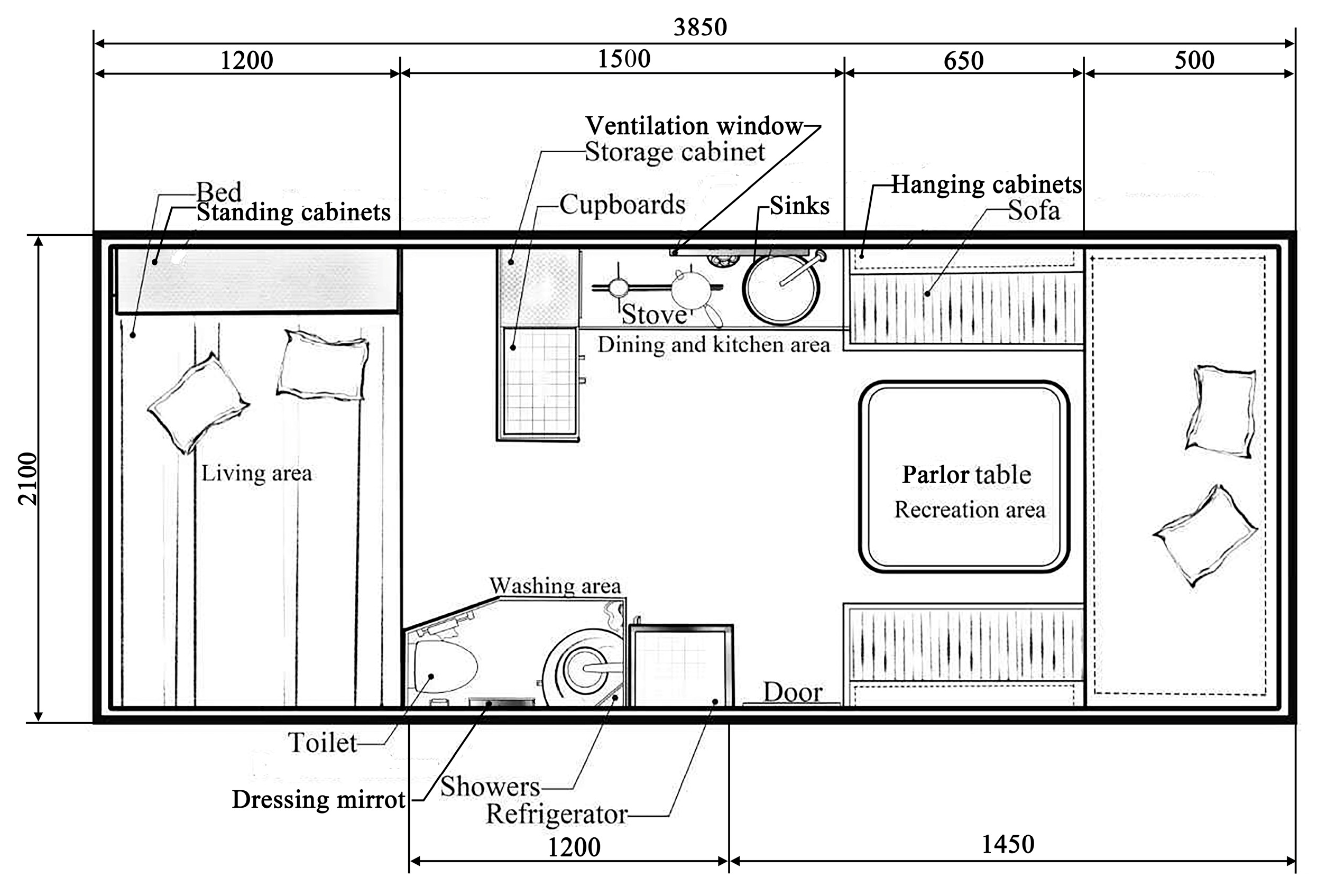
CCHW–Weiman recreational vehicle is a self-propelled recreational vehicle designed by Lanzhou Lanshi Group on the basis of the special chassis of SAIC Datsun V80, which can be used for 6 people to live and travel, and the internal layout is shown in
Figure 1. The recreational vehicle contains 14 functional facilities: beds, stoves, sofas, ventilation windows, hanging cabinets, sinks, showers, refrigerators, cupboards, toilets, dressing mirrors, storage cabinets, standing cabinets, and parlor tables, which are denoted as
X = (
x1,
x2, …,
x14)
T.
In statistics, when estimating the parameters of an
n-dimensional random vector, the sample size should be substantially greater than the dimension of the random vector to ensure the stability of the estimates [
36,
37]. Therefore, for the defined functional facilities vector
X, a sample of 115 passengers was selected. This included 16 outdoor camping enthusiasts, 22 family travelers, 17 retired individuals, 19 young professionals, 23 photography enthusiasts, and 18 professional writers, covering all occupations relevant to small recreational vehicle users. Based on a 300 min travel from Lanzhou to Xining, the usage time of the functional facilities inside the recreational vehicle by 115 passengers was recorded to calculate the usage time interval. The average usage time intervals between different functional facilities are shown in
Table 1.
Based on the data in
Table 1, the correlation degree matrix
Σ for all the functional facilities is calculated according to Equation (3), and then the eigenvalues and eigenvectors of
Σ are calculated. All the eigenvalues are sorted in descending order, and the cumulative variance contribution of the first
m (
m < 14) eigenvalues is calculated. The first four eigenvalues, eigenvectors, and cumulative variance contributions are listed in
Table 2.
From
Table 2, it can be seen that the cumulative variance contribution of the first three eigenvalues is 97.99%, so let
m = 3 and the factor loading matrix is constructed according to Equation (13), as shown in
Table 3. This, in turn, creates a system of transformation equations according to the system of Equation (9).
As can be seen from the second column of
Table 3,
x1,
x4,
x5,
x7,
x10,
x11, and
x13 are more dependent on the common factor
F1, with factor loadings exceeding 0.8. Therefore, for the common factor
F1, using 0.8 as the threshold, functional facilities
x1,
x4,
x5,
x7,
x10,
x11,
x13 are grouped together. Functional facilities in this group are mainly used for users’ living and washing and constitute the living and washing area. In the third column of
Table 3, the factor loadings for
x3,
x14, and
F2 are all greater than 0.7, indicating that
x3 and
x14 exhibit a significant dependency on the common factor
F2. Therefore, using 0.7 as the threshold,
x3 and
x14 are divided into another group to form the recreation area. Finally, the remaining facilities,
x2,
x6,
x8,
x9, and
x12, are divided into another group. This group of functional facilities is primarily used for cooking and dining while traveling and constitutes the dining and kitchen area. The final grouping results are shown in
Table 4.
In the grouping results shown in
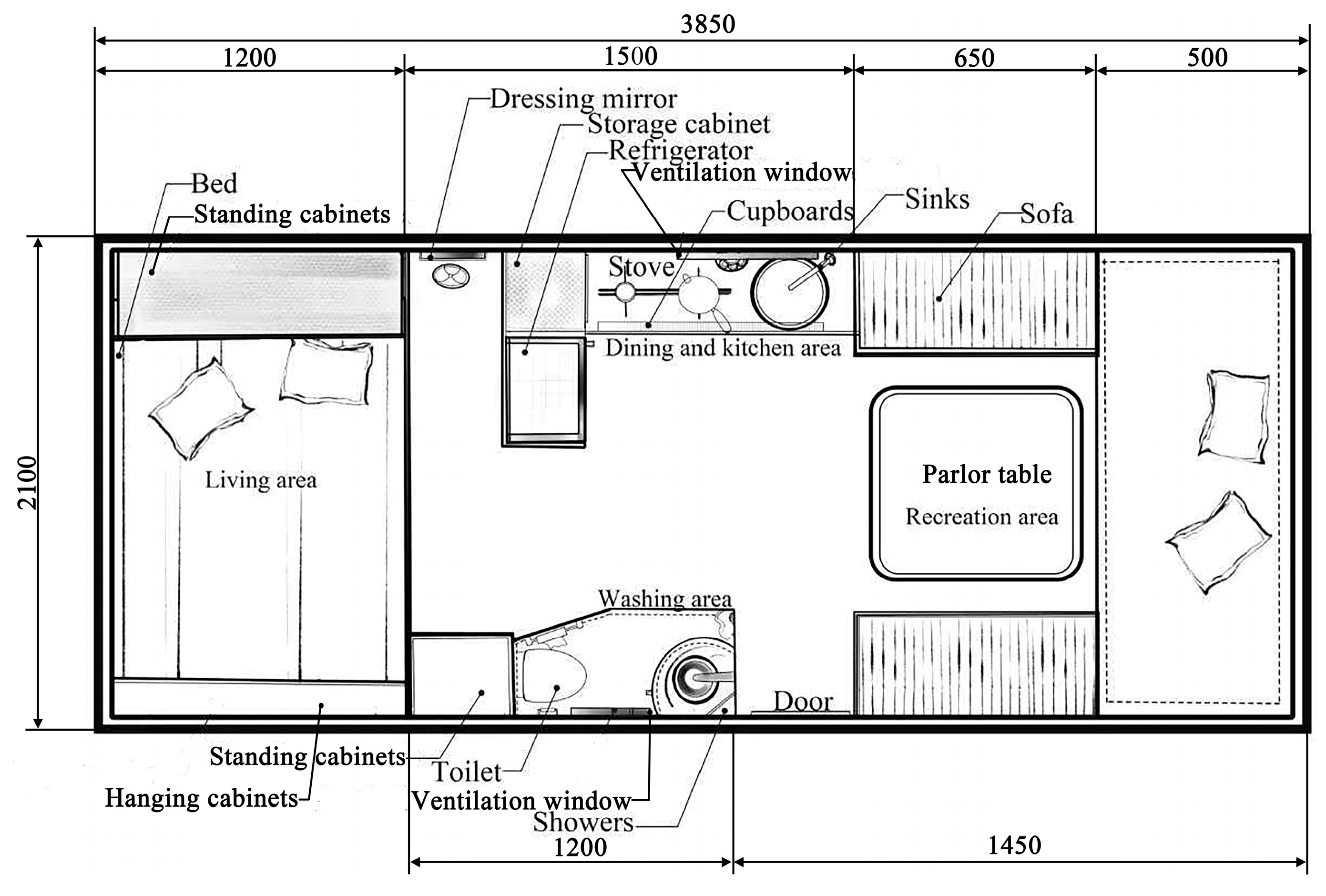
Table 4, the first group has the most functional facilities. Considering that the passengers will usually need washing after sleeping, the functional facilities of the first group are further divided into the living area and the washing area, in which the functional facilities of the living area are beds, hanging cabinets, dressing mirrors, and standing cabinets, while the washing area consists of ventilator windows, showers, and toilets. The final results of functional facilities grouping are shown in
Table 5.
Since the functional facilities in the living area and washing area are highly correlated, they are set up as adjacent areas in the space layout. On the other hand, in order to further improve the passenger capacity and space utilization of the small recreational vehicle, the upper part of the driving area is designed as an additional resting area, which can provide a resting space for 1~2 people. The final interior space design scheme is shown in
Figure 2.
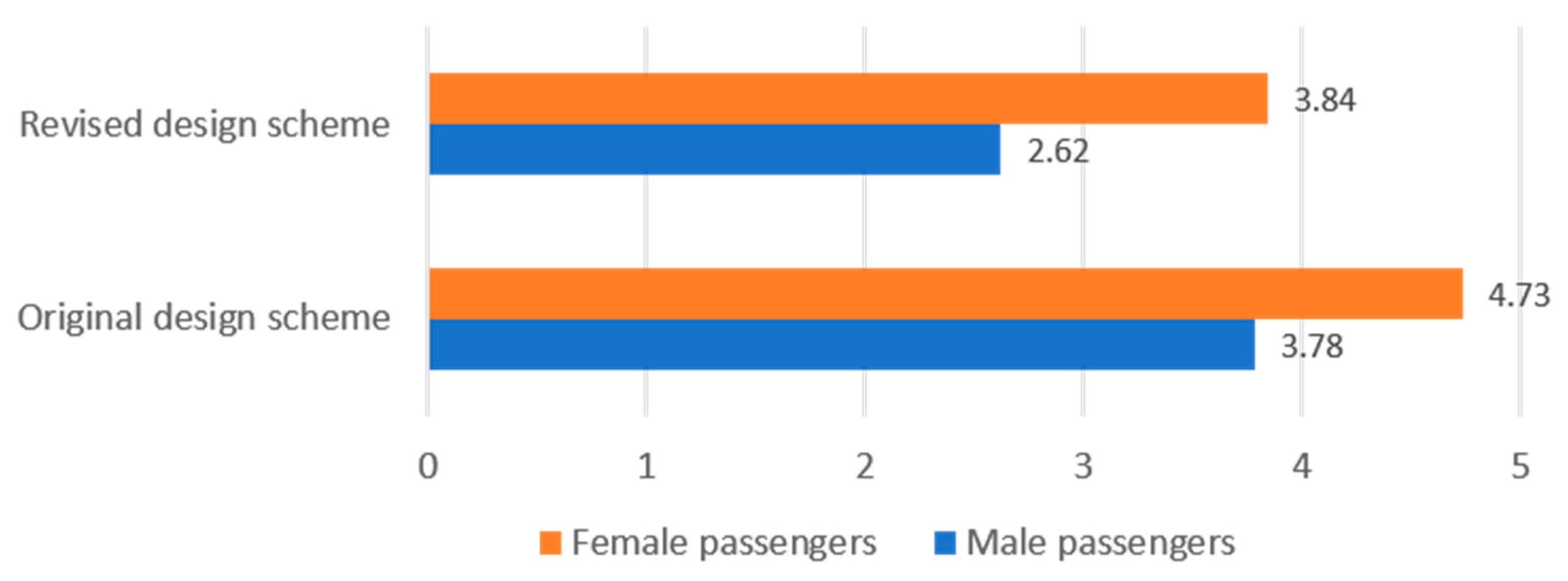
In order to evaluate the convenience of the design scheme, 15 male and 15 female passengers were invited to simulate three typical behaviors during travel: rising and washing, cooking and dining, and sleeping and resting. These behaviors correspond to the design schemes illustrated in
Figure 1 and
Figure 2, and the length of the passengers’ movement routes during each of these three behaviors was recorded.
(1) Analysis of rising and washing behavior
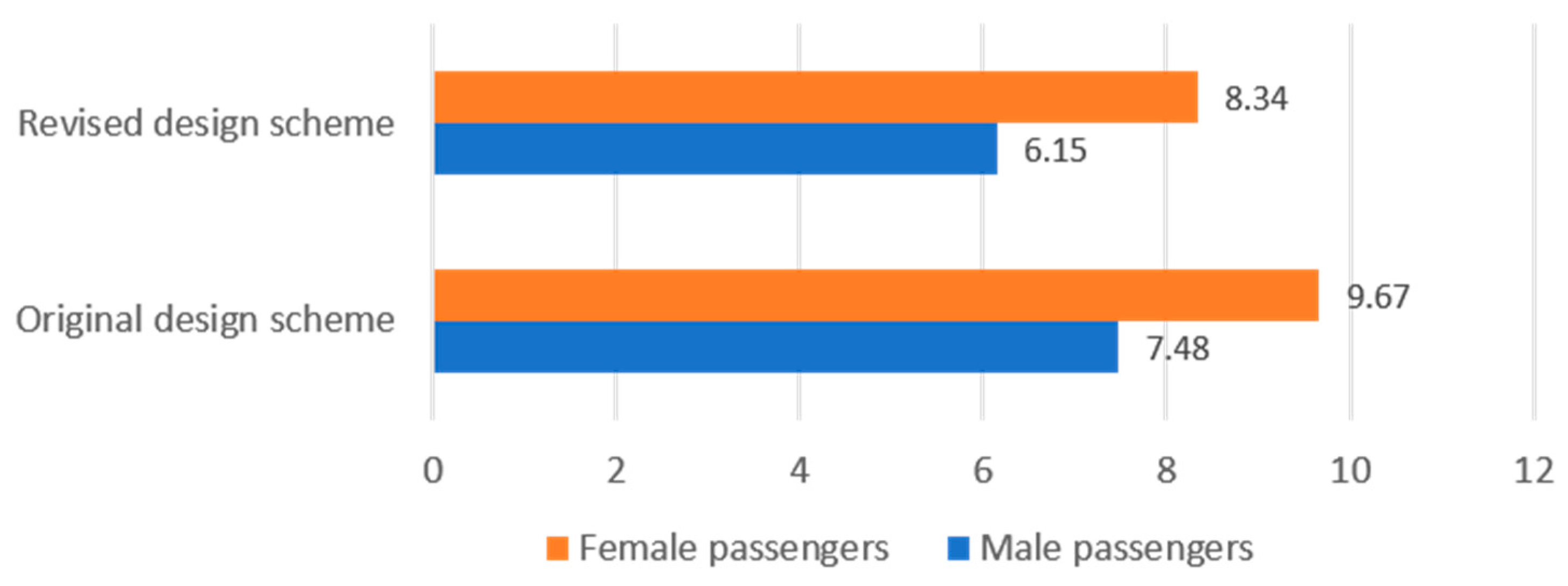
The basic routine for personal washing is as follows: after rising, passengers first go to the bathroom to wash, then open the ventilation window to air the space, and finally return to the living area to change clothes. Female passengers may additionally require time to apply makeup. The functional facilities utilized during this process include beds, toilets, showers, ventilation windows, standing cabinets or hanging cabinets, and dressing mirrors. The average distance traveled by male and female passengers after completing this activity is listed in
Table 6 and
Figure 3. It can be seen that the average movement distances for male and female passengers decreased by 17.18% and 13.75%, respectively. As male passengers do not require makeup, the reduction in average travel distance is more pronounced.
(2) Analysis of cooking and dining behavior
The act of cooking and dining requires passengers to prepare their food before dining in the recreation area. The functional facilities utilized during the cooking and dining are as follows: sinks, stoves, cupboards, refrigerators, sofas, and parlor tables.
Table 7 and
Figure 4 present the average movement distances for male and female passengers completing cooking and dining activities. It can be observed that the average movement distances for male and female passengers decreased by 36.34% and 37.70%, respectively. As cooking activities are only rarely associated with gender, male and female passengers experience a broadly equivalent improvement in convenience regarding cooking and dining activities.
(3) Analysis of sleeping and resting behavior
The basic route for sleeping and resting is as follows: passengers wash in the bathroom before going to the sleeping area to rest. Female passengers need to remove their makeup before washing. The functional facilities utilized during the sleeping and resting acts are showers, standing cabinets or hanging cabinets, beds, and dressing mirrors.
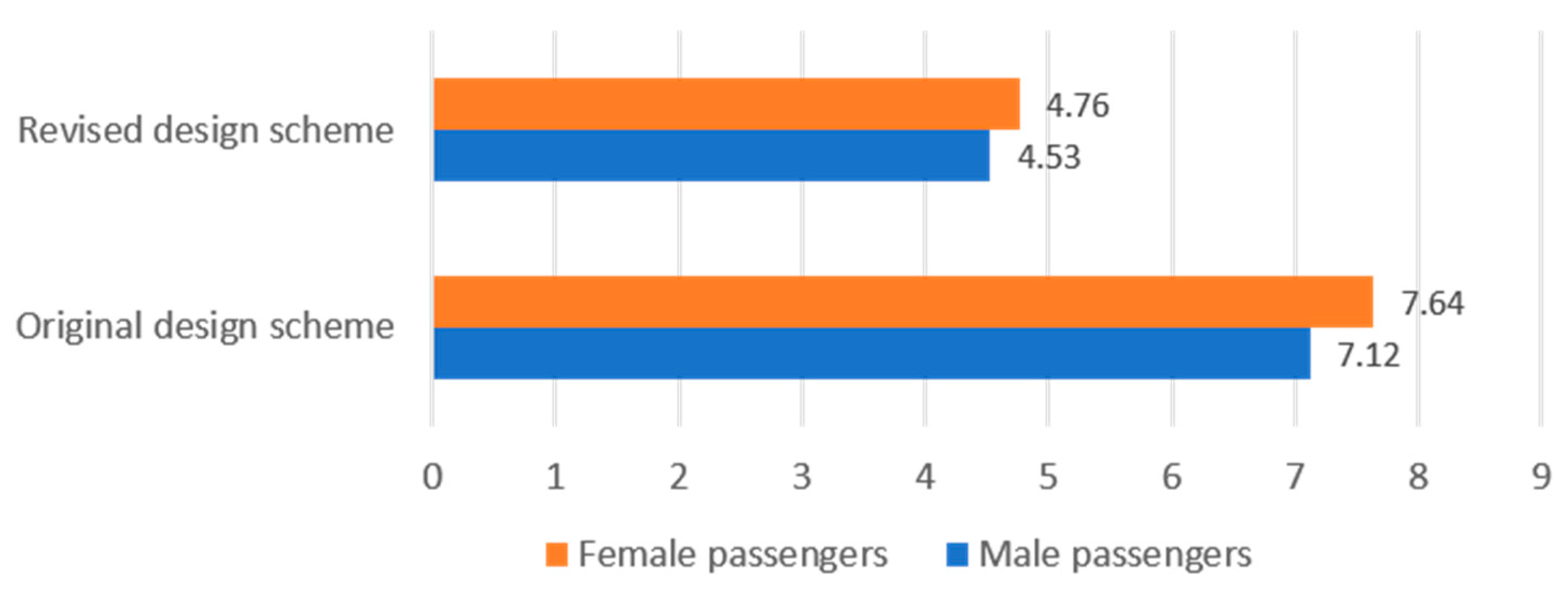
Table 8 and
Figure 5 present the average movement distances during sleeping and resting activities for male and female passengers. It can be seen that the average distance moved by male and female passengers decreased by 30.68% and 18.82%, respectively. Similar to the routine of rising and washing, as male passengers do not require makeup removal, the average distance moved decreased even further.
Taking a significance level α = 0.005 and employing the
t-test method, we analyzed the average travel distances for passengers completing three typical behaviors. The results indicate that there exists a significant difference in the average travel distances between the two design schemes. Therefore, the data presented in
Table 6,
Table 7 and
Table 8 demonstrate that the revised design scheme significantly reduces the distance passengers must travel to perform typical actions during their journey, thereby effectively enhancing the convenience of using functional facilities.
6. Conclusions and Discussion
The paper proposes a methodology for designing small recreational vehicles’ interior space based on user behavior data analysis. By establishing the correlation degree matrix between functional facilities, all functional facilities are categorized into distinct functional zones in accordance with user behavior patterns, thereby enhancing user convenience and satisfaction. The CCHW–Weiman recreational vehicle case study validates this approach, demonstrating a significant reduction in movement distances required for typical activities such as washing, cooking, and sleeping. Compared to the traditional design approaches based on modularity and ergonomics, the method proposed in this paper offers significant advantages in reducing design and manufacturing costs, providing more flexible customization options, and enhancing user satisfaction. It delivers substantial innovation and contribution to the small recreational vehicles’ interior space design.
(1) Reduce design and manufacturing costs
From a cost perspective, modular design has significant benefits in terms of manufacturing and assembly efficiency. Modular components are standardized and mass-produced, reducing production costs and simplifying the design process. However, while modular designs optimize manufacturing and assembly, they often limit spatial flexibility, as the configuration of modules is predetermined and less adaptable to varying user needs. In contrast, the proposed method focuses on user behavior analysis, allowing for dynamic interior configurations that better meet specific passenger needs. Although the initial costs may be higher due to the data collection and analysis required, the long-term benefits in terms of enhanced user convenience and satisfaction can offset these additional expenses, potentially leading to cost savings in the final product.
(2) Offer more flexible and personalized design solutions
When considering flexibility, modular design offers a degree of standardization but lacks the adaptability of a data-driven approach. The modular approach primarily focuses on fixed layouts, which may not effectively accommodate the diverse and dynamic behavior patterns of users. Ergonomics-based designs, on the other hand, focus on the physical comfort and usability of individual components, optimizing factors such as seat comfort, material choice, and spatial dimensions. However, ergonomic methods typically focus on isolated aspects of design, neglecting the interactions between different functional facilities. The proposed method addresses this limitation by analyzing the correlation between facilities and grouping them based on real user behavior, thus offering a more flexible and personalized design solution. This approach enhances the convenience of users by minimizing movement distances during common activities, such as cooking, sleeping, and washing, while still accommodating diverse ergonomic requirements.
(3) Improve users’ satisfaction
In terms of user-centered design, both modular and ergonomic approaches focus on the user experience but in fundamentally different ways. Modular design may prioritize efficiency in manufacturing, while ergonomic methods focus on comfort within specific zones. However, neither approach fully accounts for the dynamic nature of user activities within the recreational vehicles. The behavior-based method proposed in this study incorporates a broader understanding of user interactions with the space, improving overall functionality and satisfaction by analyzing patterns of space usage and facilitating optimal layout design.
While the proposed behavior-based method presents significant advancements in recreational vehicles’ interior design, there are notable limitations that must be addressed.
(1) Sample bias
The dataset used in the case study included 115 participants, representing a range of users from various backgrounds. However, this sample may not fully capture the diversity of recreational vehicle users, especially in terms of age, physical ability, or specific preferences. For instance, elderly passengers or those with mobility challenges may have different behavioral patterns compared to younger, more mobile users. Additionally, the behavior data was collected from a specific route and duration, which may not account for all possible scenarios that users might encounter during longer trips or in different climates. Future studies should aim to collect a more diverse dataset, encompassing a broader range of demographics and travel conditions, to reduce potential biases in the model.
(2) Scalability to larger vehicles
The method proposed in this paper is designed for small recreational vehicles, where space is more limited and the interactions between functional facilities are more frequent. However, as the size of the vehicle increases, the complexity of the interior layout and the relationships between functional zones also increase. In larger vehicles, the potential for complex interactions between distant facilities may make it more challenging to apply the same approach. The scalability of the proposed method to larger vehicles requires further investigation, including modifications to the correlation analysis model to account for spatially separated functional areas and different user behaviors across larger spaces.
(3) Integration with manufacturing and aesthetic design
While the behavior-based method focuses on optimizing the user experience by improving convenience, it may not fully consider the manufacturing processes or aesthetic aspects of interior design. Modular designs, though less flexible, tend to be easier to manufacture and assemble, as they are standardized. Ergonomic designs prioritize user comfort but may lead to less efficient use of space. The behavior-based approach could result in interior layouts that are highly optimized for user behavior but may not always be compatible with modular manufacturing processes or aesthetic preferences. Future work should explore how to integrate behavioral optimization with modular design principles, ensuring that the resulting layouts are not only functional but also manufacturable and aesthetically appealing.