
Article

PECNet: A Lightweight Single-Image Super-Resolution Network with Periodic Boundary Padding Shift and Multi-Scale Adaptive Feature Aggregation


College of Information Engineering, Shanghai Maritime University, Shanghai 201306, China
*
Author to whom correspondence should be addressed.
Symmetry 2025, 17(11), 1833; https://doi.org/10.3390/sym17111833
Submission received: 30 September 2025 / Revised: 22 October 2025 / Accepted: 26 October 2025 / Published: 1 November 2025

Abstract

Lightweight Single-Image Super-Resolution (SISR) faces the core challenge of balancing computational efficiency with reconstruction quality, particularly in preserving both high-frequency details and global structures under constrained resources. To address this, we propose the Periodically Enhanced Cascade Network (PECNet). Our main contributions are as follows: 1. Its core component, a novel Multi-scale Adaptive Feature Aggregation (MAFA) module, which employs three functionally complementary branches that work synergistically: one dedicated to extracting local high-frequency details, another to efficiently modeling long-range dependencies and a third to capturing structured contextual information within windows. 2. To seamlessly integrate these branches and enable cross-window information interaction, we introduce the Periodic Boundary Padding Shift (PBPS) mechanism. This mechanism serves as a symmetric preprocessing step that achieves implicit window shifting without introducing any additional computational overhead. Extensive benchmarking shows PECNet achieves better reconstruction quality without a complexity increase. Taking the representative shift-window-based lightweight model, NGswin, as an example, for ×4 SR on the Manga109 dataset, PECNet achieves an average PSNR 0.25 dB higher, while its computational cost (in FLOPs) constitutes merely 40% of NGswin’s.

1. Introduction

Lightweight Single-Image Super-Resolution (SISR) seeks to generate high-resolution images under limited computing power, enabling real-time, on-device operation. While CNN-based approaches (e.g., IMDN [1], RFDN [2]) have established efficient frameworks, they struggle to reconcile computational efficiency with reconstruction fidelity—often sacrificing quality for speed or vice versa. This fundamental trade-off impedes practical applications where both metrics are critical.
Existing solutions bifurcate into two architecturally deficient paradigms: CNN-based methods pursue efficiency through feature distillation (IMDN [1]) or separation (BSRN [3]), yet their convolutional operators—constrained by limited receptive fields—fundamentally lack global contextual modeling. To enhance representational power, CNN-based methods [4,5,6] progressively adopt deeper and larger architectures, yet such computationally intensive designs hinder deployment on resource-constrained devices. Conversely, while the self-attention (SA) mechanism employed by ViT approaches (e.g., SwinIR [7], ELAN-light [8]) effectively models non-local information for coherence, it demands high computational resources and massive memory. Hybrid attempts like NGswin [9] integrate convolutional priors into attention blocks yet exacerbate spectral imbalance due to self-attention’s inherent low-pass filtering. Nowadays, many studies on SR integrate local and non-local features. However, although the existing multi-branch models have been specially designed for extracting different types of features, the features extracted from each branch cannot complement each other well, resulting in less than ideal feature integration.
These unresolved issues have led to thorny limitations for efficient and high-fidelity reconstruction in lightweight SISR research. First, prevailing multi-scale architectures exhibit unremarkable feature synthesis: despite innovations like SMFANet’s dual-path design [10], existing frameworks fail to holistically integrate discriminative local details (e.g., high-frequency edges/textures) and global structural dependencies (e.g., low-frequency layouts)—The separation and extraction of complementary modes generate edge or corner artifacts in structurally complex regions, as quantitatively evidenced in Urban100 benchmarks [11]. Second, existing window shifting methods often create architectural imbalance when applied partially. Simply shifting windows in a single component disrupts feature consistency and degrades performance. Therefore, a significant research gap exists, as no solution can seamlessly integrate features and perform window shifting across the entire architecture without adding costly complexity.
To comprehensively address these limitations, we propose the Multi-scale Adaptive Feature Aggregation (MAFA) module—a collaborative integrated three-branch architecture that resolves the issue of inefficient feature fusion via synergistic integration;we also propose a lightweight SISR algorithm, Periodically Enhanced Cascade Network (PECNet), which employs MAFA as its main block.
(1)
MAFA integrates local details and global structural information to avoid unremarkable feature synthesis—solving the problem that existing frameworks (even with improvements such as dual-path design) still cannot integrate two complementary features as a whole, namely “distinguishable local details” and “global structural dependencies”, resulting in a disconnection in their extraction. The MAFA module achieves holistic integration through three specialized branches: the local detail estimation (LDE) enhances high-frequency details via depthwise convolution; the effective approximate self-attention (EASA) models long-range dependencies with variance modulation;the Window Nonlocal Attention (WNA) captures intra-window contexts through 8 × 8 attention.
(2)
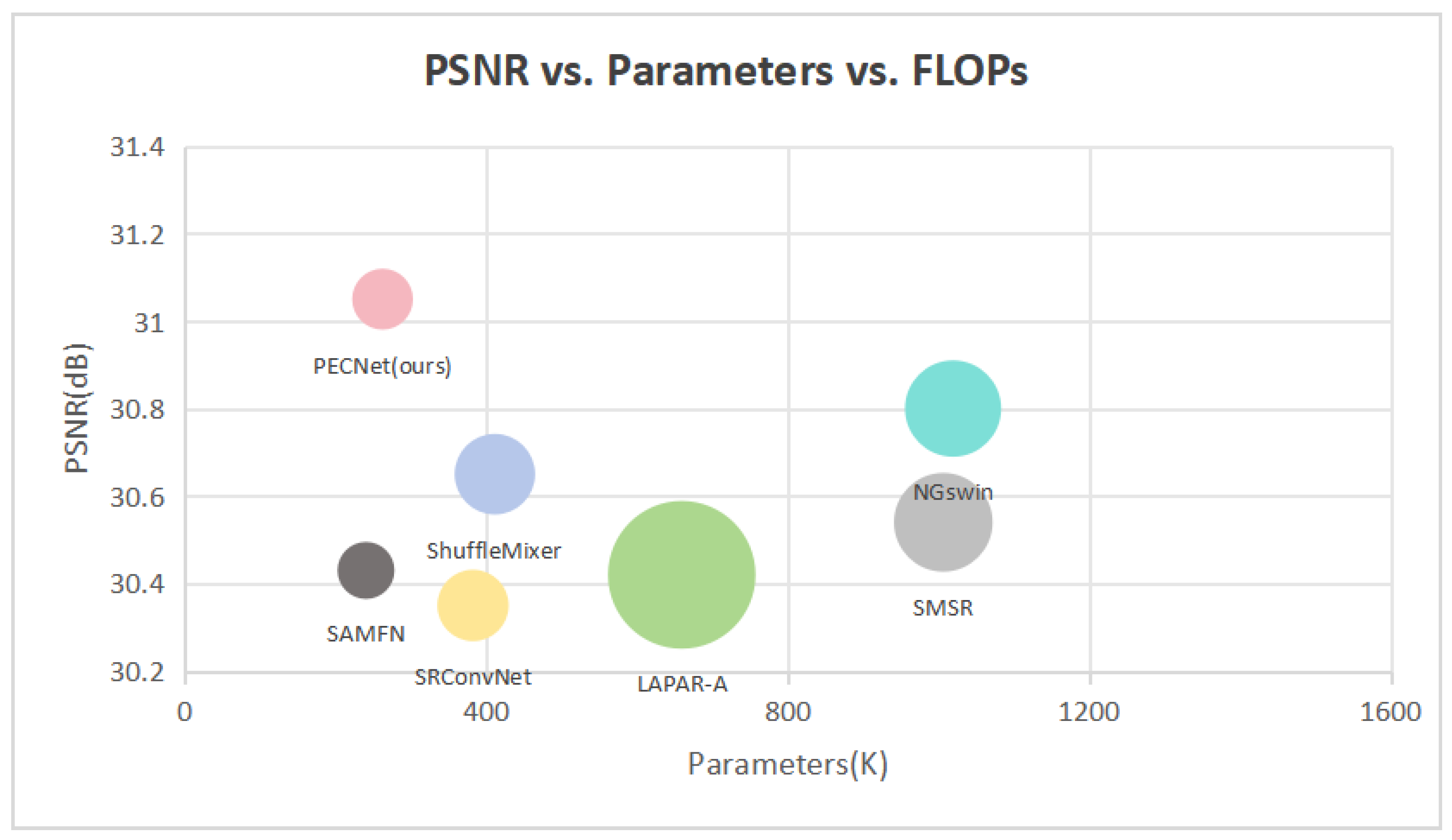
We propose the Periodic Boundary Padding Shift (PBPS) mechanism in MAFA, which serves as a unified preprocessing backbone to structurally support and align the three complementary branches. As it is difficult to apply window shifting in LDE and singly window shifting to one branch (WNA) will leading unbalance: for odd-indexed blocks, symmetric replicate-padding (4 pixels) expands feature dimensions to induce fixed window offset; even-indexed blocks maintain original resolution followed by center cropping—eliminating explicit shifting operations while equivalently achieving SwinIR-style cross-window communication at zero computational overhead. Feature refinement is enhanced via a Partial Convolution-based Feed-forward Network (PCFN) that selectively processes channels while preserving identity paths. Our experimental evaluation shows that PECNet achieves an outstanding balance between reconstruction quality and computational efficiency across multiple benchmarks (see Figure 1).
We summarize our main contributions as follows:
  • Three-branch aggregation: We design a three-branch aggregation module in MAFA to address the gap in frequency and spatial distance modeling for SISR. the EASA branch captures remote non-local low-frequency information, the LDE branch extracts local high-frequency details and the WNA branch focuses on non-local interactions within the shifted window.
  • PBPS mechanism: We propose the PBPS mechanism to integrate the three branches. The PBPS mechanism not only alleviates boundary discontinuity in traditional WNA blocks, but also enhances the generalization capability of LDE and EASA models due to window shifting is also apply in LDE and EASA.
  • PECNet algorithm: We propose a lightweight SISR algorithm, PECNet, which employs MAFA as its main block. PECNet extracts multi-frequency and multi-distance features through three specialized branches, with each block operating optimally in its respective domain.

2. Related Work

CNN-based SR. SRCNN [13] pioneered direct end-to-end mapping learning from low-resolution (LR) to high-resolution (HR) images, surpassing traditional interpolation methods. FSRCNN [14] and ESPCN [15] adopted post-upsampling strategies to reduce computational overhead, thereby improving efficiency. DRCN [16] introduced deep recursion with recursive supervision and skip-connections to achieve large receptive fields without increasing parameters. DRRN [4] employed recursive residual blocks with weight sharing and multi-path local connections to build a very deep network with minimal parameters. EDSR [5] and RCAN [6] improved performance through hundreds of layers, breaking through the limitations of deep architectures. However, these large models with high computational costs are difficult to deploy in practical applications.
lightweight SR. The classic lightweight SR algorithm AWSRN [17] introduces Adaptive Weighted residual Units and local fusion blocks for efficient residual learning, and proposes an adaptive weighted multi-scale module to fully utilize features. OSFFNet [18] introduced an Omni-Stage Feature Fusion architecture with stacked initialization and dynamic fusion to fully leverage multi-level features, particularly shallow ones, for efficient and high-quality image super-resolution. IMDN [1] proposed an information distillation block, which progressively splits, refines and aggregates feature maps, significantly reducing model parameters. HiT-SR [19] introduced expanding hierarchical windows and a spatial-channel correlation mechanism with linear complexity to efficiently aggregate multi-scale features while significantly reducing computational costs. The existing methods mainly focus on multi-dimensional information fusion:DLGSANet [20] introduced a Multi-Head Dynamic Local Self-Attention module and a Sparse Global Self-Attention module to efficiently capture both locally variant structures and the most useful global dependencies with very low computational overhead. MTKD [21] innovatively applied a multi-teacher distillation strategy to compress models, with its knowledge transfer mechanism improving the PSNR of lightweight models by 0.21 dB. XPSR [22] explored cross-modal priors to enhance reconstruction quality. Although existing lightweight SR methods model local/global features or fuse multi-source information, they lack targeted high-frequency modeling.
ViT-based SR. IPT [23] pioneered the introduction of standard ViT into SR tasks, laying the foundation for global modeling. SwinIR [7] designed window self-attention, surpassing large CNN models. Swin2SR [24] improves SwinIR by adopting Swin Transformer V2, effectively solving the problems of training instability and resolution difference, and achieving faster convergence and competitive performance in the tasks of compressed image super-resolution and recovery. Shift-Net [25] introduced a shift-connection layer to U-Net for deep feature rearrangement, enabling semantically coherent and texture-rich inpainting with improved efficiency. ELAN [8] proposed grouped weight sharing, significantly reducing complexity. Inspired by local attribution graphs, NGswin [9] introduced N-Gram context and SCDP bottleneck to expand receptive fields and fuse multi-scale features efficiently for lightweight image super-resolution. Despite the advantages of integrating convolution and attention in ViT methods, they still have drawbacks:self-attention’s low-pass characteristic over-smooths reconstructions and causes frequency-domain imbalance, notably lacking dedicated branches to explicitly model high-frequency details and low-frequency structures simultaneously, resulting in unbalanced feature representations.
Building upon the previously analyzed works, our MAFA module incorporates three dedicated branches that explicitly model both high-frequency details and low-frequency structures, enabling more balanced and comprehensive feature representation.
To collaborate with the three-branch structure of MAFA, this paper proposes a PBPS mechanism that implicitly enables shifted-window modeling while providing a unified structural foundation for parallel multi-branch processing, thereby allowing simultaneous extraction of high-frequency details and global dependencies.
In summary, PECNet is not an incremental improvement but a novel architectural solution via MAFA’s three-branch synergy and PBPS’s structural implicit shifting, achieving a superior balance between efficiency and fidelity. The comparison results are shown in Table 1.

3. Proposed Method

In this section, we will give a detailed introduction of our proposed PECNet: Section 3.1 elaborates on its overall architecture, Section 3.2 presents the three-branch design of the MAFA module and Section 3.3 explains the PBPS mechanism and its inverse operation.

3.1. Overall Architecture

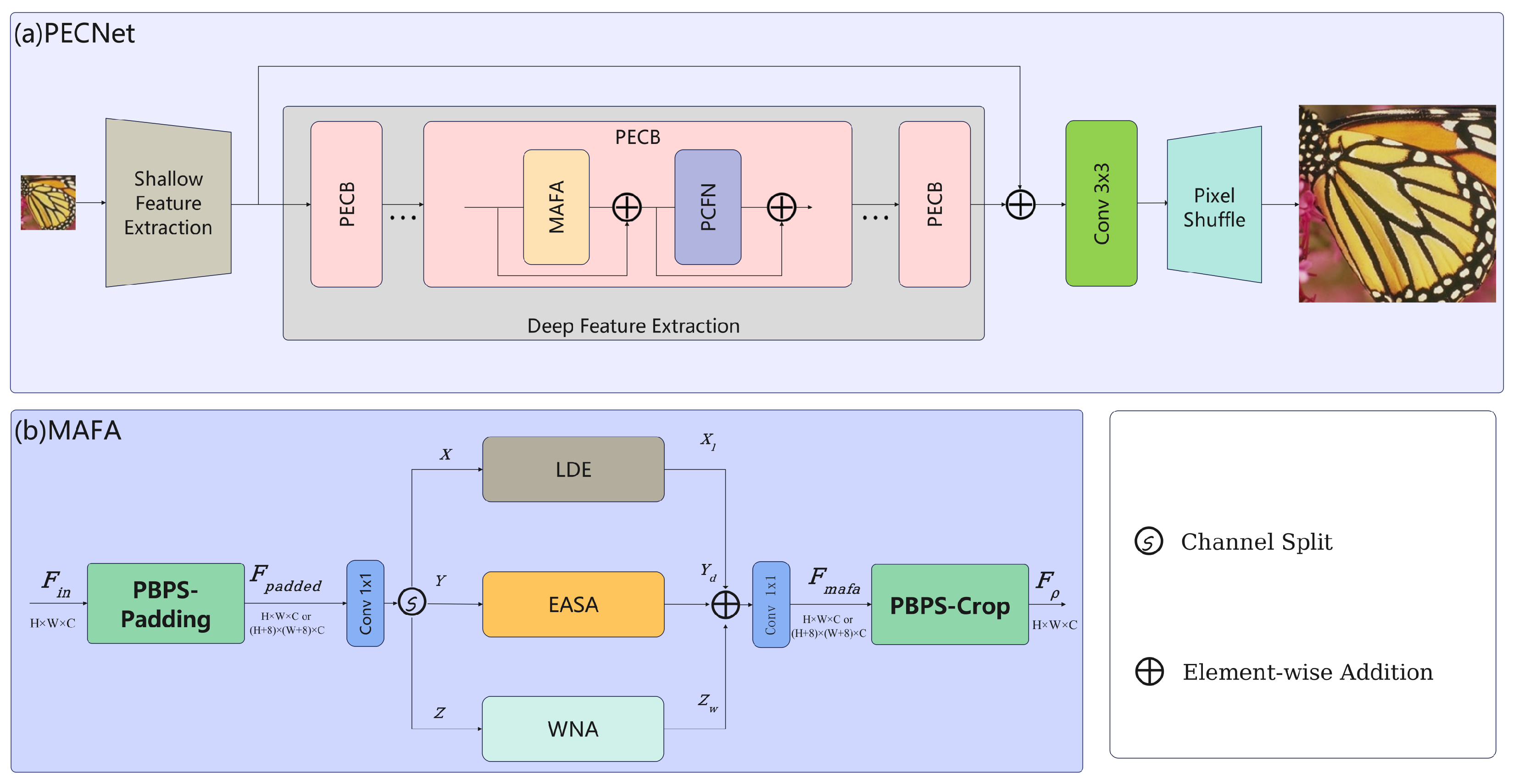
Figure 2 illustrates the overall architecture of our proposed PECNet, which takes a low-resolution (LR) image as input and employs a 3 × 3 convolutional layer to extract shallow low-level features. These features are then fed into a series of Periodically Enhanced Cascade Blocks (PECBs) to generate deep representative features, with each PECB integrating a Multi-scale Adaptive Feature Aggregation (MAFA) module and a Partial convolution-based feed-forward network (PCFN). The MAFA module, central to feature processing, deeply incorporates the Periodic Boundary Padding Shift (PBPS) mechanism, which indirectly implements window shifting for the attention mechanism by expanding image boundaries in every alternate deep feature block. The processed features are then fed into three specialized branches: the Local Detail Estimation (LDE) branch, which captures fine- grained local details and high-frequency information; the Efficient Approximation of Self-Attention (EASA) branch, which models long-range non-local interactions focusing on distant low-frequency information; and the Window Non-local Attention (WNA) branch, which partitions features into fixed windows to compute intra-window attention, handling window-internal low-frequency information. The PCFN refines MAFA’s output via channel-selective processing, applying spatial convolution to minority channels while preserving majority identity paths for efficiency.
The PECB, integrating MAFA and PCFN, achieves gradient stability via residual connections, formulated as F ρ = MAFA ( F in ) + F in and F ^ ρ = PCFN ( F ρ ) + F ρ , where F in , F ρ , and F ^ ρ retain their defined meanings. Building on the deep features output by PECBs, the image reconstruction module—with a lightweight architecture—generates the high-quality output: it uses a convolutional layer to compress channel dimensions to match the target upscaling factor, followed by a PixelShuffle layer for resolution upscaling, with a global residual connection incorporated to preserve high-frequency details. Through the PBPS mechanism and the specialized three-branch structure in MAFA, PECNet effectively captures multi-scale and multi-frequency features.

3.2. Three-Branch Architecture in MAFA

To synergistically model local and non-local features for enhanced reconstruction accuracy, we propose a lightweight Multi-scale Adaptive Feature Aggregation (MAFA) module. Within this module, the Periodic Boundary Padding Shift (PBPS) mechanism implicitly realizes shifted-window attention, while three specialized components operate in parallel: the Local detail estimation (LDE) focuses on edge and texture recovery, the Efficient approximation of self-attention (EASA) efficiently models long-range dependencies and the Window Non-local Attention (WNA) captures non-local context and low-frequency structural information.
Formally, the MAFA module processes input features F in R H × W × C through three parallel branches with integrated PBPS, as defined by the Equation (1):
MAFA ( F in ) = Γ crop ( Conv 1 × 1 ( LDE ( Γ padding ( F in ) ) + EASA ( Γ padding ( F in ) ) + WNA ( Γ padding ( F in ) ) ) )
where Γ padding ( · ) denotes center-initiated replicate-padding (4px) for odd-indexed blocks. LDE ( · ) denotes High-Frequency Extraction, EASA ( · ) denotes Efficient approximation of self-attention and WNA ( · ) denotes Window Attention. Γ crop ( · ) indicates center crop (4px) restoration for odd-indexed blocks.
The processing flow within a PECB is as follows: the input features F in first undergo the Periodic Boundary Padding Shift ( Γ padding ) for implicit window alignment. The padded features are then processed in parallel by the three specialized branches (LDE, EASA, WNA). Their outputs are aggregated via element-wise summation, followed by a 1 × 1 convolution for channel mixing and feature refinement. The resulting features are then passed through the Inverse PBPS ( Γ crop ) to restore the original spatial dimensions. Finally, the output of the entire MAFA module is integrated back into the main pathway via a residual connection ( F p = MAFA ( F in ) + F in ), followed by further processing in the PCFN with another residual connection.
Feature partitioning and fusion. Given input feature F padded R H × W × C from PBPS, we first apply channel-wise normalization and expansion, which is achieved by Equation (2):
{ X , Y , Z } = S ( Conv 1 × 1 ( | F padded | 2 ) )
where | · | 2 denotes channel-wise L2 normalization, the | F padded | 2 represents the L2 normalization at the channel level for the feature map F padded , that is, calculating the L2 norm for all pixel values in each channel, Conv 1 × 1 performs channel expansion, and S ( · ) equally partitions features into three branches.The function S ( · ) partitions the input feature channels sequentially and uniformly into three equal parts, requiring the total number of channels C to be divisible by 3, and no channel shuffling or permutation is applied. We then process the features X, Y and Z in parallel via the LDE and EASA and WNA branches, producing the X l , Y d and Z w , respectively. Finally, we fuse X l , Y d and Z w together with element-wise addition and feed them into a 1 × 1 convolution to form a representative output. This process can be formulated as Equation (3):
F mafa = Conv 1 × 1 ( X l + Y d + Z w )
where F mafa is the output feature after three-branch fusion.
LDE. The LDE branch captures high-frequency details essential for reconstruction quality. Dedicated to local feature extraction through cascaded convolutions, it complements EASA’s global low-frequency modeling and WNA’s window-based low-frequency focus [7]. This design is inspired by SMFANet [10].
The LDE branch processes the input feature X via depthwise convolution to generate the encoded feature X m ; then, through a 1 × 1 convolutional layer and a non-linear activation function, it outputs the refined high-frequency feature X l , as formulated below (4) and (5):
X m = Conv 1 × 1 ( DWConv 3 × 3 ( X ) )
X l = Conv 1 × 1 ( ϕ ( X m ) )
where DWConv 3 × 3 ( X ) denotes the local spatial feature extraction via 3 × 3 depthwise convolution, X m R H × W × 2 C is the encoded high-frequency detail feature and X l represents the optimized local high-frequency feature.
EASA. The EASA block extracts non-local low-frequency features to model long-range spatial dependencies, transcending window-constrained attention mechanisms. This design is inspired by SMFANet [10].
The EASA branch extracts low-frequency components via adaptive max pooling D ( · ) with scaling factor 8, then processes them using a 3 × 3 depth-wise convolution DWConv 3 × 3 ( · ) and to characterize spatial distribution properties, computes channel-wise variance σ 2 ( Y ) R 1 × 1 × C as statistical divergence and merges it with the convolved features via 1 × 1 convolution, which is achieved by Equations (6) and (7):
σ 2 ( Y ) = 1 N i = 0 N 1 ( y i μ ) 2
Y h = Conv 1 × 1 ( DWConv 3 × 3 ( D ( Y ) ) + σ 2 ( Y ) )
where N is the total number of pixels in the channel, and the summation runs from the 0-th to the ( N 1 )-th pixel, thus iterating over all pixels. y i denotes the value of each pixel, μ is the mean of all pixel values, the values y i in the variance calculation σ 2 ( Y ) are computed over all spatial locations of the input feature map Y before pooling. The modulated feature Y h R H × W × C is then adaptively aggregated with the original input Y to extract the representative structural representation Y d , which is achieved by Equation (8):
Y d = Y U ( ϕ ( Y h ) )
where U ( · ) denotes a nearest upsampling operation, ⊙ represents element-wise multiplication.
WNA. The WNA branch captures low-frequency information within fixed windows, balancing computational efficiency and non-local context modeling. It adapts the Swin Transformer Layer (STL) from SwinIR [7].
Input feature Z R H × W × C is divided into non-overlapping 8 × 8 windows via PBPS. In odd-indexed PECBs (expanded to ( H + 8 ) × ( W + 8 ) × C via PBPS), 81 non-overlapping 8 × 8 windows are partitioned from the feature map after boundary expansion. In even-indexed PECBs (with the original size H × W × C ), 64 non-overlapping 8 × 8 windows are directly partitioned, which is achieved by Equation (9):
W = { W i j W i j = Z [ i : i + 8 , j : j + 8 , : ] , i , j { 0 , 8 , 16 , , 64 } } ( odd - indexed PECBs , 81 windows ) { W k j W k j = Z [ k : k + 8 , j : j + 8 , : ] , k , j { 0 , 8 , 16 , , 56 } } ( even - indexed PECBs , 64 windows )
where Z [ i : i + 8 , j : j + 8 , : ] and Z [ k : k + 8 , j : j + 8 , : ] are window slicing operations. W i j (or W k j ) denotes a single window feature block with the shape 8 × 8 × C, and W the window collection. Afterward, each window independently executes self-attention, and the processed windows are reconstructed into Z w R H × W × C by their original positions. This design induces a 4-pixel offset between the window centers of the WNA branches in adjacent PECBs via PBPS, equivalently enabling cross-window information interaction, which is achieved by Equation (10):
Z w = Reconstruct ( { W 1 , , W K } )
where W i R 8 × 8 × C represents the window after calculating the internal attention.

3.3. Periodic Boundary Padding Shift Mechanism and Its Inverse Operation in MAFA

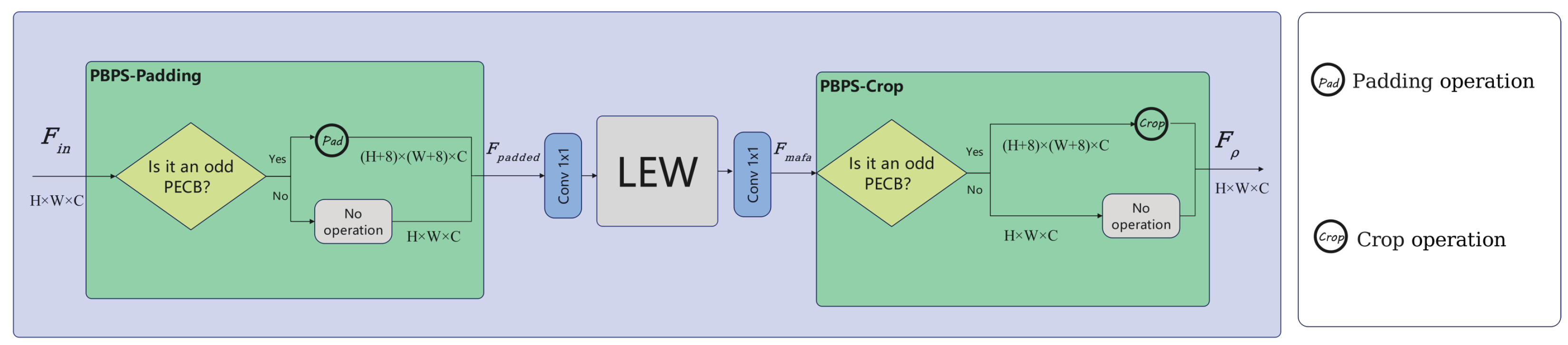
PBPS–Padding. As shown in Figure 3, the PBPS mechanism is designed to simulate window shifting mechanism due to it is difficult to utilize into the LDE and EASA. For odd-indexed PECBs, the input feature map of dimensions H × W is expanded to ( H + 8 ) × ( W + 8 ) through replicate-padding (applied only to odd-indexed PECBs), which is achieved by Equation (11):
F padded = Pad ( F in , pad = 4 ) if index mod 2 = 1 F in otherwise
where F in denotes the input feature map, Pad ( · , 4 ) represents the symmetric border expansion operation (extending 4 pixels symmetrically on all sides), and index corresponds to the PECB index (1, 2, 3, …). F padded serves as the input to the three branches. (Input dimensions: H × W × C for all cases; Output dimensions: ( H + 8 ) × ( W + 8 ) × C for odd-indexed PECBs, H × W × C for even-indexed PECBs).
The WNA branch relies on windowed non-local attention to model low-frequency dependencies, yet explicit window shifting (e.g., SwinIR’s shifted window) can only be applied to WNA branches, and directly embedding such explicit shifts into WNA will cause branch imbalance within the module; The PBPS design ensures adjacent PECBs’ windows are offset by 4 pixels without explicit shifting—thereby enabling the simultaneous introduction of window offset effects in the WNA, LDE and EASA branches, ensuring the overall coordination and efficient operation of the module. We have tested various padding methods, and our experiments indicate that replicate-padding performs the best. We will discuss these findings in detail in the Ablation Study section.
PBPS—Crop. To ensure the input and output sizes of PECBs are strictly consistent (always H × W × C ), center cropping is applied to the fused output to restore the original size ( H × W ), which is only performed for odd PECBs, as shown in Equation (12):
F p = Crop ( F mafa , 4 ) if index mod 2 = 1 F mafa otherwise
(For odd PECBs: the input size is ( H + 8 ) × ( W + 8 ) × C , and the output is obtained by extracting the central region [4:H+4, 4:W+4, :] to restore the size H × W × C .)
Where Crop ( · , 4 ) denotes the center cropping operation, where 4 is the cropping width. F mafa is the output feature of MAFA, and F p is the final output feature of the MAFA module. Regarding the input sizes: for odd PECBs, the input is ( H + 8 ) × ( W + 8 ) × C ; for even PECBs, the input is H × W × C . Notably, the output size for both cases is consistently H × W × C .

4. Experimental Results

4.1. Datasets and Implementation

Datasets. High-quality super-resolution training datasets are crucial for model performance. In this study, we adopted the widely used DIV2K [26] and DIV2K + Flickr2K (DF2K) [26] datasets as the main sources of training data. To make a fair and effective comparison with the current mainstream methods [9,10,27,28,29,30,31], we trained the proposed model on the DIV2K and DF2K datasets respectively. During the model evaluation stage, we selected multiple recognized benchmark test sets for performance verification, covering Set5 [32], Set14 [33], B100 [34], Urban100 [11] and Manga109 [12]. In terms of evaluation indicators, we convert the reconstructed image to the YCbCr color space and calculate the peak signal-to-noise ratio (PSNR) and structural similarity index (SSIM) of the Y channel to objectively measure the quality of the restored image.
Implementation. During the model training process, we randomly cropped 64 image blocks of size 64 × 64 from low-resolution (LR) images as the base input.The loss function of the model is set in the same way as SAFMN [35], using a combined loss function of L 1 Loss (weight = 1.0) and FFT Loss (weight = 0.05), with a batch size of 64 image patches per GPU, where each high-resolution patch is 256 × 256 pixels ( 64 × 64 for LR at × 4 scale). Data augmentation includes random horizontal flipping and rotation, with a fixed random seed of 10. The optimization employs Adam [36], and its hyperparameters are set to β 1 = 0.9 , β 2 = 0.99 . The initial learning rate is set to 1 × 10 4 and the minimum learning rate to 1 × 10 6 , with Cosine Annealing Restart scheduling [37] (1,000,000 iterations period, no warm-up), and no gradient clipping is applied. We trained the main model on the DF2K dataset for 1,000,000 iterations, while all models in the ablation study are trained on the DIV2K dataset for 250,000 iterations to reduce the cost. The experiments were implemented using PyTorch 1.8 on a platform with an NVIDIA GeForce RTX 3090 GPU. The proposed PECNet architecture contains 8 Periodic Enhancement Cascade Blocks (PECBs), each with 36 channels.

4.2. Ablation Experiment

In this section, we perform an ablation study to verify the effectiveness of our proposed PECNet. All ablation models were trained on DIV2K (250,000 iterations) and validated under the Set5. The upsampling scale factor was fixed at × 4 , and the network configuration remained completely consistent. The performance evaluation is based on the average PSNR and SSIM.
Verification of the effectiveness of the three-branch architecture. To systematically verify the contributions of each part of the three-branch structure in the PECNet network, we designed seven ablation models to quantitatively analyze the influence of each part on the reconstruction performance: Model S_LDE with only the LDE branch, Model S_EASA with only the EASA branch, Model S_WNA with only the WNA branch, Model D_L+E with both the LDE and EASA branches, Model D_E+W with both the EASA and WNA branches, Model D_L+W with both the LDE and WNA branches, and Model T_L+E+W with all three branches in the MAFA module. The results are shown in Table 2.
As shown in Table 2, Model S_EASA, which contains only the EASA branch, achieved the lowest PSNR and SSIM performance. The reconstruction performance improved markedly as more feature-extraction branches were incorporated. Model S_WNA significantly outperformed the other single-branch models, demonstrating the effectiveness of the WNA branch. Model T_L+E+W, which integrates all three branches, delivered the best performance, exceeding that of Model D_E+W (the best-performing two-branch model) by 0.01 dB. These results confirm that the three-branch structure effectively enhances the representational capacity of the MAFA module for high-quality image reconstruction.
Verification of the effectiveness of the PBPS mechanism. To systematically evaluate the effectiveness of the proposed PBPS mechanism, three model variants were designed for this ablation study: Model T_L+E+W from the previous ablation study, which contains the three-branch structure without PBPS and without window shifting; Model “WNA-shift”, which incorporates explicit window shifting only within the WNA branch but still without PBPS; and Model “PBPS”, which integrates both the three-branch structure and the proposed PBPS mechanism. Their reconstruction performance is quantitatively compared in Table 3.
As shown in Table 3, the data for Model PBPS(our) in Table 3 corresponds to the replicate padding methods. The performance of Model PBPS(our) is the best, illustrating the effectiveness of the PBPS mechanism. However, the performance of Model window shifting only within the WNA (WNA-shift) is worst, because it only has the window shift operation contained in the WNA branch. This is because the “explicit window movement” operation of the WNA branch in model WNA-shift disrupts the “spatial consistency” of feature extraction among the three branches of the MAFA module, introduces fusion noise and training instability and its negative effects outweigh the positive benefits brought by window interaction. The PBPS mechanism performs padding (and subsequent cropping) at the input level of the entire MAFA module. This means that the inputs of the three branches are all feature maps that have undergone the same preprocessing (padding). PBPS not only acts on WNA, but its boundary expansion operation is also theoretically beneficial for the processing of boundary region features by LDE and EASA branches, enhancing the generalization ability of the model. Due to the fact that the implicit windowing operation of the PBPS mechanism in Model PBPS(our) can be applied to three branches, the performance of Model PBPS(our) has been significantly improved, with an increase of 0.23 dB in PSNR compared to Model T_L+E+W.
Verification of the effectiveness of replicate in different Padding methods of the PBPS mechanism. To quantitatively evaluate the effects of different padding methods in the PBPS mechanism, our PBPS model can be classified into four types based on the padding method: replication, circulation, reflection and constant zero. The results are shown in Table 4.
As can be seen from Table 4, the comparison of the filling methods of the PBPS mechanism shows that the replicate mode has the highest PSNR and SSIM performance on the five types of test sets, achieving the best balance, indicating that maintaining boundary continuity is crucial for window attention.
Through experimental comparative analysis of various ablation models and different filling methods, the effectiveness of each part in the MAFA module was verified respectively.

4.3. Comparisons with State-of-the-Art Methods

Quantitative comparison. To comprehensively evaluate the performance of the proposed method, we conducted a systematic quantitative comparison. Firstly, PECNet is compared with existing state-of-the-art lightweight SISR methods, including SMSR [28], ShuffleMixer [29], SAFMN [35], SMFANet [10], LAPAR-A [30], NGswin [9] and SRConvNet [31]. These competitors have been carefully selected and cover the major architectural trends: SMSR, SAFMN and LAPAR-A represent traditional lightweight models; ShuffleMixer, SMFANet and SRConvNet are relatively novel lightweight models in recent years. NGswin, as a representative lightweight model based on Shift-Window, can directly compare our implicit PBPS mechanism with the explicit Window Shift method. When the amplification factors are × 2 , × 3 and × 4 , the quantitative results of each method on multiple benchmark datasets are presented in Table 5. PECNet(ours) was trained on the larger DF2K dataset to ensure a fair and rigorous comparison. In addition to the core image quality assessment metrics PSNR and SSIM, we have also listed the parameter count (#Params) and computational cost (#FLOPs) of each model to measure their complexity. To ensure fairness, the model complexity (FLOPs) of all methods is calculated using the fvcore library (i.e., fvcore.nn.flops_count, this code is from the SMFANet algorithm) and the calculation scenario is set to super-resolve a low-resolution image to a resolution of 1280 × 720 pixels. Our PECNet achieved a throughput of 34 FPS and a peak memory usage of 265 MB.
Table 5 shows that our PECNet has achieved better performance on almost all benchmark datasets. This indicates that thanks to the MAFA module, PECNet can more effectively mine complementary information in images. Compared with the previous lightweight SR methods based on CNN, it demonstrates significant potential for performance improvement. It particularly demonstrates advantages in detail restoration and structural fidelity. For instance, on the Manga109 test set for × 4 SR, PECNet (ours) achieves a PSNR that is 0.25 dB higher than NGswin, while its computational cost (FLOPs) constitutes only 40% of NGswin’s.
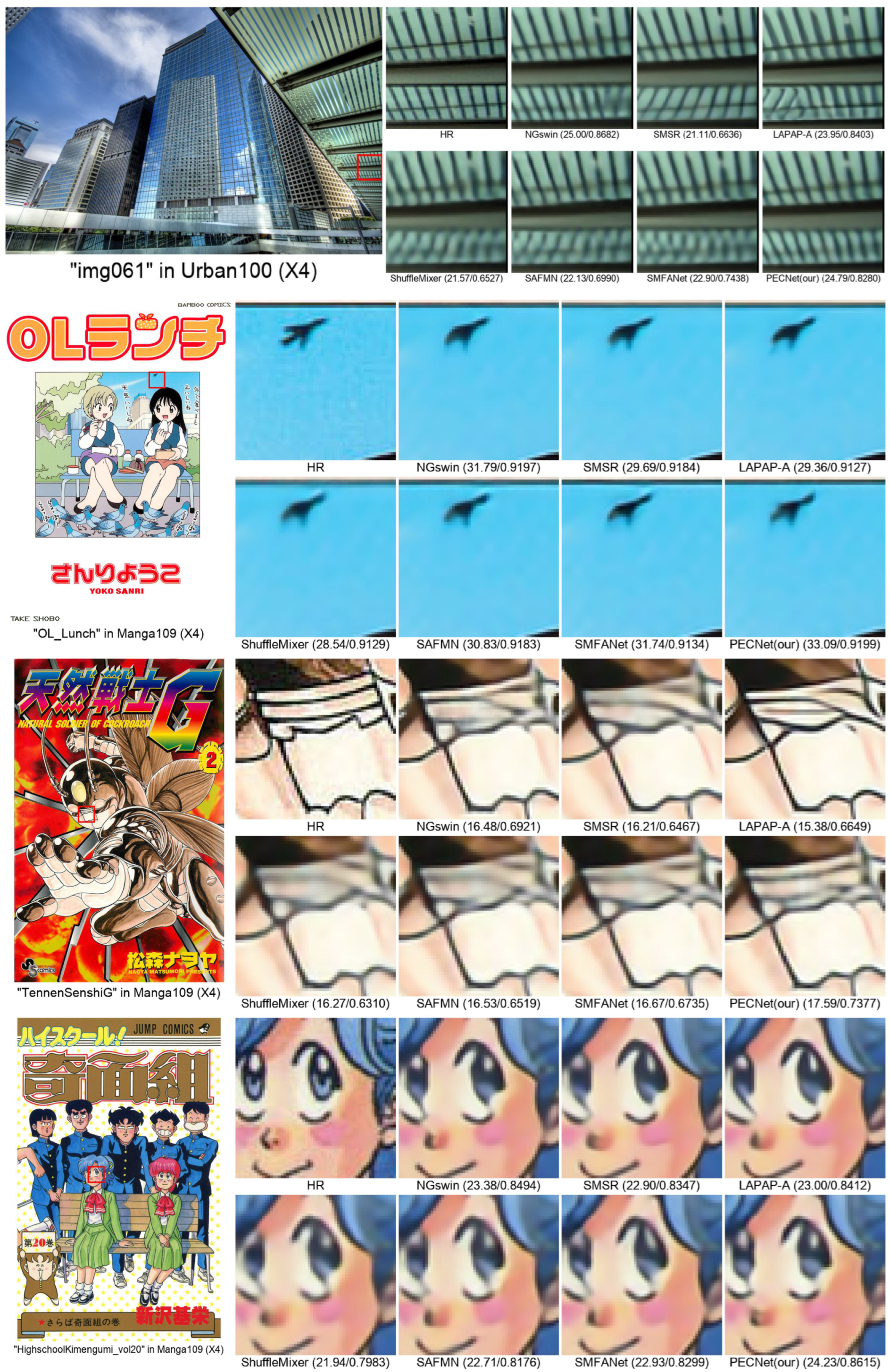
Qualitative comparisons. We compared the visual results of our proposed PECNet with some lightweight SR methods on the Urban100 and Manga109 datasets at a scale of × 4 . The comparison algorithms are as follows:SMSR, ShuffleMixer, SAFMN, SMFANet, NGswin and LAPAP-A. As shown in Figure 4, existing methods yield blur, distortions and inaccurate structures, while our PECNet produces sharper edges, structural integrity and coherent textures, demonstrating superior visual quality.
In the “img061” example from Urban100: The surface texture of the sunshade glass grilles reconstructed by our method is clearer and sharper, with the edges remaining intact and the texture direction intact.Although NGswin achieved a slightly higher PSNR/SSIM in this example, the texture orientation in the restored images was disordered. In contrast, our PECNet produced visually superior reconstructions with more precise structural lines and significantly reduced artifacts in the detailed areas of buildings.This indicates that quantitative metrics alone may not fully capture perceptual quality and structural fidelity, which are critical for practical applications.The results of other methods (such as SMFANet, SMFANet, etc.) show obvious blurriness and loss of detail, the straightness and continuity of lines are disrupted, and the texture direction is disordered.
In the “OL_Lunch” example from Manga109: The size of the entire image occupied by the aircraft is very small in the image. Our method successfully restored the basic shape of the aircraft, including the left wing, fuselage and right wing of the aircraft. In the results of other methods, the left wing of the aircraft has completely disappeared.
In the “TennenSenshiG” example from Manga109: Our PECNet precisely reconstructs the clean, continuous line texture of the character’s nose, maintaining both the sharpness and accurate curvature that closely aligns with the ground truth HR image. In contrast, other methods exhibit significant shortcomings in line recovery—NGswin produces distorted and improperly aligned nasal contours; SMSR generates blurred and unnaturally thick lines; while ShuffleMixer, LAPAR-A, SAFMN and SMFANet all fail to maintain line continuity and structural accuracy, creating either discontinuous or misaligned nasal contours that compromise facial integrity.
In the “HighschoolKimengumi_vo20” example from Manga109: Our PECNet accurately reconstructs the smooth, rounded contour beneath the character’s right eye, maintaining a natural circular shape that closely matches the ground truth. In contrast, all other compared methods fail to preserve this geometric fidelity—ShuffleMixer and SAFMN produce noticeably distorted polygonal shapes, while SMSR, LAPAR-A and SMFANet generate incomplete or irregular curves that disrupt the facial structure and visual coherence.
These visual comparison results strongly demonstrate that, thanks to the three-branch collaborative modeling of the MAFA module and the implicit cross-window information interaction brought by the PBPS mechanism, PECNet can achieve superior visual reconstruction quality, especially in restoring sharp edges and maintaining structural integrity.

5. Conclusions and Prospect

Conclusions. In this paper, we proposed PECNet, a lightweight yet powerful network for efficient image super-resolution. Its core component, the MAFA module, synergistically integrates three specialized branches: the LDE branch for high-frequency detail recovery, the EASA branch for long-range dependency modeling and the WNA branch for non-local context aggregation within shifted windows. We also proposed a novel PBPS mechanism to integrate three branches, which implicitly achieves cross-window communication without additional computational cost. Extensive experiments demonstrate that PECNet achieves a superior balance between reconstruction fidelity and computational efficiency, outperforming existing lightweight methods across multiple benchmarks.
Limitations and Future Work. Despite its efficient performance, PECNet has certain limitations. The fixed 8 × 8 window size and 4-pixel padding stride in the PBPS mechanism may restrict its flexibility when handling images with complex, non-regular structures or extreme aspect ratios. Furthermore, while the three-branch design is more parameter-efficient than many competitors, its aggregate complexity remains higher than that of purely convolutional models, presenting a challenge for deployment on extremely resource-constrained devices.
Future work will explore adaptive window sizing and dynamic padding strategies to enhance model generalization across diverse image contents. We also plan to apply the PBPS mechanism to other low-level visual tasks, such as denoising and deblurring, is a promising direction to validate its broader utility.

Author Contributions

Methodology, T.G.; Software, T.G.; Validation, T.G.; Writing, T.G.; original draft/Visualization, T.G.; Project administration, Y.L.; Funding acquisition, Y.L.; Supervision, Y.L.; Writing—review and editing, Y.L. All authors have read and agreed to the published version of the manuscript.

Funding

This work was supported in part by National Natural Science Foundation of China under Grant 61972241, Natural Science Foundation of Shanghai under Grant 22ZR1427100 and Soft Science Project of Shanghai under Grant 25692107400.

Data Availability Statement

The original contributions presented in this study are included in the article. Further inquiries can be directed to the corresponding author.

Conflicts of Interest

The authors declare no conflicts of interest.

References

  1. Hui, Z.; Gao, X.; Yang, Y.; Wang, X. Lightweight Image Super-Resolution with Information Multi-distillation Network. In Proceedings of the 27th ACM International Conference on Multimedia, Nice, France, 21–25 October 2019; pp. 2024–2032. [Google Scholar]
  2. Liu, J.; Tang, J.; Wu, G. Residual Feature Distillation Network for Lightweight Image Super-Resolution. In Proceedings of the European Conference on Computer Vision, Glasgow, UK, 23–28 August 2020; pp. 41–55. [Google Scholar]
  3. Li, Z.; Liu, Y.; Chen, X.; Cai, H.; Gu, J.; Qiao, Y.; Dong, C. Blueprint Separable Residual Network for Efficient Image Super-Resolution. In Proceedings of the IEEE/CVF Conference on Computer Vision and Pattern Recognition, New Orleans, LA, USA, 18–24 June 2022; pp. 833–843. [Google Scholar]
  4. Tai, Y.; Yang, J.; Liu, X. Image Super-Resolution via Deep Recursive Residual Network. In Proceedings of the IEEE/CVF Conference on Computer Vision and Pattern Recognition, Honolulu, HI, USA, 21–26 July 2017; pp. 3147–3155. [Google Scholar]
  5. Lim, B.; Son, S.; Kim, H.; Nah, S.; Lee, K.M. Enhanced Deep Residual Networks for Single Image Super-Resolution. In Proceedings of the IEEE/CVF Conference on Computer Vision and Pattern Recognition, Honolulu, HI, USA, 21–26 July 2017; pp. 136–144. [Google Scholar]
  6. Zhang, Y.; Li, K.; Li, K.; Wang, L.; Zhong, B.; Fu, Y. Image Super-Resolution Using Very Deep Residual Channel Attention Networks. In Proceedings of the European Conference on Computer Vision, Munich, Germany, 8–14 September 2018; pp. 286–301. [Google Scholar]
  7. Liang, J.; Cao, J.; Sun, G.; Zhang, K.; Timofte, R. SwinIR: Image Restoration Using Swin Transformer. In Proceedings of the IEEE/CVF International Conference on Computer Vision, Montreal, QC, Canada, 10–17 October 2021; pp. 1833–1844. [Google Scholar]
  8. Zhang, X.; Zeng, H.; Guo, S.; Zhang, L. Efficient Long-Range Attention Network for Image Super-resolution. In Proceedings of the European Conference on Computer Vision, Tel Aviv, Israel, 23–27 October 2022; pp. 649–667. [Google Scholar]
  9. Choi, H.; Lee, J.; Yang, J. N-gram in swin transformers for efficient lightweight image super-resolution. In Proceedings of the IEEE/CVF Conference on Computer Vision and Pattern Recognition, Vancouver, BC, Canada, 17–24 June 2023; pp. 2071–2081. [Google Scholar]
  10. Zheng, M.; Sun, L.; Dong, J.; Pan, J. SMFANet: A Lightweight Self-Modulation Feature Aggregation Network for Efficient Image Super-Resolution. In Proceedings of the European Conference on Computer Vision, Milan, Italy, 29 September–4 October 2024. [Google Scholar]
  11. Huang, J.B.; Singh, A.; Ahuja, N. Single image super-resolution from transformed self-exemplars. In Proceedings of the IEEE/CVF Conference on Computer Vision and Pattern Recognition, Boston, MA, USA, 7–12 June 2015; pp. 5197–5206. [Google Scholar]
  12. Matsui, Y.; Ito, K.; Aramaki, Y.; Fujimoto, A.; Ogawa, T.; Yamasaki, T.; Aizawa, K. Sketch-based Manga Retrieval using Manga109 Dataset. Multimed. Tools Appl. 2017, 76, 21811–21838. [Google Scholar] [CrossRef]
  13. Dong, C.; Loy, C.C.; He, K.; Tang, X. Learning a deep convolutional network for image super-resolution. In Proceedings of the European Conference on Computer Vision, Zurich, Switzerland, 6–12 September 2014; pp. 184–199. [Google Scholar]
  14. Dong, C.; Loy, C.C.; Tang, X. Accelerating the Super-Resolution Convolutional Neural Network. In Proceedings of the European Conference on Computer Vision, Amsterdam, The Netherlands, 11–14 October 2016; pp. 391–407. [Google Scholar]
  15. Shi, W.; Caballero, J.; Huszár, F.; Totz, J.; Wang, Z. Real-Time Single Image and Video Super-Resolution Using an Efficient Sub-Pixel Convolutional Neural Network. In Proceedings of the IEEE/CVF Conference on Computer Vision and Pattern Recognition, Las Vegas, NV, USA, 27–30 June 2016; pp. 1874–1883. [Google Scholar]
  16. Kim, J.; Lee, J.K.; Lee, K.M. Deeply-Recursive Convolutional Network for Image Super-Resolution. In Proceedings of the IEEE/CVF Conference on Computer Vision and Pattern Recognition, Las Vegas, NV, USA, 27–30 June 2016; pp. 1637–1645. [Google Scholar]
  17. Wang, C.; Li, Z.; Shi, J. Lightweight Image Super-Resolution with Adaptive Weighted Learning Network. arXiv 2019, arXiv:2001.09191. [Google Scholar] [CrossRef]
  18. Wang, Y.; Zhang, T. OSFFNet: Omni-Stage Feature Fusion Network for Lightweight Image Super-Resolution. In Proceedings of the AAAI Conference on Artificial Intelligence, Vancouver, BC, Canada, 20–27 February 2024; Volume 38, pp. 5660–5668. [Google Scholar]
  19. Zhang, X.; Zhang, Y.; Yu, F. HiT-SR: Hierarchical Transformer forEfficient Image Super-Resolution. In Proceedings of the European Conference on Computer Vision, Milan, Italy, 29 September–4 October 2024; pp. 483–500. [Google Scholar]
  20. Li, X.; Pan, J.; Tang, J.; Dong, J. DLGSANet: Lightweight Dynamic Local and Global Self-Attention Networks for Image Super-Resolution. In Proceedings of the IEEE/CVF International Conference on Computer Vision, Paris, France, 2–3 October 2023; pp. 12792–12801. [Google Scholar]
  21. Jiang, Y.; Feng, C.; Zhang, F.; Bull, D. MTKD: Multi-Teacher Knowledge Distillation for Image Super-Resolution. In Proceedings of the European Conference on Computer Vision, Milan, Italy, 29 September–4 October 2024; pp. 364–382. [Google Scholar]
  22. Qu, Y.; Yuan, K.; Zhao, K.; Xie, Q.; Hao, J.; Sun, M.; Zhou, C. XPSR: Cross-modal Priors for Diffusion-based Image Super-Resolution. In Proceedings of the European Conference on Computer Vision, Milan, Italy, 29 September–4 October 2024; pp. 285–303. [Google Scholar]
  23. Chen, H.; Wang, Y.; Guo, T.; Xu, C.; Deng, Y.; Liu, Z.; Ma, S.; Xu, C.; Xu, C.; Gao, W. Pre-Trained Image Processing Transformer. In Proceedings of the IEEE/CVF Conference on Computer Vision and Pattern Recognition, Nashville, TN, USA, 20–25 June 2021; pp. 12299–12310. [Google Scholar]
  24. Conde, M.V.; Choi, U.J.; Burchi, M.; Timofte, R. Swin2SR: SwinV2 Transformer for Compressed Image Super-Resolution and Restoration. In Proceedings of the European Conference on Computer Vision, Tel Aviv, Israel, 23–27 October 2022; pp. 669–687. [Google Scholar]
  25. Yan, Z.; Li, X.; Li, M.; Zuo, W.; Shan, S. Shift-Net: Image Inpainting via Deep Feature Rearrangement. In Proceedings of the European Conference on Computer Vision, Munich, Germany, 8–14 September 2018; pp. 3–19. [Google Scholar]
  26. Agustsson, E.; Timofte, R. NTIRE 2017 Challenge on Single Image Super-Resolution: Dataset and Study. In Proceedings of the IEEE/CVF Conference on Computer Vision and Pattern Recognition, Honolulu, HI, USA, 21–26 July 2017; pp. 126–135. [Google Scholar]
  27. Su, H.; Tang, L.; Wu, Y.; Tretter, D.; Zhou, J. Spatially Adaptive Block-Based Super-Resolution. IEEE Trans. Image Process. 2012, 21, 1031–1045. [Google Scholar] [PubMed]
  28. Wang, L.; Dong, X.; Wang, Y.; Ying, X.; Guo, Y. Exploring Sparsity in Image Super-Resolution for Efficient Inference (CVPR’2021). In Proceedings of the IEEE/CVF Conference on Computer Vision and Pattern Recognition, Nashville, TN, USA, 20–25 June 2021; pp. 4917–4926. [Google Scholar]
  29. Sun, L.; Pan, J.; Tang, J. Shufflemixer: An efficient convnet for image super-resolution. In Proceedings of the Advances in Neural Information Processing Systems, New Orleans, LA, USA, 28 November–9 December 2022; Volume 35, pp. 17314–17326. [Google Scholar]
  30. Li, W.; Zhou, K.; Qi, L.; Jiang, N.; Lu, J.; Jia, J. LAPAR: Linearly-Assembled Pixel-Adaptive Regression Network for Single Image Super-resolution and Beyond. In Proceedings of the Advances in Neural Information Processing Systems, Virtual, 6–12 December 2020; Volume 33, pp. 20343–20355. [Google Scholar]
  31. Li, F.; Cong, R.; Wu, J.; Bai, H.; Wang, M.; Zhao, Y. SRConvNet: A Transformer-Style ConvNet for Lightweight Image Super-Resolution. Int. J. Comput. Vis. 2025, 133, 173–189. [Google Scholar] [CrossRef]
  32. Bevilacqua, M.; Roumy, A.; Guillemot, C.; Morel, A. Low-Complexity Single Image Super-Resolution Based on Nonnegative Neighbor Embedding. In Proceedings of the British Machine Vision Conference, Surrey, UK, 3–7 September 2012. [Google Scholar]
  33. Zeyde, R.; Elad, M.; Protter, M. On Single Image Scale-Up Using Sparse-Representations. In Proceedings of the International Conference on Curves and Surfaces, Oslo, Norway, 28 June–3 July 2012; pp. 711–730. [Google Scholar]
  34. Arbeláez, P.; Maire, M.; Fowlkes, C.; Malik, J. Contour Detection and Hierarchical Image Segmentation. IEEE Trans. Pattern Anal. Mach. Intell. 2011, 33, 898–916. [Google Scholar] [CrossRef] [PubMed]
  35. Sun, L.; Dong, J.; Tang, J.; Pan, J. Spatially-Adaptive Feature Modulation for Efficient Image Super-Resolution. In Proceedings of the IEEE/CVF International Conference on Computer Vision, Paris, France, 2–3 October 2023; pp. 13190–13199. [Google Scholar]
  36. Kingma, D.P.; Ba, J. Adam: A Method for Stochastic Optimization. arXiv 2014, arXiv:1412.6980. [Google Scholar]
  37. Loshchilov, I.; Hutter, F. SGDR: Stochastic Gradient Descent with Restarts. arXiv 2016, arXiv:1608.03983. [Google Scholar]
Figure 1. Performance of our method versus other state-of-the-art lightweight methods on Manga109 [12] for × 4 SR. The circle sizes represent the number of FLOPs of the model. The proposed PECNet achieves a better trade-off between computational efficiency and reconstruction performance.
Symmetry 17 01833 g001
Figure 2. Network architecture of the proposed PECNet. The proposed PECNet consists of a shallow feature-extraction module, periodically enhanced cascade blocks (PECBs) and a lightweight image reconstruction module. Periodically enhanced cascade blocks contains one multi-scale adaptive feature aggregation (MAFA) module and one partial convolution-based feed-forward network (PCFN).
Symmetry 17 01833 g002
Figure 3. Network architecture of the proposed PBPS. The PBPS mechanism processes odd-indexed PECBs. It first applies padding to expand the feature map, and then a center cropping operation to restore the original size. LEW refers to the set of three branches (LDE, EASA, WNA) along with the feature partitioning and fusion components.
Symmetry 17 01833 g003
Figure 4. Visual comparisons for × 4 SR on the Urban100 and Manga109 datasets. The comparison between PECNet and typical lightweight methods is shown on the right side of each image.
Symmetry 17 01833 g004
Table 1. Comparison of different lightweight SISR methods.
ModelCore ArchitectureHigh-FrequencyGlobal ModelingWindow ShiftKey Innovations and Limitations
SwinIRPure TransformerWindow self-attentionWindow self-attention + explicit shiftExplicitPioneered shift-window, but self-attention insensitive to high-frequency details, explicit shifting is not suitable for multiple branches
NGswinConv + Transformer HybridPartial relief via conv priorsN-Gram context + explicit shiftExplicitEffective fusion, but explicit shifting, lacks dedicated high-frequency branch
SAFMNPure CNN (Single-path)Spatial adaptive modulationLarge-kernel conv (limited receptive field)NoneSimple and efficient, but limited long-range dependencies
SMFANetCNN (Dual-path)Dedicated path for high-freq detailsDedicated path for low-freq structuresNoneFeature separation via dual-path, but insufficient inter-path interaction
PECNet (Ours)Collaborative Three-Branch HybridDedicated LDE branchDual-path: EASA + WNAPBPS ImplicitInnovation 1: Three-branch collaboration with clear division of labor
Innovation 2: PBPS enables implicit global shifting, uniformly supports all branches
Table 2. The ablation experimental results of the three-branch architecture. The best performances are highlighted in red colors.
MethodsLDE BranchEASA BranchWNA Branch#Params (K)#FLOPs (G)Set5 (PSNR/SSIM)
S_LDE 2411031.49/0.8837
S_EASA 241631.52/0.8857
S_WNA 2411131.79/0.8890
D_L+E 2511131.77/0.8873
D_E+W 2511231.93/0.8905
D_L+W 2511531.87/0.8901
T_L+E+W2621631.94/0.8909
(our MAFA)
Table 3. The ablation experimental results of the PBPS mechanism. The best performances are highlighted in red colors.
MethodsExplicit Window ShiftingPBPS#Params (K)#FLOPs (G)Set5 (PSNR/SSIM)
T_L+E+W 2621631.94/0.8909
WNA-shift 2601431.79/0.8889
PBPS(our) 2621632.02/0.8917
Table 4. The ablation experimental results of ablation sub-ablation models with different Padding methods in Model PBPS(our). The best performances are highlighted in red colors.
Padding Methods#Params (K)#FLOPs (G)Set5 (PSNR/SSIM)
replicate2621632.02/0.8917
circular2621632.00/0.8916
reflect2621631.98/0.8914
constant = 02621631.98/0.8914
Table 5. Quantitative comparison of our PECNet with existing state-of-the-art lightweight SISR methods on five benchmark datasets. #FLOPs is measured corresponding to an HR image of the size 1280 × 720 pixels. The best and second-best performances are highlighted in red and blue colors.
ScaleMethods#Params (K)#FLOPs (G)Set5Set14B100Urban100Manga109
× 2 SMSR98513238.00/0.960133.64/0.919732.17/0.899032.19/0.928438.76/0.9771
ShuffleMixer3949138.01/0.960633.63/0.918032.17/0.899531.89/0.925738.83/0.9774
SAFMN2285238.00/0.960533.54/0.917732.16/0.899531.84/0.925638.71/0.9771
SMFANet1864138.08/0.960733.65/0.918532.22/0.900232.20/0.928239.11/0.9779
LAPAR-A58417138.01/0.960533.62/0.918332.19/0.899932.10/0.928338.67/0.9772
NGswin99814638.05/0.961033.79/0.919932.27/0.900832.53/0.932438.97/0.9777
SRConvNet3877438.00/0.960533.58/0.918632.16/0.899532.05/0.927238.87/0.9774
PECNet(ours)2506138.09/0.961133.82/0.920132.24/0.900532.46/0.930939.19/0.9783
× 3 SMSR9936834.40/0.927030.33/0.841229.10/0.805028.25/0.853633.68/0.9445
ShuffleMixer4154334.40/0.927230.37/0.842329.12/0.805128.08/0.849833.69/0.9448
SAFMN2332334.34/0.926730.33/0.841829.08/0.804827.95/0.847433.52/0.9437
SMFANet1911934.42/0.927430.41/0.843029.16/0.806528.22/0.852333.96/0.9460
LAPAR-A59411434.36/0.926730.34/0.841229.11/0.805428.15/0.852333.51/0.9441
NGswin10076634.52/0.928230.53/0.845629.19/0.807828.52/0.860333.89/0.9470
SRConvNet3873334.40/0.927230.30/0.841629.07/0.804728.04/0.850033.56/0.9443
PECNet(ours)2552834.51/0.928430.53/0.845329.20/0.807928.43/0.856534.18/0.9476
× 4 SMSR10064232.12/0.893228.55/0.780827.55/0.735126.11/0.786830.54/0.9085
ShuffleMixer4112832.21/0.895328.66/0.782727.61/0.736626.08/0.783530.65/0.9093
SAFMN2401432.18/0.894828.60/0.781327.58/0.735925.97/0.780930.43/0.9063
SMFANet1971132.25/0.895628.71/0.783327.64/0.737726.18/0.786230.82/0.9104
LAPAR-A6599432.15/0.894428.61/0.781827.61/0.736626.14/0.787130.42/0.9074
NGswin10194032.33/0.896328.78/0.785927.66/0.739626.45/0.796330.80/0.9128
SRConvNet3822232.18/0.895128.61/0.781827.57/0.735926.06/0.784530.35/0.9075
PECNet(ours)2621632.38/0.896928.81/0.785727.69/0.739626.35/0.791631.05/0.9136
Disclaimer/Publisher’s Note: The statements, opinions and data contained in all publications are solely those of the individual author(s) and contributor(s) and not of MDPI and/or the editor(s). MDPI and/or the editor(s) disclaim responsibility for any injury to people or property resulting from any ideas, methods, instructions or products referred to in the content.