Abstract
Starting from our current impasse at the LHC, of observing an SM-like Higgs boson but nothing beyond, we focus on the General 2HDM (G2HDM), which possesses extra sets of Yukawa couplings as a likely Next New Physics. After expounding its merits, we explore our “Decadal Mission of the New Higgs/Flavor era”, reporting on an Academic Summit Project (ASP) in Taiwan that conducts a four-pronged pursuit of G2HDM: CMS and Belle II searches, a lattice study of first-order electroweak phase transition, and phenomenology. The ASP Midterm report is based on ATLAS and CMS searches for , where H and A are exotic neutral scalar bosons, and now progressing onto a post-Midterm search, where is the exotic charged Higgs boson, plus a few other searches at the LHC, all with discovery potential. We then discuss a plethora of flavor observables that can be explored by CMS and Belle II, as well as other dedicated experiments. Finally, we elucidate why G2HDM, providing myriad new dynamics, can remain well hidden so far. This brief report summarizes the progress of the ASP of the NSTC of Taiwan.
1. Our Current Impasse
The 125 GeV boson, h, was discovered [1,2] in 2012 at the Large Hadron Collider (LHC), but No New Physics () beyond the Standard Model (BSM) has been found: not before 2012, not in 2012, and not in the dozen years since.
The alert Science reporter, Adrian Cho, gave the warning of this “Nightmare Scenario: The Higgs and Nothing Else!” beforehand, in an article published in Science magazine in March 2007 [3], which cited Jon Ellis concurring that “it would be the five-star disaster, because it would mean there would not need to be any new physics”. And just before the ten-year anniversary celebration at CERN for the Higgs boson discovery, he published another news article [4], stating “Unless Europe’s LHC coughs up a surprise, the field of particle physics may wheeze to its end”. Such seems the lot for particle physics.
Indeed, people have descended on ALPs [5] (axion-like particles) and LLPs [6] (long-lived particles), a sign of our times, while direct and indirect searches for Dark Matter (DM) have come up empty-handed so far. We have no idea what DM is, while its “bandwidth” seems “infinite”, as illustrated by our citation of all “White Papers" of Snowmass 2021 [7,8,9,10,11,12,13,14,15,16,17,18,19,20,21].
Another general direction that is now in vogue is EFT [10,22] (Effective Field Theory): since No New Particles () are seen other than those of SM, one assumes that new states exist above some “cutoff” scale , far above the known SM particles such as t, h, that are below the v.e.v. scale of 246 GeV. These latter particles give the dimension-4 terms of the SM Lagrangian, while we can only (nominally) divine minute deviations from SM with dimension-6 or higher operators as an expansion in .
We, however, wish to explore a “Road Not Taken”: we advocate the existence of an extra Higgs doublet (2HDM) that possesses extra Yukawa couplings, i.e., dropping the usual symmetry, and extra Higgs quartic couplings grow from 5 to 7. We call this 2HDM without the General 2HDM (G2HDM), i.e., 2HDM without any ad hoc assumptions [23]. We show that the exotic Higgs bosons, H, A, and , are naturally sub-TeV in mass [24], which is precisely the niche for the LHC to explore.
This paper is organized as follows. In the next section, we turn to advocate the 5 Merits of G2HDM. We then give our ASP Midterm Report of the “Decadal Mission of the New Higgs/Flavor Era”, namely that both ATLAS and CMS have published their searches for , with the signature of the same-sign top quark pair plus jet; we outline the 5-year Academic Summit Project of the same name to illustrate its scope. In Section 4, we give our Post-Midterm report on the and search program, where , H, and A are from the exotic doublet. In Section 5, we illustrate G2HDM as the potential Next New Physics (NNP), and show how CKM enhancement was first revealed via the mediation of , i.e., a flavor physics process. After some discussion, we conclude in Section 6: from to NNP.
2. General Two-Higgs Doublet Model
Having already observed one weak scalar doublet, and with no theorem forbidding a second, 2HDM should be a no-brainer. And dropping the symmetry conforms with this author’s maxim: “any added assumption should cost one in terms of realizability”. In G2HDM, there is no symmetry, and hence, the two scalar doublets are identical and cannot be distinguished. The standard approach, then, is to choose the “Higgs basis” [24,25] and lump v.e.v., i.e., spontaneous symmetry breaking, to the doublet, while the exotic doublet does not generate the v.e.v. Therefore, there should exist extra Yukawa matrices for , where . Furthermore, without a symmetry, the number of quartic self-couplings increases from 5 to 7.
With two identical scalar doublets, in the Higgs basis where only one doublet breaks the symmetry, the most general Higgs potential assuming CP conservation is [24,25]
where values are quartic couplings and taken as real. generates to break EW symmetry spontaneously via a first minimization condition, , while hence . A second minimization condition [24], , removes as a parameter; this latter point seems more appealing than the usual 2HDMs with symmetry.
The general Yukawa couplings are [25,26]
where are generation indices, , for (), is the h-H mixing angle between the two CP-even scalars, and , while V is the CKM matrix. The elements are real as mass is real and already measured, with . The extra Yukawa couplings are non-diagonal and in general complex, befitting their Yukawa coupling nature. We will return to comment on these non-diagonal extra Yukawa couplings in Merit-3 below.
Merit-1 of G2HDM is the extra top Yukawa couplings, either or , and each could [27] drive the electroweak baryogenesis (EWBG). The leading driving formula is [27]
a beautiful result of co-operating doublets, with the exotic doublet providing the imaginary Yukawa coupling. Interestingly, Higgs quartic couplings at can give [28] the first-order EW phase transition (1stEWPT → primordial gravitational waves!), and hence, two Sakharov conditions [29] are satisfied; the baryon number violation at a high temperature is a given.
Billions and billions of stars, and all those protons burning to light up the Universe—but seeing to the end (i.e., beginning) of the Universe: no sign of antiprotons burning! That is, we see no violent matter–antimatter interfaces. The baryon asymmetry of the universe (BAU), or disappearance of antimatter from the very early universe, is indeed a problem as big as the universe itself, and at the very core of our own existence, hence a great motivator. Equation (3) shows the (already) measured , which is real, pairing with the imaginary part of , where a best guess would be , which also holds for the imaginary part. But this brings about the next point: how to survive electron electric dipole moment (eEDM) bounds of ACME [30] and JILA [31], the current cutting edge of CP violation (CPV) search. This is of course a generic challenge to any attempt at EWBG.
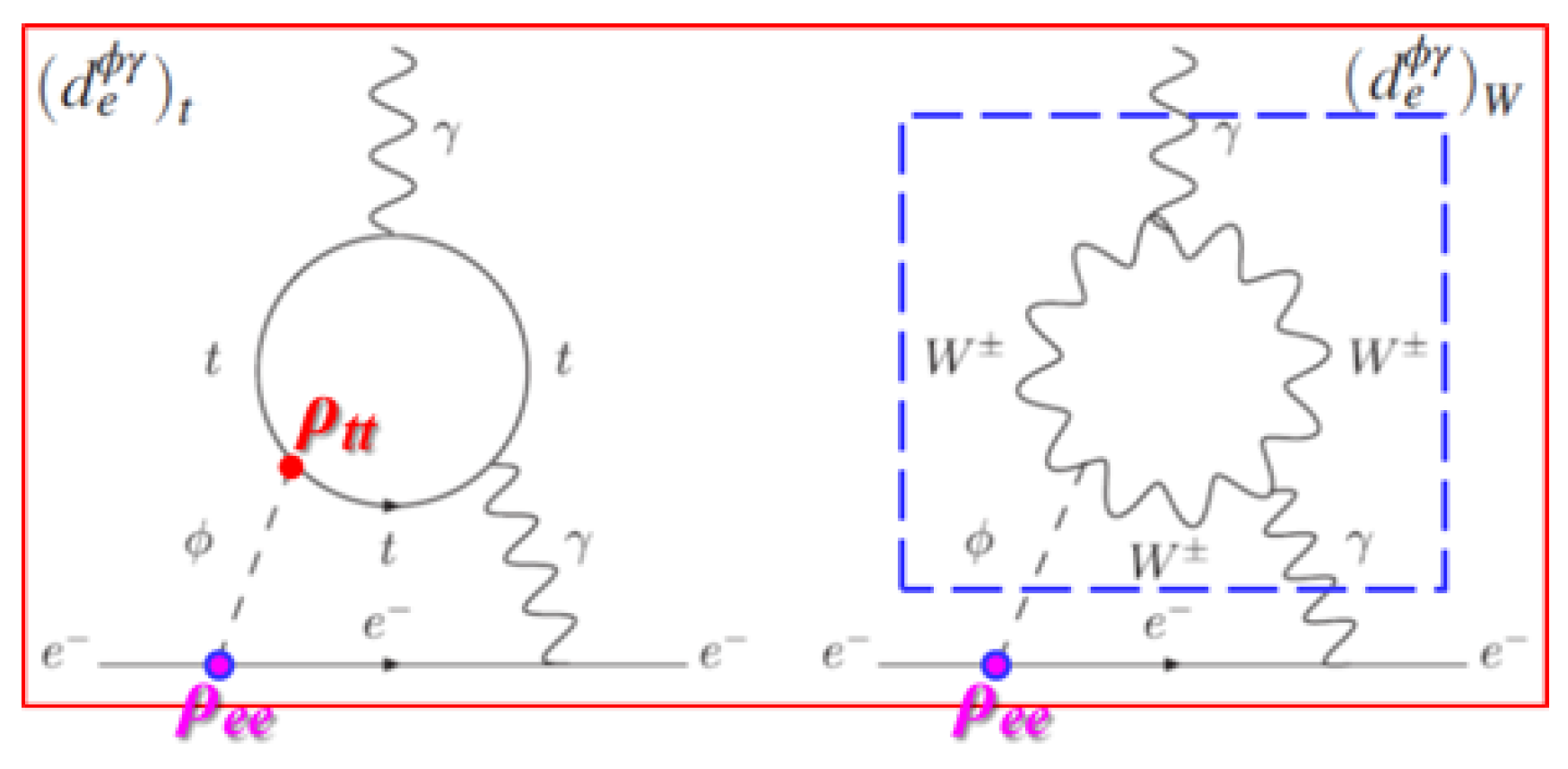
Keeping the of the charged lepton extra Yukawa matrix , Merit-2 of G2HDM is a spectacular diagrammatic cancellation [32] of two-loop Barr–Zee diagrams for eEDM, as illustrated in Figure 1. This is rather impressive, resulting in
where a “phase lock” [32] of is a prerequisite for Equation (4). As we argue later, we may have unraveled “the flavor code”: did Nature set up the observed charged fermion mass and mixing hierarchies—the flavor enigma itself—to ensure this cancellation!?
Figure 1.
Two-loop Barr–Zee diagrams for eEDM, where the top loop and the W loop naturally tend to cancel, effectively a -- insertion, where runs over h, H, A, and even .
Merit-3 of G2HDM addresses the Natural Flavor Conservation (NFC) condition of Glashow and Weinberg [33]. The alert reader should have perceived that, when theorists—even Nobel laureates—blow the “Natural” trumpet, it ain’t natural. Glashow had the legitimate worry of flavor changing neutral couplings; e.g., can induce [34] (Ref. [34] pointed out that would be naturally controlled by mass and mixing hierarchies observed in SM fermions.) But let us stress that, having discovered being lighter than the top, it is ”a PDG duty” [35] for us to search. Curiously, decay remains elusive to date, though both ATLAS and CMS have searched for it quite extensively. Noticing that h is rather close to the SM-Higgs, Nature threw in alignment (i.e., small h-H mixing, , where H is the CP-even scalar from the exotic doublet), an emergent phenomenon from circa 2015–2016. Who would have thought!? After all, is a purely Higgs sector parameter that has nothing to do with flavor! Alignment also alleviates any and constraints, as bounds are rather poor.
Merit-4 of G2HDM is that a small does not [24] contradict quartics, and that
since with a small . In fact, one can turn the argument around [24] to show that exotic scalars H, A, and populate 300–600 GeV. However, quartics imply Landau pole behavior, which can only be properly studied on the lattice (see below).
With suppressed by alignment (small ), Merit-5 of G2HDM is that it is more natural to pursue [36]
which is not alignment-suppressed, but controlled by . It was subsequently found that a better process to probe would be [37]
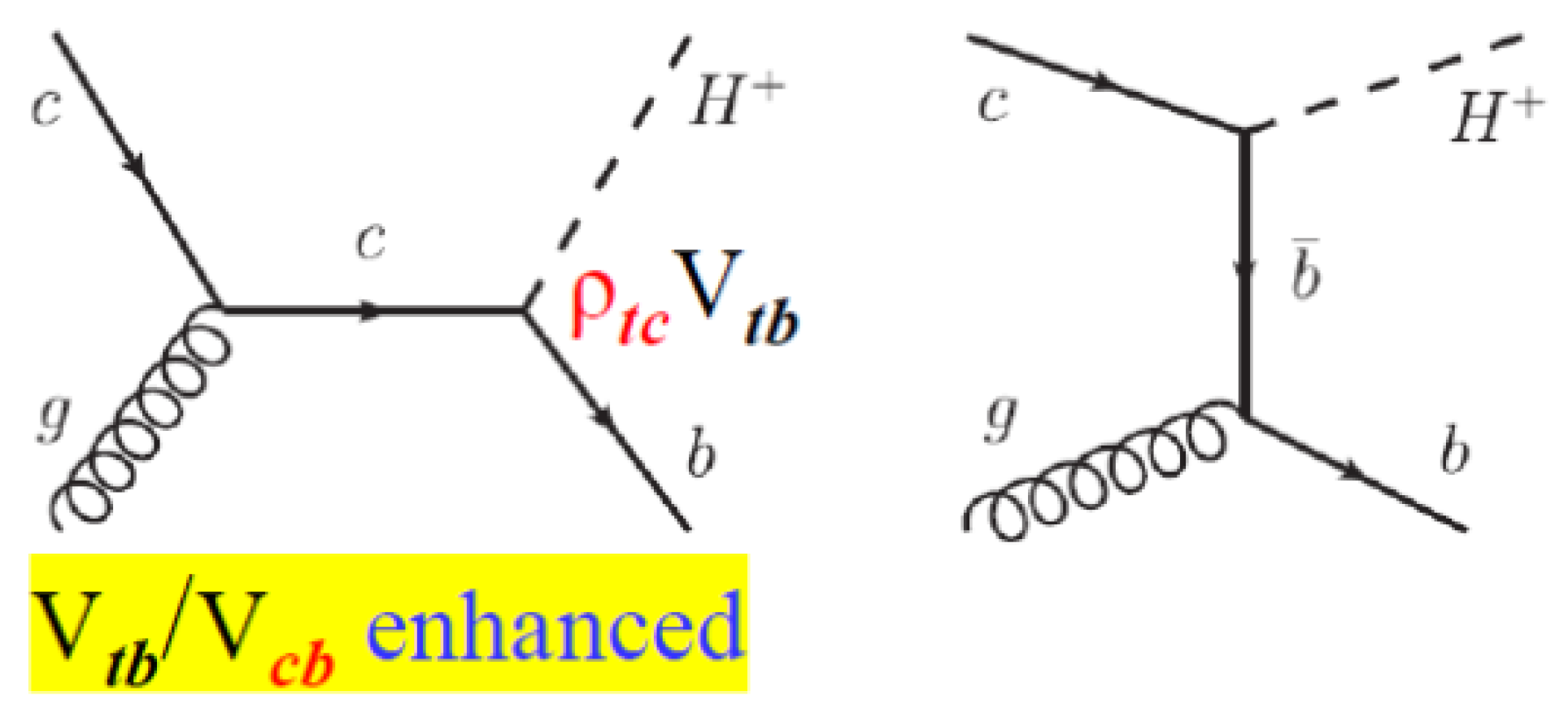
Not only would the associated b-jet be less costly compared with an associated t in Equation (6), but it turns out to be CKM-enhanced compared with 2HDM-II, the SUSY-type 2HDM.
3. Decadal Mission of the New Higgs/Flavor Era
We are happy to report that both ATLAS and CMS have completed their search for of Equation (6), with both search results published, in JHEP [38] and PLB [39], respectively. Though the CMS effort already commenced in February 2020, it started with just one experienced researcher and a graduate student. We therefore express our sincere gratitude for the timely approval of a 5-year Academic Summit Project by the NSTC of Taiwan in August 2021, such that we could build-up sufficient resources in time to complete our CMS search, lagging ATLAS only by several months.
3.1. Academic Summit Project (ASP)
The ASP lends its name to the title of this section, and it has four subprojects:
- CMS: H, A, search @ LHC (since 2020).
- Flavor physics searches:Belle II (; );CMS (; ).
- Lattice: Higgs potential (1stEWPT and Landau pole).
- Steering: Pheno (since 2017).
The ASP provided a timely injection of funds to assemble the CERN-side CMS team especially. We recently passed the Midterm point of ASP execution, and hence, we turn to our “ASP Midterm Report” on search. But let us report some recent Pheno progress: (1) To improve reconstruction in Equation (7), which is hampered by having three b-jets in the final state, making the pairing difficult, we studied instead, where reconstruction is unambiguous [40], while the recoiling c provides both a tag, and as a discriminant to suppress the background; (2) A revisit of eEDM exposed a larger parameter range, indicating eEDM might be discovered soon, and possibly followed by neutron EDM (nEDM) in a decade or two [41]; (3) The work was further extended to direct CPV difference in vs [42] for further study via Belle II.
3.2. ASP Midterm Report: Search
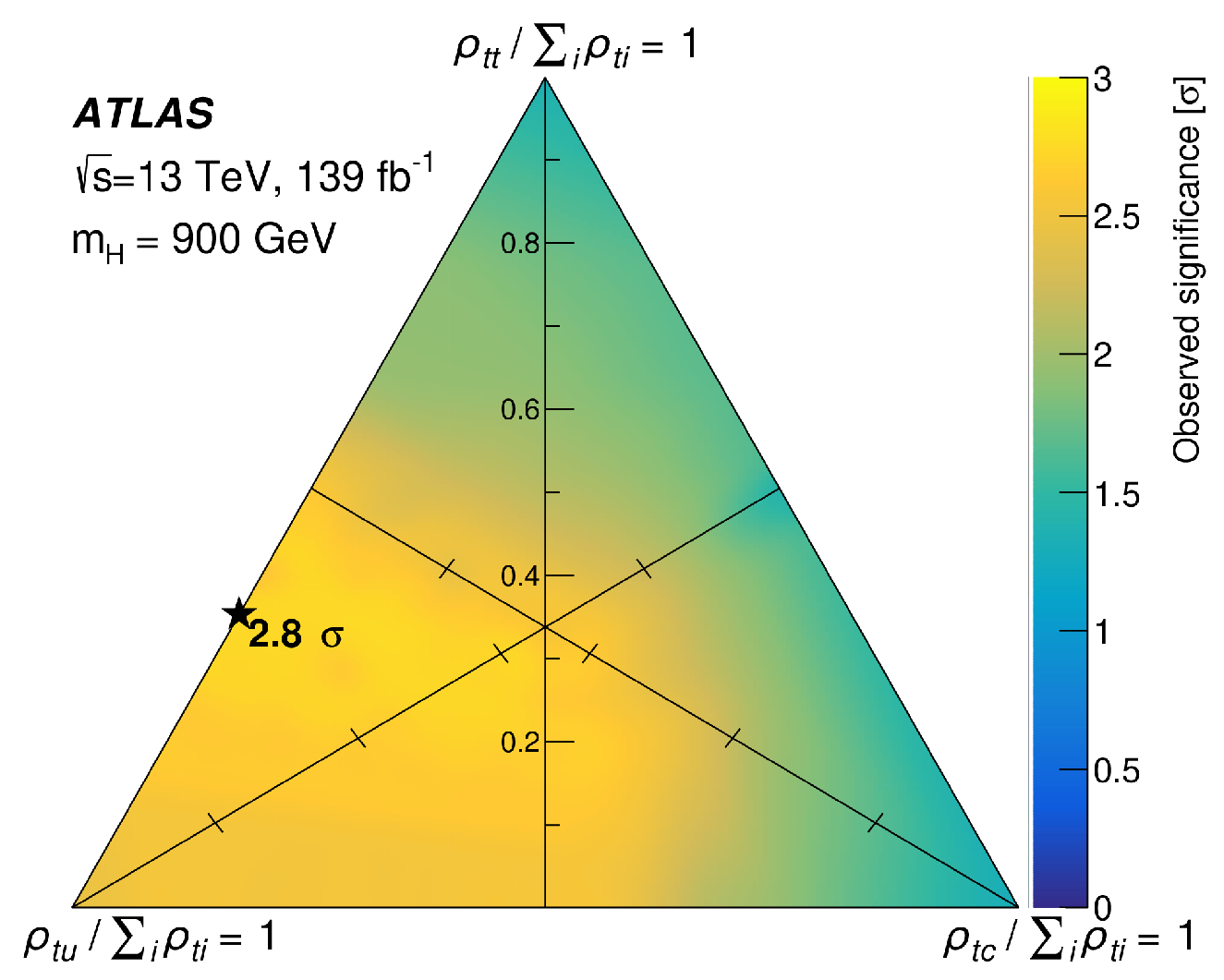
As stated in Section 2, with alignment-suppressed, it is natural to pursue , which is controlled by . We will not go into the details of the ATLAS paper, as we were not involved, but we show their Figure 10 in Figure 2 below, where the star indicates the highest observed significance of 2.8 at GeV. See Ref. [38] for further details.
Figure 2.
Figure 10 as taken from ATLAS paper [38].
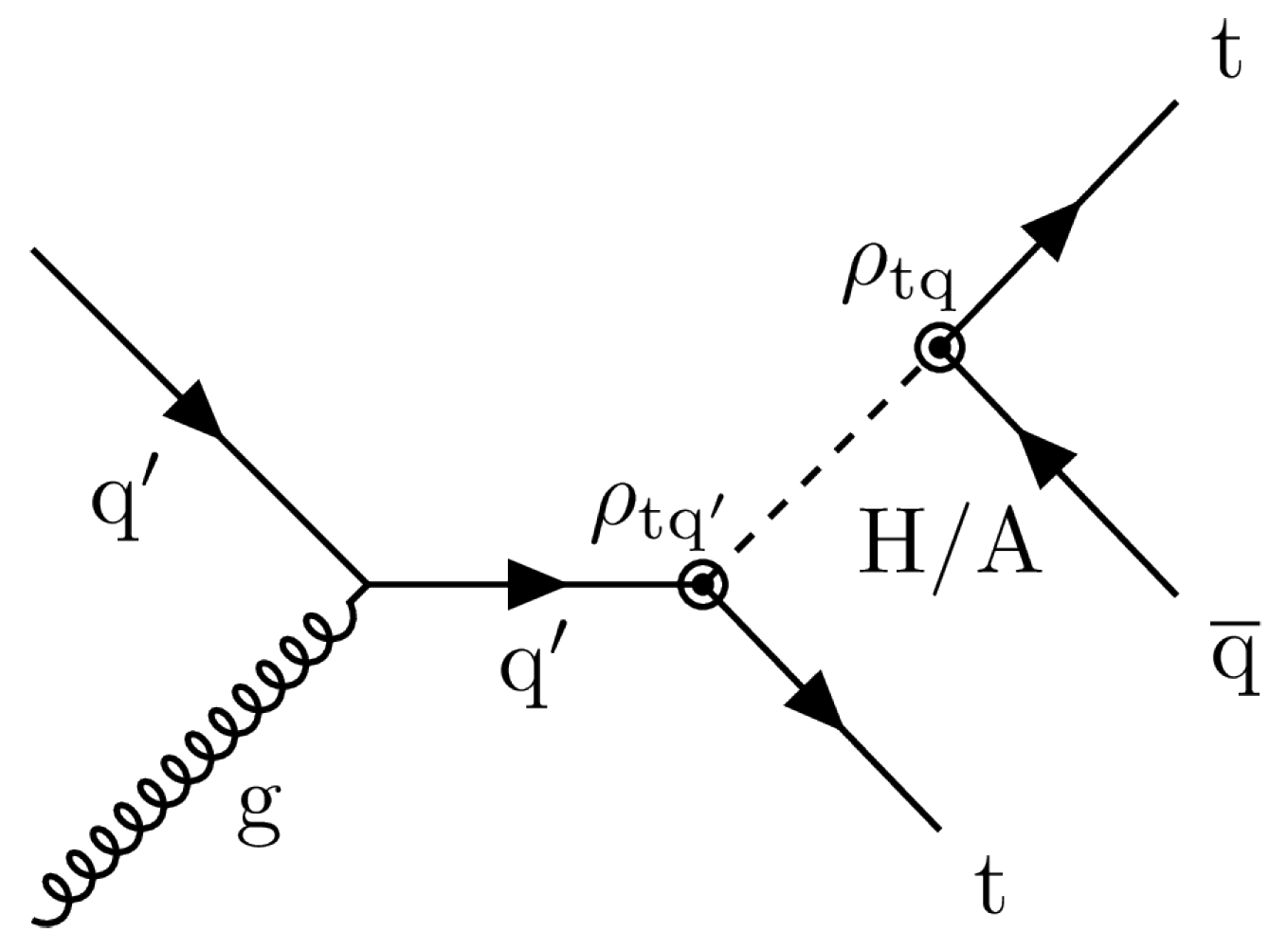
A representative diagram for , taken from Figure 1 of the CMS paper [39], is given in Figure 3 below, where is assumed. The same-sign top pair leads to same-sign di-leptons, and the additional jet serves as a further discriminant.
Figure 3.
Figure 1 as taken from CMS paper [39]. Note that is also possible.
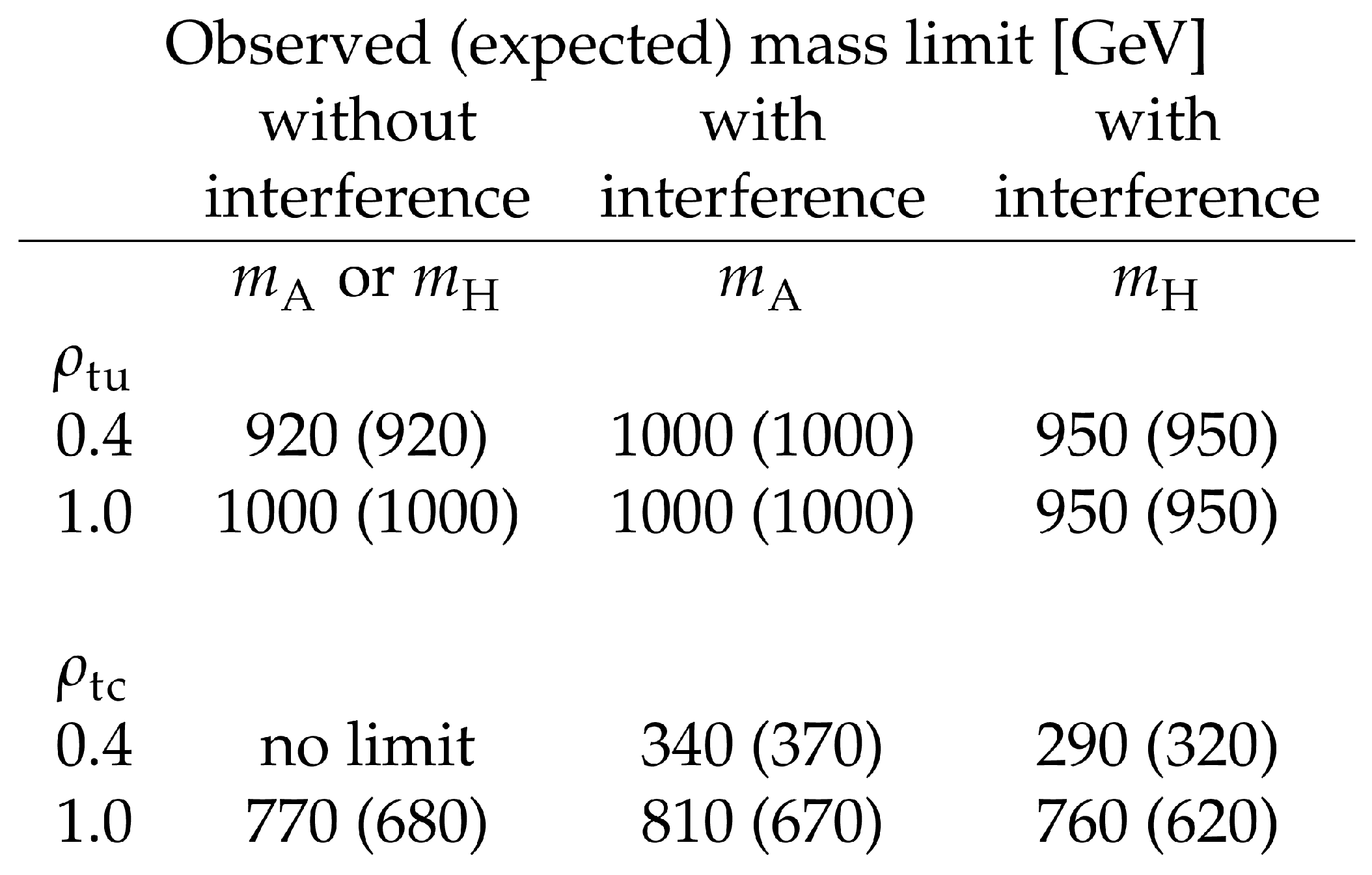
For the CMS study, we again do not give details, but show some results. Let us begin with Table 3 of the published paper, which we display in Figure 4. The CMS study takes into account H–A interference [36]: since A couples to with an i, it can hence be destructive against H if the two are nearby. The results in Table 3 of CMS (our Figure 4) can be verified by inspection of Figures 4 and 5 of the published CMS paper [39], which we do not display.
Figure 4.
Table 3 as taken from CMS paper [39].
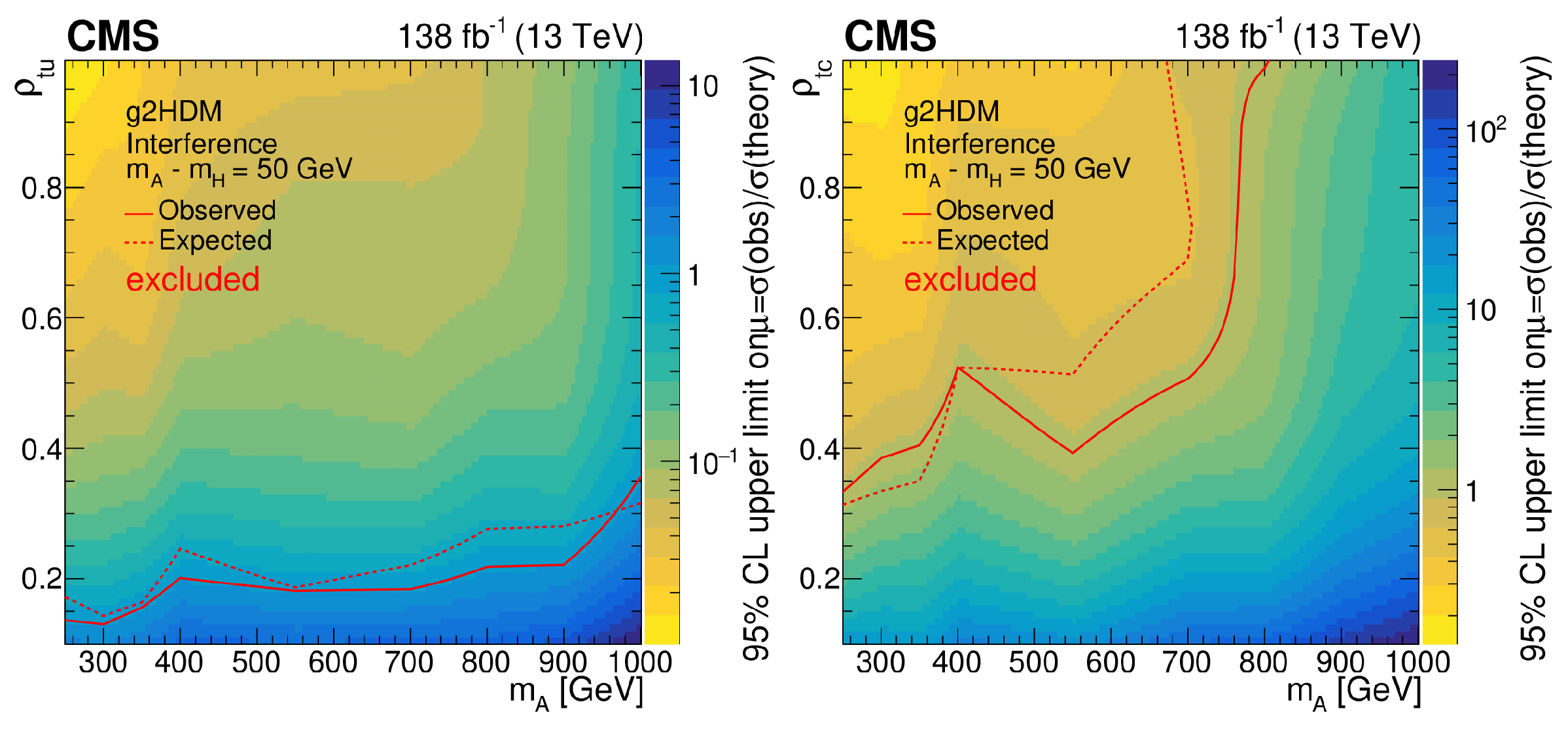
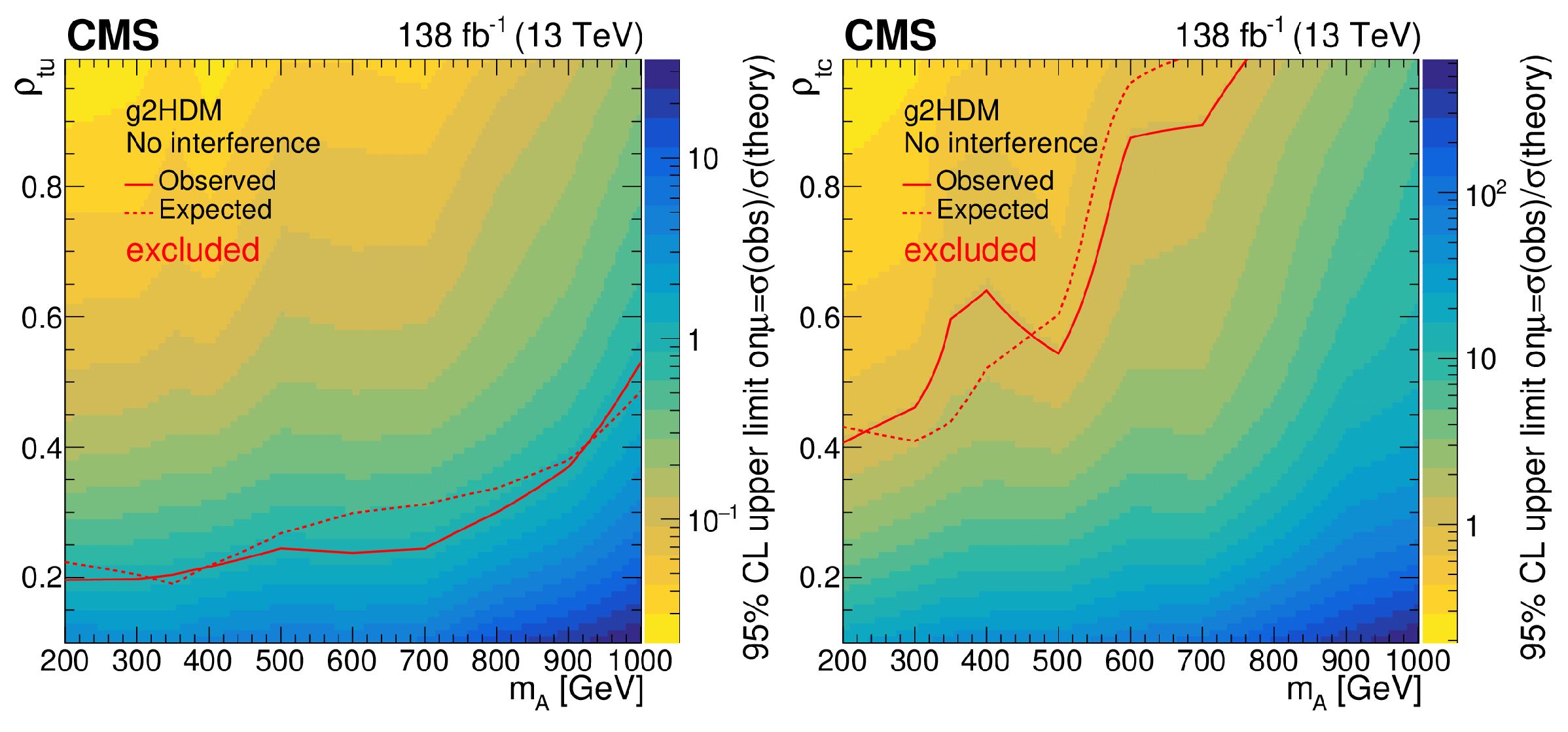
The main result of the CMS paper is given in Figure 5 and Figure 6 below, which correspond to Figures 6 and 7 of the CMS paper [39]. One can see that the constraint on is considerably more stringent than on , and more so for the A–H interference case.
Figure 5.
Observed 95% CL upper limit on signal strength vs and (left) and (right) for G2HDM without A–H interference, for the combination of , , and categories. The color axis represents the observed upper limit on the signal strength. Expected (dashed) and observed (solid) exclusion contours are also shown (taken from Figure 6 of Ref. [39]).
To conclude this section, we note that neither ATLAS [38] nor CMS [39] has seen any evidence of a signal so far, but that may not be too surprising.
4. Post-Midterm: and @ CMS
As discussed in Section 2, the process of Equation (7) is more promising than the process of Equation (6). Not only is the cross section several times larger [37] due to the CKM enhancement (as illustrated in Figure 7 below), but having an accompanying b-jet also means one can probe a broader, more reasonable range, rather than suffering the higher threshold by an accompanying t quark in Equation (6).
Figure 7.
The enhancement of process w.r.t. 2HDM-II. decay receives the same CKM factor multiplying [37].
However, aside from moving on to search, the ASP group is also considering (see caption of Figure 4), or a triple-top search simultaneously, which was not touched upon in our previous search [39].
Furthermore, since Run 3 is now progressing well, as the amount of data accumulated is beyond twice that of Run 2, the ASP group would like to repeat the search, as well as the search. The former is alignment-suppressed, but we do not know , the h-H mixing angle, while with the search with double (or triple) Run 2 data, one could possibly see a hint. Thus, all four modes have a “discovery” prospect. The process could plainly “emerge” at any time.
We trust that the ATLAS team would do the same, for healthy competition.
5. G2HDM as Next NP!?
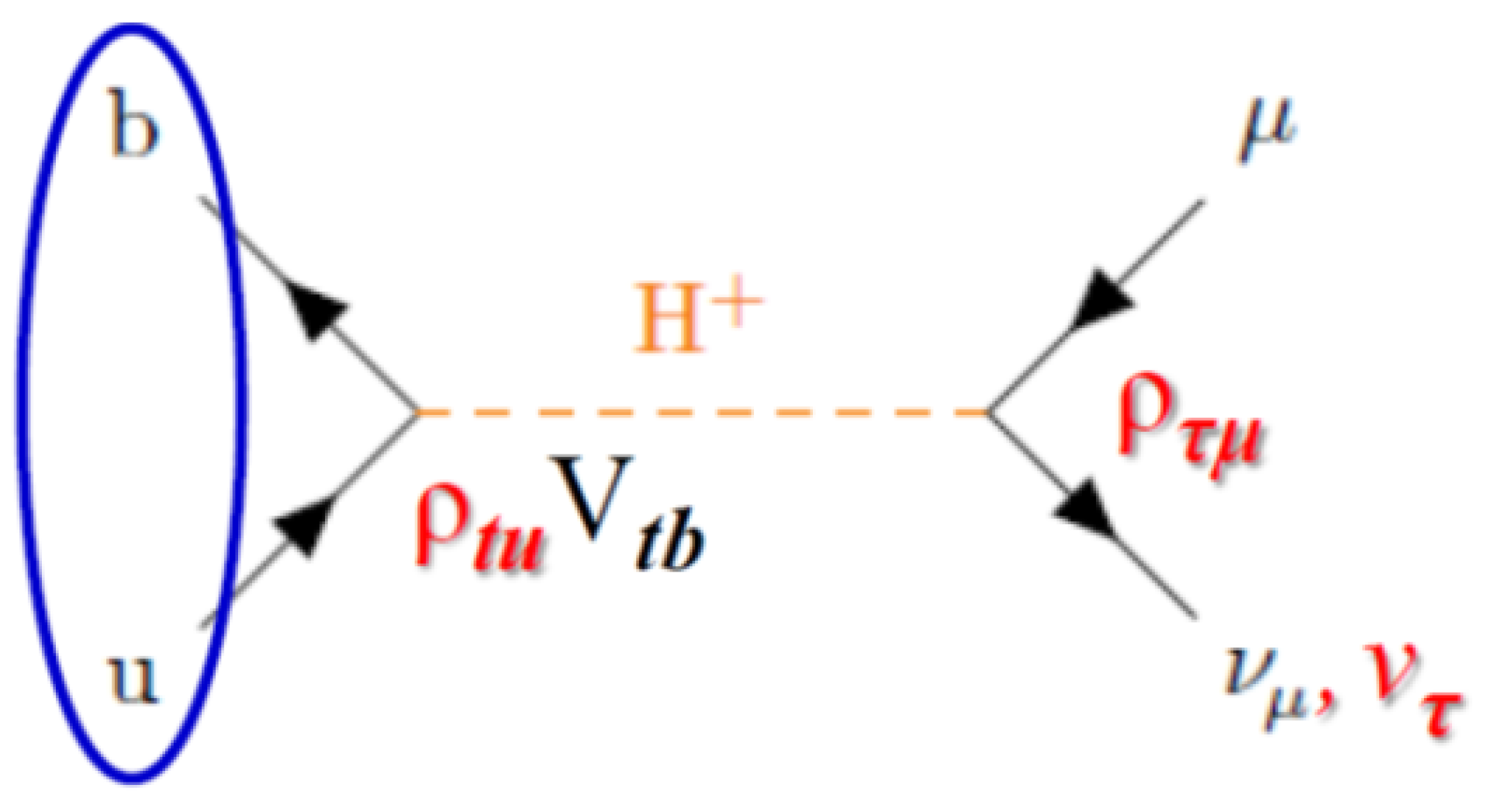
Now, we point out that the “magic” of the couplings in G2HDM for the process of Equation (7), i.e., CKM enhancement of , was first noticed [43] through the study of flavor physics, namely , as illustrated in Figure 8 below.
Figure 8.
decay, where the extra Yukawa coupling enters the process.
Here, the quark annihilates the u quark and the meson disappears into the purely leptonic plus a neutrino. Since the flavor of the latter cannot be detected, the escaping neutrino could be a , bringing in the extra Yukawa coupling for charged leptons [43]. One notices that the annihilation receives an astounding enhancement factor compared with 2HDM-II, as one would need to proceed for the latter; the process uniquely probes the extra Yukawa coupling product . The SM value for would be 0.0045, from kinematic factors of and , but 2HDM-II would give the same value [44]! Thus, a measurement of this ratio could not only facilitate the discovery of BSM physics, but also rule out 2HDM-II, which is realized with SUSY!
That in G2HDM could differ from SM (and even 2HDM-II) was first pointed out in an experimental FPCP review [45].
The measurement of the ratio, however, is quite nontrivial. The numerator is not yet measured at the evidence level [35], which would be dominated by statistical errors for some time to come. However, there is no well-defined methodology for measuring (though it appears consistent with SM), which would be dominated by not so well-defined systematic errors until a more definite method emerged.
To perform this important ratio measurement at Belle-II, a definite new method for with better systematic control is called for.
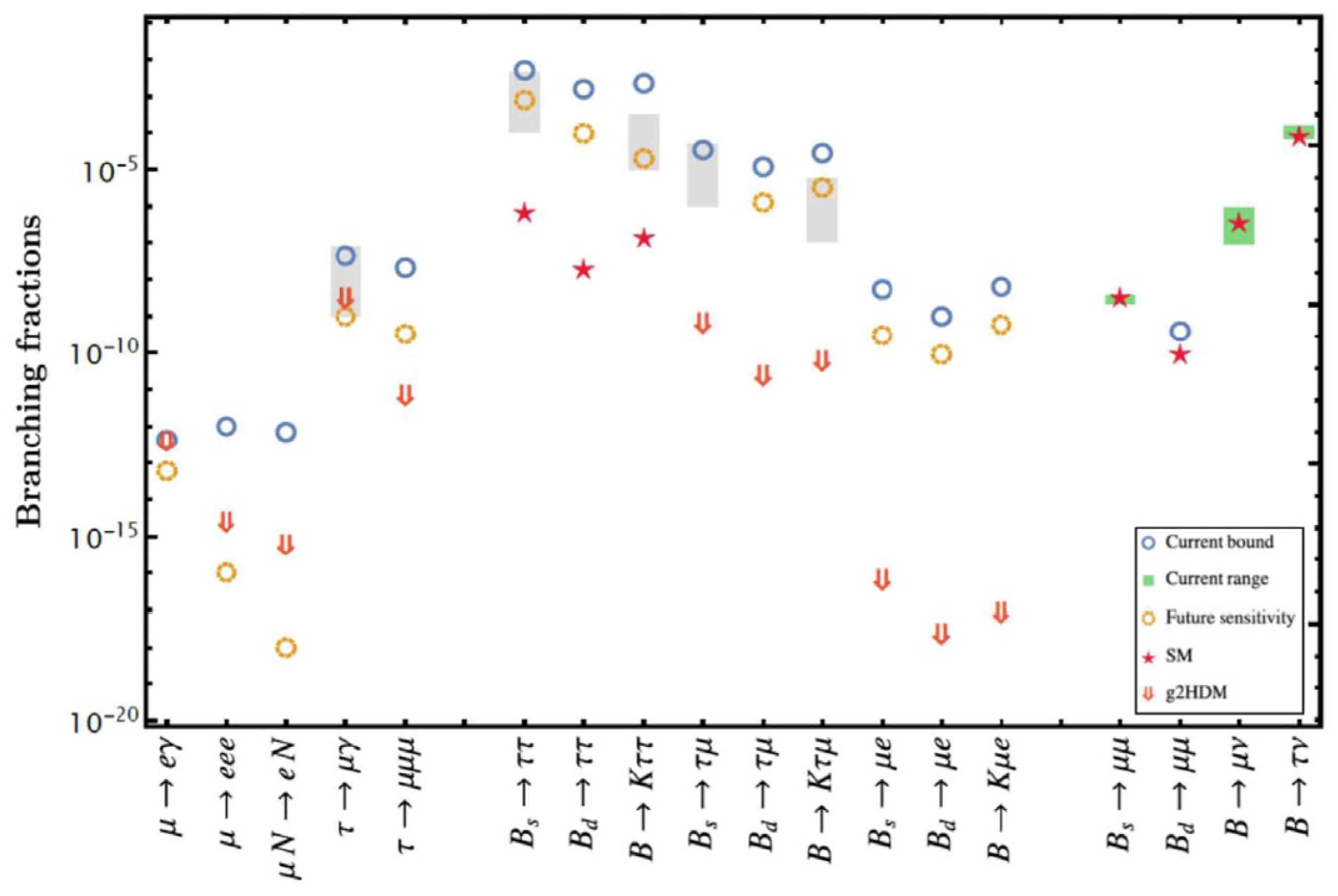
From the prelude, we present a rather rich and pictorial “flavor-table” in Figure 9, where we display the expected flavor effects in G2HDM to guide the eye.
Perhaps the most visible are the “five gray boxes". These reflect the , , , decays that were hotly pursued by LHCb, aiming for discovery, and pursued by Belle and Belle II. Though these signatures are rather interesting in their own right, the backdrop was the various B-anomalies of the 2010s (a warning against the B-anomalies from an experimental perspective was sounded in Ref. [46]), that suffered from the December 2022 LHCb confession [47] that the and “anomalies” that dominated the flavor scene were in fact driven by hadrons faking electrons (hence driving up the numerator)—quite a known effect! With the disappearance of the and “anomalies”, these modes are of less concern, though we stress again that they are certainly interesting in their own right and ought to be pursued.
Figure 9.
A picture table of the new flavor era of G2HDM in the coming decades [48]. The five gray boxes are remnants of B-anomalies, which evaporated with disappearance of and “anomalies” [47]. Blue circles are the experimental limits as of 8/2020, while orange circles are projected limits. The downward red arrow depicts the G2HDM expectation according to the “Rule of Thumb” of Equation (8) below, which explains why G2HDM effects are well-hidden when lighter generations are involved. The red stars reflect SM expectations, and the green boxes are SM-G2HDM interference ranges.
Figure 9.
A picture table of the new flavor era of G2HDM in the coming decades [48]. The five gray boxes are remnants of B-anomalies, which evaporated with disappearance of and “anomalies” [47]. Blue circles are the experimental limits as of 8/2020, while orange circles are projected limits. The downward red arrow depicts the G2HDM expectation according to the “Rule of Thumb” of Equation (8) below, which explains why G2HDM effects are well-hidden when lighter generations are involved. The red stars reflect SM expectations, and the green boxes are SM-G2HDM interference ranges.

But now, we can draw our eye to the G2HDM perspective, the 2HDM without .
First, the , , and processes at the lower left are of great interest. The first process is currently pursued by MEG II, which just published the 90% CL bound of [49]. Combining with the final result of MEG [50] gives [49]. The process still has discovery potential in G2HDM through two-loop diagrams that are not so different from the eEDM diagrams of Figure 1, i.e., changing the initial electron to a muon. All three processes have dedicated experiments, with the eventual reach of particularly impressive, and augmented further by healthy competition between KEK and Fermilab. The red arrows depicted in Figure 9 are relatively far away from current sensitivity. This is because G2HDM predicts the vertex to be dipole-dominant, which can be tested by Mu3e by measuring the relatively co-linear pairs, while for PRISM/Mu2e experiments, more thought and study would be needed. Likewise, G2HDM also predicts to be dipole-dominant, hence the “late” discovery of if at all, while lies beyond reach for Belle II.
Next, and occur in SM, but are beyond the projected sensitivity. Likewise, decays also occur in G2HDM, but our “Rule of Thumb” for flavor control,
gives the position of red arrows in Figure 9, and illustrates why G2HDM, while rich in extra dynamics, is so far quite well hidden, as is visible from the greatly suppressed and decays: flavor protection of Equation (8), our “Rule of Thumb”. This “Rule of Thumb” is supported by the miraculous eEDM cancellation mechanism of Figure 1.
Finally, we draw our attention to the remaining four “red stars”, the processes and the aforementioned , which can all occur within SM. After hinting at sub-SM strength between CMS and LHCb for some while [35], the measurement of by CMS [51], which turned out to be consistent with SM, served as a prelude to the evaporation [47] of the “B-anomalies” by LHCb. But remains unmeasured. As previously discussed, is expected in SM, as well as in 2HDM-II [44], and offers a very interesting test of G2HDM. We note that the illustrated range for is quite wide due to SM-G2HDM interference, inasmuch as the current value is consistent with SM. The measurement of this ratio would be a major target for Belle II.
6. Discussion and Conclusions
We have followed an unconventionally conventional “Road Not Taken”, as G2HDM has not gained much traction so far! But we wish to emphasize that it may very well end up being our Next New Physics (NNP)! The definite observation of one Higgs doublet should make the 2HDM a no-brainer, while G2HDM has no added ad hoc assumptions, such as NFC. We have seen the plethora of modes open for search in Figure 9, as well as H, A, direct search modes of Equations (6) and (7).
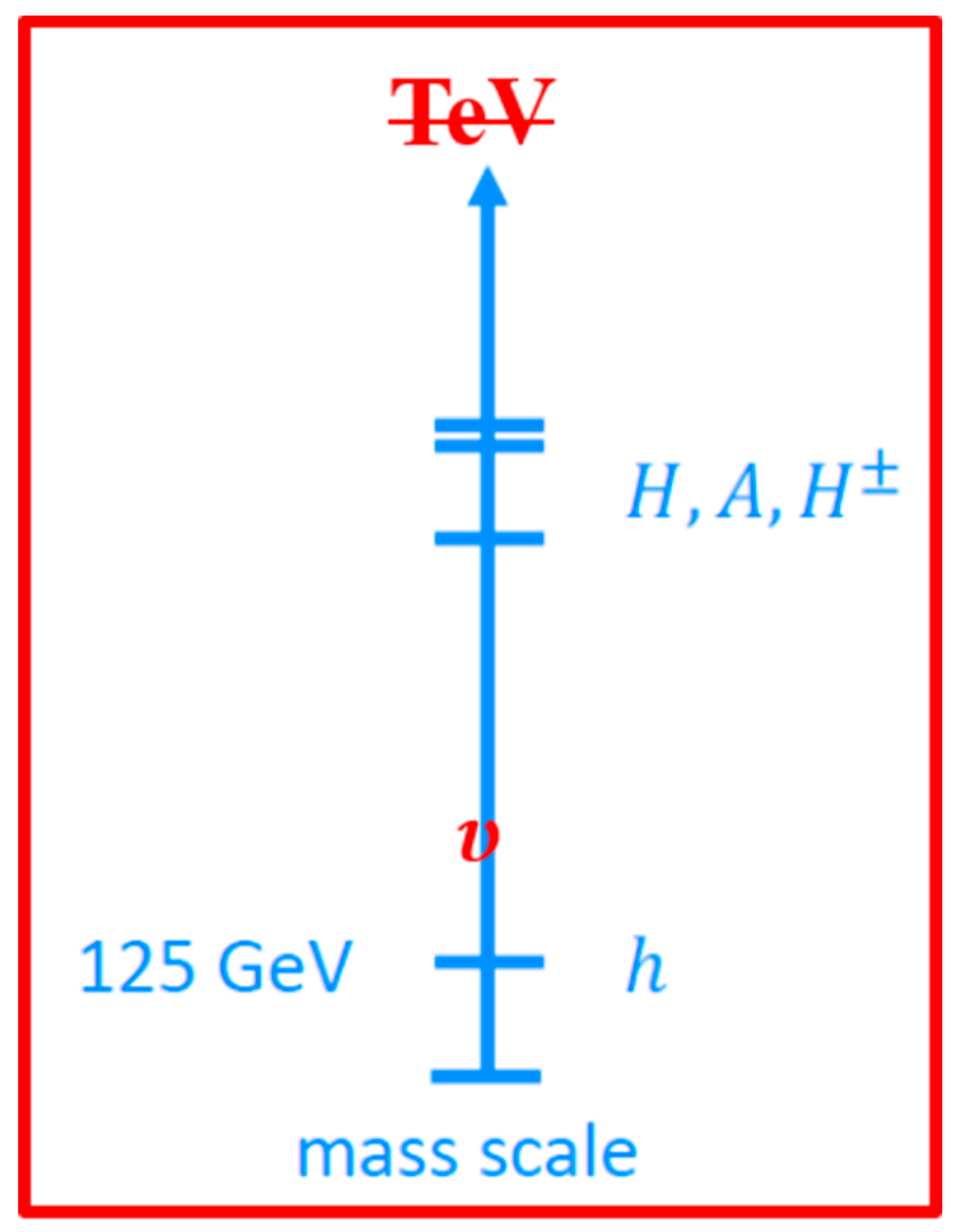
It was with Merit-4 of G2HDM, having an extra doublet but with extra Yukawa couplings, that we emphasized that the exotic Higgs bosons from would likely [24] populate 300–600 GeV, as depicted in Figure 10. This is based on Higgs quartics s being in strength, i.e., in the naive naturalness sense of , which could [28] give the 1stEWPT. This is why we brought in the lattice arm to the ASP, since one cannot trust perturbation theory any more. With 7 quartic couplings, one can easily run into the Landau pole problem, making the lattice simulation quite challenging. The Landau pole could be at 10 to 20 TeV [24]. If we find a hint for this at the LHC, it may in turn guarantee, or justify, the FCC and CEPC/SppC developments! It could well be that we got the SUSY scale wrong, and we get another shot at SUSY at a much higher scale.
Figure 10.
Illustration of the “Road Not Taken”: sub-TeV H, A, and exotic Higgs bosons.
As such, there may be a lot of work ahead for particle physicists.
We therefore conclude with our Decadal Mission:
As for the Flavor Code, we wonder whether the eEDM cancellation point, , implies that the extra and matrices seem to know the observed mass and mixing hierarchies of the SM sector already. Does this reflect the “flavor design” of Nature?
It is up to Nature whether our “Wish for Discovery” is granted, or not.
Funding
This research was funded by the NSTC 112-2639-M-002-006-ASP of Taiwan, and NTU 113L86001 and 113L891801.
Data Availability Statement
Data is contained within the article.
Conflicts of Interest
The author declares no conflicts of interest.
Abbreviations
The following abbreviations are used in this manuscript:
| G2HDM | General Two-Higgs Doublet Model |
| ASP | Academic Summit Project |
| NSTC | National Science and Technology Council (Taiwan) |
| LHC | Large Hadron Collider |
| No New Physics, or No New Particles | |
| CKM | Cabibbo–Kobayashi–Maskawa |
| NNP | Next New Physics |
| SM | Standard Model |
| BSM | Beyond SM |
| ALP | Axion-like particles |
| LLP | Long-lived particles |
| DM | Dark Matter |
| EFT | Effective Field Theory |
| CP | Charge–Parity |
| EWBG | Electroweak baryogenesis |
| 1stEWPT | First-order electroweak phase transition |
| BAU | Baryon asymmetry of the universe |
| eEDM | Electron electric dipole moment |
| CPV | CP violation |
| NFC | Natural Flavor Conservation |
| PDG | Particle Data Group |
| SUSY | Supersymmetry |
| nEDM | Neutron electric dipole moment |
| FPCP | Flavor physics and CP violation |
| PRD-L | Physical Review D Letter |
| FCC | Future Circular Collider |
| CEPC | Circular Electron–Positron Collider |
| SppC | Super proton–proton Collider |
References
- Aad, G.; Abbott, B.; Abbott, D.C.; Abed Abud, A.; Abeling, K.; Abhayasinghe, D.K.; Abidi, S.H.; Abramowicz, H.; Abreu, H.; Abulaiti, Y.; et al. Observation of a new particle in the search for the Standard Model Higgs boson with the ATLAS detector at the LHC. Phys. Lett. B 2012, 716, 1–29. [Google Scholar]
- Chatrchyan, S.; Khachatryan, V.; Sirunyan, A.M.; Tumasyan, A.; Adam, W.; Aguilo, E.; Bergauer, T.; Dragicevic, M.; Erö, J.; Fabjan, C.; et al. Observation of a New Boson at a Mass of 125 GeV with the CMS Experiment at the LHC. Phys. Lett. B 2012, 716, 30–61. [Google Scholar] [CrossRef]
- Cho, A. Physicists’ nightmare scenario: The Higgs and nothing else. Science 2007, 315, 1657. [Google Scholar] [CrossRef] [PubMed]
- Cho, A. The triumph and tragedy of the Higgs boson. Science 2022, 376, 1253. [Google Scholar] [CrossRef] [PubMed]
- Han, T.; Li, T.; Wang, X. Axion-Like Particles at High Energy Muon Colliders—A White paper for Snowmass 2021. arXiv 2021, arXiv:2203.05484. [Google Scholar]
- Knapen, S.; Lowette, S. A Guide to Hunting Long-Lived Particles at the LHC. Ann. Rev. Nucl. Part. Sci. 2023, 73, 421. [Google Scholar] [CrossRef]
- Berger, J.; Brailsford, D.; Choi, K.; Crespo-Anadón, J.I.; Cui, Y.; Das, A.; Dror, J.A.; Habig, A.; Itow, Y.; Kearns, E. Snowmass 2021 White Paper: Cosmogenic Dark Matter and Exotic Particle Searches in Neutrino Experiments. arXiv 2022, arXiv:2207.02882. [Google Scholar]
- Brito, R.; Chakrabarti, S.; Clesse, S.; Dvorkin, C.; Garcia-Bellido, J.; Meyers, J.; Ng, K.K.Y.; Miller, A.L.; Shandera, S.; Sun, L. Snowmass 2021 Cosmic Frontier White Paper: Probing dark matter with small-scale astrophysical observations. arXiv 2022, arXiv:2203.15954. [Google Scholar]
- Bird, S.; Albert, A.; Dawson, W.; Ali-Haimoud, Y.; Coogan, A.; Drlica-Wagner, A.; Feng, Q.; Inman, D.; Inomata, K.; Kovetz, E. Snowmass 2021 Cosmic Frontier White Paper: Primordial black hole dark matter. Phys. Dark Univ. 2023, 41, 101231. [Google Scholar] [CrossRef]
- Baumgart, M.; Bishara, F.; Brod, J.; Cohen, T.; Fitzpatrick, A.L.; Gorbahn, M.; Moldanazarova, U.; Reece, M.; Rodd, N.L.; Solon, M.P. Snowmass White Paper: Effective Field Theories for Dark Matter Phenomenology. arXiv 2022, arXiv:2203.08204. [Google Scholar]
- Leane, R.K.; Shin, S.; Yang, L.; Adhikari, G.; Alhazmi, H.; Aramaki, T.; Baxter, D.; Calore, F.; Caputo, R.; Cholis, I. Snowmass 2021 Cosmic Frontier White Paper: Puzzling Excesses in Dark Matter Searches and How to Resolve Them. arXiv 2022, arXiv:2203.06859. [Google Scholar]
- Banerjee, A.; Boddy, K.K.; Cyr-Racine, F.Y.; Erickcek, A.L.; Gilman, D.; Gluscevic, V.; Kim, S.; Lehmann, B.V.; Mao, Y.Y.; Mocz, P. Snowmass2021 Cosmic Frontier White Paper: Cosmological Simulations for Dark Matter Physics. arXiv 2022, arXiv:2203.07049. [Google Scholar]
- Bechtol, K.; Birrer, S.; Cyr-Racine, F.Y.; Schutz, K.; Adhikari, S.; Amin, M.; Banerjee, A.; Bird, S.; Blinov, N.; Boddy, K.K. Snowmass2021 Cosmic Frontier White Paper: Dark Matter Physics from Halo Measurements. arXiv 2022, arXiv:2203.07354. [Google Scholar]
- Han, T.; Liu, Z.; Wang, L.T.; Wang, X. WIMP Dark Matter at High Energy Muon Colliders—A White Paper for Snowmass 2021. arXiv 2021, arXiv:2203.07351. [Google Scholar]
- Mitridate, A.; Trickle, T.; Zhang, Z.; Zurek, K.M. Snowmass white paper: Light dark matter direct detection at the interface with condensed matter physics. Phys. Dark Univ. 2023, 40, 101221. [Google Scholar] [CrossRef]
- Valluri, M.; Chabanier, S.; Irsic, V.; Armengaud, E.; Walther, M.; Rockosi, C.; Sanchez-Conde, M.A.; Silva, L.B.; Cooper, A.P.; Darragh-Ford, E. Snowmass2021 Cosmic Frontier White Paper: Prospects for obtaining Dark Matter Constraints with DESI. arXiv 2022, arXiv:2203.07491. [Google Scholar]
- Baxter, D.; Bunker, R.; Shaw, S.; Westerdale, S.; Arnquist, I.; Akerib, D.S.; Calkins, R.; Cebrián, S.; Dent, J.B.; di Vacri, M.L. Snowmass2021 Cosmic Frontier White Paper: Calibrations and backgrounds for dark matter direct detection. arXiv 2022, arXiv:2203.07623. [Google Scholar]
- Carney, D.; Raj, N.; Bai, Y.; Berger, J.; Blanco, C.; Bramante, J.; Cappiello, C.; Dutra, M.; Ebadi, R.; Engel, K. Snowmass2021 cosmic frontier white paper: Ultraheavy particle dark matter. SciPost Phys. Core 2023, 6, 075. [Google Scholar] [CrossRef]
- Boddy, K.K.; Lisanti, M.; McDermott, S.D.; Rodd, N.L.; Weniger, C.; Ali-Haïmoud, Y.; Buschmann, M.; Cholis, I.; Croon, D.; Erickcek, A.L. Snowmass2021 theory frontier white paper: Astrophysical and cosmological probes of dark matter. JHEAp 2022, 35, 112. [Google Scholar] [CrossRef]
- Chakrabarti, S.; Drlica-Wagner, A.; Li, T.S.; Sehgal, N.; Simon, J.D.; Birrer, S.; Brown, D.A.; Bernstein, R.; Bolatto, A.D.; Chang, P. Snowmass2021 Cosmic Frontier White Paper: Observational Facilities to Study Dark Matter. arXiv 2022, arXiv:2203.06200. [Google Scholar]
- Argüelles, C.A.; Aurisano, A.J.; Batell, B.; Berger, J.; Bishai, M.; Boschi, T.; Byrnes, N.; Chatterjee, A.; Chodos, A.; Coan, T. New opportunities at the next-generation neutrino experiments I: BSM neutrino physics and dark matter. Rept. Prog. Phys. 2020, 83, 124201. [Google Scholar] [CrossRef] [PubMed]
- Baumgart, M.; Bishara, F.; Brauner, T.; Brod, J.; Cabass, G.; Cohen, T.; Craig, N.; de Rham, C.; Draper, P.; Gorbahn, M. Snowmass Theory Frontier: Effective Field Theory. arXiv 2021, arXiv:2210.03199. [Google Scholar]
- Hou, W.-S. Decadal Mission for the New Physics Higgs/Flavor Era. Chin. J. Phys. 2022, 77, 432. [Google Scholar] [CrossRef]
- Hou, W.-S.; Kikuchi, M. Approximate Alignment in Two Higgs Doublet Model with Extra Yukawa Couplings. EPL 2018, 123, 11001. [Google Scholar] [CrossRef]
- Davidson, S.; Haber, H.E. Basis-independent methods for the two-Higgs-doublet model. Phys. Rev. D 2005, 72, 035004. [Google Scholar] [CrossRef]
- Hou, W.-S.; Modak, T. Prospects for tZH and tZh production at the LHC. Phys. Rev. D 2020, 101, 035007. [Google Scholar] [CrossRef]
- Fuyuto, K.; Hou, W.-S.; Senaha, E. Electroweak baryogenesis driven by extra top Yukawa couplings. Phys. Lett. B 2018, 776, 402. [Google Scholar] [CrossRef]
- Kanemura, S.; Okada, Y.; Senaha, E. Electroweak baryogenesis and quantum corrections to the triple Higgs boson coupling. Phys. Lett. B 2005, 606, 361. [Google Scholar] [CrossRef]
- Sakharov, A.D. Violation of CP Invariance, C asymmetry, and baryon asymmetry of the universe. Pisma Zh. Eksp. Teor. Fiz. 1967, 5, 32. [Google Scholar]
- Andreev, V.; Ang, D.G.; DeMille, D.; Doyle, J.M.; Gabrielse, G.; Haefner, J.; Hutzler, N.R.; Lasner, Z.; Meisenhelder, C.; O’Leary, B.R.; et al. Improved limit on the electric dipole moment of the electron. Nature 2018, 562, 355. [Google Scholar]
- Roussy, T.S.; Caldwell, L.; Wright, T.; Cairncross, W.B.; Shagam, Y.; Ng, K.B.; Schlossberger, N.; Park, S.Y.; Wang, A.; Ye, J.; et al. An improved bound on the electron’s electric dipole moment. Science 2023, 381, adg4084. [Google Scholar] [CrossRef]
- Fuyuto, K.; Hou, W.-S.; Senaha, E. Cancellation mechanism for the electron electric dipole moment connected with the baryon asymmetry of the Universe. Phys. Rev. D 2020, 101, 011901(R). [Google Scholar] [CrossRef]
- Glashow, S.L.; Weinberg, S. Natural Conservation Laws for Neutral Currents. Phys. Rev. D 1977, 15, 1958. [Google Scholar] [CrossRef]
- Hou, W.-S. Tree level t —> c h or h —> t anti-c decays. Phys. Lett. B 1992, 296, 179. [Google Scholar] [CrossRef]
- Null, N.; Workman, N.; Burkert, R.L.; Crede, V.D.; Klempt, V.; Thoma, U.; Tiator, L.; Agashe, K.; Aielli, G.; Particle Data Group; et al. Review of Particle Physics. Prog. Theor. Exp. Phys. 2022, 2022, 083C01. [Google Scholar] [CrossRef]
- Kohda, M.; Modak, T.; Hou, W.-S. Searching for new scalar bosons via triple-top signature in cg→tS0→. Phys. Lett. B 2018, 776, 379. [Google Scholar] [CrossRef]
- Ghosh, D.K.; Hou, W.-S.; Modak, T. Sub-TeV H+ Boson Production as Probe of Extra Top Yukawa Couplings. Phys. Rev. Lett. 2020, 125, 221801. [Google Scholar] [CrossRef]
- Aad, G.; Abbott, B.; Abeling, K.; Abicht, N.J.; Abidi, S.H.; Aboulhorma, A.; Abramowicz, H.; Abreu, H.; Abulaiti, Y.; ATLAS Collaboration; et al. Search for heavy Higgs bosons with flavour-violating couplings in multi-lepton plus b-jets final states in pp collisions at 13 TeV with the ATLAS detector. J. High Energy Phys. 2023, 2023, 81. [Google Scholar]
- Hayrapetyan, A.; Tumasyan, A.; Adam, W.; Andrejkovic, J.W.; Bergauer, T.; Chatterjee, S.; Wang, Z.; Darwish, M.R.; Janssen, T.; Mechelen, P.V.; et al. Search for new Higgs bosons via same-sign top quark pair production in association with a jet in proton-proton collisions at s = 13 TeV. Phys. Lett. B 2024, 850, 138478. [Google Scholar]
- Hou, W.-S.; Krab, M. Reconstructing the G2HDM Charged Higgs Boson at the LHC. arXiv 2024, arXiv:2405.19190. [Google Scholar]
- Hou, W.-S.; Kumar, G.; Teunissen, S. Discovery prospects for electron and neutron electric dipole moments in the general two Higgs doublet model. Phys. Rev. D 2024, 109, L011703. [Google Scholar] [CrossRef]
- Hou, W.-S.; Kumar, G.; Modak, T. Probing baryogenesis with radiative beauty decay and electron electric dipole moment. Phys. Rev. D 2024, 109, L011701. [Google Scholar] [CrossRef]
- Hou, W.-S.; Kohda, M.; Modak, T.; Wong, G.-G. Enhanced B→μν¯ decay at tree level as probe of extra Yukawa couplings. Phys. Lett. B 2020, 800, 135105. [Google Scholar] [CrossRef]
- Hou, W.-S. Enhanced charged Higgs boson effects in B —> tau anti-neutrino, mu anti-neutrino and b —> tau anti-neutrino + X. Phys. Rev. D 1993, 48, 2342. [Google Scholar] [CrossRef] [PubMed]
- Chang, P.; Chen, K.-F.; Hou, W.-S. Flavor Physics and CP Violation. Prog. Part. Nucl. Phys. 2017, 97, 261. [Google Scholar] [CrossRef]
- Hou, G.W.-S. Perspectives and Outlook from HEP Window on the Universe. Int. J. Mod. Phys. A 2019, 34, 1930002. [Google Scholar] [CrossRef]
- Aaij, R.; Abdelmotteleb, A.S.W.; Abellan Beteta, C.; Abudinén, F.; Ackernley, T.; Adeva, B.; Casse, G.; Adlarson, P.; Afsharnia, H.; Agapopoulou, C.; et al. Measurement of lepton universality parameters in B+→K+ℓ+ℓ− and B0→K*0ℓ+ℓ− decays. Phys. Rev. D 2023, 108, 032002. [Google Scholar] [CrossRef]
- Hou, W.-S.; Kumar, G. Muon Flavor Violation in Two Higgs Doublet Model with Extra Yukawa Couplings. Phys. Rev. D 2020, 102, 115017. [Google Scholar] [CrossRef]
- Afanaciev, K.; Baldini, A.M.; Ban, S.; Baranov, V.; Benmansour, H.; Biasotti, M.; Boca, G.; Cattaneo, P.W.; Cavoto, G.; Cei, F.; et al. A search for μ+→e+γ with the first dataset of the MEG II experiment. Eur. Phys. J. C 2024, 84, 216. [Google Scholar] [CrossRef]
- Baldini, A.M.; Bao, Y.; Baracchini, E.; Bemporad, C.; Berg, F.; Biasotti, M.; Boca, G.; Cascella, M.; Cattaneo, P.W.; Cavoto, G.; et al. Search for the lepton flavour violating decay μ+→e+γ with the full dataset of the MEG experiment. Eur. Phys. J. C 2016, 76, 434. [Google Scholar] [CrossRef]
- Tumasyan, A.; Adam, W.; Andrejkovic, J.W.; Bergauer, T.; Chatterjee, S.; Damanakis, K.; Dragicevic, M.; Valle, A.E.D.; Hussain, P.S.; CMS Collaboration; et al. Measurement of the BS0→μ+μ− decay properties and search for the B0→μ+μ− decay in proton-proton collisions at s = 13 TeV. Phys. Lett. B 2023, 842, 137955. [Google Scholar]
Disclaimer/Publisher’s Note: The statements, opinions and data contained in all publications are solely those of the individual author(s) and contributor(s) and not of MDPI and/or the editor(s). MDPI and/or the editor(s) disclaim responsibility for any injury to people or property resulting from any ideas, methods, instructions or products referred to in the content. |
© 2024 by the author. Licensee MDPI, Basel, Switzerland. This article is an open access article distributed under the terms and conditions of the Creative Commons Attribution (CC BY) license (https://creativecommons.org/licenses/by/4.0/).