Abstract
In this work, we study the oscillatory features of a class of neutral differential equations with multiple delays. We present novel oscillation conditions for this equation by using a comparison method. We create conditions that exclude the positive solution of the examined equation. Using the feature of symmetry between non-oscillatory solutions (positive and negative), these conditions also exclude negative solutions without adding additional restrictions. In our study, we take into account the even and odd cases of the order of the equation. Furthermore, we study the asymptotic properties in three different cases of functional coefficients. Our results are a fundamental extension and generalization of previous relevant findings, and this fact has been demonstrated through comparisons.
MSC:
34C10; 34K11
1. Introduction
Functional differential equations (FDEs), in which the largest derivative is formed in the solution with and without delay, are known as neutral differential equations (NDEs). This type of equation has many applications, especially second-order ones. Second-order neutral equations appear in applications such as issues with lossless transmission lines in electric networks; see [1,2,3,4].
Qualitative theory is of great importance in the applied sciences. Numerous significant details concerning nonlinear mathematical models, including their stability and oscillatory behavior, as well as the examination of their features like symmetry, periodicity, bifurcation, etc., are provided by this theory. The area of qualitative theory known as oscillation theory examines the asymptotic and oscillatory characteristics of differential equation. This theory is distinguished by its diversity of mathematical methods and analytical techniques. Studying the oscillatory features of differential equations helps understand the behavior of the solutions of the examined applied models; see [5,6,7,8]. Most studies in oscillation theory rely on the symmetry feature between non-oscillatory solutions to the oscillation conditions by excluding only positive solutions.
Extensive research has been conducted on the oscillation of solutions to several kinds of FDEs. Monographs [9,10,11] and papers [3,12,13] show interest in this topic.
This study investigates the oscillatory features of solutions to a class of -order NDEs with multiple delays. The practical importance of NDEs and their richness with interesting analytical problems are the main motivations for interest in studying this type of equation. In the remaining part of the introduction, we present the studied equation and the basic hypotheses of the study, and we also review some related previous works. The main results are divided into two sections: preliminary lemmas and oscillation results. In the preliminary lemmas section, we prove some properties of positive solutions to the examined equation. Taking into account the even and odd orders, we offer several new conditions that test the oscillation of the examined equation in the oscillation results section. In the next section—examples and discussions—we apply our criteria to special cases of the considered equation. We also compare our results with some previous related ones to illustrate the importance of the new conditions.
1.1. Higher-Order NDE
This work studies the asymptotic features of solutions to the higher-order NDE
where , n and m are natural numbers, , and . Throughout the investigation, the following presumptions are made:
- (H1)
- and are the quotient of odd natural numbers, , and
- (H2)
- , and for all ,
- (H3)
- , and , where .
1.2. Review of Relevant Literature
In the previous few years, research on finding criteria for testing the oscillatory and asymptotic features of FDEs has been ongoing, see [14,15,16,17]. Among the many published studies on this topic, we present below some related works.
In 1976, Dahiya [18] tested the oscillatory features of a class of even-order delay differential equations (DDEs). He was able to provide conditions that guarantee the oscillation of all bounded solutions. By establishing a criterion that guarantees the oscillation of all solutions, Grace and Lalli [19] tested the oscillation of DDEs using the Riccati technique. Later, Zhang and Ladde [20] extended the results in [19] to equations with a middle term. For half-linear equations, Agarwal et al. [21,22] used Riccati and comparison techniques to verify the oscillation of DDEs. These works were only concerned with the canonical case of delay equations, while studies [23,24,25,26] were interested in extending their results to the noncanonical case.
Studying neutral equations often requires more inequalities and analytical tools than delay equations. In the case where , Zhang et al. [27] developed conditions of an iterative nature to study the oscillation of NDEs in the canonical case. Using the principle of comparison with first-order DDEs, Baculíková et al. [28] and Baculíková and Džurina [29] tested the oscillatory characteristics of NDE when . Meanwhile, Li and Rogovchenko [30] considered the case and presented criteria that improved the results in [28,29] for linear NDEs. Recently, Salah et al. [17] extended the results of [30] to the nonlinear case.
In order to study the oscillation of more general NDEs, Rath et al. [31] considered the NDEs with positive and negative coefficients; Moaaz et al. [32] studied the NDEs with distributed deviating arguments; Zhang et al. [33] were interested in the DDEs with p-Laplacian-like operators; and Liu et al. [34] took into account the damped DDEs. Furthermore, by improving some of the inequalities used in the study, Nabih et al. [35] recently developed criteria that investigate the oscillation of NDEs with several delays.
Conversely, odd-order FDEs have not received the same amount of attention compared to even-order equations. Das [36] used comparison theorems to look at how solutions to a canonical odd-order DDE oscillate and found necessary and sufficient oscillation conditions. For third-order DDEs with a first-order middle term, Agarwal et al. [37] investigated the asymptotic properties by using the comparison method. They established conditions for solutions to oscillate or tend to zero as t . Li and Rogovchenko [38] extended the results in [37] to half-linear odd-order DDEs.
For linear NDEs, Gopalsamy et al. [39] established adequate conditions for every solution to oscillate, which are derived along with some comparison results. Candan [40] studied the oscillatory properties of mixed NDEs with distributed deviating arguments. In the case where , Graef et al. [41] obtained adequate conditions for solutions of a class of third-order NDEs to be either oscillatory or to converge to zero. Muhib et al. [42] studied the asymptotic features of solutions to half-linear NDEs of odd order. For NDEs with several delays, Masood et al. [43] examined the asymptotic properties of solutions.
In the noncanonical case, Chatzarakis et al. [44] studied the oscillatory properties of solutions to a class of third-order NDEs. Recently, Tunc and Sarig [45] studied the oscillation behavior of DDEs with unbounded neutral coefficients.
Remark 1.
The following assumes that every functional inequality that occurs eventually holds, meaning that it is satisfied for every u that is large enough. As usual, and without losing generality, we are restricted to dealing with eventually positive solutions of (1).
2. Preliminary Lemmas
For simplicity, we define the next functions:
and
where is large enough.
Below, we review some lemmas that help us in our study, which were proven in [46] and [47], respectively.
Lemma 1.
Assume that . Then,
Lemma 2.
Assume that . If has eventually one sign for any large u, then there is a such that and an integer with even for , or odd for such that
and
for .
By employing the previous lemma, we can get the following classification of the corresponding function to the positive solutions of the studied equation.
Lemma 3.
Assume that , , and
Then, there is , with and odd, such that
and
for , where is large enough.
Lemma 4.
Assume that z is of degree κ. Then,
eventually, where
Proof.
Assume that z is of degree . Now, if , then
for . Since , we obtain
By repeating this procedure times, we infer that
For , (7) reduces to
Hence, we find
Next, we assume that . Integrating (7) from to u, we see that
Integrating this inequality times from to u, we see that
By completing as in the case , we obtain (5).
The proof is now complete. □
Lemma 5.
3. Oscillation Results
Using a comparison method with first-order DDEs, we provide conditions that assure the oscillation of every solution of the equation under study. We indicate the category of every eventually positive solution of (1) by for convenience.
The following theorems cover different study areas in terms of constraints on functions such as and . Therefore, we need to impose the following conditions:
- (Ha)
- and
- (Hb)
- , , and for
- (Hc)
- , , , and for
3.1. Comparison Theorems (I)
Theorem 1.
Proof.
Suppose, on the contrary, that . Therefore, there is a such that and for . From Lemma 3, we infer that and is of degree (for n even).
We note that is a solution to this inequality. Based on Theorem 1 in [48], we also find that Equation (13) has a positive solution, and this contradicts the assumptions of the theorem.
In the case that , we find—in the same way as before—that Equation (14) has a positive solution, and this is a contradiction.
The proof is now complete. □
Theorem 2.
Proof.
Suppose, on the contrary, that . Therefore, there is a such that and for . From Lemma 3, we infer that and is of degree .
First, we find that the oscillation of the DDEs (13) and (14) leads to the exclusion of the possibility that , as in the proof of Theorem 1.
Consider . Since and , we obtain . If , then we find , for all . Hence,
and so
where . By integrating (1) from u to ∞ we obtain
Using (17), we see that
Integrating again from u to ∞, we obtain
By repeating this procedure times, we conclude that
Integrating this inequality from to ∞, we obtain
which contradicts (16). Thus, , and so z and x converge to zero.
The proof is now complete. □
Corollary 1.
Assume that , (Ha) holds, and
Assume also that (16) is achieved for n odd. Then,
(1) is oscillatory if n even.
every solution of (1) is oscillatory or converges to zero if n odd.
Proof.
3.2. Comparison Theorems (II)
Theorem 3.
Proof.
Suppose, on the contrary, that . Therefore, there is a such that and for . From Lemma 3, we infer that and is of degree (for n even). From Lemma 5, we obtain that (10) holds. Setting , (10) reduces to
Consider . It follows from Lemma 4 that
Consequently, (21) becomes
Now, let
Since , we find
and so
We note that is a positive solution to this inequality. Based on Theorem 1 in [48], we also find that Equation (19) has a positive solution, and this contradicts the assumptions of the theorem.
In the case that , we find—in the same way as before—that Equation (20) has a positive solution, and this is a contradiction.
The proof is now complete. □
Theorem 4.
Proof.
Suppose, on the contrary, that . Therefore, there is a such that and for . From Lemma 3, we infer that and is of degree .
First, we find that the oscillation of the DDEs (19) and (20) leads to the exclusion of the possibility that , as in the proof of Theorem 3.
Consider . As in the proof of Theorem 3, we arrive at (21). Integrating (21) from u to ∞, we obtain
Integrating again from u to ∞, we obtain
By repeating this procedure times, we conclude that
or
Integrating this inequality from to u, we see that
Since z is positive decreasing function, there is a constant such that for . Thus, . Therefore, (25) yields
which contradicts with (24).
The proof is now complete. □
Corollary 3.
Proof.
3.3. Comparison Theorems (III)
Theorem 5.
Proof.
Suppose, on the contrary, that . Therefore, there is a such that and for . From Lemma 3, we infer that and is of degree (for n even).
Consider . As in the proof of Theorem 3, we obtain that (21) and (22) hold. Now, assume that is defined as in (23). Since , we have
which with (22) gives
We note that is a positive solution to this inequality. Based on Theorem 1 in [48], we also find that Equation (28) has a positive solution, and this contradicts the assumptions of the theorem.
In the case that , we find—in the same way as before—that Equation (29) has a positive solution, and this is a contradiction.
The proof is now complete. □
Using the approach followed in the previous sections, we directly get the next results:
Theorem 6.
Corollary 5.
4. Examples and Discussions
In this part, we apply our findings to special cases of the studied equation. We also compare our results with previous relevant results to illustrate their novelty and importance.
Example 1.
Consider the NDE
where and . We see that and for . Assume that .
For n even, we assume that . Applying Corollary 2, we obtain
which ensures the oscillation of Equation (30) if and
On the other hand, Corollary 6 guarantees the oscillation of Equation (30) if
which is achieved when and
For n odd, it is easy to see that (16) is satisfied. Then, for , all solutions of (30) oscillate or tend to zero. For , conditions (24) and (27) reduce, respectively, to
and
Therefore, using Corollary 4, Equation (30) is oscillatory if (33) and (34) hold.
Remark 2.
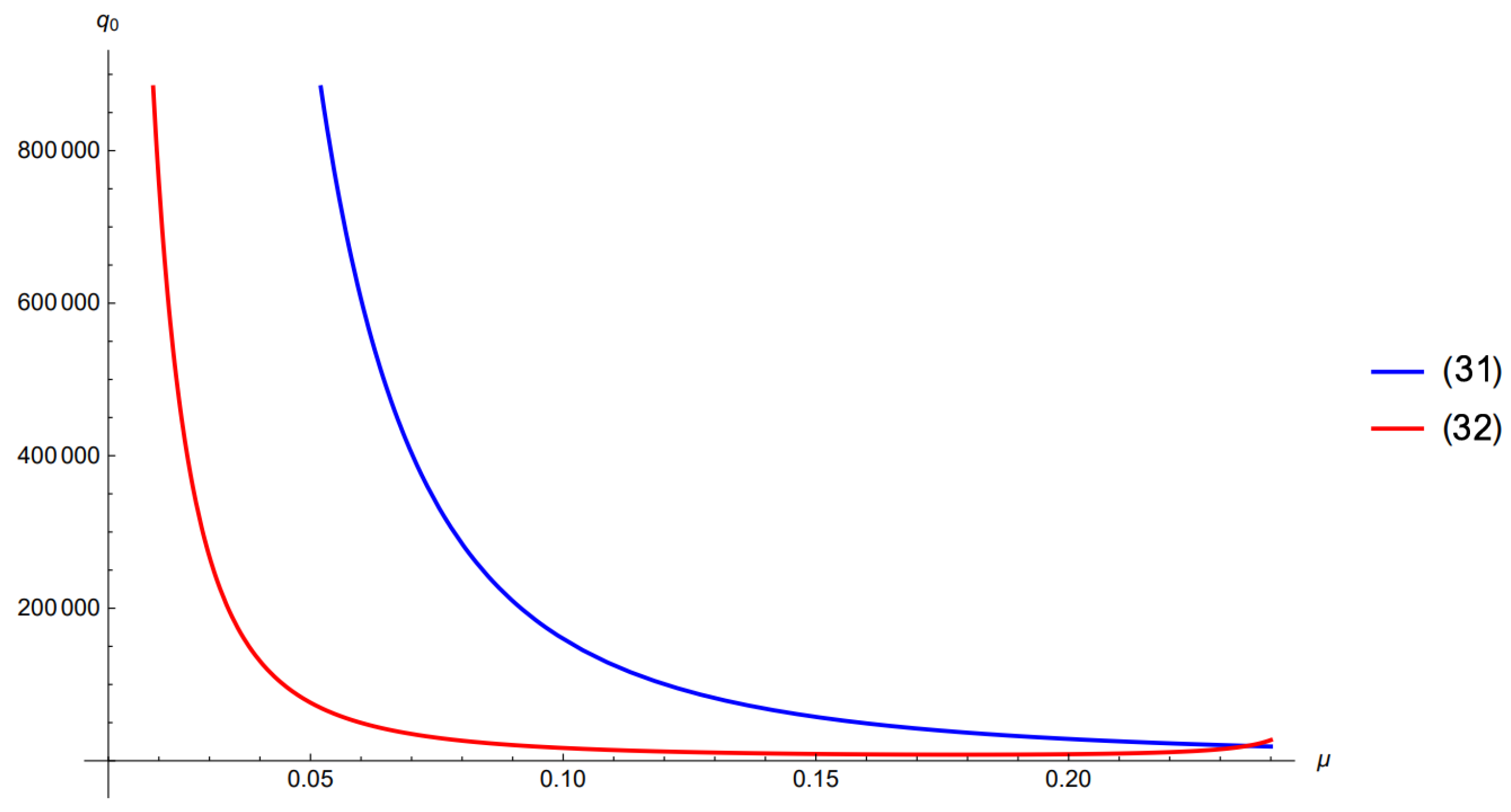
To compare criteria (31) and (32), we consider the following special case of Equation (30):
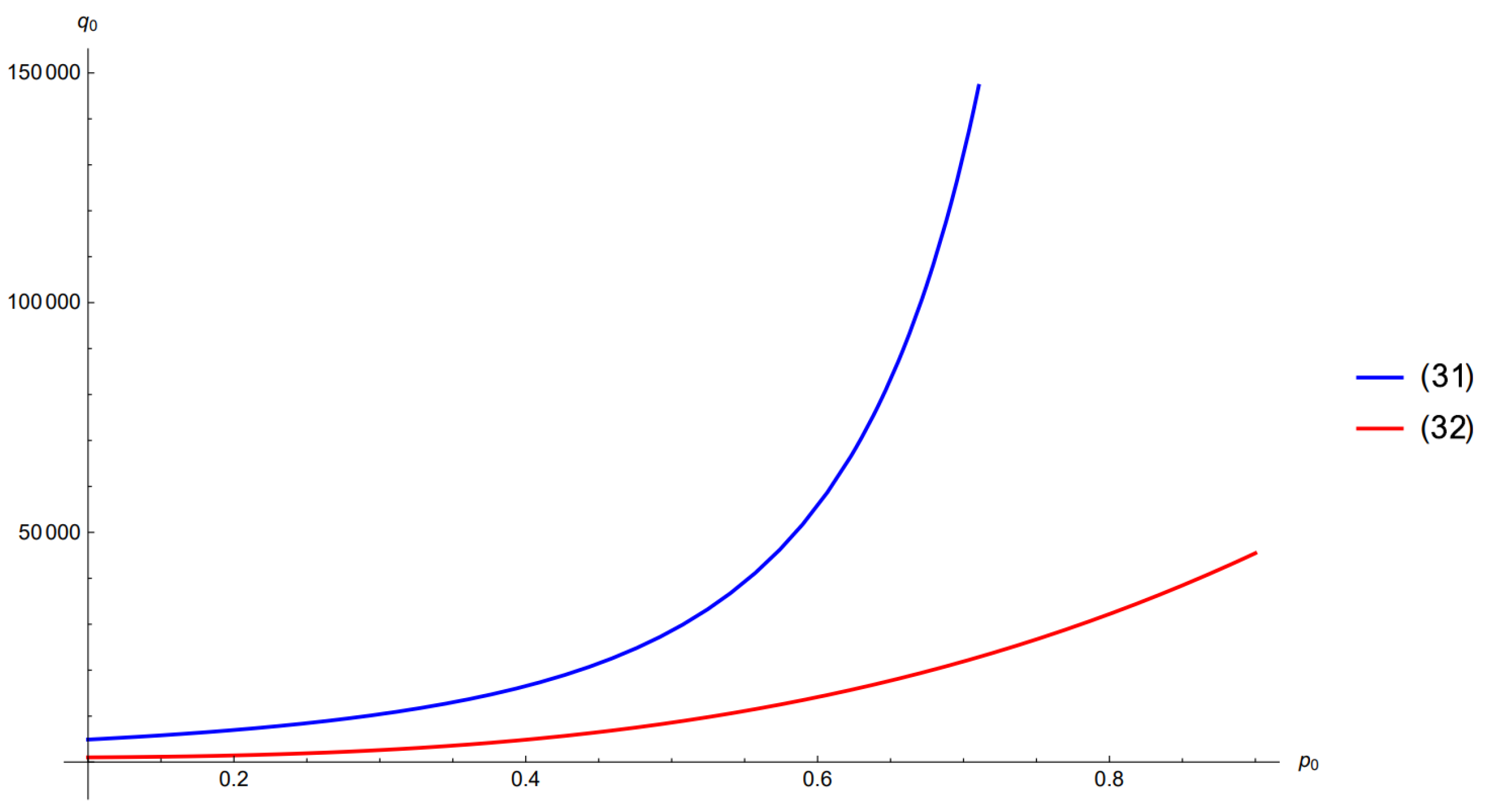
Figure 1 shows the lower bounds of the –values in conditions (31) and (32) when and . Figure 2 shows the lower bounds of the –values in conditions (31) and (32) when . We note that criterion (32) provides better results for the oscillation of Equation (35). We also note that condition (32) takes into account the effect of parameter λ, while condition (31) does not. However, Condition (31) is distinguished in that it does not require the constraint , so it provides criteria in the if case where .
Example 2.
Assume the NDE
where is even, , and . We see that , , , , and .
Remark 3.
Baculikova and Džurina [28], Li and Rogovchenko [30], and Agarwal et al. [50] investigated the oscillatory behavior of solutions of even-order NDEs using different techniques and considered different cases of the functions p and τ.
By applying Corollary 2.1 in [30], Equation (36) is oscillatory if
where and . Using Corollary 1 in [28], Equation (36) oscillates if
where . While Theorem 2.1 in [50] confirms the oscillation of Equation (36) if
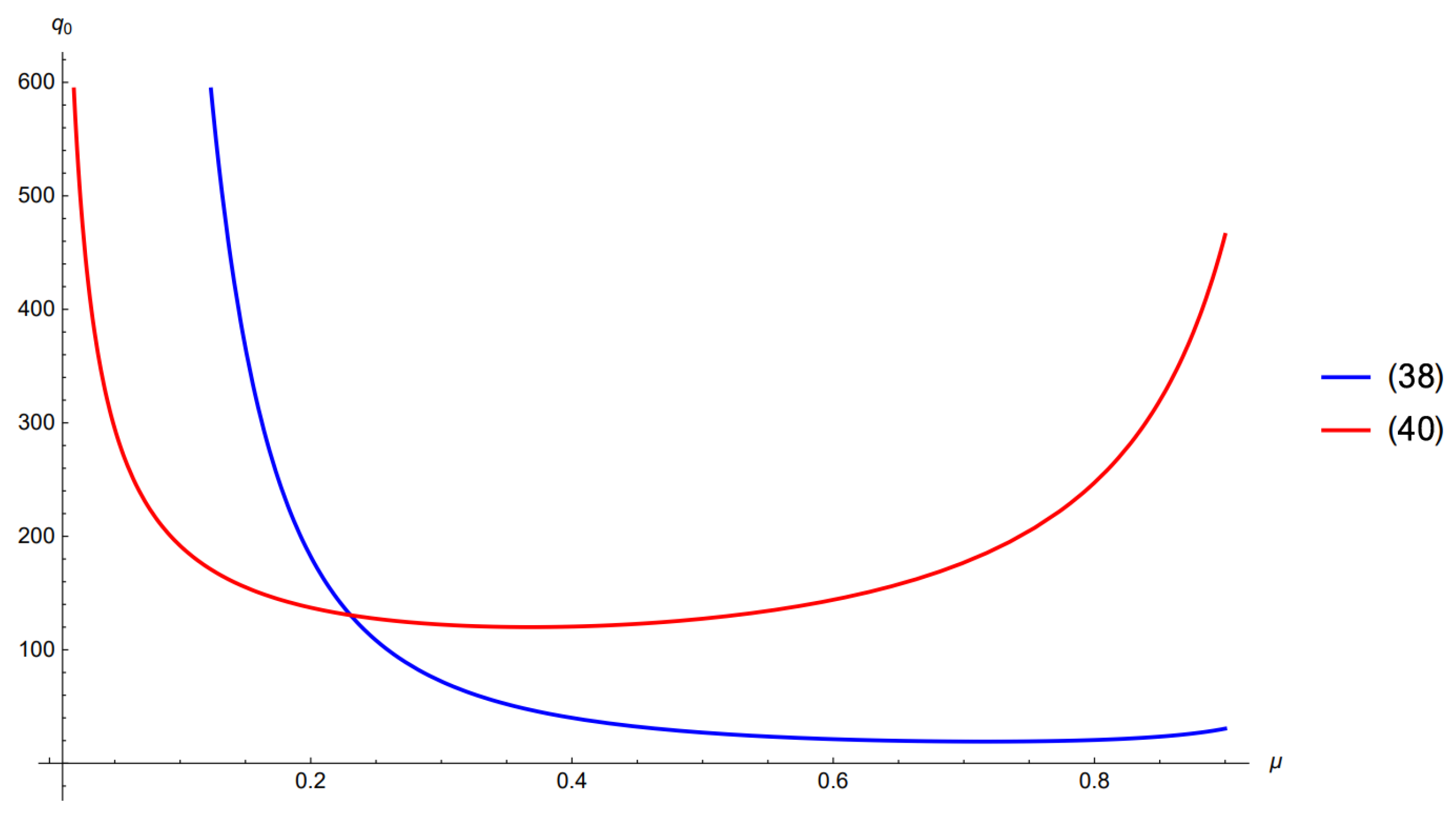
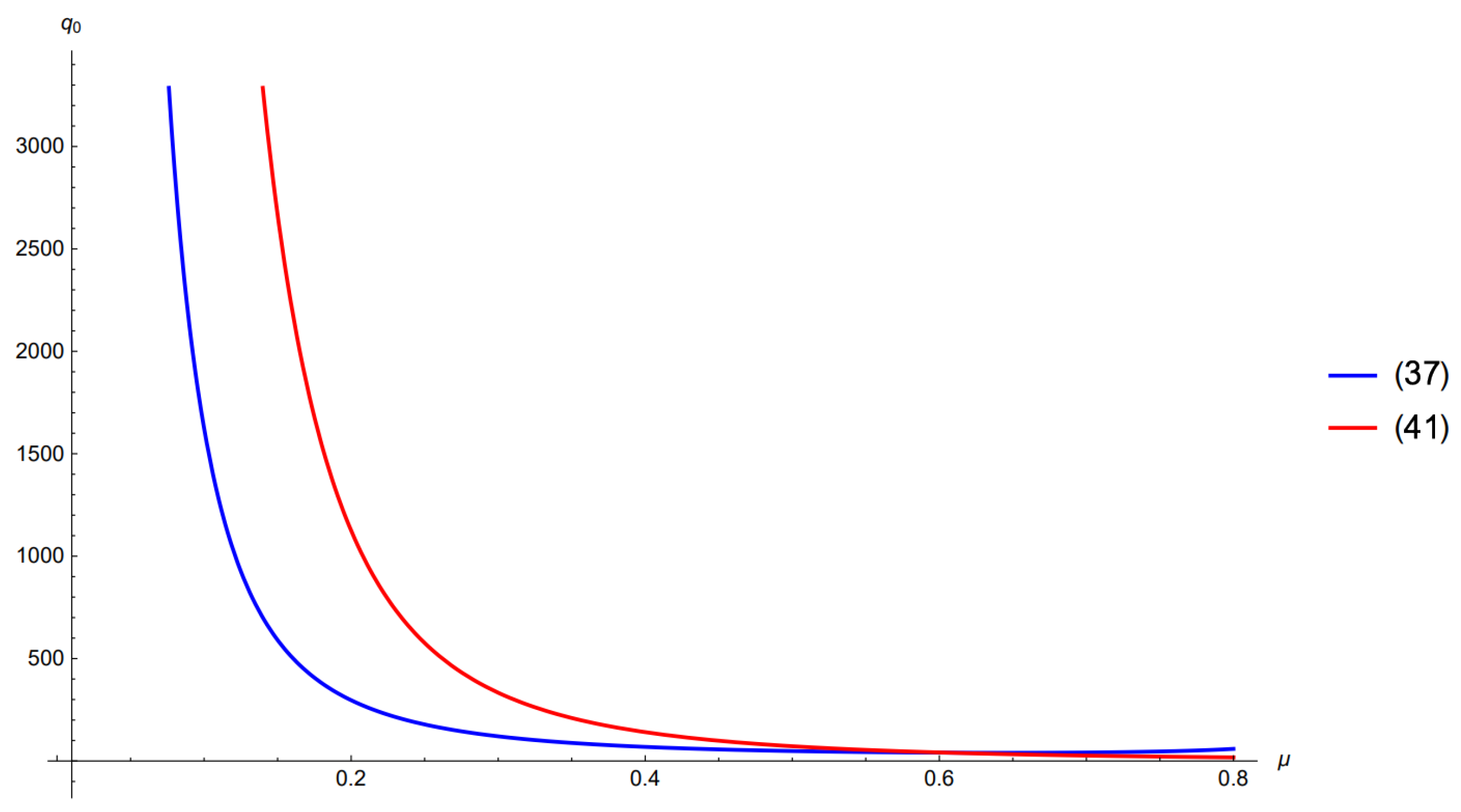
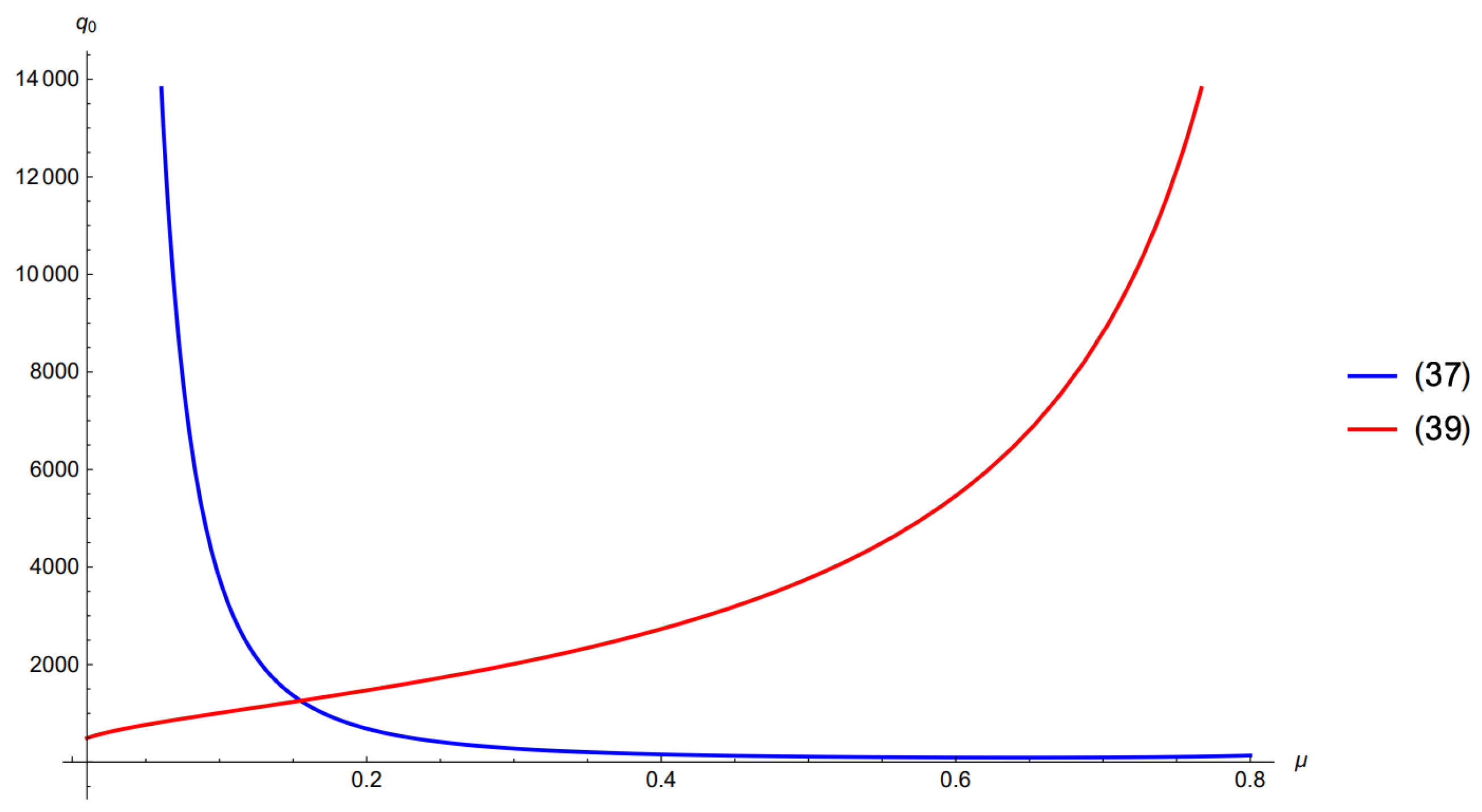
where and . Table 1 and Figure 3, Figure 4 and Figure 5 compare our criteria (37) and (38) with criteria (39)–(41) by applying them to three different cases of Equation (36) when .
Table 1.
Comparison of the oscillation conditions of Equation (36) in three different cases.
Remark 4.
In the case where and , the results of Section 3.1 and Section 3.2 are reduced to results in [51]. Therefore, our findings are an extension and generalization of the findings in [51]. Moreover, we considered Case (Hc), which was not studied in [51].
5. Conclusions
In this study, oscillatory conditions are constructed for a class of n-order NDEs. By applying the comparison method with first-order DDEs, we were able to create new standards that ensure that every solution of (1) is oscillatory if n is even, or oscillatory or converge to zero if n is odd. We considered three different cases of functions p and . Through examples and remarks, we explained the novelty and importance of the results. Accordingly, it can be said that our findings complement, generalize and improve the related results in [28,30,50,51].
It is an interesting problem to develop new conditions that ensure that every solution of (1) is oscillatory in the noncanonical case.
Author Contributions
Conceptualization, O.M. and H.S.; methodology, O.M., H.S., A.A.-J., M.A. and E.M.E.; software, O.M.; formal analysis, A.A.-J., M.A. and E.M.E.; investigation, H.S., A.A.-J., M.A. and E.M.E.; writing—original draft preparation, H.S.; writing—review and editing, O.M., A.A.-J. and E.M.E. All authors have read and agreed to the published version of the manuscript.
Funding
Princess Nourah bint Abdulrahman University Researchers Supporting Project number (PNURSP2024R406), Princess Nourah bint Abdulrahman University, Riyadh, Saudi Arabia.
Data Availability Statement
Data are contained within the article.
Acknowledgments
The authors express their gratitude to the editor and the anonymous reviewers for their helpful comments that helped improve the manuscript. The author present their sincere thanks to the editors. The authors would like to thank Princess Nourah bint Abdulrahman University Researchers Supporting Project number (PNURSP2024R406), Princess Nourah bint Abdulrahman University, Riyadh, Saudi Arabia.
Conflicts of Interest
The authors declare no conflicts of interest.
References
- Bellen, A.; Guglielmi, N.; Ruehli, A.E. Methods for linear systems of circuit delay differential equations of neutral type. IEEE Trans. Circuits Syst. Fundam. Theory Appl. 1999, 46, 212–215. [Google Scholar] [CrossRef]
- Hale, J.K. Partial neutral functional differential equations. Rev. Roum. Math. Pures Appl. 1994, 39, 339–344. [Google Scholar]
- Grace, S.R.; Lalli, B.S. Oscillation of nonlinear second order neutral delay differential equations. Rat. Math. 1987, 3, 77–84. [Google Scholar]
- Hale, J.K. Theory of Functional Differential Equations; Springer: New York, NY, USA, 1977. [Google Scholar] [CrossRef]
- Mackey, M.C.; Glass, L. Oscillations and chaos in physiological control systems. Science 1977, 197, 287–289. [Google Scholar] [CrossRef] [PubMed]
- Gopalsamy, K. Stability and Oscillations in Delay Differential Equations of Population Dynamics; Kluwer: Dordrecht, The Netherlands, 1992. [Google Scholar] [CrossRef]
- Gyori, I.; Ladas, G. Oscillation Theory of Delay Differential Equations with Applications; Oxford University Press: New York, NY, USA, 1991. [Google Scholar] [CrossRef]
- Erbe, L.H.; Kong, Q.; Zhang, B.G. Oscillation Theory for Functional Differential Equations; Marcel Dekker, Inc.: New York, NY, USA, 1995. [Google Scholar]
- Agarwal, R.P.; Bohner, M.; Li, W.T. Nonoscillation and Oscillation: Theory for Functional Differential Equations; Marcel Dekker, Inc.: New York, NY, USA, 2004. [Google Scholar] [CrossRef]
- Agarwal, R.P.; Grace, S.R.; O’Regan, D. Oscillation Theory for Second Order Linear, Half-Linear, Superlinear and Sublinear Dynamic Equations; Kluwer Academic Publishers: Dordrecht, The Netherlands, 2002. [Google Scholar] [CrossRef]
- Agarwal, S.R.; Grace, S.R.; O’Regan, D. Oscillation Theory for Second Order Dynamic Equations; Taylor & Francis Group: London, UK, 2003. [Google Scholar] [CrossRef]
- Erbe, L.; Hassan, T.S.; Peterson, A. Oscillation of second order neutral delay differential equations. Adv. Dyn. Syst. Appl. 2008, 3, 53–71. [Google Scholar]
- Xing, G.; Li, T.; Zhang, C. Oscillation of higher-order quasilinear neutral differential equations. Adv. Differ. Equ. 2011, 45, 45. [Google Scholar] [CrossRef]
- Agarwal, R.; Grace, S.; Manojlovic, J. Oscillation criteria for certain fourth order nonlinear functional differential equations. Math. Comput. Model. 2006, 44, 163–187. [Google Scholar] [CrossRef]
- Baculikova, B.; Dzurina, J. On the oscillation of higher-order delay differential equations. Math. Slovaca 2012, 187, 387–400. [Google Scholar] [CrossRef]
- Moaaz, O.; Dassios, I.; Bazighifan, O. Oscillation criteria of higher-order neutral differential equations with several deviating arguments. Mathematics 2020, 8, 412. [Google Scholar] [CrossRef]
- Salah, H.; Moaaz, O.; Cesarano, C.; Elabbasy, E.M. Oscillation of higher-order canonical delay differential equations: Comparison theorems. Phys. Scr. 2023, 98, 024003. [Google Scholar] [CrossRef]
- Dahiya, R.S. Oscillation criteria of even-order nonlinear delay differential equations. J. Math. Appl. Anal. 1976, 54, 653–665. [Google Scholar] [CrossRef][Green Version]
- Grace, S.R.; Lalli, B.S. An oscillation criterion for nth order non-linear differential equations with Functional arguments. Can. Math. Bull. 1983, 26, 35–40. [Google Scholar] [CrossRef]
- Zhang, B.G.; Ladde, G.S. Oscillation of even order delay differential equations. J. Math. Anal. Appl. 1987, 127, 140–150. [Google Scholar] [CrossRef][Green Version]
- Agarwal, R.P.; Grace, S.R.; O’Regan, D. Oscillation criteria for certain nth order differential equations with deviating arguments. J. Math. Appl. Anal. 2001, 262, 601–622. [Google Scholar] [CrossRef]
- Agarwal, R.P.; Grace, S.R.; O’Regan, D. The oscillation of certain higher-order functional differential equations. Math. Comput. Model. 2003, 37, 705–728. [Google Scholar] [CrossRef]
- Zhang, C.; Li, T.; Sun, B.; Thandapani, E. On the oscillation of higher-order half-linear delay differential equations. Appl. Math. Lett. 2011, 24, 1618–1621. [Google Scholar] [CrossRef]
- Zhang, C.; Agarwal, R.P.; Bohner, M.; Li, T. New results for oscillatory behavior of even-order half-linear delay differential equations. Appl. Math. Lett. 2013, 26, 179–183. [Google Scholar] [CrossRef]
- Dzurina, J.; Graef, J.R.; Baculikova, B. On the oscillation of higher order delay differential equations. J. Math. Sci. 2012, 187. [Google Scholar]
- Moaaz, O.; Ramos, H. An Improved Oscillation Result for a Class of Higher Order Non-canonical Delay Differential Equations. Mediterr. J. Math. 2023, 20, 166. [Google Scholar] [CrossRef]
- Zhang, Q.; Yan, J.; Gao, L. Oscillation behavior of even-order nonlinear neutral differential equations with variable coefficients. Comput. Math. Appl. 2010, 59, 426–430. [Google Scholar] [CrossRef]
- Baculikova, B.; Džurina, J.; Li, T. Oscillation results for even-order quasilinear neutral functional differential equations. Electr. J. Differ. Equ. 2011, 2011, 1–9. [Google Scholar]
- Baculíková, B.; Džurina, J. Oscillation theorems for higher order neutral differential equations. Appl. Math. Comput. 2012, 219, 3769–3778. [Google Scholar] [CrossRef]
- Li, T.; Rogovchenko, Y.V. Oscillation criteria for even-order neutral differential equations. Appl. Math. Lett. 2016, 61, 35–41. [Google Scholar] [CrossRef]
- Panigrahi, S.; Basu, R. Oscillation results for higher order nonlinear neutral differential equations with positive and negative coefficients. J. Appl. Anal. 2015, 21, 109–121. [Google Scholar] [CrossRef]
- Moaaz, O.; Elabbasy, E.M.; Muhib, A. Oscillation criteria for even-order neutral differential equations with distributed deviating arguments. Adv. Differ. Equ. 2019, 2019, 1–10. [Google Scholar] [CrossRef]
- Zhang, C.; Agarwal, R.P.; Li, T. Oscillation and asymptotic behavior of higher-order delay differential equations with p-Laplacian like operators. J. Math. Anal. Appl. 2014, 409, 1093–1106. [Google Scholar] [CrossRef]
- Liu, Q.; Bohner, M.; Grace, S.R.; Li, T. Asymptotic behavior of even-order damped differential equations with p-Laplacian like operators and deviating arguments. J. Ineq. Appl. 2016, 2016, 321. [Google Scholar] [CrossRef]
- Nabih, A.; Moaaz, O.; Askar, S.S.; Alshamrani, A.M.; Elabbasy, E.M. Fourth-Order Neutral Differential Equation: A Modified Approach to Optimizing Monotonic Properties. Mathematics 2023, 11, 4380. [Google Scholar] [CrossRef]
- Das, P. Oscillation of odd order delay differential equations. Proc. Indian Acad. Sci. Math. Sci. 1993, 103, 341–347. [Google Scholar] [CrossRef]
- Agarwal, R.P.; Aktas, M.F.; Tiryaki, A. On oscillation criteria for third order nonlinear delay differential equations. Arch. Math. 2009, 45, 507–514. [Google Scholar] [CrossRef]
- Li, T.; Rogovchenko, Y.V. Asymptotic behavior of an odd-order delay differential equation. Bound. Value Probl. 2014, 2014, 107. [Google Scholar] [CrossRef]
- Gopalsamy, K.; Lalli, B.S.; Zhang, B.G. Oscillation of odd order neutral differential equations. Czech. Math. J. 1992, 42, 313–323. [Google Scholar] [CrossRef]
- Candan, T. Oscillation of solutions for odd-order neutral functional differential equations. Electr. J. Differ. Equ. 2010, 2010, 1–10. [Google Scholar]
- Graef, J.R.; Tunç, E.; Grace, S.R. Oscillatory and asymptotic behavior of a third-order nonlinear neutral differential equation. Opusc. Math. 2017, 37, 839–852. [Google Scholar] [CrossRef]
- Muhib, A.; Dassios, I.; Baleanu, D.; Santra, S.S.; Moaaz, O. Odd-order differential equations with deviating arguments: Asymptomatic behavior and oscillation. Math. Biosci. Eng. 2022, 19, 1411–1425. [Google Scholar] [CrossRef] [PubMed]
- Masood, F.; Moaaz, O.; Askar, S.S.; Alshamrani, A. New Conditions for Testing the Asymptotic Behavior of Solutions of Odd-Order Neutral Differential Equations with Multiple Delays. Axioms 2023, 12, 658. [Google Scholar] [CrossRef]
- Chatzarakis, G.E.; Džurina, J.; Jadlovská, I. Oscillatory properties of third-order neutral delay differential equations with noncanonical operators. Mathematics 2019, 7, 1177. [Google Scholar] [CrossRef]
- Tunc, E.; Sarig, M. Oscillation criteria for odd–order neutral differential equations with distributed deviating arguments. Differ. Equ. 2023, 15, 147–160. [Google Scholar] [CrossRef]
- Thandapani, E.; Li, T. On the oscillation of third-order quasi-linear neutral functional differential equations. Arch. Math. 2011, 47, 181–199. [Google Scholar]
- Philos, C.G. A new criterion for the oscillatory and asymptotic behavior of delay differential equations. Bull. Acad. Polish Sci. Math. 1981, 39, 61–64. [Google Scholar]
- Philos, C.G. On the existence of nonoscillatory solutions tending to zero at ∞ for differential equations with positive delay. Arch. Math. 1981, 36, 168–178. [Google Scholar] [CrossRef]
- Kitamura, Y.; Kusano, T. Oscillation of first-order nonlinear differential equations with deviating arguments. Proc. Amer. Math. Soc. 1980, 78, 64–68. [Google Scholar] [CrossRef]
- Agarwal, R.P.; Bohner, M.; Li, T.; Zhang, C. A new approach in the study of oscillatory behavior of even-order neutral delay differential equations. Appl. Math. Comput. 2013, 225, 787–794. [Google Scholar] [CrossRef]
- Baculíková, B.; Džurina, J. Comparison theorems for higher-order neutral delay differential equations. J. Appl. Math. Comput. 2015, 49, 107–118. [Google Scholar] [CrossRef]
Disclaimer/Publisher’s Note: The statements, opinions and data contained in all publications are solely those of the individual author(s) and contributor(s) and not of MDPI and/or the editor(s). MDPI and/or the editor(s) disclaim responsibility for any injury to people or property resulting from any ideas, methods, instructions or products referred to in the content. |
© 2024 by the authors. Licensee MDPI, Basel, Switzerland. This article is an open access article distributed under the terms and conditions of the Creative Commons Attribution (CC BY) license (https://creativecommons.org/licenses/by/4.0/).